Winner 2026 RPS Ensemble Award
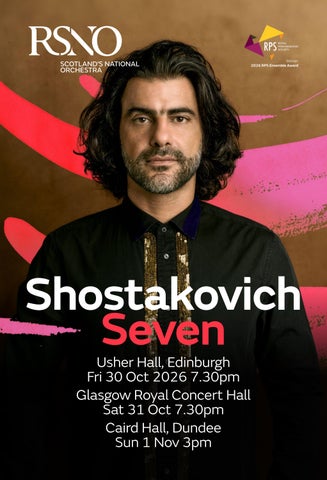
Shostakovich Seven Usher Hall, Edinburgh Fri 30 Oct 2026 7.30pm Glasgow Royal Concert Hall Sat 31 Oct 7.30pm Caird Hall, Dundee Sun 1 Nov 3pm
2 Shostakovich Seven
SAVE 1/3 UP TO
GroupSave tickets
Shostakovich Seven Usher Hall, Edinburgh Fri 30 Oct 2026 7.30pm Glasgow Royal Concert Hall Sat 31 Oct 7.30pm Caird Hall, Dundee Sun 1 Nov 3pm As Hitler’s armies surrounded the city of Leningrad, Dmitri Shostakovich composed his Seventh Symphony – a shout of courage, defiance and victory, written for massed battalions of musicians. Brace yourself for wartime drama on an heroic scale as Bassem Akiki conducts the RSNO in this sonic blockbuster: the climax of a concert that begins with Copland’s show-stopping fanfare and stars a real RSNO favourite, Philippe Quint, in a violin concerto with a dazzling difference.
COPLAND Fanfare for the Common Man [3’] LERA AUERBACH Violin Concerto No1 Op56 [28’] UK PREMIERE INTERVAL SHOSTAKOVICH Symphony No7 in C Major Op60 Leningrad [70’] Bassem Akiki Conductor Philippe Quint Violin Musicians of Sinfonia Smith Square Royal Scottish National Orchestra
The Glasgow performance will be recorded for the RSNO Archive. Supported by the Iain and Pamela Sinclair Legacy. If viewing these notes at the concert, please do so considerately and not during performances. Please silence all mobile telephones and alerts, and refrain from taking photographs, without flash, until the end of each piece.
4 Shostakovich Seven
Verdi Requiem Edinburgh | Fri 6 Nov: 7.30pm Glasgow | Sat 7 Nov: 7.30pm Patrick Hahn Conductor | Jennifer Davis Soprano | Deniz Uzun Mezzo-soprano Mario Lerchenberger Tenor | Edwin Crossley-Mercer Bass RSNO Chorus | Stephen Doughty Director, RSNO Chorus Edinburgh Festival Chorus | James Grossmith Director, Edinburgh Festival Chorus Paul Whittaker BSL Performer Supported by the Jennie S. Gordon Memorial Foundation
Book online at
rsno.org.uk
RSNO: Scotland’s National Orchestra 5
Welcome I’m delighted that musicians from Sinfonia Smith Square join the RSNO for today’s concert, which features Shostakovich’s overwhelming Seventh Symphony. Sinfonia Smith Square’s esteemed fellowship programme offers early-career musicians the chance to form a professional orchestra every year; that its alumni now perform all over the world is testament to the quality and calibre of the programme. In our own ranks we have several alumni, including First Violin Veronica Marziano and Double Bass Alexandre Cruz dos Santos, as well as Principal Oboe Adrian Wilson, who was a founding member of Sinfonia Smith Square in its previous incarnation, Southbank Sinfonia. We are looking forward to more collaboration with Sinfonia Smith Square in 2027, which will bring musicians back to Scotland during the renovation of Smith Square Hall, their London home. I’d like to extend a big thank you to the Solti Foundation for facilitating this partnership. We’re grateful not only for their continued financial support but also for the fantastic community and opportunities for collaboration they bring with them. A little while ago now, I was invited to Warsaw by the Adam Mickiewicz Institute. During my visit I attended a performance of Penderecki’s The Black Mask. I was so blown away by the charismatic conducting of Bassem Akiki in the pit that I had to invite him to Scotland. I am certain he will blow you away too! Joining Bassem is Philippe Quint, a long-time friend of the Orchestra. He recorded Lera Auerbach’s Violin Concerto No1 in Scotland’s Studio with the RSNO, so it is a real pleasure to have him back with us to give the piece its UK performance premiere. I hope you enjoy the concert.
Keep in touch with the RSNO
Royal Scottish National Orchestra 19 Killermont Street Glasgow G2 3NX T: +44 (0)141 226 3868
rsno.org.uk Scottish Company No. 27809 Scottish Charity No. SC010702
Alistair Mackie CHIEF EXECUTIVE
The RSNO is supported by the Scottish Government
6 Shostakovich Seven
Royal Scottish National Orchestra
Formed in 1891, the Royal Scottish National Orchestra (RSNO) is one of Europe’s leading symphony orchestras. Awarded royal patronage by Her Late Majesty The Queen in 1977, its special status in the UK’s cultural life was cemented in 2007 when it was recognised as one of Scotland’s five National Performing Companies, supported by the Scottish Government. Led by Music Director Thomas Søndergård, the Orchestra performs across Scotland, including concerts in Glasgow, Edinburgh, Dundee, Aberdeen, Perth and Inverness, and appears regularly at the Edinburgh International Festival and BBC Proms. The RSNO tours internationally, most recently visiting China and Europe. In May 2026, Giedrė Šlekytė was announced as the RSNO’s Music Director Designate and will formally become Music Director from the beginning of the 2027:28 Season, with Thomas Søndergård taking on the new position of Music Director Emeritus. The RSNO has a worldwide reputation for the quality of its recordings, receiving a 2020 Gramophone Classical Music Award for Chopin’s Piano Concertos (soloist: Benjamin Grosvenor), conducted by Elim Chan, two Diapason d’Or awards (Denève/Roussel 2007; Denève/Debussy 2012) and eight GRAMMY Award nominations. In recent years, the RSNO has cultivated an international reputation for world-class film, television and videogame soundtrack recording. The Orchestra has recorded for BAFTA-winning
series Silo (Apple TV) and worked with the likes of GRAMMY Award-winning composer Lorne Balfe on Life on Our Planet (Netflix). Other notable titles include Nuremberg (Sony Pictures), Now You See Me: Now You Don’t (Lionsgate), Horizon: An American Saga (Warner Bros) and Star Wars Outlaws (Ubisoft). The Orchestra records at its bespoke in-house facility in Glasgow, Scotland’s Studio. In 2026 the RSNO was the first professional orchestra since 2014 to be awarded the Royal Philharmonic Society’s Ensemble Award. The award recognises musical ensembles for outstanding quality and scope of performances and work. The RSNO believes that music can enrich lives and aims to inspire, educate and entertain people throughout Scotland and beyond with its performances, recordings and engagement programmes. Supporting schools, families, young professionals and wider communities, the RSNO delivers high-quality initiatives for all ages and abilities. The RSNO’s engagement offering includes its singing strand, encompassing a Buggy Choir and Chorus Academy in both Dundee and Glasgow and a lunchtime Workplace Choir, which complements the well-established and highly respected RSNO Youth Choruses and RSNO Chorus. The community choruses are designed with the benefits of group singing for health and wellbeing at their core and are open to all.
RSNO: Scotland’s National Orchestra 7
On Stage LEADER
VIOLA Tom Dunn
PRINCIPAL
OBOE Adrian Wilson PRINCIPAL
PRINCIPAL
Lena Zeliszewska
Asher Zaccardelli Susan Buchan Nicola McWhirter Claire Dunn Maria Trittinger Francesca Hunt Beth Woodford Eugenia García Cuesta + Henry Justo Marsailidh Groat Aoife Magee
Peter Dykes Henry Clay
Lance Green Andrew Foden Cillian Ó Ceallacháin Joshua Parkhill Alastair Sinclair
FIRST VIOLIN Maya Iwabuchi ASSOCIATE LEADER
Tamás Fejes
ASSISTANT LEADER
Cheryl Crockett Ursula Heidecker Allen Elizabeth Bamping Lorna Rough Susannah Lowdon Alan Manson Liam Lynch Veronica Marziano Momoko Arima Sonja Tuomela + Fiona Stephen Maria Oguren SECOND VIOLIN Emily Davis GUEST PRINCIPAL
Marion Wilson Emily Nenniger Paul Medd Anne Bünemann Sophie Lang Robin Wilson Kirstin Drew Colin McKee Kaylee Ramella Ray Sun + Seona Glen Sophie Sild Joe Hodson
CELLO Pei-Jee Ng PRINCIPAL
Betsy Taylor Kennedy Leitch Yuuki Bouterey-Ishido Rachael Lee Sarah Digger Robert Anderson Gunda Baranauskaitė Tahee Kim + Sonia Cromarty DOUBLE BASS Nikita Naumov PRINCIPAL
Carlos Navarro Michael Rae Yat Hei Lee Moray Jones Alexandre Cruz dos Santos Christopher Sergeant FLUTE Katherine Bryan PRINCIPAL
Oliver Roberts Justyna Szynkarczyk + Janet Richardson
PRINCIPAL COR ANGLAIS
CLARINET Timothy Orpen
TROMBONE Dávur Juul Magnussen
PRINCIPAL BASS TROMBONE
PRINCIPAL
William Knight Frank Barr + Thomas Knollys + Duncan Swindells
TUBA John Whitener
BASSOON David Hubbard
GUEST PRINCIPAL
PRINCIPAL BASS CLARINET
PRINCIPAL
Francesco Di Matteo + Paolo Dutto PRINCIPAL CONTRABASSOON
HORN Amadea Dazeley-Gaist
PRINCIPAL
Andrew McLean David McClenaghan Martin Murphy Neil Mitchell Alice Knight + Chloe Chang + Peter McNeill TRUMPET Jason Lewis Goodwin ASSOCIATE PRINCIPAL
Oscar Whight Robert Baxter Bob Farley Nina Noble + John Vernon + Ruby Orlowska
PRINCIPAL PICCOLO
Orchestra list and programme details correct at time of going to print.
PRINCIPAL
TIMPANI Stefan Beckett PERCUSSION Lewis Blee GUEST PRINCIPAL
Stuart Semple Philip Hague Colin Hyson Pete Murch Sehyogue Aulakh + MUSICAL SAW Katharina Micada HARP Pippa Tunnell Teresa Barros Pereira Romão PIANO AND CELESTE Lynda Cochrane Judith Keaney + Smith Square Sinfonia musician
8 Shostakovich Seven
Bassem Akiki Conductor
Akiki recently made his debuts with the Warsaw Philharmonic, Rotterdam Philharmonic, Netherlands Philharmonic, Royal Danish Opera and Finnish National Opera. Forthcoming debuts and returns include to London’s Royal Opera, Ruhrtriennale, Staatsoper Stuttgart, Opéra de Lille, Opéra de Lyon, Dutch National Opera, Opéra National du Rhin, Théâtre du Châtelet Paris and Teatr Wielki – Opera Narodowa. He made his professional conducting debut aged 24 with Verdi’s La traviata at Opera Wrocławska, where he was resident conductor until 2013. Since then, he has built an extensive repertoire of titles from Mozart’s Don Giovanni and Strauss’ Die Frau ohne Schatten to Prokofiev’s The Fiery Angel, Thomas Adès’ Powder Her Face and Penderecki’s Die schwarze Maske. Bassem Akiki is a Lebanese-Polish conductor and composer. Recent collaborators include Dutch National Opera, La Monnaie/De Munt Brussels, Philharmonie de Paris, Festival d’Aix-enProvence, Teatr Wielki – Opera Narodowa Warsaw and Sinfonia Varsovia. Informed by his own work as a composer, Akiki is a specialist in contemporary repertoire and has conducted many world premieres. Recent successes include Philip Venables’ We Are the Lucky Ones and Alexander Raskatov’s Animal Farm at Dutch National Opera, the latter of which won the OPER! Award for world premiere of the year in 2023. He regularly works at La Monnaie/De Munt, where he has conducted world premieres of Björk’s Medúlla and the intercultural, interdisciplinary music-theatre Orfeo & Majnun (also at Festival d’Aix-en-Provence), Mark Grey’s Frankenstein, and most recently Philippe Boesman’s final opera On purge bébé! Other world premieres include Nicholas Lens’ Slow Man at Malta Festival Poznań, and Zad Moultaka’s Hémon and Simon Steen-Andersen’s Don Giovanni’s Inferno at Opéra National du Rhin.
Alongside conducting, Akiki is a scholar in the music of East and West and their mutual influence, giving lectures on the subject, and his interest in astronomy and prime numbers has influenced his recent compositions. He has led masterclasses in institutions such as the Queen Elisabeth Music Chapel at Waterloo, the Opera Academy of La Monnaie/De Munt, and Swarthmore College Pennsylvania, where he also performed Barbara Wysocka and Michał Zadara’s Chopin Without Piano.
Celebrating 10 years with the RSNO Strings Associate Leader Lena Zeliszewska celebrates a decade with the RSNO ‘The last 10 years with the RSNO have flown by! I still vividly remember my first visit to Scotland in the Spring of 2016. I fell in love with Glasgow instantly. I loved its people, its architecture and its weather (I am being serious!). I immediately felt that I belonged here in Scotland, and in the Orchestra. From many highlights over the years, I always go back to the 2019 California Tour where we played one of my favourite pieces, Prokofiev’s Fifth Symphony. I have also loved all our epic Wagner opera projects with Sir Andrew Davis at the Edinburgh International Festival. Recently, it was a real privilege to showcase the Orchestra in Shostakovich’s defiant Eleventh Symphony at the 2026 BBC Proms alongside a
group of almost 90 RSNO supporters who had taken the trip down to be with us in London. On a more personal note, I will never forget the feeling of overwhelming joy and happiness when I found out I had been promoted to Associate Leader back in 2019. A short glimpse in one’s life when you feel a huge wave of support from the people you work with. I will cherish that moment forever.’ If you have a passion for a particular instrument or seek an insight into the life of an orchestral musician, find out more about becoming a Chair Patron by contacting Constance Fraser, Head of Development at constance.fraser@rsno.org.uk
10 Shostakovich Seven
Aaron Copland (1900-1990)
Fanfare for the Common Man During the First World War the English composer and conductor Eugene Goossens commissioned a series of fanfares to introduce orchestral concerts at a time of national emergency. Years later, after the USA had entered the Second World War, and while he was conductor of the Cincinnati Symphony Orchestra, Goossens decided to do the same thing in America, eventually commissioning 18 composers to provide something similar as a musical way of boosting national morale.
FIRST PERFORMANCE Cincinnati, 12 March 1943 DURATION 3 minutes
One of those commissioned – and, it has to be said, the only one whose fanfare has become a lasting feature of the repertoire – was Aaron Copland, whose piece was introduced at the Cincinnati Music Hall on 12 March 1943; indeed, it has gone on to become Copland’s best-known composition. The title took a while to arrive at. The USA entered the War on 8 December 1941, following Japan’s surprise attack on the US Naval Base at Pearl Harbor in Hawaii the previous day. The following year, Vice-President Henry A Wallace gave a speech in which he declared the 20th century ‘the century of the common man’, which finally gave Copland the title he had sought. Goossens approved. ‘Its title is as original as its music, and I think it is so telling that it deserves a special occasion for its performance. If it is agreeable to you, we will premiere it on March 12 1943 at income tax time.’ ‘I am all for honoring the common man at income tax time,’ replied the composer. He also said, in terms of the War itself, that ‘it was the common man who was doing all the dirty work […] He deserved a fanfare.’
RSNO: Scotland’s National Orchestra 11
Copland later used the piece as the main theme of the finale of his Symphony No3 (1944-6); earlier parts of the Symphony also hint at it. Perhaps he thought that it was an ephemeral piece and might simply disappear after its initial performance. But the Fanfare did not disappear. Instead it has been arranged, transcribed and referred to innumerable times in other works and in other genres ever since: employed in films and television programmes, at sports stadia, and on such special occasions as Pope Francis’ visit to Independence Hall, Philadelphia, in 2015, when he made a speech about religious freedom. Pop and rock bands have also made use of it, perhaps most famously Emerson, Lake and Palmer in their 1977 album Works Volume 1, which as a single reached No2 in the UK charts. Many more versions will surely follow. Copland’s own is scored for four horns, three trumpets, three trombones, tuba, timpani, bass drum and tam-tam. © George Hall
RSNO Connections Aaron Copland conducted the Scottish National Orchestra (as it was known before 1991) on two occasions in the mid-1960s. He made his debut in the Scottish Proms at Glasgow’s Kelvin Hall in June 1964, conducting a programme that included Bernstein’s overture to Candide, Brahms’ Variations on a Theme by Haydn, Beethoven’s Piano Concerto No4 with soloist Charles Rosen, and his works Quiet City, Outdoor Overture and Four Dance Episodes from Rodeo. The image right shows the cover of a programme book from that concert signed by Copland himself, now in the RSNO’s archives. Copland returned early in the Orchestra’s 1965/66 season for performances in Edinburgh and Glasgow which included works by Handel and Mendelssohn alongside Ives’ The Unanswered Question and his own Clarinet Concerto and music from the ballet Billy the Kid. © Ewen McKay
12 Shostakovich Seven
Lera Auerbach (Born 1973)
Violin Concerto No1 Op56
© Raniero Tazzi UK PREMIERE FIRST PERFORMANCE Disney Hall, Los Angeles, 22 February 2004 DURATION 28 minutes 1. Grandioso 2. Moderato 3. Andante religioso 4. Allegro
It is always fascinating to observe a journey from an initial idea to a final form and how a piece has a life and fate of its own – very much like a human being. A character of a novel may influence a real fleshand-blood person as much as this real person may become a prototype for a fictional character. Similarly, a musical composition, although bound by birthright to its creator, is in fact a creator on its own, with its own angels and demons, struggles and hungers, losses and triumphs. A world premiere [Auerbach wrote this note in 2004] is always frightening. For a composer it is the ultimate goodbye to a child who graduates into the world. The child, vulnerable yet ambitious, is completely on its own now, and the composer feels helpless at this point as he is no longer the creator, but simply an observer, listener, almost stranger, never fully satisfied, always somewhat guilty. This Violin Concerto had a long pre-history that led to its premiere at the Walt Disney Concert Hall. Back in 2000, my friend and a wonderful violinist Philippe Quint asked me to write a violin concerto. I started writing it while in residency at Johannes Brahms’ home in Baden-Baden. When I was about halfway through the score, Philippe contacted me and asked if I could write a sonata for violin and piano instead of a concerto, so I had to change direction. However, the sonata went through many transformations and was so orchestral in its nature that it was clear that one day it needed to return to the original idea of a concerto for violin and orchestra. I was very happy when the American Youth Symphony decided to commission this work for my first-year residency, as it gave the perfect opportunity for this Violin Concerto to finally come to life. When I returned to my orchestral sketches of 2000, I
RSNO: Scotland’s National Orchestra 13
understood that I could no longer use them for this piece, as they were for a chamber orchestra, and felt the piece now required a full orchestral force (although I have chosen to exclude the brass section with the exception of the four French horns). The Violin Concerto in its present form was completed in December 2003 at the Virginia Center for Creative Arts. The first movement begins with an overwhelming apocalyptic orchestral tutti – ‘Death-clusters’. In a way, the Concerto starts with the end – everything that happens afterwards, happens AFTER the end. When the solo violin enters, it feels dreamy and unreal in the context of the shocking orchestral introduction. There is a nostalgic sense of memories, but memories are always multilayered and distorted by future experiences and this is often reflected in my music – different realities blur into each other; sometimes what appears very simple may be highly complex (and vice versa), and things are most of the time not what they appear to be at first glance. These paradoxical qualities are especially apparent in the second movement – a creepy scherzo, humorous, grotesque, attractive and repulsive at the same time, all too familiar yet foreign. Is it a waltz? Is it a tune we may have heard before? Is it a cheerful tune or the remains of a nightmare – and does it matter? Is it funny or scary? Is there something terrifying about the banality of everyday life? Or, perhaps, is it a memory of a perfect simple life forever lost to catastrophe and war? Is it a crooked mirror – or a perception of a listener being questioned? The third movement, Adagio religioso, is a prayer in the form of a passacaglia based on the E flat Major scale. Despite the promise of the major key, it is deeply tragic. The obsessive inescapability
of the chord progression in the orchestra can be frightening; its simplicity may be of false premises, and the solo violin cannot break free from the hypnotic repetition of the orchestral columns. The fourth movement is a fiery dance of life and death, a rondo, inescapable circle, where end and beginning are one and the same, and the dance of life goes on even if one is no longer dancing. I wish to express my gratitude to Philippe Quint for performing this work; to Mary Bianco, Herbert and Beverly Gelfand, AYS orchestra and its patrons for this commission; to Herbert and Beverly Gelfand and to Rafael Agudelo for their continued support of my work, and to the Brahms Society in Baden-Baden and VCCA for creating perfect environments where this piece was written. © Lera Auerbach
Listen again to the RSNO
Milestones Featuring Lera Auerbach’s Violin Concerto No1 Philippe Quint Violin Andrew Litton Conductor More information prestomusic.com
14 Shostakovich Seven
Lera Auerbach Composer
Lera Auerbach is an American composer, pianist, conductor, poet and visual artist whose work reflects a distinctly cross-disciplinary and international perspective. Born in Chelyabinsk in the Ural region of Russia, she moved to New York at 17 during her first US concert tour, establishing the United States as her artistic home. She studied piano and composition at the Juilliard School and comparative literature at Columbia University, and made her Carnegie Hall debut in 2002 performing her own Suite for violin, piano and string orchestra with Gidon Kremer and Kremerata Baltica. Auerbach has since established an international career. As a pianist, she has appeared in major concert venues including Carnegie Hall and Lincoln Center New York, and the Kennedy Center Washington, DC. Her extensive composition catalogue spans all genres – from solo and chamber music to symphonic works, opera and ballet – performed by leading artists and institutions worldwide. Auerbach’s music is characterised by a highly individual voice that bridges tradition and innovation. She maintains a fluid relationship with the avant-garde, drawing on tonal language and classical forms while continually expanding their expressive possibilities. Her works frequently engage with literary, philosophical and mythological themes. These influences shape richly layered works that move fluidly between historical reference and contemporary expression, combining structural rigour with emotional immediacy. Among her most celebrated works is the ballet The Little Mermaid, created in 2005 for choreographer John Neumeier. The work has toured internationally, received major awards including an ECHO Klassik for its recording, and has been performed hundreds of times
worldwide. Other notable works include the choral cycles 72 Angels and Goetia, and a series of symphonies that challenge and expand the genre through their integration of orchestra, choir and soloists, reflecting her ongoing interest in redefining large-scale musical forms. In recent years, Auerbach has also appeared frequently as a conductor, bringing her multidisciplinary perspective to the podium. Her literary output includes poetry, prose and essays, and she has been named ‘Poet of the Year’ by the International Pushkin Society. Her book Excess of Being has been published in English, and in 2022 her children’s book A is for Oboe (Random House) received the AudioFile Best Audiobook Award. Auerbach is also active as a visual artist, creating sculptures that reflect her interdisciplinary approach and interest in the intersection of artistic forms. She holds both American and Austrian citizenship, the latter awarded in 2021 in recognition of her contributions to music and culture. Her works are widely recorded on major labels, including ECM, Deutsche Grammophon, Nonesuch, Sony Classical, Alpha Classics and BIS. Reprinted by kind permission of Boosey & Hawkes | Sikorski.
RSNO: Scotland’s National Orchestra 15
Philippe Quint Violin
Corigliano. His boundless curiosity led him to create original multimedia-format programmes such as The Muse, Homage to J S Bach, Charlie Chaplin’s Smile and Astor Piazzolla: Between Angels and Demons. Highlights of his 2026-27 season include a return to the Cabrillo Festival with Cristian Măcelaru for the world premiere of Clarice Assad’s Kontrol; a return to the RSNO for the UK premiere of Lera Auerbach’s Violin Concerto No1; the Irish premiere of Errollyn Wallen’s Violin Concerto with the Ulster Orchestra under Anna Handler; leading the Vancouver Symphony Orchestra USA in performances of Vivaldi’s and Piazzolla’s The Four Seasons; and his debut with the Fort Worth Symphony under Anna Skryleva. For Philippe Quint, the violin has always been a voice for storytelling and discovery, transforming each performance into a musical journey shared with the audience. With multiple GRAMMY Award nominations for his albums, Quint has forged an international career notable for its unconventional artistic path, broad repertoire and unwavering commitment to exploration. As Founder and Music Director of Magellan Arts and Magellan Chamber Orchestra, he is entering the organisation’s second season, continuing the Chamber Music Immersive Series in partnership with the Chicago History Museum through innovative performances and impactful educational programmes. Quint has performed with the world’s finest orchestras, including the London Philharmonic, Chicago Symphony, Los Angeles Philharmonic and RSNO. His dedication to contemporary music is evident in numerous premieres by today’s foremost composers, including Errollyn Wallen, Lera Auerbach, William Bolcom and John
An active chamber musician, Quint has appeared at the Mostly Mozart, Verbier, Luzern, Dresden, Caramoor, Colmar, Ravinia, Aspen, Rome, Moritzburg, La Jolla, Lincoln Center and Chautauqua festivals, in addition to recitals and chamber performances at the Kravis Center Florida, UC Davis Presents, National Gallery Washington, DC and San Francisco Performances. Making his home in New York in 1991, Quint studied at the Special Music School for the Gifted with Andrei Korsakov, making his orchestral debut at the age of nine. He earned both Bachelor’s and Master’s degrees from the Juilliard School. His distinguished pedagogues and mentors included Dorothy DeLay, Cho-Liang Lin, Masao Kawasaki, Isaac Stern, Itzhak Perlman, Arnold Steinhardt and Felix Galimir. Quint plays the magnificent 1708 ‘Ruby’ Antonio Stradivari violin on loan to him through the generous efforts of The Stradivari Society.
16 Shostakovich Seven
Dmitri Shostakovich (1906-1975)
Symphony No7 in C Major Op60 Leningrad
task: only 14 of the Leningrad Radio Orchestra’s members were still alive, so adverts were posted ordering all available musicians to report for rehearsals. The first rehearsal had to be terminated after just 15 minutes because the musicians were so devoid of energy. In recognition of their efforts, they received extra food rations as the Symphony was pieced together.
FIRST PERFORMANCE Kuybyshev, USSR, 5 March 1942 DURATION 70 minutes 1. Allegretto 2. Moderato (poco allegretto) 3. Adagio 4. Allegro non troppo ‘Comrades – a great occurrence in the cultural history of our city is about to take place. In a few minutes, you will hear for the first time the Seventh Symphony of Dmitri Shostakovich, our outstanding fellow citizen. He wrote this great composition in the city during the days when the enemy was, insanely, trying to enter Leningrad. This performance is witness to our spirit, courage and readiness to fight. Listen, Comrades!’ These were the words of conductor Karl Eliasberg prior to the Symphony’s first Leningrad (now St Petersburg) performance on 9 August 1942. The city had been under siege since September 1941. Assembling the required orchestra of 100 players was an enormous
The performance was broadcast live and played over loudspeakers to the German soldiers. It was greeted with stunned silence before the audience erupted into an hour-long ovation. While the citizens of Leningrad were uplifted by this astonishing performance, the Germans understood that a city that showed so much spirit while suffering such privation would never capitulate. Shostakovich was working as a relief fireman when he began composing the Symphony in July 1941. The Soviet authorities, aware of its morale-boosting potential, persuaded the reluctant composer to be evacuated to Kuybyshev (now Samara in southwest Russia), where he completed the final movement. The Bolshoi Theatre Orchestra conducted by Samuil Samosud, also in exile in Kuybyshev, premiered the Symphony. The score was later microfilmed and smuggled to America, where it was performed as an act of defiance towards the Nazis. However, as the composer’s son Maxim pointed out, his father ‘did not write about this war or that revolution, but about war and revolution in general, the state of mind and emotion, not facts’. Under Stalin, almost every family had lost someone dear to them, and people were terrified of speaking out against the regime. Shostakovich remarked that during the war, people were at least finally free to express their grief, united by a common sorrow.
RSNO: Scotland’s National Orchestra 17
The central dichotomy of this vast musical canvas is the strength and individuality of the Soviet people, represented by the strings, pitted against the savage power of oppressive regimes, represented by brutal, mechanistic writing in the brass and percussion. The first movement opens with a bold and confident theme representing the citizens. As the energy dissipates, a solo flute ushers in a lyrical theme over gently rocking lower strings. With an air of serenity tinged with nostalgia, wistful piccolo and violin solos bring this section to a close. Almost imperceptibly, an insidious side drum rhythm enters, and pizzicato strings introduce a banal march theme. The march becomes increasingly violent and bombastic until a powerful unison minor scale ushers in the catastrophic climax. As the music subsides, flute and violins recall earlier themes, devoid of energy. A solo bassoon intones a lament. The strings re-inject some human compassion, but it is rapidly crushed as the movement ends with a shocked reminiscence of the march. Shostakovich initially entitled his second movement ‘Memories’. The elegant music haltingly attempts to dance before giving way to a keening oboe. An E flat clarinet cries out over an implacable three-note figure before the wind and brass unleash a mechanistic march. The strings are forced to join the dance. The poised opening music returns, and the bass clarinet intones the oboe theme over shivering flutes. An alto flute suggests there is still hope and the movement ends in the major key. At the start of the third movement, woodwinds intone an austere chorale which is answered by impassioned strings. The sombre bassoons introduce an ominous plucked string theme, and a lonely flute sings a haunting melody before a second flute consoles it. The violins usher in an agitated central passage characterised by
mechanistic rhythms. After a bleak dialogue between violins and oboes, the violas consolingly intone the flute’s haunting melody. The strings gradually overwhelm the wind chorale, injecting it with human warmth. The fourth movement begins searchingly, yet there is a suppressed air of optimism. The basses attempt to introduce a motif that eventually launches the faster section, and the music becomes increasingly spirited. As it subsides, there is a sense of uneasiness. The violins dance in an irregular metre over short plucked notes, introducing a sombre passage. The motif introduced earlier in the basses stirs once again in the violas. Slowly and painstakingly the citizens recover their spirit, and the Symphony ends in triumph. In the words of conductor Semyon Bychkov, the Leningrad Symphony ‘was composed for humanity. And the best proof is that today we still need it – we are still listening to it.’ © Katherine Wren
Listen again to the RSNO
Shostakovich Symphony No7 Leningrad Neeme Järvi Conductor More information rsno.org.uk/recordings
18 Shostakovich Seven
Sinfonia Smith Square
For 34 of the world’s most promising early-career musicians, Sinfonia Smith Square is where the next chapter begins. Based at their London home, Smith Square Hall, Sinfonia Smith Square’s Fellowship musicians come together for a year of ambitious musicmaking, collaboration and discovery. They work with leading artists, perform in world-class venues and explore a variety of genres, building the experience to shape their careers and the future of orchestral music. Over 750 musicians have completed the Fellowship. Today, alumni perform in leading orchestras and chamber ensembles around the world, inspire the next generation as educators, and forge new paths as entrepreneurial artists.
In 2021 the orchestra, then called Southbank Sinfonia, merged with the renowned concert hall St John’s Smith Square to become one organisation with a shared administrative staff and vision. Entering a new era, it rebranded to Sinfonia Smith Square in June 2024. A beacon for the future of classical music, Sinfonia Smith Square’s aim is to enrich lives through the universal power of music, alongside supporting exciting cultural initiatives for the enjoyment of the widest possible audiences.
RSNO: Scotland’s National Orchestra 19
800 8
YEARS!
80 YEARS OF THE INSTITUT FRANÇAIS D’ÉCOSSE MAPPING PROJECTION, TALKS, SHOWS, AND CONCERTS
2-7 NOVEMBER 2026
IFECOSSE.ORG.UK W Parliament Square, Edinburgh EH1 1RN
20 Shostakovich Seven
Rafał Blechacz Piano Recital New Auditorium, Glasgow Royal Concert Hall Sun 13 Dec: 2.30pm
Book online at
rsno.org.uk
RSNO: Scotland’s National Orchestra 21
Søndergård Conducts
Schumann Piano Concerto
Rachmaninov Piano Concerto No2
Usher Hall, Edinburgh Fri 13 Nov
Glasgow Royal Concert Hall Sat 14 Nov
Anna Vinnitskaya Piano
Roman Borisov Piano
Both concerts also feature Elgar’s Symphony No1 Book online at
rsno.org.uk
22 Shostakovich Seven
Benefactors, Patrons and Circle members We are grateful to all our individual supporters for their generous philanthropy and loyalty. Your support enables the Orchestra to achieve its most ambitious goals and to continue inspiring people across Scotland both on and off the concert stage.
RSNO Benefactors
RSNO Conductors’ Circle
RSNO Patrons
Sir Ewan and Lady Brown Gavin and Kate Gemmell Kat Heathcote and Iain Macneil Ms Chris Grace Hartness Stina Bruce Jones Shirley Murray
Ardgowan Charitable Trust Ian and Evelyn Crombie Kenneth and Julia Greig David and Alix Stevenson Eric and Karen Young
Geoff and Mary Ball Lady Rebecca Fraser Don and Lois Macleod Walter and Janet Reid Charitable Trust George Ritchie Stephen Sweeney Valerie Wells
Learning and Engagement Patrons William Brown, W.S The Dundee RSNO Circle Committee Neil and Nicola Gordon Professor Gillian Mead, FRSE Nicholas and Alison Muntz Maurice and Nicola Taylor Charitable Trust David and Marilyn Wilson
Chair Patrons Assistant Conductor
Second Violin
The Solti Foundation Chair
The Nigel and Margot Russell Chair
Celia Llácer
Marion Wilson ASSOCIATE PRINCIPAL
Double Bass
Nikita Naumov PRINCIPAL
The Gregor Forbes John Clark Chair
First Violin
Sophie Lang
The Ian and Evelyn Crombie Chair
James Wood Bequest Fund Chair
Dunard Fund Chair
Viola
Flute
The Cathy and Keith MacGillivray Chair
The David and Anne Smith Chair
Maya Iwabuchi LEADER
Tamás Fejes ASSISTANT LEADER
The Bill and Rosalind Gregson Chair
Ursula Heidecker Allen
The James and Iris Miller Chair
Tom Dunn PRINCIPAL Francesca Hunt
Elizabeth Bamping
The Rolf Thornqvist and Celia Sinclair Thornqvist MBE Chair
Alan Manson
Cello
The WL and Vera Heywood Chair The Hugh and Linda Bruce-Watt Chair
Pei-Jee Ng PRINCIPAL
Ms Chris Grace Hartness Chair
Liam Lynch
Betsy Taylor ASSOCIATE PRINCIPAL
Lorna Rough
Kennedy Leitch ASSISTANT PRINCIPAL
Ms Chris Grace Hartness Chair The Sir Richard Dunbar Chair
The Maxwell Armstrong Chair
The David and Anne Smith Chair
Rachael Lee
The Christine and Arthur Hamilton Chair
Michael Rae ASSISTANT PRINCIPAL Katherine Bryan PRINCIPAL Oboe
Adrian Wilson PRINCIPAL The Hedley Wright Chair
Peter Dykes ASSOCIATE PRINCIPAL
Witherby Publishing Group Charitable Trust Chair
Cor Anglais
Henry Clay PRINCIPAL
In memory of a dear friend, Fiona H
RSNO: Scotland’s National Orchestra 23
Clarinet
Alison Murray ASSISTANT PRINCIPAL
Trumpet
The Shirley Murray Chair
Martin Murphy ASSISTANT PRINCIPAL
Ms Chris Grace Hartness Chair
Timothy Orpen PRINCIPAL
Mr and Mrs Pierre and Alison Girard
Christopher Hart PRINCIPAL
The Turcan Connell Chair
The Gordon Fraser Charitable Trust Chair
Staff
Horn
Andrew McLean ASSOCIATE PRINCIPAL The Catherine McLagan Chair
COMMUNITY SINGING ASSISTANT
William Knight ASSOCIATE PRINCIPAL David McClenaghan SUB-PRINCIPAL
Chiko Parkinson
Supported by ScotRail
The Springbank Distillers Chair
We are also grateful to those who give but who wish to remain anonymous.
If you would like to discuss how you can become an RSNO Patron, please contact Constance Fraser, Head of Development (Individuals and Partnerships), at constance.fraser@rsno.org.uk
RSNO Circle Virtuoso Ms Catherine Y Alexander Mrs A M Bennett Mr Alan and Mrs Carolyn Bonnyman Dame Susan and Mr John Bruce Francesca and Eoghan Contini Mackie Dr Clive Criper Scott and Frieda Grier Judith and David Halkerston Iain MacNeil and Kat Heathcote MBE Ian and Sarah Lister Miss A McGrory Maureen Michie Mr James Miller CBE David Moncur Mrs Abigail Morrison Nicholas and Alison Muntz Bernard and Jane Nelson Mr and Mrs W Semple Gregor and Lesley Stewart Mr Ian Taft Claire and Mark Urquhart Raymond and Brenda Williamson Margaret Duffy and Peter Williamson Symphony Martin and Jackie Beard Mr John Brownlie Mr A Campbell Dr K Chapman and Ms S Adam Dr C Cradock and Dr S Todd Mr W G Geddes Dr Robert Gibb Mr I Gow Hon Lord McGhie
Mrs A McQueen Kathryn Michael Mr Iain Percival James and Pam Robertson David and Maggie Robinson Mrs Henrietta Simpson Ian and Janet Szymanski Nelson and Barbara Waters Tom and Lisa Watson Philip Whitely and Robert H Mackay Concerto Neil Barton Mrs Mary Black Miss D Blackie Dr C M Bronte-Stewart Dr F L Brown Mr and Mrs Burnside David Caldwell Ms H Calvert Ross Cavanagh Myk Cichla Terry and Joan Cole Dr J Coleiro Christine and Jo Danbolt Steven J Davis Mr and Mrs K B Dietz Dr A Ewing David and Sheila Ferrier Mr C Ffoulkes William Findlay Mr and Mrs M Gilbert Simon and Fiona Guest Lord and Lady Hamilton P Hayes David G Henderson Dr and Mrs P Heywood Ms H Kay
Mr and Mrs W Kean Nicholas Kilpatrick Christine Lessels Morag MacCormick Mr and Mrs Marwick Mr S Marwick Mrs Sandra Maxwell Mr and Mrs G McAllister Mrs M McDonald Dr A H McKee Mr Rod McLoughlin Morag Millar Mrs B Morinaud Dr and Mrs D Mowle Ms A and Miss I Reeve Mrs E M Robertson Sheriff Linda Ruxton Dr and Mrs G K Simpson Dr Norma H Smith Mr and Mrs A Stewart Jenny Stewart David and Helen Strachan Mr I Strachan Dr G R Sutherland Mr and Mrs J B Watson Helen and Peter Wilde David W Wren Roderick Wylie Sonata Mr and Mrs G H Ainsley Mr K Allen Dr A D Beattie Mrs H Benzie Mr R Billingham John Bradshaw and Shiona Mackie Jen Brown and Ken Donaldson Mrs Bryan
24 Shostakovich Seven
Andrew Burrows Mrs C M Campbell Miss S M Carlyon Amanda Carter-Fraser Lady Coulsfield Adam and Lesley Cumming Mrs C Donald J Donald and L Knifton Mr John Duffy Mr R M Duncan Brigadier and Mrs C C Dunphie Mrs E Egan Mr R Ellis Mr R B Erskine Dr E Evans Kenneth Forbes Mr D Fraser Philip and Karen Gaskell Elizabeth Gibb Mrs M Gibson Mrs M Gillan Mrs J K Gowans Dr J and Mrs H Graham Professor and Mrs A R Grieve Mr Martin Hammick Dr P J Harper Dr N Harrison Mr and Mrs R J Hart Bobby and Rhona Hogg Mr and Mrs F Howell
Mrs A Hunter Inez Hutchison Professor R N Ibbett Thomas Jakobsen Burns Geoffrey and Elizabeth Johnston Iain M and Maire Lanaghan Ms K Lang Mrs Anne Lindsay Dr Dorothy A Lunt Alison and Bryn Martin Mrs Jean C Martin Mr and Mrs J Martin Ms S McArthur Jean McCutcheon Rhyse McDermid Mr M McGarvie Dr Colin McHardy Ms H L McLaren Margaret McLay Libby McLean Mr and Mrs B Mellon Simon Michaelson Mr I Mills Mrs P Molyneaux Kenneth M Murray Bruce and Christine Nelson Alastair Ogilvie Mr and Mrs K O’Hare Mr and Mrs K Osborne Dr G Osbourne
Mr A Ownsworth Stephanie Park Mr R Parry John Paterson Misses J and M Penman Mr J W Pottinger Miss J A Raiker Alastair Reid Ms F Reith Dr and Mrs D Robb Anne Robertson Ms A Robson Mrs J Shanks Mr J A Shipley Dr M J and Mrs J A Shirreffs Richard and Gillian Shirreffs Ana Smith Mrs E Smith Mr M Smith Dr and Mrs B Stack Mrs Lorna Statham Mrs R F Stewart Mr and Mrs B Tait Lisbeth Thoms Dr and Mrs T Thomson Dr Morag Ward Dr Alex Watson Mr W Watters Alan Weddell Mr R Young
Thank you to all our members of the Circle, including 40 who wish to remain anonymous and over 230 Overture members.
If you would like to discuss how you can become an RSNO Circle member, please contact Polly Lightbody, Development Manager, at polly.lightbody@rsno.org.uk
RSNO Foundation The RSNO Foundation was founded in 2004 with the sole purpose of supporting the work of the RSNO, encouraging the performance, study, practice and knowledge of music in Scotland, and elsewhere throughout the world. The independently registered charity is governed by its own Board of Trustees (Scottish charity no. SC035934).
RSNO Foundation Trustees Gareth Howlett Chris Huckle Chair Don Macleod Mariella MacLeod Christine Macpherson Jane Reid James Inglis Secretary and Treasurer
RSNO: Scotland’s National Orchestra 25
Charitable Trusts and Foundations Charitable trusts and foundations have a distinguished history of supporting the RSNO, both on and off the stage. From one-off donations for specific concerts and musicians’ chairs, to multi-year funding for our community engagement initiatives, including our Schools Programme, every grant in support of our work is truly appreciated. We are grateful to the following trusts and foundations for their generosity: Aberdeen Endowments Trust Alexander Moncur Charitable Trust Alma & Leslie Wolfson Charitable Trust Boris Karloff Charitable Foundation Castansa Trust CMS Charitable Trust Common Humanity Arts Trust Cookie Matheson Charitable Trust Cruden Foundation David and June Gordon Memorial Trust Educational Institute of Scotland Ettrick Charitable Trust Evelyn Drysdale Charitable Trust Fidelio Charitable Trust Gannochy Trust Gaelic Language Promotion Trust Gordon Fraser Charitable Trust Hinrichsen Foundation Harbinson Charitable Trust Hugh Fraser Foundation James Wood Bequest Fund Jennie S Gordon Memorial Foundation Jean & Roger Miller’s Charitable Trust John Mather Trust JTH Charitable Trust Leach Family Charitable Trust Leisure & Culture Dundee Leng Charitable Trust Lethendy Charitable Trust Marchus Trust Mary Janet King Memorial Fund, administered by Foundation Scotland McGlashan Charitable Trust MEB Charitable Trust Meikle Foundation Miss E C Hendry Charitable Trust Miss Jean R Stirrat’s Charitable Trust Nancie Massey Charitable Trust Noël Coward Foundation Northwood Charitable Trust
Pear Tree Fund for Music PF Charitable Trust Q Charitable Trust Radcliffe Trust Ronald Miller Foundation Russell Trust Scott-Davidson Charitable Trust Scottish Enterprise Solti Foundation Souter Charitable Trust Stevenston Charitable Trust Sylvia Aitken Charitable Trust Tay Charitable Trust Thriplow Charitable Trust Tillyloss Trust Trades House of Glasgow Commonweal Fund W A Cargill Fund W M Sword Charitable Trust Walter Scott Giving Group Walter Craig Charitable Trust Weir Charitable Trust Zich Trust We are also grateful to a number of trusts that wish to stay anonymous.
If you would like more information about our work and how you can make a difference, please contact Niamh Kelly, Head of Trusts and Projects, at niamh.kelly@rsno.org.uk
26 Shostakovich Seven
A big Thank You to our supporters FUNDERS
CORPORATE SUPPORTERS
Ecosse
PRINCIPAL MEDIA PARTNER
PRINCIPAL TRANSPORT PARTNER
EXCLUSIVE AIR TRAVEL PARTNER
BROADCAST PARTNER
PARTNERS Adelaide Place • Age Scotland • Black Lives in Music • Charanga • Children’s Classic Concerts Children’s Hospices Across Scotland • Classic FM • Douglas Academy • Dundee Science Centre • Dunedin Consort Edinburgh Zoo • Education Scotland • Fanzclub • Gig Buddies • Glasgow Life • GMAC Film Heads of Instrumental Teaching Scotland • Hebrides Ensemble Kibble • Luminate • Marine Conservation Society MARSM • Music Education Partnership Group • ParentZone • The Pyramid at Anderston Royal Conservatoire of Scotland • Scottish Book Trust • Scottish Chamber Orchestra • Scottish Refugee Council Sistema Scotland • St Mary’s Music School • Tayside Healthcare Arts Trust • Trees for Life • University of Glasgow V&A Dundee • Visible Fictions
With thanks to all RSNO Benefactors, Patrons, Circle Members and appeal donors for their support of the RSNO.
If you would like more information about sponsorships, corporate partnerships or fundraising events with the RSNO, please contact Constance Fraser, Head of Development (Individuals and Partnerships), at constance.fraser@rsno.org.uk
RSNO: Scotland’s National Orchestra 27
Royal Scottish National Orchestra PATRON His Majesty The King
Andrew McTaggart
DIRECTOR OF CHANGED VOICES
NOMINATED DIRECTOR
ARTISTIC TEAM Thomas Søndergård
COMMUNITY SINGING DIRECTOR (GLASGOW)
COMPANY SECRETARY
Giedrė Šlekytė
RSNO BOARD OF DIRECTORS
MUSIC DIRECTOR
MUSIC DIRECTOR DESIGNATE
Patrick Hahn
Aimee Toshney David McLean
COMMUNITY SINGING DIRECTOR (DUNDEE)
Celia Llácer
Elected Directors Gregor Stewart
Ellie Slorach
Gail Blain
PRINCIPAL GUEST CONDUCTOR ASSISTANT CONDUCTOR ENGAGEMENT CONDUCTOR
Kellen Gray
ASSOCIATE ARTIST
Neeme Järvi
CONDUCTOR LAUREATE
Alexander Lazarev CONDUCTOR EMERITUS
Stephen Doughty DIRECTOR, RSNO CHORUS
Patrick Barrett
CHAIR
HONORARY TREASURER
Kayla-Megan Burns Ken Hay Don Macleod David Macluskey Louise Mitchell John Stewart David Strachan
Cllr Edward Thornley
Julia Miller
Player Directors Kirstin Drew David Hubbard William Knight Liam Lynch David McClenaghan Felix Tanner SCHOOLS ADVISORY GROUP
Pam Black Norman Bolton Martin Greig Neil Millar Mae Murray
DIRECTOR, RSNO YOUTH CHORUSES
CHIEF EXECUTIVE
Alistair Mackie CHIEF EXECUTIVE
Dr Jane Donald
DEPUTY CHIEF EXECUTIVE
Nicola Kelman
EXECUTIVE ASSISTANT
PLANNING
Adam Dundas
Polly Lightbody
Ted Howie
Graham Ramage
STAGE MANAGER
FACILITIES MANAGER
GRAPHIC DESIGNER
LEARNING AND ENGAGEMENT
INFORMATION SERVICES MANAGER
Andrew Stevenson DIRECTOR OF ENGAGEMENT
Tammo Schuelke
Anna Crawford
Xander van Vliet
Rachel Naismith
Rachel Pullin
Maisie Leddy
Richard Payne
Chiko Parkinson
DIRECTOR OF ARTISTIC PLANNING ARTISTIC PLANNING MANAGER ARTISTIC PLANNING OFFICER HEAD OF LIBRARY SERVICES
Megan Bousfield
PARTNERSHIPS AND EVENTS ADMINISTRATOR
Ross Williamson
VIDEO PRODUCER (MARKETING)
AUDIO
Hedd Morfett-Jones
ENGAGEMENT PRODUCER
Sam McErlean
COMMUNITY CHORUS AND PARTNERSHIPS COORDINATOR SUPPORTED BY SCOTRAIL
EXTERNAL RELATIONS
Dr Jane Donald
YOUTH CHORUS MANAGER
Aria Tsvetanova
ENGAGEMENT DELIVERY MANAGER
CHORUS MANAGER
Christine Walker
Sam Stone
ENGAGEMENT DELIVERY MANAGER
LIBRARY ASSISTANT
Anna Burns
DEVELOPMENT MANAGER
DIRECTOR OF EXTERNAL RELATIONS
Carol Fleming
STUDIO MANAGER
MEDIA MANAGER AND AUDIO ENGINEER
Nico
TRAINEE AUDIO ENGINEER
FINANCE AND CORPORATE SERVICES
Nicola Mills
HEAD OF MARKETING
DIRECTOR OF FINANCE AND CORPORATE SERVICES
HEAD OF DEVELOPMENT
HEAD OF FINANCE
PROGRAMMES EDITOR
FINANCE OFFICER
TRUSTS AND PROJECTS ADMINISTRATOR
FINANCE ADMINISTRATOR
MARKETING MANAGER
FINANCE ASSISTANT
EXTERNAL RELATIONS OFFICER
FINANCE BUSINESS PARTNER AND ANALYST (INTERIM)
ORCHESTRA MANAGEMENT
Constance Fraser
Susan Rennie
Matthias Van Der Swaagh
Ian Brooke
Jade Wilson
Fred Bruce
Abby Dennison
Clara Cowen
Phoebe Connolly
Seonaid Eadie
David Hazel
HEAD OF ORCHESTRA MANAGEMENT
Brodie Smith
DEPUTY ORCHESTRA MANAGER
Rosie Linane
ORCHESTRA AND PROJECTS OFFICER
OPERATIONS AND PRODUCTION
Craig Swindells HEAD OF PRODUCTION
Katie Kean
COMMUNICATIONS AND MARKETING OFFICER
Niamh Kelly
HEAD OF TRUSTS AND PROJECTS
Contents © Copyright RSNO and named authors.