Winner 2026 RPS Ensemble Award
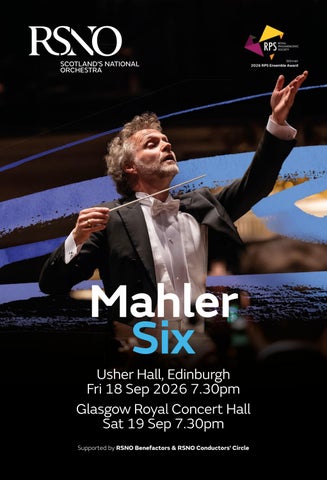
Mahler Six
Usher Hall, Edinburgh Fri 18 Sep 2026 7.30pm Glasgow Royal Concert Hall Sat 19 Sep 7.30pm Supported by RSNO Benefactors & RSNO Conductors’ Circle
2 Mahler Six
This concert is dedicated to RSNO Benefactors and members of the RSNO Conductors’ Circle, in recognition of the incredible philanthropic gifts which help us to realise our most ambitious goals. RSNO Benefactors Sir Ewan and Lady Brown Stina Bruce Jones Gavin and Kate Gemmell Ms Chris Grace Hartness Kat Heathcote and Iain Macneil Shirley Murray
RSNO Conductors’ Circle Ardgowan Charitable Trust Ian and Evelyn Crombie Kenneth and Julia Greig David and Alix Stevenson Eric and Karen Young
Thank you also to those generous donors who chose to remain anonymous. To find out more about the RSNO’s giving programme, including gifting shares, please contact Constance Fraser, Head of Development, on constance.fraser@rsno.org.uk or visit rsno.org.uk/individuals
Mahler Six Usher Hall, Edinburgh Fri 18 Sep 2026 7.30pm Glasgow Royal Concert Hall Sat 19 Sep 7.30pm Music Director Thomas Søndergård conducts two towering masterpieces in one unforgettable Season Opener. Piano superstar Alexander Malofeev shines in Rachmaninov’s glittering Fourth Piano Concerto. Composed in exile, it’s a work of brooding lyricism, lush orchestration and expressive melodies. After the interval, Mahler’s mighty Sixth Symphony is one man’s struggle against impossible odds, told in music of soaring emotion and shattering power.
RACHMANINOV Piano Concerto No4 in in G Minor Op40 [28’] INTERVAL MAHLER Symphony No6 in A Minor [82’] Thomas Søndergård Conductor Alexander Malofeev Piano Royal Scottish National Orchestra
Supported by RSNO Benefactors & RSNO Conductors’ Circle
The Glasgow performance will be recorded for future broadcast on BBC Radio 3 The Glasgow performance will be recorded for the RSNO Archive. Supported by the Iain and Pamela Sinclair Legacy. If viewing these notes at the concert, please do so considerately and not during performances. Please silence all mobile telephones and alerts, and refrain from taking photographs, without flash, until the end of each piece.
4 Mahler Six
SAVE 1/3 UP TO
GroupSave tickets
RSNO: Scotland’s National Orchestra 5
Welcome A very warm welcome to the start of the 2026:27 Season! We are pleased to be back after a busy summer which took us from the BBC Proms and Edinburgh International Festival to an 11-concert schools tour over three days, with a stop at the Rheingau Musik Festival in Germany in between. Since we last saw you, several recordings from Scotland’s Studio have been released, showing the versatility of our players: our album of Saint-Saëns’ piano concertos with the inimitable Simon Trpčeski conducted by Thomas Søndergård has come out; Paw Patrol 3: The Dino Movie has hit the screens, featuring the RSNO’s brass section on its soundtrack; and we have released a lost score by renowned Hollywood composer James Horner, which received its world premiere at The International Ayr Show – you can stream Skyward Spirit on all the usual platforms. Tonight’s concert begins with a presentation from James Murphy, Chief Executive of the Royal Philharmonic Society. James is presenting the RPS Ensemble Award, which we were delighted to win in March for the quality and scope of our performances and work. Among the other prize-winners were the Kirkcaldy Orchestral Society, who those of you in Glasgow will have seen performing in the Exhibition Hall as you arrived. This is the final Season of Thomas Søndergård’s tenure as Music Director before he becomes Music Director Emeritus, and what better way to begin than with Mahler’s mighty Sixth Symphony. Thomas is joined by the brilliant young pianist Alexander Malofeev, making his RSNO debut. Finally, I am pleased to welcome two new players to our ranks: Yat Hei Lee joined as Sub-Principal Double Bass over the summer, and this weekend’s concerts are the first for our new Associate Principal Bassoon, Matthew Kitteringham. Please join me in welcoming both of them.
Keep in touch with the RSNO
Royal Scottish National Orchestra 19 Killermont Street Glasgow G2 3NX T: +44 (0)141 226 3868
rsno.org.uk Scottish Company No. 27809 Scottish Charity No. SC010702
Alistair Mackie CHIEF EXECUTIVE
The RSNO is supported by the Scottish Government
6 Mahler Six
Royal Scottish National Orchestra
Formed in 1891, the Royal Scottish National Orchestra (RSNO) is one of Europe’s leading symphony orchestras. Awarded royal patronage by Her Late Majesty The Queen in 1977, its special status in the UK’s cultural life was cemented in 2007 when it was recognised as one of Scotland’s five National Performing Companies, supported by the Scottish Government. Led by Music Director Thomas Søndergård, the Orchestra performs across Scotland, including concerts in Glasgow, Edinburgh, Dundee, Aberdeen, Perth and Inverness, and appears regularly at the Edinburgh International Festival and BBC Proms. The RSNO tours internationally, most recently visiting China and Europe. In May 2026, Giedrė Šlekytė was announced as the RSNO’s Music Director Designate and will formally become Music Director from the beginning of the 2027:28 Season, with Thomas Søndergård taking on the new position of Music Director Emeritus. The RSNO has a worldwide reputation for the quality of its recordings, receiving a 2020 Gramophone Classical Music Award for Chopin’s Piano Concertos (soloist: Benjamin Grosvenor), conducted by Elim Chan, two Diapason d’Or awards (Denève/Roussel 2007; Denève/Debussy 2012) and eight GRAMMY Award nominations. In recent years, the RSNO has cultivated an international reputation for world-class film, television and videogame soundtrack recording. The Orchestra has recorded for BAFTA-winning
series Silo (Apple TV) and worked with the likes of GRAMMY Award-winning composer Lorne Balfe on Life on Our Planet (Netflix). Other notable titles include Nuremberg (Sony Pictures), Now You See Me: Now You Don’t (Lionsgate), Horizon: An American Saga (Warner Bros) and Star Wars Outlaws (Ubisoft). The Orchestra records at its bespoke in-house facility in Glasgow, Scotland’s Studio. In 2026 the RSNO was the first professional orchestra since 2014 to be awarded the Royal Philharmonic Society’s Ensemble Award. The award recognises musical ensembles for outstanding quality and scope of performances and work. The RSNO believes that music can enrich lives and aims to inspire, educate and entertain people throughout Scotland and beyond with its performances, recordings and engagement programmes. Supporting schools, families, young professionals and wider communities, the RSNO delivers high-quality initiatives for all ages and abilities. The RSNO’s engagement offering includes its singing strand, encompassing a Buggy Choir and Chorus Academy in both Dundee and Glasgow and a lunchtime Workplace Choir, which complements the well-established and highly respected RSNO Youth Choruses and RSNO Chorus. The community choruses are designed with the benefits of group singing for health and wellbeing at their core and are open to all.
RSNO: Scotland’s National Orchestra 7
On Stage FIRST VIOLIN Igor Yuzefovich
PERCUSSION Simon Lowdon
LEADER
CELLO Pei-Jee Ng
PRINCIPAL
BASSOON David Hubbard PRINCIPAL
PRINCIPAL
Shlomy Dobrinsky
Betsy Taylor Kennedy Leitch Yuuki Bouterey-Ishido Rachael Lee Sarah Digger Robert Anderson Gunda Baranauskaitė Niamh Molloy Maria Orlowska
Matthew Kitteringham Grant MacKay Tom Donkin Paolo Dutto
Stuart Semple Philip Hague Colin Hyson Julian Wolstencroft
HORN Amadea Dazeley-Gaist
HARP Pippa Tunnell Sharron Griffiths
ASSOCIATE LEADER
Tamás Fejes
ASSISTANT LEADER
Patrick Curlett Oliver Cave Caroline Parry Ursula Heidecker Allen Elizabeth Bamping Lorna Rough Susannah Lowdon Alan Manson Liam Lynch Veronica Marziano Catherine Alsey Stewart Webster Gill Risi SECOND VIOLIN Gongbo Jiang GUEST PRINCIPAL
Marion Wilson Paul Medd Anne Bünemann Sophie Lang Robin Wilson Kirstin Drew Colin McKee Kaylee Bontrager Fiona Stephen Liz Reeves Helena Quispe Helena Rose VIOLA Tom Dunn PRINCIPAL
Felix Tanner Asher Zaccardelli Susan Buchan Nicola McWhirter Claire Dunn Katherine Wren Maria Trittinger Francesca Hunt Beth Woodford David McCreadie Henry Justo
DOUBLE BASS Nikita Naumov PRINCIPAL
Ben Burnley Michael Rae Yat Hei Lee Moray Jones Alexandre Cruz dos Santos Olaya Garcia Alvarez Paul Speirs FLUTE Katherine Bryan PRINCIPAL
Oliver Roberts Adam Richardson Jack Welch PRINCIPAL PICCOLO
Siobhan Grealy
PRINCIPAL CONTRABASSOON
PRINCIPAL
Alison Murray Andrew McLean David McClenaghan Martin Murphy Neil Mitchell Alec Ross Ian Smith David Wheeler TRUMPET Christopher Hart PRINCIPAL
Oscar Whight Jason Lewis Goodwin Robert Baxter Andy Connell-Smith Mark Addison TROMBONE Dávur Juul Magnussen PRINCIPAL
OBOE Adrian Wilson
Cillian Ó Ceallacháin Huw Evans Alastair Sinclair
PRINCIPAL
PRINCIPAL BASS TROMBONE
Peter Dykes Ellen Wilkinson Henry Clay
TUBA Jonathan Gawn
PRINCIPAL COR ANGLAIS
Daniel Fergie CLARINET Timothy Orpen PRINCIPAL
William Knight Robert Digney Rebecca Whitener Duncan Swindells
GUEST PRINCIPAL
TIMPANI Nick Woud
GUEST PRINCIPAL
Tom Hunter
PRINCIPAL BASS CLARINET
Orchestra list and programme details correct at time of going to print.
CELESTA Lynda Cochrane
8 Mahler Six
Thomas Søndergård Conductor
and Helsinki Philharmonic. In North America, his engagements have included the Los Angeles and New York Philharmonics, the Cleveland Orchestra and the symphony orchestras of Chicago, Cincinnati, Baltimore, St Louis, Toronto, Atlanta, Montreal, Vancouver, Houston and Seattle. The 2026/27 season continues Thomas’ work with both the Minnesota Orchestra and the RSNO, alongside guest engagements across Europe. He returns to the Gürzenich-Orchester Köln with Benjamin Grosvenor and to the City of Birmingham Symphony Orchestra with Alina Ibragimova. At the Royal Danish Opera, he conducts performances of Verdi’s Falstaff, continuing a long-standing relationship with the company. Danish conductor Thomas Søndergård is Music Director of the Minnesota Orchestra and the RSNO. The 2026:27 Season marks his final season as Music Director of the RSNO, before becoming Music Director Emeritus in 2027:28. He previously served as the orchestra’s Principal Guest Conductor for six seasons. From 2012 to 2018, Thomas was Principal Conductor of the BBC National Orchestra of Wales, following his tenure as Principal Conductor and Musical Advisor of the Norwegian Radio Orchestra. Thomas has appeared with most of Europe’s leading orchestras, including the Berliner Philharmoniker, Symphonieorchester des Bayerischen Rundfunks, Gewandhausorchester Leipzig, Tonhalle-Orchester Zürich, Orchestre National de France, London Symphony Orchestra, Philharmonia Orchestra and Royal Concertgebouw Orchestra. A familiar figure across Scandinavia, he has worked with the Oslo Philharmonic, Gothenburg Symphony, Danish National Symphony Orchestra, Royal Stockholm Philharmonic, Swedish Radio Symphony Orchestra, Finnish Radio Symphony Orchestra
Opera has formed an important part of Thomas’ career. Following his Royal Danish Opera debut with Kafka’s Trial, he has returned regularly for repertoire including Die Walküre, which won the 2022 Reumert Award for Best Opera Production, Elektra, Le nozze di Figaro, Il barbiere di Siviglia, La bohème, The Cunning Little Vixen and Il viaggio a Reims. Further operatic collaborations include the Staatsoper Stuttgart, Norwegian Opera, Royal Swedish Opera and Bayerische Staatsoper. At Deutsche Oper Berlin he conducted the world premiere of Scartazzini’s Edward II and has since returned for Berlioz’s Roméo et Juliette and Strauss’ Elektra. A committed advocate of Scandinavian repertoire, Thomas has a particular affinity with the music of Carl Nielsen and Jean Sibelius. During the composers’ joint anniversary year in 2015, he conducted their works with orchestras across Europe, and in 2019 took part in a concert celebrating Nielsen at the Royal Danish Academy of Music in Copenhagen.
RSNO: Scotland’s National Orchestra 9
Shostakovich Five Edinburgh | Fri 2 Oct: 7.30pm Glasgow | Sat 3 Oct: 7.30pm Patrick Hahn Conductor Lawrence Power Viola
Book online at
rsno.org.uk
10 Mahler Six
Sergei Rachmaninov (1873-1943)
Piano Concerto No4 in G Minor Op40
When Rachmaninov emigrated from Russia to the US in 1918, it dramatically altered his career – and the trajectory of his Fourth Piano Concerto. Finding himself in great demand as both a soloist and conductor, he spent the ensuing years focusing almost exclusively on performing. As a result, his compositional output almost entirely collapsed – and by the time he began revisiting sketches for his Piano Concerto No4 in 1925, he hadn’t produced a single new work for nearly a decade.
FIRST PERFORMANCE First version: Philadelphia, 18 March 1927. Final version: Philadelphia, 1941 DURATION 28 minutes 1. Allegro vivace 2. Largo 3. Allegro vivace
The Concerto – his final completed work in the genre – captures a composer in transition, adjusting to a rapidly evolving musical landscape. The Romantic stylings that had shaped much of Rachmaninov’s early successes had been overtaken by the influences of impressionism and serialism, which were dominating the composition scene around him, causing him to question his own place in it. ‘I feel like a ghost wandering a world grown alien,’ he wrote in 1926. ‘I cannot cast out the old way of writing, and I cannot acquire the new. The new kind of music seems to come, not from the heart, but from the head. Composers think rather than feel.’ The compositional process was fraught. Plagued by insecurities and self-doubt, he wrote to Nikolai Medtner, a fellow Russian exile, pianist and composer, ‘I have already started (in my mind) to look for cuts.’ The Concerto is restless: its first movement launches into a fiery fury, while the third burns with a frenzied energy before dissolving into a thrilling piano cadenza. The second movement, which holds most of the melodic interest, showcases some of the jazz influences Rachmaninov was no doubt exposed to in New York, surrounded by composers like Gershwin.
RSNO: Scotland’s National Orchestra 11
At the March 1927 premiere, Rachmaninov performed on piano under Leopold Stokowski with the Philadelphia Orchestra. Unfortunately, the Concerto met with negative reviews, so Rachmaninov was forced to make many further cuts and revisions before it was published in 1928. In 1941, Rachmaninov turned his attention back to the Fourth Piano Concerto, revising the orchestration and undertaking many significant rewrites, thereby making it the last piece he actively worked on before his death in 1943. The new version was again premiered in Philadelphia, this time with Eugene Ormandy at the helm, and it is this version which is most commonly heard today. © Freya Parr
Listen again to the RSNO
Rachmaninov Piano Concerto No4 Plus Piano Concerto No1 and Rhapsody on a Theme of Paganini Howard Shelley Piano Bryden Thomson Conductor More information rsno.org.uk/recordings
If you enjoyed Rachmaninov’s Fourth Piano Concerto, why not try his Second Piano Concerto (performance in Glasgow 14 Nov).
What was happening in 1941? 6 Jan US President Roosevelt outlined his Four Freedoms – speech, worship, from want, from fear – as fundamental global human rights 9 Feb Prime Minister Churchill, in a worldwide broadcast, said to the US, ‘Give us the tools and we will finish the job’ 1 May Citizen Kane, directed by and starring Orson Welles, and frequently voted the best film of all time, premiered in New York 10 May Queen’s Hall in London was bombed, resulting in The Proms moving venue to the Royal Albert Hall 24 May German battleship Bismarck sank the Royal Navy flagship HMS Hood with the loss of all but three crew; on 27 May the crippled Bismarck was sunk with the loss of 2,300 crew 22 Jun Nazi Germany invaded the Soviet Union and declared war on it – Operation Barbarossa 18 Oct The Maltese Falcon film noir starring Humphrey Bogart was released 31 Oct Work on Mount Rushmore, featuring huge sculpted heads of presidents Washington, Jefferson, Roosevelt and Lincoln, finished due to a lack of funding 7 Dec Japanese aircraft launched a surprise attack on Pearl Harbor in Hawaii, drawing the US into World War II
12 Mahler Six
Alexander Malofeev Piano
In recent seasons, Malofeev has given concerts and recitals in major concert halls such as the Concertgebouw Amsterdam, Teatro alla Scala Milan, Philharmonie de Paris, Théâtre des Champs-Élysées Paris, Vienna Musikverein, Alte Oper Frankfurt, Kurhaus Wiesbaden, Bolshoi Theatre Moscow, Mariinsky Theatre St Petersburg, Queensland Performing Arts Centre, Lotte Concert Hall Seoul, Tokyo Bunka Kaikan, Shanghai Oriental Art Center, National Centre for the Performing Arts Beijing and Royal Opera House Muscat.
Alexander Malofeev studied at legendary institutions such as the Gnessin Special College of Music and the Tchaikovsky Conservatory in Moscow. In 2014, at the age of only 13, he won the prestigious International Tchaikovsky Competition for Young Musicians. Quickly hailed by critics as a ‘young Russian genius’ (Corriere della Sera), he has since established himself as one of the most remarkable pianists of his generation. Malofeev has performed with many of the world’s leading orchestras, including the Philadelphia Orchestra, Boston Symphony Orchestra, Los Angeles Philharmonic, Orchestra dell’Accademia Nazionale di Santa Cecilia, Orchestra Filarmonica della Scala, Lucerne Festival Orchestra, Orchestre de la Suisse Romande, hr-Sinfonieorchester, BBC Symphony Orchestra and Royal Philharmonic Orchestra. He regularly collaborates with renowned conductors including Riccardo Chailly, Myung-Whun Chung, Susanna Mälkki, Yannick Nézet-Séguin, Lahav Shani, Alain Altinoglu, Lionel Bringuier, Hannu Lintu, Vasily Petrenko and Andris Poga.
Malofeev is a frequent guest at international festivals and renowned piano series, among them La Roque d’Anthéron and La Folle Journée in Nantes, Klavierfestival Ruhr, the Master Pianist Series in Amsterdam and at Carnegie Hall New York, Salzburg Festival, Rheingau Musik Festival, Verbier Festival and Tanglewood Festival, as well as the Celebrity Series in Boston. At the start of the 2026/27 season, he tours with the Orchestra Filarmonica della Scala. At the end of the year, he makes his debut with the Berlin Philharmonic under the direction of Kirill Petrenko. Further highlights of the season include his debut as soloist with the Royal Concertgebouw Orchestra, Gewandhausorchester Leipzig and Budapest Festival Orchestra, his performance with the Orchestre National de Paris under the direction of Andris Poga, and an extensive tour of Germany with the Bergen Philharmonic. Alexander Malofeev is an exclusive artist of Sony Classical. For his solo album Forgotten Melodies he was awarded the OPUS Klassik in 2026 for Young Artist of the Year. Born in Moscow in 2001, he now resides in Berlin.
RSNO: Scotland’s National Orchestra 13
Gustav Mahler (1860-1911)
Symphony No6 in A Minor
FIRST PERFORMANCE Essen, 27 May 1906 DURATION 82 minutes 1. Allegro energico, ma non troppo. Heftig, aber markig [Intense, but pithy] 2. Andante moderato 3. Scherzo: Wuchtig [Powerful] 4. Sostenuto – Allegro energico
For Gustav Mahler there was a dark saying at the heart of his Sixth Symphony, but what it was exactly he declined to say. For a while he thought about giving it the title ‘Tragic’ but, probably wisely, decided against it. Mahler’s wife Alma reports him as saying that the huge finale tells of ‘the hero, on whom fall three blows of fate, the last of which fells him like a tree’. And indeed, in 1907, the year after the Symphony’s far from successful premiere, ‘three blows of fate’ did fall on Mahler: he was forced to resign as conductor of the Vienna Opera; his four-year-old daughter Maria died horribly of scarlet fever; and he was diagnosed as having a potentially fatal lesion of the heart – the condition that was to kill him four years later, at the age of 50. But is that really enough to explain the half-alluring, half-terrifying power of a symphony that seems to peer beyond personal tragedy into a truly epochal abyss? A whole century of suffering and horror seems foreshadowed in its violent march rhythms, its vivid depictions of vanquished hopes and crushed innocence. In any case, for many there remains something fascinatingly paradoxical about the Sixth Symphony. However violent, pained, desperate or ultimately bleak the emotions it expresses, there is also something exciting, exhilarating, even uplifting about it. It is as though Mahler were at the same time exulting in his mastery, his ability to express what his philosopher-hero Friedrich Nietzsche called ‘the artistic conquest of the terrible’. There is a kind of wizardry at work here: the Sixth Symphony is one of those works in which Mahler’s command of the orchestra is at its most dazzling. In his handling of the huge forces – including instruments never before used in a symphony (celesta, cowbells, whip, and a large hammer to represent the ‘blows of fate’), as well as one of the largest woodwind and brass
14 Mahler Six
sections in the standard repertory – Mahler reveals himself as a Mephistophelean magician as well as a tragic poet. There’s little room here for detailed analysis of a nearly 90-minute symphony packed with incident from start to finish, but a few pointers to key events and leading ideas may be helpful. The long first movement follows the outlines of classical ‘Sonata Form’. Two main themes – in this case an intense, driven march tune with pounding low cellos and basses, and an impassioned major key melody (apparently a portrait of Alma Mahler) – are juxtaposed, violently deconstructed, then brought back in something like their original form, leading to a noisily triumphant major key conclusion. But at the heart of the movement comes a vision of something quite different: a passage of magical stillness, with atmospheric contributions from celesta, high shimmering strings and cowbells. Like many of his symphonies, Mahler’s Sixth was composed in the summer among his beloved Alps, which he walked daily. In the Symphony’s still sections, Mahler tells us, we can hear ‘the last terrestrial sounds penetrating into the remote solitude of mountain peaks’. Mahler was unsure about the order of the middle two movements. Originally the Scherzo followed the first movement, but after the Symphony was published Mahler changed his mind, and he placed the Andante moderato second, which is the order performed tonight. After the intense drama of the first movement, the Andante moderato is like a haven of peace: meditative, songful, a deeper exploration of the Alpine solitude glimpsed at the heart of the first movement. But there is bitterness – perhaps regret, perhaps something more acute – mixed with the sweetness.
More pounding march figures begin the Scherzo: the return to the minor mode brusquely negates both the fragile peace of the Andante moderato and the major key ‘triumph’ of the first movement’s ending, which with hindsight sounds sadly premature. Now the violence has a grotesque edge. Even the seemingly innocent dance-like Trio theme (introduced on the oboe) has a strange, limping four-plus-three rhythm. This time the ending is hollow, desolate, with fragments of motifs slowly drifting out on double basses, contrabassoon and timpani. The colossal finale is at the same time a vast summing up of all that has been heard before and an expansion into new, still more awe-inspiring territory. Attempts to sum up the form in textbook terms quickly founder: better perhaps to approach it as a compelling, dramatically changeable musical narrative, by turns weird, desolate, heroically determined, joyously aspiring and catastrophically thwarted. The first two of Mahler’s ‘three blows of fate’ are underlined by the hammer, each one crushing the exaltation that built up earlier. But after the first performance Mahler removed the third hammer blow – whether for superstitious or more practical reasons is hard to guess. In any case, the most devastating stroke of all is left to the end. Tuba, trombones and low horns develop a long grim skeletal threnody, then a full orchestra chord of A minor falls like a gigantic guillotine, leaving vestiges of the march rhythms to tail off into absolute blackness. © Stephen Johnson
RSNO: Scotland’s National Orchestra 15
RSNO Connections
The Arts in 1906
The earliest performance of Mahler’s Sixth Symphony by the then Scottish National Orchestra was on 7 December 1967, conducted by Alexander Gibson, in a concert which also included songs from the same composer’s Des Knaben Wunderhorn performed by Janet Baker and Thomas Hemsley – a substantial evening. It took place in the ‘Concert Hall’ in Glasgow, a former cinema in Anderston that became a temporary venue for the SNO after St Andrew’s Hall burned down in 1962. The 1967/68 season was the final season in that venue before concert performances moved to the City Halls in Candleriggs.
In Music: Sea Drift by Frederick Delius Norfolk Rhapsody No1 by Ralph Vaughan Williams The Wreckers by Ethel Smyth Maskarade by Carl Nielsen Symphony No8 by Alexander Glazunov Pohjola’s Daughter by Jean Sibelius
Malcolm Rayment, in his Glasgow Herald review of 8 December, wrote: ‘Gibson, who clearly believes thoroughly in the symphony, kept it firmly moving in the three faster movements, and did not dally over the slow one. The orchestra, still maintaining the exceptionally fine form they have shown recently, responded to his direction with playing that was technically assured and thoroughly sensitive to Mahler’s idiom.’
In Art: Self-portrait by Umberto Boccioni Le bonheur de vivre by Henri Matisse Water Lilies by Claude Monet Boy Leading a Horse by Pablo Picasso
© Ewen McKay
Listen again to the RSNO
Mahler Symphony No6 Plus Symphonisches Praeludium Neeme Järvi Conductor More information rsno.org.uk/recordings
In Literature: The Man of Property, first volume of The Forsyte Saga, by John Galsworthy White Fang by Jack London Puck of Pook’s Hill by Rudyard Kipling The Railway Children by Edith Nesbit The Tale of Jeremy Fisher by Beatrix Potter
If you enjoyed Mahler’s Sixth Symphony, why not try his Blumine (performances in Edinburgh 12 Feb 2027, Glasgow 13 Feb and Inverness 14 Feb).
Three riddles. Two hearts. A life at risk. 16 Mahler Six
Turandot P U C C I N I
Core funded by
A new production from Sir David McVicar A new co-production with Irish National Opera Supported by Dunard Fund
Registered in Scotland Number SC037531 Scottish Charity Number SC019787
Glasgow & Edinburgh 22 October – 22 November
RSNO PLAYS
Mozart
Ayr Town Hall Tue 22 Sep: 11.30am St Mary’s RC Church, Lanark Wed 23 Sep: 11.30am Lutosławski Little Suite for Chamber Orchestra Rota Trombone Concerto Mozart Symphony No33 K319
Book now at rsno.org.uk
Angela Hewitt Mozart & CPE Bach 26 - 27 September, 7.30pm Glasgow | Edinburgh
Joseph Haydn Symphony No.6 “Le Matin” Carl Philipp Emanuel Bach Keyboard Concerto Wq. 20 in C Marianna Martines Sinfonia in C Wolfgang Amadeus Mozart Keyboard Concerto No.14 K. 449 in E-flat Angela Hewitt director, fortepiano Matthew Truscott director, violin
Tickets: £6 - £42 (+bf)
(concessions for u30s/students/unwaged/ disabled/artsworkers; u18s free)
dunedin-consort.org.uk
Izabelė Jankauskaitė Conductor Dávur Juul Magnussen Trombone Gillian Moore Presenter The RSNO is supported by the Scottish Government
18 Mahler Six
RSNO Benefactors, Patrons and Circle members We are grateful to all our individual supporters for their generous philanthropy and loyalty. Your support enables the Orchestra to achieve its most ambitious goals and to continue inspiring people across Scotland both on and off the concert stage.
RSNO Benefactors
RSNO Conductors’ Circle
RSNO Patrons
Sir Ewan and Lady Brown Gavin and Kate Gemmell Kat Heathcote and Iain Macneil Ms Chris Grace Hartness
Ardgowan Charitable Trust Stina Bruce Jones Ian and Evelyn Crombie Kenneth and Julia Greig Shirley Murray David and Alix Stevenson Eric and Karen Young
Geoff and Mary Ball Lady Rebecca Fraser Don and Lois Macleod Walter and Janet Reid Charitable Trust George Ritchie Stephen Sweeney Valerie Wells
Learning and Engagement Patrons William Brown, W.S The Dundee RSNO Circle Committee Neil and Nicola Gordon Professor Gillian Mead, FRSE Nicholas and Alison Muntz Maurice and Nicola Taylor Charitable Trust
Chair Patrons Assistant Conductor
Second Violin
Cello
The Solti Foundation Chair
The Nigel & Margot Russell Chair
Ms Chris Grace Hartness Chair
Celia Llácer First Violin
Maya Iwabuchi LEADER Dunard Fund Chair
Marion Wilson ASSOCIATE PRINCIPAL
Pei-Jee Ng PRINCIPAL
Sophie Lang
Betsy Taylor ASSOCIATE PRINCIPAL
Viola
Kennedy Leitch ASSISTANT PRINCIPAL
The Cathy & Keith MacGillivray Chair
Rachael Lee
The Ian & Evelyn Crombie Chair
The Maxwell Armstrong Chair
The David and Anne Smith Chair
Tamás Fejes ASSISTANT LEADER
Tom Dunn PRINCIPAL
Ursula Heidecker Allen
Lisa Rourke SUB PRINCIPAL The Meta Ramsay Chair
The Christine and Arthur Hamilton Chair
Elizabeth Bamping
Francesca Hunt
Double Bass
The Bill and Rosalind Gregson Chair The James and Iris Miller Chair The WL and Vera Heywood Chair
Alan Manson
The Hugh and Linda Bruce-Watt Chair
Liam Lynch
Ms Chris Grace Hartness Chair
Lorna Rough
The Sir Richard Dunbar Chair
The Rolf and Celia Thornqvist Chair
Nikita Naumov PRINCIPAL
The Gregor Forbes John Clark Chair
Michael Rae ASSISTANT PRINCIPAL
James Wood Bequest Fund Chair
RSNO: Scotland’s National Orchestra 19
Flute
Clarinet
Trumpet
The David and Anne Smith Chair
The Shirley Murray Chair
Ms Chris Grace Hartness
Katherine Bryan PRINCIPAL
Timothy Orpen PRINCIPAL William Knight
Oboe
Adrian Wilson PRINCIPAL The Hedley Wright Chair
Peter Dykes ASSOCIATE PRINCIPAL
The Turcan Connell Chair
Horn
Timpani
Paul Philbert PRINCIPAL
Ms Chris Grace Hartness
David McClenaghan SUB-PRINCIPAL
Staff
Alison Murray ASSISTANT PRINCIPAL
COMMUNITY SINGING ASSISTANT
Martin Murphy ASSISTANT PRINCIPAL
We are also grateful to those who give but who wish to remain anonymous.
Witherby Publishing Group Charitable Trust Chair
The Springbank Distillers Chair
Cor Anglais
Mr & Mrs Pierre and Alison Girard
In memory of a dear friend, Fiona H
The Gordon Fraser Charitable Trust Chair
Henry Clay PRINCIPAL
Christopher Hart PRINCIPAL
Chiko Parkinson
Supported by ScotRail
Andrew McLean
The Catherine McLagan Chair
If you would like to discuss how you can become an RSNO Patron, please contact Constance Fraser, Head of Development (Individuals and Partnerships), at constance.fraser@rsno.org.uk
RSNO Circle Virtuoso Ms Catherine Y Alexander Mrs A M Bennett Mr Alan and Mrs Carolyn Bonnyman Dame Susan and Mr John Bruce Francesca and Eoghan Contini Mackie Dr Clive Criper Scott and Frieda Grier Judith and David Halkerston Iain MacNeil and Kat Heathcote MBE Ian and Sarah Lister Miss A McGrory Maureen Michie Mr James Miller CBE David Moncur Mrs Abigail Morrison Nicholas and Alison Muntz Bernard and Jane Nelson Mr and Mrs W Semple Gregor and Lesley Stewart Mr Ian Taft Claire and Mark Urquhart Raymond and Brenda Williamson Margaret Duffy and Peter Williamson
Symphony Martin and Jackie Beard Mr John Brownlie Mr A Campbell Dr K Chapman and Ms S Adam Dr C Cradock and Dr S Todd Mr W G Geddes Dr Robert Gibb Mr I Gow Hon Lord McGhie Mrs A McQueen Kathryn Michael Mr Iain Percival James and Pam Robertson David and Maggie Robinson Mrs Henrietta Simpson Ian and Janet Szymanski Nelson and Barbara Waters Tom and Lisa Watson Philip Whitely and Robert H Mackay Concerto Neil Barton Mrs Mary Black Miss D Blackie Dr C M Bronte-Stewart Dr F L Brown Mr and Mrs Burnside David Caldwell Ms H Calvert
Ross Cavanagh Myk Cichla Terry and Joan Cole Dr J Coleiro Christine and Jo Danbolt Steven J Davis Mr and Mrs K B Dietz Dr A Ewing David and Sheila Ferrier Mr C Ffoulkes William Findlay Mr and Mrs M Gilbert Simon and Fiona Guest Lord and Lady Hamilton P Hayes David G Henderson Dr and Mrs P Heywood Ms H Kay Mr and Mrs W Kean Nicholas Kilpatrick Christine Lessels Morag MacCormick Mr and Mrs Marwick Mr S Marwick Mrs Sandra Maxwell Mr and Mrs G McAllister Mrs M McDonald Dr A H McKee Mr Rod McLoughlin Morag Millar
20 Mahler Six
Mrs B Morinaud Dr and Mrs D Mowle Ms A and Miss I Reeve Mrs E M Robertson Sheriff Linda Ruxton Dr and Mrs G K Simpson Dr Norma H Smith Mr and Mrs A Stewart Jenny Stewart David and Helen Strachan Mr I Strachan Dr G R Sutherland Mr and Mrs J B Watson Helen and Peter Wilde David W Wren Roderick Wylie Sonata Mr and Mrs G H Ainsley Mr K Allen Dr A D Beattie Mrs H Benzie Mr R Billingham John Bradshaw and Shiona Mackie Mrs Bryan Andrew Burrows Mrs C M Campbell Miss S M Carlyon Amanda Carter-Fraser Lady Coulsfield Adam and Lesley Cumming Mrs C Donald J Donald and L Knifton Mr John Duffy Mr R M Duncan Brigadier and Mrs C C Dunphie Mrs E Egan Mr R Ellis Mr R B Erskine Dr E Evans Kenneth Forbes Mr D Fraser Philip and Karen Gaskell Elizabeth Gibb Mrs M Gibson Mrs M Gillan Mrs J K Gowans Dr J and Mrs H Graham
Professor and Mrs A R Grieve Mr Martin Hammick Dr P J Harper Dr N Harrison Mr and Mrs R J Hart Bobby and Rhona Hogg Mr and Mrs F Howell Mrs A Hunter Inez Hutchison Professor R N Ibbett Thomas Jakobsen Burns Geoffrey and Elizabeth Johnston Iain M Lanaghan Ms K Lang Mrs Anne Lindsay Dr Dorothy A Lunt Alison and Bryn Martin Mrs Jean C Martin Mr and Mrs J Martin Ms S McArthur Jean McCutcheon Rhyse McDermid Mr M McGarvie Dr Colin McHardy Ms H L McLaren Margaret McLay Libby McLean Mr and Mrs B Mellon Simon Michaelson Mr I Mills Mrs P Molyneaux Kenneth M Murray Bruce and Christine Nelson Alastair Ogilvie Mr and Mrs K O’Hare Mr and Mrs K Osborne Dr G Osbourne Mr A Ownsworth Stephanie Park Mr R Parry John Paterson Misses J and M Penman Mr J W Pottinger Miss J A Raiker Alastair Reid Ms F Reith Dr and Mrs D Robb Anne Robertson
Ms A Robson Mrs J Shanks Mr J A Shipley Dr M J and Mrs J A Shirreffs Richard and Gillian Shirreffs Ana Smith Mrs E Smith Mr M Smith Dr and Mrs B Stack Mrs Lorna Statham Mrs R F Stewart Mr and Mrs B Tait Lisbeth Thoms Dr and Mrs T Thomson Dr Morag Ward Dr Alex Watson Mr W Watters Alan Weddell Mr R Young
Thank you to all our members of the Circle, including Overture members and those who wish to remain anonymous.
If you would like to discuss how you can become an RSNO Circle member, please contact Polly Lightbody, Development Manager, at polly.lightbody@rsno.org.uk
RSNO: Scotland’s National Orchestra 21
Charitable Trusts and Foundations Charitable trusts and foundations have a distinguished history of supporting the RSNO, both on and off the stage. From one-off donations for specific concerts and musicians’ chairs, to multi-year funding for our community engagement initiatives, including our Schools Programme, every grant in support of our work is truly appreciated. We are grateful to the following trusts and foundations for their generosity: Aberdeen Endowments Trust Alexander Moncur Charitable Trust Alma & Leslie Wolfson Charitable Trust Boris Karloff Charitable Foundation Castansa Trust CMS Charitable Trust Common Humanity Arts Trust Cookie Matheson Charitable Trust Cruden Foundation David and June Gordon Memorial Trust Educational Institute of Scotland Ettrick Charitable Trust Evelyn Drysdale Charitable Trust Fidelio Charitable Trust Gannochy Trust Gaelic Language Promotion Trust Gordon Fraser Charitable Trust Hinrichsen Foundation Harbinson Charitable Trust Hugh Fraser Foundation James Wood Bequest Fund Jennie S Gordon Memorial Foundation Jean & Roger Miller’s Charitable Trust John Mather Trust JTH Charitable Trust Leach Family Charitable Trust Leisure & Culture Dundee Leng Charitable Trust Lethendy Charitable Trust Marchus Trust Mary Janet King Memorial Fund, administered by Foundation Scotland McGlashan Charitable Trust MEB Charitable Trust Meikle Foundation Miss E C Hendry Charitable Trust Miss Jean R Stirrat’s Charitable Trust
Nancie Massey Charitable Trust Noël Coward Foundation Northwood Charitable Trust Pear Tree Fund for Music PF Charitable Trust Q Charitable Trust Radcliffe Trust Ronald Miller Foundation Russell Trust Scott-Davidson Charitable Trust Scottish Enterprise Solti Foundation Souter Charitable Trust Stevenston Charitable Trust Sylvia Aitken Charitable Trust Tay Charitable Trust Thriplow Charitable Trust Tillyloss Trust Trades House of Glasgow Commonweal Fund W A Cargill Fund W M Sword Charitable Trust Walter Scott Giving Group Walter Craig Charitable Trust Weir Charitable Trust Zich Trust We are also grateful to a number of trusts that wish to stay anonymous.
If you would like more information about our work and how you can make a difference, please contact Niamh Kelly, Head of Trusts and Projects, at niamh.kelly@rsno.org.uk
22 Mahler Six
A big Thank You to our supporters FUNDERS
CORPORATE SUPPORTERS
Ecosse
PRINCIPAL MEDIA PARTNER
PRINCIPAL TRANSPORT PARTNER
BROADCAST PARTNER
PARTNERS Adelaide Place • Age Scotland • Black Lives in Music • Charanga • Children’s Classic Concerts Children’s Hospices Across Scotland • Classic FM • Douglas Academy • Dundee Science Centre • Dunedin Consort Edinburgh Zoo • Education Scotland • Fanzclub • Gig Buddies • Glasgow Life • GMAC Film Heads of Instrumental Teaching Scotland • Hebrides Ensemble Kibble • Luminate • Marine Conservation Society MARSM • Music Education Partnership Group • ParentZone • The Pyramid at Anderston Royal Conservatoire of Scotland • Scottish Book Trust • Scottish Chamber Orchestra • Scottish Refugee Council Sistema Scotland • St Mary’s Music School • Tayside Healthcare Arts Trust • Trees for Life • University of Glasgow V&A Dundee • Visible Fictions
With thanks to all RSNO Benefactors, Patrons, Circle Members and appeal donors for their support of the RSNO.
If you would like more information about sponsorships, corporate partnerships or fundraising events with the RSNO, please contact Constance Fraser, Head of Development (Individuals and Partnerships), at constance.fraser@rsno.org.uk
RSNO: Scotland’s National Orchestra 23
Royal Scottish National Orchestra PATRON His Majesty The King
Andrew McTaggart
DIRECTOR OF CHANGED VOICES
NOMINATED DIRECTOR
ARTISTIC TEAM Thomas Søndergård
COMMUNITY SINGING DIRECTOR (GLASGOW)
COMPANY SECRETARY
Giedrė Šlekytė
RSNO BOARD OF DIRECTORS
MUSIC DIRECTOR
MUSIC DIRECTOR DESIGNATE
Patrick Hahn
Aimee Toshney David McLean
COMMUNITY SINGING DIRECTOR (DUNDEE)
Celia Llácer
Elected Directors Gregor Stewart
Ellie Slorach
Gail Blain
PRINCIPAL GUEST CONDUCTOR ASSISTANT CONDUCTOR ENGAGEMENT CONDUCTOR
Kellen Gray
ASSOCIATE ARTIST
Neeme Järvi
CONDUCTOR LAUREATE
Alexander Lazarev CONDUCTOR EMERITUS
Stephen Doughty DIRECTOR, RSNO CHORUS
Patrick Barrett
CHAIR
HONORARY TREASURER
Kayla-Megan Burns Ken Hay Kat Heathcote MBE Don Macleod David Robinson John Stewart David Strachan
Cllr Edward Thornley
Julia Miller
Player Directors Katherine Bryan Christopher Hart David Hubbard William Knight David McClenaghan Lorna Rough SCHOOLS ADVISORY GROUP
Pam Black Norman Bolton Martin Greig Neil Millar Mae Murray
DIRECTOR, RSNO YOUTH CHORUSES
CHIEF EXECUTIVE
Dylan Findlay
ASSISTANT STAGE MANAGER
Polly Lightbody
Alistair Mackie CHIEF EXECUTIVE
Ted Howie
FACILITIES MANAGER
Graham Ramage
Dr Jane Donald
DEPUTY CHIEF EXECUTIVE
Nicola Kelman
EXECUTIVE ASSISTANT
PLANNING
Tammo Schuelke
DIRECTOR OF ARTISTIC PLANNING
Xander van Vliet
ARTISTIC PLANNING MANAGER
Rachel Pullin
ARTISTIC PLANNING OFFICER
Richard Payne
LEARNING AND ENGAGEMENT
Andrew Stevenson DIRECTOR OF ENGAGEMENT
Anna Crawford
ENGAGEMENT PRODUCER
Chiko Parkinson
EXTERNAL RELATIONS
Dr Jane Donald
ORCHESTRA MANAGEMENT
Aria Tsvetanova
PARTNERSHIPS AND EVENTS ADMINISTRATOR
Ross Williamson
VIDEO PRODUCER (MARKETING)
Hedd Morfett-Jones
Maisie Leddy
CHORUS MANAGER YOUTH CHORUS MANAGER
INFORMATION SERVICES MANAGER
AUDIO
LIBRARY ASSISTANT
Christine Walker
Sam Stone
ENGAGEMENT DELIVERY MANAGER
Rachel Naismith
COMMUNITY CHORUS AND PARTNERSHIPS COORDINATOR SUPPORTED BY SCOTRAIL
Anna Burns
GRAPHIC DESIGNER
ENGAGEMENT DELIVERY MANAGER
HEAD OF LIBRARY SERVICES
Megan Bousfield
DEVELOPMENT MANAGER
DIRECTOR OF EXTERNAL RELATIONS
Carol Fleming
STUDIO MANAGER
Sam McErlean
MEDIA MANAGER AND AUDIO ENGINEER
Nico
TRAINEE AUDIO ENGINEER
FINANCE AND CORPORATE SERVICES
Nicola Mills
HEAD OF MARKETING
DIRECTOR OF FINANCE AND CORPORATE SERVICES
HEAD OF DEVELOPMENT
HEAD OF FINANCE
Constance Fraser
Matthias Van Der Swaagh
Ian Brooke
Brodie Smith
Fred Bruce
HEAD OF ORCHESTRA MANAGEMENT
PROGRAMMES EDITOR
DEPUTY ORCHESTRA MANAGER
TRUSTS AND PROJECTS ADMINISTRATOR
OPERATIONS AND PRODUCTION
MARKETING MANAGER
Craig Swindells
Katie Kean
Adam Dundas
Niamh Kelly
Clara Cowen
Seonaid Eadie
EXTERNAL RELATIONS OFFICER
HEAD OF PRODUCTION
COMMUNICATIONS AND MARKETING OFFICER
STAGE MANAGER
HEAD OF TRUSTS AND PROJECTS
Susan Rennie Jade Wilson FINANCE OFFICER
Abby Dennison
FINANCE ADMINISTRATOR
Phoebe Connolly FINANCE ASSISTANT
David Hazel
FINANCE BUSINESS PARTNER AND ANALYST (INTERIM)
Contents © Copyright RSNO and named authors.
20263301_CLASS_RSNO_167x245mm.indd 1 20263301_CLASS_RSNO_167x245mm.indd 1
28/08/2026 14:02 28/08/2026 14:02