Auction closes May 21, 2026
Bob Eaton CEO, Acquisitions bob.eaton@rrauction.com
Carla Eaton Owner, Auctioneer carla.eaton@rrauction.com
Bobby Livingston Executive Vice President, Public Relations bobby.livingston@rrauction.com
Bobby Eaton VP, Business Development Auctioneer, MA/Lic. #3214 bobby.eaton@rrauction.com
Sue Recks Customer Service Manager Accounts Receivable sue.recks@rrauction.com
Melissa Adams Accounting Executive melissa.adams@rrauction.com
Amey Fuller Staff Accountant amey.fuller@rrauction.com
Elizebeth Otto SVP of Consignments & Acquisitions elizebeth.otto@rrauction.com
Jeff Cafferelli Consignment Director jeff.cafferelli@rrauction.com
Fiona Lenaire Consignor Customer Service Manager fiona.lenaire@rrauction.com
Cecily Gruce Inventory Manager Customer Service cecily.gruce@rrauction.com
Grace Maggio Executive Assistant grace.maggio@rrauction.com
Kevin Lessard Shipping Manager kevin.lessard@rrauction.com
Matt Klein Filemaker Developer and IT Administrator matt.klein@rrauction.com
Bill White Lead Autograph Appraiser bill.white@rrauction.com
Dan McCarthy Writer, Researcher dan.mccarthy@rrauction.com
Evan Mugford Writer, Researcher evan.mugford@rrauction.com
Sarina Carlo Head of Production sarina.carlo@rrauction.com
Nikki Brickett Photographer nikki.brickett@rrauction.com
Joe Boucher Production Assistant joe.boucher@rrauction.com
Robert S. Eaton Sr. 1940–2001
Jochen Zeitz is a globally respected business leader, philanthropist, and conservationist, whose career embodies the American ideals of entrepreneurial drive, personal responsibility, and reflects a deep commitment to its history, culture and landscapes.
As former Chairman and CEO of HarleyDavidson, one of America’s most iconic brands, Zeitz brought his trademark turnaround expertise to an institution that represents freedom, craftsmanship, and the open road. That same business acumen defined his 18-year tenure as Chairman and CEO of PUMA, where he rescued the company from nearbankruptcy and built it into one of the world’s top three sporting goods brands.
As a dedicated conservationist, Zeitz has personally committed to protecting 50,000 acres of wildlife habitat in Kenya, actively stewarding the land and creating the environment for nature to thrive. The safari retreat he built, Segera Retreat, has been recognized by the New York Times and LA Times as one of the top 20 places to visit in the world.

Through the ZEITZ Foundation, he has funded six schools educating over 2,000 children, supported community empowerment, and helped build The Long Run, now one of the world’s largest private conservation alliances, protecting over 21 million acres of wilderness globally.
In 2013, Zeitz co-founded The B Team with Sir Richard Branson, uniting some of the world’s top business leaders around the principle that business can be a force for good. In 2017, he launched the Zeitz Museum of Contemporary Art Africa (Zeitz MOCAA) in Cape Town, the largest art museum on the continent, championing African artistic voices on a world stage.
Whether measured by shareholder returns, acres conserved, or children educated, Jochen Zeitz is a visionary who delivers, driven by the conviction that commerce, community, culture and conservation can thrive together.
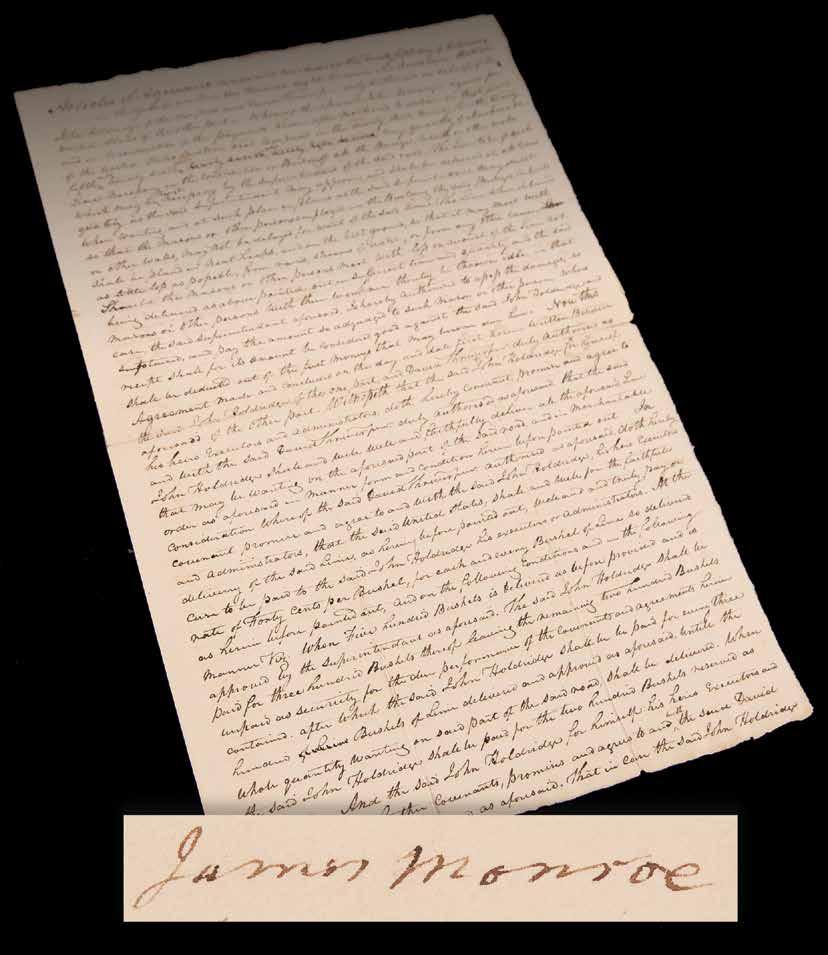
In early 1817, one week before assuming the presidency, James Monroe approves a huge government purchase of lime for the construction of “the United States Western Road”— the Cumberland Road, America’s first road into the West and the nation’s first federally funded highway
James Monroe Endorsement Signature as President-Elect, Approving a Construction Contract for the Cumberland Road (“United States Western Road”)America’s First Federally Funded Highway
Endorsement signature as Secretary of State and President-Elect, “Approved, James Monroe,” penned on the reverse of a manuscript document related to the continued construction of America’s first road into the West, the Cumberland Road. The document, one page, both sides, 11.25 x 18, dated February 25, 1817, served as the original contract for the purchase of lime used to produce mortar for the road’s masonry. It reads, in part: “Between John Holdridge of the one part and David Shriver, Jr., duly authorized in behalf of the United States of the other part…The said John Holdridge agreed for and in consideration of the payments hereinafter mentioned to deliver on that part of the United States Western Road comprised in the 23rd, 24th, 25th, and 26th sections, any quantity of merchantable lime necessary in the construction or building of bridges, culverts, or other works which may be thought necessary by the Superintendent.” The U.S. agreed to pay Holdridge forty cents per bushel of lime, so long as it was of sufficient quality. The document is signed by both Shriver and Holdridge, and signing as witnesses are Walter Slicer, a partner in the firm building the Youghiogheny Bridge (thus perhaps indicating that the lime was to be used for the bridge), and Samuel Magill, who established the first newspaper in Cumberland and was later its mayor. Signed on the reverse with his approval signature by James Monroe, still serving in his capacity as Secretary of State. In very good to fine condition, with nearly complete separation along the hinge, and to the fragile folds of the second page.
The Cumberland Road (also known as the National Road) was America’s first federally funded interstate highway and was considered a wonder of the world upon its construction. It was authorized on March 29, 1806, by President Thomas Jefferson, who believed that the poor roads of the day hindered American expansion and that a trans-Appalachian route was essential to encourage western settlement and unify the young nation.
Construction began in May 1811 at Cumberland on the Potomac River, at “a stone at the corner of lot No. 1, near the confluence of Will’s Creek and the north branch of the Potomac River.” The road crossed the Allegheny Mountains and southwestern Pennsylvania, reaching Wheeling, Virginia (now West Virginia), on the Ohio River in 1818—marking the beginning of its widespread use. In the decades that followed, the road became a vital artery of westward expansion, carrying travelers, stagecoaches, and freight between the eastern seaboard and the frontier. Massive Conestoga wagons transported produce eastward and returned with staples such as coffee and sugar for western settlements. Construction ultimately continued through Ohio and Indiana, halting at Vandalia, Illinois, in 1839.
David Shriver, an expert in turnpike management, was appointed Superintendent of the Cumberland Road by Secretary of the Treasury Albert Gallatin. He oversaw all aspects of construction, including the selection, hiring, and supervision of contractors. While he had authority to execute contracts for materials and services, final approval rested with the President. Shriver also reported regularly to Congress on the road’s progress and expenses and estimated the funding required for future sections. He quickly earned a reputation as a strict and exacting supervisor, withholding payment from contractors whose work or materials failed to meet his standards. The first phase of the project—from Cumberland to Wheeling—extended an unprecedented 123 miles and presented major engineering challenges, including the bridge over the Youghiogheny River, whose 80-foot span was the largest stone arch in America at the time. By 1817, completion of this initial phase was in sight, with only the sections west of the Youghiogheny River and the bridge itself remaining unfinished. These sections were numbered beginning at 23. The principal materials used in construction were stone, lime, and timber, with lime essential for producing the mortar that bound the masonry. In early 1817, Shriver informed Congress that approximately $1,500 would be required to procure the necessary lime for this portion of the work. He secured a contractor capable of supplying high-quality lime at a fair price and executed an agreement for its delivery—the contractor being John Holdridge.
Starting Bid $1,000
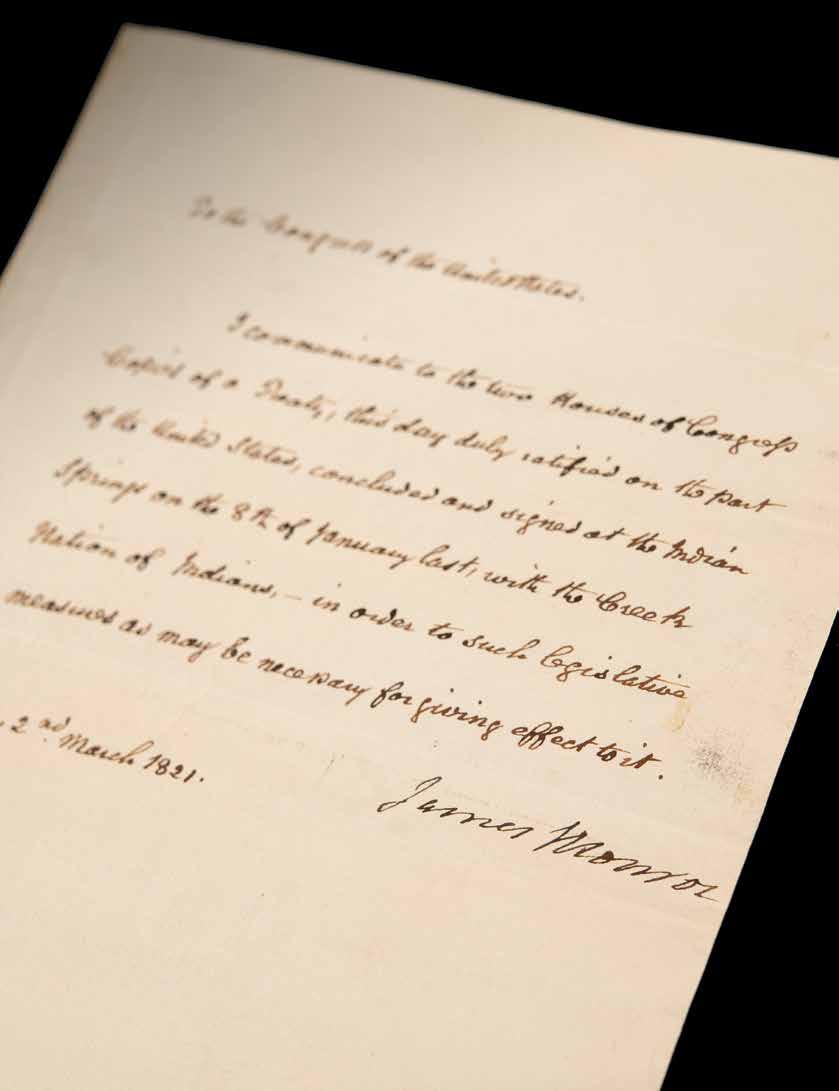
an executive letter to
“the Congress of the United States,” transmitting copies of the First Treaty of Indian Springs, a major land cession agreement with “the Creek Nation of Indians”
James Monroe Letter Signed as President to the U.S. Congress, Forwarding a Treaty with “the Creek Nation of Indians”
LS as president, one page, 7.5 x 9, March 2, 1821. Addressed from Washington, an executive message to “the Congress of the United States,” in full: “I communicate to the two Houses of Congress Copies of a Treaty, this day duly satisfied on the part of the United States, concluded and signed at the Indian Springs on the 8th of January last, with the Creek Nation of Indians, — in order to such legislative measures as may be necessary for giving effect to it.” Signed below by President James Monroe. In fine condition, with an old mounting strip along the back left edge.
During Monroe’s tenure, the removal of Indians continued in the wake of the Creek Wars, in which Andrew Jackson very successfully negotiated treaties with the Indians on behalf of the U.S. government, often obtaining huge tracts of land. His treaties with the Creeks won some 23,000,000 acres of land — more than half of Alabama and part of southern Georgia — for the United States in restitution for attacks on white settlements. Much of that territory belonged to Indians who had earlier been Jackson’s allies.
The Treaty of Indian Springs (January 8, 1821) was an agreement between the United States and the Creek Nation, negotiated at what is now Indian Springs State Park in Georgia during a period of increasing pressure from American settlers for more land. Under the treaty, the Creeks ceded about 4 million acres in exchange for payments and debt relief. While some Creek leaders supported the agreement, it reflected deep internal divisions within the nation and was largely driven by U.S. expansionist aims.
Although successful for the United States in opening land to settlement, the treaty intensified tensions within the Creek Nation and failed to bring lasting stability. Many Creeks opposed further land cessions, and conflict continued, leading to additional controversial treaties and mounting pressure for removal—developments that ultimately contributed to the forced displacement of the Creek people in the following decades.
Starting Bid $500
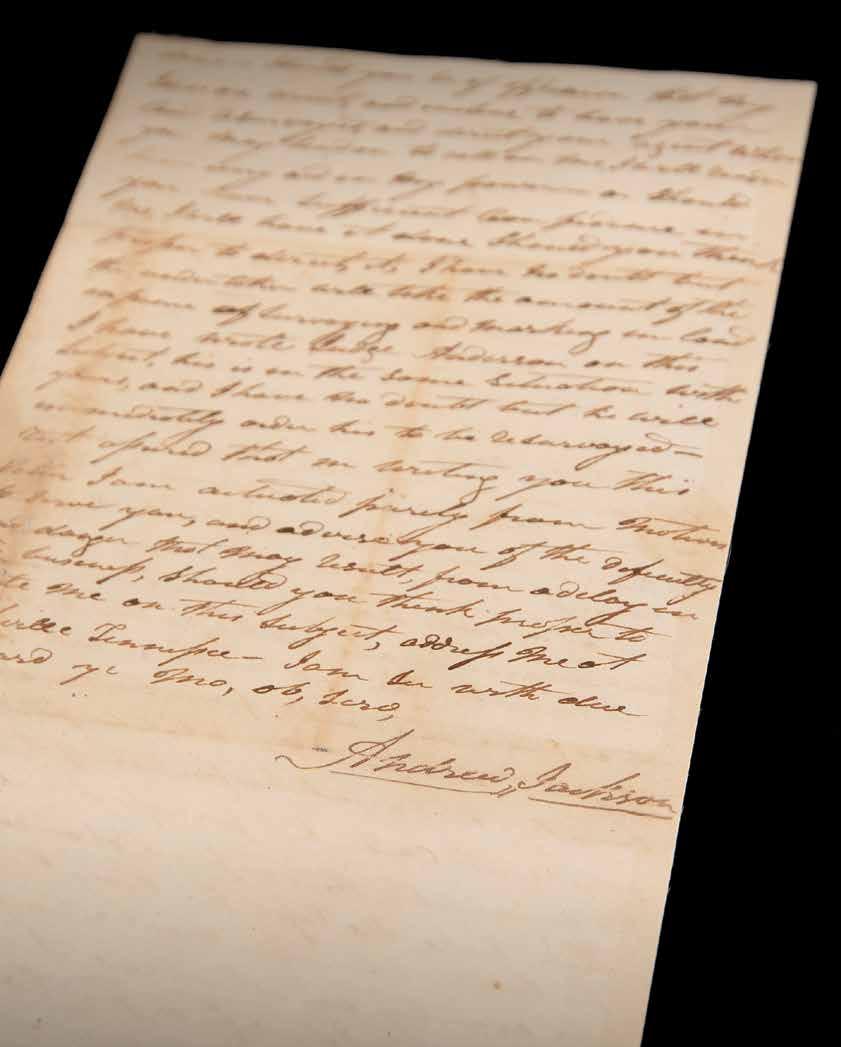
“marking locations and marking trees as far as the late purchase from the
extends, to be in readiness to enter the land as soon
Andrew Jackson Autograph Letter Signed on the 1805 Cherokee Treaty, Suggesting “marking trees as far as the late purchase from the Cherokees extends, to be in readiness to enter the land as soon as Congress ratifies the treaty”
ALS, signed “Andrew Jackson,” one page both sides, 7.5 x 12.25, December 12, 1805. Handwritten letter to Norton Prior, touching upon early American land speculation and a recently concluded treaty with the Cherokee. In full: “Having been lately on Duck River to explore a tract of land I hold there and the difficulty I experienced in finding the landmarks, induces me to write you. The great length of time that has elapsed since your land was surveyed, will make it difficult to trace the lines and find the corners. A number of persons observe that it will be impossible to find the old marks and substantiate the identitys of the land, are marking locations and marking trees as far as the late purchase from the Cherokees extends, to be in readiness to enter the land as soon as Congress ratifies the treaty. I would advise you at as early a day as possible to have your land resurveyed, and all the corners substantiated and marked. This will be attended with considerable expense and trouble from the remote sections of your land from the inhabited part of the country, and a great proportion of it being covered with corn but perhaps it will be better to encounter this expense at an early day than make the loss of the land.
Note sir that the locators and surveyors may die, remove or leave the county in which case it would be impossible to identify or find the corners, and should any person settle down on the land before you could remove them, this would have to be done. Should you be of apprehension that my ideas are correct, and incline to have your land surveyed, and direct your agent whom you may send on to call on me, I will render him every aid in my power—or should you have sufficient confidence in me, I will have it done. Should you think proper to direct it, I have no doubt but the undertaking will take the amount of the expense of surveying and marking in land. I have wrote Judge Anderson on this subject, his is in the same situation with yours, and I have no doubt that he will immediately order his to be surveyed. Rest assured that in writing you this letter, I am acting purely from motives to serve you, and advise you of the difficulty and danger that may result from a delay in this business. Should you think proper to write me on this subject, address me at Nashville, Tennessee.” In very good to fine condition, with a tear along the right edge, repaired and
reinforced by complete archival silking to the both sides. Accompanied by a custom-made quarter-morocco presentation folder.
On October 25, 1805, the Cherokees surrendered a large tract north of the Duck River, spanning over 7,000 square miles in Tennessee and over 1,000 square miles in present-day Kentucky, and granted the U.S. the right to establish a ‘free use of a road’ (part of the Federal Road) through Cherokee country, connecting Georgia to Tennessee. The Duck River, which Jackson refers to having recently visited, is the longest river located entirely in Tennessee.
In his History of Andrew Jackson, A. C. Buell writes: ‘The Cherokees… had from time immemorial claimed Tennessee as their huntingground….the Indians observed a kind of traditional law or usage, by virtue of which certain regions were set apart as hunting-grounds, in which no permanent villages should be established, and no habitation built more substantial than the camps of hunters; a sort of primitive ‘game-law’ which their mode of living made absolutely necessary to self-preservation. Therefore an occupation of their hunting-grounds was resented and resisted quite as bitterly as an attack on their villages. The Cherokees east of the mountains had long been subdued. But their Western brethren were wild and ferocious as ever… the Cherokees were the more numerous; the Chickasaws the more enterprising, or rather the more implacably hostile…were represented in the warfare waged against the Tennessee settlements. The total number…at the end of the Eighteenth Century, has been estimated at…20,000 Cherokees….
When Jackson arrived in Tennessee the practical situation was an effort on the part of, say, 60,000 Indians to drive out or exterminate 5,000 or 6,000 settlers. The available fighting strength of the Indians was one to every seven or eight of the total in tribes that had not been much at war with the whites, and one to every ten or eleven in tribes that had lost a good many of their braves in battle. The Southern Indians at that time had not been much punished by warfare with the white race and their fighting strength was at the maximum. It is, therefore, safe to say that they could muster at least 7,000 warriors at any time between 1780 and 1794; and that a considerable part of this force was on the warpath all the time against the Tennessee settlements, having not more than 5,000 to 10,000 people at any time during that period.’
Starting Bid $500
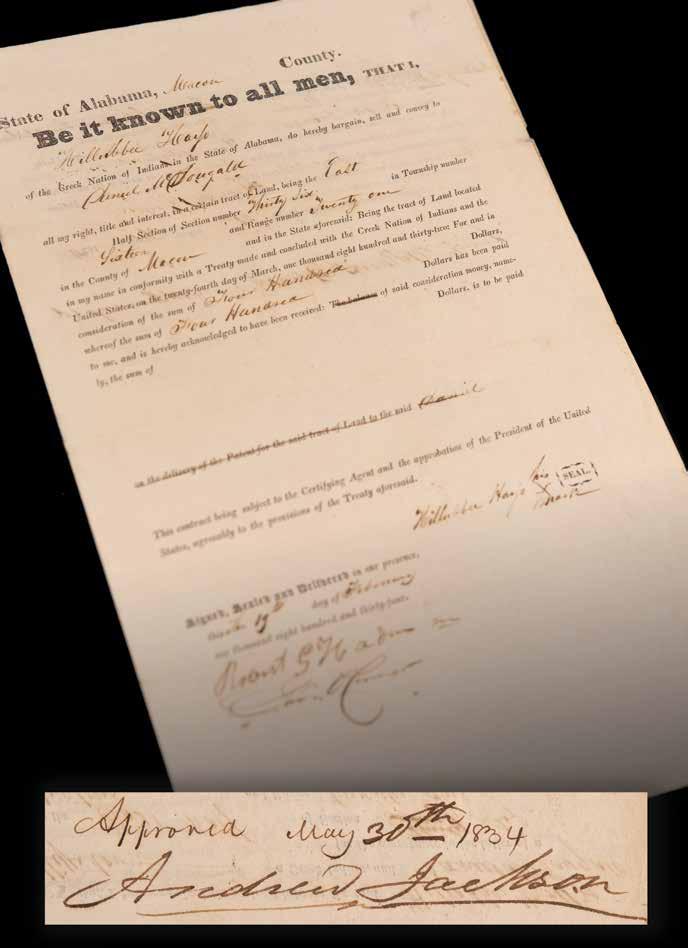
Endorsement signature as president, “Approved May 30th 1834, Andrew Jackson,” penned on the reverse of a partly printed document from the “State of Alabama, Macon County,” three pages on two adjoining sheets, 8 x 13, February 19, 1834, comprised of a land sale contract between seller Hillabee Harjo, “of the Creek Nation of Indians in the State of Alabama,” and buyer Daniel McDougald, with the former agreeing to sell his land for $400. McDougald and a certifying agent signing on the second and third pages, respectively.
The document describes the land as “being the East Half Section of Section number Thirty Six in Township number Sixteen and Range number Twenty one in the County of Macon, and in the State aforesaid: Being the tract of Land located…in conformity with a Treaty made and concluded with the Creek Nation of Indians and the United States, on the twenty-fourth day of March, one thousand eight hundred and thirty-two.” Signed with an “X” mark by Harjo at the bottom of the first page, which bears the line: “This contract being subject to the Certifying Agent and the approbation of the President of the United States, agreeably to the provisions of the Treaty aforesaid.” As such, President Jackson endorses the sale with his large approval signature on the reverse of the second integral page. In fine condition. Accompanied by a custom presentation folder.
On March 24, 1832, the Creek Nation and the United States government signed the Treaty of Cusseta, requiring the Creek to relinquish all claims to land east of the Mississippi River. While the majority of the Creek people were ultimately displaced, some were permitted to remain through individual land allotments under federal protection. Those who stayed in Alabama later became the Poarch Band of Creek Indians, now residing on 230 acres—the only federally recognized reservation in the state.
This treaty was part of the broader Indian removal policy initiated under President Andrew Jackson following the Indian Removal Act of 1830. This legislation authorized the federal government to negotiate treaties forcing Native American tribes east of the Mississippi to
exchange their lands for territory in the West. Although framed as voluntary, removal was often carried out under coercion and harsh conditions, culminating in what became known as the Trail of Tears.
Prior to 1830, the Cherokee, Chickasaw, Choctaw, Creek, and Seminole—often referred to as the Five Civilized Tribes—lived as autonomous nations in the southeastern United States. Many had begun adopting aspects of European-American culture, and some believed coexistence was possible. However, increasing pressure from settlers and government officials—motivated largely by the desire for land and resources—led to policies aimed at complete removal.
The Treaty of Cusseta included a notable provision: rather than immediately removing all Creek people, it allowed individuals to claim parcels of their ancestral land. Specifically, ninety principal chiefs were each granted one section of land, while heads of Creek families could claim half sections. These tracts were reserved for five years, during which they could be sold. Crucially, any sale required direct approval from the President of the United States—a rare stipulation, as most land grants of the period were authorized at a lower administrative level. This requirement makes surviving presidentially signed documents associated with the treaty particularly scarce and historically significant.
Despite these protections, the system was widely abused. Land speculators quickly took advantage of Creek landholders, often acquiring land through fraud or coercion. One such figure, McDougald, is documented in ‘Alleged Frauds on Creek Indians’ as having participated in numerous illicit transactions—admitting to taking land in 170 deals while paying for only 40. Many Creek individuals, including those with the family name Harjo, recorded in the 1833 census of eligible landholders, likely received little or no compensation for their land.
As a result of these exploitative practices, many Creek people were left impoverished. By 1835, desperation led some to raid nearby settlements for food. In response, the U.S. government escalated its actions, and in 1836, the Secretary of War ordered the forced removal of the Creek as a ‘military necessity.’ By 1837, approximately 15,000 Creek people had been forcibly relocated to the West.
Starting Bid $500
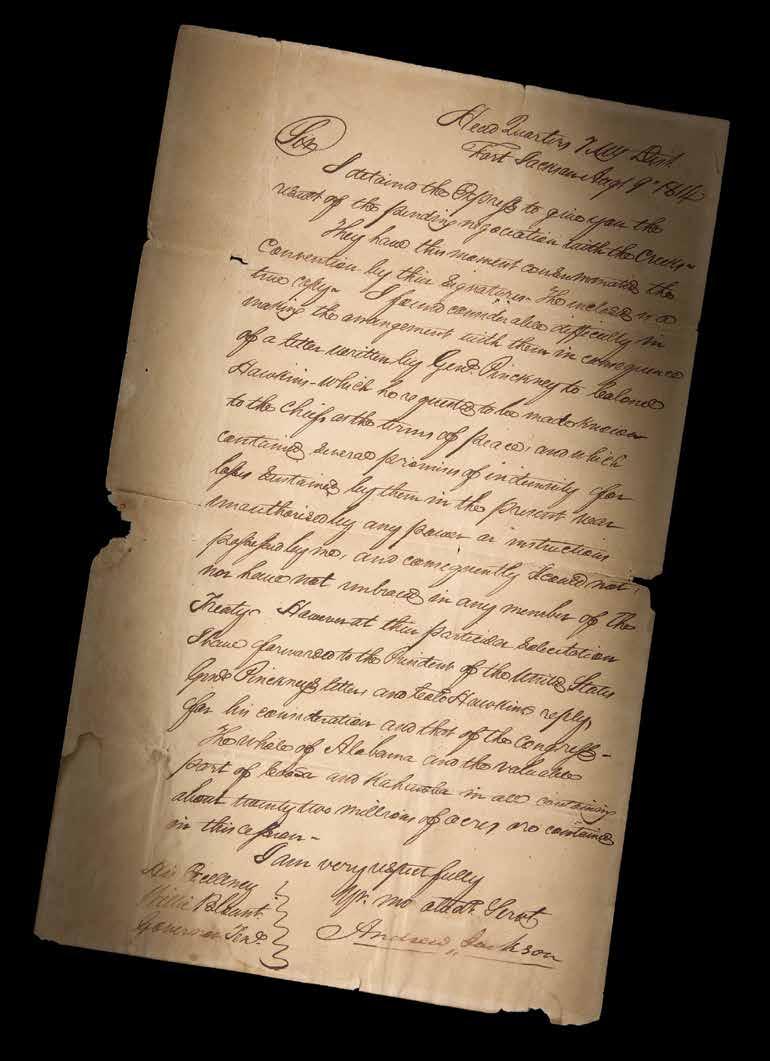
Andrew Jackson Letter Signed on the 1814 Treaty of Fort JacksonThe Creek Nation Cedes 23 Million Acres in Land
Significant LS, one page, 7.75 x 12.75, August 9, 1814. Addressed from “Head Quarters” at Fort Jackson, a letter sent to Tennessee Governor Willie Blount by Andrew Jackson as Major General, commander of the 7th Military District. The letter finds Jackson announcing the acquisition of the Creek land that encompasses much of Alabama and southern Georgia, and criticizing General Thomas Pinckney and Indian Agent Benjamin Hawkins for making his efforts more difficult. In full: “I detained the Express to give you the result of the pending negotiation with the Creeks. They have this moment consummated the Convention by their signatures. The enclosed is a true copy [not present]. I found considerable difficulty in making the arrangements with them in consequence of a letter written by Genl. Pinckney to Colonel Hawkins, which he requested to be made known to the Chiefs as the terms of peace, and which contained several promises of indemnity for losses sustained by them in the present war unauthorized by any power as instructions possessed by me, and consequently I could not, nor have not, embraced in any member of the Treaty. However at their particular solicitation I have forwarded to the President of the United States Genl. Pinckney’s letters and Colonel Hawkins reply, for his consideration and that of the Congress. The whole of Alabama and the valuable parts of Coosa and Kahawha in all containing about twenty two millions of acres are contained in this cession.” In very good condition, with light dampstaining, areas of paper loss, and splitting to the fragile hinge and folds.
In 1812, a faction within the Creek Nation known as the Red Sticks pushed to restore traditional ways and resist outside influence. Aligning themselves with the British during the War of 1812, they also came
into violent conflict with other Creeks who were more open to working with American settlers. Tensions escalated dramatically on August 30, 1813, when the Red Sticks attacked Fort Mims in present-day Alabama, killing more than 400 people. Additional attacks followed, spreading fear across the southeastern frontier and prompting urgent calls for U.S. military intervention.
In response, Secretary of War John Armstrong authorized action, and Tennessee Governor Willie Blount mobilized militia forces under Andrew Jackson. Reinforced by the 39th U.S. Infantry and allied Native groups organized by Indian Agent Benjamin Hawkins, Jackson built a force of roughly 5,000 men. After weeks of preparation, he advanced into Creek territory, ultimately confronting the Red Sticks at the Battle of Horseshoe Bend on March 27, 1814. The battle ended in a decisive and brutal victory for Jackson, effectively crushing Red Stick resistance and marking a turning point in the conflict.
Although initial peace negotiations offered relatively moderate terms, Jackson and his supporters rejected them as too lenient. Elevated to Major General, Jackson took control of the negotiations and imposed far harsher conditions. The resulting Treaty of Fort Jackson, signed on August 9, 1814 — signed earlier the same day that Jackson wrote this letter — forced the Creek Nation to cede 23 million acres of land, much of it belonging even to tribes allied with the United States. Jackson lost not a minute before sending his superior, Governor Blount, his official report on the treaty’s signing and terms. Despite later challenges from the Creeks and the British, Jackson ensured the treaty remained in force, securing a vast territorial gain and freeing him to lead American forces south to confront the British at the Battle of New Orleans.
Starting Bid $1,000
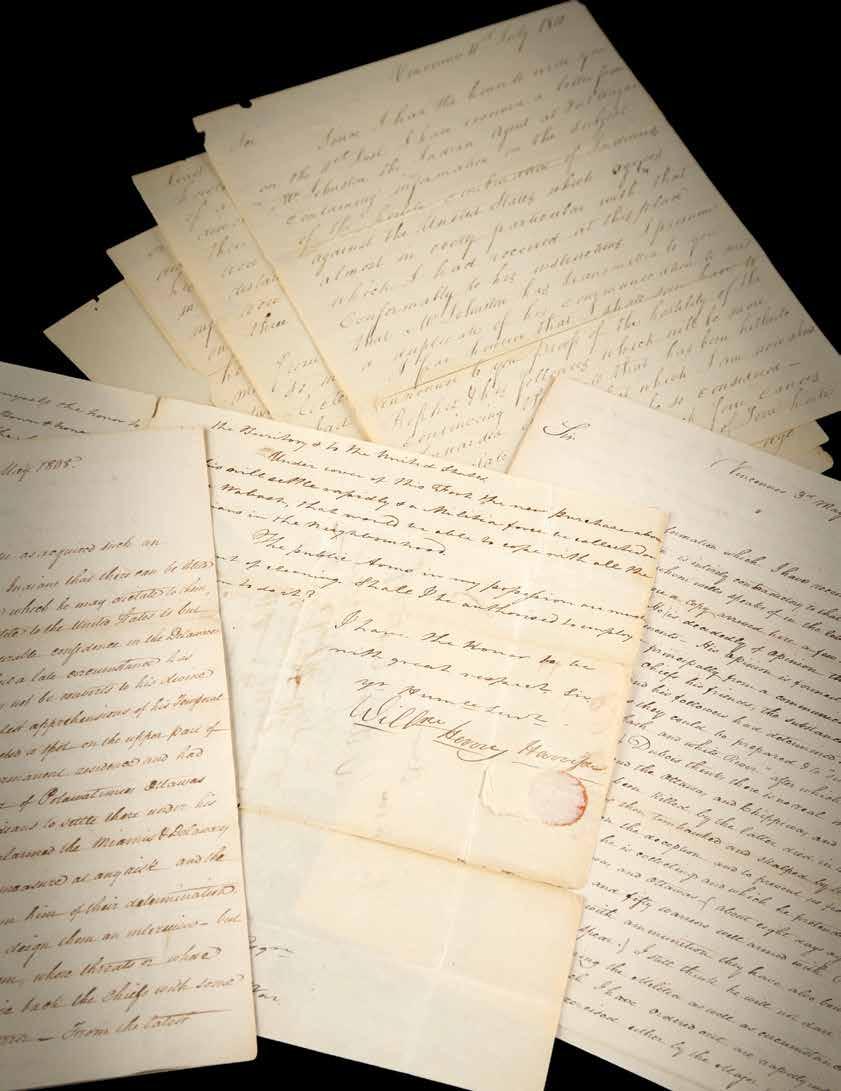
In four letters to the Secretary of War, Harrison warns of the growing influence of Tecumseh and the Prophet, documenting Shawnee intent to
“sweep all the white people from the Wabash”
William Henry Harrison (4) Letters Signed to the Secretary of War, Warning of Indian Hostilities on the Indiana Frontier
Four LSs signed ‘Will’m Henry Harrison,” totaling twelve pages, 8 x 10, dated from May 19, 1808, to July 11, 1810. Appointed the first governor of the Indiana Territory in 1800, Harrison writes to the Secretary of War—first Henry Dearborn, then William Eustis—on the state of relations with the frontier tribes, some friendly and others hostile, as American settlers pushed deeper into Indiana in increasing numbers. His letters focus on the growing power of the Shawnee leaders, Tecumseh and his brother, “the Prophet,” and describe increasingly hostile activities by their followers, warning of imminent attacks on American settlements. These tensions culminated in the Battle of Tippecanoe in November 1811, where Harrison led the victorious American forces to national fame—and a campaign slogan. He relates to Washington news of growing Indian forces under the influence of Tecumseh and the Prophet, the state of readiness of the increasingly outnumbered local militias, Indian incursions into white settlements, the theft of property and other provocations, and the constant backdrop of imminent attack. An interesting aspect of the letters is Harrison’s emphasis on the perceived power and influence of the Prophet, above and beyond that of Tecumseh.
Excerpts from the letters:
May 19, 1808, to Henry Dearborn, in part: “The Shawanoe imposter [the Prophet] has acquired such an ascendancy over the minds of the Indians that there can be little doubt of their pursuing any course which he may dictate to them, and that his views are already hostile to the United States is but too evident. I had a very considerable confidence in the Delawares and Miamis to resist his designs, but a late circumstance has convinced me that altho they may not be converts to his divine mission they are under the greatest apprehensions of his temporal power—The Prophet had selected a spot on the upper part of the Wabash for his future and permanent residence and had engaged a considerable number of Potawatomies, Ottawas, Chippawa, and other northern Indians to settle there under his auspices...I most sincerely wish the President would think himself authorized to have him seized and conveyed to the interior of the United States until the present appearance of war is removed.”
May 3, 1809, to William Eustis, carrying the latest intelligence he has gathered about the activities of the Shawnee leaders, and alarming news of their increasingly militant behavior. In part: “Mr. Dubois…is decidedly of opinion that the Prophet will attack our settlements. His opinion is formed from a variety of circumstances but principally from a communication made to Mr. LaFontaine by two chiefs his friends,
the substance of which was that the Prophet and his followers had determined to commence hostilities as soon as they could be prepared & to ‘sweep all the white people from the Wabash and White River’ after which they intend to attack the Miami.”
April 25, 1810, to William Eustis, containing an alarming report of hostile Indian intentions, and informing Washington that he has strong evidence that the British in the area are supplying the Shawnee with arms: “I have lately received information from sources which leave no room to doubt its correctness, that the Shawnee Prophet is again exciting the Indians to hostilities against the United States...The friends of the French traders amongst the Indians have advised them to separate themselves from the Americans in this town, lest they should suffer in the attack, which they meditate against the latter. I have no doubt that the present hostile disposition of the Prophet & his votaries has been produced by British influence.”
July 11, 1810, to William Eustis, discussing activities of scouting parties of hostile Indians, who have been stealing the horses of farmers and trying to goad the Americans into an attack. He warns Eustis that these actions are ratcheting up tensions in his Territory, and that it might cause American settlers to take matters into their own hands. He writes that a week ago “four canoes passed the Wea Village of Terre Hoite [sic] with four or five men in each.” Of these, one descended as far as a local Shaker settlement: “They had left their canoes there and had gone to the meeting of the Shakers on Sunday. They returned late in the evening of that day & proceeded up the Wabash about one half mile where they left their canoes, cut a hole in her & in the night stole five horses. These fellows were all completely armed, had no skins to trade with, nor did they profess to have any other business than to visit the Shakers. That they were spies from the larger party I have not the least doubt…The people in the neighborhood from whence the horses were taken are so much alarmed that they have collected together for their defence. I have forbad their pursuit of the thieves because I know that it will produce blood shed...As long however as no blood is spilt I shall have hopes of bringing the Prophet to reason. But our people will not suffer their property to be taken & I dailey [sic] expect to hear of some Indians being killed in an attempt to take off horses, nor will this be the most disagreeable circumstance attending those depredations.”
In overall very good to fine condition, with varying degrees of splitting to folds and hinges, some of which have been partially repaired. Accompanied by a custom-made quarter-leather clamshell case. An outstanding group of letters from William Henry Harrison, ably transmitting the increasing tensions, fears, and hostilities on the Indiana frontier that led to the Battle of Tippecanoe.
Starting Bid $5,000
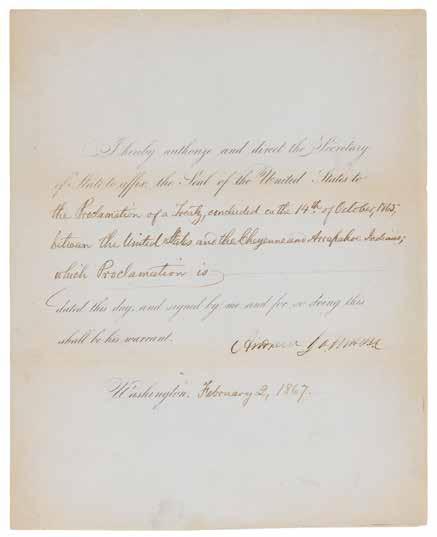
Andrew Johnson Document
Signed as President, Proclaiming an Infamous Treaty with “the Cheyenne and Arapahoe Indians”
Partly-printed DS as president, one page, 8 x 10, February 2, 1867. President Johnson authorizes and directs the Secretary of State to affix the Seal of the United States to “the Proclamation of a Treaty, concluded on the 14th of October, 1865, between the United States and the Cheyenne and Arapahoe Indians; which proclamation is dated this day.” Signed at the conclusion by President Andrew Johnson. In fine condition, with light toning to the folds and edges.
In the Fort Wise Treaty of 1861, the Cheyenne and Arapaho ceded vast tracts of land across presentday Nebraska, Kansas, Colorado, and Wyoming, agreeing in return to adopt a settled, agricultural lifestyle with government support, including land, mills, and equipment. However, only a small number of tribal leaders signed the treaty, and it was later rejected by much of the Cheyenne and Arapaho, undermining its legitimacy from the outset.
Tensions escalated in the following years, with repeated provocations on both sides leading to open conflict by 1864. That summer, several Cheyenne and Arapaho leaders sought peace and gathered at Sand Creek in Colorado Territory under assurances of protection. Instead, on November 29, 1864, Colorado militia forces attacked the encampment, killing and mutilating hundreds of men, women, and children in what became known as the Sand Creek Massacre. The atrocity reignited widespread warfare, as the Cheyenne and Arapaho—now joined by Sioux allies—launched retaliatory attacks against white settlers.
In response, the Johnson administration shifted away from purely military solutions and pursued negotiation, resulting in the Treaty of the Little Arkansas on October 14, 1865. Intended to restore peace, the treaty promised compensation for Sand Creek victims, the establishment of defined reservation lands, and safe passage for settlers. In reality, it proved to be one of the shortest-lived and least effective treaties in U.S. history: none of its major provisions were fully carried out, both sides accused the other of violations, and violence quickly resumed. Lasting only about two years, the treaty failed due to weak enforcement, mutual distrust, and the continued pressures of U.S. westward expansion. The failure of the Little Arkansas agreement highlighted the shortcomings of earlier treaty efforts and led to renewed attempts at negotiation. These culminated in the Medicine Lodge Treaties of 1867, which sought to impose more clearly defined reservation boundaries and stricter terms in an effort—only partially successful—to establish lasting peace on the Southern Plains.
Starting Bid $200
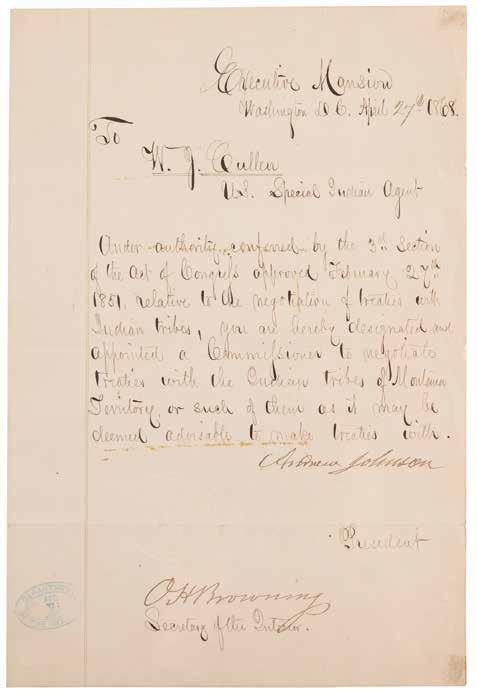
Andrew Johnson Letter Signed as President, Appointing a “Commissioner to negotiate treaties with the Indian tribes of Montana Territory”
LS as president, one page, 8.5 x 12.75, April 27, 1868. Official letter from the Executive Mansion to “W. J. Cullen, U.S. Special Indian Agent,” in full: “Under authority conferred by the 3d Section of the Act of Congress approved February 27th 1851, relative to the negotiation of treaties with Indian tribes, you are hereby designated and appointed a Commissioner to negotiate treaties with the Indian tribes of Montana Territory, or such of them as it may be deemed advisable to make treaties with.” Signed at the conclusion in ink by President Andrew Johnson, and countersigned by Secretary of the Interior Orville Hickman Browning; the letter also carries the Department of the Interior’s embossed seal and ink stamp. In fine condition, with two small corner stains.
Acting in his official capacity, W. J. Cullen concluded three significant Indian treaties in the summer and fall of 1868: a ‘Treaty with the Gros Ventre’ (Fort Hawley, Montana Territory, July 13, 1868); a ‘Treaty with the River Crow’ (Fort Hawley, Montana Territory, July 15, 1868); and a ‘Treaty with the Shoshone, Bannock, and Sheepeater’ (Virginia City, Montana Territory, September 24, 1868). These reflected a broader U.S. policy of securing peace while restructuring Indigenous land use and sovereignty: each treaty required the tribes to cede vast traditional territories to the United States in exchange for smaller, defined reservations, federal protection, and annuities or assistance aimed at transitioning them toward sedentary agriculture.
Starting Bid $500
“Would it not be strange if we should find one of our wild Indian Tribes speaking a Sanscrit language substantially that of these European Gipsies”
James A. Garfield Letter Signed, Investigating an Interpreter’s Claim as to the “relation between the Romany language and that of the Cheyenne Indians”
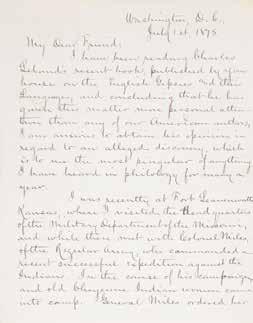
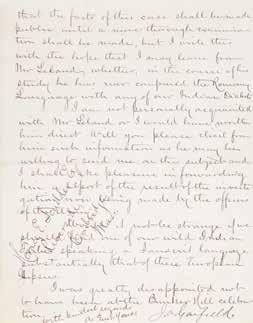
LS signed “J. A. Garfield,” two pages both sides, 7.5 x 9.75, July 1, 1875. Letter to editor Horace E. Scudder, in part: “I have been reading Charles Leland’s recent book, published by your house on the English Gipsies and their Language, and concluding that he has given this matter more personal attention than any of our American authors, I am anxious to obtain his opinion in regard to an alleged discovery, which is to me the most singular of anything I have heard in philology for many a year. I was recently at Fort Leavenworth, Kansas, where I visited the Headquarters of the Military Department of the Missouri, and while there met with Colonel Miles of the Regular Army, who commanded a recent successful expedition against the Indians. In the course of his campaign, an old Cheyenne Indian woman came into camp. General Miles ordered her to be fed and well treated in hopes that he might get some intelligence from her in regard to the movements of the enemy. He happened to have no interpreter with him at the time, but a young teamster, hearing her talk stepped forward and entered into conversation with her and told General Miles he could converse with her easily. A long conversation was carried on between General Miles and this Indian woman, by the aid of this young teamster. When the young man was asked whether he had ever lived among the Cheyennes, he answered in the negative, and said that he and this woman were talking in the Gipsy language, among whom he lived in the Grisons of Switzerland, that he was the son of a merchant and had been sent by his father into the Grisons to purchase cattle; that in the course of his absence he had spent several months among the Gipsies of that locality and had learned their language. He came to this country less than a year ago, and, not finding business, enlisted in the Sixth Regular Cavalry, but after serving for a few months was discharged from the fact of his being a minor, on the application of the Swiss Consul, resident in Washington.
General Pope is now causing a thorough investigation to be made in the case by sending the young man with well known interpreters to go with the Indian Reservation and thoroughly test the alleged relation between the Romany language and that of the Cheyenne Indians. This young man further states that he understands many of the words used by the Comanches and the Kiowas. He says he fully understands and without trouble the language of the Cheyenne. General Pope does not desire that the facts of this case shall be made public, until a more thorough examination shall be made, but I write this with the hope that I may learn from Mr. Leland, whether, in the course of his study he has ever compared the Romany Language with any of our Indian Dialects…Would it not be strange if we should find one of our wild Indian Tribes speaking a Sanscrit language substantially that of these European Gipsies.” In fine condition.
Starting Bid $200
one of 272 copies signed by President Theodore Roosevelt
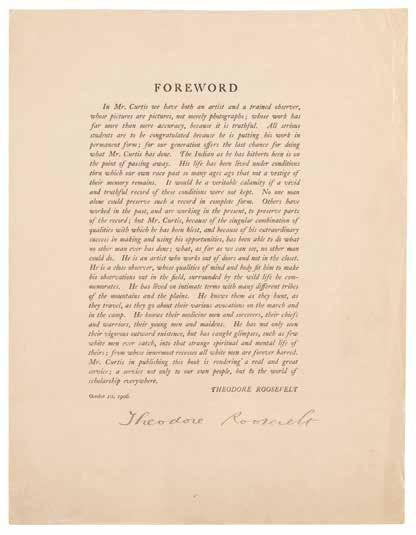
Theodore Roosevelt Presidentially Signed Foreword Page for ‘The North American Indian’ by Edward S. Curtis
Rare printed “Foreword” page removed from a volume of “The North American Indian, Being a Series of Volumes Picturing and Describing the Indians of the United States, the Dominion of Canada, and Alaska,” 9.5 x 12, dated October 1, 1906, signed neatly at the bottom in fountain pen as president, “Theodore Roosevelt.” In fine condition, with some light edge creasing. An exceedingly rare example, as only 272 copies of this signed book were published.
The text reads, in part: “In Mr. Curtis we have both an artist and a trained observer, whose pictures are pictures, not merely photographs; whose work has far more than mere accuracy, because it is truthful. All serious students are to be congratulated because he is putting his work in permanent form; for our generation offers the last chance for doing what Mr. Curtis has done. The Indian as he has hitherto been is on the point of passing away… He is an artist who works out of doors and not in the closet. He is a close observer, whose qualities of mind and body fit him to make his observations out in the field, surrounded by the wild life he commemorates. He has lived on intimate terms with many different tribes of the mountains and the plains. He knows them as they hunt, as they travel, as they go about their various avocations on the march and in the camp. He knows their medicine men and sorcerers, their chiefs and warriors, their young men and maidens. He has not only seen their vigorous outward existence, but has caught glimpses, such as few white men ever catch, into that strange spiritual and mental life of theirs; from whose innermost recesses all white men are forever barred. Mr. Curtis in publishing this book is rendering a real and great service; a service not only to our people, but to the world of scholarship everywhere.”
In 1904, after winning a national portrait contest, photographer Edward S. Curtis was invited by President Theodore Roosevelt to photograph his family at Sagamore Hill. The two quickly bonded over shared interests, including the American West and concern for Native American communities. Roosevelt became a strong supporter of Curtis’s work, writing a recommendation that helped secure funding from J. P. Morgan and later contributing the foreword to The North American Indian, which he praised as a significant scholarly achievement.
The North American Indian is a monumental 20-volume series created by Curtis between 1907 and 1930, documenting the lives, cultures, and traditions of Indigenous peoples across the United States, Canada, and Alaska. Combining extensive text with thousands of photogravure images, the project aimed to record languages, ceremonies, and daily life among more than 80 tribes. Curtis spent over two decades traveling and working with Native communities, producing one of the most ambitious ethnographic and photographic undertakings of its time.
Starting Bid $500
during his short
draws a sharp line
LOT 6011
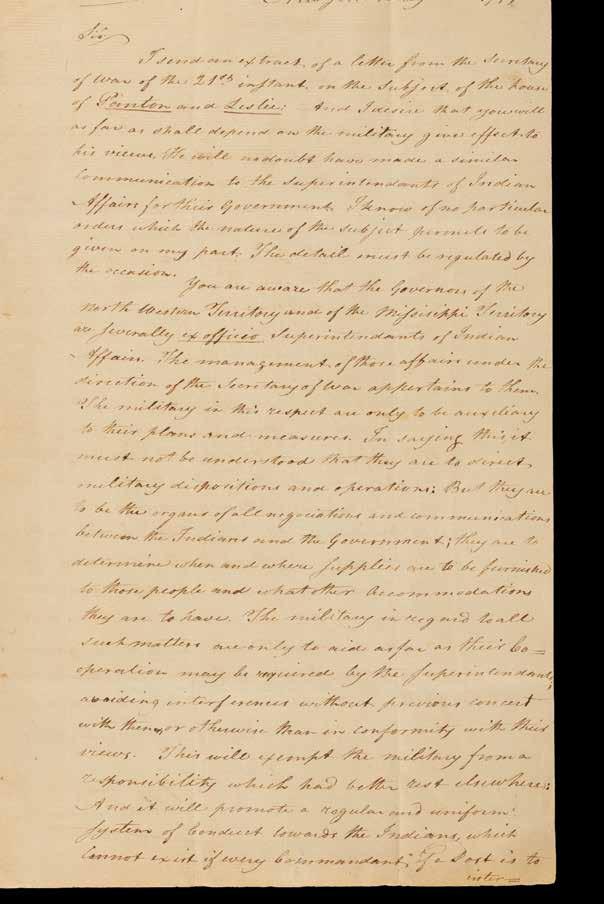
Alexander Hamilton Letter Signed as Inspector General on Military Authority Over Indian Affairs (1799)
LS, one page both sides, 8 x 13, May 23, 1799, sent from New York to Colonel Jean François Hamtramck, then serving in the Northwest Territory. Marked “Duplicate,” the letter transmits instructions from Secretary of War James McHenry regarding the trading firm of Panton, Leslie & Company and outlines the proper relationship between military officers and Indian affairs administration. Hamilton directs that military forces act only in support of civil authorities, emphasizing that the governors of the Northwest and Mississippi Territories, as superintendents of Indian affairs, are responsible for all negotiations, supply decisions, and communications with Native nations. He cautions against independent military involvement, stressing that coordination is essential to maintain a regular and uniform system of conduct toward the Indians and to avoid interference without prior concert with civil authorities. Signed at the conclusion by Alexander
Hamilton as inspector general of the United States Army. The clerical annotation of “Duplicate” indicates that this is a contemporaneous second copy sent via an alternate route to ensure delivery; such duplicates were a common and practical safeguard in early American military correspondence. In fine condition.
Included is McHenry’s referenced extract, which instructs that agents of Panton, Leslie & Company be permitted to collect debts and conclude their business without interruption from U.S. garrisons. Established under Spanish rule, the firm operated trading establishments within territory recently ceded to the United States. Issued during Hamilton’s tenure as inspector general under John Adams, the letter captures the federal government’s effort to formalize its approach to Indian affairs, placing negotiation and policy firmly in civilian hands while defining the army’s subordinate role. As such, it stands as a clear example of Hamilton’s administrative authority on the early American frontier, asserting order, hierarchy, and control in a system still taking shape.
Starting Bid $1,000
“The Indians have been trying for some time to strike at our frontier but my Rangers have made many of them pay for their curiosity”
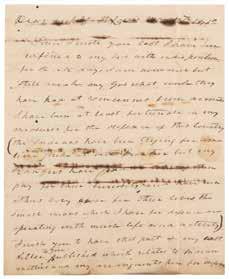
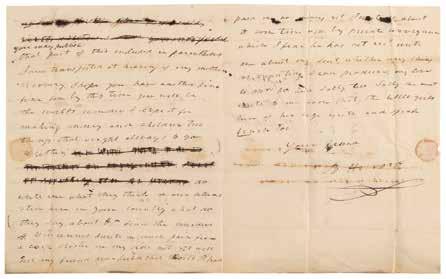
Benjamin Howard Autograph Letter Signed: “The Indians have been trying for some time to strike at our frontier but my Rangers have made many of them pay for their curiosity”
Politician and military officer (1760–1814) who succeeded Meriwether Lewis as governor of the Louisiana Territory from 1810 to 1812. ALS signed “B. Howard,” three pages on two adjoining sheets, 8 x 10, May 13, 1812. Handwritten letter to Robert Wickliff in Lexington, Kentucky, in part: “Since I wrote you last I have been confined to my bed with indisposition for 12 or 15 days. I am now well but still weak. My God, what work they have had at Vincennes from accounts. I have been at least fortunate in my measures for the defence of this Country (the Indians have been trying for some time to strike at our frontier but my Rangers have made many of them pay for their curiosity, and have run others…for their lives; the small means which I have for defence are operating with much life and activity). I wish you to have that part of my last letter to you published which relates to Indian matters
and my arrangement here for defence. You may publish that part of this…in parenthesis.
I am transported at hearing of my mother’s recovery. I hope you have another fine fine son by this time. You will be the world’s wonder I expect for making money and children—two things that ought always to go together. Do write me what they think of our situation here in your country. What do they say about Hon. since the murders of Vincennes. I write in much pain from a large blister on my side not yet well. Tell my friend Warfield that Doctr. P. has paid me no money yet. I [asked] about it some time ago by private conveyance which I fear he has not recd. Write me about my suit, whether any thing is wanting I can produce; my love to Mrs. W. and Sally. Tell Sally she must write to me soon, that the little girls here of her size write and speak French too.” In very good condition, with a split horizontal fold to the first page, scattered small stains, and some ink erosion affecting the crossed-out words of text.
Starting Bid $200
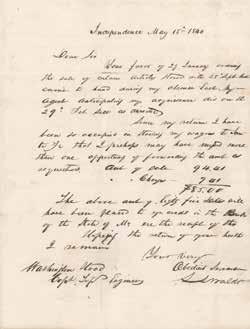
“Starting my wagons to Santa Fe”— a Missouri trader reports sale proceeds to U.S. Army Topographical Engineers in the spring of 1840
Santa Fe Trail: S. S. Waldo Autograph Letter Signed (1840)“Starting my wagons to Santa Fe”
ALS, one page, 7.5 x 9.75, May 15, 1840. Addressed from Independence, Missouri, a handwritten letter to Washington Hood, captain of the Topographical Engineers, enclosing an auctioneer’s bill of sale of public property left in his possession, in part: “Your favor of 29 January ordering the sale of certain articles stored with 28 Sept last came to hand during my absence East. My agent anticipating my acquiescence did on the 29th Feb. sell as directed. Since my return I have been so occupied in starting my wagons to Santa Fe that I perhaps may have missed more than one opportunity of forwarding the amt as requested.” Waldo calculates the total charge. “The above amt of Eighty five Dolls will have been placed to yr. credit in the Bank of the State of Mo. ere the receipt of this.” In very good to fine condition, with old tape repairs to the integral address leaf.
Starting Bid $200
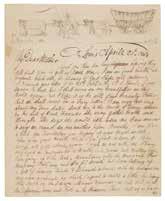
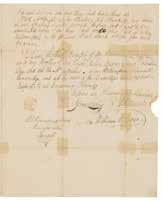
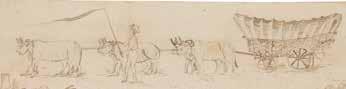
William Wilson Autograph Letter Signed on an Overland Journey with the American Fur Company and Trade with the Indians, with Wagon Train Sketch
ALS signed “Your Loving & Affectionate Son, William Wilson,” three pages on two adjoining sheets, 7.25 x 9, April 23, 1843. Handwritten letter to his mother in Glasgow, Scotland, relating his plans to work as a carpenter for the American Fur Company traveling up the Missouri and into the Rocky Mountains. At the top, he sketches a charming drawing of a man driving six oxen pulling a Conestoga wagon. Rich in small details, the sketch also depicts a gravestone by the side of the trail, a familiar sight to travelers on the Great Plains. In part: “I have engaged as Carpenter for 15 months to a coarse but healthy life. I am going up the Rocky Mountains with the American Fur Company. I will only have $10 pr month but I am takeing up a lott of jewelry, beads and ribands to traid with the Indians on my own account, by which I expect to make a little. The company will start on the Omega steamer tomorrow, we will call on all the different towns and forts on the Missouri River, saill up as farr as it is navigable that is 5 miles up the Yellow-Stone River. About 2000 miles then on mules I expect above one thousand miles through the different Indian Nations, feed on nothing but bufflo meet 3 times a day. Traid is very dull in St. Louis, if it is not better when I come down I will either come home or go to South America.” He notes that he has sent a parcel along for the family containing various gifts, including “Indian shoes decorated with beads for my Uncle Williams, a little silk parrasoll for my Sister and a book for my brother John.” In very good condition, with small old tape repairs throughout.
Starting Bid $200
LOT 6015
William Wilson Autograph Letter Signed:
“My wheat crop, the only cash article of produce, in this part of the country, has been a compliet failure”
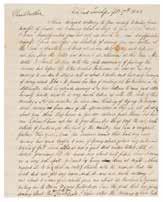
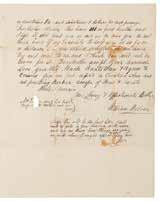
ALS, three pages on two adjoining sheets, 7.75 x 10, September 17, 1848. Addressed from Richland Township, Pennsylvania, a handwritten letter from William Wilson, an agent for the milling firm of Hoover and Frick, sent to his brother in Glasgow, Scotland, in part (spelling and grammar retained): “My wheat crop, the only cash article of produce, in this part of the country, has been a compliet failure this year, some few hundred neabors round that had very early sowing has good crops, 5 acers of spring wheat looked very well, and 11 acers of fall wheat altho it was a good deal winter killed, still it looked promising till the heads were about half filled when it came on a very wet spell, followed by heavy dews at night, which cause it to be (what we call) struck with the rust, so that the head did not fill any more, and it was not worth cutting. I cut about 5 acers of it, which gave me about 10 buchell. I finished puting in 16 Ble on 10 acers yesterday. I am the first that has finished sowing about this part o the country, so I hope in the Blessing of God that we will have a better harvest next year.” In very good to fine condition, with small stains, and small areas of paper loss, to the intersecting folds.
Starting Bid $200
Gold Rush-era 1850 San Francisco market broadside listing prices for everything from breads, candles, and fruits to opium, morphine, and arsenic
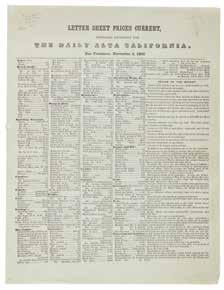
Gold Rush: The Daily Alta California Current Price Market SheetListing Opium, Morphine,
Gold Rush-era market report broadside entitled “Letter Sheet Prices Current, Prepared Expressly for The Daily Alta California, San Francisco, November 1, 1850,” one page, 8.25 x 10.75, serving as an early commercial price list printed for merchants and traders in San Francisco. Prices are listed alphabetically for “Ashes,” “Bread Stuffs,” “Building Materials,” “Candles,” “Cigars,” “Coal,” “Cordage,” “Dry goods,” “Drugs & Dyes,” “Fruits,” “Groceries,” “Hardware,” “Leather,” “Liquors,” “Preserved Meats &c,” “Provisions,” “Paints and Oil,” “Soap,” “Stationery,” “Teas,” “Tobacco,” and “Miscellaneous articles.” Portions of the final column, “Review of the Markets,” read, in part: “Flour has been steadily declining and may be considered nominal…Bricks are firmer and may be quoted at $25 @ $30 per thousand, as to quality…Coffee-Fresh arrivals have reduced the price…Cigars can be bought on better terms…The Pork was considered a little rusty, and brought from $21 @ $23…Boots are in fair request - but as the rainy season keeps back, purchases have been made at easier rates…Since our last a fair business has been done, until within a few days, the demand from the interior has fallen off on account of the sickness at and in the neighborhood of Sacramento City, and reports probably much exaggerated. Large quantities of goods arrive in bad condition — being badly prepared for a voyage through the tropics. Bales and other packages stowed directly under the deck are very frequently damaged by the sweat of the vessel, and barrels in the ground tier for want of good seasoned stuff, well secured with iron hoops…Gold Dust can be bought at less than $16, but most of what is offered is not as clear as is desirable.” In fine condition, with one trivial short edge tear. Issued for The Daily Alta California, one of the earliest and most important newspapers in San Francisco, this rare 1850 San Francisco ‘fly-sheet’ market report captures the volatile, supply-strained economy of the Gold Rush at its height—where luxury imports commanded extraordinary prices, everyday goods fluctuated unpredictably, and a rapidly expanding, globally connected marketplace struggled to meet the demands of a booming frontier city.
Starting Bid $200
“Robberys and Murders and tha are of everry Days ocurance and so common that people hardly think it worth Mentioning”—a roaming California miner sends 21 letters home detailing lawlessness, labor, and daily life in Gold Rush–era mining camps, 1851–1863
Gold Rush: P. J. Norton
Collection of (21)
Handwritten Letters on Mining Life in California, 1851-1863
Collection of 21 ALSs from P. J. (Putnam John) Norton, totaling 76 pages, written from various Gold Rush-era locations in California—including the North Fork of the American River, Beals Bar, Grass Valley, Sweetland, and North San Juan—dating from August 19, 1851, to February 26, 1863. The letters are addressed primarily to his daughter, Cordelia Norton, in Fremont, Sandusky County, Ohio, and trace Norton’s movements through mining camps and emerging towns across the Sierra Nevada during the height of the California Gold Rush.
Norton’s correspondence offers a vivid and continuous account of life in the mines, describing his labor blasting tunnels, the rough conditions of camp life, and the gradual development of society in the mountain settlements. He comments on lawlessness and vigilance committees, reflects on the high cost of provisions, and records the rhythms of daily life, from cooking and boarding arrangements to moments of isolation and hardship. Accompanied by two letters from Norton’s wife, Delia Ann, conveying family news, and 20 original mailing envelopes. In overall fine condition.
Read highlighted letters online at www.RRAuction.com.
Starting Bid $200
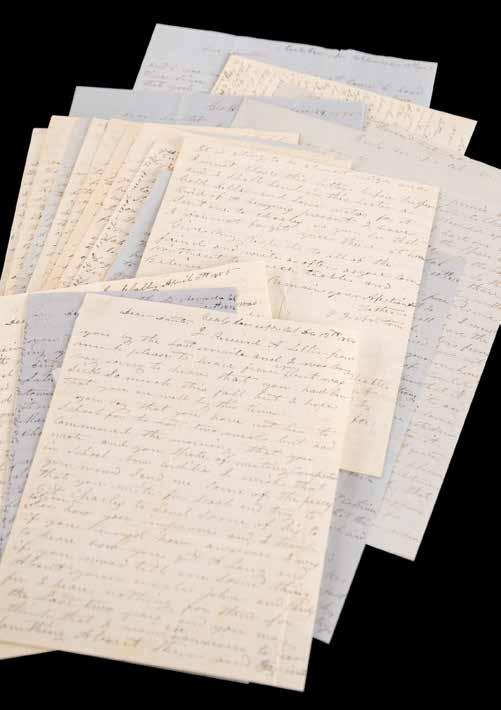
“There has been much sickness in this vicinity”— a young doctor writes from Foster’s Bar, Yuba County, on treating ailing miners through the California Gold Rush summer of 1852
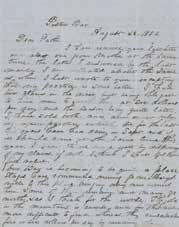
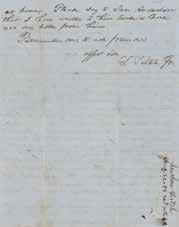
Gold Rush: Luther Fitch, Jr. Autograph Letter Signed - The Young Doctor on “much sickness” Among Miners at Foster Bar, California
ALS signed “L. Fitch, Jr.,” four pages on two adjoining sheets, 7.75 x 9.75, August 22, 1852. Addressed from “Fosters Bar” in Yuba County, California, a handwritten letter to his father, Judge Luther Fitch in Portland, Maine, in part: “I am situated about the same as when I last wrote to you, excepting that my practice is some better. I had two claims in the river but being obliged to hire men to work them at six dollars per day, and the season being quite late, I have sold both, and am now relying upon practice entirely. We for the last two years have had rain in Sept. and if it should come at the same time this year, I shall have done well by disposing of my claims, if not, I think I shall get their full value. Our Bar is becoming to be quite a place. Stages have commenced running from Marysville to this place, bringing many new comers here. Some of them remain, and many go north, & as I think for the worse. The gold in the mountains is coarse and for this reason more difficult to find, whereas, they could make five or six dollars per day by remaining here. I have just received a letter from Edward…He wants me to send him money… He think if he had a small sum he could make more by speculating, but speculations are very uncertain in any place, and in the west they have so liberal a way of tra[n]sacting business that if a man has not his wits about him, he is quite sure to be imposed upon…I have now concluded to start for home next March, not considering it safe to start in the fall after being in this country so long. If I can find anything to do by which I can gain a living at home I should much prefer to remain there, if not I must go where I can so do. I have had so hard a time in this country that I am inclined to think I can live anywhere now… The prospect for mining is not very good at present in the river. I have bank claims which I think will pay very well, but cannot work them until winter, and therefore I wish also to remain until spring. Many are coming across the plains this season and in the train are fifteen thousand turkeys which will soon arrive, and the man who brings them will make his fortune. They are worth two dollars per hen in Marysville. They are said to bear travelling better than any other animals. We have several gardens on the bar, furnishing us with cucumbers, watermellons, radishes & and all the garden vegetables which we have at home.” In fine condition. Accompanied by the original mailing envelope.
Starting Bid $200
LOT 6019
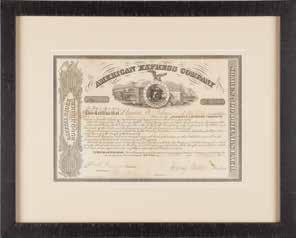
Henry Wells and William Fargo Document SignedAmerican Express Company Stock Certificate
Partly-printed DS, signed “Henry Wells” and “Wm. G. Fargo,” one page, 11.5 x 7.75, August 21, 1863. Handsomely engraved stock certificate for two shares in the American Express Company, issued to Hunloke W. Palmer of New York. Signed at the conclusion by Henry Wells as president, William Fargo as secretary, and Alex Holland as treasurer. Attractively double-matted and framed to an overall size of 17.75 x 14.25. In fine condition, with faint staining.
Starting Bid $200
LOT 6020
“There is gold in this country”— a Civil War deserter’s letters home from the Montana gold fields, 1864–1865
Montana Gold Rush:
P. D. Morris Archive of (10) Autograph Letters Signed - A Civil War Deserter’s Letters Home from the Montana Gold Fields: “There is gold in this country”
Archive of ten ALSs signed “P. D. Morris,” totaling 37 pages, mostly 5 x 8, dated from April 1864 to July 1865. Philip Doddridge Morris (18331865) graduated from the Hopedale Teacher’s College (Hopedale, Ohio) where he met his wife Sarah Howell, who he married in 1856. The Morris’s went west to Terre Haute, Indiana, where Phillip began his career as a teacher. During the Civil War, he was drafted into Indiana’s 43rd Infantry Division, but deserted and headed west along the Missouri River from St. Louis, Missouri to the Montana Territory where he tried to make a go of it as a miner. His letters reveal his uncertainty about his life choice and his longing for his family, as well as many details of the miner’s life at the Silver Creek mines, near Virginia City. His last letter details his resolve to return home, but tragically, on October 28, 1865, he died in Omaha, Nebraska, never again to see his wife Sally and “babies” as he affectionately called Emma and May.
Excerpts from some of the letters available to read online at www. RRAuction.com.
Starting Bid $300
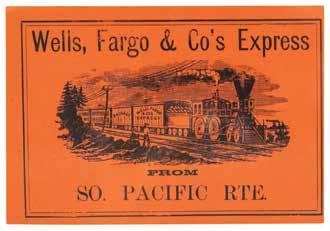
Original orange shipping label for “Wells, Fargo & Co’s Express, from So. Pacific Rte.,” 4.5 x 3, featuring a central illustration of a steam locomotive pulling train cars, one of which is marked “Wells Fargo & Co. Express.” In very fine condition. Issued circa 1870s–1890s, during the period when Wells Fargo operated as the leading express transportation company in the American West. Founded in 1852, Wells Fargo initially carried gold, currency, mail, and parcels via stagecoach before transitioning to rail service as western railroads expanded. Rather than operating its own trains, the company contracted with major lines—most notably the Southern Pacific Railroad—placing its own secure express cars aboard trains. Labels like this were affixed to shipments to indicate routing via a specific rail line.
Starting Bid $200
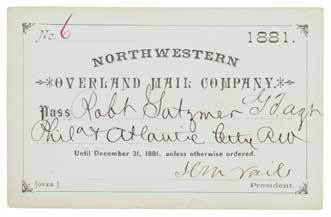
Partly-printed 4 x 2.5 pass issued by the Northwestern Overland Mail Company in 1881, marked as “No. 6,” issued to Robert Gatzmer of the Philadelphia and Atlantic City Railway, and signed by the firm’s president. Conditions and destinations are imprinted on the reverse, in part: “Good on following lines: Kansas.—Harper and Medicine Lodge, Harper and Kingman, Caldwell and Fort Sill, Dodge City and Fort Elliott. New Mexico.—Socorro and Fort Stanton. Dakota.—Terminus Northern Pacific and Miles City. Oregon.—Dalles and Prineville, Dalles and Baker City, Canyon City and Fort McDermitt, and all lines of the North-Western Overland Mail Co.” In fine condition.
Starting Bid $200
Stagecoach: 1893 California & Nevada Stage Co. Pass
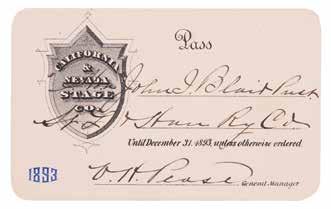
Partly-printed 4 x 2.5 pass issued by the California & Nevada Stage Co. in 1893, marked as no. “B259,” issued to “John I. Blair” as president of the St. Louis & Hannibal Railway Company, and signed in ink by the general manager, “O. H. Pease.” Conditions imprinted on the reverse read, in part: “This Pass is Not Transferable, and the person accepting it in consideration thereof, agrees to assume all risk of accidents and damages, whether by negligence of the Company’s Agents or otherwise.” In fine condition.
Starting Bid $200
“I spent a day talking forestry to a lot of politicians then straight home.
None of you know how much this summer has been to me after twenty years of solitude”
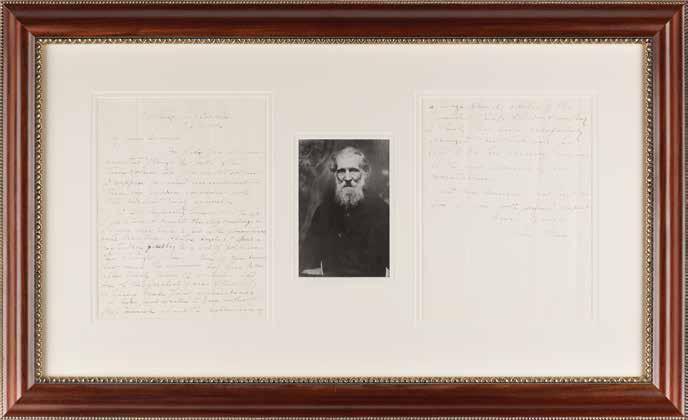
LOT 6024
John Muir Autograph Letter Signed: “I’m glad you all came unscathed t hrough the battle of the trainrobbers”
Naturalist and author (1838–1914) who helped establish Yosemite National Park. ALS, two pages, 8 x 10, October 14, 1896. Handwritten letter to General Henry L. Abbot, a surveyor and engineer who worked on the railroad through California and Oregon and later participated in the planning of the Panama Canal. In full: “I’m glad you all came unscathed through the battle of the trainrobbers. To you an old soldier I suppose it caused less excitement than my sudden encounter with that Humbold County squirrel. I felt desperately lonesome after you left. I got a team & drove to the cliff dwellings in a canon near town to put in the gloomy hours until train time. At Los Angeles I spent a day talking forestry to a lot of politicians then straight home. None of you know how much this summer has been to me after twenty years of solitude—and one of the greatest gains of the whole is having made
your acquaintance. I have just written to your brother & Prof. Hirsch about the publication of a biographical sketch of the lamented Philip Abbot & everything I think has been satisfactorily arranged. Our Club will be glad to do his memory honor—as the most admirable of our mountaineers. And now general don’t forget me.” Double-matted and framed with a portrait to an overall size of 32.5 x 19.5. In fine condition.
One of the first modern preservationists, John Muir’s activism was instrumental in the establishment of Sequoia and Yosemite National Parks. He wrote extensively about California’s Sierra Nevada Mountains and founded the Sierra Club, becoming a leading voice in the early conservation movement. In 1903, President Theodore Roosevelt famously visited Yosemite with Muir, who persuaded him that federal protection was essential to safeguard the valley from mismanagement and exploitation—an influence that helped shape the future of America’s national parks.
Starting Bid $200
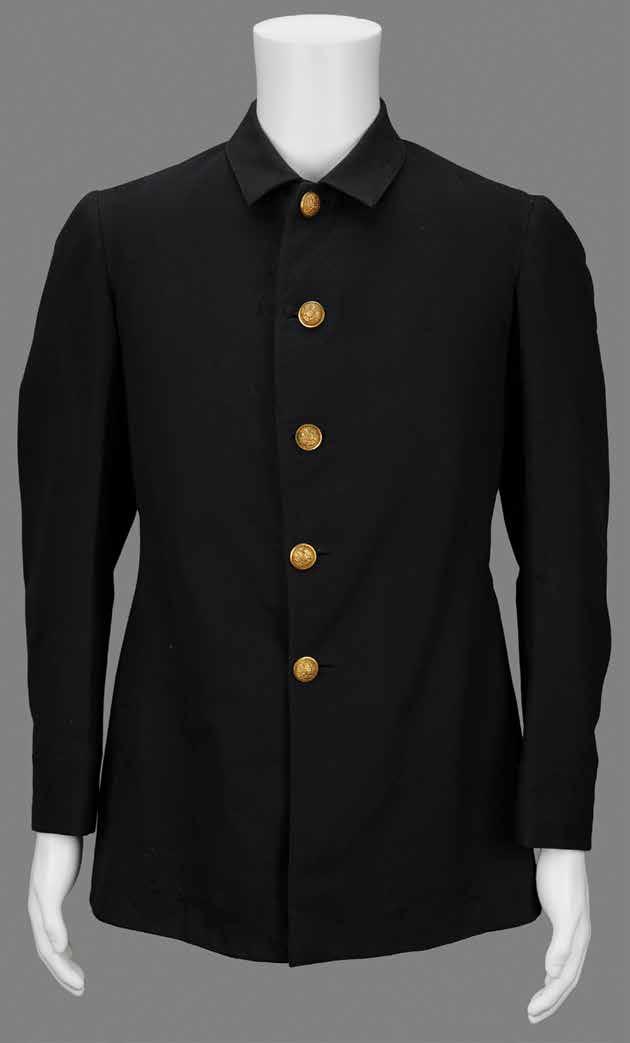
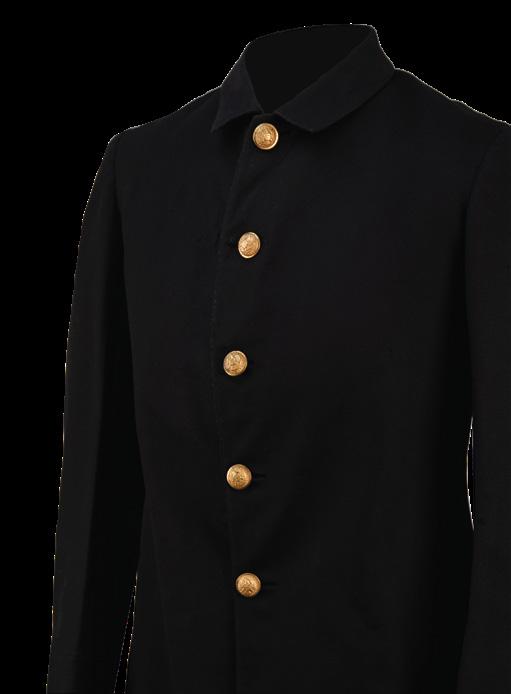
George A. Custer’s personally-owned standard-style five-button U.S. cavalry officer’s fatigue coat, almost certainly from the Fort Abraham Lincoln period (c. 1873–1876), retaining its five original brass buttons (marked “E. A. Armstrong / Detroit”) secured by their original stitching on the placket, plus three more buttons on each cuff. Sometimes termed a blouse or jacket, this style was introduced in 1872 and was custom-tailored, as was the case with virtually all officers’ uniforms; The Detroit-made buttons lend credence to the Custer provenance, as he would have likely had the jacket made by a tailor in his hometown, Monroe, Michigan. In very good to fine condition, with some small moth holes.
The coat is illustrated in Bugles, Banners and War Bonnets by Ernest L. Reedstrom (Caldwell, ID: Caxton Printers, 1977, p. 290), identified as “Custer’s 5 button blouse, Courtesy Dr. L. A. Frost Collection.” It was obtained by Dr. Lawrence A. Frost in 1950 from Howard B. Berry,
who declared in a notarized statement that it was one of the items which came to him in a trunk labeled “Col. Geo. A. Custer, 7th Cav.” Reportedly, Dr. Frost’s subsequent research determined that this trunk had gone missing around the year 1900 following a fire in the Custer family barn. Frost presented the items he had acquired from Berry to James Calhoun Custer—Nevin Custer’s son—who identified them as familiar pieces he had seen in his youth. He confirmed that his father had shown them to him and affirmed that they had once belonged to General Custer.
The coat also appears on a 1973 list by Dr. Frost of items from his collection which were for sale; a notarized 1993 affidavit from Elizabeth A. Lawrence states that she purchased the coat from Frost at that time. Photocopies of these documents are included. The coat was subsequently sold at auction in 1993 (Lot 274A, Brian Riba Auctions, 1993), and in 2012 (Lot 38581, Heritage Auctions, December 11–12, 2012).
Starting Bid $5,000
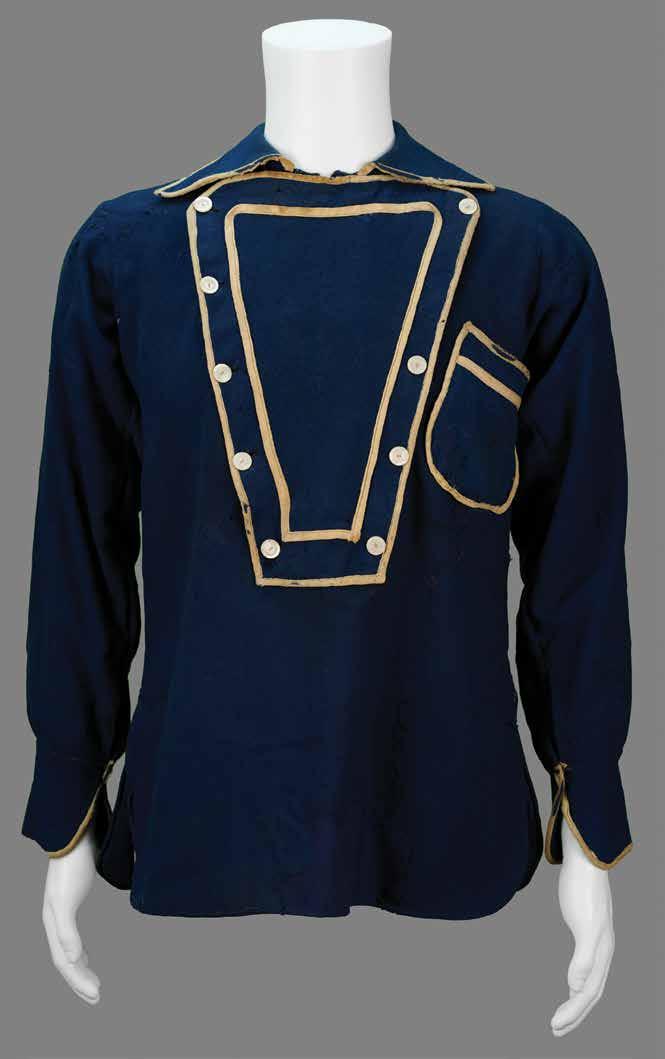
as seen in one of his most famous
George A. Custer’s Navy Blue Wool Bib Shirt, Worn in One of His Most Famous Photographs from the 1873 Yellowstone Expedition
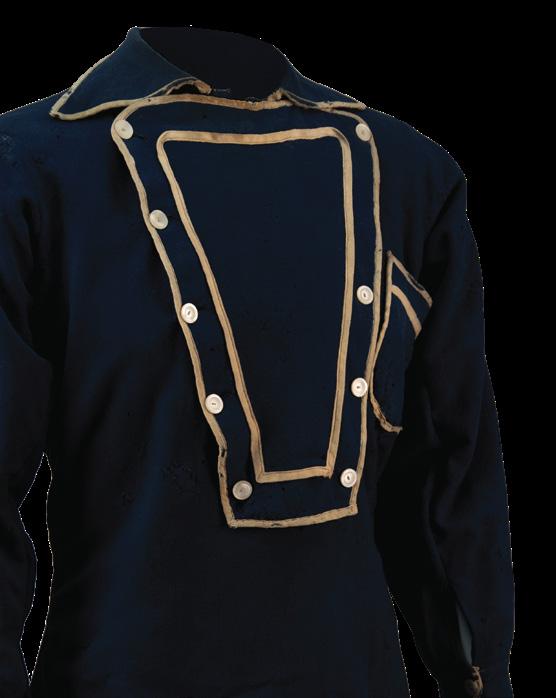
George A. Custer’s personally-owned navy wool bib-front shirt, worn during the Yellowstone Expedition of 1873 and seen in the famous photograph by William R. Pywell showing Custer with a slain 800-pound elk. Custer also reportedly wore this shirt during the 1874 Black Hills Expedition, during which gold was discovered—prompting a gold rush that escalated tensions with the Sioux and provoked the war in which Custer was to lose his life. The dark navy shirt features white trim (aged to a yellow-gold) on the bib, cuffs, breast pocket, and wide collar, with nine pearl buttons on the bib (one missing), plus matching buttons on each cuff. In overall good to very good condition, with some moth holes throughout and professional re-lining to repair some losses toward the bottom.
The shirt has been well documented over the years: it was given by Mrs. Custer to her husband’s orderly, from whom it was obtained by William O. Taylor, a 7th Cavalry veteran who had been with Reno at the Battle of the Little Bighorn, renowned as an early collector of Custer memorabilia. Between 1882 and 1920, Taylor donated a number of items to the Pocumtuck Valley Historical Association’s in Deerfield, Massachusetts, including this shirt, gifted in 1885 as recorded in the
museum’s original records. The museum eventually deaccessioned the shirt and it was acquired by famous Custer collector Alex Acevedo. Literature: illustrated in Boots & Saddles at the Little Bighorn: Weapons, Dress, Equipment, Horses & Flags of General Custer’s Seventh U.S. Cavalry in 1876, by James S. Hutchins (Fort Collins, CO: The Old Army Press, 1976, p. 22). Seen in Pywell’s photo listed as K-118/K118V in ‘Custer in Photographs’ by D. Mark Katz
Provenance: Lot 72 in the 1995 Butterfield & Butterfield “Important Custer, Indian War & Western Memorabilia” sale, which lists the provenance as “Elizabeth B. Custer/Acevedo Collection / William O. Taylor Collection, Pocumtuck Valley Memorial Association.” Subsequently sold at Heritage Auctions, June 22, 2013.
Worn by Custer during the Yellowstone and Black Hills Expeditions that intensified conflict with the Sioux, this shirt represents a rare, tangible link to one of the most mythologized figures of the American frontier—embodying the intersection of exploration, military ambition, and the cascading consequences of westward expansion. Its direct association with a well-known photograph further elevates its significance, anchoring it visually within the historical record. Coupled with its strong, traceable provenance through early Custer collectors and institutional stewardship, the piece stands not only as a personal relic of Custer himself, but also as a witness to the broader narrative that culminated in the Great Sioux War and the Battle of the Little Bighorn.
Starting Bid $5,000
See the 1873 photograph by William R. Pywell showing Custer in this shirt - Lot 6027
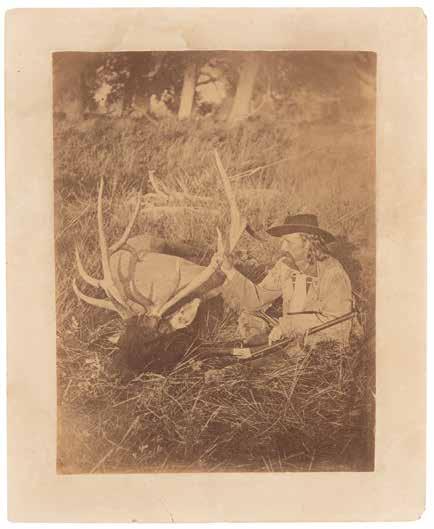
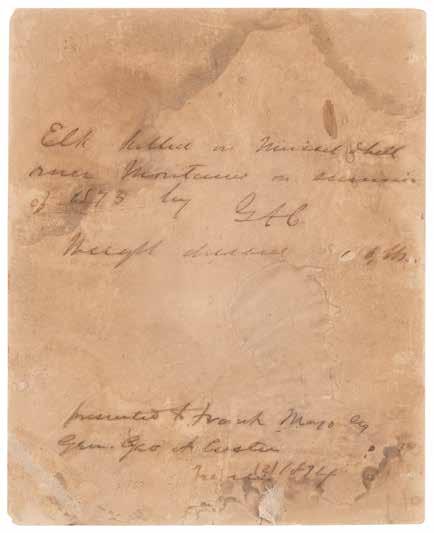
“Elk killed on
river Montana in summer of 1873 by GAC”
Extraordinary 6 x 8 albumen photo of George Armstrong Custer posing with a trophy from his Yellowstone Expedition of 1873, taken by the expedition’s official photographer William R. Pywell, affixed to its original 8 x 10 mount, captioned and signed on the reverse in ink by Custer, “Elk killed on Mussel Shell river Montana in summer of 1873 by GAC. Weight dressed [800] lbs.” Annotated at the bottom in another hand: “presented to Frank Mayo Esq., Gen. Geo. A. Custer. June 21, 1874.” In very good condition, with moderately heavy staining to the signed side, and professionally repaired tear to the borders of the mount on the image side.
The Yellowstone Expedition of 1873 was part of a series of military-led surveys into the Northern Plains and Yellowstone region, undertaken to protect railroad survey crews and assert U.S. presence in contested territories. Led by General David S. Stanley, with Lt. Col. George A. Custer commanding the 7th Cavalry, the expedition combined scientific exploration with military escort duties. Accompanied by geologists, naturalists, and photographer William R. Pywell, the party
documented the landscape, wildlife, and Native American life while navigating ongoing tensions with Lakota Sioux forces.
According to the Smithsonian Institution’s National Anthropological Archives, Custer described posing for this photograph in an extract from a letter to his wife, sent September 6, 1873: ‘I have had the good fortune to kill a fine large buck elk…weighing cleaned eight hundred pounds, and with the handsomest pair of antlers I ever saw, and such a beautiful coat. I killed him only a mile and a half from camp, sent for a wagon, and carried him entire back with us, when the officers and men, and even those belonging to the scientific party, flocked to the grassy plot in front of my tent to see him. The photographer who accompanied the scientists hitched up his photograph-wagon and drove over to take a picture of what they called the ‘King of the Forest.’ All the officers and the photographer insisted that not only the game but the hunter should appear in the picture. So I sat down, dressed as I was in my buckskins, resting one hand on an antler, and you may judge of the immense size of the elk when I tell you that as I sat there my head only reached to about half the height of the antlers.’
Starting Bid $500
See Custer’s wool bib shirt from this photograph - Lot 6026
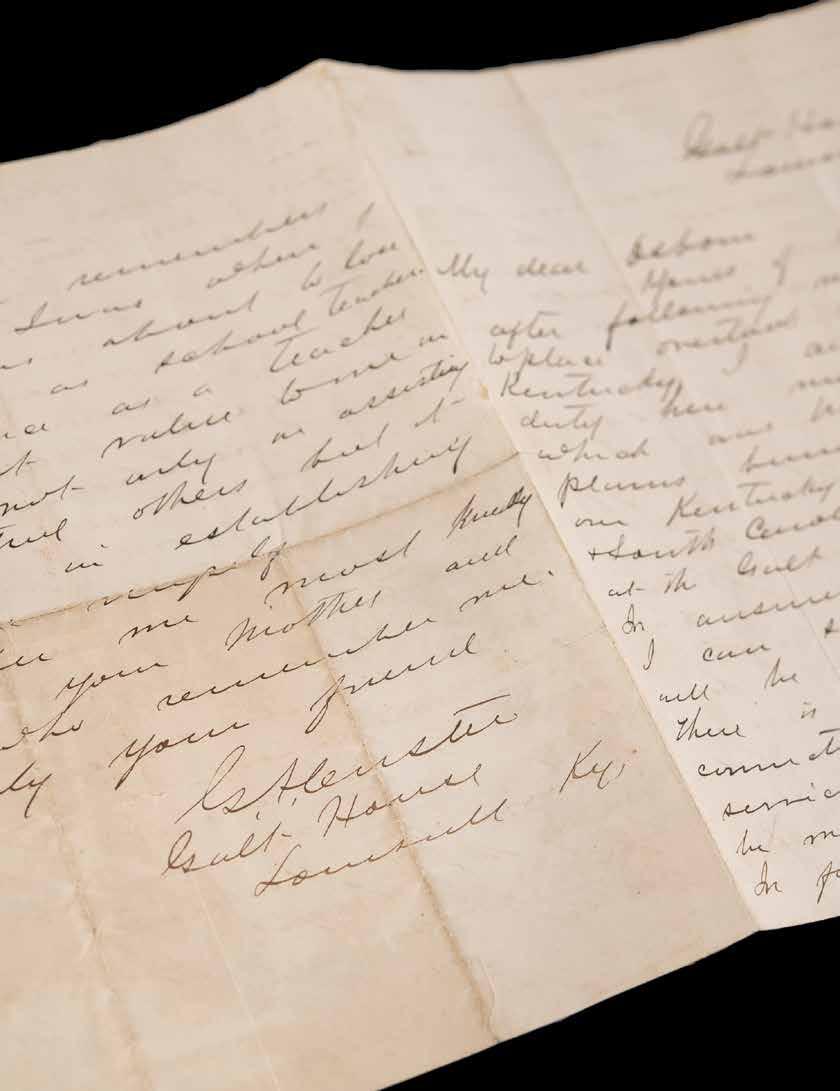
“In regard to the prospects for a young man in the West—I would recommend all young men whether with limited capital or not to locate West of the Missouri since Kansas offers great inducements to the young man possessing energy and determination”
George A. Custer Autograph Letter Signed on the Limitless Possibilities of the American West, Urging a Young Man to “to locate West of the Missouri”
ALS signed “G. A. Custer, Galt House, Louisville, Ky.,” four pages on two adjoining sheets, 8 x 10, September 4, 1871. Handwritten letter to “Osborn,” offering his own version of the immortal advice to ‘Go West, young man.’ In full: “Yours of May 30th after following me from place to place overtook me here in Kentucky. I am now on duty here my command which was brought from the plains being distributed over Kentucky Louisiana North & South Carolina. I am located at the Galt House Louisville Ky. In answer to your inquiry I can say nothing which will be satisfactory to you—there is no place or position connected with the government service here which could be made available for you. In fact we have but few unemployed companies with the members kept on the plains. If I was in the West I would be in a position to accommodate you.
In regard to the prospects for a young man in the West—I would recommend all young men whether with limited capital or not to locate West of the Missouri since Kansas offers great inducements to the young man possessing energy and determination. Every one there who is so disposed betters their fortunes. Opportunities for investment in land and cattle are constantly offering themselves. I know of several young men who have cast their lot in Kansas on my advice all of whom are prospering in their worldly affairs. Land can be obtained at very low figures while the issuance and constant flood of emigration pouring into the Western position of the State causes a steady advance in the prices and renders successful sales of land pleasant and easy. The Neosho Valley, the Solomon and Republican Valleys and Southwest Kansas genuinely all offers some opportunities for investment. You can scarcely go amiss in any of these localities.
I am sorry your letter did not give me more details concerning the other members of your family. I would travel a long distance to see Mollie again. My recollection of her is one of the bright spots of my life. I hope she has not forgotten me. I would like to see your mother again. I wonder if she remembers how troubled I was when I thought I was about to lose my situation as school teacher. My experience as a teacher was of special value to me in after life not only in assisting me to control others but It aided me in establishing control over myself. Remember me most kindly to Mollie, your Mother, and to all who remember me.” In fine condition, with some toning to the signed page, and professionally silked on the two inner pages.
Just six years after the Civil War, Custer had shifted from his celebrated role as a Union cavalry commander to his controversial post as a lieutenant colonel in the 7th U.S. Cavalry, engaged in Reconstruction-era duties and the ongoing U.S. Army campaigns on the western frontier. Stationed temporarily in Louisville as his regiment was dispersed across the South to suppress the Ku Klux Klan and break up illicit distilleries, Custer’s remarks reflect the era’s powerful cultural and economic pull toward westward expansion. His encouragement to seek opportunity “West of the Missouri,” particularly in Kansas, echoes the popularized ethos of Manifest Destiny and Horace Greeley’s famous exhortation to ‘Go West, young man,’ while also revealing the speculative optimism surrounding land, cattle, and migration in the postwar years. At the same time, the letter offers a more personal glimpse of Custer—only five years before his death at the Battle of the Little Bighorn—balancing his frontier military responsibilities with nostalgic reflections on his earlier life.
Starting Bid $1,000
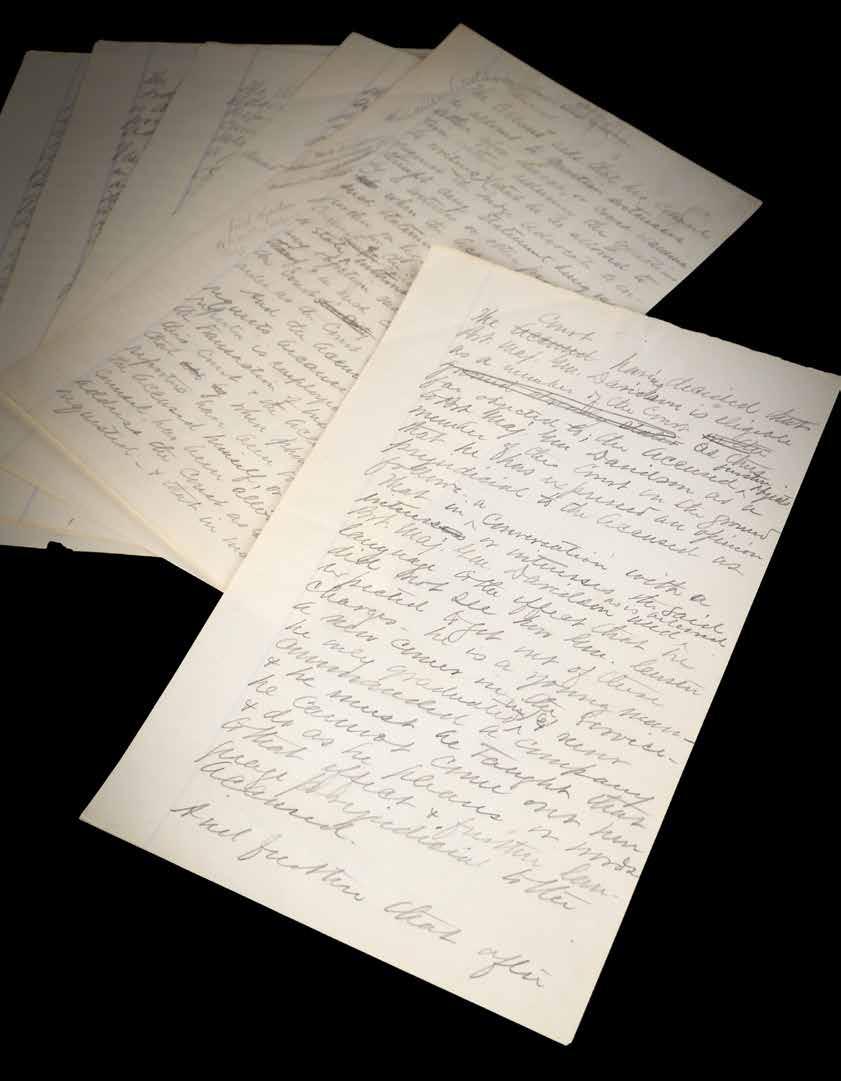
“Bvt. Maj. Gen. Davidson as is witnessed used language of the effect that he did not see how Gen. Custer expected to get out of these charges—he is a young man— a new comer in the service—he only graduated in /61 never commanded a company & he must be taught that he cannot come out here & do as he pleases”
George A. Custer Autograph Manuscript Signed, Preparing His Defense While Facing Court-Martial at Fort Leavenworth for Shooting Deserters: “He must be taught that he cannot come out here & do as he pleases”
Third-person AMS in pencil, signed within the text, “Gen. Custer,” seven pages on six sheets, 8 x 12.5, no date but circa September 1867. Facing court-martial at Fort Leavenworth, Kansas, for ordering the shooting of deserters, George A. Custer carefully drafts his defense. Custer writes, in full: “The court having decided that Bvt. Maj. Gen. Davidson is eligible as a member of the court as thus far objected to; the accused further objects to Bvt. Maj. Gen. Davidson as a member of this court on the ground that he has expressed an opinion prejudicial to the accused as follows.
That in a conversation with a witness or witnesses the said Bvt. Maj. Gen. Davidson as is witnessed used language of the effect that he did not see how Gen. Custer expected to get out of these charges—he is a young man—a new comer in the service—he only graduated in /61 never commanded a company & he must be taught that he cannot come out here & do as he pleases, in words to that effect & further language prejudicial to the accused. And further that after having been detailed as a member of this court who said Bvt. Maj. Gen. Davidson did make enquiry in regard to the merits of the said accused as is believed & did ask how he the said accused stood in his Regiment in words to that effect all of which the accused feels is to his prejudice for a fair & impartial trial.
The accused states that the order which he here presents is the order referred to in the point conceded by the Judge advocate during the course of the Prosecution, as not having been received by the accused in time to reach Gen. Hancock as herein ordered at Fort Wallace the failure to receive being due to the capture & killing of Lieut. Kidder who bore this order. All of which has been admitted by the Judge advocate for the Prosecution. The accused asks that his counsel be allowed to question witnesses either upon direct, or cross examination without reducing the questions to writing) (that he be allowed to request the Judge Advocate to interrupt any statement being made by a witness or other person present when the accused objects to such statement proceeding any further on legal grounds) (& that the counsel for the accused be allowed to state directly to the court & without reducing to writing any objection made & to grounds thereof, & in such cases to address the court subject to such rules as the court may provide—) (Brief objections to be written when long)
And the accused makes these requests because a phonographic reporter is employed to facilitate the transaction of miscues upon this court & the accused believes that when phonographic reporters have been so employed the accused himself, or by his counsel, has
been allowed to address the court, as above requested & that in such way the accused is allowed the same privileges upon the part of the Defense as are allowed to the Judge Advocate for the prosecution. And the Accused represents that if these requests be denied the Prosecution will be allowed a greater benefit than the Defense in that it will be permitted to cross-examine witnesses directly & to make its own statements directly & that moreover the objections of the accused will not at times be regarded unless he can directly state such objections to the court. And the Accused believes that hereby the business of the court will be expedited & that the dignity of the court will not be impaired. The Accused desires the Judge Advocate in presenting this Deposition to state the circumstances under which it was taken & to make that statement a part of the record. Last night, the Bvt. Maj. Gen. Cmd. the Department asked the accused, through his counsel, to permit Major Elliott to return to Fort Harker, Kas, as he was required at that post on urgent public business. The accused objected to this as he apprehended that the Court would prefer to have Maj. Elliott examined upon these points in open court but subsequently yielded to the request of the Bvt. Maj. Gen. upon further consultation with his counsel and the Judge Advocate. But he still desires it to be understood that he wished Maj. Elliott to be placed upon the stand in order that he could be subject to the fullest examination upon these points that might be thought necessary. The Accused states that he would now be able to close the testimony for the Defense but for the absence of these witnesses that the Judge Advocate was notified to produce these witnesses from the beginning of the trial & especially so last Saturday, that it is believed he has used diligence in procuring their attendance that the witnesses have been here & were allowed to go away & are expected tonight or tomorrow morning.” In fine condition.
Following Major General Winfield Scott Hancock’s expedition against the Cheyenne that achieved little and contributed to instability in the region, Custer was arrested and tried at Fort Leavenworth between mid-September and early October 1867, facing charges tied to his absence without leave and his harsh orders for the execution of deserters. In this document, Custer emerges not as the triumphant Civil War cavalryman, but as an embattled officer navigating a deteriorating command environment—marked by high desertion rates, poor communication (including the fatal loss of Lt. Kidder carrying orders), and shifting leadership under generals Hancock and Sheridan. His detailed procedural objections and emphasis on fairness reflect his awareness of the stakes and his attempt to justify controversial actions within a broader culture of frontier military discipline, where even the shooting of deserters could be defended as sanctioned practice. As such, the manuscript is significant not only as a rare firsthand defense statement, but as a vivid artifact of the Army’s struggle to impose order in the volatile post–Civil War West, capturing the moment when Custer’s aggressive leadership style collided with military law and nearly derailed his career.
Starting Bid $1,000
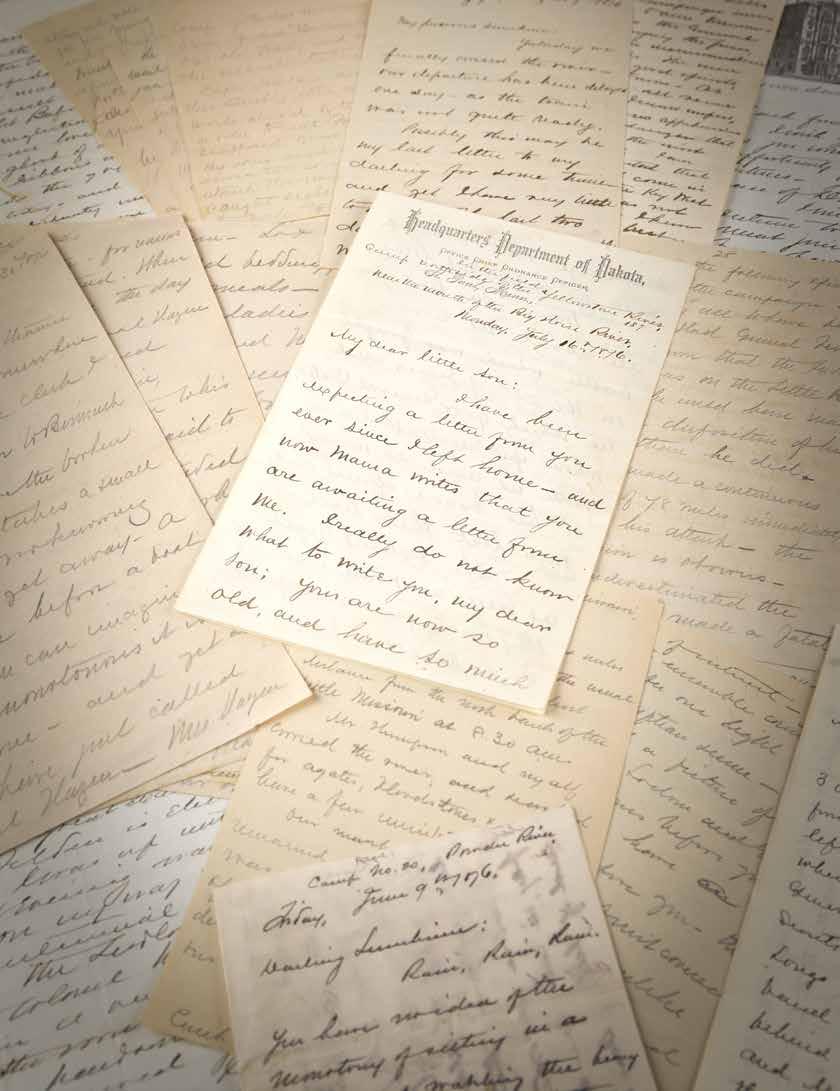
“All admire Custer’s dash, spirit, courage—and only criticize his judgement so far as Indians are concerned”
Archive of Capt. Otho Michaelis - (29) Letters: “All admire Custer’s dash, spirit, courage— and only criticize his judgement so far as Indians are concerned”
Archive of 29 autograph letters signed by Captain Otho Ernest Michaelis, most signed “Otho,” addressed primarily to his wife Kate and occasionally to his son, totaling over 100 pages, mostly 5 x 8, dated from May 17, 1876, to November 9, 1876. These letters constitute the most sustained and analytically penetrating eyewitness account of the 1876 Little Bighorn campaign known to exist in private hands, written by the Ordnance Officer of the Seventh Cavalry who marched with Custer from Fort Abraham Lincoln, remained with Terry’s column when Custer rode south to his death, and was among the first men to reach the battlefield on June 27th to help identify the dead.
In early 1876, the Army of the United States launched a three-pronged campaign to force the Sioux and their allies back onto the reservation. Colonel John Gibbon marched east from Fort Ellis, Brigadier General George Crook moved north from Fort Fetterman, and Lieutenant Colonel George Armstrong Custer led the Seventh Cavalry west from Fort Abraham Lincoln. Michaelis, as Ordnance Officer, marched with Custer from the first step. His letters open on the morning of departure, May 17, describing reveille at three in the morning, the Indian scouts singing, the band playing “The Girl I Left Behind Me,” Libbie Custer riding at the head of the column before turning back with the paymaster. The letters track every mile of the westward march—the struggle to push Gatling guns through the badlands, eight creek crossings and five bridges built in a single day on Davis Creek, and Custer’s reconnaissance parties probing ahead into increasingly hostile country. By early June the correspondence reflects growing impatience and strategic complexity. The three-pronged convergence was already breaking down—Gibbon unable to hold his position, Crook’s command turned back at the Rosebud on June 17—while Michaelis tracks the movements of the Far West steamer up the Yellowstone and Reno’s reconnaissance up the Powder River. On June 8 he writes: “I am glad I am going on this scout for I want to see an Indian campaign… General Custer does not think that we shall strike any Indians. We are going into the country near which the Crazy Horse fight took place last winter General Custer however does not think that the Indians would remain there. He thinks that they are on the Yellowstone.” On June 12, he discusses the movements of Marcus Reno: “Reno’s right wing of the 7th Cav’y with one Gatling gun went up Powder river on the 9th—are then to strike across to Tongue River—near where the Indians are supposed to be camped.” On June 22, three days before the battle, writing from the Far West near the Rosebud: “Custer is about to leave with his full regiment...He will march to the Little and
Big Horn—where the Indians are now supposed to be. General Gibbon is on board, but his column is marching for the Big Horn on the left bank. We shall steam up the same river. My impression [is] that this last plan—after its execution, will end the campaign.” His next letter is dated July 16—three weeks after Custer’s death—written to his young son, gently explaining what had happened to General Custer: “Mama has told you all about the terrible battle which was fought on the 25th of June, and in which poor General Custer, whom you recollect dining with us, and so many of his brave officers and men lost their lives. The Indians fight as well as white men—they have guns and pistols, and besides bows and [arrows] which they use with great dexterity, and with fatal effect. They are expert horsemen, and can do almost anything on the saddle.” By late July and into August, the correspondence reflects the army’s efforts to recover its footing. Michaelis tracked the arrival of reinforcements, the resumed pursuit of Sitting Bull and Crazy Horse, the internal tensions between Terry and Crook over strategy and glory, and the gradual dissolution of the campaign as the Indians scattered. On August 7, before the command moved again, he expresses hopes of revenge: “I hope we may meet the savages, and give them a good drubbing. They will fight though when pushed, and fight well, three men went ashore from the Far West the other day at Powder River, and were attacked by six Sioux. One, bolder than the others, rose close up to our men, wounded one to the death, and was himself shot from his pony by one of the survivors. One the ground, mortally shot, he just tried to crawl to the dying white man to scalp him. He did not succeed. In his possession was found a carbine taken at Custer’s fight.” On August 18, after a skirmish with hostiles near Powder River, he describes giving his horse the spurs and rushing through ravines toward the column, not daring to show himself on the bluffs: “Some friendly Indians were a mile or so behind us. We heard a shot on our right. The Indians galloped away...The only time to run from Indians is before they see you.” Shortly afterward he was injured and evacuated aboard the Far West. Within in the collection is a few pages of an autograph manuscript written for public consumption and intended for Whitelaw Reid at the New York Tribune—several letters include explicit instructions to forward passages to Reid—in which Michaelis analyzes Custer’s defeat: “He underestimated the enemy, and made a fatal mistake in dividing his command, and thus permitting the enemy to defeat him in detail…All admire Custer’s dash, spirit, courage—and only criticize his judgement so far as Indians are concerned.” The archive concludes with letters from the Philadelphia Centennial Exhibition in November, where Michaelis attended the closing ceremonies as a member of both the Seventh Cavalry and the American Society of Civil Engineers, and noted almost in passing that Tilden appeared to have won the presidency. In overall very good to fine condition, with edge tears to a few letters.
Starting Bid $5,000
of government property from the post”
George A. Custer Autograph Telegram Signed, Maintaining Order on the Dakota Frontier Two Months Before the Battle of the Little Bighorn
ALS in pencil, signed “G. A. Custer,” one page, 7.75 x 9.75, April 12, 1876. Handwritten draft of a telegram to “Hon. A. H. Barnes,” sent from “Fort Lincoln, D.T.,” two months before Custer’s death at the Little Bighorn. In part: “A large number of parties in and near Bismarck have been arrested and charged with committing… thefts of government property from the post. They and their friends are making strong efforts to secure the removal of U.S. Commissioner Jackman before whom all these cases have been taken. If he is removed I believe the public interests will suffer and that the guilty parties alone will gain by any change.” Signed at the conclusion by Custer as commander of the post, and initialed twice, “G.A.C.,” in the lower corners, authorizing a charge at “gov’t rate” and requesting a copy of the message. In fine condition.
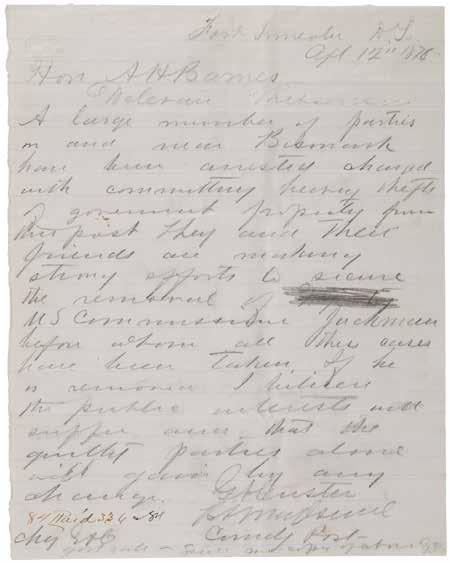
Written from Fort Abraham Lincoln in April 1876, this telegram draft reflects the disorder that followed the Black Hills gold rush, when theft, corruption, and defiance of federal authority were common across the Dakota Territory. As commander of the post, Custer found himself enforcing law and protecting government interests in a region where civil institutions were often overwhelmed. Composed only weeks before he departed with the 7th Cavalry on the campaign against the Lakota and Cheyenne, the document belongs to the closing chapter of Custer’s career. It captures him still engaged in the daily responsibilities of command, attempting to impose order on a volatile frontier, just before his march west and his death at the Battle of the Little Bighorn fixed his place in American history.
Starting Bid $500
A. Custer, captured circa 1865 by “Alex. Gardner, Photographer of the Army of the Potomac”
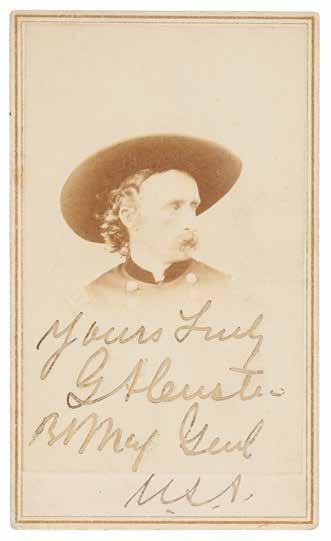
Image shown is larger than actual size.
LOT 6032
George A. Custer Signed Carte-de-Visite Photograph by Alexander Gardner
Sought-after 2.25 x 4 carte-de-visite photo of George A. Custer in his familiar cavalry uniform and wide-brimmed hat, neatly signed in ink by the subject, “Yours truly, G. A. Custer, Bt Maj. Genl., U.S.A.” The reverse bears the backstamp of “Alex. Gardner, Photographer of the Army of the Potomac,” with a small image of the United States Capitol. In fine condition, with unobtrusive surface loss to reverse.
Provenance: Lot 132, Fine Printed Books and Manuscripts Including Americana, Christie’s, June 21, 2013.
Starting Bid $1,000
George A. Custer Cabinet Photograph by J. A. Scholten
Outstanding original 4.25 x 6.75 cabinet photo of George Armstrong Custer standing in a full-length pose, clad in fringed buckskin clothing and holding a long rifle, affixed to its original studio mount, imprinted: “J. A. Scholten, St. Louis, Mo.” Listed as K-113 in ‘Custer in Photographs’ by D. Mark Katz. In fine condition.
In January 1872, Gen. George Custer assisted in guiding a lavish buffalo hunt in Nebraska for Grand Duke Alexei Alexandrovich of Russia, featuring William F. ‘Buffalo Bill’ Cody and Lakota chief Spotted Tail as members of the party. In conjunction with the expedition, Custer and the Duke traveled to St. Louis, where they posed for portraits by photographer James A. Scholten in their hunting attire.
Starting Bid $300
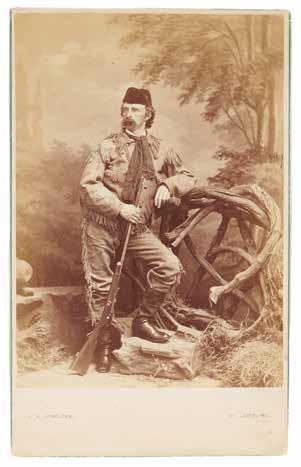
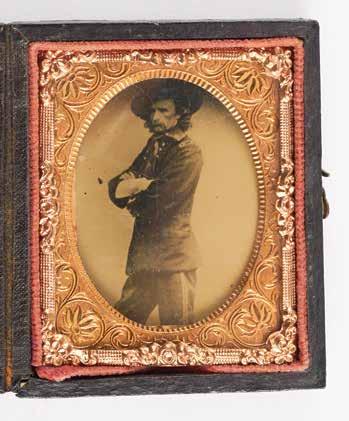
LOT 6034
George A. Custer Ninth-Plate Tintype Portrait by Mathew Brady
Appealing ninth-plate tintype portrait of George A. Custer as taken by Mathew Brady on May 23, 1865, measuring 1.5˝ x 2˝ within its 2.5˝ x 2.75˝ hinged case, showing the cavalryman standing with his arms crossed in a three-quarter-length pose—an iconic image captured while Custer was in Washington, D.C., to participate in the Grand Review of the Armies. This is a cropped version of the pose listed as K-79 in ‘Custer in Photographs’ by D. Mark Katz. In very good to fine condition, with a bit of fine crazing and slight lifting of the emulsion on the left side of the tintype.
Starting Bid $200
George A. Custer: Single Lieutenant of Cavalry Shoulder Strap, Marking His First Rank as a Graduate of
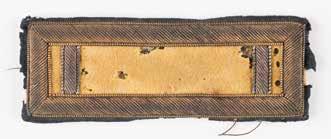
Single Lieutenant of Cavalry shoulder strap attributed to George Armstrong Custer, measuring 4˝ x 1.5˝, signifying his first rank as a fresh graduate of West Point at the outset of the Civil War. Custer graduated in 1861 from the United States Military Academy at West Point—famously ranking last in his class—and was commissioned a second lieutenant. He was assigned to the 2nd U.S. Cavalry Regiment and tasked with drilling volunteers in Washington, and was soon engaged in the defense of the capital at the First Battle of Bull Run. In very good condition, with some small bits of fabric loss to surface and edges, and significant loss to the backing. Provenance: part of lot 7 in the 1995 Butterfield & Butterfield “Important Custer, Indian War & Western Memorabilia” sale, which lists the provenance as “Acevedo Collection, Richard Reyes Collection, Charles A. Custer Family Collection.” Subsequently sold at Heritage Auctions, June 22, 2013. This lieutenant’s shoulder strap represents the very beginning of George Armstrong Custer’s meteoric—and highly unusual—military career, marking his commissioning as a second lieutenant at the outbreak of the Civil War. From this modest starting point, Custer rose with remarkable speed, earning rapid wartime promotions for gallantry: he advanced to brigadier general of volunteers by age 23 and later achieved the rank of major general. As such, this insignia embodies the foundation of Custer’s dramatic ascent.
Starting Bid $200
“The big bend of graves shows the way they fought back to the last stand”
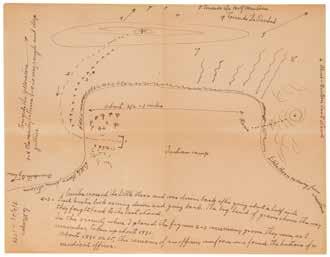
LOT 6036
[George A. Custer] Battle of the Little Bighorn Hand-Drawn and Annotated
Hand-drawn and annotated map of the Battle of the Little Bighorn by Casper Mayer of Troop G, 1st Cavalry, one page, 11 x 8.5, signed and dated in the lower left corner, “C. Mayer, 4/3/34—1888.” Mayer recalls the Little Bighorn battlefield from his time there in the late 1880s, sketching a map showing the flow of the “Little Horn” river coming down from the mountains, downstream “towards the Big horn,” with the “Indian camp” located in the “21⁄2–3 miles” area between river bends. Below, Mayer writes: “Custer crossed the Little Horn and was driven back after going about a half mile. 2–3. Trail Custer took coming down and going back. The big bend of graves shows the way they fought back to the last stand. In the vicinity where I placed the figures 2–3 were many graves. They were, as I remember, taken up about 1891. About 1891 or so, the remains of an officer’s uniform were found. The buttons of a medical officer.” In fine condition.
Starting Bid $200
“He put spurs to his horse, taking the bridle reins in his teeth, drawing both revolvers, and charged into the thickest of the fight...he made a noble stand, ‘and fought his last battle’”
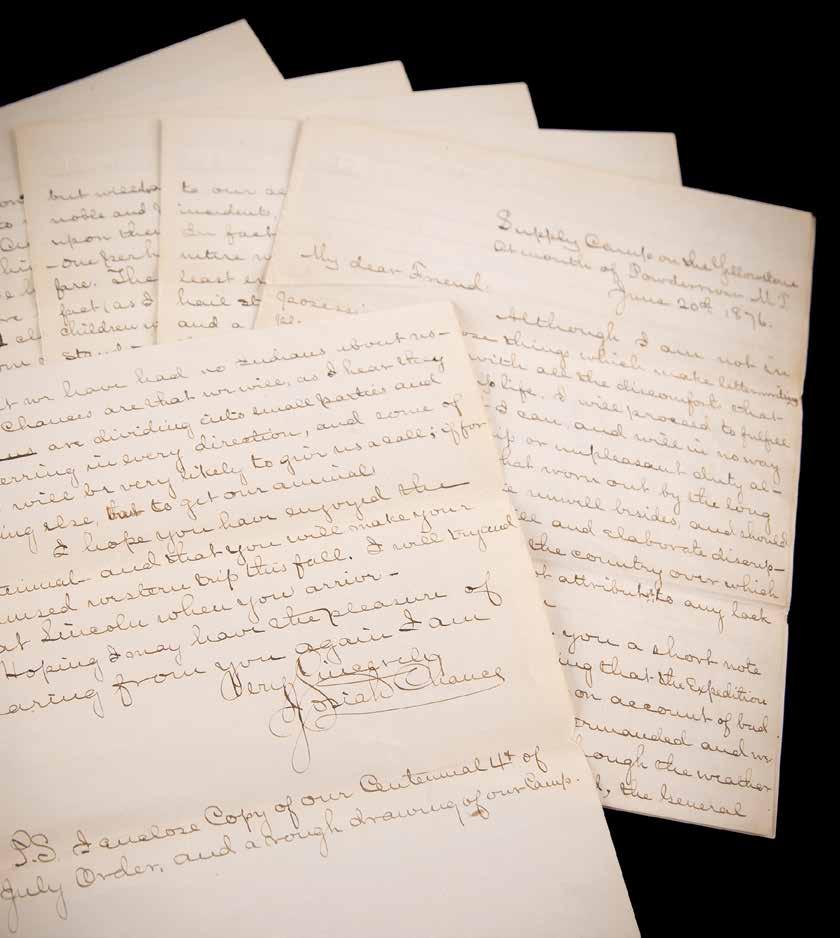
Josiah Chance Autograph Letter Signed on the Battle of the Little Bighorn - 23-Page Firsthand Account, Rife with Remarks on George A. Custer’s Bravery: “He made a noble stand, ‘and fought his last battle’”
ALS signed “Josiah Chance,” 23 pages, 7.75 x 9.75, June 20–July 5, 1876. Lengthy handwritten letter to a friend, written from the “Supply Camp on the Yellowstone, at mouth of Powder River, M.T.,” written over the course of two weeks, providing a remarkable firsthand, boots-on-the-ground account of the Battle of the Little Bighorn, fought on June 25–26, 1876.
In part: “I obtained some of the particulars of the late fight. Long before this reaches you, you will have received an account of the terrible slaughter, and as I have lost so many friends and noble comrades, that I sicken at the thought of their fate, and my heart is too full of sadness to write…If what I have already written was the whole truth, it would be less painful for me to write, but as it does not convey in the slightest, half, what the actual truth has proven, I will not at this time attempt to paint or describe the horrible scene. At present it is simply impossible for me to give a truthful account as I have not words sufficiently strong to paint the picture.It appears that Genl. Custer came upon the Indian Camp about noon on the 25 (June) with 8 Companies and Scouts, the balance of his command under Col. Benteen, being left some miles to the rear, as guard over the Pack-train. The Genl., thinking he had struck the lower end of their camp, detached Maj. Reno, with 3 Companies and Scouts (of which I have mentioned before) with orders to proceed to the upper end of their camp, cross the river and attack, and he in like manner would attack from below, and as soon as the Indians were driven, the Com’ds would unite, and act together. Maj. Reno at once proceeded to execute the orders given him, and at 1 o’cl crossed the river and made the attack—resulting as I have already stated in being driven back…Shortly after Reno’s departure the Genl. with 5 Companies, crossed the river, and charged upon what he supposed to be their camp, but which afterwards proved a decoy, an ambuscade.
The side of the river on which the Indians were encamped, some distance back from the bank was a heavy thicket of young willows and of which had been constructed hundreds of false teepees. In the willows beyond the Indians lay concealed, and as soon as the troops advanced beyond these teepees, they opened a murderous fire, unsaddling half the com’d at the first fire. It was at once evident to the General that instead of attacking them in flank, he had struck them in the center, where they quietly waited his approach, and opened fire when they had all this advantage. He soon gave orders to fall back, but from some cause not explained the order was not promptly obeyed, and seeing the critical condition of affairs, determined to leave his command if possible—and as quick as thought, he put spurs to his horse, taking the bridle reins in his teeth, drawing
both revolvers, and charged into the thickest of the fight, cheering his men, and succeeded by his presence and personal bravery, in coming off with 40 men and a number of officers—crossed the river, taking a position on a high butte where he made a noble stand, ‘and fought his last battle.’ This position was gained late Sunday evening, and he was no sooner in it than he found himself surrounded, cut off from water and closely pressed upon all sides, when night came to their relief and closed the fight for the day. No one will ever know the thoughts or feelings of that noble little band as they lay there that long night, surrounded by a savage and unrelenting foe, knowing that a few hours more their ammunition would be exhausted—and nothing but death waited them. On the following morning the struggle commenced again but no one knows how long they fought on the hour that closed the terrible slaughter—as there was not a living soul left out of the 5 Companies that followed Custer to tell the tale. They were all dead! Nine officers and 40 men with their chief lay dead, behind their horses which they had killed and used as breastworks. During the evening, (Saturday), Col. Benteen with the balance of the command succeeded in joining Reno, where they made a desperate fight all day Monday repulsing several charges and holding their position until the Indians gave up the fight, beating a hasty retreat, leaving all their dead (which was hundreds) and a great deal of supplies and camp equipage on the field.
The cause of their rapid flight was their seeing the advance Columns of Genl. Gibbons command, which soon arrived on the field and relieved our almost famished troops under Reno. It was not until after the arrival of Genl. Gibbon, that Reno learnt the fate of Custer and the 5 Cos. with him. The saddest and most heartrending scene was yet to be witnessed in the burial of our dead. Going over the ground, and in the deep ravines where our men had fought their body’s were found stripped of their clothing, scalped, mutilated and cut to pieces, and in many cases could not be recognized—having their heads cut off. The total number buried on the field, was 16 officers…4 civilians and 265 enlisted men. Number of Indians killed not known. From a ‘Crow Indian’ who was with Genl. Custer when he made his attack furnished all the information we have in regard to the fight. He succeeded in making his escape, at the time Custer fell back and recrossed the river, by stripping a dead Sioux of his clothes, and dressing himself in his costume and passed through the lines unobserved. He states shortly after the fight began he went to Genl. Custer and begged him to leave the field with him, as he knew they would all be killed, and that he was too brave a man to be killed in this way. He said the General started and went some distance with him, and all of a sudden he stopped still (with his back towards the Indians) dropping his head as if in deep thought, and remained in that position for some moments, when he went up to him, catching hold of his arm & motioned him to come. The General instantly turned shoved him away—turned his horse, took off his hat and charged back in the midst of the fight. He then left and he is today the only living being who last saw the noble and heroic Genl. Geo. A. Custer after he went into the fight.” In fine condition.Starting Bid $2,500
“It is very lonesome since you left”— a letter to Custer from his younger brother, who also perished at the Little Bighorn
Boston Custer Autograph Letter Signed to George A. Custer at Ft. Riley: “It is very lonesome since you left”
Scarce ALS signed “Bos,” three pages on two adjoining sheets, 5 x 8, October 21, 1866. Handwritten letter to “My dear brother & Sister,” George A. Custer and his wife Libbie, in full: “I thought I would write you a few lines to see if you had arrived at your place of destination yet. We are all well as usual. Pap has not got home yet but expect him every-day. We expect Tom home every day. I am going to school regular now so I could come down there with you. I know I would enjoy myself very much. I hope Anna is contented. Tell her all her folks are well. I wish Libbie was hear to help me write my composition. I have to have one friday. Mr. Jones (the man that fixed your boat) said it would cost $10.00 and I give him the $5.00 you left me and he said that he wanted you to send it to me as soon as you could. We would all like to see you very much. It is very lonesome since you left. I would like very much to make you a visit next summer but I suppose there is no chance of it. How does your dogs get along. I suppose you have gone a hunting before this time.” In fine condition. Accompanied by the original mailing envelope, addressed by Boston Custer to “Gen. G. A. Custer, Ft. Riley, Kansas,” and postmarked at Monroe, Michigan. Written shortly after George A. Custer’s posting to Fort Riley with the newly formed 7th U.S. Cavalry, this letter captures a transitional moment as he shifted from Civil War service to frontier duty in the expanding American West. It also provides a contemporary glimpse of the Custer family’s life in Michigan, offering a grounded primary-source perspective on their close-knit relationships and daily concerns in the immediate postwar period.
Starting Bid $200
Scarce Civil War-era CDV of Frederick W. Benteen, signed as commander of the 10th Missouri Cavalry
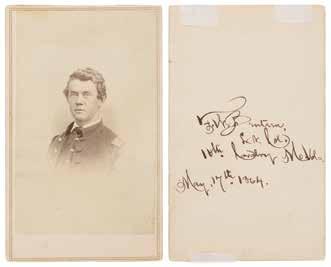
Frederick W. Benteen
Signed Civil War-Dated Carte-de-Visite Photograph
Scarce Civil War–dated 2.5 x 4 carte-de-visite photo of Benteen in uniform, boldly signed on the reverse in ink, “F. W. Benteen, Lt. Col., 10th Cavalry Mo. Vols., May 17th, 1864.” In fine condition, with three small pieces of archival tape on the back. Benteen joined the Union Army on September 1, 1861, as a first lieutenant in the 1st Missouri Cavalry Regiment, which later merged with the 10th. He participated in numerous battles throughout the Trans-Mississippi and Western Theaters, including Wilson’s Creek, Pea Ridge, Vicksburg, and Westport, earning a reputation for steady and reliable leadership. On February 27, 1864, Benteen was promoted to lieutenant colonel and commander of the 10th Missouri Cavalry. A remarkably early example, and the very first signed photograph of Benteen that we have offered.
Starting Bid $200
Historic signature of Kit Carson, signed as “C. Carson” in the summer of 1866 as commander of Fort Garland in Colorado Territory, approving a shipment of 10,000 rations of flour
Kit Carson Document Signed as Commander of Fort Garland in Colorado Territory (1866)
Manuscript DS, signed “C. Carson,” one page, 8 x 10, [July 1866]. Document headed “Special Requisition, For Subsistence Stores for the use of Officers at Fort Garland, C. T. [Colorado Territory] for 365 days, commencing the 1st day of August 1866 and ending the 1st day of September 1867,” which indicates that a total of 10,000 “Rations of Flour” will be furnished to the officers and their families. Signed at the conclusion by Kit Carson, with another hand adding his role and rank below as Colonel of the 1st New Mexico Cavalry and Brevet Brigadier General U.S.V., Commander of the Post. The document is countersigned by W. H. Barlow as Captain and Quartermaster. In fine condition.
Carson’s autograph ranks among the rarest in Western Americana. Largely unable to read or write beyond signing his name, he left little written record. After his famed career as a mountain man, fur trapper, and guide, Carson served as a colonel in the Civil War and was breveted a brigadier general. Following the war, as Ute raids intensified in the San Luis Valley, Maj. Gen. John Pope wrote to his superiors in early 1866, ‘I need not say that Carson is the best man in the country to control these Indians.’ That May, Carson was appointed commander of Fort Garland.
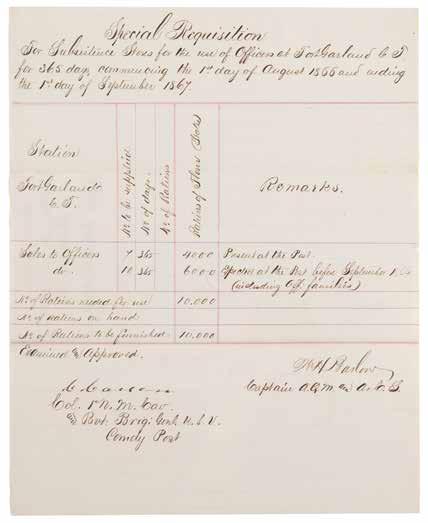
Drawing on strong relationships with the Ute—particularly Chief Ouray and Chipeta—as well as with regional Hispanic communities through his wife, Josefa Jaramillo Carson, he worked to ease tensions. In September 1866, Carson persuaded Ouray to bring his band to Fort Garland for negotiations, even hosting tribal encampments near the post. These efforts culminated in a successful peace treaty with the Utes in 1867.
Carson lived at the fort with his wife and their seven children until November 22, 1867, when he was mustered out of service due to illness. He subsequently served as superintendent of Indian affairs for Colorado Territory, but died shortly thereafter in the summer of 1868. This example represents the more typical form of his signature; Carson only occasionally signed ‘Kit Carson’ on cartes-de-visite for autograph seekers and never used his full name. A rare and highly desirable signature from one of the most legendary figures of the American West.
Starting Bid $2,500
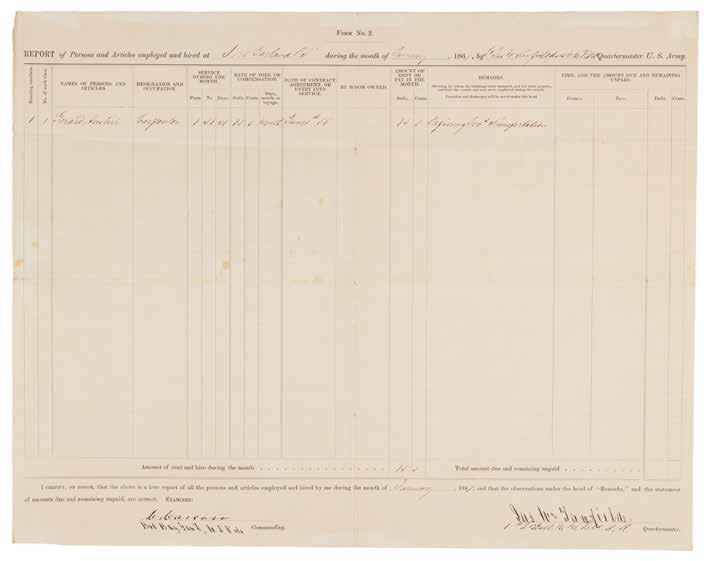
LOT 6041
Kit Carson Document Signed - Report of Persons and Articles Employed and Hired at Fort Garland (1867)
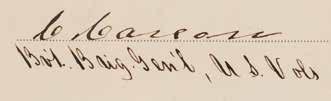
Partly-printed DS, signed “C. Carson,” one page, 16.5 x 13, no date but circa January 1867. Document headed “Report of Persons and Articles employed and hired at Fort Garland, C.T. during the month of January, 1867,” listing “Gerard Austin, Carpenter,” who worked eleven days “Repairing Gov’t Transportation,” earning $75. Boldly signed at the conclusion in ink by Kit Carson as commander of Fort Garland, and countersigned by James W. Fairfield as quartermaster. In fine condition, with a few trivial stains to the document’s body, nowhere near the pristine signature. Fort Garland was an important U.S. Army post in Colorado’s San Luis Valley, established in 1858 to protect settlers in the region. After the Civil War in 1866, Carson took command as the Army worked to reassert authority across the West and manage relations with the Ute people. Drawing on his frontier experience, he helped negotiate a temporary peace in 1867, supporting safer travel and settlement. Documents such as this reflect the everyday military and logistical functions—hiring civilian labor, maintaining equipment, and supporting mobility—that underpinned the broader effort to secure and develop the postwar West.
Starting Bid $1,000
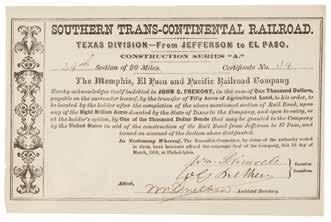
Partly-printed DS, signed “J. C. Fremont,” one page, 7.75 x 5, March 2, 1868. Bond headed “Southern Trans-Continental Railroad, Texas Division—From Jefferson to El Paso, Construction Series ‘A,’” in which the “Memphis, El Paso and Pacific Railroad Company… acknowledges itself indebted to John C. Fremont, in the sum of One Thousand Dollars.” Boldly endorsed on the reverse by Fremont. In fine condition.
Starting Bid $200
Muster roll of Company A, 24th Infantry— a ‘Buffalo Soldier’ regiment comprised of veterans of the U.S. Colored Troops and freedmen
Buffalo Soldiers: 24th Infantry Muster Roll (1874) - Comprised of Veterans of the U.S. Colored Troops and Freedmen
Partly-printed DS, one page, 31.75 x 20.5, December 31, 1874. Document headed, “Muster Roll of Captain Fredrick M. Crandal, Company ‘A’ of the Twenty Fourth Regiment of Infantry, Army of the United States, Pay Roll…from the 31 day of October…to the 31 day of December, 1874.” The document lists the names and ranks of the men in the regiment—totaling 54 active troops, with one discharged and one transferred—along with remarks relating to their pay. The reverse notes their assignment, “The Company remains on duty at Ringgold Barracks, Texas, during the time for which mustered,” and is signed in ink by Captain F. M. Crandal of the 24th Infantry, and Colonel Edward Hatch of the 9th Cavalry. In very good to fine condition, with some light stains and minor fold splits.
The 24th Infantry Regiment, known as one of the Buffalo Soldier regiments, was organized on November 1, 1869; all of the enlisted soldiers were Black, either veterans of the U.S. Colored Troops or freedmen—among the names listed here are Moses Brooks, Joseph Brown, James Campbell, Henry Houston, John Johnson, Joseph Merryweather, John Miller, Anthony Pitts, Lewis Staley, Thomas Brown, and Charles Jackson. Its missions included garrisoning frontier posts, fighting Native Americans, protecting roadways against bandits, and guarding the border between the United States and Mexico.
Starting Bid $200
The officer’s trunk of Colonel Elmer Otis, who rebuilt the 7th Cavalry after Little Bighorn and sat in judgment of Major Reno at his court-martial, stenciled
“Col. Elmer Otis, 8th Cav.,” used while in command at Fort Meade, Dakota Territory, 1883–1889
LOT 6044
Indian Wars: Col. Elmer I. Otis’s Wooden Officer’s Trunk as Commander of the 8th Cavalry (Fort Meade, Dakota Territory)
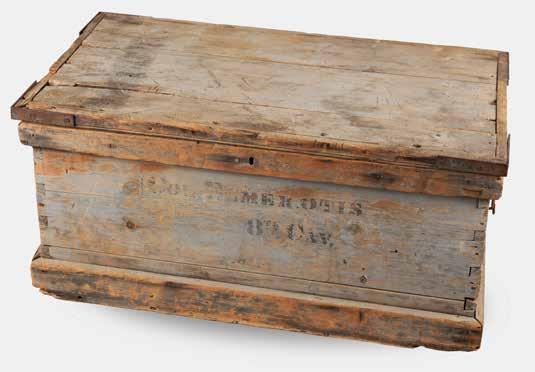
Large wooden storage trunk used by Colonel Elmer I. Otis between 1883 and 1889, while in command of the 8th Cavalry Regiment at Fort Meade, Dakota Territory, a key command center for the United States Army during the Indian Wars and westward expansion. The trunk, which bears traces of original bluish-gray paint, measures 37˝ x 18.5˝ x 20.5˝ and features faded stenciling on the front: “Col. Elmer Otis, 8th Cav.” This standard U.S. Army Indian Wars-period footlocker with dovetailed corner joints would have been invaluable to an officer like Otis, who was constantly on the move. This simple piece of soldier’s furniture followed him and his family from the northern plains to the southern frontier, serving as storage, luggage, and – given the sparse furnishings of frontier quarters – likely also as a table and, with ten children, even a makeshift crib.
Otis was promoted to colonel in April 1883 following years of frontier and Civil War service. Best known for securing the surrender of Modoc leader Captain Jack, he later took command of the 7th Cavalry after the Little Bighorn (1876), rebuilding the regiment in the face of opposition from Major Marcus A. Reno, his long-time rival. In 1880, Otis sat on the court-martial board that dismissed Reno and was among the officers who refused to support his appeal for clemency. The trunk shows expected age and use but remains structurally sound, with solid wood throughout. Minor shrinkage has caused gaps in the lid, though the boards remain strong. The right leather handle is intact; the left is missing. Front bottom corner brackets are incomplete—one detached, one missing—and the interior locking mechanism is present but detached.
This historic officer’s trunk was purchased from a farm family in N.W. Kansas, in late 2003, where it had served for the last 28 years, first as a child’s toy chest and, most recently, as a storage bin for bird seed on the front porch of the farmhouse. The trunk was found in the attic when the resident first occupied the house in 1975. The house, which was built in the early 1920s, is located approximately 60 miles from Fort Riley, the famous U.S. Army Cavalry post. That the trunk came to rest in this area is not surprising, given that Otis’s son-in-law was a cavalry officer who served into the 20th Century, and one of Otis’s granddaughters also married a cavalry officer. Both officers would have been the most likely ones to have inherited the trunk. Accompanied by a three-ring binder that contains ample research on Otis’s military career, and two signed letters of provenance.
Starting Bid $200
Early 20th-century goldtone Edward S. Curtis photograph, ‘The Vanishing Race – Navaho,’ a classic image published as Plate 1 from The North American Indian, depicting Navajo riders receding into the canyon, printed from the 1904 negative, presented in its original Curtis studio batwing frame
Edward S. Curtis Original Goldtone Photograph‘The Vanishing Race - Navaho’ (early 20th-Century)
Original early 20th-century goldtone photograph by Edward S. Curtis, entitled ‘The Vanishing Race – Navaho,’ 13.5 x 10.5, depicting a group of Navajo riders on horseback receding into the distance through a canyon passage, printed from Curtis’s original 1904 negative. Conceived as a visual metaphor for what Curtis saw as the central theme of his life’s work, the image presents a quiet, elegiac procession into shadow, embodying his belief that Native American cultures were undergoing profound and irreversible change. Lower right bears Curtis’s studio signature, inherent to the original negative. Presented in its original Curtis-designed ‘batwing’ frame, to an overall size of 19 x 16.25; the frame backing bears the original price label from The Curtis Studio. In fine condition, with some wear and chipping to the frame. The image was published as the first plate in Portfolio I of The North American Indian. Curtis wrote of the scene: ‘The thought which this picture is meant to convey is that the Indians as a race, already shorn in their tribal strength and stripped of their primitive dress, are passing into the darkness of an unknown future. Feeling that the picture expresses so much of the thought that inspired the entire work, the author has chosen it as the first of the series.’
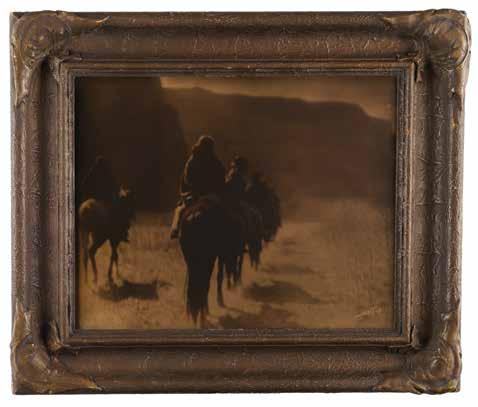
Curtis conducted extensive fieldwork among Native American tribes in the early twentieth century, ultimately producing The North American Indian, a monumental project undertaken with the financial backing of J. Pierpont Morgan and the encouragement of President Theodore Roosevelt. Issued between 1907 and 1930, the work comprised twenty volumes of text and twenty accompanying portfolios of photogravures. ‘The Vanishing Race – Navaho,’ which opens Portfolio I, became Curtis’s most widely recognized image and a defining statement of the project’s conceptual framework.
Curtis’s orotones, or goldtones, were distinct from the portfolio photogravures. Instead of printing on paper, he created images on glass plates backed with gold-toned metallic particles, producing a warm, luminous effect with a depth and richness unique to the process. The surface lends a remarkable sense of atmosphere, particularly suited to this composition, where figures gradually dissolve into the surrounding landscape. Today, the image remains one of Curtis’s most sought-after works and has been recognized among the most influential photographs ever made.
Starting Bid $500
Circa 1915 goldtone Edward S. Curtis photograph, ‘Out of Darkness,’ published as Plate 37 from The North American Indian, picturing five Navajo riders at Canyon de Chelly, presented in its original Curtis studio batwing frame
LOT 6046
Edward S. Curtis
Original Goldtone
Photograph‘Out of Darkness’ (ca. 1915)
Original circa 1915 goldtone photograph by Edward S. Curtis, entitled ‘Out of Darkness,’ 13.5 x 10.5, depicting five Navajo riders on horseback emerging from the shadowed brush of Tesakod Canyon, a narrow branch of Canyon de Chelly, Arizona, printed from Curtis’s original 1904 negative. The composition captures a dramatic transition from deep shadow into light, a hallmark of Curtis’s carefully staged yet evocative imagery of the American Southwest. Lower right bears Curtis’s copyright credit, inherent to the original negative.
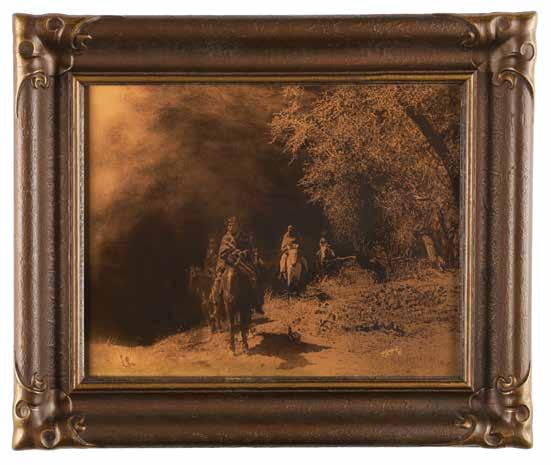
Presented in its original Curtis-designed ‘batwing’ frame, to an overall size of 18.5 x 15.5. The image was published as a photogravure in The North American Indian, Portfolio I, Plate 37. Curtis described the scene: “In Tesakod canon, a small branch of Canon de Chelly. At the point where the picture was made the gorge is very narrow.” In fine condition.
Curtis conducted extensive fieldwork among the Navajo in the early twentieth century, producing some of his most enduring imagery in and around Canyon de Chelly. The North American Indian, undertaken with the financial backing of J. Pierpont Morgan and the encouragement of President Theodore Roosevelt, ultimately grew into a monumental project of twenty volumes of text and twenty accompanying portfolios of photogravures, issued between 1907 and 1930. Portfolio I—one of the earliest published installments—included Out of Darkness as Plate 37.
Curtis’s orotones, or goldtones, were distinct from the portfolio photogravures. Instead of printing on paper, he created images on glass plates backed with gold-toned metallic particles, producing a warm, luminous effect with a depth and richness unique to the process. The surface lends a remarkable sense of atmosphere, particularly suited to compositions like this one, where figures emerge gradually from shadow into light.
Starting Bid $1,000
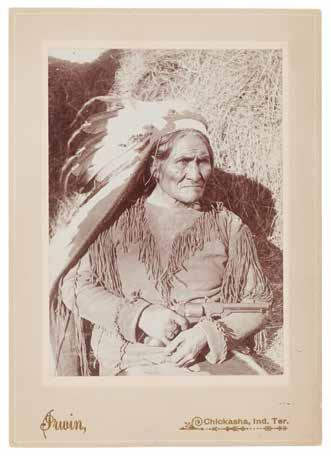
“Chief of the notorious
of
now a prisoner of war at Ft. Sill”
Sharp original 5.25 x 7.25 cabinet-style photo of legendary Apache warrior Geronimo, showing him dressed in fringed buckskin and a full feathered war bonnet while brandishing a rare Texas-made Dance revolver, taken by William Irwin circa 1899. Imprinted on the studio mount, “Irwin, Chickasha, Ind. Ter.,” and annotated on the reverse in pencil: “Geronimo, Chief of the notorious Band of Arizona Apache Indians, now a prisoner of war at Ft. Sill.” In fine condition, with a modern provenance label from the “Volkmar Wentzel Collection” affixed on the reverse. A remarkable portrait of the Apache icon.
Starting Bid $200
Native American Seneca orator and chief of the Wolf clan (c. 1750–1830) whose Indian name was Sagoyewatha. Original hand-colored 12 x 15.5 lithograph portrait of “Red-Jacket, A Seneca War Chief,” showing him wearing the large ‘Peace Medal’ given to him by George Washington. Imprinted at the bottom: “Published by E. C. Biddle, Philadelphia. Printed & Coloured at I. T. Bowen’s Lithographic Establishment No. 94 Walnut St: Entered according to act of Congress in the Year 1837, by E.C. Biddle, in the Clerks Office of the District Court of the Eastern District of Penna.” Archivally matted and framed to an overall size of 23.75 x 27.5. In fine condition.
Starting Bid $200
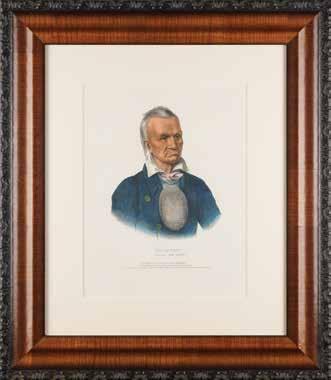
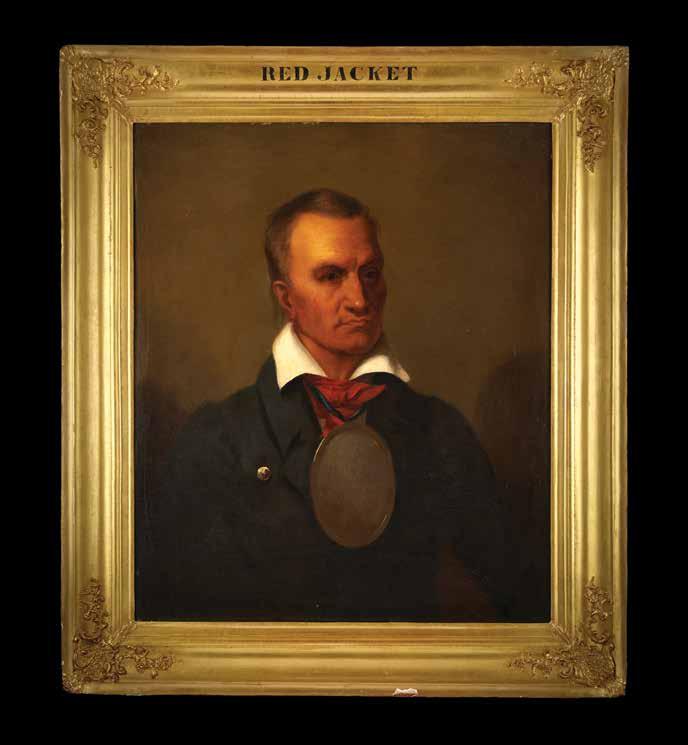
Exceptional original 25 x 29.5 oil painting of Red Jacket accomplished by fashionable 19th-century Philadelphia portraitist John B. Neagle, oil on canvas laid down on Masonite, showing the celebrated Seneca leader in a bust-length pose, dressed in a navy blue coat, bright red cravat, and the large ‘Peace Medal’ given to him by George Washington in 1792. Impressively framed to an overall size of 33 x 38, with a block-letter caption, “Red Jacket,” painted at the top. In very good to fine condition, with some chipping and old repairs to the frame.
Provenance: Property from the Philadelphia History Museum at the Atwater Kent (Acquired in 1855), Lot 36, Christie’s, September 25, 2012.
Exhibition history: The Pennsylvania Academy of the Fine Arts, Exhibition of Portraits by John Neagle, April 12-May 13, 1925; illustrated in the exhibition catalogue, p. 80.
Also illustrated in The Indian Legacy of Charles Bird King by H.J. Viola, Washington, D.C., 1976, p. 141, as attributed to Charles Bird King. A label from the Historical Society of Pennsylvania on the reverse also misattributes the work to King. John B. Neagle (1796–1865), among the most accomplished portraitists active in Philadelphia during the early 19th century, rose to prominence through a combination of technical discipline and influential artistic associations. He began his training as an apprentice to Thomas Wilson, a noted sign and coach painter, whose connections introduced Neagle to leading figures in the city’s artistic circles, including Bass Otis and, later, the celebrated portraitist Thomas Sully. Under this guidance, Neagle refined a meticulous ap-
proach to likeness and developed a particular aptitude for portraiture, establishing his reputation by the mid-1810s with a series of small but finely executed works. By 1818, he had committed himself entirely to portrait painting, quickly becoming one of the foremost practitioners in Philadelphia.
Neagle’s career gained significant momentum in 1823 when he exhibited an oil study of the renowned Seneca orator Red Jacket (Sagoyewatha). The work attracted widespread attention and cemented his status among the leading artists of his day. Known for his ability to capture both the physical presence and psychological depth of his sitters, Neagle would go on to produce some of the most compelling portraits of prominent American figures of the period.
Red Jacket himself was a figure of considerable interest to artists and audiences alike. A principal chief of the Seneca and a member of the Wolf Clan, he was widely admired for his eloquence and leadership, particularly in negotiations with the United States government. His receipt of a large ‘Peace Medal’ from President George Washington in 1792 symbolized his diplomatic importance and became a defining attribute in his portraiture. As a result, he sat for, or inspired, numerous likenesses by leading artists including Charles Bird King and George Catlin.
Although Neagle is known to have produced portraits from life sittings with Red Jacket, the present work appears to draw inspiration from an earlier composition by Charles Bird King, reflecting the broader circulation and reinterpretation of iconic Native American subjects among 19th-century artists.
Starting Bid $2,500
LOT 6050
Rain-in-the-Face Cabinet Photograph by O. S. Goff/D. F. Barry - “Murderer of Gen. Custer”
Original 4.25 x 6.5 cabinet photo of Rain-in-the-Face likely taken by Orlando Scott Goff circa 1874, and published by his business partner David Francis Barry, with a printed caption affixed to the mount, annotated below in contemporary pencil: “Murderer of Gen. Custer, Now at Ft. Yates, Dak.” Reverse is imprinted: “D. F. Barry, Photographer, Bismarck, Dak.” In very good to fine condition, with a tiny surface tear to the upper left edge, and a small crack to the lower left corner repaired with tape on the reverse.
Starting Bid $200
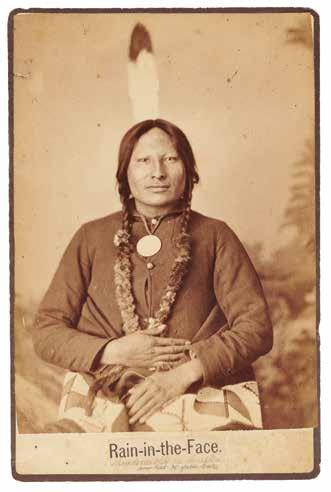
LOT 6051
Rain-in-the-Face Cabinet Photograph by D. F. Barry
Original 4.25 x 6.5 cabinet photo of Rain-in-the-Face taken by David Francis Barry circa 1886, with a printed caption affixed to the mount. Reverse is imprinted: “Barry, Photographer, Bismarck and Standing Rock, D. T.” In very good condition, with tack holes to the corners, light scuffing and soiling, and a few small areas of surface loss.
Starting Bid $200
Original 3.75 x 2.25 ticket to the World’s Columbian Exposition in Chicago, May 1–October 30, 1893, signed in pencil, “Rain in the Face.” The pass is affixed to a page portraying “Sitting Bull’s Hütte” inside a German-language book covering the 1893 World’s Fair, annotated in ink in German: “Signature of Chief ‘Rain in the Face.’ He killed General Custer at the ‘Little Big Horn.’ My uncle met the Indian at the 1893 World Exhibition personally!” A newspaper clipping describing the chief being stabbed at Standing Rock is also affixed to the page. The ticket itself is in fine condition, with very poor signature contrast; the book’s binding is worn and split, with the front cover detached.
Rain-in-the-Face signed this rare admission pass at the 1893 Columbian Exposition (World’s Fair) in Chicago, Illinois. The Hunkpapa Lakota Sioux chief was a participant in one of the cultural villages on exhibition at the fair meant to represent peoples from around the world. The Indian exhibit included ‘Sitting Bull’s Cabin,’ the actual cabin in which the Sioux chief died. A contemporary description of the Exposition said of the scene: ‘Sitting Bull’s Cabin was filled with a number of Indians, including Rain-in-the-Face. War dances were given daily.’ Acknowledged as the grandest exhibition of the time, the 1893 World’s Fair was attended by 27 million people, nearly half of the U.S. population.
Starting Bid $300
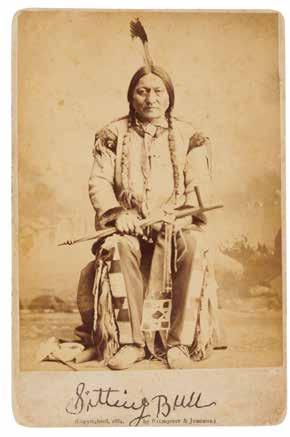
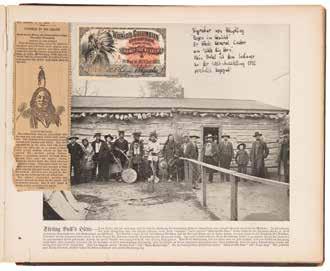
Superb original 4.25 x 6.5 cabinet photo of Sitting Bull seated in a full-length pose, with a single eagle feather in his hair and a pipe across his lap, taken circa 1884 by Palmquist & Jurgens of St. Paul, Minnesota, imprinted on the mount with his facsimile signature and the studio credit: “Copyrighted, 1884, by Palmquist & Jurgens.”
Also imprinted on the reverse with a biographical blurb, in part: “Tatonka-I-Yotanka (Sitting Bull), an Uncapapa Sioux, was born on the Missouri near Grand River, in 1835. In early life he was somewhat noted both as a hunter and warrior, and in early middle age gained prestige as a medicine man (the Sioux order of priesthood) and counselor…When Custer was killed on the Little Big Horn, in June, 1876, Sitting Bull was the consulting head of five thousand warriors. After that massacre, the huge camp was broken up, and Sitting Bull with a thousand or more retreated into the British territory whence, until 1881, he made frequent raids upon American soil. His band constantly suffered depletion until, in the summer of 1881, he had but one hundred and sixty followers remaining. These he surrendered to Lieut. Col. Brotherton at Fort Buford, and with them was sent as a prisoner to Fort Randall, Dakota. Here he remained until May, 1883, when he was released and sent to his present home, among his kindred, at Standing Rock Agency, seventy miles south of Bismarck, on the Missouri River.” In fine condition scattered light foxing and soiling.
Starting Bid $200
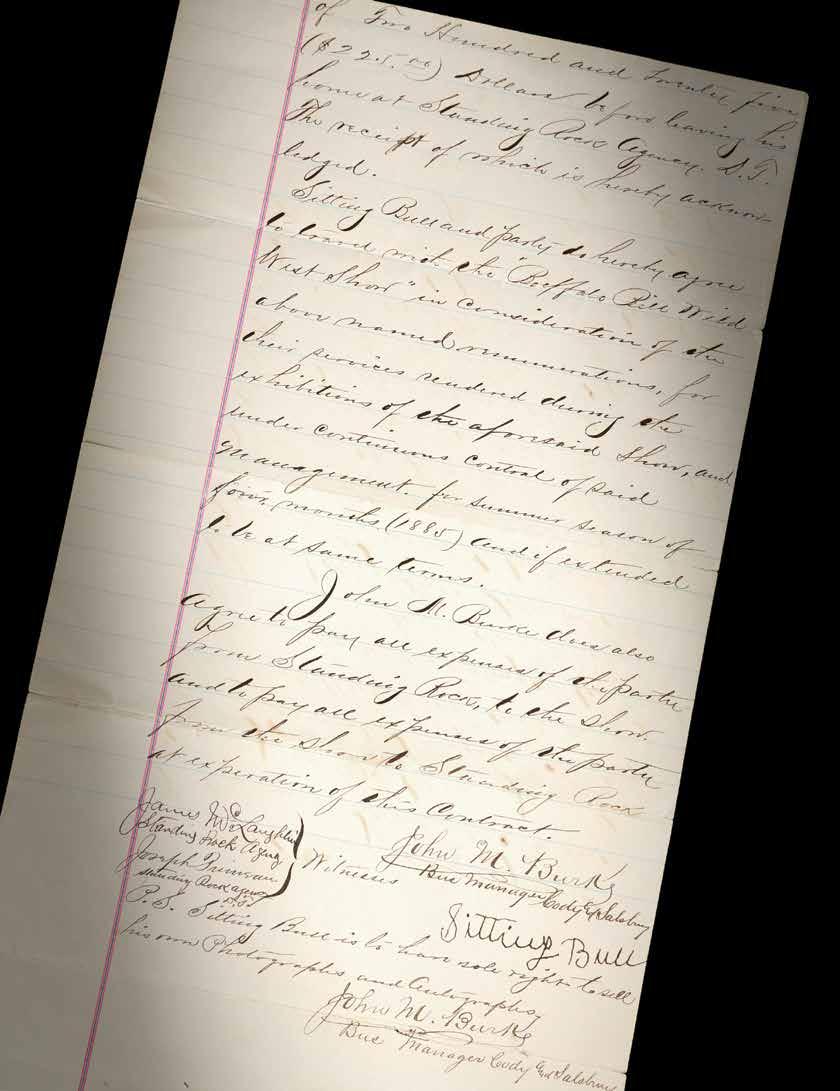
Sitting Bull Rare and Historic Document Signed - His 1885 Contract to Appear in the “Buffalo Bill Wild West Show”
Historic manuscript DS, signed “Sitting Bull,” one page both sides, 8 x 12.5, June 6, 1885. Contract concluded at the “Standing Rock Agency, D.T.,” for his appearance in the “Buffalo Bill Wild West Show.” In part: “This agreement entered into this sixth day of June, 1885, between John M. Burke General Manager of the ‘Buffalo Bill Wild West Show,’ and Sitting Bull and party consisting of ten people, I, John M. Burke do hereby agree to pay Sitting Bull Fifty ($50.00) Dollars per week, to be paid weekly every Saturday night; Five (5) Indians at Twenty five ($25.00) Dollars per month each…three Indian women at Fifteen ($15.00) Dollars per month each…and William Halsey Interpreter to be paid Sixty ($60.00) Dollars per month…It is also agreed that Sitting Bull is also to receive One hundred and Twenty five Dollars as a present, and the first two weeks pay in advance, being a total of Two hundred and Twenty five ($225.00) Dollars before leaving his home at Standing Rock Agency, D.T.
Sitting Bull and party do hereby agree to travel with the ‘Buffalo Bill Wild West Show’ in consideration of the above named remunerations, for their services rendered during the exhibitions of the aforesaid Show, and under continuous control of said management, for summer season of four months (1885) and if extended to be at same terms.”
Signed at the conclusion in ink by Sitting Bull and John M. Burke, and countersigned by Indian agent James McLaughlin and interpreter Joseph Primeau as witnesses. Burke signs again at the bottom, attesting that “Sitting Bull is to have sole right to sell his own Photographs and Autographs.” In fine condition, with three small old tape repairs to the blank bottom of the attached docketing sheet.
Sitting Bull (c. 1831–1890), the famed Hunkpapa Lakota leader, was one of the most prominent and complex Native American figures of the 19th century. Widely associated with the Lakota victory over Custer at Little Bighorn in 1876, he became both feared and admired as a symbol of Native resistance. After leading his people into exile in Canada, he returned to the United States in 1881 under threat of starvation and spent two years as a prisoner of war. By 1883 he had settled at Standing Rock Agency, where he lived under the authority of Indian agent James McLaughlin, who viewed him with suspicion despite recognizing his influence. Contrary to McLaughlin’s belief that he was an agitator, Sitting Bull was deeply interested in the future of his people and open to engaging with American society.
In 1885, Sitting Bull agreed to join Buffalo Bill Cody’s Wild West show, seeing it as an opportunity to observe white American culture and advocate for his people. Negotiated by John M. Burke, the agreement made him the highest-paid performer in the show and included provisions such as advance payment, travel expenses, and the exclusive right to sell his own autographs and photographs—an arrangement that proved highly profitable. During his time with the show, Sitting Bull was presented respectfully as a renowned leader rather than a caricature, and he used his platform to address audiences about the needs of the Lakota, though translations of his speeches were not always accurate. He also famously met Annie Oakley, whom he admired and symbolically adopted as ‘Watanya Cicila, or ‘Little Sure Shot.’
Sitting Bull traveled with the Wild West for four months, appearing across the Northeast and Canada and even visiting the White House, where he presented President Cleveland with a written appeal on behalf of his people. A contemporary reporter observed that ‘He had no wish for blood in his heart… He recognized the inevitable supremacy of the white man, but hoped that the red man had enough self-respect and the white man enough honesty left to make the end of the controversy a peaceful one.’ His relationship with Buffalo Bill was described as one of mutual trust and respect. Though he returned to Standing Rock with positive impressions of the experience, he was prevented from continuing with the show by McLaughlin’s opposition.
Five years later in 1890, amid rising fears surrounding the Ghost Dance movement, it was James McLaughlin who ordered Sitting Bull’s arrest at Standing Rock. The attempt, carried out by Indian Agency police, ended in a violent struggle during which Sitting Bull was shot and killed. His death heightened tensions across the region and contributed directly to the chain of events that culminated in the tragic massacre at Wounded Knee two weeks later.
The survival of this 1885 contract stands as a powerful and exceptionally rare document of these significant cultural intersections. While Sitting Bull is known to have signed hundreds of autographs during his time with Buffalo Bill’s Wild West—capitalizing on the very right secured in this agreement—he famously never signed a treaty with the United States government, a reflection of his steadfast resistance to federal authority. As such, documents bearing his signature in a formal context are of the utmost rarity—no other contract signed by Sitting Bull is known to exist. An extraordinary piece that bridges his legacy as both a defiant leader of his people and a participant in the spectacle of the American frontier.
Starting Bid $10,000
Original 4.25 x 6.5 cabinet photo of Sitting Bull seated in a three-quarter-length pose, with pipe in hand and his braided hair draped over his shoulders, featuring his facsimile signature and a printed caption inherent to the image, “Taton Kaiyotonka, Sitting Bull, The above is a true Photo and Autograph of ‘Sitting Bull,’ the Sioux Chief at the Custer Massacre.” Imprinted on the mount with the studio credit, “Copyrighted, 1882, by Bailey, Dix & Mead,” and on the reverse with a biographical blurb and listing of cabinet cards for sale. The biography reads, in part: “This noted Chief, With his band of Uncapapa Souix Indians, now prisoners of war at Fort Randall, D. T., is 43 years of age; Weight 200 pounds; Height, 5 ft. 9 in. Has had over 100 engagements with their natural enemies, the Crows, of which he proudly boasts, but is too shrewd to acknowledge to having killed any whites. He has had 9 wives.” In fine condition, with a trivial light surface crease to the upper right corner area.
Starting Bid $200
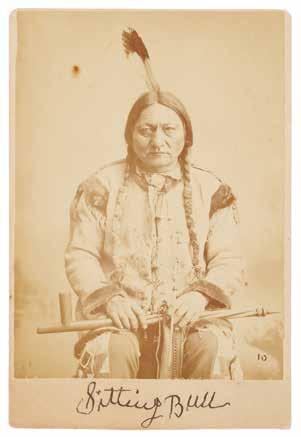
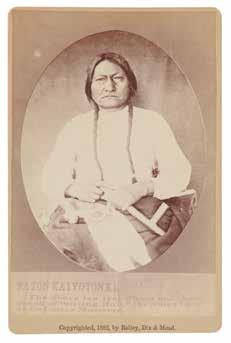
Fantastic original 4.25 x 6.5 cabinet photo of Sitting Bull seated in a threequarter-length pose, with a single eagle feather in his hair and a pipe across his lap, taken circa 1884 by Palmquist & Jurgens of St. Paul, Minnesota, imprinted on the mount with his facsimile signature. Imprinted on the reverse with the studio credit: “Photographed and Published by Palmquist & Jurgens, Cor. Seventh and Robert Sts. St. Paul, Minn.”
Also imprinted on the reverse with a biographical blurb, in part: “Tatonka-IYotanka (Sitting Bull), an Uncapapa Sioux, was born on the Missouri near Grand River, in 1835. In early life he was somewhat noted both as a hunter and warrior, and in early middle age gained prestige as a medicine man (the Sioux order of priesthood) and counselor…When Custer was killed on the Little Big Horn, in June, 1876, Sitting Bull was the consulting head of five thousand warriors. After that massacre, the huge camp was broken up, and Sitting Bull with a thousand or more retreated into the British territory whence, until 1881, he made frequent raids upon American soil. His band constantly suffered depletion until, in the summer of 1881, he had but one hundred and sixty followers remaining. These he surrendered to Lieut. Col. Brotherton at Fort Buford, and with them was sent as a prisoner to Fort Randall, Dakota. Here he remained until May, 1883, when he was released and sent to his present home, among his kindred, at Standing Rock Agency, seventy miles south of Bismarck, on the Missouri River.” In fine condition, with a spit of soiling to the background.
Starting Bid $200
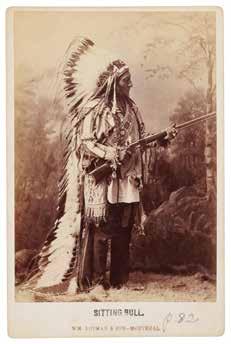
Sitting Bull Cabinet Photograph by Wm. Notman & Son
Remarkable original 4.25 x 6.5 cabinet photo of Sitting Bull standing in a full-length, profile pose, wearing a feathered headdress with long trailing feathers down his back, draped in an ornately beaded bandolier bag, and holding a long rifle across his body. Imprinted on the mount, “Sitting Bull. Wm. Notman & Son, Montreal,” with the studio’s ornate crest imprinted on the reverse. In fine condition, with ink and pencil notations to the lower border and reverse.
A sharp, dramatic portrait of the legendary Hunkpapa Lakota leader.
Starting Bid $200
Original Photograph by D. F. Barry
Oglala Lakota leader (1836–1893) known as Tasunka Kokipapi or They Fear Even His Horses, but commonly mistranslated as ‘Young Man Afraid of His Horses,’ remembered for his participation in Red Cloud’s War, as a negotiator for the Sioux Nation after the Wounded Knee Massacre, and for serving on delegations to Washington, D.C. Original semi-glossy 4.5 x 6.5 silver gelatin photo of Oglala Lakota leader YoungMan-Afraid-Of-His-Horses, taken circa 1884 by David Francis Barry, a pioneering photographer of the American West, housed in its original 7 x 10.5 studio mat, signed in white ink, “Barry Photo,” with “Barry” blindstamped on the mat, and a credit label affixed to the reverse: “D. F. Barry, Photographs of All Noted Indian Chiefs, Photographer, 1312 Tower Ave., Superior, Wisconsin.” In fine condition, with a light crosshatch grid pattern to the emulsion.
Starting Bid $200
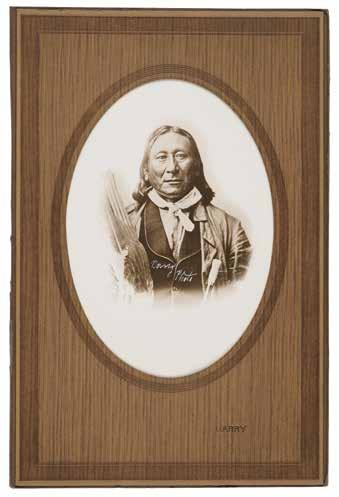
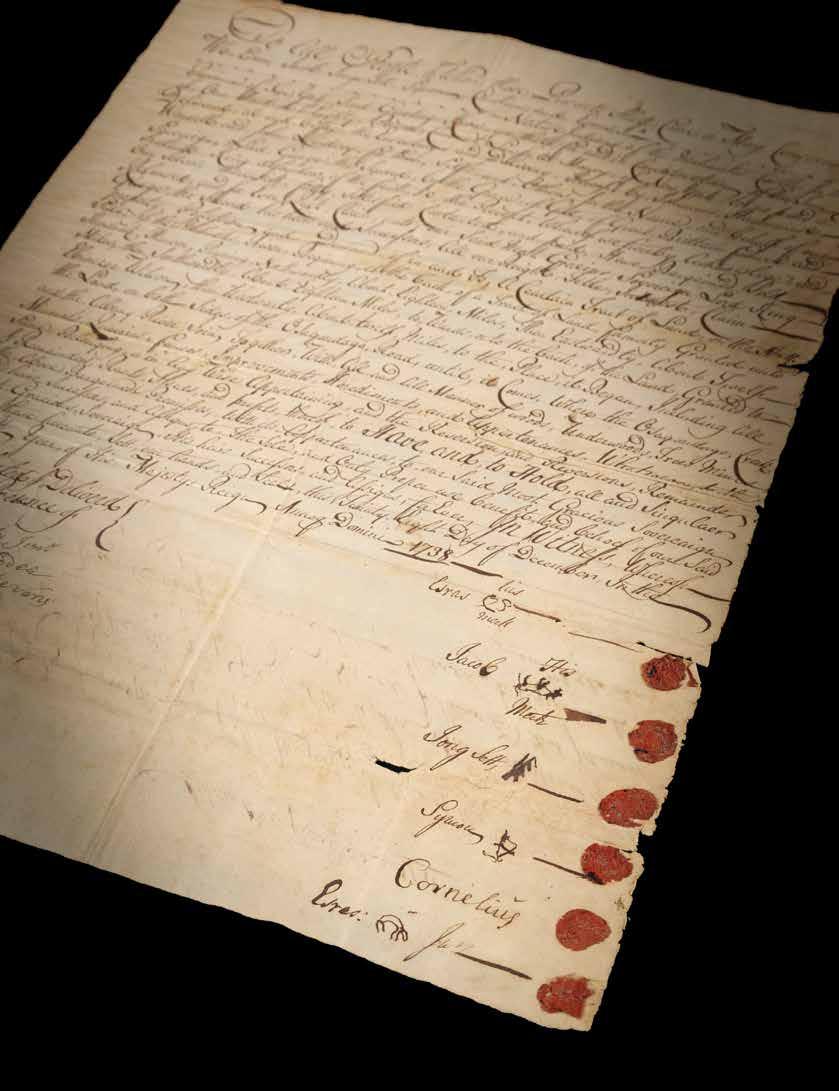
Mohawk Indian Chiefs Signed Land Cession
Deed, Selling New York Acreage to King George II (1738)
Rare manuscript deed signed by six chiefs of the Mohawk nation, one page, 12.5 x 15.75, December 12, 1738, selling some 216 square miles of land in east-central New York to King George II. The deed, in part: “We, Esras, Jacob, Long Sett, Symon, Cornelius, and Esras Jr., Native Indians of the Mohawk Castle, in the province of New York, send greeting. Know ye, that for and in consideration of the sum of one hundred eighty pounds, current lawful money of New York… have bargained, sold released, and for ever quit claim unto our said most gracious sovereign Lord King George the Second, his heirs and successors all our rights, title, interest, claim, property, possession, and demand, of in and to, a certain tract of land on the north side of the Mohawk River.”
The payment was to be delivered to the tribe by Johannis Wendell and John Lindsey, acting on behalf of the British crown. The land is situated northwest of Albany, and its parameters are carefully given: “a certain tract of land on the north side of the Mohawk River, beginning at the back of a tract of land formerly granted unto Hendrick Hauser, running northwardly, about eighteen miles, then eastwardly, about twelve miles, then southwardly, about eighteen miles, towards or to the back of the lands granted to Ebinezer Wilson, then westwardly about twelve miles to the place it began.” The land is further identified
as running along both sides of the “Osagondago Road,” and the deal includes “all manner of woods, underwoods, trees, mines, minerals, quarries, fences, improvements, herediments, and appurtenances.”
The deed is signed at the conclusion in ink by the six Mohawk leaders mentioned: Cornelius’s name stands alone, while the other sign with their totemic marks. Each chief has a red wax seal affixed beside his name, and the document is further signed by three witnesses. It appears that the validity of this deed may have been challenged just a few years after it was executed, for on the reverse there is a manuscript attestation, dated September 30, 1741, stating that Jacob Glen, a justice of the peace for the county of Albany, has sworn on a Bible that the Indians have been paid the full amount, according to the contract as written. In fine condition, with scattered trivial paper loss.
A rare and historically revealing document, this deed offers firsthand insight into the mechanisms of British colonial land acquisition from the Mohawk Nation during a formative period in North American history. Executed just a generation before the Mohawks formally allied with the British during the French and Indian War, it reflects the evolving political and economic relationships between Indigenous leaders and the Crown. Such agreements—often framed in European legal terms but negotiated across cultural boundaries—played a critical role in shaping both territorial control and alliances in the contested landscape of colonial New York.
Starting Bid $5,000
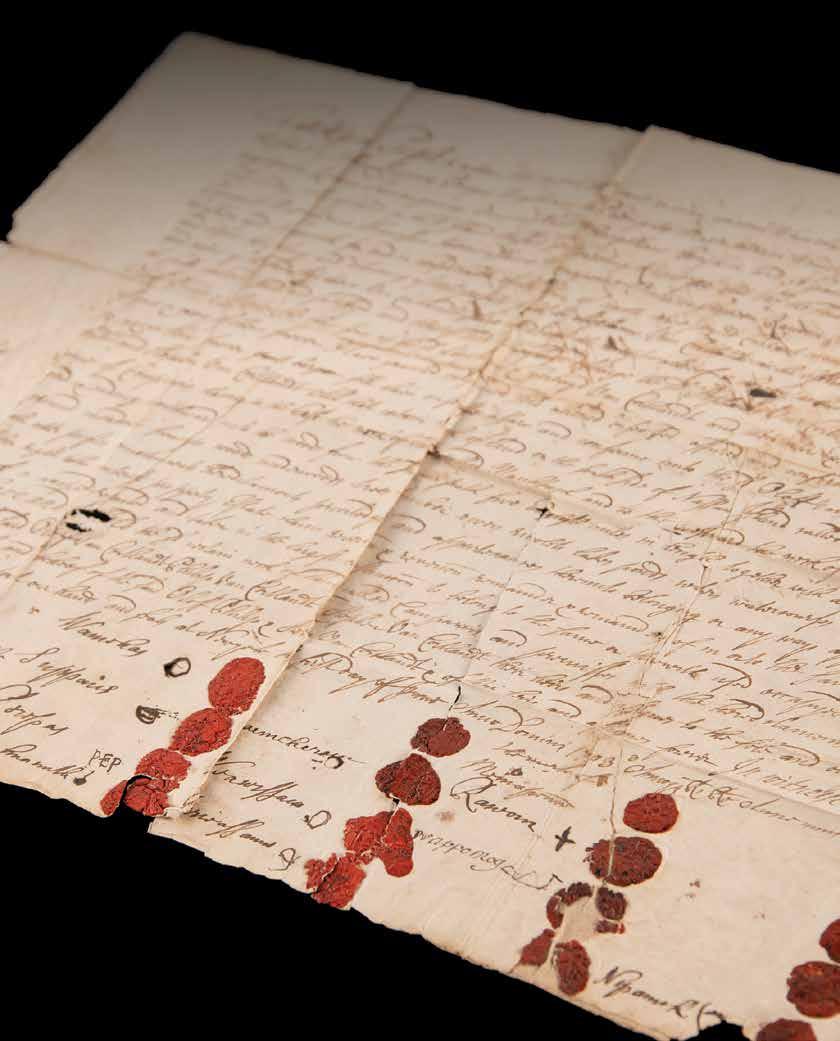
Rare manuscript deed signed by twelve Native American Indian chiefs, one page, 14.5 x 11.5, June 1, 1703, selling a large tract of land on Long Island to members of the wealthy and influential Van Cortlandt family. This deed follows in a long line of similar transactions stretching back to 1626, when Peter Minuet purchased Manhattan Island from the local Indians on behalf of the Dutch West India Company. In 1670, Governor Francis Lovelace purchased Staten Island from local chiefs. The present contract was made on June 1, 1703, between twelve Indian chiefs and Gertrude Van Cortlandt, widow of the late Stephanus Van Cortlandt, and her children. The n ames of the chiefs on the document include Wamshas, Suppans, Porspas, Rawson, and others from the local Indian tribes. They agree to sell, “for and in consideration of eighty three pounds currant money of New York to us in hand paid,” an extensive tract of land “on the south side of Nassau island.”
The deed is signed at the conclusion in ink by the twelve Native American Indian leaders mentioned, all signing with their marks beside affixed red wax seals. It is additionally signed by three witnesses—including the noted trader and land speculator Arent Schuyler—and is endorsed on the reverse by Jacobus Van Cortlandt (1658-1739), who was mayor of New York City in 1710 and 1719, and, like other members of his family, also set about amassing a large estate through purchases of land from local Indian tribes (a part of which became present-day Van Cortlandt Park in the Bronx). Van Cortlandt attests that the chiefs have presented themselves before him and confirmed the accuracy of the document. In good to very good condition, with tears and fold splitting (nearly complete separation to the central vertical fold), partly repaired with old tape on the reverse.
The Van Cortlandt family was among the most prominent clans in colonial New York. Stephanus Van Cortlandt (1643-1700) was born in New Amsterdam (now New York), the son of a wealthy merchant. In 1681 he married Gertrude Schuyler of Albany, and they had eleven children. Stephanus Van Cortlandt rose to prominence as a merchant himself, and he successfully negotiated the power struggle between the Dutch and British in New York, being appointed to positions of power by colonial authorities on both sides. In 1677 the British governor of New York, Sir Edmund Andros, appointed him the first native-born mayor of New York City, and he served on the Governor’s Council, as receiver of the revenue for New York and New Jersey, and as a judge on several courts. Also in 1677, Andros granted Van Cortlandt a license to obtain land from the Indians, and in 1683 he began buying huge tracts of land along the Hudson River and in western Connecticut. He also owned land in Manhattan, as well as in the counties of Suffolk (on the northeast shore of Long Island), Richmond (on Staten Island), and Kings (in present-day Brooklyn). Upon his death in 1700, Van Cortlandt divided his land among his eleven children, though his widow, Gertrude, largely controlled the estates until her death in 1723. The Van Cortlandts continued to add to the family lands through purchases such as the one executed in this deed.
Early colonial land cession documents of this nature are exceptionally rare survivals, offering direct, contemporaneous evidence of the complex and often fraught relationships between Native American Indian communities and European settlers. While such agreements are frequently cited in broader narratives of colonial expansion, the original manuscripts themselves remain underutilized as primary sources that illuminate the agency and material realities of Indigenous participants. This deed stands as an important historical record, preserving not only the names and marks of the Native leaders involved, but also the legal and economic frameworks through which land was transferred—providing invaluable insight into the early dynamics of colonial land acquisition and Native–colonial relations in New York.
Starting Bid $5,000
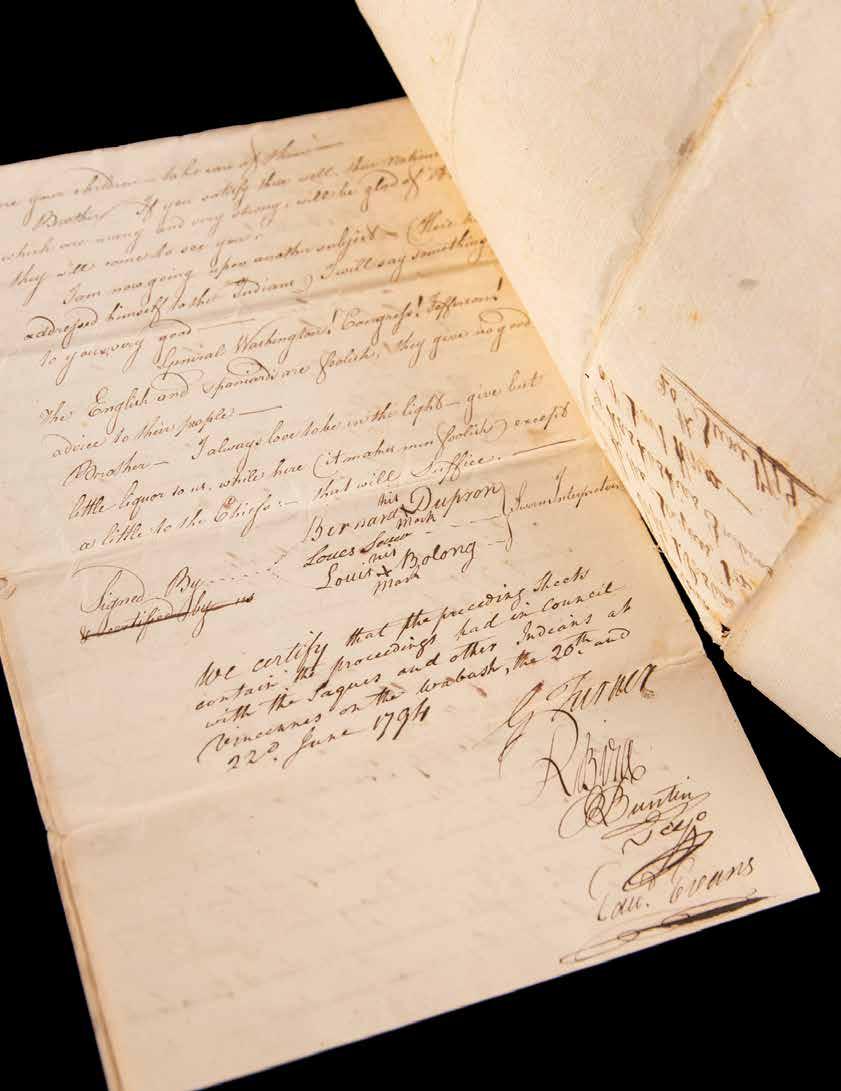
Council at Vincennes: Manuscript Record of a Peace Council with Chiefs and Warriors of the Saque, Fox, and Kaskaskias (1794)
Manuscript DS, twelve pages on adjoining string-bound sheets, 7.5 x 12, June 20, 1794. Significant manuscript record of a “Council held at Vincennes with certain Chiefs and Warriors of the Saque, Fox, and Kaskaskias, Indians, at which attended several Piankeshaws and Ouiattanons,” with the United States represented by Captains Pasteur and Prior. In this record of the Council, chiefs from the three tribes express their affection for Gen. George Washington, the United States, and France, and request more provisions from the white settlers, especially guns.
In part: “Sheh-Kowak, of Wheat Chaff…Got up to make a Speech for Pashepahwhah, Chief of the Fox Nation….the language he spoke being the Kickapoo—and not well understood by the Interpreters, he resumed his speech in the Pottawatami tongue. He said he had come a long way with his young men to see his friends—that he had sent away all bad birds from his Village, that he hoped his brother (meaning Capt. Pasteur) would take pity on him and his young men, since they had come so far to see him…Turning to Captain Pasteur, he observed that General Washington and his red people were as one—that they had come from Illinois to see their brothers, the Americans and French, and to hear him speak…he delivered a string of black and white Wampum…That immediately on receiving the letter (meaning a letter of invitation from Ducoin, requesting them to go and see General Washington) he and his young men did not hesitate to come…he hoped that guns would be given to his young men; for that they were fond of their brothers’ guns—and that such of his young men’s guns as were out of order, his brother would cause to be repaired…that as they were leaving their homes to come hither, several Nations admonished them against it, saying, ‘My brother, why do you go? Some of your young men will be killed, where you are going.’ Sheh-Kowak concluded by saying they were dry for a Dram; he then delivered another string of black and white Wampum.”
Speaking next, Kaskaskia chief Ducoin announces: “’I desire all persons now present, both white and red, to listen with attention, for I am going to speak. My father General Washington, Congress and Colo. Jefferson, open your ears and listen to what I shall say. I shall hide nothing from you. One half of your children on the Mississippi and Wabash are bad—General Washington sent us here to put the bad children in a good way’….He said that he, Ducoin, was not to despise General Washington, Captain Pasteur, or Captain Prior, nor would
they despise his father’s children—He hoped they would give with a liberal hand to their children whether of the Mississippi or Wabash, such goods as are suitable…that perhaps the English would come upon his lands, and on the lands of the red people with him, and they might possible kill him—but he would give his lands to Congress to protect…that he intreated Captains Pasteur & Prior to make their hearts glad on going home, by giving them presents of goods, guns and ammunition…He said that they had been demanded to come and see the Americans—that as they passed the Spaniards in the route hither, the Spaniards told them they were fools, they would get nothing from the Americans—not even a knife—but that notwithstanding he trusted Captain Pasteur would take pity on them.”
The document continues along similar lines, with further transcripts of speeches of the various council attendees, closing with another speech by Ducoin. At the end, it is signed by three interpreters and five witnesses, who attest that it is a true record. One witness, Francis Vigo (1747-1836), was a prominent fur trader and merchant with headquarters in St. Louis. During the Revolution, his aid was instrumental in George Rogers Clark’s efforts to secure the northwest country from British influence. In fine condition. Housed in custom-made a quarter-morocco slipcase with chemise. The United States’ standing with the western Indian tribes had collapsed after the decisive defeats of Generals Harmar and St. Clair along the Wabash in 1791. In the years that followed, the situation on the Northwest frontier remained unstable, with British agents actively encouraging further conflict against American forces. In 1794, the United States mounted a counteroffensive under General Anthony Wayne, who spent the spring and summer recruiting and rigorously training a force of regular soldiers and Kentucky militia.
Amid expectations of renewed war on the northern frontier, American leaders moved to secure their western flank by persuading—and at times pressuring—nearby tribes to remain neutral or supportive. The Vincennes Council, held in late June, proved pivotal in winning the loyalty of tribes that could otherwise have posed a serious threat to overstretched American forces. This effort was highly successful, as the three key tribes remained aligned with the United States.
Just two months later, on August 20, 1794, General Wayne’s army decisively defeated the British-backed confederation at the Battle of Fallen Timbers, near present-day Toledo. The outcome owed much to the diplomatic groundwork laid at Vincennes, which helped ensure that potential western adversaries did not join the fight.
Starting Bid $2,500
“I was an oficer in the Mexican War and can fight Indians if it is required for me to doe so”
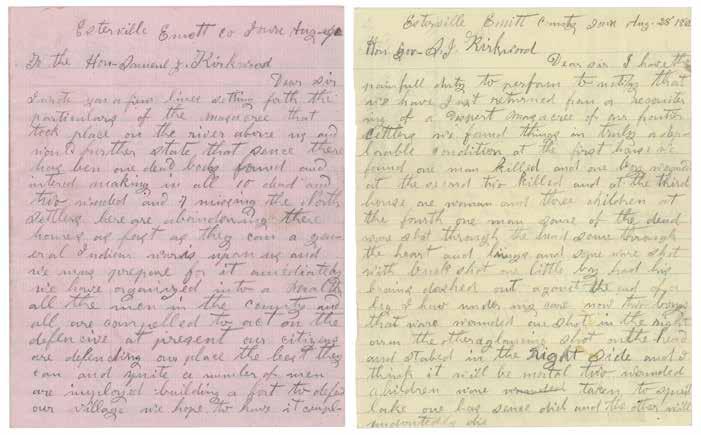
Sioux Depredations: Edwin Bruce (2) Autograph Letters Signed to Gov. Samuel J. Kirkwood of Iowa on a “Desert massacre of our frontier settlers”
Two ALSs in pencil, both signed “Dr. Edwin Bruce,” totaling five pages, 6.25 x 8, August 28, 1862. Both are to Governor Samuel J. Kirkwood of Iowa, describing depredations by marauding Sioux warriors. The first, in part (spelling and grammar retained): “I have the painfull duty to perform to notify that we have just returned from a reconitering of a Desert massacre of our frontier settlers we found things in truly a deplorable condition at the first house we found one man killed and one boy wounded at the second two killed and at the third house one woman and three children at the fourth one man some of the dead were shot through the head some through the heart and lungs and some were shot with buckshot one little boy had his brains dashed out against the end of a log…The like of barberous brutality I never wittnessed before houses were stripped of all there contents and utterly destroyed…we are truly in a destitute condition we are out of arms, and out of amonition if you will send us arms & amonition please notify our citizens of the same…I was captain of the force sent to releive the settlers if we can’t get powder lead and caps and arms we must abandon our settlements and being exposed to merciless savages
all of the scattering inhabatants here on the frontier.”The second, in part: “I wrote a few lines setting forth the particulars of the massacre that took place on the river above us and would further state that since there has ben one dead body found and intered making in all 10 dead and two wounded and 7 missing…our citizens are defending our place the best they can…a number of men are imployed building a fort to defend out village we hope to have it completed in a fiew weeks the citizens up the river have abandoned all and rushed down here…I am about out of medicines and have no instruments. If you will please send me a case of amputating & surgical instruments and a small asortment of hospitle medicines I will be very thankfull…most of the settlers are brave and undaunted and determined in their persuits and will defend there homes if they can but have the arms and ammunition and doe credit to our noble little State…If you want my cerveses in this part of the state cervis it is at your disposel. I was an oficer in the Mexican War and can fight Indians if it is required for me to doe so.” Both docketed on the reverse by the governor’s office, “About Indian outrages.” In overall fine condition. These urgent, firsthand appeals—rich in unfiltered detail and emotional immediacy—stand as powerful documentary evidence of the tensions and uncertainties that defined life on the frontier in 1862.
Starting Bid $200
“4 Winnebagos were murdered by whites last month...It is plain that an instant stop must be put to such conduct on the part of the whites, or it will be utterly impossible to keep the Indians quiet on this frontier”
Capt. E. V. Turner Autograph Letter Signed, Detailing Frontier Violence, Tensions withthe Winnebago, and “the horrible murder at Wilcox’s settlement”
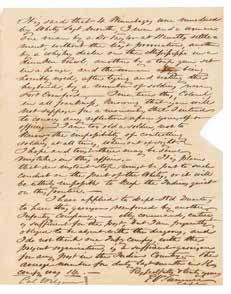
ALS signed “E. V Turner, Capt.,” three pages on two adjoining sheets, 8 x 10, April 3, 1843. Handwritten letter to his superior, “Col. H. Wilson, Fort Crawford,” sent from Fort Atkinson, detailing a heinous act of Indian savagery on the frontier, while noting escalating tensions between whites and Winnebagos in the region. In part: “I have had a busy week here in consequence of the horrible murder at Wilcox’s settlement on the 25th ulto. I had the good fortune to catch the three murderers in 36 hours after they committed the act, and I have them not in my guard house, in irons. I took them down to Wilcox’s last Saturday for the purpose of having them identified by the wounded children and they, at once, clearly recognized them, which secures the conviction of these fiends.
This outrage was accompanied by a crime, hitherto unheard of among Northern Indians—It seems the Indians went to the house on Friday morning the 24th of March, and remained there through that day and the next—the house was occupied by two men—Atwell and Teagarden and three children of the latter—one a boy of 14 yrs another boy of 9 yrs and a little girl between 7 and 8, the mother was absent at a neighbour’s.
On Saturday evening the Indian began to show hostility—the father Teagarden was drunk and had gone to be with the children—the Indians first killed Atwell—they then tied the hands of Teagarden, and threw a bottle at his head, which roused him, and he sprang up perfectly sober, but his hands being tied he was entirely in their power—they beat him for some time, and then shot him through the head—they then killed the youngest boy, by beating out his brains, and gave the oldest boy five dreadful wounds in the back, with a spear of some kind—the infernal villains then, all of them, ravished the little girl and afterward wounded her as they had the boy in the back—they then set fire to the house, and went out, it is supposed, to find a horse that was near by. The little girl first recovered consciousness, and roused her oldest brother who had fainted—these children then escaped out of the burning house…Dr. King who has visited them, thinks the little girl may live, but he has but little hope of the boy.
It is said that 4 Winnebagos were murdered by whites last month, 3 men and a woman. One man by a Dr. Taylor at Hewitt’s settlement, without the least prosecution, another by a whiskey dealer on the Mississippi in a drunken brawl, another by a trap gun set in a house, and the woman by being horribly used, after tying and beating the husband, by a number of soldiers near Fort Crawford.—I mention this, Colonel, in all frankness, knowing that you will not suppose for a moment, that I intend to convey any reflection upon yourself or officers—I am too old a soldier, not to know the impossibility of controlling soldiers, at all times, when out of sight…It is plain that an instant stop must be put to such conduct on the part of the whites, or it will be utterly impossible to keep the Indians quiet on this frontier.” In fine condition, with light staining, and a small area of seal-related paper loss to the integral address leaf.
Starting Bid $200
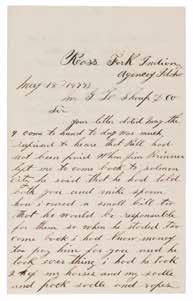
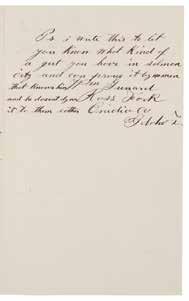
ALS signed “Wm. Gunard,” three pages on two adjoining sheets, 5 x 8, May 18, 1877. Addressed from “Ross Fork, Indian Agency, Idaho,” a handwritten letter to G. L. Shoup & Co., in part (spelling and grammar retained): “Your letter…come to hand to day was much suprised to heare that Bill had not been paid When Jim Brinner left me to come back to salmon city he said that he had told both you and mike sporm how i owed a small bill too that he would be responsuble for them so when he started too come back i had know money too pay him for you and he took ever thing i had he took 2 of my horses and my sadle and pack sadle and ropes and 11 Beaver traps and all of my Blankets togeather with all of the skins that we catched all winter know shoup all i want is what is right and squar if he aint man enough after taken all a man had and leaving him a foot to pay them 2 small Bills that i owed in salmon city after saying he was responsible for them and he had to pay thim if i did not that he aint know man and if he dont pay them that i will mak him pay me 5 times the amount when i get my eyes on him Pleas see him and see what he says and rite me if he aint man enough to setle it I will.” Gunard adds a postscript: “i write this to let you know what kind of a gut you have in salmon city and can prove it by 40 men that knows him and he dosent Lyne it to them either.” In fine condition.
Starting Bid $200
Indian Removal: Report of a Visit to Some of the Tribes of Indians, Located West of the Mississippi River (1843)
Scarce book: Report of a Visit to Some of the Tribes of Indians, Located West of the Mississippi River by John D. Lang and Samuel Taylor, Jr. First edition. NY: Press of M. Day & Co., 1843. Rebound hardcover in brown cloth boards, 5.5 x 8.5, 34 pages. Book condition: VG/None, rebound without its original brown printed wrappers and with some mottled foxing to the first few pages. Read the book’s foreword online at www.RRAuction.com.
Written by Quaker ministers John D. Lang and Samuel Taylor, Jr., The Report of a Visit to Some of the Tribes of Indians, Located West of the Mississippi River recounts their 1842 mission on behalf of the New England and New York Yearly Meetings of Friends to assess the condition of Indigenous tribes forcibly relocated to trans-Mississippi regions. Traveling from Maine, they visited more than a dozen tribes—including the Shawnee, Delaware, Osage, Cherokee, Creek, and Choctaw—documenting their social, agricultural, and educational circumstances in present-day Kansas and Oklahoma. Issued at the height of post-Indian Removal resettlement, the report stands as an important primary account of Indigenous life in the immediate aftermath of the 1830s displacement.
Starting Bid $200
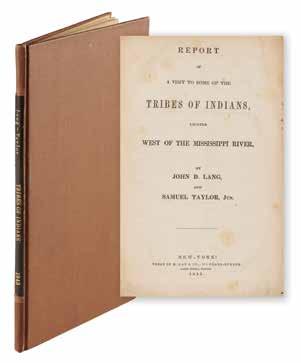
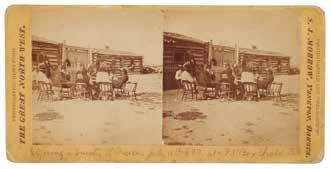
Original 7 x 3.5 stereoview photograph of a peace treaty signing at Fort Berthold, photographed and published by S. J. Morrow of Yankton, Dakota, as part of a series of “Photographic Gems from the Great North-West.” Captioned on the mount in pencil, “Signing a Treaty of Peace; July 11th 1870 at Ft. Berthold D.T.” In fine condition, with light soiling and edgewear to the mount. The Fort Berthold reservation was established by executive order on April 12, 1870, establishing a home for the Mandan, Hidatsa, and Arikara Nation.
Starting Bid $200
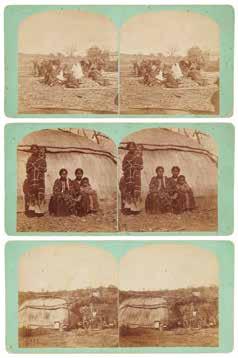
Three original 7 x 3.5 stereoview photographs of Winnebago Indians and their camp life, including scenes of women with children outside a wigwam (“Winnebago Squaws”), a group of them wrapped in blankets (“Winnebago Group clost to a Saw Mill”), and a wider view of several outside one of their bark-covered dwellings (“Winnebago wigwam”). All are captioned and signed on the reverse in ink by the original collector, “P. T. Buckley.” In overall fine condition, with some light surface scuffing.
Starting Bid $200
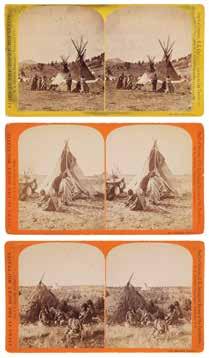
Three original 7 x 4 stereoview photographs of Bannock-Shoshone Indian views mounted on William Henry Jackson’s “Department of Interior, U.S. Geological Survey” cards as part of the “Rocky Mountain Series” published by E. & H. T. Anthony & Co. of New York. Includes views of “Bannock Indians” beside their stick and grass lodge, with tipis in the distance; a Bannock family and papoose in cradle in front of their tipi, one of them wrapped in a traditional blanket; and the “War Chief’s Tent” amidst an encampment nestled in the hills. In overall fine condition.
Starting Bid $200
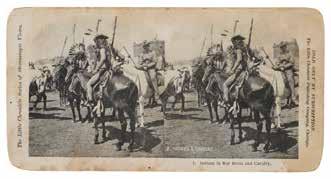
Indian Warriors
by the Little Chronicle Publishing Company
Original 6.75 x 3.5 stereoview card printed as part of the Little Chronicle Publishing Company of Chicago’s “Little Chronicle Series of Stereoscopic Views,” featuring an image of “Indians in War Dress and Cavalry.” In very good to fine condition, with overall light soiling and staining.
Starting Bid $200
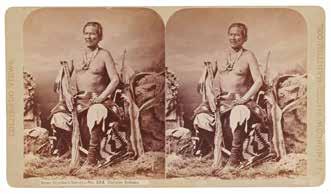
LOT 6070
Manuelito Stereoview Photograph by J. Thurlow
Navajo chief (c. 1818–1893) during the ‘Long Walk’ period, remembered for rallying his nation against the oppression of the United States military. Original 7 x 4 stereoview photograph of Navajo chief Manuelito, published by James Thurlow as part of a “Colorado Views” series, on its original studio mount, with affixed caption: “From Hayden’s Survey—No. 134. Navajoe Indians.” The chieftain is shown shirtless, holding a rifle in a buckskin scabbard while wearing moccasin boots, a woven Navajo blanket, and beaded necklaces with a saber pendant. In fine condition.
Starting Bid $200
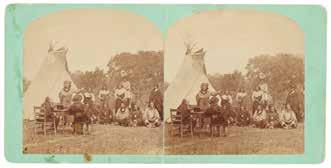
Sioux Peace Council Stereoview Photograph
Detailed original 7 x 3.5 stereoview photograph showing a Sioux chief addressing two white men seated at a table, with a tipi and tribal members behind him. Captioned on the reverse in ink by the original collector, “Tom Council in 1875, P. T. Buckley.” In fine condition, with scattered small stains.
Starting Bid $200
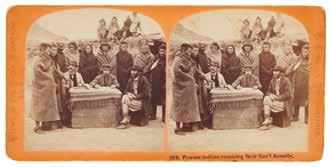
Pawnee Indians Stereoview Photograph by John Carbutt
Original 7 x 3.25 stereoview photograph of “Pawnee Indians receiving their Gov’t Annuity,” photographed by John Carbutt of Chicago and published as part of a “Views of the Rocky Mountains” series, on its original studio mount. In the scene, nine Pawnee wrapped in blankets—one wearing a cavalry hat, another a tall hat, and a third holding a tomahawk with a spontoon-style blade visible—stand around three seated white men distributing ration tickets; four children sit atop a wickiup in the background. In fine condition.
Starting Bid $200
Two original 7 x 3.5 stereoview photographs of Omaha Indians in social settings, sitting outside their tipis and smoking pipes. The scenes are filled with fascinating details—ornate garments, jewelry, buffalo skin rugs, and pipes are seen, and a mother carries a child on her back in one of the photos. Both are annotated on the reverse in ink by the original collector, “Omaha Indians, P. T. Buckley,” and one carries an affixed label: “Social Smoke. Omaha Indians with Tent. Published by Hamilton & Hoyt, Sioux City, Iowa.” In overall fine condition.
Starting Bid $200
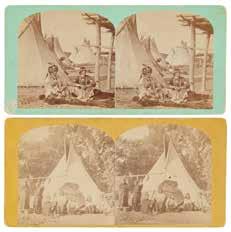
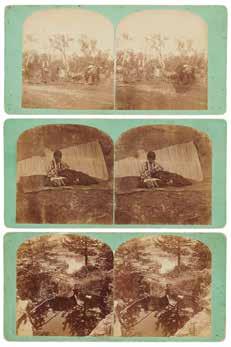
Three original 7 x 3.5 stereoview photographs of Sioux Indians and their territory, including scenes of a young woman either braiding hair or combing for lice (“Showing they way the Indians catch ‘em”), a group of them traveling with a pack horse (“Sioux moving”), and a lovely landscape view of Sioux Falls ( “Sioux Falls 90 miles above Sioux City”). All are captioned and signed on the reverse in ink by the original collector, “P. T. Buckley.” In overall fine condition.
Starting Bid $200
Original 7 x 4 stereoview photograph of “Noted Sioux Indian Chiefs,” published by F. Jay Haynes of Fargo, Dakota Territory, as part of a series of “Northern Pacific Views,” on its original studio mount. The chiefs are identified on the reverse in modern pencil: “GaulOncapapa, Running Antelope - Ogalala, Low Dog - Ogalala, Spotted Eagle - Sandjarzk, Rain in the Face - Oncapapa.” In fine condition.
Starting Bid $200
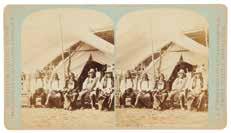
Original 4.25 x 6.5 cabinet photo of Crow King, also known as Medicine Bag That Burns, in a stoic, front-facing pose, wearing a bone hairpipe breastplate beneath a U.S. Army–issue coat, with a single feather in his hair, taken circa 1880 by David Francis Barry, a pioneering photographer of the American West. Identified on the mount in ink, “Crow King,” and further annotated on the reverse, “Little Big Horn Veteran.” Also stamped on the reverse in ink, “D. F. Barry, Photographer.” In fine condition, with very slight fading and soiling.
Crow King, a Hunkpapa Sioux war chief, was a prominent leader during the Battle of the Little Bighorn and one of Sitting Bull’s principal war chiefs. He played a decisive role in the fighting, helping drive Reno’s troops out of the valley and across the river before leading approximately eighty warriors in a sustained assault against Custer’s forces on Calhoun Hill and Finley Ridge. Attacking from the south throughout the battle, Crow King and his band contributed to the encirclement of the 7th Cavalry alongside leaders such as Crazy Horse and Gall. Two of his brothers were killed in the conflict.
Following the battle, he remained a key figure within Sitting Bull’s circle, serving as a band chief during the Lakota exile in Canada from 1877 to 1880. He ultimately surrendered at Fort Buford in the Dakota Territory in the autumn of 1880, when this portrait was taken.
Starting Bid $200
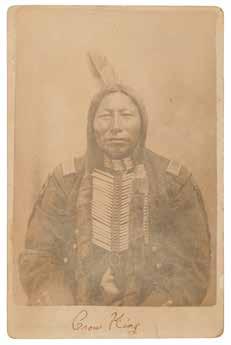
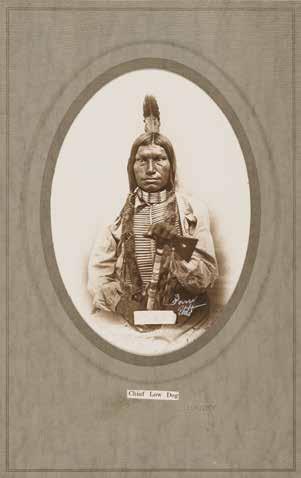
Low Dog Original Photograph by D. F. Barry
Original semi-glossy 4.5 x 6.5 silver gelatin photo of Oglala Lakota chief Low Dog by David Francis Barry, a pioneering photographer of the American West, housed in its original 7 x 11 studio fold er, signed in white ink, “Barry Photo,” with “Barry” blindstamped on the mount and a biographical blurb affixed on the reverse. Low Dog is shown in his full Native American regalia, topped by a single feather in his hair, with tomahawk in hand. The blurb on the reverse describes D. F. Barry as a “Photographer of Noted Indians,” and thus describes Low Dog: “A Member of Chief Gall’s band of Indians…He had a very wicked face…In the Custer fight he worked hard to get credit for killing so many soldiers. At the agency…he was pointed out to the whites as a real bad Indian.” In fine condition.
Starting Bid $200
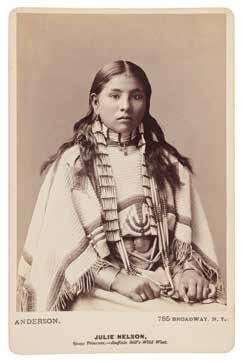
Julie Nelson Cabinet Photograph by Anderson of New York - “Sioux Princess— Buffalo Bill’s Wild West”
Choice original 4.25 x 6.5 cabinet photo of Julie Nelson seated in a stunning half-length pose, dressed in a beautiful fringed and beaded overblouse, and lavishly adorned with a dentalium shell choker and matching earrings, necklace composed of brass beads and bone hairpipes, German silver concho belt, and brass bracelets. Imprinted on the mount, “Anderson, 785 Broadway, N.Y., Julie Nelson. Sioux Princess—Buffalo Bill’s Wild West,” with the studio’s imprint also on the reverse. In fine condition.
Starting Bid $200
Sioux and Pawnee Chiefs Cabinet Photograph by Anderson of New York
Outstanding original 6.5 x 4.25 cabinet photo of Sergeant G. H. Bates flanked by eight chiefs of the Pawnee and Sioux Nations—the Pawnee wear single feathers in their hair, while the Sioux are dressed in full feathered war bonnets. Captioned on the mount: “Head Chiefs of the Pawnee Nation. Eagle Chief. Knife Chief. Brave Chief. Young Chief. / Head Chiefs of the Sioux Nation. American Horse. Rocky Bear. Long Wolf. Flies Above.” Imprinted on the reverse by the studio: Anderson, Photographer, 785 Broadway, cor. of 10th, New York.” In fine condition.
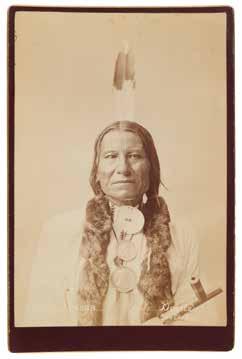
Tatanka Wanaghi Cabinet Photograph
Original 4.25 x 6.5 cabinet photo of Tatanka Wanaghi, also known as Buffalo Bull Ghost, in a stoic, front-facing pose, wearing two peace medals, braids wrapped in fur, and a single eagle feather in his hair. Identified within the image: “Tatanka Wanayi, Dakota, (Crow Creek).” In very fine condition.
Starting Bid $200
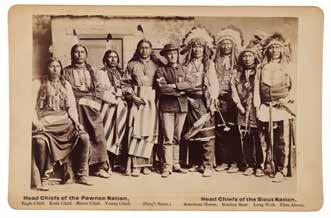
Starting Bid $200
Crystal-clear original 4.25 x 6.5 cabinet photo of Arikara scout Goose, shown in profile, facing left, with a composed, dignified expression, as captured by David Francis Barry, a pioneering photographer of the American West. Goose’s hair is parted and wrapped in fur, beaded necklaces cascade across his chest, and he holds a catlinite pipe and decorative tamper. Imprinted on the mount: “D. F. Barry, West Superior, Wis.,” with Barry’s likeness of Chief Gall illustrated on the reverse, along with an advertisement for “Photographs of All the Noted Indians.” In fine condition.
Goose, an Arikara scout, served as lead scout for George Armstrong Custer during the 1874 Black Hills Expedition, a role that later led many to blame him for opening the region to white incursions. Despite this controversy, he continued to serve as a scout and was wounded during the Reno engagement at the Battle of the Little Bighorn.
Starting Bid $200
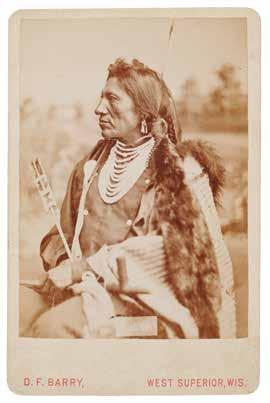
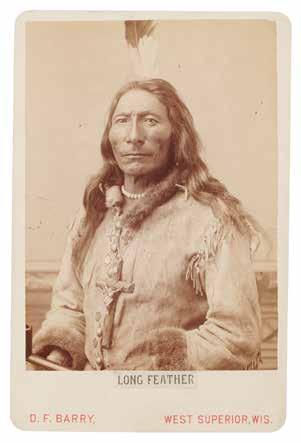
Excellent original 4.25 x 6.5 cabinet photo of Long Feather in a stoic, front-facing pose, wearing a beaded buckskin jacket, a single hair feather, and an enormous crucifix, as captured by David Francis Barry, a pioneering photographer of the American West. Imprinted on the mount: “D. F. Barry, West Superior, Wis.,” with Barry’s likeness of Chief Gall illustrated on the reverse, along with an advertisement for “Photographs of All the Noted Indians.” In fine condition.
Starting Bid $200
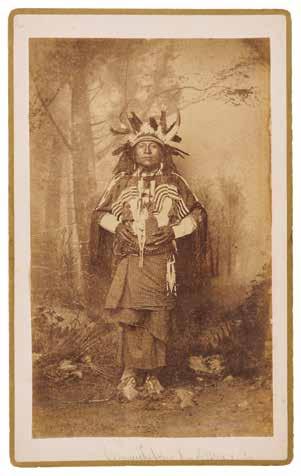
Comanche John Boudoir Cabinet Photograph by A. Frank Randall
Superb original 5.25 x 8.5 boudoir cabinet photo of “Comanche John, Son of Blue Kimbe,” shown in a striking full-length pose adorned in a fringed and beaded cape, a buffalo horn headdress, and two beaded tab bags, along with a cartridge belt, by A. Frank Randall of Willcox, Arizona Territory, circa 1886. The studio imprint on the reverse advertises Randall as a “Dealer in Views of Arizona and New Mexico: Geronimo and his Band, also Tonto, San Carlos, Yuma, Mojave, White Mountains, Jicarilla, Mescalero, and Apache Photos.” In fine condition.
Starting Bid $200
Indian Braves at Tipi Boudoir Cabinet
Photograph by Bailey of Spokane
Sharp original 8.5 x 5.25 boudoir cabinet photo of three Native American Indian braves outside a tipi in a gently sloping, pine-covered plain in the Pacific Northwest, imprinted on the mount: “Bailey, 116 West Riverside, Spokane, Wash.” The composition feels staged but natural—typical of ethnographic or documentary photography of the era—balancing the tipi, figures, and surrounding landscape to present a composed view of daily life. In fine condition.
Starting Bid $200
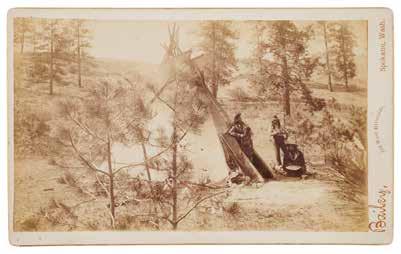
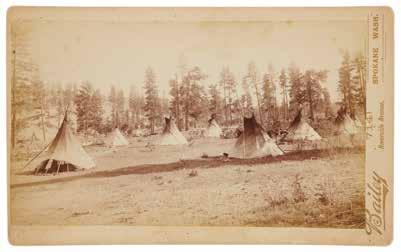
LOT 6085
Indian Tipi Encampment
Boudoir Cabinet Photograph by Bailey of Spokane
Vivid original 8.5 x 5.25 boudoir cabinet photo of a Native American Indian tipi encampment in the clearing of a Pacific Northwest pine forest, imprinted on the mount: “Bailey, 7141⁄2 Riverside Avenue, Spokane, Wash.” In fine condition, with a hint of light foxing.
Starting Bid $200
Ute Chief Carte-de-Visite Photograph
Uncommon 2.5 x 4 carte-de-visite photograph of a Ute chief in a dramatic full-length pose, holding a revolver in his left hand, dressed in his traditional feathered war bonnet with furwrapped braids, bandolier, and gunbelt. The portrait highlights a striking tension between tradition and modernity, as the chief’s traditional regalia and headdress contrast with the presence of a modern firearm—a juxtaposition that suggests a moment of cultural transition, where Indigenous identity persists even as outside technologies become part of daily life. In fine condition, with a pencil notation on the reverse, “Buckskin Charlie Mose.”
Starting Bid $200
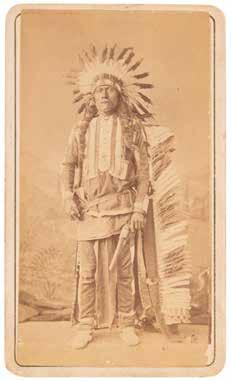
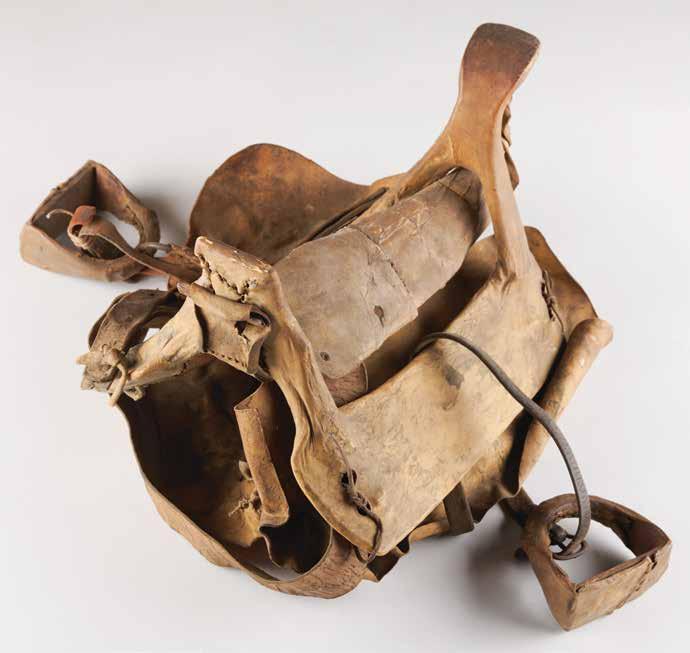
Early Plains Indian wood-frame saddle, undated, circa mid-to-late 19th century, approximately measuring 17˝ in length and 12˝ in width, the wooden tree with high pommel and cantle fully wrapped in rawhide and leather, retaining side flaps, rigging elements, and attached wooden stirrups suspended from leather straps.
This saddle follows the Plains Indian pad-and-tree tradition, developed across the Great Plains after the introduction of the horse in the late 17th century. The frame consists of forked wooden elements forming the pommel and cantle, bound in green rawhide that dried into a rigid shell around the armature. The rawhide sheathing, now aged to a mottled brown-gold tone, has split and curled in places, exposing
the underlying wood. The form—high forked pommel and cantle—is consistent with mid-19th-century Plains saddle types documented in period accounts. Plains saddle-making emerged as a distinct craft tradition as mounted cultures developed among tribes such as the Lakota, Cheyenne, and Comanche. These rawhide-wrapped woodtree saddles were lighter than Spanish Colonial forms and well suited to the demands of hunting and travel, with construction that allowed for repair using available materials. The saddle presents in heavily aged condition, with dried and cracked rawhide showing splitting at the cantle and along the seat edges. The pommel shows surface wear and loss. Stirrups and straps remain present, and the seat covering is cracked but intact. Undecorated, it appears to be a working example.
Starting Bid $200
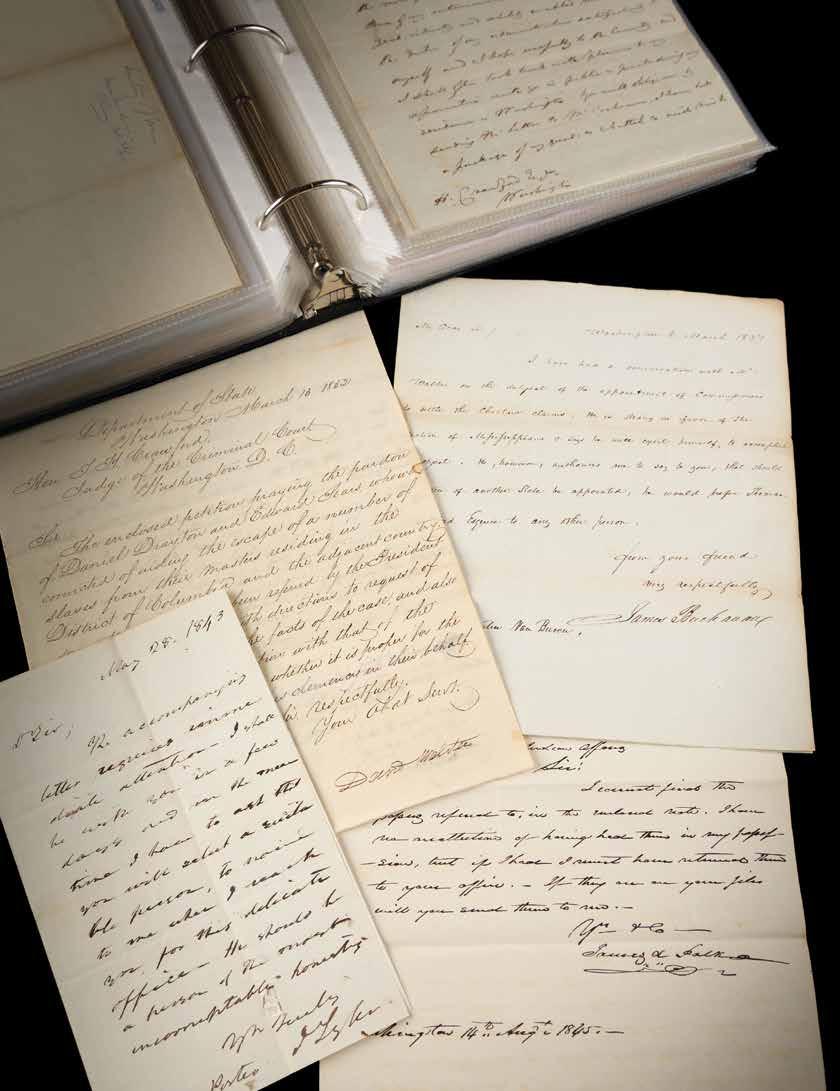
LOT 6088
Westward Expansion Archive (12,000+ Pages): The Papers of Judge Thomas Hartley Crawford — The Most Significant Unpublished Chronicle of Indian Removal and the Westward Expansion of the United States
Historic, comprehensive archive of the papers of Judge Thomas Hartley Crawford, being the most important unpublished record of the physical and fiscal treatment of Native American Indians by the United States government in the mid-19th century, and thus chronicling the westward expansion of the United States. The enormous archive comprises nearly 3,000 papers (amounting to more than 12,000 pages), neatly organized into 43 separate binders.
Thomas Hartley Crawford (1786–1863) was born in Chambersburg, Pennsylvania, graduated from Princeton University in 1804, and was admitted to the Pennsylvania bar in 1807. Elected as a Jacksonian Democrat, he served as a U.S. Representative to the Twenty-first and Twenty-second Congresses (1829–1833) and as a member of the Pennsylvania State House of Representatives in 1833 and 1834. Appointed by President Andrew Jackson to investigate alleged frauds in the sale of Creek lands in Alabama, he was subsequently appointed by President Van Buren as U.S. Commissioner of Indian Affairs, serving from October 22, 1838 to October 30, 1845. At the end of his tenure Crawford was appointed federal judge of the criminal court of the District of Columbia, a post he held until his death in January 1863.
As Federal Commissioner of Indian Affairs, Crawford oversaw the removal of Native Americans from their ancestral lands during the critical period of America’s westward expansion. Through nearly half of this unpublished archive we see in writing the problems faced by the government, Indian traders and agents whose agendas were less than altruistic, and settlers anxious to have what they called the “wretched race” removed so they could take over and form new states.
The submissions to Crawford by individual agents detailing the costs of feeding, clothing, and trading with the various tribes are particularly revealing. The other half of the archive consists of Crawford’s legal opinions, chronicling cases through another critical period of American history, with many of his draft letters and opinions relating to slavery and political problems of the age.
The sweeping depth and breadth of the archive might be broken down into five distinct groups: Indian affairs; handwritten legal opinions; handwritten letters by Crawford (drafts and dockets); legal and personal documents and correspondence; and significant letters signed by famous and significant personages, including James Buchanan, James K. Polk, John Tyler, Francis Scott Key, Daniel Webster, Winfield Scott, Robert Stuart, John Bell, James Duane Doty, Ethan A. Hitchcock, and Joel Roberts Poinsett.
Some other highlights are: a contemporary manuscript copy of a memorial submitted by the “People of Alabama and Georgia,” requesting a federal investigation into “the causes of the Creek Indian War”; a lengthy manuscript “Itinerary of a route from Fort Randall, Nebraska Territory, in Lake Preston, Minn. to the…Whetstone River below 2nd fork”; a court martial document signed by Judge Advocate General Joseph Holt, who would famously prosecute the Lincoln assassination conspirators; and substantial correspondence from cabinet secretaries, numerous generals and officers, regional commissioners of Indian Affairs, territorial governors, senators, representatives, judges, lawyers, Indian agents, and many other notable men of this historic time period.
In overall very good to fine condition. Interested parties are encouraged to view the collection in person at our offices or call us with specific inquiries, as this collection is sold as is and no returns will be accepted. A more detailed description is available online at www. RRAuction.com.
Starting Bid $25,000
Spanish morion helmet, late 16th–early 17th century, measuring 14˝ x 12˝ x 11˝, constructed of forged iron or steel in classic form, with a high medial comb and broad upturned brim rising to pronounced points at the front and rear. The bowl is decorated with finely executed embossed ornament, centered by a circular cartouche and surrounded by flowing scrollwork motifs. The interior reveals the reverse of the repoussé decoration, with rivet holes at the base for the now-missing liner. The surface exhibits expected oxidation and wear consistent with age; the brim bears white ink notations. In fine condition, with evidence of polishing and restoration. Morions of this type were widely used by Spanish infantry, including soldiers active in the New World during the later phases of the conquistador period.
Starting Bid $200
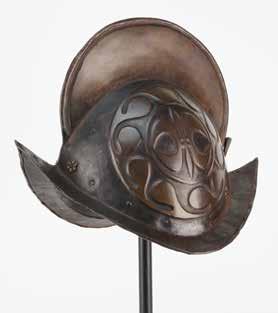
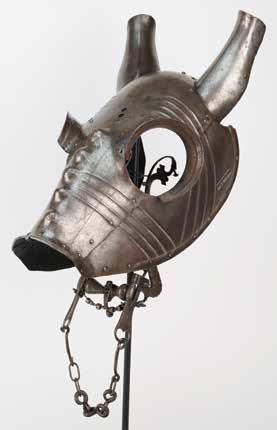
Rare early Spanish colonial horse chanfron (chaffron), dated to the 15th–16th century, recovered from a rock shelter north of El Paso, Texas, accompanied by an ornate later engraved curb bit. Of robust iron or steel construction, the chanfron measures 23˝ 12.5˝ x 13˝ and retains its characteristic form, with pronounced ridged ‘bump-ups’ reinforcing the elongated nasal area for added protection. Both ear guards remain intact, while the escutcheon plate – intended to strengthen the vulnerable forehead region – is no longer present. The surface has been professionally cleaned, with minor but well-executed restoration to areas of deformation, preserving the integrity and visual impact of the piece. The lower left cheekplate is annotated in white ink, “From a rock shelter…Near El Paso, Texas. 1926 by Maria Golar.” Included with the chanfron is an ornate engraved curb bit, of later date, featuring long decorated shanks and a complex mouthpiece. In fine condition, with the curb bit appearing to miss one or two embellishments.
The chanfron, a form of plate armor designed to protect a horse’s head in combat, was introduced in Europe in the early 14th century and saw widespread use by the 15th century. As horses played a critical role in both warfare and early exploration, significant effort and expense were devoted to their protection. Such equipment is closely associated with the mounted warfare of the Spanish conquistadors, whose expeditions carried European arms and armor into the New World, with this example representing rare and important archaeological evidence of early Spanish presence in the American Southwest.
Starting Bid $200
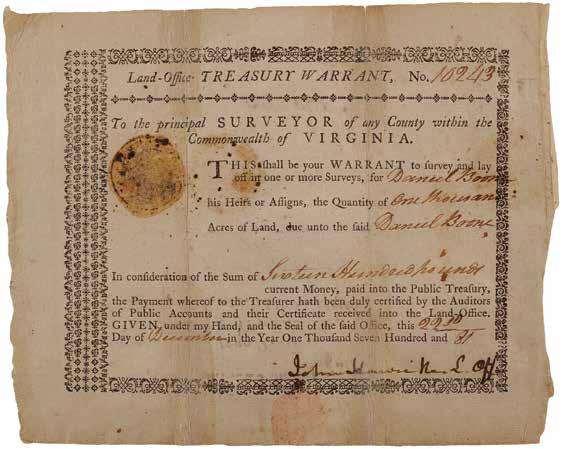
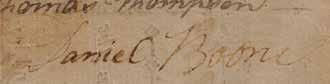
Sought-after partly-printed DS, signed “Daniel Boone,” one page, 8 x 6.5, December 22, 1781. Commonwealth of Virginia Land-Office Treasury Warrant, issued as “No. 10243,” in part: “This shall be your Warrant to survey and lay off in one or more Surveys, for Daniel Boone, his Heirs or Assigns, the Quantity of one thousand Acres of Land, due unto the said Daniel Boone, In consideration of the Sum of Sixteen Hundred pounds current Money.” Signed on the front by John Harvie as register of the Virginia Land-Office, and endorsed on the reverse in ink by Boone, “Daniel Boone,” below a statement penned in another hand: “I do hereby assign over the within warrant of one thousand acres to Thomas Thompson.” In fine condition, with Boone’s signature light in places, but fully legible.
Daniel Boone (1734–1820) was one of the most influential American frontiersmen of the 18th century, renowned for his role in opening the trans-Appalachian West to settlement. Born in Pennsylvania and
raised in North Carolina, Boone gained fame as a hunter, surveyor, and trailblazer, notably opening the Wilderness Road through the Cumberland Gap into Kentucky. His explorations, settlement efforts at Boonesborough, and leadership during periods of frontier conflict made him a widely respected figure among western settlers.
As Virginia’s western lands became more populated and politically organized, Boone transitioned from pioneer to public servant, supporting the frontier’s growing integration into established government. In April 1781, Boone was elected to represent Fayette County in the Virginia General Assembly (House of Delegates), giving the folk hero a formal role in shaping the laws that governed the rapidly expanding frontier.
The warrant is additionally signed by John Harvie (1742–1807), a Virginia Founding Father, lawyer, and builder who served as register of the Virginia Land Office from 1780 to 1791. Harvie was a delegate to the Second Continental Congress, where he signed the Articles of Confederation. A significant early American document.
Starting Bid $2,500
Sought-after 1784 handwritten letter from Daniel Boone as deputy surveyor of Lincoln County, assuring a client that his land, “20 miles from Boonesborrough between the Cantuck and Licking,” is secure and that “the business shall be Dun”
Daniel Boone Autograph Letter Signed as Deputy Surveyor, Referencing Land “20 Miles from Boonesborrough” (1784)
ALS, one page, 7.75 x 5.75, September 19, 1784. Handwritten letter from Daniel Boone to James Minor, in full (spelling and grammar retained): “Mr. Smith Has Wated on me Several times to Survey your Land But onavoidable accedents hath prevent it But it will be Dun in a few weeks from now but your Land is out of any Dispute and is very good and Lyes a bout 20 miles from Boonesborrough between the Cantuck and Licking I hope you will Rest assured the business shall be Dun as Mr. Smith is always Redy to attend.” Boone has addressed the reverse mailing panel in his own hand, “Mr. James Minor.” In very good to fine condition, with some small stains, and discreet expert professional repairs. Accompanied by an engraved portrait of Boone bearing a facsimile signature.
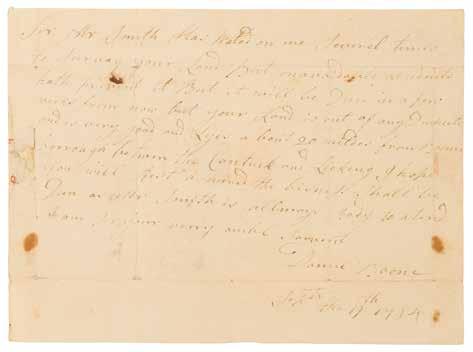
As a pioneer and frontiersman, Daniel Boone was influential in extending the nation beyond the peaks of the Allegheny Mountains. With the company of his brother Squire, he explored the Kentucky wilderness from 1767 to 1769, and eventually settled his family in the territory in 1773. Two years later, he extended the Wilderness Road over the Cumberland Gap through the Allegheny Mountains and erected three settlements, one of which was named ‘Boonesborough.’
In 1783, Boone was appointed deputy surveyor of Lincoln County, and in this role surveyed parcels of land for early Kentucky settlers, including the tract referenced here. In the wake of the Revolutionary War, he resettled in Maysville, Kentucky, and later was elected to the Virginia state assembly in 1787. His military pursuits over, Boone became a local celebrity and, for a period, earned a profitable living as a tavern keeper, surveyor, horse trader, and land speculator.
An especially important moment in Boone’s life came in November 1784 with the publication of John Filson’s The Discovery, Settlement and Present State of Kentucke, which chronicled his adventures and quickly made him an international celebrity, with translations appearing in French and German shortly thereafter. The legalities of land speculation soon caught up with Boone’s sense of honor and weak investment strategies, and in 1788, he moved upriver to Point Pleasant, Virginia, operating at a trading post and later occasionally working as a surveyor’s assistant. An interesting land document dating to the most prosperous period of Boone’s life.
Starting Bid $2,500
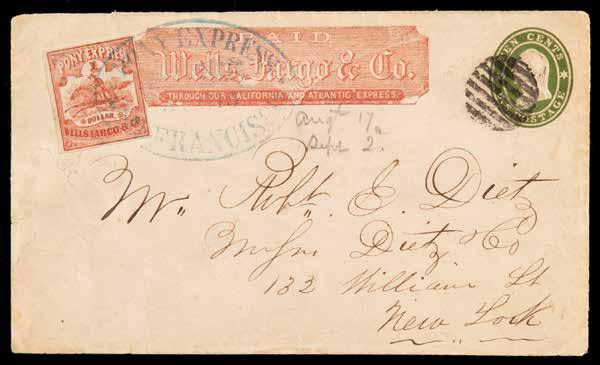
LOT 6094
Pony Express ‘Wells, Fargo & Co.’ Cover with Blue Oval San Francisco Datestamp (August 15, 1861)
Exceedingly rare, Civil War-dated Wells, Fargo & Co. ‘Pony Express’ cover, 5.5 x 3.25, bearing a blue oval “Pony Express / San Francisco / Aug 15” [1861] datestamp, an affixed red onedollar Pony Express adhesive from Wells Fargo, and a green embossed U.S. 10-cent ‘Washington’ embossed indicium. The envelope is addressed in ink to prominent New York lantern and lighting manufacturer Robert E. Dietz. In fine condition, with expected signs of use.
Pony Express adhesive stamps were used on eastbound mail from California between July 1 and October 26, 1861, during which period approximately 35 west-to-east trips were completed, and fewer than 5,000 letters were carried. As such, this cover was likely carried by steamer from San Francisco to Sacramento, where it entered the Pony Express on August 17 for transmission eastward to St. Joseph, Missouri, and thence by rail to New York. Transit time from California to St. Joseph averaged approximately ten days, with riders dispatched twice weekly. The Pony Express route generally followed established overland emigrant trails, closely paralleling the Oregon and California Trails, with relay stations at regular intervals for horse changes and rider exchange. With the completion of the transcontinental telegraph on October 26, 1861, the Pony Express was discontinued.
Starting Bid $5,000
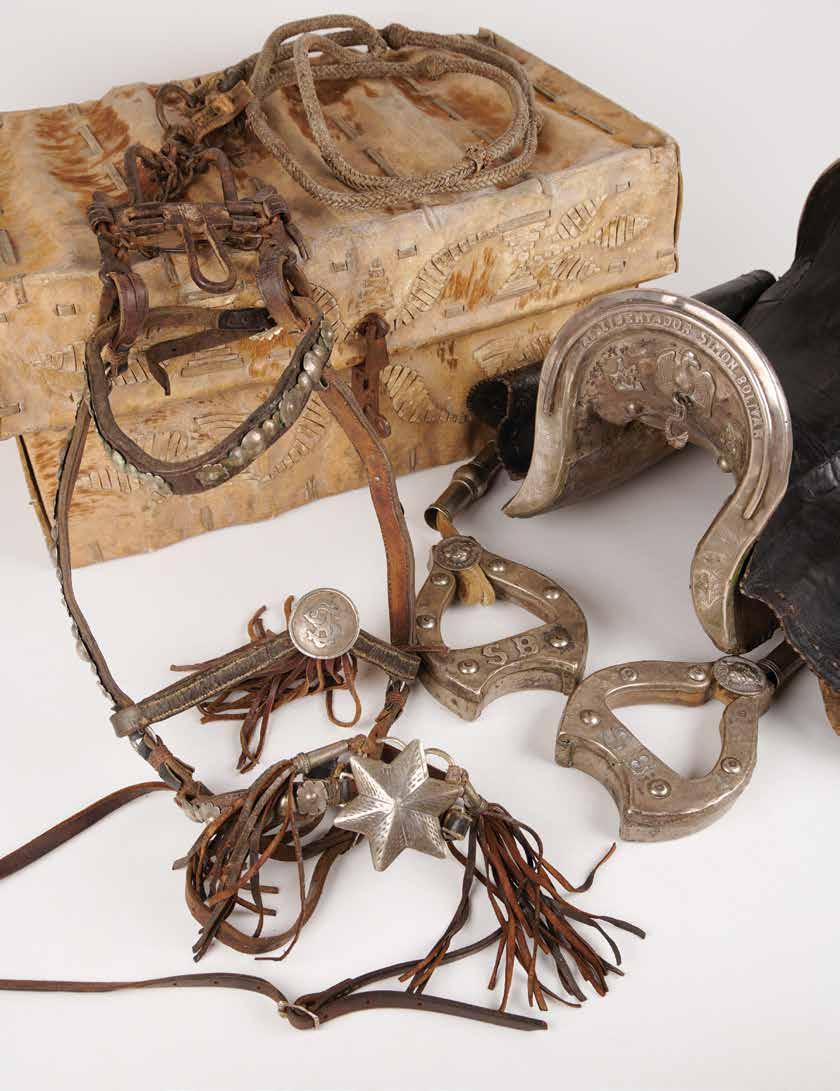
Simon Bolivar 1825 Silver-Mounted Horse Saddle, Bridle, and Trunk - A Finely Detailed Presentation to “Al Libertador Simón Bolívar”
Remarkable silver-mounted black leather saddle and bridle presented in 1825 to the world-renowned Liberator of South America, Simón Bolívar. The saddle resembles the old Spanish jineta style, with sides bordered in a double buck-stitch pattern. The bowed front and matching cantle are each mounted in heavy silver, and engraved in a floral motif. The front plate reads, “Al Libertador Simón Bolívar” in applied letters, and features two applied silver horsemen and an eagle, with an articulated and engraved silver hook. The cantle plate reads, “Potosi 1825,” and features an applied coat of arms.
The stirrups are of wood, completely covered with heavy silver, with the applied initials “SB” and lion’s-head disk, and bordered in an engraved floral motif. Around each stirrup leather is a heavy 5˝ ferrule of applied and engraved silver. The underskirt is also of black leather, with inlaid silver “SB” medallions on either side, and dramatic forward and backward sweeping corners: in each is a triangular patch of spotted animal fur, and a tip of engraved silver. The stirrup leathers and portions of the saddle pad have been restored and reinforced over the years, but remain in remarkable condition for their age.
The highly decorative bridle features two brow bands and a nose band. The top band is joined in the center by a large, hand-worked and engraved five-point silver star, suspended from which are two silver ferrules and 6” leather fringes. The lower brow band is joined in the center by a large silver disk with the applied initials “SB” and a single 7˝ cluster of fringe. Two of the bands, as well as the cheek pieces, are decorated along their entire lengths with rows of worked and engraved silver flowers, and all buckles are silver. The ageappropriate bit, mouthpiece, rings and chain are constructed of handforged iron. The period-correct reins are braided and knotted rawhide. Condition of silver is very good. Bridle leather has undergone repairs and restoration over years and is in fair condition.
An accompanying trunk measures 24˝ x 14˝ x 13˝ and is constructed entirely of cowhide—with remnants of animal hair evident throughout—bound and extensively decorated with rawhide lacing. Side handles are also of rawhide and the trunk is secured by original hand-forged iron hasp and ring. On underside of lid is a worn paper label, imprinted: “Republica de Colombia, Simon Bolivar, Liberator Presidente de la Republica.”
Accompanied by a color copy of a letter of provenance from Jesus Guzman Carrasco, dated January 6, 1950, addressed to the Deputy Prefect of Azurduy Province, Bolivia. In part (translated): “As you and the local community already know, my great grandfather, deceased Leonidas Carrasco Ferrufino, neighbor of this Village, housed in his modest home refugee Antonio Leocadio Guzman Blanco, who was a close supporter of the Liberator during the Independence War, being part of the glorious army for 5 years.
This young man, retired from the Army, established in our Village Asipiazu until his weak health made him go back to his home country Colombia or Venezuela. When he left, my grandfather Leonidas Carrasco helped this brave ex-serviceman providing enough money for the long trip he had ahead. In exchange, he received some of Antonio’s belongings, among them his military saber, several books, uniforms and a bunch of mementos he received from his Master, Friend and Protector, the Liberator Simon Bolivar.
These belongings are the property of my family, and they have been in our province for so many years…The belongings are as follows: Campaign written materials, gunner trunk, a campaign cape, a French spyglass, two mule implements with silverwork details, one complete horse harness, crafted from cowhide and silver, a silver inkwell for three types of inks, a shoehorn and button holder made of silver and nacre.”
This stunning saddle and bridle set is deeply tied to one of the most pivotal moments in South American history—the final phase of the wars of independence and the birth of Bolivia in 1825. That year, following decisive victories over Spanish forces, the region of Upper Peru declared independence and was renamed Bolivia in honor of Simón Bolívar, the ‘Liberator’ whose campaigns helped dismantle Spanish colonial rule across the continent. Bolívar himself traveled through key cities during this triumphant period, where he was celebrated as both military hero and founding statesman of the new republic. At Potosí, Bolivar climbed the Cerro Rico to declare his work finished, waving a flag from the mountain’s summit in a symbolic act associated with the founding of a new nation. Rich in silver from one of the most historically important mining centers of the Spanish Empire, the saddle and bridle evoke the material and cultural legacy of the region at the very moment it transitioned from colonial rule to sovereign nationhood, making the ensemble a rare artifact of revolutionary history.
Starting Bid $5,000
A vivid cross-section of frontier life captured in silver on iron — seven original tintypes bearing witness to the fashions, faces, and characters of the mid-to-late 19th-century American West, ranging from anonymous cowboys and their wives to a self-described vagabond outlaw with a revolver in his lap.
• Tintype (3.25 x 2.5), a man seated in a horse-drawn wagon holding a rifle aloft — an uncommon action pose for the format.
• Tintype (3.25 x 4.75), four men posing together in distinctive frontier fashions — hats, facial hair, and period garments throughout.
• Tintype (2 x 3.25), two men in wide-brimmed hats, jackets, and leather boots, housed in a CDV-style paper frame.
• Tintype (1.5 x 2), a man in a white shirt with messy hair and short beard, cheeks hand-tinted rosy, housed in a CDV-style paper frame.
• Tintype (2.5 x 3.75), two men dressed as cowboys in vests, wide-brimmed hats, and leather chaps, housed in a CDV-style paper frame annotated in pencil identifying the subjects as “Hearst” and “Glispy.”
• Tintype (2.25 x 3.25), an outlaw in a suit and wide-brimmed hat holding a revolver in his lap, housed in a CDV-style paper frame annotated in ballpoint identifying the subject as “Joe Been, the (vagabond).”
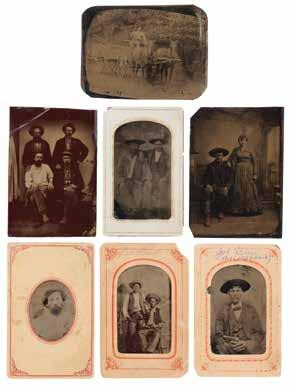
• Tintype (2.25 x 3.25), a cowboy and his wife posing together — the man seated in wide-brimmed hat, bullet belt, and tall cowboy boots, the woman standing at his side in a floor-length dress. Overall condition is very good to fine across the group, with light bends and surface impressions to select plates, minor emulsion irregularities to one example, and corner loss to one mount. The annotated examples — “Hearst,” “Glispy,” and “Joe Been, the vagabond” — carry the strongest individual identity.
Starting Bid $200
German painter (1854–1918) renowned for his portrayals of the most powerful members of the animal kingdom—lions, tigers, polar bears, moose, and buffalo are recurring subjects in his works. Original oil painting of a mighty buffalo drinking from a stream, accomplished by Richard Friese on a 14.5 x 9.75 mounted sheet, signed in the lower right corner by the artist, “R. Friese, ‘98.” This naturalistic painting of a solitary buffalo is rendered in rich, earthy browns with textured brushwork that emphasizes its shaggy coat and powerful form. A softly blurred, wooded background in muted greens and earthy ochres centers attention on the imposing figure. Ornately framed to an overall size of 24 x 19. In fine condition, with hairline cracks through the decorative corners of the frame, not affecting its stability.
Starting Bid $200
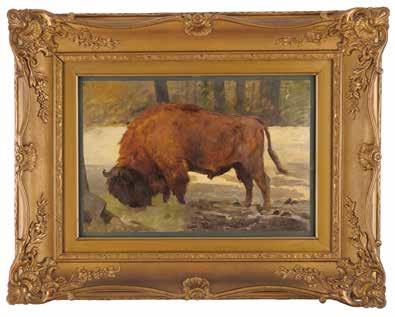
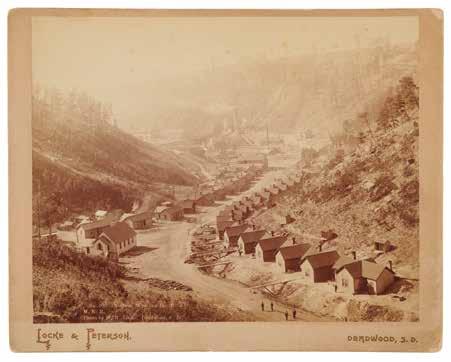
Dramatic original 10 x 8 imperial cabinet photo of “Cambria, Wyo., on the B. & M. R. R.,” taken by H. R. Locke of Deadwood, South Dakota, showing a winding row of modest newly built homes along a road leading to a mining operation and refining plant, nestled within steeply rising valley walls, sparsely covered with trees and scrub. The studio mount is imprinted: “Locke & Peterson, Deadwood, S. D.” In fine condition.
Located in the Black Hills of Wyoming, Cambria was established following the 1887 discovery of rich coal deposits, quickly developing into a thriving company town tied to the expanding railroad industry. Built and operated by the Cambria Fuel Company, the town featured organized housing, schools, and community facilities to support its workforce. At its peak in the early 20th century, Cambria was home to over a thousand residents and produced substantial quantities of coal for regional use. By 1928, the mines were exhausted, operations ceased, and the town was abandoned, leaving behind the remnants of a once-bustling mining community.
Starting Bid $200
Original 7 x 5 albumen photograph of three cowboys armed with lassos and decked out in wooly chaps, affixed to a black 8.75 x 6 mount, captured by an unknown turn-of-the-century photographer. In fine condition, with some light silvering to the darker areas of the image.
Starting Bid $200
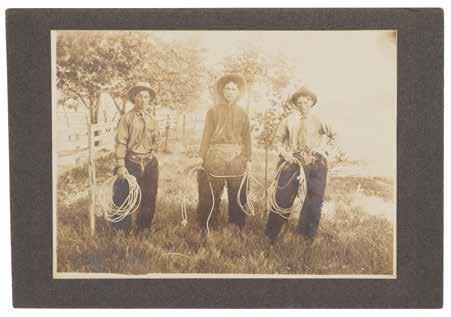
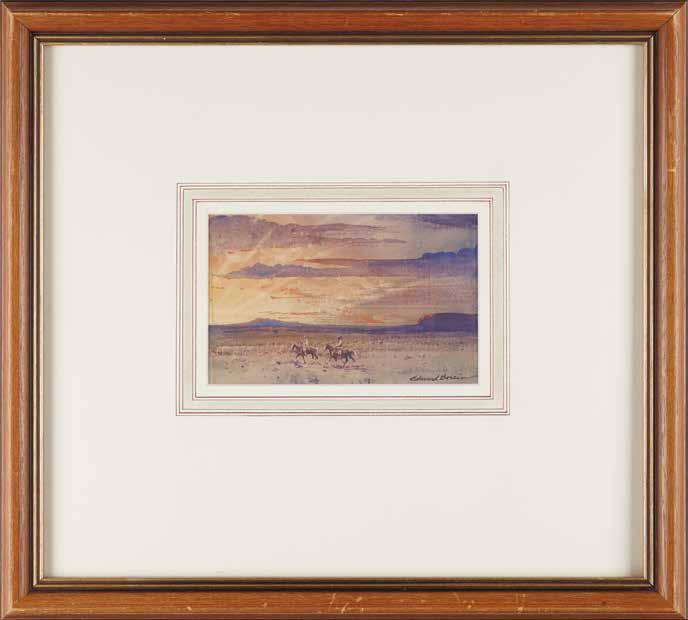
American etcher, painter, and illustrator from California (1873–1945) whose travels as a working cowboy informed his depictions of the American West. Gorgeous original watercolor painting of a dramatic Western landscape with two riders on horseback, accomplished by Edward Borein on a 7.25 x 4.75 sheet, signed in the lower right corner in ink, “Edward Borein.” The scene unfolds under a vast sky streaked
with dark clouds and the glowing orange light of sunset. Two horseback riders move quietly across the wide, barren desert, dwarfed by the scale of the open terrain and distant mountains. The overall mood is quiet and contemplative, with a strong sense of space, solitude, and the rugged beauty of the American West. Matted and framed to an overall size of 18.75 x 17. In fine condition. Provenance: John R. Young Collection, California and American Paintings & Sculpture, Bonhams, November 24, 2008.
Starting Bid $200
Texas Association Stock Certificate (1858)Large-Scale
Circa 1858 original 10.5 x 6.75 unissued Texas Association stock certificate for a share of 8,000 square miles on the Trinity River. As the Republic of Texas was short on cash and inhabitants and faced the threat of Mexican invasion, companies were granted large tracts of land. In fine condition. A handsome document, highlighted by a small vignette at the bottom depicting a spearwielding Indian hunting a bison. An unrecorded document about the Texas Association, better known in Texas history as the Mercer Colony. The Texas Association was formed in early 1844 by Charles Fenton Mercer, a former agent for the Peters’ Colony, which had obtained a large empresario grant to settle North Texas. Following a controversy between English and American stockholders in which the latter seized control of the project, Mercer sold his interest in the enterprise and obtained a separate contract from the Republic of Texas. This agreement, made by President Sam Houston on January 29, 1844, granted Mercer and the Association 8,000 square miles on the Trinity River. In a prospectus entitled Texas Colonization, Mercer offered up to a half section of land for every family settling on the grant before March 20, 1845. Although he had spent over $15,000 on his project by September of 1847, Mercer’s plans did not progress smoothly: ‘The work of colonization was impeded by the fact that various Texas politicians, land speculators, and squatters…questioned the legality of the renewal of the empresario system. Squatters moved into the Mercer survey and denied the claims of settlers who held…certificates’ [Handbook of Texas]. Faced with mounting losses, Mercer in 1852 assigned his interests in the colony to a group of Louisville investors in exchange for an annuity of $2,000. Under the leadership of George Hancock, the Chief Agent, the Association was reorganized. In September 1858, Secretary Claudius Duval called in Mercer’s original hundred certificates and issued new shares for one hundred dollars each. This certificate is from that issue of 1858.
Starting Bid $200
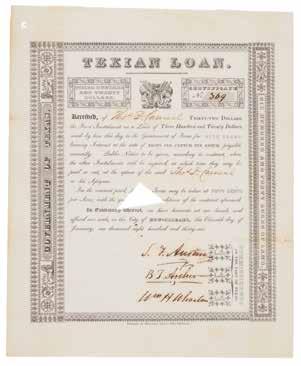
- Ornate 1836 Texian Loan Certificate Supporting the Revolution
Partly-printed DS, signed “S. F. Austin,” one page, 8.5 x 10.25, January 11, 1836. Ornate financial document headed “Texian Loan,” in part: “Received of Thos. D. Carneal Thirty-two Dollars, the First Instalment on a Loan of Three Hundred and Twenty Dollars, made by him this day to the Government of Texas for Five Years.” Boldly signed at the conclusion by Stephen F. Austin and countersigned by two other commissioners, Branch T. Archer and William H. Wharton. In fine condition, with a triangular cancellation cut to the center of the sheet.
Stephen Austin’s provisional government issued these certificates to raise money to finance the ongoing Texas Revolution. January 11, 1836, is the earliest known date for these Texian Loan documents, coming just six weeks before the infamous Battle of the Alamo. These ‘loans’ were essentially land purchase contracts redeemable at fifty cents per acre, a cheap price designed to attract large investments. As a document representing the Revolution and foundational stages of the state’s government, this is of the utmost desirability.
Starting Bid $300
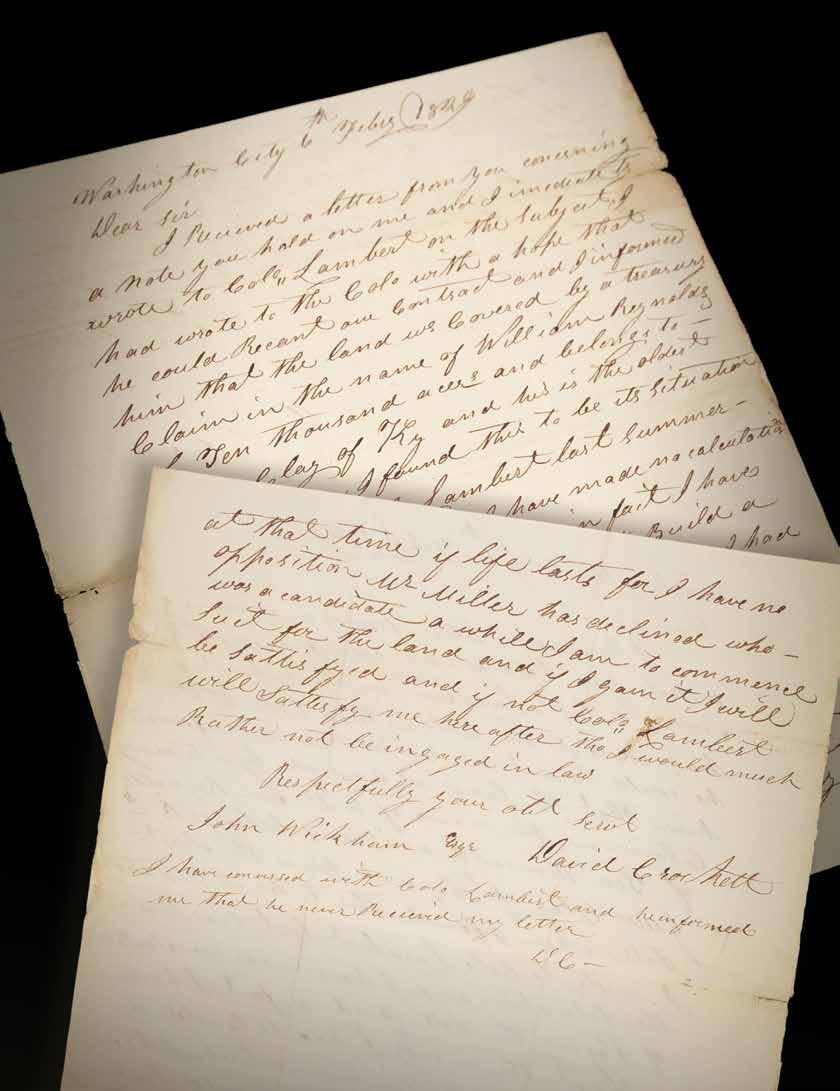
“I have no opposition”— Exceptionally rare handwritten letter from “David Crockett,” sent from Washington to a noted Virginia lawyer in early 1829, discussing land dealings, debt, and his upcoming congressional reelection
ALS as a Tennessee congressman, one page both sides, 8 x 9.75, February 6, 1829. Addressed from “Washington City,” a handwritten letter to prominent Virginia lawyer John Wickham, one of the few Loyalists to rise to prominence following the American Revolution. Crockett discusses a financial obligation owed to Wickham and his efforts to resolve it through land interests in Tennessee and Kentucky, noting complications arising from prior claims and expressing his intention to repay the debt, potentially using western lands as security. The letter, in full (spelling and grammar retained): “I Received a letter from you concerning a note you will hold on me and I imediately wrote to Colo Lambert on the subject. I had wrote to the Colo with a hope that he could Recant one contract and I informed him that the land was covered by a treasury claim in the name of William Reynolds of Ten Thousand acers and belongs to Green Clay of Ky and his is the oldest date when I found this to be its situation I wrote to Colo Lambert last summer – the situation and I have made no calculations of Paying the note and in fact I have not got the money I had to Build a mill and a Cotton gin which I had to expend all the money I could Raize tho I have told Colo Lambert that as he cannot get my note that I know no other way then to let the note ly until next session than I will pay
the note and intrest and will pledge my honor not to Decieve you at that time if life lasts for I have no opposition Mr. Miller has declined who – was a candidate for a while I am to commence Suit for the land and if I gain it I will be Satisfyed and if not Colo Lambert will Satisfy me here after tho I would much Rather not be ingaged in law.” Crocket adds a short postscript, which he signs with his initials, “DC.” It reads: “I have conversed with Colo Lambert and he informed me that he never Received my letter.” In fine condition. Accompanied by custom-bound presentation folder and an engraved portrait bearing a facsimile signature.
Written from Washington in early 1829, this letter dates to a pivotal moment in Davy Crockett’s political career, as he looked ahead to his reelection later that year. Elected to Congress as a Jacksonian in 1827, Crockett secured reelection in August 1829, though his growing opposition to Andrew Jackson—particularly over the Indian Removal Act—soon placed him at odds with his party and contributed to his defeat in 1830. He returned to Congress in 1832 but was again unseated in 1834. After these political setbacks, Crockett set out for Texas in hopes of reviving his fortunes, only to meet his death in March 1836 at the legendary Battle of the Alamo.
Starting Bid $5,000
Partly-printed 3.75 x 2.25 pass issued by the Texas Transfer & Mail Company in 1879, marked as “No. 15,” issued to “J. H. Page Esq.,” and signed by a superintendent. A small vignette of a stagecoach appears below the company’s name, and the reverse is imprinted: “This Pass is not transferable and the person accepting and using it thereby assumes all risk of accident and damage to person and baggage.” In fine condition.
Starting Bid $200
Partly-printed 4 x 2.25 pass issued by the Texas & California Stage Co. in 1880, marked as no. “83,” issued to “J. H. Franklin, Supt., Boston & New York Air Line R.R.C.,” and signed in ink by General Superintendent R. C. Kerens. The pass features an ornate border and terms printed on the reverse, in part: “In consideration of Free Passage, the person accepting and using this Ticket thereby expressly agrees to assume all risk of accidents.” Includes a 5.5 x 2.75 cardstock pocket map showing “some of the lines of the Texas and California Stage Co.,” which pass from Austin to San Diego, from Dallas to Fort Concho, and from Harwood to Eagle Pass, Texas. In overall fine condition.
Starting Bid $200
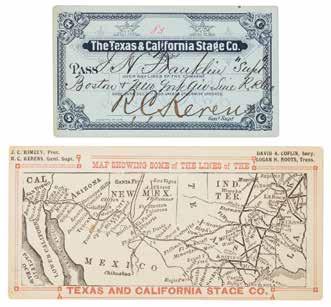
know
Original vintage matte-finish 23.75 x 9.5 silver gelatin photo of “State Rangers & Prohibition Agents of Texas,” captioned within the image, most shown posing with their rifles. Annotated on the reverse in pencil: “These are the original Texas Rangers who were in Denison guarding the R. R. shops. They sure know how to shoot guns & ride horses. Some of them just came off the Rio Grande border up here. 7/31.” In very good to fine condition, with multiple vertical folds.
Starting Bid $200
“W. S. Earp, Const.”—an extremely early subpoena served as constable of Lamar, Missouri, his first post in law enforcement
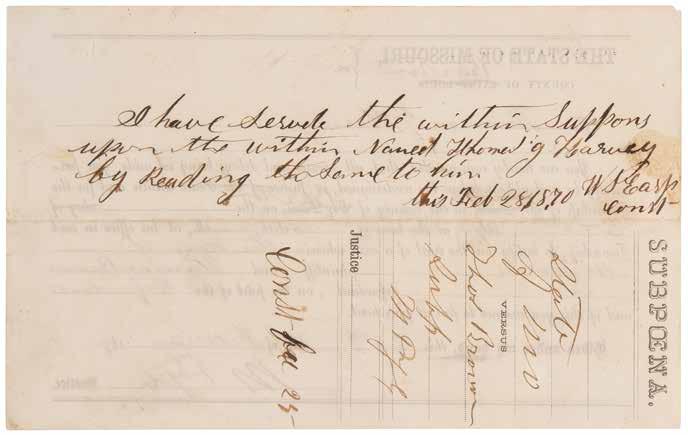
Wyatt Earp Autograph Endorsement Signed as Constable of Lamar, Missouri - His First Job in Law Enforcement
Legendary Tombstone lawman and gambler (1848–1929) famed for his involvement in the gunfight at the O.K. Corral. Partly-printed DS, endorsed “W. S. Earp, Const.,” one page, 7.75 x 4.75, February 28, 1870. Subpoena issued in Barton County, Missouri, for the appearance of Thomas G. Harvey “to testify on the trial of a case wherein the state of Missouri, plaintiff, and Thomas Brown is defendant, on the part of the Defendant and of this you are not to fail at your peril.” Signed at the conclusion in ink by a justice, “M. Pyle,” and boldly endorsed on the reverse in ink by Earp as constable of Lamar, Missouri: “I have served the within summons upon the within named Thomas G. Harvey by reading the same to him, this Feb. 28, 1870.” In fine condition, with a light stain touching the end of the signature.
This 1870 subpoena, endorsed by Wyatt Earp during his brief tenure as constable in Lamar, Missouri, captures the 21-year-old lawman at the very outset of his career. Earp stepped into the role after the resignation of his father, Nicholas Earp, who had previously served as constable, highlighting the familial and community-based nature of such appointments in small Midwestern towns. His duties at this time were largely routine—serving legal papers and executing warrants to support the local justice system—offering a revealing glimpse into the administrative side of frontier justice rather than the gunfights that would define his later legend. Earp’s endorsement represents one of the earliest known examples of his signature in an official law enforcement capacity, capturing him at the threshold of a career that would become synonymous with the mythology of the American West.
Starting Bid $2,500
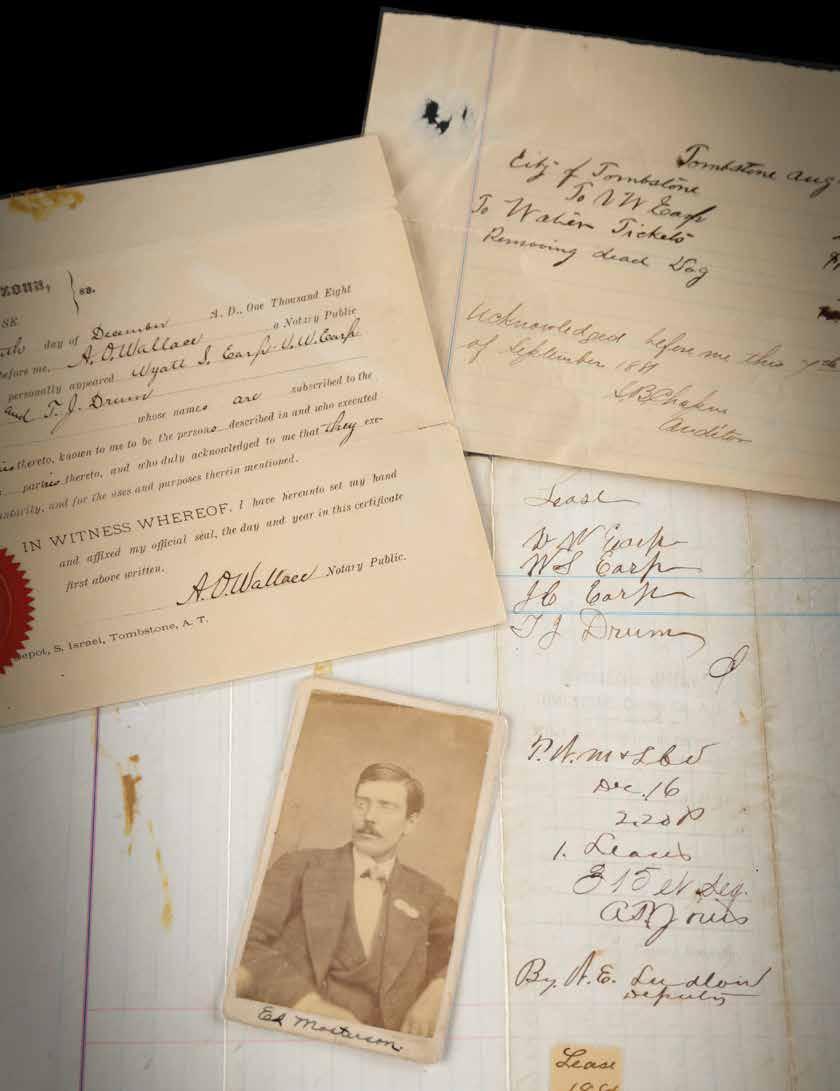
Historic archive of documents from Tombstone, Arizona, highlighted by a lease signed by three members of the Earp family—Wyatt Earp, Virgil Earp, and James Earp—for a reservoir to bring water to their Grasshopper Mine. Includes:
- Manuscript DS, signed “Wyatt S. Earp,” “V. W. Earp,” “James C. Earp,” and “T. J. Drum,” one page both sides, 8 x 12.5, December 8, 1881. In part: “This agreement made this day between V. W. Earp, W. S. Earp, J. C. Earp, & T. J. Drum all of the City of Tombstone, Cochise County, Arizona Ter., Parties of the first part & the Tombstone Water Mill & Lumber Co., a corporation of the same city…The parties of the first part for & in consideration herein after named do grant, bargain & lease to the parties of the second part the right of way to build their reservoir & say their water pipe from the westerly line…over their mining claim known as the Grasshopper mine in Tombstone district.” Signed on the reverse in ink by the four parties of the first part, and embossed with the seal of notary A. O. Wallace.
- Partly-printed DS, signed “A. O. Wallace,” one page, 8.5 x 7, December 14, 1881. In part: “On this Fourteenth day of December…before me, A. O. Wallace, a Notary Public in and for the County of Cochise, personally appeared Wyatt S. Earp, V. W. Earp, James C. Earp, and T. J. Drum whose names are subscribed to the annexed instrument as parties thereto, known to me to be the persons described in and who executed the said annexed instrument.”
- ADS by Virgil Earp, signed within the text, “V. W. Earp,” one page, 7.75 x 6.25, August 1881. A bill written at Tombstone, in part: “City of Tombstone To V. W. Earp, To Water Tickets—$1.00, Removing dead Dog, .50—$1.50.” Acknowledged below by an auditor, and also endorsed on the reverse by Virgil Earp, “Bill of V. W. Earp.”
- Original 2.5 x 4 carte-de-visite portrait of lawman Ed Masterson, the older brother of famed gunfighters Bat Masterson and James Masterson, showing him in a suit and tie, with an identification notation inked on the mount. The reverse bears the imprint of “W. B. Critchfield, Photographer, Chariton, Iowa.”
In overall very good to fine condition, with all pieces fully laminated by a collector in the 1970s. Accompanied by a copy of a petition relating to “the matter of application of Wyatt Earp and J. H. Holliday for writ of Habeas Corpus,” produced by the Tucson Blue Print Co.
This compelling group of Tombstone documents captures Wyatt and Virgil Earp at a pivotal moment in their frontier careers, just weeks after the famed Gunfight at the O.K. Corral in October 1881 and amid the escalating tensions that would soon erupt into the Earp Vendetta Ride. Far from the popular image of gunfighters alone, these records place the Earps firmly within the economic and civic fabric of boomtown Tombstone, where mining interests and infrastructure projects were essential to survival and prosperity.
Starting Bid $1,000
Wyatt Earp Typed Letter Signed to Biographer
Stuart N. Lake, the Creator of Earp’s Enduring Legend
Legendary Tombstone lawman and gambler (1848–1929) famed for his involvement in the gunfight at the O.K. Corral. TLS signed “Wyatt S. Earp,” one page, 8.5 x 11, June 8, 1926. Letter to his biographer, Stuart N. Lake, in full: “Mrs. Earp and I are now returned from the desert; we have been home for about a week and we are glad to be back. Now I realize that it is beginning to be vacation time, and while I do not know what you have in mind for the summer, if it is at all coincident with your plans, I shall be pleased to have you call to see me; we shall be here until Fall. If you should drive out, please let me suggest that you select either Sixteenth Street or Washington (Nineteenth) Street in traveling west through the city (as Seventeenth Street is not a cut through), as far west as Ninth Avenue, then to Seventeenth Street and thence east for a block. The street car service is convenient over the Sixteenth (red) car line or the Washington St. (‘W’ - yellow) car line. Mrs. Earp and I shall look for you; we trust you are well and we send you the kind regards.” In fine condition.
Stuart N. Lake’s Wyatt Earp: Frontier Marshal, published in 1931 (two years after Earp’s death), became the most influential—and controversial—account of Earp’s life, transforming the aging lawman into a larger-than-life symbol of frontier justice. Based in part on Lake’s personal interviews and correspondence with Earp during the 1920s, the book presents a heroic, morally resolute figure whose exploits helped to define the popular image of the American West for generations. Though later historians have challenged its accuracy and noted embellishments, Lake’s biography remains a cornerstone of Earp’s legend, making letters like this one—written during their collaboration—especially significant as evidence of the relationship that shaped Earp’s enduring legacy.
Starting Bid $1,000
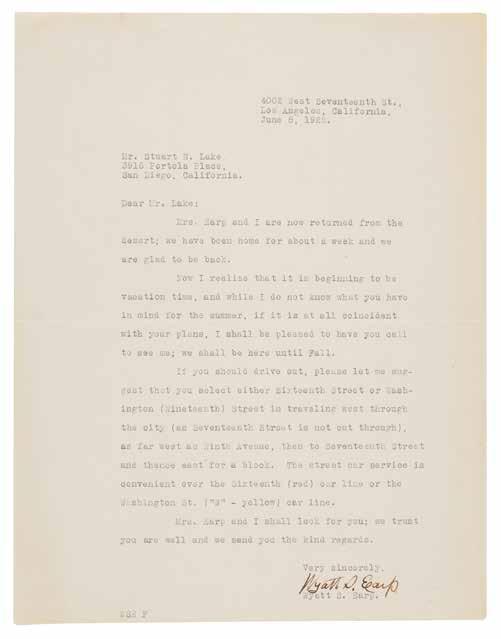
Pat Garrett Document SignedBilly the Kid’s
New Mexico lawman (1850–1908) famed for killing his former gambling partner, the fabled outlaw Billy the Kid, in 1881. Partly-printed DS, signed “P. F. Garrett,” one page, 8 x 3.5, August 11, 1900. Promissory note issued at Las Cruces, New Mexico, for $30 payable “60 days after date…to the order of Geo. D. Bowman and Son, Bankers…with interest at the rate of twelve per cent per annum from maturity until paid, with ten per cent, on amount unpaid if placed for collection in the hands of an attorney.” Signed at the conclusion in ink by Pat Garrett. In very good to fine condition, with multiple light vertical folds. Accompanied by a modern matte-finish portrait of Garrett.
Starting Bid $200
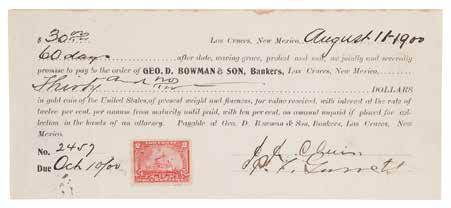
Billy the Kid’s killer writes home from Las Cruces: “I am in the real estate business and am doing splendid”
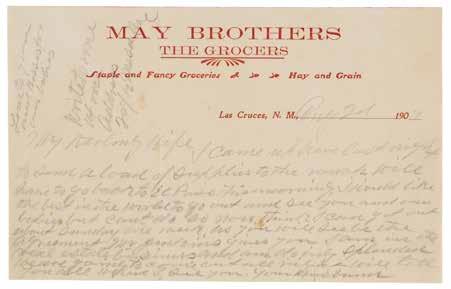
Signed to His Wife: “I am in the real estate business and am doing splendid”
New Mexico lawman (1850–1908) famed for killing his former gambling partner, the fabled outlaw Billy the Kid, in 1881. ALS in pencil by Pat Garrett, signed “Your Husband,” one page, 8 x 5, May Brothers: The Grocers letterhead, August 2, 1907. Handwritten letter to his “Darling Wife,” in full: “I came up here last night to send a load of supplies to the ranch. Will have to go back to El Paso this morning. I would like the best in the world to go out and see you and our babies but can’t do so now. Think I can get out about Sunday one week. As you will see [in] the agreement Mr. Jenkins gives you I am in the real estate business and am doing splendid. We are going to come out all right; will tell you all when I see you.” In a postscript at the head, Garrett adds: “Love to you and kisses for our babies. Write to me at once Address 20412 Masu Ave.” In fine condition.
Starting Bid $200
Billy the Kid’s killer deals in the difficult horse-trade: “We will leave home tomorrow with the Horses for Eastern Texas. I have failed to sell in this country”
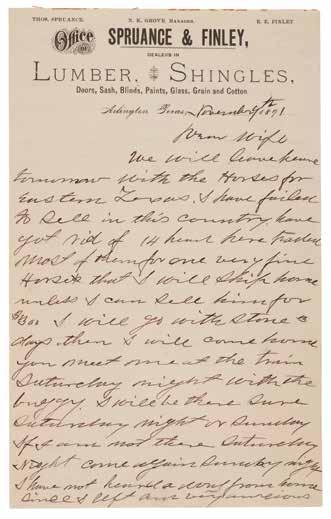
Pat Garrett Autograph Letter Signed to His Wife on the Texas Horse-Trade: “Have got rid of 14 head here traded most of them for one very fine Horse”
New Mexico lawman (1850–1908) famed for killing his former gambling partner, the fabled outlaw Billy the Kid, in 1881. ALS signed “P. F. Garrett,” one page both sides, 5.75 x 9.5, Spruance & Finley letterhead, November 4, 1891. Handwritten letter to his wife, in full: “We will leave home tomorrow with the Horses for Eastern Texas. I have failed to sell in this country, have got rid of 14 head here traded most of them for one very fine Horse that I will ship home unless I can sell him for $300 I will go with Stone 3 days, then I will come home you meet me at the train Saturday night with the buggy. I will
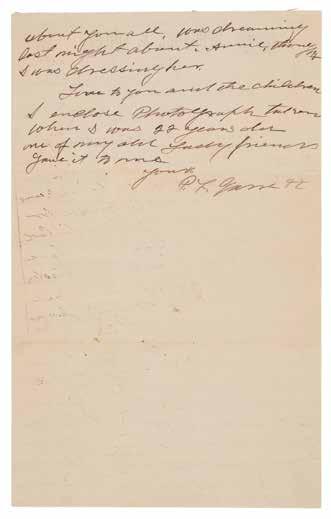
be there sure Saturday night or Sunday. If I am not there Saturday night come again Sunday night I have not heard a word from home since I left am very anxious about you all. Was dreaming last night about, Annie, thought I was dressing her. Love to you and the children I enclose Photograph taken when I was 22 years old one of my old Lady friends gave it to me.” In fine condition. Accompanied by the original mailing envelope, addressed in Garrett’s hand to “Mrs. P. F. Garrett, Uvalde, Texas.”
In 1890, Garrett had run unsuccessfully for sheriff of the newly created Chaves County, New Mexico. Following his defeat, he moved his family to Uvalde, Texas, where he spent several years raising horses.
Starting Bid $200
“I don’t care what my business may be or how much money there may be in my being away from you I will never again be so long away from you until the monster death seperates us”
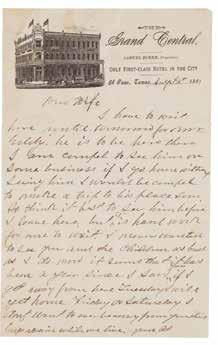
Pat Garrett (2) Autograph Letters Signed to His Wife: “I will never again be so long away from you until the monster death seperates us”
Two ALSs, signed “Pat” and “P. F. Garrett,” totaling three pages on two sheets, 6 x 9.5, The Grand Central letterhead, August 4 and 6, 1889, both addressed to his wife. The first, in full: “I have to wait here until tomorrow for Mr. [Charles] Eddy. He is to be here then I am compel to see him on some business if I go home without seeing him I would be compel to make a trip to his place soon so think it best to see him before I leave here but it is hard work for me to wait. I never wanted to see you and the children as bull as I do now it seems that it has been a year since I saw you if I get away from here Tuesday I will get home Friday or Saturday I don’t want to ever be away from you this long again while we live.”
The second, in full: “I wrote you yesterday morning that I expected to leave here to day thought sure Mr. Eddy would have been here yesterday, and we could have gotten through our business so as to have started out to day, but he did not come. However I look for him sure today and we will get through with our business and start home
tomorrow. If I can get off tomorrow I will be home Saturday night I give you my word that this is the last time that I will ever be away from you if you knew how I want to see you I know you would be sorry for me. I don’t care what my business may be or how much money there may be in my being away from you I will never again be so long away from you until the monster death seperates us. It seemes to me I can see you worrying and looking for me. Be pacient my Angel this is the last time.” In overall very good to fine condition, with scattered light staining and creasing.
Four years before these letters were written, Pat Garrett embarked on an ambitious irrigation venture in the Pecos Valley. He proposed damming the Hondo River and channeling its waters through a network of canals across west Texas and southern New Mexico, envisioning that the primary profits would come not from land sales but from water rights. To advance the project, Garrett enlisted the financial backing of New Mexico cattleman Charles Eddy, and, with assistance from his former publisher Charles Greene, helped establish the Pecos Valley Irrigation and Investment Company. Although the company was formally incorporated in 1888, the enterprise ultimately proved unsuccessful.
Starting Bid $200
Pat Garrett Document Signed - Part of the Las Cruces Land Deal that Ended in His Murder
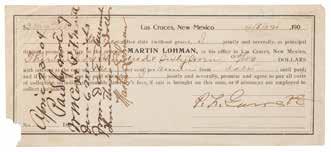
Partly-printed DS, signed “P. F. Garrett,” one page, 8.5 x 3.75, April 8, 1902. Promissory note issued at Las Cruces, New Mexico, in full: “Two years after date (without grace), I jointly and severally, as principal debtors, promise to pay to the order of Martin Lohman, at his office in Las Cruces, New Mexico, Thirty-five Hundred & Sixty Seven 50/100 Dollars with interest at the rate of 12 per cent per annum from date until paid; and if the same shall not be paid when due, I jointly and severally, promise and agree to pay all costs of collection, including reasonably attorney’s fees, if suit is brought on this note, or if attorneys are employed to collect the same.”
Garrett had acquired the 160–acre Bear Canyon Ranch in Doña Ana County, New Mexico in 1898, and kept it for four years before mortgaging it to Lohman. Tired of non-payment on the note, Lohman sold it to Garrett’s neighbor, W. W. Cox, for a slightly discounted rate of $3,000. Cox renewed the note as evidenced by a second inscription found scrawled vertically across the face: “April 23 04, Paid by note of W. W. Cox & P. F. Garrett, Due 6 months from date current, Three Thousand Dollars, Martin Lohman.” In very good to fine condition, with overall creasing, and minor loss to the lower left corner.
Various theories about Garrett’s murder stem from the renewal of this note by Cox. The generally accepted story is that Jesse Wayne Brazel leased a portion of the land from Garrett’s son (who had no legal right to make such a deal) to graze his goats. Garrett was furious about the goats and, sometime later, while Garrett was riding with Carl Adamson to Las Cruces discussing the purchase of Garrett’s land, Brazel rode up. An argument over the goats ensued and Garrett was shot by Brazel. Brazel, whose story was backed by Adamson, claimed Garrett was reaching for a shotgun and Brazel shot him in self defense. He was acquitted. However, Leon C. Metz, in his 1974 biography of Garrett, relates the claim of W. T. Moyers that ‘his investigations led him to believe that [W. W.] Cox himself ambushed and killed Garrett,’ but also wrote that ‘the Garrett family believes that Carl Adamson pulled the trigger.’
Starting Bid $300
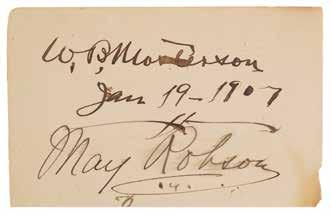
LOT 6120
Bat Masterson Signature - Rare Autograph of the Dodge City Icon
Bold ink signature, “W. B. Masterson, Jan. 19—1907,” on an off-white 4.75 x 3 album page. Actress May Robson’s signature is below Masterson’s with several other signatures on reverse. In fine condition. Accompanied by a modern cardstock portrait.
Starting Bid $500
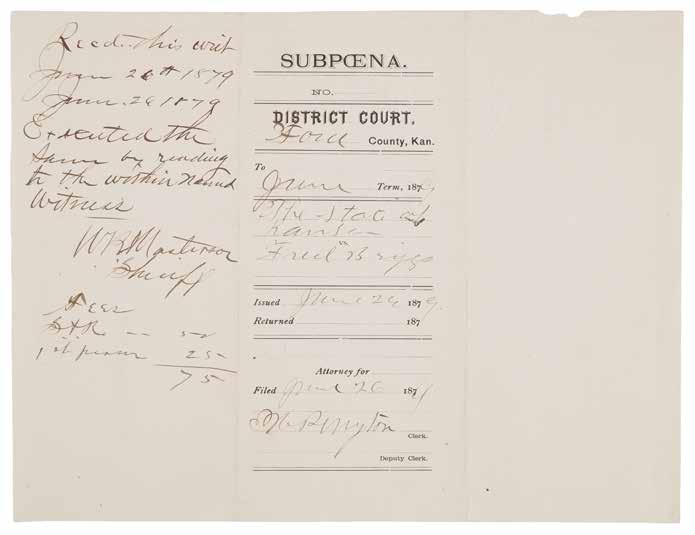
LOT 6121
Bat Masterson Document Signed as Dodge City Sheriff - Subpoena for the Appearance of a Witness
Partly-printed DS, signed “W. B. Masterson, Sheriff,” one page, 8 x 10.5, June 26, 1879. Subpoena issued in Ford County, Kansas, commanding H. P. Niese “to be and appear in your own proper person, before the Judge of the District Court of the State of Kansas, sitting in and for the County of Ford at the Court House in Dodge City, County of Ford on the 26th day of June…then and there to testify on behalf of the Dft. in a certain matter of controversy now pending and undetermined in said Court.” Signed at the conclusion in ink by a court clerk, and endorsed on the reverse by Masterson: “Recd. this writ June 26th, 1879, June 26, 1879, Executed the same by reading to the within named witness. W. B. Masterson, Sheriff. Fees, S&R—50 ,1st person 25—75.” In fine condition, with a small chip to one edge.
Issued at the height of Dodge City’s turbulent cattle-town era, this document places Bat Masterson squarely in his official capacity as sheriff during one of the most storied periods of frontier law enforcement. By 1879, Dodge City stood as a crossroads of commerce, vice, and violence, where figures like Masterson and his close associate Wyatt Earp struggled to impose order on a transient population of cowboys, gamblers, and opportunists. While Masterson’s legend is often tied to gunfights and gambling halls, this subpoena underscores the routine but essential duties that defined his office—serving writs, compelling testimony, and upholding the rule of law. The endorsement in Masterson’s own hand illustrates the administrative realities behind the mythology of the Old West—justice was carried out not only at the barrel of a gun, but through the formal processes of the court.
Starting Bid $1,000
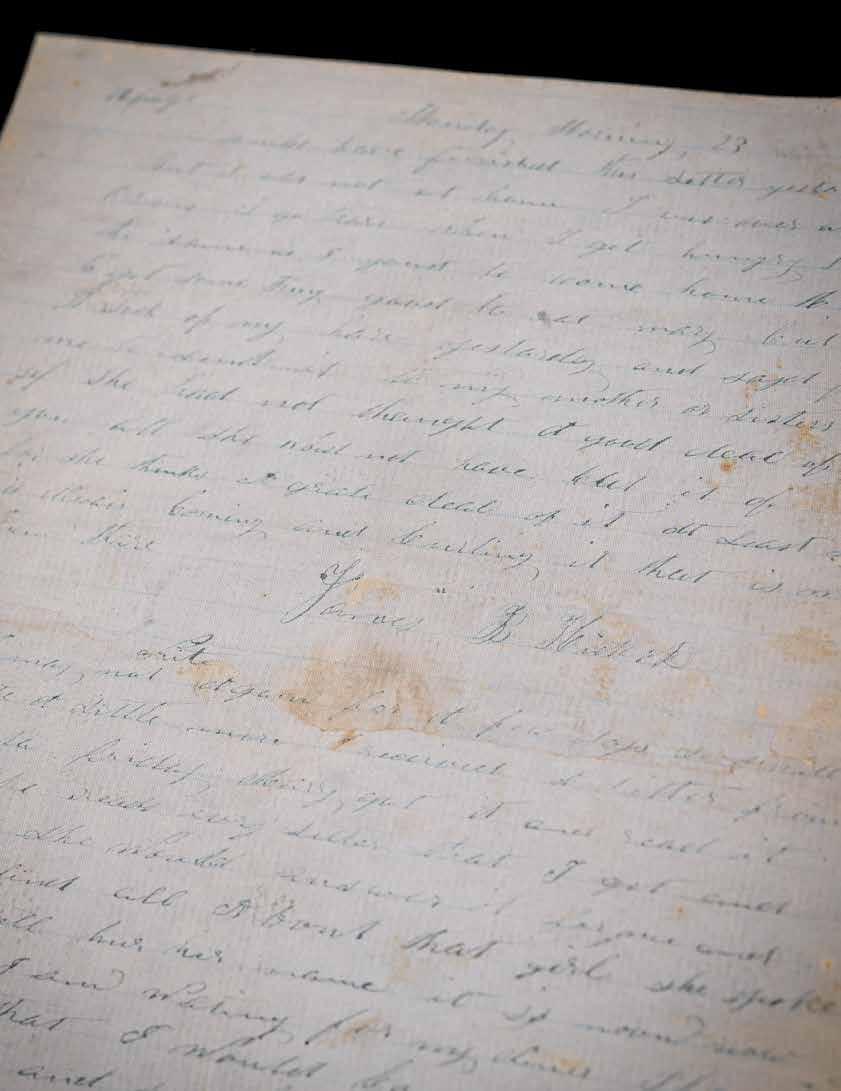
Wild Bill Hickok Autograph Letter SignedAn Excessively Rare Old West Autograph, Signed Four Times!
Old West folk hero (1837–1876) who earned notoriety as a scout, lawman, gunslinger, and gambler, famously shot and killed while playing poker in a saloon in Deadwood, Dakota Territory. Exceedingly rare ALS, signed four times—”Jm. Hickok” twice, and “James B. Hickok” twice—one page both sides, 8 x 10, August 20, 1858. Handwritten letter from Monticello Township, Johnson County, Kansas, littered with misspellings and other errors, evidently sent to his family—his mother and sisters—in Illinois.
In full (spelling retained): “I have raked and put up a tun of hay in an hour and a half and now I will write a little more to you if I can think of anything to write. You must not blame me if you can’t read my writings for evry spare moment I have I sit down on my bed and put my paper on a Book and Write a few lines and then quit and that is the reason I don’t write Better. I guess sitting Bent over Writing on one’s nee ain’t a verry nice way of resting one’s self I don’t think. I have got to mo one hundred tun of hay yet and mabee too hundred I don’t no yet exactly how much I have got to mo. Thare is considerable sickness in the teritory jest now though there are but dew deaths. Scarcely any one dies with the fevers that they have here. Write me all the news. When you Write again if you pleas Let us all no how the Corryel gets a long for gerry want to no verry Bad. I guess he told me to say that he had Writen to you once Since he Came here.”
Hickok signs twice at the bottom of the first page, then continues his letter on “Monday Morning,” August 23rd: “I would have finished this letter yesterday But I was not at home. I was over at John Owens. I go thare when I get hungry jist the same as I youst to come home to mothers to get some thing good to eat. Mary Cut off A Lock of my hare yesterday and sayd for me to send it to my mother or sisters if she had not thought a good deal of you all she woud not have Cut it of for she thinks A grate deal of it. At least she is allwais Coming and Curling it that is when I am thare.”
He signs once more, then finishes his letter: “I may not write again for A few days so I will Write a little more. I received A Letter from Celinda friday, Mary got it and read it for she reads evry letter that I get and sayd she would answer it for me and tell Celind all About that girl she spoke and tell hur her name. It is noon now and I am waiting for my diner. I promised gery that I would Come out to Olatha and see him last Sunday but it rained all day and I did not go.” Hickok signs again at the end of the letter. Professionally silked on one side and in fine condition. Accompanied by a handsome custom-made quarter-leather presentation folder.
Hickok had fled Illinois in 1855, at age 18, and joined up with Jim Lane’s vigilante Jayhawkers—the antislavery guerrilla group—during the ‘Bleeding Kansas’ era. In 1857, he claimed a 160-acre homestead tract in Johnson County, Kansas, and in March 1858 he was elected one of the first four constables of Monticello Township. There, he fell in love with Mary Owen—later described as ‘an eighth-blood Shawnee of great attraction’—who he mentions here, and who he reportedly intended to marry. It may have been his family’s objections to a mixed-heritage marriage that resulted in the relationship’s demise. According to Jule Hadley, an early resident of Johnson County: ‘The public does not know it but his matrimonial failure and disappointment made him [into] ‘Wild Bill.’’ (see: Wild Bill Hickok: The Man and His Myth by Joseph G. Rosa, p. 10).
Hickok left Monticello in 1859, becoming a driver for the Russell, Majors and Waddell freight company—the parent company of the Pony Express—before serving in the Civil War. He went on to earn fame as an Old West icon for his exploits as a scout, gunfighter, and lawman on the expanding western frontier. His exploits—some documented, others embellished—helped cement his reputation as one of the most celebrated figures of his era.
Autograph letters of Wild Bill Hickok are extremely rare, with only a small number of authentic examples known; perhaps a dozen exist in private hands. This example is especially noteworthy in that Hickok signs four times in two distinct forms—“Jm. Hickok” and “James B. Hickok”—a highly unusual and desirable feature that significantly enhances its appeal.
Starting Bid $5,000
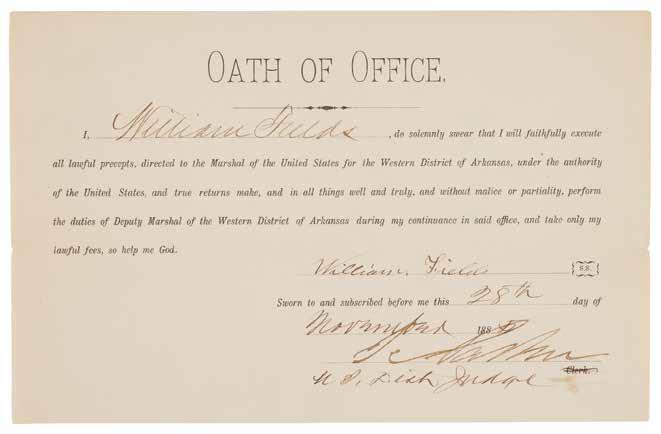
Isaac C. Parker Document Signed - Oath of Office Approved by ‘The Hanging Judge’
Fearless and determined justice (1838-1896) of the Indian Territory in western Arkansas who earned the nickname ‘The Hanging Judge’ because of the great number of convictions he secured against criminals, renegades, and fugitives from justice. Uncommon partly-printed DS, signed “I. C. Parker,” one page, 8.5 x 5.5, November 28, 1885. Oath of office issued to William Fields, who swears to “faithfully execute all lawful precepts, directed to the Marshal of the United States for the Western District of Arkansas… and without malice or partiality, perform the duties of Deputy Marshal of the United States for the Western District of Arkansas during my continuance in said office.” Signed at the conclusion in fountain pen by Isaac C. Parker, and countersigned by William Fields. In fine condition. Serving during one of the most dangerous times of Western expansion, Parker sent 79 people to the gallows. Incidentally, as a reflection of the frontier violence, as many as 109 deputy marshals were killed in the line of duty during that time.
Starting Bid $200
by Allan Pinkerton, who approves the
publication of his 1875 short story collection
‘Claude Melnotte as a Detective, and Other Stories’
Scottish-American detective and founder (1819-1884) of the Pinkerton National Detective Agency, known for his claim to have foiled an 1861 plot to assassinate president-elect Abraham Lincoln. Manuscript DS, one page, 9 x 13.75, March 20, 1875. A Canadian publishing rights agreement between Allan Pinkerton and Hunter, Rose & Co. of Toronto, with W. B. Keen Cooke & Co., publishers of the American edition, providing stereotype plates and acting as intermediary. The contract reads, in full: “Memorandum of an agreement made this day by and between W. B. Keen Cooke & Co. and Allan Pinkerton of the City of Chicago and Hunter, Rose and Co. Publishers of Toronto, for and in consideration of one dollar, the receipt of which is hereby acknowledged.
Witnesseth that the sum of Two hundred and fifty dollars ($250) to be paid to the said W. B. Keen Cooke & Co. they will furnish Hunter, Rose & Co. a complete set of stereotype plates of a book entitled ‘Claude Melnotte and other detective stories,’ from which plates the said Hunter, Rose & Co. agree to print and publish an edition of at least three thousand copies – and also agree to pay to the said Allan Pinkerton a royalty of Ten (10) cents on each and every copy of the work printed and sold of this first and all subsequent editions. Settlements to be made by remittance to said W. B. Keen Cooke & Co. on the first days of July, October, January and April of each year hereafter.
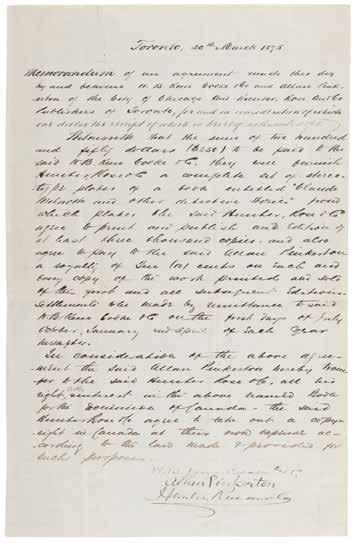
In consideration of the above agreement the said Allan Pinkerton hereby transfer to the said Hunter Rose & Co., all his right [title] & interest in the above named Book for the Dominion of Canada – the said Hunter Rose & Co. agree to take out a copyright in Canada at their own expense according to the law made & provided for such purposes.” Signed at the conclusion by Pinkerton and by representatives of the two publishing houses. In fine condition. Pinkerton remains scarce across all signed formats.
Drawing on his high-profile career as a detective and founder of the Pinkerton National Detective Agency, Allan Pinkerton turned to producing popular detective literature based on his own exploits and those of his operatives. These works, believed to have been written with the assistance of ghostwriters and intended in part to promote his agency, include the book Claude Melnotte as a Detective, and Other Stories, which was published by W. B. Keen, Cooke & Co., in 1875. The work, one of his earliest, contained four detective stories: ‘Claude Melnotte as a Detective,’ ‘L’Envoi; Sequel,’ ‘The Two Sisters; or, The Avenger,’ and ‘The Frenchman; or, The Bills of Exchange.’
Starting Bid $1,000
New Mexico Territory: Frank Lea Signed Warrant to “Arrest and Take the Body” of a Murder Suspect in Lincoln County (1882)
Partly-printed DS, signed “Frank H. Lea,” one page, 8.5 x 7, July 17, 1882. Arrest warrant from “The Territory of New Mexico,” issued to the constable of Lincoln: “You are hereby commanded to arrest and take the body of Bill Johnson (colored), and him safely keep, so that you have his body before the undersigned, a Justice of the Peace, within and for, Precinct No. 8, County of Lincoln, at my office in White Oaks, in said County forthwith then and there to answer unto the Territory of New Mexico on a charge or murder.” Signed at the conclusion by Lea as justice of the peace. Lea signs again on the reverse after a handwritten statement: “Wm. R. Rexford is hereby appointed special constable to serve the within unit.” In fine condition. A notable arrest warrant related to an infamous New Mexico county and the site of the ‘Lincoln County War,’ a violent Old West conflict between rival factions that began in 1878 and continued into 1881, which became legendary for the involvement of William H. Bonney, aka Billy the Kid. Frank Lea was an influential early settler and civic leader in late 19th-century New Mexico, serving as Justice of the Peace, treasurer, and founder of a prominent cattle company in White Oaks. Among the earliest settlers of the Pecos Valley, he is credited as the original founder of White Oaks, laying out the town himself, and later arrived at the site of present-day Roswell in 1881, where he built one of its first homes.
Starting Bid $200
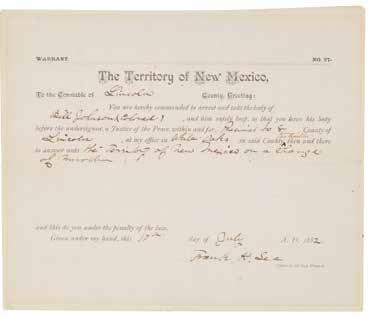
Wyoming Territory bench warrant charging a Johnson County man with horse branding fraud in 1885, seven years before the county’s deadly ‘War on Powder River’
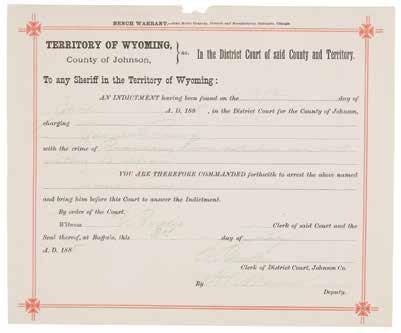
Wyoming Territory: H. R. Mann Signed Bench Warrant for a Johnson County Horse Branding Fraud Case (1885)
DS, one page, 8.25 x 7, July 3, 1885. County of Johnson bench warrant issued to “any Sheriff in the Territory of Wyoming,” related to an indictment charging “James Cannery with the crime of Branding horse not his own with intent to defraud.” Signed at the conclusion by H. R. Mann as the deputy of Johnson County. In fine condition.
Starting Bid $200
ALS signed “B. F. Branham, Sheriff, by Eben C. Farley, Under-Sheriff,” one page, 8 x 10, Santa Clara County Sheriff’s Office letterhead, July 13, 1885. Handwritten letter to Constable J. C. White, in part: “I will send you the description of Ah Quong alias Hip Sing. He is a native of China, age 26 or 27 height 5 ft 5 in or 5 ft 6 in, very white for a chinaman, the finger next to the little finger on the left hand is crooked in…There is a reward of $600 for him upon conviction. If your Chinaman answers the above description let me know and I will go and get him. Let me hear from you by return mail or express or telegraph.” Includes an original 2.25 x 3.5 albumen mug shot photograph of “Ah Quong.” In very good to fine condition, with scattered light foxing and toning, and clipped and rounded corners.
Starting Bid $200
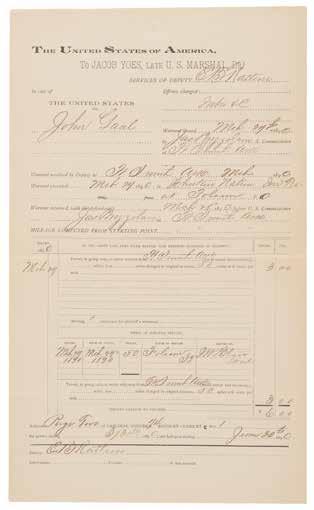
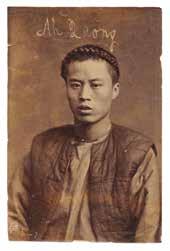
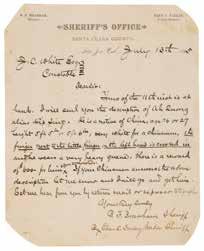
Indian Territory: Expense Voucher for E. B. Ratteree, a Deputy U.S. Marshall Under Judge Isaac Parker (1890)
Partly-printed DS, one page, 8.25 x 14, March 31, 1890. Expense voucher issued to Jacob Yoes, United States Marshal in the Western District of Arkansas, for services rendered by Deputy E. B. Ratteree in the case of “The United States vs. John Gaul,” which indicates that a warrant was received at Fort Smith, Arkansas, in March 1890, executed on March 24th in Choctaw Nation, Indian Territory, and returned with the defendant on March 28th. Ratteree was given $6 for 100 miles traveled. In very good to fine condition, with a few short edge tears, and a half-separation to the central horizontal fold. Edward Burton ‘Coon’ Ratterree (1852–1912) served as a U.S. Marshal operating out of Fort Smith, Arkansas, under the authority of Judge Isaac Parker, the famed ‘Hanging Judge.’ Ratterree was also a member of the posse that captured the noted outlaw Ned Christie at his fortified stronghold in the Cherokee Nation in 1892, bringing an end to one of the most notorious manhunts of the era.
Starting Bid $200
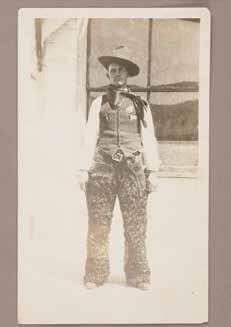
Original vintage matte-finish 3.5 x 5.75 silver gelatin photo of a cowboy sheriff standing in a confident full-length pose, wearing broad-brimmed hat, neckerchief, vest with badge, gunbelt, and wooly chaps. Affixed to a slightly larger mount and in fine condition.
Starting Bid $200
Tombstone 1900 Execution Card for the Halderman Brothers
Scarce partly printed ‘execution card’ from Tombstone, Arizona, 4 x 3, issued to C. L. Blackburn by Scott White, the sheriff of Cochise County. The execution invitation, dated July 28, 1900, reads: “The Sheriff of Cochise County, Arizona, announces that on Friday, August 10, 190, at the hour of 12 o’clock, Noon, William Halderman and Thomas Halderman. Will be Executed at the Jail Yard in this City for the Murder of Teddy Moore. You are Respectfully Invited to Witness the Execution.” Signed at the conclusion by White. In fine condition, with complete lamination to both sides, the reverse peeling, and an apparent crease to left side.
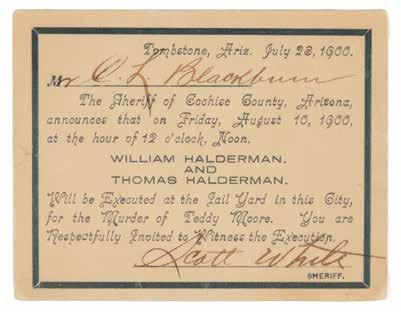
The Halderman brothers, William and Thomas Lee, were figures in one of Tombstone’s last frontier-era legal dramas and the final individuals to be buried in the town’s famed Boot Hill Graveyard. Their case arose from the ‘Shootout at Wilson Ranch’ on April 7, 1899, when lawmen confronted the brothers in the Chiricahua Mountains under disputed circumstances. The encounter escalated into gunfire, resulting in the death of Constable Chester Ainsworth and the mortal wounding of his deputy, Teddy Moore. The brothers fled to New Mexico but were soon captured and returned to Tombstone for trial.
Following their conviction, the Haldermans appealed their sentences, prompting President William McKinley to grant a stay of execution until October 5, 1900, which was later extended. Despite these delays—and lingering questions surrounding the necessity of the initial confrontation—they were ultimately executed by hanging on November 16, 1900, in one of Tombstone’s final legal executions. They were subsequently buried in Boot Hill, marking the last interments in the cemetery.
Starting Bid $200
One of three known portraits of Butch Cassidy— original glass negative ‘mug shot’ of the legendary Old West gang leader, pictured at the Wyoming Territorial Prison in 1894—his first and last arrest
LOT 6131
Butch Cassidy
Original ‘Mug Shot’ Glass NegativeOne of Only Three Known Portraits of the Outlaw - From His First and Only Arrest (1894)
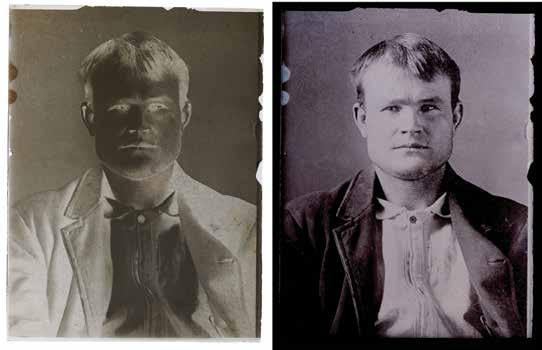
Original glass negative of Butch Cassidy’s mug shot taken at the Wyoming Territorial Prison in Laramie in 1894, the first and only time he was arrested. The negative, 3.25˝ x 4.25˝, depicts Cassidy relatively clean-shaven, wearing a dark coat over a lightcolored button-up shirt, his hair slightly flattened, likely from wearing a hat. Includes a portion of the original envelope, with the “Remarks” field annotated in ink, “Cassiday, Butch.” In fine condition. Research suggests that this is one of two known images taken of Butch Cassidy before he posed for the Wild Bunch portrait taken six years later in Fort Worth, Texas; the other documented photo is an early studio portrait of Parker as a young man in a full-length pose, exhibited as part of the J. Willard Marriott Digital Library at the University of Utah. This glass negative was most likely provided to the Pinkerton Detective Agency, which had been hired to apprehend Cassidy, one of the Old West’s most famous and colorful outlaws.
In 1894, Robert LeRoy Parker (1866-1908), better known as Butch Cassidy, was arrested in Lander, Wyoming, for horse theft and possibly for operating a protection racket among local ranchers. He was imprisoned in the Wyoming State Prison in Laramie, where he served eighteen months of a two-year sentence before being released and pardoned in January 1896 by Governor William Alford Richards—apparently after promising never to commit another crime in Wyoming.
Following his release, Cassidy assembled the group of outlaws known as the Wild Bunch, which terrorized the region where Wyoming, Utah, and Colorado meet. The gang ranged from Hole-in-the-Wall to Robbers Roost along what became known as the Outlaw Trail. Around 1896–1897, he recruited Harry Alonzo Longabaugh—better known as the Sundance Kid—and outlaw history was made.
From a Utah private collection.
Starting Bid $2,500
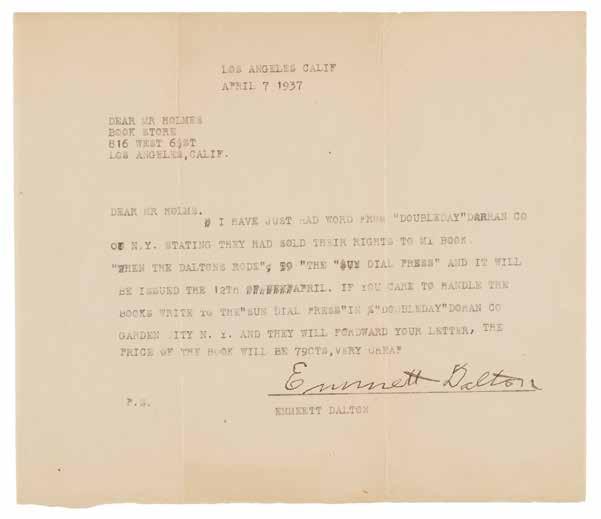
Emmett Dalton Typed Letter Signed on His Book, ‘When the Daltons Rode’
TLS, one page, 8.5 x 7.25, April 7, 1937. Letter to “Mr. Holmes” in Los Angeles, in part: “I have just had word from ‘Doubleday’ Doran Co. of N.Y. stating they had sold their rights to my book. ‘When the Daltons Rode,’ to the ‘Sun Dial Press’ and it will be issued the 12th of April. If you care to handle the books write to the ‘Sun Dial Press’ in ‘Doubleday’ Doran Co. Garden City N.Y. and they will forward your letter, the price of the book will be 79cts, very cheap.” In fine condition, with some light toning to the top and bottom edges.
Starting Bid $200
Frank James Autograph Letter Signed to His Wife, Awaiting Trial in Gallatin, Missouri, Five Months After Jesse James was Gunned Down by Robert Ford: “Hoping to be free and regain your love”
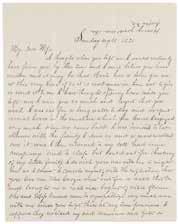
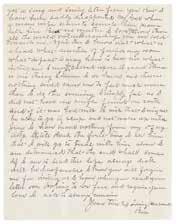
ALS signed “Your True and Loving Husband, Ben,” four pages on two adjoining sheets, 7.5 x 9.75, April 22–23, 1883. Lengthy and deeply emotional handwritten letter to his wife while jailed in Gallatin, Missouri, awaiting trial for murder during a train robbery; as usual, he signs using an alias to ensure their privacy should his letter fall into the hands of reporters. In part: “I thought when you let me I would certainly hear from you by this time and I must believe you have written and it may be that Rush has a letter for me at this very hour if so it is real mean in him not to give or sent it to me. I have thought of you every hour since you left me. I miss you so much and regret that you went. I was out for a long walk to day and we spent several hours in the sunshine which you know I enjoyed very much.
When we came back I was invited to take dinner with the family. I done so and a most excellent one it was. I then returned to my cell, had some company, tried to sleep by could not for thinking of my little family. I do wish you was with me to night but as I cannot, I console myself with the reflection that you love me…. Monday April 23rd. This morning broke gloomy and cold. The fire feels real comfortable. I have just finished cleaning house…I am waiting very impatiently for the morning’s mail hoping and believing with it will come a letter from my precious darling. If I hear nothing from you today I shall be very much disappointed. I feel as a letter will come sure, you have always been so good and punctual to write I feel as you will not disappoint me this time.I will now await the mail a kiss goodbye until after dinner. It is now 1:20 pm and so far no news from my darling. Had a postal from Bob Sampson but he said nothing about my darling. I don’t know why you do not write.I think your deauty to write me first anyway if I do not hear from you by to morrow I shall not stand on formality but send this letter. I know you have grounds for this delay which will be fully explained when I do hear from you. I asked Mr. Crozier to day if he could board you and ma during the trial. The answer he gave me that he thought Mr. Burns would board you. He lives right across the street from the jail. I think will have you come up about the first of June. I wish to the Lord you were here now. I am just too lonesome for any and don’t think I can really stand to be here in this miserable place by myself. I will now put my letter up for a while hoping to hear from you.
5:35 pm Well I have just been handed your loving and interesting letter…yours was a loving and newsy letter and no mistake. Oh well I can stand any thing let them be filled with or cussing I realize I am just as near alone in this world as a man could well be. You are growing very strange of late and if you do not care any thing for me I am grieved to know it. Why do I write this I will just return your letter to you and ask you to read it.
Do you suppose if you were in jail I would write you such a brief and unloving not as that. No, no, that I would not. It makes my heart ache as I look at it on the table before me…I have been sadly disappointed My God when a man’s wife ceases to console him Heaven help him. But no matter I love you more than all the world notwithstanding you are cold towards me. After this I know not what is ahead what desertion of friends may occur what defeat I may have to hear; nor what intrigues I may be called upon to guard. There is one thing however I do know and that is nothing could cause me to feel much worse than I do this evening. I simply feel as I did not have one single friend on Earth and if it was God’s will I wish that I might be able to go to sleep and not wake up untill June. I have heard nothing from any of my atty. I’ll tell Rush the first time I see him that I will go to trial with him alone. I am determined that the end shall come. If I am to lead this life always death will be preferable…Hoping to be free and regain your love.” In fine condition. Accompanied by the original mailing envelope, addressed by Frank James to “Mrs. A. F. James, Independence, Mo.” In September of 1882—five months after his brother Jesse was gunned down by fellow gang member Robert Ford—James turned himself in to Missouri governor Thomas Crittenden in Jefferson City, tired of running and hoping to avoid the same gruesome fate. He was held and put on trial in Gallatin, Missouri, for participating in two murders during a train robbery. However, having reached folk-hero status within the general population, he was acquitted by the jury.
Starting Bid $200
With his trial looming, an incarcerated Frank James writes a letter to his wife, wary of his potential defense team—“It seems as Johnson and Glover are taking but little interest in the case. In fact I don’t think they know one devilish thing about it”
Frank James Autograph Letter Signed from Gallatin Jail, Wary of His Defense“I don’t think they know one devilish thing about it” (May 9, 1883)
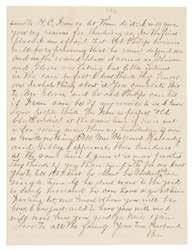
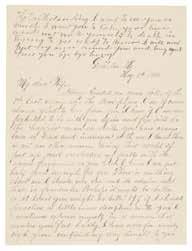
ALS signed “Your true husband, Ben,” four total pages, 8 x 10.5, May 9, 1883. Handwritten letter to “My dear Wife,” Annie James, written from jail in Gallatin, Missouri, while awaiting trial for murder during a train robbery; James signs using an alias to prevent the letter from falling into the wrong hands. In part: “I am of course always glad to hear from you, & know if I am ever permitted to be with you again and free will be the happiest man on earth, You have always been so kind and indulgent with me I know there is not an other woman living that would have put up and overlooked my faults with the same forgiveness as you have. I know I am not half good enough for you. There is one thing about me I think you can and do admire and that is frankness. Perhaps it might be better or at least you might be better off if I should practice a little more deception with you. I sometimes express myself in a manner that makes you feel badly. I have now for nearly eight years confided my every thought to you and often what I have said to you has caused you to be unhappy. I sometimes think I will keep my thoughts and plans to myself as other men do. It might be you would be happier if I should do so I am troubled with a mighty…mouth this morning. I had a couple of teeth extracted on yesterday, so now I haven’t an unsound tooth in my mouth and I am truly glad of it. You can kiss me now without any offence from rotten teeth. I wish you were here this morning to do so, I go out now every morning before breakfast and draw water and remain until time for breakfast, You know I enjoy it. The sheriff has perfect confidence in for the he does not take his pistol with him anymore. I am succeeding remarkably well in gaining the confidence of the people I have some one tell me every day that I have many friends in the county. Some have said that I have a kind of magnetism about me that attracts almost every body… You deserve all the credit for my success. Had it not been for you no doubt I would have been to day worse than nothing but as it is I must retain my manhood for the sake of you and Robie. I am proud of you both and hope to be spared to make you comfortable and happy in the future. I haven’t beyond you and he a single thought — I sometimes think I am selfish in that respect. If so, I can’t help it. When I think of and look at you I see so many things to admire that I deem it no sin to worship you. Did I tell you that Mr. Dean had been to see me. He seems to be very much interested in my case and has found out many things that no one else has. I can tell you when you come, he is ready to defend me in my coming trial if he is wanted. I think he would be a strong man in the case and I should love to have him. I want you to see Mr. Glover and see what he think about it. He can consult Col. Philips…in the second place, it seems as Johnson and Glover are taking but little interest in the case. In fact I don’t think they know one devilish thing about it. You can state this to Mr. Glover, and he and Philips can tell if Dean can be of any service to us.” In fine condition. Accompanied by the original mailing envelope. In September 1882—five months after his brother Jesse was murdered by fellow gang member Robert Ford—Frank James, weary of life on the run and fearing a similar fate due to the bounty on his head, surrendered to Missouri governor Thomas Crittenden in Jefferson City. After years of robbing banks, stagecoaches, and trains with the James-Younger gang, he was indicted for participating in two murders committed during a train robbery in Winston, Missouri, where the gang netted only $650. His trial began in Gallatin in August 1883 and drew intense public attention, as James had achieved near folk-hero status; the jury pool was so sympathetic that, as the prosecutor observed while reviewing potential jurors, ‘the verdict of the jury that is being selected is already written.’ Defended by former cavalry colonel John F. Philips, James was acquitted in September 1883, later facing and beating additional charges in Alabama. Assured he would not be extradited if he remained law-abiding, James complied, spending the next three decades in humble occupations such as farming, selling shoes, and working as a theater ticket taker—an unassuming final chapter for one of the West’s most notorious outlaws.
Starting Bid $200
A month before his trial, Frank James writes to his wife—
“I think one half the world is as corrupt as hell itself and the men are more to blame than the women”
ALS in pencil, signed “Ben,” four pages on two adjoining sheets, 5 x 8, July 5, 1883. Handwritten letter to his wife, Annie Ralston James, while jailed in Gallatin, Missouri, awaiting trial for murder during a train robbery; he signs using an alias to prevent the letter from falling into the wrong hands. In part (spelling and grammar retained): “There is nothing much to add since I last wrote you I will write however to remind you that I think of you all the time. I have had no visitors at all this week and only four since you left me, and I am glad of it. Mrs. May Cox sent me over a saucer of ice cream and a bowl of cherrys this week and I of course enjoyed the cherrys and gave the cream to Mrs. Crozier. I think Mrs. Cox, the best friend we have in town, she and Mrs. Brasins. Mrs. B is now bed quite sick so Lena tells me she comes up every few days and brings me flowers. She is a good little girl. I was very much surprised the other day by a letter from Jonas Taylor from Nashville. You remember him. The Blacksmith he tells me I have many friends in that place. We have had a general…and have also whitewashed and it has improved the looks of my prison ever so much. You remember Buck Killy whom I called with M. M. Langhorn last winter and shed so many tears about his little bot that was killed. Well I see in day before yesterday times that he and his partner Ms. Freeman has dissolved this interest in this paper on account of Mrs. Killy being too intiment with Mr. Freeman and Daughters. I think one half the world is as corrupt as hell itself and the men are more to blame than the women. Women as a whole are weak and the men know it and take advantage of their weakness. There is but the one way to serve them and that is to do as Phil Thompson did shoot them dead on the spot. Mamma I know if I am ever permitted to be with you again I will be the happiest man in the world. You are the dearest little creature in all this world. How is my little man? Don’t let him forget his papa. I was sorry to see an account of M. Gossett being robbed hope he may catch the thieves I will write you again Monday I will write you ever Thursday and Monday and even three times a week if you like. Lots kisses to you and Rob goodbye, love to all.” In fine condition. Accompanied by the original mailing envelope, postmarked from Gallatin on July 16, 1883.
In September 1882—five months after his brother Jesse was murdered by fellow gang member Robert Ford—Frank James, weary of life on the run and fearing a similar fate due to the bounty on his head, surrendered to Missouri governor Thomas Crittenden in Jefferson City. After years of robbing banks, stagecoaches, and trains with the James-Younger gang, he was indicted for participating in two murders committed during a train robbery in Winston, Missouri, where the gang netted only $650. His trial began in Gallatin in August 1883 and drew intense public attention, as James had achieved near folk-hero status; the jury pool was so sympathetic that, as the prosecutor observed while reviewing potential jurors, ‘the verdict of the jury that is being selected is already written.’ Defended by former cavalry colonel John F. Philips, James was acquitted in September 1883, later facing and beating additional charges in Alabama. Assured he would not be extradited if he remained lawabiding, James complied, spending the next three decades in humble occupations such as farming, selling shoes, and working as a theater ticket taker—an unassuming final chapter for one of the West’s most notorious outlaws.
Starting Bid $200
Frank James Autograph Letter
Signed to His Wife, from Jail (“St. James Castle”) in Gallatin, Missouri: “I am just as frisky as a colt feeling good all over”
ALS signed “Your true and loving Hubby, Ben,” one page both sides, 5 x 8, August 16, 1883. Handwritten letter to his wife from “St. James Castle,” a joking nickname used by James for the Daviess County Rotary Jail in Gallatin, Missouri; as usual, he signs using an alias to ensure their privacy should his letter fall into the hands of reporters. In full: “Ha ha you knew I would laugh and be happy when you told me the ‘Enigmatical question’ had been solved. I am just as frisky as a colt feeling good all over. But Saturday my happiness will be complete. How awful sweet you can be when you try. You are too sweet yes precious you are the essence of grace distilled from the birds of perfection. I had almost come to the conclusion that you was no good since the reception of your letter of the 12th I retract all I have thought and really think I have been mean to doubt for one single moment that you did not love and think of me But as I had always heard from you on Monday and your letter was so long on the road not coming until last night it was enough to vex me. Don’t you think so? Oh! Lord I think you are giving me a little ‘taffy’ when you tell me that you have told several that I was the best man in the world. I don’t think you every talk so extravagantly as that.
Ah! well we will see just how much you do love me when you come and one proof of your sincerity will be to see you in this jail early Saturday morning. It is only two days but oh! my what long ones they will be to me. Don’t I wish you were here now I would love you and make you feel good all over. If any thing should occur to prevent you from arriving here to morrow night I will do what the woman did that Mrs. H spoke of. Let nothing but sickness prevent you coming to morrow night. I think Col. M can bring up the forces without a doubt. See Col. M and find out upon what day he will come and get Harry to go see Duck and Bell H. and tell them to meet Col. M in Independence at the appointed time ready to come. Do not fail to come I must see you Saturday. It may be of absolute nececity for you to be here. I have just this moment telegraphed Johnnie Samuels to come here at once. There is no little important things to do between this and Monday.
I of course can not tell you all I want done. You may understand from my general fun of conversation why I am so anxious for you to put in an appearance at this place If you get this and are coming Friday night telegraph me from Independence just let your answer by wire to me be O.K. sign Red Cloud instead of your own name. Again let me urge upon you the importance of you being here Friday night Love to all. Hoping to see you early Saturday morning I will now say Good bye.” In fine condition. Accompanied by the original mailing envelope, addressed by Frank James to “Mrs. A. F. James, Independence, Mo.”
In September of 1882—five months after his brother Jesse was gunned down by fellow gang member Robert Ford—James turned himself in to Missouri governor Thomas Crittenden in Jefferson City, tired of running and hoping to avoid the same gruesome fate. He was held and put on trial in Gallatin, Missouri, for participating in two murders during a train robbery. However, having reached folk-hero status within the general population, he was acquitted by the jury.
Starting Bid $200
“I would much rather remain here than to be in jail at K.C....with Langhorn as keeper. He I think would put up a job to have the Fords or Liddil kill me if I was in his charge”
LOT 6138
Frank James Autograph Letter
Signed to His Wife, Awaiting Trial in Gallatin, Missouri:
“He I think would put up a job to have the Fords or Liddil kill me if I was in his charge”
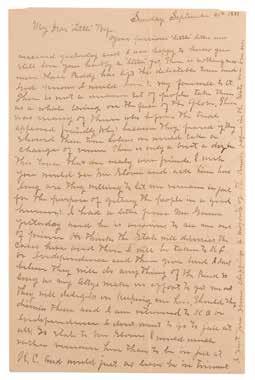
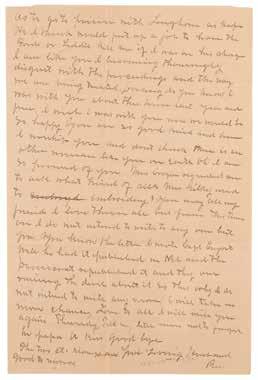
ALS signed “Your Loving Husband, Ben,” one page both sides, 8 x 12, September 30, 1883. Handwritten letter to his “’Little’ Wife” while jailed in Gallatin, Missouri, awaiting trial for murder during a train robbery; as usual, he signs using an alias to ensure their privacy should his letter fall into the hands of reporters. In part: “Your precious ‘little’ letter was received yesterday and I was happy to know you still love your hubby a ‘little’ yet. There is nothing new more than Paddy has left this detestable town and God knows I would love to say farewell to it There is not a meaner set of people take them as a whole living on the face of the globe. There was many of them who before the trial appeared friendly. Why? because they feared if they showed their true colors we would take a change of venue. There is only a bout a doz. in this town that are really our friends.
I wish you would see Mr. Glover and ask him how long are they willing to let me remain in jail for the purpose of getting the people in a good humor? I had a letter from Mr. Garner yesterday and he is anxious to see me out of prison. He thinks the State will dismiss the cases here and then I will be taken to K.C. or Independence and then give bond. I don’t believe they will do any thing of the kind so long as my Attys make no effort to get me and they will delight in keeping me here. Should they dismiss them and I am returned to K.C. or Independence I don’t want to go to jail at all. So state to Mr. Glover I would much rather remain here than to be in jail at K.C….with Langhorn as keeper. He I think would put up a job to have the Fords or Liddil kill me if I was in his charge.
I am like you I becoming thoroughly disgust with the proceedings and the way we are being treated. Darling do you know I was with you about this time last year and how I wish I was with you now we would be so happy you are so good kind and how I worship you and don’t think there is an other woman like you on earth Oh! I am so proud of you.” In fine condition. Accompanied by the original mailing envelope, addressed by Frank James to “Mrs. A. F. James, Independence, Mo.”
This interesting letter boasts noteworthy references to both Robert Ford, the killer of Jesse James, and Dick Liddil, another former associate of the James–Younger Gang, who had implicated Frank James in the 1881 Muscle Shoals robbery and was pardoned in exchange for his testimony. Despite Liddil’s testimony, Frank James was acquitted, reportedly because the jury concluded that the turncoat Liddil was not a reliable witness.
Starting Bid $200
“I just can’t live away from you any longer”— Frank James writes from jail in Gallatin
Frank James Autograph Letter Signed to His Wife, from Jail in Gallatin, Missouri: “I just can’t live away from you any longer”
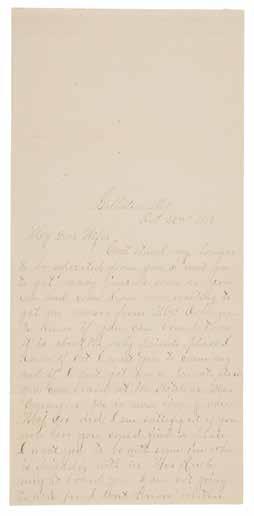
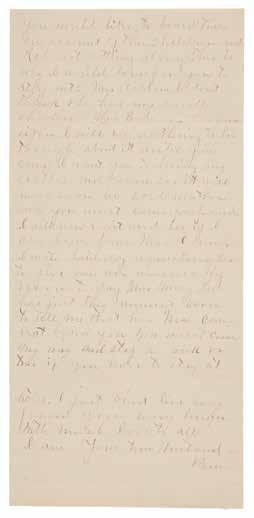
ALS signed “Your true Husband, Ben,” one page both sides, 5 x 10.75, October 22, 1883. Handwritten letter to his wife while jailed in Gallatin, Missouri, awaiting trial for murder during a train robbery; as usual, he signs using an alias to ensure their privacy should his letter fall into the hands of reporters. In full: “Can’t stand any longer to be seperated from you. I want you to get ready just as soon as you can and come. I am now waiting to get an answer from Mrs. Osborne to know if you can board there. It is about the only private place I know of but I want you to come any[way] and if I can’t get you a private place you can board a the Hotel or Mrs. Emmons. She is now living where Maj. Cox did, I am satisfyed if you were here you could find a place. I want you to be with some one who is friendly with us. Mrs. Rush might board you. I am not going to ask for I don’t know whether you would like to board there on account of the children and Rob not getting along. This is why I would love for you to stay with Mrs Osborne. I don’t think she has any small children. Mrs. Emmons has none either, I will say nothing to her though about it until you come. I want you to bring my clothes and remember it will now soon be cold weather and you must come prepared. I will not wait and see if I can hear from Mrs. Osborne. I wrote Saturday requesting her to give me an answer by noon to day. Miss Mary Lee has just this moment come to tell me that her Ma can not board you. You must come any way and stay a week or two if you have to stay at hotel. I just can’t live away from you any longer.” In fine condition. Accompanied by the original mailing envelope, addressed by Frank James to “Mrs. Annie James, Independence, Mo.”
In September of 1882—five months after his brother Jesse was gunned down by fellow gang member Robert Ford—James turned himself in to Missouri governor Thomas Crittenden in Jefferson City, tired of running and hoping to avoid the same gruesome fate. He was held and put on trial in Gallatin, Missouri, for participating in two murders during a train robbery. However, having reached folk-hero status within the general population, he was acquitted by the jury.
Starting Bid $200
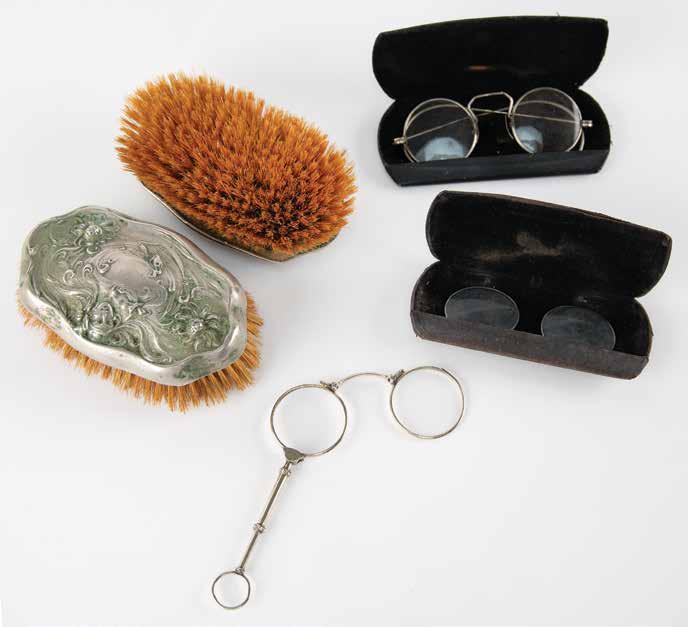
LOT 6145
Frank James’s Personally-Owned Eyeglasses, Brushes, and Accessories
Collection of five personal items which personally belonged to famed outlaw Frank James, including: a pair of silver-tone eyeglasses with circular lenses and flexible wire stems, in a hardshell case; an elegant pair of handheld opera-style reading glasses with circular magnifying
lenses; two loose lenses in a leather eyeglass case; and two ornate silver-tone brushes. In overall very good to fine condition, with some tarnishing to the brush handles.
Provenance: Riba-Mobley Auctions, 1988; part of a selection of items consigned directly by a James family member.
Starting Bid $500
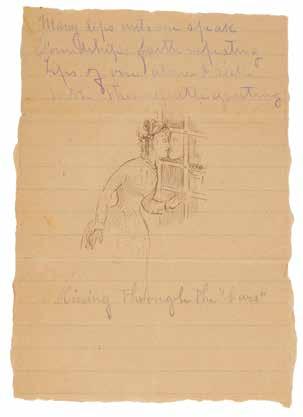
Frank James Original Sketch, Sent to His Wife from Jail: “Kissing Through the ‘Bars’”
Outlaw and older brother of Jesse James (1843-1915). Charming original penand-ink sketch accomplished by Frank James on an off-white 4.25 x 6 lined sheet, enclosed with one of his jailhouse letters to his wife, Anna. The highly detailed sketch shows Frank James kissing Anna through the open grid of the jail cell door, his hand grasping one of the crossbars; Anna has captioned the drawing in pencil, “Kissing through the ‘bars,’” and transcribed a verse from a poem by Maggie May Danehy above: “Many lips unto one speak / Friendships faith repeating / Lips of one alone I seek / With this gentle greeting.” On the reverse, she writes: “Still my griefs are mine.” In fine condition, with intersecting folds, uniform toning, and neatly torn edges.
Starting Bid $200
James-Younger Gang: Flournoy Yancey Document SignedHired as an Agent in the Missouri Secret Service
Manuscript DS, signed “Flournoy Yancey,” one page, 8.5 x 11, September 3, 1874. Issued in Jefferson City, a confirmation of receipt for government funds tied to antioutlaw operations in Missouri, in full: “Received of Chas. P. Johnson, Acting Governor of the State of Missouri, the sum of One Hundred Dollars ($100) to be used as expenses of Special Agent, appointed under an act of the General Assembly, entitled ‘An Act to suppress outlawry and robbing in Missouri, and to appropriate money therefor.’ Approved March 30th 1874, and for no other purposes.” Signed at the conclusion by Flournoy Yancey. Includes a light green ‘State of Missouri’ envelope bearing a signed note from Charles P. Johnson, “Receipt of Flourney [sic] Yancey for $100 – Paid for secret service duty - Johnson.” In fine condition.
On September 3, 1874, Flournoy Yancey, a detective with the St. Louis Police Department and a scout during the late war, was hired as an agent with the Missouri secret service by acting governor of Missouri, Charles P. Johnson. His mission was to track down leading members of the James-Younger Gang following the Lexington Stage Robbery on August 30, 1874. He crossed paths with the gang not long after, and sent the following telegram to C. C. Rainwater, vice president of the St. Louis Police Board: ‘On Monday morning at eight thirty oclock I flushed Jesse James and James Younger was forced to fight eleven shots exchanged Jesse James wounded I am safe have been in pursuit since.’
Starting Bid $200
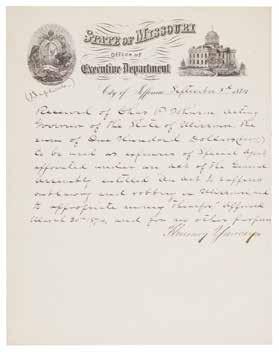
Flourney Yancey writes to the acting governor:
“My plan is—if possible—to get them in a position that I can surround them and make it impossible for them to escape”
James-Younger Gang:
Flourney Yancey
Autograph Letter Signed,
Pursuing the Outlaws:
“I am fully satisfied that it is the Jameses and Youngers who have perpetrated all the recent robberies”
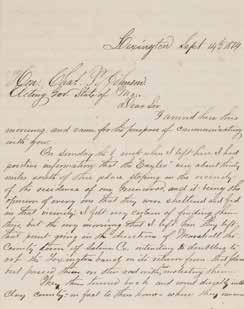
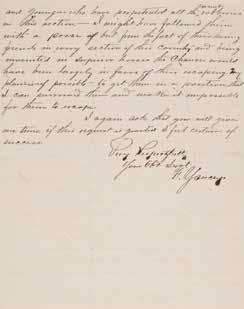
ALS signed “F. Yancey,” three pages on two sheets, 8 x 10, September 14, 1874. Handwritten letter to Hon. Charles P. Johnson, acting governor of Missouri, just eleven days after being hired as an agent for the Missouri secret service to track down the James-Younger Gang. In part: “On Sunday the 6 inst., when I left here I had positive information that the ‘Eagles’ were about thirty miles south of this place stoping in the vicinity of the residence of one Greenwood, and it being the opinion of every one that they were sheltered and fed in that vicinity, I felt very certain of finding them there, but the very morning that I left here they left that point going in the direction of Marshall…intending doubtless to rob the Lexington band on its return from that place, but passed them on the road without molesting them.
They then turned back and went directly into Clay County, in fact to their home—where they remained one night. On Tuesday evening two of them left going in the direction of Greenwood’s and one (Frank)—in my opinion—took the cars for Kansas City. I am not certain of this but give as my opinion. On Wednesday, Thursday, and Friday, I could obtain no trace of them whatever. On Saturday morning I again discovered their trail…going in the direction of Greenwood. On yesterday they crossed the river by swimming their horses over and went in the direction of Clay County. I leave immediately for Richmond and will make every effort to capture them before they leave that county.
I trust that you will not think that I have been unreasonably slow in this matter from the fact of one half of the people in this country being in sympathy with these men, and the other half afraid of them…it is absolutely necessary in order to accomplish any thing, that I should move with the utmost caution…I am fully satisfied that it is the Jameses and Youngers who have perpetrated all the recent robberies…I might have followed them with a posse but from the fact of their having friends in every section of this country and being mounted on superior horses the chances would have been largely in favor of their escaping. My plan is—if possible—to get them in a position, that I can surround them and make it impossible for them to escape.” In fine condition.
One week after writing this letter, Yancey unexpectedly encountered Jesse James and Jim Younger. The three men exchanged gunfire, and Yancey claimed he wounded James, but the pair escaped and once again avoided capture.
Starting Bid $200
“I respectfully call your attention to my self as wishing to undertake the capture of the James Bros. & Youngers”
James-Younger Gang: J. B. Dunn Autograph Letter Signed to Gov. Silas Woodson: “I respectfully call your attention to my self as wishing to undertake the capture of the James Bros. & Youngers”
ALS signed “Col. J. B. Dunn,” one page both sides, 5 x 8, September 8, 1874. Handwritten letter to “His Excellency Governor Woodson,” in full: “I respectfully call your attention to my self as wishing to undertake the capture of the James Bros. & Youngers. I am at your service & if you wish me to undertake the capture of the aforesaid parties, send orders for my guidance. I am well used to such fellows. I was raised on the frontiers of Missouri and Kansas, and all I would request of you would be your sanction of lawfull operations on my part. My home is at present at Winfield, Cowley Co., Kans., but am on a visit to some friends in Ill. And if you wish me to undertake their capture send orders and I will report immediately.” In fine condition, with all of the handwriting very light, but still readable. Accompanied by the original mailing envelope.
Starting Bid $200
“I desire some information from you as regards rewards offered for said robbers, if any, and whether the rewards are confined strictly to the Younger & James Brothers”
Autograph Letter Signed to Gov. Charles H. Hardin, Inquiring “whether
the rewards are confined strictly to the Younger & James Brothers”
ALS signed “Robert M. Boatright,” one page both sides, 5 x 8, May 27, 1875. Handwritten letter to “Hon. Gov. Hardin, Governor of Missouri,” in part: “Having been connected for several years in the private detective business in this city, & having worked diligently to ascertain the perpetrators of the recent Rail Road Bank and Store Robberies committed in this State, In which the Younger & James Brothers were supposed to be the perpetrators & being now in a position In which I feel confident I can arrest the actual perpetrators of said Deeds, I desire some information from you as regards rewards offered for said robbers, if any, and whether the rewards are confined strictly to the Younger & James Brothers, If so cannot the reward be so altered or ammended as to cover the guilty parties whoever they may be (on conviction) I would also ask if any distinction is made in regard to the amount of rewards for the chief or chiefs of these Gangs. I am perfectly satisfied their is two gangs of these Desperadoes but are working under one head or chief.” In fine condition.
Starting Bid $200
“As nearly all the parties who I made enquiries of seem to be friends of the James & Younger it is hard to get any information that I can rely upon as I dare not let my business be known”
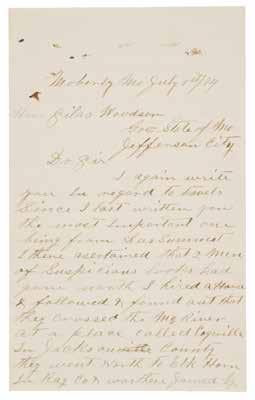
LOT 6151
James-Younger Gang: J. W. Ragsdale
Autograph Letter Signed to Gov. Silas Woodson, Tracking the Outlaws: “Find it very dificult to get in posession of any reliable information”
ALS signed “J. W. Ragsdale,” four pages on two adjoining sheets, 5 x 8, January 1, 1874. Handwritten letter to “Hon. Silas Woodson, Gov. State of Mo., Jefferson City,” sent three months after being hired to track down the members of the James-Younger Gang, reporting on his progress. In part: “I again write you in regard to travels since I last written you the most important one being from Lees Summit. I there asertained that 2 men of suspicious looks had gone north. I hired a horse & followed & found out that they crossed the Mo. River at a place called Cogsville in Jackson County. They went north to Elk Horn in Ray Co. & was there joined by two other men answering the discription of the James
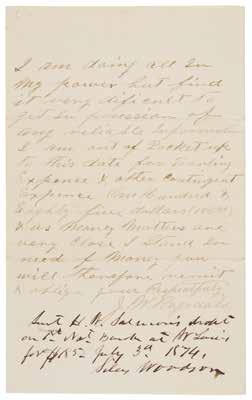
Boys. I still followed north east…to Grundy near Trenton I lost track & returned via of Galaton Hamilton & Carnney. I there found a party who I think I can trust & employed him to go & work for Rose James Boys Brotherinlaw who lives on the old James farm & to keep a close wach for them should they return & to inform me imediately by Telegraph…I am satisfyed the parties I was following were bad caracters but as nearly all the parties who I made enquiries of seem to be friends of the James & Younger it is hard to get any information that I can rely upon as I dare not let my business be known…I am doing all in my power but find it very dificult to get in posession of any reliable information. I am out of pocket up to this date for travling expence & after contingent expence one hundred & eighty five dollars & as money matters are very close I stand in need of money.” Boldly endorsed at the conclusion in ink by Silas Woodson, remitting the requested funds. In fine condition.
Starting Bid $200
“Face
trial
you have
ten thousand
James-Younger Gang: John Newman Edwards Autograph Letter Signed to Frank James: “Face that trial like you have faced ten thousand dangers”
Journalist, editor, and founder of the Kansas City Times (1839–1889) known for contributing to the folk hero status of outlaw Jesse James.
ALS signed “J. N. Edwards,” one page both sides, 5.5 x 11, The St. Joseph Daily Gazette letterhead, April 11, 1884. Handwritten letter to Frank James, just days before he stood trial in Huntsville, Alabama, for the 1881 Muscle Shoals payroll robbery. In part: “This is probably the last letter you will receive from me before your trial, and so I need not say in it to face that trial like you have faced ten thousand dangers, and in every shape. I do not see how it is possible for us to have done any better on this end of the line. Every point has been made, and every single position of the enemy carried. The last move was a master stroke, and no one yet knows what has been done, or where they have been outflanked—I mean no one among the enemy.
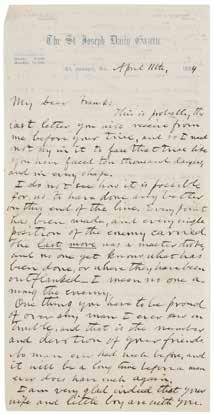
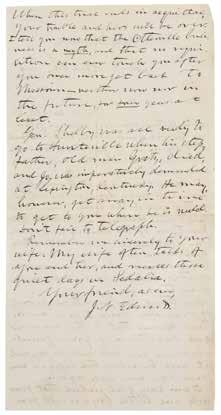
One thing you have to be proud of over any man I ever saw in trouble, and that is the number and devotion of your friends. No man ever had such before, and it will be a long time before a man ever does have such again. I am very glad indeed that your wife and little boy are with you. When this trial ends in acquittal, your trouble and hers will be over. I tell you now that the Otterville business is a myth, and that no requisition can ever touch you after you once more get back to Missouri—neither now nor in the future, for four years at least.
Gen. Shelby was all ready to go to Huntsville when his step father, old man Gratz, died and Jo. was imperatively demanded at Lexington, Kentucky. He may, however, get away in time to get to you when he is needed.” In fine condition. Accompanied by the original mailing envelope, addressed by Edwards to “Mr. Frank James, Care of the Jailer, Huntsville, Alabama.”
Written just days before Frank James faced trial in Huntsville, Alabama, for the 1881 Muscle Shoals payroll robbery, this letter from journalist and Confederate veteran John Newman Edwards captures the intense behind-the-scenes efforts of James’s allies as well as the confidence surrounding his defense. Edwards—long a sympathetic chronicler of the James brothers—offers reassurance, hinting at strategic maneuvers carried out on James’s behalf and emphasizing the extraordinary loyalty of his supporters.
One such supporter was Joseph O. Shelby, under whom Edwards had served in the Civil War, and who had previously testified in James’s 1883 trial in Missouri. Edwards’s optimistic tone, predicting acquittal and dismissing other potential legal threats, attests to the coordinated defense campaign and the broader public fascination with the former outlaw. Despite his notorious name, the prosecution struggled to present solid evidence or reliable witnesses linking him directly to the crime, and James was indeed acquitted on April 25th.
Starting Bid $200
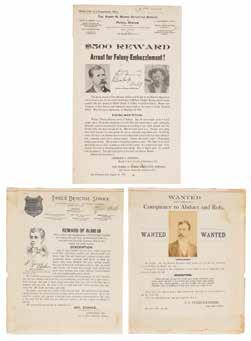
Three original late 19th- and early 20th-century ‘Wanted’ posters from American law enforcement and detective agencies, offering rewards for fugitives accused of embezzlement, abduction, and grand larceny. The lot includes:
Harry N. Morse Detective Service and Patrol System poster, 8.5 x 14, offering a $500 reward for the arrest of William Thomas Bunney, who, as treasurer of Inyo County, “embezzled county funds to the extent of several thousand dollars.” Issued by Inyo County Sheriff Charles A. Collins and the above-mentioned San Francisco detective agency on August 20, 1903. The upper corner is marked as “2nd issue.” The next two posters are affixed to the front and back of the same 9.25 x 11.5 sheet: Detroit Police Department poster, 8.5 x 11, issued for the arrest of Thomas Kennedy, “Wanted for Conspiracy to Abduct and Rob,” issued by C. C. Starkweather, the Deputy Superintendent of Police of Detroit, Michigan, on September 29, 1891, which notes: “On August 12th last, Thomas Kennedy, with others, was arrested for abducting Joseph Perrien, on March 19th, 1891. During the progress of the examination in our Police Court, on September 24th Kennedy jumped his bail.”
Thiel’s Detective Service poster, 8 x 10.5, issuing a $1000 reward for the apprehension of Sylvester Young, “late Cashier Newport News and Mississippi Valley, Co., who fled from Louisville, Kentucky, July 31, 1891. Arrest for grand larceny.” Poster notes that all communications should be addressed to “Jno. Echols” of the Newport News and Mississippi Valley, Co., or the above agency. In overall very good to fine condition, with wrinkling and light staining to the Kennedy poster.
Starting Bid $200
Jim and Bob Younger (2) Cabinet Photographs, with a Jim Younger Signature
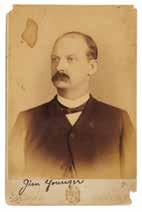
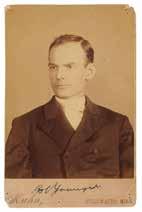
Historic pairing of original 4.25 x 6.5 cabinet photos of outlaw brothers Jim Younger and Bob Younger, taken in 1889 while they were imprisoned at Minnesota State Prison in Stillwater by local photographer John M. Kuhn, identified on the studio mounts with contemporary ink notations in an unknown hand. The reverse of Jim’s portrait is imprinted “Copyright, 1889, Henrietta Younger,” and bears a clipped ink signature, “Jim Younger,” affixed below; the reverse of Bob’s portrait is stamped, “Copyrighted, 1889, By Henrietta Younger.” In overall very good condition, with a stain to Jim’s image, an tack holes and associated corner loss to both. Provenance: collection of Harry Hoffman, an affiliate of the Jesse James family and close friend of Cole Younger; sold to Frank Foster in 1948; acquired by Wilbur Zink in the 1970s; sold at Heritage Auctions, June 22, 2013. In 1889, Henrietta ‘Retta’ Younger traveled from Missouri to Minnesota to seek the release of her older brothers. Although unsuccessful, she was allowed to bring them new suits of clothes and have a photographer take their portraits—simple comforts that meant a great deal during their time in prison. Bob Younger would die of tuberculosis in prison on September 16, 1889; Jim would finally be paroled on July 10, 1901.
Starting Bid $300
Cole Younger describes the infamous Confederate raider’s spycraft: “Quantrill, did so by keeping skiffs hid at different points on the river an got the News by having spies in differrent parts of the state and having citizens subscribe for the leading papers through out the north and Eastern states and cliping out all information in regard to the movements of the union army”
Cole Younger Twice-Signed Autograph Letter on Confederate Guerrilla William Quantrill: “He was a regular comishion officer Capt. of Partizen rangers same as Mosby of Va”
Old West outlaw (1844–1916) associated with Jesse James as a leader of the James-Younger Gang, who eventually turned from a life of crime to Wild West shows and public speaking. ALS signed twice, “Cole Younger” and “Cole,” one page, 5.5 x 8.75, no date but circa 1898. Handwritten discussion of the infamous guerilla leader William C. Quantrill—under whom the Younger and James brothers served during the Civil War—and his means of getting information about the movements of Federal troops. In full: “Now as to Quantrill all men high in athority know he was a regular comishion officer Capt. of Partizen rangers same as Mosby of Va. and was kept in Mo. so as to provide ways & means for recruting officers of the C.S.A. to get a cross the Mo. Rivers. And to colect news in regard to the movements of the northern army. He Quantrill, did so by keeping skiffs hid at different points on the river an got the News by having spies in differrent parts of the state and having citizens subscribe for the leading papers through out the north and Eastern states and cliping out all information in regard to the movements of the union army and sending it south by courer or scout to Gen. Price, Marmaduke or Shelby.”
At the top, Younger writes another note in ink, signed with his first name only: “I sent Judge Norton and Judge Brown each one of your cards so they will know who you are when you write.” Younger’s notes are written on the reverse of a letter sent to him by Nimrod L. Norton (1830-1903), who was himself a former Confederate colonel and member of the Confederate House of Representatives. Norton’s letter, in part: “I send by this mail under separate cover a copy of the Dollar News with your Letter in full…I am very much gratified…there able to do you & Jim a little act of justice.” In fine condition, with one short fold split.
Starting Bid $500
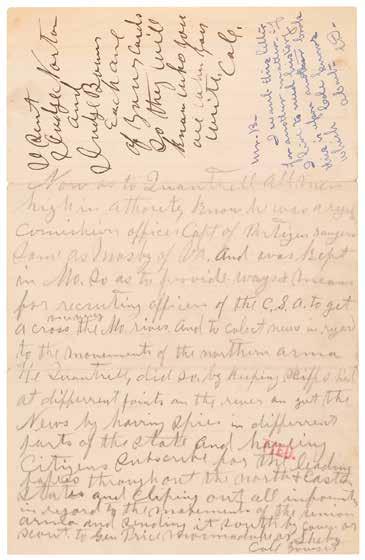
cannot
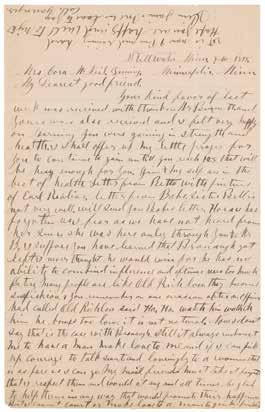
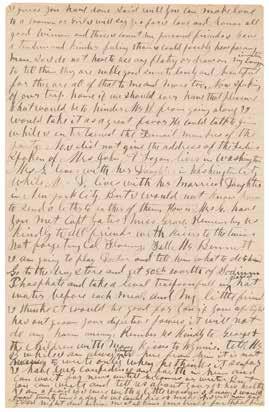
Cole Younger Autograph Letter Signed from Minnesota State Prison: “I cannot court or make love to a man to gain his friendship”
ALS signed “Cole Younger ,” one page both sides, 8 x 12.5, August 14, 1898. Handwritten letter to his friend Cora McNeil Deming, who may have been a sweetheart of Jim Younger’s before he went to prison, and later became the wife of Minneapolis judge George M. Bennett, who had taken an interest in Jim and Cole and worked for years to have them released and pardoned. Younger writes from Minnesota State Prison at “Stillwater,” discussing his life behind bars, expressing intimate details and longing for the touch of a woman.
In part: “I suppose you have learned that Bronaugh got left I never thought he would win for he has no ability to combined influence and oftimes uses too much flatery many people are like Old Richlou. They become suspishious you remember on one occasion after an officer had called Old Richlou said Ha. Ha. Watch him wathch him he bumps too low. It is not natural. Now I don’t say that is the case with Bronaugh. Still it always imburest me to have a man make love to me. And if I can pick up courage to talk sweet and lovingly to a woman that is a fare as I can go. My mail friends must take it…that I respect them and would at any and all times be glad to help them in any way that would promote their happiness But I cannot court or make love to a man to gain his friendship. I guess you have done said well you
can make love to a woman or girl. I will say yes for I love and honor all good wimen and those I count my personal friends I have a tender and kind feeling than I could posably have for any man…
Now speaking of our trip home if we should ever have that pleasure what would be to hinder Mr. B. from going along I would take it as a great favor. He could talk to jim while I intertained the Femail members of the party…I am afraid if I were with a little woman I know, I would quarrel twenty times a day so we could kiss & make up. I will now say good night…Hope you are happy and well tonight. Jim joines me in love to you.” In fine condition. Cole and Jim Younger began their life of crime during the Civil War as members of the notorious Quantrill’s Raiders. The brothers avoided arrest longer than many other outlaws due to the sympathy and support of many of their fellow Confederate veterans. However, in 1876, the Younger luck ran dry when their attempted bank robbery in Northfield, Minnesota, went famously awry. Armed townsfolk disrupted the robbery, chased off the gang, and in the ensuing melee, two townspeople were killed. When the Youngers were finally captured, they were tried and sentenced to life imprisonment at the Minnesota State Prison in Stillwater—a guilty plea saved them from the hangman’s noose. After two years of legislative wrangling, a parole bill was passed in Minnesota’s legislature and Cole and Jim Younger were freed on July 10, 1901.
Starting Bid $500
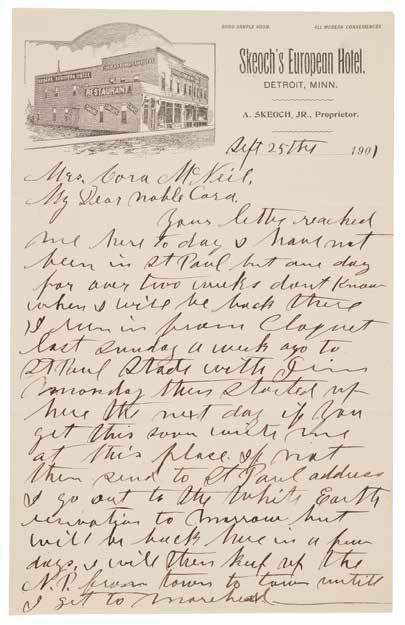
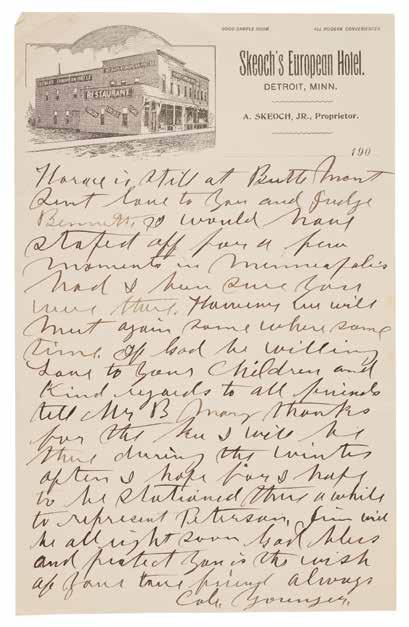
an update on his brother,
“Jim will be all right soon”
Cole Younger Autograph Letter Signed, Two Months After His Release from Prison: “Jim will be all right soon”
Old West outlaw (1844–1916) associated with Jesse James as a leader of the James-Younger Gang, who eventually turned from a life of crime to Wild West shows and public speaking. ALS, signed “Cole Younger,” two pages, 6 x 9.5, Skeoch’s European Hotel letterhead, September 25, 1901. Handwritten letter to friend and supporter Cora McNeill, just over two months after being released from Minnesota State Prison for his role in the Northfield bank robbery. In part: “Your letter reached me here to day I have not been in St. Paul but one day for over two weeks don’t know when I will be back there I run in from Claynet last Sunday a week ago to St. Paul stade with Jim [Younger] Monday then started up here the next day if you get this soon write me at this place. If not then send to St. Paul address I go out to the White Earth reservation to morrow but will be back here in a few days. I will then keep up the N. T. from town to town untill I get to Morehead. Horace is still at Butte Mont. Sent love to you and Judge Bennett & would have stayed off for a few moments in Minneapolis
had I been sure you were there. However we will meet again some where some time, if God be willing. Love to your children and kind regards to all friends…I will be there during the winter often I hope for I hope to be stationed there a while to represent Peterson. Jim will be all right soon God bless and protect you is the wish of your true friend always.” In fine condition.
Cora McNeill was born in St. Clair, Missouri, in 1862. She was an admirer of Cole and Jim Younger, and it is believed that she was a sweetheart of Jim’s before he went to prison. She continued her correspondence to both Jim and Cole while they were incarcerated in Minnesota following the botched Northfield bank robbery. She was married to Minneapolis judge George M. Bennett, who attempted to secure a pardon for the Younger brothers.
After his release from prison, Cole Younger published his memoirs and later toured the South with the Cole Younger and Frank James Wild West Company. In 1913, he experienced a religious awakening, becoming a born-again Christian and repenting for his criminal past.
Starting Bid $500
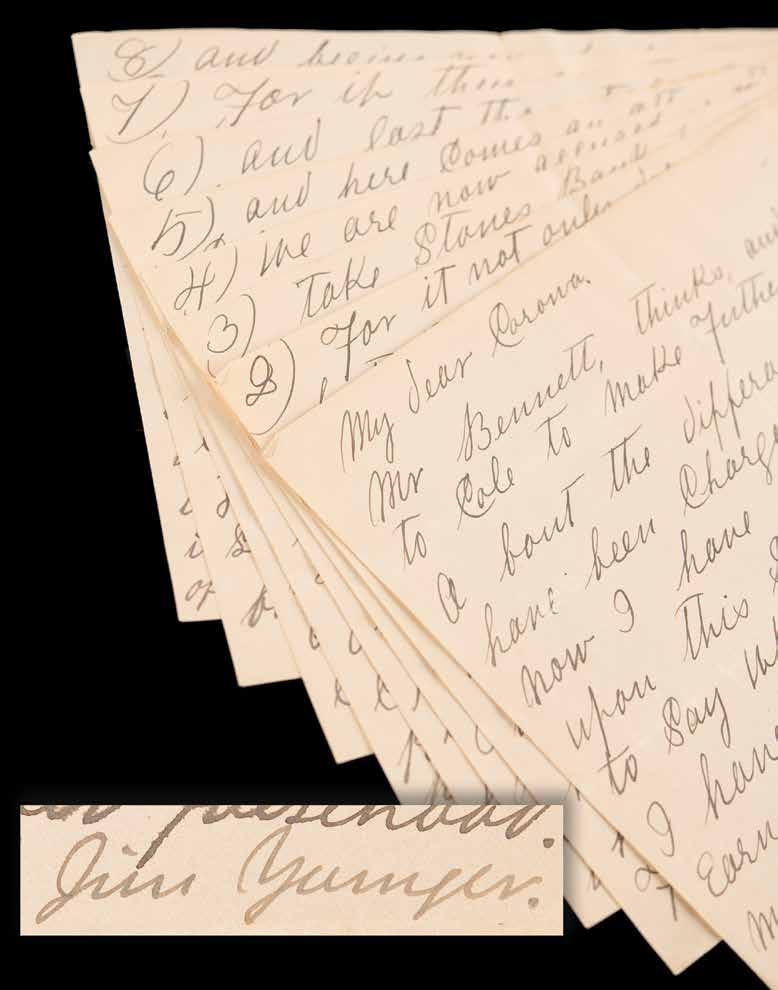
“There is not the evidence of a single soul to substanciate a single charge that stands aganst us to day”—Jim Younger defends against charges and rumors, including an
allegation “that we had gone in to a town of three hundred inhabitants, and killed them all”
Jim Younger Autograph Letter Signed, Denouncing Criminal Rumors: “There is not the evidence of a single soul to substanciate a single charge that stands aganst us to day”
ALS signed “Your Friend, Jim Younger,” eight pages, 12 x 9, no date. Lengthy handwritten letter to his friend Cora McNeill, whom he calls “Corona.” Cora, who may have been a sweetheart of Jim’s before he went to prison, was the wife of Minneapolis judge George M. Bennett who had taken an interest in Jim and Cole and worked for years to have them released and pardoned. In this fascinating letter, Jim offers a statement of the several crimes he and Cole were accused of committing, one of which occurred while they were incarcerated.
In full: “Mr. Bennett, thinks, and suggested to Cole to make further statements a bout the different crimes that have been charged to us. Now I have not talked with Cole upon this subject lately enough, to say what he intends doing, but I have not my self, and have most earnestly objected in my views of his making such statement for publication. For it not only does no good, but it gives our enemies a chance to come back with new charges and abuse. Further more, there is not the evidence of a single soul to substanciate a single charge that stands aganst us to day—except northfiend [Northfield], and the fight with detectives. While hundreds of good men, and woman have said we were not guilty; but a few others have sworn we were not.
Take Stones Bank for instance. We are accused of robbing that when Stone and all his family have been our friends, from our birth. Stage and gads hill train robbery [Missouri]. Bill Dicenson, and the masonic lodge at Floyd La. know that we were there, and made oath to that effect. Iowa train robbery. Five hundred people knows we were at Monagaw. and some good people have made oath to that fact, but the accusation goes on.
We are now accused of the blue cut robbery. One man went so far as to say I took fifteen hundred dollars from him alone. Now we came to prison in—76—and the railroad that forms the blue cut, was not built untill 80-84 and we haven’t lost a single day at the prison. So there must be a mistake some where. And Cole charged with shooting sixteen men with one gun. Why don’t they locate this. They know why.
And here comes an other that Cole first shot, then hit him with a rock, and Cole at the same time 3-thousand miles a way. Now if this little spree of Coles were true, then I should pronounce Cole to be as sillie as Thompsons Colt. For why should he carry a gun, or why should he waist his time casting stones at some one he never knew, why not have straddled a rock pile and killed his enemies. Such nonsense.
And last tho not least. There comes an easy lier, and states in a speach made in the state’s capital of Minnesota, that we had gone in to a town of three hundred inhabitants, and killed them all. Now where did this town belong. Or what earthly use is it to try to head off such absurd liers. Are the men who are to sit on the case to listen to such tales as this. For if they are, then the whole thing had just as well stop now as ever. For any man with enough sense to go in when it rains, knows such as the a bove is false, as nothing like this has ever occurred, and could not take place without—one. Just one. Soul. Man. or woman. having seen and know something a bout it. But they haven’t been found. Just think of it.
And beging your pardon for this comparison, I will say what cannot be denied. That if news paper accounts a lone were true, or if one half of what is said in the papers are true, there has never been an honest President, Govenor—Senator—or politition since the world began, but we know there has, but if the papers or reporters will write as they do of public men then why donot these same public men understand how easy it is for them to write falsehood after falsehood of men helpless in prison.” In fine condition. This remarkable letter is especially notable for Jim Younger’s blend of logic, sarcasm, and evident frustration as he attempts to dismantle the many accusations against him and his brother. He repeatedly points to clear inconsistencies—most strikingly noting that they were blamed for a robbery involving a railroad not even built until years after their imprisonment—while also mocking the more outlandish claims, such as Cole allegedly killing multiple men or even wiping out an entire town. His tone shifts between reasoned argument and dry humor, revealing both intelligence and exasperation. Particularly compelling is his broader critique of the press, observing how easily “falsehood after falsehood” can be written about “men helpless in prison,” offering a rare and personal glimpse into how notorious outlaws perceived the power of public opinion in shaping their legacy.
Starting Bid $1,000
“And not one soul have I deceived. Or, a single trust betrayed”—Younger pens a poem from prison
Jim Younger Autograph Poem Signed from Prison: “And not one soul have I deceived. Or, a single trust betrayed”
Autograph poem, signed “Jim Younger,” one page, 8.5 x 11, July 4, 1899. Younger writes a poem entitled “Fourth,” sent to Cora ‘Corona’ McNeill from Minnesota State Prison. In full: “If it were left to me, should be boundless, as that of Love. Which is God Eternal—all in all. That loving soul—and true friend Golden hair, is your Little Mother Koe. And then comes baby Golda. Twas in my happy childhood days. I had so many secrets learned. Of lonely woman and their ways. Their confidence I also earned. And not one soul have I deceived. Or, a single trust betrayed. Love being boundless, is what makes me feel so large. For I do feel as if I had goten on the outside of the whole business. Amen. God bless and protect you, is the earnest wish of your grateful friend.” Addressed on the reverse in Younger’s hand to “Corona.” In fine condition.
Cole and Jim Younger began their life of crime during the Civil War as members of the notorious Quantrill’s Raiders. The brothers avoided arrest longer than many other outlaws due to the sympathy and support of many of their fellow Confederate veterans. However, in 1876, the Younger luck ran dry when their attempted bank robbery in Northfield, Minnesota, went famously awry. Armed townsfolk disrupted the robbery, chased off the gang, and in the ensuing melee, two townspeople were killed. When the Youngers were finally captured, they were tried and sentenced to life imprisonment at the Minnesota State Prison in Stillwater—a guilty plea saved them from the hangman’s noose. After two years of legislative wrangling, a parole bill was passed in Minnesota’s legislature and Cole and Jim Younger were freed on July 10, 1901. After his release, Jim became engaged to Alix Mueller, but due to the terms of his parole, Jim was not legally allowed to marry. In 1900 he was listed as a farmer in the census and killed himself on October 19, 1902, in St. Paul, Minnesota.
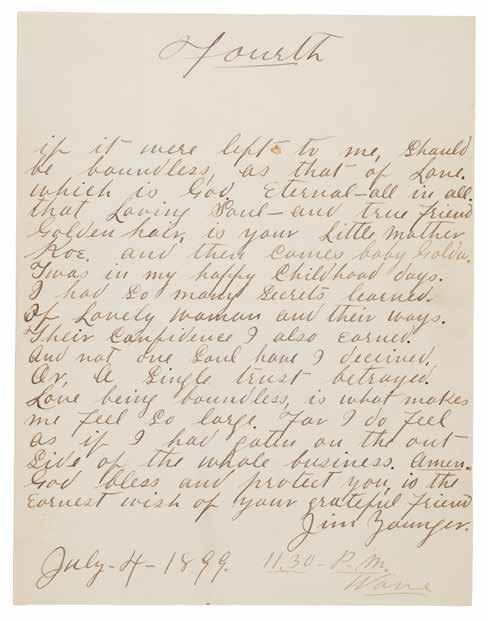
Cora McNeill was born in St. Clair, Missouri, in 1862. She was an admirer of Cole and Jim Younger, and it is believed that she was a sweetheart of Jim’s before he went to prison. She continued her correspondence to both Jim and Cole while they were incarcerated in Minnesota following the botched Northfield bank robbery. She was married to Minneapolis judge George M. Bennett, who attempted to secure a pardon for the Younger brothers.
Starting Bid $500
Paul Blum Autograph Document Signed TwiceAgreeing to Sobriety “while with the Buffalo Bill Wild West Show, or while in charge of Sitting Bull”
Scarce autograph document signed twice as “Paul C. Blum,” one page, 8 x 12.5, June 7, 1885. Submitted from the “Standing Rock Agency” in Dakota Territory, a handwritten statement from Blum vowing to abstain from drink while in the employment of William F. Cody, in full: “I, Paul C. Blum, do solemnly promise not to touch or drink any kind of intoxicating liquor while with the Buffalo Bill Wild West Show, or while in charge of Sitting Bull.” Signed at the conclusion by Blum. The reverse of the top edge is affixed to an 8.5 x 11 album page. In fine condition.
Paul Blum served as a government agent and ‘Indian trader’ tasked with managing Sitting Bull during the Lakota leader’s tenure with Buffalo Bill’s Wild West in 1885. Acting as both handler and intermediary, Blum oversaw Sitting Bull’s activities during a period in which the famed chief was exhibited as a principal attraction alongside performers such as Annie Oakley. Sitting Bull joined Buffalo Bill Cody’s show in June 1885 under a four-month contract, traveling with a delegation that included Seen-by-the-Nation, Spotted Horn Bull, Gray Buffalo Woman, Eagle, Long Dog, Gray Eagle, Crow Eagle, Flying By, Good Sounding Iron, and Princess Red Spear. Accompanied by interpreter Louis Primeau, the group was collectively known as the ‘Sitting Bull Combination,’ a troupe organized specifically for the 1885 touring season.
Starting Bid $200
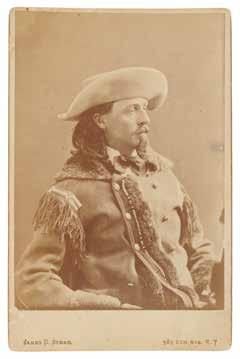
William F. ‘Buffalo Bill’ Cody Cabinet Photograph by James U. Stead
Scarce, early original 4.25 x 6.5 cabinet photograph of the seated William F. ‘Buffalo Bill’ Cody clad in his beaver-trimmed buffalo-hide coat and broad-brimmed Stetson, taken in the mid-1870s by James U. Stead of New York City. Imprinted on the mount with the photographer’s credit: “James U. Stead, 383 6th Ave., N.Y.” In fine condition. An exceptional portrait of the well-dressed Wild West showman on the brink of international fame.
Starting Bid $200
William F. ‘Buffalo Bill’ Cody Woodburytype Cabinet Photograph
Exceptional original 4.25 x 6.5 cabinet photo of William F. ‘Buffalo Bill’ Cody standing confidently in a full-length pose, wearing a fringed buckskin outfit, wide-brimmed hat, and tall boots, with long hair and a prominent mustache and goatee, one hand on his hip and the other atop a long rifle. Imprinted on the mount: “Copyright Woodburytype, Colonel W. F. Cody, ‘Buffalo Bill.’” In fine condition, with light scuffing to the image, visible at an angle.
Starting Bid $200
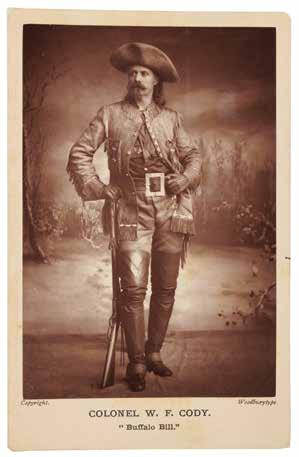
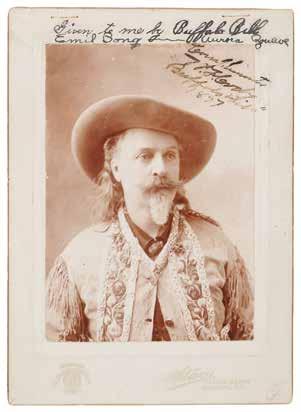
William F. ‘Buffalo Bill’ Cody Signed Photograph
Outstanding original glossy 5.25 x 7.5 mounted cabinet-style photo of William F. ‘Buffalo Bill’ Cody wearing a cowboy hat and ornately decorated buckskin jacket, signed in the upper right corner in ink, “Compliments, W. F. Cody, ‘Buffalo Bill,’ 1897.” Affixed to its original studio mount, blindstamped: “Extra Finish, Stacy, 5th Ave. & 9th Ave., Brooklyn, N.Y.” Annotated at the top in ink: Given to me by Buffalo Bill, Emil Bong—Aurora Zouave.” In fine condition, with two rusty staple marks toward the top edge.
Starting Bid $200
LOT 6164
William F. ‘Buffalo Bill’ Cody and Sitting Bull
Oversized Mounted
Photograph by Wm. Notman/D. F. Barry (16˝ x 20˝)
Original 11 x 14 photo of Sitting Bull and William F. ‘Buffalo Bill’ Cody, originally taken in August 1885 by William F. Notman of Montreal and later published by David Francis Barry, affixed to its original 16 x 20 studio mount. Blindstamped toward the bottom of the image (near the butt of Cody’s rifle), “Copyright by Barry,” and on the mount, “Barry.” The studio’s label is affixed on the reverse, “D. F. Barry, Photographs of All Noted Indian Chiefs, Photographer 1316 Tower Ave., Superior, Wisconsin.”
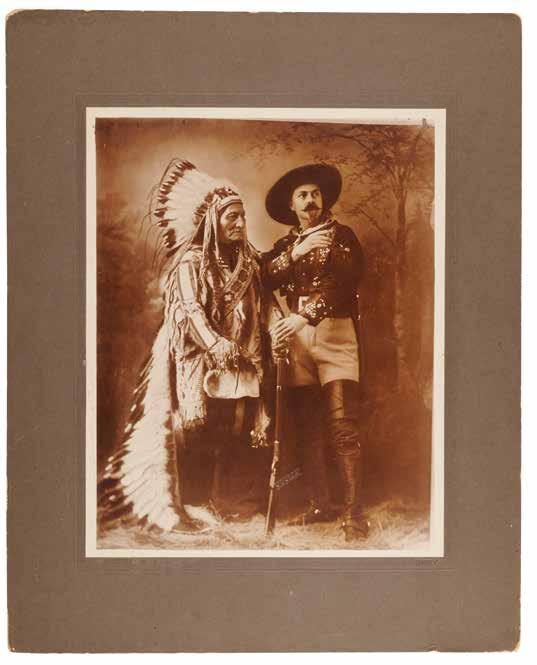
The iconic image features Sitting Bull on the left, wearing a large feathered headdress and traditional clothing with beadwork and fringe, standing calmly with a composed expression. Beside him on the right is Buffalo Bill, dressed in a decorated Western-style outfit with a wide-brimmed hat, tall boots, and a mustache, holding a long rifle upright and gazing off to the side. Although the photograph is credited to Notman’s studio, it was copyrighted about a decade later by D. F. Barry, a pioneering photographer of the American West, who helped bring it wider recognition. The image is most commonly seen as a cabinet card; examples of this unusually large size are exceptionally scarce. In fine condition.
Starting Bid $200
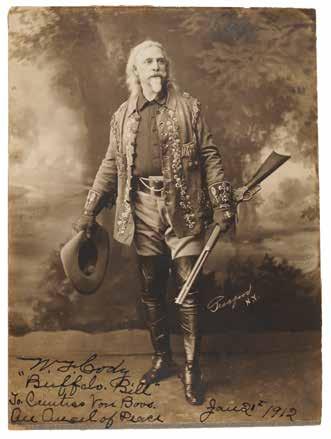
William F. ‘Buffalo Bill’ Cody Autograph Letter Signed: “I have been busy talking land sales and hotel sale”
ALS signed “W. F. Cody,” one page, 8.5 x 11, Buffalo Bill’s Wild West letterhead, September 10, 1912. Handwritten letter to H. H. Cross, in part: “Your good telegram came and I wired you to send Burke’s letter in my care. My family are here with me to day…I have been busy talking land sales and hotel sale. I am going to sell my hotels but it’s going to take a little time to make the deals in the meantime your 1000 will help me very much.” He closes with a comment about “show business.” In fine condition. Accompanied by the original mailing envelope, addressed in Cody’s own hand. A boldly penned letter on ornate stationery advertising Buffalo Bill’s Wild West combined with Pawnee Bill’s Great Far East.
Starting Bid $200
William F. ‘Buffalo Bill’ Cody Signed Photograph, Presented to an
Superlative vintage matte-finish 7 x 9.5 photo of the Wild West showman standing in a full-length pose, clad in a finely embroidered coat with hat and rifle in hand, neatly signed and inscribed at the bottom in fountain pen, “W. F. Cody, ‘Buffalo Bill,’ To Countess Von Boos, An Angel of Peace, Jan. 21st, 1912.” Affixed to a slightly larger mount and in fine condition, with light silvering to darker areas of the image.
Mezzo-soprano singer and philanthropist Eugenia Hildegard von Boos Farrar (1875–1966) was an organizer and member of the Executive Committee of the Universal Peace Union, but may be better known for her feats in show business: in 1907 she gave what is believed to be the first live radio singing performance, broadcast over Lee de Forest’s experimental transmitter located atop the Parker Building in New York City. An interesting association piece and a great image of ‘Buffalo Bill’ Cody.
Starting Bid $200
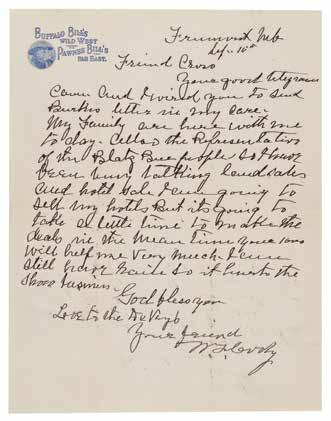
“Seems as everything went against me. Well I will make it back I am not quitter”— Buffalo Bill on his disastrous 1912 season, turning to land sales, a quartz mill, and his High Jinks gold mine to stay afloat
ALS signed “W. F. Cody,” one page both sides, 8.5 x 11, Buffalo Bill’s Wild West Combined with Pawnee Bill’s Great Far East letterhead, October 19, 1912. Addressed from Ocala, Florida, a handwritten letter to his friend, the painter and frontiersman, Henry H. Cross, in full: “Your letter rec’d here. I fear you did not get my letter I sent to some place in the North West, I have forgotten the name. You say you will be in New York early in Nov. I will be at the Waldorf Nov. 3rd + 4th. Maybe we will meet there. If not let me have a line telling where you will be about that time. I have to rush to Neb. and get to selling land & town lots to raise some money to pay for my debts for this entire season has been a looser. I generally clear over $100,000 on a season. But I could not do a thing but loose 50,000 this season. Seems as everything went against me. Well I will make it back I am not quitter. Johnnie Baker has gone to open up the High Jinks mine and I have one quartz mill running ten hours a day on ore from a new strike we recently made that looks mighty good. If Col. Dyer had not been laid out by sickness there would been work done at the mines all summer. Love to the DeVrys and your own good self.” In fine condition. Accompanied by the original hand-addressed mailing envelope.
The 1912 season marked a difficult turning point for Buffalo Bill and his Wild West show. Under growing financial strain, Cody borrowed $20,000 from Denver Post owners Harry Tammen and Frederick Bonfils in an effort to sustain the production. Despite this, the season fell short; attendance was inconsistent, performances uneven, and the show struggled to recapture its earlier success.
At the same time, Cody was actively seeking other sources of income. As this letter reveals, Cody looked to ventures beyond the show, including the sale of land and town lots in Nebraska, as well as interests in a quartz mill and the High Jinks gold mine. In managing these far-reaching enterprises, Cody increasingly relied on his longtime associate, Lewis H. ‘Johnny’ Baker. Often called the ‘Cowboy Kid,’ Baker had joined the Wild West show as a teenager in 1885, rising from a skilled marksman – mentored by Annie Oakley – to one of its featured performers. Over time, he took on growing responsibility behind the scenes, eventually serving as a trusted troubleshooter and business manager for Cody’s operations, including oversight of ventures such as the High Jinks.
Even so, the show’s financial difficulties proved too great. Cody was unable to repay the loan, and control of the enterprise gradually passed to his creditors, who sold off assets and reorganized operations. By 1914, his position had become largely symbolic; his name still prominent, but the show no longer his to manage. He remained on the road for a few more seasons before stepping away. While he continued to work in other productions, the setbacks of these years had lasting consequences, and by the time of his death in 1917, much of the fortune he had once built was gone.
Starting Bid $200
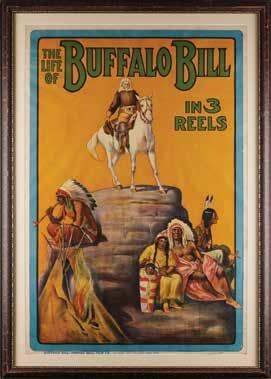
William F. ‘Buffalo Bill’ Cody: The Life of Buffalo Bill Movie Poster (c. 1912)
Outstanding original 27 x 40 one-sheet movie poster for the 1912 film “The Life of Buffalo Bill in 3 Reels,” featuring vivid full-color imagery of the famed Wild West showman on horseback atop a rocky outcrop, with a Native American Indian family below. Imprinted in the lower border: “Buffalo Bill–Pawnee Bill Film Co., 145 West 45th St., New York City.” Archivally matted and framed to an overall size of 33 x 46.5. In very good to fine condition, with light creasing and edge rippling.
Starting Bid $200
William F. ‘Buffalo Bill’ Cody: The Life of Buffalo Bill Movie Poster (c. 1912)
Vibrant original 27 x 40 one-sheet movie poster for the 1912 film “The Life of Buffalo Bill in 3 Reels,” featuring dramatic full-color imagery of the “First Scalp for Custer” and a large portrait of famed Wild West showman William F. ‘Buffalo Bill’ Cody on horseback. Imprinted in the lower border: “Buffalo Bill–Pawnee Bill Film Co., 145 West 45th St., New York City.” Archivally matted and framed to an overall size of 33 x 46.5. In very good to fine condition, with light creasing and edge rippling.
Starting Bid $200
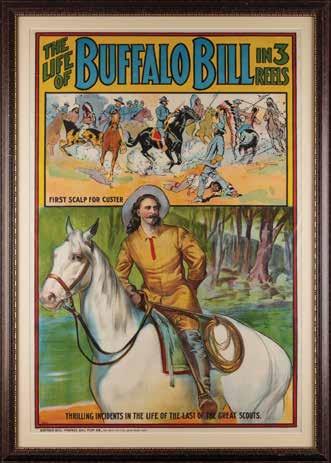
William F. ‘Buffalo Bill’ Cody: The Life of Buffalo Bill in Moving Pictures Poster (27˝ x 6.5˝)
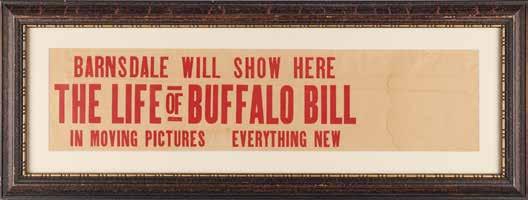
Original circa 1912 poster advertising the Barnsdale Electric Moving Picture Company’s showing of the film The Life of Buffalo Bill, 27 x 6.5, imprinted in red: “Barnsdale Will Show Here The Life of Buffalo Bill in Moving Pictures, Everything New.” Archivally matted and framed to an overall size of 33 x 12.5. In very good to fine condition, with a heavy horizontal crease, and light dampstaining to the edge blank area.
Walter Barnsdale founded a traveling motion picture exhibition company in the early 1900s, presenting feature films using the finest electric lighting technology then available. Journeying across the country, Barnsdale brought the cinematic experience to audiences in remote areas who otherwise lacked access to theaters in larger cities.
Starting Bid $200
William F. ‘Buffalo Bill’ Cody Museum-Issued Portrait Poster (17.5˝ x 24.5˝)
Four-color 17.5 x 24.5 lithograph poster of William F. Cody, entitled “Col. W. F. Cody, ‘Buffalo Bill,’” showing him in a bust-length portrait, facing slightly left, wearing a wide-brimmed hat and fringed buckskin jacket with a red neckerchief, set against a stylized gold background, a later museum-issued example after the original circa 1888 design by A. Hoen & Co., Baltimore, whose credit is printed above the plate number “9.” Lower margin bears a copyright caption to the “Buffalo Bill Museum, Golden, Colorado,” and notes that the poster was “Published by Washington Avenue Gallery, Golden, Colorado. All rights reserved,” indicating production for museum sale. Framed to an overall size of 23 x 30. In fine condition.
Starting Bid $200
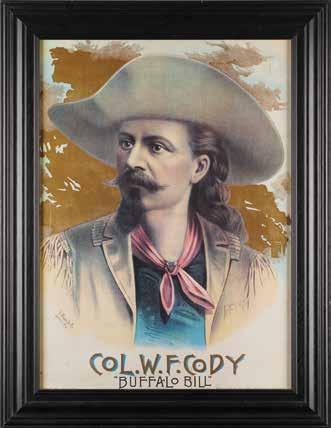
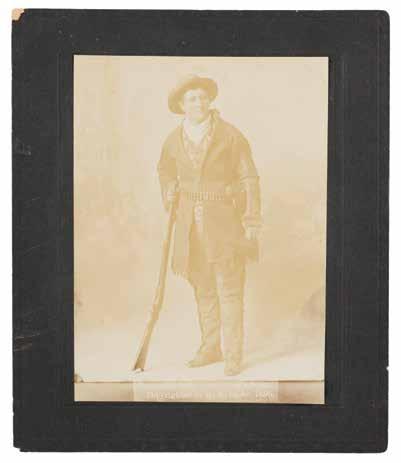
R. Locke
American frontierswoman, sharpshooter, and storyteller (1852–1903) remembered as one of the Old West’s most colorful figures. Original 3.5 x 5 albumen photograph of Martha Jane Canary, better known as ‘Calamity Jane,’ affixed to a black 5.5 x 6.5 mount, captioned within the image: “Calamity Jane, Gen. Crook’s Scout. Copyrighted by H. R. Locke, 1895.” Captured in a full-length pose, this remarkable portrait exudes the rugged independence that defined Calamity Jane’s legacy. She stands confidently, dressed in traditional Western attire: a wide-brimmed hat, fringed buckskin jacket, and sturdy trousers tucked into boots. A bandolier of ammunition crosses her waist, and she grips a long rifle at her side, reinforcing her reputation as a skilled scout and sharpshooter. In fine condition. An evocative and iconic representation of one of the American West’s most enduring figures.
Starting Bid $200
Gordon S. ‘Pawnee Bill’ Lillie and Captain Jack (2) Signed Items
Two items individually signed by the Wild West show legends: a 4.25 x 5.25 greeting card featuring an inset photograph of Pawnee Bill, signed inside in fountain pen, “G. W. Lillie, ‘Pawnee Bill’”; and a matte-finish 3.75 x 5.5 photo of ‘Captain Jack’ Crawford at his desk, signed and inscribed on the front in fountain pen, “Hello Bill, J. W. Crawford, Capt. Jack, 1913,” and signed again on the reverse, “J. W. Crawford, Capt. Jack, 1913.” A printed poem is also affixed to the reverse of the Crawford photo. In fine condition, with light silvering to darker areas of both images.
Starting Bid $200
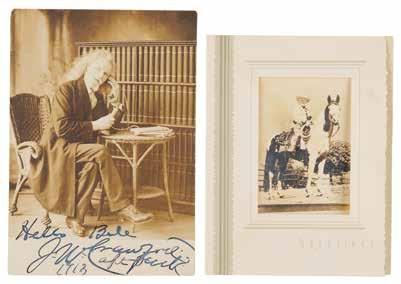
American showman (1860-1942) who began his career as a trapper and Pawnee interpreter and later became a partner in Buffalo Bill’s Wild West Show. Vintage
glossy 3.5 x 5.5 postcard photo of Gordon W. ‘Pawnee Bill’ Lillie and William F. ‘Buffalo Bill’ Cody in an artist’s near-profile portrait, signed in fountain pen, “G. W. Lillie, ‘Pawnee Bill.’” In very good to fine condition, with a small puncture to the brim of Cody’s hat, and old tape to back edges. Accompanied by the original mailing envelope, postmarked at Pawnee, Oklahoma, December 14, 1938.
Starting Bid $200
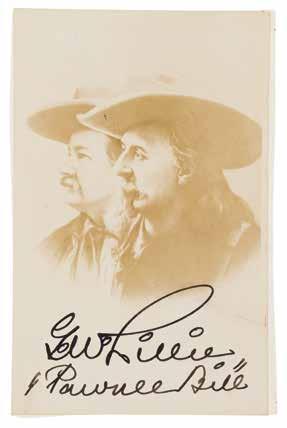
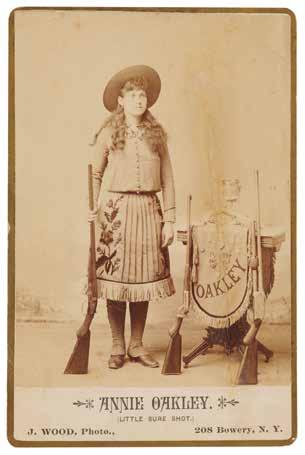
Annie Oakley Cabinet Photograph by J. Wood“Little Sure Shot”
Fantastic original 4.25 x 6.5 cabinet photo of Annie Oakley standing in a fulllength pose beside three of her rifles and an array of awards, imprinted on the mount: “Annie Oakley, (Little Sure Shot), J. Wood, Photo., 208 Bowery N. Y.”
The reverse features a biographical blurb, in part: “This celebrated girl-shot was born at Woodland, Darke Co., Ohio, Aug. 13th, 1866. Ever since a toddling child she has had an inherent love for fire-arms, and hunting…At the age of twelve she was presented with a 14-gauge muzzle-loading shot gun. With this she improved rapidly, and became such a fine shot that she rarely missed a quail or a pheasant…For the past five years she has been shooting before the public with great success; though, like the modest little girl she is, she never laid claim to being a champion…Sitting Bull, the great Indian Chief, after seeing her shoot in St. Paul, Minn., adopted her in the Sioux tribe, giving her the name of ‘Watanya Cicila,’ or Little Sure Shot.” In very good to fine condition, with light rubbing along a vertical crease passing through the table in the image.
Starting Bid $200
Annie Oakley Cabinet Photograph by Baker’s Art Gallery - From the Family Collection of Her Brother-in-Law
William Butler
Uncommon original 4.25 x 6.5 cabinet photo of Annie Oakley wearing a cowboy hat in a forthright pose, published by Baker’s Art Gallery of Columbus, Ohio, with her facsimile signature imprinted on the mount. In very good to fine condition, with small surface impressions to her neck, and a crease and associated small are of emulsion loss to the lower right corner of the image.
Provenance: from the collection of her husband Frank Butler’s brother William, and accompanied by a family letter of provenance; originally sold at Heritage Auctions, June 10, 2012.
Starting Bid $200
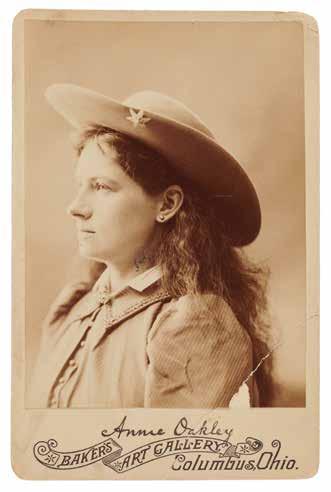
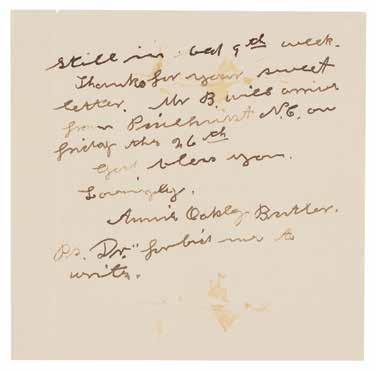
Annie Oakley Autograph Note Signed: “Thanks for your sweet letter”
Celebrated American performer (1860-1926) whose legendary prowess as a markswoman earned her worldwide renown. ALS signed “Annie Oakley Butler,” one page, 5.25 x 5.25, no date. Handwritten note, in full: “Still in bed, 9th week. Thanks for your sweet letter. Mr. B. will arrive from Pinehurst N.C. on Friday the 26th. God bless you…P.S. Dr. forbids me to write.” In fine condition, with a few small stains.
Starting Bid $200
Notable group of three typed letters from 1891-1892, on the plight of reservation Indians and their recruitment as Wild West show performers. Each one page, 8 x 10.5, including two TLSs from Herbert Welsh, corresponding secretary of the Philadelphia-based Indian Rights Association, and a carbon copy of a letter to Welsh from noted Catholic Bishop Martin Marty, whose zeal for the Native American missions earned him the title, ‘The Apostle of the Sioux.’
The first TLS from Welsh, on Indian Rights Association letterhead, dated June 3, 1891, sent to Major James McLaughlin at the Standing Rock Agency in North Dakota, regarding an issue with Indians contracted to perform in Buffalo Bill’s Wild West. In part: “I herewith enclose for your consideration a copy of a letter which has just reached me from Mr. Salisbury, the vice president of the wild west show, together with a copy of my letter to the New York Evening Post, to which he has taken such violent exception. Will you kindly inform me as to any mis-statements of fact made in my letter, and as to your knowledge of Miss Collins’ reliability as a witness? Mr. Salisbury’s letter does not affect the main position which we have taken as to the propriety of the Government permitting contracts to be made with reservation Indians for this purpose. Of course if I am in error as to any statement concerning Mr. Cody’s wild west show, I will very gladly withdraw them.” McLaughlin was a senior Indian Service Officer best remembered for having issued the arrest warrant for Sitting Bull, which led to his shooting. McLaughlin was known as an advocate of helping Native Americans to adopt Eastern ways and assimilate.
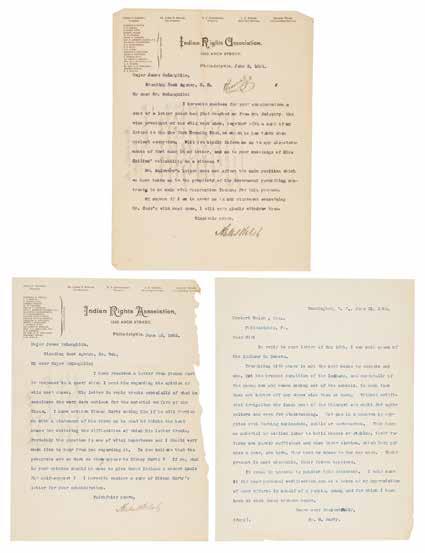
The carbon copy letter, unsigned, dated June 21, 1892, sent to Welsh by Bishop Marty regarding the life of Indians in Dakota, in part: “Travelling with shows is not the best means to educate anyone, but the present condition of the Indians, and especially of the young men & women coming out of the schools, is such that they are better off anywhere else than at home. Without artificial irrigation the lands west of the Missouri are unfit for agriculture and even for stockraising. Not one in a hundred is supplied with farming implements, cattle, or work-horses…their rations are barely sufficient and when their clothes, which they get once a year, are torn they have no means to buy new ones.”
The second TLS from Welsh, also on Indian Rights Association letterhead, June 22, 1892, sent to Major McLaughlin, in part: “I have received a letter from Bishop Marty in response to a query which I sent him regarding his opinion of wild west shows. His letter in reply treats especially of what he considers the very dark outlook for the material welfare of the Sioux. I have written Bishop Marty asking him if he will furnish me with a statement of his views as to what he thinks the best means for obviating the difficulties of which his letter treats. Certainly the question is one of vital importance and I should very much like to hear from you regarding it. Do you believe that the prospects are as dark as they appear to Bishop Marty? If so, what in your opinion should be done to give these Indians a secure basis for self-support?” In overall very good to fine condition, with edge loss to the 1892 Welsh letter.
Starting Bid $200
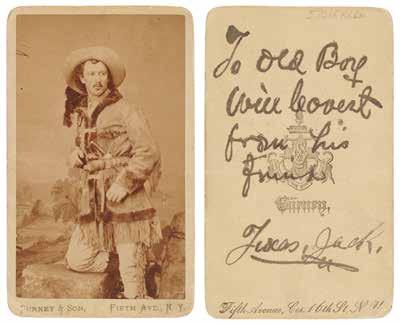
John Baker Omohundro (1846-1880) was an American frontier scout, actor, and cowboy who became a legendary figure in the American Old West as a Western showman performing dramas on the stage throughout the country, and was immortalized in dime novels published around the world. Scarce 2.5 x 4 carte-de-visite photo of ‘Texas Jack’ Omohundro clad in classic buckskin and posed in a dramatic stance, published by Gurney & Son of New York, signed and inscribed on the reverse in ink, “To Old Boy Will Covert, from his friend, Texas Jack.” In very good to fine condition, with rounded corners and some feathering to the ink.
Starting Bid $200
Cad Wilson Signed PhotographPopular Klondike Dancehall Girl
Vintage matte-finish 5.5 x 7.75 photo of popular entertainer Cad Wilson—a favorite of gold rush–era miners—affixed to its original 6.7 x 9 mount, signed and inscribed on the reverse in ink, “To My Old Friend John, ‘who never eats,’ Sincerely Yours, Cad Wilson, ‘Such a nice girl too.’” In fine condition, with light staining along the edges.
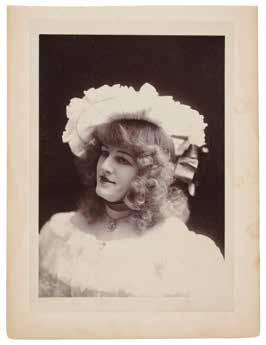
Cad Wilson was a vaudeville performer and dance-hall entertainer who rose to prominence during the Klondike Gold Rush, becoming one of the most popular and notorious ‘good-time girls’ in Dawson City. Arriving in the Yukon in 1898, she quickly became the highest-paid act in Dawson, known for her charismatic stage presence and her signature song ‘Such a Nice Girl, Too.’ Her performances, often risqué and highly lucrative, attracted wealthy miners who spent lavishly on her, contributing to her accumulation of significant wealth and a famous gold-nugget belt. After only one season in Dawson, she left the Yukon with tens of thousands of dollars and continued performing elsewhere, cementing her legacy as a colorful and emblematic figure of the Klondike entertainment scene.
Starting Bid $200
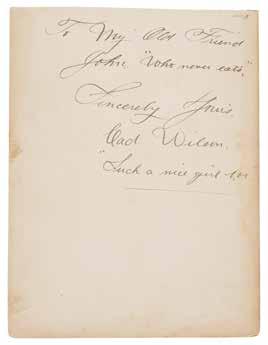
ANYONE EITHER REGISTERING TO BID OR PLACING A BID (“BIDDER”) ACCEPTS THESE CONDITIONS OF SALE AND ENTERS INTO A LEGALLY, BINDING, ENFORCEABLE AGREEMENT WITH R&R AUCTION COMPANY OF MASSACHUSETTS, LLC (“RR AUCTION”) TOGETHER WITH BIDDER, THE “PARTIES”).
This Agreement contains important provisions that control rights and liabilities, and specifically has provisions governing how disputes are handled as well as LIMITATIONS OF LIABILITY that can be imposed upon RR Auction, WAIVER OF JURY and ARBITRATION PROVISIONS. This acknowledgement is a material term of these Conditions of Sale and of the consideration under which RR Auction agrees to these terms. PLEASE READ CAREFULLY.
The following terms and conditions (“Conditions of Sale”) constitute the sole terms and conditions under which RR Auction will offer for sale and sell the property on its website, and/or described in the catalog of items for auction (the “Catalog”). These Conditions of Sale constitute a binding agreement between the Parties with respect to the auction in which Bidder participates (the “Auction”). By bidding at the Auction, whether in person, through an agent or representative, by telephone, facsimile, online, absentee bid, or by any other form of bid or by any other means, Bidder acknowledges the thorough reading and understanding of all of these Conditions of Sale, all descriptions of items in the Catalog, and all matters incorporated herein by reference, and agrees to be fully bound thereby.
The Parties1.1 RR Auction and Auction
This Auction is presented by RR Auction, a d/b/a/ of R&R Auction Company of Massachusetts, LLC, as identified with the applicable licensing information on the title page of the Catalog or on the www.RRauction.com Internet site. The Auction is conducted under these Conditions of Sale. Announcements and corrections from the podium at live auctions and those made through the Conditions of Sale appearing on the Internet at RRauction.com supersede those in the printed Catalog.
1.2
Bidder shall mean the original Bidder on the property offered for sale by RR Auction and not any subsequent owner or other person who may acquire or have acquired an interest therein. If Bidder is an agent, the agency must be disclosed in writing to RR Auction prior to the time of sale, otherwise the benefits of the warranty shall be limited to the agent and not transferable to the undisclosed principal.
The rights granted to Bidder under these Conditions of Sale are personal and may not be assigned or transferred to any other person or entity, whether by operation of law or otherwise without the express written assent of RR Auction. Bidder may not transfer, assign, or otherwise convey these Conditions of Sale or any of the rights herein, and such purported transfer, assignment, or conveyance shall be null and void. No third party may rely on any benefit or right conferred on any Bidder by these Conditions of Sale, and no third party is intended as a beneficiary of these Conditions of Sale.
Bids will not be accepted from minor persons under eighteen (18) years of age without a parent or legal guardian’s written consent containing an acknowledgment of the Conditions of Sale herein and indicating their agreement to be bound thereby on behalf of the Bidder.
All Bidders must meet RR Auction’s qualifications to bid. Any Bidder who is not a client in good standing of RR Auction may be disqualified at RR Auction’s sole option and will not be awarded lots. Such determination may be made by RR Auction in its sole and unlimited discretion, at any time prior to, during, or even after the close of the Auction. RR Auction reserves the right to exclude any person from the Auction.
If an entity places a bid, then the person executing the bid on behalf of the entity agrees to personally guarantee payment for any successful bid and agrees to be bound by these Conditions of Sale in addition to company for whom the Bidder is acting
By accepting the Conditions of Sale, Bidder personally and unconditionally guarantees payment.
Section 2 Bidding Privileges
2.1 In order to place bids, Bidders who have not established an account with RR Auction must either furnish satisfactory credit information (including two collectibles-related business references) or supply additional information if requested, well in advance of the Auction. Bidders who are not members of RRAuction.com should pre-register before the close of the Auction to allow adequate time to contact references. Privileges will be granted at the sole discretion of RR Auction. Additionally, Bidders who have not previously established credit or who wish to bid in excess of their established credit history may be required to provide a cash deposit prior to RR Auction’s acceptance of a bid. Check writing privileges and immediate delivery of merchandise may also be determined by pre-approval of credit based on a combination of criteria: RRAuction.com history, related industry references, bank verification, a credit bureau report and/or a personal guarantee for a corporate or partnership entity in advance of the Auction venue.
2.2 Bidder providing any false or misleading information provided in connection with the registration shall be a material breach of the Conditions of Sale and in addition to any other remedies at law shall excuse RR Auction from performance under these Conditions of Sale, including the right to any refund.
2.3 Bidding privileges may be revoked without notice, for any reason, at the sole discretion of RR Auction .
Section 3
Buyer’s Premium
3.1 The Bidder acknowledges and agrees that a 25% buyer’s premium will be added to the hammer price on all individual lots sold in timed and live Auctions. . For payment other than by cash, delivery will not be made unless and until full payment has been received by RR Auction, i.e., check or wired funds have fully cleared. Unless otherwise agreed in writing, signed by RR Auction, payment in full is due within thirteen (13) calendar days of the Auction or within twelve (12) calendar days of the invoice date, whichever is earlier. Bidder’s failure to pay any payment in full when due required shall constitute a material breach, and in addition to other damages available under contract or law, at RR Auction’s election, RR Auction may cancel the sale and require full premium still be due along with interest at 1.5% per month from the date of breach, or at the maximum legally allowable rate.
Section 4
Bidding
4.1 Each Bidder’s determination of its bid should be based upon its own examination of the item(s) and independent investigation, rather than any reliance as to what is represented in the Catalog, online or elsewhere. Bidder affirms that it regards any statements made by RR Auction concerning the item as solely opinion and that Bidder is making its own inspection and independent evaluation of the goods, and is not relying upon any description or statements by RR Auction (including as to quality, authenticity, provenance, ownership, liens existing, on goods legality, or value) in making its determination to bid on or purchase an item. In any purchase or sale, the value of the item(s) is determined by the price. THE BIDDER HEREBY ASSUMES ALL RISKS CONCERNING ANY AND ALL PURCHASES TO THE FULLEST EXTENT UNDER APPLICABLE LAW.
4.2 RR AUCTION IS NOT RESPONSIBLE FOR ERRORS IN BIDDING. A Bidder should make certain to bid on the correct lot and that the bid is the maximum (plus the Buyer’s Premium) that the Bidder is willing and able to pay. Since other Bidders (by mail, facsimile, online, and in person) will be present, and since a reoffering could damage the momentum of the sale, once the hammer has fallen and RR Auction has announced the winning Bidder, such Bidder is unconditionally bound to pay for the lot, even if the Bidder has made a mistake.
4.3 All prospective Bidders who examine lots in person prior to the sale shall personally assume all responsibility for any damage they cause in so doing. RR Auction shall have sole discretion in determining the value of the damage caused, which shall be promptly paid by the prospective Bidder.
4.4 Title to any lot remains with Consignor, any secured party of the Consignor, or assignee of Consignor, as the case may be, until the lot is paid for in full by Bidder and Bidder has fully satisfied any outstanding financial obligations to RR Auction (including as it concerns any other lots). RR Auction reserves the right to require payment in full before delivering any lot to the successful Bidder.
4.5 It is the Bidder’s responsibility and obligation to have the lots fully insured while in their possession. Bidder assumes any and all risk of loss upon the earlier of shipment to Bidder or in Bidder’s possession.
4.6 Bidder grants to RR Auction or its assigns the right to offset any sums due, or found to be due by RR Auction, and to make such offset from any past, subsequent or future consignment, or items acquired by Bidder in possession or control of RR Auction or from any sums due to Bidder by RR Auction. Bidder fur-
ther grants RR Auction a lien consisting of a senior security interest (or purchase money security interest to the extent applicable) in such sums or items to the fullest extent applicable, authorizes RR Auction to file documents concerning the interest, and Bidder agrees to execute any further documents as may be reasonably necessary to grant RR Auction such security interest. Bidder agrees that RR Auction and its assigns shall be a secured party with respect to items bought by Bidder and in the possession of RR Auction, to the extent of the maximum indebtedness, plus all accrued fees and expenses, until the indebtedness is paid.
4.7 By bidding in this sale, Bidder personally and unconditionally guarantees payment. The authorized representative of any corporate Bidder who is present at the sale shall provide RR Auction or its agent, prior to the commencement of the bidding (or at the time of registration), with a statement signed by a principal, director or officer that they he or she personally and unconditionally guarantees any payment due RR Auction.
4.8 RR Auction may at its sole and absolute discretion, make loans or advances to Consignors and/or prospective Bidders.
Section 5 Bidding Options
5.1 Non-Internet bids (including but not limited to in-person, facsimile, phone and mail bids) are treated similarly to floor bids in that they must be on-increment. Any in-person, facsimile, phone, or mail bids that do not conform to a full increment will be rounded up or down to the nearest full increment and this revised amount will be considered Bidder’s high bid.
5.2 When identical bids are submitted, preference is given to the first received. To ensure the greatest accuracy, written bids should be entered on the standard printed bid sheet and be received at RR Auction’s place of business at least twenty-four (24) hours before the Auction start. RR Auction is not responsible for executing mail bids or facsimile bids received on or after the day the first lot is sold, nor Internet bids submitted after the published closing time; nor is RR Auction responsible for proper execution of bids submitted by telephone, mail, facsimile, e-mail, Internet, or in person once the Auction begins.
5.3 In all Auctions, bids on an item must raise the current high bid by at least 10%, or as specified on a per-Auction basis. Bids will be accepted in whole dollar amounts only. No “buy” or “unlimited” bids will be accepted. In a live sale, bids on an item can change at the discretion of RR Auction.
5.4 RR Auction reserves the right to accept or decline any bid. Bids must be for an entire lot and each lot constitutes a separate sale. All bids are per lot unless otherwise announced. Live auction lots will be sold in their numbered sequence unless RR Auction directs otherwise. It is unlawful and illegal for Bidders to collude, pool, or agree with another Bidder to pay less than the fair value for lot(s). For live auctions, RR Auction will have final discretion in the event that any dispute should arise between Bidders. RR Auction will determine the successful Bidder, cancel the sale, or re-offer and resell the lot or lots in dispute. RR Auction will have final discretion to resolve any disputes arising after the sale and in online auctions. If any dispute arises, RR Auction’s sale record is conclusive.
Section 6 Payment
6.1 Subject to fulfillment of all of the Conditions of Sale set forth herein, upon the sooner of (1) the passing of title to the offered lot pursuant to these Conditions of Sale, or (2) possession of the offered lot by the Bidder, Bidder thereupon (a) assumes full risk and responsibility (including without limitation, liability for or damage to frames or glass covering prints, paintings, photos, or other works), and (b) will immediately pay the full purchase price or such part as RR Auction may require. In addition to other remedies available to RR Auction by law, RR Auction reserves the right to impose from the date of sale a late charge of 1.5% per month of the total purchase price if payment is not made in accordance with the conditions set forth herein. All property must be removed from RR Auction’s premises by the Bidder at his/her expense not later than sixty (60) business days following its sale and, if it is not so removed, RR Auction may send the purchased property to a public warehouse for the account, at the risk and expense of the Bidder.
6.2 Payment is due upon closing of the Auction session, or upon presentment of an invoice. RR Auction reserves the right to void an invoice if payment in full is not received within thirteen (13) calendar days of the Auction or within twelve (12) calendar days of the invoice date. In cases of nonpayment, RR Auction’s election to void a sale does not relieve the Bidder from their obligation to pay RR Auction its fees (seller’s and Buyer’s Premium) on the lot and any other damages pertaining to the lot.
6.3 All sales for total invoices greater than $1,000 are strictly for cash in United States dollars (including U.S. currency, bank wire, cashier checks, eChecks, and bank money orders), and are subject to all reporting requirements.
6.4 All deliveries are subject to good funds; funds being received in RR Auction’s account before delivery of the Purchases; and all payments are subject to a clearing period. RR Auction reserves the right to determine if a check constitutes “good funds”: checks drawn on a U.S. bank are subject to a ten (10) calendar day hold, and ten (10) business days when drawn on an international bank. Clients with pre-arranged credit status may receive immediate credit for payments via e-Check, personal or corporate checks.
6.5 In the event that a Bidder’s payment is dishonored upon presentment(s), Bidder shall pay the maximum statutory processing fee set by applicable state law. If Bidder attempts to pay via check and the financial institution denies the transfer from Bidder’s bank account, or the payment cannot be completed using the selected funding source, Bidder agrees to complete payment.
6.7 If RR Auction refers any unpaid invoice to an attorney for collection, the Bidder agrees to pay and shall be liable for RR Auction’s attorney’s fees, court costs, and other collection costs incurred by RR Auction in addition to the invoice amount and interest the greater of 1.5% per month or at the maximum legally allowable rate from date of invoice to collection. If RR Auction assigns collection to its house counsel, such attorney’s time expended on the matter shall be compensated at a rate comparable to the hourly rate of independent attorneys.
6.8 RR Auction shall have a lien against the merchandise purchased by the Bidder (as well as to the extent it is a consignor any other monies owed or due to Bidder) to secure payment of the Auction invoice. RR Auction is further granted a lien and the right to retain possession of any other property of the Bidder then held by RR Auction or its affiliates to secure payment of any Auction invoice or any other amounts due RR Auction or affiliates from the Bidder. With respect to these lien rights, RR Auction shall have all the rights of a secured creditor, including but not limited to the right of sale. In addition, with respect to payment of the Auction invoice(s), the Bidder waives any and all rights of offset he might otherwise have against RR Auction and the consignor of the merchandise included on the invoice (the Consignor”). If a Bidder owes RR Auction or its affiliates on any account, RR Auction and its affiliates shall have the right to offset such unpaid account by any credit balance due Bidder, and it may secure by possessory lien any unpaid amount by any of the Bidder’s property in their possession.
6.9 All checks, cashiers checks, bank checks, or money orders are payable to R&R Auction Company of Massachusetts, LLC. RR Auction clients with an invoice totaling $1,000 or under will have the option to pay by VISA, Mastercard, Discover or Paypal. All Paypal payments must be sent to FinanceDepartment@ rrauction.com. Authorize.net, a third-party service provider contracted by RR Auction for processing on-line payments, charges a nonrefundable service fee of 3%, which will be added to your final invoice should you pay by credit/debit card.
Section 7 Sales Tax
RR Auction is a remote seller and we are now required to collect Sales/Use Tax from our bidders. The states that we have nexus in we will be required to collect and remit sales tax on your behalf. Each state has different requirements to meet nexus. When RR Auction has achieved a certain monetary and/or invoice threshold in each state we will apply sales tax to your total invoice. The states that are affected are: ARIZONA, ARKANSAS, CALIFORNIA, COLORADO, CONNECTICUT, FLORIDA, GEORGIA, ILLINOIS, INDIANA, IOWA, KANSAS, KENTUCKY, MAINE, MARYLAND, MASSACHUSETTS, MICHIGAN, MINNESOTA, NEBRASKA, NEVADA, NEW JERSEY, NEW YORK, NORTH CAROLINA, OHIO, OKLAHOMA, PENNSYLVANIA,RHODE ISLAND, TENNESSEE, TEXAS, UTAH, VIRGINIA, WASHINGTON, WISCONSIN
If we have not achieved nexus in a particular state it is still your responsibility to pay sales tax on your purchases.
The sales tax rate is determined by the State, Country, and City where purchases are shipped to. If you decide to pick up your purchases at our New Hampshire location you will not be required to pay sales tax. The State of New Hampshire does not have a general sales and use tax. All purchases picked up at our Massachusetts location will be taxed at the current rate of 6.25%.
If you have a resale number please email Sue@RRAuction.com or fax to (603) 732-4288 a copy of your state resale certificate and you will be exempt from paying sales tax.
Section 8
Delivery; Shipping; and Handling Charges
Bidder is liable for shipping and handling and providing accurate information as to shipping or delivery locations and arranging for such. RR Auction is unable to combine purchases from other auctions or affiliates into one package for shipping purposes. Lots won will be shipped in a commercially reasonable time after payment in good funds for the merchandise and the shipping fees is received or credit extended, except when third-party shipment occurs. Bidder agrees that
service and handling charges related to shipping items which are not pre-paid may be charged to a credit card on file with RR Auction.
Successful international Bidders shall provide written shipping instructions, including specified Customs declarations, to RR Auction for any lots to be delivered outside of the United States. NOTE: Declaration value shall be the item’(s) hammer price and RR Auction shall use the correct harmonized code for the lot. Domestic Bidders on lots designated for third-party shipment must designate the common carrier, accept risk of loss, and prepay shipping costs.
All duties, customs, and any other import charges are the responsibility of the bidder.
Section 9
Title
Title shall not pass to the successful Bidder until all invoices of Bidder (including those pertaining to the item(s) at issue) and amounts owed to RR Auction are paid in full. It is the responsibility of the Bidder to provide adequate insurance coverage for the items once they have been delivered to a common carrier or third-party shipper.
Section 10
Rights Reserved
RR Auction reserves the right, at any time before, during or after an auction has ended to: withdraw any lot before or at the time of the Auction, cancel any bid, and/or to postpone the Auction of all or any lots or parts thereof, for any reason. RR Auction shall not be liable to any Bidder in the event of such withdrawal, cancellation, or postponement under any circumstances. RR Auction reserves the right to refuse to accept bids from anyone at any time.
Section 11
Conducting the Auction
11.1 RR Auction reserves the right to postpone the Auction or any session thereof for a reasonable period of time for any reason whatsoever, and no Bidder or prospective Bidder shall have any claim as a result thereof, including consequential damages.
11.2 RR Auction’s Discretion: RR Auction shall determine opening bids and bidding increments. RR Auction has the right in its absolute discretion to reject any bid in the event of dispute between Bidders or if RR Auction has doubt as to the validity of any bid, to advance the bidding at its absolute discretion and to determine the successful Bidder in the event of a dispute between Bidders, to continue the bidding or to reoffer and resell the lot in question. In the event of a dispute after the sale, RR Auctions record of final sale shall be conclusive. RR Auction also may reject any bid if RR Auction decides either that any bid is below the reserve of the lot or article or that an advance is insufficient. Unless otherwise announced by RR Auction at the time of sale, no lots may be divided for the purpose of sale.
11.3 Reserves
Lots may be subject to a reserve which is the confidential minimum price below which the lot will not be sold. Consignors may not bid on their own lots or property. RR Auction may, from time to time, bid on items that it does not own. RR Auction may execute bids consecutively or otherwise up to one bid increment below the reserve.
11.4 Off-Site Bidding
Bidding by telephone, facsimile, online, or absentee bidding (advance written bids submitted by mail) are offered solely as a convenience and permitted subject to advance arrangements, availability, and RR Auction’s approval which shall be exercised at RR Auction’s sole discretion. Neither RR Auction nor its agents or employees shall be held liable for the failure to execute bids or for errors relating to any transmission or execution thereof. In order to be considered for off-site bidding in any manner, Bidders must comply with all of these Conditions of Sale and the terms contained on the Registration Form.
11.5 Estimate Prices:
In addition to descriptive information, each item in the Catalog sometimes includes a price range which reflects opinion as to the price expected at auction (the “Estimate Prices”). In other instances, Estimate Prices can be obtained by calling RR Auction at (603) 732-4280. The Estimate Prices are based upon various factors including prices recently paid at auction for comparable property, condition, rarity, quality, history and provenance. Estimate Prices are prepared well in advance of the sale and subject to revision. Estimates do not include the Buyer’s Premium or sales tax (see under separate heading).
11.6 Owned or Guaranteed Property:
RR Auction generally offers property consigned by others for sale at public auction; in very limited occasion, lots are offered that are the property of RR Auction.
11.7 Before the Auction:
Bidder may attend pre-sale viewing for all of RR Auction’s auctions at no charge. All property to be auctioned is usually on view for several days prior to the sale. Bidder is encouraged to examine lots thoroughly. Bidder may also request condition reports (see below). RR Auction’s staff are available at viewings and by appointment.
11.8 Maximum Bids In All Auctions:
To maximize Bidder’s chance of winning, RR Auction strongly encourages the use of maximum bids. RR Auction will then bid for Bidder until the lot reaches Bidder’s specified maximum. Maximum bids are strictly confidential. Placing arbitrary, non-incremental bids on lots with prior maximum bids may result in these lots being sold for less than 10% above the under Bidder’s bid.
11.9 Successful Bids:
The fall of RR Auction’s hammer indicates the final bid. RR Auction will record the paddle number of the Bidder. If Bidder’s salesroom or absentee bid is successful, Bidder will be notified after the sale by mailed or emailed invoice.
11.10 Unsold Lots:
If a lot does not reach the reserve, it is bought-in. In other words, it remains unsold and is returned to the Consignor. RR Auction has the right to sell certain unsold items after the close of the Auction. Such lots shall be considered sold during the Auction and all these Terms and Conditions shall apply to such sales including but not limited to the Buyer’s Premium, return rights, and disclaimers.
11.11 Bidding in Timed Auction:
Bidder may open, monitor, and/or raise bids at any time before the close of a lot through www.rrauction.com. RR Auction offers a callback service the day of the Auction, but Bidder is responsible for supplying a correct telephone number(s) where Bidder can be reached until the Auction closes. Bidder must request this service in writing. RR Auction will make reasonable efforts to ensure that Bidders who request a callback are contacted if outbid; however, RR Auction does not guarantee this service and it is merely a courtesy and not an enforceable right. The auctioneer may also execute a bid on behalf of the consignor to protect the reserve, either by entering a bid in response to salesroom, telephone or absentee bids. Under no circumstances will the auctioneer place any bid on behalf of the consignor above the reserve. The auctioneer will not specifically identify bids placed on behalf of the consignor to protect the reserve.
To ensure proper registration, those Bidders intending to bid via the Internet must visit www.RRauction.com and register accordingly at least one full day prior to the actual auction. Winning bidders will be notified by RR Auction. RR Auction is not responsible or liable for any problems, delays, or any other issues or problems resulting out of use of the Internet generally or specifically, including but not limited to transmission, execution or processing of bids.
Any Bidder may bid on any lot prior to 6 pm EST/EDT. At that time, an extended bidding period goes into effect. If Bidder has not bid on a lot before 6 pm EST/ EDT, Bidder may not bid on that lot after 6 pm EST/EDT. Only those Bidders who have placed bids on a lot before 6 pm EST/EDT will be allowed to bid on that lot after 6 pm EST/EDT. If Bidder is the only Bidder on a lot at 6 pm EST/ EDT, that lot is awarded to Bidder. During the extended bidding period, a lot will remain open only to those who bid on that lot prior to 6 pm EST/EDT. All lots WITHOUT an opening bid at 6 pm EST/EDT will remain OPEN to ALL Bidders until 7 pm EST/EDT or until they receive their first bid. These lots will close immediately upon receipt of a bid or at 7 pm EST/EDT, whichever comes first. For all lots that are active after 7 pm EST/EDT, bidding will remain open until 30 minutes pass without a bid being placed on THAT lot (the “30 Minute Rule”). The 30 Minute Rule is applied on a PER LOT BASIS; each lot in the Auction closes individually based on bidding activity after 7 pm EST/EDT. On a PER LOT BASIS, the 30 minute timer will reset each time a bid is placed after 7 pm EST/EDT. If Bidder is the high Bidder, raising Bidder’s maximum bid will NOT reset the timer. RR Auction reserves the right to close the Auction at any time at its sole discretion.
Bidder may open, monitor, and/or raise bids at any time before the close of a lot through www.rrauction.com. RR Auction offers a callback service the day of the Auction, but Bidder is responsible for supplying a correct telephone number(s) where Bidder can be reached until the Auction closes. Bidder must request this service in writing. RR Auction will make reasonable efforts to ensure that Bidders who request a callback are contacted if outbid; however, RR Auction does not guarantee this service and it is merely a courtesy and not an enforceable right.
To ensure proper registration, those Bidders intending to bid via the Internet must visit www.RRauction.com and register accordingly at least one full day prior to the actual auction. Winning bidders will be notified by RR Auction. RR Auction is not responsible or liable for any problems, delays, or any other issues or problems resulting out of use of the Internet generally or specifically, including
but not limited to transmission, execution or processing of bids.
During live internet or live auction, property is auctioned in consecutive numerical order, as it appears in the catalog. The auctioneer will accept bids from those present in the salesroom or absentee bidders participating by telephone, internet or by written bid left with RR Auction in advance of the auction. The auctioneer may also execute a bid or bids (successively or otherwise) on behalf of the consignor to protect the reserve, either by entering a bid in response to salesroom, telephone or absentee bids. Under no circumstances will the auctioneer place any bid on behalf of the consignor above the reserve. The auctioneer will not specifically identify bids placed on behalf of the consignor to protect the reserve. All auctions for lots are with reserve unless specifically stated otherwise.
During live Auctions, internet bids can be placed in real time through one or more of the following Third Party services: www.liveauctioneers.com, www.invaluable. com and www.icollector.com. RR Auction is not responsible or liable for any problems, delays, or any other issues or problems resulting out of use of the Internet generally or specifically, including but not limited to transmission, execution or processing of bids. RR Auction treats any third-party site bids as floor or telephone bids. Floor bids and telephone bids are always considered first over third party sites bids, and floor bids are considered earlier than telephone bids. All RR Auction lots purchased through the third-party sites carry an additional Buyer’s Premium.
11.13 Miscellaneous:
Agreements between Bidders and Consignors to effectuate a non-sale of an item at Auction, inhibit bidding on a consigned item to enter into a private sale agreement for said item, or to utilize RR Auction’s Auction to obtain sales for non-selling consigned items subsequent to the Auction, are strictly prohibited. If a subsequent sale of a previously consigned item occurs in violation of this provision, RR Auction reserves the right to charge Bidder the applicable Buyer’s Premium and Consignor a Seller’s Commission as determined for each auction venue and by the terms of the seller’s agreement.
Acceptance of these Terms and Conditions qualifies Bidder as a client who has consented to be contacted by RR Auction in the future. In conformity with ”donot-call” regulations promulgated by the Federal or State regulatory agencies, participation by the Bidder is affirmative consent to being contacted at the phone number shown in his application and this consent shall remain in effect until it is revoked in writing. RR Auction may from time to time contact Bidder concerning sale, purchase, and auction opportunities available.
11.14 Rules of Construction: RR Auction presents properties in a number of collectible fields, and as such, specific venues have promulgated supplemental Terms and Conditions. Nothing herein shall be construed to waive the general Conditions of Sale by these additional rules and shall be construed to give force and effect to the rules in their entirety.
Section 12
RR Auction’s Remedies
Failure of the Bidder to comply with any of these Conditions of Sale or the terms of the Registration Form is an event of material breach or default. In such event, RR Auction may, in addition to any other available remedies specifically including the right to hold the defaulting Bidder liable for the Purchase Price or to charge and collect from the defaulting Bidder’s credit or debit accounts as provided for elsewhere herein: (a) cancel the sale, retaining any payment made by the Bidder as damages (the Bidder understands and acknowledges that RR Auction will be substantially damaged should such default occur, and that damages under subpart (a) are necessary to compensate RR Auction for such damages); (b) resell the property without reserve at public auction or privately; (c) charge the Bidder interest on the Purchase Price at the rate of one and one-half percent (1.5%) per month or the highest allowable interest rate; (d) take any other action that RR Auction, in its sole discretion, deems necessary or appropriate to preserve and protect RR Auction’s rights and remedies. Should RR Auction resell the property, the original defaulting Bidder shall be liable for the payment of any deficiency in the purchase price and all costs and expenses associated there with, including but not limited to warehousing, sales-related expenses, reasonable attorney fees and court costs, commissions, incidental damages and any other charges due hereunder which were not collected or collectable. In the event that such Bidder is the successful Bidder on more than one lot and pays less than the purchase price for the total lots purchased, RR Auction shall apply the payment received to such lot or lots that RR Auction, in its sole discretion, deems appropriate. If RR Auction does not exercise such discretion, the lots to which the payment shall be applied will be in descending order from the highest purchase price to the lowest. Any Bidder failing to comply with these Conditions of Sale shall be deemed to have granted RR Auction a security interest in, and RR Auction may retain as collateral such security for such Bidder’s obligations to RR Auction, any Bidder’s property in RR Auction’s possession or to which title has not yet passed to Bidder. RR Auction shall have the benefit of all rights of a secured party under the Uniform Commercial Code (U.C.C.) as adopted by the
Commonwealth of Massachusetts.
Section 13 Warranties
13.1 RR Auction does not provide any warranties to Bidders, whether expressed or implied, beyond those expressly provided in these Conditions of Sale. All property and lots are sold ”as is” and “where is”. By way of illustration rather than limitation, neither RR Auction nor the Consignor makes any representation or warranty, expressed or implied, as to merchantability or fitness for intended use, condition of the property (including any condition report), correctness of description, origin, measurement, quality, rarity, importance, exhibition, relevance, attribution, source, provenance, date, authorship, condition, culture, genuineness, value, or period of the property. Additionally, neither RR Auction nor the Consignor makes any representation or warranty, expressed or implied, as to whether the Bidder acquires rights in copyright, trademark, or other intellectual property (including exhibition or reproduction rights) related to the item, or whether the property is subject to any limitations or other rights. RR Auction does not make any representation or warranty as to title.
13.2 All descriptions, photographs, illustrations, and terminology including but not limited to words describing condition (including any condition reports requested by Bidder, see also Terminology), authorship, period, culture, source, origin, measurement, quality, rarity, provenance, importance, exhibition, and relevance, used in the Catalog, bill of sale, invoice, or anywhere else, represent a good faith effort made by RR Auction to fairly represent the lots and property offered for sale as to origin, date, condition, and other information contained therein; they are statements of opinion only. They are not representations or warranties and Bidder agrees and acknowledges that he or she shall not rely on them in determining whether or not to bid or for what price. Price estimates (which are determined well in advance of the Auction and are therefore subject to revision) and condition reports are provided solely as a convenience to Bidders and are not intended nor shall they be relied on by Bidders as statements, representations or warranties of actual value or predictions of final bid prices.
13.3 Bidders are accorded the opportunity to inspect the lots and to otherwise satisfy themselves as to the nature and sufficiency of each lot prior to bidding, and RR Auction urges Bidders to avail themselves accordingly.
13.4 All lots sold by RR Auction are accompanied by an Auction Certificate (“AC”). On any lot presented with an AC issued by RR Auction, the certification is only as to its attribution to the person or entity described or to the lot’s usage and only as explicitly stated therein (the “AC”), to the exclusion of any other warranties, express or implied, including but not limited to those pursuant to the Uniform Commercial Code. The AC inures only to the original Bidder (as shown in RR Auction’s records). Bidder may not transfer, assign, or otherwise convey the AC and such purported transfer, assignment, or conveyance shall be null and void.
Section 14
Firearms
RR Auction complies with all Federal and State rules and regulations relating to the purchasing, registration and shipping of firearms. A Bidder is required to provide appropriate documents and the payment of associated fees, if any. Bidder is responsible for providing a shipping address that is suitable for the receipt of a firearm.
Section 15
Unauthorized Statements
Under no circumstances is any employee, agent or representative of RR Auction authorized by RR Auction to modify, amend, waive or contradict any of these Conditions of Sale, any term or condition set forth on a registration form, any warranty or limitation or exclusion of warranty, any term or condition in either the Registration Form or these Terms and Conditions regarding payment requirements, including but not limited to due date, manner of payment, and what constitutes payment in full, or any other term or condition contained in any documents issued by RR Auction unless such modification, amendment, waiver or contradiction is contained in a writing signed by all parties. Any statements, oral or written, made by employees, agents or representatives of RR Auction to Bidder, including statements regarding specific lots, even if such employee, agent or representative represents that such statement is authorized, unless reduced to a writing signed Bidder and by an authorized officer of RR Auction by all parties, are statements of personal opinion only and are not binding on RR Auction, and under no circumstances shall be relied upon by Bidder as a statement, representation or warranty of RR Auction.
Section 16
Bidder’s Remedies
16.1 Except as stated expressly herein, Bidder’s sole and exclusive remedy related to or pertaining to items it bids upon, views, or purchases from RR Auc-
tion, and any claims by Bidder related to authenticity, ownership, condition, title or value, shall be against Consignor only.
16.2 This section sets forth the sole and exclusive remedies of Bidder as against RR Auction (inclusive of its affiliates, officers, managers, employees or agents), or in any way arising out of, related to, or in connection with these Conditions of Sale, , and is expressly in lieu of any other rights or remedies which might be available to Bidder by law. Time is of the essence with respect to these procedures.
16.3
The Bidder hereby accepts the benefit of the Consignor’s warranty of title and any other representations and warranties made by the Consignor for the Bidder’s benefit. In the event that Bidder demonstrates in writing, satisfactory to the sole discretion of RR Auction, that there was a breach of the Consignor’s warranty of title concerning a lot purchased by Bidder, RR Auction may make demand upon the Consignor to pay to Bidder the Purchase Price (including any premiums, taxes, or other amounts paid or due to RR Auction). Should the Consignor not pay the Purchase Price to Bidder within thirty days after such demand (if any made), RR Auction may disclose the identity of the Consignor to Bidder and may assign to Bidder all or some of RR Auction’s rights against the Consignor with respect to such lot or property. Upon such disclosure and/or assignment, all responsibility and liability of RR Auction, if any, with respect to said lot or item shall automatically terminate related to or arising from these Conditions of Sale or such transaction operating as a complete waiver and general release by Bidder as to RR Auction and its agents, contractors, and affiliates, as to any and all claims concerning or related to the item, if any . RR Auction shall be entitled to retain the premiums and other amounts paid to RR Auction by Consignor only. The rights and remedies provided herein are for the original Bidder only and they may not be assigned or relied upon by any transferee or assignee under any circumstances.
(1) If Bidder wishes to dispute or challenge the Authenticity of the lot or item (including asserting that it is incorrect), Bidder must adhere to the following procedure: Within 30 days of the Auction Date, Bidder must present written evidence to RR Auction, that the lot is not authentic as determined by a known expert in the field (and one recognized by RR Auction within its discretion) and send the physical item or lot at issue to RR Auction along with all evidence relied upon by Bidder for contesting the Authenticity. (“Authenticity Challenge Process”) “Authenticity” shall mean a gross discrepancy in the between the description, genuiness, or attribution of the item as represented by RR Auction in the Catalog or at the auction, and the item. If RR Auction concurs that the lot is not Authentic as was represented (it is sole discretion), Bidder’s sole and exclusive remedy as against RR Auction (inclusive of its affiliates, agents, employees, and contractors) shall be a refund of the purchase price of the subject item paid by Bidder, with no other costs, liabilities or amounts recoverable by Bidder. If RR Auction does not agree with the assertion by Bidder, then the Parties shall follow the dispute resolution procedures of these Conditions of Sale. Strict adherence to the Authenticity Challenge Process is a condition of standing for Bidder to initiate suit or claim.
(2) So long as Bidder has complied with the Authenticity Challenge Process, any claim, suit or action, by Bidder concerning an AC or Certification of Authenticity, or related to the authenticity of the item must, without any exception, be brought within one (1) year of Auction Date and is subject to the other limitations and conditions stated in the Conditions of Sale.
16.5 Other Issues. Any dispute or claim by Bidder against RR Auction (or its affiliates, directors, employees, officers, agents, or contractors)) other than Authenticity, concerning any item or lot bid upon, or purchased, including value, title, condition, bidding process, or description must be asserted (if at all) in the following manner:
(1) If the description of any lot in the Catalog is materially or grossly incorrect (e.g., gross cataloging error), or there is any other gross material issue pertaining to the item or lot, the item or lot may be returned if returned within five (5) calendar days of receipt, and received by RR Auction no later than twenty-one (21) calendar days after the Auction Date with explanation in writing.. If there is any discrepancy between the description in the Catalog and a certificate of auction, then the description in the certificate of auction (“Lot Challenge Process”). This paragraph shall constitute Bidder’s sole right with respect to the return of items, and no refunds shall be given for any items not returned to and received by RR Auction within the period of time stated herein or not materially or grossly in deviation from the description. Such a refund is subject to RR Auction’s sole discretionary review, and any request for refund must be made concurrently with returning the physical item or lot to RR Auction. Any item not returned within said frame will constitute acceptance of the item and a waiver and release of
any and all claims by Bidder pertaining to the item other than with respect to authenticity; and
(2) Provided that the Bidder has engaged in the Lot Challenge Process, any claim concerning such must be brought no later than one (1) year of the Auction Date for the item or lot at issue and is subject to the other limitations and conditions stated in the Conditions of Sale.
NO RETURN OR REFUND OF ANY AUCTION LOT WILL BE CONSIDERED OR PROVIDED EXCEPT AS PROVIDED IN THESE CONDITIONS OF SALE AND BIDDERS OR AS MAY BE REQUIRED BY LAW. FAILURE TO COMPLY WITH SUCH SHALL BE A COMPLETE DEFENSE TO ANY CLAIMS BY BIDDER RELATED TO THE CONDITIONS OF SALE, ANY AUCTION OR BID.
16.6 LIMITATION OF LIABILITY. For any and all claims by Bidder arising out of or related to this Agreement, Bidder’s viewing, bid, or purchase of items, or any agreement between the Parties, or otherwise, Bidder agrees that to the fullest extent such can be limited under the law, Bidder shall have no right to recover and hereby waives any and all rights to recover from against RR Auction or its affiliates, directors, employees, officers, agents, or contractors, consequential or indirect damages, lost profits damages, punitive, exemplary, statutory (or multiplier damages), physical or emotional distress damages, general or special damages of any kind (beyond amounts actually paid by Bidder for item(s) at issue), and in the event of recovery of any damages whatsoever, such shall be limited by the amounts actually paid by Bidder to RR Auction for the item(s) at issue in such claim, or if no money was paid to RR Auction by Bidder for items at issue, or there items are at issue, the amount of $150.00.
Section 17
RR Auction’s Additional Services
For Bidders who do not remove purchased property from RR Auction’s premises, RR Auction, in its sole discretion and solely as a service and accommodation to Bidders, may arrange to have purchased lots packed, insured and forwarded at the sole request, expense, and risk of Bidder. RR Auction assumes no and disclaims all responsibility and liability for acts or omissions in such packing or shipping by RR Auction or other packers and carriers, whether or not recommended by RR Auction. RR Auction assumes no and disclaims all responsibility and liability for damage to frames, glass or other breakable items. Where RR Auction arranges and bills for such services via invoice, RR Auction will include an administration charge.
Section 18
Headings
Headings are for convenience only and shall not be used to interpret the substantive sections to which they refer.
Section 19
Entire Agreement
Except to the extent Bidder is also a consignor (in which case the terms of the consignment agreement shall also govern), these Conditions of Sale constitute the entire agreement between the Parties together with the terms and conditions contained in the auction Registration Form. They may not be amended, modified or superseded except in a signed writing executed by all parties. No oral or written statement by anyone employed by RR Auction or acting as agent or representative of RR Auction may amend, modify, waive or supersede the terms herein unless such amendment, waiver or modification is contained in a writing signed by all parties.
If any section of these Conditions of Sale or any term or provision of any section is held to be invalid, void, or unenforceable by any court or arbitrator of competent jurisdiction, the remaining parts of the agreement and remainder of the sections or terms and provisions of the section and all sections shall continue in full force and effect without being impaired or invalidated in any way.
Section 20
20.1 The Parties agree that all agreements between the Parties including but not limited to these Conditions of Sale are entered into in Boston, Massachusetts, no matter where Bidder is situated and no matter by what means or where Bidder was informed of the Auction and regardless of whether catalogs, materials, or other communications were received by Bidder in another location.
20.2 The Parties agree that these Conditions of Sale, any other related agreement(s), along with all claims between the Parties, including those arising out of or related to such are governed by the laws of the Commonwealth of Mas-
sachusetts, without regard for its conflict of laws principles. The Parties agree that any dispute between the Parties, including but not limited to those related to or arising out of these Conditions of Sale, or related to or arising out of any other related agreement(s) shall be submitted to confidential binding arbitration (the ”Arbitration”) before a single Arbitrator of the American Arbitration Association (the “AAA”) The Parties agree that the Arbitration shall be conducted pursuant to the commercial rules of the AAA in Boston, Massachusetts, unless the Consumer Arbitration Rules apply, in which case, such rules and venue will govern. In the event that the Parties cannot agree on the selection of the Arbitrator, then the Arbitrator shall be selected by the AAA. The prevailing Party in the Arbitration shall also recover all of its related fees and costs, whether before or after the formal institution of the Arbitration, including but not limited to its reasonable attorneys’ fees and costs, if RR Auction prevails, such recovery, in addition to all remedies available at agreement or law, shall include the Buyer’s Premium as defined in these Conditions of Sale. Federal arbitration law, including the Federal Arbitration Act apply to this agreement to arbitrate and its related provisions. The arbitration and all related proceedings shall be held strictly confidential and all documents and discovery shall be held confidential and not used, published or disclosed publically or to anyone outside the Parties or expert consultants or counsel who shall agree to hold such confidential.
20.3 The Parties consent to the Commonwealth of Massachusetts as exclusive jurisdiction and venue for all claims between the Parties except as provided specifically herein and may seek confirmation of the decision in the Arbitration pursuant to the Federal Arbitration Act in any Court of competent jurisdiction, including the courts of the Commonwealth of Massachusetts or the United States District Court for the District of Massachusetts. To the extent such is necessary under the law, RR Auction may enforce the Arbitration award against Bidder and any related Party in any court of competent jurisdiction. Nothing in this Agreement shall be construed as RR Auction consenting to jurisdiction or venue in any location outside of the Commonwealth of Massachusetts.
THE PARTIES MAY NOT BRING CLAIMS AGAINST EACH OTHER AS A CLASS OR CLASS MEMBER IN ANY CLAIMED CLASS, OR IN A REPRESENTATIVE ACTION UNLESS OTHERWISE AGREED. UNLESS OTHERWISE AGREED, THE CLAIMS AGAINST EACH OF THE OTHER CANNOT BE CONSOLIDATED OR JOINED WITH MORE THAN ONE ADDITIONAL PERSON OR ENTITIES’ CLAIMS. NO INJUNCTIVE OR DECLARATORY RELIEF SOUGHT BY BIDDER IF ANY, CAN AFFECT OR BE ORDERED TO AFFECT ANY OTHER BIDDERS OR PERSONS.
20.4 Except as provided specifically in these Conditions of Sale in Bidder’s Remedies against RR Auction (along with its affiliates, directors, agents, officers, employees, and contractors) for any dispute, claim, cause of action related to or arising out of these Conditions of Sale or any other related agreement(s), brought by Bidder must be brought within the earlier of the Auction Date as it pertains to the item(s) at issue or no later than one (1) year of the acts, omissions or circumstances occurred giving rise to the alleged claim, without exception. This provision is intended as a full, complete and absolute bar to and release of any claims by Bidder initiated after one (1) year of such acts, omissions or circumstances. The Parties agree further that these waiver provisions are intended to be binding in the event of any dispute, specifically including but not limited to third party claims and cross-actions brought by Bidder. These provisions are consideration for the execution of these Conditions of Sale.
20.5 To the fullest extent under applicable law and except as specifically stated herein Bidder hereby holds harmless, releases and discharges RR Auction and its agents, officer’s directors, affiliates, successors, and assigns from any and all claims, liabilities, obligations, promises, agreements, damages, causes of action, suits, demands, losses, debts, and expenses of any nature whatsoever, known or unknown, suspected or unsuspected existing prior to these Conditions of Sale. Bidder agrees to the Conditions of Sale and upon each instance that Bidder participates in any auction, bids, or otherwise agrees to such terms and reaffirms this release as of the date of so participating or agreeing unless Bidder otherwise provides clear written notice to RR Auction prior to so bidding.
20.6 The Bidder hereby agrees that RR Auction shall be entitled to present these Conditions of Sale to a court in any jurisdiction other than set forth in this paragraph as conclusive evidence of the Parties agreement, and the Parties further agree that the court shall immediately dismiss any action filed in such jurisdiction.
20.7 Liquidated Damages for Specific Breaches
In the event that Bidder provides false information in connection with registering for bidding, fails to correct or update information or breaches the Conditions of Sale by failing to pay the purchase price when due after becoming the winning bidder, as liquidated damages associated with such breaches, R&R may obtain from Bidder the greater of (1) 150% the reserve of the item (if any); (2) the amount bidder bid; or (3), the full amount that bidder would have otherwise paid. Bidder will also be liable for an additional 20% of such amount to account for additional administrative costs, shipping, additional advertising, and other dam-
ages and liabilities fees that are difficult to calculate on an item-by-item basis.
20.8 Indemnity. Bidder agrees to defend, indemnify, hold harmless RR Auction (along with its officers, directors, agents, contractors, and affiliates) from and against any and all claims, costs, fees, damages, and liabilities arising out of or related to these Conditions of Sale, view of items, or lots, bidding, or participation in any auction by RR Auction, and/or or in any way connected to any item you viewed, bid upon or purchased through RR Auction.
Section 21: State-by-State Law Issues
This Auction is being conducted in and the sale shall take place in the State of Massachusetts. Notwithstanding, the foregoing, should these terms and conditions violate the law of any State should that state’s law be found to govern, or any provision herein determined to be invalid, the clause itself and the remainder of the Agreement shall be valid to the fullest extent allowed. Also, to the extent other states law apply to any transaction arising out of the Agreement (without admitting such), RR Auction states:
For Residents of California:
SALE OF AUTOGRAPHED COLLECTIBLES: AS REQUIRED BY LAW, A DEALER WHO SELLS TO A CONSUMER ANY COLLECTIBLE DESCRIBED AS BEING AUTOGRAPHED MUST PROVIDE A WRITTEN EXPRESS WARRANTY AT THE TIME OF SALE. THIS DEALER MAY BE SURETY BONDED OR OTHERWISE INSURED TO ENSURE THE AUTHENTICITY OF ANY AUTOGRAPHED COLLECTIBLE SOLD BY THIS DEALER.
A written express warranty is provided with each autographed collectible, as required by law. This dealer may be surety bonded or otherwise insured to ensure the authenticity of any autographed collectible sold by this dealer.
Section 22
Glossary of Condition terms
Information provided to prospective Bidders with respect of any lot, including any pre-sale estimate, whether written or oral, and information in any catalogue, condition or other report, commentary or valuation, is not a representation of fact but rather a statement of opinion held by RR Auction.
Use of the following terms constitutes an opinion as follows:
VERY FINE describes an item believed to be in virtually flawless condition, and is used sparingly for items of exceptionally attractive appearance.
FINE is the most common statement of condition, and applies to most items that we offer. It describes items that we believe to show expected handling wear, generally acceptable random flaws (such as light creases, small bends, etc.), and an overall appearance that is pleasing to the majority of collectors.
VERY GOOD describes an item that we believe exhibits more moderate flaws (such as toning, light staining, professional reinforcements or repairs, etc.). Most collectors would be comfortable with items in very good condition, and this would be the expected condition for many formats (early presidential documents, for example).
GOOD describes an item which we believe to have obvious visible flaws, including heavy wear, missing portions, or repairs that affect appearance; generally items in this condition are offered only if an item is otherwise believed to be exceedingly rare or important.
Bidder may call and request further details and information about RR Auction’s opinions concerning any item via phone or email which shall provided in RR Auction’s discretion.
Certificate of Auction, Certificate of Authenticity and Goods Acquired:
Bidder warrants that Bidder (and its agents, assigns, successors, and affiliates) shall not purposely deface, destroy, dismember, cut-up into parts the item or Lot purchased at auction from RR Auction and in the event such shall occur whether purposefully or accidently, Bidder (and its agents, assigns, successors, and affiliates) shall refrain from advertising, promoting, or marketing the item as having been purchased from RR Auction and shall in no event display, expressly claim, or imply that the item was certified or auctioned in such state by RR Auction. As liquidated damages for such breach, Bidder agrees to be liable to RR Auction for the greater of the amount of three (3) times the hammer price of the item along with all other fees and costs as otherwise provided in this Terms of Sale.
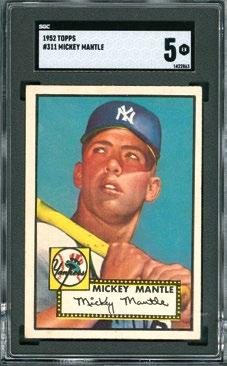
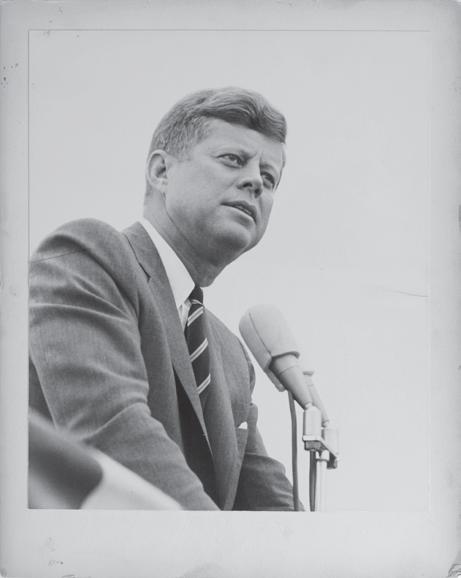
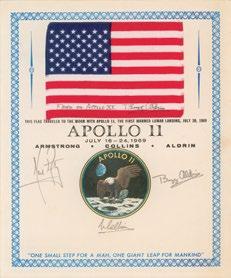
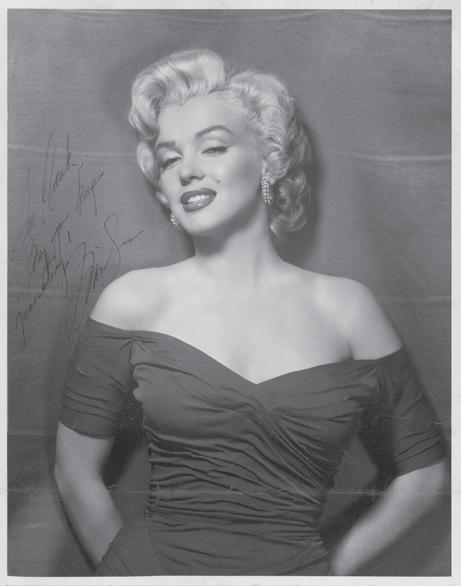
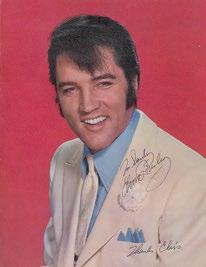
For 50 years, relationships have been the backbone of RR Auction. We have made it a priority to keep our consignors informed and involved, encouraging them to share their voices, to instill their knowledge, and to forge a partnership based on our shared passion for history. With a mutual desire to achieve greatness, these relationships are at the heart of our success.