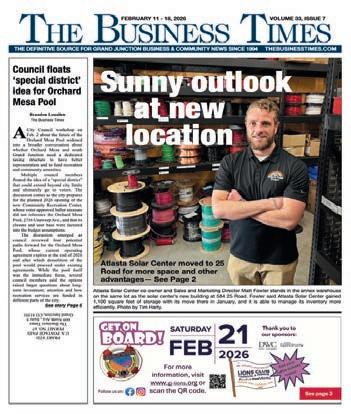
The Housing and Building Association of Western Colorado will host its annual Home Improvement & Remodeling Expo on March 6-8 at the Grand Junction Convention Center, bringing together more than 100 local builders, contractors and suppliers in one of the region’s largest annual showcases for residential construction and remodeling.
The three-day event runs 10 a.m. to 5 p.m. Friday and Saturday and 10 a.m. to 2 p.m. Sunday.
For many contractors, the expo represents the unofficial kickoff to the spring building season. Early conversations often translate into booked projects throughout the season, helping stabilize crews and sustain local employment across the trades.
The expo also serves as a major annual fundraiser for the Housing and Building Association of Western Colorado. Funds raised support the HBA’s year-round initiatives, including local housing-policy advocacy, collaborative efforts such as its housing summit, and the Careers in Construction program in partnership with Mesa County Valley School District 51.
Four returning exhibitors illustrated in interviews with The Business Times how the expo supports local employment and longterm industry sustainability.
See story Page 5
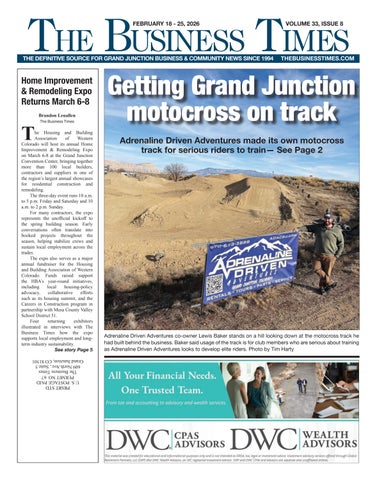
Getting Grand Junction motocross on track
Adrenaline Driven Adventures made its own motocross track for serious riders to train— See Page 2
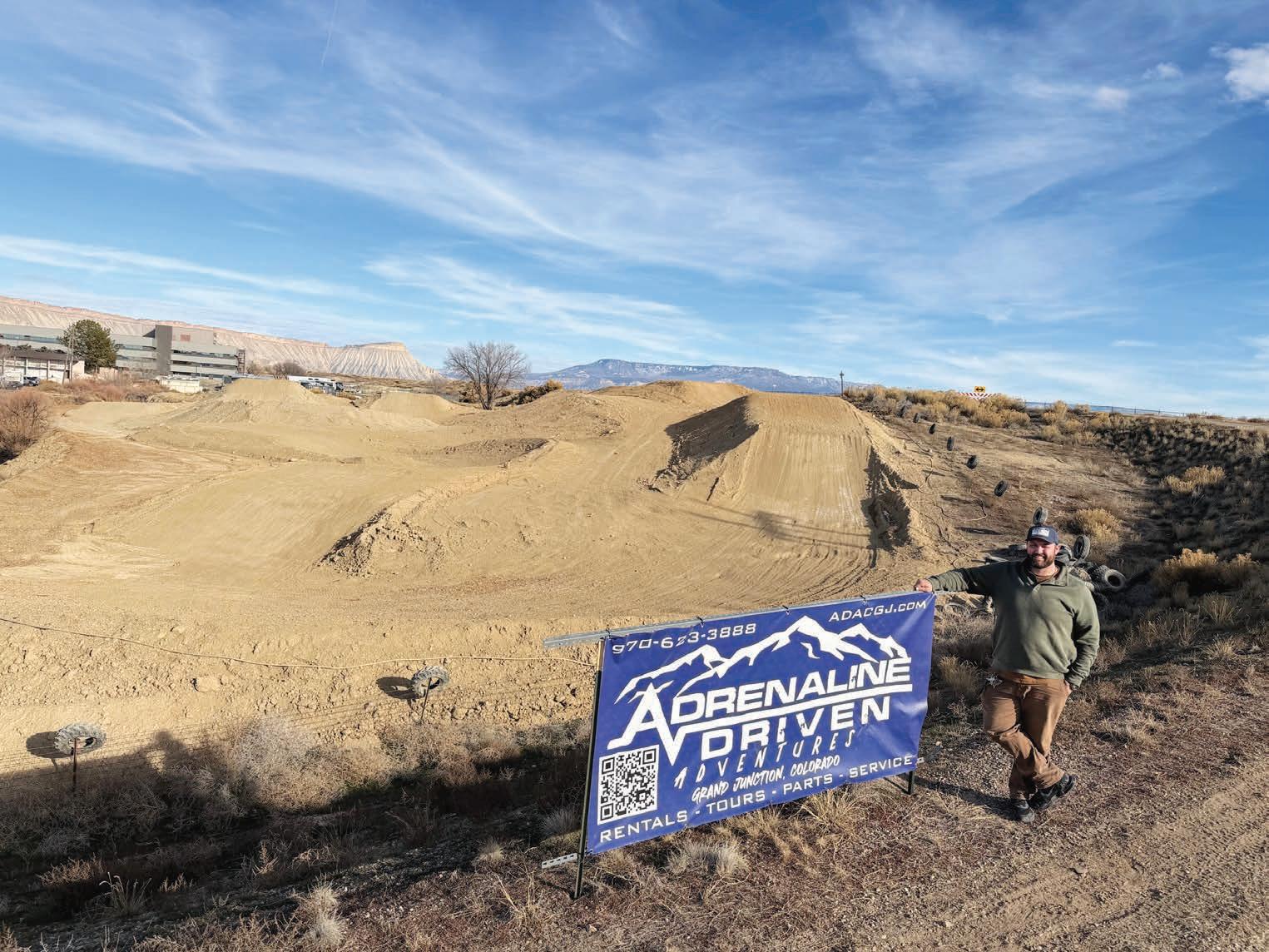
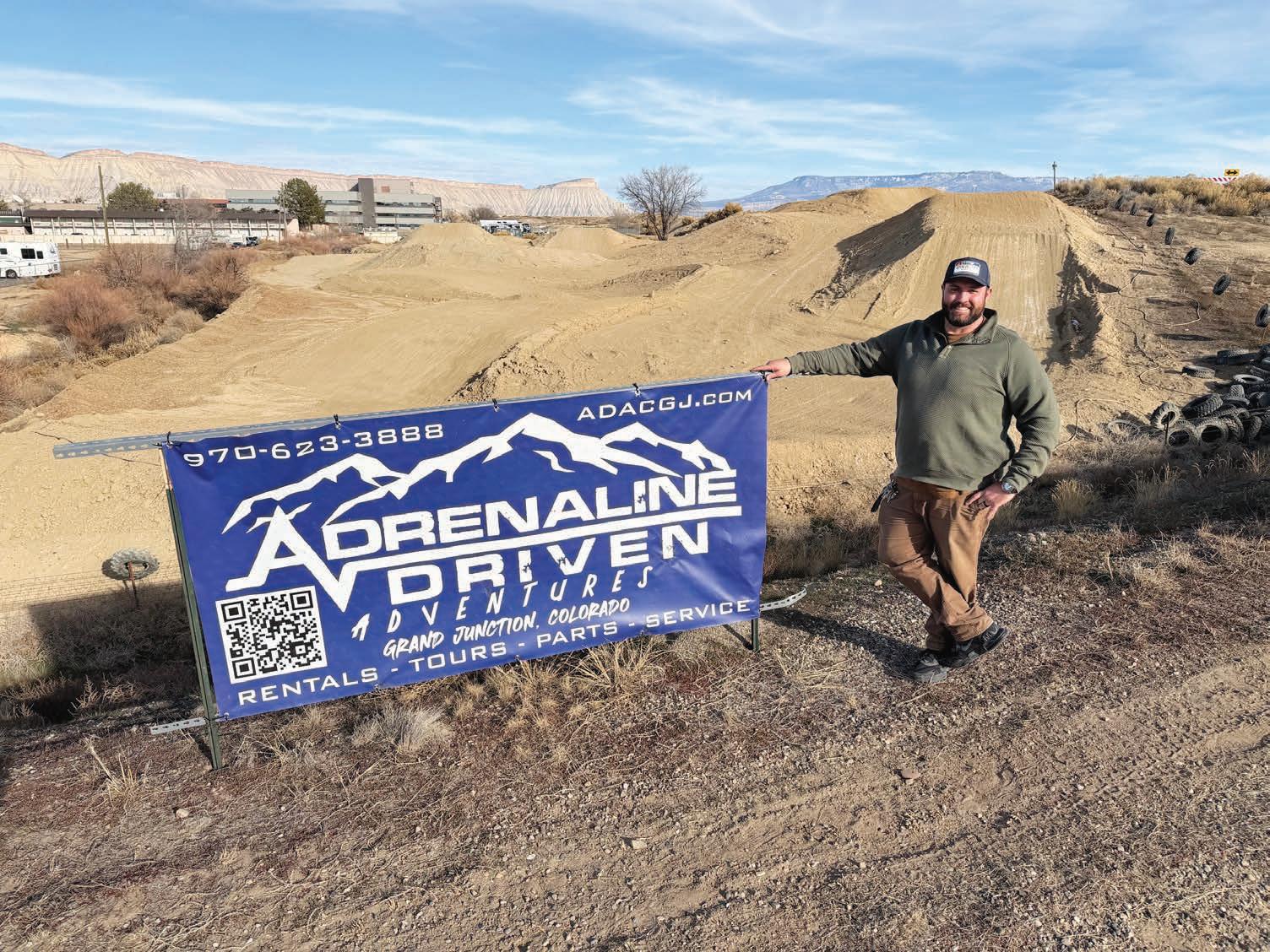
Adrenaline Driven Adventures co-owner Lewis Baker stands on a hill looking down at the motocross track he had built behind the business. Baker said usage of the track is for club members who are serious about training as Adrenaline Driven Adventures looks to develop elite riders. Photo by Tim
Harty
is “one of the best MX track builders in America. He’s the guy that makes all of the supercross and Monster Energy supercross and motocross tracks.”
Flong been the case that they hand to drive a long way to access a legitimate motocross track.
owner Lewis Baker pointed with one had to the east and the other hand to the west and said, “250 miles,” meaning it was either a trip to Denver or Salt Lake City for such amenities.
In short order, he’ll be able to stand outside the Adrenaline Driven Adventures building and throw a rock over a fence and hit a motocross track. That’s because the track he started developing several years ago is about to open. And qualified hometown talent can stay home to train there for the cost of a membership in the Adrenaline Driven MX Club.
“We’ve made Grand Junction’s first training facility right out back of our shop here,” Baker said, “to be able to give elite riders and kids of all ages, riders of all ages, a place to actually have a safe training facility that you can count on the jumps being groomed, you can count on the track being maintained.
“So, you’re not having to go out to the desert and deal with riding in unsafe conditions, having to deal with desert gypsies, having to deal with people that don’t necessarily want the same thing that we do, to be able to become that elite rider.”
As of Feb. 6, Baker said he was
have to sign up for our MX Club and be an MX Club member,” Baker said. “And whether that’s a daily club member or a monthly club member or a yearly club member, you still have to fill out our packet and kind of answer the questions to see what your expectations are, what you’re wanting out of our training facility, right? And that’s where we’re at, is where we want to help people that actually want to advance, rather than just people wanting to go ride. … We want people that are actually trying to improve their skills to be able to become that next great motocross racer. ”
Baker said Adrenaline Driven Adventures already has more than 100 riders signed up.
That’s pretty clear proof of the need he said existed for the track. And the fact it’s about to open is a testament to the community that rallied behind Baker and his project once they saw what he was trying to do.
“I started this thing four or five years ago, and I built a little track out back that was just nothing really big. You know what I mean?” he said.
See TRACK on page 10
MORE ABOUT ADRENALINE DRIVEN ADVENTURES MOTOCROSS TRACK
For more information about Adrenaline Driven Adventures and its motocross track:
• Stop at the store at 750 1/4 Horizon Drive in Grand Junction.
• Go online at www.adacgj.com.
• Call 970-623-3888.
Quality coaches for more than motocross
Adrenaline Driven Adventures’ resident motocross instructors are co-owner Lewis Baker and Shane Willms. Both are USMCA certified dirt bike coaches, and Baker said, “We are the only training facility on the Western Slope with USMCA certified dirt bike coaches.”
Both emphasized Adrenaline Driven Adventures offers more than motocross classes, as Willms said, “I feel like the average moto academy or facility is strictly racing, but (Baker’s) background is a lot of trail riding. So, basically we’re both really good at beginners and kids, but his background’s trail riding, mine’s more racing. And then recently we kind of got into like the hill-climbing type of thing.
“So, with the track, us being dif-
ferent than anybody else is we can go out and take you to the Uncompahgre and work on trail training, or I can run you up the Bookcliffs and do hill-climb stuff. That’s kind of what separates us from the normal organization, because we have 4 different mountain ranges that we can use if someone’s not a set racer or that type of riding.”
Baker added their ability to teach beginners sets them apart, too.
“For beginners where they’ve never used a clutch, they’ve never touched a throttle before, they’ve never shifted a gear before, we can get those kids riding proficiently in three hours,” Baker said. “I guarantee it.”
One more dimension of the business
Adding the motocross track stands to bring more customers to Adrenaline Driven Adventures for all of the other things it offers, as Baker said, “It ties everything together, because we’re a full-service shop, too.
“So whether you need grips or gloves or goggles, helmets, accessories, you need your oil changed, you need stuff worked on on your bike, we can do that as well.”
Adrenaline Driven Adventures co-owner Lewis Baker stands on a hill with a good view of the motocross track he will open soon. The track was designed and built by Brad Schacht, whom Baker said
Photo by Tim Harty
and built supercross
‘There’s nothing like this’
Liking what they saw, brother-sister duo from the Kimbrough Team brought The Agency
to GJ
Tim Harty The Business Times
Dave Kimbrough and his sister, Jan Kimbrough-Miller, got a lot miles – Dave estimates 20 years – from Dave’s claim in advertisements: “I’m not bragging, I’m just applying for a job.”
That was him and the Kimbrough Team of real estate agents actively seeking work.
Now, after a 20-plus-year association with RE/MAX, the Kimbrough Team has bought into a new company: global, boutique real estate brokerage The Agency.
This time, they weren’t seeking work. They were sought.
And The Agency’s sales pitch was as effective as “not bragging, applying for a job” was for the Kimbrough Team.
Hence, Dave and Jan officially opened their franchise, The Agency Grand Junction, on Feb. 10 at 601 Main St., Unit B, in downtown Grand Junction.
“They were the one reaching out to us,” Jan said, “and it was just one of those things: Yep, this feels like our people and our culture.”
Dave said the real estate market in Grand Junction has changed significantly over the past five or six years and continues to change, and The Agency allows them to “bring a different style of real estate to this market and give people a fresh perspective and a fresh option if they’re looking for a customer-forward, client-experience-focused real estate experience.
“And this company provided us the opportunity to do that with a brand that’s globally recognized and has been very successful in the markets that they’ve been in.”
Dave added, “This is gonna be a really great addition to the real estate market in Grand Junction, and there’s nothing like this.”
The Agency, which has grown to more than 150 offices across 14 countries, touts itself on its website as representing “a portfolio of luxury real estate, homes and properties for sale across the world’s prime markets and celebrated destinations.”
Dave and Jan don’t want people to get hung up on the word luxury, at least not in terms of home and property prices. They see luxury differently, especially in Western Colorado, with the word referring to customer service during the sales process and a lifestyle that this area affords people.
See AGENCY on Page 7
and
MORE ABOUT THE AGENCY GRAND JUNCTION
Couldn’t let opportunity go to someone else
Dave Kimbrough says The Agency reached out to him about becoming a franchisee, and it went down like this:
“They call me out of the blue. I spent an hour one day chatting with the guy. And I was like, ‘Holy crap! These might be our people.’ You know what I mean?”
Dave said he told the rep he liked what he was hearing, but his sister, Jan Kimbrough-Miller, has equal say in any decision, and “you either win her over or I’m out. So, he met with Jan like a couple of days later, and she got done, and she’s like, ‘Yeah, this might work.’
“I mean, had he never called, we’d still be at RE/MAX.”
And they would have been fine with that. Dave said he and Jan had been approached by lots of companies over the years, flown to meetings with those companies, “and it just had never been a fit.” They had a good thing going with RE/MAX, so getting them to leave required something that really changed the game.
“RE/MAX, we had a wonderful experience … we would never say anything negative about them,” Jan said. “They have been amazing for all of these years.”
The Agency, though, proved to be the markedly different company that the Kimbroughs couldn’t ignore.
“When we were looking at this business, this business model and this company, we ultimately came down to the fact that it’s like, ‘Oh my gosh, if somebody else did this thing, we would be cheesed,’” Dave said. “I mean, it really is that good. It’s such a cool brand and such a cool company.”
Too much fun to settle for retirement
Dave and Jan are 56 and 63 years old, respectively, and their ages were a consideration in their decision, but ultimately not a deterrent.
“We have one more good one in us; this is it,” Jan said. “That’s another thing: You don’t do something like this lightly at these ages unless you really believe this is worth doing.”
To that, Dave added, “Truth.”
Jan is closer to conventional retirement age than Dave, and she hears about it.
“Agents say to me, ‘I thought you’d be retiring,’ and I was like, ‘Why? Why would I?’” she said. “There’s so much more fun to have.”
Likewise, Dave said, “There’s so much more to accomplish. I mean, there’s always that next hill to climb.”
Room for other independent agents
Dave and Jan had one thing in particular they wanted to make sure got reported about The Kimbrough Team and The Agency Grand Junction. And it’s this:
“We’ve been the Kimbrough Team for so long, one of the myths that we need to dispel is that an agent coming here would need to be on the Kimbrough Team,” Jan said. “I need to make sure that it’s clear that we’re going to be adding independent agents and other teams under the umbrella of the agency.
“That’s just important that we have the ability to communicate that they are not all just one and the same.”
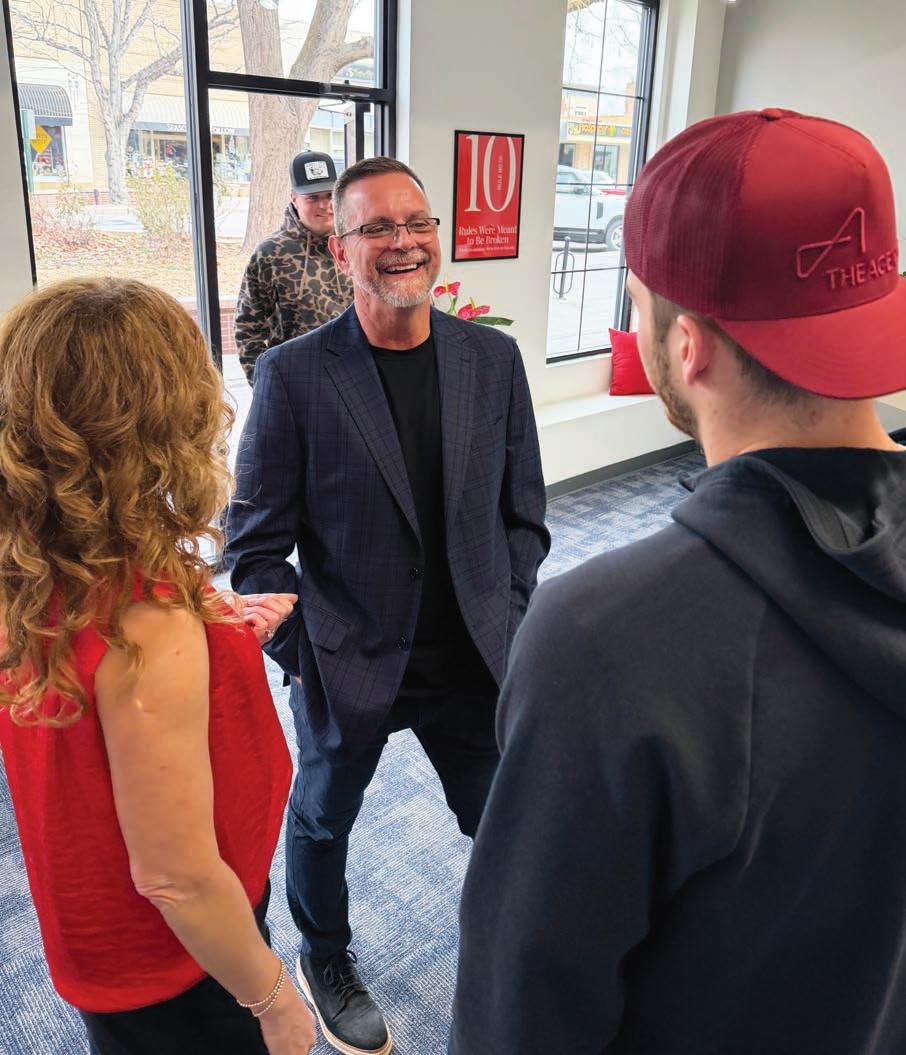
The Agency Grand Junction co-owner Dave Kimbrough, middle, talks with his wife, Nancy Kimbrough, left,
Holden Convertino during a meet-and-great event at the agency Feb. 10, its official first day. Photo by Tim Harty.
This photo
Palisade courtesy
Continued from Page 1
exhibited at the HBA show every year since its inception.
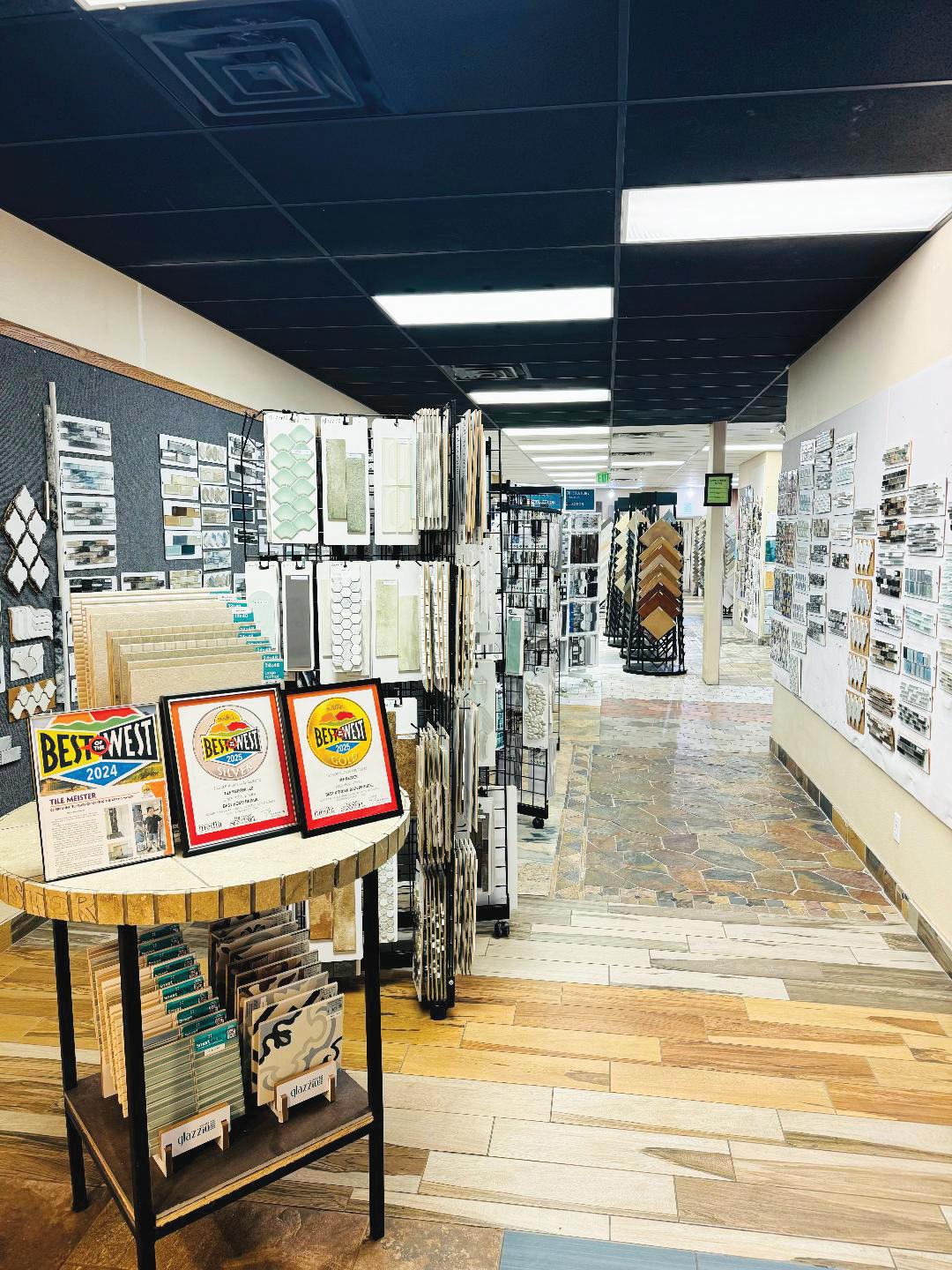
Co-owner Tony DiDonato said, “We started with one booth with some tile samples there,” and over time expanded into full kitchen and bath remodels. Today, the company employs approximately 16 people and focuses primarily on residential remodeling rather than new construction.
For this year’s expo, Tile Meister will occupy four booths and bring full shower displays directly from its showroom, along with dozens of tile samples, cabinetry and countertop selections. The company also manufactures and installs slab shower systems, which use large-format panels instead of traditional grout-heavy tile.
Saenz Roofing:
Residential and light commercial roofing
Saenz Roofing is celebrating its 20th anniversary this year and will also be on the expo floor connecting with homeowners ahead of roofing season. The Grand Junction-based contractor provides roof replacements, repairs and stormrestoration services throughout Mesa County and surrounding areas, employing approximately 15 people.
Blanca Saenz, who helps lead the family-owned operation, said the company has participated in the expo for about eight years and values the face-to-face connection it provides with customers.
“We are a local family-owned and operated roofing company,” she said. “That’s what we do, advertising, connecting face with the name. That connection is really important for us, for our clients in the community to know us.”
Monarch Heating & Air Conditioning:
Residential HVAC
Monarch Heating & Air Conditioning enters the expo with 32 employees across seven installation crews and plans to add approximately six more workers ahead of peak cooling season.
Company President Toby R. Monger said Monarch focuses heavily on the “addon replacement market,” also known as retrofit work. That includes replacing aging furnaces and air conditioners, upgrading systems for higher efficiency and converting homes from evaporative cooling to central air conditioning.
Monger said roughly 40 percent of new builds the company services are now going full electric, with some subdivisions moving entirely away from natural gas. Monarch is also installing more highefficiency heat pumps.
“The heat pumps have been redesigned in such a way that they’re a lot more efficient than they used to be,” he said.
Utility incentives are accelerating that shift.
“Xcel Energy has huge rebates for those,” Monger said, noting rebates can reach into the thousands of dollars and help homeowners afford system upgrades.
Monger said the company encourages homeowners to schedule upgrades before peak demand hits.
Ambassador Blind N’ Shutter:
Window coverings and outdoor living
Ambassador Blind N’ Shutter has operated in Grand Junction for 22 years and has participated in the expo for roughly a decade.
Patty Deters, co-owner of Ambassador Blind N’ Shutter, said she and her husband started the business in 2005 after relocating to Grand Junction, initially working out of their home before opening a commercial showroom in 2021 and expanding it last year.
“We are a family-owned and operated business,” Deters said, noting their son and daughter-in-law have returned to Grand Junction with the intention of eventually taking over the company.
At this year’s expo, Ambassador will feature custom high-quality window coverings, patio shades, drapery displays and new outdoor patio furniture offerings. Drapery is a newer emphasis for the business.
Like many exhibitors, Ambassador Blind N’ Shutter uses the expo to connect directly with homeowners and help build its spring and summer project pipeline.
This photo is from the showroom at Tile Meister, which was founded in 1994 in Palisade and opened a showroom in downtown Grand Junction in 2004. Photo courtesy of Tile Meister.
GVT operating deficit grows Rising shortfall may increase funds requested from local governments
Brandon Leuallen The Business Times
During a joint workshop between the Grand Junction City Council and the Mesa County Board of Commissioners on Feb. 3, regional transportation officials outlined what amounts to a growing structural funding gap for Grand Valley Transit.
The transportation officials said operating expenses are rising faster than revenue, and local governments may need to pull more from their own tax budgets to maintain current service.
Grand Valley Transit has never operated as a self-sustaining enterprise. Like most publictransit systems, the fares it collects cover only a small portion of what it costs to run the operation each day. The remainder has always been made up through federal grants and local tax dollars.
That gap between what riders pay and what the system costs to operate is known as a structural operating deficit, which is built into the funding model. What officials presented to city and county leaders on Feb. 3 shows the structural deficit is growing, as operating costs rise further beyond the amount in fees that are being collected over time. The presentation also showed the federal funding formula is flattening, leaving a continually larger share to be covered by local tax-supported budgets.
“Our cost to run Grand Valley Transit has increased pretty significantly since preCOVID,” Dana Brosig, director of the Regional Transportation Planning Office, said during the joint meeting.
A chart titled “Federal Funding Needs vs. Funds Available (FTA 5307)” shows projected operating needs exceeding federal formula allocations later this decade. By 2030, the shortfall is projected at roughly $750,000 if service levels remain unchanged.
“We never just get given a pot of money. All of it is reimbursable,” Brosig said, referring to federal transit funding structures. When allocations are exhausted, she said, “We would have to cover what we would normally cover with federal funds with local funds.”
How the system is funded
Grand Valley Transit’s 2024 operating budget totaled $5.6 million, according to Table 10-2 of the 2024 GVT Expended Funds by Source.
Of that:
• $3.47 million came from Federal Transit Administration operating funds.
• $1.54 million came from local sources.
• $380,000 came from fares and other revenue.
• $250,000 came from state funds.
Federal operating funds represented approximately 62 percent of total operating support in 2024.
On the capital side, 2024 spending totaled $3.68 million, of which $3.22 million came from federal and state sources and $460,000 came from local funds.
Federal grants have also helped build the system. Mesa County has received more than $11 million in bus replacement and expansion grants over the past six years, and approximately 90 percent of the $8.2 million fleet-maintenance facility was federally funded, according to materials presented at the Feb. 3 meeting.
Capital grants, however, do not cover day-to-day operating costs. Ridership down, cost per ride rises
Fares and other rider revenue brought in $380,000 of the $5.6 million operating budget in 2024, according to Table 10-2. That means riders paid for about 6.8 percent of operating costs.
In 2015, riders were covering about 15 percent of operating costs with an operating budget of slightly more than $3.3 million, according to the 2015 GVT Service Summary slide.
Historically, GVT’s fixed-route service began in 2000. Ridership peaked in the early 2010s at just over 1 million annual boardings, according to the Historical Ridership chart included in the 2015 strategic plan. By 2015, annual fixed-route boardings had dropped to 814,000.
The current projection for 2025 is about 600,000 unlinked passenger trips, according to the Grand Valley Transit System Overview slide, which amounts to roughly 1,640 to 1,700 boardings per day. An unlinked passenger trip counts each time a rider boards a bus, meaning transfers are counted as separate trips rather than unique individuals.
Brosig said the ridership pattern mirrors national trends.
“It did go up, and then it did kind of come down in the teens,” she said. “And then COVID, it really just, the floor fell out. And then since that time, we really built back pretty rapidly, and we’re always around 75, 80 percent of pre-COVID levels.”
Operating costs have moved in the opposite direction.
The operating budget increased from just over $3.3 million in 2015 to $5.6 million in 2024, according to the 2015 summary slide and Table 10-2. That represents roughly a 70 percent increase in operating spending over that period.
At a $5.6 million operating budget and approximately 600,000 projected trips, the system spends roughly $9.33 per ride. The base fare is $1.50, according to the system-overview slide. The remaining amount is covered by a combination of federal, state and local tax dollars.
In 2015, when the operating budget was just over $3.3 million and annual ridership was 814,000, the farebox recovery ratio was approximately 15 percent, according to the 2015 GVT Service Summary slide. The farebox recovery ratio measures how much of a transit system’s day-to-day operating expenses are covered by passenger fares. In 2024, that figure had fallen to 6.8 percent.
Transit provides workforce access, resiliency
While much of the Feb. 3 discussion focused on funding pressures, Brosig also emphasized what she described as the broader value Grand Valley Transit brings to the community.
“About 73 percent of our riders are employees or students,” Brosig said, “so we see this really as like a kind of safety-net system.”
She said housing and transportation tend to be the two largest expenses in a household. When housing costs are high, “people cannot always afford a car,” leaving transit, biking or walking as primary transportation options, she said.
Brosig also described transit as a form of transportation resiliency.
“One way of thinking about transit, it also is kind of an insurance policy,” she said. “Where you have an alternative way of getting around to create kind of resilience in your transportation system.”
During construction of the fleet-maintenance facility, she said about 200 employees worked on the project, with 26 of 36 companies involved being local.
“We do see transit as kind of a local economic driver,” she said.
She also noted the transit contractor employs about 50 local workers and provides commercial driver training that can lead to other jobs in the regional economy.
Local governments covering operating share
The local share of operating costs is funded through an annual Intergovernmental Agreement (IGA) among Mesa County, Grand Junction, Fruita and Palisade.
The 2026 IGA totals $3,076,799 and is distributed as follows:
• Mesa County: $1,999,919.
• Grand Junction: $923,040.
• Fruita: $92,304.
• Palisade: $61,536.
“If we don’t have other funding sources, that’s what the IGA would have to be,” Brosig said, referring to projections showing local contributions rising toward roughly $4 million annually by the end of the decade if no new revenue source is approved.
Toward the end of the transportation presentation, officials discussed: a July 24 deadline to notify intent to participate in the 2026 General Election; an Aug. 25 IGA deadline; and a Sept. 4 deadline to approve a potential transportation-funding ballot question.
Agency
Continued from Page 4
When it comes to “luxury” customer service, Dave said customer service in general is a lost art and in many cases “dead,” but not with The Agency Grand Junction.
“We don’t subscribe to that,” he said. “We never have subscribed to that.”
The Agency Grand Junction’s customers can expect “the experience of everybody being given and receiving a whiteglove treatment. … The idea is that luxury isn’t just about price point. It’s about what can you do for the client? What’s the experience for the client? And every client, regardless of the price point, deserves to have a luxury experience, because that’s what they pay for.”
For the “luxury” lifestyle, Jan mentioned Grand Junction is a regional hub with vast opportunities for outdoors recreation, easy access to world-class ski resorts, proximity to national and state parks, wonderful year-round climate and much more.
“I think that the people who value the lifestyle, they will make trade-offs,” she said. “They will trade the big house or acreage that they could get in Arkansas for the same price as you can get something on a .10-acre lot that’s 1,500 square feet. They will trade that for the lifestyle. And that is who comes here.”
She added of the Grand Valley: “I challenge people all the time. Find me a better place. Find me a better place than right here, and nobody’s come up with a better place.”
That thinking goes to another reason Dave and Jan relish their new real estate endeavor: “We are extremely high on what’s going to happen here,” Dave said.
He added, “We’re extremely bullish on what’s going to happen here over the next five, 10, 15 years. … Grand Junction is no longer a sleepy little town on the Western slope of Colorado. And since COVID – it was changing before that, but COVID really pressed the express button on that – it is now a global lifestyle destination where people know about it.”
The Agency Grand Junction co-owner Jan Kimbrough-Miller, left, chats with Brandon Melgares of Guild Mortgage, middle, and Tyler Hawkins with American AgCredit during a meet-and-great event at the new agency Feb. 10. Photo by Tim Harty.
Grand Junction Jewish Film Festival returns for third year
The Third Annual Grand Junction Jewish Film Festival will take place Feb. 21–22 at Colorado Mesa University’s Meyer Ballroom in the University Center.
This year’s festival features three acclaimed films, live filmmaker discussions, a ticketed VIP opening-night reception, and short films spotlighting emerging voices.
The event is open to the entire community and is designed to foster understanding, reflection and conversation through film.
The festival’s schedule and films are:
Feb. 21, 6 p.m. – VIP Opening Night starts the festival with a ticketed VIP reception, screening and filmmaker discussion featuring “One Big Happy Family,” followed by an in-person Q&A with producer, writer and actor Lisa Brenner. The evening includes hors d’oeuvres, professional photos and an intimate discussion with the filmmaker.
Feb. 22, 1:30 p.m. – The Sunday matinee features “Dead Sea Guardians,” followed by a live Q&A with Oded Rahav, CEO of the Dead Sea Guardians organization, offering insight into the film’s themes of environmental responsibility, resilience and cultural stewardship.
Feb. 22, 5:30 p.m. – The festival concludes with “Elie Wiesel: Soul on Fire,” an award-winning portrait of Nobel Laureate Elie Wiesel. The screening will be accompanied by a special “Night” book raffle, honoring Wiesel’s enduring legacy of moral courage and remembrance.
Short Films Featuring Emerging Filmmakers
In addition to the feature films, the festival will showcase three short films, screened following each main feature, highlighting emerging and diverse storytelling voices: Brown/White; Guygu; and Jerusalem Photographer.
These short films underscore the festival’s commitment to supporting new filmmakers and expanding the range of stories represented on screen.
Community Impact
The Grand Junction Jewish Film Festival is a fundraiser benefiting Mitzvah Masa Jewish Children’s Summer Camp and The Joseph Center. Proceeds from the festival support youth enrichment, community programming and essential services that strengthen the broader community.
“The Grand Junction Jewish Film Festival has become a place where film brings people together, across backgrounds,
generations and experiences,” festival co-founder Dalida Sassoon Bollig said. “It’s about storytelling that opens doors to conversation, reflection, and connection, and we’re proud to continue growing this event for our community.”
Grand Junction Jewish Film Festival co-founder Gayle Gerson said,“From the beginning, our goal was to create a cultural gathering that felt welcoming, meaningful and rooted in shared humanity. Film has a unique ability to open hearts and conversations, and this festival brings that experience to our community in a powerful way.”
Festival co-founder Patti Kurtzman added, “The festival was created to be something we could grow over time, an event that celebrates Jewish stories while inviting the broader community into dialogue, learning and connection. Seeing it reach its third year is incredibly meaningful.”
Community Partners & Support
The 2026 Grand Junction Jewish Film Festival is made possible through the support of community partners, including Colorado Mesa University, Colorado Office of Economic Development and International Trade, Bank of Colorado, Rocky Mountain PBS, RoseCap Financial Advisors, and Grand Valley Books.
Their support helps bring high-quality cultural programming to the Western Slope and strengthens community connection through the arts.
Tickets & Sponsorship
Tickets and VIP passes are available, with limited seating.
Sponsorship opportunities remain available for businesses and individuals seeking to support arts, culture and community engagement on the Western Slope.
For more information, go online to gjjewishfilmfestival.com.
The Business Times
609 North Ave., Suite 5 Grand Junction, CO 81501 (970) 424-5133 www.thebusinesstimes.com
The Business Times is published weekly and distributed throughout Grand Junction, Fruita and Palisade.
Advertising rates and deadlines are available upon request. Opinions expressed in this publication are those of the writers and don’t necessarily reflect the views of the publisher, editor or advertisers.
Letters to the editor at: publisher@thebusinesstimes.com
Submit stories or story ideas to: stories@thebusinesstimes.com
Club 20 Foundation’s energy-impact analysis to reframe electricity decisions
As electricity demand accelerates and planning decisions increasingly lock in infrastructure for decades, the Club 20 Research & Education Foundation announced in a Jan. 29 news release it is launching a new Energy Impact Analysis designed to fundamentally improve how major U.S. electricity system options are compared over the long term.
“This first-of-a-kind Energy Impact Analysis closes that gap by placing major electricity-system options on the same analytical footing and examining how they perform over decades.”
— Matt Solomon, CEO of Club 20
The effort is being conducted in partnership with Purdue University, Purdue’s Applied Research Institute, KeyLogic and the State Utility Forecasting Group at Purdue University.
“Decisions are being made using studies that were never designed to compare options across full lifecycles or consistent time horizons,” said Matt Solomon, chairman and chief executive officer of the Club 20 Foundation. “This first-of-a-kind Energy Impact Analysis closes that gap by placing major electricity-system options on the same analytical footing and examining how they perform over decades.”
Long-term choices around power generation, grid infrastructure and demand management are increasingly being made under conditions of rapid technological change, rising electricity demand and evolving reliability requirements. Inconsistent assumptions across studies can obscure long-term costs, reliability risks and system tradeoffs, particularly as new technologies, large data centers and emerging demand profiles reshape electricity systems, the news release said.
The Energy Impact Analysis will evaluate major electricity
generation, storage and demand-side op tions using a consistent lifecycle-based an alytical framework, enabling comparison across systems that differ in cost structure, operating characteristics and longevity.
The study is designed to inform discus sion among utilities, policymakers, regulators, technology developers, investors and commu nities without advancing the interests of any single technology, policy or market position.
“The Club 20 Foundation is excited to partner with Purdue, PARI, KeyLogics and other experts in the field,” said Wade Haerle, Executive Director of the Club 20 Foundation. “The Club 20 Foundation will be the lead fundraiser for the project, with a goal of raising $2 million to support this independent analysis.”
Many existing studies remain compartmentalized within in dividual technology sectors or institutional silos and are often designed to support specific planning, policy or investment ob jectives. The Energy Impact Analysis responds to a clear need for independent, third-party evaluation using consistent lifecycle boundaries, economic metrics and system-level assumptions.
“This analysis is designed to make long-term tradeoffs visi ble,” Solomon said, “particularly where costs, reliability and life cycle responsibilities are often evaluated separately or over short time horizons.”
The analysis will not recommend specific policies, invest ments or technologies, nor will it advocate for or against any electricity-system option, the news release said. Its purpose is to improve long-term decision-making by exposing tradeoffs that are often hidden when costs, reliability, and lifecycle responsibilities are evaluated separately or over short time horizons.
Matt Solomon
Track
Continued from Page 2
“And over the last couple years, we’ve just had more and more people reach out, saying, ‘Hey, are you guys willing to improve the track? We’d really like to be able to train here,’ and things like that.”
Then came some serious help, as Baker rattled off the names of Grand Junction businesses such as: Riverbend Machinery and Equipment Share, which both donated use of equipment; T3 Services, which provided a water truck; Austin Civil Group, which “did all of the engineering for us for free”; and Snob Productions, which provided free acoustic sound testing.
“Like I said, the entire community’s rallying behind us, ‘cause they see the need of such an amazing track,” Baker said. “It’s been simply an amazing trip, man. Like, never in my life did I think that all of these pieces, these puzzles would fall into place like I’ve had it.”
And the craziest piece that fell into place came from outside the Grand Valley in the form of track designer Brad Schacht.
“He’s one of the best MX track builders in America,” Baker said “He’s the guy that makes all of the Supercross and Monster Energy Supercross and Motocross tracks. He used to do all those guys’ tracks.
“So, that’s who came out and built my track.”
And a friend of Baker’s from South Carolina made it possible when he happened to bring Schacht to Adrenaline Driven Adventures last year.
“He had Brad come out in September or October just as friends and went on a side by side ride with us,” Baker said. “And Brad was like, “Hey, I see the track back there,’ kind of deal, said if I ever needed help, he’d help me.
“So, I reached out to him, and he did it. He truly wants to see this community thrive and be able to have that training facility. He was gracious enough to be able to do it for a really good price for me and be able to come over and help our community be able to have one of the best motocross training facilities in all the country.”
To clarify what that modest track of a few years back has become, Baker said, “It’s an actual track built to scale for motocross and supercross. And it’s not just a motocross track, it’s not just a supercross, it’s a super motocross track. So, we combined both of the styles of riding into one track.
“That’s why our track is a training facility where other tracks are just a motocross track and just a supercross track. Ours is a super motocross track, so you’re gonna have those perfectly set jumps at 65 feet on doubles or triples. You’re gonna have those perfectly, you know, 22-foot gaps. You’re gonna have those perfect set gaps that are perfect for supercross and for motocross. So he built them very specifically for those exact dimensions.”
years, we’ve reach out, willing to like to be that.” as Baker Junction Machinery both donated Services, which Civil Group, engineering for us Productions, which testing. community’s the need said. “It’s man. Like, all of these into place fell into Grand Valley Schacht.
MX track
“He’s the Supercross and Motocross guys’ tracks. built my from South when he Adrenaline September went on a said. “And track back ever needed and he did community training to be able me and be community motocross country.” modest track become, Baker scale for it’s not just supercross, So, we riding into training are just a supercross track. so you’re jumps at 65
You’re gonna 22-foot those perfect supercross them very dimensions.”
Careers in Construction classes growing across D51 as interest triples
Brandon Leuallen
The Business Times
A panel convened by the Housing & Building Association of Western Colorado during its second annual Housing Summit on Feb. 5 highlighted rapid growth in Mesa County Valley School District 51’s Careers in Construction program. Program leaders reported student interest has continued to grow heading into next school year.
“We’re tripling the amount of kids that are wanting to be in this program,” Cheryl Taylor, District 51’s director of career and college readiness, said during the workforce-focused discussion.
Taylor said students are not only continuing from the introductory course into additional certifications, but bringing friends into the program and showing increased enthusiasm for jobsite visits and hands-on learning.
The panel also included Crystal Green, work-based learning coordinator at Palisade High School; George Hess, chairman of Careers in Construction Colorado and founder of Vantage Homes Corp.; and moderator Karrie (Kuklish) Gutzwiller of Fixture Studio.
Speakers emphasized the program’s success is tied to an industry-led model pairing standardized classroom training with direct employer involvement, from real-world site visits and guest speakers to internships.
Students can begin the Careers in Construction pathway as freshmen, completing a year-long pre-apprenticeship and OSHA 10 certification before advancing into trade-specific credentials each semester through graduation.
From one pilot site to districtwide expansion
Green said Palisade was the first Mesa County school to implement the standardized Careers in Construction curriculum after she noticed the Western Slope was missing from the program’s statewide footprint. The school is now in its second year of implementation and planning for Year 3.
Taylor said early engagement at Palisade High School helped drive districtwide adoption. Nearly every District 51 high school has now added the curriculum, with Central High School planning to bring it on next year.
“Not only do we have boys really excited about this pathway, we have girls really excited about this pathway,” Taylor said, calling it a
turning point for the program.
A key feature, panelists said, is consistency. Green said when students tell employers they’ve completed Careers in Construction, contractors can expect a quality baseline of preparation.
Program becomes industry-led pipeline with measurable outcomes
Hess is a co-founder of Careers in Construction Colorado and helped start the program after seeing firsthand how construction-based vocational education changed students’ lives.
He said he and another industry leader were serving on the board of a nonprofit construction vocational program that worked with at-risk high school students. What struck him was not just that the students were learning carpentry skills, but they were succeeding academically in other areas and gaining purpose. That experience led them to pursue implementing Careers in Construction in public high schools.
Hess described the program as a publicprivate partnership built to connect education and employment through career navigators who help place students into internships and jobs.
Statewide, he said, more than 4,600 students participate in Careers in Construction Colorado each day.
Hess shared a story about a graduate who was hired by a local plumbing company and later told program leaders the pathway “saved my life” by giving him direction and purpose. Internships needed, especially carpentry and electrical
Green said District 51 students are actively seeking internships, particularly in carpentry and electrical, and urged employers to consider hosting students. She said classroom visits and jobsite tours can serve as entry points for businesses unsure about bringing high school students onto a jobsite.
Taylor added the district provides insurance coverage for student interns through required paperwork, describing internships as an opportunity for employers to evaluate and train potential future hires.
Gutzwiller also highlighted the district’s “Build for the Future” career day, which connects students with hands-on demonstrations from local trades and will be scheduled for the spring of the following school year.
Don’t lose sight of why public schools exist
OPINION
In recent years, many parents, taxpayers and fellow educators have grown increasingly concerned about the direction of public education. Real concern deepened during COVID and the online learning or lack thereof, when learning loss became undeniable and academic priorities appeared to shift.
Today, the push for ideologies and beliefs is evident all around our country. Reading and math proficiency rates across the country remain well below where they should be, and many students continue to struggle to regain lost ground. These outcomes should give all of us pause. What are the goals of public education? Why do public schools exist?
Public schools exist to provide all students, regardless of backgrounds, with a strong foundation in reading, writing, mathematics, history, science and civics, grounded in facts, not feelings. Education requires critical thinking, looking at multiple perspectives and giving students time and space to come up with their own ideas and beliefs.
Teachers should be giving facts from all angles and allowing kids to put their own points together. Schools are not meant to serve as platforms for political activism, nor are classrooms intended to reflect the personal ideologies of individual educators.
The organized walkouts or protests around the nation, and including School District 51, on January 30 open much discussion around quality educational experiences. While educators have the right to personal beliefs and civic engagement on their own time, be it weekends or evenings, they are also public employees funded by taxpayers and
entrusted with the education of hundreds of students. The outward display of dehumanizing authority is the opposite of what educators want and need in a classroom.
School District 51 policies are explicit regarding this.
Policy GBIA prohibits political activity during the workday or any encroachment on instructional time resulting from such activity.
Policy IMB restricts the use of controversial materials not approved by the district and requires educators to exercise sound professional judgment while encouraging consideration of multiple perspectives.
Policy GCMEF reminds educators that each teacher represents the school system as a whole and that the public often judges the entire profession by the actions of one individual.
Policy GBEB requires staff to uphold high professional, ethical and moral standards and explicitly prohibits the distortion or suppression of subject material to promote personal views.
These policies are not hidden or optional. Teachers review and acknowledge them annually through required training. They exist to protect students, families and the integrity of public education.
Have teachers breeched policies? Maybe, maybe not. What is true, is that regardless of what the students thought or knew, all students in schools suffered a loss of learning as a result. Some classrooms had only 7 students. Staff had to be pulled in order to make sure all were safe. Freedom of speech and standing in solidarity with your beliefs is a right, and to staff I say, “Do it on your own time, NOT school mandated time.”
The language displayed on protest signage and chants reported – such as “F* ICE” – raises serious questions about professionalism and role modeling. Regardless of one’s personal political views, such messaging does not align with the standards expected of educators or with the
responsibility of serving a diverse student population. Thankfully, no students were harmed during the events in our community, though that has not been the case elsewhere in the country. Even so, the larger issue remains: Was this decision made in the best interest of students and their learning?
Educators often speak, and maybe rightfully so, about wanting to be treated as professionals. With that expectation comes the responsibility to act as professionals. Taking instructional time away from hundreds of students to make a political statement for a select few undermines that goal. Every teacher should pause and reflect on why they entered this profession in the first place. Education is about developing capable, informed citizens – students who can read, write, solve complex problems, think critically, overcome challenges and form their own conclusions about the world.
If students leave a classroom knowing all of their teacher’s personal political beliefs, something has gone wrong. Teachers should not be remembered for their ideologies, but for the quality of education they provided.
My own education was rooted in academics. I had no idea the sexual preference or political stance of any of my teachers, and for that I am deeply grateful. Our students today deserve the same commitment to learning, to professionalism, and to putting education first.
In closing, do some research and look up Mao. How did he use students and children? The parallels may surprise you.
Christy Anderson is a K–3 elementary educator with 26 years of experience in Mesa County Valley School District 51. She was formerly an active member of the local teachers’ union, and she now serves as an ambassador for the Professional Association of Colorado Educators (PACE). In addition to being an advocate for students and teachers, she is a parent and a local Realtor for Bray and Co. Real Estate.
Christy Anderson
The two paths of leadership: Which one are you walking?
Over the course of your career, you’ve likely worked for a wide range of business owners and managers. Some made you feel valued, supported and motivated. Others created tension, stress or even dread.
Most people can recall, almost instantly, the individuals they loved working for – and the ones they couldn’t wait to escape. Your team members are no different. They, too, have a strong preference for the kind of person they want to follow.
At the heart of these experiences lies a fundamental truth: There is a profound difference between being a leader and being a boss. The distinction isn’t about job titles or organizational charts. It’s about mindset, behavior and the impact one has on the people around them.
A leader influences, collaborates, guides, inspires, mentors and supports. They help people move in a shared direction.
A boss, on the other hand, exerts control, dominates, intimidates and demands. They rely on fear, pressure and authority to extract effort. One approach builds people up, while the other wears them down.
Leaders see themselves as part of the team. They understand that success is a collective effort, and they willingly shoulder responsibility when things go wrong. They give credit freely, knowing that recognition fuels motivation and loyalty.
Bosses operate from a very different mindset. They see themselves above the team, not within it. When things go well, they take the credit. When things go poorly, they look for someone to blame. In their minds, admitting fault threatens their authority, so they avoid it at all costs.
Another defining difference lies in how leaders and bosses approach teaching and development.
Leaders invest time in training, demonstration and coaching. They know that when people understand why something matters and how to do it well, competence and confidence grow. They see teaching as part of their responsibility.
Bosses prefer to issue instructions from a distance. They tell rather than show. They value control more than growth, and they often withhold knowledge – intentionally or not – because they believe expertise equals power.
Leaders also understand the value of collaboration. They recognize that no one person, including themselves, has all the answers. They actively seek out ideas, perspectives and solutions from their team. This not only strengthens outcomes but also strengthens people.
Bosses, however, operate from the belief they already know everything worth
knowing. They dismiss input, shut down ideas and create an environment where employees feel unheard and unimportant. Over time, this erodes morale and stifles innovation.
Perhaps the most striking contrast between leaders and bosses is the emotional climate they create.
Leaders generate goodwill, enthusiasm and a sense of shared purpose. They understand that they cannot control others, so they focus on helping people develop selfcontrol, better decision-making and personal accountability. They inspire people to give their best because they treat them with dignity and respect.
Bosses rely on fear and intimidation. They believe that pressure produces results and that authority must be asserted, not earned. This approach may create short-term compliance, but it destroys long-term commitment.
Leaders empower. Bosses disempower. Leaders help people become more capable, more confident, and more successful. Bosses diminish people, often without realizing the long-term damage they’re causing. Leaders see their team members as human beings with hopes, dreams and potential. Bosses see people as tools, resources to be used in pursuit of their own goals.
The cultural consequences of these two approaches are enormous. Leadership rooted in communication, mentoring and appreciation builds trust, loyalty and high performance. Boss-style management breeds resentment, turnover, absenteeism and underperformance. One path strengthens the organization; the other slowly erodes it.
Ultimately, the greatest difference between a leader and a boss is this: Leaders empower people to grow into greatness, while bosses disempower people to maintain control. The best leaders believe in human beings. They work tirelessly to help their team members become leaders themselves.
So, it’s worth asking yourself: Which path are you walking? Are you leading, bossing, or somewhere in between?
If you recognize a desire to grow your leadership, taking the step to work with a qualified professional can transform not only your business, but your life.
Marcus Straub owns Life is Great Coaching in Grand Junction. His personalized coaching and consulting services help individuals, business owners, executives and companies build teams, organizations and lives filled with happiness and success. Straub is winner of the International Coach of the Year Award and author of “Is It Fun Being You?” He’s available for free consultations regarding coaching, speaking and trainings. Reach Straub at (970) 208-3150, marcus@ligcoaching.com or through the website located at www.ligcoaching.com.
Mesa County Public Health: A partner in economic stability
At its core, Mesa County Public Health works to protect and promote the health of all residents. Healthy businesses are essential to a healthy community.
Public health plays a critical role in supporting local employers by providing guidance, education and resources. Reflecting on our agency’s achievements in 2025 highlights the essential role public health plays in helping local businesses thrive.
Retail food
Mesa County Public Health works closely with retail food establishments in Mesa County. Through education and ongoing support, the agency helps businesses meet regulatory requirements while protecting customers and employees. Each year, our team hosts an annual webinar to help retail food establishments prepare for the year ahead. In 2025, we regularly offered training for current and future food-service workers. These courses focused on best practices for safe food preparation and preventing foodborne illness.
Agriculture
Mesa County’s burn-permit program is another example of how public health supports business needs
while safeguarding community health. The program is especially important for agricultural operations that rely on open burning to manage vegetation. Our team provides a clear permitting process, monitors conditions and issues no-burn advisories when necessary.
Mesa County Public Health helps businesses operate safely and legally while protecting healthy air quality. In 2025, MCPH issued approximately 2,400 burn permits, supporting essential operations while protecting the health of the community.
Grocery stores
Mesa County Public Health also strengthens the local economy by directing federal dollars into Mesa County grocery stores. Benefits from the Special Supplemental Nutrition Program for Women, Infants, and Children (WIC) program are redeemed at local grocery stores. This provides consistent revenue and strengthens the local food economy.
Our team helps retailers meet requirements, stock healthy foods and run eWIC systems to better serve local families. In 2025, approximately $2.5 million in federal dollars were put back into Mesa County grocery stores through WIC.
Childcare
Access to reliable, affordable child care is a critical factor in workforce participation and productivity.
Mesa County Partnership for Children and Families works to help working parents find quality child care
through a platform called BridgeCare. Using BridgeCare data, Partnership for Children and Families tracks what parents are searching for in specific areas and identifies gaps in available care. These insights help encourage providers to expand or develop services. In 2025, 113 licensed child care providers actively used the database.
Partnership for Children and Families further supports businesses by helping to sustain a reliable workforce in the early childhood industry. It invests in expanding access to quality care through initiatives such as Universal Preschool. Partnership for Children and Families also provides coaching, safety support and workforce scholarships.
In 2025, the team awarded $89,600 in early-childhoodeducation scholarships to adult and high school learners. This helps build the future workforce while supporting today’s employers.
At every level, Mesa County Public Health’s work reflects a commitment to community well-being and economic stability. Public health is not just a safety net, but a strategic partner in business success.
We are proud to serve our community and local businesses, and we look forward to another year of collaboration.
F
Sarah Gray is communication and marketing manager at Mesa County Public Health.
Marcus Straub
Sarah Gray
KKCO appears to be playing coy about Koi, and its professionalism
Even though I run a weekly newspaper, I can’t get my head around how “clarifying” this took a week, or how bad reporting can pretty much destroy a livelihood in the same amount of time.
How else can one explain what happened to (according to the same KKCO who was destroying their business) “popular restaurant Koi Ramen and Sushi” last week after it received a few health code “violations” that thousands of restaurants have received since “health inspections” became out-of-control posses riding roughshod over the folks we love to go see, because we hate to cook?
The fact is: It was KKCO (and some laziness from the local twice a week “daily”) who did Koi dirty. Because Koi’s violations can at least be fixed. And while each of these news outlets have their hard-earned reputations, where does Koi go to get its reputation back?
Let me be clear on my take on local restaurants and “health inspections.” No. 1: Restaurants aren’t in business to poison their customers. No. 2: If you can or should do it in your home when it comes to food, the same should be applied in a restaurant. And before you scream, “What about washing your hands after you go to the bathroom, Craig!?” kindly reread the last line.
So yes, we should all wash our hands after using the facilities before handling food. But let’s also be honest about this: We all don’t keep boxes of “single-use, plastic gloves” lying about, so we can change them every time we go from chopping lettuce to handling tomatoes every time we make a salad. I’d go into how much plastic we could save on that alone, but that would take also going into the rabbit hole of banning your favorite bags at the grocery store when everything else is wrapped in plastic, and I don’t have the time, space or energy to cover both idiocies from government.
So, even though it will be ignored, I am stating for the record that health procedures should be part of a restaurant’s main functions. I’ll also state the ones Koi had levied upon it are impossible to uphold 100 percent of the time, and every restaurant on any given day could be busted on them. I just don’t think they are reason enough to shutter someone’s livelihood, even for a day.
Which is why at The Business Times we don’t have a “popular” blotter about health inspections of local restaurants. Frankly, I can’t think of a reason to even cover them, even if I thought they were integral to the health of the public. Hint: They aren’t.
All one needs to do is review the idiocy a few years back of taping off every other seat, social distancing and “wearing your mask until you sit down because COVID only spreads from five feet and above” to wonder why health departments have so many insane rules. And who did those dictates come from? That’s right, the “daily” and our health department.
So back to the weekly “Restaurant Inspection Blotter for Feb 5, 2026,” at the“daily.” Interesting, they don’t even put it into print on a day they actually print, so that says something about its importance, or not. Anyways, in that report there are not one, but two, inspection reports about Koi. The first one from the inspection on Feb. 3 was the lead report, and there was a decent size list, again mostly to do with the gloves and employee actions, and that’s the report the news hawks at KKCO based its reporting on. And yes, there were enough violations to have the restaurant closed (my guess is to have a staff meeting to discuss some hygiene issues). But if KKCO’s Internet-posting team had bothered to scroll to the bottom, it would have also read that the Koi was open and passed inspection on Feb. 4 with only one minor violation.
Which begs one question: How did KKCO come up with the headline over a picture of the restaurant stating: The popular restaurant Koi Ramen & Sushi in Grand Junction has been forced to “close its doors” after a failed health inspection? I put “close its doors” in quotations for a reason, and you know what it is: It means to any rational thinker Koi went out of business. Answer: It gets clicks. Then again, so did today’s Facebook post about a pickleball melee in Florida. Rational thinkers also know why the Koi post is worse.
You see, the day KKCO first reported the story was Feb. 6, a full two days AFTER Koi had addressed all of the health department’s concerns to satisfaction and reopened after a couple of hours of “shutdown.” But here’s the coy part about Koi. KKCO also shows the original report had been updated on Feb. 10 with a note stating Koi had to “address all identified violations and pass a follow-up inspection before it can legally resume service…” when it ALREADY had. And the worst part, those stories are still up as I type this column on Feb. 13.
“Now just a minute, Craig,” you say, “KKCO posted a “clarification” on the night of Feb. 12, explaining everything.” And you’d be right; that’s what it posted. But in that post, it got the date of its original story WRONG, saying it was originally posted on the 5th when it was the 6th of February, according to my screenshot. Was that to make the mistake sound more natural by being closer to the date of the second inspection? Not sure how such sloppy reporting can be excused
when KKCO didn’t even bother to contact the Health Department until at least after the 10th (the date of its update to the original report), otherwise the clarification would have been made much earlier, and the stories would have been pulled, no?
As of my typing, the stories are still up on KKCO. Now back to the “daily.” Why wasn’t it reported that Koi had already reopened. After all, they had to know Koi was open, because they also posted in the last “blot” how Koi passed inspection with only one minor violation on Feb. 4. Why didn’t they report all concerns from Feb. 3 were addressed and Koi was reopened? Then again, why doesn’t the “daily” include in the reports the “level” (I forgot the word it uses and have used up my access for the month) of concern the “violations” pose to the public as it pronounces in the header to the “report?” Maybe they could both start with using another word besides violations – or at least use the words minor or major in front of it?
Then again, maybe, just maybe, the folks at KKCO could have called Koi and the health department to get the facts of what was going on? Heck, KKCO could have called the “daily,” and even though they wouldn’t have gotten all the story (let’s not forget why it publishes “the list”), they certainly could have ascertained the story wasn’t close to what they eventually posted.
To think, basic reporting skills learned in high school journalism could have prevented two local “news” sources from potentially destroying a “popular” local business. I know from my source they have already ruined Koi’s Valentine’s Day business.
If we ever do something so careless, I hope the other local news outlets would have someone on staff write something up to call us out – for our own good. At least it would make us print a retraction or “clarification” immediately, and we’d for sure take the story down. For the record, being coy isn’t a clarification, it’s a CYA. It’s also why much of mainstream media isn’t trusted.
So, if those outlets ever must clarify what we print, please don’t be coy about it.
That said, I’m gonna be Koi about things this weekend and get me some great, local hospitality and food from one of Grand Junction’s popular restaurants. It makes one wonder why local news affiliates worked so hard to publish so much bad about places obviously doing things so good. Otherwise, how would they be so “popular?”
In Truth and freedom.
F
Craig Hall is owner and publisher of The Business Times. Reach him at 424-5133 or publisher@thebusinesstimes.com
Craig Hall
n Clifton Community Center featured in architecture magazine
The Clifton Community Center at 3270 D 1/2 Road is featured on the cover of the December 2025 issue of Metal Architecture, a national publication that highlights notable building design projects from across the country.
The magazine includes a short architectural write-up recognizing the center’s exterior design and use of metal materials, which were selected for durability, functionality and longterm performance. The feature places a Mesa County public facility alongside projects from larger metropolitan areas nationwide.
The Clifton Community Center was designed as a flexible, welcoming space for community gatherings, programs and events, according to a Mesa County news release. Its design reflects Mesa County’s focus on building public facilities that are practical, resilient and built to serve residents well into the future.
While the recognition comes from an industry publication, the news release said, “The real value of the project is local: a community facility designed to meet Clifton’s needs and built with an eye toward longevity and responsible use of public resources.”
The digital December 2025 issue of Metal Architecture, including the project writeup (page 38), is available online at www.metalarchitecture.com/publications/de/202512.
n Schedule shifts for Grand Valley Connects at libraries
Resource navigators with Grand Valley Connects are adjusting their in-person availability at Mesa County Libraries to meet community needs, according to a Feb. 11 news release from the county.
While many community members connect by phone or through the website, walk-in services at centralized locations are valuable to those without reliable technology or transportation.
“We understand how overwhelming resource navigation can be. We want to meet community members where they are and empower them to pursue a healthy and stable future,” said Fallon Knez, Grand Valley Connects supervisor.
Services are available on a first-come, first-served basis at the following locations and times each:
Central Library, 443 N. Sixth St., first and third Tuesdays each month, 12–2 p.m.
Clifton Library, 3270 D 1/2 Road, second and fourth Tuesdays each month, 12–2 p.m. Health and Human Services Building, 510 29 1/2 Road, Monday–Thursday, 7:30 a.m.–5 p.m. Friday, 7:30 a.m.–noon.
Community members can contact Grand Valley Connects by calling 970-683-2663 or visiting grandvalleyconnects.com. A simple referral form is available online to begin the process.
When a community member sits down with a resource navigator, they will have a conversation regarding what needs they have. This includes a 10-15 minute intake to get the whole picture of what needs and resources might be available to the community member. Then, they make a plan regarding next steps to connect to the appropriate resources. The resource navigator follows up at 30, 60 and 90 days.
n Authors in Grocery Stores program comes to Grand Valley
A national program that promotes the work of local authors arrived this week in Grand Junction. The featured author this month is Western Slope novelist and cartoonist
Don Benjamin, who is selling and signing his fantasy novel and three cartoon collections Feb. 17-18 at the 24 Road City Market from 1-6 p.m. each day.
Benjamin’s fantasy novel, Stone Bride, features a resourceful Wolfkind princess, a brave sea captain, an old world witch, majestic horses and a talking dog. His cartoon books offer humorous commentaries on downhill skiing and people who live alone as well as an adult coloring book for coffee lovers.
Every month, the National Authors in Grocery Stores Program will suport the work of local writers by placing authors in hundreds of neighborhood grocery stores. The program began in Texas and has expanded to include 19 more states, including Colorado and Wyoming.
The program offers a platform for readers to connect with authors in a casual shopping environment. In addition to the opportunity to display their books in local stores, authors are able to have their books printed by an independent print shop, and participating writers compete for an annual storytelling award.
Interested authors can learn more at the program’s website: authorsingrocerystores.com.
n McIntosh recognized for career achievements
Don McIntosh, chief technology officer at Grand Junction-based Sky Peak Technologies, was inducted into the Academy of Electrical and Computer Engineers (AECE) at Missouri University of Science and Technology, formerly the University of Missouri-Rolla, during the academy’s annual meeting.
The AECE honor represents one of the highest forms of recognition from Missouri S&T, honoring alumni whose careers exemplify professional excellence, innovation and leadership in engineering disciplines.
McIntosh also was recently elevated to Senior Life Member status in the Institute of Electrical and Electronics Engineers (IEEE), a distinction reserved for engineers whose careers reflect decades of sustained contributions to the profession, technical leadership and service within the global engineering community.
“These honors recognize not only Don’s technical depth, but the influence of his work across generations of communications technology,” said Cat Coughran McIntosh, CEO at Sky Peak Technologies.
Sky Peak Technologies develops novel, intelligent technologies that enable organizations to operate more sustainably, more profitably and in greater service of humanity. Don McIntosh leads the technical vision behind CORA AI, Sky Peak Technologies’ real-time video-optimization and network-efficiency platform.
Business Bites: CMU subtracts building, adds parking
Colorado Mesa University recently demolished the building that formerly housed Roper Music at 912 North Ave., and the lot will become 23 parking spaces. When the building was there, it had 11 parking spaces.
CMU Community Relations and Communications Manager Haley Hahn said the lot now “is a designated Resident Hall Reserved lot to support CMU’s growing on-campus housing population.”
Roper Music moved to 1224 N. 25th St. in April 2021.
collections princess, a His cartoon alone as the work stores. The Colorado shopping stores, authors participating writers authorsingrocerystores.com.
Sky Peak Engineers University of Missouri innovation and Institute of engineers whose leadership influence of his McIntosh, that enable greater service Sky Peak parking formerly housed When the said the lot on-campus