Last March, Tender Gifts Birth & Wellness Center thought it was going to reside in the building that previously housed Bloomin’ Babies, anticipating a May 2025 move-in.
That didn’t happen, but it worked out for the best. Later this month, Tender Gifts will finish moving into a much larger, better-appointed building.
Intermountain Health Bloomin’ Babies Birth Center had resided at 2241 N. Seventh St. until Intermountain Health decided to close the birth center, effective March 28, 2025, citing “steadily declining birth rates in Mesa County and unsustainable decreases in the number of new patients.”
A birth center moving into the space used by another birth center made a lot of sense to Tender Gifts owner Althea Hrdlichka, who also owns and operates a Tender Gifts in Fort Collins.
But when Hrdlichka found out renovations – installing birthing tubs and birth slings in the client rooms among them – were going to cost considerably more than she anticipated, the location lost its luster.
“We decided to just go ahead and find a new location and build out from basically scratch, so that’s what we did,” Hrdlichka said.
See story Page 5
Doing mental healthcare differently
Ava Health opens Feb. 9 with transparency at the heart of its business model— See Page 2
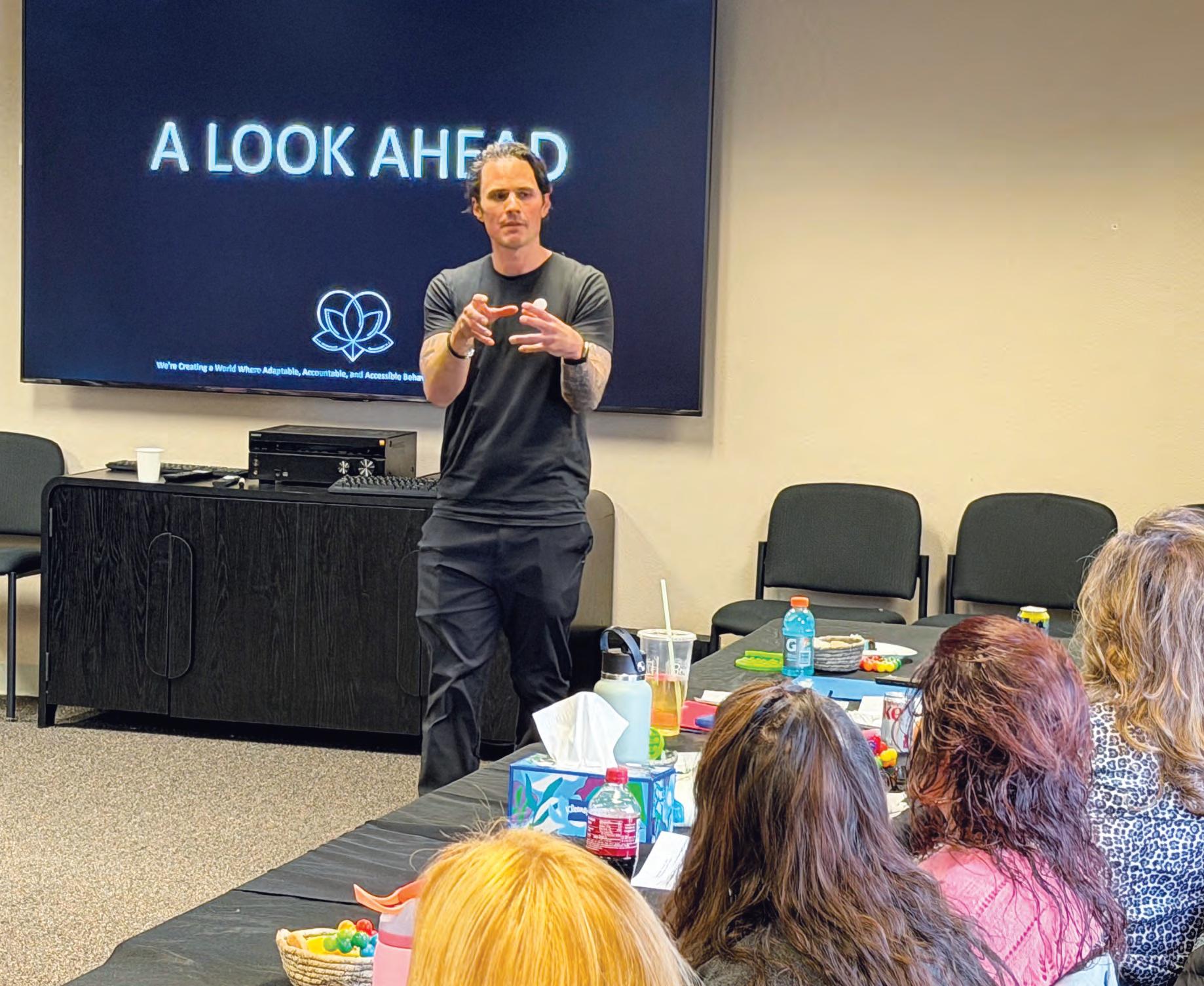
Ava Health CEO Christopher Bennett addresses a group of nearly two-dozen new employees on Jan. 28, which was the third day of a two-week orientation for the new hires, getting them ready for Ava Health to open Feb. 9. One of the things Bennett told the group was: “We will be the most accountable organization that exists in healthcare.” He also said, “You are hired here to be trusted, not micromanaged.”
by Tim Harty.
Photo
‘There
was no blueprint for it’
Transparency equals all-important trust in Ava Health’s business model
Tim Harty The Business Times
Christopher Bennett uses the word transparent frequently when discussing Ava Health, an addiction and mental health treatment center that will open Feb. 9 at 2784 Crossroads Blvd. in Grand Junction.
Because of all of the things that will be different about Ava Health, transparency is screaming, “Look at me!”
It is a cornerstone of the trust Ava Health wants to build in an industry where Bennett, Ava’s chief executive officer, said, “Trust is broken.”
And he wrote in his Jan. 29 newsletter, a weekly exercise in transparency: “You do not rebuild trust with polish. You rebuild it with visibility and accountability and a willingness to be seen when it is uncomfortable.”
Put another way, Bennett says: “Transparency equals trust.”
So, what others hide, Ava Health will display in broad daylight on Colorado’s Western Slope.
And in a business that provides behavioral health care, this is not normal behavior.
“Nobody will share financials. Nobody will share outcomes. Nobody will show what the return on their investment was,” Bennett said, adding stakeholders and investors are good at saying they invested in the business and the community, and the discourse stops there.
client’s experience, somebody that’s actually struggling with mental health or substances, they’re being sold something until they walk in the door. And then it is a very incongruent: ‘Hey, this is what we were told, this is what we were sold, and now we’re here, and it is drastically different.’
“So then you have communities coming together and going, ‘What’s going on here?’”
Health. It won’t just be words, either. Where Ava Health can show, not just tell, it will. (Editor’s note: Ava Health does not share patient’s private information).
“For us,” he said, “transparency has been something for the last two years that we’ve talked about, which was: What if we were a healthcare company that actually just shared everything? And not only externally, but internally. Meaning that we share our financials openly with every
“There’s no feedback loop, so it’s like money goes in, and it’s a black hole,” Bennett said. “Then if you look at families who have loved ones that are struggling with mental health or substance use, they’re sending their loved ones somewhere and saying, ‘How’s it going? How’s the care proceeding? What’s going on? What are the next steps?’ And they’re not getting the feedback. Like, the true receiver of services is our client, right? Yet the families are not being communicated with.”
Bennett said most of what people historically get to see is manipulative marketing practices, a “big, shiny object of ‘this is what we do,’ and yet the service is not congruent with that. And then if you look at a
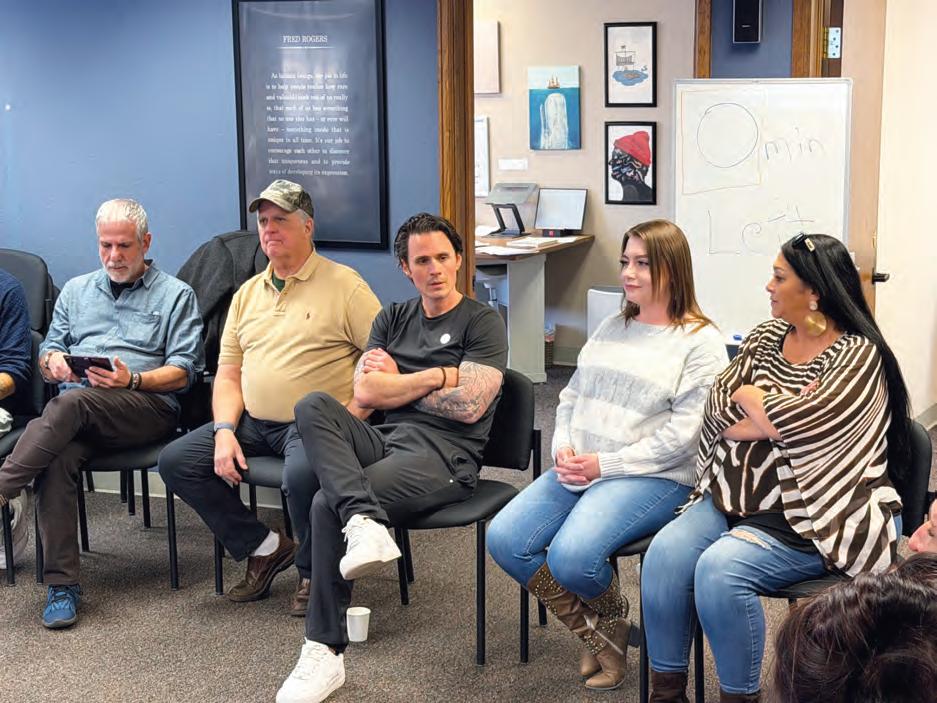
the group is a poster quoting some of the wisdom of Fred Rogers. It reads: “As human beings, our job in life is to help people realize how rare and valuable each one of us really is, that each of us has something that no one else has — or ever will have — something inside that is unique to all time. It’s our job to encourage each other to discover that uniqueness and to provide ways of developing its expression.”
Photos by Tim Harty.
“So, our CFO, David (Purinton), on Monday (Jan. 26), was with 23 new employees, pulling up budgets and financials for our entire company. And the feedback that came out of that was employees saying, ‘What is this? You’re willing to share, like, your financials with us?’ And we’re like, ‘Well, yes. This is fundamentally what we believe in.’
“How can we achieve what we want to if leadership is up in some silo, not being transparent, not communicating about what’s going on, how we’re actually doing, and just kind of bestowing, ‘Here’s what we’re going to do’ without a lot of the explanation?”
Bennett gives the example of billionaire Mark Cuban, who is a critic of the United States health care system and its high costs and lack of transparency.
“He’s been asking hospitals about why they’re not treating the Medicaid and Medicare populations,” Bennett said. “And they’re saying because it’s not profitable, and we can’t maintain a sustainable healthcare ecosystem by serving the masses. And so he says, ‘Great. Show me.’
“Nobody at this point has been willing to open the books. So, he’s a billionaire with leverage, with relationships, with capital, saying, ‘Hey, I think we can actually do this in a profitable way. … I know how to run a business. It’s not making sense to me. And there’s no transparency.’”
Bennett said transparency could be a multi-hour conversation, but he knows that’s not conducive to a newspaper article, so when it comes to Ava Health he boiled it down to this:
See AVA HEALTH on Page 4
Ava Health’s three founders — left to right, Ian Gershman, Christopher Bennett and David Purinton — sit behind microphones at a table in Ava Health’s recording studio. The in-house audio and video, such as podcasts and YouTube videos, are produced to inform the public and market Ava Health. Bennett, the addiction and mental health treatment center’s CEO, said it is another way for Ava Health to be transparent in an industry that is not known for transparency. Purinton, Ava’s chief financial officer, said the company’s goal is for marketing’s percentage of revenue spent to be “zero or near zero.”
Continued from Page 2
Photo by Tim Harty.
“I think for us, it was, ‘How can we build trust? How can we build trust with communities?’” he said. “Ultimately, we were outsiders to Grand Junction two years ago. So, how do we build trust with this community? How do we build trust with the stakeholders? How do we build trust with funding and payers? How do we build trust with people that are struggling, their families and our employees?
“And ultimately, a lot of healthcare systems we all come from have bred a lot of distrust, including myself, because we’ve worked in environments that made decisions that didn’t make any sense, and there was no explanation and all of that.
“So, that’s probably as short of an answer I can give, but it was really ultimately trust. Transparency equals trust to us.”
While the Ava Health leadership team has been inspired to be transparent, the inspiration comes from within. It was not on display anywhere else for Ava Health’s founders – Bennett, Purinton and Chief Operating Offer Ian Gershman – to see and emulate.
“I haven’t seen another company do it,” Bennett said. “I think the extent of what we’ve seen are there are more behavioral health companies starting to now share outcomes data. So, actually how effective is the programming that you’re providing, right? … You see some companies coming forth and saying, ‘Hey, you don’t have to believe our marketing as much; believe our outcomes.’ Fantastic.
“But the idea of basically complete transparency, I’ve never seen it done. Not in healthcare anywhere, in even our small subset of healthcare. There was no blueprint for it. What Ian and David and I kind of came together and thought was, again, the fundamental idea was trust.”
For more information about Ava Health, go online to helloavahealth.com or call 970-239-8740.
Follow Ava Health on social media such as Facebook, Instagram, YouTube and LinkedIn.
Grand opening is Feb. 20
Ava Health will open for business on Feb. 9 at its Crossroads Campus, 2784 Crossroads Blvd. in Grand Junction, and it will host a grand-opening celebration there on Feb. 20, 4 p.m. to 5:30 p.m.
Ava Health Chief Executive Officer Christopher Bennett wrote in his weekly newsletter, dated Jan. 29, “We announced our Grand Opening Celebration last week, and in just six days 73 community members have already RSVP’d. On February 20th, we’ll open our doors, share why Ava Health exists, and invite you into the work ahead.
“Please share this with anyone who feels called to be part of it and RSVP.”
The waitlist is growing
In the same newsletter, Bennett said, “Just three weeks after announcing Ava Health’s opening, 13 individuals are already on our waitlist, with another 14 scheduled for pre-
WHAT CARE ACTUALLY COSTS AT AVA HEALTH
When the leadership team at Ava Health said they will be transparent, even with the company’s financials, they meant it. Chief Executive Officer Christopher Bennett writes a weekly email newsletter, and a recent one included the following:
What Care Actually Costs at Ava Health
Behavioral health programs can tell families what they charge. Very few will clearly explain what that pays for. So we’re doing it.
Below is a snapshot of Ava Health’s cash-pay cost of care, based on pre-launch financial modeling. These numbers reflect how resources are actually allocated across our core levels of care that are launching February 9th.
Why we’re sharing this: Transparency isn’t a campaign for us. It’s how we’re choosing to operate. If you want the full cost-of-care breakdown, our private-pay rates, or have questions, just reply and ask.
MORE ABOUT AVA HEALTH
assessments. The need is real, and capacity is filling quickly. We’re honored by the trust and ready for the work ahead.”
Where else will Ava Health operate?
In addition to the Crossroads Campus, which Ava Health purchased, it bought a “residential and stabilization facility” near Molina, offering a calm, nature-based setting on 40 acres. Bennett said the latter is called The Homestead.
Ava Health also is leasing two homes in Grand Junction with public-transit access to outpatient services, and 14 apartments near 12th Street and Bookcliff Avenue.
Who owns Ava Health?
Ava Health was founded by three partners: Bennett; Ian Gershman, chief operating officer; and David Purinton, chief financial officer.
Bennett said they combine to bring more than 60 years of experience in behavioral healthcare, operations and finance. He detailed their experience as follows:
• Bennett has spent more than 17 years in behavioral healthcare, starting on the front lines as a case manager and later founding and scaling multiple treatment and consulting organizations. He previously founded Encore
Recovery, which was acquired by the Caron Foundation, and has advised healthcare organizations nationwide on growth, culture and marketing. His work has focused on building organizations that deliver high-quality care while staying accountable to the communities they serve.
• Gershman brings more than 30 years of experience across nearly every behavioral health setting, from detox and residential treatment to outpatient care and harm-reduction programs. He has worked nationally and internationally, including nearly a decade in the United Kingdom. Ian specializes in building systems that support staff and remove barriers for patients, with a strong belief that people can thrive when given the right tools and support.
• Purinton is a seasoned healthcare finance executive with deep experience in investment banking, private equity and behavioral health operations. He has helped organizations grow sustainably through disciplined financial planning, fundraising and strategic partnerships. At Ava Health, he ensures the organization is built to last, meaning financially strong, operationally efficient and accountable. See AVA on Page 6
Tender Gifts’ plans
Continued from Page 1
That ended up being at 360 W. Park Drive, Suite 105, on the west end of a building neighboring McAlister’s Deli.
Hrdlichka went with Vanderbuilt Solutions for the buildout as its owner, Lindsay VanderVelde, is the son of Karin VanderVelde, who is the clinical director for Grand Junction’s Tender Gifts Birth & Wellness Center.
While the renovation was being done, Tender Gifts occupied an office at 529 25 1/2 Road, Suite B-108, in Independence Plaza, and did home births.
“I think we’ve had 14 babies so far, and they’ve all been home births,” Hrdlichka said.
“We have a lot of clients already.”
Just as the reason for Bloomin’ Babies closure didn’t faze Hrdlichka last year, it doesn’t faze her now.
“A couple months back, we did a soft opening when we walked everyone through the space when the walls were up, and it was an overwhelming amount of people,” she said. “I think we ended up with 350 people that came through, and so I know this is such a need for this community.
“And we are Medicaid providers as well, and so that’s a huge demographic of people that we will be able to serve, which is amazing.
One of the very few birth centers, including my birth center in Fort Collins, that actually take Medicaid and does not cap Medicaid clients, which is almost unheard of anymore.
“The community, it’s just been awesome, so we’re super, super excited.”
Most of the moving into the new location will take place Feb. 12-17, and sometime soon after that, Hrdlichka said, Tender Gifts will have an open house. Anyone who attended the soft-opening walkthrough won’t have to imagine what the finished rooms will look like this time.
Because the West Park Drive location is twice as large as the one Tender Gifts walked away from, it will offer more amenities. For instance, there are three rooms with birthing tubs instead of just two. There’s an ultrasound room. There will be rooms for other businesses to lease office space, such as the one Montag Physical Therapy already has claimed.
And there’s one in particular that Hrdlichka wants to bring on board.
“We’ll be looking for a family nurse practitioner,” she said, “so we’ll do primary care eventually.”
There’s also a classroom that she said Tender Gifts will use to host events or open it to the public to rent for events.
Tender Gifts Birth & Wellness Center staff members fill one of the three birthing tubs in the birth center’s new location at 360 W. Park Drive, Suite 105. They are, from left to right, front row: Caitlyn Louis, owner Althea Hrdlichka and Karin VanderVelde. Back row: Amanda Hancock, Mary Anne Kaiser, Angela Bunnell and Anna Gilmore. Photo by Tim Harty.
Continued from Page 4
Full continuum of care
Bennett said Ava Health offers a “full continuum of care,” which means “individuals can receive the right level of treatment at the right time, without being bounced between disconnected providers.”
He then listed the following services:
• Medical detox.
• Mental health stabilization.
• Residential treatment.
• High Intensity Outpatient (aka PHP).
• Intensive Outpatient (IOP).
• Outpatient services.
• ASAM Level 3.1 Transitional Living.
All services are for adults (18 years old and older) with mental-health needs, substance-use challenges or both.
“The goal is simple: No wrong door,” Bennett said. “Someone can enter care at any level and continue their recovery within one coordinated system. This continuity reduces relapse, improves outcomes and creates a more humane experience for patients and families.”
Who can access Ava Health’s services?
Addressing a group of nearly two-dozen new employees as part of their orientation on Jan. 28, Ava Health CEO Christopher Bennett emphasized the ways in which Ava Health will be different than other addiction and mental health treatment centers. He told them the mental healthcare field “has become program-driven. We will not be that here.” Photo by Tim Harty.
Bennett said Ava Health is designed to serve people with Medicaid, commercial insurance (inand out-of-network) and private pay.
“The mission,” he said, “is to provide a level of care and experience typically reserved for the wealthiest patients, but make it accessible to everyone, regardless of income or background.”
Why Grand Junction?
The need for comprehensive behavioral healthcare on Colorado’s Western Slope was identified by talking with state and regional leaders, Bennett said, and after those initial conversations the Ava Health team conducted extensive research, including demand analysis, market studies and financial modeling. They also spoke directly with local providers, city and county leadership, law enforcement, courts and public health officials.
“The conclusion was clear,” Bennett said. “There is a significant gap in coordinated, high-quality behavioral healthcare in Mesa County, and Grand Junction is wellpositioned to support a full continuum model.”
Confident this will work
On its website, Ava Health said it aims to be a trusted name in mental healthcare within five years.
Confidence in that belief, Bennett said, comes from
experience and accountability.
“The Ava Health team has seen what works and what fails in behavioral healthcare,” he said. “They plan to operate with unusual transparency, publicly tracking outcomes such as patient stability, staff retention and reductions in hospitalizations and incarceration.
“They also intend to measure and share their economic impact in the community, including jobs created and local spending – an approach rarely taken in healthcare.”
Gearing up to open
From the outset of its Feb. 9 opening, Bennett said Ava Health will have 48 licensed transitional-living beds along with high-intensity outpatient, intensive outpatient and outpatient services, including ambulatory detox at its Crossroads Campus.
A second phase will follow in mid-March, when Ava Health plans to open The Homestead, which will offer mental health stabilization, medical detox and residential treatment.
Bennett said the final steps for the residential campus include completing life-safety certification and state licensure “in close coordination with the Division of Fire Prevention and Control and the Colorado Behavioral Health
Administration. These processes are well under way and required before admitting residents at that level of care.”
How many jobs will be created?
Bennett said 46 people participated in the “all-staff” meeting on Jan. 28, and more employees will be onboarded before opening The Homestead, which Ava Health aims to do in March.
How do you plan to grow?
“Growth will be guided by community need, not rapid expansion,” Bennett said, adding Ava Health plans to continue collaborating with local and regional partners on the Western Slope before considering additional communities.
“The focus is on building sustainable, high-quality care where gaps exist, not competing where services are already sufficient,” he said.
Goal: Accessible world-class care
Asked what Ava Health’s ultimate goal is, Bennett summed it up with this:
“To prove that world-class behavioral healthcare can be accessible to everyone, not just those with wealth or premium insurance, and to work with communities and governments to replicate that model where it’s needed most.”
Palisade sewer-transfer effort reveals other issues
Brandon Leuallen The Business Times
In its Jan. 21-28, 2026, edition, The Business Times reported on the Town of Palisade’s effort to move forward with a long-planned wastewater transfer to the Clifton Sanitation District, the focus was on rising construction costs, funding gaps and tightening regulatory deadlines tied to decommissioning the town’s lagoon system.
Since that reporting, town documents indicate another issue is now becoming more prominent as the transfer deadline approaches: enforcement of long-standing wastewater-pretreatment requirements for food service and other businesses that had not previously been enforced.
In a Jan. 27 Town Manager report outlining capital construction priorities, town staff said Palisade is working toward enforcement of the pretreatment-wastewater program that had existed for years. The report indicates a number of businesses connected to the town’s sewer system are not currently in compliance with pretreatment requirements, and surveys and letters have already been
The report further says pretreatment compliance is required regardless of whether Palisade ultimately completes its planned transfer of wastewater treatment to the Clifton Sanitation District.
Pretreatment requirements already in place
Under Palisade law, wastewater pretreatment requirements for restaurants, wineries, breweries and other commercial operations are already codified. Ordinance No. 2022-11 amended the Palisade Municipal Code to adopt the Clifton Sanitation District’s commercial and industrial pretreatment standards, including specific fats, oils and grease-control requirements and other discharge limitations.
The ordinance applies to restaurants, cafes and similar food-service establishments, as well as wineries, breweries, distilleries and other nonresidential users whose wastewater characteristics or discharge volumes fall within regulated thresholds.
For food-service operations, the standards require installation of a grease interceptor designed to prevent fats,
with at least two compartments and a minimum approved capacity of 750 gallons, with 1,000 gallons listed as the standard size. These systems are typically installed outside the building and sized based on fixtures and flow rates. The ordinance also requires district approval of system design, compliance with county plumbing codes, and ongoing maintenance and cleaning.
While the ordinance does not specify dollar amounts, the scope of required infrastructure and documentation indicates compliance could represent a significant financial investment for businesses not already in compliance.
Connection to lagoon compliance pressures
The Town Manager report does not explicitly quantify how much past non-enforcement has increased the pollutant load entering the system or how much it may have contributed to the compliance challenges driving the town to pursue major infrastructure changes.
As Palisade works toward a transition to the Clifton Sanitation District, pretreatment enforcement adds another layer to the town’s wastewater challenges, particularly for a community with a significant number of restaurants, wineries and breweries.
Timberline Bank launches mortgage division
Timberline Bank announced in late January it launched Timberline Mortgage, a new mortgage division created to deliver personalized, competitive home-financing solutions backed by the strength, stability, and local commitment of a community bank.
The bank said in a news release, “This strategic expansion reflects Timberline Bank’s ongoing investment in serving Colorado communities and deepening relationships with homebuyers, homeowners, and referral partners.”
The Timberline Mortgage leadership team – Mortgage President Justin Harris, SVP of Mortgage Production Glen Whaley, senior loan officers David Posta and Kevin Cordova and loan officer Carly Myers –brings decades of combined experience across retail, wholesale and bank-based mortgage lending. The team will lead the division with a consultative, relationshipdriven approach, the news release said.
“Our goal is simple: provide borrowers and partners with clear communication, reliable execution and competitive loan options tailored to their needs,” Harris said.
Whaley added, “This division has been thoughtfully built to deliver an exceptional experience for clients while also creating an environment where experienced loan officers can thrive. When our team has the right tools, support and structure, it translates directly into better service for the communities we serve.”
Timberline Mortgage will initially operate within the wholesale mortgage channel, with plans to expand into additional lending channels as the division grows, the news release said. The team will offer a broad range of residential loan products and will prioritize strong partnerships with real estate professionals, builders and financial advisors throughout Colorado.
in late Mortgage, to deliver home-financing stability, community bank. release, reflects investment communities and homebuyers, partners.” leadership Justin Harris, Whaley, and Kevin Myers –experience bank-based lead the relationshipsaid. borrowers communication, competitive loan Harris said. has been exceptional creating an loan officers right tools, directly into we serve.” initially mortgage additional grows, the will offer a products and with real financial
Council approves interim city attorney salary amid public debate
Brandon Leuallen The Business Times
Grand Junction City Council voted unanimously to approve an ordinance setting the salary for the city’s interim city attorney during its most recent regular meeting. The vote followed public debate over the transparency of the city attorney hiring process and criticism raised in a recent opinion column by former City Council member Dennis Simpson.
In a Jan. 21 opinion column in the Daily Sentinel titled “Council needs more transparency with attorney hiring process,” Simpson argued that City Council appeared to be moving toward appointing a new city attorney without sufficient public disclosure. He characterized the process as “rubber-stamping” a decision he said had already been made and pointed to a Nov. 5, 2025, executive session that he wrote was publicly framed as addressing the retirement of longtime City Attorney John Shaver but included discussion of appointing Assistant City Attorney Jeremiah Boies. The session occurred before Shaver formally announced his retirement in December 2025.
In the column, Simpson argued the structure of the interim contract suggested the appointment was intended to be permanent, citing it having no end date and language allowing Boies to revert to his prior role as assistant city attorney handling legal matters for the police department if dismissed without cause. Simpson wrote that because that position has since been filled, reinstating Boies could result in a legal challenge, which he argued was further evidence the appointment was not temporary.
Simpson also asserted the executive session agenda did not clearly disclose discussion of Boies’ appointment and argued the omission may have violated Colorado’s Open Meetings Law. The agenda for the special meeting listed the executive session as follows:
“EXECUTIVE SESSION TO DISCUSS
PERSONNEL MATTERS UNDER AND PURSUANT TO SECTION 24-6-402(4)(f)(I) C.R.S. OF THE OPEN MEETINGS LAW RELATIVE TO THE CITY ATTORNEY. THE CITY ATTORNEY HAS NOT REQUESTED DISCUSSION IN OPEN SESSION.”
During public comment, Simpson reiterated those concerns, said he believed the law had been violated, questioned who would provide legal advice on openmeetings issues going forward, and criticized Boies for what he described as a lack of experience advising on open-meetings law. Simpson urged the council to begin the process of selecting a permanent city attorney.
Background on interim appointment
City Manager Mike Bennett said there are three positions that report directly to the city council: city manager; city attorney; and municipal court judge. Bennett said that in early 2025, while preparing for his departure, Shaver conducted a hiring process involving multiple applicants to fill a vacant assistant city attorney position.
Bennett said Boies, who was serving at the time as a senior staff attorney focused on public safety, was promoted by Shaver into the assistant city attorney role in spring 2025. Bennett said the assistant city attorney position is structured to allow continuity and may be appointed as interim city attorney during a vacancy. Bennett said appointing an interim city attorney was required to maintain city operations.
“As a city, we have to have somebody in the role of city attorney or an interim city attorney to cover our functions. We can’t take a break and not have that role, even in an interim capacity,” he said.
Bennett said that during the executive session referenced by Simpson, Shaver, not Boies, served as legal counsel. He said Shaver remained city attorney through the beginning of January and drafted the interim agreement, contract language
and resolutions related to the interim appointment prior to his departure. Bennett also said he did not attend that executive session, which was held for council to meet with the city attorney regarding next steps related to Shaver’s retirement.
Bennett said if Boies is not selected for, or chooses not to apply for, the permanent city attorney position, he would revert to his assistant city attorney role, not his earlier position with the police department, which already had been filled. Discussion on process, executive sessions
Council member Scott Beilfuss questioned why the city used a different process to select an interim city attorney than it had used to select an interim city manager, which involved applications and interviews.
Council member Anna Stout said the city did not have a long lead time after Shaver announced his retirement and said it is normal to appoint a deputy or assistant to an interim position. She said the process for filling the permanent role can be discussed publicly at a future meeting.
Mayor Cody Kennedy asked Bennett to clarify what is permitted in executive session. Bennett said there are four statutory reasons a council may enter executive session, including personnel matters, but he emphasized executive sessions allow discussion only, not decisions.
“Those are discussions,” Bennett said. “There are not decisions made. That’s why there was a resolution for council to consider and debate in a public meeting.”
Bennett said the interim appointment and the ordinance setting the interim city attorney’s salary were considered and approved in regular public meetings.
Kennedy said council has not begun the permanent hiring process and emphasized the interim designation does not represent a final decision. He said appointing an interim city attorney allows council time to proceed deliberately and transparently without rushing a long-term appointment.
Intermountain Health St. Mary’s Regional Hospital will host a Heart Health Fair on Feb. 6 to start National Heart Month, reminding the community that good heart health can be a team sport.
The event will take place in the hospital lobby from 8 a.m. to 1 p.m.
Registered nurse Katie Klima, chest pain coordinator at St. Mary’s, said she believes individuals have the power to make a difference in heart health.
“With risk-factor modification and educating the community on heart attack care and CPR, we can come together, and we can take actionable measures to help people save lives,” she said.
At the health fair, people can practice hands-only CPR. Klima said accurate, aggressive CPR started on someone who has suffered a cardiac event outside the hospital increases that person’s chance of survival by 85 to 90 percent.
Attendees also can see a demonstration of an automated external defibrillator (AED) that can be lifesaving when used with someone who has lethal heart arrythmia.
“The best thing to do when someone suffers from a cardiac event is to start CPR, call for help and have someone go find an AED nearby,” she said.
Other topics covered at the health fairs will include:
• Smoking cessation.
• Symptoms of heart attack or stroke.
• Stroke education and prevention.
• Heart-healthy exercise.
• Mindfulness and stress reduction.
• Blood pressure screening.
• Grip strength assessment and body fat analysis.
• Hands-only CPR and AED demonstrations.
• Nutrition and healthy snacks.
• Talk with experts in cardiology, vascular heart care and primary care.
Organizers encourage everyone to wear red for the day to celebrate the kickoff of National Heart Month. F
Intermountain Health St. Mary’s Regional Hospital will host a Heart Health Fair on Feb. 6 to start National Heart Month, reminding the community that good heart health can be a team sport.
The event will take place in the hospital lobby from 8 a.m. to 1 p.m.
Registered nurse Katie Klima, chest pain coordinator at St. Mary’s, said she believes individuals have the power to make a difference in heart health.
“With risk-factor modification and educating the community on heart attack care and CPR, we can come together, and we can take actionable measures to help people save lives,” she said.
At the health fair, people can practice hands-only CPR. Klima said accurate, aggressive CPR started on someone who has suffered a cardiac event outside the hospital increases that person’s chance of survival by 85 to 90 percent.
Attendees also can see a demonstration of an automated external defibrillator (AED) that can be lifesaving when used with someone who has lethal heart arrythmia.
“The best thing to do when someone suffers from a cardiac event is to start CPR, call for help and have someone go find an AED nearby,” she said.
Other topics covered at the health fairs will include:
• Smoking cessation.
• Symptoms of heart attack or stroke.
• Stroke education and prevention.
• Heart-healthy exercise.
• Mindfulness and stress reduction.
• Blood pressure screening.
• Grip strength assessment and body fat analysis.
• Hands-only CPR and AED demonstrations.
• Nutrition and healthy snacks.
• Talk with experts in cardiology, vascular heart care and primary care.
Organizers encourage everyone to wear red for the day to celebrate the kickoff of National Heart Month. F
Create raving fans of your team; customers will follow
When a customer genuinely enjoys doing business with you, something powerful happens. They return. They spend more. And they enthusiastically tell others about their experience.
In a world where competition is fierce and attention is scarce, this kind of loyalty is priceless.
Businesses that want to endure hard seasons and flourish in easier ones must make it a priority to create raving fans of their customers. But there’s a deeper truth beneath that goal and it’s one many leaders overlook. The surest path to creating raving fans of your customers is to first create raving fans of your team.
Your team members are the ones who greet your customers, solve their problems, deliver your product and represent your values. They are the living, breathing expression of your business. If they don’t trust you, respect you or feel appreciated by you, that disconnect will inevitably show up in the customer experience. But when they feel supported, valued and cared for, they naturally pass that feeling on to the people you serve.
So how do business owners and managers create raving fans of their team members? It begins with something profoundly human: the desire to be liked and accepted.
Every person wants to feel seen. When you genuinely like someone, you treat them differently. You take an interest in their life. You listen. You build a relationship. And they feel it.
The opposite is also true, because people can sense when they are merely tolerated or viewed as replaceable. Your team members are not cogs in a machine. They are human beings with challenges, hopes, fears and dreams of their own. When you take the time to know them, understand them and care about them, loyalty grows. Commitment grows. And the quality of their work grows right along with it.
People also want to feel valued and appreciated. Think about how you feel when someone acknowledges your effort or expresses gratitude for your contribution. It lifts you. It energizes you. It makes you want to keep giving your best.
Your team is no different. Praise them when they do well. Recognize their effort. Celebrate their progress. They won’t be perfect, but if they consistently give their best in caring for your customers, they deserve to know you see it.
Appreciation isn’t one-size-fits-all. What feels meaningful to one person may not matter to another. Some value public recognition. Others prefer a private thank you. Some appreciate small gifts or bonuses. Others value flexibility or opportunities for growth.
When you understand what each team member values, your appreciation becomes personal and far more impactful.
If you fail to acknowledge your best people, another business will, and they’ll take their talent and their customer-creating magic with them.
Another universal human need is the desire to feel important and to know that one’s work matters. You can create this feeling by involving your team in the decisionmaking process. They see things you don’t. They interact with customers in ways you may never witness. They understand the day-to-day realities of your operations. When you ask for their input, listen to their ideas and genuinely consider their perspective, you communicate respect.
You won’t implement every suggestion, but the act of asking sends a powerful message: You matter here. Your voice counts.
Team members who feel valued, heard and supported become more engaged, more motivated and more willing to go the extra mile. They take ownership. They care. They stay. Turnover decreases, productivity rises, and customers feel the difference. Sales aren’t lost, they’re captured, often effortlessly, because customers can sense when a business is fueled by genuine care.
Customer loyalty always starts at the top. Who you are as a leader, how you treat people, how you communicate, how you show appreciation sets the tone for the entire organization. When you elevate your team, your business rises with them. When you invest in their well-being, they invest in your customers. When you create raving fans of your team, they create raving fans of your business.
As we step into a new year with all its unknowns, it’s worth remembering the symbiotic relationship between you, your team and your customers. Each one affects the others. Each one depends on the others.
When your team members become your biggest fans, they naturally create customers who feel the same way. And happy customers don’t just return, they refer, they spend more, and they become the foundation of a business that thrives in any season.
Marcus Straub owns Life is Great Coaching in Grand Junction. His personalized coaching and consulting services help individuals, business owners, executives and companies build teams, organizations and lives filled with happiness and success. Straub is winner of the International Coach of the Year Award and author of “Is It Fun Being You?” He’s available for free consultations regarding coaching, speaking and trainings. Reach Straub at (970) 208-3150, marcus@ligcoaching.com or through the website located at www.ligcoaching.com.
Solutions to the common exercise excuses
When there is something we don’t really want to do, we make excuses. Sometimes our excuses are quite creative.
Paula Reece
“I don’t know how to exercise.” This common fitness excuse is real. People often times don’t even think that a brisk walk or gardening can be considered exercise. We all know that getting up and off the couch and doing something physical and getting our bodies moving IS exercise, to a point.
Not knowing what to do when it comes to a health club may be different. Weight machines, new-technology cardio equipment and groupexercise classes may take some instruction.
Solution: Many of the new exercise machines have instructions and diagrams to help you get started. Crossroads Fitness offers a “Fitness Foundations Program” to teach the fundamentals, from basic knowledge of exercise machines to taking your heart rate.
“I’ve tried exercise and I keep quitting.” If this seems to fit for you, you may have not found the exercise that you love. Variety is the spice to life. We all get bored doing the same things and not seeing results.
Solution: Try different activities. Group exercise classes are a fun way to exercise. The group atmosphere is motivating. Once you find the right exercise, you will be excited and much more apt to go do it.
“I just don’t have time!” This one is classic. When we don’t take the time to care for our health, we may just lose it. Everyone these days is very busy, from the stay-at-home mom to the business executive. We all have 24 hours in our day to make sure that we take time for ourselves.
Solution: Schedule your exercise time as an appointment that you just can’t miss. Remember that even if you can’t do a full 30-minutes, some exercise is better than nothing.
“I don’t want to get hurt.” Exercise doesn’t have to be painful.
Solution: Start slowly in an exercise program and build up. Attend a getting-started program or hire a personal trainer to not only get you started on the right foot, but to teach you proper form.
“I have kids!” Having a family and young ones at home can make going to the gym more difficult.
Solution: Find a health club that offers a kids or nursery area. Little ones from age 6 weeks to 12 years of age can come with you when you exercise. They are not only loved and cared for, but they get a chance to play and socialize. You won’t have to feel guilty while they are having fun.
“I’ll lose weight, and then I’ll join a health club.” While health clubs may seem intimidating, maybe you just haven’t found the right one.
Solution: Find a place that fits your personality, location and personal goals. Since it is a place where you will be going numerous times a week, you will want to find a place where you feel comfortable. Everyone there started at the beginning of their own fitness journey. You will be surprised that there are people of every age, size and shape to welcome you.
Whatever your excuse is or has been, there is a solution. Stop making excuses and get moving!
Paula and Dale Reece own Crossroads Fitness Centers in Grand Junction with a downtown location at 225 N. Fifth St. and north location at 2768 Compass Drive. For more information, call (970) 242-8746 or visit the website crossroadsfitness.com.
The Business Times 609 North Ave., Suite 5 Grand Junction, CO 81501 (970) 424-5133 www.thebusinesstimes.com
The Business Times is published weekly and distributed throughout Grand Junction, Fruita and Palisade. Advertising rates and deadlines are available upon request. Opinions expressed in this publication are those of the writers and don’t necessarily reflect the views of the publisher, editor or advertisers.
Letters to the editor at: publisher@thebusinesstimes.com
Submit stories or story ideas to: stories@thebusinesstimes.com
Marcus Straub
I can’t believe what I just saw and heard. Good, because I shouldn’t.
What’s the old lyric? Believe only half of what you see and none of what you hear? Thinking this should become the phrase of the year, and it’s only the end of January. Then again, it probably should have been the phrase of the year last year. Or of the decade for the 2020’s only halfway through. Oh heck, how about of the century. And yes, that’s whether last century or just the quarter century we’ve survived thus far.
The fact remains: You just can’t trust the information you have downloaded from myriad sources every second of every day. And there’s increasingly more hitting your senses each day. Let’s face this ONE fact and go from here: You and I are not created to bear the weight of the world on our own. We’re not even created to be the weight of our own lives alone. So why do we try?
Worse, why do others continue to demand that we do?
This brings me to two points. First off, you’d be correct in saying to me, “Boy for someone telling us not to believe what’s said you sure spend a lot of time saying things.” And you’d be correct. Guilty as charged. I do write (say) a lot; 52 times a year in this newspaper alone – well, even more if I do an editorial.
And I’d like my readers to know I’m taking a good, hard, long look at how I write and, more important, what I write. But I also want you to know why I write. I write in the hope of giving us all something to think about. Something to look deeper into. Something to look at; but not from the perspective of what anyone else in the world would do. Because if you’ve read me over the years, you’d know this absolutely: You should never put your faith in a politician, celebrity, self-proclaimed community leader or anyone else who says, “My way is the best way.”
Folks, it’s about what you and I can do.
Especially when it comes to doing things according to the will of God. Heck, that’s the reason we shouldn’t trust a good portion of what we do – because if you’re like me, you’re always wondering if you’re doing His will. So, how can we possibly just surrender that level trust to others? Especially when it comes to politics. And when it comes to politics, everything is politics, because that’s how the folks who run politics want it.
So, here’s something you thought you’d never read. I don’t think I’m doing a very good job in my way of giving you topics to think about. Sure, I have a talented (IMHO) way of bringing the topics up and then sarcastically ingraining them in your mind. But I’m starting to think perhaps the message could be better. Well, not perhaps. It can be. And I know that.
Which brings me to my second point. It’s all politics. And politics, at its core, is evil. And I have no problem writing that, because at every political level it’s all about control, power and money. And before you can say, “Not my guy or my gal; they are for the people,” know this: Yes, it’s about your guy or your gal, especially if they are the ones saying it’s not about them.
I made “guy or gal” very prevalent in that paragraph for a reason, as we’re actually fighting about what’s a guy and what’s a gal at literally every political level in our country. And we fight about it with no actual definition of what a guy or gal is anymore. That’s where politics has taken us from co-opting science. Oh, the places you’ll go once it co-opts you.
Think about that the next time your favorite group meets and tell me again it’s not all politics. And just because you meet at place of worship doesn’t mean you are immune to the evil you’ve invited into your sanctuary. And before you tell me to hang on a second because Jesus was political, think about this: Did Jesus try to co-opt politics, or do politicians try to co-opt Jesus?
Well, there you go.
So, what’s someone to do? Honestly, I don’t know. Maybe that’s because I was sitting with my faith group the other day, and I ended up in a back and forth with a brother over the little dust up we’re having in Minneapolis. And I’ll be the first to admit (or perhaps in this case was a close second) it got way off course as the “conversation” went on.
Now why did that occur? First off, it’s because we both were invested in believing half of what we saw and all of what we heard. And while some of both of those things were indeed true, they weren’t the Truth. Because: Politics. And when looking at it through the lens of politics, politicians always make sure we make it all about one thing: Us. The ones they seek to control.
But the Truth isn’t. That’s why when we spend all that time arguing about politics, we hide what we’re really defending, ourselves and our take on the situation. And none of this should be about that. It should be the Godly take on the situation. And the Godly take is never about you and me. That’s what evil wants us to think. The Enemy had me thinking I had to be right. I had to win the argument. My way was best. Or my favorite, I’m smarter and better than you.
That last line is literally every political argument I’ve run into the last decade or so. Normally, I’d have a smart aleck comeback for that. But not today. Because at the end of our discussion, my friend and I were both exasperated, realizing we made the back and forth all about us. Glad our pastor was there to handle the splinters and planks. Frankly, other than how we might feel about the plight of the stranger in a strange land, there’s little effect the stranger should have on us. Certainly, we can get involved locally where we have our own strangers, but as for how Minneapolis goes, any argument does little but make us feel superior.
Frankly, the only people who get the “positives” from all the protests, walkouts, boycotts, violence and weeping and gnashing of teeth tend to be the folks telling you to do all of them. And those positives are the negatives of control, power and money over you and me. Sounds just like a politician or bureaucrat, no?
But that’s politics for you. And when politics comes into real focus, you better believe your eyes and ears, because if you don’t, it will swallow you whole. It doesn’t discriminate in who it consumes. A lesson I just relearned with a brother in faith.
Remember, in politics, if you’re not invited to the meal, you’re on the menu. You gotta see the menu and listen to the day’s special. And in order to do that, you have to remove yourself as the catch of the day that the political chefs are cooking up.
It’s about loving others. And that’s an order from above. Hopefully, He’s now serving order No. 1, which is my number. After all, I’m wholly loved, and I’m invited. Heck, I can even invite Him to what I’m cooking. Now, there’s a meal that will satisfy.
In Truth and freedom.
FCraig Hall is owner and publisher of The Business Times. Reach him at 424-5133 or publisher@thebusinesstimes.com
Letter to the Editor
Release all school districts from unfunded mandates
Dear Editor,
Colorado’s lawmakers are hemorrhaging money. They’re bleeding out the taxpayers of Colorado by spending more dollars than revenue currently coming in.
I attended the Tuesday, Jan. 20, 2026, School District 51 Board meeting where Chief Financial Officer Mel Trujillo had to give a very painful midyear financial report for D51 that was due by the end of January. Mel’s report came right after Amy Atwood’s, who is the legislative liaison to the district. Amy stated that on Friday, Jan. 16, because of the way the Colorado Department of Education and the legislature ran the formula for funding D51, it would be cutting the current year’s budget by $600,000. Mel would be required to revise the entire budget with the new information to comply with state reporting laws for school districts.
Amy describes how Colorado lawmakers on that Friday found it convenient to describe the cut as a “glitch” with budgeted numbers as the reason for reneging on promised funding to schools in order to compensate for the state’s own budget shortfall. Find this report online
at www.d51schools.org/board-of-education under board meetings for Jan. 20, 2026.
The legislative guardians of state tax dollars overspent more than $850 million of money they didn’t have. Read that number again. So, to balance the state’s books they rob from the budgets of public education and children’s programs to deal with it. FYI, this has impacted all 178 school districts in Colorado with School District 51 ranked at 171 in the state in receiving funding.
My thought is ALL school districts should be automatically released and unburdened from any and all unfunded program mandates imposed by the state, so classrooms can return to the very basics of education: reading, writing, mathematics, history and civics.
In addition, invite the Bible back into our school’s classrooms as a reminder of the 8th and 9th Commandments, “You shall not steal, You shall not lie,” and hold accountable those in Denver that do.
– AC Elliott, Grand Junction
Craig Hall
n HBA of Western Colorado inducts new president
The HBA of Western Colorado formally inducted Dave Hancock as its 2026 president, marking a new leadership term for the regional homebuilding organization.
Hancock was inducted Jan. 21 during the HBA’s all-member luncheon, according to the association. He is the owner and operator of Porter Homes, where he oversees day-to-day operations with an emphasis on preconstruction and custom-home delivery.
Hancock has been active with the HBA of Western Colorado for the past two years and currently serves as board president and chair of the Government Affairs Committee, according to the HBA. In those roles, he has represented members on policy and industry issues affecting residential construction across Western Colorado.
n Burnhams named 2026 Cattleman and Cattlewoman of the Year
Dr. Jeffrey Burnham and Leiah Burnham were named the 2026 Cattleman and Cattlewoman of the Year at the Mesa County Cattlemen’s Association annual banquet, recognizing their decadeslong service to the county’s livestock industry and agricultural community.
The MCCA highlighted the Burnhams’ longstanding commitment to local producers, veterinary care and the day-today realities of ranching in Mesa County.
According to the announcement, Dr. Burnham, a veterinarian, graduated from
Colorado State University’s College of Veterinary Medicine in 1996 and moved to Mesa County to work alongside Dr. Jim Grady. In the early 2000s, Jeff and Leiah Burnham purchased Grady’s practice and established Doubletree Veterinary Clinic. Since then, the couple has worked closely with cattle producers across the region, providing services ranging from pregnancy checks and bull testing to calving assistance and emergency care.
n Crime Stoppers’ annual car show seeks entries
Mesa County Crime Stoppers is seeking vehicle entries for its 4th Annual Car Show, scheduled for April 18 from 10 a.m. to 2 p.m. at the Mesa County Fairgrounds.
The family friendly event is open to a wide range of vehicles, including classic cars, custom builds and trucks. Organizers said all types of vehicles are welcome. The show will feature food vendors and music provided by a DJ. Admission is free.
Vehicle owners interested in participating can register through the Crime Stoppers website. Entry is expected to cost $20 per vehicle.
Crime Stoppers of Mesa County is an independent nonprofit organization that works with local law enforcement agencies, media outlets, and community members to help prevent and solve crimes. Anonymous tips can be submitted by phone, through the P3 Tips app, or online. When a tip leads to an arrest, a cash reward may be issued to the anonymous tipster.
More information about the car show and vehicle registration is available at 241stop.com/carshow.
Business Bites: Francesca’s in Mesa Mall slated to close
A Jan. 23 Retail Dive article reported fashion retailer Francesca’s, which has more than 450 stores and operates in 45 states, “plans to permanently cease operations following a ‘periodic progression’ of store closures and layoffs that began last week.”
Grand Junction has a Francesca’s store in Mesa Mall, 2424 U.S. Highway 6&50, Suite 84. A call to the store confirmed Francesca’s will be closing, but a date has not been set, and it learned about the closure in mid-January. It currently has all items marked down 25 percent.
Correction
The story headlined “Now you can see them” on Page 4 of the Jan. 28 edition of The Business Times should have said: Hormone Health & Wellness treats men for andropause; and it also does bioidentical hormone therapy.
Dave Hancock
moved to Mesa Burnham then, the services emergency care.
provided Stoppers that works members to help through the P3 issued to the available at close has more following 6&50, Suite set, and it percent.