vol 5 issue 13 South East Asian Artists Magazine lito pepito cover
Southeast Asian
Arts • Culture • Events
What's Inside . . .
• DAFI Artfest 2026 and Book Launch
• Philippines-Korea Art Exhibition in Seoul, South Korea
• Across Seas, Across Hearts: Our Art Journey in South Korea By Roy C. Espinosa & Irma F. Espinosa
• Lawangwangi ArtSociates - Paris Van Java
From The Editor . . .
In this issue, we invite you to journey with us through stories that weave together travel, art, and cultural exchange. Publisher Roy Espinosa and Managing Director Irma Espinosa, alongside Editor Ruth Espinosa and the FILARTS group, share their travel blog and highlight three significant exhibitions in South Korea — at Gallery All, Gallery Alley, and the Philippine Showroom.
We also feature Malaysian artist Iszuan Ismail, who writes about Lawangwangi ArtSociates and their vibrant showcase, “Paris Van Java.”
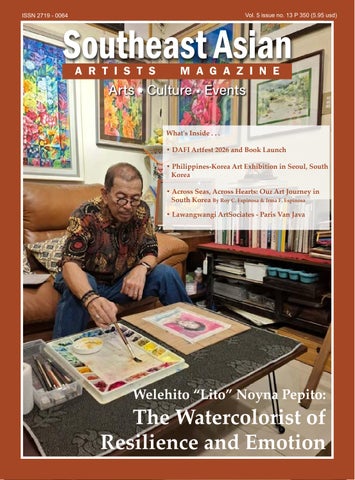
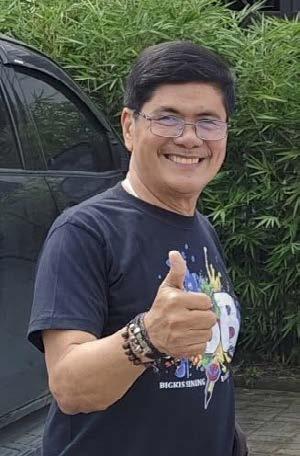
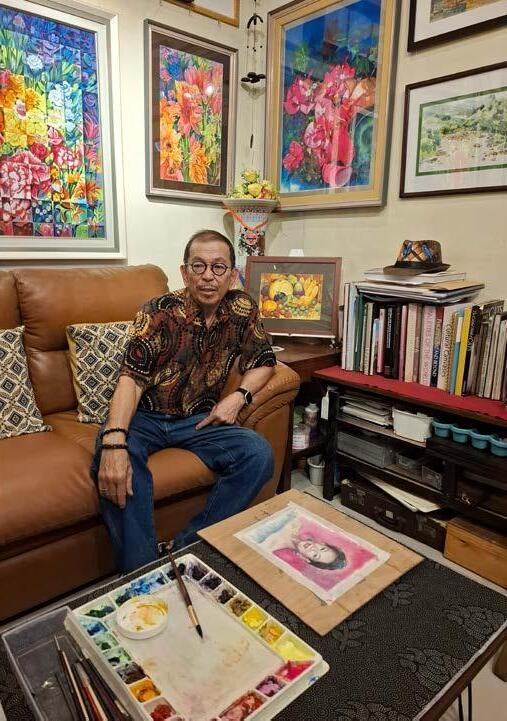
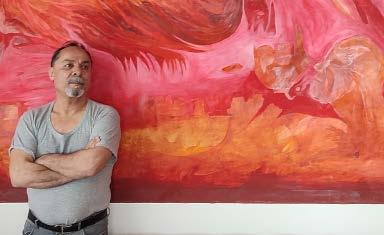
On the cover is Lito Pepito, President of the Dabawenyo Artists Federation, Inc. (DAFI), whose leadership brings us to the DAFI Artfest and the launch of the DAFI Coffee Table Book. This issue proudly celebrates both Asian and local Filipino artists, affirming our commitment to spotlighting diverse voices in the region’s creative landscape.
May these pages inspire you to see art not only as creation but as connection — across borders, cultures, and communities.
Ruth C. Espinosa
"Be original."
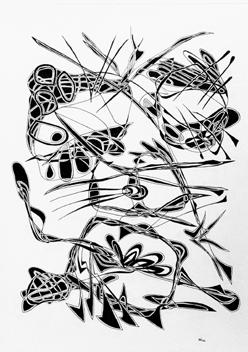
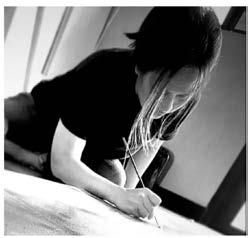
I have decided to post my black and white drawings, I have been doing these for as long as I can remember.
I remember doing them as a child on my school books and of course it was not appreciated by my teachers, I continued to do them whenever I was sitting and had a pencil in my hand.
Years later I tried to combine them into paintings, but I never felt they crossed over well into paint. I did do a lot in watercolour in this format, but unfortunately they were not popular, the reason being was that they didn't look like what others were doing and they were very different. All through my art career this was my tag line from viewers and collectors, they were to different and they didn't look like what others were doing.
Of course I ignored these comments and I have continued to draw following my muse, which has been with me all my life.
I do love these drawing, each one is different from the one before it and I see the progression of each one. I will continue to post them and talk about each drawing, it is really my obsession.
Ink on A3 watercolour paper
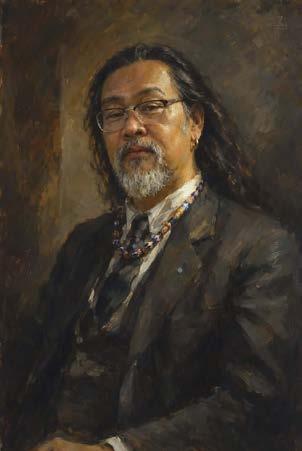
In the cool highlands of Baguio, where mist clings to pine trees and creativity thrives in every corner, one artist has carved a distinct path that bridges tradition and modernity: Iwag Palattao. Known as one of the Philippines’ premiere portraitists, Palattao’s work is a testament to discipline, heritage, and innovation. His canvases are not mere reproductions of faces or scenes; they are living narratives that pulse with cultural memory and contemporary resonance.
Palattao proudly identifies as Gaddang, an Indigenous group from Northern Luzon with centuries of history along the Cagayan River watershed. His heritage is not a footnote but a guiding force in his artistry. Each brushstroke carries echoes of ancestral pride, positioning him as both a custodian of tradition and a voice of modern Filipino identity. In a global art scene often dominated by fleeting trends, Palattao’s rootedness makes him a rarity — a polished gem whose authenticity shines through.
Palattao’s reputation rests on his meticulous realism, a genre that demands precision and patience. His portraits are flawless in likeness, yet never static. He infuses them with subtle contemporary
Echoes of Tradition: The Art of Iwag Palattao
twists — surreal elements, allegorical undertones, or mythological references — that elevate them beyond mere representation. His oeuvre spans portraits, landscapes, biblical and mystical scenes, and allegorical compositions, all executed with a perfectionist’s eye for detail.
Unlike many of his peers who lean toward abstract or fad-driven surrealism, Palattao remains committed to realism while adapting it to modern sensibilities. This balance sets him apart, allowing him to capture both the rich and famous and the humble and unadorned with equal reverence.
His recent pieces — such as Serenity, Flood the Earth, and Eternal Spring — showcase his mastery of acrylic on canvas, blending technical precision with emotional depth. These works have found homes in galleries and private collections, affirming his status as a sought-after artist in the Philippine art market.
For Palattao, art is more than craft; it is storytelling. His paintings often depict the lives, customs, and traditions of middle-class Filipinos, offering a visual chronicle of generational narratives. By doing so, he not only preserves cultural memory but also challenges viewers to reflect on their own identities in a rapidly modernizing world.
His perfectionism is not about vanity but about respect — respect for his subjects, his heritage, and the discipline of art itself. In every portrait, he insists on truth, yet he allows room for imagination, creating works that are both faithful and transcendent.
Iwag Palattao stands as a bridge between eras: a realist who embraces modernity, an Indigenous artist who speaks to global audiences, and a perfectionist whose works resonate with emotion and meaning. In the vibrant art scene of Baguio and beyond, his canvases remind us that tradition and innovation are not opposites but partners in the timeless pursuit of beauty.
—Ruth C. Espinosa
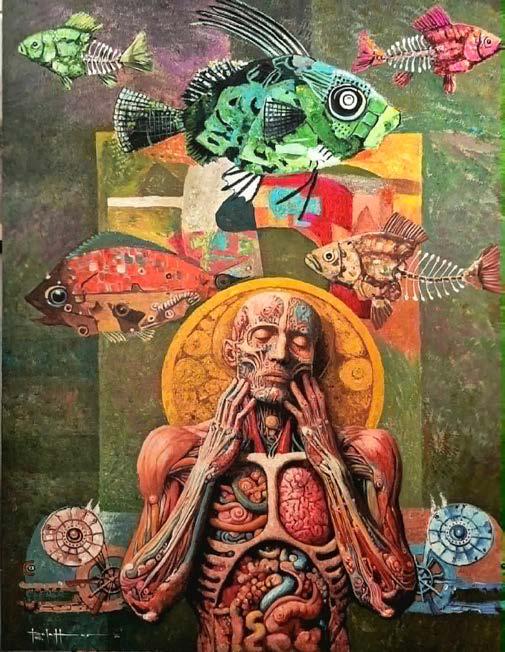
Human Restoration • Acrylic on Canvas • 32 x 41in • 2026
Steel life begin
Acrylic on Canvas
32 x 24in 2026
Mindset
Acrylic on Canvas
32 x 24in 2026
Serenity
Acrylic on Canvas
32 x 24in 2026
Under the Sea
Acrylic on Canvas
42 x 32in 2026
In the vibrant tapestry of Philippine art, Rey Punelas stands out as a figure who bridges politics, community service, and creative expression. Known in Binangonan, Rizal as a respected councilor, Punelas is equally celebrated for his artistry — a painter and sculptor whose works have earned national recognition and international collectors. His journey reflects the duality of public service and personal passion, proving that art can thrive even in the most unexpected places.
Punelas’ artistic foundation was laid at the University of Santo Tomas (UST), where he studied Fine Arts. His formal training gave him the technical discipline to explore both painting and sculpture. While his political career later became prominent, his devotion to art never waned. In fact, his creative pursuits often intersected with his civic role, using art as a means of cultural preservation and community identity.
One of Punelas’ most notable accomplishments came in 1978, when his metal sculpture won the Silver Medal at the National Arts Competition. The piece was later acquired by a Japanese collector, a testament to its universal appeal and craftsmanship.
Rey Punelas: Sculpting Memory, Painting Legacy
His paintings also carry cultural weight. His depiction of St. Ursula, patron saint of Binangonan, was immortalized as a Philippine postage stamp, ensuring that his art reached households across the nation. This achievement highlights his ability to merge personal devotion with national heritage.
Punelas’ works often balance realism with symbolism, reflecting both his academic training and his sensitivity to local narratives. His sculptures, forged in metal, embody resilience and permanence, while his paintings capture the spiritual and communal essence of his hometown. Themes of faith, tradition, and identity recur throughout his oeuvre, making his art deeply rooted in Filipino culture.
Beyond galleries and competitions, Punelas has used his art to support community causes. Exhibitions, such as those benefiting parish projects in Binangonan, demonstrate his commitment to making art a vehicle for social good. His dual role as artist and councilor underscores his belief that creativity and governance can coexist, each enriching the other.
Punelas’ legacy lies not only in his artworks but also in his example: that an artist can serve both canvas and community. His recognition in national competitions, his contribution to Philippine philately, and his enduring presence in local exhibitions ensure that his name remains part of the country’s cultural narrative.
Future generations of Filipino artists can look to Punelas as proof that art is not confined to studios or museums — it can thrive in public service, in community halls, and even in the everyday lives of people who encounter his works.
Rey Punelas embodies the spirit of a Filipino artist whose creativity transcends boundaries. From winning national awards to immortalizing local saints, his art reflects resilience, devotion, and identity. His story is one of balance — between politics and art, tradition and modernity, personal passion and public duty.
—Ruth C. Espinosa
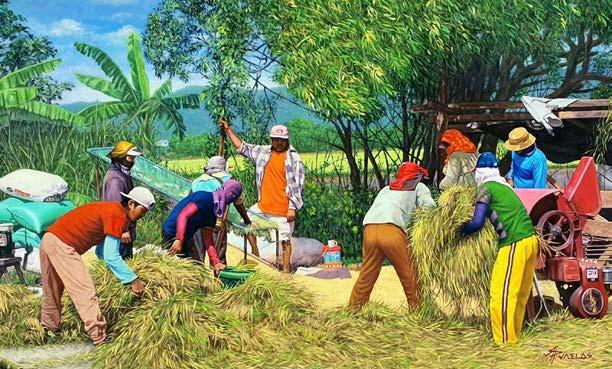
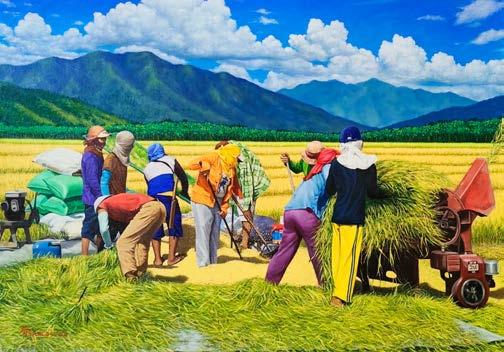
Golden Harvest 5 • Oil on Canvas
• 24 x 48in • 2026
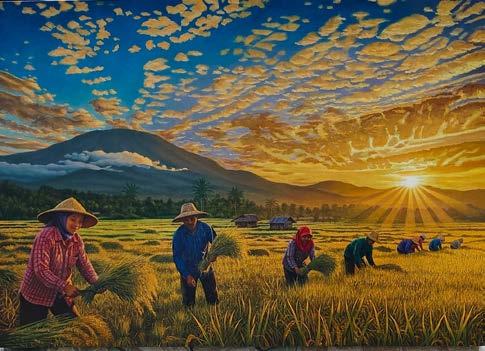
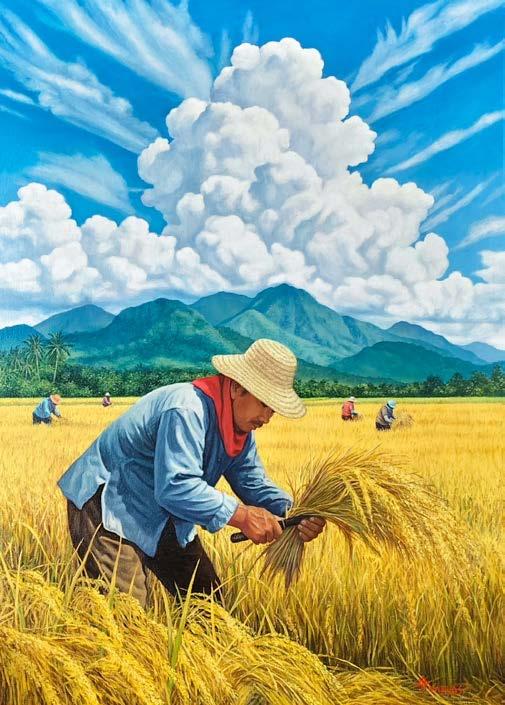
Golden Harvest 10 • Oil on Canvas
30 x 40in
2026
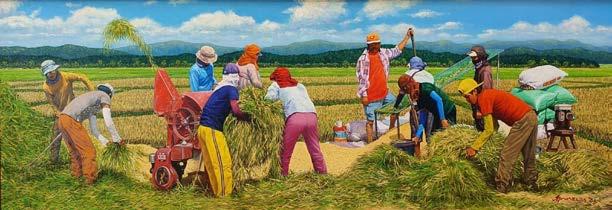
Golden Harvest 3 • Oil on Canvas • 26 x 75in • 2026
Golden Harvest 3 • Oil on Canvas
• 26 x 75in • 2026
Golden Harvest 9 • Oil on Canvas
40 x 30in
2026
Across Seas, Across Hearts: Our Art Journey in South Korea
By Roy C. Espinosa & Irma F. Espinosa
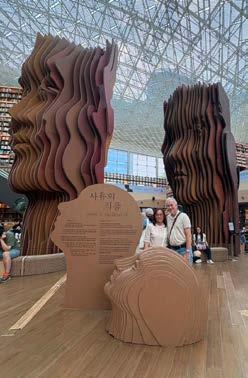
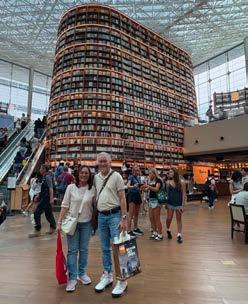
Traveling as artists is always a journey of both body and spirit. When Irma and I boarded our flight from Manila to Seoul, we carried not only canvases and sculptures but also stories, emotions, and the weight of representing Philippine art on an international stage.
This trip was special. It coincided with the 128th anniversary of Philippine Independence and the 77th year of diplomatic relations between the Philippines and Korea. To be part of exhibitions that celebrated these milestones was both humbling and exhilarating.
We knew we were not just traveling as individuals; we were ambassadors of culture, joining fellow Filipino and Korean artists in a dialogue that transcended language.
First Impressions of Seoul
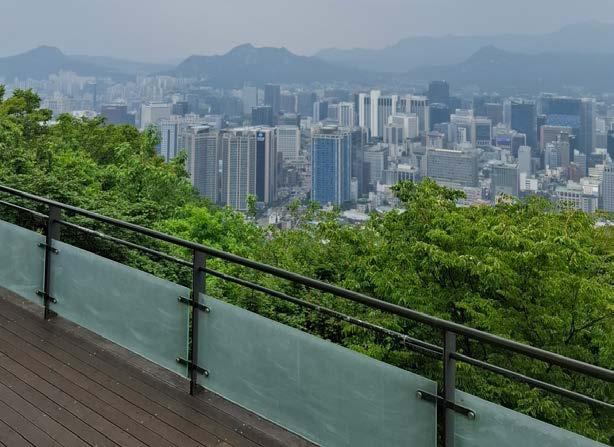
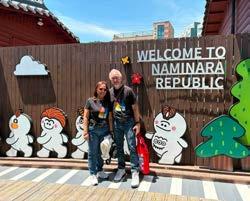
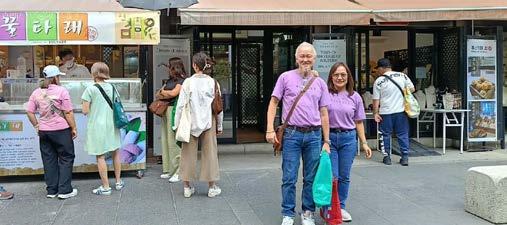
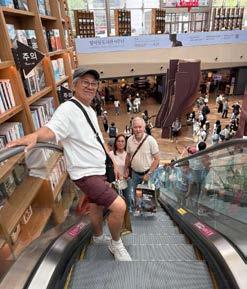
Seoul greeted us with a mix of tradition and modernity. The streets of Insa-dong, with their calligraphy shops and tea houses, contrasted beautifully with the sleek skyscrapers of Gangnam.
Walking hand in hand, Irma and I felt the pulse of the city — vibrant, fast paced, yet deeply rooted in heritage. It was the perfect setting for our exhibitions, which sought to highlight the enduring friendship between the Philippines and Korea through art.
Gallery All: Insa-dong’s Cultural Heart
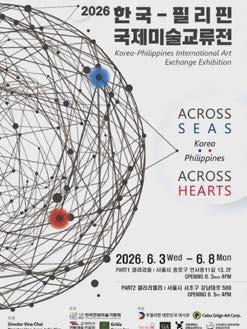
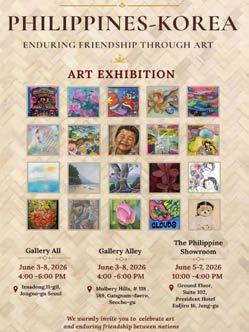
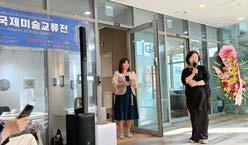
Our first stop was Gallery All in Insa-dong, home to the “2026 Korea Philippines International Art Exchange Exhibition – Across Seas, Across Hearts.” The gallery buzzed with anticipation. Filipino artists Ernesto “Aris” C. Bagtas, Jr., Esperanza “Espie” Bagtas, Roy C. Espinosa, Irma F. Espinosa, Roland F. Rosacay, Alfonso P. Vargas, Pancho M. Piano, Celso D. Pepito, Fe M. Pepito, Ruel A. Rosello, Jovita F. Punzalan, and Ritchie S. Moscoso exhibited alongside Korean counterparts, including Ms. Vina Choi, Ms. Bosuk Lee, Ms. Jungyeon Seo, Ms. Jimin Catherine Pak, and Ms. Julie Kim herself.
Irma’s paintings, with their delicate interplay of color and emotion, hung beside my own works, which explored themes of resilience and identity. Seeing them in dialogue with Korean art was a revelation — the contrasts highlighted our differences, but the harmonies underscored our shared humanity.
Visitors lingered, asking questions, sharing impressions. One Korean student told us, “Your art feels like home, even though it comes from far away.” That moment captured the spirit of the exhibition: across seas, across hearts, art connects us.
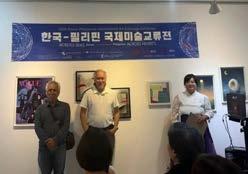
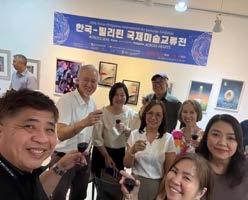
During the opening of Across Seas, Across Hearts exhibition in Gallery All in Insadong, South Korea.
The Philippine Showroom: Heritage and Pride
The Philippine Showroom at the Philippine Department of Tourism in Seoul was our third venue. Here, the exhibition “Philippines & Korea – Enduring Friendship Through Art” celebrated heritage.
Textiles, sculptures, and paintings filled the space with Philippine identity. Works by artists unable to attend — Ariosto Dale C. Bagtas, Euri Franz Bagtas, Gabriel Airon C. Bagtas, and Pauline Allison F. Espinosa — enriched the showcase, proving that art knows no boundaries.
The opening ceremony was emotional. Ambassador Bernadette Therese C. Fernandez praised the collaboration, noting that “meaningful collaboration can flourish through art, just as it does in the many facets of the relationship between our two countries.” Standing there, Irma and I felt immense pride. Our art was not just personal expression; it was part of a collective narrative of friendship and cultural diplomacy.
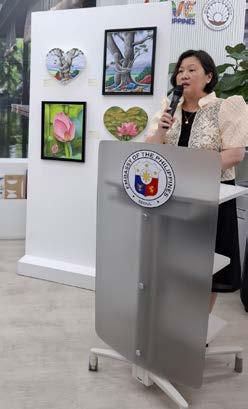
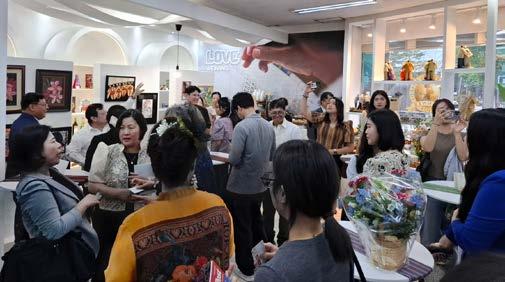
Philippine Ambassador to South Korea Honorable Bernadette Therese C. Fernandez giving the opening remarks during the opening exhibit at the Philippine showroom.
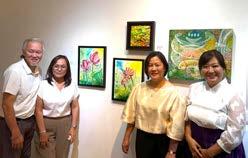
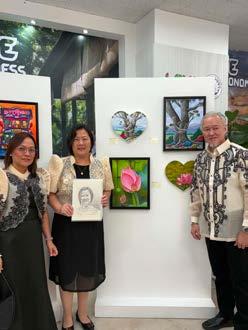
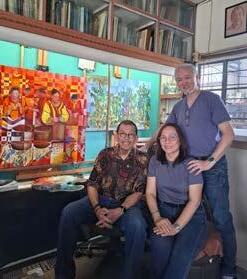
Philippine Ambassador Hon. Bernadette Therese C. Fernandez with Philippine artists Irma Espinosa and Roy Espinosa with their artworks at the background with ambassador's ballpen portrait made by Roy Espinosa.
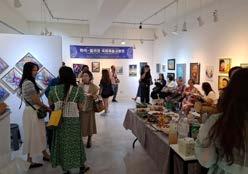
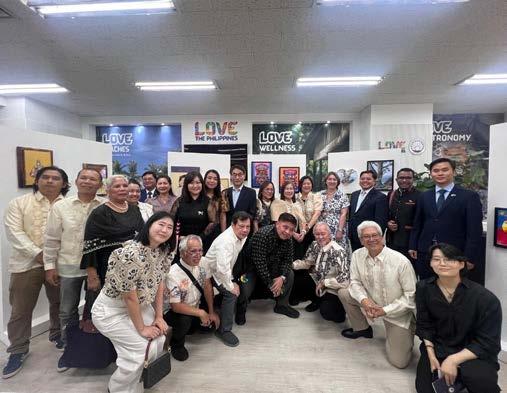
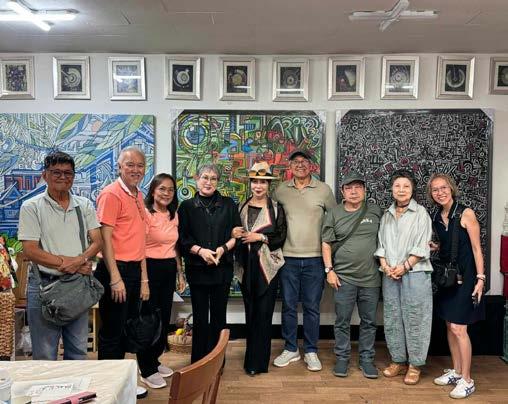
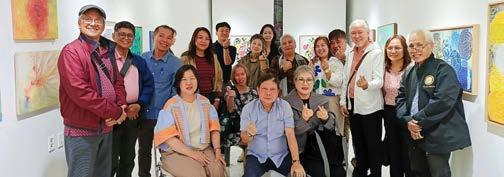
Philippine artists and korean artists with guests pose during the opening.
During the opening exhibition in the Philippine showroom at the Presidents Hotel in Seoul, South Korea
Gallery Alley: Gangnam’s Contemporary Pulse
From Insa-dong, we traveled to Gallery Alley in Gangnam. The contrast was striking — neon lights, bustling streets, and a gallery space alive with contemporary energy.
Here, approximately forty Korean artists exhibited alongside us. The diversity was astounding: traditional ink paintings, avant garde installations, digital art, and sculptures.
Irma’s work resonated with themes of longing and belonging, while my pieces explored the resilience of communities. Together, they found unexpected echoes in Korean works that grappled with identity in a rapidly modernizing society.
The conversations were as important as the artworks. We spoke with Korean artists about migration, tradition, and sustainability. The dialogue was rich, reminding us that art is not only about creation but about connection.
Korean Artist Julie Kim and GalleryAlley owner Ms. Grace
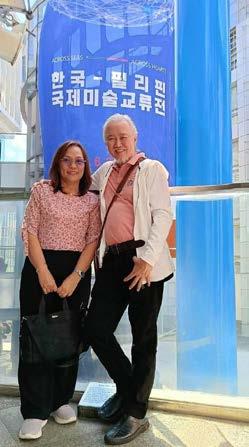
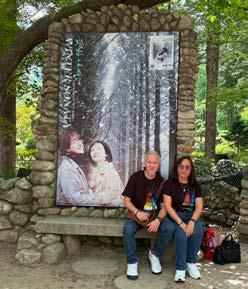
Artists Irma and Roy Espinosa posing at the Big Poster of Across Seas, Across Hearts exhibition at Gallery Alley.
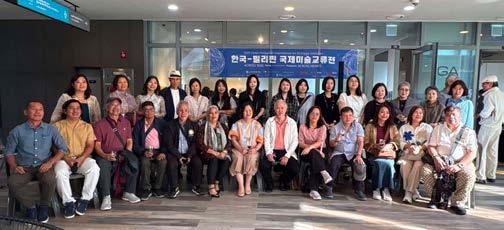
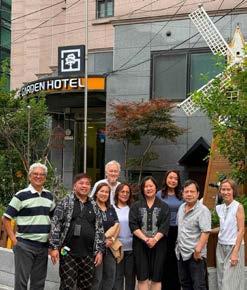
Filipino and Korean Artists posing in front of Gallery Alley during the opening exhibition.
Travel Notes: Seoul Through an Artist’s Eyes
As artists, we see cities differently. Seoul became a canvas:
• The palace of Gyeongbokgung, with its intricate architecture, inspired Irma’s palette.
• The Han River, flowing steadily through the city, reminded me of resilience and continuity.
• The markets of Namdaemun, bustling with life, echoed the vibrancy of Philippine fiestas.
Every walk, every meal, every conversation became part of our artistic journey. We sketched in cafés, took notes in museums, and found inspiration in everyday encounters.
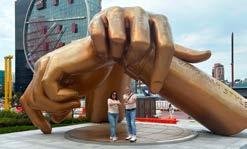
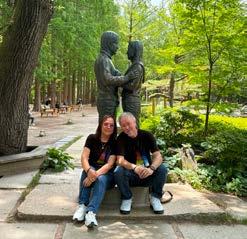
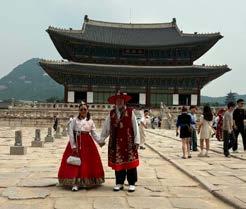
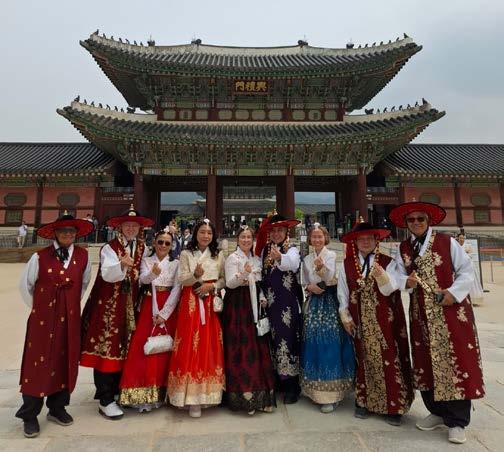
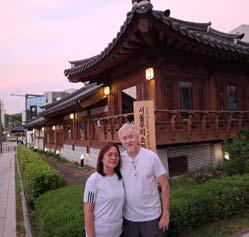
Irma and Roy Espinosa at Gyeongbokgung Palace
At Gyeongbokgung Palace from L-R Al Vargas, Roy Espinosa, Irma Espinosa, Jovita Punzalan, Espie Bagtas, Aris Bagtas, Ruth Espinosa, Roland Rosacay and Pancho Piano
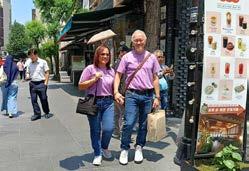
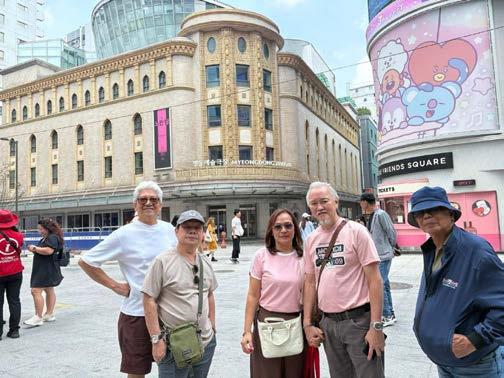
from L-R Pancho Piano, Roland Rosacay, Irma Espinosa, Roy Espinosa and Al Vargas at Myeongdong Shopping District
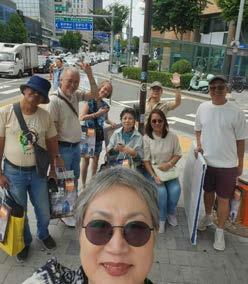
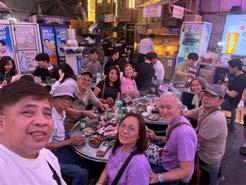
Filipino Artists enjoying eating samgyup at Insadong District. On the left doing selfie Aris Bagtas, seated on the left Al Vargas, Pancho Piano, Jovita Punzalan and Espie Bagtas. saated on the right Irma Espinosa, Roy Espinosa, Roland Rosacay and Ruth Espinosa.
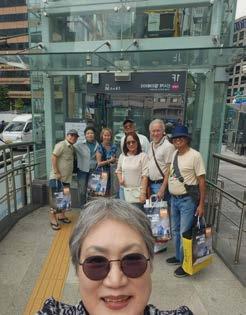
Filipino Artists from L-R Roland Rosacay, Korean artist Yeong-Ae, Ruth Espinosa, Pancho Piano (at the back) Irma Espinosa, Roy Espinosa, Al Vargas and Korean Artist Bosuk Lee doing the selfie on the Street of Seoul, South Korea.
Reflections: Themes That Endure
Looking back, several themes defined our journey:
• Resilience: Our art spoke of endurance, mirrored in Korea’s own history of overcoming challenges.
• Identity: We explored what it means to be Filipino in a globalized world, finding parallels in Korean explorations of modern identity.
• Dialogue: Conversations with Korean artists enriched our understanding and deepened our connections.
• Friendship: Above all, the exhibitions celebrated the enduring friendship between our nations.
Across Seas, Across Hearts
Our journey to South Korea was more than an art trip; it was a pilgrimage of friendship. Through exhibitions at Gallery All, Gallery Alley, and the Philippine Showroom, we discovered that art is a universal language — one that speaks of resilience, identity, dialogue, and love.
As Irma and I returned to Manila, we carried with us not only memories of Seoul but also the conviction that art can build bridges. Across seas, across hearts, creativity unites us.
This blog is our testament: that as artists, travelers, and partners, we found in South Korea not just an audience but a family of kindred spirits. And in every brushstroke, every conversation, and every shared moment, we felt the enduring friendship between the Philippines and Korea come alive.
Pey Raymond: A Journey Through Abstraction and Motion
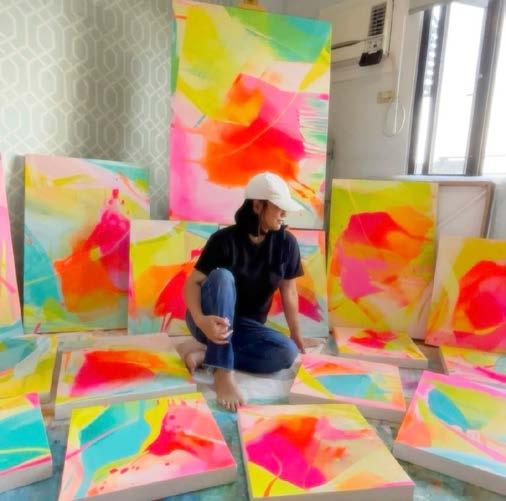
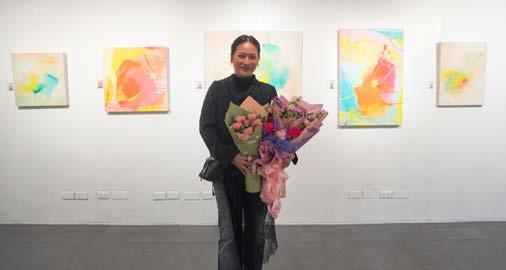
Pey Raymond, born in San Fernando, Pampanga in 1977, is a contemporary artist whose work embodies the delicate balance between intuition and method. Her artistic journey began at the age of twelve, when she first experimented with charcoal and acrylics, inspired by her late sister and a profound passion for visual storytelling. This early exploration laid the foundation for a career defined by resilience, curiosity, and a commitment to translating human experience into poetic abstraction.
A graduate of the University of the Philippines, Pey initially pursued a career in early childhood education before fully embracing her artistic calling in 2001. Her transition from teaching to professional artistry reflects her belief in the transformative power of creativity. Later, she relocated to Los Angeles to study Animation and Art Studies, a period that sharpened her technical skills and allowed her to work as an animator. This experience profoundly shaped her approach to painting, infusing her canvases with a sense of fluidity and motion.
Now based in the Philippines, Pey’s practice bridges her academic background in Psychology and Animation. Her works are characterized by layered acrylics manipulated with the translucency of watercolor, resulting in compositions that capture time, space, and movement. Through varied brushstrokes, textures, and spontaneous applications, she creates visual narratives that oscillate between abstraction and portraiture.
Her studies in Psychology inform her perspective on art as a tool for healing. By weaving organic lines with textural accents, and balancing hard and soft elements, Pey translates resilience into a visual language of light and happiness. Her canvases are not merely aesthetic objects but meditations on the human spirit, offering viewers a sense of calm and renewal.
Pey’s artistry has been showcased in both solo and group exhibitions across the Philippines and abroad. Highlights include her 2024 solo exhibition Myriad of Luminescence at Altro Mondo Creative Space in Manila, and her earlier solo show Bright White Light at Happy Gallery in Makati City. She has also collaborated with fellow artists, such as Pancho Piano in 2017, and participated in international exhibitions in Los Angeles, including Abstractions and Motions (2012) and Figure in Motion (2010).
Her group exhibitions further demonstrate her versatility, with recent contributions to Shedding Skin (2026) and The Selection: Tones for Weathered Silence (2025). Pey’s presence at art fairs and festivals, including Art in the Park and Xavier Art Fest, underscores her growing influence in contemporary art circles.
At the heart of Pey Raymond’s practice is a desire to merge the intuitive with the methodical, creating works that resonate with emotional depth and technical sophistication. Her paintings are not only explorations of abstraction but also reflections of resilience, healing, and joy. By blending her background in psychology with her animation training, Pey continues to push the boundaries of visual storytelling, offering audiences a luminous journey through motion and meaning.
Pey’s art is a testament to the enduring power of creativity — a reminder that through color, texture, and abstraction, one can find both solace and inspiration.
—Ruth C. Espinosa
Keiichiro Kimori: A Contemporary Voice in Asian Art
K
eiichiro Kimori is a Japanese painter whose career embodies the spirit of cultural exchange and artistic innovation across Asia. Based in Fukuoka, Japan, Kimori has steadily built a reputation as a dynamic figure in contemporary art, blending rigorous academic training with an expansive international presence. His journey reflects both personal dedication and a broader commitment to fostering dialogue between artists and audiences worldwide.
Education and Foundation
Kimori’s artistic path is deeply rooted in academic excellence. He earned his Bachelor of Fine Arts in Painting from Kyushu Sangyo University in 2007, followed by a Master of Fine Arts in Plastic Expression in 2009. His pursuit of mastery culminated in a PhD in Fine Arts in 2014, also at Kyushu Sangyo University. This progression highlights not only his technical skill but also his intellectual engagement with the theory and practice of art. His doctoral work in plastic expression underscores his interest in exploring the material and conceptual dimensions of painting.
International Residencies and Festivals
Kimori’s career is distinguished by his active participation in international art festivals and residencies. From Malaysia’s Sasaran International Art Festival (2014) to Indonesia’s Yogyakarta International Art Festival (2015), and later India’s FACE TO FACE International Art Festival (2018), he has consistently sought opportunities to engage with diverse artistic communities. His presence at events in Vietnam (2019, 2023) and Malaysia (2022) further demonstrates his commitment to cross-cultural collaboration. These experiences have enriched his practice, allowing him to absorb and reinterpret artistic traditions from across Asia.
Exhibitions and Recognition
Kimori’s exhibition history reflects both depth and breadth. His solo shows, such as the 2012 exhibition at Gallery ArtdeMaA in Fukuoka and the 2019 “Physical Concept” exhibition at 410Gallery, reveal his evolving exploration of form and concept. Group exhibitions have placed him alongside peers from across Asia, including the Asian International Art Exhibition (2015–2023) at the Fukuoka Asian Art Museum and collaborative showcases in Malaysia, Nepal, and India.
His achievements have been recognized through numerous awards. Early honors include the Purchase Award (2007) and Incentive Award (2008), while later accolades such as the Grand Prize at the Tenjin Art Biennale (2016) and the Fukuoka Wall Art Award (2022) cement his standing as a leading contemporary artist. In 2024, he received the Anish Kapoor Award at the World Heritage Art Festival in India and Sri Lanka, a testament to his growing international stature.
Teaching and Mentorship
Beyond his personal practice, Kimori has contributed to the academic world as a lecturer in artistic anatomy at Kyushu Sangyo University from 2014 to 2024. Since 2022, he has also served as a project lecturer at Zokei Junior College of Art and Design. His teaching reflects his dedication to nurturing the next generation of artists, ensuring that his influence extends beyond his own canvases.
Artistic Vision
Keiichiro Kimori’s work is characterized by a balance between conceptual rigor and expressive freedom. His
participation in international exchanges underscores his belief in art as a universal language, capable of bridging cultural divides. Whether through solo exhibitions or collaborative projects, his paintings invite viewers to engage with questions of identity, materiality, and connection.
Keiichiro Kimori stands today as a painter whose career exemplifies the vitality of contemporary Japanese art within a global context. His achievements— academic, artistic, and cultural—position him as both a creator and a connector, weaving together traditions and innovations across borders.
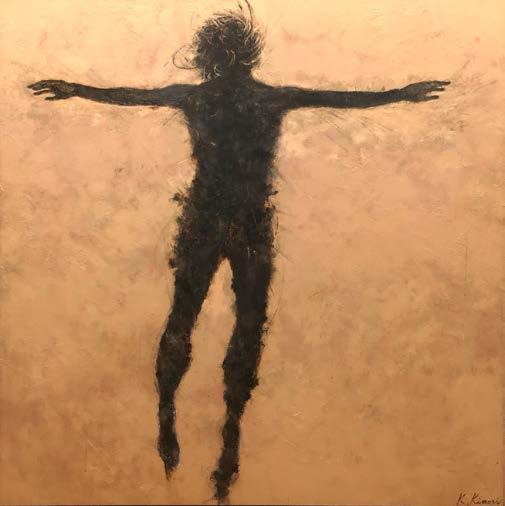
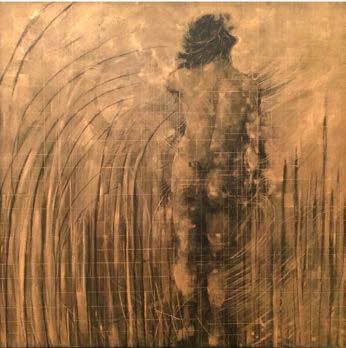
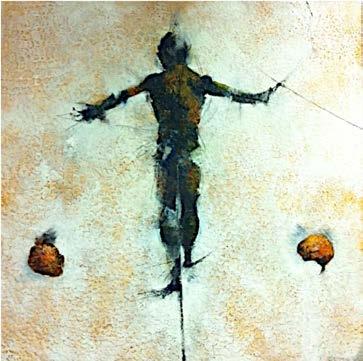
Physical Concept Adolescence • Mixed Media • 162 x 162cm • 2016
—Roy C. Espinosa
Beyond the Gaze Mixed Media 162 x 162cm 2015
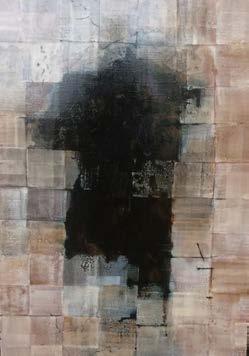
Torso
Mixed Media
80.3 x 100cm
Mixed Media
80.3 x 100cm
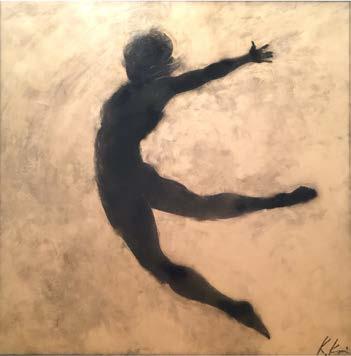
Physical Concept Leap
Mixed Media
162 x 162cm
Torso
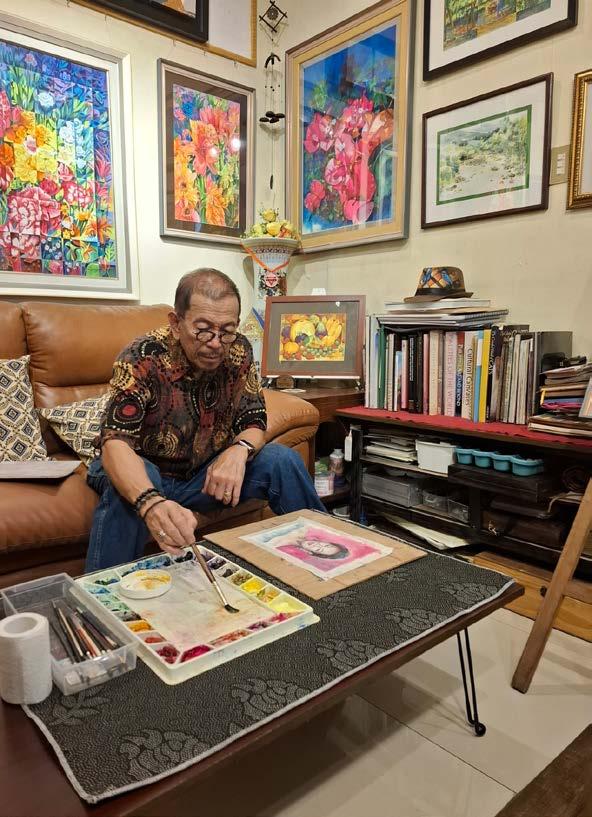
Welehito “ Lito ” Noyna Pepito:
The Watercolorist of Resilience and Emotion
Introduction: A Legacy in Color
In the heart of Davao City, where tradition and modernity intertwine, one artist has carved a name that resonates far beyond the local art scene. Welehito “Lito” Noyna Pepito, born in Calero, Lilo-an, Cebu, is a distinguished visual artist whose works blend realism with emotional depth, creating pieces that are as evocative as they are technically masterful. His journey from a young boy sketching in school competitions to a celebrated watercolorist admired both locally and internationally is a testament to passion, perseverance, and vision.
Early Life: Roots in Cebu
Pepito’s artistic journey began in his elementary years, where his natural talent in drawing earned him recognition in school contests. Coming from a family with no known artistic lineage, his pursuit of art was entirely self driven, fueled by innate creativity and the influence of local artists.
His formative years were shaped by his education at the University of Southern Philippines (USP). Here, he honed his skills in both vocational and artistic disciplines, laying the foundation for a career that would later flourish. Early inspirations included Cebu based artist Laborio Jabunero and university illustrator Arch. Bert Minosa, whose guidance helped him refine his craft. One of his first significant contributions was donating a Seed Mosaic artwork to the USP School Museum — a gesture that reflected his dedication to art and community even at a young age.
Mentorship and Artistic Growth
As Pepito’s career progressed, he found guidance from renowned figures in the Philippine art scene. Cebu watercolorist Tony Alcuseba and Fred Liongoren of UP Diliman became pivotal mentors, helping him refine his technique and expand his artistic horizons.
Their influence led Pepito to explore Hyper Realism, a style that allowed him to create breathtaking landscapes, seascapes, still lifes, and floral compositions. His works often began with photographs taken during his travels, which he recomposed to infuse personal emotions and life experiences. This approach gave his paintings a unique blend of technical precision and emotional resonance.
Philosophy: Art as Happiness
Pepito’s artistic philosophy is rooted in the belief that art should evoke happiness. Even when created during moments of frustration or sadness, his works radiate positivity and resilience. “Live and Paint till the end,” he often says, a guiding principle that reflects his unwavering dedication to his craft.
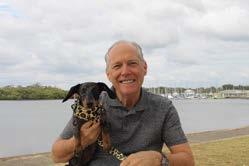
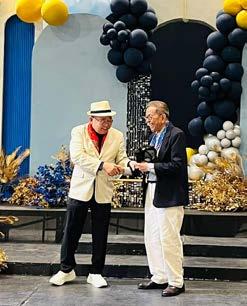
Former president Vic Navales and new president of DAFI Welehito Pepito
For Pepito, art is sacred. He believes in doing the best always, never settling for second best. His paintings are not just visual representations but emotional landscapes — testaments to his resilience and his commitment to finding joy in creation.
Influences: From Local Masters to Global Icons
Pepito admires great homegrown artists while also drawing inspiration from international masters. His influences include:
• Andrew Wyeth and Norman Rockwell for their realism.
• Vincent Van Gogh for his emotional depth.
• Gustav Klimt for intricate and symbolic compositions.
• Pablo Picasso for abstraction and its playful, childlike qualities.
Beyond visual art, Pepito finds inspiration in music. Songs like John Lennon’s Imagine and various ballads and folk tunes stir his thoughts about nature, existence, and humanity. This cross disciplinary influence enriches his work, making it resonate on multiple levels.
Exploring Styles: Hyper Realism and Posterisque. While Hyper Realism remains central to Pepito’s oeuvre, he has also explored Posterisque artwork — a style characterized by rapid execution, well suited for commercial and advertising purposes. This versatility demonstrates his adaptability and
willingness to experiment, ensuring that his art remains dynamic and relevant.
His Hyper Realist works, however, remain the cornerstone of his reputation. Whether depicting a serene seascape, a vibrant floral arrangement, or a quiet still life, Pepito’s paintings capture not just the physical details but the emotional essence of his subjects.
Challenges and Triumphs
Sustaining a career as an artist is never easy, and Pepito has faced his share of challenges. Financial constraints, limited access to resources, and the unpredictability of the art market tested his resilience. Yet, he remained steadfast, driven by passion and guided by his principles.
One of his greatest personal triumphs is his wife’s acceptance and appreciation of his artistry. Her support has been a cornerstone of his journey, providing the emotional foundation that allows him to continue creating with dedication and joy.
Community and Legacy
Pepito’s impact extends beyond his personal achievements. He is deeply committed to the art
community, mentoring young artists and advocating for the accessibility of art. His contributions — from workshops to exhibitions — have inspired a new generation of creatives in Davao and beyond.
Looking ahead, Pepito envisions himself being remembered posthumously as a kind and generous visual artist. He acknowledges the possibility of being a forgotten contributor, yet his works ensure that his artistic voice will remain alive in the hearts of those who appreciate his vision.
Guiding Principles
Pepito’s guiding principles encapsulate his philosophy and dedication:
• “Live and Paint till the end.”
• “Do the best always, don’t go for second best.”
These mantras reflect not only his approach to art but his approach to life — a commitment to excellence, resilience, and authenticity.
The Cover Story of a Visionary
Welehito “Lito” Noyna Pepito’s story is one of passion, resilience, and artistry. From his humble beginnings in Cebu to his celebrated career in Davao, he has remained true to his vision, creating works that blend realism with emotional depth. His paintings are more than images; they are reflections of his soul, his experiences, and his philosophy.
As he graces the cover of this magazine, Pepito stands as a symbol of dedication and creativity. His legacy is not just in the artworks he leaves behind but in the inspiration he provides to future generations. His brushstrokes remind us that art is not merely about representation but about emotion, resilience, and the pursuit of happiness.
Ruth C. Espinosa
LAWANGWANGI ARTSOCIATES“PARIS VAN JAVA”
" Paris Van Java " The most popular nickname since colonial times because of its atmosphere similar to the city of Paris, complete with lifestyle and shopping centers, some call it "Kota Kembang" (Huge Cool City) because in the past this city was very beautiful, cool, and filled with a variety of lush flora blooming and beautiful. In fact, the most accurate for me is Creative City, in another location that must be visited apart from Jakarta, Jogja, and Bali.
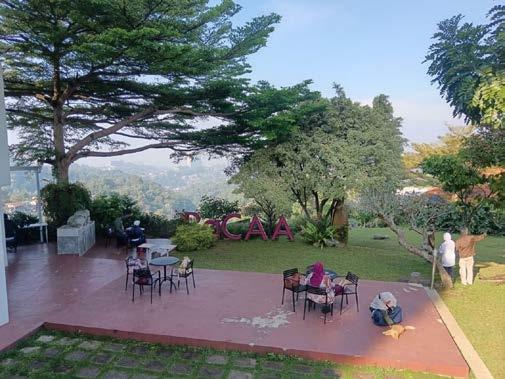
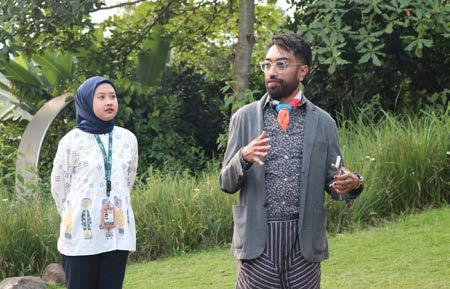
Lawangwangi Creative Space, a gallery that must be visited, the location in the highlands of the mountain is sure to be cool, fresh and breathtaking for anyone who visits here. For those with the name of artist, this is the most location to express their soul of expression and impressionism. I was able to interview Yori Papilaya (General Secretary) and Alifia Andini (Tour Guide) of ArtSociates.
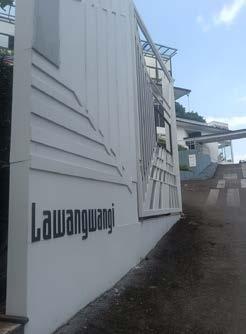
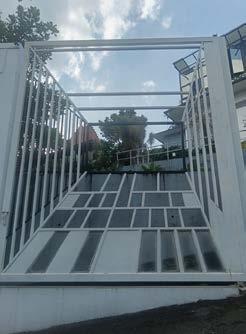
Entrance of Lawangwangi Creative Space 2
Entrance of Lawangwangi Creative Space 1
How do you interpret artistic value when selecting works?
We also consider the practical aspects of the work: how accessible it is to a wider audience, whether it can find its place within a collection, and the overall quality of its craftsmanship and presentation. Beyond the work itself, we look at the artist's practice as a whole, their reputation, the consistency of their artistic vision, and how their ideas and contributions continue to develop and grow over time.
What criteria guide your curatorial decisions?
Because we position ourselves as an artist management gallery, one of the most important considerations is our confidence in an artist’s future development and potential. This applies not only to artists under our management, but also to those we choose to present through our exhibitions.
We place great value on consistency, artistic growth, and an artist’s commitment to their practice over time. Of course, there is no way to guarantee how an artist’s journey will unfold in the future. What we can do is place our trust in their potential and, hopefully, provide a platform that encourages and supports them in continuing to create, experiment, and grow.
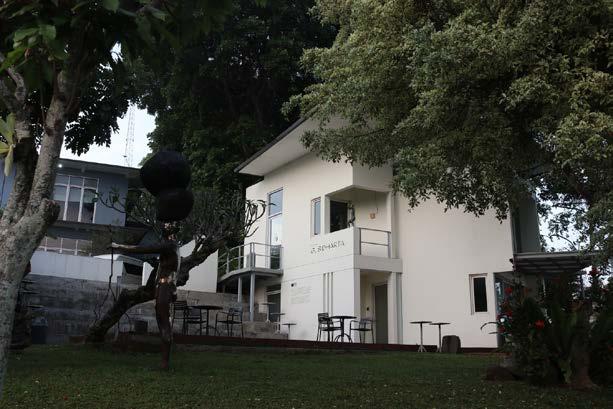
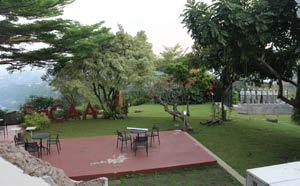
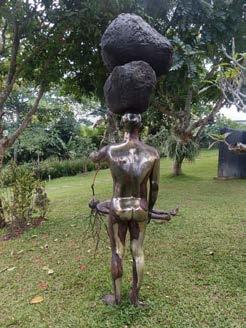
Lawangwangi outdoor and sculpture space
Alifia Andini & Yori Papilaya
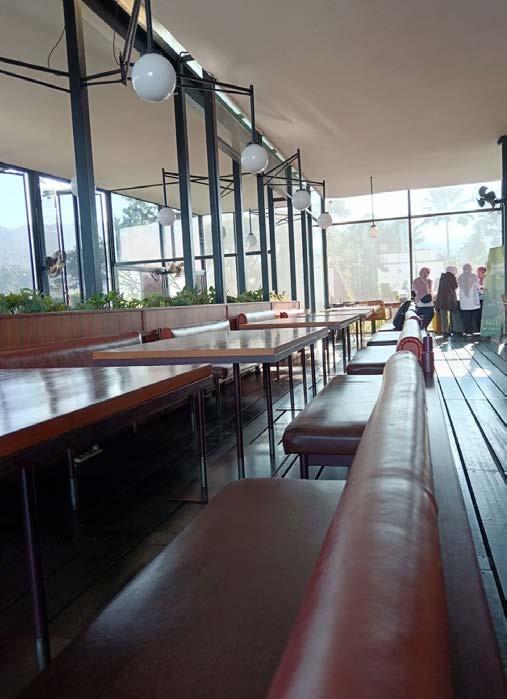
Coffee House Lawangwangi
How do you choose exhibition themes?
There is no rigid formula behind our programming. In general, we respond to ideas, conversations, and artistic concerns that feel particularly relevant or important at a given moment. At the same time, we believe it is important to recognize that Indonesian art does not exist in isolation from its own history. We see value in highlighting the threads that connect past and present, reminding ourselves of what has shaped our artistic landscape while continuing to look forward. In that sense, our exhibitions often hold two intentions simultaneously: maintaining a sense of forward momentum while also revisiting and reflecting on ideas, practices, and histories that remain meaningful today.
How have local artists at Lawangwangi Creative Space maintained Indonesian artistic identity in contemporary works since its inception?
First of all, we would appreciate being referred to as ArtSociates, as we have undergone a rebranding. Lawangwangi is now simply the name of the building rather than the entity itself. To answer your question, we feel it is important to first ask what we mean by "Indonesian artistic identity." While it is a fascinating topic, it is also a complex one, something that could easily become a discussion lasting days rather than minutes. From our perspective, an artist's identity is shaped by the realities they inhabit: their daily lives, struggles, experiences, observations, and the social and cultural environment around them. These elements naturally find their way into artistic practice, whether consciously or unconsciously. Because of that, we do not see ourselves as actively trying to preserve an Indonesian artistic identity. Rather, we believe it is already embedded within the artists we choose to work with and present. Their perspectives, experiences, and ways of responding to the world are inseparable from the contexts in which they live, and those contexts inevitably become part of the work itself.
What are the main differences between art trends in Bandung compared to the global art market that is commonly seen?
We should also acknowledge that the global art world is still, to a significant extent, shaped by frameworks, institutions, and systems of value that originated in the West. It would be difficult to discuss contemporary art without recognizing that reality. In Bandung's case, we often refer to the city as having a long-standing reputation as a "laboratory of the West," a perception that can be traced back to the establishment of what is now Institut Teknologi Bandung in the early
twentieth century. The presence of the institution has had a profound influence on the city's artistic and intellectual development.
As a result, Bandung has historically maintained a strong orientation toward international discourse and global artistic conversations. Compared to other major art centers in Indonesia, such as Yogyakarta or Bali, each with their own distinct cultural ecosystems. Bandung often feels more outward-looking and globally connected than domestically focused. This is not necessarily a matter of one approach being better than another, but rather a reflection of the different histories, institutions, and cultural conditions that have shaped each city and its artistic community.
How are global issues such as climate change, politics and technology translated through the lens of local culture here?
From a cultural standpoint, these issues are rarely addressed directly through mainstream gallery-based artistic practices. There are certainly artists who engage with these concerns and communicate them through their work, but the reality is that presenting an issue within a white-cube gallery
setting does not always translate into immediate or direct social impact. What galleries can do, however, is make these issues more visible. Art can create space for reflection, conversation, and awareness, even if it cannot resolve the issues on its own. At the same time, because the question of "local culture" is much broader, we often see some of the most active engagement happening outside traditional art institutions. In Bandung and arguably in Indonesia more broadly these conversations are frequently carried forward by smaller communities, grassroots initiatives, and interdisciplinary collectives. These spaces often allow for a closer relationship between cultural concerns, daily life, and collective action, making them an important part of the wider cultural ecosystem.It largely depends on the nature of the work being exhibited. In most cases, we do not actively encourage audience participation beyond the act of viewing and engaging with the artwork itself.
As an artist management gallery, Art Sociates primarily functions as a platform to present the practices and portfolios of the artists we work with. Because of this, direct audience engagement is not always a central consideration in our exhibition planning. That said, whenever possible, we do try to create opportunities for deeper engagement through artist talks, curatorial tours, or public discussions. These programs are developed on a case-by-case basis, depending on the nature of the exhibition and the resources, time, and energy available to support them.
What curatorial programs are used for audience engagement?
Typically, these take the form of curatorial tours, artist talks, public discussions, or informal conversations around the exhibition. However, these programs are not a standard component of every exhibition we present.
Instead, we consider them on a case by case basis, depending on the nature of the exhibition and whether we feel additional context, dialogue, or public engagement would meaningfully contribute to the audience's experience of the work.
How does audience engagement shape curatorial direction?
To be honest, audience engagement rarely determines our curatorial direction. We do not typically build exhibitions around audience demand or anticipated reactions. Instead, our decisions are guided by the artists we work with, the ideas we find important, and the conversations we believe are worth bringing into public view. Audience engagement remains important, but we tend to see it as a response to the exhibition rather than a factor that shapes it from the outset.
Share the number of staff and organizations working at Lawang Wangi (Director, Curator, Administrator) Does LW hire students to work as practical students in implementing an exhibition or art event?
ArtSociates is managed by a core team of seven people dedicated to the artistic and gallery aspects of our operations. We make this distinction because the Lawangwangi building also includes hospitality and Food & Beverage functions, which are managed separately. In general, we do not rely on student volunteers or interns to support our exhibition programs. Given the space and complexity of our activities, particularly when exhibitions, events, and installations overlap, we find it important to work with individuals who already possess the necessary professional experience and technical skills. When additional support is required, such as for exhibition installation and dismantling, documentation, or other specialized tasks, we typically collaborate with freelance professionals and practitioners who are familiar with the demands of this type of work.
Thank you very much for both of you as an art lover for peoples even due not for artist, curator, publisher but on the other side this is one of places for tourists around the world to come and capture a beautiful moment, action in Lawangwangi.
Thanks…
Iszuan Ismail Galeri Shah Alam, MALAYSIA
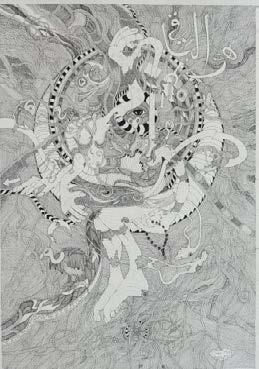
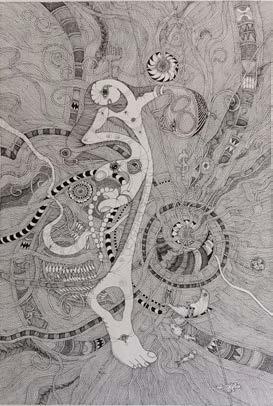
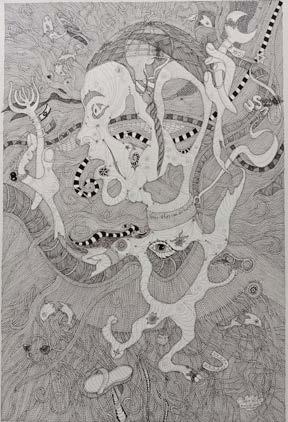
Lines of Eternity: The Art of Safa Büte
Safa Büte, born in Niğde in 1958, is a contemporary Turkish painter and curator whose artistic journey has become a bridge between Anatolia’s cultural heritage and the universal language of art. Recognized both nationally and internationally, Büte has carved out a distinct identity in the art world, one so unique that critics have coined the term “Safa Büte Style” to describe his work. His mission has always been clear: to spread art to the grassroots, to make it accessible beyond the confines of metropolises, and to weave the local into the global.
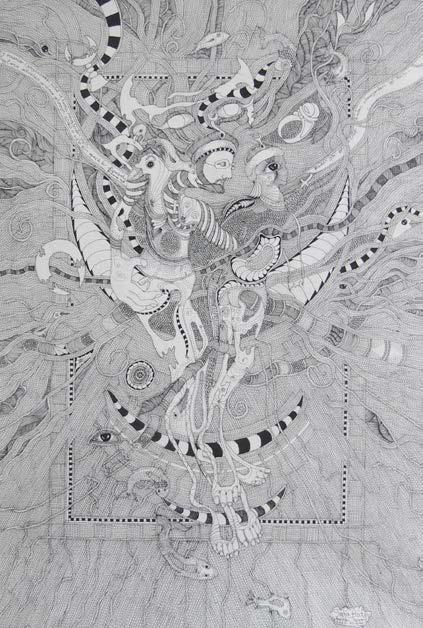
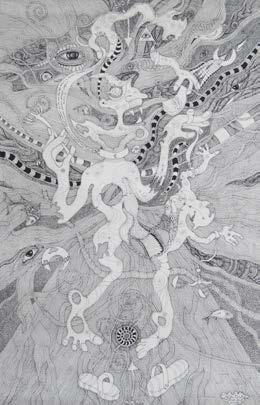
At the heart of Büte’s artistry lies a meticulous technique defined by patience and precision. His canvases are built from millions of points and lines, forming vast textures that invite viewers into a world of hidden figures and dreams. What may appear abstract at first glance gradually reveals faces, stories, and symbols upon closer inspection. As Büte himself explains, “No matter how many times you look at my works, you will find a new dream and new figures each time.” This layered complexity transforms his paintings into living narratives, endlessly unfolding before the eye.
The technical rigor of his process is uncompromising. Working with ink and pointillism, Büte embraces an irreversible medium where mistakes cannot be erased. Each stroke demands concentration and devotion, reflecting not only craftsmanship but also a spiritual discipline. His art, while not strictly expressionist, is a pure outpouring of emotion and
existential inquiry. Themes of love for nature, humanity, animals, and universal harmony permeate his works, carrying profound spiritual resonance. Art historian John T. Spike once remarked that Büte’s paintings reminded him of sacred works hidden in museum drawers—pieces to be contemplated with reverence.
International recognition has followed this singular vision. In 2000, Büte was listed among the world’s top ten painters by the Australian based Artist Own Registry. Three years later, he won 4th place at the Florence Biennial in Italy, cementing his reputation on the global stage. His works have traveled across continents, exhibited in Italy, France, Mexico, Romania, and beyond, finding homes in private collections and inspiring audiences worldwide.
Yet Büte’s legacy is not confined to galleries. Returning to his hometown of Niğde after years abroad, he sought to transform it into an art center. Through ANI Art Niğde International, he organized art camps and exhibitions that brought together hundreds of artists from nearly 70 countries. His vision of “Anatolian Biennials” challenged the dominance of metropolitan art scenes, offering local communities many of whom had never set foot in a gallery—the chance to encounter universal art in their own environment. In doing so, Büte redefined the role of the artist as not only a creator but also a cultural activist.
Safa Büte’s art is a holistic story of existence, woven patiently from points and lines that stretch
from the intimate to the infinite. His canvases are not merely visual experiences but philosophical meditations, inviting viewers to see, to feel, and to dream anew with every encounter. In blending Anatolia’s soul with a universal language, Büte has ensured that his lines of eternity will continue to resonate across borders and generations.
—Roy C. Espinosa
The Devil's Servants-1
35 x 50cm
The Devil's Servants 2 35 x 50cm Ink On Paper
The Devil's Servants 3 35 x 50cm Ink On Paper
The Devil's Servants 5 35 x 50cm Ink On Paper
The Devil's Servants 4 35 x 50cm Ink On Paper
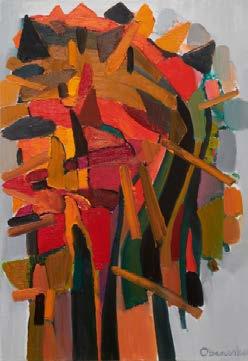
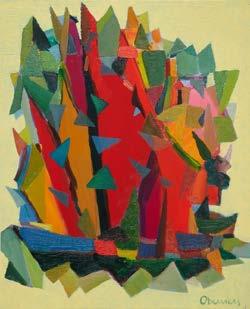
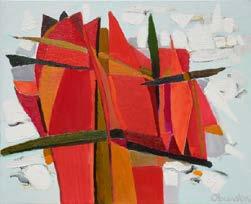
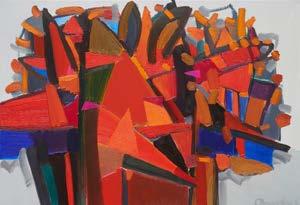
Antanas Obcarskas, born in 1958 in Zapyškis, Lithuania, has carved a distinctive path in contemporary art, balancing the tension between abstraction and figuration. Educated at Kaunas Four-Year Children’s Art School, Kaunas S. Žukas Applied Art College, and later the Vilnius State Art Institute, Obcarskas emerged in the early 1980s as part of a new generation of Lithuanian artists eager to redefine visual language in a shifting cultural landscape.
His early works reveal a fascination with bold contrasts, textured surfaces, and expressive color fields, reflecting both the influence of modernist traditions and the restless search for new forms. By the 1990s, Obcarskas had established himself as a painter of international reach, exhibiting across Europe in Germany, the Netherlands, Portugal, and Poland. His canvases, often monumental in scale, invite viewers into meditative spaces where silence and intensity coexist.
Since 2004, Obcarskas has pursued a minimalist direction, creating large-format compositions that emphasize spatial tension and chromatic purity. These works, stripped of narrative, resonate with a Zen-like clarity, embodying his belief in painting as a field of contemplation. Yet his practice extends beyond the canvas: installations, video art, photography, and Fluxus-inspired actions—such as Air from Kaunas in Warsaw—demonstrate his openness to conceptual experimentation and performance.
Obcarskas’ works are housed in major collections, including the Lithuanian Art Museum, the
Antanas Obcarskas: Between Abstraction and Silence
National M.K. Čiurlionis Art Museum, and institutions in Germany, alongside numerous private collections worldwide. His membership in the Lithuanian Artists’ Association, the avant-garde group Angis, and the German Artists’ Union “Focus Europa” underscores his role as both a national and international figure.
Notable pieces such as Sapnas (Dream, 1992), Juodoji poema apie iliuzijų praradimą (Black Poem on the Loss of Illusions, 2004), and the Akriliniai rašmenys series (2012–2013) reveal his evolving dialogue with memory, illusion, and the materiality of paint. Installations like Dangus (Sky, 1996) and Intervencija (Intervention, 2000) further highlight his conceptual reach.
Today, Obcarskas continues to teach at Kaunas A. Martinaitis Art School, nurturing younger generations while refining his own practice. His legacy lies in bridging Lithuanian modernism with contemporary experimentation, offering a body of work that is at once deeply rooted in Baltic sensibility and open to global currents.
Roy Espinosa
Plant bud - VIIl • Oil on Canvas • 116 x 81cm • 2021
Plant bud -XVII • Oil on Canvas • 100 x 81cm • 2021
Plant bud-V • Oil on canvas • 81 x 100cm • 2021
Plant Bud - XVI • Oil on Canvas • 81 x 116cm • 2021
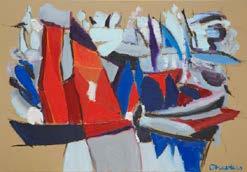
Red Sails • Oil on canvas • 116 x 81cm • 2021
DAFI Art Fest 2026: Celebrating Art, Community, and a New Chapter for Davao’s Visual Artists
by Wilfred Dexter Tanedo
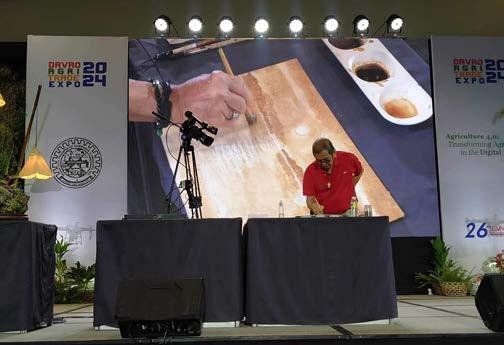
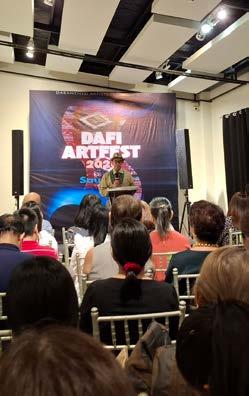
The DAFI Art Fest 2026: Saudade marked another milestone for the Dabawenyo Artists Federation, Inc. (DAFI), bringing together artists, galleries, collectors, and art enthusiasts in a four-day celebration of creativity at the La Herencia Davao Art & Events Pavilion from May 13–16, 2026. More than an exhibition, the festival reaffirmed DAFI’s commitment to strengthening the local visual arts community while introducing exciting new initiatives under the leadership of its newly elected officers headed by Datu Bago Awardee for Visual Arts, Lito Pepito.
One of the festival’s defining highlights was the launch of the first-ever DAFI Artists Coffee Table Book, a landmark publication featuring the works and stories of 48 DAFI artists. The book serves as a lasting document of the federation’s artistic journey and the remarkable diversity of its members—from established masters to emerging talents. More than a collection of artworks, it is a celebration of the people behind the creative spirit of Davao and a valuable contribution to the region’s visual arts history.
The annual art festival also showcased the strength of collaboration within the city’s thriving art scene. Fifteen participating art groups, galleries, and artist organizations came together under one roof, presenting an impressive range of paintings, sculptures, mixed media, watercolor, floral art, and contemporary
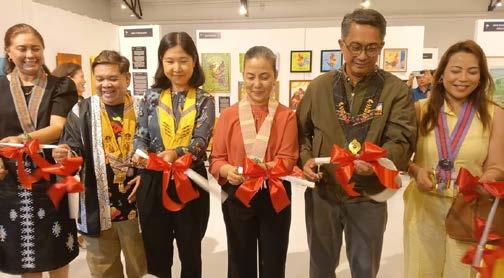
The Cutting of Ribbon with DOT Davao Regional Director, Tanya Rabat-Tan, Davao City Office for the Culture and The Arts, Oscar Casaysay, guests from the Chinese Consulate, MinDa Secretary Leo Tereso Magno as one of the many honored guests.
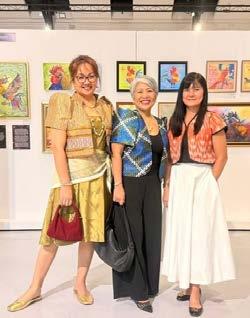
The Officers of DAFI, Aimee Suarez and Joy Mijares with DAFI ArtFest 2026 Curator, Dadai Joaquin and art works from the Davao BaiHinang Women Artists group.
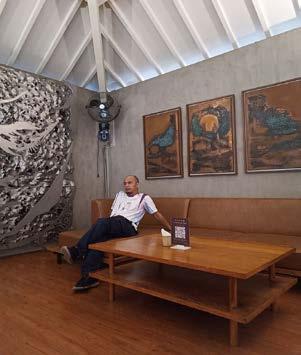
works. Participating groups included Artist Initiative, Art Pavilion, Bai Hinang, DavSur Art League, Davao Watercolor Society, Floral Artists of Davao, GAMA, Jing Rabat Art Gallery, Lakbay Diwa, La Herencia Davao Art Space, Obra Panaboeño, Piguras Contemporary, PintalSamal, Tabula Rasa, and TM Artists. Their collective participation reflected the growing unity and vibrant diversity of Davao’s visual arts community.
Adding excitement throughout the festival was the much-anticipated DAFI Art Raffle, where visitors and supporters had the opportunity to win original artworks generously donated by DAFI member artists. More than a fundraising activity, the raffle allowed collectors and first-time art buyers to bring home authentic pieces while directly supporting the federation’s programs and future projects. It also strengthened the connection between artists and the public, making original art more accessible to a wider audience.
As DAFI Art Fest continues to grow each year, the 2026 edition demonstrated that the federation is not only preserving the legacy of Davao’s artists but also creating new opportunities for collaboration, documentation, and public engagement. With the successful launch of its inaugural artists’ book, the participation of fifteen dynamic art groups, and the continued support of the community through initiatives like the Art Raffle, DAFI enters a promising new chapter—one led by a renewed vision, united leadership, and a shared passion for advancing the visual arts in Davao and beyond.
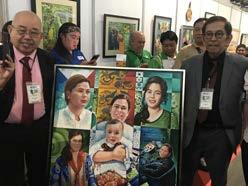
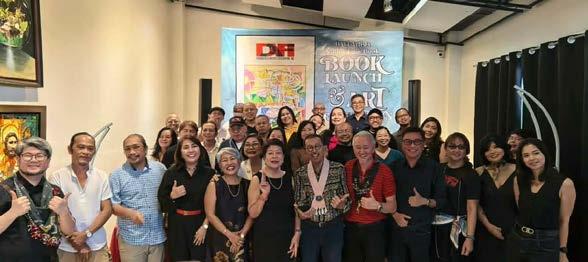
The DAFI Artist Coffee Table Book during the Book Launch on May 14, 2026 at the Foyer of La Herencia Davao with book publisher from FilArts, Roy Espinosa
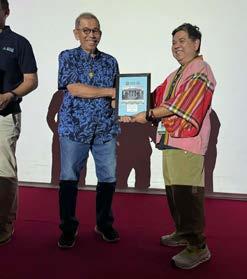
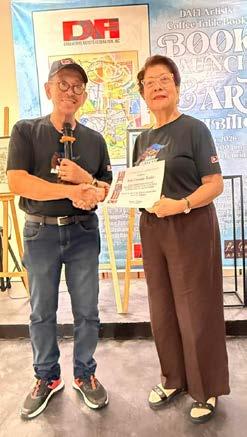
Current DAFI President Lito Pepito awards pioneering artist and former DAFI President Josie Tionko a Certificate of Appreciation in recognition of her continued support and invaluable contributions to the federation. Both are Datu Bago Awardees for Visual Arts, the highest honor bestowed by the Davao City Government upon a Dabawenyo for outstanding achievements that shaped the city.
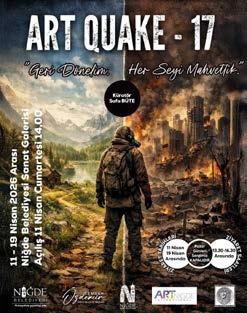
Art-Quake-17 International Group Exhibition and Niğde city located in Cappadocia
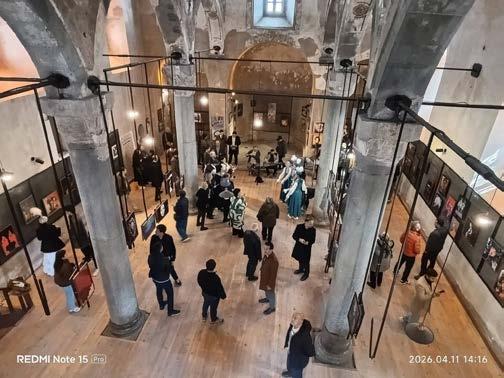
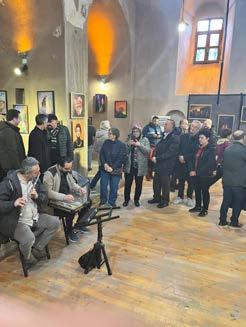
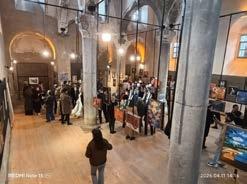
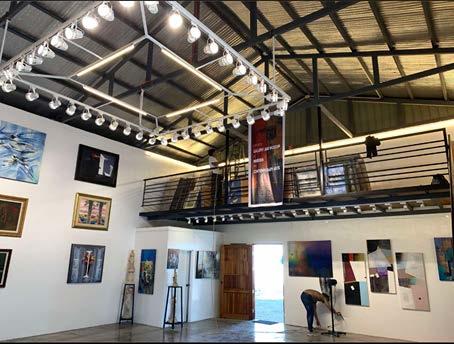
The international painting exhibition Art-Quake-17, themed ‘HUMANITY WAKE UP and RETURN BACK TO THE BEGINNING’ curated by artist Safa Büte and organized by Art Niğde International, featuring 103 works by 78 artists from 28 countries, opened with a magnificent ceremony on Saturday April 11, 2026, to art lovers from Niğde and abroad.
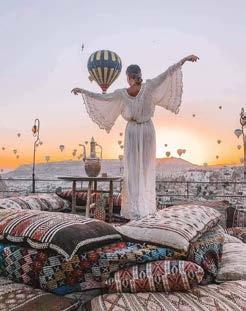
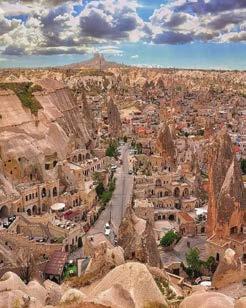
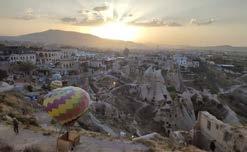
Niğde, known as the gateway to Cappadocia and steeped in history, a small but ancient city with deep historical roots, a center of Ottoman and Seljuk architecture and medieval Christianity, is making a name for itself in the art world with such artistic events.
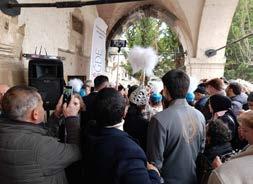
The foreign artists who came to Niğde for the exhibition, after the opening of the art exhibition, spent their time in the best way possible by visiting the Smiling Virgin Mary fresco in Gümüşler Monastery, which is unique in the world, and the Tomb of the Virgin Mary in the center of Niğde.
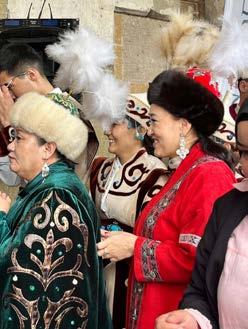
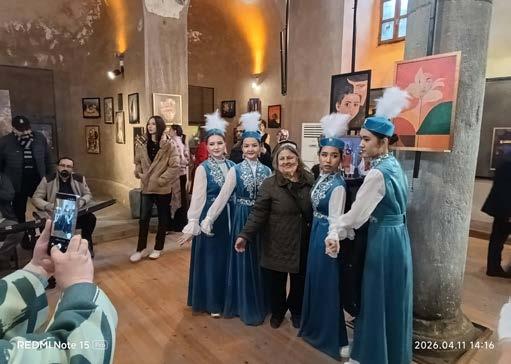
The group from Kazakhstan, who came to Turkey for the Nevruz celebrations in Altay Village, where Kazakh Turks live in Niğde, also attended the exhibition opening. The Kazakh songs performed by the group added a special touch to the exhibition opening.
The promotion of the Art-Quake-18 international group exhibition, themed ‘NO TO WAR, YES FOR ART’ ‘KEEP YOUR DIRTY HANDS OFF OUR CHILDREN!’, to be held in September-October 2026, was also made, and registration of participating artists has begun.
THIS IS THE INFORMATION OF MY OTHER PROJECT IN NEXT COMING DAYS WILL BE REALIZED.
Art is truly, truly powerful. Pablo Picasso saw art not only as an aesthetic pursuit but also as a political weapon and a method of protest.
That's very true. If we can use art as a political weapon, the real wars where children and innocent
people are killed, and animals and nature are slaughtered, can come to an end.
Therefore, artists' hearts must beat together, their breaths must be taken together, and they must react to and protest the inhumane events they see and experience. These protests should be combined with street demonstrations and resistance, and the artistic version of these resistances should take root in every field through unity and solidarity.
The artist is the one who resists!!! The artist is the one who knows and uses the power of art best. The artist is the one who conveys what they want to say not so much with their words, but with their brush on the canvas. This means that the works they produce in the name of resistance and opposition will not only be a source of inspiration for future generations, but will also equip them with the knowledge on how to act if they experience the same things in the future. Anything can happen, and when the masks fall from people's faces, it may be too late.
An artist; Painting, sculpture, photography, music, etc., whatever art form one engages in; that is their political weapon.
Unfortunately, the world order, morality, goodwill, freedoms, bread, and, even worse, a large part of art and artists have become playthings in the hands of evil men. As of now, it is not morally acceptable for artists to produce works of art that adorn corners and walls.
Until we breathe in freedom, the innocent silence of the night, the scent of raindrops falling on warm earth, with love and hope, we must continue the struggle with our brushes, paints, colors, canvases, exhibitions, and artistic activities.
You can be sure that achieving all this without highlighting differences such as religion, language, or race will be one of the most powerful blows to be dealt to global gangs.
What I ask of you, the world's artists, is this: whatever art form you engage in... Let the painter, with his painting, the musician with his musical notes, the photographer with his photographs, etc., work to expose these immoral people, these pedophilic perverts, those who try to destroy living beings that have a right to live on this earth, and the politicians of their own or other countries who support them. Let them share this on their own page and on social media for at least ten days, starting on the date we previously specified. Also, let them share these posts, that is, the posts of other artists. If we can do this, we will be able to create great awareness. Furthermore, we will have turned the barrel of the gun that this global gang has pointed at us back on themselves.
And then?
Believe me, in seconds, an innocent child, emaciated from malnutrition, who has lost his mother and father in treacherous wars, will pull that trigger!!!
With greetings and prayers,
Safa Büte Curator & President of Art Niğde International
The Museum and Gallery of Modern and Contemporary Art
The Museum and Gallery
Is dedicated to collecting, preserving, and interpreting developments in the late 19th century to post-World War II art through 1970’s (Modern Art) and 1970’s to the present (Contemporary Art) in all media and creating a welcoming environment for its public appreciation. The Museum promote understanding and interest in art and artists through art shows and exhibitions, curatorial research and publications, and a variety of educational programs, including lectures, guided tours, and workshops.
The Museum is an organic, changing place. Although all the works seen are part of our permanent collection, in order to show the full range of our holdings - over 2,000 objets d’art - and to accommodate important temporary exhibitions, certain works must occasionally be taken off view.
Modern Art
Modern Art includes artistic work produced during the period extending roughly from the 1860s to the 1970s, and denotes the styles and philosophy of the art produced during that era. The term is usually associated with art in which the traditions of the past have been thrown aside in a spirit of experimentation. More recent artistic production is often called contemporary art or postmodern art.
Contemporary Art
Contemporary Art is the art of today, produced in the second half of the 20th century or in the 21st century. Contemporary artists work in a globally influenced, culturally diverse, and technologically advancing world. Some define contemporary art as art produced within “our lifetime”.
Free Admission
Come Visit Us by Appointment
Mon - Fri: 10am - 4pm Sat, Sun and Holidays: Closed
Moncada - Alcala - Bayambang National Road (Arboleda Street) San Pedro Ili, Pangasinan, Philippines
museumgallery.ph@gmail.com
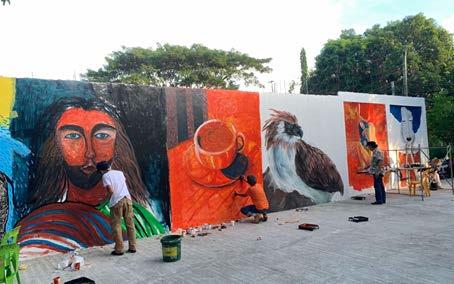
Delegates of Freedom and Love event who participated in the mural making in the wall of the museum.
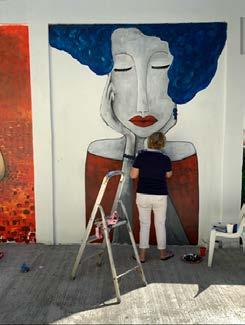
French artist Salette Viana Le Cornet doing her mural
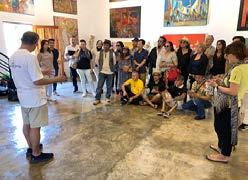
Ray “ Beng “ Duque discussing to the Freedom and Love delegates about the museum.
B
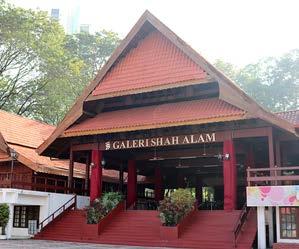
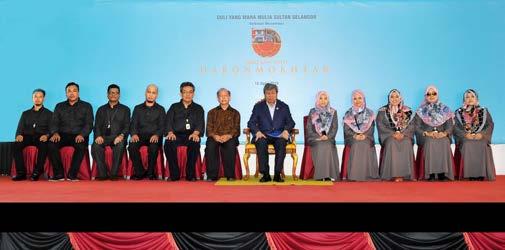
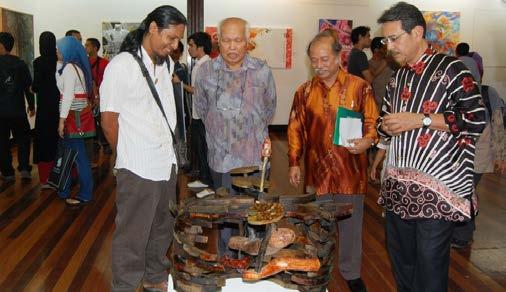
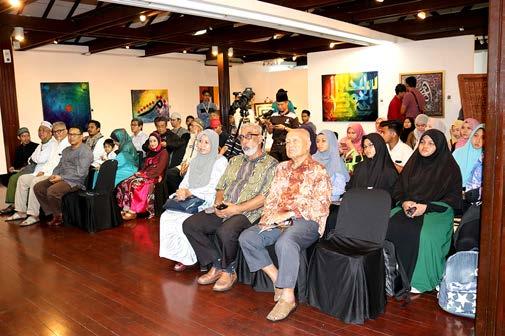
Galeri Shah Alam was founded under the management of Selangor Darul Ehsan Art Foundation on 26th January 1991 and was perfectly officiated by Duli Yang Maha Mulia Sultan Salahuddin Abdul Aziz Shah on 6th July 1991.
Selangor Darul Ehsan Art Foundation was inspired by Duli Yang Maha Mulia Sultan Sharafuddin Idris Shah Alhaj Ibni Almarhum Sultan Salahuddin Abdul Aziz Shah Alhaj when he was the Duli Yang Teramat Mulia Raja Muda Selangor, where he himself has deep interest and fond of painting.
To realize the inspiration, a discussion between Duli Yang Teramat Mulia Raja Muda Selangor, YM Raja Zahabuddin Raja Yaacob (Prof. Dato’), Syed Ahmad Jamal (Datuk), Tuan Haji Mohd. Musa Ideris and Encik Kassim (Dato’ Dr.), the expert in paintings and design, museum and law was done in order to help implement Duli Yang Teramat Mulia Raja Muda Selangor’s inspiration, in planning the outline of Galeri Shah Alam function and establishment under Selangor Darul Ehsan Art Foundation .
This former Selangor’s Cultural and Tourism Office building with a traditional Malay design, was designed by Puan Maimunah Deraman in the early 1980s. Then, Shah Alam City Council renovated the building to facilitate the art activities in Galeri Shah Alam.
Other than that, the building was designed with traditional Malay design and carving precisely demonstrated Galeri Shah Alam foundation objectives. Therefore, it was in line with the efforts made to the awareness, understanding, and appreciation toward art and integration of plural society in Selangor to popularize the nation’s visual and liberal art.
Galeri Shah Alam as an art centre and tourism attraction in the Klang Valley, is located in the middle of Shah Alam city core. The beautiful building with exquisite traditional Malay art and design surrounded by the lake and recreational park added the ‘art’ value. Besides the peaceful and cosy atmosphere, it can attract more people to visit Galeri Shah Alam.
The logo was inspired from a combination of soft elements of metaphoric and typography. The logo was made from a combination of the letters “SS” which means ‘Seni Selangor’, invented in abstract formation to highlight the art and aesthetic features. It also mirrors the functions and roles of Selangor Art Foundation in encouraging the visual and liberal art development.
To specifically make Shah Alam as an Art City to popularize the nation’s visual and liberal art. To be the driving force of visual art and development activity, also variety of liberal art studies especially in Selangor and Malaysia in general.
To be the art reference for students of school, public and private institutions of higher education, and also to share experiences with the art activists especially the young generations.
To be the centre of exhibition for the painters and designers, besides as the tourism attraction.
To be the art heritage centre for the future generations.
To develop appreciation of cultural art through exhibition, poetry reading, discussion and more.
Centre His Royal Highness Sultan Sharafuddin Idris Shah Ibni Almarhum Sultan Salahuddin Abdul Aziz Shah Sultan Of Selangor. (Chairman of Galeri Shah Alam) Sit from right of Sultan Prof. Raja Dato’ Zahabuddin Raja Yaacob (Board of Trustee) Ibrahim Bujal (retire), Iszuan Ismail, Khairulsani Ismail, Noor Mohd Ariff Hashim, and M.Hilmi Abd. Halim. Sit from left of Sultan Siti Nurani Adenan, Ratna Astuti, Nur Syafiqah Zainal, Shafinaz Ismail and Kamariah Mohammad.
Roles of the Galeri Shah Alam
• To Establish the Gallery Permanent Collection
To acquire visual art works (drawings, paintings, sketches, sculptures, textile photography and others) from nation’s renowned artists from the early days until now as the permanent collections. The acquisition of foreign works is also made to enhance the Gallery collections.
• To Organize Exhibition
Organizing periodical exhibition by inviting nation’s artists either solo or in groups. Exhibitions by foreign artists and art institutions also being held especially to
give chances to the local community to evaluate and as a reference on art development globally.
• To Organize Competition
Art, photography and print art graphic competitions at school, institutions of higher education, district, state and national level are always held as one of the ways to develop skill and new talents in visual art.
• Art Education
Programs like painting class, sculpture, print, textile and photography for children, teenagers and adults are held in line with main role of Galeri Shah Alam in its effort to provide art education to those who are interested.
• Research and Reference
Provides reference materials for research such as books, magazines, exhibition catalogs, photos and slides, brochures related to local and foreign local art.
• Collaboration Programs
Organize collaboration programs with National Art Gallery, National Museum, State Art Museum, local art galleries, local and foreign art institutions, government and private departments, local and foreign institutions of higher education and also foreign countries to ensure art programs can be done successfully.
Clients Charter
Always ready to entertain, assist and give information to the artists, painters, art activists and art lovers.
Islamic Art Exhibition, Khat Caligraphy 2018.
To give feedback to enquiries regarding the collections and collections information within seven (7) working days.
Always alert to the appropriateness of the needs to exhibit.
To organize Galeri Shah Alam Open Exhibition as a permanent annual activity.
Besides additional programs such as drawing competitions, workshops, drawing classes, related seminars, symposiums, conferences, talks and talk shows also take place.
Please follow us at: www.galerishahalam.com for any info about Malaysia Art scene
Print making art activity by Faizal Suhif (Artist print maker and he is artist residency 2011)
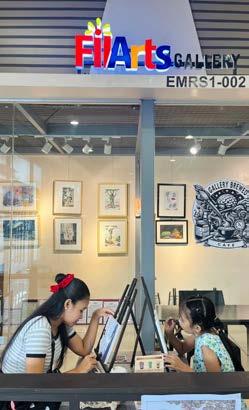
Where Art and Coffee Craft a Creative Haven Gallery Brewed Cafe:
H
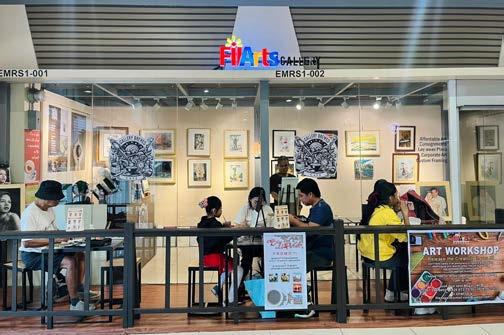
idden within the vibrant heart of Robinsons Novaliches lies a gem where creativity meets caffeine— the Gallery Brewed Cafe by FilArts. This isn’t just another coffee shop; it’s an artistic haven for those who yearn to stir their imaginations while sipping on a finely brewed cup of coffee.
Walking into the Gallery Brewed Cafe, you’re immediately greeted by an atmosphere that exudes warmth and creativity. The aroma of freshly brewed coffee mingles with the subtle scents of acrylics and canvases, forming a unique olfactory symphony. The interior is a feast for the eyes, with walls adorned with vibrant artworks, all curated to inspire and provoke thought. Every corner of the cafe tells a story, each brushstroke a testament to the boundless creativity of local artists.
But Gallery Brewed Cafe isn’t content with merely displaying art; it’s a hub for fostering creativity
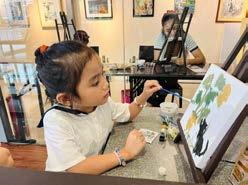
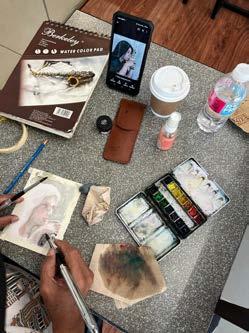
within the community. For those who’ve always wanted to try their hand at painting, the cafe offers art workshops. These sessions are more than just a chance to learn how to paint; they’re a journey into the heart of artistic expression. Whether you’re a beginner looking to explore your creative side or an experienced artist seeking new inspiration, these workshops cater to all skill levels. Experienced instructors guide participants through the fundamentals of painting, from understanding color theory to mastering brush techniques. Each session is designed to be both educational and therapeutic, providing a perfect escape from the hustle and bustle of daily life.
The cafe’s commitment to art and creativity extends beyond its walls. By collaborating with local artists and hosting regular exhibitions, Gallery Brewed Cafe serves as a platform for emerging talents. This collaboration not only gives artists a space to showcase their work but also enriches the community
by making art accessible to everyone. It’s a space where conversations flow as freely as the coffee, sparking connections between like-minded individuals and fostering a sense of camaraderie.
Of course, the coffee itself is nothing short of exceptional. The cafe takes pride in its carefully curated menu, featuring a selection of beans sourced from the best coffee-growing regions. Each cup is brewed to perfection, with baristas who are as passionate about coffee as the artists are about their craft. From rich, velvety espressos to creamy lattes with intricate latte art, there’s something to satisfy every coffee lover’s palate.
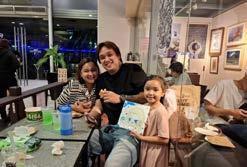
In essence, Gallery Brewed Cafe by FilArts is more than just a place to grab a coffee; it’s a sanctuary for creativity and a community hub. Here, art and coffee blend seamlessly, creating an environment where inspiration is served by the cup. So next time you find yourself at Robinsons Novaliches, take a moment to step into this artistic oasis and let your senses be invigorated.
—Ruth C. Espinosa
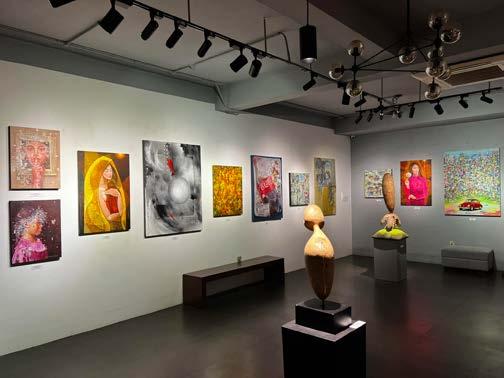
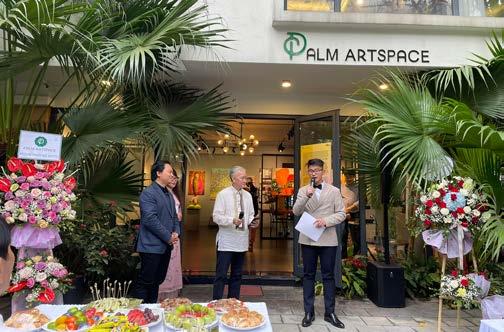
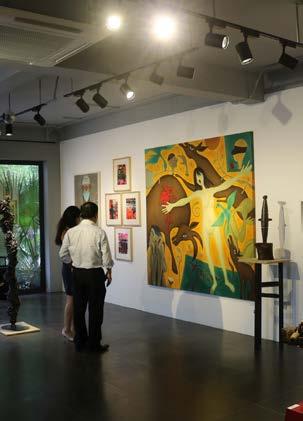
Palm Artspace is a contemporary art gallery devoted to cultivating a genuine appreciation and passion for both Vietnamese and international arts. Its vision embraces a wide spectrum of creativity, ranging from traditional works rooted in heritage to bold contemporary expressions that push boundaries. Established by Vietnamese visual artist Dang Tuan, the gallery is nestled in the midst of lush greenery, offering visitors not only an artistic experience but also a serene environment that enhances reflection and inspiration.
Beyond being a showcase for art, Palm Artspace serves as a dynamic cultural hub. It regularly conducts workshops designed for the young and the young at heart, encouraging creativity and hands-on engagement with artistic practices. The gallery has become home to diverse exhibitions, featuring both local and international artists whose works span painting, sculpture, and experimental media.
Its walls have been graced by the creations of emerging talents alongside established masters, making each exhibition a vibrant feast for the senses. Audiences from varied backgrounds flock to Palm Artspace, drawn by the promise of discovery and the opportunity to witness the evolving narrative of visual art. The gallery is particularly dedicated to presenting artists who have brought esteem to Vietnamese art, perfecting their skills in traditional media while also exploring new directions.
Palm Artspace provides fertile ground for experimentation, nurturing bold and innovative voices. “With Palm Artspace, we have given a space to artists who are bolder and more experimental in their creative pursuits. Their artistry could be described as contemporary, but we could refer to them as the ‘Millennials’ in Vietnamese art, ” reflects its mission.
Located at 188A Thao Nguyen Ecopark, Hung Yen, Vietnam, Palm Artspace continues to stand as a beacon of creativity, dialogue, and cultural exchange.
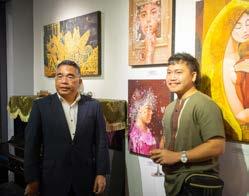
During the Vietnamese and Philippine Artists Show Beyond Expression 2023
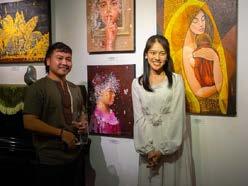
Phil. Ambassador to Hanoi Hon. Maynard Montealegre and Filipino Artist Lloyd Lusica