Whisky Age Statement Explained: What the Number on the Bottle Means
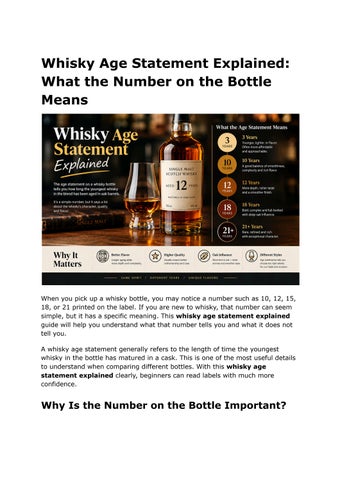
When you pick up a whisky bottle, you may notice a number such as 10, 12, 15, 18, or 21 printed on the label. If you are new to whisky, that number can seem simple, but it has a specific meaning. This whisky age statement explained guide will help you understand what that number tells you and what it does not tell you. A whisky age statement generally refers to the length of time the youngest whisky in the bottle has matured in a cask. This is one of the most useful details to understand when comparing different bottles. With this whisky age statement explained clearly, beginners can read labels with much more confidence.
Why Is the Number on the Bottle Important?
The number can provide useful information about the whisky's maturation history. A longer maturation period can influence flavor, texture, aroma, and character. However, age alone does not determine whether a whisky will match your personal taste. Cask type, climate, distillation methods, blending, and production style can also affect the final drink. This is why the whisky age statement explained should never be treated as simply “older equals better.” A younger whisky can have an appealing character, while an older whisky may offer a very different style.
What Is a Whisky Age Statement? A whisky age statement is a number displayed on a whisky label that indicates the minimum maturation period of the whisky. For example, a bottle marked “12 Years Old” contains whisky that has been matured for at least 12 years. This does not necessarily mean that every drop inside the bottle spent exactly 12 years in a cask. The whisky may contain older components, but the stated age generally represents the youngest whisky used. That basic point is central to any whisky age statement guide. When reading a label, always remember that the age number is not simply an indication of the average age. A useful whisky age statement guide should also explain that maturation takes place before bottling. Once whisky is bottled, it does not continue aging in the same way it does inside a wooden cask.
How Does Whisky Age in a Cask? Whisky matures while it rests in a wooden cask. During this period, the spirit interacts with the wood and gradually develops additional flavors and aromas. Depending on the cask and production style, maturation can contribute notes such as: ● ● ● ● ● ● ● ●
Vanilla Caramel Dried fruit Spice Oak Toasted wood Nuts Chocolate
This part of a whisky age statement guide is important because the number on the bottle does not describe flavor by itself. Two whiskies with the same age can taste noticeably different. For example, a 12-year-old whisky matured in one type of cask may have a different character from another 12-year-old whisky matured in another cask.
What Does “12 Years Old” Actually Mean? Suppose you see “12 Years Old” on a bottle. Under the relevant whisky age statement rules, the stated age refers to the youngest whisky included in the bottle. Imagine a whisky contains components that matured for 12, 15, and 18 years. The bottle can generally carry a 12-year age statement because the youngest component is 12 years old. This is one of the most important points in any whisky age statement explained discussion. The age number should therefore not be interpreted as an average. It represents the minimum age of the whisky used in the bottle under applicable whisky age statement rules.
Does Older Whisky Always Taste Better? Not necessarily. Age can influence whisky significantly, but it is not a universal quality score. A whisky that has spent decades in a cask can develop deep and complex flavors. At the same time, excessive interaction with wood can sometimes create a strong oak influence that may not suit every drinker. This is why a practical whisky age statement guide focuses on understanding rather than ranking bottles simply by age. When using whisky age statement rules to understand a label, think of the number as information about maturation rather than a guaranteed measure of quality.
What Happens After Whisky Is Bottled? One common beginner question is whether a 12-year-old whisky becomes a 13-year-old whisky after sitting unopened at home for another year.
No. The age statement relates to the time the whisky spent maturing in the cask. Once bottled, the maturation process essentially stops. Keeping the bottle for several years does not normally change its official age statement. This is another useful part of whisky age statement explained for anyone beginning to collect or explore whisky.
What Are the Main Whisky Age Statement Rules? The exact whisky age statement rules can vary depending on the whisky-producing country and applicable regulations. However, an important principle is that an age statement must accurately represent the relevant youngest whisky in the bottle. A good whisky age statement guide should encourage buyers to check the actual label rather than making assumptions from the brand name or packaging. The whisky age statement rules are designed to provide useful information to consumers, particularly when a bottle makes a specific age claim. Understanding these whisky age statement rules can make shopping much easier because you know what the printed number is intended to communicate.
What Is a No-Age-Statement Whisky? You may also encounter bottles without a numerical age statement. These are often described as NAS, meaning “No Age Statement.” A whisky without an age number is not automatically young or poor in quality. Producers may combine whiskies of different ages to create a particular flavor profile without highlighting a numerical age. A complete whisky age statement explained article should therefore include both age-stated and non-age-stated whiskies. If a bottle has no age statement, you can still learn about it by looking at information about its casks, production style, strength, and flavor profile.
Can Two Whiskies With the Same Age Taste Different?
Absolutely. Age is only one factor in whisky production. Consider two bottles that are both 12 years old. One could have strong vanilla and caramel notes from a particular cask, while another could have more fruit, spice, or oak character. A helpful whisky age statement guide therefore looks beyond the number. Other factors include: 1. Cask type 2. Cask history 3. Climate 4. Distillation style 5. Maturation conditions 6. Bottling strength 7. Blending choices These details explain why whisky age statement explained should not be reduced to a simple comparison of numbers.
How Should Beginners Read an Age Statement? Start by identifying the number on the bottle. Then ask what that number represents. For example: 10 Years Old: The youngest whisky in the bottle has matured for at least 10 years. 15 Years Old: The youngest whisky has matured for at least 15 years. 18 Years Old: The youngest whisky has matured for at least 18 years. This simple approach makes whisky age statement explained much easier to understand. Next, look at the cask information, whisky type, alcohol strength, and tasting notes. Together, these details provide a much fuller picture.
Why Cask Type Matters Alongside Age The wooden cask plays a major role in maturation. Whisky may be matured in different types of casks, including those previously used for other beverages.
A whisky age statement guide should always encourage readers to consider cask information alongside the age number. For example, two whiskies of the same age can develop different characteristics because their casks interact with the spirit differently. This is why whisky age statement explained is really about understanding the relationship between time, wood, and whisky.
How Can You Use the Age Statement When Shopping? When comparing bottles, use the age statement as one helpful reference point rather than the only deciding factor. Check: ● ● ● ● ● ● ●
The stated age Cask information Whisky style Alcohol percentage Tasting notes Producer information Bottle size
Following a practical whisky age statement guide can help beginners avoid assuming that the highest number automatically means the right bottle for them. It is also useful to remember that whisky age statement rules concern labeling information, not personal taste.
FAQ What does the number on a whisky bottle mean? The number generally indicates the minimum age of the youngest whisky in the bottle. It refers to time spent maturing in a cask.
Does a 12-year-old whisky contain only 12-year-old whisky? Not necessarily. It can contain older whisky too, but the stated age generally reflects the youngest whisky included.
Does whisky keep aging after bottling?
No. Whisky's official age relates to its maturation in the cask, not the amount of time it spends inside a glass bottle.
Is older whisky always better? No. Age can influence flavor and character, but cask type, production style, and personal preference also matter.
What are whisky age statement rules? Whisky age statement rules are labeling requirements that govern how age information is represented on whisky bottles. The specific requirements depend on the relevant jurisdiction and whisky category.
What is a whisky age statement guide useful for? A whisky age statement guide helps beginners understand what bottle numbers mean and how age relates to maturation and flavor.
What does NAS mean on whisky? NAS means “No Age Statement.” It indicates that the bottle does not display a numerical age statement.
Why can two whiskies of the same age taste different? Different casks, production methods, maturation environments, and blending choices can create very different flavors even when the stated age is identical.