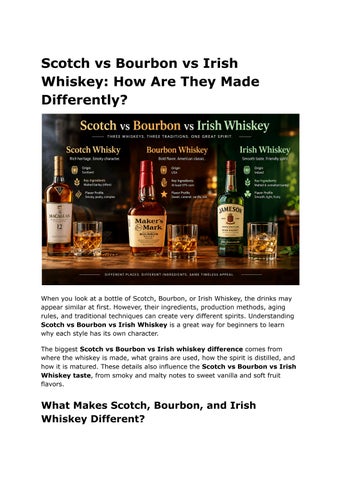
Scotch vs Bourbon vs Irish Whiskey: How Are They Made Differently?
When you look at a bottle of Scotch, Bourbon, or Irish Whiskey, the drinks may appear similar at first. However, their ingredients, production methods, aging rules, and traditional techniques can create very different spirits. Understanding Scotch vs Bourbon vs Irish Whiskey is a great way for beginners to learn why each style has its own character. The biggest Scotch vs Bourbon vs Irish whiskey difference comes from where the whiskey is made, what grains are used, how the spirit is distilled, and how it is matured. These details also influence the Scotch vs Bourbon vs Irish Whiskey taste, from smoky and malty notes to sweet vanilla and soft fruit flavors.
What Makes Scotch, Bourbon, and Irish Whiskey Different?
The Scotch vs Bourbon vs Irish whiskey comparison begins with geography. Scotch must be produced in Scotland, Bourbon is an American whiskey style, and Irish Whiskey is produced on the island of Ireland under its applicable production requirements. Another important Scotch vs Bourbon vs Irish whiskey difference is the main grain. Scotch can be made from malted barley or a mixture of grains, depending on the type. Bourbon must use a mash bill containing at least 51% corn. Irish Whiskey can use different grains, with malted and unmalted barley playing an important role in many traditional styles. These ingredients contribute significantly to the Scotch vs Bourbon vs Irish Whiskey taste. Corn often gives Bourbon a naturally sweet character, while malted barley can create rich, cereal, fruity, or roasted notes in Scotch and Irish Whiskey.
How Is Scotch Whisky Made? The production of Scotch is an important part of the Scotch vs Bourbon vs Irish Whiskey discussion. For single malt Scotch, malted barley is combined with water and heated during mashing. The resulting liquid, called wort, is fermented with yeast. Fermentation creates a beer-like liquid. It is then distilled, usually in copper pot stills for single malt Scotch. The shape and size of these stills can influence the character of the finished spirit. A major Scotch vs Bourbon vs Irish whiskey difference can be seen in the use of peat. Some Scotch producers dry malted barley using peat smoke. This can introduce smoky, earthy, medicinal, or campfire-like aromas. After distillation, Scotch is matured in oak casks for at least three years. Many Scotch whiskies spend much longer in barrels, allowing flavors to develop gradually. The Scotch vs Bourbon vs Irish Whiskey taste can therefore range from light and floral to rich, fruity, spicy, or heavily smoky depending on the distillery, grain, cask, and production choices.
How Is Bourbon Made? Bourbon brings a different approach to the Scotch vs Bourbon vs Irish Whiskey comparison. Its mash must contain at least 51% corn, while the remaining grains can include rye, wheat, and malted barley.
The grains are cooked with water before fermentation. Yeast is added, allowing the sugars available in the mash to ferment. The fermented liquid is then distilled. One clear Scotch vs Bourbon vs Irish whiskey difference is the way Bourbon is matured. Bourbon must be aged in new, charred oak containers. This fresh oak contributes strong flavors such as vanilla, caramel, toasted wood, and baking spices. The charred barrel is especially important to the Scotch vs Bourbon vs Irish Whiskey taste. As Bourbon matures, the spirit interacts with the oak, developing a rich and often sweet profile. Bourbon production can also use different mash bills. A Bourbon with more rye may taste spicier, while one made with more wheat can have a softer and sweeter character.
How Is Irish Whiskey Made? Irish Whiskey adds another layer to the Scotch vs Bourbon vs Irish Whiskey comparison. Depending on the style, producers may use malted barley, unmalted barley, corn, wheat, or other permitted grains. The grains are mashed with water and fermented using yeast. Irish Whiskey may be distilled in pot stills or column stills, depending on the category and producer. Triple distillation is strongly associated with Irish Whiskey, although it is not universal. This is another interesting Scotch vs Bourbon vs Irish whiskey difference because Scotch and Bourbon commonly follow different distillation traditions. Irish Whiskey is generally matured in wooden casks for at least three years. Producers may use previously filled Bourbon barrels, sherry casks, wine casks, and other types of wood to develop additional flavors. These choices help shape the Scotch vs Bourbon vs Irish Whiskey taste. Irish Whiskey is often associated with smooth, fruity, creamy, honeyed, or lightly spicy notes, although individual bottles can vary considerably.
Does Distillation Change the Flavor? Yes. Distillation is an important part of the Scotch vs Bourbon vs Irish Whiskey comparison because it helps determine which flavors remain in the spirit.
Pot stills are traditionally associated with rich and characterful spirits, while column stills can produce lighter and more consistent spirits. The number of distillations can also affect the final character. This is another Scotch vs Bourbon vs Irish whiskey difference worth remembering. Scotch, Bourbon, and Irish Whiskey do not all follow one universal distillation method. For beginners exploring Scotch vs Bourbon vs Irish Whiskey, it helps to think of distillation as a filtering and concentrating stage. The producer controls the character of the spirit by choosing equipment, distillation strength, and the parts of the distillate that are retained.
Why Does Aging Matter So Much? Aging is one of the most noticeable factors in the Scotch vs Bourbon vs Irish Whiskey comparison. Whiskey changes as it rests in oak. The spirit extracts compounds from the wood while also undergoing gradual chemical changes. Bourbon's use of new charred oak creates a distinctive Scotch vs Bourbon vs Irish Whiskey taste, often bringing vanilla, caramel, toasted sugar, and oak flavors. Scotch frequently uses previously used casks, including Bourbon and sherry casks. Irish Whiskey can also mature in a variety of previously used barrels. This creates another Scotch vs Bourbon vs Irish whiskey difference. Even when two whiskies begin with similar ingredients, different barrels can produce completely different results.
How Does the Production Process Affect Taste? The Scotch vs Bourbon vs Irish Whiskey taste is the result of many production decisions rather than one single ingredient. For Scotch, malted barley, peat, pot distillation, and cask selection can create flavors ranging from smoky to fruity. For Bourbon, corn, fermentation, distillation, and new charred oak commonly contribute sweetness and rich oak character. Irish Whiskey can combine different grains, distillation styles, and cask types for a broad range of flavors. When studying Scotch vs Bourbon vs Irish Whiskey, remember that not every bottle tastes exactly like the general category. A lightly matured Bourbon
can differ from a heavily oaked Bourbon, just as a peated Scotch can taste very different from an unpeated Scotch.
Scotch vs Bourbon vs Irish Whiskey: What Is the Production Difference? The main Scotch vs Bourbon vs Irish whiskey difference can be simplified into several production stages: ● Scotch: Often uses malted barley, may use peat, and is commonly distilled in copper pot stills for single malt. ● Bourbon: Must contain at least 51% corn and is matured in new, charred oak. ● Irish Whiskey: Can use several grains and may be distilled using pot stills, column stills, or both. ● Scotch: Must mature for at least three years in oak casks. ● Bourbon: Gains much of its character from new charred oak. ● Irish Whiskey: Must mature for at least three years and can use different cask types. These production rules explain much of the Scotch vs Bourbon vs Irish Whiskey taste difference.
What Should Beginners Notice First? When exploring Scotch vs Bourbon vs Irish Whiskey, start by paying attention to sweetness, smoke, fruit, spice, oak, and mouthfeel. If a Scotch has been made using peated malt, smoke may be one of its most noticeable characteristics. Bourbon often highlights sweet corn, vanilla, caramel, and oak. Irish Whiskey can offer approachable fruit, honey, grain, spice, or creamy notes. The Scotch vs Bourbon vs Irish whiskey difference becomes easier to understand when you taste the whiskies side by side rather than relying only on descriptions. The Scotch vs Bourbon vs Irish Whiskey taste can change significantly according to age, cask history, grain recipe, distillation method, and producer. That variety is part of what makes comparing these three whiskey traditions interesting.
FAQ
What is the main Scotch vs Bourbon vs Irish whiskey difference? The biggest differences involve production location, grain recipes, distillation methods, and maturation requirements. Bourbon must contain at least 51% corn and use new charred oak.
Which grains are used in Scotch? Scotch can use malted barley, or other grains depending on the category. Single malt Scotch is made from malted barley at one distillery.
What grain makes Bourbon different? Bourbon must contain at least 51% corn in its mash bill. Other grains such as rye, wheat, and malted barley can make up the remaining portion.
Is Irish Whiskey always triple distilled? No. Triple distillation is common in Irish Whiskey production, but it is not a universal requirement. Producers can use different distillation approaches.
What creates the Scotch vs Bourbon vs Irish Whiskey taste? Flavor comes from grains, fermentation, distillation, maturation, cask type, and production choices. Peat can also strongly influence some Scotch whiskies.
Why does Bourbon taste sweet? Corn contributes to Bourbon's flavor profile, while new charred oak can add vanilla, caramel, toasted, and sweet spice notes during maturation.
Can Scotch taste smoky? Yes. Some Scotch is made using peat-smoked malted barley, which can create smoky, earthy, medicinal, or campfire-like flavors.
Is Irish Whiskey smoother than other whiskey? Some Irish Whiskeys are known for soft and approachable profiles, but smoothness depends on the specific whiskey, production method, alcohol strength, and maturation.
Does aging always make whiskey better?
Older whiskey is not automatically better. Aging changes flavor and texture, but the ideal balance depends on the spirit, cask, maturation conditions, and individual preference.
How can I understand Scotch vs Bourbon vs Irish Whiskey? Trying examples from each category side by side can help. Compare their aroma, sweetness, spice, smoke, fruit, oak, texture, and finish.