ROYAL REHAB PRIVATE & METROREHAB NEWSLETTER » ISSUE 2 » DEC 2020
Rehab Matters at Royal Rehab Private
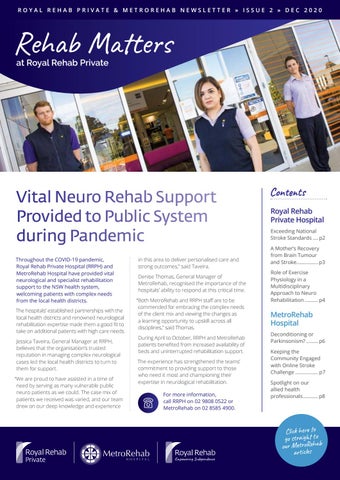
Vital Neuro Rehab Support Provided to Public System during Pandemic Throughout the COVID-19 pandemic, Royal Rehab Private Hospital (RRPH) and MetroRehab Hospital have provided vital neurological and specialist rehabilitation support to the NSW health system, welcoming patients with complex needs from the local health districts. The hospitals’ established partnerships with the local health districts and renowned neurological rehabilitation expertise made them a good fit to take on additional patients with high care needs. Jessica Taveira, General Manager at RRPH, believes that the organisation’s trusted reputation in managing complex neurological cases led the local health districts to turn to them for support. “We are proud to have assisted in a time of need by serving as many vulnerable public neuro patients as we could. The case mix of patients we received was varied, and our team drew on our deep knowledge and experience
in this area to deliver personalised care and strong outcomes,” said Taveira. Denise Thomas, General Manager of MetroRehab, recognised the importance of the hospitals’ ability to respond at this critical time. “Both MetroRehab and RRPH staff are to be commended for embracing the complex needs of the client mix and viewing the changes as a learning opportunity to upskill across all disciplines,” said Thomas. During April to October, RRPH and MetroRehab patients benefited from increased availability of beds and uninterrupted rehabilitation support. The experience has strengthened the teams’ commitment to providing support to those who need it most and championing their expertise in neurological rehabilitation. For more information, call RRPH on 02 9808 0522 or MetroRehab on 02 8585 4900.
Empowering Independence
Contents Royal Rehab Private Hospital Exceeding National Stroke Standards..... p2 A Mother’s Recovery from Brain Tumour and Stroke................. p3 Role of Exercise Physiology in a Multidisciplinary Approach to Neuro Rehabilitation........... p4
MetroRehab Hospital Deconditioning or Parkinsonism?.......... p6 Keeping the Community Engaged with Online Stroke Challenge.................. p7 Spotlight on our allied health professionals............ p8
Click here to go straight to our MetroRehab articles
A Message from our GM Welcome to the second issue of Rehab Matters — the combined newsletter of Royal Rehab Private Hospital (RRPH) and MetroRehab Hospital designed to keep specialists and GPs up to date on the latest in rehabilitation medicine. RRPH is an independently owned physical rehabilitation facility specialising in neurological conditions (such as stroke, multiple sclerosis, and Parkinson’s disease), orthopedic rehabilitation, multidisciplinary reconditioning, and post-operative care. We operate as part of Royal Rehab — a leading notfor-profit provider of rehabilitation and disability support services with over 120 years’ experience. Throughout this challenging time of the COVID-19 pandemic, RRPH has remained committed to ensuring our inpatient and day rehab services remain available to clients with safe measures in place that adhere with the guidelines of NSW Health. Not only has RRPH remained COVID-19 free, but also welcomed patients from the public system to benefit from our neurological expertise. We are committed to supporting the new case mix of clients with continuity of care and determined to ensure everyone is able to access our services. Feel free to contact us regarding referrals or if we can be of any assistance with your patients’ physical rehabilitation needs.
Jessica Taveira General Manager Inpatient Services and Director of Nursing at RRPH
Exceeding National Stroke Standards Royal Rehab Private Hospital (RRPH) took part in the 2019 National Stroke Audit, an initiative led by the Stroke Foundation to capture the current state of play in stroke care and review best practice guidelines. It explored all facets of stroke care within our health system to ensure all patients are adequately cared for. RRPH is proud to not only meet the standards outlined in the 2019 National Stroke Audit, but in many cases, exceed them.
Audit recommendation: Stroke rehabilitation services should be available to patients seven days a week.
RRPH offers physical
rehabilitation therapy seven days a week. RRPH not only meets this target but by the end of 2020 is set to exceed it by increasing our offering with the addition of occupational therapy services on weekends.
Audit recommendation: The psychological needs of all patients should be assessed and appropriate support should be provided during and after inpatient rehabilitation.
RRPH meets this requirement by providing all clients with access to a dedicated clinical psychologist. RRPH also provides patients access to neuropsychologists, who ensure our work extends beyond the physical deficits experienced post-stroke.
Audit recommendation: Patients should have easy and regular access to a postdischarge centre and communitybased rehabilitation services.
RRPH clients have access to Day
Rehab including our sexuality clinic, hydrotherapy and a driver assessment program, as well as a series of other post-discharge rehabilitation options.
Audit recommendation: All staff within rehabilitation services need to receive ongoing, stroke-specific education and training.
RRPH prides itself on providing our
staff with access to training and education within all facets of the rehabilitation space. Recently, our inpatient staff members undertook specialist training in sexual health, reproduction and carer support to assist clients in intimacy matters after stroke. Phone us on 02 9808 0522 for all enquiries about our stroke rehab services.
It was difficult for her to understand others and communicate basic messages. She required full assistance from the nursing team for her personal care and her mental state at the time also made it challenging for her to participate in therapy. For the last three months, Maxine has participated in daily physiotherapy, speech therapy and occupational therapy sessions. She was also supported by clinical psychologists and psychiatrists to help manage her mental health.
Maxine has made considerable gains, is now able to communicate at a reasonable level, understand conversations, walk with assistance, and is building the strength needed to return home.
A Mother’s Recovery from Brain Tumour and Stroke Maxine and Marcus were expecting their second child, due in February 2020. Six months into her pregnancy, Maxine started suffering from terrible headaches. The headaches became so painful that she required a brain scan. At 39 years old, she was diagnosed with meningioma. The pain and side effects from the tumour worsened later into the pregnancy. After the birth of their baby girl, the side effects of Maxine’s tumour continued to increase, and it was determined that the planned surgery to remove the tumour needed to be done as soon as possible. The situation was further complicated when Maxine suffered a left-sided stroke shortly after the operation, which caused partial paralysis on the right side of her body. Following the operation, she was placed in ICU for two weeks.
When Maxine came out of the ICU, her movement, cognition, speech and mood were all severely affected. “It was unclear whether Maxine would require further surgery due to severe swelling of the brain. We worried about whether she was going to recover from the surgery at all. It was an extremely tough time for our family,” said Marcus.
Maxine’s role as a mother is very important to her. She practices feeding, dressing, talking and singing nursery rhymes to her daughter during the frequent visits from Marcus and her 10 year-old son. Maxine’s significant process has lead the RRPH team to start arranging with her family and the NDIS for her to slowly transition back home. She will start by going home for a few hours every day, while continuing to live at RRPH. This will then lead to a complete move back home where her family and carers will continue to support her. RRPH is providing support and guidance on how the family can alter their house to make it safe for Maxine.
Maxine was admitted to Royal Rehab Private Hospital (RRPH) in July where she received a personalised rehabilitation program designed by a team of multidisciplinary allied health professionals under the direction of a rehabilitation specialist.
“I cannot thank the staff at RRPH enough. All of them have gone above and beyond to help us through this process and work towards Maxine’s goal to return home to our children,” said Marcus.
At first, Maxine’s mobility was very limited — she had to use equipment to mobilise herself and required moderate assistance from two people.
For more information about RRPH’s brain tumour and stroke services phone 02 9808 0522.
235 Morrison Road, Ryde NSW 2112 02 9808 9222 | royalrehab.com.au Follow us on:
Role of Exercise Physiology in Multidisciplinary Approach to Neuro Rehabilitation It is estimated that up to one billion people worldwide are affected by neurological disorders such as stroke (CVA), Parkinson’s disease, cerebral palsy, multiple sclerosis, spinal cord injury, traumatic brain injury and dementia1. Once a patient is diagnosed with a neurological disorder, they will often be referred to a rehabilitation service to receive multidisciplinary care. The goal of neuro rehabilitation is to work with patients and empower them to reach an optimal level of function and regain their independence. As an exercise physiologist my work is centred on providing exercisebased interventions that help patients increase functional capacity and regain independence. These interventions are guided by evidence, look to safely 1
increase physical activity and support patients as they make lasting behaviour and lifestyle modifications.
» Increasing cardiovascular fitness and aerobic capacity » Improving gait and mobility
At Royal Rehab, I work closely with patients to help them achieve their goals. Much of this is focused on reducing the impact their neurological symptoms have on their independence and their ability to perform everyday activities.
Exercise has also been proven to facilitate neuroplastic change within the brain, which is crucial for any patient with a neurological disorder.
Through exercise, we look to improve function by focusing on different aspects of physical health and wellbeing. This helps to improve a range of neurological deficits that can occur. These include, but are not limited to: » Improving balance, coordination and proprioception (the sense of selfmovement and body position) » Increasing muscular strength and endurance
Working with neurological patients is very rewarding as you become involved in their progress. Seeing them regain control of their independence, helping them to achieve their goals and improve their function is truly inspiring. Luke Maddalena BExSc, MCEP, AEP is a Senior Exercise Physiologist and Day Rehab Coordinator at Royal Rehab.
For more information about RRPH’s Day Rehab program, call 02 9808 0522.
https://www.who.int/mediacentre/news/releases/2007/pr04/en/
235 Morrison Road, Ryde NSW 2112 02 9808 9222 | royalrehab.com.au Follow us on:
Rehab Matters at MetroRehab Hospital
MetroRehab Exceeds Stroke Audit Standards Number one nationally for the KPI of “setting goals collaboratively with stroke survivors and their families.” MetroRehab Hospital took part in the 2019 National Stroke Audit, an initiative led by the Stroke Foundation, to capture the current state of play in stroke care and review adherence to the clinical guidelines. It explored all facets of stroke care in our health system to ensure all patients are adequately cared for. MetroRehab is proud to not only meet the standards outlined in the Audit, but in many cases exceeded them.
Audit recommendation: The psychological needs of all patients should be assessed and appropriate support should be provided during and after inpatient rehabilitation.
MetroRehab Hospital meets this
requirement by ensuring all client moods are assessed and referred to our clinical psychologist for therapy in our inpatient and day program. In addition, MetroRehab also offers music therapy via our registered music therapist who supports patients process their emotions and improve mood.
Audit recommendation: All staff should be encouraged to routinely use clinical guidelines to guide practice.
All staff at MetroRehab Hospital
complete ongoing training and this is supported by our stroke and neurological programs manager who ensures guidelines are continually being met and updated according to evidence.
Audit recommendation: Information and education to patients and their family/carers includes secondary prevention, information on return to work, driving and intimacy.
Staff at MetroRehab Hospital are
trained in providing education about stroke, stroke prevention and recovery. Patients and their carers receive support and relevant training to ensure their care needs are met and their rehabilitation journey is seamless.
Audit recommendation: Patients need to be cared for by a dedicated stroke/neurological team.
Patients are cared for by our
dedicated team who provide the latest evidence-based treatment in the inpatient and day programs. The care also includes support by our stroke and neurological programs manager who ensures patients receive the recommended amount of practice to maximise recovery and are linked to support services for continuity of care following discharge.
A Message from our GM MetroRehab Hospital is a leading provider of rehabilitation services renowned for neurological, orthopaedic and general rehab programs. Our dedicated team of rehabilitation health professionals pride ourselves on delivering strong clinical outcomes and the highest quality of care. Last year, MetroRehab was acquired by Royal Rehab, a leading provider of rehabilitation and disability support services including two state-wide services for brain and spinal injury. This partnership brings to life remarkable patient-centred service with unmatched experience. Our team is enormously proud to have supported the broader health network during the COVID-19 pandemic, welcoming public patients with complex health care needs. We understand that medical professionals, patients and the general community were, and continue to be, concerned about disruptions to care, infection control and personal safety. We remain committed to providing a safe and accessible service to all our patients, staff, and the wider community which we serve. Feel free to contact us on 02 8585 4900 if we can be of any assistance with your patients’ rehabilitation needs or for information regarding referrals.
Denise Thomas General Manager MetroRehab Hospital
Deconditioning or Parkinsonism?
Potential Benefits of Levodopa in Rehabilitation Parkinsonism refers to a group of neurological disorders that cause movement abnormalities similar to those seen in Parkinson’s disease. These include slowness of movement (bradykinesia), muscle stiffness (rigidity), tremor or impaired speech. There is no definitive test to diagnose Parkinson’s disease or Parkinsonism, rather the diagnosis is based on clinical grounds. During our clinical practice, patients are often referred for inpatient rehabilitation for various reasons such as decline in mobility or frequent falls, and labelled as ‘deconditioned’. However, upon re-examination, many of these patients are identified as having signs of Parkinsonism. Over an 18-month period, we studied all patients admitted as ‘deconditioned’ to a sub-acute general rehabilitation hospital for inpatient rehabilitation. After a 7-10 day period of conventional therapy, 7.8 per cent of the total cohort were noted to not be making significant functional gains in their mobility.
benserazide) 100/25mg tablet was the initial treatment of choice. The median duration of treatment with Levodopa was 9.5 days with average dose of 100mg three times a day. The 10MWT (10 metre walk test) was selected as the objective outcome measure to assess response to therapy. The median improvement in 10MWT was 8 seconds (34 per cent). 17 of the 22 (77 per cent) patients showed at least a 25 per cent improvement response to levodopa therapy with 18 per cent showing a >50 per cent improvement in their functional mobility in this short period of time. “A diagnosis
of Parkinsonism provides patients the opportunity to receive Parkinson’s specific rehab therapies.”
Additionally, when re-examined, these patients were noted to have signs of parkinsonism (bradykinesia plus rigidity, tremor or postural instability). Once Parkinsonism was confirmed, these patients commenced a trial of levodopa therapy. In all patients, Madopar (levodopa /
Parkinsonism is a common neurological disorder with signs that may go unrecognised in rehabilitation settings.
It is a condition that should be considered as a possible underlying cause of mobility decline or frequent falls in patients referred to a rehabilitation facility. Trials of levodopa are generally well tolerated and easy to initiate for rehabilitation inpatients. A diagnosis of Parkinsonism provides patients the opportunity to receive Parkinson’s specific rehabilitation therapies, which may differ from a general reconditioning program. Professor Arun Aggarwal MBBS, FRACP, FAFRM (RACP), FAFPM (ANZCA), PhD is a Visiting Medical Officer at MetroRehab Hospital.
Excellence in medical rehabilitation
Keeping the Community Engaged with Online Stroke Challenge The Stroke Wellness Walk is an annual event hosted by MetroRehab Hospital. It unites current and former stroke patients, their families and staff to support National Stroke Week. The event raises funds for the Stroke Association of NSW which provides support to stroke survivors and their families. This year, when in-person events were no longer an option, the team had to think creatively to keep this celebrated tradition alive. The team drew upon insights from research, which shows that while intensive rehabilitation is readily available for stroke survivors in the first few months, benefits can be gained for years following. With this in mind, MetroRehab partnered with the Stroke Recovery Association NSW to hold a virtual event — entitled the Move with Metro Stroke Challenge! The theme of the event was retaining the brain, emphasising the importance of repetition in stroke rehabilitation.
Event participants set personal rehabilitation goals of exercises that they would repeat a certain number of times such as steps, arm raises or drinking from a cup. There were opportunities for each person to check-in with MetroRehab rehabilitation staff including specialists, allied health and neurological program managers. The Move with Metro Stroke Challenge wrapped up with a virtual event celebrating the accomplishments of the participants. Presentations were made by a number of speakers, including Her Excellency Margaret Beazley, AC QC Governor of New South Wales. For more information on MetroRehab’s stroke and neurological programs contact 02 8585 4900.
275 Addison Road, Petersham NSW 2049 02 8585 4900 | metrorehab.com.au Follow us on:
Spotlight on our Allied Health Professionals Netta Dor
Tressa Naylor
REGISTERED MUSIC THERAPIST (RMT)
SOCIAL WORKER (MWS - Q, BA - PSYCH) Tressa obtained her undergraduate degree in psychology from Occidental College in the United States and completed a Master of Social Work (Qualifying) degree in Australia at the Australian College of Applied Psychology. Tressa works with the multidisciplinary team at Royal Rehab Private Hospital to provide holistic support to patients undergoing neurological rehabilitation as well as their families including emotional support during their rehab journey and practical support when planning for discharge.
Netta graduated with Distinction from the Master of Music Therapy course at Western Sydney University in 2019. She gained experience working at MetroRehab Hospital during her studies and then returned to the organisation after graduating as a Registered Music Therapist. Netta supports stroke survivors, as well as people with neurodegenerative diseases.
Sam Gibson
Priya Iyer
SPEECH PATHOLOGIST (BSC. HONS., CPSP, MSPA) Sam graduated with a First Class Honours degree in Speech & Language Therapy, from City University, London in 2005. She has extensive clinical knowledge of acquired neurological disorders and has been providing swallow and communication assessment and management to patients at MetroRehab Hospital since 2015. Sam is trained in Lee Silverman Voice Treatment (LSVT LOUD) — an evidence-based speech treatment used primarily for people with Parkinson’s disease that works by targeting vocal loudness. She takes great interest in collaborating with therapists in MetroRehab’s Music Therapy program, to encourage increased verbal expression post-stroke.
PROFESSIONAL LEADER – DIETETICS BSC (NUTR), MSC (FOOD SC & NUTR), MSC (NUTR & DIET), PHD CANDIDATE Priya provides nutrition care to patients admitted to Royal Rehab inpatient units. She holds a Bachelor of Science (Nutrition), a Master of Science (Food Science and Nutrition) from the University of Mysore, India and a Master of Science (Nutrition and Dietetics) from the University of Wollongong, Australia. She is an accredited practising dietitian with extensive experience in diverse settings. Priya is also currently completing a PhD that explores how dietary intervention can be used to lower cardiovascular disease risk in individuals with spinal cord injury.
Multidisciplinary Approach to Parkinson’s disease MetroRehab Hospital offers a tailored approach to understanding the needs of patients with Parkinson’s disease, and individualised therapy programs are designed. These include: » Music Therapy – Techniques such as rhythmic auditory stimulation are used to improve the quality of movement.
» PD Warrior® program – MetroRehab is proudly licenced to offer this form of exercise therapy, which is designed to enhance movement in order to make everyday activities easier. » Speech Therapy – Based on the Lee Silverman Voice Treatment (LSVT) principles which improve breathing and control of the voice box so that speech is easier to understand. » Clinical Psychology
» Hydrotherapy – These sessions take place in our 34’ heated pool. » Occupational Therapy – Looks at the ability to manage everyday activities, cognitive changes and fine motor ability such as writing. » Physiotherapy » Dietetics For more information on Parkinson’s disease therapy at MetroRehab, contact 02 8585 4900.
275 Addison Road, Petersham NSW 2049 02 8585 4900 | metrorehab.com.au Follow us on: