ROYAL REHAB PRIVATE & METROREHAB NEWSLETTER » ISSUE 1 » JUNE 2020
Rehab Matters at Royal Rehab Private
Our Day Rehab Programs are open!
rvice, Same great se 9 safety new COVID-1 precautions.
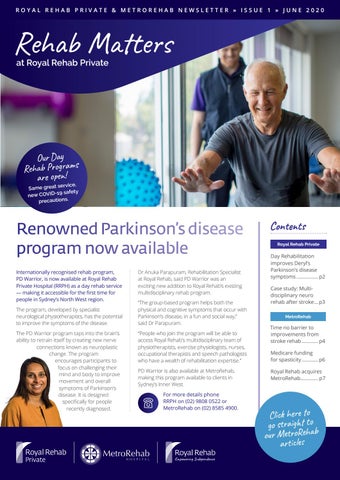
Renowned Parkinson’s disease program now available Internationally recognised rehab program, PD Warrior, is now available at Royal Rehab Private Hospital (RRPH) as a day rehab service — making it accessible for the first time for people in Sydney’s North West region. The program, developed by specialist neurological physiotherapists, has the potential to improve the symptoms of the disease. The PD Warrior program taps into the brain’s ability to retrain itself by creating new nerve connections known as neuroplastic change. The program encourages participants to focus on challenging their mind and body to improve movement and overall symptoms of Parkinson’s disease. It is designed specifically for people recently diagnosed.
Dr Anuka Parapuram, Rehabilitation Specialist at Royal Rehab, said PD Warrior was an exciting new addition to Royal Rehab’s existing multidisciplinary rehab program. “The group-based program helps both the physical and cognitive symptoms that occur with Parkinson’s disease, in a fun and social way,” said Dr Parapuram. “People who join the program will be able to access Royal Rehab’s multidisciplinary team of physiotherapists, exercise physiologists, nurses, occupational therapists and speech pathologists who have a wealth of rehabilitation expertise.” PD Warrior is also available at MetroRehab, making this program available to clients in Sydney’s Inner West. For more details phone RRPH on (02) 9808 0522 or MetroRehab on (02) 8585 4900.
Empowering Independence
Contents Royal Rehab Private
Day Rehabilitation improves Deryl’s Parkinson’s disease symptoms................. p2 Case study: Multidisciplinary neuro rehab after stroke.... p3 MetroRehab
Time no barrier to improvements from stroke rehab............. p4 Medicare funding for spasticity............. p6 Royal Rehab acquires MetroRehab.............. p7
Click here to go straight to our MetroRehab articles
“This actually helped a lot and is something I continue to do every day.” DERYL, PATIENT
A message from our GM Welcome to the first issue of Rehab Matters, our combined newsletter with MetroRehab Hospital designed to keep GPs and specialists up to date on the latest in rehabilitation medicine. Royal Rehab Private Hospital (RRPH) is an independently owned physical rehabilitation facility specialising in rehabilitation for neurological conditions such as stroke, multiple sclerosis, Parkinson’s disease; orthopaedic rehabilitation; multidisciplinary reconditioning and postoperative care. We operate as part of Royal Rehab, a leading not-for-profit provider of rehabilitation and disability services with over 120 year’s experience. During this challenging time of the COVID-19 pandemic, I am pleased to let you know RRPH continues to welcome inpatients and clients to our day rehabilitation service. Of course, the wellbeing of our clients, staff and the wider community are our top priorities. You can be confident in knowing we are strictly following the guidelines of NSW Health with regard to screening, hygiene and social distancing. Please feel free to contact us regarding referrals or if we can be of any further assistance.
Jessica Taveira General Manager Inpatient Services
Day Rehab improves Deryl’s Parkinson’s disease symptoms It was a slight shaking in her hands that made 75-year-old Deryl first think she may have Parkinson’s disease. A neurologist soon confirmed her suspicions. When Deryl’s symptoms started to interfere with the activities she loved doing, such as gardening, sewing, walking and giving lectures on horticulture, she was quickly referred to Royal Rehab Private Hospital (RRPH) for a multidisciplinary day rehabilitation program. Deryl began neurological physiotherapy based on the principles founded by the PD Warrior program, an internationally recognised program designed to improve the symptoms of Parkinson’s disease. This addressed the weakness and tremors in her hands. “My fine motor skills had deteriorated to the extent that I was finding those types of activities quite trying,” she says. “The therapist had me gripping things, squeezing things, using rubber bands and moving my hands in certain ways. I noticed an improvement in strength and control straight away.” Joint stiffness had become another issue for Deryl and she had been walking awkwardly. “At Royal Rehab, I did a lot of walking and turning, some aqua aerobics and other full body movements to help my stiff joints. I was also finding my coordination wasn’t great, so we practised engaging my brain when I was doing things so that I was making conscious movements. This actually helped a lot and is something I continue to do every day.”
“Deryl can now walk further, and her step length and cadence is significantly improved,” says Royal Rehab physiotherapist, Johnathan. Deryl was also having some trouble with her speech. “My voice would just go on me sometimes, or it might go husky or breathy – it was becoming difficult to control. It was hard to talk for long periods, which makes giving lectures a bit problematic.” Vanessa, a Royal Rehab speech pathologist, focussed on supporting Deryl improve her volume, control her pitch and articulate consonants more clearly. According to Vanessa, “As well as improving control, the therapy changes the client’s pattern of behaviour. For example, they often don’t realise they are speaking softly. The therapy helps them be aware of it so they can recalibrate their volume. “Without therapy, people with Parkinson’s find their function deteriorates. Unfortunately, some clients may have lost some cognition or insight into their condition which can make them apathetic. Then it’s our job to motivate them by making the therapy as functional as possible. We find out what is important to them, and focus on facilitating these skills to help bring back purpose to their lives.” To refer to Day Rehab visit royalrehab.com.au/ private-hospital/referralsand-admissions, phone (02) 9808 0522, fax (02) 9475 0497 or email us at DayRehabilitation@ royalrehab.com.au.
Royal Rehab Private: Case Study
Benefits of multidisciplinary neuro rehab after stroke Case Study by Dr Tram Bui, Senior Rehabilitation Specialist and VMO at Royal Rehab Background: Helen, aged 74, presented with a six-month history of progressive decline in her mobility and had frequent falls. She had a cerebrovascular accident (CVA) two years prior, which left her with residual left body paresis. Prior to this incident, Helen mobilised independently with a frame and lived with her husband, Ken. History: As well as experiencing more frequent falls, Helen was experiencing painful spasms in her left upper limb, which interfered with her activities of daily living. Between the spasms and the falls, Helen’s mobility had become significantly reduced, and she relied on her husband Ken for physical assistance and transfers. Examination: On presentation, Helen was tearful, with a stooped posture and slowed gait. On physical examination, she had increased tone in her left upper arm, including the pectoralis major, biceps, pronator teres, flexor carpi radialis, flexor digitorum profundus, flexor digitorum superficialis and flexor carpi radialis muscles. Clinically, this has resulted in an adducted arm, fixed flexion of the elbow, pronated forearm and flexed fingers. In addition to her physical signs, a psychological assessment with the Geriatric Depression Scale indicated that Helen had mild depression. Management: Helen has ongoing spasticity, occurring in up to 40 per cent of patients after stroke, most commonly in the upper limbs. Because of Helen’s high falls risk, oral agents such as the skeletal muscle relaxant Baclofen are best avoided. Helen was referred for further review and management as an inpatient at Royal Rehab Private Hospital and was treated through a specialist multidisciplinary program. Here, she was recommended a program of stretching, positioning, splinting, and botulinum toxin injections to the left upper arm and chest wall. She received botulinum toxin injections to the identified spastic muscles, followed by upper arm therapy and gait retraining.
An aged care assessment of their home situation was organised through a My Aged Care referral, which enabled Helen and Ken to access a range of community support services. Discussion: Spasticity can be disabling and occurs commonly following post stroke. It may be complicated by contractures, resulting in further pain and disability, and can affect independence in activities such as hygiene, mobility and sleep. Disabling spasticity is best managed in a specialist multidisciplinary program, taking into consideration the patient’s life circumstances, expectations and support. Depression is common after a CVA, with an estimated prevalence of 29 per cent at 12 months post stroke. The major predictors are the level of disability, pre-stroke depression, cognitive impairment, stroke severity and anxiety. Physical and cognitive recovery from this depression has been shown to be enhanced with early pharmacological treatment and psychotherapy. The SSRI Fluoxetine also has some evidence of benefit in motor recovery post stroke. Summary: Royal Rehab Private Hospital has multidisciplinary geriatric and specialist neurological services to manage patients effectively following a stroke. Inpatient admission may be needed followed by a referral to a Day Rehabilitation program which will allow patients to attain the intensity of rehabilitation required to optimise physical and functional gains in the critical window period following a stroke. This article is revised from an original paper co-authored with Dr Ana Llado, Royal Rehab and Dr Kate Scrivener, Macquarie University.
Helen was also prescribed an SSRI, resulting in significant mood improvement over the next couple of months. Following discharge, physiotherapy was continued on an outpatient basis.
235 Morrison Road, Ryde NSW 2112 02 9808 9222 | royalrehab.com.au Follow us on:
Rehab Matters at MetroRehab Hospital
Outstanding AROC results Top 25th percentile for improvement in function (FIM). Top 25th percentile length of stay neurological conditions. 87.5% of stroke patients return home compared to national average of 80%.
The Sydney Stroke Rehabilitation Centre at MetroRehab Hospital specialises in rehabilitation for stroke patients. The hospital’s outstanding results in the recent Australasian Rehabilitation Outcomes Centre (AROC) data reflect our commitment to providing excellence in care and client outcomes. Patients benefit from: » Skilled stroke rehab team under the guidance of rehab specialists » Tailored hydrotherapy programs » Botulinum injection spasticity management » Dedicated on-site sstroke and neurological programs manager, providing education and support in-line with the latest evidence in stroke care.
Time no barrier to improvements from stroke rehab Intensive rehabilitation is readily available for stroke survivors, those with brain injury and spinal cord injury in the first months after the event. However, many do not receive adequate rehabilitation in subsequent years – a period during which there can be complications and issues that can profoundly impact quality of life. These can include neurogenic pain, spasticity, adjustment disorders, relationship issues, questions about work or driving, or changing equipment needs. According to Lara Fernandez, MetroRehab’s Stroke and Neurological Programs Manager, the literature shows with the advancements in acute management of stroke as a result of thrombolysis and endovascular clot retrieval, we are experiencing improved patient outcomes. However, we are commonly seeing patients discharged from the acute facilities without a rehabilitation consult or referral. (Evidence from 2019 stroke foundation audit.)
‘’When stroke survivors return home quickly post intervention at an acute hospital, they can experience difficulties in managing their everyday activities and their carers can have high levels of stress,” says Lara. “Physically, patients may present normally, however cognitively there can be issues. It’s vitally important we look beyond just the physical presentations — cognitive problems are often ‘hidden’ but can greatly affect quality of life.’’ Adults with chronic neurological disorders can benefit from the expertise at MetroRehab including those who have experienced a stroke, acquired brain injury (traumatic or post neurosurgery), or have conditions such as Parkinson’s disease, cerebral palsy, spinal cord injury (traumatic or degenerative), and multiple sclerosis. Lara Fernandez works in both the inpatient wards alongslide the multidisciplinary rehab team and also with Rehabilitation Specialists Dr Helen Redmond and Dr Darren Lee at MetroRehab in the NeuroRehab clinic.
Excellence in medical rehabilitation
MetroRehab: Case Study
Functional and cognitive improvements ten years post stroke By Lara Fernandez, Stroke and Neurological Programs Manager Gary is a 57-year man who is now 10 years post-acute brain injury secondary to a vertebral aneurysm and subarachnoid haemorrhage. While Gary recovered physically, his main deficit was frontal lobe dysfunction and anterograde amnesia. His attention span was five minutes and he was unable to sit still. This impacted so greatly on his function that it requires him to have 24-hour care in a residential facility. Recently, Gary’s family noticed cognitive changes and he was referred to MetroRehab for a rehabilitation review and subsequently one on one occupational therapy for cognitive retraining. Gary expressed he was feeling that he had no control and did not know what his days entailed.
When first seen by the occupational therapist, Gary was impulsive and unable to sit or focus on a task for longer than five minutes. Over several weeks of rehabilitation, his attention gradually improved to the full 60 minute session. He also recalled the learnings from session to session including remembering the clinician’s name, the room where therapy was completed and strategies to assist with his memory. Today, Gary uses a diary to assist him to prepare and feel in control of his life. While he still requires support and prompts, his behaviour is less impulsive and he continues to improve functionally, psychologically and in formal testing of cognition. Gary’s story highlights that recovery can occur at any time, and rehabilitation input is not just for the period immediately post stroke.
A message from our GM Welcome to the MetroRehab section of Rehab Matters, our combined newsletter with Royal Rehab Private Hospital for GPs and specialists. MetroRehab is a leading provider of physical rehabilitation services with a strong reputation for stroke, neurological, orthopaedic and general rehab programs. We have the highest level of patient care through dedicated staff experienced in all major rehabilitation specialities. MetroRehab was recently acquired by Royal Rehab and we are proud to be part of this iconic facility. In these challenging times brought about by the COVID-19 pandemic, it’s important to know our health professionals are here to support you and your patients. We are strictly following the guidelines of NSW Health with regard to screening, hygiene and physical distancing. You can be confident the health and wellbeing of our patients, staff and the wider community are our top priorities. Referrals can be made as usual via our website, phone 02 8585 4900 or email reception@metrorehab.com.au. Feel free to contact me if I can be of any assistance.
Denise Thomas General Manager MetroRehab Hospital
275 Addison Road, Petersham NSW 2049 02 8585 4900 | metrorehab.com.au Follow us on:
NeuroRehab Clinic for spasticity now Medicare funded Early recognition and treatment of spasticity is important in maximising the return of active function for neurological conditions such as stroke, Parkinson’s disease, multiple sclerosis, acquired brain and spinal cord injury. According to MetroRehab Rehabilitation Physician Dr Helen Redmond, ‘’Any upper motor neuron lesion can lead to muscles becoming tight and contracting involuntarily at rest or during activity. This causes restricted movement, pain, spasms or deformity, and can interfere with the use of the affected limb.’’ Recent welcome announcements by the Australian Government mean Medicare now covers botulinum toxin when necessary to treat a condition. Dr Redmond and MetroRehab Rehabilitation Specialist, Dr Darren Lee, are experienced in spasticity management. Through the hospital’s NeuroRehab Clinic, the doctors use botulinum toxin injections and therapy to relieve symptoms for patients with a broad range of neurological conditions.
‘’It is important that injections are followed by targeted physical therapy including stretching, strengthening and motor re-learning,’’ says Dr Redmond. “Splinting, casting and the prescription of orthotics can be part of treatment to maintain benefit from injection therapy and promote good active function. ‘’Left untreated, spasticity results in joint contractures making even a simple task such as dressing awkward for both clients and carers. In severe cases, skin can become difficult to clean and break down with ulceration or infection. Untreated spasticity also leads to pain and treatment alleviates this in many cases.’’ The NeuroRehab Clinic at MetroRehab is ideally placed to coordinate interventions and subsequent therapies. All treatments are tailored to support clients achieve their personal goals. For more information contact the MetroRehab Stroke and Neuro Program Manager on neuro@metrorehab.com.au
PD Warrior is available at MetroRehab!
Support your patients with the internationallyrecognised program designed to slow the symptoms of Parkinson’s disease. Find out more: (02) 8585 4900 or reception@metrorehab.com.au.
Excellence in medical rehabilitation
Royal Rehab acquires MetroRehab Hospital MetroRehab Hospital was recently acquired by Royal Rehab, a leading provider of rehabilitation and disability support services with over 120 years’ experience.
General Manager MetroRehab, Denise Thomas sees natural synergy between the organisations and greater benefits for patients.
‘’MetroRehab has a long history and enjoys a strong reputation within the community. We are pleased to take MetroRehab into our fold and continue providing quality medical, allied health and nursing expertise to Sydney’s Inner West,’’ said Matt Mackay, CEO Royal Rehab.
‘’With the support of Royal Rehab we now have access to more resources including clinical, research and education expertise from which our patients and referrers will gain. Otherwise, it is business as usual — the same high-quality rehabilitation services delivered by a team of skilled and caring professionals,’’ she said.
Spotlight on some of our specialists... Dr Anuka Parapuram
Dr Tram Bui
MB BCH (WALES, UK), FAFRM (RACP) Dr Parapuram obtained her undergraduate medical degree at the University of Wales, United Kingdom. She is a visiting medical officer at MetroRehab Hospital and Royal Rehab Private Hospital. Dr Parapuram has a special interest in rehabilitation for Parkinson’s disease and oncology rehabilitation.
FAFRM (RACP), MBBS, MPH, MBA (HEALTH MANAGEMENT) Dr Tram Bui undertook her medicine training at the University of Sydney and completed her Fellowship with Faculty of Rehabilitation Medicine, graduating in 2001 with the Basmajian Prize for best overall performance in her final exams. Dr Bui has a clinical background in geriatrics, general and brain injury rehabilitation. Dr Bui works in the Brain Injury Community Rehabilitation Team and specialises in neurological rehabilitation.
Dr Darren Lee BSC (MED), MBBS, FAFRM (RACP) Dr Darren Lee is a rehabilitation medicine physician and visiting medical officer at Royal Rehab, a senior staff specialist in the Department of Rehabilitation Medicine at Royal Prince Alfred Hospital and at Balmain Hospital. He also admits to MetroRehab Hospital. Dr Lee’s clinical expertise and research interests include rehabilitation of neurological conditions with a particular interest in stroke, cancers of the nervous system, multiple sclerosis and Parkinson’s disease.
Dr Helen Redmond MBBS FAFRM (RACP) Dr Redmond is a rehabilitation physician who has worked at MetroRehab since 1998. She works in general rehabilitation and has a wide range of skills including stroke rehabilitation, pain management, multi-trauma, orthopaedic and aged care rehabilitation. She is qualified in spasticity management including botulinum toxin injection and heads the Spasticity Management Service at Liverpool Hospital. Of interest to Dr Redmond is how mind-body interactions affect recovery and rehabilitation from illness and injury.
275 Addison Road, Petersham NSW 2049 02 8585 4900 | metrorehab.com.au Follow us on:
Rehab empowers new dad with strength after cancer It was 2am on a Monday in late October 2018 when Brenton woke up with a start and what he describes as a very strange feeling. “I knew something wasn’t right – I felt a vagueness and a sharp pain running through my left arm. I thought I was having a heart attack or stroke. I asked my girlfriend to call an ambulance. It was like nothing I’d ever felt before,” Brenton says. Within about 20 minutes, he was being assessed by the emergency medical team at the hospital nearby. “I then had a seizure and when I woke up 45 minutes later, I was told they’d run a CT scan,’’ Brenton recalls. “It revealed I had a malignant brain tumour in the right side of my skull.” Brenton was sent home from hospital on anti-seizure medication and plans were made for surgery to remove the tumour. He began ‘pre-rehab’, exercising, eating well and mentally preparing for the high likelihood he’d wake up afterwards with hemiplegia — paralysis of one side of his body. Brenton’s procedure took 12 hours and afterwards, the left side of his body was paralysed ‘to the millimetre’. The next few days were a struggle. He couldn’t speak properly, sit up or walk without the help of two people and mobility aids. He remembers getting his left arm stuck underneath him once because he thought his arm was above his head and not by
his side. He couldn’t even drink regular water – it had to be thickened because he couldn’t swallow as normal.
Starting rehab was an important milestone Five days after surgery, he was transferred to MetroRehab Hospital to start rehabilitation. Mentally, Brenton says rehab was a significant milestone, another step in the right direction. Under the care of a rehabilitation specialist and a multidisciplinary team of health professionals – including an occupational therapist, physiotherapist, exercise physiologist and speech pathologist – a personalised program was developed for Brenton that was goalbased and meaningful to him. These goals included: being able to prop up in bed, drink ‘normal’ water, and walk to the bathroom to use the toilet and shower. Ultimately, the aim was to help Brenton return home as soon as possible. With his devoted partner by his side, Brenton’s hard work payed off and the planned three-month stay was reduced to one month. He continued rehab as an outpatient in MetroRehab Hospital’s Day Patient Rehabilitation Program where he continued to benefit from occupational therapy, physiotherapy and exercise physiology.
Looking back, Brenton describes this time as mentally and emotionally challenging, but his rehabilitation quickly brought results making it all worthwhile. “I had to learn everything again — simple things you don’t normally need to focus on. Once I could sit up in bed, I had to learn to turn using proper techniques so I didn’t injure myself. Then lower my legs, straighten them and shift my weight to stand, centre my weight and bend my knees to sit again. “I’d never had to rely on anyone to do basic things before and it was extremely frustrating. But being independent came faster than I thought it would, which was great,” he says.
Welcome baby news expanded his rehab goals A few months after surgery, the 33-year-old construction worker received the exciting news that he and his partner were expecting. Brenton’s rehabilitation program was modified to include new goals to help him fully participate in the care of his child. Wanting to be a hands-on father, the MetroRehab Hospital team supported him to learn how to hold the baby, change nappies, dress the baby and more. His rehab team worked closely with the public hospital midwife even organising a lifelike ‘baby’ doll he could use in rehab and practice with at home so he could gain confidence before the birth. In November 2018, Brenton proudly introduced six-week old baby Townes to the MetroRehab Hospital team, showing off his ability to safely hold and burp his son.
Living his new normal A year on and back at work part time, Brenton says his very supportive employer has placed him in a new role he can do at his own pace. He says returning to work allowed him to practice things he’d worked on in rehab, particularly multitasking – for example walking and talking at the same time. Today, people who don’t know him wouldn’t know he’s only just learned to walk again. He’s also happy to be driving again and most importantly, to be able to care for Townes on his own. To refer to MetroRehab Hospital’s cancer rehabilitation programs visit metrorehab.com.au
Excellence in medical rehabilitation
275 Addison Road, Petersham NSW 2049 02 8585 4900 | metrorehab.com.au Follow us on: