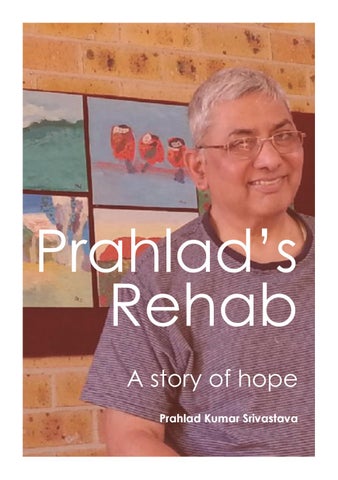
Prahlad’s Rehab A story of hope Prahlad Kumar Srivastava
Cover photograph: Prahlad Kumar Srivastava with his paintings
All paintings in book by the author.
Š 2017 Prahlad Kumar Srivastava
Proudly published by generously printed this free of charge.
in partnership with
Five Dock, who
Contents Before my illness
1
Illness
2
Rehabilitation 3 Family Support
4
Life Coach
6
Downsizing 7 Royal Rehab Road to Recovery
8 10
Cooking 11 Travel 12 Art Therapy
13
Garden Therapy
15
Hope 16 Emotional Healing
18
My Hero
19
Gratitude 20 Affirmations
21
Acknowledgements 23 Appendix: Time Line
24
Hope is what happens when you see the first light.
Before my illness I was born and raised in India. I gained a Master of Technology degree in computer science at Indian Institute of Technology, Kanpur. I also gained a Master of Business and Technology degree at University of New South Wales, Sydney. I got married in 1976 and had two children. In 1982, we migrated to Australia, where I worked as an Engineer for many years. From 1997, I designed and built our new environmental home in Beecroft. I designed every aspect of living, convenience, comfort and family entertaining into this house. We moved into our dream home in 1998. In 2007, I retired as an Engineer at the age of 61. I saw retirement as an opportunity to be more actively engaged in community life. So I undertook a course in mental health, aiming to become a Bilingual Group Leader (in Hindi and English) for multicultural Indian community forums. The day I finished the course I was diagnosed with life-threatening compression of my cervical spine and brain stem against my skull, which required urgent decompression surgery. And so began a series of operations, complications, hospitalisations and rehabilitation. My life changed forever and so did the lives of my wife, children and grandchildren. First, there was physical survival of this major illness and the associated complications. Then there was psychological and emotional survival of living with disability. After brain or spinal injury, it is very easy to lose hope. This story is for those who are struggling to find hope. I encourage people to accept life and live it full of positive thoughts. 1
Illness It was a busy time for my family, especially my wife, dealing with doctors, specialists, surgeons and hospitals. In May 2010, my neurosurgeon referred me for MRI and CT scans of my cervical spine. These scans showed severe compression in this area and the neurosurgeon’s report stated that “he is at high risk of sudden neurological loss or death in the event of an accident or fall… (and)… without surgery to decompress and stabilise this part of his spine, he is at very high risk of quadriplegia and death within the next 6 months”. And so began a serious of operations, one of which resulted in “every possible complication predictable and completely out of the blue (taking) place”, according to the medical report. Not only did I have a stroke during spinal/brain surgery, I also had to have heart surgery to insert a pacemaker. Following the busy period of visits to doctors and hospitals, I was faced with the reality of my disability. I could not sit, stand or walk. I had lost the use of my arms and legs. I had lost speech, sensation and appetite. And when I realised that I could not return to our dream home, I understood that my entire life had changed forever. Through my rehabilitation journey I learnt that you have to be an active participant in your recovery. Nothing is going to drop out of the sky for you. Sometimes you’ll take a step and fall. But you have to get up and start again.
2
2
Rehabilitation My first journey to rehabilitation started at Mt Wilga Private Hospital. I was an inpatient at Mt Wilga twice, the first time in June 2010 after my discharge from Dalcross Hospital and the second time in November 2010 after I was discharged from Royal Prince Alfred Hospital. My confidence was very low and it took me seven months just to stand up. At my first appointment in Mt Wilga in November 2010, I was not able to stand on my feet at all. It took two physiotherapists and a lot of effort for me to take just a couple of steps. It was a major challenge to feel confident about myself when in this state, but I did make progress and I am thankful to God for that. For about 10 weeks I was living in the hospital as an inpatient. Mt Wilga hospital gave me sessions with physiotherapy, occupational therapy and speech therapy. I was receiving physiotherapy every day. Physiotherapists helped me to walk and climb stairs. They also taught me how to transfer in and out of a car. All these things improved my ability to participate in social outings, particularly through the Community Connect Program.
Harbour Bridge
3
Family Support My wife has been with me every step of the way. She has helped me and the family constantly. In the early months after my stroke, I felt anxiety, pain and strong emotions all the time. While I was an inpatient, my wife, daughter and son were my pillars of support. My wife was by my side every moment and my daughter was a true strength behind looking after her. My son, being a doctor, was liaising with my treating specialists throughout, which was a huge support. My daughter-in-law and my little granddaughter regularly visited me and brought immense happiness to me. Then as an outpatient, my wife brought me to Mt Wilga hospital two to three times per week. During that difficult period, my daughter continued to support my wife and their home life. The load on my wife was enormous. As well as looking after me, she sold our beautiful Beecroft home and bought a new place in Putney to suit my needs. She has done everything for me, for which I am truly grateful. When I was weak, I forgot to appreciate what people were doing for me. I had very low self-esteem at the time and wanted to isolate myself from family and friends. I was doing negative self-talk. My morale was very low and I had lost interest in daily living and life in general. I had no appreciation of the people who were supporting me all the time. I felt unhappy most of the time, was frustrated and thought that life was not worth living. As a result I didn’t appreciate my wife and children then but I do now. I realise that their support has been very precious for me. At times it felt like there was nobody to help me. In those moments I found that I turned to God. He gave me strength to persevere at these difficult times and that is when my spiritual journey began. 4
4
Unconditional love for my wife, children and grandchildren takes me out of depression
5
Life Coach Before the stroke, I volunteered at my local Migrant Resource Centre, where I struck up a friendship with David, a fellow volunteer who had completed a course in Life Coaching. When I returned home to Beecroft I was at a loss, wondering how to put my life back in order. I had spent seven months in my Beecroft home and life was so difficult that it was almost unliveable. So I called David and asked him to be my life coach. At that point in time I practically had no hope to survive. I was very low but I still wanted to live. David and I shared trust and respect and there was no judgement. We were equals. David helped me identify my own goal, which is to regain mental strength and mobility. Through my interaction with David I realised that fear is just in my mind, and I’m the only one to control my mind. I can replace fear with joy, confidence and belief that I will walk again. When we moved to Putney, I still had weak moments, but not as bad as when I returned to my Beecroft home from Mt Wilga Hospital. It was then that I realised that the journey to recovery had finally started. Even though I had dark moments, I was still happy to be part of the world around me. I had sunshine, birdsong and I could feel the breeze. Before all this, I had been more of an observer of the world, not a contributor. Now I was increasingly becoming a contributor. 6
6
Downsizing After the stroke, my needs changed drastically and my Beecroft house, though it was my dream home, was no longer suitable for my new life. My new house had to be smaller, provide ease of access and ease of maintenance. My wife worked very hard to sell our Beecroft home and find us a more suitable place to live. Those three months were very trying for her and full of anxiety but like with everything else, she worked very hard and succeeded in finding us a villa in Putney which met my new requirements. The Putney villa also gave me proximity to Royal Rehab at Ryde to continue my rehabilitation journey, as I wanted to be able to shower myself and become as independent as possible. To do that I required therapy, which I started at Royal Rehab.
Home sweet home
7
Royal Rehab I joined the Royal Rehab outpatient service when I moved to Putney in September 2012. Of particular use to me were the courses offered in physiotherapy, occupational therapy, meditation, relaxation, adaptive yoga, and the Stepping On program. Proximity to Royal Rehab also helped me to visit their beautiful walking track. This was a bonus, as I had never imagined that I would be able to do this track. So one day every week I make use of the walking track to practise my walking and challenge my balance. It also gives me the opportunity to traverse slopes, upward and downward, and some steps. Royal Rehab staff are specialised in recuperating patients after neurological injury. They understood my needs and working with them has given me improved confidence in my new home. They also tailored our villa in Putney to make it safe for me and I am thankful for that. It was not easy to move from my dream home to my new home (villa) but I know it was the best option for me. My wife is still trying to adjust to villa living. As a prolific entertainer she misses the ability to host large parties. Hopefully she will be able to adjust over time. In the new villa, I had the flooring, lighting and kitchen changed to meet my requirements. Now I can make use of the kitchen independently. I can utilise both indoor and outdoor space at our new villa which is helping me to increase my stride length. Hopefully one day I will be satisfied with my new life. I have a goal, to be able to go to my local coffee shop independently. I’m still working on that and hopefully one day I will be able 8
8
to achieve it. I’m also trying to learn how to use Royal Rehab’s raised garden bed and new techniques associated with this type of gardening. Also I am now a member of Royal Rehab’s Consumer Representative Council (CRC). My aim is to utilise my training in mental health to help myself and to help others. Volunteering is something that I am aiming to do. Giving time and hope to others gives me happiness and improves my confidence. Extending help is also very rewarding. I hope that my life can provide inspiration to some people.
The Outback
9
Road to Recovery I escaped from depression when I started believing that I am my own best friend. All of my other acquaintances are busy in their own lives. I reflect on my strengths at the moment: I can still breathe; I have movement in my body; I have a sense of touch; I have a sense of visual contact; I have not lost my hearing or ability to really listen; I can still smell and I can bite. These are the basic strengths I recognised that I still had and I started to take my life forward from that point. Without encouraging vanity, self-centredness, selfishness and empty pride, I would like to trust myself more than anyone else to give me a meaningful and fulfilling life. This truly unselfish love, towards me first, is essential before I can expect someone else to love me more. “The body is a great healing machine. It can rejuvenate itself if we accept everything without reacting inordinately. Once the mind is calm and free, nature’s many self-sustaining, positive energies become available to us� (Journey into Health, Swami Swaroopananda, 2008, pp. 26-27). Recovering from depression has included different activities which have taken me out and about, and and extended my new sense of self.
10
10
Cooking I enjoy good food and have always had a passion for cooking. Before the stroke I did courses in Thai and Italian cooking at my local Community College. After my stroke I lost the ability to cook. I was desperate to return to the kitchen. I got an opportunity with Hunters Hill-Ryde Community Centre to have volunteers to teach me how to cook once again. I learnt to cook Chinese and other Asian cuisines. A volunteer from Peru, South America, taught me Peruvian cuisine, which was very exciting. The experience from the Peruvian menu was absolutely delightful, as I had never tried this type of food before. Watching them cook me a traditional meal using new ingredients really activated my brain. I have yet to try to cook Peruvian cuisine independently. I have five or six recipes, which I would like to try this year (2017). My goal is to cook once a week, at least one dish. I am pretty close to that, but cleaning is something I still struggle with and need to incorporate into the procedure. After cooking my kitchen is a mess, which I cannot clean, and is a point of concern for my wife. Hopefully I will be able to manage the cooking and cleaning in a year’s time. Learning cooking gave me confidence to choose a menu, shop for groceries and special spices, and to use different pots and pans. Cooking has given me training for eye-hand coordination. It has developed my sense of smell and my upper limb motor skills, through activities such as chopping fruits, vegetables and meat, and taking the pots and pans out of the drawer. Using the kitchen safely requires turning off the gas when finished, so I have to be mindful of that. 11
Travel I longed to travel again but the challenge was to find transport and destinations that were suitable. In 2011 my wife and I travelled to India for our daughter’s wedding. The transport was fine and I had plenty of care because we stayed with family. However, it was difficult and stressful for the family to look after me, and that made me feel uncomfortable. After that trip my wife and I decided to travel more locally, so we went to New Zealand. In Australia, we went to Cairns, Port Douglas, Hunter Valley and took a cruise to Noumea and Pacific islands. We took the Ghan Train from Adelaide to Darwin. We also visited Uluru and Melbourne (including the Great Ocean Road). Locally we visited Parramatta Lake, Pearl Beach, Watsons Bay and Narrabeen Lakes. Our next adventure is to Noosa and the Sunshine Coast. I found the biggest restrictions to travel are my accessibility to car park and toilets and simply getting on and off an aeroplane and train.
12
12
On the road together
Art Therapy I picked up painting as an upper limb exercise. I had never done it before so it was a completely new venture. I went to church groups in the neighbourhood and met with people there who offered to teach me to paint. I found that I have some appreciation for colours and paint. I started painting really basic images and felt that I could pursue it further. This was a good feeling, as painting concentrated my mind and gave me peace. I would love to exhibit some of my paintings at exhibitions in the future. Painting for me is an expression of wellness and connectivity with nature. When I paint I am totally connected to myself and I feel good that I can express myself. It takes me about four sittings of roughly four hours each to complete a painting. As I often don’t do much else, this time is good. For me painting is not just about the colours but the expression of happiness, sadness and anger. I think it gives me a platform to communicate with myself. I hope that through painting I can be at peace with myself. I think that after the stroke my brain has worked differently. I now have an understanding of colour, shape and shade, which I did not have before. I discovered this ability when I picked up paint and brush for the first time. I exhibited my paintings at the Hunters Hill Ryde Community Services and one of my paintings was sold. I donated the money from that sale to Royal Rehab, which gave me a double joy. I have completed 16 paintings through the art group sessions. I mostly prefer to paint landscapes. I go to art classes once a week and paint in the company of five or six other painters. It is encouraging when others are painting around 13
me, and I get assistance for cleaning my brushes and mixing the paint. Painting has developed in me the ability to portray meaning through creative exploration and expression. I believe that Sandy, at the Uniting arts group classes, has given me a lot of encouragement and support throughout my painting experience.
Nature is beautiful—enjoy it!
14
14
Garden Therapy Gardening has always been my passion. After I moved to Putney, I purchased a raised garden bed so that I can do gardening independently. I had seen people using raised garden beds in day care centres I visited. I have been regularly enjoying gardening ever since. It gives me a sense of fulfilment, relaxation, happiness and wellbeing. It benefits me in exercising my arms and gives me confidence in using my fine motor skills. Digging, planting and watering improves my balance. I have planted herbs (basil, rosemary, parsley, chives, coriander) in my garden bed and use them while cooking dishes, as needed.
From little things big things grow
15
Hope Having and nurturing hope is important because it keeps me moving forward, towards healing. •
Hope is what happens at the first birth of spring, when the sun touches the sky or a bird spreads its wings.
•
Hope is what happens when a wound starts to heal, whether it is skin deep or soul deep, you begin to feel real.
•
Hope is what happens when you are down but not broken.
•
There is a golden mine of dream, not yet awoken.
•
Light always follows darkness.
•
Do not compare yourself to others, you may become vain and bitter for always there will be a greater and a lesser person than yourself.
•
Of all the people you know in your lifetime, you are the only one to leave or lose. To the question of your life, you are the only answer. To the problems of your life, you are the only solution.
•
You may have to fight a battle more than once to win it.
•
God never gives you anything you cannot cope with.
•
Only one principle will give me courage, that is, that no evil lasts for a very long time (Epicurus 2071BC).
•
The most difficult matter is not so much to change the world but to change yourself.
•
Tough times don’t last, tough people do.
•
The only thing we have to fear is fear itself (Franklin D Roosevelt). 16
16
•
God grant me the strength to accept the things I cannot change, encourage me to change the things I can, and the wisdom to know the difference.
•
I may cry easily but I never give up.
•
Don’t ask for an easier life, ask to be a stronger person.
•
Experience is not what happens to you, but what you do with what happens to you (Huxley).
•
Hope gives me a new opportunity to appreciate the gift of my life.
•
Hope gives me the desire to talk to myself and repeat affirmations.
•
Hope gives me positive energy and a belief in my body’s healing power.
•
Hope tells me to enjoy the present moment.
Poppies—new life
17
Emotional healing I found that to heal myself emotionally, I had to accept my new reality. In Journey into Health (2008), Swami Swaroopananda writes that: “Once we can accept our situation, once we are convinced about the nature of our true ‘self’ and we absolutely refuse to be miserable, everything else falls into place” (p.27); “Constantly remind yourself that happiness is always with you: you are happiness and that happiness does not depend on anyone or anything in the outer world” (p. 17); and “When you accept a situation unequivocally, that very moment you achieve peace and the situation can no longer bother you” (p. 25).
18
In memory of Horrie, my hero
18
My hero I used to attend Woolwich Day Centre each Friday. By going there, I found confidence and connectivity, particularly once I met Horrie. Horrie attended the centre three to four times each week. When I met Horrie he was 100 years old. He lived alone in his own home. He could sing and paint. What I liked about him was that he was a very giving person. I also liked that he had a spiritual and inquisitive nature. He was a seeker of truth rather than being a follower. At the age of 100 Horrie had a purpose in life and he was enjoying his life, not just living. He lived each day to the fullest. Horrie died in 2016, but he continues to inspire me to live on, not to surrender. I always think of Horrie as my hero. The way Horrie inspires me is part of the inspiration I receive from other sources, including WW Dyer’s ‘Inspiration: your ultimate calling’ (2006): •
Unclutter your life
•
Being at peace inspires others
•
Living passionately inspires others.
“A man may have never entered a church or a mosque, nor performed any ceremony; but if he realizes God within himself, and is thereby lifted above the vanities of the world, that man is a holy man, a saint, call him what you will… “ (Vivekananda, in Dyer, 2006, p.125).
19
Gratitude I am grateful for all the things that I have, all the people I am connected to, and all the things I can do: •
Breathe—being alive and breathing, experiencing the connection with my body;
•
Move—being able to move around, and aiming to move more and more;
•
Touch—touch helps me to connect, develop trust and experience support, with the warmth of a shower, or a firm handshake;
•
See—I can see for myself and assess what is safe and what is not safe;
•
Hear—I can hear a dog bark, a baby crying, birds chirping, bees buzzing, which could be soothing and comforting or disturbing;
•
Smell—it links me to the environment, and I choose a clean environment;
•
Bite—expressing emotion when I bite my teeth or lips;
•
Feel—life is meaningful when heart and mind are in unison, and I have control over that;
•
Warmth—both a physical and mental experience, about harmony and trust;
•
Stay connected to my feelings—this simplifies life;
•
Keep heart and mind in unison;
•
Talk—dialogue generates feelings;
•
Believe in God—life is better if you are experiencing God’s presence. 20
20
Affirmations From hope comes happiness. When I’m happy I sit and stand upright. It’s on my face and people come to me. I feel loved and I’m grateful for all the people and things I have, and for all the things I can do. •
I believe in myself.
•
I am ready to change myself.
•
I am ready to entertain positive thoughts.
•
I am grateful for my wife, daughter, son-in-law, son, daughterin-law and grandchildren.
•
I am grateful for my second life.
•
I am patient with myself.
•
I am grateful for my body’s amazing healing abilities.
•
I love being surrounded by the healing miracles of nature.
•
I love how I feel, as I feel grateful and loved.
•
I feel inspired to impact future generations.
Three birds singing and rejoicing together
21
Sunrise—a new day bringing in rays of hope into life
22
22
Acknowledgments This story was created with the help of Royal Rehab Outpatient’s Occupational Therapist Paul Hurst, Volunteer Manager Ayse Dalkic, Volunteer Co-ordinator Nicki Bispham, volunteers: Arun Sharma and Maria Degabriele, and my wife Neera Srivastava. I wish to express my heartfelt thanks to all these people who have helped in shaping my rehab story. I wish to express my thanks to Martina Fox, Marketing and Community Relations Manager, Royal Rehab for co-ordinating the printing of my book and organising its launch during National Stroke Awareness Week 2017. Special thanks to Kwik Kopy, Five Dock, for generously printing my book free of charge.
Sincere thanks
23
Appendix: Time Line 17 May 2010
Diagnosed with severe cervical spine compression needing urgent surgery
30 May 2010
Admitted to Dalcross Hospital, placed head into traction for 48 hours
1 June 2010
Cervical spine decompression surgery at Dalcross Hospital
12 June 2010
Transferred to Mt Wilga Rehab Hospital— physiotherapy, occupational therapy, car transfer, speech therapy
3 July 2010
Discharged from Mt Wilga Hospital to Beecroft Home
3 July 2010
At Beecroft Home attending Outpatient clinic at Mt Wilga Rehab Hospital—with anxiety and depression
31 Aug 2010
Discovered Optic nerve swelling by the optometrist (could result in blindness in both eyes).
24
24
15 Oct 2010
Surgery to insert stent in brain at Royal Prince Alfred Hospital (RPA)
15 Oct 2010
Brain haemorrhage after stenting, extra ventricular drain (EVD) placed, pacemaker surgery, in ICU at RPA
30 Oct 2010
Transferred from ICU to Neuro ward at RPA—observation, physiotherapy, preparation to transfer to rehab at Mt Wilga Hospital
18 Nov 2010
Transferred to Mt Wilga Rehab Hospital— physiotherapy, OT, speech therapy
14 Jan 2011
Discharged from Mt Wilga Hospital to Beecroft Home —continued rehab as an outpatient at Mt Wilga Rehab Hospital for next 12 months
July 2011
Started sessions with Life Coach
Nov 2011
Travelled to India to attend my daughter’s wedding.
25
1 Sep 2012
Moved to Putney home and began attending Royal Rehab as an outpatient—physiotherapy for upper and lower limbs
May 2013
Attended Yogabilities (Adaptive Yoga) sessions at Royal Rehab
February 2014
Gallbladder removal surgery at North Shore Private Hospital
Nov 2015
Became a member of Royal Rehab’s Consumer Representative Council (CRC)
May 2016
Diagnosed with Myasthenia gravis (drooping eyes, choking with food)
Sep 2016
Diagnosed with Diabetes
Sep 2017
Continuing attendance at Royal Rehab Outpatient Clinic
26
26
Prahlad Kumar Srivastava’s book is a gift to you and your loved ones. Prahlad’s story is that of hope after surviving a stroke and many other neurological complications. He believes that light follows darkness and hope is a powerful force for you to dream a better future. Hope is important because it can make the present moment less difficult to bear if we believe that tomorrow will be better.
in partnership with