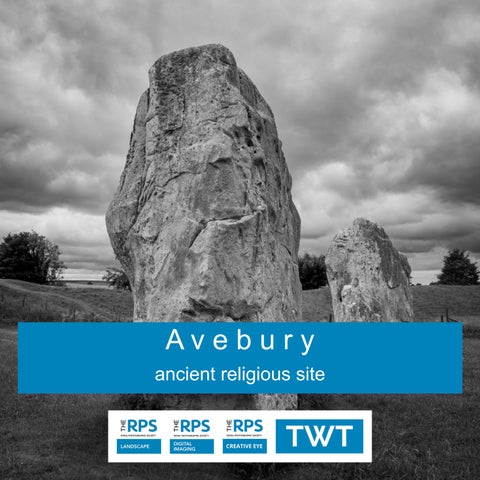
Avebury ancient religious site
Talk Walk Talk - photo walk TWT is a collaborative project between the Digital Imaging and Landscape Groups of the RPS which aims to bring photographers together on a specific theme. Avebury (and its accompanying prehistoric sites of Silbury Hill and West Kennet Barrow) was chosen as an example of 'a site of religious significance'. Seven of us met on the last day of June 2026 and spent some time focusing on the stone circle in Avebury before some continued on to visit The Avenue and 'Silbury Hill. This zine includes some of our images from the walk on that day. On a later date we also reviewed the two images that each of us had submitted for a feedback and reflection session. We chose Steve's image 'Biblical Storm Brewing over the Stones' for inclusion in the national Talk Walk Talk gallery and e-Zine, with John's 'Stone Free' a close second.
Guy Robertson - Walk Leader Steve Hartley - Walk Co-Leader
Biblical Storm: Steve Hartley LRPS
The veins of Avebury: Denise Bailey LRPS
The Talk-Walk-Talks offered Digital the by Imaging and Landscape fantastic Groups RPS athe are of initiative reasons the keep and RPS one of my membership. I enjoy meeting I and learning from other photographers never amaze group photographers fails to and itthat of ame same the same the time at on out day and produce can go such different results.
Avebury was awe an inspiring place steeped history in which you could ‘feel’. Thank you Guy and Steve for the work you have done run this to TWT event and for the zine that you produced afterwards, which lovely aismemento the event. of
Denise Bailey LRPS The Talk-Walk-Talks offered by the Digital Imaging and Landscape Groups of the RPS are a fantastic initiative and one of the reasons I keep my RPS membership. I enjoy meeting and learning from other photographers and it never fails to amaze me that a group of photographers can go out at the same time on the same day and produce such different results. Avebury was an awe inspiring place steeped in history which you could ‘feel’. Denise Bailey LRPS
Stone Free: John Knight
Inner Circle with sheep: Lesley Bravery
When I saw that the RPS were arranging a walk at Avebury, I knew that I wanted to participate in this as it was so close to my home and the subject matter was so very interesting. One of the pleasures that I experienced on the day was the ability to be on one’s own and totally immerse myself in the environment before actually taking any images. Avebury is steeped in history and it is easy to imagine the lives of the people who actually formed the stone circles and the distances that they must have walked over the hills surrounding the village. I decided to shoot my images on a 100-400mm lens so that I could avoid including as much as possible of the tourists that are always at Avebury, although in one image people are included to show the scale and size of the stones.
Lesley Bravery
Silent Guardians: Lin Knight
Avebury Stones: Vicky Taylor LRPS
The Pilgrims Path:Denise Bailey LRPS
Stone and Sheep: Guy Robertson
Rood Screen: Vicky Taylor LRPS
Part of the Avenue: Lesley Bravery
Avebury: an historical overview Avebury stone circle is the largest megalithic stone circle in the world. It was built from sarsen stones that were dragged on sledges from Marlborough Downs some two miles away by solely human labour. It is estimated that up to five hundred people would have been required to transport the very largest stones weighing around one hundred tons. Once the stones arrived, workers probably excavated a ramp using simple tools. They lined it with chalk before raising each stone with wooden levers and scaffolding. Originally, the circle contained around one hundred standing stones. Archaeologists believe this enormous project was made possible by strong community leadership and shared beliefs. The henge was probably used for Neolithic ceremonies and feasts. Evidence suggests that people processed between the stone circle, West Kennet Long Barrow and the Sanctuary during ceremonies. During the Middle Ages, as Christianity spread, the 'Devil's Stones' were often pulled down and buried in an attempt to suppress pagan beliefs. In one case a body was discovered in 1938 of the so called “Barber/Surgeon of Avebury” who is thought to have been beside the stone when it toppled. The unromantic element amongst the archaeological community have offered another theory – that he was already dead and was simply buried there. Some were reused for local buildings. They were broken apart by heating them with fires before dousing them with cold water causing the sarsen to crack. Fragments of the stone can still be seen in some local cottages. The missing stones are now represented by small concrete pillars. By John Knight
Juxtaposition: John Knight
Church between the stones: Lin Knight
Avebury Church: Steve Harley LRPS
Offering: Guy Robertson
Offering: Guy Robertson
The photographers who attended the day were: Denise Bailey LRPS, John Knight, Vicky Taylor ARPS, Lin Knight, Lesley Bravery, Steve Hartley LRPS and Guy Robertson.
This Zine was compiled using the (free) Affinity app in Layout mode by Guy Robertson and printed by Mixam.
To learn more about the Talk Walk Talk initiative and to see more images from other TWT walks, go to the TWT website:
www. talkwalktalk.org