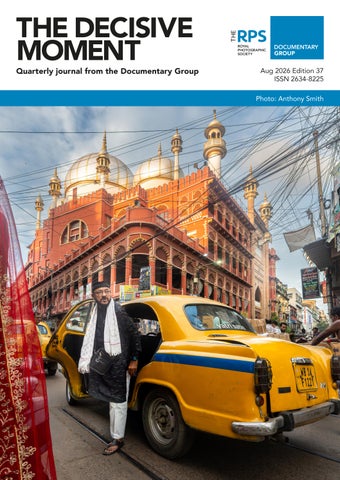
THE DECISIVE MOMENT
Quarterly journal from the Documentary Group
Aug 2026 Edition 37 ISSN 2634-8225 Photo: Anthony Smith
Contents 04
From Our Chair
06
The Documentary Group Team and Plans
08
Catching the Tide - Colin McPherson
28
The Second Skin - A Psychological Study of the Gajon Festival - Shubhodeep Roy
48
Postgraduate Study - Felicity Handford ARPS
66
Dark Tales: British Documentary Photography and the Gothic - Martin Parr Foundation
74
Still Got It! – the untold story of the older generation - Mike Longhurst FRPS
2
92
Until the Wind Dies - Laura Argiolas
108
Food Photographer Award - Maggie Jary ARPS
118
Relocating Amber - AmberSide Collection
132
The End of Kolkata’s Ambassadors - Anthony Smith
150
Regional Focus - Documentary East Anglia
166
Events
168
Documentary Group Online
Catching the Tide - Colin McPherson. p8.
The Second Skin - A Psychological Study of the Gajon Festival Shubhodeep Roy. P28.
Postgraduate Study - Felicity Handford ARPS. p48.
Still Got It! – the untold story of the older generation - Mike Longhurst FRPS. p74.
3
From Our Chair “May you live in interesting times” says the fabled curse. Those of us who have been RPS members in recent times may feel it applies to the Society: we moved into purpose-built premises and then moved out again; introduced an IT system that baffles those who try and use it; have had 4 CEOs; and have ongoing financial difficulties. Let us hope this period of instability is now at an end. Change, however, is inevitable. Over the coming year, we will see the launch of a new RPS website and a new Distinctions system. Many members have raised their concern that this year’s Distinctions Assessments have been cancelled, and I offer my sincere sympathy to those of you who have been disappointed by this. At the same time, the success rate under the old system had become so low that change was necessary. Let us hope that the new system will support our members to gain Distinctions in a fair manner. The Documentary Group will also be making changes. This year we have experimented with adding events to the DPA Touring exhibition, an approach we will expand during the 2028 tour. Many thanks to Ffordes Photographic for sponsoring our event at The Stirling Photography Festival and offering our members a discount. We have begun a process of supporting our Regional Groups and intend to expand the network of groups across the country making us a truly nationwide organisation.
4
As September arrives, bringing shorter days and a much-needed chill to the air; we put away our summer clothes and store the buckets and spades. There is a familiar sense of returning to work. Over the next few months, we will restructure some committee the roles and revise the ways we organise our work. I know that many members have skills that could help us move forward but cannot commit to a large role or do not wish to sit on a committee. We are planning to divide roles into discrete, manageable tasks. For example, Mark has previously run the competition element of the DPA, while I ran the touring exhibition. In future, this work will be broken down into smaller modules that don’t require large time commitments and can be shared among a group of volunteers. We will cover this issue in a Newsletter in a few weeks' time. I hope you have had a good summer and have had the opportunities to create some interesting projects Harry Documentary Group Chair
5
The Documentary Group Team Documentary Group Committee: Chair:
Harry Hall FRPS
doc@rps.org
Secretary:
Nick Linnett LRPS
docsecretary@rps.org
Finance Officer:
Andrew Burton ARPS
docfinance@rps.org
Decisive Moment:
Wayne Richards
decisive@rps.org
Projects:
Valerie Mather ARPS
docprojects@rps.org
Exhibition:
Harry Hall FRPS
docreg@rps.org
Social Media:
tbc
docweb@rps.org
Publishing:
Dave Thorp
docpublishing@rps.org
Events:
tbc
Education:
tbc
The Decisive Moment: Editor:
Wayne Richards
Sub-Editors:
Lyn Newton ARPS, Rachael Thorp
Editorial: Publishing
Dave Thorp
Local Group Organisers: East Midlands:
Volunteer Required
docem@rps.org
South East:
Jeff Owen ARPS
docse@rps.org
Northern:
Peter Dixon ARPS
docnorthern@rps.org
Thames Valley:
Philip Joyce FRPS
doctv@rps.org
Central (with Contemporary):
Steff Hutchinson ARPS
North West (with Contemporary): Alan Cameron Yorkshire:
Graham Evans LRPS
docyork@rps.org
Southern:
Christopher Morris ARPS
docsouthern@rps.org
East Anglia:
Richard Jeffries
docea@rps.org
Scotland (with Contemporary et al): Steve Whittaker
email Steve Whittaker
Documentary Group Plans for 2025-2026 Overall Objective To support the RPS Strategic Plan Photography for Everyone 2021-2026 and to enhance the relevance for Documentary Photography by engaging more diverse audiences and ensuring our activities self-fund.
Inspiration – showcase inspiring photography and to shed new light on subjects of importance These activities are focussed around showcasing and celebrating high quality photographic work and thinking: Engagement talks The Decisive Moment Documentary Photography Awards (DPA) DPA touring exhibition
Skills and Knowledge – encouraging a deeper understanding of photography and providing resources for photographic education and Recognition (such as distinctions and awards) To develop the range and reach of our educational activities. We want to help photographers develop their practice, and also educate non-photographers about what is current in documentary photography: Workshops Engage university courses Resources and support individual development Distinction support
Community – promote belonging and inclusivity, by supporting and engaging widely To engage with more people and connect with other communities, including those who are not photographers, to appreciate the value of documentary photography: Work with groups outside RPS Regional and local activities Website and social media Online competition Newsletter The Documentary Group is run by RPS members who volunteer their time. If you can help in any capacity, please email Harry Hall using doc@rps.org to let him know.
rps.org/groups/documentary/about-us
Catching The Tide Colin McPherson
8
For nearly three decades, Colin McPherson has documented Scotland's salmon net fishermen, recording not simply a traditional industry in decline, but the communities, landscapes and lives shaped by it. His forthcoming book, Catching the Tide, published by Dewi Lewis Publishing, brings together this long-term body of work in its most complete form to date. In this conversation with The Decisive Moment, Colin reflects on the evolution of the project, the challenge of distilling decades of work into a photobook, and the experience of bringing the publication to life through crowdfunding.
9
Catching the Tide - Colin McPherson
DM – Catching the Tide draws on many years of work documenting Scotland's salmon net fishermen. At what point did you realise that this long-term body of work had become a book? CM – The idea of publishing the project in book form goes back over 15 years. I began taking photographs for what would develop into Catching the Tide in 1996 and after about a decade of documenting the subject at a number of key locations around Scotland, I felt there was sufficient material for a book. I did have discussions with a couple of publishers based in Scotland, and although there was quite a lot of enthusiasm on their behalf, I felt that their ambition for the work didn’t match mine in terms of what a book would look or feel like. The publishers wanted to pigeon-hole the material as ‘heritage’ or ‘contemporary history’ and for me the work was a much bigger and deeper creative exploration with my voice at the heart of it. As a result, I rejected the offers and concentrated more on getting the work and the subject known through magazine articles and contributing individual images or small series of pictures to other people’s books. In 2008, I collaborated with my friend, the designer Doug Cheeseman, to submit a book dummy for the annual European Publishers Award for Photography. Although we were unsuccessful, one of the judges was Dewi Lewis, and through our submission he became aware of the project for the first time. Almost 20 years later, it is Dewi who is publishing the work, something I am absolutely delighted about. DM – The project documents a way of life that has undergone profound change. How did your understanding of the subject evolve and did that influence the final shape of the book? CM – I started with nothing. I had no knowledge of salmon net fishing in Scotland when I pointed my camera for the first time at a strange contraption of poles, nets and ropes on the beach at St. Cyrus in Aberdeenshire on Scotland’s east coast. Despite growing up and (so I thought) knowing so much about my country, it goes to show there are always gaps in your knowledge. My interest was sparked by the visual aspect of salmon netting: the shapes of the stake nets set against the seascapes, wide sandy expanses and vast skies. It was a fascinating exercise in playing with composition and light and bringing these elements together to make photographs. There was the human element too, although to begin with, I saw the fishermen as figures in a landscape. They added scale to the images, nothing more. I was captivated by the scene rather than the subject. My instincts as a journalist, however, led me to delve deeper into net fishing, and I soon struck up a good relationship with a man called Bob Ritchie, whose job title was Superintendent of Wild Fish for Joseph Johnston & Sons, a large company based in Montrose which had fishing interests around Scotland. If you pardon the expression, he showed me the ropes. Through Bob I got to know other fishermen and started exploring fisheries at a variety of locations from Sutherland in the far 10
Catching the Tide - Colin McPherson
north to the Solway Firth and the river Tweed. It was an adventure, one that allowed me to explore hidden corners of Scotland and document a way of life which I could see disappearing from coastal communities around the country. The book I am publishing with Dewi Lewis draws on my experiences with this fishing and I hope strikes a balance between showcasing my work and informing readers about salmon netting. The book is led by the photography. Through my images I am trying to tell a story and that’s a challenge. I decided to keep the texts in the book to a minimum without the subject matter being too opaque. I am fortunate I have been able to include a beautiful contribution by writer Fiona Halliday which summarises the history of the practice. Other than a short introduction and the usual biographical content, I am trying to make the photography do the talking in Catching the Tide and thereby letting the fishermen’s voices be heard. DM – Long-term projects often generate far more material than can ever be published. How did you approach the difficult process of editing and sequencing work for the book? CM – The process of filleting down around 850 monochrome images which reside in my archive to the one hundred which are included in the book was actually surprisingly easy. Having lived with the work for so many years, there were images which were touchstones and had to be included. This started with the cover image, which shows Jim Mitchell struggling through a hailstorm at Kinnaber with a scum net full of salmon. The figure looming large in the background is, appropriately, Bob Ritchie, looking like (as he described it) the Grim Reaper. It’s the photograph which has come to define the project and was and is the starting point for most things Catching the Tide. The initial selection of the images was made to reflect the arc of my experiences with the fishermen, rather than being a list of places visited and people met. I worked with a number of key individuals across the years and therefore I wanted to reflect the essence of their characters and the particular characteristics of their fishing in the contents of the book. I had my favourite images, ones which I went back to time and again if people wanted pictures to illustrate articles or to include in books or exhibitions. There are seven photographs held in the collection of the National Galleries of Scotland and a similar number in the archive of St. Andrews University: these are pictures which I think reflect most strongly the project and were starting points for selections made for the book. In the end, I did change and swap a few, but not that many. I settled on my selection comparatively quickly, although I had to leave space for three images which I made this year, one of which was taken on the first day of fishing at the inner Solway just two weeks before the final artwork was signed off.
11
Catching the Tide - Colin McPherson
12
Catching the Tide - Colin McPherson
13
Catching the Tide - Colin McPherson
DM – You have spoken previously about earning the trust of the fishermen over many years. How important was that sustained relationship in allowing you to make the photographs that appear in Catching the Tide? CM – Maintaining the trust and (I hope) respect of the fishermen was and is absolutely vital. Sadly, many of the men I worked with have passed away, but I am still in contact with their families and continue to include them as the project develops. In addition to publishing the book, I am undertaking a funded project to explore how communities and their salmon fisheries can work together to protect and develop the assets they have. This is being run by Museums Galleries Scotland and is allowing me to film and interview some of the men who I worked with previously and make the acquaintance of others who, for one reason or another, I have not met until now. Again, gaining and retaining the trust of the fishermen is so important, because it is their voices I want to hear amplified through Catching the Tide. Ultimately, the book is about and for them. DM – You worked with Dewi Lewis Publishing on the book. How collaborative has the process been, and what have you learned from working with an experienced photobook publisher? CM – The process has been absolutely brilliant, really interesting and I feel privileged to have benefited from Dewi’s enormous wealth of knowledge. There have been three of us involved in the publication of Catching the Tide as I wanted to collaborate again with Doug Cheeseman bringing him on board to act as a conduit for my ideas. I have been working with Doug for many years, firstly in his role as art editor at When Saturday Comes, the monthly football magazine I photograph for. In 2024, we were part of the team which published AT THE MATCH, a compendium of images taken by me and colleagues Simon Gill and Paul Thompson which drew from twenty years of photography in the WSC archive. Dewi’s involvement in the production of Catching the Tide has steadily become more prominent. He initially approved my outline design for the book at the end of 2025, after which I set about rescanning negatives (all the material in the book is analogue), editing the images and writing captions and other content. Doug was the one who then brought the design together by producing the laid-out pages. They were then passed to Dewi who made tritones, before the whole book was passed back to me for final checking and proofing. Dewi and I then headed to an industrial estate near Verona in northern Italy where the book was expertly printed by EPS. The five days spent with Dewi (and fellow photographers SirkkaLiisa Konttinen and Stu McKenzie who were also ‘on press’) were just magical. Long days spent talking about photography and life whilst the printing presses rolled and the pages were produced. I learned more that week about what it takes to publish a photobook than in my whole thirty-seven-year career as a photographer. It’s impossible to quantify what I learned, but if I am ever lucky enough to publish another book, I’ll certainly know what to expect! 14
Catching the Tide - Colin McPherson
My motivation for doing this work has always been to tell a story, one in which the central characters are the salmon net fishermen and the work they do. DM – What led you to choose Kickstarter as the route to market for Catching the Tide? CM – Well as I don’t have a goldmine or oil well under my house, the money to produce the book had to come from somewhere, and Kickstarter was the obvious platform. I had experience of working on one we used to fund AT THE MATCH, and I had acted as an unofficial advisor to Craig Easton on his book project last year (An Extremely Un-get-atable Place) published by GOST, so the process held no terrors for me. These days, photographers are expected to stump up the money to publish books, so I was under no illusion that this would be the case for Catching the Tide. We set a target initially of £12,000 but I felt this was a little on the low side and I knew it would not come close to covering all the design, printing, production and fulfilment costs. I therefore added another one thousand to the target and although I knew it was a lot of money to raise in five weeks, I was pretty confident I’d get there. That’s not to underestimate the immense amount of hard work it takes to reach a target like that in the allotted time. It required a lot of planning, chiefly around how to organise social media posts, get people in the media interested and firming up mailing lists of friends, relatives and contacts who I surmised would back the book. It is no underestimate to say I worked on Kickstarter for around three weeks before its launch and every single day for the duration of the campaign. As well as the basic book offer, there were further ‘rewards’ that backers could choose: these ranged from signed copies of the book, giclee prints and at the top end, handmade darkroom prints for people willing to support me with larger sums of money. As always with Kickstarter campaigns, it got off to a blistering start before plateauing for a good two weeks. That was the most nerve-shredding time: I was well short and just had to persevere with endless multi-platform social media posts and reminders to those who indicated their intention to back me. In the end, we cruised past the target and ended up with £14,200 from 217 backers. The ‘large ticket’ items certainly helped, but it was the spread of support which got us there. Exceeding the target meant we could add more pages (and pictures) to the book, which I was delighted with. It still has not covered the entire cost of producing 600 books, but it’s very close. I’ll be paying the rest. Additional costs, such as materials for the photographic prints, art postcards (another reward) and of course my trip to Italy for the printing have been my responsibility and were not covered by the Kickstarter. These extra costs, and the time you will spend on crowdfunding, are things worth budgeting for if you are thinking about raising money this way. 15
Catching the Tide - Colin McPherson
16
Catching the Tide - Colin McPherson
17
Catching the Tide - Colin McPherson
DM – Running a crowd funding campaign requires photographers to become promoters and marketers as well as image-makers. How comfortable did you feel stepping into that role, and what aspects of the campaign surprised you most? CM – To be honest, I love doing this sort of stuff. I enjoy talking about and sharing my work and am happy and relaxed when it comes to putting the effort in as I know it’s for the greater good of the project. I love figuring out how to reach individuals, groups and communities, whether that’s small-scale or via the media. I am very fortunate that having worked in the media for well over three decades, I have many contacts I can get in touch with and who are interested in what I am doing. The Catching the Tide Kickstarter ended up being featured in a number of newspapers, magazines and prominent photography websites, which was invaluable. What surprised me most, however, was the engagement I got via Facebook. I managed to join and post details on several hyper-local groups which had geographical connections to where the fisheries were. As a result, a whole host of people engaged with me on an individual basis, which was phenomenal. The interest in the project was widespread, and the most gratifying aspect was having conversations with people who had connections with salmon net fishing. It felt like it was a really engaging and rewarding process for both me and people out there. DM – Looking back on the experience, what advice would you offer other documentary photographers who are considering crowdfunding a photobook project for the first time? CM – You really have to be committed to the process if you think of undertaking crowdfunding via Kickstarter or any other platform or method. My feeling is you owe it to the people who do back you to make sure you can hit your target or cross the finishing line. People will back you for numerous reasons, but fundamentally, it’s a contract between you and your audience. You should endeavour to make the campaign a success; this will help validate your work and solidify your project’s reputation. You should identify the likely audience who will receive your message about the project. Being certain in your own mind about who is interested in your work and where you can locate them will make the process a lot smoother and increase your chances of success. Ultimately, unless something unexpected and spectacular occurs, your crowdfunding journey will be one of small steps. It will come down to how much you are prepared to work on it, the effort you put in and your ability to chase leads and contacts which can get the publicity you will need to reach potential backers. Clear and consistent messaging, strong visual content and an indefatigable spirit will be what you require. Your backers are out there: you just need to find them!
18
Catching the Tide - Colin McPherson
DM – What do you hope readers will take away from Catching the Tide, not only about this community, but about the importance of long-term documentary photography itself? CM – I hope that firstly people will enjoy the book, admire the work and feel they have learned something about the subject. Beyond those elements, I hope they can see the value of documentary photography as a way to open a window on the world. My motivation for doing this work has always been to tell a story, one in which the central characters are the salmon net fishermen and the work they do. They have been dealt a rough hand by history and if I can do anything it is to show people who engage with my project or read the book a way of life which has been woven into the fabric of coastal life in Scotland and which is now under severe threat. I moved on long ago from merely taking photographs of netsmen: Catching the Tide is their story, and I am incredibly proud and honoured to tell something of it through my photography.
As Catching the Tide makes clear, the strongest documentary projects are built through patience, trust and a willingness to return, again and again, as lives and landscapes slowly reveal themselves. Catching the Tide stands as both a tribute to Scotland's salmon net fishermen and a reminder of the unique power of long-term documentary photography. Colin's work offers far more than a historical record. It is an intimate account of a community facing profound change, ensuring that voices and traditions at risk of being lost will continue to be seen and heard by future generations. For more information, please visit: colinmcpherson.photoshelter.com Catching the Tide is available through Dewi Lewis Publishing: www.dewilewis.com All images ©Colin McPherson 2026 19
Catching the Tide - Colin McPherson
20
Catching the Tide - Colin McPherson
21
Catching the Tide - Colin McPherson
22
Catching the Tide - Colin McPherson
23
Catching the Tide - Colin McPherson
24
Catching the Tide - Colin McPherson
25
26
Catching the Tide - Colin McPherson
27
The Second Skin A Psychological Study of the Gajon Festival Shubhodeep Roy Four years ago, The Decisive Moment introduced readers to a young photographer from Kolkata whose project The Migrant Workers of India revealed both a remarkable eye and a deep empathy for the people he photographed. Since then, Shubhodeep Roy has continued to develop a thoughtful and distinctive documentary practice, producing work that looks beyond events to explore questions of identity, memory and faith. His latest project, The Second Skin, examines the Gajon Festival in West Bengal, not simply as a colourful religious celebration, but as a meditation on transformation and the relationship between ritual and identity. We caught up with him to discuss how his photography has evolved, the thinking behind the project, and what he has learned along the way.
28
29
The Second Skin - Shubhodeep Roy
DM - We first featured your work when you were just twenty-one, and it's been a pleasure to watch your development as a documentary photographer. Looking back over the past four years, how do you feel your approach to photography has evolved, and what has remained constant? SR - Firstly, thank you. Reading those words is deeply moving. Four years ago, when The Migrant Workers of India was first featured by the Royal Photographic Society, I was only beginning to understand what photography could be. I believed it was about documenting important stories. I never imagined I would have the privilege of returning to these pages. Working with migrant workers during the pandemic shaped me far more than the photographs themselves. Their stories of uncertainty, resilience and hope taught me that before we make an image, we must first learn to listen. The greatest change in my work has not been how I photograph, but the questions I ask. Earlier, I was interested in asking, "What is happening?" Today I ask, "What does this reveal about being human?" That shift has drawn me away from documenting events alone and towards the quieter emotional truths beneath them, identity, faith, belonging and resilience. What has remained constant is my belief that photography begins with empathy. Before composition or light, there is a relationship between two people. Alongside my documentary work I continue to work full-time in banking, often making photographs before sunrise or after long days at work. It has reminded me that meaningful projects are built through persistence rather than speed. Looking back, I realise that every person who has welcomed me into their life has left me with far more than a photograph. They have deepened my understanding of humanity, and I remain a student of people, life and photography. DM - The Second Skin is subtitled, A Psychological Study of the Gajon Festival. Many photographers have documented religious festivals in India, so what made you want to explore this one through the lens of psychology rather than simply recording the rituals themselves? SR - When I first travelled to a small village in West Bengal, I expected to photograph a vibrant religious celebration. Gajon is a traditional folk festival where participants embody sacred identities through ritual, music, performance and elaborate body painting. As night fell, the village changed completely. Away from the crowds, I found devotees quietly preparing themselves. There was very little conversation, only concentration and devotion. Faces disappeared beneath layers of paint as ordinary villagers prepared for ritual. As the night unfolded, it was not the spectacle that stayed with me. It was the quieter preparations. A devotee sitting silently while another painted his face. 30
The Second Skin - Shubhodeep Roy
Someone studying themselves in a mirror. Another standing with closed eyes before joining the procession. I realised that the real transformation was not happening on the surface of the body but within the individual. The paint and costumes were simply visible expressions of something much deeper. Through faith and devotion, ordinary people appeared to step beyond their everyday identities and embody sacred figures. That changed the direction of the project. Instead of asking, "What does this celebration look like?" I found myself asking, "What happens to a human being through faith?" The subtitle reflects the questions I carried home with me. I was never trying to explain the tradition, only to understand it. For me, The Second Skin is about the invisible transformation beneath paint and ritual. The festival was the setting. The real subject was the relationship between faith and identity. DM - You describe yourself as "only a witness" rather than an interpreter. Documentary photographers often have to balance observation with storytelling. How do you decide how much of yourself to bring into the work, and where do you draw that line? SR - When I describe myself as "only a witness", I do not mean the photographer should be invisible. Every photograph carries something of the person behind the camera. In The Second Skin I tried to ensure my presence never became more important than the people I was photographing. Instead, I was drawn to the quieter moments of preparation and reflection. I never wanted to explain the spiritual experience of the participants. I could not know exactly what faith meant to them, and I did not want to reduce something deeply personal to my own interpretation. Every story involves choices. The important question is whether those choices serve the story or simply the photographer. DM - The work feels intimate despite taking place during a large public festival. How did you approach photographing participants in such emotionally and spiritually charged moments while remaining respectful of their beliefs and practices? SR - For me, the photographs only appear intimate because I first tried to be present as a person rather than as a photographer. When I arrived, I did not immediately begin making photographs. I spent time walking through the village, observing, introducing myself where appropriate and understanding the rhythm of the celebration. 31
The Second Skin - Shubhodeep Roy
32
The Second Skin - Shubhodeep Roy
33
The Second Skin - Shubhodeep Roy
I was conscious that I was entering a sacred space that did not belong to me. Rather than directing or interrupting moments, I tried to let the celebration unfold on its own terms. Many of the photographs were made before the public rituals began. Those quieter hours revealed deeply personal moments of preparation. Sometimes I photographed them, and sometimes not. I think knowing when not to make a photograph is just as important as knowing when to press the shutter. As the rituals began, the atmosphere became incredibly powerful. My instinct was never to move closer for a more dramatic image. It was simply to observe quietly and allow the moment to unfold without interference. As the hours passed, people became accustomed to my presence and returned their attention to the ritual. Perhaps that is why the photographs feel intimate. They are not the result of physical closeness, but of quiet observation. DM - In your project statement you write about moments when "identity appeared to loosen" and familiar faces became something beyond everyday recognition. Was there a particular encounter or photograph that crystallised this idea for you? SR - Yes. There was one moment that has remained with me ever since. It was late at night. A devotee stood completely transformed, his face painted blue, a crown of peacock feathers rising above him and a ritual blade resting quietly in his hand. He stood perfectly still; his eyes fixed somewhere beyond me. Only a short time earlier I had watched him preparing like any other member of the village. Standing before me it was almost impossible to reconcile the two. Within the belief of the community, he was no longer simply himself but the living embodiment of a deity. Even members of his own family approached him with folded hands and offered prayers. Whether that transformation was spiritual, psychological or something beyond words, I cannot say. As a documentary photographer, it is not my place to define another person's experience. I could only witness what unfolded before me. That encounter changed my understanding of the project. I realised I was not simply photographing a religious celebration, but those rare moments when faith reshaped identity. The paint and costume were only the visible surface. The real transformation lay beneath them. DM - Your photographs seem to avoid the obvious spectacle of the festival, instead concentrating on quieter expressions, gestures and transformations. How did you edit the project, and what guided your decisions about which images best conveyed the ideas behind The Second Skin? 34
The Second Skin - Shubhodeep Roy
SR - From the beginning I knew I did not want the project to become a collection of the festival's most dramatic moments. I approached the edit as a psychological exploration. The sequence begins with preparation, quiet concentration and anticipation. As it progresses, familiar faces slowly disappear beneath paint and costume until individuals seem to move beyond their everyday identities. I selected images because they suggested an inner change. I wanted viewers to sense the moment when a person seemed to exist between two identities, still recognisably human, yet carrying the spiritual role they had entered through ritual. Every photograph had to contribute to one central question: how does a person become something more than their everyday self? If an image only showed colour or spectacle without contributing to that journey, it did not belong in the edit. Ultimately, The Second Skin is not about paint or performance. It is about the invisible process through which faith and ritual temporarily reshape identity. My hope was that viewers would not simply see the festival but feel that gradual movement from the familiar towards the sacred. DM - This project suggests an India that exists beneath the surface of contemporary life, sustained through ritual, memory and faith. Do you see this as the beginning of a longer body of work exploring these hidden cultural traditions, and where might that process take you next? SR - The Second Skin feels like another chapter in a longer story that has been unfolding for several years. My years in Varanasi taught me that photography is rarely about what first attracts us to a place. What began as a project about life and death gradually became an exploration of dignity, faith and the realities of living alongside mortality. It encouraged me to look beyond rituals and towards the quieter truths that shape people's lives. That experience has led me to what I think of as the India within India. I mean the communities that rarely demand attention but reveal something essential about resilience, belonging and faith. I hope to continue travelling across India, building long-term relationships with communities whose stories deserve patience rather than urgency. Where it will lead, I honestly do not know. I hope it leads me to people and places that challenge my assumptions and deepen my understanding of both others and myself. The longer I practise documentary photography, the more I realise that every meaningful journey outward also becomes an inward one. If I continue following stories with curiosity, humility and empathy, I hope that journey never ends.
35
The Second Skin - Shubhodeep Roy
DM - Finally, you first appeared in The Decisive Moment as an emerging photographer and now return with a mature and reflective body of work. What advice would you give to young documentary photographers who are just beginning to find their own voice? SR - I still think of myself as a student. When my work was first recognised by the RPS, I was simply grateful that someone had taken the time to look at my photographs and believe in my attempt to tell honest stories. Everything I have learned has come from the people who have allowed me into their lives. Through my projects I tried to understand lives shaped by struggle and faith. Those experiences taught me that documentary photography is not about observing from a distance. It is about building trust, listening carefully and respecting the people in front of the camera. If I could offer one piece of advice, it would be this: before making photographs, learn to be present as a human being. Technique matters, but the person in front of the camera matters more. A camera can record a moment, but only genuine curiosity helps us understand its meaning. Stay curious. Read widely, look at art and pay attention to the world around you. Do not wait for perfect equipment or perfect circumstances. Most of the important things we carry are not inside our camera bags, but within ourselves: patience, honesty, humility and a willingness to keep learning. Finding your own voice is not a race. It develops through time, experience and sincerity. Above all, remember that every photograph depends on another person's trust. Our responsibility is to honour that trust with honesty and compassion.
Four years after first appearing in these pages, Shubhodeep Roy remains, in his own words, "a student of people, life and photography". If The Second Skin is any indication, his curiosity is leading him towards work of increasing depth, sensitivity and quiet assurance.
Instagram: @shubhodeeproy.in Linktree Link: linktr.ee/shubhodeeproy.in All images ©Shubhodeep Roy 2026 36
The Second Skin - Shubhodeep Roy
37
The Second Skin - Shubhodeep Roy
38
The Second Skin - Shubhodeep Roy
39
The Second Skin - Shubhodeep Roy
40
The Second Skin - Shubhodeep Roy
41
42
The Second Skin - Shubhodeep Roy
43
The Second Skin - Shubhodeep Roy
44
The Second Skin - Shubhodeep Roy
45
The Second Skin - Shubhodeep Roy
46
The Second Skin - Shubhodeep Roy
47
Postgraduate Study Felicity Handford ARPS One of the recurring questions many documentary photographers ask themselves is whether formal postgraduate study can genuinely change the way they work. For Belgian-based photographer Felicity Handford, undertaking an MA in Photography at Falmouth University proved to be about far more than gaining a qualification. It became an opportunity to develop a deeper understanding of photography, ethics and longform storytelling, culminating in an 18-month project documenting La Ferme du Chant des Cailles, an urban market garden in southeast Brussels. In this interview, she reflects on the experience of postgraduate study, the importance of building trust with a community, and the lessons she has carried into her photography since graduating.
48
49
50
Postgraduate Study - Felicity Handford ARPS
51
Postgraduate Study - Felicity Handford ARPS
DM - What drew you to undertaking an MA in photography at Falmouth University? Was there something you hoped it would give you that you couldn’t achieve on your own? FH - During Covid, the RPS ran a number of short courses that both helped me think about and improve my photography but also helped me understand how much I got out of working within a time limited, structured, learning environment. Later I enrolled in two separate OCA/Open University courses. Photography as Language and Investigating Place with Psychogeography. Both of those courses taught me something very important about photography and photographs, and how to let my eyes lead what I photograph. When one of the members of the Photography as Language course began her MA at Falmouth, I began to investigate the course. I applied and was accepted onto the course. DM - Was there a particular tutor seminar or piece of feedback during the course that changed how you think about your photography? FH - The course was an online two-year part-time course. It was divided into four modules of four months. The final major project took the last eight months. The first was an introduction to the whole course. At the end of each module there was a written test and a photographic project that had to be passed before progressing onto the next module. When I reflect on everything I learned during the course, I cannot say that there is one piece of information, learning point or technique that changed my photography. Rather each separate module taught me something that came together in the work that was my final major project. What a photograph is and is not, its possibilities and limitations, issues of cultural bias and sustainability. Our responsibility as photographers to the subjects we are taking photographs of. DM - Your final major project focuses on an urban market garden in Southeast Brussels. How did you first discover the garden, and what convinced you it was a story worth exploring? FH - We were encouraged to look for projects that we could work on through each module. I decided that I wanted to identify one project that I could work on throughout the whole course. I am a city dweller, and the issue of city sustainability is important to me. Our relationship to nature became clear to me before beginning my MA, through a six-month project following a woman feeding pigeons. I searched for and found a site that listed all the urban food growing projects in Brussels and it was through this site that I found La Ferme du Chant des Cailles, an urban farm in southeast Brussels. In late February 2024 I met with one of the organisers, a man called Alex. He showed me round the farm, explained how it was organised and was very encouraging when I explained what I wanted 52
Postgraduate Study - Felicity Handford ARPS
to do. I knew from that visit that this was a place that excited me as a photographer, a place that I would have no difficulties in finding stories to tell. DM - Documentary photography often depends on building relationships over time. How did you gain the trust of the people involved, and in what ways did those relationships shape the photographs you were able to make? FH - I believe that to build relationships that work there must be both trust and respect between the photographer and subject. These are things that must be worked on and are built over time. I needed to understand the work involved in growing the food. By asking questions, showing interest and just observing everything that was going on I learned a great deal that helped me anticipate and plan my photography. Before photographing people, I introduced myself, explained what I was doing and asked their permission to photograph them. Most people were very happy to be photographed, a few were not, I respected that. On average I went to the farm at least twice a week. I wanted photographs of people working, not posing. By becoming a familiar figure, the farmers just ignored me, and I got the images that I wanted. DM - Can you describe your approach to making the work? Did you begin with a clear idea of where the project was heading, or did it evolve through research experimentation and reflection as you spent more time there? FH - During my initial discussion with Alex, he explained that the farm was divided into sections. The biggest was the area farmed by the market gardeners, then there was an aromatic area with herbs and spices, an area with allotments for individual gardeners, a field for sheep and an area for social activities that includes a small, covered area where cheese, yogurt and ice-cream is sold during the summer. This meant that there were several different stories for me to tell. With each of the three modules before my final project I focussed on a different aspect of the farm. At first this was the plants and the weather. For the first time I saw first-hand the importance of climate on food production. For Belgium, 2024 was one of the wettest years on record, and this had a dramatic effect on the plants. The allotments were particularly badly hit, most of the plants never got beyond seedlings before being eaten by snails and slugs. Last year, 2025, was very different. The farm is organic and usually manages to store enough water. However, it ran out water before the end of May. This increased the cost of food production as water had to be paid for. Observing and experiencing this gave me an invaluable experiential understanding of food production that drove my photography.
53
Postgraduate Study - Felicity Handford ARPS
I had to learn how to photograph in less-than-ideal light. The bright and unrelenting sunlight of 2025 was more challenging than the clouds and rain of the previous year. I changed my images from portrait to landscape, so that my environmental portraits included urban farm and signs of the city. All the research done on urban sustainability shows how important open spaces are for the wellbeing of city dwellers. Not only for people’s mental and physical wellbeing but also for building communities. I witnessed and experienced this first-hand. My final major project focused on the community that works and socialises on the farm. DM - Producing photographs is only part of the process. How did you approach editing and sequencing the work and what did you learn from presenting it as a coherent body of work? FH - I learned that putting together a cohesive set of images required me to do three main things. Firstly, I needed to have written a clear statement of intent, to remind me what the story I wanted my images to tell was. I learned that however good I think an image is, if it does not tell the story, it gets left out. Secondly, it was and is important to have photographer friends who will give you honest, but constructive criticism. We were actively encouraged to share our images with our cohort, and I think that we all learned to look at and talk about each other’s images during the course. For this project was my final major project, I had very important, invaluable help and feedback from my tutor. Lastly, I printed out all the images that I thought I might include and these took over my dining room table. I moved them around, added and took away images, before settling on the final set. DM - Now you’ve had some distance from the project, how do you feel about it? Looking back, is there anything you would approach differently? FH - Working on a long-term project has changed the way I approach my photography. It has taught me to slow down, to let my eyes guide what I see and photograph. In the past I have tended to overthink what I was doing, but I learned to trust that I would find inspiration. The 18 months of the project taught me the difference between taking photographs of places and people I do not know or have a connection with and taking photos of a place and people that I have got to know, that I am familiar with and care about. I am incredibly grateful for that experience, and I would not change anything.
54
Postgraduate Study - Felicity Handford ARPS
DM - What advice would you offer to fellow RPS documentary group members who are considering postgraduate study or embarking on their own long-term documentary project? FH - An MA is not about photographic technique; we were expected to know how to use our cameras. What we photographed was for us to decide. Some people changed projects each module, others like me photographed different aspects of the same place. The first thing to consider is the time commitment needed to complete the degree. There is academic work, reading, writing, research and group discussions. A two-year part-time course is more flexible if you are working. If you are concerned that you might not manage the work then try a short course, e.g. Photography as Language and Investigating Place with Psychogeography. Finally, go for it, you are never too old, I’m in my 70s and probably the oldest on my course, but most of my fellow cohort were in their 40s, 50s and 60s. Interestingly, a very high number of my fellow students are in the neurodiverse population, and are some of the most talented photographers I know. DM - Finally what comes next? Is this project complete or do you see it continuing to evolve and how has it influenced the direction of your photography since graduating? FH - For the moment I have stopped photographing the farm, but there are other aspects of the work I could come back to. The experience of working on a longterm project has changed how I photograph. I realise that I no longer need to travel to distant places to find things that interest me, I am finding ways to photograph where I live, which is very well known for its restaurants, bars and its’ square. I have begun a project to photograph the area at night, In September I am taking part in a small exhibition in Brussels entitled ‘Breathing Spaces’, using photographs I took in the Park Royale in Brussels.
Felicity's experience demonstrates that meaningful documentary work is rarely rushed. Her reflections on education, patience and sustained observation serve as a reminder that strong projects often emerge through commitment rather than immediacy. Whether considering postgraduate study or embarking on a longterm body of work, her advice is simple: invest the time, remain curious and allow relationships with both people and place to develop naturally. The resulting photographs are often richer for it. All images ©Felicity Handford 2026 55
Postgraduate Study - Felicity Handford ARPS
56
Postgraduate Study - Felicity Handford ARPS
57
Postgraduate Study - Felicity Handford ARPS
58
Postgraduate Study - Felicity Handford ARPS
59
Postgraduate Study - Felicity Handford ARPS
60
Postgraduate Study - Felicity Handford ARPS
61
Postgraduate Study - Felicity Handford ARPS
62
Postgraduate Study - Felicity Handford ARPS
63
Postgraduate Study - Felicity Handford ARPS
64
Postgraduate Study - Felicity Handford ARPS
65
Dark Tales: British Docum Photography and the Go Martin Parr Foundation Exhibition Preview The Martin Parr Foundation's latest exhibition, Dark Tales: British Documentary Photography and the Gothic, opens in Bristol on 17th September and runs until 20th December 2026. Curated by Isaac Blease, the exhibition brings together work by more than thirty photographers, including Bill Brandt, Don McCullin, Martin Parr, Jo Spence, Jem Southam, Sarah Pickering, Charlie Phillips and Donovan Wylie. Organised into four thematic chapters, it explores how documentary photography has long reflected themes of uncertainty, fear, memory and the uncanny, offering a fresh perspective on Britain's photographic history. Alongside Dark Tales, visitors can also see Darkroom by Michel Campeau at nearby Arnos Vale Cemetery, with both exhibitions forming part of the Bristol Photo Festival 2026 programme. Admission is free. martinparrfoundation.org
66
mentary othic For many of us, documentary photography is associated with ideas of truth, evidence and social observation. We tend to think of it as a medium that records the world as it is. Yet the photographs that stay with us often do something more. They create unease, suggest hidden narratives or leave us questioning exactly what we have seen. The forthcoming exhibition Dark Tales: British Documentary Photography and the Gothic at the Martin Parr Foundation invites us to look again at documentary photography through precisely this lens. Drawing on more than eighty years of British photography, the exhibition suggests that documentary has always contained a darker current. Whether depicting declining industries, troubled domestic spaces, political conflict or the rituals of everyday life, these photographs often reveal as much about our anxieties and imaginations as they do about the events in front of the camera. It also arrives at a particularly interesting moment. As documentary photography grapples with questions of authenticity, trust and the implications of artificial intelligence, the exhibition reminds us that photographs have never been entirely straightforward documents. They record reality, but they also shape atmosphere, emotion and meaning. Whether you agree with the exhibition's premise or not, Dark Tales promises to stimulate debate about where documentary ends and interpretation begins. That alone makes it an exhibition worth seeking out.
67
68
Dark Tales - Martin Parr Foundation
‘Sunderland, North East of England 1962’. Coal scavengers working on a mound. Part of the grafters collection. © Colin Jones / TopFoto.
69
Dark Tales - Martin Parr Foundation
Woman with pram, Consett, 1974. © Don McCullin. Courtesy the artist and Hauser & Wirth.
70
71
72
Dark Tales - Martin Parr Foundation
Thirty Eight Bastard Years on the Furnace Front, Furnace Keeper, Mess room for Number 4 and Number 5 Furnaces, Clay Lane Ironworks, South Bank, Middlesbrough. 1983. © Graham Smith, courtesy Augusta Edwards Fine Art.
73
Still Got It! – the untold story of the Mike Longhurst FRPS It is easy to believe from media coverage and government rhetoric that the general image of people aged seventy and over is of dependence and burden. Unfortunately, communications from the age-related charities only compound that impression, using needy images to raise donations for them. I knew this was a false picture, but we oldies are simply not the kind of people to organise marches, throw paint over monuments, or block motorways to change views. The photographers amongst us have a weapon far stronger and I decided to point it at the issue, revealing the story that the present older generation continues to make an enormous social and economic contribution. Many thousands are working on, often in new roles and on a freelance basis, earning a fraction of what they might have expected years earlier. They are paying tax and providing cheap labour that benefits the economy. Many thousands are also volunteering, not only for charities, but in areas that once were paid occupations. A study by Benefact Group in 2022 put the economic value of volunteering alone at £18.7bn a year, but that is only part of the story. The older age group, being the fittest ever, are also funding a huge involvement in social activities, which creates employment in those areas and creates marketing opportunities for manufacturers of equipment and underpins resources like halls and facilities for all. The “Still Got It!” study To find out how older people continue to contribute, I did not have to dig far. An appeal in the Nextdoor social site sparked dozens of replies and for a couple of months I was wishing I had secretarial support to answer and arrange photo sessions. An early concern was that the contacts I was getting were very white middle-class, so I wanted a better balance, but other groups perhaps had different reasons for keeping their heads down. 74
older generation Suggestions were made for ageing flag-carriers like Mick Jagger, but I staunchly resisted the temptation to go a celebrity route. Celebrities are exceptions and I wanted to prove a rule, so it had to be based on normal everyday people, or at least not widely recognised ones. I also set a target of age 70 and above, simply because of the noise about creeping the retirement age up to 70. Importantly, I wanted to try to stick to no more than one person per activity, to show the breadth of involvement in every aspect of life. I excused a few duplications if they added breadth and for simplicity, I wanted to try to limit to single individuals, except where the group was essential and all qualified by age. Beyond my wildest expectations I could not have begun to write a list of all the occupations that I eventually found. The passion and energy of the people I met was infectious. I was anxious to try to convey as much of it as possible through the photography, so decided it should be authentic, with as little posing as possible and if they wanted to smile at the camera, that’s fine. One problem of course was the people who could not be photographed in their work location or whose occupation was essentially invisible. Then I had to have my wits about me and conjure something, as I did with Dame Parveen Kumar, Professor of Medicine. Wandering around her house looking for clues, I spotted a bookcase full of the textbooks she edited, and they provided the context I needed. Maths tutor Mike Bradley works online and in a tiny home office, but his whiteboard gave me all I needed to tell his story. Expert caver Una Duffy and I met deep in the old sand caves under Reigate Castle, which they really do use for training. Artisans like bespoke violin and guitar maker Brian Cohen and woodturner Terry Allen, allowed me into their “man cave” workshops and beekeeper Sue Brookes led me down her garden path – she in full protective gear and me in a T-shirt! In the spirit of going where they go and doing what they do, I waded out into flooded fields with the Surrey Hedgelayers, sat through the morning’s briefing with the Dunstable Downs glider pilots and played visual games with Op Art icon 75
Still Got It! - Mike Longhurst FRPS
Patrick Hughes. I spent an evening with the Steampunks, the daftest group I have ever met and was walking the streets until after 3am with the Street Angels. Sunday morning with Harley Davidson bikers, afternoon in a muddy field with metal detectorists and evening sat on the floor of a tiny belfry trying to get space between a dozen ringers. Only one person appears under two guises: Tom Langdale is a successful fiction author by day and Samaritan by night, a remarkable man. Some tricky ones Inevitably, a few shots presented problems and at least three needed to be reshot. That was mostly because shooting candidly as they did what they were doing didn’t work to my satisfaction. The Surrey Harmony barbershop chorus was one I just had to admit I hadn’t nailed, but they were very good and the over 70s section staged a special performance for me. Prize for the most surprising occupation must go to Janice Chapple, who travels the country studying and photographing Victorian stink pipes. Tricky one to shoot that: small lady, massive pipe. There is only one significantly altered picture: At 102, Margaret Palmer, once a well-known portrait artist, was not too mobile and had only the barest outline sketch on her easel. She was very keen for me to see the picture of her father that hung in another room, so I secretly snapped it and montaged it in later. She was totally delighted. I generally used a bit of fill flash to try to achieve a more even look across a vast number of pictures, shot in all conditions, but ditched that with poet Angela Kirby and just used her table lamp as she read to me from one of her books. It was a magical recital and a great memory. Quick thinking was also needed at a rehearsal with the Brooklands Sinfonia when Conductor Greg Wheeler had his back to me. I didn’t think that was going to be very engaging, so called out to him and he turned round and conducted backwards for a few bars. I’m pleased to say there was only one horror story. I visited one “creative” person and her house was filthy and full of junk. The only place where a picture was possible was the kitchen and that was a half inch deep in water, which she didn’t seem to notice. I took the shot as quickly as I could and escaped. All those who have taken part have received a selection of pictures for their own use and many are using them on websites and social media. Help and hindrance Many organisations were happy to help me get the shots. Age UK allowed me to shoot a consultant with a client and the National Trust, who rely heavily on volunteers, were very amenable. The u3a organisation gave me access to many of their activities and even ran a little photographic spin-off with their members. Thameslink trains were delighted to help me shoot octogenarian stationman 76
Still Got It! - Mike Longhurst FRPS
Siggy Cragwell and went out of their way to facilitate it. Local people also contacted me to request inclusion of local heroes like shoe repairer Barrie Buckell, who almost couldn’t fit into his tiny, cluttered, shop on his own, even without me in there trying to get him in the frame. Individuals like poet and performer Audrey Adern-Jones have also been a massive help in keeping me going and motivating me with their support. I think at least six of Audrey’s contacts are now in the study and she invites me to her recitals. Others like Mike Bradley have become personal friends. On the other hand, the NHS, who rely extensively on volunteers, never approved a shot with any of the many employees who contacted me. I suspect just a matter of bureaucracy, but when Mike Harrison, a volunteer driver for cancer patients, called me and said as a supplier he needed no permission and drove straight round to see me. Another entirely missing page is all the charity shop volunteers who contacted me. Not one charity shop has so far given permission for a shot on their premises to support those who support them. I really don’t know why. But time moves on It was inevitable that before too long I would start to hear that some of my subjects had passed away. We all knew and accepted that. It is a snapshot in time, and those people live on through what they contributed. Margaret Palmer, whose works hang in many galleries was delighted to be remembered in the project and her relatives wrote to me to insist she remained in. I hope Martin Parr’s connections would feel the same. Martin was happy to take part, and I suspect when we met, believed he might have little time left. He would not be photographed in action, or with a camera, but lodged himself in his little corner, between computer and printer. I think even in this, he wanted to avoid any photographic cliché. Where next? Well, I set out to shoot seventy over seventies, eventually shot eighty-five and I believe it tells the story and proves the case. Of course it could be rolled out beyond my limited geographical reach, it could plug some missing gaps (skydiver, Morris dancer, NHS orderly, charity shop assistant) but that would just reinforce what has already been demonstrated: this older generation contributes massively - they have still got it! On a personal level, I have been inspired by those I have met to continue and also to go on doing what I have been doing since my own retirement - offering freelance services with the emphasis on free to charities and non-profit organisations that need photographic support. Maybe I should put a selfie in the project? All images ©Mike Longhurst 2026 77
Still Got It! - Mike Longhurst FRPS
Dame Parveen Kumar. 82. Professor of Medicine. Medical textbook editor
78
Still Got It! - Mike Longhurst FRPS
Mike Bradley. 70. Maths Tutor
79
Still Got It! - Mike Longhurst FRPS
Una Duffy. 74. Caver
80
Still Got It! - Mike Longhurst FRPS
Brian Cohen. 72. Bespoke Violin and Guitar Maker
81
Still Got It! - Mike Longhurst FRPS
Olly Watt. 72. Surrey Hedgelayer
82
Still Got It! - Mike Longhurst FRPS
Patrick Hughes. 85. Grandfather of British Op Art
83
Still Got It! - Mike Longhurst FRPS
Ray Noble. 83. Steampunk
84
Still Got It! - Mike Longhurst FRPS
Frances Fancourt 75 and Rob Page 72. Metal Detectorists
85
Still Got It! - Mike Longhurst FRPS
Margaret Palmer. 102. Portrait Artist
86
Still Got It! - Mike Longhurst FRPS
Angela Kirby. 92. Pœt
87
Still Got It! - Mike Longhurst FRPS
Siggy Cragwell. 85. Station Assistant
88
Still Got It! - Mike Longhurst FRPS
Barry Buckell, 78, Shœ Repairer
89
90
Still Got It! - Mike Longhurst FRPS
91
Until the Wind Dies Laura Argiolas
Laura Argiolas is a final-year photography student whose project Until the Wind Dies has just earned her an RPS Documentary Award. The work turns a lens on Sardinia, her home island, looking at the reshaping of land, ecosystems and cultural memory by large-scale renewable energy development. Weaving together landscape, portraiture and Sardinian folklore, the project asks who benefits from the energy transition and who pays its hidden costs. We spoke to Laura about myth as resistance, the complexities of photographing a politically charged subject from the inside, and where the work might lead next.
92
93
Until the Wind Dies - Laura Argiolas
DM - Congratulations on receiving the RPS Documentary Award. Could you begin by telling us about Until the Wind Dies and what first drew you to this subject? LA - Until the Wind Dies explores the impact of energy exploitation in Sardinia and what has been described as ‘green colonisation.’ It looks at how large-scale renewable energy projects are reshaping the landscape and raising questions around land ownership, autonomy, and cultural identity. Sardinia has a long history of external control and resource extraction, from land privatisation and mining to military occupation. I see what is happening today with energy development as part of that same ongoing cycle. Even though these projects are presented as sustainable, they often come at the expense of local communities, agricultural land, and ecosystems. What first drew me to this subject, I believe, comes from my interest in the relationship between people and the land. In recent years, I have become much more interested in Sardinia’s archaeological sites and the stories linked to them and to the landscapes around them. After visiting some of these sites, I began to reflect on the idea that a territory is not only a physical place, but something that is experienced through memory, lived experience, and emotional connection. Through the development of these projects, I wondered how the exploitation of the territory could have an impact on local communities and their sense of belonging. Although the project is also a study of the negative impact on wildlife – the impact on bird migration, as well as the proliferation of microplastics within ecosystems and the effects of acoustic pollution – I am also interested in observing the cultural and identity-related impact. Many of the proposed wind farm projects are planned to be built near archaeological sites which, according to cultural heritage laws, should be protected to prevent alterations to the landscape. Despite this, the large-scale projects proposed in Sardinia systematically violate this regulation. DM -The work explores the intersection of renewable energy and Sardinian mythology. Why did you feel this was an important story to tell now? LA - In this project, folklore and energy exploitation are closely connected. For centuries, Sardinia has preserved the art of oral tradition, stories and legends passed down from generation to generation. The story of the Janas – mythological Sardinian creatures associated with ‘domus de Janas’ ("fairy houses," or Neolithic rock-cut tombs) – comes from a desire to use folklore as a form of cultural resistance, as a way to keep alive a connection to the land, a connection that is at risk of being erased or reshaped by contemporary forms of exploitation. In this context, I wish to reference Antonio Gramsci, the Sardinian intellectual who viewed folklore as something worthy of serious study, particularly as a counter94
Until the Wind Dies - Laura Argiolas
narrative to dominant power structures. Through this project, I want to highlight that folklore is not simply something inherited from the past, but rather a tool for cultural understanding and a symbol of resistance. The urgency of telling this story now comes from the specific events unfolding in Sardinia. My aim is to bring visibility to underrepresented issues that also resonate on a global scale, reflecting the climate injustices experienced by other marginalized and Indigenous communities. DM - How did your personal connection to Sardinia shape your approach to the project? LA - As a Sardinian myself, this connection shaped the project in a very significant way for me. Growing up with Sardinian culture made me aware of the deep relationship between land, memory, and identity. This project became a way for me to reflect on that relationship and to engage with the tensions between cultural heritage and contemporary forms of exploitation. Sardinia was often represented and narrated through the eyes of external people, because of this, I felt it was important to approach this work from an insider perspective, through lived experience, cultural memory, and emotional connection. DM - Renewable energy projects can be politically and emotionally charged subjects. How did you navigate presenting different perspectives while maintaining your own authorial voice? LA - I approached this project understanding that wind power is not negative, I’m fully aware that it plays an important role in addressing climate change. In fact, my project is specifically about the capitalist exploitation of the territory, and the complexity surrounding how these projects are implemented, and who bears the consequences of those decisions. DM - Can you talk about your visual approach? How did you decide on the balance between landscape, portraiture and observational moments? LA - My visual approach was shaped by the desire to create a dialogue between reality, mythology, and lived experience. For me the landscape photographs are central to this project because the land itself is at the core of the project. Through these images I wanted to show the vulnerability, extraction, and transformation of the land in contrast with what has been long protected by our ancestors. The portraiture serves to help reconstruct and reimagine the story of the Janas. They introduce a symbolic and mythological dimension to the work, allowing folklore to become visually present. This was important to me because it creates a space where myth and reality can coexist, reflecting how oral histories continue to shape cultural identity and collective memory. 95
Until the Wind Dies - Laura Argiolas
DM - As a final-year student, what has this project taught you about documentary photography and the kind of photographer you want to become? LA - As a final year student, I reflected more on the kind of photographer I want to become in the future, I’m deeply interested in storytelling and what I do know is that I want to continue telling stories about my homeland. I do not see Until the Wind Dies as a completed body of work at all. I feel this project is only the beginning, and I see it developing into a long-term project. Moving forward, I would like to spend more time in Sardinia, speaking with local people, farmers, shepherds, and activists, to include more voices and stories and showing the resistance of Sardinian people. DM - If there is one thing you hope viewers take away from Until the Wind Dies, what would it be? LA - I hope viewers take away a deeper awareness of what is currently happening in Sardinia and the complexity surrounding these issues. I hope the project encourages people to look beyond simplified narratives around progress and energy transition, and to consider who is affected by these developments.
For Argiolas, Until the Wind Dies is less a finished statement than a starting point. She plans to return to Sardinia to spend more time with the locals whose voices she hopes to weave into the project, expanding it into something more layered and long-term. It is a fitting trajectory for a photographer whose work insists that the land is never just scenery, but memory, identity and contested ground. As energy politics reshape landscapes far beyond Sardinia, Argiolas's determination to look closely, and from within, gives the work a relevance that extends well beyond the island itself. All images ©Laura Argiolas 2026
96
Until the Wind Dies - Laura Argiolas
A wind turbine near the pre-historic Nuragic Sanctuary of Santa Vittoria, Serri, Sardinia.
97
Until the Wind Dies - Laura Argiolas
Genna Salixi Necropolis, Villa Sant’Antonio.
98
Until the Wind Dies - Laura Argiolas
99
Until the Wind Dies - Laura Argiolas
Menhir of Monte Curru Tundu.
100
Until the Wind Dies - Laura Argiolas
101
Until the Wind Dies - Laura Argiolas
Monte Grighine Wind Farm consists of 42 wind turbines with a total height of 115 m, located in a landscape of high natural value and an ecologically important wildlife habitat, Sardinia.
102
Until the Wind Dies - Laura Argiolas
Nurri Wind farm, Sardinia.
103
Until the Wind Dies - Laura Argiolas
Monte Grighine Wind Farm, Sardinia.
104
Until the Wind Dies - Laura Argiolas
Monte Grighine Wind Farm, Sardinia.
105
Until the Wind Dies - Laura Argiolas
Transmission Tower in Monte Grighine, Sardinia.
106
Until the Wind Dies - Laura Argiolas
Wind turbines at Monte Grighine Wind Farm, Sardinia.
107
Food Photographer Award Maggie Jary ARPS Over the years, Maggie Jary has returned repeatedly to the subject of food, not simply as something we eat, but as a lens through which to explore people, relationships and everyday life. Her categorywinning image in the 2026 World Food Photography Awards captures a simple, unguarded moment between friends and reflects an approach rooted in observation rather than orchestration. Here, Maggie discusses her long association with the awards, her interest in the social role of food, and why the camera you have with you is sometimes the only one that matters.
DM - Congratulations on your success in this year's World Food Photography Awards. Could you tell us about the winning image and how the moment came about? MJ - This particular image took me by surprise, as is often the case when out and about. As soon as I saw the four friends together, I felt an affinity with them. I could sense the pleasure they were having on their day out and the joy of eating such a simple snack as a bag of chips. They were aware of me taking the photo and appeared happy for me to do so, as if they were inviting me to share their fun. DM - Food photography is often associated with carefully controlled and highly polished imagery, yet your work seems equally interested in people, atmosphere and social interaction. What is it about foodrelated spaces and experiences that attracts you as a photographer? 108
109
Food Photographer Award - Maggie Jary ARPS
MJ - Whilst I do enjoy creating and styling an image of food requiring a particular skill set, I find documenting the human interaction with food more interesting. Without going into the politics of food, it does unite us all and is something we can relate to in one way or another. Through family, friends and acquaintances I have been fortunate to have had opportunities to visit charities and organisations in several African countries. In fact, I lived in Uganda for two years. Food and health were always at the core of these visits. This led to a greater understanding of food related issues around the world. DM - Looking back, you have a history with the awards, achieving commendations in 2017 and 2018, recognition again in 2021 and now a category win in 2026. How do you reflect on that journey and the development of your work over time? MJ - I feel I have grown in confidence and technical ability over the years but I have stayed true to my style and the things that interest me. Looking back at my previous submissions I realise that all but two of my images have included people. This ties in with my interest in people as individuals, how they relate to one another, and their relationship with food. My earlier images might not have had strong enough image content and the all important initial visual impact but I have learnt to be bolder and how getting closer to the subject can help. DM - Your winning image feels observational and documentary in nature. Do you feel your work has shifted in that direction over the years? MJ - As an amateur photographer I have the freedom to not be defined by any particular genre of photography. There are days when I lean more towards my creative side and like to produce more abstract work. Conversely, working on a documentary style project also appeals to me, mainly because this is open ended and can be worked on over a long period of time. I also find fun in the unpredictability and spontaneity of street photography (as in my winning image). Since becoming a photographer I feel my visual awareness has developed, especially around people and their surroundings. DM - There is a certain irony that your winning image involved no food styling at all and was taken on an old iPhone 5. Did that surprise you, and has it changed the way you think about equipment or process? MJ - I retired from my career as a food stylist quite a few years ago. It was the importance of good food for my family and friends that informed that career choice and, in turn, it was the career that led me to discover photography. 110
Food Photographer Award - Maggie Jary ARPS
My usual cameras are the Fuji XT5 and X100V but on this occasion it was my old iPhone 5s that I had to hand. Using my instinct, I spontaneously took the photo with the phone. Had I hesitated by getting my camera out I would certainly have missed the shot. There is always a balance to be found and in this instance capturing the emotion was more important to me than the technical assets of my phone camera. After many attempts to become a finalist in the awards it’s quite ironic that my winning image didn’t require any styling or specialist equipment at all. DM - Having experienced both recognition and rejection within the same competition over the years, what have you learned about persistence and creative development as a photographer? MJ - The competition showcases the best in food photography from around the world and the images are very inspiring. The Awards have a strong sense of a supportive community and I am proud to be part of this. Even when I hadn’t succeeded in the competition I found this motivated me to become a better photographer and story teller, and I’m glad I persevered and finally produced a winning image. DM - Finally, what advice would you give to photographers who are still developing their work and perhaps waiting for that breakthrough moment of recognition? MJ - I assume that anyone considering entering the World Food Photography Awards already has an interest in food. There are categories covering every aspect of food so it’s possible to find one that appeals most. It’s important to really enjoy the process and that will carry through into the final image. For myself, I had to fight off the self-doubt. I very nearly didn’t submit my winning image, possibly because it was taken on an old phone, but also because I thought that other people might not see what I saw. Thankfully the judges did!
There is a quiet lesson in Maggie's success. Recognition arrived not through elaborate planning or specialist equipment, but through attentiveness to an everyday moment and the confidence to act on instinct. Her journey is a reminder that persistence matters and that some of the strongest photographs are often the simplest. All images ©Maggie Jary 2026 111
Food Photographer Award - Maggie Jary ARPS
112
Food Photographer Award - Maggie Jary ARPS
113
Food Photographer Award - Maggie Jary ARPS
114
Food Photographer Award - Maggie Jary ARPS
115
Food Photographer Award - Maggie Jary ARPS
116
Food Photographer Award - Maggie Jary ARPS
117
Relocating Amber AmberSide Collection
Baltic Square, Baltic building. A new curatorial office at Baltic Centre for Contemporary Art will provide photographers, filmmakers and artists with access to the Trust's reference library, alongside portfolio reviews and project development support intended to encourage new documentary work rooted in place, research and long-term engagement. 118
Newcastle University Special Collections, 2026.
119
Relocating Amber - AmberSide Collection
Dorman Long Collection - Building the Tyne Bridge, 1927.
120
121
Relocating Amber - AmberSide Collection
One of Britain's most important documentary photography archives has secured its long-term future after the AmberSide Trust received £242,508 from The National Lottery Heritage Fund to safeguard the internationally significant AmberSide Collection while expanding public access to it. The project, Relocating Amber, will place the Collection on loan to Newcastle University Special Collections. There, it will benefit from specialist conservation and archival facilities and become more accessible to researchers, students and the public. For documentary photographers, the announcement represents far more than an archival move. It ensures that over fifty years of socially engaged photography and filmmaking will remain publicly accessible in the region where much of the work was created, while opening new opportunities for education, research and contemporary documentary practice. Built over five decades, the AmberSide Collection contains more than 20,000 photographs, around 100 films and extensive paper and digital archives documenting working-class communities, mining, shipbuilding, housing, protest movements, youth culture, migration and everyday life across the North East and beyond. In recognition of its national significance, key parts of the archive were added to UNESCO's UK Memory of the World Register in 2011. Founded in 1968, the Amber Film & Photography Collective became one of the defining voices in British documentary practice, building its reputation through sustained collaborations with working-class communities across the North East. That legacy is reflected in the AmberSide Collection, whose influence on British documentary photography is difficult to overstate. Alongside the work of the Amber Film & Photography Collective, it includes photographs by Sirkka-Liisa Konttinen, Chris Killip, Tish Murtha, Graham Smith, Mik Critchlow, Ian Macdonald and John Davies, as well as internationally recognised photographers, including Susan Meiselas, Diane Arbus, Don McCullin, Robert Doisneau and Walker Evans. Rather than concentrating activity in a single venue, the project will continue Amber's long-standing commitment to community engagement. Side, which delivers the Trust's exhibition programme, plans to work with partners across the North East to bring exhibitions, screenings, talks and events back into many of the communities whose histories are represented within the archive.
122
Relocating Amber - AmberSide Collection
The project also creates opportunities for the next generation of documentary photographers and filmmakers. A new curatorial office at Baltic Centre for Contemporary Art will provide photographers, filmmakers and artists with access to the Trust's reference library, alongside portfolio reviews and project development support intended to encourage new documentary work rooted in place, research and long-term engagement. Amber Education will continue to use the Collection in schools, connecting young people with local history through photography and film-based projects. Laura Laffler, Managing Director of the AmberSide Trust, said the project would protect the Collection while creating "new ways for people to encounter and use the stories it contains" and support the next generation of documentary practitioners. For Newcastle University, the partnership further strengthens one of the country's leading special collections while opening new opportunities for teaching and research. Jill Taylor-Roe, Director of Academic Services and Newcastle University Library, described the archive as documenting and celebrating working-class culture for more than fifty years and said the University's nationally accredited archive service would ensure its preservation for future generations. While the announcement centres on preservation, it also reflects something fundamental about documentary photography itself. Archives remain relevant only if they continue to be seen, studied and reinterpreted. By combining professional conservation with an ambitious programme of exhibitions, education and practitioner development, Relocating Amber seeks not simply to preserve an extraordinary body of work, but to ensure it continues to inspire conversations about community, place and social change for decades to come. To find out more visit: Website: sidegallery.co.uk Instagram: @amber_sidegallery
123
Relocating Amber - AmberSide Collection
Interiors - Children from a Juvenile Jazz Band, St. Christophers Way, North Shields, May 1981. © Sirkka-Liisa Konttinen.
124
Relocating Amber - AmberSide Collection
Surviving on Darlington’s Shop Floors - Morrisons of North Road, 1980-81. ©Richard Grassick.
125
Relocating Amber - AmberSide Collection
Harry Morrison Collection, The Flour Mill, Gateshead, 1953. © Harry Morrison.
126
Relocating Amber - AmberSide Collection
Shipbuilding on the Tyne - Section in Fab Shed, 1983. © Bruce Rae.
127
Relocating Amber - AmberSide Collection
Jungle Portraits, 1980. ©Izabela Jedrzejczyk.
128
Relocating Amber - AmberSide Collection
River Project - Coal Staiths of the River Tyne, 1973. ©Sirkka-Liisa Konttinen.
129
130
Relocating Amber - AmberSide Collection
Farewell Squalor, 2001-02. ©Sally-Ann Norman.
131
The End of Kolkata’s Ambassadors Anthony Smith Over the past 20 years I've been a regular visitor to India primarily to photograph cultural, ethnic and religious festivals but also the traditional life and people generally. One of my favourite places has always been Kolkata, a city of many layers and one of the last cities of Asia where 19th century urban form is still complete. So much history and a melting pot of religions. A year or so ago I was surprised and disappointed to learn that the yellow Ambassador taxis, “Ambis”, would soon be no more. The Ambi is a car I’m very familiar with from my past as a teen and young man in Wales and England. In those days it was the Morris Oxford, a popular family saloon. That set me off researching the history of the car and the people that drive them, photographing them before they disappeared forever. In March 2026 I returned for the third time to continue my project.
132
133
The End of Kolkata’s Ambassadors - Anthony Smith
So what led to this change? In 2020, the West Bengal Regional Government in India made a bold move. They introduced a law that required all commercial vehicles over 15 years old to be scrapped and removed from the streets. The goal? To reduce pollution and improve air quality. However, caught up in the midst of all this are the iconic yellow Ambassador taxis, the bright beacons of sunshine and a staple of Kolkata’s streets since the 1950s. Once numbering 7500 that number reduced to 4500 by the end of 2025. By end of 2027 they should all be gone and Kolkata will never look the same again. Registered owners of these vehicles are being issued official “scrappage” notices. Failure to comply by the effective date will result in fines or even prison time. More about scrapping at the end but first let's start at the beginning. The Morris Oxford Version Three motor car was designed under the direction of Alec Issigonis. It incorporated American influences with modest tail fins, a wide front grill and two-tone paint work. Production at Cowley in Oxford, England lasted for a mere 4 years. In 1959 the factory was transformed to manufacture the groundbreaking invention of Issigonis, the Mini, with its revolutionary transverse engine and front wheel drive. My first car. In 1957 the Morris Motor Company sold manufacturing rights for the Morris Oxford to the Hindustan motor company of India owned by the CK Birla Group and located at Uttapara near Kolkata. The Ambassador was born. The new Uttapara built Ambassador car was manufactured from 1957 to 2014 and stands out as a remarkable feat in automotive folklore. It is the second longest continuous production of a motor vehicle in history, trailing only the Volkswagen Beetle. Beyond its taxi and military applications, the vehicle also served as a family car for the country’s better-heeled citizens. It was aptly marketed as the “King of India’s Roads”. Over the years there were various modifications to the engine and interior and tweaks to the bodywork, but it remained fundamentally the same. Taxi owners liked it for its robust build, interior capacity, the abundance of cheap, used parts and an easily maintained engine and transmission. They just kept going. Hindustan Motors expansive premises covered an area of 744 acres (301 hectares), the largest automotive plant in India. In addition to the car plant was an adjacent township for workers. This township provided accommodation graded by rank for 30,000 individuals. It featured internal roads, shops, recreational and sports facilities, religious sites, a hospital, a school, and comprehensive utility infrastructure. Upon the factory’s closure, two-thirds of the workforce relocated, while the remaining individuals primarily commuted to Kolkata for work. The dedicated railway station “Hind Motor,” situated adjacent to the factory wall, served as a convenient hub for these commuters. From there, it was three stops and 20 134
The End of Kolkata’s Ambassadors - Anthony Smith
minutes to Howarth Station and a walk, bus or ferry ride to the city. In recent years, it has become increasingly challenging for Ambassador taxi owners to sustain their livelihoods due to the proliferation of app-based services such as Uber, Ola Cabs, InDrive, and others. The West Bengal government initiated an app service called Yatri Sathi to help the Ambi taxi owners, but its adoption has had limited success, especially with older drivers who are not tech savvy. The majority of drivers are male Hindu migrants from the impoverished state of Bihar in northern India. They are devout individuals and their cabs invariably have religious idols displayed on the dashboard and the burning of incense sticks inside is not unusual. Interiors vary considerably from pristine to terrible with door handles broken or missing, torn seats, windows that won’t open (or close) and more. None have air conditioning; a fan or open windows is the best you can expect. All cabs have official meters that are never used, drivers preferring to negotiate, a skill best left to your guide or interpreter, if you have one. If you don’t and they “see you off” it will be for a fraction of a taxi fare back home - and you will have made a poor man happy. Scrapping Every driver I spoke with had received a scrapping notice. By the date indicated the car must be off the road forever. There is no official compensation. Drivers have to negotiate with the scrappers who will pay them up to $1000, insufficient to buy another car, or perhaps even to repay a loan. Many will be left with no alternative other than to return to their town or village in Bihar State and with no other skills, will be seeking low-paid employment. I feel for them and was touched by the man who couldn’t hold back his tears as he described his plight. I spent a couple of days searching out the scrappers and photographing the process. Some were in open-air yards whilst most were small garage spaces up narrow lanes hardly wide enough for the cars. It takes 3 men about 4 hours to completely dismantle an Ambi and carry off the parts. Some will dismantle 2 in a day. The first task is to remove the fuel, oil, fluids and water, followed by the interior seats and trim. Once that is done the body panels are removed with a hammer and chisel to break the weld seams. The transmission and engine follow, then what’s left. The only tools I saw were club hammer and chisel, screwdriver, spanners and a hacksaw. They safely retain the brass plaque with the serial number from the engine compartment, presumably for legal purposes. It’s not just the cars being scrapped but the drivers too and I wish them all well in their uncertain futures. All images ©Anthony Smith 2026
135
The End of Kolkata’s Ambassadors - Anthony Smith
136
The End of Kolkata’s Ambassadors - Anthony Smith
137
The End of Kolkata’s Ambassadors - Anthony Smith
138
139
The End of Kolkata’s Ambassadors - Anthony Smith
140
The End of Kolkata’s Ambassadors - Anthony Smith
141
The End of Kolkata’s Ambassadors - Anthony Smith
142
The End of Kolkata’s Ambassadors - Anthony Smith
143
The End of Kolkata’s Ambassadors - Anthony Smith
144
The End of Kolkata’s Ambassadors - Anthony Smith
145
The End of Kolkata’s Ambassadors - Anthony Smith
146
The End of Kolkata’s Ambassadors - Anthony Smith
147
The End of Kolkata’s Ambassadors - Anthony Smith
148
The End of Kolkata’s Ambassadors - Anthony Smith
149
Regional Focus Documentary East Anglia Richard Jefferies, Group Lead Over the last five years — the period in which I’ve been actively involved with the East Anglia Group, latterly as Lead — we’ve all become very familiar with the digital camera, the “digital nomad”, digital platforms and, new for 2026, the “digital native”. At the same time, we’ve seen increasing layers of authority, from GDPR onwards, to the point where our own RPS is now cautious about us communicating directly with our members by electronic means… even by e-mail. So, it is refreshing, having been asked to contribute a piece for The Decisive Moment, to take the opportunity to update our regional group — and others — on where we currently stand in our drive for relevance. Since 2023, with the assistance of our now retired Secretary, David Collins ARPS, we have delivered: Fifty-plus newsletters Four exhibitions at The Forum, Norwich (not just Bristol 1–4) Newmarket ’23 — Group activity with The Jockey Club Slipstream ’24 — in association with The American Library Rising Tide ’25 — exploring East Anglia coastal erosion Deutschland ’25 — again with The American Library Leipzig Shadows ’26 — also in association with The American Library All of these can be found on our digital playlists, on our digital platform (YouTube: @39images), or — in the case of the Newsletter — delivered digitally.
150
a You may well ask why this shift in delivery matters. The RPS membership has a certain, and obvious, demographic. We are getting older, and as a result, less mobile. Our region covers a vast area, and our members are anything but centralised. Actively receiving physical images is expensive and inefficient. The advent of WeTransfer has changed the landscape. Massive, high-definition file transfers are now routine. The images accompanying this piece travelled by that route. We intend to maintain this approach, and I would encourage our regional members — or indeed anyone else — to contact me at docea@rps.org if they wish to obtain the briefing notes and contribute to the 2027 programme. 2027 Programme: PULSE East Anglia and the Cold War — a look at what remains before the next one kicks off. FISH The Silver Darling, from Shetland to Lowestoft. ARC The American Red Cross in East Anglia, and American female photographers at war. The above projects are already open with PULSE scheduled for display at the RAF Air Defence Radar Museum Neatishead on its season opening next April.
151
Regional Focus - Documentary East Anglia
152
Regional Focus - Documentary East Anglia
153
Regional Focus - Documentary East Anglia
154
Regional Focus - Documentary East Anglia
155
Regional Focus - Documentary East Anglia
156
Regional Focus - Documentary East Anglia
157
Regional Focus - Documentary East Anglia
158
Regional Focus - Documentary East Anglia
159
Regional Focus - Documentary East Anglia
160
Regional Focus - Documentary East Anglia
161
Regional Focus - Documentary East Anglia
162
Regional Focus - Documentary East Anglia
163
Regional Focus - Documentary East Anglia
164
Regional Focus - Documentary East Anglia
165
Events RPS Documentary Events can be found on our events page, which includes our Engagement Talks series, Documentary Events and Exhibitions.
events.rps.org - Documentary
Group Meetings: As well as centrally organised events, our Local Groups put on numerous events. These include talks and presentations, workshops or exhibitions of members work, group projects, visits and photo walks, feedback and critique sessions and online Zoom meetings. We currently have Groups in Northern, Yorkshire, East Anglia, Thames Valley, Southern, South East, and joint groups with Contemporary in Scotland, Central and North West.
The Documentary Group Online The documentary group has a presence on the following platforms, come and join in the conversation. We understand that not everyone has a social media profile or wants to create one. That’s why all our profiles are public and can be viewed by everyone, no matter whether you have an account or not. This means you will be able to view all our posts and book on to ticketed events. Checking our RPS page and searching for events is still a good way to keep informed with all that is happening in the Documentary group. If you have any questions you can always e-mail us – all our contact details are listed there.
Facebook Facebook Page - facebook.com/rpsdocumentary Our public Facebook page highlights projects and events related to Documentary photography.
Facebook Group - facebook.com/groups/RPSDVJ We also have a closed group Facebook page, exclusively for our members. If you want to join us there, you can share your pictures with us, ask for advice, and engage with our online community.
Instagram @rpsdoc Instagram is an image-based social media platform, so think of our profile as of an online gallery. If you follow us there, you can see pictures from our competition winners, DM contributors and members along with invitations to events and images from these occasions. Instagram is the place where we want to promote the work of our group and our members to the wider public and encourage them to follow and engage with our projects.
Flickr Royal Photographic Society - Documentary Group Documentary Group members run an active group on Flickr with plenty of images and the opportunity to discuss them with the group.
rps.org/documentary
Contact: docweb@rps.org
#rpsdoc X @rpsdoc Our X/Twitter page is for short important updates such as events, exhibitions, call for entries or other announcements. If you do not have much time for scrolling on social media but still want to be in on the action, we recommend you to follow us there. We promise we’ll be short and concise.
Issuu Issuu.com - Documentary Group, Royal Photographic Society The Decisive Moment is published on the Issuu platform where you can read each edition online or download pdfs to read offline. Please follow the Documentary Group in Issuu and use the buttons to like and share your favourite editions or individual features - it really helps support the Documentary Group.
Website rps.org/documentary The Documentary Special Interest Group has a section on The Royal Photographic Society website. Here you can learn more about the group, hear about recent news and future events and access an increasing number of documentary photography resources.
Documentary is about developing a narrative or story using images. Our Documentary Group members have a common interest in documentary, urban and street, photography. The group offers a lively events programme, a regular e-journal and the opportunity to participate in other photographic initiatives. Documentary photography communicates a clear narrative through visual literacy. It can be applied to social, cultural, historical and political events. Documentary photographers’ work always has an intent; whether that is to represent daily life, explore a specific subject, deepen our thinking, or influence our opinions. rps.org/documentary
Flickr
X
Members form a dynamic and diverse group of photographers globally who share a common interest in documentary and street photography. We welcome photographers of all skill levels and offer members a diverse programme of workshops, photoshoots, longer-term projects, exhibitions, an online journal and newsletter and the RPS Documentary Photography Award (DPA). Some longer-term collaborative projects are in the pipeline for the future. We have a active membership who participate in regional meetings, regular competitions and exchange ideas online through our social media groups. The Documentary Group is always keen to expand its activities and relies on ideas and volunteer input from its members.
If you’re not a member come and join us. Find us on the RPS website at: rps.org/documentary
The Chip ‘n’ Ladies Day Out - Maggie Jary ARPS
rps.org/documentary