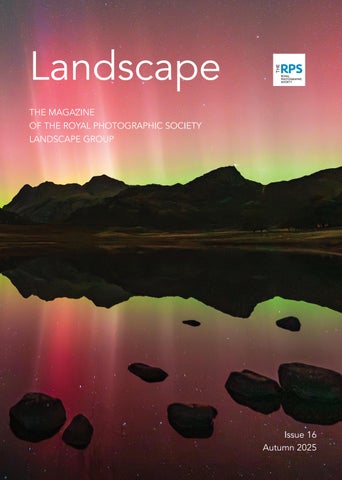
Landscape THE MAGAZINE OF THE ROYAL PHOTOGRAPHIC SOCIETY LANDSCAPE GROUP
Issue 16 Autumn 2025
THE ROYAL PHOTOGRAPHIC SOCIETY
RPS LANDSCAPE GROUP
HERE, 470 Bath Road, Bristol, BS4 3AP, UK rps.org Incorporated by Royal Charter
Magazine Editor: Candia Peterson ARPS
Patron
Committee
HRH The Princess of Wales
Colin Balfour LRPS: Chair
Assistant Editor: Gaynor Davies ARPS Publication Manager: Paul Cayton LRPS
Viv Cotton ARPS: Secretary President and Chair of Trustees
Trevor Judd: Finance Officer
Simon Hill HonFRPS
Candia Peterson ARPS: Communications Officer
Deputy Chair
Chris McIntosh LRPS: Professional Events Manager
Mathew Lodge LRPS
Howard Klein LRPS: Member Events Manager
Chief Executive Officer
David Travis ARPS: Circles
Victoria Humphries Honorary Treasurer David Muiry FIA ARPS
Please send contributions to landscapemagazine@rps.org COVER IMAGES:
Front: Blea Tarn Lightshow by Mark Hetherington ARPS Back: Beinn Eighe & Loch Coulin Reflection by Howard Klein LRPS Landscape is the magazine of the RPS Landscape Group and is provided as part of the annual subscription to the Group. © 2025 The Royal Photographic Society All rights reserved on behalf of the contributors and authors. No part of this publication may be reproduced, stored in a retrieval system or transmitted in any form or by any means, electronic, mechanical, photocopying, recording or otherwise without the written permission of the copyright holder. Requests for such permission must be addressed to the Editor. The Royal Photographic Society, RPS Landscape Group and the Editor accept no liability for any misuse or breach of copyright by a contributor. The views expressed in this magazine do not necessarily reflect the policies of the Royal Photographic Society or of the Landscape group.
Printed on behalf of The Royal Photographic Society by Fretwell Print and Direct Mail, Healey Works, Goulbourne Street, Keighley, West Yorkshire, BD21 1PX
CBP032706
2
Landscape Issue 16 - Autumn 2025
Regulars 4 & 5. Welcome from the Editor and interview with Victoria Humphries 46.
Webb Watch Stunning images from the Webb Telescope - the ultimate landscape.
62.
Inspiration
Professional Photographers 28.
The Altered Landscape Michael Hall launches our new series on the Anthropocene Age with a study of trees and deforestation.
48.
An Alternative View Roxanne Bouché Overton talks about her ICM processes.
Member Contributions 6.
Where in the World? I Kevin Goodwin gets his kicks on Route 66.
10.
Working with a Drone George Pearson ARPS shows us how to light the night time landscape with a drone.
18.
The Human Landscape Rob Kershaw ARPS discusses the varying architecture of Tokyo.
24.
Preparation Page - Working with a Drone In a companion piece to George Pearson’s his photography partner Nicholas Hill ARPS, takes a dive in to the technical considerations in planning and in post-processing.
34.
A Fresh Perspective on Landscape Photography Committee member and Circle manager David Travis ARPS does his own analysis on the nature of a landscape photograph.
40.
Photobook Anne Whiteley LRPS takes us on a journey from shutter to photobook on an RPS workshop.
56.
Where in the World? II Jean Robson FRPS takes us to a small mining town in Svalbard.
4
Landscape Magazine Issue 16
Welcome from the Editor Welcome to the Autumn 2025 edition of the RPS Landscape Group Magazine. As ever, we have a wide variety of articles that take us from Tokyo to the Grand Canyon, with the Arctic in between. We take a look at a photobook project run by veterans of the Landscape Group (LG) Fiona McCowan FRPS and Richard Ellis ARPS and, another longstanding anchor of the LG, David Travis ARPS, gives us his take on what makes a landscape photograph, drawing on his huge experience of running and participating in our eCircles. This edition’s “Alternative View” features the very striking ICM images from Canadian photographer Roxanne Bouché Overton. She says “I hunt light, colour/contrast, shapes/lines, patterns and motion. If I get three or four of these subliminal elements in my frame I will be on my way to a good image. When I harness all five, I’m in exciting territory.” In my view, she goes a long way towards that magic five in the images she has to show us. We are very pleased to introduce New Zealander Michael Hall to kick off our new series on the human impact on the environment. I’ve taken the running title of “Anthropocene Age” from his website. According to the Apple dictionary, “Anthropocene – relating to or denoting the current geological age, viewed as the period during which human activity has been the dominant influence on climate and the environment”. Michael gets us going with trees, a study of drought and deforestation. If that sounds a little depressing,
it is but Michael’s work is important and visually very exciting. On cheerier notes, our member features this autumn include a revisit to the Arctic from Jean Robson FRPS, a romp down Route 66 from Kevin Goodwin and a study of the vibrant diversity of architecture in Tokyo by Rob Kershaw ARPS. Finally, I am sure many of you have experimented with the brave new world of Drone Photography but I think it unlikely that more than a very few of you have experimented with using your drone to light paint the landscape at night. George Pearson ARPS and Nick Hill ARPS have done just that and, between them, they have given us two pieces by which you can discover this technique from their joint efforts in Utah. George gives us the main article and, for this edition only, I have changed our Post Processing Page to a “Preparation Page”, in which Nick describes how he sets up the drone for light painting and briefly how he deals with the resulting images. As ever, I hope you will enjoy reading this edition as much as Gaynor Davies ARPS, Paul Cayton LRPS and I have enjoyed putting it together. Without their fabulous and constructive help as Assistant Editor and Publication Manager, I could not have managed to achieve what you are now reading and I’d like to offer huge thanks to them. Candia Peterson ARPS Magazine Editor
Contrasts and Reflections at Loch Garten - Janet Benson
Landscape Magazine Issue 16
Victoria Humphries - Under the spotlight As Editor of the Landscape Group magazine, I was thrilled when the new CEO of the RPS, Victoria Humphries, was shown some back issues of ‘Landscape’ and expressed her enthusiasm for our efforts back to our Chair, Colin Balfour. Shamelessly, I leapt on this with a request for an interview and the results are below. I began by asking Victoria if she was a photographer before she joined the RPS as its new CEO. I knew from her letter to members that she had done some exciting outward-bound adventures and I wondered if she was able to record these photographically as she went? The first part of her answer was revealing in that, in common with most of the wider population, she is more of a phone photographer of family, friends and notable events than an owner of the latest upmarket kit and a tripod. She does, however, find photography extremely powerful and evocative; more so than, say, reading old diaries and is always transported back to that moment in time when looking back at them. In respect of her various adventures in remarkable landscapes, she does say that “doing any activity outside in the fresh air is my happy place, so landscape photography probably does play a significant role in my life. Some of my favourite photos are the ones I took up in the Arctic on my various expeditions. They’re not great quality because we had basic cameras and the mechanisms often froze in the sub-zero temperatures but they are a wonderful record of a life-changing (and lifethreatening) experience that I will never forget.” That said, she says that she doesn’t really look at photography in ‘genres’ or that landscape photography is her only draw. Rather, she says “to me it is what photography does to you, the viewer. Does it make you stop in your tracks because of its beauty or the composition or does it challenge you because it is a deliberately provocative subject or does it stir an emotional response?” I moved on to asking Victoria more generally about her plans for her tenure and whether she had been thinking about the expansion of projects and social activities within the Special Interest Groups (SIGs). “SIGs and Regions are the backbone of the RPS and recently there has been a bit of a divide between Bristol and the groups; I am keen to rebuild relationships and for more collaboration over the
coming months and years. I don’t know what that looks like yet but I have lots of ideas in my mind! “My priorities for today and going forward are very simple – rebuild relationships within the RPS community, reach a wider audience through our education, improve our member offering and become more of a voice for photographers.” Finally, I asked Victoria for her views on AI and how she might address the benefits and challenges of this difficult topic as she takes the RPS forward. She acknowledged that AI is both a growing threat but also an opportunity across multiple areas of society and that photography is significantly impacted. She went on to tell me that, as part of the wider strategic review, the current position of the RPS on AI is very much on the agenda and that the wider membership will ultimately be consulted on the review. Moving forward, Victoria has a large task on her hands but her enthusiasm for our Landscape SIG is encouraging and, more widely, she appears both willing and able to address many of the issues that are of interest to us all. For more from Victoria in her own words see this link (QR code below) to her Linked-in page, commenting on her first 100 days in the role. Candia Peterson ARPS Magazine Editor
5
6
Landscape Magazine Issue 16
Where in the World? I Kevin Goodwin Kevin takes us on a journey that must be on many a bucket list, along the iconic Route 66 from Amarillo to Las Vegas, through Arizona and with detours to Death Valley and the Grand Canyon. www.kevingoodwinphotography.com Instagram: kgoodwin_photo
Route 66 has always held a fascination for me, although I do wish I had visited it much earlier in my life than when I actually did, in Spring 2025. Then, potentially more of what is now derelict would have been still functioning, to provide more of a mix between active and derelict structures. Also, as a motorcyclist, there is always the desire to ride some or all of it but it’s a long way from Chicago to the Pacific coast – although, whilst on the tour, I did meet and talk to some motorcyclists who were doing just that. In late 2024, I saw a fellow RPS member on the Landscape Group Facebook page mention that they were doing a tour of part of Route 66 in Spring 2025. I contacted them to find out who they were
Desert Colours
going with and looked at the tour website. It was full but I joined the waiting list and, as sometimes happens, shortly afterwards there was a cancellation and I was now signed up for the tour. The tour was to run from Amarillo to Las Vegas, taking in large parts of the route or as close as possible to it. In some areas, the original route is no more than a single-track road, with passing places, that runs alongside Interstate 40 or what now is, in fact, Interstate 40. We would stop at various places such as Albuquerque, Grants, Gallup, Holbrook, Winslow, Flagstaff, Williams, Seligman, Kingman and then, via the Hoover Dam, on to Las Vegas. In the end, we also detoured to the Little Painted Desert and the Southern Rim of the Grand Canyon.
Landscape Magazine Issue 16
Route 66 ‘The Mother Road’ - Amarillo to Las Vegas It was an intense tour, with a small group of fellow photographers staying in different accommodation, including the type of two storey motel I had only seen on television. Of slight concern in the first motel was a missing shower curtain and I had visions that the last occupant had been wrapped up in this! But there was lots to see relating to the abandonment of Route 66 along the way and the landscape that we drove through was as I had imagined; large areas of mainly flat land, sometimes with animals, that stretched for what seemed like miles in all directions outside the towns, with little foliage. As we headed west, the landscape did change, with more undulation and more vegetation and forested land. My only experiences of the US to date had been on various trips/holidays to major cities such as New York, Chicago, Washington, etc. so this was something I wanted to experience. Before we got into the main reason for the tour, we did go to see some ‘modern art’ on the edge of Amarillo, in the form of old VW Beetle and Cadillac cars, buried bonnet-down in the ground and with
Drive Through service available
copious graffiti. There was even part used aerosol cans lying around if you felt so inspired to add to the riot of colours. A lot of our route also seemed to follow a main railroad route across the various states that we passed through. So we had several sightings of multiple engines pulling double stack cars of containers and some of these were around 100 cars long, pulled by sometimes 4 or 5 engines. They wound their way along through the flat-lands. Just standing at close proximity to these by the tracks was an experience; no British Rail fencing! This part of the overall route, given we were starting our Route 66 journey part way, as it officially starts in Chicago, contains a mixture of buildings such as motels, diners and trading posts that are still hanging on or have been repurposed to meet the desire of tourists, through to derelict and abandoned motels, gas stations and signage that has just been by-passed with the construction of Interstate 40. Where the buildings and structures are
7
8
Landscape Magazine Issue 16
outside small towns, then the graffiti artist has also been to work.
was well worth the detour, as was the stop on the roadside to look back down the highway.
Some structures still contain fixtures and fittings, as though someone closed up one day and just walked away, although these have been picked through in places and cabinets and the Pepsi drink dispensers overturned. Other buildings are boarded up or, in one case, have suffered fire damage. At Twin Arrows there is just one Arrow, the second arrow having apparently been removed in 2022 when it fell down. Tumbleweed exists and blows into empty corners and across silent forecourts. Some old gas stations still have their gas pumps, occasionally almost complete, although most without their hoses and metal nozzles and some just the skeleton without the casing.
After this, there was another diversion to the Grand Canyon. Whilst I had visited before on a holiday, I could spend more time on this occasion taking images. It is such an amazing geological sight, with the occasional glimpse of the Colorado River 1524m below. The geological forms and light worked well for us on this occasion, with some clouds in the blue sky.
At some of the locations, there are a variety of old American cars and some non-American cars quietly rusting away, that are unlikely to start or move. There was even an old British Rover 75 car, dating from the 1950s. The Wigwam Motel contains a number of old vehicles parked outside the 15 large concrete and steel teepees that guests can stay in. Where motels were still hanging on, then their neon lights still shone at night. But there were also lots of neon signs that will unfortunately never shine again. At Winslow, Arizona we have the statue of a man with guitar ‘standing on the corner’. This represents the line from the Eagles song ‘Take it Easy’, where the song states “Well I’m-a standing on a corner in Winslow, Arizona…” Having photographed an amazing amount of old and derelict buildings, signs and cars, it was decided to see something different in terms of the landscape and so we detoured to the Little Painted Desert. As we stood on the rim of the desert, we looked out on the amazing colours of the painted desert, both on the edge of the rim and in the ridges below. It
Self Service
At Kingman, we said goodbye to Route 66 that heads west and south towards the coast. Our last formal stop before Las Vegas was the Hoover Dam, completed in 1936, although dedicated in 1935. I had previously seen this from the air but it is an engineering marvel at ground level, holding back Lake Mead. A couple of us took a tour into the bowels of the dam to see the pipework and turbines. Today there is some concern over the future of the dam to provide power for the area, with falling water levels in the lake. It was then on to Las Vegas before my flight home. Having been here before and with most of the day until my flight home, I went exploring. I avoided the popular strip and went to the Shelby motor museum to the south, Fremont Street in the older part of Las Vegas to the north and the Neon Museum to the north. Was it worth the visit and did I feel fulfilled? Yes, to both. 2026 is the 100th anniversary of the establishment of the road as a US Numbered Highway and there is still enough standing to celebrate, occupied or derelict. So, if it’s something of interest, go seek it out like I did. Kevin’s workshop on Route 66 was organised by www.aspect2i.co.uk and led by Paul Mitchell FRPS and Michael Pilkington FRPS.
Little Painted Desert
Landscape Magazine Issue 16
Wigwam Motel
Pepsi Light
Abandoned gas station
Standing on the corner
Cadillac Ranch
Route 66, Amarillo
9
10
Landscape Magazine Issue 16
Working with a Drone George Pearson ARPS George describes his adventures with companion Nick Hill ARPS as they used drones to light the landscape as they shot at night. Nick is also taking on our post-processing page this edition, to talk about the technicalities of preparing for drone lighting as well as the techniques for dealing with the result in-post. In April 2024, my good friend and travelling companion for many years, Nicholas Hill and I, completed a trip to the United States. We had, like many photographers, visited before on several occasions to shoot both the honey pots and expand our particular interest in urban exploration. But this venture made far more demands in terms of initial research and later, the physical pressures of getting strong images. From the start, we wanted to try to explore new, less well-known areas but also to try to improve our ability to take astro landscapes. This involved hour after hour sourcing videos, consulting maps, reading guides and getting detailed descriptions of access
Long Dong Silver
routes (Andy Mumford videos: Excellent). We ended up with a list of potential places, previously unknown to us, near Utah’s Capitol Reef, e.g. Long Dong Silver, Moonview Overlook, Bentonite Hills. Then we added others but kept everything very flexible so Whitepocket, Shiprock and Bisti Badlands became possibilities, amongst many others. April seemed perfect for us, when there were fewer tourists around so more accommodation was available. It was also necessary to move to wherever the weather was most suitable. More importantly, we needed as many moon-free days as possible at a time when the Galactic Core was visible.
Landscape Magazine Issue 16
The Mid-West Reimagined We had previously photographed the Milky Way in Namibia on perfect warm nights, getting to bed around midnight. That was never possible on this trip, which involved being out in the cold well after midnight and into the early hours of the morning. In Namibia, Nick had successfully used a drone to illuminate foregrounds and it was a process we repeated again. Both of us had DJI Mini 4 Pro drones which, at less than 250g, enabled us to fly pretty much worldwide (although not in National Parks etc.) and both of us had Operator and Flyer licences. Fitted with strip lights, we tested the set-up beforehand in Kent. So many of the landscape foregrounds are lit by the drones and composited later and combined with composite Milky Way shots from the same location. Then we needed to decide on transport. We knew that some of these locations were not on normal roads and we had to drive on rough tracks and occasional sand for quite some distance. We hired a 4x4 Grand Jeep Cherokee which had sufficient clearance for all but the drive into Whitepocket.
Fairfield Church
Whilst we were out there, we heard of the untimely death of Alyn Wallace, whose brilliant books and videos we had referred to at the research stage. Both of us made additions/replacements to our gear for the trip. I used a Canon R6 or 5DSR with Irix 15mm f2.4, Canon 16-35mm f2.8, Canon 28-70mm f2 and Canon 100-400 f4, whilst Nick used mostly Fuji medium format gear but also a Canon 6D astro modified camera with a 35mm f1.4 Sigma lens. We had tried to choose a lens that came out well in coma and other aberration tests. We both invested in Move Shoot Move Nomad trackers to counteract the rotation of stars around the pole star and to give pin sharp stars and we added Polar Alignment Pro to our apps (PhotoPills, Windy, Alltrails etc.) Finally, we got personal gear together, most importantly layers including merino wool undergarments, decent insulated waterproofs, headgear and gloves with hand warmers. I hope it’s clear that we went pretty well prepared!
11
12
Landscape Magazine Issue 16
Alien Throne
So we flew out early April to Denver, picked up the car and drove to Colorado Springs for the night but left around 5am for the long drive to Farmington, New Mexico. For every Milky Way shoot we needed to visit the area during the day to source suitable foregrounds and check with the augmented reality on PhotoPills how and when the Galactic Core would appear. A pattern was set when we would work mostly during the nights and grab bits of sleep between that and daytime exploration. One of the places we were keen to visit was the Valley of Dreams in the southern section of the Bisti Badlands. On a previous visit to the Northern section we had hiked for an hour into the Egg Hatchery to photograph sunset. That became so popular they added an access road and car park, making the place very accessible. But the drive to the Valley of Dreams was anything but and we parked 300m sort of the trailhead, anxious not to ground the car so early in the trip. Then we walked the 3km into the Alien Throne area and scouted the site late afternoon before taking sunset images. As dusk approached, we used a drone to light up the amazing sandstone shapes in sections. The walk back in the dark was formidable, using geolocated trails which are, of course, 2D and we underestimated the canyon’s depths. I suppose in the distance we could see the lights of a couple of campers at the trailhead so I was never at risk, just exhausted.
The next place to go was Shiprock, a huge volcanic core visible from 30 miles. We drove there in the morning on a dusty trail, then walked around trying to find compositions. We returned toward sunset and then the best laid plans for an evening shoot went astray. It gradually became more cloudcovered and obvious that no stars were going to be visible. We both sent up drones in quite serious winds and did manage to get some images of the radial volcanic ribs. A check of the weather forecast, which gave strong winds locally and clouds, forced us to reconsider our plans. Nick spotted a video by Chris Attrell on the ‘ghost town’ at Nelson. He had photographed it at night using flashlights but the owner was willing to let us have inexpensive sole access one evening with the drones. It was a long drive towards Las Vegas but we did a recce in the afternoon and then, in the evening, spent around 4 hours using one drone and numerous batteries to light up a dozen locations. The following day involved another long drive back to Page, Arizona, with some small detours en route and we rested overnight. Before dawn, we drove the mile or so up to the new Horseshoe Bend car park and wheelchair accessible path to the overlook which had few visitors so early. But the soft light of pre-dawn is essential before harsh shadows and difficult lighting spoil images. Then a new location for us, Toadstool Hoodoos, a short drive north west,
Landscape Magazine Issue 16
Shiprock
Water Tower and Lorry
The following day involved another long drive back to Page, Arizona, with some small detours en route and we rested overnight. Before dawn, we drove the mile or so up to the new Horseshoe Bend car park and wheelchair accessible path to the overlook, which had few visitors so early. But the soft light of pre-dawn is essential before harsh shadows and difficult lighting spoil images. Then a new location for us, Toadstool Hoodoos, a short drive north west, parking and a 30 minute walk into the hoodoo area. We explored the whole area thoroughly to get foreground compositions then went back to rest for a few hours. Before sunset we returned to take images during the golden hour and once again at/after dusk used a drone to light up sections. Later that evening we walked back to the car and found a perfectly flat landscape, away from the road headlights, to shoot the Milky Way It’s very important, even with just 2 people, to allow space and avoid compromising each other’s images. Getting the tripod head level is essential if you are panning on several Milky Way sections. We used the phone app Polar Scope Align Pro to find the Pole star, which easily enables the correct mounting of the Nomad tracker. In the dark it becomes insanely difficult to do anything well, even with red lights from head torches. Focusing on stars is critical and, of course, we both made mistakes.
13
14
Landscape Magazine Issue 16
I think both of us used both tracking and stacking at some stage. Basically, stacking typically uses 10+ stacked identical images of 12 secs at f2.8 at ISO 6400 and is simpler to set up, does not need additional equipment and the processing, using Sequator (Macs), removes noise and eliminates plane trails (comets too). Tracking, using the Nomad, might allow for 180 secs at f2.8 ISO 640 and will give finer details and usually better colour reproduction. Nick often did multi-row panoramas of stacking involving large image numbers (72+), including dark frames with consequently lengthier processing and blending (much more in a Preparation article in this edition).
Toadstool Hoodoos and Milky Way
Kodachrome - Photopills Augmented Reality
We then moved on to Cannonville, near Bryce Canyon, for a couple of nights in cabins. During the day we scouted 2 locations, Thors Hammer in Bryce and Kodachrome canyon nearby. There was still considerable snow at this 9000 foot elevation. We descended into the trail near Sunset point and found a point where Thors Hammer stood clear of the horizon, where we did some foreground shots before returning to the rim to do the Milky Way panorama, easily seen from this elevation. It was now well below zero and, after an hour or so, my body was so cold I returned to the car, leaving Nick to finish off.
Landscape Magazine Issue 16
Kodachrome Canyon and Milky Way
Night at Whitepocket - drone lit
15
16
Landscape Magazine Issue 16
The following morning we decided on a walking tour around Kodachrome State Park and, again, we used PhotoPills Augmented Reality AR to plan an evening shoot. One of us managed to forget to pack something essential but the return and delay did not really impact the evening image, although the outcrop was very large and difficult to light from the drone. On a previous trip to the area we had visited Whitepocket, having failed to get permits for The Wave from Kanab. At that time we were driven in, and stayed for, 6/7 hours but there is so much to see we decided to fork out around $500 each to hire a company and stay much longer. The drive in needs a specialist vehicle with reflatable tyres and a skilful driver of a high clearance 4x4. They also provided a tent each, with sleeping bags etc. and cooked wonderful steaks. We were able to explore widely, taking photographs at sunset, at night and using the drone before dawn.
Goblin Park Factory Butte
16
Another long drive followed towards the Capitol Reef N.P., staying for 3 nights at cabins in Hanksville. A typical day here was to shoot from the drones before dawn in the Bentonite formations) or at Factory Butte or Moonview Overlook, sleep for a while, then go out to catch sunset and dusk at The Spire or other less successful locations. Of course, we still went out in the middle of the night to doubly make sure the Milky Way images were strong enough. It was punishing at times (and I did very little of the 5000 mile driving) but entirely worthwhile. Our August trip to Indonesia was gentle by comparison but planning is well advanced for Greenland and Brazil in 2025.
Landscape Magazine Issue 16
17
Bentonite
Whitepocket at dawn
17
18
Landscape Magazine Issue 16
Grand Pier Teignmouth
The Human Landscape Rob Kershaw Ph.D ARPS Having spent many years living in Tokyo and, even more subsequently, visiting on a regular basis, Rob takes a look at the huge variety of architectural styles to be found in this most eclectic of cities. Wonderful and sometimes weird, Tokyo certainly exhibits a diversity of modern style in its more recent architecture. I lived in Tokyo for four years in the early eighties and followed this by travelling there on business each year from 1989 until 2019. In many ways Tokyo has not changed since I lived there; however, the main difference is the astonishing
Shinjuku 6, Washington Hotel
number of new buildings that have sprung up over the years and the development of whole new areas of modern buildings. The aim here is to show a range of designs, not through a traditional architectural approach but by highlighting some of the interesting design features.
Landscape Magazine Issue 16
Architectural styles in Tokyo Shinjuku was one area of Tokyo that had skyscrapers back in the eighties and the Washington Hotel, built in1983 and refurbished in 2016, still serves the tourist trade today. It exhibits what was then a common style of flat facades with many windows. Mode Gakuen Tower could not be more different. It’s a 204m high, 50 storey educational facility, completed in 2008. What makes it stand out is its elliptical form and the criss-cross patterns on the outside of the building, as shown in the image which was taken looking up from a basement stairwell. The Nakagin Capsule Tower was opened in 1972 and was an example of Japanese Metabolism architecture. However, it was demolished in 2022, despite efforts to save it. Some of the capsules were preserved and sent to museums around Japan and the world.
Mode Gakuen Tower, Shinjuku
The Nakagin Capsule Tower Hotel
19
20
Landscape Magazine Issue 16
In Yurakucho, the interior view of the Tokyo International Forum, opened in 1996, highlights the swooping curves of steel truss and glass; it is shaped like an elongated boat. Moving on to the Shiodome Sio-Site: The Dentsu Building houses the HQ of Dentsu, the largest advertising agency in Japan. It was completed in 2002 and rises to 213m. The view chosen suggests a triangular shape to the building.
Tokyo International Forum and Exhibition Centre
The Dentsu Building
The Nippon TV Nittele Tower was completed in 2003 and rises to 192m. The building is distinguished by the different styles of façade and the tubular steel structure rising to the top.
The Nippon TV Nittele Tower
Asakusa plays host to a famous temple but shown on the following page, looking skyward, are the Asahi Beer HQ in gold and, to the left, the Asahi Beer Hall, atop of which is a structure called the Golden Flame, also known locally by less romantic names! The HQ building is supposed to represent a glass of golden beer with structures at the top representing the foam! “Looking to the Sky” was taken between the two buildings. Asahi Super Dry is the biggest selling beer in Japan but, in my opinion, is the worst.
Landscape Magazine Issue 16
Asahi Beer HQ
“Looking to the Sky”
Miraikan, The National Museum of Emerging Science and Innovation Japan
21
22
Landscape Magazine Issue 16
Odaiba is a high-tech entertainment hub built on an artificial island in Tokyo Bay and is home to many examples of modern architecture. Miraikan, The National Museum of Emerging Science and Innovation Japan, opened in 2001 and has a typically futuristic façade as you can see on the previous page.
Stairway
The Fuji TV HQ
Daikanyama Lotus Baguette
The Fuji TV HQ, which opened in 1996, is another example of a futuristic design, glowing gold in the late afternoon sun. The stairway is a close-up shot from the same building.
Landscape Magazine Issue 16
Unusually, even a local bakery such as Daikanyama Lotus Baguette has a modernistic façade, with shapes, patterns and mirrors providing an interesting take on its surroundings. Apparently, it was designed to be welcoming, creating a sense of naturalness, enticing customers to try its famous baguettes and range of breads. One of the best bookshops in Tokyo is situated opposite this bakery. Moving to Oshiage at night, the Tokyo Skytree, opened in 2012, rises to 450m and remains the tallest structure in Japan. The whole building is almost a city in itself, with 300 shops and restaurants, an aquarium, a planetarium and a Postal Museum. All the images have been taken whilst on walkabout around Tokyo on a range of Pentax digital cameras and lenses, apart from Washington Hotel which is from a scanned slide. Adobe Camera Raw has been used to process the images which have been cropped as appropriate.
The National Arts Centre, Roppongi
Tokyo Skytree
Further information about the buildings can be found on the following websites: Shinjuku Washington Hotel - https://fr.wikipedia.org/wiki/Shinjuku_Washington_Hotel Mode Gakuen Tower - https://en.wikipedia.org/wiki/Mode_Gakuen_Cocoon_Tower The National Art Center, Tokyo - https://www.nact.jp/english/ Tokyo International Forum and Exhibition Centre - https://en.wikipedia.org/wiki/Tokyo_International_Forum The Nakagin Capsule Tower - https://en.wikipedia.org/wiki/Nakagin_Capsule_Tower Dentsu Building - https://en.wikipedia.org/wiki/Dentsu_Building The Nippon TV Nittele Tower - https://en.wikipedia.org/wiki/Nittele_Tower Asahi Beer HQ - https://en.wikipedia.org/wiki/Asahi_Beer_Hall The National Museum of Emerging Science and Innovation Japan - https://en.wikipedia.org/wiki/Miraikan The Fuji TV HQ - https://en.wikipedia.org/wiki/Fuji_Broadcasting_Center Daikanyama Lotus Baguette - https://en.japantravel.com/tokyo/lotus-baguette/24480 Tokyo Skytree - https://en.wikipedia.org/wiki/Tokyo_Skytree
23
24
Landscape Magazine Issue 16
The Preparation Page Nicholas Hill ARPS In a piece designed to work with George Pearson’s article on lighting night shoots with drones, Nick describes the set-up needed and also talks about the particular issues with processing the resulting images. www.nicholashillphotography.co.uk If you’re completely new to drones, don’t worry— getting started is easier than you might think. Most consumer drones designed for photography, like the DJI Mini 4 Pro or Air 3, come with a high-quality camera pre-mounted and ready to go, straight out of the box. These cameras are stabilised with a built-in gimbal, allowing for smooth, long exposures, even in flight. You don’t need to attach a separate camera or build anything yourself. Everything is controlled via a smartphone or tablet using the manufacturer’s app, which handles flight controls, camera settings and live preview. Entry-level models are lightweight, reliable and packed with safety features like GPS positioning and auto return-tohome. That said, it’s crucial to familiarise yourself with local drone regulations, particularly when flying at night. Always practice flying in daylight before attempting more complex shots in the dark. Light painting is nothing new. For years, photographers have used handheld lights to create
24
stunning long-exposure images that reveal unseen beauty in the darkness. But with the rise of small, affordable drones, this creative technique has taken on a thrilling new dimension. When I first discovered the work of Ruben Wu— particularly his surreal images of the American West lit by drone-mounted lights—I was blown away. He wasn’t just using drones to photograph landscapes; he was using them to sculpt light from above, adding an ethereal, cinematic quality to his images that felt otherworldly yet believable. Inspired by his approach, I began experimenting with drone-based light painting myself. In this article, I want to share my techniques and tips to help you get started—whether you’re curious about the process or ready to create your own drone-lit masterpieces.
Landscape Magazine Issue 16
25
Light Painting with a Drone: A New Twist on a Timeless Technique Why Use a Drone for Light Painting? You might be wondering: why go through all this effort when you can just light paint with a torch from the ground? The answer lies in the quality and direction of the light. A drone allows you to introduce light from above, mimicking the effect of moonlight. Our brains are wired to believe this kind of lighting; it feels natural. When we shine a flashlight from ground level, the shadows often look unnatural or confusing. But when you light a subject from above, the results are far more convincing and atmospheric. I’ve found this technique works best with manmade structures, especially those that are old, abandoned or full of character. For this example, I’ll focus on a rural church near where I live. Its age and isolation make it an ideal subject, not just for creative storytelling but also for flying a drone at night without disturbing anyone. Scouting and Planning Ahead As with most photography, preparation is key. I always scout my location during the day. Not only does this allow me to find the best composition but it also gives me a chance to fly the drone in daylight
and take note of height measurements and potential obstacles. This is crucial because most drones’ obstacle avoidance systems don’t work in the dark. If you want to get really creative, apps like PhotoPills can help you align your composition with the Milky Way or plan for other celestial events. It takes a bit more planning but the payoff can be dramatic. The Setup You’ll want to arrive around dusk to allow time for setup. I always take base exposures for the sky during blue hour because this helps preserve some detail and avoids having a completely black background later in-post. Once full darkness falls, the magic begins. Resist the temptation to start too early. If there’s still ambient light in the sky, your drone’s light source may not stand out enough and the results can look washed out or unbalanced. Most drones have built-in landing lights but these are often too weak for serious light painting. Instead, I use small, lightweight micro LED lights that I attach to the underside of the drone. These can be found cheaply online and many emit a constant white beam that’s ideal for illuminating
25
26
Landscape Magazine Issue 16
scenes. For larger subjects, I often use two. They only weigh a few grams and won’t noticeably affect your drone’s performance. Camera and Exposure Settings The most common question I get is: what settings should I use? There’s no single right answer but a solid starting point is: • Lens: Wide-angle (around 16–24mm full-frame equivalent) • Aperture: f/5.6 • ISO: 1600 • Shutter Speed: 30 seconds Every scene is different so you’ll want to take test shots. Use your histogram, not your eyes, to judge exposure. With night photography, everything will look dark, but your histogram should still show some midtones and highlights. If everything is crushed to the left, your scene may be underexposed and you’ll struggle to recover details later.
Lighting Strategy One of the biggest mistakes beginners make is lighting the most interesting parts of the scene first. It’s easy to lose track of what you’ve illuminated and what you haven’t, especially when working in the dark. Instead, I recommend visualising your scene first. Work methodically, from less important areas to focal points and try to cover every element. Remember, you don’t have to use every frame in your final image but missing a key area entirely can ruin an otherwise successful shoot. When lighting the front of the church (see image on Page 11), for example, I found that a single exposure with the drone wasn’t enough. Light falloff is real; the inverse square law tells us that intensity drops off quickly with distance. To maintain even coverage, I created three separate exposures from different heights but with a consistent distance from the facade. This helped produce a more uniform light spread across the structure.
Landscape Magazine Issue 16
Post-Processing Once you’ve finished capturing your images, it’s time to head into post. My full editing workflow is beyond the scope of this article but here’s a quick overview. I import all the individual exposures into Photoshop as layers, align them and set the blending mode for each layer to “Lighten.” This reveals the areas that were lit in each frame and creates a composite image with all the lighting combined. Next, I go through each layer, one by one, turning them on and off to see what they add. If a layer doesn’t improve the image, I hide it. Then, I use masks to paint out the drone itself, which often appears as a bright dot in the frame. Finally, I use selective brightness and contrast adjustments to fine-tune the lighting across the image. This is where the artistry really comes in— deciding where to draw the eye, what to highlight and how to shape the overall mood.
Final Thoughts Light painting with a drone isn’t just a gimmick; it’s a powerful creative tool that opens up new ways of seeing the world. With some planning, the right gear and a bit of trial and error, you can produce truly unique images that blur the line between photography and art. If you’d like to see a full demonstration of this technique in action, I’ve created an accompanying video on my YouTube channel, Learn Shoot Repeat. It walks through everything from setup to postprocessing with behind-the-scenes footage of a drone-lit church at night. So grab your drone, get creative and let there be light—from above.
27
28
Landscape Magazine Issue 16
The Altered Landscape Michael Hall In the first of a new series on the impact of man on the landscape, acclaimed Kiwi photographer, Michael Hall, shares with us the often sad and haunting story of deforestation in his images on the subject of trees. www.michaelhall.net This article is based on an interview with Michael Hall and on quotes and discussion points he has made in other publications. New Zealand born Michael Hall developed simultaneously a wanderlust and a passion for photography, one very much feeding the other. At the time of his first departure as a very young
man from Auckland Airport, his father handed him an old rangefinder camera and, for the next five years, Michael went exploring on a remarkable journey that, at one point, saw him travel from India to Hong Kong, through China, having lost his passport in what he describes as a drunken card game in a remote village. His camera was both his motivation
and, ultimately, his salvation when he had the results of an edit of 65 rolls of film published in a number of issues the magazine China Traveller. This enabled him to return to New Zealand where he studied photography before moving to Australia, where he went on to become an acclaimed and award-winning commercial photographer.
Landscape Magazine Issue 16
The Anthropocene Age and The Human Impact on our Environment
29
30
Landscape Magazine Issue 16
In 2006, his career took a rather drastic turn when; while out cycling, he picked a fight with an 18-wheel articulated lorry which resulted in a back broken in two places and almost the loss of his left arm. This near-death experience and eighteen months of gruelling recovery, combined with what was anyway a nascent dissatisfaction with his commercial work, led him down the path of environmental and ecological photography. Shortly before the accident, Michael had begun clearing
out a lifetime’s worth of work, during the course of which he found a small series of bleak landscapes that he had taken on the NSW/Victoria borders of a desolate river bed. He had long forgotten them but, on revisiting, found them compelling as they graphically represented the drought Australia was experiencing. This discovery was something of an epiphany he says; a “realisation that I should and would devote time and effort to shooting a project on the causes and effects of climate change”.
Michael puts a lot of research into his story-telling which he feels has to be compelling as well as holding visual weight. His research is extensive, both into the topic and the location, before committing to either. Trees, he says, hold a special place in his heart but they also hold huge sway in the governance of weather, climate and biodiversity or lack thereof. His tree and forest project was initially driven by the fact that we have lost more than 50% of the old growth forests of the planet and we continue to lose more day-by-day.
Landscape Magazine Issue 16
31
32
Landscape Magazine Issue 16
Whilst mainly associated with the wider Global South, he found that a lot of forest loss was also happening at an alarming rate in his back yard in Tasmania, where he describes the ancient forests of that island as being unique but also being devastated. Borneo too was not so distant for developing the project which, in turn, moved on to Australia and “The Big Dry”, as periods of significant lack of rainfall are called. Finally, he turned to the cloud forests of Central America, which he felt also warranted special interest as he feels that these unique, biodiverse islands are especially at risk from the heating of the planet.
To balance these subjects, Michael moved on to shoot some landscapes in the Fiordland National Park in New Zealand’s South Island where, despite 85% of its original forests having been lost, he still feels has some of the most unique and beautiful temperate forests on the planet. The photographs are shot on an Arca Swiss field camera. Michael chooses to shoot large format colour negative film for what he describes as the detail and feel that it inherently provides. “To me, the 4x5 format is the most pleasing to the eye and even though I am photographing some pretty hard and confronting
scenes, I feel it is important to create beautiful images. There is a dichotomy in tragic beauty. There is also a lot to be said about the slow, thoughtful approach that a large camera requires.” Michael’s project continues to grow and to grow beyond just the subject of trees. In this series of six articles, we will revisit more of his work whilst looking at some topics through the eyes of other photographers. Interview by Candia Peterson ARPS
Landscape Magazine Issue 16
33
33
34
Landscape Magazine Issue 16
A Fresh Perspective David Travis ARPS Many of our readers will be familiar with David who runs our eCircles and is a long-standing member of the LG Committee. His article is a thoughtprovoking analysis of landscape photography and I wonder where each of you reading it will place yourself. davidtravisphotography.com Being part of a critique circle has made me realise that photographers approach landscapes in fundamentally different ways, shaped by how they see. With that in mind, this article introduces a simple framework to help photographers break out of their habitual ways of picturing the landscape and discover fresh perspectives. I’ve been a member of an RPS landscape critique circle for over six years. Each month, I share one of my images with the other nine members of the circle for critique and, in return, I give my comments on their images. Over that time, I’ve submitted over 75 landscape images for critique and reviewed over 700. Over time, I’ve started to see patterns in how different photographers approach landscape photography. These differences go beyond style or technique; they reflect deeper ways of seeing.
34
The two dimensions of landscape photography Alongside the image, each photographer provides a few sentences to give context. As well as the ‘how’ (exposure, filters, lens choice etc.), photographers explain the ‘why’: Why did they make the image? Why this particular composition? Why did they process it like that? The photographs and their descriptions have helped me identify two key dimensions that shape how people see the landscape. One is the photographer’s intent; the way the photographer wants their image to be interpreted. A literal intent presents the landscape as it is, prioritising accuracy and direct representation. In contrast, a metaphorical intent adds layers of meaning, designing the image to evoke emotions or convey ideas that go beyond the scene itself.
Landscape Magazine Issue 16
35
What a critique circle taught me about the 4 kinds of landscape photography The second dimension is the way the photographer thinks or feels about the landscape. The ‘Thinking’ mindset is analytical. For some photographers, this might mean prioritising technical issues, such as image sharpness or applying compositional rules. In others, it might mean exploring conceptual or narrative aspects of the landscape. The ‘Feeling’ mindset is intuitive: it prioritises emotion, atmosphere and the personal experience of being in nature. The four modes of seeing Plotted on a 2 x 2 diagram, these two dimensions create four categories. We can think of these categories as modes of seeing. I’ve mapped out these dimensions in the diagram. The four modes are: • Picturesque: The Familiar View (Thinking-Literal quadrant). • Eyewitness: The Spirit of the Landscape (Feeling Literal quadrant). • Expressionist: The Poetry of form (FeelingMetaphorical quadrant).
• Investigative: The story in the Land (ThinkingMetaphorical quadrant). First, I’ll describe the four modes of seeing that emerge from this model. Then I’ll show how it can help improve the way we photograph the landscape. Picturesque: The Familiar View Photographers who favour this mode of seeing aim to create an impactful and technically proficient depiction of the landscape. They are drawn to classic compositions and iconic locations. Their approach to composition is methodical, adhering to well-established visual principles. Their images are visually appealing and communicate the scene directly and clearly, with minimal need for interpretation. They may use post-processing to increase impact (from cloning out distractions to moving, altering or replacing elements of the landscape) but the final image still appears to be a literal representation of the scene.
Picturesque: Examples ‘Llandwyn Island ‘. When I took this picture of the lighthouse on Llandwyn Island in Anglesey I was deliberately trying to recreate the composition of another photographer that I admired. This is a strong composition but the sky was clear at the time, so I blended in a sky from another image taken on a different day.
35
36
Landscape Magazine Issue 16
Picturesque: Examples ‘Out to sea’. This image was taken in Vareid, Lofoten with a 28mm focal length. This caused the distant mountains to lose the impact I felt when I was in the landscape. In post-processing, I stretched the mountains vertically by about 20% to recreate my memory of being there.
Eyewitness: The Spirit of the Landscape Photographers who favour this mode of seeing use photography as a way to slow down and appreciate the world. For them, the act of seeing and noticing is just as important as the final image. The landscape is presented in a way that emphasises its beauty. They value authenticity over perfection so nothing is moved, altered or replaced in post-processing
(other than sensor spots). Images differ from the picturesque by conveying an emotional connection to the landscape. When showing familiar or iconic landscapes, images transcend the commonplace through unique perspectives, unusual light or dramatic weather. Examples include: Ansel Adams, Joe Cornish and Marc Adamus.
Eyewitness: Examples ‘Hamnoy, first light’. This is an iconic view, taken in the Lofoten Islands. But I would argue that the light, weather conditions and photographic treatment give this image a distinctive quality that sets it apart from similar compositions.
36
Landscape Magazine Issue 16
37
Eyewitness: Examples ‘Brocton Coppice’. This Autumn image has undergone dodging and burning in post-processing but there has been no alteration to the landscape. For example, there is a broken birch log on the far right of the frame that attracts the eye in the RAW image. It would have been easy to clone out but instead I chose to darken it down to maintain authenticity.
Expressionist: The Poetry of Form Photographers who favour this mode of seeing aim to create visually challenging, emotionally charged images. They value mood over objectivity; their images evoke feelings or ideas without the need for explanation. Images might show an overlooked detail in the landscape but photographed in such a way as to appear abstract and interpretive. Or images may be deliberately manipulated in postprocessing or by using in-camera techniques like multiple exposure or intentional camera
movement (ICM) to create a mood or feeling. The expressionist approach embraces abstraction and subjectivity, rejecting a purely literal representation of the landscape in favour of a more mood-driven response. (This mode of seeing shares many of the features of what are commonly called ‘intimate landscapes’ but I’ve used the word ‘expressionist’ to allow the inclusion of wider views, not just small details in the landscape.) Examples include Bruce Percy, Michael Kenna and Valda Bailey.
Expressionist: Examples ‘Three tufts.’ This qualifies as an ‘expressionist’ image because, without any obvious cues to scale, there is a curiosity gap; it leaves things unsaid and creates a puzzle for the viewer to solve. The image can also be interpreted metaphorically: It might be three tufts of grass but it could also stand in for a dysfunctional family.
37
38
Landscape Magazine Issue 16
Expressionist: Examples ‘Peak Prunus.’ This tree is in the middle of a housing estate by a roundabout and surrounded by cars so I used a multiple exposure method to filter out the unwanted elements. It was more important to me to recreate the feeling of the blossom tree than a literal view of the location.
Investigative: The Story in the Land Photographers who favour this mode of seeing use photography as a tool of inquiry to express a political, socio-economic or artistic point of view. What an image says takes precedence over the way the image looks. The view as presented may appear mundane but beneath the surface lies a conceptual exploration of topics like land ownership, the curated nature of the landscape and the relationship
between art and photography. When viewed in isolation, an investigative image may not fully express its meaning; it may need to be seen in a collection, supported by an artist’s statement. Examples include the 19th century images of Stokeon-Trent taken by William Blake, the coal bunker typologies of Bernd & Hilla Becher and the way Fay Godwin challenges the myth of the countryside paradise.
Investigative: Examples ‘#ThatWanakaTree.’ I took this image in New Zealand at Lake Wanaka. It shows a tourist photographing the eponymous tree. Signs at the location encourage photographers to use this hashtag for social media. When you see moody photographs of this tree on instagram, you may not appreciate there’s a circus happening on the shoreline. If you enjoy thinking about and discussing photographs in this way, you should join an RPS Landscape Critique, Processing or Print Circle. You can find more information here: https://rps. org/groups/landscape/what-we-do/circles-page/ Acknowledgements The ideas in this article arose from reviewing the images of members in my critique circle, past and present, and reading their critiques of my images. I acknowledge their influence with gratitude.
Landscape Magazine Issue 16
Investigative: Examples ‘View of Lake Como.’ I photographed this scene at Lake Como. I was trying to find an elevated view of the lake but was stymied at every turn by locked gates, tall fences and private property signs. I used an ironic title to make it clear this was a commentary on the scene; this might not be needed if it was part of a collection where the theme was more obvious.
Practical implications of this framework At one level, this framework is a way to categorise how we see. But we can also use it to step outside familiar ways of looking at the landscape. First, it encourages us to see beyond the picturesque. There is value in studying classic compositions and well-known locations but simply replicating what already exists can be a creative dead end. Moreover, picturesque images aim for immediate visual impact but some landscape images reveal themselves more gradually, drawing in the viewer over time. By deliberately exploring other modes of seeing, we can create images that show a personal interpretation of the landscape. Second, the framework prompts us to think about the story or message behind our images. This shift can encourage us to look for meaning rather than just look for attractive views. ‘Meaning’ might be: Provoking thought (investigative); capturing personal emotional responses (expressionist) or connecting with the landscape (eyewitness). This might lead us to create photographs that are less literal and/or less conventionally beautiful but more consequential at an emotional or intellectual level. Third, it legitimises abstraction, blur and other techniques that move the image away from literal representations of the landscape. This can encourage us to explore unconventional styles, creating images that evoke emotion or require interpretation rather than simply being descriptive. A field guide Here’s a set of prompts based on this framework, designed to encourage fresh ways of seeing and to move beyond the picturesque.
These prompts will help bias a picture more towards the eyewitness mode of seeing: • What if you spend time exploring the landscape before taking photographs? • What if you wait for a change in the light or the weather to influence the mood of the landscape? • What if you limited your post-processing to dodging and burning only? These prompts will help bias a picture more towards the expressionist mode of seeing: • What if you look for shapes, textures or patterns that usually go unnoticed? • What if you use abstraction, blur or framing to encourage the viewer to bring their own interpretation to the image? • What if you create a photograph consistent with the emotional and visual connection you feel? These prompts will help bias a picture more towards the investigative mode of seeing: • What if you create an image to make a statement or ask a question about the landscape? • What if you focus less on the way the image looks and focus more on what the image says? • Rather than a single image, what if you aim to create a collection that challenges social, economic or environmental power dynamics? In conclusion I’ll admit to some trepidation publishing this article, as creating a model to account for every possible kind of landscape photograph may be a fool’s errand. I’m sure other photographers have seen images that may not fit the framework I’ve described. So, if anything I discuss here doesn’t match your experience, let me know. You can contact me at landscapecircle@rps.org.
39
40
Landscape Magazine Issue 16
Photobook Project Anne Whiteley LRPS One of the many joys of RPS membership is the opportunity it brings for workshops led by members of our community. Anne describes one such workshop which took its delegates from shutter to photobook in a few packed days. ‘Photos and Phrases’ with Fiona McCowan FRPS and Richard Ellis ARPS Land’s End, 17th February - 20th February 2025 Six of us signed up for the ‘Photos and Phrases’ course superbly organised and hosted by Fiona and Richard, with the aim of making a photobook from images taken on location. Comprehensive information and a risk assessment were provided prior to the event, which stressed we were not expected to walk anywhere where we were not comfortable. As a point of principle, our leaders said they would not be taking their own photos and we received their undivided attention. The workshop was intensive, immersive, well organised and everyone entered into the spirit of making the most of our opportunity, both for photography and book-making in
equal measure. Fiona and Richard gave their time and knowledge generously and provided lots of information, handouts and material throughout. The group was inclusive, relaxed and companionable, which made for a happy and fun experience, with everyone helping each other in a variety of ways. We benefited from generous sponsorship; from Canon, with the loan of a P300 printer; from Fotospeed, who provided some Matt Proofing 170 and Art Smooth Duo 210 papers and from Blurb, who provided a discount code. Our accommodation at the comfortable Land’s End hotel
Coffee and Cake - Fiona McCowan FRPS (iPhone) 40
was an experience in itself as we battled with the front door in the high winds, whilst listening to the fog horn and waves crashing onto the shore at night. We were well catered for by the chef and friendly staff and had a large area to work in when engaged in our book-making. On arrival, after a short briefing and a copy of Richard’s booklet ‘Western Cornwall: A coastal photography guide’, we set off for our first photo shoot. From the outset Fiona encouraged us to start thinking about a concept or purpose for our photobook, based on a simple theme(s) and to have it in mind when doing our photography, whilst acknowledging concepts might change and evolve.
Gunwalloe Rocks, Dollar Cove - Carole Mortimer
Landscape Magazine Issue 16
Breaking Waves - Christopher McCintosh LRPS
41
Cleaning Filters - Fiona McCowan FRPS
Ebb and Flow - Anne Whiteley LRPS 41
42
Landscape Magazine Issue 16
Richard generally chose the locations we went to, with his intimate knowledge and experience of this area of Cornwall. Our first photo shoot was late afternoon and it gave us a taste of working in stormy and wet conditions as we explored the rugged coastline between the hotel toward Pordenack Point. We faced into the weather and some of us got soaked; at times, it was a question of one person wiping the filter as the other pressed the shutter release in order to get a clean shot. However, the dramatic, rugged shoreline and Atlantic swells were both exhilarating and mesmerising and what you would expect of the West Cornwall coast in winter. On the second morning we were ‘up and out’ in the dark with the first blackbirds singing in the hedgerow and head
torches casting light beams up the stony track to arrive at the viewpoint of The Logan stone near Pedn Vounder. There is something magical about being out at that time of the morning in anticipation of day-break and appreciating the drama of the scenery and the roar of the waves. It is an exposed location but, on this occasion, it was not too cold. We enjoyed the blue hour without a sunrise and headed back for a hearty breakfast. The rest of our day was spent at the following locations - Porthleven, Gunwalloe and Botallack - making images and thinking about concepts for our photobooks. We arrived at Porthleven in sunshine on a falling tide - it still produced some big waves and wet feet for those of us not quite alert to the occasional rogue breakers travelling high up the
Gunwalloe Rocks, Dollar Cove - Carole Mortimer
42
beach. A quick coffee, cake and ice cream refreshment stop gave us a chance to enjoy the sun’s rays before moving on to the beach at Dollar Cove, Gunwalloe. The light was quite strong and a number of us concentrated on intimate shots of the fascinating rock formations and colourful rocks, some using their iPhone. Our final shoot of the day was at Botallack with a stiff wind at the top which, thankfully, subsided as we descended the cliff to view the Crown Mines, where the surf was swirling around the rocks. Richard kept an eye on the cloud and accurately predicted that sunlight would glance the waves and light up the front of the old mine buildings. It was a day packed full of photography and exploring some great locations. Thanks to John and Richard for driving.
Landscape Magazine Issue 16
Crown Mines, Bottalack - Lynda Piper
Gunwalloe Briefing - Fiona McCowan (iPhone)
Crown Mines, Bottalack - Fiona McCowan (iPhone)
Rock Abstract - Christopher McCintosh LRPS
Nanven, Cornwall - Stephen Roberts
Up and out in the dark - Fiona McCowan (iPhone)
43
44
Landscape Magazine Issue 16
Restless Waves - Anne Whiteley LRPS
Day 3 and the start of the book-making. We were ready to begin at 9am, with our laptops and images in Lightroom (LR), to learn the basics of the LR book module and to start to formulate ideas and build on concepts for our books. Fiona took us through several presentations that made the somewhat complex art of making a book in Lightroom an understandable and achievable process. Using the Canon printer and the Fotospeed proofing paper, Richard was able to print out small photos of our ‘final cut’ book images which we were able to sequence and arrange under the watchful eye of Fiona. At this stage, ideas of text and story-telling became more important and all our concentration was applied to this intensive and absorbing work. There was a short break midway through the day to visit Porth Nanven, made famous by Andrew Nadolski’s photography book ‘End of the Land’, where we enjoyed the ancient ‘dinosaur egg-like boulders’ before the rain and had a final opportunity to make some pictures. We worked on through the afternoon, making collection sets in Lightroom and sequencing our small prints to establish a flow for our photobooks. Fiona continued to provide expert knowledge, advice and regular briefings as we worked through the process. The final day dawned and Fiona introduced us to the art of handmade photobooks which left us all enthralled by the beauty and many forms of the
44
Porth Nanven - Lynda Piper
books she has made. There were lots of tips and demonstrations along the way and participants were also able to make slit books, having finalised their photobook. We all left feeling well satisfied with our efforts and appreciative of the excellent organisation and guidance afforded by Fiona and Richard. Their effort to make a success of the workshop was exemplary; we couldn’t have asked for more. In the words of one participant “I have a big smile on my face…. I can’t tell you how happy I am with this little printed slit book from the workshop. Thank you, Fiona and Richard, for your dedication and hard work over the last few days and to my fellow participants for your company and similar enthusiasm”.
Landscape Magazine Issue 16
Cornish Waves Book Cover - Stephen Roberts
Sequencing - Fiona McCowan FRPS
45
46
Landscape Magazine Issue 16
Webb Watch Candia Peterson ARPS Like many of us, I have been glued to images coming out of the Webb Telescope. Their website generously offers unlimited high-resolution downloads with the disclaimer that appears below and opposite. It is quite easy to get lost in the dozens of images on their site, although perhaps less easy to come to grips with the mind-boggling science of creating them. For an excellent read on how the images are created from start to finish, scan this QR code or go to this weblink: webbtelescope.org. In this edition, we look at the Cat’s Paw Nebula, produced to celebrate Webb’s third birthday and the fabulous Wolf-Rayet hot star. Cat’s Paw To celebrate NASA’s James Webb Space Telescope’s third year of highly productive science, astronomers used the telescope to scratch beyond the surface of the Cat’s Paw Nebula (NGC 6334), a massive, local starforming region. This area is of great interest to scientists, having been subject to previous study by NASA’s Hubble and retired Spitzer space telescopes, as they seek to understand the multiple steps required for a turbulent molecular cloud to transition to stars. With its near-infrared capabilities and sharp resolution, the telescope “clawed” back a portion of a singular “toe bean,” revealing a subset of mini toe bean-reminiscent structures composed of gas, dust, and young stars. Webb’s view reveals a chaotic scene still in development: Massive young stars are carving away at nearby gas and dust, while their bright starlight is producing a bright nebulous glow represented in blue. This is only a chapter in the region’s larger story. The disruptive young stars, with their relatively short lifespans and luminosity, will eventually quench the local star formation process. The Cat’s Paw Nebula is located approximately 4,000 light-years away in the constellation Scorpius. To dive deeper into Webb’s image of the Cat’s Paw use the QR code above to embark on a narrated tour, get closer to the image, or read the press release. Additionally, learn more about Webb’s three years of science observations.
Image; NASA, ESA, CSA, STScI
46
Unless otherwise stated, all material on the Webb Telescope site was produced by NASA and the Space Telescope Science Institute (STScI). It was created, authored, and/or prepared for NASA under Contract NAS5-03127. Unless otherwise specifically stated, no claim to copyright is being asserted by STScI and material on this site may be freely used as in the public domain in accordance with NASA’s contract. However, it is requested that in any subsequent use of this work NASA and STScI be given appropriate acknowledgement.
Landscape Magazine Issue 16
Cat’s Paw and Wolf-Rayet 124 Wolf-Rayet 124 The luminous, hot star Wolf-Rayet 124 (WR 124) is prominent at the center of the James Webb Space Telescope’s composite image combining near-infrared and mid-infrared wavelengths of light. The star displays the characteristic diffraction spikes of Webb’s Near-Infrared Camera (NIRCam), caused by the physical structure of the telescope itself. NIRCam effectively balances the brightness of the star with the fainter gas and dust surrounding it, while Webb’s Mid-Infrared Instrument (MIRI) reveals the nebula’s structure. Background stars and background galaxies populate the field of view and peek through the nebula of gas and dust that has been ejected from the aging massive star to span 10 light-years across space. A history of the star’s past episodes of mass can be read in the nebula’s structure. Rather than smooth shells, the nebula is formed from random, asymmetric ejections. Bright clumps of gas and dust appear like tadpoles swimming toward the star, with tails streaming out behind them, blown back by the stellar wind. This image combines various filters from both Webb imaging instruments, with the color red assigned to wavelengths of 4.44, 4.7, 12.8, and 18 microns (F444W, F470N, F1280W, F1800W), green to 2.1, 3.35, and 11.3 microns (F210M, F335M, F1130W), and blue to 0.9, 1.5, and 7.7 microns (F090W, F150W, F770W).
Image; NASA, ESA, CSA, STScI, Webb ERO Production Team
47
48
Landscape Magazine Issue 16
An Alternative View Roxanne Bouché Overton Roxanne is a star amongst ICM photographers and is likely to be known to many of you. Her work is of a distinctive style, with strong contrast and an emphasis on line and shape. roxanneoverton.com
In traditional landscape photography, we’re taught to wait. For the perfect light. For a pause in the wind. For clouds to drift into harmony. But what if movement wasn’t the flaw to avoid? What if it was the invitation? Not a distraction but a door. A way to see not just farther but deeper. Intentional Camera Movement invites a different kind of waiting - not for the elements to align but for the photographer to fully arrive. In a world that favors certainty, ICM lingers in the in-between.
China Beach 48
Where everything usually sharpens into definition, it softens. Where images skim the surface, it draws us into layers of reality towards feeling and presence. ICM didn’t arrive as a bold new direction for me; it emerged because I needed more. I had made traditional landscapes for years, content with my craft but quietly restless. I could capture beauty but not its resonance. I was photographing what was there, not what it stirred in me. ICM let me immerse myself into mood, into memory and into meaning.
Landscape Magazine Issue 16
The Landscape Inside: Seeing Beyond Stillness with ICM
Downtown Man
49
50
Landscape Magazine Issue 16
ICM isn’t a gimmick or a shortcut. It’s a craft rooted in intention and emotion. Its blur can reveal what clarity sometimes conceals: The ghost of a coastline; the rhythm of a forest; the breath of morning mist drifting across the land.
I shoot hand-held, totally free to move in any, and every, direction. My subject and mood determine where I start. I’m willing to take risks. Trying something outlandish just because I happen to think of it.
It took time to learn to see differently. With ICM, it’s not just about moving the camera, but about understanding how and why you’re moving it. Is your motion gentle or jarring?
Expectations in ICM are very different from traditional photography. Think about painting a watercolor. Same brush, same surface, same paint, same colours – and an untold ability to create an unlimited number of outcomes depending on your mood, moves and your imagination. That’s ICM.
The quiet power of ICM in landscape photography is that it offers another way in. A way that favors suggestion over certainty, feeling over fact. Not just “what I saw but “how it moved me”. It doesn’t replace traditional methods; it deepens them. It adds space for atmosphere, memory and mood. Creativity is the use of your imagination to do something original. But we have to start somewhere to engage our imagination. I have a simple recipe that I keep in mind. I hunt light, colour/contrast, shapes/lines, patterns and motion. If I get three or four of these subliminal elements in my frame, I will be on my way to a good image. When I harness all five I’m in exciting territory.
Caught in Time 50
One of the quietest shifts in working with ICM is learning to slow - not just your shutter but your sense of urgency. This kind of seeing begins in stillness. It asks you to listen; to observe light, motion and to hear the mood of a place and the mood within. Before I even raise my camera, I often spend time absorbing the place. Is the wind moving in gusts or steady lines? What’s drawing me - light, shape, color, sound? I may walk with the camera at my side and just breathe in what’s around me before making the first exposure.
Landscape Magazine Issue 16
Close Friends
Drake’s Estero
51
52
Landscape Magazine Issue 16
ICM is gesture-based. Every motion of the camera becomes a brushstroke. The same landscape can yield hundreds of interpretations depending on the movement; vertical sweeps to echo trees, slow arcs to soften a sky, sharp jabs to fracture light. Not every image will work. That’s part of the point and ICM rewards experimentation - not with tidy outcomes but with glimpses of what else might be possible. It’s easy to see ICM as a departure from tradition and in some ways it is. But I see it more as an expansion. It doesn’t ask you to leave behind your skills in composition, exposure or understanding of light. It asks you to go further, to feel more, risk more and say more. The most powerful expressionist landscapes begin as strong photographs. You must see with a photographer’s eye - for composition, balance and light - before you ever begin to move. ICM doesn’t disguise a weak image; it deepens a strong one. ICM is not an escape from craft but an extension of it. That’s what makes this approach so compelling; it extends what’s already strong and true. It invites us to move beyond documentation, to let the landscape speak through atmosphere, memory and movement.
Mingling
52
Where traditional landscapes show us the world as it is, these images reveal the way it echoes; not as a record but as a resonance. They collect time, capturing what unfolds between the moment we begin and the moment we release. The past and present held together even as we move into the future. Something happened and it lingers. Something fleeting, made visible. Not less real but more deeply known. It doesn’t matter if I shoot simple subjects or iconic places; when I use ICM, the photographs become uniquely mine. No one else moves quite the same way at the same timing and speed. I can never duplicate what I have done. Different movements and timing can yield a multitude of results that are pleasing in diverse ways. It’s an exciting and evolving way to tell a story, sometimes quite surprising and once you’ve seen that way, it’s hard to unsee. This article contains both new thoughts from Roxanne and extracts from two of her books: ICM – Perfecting Moves and Choosing Subjects and Advanced ICM Techniques. For more exploration of her work, you’ll find blogs, books, and creative resources on her website: roxanneoverton.com and on Instagram @roxanne_overton_photography.
Landscape Magazine Issue 16
Red Lady
Sun Stained
River Walk at Dawn
Pillar Point
53
54
Landscape Magazine Issue 16
Night Glory
Pillar Point
54
Landscape Magazine Issue 16
Moving Time
Nick’s Cove
55
56
Landscape Magazine Issue 16
Where in the World? II Jean Robson FRPS In Issue 12, Autumn 2023, Jean took us on a fabulous journey to the High Arctic. Here, she returns with a study of the Svalbard mining town, Longyearbyen. Scan the QR code to read the previous article.
Cableways to carry buckets of coal from mines to the port.
56
Landscape Magazine Issue 16
Arctic Landscape Altered by Coal
In spring this year, I was lucky enough to spend 48 hours in Longyearbyen, the main town of the Svalbard Archipelago, whilst waiting to join a small ship sailing north to the pack ice. The landscape in and around Longyearbyen has been impacted by a century of coal mining. Winds and temperatures as low as minus 26 centigrade provided opportunity to create a small project depicting the changes made by the coal industry on the polar landscape. The Svalbard Archipelago has been used by man to obtain materials in different ways
over recent centuries and each phase has had an impact on the landscape. Much of the impact has been localised, leaving terrain across the region untouched by humans. However, the impact of the current generation is more widespread as the climate crisis is causing huge changes right across the arctic but that is another story. Whalers came first and slaughtered animals, leaving bones on beaches, still found at some sites. Trappers, hunting fox and bear for skins, followed the whalers, initially from Russia and then later from Norway
and Europe. They built huts which, though mostly no longer used, still stand on beaches as a reminder of the incredibly harsh life endured by these (mostly) men to furnish the fashion houses of Europe. The twentieth century brought coal mining to Svalbard. In 1901, Mr Longyear from America realised the potential and, returning in 1906, he started the first commercial mine, close to the town that now bears his name. Mines were developed in the early 20th century by different nationalities but, today, only one Norwegian and one Russian site
Mines are often high on the mountainside, those of the early 20th century structures made from wood.
57
58
Landscape Magazine Issue 16
Triffid-like cableways’ towers are left to march across the landscape.
Slag heaps are now left undisturbed except by arctic fox and ptarmigan.
58
Landscape Magazine Issue 16
remain working. Throughout the 20th century miners worked through the polar night to extract the black gold. Longyearbyen’s mining company lasted only 10 years, during which time miners were paid well but lived in very primitive conditions. The operations were then taken over by a Norwegian company and the settlement ran as a company town. Miners came and endured the conditions and separation from families to gain better wages than could be achieved in Norway. It was not until the mid-1970s that Longyearbyen’s services were ‘normalised’ and an airport opened. The aim was to turn Longyearbyen into a community for families with access all year. In the mountains around Longyearbyen seven mines can be seen. Remnants are not removed as they are considered
The old bell to sound at shift change.
historical artifacts. Structures, initially largely wooden, later predominantly metal, came to criss-cross the landscape. The old wooden towers for the cableways which carried buckets of coal to the port march like triffids across the white, bleak hillsides. In early spring, only days after the return of the sun, the intense cold, turning the inside of my spectacles to a sheet of thin ice and the blowing snow and ice stinging any bit of exposed skin, created a great atmosphere for picturing the conditions for early miners. Not for them high quality insulated and weatherproof clothing and cosy hotel rooms to return to! As the old coal mines close, a new impact, the oil-fired power station, now provides essential energy. The town has grown from a working environment for miners to a home for families.
Schools, a university and tourists all need energy in the vast arctic wilderness. I am left wondering what this landscape will be like at the turn of the current century. References: Svalbard Museum and Website
59
60
Landscape Magazine Issue 16
As the 20th century progressed more metal was used in construction.
Closed mine building and new power station chimney.
60
Landscape Magazine Issue 16
Abandoned coal bucket.
Cableways gradually deteriorating.
61
62
Landscape Magazine Issue 16
Inspiration Wherever we are in our photographic journey, there is always room to learn, discover and take inspiration from the work of others. Here are a few ideas.
Read this: If you have been inspired by the drone work of George Pearson and Nick Hill, this might be a good book to pick up. In The Photographer’s Guide to Drones from Rocky Nook, photographer Colin Smith explains everything you need to know about drones in order to take your photography to a new level. Beginning with the fundamentals, Smith provides practice flight patterns and shares numerous controller tips for mastering the basics of flying a drone. He then goes on to discuss the new rules of composition for aerial photography and videography and reviews the best files for working with the photos and footage. Post-processing techniques are also covered, including topics such as workflow, advanced photo editing, finishing techniques, trimming clips, colour grading, encoding and common aerial video problems. Follow on Instagram: Five Instagrammers from around the world: @kelvin_yuen_ - A Hong Kong based fine art landscape photographer, many of his landscapes feel very “other-worldish”. @woodlandsofbritain – does exactly what it says on the tin. @iuriebelegurschi – an Icelandic photographer with some extraordinary iconic scenes of that country. @jude_allen – Los Angeles based photographer shows off landscapes from all of the different topographies California has to offer. @pixie_point – A German ICM photographer. Check out this website: www.janinawilde.com Janina Wilde is a Multiple Exposure landscape photographer. Her website offers “how to” tips and tricks as well as inspiration, a regular blog and you can sign up for her regular newsletter. Get the App: Forget about Landscape Photography! If you want some ridiculous and addictive fun to while away the time when you have nothing better to do, get KaleidaCam.
62
Landscape Magazine Issue 16
Autumn Curtain, Savernake Forest by Andy Leonard LRPS
63
64