The RPS Imaging Science Group newsletter
New series 2, Issue 7, October 2026
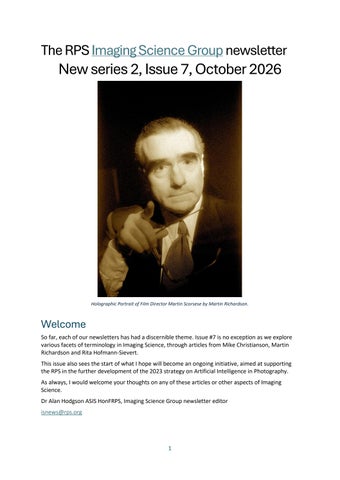
Holographic Portrait of Film Director Martin Scorsese by Martin Richardson.
Welcome So far, each of our newsletters has had a discernible theme. Issue #7 is no exception as we explore various facets of terminology in Imaging Science, through articles from Mike Christianson, Martin Richardson and Rita Hofmann-Sievert. This issue also sees the start of what I hope will become an ongoing initiative, aimed at supporting the RPS in the further development of the 2023 strategy on Artificial Intelligence in Photography. As always, I would welcome your thoughts on any of these articles or other aspects of Imaging Science. Dr Alan Hodgson ASIS HonFRPS, Imaging Science Group newsletter editor isnews@rps.org
1
Events – past and present Future events There are just a few days left for you to sign up for our second biannual Zoom meeting this year on Saturday 17th October. Details of the talks, including titles and abstracts, are given below; please contact the organiser Dr Mike Christianson if you are interested in attending; he will provide Zoom login details.
2
Recent events in revue London Imaging Meeting 2026: Imaging for Science
The seventh London Imaging Meeting took place at the University of Westminster between June 22-24, 2026 and featured one day of summer school, and two days of oral talks and poster presentations. © Dr. Sony George.
The seventh London Imaging Meeting (LIM) was held at the University of Westminster, Regent Street, from 22 to 24 June 2026. The theme this year was “Imaging for Science”, and the meeting was built around people for whom an image is not the end product but the measurement. That distinction matters more than it sounds. Across the sciences, imaging has become the instrument of first resort: the health of a coral reef, the crystallisation of a compound, the interior of a living cell and the layers beneath a painted surface are all now read from pictures. The hard part is the step from a picture to a number that can be trusted, compared and reproduced. Calibration and standardisation, colour and spectral fidelity, and the physics connecting a sensor reading to the quantity someone actually wants to know were the recurring subjects across the three days. The meeting opened with a summer school of short courses organized around the main topics: •
Imaging of Natural and Built Environments,
•
Imaging in Science, Color and Image Formation,
•
3D, Spatial, and Computational Imaging,
•
Spectral and Multi-modal Imaging,
•
Life Science Imaging.
3
The main conference consisted of two days of stimulating talks and poster presentations. Three keynotes covered the instrumentation and emerging international standards behind hyperspectral imaging systems, the encounter between radiographic imaging and fine art, and the mathematics and machine learning underpinning modern image analysis and inverse imaging problems. Four invited focal speakers addressed the design of custom spectral imaging systems, whether accurate colour recovery in underwater images is possible at all, the challenges of intrinsic image decomposition, and the rise of super-resolution microscopy. The breadth of the accepted work made the case for the theme better than any programme note could: seagrass chlorophyll estimated from images, apples counted in multispectral orchard imagery, X-ray nanotomography of crystallising materials, live-cell fluorescence microscopy, heritage ceilings rendered with physically plausible tone mapping, and colour correction for the multispectral sensors now appearing in mobile phones. Very different sciences, asking the same question of imaging, and asking it of the same small set of fundamentals. The proceedings will be published by the Institute of Physics (IoP). Our thanks go to the University of Westminster for hosting us, to the Colour Group of Great Britain for supporting student registrations, the Imaging Science Group for sponsoring and to our reviewers, whose careful work shaped the programme. LIM2026 Co-chairs Derya Akkaynak, University of Haifa Sony George, NTNU
4
Science in the Society RPS Science Committee In newsletter #6 it was noted that the Chair of the Science Committee has resigned and that "The Executive Team will review the future structure and leadership of the Science Committee and bring recommendations back to the Board". The IS Group committee has heard nothing further on this. However, it is interesting to note that this is an issue with past precedent. Looking back to the Imaging Science Group (at the time named the Imaging Science and Technology Group) News Sheet dated Spring 1990 we find the following on page 3. “Over the past year the Group Committee has been devoting much attention to science and technological matters in the Society, with particular reference as how best to maintain and enhance the status and reputation of the Society, and how best to serve the needs of members in general and professional capacities. Discussions have been held with the Executive Council which have led to a reconstitution of the Science Committee of the Society, charged to look into a range of matters and recommend future developments for the Society”. It looks like history is repeating itself once more.
Distinctions and qualifications Also in newsletter #6 the following was noted, taken from the RPS website. “Applications for our Imaging Science Qualifications (ISQ) are currently paused while we undertake development work for the Distinctions Programme”. However, there was no timescale attached to this. Looking back to the transcript of the RPS AGM 2025 Q&A session it was noted that the RPS was “Hoping to start A & Fs (New Framework) in early summer ". A recent RPS email suggests that it now looks to be 2027 for distinctions, so this probably also applies to ISQs too.
Definitions of Imaging Science Following a request from the RPS Science Committee in 2024, the Imaging Science Group committee convened a sub-group to investigate the production of a definition of “Imaging Science” that could be utilised by RPS members, where appropriate, in their publications or presentations. The members of the sub-group included the present IS Group committee and a number of scientists and academics with expertise in this field. Over the years there have been a number of definitions developed, both within the Society and in the general scientific literature, and this work was an attempt to bring these together and make them relevant in today’s Imaging environment. The decision was made to produce two definitions. The first being a short, but nevertheless accurate, description of the field which could be used where further detail was not required. The second is a more rigorous and broader version to cover all possible imaging scenarios; appended to this version is a more detailed description of the key aspects of the imaging chain and examples of its applications.
Definition Number 1 Imaging science is a multidisciplinary field concerned with the generation, collection, duplication, analysis, modification, and visualization of images. (This is based on a definition developed by Joseph P. Hornak, Encyclopaedia of Imaging Science and Technology, John Wiley & Sons, 2002, ISBN 9780471332763) 5
Definition Number 2 If electromagnetic radiation or any other form of energy, emitted from, reflected by, or otherwise affected by an object, causes a representation - the image - of the object or some aspect of the object to be generated, then the systematized body of knowledge relating to the generation, properties and processing of the representation may be defined as Imaging Science. Key aspects of Imaging Science include the following: 1. Image Acquisition: This involves the process of capturing the information relating to the image using such devices as cameras, sensors, scanners and other imaging instruments. Different imaging modalities, for example optical, infrared, X-rays, ultrasound, sonar, energetic particles and magnetic resonance imaging, are used based on the specific requirements of the application. 2. Image Processing: After an image has been acquired, various processing techniques can be applied to enhance, analyse or modify the related information. These methods may include, for example, filtering, noise reduction, image restoration, and feature extraction. Digital image processing usually plays a crucial role in this aspect. 3. Image Analysis: This involves the extraction of information and features from images. Techniques for this include, for example, pattern recognition, computer vision and machine learning algorithms. Metrology as applied to images includes quantification of various key parameters, for example dimension, colour and temporal duration, which provide critical measurements which are often traceable to national and international standards. 4. Image Interpretation: Interpreting images involves understanding and applying the information derived from one or more of the various methods of analysis and measurement. This usually requires human expertise but in some cases automated systems can be designed to aid in the interpretation process. 5. Visualisation: Imaging Science includes techniques for presenting image information in a readily comprehensible, visual manner. Visualisation methods range from basic techniques such as rendering and display to advanced methods such as virtual reality and augmented reality. 6. Applications: Imaging Science finds applications in various fields, including but not limited to: • Medical Imaging: Such as X-ray, CT scans, MRI, PET imaging and Ultrasound for diagnosis and treatment planning. • Astronomy: Where images derived from, the whole range of the electromagnetic spectrum, particles (e.g. Neutrinos and Cosmic Rays) and even Gravitational Waves, are used to examine the nature of the universe. • Remote Sensing: Using satellite (e.g. cameras and spectrometers) or airborne sensors (e.g. Lidar) to capture information about the Earth’s surface to be used, for example, in environmental monitoring, agriculture, urban planning and archaeology. • Industrial Imaging: In quality control, defect detection and process monitoring in manufacturing. • Computer Vision: Enabling machines to interpret and understand image information for applications like autonomous vehicles, robotics and facial recognition. • Art and Entertainment: In areas such as digital art, animation and special effects in films. These definitions were sent to the Science Committee Chair. To the best of our knowledge this initiative did not proceed any further. This newsletter would be interested in any comments from IS Group members on this work. Mike Christianson, IS Group Chair 6
The RPS strategy on Artificial Intelligence In 2023 the RPS created a web page on Artificial Intelligence (AI) and its impact on photography and photographers. The aim was to record “the RPS's latest thinking on AI” with an invitation to “keep checking back for new content”. Unfortunately, this has not updated since 2023 and as a result it is worth collating later RPS pronouncements on this issue.
RPS AGM 2025 The RPS AGM 2025 Q&A session noted the concerns of one member – the “loss of jobs, scraping and stealing our images”. This is a topic worth revisiting in the future. The post-AGM response noted the following. "The RPS trustees have recently initiated a new review of AI, reflecting the progress it has made since 2023... with a view to updating the RPS’ position on AI and image-making" and " to educate our members about how it is being used...and ethical concerns" This response has not appeared on the AI section of the RPS website.
Report of meeting of Board of Trustees 27/3/26 An update appeared in the RPS Journal July - September 2026 and the key points can be summarised as follows. • •
The existing 2023 statement remains in force Further work is required to distinguish "generative AI from established photographic and digital imaging practices"
This last point is interesting from a number of perspectives. It leaves open a distinction between generative and image manipulation AI. Also, the difference between "photographic and digital imaging practices" could be an interesting debate in itself! Again, this response has not appeared on the AI section of the RPS website.
A proposed route forward for this newsletter The overall aim of this initiative is for the Imaging Science Group to make a contribution to this debate. It seems unlikely that readers will take much notice of a stance on AI not updated since 2023 and one of the RPS AI pages does include the invitation “If you would be interesting in sharing your own knowledge in a blog for the RPS”. My belief as Editor of this newsletter is that the topic of AI in Photography lies within the definitions of Imaging Science laid out by Mike Christianson in a preceding article and the topic therefore has a place here. The aim of the piece below, entitled “What is real and what is not?” is to submit it to the RPS as a blog entry to show some update from 2023. If you would like to take part in this by commenting on this article or submitting your own contributions it would be great to hear from you.
What is real and what is not? We are heading towards / are in (depending on who you read) a crisis of confidence in the veracity of the digital image. Some commentators seem to consider this as a binary issue, with photographic imagery seen as real, whereas Generative AI1 seen as false and a facilitator of fake news. To examine
1
The RPS definition of Generative AI reads as follows. “Refers to algorithms which create new content such as images, texts or audio, based on harvested or mined data. Recent widely available software such as ChatGPT and DALL-E and the incorporation of such Generative AI in to software such as Photoshop has made it accessible and affordable.”
7
this the title of this piece was purposefully set in a binary context and to question if this is the correct way to frame this issue. Another binary issue perceived by some is that the problem is confined to images in the digital domain. We should start by taking a brief look into the history around this - how "real" were silver halide ("analogue") images?
A historical perspective Even a cursory examination of historical silver halide photography reveals examples of “fake news” photographs where the intention was that they should not represent reality, Victorian spirit photography and doctored propaganda images of Lenin and Trotsky being well known examples. Taking the perspective of creative photography, curator Nathalie Herschdorfer notes that celebrated early 20th century photographer Man Ray "saw the medium as a creative tool that allowed him to go beyond the representation of reality". This attitude to reality in silver halide images continues to be subjective - an alternate view from the 1970s is illustrated below. Before we move on, hold onto that phrase “representation of reality”. Moving now to digital images, the ease of digital manipulation was surfacing 20 years ago. An example comes from Binghampton University in 2006 who noted that contemporary electronic cameras produced noise footprints which were characteristic of the device and could therefore be used to trace even manipulated content. I suspect this no longer survives even in-camera processing, let alone post processing packages. The message from history is that ambivalence in both the actual and attitude to reality in photography is nothing new and dates back deep into silver halide photography. The easy target is images in the digital domain as these can be manipulated using readily available software packages. While possible, it is very much harder to construct an unreal image on silver halide film that would stand up to scrutiny. It comes down to a basic question - what can one take as "real" in a digital image? As a supplement, how big a game changer is Generative AI to this? A few examples may aid this debate.
Example 1 – an illustration from astrophysics Jean-Pierre Luminet is an artist, published poet and astrophysicist, an interesting combination. His illustration of black hole physics is particularly useful to this question.
Image of a Spherical Black Hole with Thin Accretion Disk. First numerical simulation by Jean-Pierre Luminet (Paris Observatory) published in Astron.Astrophys. 75, 228 (1979). Creative commons
8
Art historian Lynn Gamwell notes that Luminet "associated realism with photography", a stance opposite to that of Man Ray noted above. The original image was created in 1978 by hand, as a drawing made with black ink dots on white paper, then reversed photographically. Computer graphics programmes were not freely available at that time! It is another representational concept, described as a "bolometric photograph" as it shows all the electromagnetic spectrum in one image. But is it real? Luminet’s caption shown above notes it as the output of a numerical simulation. In that respect it is a real output. It does not claim to be a direct image of a black hole and as a bolometric photograph that would present further imaging science difficulties. As such it is a real visual representation; digital computer data producing a visual image – analogous to Generative AI 50 years later.
Example 2 – smartphone images of motion As a part of a commission to write a monograph on smartphone technology I wanted to reflect on the reality of the images from the imaging systems in these devices. An internal flight within New Zealand provided an opportunity.
Take-off © Alan Hodgson
In flight © Hilary Hodgson
In one respect these images are obviously not real. The propellor blades are not bent asymmetrically on take-off and they did not come apart in flight. However, they are a real reflection of the imaging chains in these smartphones with their rolling shutter image sensor technology. Embedded in these images is information on the rolling shutter image sensors deployed in each smartphone. I have not tried this but I feel sure Generative AI could produce something that looks similar but will have been trained on multiple sensor images in combination. As a result I suspect it will lose contact with any real imaging chain.
Considering more representative RPS photography The two examples cited above contain elements that are real and elements that are not. This could be seen to be blurring their content of reality. To avoid the accusation that these rather esoteric images have been chosen simply to obfuscate this concept of reality in images, it is instructive to take a look at some more representative output from the digital photography of RPS members. I 9
used a copy of the RPS Digital Imaging Group publication DIGIT, volume 108 for this, sampling the work of two members. David Townsend FRPS has moved from using photography in his working life which he describes as "representational" (that term again) of the truth. He has moved into impressionist rather than representational photography, using intentional subject movement of plants in the wind. David does in-camera composite images, rather than layers in an image editor. Each of the sub-images captured by the camera is real, but the impressionist composite is not. Does this make it any more or less real? Whichever way, he has been successful with his work. Antoinette Castro ARPS uses digital manipulation in her composite images, overlaying three images in software, aiming to "force the viewer to scrutinise the picture and raise questions”. Here the subimages are recognisable but not associated in reality, a key difference to David’s work. Antoinette describes this work as representing the human body, a different view of representational. This is photography with no intent to deceive but they do challenge the concept that photography registers reality through artistic composites.
In conclusion I believe this discussion on reality can inform our debate on AI in Photography. The aim was to show that a tempered view of reality exists throughout photography. In that context veracity becomes much wider than a binary choice between Generative AI and Photography. The debate becomes a challenge to the title of this article. Rather than set the debate as the binary choice between what is real and what is not, we need to start from the fact that digital (and to a lesser extent silver halide) imaging has for decades displayed various levels of reality. This will allow us to put AI in context. Do we need to consider AI (Generative or otherwise) as a step change or simply another method to the process of representing various levels of reality? Finally, given the theme of this issue of the newsletter covers terminology we may need to revisit this concept of representation in photography. Does our use of terminology in photography obscure some of the reality? The footnote above notes that the RPS has started a dictionary of terms for AI in photography. Representation may be an interesting one to include.
Alan Hodgson
10
Members’ projects When a Hologram is not a Hologram: The Etymology of the Word Descriptive language can lag technological and scientific concepts. It isn’t easy coming up with new descriptive information given our current technological progress, unless we consider math as a language as coders often do, essentially overtaking clear English. This prompts essential questions about the future of textual definition. The issue here is not our obsession with semantics, but the fact that technology is rapidly exceeding the vocabulary used to describe it and its impact on society. Instead, descriptive language often misrepresents the actual findings of scientific research. That said, descriptive communication is essential for education and can be difficult when technological progress outpaces its original goal, making the initial definition outdated. It becomes vital to adapt or redefine meaning. One example is how the word ‘Hologram’ has been rebranded to fit marketing language to the public’s fantasy of what a hologram is. Does this mean the value of accurate descriptive language will diminish in time – well, maybe not? The word 'holographic' is not the same as 'hologram'. While 'hologram' is commonly used to describe special effects in sci-fi films, futuristic gaming, and semi-sentient virtual advertising that influence popular culture, manufacturers of 3-D technology often struggle to explain the type of 3D image their products produce clearly. This leads them to misuse the word 'hologram' through descriptive plagiarism. Popular culture has redefined the word ‘hologram’ regardless of its dictionary definition, to mean anything that appears to reflect three-dimensional space, suggesting that dictionaries need updating. But where does that lead? The answer lies in a place where descriptive language is struggling because the words can be inadequate. One example is its use in describing the effects of the commercially available Microsoft HoloLens™ system, which merges reality with augmented reality. Reality disappears behind a screen, taking our language with it. In 2018, I was invited to give an interview to the British Broadcasting Corporation (BBC), eager to have an expert discuss holograms. When I arrived at the BBC reception, everything seemed in order until I entered the broadcasting studio and met the celebrity DJ who would interview me. That morning, live on air, he started asking me about holograms of deceased stars: Michael Jackson, Billie Holiday, Roy Orbison, Amy Winehouse—each of whom had apparently been brought to life as a hologram, a technological Frankenstein’s monster, to perform concerts across Europe to eager fans. He was misinformed but still insisted these holograms were becoming more common. Instead, I was asked to comment on the ethical and legal debates surrounding them, particularly the Roy Orbison hologram, which was about to tour in the United Kingdom. The fact that these Pepper's Ghost illusions were incorrectly called holograms didn’t matter. Our discussion focused on legal issues, especially intellectual property infringement, including trademark infringement. However, when I clarified these were not holograms but digital projections, it caused an awkward moment for me and the entire BBC research team. The BBC presents itself as a strong defender of facts and truth, but this time it wasn’t very accurate. The left the interviewer speechless, and our conversation quickly shifted to a promotional jingle. Who could have imagined that Gabor's original 1947 concept of the word "hologram" would become so popular in describing 3-D in the 21st century? However, these are all significant technical developments that have emerged as technologists have exploited his invention. The list is remarkably long and continues to grow. The Microsoft HoloLens™ system may not be an authentic hologram in the strictest sense. Still, the fact that the word "Hologram" continues to inspire innovation in the 21st century signifies that the journey is far from over. In 1985, Steven Benton, a renowned pioneer and Professor at MIT, authored a paper for the Society of Photo-Optical Instrumentation Engineers (SPIE) titled ‘A Critical Overview of Technology’. In it, he likens the 11
holographer to ‘Virgil’, trapped inside Dante’s inferno and confined to a box labelled ‘technical constraints’. He argues that a three-dimensional holographic display should be limited to a specific viewing space (the Benton Alcove Hologram) to prevent the viewer from physically reaching the angular viewing limits that he refers to as the ‘Achilles Heel’ of display holography. I reflected on Benton’s paper and 360° wide-field recording when Microsoft announced its move toward immersive interactivity. It was a jaw-dropping moment for those involved in holographic research to realize that the deceased Roy Orbison was about to enter our physical world through holographic technology, fulfilling a dream from science fiction. It promises another chapter in the history of three-dimensional imaging. I spent several days contemplating the implications this might have for the research community, and after feeling initially elated, my thoughts gradually shifted to darker ones. The idea of holograms populating our everyday lives felt somewhat unsettling, as it seems to diminish the identity of the medium. For example, it will no longer be possible to determine with certainty where the image originated or why it was there. It will be a mirror rather than a window — a mirror reflecting another’s thoughts, desires, and needs. The idea of a mirror, reflecting someone else’s view of reality, feels quite invasive because Microsoft’s HoloLens™ system intrudes on the limited, unencumbered reality we experience, which is already rapidly diminishing due to electronic screens on our walls, desks, and in our pockets. Is real space an endangered, shrinking asset? Augmented reality operating systems will eventually alter our thinking and how we interact with each other, but all forms of virtual reality can only mirror reality, at best. Modern holography offers numerous alternatives to light-shaping devices in industry, comparable to how electronic circuits and microprocessors replaced valves in the early 1960s. As mass-produced holographic optical elements replace micro-lens arrays and holographic phase memory is poised to replace today’s standard magnetic hard drives, each offers commercial potential that was once thought impossible. It remains uncertain whether our increasing dependence on technology will weaken our physical and mental capabilities, as well as our ability to adapt to natural environments. Nevertheless, we understand that the long-term benefits of modern holography over existing technologies will be substantial and, in some cases, transformative. So, don’t worry about AI developing holography – it’s the minds behind it that we should be concerned about. Holograms may one day communicate with us in real-time using artificial intelligence (AI) to shape reality itself, with Microsoft HoloLens™ promising the world of tomorrow today and future trends like ‘True Colour’ holograms and beyond. Progress in photonics aims to satisfy our innate desire for the mythical, the unattainable, and the impossible. The author suggests that holographic imaging taps into our evolutionary DNA to advance the science of photonic technology and wavefront reconstruction. It represents a passionate union of art and science, without which its development would not be possible. The paper offers reflections on the impact of artificial intelligence (AI) and holography. As science fiction novelist William Gibson famously observed, “The future is already here – it’s just not very evenly distributed,” a truism when viewed through the lens of holography.
12
Illustration 1: What’s going on when we see a hologram?
The last technological milestone in holography relates to human-computer interaction. Recent advancements in vision algorithms and artificial intelligence enable real-time 3D tracking. The availability of dependable 3D hand-tracking technology allows us to integrate real-world hand metaphors with telepresence interactivity, which is essential for manipulating objects in a virtual 3D environment. My understanding suggests that related technologies, such as robotics, are equally dedicated to creating imitations of reality. Since the Renaissance, no two fields as diverse as photonics and engineering have pursued the same goal simultaneously. On one side, there are counter-cultural figures attracted to holographic illusions, while on the other, the engineering pursuit of the ultimate Tesla Humanoid. Both rely on technology initially developed for warfare and are progressing towards the ultimate illusion of life. Our insight into how these breakthroughs will influence culture is limited, yet both contribute to the chaos they aim to escape. The primary purpose of these applications must be to serve people’s needs and enhance the quality of life. It is the rapid development of AI that will enable the rise of new creative industries, and it is also this swift progress that calls for serious discussion.
13
Holographic Portrait of Film Director Martin Scorsese by the author, Martin Richardson.
Martin Richardson
14
About the author Emeritus Professor Martin Richardson is currently a research scientist working in New York, USA. His current research focuses on advanced holographic solutions for ultra-realistic 3D displays and is an industry specialist in holography for applications to optical security. He has received The Royal Photographic Society’s ‘Saxby Medal’ in recognition of his sustained pioneering contributions to the science and technology of holographic imaging and the physical understanding of its materials and applications. In 2024 the London Science Museum acquired his entire backlog of holograms made during his career including holographic portraits of film director Martin Scorsese, Fine artist Sir Peter Blake and the artist David Bowie. His most recent book, ‘The Hologram: Principles and Techniques’, is published by Wiley & Sons– IEEE - https://www.wiley.com/legacy/wileychi/richardson/
Literature reviews Preserving an endangered technical language Many arts, crafts and technologies develop their own language and terms, which is obvious and well understood as long as people use the technique, but which is quickly lost once it is no longer practiced. In the worst case, the terms keep being used for other than the original meaning which makes the original literature difficult to understand for restaurateurs, conservators and historians of photography. As a major imaging technology of the 19th, 20th and 21st century, analogue photography had a very sophisticated and extended language. While image capture, printing and dark room practice is quite well covered in books 2and the terms are still being used by amateurs and professionals in photography, this is not true for the terms in manufacturing and testing of silver halide papers and films. Many manufacturing units have closed all over the world and the professionals have moved to other fields. In general, manufacturing activities were kept confidential, and little was published and often only after the plant was closed3. To preserve the knowledge of photographic manufacturing, the Cibachrome Association sponsored an international student project with the Worcester Institute of Technology 4 The goal was to create the template for a web based visual dictionary in three languages (English, French, German). The final dictionary would be created by as a collaborative work of experts, each of whom would sign up for a particular number of terms. The students came from different fields (Computer Science, mechanical engineering and material science). On-line interviews with international experts in silver halide and coating technology were held to define a small selection of terms with specific meaning in photographic manufacturing and testing. It was of particular interest to understand, if a term was used differently in the different countries and manufacturing sites. The project group came up with a number of recommendations : 1)
include simple mechanical diagrams wherever possible in the dictionary. These diagrams should convey the definition of the term well enough so that someone with some mechanical knowledge can understand the term without the need for the written definition. Each diagram should be provided by the author of its respective definition.
2
The Visual Dictionary of Photography, David Präkel, Routledge, 1 st edition, 2021, Print ISBN 9782940411047 Robert Shanebrook, http://www.makingkodakfilm.com/ 4 https://www.wpi.edu/project-based-learning/project-based-education/global-project-program 3
15
2) include an interactive diagram of the overall manufacturing process located on the home page of the dictionary. This should be used as a secondary means of browsing the dictionary with a basic search bar still included. 3)
pages should feature the term, the German and French translation of the term, the definition of the term, any synonyms in English, German and French, the diagrams or pictures included with the definition, any related terms, and other industries the term is used in. An example is given in annex a
4) open the creation and editing privileges of this dictionary to photographic experts, instead of making the dictionary completely open-sourced or closed-sourced. An open point was the compatibility of the graphics with AI, which may have to be solved in a follow-up project. Rita Hofmann-Sievert HonFRPS
Rita.hofmann-marly@bluewin.ch
Impasse Champ Montant 12
+41 79 445 3393
CH-1723 Marly September 2026 Annex A
16
All for now – see you next time! Don’t forget to send me your content and thoughts for the next issue. At the moment we are aiming for a January 1st publication. Thoughts on any of the content in this issue, AI in photography or the RPS AGM 2026 would be especially welcome. August 12th also provided a solar eclipse for many of our members. Thoughts and images on the imaging science of eclipse photography would be most topical. Dr Alan Hodgson ASIS HonFRPS, Imaging Science Group newsletter editor isnews@rps.org
17