This issue has a couple of themes running in parallel, of camera optics and astronomical photography Both are explored on a range of scales.
The camera optics perspective begins with a review of the recent Good Picture event where Chris Dainty discussed the lens systems in mobile phone cameras. We then move on to the optical (and physical) characteristics of a 1969 camera lens before exploring the imaging chain of the 8.1m aperture Gemini North telescope.
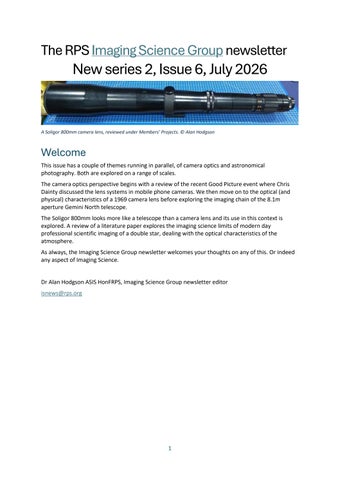
The Soligor 800mm looks more like a telescope than a camera lens and its use in this context is explored. A review of a literature paper explores the imaging science limits of modern day professional scientific imaging of a double star, dealing with the optical characteristics of the atmosphere.
As always, the Imaging Science Group newsletter welcomes your thoughts on any of this. Or indeed any aspect of Imaging Science.
Dr Alan Hodgson ASIS HonFRPS, Imaging Science Group newsletter editor isnews@rps.org
Following the successful inaugural meeting in October 2025, the IS Group held the second of the Good Picture – Online Zoom meetings on Saturday 11th April. This was the first of two such meetings in 2026. As previously there were two speakers with a Q+A session after each over a total period of about 2.5 hours.
The first speaker was Professor Chris Dainty Hon FRPS whose talk was entitled “The Fundamental Limits of Mobile Phone Cameras”. He started by making it clear that he was considering the fundamental rather than the practical limits since this knowledge was required to produce large improvements. He discussed his early work in model photodetectors and his collaboration with Rodney Shaw on the publication of a seminal work in this field i.e. “Image Science: Principles, Evaluation and Analysis of Photographic-type Imaging Processes” in 1974. In 1946, Albert Rose had proposed a method of comparing the fundamental effectiveness of various techniques of image formation, e.g. photographic film, television pick-up tubes and the human vision, using the term “Detective Quantum Efficiency” – DQE. This is the ratio of the output Signal/Noise ratio to the input Signal/Noise ratio with an ideal photodetector having a figure of 1, i.e. where input and output ratios are identical. His modelling work using this metric was initially poorly received by the photographic research community but was eventually shown to be critical in certain circumstances, for example medical X-ray imaging where the minimum level of exposure, by the patient, to produce an acceptable image is crucial.
With this introduction to the importance of fundamental limits in mind he then discussed mobile phone imaging where worldwide 5 billion photos are shared, and 500 million hours of video are recorded, every day. This was followed by some examples of the complicated structures of the lens arrays in the cameras with some standard wide-angle versions having up to 7 elements some of which are unusually shaped. These lenses are diffraction limited, not aberration limited, and are paired with matching sensors, which have almost 90% efficiency; combine this with post exposure digital manipulation, the overall system produces very efficient imaging. The major limitation is pixel size on the detector.
So where are significant fundamental improvements in DQE to be made? The comparison with astronomical imaging is interesting where over the period of 130 year to the present day the diameter of optical telescopes has increased from approximately 1 to 40 metres. This is because the angular resolution is inversely proportional to the diameter of the observing aperture. The larger diameter also produces an increased photon flux into the device since this is proportional to the diameter squared. Thus on a fundamental basis to produce significant imaging improvements to mobile phone cameras what is required is larger lenses! Of course the form of the present mobile phone makes this a difficult proposition.
The talk was concluded with a review of some of the present mobile phone camera features and possible future developments some of which may impact this lens diameter issue.
The second speaker was Dr. Rita Hofmann-Sievert Hon FRPS who gave a talk entitled “Material Science in Photography: Surface and Nanostructures”. The purpose of this talk was to show how material science developed for classical Silver Halide (AgX) products has not disappeared but, in a number of applications, has affected modern nanomaterials. The important characteristics of all materials include the chemical structure, the structural morphology, particle size and distribution and surface treatments. All these have effects on the properties of the material and photographic products were manufactured with very careful control to ensure that the required sensitivities were reproducibly generated.
Particle size, size distribution and shape was carefully controlled to produce the wide range of light sensitive AgX crystals required by the whole range of photographic films and papers. The production of silver from the latent image (produced by light exposure) using chemical or physical development was the basis of the amplification required to produce the final image. Silver particle sizes produced in the way were in the range 0.2 – 2 micrometres. Smaller silver particles (2 – 100 nanometres), known as “Colloidal” silver, is yellow in suspension and was used as a blue filter in colour films to avoid exposure of the green and red sensitive layers to blue light. “Colloidal” silver is used today as a biocide and in other medical applications.
The importance of the AgX crystal surface was discussed, particularly the use of adsorbed “sensitising” dyes to produce grains which could absorb light across the full visible spectrum not just in the blue region where the untreated crystals absorbed. This technology is important in many modern sensor technologies.
The discussion moved to ink-jet materials which are still in use in the modern digital world. Particle size of the solid dispersion inks are well under 100 nanometres and all have surface treatment primarily to avoid sedimentation and provide the required fluid properties. The use of surface active agents produces electrostatic and steric stabilisation and there are many such surfactant to choose from. This process is now used in modern technologies such as 3D printing and flexible electronics.
The preparation of Carbon Black was discussed, as an example of ink production, and the two main manufacturing methods i.e. Gas Black and Furnace Black, were compared; these produce inks with different characteristics which need to be matched to the use. It is also possible, in a way analogous to “Colloidal” silver, to produce very fine carbons which are coloured, these are known as Carbon Nanodots and have colours across the visible spectrum.
Finally she discussed ink-jet receivers which are resin-coated paper on which a nano-porous mineral oxide containing multi-layer is coated utilising the standard methods used in photographic film production. The channels in the oxide layer are significantly smaller than the typical drop size and the ink is absorbed in approximately 20 nanometre channels. The metal oxide particles are treated with surfactants to produce a cationic (positively charged) surface which attracts and binds the anionic (negatively charged) pigment/ink. This not only produces a sharper image but also prevents migration of the ink at higher humidity.
Many of the technologies discussed in this talk were originally developed for photographic materials, taken up when ink-jet printing was developed and continue to be used in modern manufacturing processes in many fields such as photonics, sensors and medical applications.
Recording of these two talks can be viewed on the Imaging Science Group’s section of the RPS website using the following link: https://rps.org/groups/imaging-science/good-picture-online-april2026/
Mike Christianson, Imaging Science Group Chair
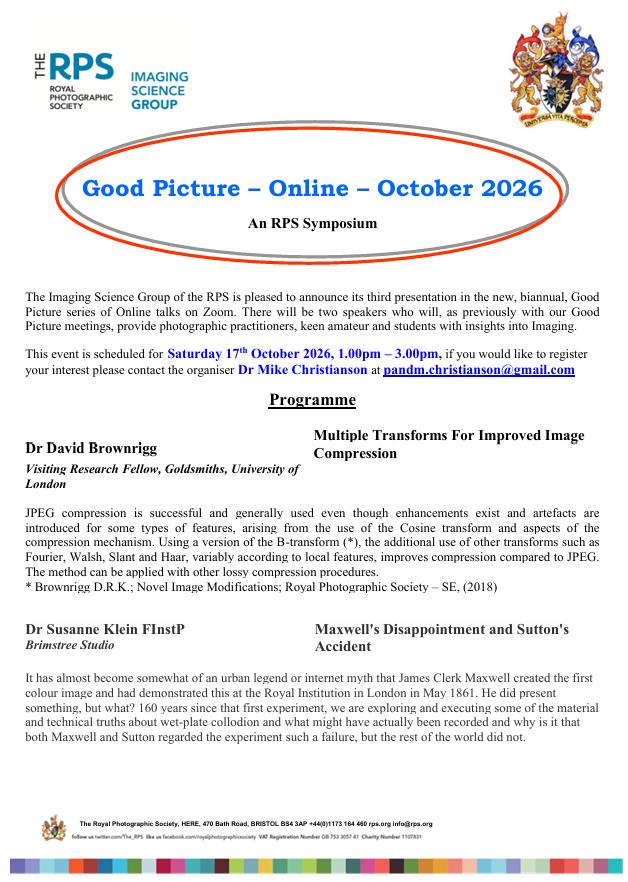
Future event - Good Picture – Online – 2026 Part 2
The IS Group will be running its second, biannual, Good Picture – Online Zoom meeting for this year on 17th October 2026. There will be 2 speakers for this meeting, their names and the titles of their presentations are as follows:
• Dr David Brownrigg: “Multiple Transforms For Improved Image Compression”
• Dr Susanne Klein FInstP: “Maxwell's Disappointment and Sutton's Accident”
The full details of this meeting, including how to apply, are given on the attached publicity “flyer”, this will also appear on the Group’s website and will be sent separately to all members.
Dr Mike Christianson, Organiser.
Science in the Society
The RPS Science Committee
The RPS maintains a number of Standing Committees, one of which is the Science Committee. The general purpose of the Science Committee includes to “advise the Board of Trustees on matters relating to imaging science and scientific imaging”.
As with all RPS Committees it has an appointed Chair. Earlier this year The RPS Journal contained some notes from the Jan 20 Trustee meeting. This notes that the Chair of the Science Committee has resigned and that "The Executive Team will review the future structure and leadership of the Science Committee and bring recommendations back to the Board".
Distinctions and Qualifications
The same edition of The RPS Journal also noted that Kauchik Gosh became AIS in February and ARPS in the same month, presumably through his AIS. Congratulations Kauchik! This is also proof that the Imaging Science Qualifications were still functioning and a benefit of membership.
However, we should also note that at that time the RPS website noted the following.
“Imaging Scientist Qualification - Applications for our Imaging Science Qualifications (ISQ) are currently paused while we undertake development work for the Distinctions Programme”
Historical perspective
In March this year rps.org published an article “1853-2026: The RPS President”, written by Michael Pritchard. It touches on the balance between Science and Art within the Society and I found it an interesting read from that perspective. This is an area worthy of further exploration in the history of The RPS and I would be interested in your thoughts on this.
Members’ projects
A Soligor 800mm camera lens
This was sold as an 800mm f/8 manual focus camera lens and as such it has a 100mm aperture. This was the attraction for me when I bought it second hand in 2021. I wanted to build an astronomical refractor and if this camera lens did not prove useful I planned to scrap the tube and use the 4” objective lens to create a telescope. As is often the case, the project settled somewhere in between the two.
The lens as supplied is almost 800mm long – it is a simple doublet with no telephoto length compression. The same lens appears to have been sold under multiple brands and is illustrated here featured in a Yashica brochure. This looks identical to the Soligor and shows a simple doublet objective lens.
It has an enticing impracticality about it, with a weight of 3kg and a minimum focus of 25m.
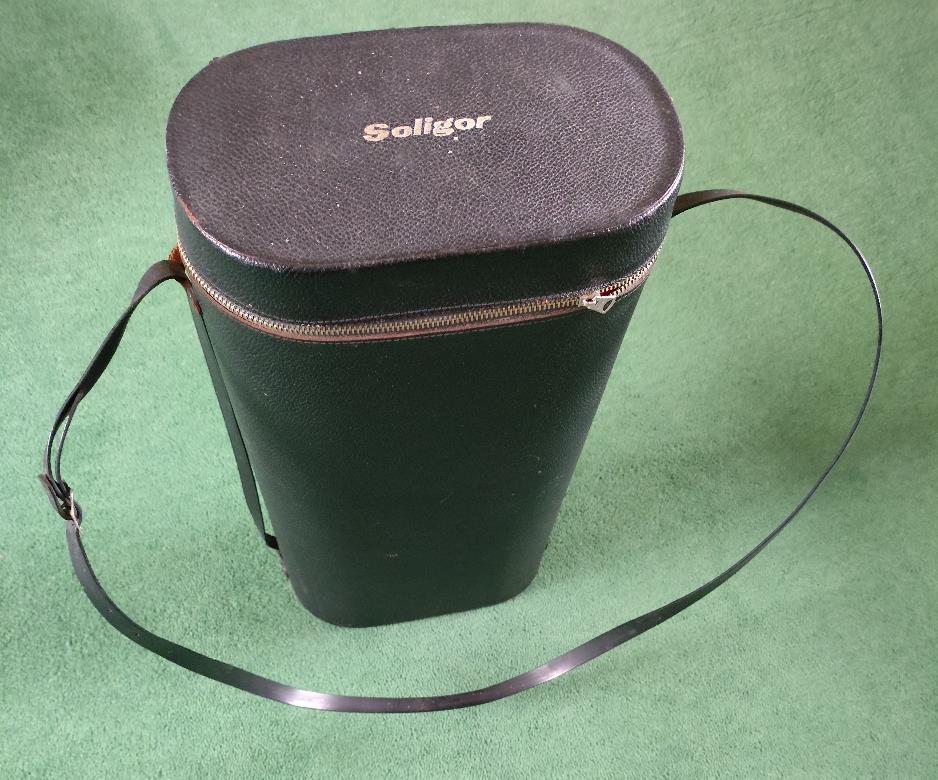
My lens has S/N 9690029 which denotes it was made by Kobori in 1969. The item comes in 2 halves, split around the tripod foot. That way it fits into what looks like a large binocular case.
The front end contains the 100mm aperture doublet, the back end the diaphragm, helical focus assembly and a T2 mount for the camera. Mine came with an M42 adapter on this.
The choice of a doublet was probably made on the grounds of cost. Triplets give better colour correction but I read somewhere that this can also lead to worse spherical aberration. Triplets are also heavier as they have more glass and therefore need more cooling time for dark sky work The benefit of the doublet is therefore lower weight and (potentially) better spherical aberration.
As a camera lens it only has a single mounting point for a tripod, the foot containing a standard ¼” Whitworth thread. And it is very big, seen here on a 1cm grid mat without the lens hood.
The physical construction of the tube is interesting. It is wholly metal and at each point where the diameter changes the joint is threaded. It was a joy to disassemble in the knowledge that anything that gets removed in a rebuild could easily be used in another project. However, the black metal ended up causing some unexpected issues…
Issues revealed on initial testing
A number of challenges were revealed by initial testing. It would be easy to consider these simply as issues but this project was to consider these as challenges for a subsequent rebuild. The image quality tests started in daylight then moved on to some night sky images.
Imaging stability
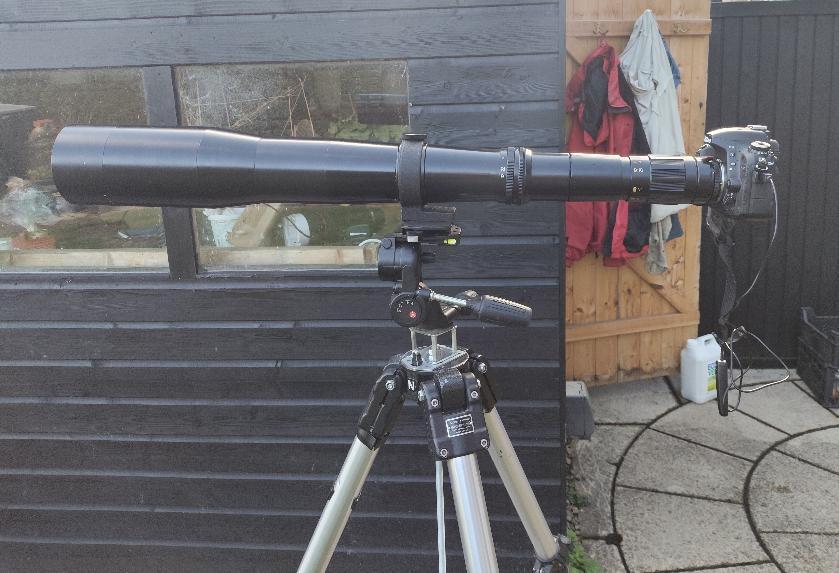
The mounting is not very stable. It is constrained by the fact that it is designed as a camera lens, so only one mounting point for a tripod. It is front heavy with a film camera but rear heavy with a Nikon D750 DSLR. Even with a substantial tripod and sturdy Manfrotto head it is not very stable.
It is easy to pick up angular momentum around the mounting point as the heavy glass is at the front end and the camera is at the back, with 800mm of leverage between the two. The mounting point location is about right but is does need some further support somewhere, probably front (around the lens) and back (around the camera).
Vignetting
The initial images look sharp but with some corner vignetting.
A series of images shows the following
• The vignetting diminishes from f/8 down to f/16 using the internal diaphragm
• At f/22 -f/32 it has disappeared
• No change with or without the lens hood. This is evidently not the cause of the issue.
It is probably an issue with such a long, diminishing tube length. However, if the sensor is not seeing the full aperture in the corners there will be accompanying image quality issues, such as coma / astigmatism.
This lens may be better suited to DX format imaging or for small sensor sizes.
Focus assembly
An initial test suggests that there is plenty of latitude to the existing focus mechanism for SLR photography and adequate stiffness when pointed upwards. But not much chance of fine, reproducible focus.
The focus throw of existing focus mechanism was measured as 29.5mm While this is enough for wildlife photography it could be a constraint for use with an assortment of cameras. I have in mind using this lens for sky photography with both DSLRs and bespoke astronomical cameras, where this focus throw could cause some issues.
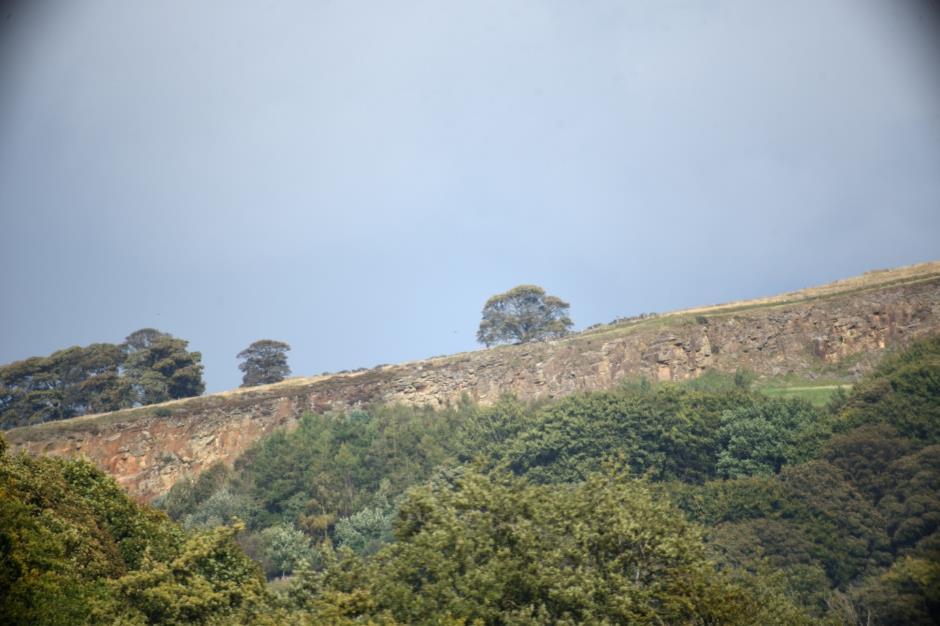
D750 ISO 200, f/8 1/800s. Uncropped full frame image.
Colour correction
It has a 1960s 2-element lens so presumably achromatic. As a result I expected to see some colour issues. At 800mm focal length the scale is good to show the Moon with a significant amount of horizon. This could also work shooting DX format. This moderately high contrast image shows up some green fringing, something an Image Engineering article suggests may be seen with an achromatic lens as either magenta or green fringing.
This is presumably dictated by where you set your focus, the spectral sensitivity of the camera and the designer’s choice of the colour correction on this optic. A preliminary chromatic result from some initial images suggests the following.
Focal length = Green < red (but close) < blue (a little more distant)
Frosting
The assembly was set up in daylight and left to equilibrate until dark under clear January skies. The lens cap was on but the tube uncovered. It became a frosty night and when I went out the black metal tube had a thick coating of frost by radiative cooling from the black metal tube. After a few exposures with the lens cap removed both outside and inside face of the lens showed frosting.
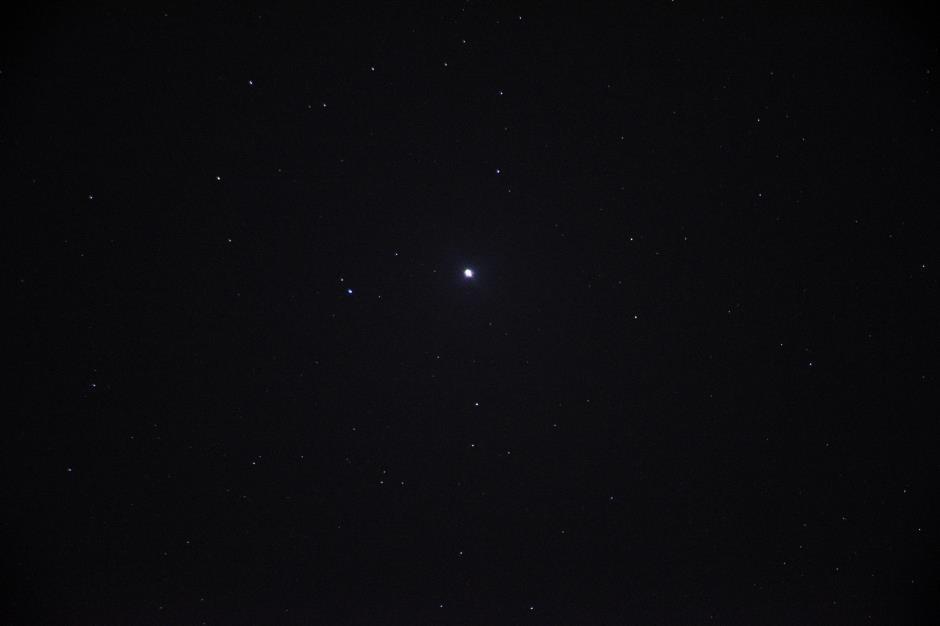
It was useable with regular wiping of the lens but a major inconvenience. Below is an image of the star Polaris and the Engagement Ring asterism. Although the principal stars are overexposed this captures the asterism pretty well. The image of Polaris has substantial blue and magenta fringes. Some of this may be optics but some may have been due to frosting.
D750 ISO 200, f/11 1/100s Uncropped full frame image
Polaris and Engagement Ring asterism January 2022. D750 ISO 1000, f/8, 4s. Uncropped full frame image.
The issues here may not all be simply chromatic aberration. Watching a star image on the camera display in live view shows the star images looking like a moving flame in the display. It may be “bleeding”, thermal streaming effects in the tube or from poor seeing.1 More to investigate here
Next steps
Decisions taken. The 4” doublet is interesting enough to continue but the lens needs a rebuild to make it worthwhile. Overall aim is to convert this into an astronomical telescope. The plan was made to tackle the following issues first.
• Make a more stable mount for the optical system, treating it as a telescope rather than a camera lens.
• Address the frosting issue with a heater for the lens and a cover for the black tube.
• Investigate options for an improved focus assembly to replace the helical unit. This will embrace a wider range of options.
o Eyepiece viewing – using it as a visual telescope
o Shorter focus sensors such as astronomical cameras
o Retaining DSLR capabilities.
Vignetting, colour correction and other optical aberrations I will pick up on the way as further considerations. Just my sort of project!
1 See Literature Review on the topic of seeing.
Literature reviews
The resolution limitations of ground-based astronomy
A paper entitled “The Probable Direct-imaging Detection of the Stellar Companion to Betelgeuse” was published in The Astrophysical Journal Letters in August 2025. It is notable on two fronts from an Imaging Science perspective, both of which are explored below. It also serves to illustrate the capabilities of modern ground-based systems, in this case the 8.1m aperture Gemini North telescope.
The paper serves to highlight the imaging capabilities of Gemini North. Even so they admit that the results presented can only be described as probable rather than definitive as they are operating right at the limit of the instrument capabilities. As such it is a fascinating study of leading-edge optical instrumentation at the scale of an 8.1m aperture.
The optical system
The authors note the diffraction limit of the instrument as 15 milli-arcseconds (mas) at 466nm and 17 mas at 562nm. To put this in perspective they calculate the angular separation of Betelgeuse from the companion star as 52 mas. Wavelength selection was also important in this study –Betelgeuse is a very bright and red star and longer wavelengths were found to saturate the detector on such a wide aperture, even at short exposures. The optical capabilities of the detector, named ’Alopeke cater for this.
’Alopeke splits the collimated light beam into 2 channels using a 700nm dichroic element. Each of these optical channels (labelled blue and red) are in turn fitted with further bandpass filters and ends in an Andor electron multiplying CCD camera. The image processing steps incorporate an autocorrelation function leading to a 180° quadrant ambiguity – an identical image on the opposite side of Betelgeuse. This ambiguity was subject to a further estimation, favouring one quadrant above another.
The ’Alopeke detector belongs in the classification of optical speckle imaging, giving fast readout capabilities from thousands of exposures in the range of 10-60 ms exposure time. This was done to “freeze” the atmospheric distortion in each exposure, citing the work of David L Fried in this context. It is this characterisation of atmosphere as a dynamic optical element that is a further interest from this paper.
The atmospheric optics
"Atmosphere is the medium through which we see all things” is a quotation attributed to American photographer Alfred Sieglitz from around 1890. This is a critical issue for ground-based astronomy where variations in the atmosphere can make stars twinkle and jitter, through modulations in the refractive index of the air column the telescope must look through. In astronomy, the extent of this variation is known as seeing, a temporal measure of the stability of the atmosphere.
In amateur astronomy subjective measures such as the Antoniadi and Pickering scales of seeing predominate. However, this paper from Gemini North uses a more objective measure, based on the work of Fried who related the statistics of wave distortion to optical resolution. This is quantified using the Fried Parameter r0, typically expressed in cm.
Length r0 can be considered as the aperture of a telescope where the diffraction limited angular resolution is equal to the resolution limited by seeing. Apertures smaller than this are diffraction limited but larger apertures are limited by this parameter. Calculations show that r0 varies with wavelength as λ6/5, so going to longer wavelengths helps some. To put this in context, at 500nm r0 varies from something over 30cm at the best locations to around 5cm at sea level.
At first sight this looks to be a serious constraint on large aperture telescopes but atmospheric science does leave a loophole to exploit. This is because the Fried Parameter uses an average of the atmosphere over significant time, typically >10ms. Short exposures, such as those used by the ’Alopeke detector are a way of getting round atmospheric distortions which limits resolution to be much worse than the point spread function of such an aperture.
These short exposures take advantage of another parameter, the atmospheric coherence time τ0 When exposure times are < τ0 the movement of the atmosphere is too sluggish to have an effect and as a result the image recorded is a snapshot of the atmospheric seeing at that point in time. At infrared wavelengths, coherence times are of the order of 100 ms, but for the visible region they drop to as little as 10 ms. The use of these short exposure times to exploit this “loophole” is the initiative developed by David Fried.
Adaptive optics and lucky imaging (stacking the best frames) is used to get around this. This happens more often when the number of r0-size patches over the telescope pupil is not too large.
The images in this study were "then mathematically combined using Fourier analysis techniques", rather than simply arithmetically stacked.
Learning points for the amateur astronomer
The use of stacking short exposures is a well known technique for digital imaging in amateur astronomy, as is the use of software to select the “best” frames for stacking. This paper puts some theoretical underpinning to this, specifically on the contribution of David Fried. Back in Issue #3 I noted that I was considering writing a review of a software package called Sequator – this paper gives me some parameters to use in assessing the package.
The paper also notes the benefits of going into the near infrared for improved coherence times. With more back-thinned image sensors becoming available this becomes an interesting avenue to explore. I have recently acquired a Sony IMX585 sensor and this is an area I plan to explore.
This was a very worthwhile paper to sit down and read, leading to some further avenues to explore.
All for now – see you next time! Don’t forget to send me your content and thoughts for the next issue. At the moment we are aiming for an October publication.
Dr Alan Hodgson ASIS HonFRPS, Imaging Science Group newsletter editor isnews@rps.org