There is a spread of articles in this edition but with a couple of themes. The first of these is collaboration across the Society with a review of events with the Historical and Digital Imaging Groups plus a discussion of an article in the Germany Chapter newsletter.
The second is topic lead with a look at Aerial photography both past and present.
This is a slimmer edition this time. As editor I am looking for contributions from the membership of the Imaging Science Group.
Dr Alan Hodgson ASIS HonFRPS, Imaging Science Group newsletter editor isnews@rps.org
There are just a few more days left for you to sign up for this Zoom meeting on Saturday 11th April. Details of the talks etc. are given below; please contact the organiser Dr Mike Christiansonifyouareinterestedinattending;hewillprovideZoomlogindetails.
Good Picture – Online – April 2026
AnRPSSymposium
Following the successful inaugural meeting of the new Good Picture series of Online talks on Zoom in October 2025, the Imaging ScienceGroup ofthe RPS is pleased to announceits first meeting of2026. Therewill betwo speakers who will, as previously with our Good Picture meetings, provide photographic practitioners, keen amateurandstudentswithinsightsintoImaging.
Thiseventisscheduledfor Saturday11th April 2026,1.00pm –3.00pm,ifyouwouldliketoregisteryour interestpleasecontacttheorganiser DrMikeChristiansonatpandm.christianson@gmail.com
Programme
ChrisDaintyPhD,HonFRPS FundamentalLimitsofMobile Phone Cameras Emeritus Professor
Approximately 5 billion photos and 500 million hours of video are recorded on mobile phone cameras each day. The image quality is remarkable but falls short of that obtained by "real" digital cameras. What governs theimagequalityofphonecameras,and whataspectofthemfundamentallylimitstheirperformance?
DrRitaHofmann–SievertHonFRPS MaterialScienceinPhotography:Surface and Nanostructures
To master the capture and recording of light, scientists in the photographic industry had to master materials on thesubmicronandnanometrescale,wellbeforemoderntoolsofnanotechnologywereavailable. We perceive materials as homogenous pieces of matter with defined physical and chemical properties. But it is often their surface, with sometimes very different characteristics, that interacts with light and the environment. Thepresentationwilladdresssomeofthesurfacescienceinvolvedinimageoutputmaterials.
Recent events in revue
Joint Imaging Science Group and Historical Group Meeting
At a joint meeting of the RPS Historical and Imaging Science Groups on 2nd December 2025, Dr Alan Hodgson (IS Group committee member) gave a Zoom presentation entitled “Fraunhofer Spectra –Their Place in the Evolution of Photography”. He began by explaining that 2025 had been designated by UNESCO (United Nations Educational, Scientific and Cultural Organisation) as the International Year of Quantum Science and Technology and that this lecture was the Society’s support for this initiative.
Although Isaac Newton described the production of a spectrum from sunlight using a prism in his publication “Opticks” in 1704, it was almost 100 years later that Willian Hyde Wollaston in 1802 observed “dark bands in the solar spectrum”. In 1814 it was Joseph von Fraunhofer, inventor of the slit spectroscope, who examined these bands in detail and showed that they did not change location and also existed in the spectra of bright stars. He proposed a labelling system using letters for the most pronounced bands. These labels were used from that time to accurately and reproducibly denote colours especially in later colour photographic systems. Further studies in the 1840s showed that the Fraunhofer lines were also visible in the Ultraviolet and Infra-Red portions of the spectrum.
A number of notable scientists e.g. William Herschel and Henry Fox Talbot tried unsuccessfully to find a cause for these lines but it was not until 1913 that Niels Bohr provided the explanation in his Quantum Theory of the atom i.e. absorption of quanta of light by atoms of various elements in the Sun and stars.
Alan also mentioned the use of early colour photographic systems and attempts to produce full colour solar spectra. The most successful early spectra were produced by Alexandre-Edmond Becquerel in 1848 using the “Heliochrome” process.
The use of Fraunhofer lines as reference points in other systems and experiments was discussed. For example in the measurement of spectral sensitivities of silver halide emulsions both undyed (W de W Abney 1882) and dyed (F E Ives 1888), astronomical and camera lens design and Uranium phosphorescence (Alexandre-Edmond Becquerel 1872). Between 1881 and 1883 Josef Maria Eder published an important series of reviews on colour photography and its future; all these were made with significant reference to the Fraunhofer lines. Even some commercially available sensitised plates, e.g. Lumière A, B and C, used his labelling system to denote the region of their spectral sensitivity.
This was a fascinating journey from an original scientific discovery through to its use and beyond. Alan’s often amusing comments on the personalities and various interactions between the many scientists involved, from around the world, was both very informative and entertaining. This lecture, with its capture of the many links between both the science and the scientists and its extensive use of references, is a valuable resource for anyone interested in the history of photography.
A recording of this lecture is available on the Imaging Science Group’s section of the RPS website.
Mike Christianson
HDR Displays: Show the Full Dynamic Range of RAW Files
This on-line event took place on Saturday 10th January and was organised by the RPS Digital Imaging Group. You may have noted from the last newsletter that they kindly extended an invitation to Imaging Science Group members. The presentation was given by Greg Benz who also answered a series of questions at the end.
He highlighted the difference between the older SDR (Standard Dynamic Range) and HDR (High Dynamic Range) display technologies. From an imaging science perspective this comes down to SDR being 8 bits per colour and HDR commonly using 12 bit at present. By way of comparison Greg noted that modern DSLR cameras record at around 14 bits per colour so this revolution in technology has real potential for DSLR image display.
Using some of his landscape images Greg illustrated the issue that arises when a DSLR image is mapped into SDR for conventional display. The process compresses the highlights so it can show midtones and shadows and as a result a move to HDR display rescues the highlights. This improvement in highlight rendition appears to be the key deliverable from this upgrade, displaying images that are much closer to those that the eye and DSLR can “see”. The results of processing a single RAW image in HDR produces a result that makes SDR look dowdy. The public will not accept that they can see an HDR image on their phone but are limited elsewhere.
HDR is apparently already well supported. Hardware such as modern TVs and smartphones can be expected to be HDR capable and computer monitors are catching up. As an example, my laptop (2025) is HDR capable but the additional monitor (2007) is not. Apple phones since the iPhone 12 (2020) have had HDR capable screens. However it was only recently that the new iOS 26 made the phone fully HDR compatible. The option of selecting HDR in an iPhone has gone from the camera, it is permanently HDR, as are videos. Google Pixel phones are similarly advanced.
From a software perspective many photo processing packages support HDR processing. The International Standards are evolving too – documents on the Gain Maps to support HDR have been under discussion in ISO Technical Committee 42 (Photography) for some time now. There is now a published standard: ISO 21496-1 for gain map metadata, which both Apple and (some) Android vendors are adopting. In summary, everything seems to be in place for the photo community to embrace this technology.
Greg also covered the issue of print production. Most of the hard copy prints do not generally have the dynamic range to support the scale of HDR available from a monitor and Greg’s recommendation would be to print from SDR so that you retain full control.
At the Consumer Electronics Show there were displays shown which hinted that in the future HDR images would be hung on the wall. It is apparent that solutions are in the available and further solutions are on the way.
Why should I care?
This was the question that came at the start of Greg’s presentation and was picked up by the questions at the end of the session. There were substantial interest / concerns about the effects on camera club competitions when the images are discussed and judged by projection. Greg made the point that realistic club projection technologies are some way off capability of HDR display. Perhaps some will move over to HDR TV display where HDR has been with us for some 10 years.
My interest was twofold. First, I need to replace the 2007 monitor sometime as it does not support some newer HDMI protocols. But secondly, I am interested to see how HDR will shift attention to some of the options already available in DSLRs.
I am a lifelong Nikon user and I have been looking at their Active D-Lighting (ADL) technology. It is available in camera but also for post-processing in NX Studio and it is this latter option that interests me. Will it prove to be any different to the other image processing tools available to us?
Alan Hodgson, with contributions from Rex Waygood.
Science in the Society
What happened to Aerial Photography in the Society?
The RPS Germany Chapter also produce a regular newsletter. In their Q4 2025 edition they had a fabulous article featuring aerial photographs of the Ruhr area – you can find a copy here. In this case the photographs were taken from a light aircraft and the concept was also revisited in the Digital Imaging Group magazine DIGIT #107.
Platform choice matters in aerial photography. In this case the craft is moving at around 100 mph and the article discusses the constraints placed on photography by this choice. We also see the occasional piece on photography from helicopters and of course drone photography is an evolving genre.
The author of the Ruhr piece, Jonathan C K Webb brings a documentary perspective to aerial photography and this is the latest in a long line of RPS articles featuring this type of work. The Imaging Science Group has also been involved here as “the impact from various areas of science and technology on aerial photography and satellite imaging requires a very wide background for reference”. As an example of our involvement, satellite imaging has appeared a number of times in our Good Picture events.
The quote above comes from one of our members, Grant Thomson from a previous series of this newsletter back in Autumn 1991. Up until this date the RPS had an additional science based special interest group, the Aerial Group. However, by that time diminishing resources meant that the Aerial Group was no longer able to continue its activities and the Group closure was reported to RPS Council
However, as reported in Autumn 1991 the members were made welcome in this, the Imaging Science Group and as noted above, activities on aerospace imaging still feature in our programme. The science and technology of Aerial Photography is alive and well in the Imaging Science Group.
RPS Historical Group Research Symposium
This event took place at the University of Wolverhampton School of Art on March 14, 2026. It was a partnership between The RPS Historical Group and the Photography Department at the University of Wolverhampton. It was presented to those in the room and on-line via Zoom. The aim was to bring together researchers and practitioners to explore photography’s evolving role across post-digital imaging, nineteenth-century visual culture, material processes, and the ethical complexities of archival practice. Full details on the event can be found here
The event explored photographic practice through four thematic sessions, examining social concerns, cultural memory, technological innovation and contemporary visual life. This is a summary of the event through an Imaging Science lens and thus gives more information on presentations that lean in that general direction. What has been retained is some of the terminology used by the presenters, to give a flavour of their different approaches.
This is the second year that this event has been hosted at Wolverhampton School of Art. It has evolved into a fascinating forum to see photographic history and technology reframed for an audience of diverse backgrounds.
Session 1: Post Digital Imaging & Computational Vision.
Key themes explored here were machine vision, algorithmic interpretation, computational systems and the reshaping of the production and circulation of images.
Malita Dahl: “Deadpan artefacts: Creative Experiments with Facial Expression Recognition in Photographic Portraiture”.
Malita is a PhD candidate at the Australian National University School of Art and Design. Her presentation examined the history of photographic portraiture, moving into the “deadpan” or “stone face” facial expression, shown as a persistent convention in fine art photographic portraiture since the 1920s.
In this paper Malita explored the datafication of portraiture, noting the shift in photography towards a computational space shaped by digital and algorithmic processes, with photographic representations increasingly replaced by data. She explored the creative engagement with Facial Expression Recognition (FER) technologies, which aim to interpret what the person is feeling.
FER take us into the realm of capturing emotional data (affective computing) by quantifying the expression on a face. The tools can reveal emotion but was noted as often faulty. This work was noted as situating contemporary machine vision within photographic histories of standardisation, objectivity and emotional restraint.
A fascinating piece of work on machine vision with the author summarising photographic portraiture, whether captured by the camera or parsed by an algorithm as never being neutral.
Mark Bessondo: “Photography in Flux: Google Street View as Post-Photographic System”
Mark described this work as coming from his UCL Master’s thesis. He noted the scale of Google Street View as 220 billion images and the work positioned Street View in the history of urban photo and the architectural image as social commentary. These images started as functional photography –navigation tools but can be considered as much more, a distributed visual infrastructure whose images circulate globally with authorship and labour dispersed across global digital networks.
Mark drew parallels with the 1966 book by Ed Ruscha “Every building on the Sunset Strip”, a panoramic survey of the road produced by a moving car. There is a copy in the National Arts Library at the V&A and there is an interesting project here for photo history. Sunset Strip was an important area in Hollywood photography; I have interesting memories of visiting dealers here in my Ilford days during the 1990s.
Dr George L. Mutter: “3D Digital Revival of 19th Century Egypt as Captured by Vintage Stereophotography.”
George is an Emeritus Professor of Pathology at Harvard Medical School where he worked on image digitisation and computational analysis. He is now interested in historical stereophotography. This presentation showed examples of ancient Egyptian sites which became practical from the 1850s, particularly from the work of Francis Frith.
The historic content originally issued as stereo pair images have been digitised and converted into red/blue anaglyphs which were displayed to the audience in the room. More of his work and collection can be seen on his Photoarchive3D web site.
Session 2: Victorian Visual Culture & the Emergence of Photographic Modernity
Key themes explored here were the experimental, documentary and cultural functions of early image making.
Dr Rosalind Haynes: “Imaging on the Edge of Invisibility: Photography and Extinction in Victorian Britain.”
Rosalind is a Carrer Development Fellow at Durham University. Her topic covered the documentary of endangered species, conveyed here as the preservation of scientific facts using photography even as the species disappeared. It was noted that the concept of extinction was almost coeval with the early experiments in photography.
The talk focussed on the work of British zoological photographer Robert Gambier Bolton, noting his unorthodox approach of privileging longer exposures over rapid shutter speeds. The work touched on the scientific approach to nature photography, using camera hide technology as an example. It was a great overview of the historical relationship between photography and science.
Dr David Barber: “Scenes at Balmoral’ (1896): A Cinematograph Mystery Solved?”
The presentation discussed an early cinematography recording made in October 1896 by W & D Downey and covered their transition from still to moving images. The scene contained the British and Russian royal families and that adds to the historical interest. The Downeys used the process pioneered by the Lumière brothers but later analysis revealed that there were some frames missing. David offered a possible explanation of this with an illustration of the possible missing frames, revealing round perforations and a distinctly sepia colour to the film. It is possible that this indicates pyro development.
David’s blog makes an interesting read as it covers some topics complementary to this work.
Dr Sarah French: A Photographic Retrospective: The Royal Photographic Society’s International Exhibition at the Crystal Palace, 1898
Sarah is a Curatorial Fellow in Photography at the V&A and discussed a photographic “extravaganza” at the Crystal Palace, featuring colour processes, X-ray, microphotography and moving images. A copy of the exhibition catalogue can be found here and there is more to research here in terms of the scientific and technical content of these exhibitions.
Section 3: Material Practices & Photographic Production
Key themes explored here included the genealogical reassessment of historical methodologies.
Aindres Scholz: “Ecological Wetroom and Prussian Blue: Re-activating Cyanotype’s Material Histories.”
Aindres is a London-based photographer working with cameraless photographic printing processes as ecological practice. He described the cyanotype process with reference to Anna Atkins’ work. He then discussed the chemistry in terms of archival permanence in the context of environmental change – photographic chemistry placed in a photo historical context. This presentation was an interesting example of the reframing of a historic process in terms of a contemporary societal meme.
Craig Mehra: “Titania Type Prints: A new way of printing impressions of photographs.”
Craig is a Lens-based Artist and experimental printmaker. The substrate for this work is thin sheet metal and Craig describes the process as growing the image out of Titanium by selectively growing a thin transparent layer of Titania on the surface by electrolysis.
These thin layers of oxide that make up his images were described in the context of Lippmann photography and described as constructed by interference. Craig noted that the electrical conditions in the electrolysis process determine the colour of the image by virtue of layer thickness.
However, Craig also noted that the images are visible from all viewing angles and this was also apparent from the images that were circulating during the presentation. He ventured an alternative explanation, that the image formation results from the surface structure of the Titania. He is positioning this process as a proactive approach to archiving.
Alan Hodgson: “The Becquerel Dynasty: Setting the record straight”.
I was at this event to present some work on the Becquerel family, framed against their dynastic succession. It described some tensions in the literature and ventured the opinion that we have a duty to address these as AI becomes an increasing part in research.
Section 4: Archives, Ethics & the Afterlives of Images
Key themes explored here included the ethical and political stakes in archival photography, foregrounding the complex journeys images undertake as they circulate.
Dr Nelly Ating: “Sales, Human Rights Photographs, and the Platform Economy: The Digital Afterlife of an Anti-Apartheid Image”.
Nelly is a multidisciplinary artist, curator and academic. In her presentation she noted that as images circulate across global digital platforms they can often become detached from their original political and ethical contexts, reshaped by platform capitalism as a commodity and rebranded as a “vintage” collectable. The presentation was illustrated by the example of the contemporary trade of stock photographs of human rights subjects.
Maria Vaz: “lustríssimos/Most Illustrious: The Presence of Children within a Contested Archive”.
Maria is a visual artist and PhD candidate at the Federal University of Minas Gerais in Brazil. She drew on images from an archive of 12,500 images from Belo Horizonte, Brazil that document civil ceremonies, political events and public works, noting that children repeatedly appear at the edge of the frame. Investigating this Maria aims to reframe this photographic heritage and open spaces for marginalised histories, affective residues and alternative forms of agency.
These images would make a great target for Malita’s work with FER.
Angela Brown: Rethinking Identity and Redeeming History through Family Photographs
The work that Angela presented here was based on an MA at Leeds and she is currently working as a creative project producer, curator and writer. She described a project in Bradford which received funding as the City of Culture in 2025 which scanned family photographs to create a digital archive of the citizens.
Alan Hodgson
Members’ projects
What's your genre?
In Issue #4 of this newsletter Gigi and Robin Williams shared their experiences in redefining their photography from a medical science background into something more creative. What is your experience of this – it would be great to feature this in a future issue. I am still searching to redefine mine and this article is a part of my journey. Where does my science background fit into this?
I read a lot and when browsing articles in RPS publications I ask myself “Why did the photographer take this image?”. Common motivations that come to me are for distinction or competition success, specifics such as "I am a Landscape photographer" or just the raw material for Photoshop layers to go into a creative project. But when exploring my future photographic direction I always find myself referring back to my past in scientific images.
Scientific images
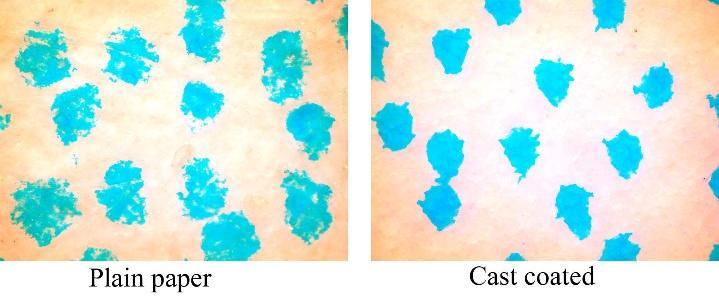
The last newsletters have featured images for diagnosis or discussion. Other scientific images are taken for education and outreach. Many of mine have been taken for science illustration as illustrated below from a 2004 paper on inkjet print dot morphology
Like Gigi and Robin I have been looking for a way to move on from this, but with rather less success. Again conditioned by my past I look to the literature for guidance on this problem.
A metaphorical approach
I greatly value the work of Robert P Crease, philosophy professor and science historian at Stony Brook university in the US. He writes a monthly column in Physics World and in the September 2025 edition he discussed the differences between scientific and poetic images, citing the thoughts of Elyse Graham, Professor of English and Paul Fry at Yale. They note that the scientific image as "structured to evoke a specific, shared understanding between author and reader" whereas a poetic image is aimed to "evoke a meaning that connects with the reader's experience and imagination" which "can be different to the authors within a certain domain of meaning".
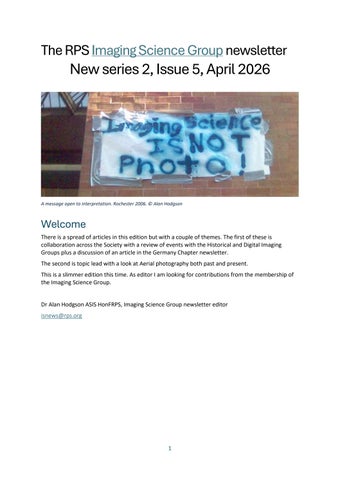
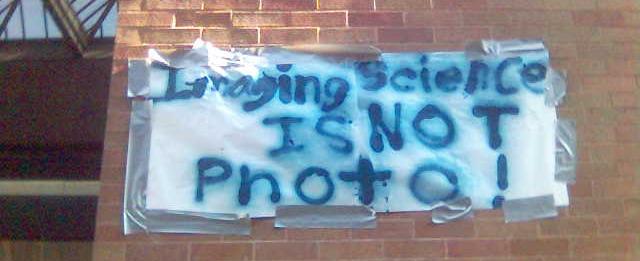
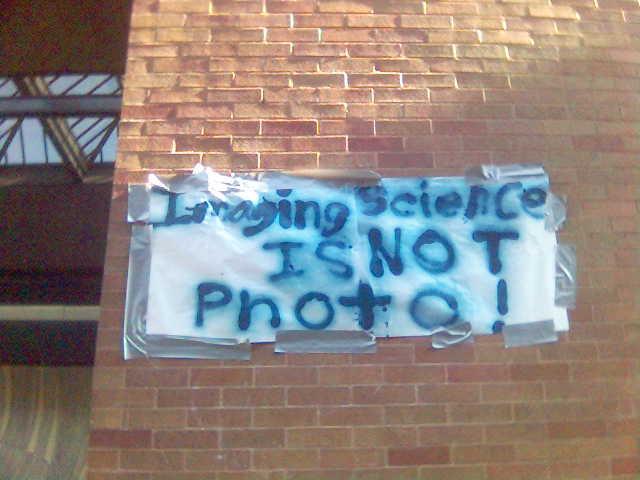
For me, the heart of this is the perennial issue of the Arts / Science divide. This is of particular interest in my work on photographic history as a constraint that reoccurs through the decades. My most visual reminder of this occurred in 2006 when I visited the campus of Rochester Institute of Technology during the International Congress of Imaging Science conference, where a student had plastered a poster on a building the delegates had to walk past.
Over the last 20 years I have pondered the layers of potential meaning of this comment. The fact that interpretation is layered leaves this in the poetic classification of imagery, which may or may not be the intent of the author. Not normally my sort of photography
I am tuned by my past to create images that are not open to further interpretation, a necessary concept for poetic or artistic creativity. Gigi and Robin however showed that they have been able to escape this trap. One approach that may work for me is “depiction of a concept”, leaving further interpretation to the viewer.
A working title of "Depiction"
So if asked about my photographic genre I would suggest Depiction, portrayal by representation by way of an image. It fits well with my past, representing imaging science in conference papers, often for non-scientific audiences My photography is starting to move on, to depiction of a visual narrative as a record of a memory where the photographer was present
I find that this is also scalable into my written work to, with a photo history paper on the contributions to imaging science of François Arago He is depicted in visual narratives in a number of French postage stamps and in Martian and Lunar craters. You will find more on his contribution in the Fraunhofer event described above.
It would be interesting to hear how others describe their genre and thanks again to Gigi and Robin Williams for starting this conversation.
Alan Hodgson
Literature reviews
ISO 1008:2025
In October 2025 ISO (the International Organization for Standardization) issued a revised version of International Standard ISO 1008, with the title “Photography Unprocessed photographic papers Sheet dimensions”. Revisions of ISO standards happen periodically but in this case there are several changes worthy of note to the Imaging Science community. We also had involvement in these changes, with a number of members having the opportunity to participate through their involvement with their National Standards committees.
ISO 1008 is the reference document for the cutting sizes of silver halide photographic papers. The sizes and tolerances on these are mature and as a result this revision does not change any of the numbers in the relevant tables. The main target of the revision is to update the terminology used, making it more specific and accessible to a new generation of users.
The first change was in the title, with the previous version from 1992 carrying the heading “Photography Paper dimensions Pictorial sheets” . Thirty years on, this could also be seen to refer to materials for digital printers, now the subject of a separate document ISO 18055-1, which covers the corresponding sizes for photo grade inkjet media.
While the numerical values of the cutting sizes are unchanged, the column headers have changed to give historical context to users whose only life experience is with metric measurement. For the benefit of those readers, sizes in inches are also included to add historical context. As an example, while a sheet size of 356x432mm seems strange it makes more sense when explained that this was originally defined as 14x17 inches.
These changes illustrate an important concept for Science within photography. A new generation of users may require a dictionary of terms to understand past literature, particularly if going back more than one generation. One solution (which could be considered as both lazy and dangerous) would be to leave this to AI. The concept of The RPS taking part in this has been proposed to the Science Committee and it will be interesting to see where this leads.
A commentary on Gabriel Lippmann
An interesting paper appeared in the November 2025 edition of Physics World, written by their online editor Margaret Harris. The article was entitled "The physics Nobel prizes you have never heard of" and you can read the relevant section here It is a provocative paper and received a number of responses, as outlined below
It was the subheading that initially caught my eye, “how an obscure version of colour photography beat quantum theory to the most prestigious prize in physics”. Given the current (obsessive?) focus on all things quantum the stance is unsurprising, but this should not obscure other areas such as photography. You will have guessed that the Nobel Prize for Physics in question was the 1908 award to Lippmann "for his method of reproducing colours photographically based on the phenomenon of interference”
The topic of “physics Nobel prizes you have never heard of" is obviously an issue of perspective Those with a recent physics degree may be more familiar with Lorentz contractions than colour photography from this period. However, rather than label his version of photography obsolete with the benefit of historical insight we should label it as foundational.
Harris’ article suggests that at the time of the award Lippmann’s “achievement was already obsolete”. Yes, the autochrome process had a speed advantage and was commercially successful but Lippmann's 20 years of work laid the foundations for the photographic recording of holograms. It was much more than just an elegant application of classical wave theory
His nomination also reflects a contemporary interest in photography in natural colours. Colour separation processes such as autochrome were deemed unnatural by some in the arts community. What became known as C P Snow's 2 Cultures were alive and well in even in those days The 1848 Becquerel and Lippmann colour processes had the attraction that they were deemed "natural" Articles on topics such as “prizes you have never heard of" are provocative and Physics World welcomes letters on these to the Editor in Chief Matin Durrani for publication in a later issue. These were not long in coming with an initial one commenting on the use of Lippmann’s work in holograms for security documents and brand protection. After some dialogue with Durrani the March 2026 edition featured a letter from me based on the above points. It is my belief that we should not let these challenges to our photographic history go unanswered.
Likewise, if you have thoughts on these articles or content for the next issue do get in touch At the moment we are aiming for a July publication.
Dr Alan Hodgson ASIS HonFRPS, Imaging Science Group newsletter editor isnews@rps.org