TOP STORY
TRAVEL GUIDE
ORTIGIA —
RHINELAND-PALATINATE
ECHOES OF ART AND CULTURE
BEYOND THE BEATEN PATH
EXHIBITION MINING IN THE RUHR AREA —
MONUMENTS TO A VANISHED INDUSTRY
eMAGAZINE 4TH QUARTER 2025
02 | COVER IMAGE
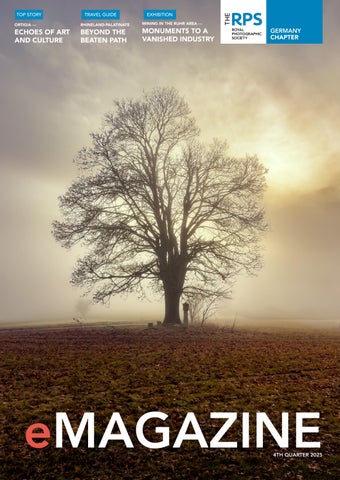
About the cover image PHOTOGRAPHER: Chris Renk IMAGE TITLE: Winter’s Solitude in Franconia CAPTION: During a quiet morning walk across the open fields of Upper Franconia, I captured this serene winter scene. A lone tree stands tall against the misty dawn, its bare branches reaching into the soft, golden light. The fog blankets the landscape, creating an atmosphere of peaceful stillness, while the sun gently breaks through, casting a warm glow over the frosty earth. The quiet beauty of this moment—where nature’s resilience meets the tranquility of winter—invites reflection and appreciation for the simple, fleeting magic of the season.
Get featured as well Would you like to be featured on the front page as well? Then please send us your favourite image, including the title of the photo, the place where you took it, and a short caption. We would love to hear what motivated you to take this photo and what emotions it triggers in you. You can send us the photo as a JPEG, TIFF, or PSD file. Please make sure that the photo has a minimum resolution of 3000 x 3000 pixels and 300 dpi. Of course, we must also adhere to the regulations for data protection and the rights of use according to copyright law. Therefore, we ask you to make a short statement in the email regarding the declaration of consent of the person(s) depicted and to allow us to use your photo. Please use the following email address to send the photo: germany@rps.org
EDITORIAL OFFICE Royal Photographic Society Germany Chapter Chris Renk ©2026 RPS Germany Chapter - all rights reserved
02 / 4TH QUARTER 2025 / eMAGAZINE
4TH QUARTER 2025 | 03
DEAR MEMBERS AND FRIENDS OF THE RPS GERMANY CHAPTER
A
s we bring the final quarter of 2025 to a close, I am filled with a strong sense of pride and gratitude when looking at this edition of our eMagazine. This issue is a powerful reminder of what can be achieved through s ha re d pa s sion, mu tual support and a willingness to contribute time, ideas and creative energy. It reflects not only the photographic excellence within our Chapter, but also the spirit of collaboration that defines our community.
I would like to extend my sincere thanks to all contributors, authors, photographers and editors who made this issue possible. Equally important are those who support the Chapter by participating in meetings, image reviews, discussions and informal exchanges. The tremendous level of engagement and encouragement among members is truly inspiring and continues to motivate me in my role as Chapter Organiser.
The content of this issue takes us on a rich and varied journey. From the cultural depth and visual poetry of Ortigia – Echoes of Art and Culture, to the personal and exploratory approach of Beyond the Beaten Path, our contributors invite us to see places, stories and moments through their unique perspectives. The Photo Work – 4th Quarter 2025 section brings together diverse contemporary positions, showcasing how broad and dynamic photographic practice within our Chapter truly is.
A particular highlight will be our upcoming Chapter exhibition in June 2026. This exhibition will provide an important opportunity to present our work in a physical space, to reach a wider audience, and to experience photography beyond the digital environment.
We also engage with photography as a medium of reflection and documentation. Mining in the Ruhr Area connects past and present, highlighting industrial heritage and transformation, while Authorship in the Age of AI addresses one of the most pressing and complex questions facing photography today. These contributions demonstrate that our members are not only image-makers, but also critical thinkers who actively engage with the cultural, technological and ethical dimensions of photography.
Looking ahead to 2026, we have an exciting year in front of us. Our programme will continue to include regular online meetings, image critiques, webinars and learning opportunities, with a strong emphasis on exchange, development and dialogue.
As we move into the new year, I invite you to stay curious, remain engaged and continue supporting one another. The strength of the RPS Germany Chapter lies in its members – in your diversity of perspectives, your openness to dialogue, and your shared enthusiasm for photography. I hope you enjoy this issue and find inspiration within its pages. Warm regards, Chris Renk Editor & Chapter Organiser RPS Germany Chapter
eMAGAZINE / 4TH QUARTER 2025 / 03
04 | 4TH QUARTER 2025
06
ORTIGIA: ECHOES OF ART AND CULTURE
50
Christopher Wills explores Ortigia’s layered history, vibrant street life and enduring artistic traditions in Sicily.
PHOTO WORK 4TH QUARTER 2025 Seven photographers present diverse visions, spanning architecture, motion, nature, and experimental visual storytelling.
30
BEYOND THE BEATEN PATH Exploring Rhineland-Palatinate: castles, forests, vineyards, and landscapes through Robert Driscoll’s photographic journey.
04 / 4TH QUARTER 2025 / eMAGAZINE
4TH QUARTER 2025 | 05
IN THIS ISSUE 72
MINING IN THE RUHR AREA
100
Aerial photographs revealing the Ruhr’s mining monuments between industrial legacy and sustainable transformation.
DATES & EVENTS JANUARY - MARCH 2026 Online Meeting, Release dates eMagazine, Webinars and Online Training of the Chapter.
98
AUTHORSHIP IN THE AGE OF AI Klaus H. Peters explores how artificial intelligence challenges photographic authorship.
eMAGAZINE / 4TH QUARTER 2025 / 05
Wills LRPS 06 | TOP STORY | Christopher — Ortigia: Echoes of Art and Culture
After the rain - a pinkish yellow glow – Christopher Wills LRPS
06 / 4TH QUARTER 2025 / eMAGAZINE
Christopher Wills LRPS — Ortigia: Echoes of Art and Culture
| TOP STORY | 07
ORTIGIA — ECHOES OF
ART AND CULTURE
eMAGAZINE / 4TH QUARTER 2025 / 07
Wills LRPS 08 | TOP STORY | Christopher — Ortigia: Echoes of Art and Culture
Piazza Duomo, Ortigia – Christopher Wills LRPS
ART, CULTURE AND EVERYDAY LIFE IN THE ANCIENT HEART OF SYRACUSE Christopher Wills LRPS
In Ortigia: Echoes of Art and Culture Christopher Wills LRPS invites readers to explore the ancient heart of Syracuse through a richly layered photographic and cultural journey. Ortigia reveals itself as a place where history, art and daily life coexist in close quarters: from Greek temples and Baroque piazzas to narrow medieval alleys alive with colour, craft and conversation. Christopher’s images and observations trace the island’s deep creative roots — from papyrus making along the Ciane River and the legacy of Archimedes, to street murals, theatre festivals and the enduring tradition of Sicilian puppetry.
08 / 4TH QUARTER 2025 / eMAGAZINE
Christopher Wills LRPS — Ortigia: Echoes of Art and Culture
O
rtigia, the historic heart of Syracuse, is a small island linked to the mainland by three bridges. Despite its size, it carries an extraordinary weight of history shaped by seafaring, trade, food, art and culture. Greeks, Romans, Moors, and Portuguese and Spanish rulers have all left their mark, creating a layered identity that remains visible today. Since Sicily became part of Italy in 1861, these influences have continued to coexist, forming a rich and distinctive cultural fabric.
| TOP STORY | 09
Largely car-free due to its age and compact structure, Ortigia is best explored on foot. A dense network of narrow alleys opens unexpectedly into elegant Baroque squares dating from the seventeenth century. The Piazza Duomo, with its unusual curved form, is particularly striking, and its cathedral incorporates the remains of a Greek temple. In the narrowest streets, only the smallest vehicles can pass — the classic Fiat 500 and the Piaggio Ape seem almost purpose-built for this environment.
Piaggio Ape, ideal in the narrow streets – Christopher Wills LRPS
Temple of Apollo built 560 BC, Graziella district – Christopher Wills LRPS
eMAGAZINE / 4TH QUARTER 2025 / 09
Wills LRPS 10 | TOP STORY | Christopher — Ortigia: Echoes of Art and Culture
´Culture cannot be cut´ – Christopher Wills LRPS
Papyrus plant growing on the Ciane River – Christopher Wills LRPS
10 / 4TH QUARTER 2025 / eMAGAZINE
Christopher Wills LRPS — Ortigia: Echoes of Art and Culture
| TOP STORY | 11
ORTIGIA IS INSEPARABLE FROM THE HISTORY OF IDEAS AND CREATIVITY It was here that Archimedes calculated the value of pi, and where Greek and Roman amphitheatres, sculpture and architecture established Syracuse as an early centre for the visual and performing arts. This legacy continues today through a vibrant student population and an active contemporary arts scene. Along the Ciane River, papyrus once flourished as a vital material in antiquity. After centuries of decline, the craft was revived in the twentieth century, reconnecting the region with one of its oldest cultural traditions. Fontana di Diana, Piazza Archimedes – Christopher Wills LRPS
eMAGAZINE / 4TH QUARTER 2025 / 11
Wills LRPS 12 | TOP STORY | Christopher — Ortigia: Echoes of Art and Culture
ART IN ORTIGIA IS NOT CONFINED TO MUSEUMS In the Graziella district, murals celebrate local figures such as the painter Salvatore Accolla, whose work drew inspiration from boats, fish and the intense colours of everyday Ortigian life. During the summer months, warm evenings are given over to informal ‘painting parties’, where young people gather in the streets to develop their skills, blurring the boundary between learning, community and celebration.
Mural of Salvatore Acolla, Graziella district – Christopher Wills LRPS
012 / 4TH QUARTER 2025 / eMAGAZINE
Christopher Wills LRPS — Ortigia: Echoes of Art and Culture
| TOP STORY | 13
Colourful benches are plentiful – Christopher Wills LRPS
Fish is at the centre of Sicilian food – Christopher Wills LRPS
eMAGAZINE / 4TH QUARTER 2025 / 013
Wills LRPS 14 | TOP STORY | Christopher — Ortigia: Echoes of Art and Culture
Boat and reflection, harbour of Ortigia – Christopher Wills LRPS
14 / 4TH QUARTER 2025 / eMAGAZINE
Painting parties, Graziella – Christopher Wills LRPS
Christopher Wills LRPS — Ortigia: Echoes of Art and Culture
| TOP STORY | 15
Painting parties, Graziella – Christopher Wills LRPS
Painting parties, Graziella – Christopher Wills LRPS
eMAGAZINE / 4TH QUARTER 2025 / 15
Wills LRPS 16 | TOP STORY | Christopher — Ortigia: Echoes of Art and Culture
Mural of Andrea Camilleri in Graziella district ´Words that tell the truth have a different vibration´ – Christopher Wills LRPS
16 / 4TH QUARTER 2025 / eMAGAZINE
Christopher Wills LRPS — Ortigia: Echoes of Art and Culture
| TOP STORY | 17
Ortyx Drama Festival - A Mouthful of Earth by Heinrich Böll – Christopher Wills LRPS
THE ISLAND ALSO HAS A STRONG THEATRICAL AND LITERARY HERITAGE The playwright and author Andrea Camilleri, born in Sicily, is commemorated in street art and local memory. Drama schools and festivals animate Ortigia throughout the year, with student performances spilling into courtyards and open air spaces, particularly during the summer theatre and film festivals. These events reinforce Ortigia’s role as a living stage rather than a static historic site.
eMAGAZINE / 4TH QUARTER 2025 / 17
Wills LRPS 18 | TOP STORY | Christopher — Ortigia: Echoes of Art and Culture
Pupi Siciliani – Christopher Wills LRPS
ONE OF SICILY’S MOST DISTINCTIVE TRADITIONS — THE PUPI SICILIANI — REMAINS ALIVE IN ORTIGIA’S JEWISH QUARTER, THE GIUDECCA The Puppet Theatre and Museum presents regular performances of the Opera dei pupi, telling epic stories of Charlemagne and his knights. Originating in the nineteenth century as an art form of the poorer classes, these productions preserved history and legend through storytelling at a time when many puppeteers were illiterate. Honour, love, religion and heroism are still fought out on stage today, maintaining a craft recognised by UNESCO as intangible cultural heritage.
18 / 4TH QUARTER 2025 / eMAGAZINE
Christopher Wills LRPS — Ortigia: Echoes of Art and Culture
| TOP STORY | 19
Pupi Siciliani – Christopher Wills LRPS
eMAGAZINE / 4TH QUARTER 2025 / 19
Wills LRPS 20 | TOP STORY | Christopher — Ortigia: Echoes of Art and Culture
Pupi Siciliani – Christopher Wills LRPS
20 / 4TH QUARTER 2025 / eMAGAZINE
Pupi Siciliani – Christopher Wills LRPS
Christopher Wills LRPS — Ortigia: Echoes of Art and Culture
| TOP STORY | 21
Pupi Siciliani – Christopher Wills LRPS
eMAGAZINE / 4TH QUARTER 2025 / 21
Wills LRPS 22 | TOP STORY | Christopher — Ortigia: Echoes of Art and Culture
EQUALLY ICONIC IS SICILIAN CERAMICS Brightly coloured Teste di Moro —typically displayed as a male and female pair—embody dramatic Sicilian legends of love, jealousy and betrayal. Beside them, green-glazed ceramic pine cones symbolise fertility and prosperity and are traditionally given to mark new beginnings. Rooted in Arab and Moorish influences that reached Sicily during the Middle Ages, these distinctive forms are ubiquitous in Ortigia, appearing in private homes, shop windows and market stalls alike. The Teste di Moro, usually depicted as a turbaned man and a crowned woman, are most famously linked to a gruesome legend set in Palermo’s Kalsa district. A Moor falls in love with a beautiful local girl, and the two begin a passionate affair. When he later reveals that he already has a wife and children, the woman, consumed by jealousy, beheads him and uses his head as a vase in which she plants basil. Watered with her tears, the plant grows luxuriantly.
22 / 4TH QUARTER 2025 / eMAGAZINE
Moors Heads and Pine Cone ceramics for sale in the market – Christopher Wills LRPS
A neighbour, envious of its beauty and scent, commissions ceramic vases in the shape of the Moor’s head, hoping to replicate the same success. An alternative version of the tale tells of a noble Sicilian girl and a poor Arab man whose forbidden love enrages her family. Declaring the match unsuitable, her parents have both lovers executed, their severed heads becoming a lasting symbol of passion and punishment.
Christopher Wills LRPS — Ortigia: Echoes of Art and Culture
Ceramic pine cones, commonly finished in glossy green glaze, are also a familiar sight in Sicilian markets. They represent fertility and abundance and are traditionally gifted to celebrate new homes or the founding of a business. Today, these characteristic forms are
| TOP STORY | 23
found at the entrances of estates, houses, shops and hotels—and even in bedrooms—serving as powerful decorative symbols. The style itself traces its origins to Arab ceramic traditions developed in Moorish Majorca before reaching Sicily in the 14th century.
eMAGAZINE / 4TH QUARTER 2025 / 23
Wills LRPS 24 | TOP STORY | Christopher — Ortigia: Echoes of Art and Culture
LIFE ON AN EXPOSED ISLAND BRINGS ITS OWN CHALLENGES Sudden storms and heavy downpours can overwhelm Ortigia’s drainage system, causing flash floods that temporarily transform streets and markets. Yet even these moments create unexpected beauty: after the rain, pink light reflects off yellow limestone façades, lending the town a renewed glow.
Downpour in fish market, Graziella – Christopher Wills LRPS
24 / 4TH QUARTER 2025 / eMAGAZINE
Christopher Wills LRPS — Ortigia: Echoes of Art and Culture
| TOP STORY | 25
On the way to the wedding in the rain – Christopher Wills LRPS
After the rain - coffee and gelato stand – Christopher Wills LRPS
After the rain - Chiesa Santa Lucia alla Badia – Christopher Wills LRPS
eMAGAZINE / 4TH QUARTER 2025 / 25
Wills LRPS 26 | TOP STORY | Christopher — Ortigia: Echoes of Art and Culture
Pistachios and almonds – Christopher Wills LRPS
TOURISM HAS UNDENIABLY RESHAPED ORTIGIA Rising property prices have forced many long term residents to relocate to the mainland, while holiday rentals and hotels multiply. Away from the busiest streets, however, everyday life continues. Locals fish for lunch, shop at the vibrant daily market, swim from public platforms built along the sea wall and participate in regeneration projects that aim to preserve both buildings and community.
26 / 4TH QUARTER 2025 / eMAGAZINE
Christopher Wills LRPS — Ortigia: Echoes of Art and Culture
Fishing for lunch – Christopher Wills LRPS
| TOP STORY | 27
Buying tuna steaks – Christopher Wills LRPS
Buying tuna steaks – Christopher Wills LRPS
eMAGAZINE / 4TH QUARTER 2025 / 27
Wills LRPS 28 | TOP STORY | Christopher — Ortigia: Echoes of Art and Culture
Swimming platform – Christopher Wills LRPS
THIS COEXISTENCE OF PAST AND PRESENT DEFINES ORTIGIA.
28 / 4TH QUARTER 2025 / eMAGAZINE
Christopher Wills LRPS — Ortigia: Echoes of Art and Culture
| TOP STORY | 29
It is a place where ancient stones frame contemporary lives, where culture is practiced as much as it is preserved, and where photography can reveal not only beauty, but resilience, continuity and change.
eMAGAZINE / 4TH QUARTER 2025 / 29
Driscoll 30 | TRAVEL GUIDE | Robert Beyond the Beaten Path: Photographing Rhineland-Palatinate
BEYOND THE BEATEN PATH
PHOTOGRAPHING
RHINELAND-PALATINATE The formidable Trifels Castle — Robert Driscoll
30 / 4TH QUARTER 2025 / eMAGAZINE
Robert Driscoll Beyond the Beaten Path: Photographing Rhineland-Palatinate
| TRAVEL GUIDE | 31
eMAGAZINE / 4TH QUARTER 2025 / 31
Driscoll 32 | TRAVEL GUIDE | Robert Beyond the Beaten Path: Photographing Rhineland-Palatinate
Beautiful stonework on Speyer Cathedral — Robert Driscoll
FROM ROMANESQUE CATHEDRALS TO SANDSTONE CLIFFS AND FORESTED VALLEYS Robert Driscoll Often overlooked, Rhineland-Palatinate is a treasure trove for photographers willing to venture beyond Germany’s well-known destinations. In this richly illustrated travelogue, Robert Driscoll takes us from the historic streets of Speyer to the vineyards of the German Wine Road and deep into the Palatinate Forest’s dramatic landscapes. Castles, gorges, mythical rock formations, and sweeping river views offer endless photographic inspiration. Combining historical insight with practical observations, this article invites readers to discover a region where history, landscape, and photography converge.
32 / 4TH QUARTER 2025 / eMAGAZINE
Robert Driscoll Beyond the Beaten Path: Photographing Rhineland-Palatinate
| TRAVEL GUIDE | 33
Speyer Cathedral — Robert Driscoll
C
ontinuing my exploration of Germany’s lesser-known photographic regions, I travelled to RhinelandPalatinate, a state in the southwest of Germany that borders France and is rich in history, landscapes, and photographic opportunities.
My trip began in Speyer, a town best known for its magnificent 12th-century cathedral, a UNESCO World Heritage Site. Alongside many other historic buildings, it offers a wealth of architectural subjects. As Speyer is popular with tourists, early mornings—before 10 a.m.—are ideal for photography. The cathedral itself, built from light-coloured stone, is particularly striking and noticeably brighter inside than many comparable churches.
eMAGAZINE / 4TH QUARTER 2025 / 33
Driscoll 34 | TRAVEL GUIDE | Robert Beyond the Beaten Path: Photographing Rhineland-Palatinate
Speyer old town — Robert Driscoll
SPEYER’S HISTORY RUNS DEEP In March 1193, Richard the Lionheart was brought here to face Emperor Heinrich VI after being captured in Austria while returning from the Crusades. He was later imprisoned at Trifels Castle, about 30 miles west in the Palatinate Forest—a vital destination later on this trip. The town centre offers further photographic interest, with historic buildings framed by the tall Eastern Town Gate. Speyer also held a special place in the heart of former German Chancellor Helmut Kohl, who hosted international figures such as Margaret Thatcher, François Mitterrand, and Mikhail Gorbachev here. Inside the Trinity Church — Robert Driscoll
34 / 4TH QUARTER 2025 / eMAGAZINE
Robert Driscoll Beyond the Beaten Path: Photographing Rhineland-Palatinate
| TRAVEL GUIDE | 35
Pilgrim on his way to Santiago de Campostella — Robert Driscoll
Beyond the cathedral, Speyer is home to several impressive churches. The Trinity Church, while relatively unassuming from the outside, reveals a richly decorated, visually striking interior—well worth photographing. The regional cuisine is hearty and unapologetically substantial, featuring dishes such as stuffed pig’s stomach and oversized schnitzels. Fortunately, the region also produces excellent wine to accompany these meals. While pilgrims historically travelled through this region on their way to Santiago de Compostela, I headed west towards the Palatinate Forest.
eMAGAZINE / 4TH QUARTER 2025 / 35
Driscoll 36 | TRAVEL GUIDE | Robert Beyond the Beaten Path: Photographing Rhineland-Palatinate
Vineyards near Hambach Castle from below — Robert Driscoll
36 / 4TH QUARTER 2025 / eMAGAZINE
Robert Driscoll Beyond the Beaten Path: Photographing Rhineland-Palatinate
| TRAVEL GUIDE | 37
GERMAN WINE ROAD (DEUTSCHE WEINSTRASSE)
Vineyards near Hambach Castle from above — Robert Driscoll
At the edge of the forest lies the famous German Wine Road (Deutsche Weinstraße). From here, Hambach Castle overlooks seemingly endless vineyards. The views are particularly rewarding in late autumn, when seasonal colours transform the vines.
eMAGAZINE / 4TH QUARTER 2025 / 37
Driscoll 38 | TRAVEL GUIDE | Robert Beyond the Beaten Path: Photographing Rhineland-Palatinate
PALATINATE FOREST (PFÄLZERWALD) Moving deeper into the Palatinate Forest (Pfälzerwald)—Germany’s largest contiguous woodland—I encountered a dramatic landscape of deep valleys, distinctive mountain shapes, unusual rock formations, and hidden lakes. Numerous vantage points offer excellent opportunities for landscape photography, including views of Trifels Castle, where Richard the Lionheart was once held captive.
Palatinate Forest in autumn — Robert Driscoll
38 / 4TH QUARTER 2025 / eMAGAZINE
Trifels Castle, Richard the
Robert Driscoll Beyond the Beaten Path: Photographing Rhineland-Palatinate
| TRAVEL GUIDE | 39
Lionheart`s prison — Robert Driscoll
eMAGAZINE / 4TH QUARTER 2025 / 39
Driscoll 40 | TRAVEL GUIDE | Robert Beyond the Beaten Path: Photographing Rhineland-Palatinate
Typical wild rock formations — Robert Driscoll
40 / 4TH QUARTER 2025 / eMAGAZINE
Robert Driscoll Beyond the Beaten Path: Photographing Rhineland-Palatinate
| TRAVEL GUIDE | 41
REACHING THESE VIEWPOINTS OFTEN REQUIRES STEEP HILL WALKS, BUT THE EFFORT IS WELL REWARDED. The area is characterised by layered sandstone formations, coloured red and yellow by iron oxides. It remains a mystery to me how small trees manage to cling to life on these exposed rock outcrops.
Typical wild rock formations — Robert Driscoll
eMAGAZINE / 4TH QUARTER 2025 / 41
Driscoll 42 | TRAVEL GUIDE | Robert Beyond the Beaten Path: Photographing Rhineland-Palatinate
Dahn Castle — Robert Driscoll
SEVENTEEN MILES SOUTHWEST LIES THE TOWN OF DAHN, CLOSE TO THE FRENCH BORDER The surrounding hills are dotted with castle ruins and remarkable rock formations, including Dahn Castle itself. Nearby, the remains of Lindelbrunn Castle in Vorderweidenthal offer breathtaking panoramic views across the region.
Views from Lindelbrunn Castle — Robert Driscoll
42 / 4TH QUARTER 2025 / eMAGAZINE
Robert Driscoll Beyond the Beaten Path: Photographing Rhineland-Palatinate
| TRAVEL GUIDE | 43
Views from Lindelbrunn Castle — Robert Driscoll
eMAGAZINE / 4TH QUARTER 2025 / 43
Driscoll 44 | TRAVEL GUIDE | Robert Beyond the Beaten Path: Photographing Rhineland-Palatinate
View from Dragon Rock — Robert Driscoll
Dragon Rock — Robert Driscoll
View from Elwetritsch Rock — Robert Driscoll
A FEW MILES FURTHER ON STANDS DRACHENFELS CASTLE, ALSO KNOWN AS DRAGON ROCK Given the terrain, it is hardly surprising that walking, mountain biking, and rock climbing are among the most popular activities in this area.
44 / 4TH QUARTER 2025 / eMAGAZINE
Robert Driscoll Beyond the Beaten Path: Photographing Rhineland-Palatinate
| TRAVEL GUIDE | 45
An Elwetritsch — Robert Driscoll
CLOSE TO DAHN, THE ELWETRITSCH ROCK OFFERS ANOTHER EXCELLENT VIEWPOINT The Elwetritsch, for the uninitiated, is a mythical creature said to combine elements of a hen, a duck, a goose, a kobold, and an elf. I haven’t yet seen one—but they are reputedly shy.
eMAGAZINE / 4TH QUARTER 2025 / 45
Driscoll 46 | TRAVEL GUIDE | Robert Beyond the Beaten Path: Photographing Rhineland-Palatinate
The famous Devil’s Table — Robert Driscoll
DEVIL’S TABLE (TEUFELSTISCH) From Dahn, I drove north to Hinterweidenthal to photograph the famous Devil’s Table (Teufelstisch)—a bizarre rock formation and a favourite subject for astrophotography, with the stone “table” dramatically silhouetted against the night sky.
46 / 4TH QUARTER 2025 / eMAGAZINE
Robert Driscoll Beyond the Beaten Path: Photographing Rhineland-Palatinate
| TRAVEL GUIDE | 47
KARLSTALSCHLUCHT (KARL’S VALLEY GORGE) Continuing north, I reached the Karlstalschlucht (Karl’s Valley Gorge) near Trippstadt. Here, a small river flows through a wooded gorge, tumbling over countless small waterfalls. It is an ideal location for practising long-exposure techniques and rewards patient photographers with endless compositions—particularly in autumn.
Karls Valley Gorge – a great place for photographers! — Robert Driscoll
Karls Valley Gorge — Robert Driscoll
Karls Valley Gorge — Robert Driscoll
Karls Valley Gorge — Robert Driscoll
Karls Valley Gorge — Robert Driscoll
eMAGAZINE / 4TH QUARTER 2025 / 47
Driscoll 48 | TRAVEL GUIDE | Robert Beyond the Beaten Path: Photographing Rhineland-Palatinate
Hairpin on the River Saar — Robert Driscoll
48 / 4TH QUARTER 2025 / eMAGAZINE
Robert Driscoll Beyond the Beaten Path: Photographing Rhineland-Palatinate
| TRAVEL GUIDE | 49
HAIRPIN BEND OF THE RIVER SAAR My journey concluded with a drive to Mettlach in neighbouring Saarland, near the borders with France and Luxembourg. Here, the hairpin bend of the River Saar is a classic photographic subject. A purposebuilt observation tower provides an elevated viewpoint. My visit in March captured the scene before spring had fully arrived.
CONCLUSION Although Rhineland-Palatinate may not be among Germany’s most famous destinations, it offers an exceptional range of photographic subjects— especially for landscape photographers willing to explore beyond the obvious.
eMAGAZINE / 4TH QUARTER 2025 / 49
Quarter 50 | PHOTO WORK | 4th 2025
MEMBER’S PHOTO WORK Every quarter brings a new selection of members’ finest images, submitted to inspire, provoke thought, and fuel creative exchange.
4th quarter 2025
T
he latest quarterly submissions once again highlight the creative breadth within the RPS Germany Chapter. Seven photographers contributed works that differ widely in subject, style, and intent, yet together form a coherent and engaging visual journey through contemporary photographic practice. The series opens with two architectural night scenes that immediately establish a strong sense of place. A grand city square, its stone surface shimmering after rainfall, uses reflections and receding lines to draw the viewer deep into the frame. Small human figures provide scale, reinforcing the quiet atmosphere of a city momentarily at rest. In contrast, the neighbouring image presents a narrow street corridor framed by historic stone walls and modern façades. Clean lines, measured spacing, and controlled lighting transform an everyday passageway into a study of rhythm and urban geometry. The next image shifts mood through monochrome. A river scene at dusk or early night captures dramatic clouds above softly glowing city lights. Reduced to tones and contrasts, the photograph emphasises atmosphere and balance, offering a contemplative pause within the sequence. This is followed by a close observation of water flowing across stone steps. Reflections, shadows, and geometric shapes interact to create an almost abstract composition, reminding us how subtle details can become powerful visual statements.
50 / 4TH QUARTER 2025 / eMAGAZINE
Energy and motion dominate the following pairing. An expressive photograph of a racing kart employs intentional motion blur to convey speed and intensity. Colour streaks replace sharp detail, placing sensation above documentation. This dynamic image is counterbalanced by a dramatically lit ice sculpture captured mid-action. Cool light reveals crystalline textures and sharp edges, freezing a fleeting moment of strength and precision against a dark background. The sequence then opens into landscape. A solitary mushroom-shaped structure stands on a grassy rise beneath a wide sky. Shot from a low perspective, the image combines gentle humour with a sense of isolation and space, inviting the viewer to construct their own narrative beyond the frame. The final image introduces a human presence through a monochrome portrait. Strong directional light casts bold shadows across the scene, creating graphic forms that contrast with the subject’s relaxed posture. The result is an intimate and contemplative photograph that closes the series on a quiet, reflective note. Taken together, this quarter’s submissions reveal how diverse photographic interests coexist within the RPS Germany Chapter. From architecture and abstraction to motion, landscape, and portraiture, the works demonstrate individual vision while contributing to a shared culture of thoughtful image-making and visual dialogue.
4th Quarter 2025
| PHOTO WORK | 51
eMAGAZINE / 4TH QUARTER 2025 / 51
Quarter 52 | PHOTO WORK | 4th 2025
Photographer
SIEGFRIED RUBBERT
52 / 4TH QUARTER 2025 / eMAGAZINE
4th Quarter 2025
| PHOTO WORK | 53
Image title:
Nightlines Image subject:
Urban Photography Country:
Italy
eMAGAZINE / 4TH QUARTER 2025 / 53
Quarter 54 | PHOTO WORK | 4th 2025
Image title:
Street canyon with a view of “Überwasserkirche” (Münster) Image subject:
Architecture Photography Country:
Germany
54 / 4TH QUARTER 2025 / eMAGAZINE
4th Quarter 2025
| PHOTO WORK | 55 Photographer
EBERHARD POTEMPA
eMAGAZINE / 4TH QUARTER 2025 / 55
Quarter 56 | PHOTO WORK | 4th 2025
Photographer
PAUL JOYCE LRPS
56 / 4TH QUARTER 2025 / eMAGAZINE
4th Quarter 2025
| PHOTO WORK | 57
Image title:
Paris at Night Image subject:
Landscape Photography Country:
France
eMAGAZINE / 4TH QUARTER 2025 / 57
Quarter 58 | PHOTO WORK | 4th 2025
Image title:
Venice Sinking Image subject:
Street Photography Country:
Venice, Italy
58 / 4TH QUARTER 2025 / eMAGAZINE
4th Quarter 2025
| PHOTO WORK | 59 Photographer
CHRISTOPHER WILLS LRPS
eMAGAZINE / 4TH QUARTER 2025 / 59
Quarter 60 | PHOTO WORK | 4th 2025
Photographer
MARTIN GERLING LRPS
60 / 4TH QUARTER 2025 / eMAGAZINE
4th Quarter 2025
| PHOTO WORK | 61
Image title:
Christmas Party Image subject:
Contemporary Photography Country:
North Rhine Westfalia, Germany
eMAGAZINE / 4TH QUARTER 2025 / 61
Quarter 62 | PHOTO WORK | 4th 2025
Image title:
Hard work Image subject:
Contemporary Photography Country:
North Rhine Westfalia, Germany
62 / 4TH QUARTER 2025 / eMAGAZINE
4th Quarter 2025
| PHOTO WORK | 63 Photographer
UTE GERLING
eMAGAZINE / 4TH QUARTER 2025 / 63
Quarter 64 | PHOTO WORK | 4th 2025
Photographer
CHRIS RENK
64 / 4TH QUARTER 2025 / eMAGAZINE
4th Quarter 2025
| PHOTO WORK | 65
Image title:
Frakonian Winter Morning Image subject:
Landscape Photography Country:
Bavaria, Germany
eMAGAZINE / 4TH QUARTER 2025 / 65
Quarter 66 | PHOTO WORK | 4th 2025
Image title:
Urban Silence Image subject:
Contemporary Photography Country:
Berlin, Germany
66 / 4TH QUARTER 2025 / eMAGAZINE
4th Quarter 2025
| PHOTO WORK | 67 Photographer
STEFAN LÖFFLER
eMAGAZINE / 4TH QUARTER 2025 / 67
Quarter 68 | PHOTO WORK | 4th 2025
Are you a member of the Germany Chapter and would like to submit pictures for the quarterly project “Members Photo Work” as well?
Here is a list of the deadlines for each quarter: 1ST QUARTER 2026: 30.03.2026 2ND QUARTER 2026: 30.06.2026 3RD QUARTER 2026 30.09.2026 4TH QUARTER 2026: 31.12.2026 Please send us the photos with a minimum resolution of 3000 x 3000 pixels and 300dpi. For the naming of the photos please use following naming convention: FIRST3LETTERSOFYOURSURENAME_Q-NUMBEROFQUARTER-YEAR_IMAGETITLE.JPG Each participant is responsible for compliance with the Data Protection Ordinance and the Copyright Act. Participants please send the photos to the following email:
germany@rps.org
68 / 4TH QUARTER 2025 / eMAGAZINE
4th Quarter 2025
| PHOTO WORK | 69
eMAGAZINE / 4TH QUARTER 2025 / 69
about 70 | DEU CHAPTER | Facts the RPS Germany Chapter
FACTS ABOUT THE GERMANY CHAPTER Learn more about the current composition of the Germany Chapter, its members’ locations in the federal states, its Distinction Holders, and the Special Interest Groups in which the members participate.
49 Members 3 Countries
70 / 4TH QUARTER 2025 / eMAGAZINE
Facts about the RPS Germany Chapter
| DEU CHAPTER | 71
Denmark Schweden
Women in Photography
3
Digital Imaging Creative Eye Visual Art Contemporary
1
6
2 1
3
3
Archaeology & Heritage
Landscape
1 3
Documentary
4 2
Nature
Travel
Analogue
eMAGAZINE / 4TH QUARTER 2025 / 71
72 |
EXHIBITION
|
Jonathan C. K. Webb ARPS Mining in the Ruhr Area – Monuments to a Vanished Industry
MINING IN THE RUHR AREA –
MONUMENTS TO A
VANISHED INDUSTRY
Zeche Consolidation — Jonathan C. K. Webb
72 / 4TH QUARTER 2025 / eMAGAZINE
Jonathan C. K. Webb ARPS Mining in the Ruhr Area – Monuments to a Vanished Industry
| EXHIBITION | 73
eMAGAZINE / 4TH QUARTER 2025 / 73
74 |
EXHIBITION
|
Jonathan C. K. Webb ARPS Mining in the Ruhr Area – Monuments to a Vanished Industry
AERIAL PHOTOGRAPHS OF THE RUHR’S MINING LEGACY AT THE THRESHOLD OF CHANGE Jonathan C. K. Webb ARPS
For over 700 years, coal mining defined the Ruhr region — shaping its landscape, economy and identity. In this aerial photographic essay, Jonathan C. K. Webb documents the powerful industrial monuments left behind after the closure of Germany’s last coal mine in 2018. Photographed from a light aircraft, these images reveal headframes, spoil heaps and former collieries as sculptural forms embedded in a landscape undergoing rapid transformation. Against the backdrop of the Energiewende, this work captures a region suspended between industrial past and sustainable future — a visual record of heritage, change and enduring presence.
F
or more than seven centuries, coal mining shaped the Ruhr region — its economy, its landscape, and the lives of millions. That long industrial chapter came to a definitive close in 2018 with the extraction of the final coal from the Prosper-Haniel colliery. What began with shallow open-cast mining in the south gradually moved northwards and deeper underground as industrialisation accelerated. Today, mining has vanished, but its powerful architectural and cultural traces remain embedded throughout the region. I have long been fascinated by this industrial heritage and feel a strong urge to document it before it is irrevocably transformed. The Ruhr is undergoing profound change as part of the Energiewende—the rapid transition from fossil fuels to renewable energy. Former collieries, spoil heaps, and industrial infrastructure are being reimagined as cultural venues, parks, residential quarters, or energy landscapes. This moment of transition gives the surviving structures a particular poignancy: they are monuments suspended between past and future.
74 / 4TH QUARTER 2025 / eMAGAZINE
Jonathan C. K. Webb ARPS Mining in the Ruhr Area – Monuments to a Vanished Industry
| EXHIBITION | 75
Perhaps fittingly, my photographic approach is somewhat anachronistic. All images in this series were taken the “old-fashioned” way, from a light aircraft. I have yet to embrace drones, not out of resistance to modern technology but because I value the physical experience of flight — of being present in the air and seeing the landscape unfold in real time. In that sense, I sometimes feel like a photographic archaeopteryx, hovering between eras. All photographs were taken handheld with Canon DSLR cameras, primarily the highresolution 5DS R. I work almost exclusively with prime lenses rather than zooms, preferring to adjust perspective by moving the aircraft closer to or further from the subject. Lens choices ranged from 21 mm — the widest usable focal length without including parts of the aircraft — to 300 mm, which allows surprisingly intimate views even from altitudes exceeding 1,000 feet. Shooting from a light aircraft travelling at around 100 mph presents unique challenges. Aligning industrial structures precisely within the frame requires anticipation, carful positioning of the aircraft, and heightened awareness of timing. With longer focal lengths, in particular, the difference between a successful image and a missed opportunity can be a fraction of a second. Henri Cartier-Bresson’s notion of the decisive moment takes on a literal meaning here — suspended between motion, geometry and fleeting alignment. From above, the former collieries reveal themselves not merely as isolated buildings but as part of a vast industrial network. Headframes, Malakow towers, spoil heaps and transport infrastructure form a visual language of power, labour and ambition. Seen from the air, these structures become sculptural forms within the landscape — stark, rhythmic and often unexpectedly beautiful. What remains today are not ruins, but witnesses: carefully preserved landmarks, repurposed sites, and symbolic anchors of regional identity. Through aerial photography, I seek not only to document these monuments but also to offer a new perspective on a landscape shaped by human endeavour — and now redefining itself once more.
eMAGAZINE / 4TH QUARTER 2025 / 75
76 |
EXHIBITION
|
Jonathan C. K. Webb ARPS Mining in the Ruhr Area – Monuments to a Vanished Industry
— Jonathan C. K. Webb
76 / 4TH QUARTER 2025 / eMAGAZINE
Jonathan C. K. Webb ARPS Mining in the Ruhr Area – Monuments to a Vanished Industry
| EXHIBITION | 77
BONIFACIUS COLLIERY, ESSEN-KRAY Headframe of Shaft 1. Opened in 1857 and closed in 1974, the Bonifacius Colliery was an essential employer in eastern Essen, at its peak employing approximately 2,800 people. Today, preserved buildings on the former site have been adapted for cultural, commercial and gastronomic use.
— Jonathan C. K. Webb
Headframe view. The structure remains a prominent reminder of Essen’s mining heritage and reflects the functional steel architecture typical of early shaft construction in the Ruhr region.
eMAGAZINE / 4TH QUARTER 2025 / 77
78 |
EXHIBITION
|
Jonathan C. K. Webb ARPS Mining in the Ruhr Area – Monuments to a Vanished Industry
FRIEDRICH HEINRICH COLLIERY, KAMP-LINTFORT
— Jonathan C. K. Webb
The former coal mine opened in 1912 and closed in 2012. Once the westernmost mine in the Ruhr region, it was redeveloped as a public park and hosted the North Rhine-Westphalia State Garden Show in 2020.
78 / 4TH QUARTER 2025 / eMAGAZINE
Jonathan C. K. Webb ARPS Mining in the Ruhr Area – Monuments to a Vanished Industry
| EXHIBITION | 79
The headframe of Shaft 2, constructed in 1912, is now a listed structure. It forms part of the preserved colliery ensemble and illustrates early twentiethcentury mining engineering. — Jonathan C. K. Webb
Concrete colliery tower built in 1958, the tower exemplifies post-war industrial architecture and now serves as a public viewing platform, offering wide views across the Lower Rhine plain and symbolising the site’s transformation from industry to leisure. — Jonathan C. K. Webb
eMAGAZINE / 4TH QUARTER 2025 / 79
80 |
EXHIBITION
|
Jonathan C. K. Webb ARPS Mining in the Ruhr Area – Monuments to a Vanished Industry
RHEINPREUSSEN COLLIERY, MOERS The headframe of Shaft 4, built between 1900 and 1904 and decommissioned in 1964, is preserved as part of the Industrial Heritage Trail and marks the westward expansion of coal mining towards the Lower Rhine.
— Jonathan C. K. Webb
80 / 4TH QUARTER 2025 / eMAGAZINE
Jonathan C. K. Webb ARPS Mining in the Ruhr Area – Monuments to a Vanished Industry
| EXHIBITION | 81
eMAGAZINE / 4TH QUARTER 2025 / 81
82 |
EXHIBITION
|
Jonathan C. K. Webb ARPS Mining in the Ruhr Area – Monuments to a Vanished Industry
— Jonathan C. K. Webb
PROSPERSTRASSE SPOIL HEAP, BOTTROP Formed between 1983 and 1991 from mining waste from the Prosper-Haniel Colliery. The Alpincenter indoor ski hall opened on the heap in 2001, exemplifying the creative reuse of former industrial landscapes.
— Jonathan C. K. Webb
COAL PORT, BOTTROP Opened in 1914 to serve coal distribution by rail and waterway. Despite the end of domestic coal mining, the port remains in use today for coal imports, underscoring the continued logistical role of fossil fuels.
82 / 4TH QUARTER 2025 / eMAGAZINE
Jonathan C. K. Webb ARPS Mining in the Ruhr Area – Monuments to a Vanished Industry
| EXHIBITION | 83
— Jonathan C. K. Webb
PROSPER COLLIERY, BOTTROP Malakow Tower, Prosper II. Opened in 1861, Prosper was the last active hard coal mine in Germany, closing in 2018. The Malakow Tower takes its name from Fort Malakoff near Sevastopol and represents an early form of robust shaft construction.
eMAGAZINE / 4TH QUARTER 2025 / 83
84 |
EXHIBITION
|
Jonathan C. K. Webb ARPS Mining in the Ruhr Area – Monuments to a Vanished Industry
— Jonathan C. K. Webb
84 / 4TH QUARTER 2025 / eMAGAZINE
Jonathan C. K. Webb ARPS Mining in the Ruhr Area – Monuments to a Vanished Industry
| EXHIBITION | 85
SCHURENBACH SPOIL HEAP, ESSEN-ALTENESSEN Used for overburden storage until 2000. Today, the site forms part of the Industrial Heritage Trail and the Emscher Landscape Park, serving both tourism and nature conservation.
eMAGAZINE / 4TH QUARTER 2025 / 85
86 |
EXHIBITION
|
Jonathan C. K. Webb ARPS Mining in the Ruhr Area – Monuments to a Vanished Industry
HUGO COLLIERY, GELSENKIRCHEN-BÜER Headframe of Shaft II. The mine opened in 1873 and closed in 2000, leaving this structure as a key reminder of Gelsenkirchen’s mining past.
— Jonathan C. K. Webb
86 / 4TH QUARTER 2025 / eMAGAZINE
Jonathan C. K. Webb ARPS Mining in the Ruhr Area – Monuments to a Vanished Industry
| EXHIBITION | 87
eMAGAZINE / 4TH QUARTER 2025 / 87
88 |
EXHIBITION
|
Jonathan C. K. Webb ARPS Mining in the Ruhr Area – Monuments to a Vanished Industry
— Jonathan C. K. Webb
88 / 4TH QUARTER 2025 / eMAGAZINE
Jonathan C. K. Webb ARPS Mining in the Ruhr Area – Monuments to a Vanished Industry
| EXHIBITION | 89
GERMAN MINING MUSEUM, BOCHUM Aerial view of Germany’s most visited museum. The headframe originates from the former Germania Colliery (1858– 1929) and was relocated here in 1974 as a national symbol of mining heritage.
eMAGAZINE / 4TH QUARTER 2025 / 89
90 |
EXHIBITION
|
Jonathan C. K. Webb ARPS Mining in the Ruhr Area – Monuments to a Vanished Industry
— Jonathan C. K. Webb
EWALD COLLIERY, HERTEN Double headframe of Shaft 7. Opened in 1877, with Shaft 7 entering service in 1942, the colliery closed in 2001. The site has since been redeveloped as the Ewald Project Community.
NORDSTERN COLLIERY, GELSENKIRCHENHORST Opened in 1868 and closed in 1986. Today, the former colliery forms part of the Industrial Heritage Trail and has been integrated into a landscaped public park.
— Jonathan C. K. Webb
90 / 4TH QUARTER 2025 / eMAGAZINE
Jonathan C. K. Webb ARPS Mining in the Ruhr Area – Monuments to a Vanished Industry
| EXHIBITION | 91
ERIN COLLIERY, CASTROP-RAUXEL Headframe of the former coal mine, opened in 1866 and decommissioned in 1983. The structure stands as a reminder of one of the region’s early mining operations.
— Jonathan C. K. Webb
eMAGAZINE / 4TH QUARTER 2025 / 91
92 |
EXHIBITION
|
Jonathan C. K. Webb ARPS Mining in the Ruhr Area – Monuments to a Vanished Industry
MOTTBRUCH SPOIL HEAP, GLADBECK-BRAUCK Created from waste rock until 1989. In 2021, an Enercon E-138 wind turbine was installed on the heap, symbolising the Ruhr region’s transition towards renewable energy.
— Jonathan C. K. Webb
92 / 4TH QUARTER 2025 / eMAGAZINE
Jonathan C. K. Webb ARPS Mining in the Ruhr Area – Monuments to a Vanished Industry
| EXHIBITION | 93
— Jonathan C. K. Webb
WESTERHOLT COLLIERY, HERTEN-WESTERHOLT Opened in 1907 and closed in 2008. Westerholt was the last operating coal mine within the city of Gelsenkirchen.
Headframe of Shaft 1. The preserved structure marks the final chapter of active coal mining within the city.
— Jonathan C. K. Webb
eMAGAZINE / 4TH QUARTER 2025 / 93
94 |
EXHIBITION
|
Jonathan C. K. Webb ARPS Mining in the Ruhr Area – Monuments to a Vanished Industry
CONSOLIDATION COLLIERY, GELSENKIRCHEN
— Jonathan C. K. Webb
Double-strut headframe of Shaft 9, built in 1922. The colliery opened in 1854 and closed in 1993. The structures are now protected as historical monuments.
94 / 4TH QUARTER 2025 / eMAGAZINE
Jonathan C. K. Webb ARPS Mining in the Ruhr Area – Monuments to a Vanished Industry
| EXHIBITION | 95
— Jonathan C. K. Webb
Concrete headframe of Shaft 4, constructed in 1975. The design reflects late-phase industrial architecture, occurring shortly before the mine’s closure in 1993.
eMAGAZINE / 4TH QUARTER 2025 / 95
96 |
EXHIBITION
|
Jonathan C. K. Webb ARPS Mining in the Ruhr Area – Monuments to a Vanished Industry
— Jonathan C. K. Webb
UNSER FRITZ COLLIERY, NORTH RHINE-WESTPHALIA Malakow Tower of Unser Fritz 1, built in 1873 and decommissioned in 1993. The listed structure remains a characteristic example of early Ruhr mining architecture.
96 / 4TH QUARTER 2025 / eMAGAZINE
Jonathan C. K. Webb ARPS Mining in the Ruhr Area – Monuments to a Vanished Industry
| EXHIBITION | 97
CLOSING REMARK From the air, standing above the Ruhr, it is impossible not to sense the scale of human effort embedded in this landscape. What were once purely functional structures have become enduring markers of memory, identity and transformation. Photographing these sites from a light aircraft allowed me to see them not as isolated remnants but as part of a vast and interconnected industrial system. As the Ruhr continues its transition towards a new energy future, I hope these images serve as both a record of what has been and a reminder of the ingenuity, labour and communities that shaped this region for generations. — Jonathan C. K. Webb
eMAGAZINE / 4TH QUARTER 2025 / 97
98 |
ETHICS & AI
|
Klaus H. Peters – Authorship in the Age of AI
Result after applying AI — Klaus H. Peters
AUTHORSHIP IN THE AGE OF AI WHEN DOES A PHOTOGRAPH STOP BEING ‘YOURS’? Klaus H. Peters As artificial intelligence becomes an everyday tool in photography, fundamental questions about authorship and authenticity are impossible to ignore. In this thoughtful article, Klaus reflects on a simple missed moment that led him to use AI to complete an image—and the unease that followed. When AI fills the gap between intention and reality, who is the true creator of the photograph? Klaus explores the fine line between enhancement and fabrication, examining how AI can both support creative vision and undermine documentary value. Should AI-altered images be labelled? And are we witnessing a shift away from photographic truth? A timely and compelling reflection on where photography may be heading.
98 / 4TH QUARTER 2025 / eMAGAZINE
Klaus H. Peters – Authorship in the Age of AI
|
ETHICS & AI
| 99
THE CREATION OF THE PHOTO
M
y original photo was meant to show a dog running along the platform. BUT: I was too slow, and by the time I pressed the shutter, the dog was already gone. Without the dog, however, the photo was not very appealing. So I turned to AI for help and used it to insert a suitable dog. While I do like the result, I no longer feel like the photo’s creator.
Slightly unattractive original image — Klaus H. Peters
IS IT STILL “MY” IMAGE? For digital photographers, such image modifications have long ceased to be remarkable. AI now enables extensive retouching or alteration of a photograph. However, authorship may become problematic for the photographer, and the photo’s value as a document diminishes. Even when photographers use AI only for minor corrections, the images become beautified and more “streamlined” — at the cost of their authenticity. For this reason, I not only see the benefits of AI for photography but also the emerging risks. Many questions remain: What about copyright — is it still “my” picture? Are there suitable rules for the use of AI in photographs? Should photos containing AI elements be labelled? These are just a few of the questions that need clarification. The impact of AI on photography is far-reaching. Aesthetics or authenticity — does documentary photography perhaps come to an end? Where are we headed?
eMAGAZINE / 4TH QUARTER 2025 / 99
2026 - March 2026 100 | DATES & EVENTS | January Germany Chapter
Credit: Chris Renk
CHAPTER ZOOM MEETING 2026
CHAPTER TALKS & WORKSHOPS
Meetings
MONTHLY ZOOM MEETING STARTING 19:00 EST
RELEASE DATES FOR eMAGAZINE
Here is an overview of the specific publication dates: For upcoming meetings and events, please visit frequently our Chapter Page on RPS.org.
1ST QUARTER 2026: 05.04.2026 2ND QUARTER 2026: 05.07.2026
12.01.2026 09.02.2026 09.03.2026 13.04.2026 11.05.2026 08.06.2026 13.07.2026 10.08.2026 14.09.2026 12.10.2026 09.11.2026 14.12.2026 Links will be provided via email. If you aren’t a member of the DEU Chapter and wish to participate as well, don’t hesitate to get in touch with us via the following email:
germany@rps.org ....
100 / 4TH QUARTER 2025 / eMAGAZINE
https://rps.org/germany 3RD QUARTER 2026: 05.10.2026 .... 4TH QUARTER 2026: 05.01.2027 The Magazine will be published via email as well as on the RPS’s account on ISSUU. ....
January 2026 - March 2026 GermanY Chapter
| DATES & EVENTS | 101
Credit: Chris Renk
DEADLINES FOR PHOTO WORK
EXIBITIONS
DEADLINES ENTRIES eMAGAZINE
You would like to submit pictures to the quarterly project “Members Photo work”?
Kunstkirche Fröndenberg
Here is a list of the deadlines for each quarter:
29.05.2026 - 28.06.2026
Since the magazine is published by the chapter itself, we are very flexible regarding the time schedule for submitting texts, pictures, and dates for events.
1ST QUARTER 2026: 05.04.2026
Vernissage: 29.05.2026 19:00 CEST
We ask for enough time in advance to avoid complicating the editor’s life.
2ND QUARTER 2026: 05.07.2026
....
As a rule, the editor should receive contributions about 30 days before the publication date.
3RD QUARTER 2026: 05.10.2026 4TH QUARTER 2026: 05.01.2027 Please send us the photos with a minimum resolution of 3000 x 3000 pixels and 300dpi. For the naming of the photos please use following naming convention:
“MINIMALISM”
Otherwise, inform us that you need additional time to contribute. Please take the publication dates from the adjacent column. ....
FIRST3LETTERSOFYOURSURENAME_ QNUMBEROFQUARTER-YEAR_IMAGETITLE.JPG Each participant is responsible for compliance with the Data Protection Ordinance and the Copyright Act. Participants please
send the photos to the following email: germany@rps.org ....
eMAGAZINE / 4TH QUARTER 2025 / 101
THE ROYAL PHOTOGRAPHIC SOCIETY
GERMANY CHAPTER