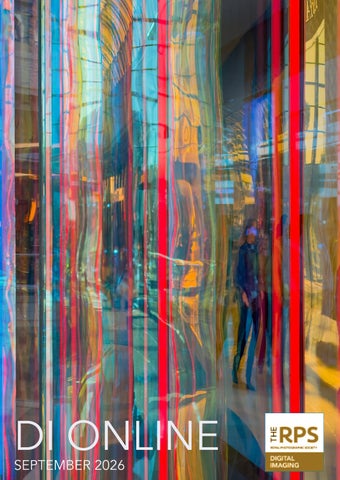
DI ONLINE SEPTEMBER 2026
| COVER IMAGE|
The Photographer: Gigi Williams
About the Image: See Gigi's article starting on Page 6
|SEPTEMBER | 2026 | DI ONLINE
|SEPT | 2026 |
THE CONTENTS
THE CONTENTS
3
EDITOR'S WORDS
4
A MEMBER WRITES GIGI WILLIAMS
6
T-W-T
20
ANNUAL DPI COMPETITION
21
A MEMBER WRITES PETER MERRICK
22
A MEMBER WRITES LOIS WAKEMAN
29
A MEMBER WRITES SEAN GOODHART
32
WORKSHOPS
40
NEWLY RELEASED WORKSHOPS
41
|3|
| EDITOR'S WORDS |
EDITOR'S WORDS
Our Chair’s Chat is suspended this month while Janet enjoys some time away in Scandinavia, so I am pleased to fill the gap as Editor. The long, hot summer is now a memory, and the rain has returned. Even so, the summer plants seem determined to put on a late show. I suspect many of you found that the heat was not conducive to photography—it certainly had a way of zapping one’s energy levels—but we all love autumn, don’t we? Perhaps the cooler days will encourage you to get out with your cameras again and capture some lovely images for the 2027 competitions. By the time you read this issue, the 2026 Digital Imaging Competition will have been decided and the overall winner virtually presented with their award. The competition team were impressed by the number of entries, while all the selectors involved in the various stages had the difficult task of choosing their favourites. Do follow the link on Page 21 to view all the selected images, thoughtfully gathered together into page-turning zines by Fintan Healey. All the September DI ONLINE articles were contributed by members. Gigi Williams, an international member from Australia, contributes Living Reflections, a photographic response to the Through the Looking Glass installation at Chadstone Shopping Centre in Melbourne. Her article explores how light, reflections and passing shoppers continually recreate the artwork. I viewed Peter Merrick’s Gold Medal-winning entry in the RHS Portfolio at the Saatchi Gallery in July and contacted him to ask how the germ of an idea developed into his award-winning panel. Peter recounts how a simple fascination with succulents and focus-stacking grew into a large-scale project, leading to an IPF Fellowship and an RHS Gold Badge portfolio at the Saatchi Gallery. I do not think this is the end of his fascination either. Sean Goodhart’s article was conceived while he was “messing about” on his computer. He shows us, in detail, his many attempts to achieve a “useable” result. It is an interesting, well-illustrated record, and it poses a leading question: “When AI changes more than the photographer intended, can the resulting image still be considered the photographer’s own photograph—and would it be acceptable for an RPS distinction or competition?” Lois Wakeman brings us evocative memories of a early July walk ,close to her home in Devon. It preserves a moment in time, the light, the scent, and the mood, something that it can be revisited and recalled. Have you booked your place on a T-W-T event? Have you found one near you? Some areas of the country are very well covered, while others are something of a desert. The TWT team are always |SEPTEMBER | 2026 | DI ONLINE | 4
| SEPT |2026 |
happy to hear from new members willing to lead a walk. It is not at all onerous; rather, it is a pleasurable role and an opportunity to meet other members and share your locality with them. We have more events planned for 2027 in conjunction with both the RPS Creative and Landscape groups, so look out for the appeal for Walk Leaders. Book a walk for Urban. We are also back in full-on workshop mode, with more events in the various series and Celia Henderson and Joe Houghton commencing new sessions. The small Workshop Team is certainly not idle: they are busy contacting new presenters and inviting them to join our diverse range of workshops for 2027. You will soon see how we can help fill your 2027 diary, all at very affordable prices. Do think about joining us online for our Members’ Evening on 5 October, when Anthony Luvera, RPS Head of Distinctions and Education, will tell us about the changes to the Distinction process. There will also be time for him to answer a few questions. Registration details are on page 7. Enjoy the read, and all the lovely images. Regards, Melanie Editor DI ONLINE
WHAT'S ON ? FOR EVENTS IN DI AND OTHER SIGS
READ PULSE
SEPTEMBER ISSUE Published monthly Next issue OCTOBER 1st Look out for the email
|5|
| MEMBERS EVENING |
MEMBERS' EVENING MONDAY OCTOBER 5th at 7.30 We invite all Digital Imaging members to our half yearly DI Members' Evening - this is your chance to engage with the committee, ask questions, put forward any good ideas. We see this as an open two way dialogue. At the October meeting we are delighted that Anthony Luvera, RPS Head of Distinctions and Education, will update us on the new Distinctions programme. We are sure that many of you will wish to hear what he has to say as it may well impact on your own Distinction plans and journey in 2027. Anthony will also take your questions. Joanne Segars, President Elect, will be in conversation with DI Chair Janet Haines and answering some questions. We hope as many of you as possible will join us live on the evening; we will record the meeting for those unable to make it, but you will need to book if you wish to receive the recording link post the event.
Joanne Segars LRPS Appointed Trustee and President Elect
Joanne is an experienced Board chair and non-executive director. She currently chairs the trustee board at now:pensions, a pension scheme with 2.5m members, and chairs the Independent Governance Committee at Legal & General. She is also a member of the Pension Fund Governing Board at CERN in Switzerland. Joanne has undertaken several consultancy projects for some of the country’s largest pension schemes. Before becoming a non-executive director, Joanne was the CEO of the UK’s main pensions trade association where she regularly appeared on radio and TV as well as appearing before House of Commons Select Committees. Joanne has a degree in economics from John Moores University and an MA in Industrial Relations from the University of Warwick. Previously she worked on public policy at the Association of British Insurers and the Trades Union Congress. She was awarded an OBE for services to pensions in the 2003 Queen’s Birthday Honours. As for many people, Joanne’s passion for photography began with a passion for travel. That inspired her to study photography more deeply and she was awarded a HND in photography through the British Academy of Photography in 2024. Believing that photography is a powerful tool that can tell us much about society and the world we live in, Joanne discovered a passion for social documentary photography and is currently working on a long-term project exploring recycling and sustainability. Her work has featured in local newspapers and has been shown in group and solo exhibitions across London. Joanne has been a member of the RPS for several years and is an active member of the London Region. This included leading the Region’s project and exhibition Sustainable London in 2024. She was awarded her LRPS also in 2024 and is currently working towards her ARPS in documentary photography. |SEPTEMBER | 2026 | DI ONLINE | 6
| SEPT |2026 |
Anthony Luvera Director of Education at the RPS Anthony Luvera is an Australian socially engaged artist, writer, and educator based in London. His long-term collaborative work with individuals and communities has been exhibited widely in galleries, public spaces, and festivals, including the UK House of Commons, Tate Liverpool, the British Museum, London Underground’s Art on the Underground, the National Portrait Gallery London, Belfast Exposed Photography, PhotoIreland, Les Rencontres d’Arles, and Landskrona Foto Festival. His writing has appeared in a range of publications including Trigger, Photography and Culture, Visual Studies, Photoworks, Source, and Photographies, and he is the editor of Photography For Whom?, a periodical on socially engaged photography. Anthony is Director of Education at the Royal Photographic Society and a trustee of Four Corners. He previously served as Associate Professor and Course Director at Coventry University and has held Lecturer roles at a number of universities, including Central Saint Martins and the University for the Creative Arts, Farnham. Alongside his academic work, he has designed education and mentorship programmes, facilitated workshops, and delivered public lectures for the National Portrait Gallery, Tate, Magnum, the Royal Academy of Arts, The Photographers’ Gallery, Barbican Art Gallery, and community photography projects across the UK.
CLICK IMAGE TO TAKE YOU TO BILLETTO TO REGISTER YOUR PLACE
|7|
| A MEMBER WRITES|
A MEMBER WRITES LIVING REFLECTIONSA Photographic Response to Through the Looking Glass
BY GIGI WILLIAMS FRPS FBCA FAIMBI
Living Reflections is a photographic response to Through the Looking Glass at Chadstone Shopping Centre in Melbourne. Rather than simply documenting the installation itself, this body of work explores the ever-changing relationship between light, reflection and the people who unknowingly become part of the artwork. Throughout the day the installation transforms continuously. Every passing shopper, every change in light and every shifting reflection creates a composition that exists for only a moment before disappearing forever. These photographs capture those fleeting intersections of architecture, movement and chance, revealing an artwork that is not static, but constantly recreated through human interaction. Together they celebrate the imagination of its creators while offering another perspective on how public art enriches everyday experience.
|SEPTEMBER | 2026 | DI ONLINE | 8
| SEPT |2026 |
|9|
| GIGI WILLIAMS |
|SEPTEMBER | 2026 | DI ONLINE |
| SEPT |2026 |
| 11 |
| GIGI WILLIAMS |
|SEPTEMBER | 2026 | DI ONLINE |
| SEPT |2026 |
| 13 |
| GIGI WILLIAMS |
|SEPTEMBER | 2026 | DI ONLINE |
| SEPT |2026 |
| 15 |
| GIGI WILLIAMS |
|SEPTEMBER | 2026 | DI ONLINE |
| SEPT |2026 |
| 17 |
|GIGI WILLIAMS|
|SEPTEMBER | 2026 | DI ONLINE |
| SEPT |2026 |
| 19 |
|GIGI WILLIAMS |
|SEPTEMBER | 2026 | DI ONLINE |
| SEPT |2026 |
| 21 |
| T-W-T |
T-W-T
|SEPTEMBER | 2026 | DI ONLINE |
| SEPT |2026 |
ANNUAL DPI COMPETITION RESULTS -MONO ROUND Fintan Healey, the DI Competion Secretary, has created a page turning online Zine, featuring the Shortlist of 49 Mono images and then the further refined selection of 15 that have gone through to the final. Just a teaser image here but click it to take you though to Issuu to see the larger high quality images as well as the Open Colour Images too.
| 23 |
| A MEMBER WRITES|
A MEMBER WRITES BY PETER MERRICK ARPS
From time to time I get this bug, instead of just working on individual images, to try my hand at a new topic based project. It was perhaps also not surprising with four generations of gardeners and my own passion for photography and whilst walking our miniature Schnauzer one day that an idea should float into my mind. We already had a number of succulents including cacti growing in our sun lounge. In addition, I was keen to try out the focus - stacking feature present in my new camera. So, little did I appreciate then, that an idea to capture in minute detail the varied colour, shape and texture of this plant group would turn into a project of such pleasure, success and magnitude? With some experimentation and practice I quickly learnt that with my macro lens and smaller plant specimens, I required some 300 or so stacked images to give the level of sharpness throughout the consolidated plant, but this reduced down to about 50 for the larger specimens. Primary processing was completed in Lightroom and with some use of Photoshop, but it also became clear that to achieve the image quality and ease of computer processing I sought a specific image stacking software package was needed. After some research I believed that Zerene Stacker would suit my needs and this was certainly true.
|SEPTEMBER | 2026 | DI ONLINE |
| SEPT |2026 |
It was not very long, in my excitement for this new challenge, that I exhausted my home supply of suitable specimens! Visits and purchases from local garden centres helped, but my hunger grew for a wider range of examples. So then I explored nurseries and even a national horticulturalist with Royal Horticultural Society gold standard awards. This approach finally gave me the range I was truly looking for. It did require me to travel to these locations but the people there were so helpful and supportive with my project that I was able to set up my camera and tripod at these locations and shoot away in blissful happiness.
| 25 |
| PETER MERRICK |
So, some 15 – 20,000 photographs later, 65 successful consolidated individual plant specimens and 20 images selected to represent an impression of the diversity of this plant group I had a set worthy of submission to the Irish Photographic Federation and was successful in achieving a Fellowship Award. My Statement of Intent follows; Succulents, including cacti are becoming more garden - friendly due to their ability to store water within their thick fleshy leaves or stems. As an avid gardener I can grow and nurture these sustainable plants and study their resilience to extremes of heat and cold, drought and flood, light and darkness. BUT as a photographer I can expand my knowledge of this interesting plant group by exploring the variety of their shape, colour and texture combinations and observe their ability to protect their inner fleshy substrate to minimise evaporation and provide a defence against predation. The varied succulents chosen for this project have been captured in diffused natural light and incorporate focus stacking techniques. In addition, images have been reproduced using textured Fine Art Rag paper to provide an abstracted representation of their visual form and to further enhance their structural impact and colour tones.
|SEPTEMBER | 2026 | DI ONLINE |
| SEPT |2026 |
| 27 |
| PETER MERRICK |
|SEPTEMBER | 2026 | DI ONLINE |
| SEPT |2026 |
BUT, the project did not end there! A good friend of mine, Sue Lambert from my local camera club at Southwick and fellow DI Group member, suggested I might like to consider putting in a submission for consideration by the RHS for their Botanical Art and Photography Portfolio Exhibition run annually at the Saatchi Gallery in London. I was successful, earlier in the year, in being shortlisted for inclusion in the Exhibition this summer and to my huge amazement, achieved the Gold Badge standard for my portfolio submission, the images of which are included here. As to where this project takes me from here, Well Who Knows …. Peter Merrick.
| 29 |
| A MEMBER WRITES |
I am working alongside Lois in a year long project of discovery, whilst taking part in monthly sessions with Brad Carr. The title of the course is Photographing with Purpose, and we are being encouraged to keep a journal or simply write down how we are feeling as we start to capture images in a particular place. I have personally enjoyed this disipline, which when back home I have turned my random thoughts and observations into writing and even some poetry, to go alongside my images of 'My Place' that I am recording on my website. Lois has chosen to write the occasional blog and when I first read this post it evoked memories of my own, often mine are also stirred by the scent of a flower. I felt I was sharing that evening walk and noticing the beauty of the lane alongside Lois. Her words are beautiful and evocative and in some ways give a meaning and purpose to why we take images. They are often just for ourselves, recording a moment, a pleasure, something to squirrel away, to be revisited at leisure, in the months and years to come and then to be transported back to that particular July evening. I will be featuring more photographers, involved in this project over the coming issues. Melanie
Visit Brad Carr 's website to find out more about him and his work.
|SEPTEMBER | 2026 | DI ONLINE |
| SEPT |2026 |
A MEMBER WRITES A START TO JOURNALLING – JULY 1ST 2026 BY LOIS WAKEMAN LRPS
'This post is prompted by a year-long course I’m doing, emphasizing the importance of both presence and being ‘in the moment’. Lois An evening walk down the lane from my house – just a few hundred steps in the cool evening breeze just before sunset. Long shadows, golden light catching the trunks of the old beech trees. Honeysuckle scent drifting from the hedge and perfuming the breeze. A roe deer bounds away through the wildflower strips, swishing as she goes. Little birds fly overhead, and a flapping woodpigeon launches itself clumsily into the air. A clump of betony in full bloom glows magenta in the twilight, and foamy billows of white bedstraw fall over the wire fence and into the lane. As I turn for home, I notice the slowly colouring clouds in the southern sky, turning from cool grey to soft rose pink. I’m greeted with a chirrup by one of the cats on a crepuscular expedition as I near the back door. Home again!
| 31 |
| LOIS WAKEMAN |
And here are three images I took while I was immersing myself in a Devon evening: none are particularly special on their own, but they have meaning for me with the accompanying words and memories…
|SEPTEMBER | 2026 | DI ONLINE |
| SEPT |2026 |
| 33 |
| A MEMBER WRITES|
A MEMBER WRITES SEAN GOODHART ARPS
Sean is a consulting engineer and university Teaching Fellow specialising in the control and automation of chemical processes. He’s an active member of the RPS Digital, Landscape and Contemporary groups and currently chairs the Contemporary group. His interest in “AI” spans engineering, teaching and photography, where he’s fond of reminding people that “there’s no such thing as AI – it’s just maths and algorithms.”
Looking at the new Prompt to Edit feature in Photoshop This article explores whether Photoshop’s new Prompt to Edit AI tools can assist novice users in improving an old photograph by repositioning figures in the scene. I also attempt a largely manual edit using selections, AI-assisted removal and healing tools. I then compare the two approaches considering how the edits might be considered if the image was to be used in an RPS distinction or competition. Before we start let’s all just agree that rearranging elements in a photograph is something that’s been done already for more than 100 years – it’s just a lot easier to do in the computer than it was in the darkroom.
Oh genie of Photoshop, Make a Silk Purse…
As a relatively infrequent user I was wondering if the new “AI prompt based editing” introduced in Photoshop 27.10 (August 2026) would be helpful at fixing an imperfect photo. I took the photo in Figure 1 back in 2012. I used the image in an unsuccessful LRPS panel back in 2014; one of the feedback comments had been that the image would work better if there was separation between the figures and the trees. It’s hard to disagree this would improve the photograph.
Figure 1 original image
|SEPTEMBER | 2026 | DI ONLINE |
| SEPT |2026 |
Fast forward to 2026 and I wondered whether the power of AI in editing tools would be able to ‘fix’ my error. After asking Lightroom Classic (LrC) to open the image in Photoshop we see “prompt to edit” at bottom of image, Figure 2.
Figure 2 Prompt to edit
Algorithmic Edits First prompt: “move the cyclist and dog, and their reflections, to the right so that they are centred between the trees” using the Adobe Firefly “model” with the prompt (Figure 3) resulted in Figure 4 which looks ok at first but the dog’s front legs don’t look particularly natural. Figure 3 Detailed prompt window
Figure 4 First prompt result
| 35 |
| SEAN GOODHART
Second prompt: “move the cyclist and dog, and their reflections, to the right so that they are centred between the trees. Keep the dogs legs in the same orientation.” This time the result, Figure 5, had a much more natural looking set of dog’s legs but I noticed the cyclist was also changed. That had happened in Figure 4 also, but I’d been drawn to the weird front leg on the dog.
Figure 5 Second prompt result
Third prompt: “move the cyclist and dog, and their reflections, to the right so that they are centred between the trees. Keep the dogs legs in the same orientation. Do not change the cyclists arms and leg positions. Do not change the bike.” The result still changed the cyclist and once again the dog had an awkward front leg. My conclusion here is that the Adobe Firefly algorithm is ignoring my instructions to not change the relationship between the dog/bike/human. Fourth prompt: Switch over to Gemini 3.1, but same prompt text as per third prompt. The algorithm used to work the edit prompts can be changed to “partner models”, not just Adobe’s own Firefly. I chose the Google Gemini 3.1 model (Figure 3 shows we have an option pull down list). The result showed much better positioning of the figures, the cyclist appeared very similar to the original and the dog looks natural – but the colours became more saturated and the contrast between the figures and the foggy background was much stronger. Fifth prompt: Gemini 3.1, “move the cyclist and dog, and their reflections, to the right so that they are centred between the trees. Keep the dogs legs in the same orientation. Do not change the cyclists arms and leg positions. Do not change the bike. Keep the colours and contrast from the original image.”
|SEPTEMBER | 2026 | DI ONLINE |
| SEPT |2026 |
Figure 6 - Fifth prompt result
This result, Figure 6, feels better but the colour is not quite as per original. Having arrived at something “more or less acceptable” side by side in LrC I realised the AI edit has actually changed more than the position of the figures, there’s different details in the trees. Very hard to see on a single image but presenting the two images full screen and flicking between them I saw movement of branches and twigs across the image.
| 37 |
| SEAN GOODHART |
Sixth prompt: Gemini 3.1, “move the cyclist and dog, and their reflections, to the right so that they are centred between the trees. Keep the dogs legs in the same orientation. Do not change the cyclists arms and leg positions. Do not change the bike. Keep the colours and contrast from the original image. Apart from the cyclist/dog and reflections, make no changes to the trees, sky and water.” The results showed this last attempt made less changes to the trees (but there were changes). The tone is still somewhat altered, but I can fix that easily (I’ll do it in LrC, not Photoshop). The colour mixer/point colour tool allows me to shift the tone easily towards the original, see Figure 7 where we have the results of the 6th prompt on the right with the original on the left.
Figure 7 - Fixing tones in LrC
|SEPTEMBER | 2026 | DI ONLINE |
| SEPT |2026 |
The sixth prompt results in Figure 8 looks closer to the original, with the objective of creating separation between the figures and the trees fulfilled. But now the big question: “Are these my pixels?” Could I pass the red face test and put this in for an RPS distinction? I think not.
Figure 8 - Mostly satisfactory result – but it’s not my pixels
| 39 |
| SEAN GOODHART |
A (Mostly) Manual Edit What about doing it manually? I think I managed, see Figure 9 for my step by step layers in Photoshop. First thing I did was roughly select the figures, copying and pasting to a new layer called “figures” – then removed the orange tones, leaving only the darker tones, see Figure 10. I used the erase tool with a soft brush and ~50% opacity to make the rear of the dog look a little better and to soften the edges of the remaining pixels. Figure 9 - Photoshop layers from manual edit
Figure 10 - Isolated and shifted figures For each of the “remove” operation layers in Figure 9 I used lasso select tools, then the “Remove using generative AI” button, as per Figure 11, so I’ve not strictly avoided using the AI but I could argue that the tool is simply doing what a proficient user of Photoshop could do without AI by using the clone-stamp tool. There were 4 removes required, probably because I’m not good at driving Photoshop and could not select the cyclist/dog and their reflections all in one go.
Figure 12 - Ghosts
Figure 11 - Select and remove |SEPTEMBER | 2026 | DI ONLINE |
| SEPT |2026 |
The final result has only changed the specifics I wanted to change – nothing changed in the trees. It took a little longer to do than giving the AI commands (per figures above) but that’s mostly because I’m not a hard-core Photoshop user. The final image in Figure 13 is a far more honest “shift to the right” – but is it an AI edit or the work of human hands?
Figure 13 - Final result from manual edit Concluding Remarks I’ve investigated whether Photoshop’s new Prompt to Edit AI tools (Firefly and Gemini 3.1) can correct an old photograph by repositioning figures in the scene. Despite increasingly detailed prompts, Firefly repeatedly alters unintended elements, while Gemini produces more faithful results but still changes colours, tones and background details. Even with refined instructions, the AI modifies pixels beyond the requested adjustment, raising questions about authorship and suitability for RPS distinctions or competitions. The largely manual edit using selections, AI-assisted removal, and healing tools preserves the original scene far more accurately, achieving the desired separation without wholesale image alteration. There’s a tension between AI convenience and maintaining photographic integrity, I’m not certain my edit has pushed the changes “too far”. The result is clearly a better image – but is it still my photograph? I wish I’d waited… Sean
| 41 |
| WORKSHOP NEWS |
WORKSHOPS
Quick guide to booking and joining Digital Imaging workshops Our Digital Imaging workshops are very popular. It is an extensive programme, delivered via Zoom, with workshop resources and the recording available to those who book. The process has recently been improved, it is always evolving and to help you get the most from them—and to keep things running smoothly for our volunteers—please follow the steps below.
How it works Book via Billetto: • https://billetto.co.uk/users/rps-digital-imaging Check your email: • You’ll get an acknowledgement straight away. • 2 days before the workshop: reminder email with the Zoom link. • On the morning of the workshop: another reminder with the same link. Join the workshop: • Green button in the reminder = Zoom link • Blue button = Resources and recording (available after the session) • The reminder also includes a link to view all your past and present DI workshop bookings. Need a visual guide? • We’ve made a short video showing each step and the links: https://www.youtube.com/watch?v=0ekKr3xA-34 Follow this process and you’ll be all set. Not receiving emails? • Check your Spam/Junk folder. • Whitelist our email address to ensure future messages land in your inbox. Martin Tomes has written a guide to help you ensure you receive RPS emails. You can find it here
|SEPTEMBER | 2026 | DI ONLINE |
| SEPT |2026 |
NEWLY RELEASED WORKSHOPS CLICK IMAGE TO VIEW DATES AND DETAIL
STARTING IN OCTOBER AND NOVEMBER
| 43 |
DIGITAL IMAGING WEBSITE
DI Pulse for WHAT’S ON THIS MONTH