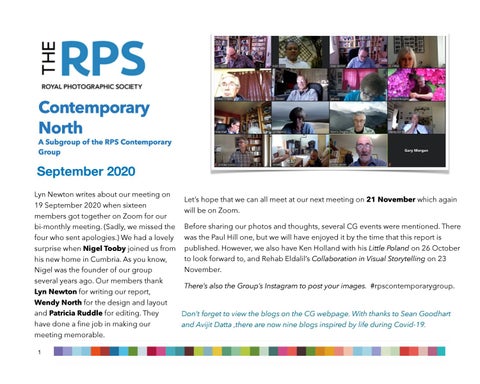
September 2020 Lyn Newton writes about our meeting on Let’s hope that we can all meet at our next meeting on 21 November which again 19 September 2020 when sixteen will be on Zoom. members got together on Zoom for our bi-monthly meeting. (Sadly, we missed the Before sharing our photos and thoughts, several CG events were mentioned. There four who sent apologies.) We had a lovely was the Paul Hill one, but we will have enjoyed it by the time that this report is surprise when Nigel Tooby joined us from published. However, we also have Ken Holland with his Little Poland on 26 October to look forward to, and Rehab Eldalil’s Collaboration in Visual Storytelling on 23 his new home in Cumbria. As you know, November. Nigel was the founder of our group several years ago. Our members thank There’s also the Group’s Instagram to post your images. #rpscontemporarygroup. Lyn Newton for writing our report, Wendy North for the design and layout and Patricia Ruddle for editing. They Don’t forget to view the blogs on the CG webpage. With thanks to Sean Goodhart have done a fine job in making our and Avijit Datta ,there are now nine blogs inspired by life during Covid-19. meeting memorable. 1
Morris Gregory introduced his One Acre of Photographs to the group. He explained that the project started two years ago after buying an acre of land behind his house. He decided to set himself the challenge of photographing all the elements in different seasons and different times of the day. The challenge he set himself was to produce a set of images from a very small geographical area. He stressed it was still very much experimental and a work in development. He was interested in catching the movement in the field and experimented with the use of intentional camera movement and multiple exposures as well as straight photos to capture the grasses, flowers, trees and wildlife that he found in his acre of land.
Some of the images had a pointillist feel to them and others were quite abstract in nature. He told us that he hasn’t yet settled on a specific direction, but would probably make a book when the project was finished because he prefers to work on projects rather than individual images.
2
Morris Gregory One Acre of Photographs
3
Jim Souper had just returned from an organised trip to the Western Highlands of Scotland where the open beaches and forest space were a welcome break from the lockdown situation back home. He used black and white for many of the images, particularly using his camera converted to infrared. Jim explained that he experienced shinrinyoku which is the therapeutic experience of bathing in the atmosphere of a forest. (Avijit mentioned that In Japanese shinrin is forest and yoku mean bath. The practice started in Japan back in the 1980s but has now spread around the world.) Part of the workshop included post processing where he worked with Paul Gallagher from aspect2i on processing his infrared images. Jim particularly recommended In Another Light, a book co-written by Paul Gallagher and Michael Pilkington which looks particularly at working with infrared.
4
References: Ikigai & Other Japanese Words To Live by, Dr Mari Fujimoto (Author) and by Michael Kenna (photographer).
5
Wendy North shared with us her enigmatic work Dream Time. The project started pre-lockdown when Wendy began experimenting with an iPad app allowing her to blend images together. The images she felt were slightly nightmarish and dreamlike and out of this came “the misty, tangled up in the duvet, hazy memories of people and places�. Lockdown gave her the time to experiment with a selection of images to position in panels so that they made connections and suggested stories. Several included a very much loved teddy bear photographed through a plastic bag which adds to the ethereal quality of the images. The resulting book, which was in two separate parts, has been carefully curated taking into account colour tones, flow and subject matter and Wendy has put the resulting book on ISSUU. https://issuu.com/wendynorth/docs/dreamtime_wendynorth_200720 6
7
A<er the mee=ng, Wendy learned that Teddy’s Story was awarded a Selector’s Ribbon in the Digital Imaging Group’s Altered Reality sec=on in their 2020 annual exhibi=on.
Peter Bartlett then showed us his recently published book A Day at the Races. His focus was very much about the people going to the races rather than the actual venues. Using a small Ricoh camera with a 28 mm fi xed lens (and occasionally when the weather was bad, his phone) Peter got in close to get his shot; the benefi t of using the small camera was that it attracted very little attention.
8
Peter was ‘headhunted’ by a publisher when his project was spotted on Instagram. The book, published by ADM Publishing, is available now in hardback on Amazon or via the publisher at www.artdecomagpie.com at £12.50 or £20 for the signed Collector’s Edition, including a 5 x 7 inch print. There is a 10% discount at the moment if you quote the code REDRUM. 9
Celine Alexander Brown talked to the group about her passion for seeking out and photographing beauty wherever she is. During lockdown she had spent a lot of time in her garden taking photos of fl owers and then experimenting with techniques she had learned in RPS lockdown workshops. Her images of fl owers and grasses used a range of techniques such as focus stacking, intentional camera movement, conversion to black and white, revealing underlying hidden textures. She had also experimented with producing a panel of images, in striking colours, of gladioli in her garden.
10
An interesting discussion took place when Celine questioned whether her work was actually contemporary. Members felt that it was and this was encapsulated by Nigel Tooby who said that the subject was not important; what was important was the purpose behind the images. We all agreed that her studied, investigative approach embodied the idea of photos ‘about’ and not ‘of’.
hJps://rps.org/events/bristol/2020/april/ondemand-digital-workshop-rps-collec=on-macroart-with-john-humphrey-frps/ /rps.org/events/regions/south-east/2020/ august/photoshop-through-flowers-for-thecrea=ve-photographer-module-3/
Celine Alexander Brown 11
Lyn Newton showed images from a project she was pursuing in Newcastle. She explained that she was walking around the city looking for the unexpected in the ordinary sights that most people walk by in their daily life and never notice. Her images included patterns and refl ections where buildings interact with each other and unusual views of iconic structures. Like Celine, Lyn experimented with a combination of multiple exposures and some intentional camera movement to create the effect she wanted. She also changed the kelvin temperature between multiple exposures. The project is far from complete and she is hoping, ultimately to put the images into a book. 12
13
Richard Hall is currently undertaking a university degree in photography and, as part of his module Historical and Contextual 2, he was asked to identify and pay homage to a photographer working before 2000. Richard has chosen Todd Hido. He said he particularly liked the fact that Hido left gaps in the narrative of his work, making it ambiguous so that the viewer could engage and interpret the story. Hido often takes banal images such as suburban houses but he takes into the sun, or through rain or dirt covered windscreens to create a fi lter between the viewer and the object.
Richard explained that there were some aspects of Hido’s more explicit and upsetting images in his nude collection that he would find difficult to work with himself, but he had thought about using as a starter the line from a poem I am alone with my beating heart. He asked a local poet to write a poem for him and then after he has selected a scene in which to place his models, the models will read the poem. Richard hopes that the poem will inspire their mood, expression and poses in the space. Richard also showed images he had taken, influenced by Hido’s work. They had an air of mystery and suspense, many taken in low light. The group had a discussion about choosing a photographer to mimic style. Richard suggested that the module’s idea was to take work in the style of, but reflect your own style in the making. 14
15
Richard Hall
Avijit Datta talked about a project by Carolyn Mendelsohn which she will discuss in a Contemporary Group talk in January. But before then there will be another blog on our webpage, the 10th in which Avijit interviews Carolyn about teaching young people to express their feelings and themselves via photography, using an easily deliverable series of lessons and debriefing sessions on the Internet.
Carolyn is well known for her project Being Inbetween which is a series of images of girls aged between 10 and 12, exploring the transition between childhood and adulthood. The images have been made into a book and have been exhibited in large scale across the country. In her new project, Carolyn applied for funding from Bradford Council to work with a broad range of young people in Bradford, including those from refugee families and some with disabilities. Working on Zoom, she taught the young people photographic skills and asked them to record, on their phones, their feelings and emotions during the lockdown period. The aim was to ask them to record photographically what they might find difficult to say in words. The findings were very positive, creating social cohesion and a sophistication of imagery that would have been hard to anticipate. Some of the images have now been made into posters and are displayed around Bradford. https://www.instagram.com/
16
through_our_lens_covid19_proj/
Avijit mentioned that there is extensive neuroscience and neuropsychiatric research into the subject using an agreed set of images, the International Affective Picture System (IAPS) images. With his medical knowledge he gave us the following links in our Zoom chat: •
Lang PJ, Bradley MM, Cuthbert BN. International Affective Picture System (IAPS): Instruction Manual and Affective Ratings. Gainesville, Florida, USA: University of Florida; 1999.
•
Lang PJ, Greenwald MK, Bradley MM, Hamm AO. Looking at pictures: affective, facial, visceral, and behavioral reactions. Psychophysiology. 1993;30:261–73
In conclusion, Avijit asked us all to think about spreading this technique in our own areas. As the participants use their own phones, the main commitment would be in the time to carry out the Zoom teaching techniques, and a follow-up debriefing meeting with those taking part so that they could share and discuss their work. He felt it was a way that we could spread the love of our photography with others who may be less privileged at minimal cost, and is in keeping with RPS aims and objectives.
When discussing the emotions evoked by the images, Robert Harris told us about a project that he read, when poor kids from the Nairobi slums were given point-andshoot cameras to photograph their world, as opposed to the world seen by outsiders. https://www.amazon.co.uk/ShootbackPhotos-Kids-Nairobi-Slums/dp/ 1861541325 17
The final presenter was Gary Morgan who shared a selection of images from Vietnam, Stuttgart, and the UK. He was particularly influenced, he said, by tones and curves. Many of his images were in black and white. He particularly liked the work of Karl Blossfeldt and had used a similar technique in a couple of his own images. The group particularly liked the ‘spring onions’ with their papery leaves and textures, from his series “What I Found in the Compost Bin.”
18
What I found in the compost bin
19
With a light-hearted last photo, Gary’s showed us a lockdown approach by one innovaGve man in Viet Nam.
20
The meeting ended with a quick update by Morris Gregory on the progress of the proposed group book Vision 20:00. Wendy North and Lyn Newton will set up a Dropbox link from the end of October for members to put their images in. Each person taking part will have up to 6 pages of an A4 landscape book to fill as they wish. Wendy and Lyn will send around dimensions and information and also put this as a file in Dropbox. All images must be taken by 31 December 2020 to fulfil the title and must be sent to Dropbox by, at the latest, 14th January 2021. It is hoped people will send in their work earlier if it is ready.
Patricia brought the Contemporary Group Online Exhibi=on to members’ a@en=on. Entries (a series of up to 5 images) can be submi@ed in any of the three themes: 1) Open (any work not previously exhibited) 2) Life in Lockdown (any work taken since 22nd March up to the closing date) 3) Climate change The closing date for entries is 31 October 2020. Check out the RPS website for full details. h@ps://rps.org/news/groups/contemporary/2020/august/groupmembers-online-exhibi=on/ Members also mentioned the Bill Brandt and Henry Moore exhibition at the Hepworth in Wakefield which runs until 1 November for those lucky enough to live in the area. 21
Stop Press! In the week following our mee=ng, Richard Hall ARPS received word that his Associate applica=on was awarded for his book A Photobook Project in 80 Days. You will know his book from the blogs on our webpage. His was the first one in response to lockdown. Richard’s story is an amazing one. He bought his first camera in 2017, then went on to achieve both Licen=ate and Associate dis=nc=ons within two months. A<er our last North mee=ng in July, Richard joined the Contemporary Group. What an inspira=on!