Contemporary North A SUBGROUP OF THE RPS CONTEMPORARY GROUP
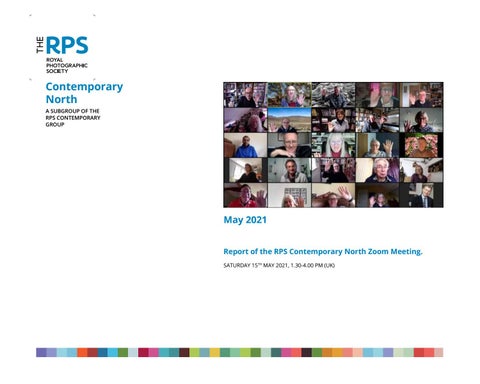
May 2021 Report of the RPS Contemporary North Zoom Meeting. SATURDAY 15TH MAY 2021, 1.30-4.00 PM (UK)
HOSTED BY JIM SOUPER AND CHAIRED BY PATRICIA RUDDLE TEXT: ALEXANDRA PRESCOTT COORDINATION AND EDITING: PATRICIA RUDDLE LAYOUT AND DESIGN: CHRISTINE PINNINGTON
Images and content of this publication are the copyright of the photographer unless stated otherwise.
The geographic spread of our members continues to grow. temporary Group series on Covid-19. And this is not to forget completing a degree course at Lincoln College. His final degree show was at the Sam Scorer Gallery, Lincoln, 18 23 May 2021. However, a virtual 3-D exhibition can be seen at:
Twenty-nine members joined, in addition to our members from England and Scotland, and of course, the “Benelux Three”, we welcomed Regina Wilkinson. Regina received RPS and Contemporary Group membership as a birthday present. Some of us already knew Regina from her Instagram account where she is known as a cook par excellence – note all things sourdough, @reginwlk. Regina has also published a book, The History of Food on Your Plate, illustrated with photos by Simon Hill, RPS President.
https://artspaces.kunstmatrix.com/en/exhibition/6290608/f8exhibition?fbclid=IwAR2-Isut2FDZTCZ_hG5P-Ve2NYIJuODupkHse7DLlTfVi1hWea1HoVduiuI The RPS East Midlands Region posted the following on their website. It shows behind-the-scene activities of the exhibition and a profile of the eight degree students.
We had five apologies: Harry Silcock, Monty Hall, Adrian James, Wendy North (happy birthday), and Mary Crowther. Mary was scheduled to show us her project Fly Tipping is Illegal but had to withdraw because she was on volunteer Covid jab duty.
https://rps.org/news/regions/east-midlands/2021/may/2021-lincoln-college-student-exhibition/?fbclid=IwAR3PXziqk3URYw3pc0dg2bmT_hgg20_MmnR-2A_IbjBsHkCEGRDsh3CnR6U
It was also a pleasure to see Duncan Unsworth. Duncan is a Contemporary Group committee member, but most of us know him through his organisation of the Group’s Postal Portfolio. Let’s hope that Duncan will have time in the future to show us some of his own photographs.
Patricia Ruddle made a few announcements. First of all, many thanks to Jim Souper for the hosting and tech support provided. There was also a gentle reminder to everyone to speak clearly so we can all hear and understand because several of us have hearing difficulties. Alexandra Prescott and Christine Pinnington have kindly agreed to take the meeting notes and then prepare the PDF for our Newsletters webpage. Morris Gregory whose innovative idea was the 2020 Vision book, and the subsequent organisation of printing and posting, reported that there was a print-over run. So, if you still would like a copy – there are some left. Also, thanks to some clever procurement, the book has made a profit. Alexandra suggested that we donate the £65 to a local charity affected by Covid, which we agreed. If you buy a copy now, more money goes to charity!
https://rps.org/news/groups/contemporary/2020/december/ postal-portfolio/ https://www.duncanunsworth.com/ Richard Hall continues to amaze us not only with his engaging and perceptive photography, but also how quickly he has achieved success. Having bought his first camera in 2017, he was awarded a Licentiate distinction in 2020, followed by the Associateship six weeks later; the Fellowship came last April. During this time he produced a book, A Photobook Project in 80 Days, on lockdown which also appeared as the third blog in the Con3
Thanks to Wendy North, our April meeting is now on Issuu:
crossing over to the Netherlands and Paris. Members have said that it’s been great meeting photographers outside our Northern borders, photographers who we wouldn’t have known before Zoom.
https://issuu.com/royalphotographicsociety/docs/rpscontempnorth_april2021 Speaking of Issuu, Lyn Newton is the Editor of the Northern Region Newsletter. The May one is available:
We noted that Avijit Datta and Sean Goodhart have created three more blogs since our last meeting, taking us to diverse locations such as Blackburn, India and New York during the pandemic.
https://issuu.com/royalphotographicsociety/docs/may_newsletter_edition18_final
No. 33 The New Normal and the COVID-19 Fight in India for the world. Supriyo Das
Big news: North goes face-to-face on 16 October at Clements Hall. Unfortunately, our cosy Meeting Room is not available for the foreseeable future, so we will meet in the Main Hall. Clements very supportive manager, Linda Spiegel, is renting us the Hall for the same price for 2021.
https://rps.org/news/groups/contemporary/2021/april/the-new-normal-and-the-covid-19-fight-in-india-for-the-world/ No. 34 Analogue New York during protests and a pandemic. Adam Miller
https://www.clementshall.org.uk/
https://rps.org/news/groups/contemporary/2021/may/analoguenew-york-during-protests-and-a-pandemic/
It has been decided that the Group will have in-person meetings at Clements Hall with alternate bi-monthly meetings on Zoom. Here’s the current schedule (variants permitting). 16th October 20th November 18th December
No. 35 Bank Top – congregations not segregation during Covid by Craig Easton. Blackburn Lancashire. https://rps.org/news/groups/contemporary/2021/may/ bank-top-congregation-not-segregation-during-covid-19/
Clements Hall Zoom Clements Hall
Working towards your Fellowship - thinking about it?
Our next meeting on 19 June will be the last one before our Summer break.
Alexandra Prescott organises the Contemporary Group’s Fellowship Distinction Peer Support Group. Next meeting is Monday 9th June at 5 pm (UK time). This is a monthly Zoom meeting. We are all working for our RPS Fellowship Distinctions – just at different stages of the journey. This is an unofficial group who get together to support each other and offer thoughts on the journey we are all going through. Collectively there is a huge skill base that we can draw on and at the very least - some words from someone who is not so close to your work can make you think. Contact aprescott_3@yahoo.co.uk
Members have voted for a break in July and August to allow for holidays but if any one feels like organising a mini- meet please volunteer to Patricia. Alternate Zoom and in-person meetings will benefit those members who can’t travel or are out of the area, e.g. from the Isle of Wight to Edinburgh, covering the country in between, 4
As you know, Avijit Datta is a Trustee on the RPS Council. We asked him about recent RPS developments. He reminded us that the last issue of the RPS Journal contained the new 5-year strategy of the RPS Photography for Everyone. There are 21 programmes under three pillars “inspire create and connect” that the RPS wishes to promote. https://rps.org/news/bristol/2020/september/photography-is-for-everyone/
“Ask not what the RPS can do for you, ask what you can do for the RPS” The quotation above paraphrases J F Kennedy’s inaugural speech; please read the RPS strategy and reflect to see how you can translate any of the 21 programmes, either individually or in concert into action. The RPS has four central committees, three of which are new. I am the Trustee representative on the Members Committee (MemCom, previously known as the Standing Committee), which discusses operational issues. A recent paper presented was on the benefits of online meetings – cost savings, environmental benefits and breaking down parochial geographic boundaries. Contemporary North meetings have benefited – in addition to Yorkshire and Lincolnshire, participants are from Belgium, Holland, France, Scotland, Cumbria, Dorset ,Gloucestershire, Hereford and the Isle of Wight – as a result, during lockdown it has a stellar participant list including six FRPS members, one HonFRPS ( RPS President, Simon Hill) and an Honorary Life Member (Patricia Ruddle). Even after the lifting of lockdown, the RPS Environment and Social Responsibility Committee is overseeing work in this area to maintain the above benefits. The Representatives Committee (RepCom) is a think tank to scope new proposals. An initiative I proposed at Council, and some months later was separately discussed at RepCom is promoting International Membership, not least for the financial and artistic benefits which will accrue. Finally, the Nominations Committee (NomCom) inter alia scrutinises skills of potential Trustee candidates for the forthcoming September AGM elections. The aim is to have the best team to serve our 10,800 RPS members.
Please contact me on Avijit.Datta@rps.org regarding any ideas, suggestions (and unresolved issues) you may have to improve the RPS member experience.
5
Bunshri Chandaria gave a short presentation about her recent Fellowship award wth book Silent Voice. She read her Statement of Intent and showed three of the successful images from her 30-page lay flat book. (A longer, in full presentation will follow at a later meeting.) Statement of Intent My mother-in-law’s Alzheimer’s diagnosis alarmed and saddened me. She couldn’t communicate in a manner people were accustomed to. People stopped calling. They didn’t know how to react, how to relate to her. As a consequence she felt isolated. She went quiet. I felt a deep need to give her a voice. I wanted to break down the barrier between her and how the world sees her; I wanted people to understand how she sees the world – and to be at ease with that. So I decided to make a photographic book. My challenge was to find a way to reveal her world. I purposely abstained from showing her face in my photographs, not wanting the viewer to make assumptions about her. Instead, in her familiar surroundings, I photographed items that set off a twinkle in her eyes. I wanted to reveal the significance of small things: how these symbolic objects triggered her sporadic memories. Many of her stories, I had not heard before. I deliberately used a shallow depth of field, blurring certain elements to convey the narrow vision experienced by an Alzheimer’s sufferer. By restricting the view, I wanted to emphasize confusion. I wanted the viewer to exercise his/her imagination to create a visual interest. My intention is to prompt the viewer to look back and forth: reflecting on how my mother-in-law’s mind works. The delicacy of the images is intended to contrast with the harshness of the disease. The juxtaposition in the text of her ‘spoken’ words and my factual footnotes further reveal the way she thinks in relation to reality. It amplifies her way of communicating, which is not in the usual linear thought process of A to B to C. I have also intentionally scattered the placement of her words to mirror her fractured recollections.
Today Bunshri talked about her journey. She explained that she has a very close relationship with her mother-in-law and throughout her marriage Bunshri has seen her as her mentor. Now she has Alzheimer’s, and it feels as if she has lost her voice, her essence. Bunshri wanted to honour her and record her persona so that the memories wouldn’t be lost The images used different techniques to convey the narrow vision of an Alzheimer sufferer, which invites the viewer to exercise their imagination to understand this. Some of the detail fades away in the opening image. Flowers sent to her mother-in-law after diagnosis was preserved and from that Bunshri realised that these plus other artefacts triggered memories which she could then use to create a memory archive http://www.bunshri.com We first learned about Bunshri when she published an article in the RPS Journal, v 151, no 10, April 2011. https://archive.rps.org/archive/volume-151/755807-volume-151-page-94?q=bunshri%20chandaria 6
7
André Bergmans, Secretary of the RPS Benelux Chapter, gave us a presentation called Dead and Gone, which was inspired by A Journey Around My Room by Xavier de Maistre.
and personal connection both to and between the images. A discussion followed about exhibitions in general, and Brian O’Doherty was mentioned. His 1976 book Inside the White Cube suggests that frames/mounts curtail the space between images and isolates them. Perhaps an idea for a future North exhibition?
https://www.theguardian.com/books/2013/jun/04/journeyaround-my-room-review Life changing events triggered recognition of Andre’s own mortality, and he got to thinking about what would happen to his personal possessions when he was gone, what would family and friends keep or discard? André photographed the objects in his room with no particular plan – just as each one caught the eye: Glasses, pills, cufflinks, a watch, keys, loose change, small photos of family members, icon badges, a bible, an id card, shaving equipment and a whole host of other common but personal possessions.
https://www.tate.org.uk/art/art-terms/w/white-cube
André selected ten of the images that most represented his life to submit as a collection to the Heel Holland Fotografeert competition held as part of the Fotofestival aan de Maas in 2018 held at the Nederlands Fotomuseum in Rotterdam. The Benelux Chapter e-Journal contains an article on the show, pp. 38-41. (There are some other surprises in this issue, for example Carol Olerud’s Associateship panel and Armando Jongejan’s Monk’s Life – St Adelbert’s Abbey.) https://issuu.com/royalphotographicsociety/docs/ejournal_11_ summer_2018_def_2018060 The Exhibition was strictly for amateurs and there were 2700 submissions. Andre’s video of the exhibition showed us that the presentation style was simple but effective. Images were nailed to the wall with no mounts to encourage viewer interpretation
8
9
10
11
Lyn Newton created a short audio-visual presentation of Newcastle. Set to a famous track from Newcastle’s local son and national hero, this AV presented the images reflecting her feelings during and after a visit to the city experienced on a recent visit to Newcastle. Lyn’s pictures capture the modern and developed side of the city. Images of young men primping at the barbers, an NHS rainbow in the window of Newcastle’s iconic student accommodation, evening light turning a modern building to a shimmer of gold, graffiti on a wall behind a street musician questioning the positive Geordie phrase Why aye. The images were muted and projected a damping down of the famous Newcastle spirit – appropriate as it has been through the fate of every city – lockdown. Historically, people photographing Newcastle have often focused on the poverty and ensuing culture. There is no shortage of photographers depicting life in Newcastle, and indeed the North. For example, Sirkka-Liisa Konttinen, Mark Pinder, Chris Killip, to name a few. A discussion followed about the use of music in AV presentations. Mick Yates uses the Free Music Archive which has a wide variety of music clips, absolutely free anywhere to use in your work.You can sort by genre and subject matter. https://freemusicarchive.org Colin Howard had experience with the Institute of Amateur Cinematographers (IAC), which isn’t cheap. It’s necessary to join in order to get a license. The irony is that even with a license, it’s not allowed to credit a music track at the end of an AV presentation. https://www.theiac.org.uk/ 12
13
14
15
We first met Prabir Mitra last January, when he showed us his award-winning photograph of the Indian Holi festival featured in National Geographic. Prabir also presented the 17th blog The Fight Must Go On. Today we saw some of the photos from his on-going project depicting the impact of Covid in care homes. Prabir is a GP based in Kings Lynn, Norfolk, and has considered that the effect of the Corona virus on care homes was/is an important facet of the fallout from the pandemic. The collection opens with an image of victim identification before the official signing of the death certificate. Prabir saw that the virus took away identities; the victim transformed into an anonymous white body bag. There were images of lows within the care homes as carers dealt with ‘gone’ clients’ belongings and empty rooms with signs that a person was ‘no more.’ There were images of rare highs - emphasised as the lows outnumbered them. A birthday 101 celebration, test and trace technology and jabs offered with bribes – light hearted moment but also recognition of the last of Shakespeare’s Seven Ages of Man. These images were a very powerful and privileged view of care homes while life outside tried to carry on. https://www.prabirmitra.co.uk/
16
17
18
19
Morris Gregory recently read about Edward Burtynsky’s project Natural Order. https://www.edwardburtynsky.com/projects/photographs/natural-order It reminded him that on several occasions his own work, a project that he started over two years ago, bore a co-incidental but startling similarity in terms of style and ideas to Edward Burtynsky, Hon FRPS. Morris thought it would be an interesting idea to compare images from both their projects that in Morris’s words, brings about order from chaos. Burtynsky sells his images for upwards of 50K each while Morris’ prints are available for less, but the common consensus of opinion among the group was they would prefer a Morris Gregory print, even if both were free. What followed was a selection of images that demonstrated that nature can be disorderly, but puts a veneer of calm and order on the surface. Pictures of snow blanketing, dead winter growth on trees - the snow unifies and unites the branches, calm and tranquillity supported by last year’s frantic growth, now exhausted. Another picture of spring growth showed orderly waves of colour as the growth progressed and matured. Moss and lichen on trees, living a symbiotic existence again demonstrated that there is order in nature when often we only see chaos. Because of copyright, Burtynsky’s photographs cannot be shown.
20
Links
21
However, if you look at Natural Order on his website you can see the amazing similarity of their images. Also included is a virtual tour of the exhibition at the Nicholas Metivier Gallery.
Morris also showed us other photos that are part of his project but have no direct comparison to those in Natural Order. They relate to the change from winter to spring. He says that “a still picture has lots going on; it has a pattern to it.” Jim Souper, who wrote his BA dissertation on Edward Burtynksy, gave us this interesting link, a YouTube meeting between Edward Burtynsky and Sebastião Salgado. https://www.youtube.com/watch?v=WMD5fXDcHMo Running out of time, Rachel Ann Perry said that she will show her Water Towers project at our June meeting. Rachel Joined the RPS and the Contemporary Group in April. She’s an artist who lives in York, North Yorkshire and specialises in printing, photography and oil painting. https://rachelperryartist.com/
Contemporary North looks forward to seeing you on the Zoom screen on 19 June 2021 at 1.30 pm UK time.
Our meeting didn’t end on Saturday, the 15th…. 22
Patricia followed up with a Postscript on The History of Food on Your Plate. Intrigued by a Covid 19 lockdown project with a difference, the book was researched, written, props bought and recipes made, by Regina Wilkinson and photographed by Simon Hill who also researched historical facts. Those of us not into this most widespread lockdown activity, sourdough bread, will still know that it has become an extraordinarily popular lockdown pastime. Regina told me her story. It all started with the sourdough starter. I had been baking sourdough for a year when in March, 2020 the world went into its first lockdown with empty shop shelves. I had been desperately searching for rye flour for my sourdough starter to keep it alive. Luckily, while doing online search, I had managed to grab a 25kg bag of organic rye flour. I loved the sourdough rye bread I grew up with in Belarus whose unique taste comes from a very different and complex dough technology. In May I enrolled in an online course with a Russian baker who works at The Bread Research Institute in St Petersburg. The idea for the book came from a photo of the Borodinsky traditional rye sourdough bread which I published on my Facebook page in June 2020. The legend says that the bread is linked to the Battle of Borodino when a food trailer, containing caraway and coriander seeds and rye flour got blasted by a cannon, forcing the locals to recover the ingredients and use them together for the first time to create the legendary Borodinsky sourdough rye bread. Simon left a message saying that it would be a great lockdown project to work on. From June to December we gathered dishes with an actual or legendary cultural historic link to get global recipes. The book has recipes from thirty countries. For Simon the project combined his three passions of food, photography and history in one project. Sample recipe: Starter: Shuba (1918, Russia) Main course: Hiroshima-style Okonomiyaki (1950, Japan) Desert: Om Ali (1257, Egypt)
A few limited edition hardback copies are available from either Regina or Simon. Let’s hope that they decide to produce a soft back edition in the future.
23