AV News
Issue 236 Winter 2025
Weblinks Web links are live in the online and PDF versions of this journal when viewed on your computer or mobile device. QR codes are also included if you are reading a print version of this publication.
AV News Mission Av News is published by the RPS AV Group three times a year: April, August and December. Its mission is to inform, inspire, showcase and advocate on behalf of the AV community through its articles by AV practitioners, technical and event reports and news. Deadlines for submissions of articles, reports and news of events are: Deadline
Edition
March 1st
April
July 1st
August
November 1st
December
AV Group Committee Chairman Past Chairman Secretary Treasurer Webmaster AV News Editor
Ian Bateman ian@ibateman.co.uk Edgar Gibbs edgar.gibbs@outlook.com Keith Watson keithwatson.pictures@icloud.com Alastair Taylor alast.taylor@gmail.com Sheila Haycox sah2@live.co.uk Ian Hosker aveditor@rps.org Andrew N Gagg andrewngagg@gmail.com Malcolm Imhoff malcolmimhoff@gmail.com Adrian Battersby adrian.battersby@icloud.com Mike Pill quills55@gmail.com Martin Addison martinaddison22@gmail.com
In this issue Chairman’s chatter - Ian Bateman
4
AV Group
Editor’s musings - Ian Hosker
5
Chairman Ian Bateman
SCPF Newsletter: November 2025 (an extract)
6 Secretary Keith Watson
Why can’t we have one as well? - Mike Pill
15
AV Lives: Malcolm Imhoff FRPS FACI(M) AV-EFIAP talks to Alastair Taylor
20
Alastair Taylor
The quiet power of fade to black - Shiree Jetha
43
Editor AV News
How are your photos shown? - Paul L. G. Morris
51
Email: aveditor@rps.org
Backing-up and archiving - Keith Watson
67
Design Consultant
Bravo Maurice! - Adrian Battersby
71
Looking back at the 2025 International Audio Visual Festival - Alastair Taylor
75
Obituaries
93
Letters
97
Tell us what you think?
100
Treasurer
Ian Hosker
Andrew N Gagg
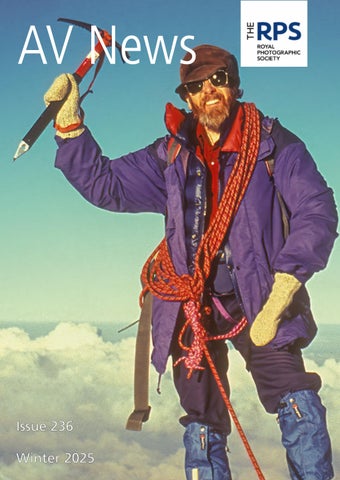
Cover image: Malcolm Imhoff, frps faci(m) av-efiap, at the summit of Mont Blanc
Chairman’s chatter Ian Bateman FRPS MPAGB AV-EFIAP APAGB
T
he big news this issue is successful running of the 26th RPS International AV Festival. This year marked a departure from previous Festivals in that all of the entries were shown on Zoom during the week, followed by a Gala showing of the
she’d recently visited Gibraltar, and met with the local camera club as part of her visit. Gibraltar Camera Club is part of the Southern Counties Photographic Federation, and had taken part for the first time in the SCPF AV Competition. Coincidentally I had judged this on 26th
winners at the DANCE Studio in Worcester University. This has helped keep the costs down, and will be a benchmark for our future events. My thanks go to all who helped in the successful running of the event, and in particular to Alastair Taylor, who brought the whole thing together.
October, and the Gibraltar entries had done very well. They were still buzzing about it when Victoria met them, and reinforced the idea that AV is alive and well, and still an integral part of the photographic community.
Victoria Humphries, the new RPS CEO, was able to attend the Gala Day, and was very impressed with the quality of the sequences shown. In particular, she understood how the combination of images, script, music and production can come together to provoke an emotional response in a way far surpassing still images alone.
The SCPF published a report on the AV Competition, and this is re-printed in this issue. Uniquely (I think) they ask the judge to make a presentation on what makes a good AV, so that the audience can understand why the decisions have been made. Finally, I’d like to wish everyone a Merry Christmas, and welcome our three newest members:
This week (early December) I had another meeting with Victoria at the new RPS HQ at HERE in Bristol. We discussed the future of AV and how it would fit into
Michael Turner ARPS John Bradshaw FRPSI an Johnson LRPS
the RPS universe. She mentioned that
apagb
Issue 236: Winter 2025 (page 4)
Ian Bateman frps mpagb av-efiap
Editor’smusings Ian Hosker ARPS
W
elcome to the winter edition of AV News.
Publication is slightly delayed so that we could include some late material that we felt should not wait until April to publicise. Anyway, what we do have for you is a ‘bumper’ edition! Hope you enjoy it as there are articles covering a wide range of subjects, and people. So a very diverse read - I wanted to resist using the cliche of ‘something for everyone’ but I didn’t - sorry.
Finally, this edition completes the first annual cycle of the online version of AV News, so we would appreciate some feedback from our readers. We want to understand your experience of the new version, and gain views on its further development. At the end of this edition, you will find a link to an online survey, so please help us out and give us your thoughts - it’s anonymous, by the way. With our best wishes Ian Hosker, arps
Make contact Have an idea for an article? Do you have news of AV or multimedia events? Have views you wish to express? Then get in touch via email: aveditor@rps.org
Issue 236: Winter 2025 (page 5)
SCPF Newsletter: November 2025 (an extract) AV Championship
shown to ensure an entertaining and informative programme for the event. Ian gave an authoritative introduction on what makes a good AV and we were able to see three of his own sequences before the results were announced.
Basingstoke CC turn out in force
The SCPF AV Championship was held on 26th October in the clubhouse of Blandford Forum Camera Club. This year we had an increased field of 31 entries from 15 clubs, 8 of which competed for the coveted Oak Leaf Salver. The sequences had been judged in advance by Ian Bateman FRPS MPAGB APAGB AV-EFIAP. Only the 19 highest scoring sequences were
Thanks, as always, to Suzie Kirkby for all the effort she put into making this Championship a success. To Ian Bateman for his excellent positive appraisals and sound advice. To Blandford Forum Camera Club for the use of their facilities, with particular thanks to Ian Ferris for technical support and to Denise Halford and Rachel Cooper for their excellent catering, particularly the cakes! Thanks, of course to all the entrants and the support of the CompSecs of all the clubs who participated. The top three sequences, including the judge’s comments were
Issue 236: Winter 2025 (page 6)
1st: Phantasmagoria by Dale Robins of Bognor Regis CC “This is always going to be a 'Marmite' sequence with no middle ground. I thought it was great! I loved the fact that the whole thing seemed to be made from a single image, with the kaleidoscopic presentation making good use of the metallic shapes. The music was an excellent fit - and kudos to the photographer for creating it! The whole thing was mesmerising, and I found it almost hypnotic to watch the engine dance across the screen. I have said that you should have fun and embrace new techniques, and this one does it in spades!”
Issue 236: Winter 2025 (page 7)
2nd: The Great Yew Forest by Dean Sephton of Storrington CC “Excellent documentary sequence, telling the story of how the yew forest came to be planted, and the tangle of trees that still exist 1,000 years later. Well narrated - possibly by an AI voice (maybe Eleven Labs?), but enough inflexion to maintain interest. The gentle zoom-in helped to draw us into the forest, and the sombre music suited the subject and pace. Good use of a black slide to separate out different aspects of the story.” 3rd
The Streets of Malaga by Alex Zapata of Gibraltar PS
“AV can be used to showcase any genre of photography that interests you, and this is very much a set of street images. I like the gritty mono style, and the fact that we saw the back streets of Malaga with people going about their day-to-day business. The music worked well, and the pace and style suited the subject. The only suggestion I'd make is to bring in the final shot of the Christmas lights in a fraction earlier to match the final note of the music.” Highly Commended awards went to The Eagle Hunters of Western Mongolia by Colin Ridley of bh pc Young Kingfishers by Nick Leonard of bh pc Defending Heritage by Victor Hermida of Gibraltar PS Cool Curves by Mike Barton of Gosport CC The Oak Leaf Salver was closely fought for, with a single point separating the leading contenders. The trophy went to Storrington CC with Gibraltar PS gaining the edge over bh pc through a countback. Full results can be found HERE Our Championship even made it into the October issue of the RPS publication “AV World e-xtra”. We are on pages 5, 6, 50 and 51. Click HERE Issue 236: Winter 2025 (page 8)
Ian Bateman: What makes a good AV? The intention when creating an audiovisual sequence is to achieve a harmonious blend of images and audio. It is not a new idea and AV sequences have been created with magic lanterns, slide projectors and tape decks. The more recent means to create digital sequences open new creative opportunities. Ian Bateman, in his introduction during the AV Championship, outlined 10 guiding principles for creating AV sequences: 1. Don’t overstay your welcome: AV sequences are rarely criticised for being too short, but they are frequently criticised for being too long 2. Never bore your audience! Garbage in, Garbage out Never be tempted to pad out your sequences with poor quality images. The audience (and judge) will always remember the sub-standard ones Less is always more! 3. Remember IBM: Avoid being Imprisoned By the Music. If the music is too long, remove some from the middle. Use the music’s natural ending
4. The music has to suit the sequence: Fast tempo music needs fast changes Slow tempo music needs slow changes. Anything else causes a mismatch 5. Keep in good shape: Choose an aspect ratio that suits your images. Crop all of your images to the same shape. Avoid the edges crossing over! 6. Give your sequence a structure: Try to have a ‘start’, ‘middle’ and ‘end’. Even short “photo harmony” style AVs will benefit from this 7. f possible, attach a hook! Something that the audience will remember. An image, a special effect or piece of information that is unexpected 8. It’s a balancing act: If you are narrating a script, inject some light and shade into your voice. Underlying music should be very low in the audio mix 9. Remember your objective: AV is not a genre in itself . It is a way of presenting your images in a creative showcase. 10.
Have fun! Embrace new technology . Lots of AI tools now available! Narration and music as well as images and audio Enter competitions!
Issue 236: Winter 2025 (page 9)
Dale Robins: The making of Phantasmagoria For a while now, I have been fascinated by multiple exposure photography. Phantasmagoria approaches this from a contrary perspective: here, a single image is overlayed on itself multiple times, and instead of the camera moving around the subject, the photograph itself is in motion while the camera remains stationary. This results in a photographic kaleidoscope. Several members of Bognor Regis Camera Club saw a 2022 blogpost by Julieanne Kost entitled ‘How to make a “Smoke Flake” in Photoshop’. and made some very interesting images, so I thought I’d have a go myself. I’d previously created images using reflection and rotation techniques, so I dived straight in without reading Julieanne’s post first (I recommend that you take a look at her post, as she does great work). It turns out that I used a slightly different method to build the image, which would eventually become Phantasmagoria, but that’s part of the fun of Photoshop - there are many ways to accomplish the same goal. I didn’t have a smoke image to try, so I searched through my archive for something suitable and eventually found a photo of the connecting rods of a steam locomotive I’d shot at the
Issue 236: Winter 2025 (page 10)
Bluebell Railway. This proved to be a great choice, and as soon as I’d made my picture, I thought, “I could animate that”. So, I set about reconstructing the image in Adobe After Effects while thinking about what to do with it once all the layers were in place. You can see my original “Smoke Flake” image on Flickr here: https://flic.kr/p/ 2n4NDSv. I’m not sure that ‘Smoke Flake’ is the best description of the image - it looks more like some kind of ‘Cyber-Flake’ to me. And now, the technical bit: it might be worth watching the sequence now, if you haven’t already done so (see the link below): Only one photo is used in the whole piece. That single photo is first mirrored three times, to give a group of four images. The original single photo is then made to rotate in a clockwise direction and, because they are mirrored copies, the other three images in the group appear to rotate in contrary directions. This sets up the basis of the kaleidoscope effect. his gives a total of thirty-six copies of that original image, arranged in nine groups. Because each of the eight overlayed groups is a duplicate of the original group, their images also rotate in the same fashion as the original.
Issue 236: Winter 2025 (page 11)
Then the whole collection of nine groups is set rotating in an anticlockwise direction. Finally, the entire rotating set of nine groups is set in motion, moving left and right, up and down, zooming in and out beneath the stationary ‘camera’.
music and the instruments are from Spitfire Audio’s ‘BBC Symphony Orchestra’ and ‘Eric Whitacre Choir’ sample libraries; if you’re not familiar with these, you’ll find links to more information below
As the sequence progresses, groups are shed at various intervals, changing the patterns generated by the rotation.
Timewise, I think the animation part of the project took about thirty hours (after all the tweaking!), and writing the music took about the same, although I didn’t really keep track of how much time was passing.
It’s worth noting that the rotational
Now for the Oscars speech: (you can
speeds of the original image and the collection of nine groups are constant throughout the length of the sequence, bar the ‘eased’ beginning and ending. I mention this because there are times when it seems like the spinning is speeding up and slowing down, but this is merely a function of the interacting elements of the many layers. Nearly there now… Once the sequence was completed, it was time to create the music to accompany it. I took a short orchestral piece that I’d written a year or two earlier, divided it into a beginning and an end, and then set about writing some new parts to fill in the gap. The original piece was just over one minute long, so that left around two and a half minutes to fill in. I used Apple Logic Pro for writing the
Issue 236: Winter 2025 (page 12)
turn off at this point or just go and make a nice cup of tea and then come back for the links) Many thanks to all the Bognor Regis CC members for their encouragement and to Suzie Kirkby, Stewart Lacey and Ian Bateman for a great event. However, Phantasmagoria wouldn’t be nearly as good if it weren’t for The Wife, who is particularly good at saying what needs to be said about these things. That’s it, really. Simple! Oh. The name of the project was inspired by the many ephemeral creatures and macabre faces that emerge from the swirling interactions of the superimposed layers; those of you prone to pareidolia will know what I mean.
Links: My original ‘Cyber-Flake’ image on Flickr:
same. Don’t forget to like and comment if you like what you see! https://www.youtube.com/watch? v=4dZ7Wfgkz7M
https://flic.kr/p/2n4NDSv Phantasmagoria on YouTube: You can see Phantasmagoria on The Wife’s YouTube channel, Shameless plug: She is an author who writes under various pen names, and her channel includes original stories as well as readings of classic ghost/horror stories. As she appears as ‘Miss Worm’, Phantasmagoria is credited to ‘Mr Worm’ (that’s me!) and therefore the end credits of the video on YouTube are different to the version entered into the SCPF Championship; everything else is more-or-less the
Issue 236: Winter 2025 (page 13)
Julieanne Kost - How to make a Smoke Flake: https://jkost.com/blog/ 2022/01/how-to-create-a-smoke-flake. html Spitfire Audio: BBC Symphony Orchestra: https://www.spitfireaudio.com/products/ bbc-symphony-orchestra-professional Eric Whitacre Choir: https://www.spitfireaudio.com/products/ eric-whitacre-choir Dale Robins: dale@monopolar.co.uk
Issue 236: Winter 2025 (page 14)
Why can’t we have one as well? Mike Pill DPAGB/AV, ARPS
C
OVID has been directly or indirectly responsible for lots of things and one thing it has hindered has been face to face AV gatherings. Organised face to face meetings never fully restarted. Zoom helped keep communities together, but it was never a substitute for seeing people in the flesh.
Adrian Battersby, ARPS DPAGB/AV
After the successful 4K AV day held at Smethwick, that Adrian Battersby organised at smethwick in May 2025, he and I were chatting, and we both agreed that we prefer in-person meetings. However, in the north-west, for various reasons, they’re a bit like hen’s teeth; spoiler alert: there aren’t any! It’s a fact that there aren’t as many AV workers as those that just take photographs, so taking time together to share views, and our latest creations, in a face to face and supportive environment is so much more important. Let’s face, it making a really good AV isn’t easy, particularly when just starting out, and it’s a challenge even when you’ve been round the block a few times! You don’t just have to master photography, you have to master story telling, sound and production techniques as well as being able to find your way around IT systems and software. It’s always good
Issue 236: Winter 2025 (page 15)
to have friendly support and advice, and in the AV world these are always available. The idea for a North-West AV Day was born Adrian and I kicked around the idea of an AV day and thought: why don’t we put our money where our mouth is, so to speak, and organise an AV day in the North-West, ideally near where we live? It won’t be that hard if we share all the work and rope in as many volunteers as possible. Next steps We discussed what we wanted, and Adrian spent a lot of time looking for possible venues. Given that I live on the Wirral and Adrian lives in Warrington we wanted something that was readily accessible from the motorway network which would make access easier for those coming from further afield. After a lot of Googling, phone calls and emails, Adrian came across Leigh Film Factory in Leigh. It’s on the site of a large old mill building. Some of the building is still used today as a working factory, but several floors have been repurposed into smaller units, of which the cinema is one. Right next to the cinema is the North West Computer Museum, which some may also find of interest, especially as it has a display of Colin Balls’ Royale projector systems.
Issue 236: Winter 2025 (page 16)
The Leigh Film Factory is a community cinema, staffed and run by volunteers. It has a raked 115 seat theatre with plush comfy seats, large screen, cinema quality 4K projection and 7.1 Dolby Digital surround sound, PA system, etc. It ticked all our boxes. It was also only 15 minutes from Adrian’s house; oddly it was further from my house! Sponsorship We talked through the project with the RPS AV Group committee during the summer and they were unanimously fully supportive and agreed to subsidise the event. This took a weight off our shoulders, as it allowed us to offer a fantastic event but keep our ticket prices to a minimum. It also allowed us to pull the trigger on securing this superb venue. What next? We now had to start working along two parallel paths. Firstly, we had to work out how we were going to promote the event and, secondly, what were we going to do on the day. Promotion Adrian has worked in sales and marketing in a previous life and I had a small business for a few years so we had the right sort of background. In particular we are both enthusiastic AV workers and active photographers,
having both quite recently got our DPAGB/AV awards. We also enlisted the support of Andrew Gagg, FRPS, to design our posters and graphics and he is doing an amazing job. What are we going to do on the day? We were keen that there should be something for everyone, at all levels of ability and knowledge and, above all, it should be fun and interesting, as well as being a major social event for the AV world. We were also keen to have a big ticket draw – and via our contacts we persuaded the award-winning director and cameraman, Paul Kittel, to do a keynote talk. Paul will talk about the ways in which AV and film overlap, and relate his experiences of filming in many places throughout the world. Paul’s reputation goes before him as an excellent and entertaining presenter. We also have the well-known John Smith all the way from from Conwy, of Wilmslow AV Group fame. John will give us a technical talk. He told me: ‘just tell me what you want me to talk about!’ It’s likely to be something on sound or animation.
Issue 236: Winter 2025 (page 17)
We will have ‘show and tell’ AV sessions, where advice will be available for those who want it from well-known and highly experienced AV workers, such as Edgar and Linda Gibbs, Malcolm Imhoff, and other AV experts. We also plan on running a Q & A session during the day. In addition, we hope that two of the AV world’s best known and revered AV workers, Ron Davies and Colin Balls, will also be able to join us for the day and Colin has been persuaded to do one of his AV talks. It’s mid-September as I write this article, and April 19th 2026 seems a long way away. We’ll be announcing more details of the day as we get closer to the date. We will be on social media, AV News, AV World and anywhere else we can think of. •
Keep an eye open for the ‘tickets available’ announcements
•
Put Sunday April 19 2026 in your diaries
•
Book your tickets as soon as you can!
th
When I wrote the first part of this article, it was early September and the
photographer for the day. Alastair Taylor has kindly agreed to be MC.
North West AV day was still over 6 months in the future. Plenty of time, way, way ahead. I’m now writing this piece at the end of November, and the emails have been flying backwards and forwards. I can’t believe how many video calls we’ve had: WhatsApp, Facetime and Zoom. How did we manage without the technology? The pace is hotting up.
Adrian Battersby and I are chief worriers and trouble shooters for the day! I am sure I have forgotten someone, but it’s been a team effort. If I’ve forgotten anyone, I apologise now!
Our ace graphics artist, Andrew Gagg, has been beavering away producing our posters. Our speakers have all been locked in. We’ve been writing articles, pushing our posters to everywhere we can think of. Sheila Haycox has been sorting out the event on the RPS website. Malcolm Imhof has been managing our interface to the IAC magazine. Keith Watson has agreed to be our in-house Issue 236: Winter 2025 (page 18)
We’ve still got stuff to do. Mainly promotion, promotion and more promotion. Our aim is not to beg people to come, because we don’t need to. We just need to make sure everyone out there knows what a damn fine event it’s going to be. The tickets should be at least twice the price for this luxury high-spec boutique cinema, but thanks to generous RPS AV Group sponsorship, they are at their usual very reasonable levels. Whilst we’re supplying free tea and coffee, plus excellent biscuits with your ticket, don’t forget to bring your lunch.
The Northwest Computer Museum next door also has a little cafe where you can buy something if your sandwich making is not up to scratch, or you’ve left your butties on the kitchen table.
We’ve got an amazing day lined up for you.
So it’s now up to you.
Colin Balls - one of the country’s bestloved AV workers will show some of his award-winning AV’s.
You said you wanted a face-to-face AV day. Here it is.
Paul Kittel – BAFTA-nominated director/cameraman will talk about video and AV and his experiences.
Book your ticket and setup your sat-nav to Leigh Film Factory and come along. After all it’s the audience that makes
John Smith – a former audio professional, well known for his work with the LCPU, the Wilmslow AV group and Focal Points editor, will talk about
the event a great day.
sound editing.
If you’re reading this over someone’s shoulder, you should know that you don’t have to be an RPS AV Group member or even a member of the RPS. So, if you know anyone who’s into AV, or interested in having a bash, or simply likes watching excellent AV’s. buy them a ticket and bring them along.
Plus, you will have the opportunity to show your own AV’s. Either for entertainment - a ‘show and tell’ or if you’d like some advice, critique etc. from AV experts such as Linda and Edgar Gibbs, Malcolm Imhoff, and others.
Issue 236: Winter 2025 (page 19)
Here is the day's schedule:
Malcolm Imhoff FRPS FACI(M) AV-EFIAP
talks to Alastair Taylor
I
have known Malcolm for many years and have always admired his work and skill in AV production. I sum up his work in a number of words: Venice, mountains, walking, the great outdoors, the Lake District, The Beatles, and emotion. Malcolm and I met for an afternoon in mid-September to discuss the subject of audio visual and his life in it. My first question was whether those words were an accurate portrayal of his AV work. Yes, I think that's a pretty good summary, but I would probably add to that 'Music', because I don't think that there are many people who use music in the way I do. I don't do "background music”; the music's always an integral part of the sequence and there for a purpose - to create a mood, to drive the sequence, change the pace, or tell
people what they should be thinking. It's usually edited precisely to fit. We talked about how our interests and life experiences shape our AV subjects. I asked Malcolm why he was so interested in the outdoors. He grew up in Southall, (Middlesex as Malcolm was keen to point out). As a boy he was a Scout. My first Summer Camp was in Buttermere, so you can imagine the effect that had on a thirteen year old lad. From this came a love of the countryside and mountains. “Funny how things shape your life”, we agreed. Many readers will not know that Malcolm first trained as a quantity surveyor and moved up to the Midlands to help build the M6 Midland Link Motorway. He met Maggie and they married in 1970.
Issue 236: Winter 2025 (page 20)
Maggie helped me believe that I could do something useful with my life. So he trained as a geography teacher (four years of poverty) and spent the rest of his career teaching in the West Midlands. Malcolm emphasised that as a geography teacher he took kids on field trips. That was very important to me. I made sure, even before I became a Head of Department, that every kid who took geography went on at least one field trip in a year, obviously just a day trip for the Lower School, and then the Sixth Formers I took them away for a week to North Wales, Swaledale, the Lake District. I also ran a 'Mountain Club'. I like to think that I might have had a bit of influence on some of those kids' lives. So little wonder we see so much mountain scenery in Malcolm’s work. So I get the mountains, I get the Lake District, I get your walking, I get The Beatles as well 'cause you're a child of the Sixties aren't you? Absolutely, I've seen The Beatles live. But Venice? What is the story behind Venice? I asked. It is rumoured that you've been to Venice in every month of the year, is that true? Yes it is. Well I'd been to Venice once. I organised a Mountain Club trip with the
Issue 236: Winter 2025 (page 21)
Sixth Formers to the Austrian Alps, and after we'd done the mountaineering bit we just happened to end up in Venice, and when Maggie found out I was in big trouble as she'd always wanted to go to Venice, so I had to take her. In 1983 we went on a trip with two good friends to the Dolomites, and of course Venice is just down the road. That was Maggie's first time and it was amazing as we arrived in the middle of an electrical storm. It was also the start of a love affair with Venice, and after we'd been a few times Maggie had a plan, a dream, to be in Venice in every month of the year. She managed ten of those months, and after she died I felt I need to finish this, so I made the pilgrimage and completed the other two months. I didn't know how I would feel but the amazing thing was I felt really really good; it's one of those places where we've always felt totally at home. But for some of those months we've been more than once, I mean the Carnival in February, three or four times. We've even been there in the snow. I know it very well so recently I've been with friends like Richard and been their guide. What would you say is your favourite month to go to Venice? It's amazing at any time of the year, but
people have often asked us that question, and Maggie has actually
Top: Venice from the AV Carnival in Venice
Bottom: Venice from the AV Images of Venice
Issue 236: Winter 2025 (page 22)
Top: Venice from the AV The Stuff of Fairytales
Bottom: Venice from the AV An Autumn Adagio
Issue 236: Winter 2025 (page 23)
produced a little "guide for first time visitors", about where to go, where to stay, what to do, where to eat, how to get around, everything. We would probably say the best times to go are February, and Autumn for the best quality of light and weather. One of the reasons for going in different months is to coincide with the various festivals, and I've been to all of the Venetian festivals now, the Carnival, the Regatta, the Biennale, the Vogalonga, the Redentore. I would say my best photographs were in January, when we got the snow. It's been a great source of AVs for you hasn't it? Oh yes, and it featured in both my ARPS and FRPS submissions I asked Malcolm what was his first Audio Visual memory. I've taken photographs ever since I was a teenager, Bonus prints to start with and soon moved onto slides, Agfa, as I liked the orange plastic boxes which I still use to store my screws and panel pins, and then I discovered Fuji Velvia and the lovely saturated colours which is what I try to recreate in my digital photography. The green boxes are quite useful too. As a teacher I made single projector slide shows of my kids on field trips, and showed them at parents' evening to tell the parents what their little darlings got up to! Then
Issue 236: Winter 2025 (page 24)
two things happened round about the same time. The first was about 1985 when I was in Torridon in the far northwest of Scotland, and there was a visitor centre with a multi-projector slideshow. I was just blown away, all those wild landscapes, eagles soaring. The same year I went to the MidPhot exhibition, which at that time took place in Sutton Coldfield Town Hall. Those who remember it will recall the fantastic print exhibition, but for Malcolm it was the showing of the MidPhot Audio Visuals which captured him and he said: I want to do that. Some of the greats of the AV world, such as Clive Atkins, Keith Brown, Ray Dowding, Ken Palmer, and the Hardwicks would have their work on show. Malcolm and I agreed that the Midlands always was (and still is, we think) something of a power house when it comes to AV innovation. At MidPhot I met somebody who told me about Aston & Erdington Photographic Society who had an AV Group, so I joined that. The A&E AV Group was very active. We would be out sometimes a couple of evenings a week giving shows to camera clubs, gardening clubs, women's groups, and we had to make shows for the general public. But I just didn't know how to get started, so it was only when one of
the members, Charles Simpson, said "Come round to my house, bring a set of slides and we'll get them on the light box and see what we can do". So I am eternally grateful to Charles, otherwise I don't know how I would have got started.
in it. But I think my music choice was spot on, it wasn't your Vivaldi as you might expect but Handel's Water Music! And the way I synchronised the slide changes to the music is something that I've always done right from the beginning.
From that point on I was hooked.
Malcolm has produced many AVs over the years. Venice features a great deal in these but it is the mountains where Malcolm has enjoyed his greatest success. I ask Malcolm which is his most rewarding production. It is no surprise that his top two are the same as mine, namely "Soul Music" and the "Queen of the Hills".
And the rest is history as they say. Malcolm remembers his very first AV called “Images of Venice”. I made all the usual mistakes, it was too long, 12 minutes for just pictures with music, and I had lots of vertical pictures
Issue 236: Winter 2025 (page 25)
Soul Music: https://youtu.be/yKB-Qnlq1qY
Queen of the Hills: https://youtu.be/KYk0aAjtQq8
Most readers will have seen both of these wonderful AV productions but if you haven’t, you can use the links above.. I'm curious about the back story to "Soul Music" and how you got involved with the BBC Radio Programme of the same name. We had a church newsletter, the "green sheet" it was called, and one time there
Issue 236: Winter 2025 (page 26)
was a little advert saying the BBC were had this series called "Soul Music" about pieces of music with a powerful emotional impact, and they were doing a programme about the hymn "How Great Thou Art" and if anybody had any stories or memories to get in touch. Well, it means a lot to me because that hymn kept coming into my head all the time I was climbing Mont Blanc, and when you hear the words you know why.
I emailed the Producer Lucy Lunt, not really expecting anything to come of it, and I got a phone call, and after a time I realised she was actually interviewing me. She said "I think we can use this", so we fixed a date for me to go to studio at The Mailbox in Birmingham, and they sent a car for me! That was an experience. I loved seeing all the recording equipment and the very high quality microphone! Actually the interviewer had a very good recording style which reminded me of Charles Parker. He was a BBC producer and me and Maggie sang with him when we were residents at the Grey Cock Folk Club in Birmingham. He transformed radio documentary by recording the voices of ordinary working people with their rich vocabulary and using the actuality recordings, whereas before that the BBC got an actor to read the lines in Received Pronunciation. Charles would actually kneel down, and my Producer also held the mic low so the mic wasn't in your face and eventually you just forgot about it. Somehow this has led to a very natural recording and since the words are unscripted it gives a quality to the recording which has seldom been achieved since. You begin to see a few people going for that approach these days, so I think it was quite groundbreaking what you did there, and
Issue 236: Winter 2025 (page 27)
moved people on, it moved me on in my thinking, and my next AV is unscripted. What's fascinating is, that the order it comes out is not the order I recorded it, and you told me that. Yes, a very important thing for anybody recording somebody else is that you often want them to say who they are, to say their name, but strangely a lot of people find that very difficult. So what the BBC interviewer did, she left it right to the end, and said "OK, just say your name" and of course by that time I was relaxed and it was no problem. But then it was edited and put at the front. The other thing is that the questions have to be very open-ended. You can't ask a question like "Did you find climbing Mont Blanc difficult?" to which the answer is "Yes"! You have to say something like "Tell me how you felt when you got to the top". That is a very interesting and useful approach for AV workers. "Soul Music" is so authentic, so beautiful, and so from you, from the heart, and full of emotion, and you're a bit like me in that respect, you're not frightened of your emotion, and I respect you for that, because I think if you're emotional and passionate about something it's going to come over so much more strongly. It was Peter Coles who heard the programme when it was broadcast (still
available at https://www.bbc.co.uk/ sounds/play/b00txhfk), and said to me "you should make an AV of that, you've got the pictures" so I sought angained permission from the BBC to do that. Malcolm points out that his AV "Soul Music" was born out of four previous productions. They are, 'Ascent of Mont
Blanc', 'The Way to Mont Blanc', 'The White Mountain' and The Descent of Mont Blanc'. For me, the natural style of the voice over in "Soul Music" combined with the fabulous photography, and above all the heartfelt story line, make this AV
Ascent of Mont Blanc
The Way to Mont Blanc
The White Mountain
The Descent of Mont Blanc
Issue 236: Winter 2025 (page 28)
one of the greats and it is little wonder that it is a favourite amongst the AV audiences and has been successful in competitions home and abroad. Our other favourite, “Queen of the Hills” is a technical masterpiece and is held in very high regards for the quality of sound recording. Both of those have won about twenty awards, but "Queen of the Hills" has won quite a few awards for the Best Sound, and I'm especially proud of that because as you know there's hardly any music in it at all, it's all sound effects. My other favourites would be "Watch Where You're Putting Your Feet" [https:// youtu.be/c7PUZsFcCg4] another AV with just a person talking, "In Lonely Places" [https://youtu.be/NY6gSJQsZw4], the one I want played at my funeral, and "Walking with Grief" [https://youtu.be/L90qOWQSV8k?si=lS46kf6QM2lKT13], also a very personal one. We talk about the past masters of sound production, including Normal Veale, and in the same week as we discussed the subject there was a show of all seven AVs produced by Norman. We said that it is good to revisit these and others from the past. We both agree that as clever as it is, we really do not like Artificial Intelligence. We also marvel that the equipment being used by these past masters was quite primitive compared to what we can do today.
Issue 236: Winter 2025 (page 29)
Who's influenced you from the past? Well, obviously Peter Coles. He really encouraged me and made me aware of the wider AV World which I didn't know existed, but going right back to A&E AV Group one of the influences was Clive Fenn because he made AVs that were always a bit different, often humorous when everybody else was making documentaries in what I call the "Readers' Digest" style. At MidPhot we used to count the gravestones! But I've always made AVs that are very personal, they're often about somewhere I've been, a favourite place, a mountain I've climbed, but always with a personal input. Tell more about Clive Fenn. At the A&E Annual Exhibition, the AV Group provided the "entertainment" for the Saturday night, and Clive was the MC, and always had a theme. One year, it was the letters "A" and "V", so every introduction was somehow related to that, like "Aston Villa" or "Autumn in Venice" (that was mine!). We usually had a singalong, so the group were each given a song and we had to make an AV to it. I remember doing "Run Rabbit Run" and "Tiptoe Through The Tulips"! We also made a lot of group
sequences. Adverts, that was one of my ideas. [https://youtu.be/lRIJFSDkucU] Every year, for the Sutton Fun Run, we'd all be given a couple of films and a place to go in Sutton Park or the Town Centre and we made an AV that was shown at the Awards Ceremony when all the sponsors and dignitaries were there. For ten years I made the Audio Visual of the members' slides for the Annual Exhibition, a 45 minute show, and I only got the slides the week before, but I spent the whole year thinking of a theme. One year it was Beatles music, another piano music, and preparing the phrases to introduce each slide, and I hardly ever repeated a phrase. I got Mike Jeffries, one of the AV Group to do the voice over and we had such fun recording, especially with all the Latin names in the Nature Section. I had to keep each author's ten slides together, but within that I rearranged them to give the best fades and always made sure the transitions were snappy and in time with the music. I always say that's how I learnt my craft. Who else from back then? Colin Balls, one of the best AV producers in my opinion, and he wrote a book called "The A to V of AV" ,which I've still got somewhere, and that taught me a lot. So what was your first AV success, and when? Issue 236: Winter 2025 (page 30)
I'd been entering MidPhot for ten years and got a few Commendeds, but it was in 1997 when I entered my "Carnival in Venice" into MidPhot (now in its 51st year) that it took off. The judges were Colin Balls, Mick Ball and Di Burns, but Ron and Peter had come down with Colin. Everybody thinks I won but I actually came third and Colin Balls chose mine for his medal. After the competition Colin and Peter collared me, as they wanted some photos for an article in AV World magazine, Issue No.2, and I even got on the front cover! In the article Peter wrote: "Surely MidPhot AV Competition must be, literally, one of the best local AV shows on earth…there is such a wealth of AV talent here that the sequences we see make the selection on a par with most National events". Peter also said: "For me 'Carnival in Venice' was the best sequence in the Competition". It went on to win the IAC CEMRIAC Jessop Rose Bowl Competition, the Peter Coles AV Competition and the Geoffrey Round Trophy (plus a cash prize of £100, as that year they wanted to revive the competition after a lapse of a few years), a Silver Medal in the National AV Championship, and quite a few other awards. After the MidPhot Competition I went home and said to Maggie: "You should come to the meal, because there's someone there that I think you will get on with". That was the beginning of a
Issue 236: Winter 2025 (page 31)
great friendship between Maggie, Peter and I, and it was only through meeting the Big Three, Peter, Colin and Ron that I found out about this wonderful "AV World", the competitions and festivals, the magazines, and Distinctions. They encouraged me to go for an RPS Distinction.
has encouraged me, and I've encouraged Keith to get on and complete his set of AVs on The Beatles.
Which Malcolm duly did but more on that later.
Well that's good, and long may it continue.
We talk about the generosity of spirit across the AV community.
So what about today? Who's on your radar today?
Peter encouraged me a lot. I remember once I wanted to know "how did he get the hands on that clock to go round?" and by return of email I'd get a tutorial with an example.
You see what I love, 'cause it happened to me, is when somebody new comes on the scene, and just takes the AV world by storm. Alan Tyrer, Judith Kimber did that, and Cathy Fordham's doing it, and it's wonderful to see. But, as Peter said to me, and I'm sure he said to other people, "make the most of it, as you won't be at the top for ever!"
He was very generous wasn't he? I think the AV World has always been a different beast from Club photography. And we still have that culture as well, Jill and Howard Bagshaw are others who will tell you how to do it. Yes, and I do too. There was a guy, Bernard Haskew, he'd often phone me up and say something like 'I've lost my timeline', and I'd say 'hang on Bernard, I'll just turn my computer on and try and work out what you're doing. Try this. 'That's it, thank you', and he'd be gone! Ashley Franklin's the same, he's often phoning me for help. Keith Brown
Issue 236: Winter 2025 (page 32)
They were generous with their support, with their time, with their comments, although they didn't always mince their words! Colin in particular!
Our conversation turns to the various fund raising events Malcolm and his team (Dave Cooke, José Currant and Richard Brown) have run over the years. They are such good friends. With the Macmillan show, which I've been doing for over twenty years since 2002, originally with just me and Maggie, there was a Macmillan Committee headed by Lin Benson, and they did all
the organising, booking, the tickets, the raffle, putting the chairs and tables out. They actually cooked food, usually chilli con carne and baked potatoes, so all we had to do was turn up and do the show! Then Lin had a spell of ill-health and was told she had to give some things up. So me and Maggie took it on, but we couldn't do all the catering so we got the idea of having a fish and chip supper, which we still do. And
Issue 236: Winter 2025 (page 33)
when Maggie died I wanted to continue, and Dave, José and Richard came up trumps. We've done two "themed" evenings where everybody dressed up. We had The Beatles 'Magical Mystery Tour" which we've taken 'on tour' to various clubs and of course the Nationals, and we became known as 'The Fab Four', and last year we had the 'Venetian
Masquerade' where we became 'The Fab Four Seasons'! These AV shows have been a great success and remain popular. Over the years, Malcolm and his team have raised something like £20,000 for Macmillan Cancer Support – a charity which means a lot to Malcolm. We talk about what draws us to AV and what the ingredients are. We both feel strongly that you can't beat seeing AVs on a big screen with big sound. We both agree that Zoom was a great help during the pandemic and has been great in bringing people together, but something will always be lost over the internet. If you were a chef what are the ingredients of an award-winning AV? Speaking as a judge, what I tend to look for is, first of all the technical stuff, the photography and all the aspects of that, the content, composition. The sound track, and all aspects of it, the script, the voice, the quality of the voice recording, and the way it's been edited and the way it's been mixed, which I probably rate more than the photography if I'm honest. Can I press you to a ratio of like 60:40 then? Sometimes people want to judge AVs by giving each of the elements a score, and I refuse to do it.
Issue 236: Winter 2025 (page 34)
And then you've got the production, the transitions, third images, and how it's all put together, the structure of it, the beginning, the end, and the bit in the middle, and also, which I would say are features of some of my best AVs, the change of pace, which helps to keep people's attention. And of course the main thing is, as Ron always says, "the aim at the top of the lightbox", the Idea. So having taken on board all the technical stuff, then what I'm really looking for, and what will be my winner, would be the one that makes me think or feel something, laugh, cry, happy, sad, thoughtful, emotion of some sort. We go on to talk about some of the AVs from history, and I ask Malcolm to highlight his absolute favourites of all time. Top of the list would be 'Portrait of the
Author', Colin Balls with Walter Jones and Iain Lang, never fails to move me to tears. Second would be Peter Coles' 'Sarah', so simple but absolutely riveting. My favourite humorous AV is 'The Pleasures and the Pitfalls' by Val Rawlings, the master of that genre, and Keith Brown's 'The Bench' both of which I've shown at our Macmillan show. Thinking about all the war sequences, I remember being bowled over by
Carnival in Venice: https://youtu.be/dEvj6Brw5SI
Martin Fry's powerful AV on Oradoursur-Glane where he used the Dire Straits song 'Private Investigator'. The sound, on reel-to-reel tape, was awesome, and I've always tried to get my sound as good as that. And then there's Keith Leedham's 'For The Sake Of Example', another very powerful AV. I'd have to have one of Judith Kimber's on my desert island, either 'Matthew Loney's Miracle' or 'Car Guy', or both, and Cathy Fordham's 'The Custodian'.
Duet, Jacek Zaim and Ursula Gronowska. Our conversation moves on to the subject of Distinctions. Malcolm has ARPS and FRPS from the Royal Photographic Society. He is one of a few people with AV-EFIAP. He also has FACI(M).
And my all-time favourite foreign one is
That was Peter Coles' influence. He persuaded me to go for a Distinction, and in a way it's nice to be recognised for what you do. I went straight for my ARPS, and that was at Bath. I'd been
'People of the Forest' by Romantic
told when my AV would be shown, I'd
Issue 236: Winter 2025 (page 35)
been given a slot, and I had to take my AV, in two massive 50-slide magazines, but I had no idea what the system was, so I arrived in good time I thought, and as we walked in Colin Balls announced in a loud voice "Oh he's deigned to grace us with his presence!" because everybody else had been there right from the start, and I didn't know that's what you did! The procedure then was a model of excellence. You showed your own work, the Panel would retire to
deliberate, then one of the Panel would come out to address the audience, it was all open to the public, and at the same time the candidate would go in to meet the Panel to receive the decision and some critique. If people had failed they got help and support and encouragement to have another go. I remember driving home with Maggie as high as a kite. I just put the one AV in, "Carnival in Venice", and you had to submit a brief biography, and
Statement of Intent I am submitting one sequence which I feel demonstrates originality in the medium and a high degree of technical and visual proficiency. The photography embraces a wide variety of types of images and focal lengths, shows ability to use fill-in flash and skill in picture composition. Securing attractive poses is quite challenging at a crowded event like the Venice Carnival. A wide range of audio-visual techniques is employed including dark areas, third images, soft-edge masks, and the use of many types of dissolve to achieve variations in mood. Selective use is made of computer manipulation of images for particular purposes. All these effects are used sparingly for maximum impact. I hope my love for the place is apparent. The script is based on research gained from numerous visits to Venice and the Carnival, and from personal knowledge and experience of the folk tradition. I have aimed to produce a sound track of high technical quality. Music is important in all my sequences - here unusual versions of sometimes familiar pieces have been carefully chosen and blended with the narration to create the right atmosphere. I feel the "idea" is often the most important element of an audio-visual and I hope the careful structure of the sequence and the continuity of conception make this clear. I have tried to gain the viewer's attention with a strong beginning and to maintain interest with several changes of pace. I wanted the sequence to be informative, imaginative and entertaining, hopefully making people want to go to Venice themselves, but also to engage the audience's feelings and make them think. By the end of the sequence I want people to wonder whether many of the slides and sounds are quite as they seem.
Issue 236: Winter 2025 (page 36)
also a Statement of Intent, so this was what I said: In 2000, Malcolm went for his FRPS. He recalls the day. Same procedure, although this time I was using all my own equipment, especially my digital personal studio, the Akai DPS12, a great piece of kit. I've been using digital sound for a long time, way before digital photography. There were three people going for their 'F', Jean Royle, Heather Clarke, and me. I was on last for some reason, I think because everybody thought he's a dead cert. Well I wasn't certain, and in fact I'd actually prepared a second submission for when I didn't get it. My submission played well. The audience reaction was encouraging. After each submission the panel withdrew and for the two 'Fs' they were out for between half and three quarters of an hour, a long time, but for me, I was packing my stuff away, and about three minutes later Maggie said 'they're coming back in', and I said 'Oh, something's gone wrong'. Peter came to the front and said some wonderful things about my presentation. I was so high I didn't take them all in, but Maggie remembered, and it is something which I always used as a guide when I have been privileged
Issue 236: Winter 2025 (page 37)
to be on the Distinctions Panel, and that was that "for a Fellowship, the highest level of distinction, the Panel is looking for something special, something extra, a unique style, or 'flair', almost impossible to define, but when we see it, we know. And today you have seen it." Maggie's interpretation of that was "Malc, you've been given it with honours!" So what did you use for your 'F' submission? Ah, so that was the other thing, and I don't think that anybody has done this since, because normally people put in three separate AVs. What I did, I made one twenty minute submission which ran from start to finish, on the theme of "From Darkness to Light". I started with a short introductory sequence, and then I showed a new 5 minute version of "Carnival in Venice" which the Panel would have seen before but just using the beginning and the end. There was another short link and I showed 'Wainwright' – "Watch Where You're Putting Your Feet", and that was the first time that had ever been shown, nobody had ever seen it before. Another linking sequence, and then I showed "The Ascent of Mont Blanc", but just the end,
Statement of Intent: From Darkness to Light Light and dark, good and evil, death and rebirth, triumph over adversity. These are some of the themes that run through the sequences you are about to see. In "Carnival in Venice" these ideas are all inextricably linked. Whether in a city, or in the mountains, there is something magical about being at the dawn of a new day. The experience is unforgettable, and remains long after strength fails, limbs tire, and the light has faded. In this final sequence we have been climbing in the dark since the early hours of the morning. We are now in the grey light of dawn, and can see the difficulties ahead.
From Darkness to Light: https://www.youtube.com/watch?v=4LR4nppRbTc
Issue 236: Winter 2025 (page 38)
where we've been climbing in the dark and can now see what lies ahead. Tell us about the IAC award, the FACI(M). That is a "Master Fellowship", a "Master of Audio Visual Arts". You must have been a member of the IAC for at least five years. You have to accumulate points (and what do points mean?). Two AV sequences which have each won two international awards are worth one point, provided that one of the four international awards was via the Peter Coles/Geoffrey Round AV Competition. You have to get five points, so ten different AVs and twenty different awards. In addition, at least one of the awards must be the overall winner of the Peter Coles/Geoffrey Round Competition. So that's pretty difficult, and as you can imagine, I am very proud of that, especially as I am only the third person to have received the award, after Peter Coles and Ron Davies. And you've now got the EFIAP in AV? Yes, you get this by accumulating acceptances in FIAP international AV Salons. I got the AV-AFIAP in 2022, and the AV-EFIAP in 2023, and when I got it the conditions were much harder, they've changed them now so it's a lot easier. When I applied the minimum requirements were:
50 Acceptances with at least 20 different AVs in 18 different international events with FIAP patronage from 10 different countries So that is pretty tough, but it is actually impossible now as there aren't ten countries holding FIAP salons, there are only six, and there aren't eighteen different events. So I'm quite pleased with that as well, and I know Maggie would be very proud of me. In writing about Malcolm’s life in AV it would be remiss to not to mention Maggie who died in 2016. Her passing has left a massive gap in Malcolm’s world and those of us who were lucky enough to meet Maggie share that loss. I ask about Maggie’s involvement in Malcolm's work by thinking about the various husband and wife teams involved with AV, people like Bev and Alan Tyrer, Jenny and Malcolm Gee, Linda and Edgar Gibbs, Mike and Lavinia Hardwick, and various others, and how that often brings an extra something. So how did Maggie influence your work? Well most of the time I would make my AVs completely on my own, and when it was finished I would show them to Maggie, and often she would be in tears and would say "that's beautiful".
Issue 236: Winter 2025 (page 39)
And then there would be a BUT, and she would always be right, and that's the thing I would change. It was only when Maggie became interested and involved in my AVs that I started winning. And Maggie was the same. Maggie made not too many AVs, but all of them are very personal, they've all got "heart". She insisted on doing them herself. She'd quite often use her own pictures, which were pretty good, sometimes some of mine, she'd always write her own script, I would record her. She got very frustrated sometimes but we persevered and we would end up with something great. Maggie loved
Malcolm and Maggie Imhoff
Issue 236: Winter 2025 (page 40)
Maggie Imhoff
"the sliding thing" as she called it, the Imatronic hand control, as I did, and I think we're very fortunate to have grown up in the days of analogue AV and the Imatronic, because you had your slides, and you had your music, and you were changing the slides by listening to the music and going with it, like 'dancing' with it. That's something I try and do digitally and I wish there was a digital equivalent of that today, a hand control that you could plug into your computer. When we got into digital AV, Maggie still insisted on doing it herself; I wasn't allowed near the computer, but quite often there would be a cry "it's all gone wrong again, I've lost it all, what does this message mean?" and I would come up and look at the screen and say "I've never seen that before". I have this theory that computers can sense your fear. I'm very proud of Maggie's AVs and next January, as it will be ten years since Maggie died, I asked the members of my AV Group if they would like me to present an evening of Maggie's work, and the response was an overwhelming 'yes', so it's in the programme. I said it would be right and proper to reference one or two of Maggie's AVs in this article, because I think you're not Malcolm without Maggie, and yostill use the M&M Logo on your AVs don't you? Issue 236: Winter 2025 (page 41)
Yes, we're always known as M and M. We've got some sweets named after us you know. Malcolm is a very busy person. He's on the RPS AV Group Committee, he's on the organising team for the National AV Championship, he's just taken over the organisation of the Peter Coles International AV Competition, he's a regular contributor to AV News and AV World magazines, and he writes the AV Column in the IAC 'Film and Video Maker' magazine. He's Chairman of the East Midlands Audio Visual Group (www.emavg.org.uk) and has been involved with the group for many years. With over 200 AV productions to his name, including Maggie's, Malcolm could be described as “prolific”. There's about 120 of them on my
"M&M AVs" YouTube channel [https:// www.youtube.com/channel/ UC2pkfrjuYhD9JPreH1Ghn9g] and nearly 50 one-minute AVs on my "Just a Minute" YouTube channel [www. youtube.com/@JustaMinute-AVs]. At the end of the day I make them for myself, and I try to make them entertaining, and if other people like them, then that's a bonus. Well I like them, and I think they are great. Thank you Malcolm.
https://www.youtube.com/watch?v=V9nxpfO-13Q
https://www.youtube.com/watch?v=u83qCdNDD4A
Issue 236: Winter 2025 (page 42)
The quiet power of fade to black Shiree Jetha
MCAPA ACAPA PIAAP AIAAP
I
n film and audio-visual shows, fade to black isn’t silence… it’s a strategy! It’s the unsung hero of visual rhythm: It shapes meaning, emotion and narrative flow. In both, filmmaking and audio visual storytelling, Fade To Black is one of the most overlooked tools we have. It’s often mistaken for a pause, a filler or as one judge said, “it signals time for tea and biscuits!” Upon hearing this, I almost fell off my chair…! I bit my tongue, thinking…It’s cinematic breath (and my show is not a prelude to your
Issue 236: Winter 2025 (page 43)
snacks)!!! Fade To Black is so much more than a call to intermission! You’ve just got to be open to it, and submit to the journey the filmmaker is taking you on. It’s the end credits that signal the show is over. A Fade To Black is intentional. It’s a breath in the chaos. A controlled moment of stillness where the image steps back so emotion can step forward. Used well, it can carry as much weight as any visual frame. Maybe even more so.
When I use it, and often I do, it is done with deliberation. Fade to Black, black screens, silence, isn’t a lazy full stop. To me, it’s a beat, a breath, a bridge. It has emotional consequence. It can hold chaos or calm, even memory or mystery. It evokes subliminal space, the pause between scenes, as if time itself momentarily loses footing. In my own AV work, I use it not just to pace, but to provoke. There’s a certain emotional mayhem I enjoy inviting in. I want the viewer to lean into the blackness. To feel emotions rise in the silent darkness; essential for surreal works. Let’s discuss. From a film making perspective, Fade To Black has an illustrious and varied lineage. In The Godfather (1972), Director, Producer and Screenwriter, Francis Ford Coppola, treats Fade To Black as a cinematic oath. After Michael, the protagonist, closes the door on Kay
Issue 236: Winter 2025 (page 44)
Adams, his second wife. This scene is a dramatic visual metaphor for his final descent into the underworld of power, as the screen fades to black. That’s not just a scene closure. It’s a moral closure. A hard cut would have been too brittle. The fade suggests finality laced with regret. It’s brilliant. Effective, dramatic and laden with suspense of future turmoil.
Director Christopher Nolan, in Inception (2010), ‘weaponises’ the black screen. Here in the well known final scene, where Leonardo DiCaprio’s character, Dom Cobb is spinning, the scene top cuts sharply to black. The audience holds its breath. Is it a dream? Or is it reality? The fade is brief, but it opens up an infinite loop of interpretation. It’s not a visual gimmick. It’s psychological sleight of hand. And it works because of its restraint.
Then, in the HBO hit TV show, The Sopranos (1999–2007), it took the Fade to Black technique even further, and arguably to riskier terrain. That ending of an abrupt Fade to Black, no music, just silence, beautiful hanging golden silence, sparked a decade of debate among its fans. It wasn’t a malfunction. It was punctuation. An anti-ending that left the audience dangling in a void, forced to reckon with the
unpredictability of death. Fade to Black, in this case, becomes the final narrative gamble… and I love it! There is no time for tea and biscuits; at this moment, I’m hung up with emotion, mental chaos… the twists and turns followed in several seasons, all upset, upside down chaos of anticipation of what’s going to happen next… and just like that, right there, we experience the quiet power of the Fade to Black.
Issue 236: Winter 2025 (page 45)
Even in more classical storytelling, like Schindler’s List (1993), the Fade To Black technique functions as a tonal gateway. After the dramatized narrative ends, the screen fades, then reopens to the real survivors placing stones on Schindler’s grave. This is not just an epilogue. It’s a temporal dissolve. The fade allows the viewer to reset emotionally and prepare to absorb historical truth. Next, in Requiem For A Dream (2000), director Darren Aronofsky, uses repeated fade to black transitions to mimic the chaos of drug addiction. The flickering fades become sensory stutters, hallucinatory and jarring. They fragment time and sanity, pushing the viewer into the same psychological free fall as the characters. Truly genius and perhaps the best case study for this technique. In No Country for Old Men (2007), where the Coen Brothers make blackness do the heavy lifting, the film ends not with a bang but with a quiet, unresolved dream. Fade to Black here isn’t comfort, it serves as existential unease. The audience is left not with catharsis, but the residue of dread.
Issue 236: Winter 2025 (page 46)
12 Years A Slave (2013) delivers one of the most emotionally charged fade to blacks in modern cinema. After Solomon Northup is finally reunited with his family, a moment saturated with relief, guilt and grief, there’s a long, quiet Fade to Black. The fade doesn’t just close the scene, it acts as a decompression chamber. And I needed that moment at this poignant moment. It allowed the weight of his experience to land. Technically, it’s a tonal descent: the image gently falls away while the audience remains suspended in emotional inertia. It’s the kind of visual diminuendo that turns a moment into a reckoning. And in documentary-style AVs, it’s the equivalent of letting an image echo after the sound has stopped. The West Wing (1999–2006) uses Fade to Black not for dramatic flair, but rather as structural grammar. Nearly every episode ends on one: a choice that reinforces its walkand-talk tempo with clear editorial beats. Think of it as a type of chapter break and not a full stop, but a controlled breath before the rhythm resets. In AV language, it’s akin to spacing a show with interstitial rests, like moments that manage pacing without breaking momentum. It teaches you that Fade to Black can also be disciplined, not just for emotional purposes.
Issue 236: Winter 2025 (page 47)
In my AV shows, especially the surreal and concept-driven ones like Fantastical, From Dusk to Dawn and The Honey Bears and Their Teacup Adventures, Fade to Black becomes a tool of tension, not just transition. It breaks expectation. It holds a note. It lets music linger without image or text land with weight. I’ve used it mid-show to reset tempo, or to accentuate a quote, punctuate to give breath to a complex sequence that needs mental digestion. Technically, it’s a timing mechanism. A way to resolve an audio tail before the next visual beat lands. It can signal a change in time, tone or internal state, essentially functioning like a non-verbal cutaway to consciousness. In the language of editing, it’s more dissolve than delete. A visual diminuendo. And perhaps most importantly, it’s a space where the audience can meet you halfway. In AV work, particularly when exploring altered reality or conceptual abstractions, you are not spoon-feeding a story. You are creating psychological invitations in each frame. You are opening up doors to viewers’ interpretation. The Fade to Black is your pause button, it’s allowing the audience to process, to project and to participate. It’s also a rebuttal to formula. Too often, judges or club audiences expect a tidy structure: like image–text–image–climax– fadeout–applause. But what if your story demands something else? What if your show needs to breathe differently? What if that two second or 3 seconds of black screen is actually where the soul of the story lives?
https://youtu.be/AW7oWmrYTW4?si=9vX-ouztnTAQsR0M
https://youtu.be/s5AzZsWmb04?si=eRxiEUvhnO00sT7v
https://youtu.be/LfIPbFlY9JE?si=TuuvjKveJGyvRHoj
Issue 236: Winter 2025 (page 49)
Some of the strongest uses of fade to black work precisely because they don’t deliver closure. Lost in Translation (2003) fades out after an inaudible goodbye. You’re not told what was said, but the fade makes you feel it anyway. The Handmaid’s Tale (2017–), filmed in three Canadian cities including my hometown of Toronto, uses it as emotional punctuation, letting voiceovers or expressions ring into the void before we move on. It’s a tool of emphasis, of mood, of echo. So no, the Fade to Black isn’t lazy. It’s loaded. It’s not the absence of visual thought; it’s the presence of intentional pause. Used wisely, it’s as powerful as any image you project. In AV work and film making, it’s not always about what you show. Sometimes, it’s about what you withhold. That’s the irony in that, in an art form driven by visuals, some of the most powerful moments come from what you don’t see. The ‘Greats’ showed us blackness isn’t empty. It’s fertile ground. It’s the canvas waiting for your next spark. It can be grief. Or memory. Or anticipation. It’s not a gap, I see it as the grip! So the next time someone tells you a black screen signals a tea break, smile politely. Then Fade to Black and let the silence say everything you need it to.
ABOUT THE AUTHOR Shiree Jetha, widely known as Photographer At Heart, is a documentarian, lens-based surreal artist and the IAAP Ambassador for Canada. A multiple international gold medallist, she has exhibited installations around the world of works that explore the poetic visual tension between reality and imagination. Her portfolio, created entirely without AI, merges photographic art, narrative depth and environmentallyconscious visuals and sound, in her signature style she calls Artography. Through it, she remains devoted to the craft of true photography, where each frame is conceived, composed and realised by hand and heart. Shiree is a trained judge (stills and motion), multimedia designer and seasoned traveller to more than 100 countries, which brings a global sensibility to her storytelling. She mentors emerging photographers and serves as a juror across all genres of photography. She is a member of the International Association of Art Photographers (Europe), Leeds and Wilmslow AV Groups, the Virtual Video Group, the Royal Photographic Society and the Institute of Amateur Cinematographers (United Kingdom).
Issue 236: Winter 2025 (page 50)
How are your photos shown? Paul L. G. Morris
T
raditionally, there have been three methods of showing photographs: photo albums, books or slide shows. These have their digital equivalents but modern computer technology gives us more options. Most of methods I am going to discuss and show are delivered via a web browser and, in some cases, need a web server (i.e. a website or software running on your PC) to provide the functionality that the
Issue 236: Winter 2025 (page 51)
browser interacts with. Sounds complicated doesn’t it? But it is better to show what I mean by screen image shots and links to my website where I have these examples running. I have consolidated the examples to a single page on my website where you can try them out. Note that I will detail some of the technical aspects towards the end of this article.
Comparisons So, let me start with ‘Comparison Sliders’ that enable Before/After or Then-And-Now comparisons of two
images side-by-side. This screenshot shows the Rugeley Power Station in Staffordshire before and after the cooling towers were demolished in 2021.
Example 1: Rugeley slider screenshot
On the website, the vertical line in the middle with the 2 arrows can be dragged using a mouse (PC) or finger (mobile device) from side to side. For the keen eyed, you may discern slight
Issue 236: Winter 2025 (page 52)
alignment errors – it is often easier to align distant objects than nearby ones where the slightest change of position becomes more obvious.
Example 2: Then and now view of Stokesay Castle
One aspect of this technique that I enjoy is getting old views and creating modern versions. I like to try and reproduce views taken in 1930s-40s or earlier. To this end I have several old travel guides that I use when I am visiting different parts of the country. Because of their age, I believe the photos are out of copyright. The screenshot above (Example 2) is a view of Stokesay Castle (near Craven Arms in Shropshire).
revealing deficiencies. Therefore, I need to visit again using a different right of way further to the right. Ordnance Survey maps are invaluable for this sort of photography.
Even with a copy of the old view in my hand I wasn’t in quite the right place.
One thing I have noticed in trying to replicate some of these old views is that often they do not appear to be straight ‘out of the camera’ images. I am sure some darkroom techniques with enlarger bellows have been used, equivalent to today’s Photoshop ‘Transform’ tools. I am also beginning to suspect lens distortions are coming
The comparison slider is good at
into play.
Issue 236: Winter 2025 (page 53)
I do not limit myself to buildings for this technique. From a corner of my back garden I have this wonderful view of a tree across a farmer’s field (soon to be a housing estate!). If you have the patience to take the same view at different times of the year you can create this type of comparison (Example 3). With this type of subject you are never going to get perfect registration. This
Example 3: Tree-slider screenshot
Issue 236: Winter 2025 (page 54)
is a growing, living organism, but with a bit of care you can get a decent alignment of the two images. The two images below are part of a set shot over the course of a year. Yes, you can make a time-lapse video of the view. But the traditional time-lapse of hundreds of shots pulled together doesn’t work for me. I prefer a different approach using virtual tour techniques:
Virtual tours through time using virtual tour software Virtual Tours started off for places such as high-end hotels, golf clubs and tourist sites as a way of interactively showing their venues. But as the techniques have become more widespread you may come across these for many tourist oriented sites and even estate agents selling more modest properties. This technology was developed mainly for 360º x 180º panoramic photos and videos – that is all the way round and
Example 4a: Tree through the four seasons.
Issue 236: Winter 2025 (page 55)
up and down. Although I have taken 360º photos, I also use this software for regular photos. Using a full set of images taken over a period of time (example 3 is just 2 of them), these have been pulled together with virtual tour software. The software has many options for configuring the look of the tour and options within it. The difference is with the level of interactivity (Example 4a).
In this configuration I show thumbnails that can be made visible or not. This means you can click on any thumbnail of your choice – you choose your way through the tour. Other options include the double arrow head symbols for progressing through the images in sequence. The single arrow
plays the tour as a slide show. But a difference with this technique compared with slide shows are the + and - buttons for zooming in or out. When zoomed in you can pan around the photo as shown below (using the 10th image from the sequence Example 4b)
Example 4b: Zoomed in view of the 10th image in the sequence.
Normally you would not have spotted the pigeons in the tree. I am sure that this was not an intended use for this type of software.
Issue 236: Winter 2025 (page 56)
This tour has no sound but soundtracks can be added if you prefer. I also prepared video versions of these sequences.
‘Transition Time Lapse’ I have processed the same set of images into a video sequence (Example 5). A traditional time lapse uses many (hundreds) of individual images to create a video which gives a speeded up version of reality. Although many of these are fine, you do not get time to examine the individual photos in the stream.
I like to use fewer images but keep them on screen for longer – a few seconds at least. This gives time to view and examine each photo. Yes, this is a bit like a slide show, but the subject doesn’t change, just the environment it sits in.
Example 5: https://www.youtube.com/watch?v=HBTTI5RzoCc
Issue 236: Winter 2025 (page 57)
Showing Panoramic Views using Virtual Tour Software I mentioned earlier that the virtual tour software was built mainly for 360ºx180º panoramas. But there is nothing stopping it being used for a single image, be it a full ‘sphere’ panorama, a ‘regular’ 360º panorama (i.e. all the way round but not up or down), a partial panorama (i.e. an ultra wide ‘letterbox’ view) or, as shown above, photographs with normal aspect ratios. Because I am using the virtual tour software, the interactive facilities of
Example 6: Full 360o panorama
Issue 236: Winter 2025 (page 58)
zooming in and out and panning around the view is still available. The first example is a full sphere (360º x 180º) panorama. This was taken using a bottom end ‘sphere’ or ‘360’ camera (Example 6). The control panel is at the bottom. The setting for this example is to start panning automatically. But you can stop and start manually pan (even to the extent of viewing the floor or ceiling), zoom in.
Zooming in
Zooming out
This next example is a 360º panorama
compact camera on a home-made
but not full sphere. In fact it used 14 image segments that were taken with a
panoramic head, then stitched together with a software package.
Example 7: 360o panorama in conservatory
Note the right hand icon of the control panel at the bottom middle of the screen image. It sets the viewing to full
Issue 236: Winter 2025 (page 59)
screen mode which was used for these 2 screen shots. This enables a decent level of detail by zooming in.
Zoomed in
As this panorama wasn’t a full ‘sphere’ image, the actual height of the panorama was used for the standard view, so zooming right out cannot be done.
If you are amazed at the number of houseplants in this view, I cheated! I carefully moved the plants around as I took each image segment just keeping those at the start and end in place.
Virtual tours So far, I have shown the use of virtual tour software for anything but a tour. For this segment I will show some examples of using virtual tour software for virtual tours. But, again, my use doesn’t seem to be a mainstream one. Most of my use with virtual tours has been the result of my work as a volunteer photographer for Staffordshire Wildlife Trust for their
Issue 236: Winter 2025 (page 60)
‘Trent Valley’ projects. The best place to see these tours is on their website: https://www.thetrentvalley.org.uk/ with the tours being on this page: https://www.thetrentvalley.org.uk/ explore-the-area/virtual-tours/ This page shows both the interactive virtual tour and the video virtual walk
versions. These tours are not intended to be fantastic wildlife or landscape photographs but are produced with with three reasons in mind:
To quote from their website:
1. To show that the different reserves and landscapes have paths that may be followed. This could be to encourage people to visit these places full of nature.
landscape, explore 360° views, photo galleries,
2. To show the supporters of the Trust, some of whom are unable to get out, how it uses their support
So, let’s take an example tour – Branston Leas (Example 8) which is a small reserve near Burton-on-Trent, sandwiched between the River Trent
3. To encourage people to take an active part in supporting or visiting their local natural areas.
“Explore the Transforming the Trent Valley scheme area through our virtual, self-guided walks. Each walk allows you to move around the video, and sound. You can view our virtual walks on your smartphone, tablet, or smart TV. All you need is access to the internet and a digital device to view the walk.”
and a railway line. It is a circular walk and the tour comprises of a number of static images (videos can also be used within the tours) linked together via ‘hotspots’ – clickable links. This is a shot of the opening page.
Example 8: Home page of the Branston Leas virtual tour
Issue 236: Winter 2025 (page 61)
This introductory screen has a lot on it so let’s go through it one item at a time: 1. At the bottom is the control panel controlling the route through the tour. The bottom one on the left switches the map (6) on or off. 2. An information box specific to each page. The ‘i’ button in (1) switches this on or off. 3. An object specific information box is revealed. There can be several on a page. 4. A web link. This can be associated with an object. 5. This is a set of photo galleries created with the virtual tour software. On this tour images from other volunteer photographers are included.
Example 9: View when clicking on G.
Issue 236: Winter 2025 (page 62)
6. The map of the location. The route is a red line. Along the line are some small black circles. Click on one of these and you jump to that spot. 7. This is a ‘hotspot’ for another photo – click on it to view. 8. This is a hotspot for the next view on the walk. There is a lot more sophistication available. For example, not only can you have sound specific to a page but, as you rotate a panoramic view around the sound of an object can get louder as it comes into view then fade as it moves out. This article is only scratching the surface of the capabilities. If you click on a gallery (G). You may get something like this (Example 9).
This is an image from a picture gallery. Notice it has similar controls to the main tour which lies darkened behind this photo.
Back on the main page, if you hover the mouse pointer over the hotspot (8) you get a preview. Clicking on it moves to the first part of the walk (Example 10).
Example 10: Preview of the hotspot 8
On this page the thumbnails are enabled and by clicking on the i on the information board, further information pops up. This darkens the view to display the information. In this view I have panned down bit so you can now see the hotspot to the next place, but the map is of particular interest.
Issue 236: Winter 2025 (page 63)
This particular image is a full 360º x 180º view so I can pan around the full scene (Example 11).
circle. This is the place where we are currently located. I said earlier that there is a lot of sophistication available. Look carefully at the circle and it is broken by a small black segment: this shows the direction we are pointing. If I pan the image around to view the river, the black segment will move to that side of the circle. I admit this may be a bit too subtle for most viewers. The black circles can be clicked to jump to a particular place. This allows you to take your own route through the tour. But notice the thick red vertical line I have drawn leading you a white
I will leave you to explore more at your leisure. I don’t pretend to be an expert at using this software, but I can do what I want and I need to do. Just as with Photoshop, I don’t use every facility there is and there is always more to learn, and help to learn it.
What else is there? I make extensive use of photo albums to manage the photographs on my PC. These are viewed via a web browser. The software I use has a huge range of ‘skins’ (for the look of the album)and configuration options. One feature I do like is a search function. I have a small example on my website – this sits outside of the Wordpress environment. See: https://www.pmstudios.co.uk/mainwebsite-gallery/
Issue 236: Winter 2025 (page 64)
The photos shown on the home page are a random selection from this gallery. The virtual tour software that I use, Pano2VR, also has a version that looks at single objects (Object2VR). You may encounter this on shopping sites to view a product by spinning it around as if it were on a turntable. I have played with the trial version but I intend to try it out for something more adventurous.
Finally, there is one more system that I want to try (a winter project) – Photogrammetry – I don’t know enough to be able to explain it well, but I have seen it on TV where it is used to build 3D models of archaeological sites.
If you know of other photography based interactive systems then feel free to contact me: paulrps2025@pmstudios.co.uk
Some technical notes Comparison Sliders:
Virtual Tour in Wordpress:
As with a lot of software, there are different options and techniques available. My choice was guided by the CMS (Content Management System) that I use for my website – Wordpress. I found a free plugin called ‘Modern Comparison Slider’ which makes the creation of the slider easy (assuming you have the two aligned images). All you do is to have a paragraph with [compare] in it. You then load the two images as you normally would in Wordpress, and finish with a paragraph using [/compare]. Note that square brackets [] are required. This plugin does have options to make some limited changes to the slider.
I hard code the tour into Wordpress (using the code editor). There is a Wordpress plugin called ‘Garden Gnome Package’ that I need to revisit, my first attempt failed! But this is typical of the code I currently use:
For testing on my PC I sometimes use some software called twentytwenty but this entails some web coding in HTML
Issue 236: Winter 2025 (page 65)
<iframe src="/vr/example-tours/ F20B1494-2020-tree-thru-year/index. html" data-mce-fragment="1" width="800px" height="530px" frameborder="0"></iframe> Full 360 panoramas: For reference, this is the native 360º x 180º image that I used for Example 6 – technically it is an ‘Equilateral’ projection (similar to the Mercator maps of the world you saw at school) with an aspect ration of 2:1. Because of the stretching towards the top and bottom it makes the room look huge.
Standard 360º panoramas The conservatory houseplant panorama for Example 7 was created using a DIY panorama head made for a
compact camera, and by moving a small selection of plants around for each image segment. This is the full panorama.
Virtual tour software There are several programs that are available, and a lot of resources to both choose and help you. I use Pano2VR which satisfies my needs. It is a
Issue 236: Winter 2025 (page 66)
European made package with the main support from a UK guy, so that is a bonus in my book! https://ggnome.com/pano2vr/
Backing-up and archiving Keith Watson LRPS
I
n 1086, William 1 commissioned a countrywide assessment of England.
No shire, village, manor, person, plough, ox or sheep was left out, for William wanted to know the value of the country he had conquered some 20-years earlier. The information gathered was written and recorded by just one person and is the best historical record of any country in the world. Today, that record is known as Domesday Book, or the Day of Judgement. To mark its 900th anniversary in 1986, the BBC in 1986 decided to commission its own Domesday book. It was a big event. Schools were involved to gather information and to send in photographs where they lived. Documentary programmes were made telling the story of 1086 and the “Day of Judgement” which followed.
Issue 236: Winter 2025 (page 67)
Once all the information had been gathered, the BBC stored it all on cutting edge media known as a video disk. These 12-inch laser disks, along with VideoDisc players, would be available for anyone to view in all major libraries throughout the land. So, what happened to it? Well, after just 40-years, the BBC Domesday did not last the test of time. For now, VideoDisc has been outperformed many times by newer and arguably better innovations. More importantly is the fact that there are no longer any VideoDisk players left working at the BBC. Yet, nearly 1000 years later, King William’s Domesday Book can still be seen in the Public Record Office. This all leads into the situation where we all find ourselves with our photography and Audio Visual productions. If we are not careful, we could all fall foul of the same mistake
made by the BBC. When I ventured into digital photography in 2004, I stored my Jpegs on CD-ROMs. I still have them. Now, computers do not have CD drivers. My car has no CD player. And even if I could access my CD-ROMs, they only ever held 700 megabyte and for today’s cameras with 45-megapixel sensors, those disks just don’t stand a chance. And anyone who has looked at 4K video will know only too well just how large those files are. 4K will not last long either. Already my iPhone records video in 8K! Photography and video filming has never been more popular, given the capabilities of mobile phones. We constantly carry around with us not just a camera but a complete film production unit. But what do we do with those photographs and videos we take? All those treasured moments in our lives that we lovingly recorded and stored on a phone which might carry on working for five or so years. Maybe we store them in “the cloud” but just how reliable will that prove to be in say another 20-years? Perhaps we store them on the computer or external hard drive. Yet, how long will a hard drive work for: 10-years? 20years? And for how much longer will a computer be able to read a JPEG or an MP4 file? Another method or new digital program will inevitably come one day.
Issue 236: Winter 2025 (page 68)
Another thought provoking question is: how many of the photographs we take do we print? My personal answer to that is not many! Not until recently anyway. But, just like the Domesday Book, I have stored family photograph albums where some contain photographs which my grandma took in the late 1890s. Whereas, I have absolutely no confidence that my grandchildren and their children will be able to view my “saved” RAW, Jpegs and MP4s. They won’t even know what any of those were! Perhaps we should all learn a lesson from the Domesday Book and print our best or most treasured images rather than solely rely upon technology. Make a photo-book, even. After all, we have edited and arranged our photographs to make AVs and to produce a photo-book is very similar to making an AV sequence. Just no sound. Over time, we not only have a collection of AVs but a printed library of them too for handing down generations ahead. If we choose to just store our images and AVs electronically then there are various ways to do so. To solely rely upon the computer’s hard drive is not really feasible. Camera image files are just too large and gobble up memory space before you know it.
It is rather better to invest in a portable hard drive or two. I have three 5 TB drives for this. Why three? Any hard drive is susceptible to failure at some point. For three to fail at once would be deemed as very bad luck. You could even store one with another family member or in a fireproof safe. Just in case! Portable or external hard drives of various file capacity are available to buy in abundance, and everyone will probably have their own favourite manufacturer. In my opinion, solid state drives (SSD) work best and I have used, or am using, those produced by
Lacie and SanDisc. Without tempting fate, so far I have had none of them fail. To be absolutely covered for the best protection, you can backup files using this method but also store on the cloud. These generally cost £6.00 or so a month for around 2 TB of storage. By doing this, you have your eggs in as many baskets as possible. You can even upload or download your files anywhere in the world provided you have internet connection of course. This year, I did a tour of Egypt and each evening I was able to upload that day’s photography to iCloud. I kept them on the camera’s SD Card each day too though, just in case.
Typically, we will back up our images and AV files on a high capacity hard drive, or even USB sticks. While these are convenient, there is a saying that hard drives start failing from the moment they are first used. While generally reliable, they will fail in the end - especially if they are dropped!
Issue 236: Winter 2025 (page 69)
To this end, the RPS AV Group Committee have started the task of archiving some of the best AVs ever shown on the big screen. Some of these originated from slide tape days and are now digitised as MP4 files. MP4 seems to be currently the best platform than just exe. or OS files. They will be stored on the cloud and on at least two hard drives which are stored in two separate locations. We feel this is as safe as it can ever be. Not to archive this wonderful AV material would be a crime. These wonderful pieces of work cannot be allowed to just disappear in time but stored for everyone forever.
Once completed, any RPS member who wishes to see them can request the link to view them. It is intended that the archiving will never be completed as new AVs are deserved to be stored. We also rely upon future members to keep the files up to date by transferring the MP4s to a newer, better technology when it eventually arrives. We need your help though by sending us your best AVs for archiving, or do you know an AV producer who should have some of their AVs archived? One thing is a must though. Whatever we do, or however we do it, we must archive.
The term ‘cloud storage’ conjures up an impression of some unlimited space in the ‘ether’. The reality is that when you upload to the ‘cloud’, the ‘cloud’ is actually a massive data storage facility, somewhere - not necessarily in your own country. The advantage is that it keeps the memory storage on your device (computer, tablet, mobile phone) clear. So long as you have an internet connection, you can access your files from anywhere in the world. However, it does mean you are trusting your valuable data to some anonymous corporate (usually) organisation, and so you also need to trust that your data is secure, and the organisation will still be around in the future.
Issue 236: Winter 2025 (page 70)
Bravo Maurice! Maurice Dybeck arps in conversation with Adrian Battersby
M
aurice Dybeck has become something of a pen-pal of mine in recent months.
Maurice is one of those people that on the surface is “just an elderly person”, but when you start a dialogue beyond obvious pleasantries, you realise you are in contact with a legend, a force of nature, a character who has lived a life, and lived it to the full, made his mark on the world. I’m going to fill this point out with a bit more detail further on in this article, but for now let me give you an example from a recent email exchange in which he mentioned his past professional career in filmmaking: “In filming we found that if you wanted to reach the wider audiences you had to play to their rules. Forgive the name dropping, but when David Attenborough vetted a film I had made in the remote island of Foula, and I was now aspiring to have one in his Issue 236: Winter 2025 (page 71)
ADVENTURE TV series, he gave me lots of firm advice on keeping your message clear and not being too subtle. Thirty years later, when I was hoping he would add a voice-over to a compilation of material (for an RGS show), he again came with the same advice: “Keep it simple”. I think you’re probably getting my drift….but if not, or you need more reassurance that you should be listening intently to Maurice, take a quick scan through his film career (provided via a link at the end of this article). Maurice has written several articles for AV News over recent years, with a broad thrust towards widening our scope of subjects and our range of production styles. He has been kind with his comments about my recent production “If…”, partly because it tried to be different from the existing norms. My current project (don’t hold your breath, it will be at least as much work
as the last one) is also trying to be different … but in a different way.
better your (stills) approach is over the (to them) conventional video.
Having provided this little introduction, I’m going to hand over to the man himself:
And my approach has been the same in every AV that I have made for clients. The start point is, with maybe the odd clip of yours, to show them what CAN be done. In your own AVs you speak a very different specialised language to normal mortals and your skill now is to show them how their vision, whatever it is, can be translated into one of your packages.
“The Group really must widen its remit. With nobody else in the RPS talking about sound and vision they really need to open up to the wider world and its concerns…. not just the issues in which they happen to be taking a fancy. Having never won an Award in AV I do not think I am the one to tell them How to Make an AV!!! My message, for what it is worth, is for them to look outside their personal photographic interest and ask people in the outside world what we can do to help. Whenever I dealt with a client the first step was to discuss their needs in general terms. Very often they would only have the vaguest notions of what they were after. For example, in an industrial safety context they might say just ‘do me a video’. My job was to sort out what this might mean first of all in text – reading their dull safety manuals – and highlighting the key points and suggesting how to illustrate them. This is where your skills in writing terse and interesting script, and then selecting what on-site pictures can best make the points comes in. Show them how much Issue 236: Winter 2025 (page 72)
And the same approach was one I used in earlier days as EXPLORER FILMS: start with discussion (and of course budgeting!) Then prepare mock-ups (or show other likely films). Then do early runs. Absolutely vital that client now sees what you are aiming for. Shoot, show drafts, and get clearance. At this stage it is absolutely vital that the client does not have second thoughts (they often do). Once they have signed, you are away! If all this sounds solid and sordid my response is that it is a challenge. And one that can bring rich fruits. But not necessarily financial! My breakpoint with the current setup is that it is missing out on so many wonderful opportunities that lie in the world beyond their ten-minute escapades. For over 37 years, and in over 40 articles, I have suggested some of the many ways in which they could
further apply their talents and enjoy an even wider approbation. Do they just need something like a clearing house for OUTSIDE CHALLENGES? An advert in a local rag stating: ‘We are here to help’? Or ‘Talking to pictures: basic skills’? or ‘Light Shows, by those who know how’. Or why not an authoritative letter to the main RPS JOURNAL saying all this? Challenge them to publish it! Keep smiling.“ Whilst Maurice’s examples from his own commercial filmmaking career sound perhaps a little commercial and functional to us AVers, I think his fundamental point about: (a) In looking for new purposes and challenges for AVs is an interesting one, and even more importantly in my view, and (b) his push for us to try to step out of our various “ruts” and come up with new structures and styles for our AV’s is a really spot-on suggestion.
Issue 236: Winter 2025 (page 73)
I hope you will see from my recent productions that I’m trying to do my bit to step away from “conventional” AVs myself; but even more-so, I hope some of you will take Maurice’s main point on board. On the next page, you will find links to (a) Maurice’s professional 16mm film productions (b) his “Writings” and (c) his relatively recent (post-16mm) production work. The images are live links, and QR codes have also been included if you have a printed version of the article. I highly recommend you give them a quick read. A life VERY well-lived. Bravo Maurice!
Issue 236: Winter 2025 (page 74)
Looking back at the 2025 International Audio Visual Festival Report from Festival Director Alastair Taylor ARPS DPAGB/AV AV-AFIAP
T
he joy of International Audio Visual Festivals is the opportunity to see productions from all around the world, to be absorbed by the different stories and to experience the diverse styles and approaches. Our own International Audio Visual Festival (IAVF) held during week commencing 17th November 2025 did not disappoint in terms of the variety of shows on offer and all those who participated, be that by attending one of the on-line shows, or by attending the Gala Results Show. I could not be anything other than grateful that AV is
Issue 236: Winter 2025 (page 75)
alive and well around the world. There were 50 entries from 13 different countries and a plethora of subjects from personal stories, fantasy, historical records, the beauty of nature through to documentaries and social statements on the state of the world. If you didn’t attend, you missed a treat. This was the 26th IAVF organised by the Royal Photographic Society AV Group Committee and what a great team effort it was. These events cannot run without the hard work and enthusiasm of a dedicated group of people.
At the planning stage, there was a risk that it would not happen at all. After a number of years as organisers, Linda and Edgar Gibbs decided to step back and the committee was left with the challenge of deciding the best way forward. It was clear that as times change (and especially during the post pandemic years), a new approach was needed – more than anything to reduce the cost of running these events as well as trying to keep things simpler and reduce the burden on the volunteers who step up to run such events. The problem is that the committee want the event to the best it can be. Anyone would think they were in charge of the Golden Globes or Oscars. With the risk that the IAVF would fold, I agreed to be the Festival Director as a means of keeping the festival alive. It was also decided to move the event to a date a little later in the year than has been normal. Darker nights, with the holiday season behind, us makes for a nice way of seeing us through the autumn months. Others stepped in to help. Sheila Haycox looked after the Website and Bookings, Linda Gibbs offered to be the Event MC and Ian Bateman agreed to project the shows. Andrew Gagg picked up the design of graphics as he has always done for many years. Other committee members stepped in to help with
Issue 236: Winter 2025 (page 76)
various tasks. We were up and running again. It was decided that the IAVF would build on the approaches used by other festivals around the world. It would all end with a Gala Show when the results would be announced and the winning entries shown. During the run up to this, all entries would be shown on-line on three consecutive evenings. This meant that entrants and enthusiast from around the world could participate – granted that those in Australia would be crawling out of bed with South African friends having to stay up a little later than normal. This paid off with on-line viewers joining from Australia, Canada, South Africa, India and across Europe – a truly global affair. In the same way as for many other festivals, the IAVF moved away from live judging. Robert Albright agreed to be the Jury Chair, with Jean Paul Petit from France and Jill Sneesby from South Africa bringing an international perspective. All entries were sent to the judges who over a few weeks viewed and scored all entries on an independent basis. They met to discuss their findings and after the normal deliberations, a decision was reached. There were 27 awards in total so just over half of those who entered were successful.
With this information the Festival Director liaised with Andrew Gagg to produce suitable graphics and certificates in preparation for the “big reveal” at the Gala Show. Then there was the choice of a suitable location for the Gala Show. Somewhere central and accessible was planned and, to that end, the Drama Studio at the University of Worcester was chosen. There is always a risk with new locations but the comfortable seating, great blackout and outstanding sound system swung the argument. The IAVF borrowed a good quality HD projector from Malcolm Imhoff and this projected onto the AV Group’s fantastic screen which measures 16 by 9 feet. It is huge and made for a wonderful spectacle at the Gala Show. With catering from the University and car parking included in the costs, the IAVF did everything it could to make the Gala Show an attractive proposition. This worked well with around 60 attendees which filled the room nicely. With the day planned to start at 10:00 and end at 17:00, there was plenty of time to show the 27 award winners and still leave time for social interaction. The day was split into four parts starting with the Commended entries and moving on to the Highly Commended, and finally the special awards followed by the Bronze, Silver and Gold winners.
Issue 236: Winter 2025 (page 77)
The quality of AVs on show built as the day progressed with the big reveal at the end. There was a sense of anticipation in the audience and as the entries were shown it was clear that the element of surprise was working well – but not for everyone. A strength of previous IAVFs (unless there was pre-selection) is that all entries are shown, and even if the entry is not successful, there is still pleasure to be had from seeing it on the big screen with big sound. It was obvious that some people in the audience would be disappointed that they missed the opportunity to see their own work. We need to think about that for the future. We were blessed with the presence of a few special guests. Chair of Jury, Robert Albright, joined us for the day and made a few comments about the judging process. Chair of the RPS Audio Visual Group Committee presented some of the awards, as did Martin Fry who sponsors the medal for the best interpretation of a song (he won his own medal!). John Willett sponsors the “Sound-Link” Medal for Best Sound and he was able to join us to present it to the winner. The RPS CEO Victoria Humphries joined the afternoon sessions and was able to see the main award winners. In her own words, she was very impressed with what she viewed together with the
friendliness of those attending the event. So was it a success. We think so. Of course there are things we can do to make things better but more than
anything we kept the IAVF alive and we put on a fantastic show. If you weren’t able to attend, you really did miss a treat. Here are a few words from some of the entrants:
“Thank you very much for awarding me the Commended Certificate in the competition. I truly appreciate the recognition, and I’m grateful for the opportunity to take part. It was a valuable experience, and this acknowledgement motivates me to continue creating and developing my audiovisual work.” “Thank you to the jury who were very grateful for our two Frenchmen. Thank you for this organisation and regret not having been able to be present at the zoom video conferences. Thank you to the whole organisation.” “Thank you for organising the RPS AV International and keeping the medium alive on the big screen. There is nothing better than seeing work presented in this way and feeling the buzz and response from the audience. As a viewer you are totally engrossed in the presented work something that is impossible to replicate on your home screen in terms of sound and vision.” “It was a great day and has actually fired the AV interest within me up again.”
Over the following pages, there are some pictures from the day. With thanks to Keith Watson for being the event photographer.
For more information on the 2025 IAVF, including the full results, the Official Programme and the Catalogue, please visit: https://rps.org/groups/audio-visual/iavf/
Issue 236: Winter 2025 (page 78)
RPS and FIAP Medals, FIAP Ribbons, The Winners Trophy
Malcolm Imhoff sets up his HD projector
Alastair Taylor shows Martin Addison how to drive the laptop
Festival Director Alastair Taylor talks tactics with Festival MC Linda Gibbs
Shaking hands with the University of Worcester Technical Team. Thank you!
Issue 236: Winter 2025 (page 79)
MC Linda Gibbs welcomes the Audience
Issue 236: Winter 2025 (page 80)
Issue 236: Winter 2025 (page 81)
Issue 236: Winter 2025 (page 82)
Issue 236: Winter 2025 (page 83)
A big thumbs up for a great event in a great theatre.
Winners and awards
Top - Commended: Sheila Haycox
Issue 236: Winter 2025 (page 84)
Below - Bev Tyrer accepts the Commended Award and Audience Vote for her late husband Alan Tyrer
Top - Highly Commended for Linda and Edgar Gibbs
Issue 236: Winter 2025 (page 85)
Below - Highly Commended for Maureen Martin
Top - Highly Commended for Cathy Fordham
Issue 236: Winter 2025 (page 86)
Below - Highly Commended and a FIAP Ribbon for Ian Bateman
Top - Martin Fry wins his own medal for Best Interpretation of a Song
Issue 236: Winter 2025 (page 87)
Below - Malcolm Imhoff receives the medal for Best Sound from John Willett
Above - The Champion and Grand Prix Winner Richard Brown receives his medal from Chair of Jury Robert Albright
Issue 236: Winter 2025 (page 88)
Below - One very happy Champion – Congratulations Richard
Above - RPS CEO Victoria Humphries addresses the audience
Issue 236: Winter 2025 (page 89)
Below - Victoria with the past IAVF Directors
The Award Winners and Festival Makers
Issue 236: Winter 2025 (page 90)
Issue 236: Winter 2025 (page 91)
Final Thanks from Ian Bateman – Chair of RPS AV Group
STOP PRESS Here is the link to view/download the 2025 IAV Catalogue
Issue 236: Winter 2025 (page 92)
Obituaries Alan John Tyrer, ARPS, DPAGB/AV, AV-AFIAP
A
lan Tyrer, one of the great names in the Audio Visual world, producer of some of the best and most memorable AVs ever, admired and respected by us all, died on 7th November 2025. He was a great friend, a generous and gentle man, and I had the privilege of working and judging with him on several occasions. I hope to include a tribute to Alan at the Peter Coles Competition which we judged together in 2024. The AV world is a poorer place without him. Sending love, thoughts and prayers to Bev. (Malcolm Imhoff, frps) Many years ago, while finding myself stuck every Monday morning in Cleethorpes, I heard there was a Cleethorpes Camera Club that had started to meet on a Monday morning. I managed to find the venue, but it was always locked, on my every visit. So, I posted a brief note in the venue post-box, enquiring on opening times etc. That same day Alan Tyrer rang me and encouraged me to attend. The following Monday I turned up and found a warm welcome from one of the kindest persons you could meet, Alan Tyrer. Alan explained about the Cleethorpes Camera Club, how members meet as independent groups, all with their own programmes, most evenings of the week and that the Monday Group was a new section under the umbrella of the CCC. In those early days, the Monday Group was a small collection of people all with differing camera skills under the guidance of Brian Gromett and Alan Tyrer. I had almost always taken photographs but never know what I was doing. So, as a newbie, I soon found Alan to be highly skilled, and his soft, friendly very
Issue 236: Winter 2025 (page 93)
approachable method of encouraging everyone from the beginners to highly skilled photographers soon encouraged me to sign up as a full member of the CCC. Within, this initial period of my membership Alan introduced the small membership to the magic of AV (Audio Visual). Alan’s patient and skilful approach in his presentations soon had me hooked and wanting to create AVs for myself. Looking back at my early work, no matter how bad it was, Alan always made kind, supportive, helpful and constructive comments on how to improve. Alan never criticised, and he encouraged me. What also impressed me about Alan, no matter how many qualifications he gained, the awards he won, or the many accolades he received, he was always the same kind, patient, and supportive person that I first meet all those years ago. With the then Monday Group chairperson stepping down, and no-one wanting to take up the role, Alan encouraged me to step forward, and I became the Monday Group Chairperson with a totally new committee. Although none of us really knew what we were taking on, Alan (with Brian Gromett) was always supportive, giving advice and suggestions that helped the growth and success of the CCC Monday Group. The clubroom was old, cold and damp (at times I was sure that when the tide came in the floor lifted?) and it needed lots and lots of tlc. Alan was the driving force behind gaining a considerable Lottery Grant that has transformed the whole building into the wonderful venue that the membership enjoys today. Everyone, members and guests that attend the CCC venue today should be thankful to Alan (and the then small CCC team) as they now enjoy a much-envied building. The world in general, and the AV world in particular, will be a sadder place without his kind approach and encouragement to all of us who were always far less skilful than himself. He may never have known it, but he inspired so many people. I know I will be honouring him in my own way and take a leaf from his life and try to be both a better and kinder person to everyone. (David Thompson, Cleethorpes Camera Club)
Issue 236: Winter 2025 (page 94)
Remembering Ernie King CPAGB 19th November 1932 - 29th October 2025
W
e are very sad to report that one of the WCPF’s most loyal members passed away in hospital on 28th October 2025.
Ernie and his late wife Jean were long-standing members of both Exmouth Photo Group and Dawlish & Teignmouth Camera Club. They were avid supporters of the WCPF, and could always be seen in the front row of all the Federation events. Ernie was born in Dulwich, South London, and was evacuated to a farm in Suffolk during the war. When he returned to Dulwich, he met and married Jean, who was his constant companion until her death in 2018. As well as photography, they shared a passion for ballroom dancing and competed to a very high standard. After Ernie’s career with the Post Office and British Telecom they retired to Dawlish, close to their family. Ernie loved being surrounded by his grandchildren! They also enjoyed travelling, visiting many locations throughout America. Both Ernie and Jean were keen AV makers, and made many travelogues about the places they visited. Just before she died, Jean made Ernie promise that he would continue with his photography, and he fulfilled her wishes to the very end. He was awarded Life Membership of Exmouth Photo Group in 2018, and made the journey over to Exmouth for as long as his health allowed. When he had to stop driving, he maintained his connection by joining the regular Zoom sessions of the EPG AV Group. The final AV he made was a documentary about the infamous Dawlish Sea Wall. This proved very popular, and in August 2024 he was asked to show it to a group of Exmouth U3A members. This Zoom session was recorded and can be seen here:
https://www.youtube.com/watch?v=Yv_aYuVrL90
Issue 236: Winter 2025 (page 95)
This project was very close to Ernie’s heart, and he was determined to finish the AV even though it took him ten years to record the catastrophic storm damage and its subsequent restoration. Ernie was always very active in the camera club world, judging and lecturing in WCPF clubs and representing Exmouth Photo Group at the AGM and Council meetings. His affable and cheerful friendship will be greatly missed throughout the federation. (Ian Bateman frps mpagb av-efiap apagb)
Issue 236: Winter 2025 (page 96)
Letters From Lilian Webb Thank you and all your team for a wonderful issue of AV News, which came on a stormy bank holiday Monday - perfect to while away the hours - which took me into yesterday to complete! The Soundscapes was a very worthwhile exercise combining AV with the Landscape group and what a variety of sequences - all 13 of them different and took me to places I hadn't been and some I'd love to visit but will have to be content with the sequences. As a fellow hearing aid wearer to yourself and Mike Pill, I was very interested in his article. That together with vision problems at the moment and added mobility issues - my days of taking images are definitely over for the foreseeable future. But, when I've departed this life, my nephews and niece will be delighted that they haven't more to sort!! So, AI is something less for me to worry about! When did it all begin? 1953 for Maurice Dybeck - a few years later for me with a Brownie Box Camera for getting a scholarship and for my 21st my first SLR. A member of the Photographic Society of Ireland - now defunct - it was the 2nd oldest society after the RPS - for many years - and it was there that the late Joe McCusker's Audio Visual on "Weeds in the Garden" had me hooked on AV. Like Richard Brown with Ray Dowding. It was interesting to hear how Alastair Taylor's "Ansel" AV came into being. I had seen this before - a part of the world that I haven't visited. Also to learn about the Geoneedle, which I hadn't known about and its various guises in the introduction sequence. Well done once again to Cathy Fordham for her three wins in a row very well deserved. Also interesting to read about Rosemarie Culver changing her date of birth!! Dreaming of a Summer Meadow by Martin Addison is a wonderful AV but I won't be learning DaVinci Resolve any time soon! Congratulations to the four brave souls who took on the Weather Forecast AV competition. The area around the coast of Ireland has much less areas - but I wouldn't attempt to make a sequence on them.
Issue 236: Winter 2025 (page 97)
Thanks for the great interview with Andrew Gagg - about his life and his AVs - I had seen them all but two before - but never tire of seeing them. His gift for all things in the design/font department that he gives freely to the RPS is much appreciated. He is along with many of my AV friends from England, Wales and South Africa whom I've had the pleasure of hosting over the years. My greatest honour was to receive the Dobson Henry Medal along with Ian Bateman and Lorenzo Di Francesto and has pride of place among my awards. Keep up the good work. Best wishes, Lilian . From Howard Wilson Many thanks for your email and AV News. The AV News is superb. Completely stopped what was supposed to be an afternoon of doing housework. I’ve had to really force my finger to close the pages for now. The last thing I saw was the Weather Forecast. I have had this sound on CD for many years, always wanting to make an AV to it but never getting round to working it out. Sheila (it had to be didn’t it?) beat me to it. It’s just great and the many people who have never heard of it will be greatly amused I am sure. Well done Sheila. But well done to the editor and whole team of contributors etc. I’m really knocked out by it. Hmmm, now to download Davinci Resolve. Very best regards to all. Howard Wilson
Issue 236: Winter 2025 (page 98)
Issue 236: Winter 2025 (page 99)
Tell us what you think?
A
s I indicated in my Editor's musings we want to gather information about your experience of AV News online. I have created a short online survey (using MS Forms) and it is an anonymous survey.
Your responses to the survey will help inform how the publication will develop in the future. While we cannot guarantee incorporating everything you feed back to us, we will explain what will be incorporated and why. The link to the survey is here (with a QR code if you are reading a hard copy of AV News). https://forms.office.com/e/KC8CiBjcRG
Issue 236: Winter 2025 (page 100)