Newbank Garden Centre (Radcliffe) Bury Road, Radcliffe, Bury, Manchester M26 2WW 0161 509 5520
Mr
This publication contains official and personal contact information. It should be treated therefore with discretion by the recipient.
The views expressed in the articles in this journal are those of the authors and do not necessarily reflect the policy and views, official or otherwise, of the Royal Green Jackets Association or the Ministry of Defence.
No responsibility for the goods or services advertised in this journal can be accepted by the publishers, printers or the Royal Green Jackets Association.
Foreword by
Colonel Carron Snagge OBE DL
Chairman
The Royal Green Jackets Association
Welcome to another edition of Swift & Bold. Thank you to all those who have contributed, and to our Editor, Kevin Stevens and his proof-reading team, and to our sponsors who make the enterprise financially viable. I hope you all enjoy this issue which as always is the product of a wonderful team effort by volunteer members of our Regiment.
Last year it was great to see so many of you in Sir John Moore Barracks on 13 July and later there was the Northern Ireland Commemoration at the National Memorial Arboretum, on 10 September, also well attended. In addition, there were memorable commemorations in Calais in May and at Pegasus Bridge in June, and it was a busy year elsewhere in Normandy for the 80th Anniversary of D Day. The turnout at the Cenotaph was also uplifting. 2025 is the 80th anniversaries of VE and VJ, so it will be another busy summer closer to home. Please keep an eye out for information about future events on SWIFT or our own Royal Green Jacket Association website.
The RGJ Council has confirmed that in 2025 there will be no reunion at Sir John Moore Barracks (SJMB). But the NIVA commemoration at the NMA is confirmed for Saturday 13 September. The next (and almost certainly the last) reunion at SJMB is being planned for Saturday 11 July 2026, so please put both those dates in your dairy now. There are already some thoughts being gathered for what happens next – possibly something smaller, centered in Winchester City? This Winter is the time to put your own ideas into the melting pot, through your own Branch or more directly.
This edition of S&B is also my own swan song, as on 11 April I will have handed over as your chairman to Colonel Johnny Schute OBE. Johnny is well known to many of you and is eminently well qualified for the role – younger(!), Rifles Colonel for Winchester and currently Clerk of the Cheque and Adjutant of the King’s Body Guard of the Yeoman of the Guard – you can read all about that historic organisation in the 2023 edition of this magazine.
In signing off I would just like to say a huge thank you to all the RGJ Council and Committee members and to all the Branch volunteers, who do so much to make this Association work so well. It is so easy to take the goodwill of all those involved for granted but that must never happen. We are all incredibly lucky to be members of such a wonderful regiment.
SWIFT AND BOLD
Editorial
Welcome to the 2024 edition of the Swift & Bold journal. I would like to start by thanking a few fellow Riflemen. First Colonel Carron Snagge OBE DL who after several years as our chairman steering the association has decided to retire, he has carefully guided the association through some difficult times, the Covid pandemic then the difficult decision to hold the reunion every other year. As the Americans say, “thank you for your service and enjoy your retirement.”
In retiring he has handed over to Col Johnny Schute OBE. Those who served in 1RGJ during the years 1981 to 2004 will know him well as he spent his regimental service when not away on external courses or postings from young subaltern to commanding officer with 1RGJ. Welcome to the hot seat!
I would also like to thank General Sir Robert Pascoe KCB MBE. General Bob volunteered to assist me using his not inconsiderable knowledge on the main article this year. Without his help I could not have produced such a detailed article.
I would now like to mention the distribution issues
experienced last year. Unknown to either Bill Shipton or myself the list produced was historical in its makeup rather than up to date. It was only when I started to get emails asking when S&B would be out that I realised there was a problem, it was also being mentioned on Facebook. It took a while but everyone who said they hadn’t received their copy and had contacted me eventually received one. It should not happen again.
Finally, once again can I suggest all Riflemen register with SWIFT on the Rifles website. This is the way forward for all of us and although I expect the association to last for quite a few years yet, eventually we will be absorbed into the Rifles Association or whatever they are called by then, probably something like the "Heavy underwater mounted infantry Corp".
My thanks to my proofreaders, Trevor Anderson has decided to step down, I would like to thank him for the years he has spent proofreading for me. We welcome a new person in Mick Johnson.
John Pentrith
Leslie Thacker
Peter Casson-Crook
Kit Dollard
Patrick Mitford-Sale
Malachy Doran
Jeremy Hill
Andrew Jardine
Jamie Robertson-MacLeod
John Cohen
Jim Sinclair
Chris Gates
Charles Vyvyan
Christopher Kemble
Barney Vivian
Piers Reinhold
Corporate Advertising
Personal Donations
Pascoe Nick Kitson
Marius Coulon
Robert Moore
Barrie Tollerson
Alun Felix R Dean
David Pitman
Ted Evelegh Nick Cottam
Ken Smith
Chris Pond
Patrick Dalby
John Cohen
Rod Le Couilliard
Simon Chapman
Enjoy the year, don’t forget the NIVA meeting in September, it is becoming increasingly popular and we will soon become the largest contingent there. Best wishes
Tina Marsh
Nicholas Prideaux
Mark Dunkerton
John Short
Ken Gillingham
Chris Mieville
Mike Vince
Jamie Balfour
David Wyatt
Alan Draycott
Gary Miller
Denis Waters
Rifle Brigade Association
London Branch RGJA
Rifles’ Officers Club Oxford
Various Anonymous Donors
I would like to thank all those who have contributed to S&B for their very generous donations which has made this edition possible. Kevin Stevens – Editor S&B
Kevin Stevens Editor
Colonel Johnny Schute OBE
I am delighted to be taking over from Colonel Carron Snagge as the Chair of the Royal Green Jacket Association. Having served exclusively in the First Battalion (old and new) I am conscious that I will not be known to many of the Association’s members and so I have put together a brief resume of my military career by way of introduction.
I joined the Royal Green Jackets in 1981 after RMA Sandhurst and on commissioning joined the First Battalion in Hounslow shortly after their return from a Northern Ireland tour where they had sadly taken several casualties. We were soon preparing for another tour of Northern Ireland and moved out to Aldergrove in December 1981. I took over 5 Platoon in B Company and commanded for two years.
After a brief stint as the assistant adjutant, I left the battalion in 1983 and was posted to the Southern
Oman Regiment based in Salalah, Dhofar and following a line of RGJ officers who had served on loan service there. I was training officer for most of my tour but also worked as a company second in command through until 1986.
I returned to the First Battalion and assumed responsibility for the anti-tank platoon prior to an arms plot move to Osnabruck in Germany. The platoon was large at 96 all ranks – almost the size of the rifle companies. We exercised in Germany and Canada and after 18 months I returned to Winchester to take over as adjutant at the Light Division Depot.
I then moved internally within the depot to a junior soldiers’ company and whilst there I successfully passed the exams for entry to the Army Staff college.
I spent 1992 at Camberley and on completion of the course took on a staff appointment at 3(UK) Division based in Bulford, working on exercise planning and collective training for the division.
I rejoined the First Battalion in Cyprus and took command of D company. We exercised in Jordan
both at company level and battalion level, but it was a difficult time for the company due to the fallout from the horrific Jensen murder. The battalion then returned to Bulford where we remustered as B company and undertook an op tour to Bosnia.
I then transferred internally to become battalion second in command which included planning an OTX in Kenya.
I then left the battalion and moved to Warminster to command the Platoon Commanders Division at the Infantry Battle School. My first appointment as a Lieutenant Colonel was at PJHQ Northwood where I was responsible for Cyprus, the Falkland Islands, and Gibraltar.
I then took a year out to improve some of my professional qualifications at Cranfield University, before assuming command of the First Battalion and moving to Weeton in Lancashire. It was a busy command including SPEARHEAD and operational tours in both Iraq and Northern Ireland.
On promotion to full Colonel, I moved to HQ Infantry as chief of staff and then back to RMAS as Colonel Training. I returned to Oman to run the loan service operation out there, before a final staff appointment at the Army HQ as head of operational safety.
Since retiring in 2015 I have worked in the rail sector and currently run a company which provides specialist technical engineering support to the GB rail network.
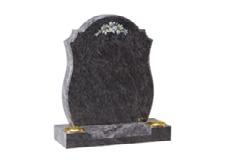
Gravestones and the Regimental Cap Badge
The dealing with the passing of a loved one is a traumatic experience at the best of times. If you wish to use the RGJ Cap Badge on your next of kin’s memorial there is a simple, but necessarily time consuming, process which will ensure
that you use the correct Crown Copyright design authorised by the MoD.
The following is from an email received from The Joint Casualty and Compassionate Centre (JCCC) of the MOD:
Private Memorials
“MOD owned insignia are protected under the Copyright, Design and Patents Act 1988 (as amended), Trade Marks Act 1994 (as amended) and the laws of heraldry. The Secretary of State for Defence is content to permit the use of appropriate specified MOD Crests or Unit Badges granted by the Monarch on Private Memorials of former Military Service Personnel postmortem. Permission is granted once all requirements set out have been met. The process for making a request can take several weeks. Therefore, please ensure you have read the process carefully and provide as much of information requested as possible to avoid delay. There is no minimum qualification of service. There is also no charge.
The Next of Kin of the deceased or persons representing the deceased need to make a request for permission to use a MOD Crest or Unit Badge on a Private Memorial in writing, using the form at Annex A. This should be posted or emailed to the address given.
The Joint Casualty and Compassionate Centre (JCCC) will acknowledge receipt of the request and once all the information required is received, they will confirm the service history of the deceased. When the service history of deceased has been confirmed JCCC will issue to the requestor a copy of the requested MOD Insignia and a letter permitting its use on the deceased’s Private Memorial.”
The system does progress at a somewhat sedate pace and can take several weeks but in the end, you should receive a high resolution copy of our cap badge as stored by the JCCC.
The Annex A referred is posted on to the main RGJA website with all the other information required to help you get our cap badge for a person’s gravestone. It can also be found following this link: https://assets.publishing.service.gov.uk/ media/5c530a8d40f0b625422c9631/Annex_A_to_ UseOfMODInsigniaOnMemorialsOrHeadstones-V3. pdf
Finally, it is Interesting to note that the Veterans Badge which was approved by Her Majesty Queen Elizabeth II is to be used as a lapel badge only and cannot be used on headstones.
Colonel Johnny Schute OBE
Colonel Johnny Schute
The Royal Green Jackets Association Key Personnel 2025
President Maj Gen James Gordon CB CBE 01962 828524 rgjacontact@gmail.com
Chairman Col Carron Snagge OBE DL 01962 828524 rgjacontact@gmail.com
Chairman Designate Col Johnny Schute OBE 01962 828524 rgjacontact@gmail.com
Vice Chairman Mr Simon Booth-Mason 01962 828524 rgjacontact@gmail.com
Webmaster Capt William Shipton 01256 895719 bill.shipton@btinternet.com
Editor Swift and Bold Journal Mr Kevin Stevens 07954 594451 rgjacontact@gmail.com
Photo History Mr Seamus Lyons 01279 723908 splyons@btinternet.com
Database Manager Mr Kevin Stevens 07954 594451 rgjacontact@gmail.com
Deputy Database Manager Mr Tony Williamson 07891 367429 rgjadepdatabasemanaer@gmail.com
In Memoriam Board Manager Mr Mark Adams 01442 380713 greenjackets_2001@yahoo.co.uk
Branch Contact Tel and/or Email
Aylesbury – Meeting second Sunday September to May holiday Graham Liggins 07764 151940 season June to September.
Central England – Contact Guy Myneet for information. Guy Myneet guymynett8172@gmail.com
East Midlands – Contact Len Dooley for information. Len Dooley 01623 239299 lennie_max_123@hotmail.co.uk
London – Meetings occur during branch functions. Gary Driscoll 01708 442662 Please check with Secretary for details. rgjldn@ntlworld.com
North East – Contact John Snell for details of branch John Snell 07931 161433 meetings and events.
North West – Contact Chris Rumble for information. Chris Rumble 01606 784288
Oxfordshire – 1st Tuesday of each month. Maj Andrew Bowes 07773 200085 8:00pm Volunteers Bar, Edward Brooks Barracks. rgja.oxford@gmail.com
South East Kent – Last Thursday of: January (AGM), March, June, Martin Garrett 07932 608695 September and November.
Wiltshire – Warminster Conservative Club 7:30pm for 8:00pm Bill Tyson billtyson@blueyonder.co.uk 1st April, 3rd June, 2nd September, 2nd December.
Winchester & District – Every 2nd Tues of the month at 7.30pm. John Fritz-Domeney 07801 386461 or 02380 465829 WOs & Sgts Mess Sir John Moore Barracks, Winchester. johnfd2@sky.com
Yorkshire – At Wakefield TAC 7:30 for 8:00pm, 4th Tuesday Stuart Anderson 01757 618081 every month except November, December, January & February. valerieandeson41@outlook.com
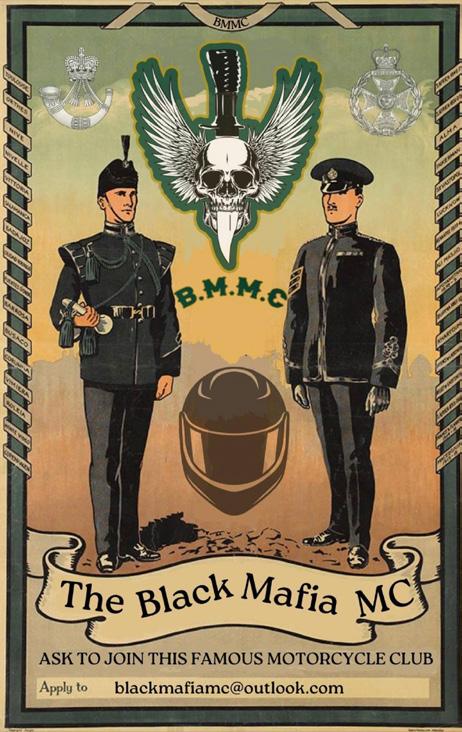
The Black Mafia Motorcycle Club Del Goody 07305 083933 See article for details of meetings etc. blackmafiamc@outlook.com
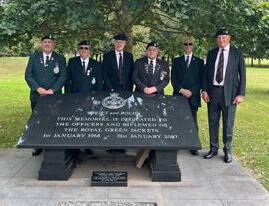
The Royal Green Jackets Roll of Honour
1 January 1966 – 31 January 2007
The Royal Green Jackets Roll of Honour records the names of all those, including attached personnel and those seconded to other regiments, who have died as a direct result of enemy action, in the act of conducting actions against the enemy or as a result of acts of terrorism since 1 January 1966 until 31 January 2007.
The names of all those serving in the regiment including those on the Roll of Honour who have died as a result of accident, illness, during training or from other causes are recorded in:
The Book of Remembrance The Light Division Chapel Sir John Moore Barracks, Winchester
Officers of the Royal Green Jackets commissioned from the ranks
1 January 1966 – 31 January 2007
Ranks and awards shown were achieved whilst serving within the
Some who served on after 1 February 2007 will have been transferred to THE
The
shown is the year commissioned.
Did you know that Care for Casualties is part of The Rifles Benevolent Trust?
The Trust Also Supports:
Simon's Joanne Booth-Mason Charity Golf Day – 29 August 2023
Care for Casualties
Simon Booth-Mason would like to thank all those Riflemen who kindly and generously contributed by whatever means to the Joanne Booth-Mason Memorial Fund / The Rifles Benevolent Trust in respect of the golf event on 29 August 2023 at Woking Golf Club to raise monies for The Rifles ‘Always A Riflemen’ (AARP) mental health programme.
It was a brilliant day, the weather was kind, the course in excellent condition, the Club were extremely helpful, and 72 golfers turned up who all enjoyed the day.
Lt Gen Tom Copinger-Symes presented prizes, Johnny Mercer MP Veterans Minister sent a short
video, Lt Col Baz Melia gave a short but hard-hitting introduction of AARP and we had two Buglers to tell us ‘lunch is served’!
Everyone was extremely generous whether via Just Giving, donations, match funding, raffle tickets or buying auction items and I am very pleased to say that, after RHQ audit, the funding raising event raised £39,199.31 in total. So, I am very grateful to you all and will ensure this monies is properly spent on deserving Riflemen in need of help.
The PRINT
Guru
Please call or email Nick to discuss all your printing requirements. From business cards to leaflets, newsletters to journals, posters, workwear, signage. Also, regimental menus and place cards with the RGJ badge, all at a competitive price, just mention this ad.
Would you like to publish your RGJ memoirs...
I can help you publish your own casebound book. If you have your text on a Word file, or similar, give me a call and I can help you. I can layout your text, design the cover, chapterise it, produce a contents page, create a 'forward', help you with pictures, graphs etc.
You don't have to have large numbers printed. I can produce 5 copies, or say 25 copies. If the book was to get popular and in demand, not a problem to produce 100 copies or even a 1,000.
The cost to produce 5 copies of an A5 casebound book, consisiting of 50 pages (100 sides) £100 to £120, and 25 copies of the same spec, £225 to £250. I will oversee all the production and delivery.
Always a Rifleman Programme Tesco Food Vouchers
T: 07522 757244
E: nick@theprintguru.co.uk
Thank you all.
With much appreciation and thanks, Simon
Regiments Welfare
The Rifleman’s Museum
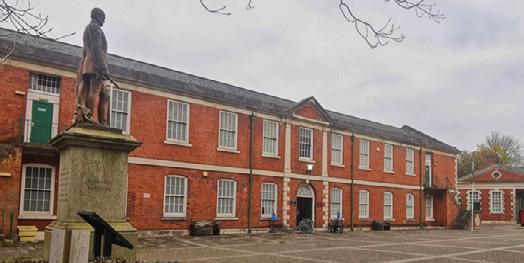
Most of you will know that The RGJ (Rifles) Museum in Winchester was renamed The Rifleman’s Museum on 31 January 2025.
Why has this happened?
A landmark study of Army Museums in 2012 recommended that by 2030 there should only be one MOD funded museum per active Army regiment. Whilst this was reasonably easy for regiments with limited amalgamations it has proved a much more difficult challenge for The Rifles who have 11 antecedent regimental museums, 4 of which are still MOD part funded. The RGJ (Rifles) Museum is one of these.
The Rifles are very proud of their rifle regiment heritage and battalions today have many of the characteristics you will remember from your time in the Green Jackets. The RGJ (Rifles) Museum holds the definitive rifle regiment collection and is therefore in the best position to help The Rifles make more of its history.
The Rifles therefore decided that the RGJ Museum should be their single MOD funded museum beyond 2030.
What are the implications for the museum?
• The museum has received a significant uplift in MOD grant in aid allowing it to hire two additional
members of staff.
• The Rifles will provide additional funding to help the museum’s running costs.
• A new lease can now be taken out on the building so that the rifle regiment collection remains secure at Peninsula Barracks in Winchester.
• The Green Jacket section will be enhanced with a new display allowing photographs and other media showing life in battalions and on operations.
• The entrance, shop and RIFLES display (2007 to present day) will be improved to show how rifle regiment characteristics are alive today and the regiment’s involvement in recent operations and contribution to the United Kingdom’s security.
• The museum will become a ‘hub’ museum for The Rifles helping establish rifle regiment displays in some of the other antecedent regiment museums.
• The office area will be developed to allow improved public access to records and research.
When will this happen?
The museum’s name was changed and a new website launched in January 2025 (riflemansmuseum.co.uk). It has been rebuilt from scratch and will eventually include a large collection of online stories and artefacts for remote access and to supplement museum visits. The Museum has also concluded a comprehensive tender competition to redesign the entrance, shop and RIFLES section of the museum. We expect to have some initial drawings by February with the design phase concluded by April followed by construction tendering and fundraising with completion later in the year.
This work will help inform plans for pop-up RIFLES heritage displays in other antecedent museums which we would hope to start rolling out in 2026. The reference and research area will follow on once
the new RIFLES display is in place.
This transformation will create a refreshed and living rifle regiment museum which celebrates the history and origins of riflemen and connects these to the current regiment. It is the best possible outcome for those wanting to ensure that the Green Jacket legacy endures.
The museum has funds for approximately half the cost of the project and so will be raising funds later this year to ensure its completion.
If you would like further information then please contact the Museum Curator at: curator@riflemansmuseum.co.uk or the Trust Chair at: trust@riflemansmuseum.co.uk
Swift and Bold!
D Day 1944 and Operation Deadstick
Editor’s Note: In producing this article, I want to thank General Sir Robert Pascoe KCB MBE for all his help in fact checking this article, making suggestions on photo placement, correcting text where I had made an error and adding detail which was not readily available to me. Without the generous help of General Bob I could not have produced this article to a standard I hope you will enjoy reading. I would also like to thank the Oxfordshire branch for their input through their own branch newsletters, once again a big thank you Kevin Stevens
Background and Timeline
Operation Overlord was the codename for the Allied operation which launched the invasion of Europe and the successful liberation of German-occupied Western Europe during World War II. The operation, which was the largest amphibious assault ever
undertaken, was originally scheduled for 5 June 1944 but adverse weather caused a postponement of 24 hours, so 6 June became D-Day.
The Normandy landings, codenamed Operation Neptune, saw 160,000 troops transported across the English Channel on day one with more than two million Allied troops having landed in France by the end of August.
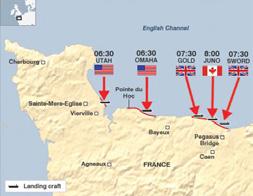
The decision to undertake cross-channel landings in 1944 had been taken at a conference in Washington in May 1943 with the Normandy coast in northwestern France being chosen as the site of the landings, with the Americans assigned to land at sectors codenamed Utah and Omaha, the British at Sword and Gold, and the Canadians at Juno.
To meet the conditions expected on the Normandy beachhead, special technology was developed, including two artificial ports called Mulberry harbours and an array of specialised tanks
nicknamed Hobart's Funnies. In the months leading up to the landings, the Allies conducted Operation Bodyguard, a substantial military deception that used electronic and visual misinformation to mislead the Germans as to the date and location of the main Allied landings.
The weather in early June was not ideal, and the operation, having been delayed 24 hours was in danger. Any further postponement would have meant a delay of at least two weeks, as the planners had requirements for the phase of the moon, the tides, and time of day, that meant only a few days each month were deemed suitable.
General Eisenhower eventually made the decision to go, and the huge operation got underway.
Operation Deadstick
Shortly before 23:00hrs on the night of 5 June, a force of 181 men, comprising D Company and two platoons of B Company, 2nd (Airborne) Bn the Oxfordshire and Buckinghamshire Light Infantry, as well as men from the Royal Engineers and a few medics, all under the command of Major John Howard with second in command Captain Brian Priday, took off from RAF Tarrant Rushton in Dorset, to carry out what was called a coup de main operation.
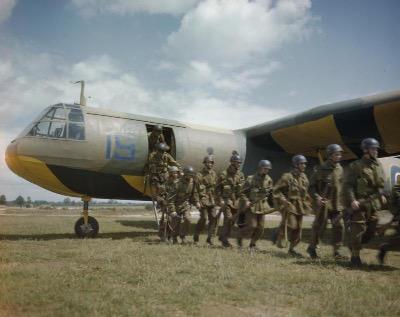
Each of the platoons in the six Horsa gliders were briefed, equipped and capable of carrying out the mission, which was the capture of two bridges, preferably intact. One at Bénouville, now known as Pegasus Bridge over the Orne canal and the other
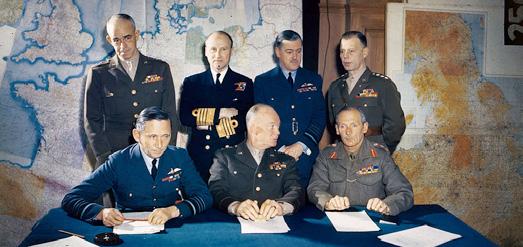
Meeting of the Supreme Headquarters Allied Expeditionary Force (SHAEF), 1 February 1944.
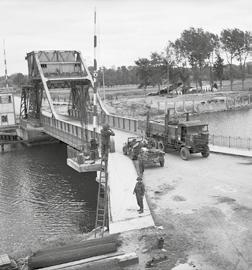
Bénouville Bridge
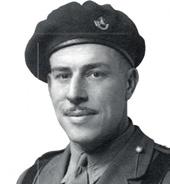
Major John Howard
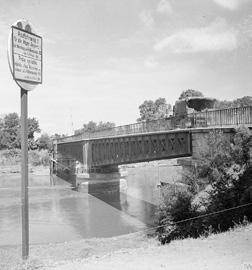
Ranville bridge
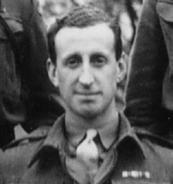
Lt-Col Geoffrey Pine-Coffin Capt Brian Priday
nearer Ranville, known today as Horsa Bridge, a few hundred yards to the east, spanning the Orne River. It was vital to capture these two bridges as they would have enabled German armoured units to counterattack the British bridgehead and they provided the only exit eastwards for British forces, so they were vital targets to ensure the security of the landings on Sword Beach. Intelligence reports said the defences around both bridges were being improved by the Germans and the bridges were wired for demolition.
The “Order of mission” signed by Gen Sir Richard Gale commanding the 6th Airborne Division, was to: “Capture intact the two bridges of the Orne and the canal of Caen at Bénouville and Ranville. The capture of these two bridges, which will be known as Operation Deadstick, is based essentially on the surprise effect, the mission execution speed and the determination to overcome. Counter-attack will be expected, and we will have to hold our positions until the arrival of the changing troops”.
The relief force would be the 7th Parachute Battalion which was to land about 30 minutes after the glider force and would take overall command once Lt Col Richard Pine-Coffin, their commander, had gathered sufficient men. Unfortunately, the bad weather resulted in the battalion being widely
scattered and consequently many were delayed in getting to the bridges.
John Howard was told the exact details of his mission on 2 May and from there on he planned and rehearsed his men over and over again without telling them the exact targets.
It would be fair to describe John Howard as a fitness fanatic. Daily, before breakfast, road runs and walks, route marches ad nauseam, were routine drills. One such fitness test involved marching 22 miles, in full battle order, in six hours. There was much cross-country running. All this in addition to "normal" sports like football, boxing, rugby, and cricket. Frontline transport was limited to Jeeps and trailers, and platoon handcarts, which may account for so much reliance being placed on movement by foot. Howard, expecting the invasion to involve night-fighting, changed the daily routine. For weeks at a time, they rose at 20:00hrs and completed exercises, drills and normal paperwork throughout the night before retiring at 13:00hrs.
When it became apparent that D Company would not be able to carry out the mission on its own Howard was instructed to select two more platoons from the battalion to join them. Howard chose platoons from B Company which were commanded
by Lts Sandy Smith and Denis Fox.
Any explosive charges found attached to the bridges were to be dealt with by thirty Royal Engineers from the 249th (Airborne) Field Company, commanded by Captain Neilson. Each glider had medics on board and there was one officer from 7 Para to act as liaison officer.
Howard’s operational plan was to attack both bridges simultaneously directing three platoons to each bridge with his infantry overcoming the troops on guard duty while the engineers located and dismantled any demolition charges.
Howard arranged training exercises to capture bridges in various parts of the country including six days and nights just outside Exeter where two bridges similar to their objectives were found over the Exeter Ship Canal.
On 5 June 1944, the company made final preparations for the mission. Just before the men boarded the gliders, codewords were issued. 'Ham' indicated the canal bridge was captured and 'Jam' the river bridge. Capture and destruction of the canal bridge would be signalled using the codeword 'Jack'; 'Lard' would be used if a similar fate befell the river bridge.
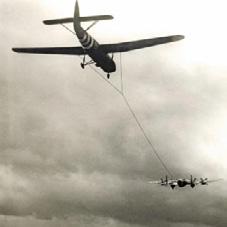
Flying over the English Channel at 7,000 feet the Halifax bombers towing the gliders crossed the Normandy coast at 00:07hrs on 6 June and released their loads.
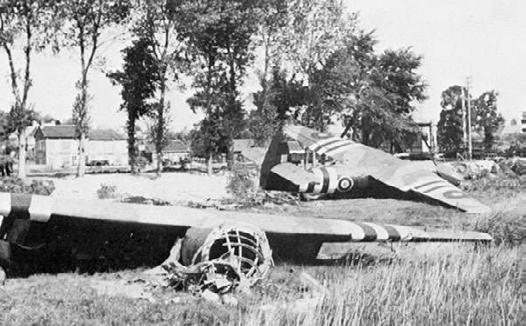
The 12 NCO pilots of the six gliders from 'C' Squadron, Glider Pilot Regiment succeeded in delivering the force to their objectives with only one exception. The first glider, piloted by Sgt Jim Wallwork, crashed into the barbed wire surrounding the canal bridge defences at 00:16hrs and Wallwork and his Co-pilot were thrown forward in the collapsed cockpit. Number two glider followed about one minute later. The third glider bounced over Number two and ended up broken in half and between the others. It came to halt at the edge of a large pond. One of the men, Lcpl Greenhalgh, was knocked unconscious in the crash landing and thrown out and died by drowning, becoming the first casualty of the operation. Two of the platoons headed off to cross the bridge, while the third moved to clear the trenches on its northeast side
After a brief exchange of fire, both bridges were captured and defended successfully against German counterattacks, until relief arrived.
While the Germans knew the invasion was
imminent, they did not know the exact location; Major Schmidt, in command of the bridges, had been told that they were one of the most critical points in Normandy. The defenders however were not on full alert on the night as the weather was deemed too bad for any attack. Only two sentries were on duty when the gliders landed and although they must have heard the crashing gliders, they assumed it was an Allied aircraft that had been shot down. They were not very inquisitive.
As Lt Brotheridge led his platoon across the canal bridge one of the sentries ran off shouting "paratroops" while the second fired a flare to alert nearby defenders. Brotheridge shot him while other members of his platoon raced across the bridge. Alerted by the flare, the German machine gunners opened fire at the men on the bridge, wounding Brotheridge as he threw a grenade. The grenade silenced one of the machine gun positions and another was taken out by Bren gun fire.
As planned Brotheridge’s platoon once across the bridge took up a defensive position on the west bank. Meanwhile the Royal Engineers searched for explosive charges under the bridge and cut fuse wires. Lt Smith's platoon crossed the bridge next, exchanging fire with the German defenders, whereupon Smith, who had damaged his arm in the crash landing, was wounded by a grenade. Using grenades and sub-machine gun fire, the trenches and bunkers were soon cleared.
By 00:21hrs German resistance around the canal bridge was over. Checking the area, the men of Brotheridge's platoon now realised that their leader was seriously wounded, and he died soon after without regaining consciousness thus becoming the first Allied soldier killed by enemy action during the invasion. On the east bank, as Lt Wood's platoon began clearing the trenches and bunkers Wood was hit in the leg by machine-gun fire. His platoon Sgt was also wounded and Cpl Godbold assumed command as the platoon continued its work.
Around the same time, pathfinders from the 22nd Independent Parachute Company landed in the area between the River Orne and the River
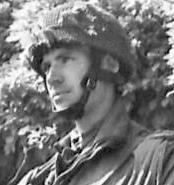
Lt Denham Brotheridge
The gliders at Bénouville Bridge
Dives. Brigadier Nigel Poett, commanding the 5th Parachute Brigade, along with a small team accompanied the pathfinders. Disoriented after landing, Poett heard Sten gun fire and set off for the bridges with the only man he could locate.
Lt Fox's glider (number six) was the first to land 330 yards (300m) from the bridge over the River Orne at 00:20hrs, while glider number four was missing.
When the Germans opened fire Fox’s platoon responded with a 2-inch mortar and destroyed the gun with a direct hit. They then crossed the bridge without further opposition. At 00:21hrs, glider number five landed 770 yards short of the bridge.
Lt Sweeney met up with Fox and left one of his sections on the west bank then moved the rest of the platoon across the bridge to take up defensive positions on the east bank.
From his newly established command post in the trenches back on the eastern bank of the canal bridge, Howard learned that the river bridge had also been taken. The engineers reported that although the bridges had been prepared for demolition, the explosives had not been attached. Howard ordered his signalman Cpl Tappenden to transmit the code words 'Ham' and 'Jam' then ordered Fox's platoon to go across the canal bridge, positioning them at the Bénouville to Le Port crossroads as the company's forward platoon.
At 00:50hrs aircraft carrying parachute battalions of the 6th Airborne Division appeared overhead and the paratroopers descended onto drop zones marked out by the pathfinders.
Howard began blowing the morse code letter 'V' on his whistle, to help guide the 7th Parachute Battalion to the bridges. The first paratroops to arrive at 00:52hrs, were Brigadier Poett and the soldier he had picked up en route. Briefed by Howard on the situation, they heard tracked vehicles and lorries moving around in Bénouville and Le Port.
On the main drop zone, only about 100 men of the 7th Parachute Battalion had made it to the rallying point and much of their signal equipment, machine guns and mortars were missing. Lt-Col Pine-Coffin, aware that his battalion was the only unit allocated to the defence of positions west of the canal, was anxious to press on to the bridges to relieve the coup de main force before the Germans began their counter attacks.
7 Para were expected to take over from Howard
soon after 01:00hrs but it was not until 03:00hrs that PineCoffin assumed command and ordered Howard to continue holding the two bridges while his men had pushed on over the canal and prepared their defences against the inevitable German attacks that soon developed.
But before that, tracked vehicles in Benouville were heard moving closer.
As the first vehicle reached the junction leading to the bridge, it was hit by a round from 'D' Company's PIAT anti-tank weapon fired by Sgt Wagger Thornton. The vehicle exploded, setting off its stowed ammunition, and two or three following tanks then withdrew.
The explosions went on for some time and helped to guide the scattered men of 7 Para.
Another PIAT action took place when at about 07:00hrs a small German gunboat came towards the canal bridge from Ouistreham and opened fire on some 7 Para positions. Pte Cheesely fired his PIAT and scored a direct hit which caused the boat to swerve into the bank and Cpl Godbold’s men captured their first prisoners. There was other excitement in the morning as 7 Para continued to be engaged in Bénouville as they fought off German attempts to recapture the bridges.
At about 10:00hrs a lone German aircraft appeared, and Howard’s men watched helplessly as a bomb fell towards the bridge. It was a good shot, for the bomb struck the tower of the bridge and then fell into the canal with a splash. Luckily the bomb did not explode. A dent in the bridge where the bomb struck can be seen to this day.
Howard’s mission was to seize the two bridges and hold unit relieved. As the morning wore on and the attacks on 7 Para continued ferociously Howard wondered just how long they could hang on. It was not until 13:00hrs that the first seaborne troops reached the bridge.
As recorded in the film “The Longest Day” Howard’s men were astonished to hear bagpipes in the distance but getting closer. Lord Lovat and his piper Bill Millin led the way along the towpath beside the
canal having landed on the beaches soon after 06:45hrs.
But Lovat had to press on, it was not his job to take over at the bridges and it was not until the evening of 6 June that Howard was able to hand over to the CO of 2nd Warwicks of the 3rd Division.
Taking stock of his command with job done John Howard was affected by the losses of friends and comrades. He had lost three officers, one being killed, and two wounded. One soldier was dead and 14 had been wounded.
In addition, two other officers were missing including his second in command, Captain Brian Priday. He was in glider Number 4 with Hooper’s platoon and their glider had been released by its tug aircraft in the wrong place. They had landed beside the River Dives, near Varaville about eight miles from their real target. So, they captured the bridge for good measure and then spent the whole day finding their way back towards the bridges to rejoin the company.
British advance on 6 June 1944.
On 9 June the Luftwaffe attacked the bridges with 13 aircraft. The British had positioned light and medium-sized anti-aircraft guns around the bridges and in the face of intense anti-aircraft fire the attack failed, although they did erroneously claim one of the bridges was destroyed by a direct hit.
Following Deadstick, the engineers, glider pilots and 'B' Company men were returned to their parent formations.
They collected various additional men as they waded and walked back, including several paratroopers who had been blown well off their drop zones, and a pilot of a crashed aircraft. When Priday eventually got his party back to join the rest of the battalion near Ranville he had brought 45 men safely to British lines.
Aftermath
Of the 181 men that landed with Howard in Operation Deadstick, two were killed and fourteen wounded.
Elements of 6th Airborne retained control of the area around the bridges until June 14 when the 5 1st (Highland) Division assumed responsibility for the southern part of the Orne bridgehead. Subsequent weeks saw British forces fight a protracted battle for Caen as Allied strength in Normandy grew.
Bénouville was the farthest forward point of the
D Company played its part in the 6th Airborne Division's defence and subsequent breakout from the Orne bridgehead, and the advance to the River Seine.
On 5 September 1944 when the 6th Airborne Division was withdrawn to England, all that remained of the original D Company were 40 men under command of John Howard, and he was the only remaining officer. All the other officers, sergeants, and most of the junior NCOs having been among the casualties in the Normandy campaign.
Honours and awards
Howard was awarded the Distinguished Service Order, presented in the field by General Bernard Montgomery.
Both Lts Smith and Sweeney were awarded the Military Cross for later actions in Normandy and the Military Medal was awarded to Sgt Thornton and Lcpl Stacey. Lt Brotheridge was posthumously mentioned in dispatches. In recognition of their impressive feat of flying, eight of the glider pilots were awarded the Distinguished Flying Medal.
The canal bridge was officially renamed Pegasus Bridge in 1944 in honour of the British Airborne's emblem and the Orne bridge became Horsa Bridge.
After the war the 2nd Bn The Oxfordshire & Buckinghamshire Light Infantry was awarded the Battle Honour ‘Pegasus Bridge’.
Sgt “Wagger” Thornton
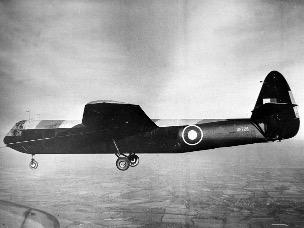
The Airspeed AS.51 Horsa
Editor’s note: Some of you will recall I have previously mentioned in an earlir edition of S&B that when growing up just outside Standlake in Oxfordshire we had a Horsa glider in our orchard which had crash landed there after coming loose from its tow during training possibly from RAF Brize Norton. All the important parts had been recovered but I guess it was too difficult to get down our lane to the farm to get the main body, so there it lay for the next 20 years or so rotting away or being used as firewood. Kevin Stevens
The Airspeed AS.51 Horsa was primarily a wooden troop-carrying assault glider, designed and built by Airspeed Limited, specifically for use during World War II.
The Air Ministry issued Specification X.26/40 calling for a large glider aircraft, capable of accommodating up to 30 fully equipped paratroopers, destined for operations in Northern France. Amongst the particulars was the instruction that the aircraft should make use of wood as its main construction material; in order to conserve critical supplies of metals The contract being awarded to Airspeed.
due to the constant threat of air raids and so the Airspeed team relocated to Salisbury Hall, at nearby London Colney. The final design for the new glider was completed in just 11 months.
With the designs complete, the first two prototypes were built at Salisbury Hall before being transported to the Fairey Aviation Works at Hayes where the first prototype (DG597) was first flown on 12 September 1940 by George Errington. It was first towed into the skies over West London and Berkshire by an Armstrong Whitworth Whitley
The war effort was in full swing at the parent de Havilland Aircraft Company, which had recently acquired a controlling interest in Airspeed, so the team was based in the classrooms of the de Havilland Technical School. This was not ideal,
As soon as production began, a number of suggested improvements and refinements were made. These resulted in the Airspeed AS.58 Horsa II which had a modified design featuring a reinforced floor, together with a hinged nose section in order to accommodate military vehicles for both transport and combat roles. Another significant upgrade was fitting a stronger twin nose-wheel, plus a modified tow attachment. With seating for up to 30 troops, the Horsa was much bigger than its American the Waco CG-4A which only had a capacity of 12.
The type's most famous sortie was carried out by six Horsas, codenamed Operation Deadstick and delivered an advance force of 80 paratroopers, on the evening of 5 June 1944, the night before the D-Day landings. These men, from D Company of the 2nd Oxfordshire & Buckingham Light Infantry, were transported by the Glider Pilot Regiment into the countryside, just four miles from the Normandy coast. Under cover of darkness and after an almost silent approach, they were responsible for successfully securing the strategically important bridge (now known as Pegasus Bridge) at Bénouville, over the Caen Canal in Normandy.
The Horsa was a major factor in a number of operations that followed the successful Normandy assault. These included Operation Dragoon and Operation Market Garden, which involved 1,205 gliders in 1944. A year later Horsas were involved in Operation Varsity (March 1945) when 440 aircraft carried soldiers of the 6th Airborne Division across the Rhine, in the type's final operation of the war.
All told, nearly 3,800 Horsas were built, with extensive subcontracting to furniture manufacturers. Airspeed built some 700 (695 at Christchurch), the Harris Lebus group adding around 2,700 others and Austin Motors Ltd a further 365. Due to the dispersed manufacturing of the subcomponents before final assembly at various RAF Maintenance Units around the UK, it is difficult to confirm a total production number, but some estimates vary from 3,799 to 4,000 aircraft. Despite this, only one complete original example survives today, although several replicas and cockpit/ fuselage sections are also on public display in Britain, France and the Netherlands.
Specification:
• Span – 88ft 0in
• Maximum Weight – 15,750lb
• Capacity – Pilot and 20-25 equipped troops
• Maximum Tow Speed – 150mph
• Glide Speed – 100mph
D-Day veteran recalls landing ‘in flying coffin’
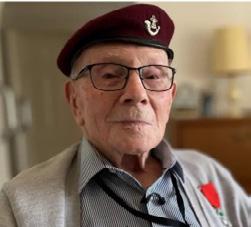
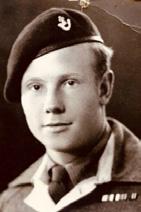
Below is an interview given by Mr John Arthur of the Ox & Bucks LI to BBC Lincolnshire in 2024, the D-Day veteran recalls landing 'in flying coffin”. Sadly, John passed away on 28 November 2024 at the age of 101 years old.
“We called them flying coffins,” says John Arthur. “They were made basically with wood – thin because they were only made for a one-way trip.” Mr Arthur is talking about the Horsa gliders. He was just 20 when he boarded one as part of the infantry heading to France on D-Day. They were towed behind bombers, then let go to land.
“The pilots used to, if it was possible, aim the glider between two trees or bushes so it would rip the wings off,” he recalls. “They could only knock the speed down to 90mph, so every glider was doing 90 when it hit the ground.”
I cannot hide my astonishment, as I ask him what it was like. “Ruddy awful!” he laughs.
Troops from the UK, the US, Canada and France attacked German forces on the coast of northern France on 6 June 1944.
Operation Overlord was the largest military naval, air and land operation ever attempted, involving the simultaneous landing of tens of thousands of troops on five separate beaches in Normandy.
At his home in Lincolnshire, Mr Arthur now in a wheelchair, with a whiteboard on the dining room table reminding him to drink his water. His son, daughter-in-law and grandson are with us, making sure he is not too tired; prompting him when his memory fails. No one can ignore Mr Arthur's age –
that it was used before the invasion of
general theme this issue.
he will be 101 later this year. But his descriptions are vibrant, complete with actions and sound effects.
"Were you scared?" I ask. He replies: "You all had thoughts, but I don't think scared came into it. You were more thinking about what will happen if you are lucky and landed safe. You soon found out, because as soon as you opened the glider then the Germans were bang, bang, bang."
While the story of D-Day might often focus on the Normandy beaches, those who arrived by air played a crucial role. Mr Arthur volunteered for the 2nd Ox & Bucks LI. Ahead of D-Day, it became part of the 6th Airborne Division. Paratroopers and gliderborne infantry were dropped into France behind the beaches to capture key targets such as bridges over the Caen Canal and River Orne.
the priority was to check the equipment and then the men. He says for troops like him there was little knowledge or thought about the scale of Operation Overlord.
“The likes of me didn’t know what was going on. All you knew was bullets coming from that way, mortars coming down from up there,” he says, gesturing.
Mr Arthur fought in battles at Escoville, Hérouvillette and at Château St Côme. As a machine gunner, it was his job to provide covering fire for the troops and while that meant he did not face hand-to-hand combat as others did, the machine gun crew had its own risks.
“Once you opened the Vickers, what did the Germans reply with? Their three-inch mortars,” says Mr Arthur.
There were horrors too. Mr Arthur describes going through a wood with the bodies of paratroopers hanging from the trees and on the ground.
“You wanted to help them, but we were warned by the padre, ‘don't go near them’. The Germans had booby trapped them.”
Eighty years on, the loss of friends is still something he feels. He suddenly covers his face with his hands and cries. “It just brings back memories – of Bob
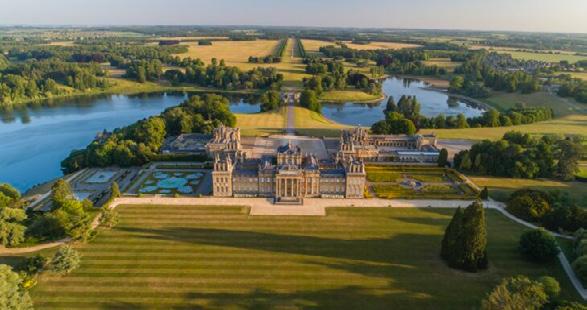
Blenheim Palace Lake, Woodstock, Oxfordshire
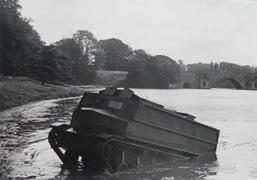
The lake was used as part of Opera-on Neptune, a Bri-sh project craI. Two prototypes, manufactured at the nearby Morris the Argosy and the Neptune.
The lake has an interesting history but why should it feature in S&B you ask? The answer is that it was used before the invasion of Europe in 1945 as a testing ground so fits in with our general theme this issue.
The ini-a-ve was something of a pet project for Churchill, counterpart to American landing craI. However, neither of invasion of June 1944, although one later saw use in the Middle
The lake was used as part of Operation Neptune, a British project to develop its own landing craft. Two prototypes, manufactured at the nearby Morris car factory in Oxford, were named the Argosy and the Neptune.
The initiative was something of a pet project for Churchill, who wanted to develop a British counterpart to American landing craft. However, neither of the prototypes was used in the invasion of June 1944, although one later saw use in the Middle East.
The large lake was also used to trial HMS Conundrum, a 250-tonne floating drum used to lay miles of oil and fuel pipelines under the Channel ahead of D-Day.
The estate was used by MI5 as well, as a temporary base after its London headquarters was bombed in September 1940.
Marlborough by Queen Anne his reward for his victory against 1704 Ba\le of Blenheim in 1704, the grounds were
The grounds were laid out by Lancelot 'Capability' Brown.
Blenheim Palace was built between 1705 and 1722 for John Churchill, the 1st Duke of Marlborough, by Queen Anne, his reward for his victory against France and Bavaria at the 1704, Battle of Blenheim.
Mr Arthur survived and got married before the Army
During WW2 German aircraI were using Blenheim Palace like a compass to find their way to all the important industrial was covered over so no reflec-ons showed. This would have Churchill knowing the Germans were using his birthplace as
During WW2 German aircraft were using Blenheim Palace Lake at Woodstock in Oxfordshire like a compass to find their way to all the important industrial Cities. Once realised the lake was covered over so no reflections showed. This would have particularly infuriated Winston Churchill knowing the Germans were using his birthplace as a marker.
The Airspeed AS.51 Horsa
Blenheim Palace Lake, Woodstock, Oxfordshire
The HMS floa-ng and ahead
The a temporary headquarters
September
Blenheim for John
laid out
London Branch
The Committee
Honorary President Colonel George Smythe OBE
Secretary Gary Driscoll
Treasurer Maria Driscoll
Committtee Officer Norman Morrison
Since last year we are delighted that we have again had an increase in the numbers of veterans joining the London Branch and we now have 220 members. We have sufficient funds in our bank account which enables us to book in advance the function halls for our annual events, and the hiring of transport and hotel rooms and tour guides for our battlefield tours etc.
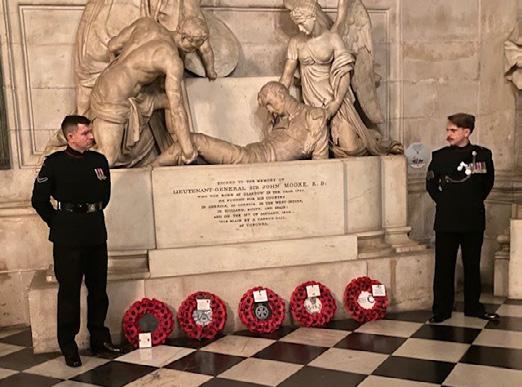
The first two events on our calendar in 2024 were held in January. The first being the Memorial Service and wreath laying ceremony for the anniversary of the death of Lieutenant General Sir John Moore, which is held annually at St. Paul’s Cathedral.
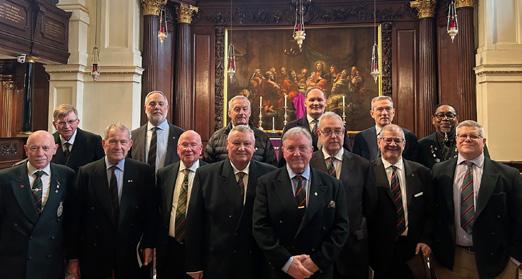
The second event was the Turning of the Pages of
the Book of Remembrance, which was held at St. George’s Church in Hanover Square.
The Turning of the Pages ceremony is a new event for members of the London Branch.
The ceremony was for many years held in the drill hall at Davies Street every Remembrance Sunday, by members of 4RGJ and then later 7 Rifles, to remember the fallen of the Queen Victoria’s Rifles, listing the names of the fallen from the 1st and 2nd world wars.
However, as you will be aware, the drill hall in Davies Street ceased to be available to the regiments, so it was suggested that we approach St Georges Church for the event instead.
The London Branch secretary, Gary Driscoll, attended several meetings with the Vicar and the Verger and had a significant part in the planning and organisation of the format for this new service to take place. It was decided that all future services will be held on a Wednesday afternoon every other month. Three members of the London Branch will read out the Five names from the Book of Remembrance of the Queen Victoria’s Rifles from both world wars, along with five names from the Royal Green Jackets. One member from either 7 Rifles or the Rifles Association will read out five names from the Rifles Book of Remembrance.
Neil Johnson, Chairman of the London Rifles Volunteer Trust and former CO of 4RGJ, organised the refurbishment of the old cabinet used for displaying the book. It was refurbished to match the oak of St. George’s Church, and a dedication service was held in 2023, in the presence of HRH the Duchess of Gloucester, Colonel in Chief of 7 Rifles. The book has been updated to include the names of the fallen of both the Royal Green Jackets and the Rifles.
The most recent service was held in November and well attended by London branch members.
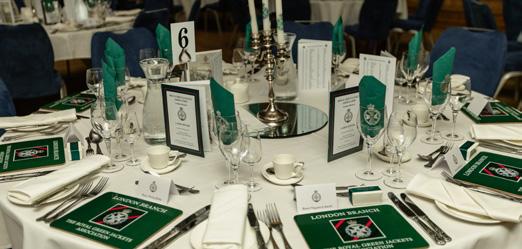
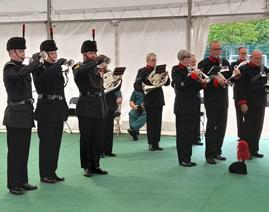
Every March we hold our flagship event, the Ladies Dinner Night, at the Victory Services Club in Marble Arch. On this occasion we had eighty people in attendance. The evening began with a reception with photographer who took photos of couples and groups. Cadets from the Kings Royal Rifle Corps were there to assist with ushering people to and from the cloak room and guide attendees to the reception and the main hall for the dinner. We were fortunate again to have a bugler sounding the three warning calls to let us all know when dinner was served.
The highlight of the evening was when the exbuglers entertained us with some of the more popular regimental marches and of course High on a Hill. After dinner and a very short speech by the Secretary of the branch, we proposed toasts which included a toast to: ‘The Ladies’ ‘The Regiment’ ‘Absent Friends’. This followed with the ‘ticket draw’ for the silver RGJ Ladies Brooch.
The DJ then continued the evening entertainment for us with music, getting everyone up on the dance floor, rounding off a fantastic evening with friends. Thank you to all those who attended this wonderful evening.
In May, thirty members of the London Branch, travelled once again to Calais for the QVR, KRRC and RB Defence of Calais Memorial Service to remember the many riflemen who lost their lives in the 2nd World War defending the port of Calais. Our secretary Gary Driscoll laid a poppy wreath on behalf of the RGJ association.
Turning the Pages St. George’s Church
Ladies Dinner Night
June was when we held our annual Veterans Lunch at 86 St James’ in central London.
It’s always a great opportunity for us to get together to mark Veterans Day. We held a raffle to help raise funds for our regimental charities, such as donations to help raise money for the costs of publishing this magazine.
Committee member Norman Morrison was on hand to chivvy everyone along to purchase raffle tickets. We take this opportunity to thank one of our longterm London Branch member, Mac McDonald, for again donating many prizes for this event.
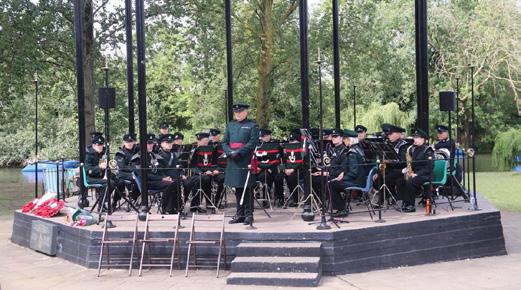
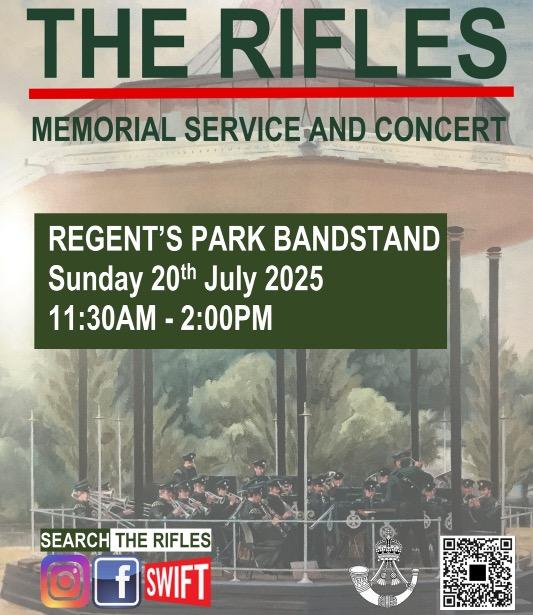
In July, we held our Band Memorial Service to remember the 7 bandsmen who were killed on the Regents Park Bandstand as a result of the terrorist bombing on 20 July 1982. We always choose the nearest Sunday to the 20 July, which allows more of our members and families to attend.
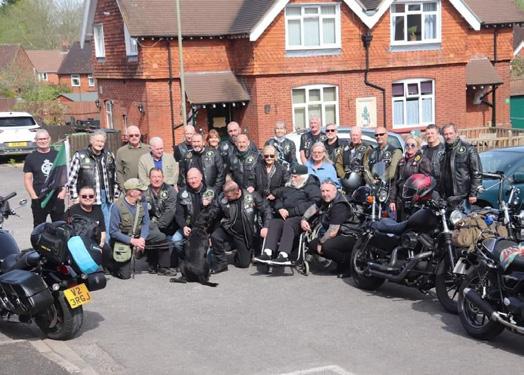
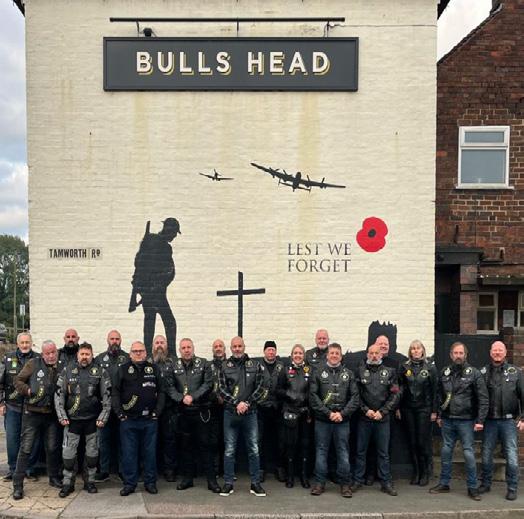
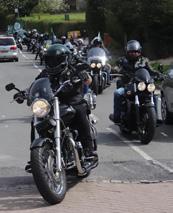
Over a hundred people attended this year, including the Lord Mayor of Westminster, the Mayor of Camden, and the Black Mafia Motorcycle Club.
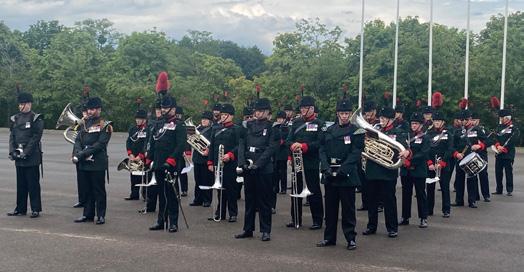
We were also privileged again, to have the Waterloo Band and Bugles to assist us by providing the music for the Last Post and the hymn. The service was followed by a concert directly afterwards.
On the 20 July 1982, a bomb had been hidden under the bandstand and triggered by a timer. The Band of the 1st Battalion of the Royal Green Jackets, were holding a concert at the time. Six bandsmen were killed instantly; the rest were wounded and the seventh died of his wounds twelve days later. Eight civilians were also injured. The IRA claimed responsibility for the attack.
Below are the names of the seven RGJ Bandsmen
who lost their lives on that day:
• Warrant Officer Graham Barker
• Sergeant Robert ‘Doc’ Livingstone
• Corporal John McKnight
• Bandsman John Heritage
• Bandsman George Mesure
• Bandsman Keith Powell
• Bandsman Larry Smith
The next service will be held on Sunday 20 July 2025, which will be the 43rd anniversary of the bombing. We are delighted once again to be joined by the Waterloo Band and Bugles to assist us and to perform a concert directly after the service.
In September we held our annual Battlefield Tour. 38 attended this year, setting off for a long weekend to Ypres in Belgium.
Whilst travelling to the hotel, we visited the CWGC Visitors Centre in Beaurains. We got to see the inner workings of one of the world’s foremost commemoration organisations workshops. It showed us an insight into every aspect of the work that goes into recovering and reburying the dead of the World Wars.
We saw examples of the work of highly skilled craftsmen, who maintain and care for the most impressive and recognisable war cemeteries and memorials worldwide, underpinned by the Commonwealth War Graves. From there we
continued onto our hotel in the centre of Ypres. The evening was free to explore the various local restaurants and bars.
The next day we looked at the many Rifle Regiments that served in the Ypres Salient, which included Prowse Point Cemetery. This is the only cemetery in the salient named after an individual, Major (later Brigadier General) CB Prowse DSO of the Somerset Light Infantry.
Prowse displayed great heroism during the fighting here in October 1914, but was later killed on the first day on the Somme in 1916.
The Ploegsteert UEFA Memorial was next on the itinerary. This football themed monument was unveiled in 2014 to mark 100 years of the famous Christmas Truce football matches, which took place between British and German soldiers. On Christmas day in 1914, It was here that the British and the German troops climbed out of their trenches and met in ‘No Man’s Land’ where the football matches (more than one across the area) were said to have taken place.
We then headed off to Ploegsteert Wood, otherwise known as Plugstreet. Here was home to many regiments throughout the war, with many of them being battalions of the Rifle Brigade and the King’s Royal Rifle Corps.
We took a walk through the woods leading us to the three cemeteries which are located there. We
visited
Regents Park Memorial
Veterans Lunch
Regents Park
Mud Corner Cemetery, Ploegsteert Wood Military Cemetery, and Rifle House Cemetery, which is a London Rifle Brigade cemetery. We laid a wreath here on behalf of the RGJ Association, followed by a two-minute silence to pay our respects.
We then moved on to Ploegsteert Memorial and Hyde Park Corner Cemetery. The memorial commemorates more than 11,000 servicemen of the UK and South African forces who died in this sector during the First World War and have no known grave. It stands in the Berks Cemetery Extension and opposite Hyde Park Corner.
From there we headed off to the Black Watch Corner Memorial, which is dedicated to the regiment. This bronze statue of a sergeant, was unveiled in 2014.
We moved on to visit the Hooge Crater Museum which has one of the best private WW1 museums. It has life size reconstructions of World War 1 battle scenes, an extensive collection of weapons, equipment and photographs. It was here at Hooge that the flamethrower was used for the first time against men of the Rifle Brigade and the Kings Royal Rifle Corps. The museum also organised a lunch for us there.
We walked over the famous Hill 60 that was once owned by the Queen Victoria’s Rifles. Their memorial sits proudly on the hill, although the original was blown apart by a German tank during the retreat to Dunkirk in the second world war.
From here we ended the day by visiting the Caterpillar Crater. The crater was formed by a mine which was exploded under the German position on the high ground south of the Ypres Comines Railway.
The following day we headed off to Gheluvelt and the story of the 2nd Worcester’s. This desperate battle saw the 2nd battalion of the KRRC make a stand in the pastureland south of the town and on the Menin Road, where they held the German advance back for almost one hour thanks to the work of Lt Jack Dimmer and his machine gun section.
We made progress and moved on to the remarkable Tyne Cot Cemetery which is the resting place of almost 12,000 soldiers of the Commonwealth Forces. It is the largest Commonwealth military cemetery in the world. At the back of the cemetery is the breathtaking Wall of Remembrance, containing almost 35,000 names.
We then visited Vancouver Corner Canadian Memorial. It commemorates the first use of gas used on the 22 of April 1915, which started the 2nd battle of Ypres, followed by a stop at the Essex Farm Cemetery. It was here that Lt Colonel John McCrae of the Canadian Army Medical Corps, wrote ‘In Flanders Fields’ in May 1915. Located within the cemetery are bunkers that were used as an Advanced Dressing Station and was here that McCrae worked. In this cemetery is the grave of a VC winner and also one of the youngest soldiers to die in the salient, Rifleman Valentine Strudwick of the Rifle Brigade.
Our next stop was the Shot at Dawn Memorial and Death Cells, in Poperinge Town Hall.
We visited the chilling and moving holding cells and execution post in the town hall courtyard, where those accused of desertion and cowardness met their end.
We stayed in the town of Poperinge for lunch and then moved on to the new cemetery which contains the largest number of soldiers who were shot at dawn.
The Football Match
Our next stop was the infamous Brothers in Arms Memorial, which is dedicated to the story of two brothers from Australia, Jim and John Hunter.
They were separated by death in the Great War. It was in these grounds that Johan Vandewalle, the man responsible for the creation of this beautiful memorial, allowed us to re-create the famous football match of Christmas Truce in 1914.
Tony Beach, one of our 4RGJ veterans, arranged for us to play a 5-a-side match, as we only had so many still swift and bold. The referee was Dennis Pearce, also ex 4th Battalion and brother of Stewart Pearce the ex-England captain, so we knew he would not be biased.
So, the ref (with clay pipe in hand) blew the 1916 whistle for our not so young footballers to kick off. The game started with England scoring two early goals and who managed to reach half time with the score a comfortable 2-0. Germany was then unfortunate to have had Timmy Driscoll sent off and things were looking bleak for them, so the German Barron Von Puddefoot faked a hamstring and was substituted for Ringer who scored a goal past our own Banksy, aka Gary Driscoll. Referee Pearce blew the whistle straight away for full time (all were maxed out) and it was a win for England! We took some momento photographs for the album, and retired to the bar for a glass of beer and a great talk by the owner Johan.
Our final visit was back near our hotel, where we all attended the famous Menin Gate Last Post and wreath laying ceremony.
Restoration work was still going on there which had started in April 2023, and is expected to go on until the summer of 2025. There was scaffolding along one of the walls, but there were still enough of the named panels visible. The parade still went ahead with Tony Morrell laying a poppy wreath on behalf of the Rifles, and our secretary Gary Driscoll laid a wreath on behalf of the Royal Green Jackets Association.
Ypres
Football match
The Players
Our annual Christmas lunch, was held at our usual venue, at 86 St James’. This year we had 70 in attendance. Members and wives/partners had great fun singing the Twelve Days of Christmas, where the people on each table must stand up when it’s their verse to sing! Everyone gave generously to the raffle and money was raised towards the cost of this publication. A huge thank you to Mac and Iona McDonald again for providing the raffle prizes.
The London Branch welcomes ex-riflemen of any rank to join us in supporting the RGJ family. If you would like to join the London Branch, please email: Gary Driscoll, Branch Secretary, rgjldn@ntlworld.com
We look forward to seeing our members at our forthcoming events, to mark our special 30th Anniversary year in 2025.
Forecast of Events 2025 – 30th Anniversary Year –
• Tuesday 14 January – Sir John Moore’s Memorial Service, St. Pauls Cathedral
• Wednesday 15 January – Turning the Pages, St. George’s Church
• Friday 21 February – Lord Mayor of Westminster’s Parlour
• Saturday 8 March – Ladies Dinner Night, Victory Services Club
• Wednesday 19 March – Turning the Pages, St. George’s Church
• Wednesday 21 May – QVR/KRRC/RB Memorial Service, Calais
• Wednesday 28 May – Turning the Pages, St. George’s Church
• Friday 20 June – Veterans Day Lunch, 86 St. James’
• Wednesday 16 July – Turning the Pages, St. George’s Church
• Sunday 20 July – RGJ Band Memorial Service, Regents Park
• Wednesday 17 September – Turning the Pages, St. George’s Church
• Sunday 9 November – Remembrance Sunday, Cenotaph
• Wednesday 19 November – Turning the Pages, St. George’s Church
• Friday 12 December – Christmas Lunch, 86 St. James’
We look forward to seeing you at our forthcoming events
Christmas Lunch
North East Branch
2024 has been another quiet year for the NE Branch.
John Snell had been Chair/Secretary but has stood down at the Jan 2025 AGM/Branch Meeting. Bob Newman has taken on the role of Chair/Secretary whilst John Kelly has remained as Treasurer. There were no planned activities during the year except for the quarterly Branch Meetings and the Annual Remembrance Weekend in November.
The branch had a membership of 43 members at the beginning of the year however some of our members have sadly passed away. Members subscriptions are due between January and April, until then we won’t have a final number. There hopefully will be more ex-RGJ/Rifles as it was proposed and passed at one of the branch meetings that former Rifles living in the area would be made welcome to join the branch.
The Branch held its annual Remembrance Weekend starting with a meet and greet in the Queen Vic Hotel on the Friday evening and the Remembrance Function took place in the ballroom of Grand Hotel Seaburn with over 80 members and partners attending. This consisted of a 2 course sit down meal, a band and disco. The members advised that it was an immense success and thoroughly enjoyed by all. It was proposed at the last branch meeting that we hold the 2025 function at the same venue as this year.
Members of the branch took part in the Remembrance Parade on Sunday Morning at the Sunderland Cenotaph. This was conducted with other members of the Light Division to make a larger contingent.
I can confirm that we have secured the ballroom of the Grand Hotel in Seaburn once again for 2025. So, watch our Facebook Page for future information nearer the date.
We do hope to be conducting other events this year but again this will depend on the members wishes and taking part in events that are proposed and organised if passed by the members.
North West Branch
We started the year without a branch but over a few pints and many conversations we decided that it would be criminal not to reform the branch to create a central focal point here in the Northwest.
Firstly, we formed a committee, then reached out to the national Green Jacket Association to show our commitment. Secondly, we recruited (pressganged) 35 members and set about organising events.
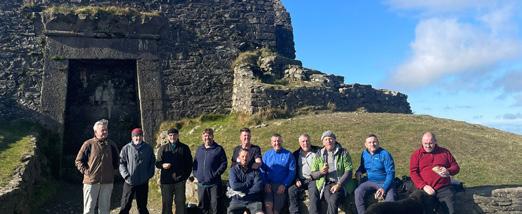
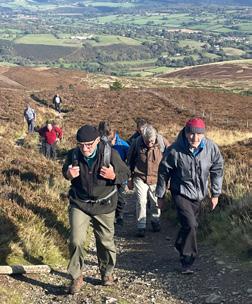
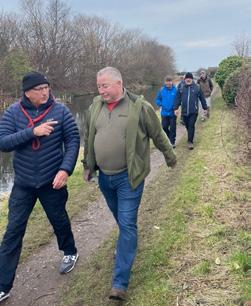
We have a monthly walk and have done Cumbria, North Wales, Liverpool Docks, Merseyside and Lancashire. These are not too arduous and normally finishes with a nice lunch. We have had a Crown Green bowls day at Hightown Bowls Club which was well attended and received.
We generally meet up once a quarter in Liverpool for a drink with food provided with members and other Association branches members attending.
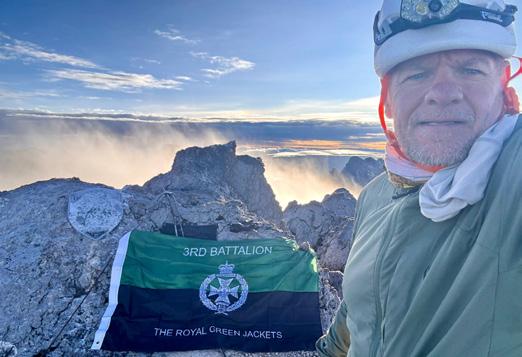
Our very own committee member Yozza Hughes has climbed various mountains around the world and has raised thousands for the branch and the
Branch has made donations to Always a Rifleman charity. He currently is training to scale Everest and walk solo to the South Pole.
Myself as Chairman of the Branch have organised a charity Golf Day for 1 August on behalf of my company Solid Sheds with all proceeds going to the branch. Anyone interested in playing, sponsoring or donating please contact Andy (Hazel) Hayes on: 07590 928003.
We are currently planning a meet up in the spring to visit the Western Approaches, the WWII bunker that protected the tactics of the British Armed Forces and organising a gentleman's dinner in October which seems provisionally to be a well-attended event.
Andy Hayes
Oxford Branch
The period since the last Swift & Bold has been a busy one with many events attended and celebrated by our branch members.
Our usual Spring lunch in April was, as always, well attended and thanks to Andrea Isham and Phil Evans we had good food and fine company. We invited two employees from the Oxford Tube Bus Company to join us as branch guests. This was to say “Thank you” to the Company who give free travel to Veterans who are attending remembrance events in London and on the local bus routes.
June as you can imagine was special with the 80th Anniversary of D Day both here and in Normandy. The branch was well represented at these events as other articles in this S&B will show.
In July we had our Annual Band Concert at Edward Brooks Barracks thanks to The Waterloo Band & Bugles of 7 Rifles and A Coy allowing us to use their Training Centre. It attracted record attendance from members and their families. Coupling this with the OBLI Reunion there were over 80 people present.
A “Sunday Roast” arranged by Angela after a really enjoyable performance by the band was well received and it also gave a chance for members to meet our new President, Lt Col (Retd) Tom Hamilton Baillie, who gave a short address after the concert.
Our Autumn Lunch in September has now been named “The Queen Elizabeth II Memorial Lunch” to remember our Colonel in Chief for many years.
In November members of the branch made the annual pilgrimage to the Field of Remembrance at Westminster Abbey, and many attended their local Remembrance Sunday Services with Wreaths laid in memory of the fallen of The OBLI (43rd & 52nd) and RGJ at St Giles War memorial in Oxford.
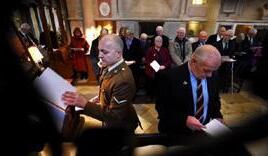
The Armistice Service on the 11th was again held in Christchurch Cathedral incorporating the Turning of The Pages (TOP). The Rifles provided the Conducting Officer as the rotation of three County Regiments continues.
The TOP services are well supported, and I would like to mention that they are open to all especially if you are visiting Oxford. We also encourage those
who know of relatives who gave their lives from WW1 to present day from OBLI/RGJ/Rifles to put names forward to be “Remembered” at one of the services.
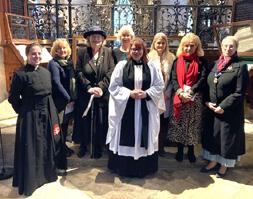
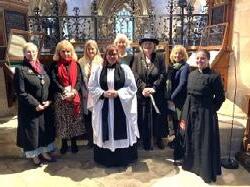
In January 2025 it had been decided to invite the Ladies to read the names – a resounding success.
It is amazing that there are still many Military memorials to our past still to be discovered locally. After attending the Holocaust Day memorial event in Oxford Town Hall my brother, Gordon, and I were asked to visit a nearby Church in Cornmarket Street and meet the Vicar. He showed us two Books of remembrance of those in Oxford from all arms who gave their lives in WW1 & 2 that belong to Oxford City Council. These were in a case along with another book commissioned by the Burma Star Association and there is also a stained-glass window in memory of the Burma Campaign. We hope that there will now be some plans by the Church to raise the profile of these with our support.
Wishing all our fellow Rifleman and their families good health and fortune.
Terry Roper MBE TD “Swift & Bold”
South East Kent Branch
Not so Swift these days but still as Bold...
Another year has passed, and we reflect on a busy itinerary designed to encourage more active participation and widen our membership. We remain resilient in our continued efforts on how we nourish and promote the longevity and ethos of the Rifleman.
This year’s AGM was held on the 26 April 2024, where we reconfirmed committee members: Fred
Barrett remains the President, and Martin Garrett has replaced Dave Ivatt as Chairman. The remainder of the committee remains unchanged with Barbara Barrett as Treasurer, George Nash Entertainments along with Gary Tingey, Tiny Tidnam in charge of media coverage, and Chris Clifford and Mo Docherty overseeing memorial services, we also
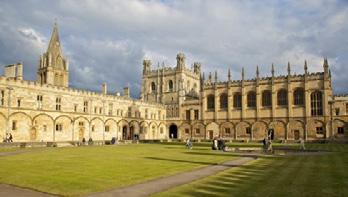
The Ladies at Christchurch Cathedral
extend our gratitude to our Padre Sean Sheffield for his continued services to the Branch.
Our breakfast meetings, held on the first Saturday of each month, typically has between 10 to 16 members attending and rotates between Dover, Margate, and Ramsgate, we continue to reach out to branch members across the southeast for other venues and meeting opportunities.
Key highlights of the year
Sunday 9 June 2024
This marked the 80th Anniversary of the D Day Landings and the battle of Normandy that led to the liberation of France and the rest of Western Europe, laying the foundations for the allied victory on the western front. Connaught Barracks, along with Fort Burgoyne and the tunnels beneath Dover Castle, played a pivotal role throughout World War II in planning and assembling of large quantities of men and supplies for shipment across the channel to the Western Front.
As in true Royal Green Jacket style, we continue to honour those who came before us and helped shape who we are today (those that gave their lives so that others could survive).
Sunday 28 July 2024
On behalf of the Royal Green Jackets Association
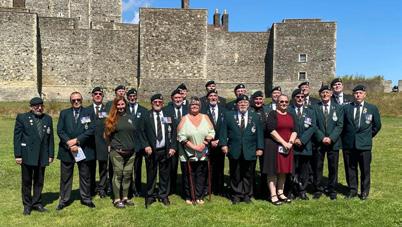
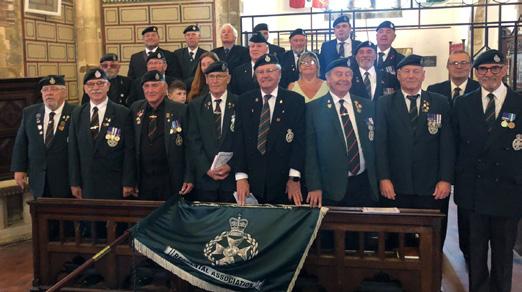
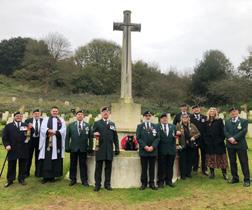
(RGJA), the RGJA SE Kent Branch presented a Regimental Standard to St Mary’s (Sub Castro) Church, which is located within the grounds of Dover Castle. Padre Sean Sheffield conducted the service, and Bugler John Harknett played both Last Post and Reveille. All three Battalions have served at Connaught Barracks (Dover), maintaining a strong connection between the Regiment, the Castle, and the people of Dover. This event rekindled this past alliance despite the Barracks being long gone. The Garrison Church and Castle are open daily and receive approximately 350,000 visitors annually. It is a National Heritage site, providing an opportunity for the “Royal Green Jackets” Regiment to be remembered and honoured in future years.
Saturday 24 August 2024
The Branch held a fund-raising sports and garden challenge event at the Anchor Inn (Wingham) for the “Lest we Forget Association” and “Porchlight” Charity. Despite bad weather, 14 teams (56 people) participated, raising £200 split between the two charities and we plan to make this an annual event.
Saturday 28 September 2024
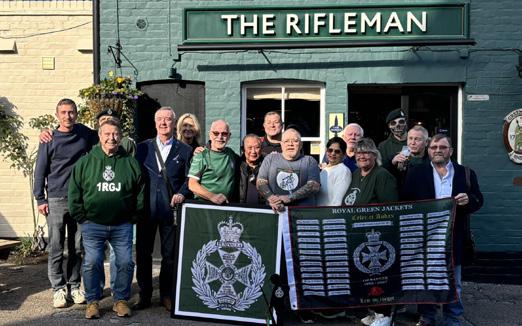
The Branch revisited the “Rifleman Pub” in Sevenoaks for a BBQ to encourage West Kent members to join. The event was successful, and we aim to keep the "Rifleman Pub" as a meeting venue outside of the Dover area. Sevenoaks has
strong military ties, and the pub, possibly an old guardhouse or SNCO’s Mess, has been linked to the supply of alcohol since Mr George Crouch, a Beer Retailer started it in 1871.
Sunday 10 November 2024
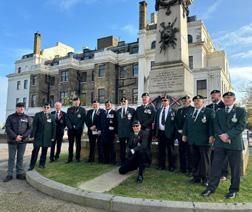
The Remembrance Service held this year in Dover Town Centre was well attended, after which the Branch proceeded to pay it’s respects at the 60th Rifles Memorial near Dover Sea Front within the Shorncliffe Military Cemetery. It is noteworthy that Sir John Moore Barracks was synonymous with the “Shorncliffe Method” where officers and soldiers were instructed in the principles of the then modern concept and tactics of using Light Infantry.
The units stationed there during the Napoleonic Wars significantly influenced military history, representing a new generation of soldiers trained to think independently and act on their own initiative.
An unusually high proportion of these soldiers were literate for their time. Additionally, in an era when many officers received no training, the light infantry officers practiced drills alongside the enlisted men. Their battlefield tactics marked the early development of modern military manoeuvres, often engaging in skirmish formations ahead of the British main battle line.
SSAFA Award: Syd Hopgood MBE
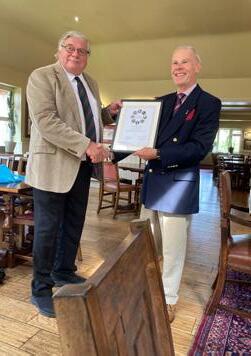
In recognition of the support given to SSAFA over the years, Syd Hopgood was awarded the Global Sir James Gidea Award for outstanding service to SSAFA.
The Award of which only 12 volunteers globally are honoured annually was presented by the President
of SSAFA Shropshire Major General
VR DL in July this year.
Syd joined SSAFA on the 21 September 2003 at Copthorne Barracks (formerly Sir John Moore Barracks) Shrewsbury whilst still serving and upon passing the two week caseworker course, became a fully qualified caseworker (CW) in the Shrewsbury Division of SSAFA holding various appointments over a period of 21 years. Well, done, Syd...
Crackett CB TD
60th Rifles Memorial Dover Kent
WW1 Plot and Cross of Sacrifice
Wiltshire Branch
The Wiltshire way is up
Once again, the first item in our calendar was the branch AGM. The most notable point of this was the change at the top: Bill Tyson stepping into the breach to become the fourth branch Chairman, taking over from Mike Walsh.
This was very swiftly followed by three of our members representing the branch at the local D-Day 80 anniversary celebrations at Minster Church.
The Annual highlight, the summer Barbeque which
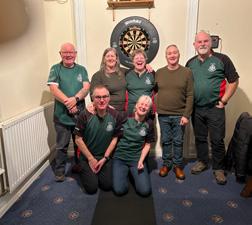
The first event of the year was the defence of the Faugh a Ballagh trophy at the annual charity trophy event, hosted by the local Royal Irish Rangers branch in the Warminster Conservative Club.
We managed a good number of players for this year’s event, playing Snooker, Skittles and Darts, with a horse racing finale. But sadly, we were unable to retain the trophy, instead settling for a creditable 3rd. Still, the night raised £338 for local charities so a win for all, nonetheless.
A quiet February was followed by the March and May quarterly meetings which nicely sandwiched a Sunday lunch at the Bell in Standerwick, a local village where 19 of us sat down to a delicious carvery.
A very busy June saw some of us supporting Capt. Dutch Holland’s weekend March from RAF Tarrant Rushton in Dorset to RAF Harwell in Oxfordshire which commemorated D-Day 80, by supplying an impromptu water point on the Bulford range road.
this year was hosted once again by Rich and Jax Ciereszko (CZ) followed. The theme this year was American country and western, which produced several fantastic cowboys and girls. Much fun in cowboy hats was had!
Supporting Dutch Holland’s D-Day 80 march
The January games night team Mick Walsh, Liz Stone, Jax Ciereszko, Shane Stone, Bill Tyson with Phil and Val Ashby (front)
Summer BBQ
August Sunday Lunch
DDay Church service June 24
Brian -Darvill, Mick Walsh and Gary Byrne
July’s now biannual gathering in the spiritual home, incidentally, not attended by too many Wilts members this year, and the NIVA assembly in September which did, sat either side of both the early September branch meeting and August’s Sunday lunch outing to Col Nufer’s Plume of Feathers pub in Shrewton, where 21 branch members and guests spent a cracking afternoon in one of Wiltshire’s hidden gems.
Remembrance season in Warminster has become one of the branches’ major occasions over the years. This year it began at the end of October with a small assembly to decorate Warminster town centre in preparation for remembrance weekend. ‘Painting the town red’ wasn’t quite the requirement but red was certainly on display, adding a more vibrant feel to the town.
This in turn led into collecting for the RBL poppy appeal. This year however, under the watchful eye of our very own Kev Severn, Warminster’s Poppy Appeal Coordinator, we accepted the challenge after arrangement with the store, of trying to collect over two weekends in Waitrose, instead of the normal one. This paid huge dividends as we hugely
surpassed expectations, collecting a very pleasing £4,490.07.
We did allow ourselves a little congratulatory drink after Sunday’s parade and service where several of us gathered, as usual under what we call ‘Green Jacket Corner’ before retiring to the Conservative
club for said suitable sustenance.
December’s quarterly meeting led us into the Christmas season which once again saw us gather for festivities on the eve. Another cracking afternoon spent in each other’s company sent us home for Christmas in fine fettle.
Warminster Garden of Remembrance
Kev Severn and Fellow veterans collecting
Warminster Remembrance parade
Dave Caws nd friend placing poppies through Warminster Town Centre
Gary Byrne and Tommy Byrne (facing) discussing remembrance issues
Winchester & District Branch
You will never know the value of a moment until it becomes a memory
I’m not sure whether it’s due to lack of sleep, stress, medication, low intelligence or just simply an age thing, but as someone with the memory recall of a goldfish I do envy people with exceptionally good memories. By that of course I don’t necessarily mean happy clappy fluffy sunlit recollections of their past, but a quite unique talent for recalling the most minute and obscure detail from their past lives and experiences.
Ok! So, I know my poor memory is probably due to all of the reasons given above, but I also like to think its maybe due to what I call my selective memory –well that’s what my wife calls it anyway. The strange thing is I have always been able to remember the really important stuff that my brain considers to matter but completely forget or at least disregard what it considers to be less important. For example, I can still remember how to strip down a GPMG, recall quite easily every military anacronym that has ever existed, and most importantly of all remember my regimental number, even after the 60 odd years since it was first issued to me. Mind you it’s also true to say memorising my regimental number was somewhat reinforced by the gagging and spluttering on chlorobenzylidene malononitrile (important stuff see) in a gas chamber!
As for the less important fluffy stuff, what can I say other than it includes, although not necessarily inclusively so, such things as my wedding anniversary, the birth date of every member of my immediate and extended family, and the worst of all – trying and failing to remember the names of people I was introduced to only moments before.
As a consequence, I do tend to get a little bit jealous of those who flaunt their elephantine memories on social media sites. You know the sort of thing. Someone posts something about old Mike Anonymous kicking his clogs, and someone else comes back and says, ‘yes I remember him that’s old Mike ‘Mismatched’ Anonymous who was a Ferret driver in B Coy 3RGJ in Iserlohn in 1967 who had a bunk by the washroom, and who had one size
8 foot and the other a size 11!’ What! How do they do that when I cannot even remember what I had for dinner last night?
So where does that leave me dear reader? Well, given I have now accepted I have the brain of a goldfish and therefore I will never be able to recall and articulate my memories with such fluency as others, I have resigned myself to doing it the hard way. Which usually means of course having to look back at old diaries and minutes of various meetings to see what I and the rest of the world have been up to! So here goes.
On the 1 January the branch together with other ex-members of the regiment celebrated along with family and friends the Regimental Birthday in the Sportsmen’s Club Winchester. As always, our ‘go to’ man Andy Spalding and his wife Sam really pulled out all the stops and laid on a superb birthday party and free buffet that was thoroughly enjoyed by all who managed to get there. As an aside please remember this event is not laid on exclusively for the Winchester Branch but for all ex-members of the Regiment who might be visiting Winchester on New Year’s Day.
With January over and with all the Christmas and New Year razzamatazz out of the way the next thing on our calendar was the branch AGM in February at which, and among other items of business our events and activities would be announced for the coming year. Also at the AGM, and I guess like most branches we also take the opportunity to try and encourage our members to step forward and take on various appointments within the branch ‘management team’. You know the sort of thing – Chairman, Secretary, Treasurer etc for the ensuing year. Now I don’t know about other branches, but this is without doubt one of the hardest things to encourage and persuade our members to take on. Not sure why there is such a reluctance to give these roles a go because our attendance average at all of our meetings suggests the support and enthusiasm within the branch is obviously there. And anyway, let’s be honest, you
don’t need the command ability of a Field Marshal, the brains of Einstein, and administrational skills of a Government Cabinet Secretary to run a branch of the association. Nevertheless, and despite having to almost get on bended knee, sadly the take up as always was zilch! So once again the Old Guard remained in office for yet another year for which we thank them most sincerely.
Although March was a fairly quiet month as far as our activities were concerned, we nevertheless had an interesting and encouraging branch meeting that month to which the new CO of SJM Brks ATR Lt Col James Phipps was invited. On addressing the branch later that evening James said “How wonderful it was to meet some of the ‘original owners’ of SJM Brks and pledged his continuing support of the ATR/RGJA relationship. A relationship and bond of mutual friendship and cooperation which has undoubtedly been enhanced over the years by the work of our ATR Liaison Officer our President Nicholas Prideaux.
I suppose in some respects it could also be perceived, particularly as far as our list of planned activities are concerned, that we might just be slowing down just a little. But the truth is, given the inevitable constraints on us all, particularly on our time and availability which is also somewhat constrained by our ageing membership with all the trials and tribulations that can often bring, we feel that we have now attained just about the right balance of activity for our members. As a consequence, our activities are now generally confined throughout the year to well established larger events, such as the Veterans Reunion in July and the NIVA/RGJA Services of Commemoration in September. Having said that, the branch still managed to host a thoroughly enjoyable BBQ in Green Jackets Close together with its residents in June, and of course it still continues with its everpopular biannual Quiz Nights with a fish and chip supper hosted and organised by our Chairman Roy Stanger and Treasurer Peter Andrews.
Nevertheless, and despite a small reduction in organised activity we continued throughout the year to participate in whatever was going on in and about the Winchester area. A little example of which was in April when the branch received an invitation from the RGJ Scout Group in Winchester to march with them at the scouts annual St George’s Day Parade in the city. Despite an ‘age concession’ being offered to the branch by the Scouts Group to give the actual march a miss and to meet them at the cathedral doors after the
parade, Tiny Adams in typical Green Jacket style decided to represent the branch and Regiment and march with them. Tiny your imposing frame and heart is as big as your toggle – and no that’s NOT a euphemism!
The summer once again saw us heavily involved with the Veterans Reunion in July which was a resounding success under the final hoorah of our inimitable Chairman Roy Stanger. Roy as many will know has now stood down from organising this wonderful regimental event, and in doing so goes with the grateful and everlasting thanks of us all. Talking about which, the question will undoubtedly be asked – where does this leave the reunion in the future? Well on the organisational side Roy’s departure does obviously create a vacuum which needs to be filled. The good news is it will be, so fear not on that score. However, the more pressing and worrying concern is the programmed closure of SJM Brks ATR in late 2026. If it does go ahead on or about that time it is hoped that one final reunion will be held there before it closes. Having said that, and despite rumour control going into complete overdrive on all social media platforms there has been NO confirmation received as yet that the ATR closure will go ahead. On a personal level I would like to think that given the financial constraints being applied by the government right now it never will be. But what do I know?
The only thing about the future of the ATR which appears to be a little more positive, is regardless of whatever happens to the ATR we are at least assured (so far anyway) that the Light Division Garden of Remembrance will remain untouched by any future re-development. This is really good and welcome news for the families of those exRiflemen whose ashes are scattered there, and of course not least for the considerable investment in time and labour by the branch, together with the financial support of the Regiment. The happiest people however will be our ‘Garden Guru’s’ both past and present, who over the years have given such selfless commitment and dedication to its maintenance. The latest of a long line being its current warden cum gardener Steve Harden (ex 3RGJ) who has put his heart, soul and many hours of hard graft into developing and creating such a wonderful and peaceful Garden of Rest.
The late summer and autumn months saw the branch involved in both the gathering at the NMA for the NIVA/RGJA Services of Commemoration in September, and of course the national Remembrance Day in November. The former
despite its respectful and dignified overtones was as always, a wonderful opportunity for a mini reunion and lunch at Lichfield Rugby Club organised by the CEB. Remembrance Day on the other hand being a national event was by its very nature a full-on day of activity in which the branch always gets heavily involved. First with the Service of Remembrance at the KRRC Memorial outside Winchester Cathedral at 09:00hrs, followed immediately afterwards by the main Service of Remembrance in the cathedral itself. As in previous years branch members were also invited by the ATR to attend an alternative Drumhead Service in SJM in Brks in lieu of the traditional cathedral gathering. An invitation which was accepted by many of our members who also took the opportunity to lay wreaths at the LD Garden of Remembrance and the LI Ballygawley Memorial adjacent to the ATR gymnasium. Once all the services were over branch members plus their wives, partners, family and friends all reassembled again to enjoy a superb Memorial Lunch in South Winchester Golf Club. A long and respectful day but an enjoyable one, nevertheless.
As the year drew to a close and with Yuletide just around the corner, the branch held its annual Christmas dinner for the very first time in Ampfield Golf Club near Romsey. It was really pleasing to see 67 very happy individuals sit down to a truly enjoyable evening of delicious food and superb wines plus of course our usual free raffle. Although the golf club obviously doesn’t have quite the same military look and ambience as a regimental mess it certainly matched it in warmth, décor and privacy which made it the perfect venue to end our year on. A wonderful evening was closed with seasonal greetings and best wishes from our President Nicholas Prideaux and a toast to the Regiment and Absent Riflemen from our Chairman Roy Stanger.
Finally, from all our members here in Winchester and the Hampshire surrounds we would like to take this opportunity to wish all of our fellow Riflemen and their families wherever they be around the world a Happy, Healthy and Prosperous 2025.
As Oscar Wilde once said, “Memory is the diary we all carry about with us!” Sadly, my memory will always have to be a paper version!
Yorkshire Branch
We continue to meet at the TA centre in Wakefield which is in the centre of town. We have a close association with our comrades in the KOYLI/LI association who also use the TA centre.
President: Hugh Goudge 1RGJ
Chairman: Thomas Conlin 1RGJ
Treasurer: Sue Conlin
Secretary: Stuart Anderson 1RB
We are fortunate to have a TAVR WO1 who opens the premises for us and operates behind the bar so that we can meet in the afternoon rather than the evening, this is because some of us have reservations about driving after dark.
We meet on the 4th Tuesday in the moth at 14:30hrs for a 15:00hrs start. We do not meet during the winter months from November to February inclusively. Our treasurer Sue Conlin who assumed the role upon the retirement of John Woods KRRC is keeping us financially solvent, this is no easy task for such a small branch.
We have adopted a revised system for sending out the minutes, the secretary writes them out long hand, they are then sent to John Lengthorn, his partner Stephanie who has a degree in English then corrects the text and types them up into the PC for onward transmission to those on the internet. The remainder receive their copy by post. It is an improved system and cost less as well.
Our first meeting of 2024 in March had to be cancelled due to unforeseen circumstances and our April meeting was missing John L who was in the USA. Also in the USA were our chairman and treasurer however Hugh Goudge stood in as deputy chairman for the meeting. We were indebted to our barman Vince for agreeing to open the premises for us. He deliberately cuts short his regular job at the post office to allow our meeting to go ahead.
We were represented at the Sir John Moore ceremony in York Minister earlier in the year by our President, Julie and Paul Crompton 7LI, the latter is an associate member and our own resident
history expert. Hugh read the famous poem about the burial of Sir John Moore at Corunna which he knows by heart now and Paul accompanied this with the eulogy he had written himself.
John FD
Light Division Garden of Remembrance - before
York Minster – Hugh Goudge reciting the poem “Burial of Sir John Moore”
At the May meeting the secretary was inconveniently upon the high seas bound for Trondheim in your actual Norway, all was not lost though as Paul volunteered to take the minutes. They were of a suspiciously high quality, and we later learned that he also wrote the minutes of the KOYLI/LI Association as well. At this meeting it was proposed to discuss the options and issues involved in recruiting new members in view of the fact numbers would inevitably dwindle over time.
It was decided that the annual lunch would be held at our previous venue, the Dulce Vita, in Wakefield as in 2023. The restaurant is quiet during the day and conveniently across the road from our HQ carpark with free parking for the disabled.
The meeting in June commenced with our usual toast to “Riflemen past and present” followed by one suggested by Paul Crompton to those who had fought at the battle of Vittoria on 21 June 1813, 211 years ago almost to the day. Paul was then thanked for his excellent minutes which were generally felt by those of a scholarly bent to be “Succinct and concise”.
The meeting continued with a discussion of the possibilities of some sort of amalgamation with
the KOYLI/LI association, Yorkshire branch. The president Hugh Goudge pointed out some of the complications and recommended that the matter be held in obeyance for two years which was agreed to.
Somewhere along the line I have missed out the unfortunate accident that befell our president Hugh Goudge who was in strict training for a subaqua holiday in Egypt later in the year. He had the misfortune to fall off a wall while hanging out his wetsuit to dry. He landed awkwardly and sustained a nasty fracture to the pelvis. When I spoke with him, he was still in hospital, but I have to report his venture into Egypt actually took place later in the year and was a success.
The July meeting coincided with the 53rd anniversary of the happy day Tom and Sue Conlin first encountered each other. We also had a report of the ceremony in York Minster to mark the 80th anniversary of the battle of Kohima in 1944. Our members have taken part in these ceremonies for a good number of years. They are always followed by lunch at Imphal barracks with transport to and from the Minster preceded by light refreshments in the Sgts Mess.
In August the branch lunch took place at the Dolce Vita and was pronounced a great success. For this much credit must go to our treasurer who did the organising and to the restaurant staff who were excellent in all regards.
The secretary was unwell and unfit to drive at the time of the meeting. In his absence the deputy secretary Stephanie volunteered to take the minutes which earned her a mention in dispatches. This was in September and after the NIVA ceremony at the NMA during which the secretary was fit enough to march to the Ash Grove but not back again. As he and Valerie were leaving by the main entrance, they encountered Mark Westbrook who is a member of the Winchester branch now, but he was formerly a Yorkshire branch member. Mark and David Bloomfield 2RGJ founded the branch in 1997.
During the Autumn at our last meeting a raffle took place, and a lavish buffet was provided by our treasurer and Lisa Elmore the wife of Peter who served in 1RGJ.
Our members took part in several Remembrance parades and services one of which involved a march through Wakefield to the cenotaph with refreshments in the mayor’s parlour.
Our last gathering was as guests of the Wakefield KOYLI/LI Association at their Xmas party in the richly decorated drill hall. We were entertained by a trio of musicians who were reminiscent of some of the cast of “last of the Summer wine”. Last year it was the Everley brother!
Stuart Anderson Hon Sec 1RB
Wives of members at Dolce Vita Branch Lunch
Valerie Anderson, Stephanie, Julia Goudge, Lisa Elmore, Sue Conlin
Members at the funeral of our original chairman Fred Williams RB Tom Conlin, Hugh Goudge John Lengthorn, Bugler Craig Rosser, Sue Conlin and Ernie Blanchard
Members at Shepherd VC Ceremony (some time ago)
Bill Broadbent RB, Lewis Austin KRRC, Bill Gledhill RGJ, Rod Ball KRRC, David Bloomfield RGJ and Arnold Senior KRRC (All but Bill Gledhill are now deceased)
The Rifles – Annual Report 2024
Rifle regiments rarely stand still and true to form 2024 has seen plenty of activity both abroad and in the UK, with our Riflemen working at pace operationally, on the home front and also enjoying plenty of sport and adventurous training. Peter Corbin
Introduction
Rifle regiments rarely stand still and true to form 2024 has seen plenty of activity both abroad and in the UK, with our Riflemen working at pace operationally, on the home front and also enjoying plenty of sport and adventurous training. The five pillars that sustain The Rifles (Regulars, Reserves, Veterans, Cadets and our Communities) have mutually supported one another through a year of much change, as the busy battalions adjusted or bedded further into their new roles.
The geopolitical situation remains fluid, demonstrating the importance of RIFLES battalions being ready for any eventuality. Our Riflemen have been on operations in Estonia, on the NATO flank keeping the country safe from Russian aggression, whilst also continuing to train Ukrainian personnel on Operation INTERFLEX. Furthermore, troops have been in Kenya on major exercises and provided support on the ground in other areas of the Middle East and elsewhere.
Operational and Training Activities
In 2024, 1 RIFLES continued its role as the Regional Standby Battalion (RSB) in Cyprus, amidst heightened Middle East tension. Preparations are underway for the battalion’s 2025 return to
Chepstow and conversion to a Light Mechanised Infantry role under the 7th Light Mechanised Brigade Combat Team, contributing to NATO's Allied Reaction Force. This year, key operations included supporting Gaza evacuations via the Rafah Crossing in Egypt, deploying to the West Bank, and acting as the UK's Emergency Response Option for Lebanon evacuations. Training highlights featured joint exercises with 40 and 42 Commando, company size missions in Oman, and conducting Support Company weapons cadres in Gibraltar and Germany. A challenging JNCO Cadre in Cyprus qualified 47 riflemen for Lance Corporal promotion, and driver training commenced as part of the battalion’s new capability development. 1 RIFLES is preparing a Sounding Retreat for April 2025 to mark its departure from Cyprus next Summer.
2 RIFLES has been particularly busy, and the battalion has excelled through rigorous training and operational achievements, highlighted by a successful validation exercise in Kenya, ensuring future battle-readiness. Early in the year, 27 Riflemen graduated from the JNCO Cadre in Northern Ireland, attended by Your Majesty, while 11 Riflemen performed extremely well in the jungle environment at the 1 Royal Gurkha Rifles JNCO Cadre in Brunei. I Company led the
Brigade Battle-Winning Capability Cadres, training over 550 personnel and setting a benchmark for brigade-level training. The Battalion supported Exercise ULU WARRIOR in Brunei, trialling cuttingedge technologies under jungle conditions. The year concluded with Exercise HARAKA STORM in Kenya, a 42-day battlegroup deployment replicating modern warfare, piloting the Army’s Land Training System, and testing 650 personnel against the Scots Guards, where Riflemen demonstrated their operational excellence and innovation to secure success.
Throughout 2024, 3 RIFLES demonstrated its adaptability, transitioning from the short-lived Security Force Assistance (SFA) role to the Tactical Recce Strike role, their sixth transformation since 2014. While the SFA role focused on fostering partnerships in the Middle East, this shift refocused the battalion on core soldiering and specialist weapons skills for warfighting in Europe. Highlights included the return of the Chesterman Trophy, a demanding platoon competition named after a fallen Rifleman, and the challenging Exercise HARAKA SPEAR in Kenya, where the battalion
OTX Oman
Anti Tank Javelin Live Fire on 4 LBCT BWC Cadres
2024 Chesterman Trophy March & Shoot on the Pentland Hills
refined light infantry tactics despite its recent structural changes. While SFA training faced logistical challenges, 3 RIFLES built valuable Middle East connections, delivering high-calibre training to the Saudi Arabian National Guard and the Kuwaiti Armed Forces, earning praise from senior military leaders and diplomats. Additionally, B Company participated in a multinational exercise in Turkey, culminating in a helicopter assault operation.
Over the past year, 4 RANGER has expanded its global footprint, focusing on the Middle East by assisting Jordan with border security under King Abdullah II’s guidance, aiming for NATO validation
in 2025, and working in Lebanon on intelligence and contingency planning. In response to Russia’s illegal invasion of Ukraine, the unit has deepened NATO commitments, with plans to lead the UK’s Land Special Operations Task Group in NATO’s Allied Reaction Force, targeting NATO Special Operations Force validation in 2026 – a UK first. Collaboration with US Special Forces remains strong, with permanent instructors assigned to their advanced urban combat course. The battalion’s success is driven by its personnel, who have received accolades for excellence, with recruitment thriving from The Rifles and The Royal Gurkha Rifles. Gurkha traditions and family events like Salamanca
Day enrich its emerging new culture.
In 2024, 5 RIFLES excelled in Mission Ready Training (MRT) in Germany, completing a Command, Staff, and Tactical Training Exercise (CSTTX) that validated its warfighting capabilities for Operation CABRIT in Estonia. Partnering with the French 4th Coy Troupes de Marine, the battlegroup achieved outstanding results in offensive, defensive, and delay missions, earning top marks. For Operation CABRIT 14, Headquarters, B, and Fire Support Companies deployed to Estonia under NATO’s Forward Land Forces Battlegroup. The mission integrated the Battalion with the 1st Estonian Brigade to deter Russian aggression and enhance NATO unity. The deployment featured major multinational exercises like BOLD BUGLE and SPRING STORM, involving 15,000 troops from 15 countries, and showcased interoperability, public engagement, and operational success. The Battalion also spearheaded warfare development through the CABRIT Battle Laboratory, refining tactics to meet the Army’s goals for increased lethality by 2027. This work included creating a comprehensive battle book and advancing interoperability with French and Estonian allies. Leadership development flourished, with 42 Riflemen promoted to Lance Corporal after completing a cross-cap badge PJNCO course, with
HRH the Duchess of Edinburgh attending their pass off parade.
6 RIFLES, the first of our 3 Reserve Battalions, had a productive year, focusing on enhancing lethality in alignment with 19th Light Brigade and 1st (UK) Division priorities. The Battalion’s primary training event, Exercise IBERIAN STAR in Spain, marked its first overseas exercise since Covid-19, adapting effectively to the absence of the Spanish Army due to a flood disaster. Operational contributions included deployments on Op INTERFLEX to train Ukrainian Armed Forces, a Force Protection Section in Kenya, and the Regimental Medical Officer supporting operations in Cyprus, Italy, and Spain, with further mobilization for Op TOSCA 42 in Cyprus, alongside 8 Riflemen.
7 RIFLES also had a highly productive year, focusing on soldiering skills, recruitment, and operational support for the Army Reserve. Key activities included deploying a Light Role Company for Live Fire Tactical Training in Northern Ireland during Exercise SPEARPOINT 3 and delivering a Battlegroup Headquarters for Exercise RAU FIST. Operationally, the battalion contributed to missions such as Op INTERFLEX in Ukraine, Op CABRIT in Estonia, and a deployment to Nairobi under 77 Brigade. Training successes included infantry
Op CABRIT
Riflemen 'float' the flag with pride on Exercise DRAGON DIVE in Cyprus
Peninsula Resolve Stretcher Carry
trade qualifications, basic training completions, and career course advancements. The battalion also maintained strong community engagement, supporting over 100 events, Army Cadet Force activities, and The Rifleman’s Association to foster our ties with veterans. The year concluded with a Christmas Carol Concert at St. George’s Church, attended by HRH The Duchess of Gloucester, celebrating 7 RIFLES’ regimental traditions and community involvement.
8 RIFLES continues to lead innovation within 19 Light Brigade, driving modernization in the Army Reserve. Its Headquarters Infantry Reserve "Skirmish Group" pilot, advances modularization of support weapons, enhancing lethality, manoeuvrability, and survivability in line with “How We Fight 2026.” During 2024 the Battalion supported operations such as Op INTERFLEX, force protection for the British Army Training Unit Kenya, DESERT KHANJAR, and Special Forces tasks, both in the UK and overseas. Training remains central in the battalion, with success in support weapons cadres, including top 5 placements in 2 RIFLES' anti-tank cadre. A highlight of the year was Exercise SAVA STAR, a NATO interoperability exercise with Croatian forces, with preparations underway for Army’s Special Operations Brigade’s RANGER validation exercise in 2025.
Regimental Health
Recruitment and Retention: The Army continues to face significant national recruiting challenges but there are some early signs of an improvement. Regimental recruiting ceased in 2023, following the introduction of agnostic Infantry loading into training, that sees The Rifles receiving around 20% of those that volunteer to join the ‘Line Infantry’, with the Gurkhas, Foot Guards and Parachute Regiments loaded into their bespoke training packages separately. This has not worked well for The Rifles, who previously attracted a healthy inflow of new recruits, and measures are being implemented to improve the situation. The net outcome is that in 2024, The Rifles received about half of the number of new recruits it needed to match its outflow. This was mitigated by the reduced Workforce Requirements brought about by the changes of battalion role. In relative terms, The Rifles workforce remains comparatively healthy when looked at across the wider Infantry.
Welfare: The Rifles was characteristically forward leaning when it formed in 2007 by pooling together its various welfare funds such that Regimental Headquarters (RHQ) could support all Antecedent, Forming and RIFLES folk equally, based on their needs. 2024 saw another busy year for Welfare
and Benevolence. RHQ provided significant block, welfare grants to each battalion and separately processed around 600 individual applications, disbursing around £375,000. Most funds disbursed were for our veteran community; with serving personnel accounting for only around 5% of the overall total, including compassionate flights home for our Foreign and Commonwealth Riflemen. Around 25% of the total amount disbursed was used for mental health counselling fees and the majority of these were referrals from our Always a Rifleman Programme (AARP). The AARP is proving to be very successful, setting the Army wide gold standard for regimental support to mental wellbeing, and held a hugely successful seminar in London in November.
Extracurricular Development
Despite such busy battalion programmes, 2024 has seen plenty of sport and adventurous training undertaken by Riflemen.
1 RIFLES: In 2024 the battalion fully leveraged the extensive sporting and adventure training opportunities available in Cyprus participating in paddleboarding, kayaking, and wakeboarding in addition to skydiving, mountain biking, and scuba diving certifications. Scuba diving emerged as a highlight, culminating in the upcoming Ex HURGHADA CHALLENGE, involving 26 Riflemen in the Red Sea. Sporting achievements saw strong performances in rugby, cycling, and distance running, with members earning regimental colours. We excelled in the Commander British Forces Cyprus (CBF) Cup, particularly in swimming and the ultra-marathon Cyprus Walkdown. In December LCpl Hale was awarded Infantry Sports Person of the Year after some incredible road cycling performances in 2024.
2 RIFLES: Despite a demanding operational tempo, the Battalion prioritized sport, adventure training, and community engagement. Over 70% of personnel participated in adventurous activities during the Kenya deployment, including a Mount Kenya summit by 15 Riflemen after 42 days in the field. Nordic skiing teams achieved divisional and Army-level success, with Capt Emily Smith retaining her Army and national titles, while rugby players Rfn Qorowale and Rfn Ravuvu earned professional contracts with Ampthill RFC. Boxing champions LCpl Caws and Cpl Taylor excelled at the Army Championships, with Cpl Taylor also claiming the Ulster 75kg title. The Battalion supported Kenyan community projects, aiding a young mothers’ orphanage and Restart Africa, and domestically
facilitated the relocation of a memorial for Cpl Coughlan and Pte Swanick, ensuring their sacrifices during the Op BANNER operation in Northern Ireland are honoured.
3 RIFLES: This year, 3 RIFLES embraced a diverse range of adventurous training and sporting achievements despite significant restructuring. Deployment to Kenya enabled activities like rafting, canoeing, and climbing, with a team summiting Point Lenana (4915m) on Mount Kenya. Additionally, riflemen trained in the Highlands and participated in a ski trip to the French Alps. Sporting highlights included success in cross-country, two Riflemen joining Army under-23 teams, and the return of a battalion boxing night featuring 15 novice boxers.
5 RIFLES: In 2024, the Battalion excelled in shooting, adventurous training, and sports. The Rifles’ Shooting Team achieved third place at the Army-level competition and won an international contest against Oman and the Netherlands. Adventurous training saw 33% participation, with activities like skiing, sea kayaking, and mountain biking in Bavaria and Estonia. Notably, 75 members will complete Ski Foundation training in Tignes during Exercise SNOWBADGER XIII. In sports, the Battalion participated in events like the Tallinn Ironman and Marathon, won three Army Indoor Rowing League categories, and hosted the Brigade Inter-Unit boxing event. Soldiers represented the Army in triathlon, rugby, and netball, with highlights including LCpl Cozens qualifying for the Ironman World Championship and Rfn O'Malley excelling in netball. The Nordic skiing team retained the Infantry Championship, dominated the Divisional Championships, and won silver at the Army Championships. Exceptional individual performances included LCpl Carter joining the British Biathlon Union and Rfn Webber being named top junior novice.
6 RIFLES: The Battalion conducted Exercise WYVERN ATLAS, a 130-kilometer trek through Morocco's Atlas Mountains, including summiting North Africa's highest peak. We also engaged in diverse activities such as Mediterranean diving, sailing in Cyprus, and powerboating courses in Cornwall, with its ski expedition, Exercise FROSTED WYVERN, planned for February 2025. 14 Riflemen competed at the Army level in various sports, including surfing, hockey, and carp fishing, and Rifleman Bennett retaining the Army Female Enduro Cycling Champion title.
7 RIFLES: Exercise SPEARPOINT 3 offered
Riflemen Adventurous Training in Northern Ireland and cultural visits, while G Company organized additional training in the UK, including mountain biking in the Forest of Dean. The battalion’s Alpine Skiing team will compete in Exercise FROSTED BLADE in December, aiming to surpass last year’s silver medal performance. Individual achievements included OCdt Jones joining the Army High Performance Pathway for Canoeing, Capt Hannan’s selection for Army Indoor Rowing, Musician Thompson playing for the Army Reserve Women’s Football team, and Lt Pratt representing Infantry and Army Hockey teams. The battalion Cricket Team had a standout year, finishing as runnersup in the Inter-Battalion T20, while the golf team retained the Florence Cup, continuing strong ties with the Haberdashers’ Company through events like the annual cricket fixture at Burton Court.
8 RIFLES: This year, 8 RIFLES excelled in adventure training, defying Reserve trends with activities like sailing and skiing. Several Riflemen represented the Army in sports, including LCpl Myles (climbing), Pte Cage-White (sailing), Rfn O’Shaughnessy (British jujitsu), and CSjt Forrester (rugby league). LCpl Chatwin continued representing in cycling, while Sjt McGinlay and Rfn Chamberlain competed in angling and climbing for the Infantry. The unit achieved notable success in running events, including 2nd place in the Men’s Elite category of the Great North Run.
Regimental Association, Veteran, Cadet and Community Engagement Support
Regimental Association and Veteran Support: The regimental associations of the Forming and even some Antecedent Regiments of The Rifles continue to thrive but as members get older and fewer people volunteer to form the necessary branch committees, we have seen a natural and gradual decline in numbers. Meanwhile, The Rifleman’s Association (TRA) continues to grow slowly as those that have served in The Rifles only since 2007 are entering the stage in their lives where a regimental association starts to appeal more. The expectation is that this growth will accelerate, drawing in older and new veterans from all our collective regiments to events such as the excellent Family Gala Dinner held at Silverstone in May 2024. The honour of having Your Majesty, our Colonelin-Chief, appointed as Patron of The Rifleman’s Association from 2024 was an immense boon.
Cadet Support: The Regiment remains hugely fortunate to have around 25% of all ACF/CCF cadets, as well as around 3000 of their Adult Volunteers, affiliated to The Rifles. Our support to
them in 2024 included the provision of inspecting officers for parades, training support at respective annual camps, the provision of The Rifles Cadet Cup Competition and in 2025 a CCF Shooting Competition will be inaugurated. We have an Honorary Cadet Colonel on The Rifles Council and together we are looking at the mutual opportunities that the growth of the cadet community offers both constituents.
Community Engagement: The Rifles continues to enjoy 72 Civic Privileges across England and aims to exercise these routinely as requested by the many cities and towns in our historic communities. In 2024 we saw Torbay Council open a splendid new RIFLES memorial garden in Devon; a county in which the Regiment has long standing and very deep roots. Beyond this parade and in part to mitigate the challenging financial times being experienced by both the Army and civic institutions, The Rifles have provided several ‘Bugle Breakfasts’ to which key stake holders from respective communities were invited. There have also been a multitude of civic band engagements by the Regular and 2 Reserve battalion bands and bugles of The Rifles.
Conclusion
As proud Riflemen we cherish our heritage, and the ‘Thinking Rifleman’ moniker has never been truer on the operational front, was more in demand. But we also value innovation and continue to be forward thinking in everything we do, as demonstrated by a RIFLES team winning a recent Army cyber competition, beating the favourite and more technical teams from across Defence by a considerable margin.
Our sporting endeavours have been the envy of many other regiments and culminated in December with LCpl Lewis Hale (1 RIFLES) being awarded the Infantry Sports Personality of the Year, a huge achievement after only taking the sport seriously in the past couple of years and winning multiple podium places along the way. We also have Captain Rob Treasure currently in a race rowing across the Atlantic.
The calendar has not eased, and the Christmas break will see welcome respite for the Regiment, allowing everyone to recharge their batteries and look forward to 2025 with the many challenges and opportunities it presents. We will also see 1 RIFLES return to Chepstow after a very successful tour in Cyprus, 3 RIFLES bed in as a Tactical Recce Strike Force, and look for the opportunities that the ongoing Strategic Defence Review might offer The Rifles.
Turning of the Pages at the Military Chapel Christ Church Cathedral, Oxford
Christ Church Cathedral is a cathedral of the Church of England in Oxford. It is the seat of the Bishop of Oxford and the principal church of the diocese of Oxford.
It is also the chapel of Christ Church, a college of the University of Oxford; this dual role is unique in the Church of England.
The Cathedral is one of the smallest cathedrals in the Church of England.
The Grand Hall in the Harry Potter series of films was modelled on the dining hall at Christ Church College which is called the Tudor Great Dining Hall of Christchurch.
The military chapel forms part of the Cathedral with ‘Turning Of The Pages’ taking place every other month to remember those soldiers who lost their lives in conflicts across the world at this service.
The remaining dates for 2025 and into 2026 are as follows:
The dates for 2025 are as follows:
• Saturday 3 May 2025
Saturday 12 July 2025
• Saturday 6 September 2025
• Tuesday 11 November 2025
• Saturday 3 January 2026
For January 2025 it had been decided to invite the Ladies to read the names, this was a resounding success and with the Ladies reading the names was, for the first time ever, a clean sweep of ladies doing everything in the service – from reading the names to acting as Conducting Officer and reading the Remembrance Exhortation and Kohima Epitaph.
The TOTP services are well supported and are open to all especially if you are visiting Oxford. We also encourage those who know of relatives who gave their lives from WW1 to present day from OBLI/RGJ/Rifles to put names forward to be “Remembered” at one of the services.
For further information please contact: Colonel (Rtd) Mike Montagu mike.montagu@ditchley.com
concerns about what was coming our way. However, we need not to have worried as
the Saturday morning it promised to be a dry and warm day – and so it was.
Northern Ireland Veterans Parade
14 September 2024
Deputy Chairman: Simon Booth-Mason | Photographs courtesy of Lisa Pitchford
By Michael Leeming
has not changed so there was plenty of Gme to have coffee and chat to old friends before NMA SOR in the chapel. We all then gathered at 11:30 hrs for our usual regimental group the steps of the AFM. It was here that we saw the early signs of our new ‘don’t mess with me’ Commander, Captain ‘Dutch’ Holland who clearly showed us who was in charge and kept us all up throughout the gathering.
After 2023 NIVA Parade at the NMA, which was the hottest day of that year, there were two subjects that worried most marching Riflemen this year –the weather and the officers’ marching abilities – which seemed to be commented on every year! One we could deal with but the other was in the lap of the Gods. The Parade follows its familiar format which we all know, but more of that in due course.
Our autumn weather up to 14 September 2024 had been very unsettled with heavy rainfall, so there were concerns about what was coming our way. However, we need not to have worried as when dawn broke on the Saturday morning it promised to be a dry and warm day – and so it was.
The Parade format has not changed so there was plenty of time to have coffee and chat to old friends before the daily 11:00hrs NMA SOR in the chapel. We all then gathered at 11:30hrs for our usual regimental group photograph on the steps of the AFM. It was here that we saw the early signs of our new ‘don’t mess with me’ Contingent Commander,
Captain ‘Dutch’ Holland who clearly showed us who was in charge and kept us all up to the mark throughout the gathering.
At 12:00hrs the Light Division contingent formed up on Millenium Avenue to march down to Ulster Ash Grove. However, this year was different as our contingent commander placed the officers at the rear of the contingent instead of at the front. Apparently, there has been increasing comment about officers’ poor marching abilities? Expecting the usual Riflemen comments a small group of 10 officers, who usually stay the Friday night at a nearby pub called The Shoulder of Mutton, decided to do something about it. Rumor had it that they were ‘asked’ to appear in the pub’s car park by the Deputy Chairman, armed with a gin and tonic before dinner, for 30 minutes marching practice. Even the pub locals came out to cheer. Anyway at 12:15hrs the Buglers sounded the advance and off we went. The banter that ensued was that the marching at the front of the contingent was no better than in previous years!
At 12:00 hrs the Light Division conGngent formed up on Millenium Avenue to march down to Ulster Ash Grove. However, this year was different as our conGngent commander placed the officers at the rear of conGngent instead of at the front. Apparently, there has been increasing comment about officers’ poor marching abiliGes? ExpecGng the usual Riflemen comments a small group of 10 officers , who usually stay Friday night at a nearby pub called The Shoulder of Mu8on, decided to do something about it. Rumor had that they were ‘asked’ to appear in the pub’s car park by the Deputy Chairman, armed with a gin and tonic before dinner, for 30 minutes marching pracGce. Even the pub locals came out to cheer. Anyway at 12:15 the Buglers sounded the advance and off we went. The banter that ensued was that the marching at the front of the conGngent was no be8er than in previous years!
At 12:00 hrs the Light Division conGngent formed up on Millenium Avenue to march down to Ulster Ash Grove. However, this year was different as our conGngent commander placed the officers at the rear conGngent instead of at the front. Apparently, there has been increasing comment about officers’ poor marching abiliGes? ExpecGng the usual Riflemen comments a small group of 10 officers , who usually Friday night at a nearby pub called The Shoulder of Mu8on, decided to do something about it. Rumor that they were ‘asked’ to appear in the pub’s car park by the Deputy Chairman, armed with a gin and before dinner, for 30 minutes marching pracGce. Even the pub locals came out to cheer. Anyway at 12 the Buglers sounded the advance and off we went. The banter that ensued was that the marching at front of the conGngent was no be8er than in previous years!
The NIVA SOR then proceeded with Armed Forces veterans, flags and bugles amidst the six large monolith stones from Northern Ireland with family and friends. General Sir Roger Wheeler GCB CBE, as Patron of NIVA, gave an Address and a#er Last Post wreaths were laid. Major
The NIVA SOR then proceeded with Armed Forces veterans, flags and bugles amidst the six large monolith stones from Northern Ireland with family and friends. General Sir Roger Wheeler GCB CBE, as Patron NIVA, gave an Address and a#er Last Post wreaths were laid. Major Nick Chavasse MBE laid a wreath behalf of the RGJA.
The Parade so there was plenty of Gme to have coffee and chat to old friends
the daily 11 00 hrs NMA SOR in the chapel. We all then gathered at 11 30 hrs for our usual regimental photograph on the steps of the AFM. It was here that we saw the early signs of our new ‘don’t mess with ConGngent Commander, Captain who and kept us to the mark throughout
The Parade format has no so there was plenty of Gme to have coffee and chat to old friends before the daily 11:00 hrs NMA SOR in the chapel. We all then gathered at 11 30 hrs for our usual regimental group photograph on the steps of the AFM. It was here that we saw the early signs of our new ‘don’t mess with me’ ConGngent Commander, Captain clearly to the mark throughout
Steve Barre<, ‘Dutch’ Holland, Phil Jefferys Amanda Prideaux, Fiona Innes and Mark Cook – An A Coy 3RGJ Reunion! and Charlo<e Phillips.
Steve Barrett, ‘Dutch’ Holland, Phil Jefferys and Mark Cook – An A Coy 3RGJ Reunion!
Amanda Prideaux, Fiona Innes and Charlotte Phillips
Steve Barre<, ‘Dutch’ Holland, Phil Jefferys Amanda Prideaux, Fiona Innes and Mark Cook – An A Coy 3RGJ Reunion! and Charlo<e Phillips.
Major Nick Chavasse at the Ulster ash Grove. LCpl Tiny Adams and Brig David Innes at the RGJ Memorial
Major Nick Chavasse at the Ulster Ash Grove LCpl Tiny Adams and Brig David Innes at the RGJ Memorial
Nick Chavasse MBE laid a wreath on behalf of the RGJA.
Major Nick Chavasse at the Ulster ash Grove. LCpl Tiny Adams and Brig David Innes at the RGJ Memorial
Quicksilver Entertaining – brilliant as always! Simon Booth-Mason with Nickie and Guy Searle (daughter and son in law of the late John Purkis 1 RGJ)
The NIVA SOR then proceeded with Armed Forces veterans, flags and bugles amidst the six large monolith stones from Northern Ireland with family and friends. General Sir Roger Wheeler GCB CBE, as Patron of the NIVA, gave an Address and after Last Post wreaths were laid. Major Nick Chavasse MBE laid a wreath on behalf of the RGJA.
The rugby club gave us the opportunity to enjoy our companionship with each other over a beer or two and to have an excellent lunch (courtesy of the AssociaGon) followed by familiar regimental entertainment provided by Quicksilver with the bugle marches and music which we all love and cherish. The day was well supported and does provide a popular meeGng point both for our AssociaGon and also for friends, family and relaGves of Riflemen who sadly are no longer with us. Nice to see everyone. Thanks, should also be given to
Simon Booth-Mason with Nickie and Guy Searle (daughter and son in law of the late John Purkis 1 RGJ)
our companionship with each other over a beer or two and AssociaGon) followed by familiar regimental entertainment and music which we all love and cherish. The day was well point both for our AssociaGon and also for friends, family and us. Nice to see everyone. Thanks, should also be given to contributed in making this gathering so memorable, from
Major Michael Leeming, the CEB and all those who contributed in making this gathering so memorable, from many different aspects.
After our return march back down Millennium Avenue, saluting General Sir Roger Wheeler the RGJA on the way, the RGJ contingent held our SOM at our own Memorial. Sadly, the CEB Honorary Padre the Rev Kelvin Price (2RGJ/4 Rifles) was unable to be present, so Major Michael Leeming took his place. More practice needed Michael! After reading the Roll of Honour and sounding The Last Post and Reveille our Association wreath was laid by Brigadier David Innes OBE DL and LCpl Douglas (Tiny) Adams 2RGJ on behalf of the Wounded and Injured. Thus, the formal aspects of the day drew to a close as we all then retired to a relaxed lunch at the Lichfield Rugby Club.
companionship with each other over a beer or two and AssociaGon) followed by familiar music point both for our AssociaGon and also for friends, family and us. contributed in making this from Wheeler and Chavasse.
The rugby club gave us the opportunity to enjoy our companionship with each other over a beer or two and to have an excellent lunch (courtesy of the Association) followed by familiar regimental entertainment provided by Quicksilver with the bugle marches and music which we all love and cherish. The day was well supported and does provide a popular meeting point both for our
Quicksilver Entertaining – brilliant as always!
Colin Smith, Andy Hayes, Ozzie Osborne, Greg Wood & Messer’s Willing, Pringle, Stanford Chris Rumble – Liverpool and Lancashire Con^ngent! Wheeler
Association and also for friends, family and relatives of Riflemen who sadly are no longer with us. Nice to see everyone. Thanks, should also be given to Major Michael Leeming, the CEB and all those who contributed in making this gathering so memorable, from many different aspects.
The 2025 event will be on Saturday 13 September and we look forward to seeing as many of you as possible.
The rugby club gave us the opportunity to enjoy our companionship to have an excellent lunch (courtesy of the AssociaGon) provided by Quicksilver with the bugle marches and music supported and does provide a popular meeGng point both relaGves of Riflemen who sadly are no longer with us. Nice
Major Michael Leeming, the CEB and all those who contributed many different aspects.
Ken
will be on Saturday 13 September and we look forward to seeing as many of you as possible.
Gray, Pete & Marianne Layton, Liz Drummond & Frank Allen – RB Assoc
Ken Gray, Pete & Marianne Layton, Liz Drummond & Frank Allen – RB Assoc
Colin Smith, Andy Hayes, Ozzie
Tuck, Chris Rumble Liverpool and Lancashire Con^ngent! Wheeler and Chavasse.
The 2025 event
Quicksilver Entertaining – brilliant as always!
Simon Booth-Mason with Nickie and Guy Searle (daughter and son in law of the late John Purkis 1RGJ)
Colin Smith, Andy Hayes, Ozzie Osborne, Greg Wood and Chris Rumble – Liverpool and Lancashire Contingent
Messer’s Willing, Pringle, Stanford-Tuck, Wheeler and Chavasse
RGJA 2024 Winchester Reunion
After a 2-year absence since our last Reunion we were all much looking forward to this year. Simon Booth-Mason
However, for your planning Sub Committee, it was not without its varied challenges. These consisted of soft ground/flooding after a sustained period of heavy rain in the preceding months, inflation, requested unplanned outside professional risk assessment, which was in addition to our own usual assessment, additional toilets and finding a replacement at the last minute for
St Johns Ambulance who decided to drop out very late in the day. In addition, new staff personnel at SJMB had to be educated by our key Sub Committee members being Roy Stanger, Andy Spalding and Brigadier Nicholas Prideaux. It was Roy’s last year in charge and we all owe him a huge debt of gratitude for in excess of 20 years work on our Reunions.
Due to the flooding/soft ground, changes had to be made regarding campers’ location as the top field was out of bounds. They were eventually set up on the hard far end car park and vehicle parking was brought down the hill and closer to the assault course. Thank you, Riflemen who understood and graciously accepted this situation, without complaint. Another issue was the smoking area which was finally restricted just to the large marquee as all MOD properties are now nonsmoking.
I would like to thank the Winchester Branch who have given over many years tireless service in smartening up the Reunion area, The Light Division Garden of Remembrance and assistance on the day itself. Our usual 4 Rangers work party were unable to assist this year due to military commitments
and thank you 5 Rifles for stepping in. You might be interested to know that all the marquees and our Reunion area have to be cleared away by the following Tuesday. So, there is much work undertaken both before and after the Reunion itself.
In spite of a poor weather forecast over the weekend the campers still braved it undeterred and arrived Friday afternoon. By 11:30hrs the following day everything was in place for Roy to carry out his final inspection so the gates could open at 12:00hrs. The first foot arrivals, courtesy of the free continuous bus service from the city centre, duly arrived, along with those arriving by cars after having been directed to the revised parking areas by the cadets from 60th Rifles, London. Membership etc. details were checked at our reception tent and then on to the marquee bar. Well done Michael
Leeming, Hugh Goudge and others who made up the Reception team and maintained a speedy flow of Riflemen and their guests passing through.
Our usual first event is the Service of Thanksgiving led this year by the Senior Chaplain ATR Padre The Reverend Ian Kemp, assisted by the Winchester Military Wives choir and a small brass ensemble from the B & B. Unfortunately, a short but heavy cloud burst of rain made everyone run for cover to the marquee and so a 20-minute delay ensued. Over the years comments have been made why we need such a large marquee? Well today provided the answer on at least two occasions. Basically, there is no wet weather programme other than a large marquee to take cover in. In recent times we have been very fortunate with dry July weather but not in 2024!
The rain kindly stayed away for our much-enjoyed Combined Regimental March Past under the eagle eye of that well-known singer, Parade Adjutant Gary Driscoll. However, it was noted that the numbers marching were down compared to previous years and generally over the Reunion itself walking sticks were much more in evidence. Something we must sadly expect.
This was followed by an Address from our President Major General Jamie Gordon CB CBE with the Salute being taken by HM Lord Lieutenant of Hampshire Nigel Atkinson Esq, himself a Rifleman.
The combined Band and Bugles of The Rifles
Reserve then treated us brilliantly to Sounding Retreat and Sunset musical programme with our usual favorites before The Finale. Thank you, musicians who had travelled, up from the West Country that morning by coach before being put through a lengthy square practice by the Director of Music Major Lawrence Sale of 7 Rifles. Without doubt this part of the Reunion is much looked forwarded to as we all recall that familiar music which is embedded into our DNA and never forgotten along with immense pride.
We all departed to the well-run bar in the marquee for drinks in an uplifted and happy mood just before another cloud burst of heavy rain. When this finally cleared some of the Band members gave us an impromptu musical display outside while we continued to drink our beers, smoke and socialize with friends.
Of course, the Reunion had other attractions like the ever-popular burger stand which provided excellent service all day and the RGJ (Rifles) Museum and shop who had a profitable day both at SJMB and at Peninsula Barracks over the weekend. In addition, there was, for those wishing to eat something more substantial, an excellent two course meal available in the marquee restaurant. Its cost and quality was wonderful value for money.
The organization required to run a Reunion like ours does not happen without planning in time and effort beforehand. The Sub Committee had more than its fair share of challenges to overcome this year
and I would like to acknowledge their significant contribution to a successful and enjoyable day. Up to 17:00hrs 630 Riflemen had attended plus maybe another 200 who arrived after that time. The Reunion cost £61,000 gross with £8,700 coming in from gate and bar receipts costing £52,300 net at the end of the day. Although the Reunion receives a grant of £31,000 from the RGJ Council this still left a shortfall which our Treasurer, Major Michael Leeming, managed to fill, so thanks to him also. I should thank CO ATR Lt Col JW Phipps PWRR for all the help that he and his staff gave us over the organization of our Reunion.
What of the future?
Th exact date when SJMB will be finally closed is still uncertain although summer 2026 is mentioned? However, we are planning that our next Reunion at
SJMB will be 11 July 2026 which will also co-inside with our 60th Anniversary. So, mark your diaries now. If the date has to change beyond our control you will be informed accordingly. Whether or not this will be the last one at SJMB remains to be seen but, rest assured, if it is then something will be organized at Winchester, being our historic home, for the future.
I hope to see you at as many 2025 events as possible and at our 2026 Reunion also.
Although this article was written before Christmas 2024, I hope you all had an enjoyable Christmas and wish you a happy and healthy 2025.
Simon Booth-Mason
Chairman Reunion Sub Committee.
The Black Mafia Motorcycle Club
The Black Mafia Motorcycle Club was founded after originally being a group of like-minded former Green Jackets who like to meet up and ride motorbikes together. Del Goody
We started to grow in numbers through word of mouth to become the Black Mafia Iron Horses riders group, with the word spreading via social media, the natural progression after a few years was to become an MCC wearing patches to show who we are and attracting new members to include former members of the Light Division and affiliated Regiments.
The Club is now an MC, which in the biker world we wear full front and 3-piece patch sets (see attached images), we are the ONLY motorcycle club representing the Regiment and are always actively recruiting for new members, which includes The Rifles, who are also with us now. We currently have 40 full members with 6 'prospects' on our books.
We do provide an escort for funerals, we attend fetes, fund raising events and school proms if we can.
We travel abroad as a club and we were present in Normandy last year for the 80th anniversary of the Pegasus Bridge glider landings and D Day, we will be in Belgium this year at Ypres too.
We do have an annual AGM which is held at Peninsula Barracks (07 June 2025) this year, which is entirely appropriate as it's our ancestral home, and a visit to the Veterans in Green Jacket Close as well.
For anyone interested in joining do please send an email to: blackmafiamc@outlook.com
admits to being in his 70s.
For long service – and good conduct?
The Association honours two of its members
At a meeting in 2023 in Winchester two stalwarts of the association namely Roy Stanger and John Fritz-Domeney announced they had decided to retire from the front line of organising the reunion and the 2024 reunion would be their last. Kevin Stevens Editor
So that is their military service summed up. Both have not only been long term members of the associa'on and their local branch in Winchester, but both have been heavily involved with the organising of the reunion for more years than either they or I can remember when they started but it was certainly around the 'me that Pon'us Pilot was s'll an air cadet in training at RAF Cranwell!
Roy had joined the army in 1959, commissioned from the ranks in 1981 he re'red as a major in 2004 before then star'ng work as a civilian at RAPC Worthy Down un'l finally re'ring completely in 2020. He says he is 80yrs old but quite honestly doesn’t
Roy had joined the army in 1959, commissioned from the ranks in 1981 he retired as a major in 2004 before then starting work as a civilian at RAPC Worthy Down until finally retiring completely in 2020. He says he is 80yrs old but quite honestly doesn’t look a day over 79yrs old!
John Fritz-Domeney is a little younger having joined the army in 1964 and again after commissioning from the ranks in 1986 retired as a Captain in 1992 his last posting being HQ LDD. He admits to being in his 70s.
So that is their military service summed up. Both have not only been long term members of the association and their local branch in Winchester, but both have been heavily involved with the organising of the reunion for more years than either they or I can remember when they started but it was certainly around the time that Pontius Pilot was still an air cadet in training at RAF Cranwell!
and the word came back: “Please organise it”.
John Fritz Domeney is a liUle younger having joined the army in 1964 and again aWer commissioning from the ranks in 1986 re'red as a Captain in 1992 his last pos'ng being HQ LDD. He admits to being in his 70s
Remind me to keep my mouth shut in future!
Now tasked with coming up with a design and getting it costed I spoke with Nick Parker who works alongside me and is excellent at design work as you will be aware of from Swift & Bold. Between us we came up with a couple of ideas which were then created on paper and after we had carried out a bit of tweaking chose the one we liked the best which was then sent for
In April 2024 aWer the Spring mee'ng, I emailed the senior members of what our then Chairman Col Carron Snagge referred to as RHQ RGJA and asked the ques'on “are we as an associa'on going to make a presenta'on to Roy and John to mark their re'rement?” I was thinking perhaps a statueUe or similar but aWer a liUle discussion it was decided a presenta'on cer'ficate would be most appropriate and the word came back “please organise it ” .
Remind me to keep my mouth shut in future!
which had been previously signed by both the Lord Lieutenant of Hampshire Nigel Atkinson, a retired Green Jacket himself (the Mafia continuing to fill important roles even in civilian life) and the RGJA President. Roy was also presented with a small Union Flag on a miniature flagpole and base by Maj Gen Jamie Balfour this being a reminder to Roy to lower the flag at 18:00hrs each night, something he was apparently a little remiss at during his military service. Roy then asked if he might say a few words. This brought to mind the question about the religion of the pope! Roy said he likes to speak, something none of us knew.
So that is their military service summed up. Both have not only been long term members of the associa'on and their local branch but both have been heavily involved with the organising of the reunion for more years than either they or I can remember but it was certainly around the 'me that Pon'us Pilot was s'll an air cadet in training at RAF Cranwell!
Roy started by thanking the President for presenting the certificates to John and himself and said they would treasure them until such time as they both tapped their respective slings.
Now tasked with coming up with a design and geang it costed I spoke with Nick Parker who works alongside me and is excellent at design work as you will be aware of from SwiW & Bold. Between us we came up with a couple of ideas which were then created on paper and aWer we had carried out a bit of tweaking chose the one, we liked the best which was then sent for approval by the aforesaid RHQ RGJA which was duly received so were put into produc'on.
He then thanked everyone for attending the occasion noting that many had travelled from far afield.
approval to the aforesaid RHQ RGJA which was duly received so were put into production.
They were to be presented at the reunion however for various reasons this did not take place and instead a less formal buffet and presenta'on took place in the
In April 2024 after the Spring meeting, I emailed the senior members of what our then Chairman Col Carron Snagge referred to as RHQ RGJA and asked the question: “Are we as an association going to make a presentation to Roy and John to mark their retirement?” I was thinking perhaps a statuette or similar but after a little discussion it was decided a presentation certificate would be most appropriate
They were to be presented at the reunion however for various reasons this did not take place and instead a less formal buffet and presentation took place in the Kincaid room of the museum on 13 January 2025. There were approximately 25 very senior officers present some with their wives – and me, I was severely outranked!
The presentation to Roy and John was carried out by our President who gave a short speech extolling the virtues of both and mentioning the fact he had first met Roy when he, not Roy, was a young officer with long-hair unlike now (his words not mine). They were then given their certificates
He went on to explain he had organised the first reunion at the old Rifle Depot back in 1977 when the late Major Ron Cassidy had said to him that there was going to be an annual reunion – Uncle Ron’s instructions were both concise and clear, he just said: “Organise it!” Roy later organised similar reunions in Davies Street
in London before arriving back in Winchester and getting involved again in the reunion now at SJM Barracks. He noted that in 1977 some were wary of a lot of ex Riflemen coming together for drinking and fighting and the PTIs were aghast at the reunion taking over their gym and spilling beer on their beloved floor, all nonsense of course as
Riflemen are not known for spilling beer. However, as we all got older it was more shaking of hands than the wringing of necks and the reunion has continued to be a great success ever since, we are all after all Riflemen first although the numbers have slowly dropped as we have all got older and are less able to travel.
Following a round of applause people went to get a closer inspection of the certificates and several photos were taken. I took the opportunity of looking more closely at the certificates as it was the first time I had seen the real thing rather than photos during design and production.
In April 2024 aWer the Spring mee'ng, I emailed the senior members of what our then Chairman Col Carron Snagge referred to as RHQ RGJA and asked the ques'on “are we as an associa'on going to make a presenta'on to Roy and John to mark their re'rement?” I was thinking perhaps a statueUe or similar but aWer a liUle discussion it was decided a
I spoke with John later in the week and he confirmed that the presentation had come as a complete surprise as it had only been billed as a farewell event organised by our Chairman and involving a few people living locally to thank the pair of them for all their hard work over the years and to the best of my knowledge initially only about six of us knew of the actual presentation.
There were many in attendance who I recognised but could not remember their names, those I did recognise were Brig Nicholas and Mrs Amanda Prideaux, Brig David Innes, Col Carron Snagge,
Lieutenant-General Sir John Moore KB
13 November 1761 – 16 January 1809
Each year on the anniversary of the death of Lieutenant General Sir John Moore of Corunna serving and former riflemen gather to pay their respects at his memorial in St Paul’s Cathedral in London, but what do we know about the man apart from him being the founder of our military way of life. I looked into his life in a little more detail.
The 216th anniversary of his death in 2025
Lieutenant-General Sir John Moore KB also known as Moore of Corunna is best known for his military training reforms and for his death at the Battle of Corunna, in which he repulsed a French army under Marshal Soult during the Peninsular War.
Born in Scotland he joined the Army in 1776 as an ensign in the 51st Regiment of Foot and first saw action in 1778 during the American War of Independence as a lieutenant in the 82nd Regiment of Foot. In 1779, he distinguished himself in action during the Penobscot Expedition in present-day Maine, when a small British detachment held off a
much larger American force until reinforcements arrived
After the war he returned to Britain and in 1784 was elected to Parliament as the Member for Lanark Burghs in Scotland the seat he held until 1790.
In 1787, he was promoted to Major and joined the 60th (Royal American) Regiment of Foot, later the King's Royal Rifle Corps, but this was only for a short time before he returned to the newly renumbered 51st the original 51st having been disbanded in 1755. The 51st were later to
Lieutenant-General Sir John Moore KB
amalgamate with the 105th Regiment of Foot (Madras Light Infantry) to form the King's Own Yorkshire Light Infantry in 1881.
In 1791 his unit was posted to the Mediterranean and he was involved in the invasion of Corsica.
John Moore now a Lieutenant Colonel was the regiment's commanding officer at the siege of Toulon in autumn 1793 and the siege of Calvi in July 1794 where he was wounded.
Promoted to Colonel he became AdjutantGeneral to Sir Charles Stuart but friction between Moore and the new British viceroy of Corsica led to his recall and posting to the West Indies in 1796 where he played a leading role in the British recapture of Saint Lucia, which at the time was under the control of the French. During the campaign, Moore retook Fort Charlotte with the 27th Inniskilling Fusiliers after two days of bitter fighting. Upon the capture of the fort, LieutenantGeneral Sir Ralph Abercromby, KB departed the island, placing Moore in charge of the British garrison. Moore remained at this post until falling ill with yellow fever, upon which he was repatriated to Britain.
Moore was seriously injured in the action. He recovered to lead the 52nd regiment during the British campaign in Egypt against the FrenchIn 1801, General Sir John Moore became the regiment’s colonel. Later that year, he nominated the 1st Bn for an experiment in training line infantry to operate in a light infantry role as well. This made the 52nd Foot the first-ever British regiment to do so.
He returned to Great Britain in 1803 to command a brigade at Shorncliffe Army Camp near Folkestone, where he established the innovative system of drill and manoeuvre. Sir Arthur Bryant wrote: “Moore's contribution to the British Army was not only that matchless Light Infantry who have ever since enshrined his training, but also the belief that the perfect soldier can only be made by evoking all that is finest in man – physical, mental and spiritual.”
Edward Paget to assist the Swedish. Disagreements with Gustavus IV led to his being sent home where he was ordered to Portugal in July 1808.
Moore took command of the British forces in the Iberian Peninsula. When Napoleon arrived in Spain with 200,000 men Moore drew the French northwards while retreating to his embarkation ports of Coruña and Vigo. Moore established a defensive position on hills outside the town while being guarded by the 15th Hussars. He was fatally wounded at the Battle of Corunna, being struck in his left breast and shoulder by a cannon shot, which broke his ribs, his arm, lacerated his shoulder and the whole of his left side and lungs. Like Admiral Lord Nelson, although mortally wounded in battle, he survived long enough to be assured that he had gained a victory. He remained conscious and composed throughout his final hours. Before succumbing to his wounds, Moore confided to his old friend and aide-de-camp, Colonel Paul Anderson, “You know, I always wished to die this way, I hope the people of England will be satisfied! I hope my country will do me justice!” He asked
He asked if his staff were safe and was assured that they were and where his will could be found. Casting his eyes around the room, he spied Charles Banks Stanhope and said to him: "Remember me to your sister, Stanhope” He was then silent and died shortly afterwards.
Moore was buried wrapped in a military cloak in the town’s ramparts. Moore's funeral is commemorated in the poem ‘The Burial of Sir John Moore after Corunna’ by Charles Wolfe.
In 1798, he was made Major-General and served in the suppression of the Irish Rebellion of 1798. His personal intervention was credited with turning the tide at the Battle of Foulksmills. The British Army and Irish loyalists had sought to defeat the rebel forces of the United Irishmen in County Wexford. on 20 June and he regained control of Wexford town before General Lake could, thereby possibly preventing its sacking.
In 1799, he commanded a brigade in the Helder Expedition, with the campaign failing after the British and Russian forces failed to overcome entrenched Dutch defenders.
When it became clear that Napoleon was planning an invasion of Britain, Moore was put in charge of the defence of the coast from Dover to Dungeness. It was on his initiative that the Martello Towers were constructed (complementing the already constructed Shorncliffe Redoubt), following a pattern he had been impressed with in Corsica. He also initiated the cutting of the Royal Military Canal in Kent and Sussex, and recruited about 340,000 volunteers to a militia that would have defended the lines of the South Downs if an invading force had broken through the regular army defences. In 1804, Moore was made a Knight Companion of the Bath, and in 1805, he was promoted to LieutenantGeneral.
In 1806, he returned to active duty in the Mediterranean and then in 1808 in the Baltic with
After the war General Sarrazin wrote a French history of the battle, in which he said: “Whatever Bonaparte may assert, Soult was most certainly repulsed at Corunna; and the British gained a defensive victory, though dearly purchased with the loss of their brave General Moore, who was alike distinguished for his private virtues, and his military talents.”
In his native Glasgow he is commemorated by a statue in George Square. Houses are named for him at The High School of Glasgow and HM Queen Victoria School, Dunblane. In England there is a monument in St Paul's Cathedral by John Bacon. Sir John Moore Avenue in Hythe Kent near the Royal Military Canal and of course Sir John Moore Barracks in Winchester.
George Square Glasgow Moore’s grave and monument Corunna
Lieutenant-General Sir John Moore KB
Lieutenant-General
Sir John Moore KB
Portrait of Sir John Moore by Thomas Lawrence
Where it all began
I wonder if people passing through Hythe and Shorncliffe, notice or are aware of the various monuments that depict the military history of that area. By Mike Gleeson
Colonel Coote Maningham for he was a man.
He developed a capital plan.
He formed the Corps of Riflemen to fight for England’s Glory.
He dressed them in rifle green and placed them where they could not be seen.
To fight for England’s Glory.
Where the original site of the School of Musketry stood, which was later the barracks of the Small Arms School Corps, there is now a Sainsbury supermarket, but at least there is a bronze plaque listing what had originally been there.
I wonder if people passing through Hythe and Shorncliffe, notice or are aware of the various monuments that depict the military history of that area. As Green Jackets we know that this is where a lot of our history began. The first monument that comes into view is the statuette of the bronze Riflemen on the approach road into Hythe from the Folkestone entrance to the town.
Further down the coast at Shorncliffe there is the Sir John Moore Monument. To the rear of this mounted on the wall are pictures of the Peninsula War. No doubt these artefacts go unnoticed to the majority of the general public.
But for those of us who have served in the Regiment and have read and heard of the exploits of the Experimental Corps of Riflemen, The 95th, The Rifle Brigade and The Light Division. We are more than aware of what these monuments depict and their significance.
Colonel Coote Maningham certainly was a man.
The Saxon
Johno 2RGJ, with first-hand experience of the Saxon tells his storey and escapades with this military vehicle.
The Saxon Cadre
I arrived at 2RGJ, A Company 2 Platoon (Rifle Company), in Dover, Summer 1990. I was sharing a 3-man bunk at the end of a three-storey block, on the second floor.
My Section Commander entered the room and asked if any of us had a driving licence? The other lad in the room replied: “Well I can drive mate, but we don’t do licenses in Liverpool.” Typical Scouser, I thought. He then turned to me and said: “Do you have a licence as you’re from London?” I replied: “Well yes.” “Great!” he said, “report to the MT (Motor Transport) at 09:00hrs tomorrow morning, the MT Instructor will tell you what you will be doing.”
I awoke at 05:30hrs the next morning, put on my working dress and formed up outside the block for first parade – “to the right, fall out!” Then up to the cookhouse for a nice plate of standard ‘eros’ British Army breakfast and after filling my stomach, dually reported to the MT Shed/Warehouse.
I was greeted by a skinny guy, with a military Mk1 tash, a corporal by the name of Steve. “Here for the Saxon Cadre?” He asked in a soft voice, grinning at me. I replied: “What’s a Saxon?” Thinking I was going to drive a Land rover. “Well, it’s an armoured personal carrier, basically a Bedford lorry with armour on it.” He took me outside to where one was parked. I passed my test at the young age of 17 years and 9 months and had only ever driven a Mk1 Escort and a small Nissan.
The Saxon was an imposing sight, 17 feet long, 8 foot wide, and weighing in at 10.6 tonnes. It carried up to 10 soldiers, including the driver and commander. The driver sits in a very cramped compartment at the front, due to the massive sixcylinder diesel engine on the left-hand side of the compartment. He also had very limited visibility as the windscreen was a small, armoured glass window. The commander sat behind the driver in a small, elevated turret. In the rear there was room for eight fully equipped soldiers.
Steve gave us all a run-down of the Saxon, all very professional, textbook standard from the MT Handbook. “Right, this is how you enter the Saxon,” said Steve. I was thinking, “what through
the door,” and to me that made sense. It was the side door on the driver’s side of the vehicle. The Saxon apparently has NBC capability, which in other words means, you must be shut in with eight other soldiers, and in the event of a nuclear war, whilst the Russian’s circled the vehicle, trying to kill you –I was glad I was the driver.
Steve showed us the rest of the operational workings of the Saxon, which took about four hours, then he said: “Right, that’s enough for now,” in his soft-spoken voice, “time for a brew and a fag break.”
At the end of the MT shack was a tea bomb, olive green in colour and containing about ten litres of standard ‘army teeth stainer’ (tea). Many visits to the army dental corps are required after a few years of army tea. We had a Naafi break and then went back to the MT shack.
Steve was waiting for us by the other entrance, and there was the Saxon parked outside. We all got into the vehicle, and I was first up, as the driver. To enter you had to pull a lever down which released the backrest, a kind of military sun lounger, and then you climb into the cockpit. You had a headset, and microphone, for direct communication with the commander, seated behind you. Above was a drivers hatch for emergency exit. The controls were all very basic, steering wheel, automatic gear lever, and two pedals – accelerator and brake – and that was about it.
I climbed into the driver’s compartment, put the comm’s equipment on. Steve sat in the command
turret; we did a comms check. I started the Saxon engine, it was quite daunting at first, but Steve was patient and understanding. We moved forward and out of the gate onto the public road. We headed up to the cliff area, behind Connaught Barracks, past and old Napoleonic structure called Fort Burgoyne. The roads were quiet and perfect for my first drive of this big, heavy vehicle.
The Saxon was hard to drive because you are blind on the left-hand side. You had to rely on the commander issuing instructions through the comms headset. It was especially difficult approaching parked cars on the left-hand side –trust and judgement were needed and paired with the fact that the vehicle wasn’t very responsive, in fact very sluggish. We continued along the cliff, changing drivers every two hours and having many ‘brew’ stops. We continued this process for about five days until we were completely competent handling the Saxon.
At the end of the cadre, we were issued with a qualification on record called FMC600 Vehicle Familiarisation. The next time I would be driving the vehicle would be in two weeks on exercise in Otterburn, Newcastle.
The Saxon on exercise in Otterborn, 1990
Early summer in 1990, 2RGJ was tasked with playing the enemy for the Royal Military Academy Sandhurst Cadets. Our role was that of a mechanised infantry, using the Saxon. The whole of
A Company was involved split into three platoons: four Saxon’s per platoon. So, 12 vehicles had to be moved from Dover, via an army freight-train yard, up to the training area in Otterborn.
First thing in the morning, all the drivers had to report to the main parade square, in Connaught Barracks, where about 40 Saxon’s were parked. All the section drivers had to do the vehicle checks before departure – oil, tyres and general maintenance. All good to go we set off in a convoy of 12 Saxon’s, to the freight yard.
We hadn’t got far on the motorway when we were brought to a sudden halt! Apparently, one of the section drivers had stacked his Saxon into the back of another one...not a good start. He was driving far to close and hit it so hard, it had caved the rear doors in. After much flapping we set off again and had no further issues.
However, when we reached the rail yard there was another surprise. We had to manoeuvrer the Saxon, via a steel loading ramp, onto the train. This was a test of faith because you couldn’t see ‘b*gger-all’ from the driver seat apart from what’s directly in front of you. Basically, you had to line the vehicle up, floor the accelerator pedal and hope for the best. Unfortunately, it had been raining, and the underpowered Saxon was sliding all over the place. The ramp was at a 45-degree angle so as soon as you hit it, all you could see was sky from the drivers slit. Another well thought out military design. After three attempts, I finally managed to get the Saxon onto the train without running anyone over – especially the guy with the signal flags giving it left-hand and right-hand down, who I couldn’t see anyway.
After about a seven-hour journey, we arrived at Otterburn Camp and Training Area. A place of natural beauty, but unfortunately, not the camp. It was very bleak and rundown – 1950’s corrugated half circle billets, with a brick building structure that was a cookhouse and a ramshackle bar!
I knew I was driving the next day, so we all unpacked our 58 pattern sleeping bags and got our heads down for the night. Not for long so it seemed, as a couple of the full screws had got bored and decided to get rat-ar*ed in the bar and proceeded to wake everyone up. They were gobbing off drunk, turning on all the lights and telling some of the other guys what they really thought of them...hilarious...a drunk always tells the truth!
After the previous night’s cabaret, we awoke early,
sorted all our kit out and headed to the cookhouse for a full English breakfast. The ‘slop jockeys’ version was egg, bacon, sausage, fried bread, beans and hash browns, all swimming in ‘eros’ grease and washed down with a 58-pattern mug of the usual tooth stainer. Breakfast over, we exited the cookhouse, and headed over to our Saxon’s ready for the exercise.
Each Saxon contained an eight-man section, six riflemen, section commander, and the driver. I fired the engine up and we were on the move to the training area. I soon started to get irritated driving the Saxon and keeping it on course, whilst negotiating the off-road terrain. It didn’t help when you had six riflemen in the rear burping, farting, smoking, throwing porn mags at each other, and messing around with the rachet strap on the boiling vessel – something they would regret later that night.
After a day of driving around the area, and many brew stops, nightfall descended. We had to make our way to a platoon harbour area about three miles away. Driving through heavy woodland, and on small tracks more suitable for land rovers and to make matters worse it had just started to rain! I was driving the third of four Saxon’s in our platoon, around 40kmph, looking through the drivers slit in pure darkness, with only the red convoy light on the rear of the vehicle in front for guidance.
I was hammering the accelerator pedal as hard as I could, and suffering fatigue from the days driving when suddenly, the Saxon commander shouted hysterically through the comms headset: “Johno! Johno! wake up! wake up!” I wasn’t asleep, I just couldn’t see anything. The next thing I remember was an uneasy feeling of complete doom and vibration, and a massive thud. The Saxon had left the track, gone down a ten-foot gulley, and was laying a third on its side. Steam was pouring out the engine compartment, the six riflemen were tossed around like laundry with the boiling vessel hitting one of the Riflemen who fortunately he had his helmet on, and the commander practically knocked out!
I quickly exited the Saxon (‘die-hard’ style and even managed a little commando roll when I hit the ground – something I was quite proud of) through the hatch and jumping clear in case the thing blewup! After much deliberation I decided to assess the damage, but this was short-lived as the three other Saxon’s pulled up and a major who I’d never seen before started screaming and shouting about what I’ve done. Behind him was my friend, Matt, another Riflemen from 1 Platoon, he was cracking
up with laughter. Me in total shock said: “Oh well sir, what’s done is done, no point in getting angry.” “You what Riflemen” he barked, “you’re on a charge for neglected duty and insolence.” I looked at Matt and he was practically on the floor still laughing.
Fortunately for me, three other Saxon’s went off track the same night – I was never charged...Swift and Bold!
Vehicle spec
The GKN Sankey AT105, later called the Saxon, was a completely new vehicle which only shared with the AT104 identical parts liked to the Bedford RL 4x4 four-ton truck chassis. It was the standard vehicle of its category used by the British Army and well exported. Studies started early on, in 1976. At first the British Army bought three vehicles for testing, while 200 has been already exported to Barheim, Kuwait, Malaysia and Oman.
In 1984 the army placed an order for fifty vehicles. The first were delivered later that year, intended for the British infantry battalions scheduled to join the BAOR in wartime, sent in West Germany. These battalions used until then the standard, unarmoured Bedford Mk 4x4 truck, so having a fully armoured version was immediately seen favourably due to the relatively low cost of the vehicles. The British Army's request was ramped up soon to a thousand vehicles to be assigned to Territorial Battalions, and Regular Battalions alike. Soon named the "Saxon", the was delivered in large numbers until 1989 by GNK Sankey.
The Saxon was basically a cheap and efficient "battle-taxi" with enough comfort to make long journeys in the cold German weather, more bearable for British Army of the Rhine. What attracted interest from the Army was its relatively low cost indeed, even for an armoured personnel carrier. Like the previous Bedford Pig, the AT105 was based on a revised Bedford M series 4x4 truck chassis. The latter was a very common army truck, widely exported, trusted, with an already low chassis cost. In addition, it used mostly commercially available components.
Despite a bulky, intimidating appearance, this was a still lightly armoured wheeled vehicle, making it faster on roads and easier to maintain compared to tracked vehicles. A considerable change compared to the M113 and the vehicles it was to replace from mid-1985:
Hull & Armor: The AT105 hull was monocoque, using the chassis and as many components of the
Bedford TM 8-Ton Truck as possible. The hull is quite tall and rectangular, with the driver located at the front right of the hull, with a large window in the front, smaller ones on the left and right. A large horizontally ridged grille is placed at the front, bottom left. On each side mid-length is placed a large rectangular door, with a window. Just behind, two windows provided with firing hatch below are located instead of pistol port to fire on the march.
The vehicle is armoured against small-arms fire (armour thickness around 8mm) shell splinters, but not intended withstand dedicated AT weapons or even light guns, but as proof against heavy MGs like the Russian KPVT and DSHK. It was 6 to 12.5mm thick and according to Dutch sources, up to 16/17mm, so even greater for the sloped parts.
As defined as a troop transport, it was to be armed with a single machine gun for close defence. Its hull was made of welded steel, but with a V-shaped underbelly plate. It is an important addition to deflect mine detonations, inspired by South African vehicles. But this made the vehicle taller and this a bit more unstable. Seating in the rear compartment comprised two banks for five seats, enough for ten troops, and eight with all equipment included. Still, the vehicle was provided with an equipment stowage area on the hull roof.
Engine: The engine hood was separated from the driver's cabin, on the right side. It contained behind the armoured louvres in front of the radiator, a Bedford 500 6-cyl diesel rated for 164hp (122kW). It allowed for a range of 510km (320mi) and a maximum speed of 96km/h (60 mph), not bad given its 11.660kg weight. Also, it had limited cross country mobility but still was capable of operating in forward areas. It was found able to climb a gradient of 60%, a side slope of 30%, a vertical step of 0.45m, gap a trench of 0.5m and fording 1m without preparations.
Armament: A standard NATO 7.62mm GMPG light machine gun is mounted in a small turret, with slab-sided walls and windows, at the front centre, on the roof. A small periscope is placed on its left and right, and a larger one at the front to fire without opening the single piece hatch above. The mortar variant was presented with the rear compartment topped by two large hatches to be opened when firing, and the compartment housing a foldable standard NATO Brandt 81mm mortar. The commander has a fixed cupola with a ringfort the 7.62mm machine gun, on an unprotected pintle.
The Saxon
The Big Interview: From Subsea to Summit
Ian Hughes’ career and passion for adventure have taken him from the depths of the ocean to the top of the world. Here he tells us more about his professional and personal missions.
Deep-sea diver, former soldier, entrepreneur, adventurer, ultra marathoner, summiter and innovator, Ian Hughes has spent his life pushing the envelope in whatever he does.
As chief operating officer at Hughes Subsea Services, an OEG Renewables company, he says “huge plans” lie ahead as he sets out to conquer more.
Everyone says I have ADHD. I probably do. I’ve always been extremely hyperactive and always bouncing around. If so, it is my superpower.”
Superpower is the operative word to describe Ian. He has embroidered risk and danger throughout a life so rich with achievements and ambitions they are terrifying on paper.
His CV is exhausting. He’s built a multi-millionpound business twice – and sold it twice – worked with the biggest energy names in gas, renewables and nuclear, all while also bringing up his “life’s highlight”, his two children, Cerys and Owain, with his wife, Carolyne.
How has he fitted it all in? In the same way he describes how he completes 100-mile-plus ultra marathons that take him 37 hours: “I just keep going.”
And if we still needed confirmation that Ian was the perfect subject for our “big interview” this issue, it came just as we went to print when he was named Maritime Personality of the Year at the Mersey Maritime Industry Awards 2024 (MMIA24).
On Top of the World
A man of extremes, after a career of subsea engineering as a deep-sea diver, Ian is heading to the top of the world, attempting the Explorers Grand Slam – climbing the Seven Summits (the highest mountain peaks of each of the seven continents: Everest, Kilimanjaro, Denali, Aconcagua, Vinson Massif, Elbrus, Kosciuszko and Carstensz Pyramid) and skiing to the North and South Poles to raise money and awareness of the charity of his old army regiment, now The Rifles.
An ex-Royal Green Jacket, who signed up at 16, he has embraced its charity, Always a Rifleman, to raise awareness and money about post-traumatic stress disorder (PTSD) and suicides among exRiflemen.
His army career was short, but tackling his mountain expeditions for the small charity is important to him.
“There is more conflict and PTSD rates are rising. It is a small private charity that needs to be seen – if I can raise a bit of money and people are aware of it and what it does, all the better.”
Ian has already conquered four of the seven summits, the most recent being Carstensz Pyramid in Indonesia in October, and has his sights set on Mount Everest in April 2025, followed by the South Pole in November or December next year.
“I have been to the bottom of the oceans and the North Sea, so wanted to go to the top of the mountains. And thought, why don’t I go to both poles too? I quite like the cold.”
But it’s not easy. “I really do suffer from altitude sickness and am a mess when I get to the top and have to be helped up there.
“I climbed Mont Blanc and didn’t have a problem. Then Mount Denali, I suffered horrendously at nearly 6,200m. It seems I have a problem at 5,500m.”
Now 55, he has a bucket list to tick off by 60. Seven Summits by 57, Grand Slam by 58, North Pole by 60.
“Getting to the North Pole is extremely difficult, but where there is a will, there is a way.”
This could be Ian’s motto. Another superpower is making things work for him.
From to deep-sea diver
Ian enjoyed the variety of the army but “I found myself getting into trouble, so thought it was a good time to get a career change”.
He read about deep-sea diving, thought it looked good and left.
In 1992, after jobs as a scaffolder and labourer, he got a loan from the Clydesdale Bank to train as a deep-sea diver, taking him to Fort William in Scotland for a three-month air diving course. A job on Humberside for Northern Divers came straight after.
He took his saturation divers course in Marseilles after a few years diving in the Middle East, Africa and India, securing work in the Middle East, then Africa.
“A manager asked me: ‘Why are you not working in the North Sea?’ He helped me get a job as a deepsea saturation diver in the North Sea where I spent about eight years doing saturation diving for large oil companies.”
Hughes 1.0
In 2005, Ian decided to go it alone and set up Hughes Sub Surface Engineering in his garage.
“I hadn’t got the slightest clue how to run a business. I bought a dive spread from Ebay, a van, and a small boat, which were outside the house. My neighbours must have loved us.”
Ian at the top of Kilimanjaro, which is one of the Seven Summits
Ian signed up as a Royal Green Jacket when he was 16 and uses his expeditions to raise money for his old army regiment’s charity Always a Rifleman
Ian is planning to ski to the North and South Poles as part of the Explorers Grand Slam Images: Ian Hughes
His first client was BAM Nuttall, expanding Liverpool docks.
“The first job we got was safety boat cover and worked with a joint contractor on site at that time. They gave us the job on the Twelve Quays project. We achieved more in the first night than had been achieved previously in three weeks, so they gave us the contract straight away. After that we won more jobs.”
His first blue chip job was with EON on Connah’s Quay, a gas-fired plant in Wales.
Ian then spotted a niche in offshore wind, securing work with Subocean in 2007, later with RWE on Rhyl Flats.
“I gave RWE my word we could be on site in two hours. I was called at 8pm and I had a full team of five on site by 10pm with a dive spread. They sent us offshore and didn’t realise we were off diving for 36 hours straight.
“We went back the next day and were asked to provide two teams for 24 hours cover for six months. That was the start of our renewable energy business, which took us from project to project for subsea support work. It grew and grew, and after 10 years we were turning over £20m a year. We were on five wind farm projects in 2012 all over Europe.
“The big gamechanger was Gwynt Y Mor, where we were working for RWE and the cablers. It was the first time we used a DP2 (dynamic positioning) vessel, when before it had been anchored vessels. It is the only project where everything was happening at the same time.”
Hughes had up to 250 people on Gwynt Y Mor and was on site until 2013.
“We spent two years diving every day doing various tasks. We did everything – cabling, mattress installation, crossings, scour removal, CPS assistance and maintenance, UXO [unexploded ordnance] works.”
The business won awards for its emergency response teams, including the Crown Estate Innovation Award with RWE.
London Array, Walney, Ormonde, West of Duddon Sands, offshore wind farms in Germany, are all in Hughes’ portfolio.
At its height, in 2016, James Fisher and Sons acquired Hughes Subsurface Engineering with Ian joining as subsea director for three years.
“We took the subsea business from £20m turnover to £150m in three years.”
Hughes 1.1
Ian had intended to retire at 50 “but I still felt in my 20s, so didn’t”.
After a short sabbatical skiing in 2019, he re-started the business as Hughes Subsea Services, winning work on the NNG project and Hinkley Point Power, instantly giving the company a revenue stream.
“The NNG work was too big for us, so we partnered with Helix and turned it into a £35m job. It put Hughes Subsea back on the map.”
Work with Orsted, Vattenfall and others followed, and within 18 months, potential buyers came knocking “to see if I would sell again”.
OEG came “out of the blue”. In four months, Hughes Subsea Services was part of the OEG Group, working on the East Anglia Hub doing UXO and performing construction support services on Dogger Bank.
The company is currently undertaking an UXO identification, investigation and clearance campaign at the EA3 site, which started in March.
For the clearance work, the company will be using the DP2 vessel Glomar Wave which, after mobilisation, will begin disposing of the confirmed unexploded ordnance (cUXO) by using a remotely operated vehicle (ROV) and low-order detonation operations.
The first campaign will focus on clearing seven priority targets located within the wind turbine array site, followed by the remaining UXOs.
Besides the wind turbine array site, Hughes Subsea is also carrying out the same work along East Anglia Three’s nearshore section of the export cable route, near Bawdsey. Ian’s next mission is to continue to build the brand for OEG in Taiwan, the US and Europe.
“We have a secure market in renewables, oil and gas, nuclear and marine civil engineering,” he said. “We cover 90% of the subsea sector of work.” In North Sea oil and gas, most of Hughes’ work is ROV, vessel or daughter craft diving. For renewables, it is ROV, boulder or UXO clearance.
“We own two large daughter crafts and one smaller daughter craft. We are looking at subsea preparation and clearance – a lot of the new wind farm sites in Europe have boulder fields as well as UXO and we do boulder relocation and UXO work.
“We are setting up business focused on seabed clearance and always subsea work. I want us to be first on everyone’s lips when they are looking for a company.”
The Legacy
One of Ian’s biggest sources of pride is that his children have followed in his footsteps. His son, Owain, 22, is a commercial diver and dive technician with mechanical and electrical engineering training. His daughter, Cerys, organises the crewing for Hughes Subsea Services.
He also takes great pride in becoming a full member of the International Marine Contractors Association and previously being on the committee of the Association of Diving Contractors “because it gave me a voice to change legislation”.
Raising money through his “adventures” is a big driver for Ian. He’s raised £3,000 for Always a Rifleman on each of the expeditions he’s done so far as part of the Explorers Grand Slam, but would like to raise more.
You can sponsor Ian on JustGiving at: tinyurl.com/5bdv6rzb
Developing a diver's sixth sense
Ian chose diving because it “sounded James Bondy” and he wanted to do something physical and outdoors.
“I never really looked at the danger side of it. I had been in the military and all the jobs I had had been classed as high risk, so I wasn’t worried about the risk.
“I loved being a diver because it is so diverse. You rarely do the same job, you get to travel and see the world – although much is going from the airport
offshore – but I enjoyed the glamour of that, if you can call it that.
“I’ve been diving for 32 years and love it. You are left on your own to get a job done. You have to think how to fix jobs.
“A lot of the time you can’t see what you are doing. It is done by touch. Some of the offshore sites have such little vision because of the silty bottoms. It gives you a sixth sense how to work. You learn to use tools blind and when you can see them, life becomes easy.
“Working in the Humber when I started my career, everything two inches into the water you couldn’t see. We are doing highly technical engineering underwater, and you can’t see.
“The first time it is like the lights go off in the dark. You can’t see anything. You put a torch on your face but can’t even see that. It was before health and safety was as relevant. We took our gloves off and got shredded hands doing the work with bare hands.
“Time is a great trainer. Two years down the line I knew the principles and procedures. I was always keen to learn and research for myself to find out more to get skilled.
“Northern Divers were experienced divers who had been around for so many years, and the older guys explained what to do and how to use fingers for measurement. I have got a lot to thank them for in my early days.”
Hughes Subsea Services offers diving services across renewables, oil and gas, nuclear and marine civil engineering
Ian said one of the biggest challenges for divers is doing highly technical engineering with very little visibility. Images: Macial Photography
A Fellow Rifleman Remembered
17 August 2023 – Shortly after joining the Winchester branch of the association I found that I had been ‘volunteered’ as the Events & Activities Organiser for the branch. Bit of a misnomer that as I would best describe it as being ‘press-ganged’. But that’s another story.
By Douglas ‘Tiny’ Adams
Anyway one of the small day trips I arranged back in September 2023, was for a small party of branch members consisting of Johnny Harper, Steve Horsley, and Johnny McMullan plus Carolyn Wilson Johnny Macs partner/carer to visit the Army Air Corp Museum in Middle Wallop.
On this particular occasion we made a short detour to visit the site of the Fovant Badges, which are a number of regimental badges carved into a chalk hillside just outside the village of Fovant in Wiltshire. It was of particular interest to us of course because one of the badges is that of the Post Office Rifles, and another which unfortunately is no longer visible, the Queen Victoria Rifles. Both of which have an association with the antecedent regiments of the Royal Green Jackets.
The badges mostly date back to the First World War where Fovant and other nearby villages housed various large military camps where soldiers gathered prior to moving to France. Barracks were extremely large with endless rows of huts housing large numbers of men. These men, though largely in transit, still found the time to carve their regimental
badges in the chalk. Since the first badges were carved, others have also been added although many have since disappeared due to security concerns in WW2 and sadly just simple neglect.
The badges can be clearly seen from the main road where you can stop in a lay-by and place a donation in the collection box which is in the shape of a WW1 tank. All monies go towards the upkeep of the badges which cost approximately £30,000 per year to maintain by the Fovant Badge Society. www.fovantbadges.com
We were limited for time here because we were parked in a busy lay-by close to the busy main road, so it was onwards and upwards to the Army Flying Museum in Middle Wallop.
On arrival hunger had taken over, and we all decided we needed something to eat. This need unfortunately we had to put aside as we quickly discovered the main obstacle in front of us was a large stair case leading into the museum. This of course was a problem with Johnny Mac in a wheelchair. The only option therefore and in good Green Jacket style we entered by the main entrance
adjacent to the museum instead, which meant of course we didn’t pay to get in. A real bonus for Johnny Harper. Once in we found a lift to the museum café for our much needed wet and scoff before doing the museum tour in reverse.
The collections in the museum cover five main branches of Army Aviation:
• Royal Engineers (1878-1912)
• The Royal Flying Corps (1912-1918)
• The Air Observations Post Squadrons (1941-1957)
• The Glider Pilot Regiment (1942-1957)
• The current Army Air Corps (1957- to date)
There are over 35 aircraft on show, plus also smaller items such as uniforms, medals and equipment. Because we did the tour in reverse it was a little confusing to say the least! Punishment for not paying I guess.
Anyway after a really enjoyable but tiring day it was back to the transport and the drive home to Winchester. As I had laid on the transport I decided I would drop everyone off at their homes, Steve Horsley being the last. Little did I know that at this point a number of events were about to come into play which would affect both Johnny Harper and I.
Within ten minutes into my journey home Steve called to say that he had just tested positive for Covid! I called Johnnie Mac to let him know, then John Harper. Little did I know that this would be the last time I would ever see or speak to Johnny Harper ever again. For exactly one week later I was admitted to Southampton General Hospital for six weeks with Pneumonia and Sepsis and put
into a induced coma for two weeks! On release from hospital and recovering I was informed that Johnny Harper had suffered a stroke and had been admitted to Winchester Hospital. Because of my condition and Johnny’s visiting was out of the question. Sadly and much to my shock and despair a few weeks later I was informed that Johnny harper had Passed away! The only consolation for me at this really sad time was the family allowed me to escort Johnny to his final resting place. A great loss of a fellow Rifleman and friend who though sorely missed will definitely be remembered. RIP Johnny!
Wolfgang Meier, ‘the Legend of Soltau’
There are only two Wolfgangs worth talking about, Wolfgang Amadeus Mozart the great Composer and Wolfgang Meier, the Legend of Soltau known to anyone who took part in any form of exercise in the Soltau area in the 70s, 80s and early 90s.
Wolfgang Meier began selling fast food to British troops in the early 1970s. His van could appear at any time of day, even in the middle of live military training exercises and on more than one occasion he admits that grenades narrowly missed him.
It didn’t matter how well you were cammed up or what part of the training area you were in Wolfgang knew where to find you. Where a 432 or a tank might fear to drive for fear of getting bogged down you could find Wolfgang.
There were rumours that he had his own C42 radio and his own maps. Wolfgang himself had a much simpler explanation, saying: "I always had packs of beer with me – ten bottles in each. If I wasn't sure where a unit was, I would stop a tank crew and offer them beers. They'd give me directions, then I would know exactly where to go." He could have been a Green Jacket with that sort of thinking!
Now on the various media outlets where squaddies gather to swing the lamp and tell old war stories, he is being spoken about with great affection with such memories such as when he pulled up at the back of a briefing to 600 troops by their CO so bringing the briefing to a rather swift end.
Wolfgang’s fast food van completed its last mission in 1994. He claimed the money he made paid for the campsite that his daughter now manages.
Wolfgang has now cooked his last Bratwurst. He passed away peacefully 26 February 2025 and will have already gone to the FRV where no doubt the squaddies are already queueing up for his food.
Wolfgang was a morale booster to the British Forces who served in BAOR in the 70s, 80s and early 90s and that’s lot of people. He was a part of our Cold War really.
RIP Wolfgang, a friend to everyone.
Royal Rhodesia Regiment
The history of the association between the Royal Rhodesia Regiment and the King’s Royal Rifle Corps. By Lt (Retd) Frank Harrison Rhodesia Regiment.
The birth of the Royal Rhodesia Regiment came about by the recruitment of men to be deployed to ward off a possible Boer invasion in Southern Rhodesia during the Anglo-Boer War of 1899 – 1902 in South Africa.
A British Special Service officer on orders from Whitehall, UK, Colonel Baden Powell, was instrumental in setting up this new Regiment. (The Regiment’s previous name was The Southern Rhodesian Volunteers.)
In August 1914 the 16th Marquess of Winchester proposed that his own Regiment, The King’s Royal Rifle Corps (60th Rifles), would make the small Rhodesian contingent welcome. Arrangements were duly made through the War Office that began the long relationship which the Rhodesia Regiment of the future, and indeed Rhodesian fighting men on the whole, would enjoy with the Corps. At the start of the war volunteers could more or less select the Regiment or unit that they would prefer to serve with, but once Rhodesians had begun to concentrate in the KRRC a pattern was set, and the Corps was adapted somewhat as Rhodesia’s own home regiment.
Rhodesian service in the Corps was divided between the Western Front and Greece. The 3rd Battalion KRRC arrived in the Greece theatre in 1915 as part of the Allied strategy.
In July 1916 the 2nd Battalion KRRC, along with its Rhodesian Platoon, took part in the British “Big Push”, which took place mainly on the Somme.
In 1917 the RR was with the KRRC and the Northamptonshire’s at the mouth of the Yser River among the dunes of Nieupoort, Belgium.
This association of Rhodesia with the KRRC carried on for many years until recently when they had access to the Rifles Officers Club in London for their meetings and luncheons. (I attended one on the 6 April 2013).
In the 2nd World War Rhodesians were assigned to the 1st Battalion, KRRC (The Rifles).
For the RR some measure of recognition was given in 1947 upon the visit to the colony of the Royal family as a brief addition to their South African tour. King George VI, in appreciation of service given in both global conflicts, consented to be the Regiment’s Commander-in-Chief and awarded it the prefix ‘Royal’. The role of Commander-inChief continued until King George’s death in 1952, upon which Queen Elizabeth II assumed the same honorary role. Thus the Rhodesia Regiment became the Royal Rhodesia Regiment.
The overarching battle honour of the Second World War was awarded to the RR as recognition of a comprehensive service. The RRR badge was now a Maltese cross surmounted by a crown, with, at its centre, the Rhodesian heraldic lion supporting a tusk of ivory from the old British South Africa Company coat of arms. The Regiment’s battle honours were stamped upon each arm of the cross. These were: South West Africa 1914 – 1915 (1); East Africa, Beho Beho 1917 (2); East Africa, Kilimanjaro ); Second World War (
1. Blazer Badge of the Royal Green Jackets
2. The Badge of the Royal Rhodesia Regiment (Peninsular) with Battle Honours engraved. Maltese Cross was adapted from the Kings
3. Beret badge of the Second Battalion
4. Beret badge of the Rhodesia Regiment with Rhodesia Regiment. Battle Honours engraved.
1. Blazer Badge of the Royal Green Jackets
2. The Badge of the Royal Rhodesia Regiment (Peninsular) with Battle Honours engraved. Maltese Cross was adapted from the Kings
3. Beret badge of the Second Battalion 4. Beret badge of the Rhodesia Regiment with Rhodesia Regiment. Battle Honours engraved. Crown and Lion and Tusk reversed.
1. Blazer Badge of the Royal Green Jackets 2. The Badge (Peninsular) with Battle Honours engraved. Maltese Cross
3. Beret badge of the Second Battalion 4. Beret badge Rhodesia Regiment. Battle Crown
1. Blazer Badge of the Royal Green Jackets 2. The Badge of the Royal Rhodesia Regiment (Peninsular) with Battle Honours engraved. Maltese Cross was adapted from the Kings Royal Rifle Corps.
3. Beret badge of the Second Battalion 4. Beret badge of the Rhodesia Regiment with Rhodesia Regiment. Battle Honours engraved. Crown and Lion and Tusk reversed.
1) Blazer Badge of the Royal Green Jackets (Peninsular) with Battle Honours engraved
2) The Badge of the Royal Rhodesia Regiment Maltese Cross was adapted from the Kings Royal Rifle Corps
3) Beret badge of the Second Battalion Rhodesia Regiment 4) Beret badge of the Rhodesia Regiment with Battle Honours engraved. Crown, Lion and Tusk reversed
Wolfgang, ‘the Legend
The further adventures of Mick Copp
Two more stories from Mick. Mick Copp ex 2RGJ
Kimba goes AWOL...
I had gone to the woods with Kimba and a young pup, that I was assessing to see if he was any good – he wasn’t. I let them both out of the van and off they went. Normally he would go off and within ten minutes, rejoin me – not this time. To cut a long story short they hadn’t returned after another hour. Suddenly the pup appeared so at least I had one back.
After another hour of walking and shouting I decided to risk going in the van and drive the perimeter of the wood including driving through Rowlands Castle. Still nothing, so after yet another hour I decided to pop along to Chichester Dog Rescue, which wasn’t in Chichester at all but Rowlands castle.
The main man answered the door and to my initial relief said yes, they had picked up a good-looking German Shepherd on the green in Rowlands Castle. In fact, the comment was made that he looked like he would make a good police dog! I was getting ready to go round the back when he said those fatal words: “No we are full up, so we took him to the police station at Havant.” My relief turned to despair, not because I was in any trouble but the embarrassment of collecting him from a nick I used to visit a lot.
Anyway, I turned up, went to the kennel and there he was, and he didn’t give a shit, he looked at me as if to say: “yea and what”. So, after the humiliation of going and reclaiming him and being the butt of the shift’s jokes, I put him in the van.
However, a few months later I managed to almost
get my own back, though at great risk. We were in Havant nick with the same shift when someone asked how the dog would be of any use in the van if someone kicked off on a stop check. I said if they came outside, I would show them.
On nights, I would on stopping a vehicle have the front of the dog cage open, and the lower the passenger side window. If the stop went wrong all I had to do was call to the dog and out he would pop though. I had practised it but never had to use it.
We went out in the yard, and I told the shift to stand by the back door and make sure they didn’t let it close. I then called Kimba who came crashing out of the passenger window. Unfortunately for me panic then set in and the person who was supposed to keep the door open let it slam shut. Now I could see my dog section career disappearing fast.
The vision of six coppers fighting to get the door open and failing was priceless however I had to sort it fast. l ran to the side and shouted Kimba’s name and thank goodness as usual he responded. However, with hindsight it was a stupid and dangerous thing to do. But we all agreed, and we are now quits.
Well hard in Borneo
It was May 1966, second tour. C coy were still at Serudong Laut and things had been quiet apart from in March when poor young Jalin the Iban had stood on a box mine.
C coy under Peter Welsh, were on yet another patrol that was 10 Platoon and either 9 or 11. Again over the Border, the other Platoon was in front, when there was a shotgun blast and a flurry of shots. That Platoon had met an Indonesian patrol and as per IA did a bomb burst to rejoin us via the flanks. This tactic was fraught with danger as if you were not switched on or panicked on seeing armed men suddenly appear one could shoot one’s own. However, it helped that we had coloured bands in our hats. The forward controller did his job and brought down the wrath of the 105 from SL.
To give the Indos some credit one could hear quite quickly the ping of their Mortars from their camp which was probably a mile or so away, but they were not very accurate.
As we all gathered at the RV, I decided to ask Paddy B if he wanted me to carry his Bren for a while. Now paddy was 5ft nothing smoked roll-ups non-stop though not on patrol, he never let anyone carry his baby. However, this time he took up my kind offer.
As I stood there feeling ‘Well Hard’ I noticed Kopi the senior Iban – he who had eaten Fred’s pet tortoise –in an excited conversation with the Major. It transpired he was saying he had left all his money in his pack, which he had dumped at the contact site, and he was insistent on going back to get it. He was not going to be deterred so Peter Welsh said he would go back with him with another Rifleman. Seeing I had the Bren that Rifleman was me. Suddenly I wasn’t feeling so ‘Well Hard’ any more in fact I was bricking it and was hoping paddy would like his gun back. Not a chance, in fact he looked quite smug. Just as we were about to set off Kopi remembered something and discovered his money in his belt kit. Inside I was more than relieved, outside I tried to look disappointed. I never did make another kind offer to young Paddy.
Rifleman Halpern
Rifleman Halpern, 2nd Green Jackets KRRC with the battalion mascot, a pet seal, Berlin, c1960.
It is believed that the badge on Rfn Halpern’s lower left sleeve is his Marksman (Fish Throwing) Badge, required for looking after the seal.
The further adventures of Mick Copp / Rifleman Halpern
From Family Connection to Keeping History Alive
By Carole McEntee-Taylor
As a child I didn’t know much about the army, but I was brought up to walk everywhere at top speed and until I met my husband, David (Spud) Taylor, I didn’t realise why! David had served in Malaya, Borneo, Germany with the 2nd Battalion Kings Royal Rifle Corps in the 1960s before being sent to the Depot and it was only when he met my father, and they started talking that I realised there was a military connection between them.
My father, Anthony Joseph McEntee, had joined the 1st Battalion Rifle Brigade in 1945 aged 17, hoping to be in time to catch the fighting. He was too late, but in May 1945 he was posted to Germany as part of the BAOR. Growing up in the 1960s and 70s I was always fascinated by the war, but it wasn’t something we talked about much as a family, probably because it was something everyone wanted to forget. Dad rarely spoke about his time in Germany to me, the only thing I do remember him saying was how awful it was that women were selling themselves for the price of a loaf of bread. However, he did take lots of photos of Berlin which show the incredible devastation, and I know he was a Clerk in the Battalion which probably meant that during his time in Germany he would have met
another Rifleman, Ted Taylor, my husband’s father. Both men attended our wedding in 2003 although I don’t think they discussed their army service at the time, and they didn’t appear to remember each other which probably wasn’t surprising as Ted would have been an experienced veteran while my father would have been a young inexperienced recruit.
Another member of the family was William (Marty) Bourke, also 2nd Battalion Kings Royal Rifle Corps, who was married to David’s sister, Jenny. Marty served in British Guyana, Malaya, Borneo, Germany and then Northern Ireland where he was blown up by a nail bomb. His picture had subsequently appeared on the front page of the Daily Mirror which got him into trouble because he was wearing a bright red civilian jumper under his combats (mixed dress) so it looked like he was more badly injured than he was!
To continue the connection David’s maternal grandfather, Frederick Burge, fought with the Rifle Brigade in WW1 and was based in Admiralty House in Liverpool in WW2. His paternal grandfather, Henry George Taylor fought with the RB/Royal Artillery in WW1 and was RASC in WW2 and on the beaches at Dunkirk when Ted was fighting at Calais.
It wasn’t until a few years after we were married that I found out more about Ted’s war and then I was hooked on military history, a journey that started my writing career. Ted Taylor, 1st Battalion, The Rifle Brigade, was sent to France in May 1940 as part of Calais Force. Initially sent to open up supply lines to the rapidly retreating BEF, they soon found themselves defending Calais against the might of the 10th Panzer Division. Outnumbered by at least three to one they held out for four days until they ran out of ammunition and were forced to surrender.
For the next five years Ted found himself part of the huge slave labour force in Poland under the administration of Stalag XXA and Stalag XXB. Life in the POW camps bore little resemblance to the cheerful films of the 1950s with casual brutality never far from the surface. As 1945 began and the
war entered its final bloody phase, the POWs dared to believe that at last they might be going home. But fate had one more cruel trick to play.
As the Russians approached rapidly from the east, the terrified Germans evacuated the camps and, in temperatures below -25c, began marching the malnourished, poorly clothed POWs back across Europe. The infamous ‘death marches’ to freedom across the frozen, chaotic, war ravaged landscape of Eastern Europe had begun.
I originally wrote Ted’s story in a book called The Weekend Trippers, but the publishers went bust a week later. A few years later Pen and Sword published a revised version under the title 'Surviving The Nazi Onslaught'. By then I had developed a fascination for military history, especially anything to do with the Rifle Brigade and the Kings Royal Rifle Corps.
Before I rewrote Ted’s story I was asked by a friend, Lawrence Taylor, to write up his father’s war. 'A Battle Too Far' is the true story of Rifleman Henry Taylor 6923581, late 7th Battalion The Rifle Brigade (1st Battalion London Rifle Brigade) and is based on his diaries and recollections as told to his son Lawrence. Henry’s war began in October 1942 as the 2nd Battle of El Alamein commenced and continued almost non-stop for the next three years.
From El Alamein to Tunisia, he fought with the 8th Army as they finally pushed Rommel back to the sea. Expecting to return to Britain in preparation for D-Day at the last-minute plans were changed and they were ordered to Italy instead. Here they found themselves fighting for every inch of land against determined, well dug-in defenders, in conditions often resembling the trenches of WW1. Their reward? Their campaigns forgotten as the world concentrated on the D Day invasion and to be called ‘D Day Dodgers’ despite enduring some of the heaviest fighting of the war.
By then I had realised just how important it was to keep our history alive and with that in mind I decided to start publishing books that the main publishers were not interested in. Real Lives. Memories in Print is a series of books that remember and honour those who fought for this country, something that’s not very fashionable these days but which I think is vitally important for our future.
If you would like any more information about the Real Lives. Memories in Print series or other books published by CaroleMcT Books please visit my website: carolemctbooks.info or contact me on: mybooks@carolemctbooks.info
Anthony Joseph McEntee
Some of the most famous memoirs of Britain’s long war against Napoleon have come from the pens of members of Wellington’s Light Division, but many wonderful accounts were never published and have sat in archives, libraries, museums, and private collections, forgotten for 200 years.
The regiments of the Light Division, and its predecessor, the Light Brigade, were involved in almost every major battle and skirmish fought by Wellington and Sir John Moore in the Peninsular War. Unlike the line infantry, these men were encouraged to think and fight independently and were, often, of a higher educational standard, resulting in vivid descriptions of warfare and campaign life.
However, these memoirs do not simply cover old ground. Many of these accounts were produced within hours, or at most days, after the incidents they describe, and they often portray a very different view of many famous events and cause us to question numerous claims made in those later published memoirs.
Never intended to be published, the memoirs in this book were written only for the men themselves and their families, being penned without the dreaded influence of ‘hindsight’ to alter and temper their views. Consequently, they provide brutally honest assessments of their senior officers, how operations were handled and who made mistakes that have subsequently been quietly covered over.
The Men of Wellington’s Light Division is certain to be welcomed by historians and enthusiasts alike, providing a glimpse into the past that has not been seen before.
The book delves into the pivotal role of the 52nd Regiment of Foot during the Battle of Waterloo, aiming to clarify the extent of their contribution to the defeat of Napoleon's Imperial Guard and whether they received due recognition compared to other regiments like the British Foot Guards. Strengths: Glover meticulously compiles firsthand accounts from soldiers involved in the battle. This not only adds authenticity but also brings a personal dimension to the historical recounting, making it engaging for readers with an interest in military history or personal connections to the events.
The narrative unfolds in a chronological order which not only helps in understanding the sequence of events but also in visualizing the battle's progression. This structured approach aids in appreciating the tactical manoeuvres and the chaos of battle. The book provides a rich backdrop about the 52nd Regiment, including their size, the aftermath of the battle, and their movements post Waterloo, offering a comprehensive look at the life of a soldier during that era. The reviewer’s and that of the editor's personal connection to the regiment through their ancestor adds a layer of emotional depth to the reading experience, although this might not resonate with all readers. However, this personal interest does underline the book's appeal to those with familial military history or enthusiasts of the Napoleonic Wars.
Keith Stevens x1RGJ
As this superb memoir bears out, General Sir Frank Kitson’s 41-year career ranks among the most distinguished and eventful of the post-1945 era.
Commissioned into the Rifle Brigade at the end of the Second World War, he distinguished himself during the vicious Mau Mau campaign. His highly innovative tactics and personal courage earned him his first Military Cross. The second quickly followed in Malaya at the height of the Emergency.
In typically understated style, the Author describes his role planning the fight against communist aggression in Oman and his two tours in Cyprus, the second when commanding 1st Battalion The Royal Green Jackets.
His effective uncompromising approach while commanding 39 Infantry Brigade in Belfast in the early 1970s was to have life-long security implications for Kitson and his family. Despite controversy he was marked out for high command. As GOC 2nd Armoured Division in BAOR and Commandant of The Staff College, his forensic brain and experience made a significant impact at a time of change. His final appointment was Commander-in-Chief UK Land Forces.
How fortunate that this gifted, gallant and inspiring leader was persuaded by his ever-supportive wife Elizabeth to record his career and military thinking, albeit on the condition it would only be published after his death. The result is a highly readable, wideranging work which will appeal to all interested in late 20th Century military history.
Sir John Moore is perhaps the second most famous British soldier of the Napoleonic Wars after the Duke of Wellington, yet his remarkable career has been neglected in comparison to his celebrated contemporary. His death in battle at Corunna overshadows the wide range of his earlier campaigns and his achievements as an innovative soldier.
Janet Macdonald’s fluently written and insightful biography focuses on the development of his character as well as his career as a commander. From it emerges a many-sided portrait of a fascinating man and an outstanding soldier, a key figure in the history of the British army.
Admired by his peers but distrusted by his political masters, Moore was a controversial figure. He is best known for saving the British army in Spain by leading the retreat to Corunna, but he is also credited with developing the training system that enabled Wellington’s army to beat the French in Spain and at Waterloo.
Janet Macdonald’s account will rekindle interest in a leading actor in the struggle against the French revolutionary and Napoleonic armies.
General Sir Frank Edward Kitson –Funeral Eulogy
Sixty-two years ago, a happy event took place in this ancient church, when Major Frank Kitson married Miss Elizabeth Spencer. Later in life Frank wrote in his last book that the best thing he ever did was to persuade Elizabeth to become his wife. But today we are gathered here for a different reason. Today we’ve come to remember and say goodbye to General Sir Frank Kitson and to show our sympathy and support for Lady Kitson and her family. General Robert Pascoe.
Frank Edward Kitson was born in December 1926 and became known for his outstanding career in the Army. There are not many people who know that his amazing career was very nearly ended before it had begun. As an eight-year-old he only just survived a severe attack of asthma. He was even pronounced dead by a doctor whose faulty diagnosis remained unexplained. But it was the asthma that prevented him from joining the Navy to follow his father who had been a Vice Admiral. Instead, Frank joined the Army, and we were so lucky to have him.
Frank was also a successful author, a good horseman, a keen shot and a dab hand with his rods. He had a reputation for no-nonsense clear
thinking and a long list of likes and dislikes.
Apart from his love of hunting, shooting, fishing and bird watching, he liked the 1662 Book of Common Prayer and the King James Bible. He hated drill, facial hair and sycophancy. He couldn’t see the point of golf or skiing and his sometimes-aloof manner meant that many people were scared of him. Yes, he had firm opinions on just about everything, but he was prepared to listen to wellargued views and he didn’t stand on ceremony. Hidden from many people was his puckish sense of humour and he would often be seen shaking with mirth at some amusing anecdote or cock up.
His sense of humour was certainly at work on an occasion during his time as a major general when he was Commandant of the Staff College. In one of the large ante rooms, there was an enormous carpet. It had become rather tired and the Colonel in charge of Administration decided it had to be replaced, which would involve considerable expense. Being a careful fellow, he sought and received much information about carpets and prices and he canvassed opinions from a variety of other officers. The great day came when, with his choice at last made and a swatch of the chosen carpet in hand, he entered the Commandant’s office to seek the important final approval. Having described the considerable efforts that led him to his decision the Colonel eventually reached the point where he could show the sample of this large carpet to the Commandant. As those of you who have shopped for a carpet will know, a swatch is but a small square of carpet, about one foot by one foot and as he threw it to the ground with a flourish, he said: “And that General is what we have chosen”. Frank looked down briefly at the swatch and then said: “It’s a bit small isn’t it”.
Frank was a dedicated and successful career soldier which is how he appeared to the wider
world. At home he was a devoted husband and a tolerant family man, and we’ll be hearing about that side of his life later. Frank’s father had been a Vice Admiral, but Frank was unable to follow on as he suffered from asthma. So he joined the Army and Frank said that the medical officer who passed him as fit to enlist seemed satisfied because he had two arms and two legs.
Frank became a rifleman at the end of December 1944 and after basic training and time as an officer cadet he was commissioned in the Rifle Brigade in February 1946.
During his early years in the regiment stationed in Germany, Frank had plenty of opportunities to join in game shooting and he indulged his love of horses while hunting, show jumping and competing in various Army competitions although he said himself, this was done without much success and on one occasion he suffered concussion after a bad fall during a point to point.
His Army career began to take off when he was posted to Kenya in 1953. He became a Military Intelligence Officer attached to the local police special branch as they played their part in the long running campaign against the Mau Mau gangs that were raiding and terrorising both local villagers and the white farming settlers. Frank started out with one assistant British officer and a few locals and within a year the group working for him numbered 6 officers, 13 sergeants and a large number of loyal Kenyans and former terrorists amounting to around 200 all told.
Under his leadership this unconventional organisation produced not only better intelligence but also managed to reduce the number of attacks in their area and a reduction in gang numbers. So much so that his methods which he had developed from scratch were being replicated in other areas of what was then still a British colony. For his success in Kenya Frank was awarded a Military Cross and this was followed by a second one, a bar, at the end of his next appointment, this time back serving with the Rifle Brigade in Malaya, where he pursued and further developed his novel approach on protracted operations in the jungle on light scales and often at night as he successfully dealt with the Chinese communist terrorists.
Frank made no secret that his least favourite jobs were in the War Office, later the MoD, in Whitehall. As a major in the later ‘60s he was working in a branch concerned with affairs in the Middle East and thus became involved in the unique and
complex problems of Oman which enabled him to leave his desk for a period and visit the area where, of course, Major Kitson made clear to senior local bosses how the campaign to clear dissidents from the Jebel Ahkdar could be advanced. In due course an SAS detachment arrived and successfully cleared the rebellious tribesmen from their positions although it failed to capture the three ringleaders who escaped to Saudi Arabia and continued to cause trouble for several more years.
Having been an instructor at the Royal Naval College at Greenwich for a year Frank spent a further six months in America as a student at their Armed Forces Staff College. Most students on such courses sit and listen to more experienced lecturers but in Frank’s case he found himself in demand speaking of his own experience in the Kenyan and Malayan operations, often to audiences of senior American officers. Frank’s ideas and unique experience were so valued that he was still being consulted by others long after he’d retired, including General David Petraeus before the American so-called surge in Iraq, and later still, by senior British officers involved in the difficult Afghanistan operation.
Let’s go back to 1962 now for an important event… as Frank married Elizabeth, which, and I repeat, he said was the best thing he did in his life. After an eventful honeymoon in Kenya the newly married couple went out to Cyprus in November as Frank returned to regimental duty in the Rifle Brigade now styled 3rd Battalion of the Green Jackets. The battalion’s role was to protect the Sovereign Base Areas around Episkopi and Dhekelia. This was not a demanding task, neither was Frank’s job as the Second in Command. He had plenty of time to take on a pack of drag hounds, becoming Master and huntsman while Elizabeth was the Whipper in.
But this happy and relaxed life changed over the Christmas period in 1962 when sporadic fighting between the Greek and Turkish Cypriots developed to the extent that it threatened to bring about war between Greece and Turkey. The battalion was ordered to move to Nicosia and once again, like his experience in Malaya and Kenya, Frank started from scratch to build up an intelligence network so essential in dealing with such situations.
Then came another change in Frank’s career when the commander of the dramatically increased number of British troops engaged in this peacekeeping operation, General Mike Carver, later to be the professional head of the Army, borrowed
General Sir Frank Edward Kitson – Funeral Eulogy
Frank to be his intelligence staff officer, a job which lasted several weeks until a United Nations Force was set up in March 1963….and is still in place today.
After another spell working in Whitehall Frank took over as a lieutenant colonel in command of the first battalion of Green Jackets and that’s where I began to learn of the likes and dislikes of a man I quickly came to admire and respect.
After only a few months in command Frank took our battalion to Cyprus as part of the UN Force operating between the rival Greek and Turkish Cypriots. When this rivalry suddenly developed into a full-scale military attack on two Turkish Cypriot villages in my company area I found at one stage my commanding officer squeezing in beside me under an office desk as ill-directed shells from the guns of the Greek National Guard exploded a bit too close to my company base.
Although Frank acquired a formidable reputation in the Army, and to some he appeared distant, difficult to please and given to caustic comment, this was not my experience. But he did acknowledge that he had very different attitudes to most of his contemporaries.
I always found him polite, fair minded and more flexible than story tellers made out.
It’s true he could be outspoken and intolerant of inaccurate work and sloppy action. He hated unnecessary fuss and sycophants were not tolerated.
On one occasion a young aspiring officer told Frank that he’d read his book: “From beginning to end”, to which Frank replied: “Well it would be foolish to read it any other way”.
I was not alone in collecting Kitson stories. One day in Tidworth the RSM rushed out of his office and fell instep beside Frank as he left Battalion HQ. Frank asked the RSM where he was going and the RSM said he didn’t know but he felt that he ought to accompany his commanding officer as he went around the barracks. Frank replied: “Well I’m going to talk to riflemen and I don’t want you with me because you frighten them”.
Much later when he was commander in chief of all UK Land Forces and Elizabeth was setting up what became a very successful organisation to support the wives and families of our soldiers she occasionally had trouble in getting things like meeting rooms or transport so she would ring me
up and tell me of her frustration and ask if I could help. As the Chief of Staff, I was usually able to do that and it caused me no bother. Presumably on this occasion Elizabeth must have mentioned this to Frank and next morning he said to me: “I hear that Elizabeth has been bullying you”.
The same RSM I mentioned earlier told me that one Saturday morning he saw someone crossing the battalion square instead of skirting round it as they were expected to. He shouted: “Get off my square”, but the lone figure walked steadily on. The RSM advanced rapidly to give the offending person a wigging at close quarters. As he approached, he realised that the man he had shouted at was indeed his commanding officer. He said that he halted and threw up the best salute of his life, saying: “I’m terribly sorry Colonel, I didn’t know it was you”. Frank, who had been returning from an earlier visit to the stables said: “I wasn’t hurting your square. I was only walking on it”, and he went on to say: “Why don’t you do something useful with it, like paint a hockey pitch on it”. So, on Monday morning, the PT staff were out with white paint and brushes and the battalion had a hockey pitch.
On promotion to brigadier in 1970 Frank went to Northern Ireland and took command of 39 Brigade based in Lisburn. He had six battalions under him with responsibility for the whole of Belfast and surrounding area. This was a very difficult period in the so-called Troubles that beset Northern Ireland for so long and it had a lasting and adverse effect on the Kitson family. Frank was often blamed for the internment without trial of many Catholics, but it was not his idea and its badly targeted and low effective results were definitely not in the Kitson mould.
What people don’t know is how farsighted Frank was in his efforts to galvanise his superiors and political masters into taking long term policy decisions within which Army and police operations could more successfully play their part. As we know everything to do with Northern Ireland is beset with many complications and not even Frank’s astute analysis of the many problems brought about the results he sought.
What did happen was that over many years that followed Frank was repeatedly subjected to abusive and erroneous press and social media criticism as well as threats of legal and actual physical attack. Obviously, this affected the family as well, and their security became a never-ending problem. For some time both he and Elizabeth slept with a loaded automatic pistol under their pillow. For his
exemplary service commanding 39 Brigade Frank was awarded a CBE for Gallantry, a most unusual honour.
Although always concerned about the safety of his family Frank himself took all this in his stride as he climbed to the highest ranks in the Army. He commanded an armoured division in Germany and then moved back to England to be Commandant of the prestigious Staff College at Camberley. After that he became the Deputy Commander in Chief at Wilton near Salisbury and moved up to be the top man as Commander in Chief of all troops in the United Kingdom. Here, with his clear head and long experience he set about reorganising and empowering the chain of command to better fit it for its many and varied tasks, not least of which was the enormous logistical challenge of reinforcing BAOR in the event of an attack by the then Warsaw Pact.
After less than two years in this important top job Frank turned down the offer of a final role in NATO as Deputy Supreme Allied Commander Europe as he felt that he should stay for a full three years in his UK job which would benefit from that continuity. This was agreed and Frank eventually retired here to Devon in 1985 after just over 40 years in the Army.
And then he got out his word processor and wrote more books.
He had already produced ‘Gangs and Counter Gangs’ about his time in Kenya and a heavier study of ‘Low Intensity Operations’ which was to bring about lasting change in Army procedures in various different situations. He followed that with ‘A Bunch of Five’, in which he wrote of his experiences in different campaigns. Then he produced ‘Warfare as a Whole’ and ‘Directing Operations’, both of which are important and useful reference books for aspiring senior commanders.
Changing tack, he went on to write two well reviewed books on the life of Prince Rupert as a soldier and Admiral and in 2004, his final book to be published described the life of Oliver Cromwell as a soldier in a book entitled ‘Old Ironsides’.
He also put together a short biography of his naval father with a collection of his paintings entitled ‘When Britannia Ruled the Waves’ and then in 2011 he had printed privately a limited edition called ‘A Different Sort of War’…a fascinating autobiography which he wrote as his memoir for family and selected friends.
In his retirement Frank became a Deputy Lieutenant and President of Devon County Royal British Legion. He was also the President of the Mounted Infantry Club and a Governor of Stowe, his old school.
He continued to be a keen fisherman and he and Elizabeth spent many happy days on the banks of the Tamar. At home they generously hosted many friends and of course their family brought them much happiness.
Frank was buried this morning and so this afternoon we say farewell, well done and thank you for a lifetime of service to General Sir Frank Kitson, Knight Grand Cross of the British Empire, Knight Commander of the Order of the Bath, holder of two Military Crosses, Deputy Lieutenant of Devon, sometime Aide de Camp to HM The Queen and Colonel Commandant of Oxford University OTC and the Royal Green Jackets.
He was a remarkable soldier, and a great man, in so many ways. He was also good fun and all of us who knew him well are very privileged to have done so.
General Sir Frank Edward Kitson – Funeral Eulogy
General Sir Frank Edward Kitson – Funeral
Colonel The Rt Hon Sir Geoffrey Pattie PC
With the death on 8 October 2024, of Colonel The Rt. Hon. Sir Geoffrey Pattie the Regiment and, in particular, its Reserve and Volunteer component, has lost a stalwart and effective supporter. His work as Honorary Colonel of the 4th (Volunteer) Battalion, and then as Deputy Commandant of the Regiment at a critical point in its development, has resulted in the present-day success of The Rifles and its Reserves.
the death on 8 October 2024, of Colonel The Rt. Hon. Sir Geo>rey Pattie the Regiment and, in particular, its Reserve and Volunteer component, has lost a stalwart e>ective supporter. His work as Honorary Colonel of the 4th (Volunteer) Battalion, then as Deputy Commandant of the Regiment at a critical point in its development, resulted in the present- day success of The Rifles and its Reserves.
Obituaries of a public figure such as Geo>rey in the national press leave the reader the chance to gain a wider picture of his distinguished political career. In brief, however, his a political and business career which took him to ministerial appointments in the Ministry of Defence as the last single service Minister for the RAF and first Defence Procurement Minister, and in the Department of Trade and Industry as Aerospace Minister serving in Mrs. Thatcher’s government between 1983 and 1987. He was appointed a Privy Councillor and knight bachelor.
Obituaries of a public figure such as Geoffrey in the national press leave the reader the chance to gain a wider picture of his distinguished political career. In brief, however, his was a political and business career which took him to ministerial appointments in the Ministry of Defence as the last single service Minister for the RAF and first Defence Procurement Minister, and in the Department of Trade and Industry as Aerospace Minister serving in Mrs. Thatcher’s government between 1983 and 1987. He was appointed a Privy Councillor and knight bachelor.
His public service and business life continued as a backbench MP until 1997 and continued actively in business until the age of 80. In all this time, he continued to serve the Regiment: active in big issues such as re-rolling and reorganisation, as well as in the convivial side of Regimental life.
public service and business life continued as a backbench MP until 1997 and continued actively in business until the age of 80. In all this time, he continued to serve Regiment: active in big issues such as re-roling and reorganisation, as well as in the convivial side of Regimental life.
Geo>rey Pattie was born on Teesside in 1936. He attended Durham School and then to St Catharine’s College Cambridge to read Law. Whilst at Cambridge he was
Geoffrey Pattie was born on Teesside in 1936. He attended Durham School and then went to St Catharine’s College Cambridge to read Law. Whilst at Cambridge he was granted a TA Commission in the UOTC and joined the Footlights. On going to work in London, he joined the Queen Victoria Rifles (KRRC) in Davies Steet as a 2nd Lieutenant in December 1959.
Interest in the night life of the West End at that period of their lives as against serious soldiering must have been a temptation for many of the 60th ex National Service subalterns at Davies Steet; not, however, for Geoffrey, who took his Territorial soldiering seriously. Later, as Honorary Colonel the 4th Battalion The Royal Green Jackets, long after he had left Davies Street as a captain in 1966 to start a political career, he still knew his way around a nighttime defensive position on Stanford Training Area.
He was Honorary Colonel of 4RGJ from January 1996 to 1999 and then served as Deputy Colonel Commandant The Royal Green Jackets from 1999-2007. It was a long period of duty in a role that the regular officer sometimes finds hard to grasp. It involves, of course, helping to see that the Volunteer Battalion is operationally efficient; but the foundations of operational efficiency depend on the Battalion’s own recruiting success, its contacts with employers and local opinion formers, on public relations and networking well beyond the reach of the chain of command. Geoffrey not only understood this very well, as a politician
and a PR expert would; he also gave readily and fully to using these rare, high-level talents for the benefit of the Battalion and the Regiment. He was a great believer in the Reserves.
His belief and confidence that, given the right conditions, preparation and support, Reserve sub-units composed of volunteers and commanded by volunteer officers could take part in all types of operations in Afghanistan, alongside regulars, was in fact realised, and largely through his efforts. It was well in advance of the policy that later emerged. It was achieved by a composite company, Somme Company of The London Regiment, with a strong component of F and G (Rifles) Companies of that Regiment, including its OC, Major (as he was then) Milan Torbica RGJ. Within the regimental hierarchy, Geoffrey took the most active role. He pushed for early changes in the legislation that freed up volunteers to mobilise early enough with enough man training days to achieve the rigorous professional standards needed. He visited the training to see for himself what was being done. He hassled the Staff for equipment and got it. He worked on details which few non-TA senior officers at that time would have grasped the value of, such as welfare funding and administrative workarounds. Above all he gave much time and energy giving moral support to the leaders.
As a long-time and close colleague said of him: he took the Regiment and much else more seriously than he took himself, a characteristic that won him respect and affection from all sides.
Geoffrey was a committed Member of the Green Jacket family for over 65 years.
A distinguished Member of Parliament, HMG Government Minister, a successful businessman and patron of numerous causes. He was a wise counsel and generous friend to many.
He leaves a widow Tuema and one son. His daughter pre-deceased him. He was a great-grandfather.
Colonel The Rt Hon Sir Geo0rey Pattie PC
In Memoriam 2024
1 Jan 2024 – 28 Feb 2025
Death is nothing at all, I have only slipped into the next room I am I and you are you Whatever we were to each other, that we are still. Call me by my old familiar name
Canon Henry Scott Holland 1847-1918
Entries missing from 2023
Lcpl Richard Seagrove 1RGJ & 2RGJ
Cpl John Hussey
Major Alex (Chad Lacey) 2RGJ
Daley
Rfn Martin Pearce 1RGJ
Brian (Paddy) Bonwick 3GJ, 3RGJ 18th October
Trevor (Chalky) White 1RGJ November
WO2 (BSM) Roger Betts Waterloo Band RGJ & Rifles 13th December Ken West 3RGJ Band
Entries for 2024
Lcpl Alistair Young
(BM)
Lt John Meade Ox & Bucks LI 6th January
William (Bill) Delaney 2RGJ 14th January
Lcpl Len Chappell RGJ 15th January
Rfn Henry John Campbell 1RGJ 17th January
Pte Michael Stilwell Ox & Bucks LI 18th January
Max Hamilton 1RGJ 30th January
Roy Pring 1RGJ 31st January
Sjt Reginald Rose 1RGJ 3rd February
Peter Jobson 1RGJ 5th February
Rfn Kelys Herbert 2RGJ 27th February
Ken Clayton RB & R.Sigs 1st March
Cpl Peter Jobson 1RGJ 5th March
Maj Roderick Hugh Petley
Hugh McKeown 1RGJ 11th April
Nigel Towler 4(V)RGJ & SAS 16th April
Martin Ansfield 1RGJ, 1 Royal Welsh, Royal Irish & UDR 19th April
Lcpl Kelvin Crumplin RB 3GJ & 3RGJ
David John Smith 2RGJ 2nd November
Rfn David Cooper 4(V)RGJ 8th November
Cpl David ‘Davy’ Jones Ox & Bucks LI TAVR & 4(V) RGJ 11th November
Ernie Pennock 1RGJ 11th November
Russell Stevenson 1RGJ 15th November
Capt Jocelyn Grove Cheshire Regt, Royal Leics TA, QRR & 4(V)RGJ November (*)
Col Clive Drake RAPC to 3RGJ 21st November
Melvin Price 3RGJ November (*)
Herbie Little 1RGJ 27th November (*)
Cpl John Arthur Ox & Bucks LI (WW2 Veteran died 101yrs old) 28th November (*)
Cpl William Mathieson 3RGJ Band & resident of the Royal Hospital Chelsea 29th November
Rfn Antoney Dale 4(V)RGJ 2nd December
Arnold Senior KRRC 17th December
Jan Philp SCLI & 1RGJ 24th December
Lee Kervin RGJ 26th December
Cpl Dick (Sam) Muskett 1GJ & 1RGJ 27th December
Eric Lucioni 1RGJ 27th December
Pte Lionel Musgrave Ox & Bucks LI 30th December
Entries for 2025
CSjt Trevor Evans 1RGJ 1st January
Jamie Dunne 1RGJ 1st January
Raymond Ashton 1RGJ 3rd January
Arthur Jennison KRRC 4th January
Stephen (Arfur) Staley 1RGJ, 2RGJ, 3RGJ & 5(V)RGJ 4th January
Cpl George Christian 1RGJ 5th January
Lcpl Charles Sanderson 3RGJ 8th January
Ian Merlane 3RGJ 17th January
Vincent (Titch) Atkinson 2RGJ 20th January
Bob Tilley 3RGJ 23rd January
Barrie Mitchell 3RGJ, 4(V)RGJ, 3MI & Royal Yeomanry 25th January
Rfn John Kelley KRRC & 2RGJ 25th January
Christopher Finch 1RGJ
Rfn John Kelly KRRC & 2RGJ 2nd February
Cpl David Moore 1GJ & 1RGJ 7th February
Christopher Hooper RB 9th February (*)
Michael Tyndale-Biscoe Ox & Bucks LI 16th February
Rfn David Bloomfield 2RGJ 25th February
Csgt Richard (Dickie) Dodson RB 3GJ & 3RGJ 25th February
The information listed is taken from that posted to the ‘In Memoriam’ page of the RGJA website and where seen on Facebook and information passed on to me. When the actual date for the death of a person is not known or not included then the date that the information was received has been used as a reference point and is indicated with (*).
Please note: it is not necessary to have a person’s number, rank or Bn(s) served to post a notification to the ‘In Memoriam’ page of the RGJA website although this information is useful to others. It is also not necessary to be a registered member of the website to post or add a comment to the forum.