Newbank Garden Centre (Radcliffe) Bury Road, Radcliffe, Bury, Manchester M26 2WW 0161 509 5520 Sales
Production Team
Mr Kevin Stevens
Major Michael Leeming
Major Mike Gleeson MBE
Mrs Janet Gleeson
Mr Trevor Anderson
Mr David Muir
Mr Nick Parker
This publication contains official and personal contact information. It should be treated therefore with discretion by the recipient. The views expressed in the articles in this journal are those of the authors and do not necessarily reflect the policy and views, official or otherwise, of the Royal Green Jackets Association or the Ministry of Defence.
No responsibility for the goods or services advertised in this journal can be accepted by the publishers, printers or the Royal Green Jackets Association.
Foreword by
Colonel Carron Snagge OBE DL
Chairman
The Royal Green Jackets Association
Welcome to another edition of Swift & Bold. Thank you to all those who have contributed, and to our Editor, Kevin Stevens, and his proof-reading team, and to our sponsors who make the enterprise financially viable. I hope you all enjoy this issue which as always is the product of a wonderful team effort by our Regiment.
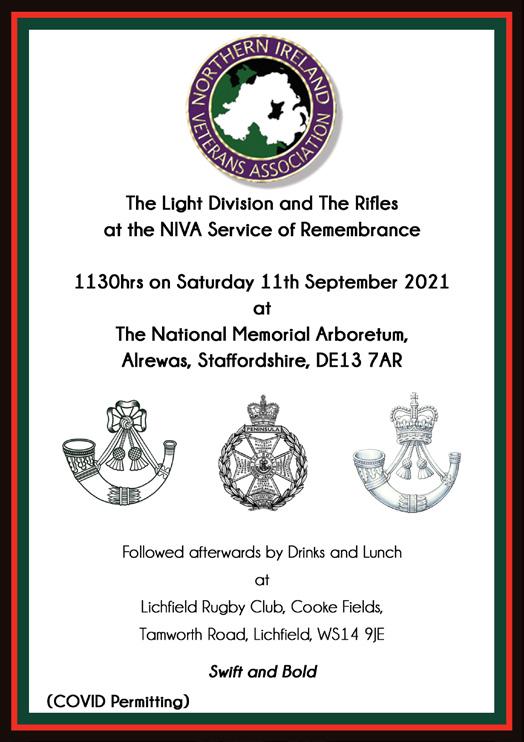
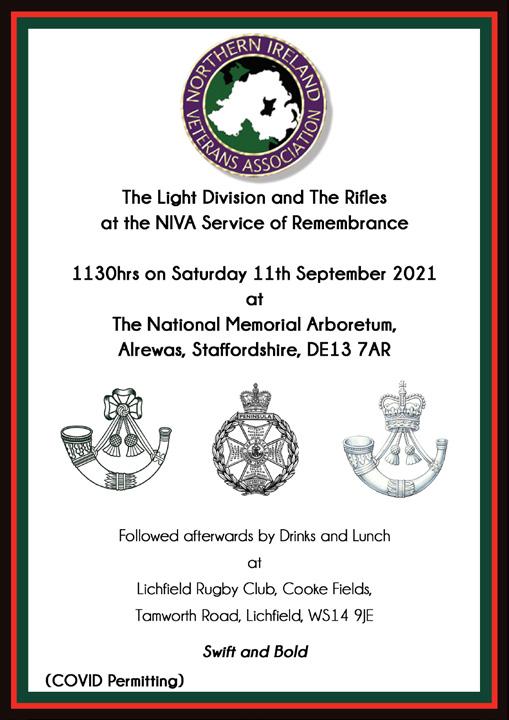
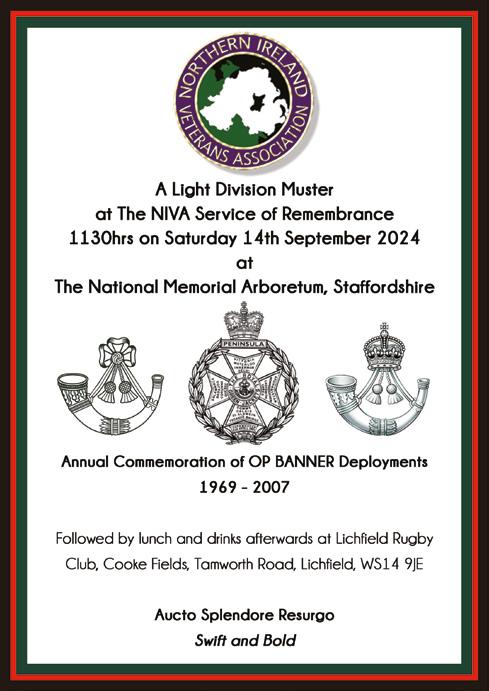
This year we are building up for a great reunion in Sir John Moore Barracks on 13 July and later there is the Northern Ireland Commemoration at the National Memorial Arboretum, on 10 September. 2024 is also the 80th Anniversary of D Day, so as well as the annual commemorations in Calais in May and at Pegasus Bridge in June, there will be lots more going on in Normandy this Summer. Please keep an eye out for more information about those and other events on SWIFT or on our own Royal Green Jacket Association website.
We have not heard anything definite but there are now some clear rumours that at the end of 2026 Sir John Moore Barracks (SJMB) will close to be made ready for disposal. The signs are that our reunion that year should be safe, but it is almost certain to be our last. SJMB is also home to the Light Division Chapel & Memorial Garden, three significant statues and some important RGJ & LI property in the messes there. RHQ have been thinking about it for a while and a plan is developing but the closure will need some careful handling, to ensure we don’t lose any of our important Regimental heritage.
While on the subject of heritage, readers will be pleased to know that there have been some very positive developments for the RGJ and Rifles Museums, so do read the article in this edition which gives you more detail.
Best wishes SWIFT AND BOLD
Editorial
Welcome to Swift & Bold 2023. I am now fully convinced that as you get older the years grow shorter because surely it was only six months ago, I was finalising the 2022 edition of Swift & Bold?
I would like to thank all those who have made a contribution to S&B both financially and in well written and often quite humorous articles. Without your contributions I would not be able to produce the journal as I do. My thanks also to my team of proofreaders, Mike and Janet Gleeson, Trevor Anderson, Dave Muir, and Michael Leeming our treasurer who looks after the financial side of things for me and of course Nick Parker (not the General, the times I have to explain this!!) who works closely with me on the actual production. Sadly, another member of my team, Roy Baillie, my oldest friend of over 50 years passed away on the15 August just a few weeks after handing over to me when he retired as Database Manager.
The subject of the Roll of Honour has caused a lot of discussion with some Riflemen contacting me saying a certain person is missing. When you look at the ROH there is now a paragraph at the top which explains who is on the ROH and why and who
goes in the Book of Remembrance, this matches that of the museum. It has been pointed out that as an association we have lost no member to conflict but what we do is honour the memory of all those who served and died in any circumstances in the years we existed in the ROH and BofR. I am grateful to Ken Gray for his help getting this correct.
The cap badge design which has been a source of irritation to some will no doubt raise its head again following a request asking if I could supply a quality reproduction of our badge to be used on a headstone. After consultation with the senior members of the RGJA the one the museum uses and is also on the memorial at the NMA and was used for the RGJ Chronicle 1966 – 2007 is currently considered to be the official version as it is the oldest representation of our cap badge. There is a short article referring to copyright issues and headstones as I have found out that the Crown copyright for our cap badge still remains with the MOD. I hope you will find this article of use should you need to use it.
See you at the reunion in July!
Corporate Advertising
Personal Donations
Syd Hopgood
Barney Vivian
Leslie Thacker
Ken Gillingham
Ted Evelegh
Nick Kitson
Rifle Brigade Association
Rod Le Couilliard
Sidney Jacobs
Chris Pond
Chris Louca
London Branch RGJA
Toby Gore
Denis Waters
John Pentreath
John Short
NE Branch RGJA
Peter Casson-Crook
Niall Warry
Steve Horsley
Roy Timms
Anthony Karslake
Mark Dunkerton
Various Anonymous Donors
Derek Hemley
Chris Gates
Patrick Dalby
Gerry Garrood
Mac McDonald
Keith Turner
Ken Smith
Mrs C.M. Weston
Bill Russell
I would like to thank all those who have contributed to S&B for their very generous donations which has made this edition possible. Kevin Stevens – Editor S&B
Skinner Sheds – Dee-Day White Solid Sheds – Andy Hayes
Kevin Stevens Editor
The Royal Green Jackets Association Key Personnel 2024
President Maj Gen James Gordon CB CBE 01962 828524 rgjacontact@gmail.com
Chairman Col Carron Snagge OBE DL 01962 828524 rgjacontact@gmail.com
Vice Chairman Lt Simon Booth-Mason 01962 828524 rgjacontact@gmail.com
Secretary Rebecca Maciejewska rgjasec@gmail.com
Treasurer Maj Michael Leeming 07803 341929 jmaleeming@icloud.com
Membership Secretary
Mr Hugh Goudge 01924 849020 oldsweat@yahoo.co.uk
Webmaster Capt William Shipton 01256 895719 bill.shipton@btinternet.com
Editor Swift and Bold Journal
Photo History
Database Manager
Deputy Database Manager
In Memoriam Board Manager
Mr Kevin Stevens 07954 594451 rgjacontact@gmail.com
Mr Kevin Stevens 07954 594451 rgjacontact@gmail.com
Mr Tony Williamson 07891 367429 rgjadepdatabasemanaer@gmail.com
Mr Mark Adams 01442 380713 greenjackets_2001@yahoo.co.uk
BRANCHES
Aylesbury Branch
Meeting second Sunday September to May holiday season June to September.
Central England Branch
See below for information.
East Midlands Branch
See below for information.
London Branch
Meetings occur during branch functions. Please check with Secretary for details.
North East Branch
See below for information.
North West Branch Branch temporarily closed.
Oxfordshire Branch
1st Tuesday of each month. 8:00pm Volunteers Bar, Edward Brooks Barracks.
South East Kent Branch
Last Thursday of: January (AGM), March, June, September and November.
Wiltshire Branch
Warminster Conservative Club 7:30pm for 8:00pm. 1st April, 3rd June, 2nd September, 2nd December. Winchester & District Branch
Every 2nd Tues of the month at 7.30pm. WOs & Sgts Mess Sir John Moore Barracks, Winchester.
Yorkshire Branch
At Wakefield TAC 7:30 for 8:00pm, 4th Tuesday every month except November, December, January and February.
For information about a branch or contact details for any of the above please contact either:
Mr Hugh Goudge (ORs Membership Secretary • oldsweat@yahoo.co.uk) or Mr Kevin Stevens (Database Manager • rgjacontact@gmail.com)
The Royal Green Jackets Roll of Honour
1 January 1966 – 31 January 2007
The Royal Green Jackets Roll of Honour records the names of all those, including attached personnel and those seconded to other regiments, who have died as a direct result of enemy action, in the act of conducting actions against the enemy or as a result of acts of terrorism since 1 January 1966 until 31 January 2007.
The names of all those serving in the regiment including those on the Roll of Honour who have died as a result of accident, illness, during training or from other causes are recorded in:
The Book of Remembrance The Light Division Chapel Sir John Moore Barracks, Winchester
1980
1981
The Green Jacket Contribution to the wider Army
The Green Jacket contribution to the wider Army was significant; at times the Regiment provided the Army with a disproportionate number of senior officers, and our battalions and Riflemen served with distinction in every operational theatre.
The Green Jacket ethos had traditionally been forward looking and many of the ideas it espoused had had a significant effect on leadership, operational success, intellectual development, and organisational change within the Army over the 41 years we existed as a regiment of the line. Maybe in part this is why the Regiment had always attracted a large number of capable officers, often too many to leave room for them all to have the chance to command the limited number of battalions within the Regiment.
Many Green Jackets were therefore privileged to command other Regiments, and both officers and Riflemen distinguished themselves in Special Forces, as well as in other areas, not least in their subsequent, or for Green Jacket Territorials their parallel, civilian careers.
This snapshot in time illustrates the Regiment’s success. In 1984 the following senior Green Jackets were all serving officers in the rank of Major-General and above:
•Field Marshal Sir Roland Gibbs, GCB, CBE, DSO, MC
•Field Marshal Sir Edwin Bramall, GCB, OBE, MC – Chief of the Defence Staff
•General Sir Frank Kitson, KCB, CBE, MC & Bar, ADC Gen – C in C UKLF
•General Sir Roland Guy, KCB, CBE, DSO, ADC Gen – Adjutant General
•Lieutenant-General Sir James Glover, KCB, MBE – CinC UKLF (designate)
•Lieutenant-General Sir David Mostyn, KCB, CBE – Military Secretary
•Major-General RA Pascoe, MBE – Chief of Staff HQ UKLF
•Major-General ME Carleton-Smith CBE – Defence Adviser, Australia
•Major-General PM Welsh OBE, MC – President Regular Commissions Board
•Major-General DJ Ramsbotham, CBE, MA – Commander 3rd Armoured Division
•Major-General CEW Jones – Director General Territorial Army
•Major-General GD Johnson, OBE, MC – Assistant Chief of the Defence Staff
A list of senior appointments held by Green Jackets is also shown and perhaps goes some way to explain why it was often commented that ‘the Green Jackets run the Army’ and why the Regiment was widely known as ‘The Black Mafia’.
Chief of the Defence Staff
Field Marshal Bramall
Adjutant General
General Mogg
General Guy
General Mostyn
General Pascoe
General Ramsbotham
Military Secretary
General Pearson
General Guy
General Mostyn
Major General Cottam
Commander in Chief
United Kingdom Land Forces
Field Marshal Gibbs
Field Marshal Bramall
General Kitson
General Glover
Deputy Commander in Chief United Kingdom Land Forces
Lt General Hudson
(Acting C in C UKLF early 1982)
General Officer Commanding
Northern Ireland
Lieutenant General House
General Pascoe
Lieutenant General Parker
Commander
British Forces Hong Kong
Field Marshal Bramall
General Johnson
Lieutenant General Foley
Commandant Royal College of Defence
Studies
General Read
Lieutenant General Wallace
Permanent Joint Headquarters
Chief Joint Operation
Lieutenant General Wallace
Governor of Guernsey
Lieutenant General Foley
Her Majesty’s Chief Inspector of Prisons
General Ramsbotham
Chief of the General Staff
Field Marshal Gibbs
Field Marshal Bramall
Quartermaster General
General Read
General Worsley
General Jones
Deputy Supreme Commander Europe
General Mogg
Commander in Chief
Allied Forces Northern Europe
General Pearson
General Johnson
Commander1 (BR) Corps
General Mogg
Field Marshal Gibbs
General Worsley
Commandant Staff College
General Kitson
Major General Alexander-Sinclair
Lieutenant General Wallace
Lieutenant General Parker
Governor of Gibraltar
General Lathbury
Sir Francis Richards
Permanent Joint Headquarters
Chief of Staff
Major General Pringle
Governor of the Royal Hospital Chelsea
General Read
General Guy
Head of the British Defence Staff USA
Major General Vyvyan
The Green Jacket Contribution to the wider Army
The Green Jacket Contribution to the wider Army
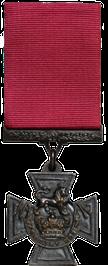
The Victoria Cross
We can be rightly proud of the 59 Victoria Crosses that were won by our antecedent regiments and must also include the two VCs won by members of the RAMC attached to our regiments one to each of the RB and KRRC. The Victoria Crosses are an important part of our history and I have chosen to look at a few of them for this edition of Swift & Bold. Kevin Stevens – Editor
In selecting who to include I have started with the first one awarded who was Francis Wheatley in 1854 and finished with the last one Lt Col Victor Buller Turner 1942.
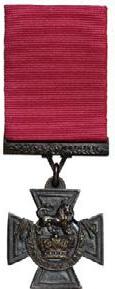
The Victoria Cross was instituted by Queen Victoria in 1856. It was created by Royal Warrant, signed on 29 January, and Her Majesty took a great personal interest in all the detail surrounding it including the design of the medal itself.
The Royal Warrant for the institution of the Victoria Cross made no provision for it to be awarded posthumously. However, in 1902 an exception was made for six men who had died as a result of the gallant action during the Boer War. Thereafter, in 1907, six more individuals who had died in earlier campaigns were posthumously recognised. It had been stated in the Memorandum in the London Gazette, at the time that the death of each had been reported, that had they lived they would have been awarded the Victoria Cross.
Thereafter, the award was made posthumously as well as to the living and the Royal Warrant was amended in 1920 to allow for this. However, the Royal Warrant did make provision for ballots to be held to nominate an individual to be awarded. Until 1918 this method for nomination was used when a Company had performed in a particularly heroic manner and wished to elect one of their number to be put up for the award. In the Indian Mutiny 46 were elected to receive the Victoria Cross under these circumstances.
Provision was also made in the Royal Warrant for forfeiture of the award. Initially any holder who was convicted of a criminal offence lost the award by this provision – eight men so did. However, it is well known from a letter written by his Private Secretary,
Lord Stamfordham, on 26 July 1920, that King George V “feels so strongly that, no matter what the crime committed by anyone on whom the Victoria Cross has been conferred, the decoration should not be forfeited. Even were a Victoria Cross to be sentenced to be hanged for murder, he should be allowed to wear the Victoria Cross on the scaffold.”
Since this 1908 the power to cancel and restore awards, although still included in the Royal Warrant that instituted the Victoria Cross, has not been exercised. The power to restore a Victoria Cross has never been exercised.
1854 Sebastopol
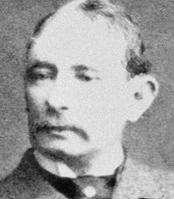
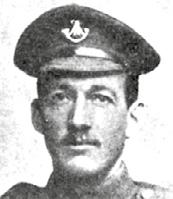
Francis Wheatley VC DCM – Rifle Brigade
Francis Wheatley was awarded his Victoria Cross for duty in the Crimean War on 12 October 1854. The day before his VC action, another act of gallantry earned him the Distinguished Conduct Medal.
The citation for his VC reads:
“On 12th October 1854 Wheatley and some other Riflemen were occupying a section of the trenches before Sevastopol when a live Russian shell fell amongst the men. Without hesitation Wheatley seized hold of the shell and endeavoured to knock the fuse out with the
butt of his rifle. He was unsuccessful at the first attempt and so, with great presence of mind and deliberation he managed somehow to heave it over the parapet of the trench. It had scarcely fallen outside when it exploded. Had it not been for his coolness, presence of mind and supreme courage and discipline, the shell would have inevitably exploded amongst the party causing serious casualties, but instead not a man was hurt.”
His VC was presented by Queen Victoria in person at the first investiture at Hyde Park, London on 26 June 1857.
He died on 21 May 1865 at Westminster Hospital, London from acute myelitis (inflammation of the spinal cord) and asphyxia. He was buried in a common grave in Brompton Cemetery, on which a memorial has now been placed. His medals are on view at the Royal Green Jackets (Rifles) Museum and his name is on the memorial in Winchester Cathedral.
1857 Dehli
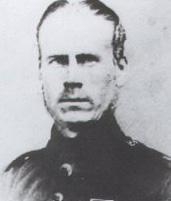
Private Samuel Turner VC – KRRC
Samuel Turner was 31 years old, and a Rifleman in the 1st Battalion, 60th Rifles (later the King's Royal Rifle Corps) during the Indian Mutiny, when on 19 June 1857 at Delhi, India the deed took place for which he was awarded the VC.
The citation reads:
“At Delhi on the night of the 19th of June, 1857, during a severe conflict with the Enemy, who attacked the rear of the Camp, carried off on his shoulders, under a heavy fire, a mortally wounded Officer, Lieutenant Humphreys, of the Indian Service. During this service, Private Turner was wounded by a sabre cut in the right arm. His gallant conduct saved the above-named Officer from the fate of others, whose mangled remains were not recovered until the following day.”
Captain
Smith VC 43rd Regiment (Ox & Bucks LI)
Smith was 37 years-old, and a captain in the 43rd (Monmouthshire) Regiment of Foot (later the Oxfordshire and Buckinghamshire Light Infantry), during the Waikato-Hauhau Māori War in New Zealand. The 68th (Durham) Regiment of Foot (Light Infantry) with a detachment of the 43rd commanded by Smith was deployed to attack an entrenchment held by the Māori. The following deed took place during the attack on 21 June 1864 at Tauranga for which he was awarded the VC.
The citation reads:
“For his distinguished conduct during the engagement at Tauranga, on the 21st of June. He is stated to have led on his Company in the most gallant manner at the attack on the Māori position, and, although wounded previously to reaching the Rifle Pits, to have jumped down into them, where he commenced a hand-to-hand encounter with the Enemy, thereby giving his men great encouragement, and setting them a fine example.”
In the charge he was struck by a bullet which lodged in the upper part of his leg. He continued to lead his men and was the first man into the entrenchment. Following fierce fighting, the Māori having sustained heavy casualties were driven from their position.
He was also mentioned in dispatches. He later achieved the rank of lieutenant colonel. He commanded the 43rd Foot from 1 December 1875 to 2 February 1878 when he retired from the army.
1864 New Zealand
Frederick
1866 Canada
Rifleman Timothy O’Hea VC – Rifle Brigade
Timothy O’Hea was about 23 years old, and a private in the 1st Battalion, Rifle Brigade (Prince Consort’s Own) stationed in Canada when the deed took place for which he was awarded the Victoria Cross.
The citation reads:
“On 9 June 1866 at Danville, Canada East, a fire broke out in a railway car containing 2,000 pounds (910 kg) of ammunition, between Quebec City and Montreal. The alarm was given, and the car was disconnected at Danville Railway Station. While the sergeant in charge was considering what should be done, Private O'Hea took the keys from his hand, rushed to the car, opened it and called for water and a ladder. It was due to this man’s example that the fire was suppressed”.
O'Hea was said to have died in the Tirari DesertSturt Stony Desert region of central Australia in November 1874 while searching for a lost member of the Leichhardt expedition.
A book by Elizabeth Reid, “The Singular Journey of O’Hea’s Cross”, poses the theory that Timothy O’Hea in fact died in Ireland, shortly after his discharge from the British Army in 1868. His identity and VC annuity were then assumed by his brother John, and it is this man who died in Australia but of course we will never know.
1899 South Africa
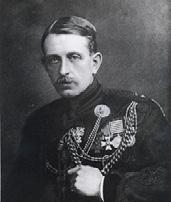
Captain Walter Norris Congreve VC – Rifle Brigade
Captain Walter Norris Congreve (later General Sir Walter Norris Congreve, VC, KCB, MVO, DL, KStJ) was serving in the Rifle Brigade when on 15 December 1899 at the Battle of Colenso with several others, tried to save the guns of the 14th and 66th Batteries, Royal Field Artillery, when the detachments serving the guns had all become casualties or been driven from their guns.
Captain Congreve, with two other officers Lt The Hon Frederick Roberts KRRC, Capt Harry Norton Schofield RA and Cpl George Nurse RA retrieved two of the guns.
All four received the VC for this action. (Roberts was the son of VC winner Field Marshal Frederick Sleigh Roberts, 1st Earl Roberts VC KG KP GCB OM GCSI GCIE VD PC FRSGS). Then, although wounded himself, seeing one of the officers fall, Congreve went out with Major William Babtie, RAMC, who also received the VC for this action, and brought in the wounded man.
The citation reads:
“At Colenso on the 15th December, 1899, the detachments serving the guns of the 14th and 66th Batteries, Royal Field Artillery, had all been either killed, wounded, or driven from their guns by Infantry fire at close range, and the guns were deserted. About 500 yards behind the guns was a donga in which some of the few horses and drivers left alive were sheltered. The intervening space was swept with shell and rifle fire. Captain Congreve, Rifle Brigade, who was in the donga, assisted to hook a team into a limber, went out;
and assisted to limber up a gun. Being wounded, he took shelter; but, seeing Lieutenant Roberts fall, badly wounded, he went out again and brought him in. Captain Congreve was shot through the leg, through the toe of his boot, grazed on the elbow and the shoulder, and his horse shot in three places.”
1916 France
Bt Major William La Touche Congreve VC DSO MC – Rifle Brigade
William La Touche Congreve was 25 years old and a major in The Rifle Brigade and already had been awarded both the DSO and MC when the following deed took place for which he was awarded the VC.
The citation reads:
“During the period 6 to 20 July 1916 at Longueval, France, Major Congreve constantly inspired those round him by numerous acts of gallantry. As Brigade Major he not only conducted battalions up to their positions but when the brigade headquarters was heavily shelled he went out with the medical officer to remove the wounded to places of safety, although he himself was suffering from gas and other shell effects. He went out again on a subsequent occasion tending the wounded under heavy shell fire. Finally, on returning to the front line to ascertain the position after an unsuccessful attack, he was shot by a sniper and died instantly.”
William Congreve’s grave is at Corbie Communal Cemetery Extension, France, 9 miles east of Amiens.
1917 France
Company Sergeant-Major
Brooks VC – Ox & Bucks LI
Edward Brooks enlisted in the 2/4th Battalion of the Oxford & Buckinghamshire Light Infantry in October 1914. His unit spent the first months of the war in England on garrison and training duty, Brooks teaching shooting and army drill to the members of the Headington Miniature [small bore] Rifle Club for the first two months of his service.
The OBLI was posted to France in May 1916 and first saw action during the Battle of the Somme in the July. He was awarded the VC for action at the village of Fayet, near St. Quentin, France, April 28, 1917.
The citation reads:
“For most conspicuous bravery. This Warrant Officer, while taking part in a raid on the enemy’s trenches, saw that the front wave was checked by an enemy machine-gun at close quarters. On his own initiative, and regardless of personal danger, he rushed forward from the second wave with the object of capturing the gun, killing one of the gunners with his revolver and bayoneting another. The remainder of the gun’s crew then made off, leaving the gun in his possession. Company SgtMajor Brooks then turned the machine-gun on to the retreating enemy, after which he carried it back into our lines. By his courage and initiative he undoubtedly saved many casualties, and greatly added to the success of the operations.”
Brooks was mustered out of the Army in 1919 and began working on the production line for Morris Motors at their Cowley plant in Oxford. He stayed with Morris until shortly before his death at the age of 61 in 1944.
Edward
1917 PALESTINE
Lance Corporal John Christie VC –Finsbury Rifles (KRRC)
John Christie was 22 years old and a L/Cpl in the 1/11th (County of London) Battalion, (Finsbury Rifles), London Regiment, when the following deed took place for which he was awarded the VC.
The citation reads:
“On 21 December/22 December 1917, at Fejja, Palestine, after a position had been captured, the enemy immediately made counter-attacks up the communication trenches. Lance-Corporal Christie, seeing what was happening, took a supply of bombs and went alone about 50 yards in the open along the communication trench and bombed the enemy. He continued to do this in spite of heavy opposition until a block had been established. On his way back he bombed more of the enemy who were moving up the trench. His prompt action cleared a difficult position at a most difficult time and saved many lives.”
John Christie had been a parcels clerk employed by the London and North Western Railway (LNWR) at Euston Station.
In 1920 the LNWR named Claughton-class locomotive No. 1407 ‘L/Cpl J.A. Christie, V.C.’ in his honour.
A plaque inside Euston Station commemorating the action of John Christie VC was unveiled by his son on 28 March 2014.
1942 Western Desert Egypt
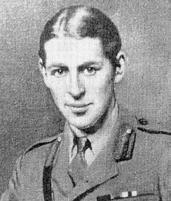
Lt Col Victor Buller Turner VC CVO –Rifle Brigade
Victor Buller Turner was commissioned as a second lieutenant in the Rifle Brigade in December 1918.
On 27 October 1942, at El Aqqaqir (Kidney feature), during the Second Battle of El Alamein, Lt Col Turner was commanding a battalion of the Rifle Brigade. After overcoming a German position, the battalion fought off desperate counter-attacks by 90 tanks, destroying or immobilising more than 50 of them. During the action one of the 6-pounder guns was left with only one officer and a sergeant, so Colonel Turner joined them as loader and between them they destroyed another five tanks. Not until the last tank had been repulsed did, he consent to having a wound in his head attended to.
The citation reads:
“For most conspicuous gallantry and devotion to duty on the 27th October, 1942, in the Western Desert. Lieutenant-Colonel Turner led a Battalion of the Rifle Brigade at night for 4,000 yards through difficult country to their objective, where 40 German prisoners were captured. He then organised the captured position for all-round defence; in this position he and his Battalion were continuously attacked from 5.30am to 7pm, unsupported and so isolated that replenishment of ammunition was impossible owing to the concentration and accuracy of the enemy fire. During this time the Battalion was attacked by not less than 90 German tanks which advanced in successive waves. All of these were repulsed with a loss to the enemy of 35 tanks which were in flames, and not less than 20 more which had been immobilised.
Throughout the action Lieutenant-Colonel Turner never ceased to go to each part of the front as it was threatened. Wherever the fire was heaviest, there he was to be found. In one case, finding a solitary six-pounder gun in action (the others being casualties) and manned only by another officer and a Sergeant, he acted as loader and with these two destroyed five enemy tanks. While doing this he was wounded in the head, but he refused all aid until the last tank was destroyed. His personal gallantry and complete disregard of danger as he moved about encouraging his Battalion to resist to the last, resulted in the infliction of a severe defeat on the enemy tanks. He set an example of leadership and bravery which inspired his whole Battalion, and which will remain an inspiration to the Brigade.”
Facts you might not know about the Victoria Cross holders
To finish this article, I looked at the VC as a whole with some interesting results.
The RIFLES hold the record of 117 Victoria Crosses from all their predecessor regiments including our own.
The VC originally awarded to members of the Royal Navy used a dark blue ribbon and not a crimson one. In 1918 this changed, and all the services thereafter used the crimson ribbon.
The first Victoria Cross awarded was to a Naval man Irishman Charles Davis Lucas (1854) during the Crimean War although the VC was not established until 1856 it was made retroactive to cover the Crimean War and was the first military honour to be awarded regardless of rank.
The oldest recipient of the VC is Lt (later Capt)
William Raynor (1857) at 61yrs old of the Bengal Veteran Establishment, Bengal Army
The youngest recipient is Andrew Fitzgibbon (1860) a Hospital Apprentice in the Indian Medical Establishment, Indian Army, aged 15yrs 3mths during the 2nd China War.
WO2 Martin Doyle, VC, MM, (1918) Royal Munster Fusiliers on being demobbed after WW1 joined the IRA in 1919 serving as a spy for them in a British army barracks. After the truce in 1921 which led to the partition of Ireland Doyle then followed Michael Collins and joined the Irish Free state army serving until 1937. The largest number of VCs won in a single day was 24 during the Second Relief of Lucknow (Indian Mutiny) on 16 November 1857.
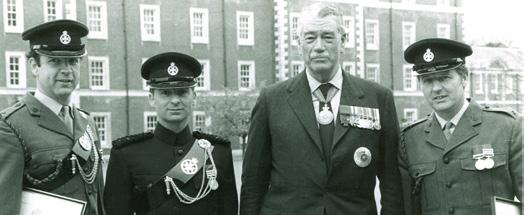
Elizabeth Webber Harris was an English nurse who was awarded a replica VC in 1869, with the permission of Queen Victoria, for her bravery during a cholera outbreak in India. She remains the only woman to be awarded a VC of any description. In 1981 an Australian Sir Roden Cutler VC AK KCMG KCVO CBE was the VIP taking a Passing Out parade at the then Rifle Depot. At the end Sir Roden presented an award from the Royal Humane Society to two members of the regiment, I was depot photographer at the time and took the photograph of the presentation and spoke with him briefly. My lasting memory of him was how pleasant he was to talk to and how tall he was. One of the recipients was WO2 Ivan (Ossie) Gibson and the officer receiving the award? None other than our Chairman Colonel Carron Snagge OBE DL. Also in the photo is the then CO Lt Col later Brig Nicholas Prideaux who is now President of the Wiltshire branch.
Maj Carron Snagge, Lt Col Nicholas Prideaux, Sir Roden Cutler, VC, KCMG, KCVO, CBE, KStJ, ex Governor of New South Wales, Honorary Colonel of the Sydney University Regiment and WO2 Ivan (Ossie) Gibson.
Maj Snagge and WO2 Gibson are holding their Royal Humane Society Awards.
1854
Rfn P Wheatley
For Valour
59 Victoria Crosses have been awarded to the antecedent regiments (regular service and territorial) of The Royal Green Jackets.
The rank and decorations shown are those held at the time of the act of gallantry for which the VC was subsequently awarded.
Privates in the KRRC and RB were known as Riflemen although the rank was not formally approved until 1923.
+ Awarded posthumously
* Elected by the privates of the regiment to receive VC
Rfn S Turner KRRC 1857
Lt The Hon HH Clifford
1854
WJM Cuninghame
Lt CT Bourchier
C/Sgt Garvin KRRC
Lt AS Heathcote* KRRC
C/Sgt G Waller* KRRC
Rfn J Bradshaw
Rfn J Thompson* KRRC
Rfn R Humpston
R McGregor
Rfn J Divane* KRRC
1857 DELHI
Bglr W Sutton* KRRC
1857 DELHI
L/Cpl H Smith 52nd LI
1857 DELHI
Bglr R Hawthorne 52nd LI
1857 DELHI
Ensn EA Lisle-Phillipps+ KRRC
1858 LUCKNOW
Capt H Wilmot RB
1858 LUCKNOW Cpl W Nash RB
1858 LUCKNOW Rfn D Hawkes RB
1858 INDIA Rfn Bambrick KRRC
1858 LUCKNOW Rfn S Shaw RB
1859 INDIA Pte H Addison 43rd LI
1864 NEW ZEALAND
Capt FA Smith 43rd LI
1866 CANADA Rfn T O’HEA RB
1879 ZULULAND
Bt Lt Col RH Buller KRRC
1882 EGYPT Rfn F Corbett KRRC
1884 SUDAN Lt PS Marling KRRC
1889 SOUTH AFRICA
Lt The HON FHS Roberts+ KRRC
1899 SOUTH AFRICA
Capt WN Congreve RB
1900 SOUTH AFRICA Rfn AE Durrant RB
1901 SOUTH AFRICA LT LAE Price-Davies DSO KRRC
1903 SOMALILAND Bt Maj JE Gough RB
1914 BELGIUM
Lt JHS Dimmer KRRC
1914 WEST AFRICA
Lt JFP Butler KRRC
1915 FRANCE WO2 CSM H Daniels RB
1915 FRANCE A/Cpl CR Noble+ RB
1915 BELGIUM 2Lt GH Woolley QVR (KRRC)
1915 BELGIUM L/Sgt DW Belcher LRB (RB)
1915 FRANCE Rfn W Mariner KRRC
1915 BELGIUM 2Lt SC Woodroffe+ RB
1915 FRANCE Rfn GS Peachment+ KRRC
1915 BELGIUM Cpl AG Drake+ RB
1916 FRANCE
Bgde Maj WlaT Congreve DSO MC+ RB
1916 FRANCE Sgt A Gill+ KRRC
1917 FRANCE 2Lt CGE Cates+ RB
1917 France WO2 CSM E Brooks Ox & Bucks LI
1917 BELGIUM Sgt E Cooper KRRC
1917 BELGIUM Sgt WF Burman RB
1917 BELGIUM Sgt AJ Knight Post Office Rifles (RB)
1917 FRANCE Rfn AE Shepherd KRRC
1917 PALESTINE L/Cpl JA Christie Finsbury Rifles (KRRC)
1918 FRANCE L/Sgt JE Woodall RB
1918 FRANCE Sgt W Gregg DCM MM RB
1918 FRANCE Rfn W Beesley RB
1918 FRANCE L/Cpl A Wilcox Ox & Bucks LI
1941 NORTH AFRICA Rfn J Beeley+ KRRC
1941 NORTH AFRICA Lt Col VB Turner RB
Two VCs have been awarded to members of the RAMC attached to the antecedent regiments of The Royal Green Jackets
1914 FRANCE Capt HS Ranken+ RAMC attd KRRC
1915 FRANCE Lt GA Maling RAMC attd RB
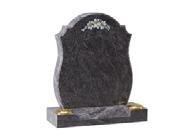
Gravestones and the Regimental Cap Badge
The dealing with the passing of a loved one is a traumatic experience at the best of times. If you wish to use the RGJ Cap Badge on your next of kin’s memorial there is a simple, but necessarily time consuming, process which will ensure that you use the correct Crown Copyright design authorised by the MoD.
The following is from an email received from The Joint Casualty and Compassionate Centre (JCCC) of the MOD:
Private Memorials
“MOD owned insignia are protected under the Copyright, Design and Patents Act 1988 (as amended), Trade Marks Act 1994 (as amended) and the laws of heraldry. The Secretary of State for Defence is content to permit the use of appropriate specified MOD Crests or Unit Badges granted by the Monarch on Private Memorials of former Military Service Personnel postmortem. Permission is granted once all requirements set out have been met. The process for making a request can take several weeks. Therefore, please ensure you have read the process carefully and provide as much of information requested as possible to avoid delay. There is no minimum qualification of service.
There is also no charge.
The Next of Kin of the deceased or persons representing the deceased need to make a request for permission to use a MOD Crest or Unit Badge on a Private Memorial in writing, using the form at Annex A. This should be posted or emailed to the address given.
The Joint Casualty and Compassionate Centre (JCCC) will acknowledge receipt of the request and once all the information required is received, they will confirm the service history of the deceased. When the service history of deceased has been confirmed JCCC will issue to the requestor a copy of the requested MOD Insignia and a letter permitting its use on the deceased’s Private Memorial.”
The system does progress at a somewhat sedate pace and can take several weeks but in the end, you should receive a high resolution copy of our cap badge as stored by the JCCC.
The Annex A referred is posted on to the main RGJA website with all the other information required to help you get our cap badge for a person’s gravestone. It can also be found here following this link
Finally, it is Interesting to note that the Veterans Badge which was approved by Her Majesty Queen Elizabeth II is to be used as a lapel badge only and cannot be used on headstones.
I've just bought a Humpty Dumpty toy from Aldi, it's brilliant it comes with Aldi Kings horses and Aldi Kings men.
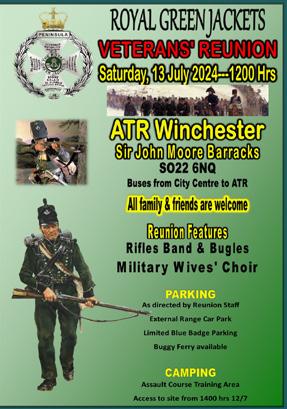
2024 RGJA Veterans’ Reunion
At Sir John Moore Barracks
Saturday 13 July, 2024
Well, after a year’s absence, it is finally back and proceeding. Your Reunion Committee has already commenced work in organizing this event for you all.
The outline details of the day will be based on our usual format, so no real change there, other than there will be no additional attractions on the Main Square apart from the Bands. Please see the attached Reunion flyer for details.
Campers can start to arrive from 14:00 hrs on the Friday but not before please. The gates open on Saturday at 12:00 hrs and also there will be a free bus service available from Winchester Town centre to SJMB.
possible at SJMB where you can reacquaint yourselves again with your regimental friends. The future of Reunions at SJMB? The next Reunion at SJMB is in the RGJA calendar for July 2026 but, in the meantime, there are a couple of uncertainties which need to be clarified: the timing for the closure of the barracks is not confirmed and we still need to identify a team of volunteers to run it. We will keep you up to date when we know more!
Times to be advised in due course but most probably from 12:00 hrs onwards. The Bands and Bugles from 6 & 7 Rifles have been confirmed and we will march around the Square as a Regiment like we did in 2022.
We hope to see you and as many families as
SO, MAKE SURE YOU ARE THERE ON JULY 13th as it will also be Roy Stanger’s last one in charge of the Reunion after more than 20 years organising it.
Simon Booth-Mason
On behalf of the Reunion Sub Committee.
Did you know that Care for Casualties is part of
The Rifles Benevolent Trust?
The Trust Also Supports:
Joanne Booth-Mason Memorial Fund/The Rifles
AARP Golf Fundraising Event
Care for Casualties
During the summer of 2022 I was given an offer I could not refuse. Joanne’s Fund was set up in 2012 when her USA boss, Doug Miller, an ex Green Beret veteran from Vietnam days, offered me 1:1 match funding up to a maximum of £10,000. This was extremely generous of him especially as he had already given me £20,000 to set up the fund initially in 2012. I decided to hold a charity golf event which duly took place on 29 August 2023 at Woking Golf Club in Surrey. I have also included other earlier fundraising events like renting out a Cornish cottage etc. With help from Ian Foster at Rifles RHQ we set up a very successful Just Giving Page in addition. After basically a year’s planning, the day arrived, and I must admit I was a little apprehensive mainly over the issue of electronic card payments etc as my bank had been difficult about setting up a separate bank account specifically for this event. Money laundering was their excuse! 72 golfers (18 teams of 4) turned up to play a four ball better ball team stableford competition with two best scores per hole to count. The weather was kind, the golf club were extremely helpful in every way, the Surrey heath land course was in great condition, the two-course lunch excellent and everybody had an enjoyable time, despite Booth-Mason taking their money! And a General and two Buglers turned up too – thank you The Rifles. The event generated an incredible £39,700 in the end coming from various aspects – Just Giving page, Gift aid recovery, donations, match funding, raffle, auction items and earlier fundraising items mentioned above etc.
Background
Always a Rifleman Programme
Veterans from Antecedent and Forming Regiments Welfare
Joanne’s Fund is a restricted sub fund under The Rifles Benevolent Trust (charity no: 1119071) and was initially set up to help those Riflemen falling under the Care For Casualties (C4C) appeal following Iraq and Afghanistan conflicts and, subsequently, PTSD injuries before Always A Rifleman Programme (AARP) was later established dealing with Mental Health/Suicide Prevention and, of course, PTSD issues. Since 2012 her Fund has helped over 100 Riflemen. We, as a very distinguished Regiment, have rightly prided ourselves in looking after our own family, and rightly so. Lt Col Baz Melia, his team and RHQ have been quite outstanding in setting up and running The Rifles AARP and I am glad to have played a small part for its future funding.
Remember:
‘A veteran is a subject who once gave this country a blank cheque’.
To the people of UK and Northern Ireland this means – you specify what amount up to and, if necessary, including my life itself.
The day itself
Tesco Food Vouchers
audience no end. After lunch I read out a very nice letter, I had received from Her Royal Highness The Princess of Wales saying she was sorry she could not attend but wished us well with our endeavours. This was followed by Lt General Thomas CopingerSymes CBE, the new Colonel Commandant of The Rifles, presenting prizes to the teams who came 1st, 2nd, and 3rd as well as longest drive at the 16th for men and ladies and nearest the pin at the 16th. Thank you General for your support.
Johnny Mercer MP – UK Government Veterans Minister sent us a short video wishing us well before Baz Melia gave a short but hard-hitting presentation about the AARP with three sad example cases as that most of the golfers present were civilians.
Serving Riflemen
Chad Murrin then conducted a very successful auction. Donors were very generous with their donations for sporting events, theatre and Xmas show tickets, superior bottles of wine and whiskey, holiday homes, dining vouchers, golf rounds, Murrayfield Calcutta Cup rugby tickets and Lords cricket Test Match tickets.
THE TRUST IS HERE TO HELP YOU!
Bacon butties awaited everyone’s arrival and after registration, raffle purchases and a course briefing the golf started at 09:30hrs with a shotgun start. Golf finished around 14:00hrs so there was time for showers and drinks on the veranda before two Buglers informed us that it was time for lunch. Very smart they were and impressed the mainly civilian
Thanks
There are many people who deserve a ‘MID’, too many to mention here sadly but I am very grateful to you all. However, I would like to mention Joanne’s USA boss Doug Miller who match funded up to £10,000, Nicholas Taylor who generously match funded too and Doug Miller’s great Vietnam friend, Marty Milco, who did all the artwork for the programme brochure, free of charge, from San Francisco. I have subsequently sent him the RGJ book ‘Jackets of Green’ as a small ‘thank you’ and to improve his Green Jacket knowledge.
Conclusion
Quite apart from raising a good sum of money, everyone from feedback subsequently received thoroughly enjoyed the day, in spite of costing them money, which I was pleased about.
I promise that the monies raised will be well spent on deserving Riflemen in need.
Thank you to everyone who contributed so generously.
Simon Booth-Mason – Deputy Chairman RGJA
LT Col Mark Shercliffe The Rifles, Simon Hazlett Rifles Trustee, Robin Thorne Honorary Green Jacket and Hugh Dumas RGJ
The winning team The Bandits– L to R: David Wolfe, Peter Johnson (team captain and WGC), Michiel Soeting and Derek Williams (both WGC) and the General.
The Royal Green Jackets (Rifles) Museum
Your Museum in Winchester has had another successful year with a return to pre-Covid visitor numbers and an increasing number of Rifleman and potential officers visiting from The Rifles. There are some new acquisitions and displays and some encouraging news on the museum’s future.
New Display
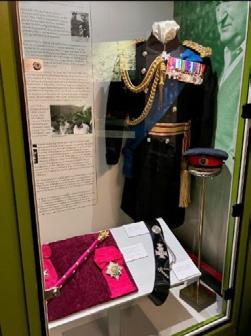
Visitors can now see the new display commemorating the life and service of Field Marshal The Lord Bramall of Bushfield KG GCB OBE MC. The completion of the display follows the Service of Thanksgiving for the Field Marshal held at Winchester Cathedral on 27 April last year. Objects on display include the Field Marshal's baton, orders, and medals as well as the frock coat and cap worn by him. Also on display is the KRRC cross belt that he used while serving with the Regiment.
Recent Acquisitions
The Museum's Summer Exhibition
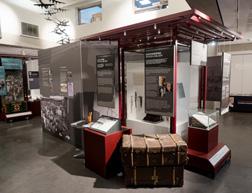
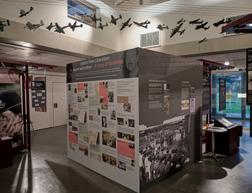
During the Summer the Museum held a temporary exhibition entitled Creatively Unwrapped. The exhibition followed the experiences of those serving during wartime as recorded in diaries and letters penned at the time. These documents are normally held in the Museum's archive collection and viewed by appointment only.
The exhibition provided the opportunity for visitors to view the papers and learn about the personal wartime experiences of Riflemen.
Shop News
MOD support will also help secure a more permanent tenure of the Museum building which will improve access to grants and other funding.
With both collections under one trust, additional staff, and a secure future, there is an opportunity to transform the Museum’s output and trustees are planning a programme of work to enable this including:
2023 saw several new additions to the Museum collection. In the spring we received a donation of six handwritten diaries kept by Rifleman McMillan whilst serving with the Rifle Brigade during the Second World War. These documents will join our archive collection housed at the Hampshire Record Office. Also donated was a World War One heart-shaped pin cushion, which is now on display in the Museum.
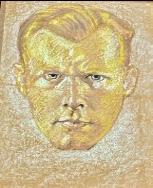
The Museum has purchased, with the aid of a grant from the V&A, a pastel portrait of the great escaper 2Lt Mike Sinclair KRRC which was made whilst he was held in Colditz as a Prisoner of War. This artwork will form the centre of a new display which is currently being planned and will focus on Prisoners of War.
This portrait will also feature in a temporary exhibition at Winchester College who are celebrating 100 years of their Cloister which remembers Wykehamists who died in the First and Second World Wars (118 of whom were Riflemen). A special tour of the Cloister for RGJ veterans has been arranged for the evening of Thursday 2 May details of which can be found on the Museum website.
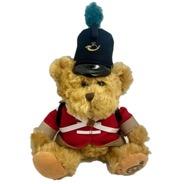
Meet Private Tom Bear. This new addition to the Museum shop is based on Private Thomas Gould of the 52nd who served during the Peninsular War.
If you would like a Private Tom he can be purchased online from Private Tom Bear (rgjmuseum.co.uk) or if you are visiting Winchester why not pop in and buy over the counter.
Evening Talks
The Museum continues to hold some very interesting evening talks and we hope to get these back on-line again this year so they can be accessed remotely.
Looking Forward
The Museum has looked after the Army’s Rifle Regiment collection, dating back to the 18th century, for many years. This important collection now also underpins the ethos of the Army’s largest infantry regiment, The Rifles.
The Rifles Council has therefore asked the Museum’s trustees to take responsibility for the post 2007 collection and to lean the curatorial effort towards helping riflemen to assimilate their history.
The Rifles has confirmed that the Winchester Museum is to continue to receive MOD funding, and this will enable it to recruit new staff and improve the ability to communicate with a wider audience including serving and retired riflemen.
• Changing the name of the Museum not only to reflect the past that we share with the other antecedent regiments, but to embrace our future combined heritage as a Rifle Regiment.
• Developing the on-line element of the Museum so that it is better able to communicate vir tually, particularly with serving and retired riflemen.
• Highlighting better those historical factors that define a Rifle Regiment.
• Improving the Museum’s overall layout to display Rifle Regiment history from its origins to the present-day including shop, offices, research and display preparation areas.
• Improving connections to the other museums in the Rifles network.
• Creating permanent and temporary Rifle Regiment displays for other locations.
These changes will ensure that the Museum retains its excellent reputation whilst also now playing an important part in supporting the ethos and heritage of The Rifles.
We hope to broaden the programme of Friends support that has been so helpful over the years and will keep the Regiment up to date with plans and progress.
If any of you have any questions, then please do get in touch with us via Christine at: curator@rgjmuseum.co.uk
Brigadier (Retd) James Plastow CBE
Chair RGJ (Rifles) Museum Trust
Mrs Christine Pullen
Curator RGJ (Rifles) Museum
curator@rgjmuseum.co.uk
01962 828549
London Branch
The Committee
Honorary President Colonel George Smythe OBE
Secretary Gary Driscoll
Treasurer Maria Driscoll
Norman Morrison
The London Branch continues to have a very strong membership of over two hundred veterans.
It has had an extremely busy year for the branch, representing the Royal Green Jackets Association at many events, including national regimental events such as the Band Memorial Service at Regents Park, the Annual Cenotaph Parade at Whitehall, the 2nd World War Memorial Service in Calais, and the Turning of the Pages from the Book of Remembrance, at St. George’s Church, Hanover Square.
In January members of the branch attended the annual memorial service for Sir John Moore, at St Paul’s Cathedral. Marking the anniversary of his death in January 1809 at the Battle of Corunna in Northern Spain. At 5:30pm, following Evensong, a short service takes place in the front of Sir John Moore’s memorial. The service is attended by both regular and reserve soldiers from the Rifles, as well as veterans from the antecedent regimental associations. Regimental poppy wreaths are laid followed by the sounding of the Last Post and
Reveille by either serving buglers from the Rifles or ex buglers from the RGJ Association.
All serving and former Riflemen and Regimental Association members and their families and friends are welcome.
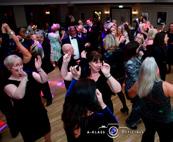
The London Branch flagship event, the annual Ladies dinner night in March was again, a huge success. 91 people attended, including members and their partners, as well as families and guests. The event was held again this year at the Victory Services Club, as the quality of the food is always excellent, and the staff are very professional. A highlight of the evening was when the ex-buglers from Quick Silver, entertained us with some of the more popular regimental marches and of course High on a Hill, interspersing the melodies with some comedic audience participation.
We also held the annual ladies ‘ticket draw’ for the highly coveted sterling silver RGJ Ladies Brooch! Entertaining us with just the right kind of tunes was Rob the D, finishing as always with our favourite tune, getting everyone up on the dance
floor to join the circle for ‘that’s what friends are for.’
Thank you to all those who attended this wonderful evening.
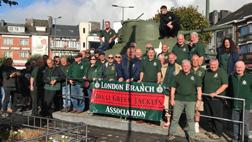
In May every year, veterans from the QVR, KRRC and RB, travel to Calais, and attend a service to remember the many riflemen who lost their lives in the 2nd World War, for the defence of Calais. Thirty of our members attended again this year, and our secretary Gary Driscoll laid a poppy wreath on behalf of the RGJ association.
Our annual Veterans Lunch in June was held at 86 St James’s, otherwise known as Mark Masons Hall in central London. It’s an ideal venue for such an occasion, as the food is of a very high standard and it is an opportunity for us to get together to mark Veterans Day.
We held a raffle to help raise funds for our regimental charities, such as donations to help raise money for the costs of publishing this magazine. Norman Morrison was again on hand to chivvy everyone along to obtain raffle tickets, and we take this opportunity to thank one of our long-term London Branch members, Mac McDonald, for again donating many prizes for this event.
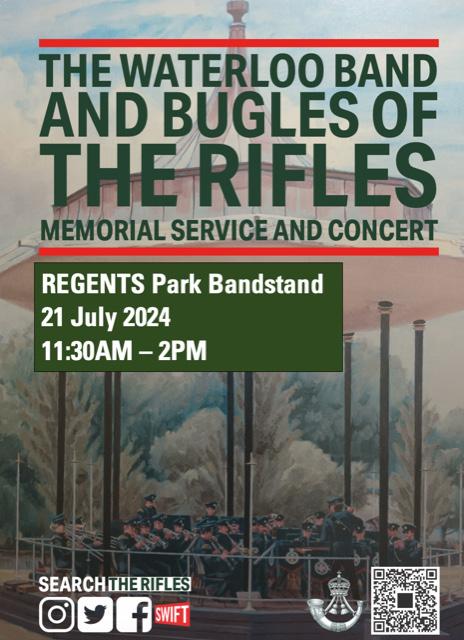
In July, we held the 41st Annual Service of Remembrance of the anniversary of the terrorist bombing of 20 July 1982.
The bomb had been hidden and triggered by a timer, under the bandstand in Regents Park, London. The Royal Green Jackets were holding a band concert at that time. Six bandsmen of the 1st Battalion Royal Green Jackets were killed instantly; the rest were wounded. A seventh died of his wounds twelve days later. Eight civilians were also injured. The IRA claimed responsibility for the attack.
These are the names of the seven RGJ Bandsmen who lost their lives on that day:
• Warrant Officer Graham Barker
• Sergeant Robert ‘Doc’ Livingstone
• Corporal John McKnight
• Bandsman John Heritage
• Bandsman George Mesure
• Bandsman Keith Powell
• Bandsman Larry Smith
The service was well attended as usual by members of the London Branch and others who paid their respects to those named above. This years’ service was also attended by Ralu OtehOsoka the Conservative Councillor for Regents Park Ward.
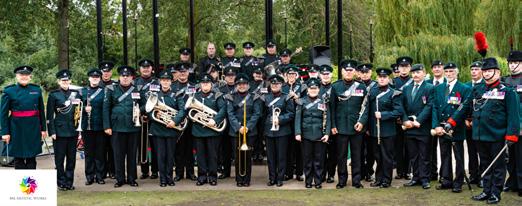
We were also very privileged to have the Waterloo Band, backed up by the ex-buglers of Quick Silver, providing the music for the Last Post and the hymn, followed by a concert directly after the service.
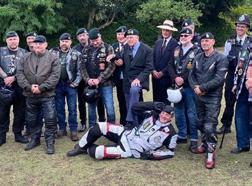
We were delighted to see two of our retired Generals present at the service; General Sir Robert Pascoe and General Charles Vyvyan. They very kindly agreed to have a photo taken with ‘The Iron Horses,’ a new ‘bikers’ group’ made up of veterans and their bikes from the Association. The service was conducted by our secretary Gary Driscoll with support from the ex-buglers of Quick Silver.
The next service will be held on Sunday 21st July 2024, starting at 11am, and we are delighted to inform you that the Waterloo Band and Bugles will be performing a concert again which will begin directly after the service. This will then be followed by the Central Band of the British Legion. Please do come along and join us.
Ladies Dinner Night Regents Park Memorial
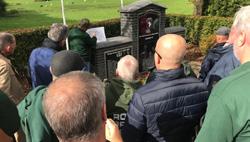
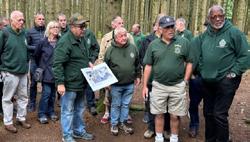
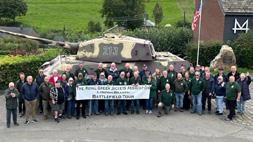
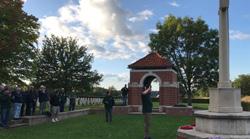
In September we held our annual Battlefield Tour, and on this occasion, we went for a long weekend to Bastogne for a tour of the Battle of the Bulge. We set off on Thursday and returned on Sunday. This allowed for two days of travelling and two days for touring.
Sadly, though on the same day of our departure, the funeral of Captain (Retd) Brian Ewin was taking place in Essex. Most of the veterans on the coach would have attended Brian’s funeral, some of us did manage to view the live video link, and during the tour we did manage to hold our own two-minute silence in his memory at one of the cemeteries. Brian had been a regular attender at London Branch events for over twenty years, and he will be sorely missed.
The first morning of the tour we looked at the 101st defence of Bastogne, and particularly the part played by Easy Company with a visit to: Bastogne War Museum This large museum focused on the Battle of the Bulge. It featured an interactive audio tour walkthrough and showcased many artefacts from the events leading up to and in the battle of Bastogne itself.
Three immersive shows told the story of four fictional characters involved in the battle. Mardasson Memorial – which is now known as the Battle of the Bulge Monument honours the memory of American soldiers wounded or killed during the battle. Designed in the shape of a fivepointed American star, the monument can be climbed in order to view the surrounding landscape. Bois Jacques (Jack’s Wood) and Easy Company Memorial, this memorial, identical to the one in Normandy, commemorates Easy Company’s defence of the woods and the men they lost. Fox Holes and Easy Company Positions: the fox holes marked the positions taken up around the woods by the 2nd Battalion 506th and predominantly Easy Company. Here they spent Christmas 1944 looking down into the village of Foy which they were destined to attack.
We followed the path Easy Company took when attacking the village, where we located the Sniper House. This housed a sniper who, from an upper story window, fired upon the men of Easy Company, until killed by a shot from Company member Daryl (Shifty) Powers. We looked at the house and where the shot was taken from.
We then visited the Foy Centre, looking at the town and the enemy positions and the run made by Easy Company Leader Ronald Spiers who ran through
the town to link up with ‘I’ Company.
We then visited the Recogne German Military Cemetery and site of American Temporary Cemetery. Here 6,807 German Soldiers who died at Bastogne are laid to rest. Across the road was the field where the men who defended Bastogne were temporarily buried including men of Easy Company. The field is now marked by an impressive memorial. We then visited Noville and Rachamps; Noville was taken by Easy Company days after its assault in Foy. The company rested that night in the convent at Rachamps where they were serenaded by the nuns’ choir as they took stock of their losses.
We had lunch at McAuliffe Square, Bastogne. This square honoured General McAuliffe and there was a US Sherman tank on display next to the general's bust. The 101st Airborne Museum was housed in the prestigious building of the former officers’ mess of the Belgian Army. The museum retraced the course of the Battle of the Bulge. A vast collection of items from the battle as well as reconstructed scenes and mannequins were displayed, and we spent some time here taking in the information about the artefacts.
We then visited Bastogne Cemetery and the Angels of Bastogne including the graves of the two nurses who tended the American wounded. They were Renée Lemaire, aged 30, killed when her aid station was bombed, and Augusta Chiwy, aged 94, who died in 2015. There is a pillbox which marks the point where the 4th Armoured Division broke through to the 101st and effectively ended the siege of Bastogne.
On the second day of the tour, we went to La Gleize and the December 44 Museum. La Gleize is located in the heart of the northern part of the Belgian Ardennes. The December 44 Museum is housed in a historic building in the centre of the village and dedicated entirely to the Battle of the Bulge. There is a King Tiger Tank Outside the museum Toger 213. This monster tank was left behind when Peiper’s Division withdrew from the town. We visited the Malmady Massacre Memorial and site. This memorial pays tribute to the 84 Americans who were murdered in the adjacent field by SS members of Kampfgruppe Peiper (part of the 1st SS Panzer Division), a German combat unit, during the battle. We then had lunch in Houffalize, a strategic location during the Battle of the Bulge Specifically, Generals Montgomery and Patton met up there, Montgomery coming from the north and Patton from the south, in their counterattack against the German forces remaining in the area. The town was flattened on
the night of 5/6 January 1945 by 90 RAF Lancasters of Bomber Command to block the key crossroads for German supply columns and the escape route for German forces. Patton wrote a poem in his diary about the bombing. In the centre of the town, a Mark V Panther tank sits as a memorial.
We then made our way to Parker’s Crossroads and the ‘Alamo Defence’. It was here that Major Arthur C Parker commanded three 105 howitzers of the 589th Field Artillery along with elements of the 106th Infantry Division and other small units totalling 400 men and held back 2nd SS Panzer Division for almost three days preventing them from reaching the Meuse River and splitting the US and British forces. La Roche-en-Ardenne. This is where the Black Watch of the 52 Highland Division met up with elements of the 82nd Airborne Division thus linking the US and British Forces. The town of La Roche was almost completely destroyed and 114 inhabitants were killed. An Achilles M10 tank now stands guard overlooking the town. We
Battlefield Tour
Field of Remembrance
visited the La Roche Museum of the Battle of the Ardennes. The museum covers 1,500 square metres with 120 military mannequins in uniform and equipment and weapons. There are some 20 vehicles and many artefacts. We then headed off to Hotton War Cemetery. This Commonwealth cemetery is outside of the town of Hotton which sits on the western limit of the Germans advance. The cemetery reflects the fact that the Germans were fighting not only the Americans but also the British in this battle.
All in all, it was an excellent tour and well presented by Rifleman Tours.
Next year 2024, we’ll be returning to the battlefields of Ypres, including the Memorial Parade at the Menin Gate.
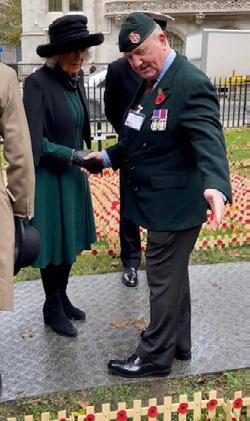
In November our secretary, Gary Driscoll and a few other veterans, attended the annual service at the Field of Remembrance outside Westminster Abbey, in London. This service marks the opening of remembrance weekend. Gary represented the Royal Green Jackets Association at the service, and yet again had the pleasure to meet Queen Camilla.
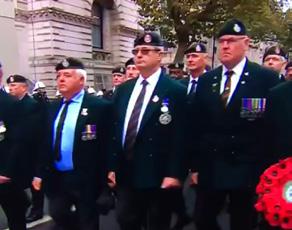
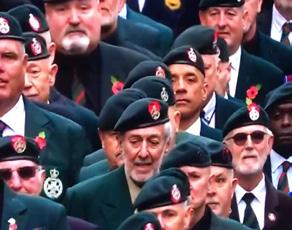
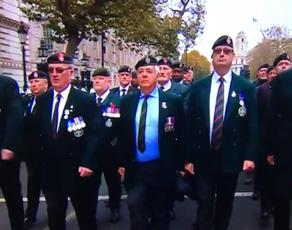
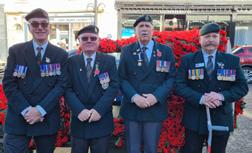
One hundred and twenty-five veterans of the regiment, took part in the annual marchpast at the Cenotaph in November. This year it was the turn of a veteran of 4RGJ to carry the regimental poppy wreath, and this task was carried out by Michael Kenevane. We were very fortunate yet again to have been mentioned and received live coverage on the BBC. The commentator gave a brief history of the regiment. Thank you to all those who attended the march-past, and we hope that we will continue to attract enough marchers for the 2024 Parade.
Please take note, that for the Cenotaph Parade in 2024, the information for applying for security passes will be posted out by email, to all members of the RGJ Association in June 2024. Marchers will be booked in on a first come first served basis. But please wait until you receive the application form.
Our annual Christmas lunch was held at our usual venue, at 86 St James’s, where the staff are always very welcoming to
us and provide a really good quality three course carvery lunch. We broke the record this year, with 90 in attendance. A rise of over 50% than on previous years. We had great fun singing the Twelve Days of Christmas. Each table has to stand up when it’s their verse to sing! Everyone gave generously to the raffle and money was raised towards the cost of this publication.
The Committee of the London Branch, RGJ Assn, would like to take this opportunity to express our
thanks to our members for their continued support, and we hope that 2024 will be a brighter one for everyone. We look forward to seeing our members at our forthcoming events.
The London Branch welcomes ex-riflemen of any rank to join us in supporting the RGJ family.
If you would like to join the London Branch, please email: Gary Driscoll, Branch Secretary, rgjldn@ntlworld.com
In Memoriam 2023
Forecast of Events 2024
• Wednesday 15 May – Turning the Pages, St. George’s Church
• Wednesday 22 May – QVR/KRRC/RB Memorial Service, Calais
• Friday 21 June – Veterans Day Lunch, 86 St. James’s
• Saturday 13 July – RGJ Association Reunion, Winchester
• Wednesday 17 July – Turning the Pages, St. George’s Church
• Sunday 21 July – RGJ Band Memorial Service, Regents Park
• Wednesday 18 September – Turning the Pages, St. George’s Church
• Sunday 10 November – Remembrance Sunday, Cenotaph
• Wednesday 20 November – Turning the Pages, St. George’s Church
• Friday 13 December – Christmas Lunch, 86 St. James’s
We look forward to seeing you at our forthcoming events
Christmas Lunch
Oxford Branch
At last, the branch is now functioning as normal thanks to the committee and the dedication of Andy Bowes and Andrea Isham, and we can now look to a full year of events etc.
Our Spring and Autumn lunches are now back on track and with a new caterer. We also welcomed several Officers who have joined the branch, including The Rifles County Colonel Mike Montagu, who has set up a “Continuity Group” to keep the names of the OBLI and RGJ prominent in the County of which the branch has representation. As in past years several of us made the journey to The Field of Remembrance in Westminster Abbey and laid poppy crosses in the OBLI plot that the branch has now adopted. The names had been taken from the Memorial Arch in The Holy Trinity Church Headington Quarry and all were local men. This is planned to be repeated in another local Church in 2024. Our thanks to the Oxford Tube and the London Taxi Drivers who waive their fares for Veterans attending.
Our Band Concert in July was well supported and although the weather was against us, we were treated to an excellent Programme of music by The Waterloo Band, and I pleased to say the attendance was much better that of 2022, so 2024 is the year to break records.
On the 11 of November we held our usual Branch sponsored Turning of The Pages (TOP) in Christchurch Cathedral. So as to ensure the continuity of this service I have rotated the Conducting Officers annually. 2023 was the turn of the QOOH (Queen’s Own Oxfordshire Hussars) and next year the Rifles and RGJ and so on.
In the evening we had the OBLI/RGJ Oxford Reunion at Edward Brook Barracks outside Abingdon. Unfortunately, there wasn't a cadet's band available to entertain us.
On Remembrance Sunday wreaths were laid in St Giles Oxford in memory of the fallen of the OBLI and RGJ from the branch as they will again in 2024.
Moving on to 2024 a small group made the journey to St Paul's Cathedral to the service in memory of Sir John Moore.
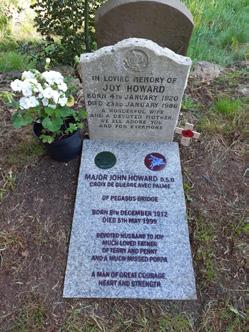
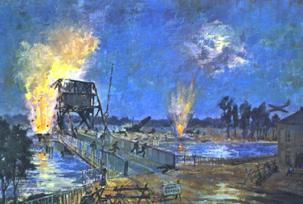
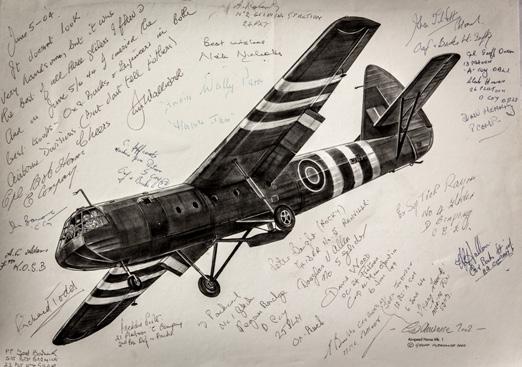
Looking forward further 6 June, 2024, will be the 80th anniversary of Pegasus Bridge. We will be making our pilgrimage to Major John Howard's Grave in Clifton Hampden.
Major Howard was an Oxford City Policeman before the War and there will be representation from Thames Valley Police at the Graveside Service and lay a wreath. We also hope to help arrange a “Pegasus Bridge” exhibition at a suitable venue.
The Oxford Band Concert and Reunion, are planned for the 14 July – the day after Winchester reunion so hopefully, a few heading away from Winchester on the Sunday will also attend this. Timings will follow by group email alter in the year.
The normal Turning of The Pages although not a Branch sponsored event, excepting 11 November, are well supported by our members, and encouraging for the future to see Col Mike Montagu the Rifles County Colonel playing a leading role.
I am being kept informed by The Rangers RSM
who is updating me on the progress of the “Stone Badge” new home in his Mess Garden in their HQ in Aldershot. It was discovered on a pallet in Edward Brooks Barracks and may have come from St Cross. At least now it will have a permanent home.
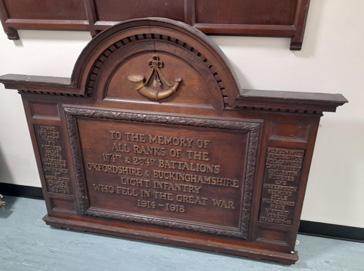
Although I never served in the OBLI it will always be my intention to keep its name, history and memorials alive. Some of you may remember the wooden Memorials in the Slade Barracks Drill Hall well, they are destined to be displayed on the main staircase in Oxford Town Hall after some renovation by Clint Ross. Always willing to help.
The Darrell Brown Trust (DBT) have agreed to give a sum of money in April next year that will be held by the branch account and ring fenced for OBLI matters that need some funding. This can include Buglers for Funerals of Branch members when they do not meet the criteria set by London District. Also, any projects that are relevant.
I have explained to the branch the criteria for the authorisation of a Bugler for Funerals in general by the London District who control Band and Bugles.
The branch is grateful for the support we receive from the RGJA for our events that are open to all RGJA members. A full list can be found on the website.
Finally, my thanks to our committee for their hard work and support, RGJA for the support they give our branch and to OC A Coy 7 Rifles for allowing us the use of the training centre.
We look forward to 2024 with confidence.
Terry Roper MBE TD “Swift & Bold”
Colonel Mike Montagu
Major John Howard's Grave in Clifton Hampden
South East Kent Branch
We started 2023 with the April AGM which was attended by 17 members and the committee duly voted in for the new year.
Thankfully we did not have any resignations during this year and had instead two members step up and join the committee, so thanks to Gary Tingey and Tiny Tidnam.
The first event we held was the annual BBQ in June organised by George Nash and his team, again held at the Phoenix club in Dover. Gary Tingey and his son yet again produced and cooked the food which was enjoyed by all. During the day we had face painting, a raffle and an auction plus a disco.
Again, this year thanks to Lest we Forget Association we had six members attend Wimbledon and 12 members enjoy a Thames River cruise.
In September we held our annual church parade in Dover Castle church conducted by our padre Sean Sheffield to remember our fallen brothers. Each of the fallen names were read out by branch members.
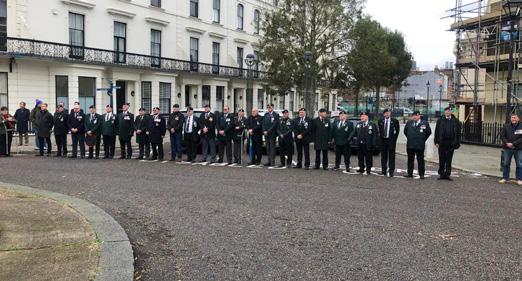
November saw the branch members attending three Remembrance services starting with leading the main Dover parade along the High Street to
the town hall service and laying a wreath. From there we moved to the KRRC memorial site to hold our own service and lay a wreath conducted by padre Sean. We then moved to the sea front WW1 memorial and because of high winds and rain coming off the sea, the wreath laying service was rather brief. It was then a quick withdraw to the Dover Sea Angling club for refreshments. Again, George Nash and his brother provided the plague and poppies for the KKRC memorial site.
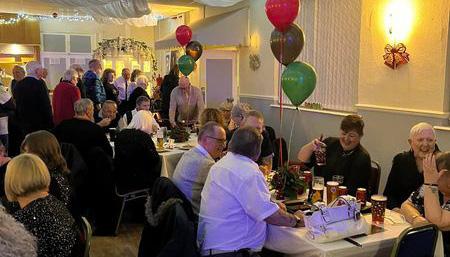
Our final event for the year was the annual Christmas party and again George and his team put on an excellent evening. The party was well attended and was held in the Phoenix club Dover. Pie and mash, raffle, auction, and disco were the order of the evening and enjoyed by all.
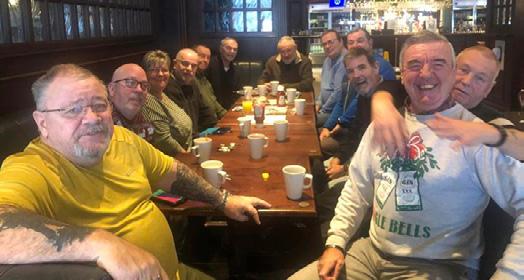
The monthly first Saturday Weatherspoon’s breakfast meet is attended by several members but varies in numbers depending on what town it’s being held.
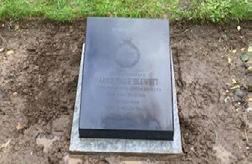
Lastly due to some detective work by Billy Mycock, Dutch Holland and Tiny Tidnam the unmarked grave of Barrie (Blue) Blewitt ex 3RGJ was found in Deal cemetery.
After some investigation and trying to track down Blues ex-partner and speaking to his daughter in Canada, George Nash made a plaque to be placed on the grave, which we did in December. We intend to hold a proper service in February 2024 for our fallen rifleman to show no one is forgotten.
Itinerary for 2024
Wiltshire Branch
The year started as expected with the Branch AGM. What wasn’t expected, was that the Branch Chair, Mike Walsh would state his intention to step down as chair at the next AGM in 2024.
A somewhat uncertain forecast of events was produced, which had a couple of TBC’s about it, still recovering from the Covid hangover. This didn’t deter the branch however from making the most of things through the year.
First up in January then was the Faugh a Ballagh charity trophy event, hosted by the local Royal Irish Rangers branch in the Warminster Conservative Club. We managed to cobble together a team, notably helped by Billy Hughes who made the trip from Poole for the evening, bringing a pair of nonRGJ friends to help make up the playing numbers.
After the three main events, Darts, Skittles and Snooker had been played, we sat second behind joint leaders, The Royal Irish Rangers, and the Royal Dragoon Guards from Battlesbury Barracks. Some exquisite dice play by the branch treasurer and
team captain Bill Tyson during the final event, the horse racing, secured us the win and the trophy.
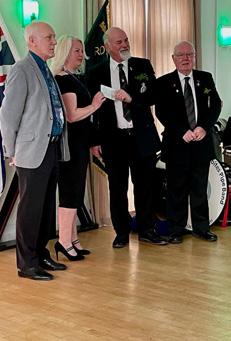
As a finale to this, the branch as winners were invited to present the cheque from the night to the local Dorothy House Hospice charity at the Royal Irish St Patrick’s day celebration. The Chair and Treasurer attended to happily fulfill this engagement.
The March quarterly branch meeting proceeded uneventfully followed by St George’s night, which saw a few of us together again in the Conservative club, our main gathering place for merriment with music.
The April Sunday dinner which normally would follow this year’s cancelled Forces March final water point event didn’t materialise mainly due to lack of
Cheque presentation – Bill Tyson and Mick Walsh presenting the cheque to Dorothy House Hospice
Mick Walsh, Jan Maddocks and Secretary Gary Byrne at the Waitrose poppy collection stand in November
hardcore availability. Undeterred though, we brought a few of us together for a Sunday Curry lunch in June which went down well with a Naan bread (and a few liquids!).
Not really a branch event, but the cancelled reunion in ’23 was replaced by a good number from the wider regiment still descending on Winchester for a brilliant weekend of renewed friendships. Once again, a few Wiltshire Branch members were spotted lurking in Winchester’s darkest corners.
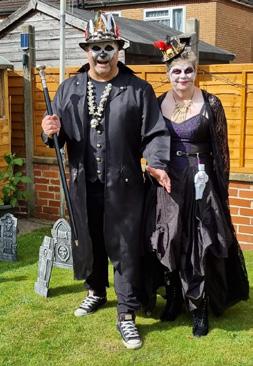
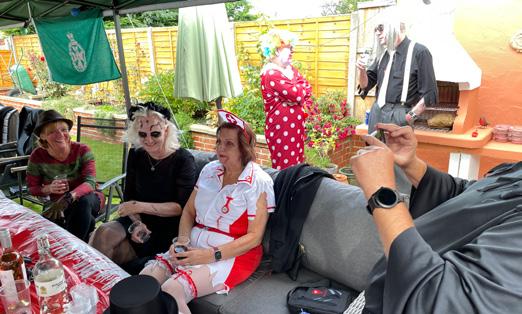
The July quarterly meeting was soon followed by the highlight in the branch calendar, the Annual summer Barbeque. This year was hosted yours truly and Frau, Elaine. The theme was ‘Horror’ which
produced much amusement and some fantastic efforts as always, with ghouls, ghosties and all manner of serial killers in attendance.
September saw our of us attending a funeral for a non-branch member, ex-bandsman Doug Horne who lived in Warminster. His family had expressed a wish for a regimental attendance and along with Bill and Mike, Phil Ashby and Bob Holcombe were available and happy to oblige.
October’s branch meeting saw the author publicly throw his hat in the ring as a candidate for branch Chair.
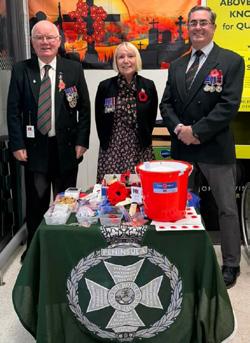
Remembrance weekend in November was once again the time for the branch to carry out collection duties for the RBL. Warminster Waitrose store again the location, the stand was attended by a number
of members, collecting a very creditable £1,631.80 over the two days.
The annual skittles night attracted a good turnout with all trophies returned and up for grabs. The format was of the traditional ‘killer’ variety with winner of the night Mick Peek who couldn’t miss if he wanted to, taking the spoils: the infamous “Frogs” trophy. The wooden spoon was ‘won’ if that’s the right word, by Emma Butcher, wife of newest member Clive (Butch).
And finally, to round off the year, the branch assembled as always for Christmas Eve drinks, the traditional end to the year, Christmas jumpers an’ all.
Be safe all, from Wiltshire! – Bill Tyson
Richard and Jacki Ciereszko (CZ) at the Horror BBQ in August
Pet Owen, Val Ashby, Elfie Severn, Mick Walsh and Phil Ashby at the Horror BBQ in August
Brian Darvill, Dave Caws, Chris & Gary Byrne and Jan Maddocks enjoying the Fish & Chips at the skittles night
Christmas Eve Drinks
Skittles night winner Mick peek, and loser, Emma Butcher
Phil Ashby, Mick Walsh, Brian Darvill and Kev Severn by Warminster’s poppy jeep on Remembrance Sunday
Winchester & District Branch
Like all branches I guess, the Winchester Branch always celebrates the end of its year in seasonal style with a good old fashioned and traditional Christmas Dinner. Our December 2022 dinner was no different from any other, in that everyone turned up at the venue for the evening, looking, and depending on their gender, either glamorous or smart.
It is true to say that a thoroughly enjoyable meal and evening was had by all, until later that night when the temperature outside and more importantly inside dropped suddenly. Unfortunately for us the venues heating system was unable to cope and proved to be inadequate in keeping us all warm. As a consequence the last hour of our evening saw us sitting shivering and huddled together like Emperor Penguins on an Antarctic ice floe!
Despite that little set-back we all departed in great spirit, and in true Green Jacket style we put 2022 behind us with the unspoken promise that 2023 would be a better and hopefully a warmer year too. A little more of that later.
So what have we been up to since our little stint as extras in Frozen? Well as always its worth first mentioning how lucky we are, that we as a branch continue to enjoy and more importantly appreciate the relationship we have with ATR Winchester, a relationship which benefits both the RGJA and ATR. From the ATR’s perspective they gain free maintenance of the various memorials situated throughout the site (including the Light Division Memorial Garden). Work, which in the main is carried out by branch members, and also freelanced by Derek Randall (ex 2RGJ) who is an honorary member of the WO’s and Sgt Mess.
The benefit we gain in return as a Regimental Association should not be underestimated either, given that for the foreseeable future at least, we have the ATR’s commitment to providing us with our venue for our now biennial Veterans Reunion. A commitment which was doubly endorsed recently when our branch President Nicholas Prideaux renegotiated a renewal of the Memorandum of Understanding Community Engagement (MUCE) with the ATR. Fancy name which simply acknowledges the long standing and friendly relationship between the RGJA and ATR(W) and in which it authorises various established activities.
So what has the branch been up to throughout 2023? Well in addition to our alternate monthly formal and social meetings, plus supporting the monthly Turning of the Pages in Winchester Cathedral, our main events for the year really got underway back in early February starting with our AGM chaired as usual by that renowned Rifleman and our inimitable Chairman – Major Roy Stanger. Roy as his wont laid the agenda foundations for a superb and busy year of branch events. The first of which really kicked off in April with a really fun and madcap family Quiz Night held in the SJM Barracks WO’s & Sgts Mess by kind permission of the ATR RSM, with a second following in October. On both occasions the Quizmaster was none other than His Royness ‘Bamber’ Stanger, whose hilarious and Gestapo like questioning technique was something to behold. It is fair to say that Bradley Walsh can sleep easy in his bed! On both occasions the evening was superbly complemented with a fish and chip supper which was paid for by the branch and organised by Pete Andrews.
Staying with the foodie theme, on the 7 May in celebration of King Charles Coronation, the branch together with the residents of Green Jacket Close jointly held a Kings Coronation BBQ in the Close itself. What a wonderful and enjoyable occasion it proved to be with Andy Spalding as our Maître d’hôtel for the day, and ably supported by Dave Lond as Chef de Cuisine who between them transformed the Close into a typical English garden party with more Union Jack bunting than you could shake a stick at, and of course the most delicious of food. All set off by the most stunning weather!
The branch took a bit of a break throughout August as it always does, but before we knew it September was upon us, and dare I say it with a little bit of trepidation, not least because our now annual minibus trip to the NIVA at the NMA on the 9 September was just around the corner. However, I am pleased to say that our trip on this occasion
went without a hitch, and a pleasant albeit very hot day was had by all who attended.
And so into the last couple of months of the year, where in November it naturally followed that as Winchester is a cathedral city, the branch would once again be heavily involved in its Day of Remembrance. As a consequence our day like everyone else across the country on Remembrance Sunday started really early with a 09:00 hrs service in the open air in front of the KRRC Memorial just outside the main entrance of the cathedral. This additional service the branch is more than happy to continue supporting and organise on behalf of the KRRC Association, which unfortunately no longer has the members to make it a viable event. As is now normal this was followed almost immediately by the main service in the cathedral.
At the same time running concurrently was a Drumhead Service in SJM Barracks ATR to which a number of our members attended and laid wreaths at the Light Division Garden of Remembrance and Light Infantry Ballygawley Memorial. Following
the various services and parades across the city a Remembrance Lunch was held at SWGC to which some 70 odd diners attended. Taking over the golf club with such numbers certainly puts the dampeners on those who prefer to play golf on Remembrance Day morning rather than pay their respects!
And so to our members and their families where I have to say 2023 was unfortunately not the best of years. Aside from the usual aches and pains and the odd occasional hospital visit caused by the aging process we have unfortunately had our share of unhappiness. Our first shock was in August when our ‘workaholic’ and ever resourceful branch ‘facilitator’ Douglas ‘Tiny’ Adams, out of the blue ended up in a coma with pneumonia and suspected sepsis. I am pleased to say however that after 50 odd days in hospital Tiny is now back at home and making a good but slow recovery.
The second shock however was the loss in October of John Harper. John was a true and loyal friend to all who knew him and an incredible servant of the
Kings Coronation BBQ's at Green Jacket Close
regiment. A Rifleman through and through. What many will not know is that John was one of the original founders of the Winchester branch who had met on a wet and snowy evening in February 1987 to discuss and lay out the infant ethos of the branch. In fact for a number of years he was also the branch secretary despite often saying he couldn’t spell or put two words together. It didn’t matter one iota as he had that thing called regimental drive and motivation, something which stayed with him right up to the very end. A sad loss to his family, branch, and Regiment.
Finally, as the year drew to a close in December, I am pleased to say that at our traditional Christmas Dinner – there were no signs of Emperor Penguins anywhere! In fact the evening really couldn’t have been better as everyone sat down in almost tropical heat and enjoyed an evening of delicious food, superb wines, and plenty of port to toast the Regiment and Absent Riflemen. Oh! and not forgetting almost everyone went home with a free raffle prize! As Punch would say ‘Now that’s the way to do it!’
John FD
Mr and Mrs George East, members of the Winchester and District Branch, received a Card from His Majesty King Charles III and Queen Camilla on the occasion of their 60th (Diamond) wedding anniversary
Yorkshire Branch
We continue to meet at the TAVR Centre in Wakefield except during the winter months or when it is the TAVR annual leave period.
President: Hugh Goudge 1RGJ
Chairman: Thomas Conlin 1RGJ
Treasurer: Sue Conlin
Secretary: Stuart Anderson 1RB
The branch was formed in 1997 meaning it was our Silver Jubilee in 2022, we still have seven founder members some of whom are not quite as active as they were in those halcyon days at the end of the last century.
Several branch members were present at York Minster on 16 January to commemorate the death of Lt Gen Sir John Moore who lost his life at the Corunna in 1809. We were the guests of the KOYLI Association (Wakefield) with whom we share our HQ.
Our President read out the famous poem by Charles Wolfe and the secretary placed our RGJ wreath at the foot of the General’s memorial in the regimental chapel (KOYLI). To our surprise one of our associate members Paul Crompton (7th Bn LI) gave the eulogy. He is a keen historian and keeps us on our toes with matters of regimental history with particular reference to the Peninsular War.
by a Falklands veteran. The speaker had served in 3 Para during the war and had sailed on the Canberra. He had taken all the slide photos himself. It was a vivid portrayal of what it was like to have served in the Falklands. It was almost standing room only and before the talk we enjoyed a nice buffet and a glass of beer at our host’s expense. One of those present was the bugler who had played at the funeral of our late lamented Chairman Fred Williams’ funeral. I will think of the veterans of that conflict with great respect.
Back to our meeting in which April we were pleased to find on entering our HQ that the new barman was in place WO1 Vince (LI) was now in post and proved to be a more than able replacement for our previous custodian. The most notable absentee was John Lengthorn (1RGJ) who together with his partner Stephanie was once again globe trotting this time in the middle east; Jordan and Egypt to be precise.
Our March meeting was cancelled, our first of the year, as our secretary was recovering from an operation and our chairman was away overseas therefore our first actual meeting was in April but before that at the invitation of our comrades in the KOYLI Association we attended a talk given
The May meeting was a little different. As I was gathering my Secretarial paraphernalia together, I received a phone call from the TAVR Centre, to cut a long story short, it was closed – TA Holidays. Like Cpl Jones of Dad’s Army fame, I now went
KRRC Service of Remembrance
into panic mode. There was hardly any time to let people know before they set off. Fortunately, my first call was to the Conlins, Sue came on the line and grasped the situation immediately, issued clear and concise orders. She and Tom would go to the car park and when others arrived, they would all go to a nearby pub leaving someone behind to round up late comers.
When I arrived, I was directed to the beer garden of a nearby pub, and we gathered around two tables on what was a temperate May evening. We couldn’t display the RGJ banner, but the chairman struck the gavel and the meeting commenced. The meeting was informed that we had a new RGJA Secretary in Rebecca Maciejewska. It was suggested that she be addressed as Rebecca or Madam Secretary, and this was offered as advice to our President who will be in contact with her at meetings in Winchester.
A discussion took place to decide where to go for the branch annual lunch, an Italian restaurant was chosen conveniently close to our HQ. The Conlin duo took control of the arrangements and as the night was now getting distinctly cooler the raffle was held and the meeting closed at 20:25hrs, the shortest recorded meeting during my tenure as Secretary. As I drove out of the car park the Conlin’s were returning with menus from the Dolce Vita.
We subsequently agreed to have lunch in the August.
At the June meeting as we assembled it was observed that a car with RGJ trappings was already in the car park, Before a search party could be assembled the wanderers returned having had an evening meal at the Dolca Vista by way of a trial run, it was pronounced most satisfactory which means we will not be using McDonalds after all as suggested by Ernie Blanchard (3RGJ and LI). During the meeting we were given a report by John Lengthorn entitled “Lawrence and Gordon” His next odyssey will be over the equator to Kilimanjaro and Zanzibar where he will be known as “Bwana” Lengthorn. We learnt from a telephone call that David Broomfield (2RGJ) was residing in a Wakefield care home. David served for a time in the company led by the late Lt Gen Sir Christopher Wallace in Celle when he was a Major. With Marton Westbrook now a member of the Winchester David helped found the Yorkshire branch.
At the July meetings we were informed of the sad death of Major Ron Cassidy MBE, a stalwart of the Green Jackets who had originally joined the army as a soldier in the Rifle Brigade in the early 50s. I had first heard of him when I joined the RB and he
was a Sgt although I never encountered him until many years later when attending a committee meeting at Winchester and found myself sitting opposite him. He will be greatly missed by everyone. Unfortunately, the news came too late for any branch member to attend but we look forward to reading his obituary in S&B which should make interest reading.
The branch held their annual as planned in August at the Dolca Vista, I arrived with my wife to find Ernie Blanchard in debate with a burly parking attendant over parking, he was joined by Peter Elmore (1RGJ) and our President Hugh. The outcome was Ernie had to pay. The meal was excellent with piping hot food and great coffee, and we had the full attention of the staff both front of house and in the kitchen.
It will be no surprise if we do not repeat it again next year. We had 12 members attend. Photographs were taken and when I mentioned that the toilets were of a very high standard, he said he would arrange for me to eat there next year!
The NIVA gathering at the NMA in September was a day of great heat Because of circumstances three of our membership were obliged to withdraw and we failed to encounter Peter and Lisa Elmore
who had stayed overnight nearby. At the forming up point many of our members had quite sensibly discarded blazers and were in shirt sleeve order. My blazer felt like a greatcoat and the Ash Grove seemed formidably far off.
The LI marched off before us, but we almost overtook them. Standing in the shade before the service began a younger marcher said: “hot, wasn’t it? My name is Nick, have you come far?” As soon as he spoke, I recognised him from meeting him at a Catterick event when he was the inspecting officer at a passing-out parade, it was Lt Gen Nick Cottam. He then said: “I’m not marching you back!” Neither did!
At the rugby club afterwards, I met John FritzDomeney. For those who knew him he has now become a bearded wonder…
On the 1 December some of our members attend the KOYLI Christmas party, the weather was particularly bad that night and the only one who could attended was our president Hugh, as a small branch we work very closely with the KOYLI Association, in fact one of our members is their Secretary. Once again we have been invited to attend the Lt Gen Sir John Moore service in York Minister on the 16 January 2024.
The Rifles in 2023
Regimental Operations Summary
Flexibility and a can-do attitude sum up the Regiment in 2023, with our Riflemen proving once again that no matter what they are tasked with, it will always be executed with RIFLES aplomb and dash. After the intensity of 2022 and Operation INTERFLEX a certain degree of normality returned, providing the battalions with valuable time to catch up with much needed core infantry training and deployments. Critically, establishing new partner relationships, whilst cementing old friendships and alliances also saw our Riflemen working at pace across multiple theatres, in challenging situations.
At home our Regular and Reserve battalions saw a tremendous amount of activity; most notably delivering testing Potential Junior NonCommissioned Officer (PJNCO) Cadres. Just over 100 Riflemen from across the regiment were promoted to Lance Corporal having been put through their paces by 1 and 5 RIFLES on separate courses across Dartmoor, Brecon, Caerwent and Salisbury Plain training areas. The courses covered the mandated Army Leadership Development Package that included planning and running training exercises, acting as safety staff for static live firing ranges as well as low level infantry skills in urban and trench warfare.
After the PJNCO cadre the headline act for 1 RIFLES saw them bid farewell to Chepstow, via a farewell parade in the town, and relocate to Alexander Barracks, Cyprus. This was no small feat when one considers the effort involved with moving 490 individuals and 150 families. Amongst the many tasks set for them was adopting the role of the Regional Standby Battalion, deployable at short notice to react to any event in the Middle East region. Tragically however, months prior to their departure from the UK, Rfn Whiting and Cpl Birnie died in separate road traffic accidents, hitting the battalion hard.
2 RIFLES have barely had time to catch their breath. After completing Exercise WESSEX STORM on Salisbury Plain in early 2023 A Company deployed to Valladolid, Spain on Exercise IBERIAN SUN which culminated in a Battlegroup advance to contact alongside their Spanish counterparts. Meanwhile elements of C Company were providing support on pre-deployment training of a Zambian Battalion prior to a mission in the Central African Republic and I Company were in the Falkland Islands for three months as the resident infanteers on Operation FIRIC. With their summer leave cancelled (again) the battalion deployed on Operation INTERFLEX, before two teams were submitted to Exercise SUNDA PATROL in Brunei a jungle-based
patrol competition like Exercise CAMBRIAN PATROL. With one eye on the future and profound change in both Brigade and role, 3 RIFLES were busy throughout 2023 on overseas commitments that saw A Company deploy to Estonia on Operation CABRIT as part of the Queen’s Royal Hussars Battlegroup. Mounted on Mastiffs, their activity focused along the Estonian border where they developed new Anti-Tank tactics incorporating unmanned aerial systems (drones). Very sadly the battalion lost Rfn Delanimati whilst there, and his funeral in Fiji saw 10 Riflemen bid him farewell. Concurrently, Exercise ORION kept the remainder of the battalion busy in France on a Corps-level NATO exercise where an exceptional performance by the Quarter Master (Technical) helped prepare and maintain 60 armoured vehicles throughout.
As a regiment our ties to 4 RANGER remain strong. RIFLES Regimental Headquarters continues to provide support, not least through the Always A Rifleman Programme. The battalion’s relationship with the Worshipful Company of Carpenters, that began under 4 RIFLES, is healthy and thrives. Across the regiment our Riflemen continue to
volunteer for the RANGERS and in 2023 this exposed them to deployments in over 25 countries covering the Middle East and Asia, where troops are rotated every six months supporting allies in counter terrorism, helping constrain hostile state activity and securing borders.
Because of 5 RIFLES’ commitments to the Armed Forces of Ukraine in 2022, the battalion had to play catch up by qualifying drivers, gunners, and commanders to re-establish its core warfighting role in armoured vehicles. This prepared them for the German validation exercises, IRON CYCLONE and CABRIT TEMPEST, alongside the Queen’s Royal Hussars, 21 Regiment Royal Artillery and 1 Royal Horse Artillery in advance of the battalion’s third deployment to Estonia on Operation CABRIT later in 2024. Put through their paces in dismounted and mounted range packages, as well mounted close combat training, the battalion performed exceptionally well and earned time off to conduct adventurous training and indulge in German culture and history. The shooting team continued to deliver, although it was disappointed to come third at Bisley in the annual competition.
Our reserve battalions have shown their considerable diversity and have stepped up by sending troops abroad on individual and Company deployments, provided instructors for Operation INTERFLEX, entered successful teams into the arduous Cambrian Patrol Competition, as well as committed to Freedom Parades and a vast amount of other community engagement activities including Bugle Breakfasts.
However, once again Operation INTERFLEX continued to absorb considerable focus and manpower throughout the year, with most RIFLES battalions (including 4 RANGER) contributing their expertise to help train Ukrainian soldiers. The regiment now has more INTERFLEX troop training package rotations under its belts than any other British Army unit and, as you would expect, we have helped refine the courses and its delivery. Of note is that some of the training has been two-way and our Riflemen have benefitted from the knowledge of Ukrainian Border Guards who have experienced some of the most violent battles, including Bakhmut.
The pace of regimental activity has been intense throughout the year, partly driven by Future Soldier and the Integrated Review, and most notably of late by the continued war in Ukraine and the Middle East atrocities committed by Hamas in Israel on 7 October. Our focus has remained resolute and unflinching, and we are well prepared for any eventuality, as you would expect from The Rifles.
Regimental Sport and Training Summary
When presented with opportunity our Riflemen have always fully grasped matters with both hands, and it has been no different during 2023. With a battalion in Cyprus, water sports have been front and centre with paddle-boarding, kayaking, windsurfing, sailing, swimming, water-skiing and wakeboarding all taking centre stage. Out of the water our troops have excelled in Alpine and Nordic skiing, rugby union and league, football, cycling, hockey, golf, indoor rowing, power lifting, triathlon, basketball,
Bobsleigh, Ju-Jitsu, Judo, cricket, and boxing. Furthermore, on an individual level Riflemen have played sport at Infantry, Army, Combined Services, Premiership rugby (Newcastle Falcons), National League One (rugby league) and Olympic level, and a handful have been awarded Army Talented Athlete Scholarships Schemes.
Despite battalions being at full stretch, those who managed to get away on adventure training made the most of it with notable expeditions to Kenya, Val d’Isere skiing, parachuting in Cyprus, sailing in the Caribbean, canoeing on the Amazon, as well as time spent at the Adventure Training Wing (Herz) in Sonnenberg climbing, walking, mountain biking and mountaineering.
Conclusion
Whilst Operation INTERFLEX has continued to absorb much of the regiment’s resources and personnel, the importance of the task has not been lost on our Riflemen who are still delivering high quality training to Ukrainian soldiers. Knowing that many are going straight to the battlefield has kept minds focused and the training relevant, with everyone aware that the next six months will be critical to the outcome.
The pace of overseas deployments has been intense meaning that many Riflemen, of all ranks, have been away from home for considerable periods of time. Whilst that has been unavoidable, the level of commitment and professionalism shown by the battalions has been nothing short of exemplary and means that each one is in a good place operationally and ready to deliver whatever it is tasked.
The ‘Always A Rifleman Programme’, led by Lt Col (Retd) Baz Melia MBE continues to deliver amazing output to those in need of support. In tandem, Unit Welfare Officers with the battalions have worked hard across the board with packed welfare programmes when loved ones have been abroad on deployments. The ingenuity and levels of enthusiasm never ceases to amaze. Thankfully it is not all work, and our Riflemen still know how to play hard, which is proven by the amount of sport and adventure training troops manage to fit into an already packed schedule.
2024 will see significant changes being made, with 3 RIFLES in particular changing role and downsizing. With an increasingly volatile security picture the world is an uncertain place, but thankfully our battalions are in excellent shape to step forward should they be required.
Waterloo Band & Bugles 7th Battalion The Rifles
The Band & Bugles have been kept busy over the course of the last year with many notable public performances as well as the Band’s small groups and Buglers providing musical support to a wide variety of events.
In February ‘23 our Buglers travelled to the Army School of Ceremonial Headquarters in Catterick where they sat their class 2 & 3 bugle exams. We are delighted to report that all three of our Buglers passed with flying colours and enjoyed the opportunity to work with their Regular counterparts as well as other Reserve Buglers from 8 RIFLES
In April the Band & Bugles performed on Bournemouth bandstand in the picturesque setting of the Lower Garden. We were also joined by our colleagues from the Salamanca Band & Bugles of 6 Rifles as well as members of the Bugle Branch of The Rifleman's Association. It was a fantastic afternoon of music with something for everyone.
May saw us honoured to once again join with the Salamanca Band & Bugles to perform in the
grounds of Buckingham Palace for the first Royal Garden Party given by King Charles III and the Queen Consort.
Also, in May we performed a Coronation concert in Swindon at the Town Gardens Bowl and a Sounding Retreat and Sunset Ceremony for the Welsh Guards Association at Edward Brooks Barracks in Abingdon.
For our ACT camp in 2023 we travelled to Mons in Belgium where we stayed at SHAPE (Supreme Headquarters Allied Powers Europe). It was a busy two weeks which saw the Band & Bugles perform at a number of events in and around SHAPE as well as a trip to Kasteel Limbricht in Holland for a Sounding Retreat and we performed a concert at the site of the Battle of Waterloo.
In June Rfn Howard, a member of our Bugle platoon had the great honour of taking part in the Ceremony of the Keys at the Tower of London. The Grenadier Guards former the escort to the Keys and Rfn Howard sounded the Last Post on the steps at 22:00hrs.
In July the Band & Bugles provided musical support at an Attestation Parade for The Queens Own Gurkha Logistics Regiment at Gale Barracks in Aldershot. We were also joined by members of the Army Medical Services Band and The
Gurkha pipes and drums.
Also, in July with the Salamanca Band & Bugles we performed a Memorial Service and Concert on the Regents Park Band stand to honour the memory of the Bandsmen of the 1RGJ who were lost and injured as a result of the IRA bombing in 1982.
We also gave a concert at Edward Brooks Barracks in Abingdon for the Oxfordshire & Buckinghamshire Light Infantry Association.
In October we took part in ‘A Night at the Proms’ concert at the Wyvern Theatre in Swindon with Swindon Young Musicians.
November saw the Band & Bugles perform a Remembrance concert in the beautiful surroundings of St Mary Magdalene Church in Woodstock which was hosted by the Soldiers of Oxfordshire Museum.
The Band & Bugles were honoured to be tasked with supporting a number of acts of Remembrance at HMP Bullingdon, Lloyds of London, Reading and
Watchfield. We also led the Remembrance Day Parade in Reading.
In December we once again performed a Christmas Concert in beautiful Bouton-on-the-Water which was hosted by the Royal British Legion.
The year ended for the Band & Bugles with a carol Service and concert in St Georges church Reading which was hosted by our fellow Riflemen from HQ Company based at Brock Barracks.
Away from music there have been opportunities during the year for members of the Band & Bugles to take part in some adventurous training and these have included skiing with the Battalion and sailing which saw Cpl Bloodworth complete a 5-day competent crew course, and L/Cpl Gould, Musn Hicks, L/Cpl Willey and Sjt Hamilton learn the finer points of dinghy sailing, windsurfing and paddleboarding.
During this year there have been some notable achievements within the Band & Bugles. In October
Musn Jackson passed CEQ 2 on Tuba (Career Employment Qualification), and Musn Maglone passed CEQ 3 Instrumental Performance on Trombone.
In November Rfn Howard received a Meritorious Service Certificate at the Oxfordshire LordLieutenants awards.
Musn Thompson and Rfn Stimpson both received the Colonel-in-Chiefs award at The Rifles Awards Dinner.
Musn Reed was presented with the Volunteer Reserves Service Medal in recognition of ten continuous years of efficient service in the Reserve Forces.
We also said goodbye to two much valued members of the Band & Bugles, in July L/Cpl Brockman, a member of our bugle platoon retired from the Reserve having served since 1994 and was presented with his citation by Colonel (Retired) Montagu.
Our Christmas concert in Reading marked the last engagement for one of our clarinettists L/Cpl Sturdy who joined the Band & Bugles in 2000, having previously served in the Regular Army from 1975 to 1993.
We have a busy schedule of events and here are some dates for your diaries, more details are available on our Facebook page:
• 21 April – Concert, Bournemouth Bandstand
• 15 June – Concert, Swindon Bowl
• 6 July – Concert, Alexandra Gardens Windsor
• 21 July – Concert, Regents Park Bandstand
8th Battalion, The Rifle Brigade –from Normandy to the Baltic
Full disclosure: my father, Foster Cunliffe, commanded F Company, 8RB throughout the period from Normandy to the Luneburg Heath. I met Don Gillate at annual F Company reunions that started in the late 1940s and continued until the mid 1980s. As you might expect, the reunions took place in different East End of London pubs. James Cunliffe
Some ‘Swift and Bold’ readers may be familiar with a book published in 2019 called, ‘With the 8th Rifle Brigade, from Normandy to the Baltic’, by Don Gillate. Don was an NCO in the battalion during WW2’s campaign from Normandy to the Baltic in 1944 and 1945.
Don’s book is based on his spoken recollections of war-time, recorded in the early 1990s, with vivid and personal descriptions of events including the death of over thirty of his fellow riflemen. It includes many photographs and maps and is a fascinating read.
Don Gillate was a member of 13 (Scout) Platoon, H Company, 8RB – a motor battalion, which was a part of the 11th Armoured Division. A Londoner, born in 1922, he had won a scholarship and been educated at Alleyn’s School, Dulwich before the war and went on to a career in broadcasting and teaching abroad, through the British Council. He was happily married to Marjorie for over 50 years, and he died in 2009.
The book was produced and edited by an extraordinary, big-hearted person from the Netherlands, Ronald Jeltes. He had met Don Gillate,
by chance, in Normandy in 1999 and they had struck up a firm friendship along with another rifleman, Dougie Maber. Ronald works in civil engineering and lives in the northern part of the Netherlands with his family.
He has a deep sense of the importance of modern history, not least the period when Holland was occupied and subsequently liberated by the allies. In his very humble way, he recognises the heavy sacrifices that the British made for his parent’s generation and their freedom from Nazi oppression and wants to keep the flame alive.
Ronald Jeltes and Don Gillate in May 2000 –photographed in the town of Delft, following a visit to the battlefields and British war cemeteries in the south-east of Holland.
To supplement and update the book, Ronald is the creator and curator of the 8th Rifle Brigade website, which is well worth viewing – www.8thriflebrigade. co.uk – and he is always looking for new material to edit and up-load, if readers have any connections to the former battalion:
Ronald is working now on a more comprehensive account of the 8th Rifle Brigade. To cover its 2nd Battalion, London Rifle Brigade beginnings as
a territorial, training unit to a fully equipped and battle-ready motor battalion, fit for D Day and the subsequent campaigns that lay ahead. The account will describe its formation in 1939, its training and its role as part of the Home Forces in Britain.
It will then go on to describe the fighting in Normandy, through northern France and the Low Countries, including the liberation of Amiens and Antwerp, the harsh winter of ‘44/’45 spent along the river Maas and in the Ardennes and the fighting into Germany, which continued right until the final stages around the Baltic coast. It will also describe its role in the liberation of Belsen and its post-war deployment to Schleswig Holstein, deterring the Russians from further advances to the west. The battalion was disbanded in 1946.
Ronald has gathered a large amount of source material for his book, both published accounts such as ‘The London Rifle Brigade, 1919-1950’ and the battalion’s ‘Company Histories’, as well as war diaries and a considerable number of unpublished personal eyewitness accounts. I know that he would welcome any further material, including letters, diaries, photographs and maps. Any reader can get in touch with him at: contact@8thriflebrigade.co.uk
8th Battalion, The Rifle Brigade – from Normandy to
8th
Ronald Jeltes and Don Gillate in May 2000 – photographed in the town of Delft, following a visit to the battlefields and British war cemeteries in the south-east of Holland
351 RIFLES
AND DORSET REGIMENT LIGHT INFANTRY
49 110 23
0
0
4
2
2 0
17
8 0
164
1
4
0
5 3 2 745
Northern Ireland Veterans Parade 2023
By Michael Leeming
THE RIFLES BENEVOLENT TRUST
Saturday 9 September 2023 was the hottest day of the year with temperatures almost at 40o C and the first time since September 2019 that the Northern Ireland Veterans Association (NIVA) have able to hold their annual gathering at NMA. The Central England Branch has however, kept our own NI Service of Remembrance going, despite all that
Covid and Government regulations could throw our way. Admittedly in 2020 we were just 10 strong, held with strict 2m separation but hold it we did! The last two years were again held just for RGJ Veterans and families but attendance numbers were good. So, 2023 was the first full Light Division & RIFLES gathering at the NMA since 2019.
Frank Grenardo Ken Potter and Del Milam Steward Greenhill, Tony North and Paddy Irish
As usual, this SoR took place on the 2nd Saturday of September and, follows on from the daily 11:00hr NMA SoR held in their chapel. We form up and march down the Millennium Avenue to the Ulster Ash Grove Memorial but increasing numbers of wheelchairs and mobility scooters highlight our advancing years and the increasing challenge of the march for many. Nonetheless, most gave it a good go, or took to their mobility scouters or simply hitched a ride on the NMA golf buggy!
On arrival at The Ulster Ash Grove, the marching contingent and visitors gather around the six large monolith stones from the six Counties of Northern Ireland that form the Ulster Ash Grove where the NIVA Service of Remembrance takes place. The NIVA is now under new management with
General Sir Roger Wheeler GCB CBE taking over the president’s reins from our own General Sir Robert Pascoe KCB MBE, and the day to day running now in the hands of Phil Ellaway.
Our Regimental Service of Remembrance was this year again conducted by CEB Honorary Padre, The Rev Kelvin Price (2RGJ/4Rifles). Despite his time being heavily in demand as the Rector of St Laurence’s Church, Ludlow, he travelled across from Shropshire to perform another excellent service for us. His spiritual offerings are always thoughtful, always sincere and always well received by his fellow Riflemen – given his own personal operational service, over nine years, with the Regiment in both Northern Ireland and Iraq.
On conclusion of reading the Roll of Honour, The Last Post and Reveille were played and the Association wreath was laid on behalf of all RGJ Veterans by our Chairman, Colonel Carron Snagge OBE. Sgt Ricky Tyson MM laid a wreath on behalf of the wounded and Injured.
Following the formal part of the day at Alrewas,
we retired to Lichfield Rugby Club for some liquid refreshment, banter aplenty and a curry lunch, courtesy of the Association, although the less said about that curry the better! We did enjoy a rather pleasant afternoon of chat, world Cup Rugby and fine entertainment thanks to Tony Bishop and Quicksilver.
Guy Mynett instilling some order into things Phil Mason and Mark Lydiat grabbing a ride to the UAG
Ulster Ash Grove Northern
Ricky Tyson MM Family wreaths a welcome addition
Rev Kelvin Price
Los Tres Amigos!
As you read this, please remember that Northern Ireland was an integral part of the history of our Regiment. It is important that it is not forgotten with the passage of time and other events beyond our control. We will continue to pay our respects to the fallen, wounded and injured annually on the second Saturday of each September: the next occasion being 14 September 2024. Our thanks go out to
all who support this annual gathering at the NMA. In particular to Rev Kelvin Price for his stalwart support, and of course Tony Bishop and his team of Buglers. Any branch who has a member, wounded or injured as a result of their NI service, and who would like continue our custom at the NMA of laying a wreath on behalf of the wounded and injured should contact the author.
Soldiers of Oxfordshire Museum celebrates its 10th anniversary in 2024
In 2024 Soldiers of Oxfordshire Museum, the home of the Oxfordshire and Buckinghamshire Light Infantry and Oxfordshire Yeomanry collections, will celebrate its 10th anniversary with the addition of new and updated permanent displays, as well as new exhibitions and events.
A special 10th anniversary display will also open from 1 June to 1 October, a showcase of the museum’s favourite objects from past displays and a few objects from the archives that have never been on public display before.
Of course, 2024 also marks the 80th anniversary of D-Day and the museum will commemorate this with a new temporary exhibition opening on 18 May and running to 24 September 2024. The exhibition aims to once again highlight the compelling stories of the Oxfordshire and Buckinghamshire Light Infantry, not least the Pegasus Bridge operation, but also provide a wide range of other Oxfordshire stories and perspectives. These will include the contributions of many RAF stations, airfields and
The Shade was in great demand on 9 September 2023
Glyn Holtham, Mick Bullivant and Guy Mynatt Frank Allen, Mike Gleeson and John Fritz-Domeney
Soldiers of Oxfordshire Museum celebrates its 10th anniversary in 2024
A Woman's War Permanent Display
Opening the Oxfordshire Gallantry Board
other sites across Oxfordshire, in planning, training and intelligence gathering ahead of the Normandy invasion. Following an appeal for local stories, the museum aims to include many civilian stories of 1944, such as residents’ childhood memories of seeing planes overhead or meeting soldiers billeted locally in the huge build up to Operation Overlord.
The permanent Battles of The Oxfordshire & Buckinghamshire Light Infantry display was recently updated with greater focus on key moments in the regiment’s history from 1940-1945.
The display already allows visitors sit inside a recreated section of an Airspeed Horsa Glider, while audio headsets provide the opportunity to hear Major John Howard recount his memories of the historic Pegasus Bridge operation. An audio reconstruction of how it may have sounded to be
aboard one of the gliders that landed there in the early hours of the morning of 6 June 1944 offers an even more immersive experience.
With the help of recent OxLEP Grant funding, SOFO has also embarked on a wider update to its permanent exhibition space, which includes both brand new displays and expansions to existing favourites.
The new Bloody Battles and Dangerous Diseases display presents a Horrible Histories-inspired look at wartime medical advances and the ways in which these, combined with new equipment, helped soldiers’ survival on the front lines.
Like so many of the museum’s displays, the new exhibition pod is packed with engaging interactives especially for children, and opportunities for younger visitors to handle and try
on real survival equipment, such as helmets, body armour and pilot’s lifejackets.
A revamped Secret War display builds on the popularity of the museum’s recent Spy Oxfordshire exhibition and explore county connections to the real world of secret agents and espionage through the lens of Ian Fleming and James Bond. Now on show are Bond film props, such as a pair of shoes worn by Sean Connery in Never Say Never Again, alongside Fleming artefacts like his Golden Typewriter. A collection of real spy kit from the
Second World War has also now been acquired by the museum, including rare equipment like concealed daggers and radio sets used by Special Operations Executives agents and Resistance fighters.
Global Army: From the Age of Empire to the Modern Day, another new permanent exhibition pod at the museum, now offers visitors insight into the global impact and scope of deployments of the many members of the Armed Forces that have called the county home. The display draws on both recent
Soldiers of Oxfordshire Museum
Maj John Howard and 2nd Battalion Oxf & Bucks LI-Oxford Salute the Soldier May 1944
Painting of the capture of Pegasus Bridge, donated to the museum by Major John Howard
Soldiers of Oxfordshire Museum celebrates its 10th anniversary in 2024
Secret Agents, Secret Armies Permanent Display at Soldiers of Oxfordshire Museum – Ian Fleming and Bond
Japanese Machine Gun –Fleming and Bond in Background
Japanese Machine Gun –Global Army Exhibition Pod
donations and objects that have never been on display outside of the museum’s extensive archive –such as a Japanese ‘woodpecker’ heavy machine gun, captured by soldier of the 6th Battalion, Oxfordshire and Buckinghamshire Light Infantry serving as part of the Second World War’s ‘forgotten army’ in Burma.
Building on SOFO’s 2023 Women & War temporary exhibition, another brand-new permanent display looks at the story of women in the Armed Forces, from Auxiliary services of the First and Second World Wars right up to conflicts as recent as Bosnia. Highlights of the display include a Women’s Royal Naval Service (WRNS or ‘Wrens’) hat which belonged to Enid Innes who served as a Cypher Officer in during the Second World War and worked on planning for Operation HUSKY – the Allied landings in Sicily – in 1943.
One of the museum’s most acclaimed displays is The Liberation of Bergen-Belsen which brings together raw, personal accounts of both the liberating soldiers of the Oxfordshire Yeomanry and the liberated camp survivors. On Holocaust Memorial Day 2024, a new addition was opened focusing on one particular story. When the Oxfordshire Yeomanry liberated the camp on 15 April 1945, Naomi Kaplan was one of the survivors they found, having endured
years in the Nazi camp system. She approached soldier Arthur Tyler and asked him to write to her family to tell them she was alive. The letters he exchanged with her family, reuniting them, are now on public display alongside panels detailing the incredible story of a simple act of kindness with an impact that lasted generations.
Visitors in 2024 may also find themselves guided by a familiar voice. A new audio tour of the museum has been narrated by comedian and keen historian Al Murray. Known for his Pub Landlord stage persona, Murray also hosts the popular Second World War Podcast We Have Ways of Making You Talk alongside historian James Holland, as well as a growing annual history festival, We Have Ways Fest. Also providing voiceover for the new audio tour will be his father, ‘The Colonel’ Ingram Murray.
The museum will also offer a special 10th Anniversary Ale by historic Oxfordshire brewers Hook Norton Brewery, celebrating its own 175th anniversary in 2024. Look out for it in the museum shop and during museum events this summer. Proceeds from sales of the celebratory golden ale will support the Soldiers of Oxfordshire Trust’s continued work collecting an preserving the county’s military stories and artefacts.
2024 will also see the 110th anniversary of the start of First World War and like D-Day, the museum will mark this
with new exhibitions. Collector John Noott’s The Art of World War II: A Personal Collection went on display last year with great popularity and acclaim, and this will be followed by The Art of WWI. The smaller but no-less impressive collection of original artwork features some truly spectacular pieces, all produced during -and depicting scenes from – the Great War. The exhibition will go on show from 25 June to 29 September.
Finally, the year will be capped off by the longawaited launch of an exhibition of the art of E.H. Shepard, from 6 December 2024 to 31 August 2025. Best known as the man who drew Winnie-thePooh for the A.A. Milne children’s stories, Shepard served as officer in the Royal Garrison Artillery during the Great War and much of his early work, for magazines like Punch, portrayed a lighter side of the war. His humorous illustrations poking fun at civilians and soldiers on both sides of the conflict.
The museum is often described as a ‘hidden gem’ in Woodstock, and with something for everyone, we hope you can come and join us in our 10th anniversary year – there’s never been a better time to visit Oxfordshire’s military museum.
Soldiers of Oxfordshire Museum celebrates its 10th anniversary in 2024
Bergen Belsen display Bergen Belsen display – Letters from Liberation
E.H. Shepard Exhibition
Soldiers of Oxfordshire Museum celebrates its 10th anniversary in 2024
John Noott Art of WWI
Drawing of Airspeed Horsa Mk 1 – signed by veterans from the opperation
Royal British Legion Bench dedication to Rfn Chris
Williams
At the Salford Memorial Gardens, 31 October 2023. Major Michael Leeming
It was a cold and very wet day that 20 Riflemen gathered at the Salford Memorial Gardens in the grounds of Salford City Hall in Swinton on Tuesday 31 October 2023. Alongside veterans from the Royal Regiment of Fusiliers, the Parachute Regiment, The Royal Army Medical Corps and the Royal Electrical and Mechanical Engineers, the Salford Branch of the Royal British Legion was dedicating ten memorial benches to sons of the city who had died in the last 40 years in conflicts from Northern Ireland and the former Yugoslavia to Iraq and Afghanistan. Rfn Chris Williams was just 19 years-old when he and LCpl Wayne Harris were tragically killed in a road traffic accident on 8 November 1991 in Northern Ireland. Both were serving in 2RGJ’s Close Observation Platoon (COP) and were on route to Aldergrove to take some leave. With all three Regular RGJ Battalions on Op Banner duty in the province, this tragedy was immediately and deeply felt across the whole of the Regimental family.
Following the RBL Dedication Service attended
by The Mayor of Salford, Counsellor Gina Reynolds and the High Sheriff of Greater Manchester, Mary-Liz Walker, former CO of 2RGJ, Maj Gen (Retd) Nick Cottam CB OBE said a few thoughtful words to the assembled Family and Regimental friends. Pete Noble, a veteran Bugler from 2RGJ played the Last Post, fittingly on the Lt Col Ian Cordon-Lloyd memorial bugle. Refreshments were provided in the adjacent City Hall on completion of the dedication Service.
Given that these events took place 33 years ago it is a testament to the bonds that join us all that so many made the journey up the M6 to Salford on a dull and wet late autumn day; with people coming from as far afield as Windsor, Winchester, Cornwall and South Wales.
The following Attended: Maj Gen (Retd) Nick Cottam CB OBE, Lt Col (Retd) Sean McEvoy BEM, Andy Sharrock, Kev Diggle, Tony Timlett, Steve McClean, Chalky White, Al Brown, Richie Horrabin, Phillip Pickford, Ian Jackson, Andy Heyes, Matt Collingson, Richard Costello, Alan Jones and Tony Morell.
Recollections of a Junior Leader
By Mike Gleeson Ex 3rd Green Jackets (The Rifle Brigade)
Ex Junior Leaders on joining the Battalion had to be prepared to be greeted with various names of endearment ‘Khaki Kid’, ‘Boy Wonder’, ‘Junior Bleeder’ and they were the polite ones. We were aware that we had a lot more indepth military training than many of our fellow Riflemen, and that there might be some resentment because of that fact. The secret was to blend in, not show off and help as required. Not many of our fellow Riflemen were aware of the amount of military training we, as Junior Leaders had been taught prior to arriving at the Battalion.
Junior Leaders joined their respective unit at the ages of 15 to 16. The 15-year-olds would complete a two-and half-year tour (8 terms) reaching the age of seventeen and half. Those 16-year-old would complete at least four terms. There were three terms a year, Spring, Summer, and Winter. Throughout their time there they would be educated and learn the skills and trade required for their chosen military career.
Junior Leaders units were established throughout UK:
• JL Royal Engineer’s at Dover, Kent
• JL RASC at Bordon, Hampshire
• JL RAC at Bovington, Dorset
• Infantry at Oswestry, Shropshire
• JL RA at Bramcote, Warwickshire
• JL Royal Signals at Newton Abbot, Devon
• JL Para Aldershot, Hants
• All Arms Junior Leaders at Tonfanau. N Wales
Also, at most Infantry Depots there was a Junior Soldiers Company, not to be confused with Junior Leaders. There were also two Army Apprenticeship Colleges, one at Chepstow and the other at Arborfield.
The Infantry Boys Battalion was formed in April 1952 at Harrogate. It took selective boy recruits
of school leaving age with the required aptitude, attitude and potential and provided them with a comprehensive training package that included sports, education, leadership skills and infantry training which would prepare them for a role as future Senior NCOs and Warrant Officers of the British Infantry. In 1954 the Battalion moved to Plymouth. In 1957 the rank Boy was discontinued throughout the British Army and was replaced with Junior. At the same time the Infantry Boys Battalion was renamed the Infantry Junior Leaders Battalion. In 1960 The Battalion moved to Park Hall Camp at Oswestry, Shropshire. Right on the Welsh Border.
The training programme was rationalised to create a programme based on the Sandhurst model. The first full year being dedicated to education (70% education 30% military training) with the final year focus on military training. The Battalions final move was in 1975 to Shorncliffe in Kent. The school leaving age had now been raised to 16. The Infantry Junior Leaders Battalion was disbanded in 1985.
I enlisted into 3rd Green Jackets (The Rifle Brigade) in December 1960 aged 15. I reported to the Infantry Junior Leaders Battalion at Park Hall Camp, Oswestry, Shropshire on 11th January 1961. All the Infantry regiments were represented there, responsible for nearly 1,000 juniors:
• A Company for Green Jacket, Highland, and Wessex Brigades
• B Company for Light Infantry, Home Counties, Forester, and East Anglian Brigades
• C Company for Lowland, Fusilier, Mercian, and Welsh Brigades
• D Company for Lancastrian, Yorkshire, and North Irish Brigades
• Guards Company for the Brigade of Guards
• Z Company was the Recruit Training Company.
Sean McEvoy, Ian Jackson, Alan Jones and Steve McLean Kev Diggle and Tony Morell
Royal British Legion Bench Dedication
Rfn Chris Williams
fledgling soldiers. We learnt to make bed blocks, Blanco belts and gaiters and of course bull boots. The emphasis was on drill, turnout, fitness, and map-reading. Daily we were dressed in denims that were far too big for us and wore Service Dress (SD) uniforms like those worn during WW1 for parades. We did many map reading exercises and route marches over the nearby Welsh Hills, plus long strengthening physical exercises in the gym.
Something that I have never forgotten, was the sight of 15-year-olds in the washroom every morning having to lather their faces and then shave with a Gillette safety razor. There was nothing to shave off! All we seemed to do was cut our chins. On completion of our training, we had to undertake a drill and turnout parade ‘Pass off the Square.’ Failure could mean getting back squadded.
On completion of training, individuals were posted to their respective regimental companies, but they would train together each term for the rest of their time at Oswestry. I was posted to 1 Platoon in A company. Here I was to meet with other Green Jackets that were to become lifelong friends. However, as we were only halfway through the term, we now trained collectively in what was called
signals, field craft and adventure training. We also attended the huge Royal Army Education Corps Wing, to be assessed on our standard of education. The aim, education wise was to get as many juniors as possible to achieve the Army Certificate of Education at Junior, Intermediate and Senior level. By achieving this it meant that each junior could report to their battalion with the knowledge that they had attained all the educational qualifications for reaching the rank of Warrant Officer. Adventure Training was fantastic. Coming from Kent I had only seen pictures of mountains.
Now, within two months of joining the army, I was camping out in Snowdonia. I had scaled Snowden in severe snowy conditions, crossing the infamous ‘Crib Goch’ without the aid of a rope. Plus introduced to the art of rock climbing and abseiling. It really was a great experience. Incidentally, one of the Adventure Training instructors was Sgt Keith ‘Chunky’ Diggings, Rifle Brigade. Easter and it was time for my first leave. I chose to go home in uniform. It was an amusing sight at the Gobowen Railway station that morning. On both platforms, north and south, were amassed hundreds of juniors all looking for their approaching train, looking to the distance for the puffing smoke. A big cheer would
be rendered from the platform by those whose train arrived first.
On the first day back from leave, we always had to undergo A FFI (Free From Infection) medical examination. Lined up in our barrack rooms, wrapped in a towel, we waited for the medical team to arrive, then individually we were checked. We then had to dress into our civilian clothes and parade outside. The CSM would then inspect us to ensure that our attire was presentable to wear out of camp. The company clerk would then list our apparel onto an Individual ‘Walking out Dress’ card which we would always have to present to the guard commander to check and inspect before we would be allowed to leave camp.
I was now a first termer getting used to the routine of A company and the Battalion. All the adult military staff were experienced soldiers, some had served in WW2, and most had been on active service in Korea, Cyprus, Kenya, and Malaya. Our Company Commander had won the MC with the Gloucestershire Regiment in Korea. Our Platoon Commander was Lt ‘The Right Honourable’ Richards and the Platoon Sgt Joe Newman, both Rifle Brigade. We lived in spider barrack blocks, each room accommodating 16 juniors cap badged, either Green Jackets, Highland, or Wessex Brigade. The routines of terms 1 to 7 were very similar. One week would be of education the next military training. Sometimes this would alter to a week of two days education and three days military training, or vice versa. Every Wednesday afternoon was allocated to a wide variety of sports. Tuesday and Thursday evenings were hobbies night, which you had to participate in. Saturday mornings were RSM drill parade, where the whole battalion would form up by companies on the vast drill square and spend the morning rehearsing for the end of term passing out parade. Sunday was church parade, being a Catholic I went to mass at 8am and would be back in the billet just after 9am. At 10am the remainder of the Battalion had to form up by companies and march behind the ‘Corp of Drums’ to the camp’s main church. They did not return until about midday. This meant that us Catholics were first in the queue for lunch and invariably got the best choices.
Every summer A Company went for its annual camp to the Isle of Anglesey. Here for two weeks, we slept in bivouacs, got introduced to deep drop latrines and open-air washstands. Plus, all the cooking was done on field cookers and served out of Hay Boxes. It was an eye opener for us, especially, each
morning, having to run down the beach, immerse yourself in the cold sea and then run back to get dressed ready for breakfast. It certainly toughened us up. At my first camp, the Junior Green Jackets were taken to the Depot at Winchester for a few days. There we were briefed on regimental history, visited the museum, and were instructed in Green Jacket drill for the very first time. We would not do this drill again until we had left the Junior Leaders and reported to the Rifle Depot, as at Oswestry the only drill permitted was The Brigade of Guard’s foot drill. At half term in the winter months, each platoon went for a long weekend at various training camps. In my first year our platoon went to Brecon in Wales and second year to Leek in the Peak District.
As each term progressed, so the training intensified. There were lots of shooting on the ranges. The weapon and tactics training became more detailed, as did navigation lessons. Signal training introduced us to the various radios and voice procedures we would be using once we had joined our battalion. Physical fitness and endurance training were paramount.
At the same time individuals were preparing for and sitting the Army Education Certificates.
We were also now having to prepare and teach lessons on certain weapon, signal, and field craft subjects. Also, the adventure training syllabus changed each term enabling us to progress in potholing, caving, canoeing, advanced climbing, and abseiling skills. These were undertaken in Snowdonia, the Peak District, River Severn, Derbyshire, and old local slate mines. Some juniors also went parachute training and others skiing in Norway. Plus, certain individuals (myself Included) attended a 3-week course at the Army Outward Bound School in Towyn in N Wales.
It was not all work at Oswestry. For recreation we had a NAFFI , cinema and a huge social club on camp. Each night during the week ‘Lights Out’ was at 21:30. On Saturday afternoons we could book out of camp until 22:30 hrs and go into Oswestry, for shopping, cinema or sneaking into the pubs (Always with an eye out for the Regimental Police on Town Patrol). Saturday night was also dance night at the Plaza dancehall. This was where you got a chance to chat and dance with girls who came in from all the local rural villages. It was probably the highlight of the week. It was pointless going into Oswestry on a Sunday because in those days being so close to the Welsh border, no shops or pubs were allowed to open, only churches.
The Final Term
The final term (Passing Out Term) was the most arduous of all. We were now being treated as adult soldiers both mentally and physically. We were the first Juniors to undertake the adult 9-mile march with full kit and weapons. We spent two weeks under canvas on Sennybridge ranges. Here we carried out individual, section, and platoon live field firing. We had been warned not to shoot the sheep, unfortunately quite a few were killed. The penalty was, now we were made to eat them. Mutton seemed to be served up at each meal, even in the haversack sandwiches. I can honestly say not another sheep was shot after that and I have always had an aversion to mutton since. We were shown how to ‘Dhobi’ our clothes in the streams and how to live hygienically in a camp site. The signal exercises were spread over three days with half sections moving up through the hills and mountains around Brecon, tasked with using various radio equipment and using relaying methods and dipoles to establish and maintain communications with base. On return from Sennybridge, we undertook various tests on all the subjects we had been taught to attain our final grading for our leaving report. Plus, we would be preparing for our long awaited Passing out Parade and to undertake ‘Exercise Pipeline’.
The scenario for ‘Exercise Pipeline’ was escape and evasion from Oswestry across country through Snowdonia National Park to the coast at Harlech Bay. We were the escapees and members of the permanent staff were the friendly agents. The exercise was initiated when we paraded one evening in a hut, dressed in denims, and carrying a groundsheet folded over our shoulder, bandolier style and secured with string. We then underwent a thorough strip search, to ensure we were not carrying any money, food, torches, or maps. We were then blindfolded and led to a 4-ton truck and transported to a barbed wire enclosure somewhere in the local hills.
At various times during the night an agent would crawl into the compound and lead an individual out through the wire. He would then release the blindfold. You suddenly realised you were in an old slate quarry facing the mine entrance. In front of you laid out along the ground was a line of mine tape to follow. The tape led you into a single candle lit chamber where a rope hung down through a hole in the floor. You clambered down the rope into a lower chamber of the mine, again, dimly lit by a candle. Following the tape, you eventually came to the exit of the mine. Here another agent briefed you
to cross the fields to a disused railway track, where you had to turn left and follow the old line for about ten miles until you reached a bridge.
At the bridge you left the embankment and entered a tiny village and made your way to the church yard. Here an agent met you and gave you food. I will always remember it, an oatmeal block, and a cup of mock turtle soup. From here in twos, we made our way across country to the edge of Lake Bala where another agent led us to a hideout. That night those juniors’ that were weak or non-swimmers had to make their way cross country to the far end of the lake. The rest of us were led to the waterside where we got into canoes and paddled behind an agent who had a low-lit torch on the back of his canoe. We proceeded to canoe the length of Lake Bala. On arrival at the far end, in pairs we hid in the forest, where we lay on one ground sheet and used the other to cover ourselves. Although it was summer it was still very wet and cold on the ground. Anyhow we were so exhausted we slept like logs.
At daybreak, the next stage began. In groups of four we set off following a route cross country towards the Welsh coast. We had been instructed to meet an agent at a telephone kiosk in a small hamlet. The agent would visit the phone Kiosk every hour from 4 o’clock onwards. Now it was typical Welsh weather pouring with rain. Throughout the day we trudged over fields and forests to the village. On arrival we were soaked. A very kind old lady saw us crouched under a tree, she beckoned us into her cottage. There was a fire blazing, the heat hit us immediately. This kind lady let us dry ourselves, while she kept the kettle boiling and produced endless cups of tea. We were so grateful. From her cottage we could see the phone box and observed the agent arriving, one of us went and got the instructions for the next leg of the journey. At the same time, he received a rollocking for being in a cottage and not out in the wilds.
The next stage for our group, was a night march, again along a disused railway track, eventually leading us to a river. There was a rope ‘Burma’ bridge over the river which we had to use to get to a barn the other side. Here we were given a hot drink, some food and told to get some rest. Being wet, we just cuddled up together and slept. The next morning individually, we were directed to cross over a mountain ridge. On the way an agent was below a cliff face, here you had to climb the rockface using the climbing and roping techniques you had been taught. Just over the mountain ridge was a farm which overlooked Harlech Bay. There you
were allowed to get a drink and rest before being sent down to the bay. You had to make your way down the mountain side to the seashore and hide in the sand dunes, waiting to be met by an agent. My agent turned out to be Sgt Keith Diggins. In the evening, as more individuals arrived, we were led to the shore. An RAF Air Sea Rescue launch appeared out in the bay and in groups we were rowed out to it and scrambled aboard. The launch then took us across the bay to Pwllheli.
On landing there we were informed that we had completed the exercise. We all felt chuffed and very relieved, we clambered onto 4-ton trucks and set off back to barracks. On arrival we were taken to the cookhouse and given one of the best meals ever served there. We were ravenous and thoroughly enjoyed the feast. Then it was off for showers and bed. We were allowed to sleep in the following morning, then paraded at the medical centre for a check up to ensure we had no ailments or injuries (especially foot blisters).
‘Exercise Pipeline’ was to me, one of the most exhilarating and physically testing exercises I have ever done during my time in the army. It was carried out in an era, long before ‘Health and Safety’ regulations and other restrictive training practises were implemented. Sadly a few years later, during the exercise, two juniors were tragically killed by a milk lorry and the exercise was discontinued.
A ‘Passing Out Parade’ (POP) was the final event of all the training a Junior Leader had undergone over the previous eight terms, it was a day long a-waited for. These parades were carried out at the end of each term. Prior to the event to ensure our drill and turnout was up to scratch, a ‘Drill and Turnout’ competition was held. Each platoon had to undergo an inspection and drill routine, judged by the Drill Sergeants specially brought in from the Guard’s depot in Caterham. Invariably Guard’s Company took the top three places, but one term, 4 Platoon A Company actually split them up, quite a shock to the Guard’s but in A Company, we were ‘Cock A Hoop’.
Because of the better weather the biggest spectacle was invariably the Summer POP. The whole Battalion would be on parade with the ‘Passing Out Platoon’ out in front. Also on parade would be a regular army infantry band. There would be hundreds of families seated, excitedly watching the parade. An extremely high-ranking officer or a member of nobility would carry out the role of Inspecting Officer. The first POP I was on, the inspecting officer was ‘Monty’. The format of the
Ex Junior Leaders in the Rifle Brigade Association
parade was similar to ‘Trooping the Colour’ but minus the Colour. After the march past in slow and quick time, the final part of the parade unfolded. To the tune of ’Auld Lang Syne’ the ‘Passing out Platoon’ slow marched off the square, whilst the remainder of the Battalion ‘Presented Arms’. Once off parade those passing out, would render a loud ‘Hurrah’ and throw their caps in the air. It was all over, we had finished.
That evening, the pubs in Oswestry would be filled with ex-Juniors. All now proudly attired in their adult Battle Dress (BD) uniforms. Blatantly extoling the fact that they were now adults and could legally drink in a pub, without the fear of being chased out by the town patrol. There would be some sore heads the next morning. I remember my next morning, proudly donning my Green Jacket BD with RB titles in the epaulettes, renovated belt and green beret. Hoisting my kit bag on my shoulder, picking up my suitcase, bidding farewell to old room mates and heading off to catch the train home for leave and after leave reporting to the Rifle Depot prior to joining the Battalion in Cyprus. On the train home I felt exhilarated that I had finished as a Junior Leader and at the same time apprehensive of what the future held for me.
What I did not realise then, was that by being a Junior Leader, I had made friends from different infantry regiments for life. As my army career progressed, so did theirs. We invariably met up on the various career courses we had to attend, and we were networking long before it became the in thing. When we attained the rank of Warrant Officer, RQMS, MTO and QM these contacts became invaluable in assistance with obtaining equipment, handover/takeovers and solving problems for the benefit of each other’s units.
Kosovo – “An egoistic Jobs Worth”
Marchwood Military Port, 1998. Peter Andrews
I was one of the Line Managers at Marchwood Military Port which became eventually the “Sea Mounting Centre” Marchwood, and some of my duties involved the gate security.
When Kosovo kicked off in February 1998, Marchwood became the dispatch centre for the Peace Keeping Force vehicles, and as such when required, adjusted all of our internal systems to cater for this. This involved closing the Port for a half-day to all daily traffic and goods, so that the Peace Keeping Force vehicles could arrive with their Hampshire Police motorbike escorts and directly park in their form up loading area. Vehicles included Land Rovers to 10 tonners.
We internally named the first group as Kosovo 1 as we knew more would follow, and the MOD produced a RORO cross channel car ferry to move the vehicles.
The Port designed a plan to park the vehicles in order of loading, so the 10 tonners were on the port quay as they were the first to load and the Land Rovers on the main dispatch area. Other weights of vehicles and trailers in between were on the roads formed up in sequence.
We had 12 fuel bowsers producing mobile POL points as required, a full REME workshop with adequate stores on site with commandeered REME mobile teams to be on the job repairers, six small tentage “tea bars” for the drivers FOC (their evening meals was on the RORO) mobile porta-loos at various locations and a lot of Port staff directing operations. If a vehicle could not be repaired, it was fork lifted onto anything and dispatched with the Peace Keeping Group.
At approx 23:00 hrs the RORO arrived and the group loaded and departed within two hours.
All went well and of course there was a couple of problems not thought through that were ironed out and soon overcome so in all we got it right.
Kosovo 2 came and went with the same plan and Kosovo 3 followed with no hiccups.
When Kosovo 4 were due to be dispatched Kosovo 1 were coming back on the RORO.
This changed a few things in the Port such as all the civvy staff we sent home at lunch time so
the car parks etc were free for the double vehicle transfer.
The added additions requirements of fuel, REME support, porto-loos and tea bars etc were doubled so each group had its own. The Hampshire Police motorbike escorts were to stay within the Port so when Kosovo 1 could dispatch its Land Rovers first the escorting Police could start the vacating of vehicles asap in packets of ten. Their destination eventually was Catterick, or to us the M27. Those boys can drink a lot of tea.
All was going well as the Roro arrived at 23:59 hrs and unloading started, when a “Her Majesty’s Custom and Excise Officer” arrived at the Port gate and wanted to see the relevant documentation that allowed us to be exporting men, machinery and vehicles to a non-EEC country as well as importing men, machinery and vehicles from a non-EEC country.
I explained and he said that he was not satisfied with my answer, and was therefore impounding all the men, machinery and vehicles involved and that nothing could arrive into or be exported from the UK until he was satisfied it was correct, also that it would take him at least a week to collect enough Customs Officers to carry out all of the necessary checks. So everyone and everything was now impounded by him for a period of seven days.
I suggested that we go to the Port Gatehouse and that I would contact my superior officer, so I placed him in the MOD Police interview room with an MOD Police officer and a cup of tea.
Our full Colonel, who was commanding the Port, was not amused when informed but would travel down and “Sort the little **** out when he got there”.
Kosovo 1 departed for Catterick post haste and Kosovo 4 loaded and sailed despite the Customs Official rantings. The Colonel had a great command of the English Language and the Customs Officer departed very subdued and seemingly embarrassed.
For some reason we had no problems when Kosovo 2 and 3 eventually came back to the UK.
A History of Green Jacket Close
Green Jacket Close – for those of you that are not aware, the Rifles own 21 properties in Winchester, which are available to ex personnel of the Royal Green Jackets and Antecedent Regiments, as well as those who continue to serve with the Rifles. By Andy Spalding.
Some History on Green Jacket Close, who I proudly serve as the Estate Manager for all the Chosen men and Ladies that live there.
On 15 July 1904, the Cottage Homes for disabled Riflemen, as they were then known, were opened by Field Marshal H R H the Duke of Connaught, Colonel in Chief of the Rifle Brigade, and H R H the Princess Christian of Schleswig Holstein, whose son, Prince Christian Victor, had died in 1900 in South Africa, while serving with the King's Royal Rifle Corps.
The homes, which consisted of four pairs of semidetached cottages, were built as a memorial to the members of the King's Royal Rifle Corps and the Rifle Brigade who had been killed in action or died of wounds or disease during the Boer War, a total of 44 Officers and 550 men. One of the Pairs of the 60th cottages were dedicated in memory of Prince Christian Victor and another pair of 95th cottages were given by the Duke of Connaught.
The money for the homes was raised by the Rifleman Aid Society, much of it by subscription
from serving and former Officers, NCOs and men of the Regt but also included several large donations from individuals. The total cost was nearly £6,000.
The original cottages have been modernised and five of them have been converted into two one-bedroom flats. In addition, in 1966 four twobedroom houses, two-bedroom flats and two one-bedroom flats were built on site with funds provided by the Rifleman's Aid Society, increasing the total number of housing units available to 21, currently there are 26 residents including widows and widowers.
Upon formation of The Rifles in 2007, Green Jacket close was absorbed into the Rifles Benevolent Trust and the occupation of the homes was opened to all members of the Forming and Antecedent Regiments, as well as those who continue to serve with the Rifles.
Applications are considered based on eligibility and need. If you would like to apply to live in Green Jacket Close or would like to put your name on the current waiting list, please contact Andy Spalding at: gjc@the-rifles.co.uk
Lieutenant Colonel Robin Letts AM MC
Robin Letts – Robin’s name was originally mentioned in a Lightbobs group email. The Lightbobs is a group for former members of the Ox & Bucks LI. Many are also members of the Oxfordshire Branch like myself . Reading the note on Robin’s passing I suggested that if I could get enough information a short article on his life could perhaps be put together for S&B. I am therefore grateful to Lt Col (Retd) Tom Hamilton-Baillie in the UK and Rick Moor in Australia with input from family, friends and former comrades-in-arms for producing the following article for me. Kevin Stevens Editor.
Australian Army – Special Air Service Regiment, 1st Battalion Pacific Islands Regiment, 1st Battalion Royal Australian Regiment and Parachute Training School.
Sometimes a large regiment like ours fails to keep track of its officers when they leave the Service, transfer to Special Forces and, as in this case, join an allied army. No one could be less deserving of this reprehensible amnesia on our part than Robin Letts, who died in his adopted country, Australia, in September 2023. Very few officers of the Regiment in the post-war era have a comparable record of gallantry on active service as he.
Robin David Letts was born in 1940. He spent an idyllic childhood roaming the wilds of the Kenyan
highlands on his family’s coffee plantation before moving to the coast near Mombasa and whiling away the hours spear fishing in the Indian Ocean. It is easy to see how this life of freedom, self-reliance and adventure shaped his character, especially in the early 1950s when the Mau Mau revolt was at its height. But like many colonial children the outside world called, and he returned to England to complete his schooling at Wellington College before entering the Royal Miliary Academy Sandhurst in late 1958. While quiet and modest, his enthusiasm and determination were noted especially on the rugby field and in the boxing ring. Brian Smith, a Sandhurst classmate, recalls a boxing match where Robin stood his ground against a much more skilled opponent and was accordingly pounded unmercifully before rallying to win. He simply wore his opponent down with his immense endurance, ability to absorb punishment and never-say-die attitude.
Commissioned into the 1st Green Jackets (43rd and 52nd) in September 1960, Robin served in the Battalion in England. His soldierly talents seem to have been spotted early as he was among the small party selected for jungle warfare training in advance of the Battalion’s deployment to Malaya in 1960. He was the sort of subaltern for whom command of the Recce Platoon was a shoe-in.
Two memories of his short time in 1st Green Jackets surfaced recently: David Roberts recalls him winning the Battalion Cross-Country race and afterwards going to the medical centre with a sore ankle. It turned out that he had run the race with a broken bone in his foot. David remembers his grit and at the same time his charming company. Dick Muskett and other members of the Recce Pl under Robin remember him as an exceptional officer with the nickname “B’wana”. He was mentioned in despatches while serving in the Battalion in Borneo.
On the completion of his service in Malaya with 1st Green Jackets Robin successfully completed
A
selection for 22 SAS and after initial specialist training returned to Borneo in 1965 where he served with D Squadron during Confrontation under the tutelage of Roger Woodiwiss and John Slim. He is especially remembered for his command of a very successful ambush in the Babang Baba area of Kalimantan in late April 1965.
After completing two nursery patrols to gain an understanding of the operating environment he was given command of a four-man team consisting of himself, Corporal Taff Springles and Troopers Brown and Hogg. On their first patrol they were assigned the task, as part of the Claret series of operations, of determining the Indonesian positions 5km across the border on the Sentimo River. The going was extremely demanding as the area was a mixture of primary jungle and neck high swamp.
After a gruelling seven-day struggle, they reached a 4m wide stream where they heard the rumble of motorboats in the distance. Robin then conducted a daylong close reconnaissance and determined that the Indonesians were using the stream as a throughfare. Accordingly, he requested permission to conduct an ambush.
Next morning, the 10th day outside the wire, he placed the patrol on a loop in the stream hoping for permission to come through. The enemy were however on a different schedule and appeared in some force after two and a half hours. Without waiting for higher cover, Robin initiated the ambush and, after a brutal, intense, and short close-quarter fight, destroyed four boats and but for one lucky escapee wiped out the entire enemy party. They then threw caution to the wind and conducted a rapid retreat to the border where after nearly a fortnight behind the lines they were winched to safety. Robin was awarded an MC for this action. His citation reads:
“Captain Letts then withdrew his patrol and brought them back to safety after a long exfiltration taking some three days, during which time he was shadowed by enemy patrols and was forced to take evasive action. The jungle through which the patrol had to move was thin in places, and the chances of discovery by enemy patrols were great.
In the above action Captain Letts displayed coolness and a disregard for his own safety worthy of the very highest praise. His actions and skill in withdrawing the patrol after their successful ambush through enemy country were of a very high order, and
his determination in completing his mission was far beyond the call of duty. In this, and other patrols he has led of a similar nature, Captain Letts has at all times displayed qualities of professional skill and devotion to duty in the very highest tradition of the Service.”
Robin continued to serve on secondment to 22 SAS until late 1968. During this time, he served as a Patrol Commander during the Aden Emergency and became both an early advocate for Military Freefall parachute insertion techniques and a highly accomplished free-fall sport parachutist. In late 1968 he led the British Army Free-Fall Team on a tour of Australia. This experience prompted him to emigrate. He could not have known it then, but 1968 was the first year since 1945 that no British soldier had been killed on operations. Robin had little interest in peacetime soldiering.
Desk work, he declared, held even less interest. So, with a letter of introduction from Arish Turle, a brother Greenjacket officer in Special Forces, Robin transferred to the Australian Army and became a member of the Australian SAS (SASR) in 1969. Though he did, eventually, command a desk, the transfer and emigration gave him, as it turned out, exactly what he wanted. Arish had also given Robin another letter of introduction, this one more personal than the other, by means of which Robin met his Anglo-Tasmanian wife, Rachel. They married in 1969.
Stationed initially in Perth, Western Australia, as the second-in-command of 2 SAS Squadron, he first deployed to Papua New Guinea as part of the squadron work up training prior to their 1971 tenmonth operational tour of South Vietnam. While his time in Vietnam lacked the personal excitement of earlier deployments his experience and knowledge of the challenges of operating in small groups away from immediate support was invaluable. This was particularly evident in his wise and compassionate handling of a tragic blue on blue contact involving the death of 2Lt Brian Jones, a highly respected young officer.
Returning to Australia in October 1971, Robin served for a spell on the staff of the 1st Recruit Training Battalion in Wagga Wagga before being posted to Papua New Guinea initially as a Company Commander with the 1st Battalion of the Pacific Islands Regiment in Lae then as an instructor to the Royal Papuan New Guinea Constabulary in Port Moresby. Rachel tells of the Australian and PNG wives from the unit keeping up with the frequent deployments to remote jungle bases from
Port Moresby by means of friendly “hi-jacks” of superannuated aircraft. It seems that adventurous resourcefulness and determination were things the couple shared in their 50 years together. Their two sons, Adrian, and Domenic were born during the ‘70s.
On return from Papua New Guinea in early 1975 Robin began a two-year posting as second-incommand of the 1st Battalion, Royal Australian Regiment in Townsville, Far North Queensland. His long battle to stay clear of staff work was wearing thin by the end of this period. The desk he eventually did command was in the Chief of the
development of a surveillance unit in Northern Australia using locally recruited indigenous soldiers. While he took no part in the further development of the concept it was expanded upon by Colonel Mike Jeffery (later Governor General of Australia – who had likewise served on attachment to D Squadron in Borneo and with the Pacific Islands Regiment in Papua New Guinea) and led to the establishment of the North-West Mobile Force (NORFORCE). Robin did well in this his first truly staff posting
Lieutenant Colonel Robin Letts AM MC
Lt Robin Letts (second from left) in Malaya about 1961
and as a result was promoted to Lt Colonel and appointed to command the Parachute Training School at RAAF Base Williamtown, New South Wales.
Following his command appointment, he returned to Canberra and attended the Joint Services Command and Staff Course before commencing a long stint in Army Headquarters. He used his time wisely by both concentrating on family life and promoting the importance of initiative, determination, resourcefulness, integrity, courage, and loyalty as key attributes in soldiering. He was the leading light for the Australian elements of Operation Raleigh, a five-year program involving multiple expeditions throughout Australia and surrounding seas, and the principal author of a study on the value of adventurous training in the development of junior combat leaders. This led to the establishment of the Army Adventurous Training Centre.
Throughout this period Robin remained positive in the face of minor opposition and successfully navigated the inertia associated with bureaucratic indifference. As one of his brother officers noted: Robin was a “quiet achiever”. His modesty, charm, common sense and unshowy natural authority were hard to resist. For all these and for his distinguished service to the Australian Army, Robin was appointed a Member of the Order of Australia (AM) in 1988. After his retirement from the Australian Army in early 1989, Robin set up and ran an outdoor experiential learning program for urban youth at risk. The program, on behalf of the Sydney City Mission, was very innovative and relied heavily on Robin’s calm demeanour and considerable experience. He demonstrated that it was possible to develop a sense of civic responsibility in disaffected urban youth by improving their self-confidence and self-worth through participation in adventurous activities in a wilderness setting.
Throughout his life Robin remained an enigma. Seemingly diffident and somewhat absent- minded, but very decisive when it mattered most. A great listener and good at getting people to talk about themselves but rarely revealing his own inner most thoughts:
• An avid sportsman – skier, climber, sports parachutist, rugby, bush polo cross, golf and tennis player – enthusiastic and determined but not exceptionally skilled, except on the longdistance running track.
• Quiet and modest but with achievements beyond most.
• A renaissance man.
• Inquiring, curious and interested in the world about him.
• A prolific reader and writer on a wide range of military subjects.
• A master of several languages including Swahili and Bahasa Indonesian, with schoolboy French and Italian and Pidgin English as asides.
• A lover of the bush and remote places but at home in the city.
• A charming host who never had a bad word to say about anyone.
Above all, he was a terrific and loving husband, father, and grandfather. But as Robin was wont to say, and many will attest, he was born a hundred years too late. In many ways he was a character straight out of a C.S. Forrester novel – a “Brown on Resolution”, a “Hornblower”. His constant companion was “Other Men’s Flowers” the great anthology of English poetry selected by Field Marshall Wavell.
Although his time in the Royal Green Jackets was brief and overshadowed by the high distinction earned elsewhere, his example as a fighting officer, as a “quiet achiever” and family man overstep any boundaries set by rank, cap-badge or nationality. Today’s members of the Regiment would do well to study his example. And for those who served with him, wherever it may have been, it is right to commemorate and mourn the passing of a very exceptional Rifleman.
By Tom Hamilton-Baillie in the UK and Rick Moor in Australia with input from family, friends, and former comrades-in-arms.
References:
1) SAS: The Jungle Frontier, Peter Dickens, London, 1983
2) SAS: Phantoms of the Jungle – Ma Rung, David Horner Sydney, 1989
3) Australian War Memorial video on operations in South Vietnam by Captain Robin Letts: www.awm.gov.au/collection/F04920
The address for messages of condolence is Rachel Letts at: lettsjr@gmail.com
Memories of an Unremarkable
Soldier
Chapter Two 1965 - 1967, by WO1(RSM) Hugh (Albert) Goudge 1RGJ. This follows on from Chapter One which appeared in the 2017 edition of the S&B Journal.
Some of you might remember that in the 2017 edition I spoke about my experiences as a recruit in training. After training we were posted to 1RGJ in West Berlin arriving on the 2 December, 1965 we were at once sent for continuation training under a Cpl Stevenson. This was on the weapons we had not trained on at the depot, the Bren light machine gun (LMG), the Sterling sub-machine gun, 3.5” rocket launcher, 2” mortar, 36 and 94 grenades. Once this had been completed, we were each dispatched to our new Coys. Me, to A Coy, George Edwards to C Coy and Paul Burke to the Signals Platoon in D Coy.
On arrival at A Coy HQ, I was told to report to Sjt Conway, in 2 Platoon. He showed me the room where I would be sleeping. On opening the door there were two beds one made up, two lockers and a window that was it. The empty bed was mine. So, after drawing out my bedding, I set about laying out my locker as I had been shown at the Rifle depot. It now being late, I decided to have an early night and see what the morning would bring. I had been asleep for about two hours when there was a tremendous crash as the door was flung open. There swaying in the doorway silhouetted by the landing lights was a huge figure. Giving a grunt he staggered across the room and unzipping his pants pissed up the side of my locker. Then not even noticing that I was even there, he then opened the window and threw out his pillows. Giving a grunt he collapsed on to his mattress, this was my introduction to Sammy Vitabue. Now Sammy was part of several Fijians the battalion had picked up when serving in Malaya. No problem when he was sober, but a real pain when drunk. My request to my Pl Sjt, Dave Conway, the following day to be moved to a different room was met with a smile and that was that!
I kept in touch with both George and Paul, often going down to the Signals Platoon accommodation or C Coy lines for a chat. One evening Paul told me what had happened to him while he was on his first camp guard duty not long after we had arrived. It was a very cold evening and he was standing next to the brazier trying to keep warm, when a civilian vehicle drove up to the barrier with a male driver in civilian clothes. He asked the driver to show his ID
card but when he refused Paul refused him entry. Paul was adamant he would not let him in and the driver he was equally adamant he would not show his ID card. This went on for some time until the driver screamed: “Do you know who I am?” To which Paul replied: “No Sir, but we will BOTH know who you are, if you show me your ID”. On hearing the ruckus, the RPs came running from the guard room – “Tell this man who I am” screamed RSM Derek Hornblower! The RPs screamed at Paul as if they were possessed and threatening him with all manner of nastiness. Paul still refused to lift the barrier, and the RPs had to do it themselves. Next day they sought to charge Paul and ordered him to report to the Adjutant, Capt Nigel Sale. The Adjutant agreed that Paul had acted properly and dismissed the intended charges, adding that the RSM had been under “considerable stress” lately! Some weeks later an officer from the battalion, dressed up in an East German army uniform, to test the security, walked unchallenged into the barracks! The RP’s received a severe reprimand for their lax security and gross incompetence which was cited in the next Part One Orders.
On 7 April 1966 a Russian jet crashed in the River Havel which was inside the British Sector. This caused a big flap just before Easter and we were all placed on high alert. Now from what I heard they had found the plane and lifted it out of the water within a few days. But it seemed to take ages, at least a month, before the remains were handed back to the Russians.
Two of the duties outside the barracks comprised of the Spandau Prison Guard and the Berlin Train Guard. Spandau Prison was built in 1876 to hold 600 prisoners. At the end of the Second World War, it was used to house Nazi War Criminals, there were seven incarcerated there in 1947. But by the time I was part of the guard in 1966 there were only three left, Albert Speer, Baldur von Schirach and Rudolf Hess. Now the Spandau Prison Guard came from each of the four sectors in turn, manning the watch towers along the prison walls. A special ceremony occurred each time one country's Spandau Prison Guard handed over responsibility to another country's Spandau Prison Guard. We spent much time practising our rifle drill until we were
Lieutenant Colonel Robin Letts
LTCOL Letts MC as CO PTS in 1980
smart enough for the occasion. Once, when we were handing over to the Americans, they arrived by coach, when they got off, I was shocked. They were immaculate, chrome steel helmets, tailored uniforms, white gaiters, thick white lanyards and white rifle slings. And they were all about the same height; their arms drill was very different to ours but very impressive. I was even more impressed when after the parade; they all got back on the coach and drove off. About five minutes later some American army trucks arrived and off the back fell out the real guard. Dressed in normal combats and looking rather scruffy, they were nowhere near as impressive. The clever Americans, to cope with all the Berlin bullshit, had a special drill squad whose job it was to carry out all ceremonial duties in Berlin.
The British Army ran a Military Train, called the “Berliner”, between West Berlin (Charlottenburg Station in Berlin) and the city of Brunswick in West Germany. It had a military escort and ran daily through East Germany and was subjected to several stops to change engines, examination of documents, etc.
Now this was a popular duty as the train would carry diplomats and officers. The restaurant car had a menu, the food was excellent, and you would be served by waiters. Now if I remember most of the windows were locked shut, however the ones in the toilet could be opened to provide ventilation. The significance of having this access to the outside was that you could gesture over the East German border guards and swap things. They wanted our cigarettes; we wanted their hats and other bits of uniform. So, leaning out of the window holding your exchange item in one hand you would only let go when you had the offered piece of kit in the other. Now those who did not have cigarettes would swap items of British Army uniform for East German ones. The result being that by the time the guard arrived back in Berlin you would have thought the East German army had been guarding the train. Training was carried out at Sennelager Ranges near Celle back in West Germany; we all fired our personnel weapons, threw hand grenades and fired the 3.5” rocket launcher. The 3.5” rocket launcher looked like a WW2 bazooka but bigger, comprising of two short tubes which fitted together. There was no recoil from the launcher as the blast went straight out the back. It was fired by a crew of two, the Gunner (No.1) who wore a face mask and his No.2, who loaded the rocket into the rear of the launcher when ordered to “load”. The No.2 also connected up the two wires to the terminals on the back of the launcher. When this was done, he would
tap the No.1 on the helmet and shouting “loaded” and huddle in as close to the No.1 as decency permitted. The launcher was aimed by a round sight which was folded out from the side of the front tube. The No.1 would then aim and squeeze the trigger which would operate a small generator in the handle and fire the rocket. Now my experience of rockets was from bonfire night. When they went off with a lovely whoosh, these things didn't. It went off with an almighty bang a great blast came from the rear and front of the launcher and the rocket would disappear down the range.
I was waiting my turn to fire and watching a guy called Rfn Truelove move up onto the firing point. The launcher was being fired from the kneeling position. First, he was a No.2 then moved up to become the Gunner! He gave the order “load” and his No.2 supporting the weight of the launcher with his right hand loaded the rocket. Still supporting the weight, he connected the wires and shouted “loaded” – suddenly taking his supporting hand away from the rear of the launcher. This sudden shift in weight caused the rear of the launcher to go down and the muzzle to go up, Rfn Truelove, as he pulled the muzzle down squeezed the trigger, the rocket shot out and exploded about 15m in front of the firing point. The blast forced the folding sight back into Trueloves mouth knocking out his upper and bottom teeth. I met him later, and he showed me his mouth. It was if someone had cut a clean round hole the size of the sight where his front and bottom teeth had been!
Berlin Infantry Brigade held its platoon battle tests in winter, which was for all the infantry battalions in Berlin. During winter temperatures dropped well below zero during the day and were far, far colder at night. We were required to complete several tasks over a 3-day period patrolling, ambushing and anti-ambush drills a river crossing, etc, etc. It sticks in my mind only because of the intense cold, well
below freezing during the day and as much as -15C at night, and trying to sleep when not on sentry duty, covered by only a single blanket and a poncho was an experience! Waking in the morning and seeing bumps in the snow where the rest of the platoon were sleeping.
One day I read in A Coy Daily Detail that 4 Platoon were looking for recruits to attend mortar and antitank courses. This was the Coy’s support platoon and comprised a section of mortars, (two mortars) and a section of anti-tanks, (two guns). This seemed like the perfect opportunity to get out of Sammy Vitabue’s room. So, I volunteered and was moved into the support platoon’s lines to start the mortar cadre. Our Pl Comd was Lt Peter Chamberlin, the anti-tank section sergeant was Ginny Cooper. The mortars section sergeant was Rupert Derbyshire with Cpl Mick Howard and L/Cpl Osman. Now most of the Rfn had already served in a rifle platoon so we were kind of wise to most of the tricks. So, it needed a wise platoon commander and NCO’s – it was a happy platoon! Mick Howard was the most laid back NCO I have ever met. He believed in doing everything that was necessary and nothing that was not, nothing seem to faze him
We were training on the 3” mortar – the same one that had been used during the Second World
War. Each mortar had a crew of three, a No.1 who acknowledges the fire orders and laid the bearings and elevation on the sight. A No.2 who placed the mortar bomb down the barrel and a No 3 who prepared the ammunition and hands it to the No.2. A rate of fire of 15 bombs in a minute was achievable from a single mortar with a well-trained crew. Now, the mortar bomb was propelled out of the barrel by a primary cartridge which when it exploded set of the augumentary cartridges around the tail of the bomb, the augumentary cartridges could be removed depending on the range needed. These unused cartridges were later burnt in the open air, they did not explode just produced a large fire ball, this would be done by one of the NCO's at the end of the shoot. I was the No.3 on this shoot and was putting the unused cartridges into the pouches on my webbing. At the end we had the normal declaration that “We had no live rounds or empty cases in my possession”. By then I had forgotten about those in my webbing, which was now in the back of the truck. I was horrified when I returned to barracks to find that both my ammunition pouches and kidney pouches were stuffed full. I had to get rid of them, so I decided to burn them myself, after all I had seen Cpl Howard do it and it did not seem that difficult.
That night about 9.30 pm carrying my webbing I made my way down to the sports pitch. I piled the cartridges into a heap on the short grass. I then broke open a dozen to make a fuse trail about 10ft long. Having looked around to make sure I was alone. I lit the trail and watched as it burnt its way towards the pile. There was an enormous orange fire ball at least 10ft wide, it lit up the whole barracks. What I had not counted on was the heat produced; I could smell the burnt hair. Grabbing my webbing I rushed back to the block and into the wash room to have a look. It had burnt off both of my eyebrows, most of the hair on the left side of my head and had turned the left side of my face a bright red. I went to bed that night only to be awakened by my roommate returning from the NAAFI bar. He told me the guard had been turned out to investigate a strange orange glow in the sky, but had found nothing. “Aliens” I ventured, keeping my face covered. The next morning, I looked even worse, planning to go sick, I then realized that a doctor would know the difference between a burn and a skin complaint.
That morning we had a company muster parade which took place first thing under the Coy Comd who would then inspect one platoon at random. We were not selected on this day; our inspection was
carried out by our Pl Comd, Lt Peter Chamberlain. I had hidden myself in the rear rank. When he came to me, he looked at my feet, and then his eyes slowly travelled up my body. When he came to my face, he looked closely, said nothing, just sighed and moved on!
In January of 1966 the Regiment had stopped being called “The Green Jackets” and became “The Royal Green Jackets”, to us rank and file it meant nothing. A slightly bigger cap badge and that was it. However, in the summer of 1967 by then we had returned to the UK and were in Tidworth.It seemed that all three Battalions would be in England at the same time and the powers that be decided that this would be a good time for Her Majesty the Queen to inspect the Regiment at Winchester. An invitation was duly sent and accepted, the Queen would visit on the 25 July 1967. The 1st and 2nd Bn would each provide a guard of 100 men, with a 3rd guard made up from 3rd Bn and the Rifle Depot. Some months earlier the powers to be in the Regiment had decided that we should give the Queen a present on this momentous occasion. It was to be a
brooch made of white gold studded with diamonds in the shape of the RGJ cap badge. Now this would have been perfectly okay if those who had made this decision were going to pay for this expensive “bauble” themselves. But no, every man in the Regiment would forfeit a day’s pay to cover the cost of this gift. Now myself, I am more of the Oliver Cromwell, Wat Tyler, persuasion in regard to royalty. Considering how badly paid the average Rifleman was in those days, this caused uproar within the rank and file. I am not sure if the money was ever taken from our pay. Perhaps the word got out and it was sensibly dropped, but Our Royal Colonel in Chief got her brooch!
In September all the support weapons platoons were moved from the Rifle Coys to D Coy. Which already had the Assault Pioneer and Recce Platoons in it. The Signals Platoon moved from D Coy to HQ Coy. Apart from another battalion exercise at Otterburn Training Area, nothing significant happened and in November we moved to Cyprus to be part of the UN.
My introduction to the SAS
Editor’s note: Some years ago, I built a website for one of our members who would then regale the readers with the exploits of one WO2 Randy McFlab SAS, the name may look familiar, but it is pure coincidence and there is no similarity to Andy McNab also of this parish. Looking back into the archives I found this story told from a slightly different perspective.
Am I handsome or what?
Have you ever wondered who really knows what is going on in that place ending Ford? It’s not the CO or his 2IC although of course they must authorise ops, it’s not the Squadron OCs and certainly not the Ruperts who think they run the troops within the squadrons. It’s not even the RSM or the CSMs – no it is me! Me, the Chief Clerk fully trained to black belt standard in origami who really knows what is going on. If you want to know where McFlab is then I am the one to ask. I am not going to tell you of course because that is classified but I have my finger on the pulse.
I am not SAS trained myself and unlike a lot of other soldiers, not Green Jackets of course, who have served in the army I haven’t even taken selection and unfortunately failed it because of a broken toenail, cut finger, shaving rash etc otherwise I could have been one of 3,000 or so number of squaddies apparently who were on the Iranian embassy balcony in 1980 when they did their thing for telly in London, I did hear they had to do it twice as the tv
people forgot to turn their cameras on the first time. I do have to do some of the fitness stuff like the BFT and ICFT, and I have even been known to look at a distance at Pen y Fan, just so I can keep up with the CO when he is dishing out the orders that I scribble down, decipher later, and knock into some sense so they can be passed on to the troops on the ground. Of course, mistakes sometimes happen, well what can you expect if you are going like sh*t off a shovel round Talybont with the CO rattling off grid references and stores allocations and you are trying to write them all down. I put my hands up to that little error which sent Sgt ‘Chuffer’ Dandridge and his team to Monaco instead of Morocco, okay they didn't find many baddies, but they had one hell of a time and its hardly my fault that they had blown up three luxury yachts by the time the slime realised that their GPS stuff was not malfunctioning. Anyway, that nice Mr Hamilton said he wanted a new boat.
You may be wondering how I landed such a job? I think it was because I have not one but two famous relatives. First my late uncle Chief Inspector Morse of Thames Valley Police whose biographer Colin Dexter lived only about 400 yards from my permanent place of residence (I almost ran him over several times! And the famous Bombadier Billy Wells who used to strike the gong at the beginning of the Rank films, he was apparently my cousin four times removed, three times sideways and twice around my gorgeous body – GO! on my mother’s side. He was also the first person to win a Lonsdale belt for boxing and I would add that even if you do not believe the rest of this extremely believable story these two facts are genuine, but I digress.
It all started back a couple of years ago. I was the ORC working away in the Orderly Room busy trying to look busy when the Chief Clerk came breezing in “Sjt M”, he never could remember my name, “you have been selected for a posting as Chief Clerk at that place ending in Ford?” “Where’s that then, Oxford? Chelmsford? Deptford?” I asked him in all innocence. “No, you plonker that other place ending
in Ford, you know Hereford” he whispered. There were a few questions I needed to ask of course before I committed myself, was it an accompanied posting? Can I take a wife then? Can I take the RSM’s wife then because she is a right goer? I was disappointed to find out I could only take my own wife but life's not always perfect. Do I get to use the black stuff? Only if it is made by Quink apparently.
To cut a long story a bit shorter a few weeks later I found myself having alighted from the train on platform 4 waiting for transport to take me to you know where. Now Bristol is not a bad place and let's be fair nobody told me a lot of stations have 4 platforms, anyway a few hours later having travelled on another train not unlike the Hogwarts Express I found myself in the correct place but with no transport. It is not quite the done thing to ring the operator and asked to be put through to the SAS and have you ever tried to get directions from civvies who are trained in the art of spotting Russian spies and treat all strangers as suspicious? It was quite a while before I finally stumbled into the barracks having walked miles. The suitcases weighed a ton on their own, but the wife never complained once as she struggled along with them behind me. We were shown our quarters and with the wife settling into our new pad I made my way down to the Orderly Room to meet the outgoing Chief Clerk who was from the Royal Angle iron regiment and who pointed me in the direction of the Commanding Officer by the rather unusual method of drawing a map in a tray of kitty litter he kept in the corner and talking in whispers.
The CO was just called ‘Boss’ as no one could remember his name. He was apparently a world champion jap slapper (I was quickly learning all the right terms to use) but as he was at least 6ft 5in tall and the average Japanese person is only 3ft tall it couldn’t be that hard, could it? The boss explained some of the basic rules to me before suggesting I might like to join him on a stroll through the barracks and surrounding areas to acquaint myself with the layout. He explained that each squadron had their own speciality troops, freefall, driving, cooking and needlecraft, rock climbing etc.
The CO was extremely keen that I should at least have a go at one of them even if I wasn’t badged regiment, he said it would broaden my horizons and as both parachuting and rock climbing were also sports these would be a good start. Somehow, I couldn’t see myself dangling underneath a large
hankie or being dragged up a rock face on a big string, but I decided this might not be the best time to mention this so just nodded my head in agreement.
The boss was especially keen that I should have a look at this big but rather strange looking house and as we had been walking for some time suggested I might like to sit in a chair and rest. He disappeared and I looked around for something to read – nothing – zilch. I was happily examining the figure 11 targets that someone had put in this rather strange little room when the lights all went out. Someone obviously had forgotten to put a shilling in the meter! All of a sudden there was a loud explosion, the door flew across the room, and I was surrounded by what I took to be Ninjas, dressed in black, blasting seven bells out of the Fig 11s. This was my introduction to WO2 McFlab who had some years earlier passed selection and had left the Green Jackets. He and his little gang of gung-ho hooligans had set me up! What made it worse was they started honking on about the smell, well let me tell you the smell might have been a touch on the heavy side, but it was me who was sitting in it!
I quickly settled into my new role as chief clerk, one of the squadron clerks was also a Green Jacket called Donald, so comms with him was easy, another was Parachute Regiment whose name was Tom, apparently all paras are called Tom and he was hoping to have another go at selection having failed following a serious case of a bruised ego. I found out he needed to have everything explained to him in great detail and simple words. His posting was almost up so I thought I would have a talk to the ORC about his replacement.
The ORC was a pleasant sort of chap who originated from Norfolk and badged Queens. We got on quite well although you could cut his accent with a knife and to him everything was booootiful just booootiful. We decided we would try and get someone from the WRAC equal opportunities and all that.
So that was my introduction to the SAS and that place ending in Ford. I wish I could go into greater detail here about of the things that took place, but the rules are quite clear as I am not badged SAS, I cannot get copyright and books deals like those who are so my stories must remain just talk. Perhaps in a future edition of S&B if our kind editor lets me I will regale you with further stories of my not quite so daring do during my time at Hairyford.
Are we there yet?
My dad, Stephen Horsley spent most of his Army life in different parts of the world, be it in the jungles of Borneo to the streets of Northern Ireland. Although he has many memories of those times, I however have different recollections. Some memories are good, others not so great, some are even a blur.
My life became entwined with his Army timeline in 1960.
In 1963 my earliest memory was looking up at the sloping ceiling in my grandparent’s spare bedroom. Their house was on Battery Hill, Winchester, Hampshire; little did I know what journey I had already been on and was about to continue.
Living with Grandad I can always remember the scent the compost and vegetables in his garden and loved that homely feeling of sitting on his knee or being fed copious amounts of food and drink by grandma until I was sick. Thinking back now I wonder how he must have felt seeing his grandchildren for short moments before we were whisked off to wherever dad’s regiment was posted to.
From Winchester I believe mum, my brother Adrian and I went to the county of Essex. We were housed in a caravan near the coast of Colchester /Shoeburyness. As little boys, my brother and I had no concept of what mum was dealing with whilst dad was away, I don’t think at the time dad was even in my thoughts. The caravan was alright, a little like the holiday caravan’s that you see at a Haven site nowadays. It was one of many in a field, with lots of rabbits running around. Most days I would enjoy chasing the rabbits and on one occasion a boxer chased me along the row of caravans; I never ran so fast in my life.
The countryside was beautiful, narrow roads lined with hedgerows, meadow flowers, birds, butterflies and hardly any vehicles. One large old building with black wooden beams stood out amongst the fields, it was the newsagents/grocery store. Inside all I can remember was the vast array of sweets, this was on a whole different level from the leftovers dad brought back from his exercise ration packs.
During this time, I experienced mums’ naughty side. Quite often we would sleep in her bed, and she would scare us in believing that there was a Bogeyman under the bed, we had to keep still and our feet from the edge of the bed. Guessing
now that was a ploy into stopping Adrian and I from fidgeting and playing up before sleep. It was awkward when needing the loo.
After the caravan we moved to Colchester and into a married quarter. This was far better than the caravan site as there were more children to play with. I did get into a lot of mischief at that time. Smashed windows of a disused building, managed to take a gulp of paraffin by climbing to a top shelf and lost the tip of my finger when a door slammed on it. Then there was the shock of seeing this strange man in mums’ bed, I ran away screaming… it was dad back from Borneo. All was forgotten once he handed Adrian and I each a toy robot. This wasn’t anything we had seen before, these robots had flashing lights and whirring sounds. This man wasn’t bad after all.
Around 1965-66 we moved to Felixstowe, the house was terraced and on a main road. Although the traffic wasn’t busy Adrian, and I would watch from the big bedroom window and count the bubble cars and Mini’s. Our neighbours were nice, their son would take me for walks, and we would explore the countryside. He could name all the birds that flew by.
Life was simple then, not much television, computers, or game consoles. So, we would entertain ourselves or in my case get into mischief. Dad was home most of the time which was handy. I nearly set a shed on fire by playing with matches, dad had to put it out as I was not able to keep up with the flames with my little beach bucket. One stupid occasion I tied string across our back garden path and Adrian ran into it by catching his mouth and flipping him over. I laugh now but not so great for Adrian at the time.
I started my first infant’s school which I didn’t enjoy much. During this time Dad bought a green Mini, it was the first car I can remember having. We would go on trips to Ipswich, the seaside and visit friends, dad even tried to teach mum how to drive it with Adrian and I in the back seat. One of the scariest moments of our little lives was mum heading
towards a tree and dad having to grab the wheel and pull on the handbrake. Mum never drove again.
In 1960 I was born in Iserlohn, we returned there in ’66, I can remember Mons barracks was dad’s base and we lived amongst other military families not far from there. Adrian and I made many friends and our new school (one of many to come) was just up the road. Some of our friends were only home during long school breaks as they were at boarding schools in the UK. Dad did not want to split us up due to his early upbringing. Being carted off from pillar to post did not serve him well other than being well suited to life in the Army. Before us, dad’s family was the KRC (National Service) and the RGJ.
I enjoyed W Germany, always enjoyed visiting Oktoberfest’s. It was an amazing sight for a little boy, the flashing lights, rides, smells of the food and of course the sweet stuff. Our regular entertainment was the SKC cinema. Over the years we would go at least every week to see such classics as Battle of Britain, Zulu, El Cid and Thunderball. During this period of Iserlohn Adrian nearly lost an eye from a rose hip thrown by a German lad. It was a traumatic time for mum and dad as Adrian had to go to BMH Rinteln for eye operations. The father of the German boy who threw the rose hip visited us a while later and was very apologetic. Thinking back, I often wondered how he knew it was his son who threw the rose hip, unless he owned up.
Another traumatic time was our house being robbed while we were asleep. I woke up one morning and went downstairs to the kitchen but only got as far as the lounge. The lounge was a mess, drawers and cupboards were opened the contents strewn across the carpet, and my post-box money saving tin was smashed open under a cushion all my pfennigs and deutsche marks had gone. I told dad and saw what had happened and contacted the police or MP’s . Turned out the robber had robbed a few of the other houses too, he was eventually caught and found to have had a pistol.
After Iserlohn it was Celle. I was a little older but didn’t get easier going into another school. Collingwood School was much larger, and I had to catch a military bus to get there. I think most of the children were from the Army and RAF. Life was great, MFO boxes to open just like Christmas day, trips to the Sgt’s Mess for coke and crisps, more films at the SKC and then there were the boxing matches between regiments. We all enjoyed joining in the chants for Tracy or Mathews into hitting their opponents in the “bread bin”. I don’t think they ever lost. Dad went away again, this time it was Northern
Ireland. Mum didn’t want to be stuck in Germany on her own, so we ended up back in Winchester for six months at my aunt’s home. Another new school and I can remember getting up to watch the moon landing. Once dad had finished his tour we were back in Celle for a while then posted back to Tidworth UK.
We moved to a house in Shipton Bellinger with other families within the regiment. My best friend then was Ha Hang Turner and we both started the same school, so it wasn’t so bad. More fun opening the MFO boxes, I imagine they were a chore to pack. The regimental displays were fun too, loud bangs from thunder flashes with some comedy thrown in. Watching dad play football was comedy too; he seemed to find his own net a couple of times. He was away a couple of times whilst we lived in Shipton Bellinger. One tour was on a peace keeping mission in Cyprus plus Northern Ireland cropped up again.
Over the next few years 1972-1975 we went through several moves. These were Preston, Southend, Ipswich and Romsey. Again, new schools and each time a little apprehension involved. Whilst in Germany dad could have enrolled Adrian and I into boarding schools to help with this upheaval, I am thankful he didn’t. I experienced the life of an Army pad brat, the comradery within the regiment and the respect I felt dad was given by the men of all ranks within the RGJ.
Unfortunately for dad I did not follow his footsteps into joining the Royal Green Jackets but in 1978 I signed on and joined the Royal Engineers instead. In 1981, I eventually followed his footsteps to Northern Ireland. I was based in Castle Dillon near Newry during the time of the notorious hunger strikes. For a couple of months of the tour I was attached to the RGJ at Bessbrook Mill. This was when Bobby Sands died. On many occasions I would drive a Haulamatic and my fellow Engineer a Muir Hill to deal with burnt out vehicles and barricades. This would be done in convoy with the RUC and RGJ armoured land rovers. A Major Cassidy kept an eye on me whilst I was there, even carried my kit bag to the transport once my time at Bessbrook came to an end. The intrigued look on the other officer’s faces as he did so was a sight.
As with dad, I also spent time in Kenya. In 1981-82 my squadron was based at Kahawa near Nairobi. We re-built the BATU base nearby; it was the best of tours. War broke out in the Falklands in 1982 and my squadron was sent with numerous other Engineer squadrons to help with the rebuild of the
runway and other tasks. We arrived as the last of the Argentinians were re-patriated to Argentina.
I have been a civilian for 40 years and like dad still dream of time in the Army, it never leaves.
Dads Postings and engagements:
• 1959-60 Wuppertal, W Germany
• 1960-62 Berlin, W Germany
• 1962-64 Colchester / British Guiana
• 1964-66 Winchester/Felixstowe/Borneo
• 1966-69 Iserlohn, W Germany/Celle, W Germany/ Northern Ireland
• 1969-70 Celle, W Germany/Tidworth/Cyprus
• 1971-72 Preston
• 1972-74 Shoeburyness/ Northern Ireland (house move to Ipswich)
• 1975 moved family to Romsey, Hampshire before final posting to Berlin.
The 1st Duke of Wellington
Arthur Wellesley KG, GCB, GCH, PC, FRS
It’s amazing to think that someone who was born in 1769 could have been photographed, but such is the case with Arthur Wellesley, the 1st Duke of Wellington.
He lived until the 1850s, but a photograph was still taken of him before his passing.
The statesman was one of the leading political and military figures of his time in Britain, serving two times as the UK’s prime minister. He made a name for himself in the Napoleonic Wars, and he is famous for defeating Napoleon Bonaparte at the Battle of Waterloo in 1815.
As a military general, he was famous for his incredible, wily defensive skills, and his battle plans are still a subject of study in military academies today.
He also made Richard Sharpe an officer of course.
The PRINT Guru
Please call or email Nick to discuss all your printing requirements.
From business cards to leaflets, newsletters to journals, posters, t-shirts, anything that involves print.
T: 07522 757244
E: nick@theprintguru.co.uk
The Regimental tie or how to start a revolution!
In January of this year there was a comment on Facebook after one of our members who shall remain nameless attended a funeral where it was observed that some were wearing Rifle Brigade ties but were clearly too young to have served in the Rifle Brigade. Kevin Stevens with thanks to Andy Spalding and Sid Bunn.
It was pointed out that these were Riflemen who had served in 3RGJ and who considered themselves and I quote, “special”. There was great alarm and despondency with a wailing and gnashing of teeth and talk of mutiny when the following was posted to Facebook.
The Colonels Commandant have approved the pattern for a new Royal Green Jackets Regimental Tie. Production orders have been placed and it’s hoped it will be on sale within three months. The Colonels Commandant have laid down the following regulations regarding the entitlement to wear Regimental Ties.
• Royal Green Jackets Regimental Tie
All ranks who have served in The Royal Green Jackets since the Regiment was formed on 1 January 1966.
• Regimental Ties of The 43rd and 52nd, The King’s Royal Rifle Corps and the Rifle Brigade
All ranks who have served in the appropriate Regiment or have served in the appropriate
Battalion of The Royal Green Jackets before the subsidiary titles (in brackets after the number of the Battalion) were abolished on 30 June 1968
e.g. a Rifleman who was on the posted strength of the 1st Battalion, The Royal Green Jackets (43rd and 52nd) on or before 30 June 1968 may wear the 43rd and 52nd tie but a Rifleman who joined 1RGJ on 1 July 1968 or subsequently may not.
• Green Jacket Brigade Tie
All ranks who have served in any of the three Regiments forming part of The Green Jacket Brigade from 7 November 1958 when it was formed or in The Royal Green Jackets. This tie is being replaced for The Royal Green Jackets by the new Royal Green Jackets tie.
• Green Jacket Club Tie
Subscribing and Honorary Members of The Green Jacket Club.
What no one had realised was this was in fact an historical note from somewhere back in the mists of time probably originally in mid 1968. So this article puts the record straight, we will continue to wear the current RGJ tie but to muddy the waters a little bit we can now also wear the Rifles tie as well.
Where does the rank Lance
Jack and Full Screw come from?
It goes back to Roman times when a group of farmers, tired of being pillaged and slaughtered by the Roman troops in Britain decided to fight back. So, they planned to form a rebellion. Then someone noticed the lack of leadership. Asking for volunteers to be leaders, Lancius Jakus and his older brother Fullus Screwus, put their hands up. As the force grew, a natural leader emerged, called Tharge, who later went on to kill the marauding Roman leader with his own big stick, called a Staaf. He then adopted the name Staaf Tharge in recognition of his win. As tactics evolved over time, Staaf Tharge noticed that
the Romans had adopted a 'swarming technique' used by ants. He studied them closely and he made himself the War Ant Officer. For every battle that he won, he added a number. Unfortunately, by the time he got to War Ant Officer Two he had to retire because of the then undiagnosed condition, irritable bowel syndrome, and he spent a lot of his time as a Loo Tenant.
I have no idea what the guy who wrote this was smoking. It was probably written in a sanger somewhere on tour at 03:00 hrs. Whoever you are, thank you.
The further adventures of Mick Copp
Three more stories from Mick. Mick Copp ex 2RGJ
On joining Hampshire Police in September 1977, I went off to Ashford Training School. On my return I was stationed at a small police station near Portsmouth.
After two years’ probation I decided I enjoyed being a beat-bobby at the same time as being part of the firearms team, (Jerry Robb RIP ex 2RGJ was one of the instructors.) l became as fit as a butcher’s dog walking six to seven miles a day.
Occasionally we had to join a shift if they were shorthanded. One night I was teamed up with another beat-bobby, Len K. It was a freezing night with heavy snow, as outsiders we had the last choice of vehicle. It was a Mini (when Minis’ really were Minis’).
We were called to a Chinese takeaway in Purbrook about two miles away where a man had gone berserk! It took us 30 minutes to get there because of the snow and on arrival we found a “man mountain” inside, drunk and surrounded by the remains of a TV he had ripped from the wall. The staff had locked themselves in the kitchen. This chap was dripping blood on the floor from a cut wrist.
Problem – how do we arrest him and get him into the back of a Mini without him kicking off?
Solution – we played on the fact we were concerned for his welfare as he could possibly bleed to death and to keep his arm upright.
Cut a long story short we took him to Havant police station on the pretence that we had to carry out first aid. He was suspicious but also scared he was going to bleed to death, (unlikely with the cut he had). Anyway, once we had backup he was nicked, he wasn’t happy. He went to court and pleaded not guilty but was found guilty.
Two months later me and Len were together again and were called to a fight in a pub in Purbrook up the road from the Chinese. On arrival we went in to the packed pub but it was quiet so we were about to leave when a loud voice boomed out from the back of the pub: “Oi you two.” Yes, it was man mountain I looked at Len and he at me, we were also a way from the front door. He forced his way to the front of the now very curious crowd and said: “You two
B@st@rds stitched me right up in the Chinese it was bloody brilliant have a pint.” Boy were we relieved but sadly we had to decline his kind offer.
The Angry Squirrel
I was on early turn and was in the beat office when there was a knock on the door. The station wasn’t yet open, but I went downstairs to be met by a young lady carrying a cardboard box. She told me she had run over a squirrel, and it was still alive, but the PDSA over the road wasn’t yet open and would I take it? I said I would it as it would only take five minutes to walk over the road when it was open.
I had a Quick Look inside the box and there was a sad looking grey squirrel. Though it was breathing it didn’t look good. I carried the box across to the front office where Eileen the cleaner was doing her thing. I explained what had happened and said to tell the duty officer when he came in that I would take it across the road when it was open, I also said to tell him under no circumstances to open the box as I knew if this thing did wake up it could cause a lot of damage. I then went back to my office.
About an hour later I heard a loud scream and noise coming from the front office, I ran over to see Eileen the cleaner trying to whack the now very angry squirrel which was running around the office being chased by Eileen and her brush. The station duty man was standing on his desk his fingers dripping blood, the squirrel then thankfully ran out of the back door. I asked him why he had opened the box he said he just wanted a quick look at the poor animal. We sent him next door to the doctors surgery for a jab. On his return it was all we could do not to laugh his fingers each had a small bandage tied to it.
The moral of the story is: DONT OPEN THE BLOODY BOX!
Borneo and Aristotle the tortoise It was March 1966 and our second tour of Borneo; it was also much quieter than the first tour. One thing I loved about Borneo was the different wildlife, a bit different now I believe.
One day on a return to Serudong Laut after a long patrol with 10 Pln, Fred Corker saw a tortoise and
decided to take it back to SL as a pet, it was the first I had seen. He obviously never thought it through as he did not know where he was going to keep it or what to feed it on. He did however come up with a name, Aristotle I didn’t know it, but Fred was a Greek Mythology buff.
After a few days it was time for another patrol. On our return Fred was told Aristotle had escaped, he was distraught to say the least so I said I would help him search the camp which we did eventually ending up down with the Iban trackers basha.
They were lovely blokes four of them, Jalin was the youngest and as you will read was to have the misfortune to lose his foot on a box mine when well over the border. Kopi was the oldest. The other two I didn’t know, Kopi always had a permanent smile on his face. They spoke minimal English but with gestures and drawings we explained what we were looking for. Kopi then still smiling rubbed his stomach and said: “good, good” Thinking he meant tortoises in general we couldn’t believe it when he suddenly produced a tortoise shell, Fred went white. It certainly looked like Aristotle!
and Jalin a young Iban tracker went off to carry out a recce nearer the river from a small spur several hundred metres up the track.
When we got there Jalin, and the boss went right and the other Rfn and I went left. After five minutes or so there was a dull thud. I wasn’t sure what had happened, then there was a loud shout and wailing. My first thoughts were that the Indos had found out where we were. The Boss called us to him, bear in mind they were only a few metres away, but the ulu was dense. When we got round, we found that poor Jalin had stood on a box mine and had lost a foot. Remarkably there was next to no blood the heat of the blast had sealed everything up.
Fred was about to lose it when I gently pointed out that these were head-hunters especially Kopi’s generation and Kopi was the type of bloke that would still be smiling when he lopped of his head. So, I promised him my rum ration that night and persuaded him to retire gracefully while he still had his head.
C company went off again on a patrol this time to recce a large river over the Border. The patrol consisted of 10 Pln and either 9 or 11 Pln. It was a long two-to-three-day trek to get there and on arrival Mr H, our Pln commander, myself, Rfn A.N. Other,
It soon dawned on us that we were not in a good place with possibly more mines around. However, we now couldn’t hang around as we had to get Jalin out ASAP and, the Indonesians might come out to investigate and we were a long way over the border.
We put Jalin on Mr Hs back and high tailed it back to the company who were stood to, we didn’t have time to watch our step it was in the lap of the gods.
We made it safely back and Jalin was treated by Mick Ryves the medic. It was then a case of rigging up a stretcher and heading for the Border which we did, that took two days of hard slog by which time Mick the medic was fighting back gangrene.
At the Border we had to hack out a landing pad as none of the choppers we used had a winch. Jalin made it to hospital but unfortunately due to gangrene lost his leg but at least he survived. I do often wonder if he is still around and how he got on.
HAPPY DAYS...
Armed Forces Veteran Card
An HM Armed Forces Veteran Card is a way to prove that you served in the UK armed forces. The card can make it quicker and easier to apply for support as a veteran.
It’s free to apply.
But it’s cold sir!
We all will remember the order to go into shirt sleeve order each summer, it would start on a specific date and there could be 6ft of snow and blowing a gale BUT it was, according to the army, now summer!
Below is an extract from the history of the 2nd (Airborne) Bn Oxf & Bucks LI stationed in that much loved posting known as Bulford and dated 18 September 1942?
“Until further orders are issued, the normal dress of all ranks until the tea hour will be ‘Shirtsleeve’ order. The object of this order is to accustom all ranks to wearing the minimum clothing, thus increasing their natural resistance to cold.”
It does seem a rather odd order to issue. There were other things happening involving the British in the world on that day such as:
• British Commandos concluded Operation Anglo successfully.
you have a UK address. Veterans who do not have a
• British forces landed on the east coast of Madagascar and occupied Tamatave.
But back to the dress code, of course it also worked in reverse even if it was 100 degrees in the shade when it was decreed it was officially winter it was on with jumpers but perhaps not for the 2nd (Airborne) Bn Oxf & Bucks LI!
I am grateful to Stephen Berridge of the Lightbobs group for the Ox and Bucks LI snippet. For those of you unaware of the Lightbobs group it is a website and email service dedicated to our predecessor regiment The Ox & Bucks LI with information going back into the late 1700s, Stephen sends out daily reports to those who are on his mailing list with the extracts coming originally from the Regimental War Chronicle.
The website can be found at: www.lightbobs.com
The further adventures of Mick Copp
Mick Copp, his daughter and his dog Kimba
Greenstock 2023
General Sir Frank Edward Kitson
GBE KCB MC & Bar DL
There are not many senior officers who have initiated and brought about a significant and lasting change in Army doctrine and practice. General Sir Frank Kitson, who has died aged 97 in early January, is certainly one of them. He is well remembered by all who served with him, first in the Rifle Brigade which he joined after schooling at Stowe, and then in the Green Jackets where he became widely known for his inimitable style of leadership and decisive command. His name was also recognised throughout the Army at large as he rose through the ranks to become Commander of 39 Brigade in Belfast and 2nd Armoured Division commander in Germany, culminating in his top job as Commander in Chief of all troops in the United Kingdom.
In his early days as a young officer in the Rifle Brigade based in Germany, he indulged his love of horses and he raced and rode in various Rhine Army events and hunts. He was also a keen shot. Later as a Captain in Kenya and as a Major commanding his company in Malaya, Frank was decisive, hard-headed, and practical but above all his novel approach to dealing with insurrection marked him out as an officer with a great future. His actions in Kenya earned him a Military Cross for his outstanding achievements against the Mau Mau and a second one, a Bar, for his successful jungle operations during the emergency in Malaya.
Much later, a year spent in Academia as a Defence Fellow at Oxford led to the publication of a book entitled “Low Intensity Operations” in which he highlighted the measures the Army should take to prepare for operations against subversion, insurrection and peacekeeping and this original work was eventually to influence the Army’s training and operational procedures. His first book had been published in 1960, called “Gangs and Counter Gangs” it described his experiences during the Mau Mau campaign in Kenya. Later, he turned his attention to the task of peacekeeping in Cyprus and the much more demanding intelligence and operational problems he encountered in Northern Ireland when dealing with the IRA during the so called “Troubles”. Although many people found that reading “Low Intensity Operations” was hard going, Frank’s other books were both readable and instructive as he recalled his many and varied experiences and the lessons he learned. In his next book entitled “Bunch of Five” he described how he dealt with counter-insurgency and peacekeeping operations based on his involvement in four campaigns in Kenya, Malaya, Oman and Cyprus. The fifth and final digit was to have dealt with operations in Northern Ireland, but that potato was deemed to be too hot to handle so instead he set out his conclusions on the way in which operations should be conducted in these different areas.
Frank’s least favourite jobs were in the War Office, later the MoD, and he was glad to have spent only two short spells there. He was an instructor at the Royal Naval College Greenwich and attended the American Armed Forces Staff College where, although a student, he was
much in demand to address various audiences of senior American officers anxious to hear his lessons learned during his already action-packed career.
Successful command of a Green Jackets battalion in the UN Peacekeeping Force in Cyprus was followed by his year at Oxford and he was promoted to brigadier in 1970 to command 39 Brigade. This was a difficult two-year period, not only for Northern Ireland, but also for Frank and Elizabeth and they were to be affected by those events for the rest of their lives.
Frank was inaccurately blamed for proposing and planning internment without trial of many Catholics in 1971. But such a highly sensitive operation was necessarily thought up and sanctioned at a much more senior level than that of a brigadier. More serious than the often scurrilous and inaccurate accusations and bad press coverage were the legal and actual physical threats to Frank personally.
When, after Belfast, he moved to Warminster to command the School of Infantry, the family were more than once warned of a threat to their lives and had to take rapid evasive action.
In 1976 Frank returned to Germany as a major general to command the 2nd Armoured Division and after that it was back to UK as Commandant of the Staff College at Camberley.
On leaving the Staff College he became Deputy C in C UKLF at Wilton as well as the Inspector General of the Territorial Army. It was no surprise when, two years later, he moved up to be the Commander in Chief as a four-star general and he became an ADC (General) to HM The Queen.
During those two senior appointments he planned and brought about the reorganisation and rationale of the home command. The headquarters staff was streamlined and the savings in staff posts were used to create new posts on the staffs of District Commanders who were made directly responsible for the many roles of UK based troops, not least the enormous logistic task involved in reinforcing BAOR in the event of an attack by the Warsaw Pact.
Frank retired a few months before his 60th birthday but not to a life of ease as he sat down once again with his word processor and produced two books on how the Army should be organised and run. These were called “Warfare as a Whole” and “Directing Operations”. He then changed tack and produced two military history books on Prince Rupert and another on the military career of Oliver Cromwell.
In retirement Frank and Elizabeth enjoyed their lives in Devon where they were hospitable and generous hosts. Frank had given up his riding and shooting but he had more time to fish on the river Tamar. He became a DL and chaired the Devon County Royal British Legion. He was Chairman of the Mounted Infantry Club, a Governor of Stowe, his old school, and a member of Boodles.
All those who served with Frank Kitson will have recognised him as an exceptional soldier, a caring commander, and an inspirational leader.
Obituary by: General Sir Robert Pascoe KCB, MBE
Major Ron Cassidy MBE
Ron Cassidy was born on 9 May 1933 in the London Borough of Camden, the son of Eileen and Dan Cassidy and was the eldest of four brothers. He was brought up in North London and would tell the tale of doing the milk round with a local milkman’s horse and cart when he was about seven years of age and 'parking up' outside Highbury Stadium, putting a nose bag on the horse and going in to watch The Arsenal by being passed down over heads to the front of the North Bank. This was the start of his lifelong passion for The Arsenal.
During the war he was evacuated to Kettering. He didn’t like it there so ran away and returned to London to be reunited with his mother where he remained for the duration of the war. On leaving school at the age of 14 worked as a page boy in one of London’s large hotels before joining the Army with National Service in 1951. On enlisting in the Rifle Brigade, he told his mother not to worry as they would not be keeping him for very long; he served for 31 years!
During his early postings to the Battalion in Germany he occasionally got into mischief but was eventually persuaded to join an NCO’s cadre. He quickly rose through the ranks and as a corporal in Kenya was a skilled patrol leader discovering Mau Mau hideouts. He was promoted to sergeant in 1958 and, on the Battalion’s return to Bulford, he met Shirley, and they were married in the Parish Church of Ludgershall with the entire Sergeants Mess present in full dress and an escort of buglers. Bob Wass was Best Man.
By 1960, the battalion was back at Wuppertal and in October set off on Exercise Pheasant Tail, the climax of the training season. For two days Ron gave sharp orders to the gunner FOO attached to B Company on several occasions before realising that he was in fact an officer, much to the amusement of all.
It was deep in the Borneo jungle that Ron, now A Company Sergeant Major revealed his talents as a master builder and plumber. With a work force of over a hundred local Dyaks, he transformed the Nibong base into a secure and comfortable home for patrols on their return from operations and even constructed hot showers.
He was an outstanding RSM for the 3rd Battalion and the Depot, always succeeding in creating a happy Sergeants Mess. He was commissioned in 1971 as Families Officer in Celle, where he took great care in looking after the families and organizing games for the children while the Battalion was in Belfast during the worst days of the Troubles. For his skill and tact in carrying out this role he was appointed MBE in 1973.
In 1976, Ron was QM of the 3rd Battalion in Berlin where he showed his entrepreneurial skills in running the PRI and negotiating good deals with the NAAFI. He noticed that the other Berlin battalions had mascots, a pony, and a goat. For the Queen’s Birthday Parade rehearsal
on the Maifeld, Ron, who had a great sense of humour, arranged for the Battalion to parade its own ‘mascot’, a potbellied pig, Charlie, from the PRI farm. On the day, when all three battalions were formed up ready to march on, RSM Ed Lilley ordered “Pig Major – march on the pig!” and Charlie, in an impressive regimental coat, was dragged forward squealing in complaint. The Battalion collapsed in laughter, which was not echoed by the other two battalions.
Ron retired 1982, but this was not the end of his service as he remained as a retired staff officer at HQ The Light Division and RHQ. He became Secretary to the Museum Trustees and became later a Curator with a deep knowledge of the Rifle Brigade archives. As Chairman of the Rifle Brigade Association, and later as its President, he organized many events including the Bicentenary celebrations at St Cross.
Ron was fiercely proud of the Regiment; a look from him was enough and he held the respect of all. But he was also a lovable, kind man who knew how to get the best out of whoever he was serving with. In the words of Field Marshal Dwin Bramall, ‘He made an enormous contribution to the well-being and reputation of the Green Jackets’.
He is survived by Shirley and their two sons, David and Stephen, and five grandchildren. Both his sons and Grandchild Jamie continue to go to watch Arsenal to this day.
Ron Cassidy died on 11 July 2023 after a long illness.
Capt Richard (Dick) Charles Brimmer OBLI, RGJ
“Once heard, never forgotten” would apply to Dick Brimmer, who died, aged 86, on 13 June 2023 in Winchester. Though his strident and commanding voice might be heard from a distance, close to, anybody could quickly understand why Captain Dick Brimmer rose from national service Private to Captain in a long and distinguished career in his Regiments.
His life story is one of exceptional talent for leadership and organisation in the Regiment and a happy and fulfilled family life of 65 years married to June. His death is a sad blow to the many who served with him in The Oxfordshire and Buckinghamshire Light Infantry, 1st Green Jackets and 1, 2, 4 and 5RGJ.
Born on 8 August 1936 in Wargrave, Berkshire, Dick’s boyhood was spent partly in Farnham and school at Henley Grammar before he started as an apprentice engineer. For men like him, national service was delayed, so he started at Cowley Barracks a little older than others of that
intake. Brian Hill was his training corporal and there were others of similar mettle, Brian Scott* among them, in an able and probably exceptional group of young soldiers. Picked out for leadership training directly after his time at the Depot, Dick joined a Junior NCO’s course at the Light Infantry Training Centre.
After qualifying, he was a training NCO at The Rifle Depot. Choosing, it appears at the last minute, to transfer from national service to regular service, Dick made the bold decision to turn away from what would doubtless have been a successful career in business.
Eventually he reached a regular battalion as Robert Hay-Drummond-Hay’s platoon serjeant in 1st Green Jackets (43rd and 52nd) in Warminster.
1GJ and 1RGJ claimed him for the next 10 years, serving with the battalion in Penang, Berlin, Cyprus, and Northern Ireland (first tour). As CSM Letter C Company, he had made his career in a perfectly conventional but fast track on operations (recce platoon serjeant under Mark Scrase-Dickens (q.v.)) in Borneo and Cyprus and tours back at the Depot.
A period with 2RGJ as RQMS in Ballykelly, Catterick and Belize followed, where he showed a mastery of administration in a wide range of military settings. The reward was to return to 1RGJ as Regimental Serjeant Major under Lt Col Edward Jones in Dover.
Commissioned service followed; first as Families Officer in Dover and Hong Kong, as Company 2ic and as MTO with 1RGJ in Hong Kong. Peter Chamberlin remembers him there as follows: We first met on the football field where he was a very capable goalkeeper, although he happily told the story of how, having let in a few too many in the first half, he went to change ends, put his head in his hands – and missed. He was for too short a time my Company 2ic in Hong Kong, where our views on so many things coincided. Meanwhile June, running the Stanley Fort kindergarten, taught my son Ed all he needed to know about football and racing for his future use.
This happy time was followed by his last Regular Army post as HQ Company Commander at the Depot. The Regiment was extremely lucky that Dick was available to fill the newly created post of Permanent Staff Administrative Officer PSAO in 4(V)RGJ’s Aylesbury (D Company) Territorial Drill Hall.
These posts, with Dick a model example, gave the Territorial and Reserve companies continuity and stability which the fast change-over of regular Permanent Staff Instructor (PSI) could not give and, with people with Dick’s seniority, experience, and authority, made a huge difference to the quality of administrative support in the Reserve Army.
Dick took it on, as he had always done, with great commitment, a good understanding of the volunteer Rifleman, and, above all, continued sense of service to the Regiment that he had given so much to for so long.
Captain BK (Brian) Ewin
Captain BK (Brian) Ewin, late 3rd Battalion, Royal Green Jackets, had a long and distinguished military career that saw service worldwide.
Brian joined the Army Cadets while at school. He then embarked on his Army career, beginning as a boy soldier in Oswestry aged 15. When he turned 18, he enlisted into the Royal Green Jackets and began a long and distinguished military career with that Regiment, which saw postings to Germany, Canada, Northern Ireland, Malaysia, Belize, and Borneo. It was on a posting to Northern Ireland in 1972 that he received a Mention in Dispatches for his selflessness and bravery when he rescued a comrade from a fire
Notable postings in this career included that of Platoon Colour Sergeant at the Royal Military Academy Sandhurst, and the one of which he was most proud and considered the pinnacle of achievement in his career, that of Regimental Sergeant Major with 1st/9th Battalion of the Ulster Defence Regiment.
Brian’s final posting as a soldier was to Strensall Barracks in York and it was from here that he was commissioned on 5 March 1991. A satisfying achievement that allowed him to continue his military service. His final posting was that of Quartermaster to the Officer Training Corps in London, a return to his home ground where he started his military life,
Always a keen boxer, Brian was able to indulge his passion throughout his service. His ability and promise were recognised, and he was selected for the Army Boxing Team and posted to Aldershot. Such was his love for the sport, he remained an active supporter with the London and Essex Boxing Association and the RGJ Association he was a long-term member of the London Branch and a regular attender at their events. Boxing, of course, was not the only physical activity that Brian enjoyed. Always into keeping himself fit, in later years he took up the sport of Triathlon, where his dogged determination once again shone through.
As a soldier and then an officer in the Royal Green Jackets, Brian was a larger-than-life character and highly respected. It has been said that ‘he had uncompromising personal standards and although a demanding taskmaster, he was always fair, and it wasn’t just all about work. He was never miserable, and it was always a pleasure to be in the field with him’.
On retirement, Brian was able to employ his considerable knowledge and experience in the civilian world and he enjoyed a second career as a National Facilities Manager.
Brian was born in Hackney, London on 28 December 1949. He grew up in Tottenham and remained a lifelong supporter of Tottenham Hotspur.
During Brian’s time in Aldershot, he met and married Linda, who loyally supported him and was by his side for 51 years. He was a proud husband, brother and uncle, and father to daughter, Katherine-Charlotte (or KC as he referred to her), son-in-law, Ben, and grandchildren, Zachary Jack Barry, Imogen Edna Elsie, and Sebastian Brian Oliver. Brian died on 29 August 2023 following complications brought on by Parkinson’s Disease.
In Memoriam 2023
If I should die before the rest of you Break not a flower nor inscribe a stone, Nor, when I'm gone, speak in a Sunday voice But be the usual selves that I have known. Weep if you must, Parting is hell. But life goes on, So sing as well.
Joyce Grenfell
Belated Entries for 2022
Keith (Spud) Murphy
Entries for 2023
Gordon Young RB Date unknown
CSgt Albert Storey RB, 3GJ, 3RGJ, 4(V)RGJ 4th January
Capt Richard (Dickie) Brimmer 1GJ, 1RGJ & 4(V)RGJ 13th June
John Weatherall 1GJ & 1RGJ 9th July (*) Maj Ron Cassidy MBE RB, 3GJ, 3RGJ & 1RGJ 11th July Michael Phillip Girdler RB 23rd July Peter Colin Warne RB 25th July
Sgt Jeff Parsonson 2RGJ 3rd August Reg Charles Ox & Bucks LI (WW2
The information listed is taken from that posted to the ‘In Memoriam’ page of the RGJA website and where seen on Facebook and information passed on to me. When the actual date for the death of a person is not known or not included then the date that the information was received has been used as a reference point and is indicated with (*).
Please note: it is not necessary to have a person’s number, rank or Bn(s) served to post a notification to the ‘In Memoriam’ page of the RGJA website although this information is useful to others. It is also not necessary to be a registered member of the website to post or add a comment to the forum.
Kevin Stevens
Battle Honours
The Royal Green Jackets as a regiment did not win any battle honours in their 41 years history however we inherited a large number of battle honours from our predecessor regiments beginning in 1759 with Louisburg, Quebec through to and ending with the Oxfordshire and Buckinghamshire Light Infantry, the Kings Royal Rifle Corps and the Rifle Brigade. These are listed below by date order.
Louisburg, Quebec 1759
Martinique 1762
Havannah, North America 1763–64
Mysore, Hindoostan, Martinique 1794
Copenhagen, Monte Video, Rolica, Vimiera, Corunna, Martinique 1809
Talavera, Busaco, Barrosa, Fuentes d’Onor, Albuhera, Ciudad Rodrigo, Badajoz, Salamanca, Vittoria, Pyrenees, Nivelle, Nive, Orthes, Toulouse, Peninsula, Waterloo, South Africa 1846–47
Mooltan, Goojerat, Punjab, South Africa 1851–53
Alma, Inkerman, Sevastopol, Delhi 1857
Lucknow, Taku Forts, Pekin 1860
New Zealand, Ashantee 1873–74
Ali Masjid, South Africa 1879
Ahmed Khel, Kandahar 1880
Afghanistan 1878–80
Tel-el-Kebir, Egypt 1882–84
Buma 1885–87
Chitral, Khartoum, Defence of Ladysmith, Relief of Kinberley, Paardeberg, Relief of Ladysmith, South Africa 1899–1902
The Great War
Mons, Le Gateau, Retreat from Mons, Marne 1914
Aisne 1914, 18
Armentieres 1914
Ypres 1914, 15, 17, 18
Langemarck 1914, 17
Gheluvelt, Nonne Boschen, Givenchy 1914
Neuve Chapelle, Gravenstafel,
St. Julien, Frezenberg, Bellewaarde, Aubers, Festubert 1915
Hooge 1915
Loos, Mount Sorrel, Somme 1916, 18
Albert 1916, 18
Bazentin, Delville Wood, Pozieres, Guillemont, Flers-Courcelette, Mortal, Le Transloy, Ancre Heights, Ancre 1916, 18
Sidi Barrani, Beda Fomm, Mersa el Brega, Agedabia, Derna Aerodrome, Tobruk 1941
Sidi Rezegh 1941
Chor es Sufan, Saunnu, Gazala, Bit Hacheim, Knightsbridge, Defence of Alamein Line, Ruweisat, Fuka Airfield, Alam el Halfa, El Alamein, Capture of Haifaya Pass, Nofilia, Tebaga Gap, Enfidaville, Medjez el Bab, Kasserine, Thala, Fondouk, Fondouk Pass, El Kourzia, Djebel Kournine, Argoub el Megas, Tunis, Hamman Lif, North Africa 1940–43
Sangro, Salerno, Santa Lucia, Salerno Hills, Cardito, Teano, Monte Camino, Garigliano Crossing, Damiano, Anzio, Cassino II, Liri Valley, Melfa Crossing, Monte Rotondo, Capture of Perugia, Monte Malbe, Arezzo, Advance to Florence, Gothic Line, Coriano, Gemmano Ridge, Lamone Crossing, Orsara, Tossignano, Argenta Gap, Fossa Cembalina, Italy 1943–45
Veve, Greece 1941, 44, 45
Crete, Middle East 1941
Arakan Beaches, Tamandu, Burma 1943–44
For further information on any of the above please contact the regimental museum.
Regimental Marches
Quick March: Arrangements of ‘Huntsman’s Chorus’ and ‘Italian Song’ Double Past: The Road to The Isles