
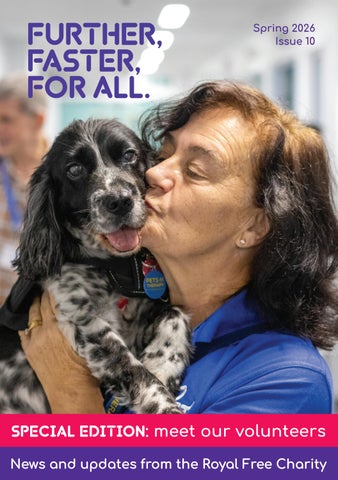
Further, Faster, For All - Spring 2026 - Issue 10

Page 1


TINy SCANNEr COuLD SPEED uP rECOvEry fOr LIvEr PATIENTS

A

pocket-sized ultrasound scanner will be tested at a London hospital to help doctors make safer, faster treatment decisions for people with severe liver disease.

The new study, funded by a £10,000 grant from the Royal Free Charity, will take place at the Royal Free Hospital and is due to begin this spring.

“Managing fluid levels in people with advanced liver disease is a challenge that doctors face on the ward,” said Dr Gemma Wells (pictured), who is leading the study. “Patients can look overloaded with fluid yet have too little circulating blood volume. Getting that balance wrong can quickly make someone much more unwell.”

The observational study will involve up to 50 adult patients admitted with complications of liver disease.

▲ Dr Gemma Wells said the study could help prevent avoidable admissions to intensive care

Using a handheld ultrasound probe linked to a mobile phone, clinicians will take short scans at the bedside before and after routine treatments such as intravenous fluids, water tablets or drainage of excess fluid.

The team will compare scan results with blood tests, clinical observations and patient outcomes. If successful, the pilot could pave the way for larger trials and a new national approach to managing liver disease that helps patients recover more quickly and safely.

The handheld ultrasound probe links to a mobile phone, allowing doctors to assess fluid levels at the bedside in minutes, without invasive monitoring or moving patients to scanning departments.

ChArITy buyS rObOT

fOr CANCEr SurgEry

Surgeons at the Royal Free Hospital are using a new surgical robot, made possible through charity funding, to carry out complex procedures with greater precision and control.

The technology allows surgeons to work through tiny keyhole incisions, using four robotic arms to make small, exact movements that are controlled from a nearby console. Robotic surgery can reduce pain, lower the risk of complications and help patients recover faster.

Eliese Gray, 70, was the robot’s first patient. “I didn’t know what to expect, but I was willing to go down that route,” she said. “It went really well; I was up and home the next day.”

For patients, the benefits can be immediate. Raymond Coulter, 70, was among the first to have surgery with the new robot. “I’m feeling absolutely brilliant,” he said. “People look at me and say they just can’t believe I’ve had major surgery; my scars are miniscule.”

The robot is mainly used to treat people needing surgery for cancers of the pancreas, liver and bowel.

▲ Eliese was able to return home the day after her operation
▲ Raymond pictured with his surgery team
▲ Ravi Barod, consultant surgeon and Angeline Shoniwa, theatre manager, with the new da Vinci Xi robot

A CumbrIA’S bIggEST AmyLOIDOSIS fuNDrAISEr

growing community in Cumbria is walking mile after mile to fund research into amyloidosis and honour the memory of Ian Lauderdale, a much-loved husband, dad and friend who died at just 43.

Ian was diagnosed with amyloidosis in 2020 and began preparing for a stem cell transplant. Just as he was about to move to the next stage of treatment, he became suddenly unwell and he died after developing organ failure and sepsis.

In the months after Ian’s death, his wife Nicola began a series of ultra challenges. Her first major fundraiser was the Yorkshire Three Peaks Challenge when 15 friends and family members walked 23 miles over three mountains and raised far more than their original £1,000 target. Since then, Nicola and her family have raised over £18,000.

Nicola went on to complete the Keswick to Barrow and Coniston to Barrow walks two years in a row, raising thousands of pounds between them, with over 50 people joining them to take part.

Nicola said: “Seeing how it devastated us as a family it felt like anything would help. We went for a big challenge so we could raise as much money as possible for the National Amyloidosis Centre. The support we have had from friends, family and even those who just want to help in some way has just been quite overwhelming.”

Amyloidosis is a group of rare conditions where a protein called amyloid builds up in the body and can damage organs such as the heart, kidneys or liver. The amyloid deposits progressively damage the structure and function of the affected parts of the body and can lead to life-threatening organ failure.

▲ Ian loved the outdoors, looking after his home and garden and Liverpool FC

Nicola said: “It’s just such a rare condition. It’s like most things, you don’t know about it until something happens to someone close to you. It’s helping educate people about the condition and how to look out for the signs and symptoms. It’s about spotting those symptoms early.”

What began as a family tribute has now grown into a community movement. More than 50 people have joined their walking teams, including Nicola’s son Jacob and daughter Luci. Supporters travel together by bus in the early hours, sharing stories and gathering for group photos before setting off.

On the toughest stretches of each walk they keep going by thinking of Ian. For Nicola, the fundraising is about more than money; it is a way to keep Ian’s memory alive, thank the people who have rallied around them and spark conversations about a condition that is often diagnosed too late.

▲ Nicola with her sisters, Kirsty, Carol and Hazel

W frOm PATIENT TO PErfOrmEr

hen Sarah picked up her violin again after breast cancer treatment, she knew she wanted to use it for something meaningful. Today, she is one of the Royal Free Charity’s music volunteers bringing calm to patients, visitors and staff across the Royal Free London hospitals.

During treatment, she noticed how much human connection mattered. “Everyone was really kind and that makes all the difference when you’re going through something quite frightening,” she said.

She also experienced charityfunded therapies, including massage and reflexology, which helped her through difficult days. “I wanted to give back,” she said.

Now she plays on wards and in waiting areas, hoping her music offers comfort. “Hopefully it blesses them. I believe music means healing and joy.”

At Chase Farm Hospital, 82-yearold volunteer David brings a different sound: his ukulele. After three decades in a band, carpal tunnel syndrome forced him to stop playing guitar, but picking up a ukulele led him back to music and into volunteering.

“You don’t know what people are feeling when they walk past,” he said. “Any way you can make the day better is a good thing.”

▲ Sarah decided to start volunteering as a way of thanking NHS staff

At Barnet Hospital, volunteer Mehmet plays the ney, a traditional Turkish reed flute he learned during lockdown.

“Many times, patients are stressed when I arrive,” he said. “When I leave, they look relaxed and smiling.”

Together, these volunteers show how a few notes can transform a hospital moment.

▲ Using his experience in a band, David plays the ukelele at Chase Farm Hospital
▲ Mehmet at Barnet Hospital. The ney has been played for over 4,500 years

fAThEr-SON DuO mAkES PAW-SITIvE ImPACT

volunteering is often a personal journey, but for Mark and Ben, it has also become a family bonding experience. The Royal Free Charity’s first father-son duo brings their two-year-old miniature schnauzer, Miggy, to volunteer at the Royal Free Hospital.

Mark, a solicitor who has worked in Hampstead for 27 years, previously spent five years volunteering with their family dog. When they later welcomed Miggy into the family, continuing that tradition with the Royal Free Charity felt natural. For Ben, joining his father was an easy decision.

Ben explained: “Dad’s volunteered for forever. I’ve always seen photos of him with nurses and dogs - everyone looks so happy. Seeing how much it means to him made me want to do it too.”

Volunteering at the same place has given them a shared purpose, as well as a new way to connect. Mark volunteers once a month, while Ben visits every two weeks, allowing them both to be actively involved.

During each visit, Mark or Ben guide Miggy through wards, meeting patients, staff and visitors. In just an hour, Miggy can greet up to 50 people, including at least 15 patients.

Mark said: “A dog can change someone’s day. He gets a smile out of people and that’s very rewarding. It’s nice to give something back into the hands of the community.”

Ben agreed: “The dog gets strokes, patients get to smile and you get something out of it too. There’s no downside.”

Together, Mark and Ben show how volunteering can strengthen family bonds while bringing comfort to others – one hospital visit at a time.

TEN yEArS Of yOuNg vOLuNTEErS mAkINg A DIffErENCE

more than two thousand young people have taken their first steps into the NHS through the Royal Free Charity’s young volunteer programme, a scheme that celebrates its 10th anniversary this year.

In the decade since its launch, the programme has welcomed volunteers from the age of 16, making it the first NHS charity to open its doors to such young participants.

Each summer, these volunteers give their time to support patients, learn from staff and glimpse the realities of hospital life.

In 2025, 255 young volunteers contributed an impressive 11,407 hours of support. They helped at mealtimes, kept wards stocked and chatted with patients. And they saw firsthand how everyone plays a part in patient care.

Volunteers also took part in training, including sessions on supporting patients living with dementia or learning disabilities, sighted-guiding training, an introduction to clinical research and advice from a former young volunteer on applying to medical school.

▲ Diya (second from right) learned skills that have helped her as a chemistry undergraduate

Guy, the charity’s youth volunteer coordinator, said: “Over the past 10 years we have seen young volunteers grow in confidence, build life skills and discover new career paths. It is fantastic to watch their journeys unfold and impressive to see the impact that they have on patients and staff in the hospitals.”

Former volunteer Diya, pictured left, found that working with patients helped her develop emotional intelligence and confidence. Now a final-year chemistry student, the experience ensured she thrives in her work. She said: “Volunteering has definitely helped me in the fastpaced laboratory. It also helped me understand how the NHS works, and I developed a high level of emotional intelligence because I was able to tell when a patient wasn’t feeling themselves.”

Janaki joined the programme in 2017 and continued volunteering for five years supporting patients living with dementia.

She said: “At 16, I was shy and anxious. Volunteering helped boost my confidence and my people skills.” Before long, Janaki was chatting with patients and discovering their stories, sometimes bonding over a shared home language.

Janaki explained: “As I spoke to patients, they became happier and more comfortable. One person said they felt lighter and more at ease after speaking to me.”

Now a biomedical scientist and fourth-year graduate medical student, Janaki credits the programme with shaping her approach to healthcare.

As Janaki says: “The skills, experience and confidence I gained put me in good stead for my journey as a medical student and as a future doctor. I strongly encourage any young person to get involved: it will change you for the better.”

▲ Volunteering on wards can help young people to develop a range of skills and build confidence

gOINg ThE DISTANCE fOr ThE TEAm

Sinead, an intensive care unit (ICU) matron at the Royal Free Hospital, set herself a formidable challenge: to walk the Camino Portugués coastal route from Porto to Santiago de Compostela without a single rest day.

Her motivation for taking on the challenge was her ICU colleagues: she wanted to do something that reflected the resilience of her team and the spirit they bring to work every day.

She stepped off the plane in Portugal and started walking immediately.

What followed was six demanding days covering 287km, a distance many walkers spread over three weeks. Sinead trekked through forests and along paths that hugged the Atlantic coastline, in aid of the Royal Free Charity.

With no rest days and long hours alone, mental resilience mattered as much as physical strength. Working in intensive care at the Royal Free Hospital, Sinead wanted to push herself to honour her colleagues.

She explained: “We’re always reflecting about COVID. The intensive care unit hasn’t stopped; we can’t pause. The staff are just showing up every day and they’re doing an incredible job. I wanted to push it physically, emotionally and mentally, just thinking of the team.”

Along the way, Sinead lost a toenail and the skin on her toe but chose not to take pain relief.

She said: “Thinking about what the team goes through on a day-today basis, they just have to get on with it and that was my motivation. I thought, ‘This pain is nothing compared to what they go through’.”

While walking, she met people from around the world, including a retired psychologist and a mother and daughter rebuilding their relationship.

“Walking into Santiago to the cathedral at the end of the trek was very emotional.”

At the end of the trek, Sinead spent hours reflecting, attending mass and visiting the tomb of St James in Santiago. Just days later, she was back at the ICU. “I hobbled into work,” she laughed.

Sinead raised over £1,700 for the Royal Free Charity. She added: “It’s such an amazing charity that has helped us improve patient and staff experience in so many ways. We’ve had break rooms renovated, staff sent to educational conferences, research funded. It was a fantastic thing to be able to support that.”

So, what’s next for Sinead? She’s already planning another Camino in northern Spain.

▲ Sinead completed her walk in just six days
▲ The Camino de Santiago

TrEATmENT hOPE

fOr rArE DISOrDEr

researchers are testing a gene-editing technique that could offer a safer way to treat a rare immune condition caused by a single genetic error.

The research focuses on Activated PI3K Delta Syndrome, or APDS, an inherited condition that affects around 70 people in the UK. Although rare, the impact on those living with it can be severe.

APDS is caused by a single change in DNA. That small error weakens the immune system, leaving people vulnerable to frequent and serious infections. Many patients experience repeated hospital admissions. Some patients with APDS develop lung disease or blood cancers, requiring lifelong treatment and monitoring.

Until recently, the primary treatment for most patients has been a blood stem cell transplant from a donor. While transplants can be effective, they involve intensive chemotherapy and carry a significant risk of serious complications.

Funded by a research grant from the Royal Free Charity, lead researcher Kate Orf is exploring an alternative treatment using a technique known as base editing. Instead of replacing a patient’s stem cells with those from a donor, the technique corrects the genetic error in the patient’s own blood stem cells in the laboratory before returning them to the patient’s body. This reduces the intensity of chemotherapy and avoids the risks associated with donor cells.

▲ Dr Kate Orf is investigating base editing as a potential treatment for Activated PI3K Delta Syndrome

“Instead of going through a stem cell transplant, which is risky and comes with a lot of challenges, including finding a donor and having intensive chemotherapy, you could give patients back their own cells,” said Dr Orf. “This still requires chemotherapy, but it’s lighter and safer.”

DNA can be thought of as an instruction book made up of billions of letters that tell the body how to function. In APDS, just one of those letters is incorrect. A traditional stem cell transplant is like replacing an entire page with one from another book. Base editing is more precise, correcting the single wrong letter while leaving the rest of the instructions unchanged.

In laboratory studies, the genetic error has been successfully corrected in patient-derived cells. As Dr Orf reaches the final stage of her PhD, the work points towards a treatment that could be safer and more targeted than existing options.

“When I started my PhD in 2021, the first papers on base editing were just being published,” she said. “Now, there are hundreds of papers and the approach we’re using has become pretty common. This is proof of principle for one disease, but we want to see this roll out to other genetic diseases also.”

If the technique continues to prove safe and effective, the research could pave the way for future clinical trials and new treatment pathways for people living with APDS.

brAvE NEW hEIghTS fOr ThE NhS

This summer, supporters of the Royal Free Charity will once again have the chance to Brave New Heights by taking on a fundraising abseil down the side of the Pears Building at the Royal Free Hospital in north London.

Guided by a team of elite Royal Marines, participants will descend 90 feet from the roof of one of the hospital’s landmark buildings, turning a moment of courage into vital support for patients, families and NHS staff.

Soulla (pictured) signed up for the abseil while her husband Andreas was receiving treatment for lymphoma at North Mid Hospital.

“I was terrified at the top, but the marines were calm and reassuring and talked me through it.

“I had a photo of my four grandchildren on the back of my shirt because I was doing this for them as well as for my husband.

“Taking part felt like a way to give something back.”

Funds raised through Brave New Heights help provide support for patients across Barnet, Chase Farm, North Mid and the Royal Free hospitals.

This includes therapeutic massage therapy, financial and welfare advice and an accredited volunteer service.

Brave New Heights offers supporters a chance to do something unforgettable and make a real difference for their NHS.

Scan the QR code to sign up or to find out more

Turn static files into dynamic content formats.
Create a flipbook
Further, Faster, For All - Spring 2026 - Issue 10 by Royal Free Charity - Issuu