Acknowledgements: Thank you to the RFDS staff, patients and members of our community for the photographs and stories in this publication.
To our wonderful supporters
I hope 2026 is looking bright for you and your family.
Last year was the RFDS WA’s busiest on record, with 10,578 patients requiring aeromedical transfer. There is growing demand on the RFDS WA, and it comes as we are starting the exciting first step of replacing our existing fleet with the latest aircraft. You can read more about the state-of-the-art aircraft which will be joining our service on pages 4 and 5.
We also welcome the State Government’s recent $7.5 million commitment to establish a new RFDS base in Geraldton to help us better serve the Mid West and Gascoyne. Geraldton Health Campus is the state’s single busiest location for RFDS patient retrievals, with crews currently transferring two to three patients per day. Geraldton will also be an enticing coastal location for our dedicated crew members and their families to live.
In this edition of Your Flying Doctor, you’ll find stories that capture the heart of what we do. On pages 6 and 7, you can follow the remarkable journey of Stevie - Australia’s youngest pre-term baby - and how the RFDS, together with the Newborn Emergency Transport Service, brought her safely home to Perth after her unexpected arrival in Queensland.
On page 13 you’ll read about Joseph from Port Hedland, who with his mum Te Aroha, has been fundraising for the RFDS with a Swim-A-Thon. Joseph urgently needed the RFDS when he suffered an asthma attack during Cyclone Zelia in 2025.
People like Joseph – and supporters like you - play a vital part in ensuring the RFDS is there for people in the regions and will continue to be into the future.
Thank you.
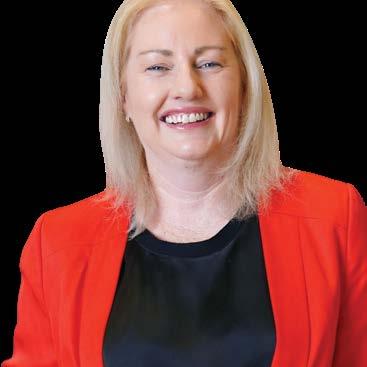
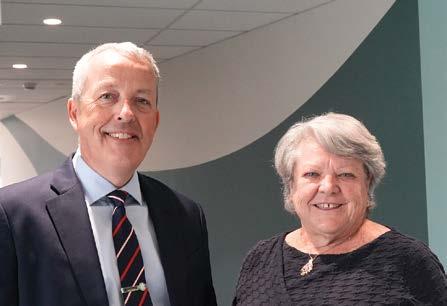
Judith Barker ASM CEO, RFDS Western Australia
Fight for recovery
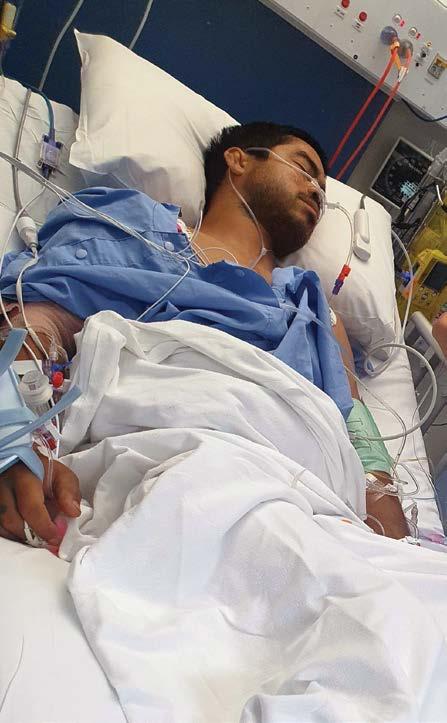
Kickboxer Danial Williams has faced plenty of tough opponents in the ring, but he met his hardest adversary when he crashed his car into a towering karri tree in the South West last year.
The 32-year-old has no memory of the crash, although he suspects fatigue played a role. He woke from an induced coma in Royal Perth Hospital’s trauma ward 36 hours later and learned he had been flown from Manjimup Hospital to Perth in the RFDS Fortescue HeliMed Service EC-145 helicopter.
On the day of the crash, Danial’s partner Carla received a phone call with the shocking news that he was in a critical condition and being flown to Perth for treatment. All she could do was wave as she watched the RFDS helicopter fly overhead, knowing Danial was safely on his way to the care he needed.
“My seatbelt certainly saved my life,” Danial said, “but it also did some damage to my insidesmy bowel was torn.”
He underwent a laparotomy, a major surgery to repair injuries to his bowel and intestines. He also suffered a serious concussion but remarkably, no broken bones. Weeks of intense pain followed yet doctors credited his fitness and strong core for helping his recovery.
Danial’s fighting career is on hold while he focuses on rebuilding his strength. These days, he’s enjoying working at a truffle farm in Shannon, east of Northcliffe.
“Just to be alive and to be able to do the normal things I was doing before, that’s what I am grateful for,” he said.
For the RFDS to fly me from one hospital to another, and be in Perth within hours after the crash, it was just incredible.
In October Danial took part in RFDS fundraiser Oceans to Outback, which allowed him to give back to the organisation and keep his body active as he recovered.
“I love the big karri trees around here, I love hugging them, just not with my car!” he joked.
Future flight
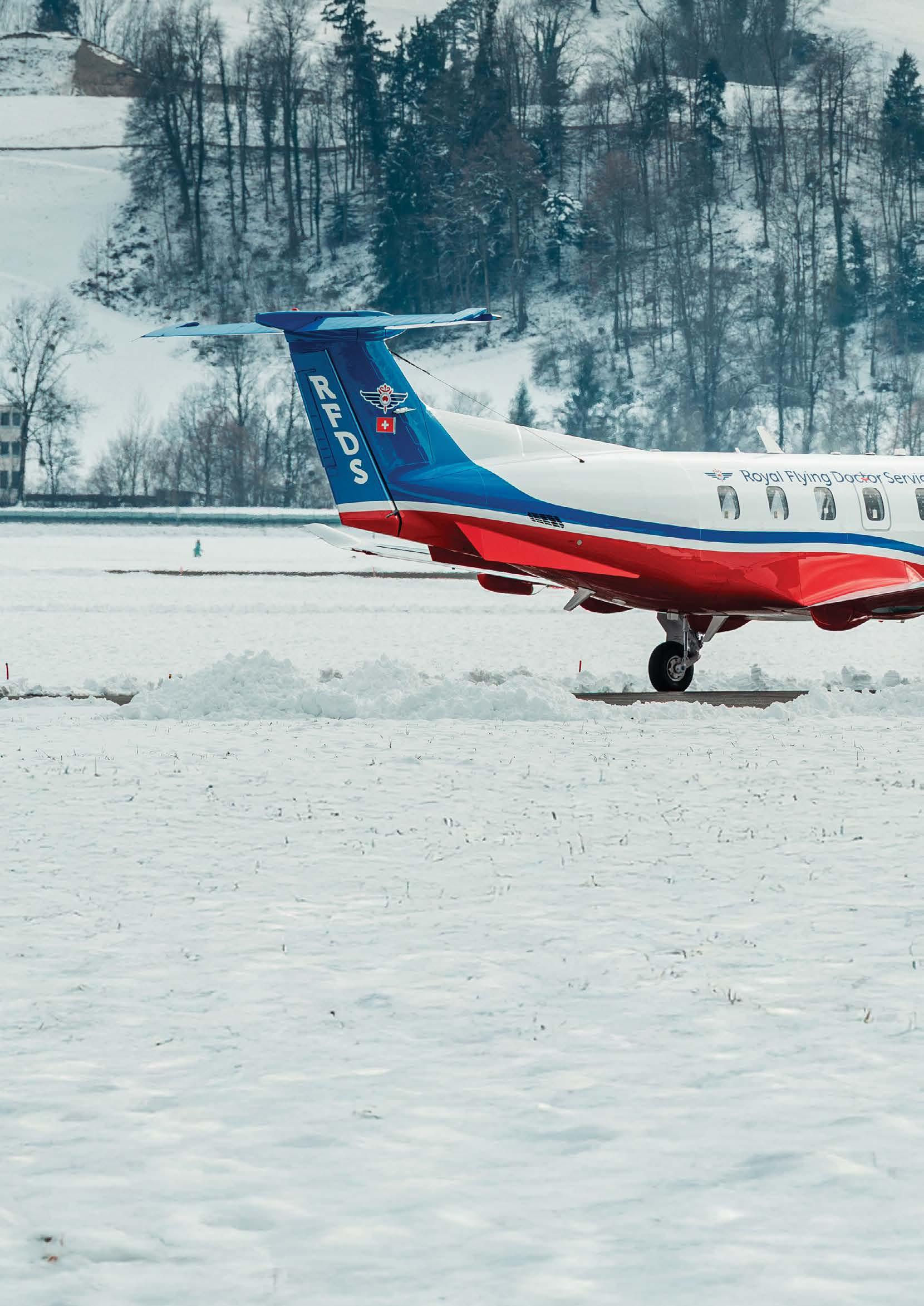
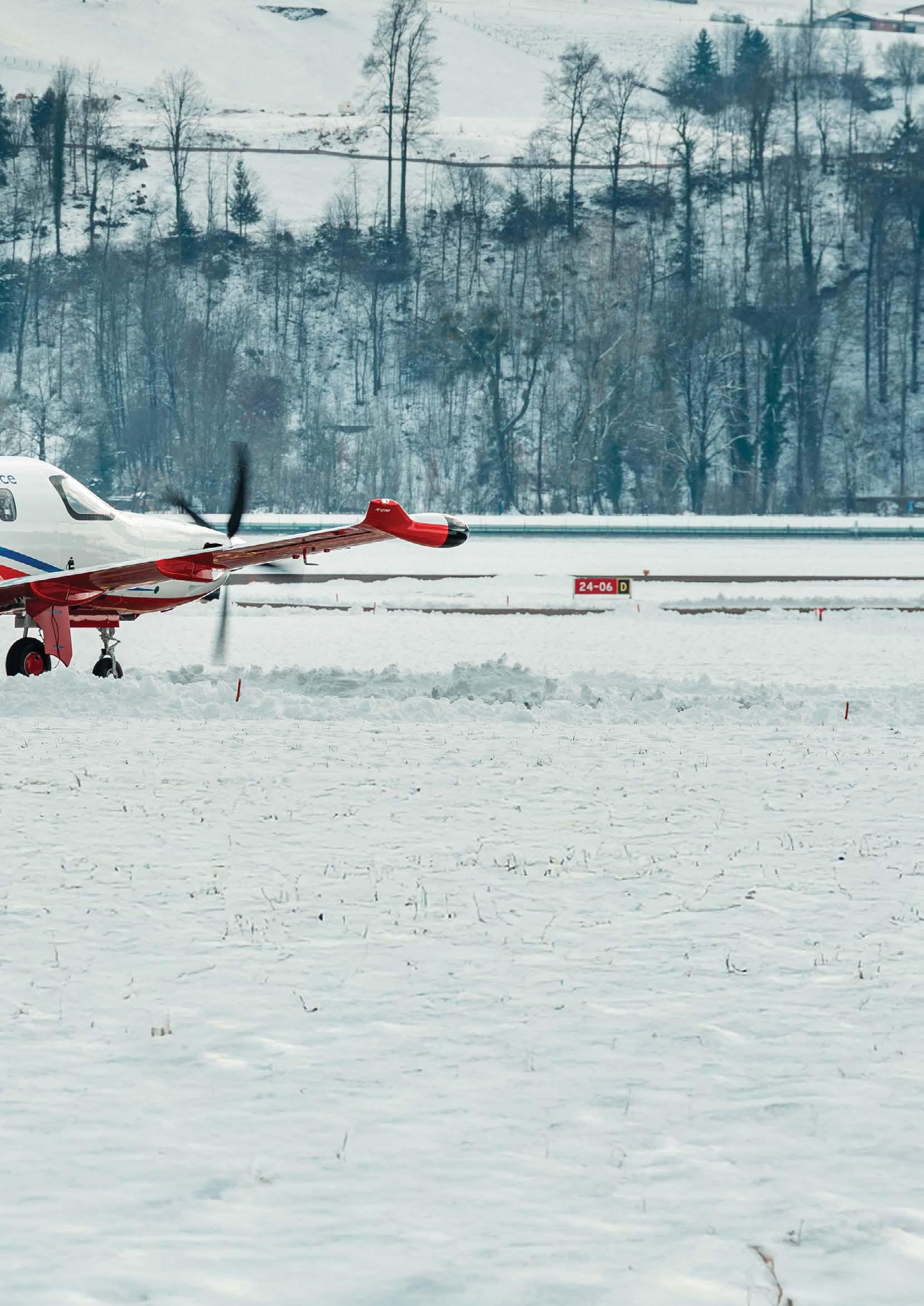
Built in the snow, destined for red dirt.
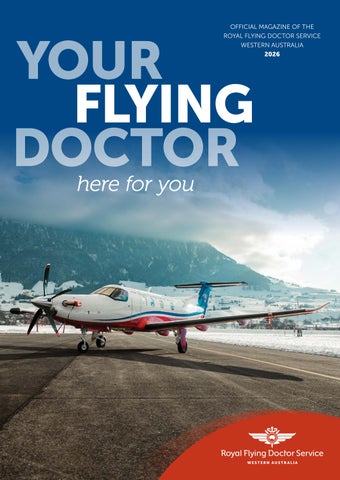
This is your first look at the Royal Flying Doctor Service WA’s brand new PC-12 PRO aircraft - one of three which will join our fleet in 2026.
Generously funded by Mrs Gina Rinehart AO through Hancock Iron Ore and the Rinehart Medical Foundation, and built at
Pilatus Aircraft’s headquarters in Switzerland, this aircraft marks the beginning of a new era for our operations across WA.
To modernise our fleet and make significant improvements in service efficiency, by 2030 RFDS WA will upgrade our current aircraft - many of which are approaching 20,000 hours of operating life - with eight new PC-12 PROs.
Flying a combined six million kilometres each year, our
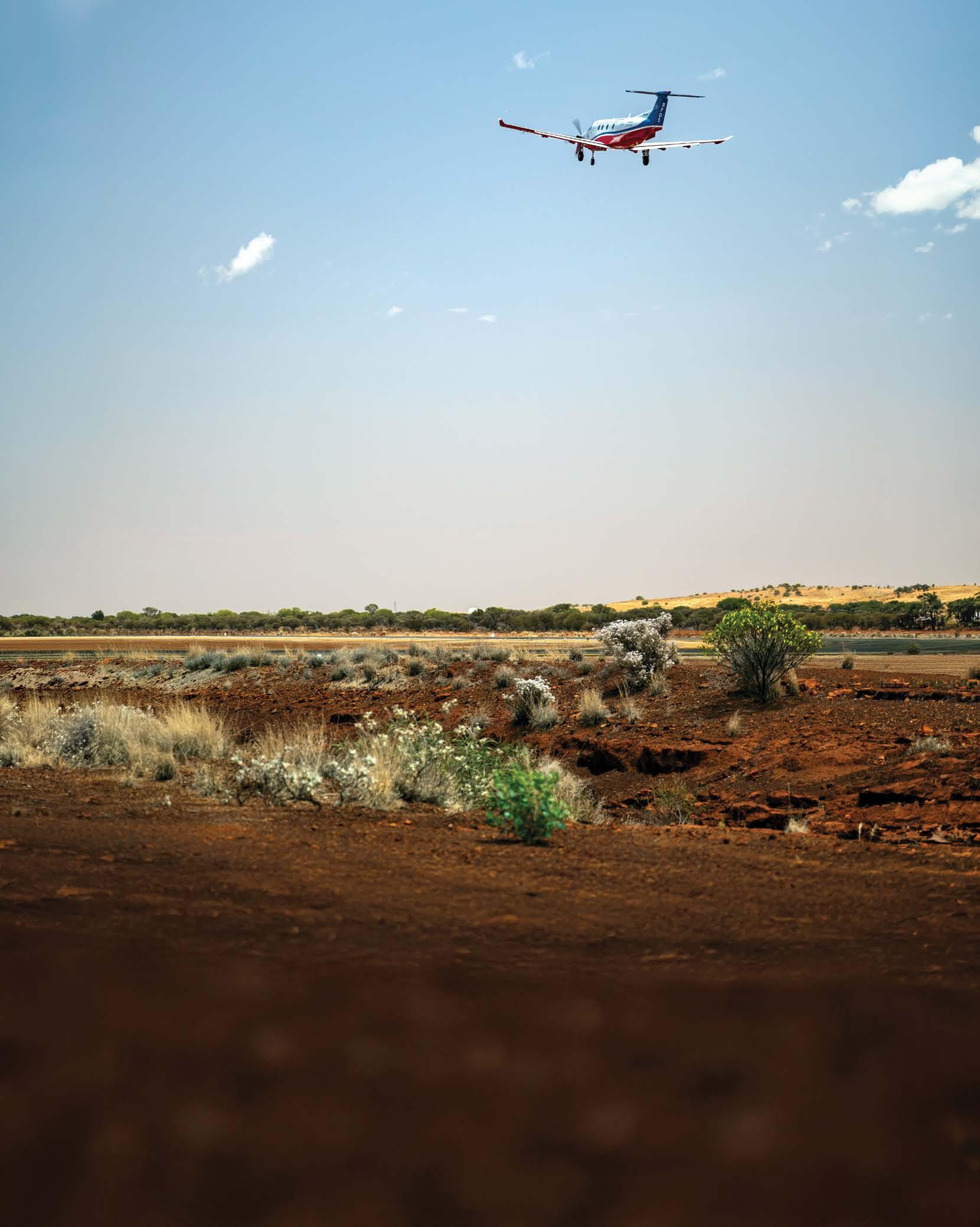
current PC-12s are used in aeromedical retrievals across some of the most remote parts of the state. Designed to take off and land on gravel airstrips and remote runways, they are the true workhorses of the RFDS.
The new PC-12 PRO represents a leap forward in technology, safety and efficiency. It includes advanced safety systems such as Autoland - which can automatically land the aircraft in the event of a safety incident - and Smart Glide, which helps guide pilots safely to the nearest airport in the unlikely case of engine failure.
The PC-12 PRO at Pilatus HQ in Switzerland before it is flown to Australia.
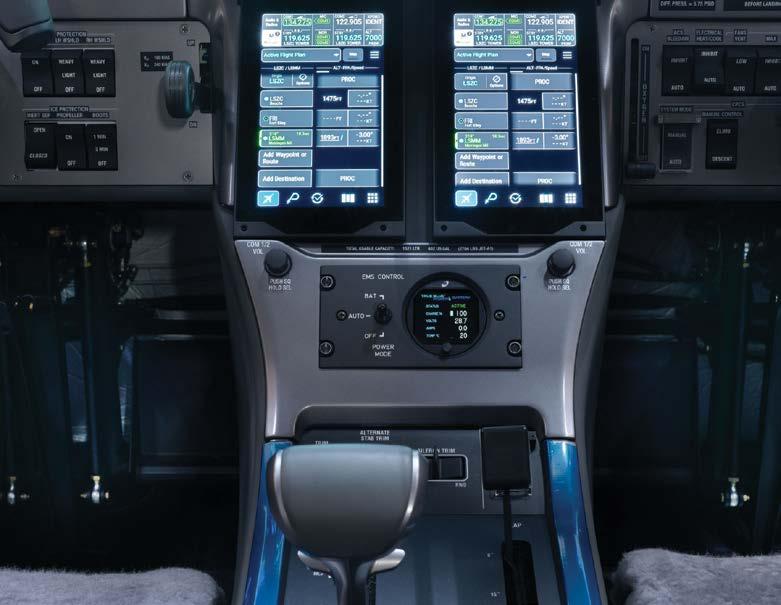
Equipped with Garmin G3000 PRIME avionics, the aircraft features a digital touchscreen cockpit, integrated Wi-Fi and Bluetooth connectivity for real-time data monitoring and an enhanced radar capable of identifying weather conditions further ahead for quicker route planning.
Inside, the Aerolite-designed cabin is focused on patient and crew comfort, workflow efficiency and infection control.
RFDS WA General Manager Aviation Andy Mudgway says the aircraft will be one of the first PC-12 PROs in Australia.
Our pilots are eager to start training on the new aircraft and having the PRO in our fleet also makes us an attractive proposition for new pilots who want to take a step forward in their career and work for the RFDS.
Once the aircraft arrives in WA, pilots and medical crews will undergo training on the new systems before it enters operational service later in the year.
The RFDS is a free service. It doesn’t matter where you are in regional WA, the Flying Doctor is there to help in a medical emergency. Donate at: rfdswa.com.au/autumn
Special delivery
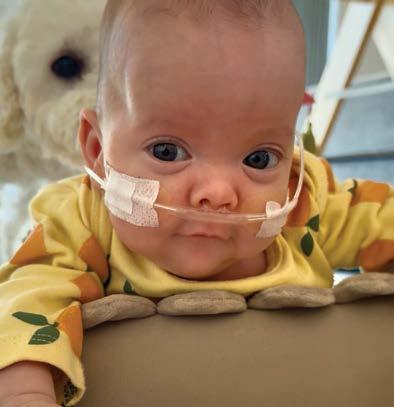
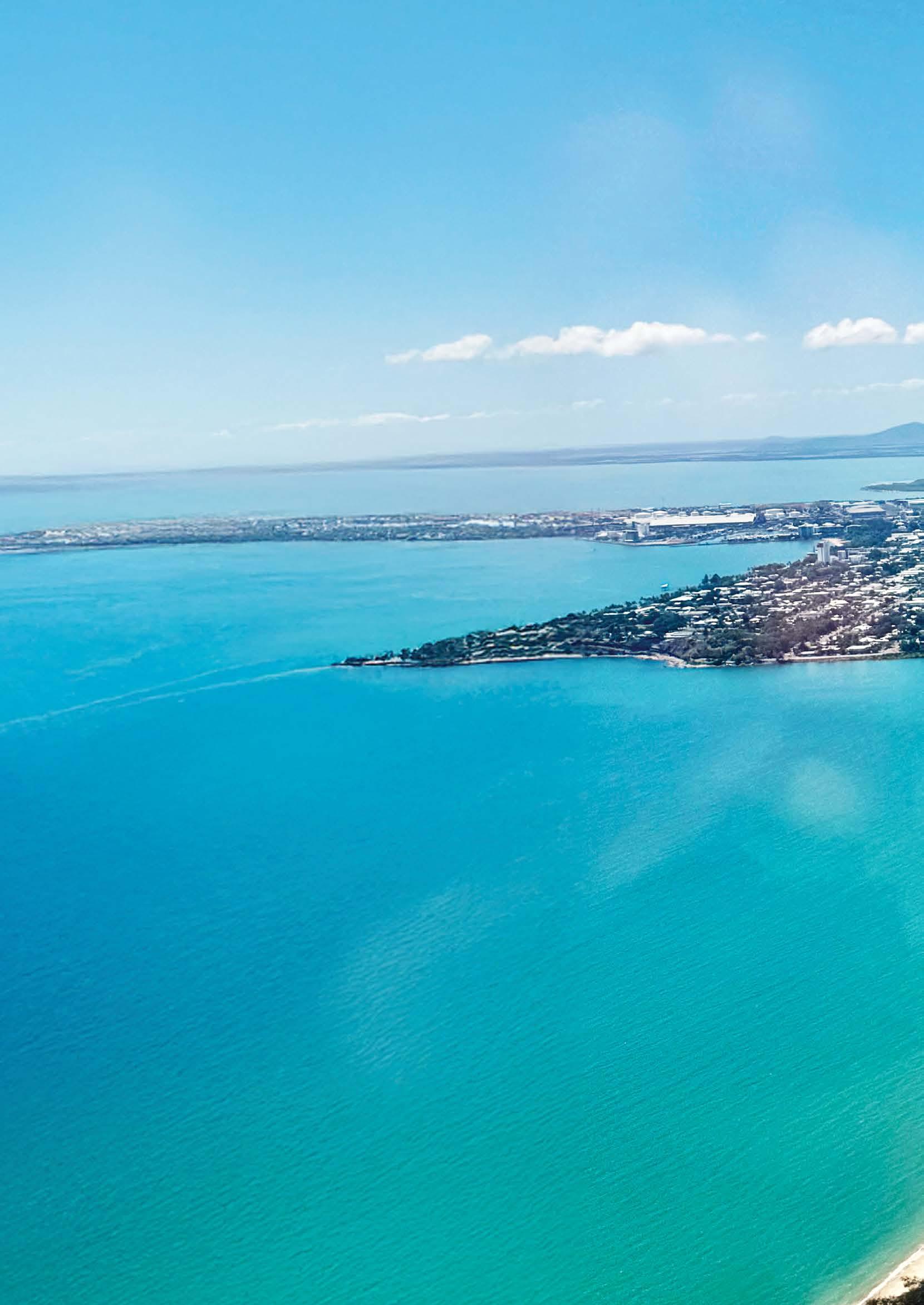
Australia’s youngest surviving pre-term baby was born 4,000 kilometres from home – and the only way little Stevie could be flown back to Perth was by the Royal Flying Doctor Service.
An infection caused Perth mum Bree Basile to go into premature labour during a much-anticipated family holiday in Queensland.
She was 21 weeks and 4 days pregnant with twins when her waters broke.
Bree was placed on bed rest at Cairns Hospital and she and her partner Jake O’Reilly were told to prepare for the worst. At that stage of pregnancy, the odds of survival are devastatingly low.
But doctors at Townsville University Hospital’s (TUH) specialist neonatal unit offered the couple a glimmer of hope. If Bree’s pregnancy could reach 22 weeks, they said they would do everything possible to save the babies.
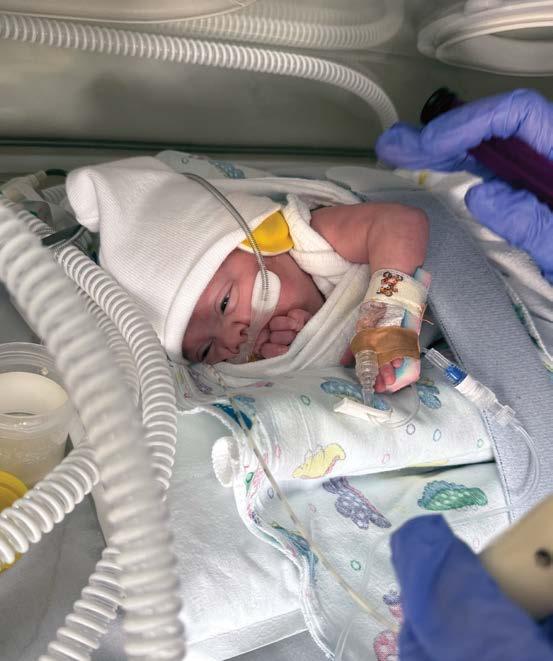
Bree was transferred from Cairns to TUH. Two days later, at 22 weeks and two days, Bree gave birth to daughter Stevie and son Adrian. Stevie weighed just 500 grams, comparable to a tub of butter. Tragically, Adrian passed away after 18 days, his tiny kidneys unable to sustain his life.
Stevie’s fight for life was nothing short of extraordinary. During her first few months, she endured multiple complications - including two collapsed lungs, sepsis, bowel surgery and seven blood transfusions.
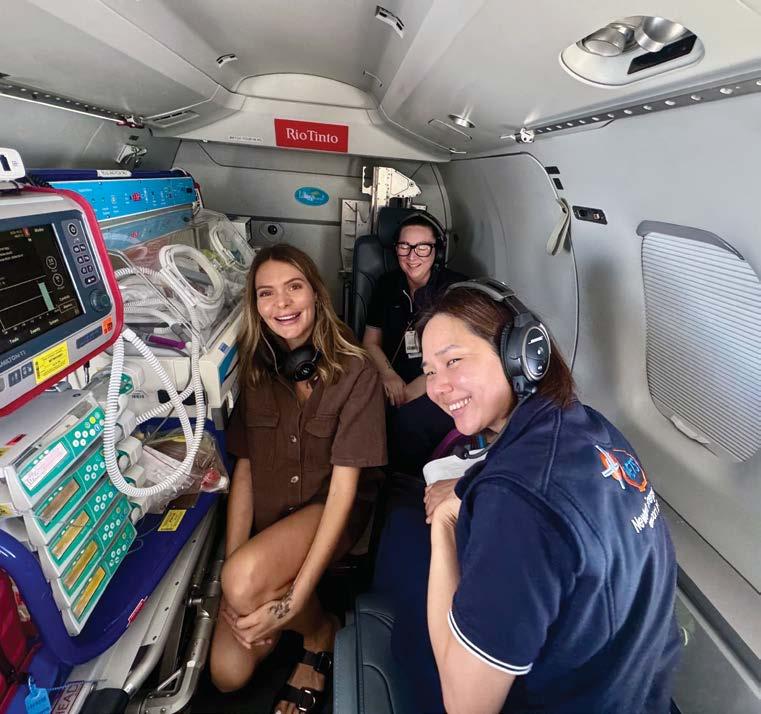
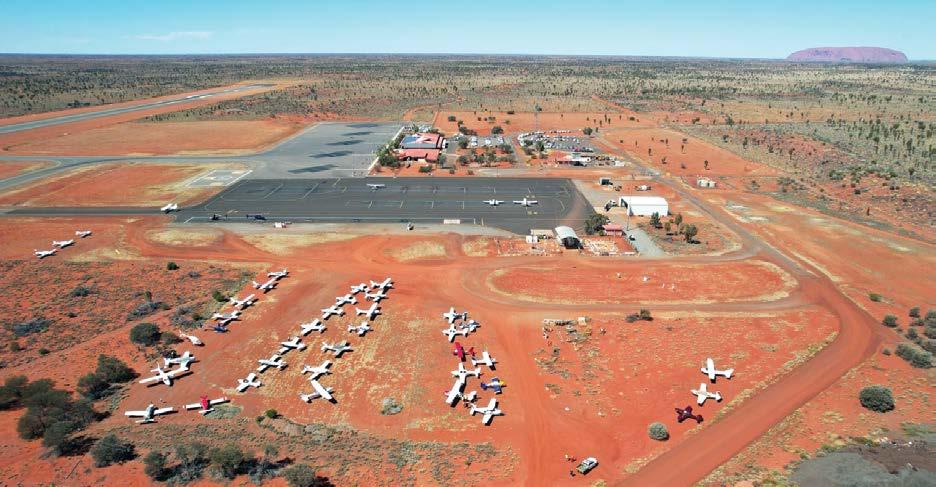
Stevie spent three months in specialist care in Townsville. Once she reached 35 weeks, Stevie and Bree were given the all-clear to be flown home on the Rio Tinto LifeFlight jet, assisted by a nurse and a doctor from WA Health’s Newborn Emergency Transport Service. The long flight home included a fuel-stop at Uluru.
“They made it so easy, and they were so loving and caring. I didn’t have to think about a single thing,” said Bree. She singled out Flight Nurse Cassie who made sure to bring snacks for the flight home, and with the neonatal cot taking up all the space in the ambulance, she even joined Bree in the taxi to the airport so she wouldn’t be alone.
The RFDS were
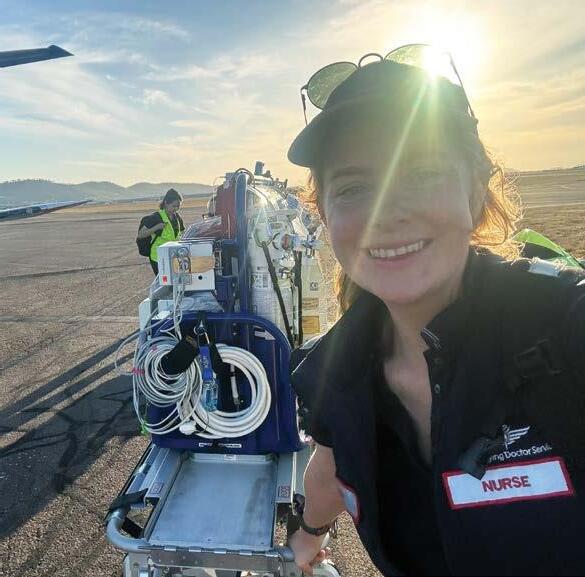
L-R: Stevie in Townsville University Hospital, Flight Nurse Cassie Gaff during Stevie’s RFDS transfer and mum Bree with the Newborn Emergency Transport Service’s paediatrician and nurse during the flight.
For Cassie, playing a part in taking Australia’s earliest pre-term arrival home was one of the most profound moments of her career.
“I’m deeply grateful to have been part of the team and to have witnessed the strength of the smallest patient I’ve ever cared for,” she said.
Once safely on WA soil, Stevie was under the care of a dedicated neonatal team at Perth’s King Edward Memorial Hospital.
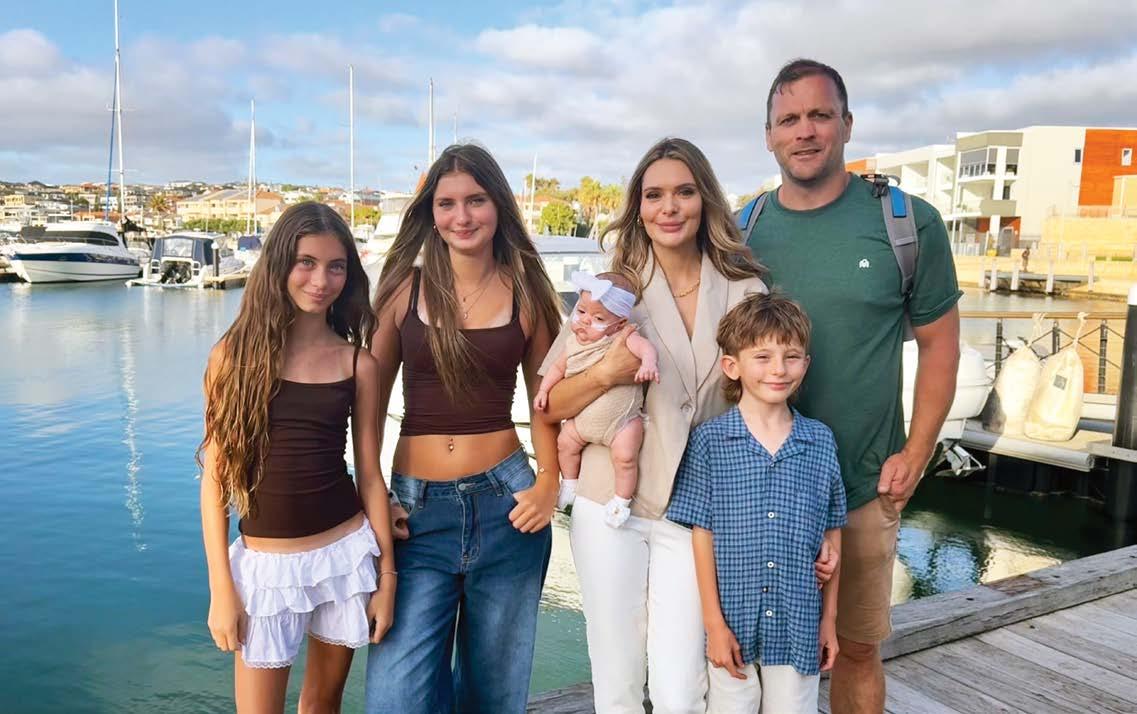
After 137 days in hospitals on opposite coasts of Australia, Stevie was able to be home for her first Christmas with her three older siblings.
“The kids decorated the Christmas tree in pink to celebrate Stevie being home,” said Bree.
Now close to five kilograms and meeting every milestone for a premature baby, their tiny warrior is thriving in every way.
“Stevie loves going for walks in the pram, and is mesmerised by sunsets,” said Bree.
“We are just so, so grateful.”
mum Bree, dad Jake and brother Isaac.
Flying Doctor Day
Thursday 14 May 2026
Get ready to celebrate the 98th anniversary of the Royal Flying Doctor Service.
Since 2021, Flying Doctor Day has raised more than $5 million in WA to fund medical equipment used on our fleet of aircraft. With new PC-12 PRO aircraft on the way, we are raising money for the medical fit-out of three new planes.
In 2026, we invite you to be part of something extraordinary once again. Can you help us make this our biggest Flying Doctor Day yet?
How to get involved
Double your impact:
Every donation made to the Flying Doctor Day campaign will be matched dollar for dollar by our generous corporate partners. Your $25 becomes $50.
Rally your team:
Become a Flying Doctor Day Champion! Bring together your workplace, school or community group to fundraise as a team and make a real difference, together. The Champions who raise the most will win a tour of our Jandakot base.
Share the love:
Many our supporters, or someone they love, have been retrieved by the Flying Doctor. By sharing your RFDS story on social media and tagging #flyingdoctorday, you help spread the word about Flying Doctor Day.
New leadership takes flight
Rob Slocombe has been appointed the new Chair of the RFDS WA, succeeding Sam Walsh AO, who will step down in April after nine exceptional years of service marked by growth and innovation.
Under Mr Walsh’s leadership, the RFDS has expanded its fleet with the Rio Tinto LifeFlight PC-24 jets and RFDS Fortescue Heli-Med Service helicopters, opened a new base in Broome, maintained operations through the challenges of the COVID-19 pandemic and secured a strong financial footing through government and corporate partnerships. Mr Walsh actively supports the RFDS community and is a dedicated member of the Friends of the RFDS fundraising auxiliary.
Mr Slocombe, who joined the RFDS WA Board in 2019, is Group CEO and Executive Director of RAC WA. His executive career spans organisations including Westpac, St George and AMP Bank. His current board and advisory roles include international motoring and advocacy, tertiary education, aged care and medical innovation.
Mr Slocombe is committed to building on the RFDS’s strong foundation.
“It has been a privilege to have served as an RFDS WA Board Member for the past seven years. As Chair, I will focus on ensuring the RFDS remains at the forefront of meeting the evolving health needs of people in regional Western
Australia, wherever they live or work in our great state,” he said.
Joanne Farrell has been appointed Deputy Chair. Also a board member since 2019, she brings more than three decades of executive experience. An executive leader at Rio Tinto for more than 30 years, she currently chairs Brightwater Care Group and serves on the University of Western Australia Senate.
Their appointments come as the RFDS WA pursues its Above and Beyond 2024–2028 Strategy and approaches a centenary of service.
Mr Slocombe praised Mr Walsh’s impact as an extraordinary leader.
“Sam’s excellent leadership over the past nine years ensures the RFDS will continue to thrive as an iconic organisation for the benefit of Western Australians for generations to come. On behalf of the Board, I sincerely thank him for his service.”
Life Member Induction
Vale
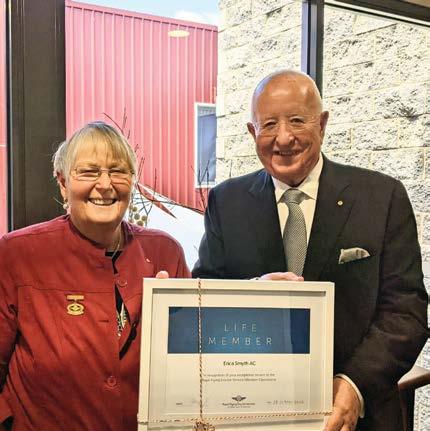
Erica Smyth
It is with sadness that we acknowledge the passing of Dr Erica Smyth AC in November 2025.
A Geraldton-born geologist, Erica dedicated much of her life to regional WA and during her nine years as an RFDS WA Board Member, she brought significant expertise from her extensive career across the corporate and not-for-profit sectors.
A committed RFDS donor, Erica also championed the health needs of regional communities and was a trailblazer for women in the resources industry.
RFDS WA Board Chair Sam Walsh AO with Erica.
Congratulations to outgoing board members Professor Angus Turner, Simon Trott, John Van Der Wielen and Tim Shackleton, who along with retiring staff member Trish Thompson, were inducted as Life Members of the RFDS WA in November 2025.
A legacy of service
Few families embody the spirit of the Flying Doctor quite like the Winchcombs.
When Rob Winchcomb first walked into the RFDS hangar as a young aircraft engineering apprentice in the 1980s, he probably didn’t imagine that decades later, he’d return to play a part in leading the same organisation that shaped his childhood. More than 40 years on, Rob has come full circle as the recently appointed Head of Engineering.
For Rob, the RFDS is part of his family’s DNA. His father Syd Winchcomb served as General
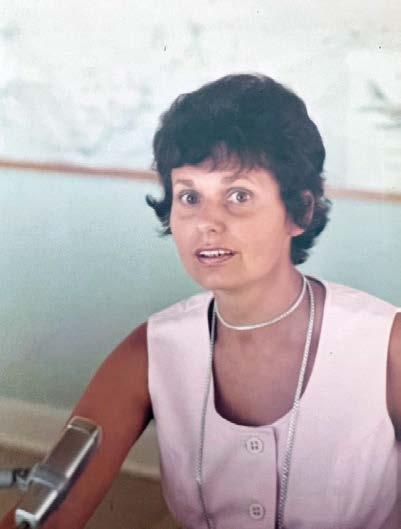
Manager of the RFDS Eastern Goldfields Section for 15 years and his mother Lorraine ‘Lol’ Winchcomb became the beloved ‘Voice of the Outback’ and a lifeline for countless remote Western Australians.
Lol joined the Kalgoorlie base in the early 1970s as a radio operator at a time long before mobile or satellite phones, and often, not even reliable landlines. For two decades her calm voice - known by the call sign VJQ - bridged vast distances, connecting those in need to the emergency care they needed.
Lol’s days were filled with radio calls to and from the most isolated corners of the state. Out of hours, a distinctive ten-second radio whistle from the outback would trigger an alarm at the Kalgoorlie Police Station, prompting officers to phone Lol at home. Rain, hail, or shine, she would jump in her car and drive to the radio base, often bringing her sleepy young sons along in their pyjamas. Once there, she’d warm up the equipment and call out across the static: “Station calling VJQ…”
Lol’s decades of community service were formally recognised when she received the Order of Australia Medal (OAM) in the King’s Birthday Honours List in 2025.
Alongside her years of work for the RFDS, she has long supported the Inner Wheel Rotary Club, the WA Golf Club, St Nicholas Church in Duncraig and Capital Community Radio, which she helped set up and where she continues to broadcast and serve on the board.
Before returning to the RFDS, Rob carved out an international career in aviation engineering. He spent 29 years working for Pratt & Whitney in the United States, Canada and Singapore and was closely involved with developing the new engine for the Pilatus PC-12 PRO, which will soon be joining the RFDS fleet. His most recent role was in Switzerland with Pilatus Aircraft, whose aircraft form the backbone of the Flying Doctor fleet. Rob says returning to the RFDS feels like coming home.
He teared up recalling a conversation he recently overheard between a pilot and a member of the operations crew.
“The patient they were on their way to was an elderly gentleman who’d been a pastoralist all his life and because of his medical condition it was likely the very last time he’d be leaving his land for a hospital in Perth,” said Rob.
The pilot’s Flying Doc instinct kicked in and he said, ‘no worries, I will make sure he is strapped in a seating position and we will do a big circle as we depart so he can look down and see his land for the last time.’ And that’s the reason we are all here for.
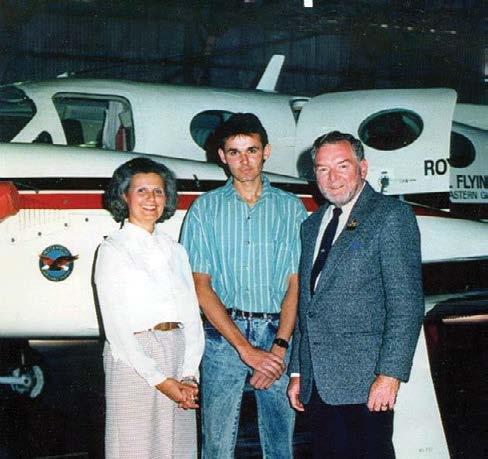
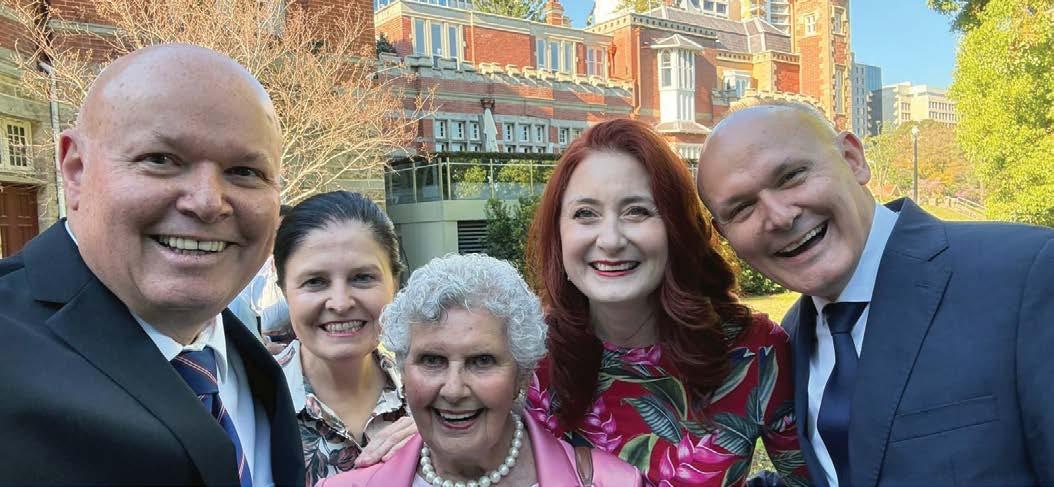
L-R Peter, Melanie, Lol, Suzanne and Rob Winchcomb. Inset: Lol Winchcomb when she was the ‘Voice of the Outback’ and a young Rob Winchcomb flanked by mother Lol and father Syd.
100 years young
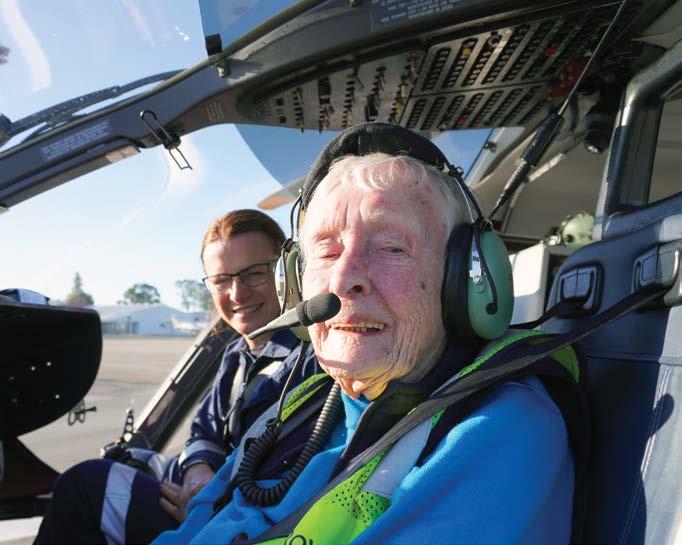
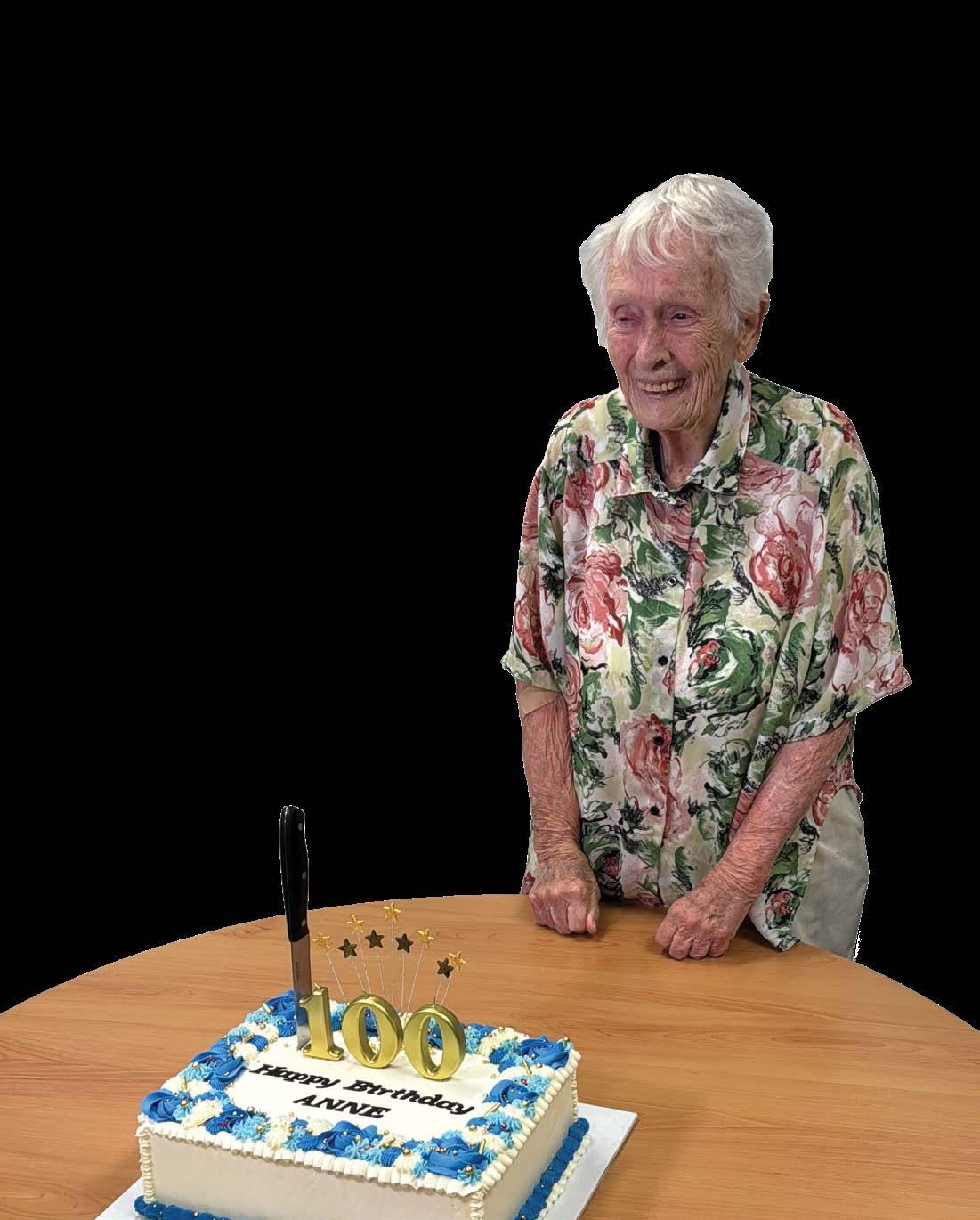
The RFDS team had the honour of celebrating aviation trailblazer
Anne Lewis’ 100th birthday at our Jandakot base with cake and a helicopter flight over Perth on a perfect summer day.
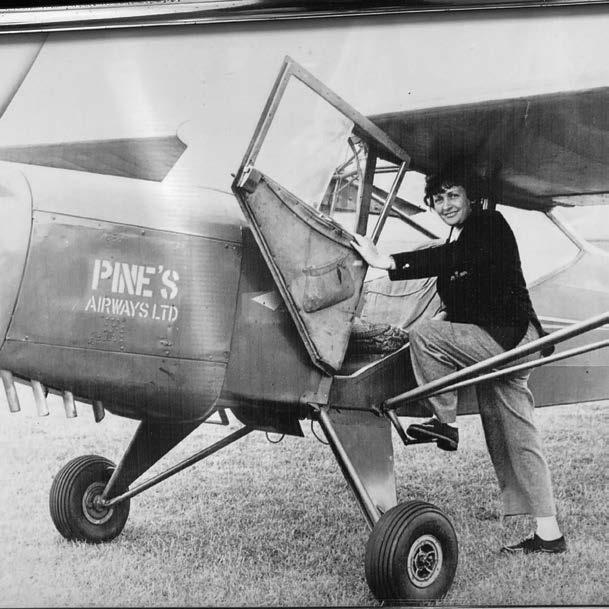
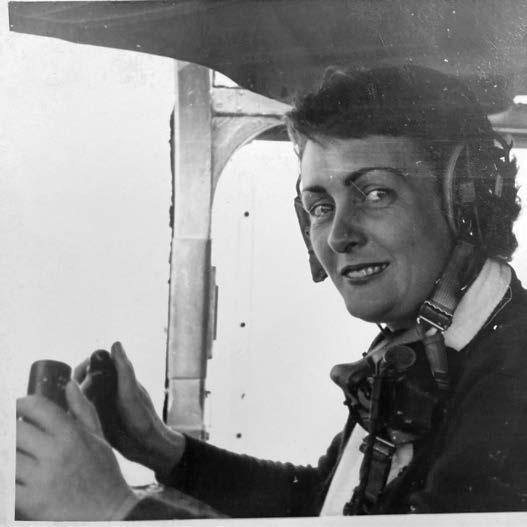
Anne made history in 1949 as the first woman in Western Australia to earn a commercial pilot’s licence and the first woman to fly for what would later become the RFDS.
Born in 1926, the same year as Queen Elizabeth II, Anne even had the privilege of meeting the late monarch and Prince Philip while flying with the UK’s Royal Air Force - a moment she still describes as the highlight of her career.
“You’re just one they pass, but to the person who is meeting them, it’s a big thing,” said Anne.
She recalls Prince Philip asking her questions about her time flying with the RFDS.
After three years with the Royal Air Force, Anne joined charter company Skyways.
“One day you might be flying to New Zealand and the next it would be Alaska, and that certainly made life very interesting,” she said.
Reflecting on her milestone birthday, Anne brushed off any notion of secrets to longevity.
“I can’t claim any kudos, it just happens and everyone thinks you’ve done something very clever and I am happy to take the adulation,” she joked.
During her birthday celebrations, Anne chatted to RFDS pilot Juliet Small and pondered why the aviation industry is still male-dominated.
“I can’t see why gender comes into it,” she said. “You can either fly an aircraft or you can’t.”
Once a young woman with big dreams, she has advice for those who are just starting out on life’s path.
If you want to do something, do it. Don’t let anyone else dictate your life.
Anne (left and centre) early in her aviation career and (bottom) pictured with RFDS helicopter pilot Elaine Cadzow.
Planning ahead
Janet Curlewis has always been a planner.
At just 23, when most young adults aren’t giving much thought to the future, Janet wrote her Will. She made the prudent decision to pledge a Gift in Will to the RFDS. Now aged in her 60s, Janet takes comfort knowing that her loved ones will never have to guess how she’d want her estate divided. For her, planning ahead brings peace of mind and the knowledge that her legacy will help others for years to come.
Growing up in Albany, Janet always understood the vital role the RFDS plays in regional communities. She saw it firsthand when a childhood friend was retrieved after a serious eye injury, and later in life when friends needed the Flying Doctor following a heart attack and a workplace accident.
But her affiliation with the RFDS became deeply personal a decade ago when friends she considers family faced a life-threatening emergency.
Janet is a ‘second mum’ to Jaison, the son of her best friend of more than 40 years. When Jaison’s wife Carley suffered severe complications during the birth of their first child, Eleanor, at a regional hospital, lives hung in the balance. Eleanor’s shoulder had become trapped in her mother’s pelvis.
Doctors delivered Eleanor, but both mother and baby had to be flown separately by the RFDS to Perth for urgent specialist care at King Edward Memorial Hospital.
“Because of massive blood loss, Carley could not have travelled to Perth by ambulance, even under lights and sirens, it’s too far,” said Janet.
We could have lost them both if it wasn’t for the RFDS.
For Janet, choosing the RFDS as a beneficiary was an easy decision.
“I chose the RFDS because the commitment and the dedication in almost 100 years since it started is quintessentially Australian.”
“The RFDS means so much to me and the people they have been there for, and I want to do everything I can to continue the amazing work that the RFDS does, with my small contribution,” said Janet.
Nearly 100 years ago the Royal Flying Doctor Service began due to a generous Gift in Will which allowed Reverend John Flynn’s plans for an outback aeromedical service to become reality. Today Gift in Will continues to be one of our greatest sources of funding.
Interested in a Gift in Will?
The RFDS uses funds received from Gift in Will to support health in rural and remote WA by contributing to the purchase and maintenance of our aircraft fleet, medical equipment and supplies as well as vital support for our many health services.
If you would like to find out more, please contact our Planned Giving Lead Jill Murray on 08 9417 6564 or jill.murray@rfdswa.com.au.
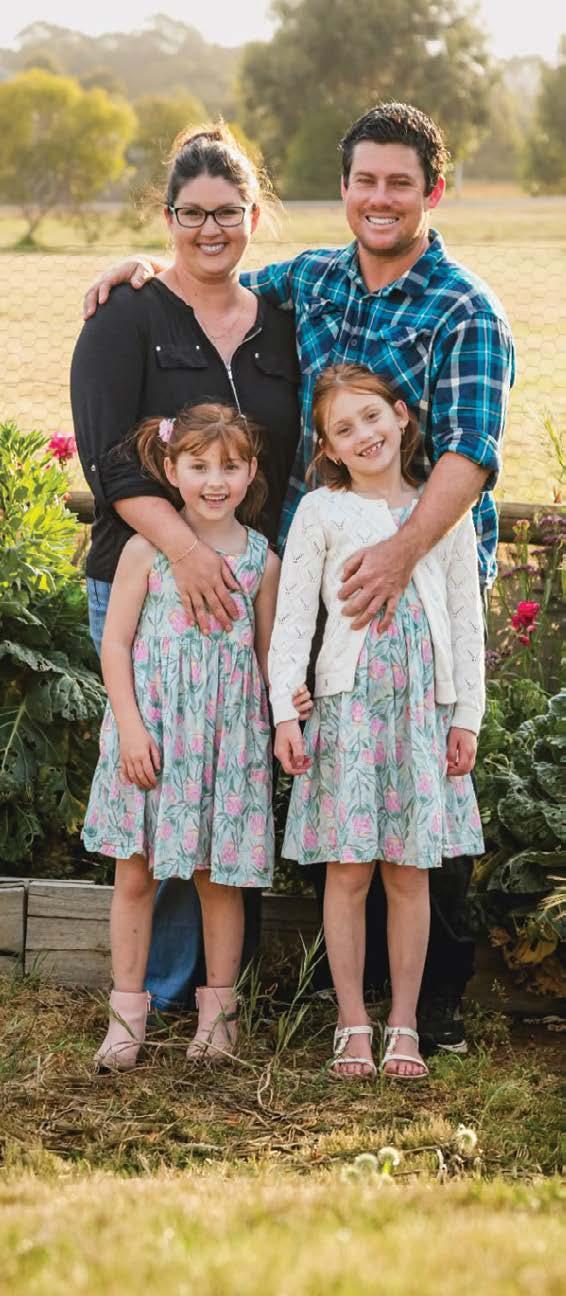
Jaison and Carley with daughters Holly and Eleanor.
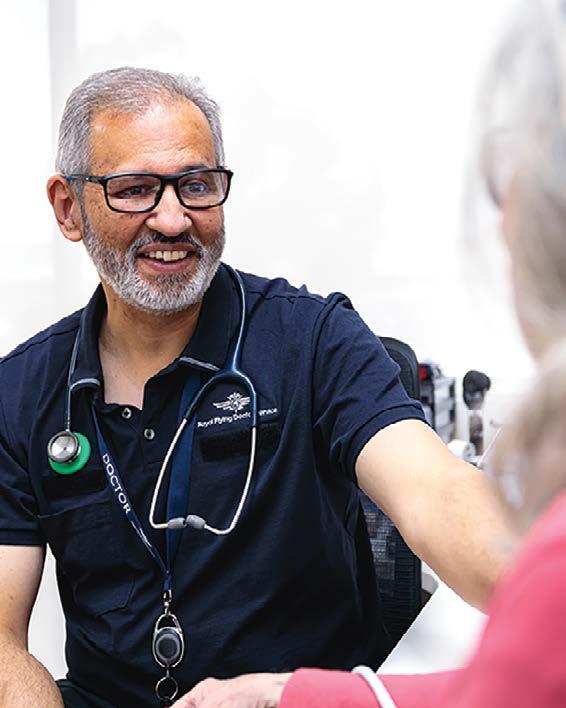
Meet Dr Ben
In August 2025, the Royal Flying Doctor Service opened its first bricks-and-mortar GP clinic, the RFDS Goldfields Health Centre supported by Northern Star Resources in Kalgoorlie. Dr Ben Banwait is the Medical Director and Business Manager.
You have a lot of experience working as a GP in regional communities. What do you enjoy about working in the bush?
It’s the sense of connection. In regional communities, you’re not just treating symptoms, you’re caring for people you know, people whose stories you understand and often entire families over time. There’s a humility that comes with that responsibility. Patients place enormous trust in you, and that is something I never take lightly. I also value the resilience and generosity of regional communities. People look out for one another and it’s rewarding to be part of that fabric.
What does a typical day look like for you at the clinic?
My days are varied, which is part of what makes the role so meaningful. As a clinician, I spend time seeing patients at our Kalgoorlie clinic and also support the RFDS fly-out and drive-out Primary Health Care clinics across the Goldfields. These outreach clinics bring care closer to people who would otherwise need to travel long distances and they help ensure access to health care is equitable across the region.
Alongside my clinical work, my role as Medical Director involves
overseeing clinical safety, governance and service planning. Balancing these roles keeps me grounded in both the day-to-day realities of patient care and the long-term vision of what regional health care can be.
What has been the feedback from patients about coming to a GP clinic established by the RFDS?
Patients often tell us how reassuring it is to receive care through a clinic run by the RFDS. We have a long and trusted history, and that trust really matters in regional communities. Many people feel comforted knowing their local GP service is connected to an organisation that understands distance, isolation and the realities of regional life.
Is there a particular area of health care that is of interest to you?
I have a strong interest in chronic disease management and preventative health, particularly in regional settings. Helping people manage longterm conditions closer to home can make a profound difference to their quality of life. Mental health is also an area close to my heart, as access to support can be especially challenging outside metropolitan areas.
As Medical Director, I’m also passionate about attracting additional health care options, such as allied health and visiting specialists, so communities can access more care locally.
Is there a particular health issue you see a lot of in the Goldfields?
We see a high number of chronic illness, including diabetes, heart disease and respiratory conditions. Mental health needs are also significant. These challenges are often made more complex
by distance and limited access to specialist services, which is why strong, accessible primary care is so important.
Do some of your patients drive a long way to see a GP?
Yes, for some of our patients seeing a GP involves planning an entire day around travel. This is why accessibility sits at the heart of everything we do. Our fly-out and drive-out clinics help reduce that burden and ensure people aren’t missing out on care simply because of where they live. Improving access isn’t just about geography, it’s about making health care work for real lives.
Why is it difficult to attract and retain GPs in regional areas?
Regional practice can be demanding. Clinicians often face professional isolation and the practical challenges of distance. Supporting safety, wellbeing and sustainability is critical. GPs need strong teams, good governance and a sense that they belong. When clinicians feel supported and connected to a clear mission, like that of the RFDS, they’re more likely to stay and build long-term careers in regional communities.
To make a booking visit rfdswahealth.com.au
The Social Value of the RFDS
Independent analysis of the RFDS by Deloitte Access Economics in January 2026 has been undertaken to put a financial value on the impact of our services in the WA community.
It combines RFDS operational data, Australian health and economic data sources, peer-reviewed academic research on health outcomes and access to care and a statewide survey of Western Australian households.
The total social value of the RFDS to the WA community over the next 30 years is estimated to be $4.1 billion
This value is generated through three key streams
$670m value to First Nations people, which equates to $6,900 per person.
Every dollar invested in RFDS operations returns around $2 in health, safety and community benefits. =
$3,450 is the average value the RFDS generates for each WA household.
$130m value to WA’s resource sector through aeromedical retrievals.
$1.9b
Existence value which represents the peace of mind metro, regional and remote Western Australians place on knowing the RFDS is there if needed.
$2b Aeromedical retrievals, emergency evacuations and inter-hospital transfers.
$200m
Other services and activities, creating value through remote clinics, telehealth, medical chests and more.
Top reasons the RFDS provides peace of mind for WA:
1 > Ensuring future generations can access services
2 > Knowing the RFDS is available for unexpected emergencies
3 > Valuing fairness, compassion and equitable access
Your regular gift creates lasting change. By giving monthly, you help us plan ahead and be there for more Western Australians, every single day. www.flyingdoctor.org.au/wa/support-us/regular-giving/
Splash of gratitude
When Cyclone Zelia bore down on the Pilbara region in February 2025, most locals bunkered down to wait out the storm. But for South Hedland man Joseph Wyllie, the cyclone brought more than just fierce winds - it triggered a terrifying case of asthma. At one stage his oxygen saturation plunged to a dangerous level.
With roads closed and the weather too dangerous to fly, the RFDS battled delays before transferring Joseph, who has Down Syndrome, from Hedland Health Campus to Perth for specialist care. After five days of treatment and weeks of recovery with home oxygen support, Joseph pulled through - and his mum Te Aroha’s gratitude inspired her to take action.
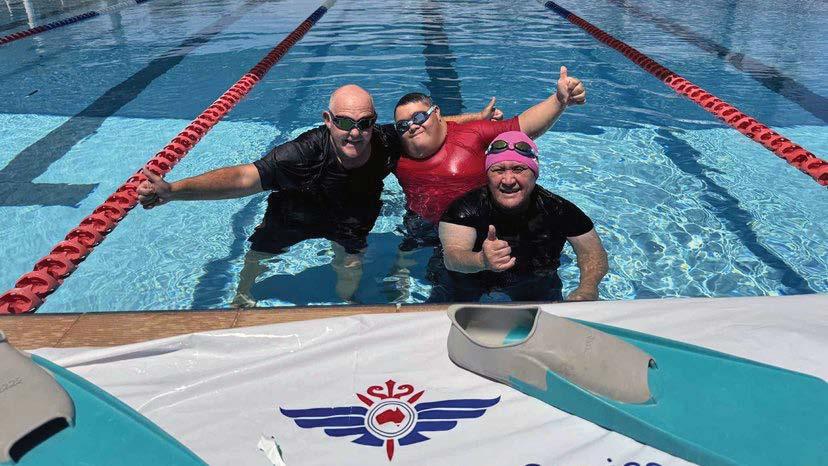
Both keen swimmers, Te Aroha and Joseph signed up for national RFDS fundraiser Oceans to Outback. Joseph is a strong swimmer and the exercise is beneficial for his asthma.
The mother-son duo set a target to each swim 20 kilometres in 20 days during the month of October in their local pool, along with Joseph’s support worker Andrew Lucas, a former marathon swimmer.
Local businesses and members of the Port Hedland community backed their ‘Swim-a-thon’, raising $2,350 for the RFDS, far beyond the family’s original target of $1,000.
“The RFDS is so important for us, living where we live,” said Te Aroha.
The RFDS crews are the ones who are there for us and we need to be there for them.
Te Aroha plans to recruit more of her family members across Australia into taking part in their 2026 Swim-a-thon and raise an even greater total.
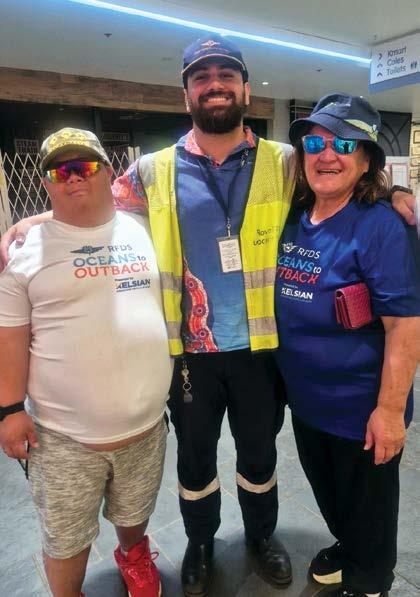
Recently Joseph and Te Aroha bumped into RFDS pilot Shak at their local shopping centre, and told him about the effort they had put in to raise funds for the RFDS. The encounter was just as meaningful to Shak.
“It’s not often we have the chance to follow up once our patients have been transferred and I’m so glad Joseph had such a positive outcome,” he said.
“Their commitment to give back to the RFDS speaks volumes about the connection so many Western Australians have with this service. Hearing their story and knowing how much the RFDS has meant to their family is a powerful reminder of the impact we have on our community.”
Meet Dr Pip
Dr Pip Baker grew up on a dairy farm in northern Victoria and graduated in Medicine from the University of Adelaide. Pip spent four years on South Australia’s Kangaroo Island working as a Rural Generalist before taking a locum position in Balgo, in the remote East Kimberley, on a fly-in, fly-out basis. Pip and her partner Courtney both joined the RFDS in 2024, Pip in Primary Health Care and Courtney in Retrieval Nursing. After 18 months working at the RFDS Port Hedland base the couple recently relocated to Broome with their dog Rolly.
What attracted you to being a GP in remote and regional WA?
I think I have the best job in the world. I love the people, I love the style of medicine, I love the places. I love flying and have started to learn to fly myself.
I don’t think I could ever go back to suburban general practice.
My patients have lived courageous lives and have so many stories to share.
What are the locations you run primary health care clinics in?
In the Pilbara I visit Nullagine, Yandeyarra and Marble Bar. In the Kimberley the clinics are in Yakanarra, Djugerari, Koorabye, Kadjina and four stations.
How does the ‘tyranny of distance’ affect the health outcomes of the patients you see regularly?
Too many times I see patients forced to accept ‘any care’ rather than the care that is appropriate for them. There may be limited choices to see a doctor of a different gender, culture or age. There are often limited or no choices for allied health support and telehealth services can’t always fathom how hard it is to change your diet and exercise habits in January in Marble Bar. In the worst of circumstances, and for a variety of reasons, people avoid accessing services at all.
The patients we visit in some of the most isolated parts of the state have a higher disease burden, are later to receive a diagnosis and suffer the consequences in long-term outcomes. The RFDS can’t be everything to everyone, but we can push hard to provide services that people would choose, even if they had more choice.
If your patients didn’t have the RFDS clinics in their community, how would they access GP services?
Most patients in the Pilbara would have a two-and-half-hour drive to Port Hedland or Newman and the services there are already stretched.
A patient from the Kimberley talked to me about accessing health care over the wet season, when the RFDS is unable to visit their station. She said the blood test her husband needed is unlikely to happen because by then their road will almost certainly be closed. It would cost about $5,000 for a charter plane to collect him and then again to fly him home. The mail plane only comes once week so if he went one way on that and did a charter flight back the cost might come down to about $3,000, factoring in accommodation too.
Most communities we visit in the Fitzroy Valley have a two hour drive to Fitzroy Crossing Hospital for the nearest available health care. They can be cut off completely during the wet season and we often end up bringing other supplies for the community in our charter plane.
Are there particular health issues you see a lot of at the clinics you run?
I spend a large amount of time managing chronic kidney disease, diabetes and ischaemic heart disease, as well as managing skin conditions such as tinea, scabies and impetigo.
What is the best part of your job?
That’s easy - the people. The RFDS people are great, but the patients are truly inspirational.
Apart from work, how else have you and Courtney become part of the local community in Broome?
The crew at the RFDS base have been incredibly welcoming, helping to make the Kimberley our home, from sharing produce from their garden to helping us beach launch our boat.
PARTNERING TO BUILD HEALTHIER COMMUNITIES
HCF has been the major national partner of the Royal Flying Doctor Service since 2023. Through the union of two trusted, long-established Australian health organisations, we’re working together to improve health access and outcomes for people in rural and remote Australia.
Incredible community support
Western Australians are very generous. We are so grateful for support from across the state, from Kununurra to Esperance and everywhere in between. Here are some highlights of the many people and organisations who continue to bring their community together to raise vital funds for the RFDS in WA.
Telethon does it again
Thanks to generous funding from Telethon, Woodside Energy and the WA community, critically ill newborns across the state will benefit from safer, faster and more standardised aeromedical transfers.
Telethon funding will enable us to purchase innovative Stryker stretchers and Cherub neonatal equipment which will be used on all aircraft types in the WA fleet.
The RFDS in WA conducts around 200 neonatal transfers each year. The Stryker stretchers and Cherub equipment will enable standardisation across the fleet and alignment with St John WA
to enhance safety during road transfer and flight and improve continuity of care across services.
RFDS WA CEO Judith Barker ASM said the RFDS in WA is proud to partner with Telethon.
“This equipment will support some of our most precious patients – premature and critically ill babies who need urgent specialist care,” Ms Barker said.
“Thanks to Telethon, our neonatal transfer equipment will be standardised across our fleet to ensure safer, faster care for vulnerable newborns across WA.”
Outback Air Race
The Red Planet Software Outback Air Race 2025 raised $1 million for the RFDS.
The race set off from Yulara, NT and touched down in Carnarvon, WA. The 3,800 kilometre journey across outback skies crossed 10 outback airstrips and saw 37 aircraft and their crews raise money for the Flying Doctor.
Since 1996, the race has grown from a niche aviation event into a national challenge, raising a total of more than $5 million.
Playing their part
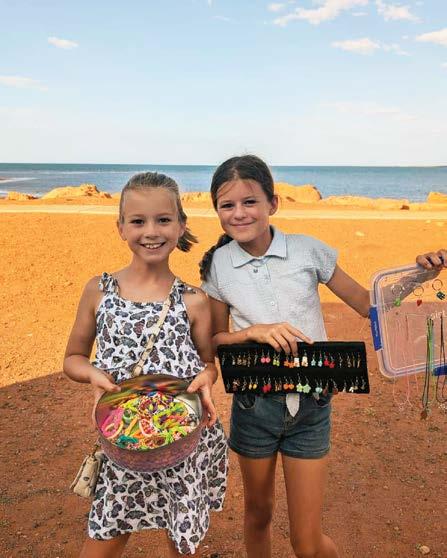
The Popples are a Victorian family who are travelling around Australia. Sisters Maddy and Amelia have been selling handmade jewellery, key chains and sun catchers in the caravan parks where they stay, raising more than $1,500 for the RFDS.
Their creativity has also been a good conversation starter with fellow travellers who often share their personal RFDS stories with the girls.
Parents Adam and Sam have made this a meaningful part of Maddy and Amelia’s education on the road, helping them learn about the vital role not-for-profit organisations play in supporting communities across Australia.
Recipes from our family to yours
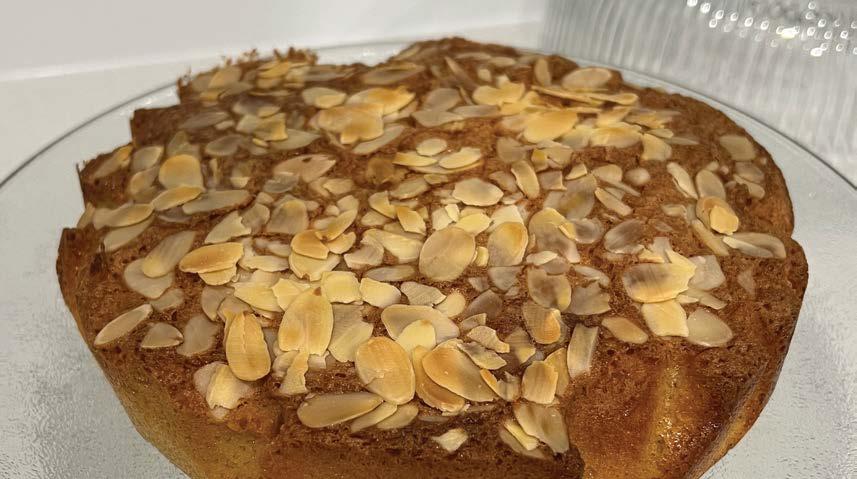
Lemon Coconut Almond Cake
Ingredients
150g unsalted butter
4 large eggs at room temp
1 tsp vanilla extract
3/4 cup caster sugar
1 1/2 cups almond meal
Method
1/4 tsp cooking salt
1 tsp baking powder
3/4 cup desiccated coconut
1 1/2 tsp lemon zest (1 large lemon) 1/4 cup flaked almonds
1. Preheat oven to 180°C (160°C fan-forced). Grease a 20cm round cake pan (or springform pan) with butter then line with paper.
2. Place the butter in a large microwaveable bowl and melt in the microwave. Let it cool for a couple of minutes.
3. Add the eggs, vanilla and sugar and whisk until combined.
4. Whisk in the almond meal, coconut, baking powder, salt and zest.
5. Pour it into a 20cm lined round cake pan.
6. Sprinkle the surface with the flaked almonds then bake for 40 minutes or until a skewer inserted into the middle comes out clean.
7. Cool for 15 minutes in the pan then carefully turn out onto a cooling rack.
8. Cool for one hour before cutting to serve.
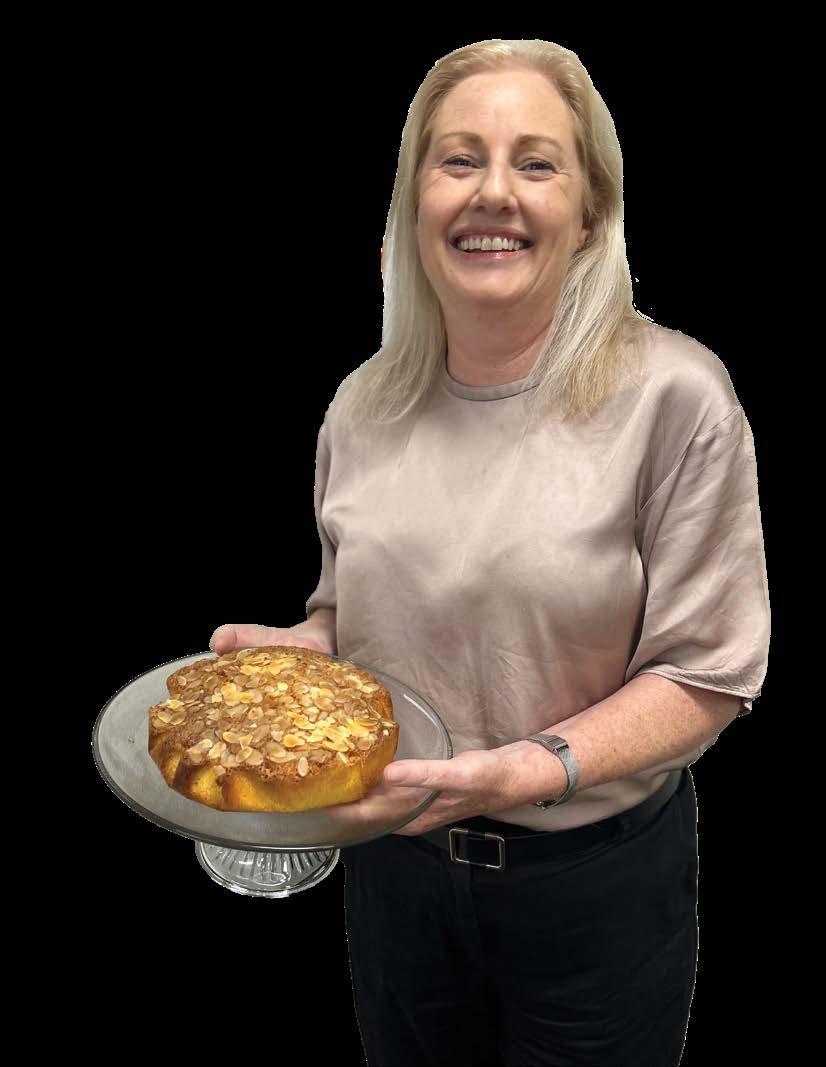
RFDS WA CEO Judith Barker is better in the boardroom than the kitchen, but says this quick and easy cake by RecipeTinEats founder Nagi Maehashi is foolproof, even for novice bakers. It’s a delicious option to take to a morning tea, book club or a school bake sale.
Acknowledgement of Country
The Royal Flying Doctor Service (Western Australia) is committed to improving health outcomes and access to health services for all people. We respect and acknowledge Aboriginal and Torres Strait Islander peoples as the first Australians and our vision for reconciliation is to provide an organisational culture that strives for unity, equity, and respect.