2026 ISSUE 1
PRESERVING ARCHIVAL PHOTOGRAPHS p. 3
THE JOY OF TOYS AND NOSTALGIA p. 9
ANCIENT EGYPT AND RITUALS OF RENEWAL p.13
©Rijksmuseum van Oudheden, Leiden, the Netherlands
This exhibition is a joint venture between and produced by the Moesgaard Museum in Denmark and MuseumsPartner in Austria.
2026 ISSUE 1
Ipek Omercikli e d i to r - i n - c h i e f
Courtney Zylstra graphic designer
Amanda Richardson e d i to r
Sophie Des Roches p r o d u ct i o n c o o r d i n ato r
The Royal BC Museum is located on the traditional territories of the Lekwungen peoples, known today as the Songhees and Xʷsepsəm (Esquimalt) Nations. We acknowledge and respect the history of Indigenous peoples, who are our partners in museum matters and community alike.
Shane Lighter p h oto g r a p h e r
Melanie Grisak
c o n t r i b u to r s
p h oto g r a p h e r
Copyright Royal BC Museum, 2026.
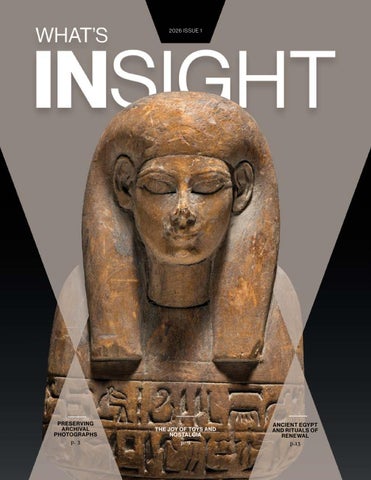
O N T H E C OV E R : Ushabti of Hat, chief goldsmith. Egypt, New Kingdom, 1569–1315 BCE. From the Ancient Egypt: Obsessed with Life exhibition. © Rijksmuseum van Oudheden, Leiden, the Netherlands.
5
7
human history More Than a Car: A Conversation with Paul Ferguson
7
8
museum spotlight New Exhibitions and National Spotlight at Chinese Canadian Museum
9
feature The Joy of Toys: Dollhouses, Action Figures and Pokémon Trading Cards Take a journey through childhood play and memory, where beloved toys spark nostalgia, connect generations and offer comfort.
8
1
11
9
natural history
CEO Welcome Message
Three Toes or Four?: The first footprints of tail-clubbed dinosaurs are from northeastern British Columbia
3
feature Preserving Truth: Indian Residential School Records at the BC Archives Learn how the BC Archives is working alongside First Nations to make residential school records accessible, supporting the search for truth and work for reconciliation.
6
bc archives Digitizing Archival Photographs for Community-Led Research
11
13
feature Ancient Egypt and the Rituals of Renewal Explore ancient Egyptian beliefs about life, death and renewal, and see how rituals, mummification and the afterlife reveal a culture deeply shaped by cycles of transformation.
19
22
19
natural history Investigations of Marine Invasive Species in the Galápagos
22 imax®
Inside the Big Screen: Why IMAX® Victoria Is One of a Kind
23
learning and engagement Ten Years and Counting: The Learning Portal from 2015 to 2025
26
publishing Excerpt from Mushrooms of British Columbia
27
13
exhibits Orcas: Our Shared Future
23
29
events calendar What’s On
26
Welcome Allison Bond, ceo
i am awed by the dedication that goes into the care of our collective cultural, human and natural history.
1 WHAT’S INSIGHT / 2026 / ISSUE 1
Dear friends and supporters, I have been at the museum for almost six months now and every day I am grateful for the opportunity to support this critical cultural institution. I have been privileged to see some of the ins and outs of the exhibitions, collections and archives. I am awed by the dedication that goes into the care of our collective cultural, human and natural history. It is a time of transformation for museums and archives around the world, and I am grateful to be a part of this journey alongside the dedicated museum, BC Archives and IMAX® Victoria staff. I have been visiting the museum for decades, and it is a privilege to now support its work at such an important moment. Preparations are well under way for the opening of PARC Campus—an undertaking that represents a significant evolution in how the Royal BC Museum and BC Archives care for and share their collections. The scale of this effort is extraordinary. Our collections staff have been busy carefully packing artifacts so that they arrive safely to their new state of the art location. We have a dedicated group of staff that are working with Indigenous partners to steward, return, protect and preserve the Indigenous heritage of British Columbia and elsewhere. They are working in partnership to ensure that when the museum reopens its 3rd floor later this year, it is grounded in respecting the rights of the Indigenous owners of the histories within. These partnerships will help ensure that the museum represents the full diversity of our history and presents it in a way that honours Indigenous peoples.
This summer and fall also bring a strong lineup of exhibitions and experiences for visitors. Following another successful run of Wildlife Photographer of the Year and the IMAX® Victoria Film Festival, we are now hosting Ancient Egypt: Obsessed with Life, running through January 3, 2027. This is an immersive experience exploring ancient Egyptian rituals, beliefs and artistry. You will journey through atmospheric spaces inspired by death, rebirth and the afterlife; you will see striking coffins, intricate jewellery and objects once meant to accompany the dead into eternity. We are also now hosting two travelling exhibits, GO FISH, a fascinating three-screen immersion into the annual herring migration across the Salish Sea, and The Island in the Middle of Everywhere, a journey to Xwe’etay, part of the Northern Gulf Islands in British Columbia, through a series of stunning photographs and video. Alongside these exciting exhibitions, we are also looking forward to a busy summer and fall filled with learning events, conferences, workshops and more. As we start our move to PARC Campus, we are entering a new chapter in our museum history—one that reflects both where we have been and where we are going. Museum staff, volunteers, members and visitors all play a role, and I look forward to sharing that future together. Kind regards,
Allison Bond Chief Executive Officer
BC ARCHIVES IS MOVING TO PARC CAMPUS Located in Colwood, BC
All BC Archives collections, staff and services currently operating at the BC Archives building in downtown Victoria will be moving to PARC Campus. PARC Campus is the Royal BC Museum’s new state-of-the-art provincial archives, research and collections building.
begin reducing public access to records and materials starting in August/ September 2026 be closed to the public starting late November and throughout December 2026 reopen at PARC Campus in early 2027
STAY UP TO DATE
THE BC ARCHIVES WILL:
WHAT’S INSIGHT / 2026 / ISSUE 1 2
Preserving Truth: Indian Residential School Records at the BC Archives Emma Wright former executive director of archives , research & collections
It all began with a mysterious request to visit the Provincial Archives of Alberta in 2018. It
Photograph of a man in a canoe, possibly Friendly Cove. BCA J-11062. opposite: Archivist Kate Heikkila pulls records from a shelf. Mel Grisak.
content warning: Please be advised that this article may be upsetting for some because it discusses and includes images relating to Indian Residential Schools. If you require immediate support, please contact the following—the Indian Residential School Survivors Society’s 24/7 Crisis Support Line: 1-800-721-0066 or the 24-hour National Indian Residential School Crisis Line: 1-866-925-4419.
3 WHAT’S INSIGHT / 2026 / ISSUE 1
was there, through conversations with our peers, that the Royal BC Museum and BC Archives learned that the Oblates of Mary Immaculate were looking to donate records related to their operations in what is now BC and the Yukon. For the past four years, the BC Archives has been focused on three projects, with the goal of making records related to the operation and administration of residential schools in BC accessible, in support of research into missing children and the legacy of the residential school system. During the Indian Residential School (IRS) system, which operated from the 1830s to the 1990s, the Canadian government forcibly removed children from their families and communities; children who endured abuse, neglect, disease and experimentation. Many of them died at these institutions. The IRS system inflicted profound and lasting harm on Indigenous children, families, communities and societies across generations. In 2015, the Truth and Reconciliation Commission of Canada published its final report detailing the experiences and impacts of the residential school system and 94 Calls to Action to address the legacy of residential schools and advance the process of reconciliation. These call on Canadian archives to take actions related to Indigenous peoples’ inalienable right to know the truth about what happened and why regarding human rights violations committed against them in residential schools; and the museum, as the steward of the provincial archives, is committed to answering this call. First Nations are seeking access to records that are in the stewardship of national, provincial, municipal and private archives for the purposes of locating, documenting, maintaining, memorialising and protecting residential school cemeteries or other sites at which residential school children were buried. This information is critical for developing a more
records from the Oblates. To date, we have processed around 72% of the OMI records donated to the archives since 2019. Recognizing that the records may contain evidence and descriptions of children, traumatic events and histories, particularly relating to residential schools, when the records first came onsite in 2019, the BC Archives asked two Indigenous Elders from Tseycum and Cowichan to come to the archives to cleanse the workspace and the staff. Using cedar boughs, the women brushed the stacks (the shelves of boxes where the records were being stored) and any archives staff that would come in contact with the records, to prepare them for the work ahead. They asked us to keep in mind the people represented in the records, and to conduct our work mindfully. This is something we keep in mind every day.
Another Catholic religious congregation that was involved in the administration of Oblate-run residential and day schools in BC is the Sisters of St. Ann (SSA). Their collection was legally transferred to the museum in 2023 and their records are now accessible online as Sisters of St. Ann, St. Joseph’s Province fonds (PR-2415). For the past three years, the sisters have funded an archivist who has processed and described over 1,340 boxes of SSA records (97% of the textual records donated)—more records descriptions are continually being added to our online database as we work through the boxes. Both the OMI and SSA collections include material that is fundamental to truth and reconciliation. The records document early settler contact with Indigenous communities in BC and contain valuable information of use for language revitalization programs and understanding of residential school history—for nations, survivors and their families. In 2022, BC’s Ministry of Indigenous Relations and Reconciliation provided project funding to the University of British Columbia’s Indian Residential School History and Dialogue Centre (UBC IRSHDC) for a joint project with the BC Archives to accelerate the digitization of archival records from the Oblates and Sisters, as well as WHAT’S INSIGHT / 2026 / ISSUE 1 4
f e at u r e
detailed understanding of the historical context and operations of residential schools, including information on the possible location of burial sites. In certain cases, this information can inform further investigations into the disappearance of Indigenous children. Information in the records is critical to First Nations, Métis and Inuit survivors and family members seeking to understand the experiences of those who attended the schools and the children who never came home. Many First Nations in BC have undertaken work to locate unmarked graves on the grounds of former residential schools. There has been a renewed and increased interest in this work since Tk’emlúps te Secwépemc released their findings at the site of the former Kamloops Indian Residential School in May 2021. The compilation and analysis of archival records is a critical step in this process, and there has been an increased interest to access records related to the 18 Indian Residential Schools and 3 Indian Hospitals that operated in BC. This has, in turn, resulted in an increased volume of access requests to key institutions that hold residential school records, including the BC Archives. The BC Archives stewards various records related to residential schools. These include government records such as vital events records (birth, death and marriage registrations), coroner’s records, maps, lands records and provincial government publications. We also steward records from private individuals and organizations that are valuable for IRS research. They include photographs, artworks, sound and film recordings, newspapers and publications, and records from religious congregations. In 2019, the BC Archives acquired the records of the Oblates of Mary Immaculate (OMI), who are a Catholic missionary religious congregation founded in 1816 that operated ten residential schools in BC: the majority of residential schools that operated in the province. OMI Lacombe Canada have funded the BC Archives processing of these records for the past six years; the records have been described online as the Missionary Oblates of Mary Immaculate fonds (PR-2400). The fonds includes approximately 79 metres of records, dating from 1828 to the present. The material comprises both civil corporation and canonical entity records, including administrative, financial and personnel records, records related to Indian Affairs and Indian Residential Schools, codices, published materials including early language dictionaries, personal papers, parish and mission records. The records are in various formats including textual, photographs, plans, books and art. Since 2019, five archivists have processed over 300 boxes of OMI records. Catalogue descriptions for the processed records are publicly available through the BC Archives Collection Search database. Materials from the 2019 donation remaining to be processed include multi-media materials. In April 2025, we received an additional donation of 94 boxes of
Yale Church, 1964. BC Archives J-11631.
other residential school-related records in BC Archives’ stewardship. We are grateful for the funding received from the province, as well as the record donors, that has enabled us to prioritize making this information accessible. To date, we have digitized 65,565 pages of Sisters of St. Ann records and 94,149 pages of Oblates of Mary Immaculate records. That’s over 159,000 pages of records in total, not including other residential school-related records in our holdings that we have also digitized in response to record requests from nations. Throughout, we have prioritized response to and requests from First Nations seeking to access records and have introduced new information disclosure processes made possible through the province’s 2021 updates to the Freedom of Information and Protection of Privacy Act. What Indigenous researchers are asking to see has guided our prioritization of records for digitization and continues to do so. We are grateful to and humbled by the 21 First Nations leading this work in BC, as well as the ongoing collaboration with multiple government agencies and our project partner, UBC IRSHDC. On June 3-5, 2025, the museum and BC Archives hosted the seventh annual Provincial Gathering for Lead Nations Investigating Indian Residential School and Indian Hospital Sites in BC and held a photograph-identification workshop in the reference room. There were over 60 attendees from 14 First Nations at the event, including Chiefs from Tseshaht and Nadleh Whut’en, and Elders and councilors from Kosapsum Nation. Gifts and research packages of records and photographs were presented to each First Nation in attendance. It was evident through the profound appreciation and emotions that were shared with us the impact of all this work for their research teams, for survivors, and for the
5 WHAT’S INSIGHT / 2026 / ISSUE 1
families of the children who never came home. Following on from the gathering, our archivists were honoured to be invited to support and bring photographs to the Lejac Residential School Reunion in Prince George on June 27-28, hosted by Takla Lake First Nation. The event brought together survivors from 17 First Nations, and there were over 400 attendees. Following the reunion, the BC Archives sent out digital and print copies of photographs and student drawings from Lejac Residential School. Over 12,792 pages of records were sent to former students and their families. Nations in what is now British Columbia are leading community-based investigations into missing children and unmarked burials related to the IRS system, and the museum is incredibly grateful to those First Nations who guide us and provide cultural oversight. The BC Archives reference room features in the 2025 Oscar-nominated documentary Sugarcane that follows Williams Lake First Nation as they investigate abuse and missing children at St. Joseph’s Mission, a former Indian Residential School operated by the Oblates. To continue uncovering the truth, nations have ongoing funding needs. They have also been the target of Indian Residential School denialism, which
We are committed to [...] Indigenousled stewardship of these records. has been increasing since 2021, directed towards survivors, former students, families, communities and researchers. In 2024, the Independent Special Interlocutor for Missing Children and Unmarked Graves and Burial Sites associated with Indian Residential Schools released her final report from a two-year investigation, which calls for the implementation of an Indigenous-led reparations framework for truth, accountability, justice and reconciliation. The BC Archives stands in solidarity with the First Nations leading this work. We are committed to truth, accountability, and Indigenous-led stewardship of these records, and we will continue to walk this path together—centering survivors, honouring the children who never came home, and rejecting denialism in all its forms. We urge you to do the same. If you would like to donate to support the continued processing and digitization of residential school records, please contact the Royal BC Museum Foundation and request your donation is in support of the Oblates fund: rbcmfoundation.ca
Digitizing Archival Photographs for Community-Led Research Christeah Dupont digital access specialist
In Spring 2025, the Royal BC Museum and BC Archives was invited by our project partners at the Ministry of Indigenous Relations and Reconciliation (MIRR) to host the next Provincial Gathering for Lead Nations Investigating Indian Residential School and Indian Hospital Sites. A biannual event organized by MIRR, the provincial gathering brings together research teams of First Nations or Tribal Councils that are investigating former residential school, day school or hospital sites located in or near their communities. When the date of June was set for the event, the BC Archives team jumped into action. In my small corner of the archives, I dropped what I was doing to reprioritize my work as a digital access specialist and focus on this event. Over the course of several meetings, we came up with a plan to host a residential school photograph workshop as part of the gathering. Photographs are essential to locating and identifying people who attended residential schools, so we created binders filled with digitized images of Indigenous children. These binders would then be gifted to the visiting nations to help them identify the people and places pictured. That is where my work began. I spent the months leading up to the gathering scouring through photographs that had been donated to the BC Archives by the Oblates of Mary Immaculate, a priesthood that ran Catholic residential schools across British Columbia. I was searching for images of children and anything
that might be related to Indigenous communities or the residential school system. Their photographs had been organized broadly by the priests: some photographs were organized into folders by location or by the name of specific priests. Some folders were organized by school; some were simply labelled as “Indians.” As a team, we did our best to identify the photographs and sort them by nation, but we knew that the priests’ methods of organization were unlikely to be accurate. The list of items that I planned to digitize grew overwhelmingly large. The process of digitization is timeconsuming and tedious: it can take up to several minutes to create a high-quality scan of a single photograph. I scanned these photographs at a high resolution which, though time consuming, would allow anyone examining the digital image to zoom in. This is especially useful for group photos, as it can be difficult to see everyone clearly in a small image. After I scanned and sorted them, we gifted each lead nation with a physical binder of printed photographs as well as a digital version of the binder. Residential schools never had students from just one nation. A separate binder was created specifically for unidentified images with no context: an “Unknown” binder filled with photographs that we hoped the nations would help identify. We prepared content warnings for each of these binders and for the workshop itself. I was nervous on the day of the workshop. The team had worked so hard in the months leading up to the
gathering and we wanted to do all that we could for both the nations in attendance and those that couldn’t make it. The workshop was powerful and emotional as attendees poured over the photographs we had compiled; people found both themselves and family members in the images. As archives and museum professionals, we often come across materials that are traumatic and difficult to work with. But I am incredibly proud of the BC Archives team for bringing together this event. This work is not just about scanning photographs; it’s about restoring connection, identity and truth to families and communities who have carried the weight of silence for generations. Each image is more than a record; it is a fragment of a life, a possible answer to a long-held question, or a face that has not been seen in decades. This work is essential to the broader process of truth, accountability and reconciliation, and we remain committed to ensuring that access to these records is guided by and in service to Indigenous communities. The photographs I scanned are but a small percentage of what is left to be digitized. Our work continues. Archivist Christeah Dupont digitizing archival records. Mel Grisak.
WHAT’S INSIGHT / 2026 / ISSUE 1 6
More Than a Car A conversation with Paul Ferguson
in some ways, one of my own rebellions.
But over time, it became iconic. Now
Ipek Omercikli
My dad wanted me to be an accountant,
it’s the one everyone wants to see.
editor
and I just couldn’t see myself doing that. I thought this would be really interesting, and it was. You get to work
Paul: It reflects change. If you look
with what I call British Columbia’s
at the Beatles in the early 60s, black
memory, documenting it, creating
suits and short hair, and then later,
stories, and making connections.
everything shifts. Their music changes,
Ipek: What do you remember
their image changes, their ideas change.
about first hearing the Beatles?
The car follows that same arc. It starts
Paul: I was about five or six. I
conservative and becomes something
still remember imitating them on the
expressive and unexpected. It speaks to
playground, air guitars, air drums,
individuality and to the idea that you
singing. That was my first exposure. I
don’t have to stay within the lines.
didn’t realize how formative it was at the time. Later, when I got into songwriting, I understood the influence more. Their
Ipek: What does it mean to have it here in British Columbia? Paul: It’s more than a local story;
music speaks to time and place. It moves
it’s a global icon. The car wasn’t
from pop into something deeper, more
used here by Lennon, but it came to
personal, more reflective of the world.
British Columbia and became part
Ipek: How did that influence your own music? Paul: When I started playing guitar, John Lennon’s famous bespoke Rolls
Ipek: What does the car represent to you?
of our collection. People recognize it immediately. It resonates with everyone. People don’t just see a car;
I just wanted to be a hard rock player.
they connect it to their own experiences
Royce Phantom V limousine was on
But I learned simple songs first, basic
and memories of the Beatles.
display until recently in the Royal BC
chords. Later, I realized how powerful
Museum, and remains an important
that simplicity could be. John Lennon
part of our collections. While visitors
eventually started writing more
are fascinated by this colourful piece
personally, and I adopted that. You
car, it’s an experience. Music does
of history, many are puzzled by its
don’t need complexity. Simple chords
that too. There’s always a song that
place in the provincial museum of BC.
and honest words are powerful. When
takes you back to a moment. The
We sat down with our now retired
you try to write like that, it pushes
car works the same way. People
history collections manager, Paul
you to express something real.
bring their own stories to it.
Ferguson, and talked about what the
Ipek: What stands out to
car means to him, and what it could
you about the Rolls Royce?
mean to people in BC and beyond. Ipek: Let’s start with you.
Paul: Originally, the car wasn’t like
Ipek: You’ve said it’s more than just a vehicle. Paul: It really is. It’s not just a
Ipek: Did revisiting the music change anything for you? Paul: Absolutely. I prepared
this at all. When it arrived with John
by listening again, and it brought
Who are you and how did you
Lennon, it was painted Valentine Black, a
everything back, memories,
end up here at the museum?
very conservative colour, representative
connections, ideas. Songs like “Let It
Paul: I’m Paul Ferguson, and I’ve
of the time. It was expensive, but not
Be” tell you everything’s going to be
been working in history for a number
unusual. Then Lennon had it repainted
okay. Sometimes you fight, sometimes
of years as a collections manager.
in a Romany-inspired design. That
you let things be. That’s how you cope.
I started here in 1978. I eventually
was a statement. He was saying that
We don’t just have a car. We
left, was away for about 30 years,
he didn’t have to be the status quo and
have a piece of John Lennon here.
and came back in 2015. Now I am
could express himself. When it first
retiring with a lot of memories.
appeared, people were outraged. How
jPaul Ferguson, retired History Collections Manager, in
could you do that to a Rolls Royce?
front of John Lennon’s Rolls Royce, 2026. Shane Lighter.
Coming to work for the museum was,
7 WHAT’S INSIGHT / 2026 / ISSUE 1
m u s e u m s p ot l i g h t
New Exhibitions and National Spotlight at Chinese Canadian Museum
Dream Factory: Cantopop Mandopop
interacting with objects and reflecting
1980s–2000, on view until August 23,
on how domestic and educational
2026. The exhibition explores the rise
environments shaped community life. Momentum: Sports and Cultural
Hosea Cheung
of Cantopop and Mandopop as global
director of marketing and visitor
cultural phenomena, highlighting
Identity, which opened on June 10,
experience , chinese canadian museum
the role of diasporic communities,
examines the intersections of athletics,
including those in Canada, in
identity and community, and elevates
shaping and sustaining these music
Chinese Canadian participation
As Canadians look for deeper
scenes. Recently recognized with
that has long been marginalized
ways to connect with the country’s
the Canadian Museums Association
in Canada’s sporting record.
past and present, the Chinese
Award for Outstanding Achievement:
In addition to its exhibitions,
Canadian Museum offers a space to
Exhibitions, Dream Factory reflects the
the museum includes 1889 Trading
encounter histories that have long
enduring influence of popular culture
Co., a retail space featuring work by
been underrepresented in national
in articulating identity and memory.
Chinese Canadian artists and makers.
narratives. Located in Vancouver’s
On the 3rd floor, A Soldier for All
After your visit, why not extend
Chinatown, the museum is dedicated
Seasons marks 80 years since the end
the experience by immersing yourself
to exploring the diverse experiences
of the Second World War, focusing on
in the vibrant culture of Vancouver’s
of Chinese Canadians, tracing stories
the experiences of Chinese Canadians
Chinatown? Support local businesses,
of migration, resilience and cultural
who served overseas. Through personal
savour mouthwatering dishes
expression across generations.
artifacts and multimedia elements,
and shop for unique products. It’s
the exhibition situates individual lives
the perfect conclusion to a truly
2024 Governor General’s History
within the broader context of wartime
unforgettable museum trip.
Award for Excellence in Museums, the
service and its lasting impacts.
Already awarded the prestigious
More information, including
Chinese Canadian Museum presents a
Nearby, Period Rooms: Historic
dynamic lineup of exhibitions alongside
School Room and Living Room recreate
visiting details, is available at
its immersive retail experience, 1889
early 20th-century interiors, offering
chinesecanadianmuseum.ca.
Trading Co. In 2025, enhancements to
a glimpse into daily life in Vancouver’s
the museum included a renovated lobby
Chinese Canadian community.
and education centre, with a rooftop
Visitors can engage directly with
Dream Factory: Cantopop Mandopop 1980s–2000s
garden set to reopen in 2026, further
space by listening to recorded stories,
celebrates the golden era of Chinese-language popular
elevating the visitor experience. The museum is housed in the
current exhibitions and
music. Visitors encounter iconic stage costumes— from a striking peacock-feather cape to bold,
Wing Sang Building, the oldest
show-stopping ensembles—displayed alongside film
brick structure in Chinatown, where
projections and archival material. William Luk.
layers of history are embedded in the
architecture itself. Across four floors, exhibitions examine both everyday life
A Soldier for All Seasons, on the 3rd floor of the
and broader historical forces, bringing
Chinese Canadian Museum, honours the Chinese
together personal stories, archival
Canadians who served in the Second World War,
materials and immersive installations.
fighting for freedom abroad while advocating for equal
Among its current exhibitions is
rights at home. Aiden Tong.
WHAT’S INSIGHT / 2026 / ISSUE 1 8
The Joy of Toys: dollhouses, action figures
and pokémon trading cards
Elizabeth Peterson curator of history
I
t was a cloudy February day in Victoria, and I was wandering through a vintage fair with my two-year-old daughter when I saw it—an early 1970s A-frame FisherPrice dollhouse! Its green roof and plastic furniture instantly caught my eye. In that moment, a wave of nostalgia came over me and I was transported back to my childhood and the garage of my grandparents’ house, where my aunt’s Fisher-Price dollhouse sat waiting for another round of imaginative play. I could hear the cicadas and feel the heat of the Texas summer drifting through the open garage door as my siblings and I crafted endless adventures with the plastic figures in the little rooms. As I stood there with my daughter’s little hand in mine, showing her the 9 WHAT’S INSIGHT / 2026 / ISSUE 1
dollhouse and accessories, I was filled with the same sense of fun and joy that I experienced on those hot summer days. Nostalgia for our past, often sparked by memories of childhood play, is a powerful force. It helps unify our sense of identity, fosters social bonds, and offers comfort during times of change. When nostalgia is triggered by something tangible, like a beloved childhood toy, its emotional impact becomes even more profound, serving not just as sentimental recollection, but as a meaningful psychological tool that can help us navigate life’s difficult moments. As a curator, I’m continually struck by the healing potential of unlocking these memories through the sharing of objects like toys. In a world filled with uncertainty, these moments
of emotional connection and self-care are vital for us all. During the COVID-19 pandemic, the power of nostalgia to help navigate tough times became especially clear. Many adults turned to toys from their youth, like LEGO, Transformers, and Pokémon cards, to find comfort during a time of isolation, loss and uncertainty. I did the same, collecting Star Trek: The Next Generation action figures from my youth to lift my spirits while staying distant from loved ones. These toys became more than objects; they were emotional lifelines, reconnecting us to joyful memories, beloved characters, and the people and places we missed. While many toys transcend cultures and generations, like hula hoops, skipping ropes, and the enduring icon
Barbie, they also serve as cultural touchstones, uniquely shaped by the spirit of their time and place. Across decades and continents, children have found joy and identity in toys that reflect their own cultural values, social contexts and imaginations. These objects, while connecting us, also celebrate the diversity of individual eras, communities and personal stories. Growing up in North America and Europe in the late 1990s and early 2000s, I witnessed the rise of the internet, social media and a global pop culture. Shaped by Baby Boomer parents and Gen X older siblings, I came of age amid rapid globalization, digital connectivity, and a growing emphasis on self-expression. Youth culture wasn’t just acknowledged, it was celebrated. From kid-centered TV networks and websites to events like the Kids’ Choice Awards, we were active participants and saw ourselves reflected in the world around us. And the toys, they reflected that bold, diverse energy. Japanese-influenced franchises like Pokémon, Yu-Gi-Oh! and Mighty Morphin Power Rangers blended action, storytelling and collectability. Interactive toys like Tamagotchis and Furbies (the fuzzy little creatures that still give me nightmares to this day) introduced digital play, while classics got a competitive twist, like Beyblades that turned spinning tops into a complex story of competition and play. Even Barbie joined the pop culture wave, releasing dolls modeled after stars like Britney Spears, *NSYNC and Spice Girls.
comfort, continuity, and a sense of well-being in an ever-changing world. In the end, I couldn’t resist—I bought the Fisher-Price dollhouse. Its ability to connect me not only to my own childhood memories but also to my wider family’s was too meaningful to pass up. Now, my daughter and I sit together on our family room rug, arranging the tiny furniture, laughing as we play. It’s become a cherished activity, a way to slow down, share our histories, and create new memories together. Through the toys of our youth, we don’t just revisit the past, we carry it forward. What toys from your youth do you remember the most and what are the feelings that you most associate with it? How do they reflect what was happening in the world at that time?
top: Takara Tomy Beyblade Dragoon V Starter Set, 1999. History collection 2003.24.1a-e middle: Curator Elizabeth Peterson and daughter at
home playing with their 1970s Fisher-Price A-frame dollhouse. opposite: Mighty Morphin Power Ranger Wolf Ninjazord, 1995. History collection 999.85.13a-b
WHAT’S INSIGHT / 2026 / ISSUE 1 10
f e at u r e
These toys weren’t just playthings; they were part of a larger branded universe. Many were tied to TV shows, movies or video games, creating immersive worlds that extended beyond the toy box. Iconic toys like LEGO underwent a major transformation, embracing licensed franchises like Star Wars and Harry Potter to stay relevant in a rapidly evolving market. These changes showed a broader shift in the toy industry toward multimedia integration and global appeal that has carried over into our modern era. Today, many of the toys from our past live on in museum collections. Preserving them affirms their cultural significance and creates joyful, personal connections offering emotional uplift through the power of memory. In a fastpaced world, this childhood nostalgia provides a grounding force, reminding us of who we were, how we grew up, and the shared experiences that continue to shape us. For me, that connection is particularly strong when I come across toys like the Spice Girls Sporty Spice doll and the Mighty Morphin Power Rangers Wolf Ninjazord housed within our history collection. They invoke joyful memories of my brother and me playing Power Rangers in the backyard and sleepovers with friends where we would dance to “Wannabe” by Spice Girls. The presence of toys like these in museum collections reminds us that these moments matter, and that we matter. They celebrate everyday life, highlighting the importance of play, connection and imagination. They create space for nostalgia, allowing us to pause and reflect on who we were, grounding us in the present, offering
Three toes or four? The first footprints of tail-clubbed dinosaurs are from northeastern British Columbia Victoria Arbour
Museum fossil preparator Calla Scott applies silicone
c u r ato r o f pa l ae o nto lo gy
moulding materials to the type specimen of Ruopodosaurus at the Tumbler Ridge Museum in August 2024.
The tail-clubbed armoured dinosaurs known as ankylosaurid ankylosaurs are my favourite group of dinosaurs to work on, and the
group that I’ve spent the most time thinking about over the last 20 years. In 2016, I published a scientific paper that noted that bones from ankylosaurid dinosaurs were missing from the fossil record of North America in the middle of the Cretaceous Period. We can find rare examples before 104 million years ago, and again 83 million years ago, but not in between. In contrast, their cousins, the nodosaurid ankylosaurs (which lack a tail club but often have large shoulder spikes) are found throughout the Cretaceous Period of North America. What happened to the ankylosaurids during this midCretaceous “ankylosaurid gap”? Were they pushed out of North America because of the changing sea levels or climate? Or have we simply not found their fossils yet, maybe because rocks from this time period are harder to come by in general? Fossils from Tumbler Ridge in northeastern BC held the answer, but the clues were in fossil footprints, not bones. Fossil footprints, or tracks, from nodosaurid ankylosaurs have been known from the Peace Region for almost 100 years, in the form of five-fingered 11 WHAT’S INSIGHT / 2026 / ISSUE 1
handprints and four-toed footprints called Tetrapodosaurus borealis. But some rare tracks with five-fingered handprints and only three toes in the footprints have been popping up since the year 2000. These footprints are found in rocks around Tumbler Ridge belonging to the Dunvegan and Kaskapau formations, and are about 97 million years old, right in the middle of the ankylosaurid gap. Several examples of these threetoed ankylosaur trackways have been collected by our colleagues at the Tumbler Ridge Museum. Dr. Charles Helm, a scientific advisor to the museum, asked me to look at some of these tracks back in 2023 to see if we could figure out what kind of dinosaur was leaving these unique tracks. The answer jumped to mind quickly: these were the footprints of ankylosaurid ankylosaurs. Ankylosaurids and nodosaurids both had five fingers on the hand that would have left a crescent-shaped handprint. However, all known nodosaurid species where the foot has been preserved show they had four toes in the foot. And all known ankylosaurid species with a preserved foot had only three toes. The shape of the hand and footprints also showed that they couldn’t have been made by other types of dinosaurs, like stegosaurs or horned dinosaurs.
Ruopodosaurus clava fossils are collected from Treaty 8 territory, on the traditional lands of the Cree, Dunne-za, Saulteau, Tse-khene and Métis peoples. Fossils in BC are protected under the Land Act and scientifically significant finds like dinosaur footprints require collecting permissions from the government.
top: Royal BC Museum fossil preparator Calla Scott and University of Victoria MSc student Teague Dickson apply archival consolidant to the type specimen of Ruopodosaurus at the Tumbler Ridge Museum.
Ruopodosaurus was found in rocks that are about 100 million years old, during a gap in the fossil record of tail-clubbed ankylosaurid fossils, which are well known from about 75 to 66 million years ago. The ankylosaurid that made these tracks lived alongside a larger nodosaurid ankylosaur that left behind footprints called Tetrapodosaurus.
66.0
Maastrichtian
Ankylosaurus
72.1
Campanian
83.6
Santonian 86.3
Coniacian Early Cretaceous Late Cretaceous
My colleagues Charles Helm, Eamon Drysdale (curator at the Tumbler Ridge Museum), Roy Rule (geoscientist at the Tumbler Ridge UNESCO Global Geopark), and the late Martin Lockley (a prominent dinosaur footprint expert at the University of Colorado) and I named these new fossil footprints Ruopodosaurus clava in a paper published in the Journal of Vertebrate Paleontology in the spring of 2025. The name means “the tumbled-down lizard foot with a mace,” a reference to the town of Tumbler Ridge and the fact that these footprints were made by the tail-clubbed ankylosaur family. These are the first examples of ankylosaurid ankylosaur footprints known from anywhere in the world. They also show that the ankylosaurid gap reflects the patchy, incomplete nature of the fossil record. Ankylosaurids were here after all between 104 and 83 million years ago—we just hadn’t found their fossilized bones yet. Maybe one day, if we’re lucky, we’ll find ankylosaurid bones in the Dunvegan or Kaskapau formations that give us an idea of what the dinosaur who left behind Ruopodosaurus tracks looked like.
Anodontosaurus, Nodocephalosaurus, Ziapelta
Akainacephalus, Anodontosaurus, Dyoplosaurus, Euoplocephalus, Scolosaurus, Zuul
89.8
Turonian 93.9
Ruopodosaurus
Cenomanian 100.5 Tetrapodosaurus
Albian Cedarpelta ~113
WHAT’S INSIGHT / 2026 / ISSUE 1 12
e d ito r
WHAT’S INSIGHT / 2026 / ISSUE 1 14
f e at u r e
and the Rituals of Renewal
Ipek Omercikli
T
he Royal BC Museum’s newest feature exhibition, Ancient Egypt: Obsessed With Life, opened to visitors on June 5. Exploring ancient Egyptian rituals, beliefs and artistry, including coffins, jewellery, grave goods, papyrus rolls, light, sound and scent displays, the exhibition’s central focus is its dissection of the mummification process. To understand why Egyptians were obsessed with life, and how mummification, for them, was about life itself rather than death, we first need to understand how they saw cycles of life. It is no surprise that ancient Egyptians were preoccupied with notions of transformation and renewal. Flowing northward through Egypt, the Nile is brimming with the possibility of life, and implications of perpetual rebirth. Egyptians developed their philosophy of life, death and rebirth as observers and inhabitants of a contrasting landscape consisting of both fertile land and rocky desert. From the floodwater that revitalized their farmland to the edge of the desert where they live and bury their dead, they observed a natural pattern: water does not cease to exist, it simply transforms and feeds into other forms of life. Just as the sun rises and sets every day, water too reemerges, feeds the land and is constant, reaffirming the cycle of life that otherwise appears linear with a final, unchangeable destination: death. For the ancient Egyptians, these cycles of renewal were not merely observations about the natural world; they were woven into the very fabric of creation.
The story of Osiris, one of the most important figures in Egyptian mythology, offers an explanation for how life can emerge from death. After being murdered and dismembered by his brother Seth, Osiris was restored by his wife Isis, who reassembled his body and returned him to existence. Rather than ending with this resurrection, the story became a model for the universe itself. As ruler of the underworld, Osiris presided over a world in constant transformation, where death was not a final destination but a necessary stage in an ongoing cycle of renewal. By aligning themselves with Osiris through ritual and mummification, Egyptians believed they too could participate in this eternal process; this continuation of life beyond death. It is fascinating that observing the natural cycles of life on earth created a desire to replicate, preserve and perfect that process. Transposed to human life, this cyclical pattern of apparent death and renewal promised not only survival after death, but the continuation of one’s social status, comforts and privileges in the next world. In order to achieve rebirth and preserve their soul, one had to be mummified and transformed into an ancestor, which was an arduous and expensive procedure that was first reserved for royalty and later for the elite and some members of the middle class. Mummification, the process of destruction, reconstruction and embalming of the body for the afterlife, transformed the dead body into a living ancestor, an Osiris, ensuring that their ties with the spirit world and gods were not severed lest they face
eternal annihilation of the soul. Remaining connected to this new world required certain rituals and offerings. That is to say, the afterlife had its own set of rules that were carried through from the deceased’s previous life. Beyond the Nile’s status as a bringer of fertility and rejuvenation, it also remained a sign of economic prosperity in the afterlife, with infinite resources for every ancestor who had been reborn under the right circumstances. The tomb, and the coffin, of the deceased was also much more than a resting place. It functioned as a dwelling, a home for the ancestor, furnished and decorated with their material possessions from their past life so that they wanted for nothing in the afterlife. These were both symbols of status and insurance for a comfortable death (and beyond). Wealthy landowners, inner circles of the royalty and state officials took their most costly and fancy belongings to the grave with them, including what is called a Book of the Dead, detailing rituals, offerings and mythological adventures written and drawn on a roll of papyrus. In the next few pages, you can take a peek at what you might find in the tomb of an elite who is hoping to keep it luxurious and comfortable in their journey into the underworld. Ancient Egypt: Obsessed with Life runs through January 3, 2027, and is produced by MuseumsPartner, in cooperation with the Moesgaard Museum, Denmark.
Votive hall of a tomb and a false door displayed in the exhibition. Mel Grisak.
WHAT’S INSIGHT / 2026 / ISSUE 1 16
f e at u r e
ancient egyptians were preoccupied with notions of transformation and renewal
lky rlp ybbk pxvb urq owsm dfs BOOK OF THE DEAD
An afterlife surviving guide. Part spellbook, part travel manual and part collection of sacred stories, a personal Book of the Dead was designed to help its owner navigate the dangers of the underworld. Written on papyrus and placed within the coffin, these funerary texts provided the knowledge needed to overcome supernatural obstacles, commune with the gods and secure a successful rebirth. The journey to the afterlife was full of tasks and trials the reborn person needed to overcome, and these guidelines were their best protection against annihilation and rejection by the gods. 17 WHAT’S INSIGHT / 2026 / ISSUE 1
ghwn jvxm vbko pxvww lk Insideurqy the rl owsmt Tomb, ybb dfso pxv hjkv urq owsm dfs hjk LET TERS
“Till death do us part” was not the Egyptian way. For ancient Egyptians, death did not sever one’s ties to the living world. Families travelled to desert tombs to visit their ancestors, bringing offerings of food and drink in exchange for protection, guidance and healing. The dead remained active participants in everyday life. Some even wrote letters to their deceased relatives, pleading for help, reassurance or peace from a haunting presence.
USHABTI
No one wants to spend an eternity doing farmwork. Avoiding monotonous labour for eternity, even after death, was a must for the Egyptian elite. Neither servant nor companion, the ushabti figurine functioned more like a magical clone of the deceased, summoned to perform labour in the fields of the gods on their behalf, animated through ritual spells and sent into the underworld in place of the ancestor. With ushabtis, the deceased had free time to enjoy an afterlife free of physical toil.
You can’t take it with you? The Egyptians disagreed. Goldsmiths and designers served the upper class, producing pieces in high demand across the elite world. Drawing inspiration from nature, they translated forms like the blue lotus, opening and closing with the sun, into symbols of rebirth and renewal. A status of wealth and beauty, pieces of jewellery were a staple of life after death.
ART AND MUSIC
Eternity was not meant to be enjoyed without music and romance. In tomb art, the afterlife is constructed as a continuation of life on earth, preserved in its most ideal form. Bodies remain young and carefully adorned, expressing vitality, sexuality and rank. Scenes of music-making, fertility rites and ritual celebrations suggest a world that continues to function socially and culturally after death.
BREWERIES
What would eternity be without a good drink? Reliefs and wooden models depicting breweries, farms and bustling estates ensured that labour, celebration and abundance continued in the afterlife. Beer, consumed by peasants, kings, gods and ancestors alike, was an important part of these rituals. Since ushabti took care of the manual labour, ancestors were free to roam and enjoy the rest of their days (forever).
All object images © Rijksmuseum van Oudheden, Leiden, the Netherlands.
WHAT’S INSIGHT / 2026 / ISSUE 1 18
f e at u r e
tkh vnp ybbk pxvb urq
lky rlp ybbk pxvb ybbh urq pxv Into owsm the urq Afterlifee dfs owsm hjk dfs xb hjk nm xbff dwwd dfy nmr iiep
JEWELLERY
Investigations of Marine Invasive Species in the Galápagos Henry Choong curator of invertebrate zoology
The Galápagos Islands are a province of the Republic of Ecuador, located approximately 965 km west of the mainland of South America. Charles Darwin visited the Galápagos Islands in 1835 during the voyage of the HMS Beagle (1831-1835) as its geologist and naturalist. His observations of the archipelago’s plants, finches and tortoise species, and their development in isolation from the mainland and their variation between the islands were vital to his formulation of the principle of “natural selection” as a mechanism for speciation. The relative isolation of Galápagos Islands from the mainland and the reproductive barriers between the islands themselves, which are responsible for its many unique species, also make it extremely vulnerable to invasions by non-indigenous, or alien, species. Alien species introductions are the main cause of biodiversity loss for oceanic islands. Together with habitat destruction, alien species are responsible for most global biodiversity loss. At least 1,500 invasive species are known in the Galápagos. Invasive species are recognized as a significant conservation threat in terrestrial habitats of the archipelago. However, although the Galápagos Islands are one of the world’s largest marine 19 WHAT’S INSIGHT / 2026 / ISSUE 1
protected areas (the Galápagos Marine Reserve is 138,000 km 2 and is the largest reserve in the Eastern Tropical Pacific), the magnitude of invasions in its coastal marine waters remains relatively unknown. As recently as the beginning of 2001, only five marine and maritime species had been documented as introductions to the archipelago. In 2015, scientists from the Smithsonian Environmental Research Center, Williams College (Mystic, Connecticut, USA), and the Charles Darwin Research Station of the Charles
Darwin Foundation launched a research program to investigate the extent of marine bioinvasions in the Galápagos and reasons for the disparity between the numbers of terrestrial and marine invasive species. They began by examining the published records which could indicate potential introductions
in other tropical or subtropical regions of the Eastern or Central Pacific Ocean. They also considered introduced species known to have been dispersed globally throughout maritime history. For example, species that occur widely throughout the Western Atlantic Ocean, but whose only known Pacific records were the Galápagos Islands or a few additional locations on the Pacific coasts of Central or South America could represent introductions by ships or other means. Marine species which are transported through shipping can subsequently attach themselves to various human-made substrates (e.g., pilings and sides of marinas). Communities of these species (often introduced) are referred to as fouling assemblages. Hydroids (gelatinous animals related to corals, anemones and jellyfish), bryozoans, ascidians, and barnacles are prominent in these fouling assemblages. Until the 1920s, human-made structures along the shorelines were rare in the Galápagos Islands. It is likely that vessels arriving in the Galápagos Islands since the 1500s had marine animals and plants attached to their hulls, but could the general absence of extensive shoreline structures (wharves, docks, pilings and buoys) until the last half of the 20th century have constrained
our results to date show that invasion diversity in the galápagos islands is far greater than previously understood.
extensive colonization by fouling species? To test this hypothesis, from 2015 onwards field surveys were conducted and experimental fouling panels (plates on which surface-dwelling or encrusting organisms would colonize) were deployed in various locations in the Galápagos, as well as on coastal mainland Ecuador. To further understand the species collected and to detect potentially introduced species, the investigators compared them with species recorded in the literature mentioned earlier, and to the physical, direct evidence
of these species—voucher specimens preserved in museum collections. Museum curators are often trained as taxonomists (scientists responsible for discovering, classifying and naming organisms). Taxonomy, the primary reason for the existence of museum biodiversity collections, forms the basis for all other scientific disciplines dealing with the study of life, its structure, function and evolution. As a hydroid taxonomist, I worked on the Galápagos material in the laboratory and in the field. I also examined comparative specimens from the Royal BC Museum’s invertebrate zoology collections. Collectively, our results to date show that invasion diversity in the Galápagos Islands is far greater than previously understood. This study identified more than 50 introduced species in marine and maritime habitats of the Galápagos Islands, representing a 90% increase in the previous number known. We have reported at least five additional hydroid species in the Tropical Eastern Pacific biota, including four presumptive newly detected introductions in the Galápagos Islands, four introductions in mainland Ecuador, three ostensibly native species as new records for mainland Ecuador, and several cryptogenic (uncertain origin) species for both the mainland and the Galápagos. In addition
to marinas and docks, hydroids and other introduced species, including polychaete worms, bivalve mollusks, bryozoans and ascidians, have also invaded natural habitats in the Galápagos. Work is ongoing, and samples are still being examined. Continued sampling over longer periods and at additional locations will greatly increase our knowledge of biodiversity in Ecuador.
Coastal infrastructure and boats, Santa Cruz, Galápagos, 2023. Henry Choong. opposite: Retrieving experimental fouling panels, 2023. Samples are kept alive in buckets filled with seawater for transport back to the lab. Henry Choong. jHydroid (Pennaria disticha Goldfuss, 1820) collected during the study, 2023. This species is common throughout the archipelago and considered to be cryptogenic (of unknown origin). Henry Choong.
WHAT’S INSIGHT / 2026 / ISSUE 1 20
LEARN MORE
21 WHAT’S INSIGHT / 2026 / ISSUE 1
Inside the BIG Screen: Why IMAX® Victoria Is One of a Kind Amanda Richardson communications specialist
When you walk into IMAX® Victoria, the screen towers above you, promising a movie experience unlike any other in town. But what
makes it different from any other theater showing this week’s next big blockbuster? To find out, I sat down with Jason St. Louis, IMAX® Victoria’s chief projectionist, who has been running the show behind the scenes for years. “IMAX started with 70mm film—15 perforations across— which gave you a 4:3 ratio that filled your peripheral vision,” St. Louis explains. “That’s what IMAX stands for: maximum image.” Maximum image indeed. At a strapping 61 ft. by 85 ft., the IMAX® Victoria screen is roughly the size of 4 female giraffes standing head to hoof by 5.5 standard 2-person canoes. Today, the system relies on laser projection, which delivers true blacks and whites, a massive colour gamut, and remarkable clarity. “Regular theaters use Xenon projectors, and you can see the pixelation,” says St. Louis. “IMAX laser uses a direct beam of light. It’s sharper, brighter and far more immersive.” That immersion extends beyond the picture. IMAX® Victoria’s 14.1 surround sound
system is designed so you don’t just hear the film—you feel it. “If a crow flies from east to west on the screen, you’ ll hear it fly overhead,” St. Louis says. “And because our sound mixes run an octave lower, you actually feel it in your chest.” For moviegoers debating the “perfect seat,” St. Louis has a professional answer: “The sweet spot is seat G20. That’s where we run our quality control tests. It’s perfectly balanced. But really, every seat in the theater is designed to give you a great experience.” Personally, he admits a preference for the back row. Not all films are created in IMAX, but that doesn’t stop the theater from showing them. “There’s a process called DMR— Digital Media Remastering—that converts Hollywood films into IMAX quality,” St. Louis explains. “And we can run almost any digital content, which has been great for local filmmakers.” That local connection is something St.Louis is particulary passionate about. “It ties directly into the museum’s mandate to tell BC stories,” he says. Over the years, IMAX® Victoria has hosted everything from nature documentaries to independent projects. Filmmakers can bring
in raw footage, watch it on the massive screen, and make editing decisions on the spot. “You never know how a shot really looks until you see it on a screen this size,” St. Louis says. Recent examples include a family-run sea kelp farm on Vancouver Island that produced a stunning 4K documentary, as well as filmmaker Michael Parfit’s revisiting of Saving Luna. “It’s an open-door policy when we can make it work,” St. Louis says. “Sharing these stories in IMAX makes them larger than life.” IMAX® Victoria has also earned an international reputation for technical excellence. The director of the new Grateful Dead film even came to test his cut here, knowing the theater’s sound and picture quality rank among the best in the world. There are only a handful of IMAX Laser GT theaters in Canada—in cities like Toronto, Edmonton and Sudbury. Having one here in Victoria is something special. “Independent cinemas are disappearing,” St. Louis says. “But here, we have a state-of-the-art IMAX that’s not only showing blockbusters but also open to the community. That’s a real feather in the cap for the Royal BC Museum.”
WHAT’S INSIGHT / 2026 / ISSUE 1 22
Ten Years and Counting the learning portal from 2015 to 2025
Liz Crocker learning program developer
When we launched the Learning Portal more than 10 years ago, we had high hopes and a clear direction to make our collections, research and stories more accessible to British Columbians . As the
provincial museum with a mandate to reach British Columbians across the province, our location on the southern tip of Vancouver Island can be a barrier, especially for one of our largest audiences: students and teachers. A 2013 report from the BC Ministry of Education recommended that the museum design and build a website to better reach this audience. After two years of development, and not a few passionate discussions about what to call this new online entity, we launched the Learning Portal in February 2015. At the time, we could not have known that a global pandemic would put a spotlight on our new learning resource. When it did, we were grateful to have an established platform that made it easier for visitors to connect with us while we, like other museums, remained closed. In April 2020, a month after the world shut down, a Globe and Mail article recognized the Royal BC Museum’s Learning Portal as one of seven Canadian museums with strong online access to their collections. By then the Learning Portal was already five years old and ready to meet the sudden increased demands of online learning.
the learning portal has always been a great success, right from the get-go. FOR LEARNERS OF ALL AGES Although our original intent was to reach schoolage audiences and teachers, we wanted the look and content to appeal to learners of all ages, so we designed the homepage to be inviting for everyone. Visiting the homepage of the Learning Portal, you are prompted to explore British Columbia through subject, time or location. Unless you’re an educator, you might not even notice the educator link at the top. One of the things about designing learning programs and materials for children is that those specific techniques often work just as well
23 WHAT’S INSIGHT / 2026 / ISSUE 1
for adults. We’ve found this to be true for the Learning Portal too. Indeed, people of all ages and backgrounds, not just kindergarten to Grade 12 students and teachers, visit the Learning Portal to learn more about the collections and work at the museum, including post-secondary students, our valuable volunteer team and the general public. We all have different learning styles no matter what age. The most visited section of the Learning Portal is pathways, where you can explore a range of subjects through different media meant to appeal to different learning styles. For example, there is audio to listen to, videos to watch and articles to read. Dave Stewart, Director of IT and Digital Experience at the Royal BC Museum, says, “The Learning Portal has always been a great success, right from the get-go. As the content grows and grows so does the audience, and they hang around too. The stats tell us they’re diving deep and spending a good amount of time on each page.” Much of that success is attributed to regular refreshing and adding of new content by the museum’s Learning & Engagement team. In 2015, we launched the Learning Portal with just six pathways. Now, there are 55 pathways with more in the works! For a museum with over 10 million objects and specimens that represents both natural and human history, in a province with the most biological and geological diversity, and the most Indigenous languages of any place in Canada, there are still countless gaps on the Learning Portal. We have much work to do to ensure we acknowledge and share a wide range of stories and histories of this province. To date, we have pathways about Indigenous languages, Japanese, Chinese, South Asian and Vietnamese Canadians in BC and two pathways about Black communities in the province. For natural history, we have pathways about dinosaurs, birds, our mammal collection, native plants in the alpine and native plants on the south coast, as well as bats, fish, orcas, mammoths and more! The first 10 years of the portal saw much growth and this dynamic platform helped position the Royal BC Museum as a leader in online learning. What will the future bring?
BC students try out the Learning Portal on launch day in February 2015. opposite: Learning Program Developer Liz Crocker promoting the Learning Portal at the 2018 Museums and the Web conference in Vancouver. Homepage of the Royal BC Museum Learning Portal.
Follow your curiosity to rbcm.ca/lp
WHAT’S INSIGHT / 2026 / ISSUE 1 24
ROYAL MUSEUM SHOP INTRIGUING & UNIQUE Visit the Royal Museum Shop—either in person or online—for all your gift-giving needs. With a wide selection of unique gifts and souvenirs, including pieces crafted by local artisans, you’re sure to find something special for everyone on your list! SHOP IN PERSON OR ONLINE AT rbcm.ca/shop Museum, Combo and IMAX® Victoria members receive 10% off all purchases.
SHOP HOURS: 10 am–5 pm daily (closed Christmas Day and New Year’s Day) 250-356-0505 | shop@royalbcmuseum.bc.ca *No admission required
Operated by the Royal BC Museum Foundation, every purchase from the Royal Museum Shop helps support the important work of the Royal BC Museum.
HELP TO SUPPORT
THE MUSEUM YOUR GIFT WILL MAKE A DIFFERENCE Donations are essential to our mission of preserving and sharing the human and natural history of British Columbia. Your contribution directly impacts our ability to maintain worldclass galleries, conduct groundbreaking research, and provide inclusive educational programming for individuals and families visiting the museum.
individual donations
gifts in will
gifts in securities
MORE INFO: Heather Jones, Director of Development hjones@royalbcmuseum.bc.ca | 250.413.7914 rbcmfoundation.ca
donor advised funds
Collecting and Eating Wild Mushrooms Andy MacKinnon and Kem Luther excerpt from mushrooms of british columbia
Among the many ways to enjoy mushrooms, bringing them from the field to the table ranks high. Mushrooms can be both delicious and nutritious. Menus of the finest restaurants and the practices of the best chefs testify to their popularity. In addition, collectors have the added satisfaction of eating something that has been foraged in the wild. Mycophobia. Warnings about the risks of foraging for and eating wild mushrooms abound. And some mushrooms are truly dangerous. But the actual danger, spread out over the wide variety of mushrooms and the frequency of their consumption, is not as great as is commonly believed (or represented in the media). In British Columbia, we have reliable records of four people dying from mushroom poisoning. These are all tragedies. But the real risks need to be kept in perspective. More mushroom pickers, for example, die from getting lost or seriously injured while picking mushrooms than die from eating them. Also, the risk of being poisoned by a mushroom you have foraged and
consumed in BC is about the same—or less—than the risk of being poisoned by eating a foraged plant. And yet people fear mushrooms, not plants. Go figure. For many people, then, the first step in collecting and eating wild mushrooms may be overcoming an inherent and exaggerated mycophobia (fear of mushrooms). The culture and traditions that dominate BC life derive in large part from customs and attitudes inherited from countries in the United Kingdom. The peoples of the United Kingdom, it turns out, were not a mushroom-loving bunch. When you speak English and live in a province called British Columbia, it is all too easy to generalize this attitude and think that mycophobia is a basic human characteristic. It is not—people in other parts of the globe (e.g., Eastern Europe, Asia, and many other places) are mycophiles rather than mycophobes. For them, collecting and eating wild mushrooms, often as a family, is culturally and even ritually important.
bc’s marvellous mushrooms
The Royal BC Museum has also developed a travelling exhibit called BC’s Marvellous Mushrooms, created to accompany the handbook Mushrooms of BC. See it in POMO Museum (Port Moody, BC) until October 27, 2026.
An updated edition of Mushrooms of British Columbia is now out. Don’t forget to grab your copy and learn all things mushroom before you go out foraging!
WHAT’S INSIGHT / 2026 / ISSUE 1 26
ORCAS:
OUR SHARED FUTURE
Supported by exhibit sponsor Prince of Whales, Orcas: Our Shared Future is a travelling exhibit that educates visitors on what makes orcas so extraordinary. Through engaging displays and storytelling, visitors are introduced to their intelligence, social structures, and role as apex predators. Visitors gain a greater understanding of orcas and what makes encountering them in the wild on a whale watching trip so meaningful. The exhibit combines science, history and culture to share the stories of these iconic animals and encourage a deeper connection to the whales of the Salish Sea. It also examines the history of captivity and the ongoing conservation challenges that orcas face today. This summer, the exhibit will travel to local communities, creating opportunities for more people to discover and connect with orcas. This collaboration between Prince of Whales and the Royal BC Museum emphasizes that protecting orcas means protecting marine ecosystems, inspiring visitors to consider their role in shaping a more sustainable future for whales and the oceans. See Orcas now on display at the Whale Interpretive Centre in Telegraph Cove and help support them as they rebuild their collection after a fire. rbcm.ca/orcas
CORPORATE MEMBERSHIP Elevate your company culture while offering meaningful, exclusive benefits to both clients and employees. Strengthen connections, inspire conversation, create community, and cultivate a lasting commitment to the stories of BC. rbcm.ca/corporatemembership Thank you to our corporate members for their support.
DONATE TODAY Your gift supports all of the Royal BC Museum’s endeavours, including education, research, conservation, repatriation, exhibition development and caring for the collections. Thank you for your support. For more information, visit rbcm.ca/donate RBCM Corporation Business No. #88032 1807 RC0001
WHAT’S INSIGHT / 2026 / ISSUE 1 28
Sea Otters: A Wild Family Adventure On now Witness the captivating comingof-age journey of a sea otter pup, Finn. Under the dedicated care of first-time otter mum Bella, Finn has only 8 months to prepare for a life of his own on these rugged coasts. Learn more about these events and others at rbcm.ca/calendar For tickets: rbcm.ca/tickets For IMAX® tickets: imaxvictoria.com
exhibitions Ancient Egypt: Obsessed with Life On now until January 3, 2027 Journey through the Pharaonic Bronze Age with immersive light, sounds, scents and stunning artifacts that bring ancient Egyptian beliefs about life, death and the afterlife into focus. Go Fish On now until January 10, 2027 Come immerse yourself into the sights and sounds of the annual herring migration across the Salish Sea in this kaleidoscopic three-screen video experience.
Horse Power On now Embark on an epic and heartwarming journey across the globe celebrating the extraordinary abilities of horses and their inseparable bond with humanity. Running Wild: Return to the River Starting September 18 Follow the extraordinary journey of wild Pacific salmon and discover how their epic migrations sustain the interconnected ecosystems of the Pacific Northwest.
adult programs After Hours After Hours is returning with all new themes that invite our visitors to eat, drink and explore our newest spaces and exhibitions after museum hours.
IMAX® victoria Mysteries of Egypt On now Explore the magnificent architectural feats, awe-inspiring legends, and amazing history of the ancient Egyptian civilization.
29 WHAT’S INSIGHT / 2026 / ISSUE 1
Included with admission or membership
Native Plant Garden Tour Main lobby | Thursdays | 11 am–1:30 pm Join one of our educators on a guided walking tour of our Native Plant Garden! Learn about our plant neighbours here on the BC coast and some Indigenous uses. Included with admission or membership
Gallery Highlights Tour 3rd floor | Tuesdays |11–11:45 am From Gold Rushes to temperature rainforests, BC’s past and present is vast and diverse. Join one of our educators for a highlight only tour of the museum’s core galleries. Included with admission or membership
Helmcken House Open House Helmcken House | Daily until August 31 | 12–2 pm Come visit the historic Helmcken House, on the east side of the museum building. It is one of the oldest houses in British Columbia still on its original site. FREE
lectures
90s Night: September 25 | 7–10 pm
Non-Monogamy: September 18 | 6:30–9 pm
The Hitchhiker’s Guide to the Underworld: The Evolution of Egyptian Funerary Texts Conference Hall | August 21 | 7–9 pm Journey through the history of ancient Egyptian funerary traditions with archaeologist Lisa Marie Wolff, then experience our exhibition Ancient Egypt: Obsessed with Life.
Straight Edition: October 23 | 6:30–9 pm
All ages | $25
19+ | $40 | PWYC tickets available
The Island in the Middle of Everywhere On now until January 10, 2027 Journey to Xwe’etay, also known as Lasqueti Island, part of the Northern Gulf Islands in British Columbia, through a series of stunning photographs and a video, and witness the archaeological work in progress on the island.
stories behind the artifacts on display.
Slow Burn Dating Tired of online dating? We’re offering a refreshing alternative—an evening of low-pressure connections and inspiring conversations. Each event has a theme, so come to one or all.
Queer Edition: October 29 | 6:30–9 pm Ages 22-55 | $40 | PWYC tickets available
gallery activity
tours
Maker Sunday: Birds Museum galleries | August 25 | 11 am–1 pm Explore the museum through games, activities and fun learning, with this session focusing on our friends with feathers.
Ancient Egypt Tour 2nd floor | Monday, Wednesday, Friday and Saturday | 2–2:30 pm Join a Visitor Experience Designer for a guided journey through Ancient Egypt: Obsessed with Life, uncovering the
Included with admission or membership
all ages Fungi Fest Clifford Carl Hall | November 1 | 10 am–5 pm Spend the day exploring the hidden world of mushrooms, moulds and the fascinating fungi that keep our ecosystems thriving. Included with admission or membership
Geodiversity Fest Clifford Carl Hall | November 7 | 10 am–3 pm Dig into the rocks, minerals and landscapes that shape our province at this celebration of BC’s geological diversity. Included with admission or membership
Folktoria Festival November 21 and 22 | 10 am–5 pm Dig into the rocks, minerals and landscapes that shape our province at this celebration of BC’s geological diversity.
MEMBERS GET MORE With unlimited year-round access to a world of ancient marvels, modern innovations and immersive experiences, members really do get more.
COMBO MEMBERSHIP (IMAX Victoria & Museum) ®
✔ Unlimited entry to museum galleries and feature exhibitions ✔ Unlimited IMAX® Victoria documentary films ✔ Discounted Hollywood feature films ✔ Up to 20% off at select partners and attractions
Included with admission or membership *Information up-to-date at time of printing.
ROYAL BC MUSEUM MEMBERSHIP
Subject to change. Visit rbcm.ca/calendar for the most up-to-date information.
✔ Unlimited entry to museum galleries and feature exhibitions ✔ 20% off IMAX® Victoria film tickets ✔ Up to 20% off at select partners and attractions
IMAX ® VICTORIA MEMBERSHIP ✔ 20% discount on Royal BC Museum admission ✔ Unlimited IMAX® Victoria documentary films ✔ Discounted Hollywood feature films
JOIN NOW WHAT’S INSIGHT / 2026 / ISSUE 1 30
100%
Scan to read this issue electronically
675 Belleville Street Victoria, BC V8W 9W2 250-356-7226 1-888-447-7977 royalbcmuseum.bc.ca