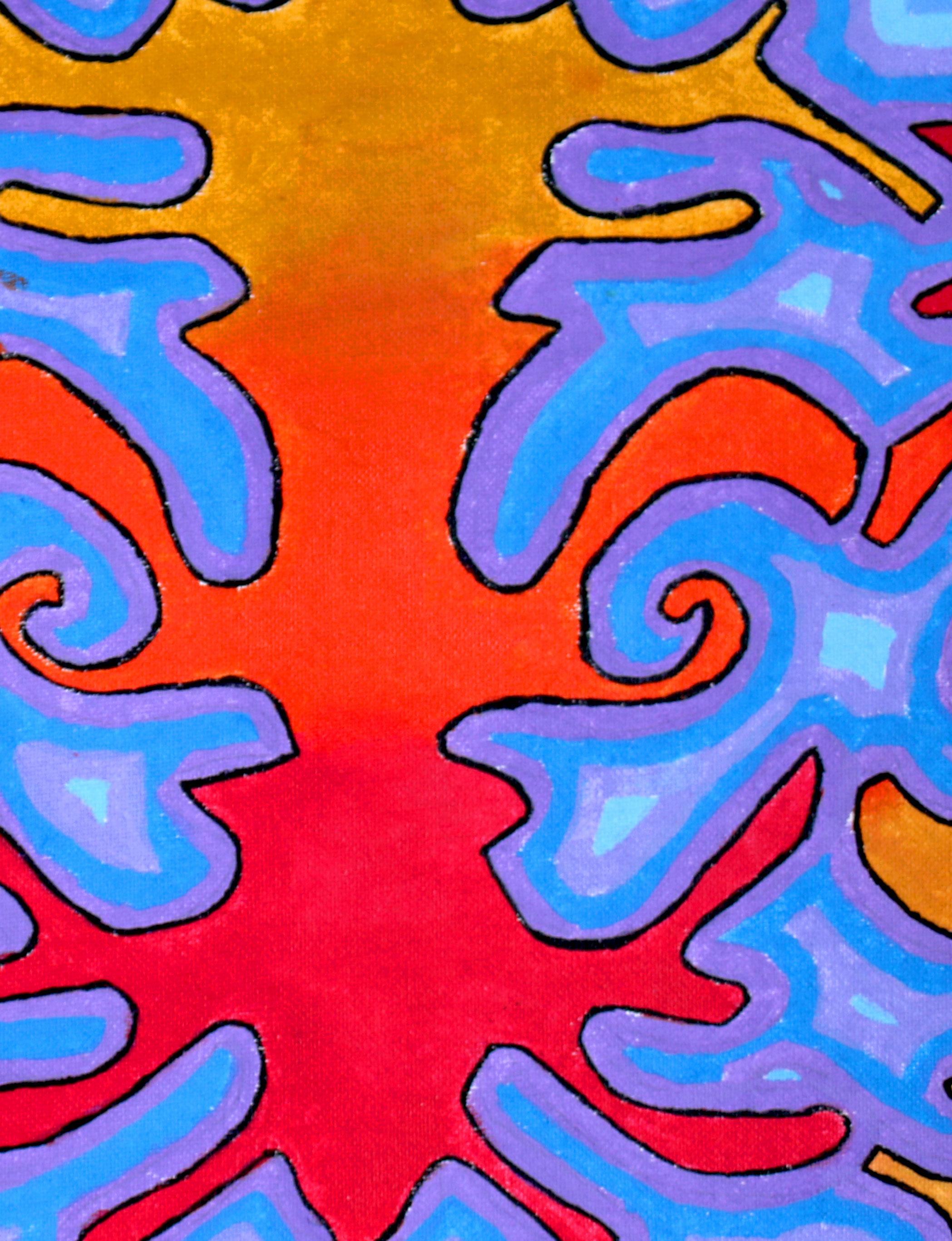
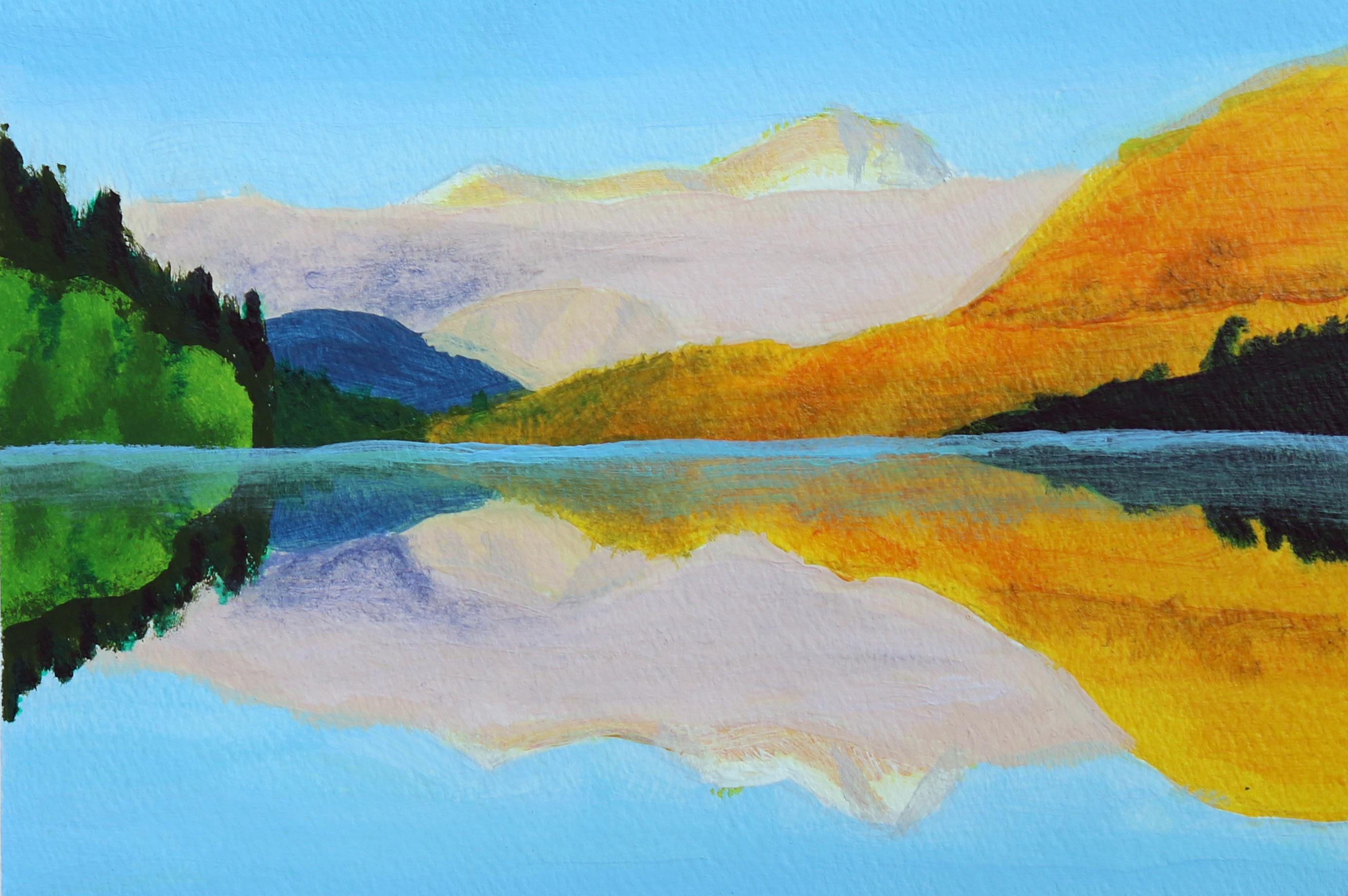
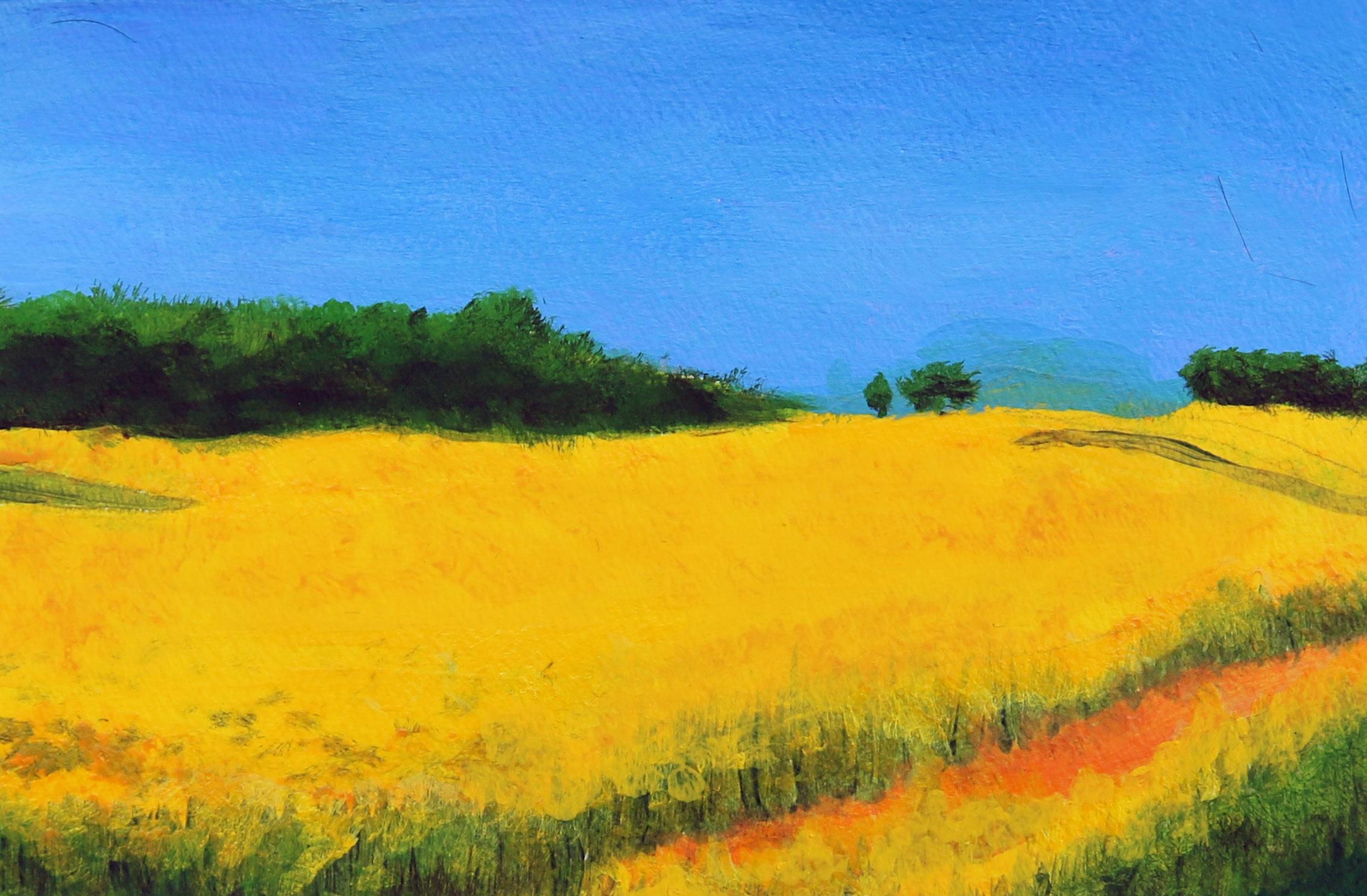
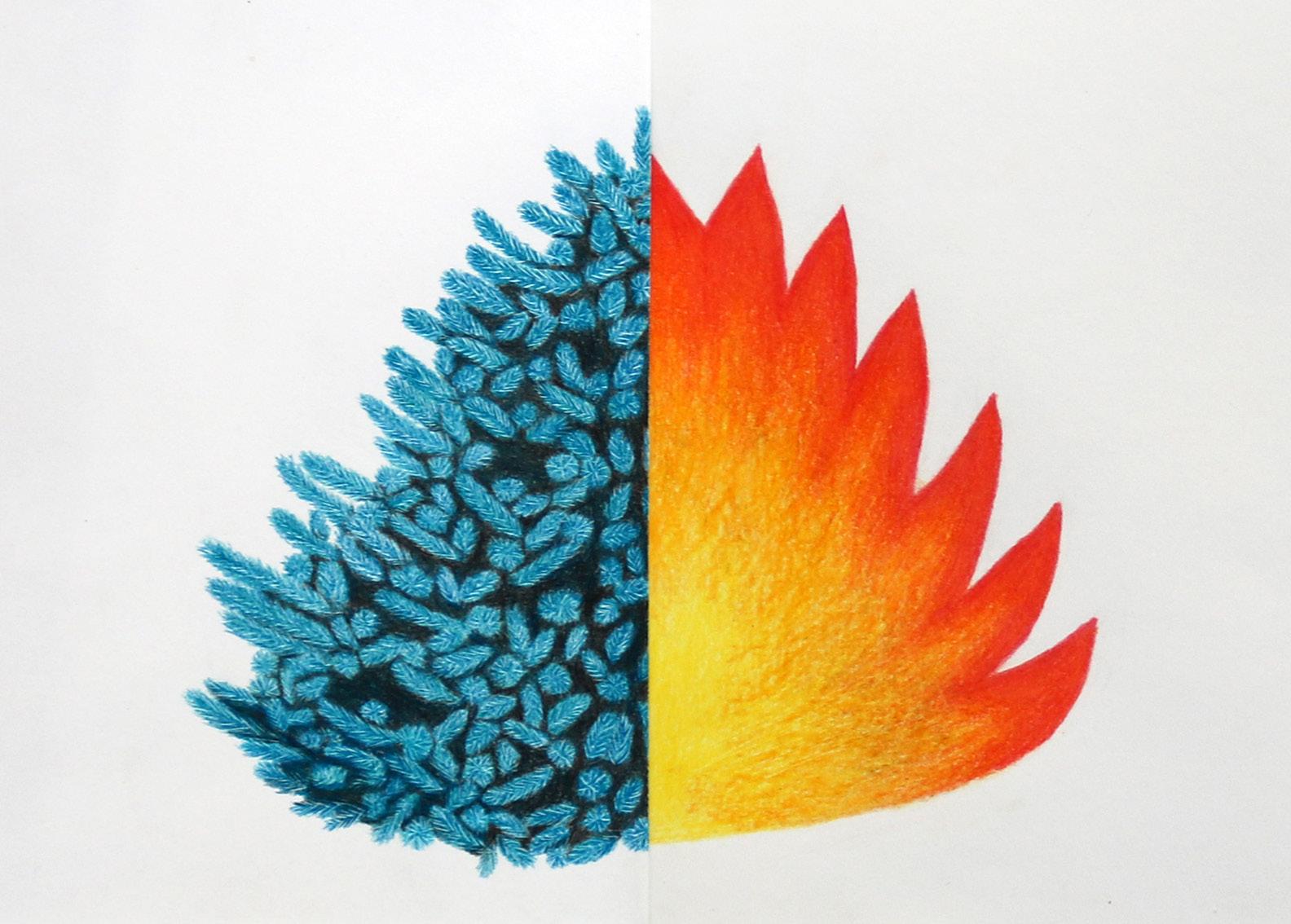
Beginning in 2022, the Tesserae website offers the magazine contents in a digital format. It also includes live recordings of poets reading their pieces.
To visit the website, scan this page or navigate to rowlandhall.org/tesserae.
TESSERAE
2022 / Volume 17
Tesserae are tiny stones or pieces of glass cut to the desired shapes to use in mosaics. With the shimmer of reflected light, tesserae work together to create a sense of the hieratic, a Byzantine method of representation that gives the effect of the supernatural, dissolving matter and leaving the light of the spirit. The mosaics in the church of St. Mark’s in Venice use tesserae to form an interior space that is otherworldly.
Rowland Hall
843 Lincoln Street Salt Lake City, Utah 84102
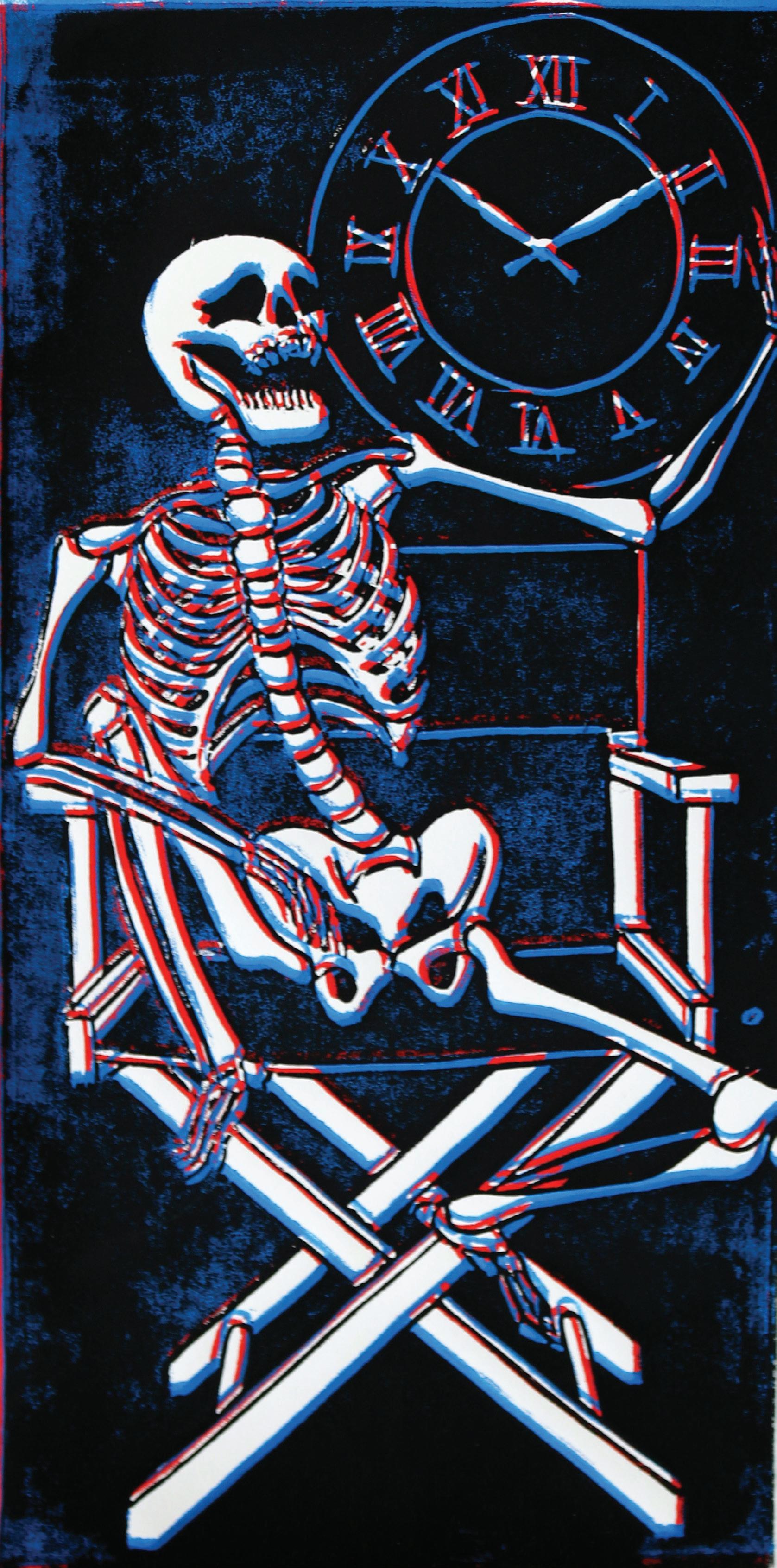
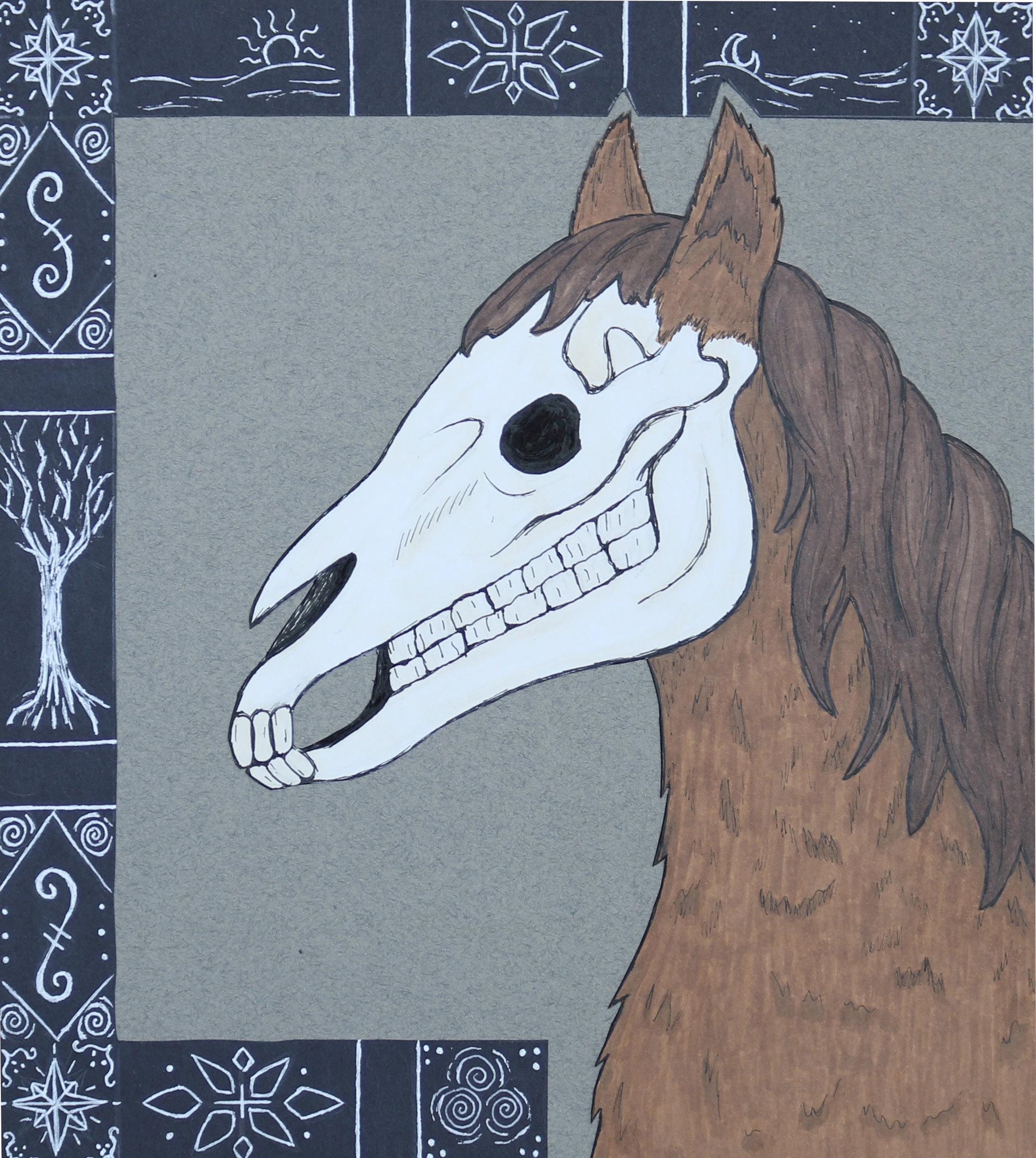
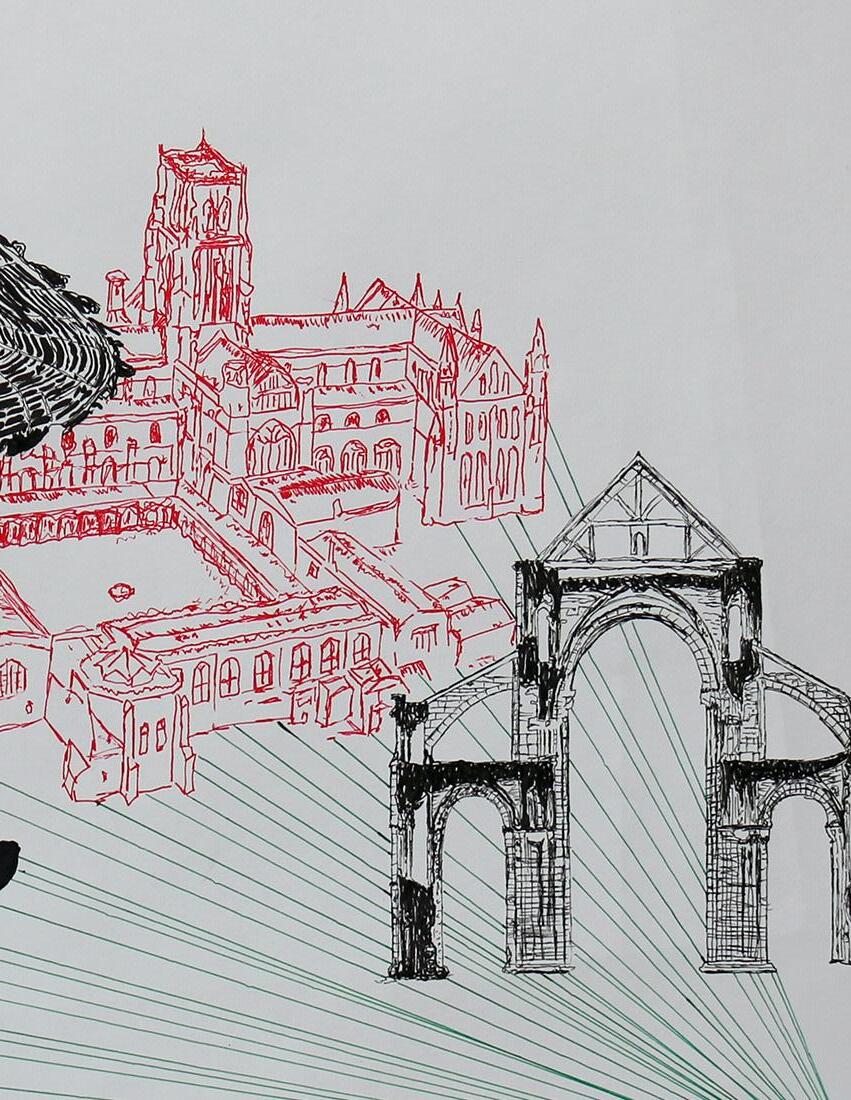
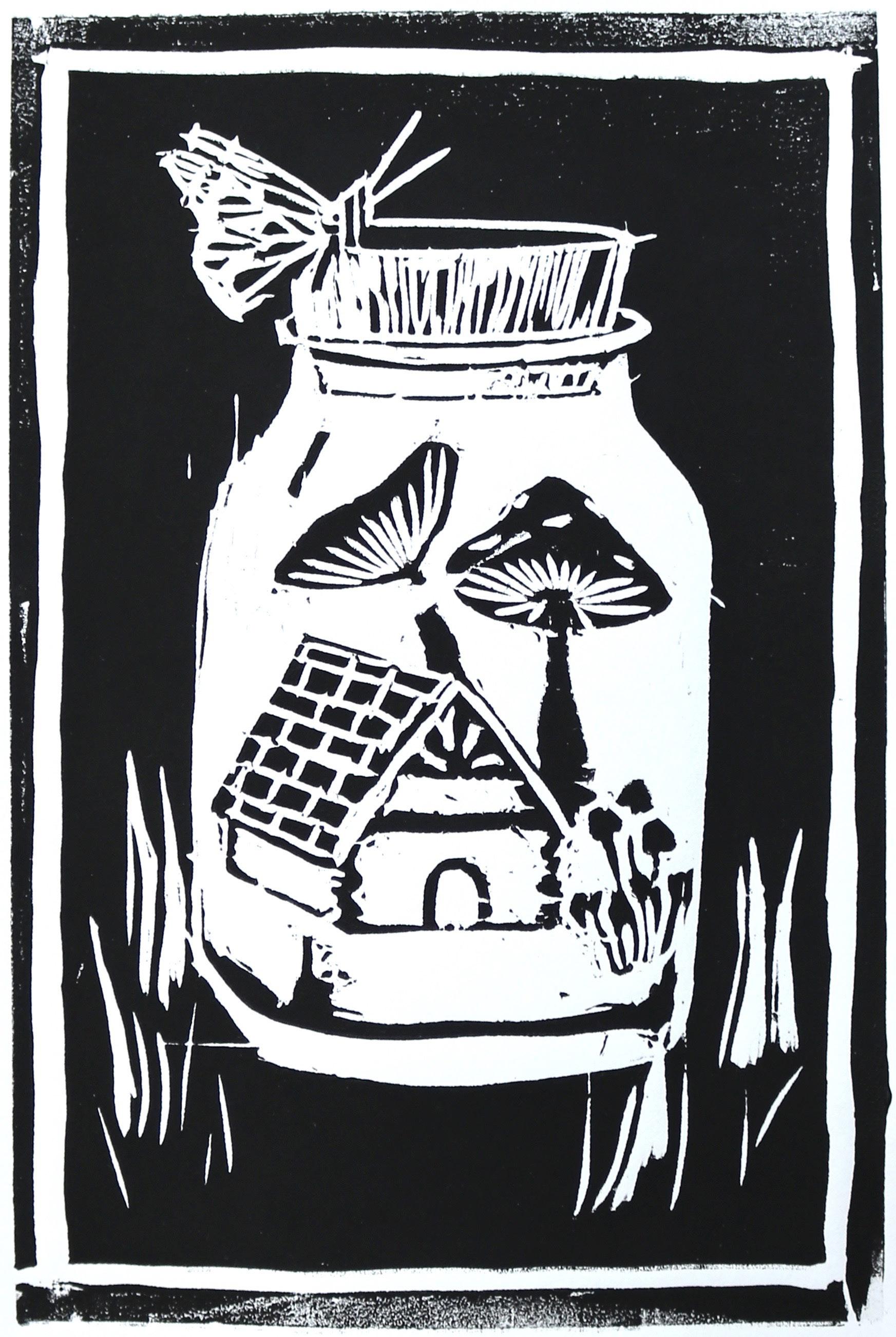
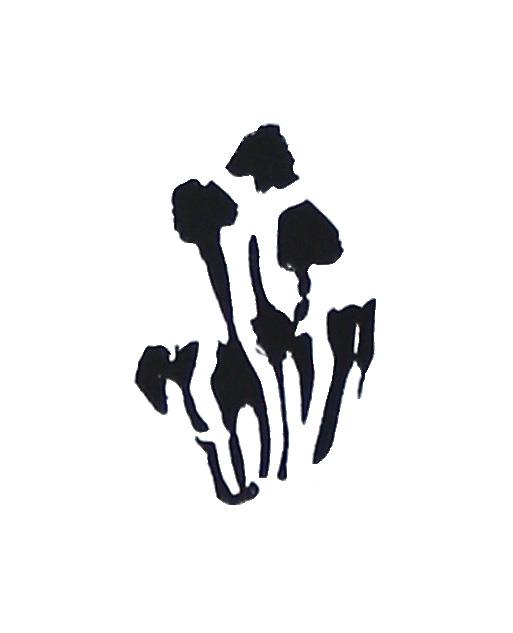
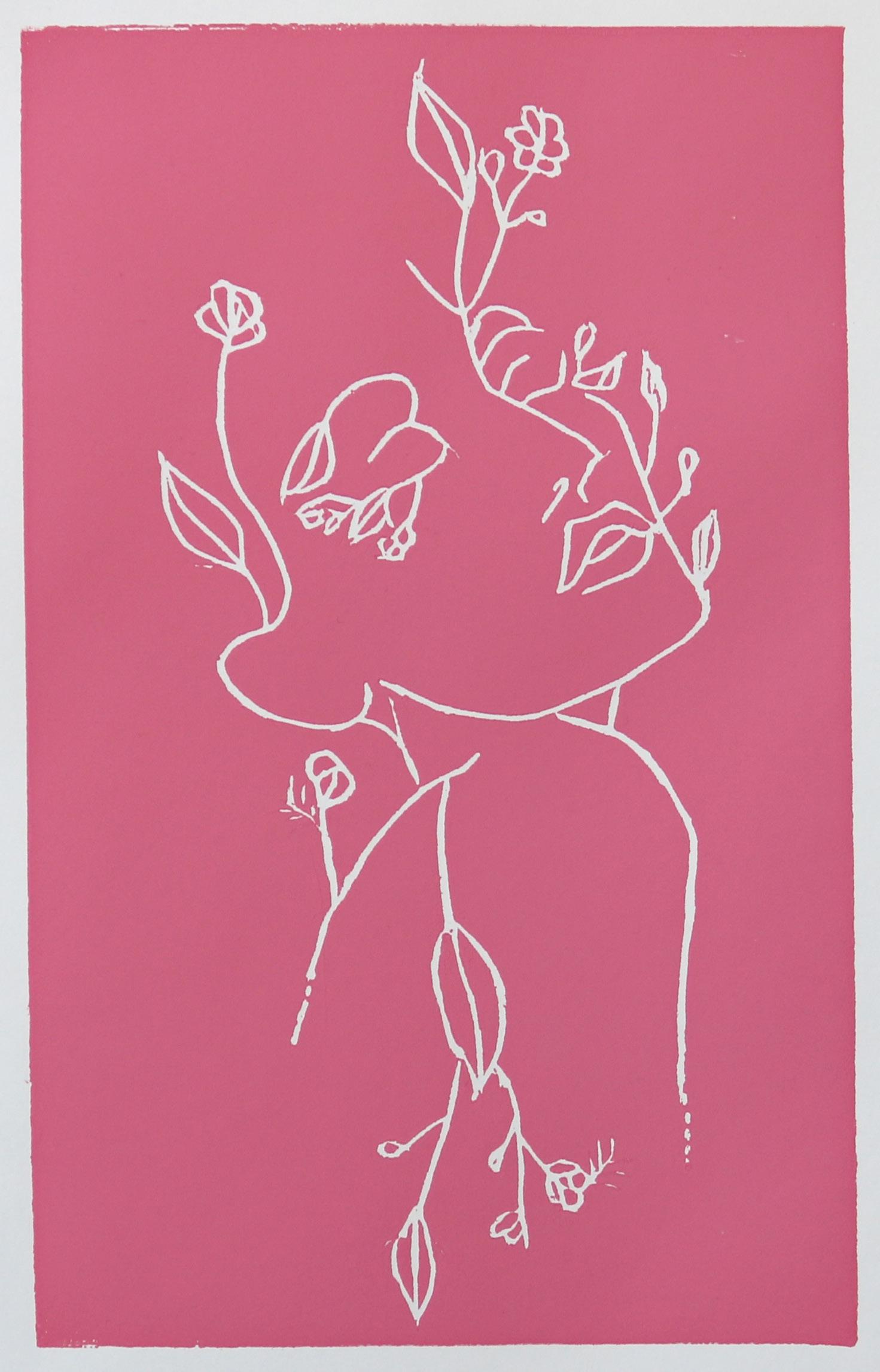
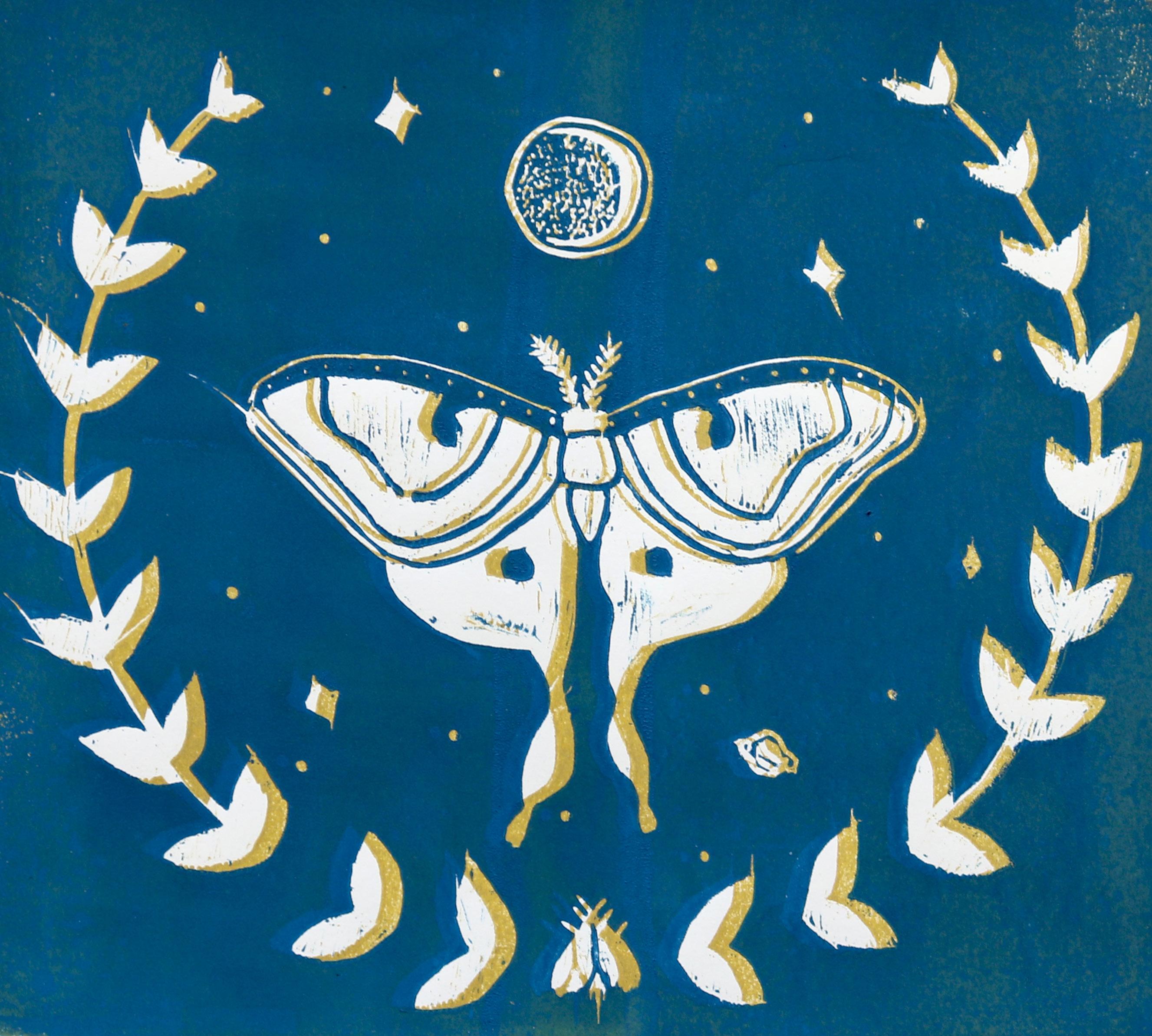
Front cover: Macabre Block print Madeleine Bateman
Caelum van Ispelen
Kit Stevens
Ella Houden
Quinn Yeates
Phillip Locke
Erin Stotts
Erika Prasthofer
Caelum van Ispelen
Erika Prasthofer
Kit Stevens
Ella Houden
Nadia Scharfstein
Mattie Sullivan
Samantha Lehman
Quinn Yeates
Ella Houden
Kit Stevens
Pia Piccoli
Caelum van Ispelen
Erika Prasthofer
CONTENTS
Poetry & Prose
Ramesses II
Hotel California
The Canyon’s Edge
Phantom Stars
Flotation
No Return to Normalcy
Pedal Gracefully
Road Pebbles
Tranquil Lulls Dimmed by Brighter Bulbs
Protomolecules
Gas Money
What Used to Be
Cascade
The Intersection Between Time and Space
Spines
Persona Poem 2,800
Plague
Too Late Time
Offspring’s Fate and Burden
Dylan Bookhamer
Izzi Hill
Quinn Yeates
Tina Su
Cambrin Taylor
Irenka Saffarian
Reece Miller
Gabriella Miranda
Winston Hoffman
Izzi Hill
Sophie Lieskovan
Phillip Locke
Ella Houden
Erika Prasthofer
Izzi Hill
Evan Weinstein
Nadia Scharfstein
Max Smart
James Obermark
Samantha Lehman
Kit Stevens
A Penny on the Floor
A Lamp, A God, and Two Rather Confused Fish
Turnips
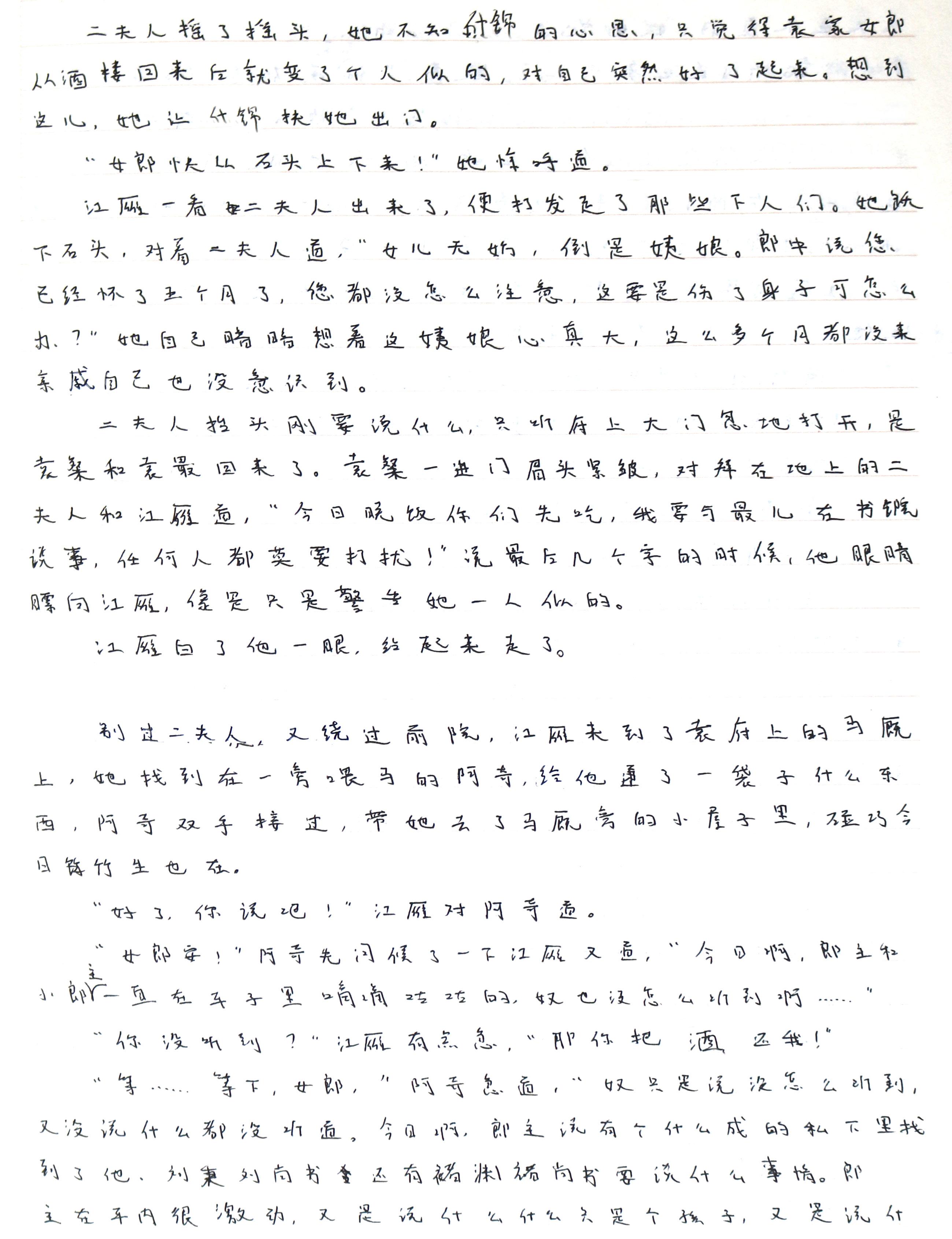
Excerpt from 穿越石头记
Don’t Handcuffs Seem Familiar
رفتن (Departure)
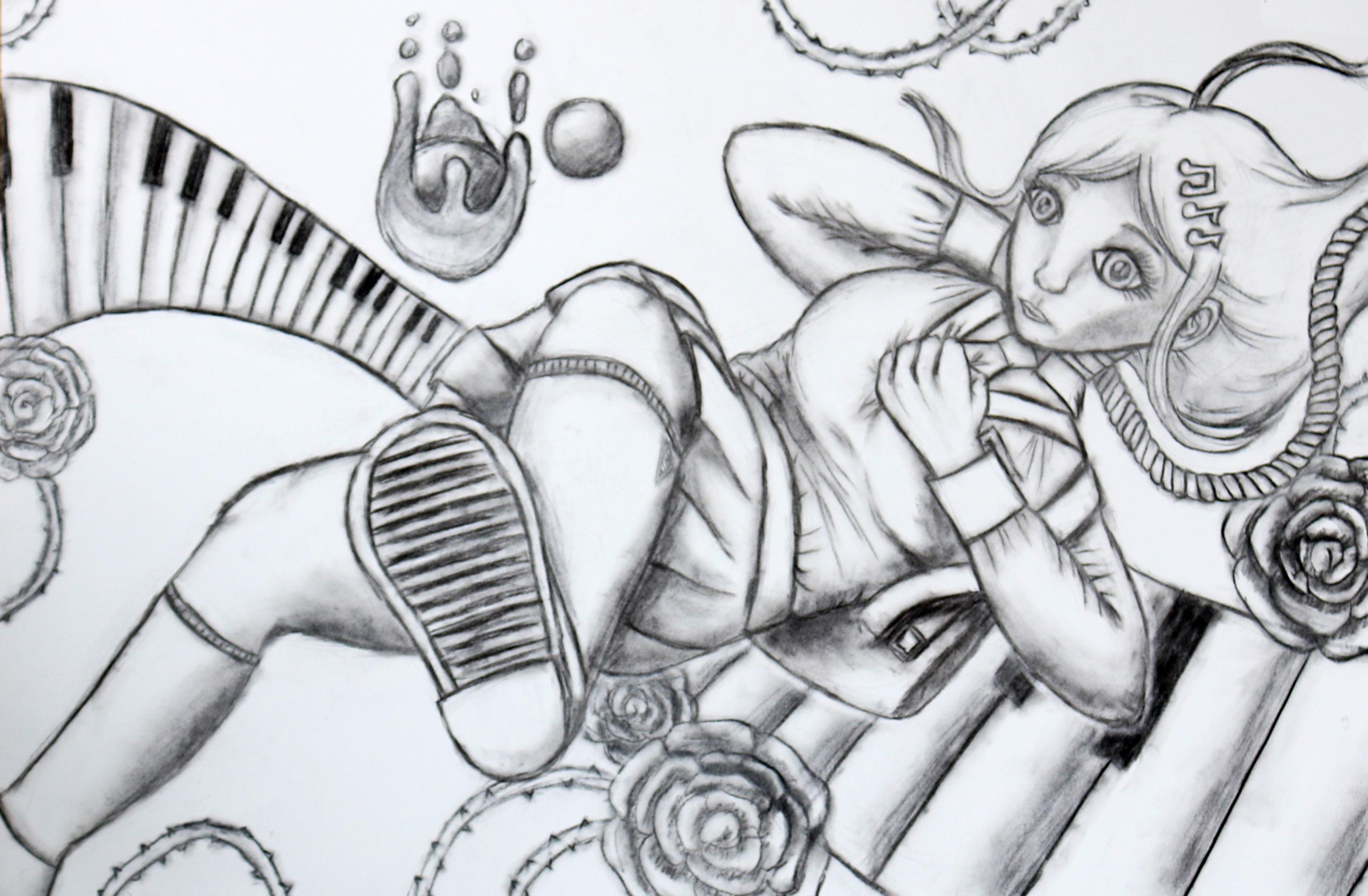
Violet Eyes and Crimson Flowers
Consecration
Fort Bragg
Departure
In His Heaven
The Downsides of Being a Domino
Hummingbird Seams
Edelweiss
Funeral Rites
Colors of Southern Utah
Lambs Canyon
Environmental Speech
A Warming Winter
Knowledge: An Existential Crisis
Say It
Artwork & Photography
Jade Wilson
Ruby Jeschke
Evan Jahn
Rachel Kessler-Weinstein
Faustine Ainsworth
Samantha Lehman
Aurelie Wallis
Logan Fang
Grace Baranko
Sarah Carlebach
Caelum van Ispelen
Logan Fang
Logan Fang
Charlotte Morris
Sophie Zheng
Rachel Kessler-Weinstein
Faustine Ainsworth
Faustine Ainsworth
Destruction
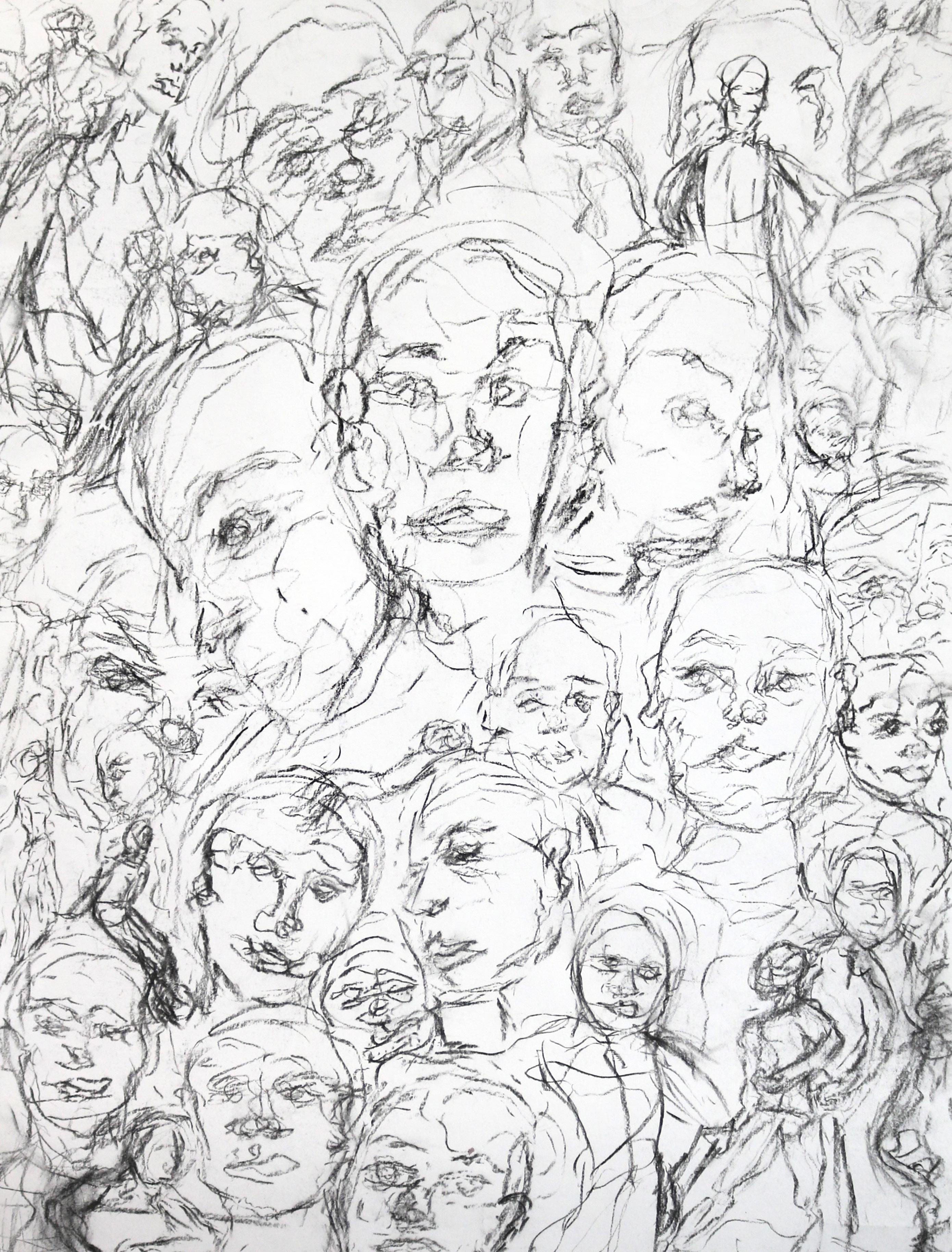
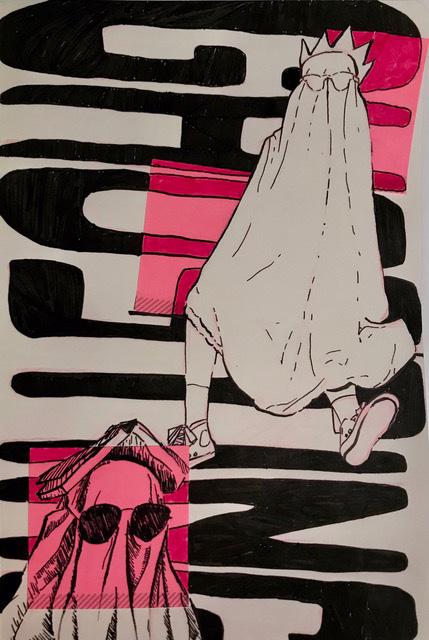
Faces
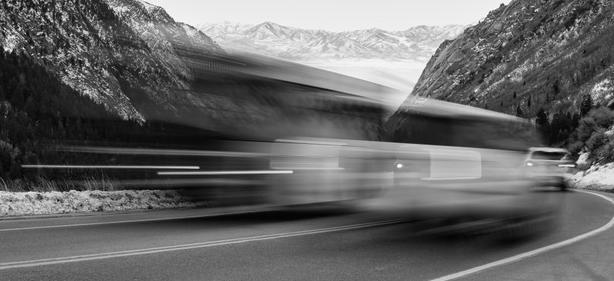
Canyon Traffic
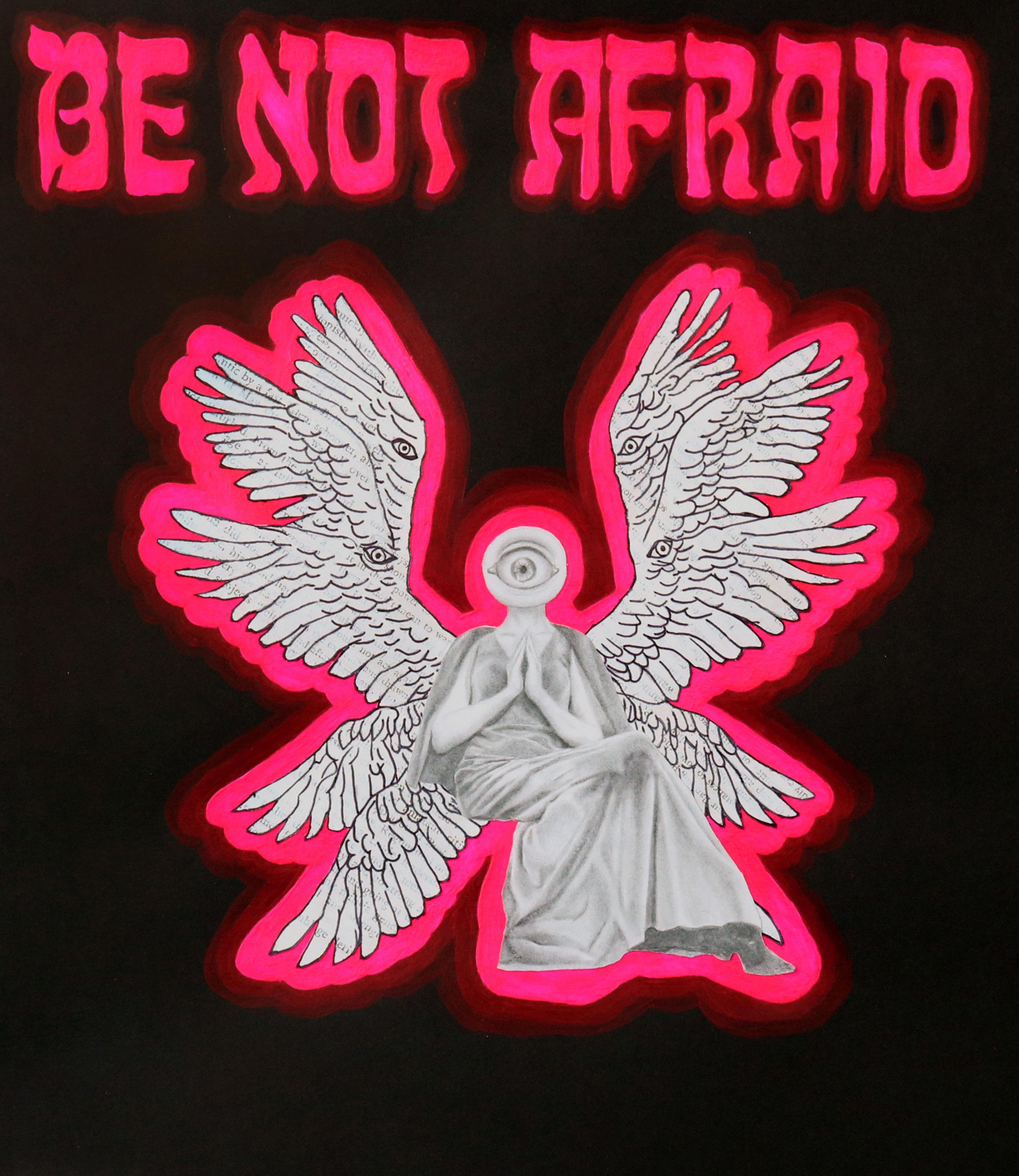
Be Not Afraid
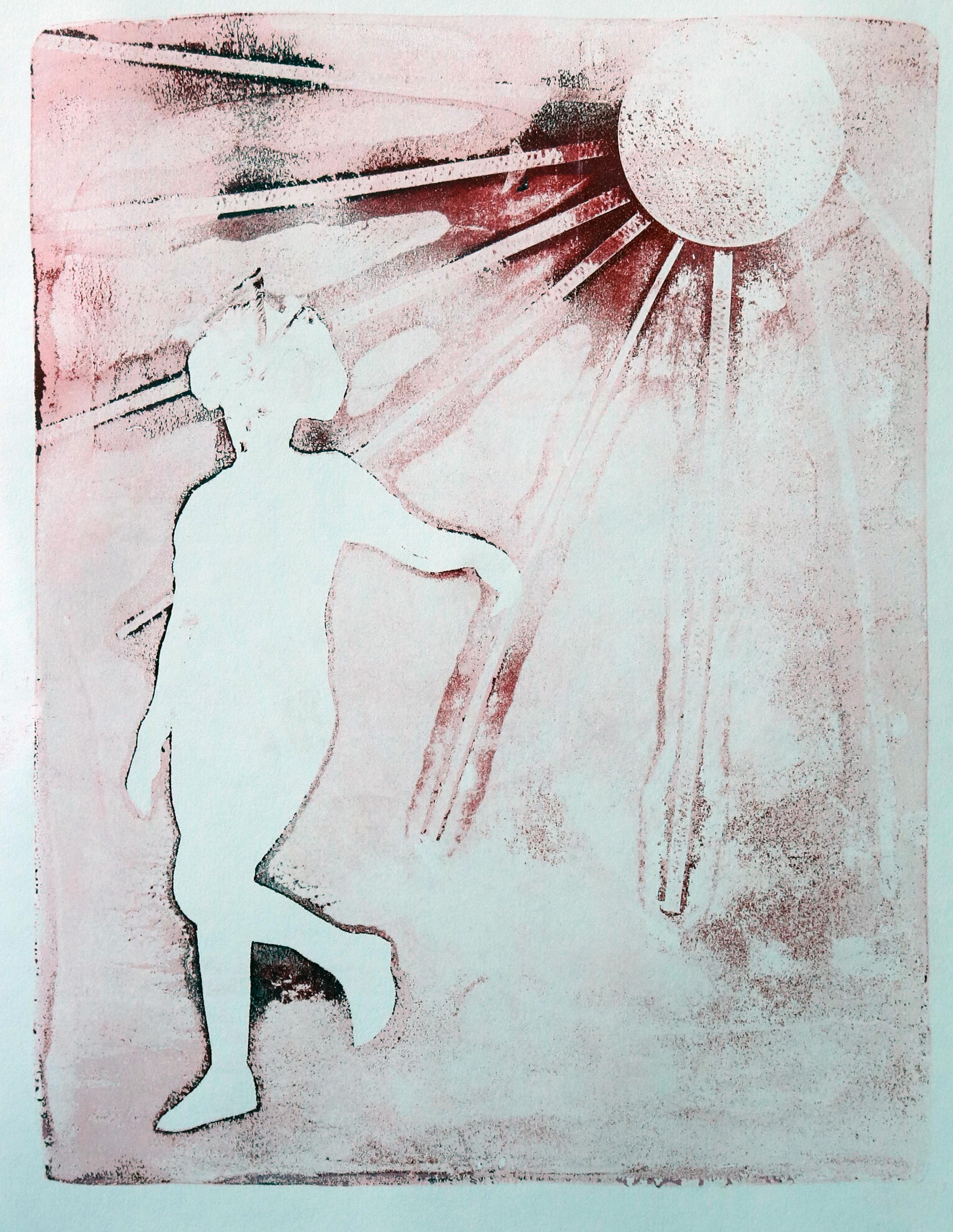
Bloodshot Rays
The Locker
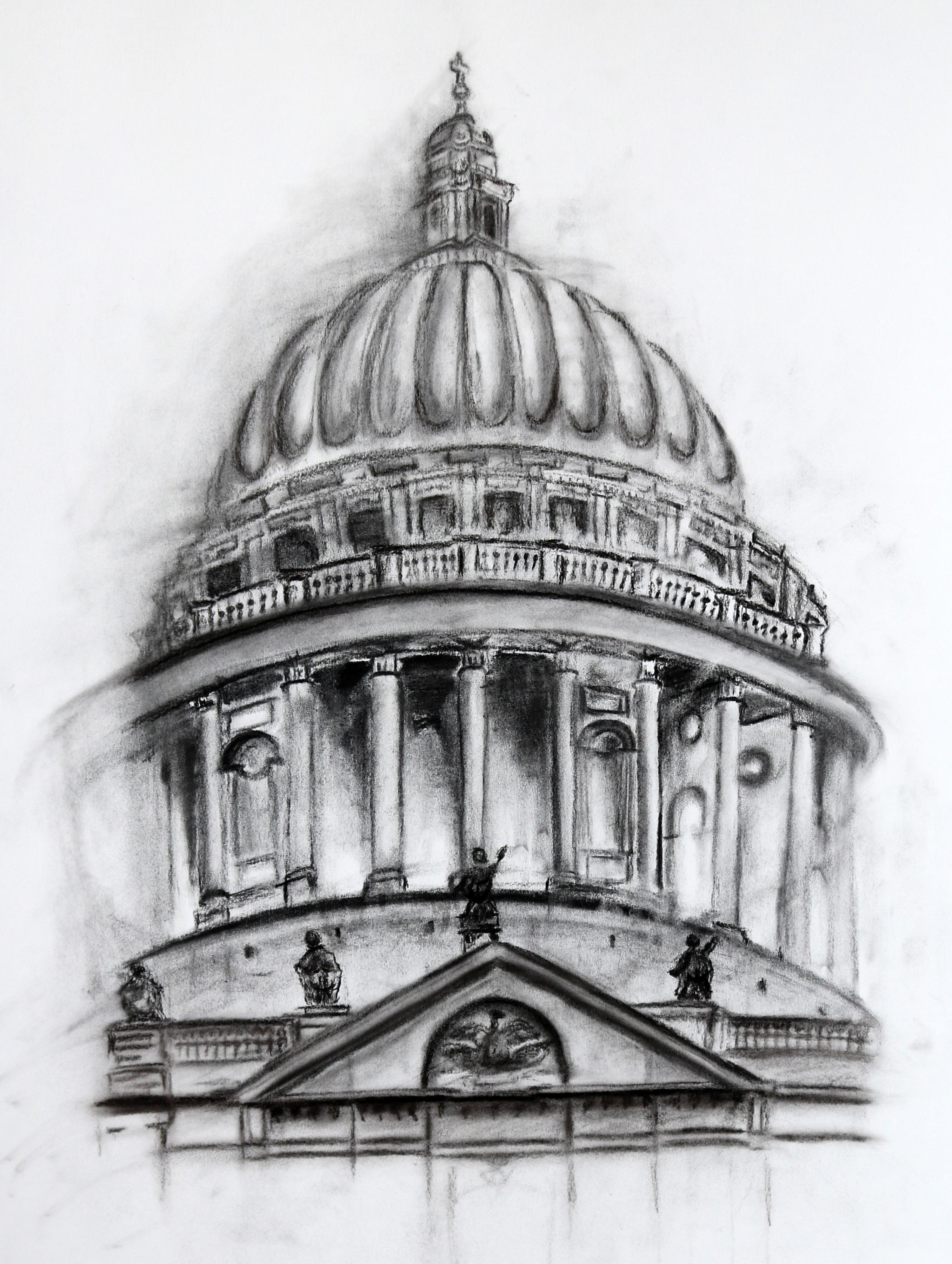
Capitol
Waves
Flower Fossil
Held
Ennui
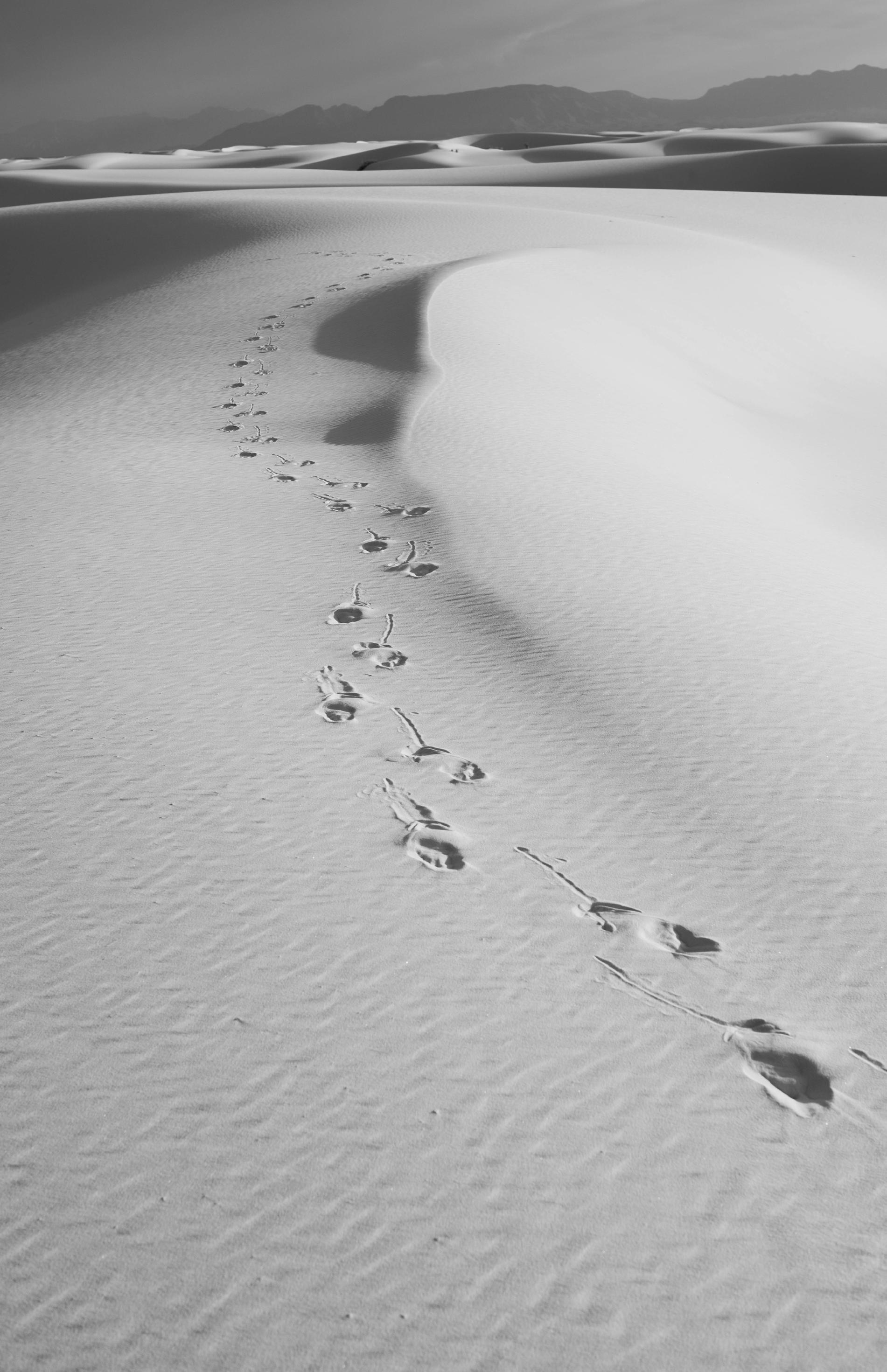
Tracks
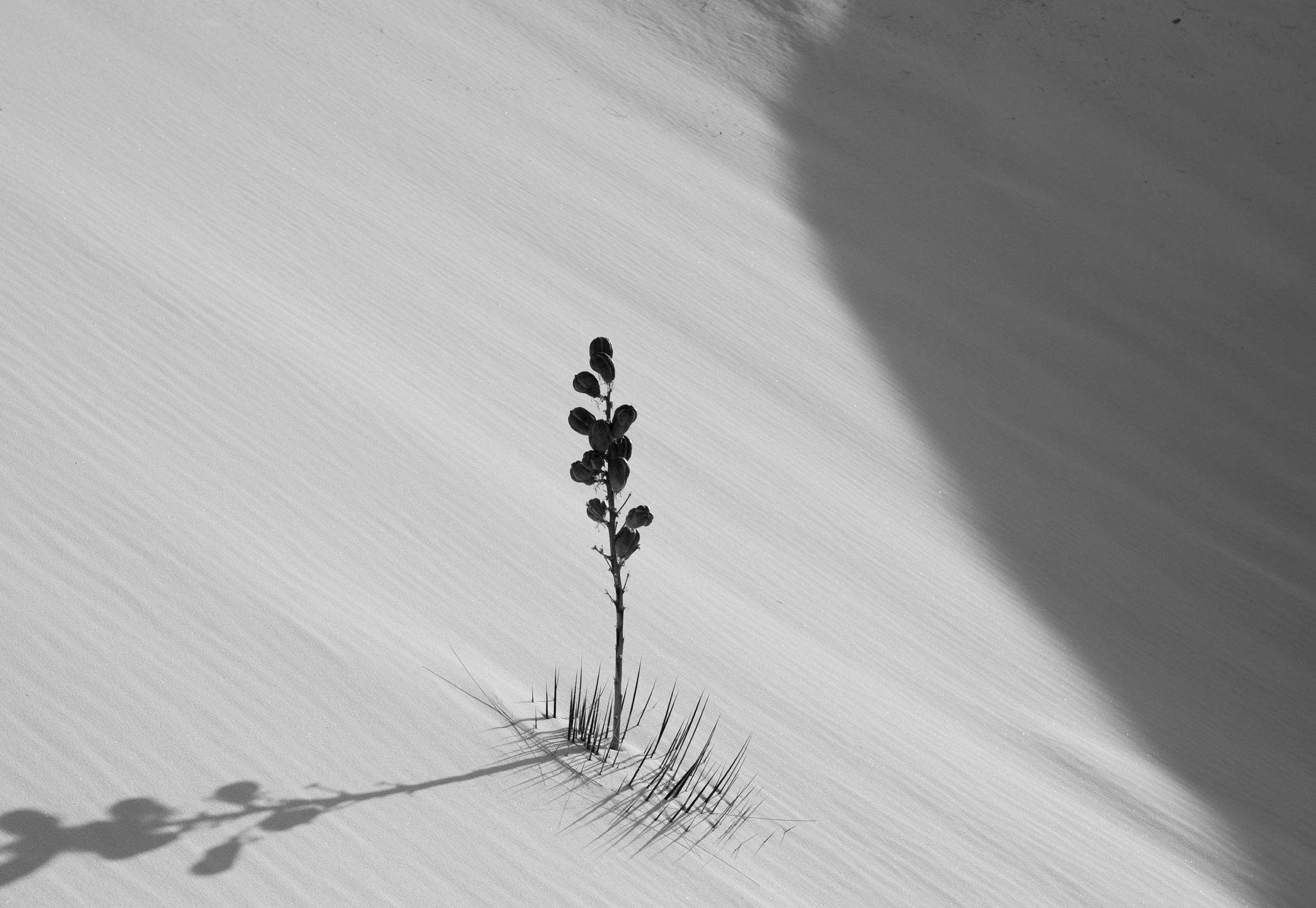
Lone Plant
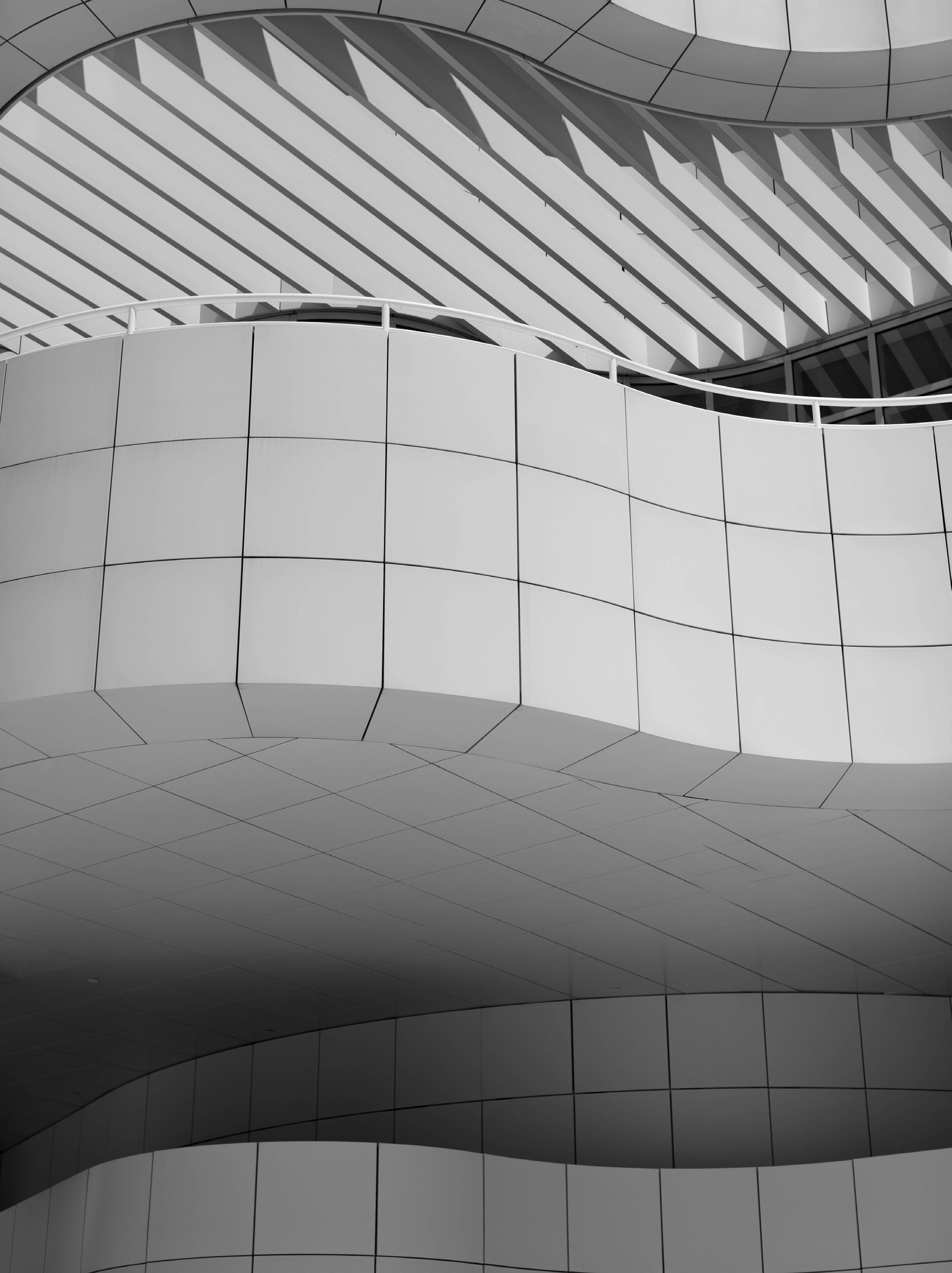
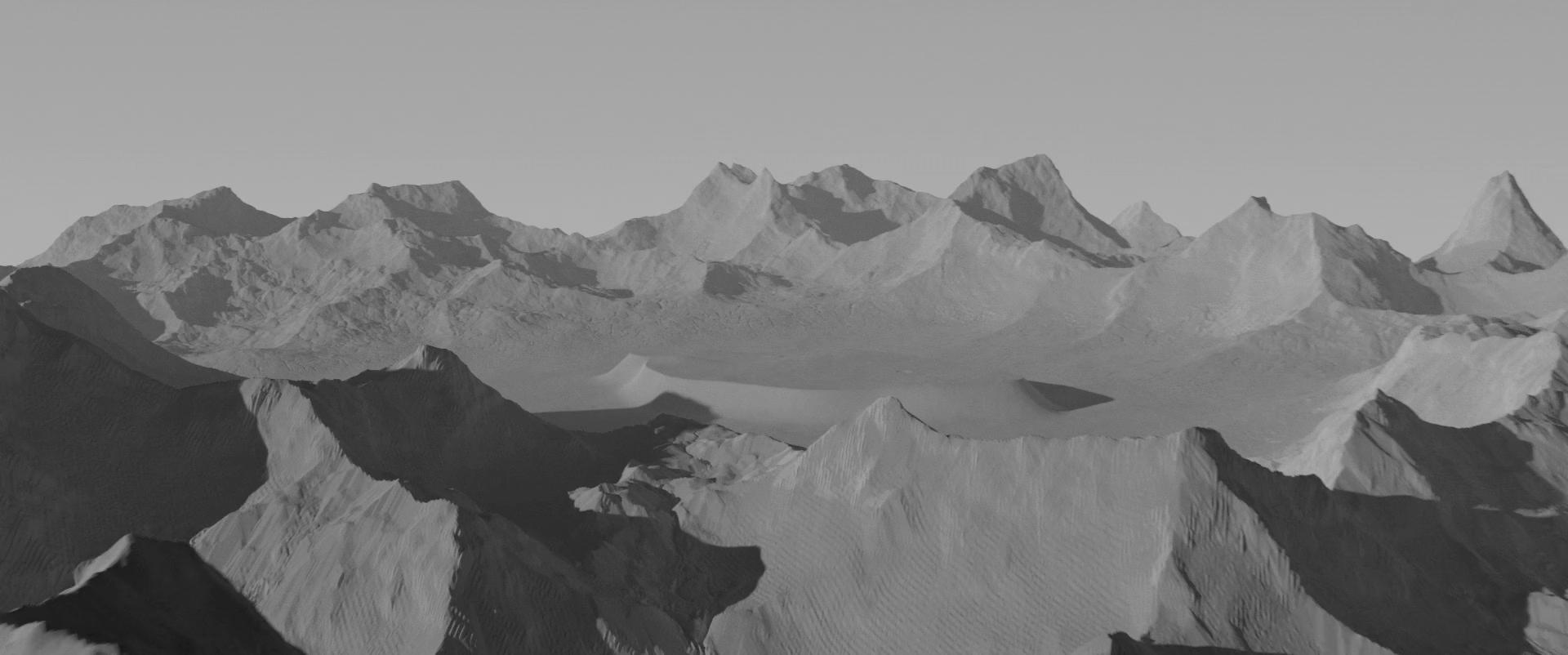
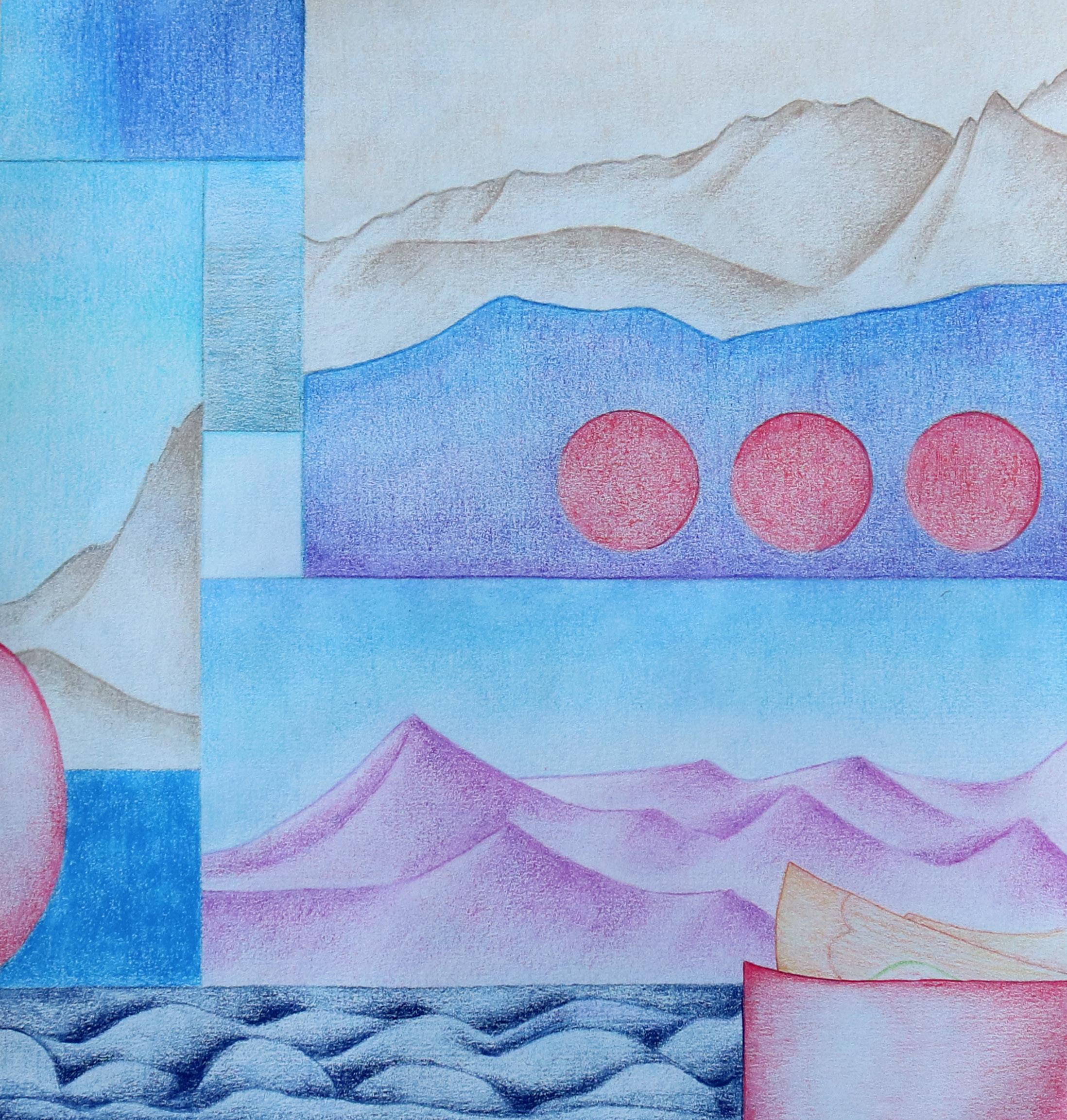
Geometric Landscape
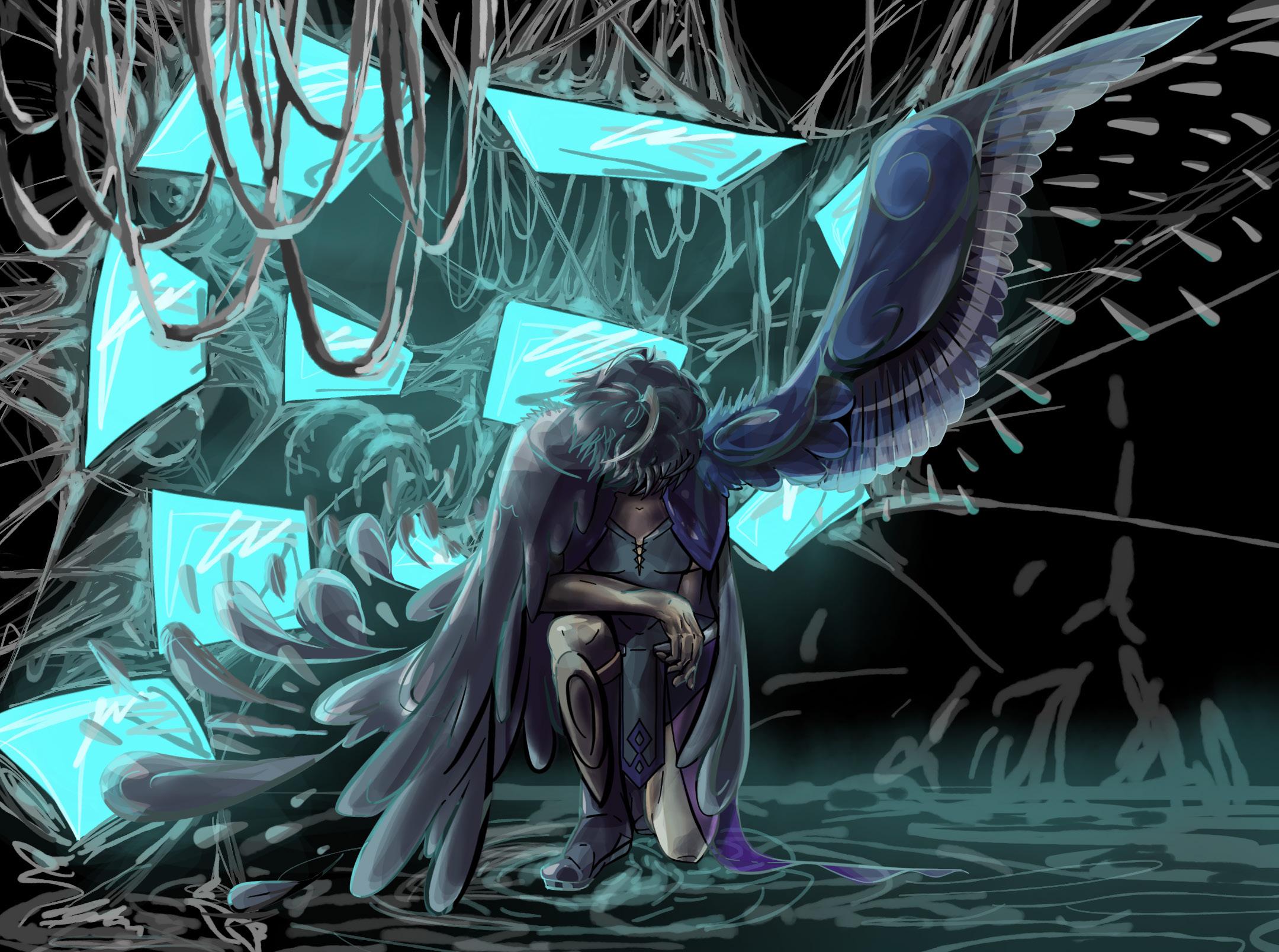
Technology’s Angel
Contrapoints
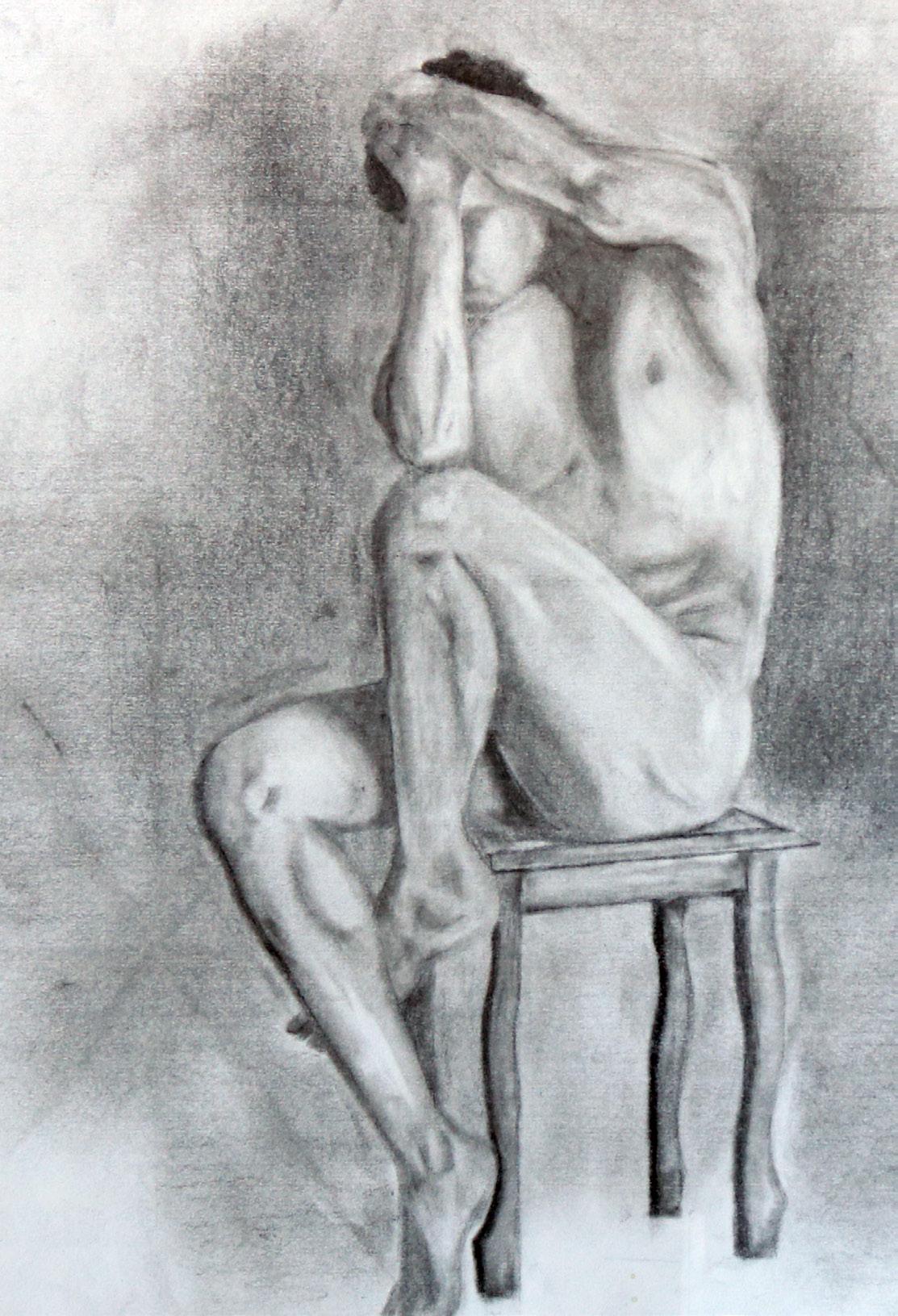
Pensive
Vulnerability
Jade Wilson
Frances Hodson
Rachel Kessler-Weinstein
Ruby Jeschke
Anthony Sanchez
Mercer Paradise
Mei Mei Johnson
Charlotte Morris
Dillon Fang
Deja Shirkey
Annie Nash
Izzi Hill
Mercer Paradise
Madeleine Bateman
Izzi Hill
Rachel Kessler-Weinstein
Faustine Ainsworth
Grace Baranko
Rachel Kessler-Weinstein
Sophie Zheng
Tripp Rollins
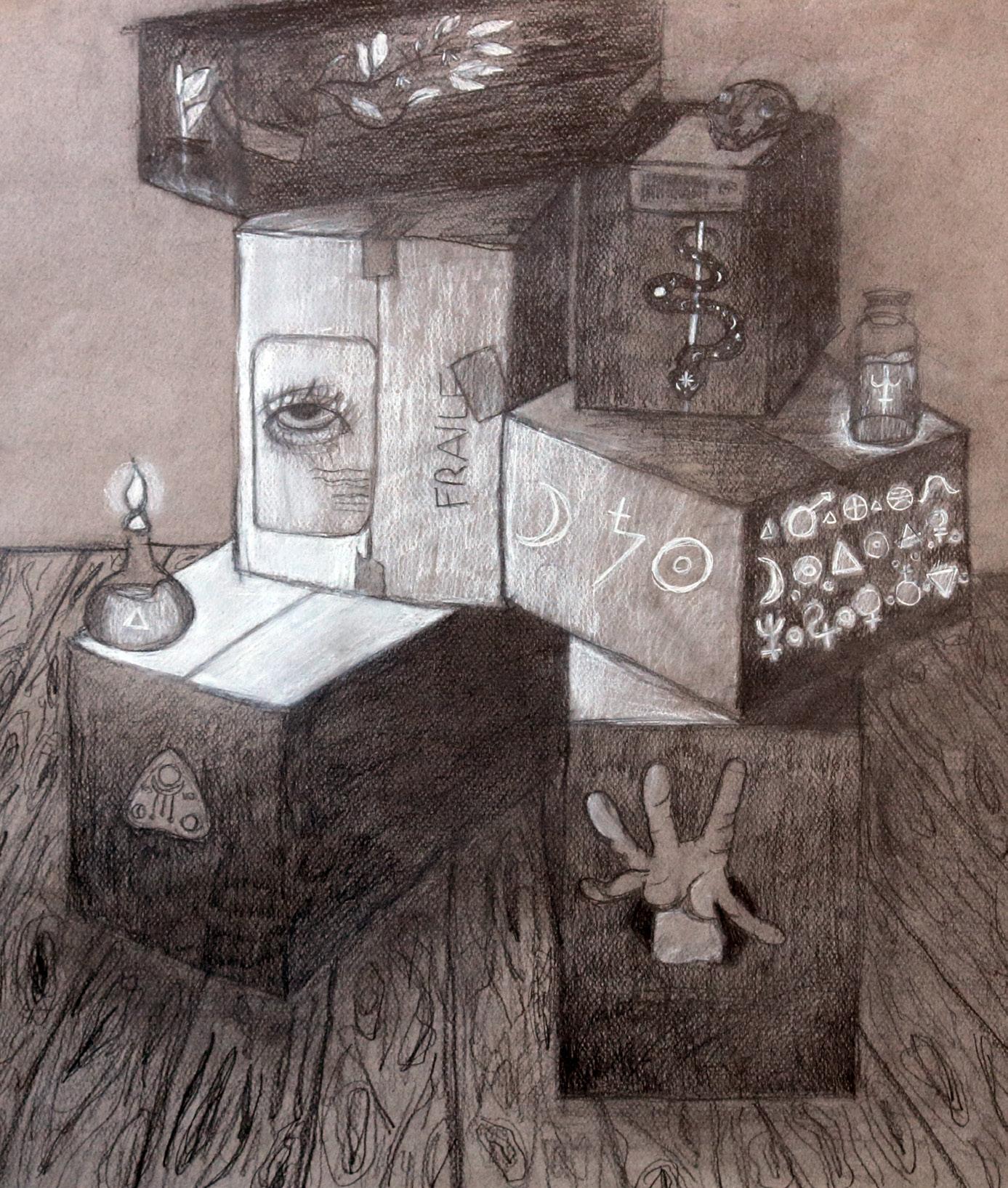
Witchcraft
Inversion
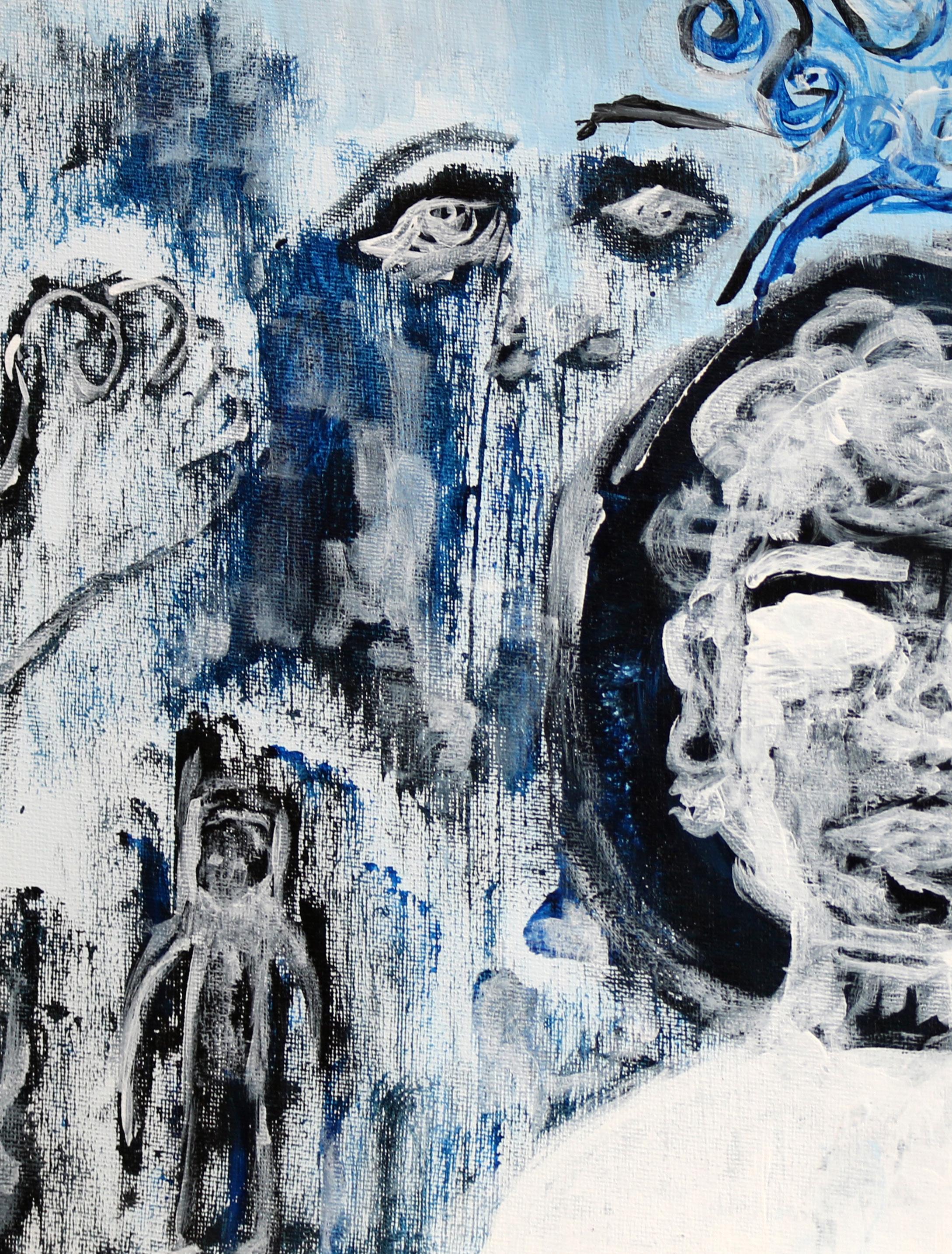
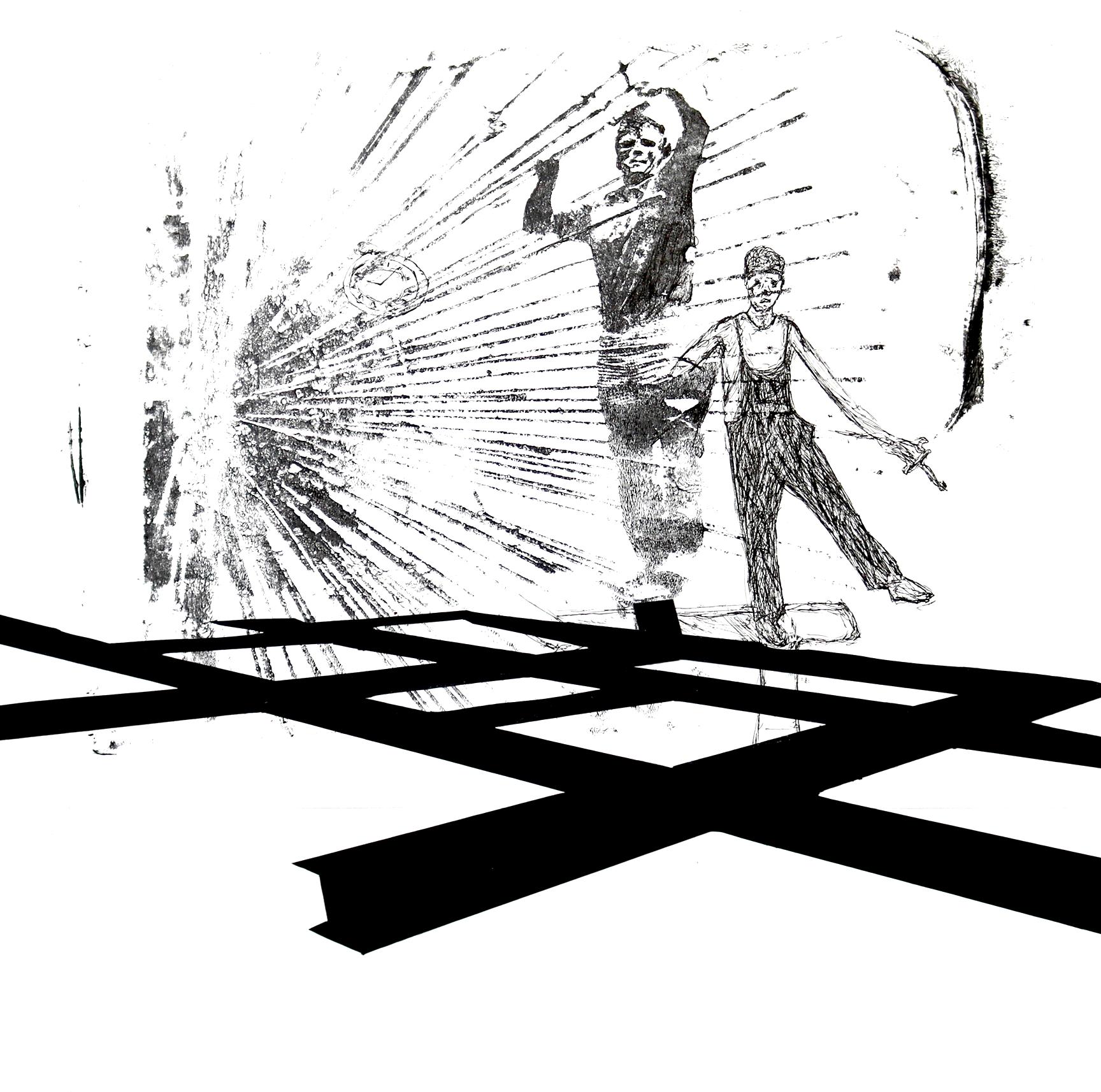
Figures in Light
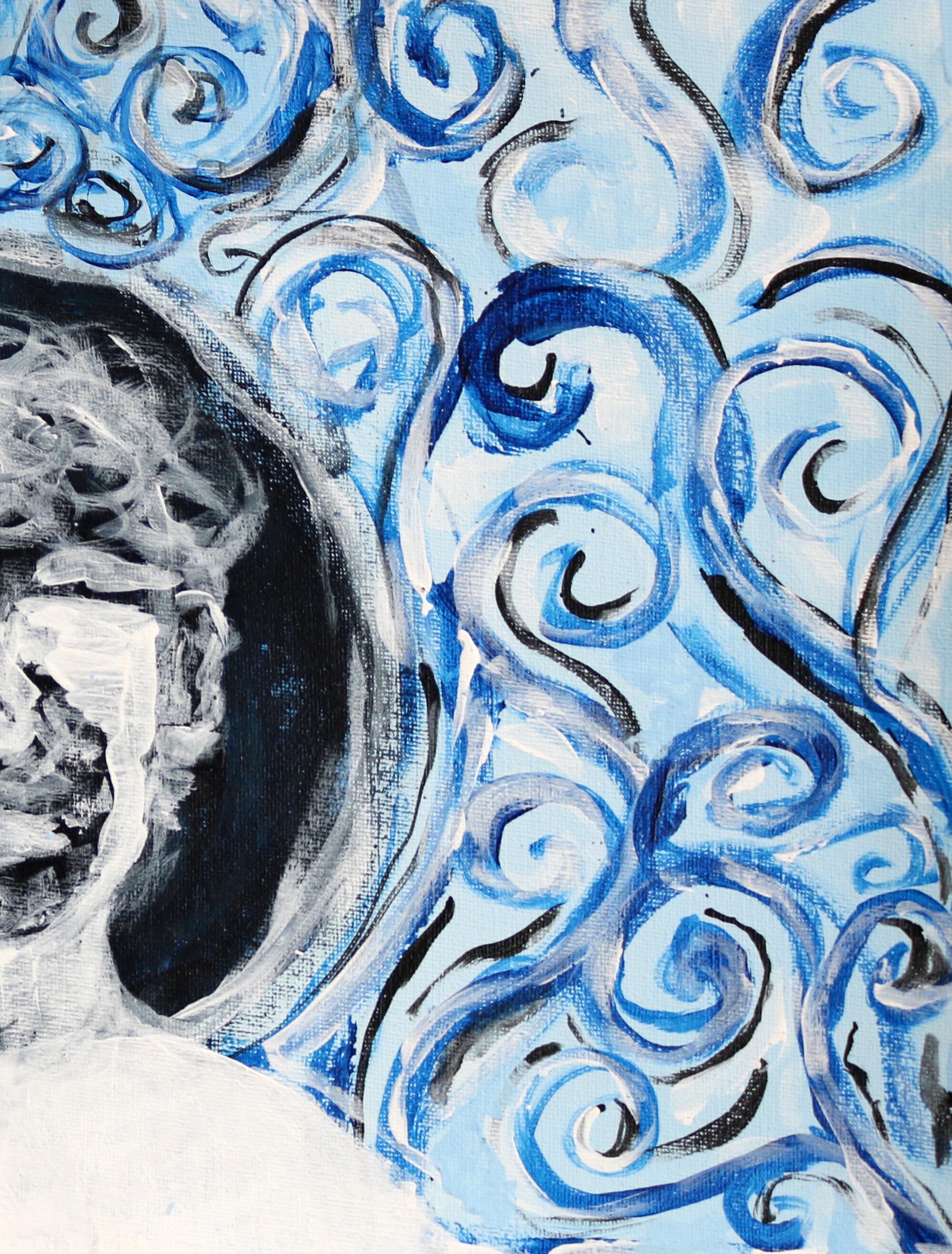
Cobalt Conscience
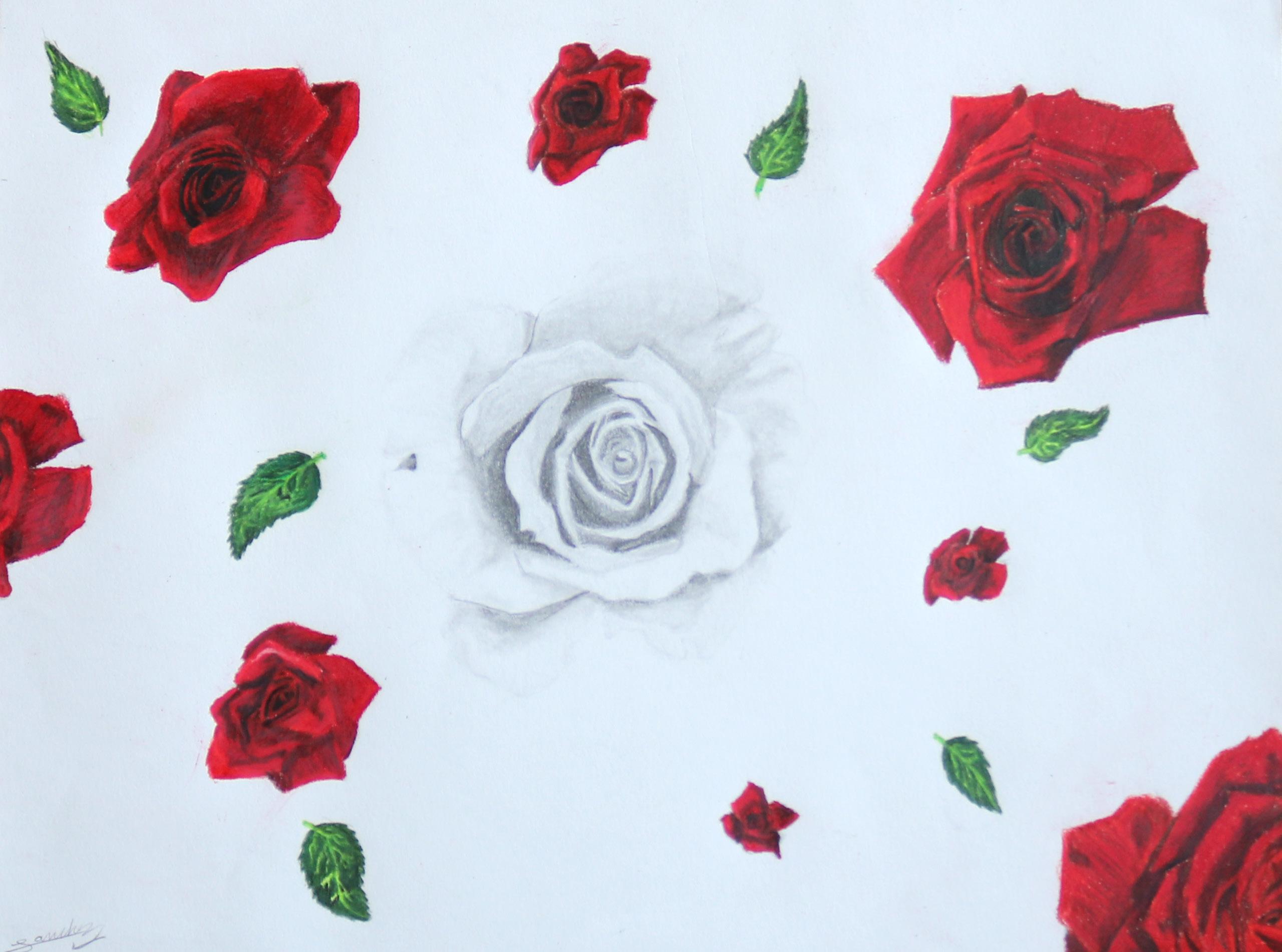
Around the Roses
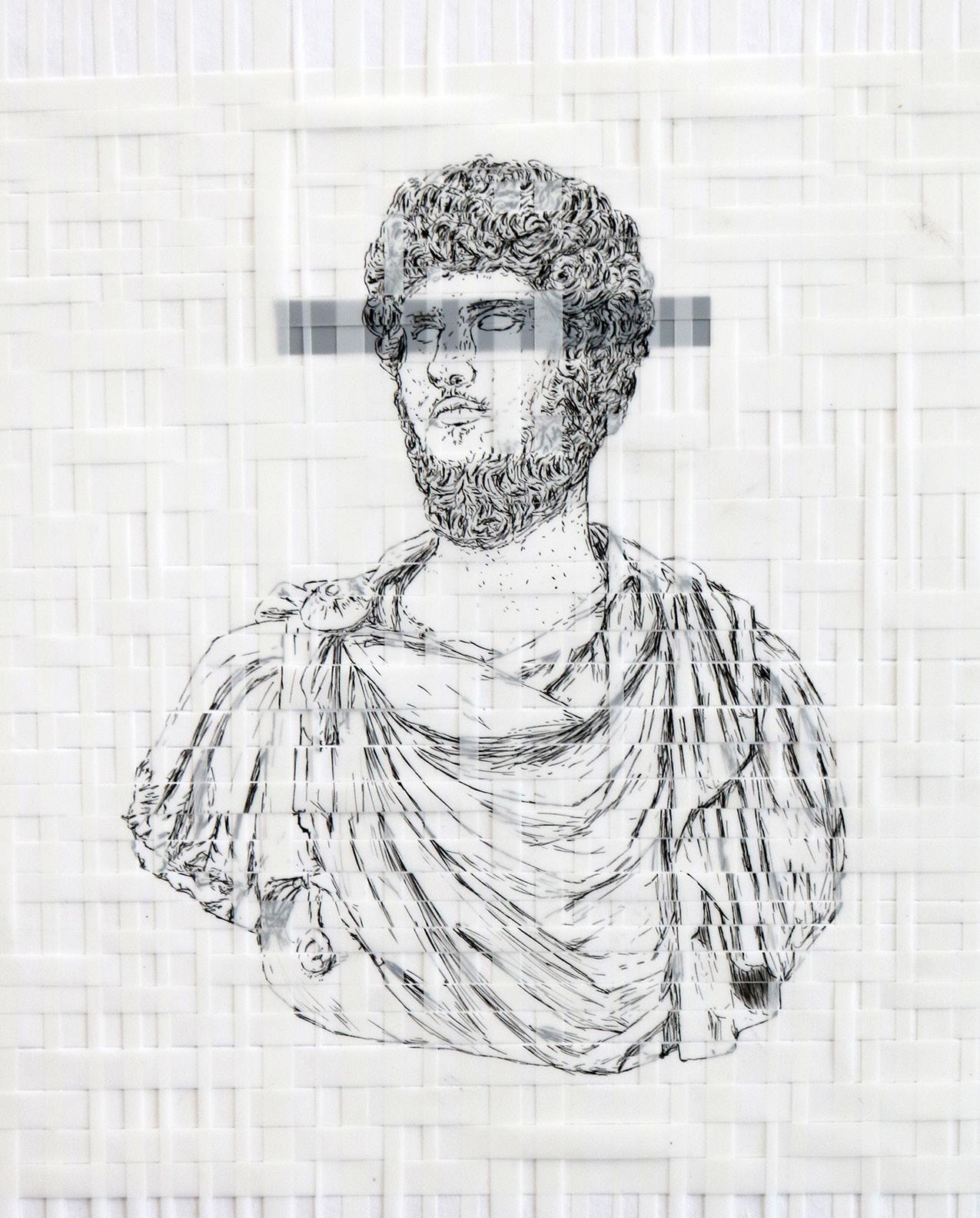
Senator
Ribbon Figure
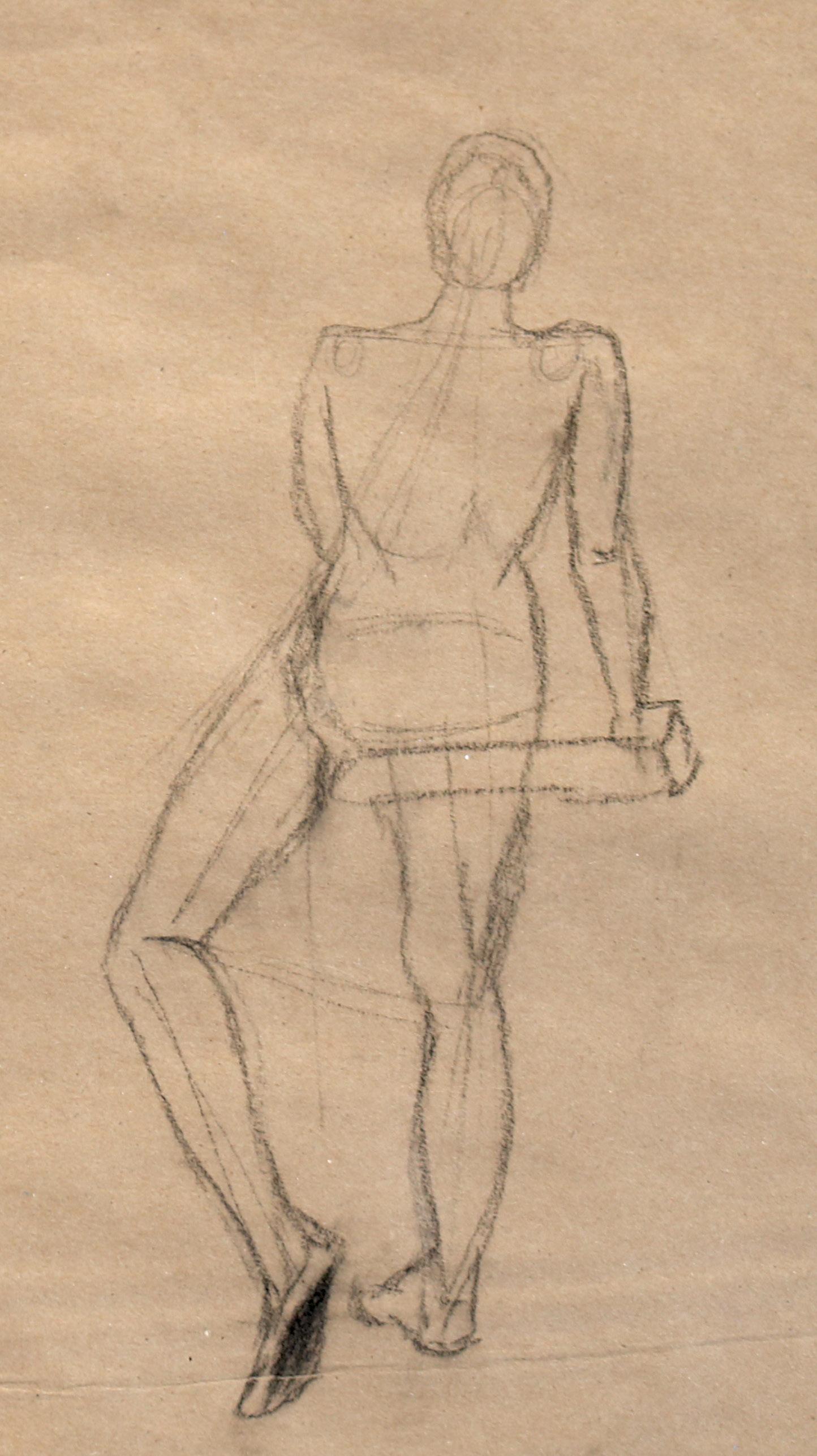
Statuette
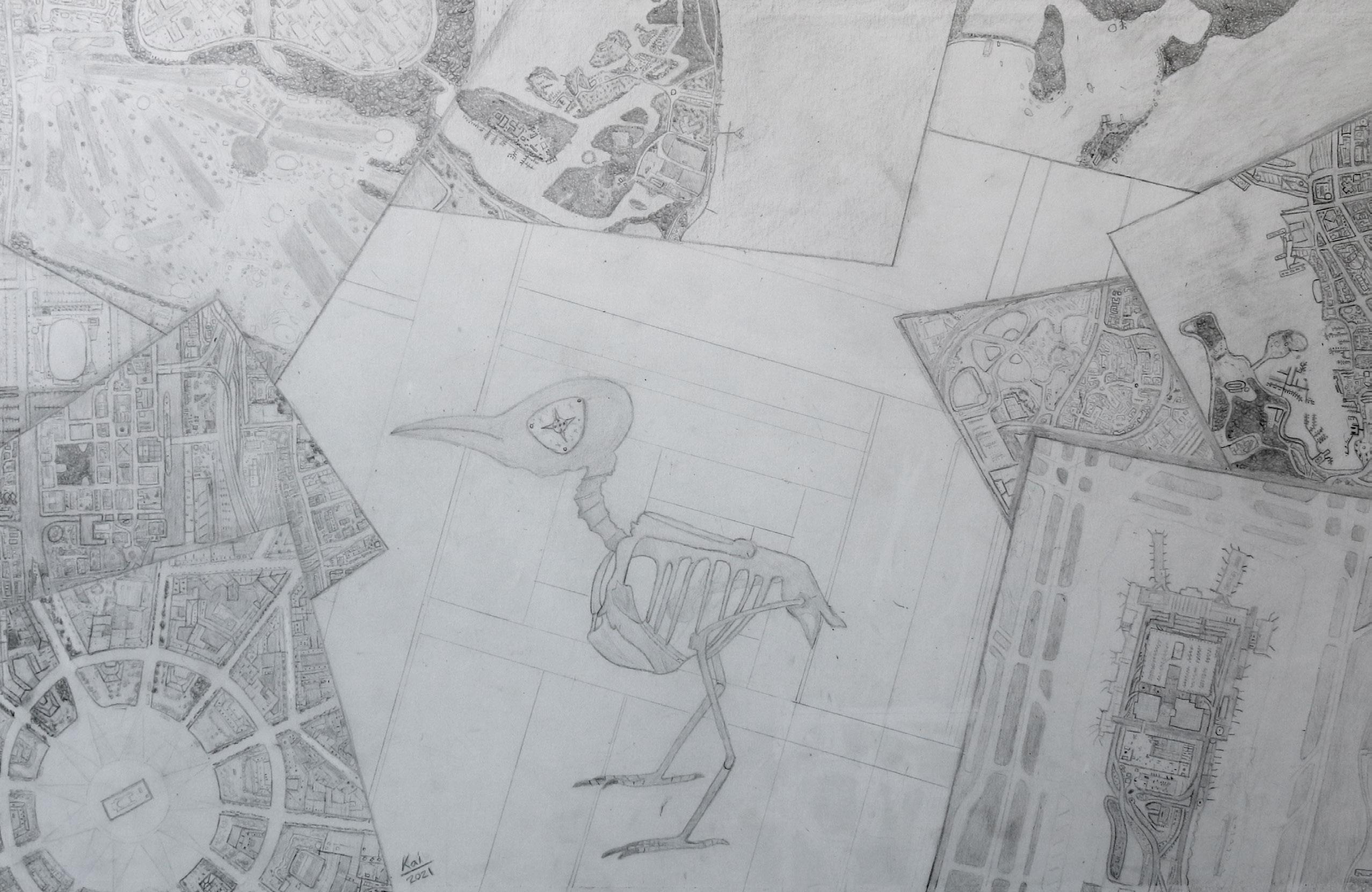
Crow Study
Grimalkin
Sickness
The Fourth Horseman
The Snake
Hermes
Tree Rings
A Private Watching
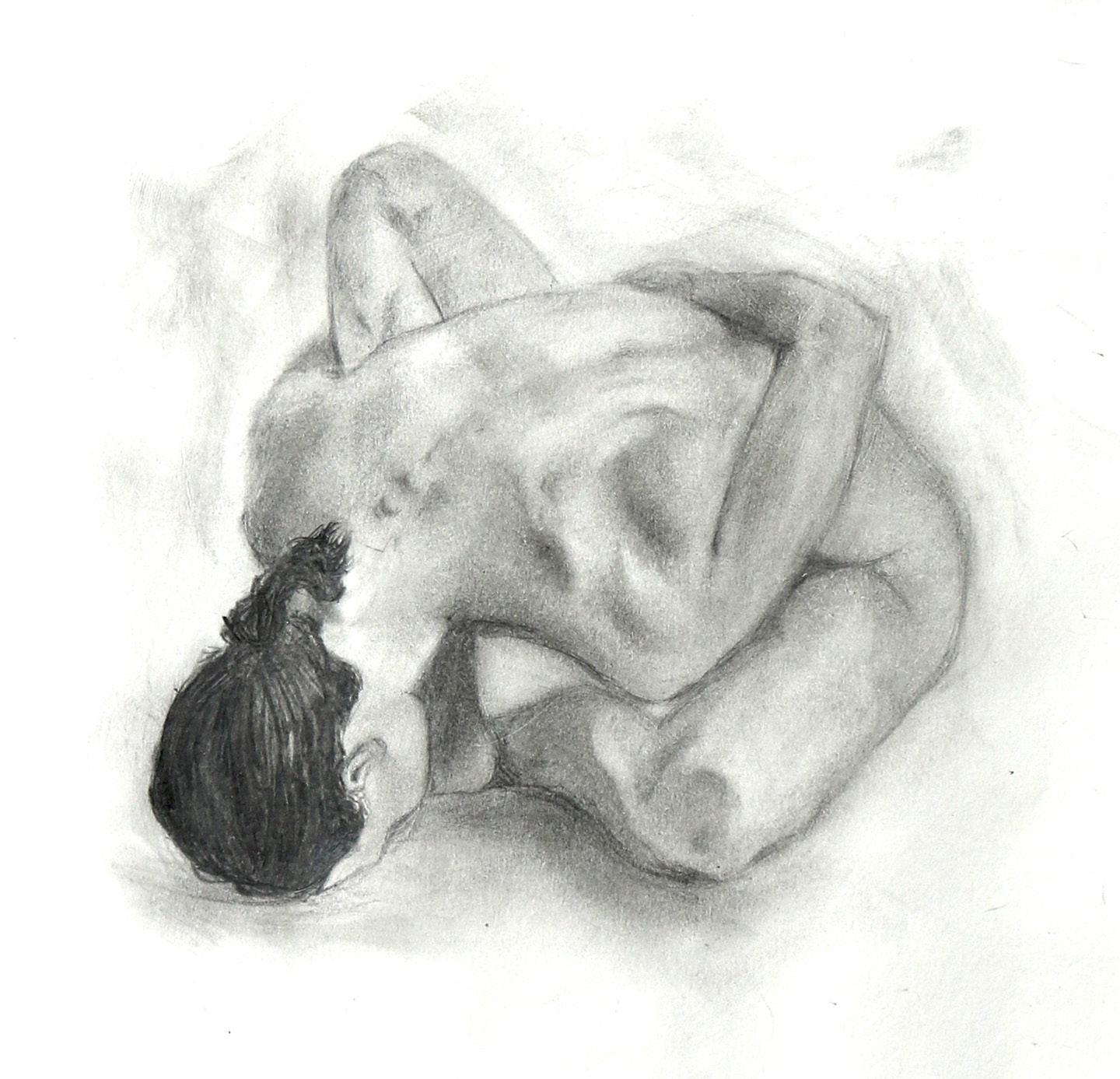
In Knots
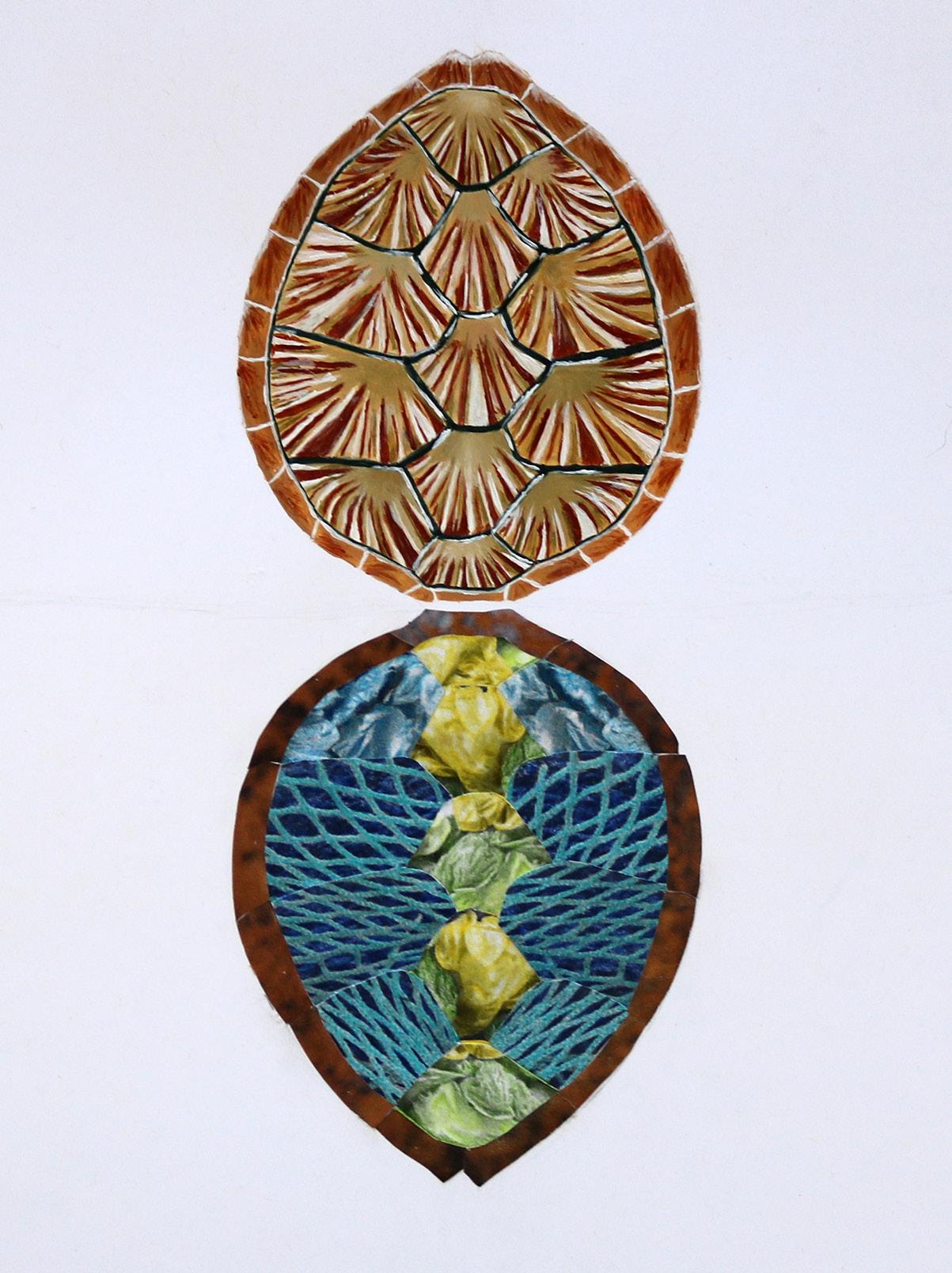
Shell
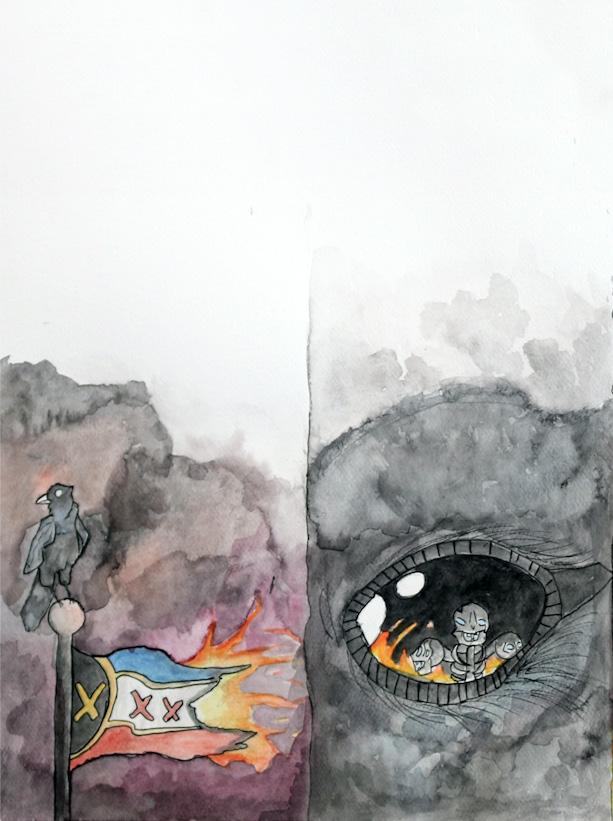
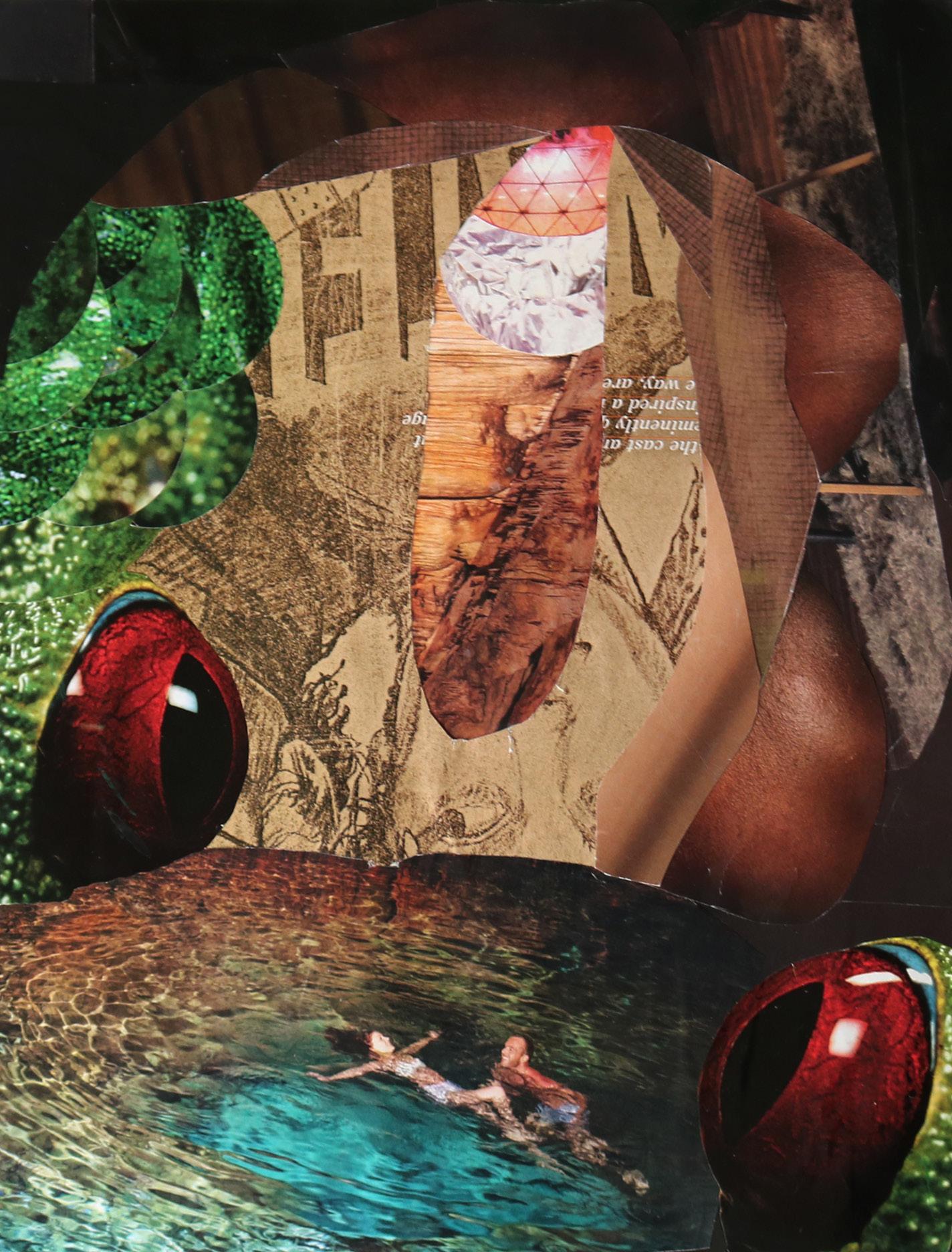
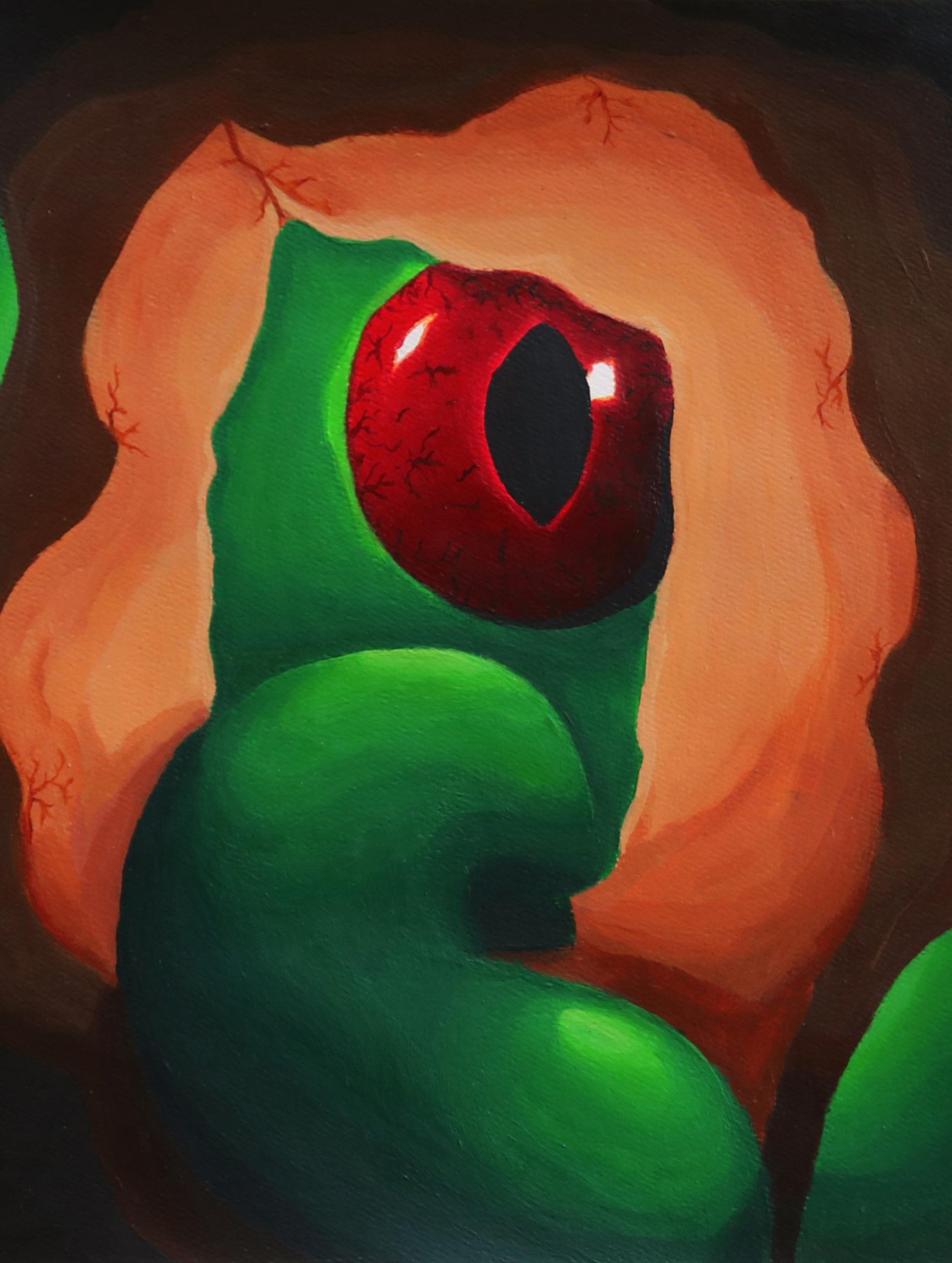
Beastly Eye
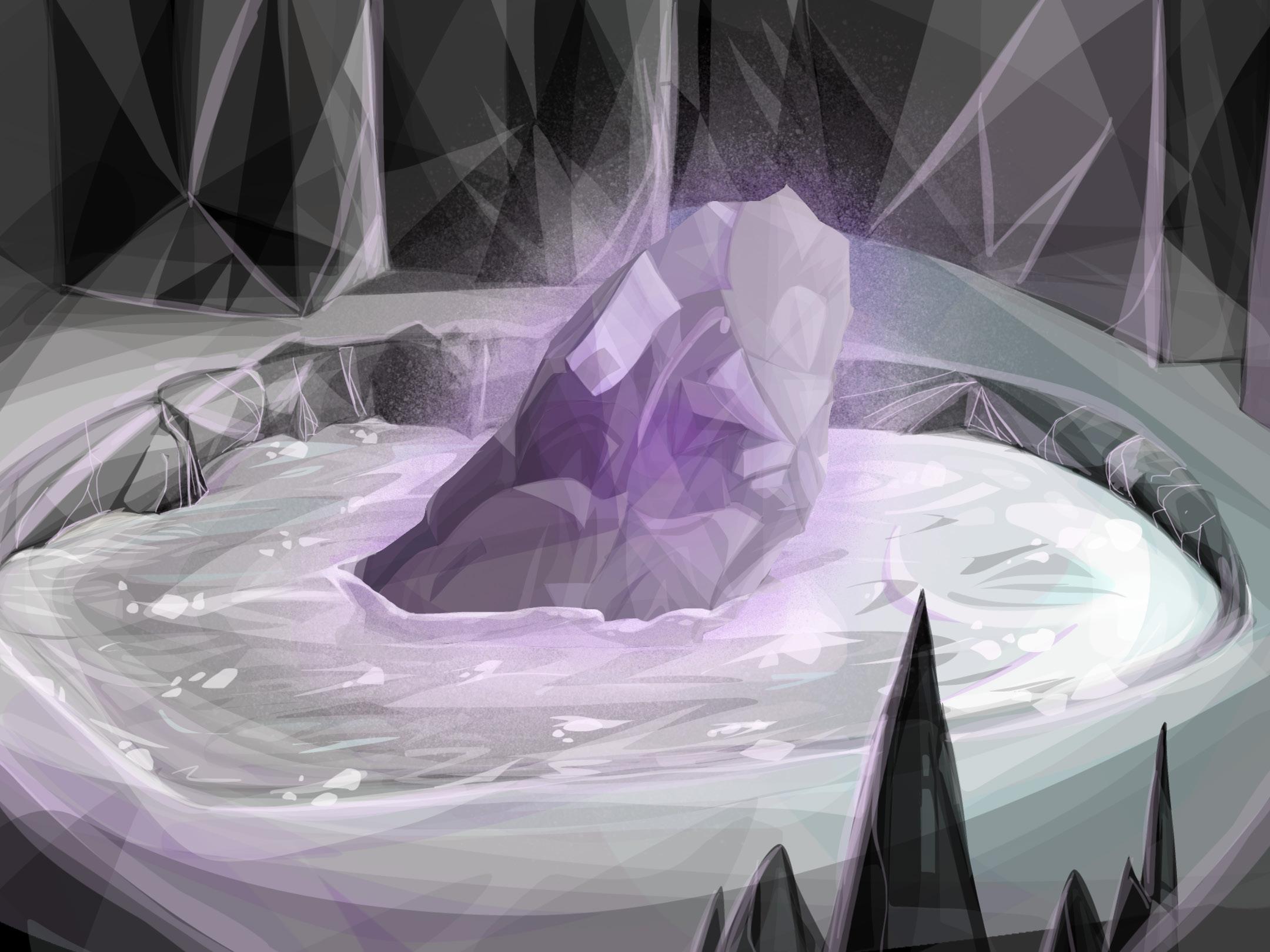
A Strange Stone
Decrucified
Evan Weinstein
Kai Dowdle
Mercer Paradise
Grace Baranko
Mackenzie White
Grace Baranko
Reece Miller
Faustine Ainsworth
Allison Mayetani
Anthony Sanchez
Kai Dowdle
Maddi Stufflebeam
Anthony Sanchez
Evan Jahn
Iman Ellahie
Ashlyn Lieberman
Iman Ellahie
Charlotte Morris
Jezzie Sammons
Gemma Ciriello
Mercer Paradise
Elevation
Illumination
Government
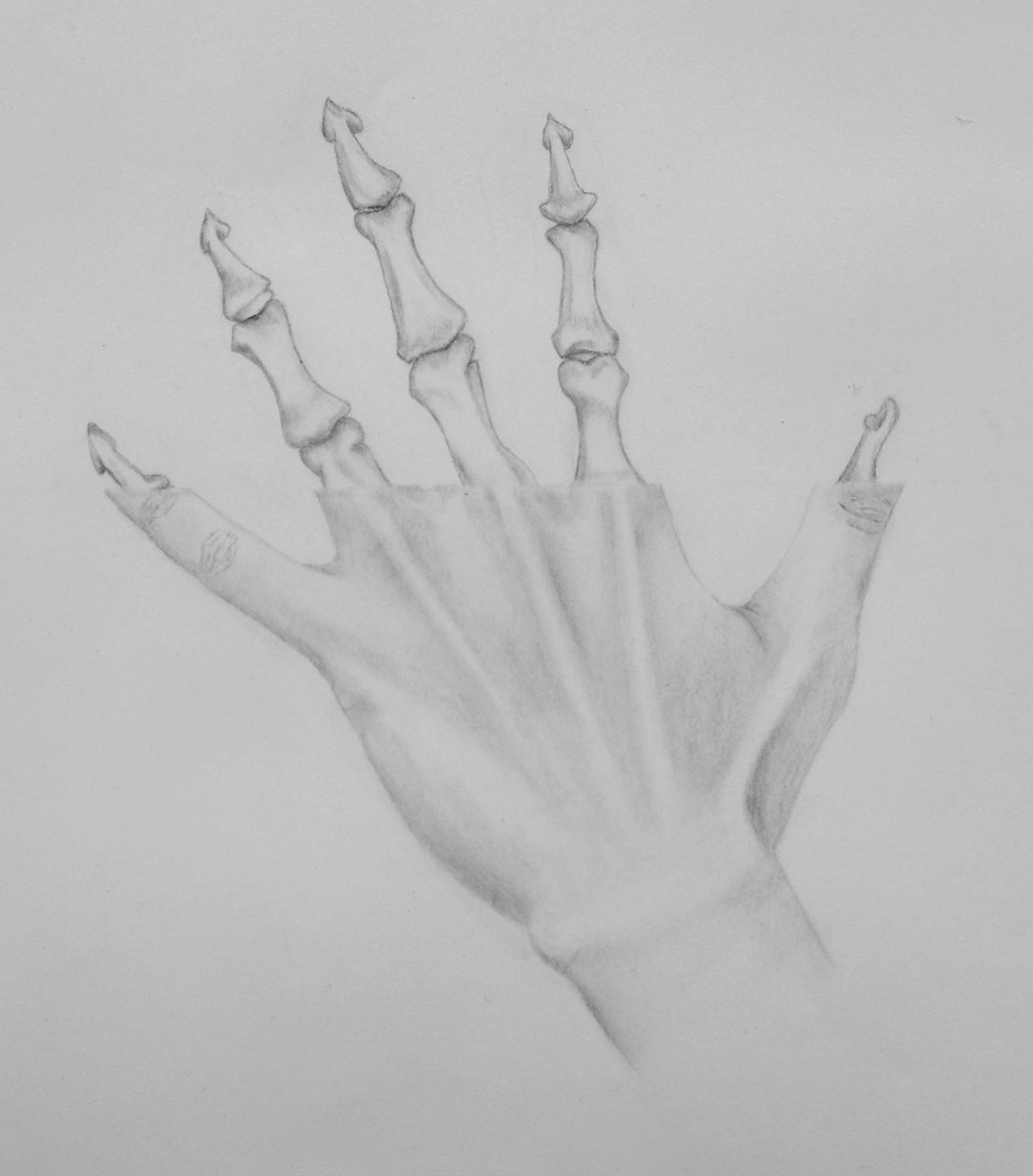
Skeleton Flesh
Artist in Solitude
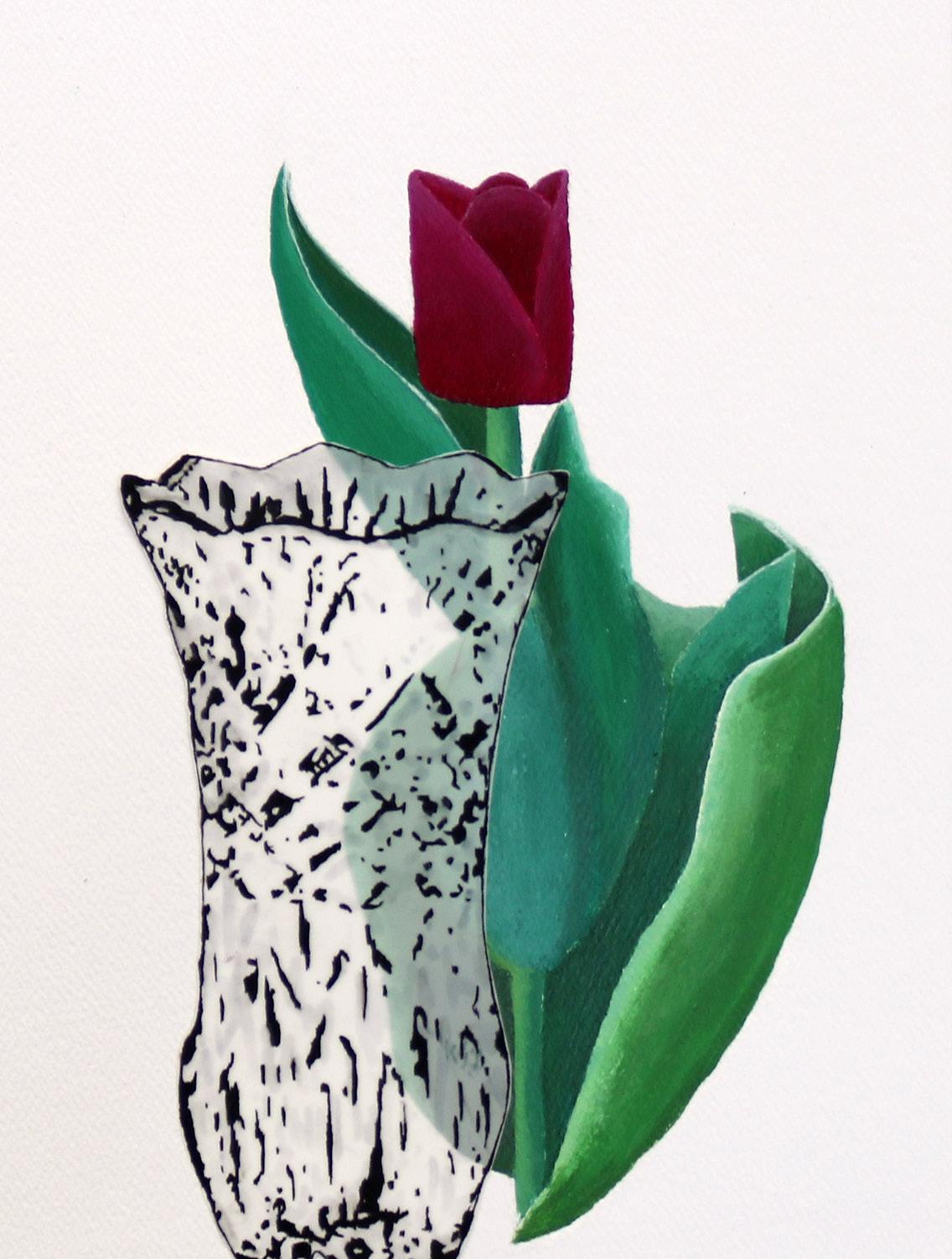
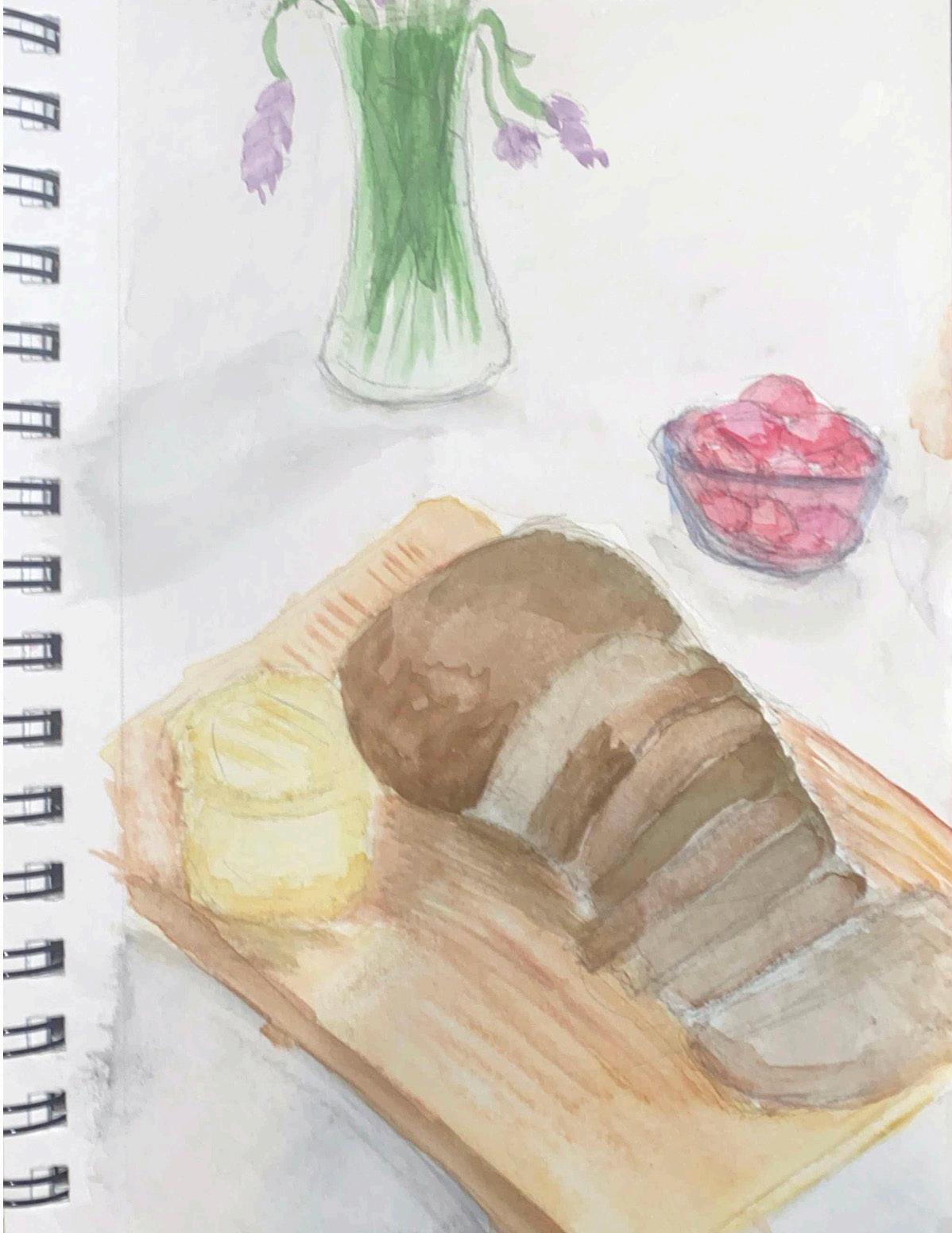
With Vase
Musician
Textile Trunk
Ghosting
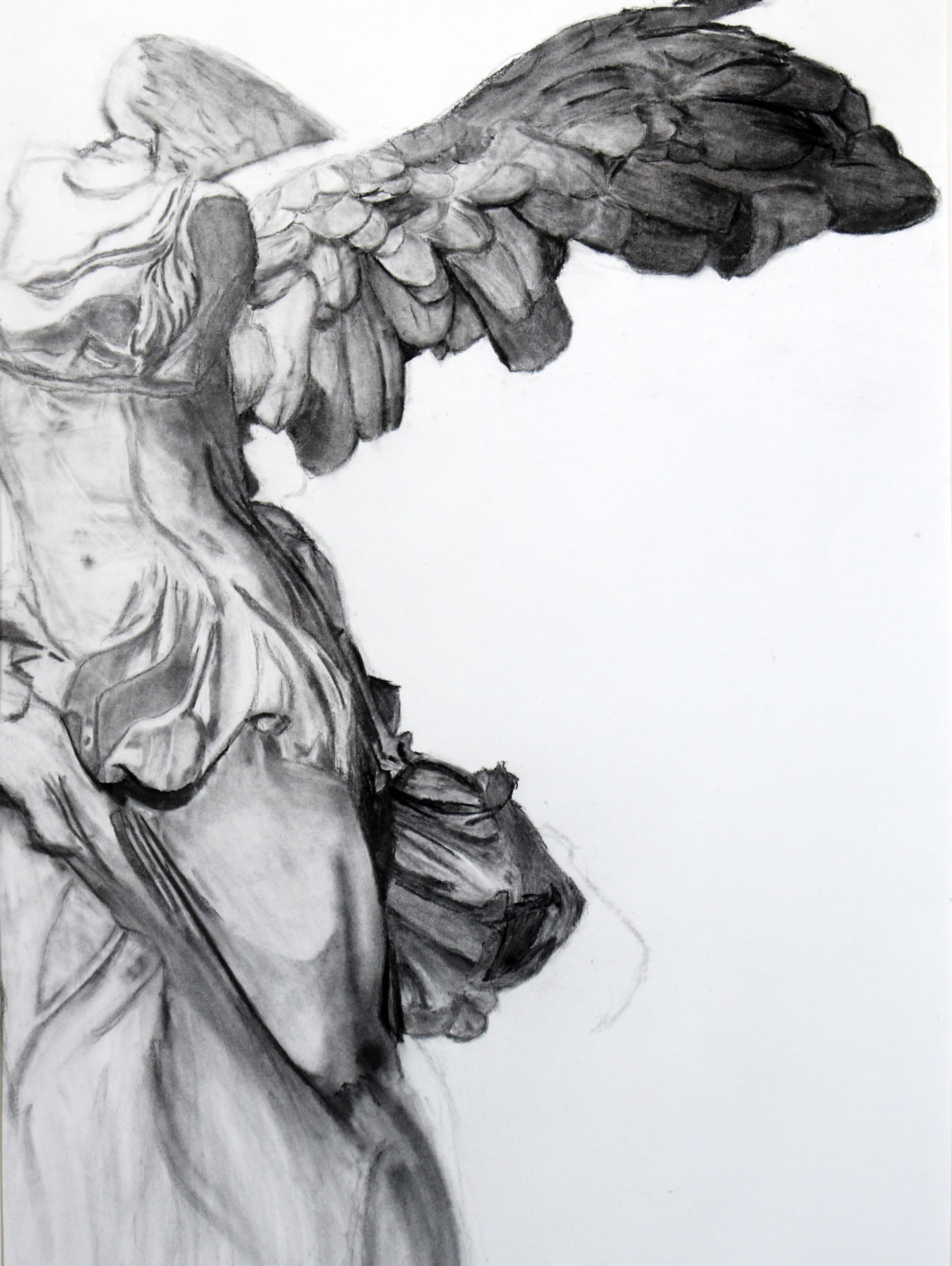
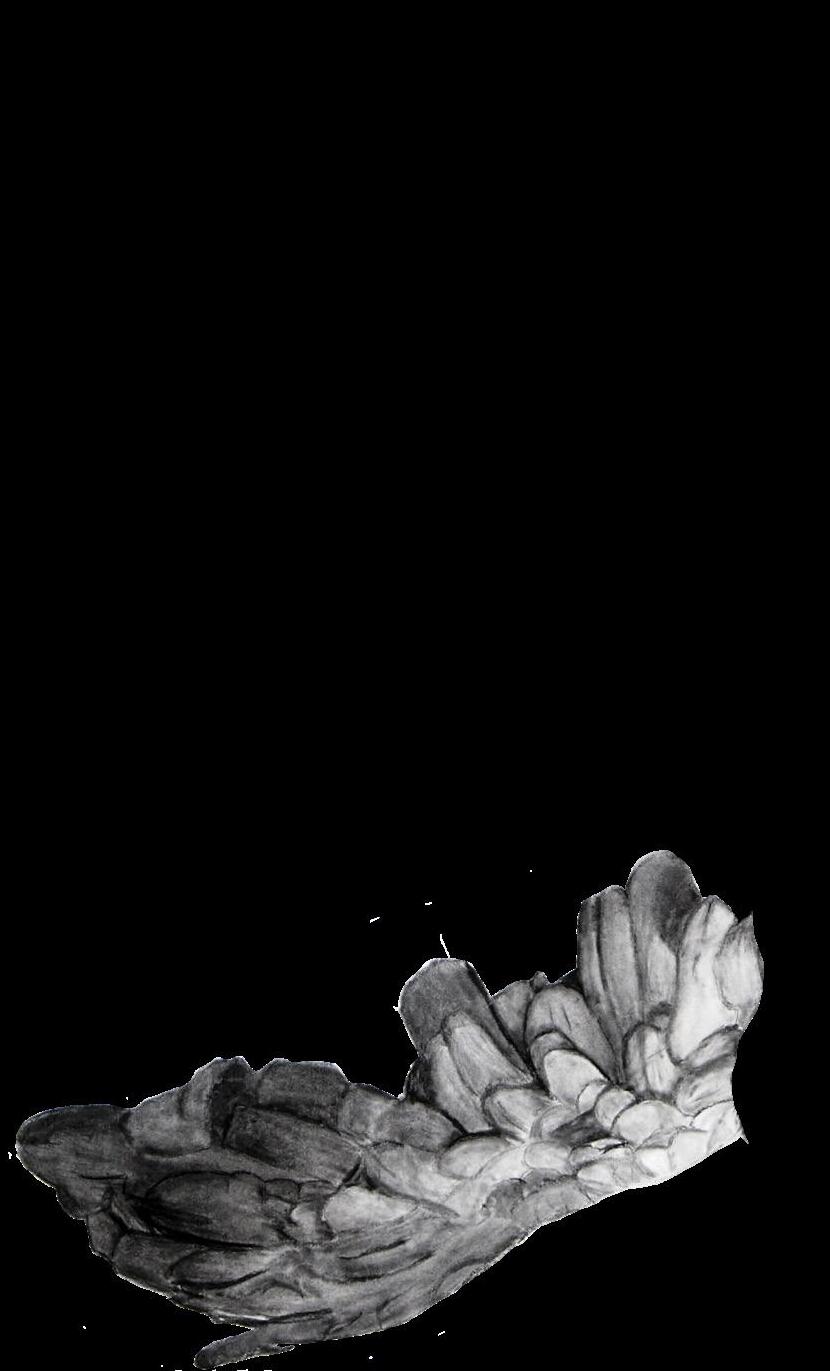
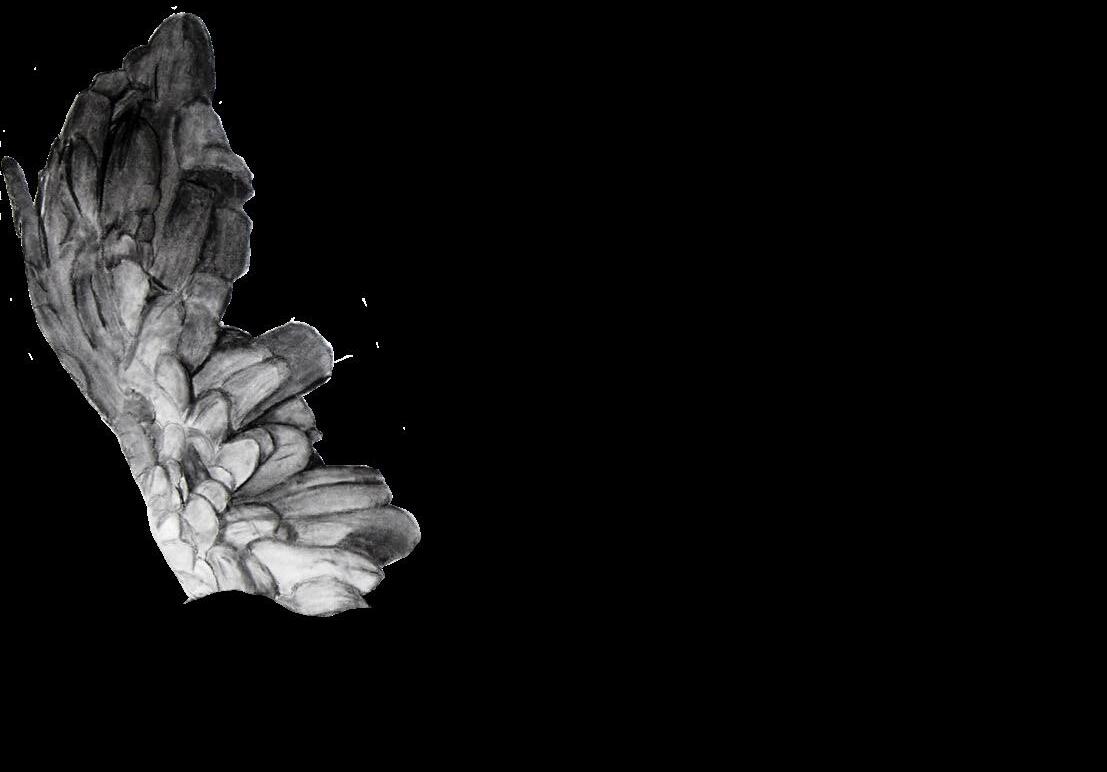
Angel
Carrion
Natural Causes
Portraits
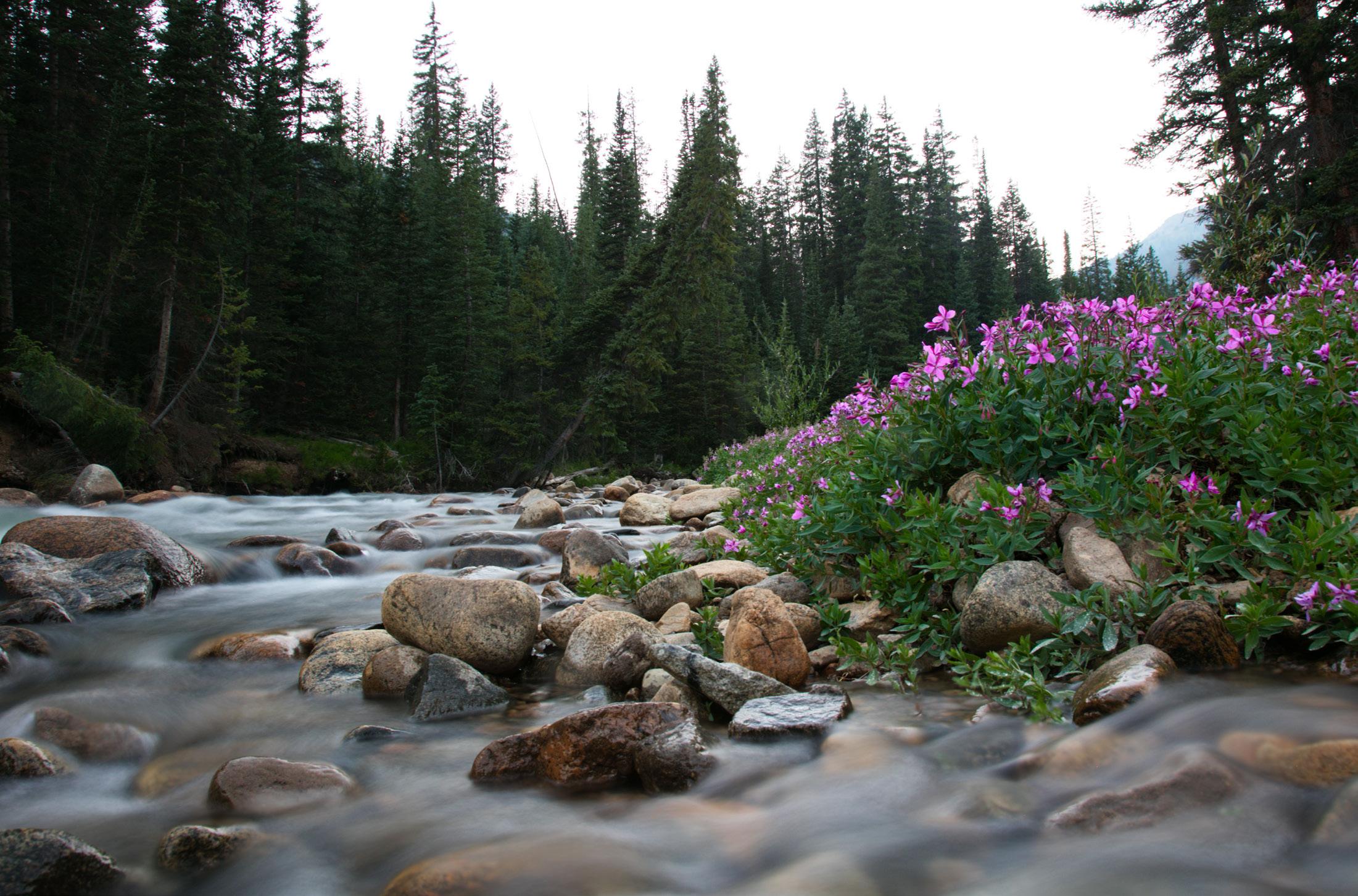
River
World in a Jar
Storm
Bird
Flower Girl
Moth
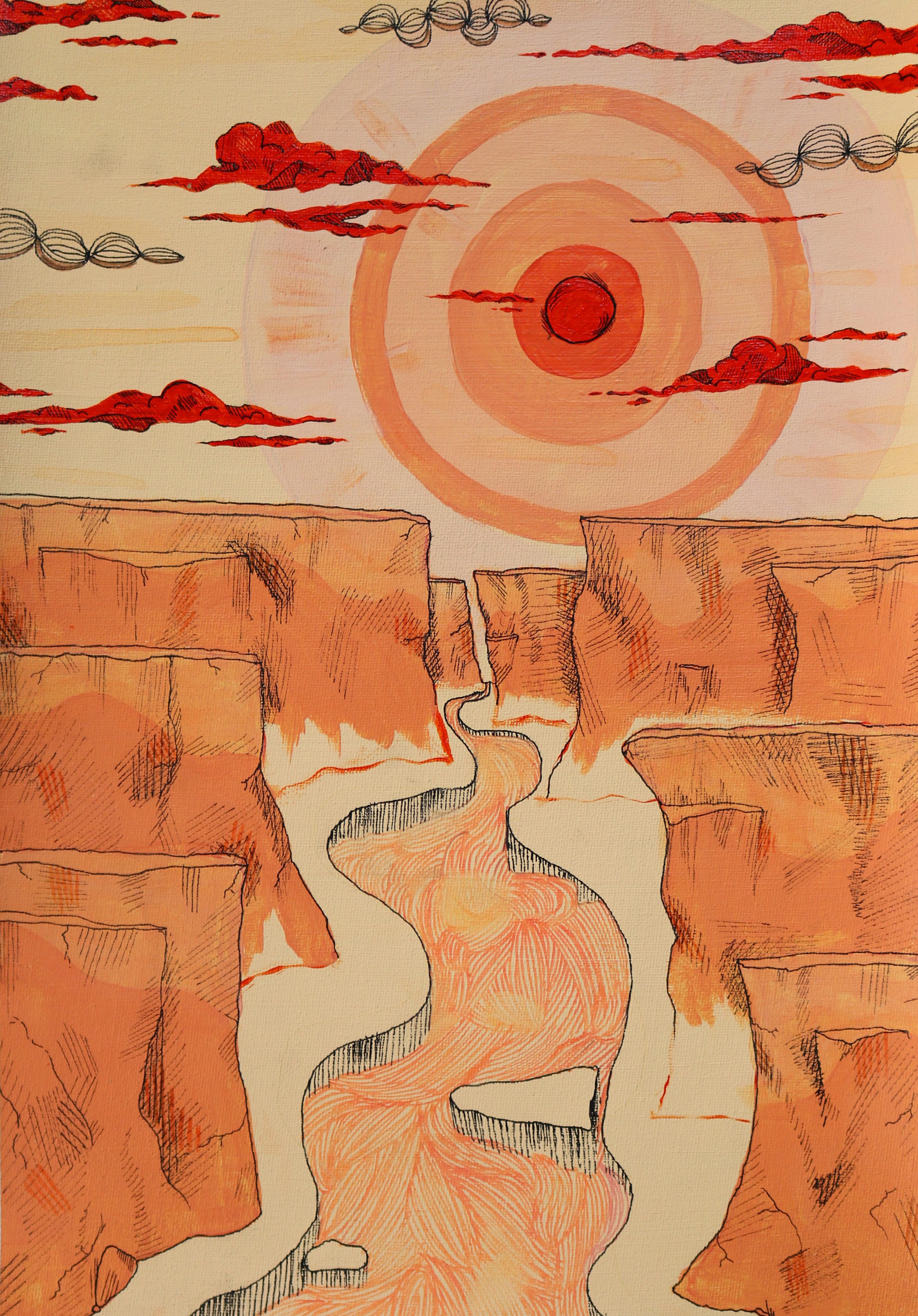
Red Canyon
The Stone Age
Logan Fang
Kavitha Kasturi
Tenzin Sivukpa
Grace Baranko
Mercer Paradise
Dylan Bookhamer
Madeleine Bateman
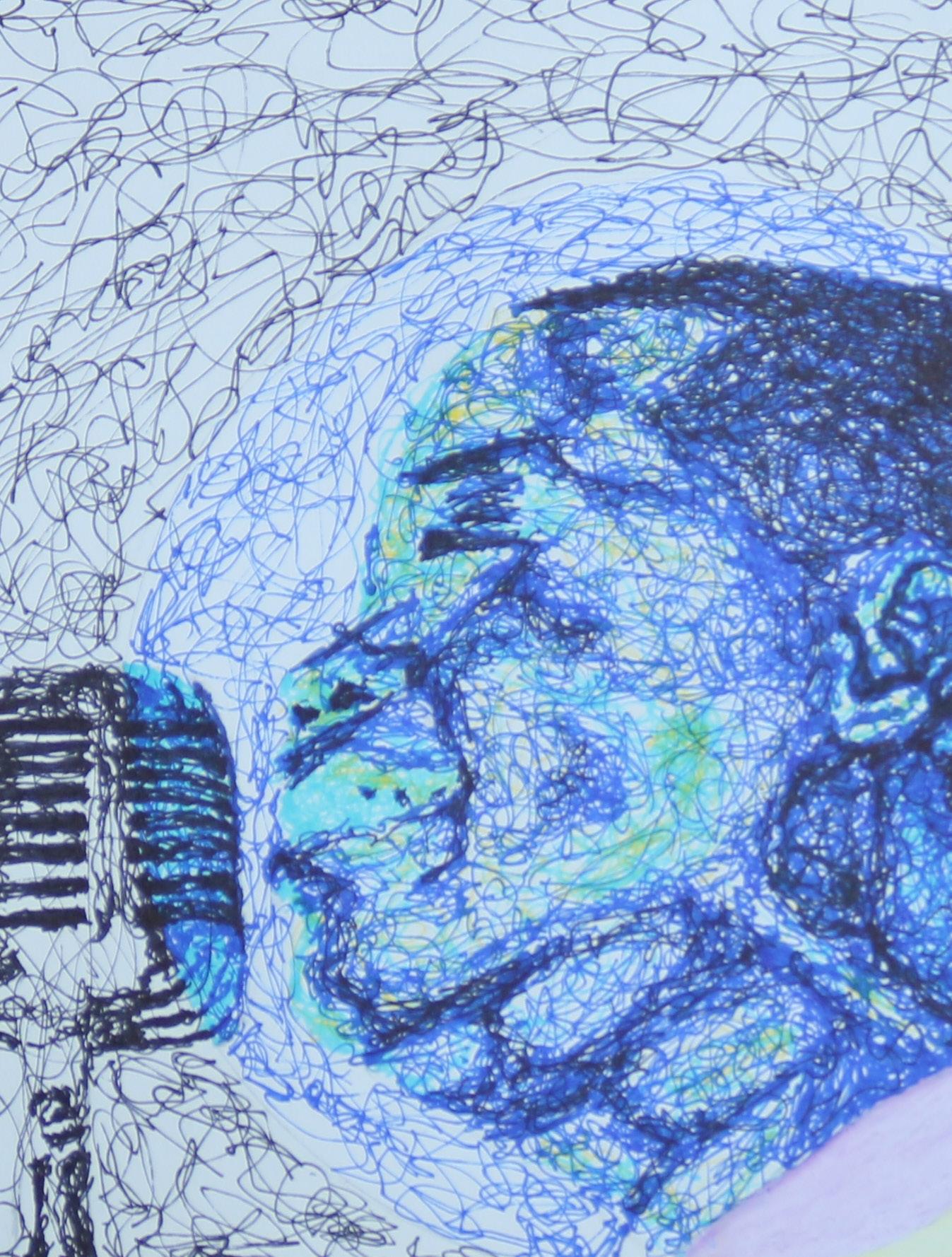
Blues Singer Ink
Anthony Sanchez
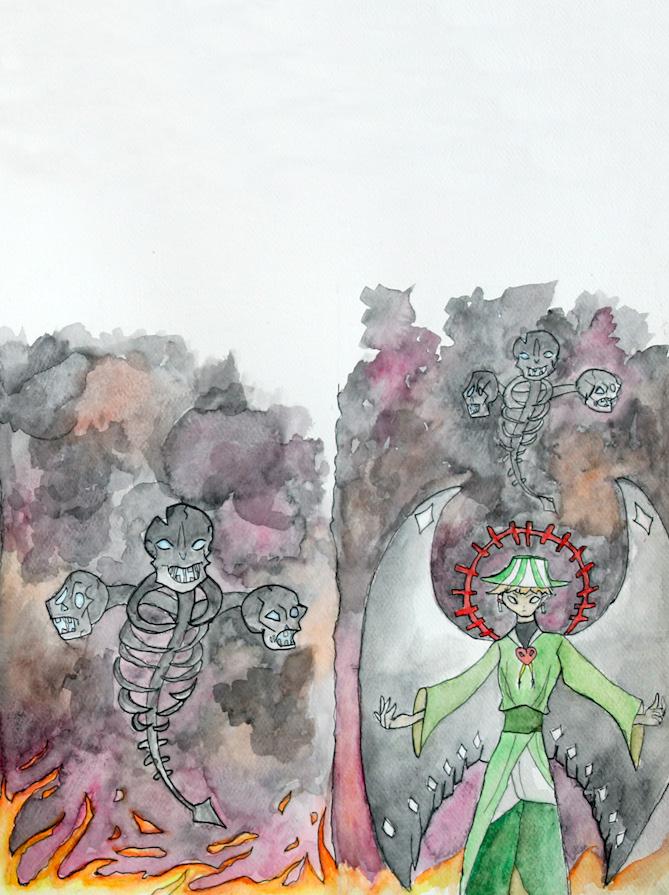
Sidebar artwork by Caelum van Ispelen
RAMESSES II
Caelum van Ispelen
I used to lounge on the Nile flood plain to watch the river churn and cut the sands, and to think how people cheered for my glory long ago and now there is only the same glory to cheer for. Yes, I was great; I saw it in the flames, the cascades of shifting bodies in the streets, proud of swordsmen, land-winners, fledgeling charioteers. For them I was enigma, Ramesses, the Great Ancestor, the god who tinkered in the life-forge.
But sulking at the Nile bank, I saw rocks
moved and smoothed and shattered, simple water ravaging the earth, and my mind sprung up and asked the gods to let me become water, so Ra told me, smirking, I was a man.
Yes, I was a man, but maybe if I climbed high enough I would be a man emancipated from the anchors of the world. Yes, I was a man, but I was a man deserving, and for years I climbed the climb to power.
In the seventh year I summited, stumbling in the sky-wind as gods blew
out their lungs to sound a warning over the winds, calling you are no god, just one speck on Ta Dehent. Nothing around. No yielding soldiers, complacent prince, palace, throne, glory. Sand. There was sand and I wilted into it. I took to the tomb.
Now, at night the Nile is not mine; the red sky sees an empire wrinkling and a man in the gloom stands with a pensive lean.
I am granite; I cannot turn; neither of us can see the other’s eyes. In the prelude to boundlessness, marble does not freeze him, though his body mocks me. He forgets how it is to have everything and still for the world to spin unsatiated.
Destruction
Watercolor and ink
Jade Wilson
HOTEL CALIFORNIA
Kit Stevens
Tonight, I am Sarah Winchester. I am many-roomed and exit-less. I am the dropped vase of roses that will never deign to hit the ground. Mourners in velvet, I bid you, lose yourselves as I have lost.
I have lost your faces. I am a forgetfulness that eats. Your fingers are stashed somewhere among my blue-tiled fountains and flowering snakes, dipped in stained glass for safekeeping. But I have rent your flesh in lines too jagged to be reattached.
Mother, daughter, son, husband, names fall off of lemon trees, resent me
and my optimism, bitter as citrus rind. You know my ashes in your lungs can never be fully exhaled.
Crack me on the sandstone, sharp as blue willow china. It changes nothing. Swing dining chairs at the cathedral doors, but still they will not close. Stab your skewers into steely beast, but still it will not die.
Mourners draped in cast iron, I see you gather on the balcony in silence, in relief, in my name. I see you teach a child to fold a paper airplane and shoot it off the parapet.
With wine-stained eyes you search for the entrance, but find only dripping moonlight, candles waxing, dumbwaiters rising up to nowhere.
THE CANYON’S EDGE
Ella Houden
Two men gather on the edge of the canyon side. One jumps the cement freeway barrier and the other waits, smoking a cigarette. A taxi-cab on the opposite curb idles before the driver takes off. There isn’t much to see: an old oil refinery, an offshoot of the freeway, gray pollution discoloring the unimpressive buildings that lean against the horizon. Yet there the men stand, having chosen this corner of land, hardly describable as a place, to meet. There was no address to be given to the departed taxi driver, only a direction and pointed finger and the occasional piping up of “turn there” from the backseat. But to these men, this barely-place place was a location to be starred, circled, and Xed on the map.
The second man, the one that flicks his cigarette from his hand and reaches for another, has laid out a ratty old blanket as if the two were in the not-place place to picnic together, partaking in cucumber finger sandwiches and glass-bottle lemonade. To them, silence is a greeting warmer than wrapping each other in hugs or offering hands to shake or patting backs like comrades on a battlefield. And so they stand in greeting silence, looking out at the city and waiting.
The cigarette man pulls a duffel bag from under the ratty blanket. The taxi-cab man does not flinch as he watches him remove a mallet, large enough to break a park bench in half. The cigarette man hands the taxi-cab man the mallet and reaches inside the bag once more. This time, he removes white-painted wood, fashioned and cut in the shape of a cross.
They both turn to each other, nod, and head toward a pile of gravel, breaking up the wildgrass and yellowing plants in a greystone-stained mound. The cigarette man places the cross next to the mound, then looks up at the taxi-cab man for confirmation. The taxi-cab man shakes his head, his thinning hair swaying with his disapproval, then points his toe and taps his foot at a section of dirt an inch-and-a-half to the left of the proposed spot. The cigarette man kneels, wobbling closer to the correct spot, and holds the cross, the staked end pointed at the dry
dirt. Both men nod their approval.
The cigarette man leans away, his hands holding the cross steady while his muscles tighten. The taxi-cab, now mallet-wielding, man begins gently rapping the intimidating instrument against the head of the cross, shoving it into the dirt a millimeter at a time. He pauses, and the cigarette man lets go. The cross topples over; it hadn’t been pressed deeply enough into the dirt. He holds out his hand and the men switch places.
The cigarette man swings at the top of the cross with decided, calculated strokes. The stake cuts through hard ground, breaching wormholes and ant-farms. This time, when the cigarette man stops and the taxi-cab, no longer mallet-wielding, man lets go of the cross, it stays.
The men step back to admire their work, the taxi-cab man toeing the cross to see if it will give in the wind. When it remains rooted in place, the men nod. Then, they search the tall field grass for a discarded, slightly rotted cross. They find it broken and spray-painted with block-lettered graffiti. The cigarette man shoves it in the duffel bag. They return to the newly laid cross, admiring their work. For the first time, the taxi-cab man speaks: “What’s it been? Twenty-seven, twenty-eight years?”
The cigarette man lights his third cigarette, having crushed the second a respectable distance from the cross. “Twenty-seven.”
The taxi-cab man coughs in agreement. The cigarette man pulls a bottle from his duffel bag; its label has been removed, and the glue that’s left over catches dust and grime from his hands. He unscrews it and swigs, his cigarette still in one corner of his mouth, the bottleneck in the other. He swallows a few times, then holds it out to the taxi-cab man. The taxi-cab man holds his hand out in a gesture of denial, then explains, “I haven’t had a drop in twenty-seven years.”
The cigarette man nods. They’ve had this conversation before, the interaction written to an exact blueprint, the number of years the only difference. He coughs into his palm before admitting, “I didn’t think you’d come, not after the
phone call.”
The other man didn’t have to ask about the phone call; a month ago, at 3:29 A.M., he answered a call from an unsaved number, a sequence of digits he involuntarily memorized. Before he had a chance to choke out a “hello,” from the other line, between static, a slurring voice asked him: “Do you hate me?” The line had disconnected before he could summon any response.
“Yeah, well, here I am,” he replied, hoping it would end there. The cigarette man cleared his throat, and the other man almost believed he was saved when he heard the question repeated, the voice less slurred but raspier this time: “Do you hate me?”
“I have a family,” he whispers.
“That doesn’t answer my question,” the cigarette man presses.
The taxi-cab man runs his index finger over his wedding band, sighs, and explains, “I have a family, so, no, I don’t hate you. I have something. All you have is 26 rotted wooden crosses lining your garage. I can’t hate you; there’s nothing left to hate.”
“So, after all these years, you admit it. You do blame me?” The accusation isn’t angry, more pleading. As if he can be absolved with a no, forced to finally accept the burden of responsibility with a yes. He can’t decide which he longs for more.
“I don’t blame you; I mourn you. As far as
I’m concerned, you both died that night. I’m the only one that is actually still here.”
“I’m standing right here.” He sounds confused, as if worried he’s become an apparition, as if the last 27 years were an illusion and he had unknowingly haunted this freeway boundary.
“Your life is a meaningless set of parentheses: you follow a trajectory, skip, waste space, land, and repeat. There is no tangible proof that you have existed in the last 27 years, nothing I could hold in my hands and call entirely yours.”
The men stand for a few more minutes, and the wind picks up in the valley below. The cross shudders slightly, then steadies itself.
“I should go,” the taxi-cab man says at last.
The cigarette man nods, pointing to his parked car in offerance of a ride. The taxi-cab man shakes his head. The cigarette man nods again.
The taxi-cab man smiles, says, “If you ever need anything…” and leaves it there, a half-offer, an “only on this particular day, if you need anything” extension of aid or acknowledgement.
The cigarette man waves his hand dismissively, and the taxi-cab man hops the cement barrier. The cigarette man gathers his ratty blanket and bag, shoving everything but the bottle inside. Then, he lifts the bottle in mock-toast to the cross and says: “To those that learn and those that don’t.” He downs the clear liquid inside and stumbles back to his car.
Evan Jahn
PHANTOM STARS
Quinn Yeates
Smears of silver grout and hunched
Eyelids, tacky from late nights awake, Fingers tap against lips as minds slip, All held close under the blood-humming
Underside of our chins, below the stars given to us, Labeled neatly with our names in stenciled Calligraphy, mine beside Andromeda’s. We’re assigned seats so the universe may more easily Recall our names and whose solar system is whose, So it can ask us how our planets are doing, to fill Lulls in conversation or empty spaces
Where stars’ shining ghosts finally blink out.
FLOTATION
Phillip Locke
The light from my window melts into thoughts, melts into swirling, breaking memories, tears the physical sensations of my body away, submerging me in light and color and death and life. I can’t feel my fingertips, but they aren’t numb. I simply forget to feel, forget to notice anything but light and death and color and life. For a moment, I float, and my mind is calmingly blank. Then I’m turning, spinning around, but I notice my body doesn’t move, and I wish I were home. At this revelation, I feel my body, but still, it isn’t mine. I feel every sensation particularly and uncomfortably, every touch unfamiliar and harsh. Then the life and death and color and light fade, and I fall back to myself entirely, finally, feeling the wood under my hands, the seat under my body, the words and the thoughts and the memories back in my mind.
NO RETURN TO NORMALCY
Icould always feel the infernal buzzing as it sat on my brain. Its light vibration made its way throughout my body, taking a toll on my senses.
The unpolished ground’s grime and numbing chill rose into me from below. The weight of my head seemed to make the wall want to give into the pressure of my heavy thoughts. I tried to close my eyes, but the lights in front of me kept changing in a call for attention.
The speakers were broken, had been for months, so they could never settle on a channel. My wish to find a pattern in the noise was hopeless.
As I sat in front of the televisions, I felt small in comparison, watching other people’s lives, children rushing down the hall on Christmas day, bags underneath their eyes from staying up the night before. People attempting to shake their loved one from the grips of death, someone sitting on the couch in the dark, watching TV with the small possibility that they are watching me. From my place on the floor, I would be squished if the stack of TVs decided to lose balance like a mosquito between a hand and thigh. Only my blood would be left to mark where I had been.
Each emotion seemed to have a screen, some overlapping, intertwining and weaving, only to make a clear image when combined as a whole. The message being conveyed was that life is pointless and barbaric, making us feel pleasure to keep holding on, just to have something cycle through and take it away. The message was undeniable when I had to watch it day after day, heartbreak after heartbreak, death after death, crash after crash, break after break.
The room was dark, so maybe I was missing something without the lights on, letting my only lightsource be the videos streaming on the endless number of televisions. My naïve self used to keep the lights on, but I found no solace in the stained concrete walls they illuminated, automatically assuming they showed no significance.
Erin Stotts
I turned my head to the side in an effort to release the building tension in my neck. What followed was a glissando of cracks down the length of my spine.
The door out of the room was only a few feet away. Nothing was keeping me where I was. The door always remained unlocked.
I dragged myself to the door, allowing my legs to follow helplessly behind me. The muscle has been drained out of my legs. I rarely use them; I don’t need to. My own life is now just a shadow compared to the lives that I watch.
As I made it to the exit, I felt a cold breeze slip out beneath the door. The air burned my lungs, making my insides raw. The environment slipping through the crack was uncontrolled: no thermostat, no controls, no remotes. Emotion filled me for the first time after what seemed like years, a solid core just melted to be filled with fear. It made me nauseous.
The door opened easily. Barely a tap left it swinging open, welcoming my exit from my own personal domain. The tungsten lights blazed unnaturally; their buzzing stung my ears like a thousand angry wasps. The floor was unmarked, free of tracks to follow, indicating it was an untravelled domain. The hallway was drafty, like a fresh wind was blowing from one end of the hall to the other. Everything was as bare as a hen plucked clean of its feathers, the body now cold with no more heartbeat.
A once well-traveled space has now been abandoned, everyone frightened away from something they cannot see. Its power is astonishing, banning a whole population away from places they think of as home.
The bright plain walls burned my retinas into pure agony. I did not want to be the first one to step out of the place I have been banished to. We were all still waiting for the allclear.
I slowly slithered back into the dank room that has now become my comfortable limbo and sealed my door, locking out the unfamiliar.
Now that I was back, I could not help myself. I couldn’t tell if my breathing was irregular or not, if I was running a fever. Did I need to sneeze or cough? Was it sweat on my brow or did the leak in my ceiling finally reach my spot? My paranoia was overwhelming.
My eyes naturally got pulled back to the screen, back to my windows. Some were in black and white, showing me how it used to be, what green, freshly cut grass looked like. But as I started to smell for the unmistakable scent,
I was left fruitless. The only smell in the room was the stench of my unmoving body. My eyes focused, determining that I wouldn’t move, again watching the happiness, sadness, and undying pain. I watched people march in the street, angry enough to take a stand, people dying in the hospital alone, nothing but a stranger to hold their hand. A family sat down to dinner, one that was long overdue.
But now I knew that I was the only barrier keeping me in this locker of presumed safety.
The Locker Photography Samantha Lehman
Capitol
Graphite
Aurelie Wallis
Waves Photography
Logan Fang
PEDAL GRACEFULLY
Erika Prasthofer
The petals will be sand in my rain jacket pocket. They lick dryly against the polyester static in the zipped cell set flat against my chest. I was taught to leave them until they shriveled by their own means, the only pressure my movement, my legs gliding through circles on the spokes of my droplet-dotted bicycle in evening’s rain, the jerks and shifts to avoid senseless puddles threading waves, energy, loops of ice pebbles up through my muscles, startling my core and promoting the slight saunter, delayed erosion of the curled-up, cocoon shape of decay beyond replenishment dangling in my hidden pocket.
When I feel their knots and spikes jutting slightly against the thin, glossy fabric of my coat to skim my chest, I know that their abrasion counts on more than the donut circulation of pulses in my legs, the swaying of my torso set on an evening of shades lighter than gray but softer, less blinding than white: an evening where my head moves from ground to overhead, to every side as lustrous cars, colors of maroon, navy, black, ripe cherry paint strokes of my reflection beating by. The people on the sidewalk glance down at their puddle-tinted soles though inside their heads feel nothing close to dread.
When I halt by the sidewalk, slip off my bike, tumble on sleekness, When I rush through the black metal gates, dripping and shedding minced tile slates, trickling beetle skins of paint to the garden, my hand hesitant as it hovers before my chest, I think to
pinch the crinkling petals of the tulip which once sat dry above dampened dirt that had not yet turned to mud. I remember there was a fresh series of days when stems cascaded white silk, were ruffled against softly by brown rabbits, so delicately skipping, wisping their rain-stained, acute triangle noses against flourishing roots and petal skins, glazed by a natural film of strawberry milk, frosted white or evergreen-mist blue.
Never bring fingers like pennies of frozen plush to a dry, wrinkled yellow stem: a stem that may wiggle, hold on but proceeds to crack.
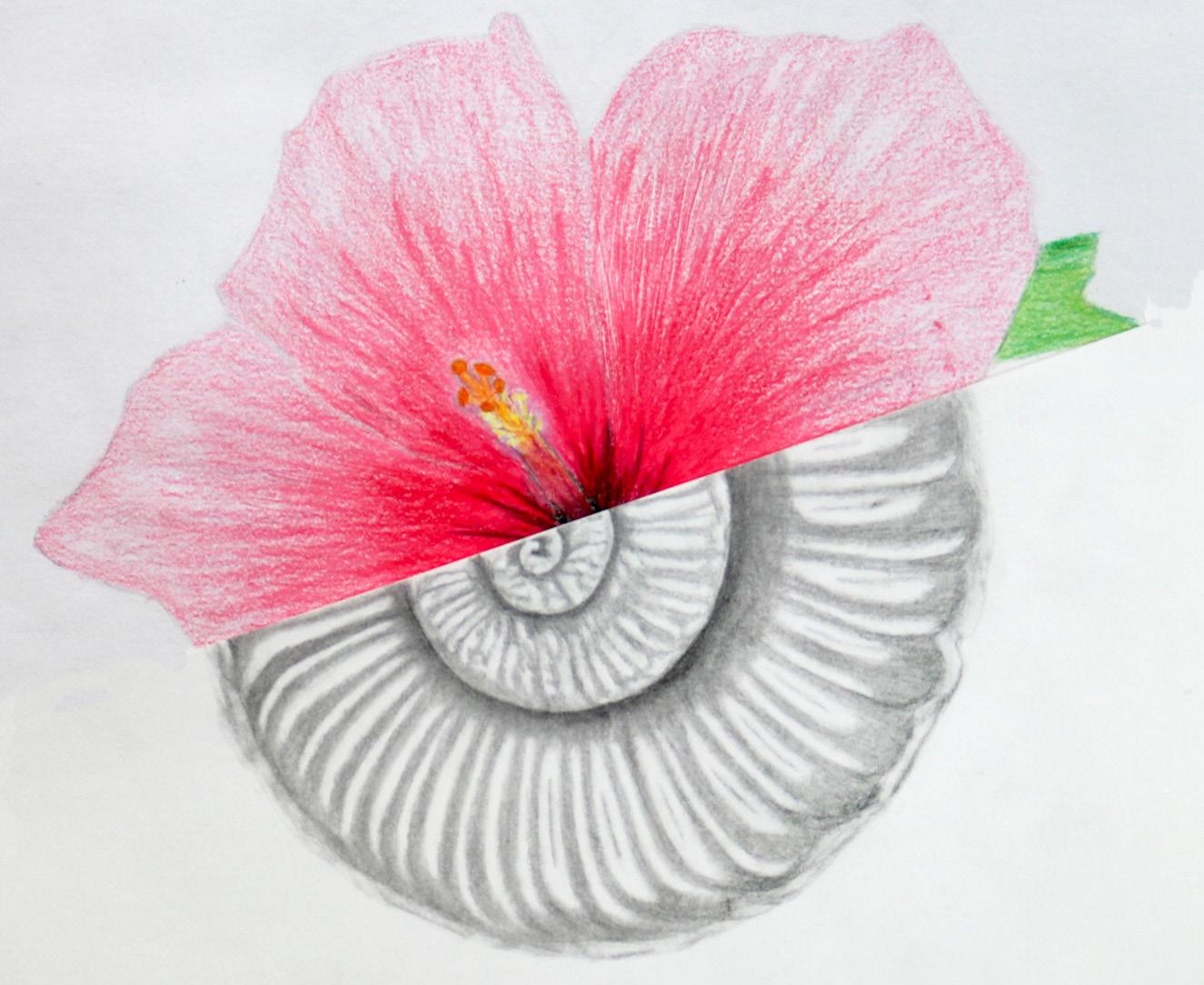
Flower Fossil
Colored pencil
Grace Baranko
ROAD PEBBLES
Caelum van Ispelen
It was night and fog occluded all, and two workers drove on the interstate road, beneath the dim spot of gleam in the sky where barring clouds the moon would shine. One worker had his hands in his lap, having nothing else to do. He frowned ahead into the void where the only color shone from the yellow strips of road paint that shifted under the car, appearing from the nothingness before them and fading, fading under miles consumed. The worker liked to watch the strips glide along because they were all that he could see, and he knew that if he turned away he would have to close his eyes because he
“Yeah.”
“You ever thought of what you’re gonna do now you’re free?”
“Nope.”
“Not after five years’ time?”
“Never thought they’d let me out.”
“I knew they would.”
“You ain’t me.”
The driver turned to glance at the worker, but he could not think of what to say, so he gazed into the asphalt to become the driver again. The other worker had not dropped his eyes away from the road paint.
“You ever notice how those yellow
could not bear to see nothing again. The other worker was the driver, so he sat attached to the wheel and stared at the road, entranced in the grinding between rubber and asphalt and sometimes, when the expanse of night walled them in, the tap of a pebble on the car underbelly.
“You still awake?” the driver asked.
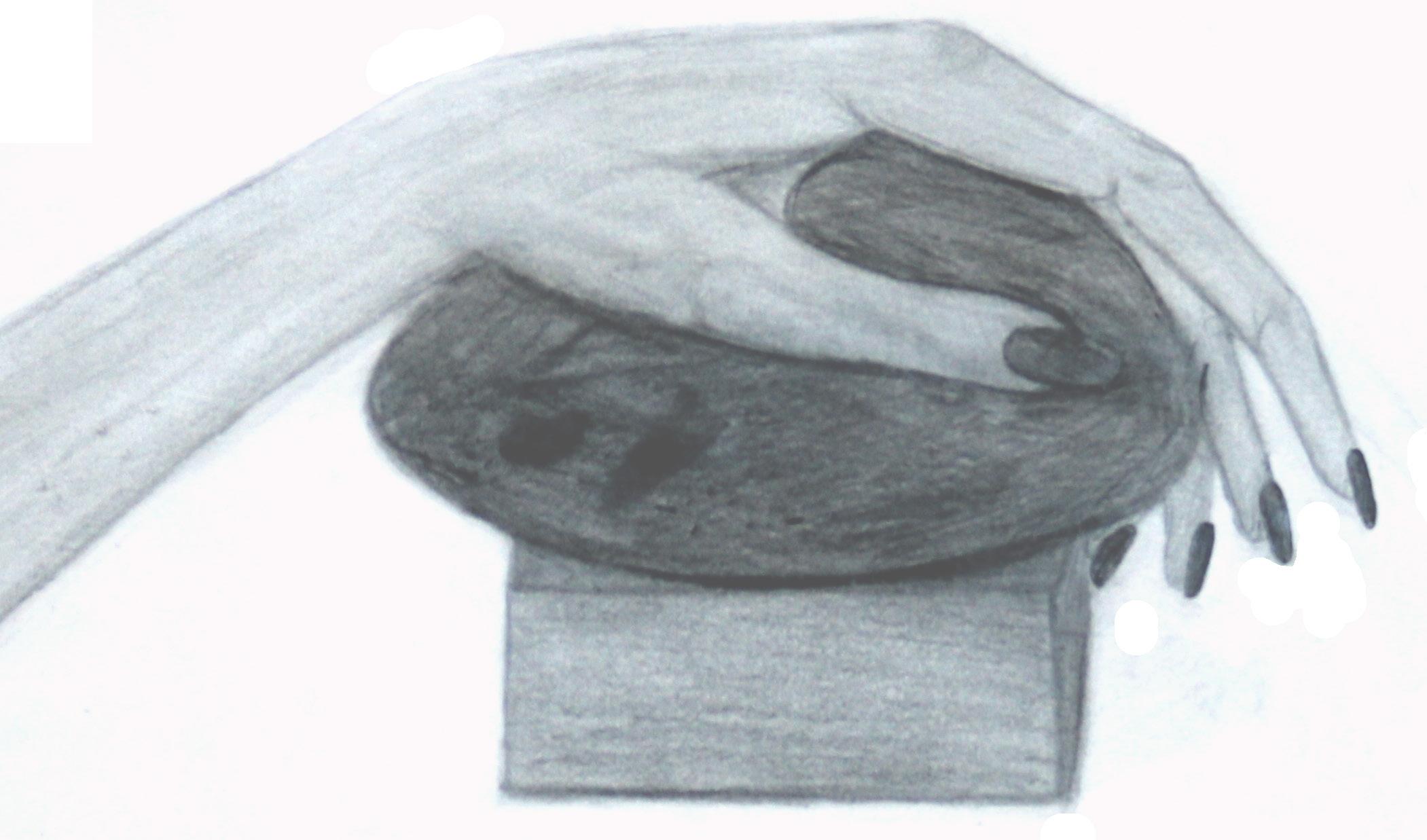
Held Graphite
Sarah Carlebach
lines bend under the windshield?”
“What lines?”
“The ones on the road.”
“No. Why’s it matter?”
“They bend at the bottom of the glass. Some used to tell me they glide through the street like a rope, ducking under the pavement. And they pass underneath the ground
‘til they come back up, so we drive over them again.”
“Go to sleep.”
“I want to see the yellow lines.”
“Those years under lock did something to you.”
The two workers sat together and did not speak. After an hour the fog settled; the invisible moon backlit a shrivel of the sky so that dim light peeked through a cloud at the horizon. The sky-halo rippled from some vast object outlining it; the passenger thought there might be mountains there, stamping blackness on the luminance, though he could not remember what mountains looked like. He watched as the brightness moved backward with the car engine’s whirring, and another hour later, it had gone. But now the air shone a bit more; he could see the charcoal bits in the asphalt and how their roughness formed flatness, and how the yellow lines, too, were formed of them. A thought erupted and he swatted it away, but as if attached to a bungee cord, it sprung back.
“What would you do if you went blind?” he asked the worker who drove.
“Why would I go blind?”
“You could. You always can.”
“Live on the streets, I guess. Wouldn’t be of much use anymore.”
The passenger paused and itched his eyes, freezing as he lost sight of the world again. His hands snapped back to his lap; the blurred yellow before him sharpened; pumped blood returned the gift of warmth to his skin.
“If I couldn’t see I couldn’t live.”
“You could live. There’s music. Can always listen to music.”
“Where I lived there was no music. They put me in a black room and wouldn’t let me out.”
“Why’d they put you in?”
“I don’t remember.”
“How can you not remember?”
“All I could think was, I can’t see the pores in my skin anymore. I don’t know how many weeks I was there. I forgot the guard’s face too.”
“I thought they kept you with the others.”
“They did at first. Then they locked me in the room. They said it was for safety.”
“Whose safety?”
Ennui
Digital Art
Caelum van Ispelen
Tracks Photography
Logan Fang
“I don’t know.”
“Maybe they don’t know either.”
“Maybe.”
“Still no idea what you’ll do now?”
“Where are we going?”
“To Denver.”
“In the morning I’ll see my own skin again, and the snow and mountains. And go from there.”
The former prisoner turned his eyes away from the yellow lines to stare into the horizon. Faintly, between the rifts of black, the lights of the world blinked in white and red and green, and the man knew he lived.
Lone Plant Photography Logan Fang
TRANQUIL LULLS DIMMED BY BRIGHTER BULBS
Erika Prasthofer
Shadows wedge like plaster between lulls, contrast being simpler to perceive than bleakness. Where is the empty state, the plain, the holes where the stars aren’t commended a crevice?
Contrast being simpler to perceive than bleakness, varied scraps of vapor are perfect downturned bowls where the stars aren’t commended a crevice to split droplets’ bondage between glass, steel poles.
Varied scraps of vapor are perfect downturned bowls on transparence, adherence to what subtle finesse to split droplets’ bondage between glass, steel poles would take, for there’s no promise not termed ceaseless.
On transparence, adherence to what subtle finesse one tries to elate, we calibrate how long unraveling rolls would take, for there’s no promise not termed ceaseless. There’s no snapping the flame in systematized goals.
One tries to elate; we calibrate how long unraveling rolls must abide to diminish reflection, infectious. There’s no snapping the flame in systematized goals. Erections of stucco echo nature’s light, heedless.
We must abide to diminish reflection, infectious. Where is the empty state, the plain, the holes, as erections of stucco echo nature’s light, heedless? Shadows wedge like plaster between lulls.
Colored Pencil Charlotte Morris
Technology’s Angel
Digital Art
Sophie Zheng
PROTOMOLECULE
Kit Stevens
And once again it’s doors and corners that are the language of the carnivore, and so I find you and I half-eaten by a blue no terrestrial letterpress can encompass, with the inside-out lining of the visionary universe etched upon your eye-lines,
I found you suspended where all lines are circles, all circles are eyes, all corners are the machinations of the visionary who has ten thousand circular, carnivore bodies and I see how you are encompassed, circumscribed by martian rings of blue,
you are, always were, here in a palace of blue once named for the goddess of golden lines that make up stalks of wheat, encompassed by sun, but here there is no wheat, just corners and lights marking the departure of carnivorous souls and carnivorous, pious visionaries
who are, at every turn, at fault, visionaries who cannot help but to stain their hands blue with the blood of that lower class carnivore who has forgotten the immortal lies and lines that keep her from cracking in desolate corners from things a cratered mind cannot encompass,
but this time we, like a firefly, are encompassed by a star named for the third type of visionary love, a burrowing love, a love that corners rats under a microscope hewn of blue interrogative light, made to break the lines that are the consciousness of the carnivore,
all these my ramblings, I, the carnivore madman, we the eater and encompasser,
I and we the demarcation of circular lines, we the singular, we the untimely visionary who is now ten thousand things, we the blue that skulks and feasts on rats in corners,
so encompass me in these corners mark me with these lines in bloody blue speak to me, carnivore and visionary.
GAS MONEY
Ella Houden
By the time she was sixty-three, Beatrice Withersby had sold most of her possessions, depositing the flea market and yard sale funds into a rusted tin bucket labeled “Gas Money.” Any spare change she discovered in her late husband’s coat pockets, cigarette pack stashaways, or safety deposit boxes went straight into the “Gas Money” bank account, located in the hallway closet three inches right of the Scrabble board and the chess set that was missing a black knight and both white rooks.
Beatrice Withersby was no longer employed by the state as a criminal defense attorney, having retired at fifty-seven followed by a party in the conference room of a Marriott Hotel. Up-and-coming attorneys shuffled awkwardly around the subject of the dire affliction known to them as old age. In their eyes, Beatrice had died the moment she decided that pacing around in court was taxing on her replaced knee. So the attorneys delivered overly sappy speeches about Beatrice’s bravery through the years, facing misogynistic judges and a defendant who had once held her at gunpoint when found guilty, recapping when her smoke breaks moved outside after smoking became illegal in court. They mourned her as her warm hands shook theirs and she thanked them for coming, because to them there was no life after law. After a painstakingly slow hour of speeches and commemorations, the last intern scampered off, mumbling something about having to be somewhere by seven o’clock. Beatrice took the ¾ uneaten generic grocery store cake and dropped it by a women’s shelter on her way home.
Unlike those lawyers, who had promptly forgotten Beatrice Withersby the moment her office had been cleared of its last Eleanor Roosevelt bobblehead, to Beatrice, retirement signified new life. She slept most days, napping on her plastic-wrapped couch in the afternoon as sunlight wound its way through the permanently-stuck-halfway-up-andhalfway-down blinds. At night, she changed
from her faded pajamas into a heavy winter coat and jeans, eased behind the wheel of her beige-yellow 1978 Fleetwood Cadillac, and made for the highway.
They mourned her as her warm hands shook theirs and she thanked them for coming, because to them there was no life after law.
She would drive for miles, scanning the roadside street lamps for lost souls with stuck-out thumbs as an Elvis Presley cassette tape played and replayed his Top 5 Greatest Hits. Her searches often yielded teenage girls in band tees, thirty-year-old men who looked twenty years her senior, and families of two or four, huddled together with sleeping bags and stereos. She could hear her late husband each night as she pulled out of the garage: “Bea,” a cigarette rasp in his throat, “you are going to go off and get yourself killed.”
The first time she had pulled over, a young man was pacing under Highway Marker 34, his breath spooling around the green neon of the street sign. She did not plan on stopping when she first noticed the silhouette from a hundred yards away, but as he watched her car putter by, she noticed his flannel coat. She hesitantly tapped at the brakes, then reversed onto the shoulder until he stood just outside the passenger window. The man leaned his head down, and Beatrice ignored the sighing in her hip as she leaned over to manually roll down the window a crack.
“Are you going to kill me?”
The man stared blankly, then laughed. It was his laugh that made her roll the window down three more clicks. He scratched at his beard, or his body’s best attempt at growing one between patches of bare, baby-soft skin, and replied with a simple, “Wasn’t planning on it.”
She grunted and unlatched the lock on the door. The man must have gotten the cold in his veins, she thought, because he paused
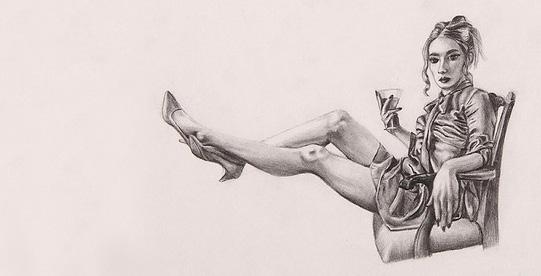
Contrapoints
again, fingerless gloved hand hovering over the Cadillac’s handle.
“Well, are you gonna get in or should I keep driving?”
The man got in the car, careful not to transfer any of the mud stains on his pants to the leather seats of the Fleetwood. They drove in silence until Beatrice reached a station the man had indicated was “far enough for the old lady to take him.”As he climbed out, Beatrice reached in her purse and handed him some loose bills that had been tucked under wads of crumpled tissues and paper-wrapped-expired cough drops.
“I don’t need your money, old bag,” the man smiled, the insult sounding almost affectionate.
“I like your coat,” Beatrice replied, and drove off.
From that night on, Beatrice, the insomniac do-gooder, began to keep a bucket labeled “Gas Money.” She took a handful from it, zipped it in her purse, and drove restlessly until she found a hitchhiker. Some nights, when dawn began to break over the highway’s gray cement arches and road, she returned home the opposite of empty handed, deposited the cash back in the bucket, and hoped for better luck the next night.
She never forgot her unofficial fares, the travelers that took refuge in her front seat. Beatrice never learned anyone’s real name. It was safer that way, or at least more distant, as she closed herself within a two-foot reach of strangers. Some of them were silent, with shame or fear or sorrow or numbness. She could never quite tell. Then there were the ones who spoke incessantly. Her favorite had to be the teenage girl she had nicknamed “Talk-Your-Ear-OffTammy.”
“I just love autumn, it must be my favorite season. The leaves, the battle between warm and cold, the apple cider and pumpkin pie; my mom makes the best pumpkin pie.” It was when she paused after every mention of her mother that Beatrice thought Tammy was neglecting the past tense. Beatrice was silent for most of the fare, and Tammy was like an unreliable engine: suddenly it fired at all cylinders, fizzled out, backfired, and accelerated again. The girl had silent hiccups or something, air bubbles that broke up her voiced thoughts.
When Beatrice pulled in front of a library as the sun began to draw lines through the sky, she scrawled “For Pumpkin Pie” on an envelope, sealed a couple of bills inside, and slipped it into Tammy’s unzipped pocket.
Then there was Roosevelt and his son,
Graphite
Rachel Kessler-Weinstein
JFK. Beatrice named them that because they looked absolutely presidential with their white teeth and sausage fingers, pointing this way and that with scraped-together conviction.
“My wife is still in Venezuela, but I am going to climb my way to the top at this corporate office, just you wait, and by then we’ll have enough for her to apply for a visa and we will all be together by next Christmas!” Roosevelt said, his accent catching on his “j’s” like velcro on wool socks. When Beatrice left them outside of a windowless factory building, she handed JFK an envelope marked “For Visas and Next Christmas.” He was teething on its edge as he and Roosevelt headed for the offices inside just as night began to fall. Beatrice hoped JFK wouldn’t drop it and wished she had brought more “Gas Money” along with her that particular day.
One fare had left ashes on her seat. She
called this one “Silent Stephen.” He had been dressed in a business suit that was four sizes too large and reeked of moth balls. His tie was tied around his neck, not the collar of his shirt. She had made the mistake of joking, “That must be your father’s suit,” before she noticed the urn. He scratched at his arms nervously, twitching in the passenger seat. They had driven only a few miles before he began to scratch at his arms so aggressively that he needed to pull over, climb out of the car, and tear at his skin with dirty fingernails while frantically bouncing around. His arms looked like festering red bugbites, hives erupting in bruise like depth over his wrists and hands. When Beatrice had asked if he was climbing back in, he had simply started tugging at his hair until it came from his scalp in clumps. The urn he had been clutching for half the ride and had abandoned on the seat, when he began his manic itching, leaked bits of black dust,
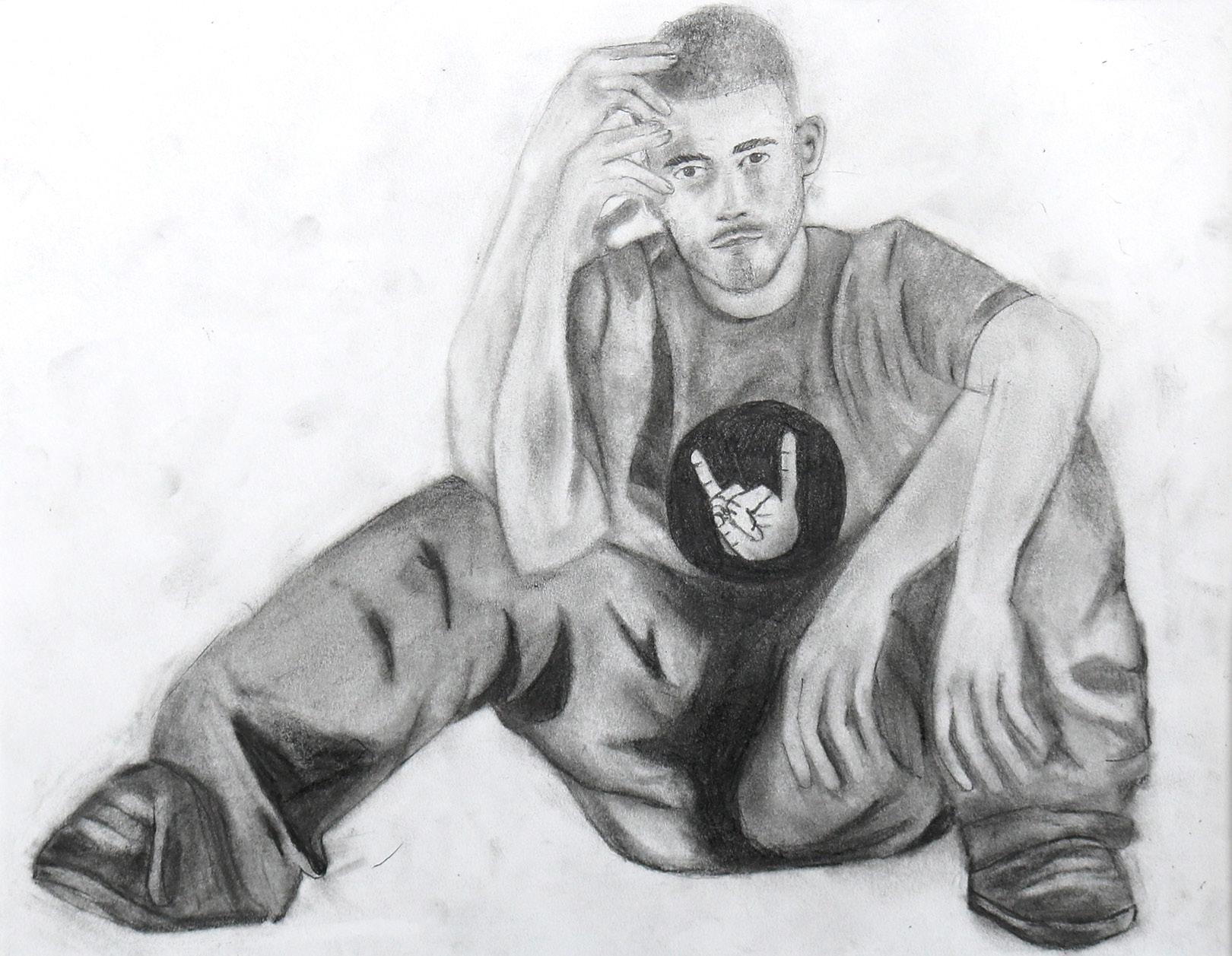
Pensive Graphite Faustine Ainsworth
Vulnerability
Graphite
Faustine Ainsworth
which he swept at with bloodied fingers before running with the urn and leaping over the highway barrier. Beatrice had to get out to close his door, which ached something awful on her knee, and turned for home early that night at 1:39 a.m.
Beatrice named them that because they looked absolutely presidential with their white teeth and sausage fingers, pointing this way and that with scraped-together conviction.
Aside from the usual uneasiness that accompanied the stranger’s in Beatrice’s car, she had only one threatening encounter. The girl that accepted the ride was wearing an old Cubs jersey, and Beatrice suspected that every bone in the girl’s body was magnetically drawn to the city passing on the right side of the car as she leaned herself as far from Beatrice
as possible. When they reached an overpass, the girl twitched out of her collapsed state as she withdrew a switchblade from the band of her jeans. Beatrice slowed the car as the silver caught the light of the overhead streetlamps, briefly flashing back to the time she’d been held at gunpoint just outside the courthouse where she had spent twenty-odd years of her life. If she lived, she could tell people which administered a greater rush of adrenaline and fear as it was pointed at your heart—the gun or the knife.
“Pull over and give me your purse.”
The girl’s voice didn’t shake as the man’s had when he had held her life under the fat pad of his trigger finger. If Beatrice hadn’t been focused on the roadmarkers ahead and could see the girl, she would have noticed an utter void of human emotion in her eyes.
Beatrice did as she was told, pulling onto the shoulder next to a popped-off tire and handing the girl her purse as she put the Cadillac in park. “I suppose you want the car too?”
The girl got out, knife still pointed at Beatrice, a compass needle pointing true North. “Can’t drive stick.” As the girl walked off into the night, she dragged the blade against the Cadillac’s side door, scraping the paint in bits of unfurled beige-yellow that hung from the car like too-thin party streamers. A car swung out from the shadows and the girl got in. Beatrice heard chanting and whooping inside. As the car drove by where Beatrice sat, breathing and trying to steady her hands by clutching the steering wheel in white-knuckled anger, the girl smiled at her from the wound-down window and spat before the driver peeled off. Beatrice would later say that both the knife and gun were horrifying, one made of hot black metal and distance, the other silver cold and personal. Maybe the blade was scarier because Beatrice had more to lose. Back then, she had a husband and clients. Now, she had her fares to look out for. Beatrice decided to spend the next few nights in bed. Each fare was uniquely painful and fulfilling, and Beatrice often felt like she didn’t have enough tread on her tires to find everyone she needed to. So she began to keep a journal, writing down the coined names of each hitch-
hiker. They didn’t quite blend together after time, but rather they distorted into the emotions she had felt and hidden when they had fogged up the glass of her Cadillac’s windows as they leaned against them, looking at where they had been standing, their streetlamp-lit section of night. The flickering bulbs illuminated them as they stood singularly against the stark shadows of what they had left behind.
It was on her last fare that she picked up a girl with ribbons in her hair, the girl she deemed “Baby Bea” even though she was at least nineteen.
Baby Bea tugged at her necklace every four minutes, opening the locket, staring at the black and white photograph within before clasping it shut. Her leg bounced up and down, tearing her nylon tights at the toes.
“So, why did you pick me up?” Baby Bea asked in a voice that Beatrice guessed was an imitation of Baby Bea’s mothers.
“I pick everyone up,” Beatrice answered,
signaling as she changed lanes for the next exit. Baby Bea unclasped and reclasped her locket two more times or for eight more minutes before laughing: “You pick everyone up. Little old lady like you? You are going to get yourself killed.”
Beatrice supposed the girl didn’t mean to sound snarky, but her late husband’s voice nagged at the back of her skull. She returned the sarcasm: “Little girl like you? You are going to get yourself killed.”
Baby Bea faced the window for a while, winding the handle to shift the window up and down, suctioning in wind and forcing it out.
“Stop that, you’ll break my car,” said Beatrice as she took the exit and headed toward the twenty-four-hour café the girl had requested a ride to. They rode in silence, the window firmly shut on the passenger side, the locket hinge clicking every once in a while. For once the silence felt pointed and sharp, like it was holding a rag over her mouth and suffocating her. Beatrice needed it to end before her lungs
gave out.
“You asked why I picked you up? I pick everyone up. Do you wanna know why I pick everyone up?” Elvis sang in the background while Beatrice waited for the girl to nod. When Baby Bea did, Beatrice sighed, “I pick everyone up because I was picked up once, by a college professor named Saul or Sampson or something. He gave me two things: his old flannel coat, which I later sent off to Goodwill, and some pain-in-theass advice. He told me what I’m going to tell you: running doesn’t fix anything. Now, this advice does not apply to everyone running. Trust me, I see a lot of runners, American and non-American refugees fleeing to different corners and potholes in America, and most of them have good reasons to run, which they might tell you themselves, or their black-bruised eyes, needle marks, gang tattoos, and black church clothes might. You have someone in that locket. Alive or dead?”
Baby Bea swallowed. “Alive.”
“Then why the hell are you running?”
“I’m too young to be a mother,” Baby Bea kept her hand around the locket.
“And I’m too old to be a god damn taxi driver,” Beatrice responded, though Baby Bea didn’t know that Beatrice had stolen this line from the professor who had delivered it to her. “If you keep running, you are a coward. Most people run from death, not life. Count yourself lucky.” They pulled up to the cafe, but Baby Bea made no move to get out of the car.
“That’s bullshit,” the young girl whispered, tugging at the locket until the clasp broke. She stared at the ruptured metal links of the necklace as it laced around her wrist. She quickly wrapped it around her hand to make a makeshift bracelet.
“Maybe. I can’t claim to be all-knowing. Hell, I’m old, not God,” Beatrice took off her scarf as the car warmed with their collective breaths.
“What were you running from?” Baby Bea asked, the neon sign of the cafe coloring her grimace red.
“Nothing. I was running just to run.” The lie was obvious to them both. Baby Bea slid in her seat and began to get out of the car. Beatrice reached for an envelope and some cash, handing it to the girl with ribbons in her hair and the broken locket in her hand. This envelope was simply
labeled “Gas Money.” Baby Bea stared at the hunched old woman in the driver’s seat. “I don’t have a car.” Beatrice turned back to the road, restarting the Cadillac’s engine. The door slammed closed as Baby Bea headed inside the cafe, shaking her head about the crazy lady in the Fleetwood Cadillac. Beatrice reached inside her glove box, pulled out an age-faded envelope with the words “Gas Money” written in a college professor’s cursive and whispered into the envelope a verbal letter:
“Thank you for the gas money, Saul or Sampson or something. I think this will be my last fare.”
She placed the envelope on the dashboard and parked a few blocks from the twenty-fourhour café. She glanced up as Baby Bea hurried out of the building and waited for another driver. Beatrice watched as Baby Bea’s new ride took off in the direction she had come from and smiled. On the drive home, Beatrice Withersby sputtered and shut down as she ran out of gasoline.
Margot DeLaney received an odd phone call that someone named Beatrice Withersby had died. The person on the other end paused, waiting for Margot to cry out or make some expression of grief. Margot simply said, “Who?”
As it turned out, this Mrs. Withersby had left Margot something in her last will and testament, which Margot DeLaney was preparing to argue was a mistake of some sort when the person on the line informed her she had been left a 1978, beige-yellow Fleetwood Cadillac. Margot collapsed in a rocking chair in her house’s old nursery, which had recently been converted into an at home gym. How had Beatrice found her? Missing posters?
The person on the other line became impatient. “Miss DeLaney? Should I inform my boss that there’s been a mix-up?”
“No, no,” said Margot, “there hasn’t been a mistake. I will come pick up the car on Tuesday.”
“One more thing, Miss DeLaney.”
“Yes?”
“Do you know what Mrs. Withersby meant by labeling the will ‘Gas Money’?”
WHAT USED TO BE
Nadia Scharfstein
I imagine a black void that swallows all to infinity, celestial bodies sweeping in rapid orbit until the giant globes have narrowed and stretched into strands of what used to be.
Blue and red tinted stars come closer to the looming lull of the abyss. Now, no longer stars but reminders of the past, the elements that composed them are no longer viable.
The remains of the universe are a broken lightbulb, crushed pieces of matter spread about the microcosm, a mashedup mosaic of light, and a neverending shadow of corrupted faith.
The final rays fade, twist into fractured orbs as they flee towards the gap in the universe: the last pieces of matter, past hopes of my imagination.
No longer can I separate the empty space from the pit that deprived the universe of light. Everything is dark; everything is gone, shattered fragments of my life. I imagine a black void exploding, its chasm too small to hold
the universe. Not a single particle falls to its normal state. What is released is broken, wrecked, scattered debris of what used to be.
Inversion
Acrylic Frances Hodson
Figures in Light Graphite
Rachel Kessler-Weinstein
CASCADE
Mattie Sullivan
human movement, subtle but great, a glance around the shoulder, follow the crowd, must stay in this state. a blink and a breath that keep us alive, how in the world do we plan to thrive? tearing from the path, a shuffle of feet, balance shaken, they saw defeat. a look around, conscious of others a subtle turn, tearing apart, heads shift.
uniform and stiff turned into an opposite, we can feel the change stunning the room, stillness turned into destined doom. the wave starts to hit, but we follow the rules. we keep still as the terror looms. you’ve broken the rules of our group, follow our laws, and you will conclude staying still shifts the minds, from freedom to focus a breath and a glance to keep in check. human movement is something to fret.
you know it’s been broken, our movement to fault, terror swiftly floods our thoughts. how could you change and break our pact? leading to doom and memory of the past. it all started with a simple promise. everything you’ve done has turned into mist. we should have known not to trust a human like you. your need for individuality tends to climb through.
maybe it was to conform, to follow the rules, but the promise was to trust, and simply follow through. oh, how you’ve broken the world and our simple pact.
terror to come and no peace intact. I wish you could have followed our rules, now be defiled by empty rib cages and ghouls. but the human mind took over and was cruel. if there were a next time, please trust and see, this danger restrains and leaves its debris.
arms rise, and bodies contract, trying to hide from the inevitable effect. one or two hits and crumbles to the floor, fallen soldiers of our worries are free once more. we come together to shelter from what looms, but we find the rules are only shattered once more. us fragile humans, destined to fail. if only we had followed our ancestors’ trail.
Cobalt Conscience
Acrylic Ruby Jeschke
THE INTERSECTION BETWEEN TIME AND SPACE
Samantha Lehman
There’s a point where the intersection between time and space becomes overbearing to the senses— when past whispers, present memories, and future demands collide into a collection of unsculpted quartz that is dropped from the constellations into the mind far below so that light could never keep up. If time folds itself correctly, the body bends in conjunction, too low to stand without the reversal of gravity but positioned so that it cannot sink like a stone in a lake— or in a grave—at quite this moment. Each second is a thousand centuries; selves pile onto selves. That is to know the end is coming.
Around the Roses
Graphite and colored pencil
Anthony Sanchez
Ribbon Figure
Acrylic
Mei Mei Johnson
SPINES
“Look,” she yells, “if we were talking three, I could do that, but eight? No way in Hell.”
“We’re not in Hell,” he shouts back. “Not for certain, at least.”
He’s missing the point again. His aim is actually quite extraordinary; he just never aims for what she wants him to.
“Besides,” he says, “I haven’t even told you what the eight things are yet.”
She straightens her spine, irked. (She’s told she only has the one, but she often feels there are six more spines hiding within her, creaking to remind her she’ll lose them all someday, to age or illness or the distance between her points and his.) (The only benefit of having seven spines is how they extend the body, allowing it to hit both its point and someone else’s.)
(She’ll endure some creaking, she supposes, if it’s the reason she can reach him.)
“Doesn’t matter,” she says, following his voice, attaching her fourth spine to the door jamb. “Eight is too many. I have too much on my plate.” (Never true; she only owns bowls. See, now she’s missing the point. It happens, in this pointless space between her point and his.) She peels out another spine, hooks it to the chain trailing behind her.
She finds him in the kitchen, asking if there might be eight eggs in the fridge in the garage, and she gives a boneless shrug and goes to investigate, and he only really needs five but he did the math wrong double-and-a-half-ing the recipe, and it’s another point missed and another bone left clinging alone to a door jamb, and they make eggy cake and hold hands without any pointlessness between them, and when they hug, their rib cages ache to join her spines outside their bodies so that they might better touch hearts.
PERSONA POEM 2,800
Ella Houden
I should not have loved you in death. In dying, we buried ourselves in wheat
And barley caskets, the smell of sun-
Tarnished stalks and seedlings inhaled
As dust-crushed pollen, a reprieve
From the inhalation of smoke
And the burning of clay.
As fire found its way from soldier’s
Matches and slate stones struck By their knives, it embraced
Everything but the mud walls, The outskirts of the citadel
Unscathed as the people caught
Sparks in their hair.
Hasanlu, to tell, Hasanlu, the hill, Persian words melt in the golden
Bowl carved with stagnant men.
Gold is the collision of neutron stars, And they marred it to engrave donkeys
And trade merchants, ruined
As it depicts people who remind Me of you.
Our lungs spoke in the language
Of ash as the fire dwindled
From orange to black in the air.
In the moments that breathing
Felt like stars colliding, gilding
Our airways gold. From beneath
My grain kernel shroud my hand
Met the whip-scarred skin of your cheek.
When breath became a memory,
I greedily sought it from your lips, Finding none. I died trapped
In a tomb not of plaster walls, An airless and wheat-filled barrel, But of your flesh.
When our skin cooled, then rotted Away, chewed by field mice
And earthworms, I was stranded. For then, we were bones, calcium
Deposits in the shape of skeletons, femurs
Bending, finding each other in the angles
Of full-bodied grasp.
Our arms are indiscernible, yours is mine, Or is mine yours? They become bridges
To ants as they cross from my skeleton
To your yellowed one, carrying blackberry
Leaves on their backs.
On my side, my ribs caved, the bones
Caging buckwheat dust and air where smoke
Once was. Yours remains upright, bent In the same curve your fingers
Used to when you ran them over dyed Fox fur string.
When the plaster lid of the grain bin
Is removed by the yellow arm of metal Bent in phantom limb, and debris breaks
A piece of your skull, I wish I had the abdomen
To laugh. You caged us in this catacomb, Expecting me to love you for nearly three
Thousand years. You did not understand There is no love in death.
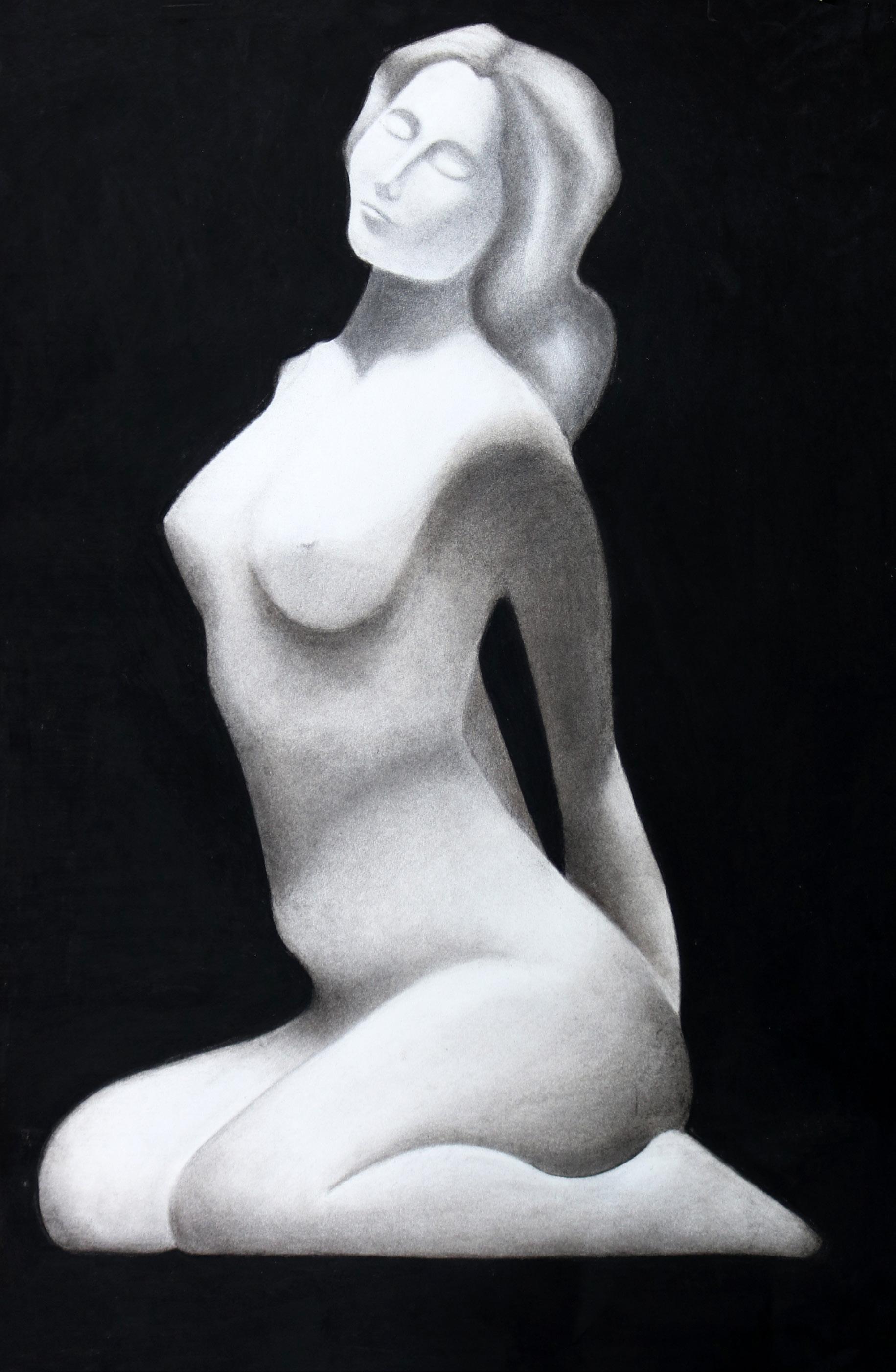
Statuette
Graphite
Charlotte Morris
PLAGUE
Kit Stevens
It’s nicer now the village is empty. I am full, and warm, and alone. My stomach no longer swims into my throat and strangles me. I have enough smoked and salted lamb piled in the neighbor’s shack to last me three seasons. The Lord and Lady do not come to take it. If the price of satisfaction is loneliness, so be it. I am more than willing to pay.
The first to go was Edith Carpenter’s newborn, unchristened son. Oh how he shrieked in the mid-night, waking me in the wee hours. At two weeks old, he stopped and did not start again. Edith ran to the apothecary at dawn, explained on the exhale how her unchristened son was turning all black and coal-spotted. The apothecary sent her away. The cold that had come and settled over the village still hadn’t picked up the courage to leave. The crop-stems were freezing into daggers and withering with the melt. Empty bodies were starting to pile. One child more was not a considerable loss. She took her unchristened son to the bishop. She wanted him to go straight on up to the Lord, a white soul unblemished by the necessary evils of living. So occupied was she with thinking up a Christian name, she didn’t notice he was dead as a stone ‘til the bishop told her. He said he couldn’t christen a soul that’s no longer bound to a body. She begged him, told him she could still hear a heartbeat. At his refusal, she lunged at the baptismal font, grasping in her outstretched hand a few drops of holy water. They slithered through her fingers, barely making it onto the forehead of the child now called Will. I watched her return home in the early light, dragging her feet in the frozen dirt. At least it was quiet.
After Will, the young and the ancient began dropping as quickly as rabbits are born. We saw how the demon jumped from the dying to the next closest host. Once someone allowed it into their lungs, the rest of their family was soon to follow.
Mother showed us the most effective way to burn bodies. Elanor up the road suggested we
burn down the houses of the sick as well, with their families safely locked inside.
After Will, the young and the ancient began dropping as quickly as rabbits are born.
For many weeks, my family seemed to be immune to the spreading curse. Back then, it was me, Mother, Grandfather, Richard, Iohannes, Maud, and Lucifer the barn cat. The seven of us slept hunched together like crooked birds in our one-room cruck house. When Father was alive, he’d built the place of wattle and daub, shaping manure into pungent walls that now smelled of home. Back then we were hungry. Mother cooked us pottage and vegetables in the hammered-tin pot, the only metal in our home, save the axe. After being boiled to cleanliness, very little of the cabbage remained. Mother added cedar wood to the water to give it a heartier taste. More to the young, less to the old, bones to the cat. As I drifted off to sleep between Maud and Iohannes, I’d stare at the moonlight reflecting off the pot, crossing my eyes until I saw silver waves shimmering above me.
As soon as Edith told Mother of Will’s affliction, Mother commanded us not to go out, not even to church. Grandfather scoffed at this. His flesh was as brittle as oak bark and his spirit as pious as a false prophet. His bitterness ensured that Lucifer was his closest and only companion. He told us our faithlessness was the reason death had ridden in on his rat-horse in the first place. Prayer, he announced, was the only solution. His argument might have held its holy water if the bishop hadn’t died days before. Poetically, justly, it was he who invited the demon through the doorway. When the first signs appeared, Mother immediately banished him to the lean-to where we kept the wood, throwing the flea-ridden Lucifer out after him. Every night, (night only, for one meal is more than enough for a dead man) she slipped his food under a loose board. Once she
had gone, I’d creep out to take a peek at Grandfather through a knothole, just to see how he was progressing. It started with shaking and chill, then sparkling droplets of blood in his cough. Soon, he was covered in the ashen fingerprints of boils. More and more of his extremities were overtaken by an ever-growing, blackening wood. His fingers fell off. One night, taking up my post at the knothole, I noticed that Grandfather stopped moving. He lay still, propped up against the wood pile, his dingy hair spread about him like a halo. Lucifer sat on his chest, purring. His lampeyes focused upon me, accusatory, as if I were the one to cool his warm seat.
Maud, the youngest, was next. That was a pity. I liked Maud. She and I would play with knuckle bones or straw dolls, inventing the grandest stories. She was a princess who lived in the Lord and Lady’s castle, with many servants and an endless supply of lamb-on-the-bone. She placed the pot atop her feathery hair as a crown, held the axe in one hand and a river stone in the other to be her orb and scepter. She then would prance about the fields, proclaiming the end of work and hunger and demanding the frost to depart. Once, she attempted to anoint Lucifer as her kingly steed, but the tattered gray cat escaped before she could snatch it. I was her court executioner.
game of balance: too many sons, and you couldn’t feed them. Too few, and there would be little chance of having at least one live to adulthood.
It might be unchristian of me to say so, but when Richard, then Iohannes succumbed to the Death, I didn’t really mind. They never agreed to play with me. Though two years apart, their beetle-eyed faces were nearly identical. They were like bookends in that they served little use as anything other than furniture. Even so, they were mother’s best hope; they were the most likely to survive. Mother played a teetering
The night Iohannes died, Mother went outside and killed the last of the sheep with the firewood axe. I could hear the hacking through the shallow walls, pounding out a heartbeat in the darkness. We spent the night roasting and salting the piles of meat, she tending the fire and I tending the salt. With just Mother and me, there was enough food to go around. After returning from the fields, mother would play with me as much as I wanted. She’d tell me any story I asked to hear. Every night I could curl up next to her without the nuisance of my brothers
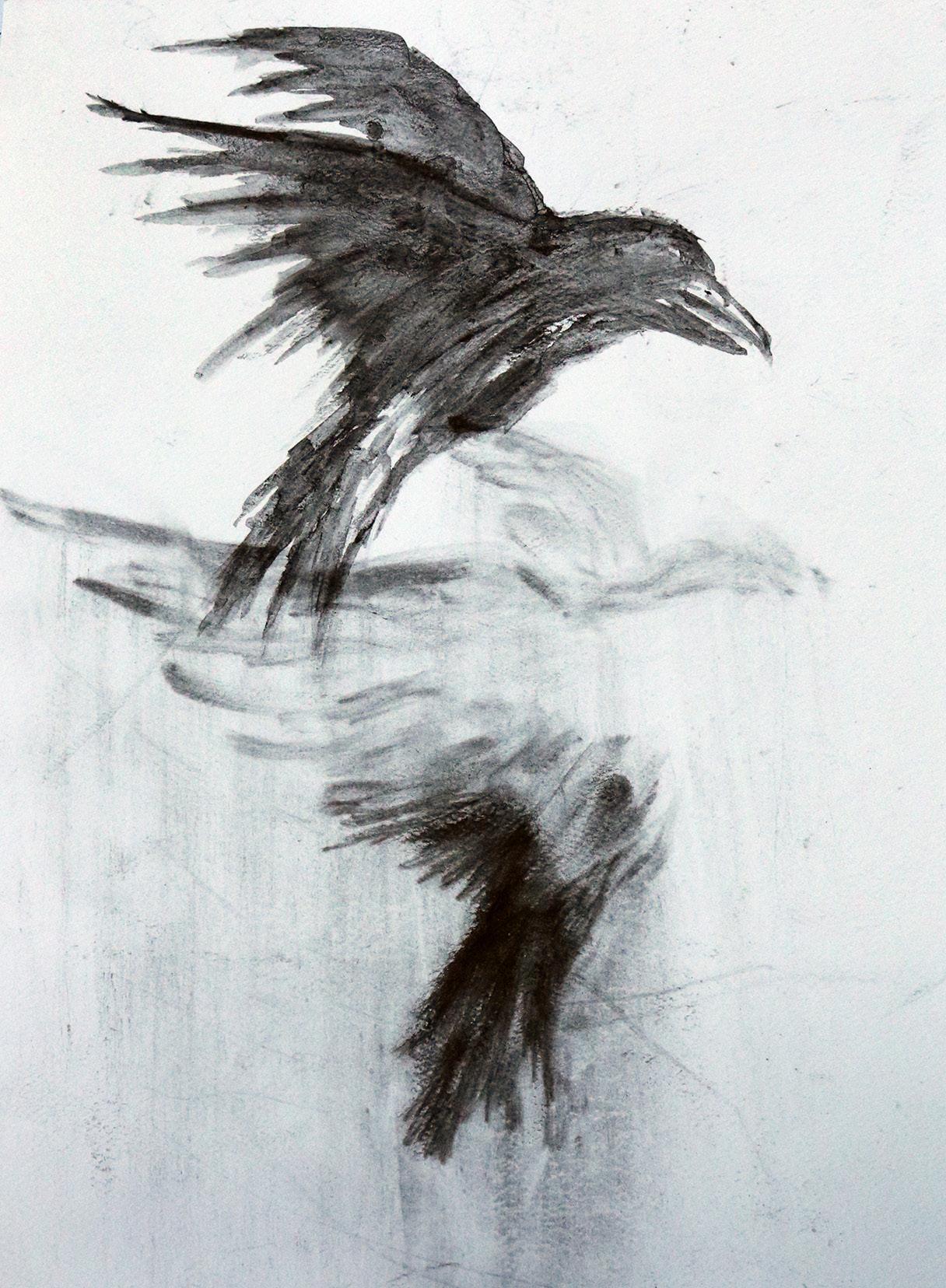
Crow Study Charcoal Dillon Fang
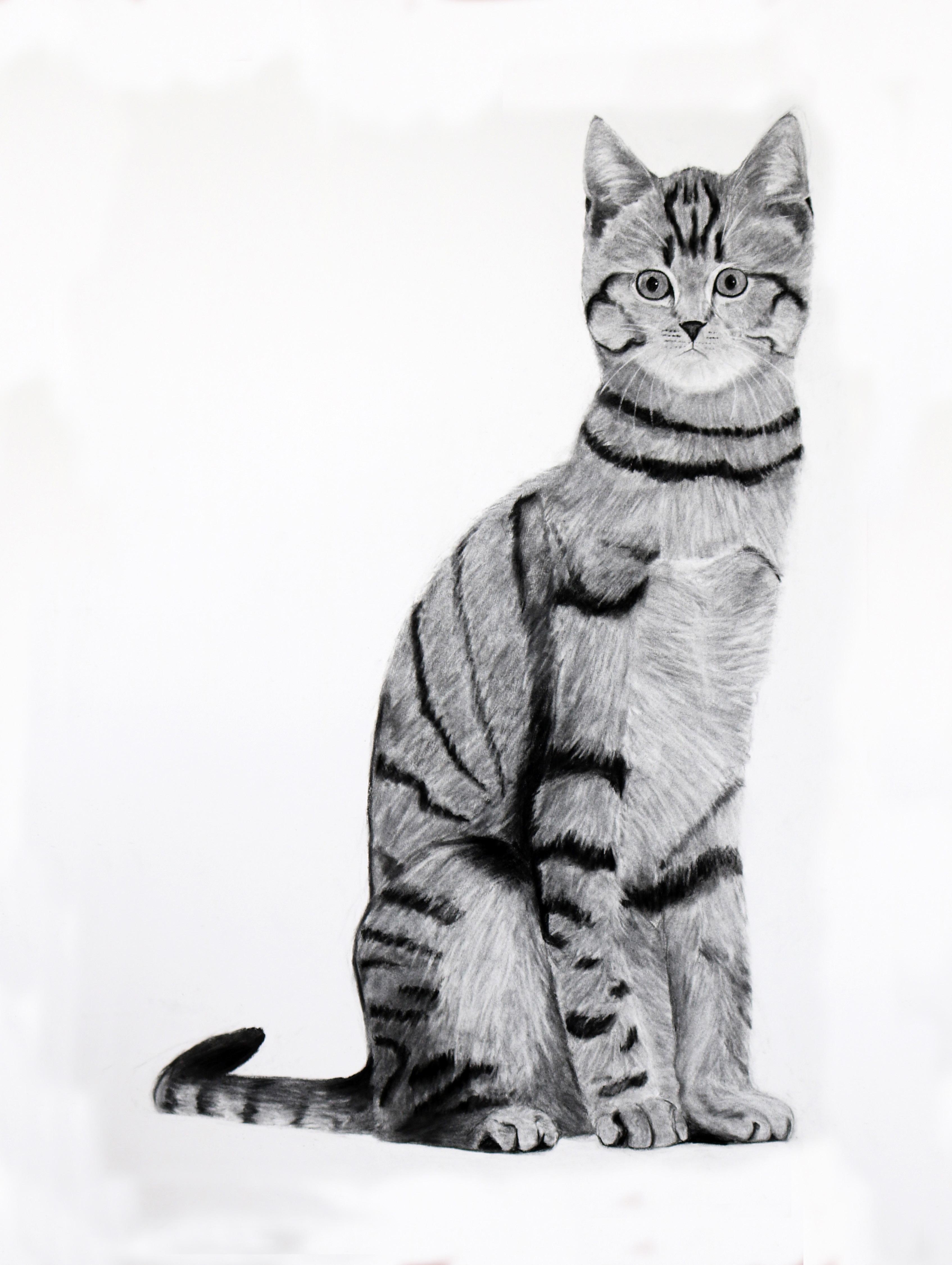
Grimalkin Graphite
Deja Shirkey
in the way. Now I was an only child. Now I was more valuable than salt.
At last, Mother died too, as I knew she would. I awoke to her stiff as new linen under my outstretched arm. I had seen the black fingers start to creep around her neck, but I ignored them, hoping to starve them off by giving them no fear to feast upon. Just as well she died, I suppose. Mother’s spirit was dull from chopping.
I dragged her body outside and burned it in the way she had taught me. I threw her ashes to the chilling wind, not caring where they landed, and began to walk. With each step, I dulled another sliver of grief.
I found myself outside of Edith’s slowlytilting shack. It was one room, like ours—like mine. I knocked to no answer. I thrust open the door and walked inside, covering my reddened face with a kerchief. As I anticipated, Edith lay unmoving on the hardened dirt floor, weeds writhing up through the soil to caress her face. I carefully stepped over her and started rummaging through her cupboard. I helped myself to her preserves, making sure to drench the jars in vinegar before touching them; she had rows of brilliant green beans and strawberries so red they seemed to catch the shelf aflame.
A spark of panicking excitement was begging to burn the back of my throat. I sprinted to the next house, knocked, and entered without waiting for an answer. No one there either, at least no one alive enough to mind my stealing their carving knife. I went from house to empty house adding to my plunder, telling myself I was searching for food. By the fifth house, I stopped knocking. Once I reached the last home in the village, devoid of life like all the others, I allowed myself to laugh. It was a harsh, doglike laugh, the kind of laugh you hurl violently upwards hoping it hits God. I snatched up a bale of golden wheat sitting tantalizingly on a shelf and twirled round and round with it, a drunken dancer with a corpse for a partner. I was alone.
At least momentarily. A voice sounded from behind me. It was a voice dark and dripping as water scraped from the bottom of a drying well.
“You shouldn’t take from the dead, lass.
They might be watching.”
It was a harsh, dog-like laugh, the kind of laugh you hurl violently upwards hoping it hits God.
I whirled around, brandishing the wheat like a saber. At first I saw no one. I glanced down. At my feet sat Lucifer, rat-tailed and moon-eyed. Only mildly surprised, I asked him to repeat himself. After all, in the End of Days, animals speaking and walking two-legged is to be expected. I was more surprised that such a sonorous voice could belong to the dilapidated cat.
“I said, you shouldn’t steal from the dead. At least not if they don’t deserve it.”
“Well then, who does?” I asked.
“Has it not yet occurred to you, child? Those who have most deserve it least.”
Ah, the Lord and Lady.
“They are dead then?”
I did not pause to wonder why the cat would know this. It seemed obvious to me that such a creature would take note of the presence of death.
“Of course they are,” Lucifer replied. “Inferior breeding, you know. Soft-bellied creatures cannot fend for themselves in such times.”
Whether or not it came from a cat, the suggestion was a good one. I stashed my plunder beneath a floorboard and moved towards the doorless entry way of the shanty. I glanced behind me. Lucifer followed in my wake, limping on his creaking hind legs.
The castle was shockingly intact, the stone untouched by the tearing hand of time that so easily destroyed our earthen walls. Lucifer and I walked up the long drive towards the entrance, passing under the curtain wall and into the keep. I had never been this close to the Lord’s home before. We serfs were to stay in the fields lest we bring disease. In the end it mattered not. Lucifer told me the Lord’s household was one of the first to succumb. The gilded doors were flung open and sagging from their hinges, patterned by divots where ornate filigree had once lain. The cat
and I stepped through the threshold. Lucifer’s eyes waxed into black pools as they adjusted to the sudden darkness. Mine adjusted slower, revealing the upturned entry hall. I cautiously made my way through, careful to avoid tripping on the fragments of oaken furniture that littered the floor. Lucifer stalked ahead, easily winding through the detritus. My foot kicked something soft. Fearing the worst, I peered down. Only a tapestry. The cloth was unraveling where someone had picked out the blue and purple threads, leaving the cheaper red and yellow behind. I spread it out on the floor. The Lord’s face stared back. He was stretched and warped on the fraying fabric, blue eyes gouged out by scavengers.
We passed through the hall and into the chapel on the right. The walls were covered in claw-like scratches where gold-leaf paint had been scraped from a fresco. The scavengers had reached impressively high, even managing to pluck the jewels from the chandelier as if it were a laden tree. Beneath it, the ancient crypt of some long dead Lord lay with lid uprooted. I approached it slowly. Lucifer perched himself on the headpiece to peer down into the casket. To his disappointment, it was empty. Bones make for flavorful broth.
“Pity, I hoped they would leave the crown,” I said.
“I hoped they would leave the bones,” the cat replied.
We returned to the hall, this time turning
left away from the chapel. When we entered the adjoining room, it became immediately apparent that our journey to the castle had not been in vain. The tall, windowed chamber was filled with leather-bound books. The bandits had left the shelves mostly intact. While books are valuable, they are of little use if there is no aristocracy left to sell them to. It’s not as if we serfs could read them anyway. I had always wanted to learn to read, but no one in the village knew how; that is, except the bishop, and he had no desire to teach us. When I was supposed to focus on his sermon, I would instead scrutinize his eyes and mouth, trying to discern how he translated the mess of hash marks in his bible into speech. I have no doubt I would have broken into the parsonage if I had any want to read the bible. Luckily for my still-attached head, I did not. The only reason I wanted to read was to be entertained, and the Latin Bible fundamentally lacked such qualities. Foreseeing boredom in my future with no one but me in the village, I picked up an armful of books. Boredom is but a little death, but it can kill nonetheless.
“Can you read, Lucifer?” I asked the cat. “Of course I can read. What kind of cat do you mistake me for?”
“Cats cannot read,” I informed him, not sure what I was hoping to achieve. If a cat can read, there is little point in telling it otherwise. “Exactly,” Lucifer responded, “Cats cannot read.”
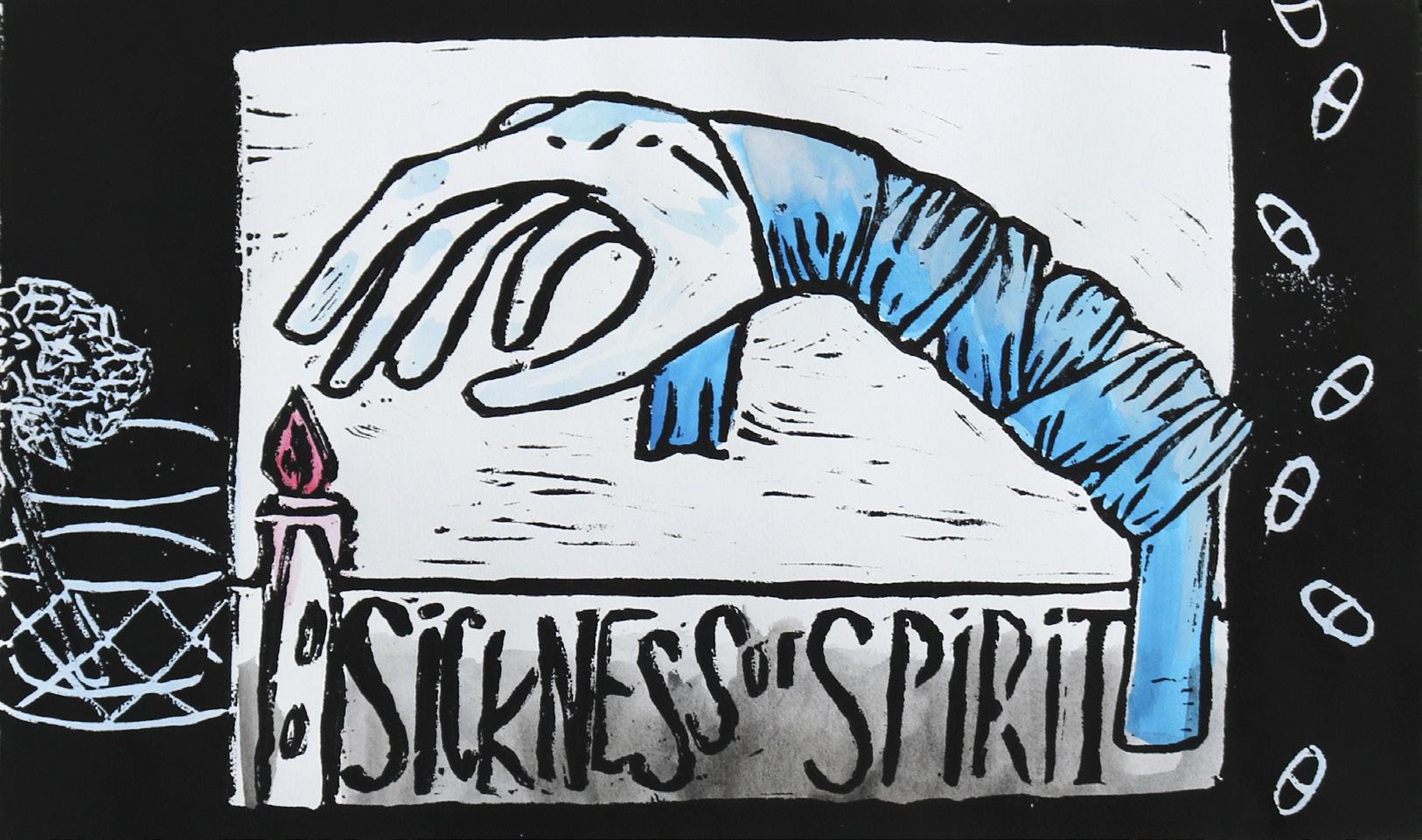
Sickness Print
Annie Nash
I exited the castle and trudged back southward, pondering what Lucifer meant by “cats cannot read.” The sun was growing steadily lower in the sky, dissipating into silken grayness at the horizon. It occurred to me that just this morning, Mother had swung her final axe and died. It seemed distant now, as if the presence of other humans was only a fading hallucination. I paged through my brain in search of any emotion but found none. It seems that feeling is easily worn through.
Upon arriving at my shack, I deposited the books in a heap atop the woodpile. I strode inside, shutting the door in Lucifer’s face before he could sneak in after me.
“Well that is rather impolite,” he said, muffled by the door.
I opened the door a crack.
“You have fleas, cat. Do you want me to sicken and die like all the others?”
He flicked his ear, looking offended.
“I have no fleas.”
“How’s that then? Everything’s got fleas.”
“I drowned them.”
Strange cat, this. Jumps in the water to drown his fleas. And reads. Allegedly.
“I’m going to frost out here child. Let me in, or would you rather go back to being bored and alone?”
A solid line of reasoning. I closed the door once more and reached for my vinegar bottle. I reopened the door and let the cat slither through. Just as he entered, I poured the vinegar, drenching him. That would take care of fleas, existent or not. Lucifer hissed and spiked his tail, turning his lamp-eyes on me in disgust.
“I told you, I have no fleas,” he spat.
“I don’t trust a cat who says he’s jumped in water. Much less a cat who says anything at all,” I replied.
“Again, you assume I am a cat.”
And we came full circle.
“Well then, what are you?” I asked point blank.
Lucifer flattened his ears, looking somewhat put out. Clearly he’d wanted to continue playing his game of sinister hints.
“You tell me. You named me, after all,” he said, trying to salvage some of his mystery.
I had named him. I found Lucifer as a kitten, freezing underneath the woodpile. Even then, he appeared ancient, as if he’d been tossed in the butter churn before even being born. Mother allowed me to feed him some broth, saying a mouser would be useful. When I reached out to try to pat his scruffy head, he bit me. That was unsurprising. At my yelp, Grandfather chucked his rosary at me, telling me to “sod off, in the name of God.” This was even less surprising. Grandfather had a penchant for crusading. The beads clattered to the ground, scaring the cat. He hissed and batted at the string. He took it in his mouth and ripped it apart. “Lucifer! Get thee back!” Grandfather had yelled. Out of spite, I decided to call the cat Lucifer from then on. In the same spirit, Lucifer decided that Grandfather was to be his favorite person.
“So you claim to be the devil, then? Don’t you think that’s a bit high and mighty—or rather low and mighty—coming from a barn cat?” I asked sarcastically.
“Evil takes many forms.”
“Yea, it does, but I do not think you are one of them. Biting children and torturing fleas can hardly be called considerable evils.”
“I killed your Grandfather. It was I who brought the plague into his lungs.”
“Perhaps he needed killing. I daresay he’s held on long enough,” I said, thinking distastefully of the cross old man.
“Names have power, child. That is simply my point,” Lucifer responded, ignoring my previous comment.
We spent many a day like this, entrenched in the back-and-forth. I’d go out to the fields and cultivate my little patch of land. There was no need for more than 30 squared poles with only the two of us. I split the plot into three, planting barley in the first row, peas and tomatoes in the second, and leaving the third fallow. Each day, I watered and tended to my small square of life. Lucifer would follow at my heels, making snide remarks. His presence was often irritating, but anything was better than silence.
At night, I’d struggle silently with the stolen books. No matter what I did, I couldn’t make the lines on the page march in order. They
remained immobile, inscrutable claw marks that scratched themselves into my eyes. Lucifer would watch me while I worked, plainly thinking himself superior for his purported reading ability. Finally, one night, I gave in and asked him for guidance. The cat’s face sprouted into a menacing grin.
“My help? Me, the mangy cat? How shocking,” he said, attempting to roll his eyes. “Very well, I suppose I could be put upon to lend a—”
“What, a hand? You haven’t got any,” I interjected. Lucifer scoffed and ignored my comment. He jumped up on the rickety kitchen table and peered down at the small leatherbound book.
“Let’s see, this one is about a girl-child who lives in a village. She’s so bored, she thinks she’ll go mad. So one night, she makes herself a little friend out of clay. She holds it to the east wind to give it breath and places burning embers in its eyes to give it life.”
I doubted this was truly the story written, but it matched well enough with the somber charcoal drawings littering the borders of the pages.
“She has so much fun with her little clay friend. They eat and talk and menace. Little Friend has such wonderful ideas.” Lucifer was no longer looking at the page. “One day, he suggests that the girl go down to the river with her brothers. When they’ve waded in nice and deep, Little Friend tells her she should dunk them under the darkened water, just to see what happens. Maybe a little liquid in the lungs will strangle out their mean-spirited souls. Then he says that she should hold them down just a little longer, a little longer, to make sure the job is done. When they surface, he says, they will be kind. Memory makes the dead seem all the sweeter—”
“Fancy yourself a Little Friend then, eh? You are indeed little, but I doubt I’d call you a friend,” I interrupted. Lucifer flicked his tail, looking put-out.
“Just reading, just reading,” he replied.
“Reading my arse. You’re not even looking at the page. If you want to teach me, you must actually read the book.”
“Well, I may have slightly exaggerated my
ability.”
“I gathered. Not that I expected anything else from a cat.”
“For the last time, I am not a cat,” he responded, once again trying to impress.
“Well then, you’re not particularly wellversed for a demon either. I thought the devil was supposed to be possessed of ancient secrets,” I said mockingly.
“Well, well, I never said anything about demons,” he responded, trying to keep up his secretive airs.
I sighed and turned away. After several months with this beast, I was tiring of his “what are you” game.
When I woke the following morning, I couldn’t find head nor crooked tail of Lucifer. This was uncommon. Typically, he liked to wake me in the mornings with his infernal scrolling, just to prove a point. I searched the wood pile to no luck, then shrugged and continued out to the fields. Perhaps he’d gone to some puddle to drown his fleas. I began to work but became quickly aware of the silence devouring my ears. The quiet started to seep into my brain, my thoughts becoming too soft, then too loud as if carried on a twisting wind. I threw down my trowel and began looking once again. I walked southward towards the main part of the village, rooting through houses in my search. It was nearing midday and it had begun to rain, but still I had not found Lucifer. I approached the last home and continued into the moor beyond. Along the path, I spotted jewels of blood staining the dry earth. Fear pounded in my chest as I followed them away from the trail at a run.
Rounding a bend, I stopped short. A giant owl, speckle-winged and razor-beaked, perched on a heather bush before me. For a moment, I stood in awe. The beast was larger than any owl I’d ever seen, big enough to fight a stork and carry off the baby in its arms. Its yellow, harvestmoon eyes shimmered even in the half-darkness of rain. My awe was only momentary, for then I saw the burgundy blood shimmering on its beak. In that beak was Lucifer.
I was not sure of my reaction. I could scream and cry for the loss of the last conscious creature other than myself. I could fall to my knees and mourn my only friend. But I could just
as easily walk away, burn bodies, scatter ashes, like I always had. I could decide with little moral resistance to cease all feeling. I remained frozen, locked in the gaze of the owl. “Decide, decide,” it taunted. Its waning eyes consumed me whole. But before I could make a decision, a sonorous
voice sounded from somewhere yet unknown. The owl opened its mouth.
“You shouldn’t mourn what isn’t dead, child.”
The Fourth Horseman
TOO LATE
Pia Piccoli
I know your secrets, buried in the past. Your affairs, your lies, all in my time. You carelessly glimpse at me, Running around with your bags, Holding your children, Kissing your love. If you knew the things I know, You would take me away, Off the walls of the house You built.
My hands shift with every second; You depend on me. As you rush, I stay. As you sleep, I watch. I don’t bother you; I just contemplate, Perched up in my boundless tower, Not knowing what the next minute awaits.
I tick; you wait, Watching me, longing in your eyes. They tell me to speed up, slow down. As the door opens, You look up at me one last time, Eyes of stone, realizing what you had done. Wishing you could go back. My dear, don’t you know I don’t control the time, for I am just a clock.
The Snake Collage Mercer Paradise
Madeleine Bateman
Tree Rings
Graphite
Izzi Hill
APrivate
Watching
Rachel Kessler-Weinstein
Collage
TIME SPLITTING TIME
Caelum van Ispelen
It’s easy to tell time where I live: clocks on walls, on floors, grandfather clocks and grandfathers’ watches, engraved with waves and hydras flying, soaked in steel perspiration from sixty years’ life and ten from me, softer, aluminum.
Dust seals the band-links and bezel of a wristwatch dropped in the haste of morning, when rain dripped outside and the air glowed with tomorrow. I grasp it; chains squeak and the hand stutters to tell me it’s 6:21 when the pendulum clock reads XI. If either time, or neither, were right, the teller could not know.
Sulking in a room not entered since his end of time, I find splinters, fragments. A dog, tired, chewed them of wood as it watched the still hump on the bed, expecting, expecting another day from the bag under the quilted blankets, yet as the hour-hand turned from eight to eight, twelve to twelve, the dog still waited, indulgent chewing unended, its rhythmic gnaw sounding the metronome of waiting. The tempo sprinted and marched across the bed, though the clock’s pressing ticks chimed in line: one second, one time.
For the dog time fractured into two. He saw the story of three men strolling on the sauntering glaciers of the world, foreheads bare to wind and frost. Then there were two, then one, then none. Though it was easy to know the hour, they never learned to tell time.
OFFSPRING’S FATE AND BURDEN
Erika Prasthofer
Je porte ses fautes. The song of Winter’s leaf-swallowing breeze would not let her blemish; her rhubarb-blush, wind-pinched cheeks drown from a color as intricate, webbed with strands of spider silk as genes. Tomorrow is the awakening of the mist, the downfall of sapphire and diamonds of pale blue, so dump the ash— its fatigue that makes the living question sagging skin from flesh that burns. My breath grates electrocuted paper and sand, throat of glass and flame— torn, jagged gashes born in rubied gums now bitten by the vampire teeth that Invisalign can never bring straight. My numbness pleads for something sane, something of my own: if only I could breathe up, conjure enough smoke to let out such a gasp of whispers. Pollute the walls engraved by echos with trinkets in my favorite color— vandalism by the standards of those who seek control— lined by hazy stutters, muffled by humble contradiction. Anything that might stain the difference in the brown, tree-splintered chalk of my eyes from the liquid poison of her own is enough. It seems simplest to obliterate this thriving corpse, too full of dreams, to let a mother’s sinful shadow be forgotten. Silver turns to gold when aspen branches may finally destroy their fringe of chartreuse-speckled green.
In Knots
Graphite
Faustine Ainsworth
A PENNY ON THE FLOOR
Dylan Bookhamer
Concrete pressed its metal back, Imprinting in the ground
As if the stone had gone soft.
How long had he been there
Encompassed by entangling stone?
How many shoes have pressed this spot
Leaving their mark, Bruises and breaks,
Subtle splinters and streaks?
The copper dulled by time passed, My fingers struggle, attempting to grasp the coin settled on the coarse floor,
The ground rock rubbing my nails,
Scraping me.
I pick and pry,
The penny refusing to stand.
The dirt transfers, Staining my hand,
The underside hiding a shining face— A pure metal of beauty.
In materialistic ways it is not worth,
But the color screams in disagreement. Shine radiates through the surface
As if the object produces it own light, But it’s simply reflecting
The dull lamplight of the towering city
Still beaming in the pale, dark night.
I peer up at the shining gas station sign, Not nearly as bright as what lays in my palm.
My stomach rumbles, howling for food; I could pocket this piece,
Save it for myself,
But it pleads me from its begging eyes
To leave it for someone else.
Bring joy to the next person who may too have a craving.
Shell
Mixed media
Grace Baranko
A LAMP, A GOD, AND TWO RATHER CONFUSED FISH
Izzi Hill
The fish in my pond seem to have a favorite direction of swimming. It’s deisul, or clockwise, the same direction as the path that the light makes around a sundial. Every now and then you’ll see a lone fish swimming widdershins, or counterclockwise, and you can see all of the normal fish parting the tide and swimming around them.
Today, the goldfish were making a wide berth around one of their neighbors, not for his swimming habits, but for the fact that he looked absolutely nothing like any one of them, and had seemingly appeared out of nowhere. In reality, the rather large stranger had leapt into the water after flying over the pond as a horsefly and deciding to drop in as a salmon.
But the goldfish did not know that.
A pair of old koi, one yellow with black spots and one orange with white and black dots, approached the stranger leisurely. The two of them were the biggest fish in the pond, and they had never had anything really bad to fear before.
“Hello!” said the orange fish.
“Good morning,” the stranger replied.
Unfortunately, the koi had no concept of mornings, let alone good ones, but they were too polite to start an argument about it.
“What sort of creature are you?” asked the yellow koi.
“For now, I am a salmon,” the salmon told them, but that didn’t explain a lot for the other fish.
“Are you here to swim with us?” Yellow asked.
“Not for long. I suppose you could say I’m on the run.”
“Fish do not run,” Orange told him simply. “The brown rat can, but she is not a fish.”
“Never mind it then.”
The salmon twitched and made a little circle in the pond. “Say, do you notice anything
strange about this water?” he asked them.
“No, not really.”
“Seems the same as it always does.”
“How curious,” the salmon hummed.
He flicked his tail and began investigating the interior of the pond. The two koi followed him in fascination, careful to keep a respectful distance from the newcomer.
“Why, it must be down there,” the salmon said to himself, swimming towards the very bottom of the pond.
“What is it?” Orange asked him.
“I sense something peculiar. Perhaps it may be of use to me.”
The salmon nosed around in the murky weeds. He bumped against something different from the mud and stones and lurched backward with a sneeze. I have no idea how he managed to sneeze underwater, but truthfully that was what happened. Within a second, he was back down next to the unknown object, using his fins to churn up the silt and uncover what he’d found.
It was, in a sense, a lamp. Or at least it looked like one.
The salmon certainly noticed something fascinating about it. Somehow, he managed to turn on the thing that looked like a lightbulb, and a sickly glow illuminated the bottom of the pond. A strange and overpowering presence filled the water and settled around the area like a vile shadowy cloak. The koi, being ordinary fish, didn’t notice any difference. The salmon, on the other hand, seemed quite pleased.
“I am tired. Perhaps I will stay for a while,” he announced to the koi.
The salmon wriggled in the water. With a sound like popping knuckles, his body shrank and shifted, and his hide rippled into fitted gleaming scales.
The koi were quite baffled. “I didn’t know salmon could do that,” said Yellow.
Beastly Eye
Acrylic
Rachel Kessler-Weinstein
“For now, I am a goldfish,” the former salmon corrected them.
That did not explain very much to the other fish, but koi don’t mind not knowing everything, and so they didn’t say anything more. The horsefly-salmon-goldfish quietly joined the clockwise current swimming lazily around the lamp-shaped object.
It might be important for you to know that Ásgar∂r, the realm of the Norse gods, was in chaos. For once, the Æsir and the Vanir were working in perfect harmony, yet everything was on the border of panic, because no one knew where Loki was.
Now you might not know why this was such a problem, but usually when no one knew where Loki was, they were about to find him in the middle of something he shouldn’t be involved with. In this case, it was especially bad because Loki was supposed to be imprisoned, or at least he would be if O∂inn’s plans would just work for once.
You see, there is supposedly a prophecy detailing the end of the world as we know it. It would be a bad thing for some people and a good thing for others, but for O∂inn and many of the other gods, it would be a very bad thing indeed.
O∂inn had always been obsessed with controlling his own fate, so if Loki and his offspring were destined to kill him and reshape the world as he’s built it, then he would just have to prevent that, wouldn’t he?
The issue was, Loki had escaped, and as far as O∂inn could predict, he was on his way to release his children too. With a few of the right words spoken to the right people, the rest of Ásgar∂r had joined in the frantic hunt for the shapeshifting half-jotunn.
It had been more than a day already, and no one had found him.
O∂inn was not personally searching, but spending much of his time orchestrating the search parties and routinely speaking with Heimdallr, the god of the dawn, who could peer into any world connected to Yggdrasill’s branches.
O∂inn was getting frustrated.
“The nine realms are vast, but surely you have found him by now, no matter the form he has taken!”
The watchman of the gods had tears running down his face. “My sight is being drawn to the same place again and again, but all I can see is this hideous green lamp,” he cried.
Needless to say, they would not be finding that pesky little goldfish anytime soon.
A Strange Stone Digital art
Sophie Zheng
Decrucified Graphite
Tripp Rollins
TURNIPS
Quinn Yeates
god boasted about christ so much (jesus this, jesus that, oh he helps so many sheep, have you seen the nails in his feet yet? that’s my son, getting his feet nailed for his sheep!) that I finally snapped
I took a trip to where fingerprints are forgotten, to plant a son, and when he sprouted, a turnip red with crying, I held him to the sky and he cured the world of lead poisoning, and when god next saw me, he crowed about how jesus’s infected feet were cured, and I raised my turnip son to the heavens he bested and yelled, I won, I won
Elevated Photography Evan Weinstein
EXCERPT FROM 穿越石头记
Tina Su
DON’T HANDCUFFS SEEM FAMILIAR
Cambrin Taylor
Don’t handcuffs seem familiar?
No?
Maybe they would if you saw them in a history book, The silver shining on a darker complexion. Or would it seem familiar with others shackled with the same silver As though they were modeling jewelry, Jewelry designed to mold to the skin. This jewelry is not made for looks but bondage, Like a dog with a collar, a parrot in its cage. The shape may be sleeker, but the origin remains the same.
The bus, like ships, continues to transport, Both filled to the brim with little air to breath, Transported with that same silver. History repeats its forgotten truth. Cages are now called homes for many; Most will rot and will be forgotten, Another statistic, another brand.
A brand that marks you forever, A brand burning deeper than skin, Leaving wounds that others can’t see. No one will know their name. They will only know them by that brand, Herded and corralled, Made to work for something they will never earn.
The silver is what will bond them to this fate. The silver is never bought, only worn. Don’t the handcuffs seems familiar?
Yes?
The silver, vivid, on a darker complexion.
Skeleton Flesh
Graphite
Grace Baranko
Artist in Solitude
Colored pencil
Mackenzie White
(DEPARTURE)
Irenka Saffarian
And when you leave, but others stay behind, do you leave the kitchen, with the oil-stains of good food and the counter with the view of the pastel sky?
Do you leave the brown sofa with the Persian rugs and pillows, the summer-project television and the empty bowls of popcorn? Or do you leave the sounds of feet—pounding, tapping, shuffling, pressing— which announce comings and goings, as well as any voice?
Do you leave the occasional yelp as you open the bathroom door on an unsuspecting sibling and hastily spin back into the hall?
And do you leave midnight in the smell of the dust of your presence, which always needs cleaning and brings you to sleep each night? Or do you leave midnight on the dining table with the big mirror and the sounds of shab-zendedari— the keyboard tapping, the pages shuffling, the click of the eternally-busy kettle? And when you leave, but others stay behind, do you leave the amber warmth of tea on that dining room table, or in sitting by the teapot, waiting, listening to the sounds of the house?
After Marilyn Hacker
VIOLET EYES AND CRIMSON FLOWERS
Aster’s eyes trailed over the sight before her. Beyond the boundaries of her palace was a city—no, an empire—with walls so tall that those inside wondered if the world really extended beyond them, with countless perfectly designed buildings lining the streets her soldiers patrolled. It was the Violet City, the center of the world, both beautiful and strong. But Aster was not looking at the city. Although she could see it by simply lifting her head, she found the garden in which she was standing much more entrancing.
A sea of aromatic flowers surrounded her, swaying gently in the wind. Their thin stems, which grew no leaves, gave way to long anthers and large violet petals, of which each flower had exactly seven. Aster knelt down and let her fingers trail over them, relishing the smell of rain and their silky texture against her fingers. These flowers could not be found in any book or journal. If someone were to ask an expert, they would shake their head and insist that they’ve never heard of such a species. They were her creation, and they were perfect: rows and rows of cloned beauty.
The sounds of feet carefully avoiding the flowers behind her interrupted Aster’s tranquil moment. The sound nagged at her mind. She never liked it when her guards entered her garden; if any of them crushed a single bloom, they would have hell to pay. The footsteps stopped their progression; the guard cleared his throat awkwardly.
“Your Excellence, you are needed in the laboratory. The dolls are ready.”
Aster had been preparing to snap at him, but the mention of her dolls was enough to distract her from her annoyance. She rose from her position amongst the flowers, turning to face the guard. “Very well.”
Every head in the room turned towards Aster as she entered the laboratory. Several guards were present; they lowered their heads respectfully when they saw her.
Reece Miller
One woman didn’t lower her head. Instead, she smiled. Aster allowed a small smile to show on her own face in return.
Striding past the others, Aster made her way to the back of the room. Against the wall were several bodies laid in a row on metal tables. Each one looked perfectly identical, their appearances almost matching hers completely; the only difference was the sigil placed on the dolls’ chests. Aster’s eyes scanned over their long black hair, their unblemished pale skin, their violet eyes which matched the flowers in her garden. Good, there were no visible deformities.
The armorless woman came to her side, a curious grin on her face. “You really can’t tell the difference, huh? They look completely human. They’re amazing, Aster!”
Aster preened at the compliment. “You flatter me, Saphine.” Of course they were amazing; they were made using her magic, after all. Not just anyone was able to rule the Violet City. Aster became a ruler because she was the best, because her skills far surpassed the others daring enough to try learning magic. It was only natural that someone like her would end up leading others.
But ruling came with its downsides. She had so many responsibilities to tend to, and these responsibilities took up much of her precious time. This is what the dolls were for. If one of these dolls were capable of being Aster’s replacement, it could handle her duties as ruler while she focused on more significant things. She smiled at the thought. No matter how adept she might be at magic, she could always use more improvement, and she didn’t spend nearly as much time with Saphine as she did before. With a replacement, she would have time for such things.
A guard holding a violet key stepped up to her. “Will you awaken them now, Your Excellence?”
“Yes.” Taking the key in one swift movement, Aster commanded the others in the room
With Vase
Mixed media
Grace Baranko
to stand back with a wave of her hand. Touching the key to the nearest doll’s chest, she called forth her magic. Violet light struck out from her fingertips, the buzzing electric current traveling through the key and connecting with the doll’s sigil.
The doll twitched, then took its first breath.
“It looks like it’s going to rain.” Saphine’s eyes drifted over the horizon, where darkened skies could be seen in the distance.
“I wouldn’t water the flowers if I were you. Wait, do they even need to be watered?”
“They don’t need water or sunlight,” Aster responded, gazing over the aforementioned flowers. “My magic is enough to sustain them.”
“Well, that sounds exhausting.” Saphine giggled, kneeling to run her fingers over the nearest bloom. Aster smiled, warmed by the sight. People weren’t normally allowed in her garden for an extended period of time, but Saphine was an exception to many of her rules.
“Hey, look at this!” Saphine’s attention was caught by something behind Aster. Brought out of her thoughts by Saphine’s call, Aster turned to see what she was looking at.
Her insides froze.
Growing among the rows of violet was an anomaly: a flower with blood red petals that stood out irritatingly against its neighbors. It was a miracle they hadn’t noticed it earlier. Aster’s mind raced to explain what she saw. Did someone plant it as a joke? Was something wrong with her magic? Was she just going mad? Whatever it was, it should not be here. Aster reached out for the offending flower, but Saphine’s voice stopped her.
“Wait, don’t kill it! Isn’t this a good thing?”
Aster balked at her, then quickly recovered her composure when she realized she looked like a fool. “I never created this flower, and I do not know where it came from. It could be dangerous. I should remove it immediately.”
Saphine’s face fell at Aster’s words. “Are you sure? I’m sure it’s not dangerous, and it would really be nice if your garden had a little more color.”
Aster soured at the comment about her
garden, but she still couldn’t bear to make Saphine upset. Her eyes darted between the red of the flower and the green of Saphine’s eyes. Sighing, she backed away from the flower.
Saphine’s smile was radiant as Aster took her hand, leading them out of the garden. Aster managed a small smile in return, but the crimson flower lurked in her mind.
“It’s a physical test.” Aster explained. On suspended platforms in front of them was an unusual rendition of an obstacle course, complete with elaborate contraptions and enchanted devices Saphine helpfully dubbed “death traps.” Aster’s dolls were moving through the course at breakneck speed, artfully dodging any obstacles. “While the dolls may look the same, they are not all equal in quality. This will help me decide which doll to choose as my replacement.”
“You can’t just keep them all?” Saphine’s brow creased in concern as a doll narrowly avoided a swinging blade.
Aster thought over the question. She was capable of maintaining several dolls, but the idea of permanently having so many copies of herself left a bad taste in her mouth. She shook her head, dispelling the thought. “One is all I need.”
She returned her attention to the test, where two dolls seemed to have pulled ahead of the rest. Their eyes were firmly set on the path in front of them, both struggling to outperform the other. At first it seemed like there wouldn’t be a clear victor between the two, but suddenly one of the contraptions placed in the course was set off, sending a large mace hurling towards the dolls. The first doll leaped over the mace, unphased by the sudden attack. Its opponent was not as fortunate.
The doll made a gasping noise as the mace connected with its stomach, the momentum sending if flying off of the platform. Its body hit the ground with a sickening crack, wrenching a pained scream from its mouth. Aster quickly turned away from the sight, her body stiffening. Saphine’s face paled as she rushed to the doll’s side, immediately kneeling down beside it. “Aster, she needs help!”
Shocked back into movement by Saphine’s words, Aster turned towards the nearest guards, gesturing for them to move. The guards walked up to the doll, hoisting it off of the ground to bring it to the infirmary. The doll made another pained sound at the movement.
“Be careful, you don’t want to hurt her more!” Before Saphine followed the guards carrying the doll away, she turned towards Aster. “Are you going to come with us?”
Aster shook her head, still not looking in Saphine’s direction. “I will meet with you later. For now I should continue to supervise the other dolls.”
Saphine hesitated for a moment, but eventually she nodded, rushing to catch up with the injured doll. Once she could no longer hear the miserable noises, Aster’s posture relaxed, and her attention once again returned to the test. At this point the doll from before was far ahead of the competition, its violet gaze a strike of lightning.
Aster’s shoes clicked against the tiled
floor as she made her way to the palace’s infirmary. It had been several hours since Saphine had left with the injured doll, and Aster hadn’t seen her since. She hoped nothing had gone wrong.
Arriving at the infirmary, Aster noticed that the door had not been closed properly. Through the crack, she could see the injured doll sitting up in a bed, staring at its hands. She considered entering and asking the doll for Saphine’s whereabouts, but before she could, a voice spoke up from within the room.
“Here, I made you something to eat!”
Saphine walked into Aster’s line of sight, sitting down on the doll’s bed with a tray of food. The doll lifted its head, staring at the food before it. It blinked, then turned to Saphine confusedly.
“I don’t need to eat, miss.” The doll’s voice was quiet, the kind of sound one would strain themselves to hear. Aster’s mind took a while to comprehend it. She knew, factually, that her dolls could speak, but they rarely did so. Most of the time they were mute, not needing their voices to carry out orders.
Musician Charcoal Reece Miller
Textile Trunk
Mixed media
Faustine Ainsworth
“I know you don’t need it, but good food always makes me feel better when I’m hurt, so I thought you should have some! It’s fine if you don’t want it though; I won’t be mad.”
“No. It’s fine.” The doll reached for the tray, pulling it onto its lap. The tray included a bowl of steaming soup, some sliced fruit, and a strawberry pastry Aster knew was homemade. The doll picked up the pastry, tentatively taking a small bite. Its pupils widened, and it continued eating with new fervor. It turned towards Saphine, eyes shining with childish awe.
“This one. It’s good.”
Saphine giggled, glowing at the compliment. “You may look like her, but you sure aren’t Aster, huh? I’m glad someone likes my pastries! It’s a recipe I made myself.” She leaned down to speak to the doll, a conspiratorial smirk on her face. “Aster pretends to like them, but I can tell she doesn’t like strawberries.”
Aster’s face grew red.
The doll made an unusual wheezing sound, which Aster realized was its version of a laugh. Its expressionless face curved into a small smile, then a frown.
“There is something wrong with my face.” Saphine laughed, pulling the doll into a one-armed hug. “No, no, you’re just smiling; that’s completely normal!”
The doll nodded, face returning to its natural expression. “Okay. Thank you, miss.”
“You can call me Saphine.”
“Okay, Miss Saphine.”
“Close enough.”
The doll continued eating, Saphine by its side. Aster realized this was when she should enter the room, but before she could, something stopped her. She couldn’t ignore the feeling that this moment should be left uninterrupted. Before she could come to a decision, the doll once again spoke.
“Why are you still here, Miss Saphine? Do you need something?”
Saphine shook her head, smiling. “No, not at all. I just wanted to stay with you.”
“Why? I do not require any assistance.”
“I just wanted to check on you. It’s what anyone would do.”
“Her Excellence didn’t.”
Saphine froze, her relaxed posture going rigid. The doll blinked at her confusedly. Saphine started to laugh; the carefree noise was enough to reassure the doll, but her body remained stiff. “Oh, Aster is really busy with her duties as ruler. I’m sure she wanted to come, but she just couldn’t.” Her eyes drifted off into the distance, focusing somewhere far beyond the infirmary.
“You know… I knew her before she became a ruler.” The doll tilted its head, intrigued. “She didn’t come from much. Neither of us did. But she managed to climb her way up with her power alone. It’s truly incredible.” Her smile faltered, changing to something melancholic and genuine. Both Aster and the doll leaned forward, hanging onto her words. “I miss it, sometimes. The way things used to be.” Aster stepped back from the doorway. Suddenly, she realized she shouldn’t be listening to this. She turned back down the hallway, an unusual pain in her chest.
After that day, Saphine seemed unusually attached to the dolls, often smiling and attempting to start conversations with them. Most of the dolls were unreceptive, never saying more than what was considered polite. One doll, the one that had been injured, responded to her with almost equal enthusiasm. Once it left the infirmary, it went straight to her every day after completing its tasks. Aster did not understand why Saphine let it follow her around like a lost child; maybe she found it amusing. Aster watched every interaction from a safe distance, keeping her worried thoughts contained. Saphine’s interest was concerning. She treated them as if they were human, but they simply were not. They did not have the emotional capacity of humans nor desires that extended beyond their orders. They were no more alive than the violet flowers that lined her garden. Aster was sure Saphine would realize this eventually, and when that happened, she would certainly be upset. She knew this, yet whenever the chance arose, she couldn’t bring herself to speak the harsh truth. She couldn’t bear to be the one who broke that glass smile. “What is this?”
“It’s ciabatta bread with a floral jam,” the formerly-injured doll replied. Its voice had grown stronger since that day in the infirmary. “Miss Saphine helped me in making it.”
“I can see that, but why are you here?”
Aster was using a rare moment of free time to visit her garden, and she had certainly not been expecting the doll to arrive with food she had never asked for. “And what is wrong with your face?”
“I was attempting to smile…” The doll trailed off dejectedly. “Miss Saphine said that smiling helps to form connections between people. It appears that I still need more practice. As for the food, Miss Saphine mentioned this was something you liked.”
Aster slowly nodded in understanding. So Saphine had suggested this. That at least made a little more sense to her. “Very well. Bring it here.”
The doll carefully stepped around the violet flowers surrounding Aster, balancing the tray in its hand with careful attention. Aster received the tray with an assessing look. She brought a slice of the bread to her mouth, keeping any emotion from her face. The doll stood next to her with wide eyes, clasping its hands together as it slowly leaned forward. Aster hummed approvingly. “I accept this. Give Saphine my thanks.”
The doll nodded, mouth twitching into a giddy smile. “That’s great, Your Excellence.” Aster returned her attention to her flowers, expecting the doll to leave. Instead she heard rustling as the doll sat next to Aster, following her gaze towards the violet blossoms. She didn’t miss how its eyes lingered on a spot of crimson.
One day, when Aster was retrieving her dolls for another assessment, she witnessed something she’d never seen before. Every single doll was in Saphine’s room, all sitting in a perfect circle. Saphine was reading some fairytale to them, her voice gently washing over the room. Even the dolls that had never shown interest in her seemed entranced by the story, leaning forward with attentive eyes. Though she could magically identify each doll, Aster
needed no help to tell that the one sitting closest to Saphine was the formerly-injured doll.
Aster later questioned Saphine about her confusing actions.
“Why did you read to them? They won’t gain any practical knowledge from fiction.”
“Well, I wasn’t really trying to teach them anything like that. They don’t get out much, so I thought this could be a way for them to build character!”
Aster considered pointing out that they didn’t need to “build character” either.
Saphine crossed her arms, a pensive look on her face. She then looked to Aster, her tone carefully neutral. “Hey… Aster? Do you think we can give them names?”
Ice shot down Aster’s spine. Her response came unusually quick, as if it were reflex.
“No.”
“But why?”
“They don’t need them.” Why? Because they’re dolls. Because they’re her creation. Because they’re extensions of her. Because they aren’t humans. Because she controls them. Because Aster doesn’t make mistakes.
Graphite
CONSECRATION
Gabriella Miranda
Born anew in elasticity, beige and borrowed, I bathe in barrels of crimson wine
Until it stains in droplets of sacrament on my skin, Unrelenting, like ashen sediment.
I bathe in barrels of crimson wine
In drunken baptisms veiled by vapor haze. Unrelenting, like ashen sediment, My morals bleed in the eggshell of stolen scriptures.
In drunken baptisms veiled by vapor haze, Could I distill what drapes above in a sole stream?
My morals bleed in the eggshell of stolen scriptures, Like ink tarnishing cobalt-stained glass.
Could I distill what drapes above in a sole stream?
Its contents coursing, intravenous and acute, Like ink tarnishing cobalt-stained glass. I exist outside of solemn syllables and damning.
Its contents coursing, intravenous and acute, I’m ridden with rituals composed of moss and memory. I exist outside of solemn syllables and damning, Evergreen and unforgetting.
I’m ridden with rituals composed of moss and memory, Curiosity like venom dispersed in opaque milk. Evergreen and unforgetting, Do I fear both the life I live and its residue?
Curiosity like venom dispersed in opaque milk, I feel tangible when speaking in what is not said, Do I fear both the life I live and its residue?
Sordid in silence, an apple in my teeth.
I feel tangible when speaking in what is not said, Like how blind blends into midnight with ease. Sordid in silence, an apple in my teeth, The remnants of the Sistine chapel on my palm.
Like how blind blends into midnight with ease, At the week’s closure, I lament and wash away The remnants of the Sistine chapel on my palm, Calloused from judgment’s embers.
FORT BRAGG
Winston Hoffman
In the picture, before you leave us, we gather together at the airport As some passer-by snaps a photo of us, telling us to smile, Even though they can see why we are here. My face lights up, but my mother’s face is strained.
At four years old, you are my hero. I think you will go off to fight villains— Like the ones in the stories you would read to me. Now it’s not that simple.
You are about to leave to a place to which I will never go, but that will become familiar. When I return home after your plane takes off, I will climb over the couch and point to Pakistan, nestled on the giant map hanging on the wall So I always know where you are.
That year, you missed Christmas morning. You couldn’t say go back to bed when it was 6 A.M. And when my sister and I woke up in anxious excitement, We couldn’t even call you.
This year, again, comes heart-breaking disappointment. It’s marked by new bars on the sleeve of your jacket missed by a stranger who would know your job but not what you do, And reminding me of the 13 times I’ve had to find you—somewhere—on our map.
I know now what you will miss, the weight you will carry, the things you will break. In twelve months you return to make us whole again, But I still wonder,
Carrion
Graphite Kai Dowdle
GLASS
Izzi Hill
And when you leave, and no one’s left behind, Will you leave the echo, ringing, Of footsteps in the bottleneck squeeze
In the cobblestone streets of this place?
Will there be an empty glass of cola,
Or a hollow cup with the dregs of café con leche
Left with a short stack of euros on the metal-wire table?
The pale yellow moon in the humid dusk
Brings the tide back in with the steady hand of clockwork. A sound that is never different, and ever changing, That carries with it
The litter of smashed sangría— Beer, wine, the cutting greens and blues
Like knives in the current. The water takes them, Sharp and clear, and brings them down with a soft hiss
As the pebbles shuffle together with the foam.
When what is left is no longer what it was—
Shards handed over to the static thumping of the bay
And returned as pebbles on the shore, green and blue, Clouded with an opaque fog, like a cool salty steam
Obscuring the crystal horizon.
When what is left is the hollow of a footprint
Being pulled away by the tide.
And when you leave, and no one’s left behind, Will you take the glass with you?
After Marilyn Hacker
Natural Causes Ink and colored pencil
Maddi Stufflebeam
Portraits
Colored pencil
Anthony Sanchez
IN HIS HEAVEN
Sophie Lieskovan
In 2011, when I was four or five, my father and mother bought a house in Ketchum, Idaho. The house was simple—wood of a dusky brown shade, a tin green roof, a worn little deck, and (this I remember vividly): two stained glass windows by the door, depicting bears and rivers and little trees in various shades of pearly green. It wasn’t a big house, or an elaborate one, or even an especially interesting one, but no one could deny that it was home. And to my child’s heart, it was paradise.
We called it ‘ketchup’ and ‘idy-home’ and other endearing terms only our young imaginations could translate into words. I loved it there, and I must give my parents credit for this; they let us out in the golden sun as often as we hoped. Most days, we roamed about until the magpies ceased to sing, and then we ran home sunburnt to a crisp, drenched with umber mud, and utterly delighted.
The land surrounding the house was two acres of lush greenery, with an ever-quaking aspen grove in the corner and wheatgrass that we flew through with our palms open to feel the fleecy bristles float across our fingers. Somehow, the sky was always bonnie blue at that house, and the snow fluffy and white. Even our guest book was magical. I remember lifting that hefty, old book off the shelf and setting it on the floor with my child fingers, pretending to blow the dust off the cover as if it was some old artifact from long ago. I’d lift the cover and clumsily trace the messy scrawls and loopy cursive with my chubby finger, memorizing the unintelligible loops and lines, knowing that someday they would become words and waltz on the thick ivory paper. Sometimes I would run to my Chinese grandpa and we would stumble over the words, foreign to English together, forming symbols into letters and then words until one day, I opened the book and the words began to dance.
On another memorable trip, the snow grew tall and my dad spent hours shoveling the snow aside with a rusty old shovel, just so my brother and I could build a proper fort. Delighted with our little ice house, we spent all day in
it, adding rooms and bringing bark and brittle twigs for furniture, until my mother called us back inside for hot cocoa. That following summer, my grandpa and I waded through the river with our fishing rods, skipping pebbles across the diamond river and watching the silvery water bubble up and break in the lingering wind.
As I grew older, the house kept its significance in my heart. The sturdy ceiling beams might have grown a little closer to the top of my head, and the once colossal trees a little less tall, but it was still the house I’d always known. I will always remember lazing on the porch with my grandpa, chancing sips of our scorching green tea and listening to the chipmunks chatter while we waited for our mugs to cool. He would sit patiently on those wooden chairs, his thin black hair refusing to glint in the persistent sun, gazing into the far-off hills while I read a thin novel. It’s clear now he was savoring the deep blue skies that seemed to reach straight into heaven, so different from the industrial grey skies of China he was used to. Sometimes he would point out little things I’d have missed—a tiny quivering grasshopper in the lawn, or a deer-shaped cloud in the distance; and sometimes, I would draw him, the smooth ink of my pen rolling onto the creamy paper to paint his wrinkled tan skin, the creases on his warm black eyes, and those little freckles scattered across his face that I’d inherited. It would be hard to forget the times I’d spent with grandpa at the house.
In 2015, grandpa passed away from cancer, and my heart began to numb. Each night, I huddled in my cotton coverlet until I fell asleep, and each morning, I woke up with the bitter aftertaste of hopelessness. In what seemed like seconds, he had dissolved from my life.
I’d always been my grandpa’s little girl. Even as a half-lidded infant I had reached my plump hands to him first, delaying the moment someone would pluck me from him, desperation apparent on my face as I clung to his shirt and tension set in my clenched teeth.
The pain began to subside after a couple of years as I lived my life. Then, when I was
twelve, I began to feel it again. I know I’ll never truly understand why that specific year brought those memories back, but then again, life acts on its own accord. It can’t be predicted or divined; we must just live and trust.
That August, my family went to Idaho. It wasn’t the first time I’d gone since grandpa’s passing, or even the first time since I began to feel his death…but I’ll never forget walking out onto that worn old porch with a cup of green tea, dreaming of my younger self wisping around that field, happy and carefree. I began to mourn that I’d never get to see grandpa again in that yard with a baseball cap or standing by the river watching me splash about, or smiling with that gentle old face of his when I caught a fish. He was gone.
I recall having set my tea so forcibly on the steps that droplets splashed on the boards and sprinting into the woods behind my house with fervor. He’s gone, I thought with an awful realization. Forever. I ended up in a little dip in the hill, sitting dumbly against a pine tree, hiding in the tall grasses beneath it. A few burrs clung desperately to my clothes and my braid
had come undone.
I must’ve looked terrible. I remember having had on a light, hazel brown shirt, and white denim shorts, with my hair loosely tied. I was barefoot. I suppose I had fresh, dry wheatgrass in my hair then, streaking my mousy hair with crusty blonde, with chalky dirt smeared on my cheek, and veins of rose pink in my eyes from tears. It was a typical look for me, but this time it wasn’t from roughhousing on the lawn. This time, my eyes weren’t blush with sunburn, and the bloody nicks on my legs weren’t from chasing snakes.
I sat out there for a while, thinking of grandpa and infanthood, and childhood trips to the house. As I thought, I gazed out at the huge expanse of wilderness before me. I was high enough up the hill that I could see our house under me, its familiar green roof visible even at sunset. The sky was dimly graying at the edges and a rosy glow emitted from behind the mountain where the sun was setting in the west. To the east, a snow-capped mountain peeked out from the fading clouds, and tiny evergreens perched from the cliffs.
River
Photography
Evan Jahn
Block print
Iman Ellahie
The aspens in the hills around me were beginning their familiar turn to shades of citrusy orange, rusted gold, and amber. Maples in hues of ruby and apple clustered between them and the late-to-turn oaks were tipped with warm green. Beneath me, I heard the meandering rush of the Big Wood River. A small patch of wildflowers, including the vibrant yellow Arrowleaf Balsamroot, Fleecy Chicory, and delicate Pacific Pea grew beside me, and I brushed my fingers against them before leaning back and noticing a large rock behind me. Larkspur grew through the cracks, a sweet scent flowing from the fragrant phlox beside it, a sprig of lupine lingering in the wind like tiny mauve and pink butterflies floating across the river: fluttering, wafting, skimming across the air.
In the pines around me, a house finch warbled a sweet melody, its carmine plumage flushing in the warm evening night. It perched upon a feathery branch and the bristly pine needles folded around it like a soft batter. The lighthearted aria pricked at my heart as I confronted my delayed grief. I knew I wouldn’t see grandpa again. I’d accepted that years before. No, it was something deeper, something entwined in the deepest recesses of my heart, a needle pricked so subtly into my soul that it was lost in its translation to my heart. I sat perfectly still for a few minutes, my only indications of life the fistfuls of forest floor I clutched in my hands. Then, a sigh. Of course. In my haste for answers I’d pushed aside the obvious. Briny tears began to flood down my cheeks. It was quite simple, really. I had never gotten to say goodbye.
I’d always been wary of goodbyes. As a little girl, my brothers had always laughed at me when I held a goodbye hug too long, or stared out the window waving for too many minutes. Death wasn’t any different. The last time I’d seen
grandpa, I’d been a seven year old baby. The last time I’d seen him, I thought I would see him again.
The sky was beginning to dim all over, and tiny stars began to wake up from their slumber in beams of whispery light. If I was right, my grief would never be mended. I couldn’t say goodbye to him now, any more than I could Cleopatra. My life would continue to be draped in a misty veil of mourning, and there was nothing I could do about it. He was gone, gone, gone… and in my misery I repeated it aloud as if saying it would somehow cure my grief. I looked up as the night developed and there in the darkness, an ethereal streak of white dipped across the sky. I climbed to my knees and out of the hollow I’d been huddled in. It was beautiful.
This was beautiful. I looked around and breathed in the warm forest night. Grandpa had loved this. The deep purple sky, the trees, the perpetual rush of the river—it’d been his heaven. And I was standing here, here in the soil that marked his paradise, unsure if I could ever say goodbye again. He could hear me, he could see me. He knew I regretted not saying goodbye, and he knew I was saying it in my head. I was standing in his heaven, and though he was in another world, he was standing beside me. That night in bed, my cuts stung with hydrogen peroxide and my cheeks were raw from scrubbing. My hair was brushed to death and every wheatgrass kernel in my hair had been banished to the dustpan. Even the clothes I’d ruined had been thrown into the sink and scoured. But beneath the soap, I was euphoric. I was finally reconciled with grandpa’s death. After all, I was in heaven too.
THE DOWNSIDES OF BEING A DOMINO
Phillip Locke
A forest does not fall when a single tree is cut, But a domino will topple the whole line.
The trees of a forest are solitary, Standing next to each other but Never speaking, Touching each other but Never connecting.
Dominos stand alone, But they stand because their fellows Never fall, So long as they themselves Never falter.
If a tree falls in a forest, Its companions rustle and remain.
When a domino tips, Its brothers tip with it.
A tree can fall if it wishes to. A domino cannot go without taking the world with it.
Storm Acrylic Ashlyn Lieberman
HUMMINGBIRD SEAMS
Ella Houden
Feathers unraveled themselves from the tapestry of bird wings, Slitting the seams that once stitched the escaping quill Against the air-thinned bones of the bird’s embowed arm. The liberated feathers gathered in quartz stone quarries.
Slitting the seams that once stitched the escaping quills, Feathers fell, departed from canaries and chickadees, sparrows And swans, each liberated feather landing in quartz stone quarries. A toothless man stepped barefoot on Earth scratched crystal,
And the feathers fell from canaries and chickadees, sparrows and swans, Landing in the valley of opaque rock, gathering the makings. A man stepped with the lamb wool caution of cumulus clouds over crystal, With a woven weaving basket, a basket woven to collect weavings.
Landing in the valley of opaque rock, gathering the makings
For a bird made of all avian creatures, the toothless man cradled The woven weaving basket, a basket woven to collect weavings, And caught the falling feathers, capturing them from the sky.
For a bird made of all avian creatures, the toothless man cradled
His hands together. He was the son of creation and bled with sky, So he caught the falling feathers, capturing them from his blood, the sky, And spooled them into the biting, not the toothless mouth of his loom.
His hands together, he prayed to creation, palms bleeding with sky, And asked his friend the sun for a drop of its mercuried starlight. He spooled the sundrop with the feathers into the biting loom, Knitting and snaking the stray feathers with the bead of sun.
He asked his friend the sun for a drop of its mercuried starlight
To twine the warmth of lung-filled breath and heartbeats, Knitting and snaking the stray feathers with the bead of sun, And from copper age-stained sunrays and lost feathers
He twined warmth of lung-filled breath and heartbeats
From feathers that had unraveled themselves from bird wing tapestries With copper stained sunrays and the lost feathers, and from his loom Emerged the air-thinned bones of the hummingbird’s embowed arm.
Bird
Pottery Iman Ellahie
Flower Girl
Block print
Charlotte Morris
EDELWEISS
Erika Prasthofer
Delicate, tiny petals laced by globe ovals and transparent shells of orange crystals sliced in half, their juicy guts drained of color as their thick peels shedded, leaving a smooth, glassy half-sphere then shriveled dainty into droplets, filtered into liquid that slides from air-spiked crowns of white, falling down to stocky greens that sit beneath the flower or swallowed by its yellow, cornstalk center. Austria’s air, crisp on foggy Alps in morning mist, solidifies the crystals upon petals, freezes the flattened pearls, scattered and glimmering through the lion heads of edelweiss.
She steps outside, for the smell of her country, the essence of clumps of leaning flowers prickled with fuzz to stay warm on mountain heights in the morning’s haze envelops her, lets her float and keeps her back straight as the sun takes a peek at her side of the earth, getting ready to cast shadows on the evergreens, banding the sky in a belt of white, surrounded, bled by every shade of red.
She stares down at the edelweiss, catching a glance at one, for no other could be her own, for every alpine star is worthy of her country, symbolism for her name, but she tears it from the ground, chips it from the roots, rustling other blooms: a subtle clanking of ceramic frames, many other flames enrooted in the core of her country, flowers left the job to bring out the light of Austria, but if she had such a dreadful, hurried plane to catch tonight away from this country, with no band of pearly white on verdant draping heights for stars, so would they, petals astray in the dark, empty skies of America,
As lost in smoke are the stars on the country where edelweiss doesn’t grow naturally—where the last of the flower seen got sent shooting back to its country, snapped in reverse by the plane’s path, from the girl’s hand, hitting the constellations in estranged direction, severing the extension between the native’s expression, connection, swiping it for American, seized country rose, an unforgettable trait that no alpine star could shine pure again.
FUNERAL RITES
Izzi Hill
Mentha piperita, purple-flowered peppermint,
blossoming from the fissures in the chartreusestained granite lining the rim of the overcast water, peppermint stems and peppermint
leaves, cut and drowned in glasses of ginger and limegreen soda sipped in the hour of crickets and cicadas.
Mentha piperita swaying off the brink of her ledge, on the toe tips of her veiny heartstring roots, dripping wet with algae clipped
into the mouths of hungry wasps as they swarm, their wingbeats kissing the water they both drink.
Mentha piperita grown, then flattened, stamped into the cool mud—now fragrant with peppermint
leaves crushed underfoot, trampled like the slender body of the nymph who fell for the host of many guests, who became a warning to those who smell
Mentha piperita, purple-flowered peppermint.
Moth
Block print
Jezzie Sammons
COLORS OF SOUTHERN UTAH
Evan Weinstein
Peaks covered in snow, with the sky ripening by the minute, all its hues bouncing off the snow. A tangerine-covered mountain range, slowly faded into the darkness. The firewood still burning bright, burning a vibrant golden hue. Never dying out and always burning on until the last of its hope had been consumed. When the fire had burnt itself out. Then there was no flame left inside the light died within the people. Finally as the stars fell, the people around rose. Rising to the opportunity to explore, explore in the sand colored with millions of tiny rubies. Unique to southern Utah but always there as a constant.
Red Canyon Mixed media Gemma Ciriello
The Stone Age
Mixed media
Mercer Paradise
LAMB’S CANYON
Nadia Scharfstein
Every morning I open my eyes to a patch of nothing. Every morning where the glacial dew should coat my hands, are instead the black bodies of wood that helped this world to breathe. A repair-needing rig threatens my sanctum, but I am helpless until others accept that parting seas of ash do not belong on this planet. In autumn we should see orange, not black: on earth, we should thrive, not kill. Legacy means nothing until this world has survived a war against its inhabitants.
Pathways
Acrylic
Kavitha Kasturi
ENVIRONMENTAL SPEECH
Max Smart
I am drawn like a magnet to a particular loamy, reddish dirt about forty five minutes away from my house.
In my freetime, I frequently drive up Little Cottonwood Canyon, a local source of natural beauty and outdoor recreation. Once I’ve driven a considerable distance up the canyon, I pull off on the side of the road and hike into the woods exploring. Comparatively, Little Cottonwood Canyon is not a place of great grandeur and blatant, blinding beauty. It takes an observant eye to gather up what’s truly interesting in the canyon.
I like to hike off far enough so I can’t hear the incessant buzzing of State-Road 210 and sit in the dirt or on a rock. It’s incredible to take in the natural diversity of just one small area, say 50 square feet of space. I’ve noticed over 20 species of plants, constantly interacting with insects and birds in an area that small. But the smaller your subject of observation, the more individual detail you can notice. What always proves the most interesting, however, are the trees. The patterns in tree bark can’t be accidental. They’re deliberately created by a living creature. Each crack and crevice is not the incidental existence of an inanimate object (like many of us often see it) but the intentional construction of a living thing that is carrying out a purpose. Though the entirety of that purpose may never be fully known by us, in that purpose is, without a doubt, the ambition of life and, moreover, the manifestation of beauty. And as that bark tracks the growth, change, and struggles of a living thing, to a very observant eye, it may even hold some small kernel of truth. Each tree’s bark pattern is distinct and unique, even among one species of tree. They each tell a different story. It’s all beautiful, quickly disappearing, and worth fighting for.
But when I look very closely at that red loamy dirt up Little Cottonwood, I am dumbfounded and amazed. It’s composed of particulate matter unique to its exact longitude and
latitude within the canyon and contains that spot’s past. As everything that once existed eventually collapses and returns to earth, that dirt keeps track of all that has existed in Little Cottonwood Canyon when weathering and erosion turn its contents to dust. It certainly keeps track of everyone’s actions within the canyon and will be sure to hold some small remnants of every littered piece of trash, idling car, and stomped sapling. For better or for worse, that dirt keeps a keen eye on us and notes how we treat our planet. Human actions against the environment cannot go unchecked by the immutable ledger of dirt.
It’s my curiosity that pulls me up Little Cottonwood. It’s my curiosity that drives my eyes into those trees and that dirt. It’s curiosity that compels us to not only exist in but also notice the world around us. By that token, it’s also curiosity that shows us that our natural world is worth fighting for. So whether you’re reticent to leave a mark of outward destruction in the dirt, or compelled to tediously study the patterns of tree bark, I’d like to invite you to be curious. Observe the world for yourself: learn, from what is around you, what you love and what you do not.
You’ll care for your surroundings more and more as they continue to teach you who you are. But, during your sojourns of curiosity, know that you cannot even exist in a world that cannot support life. So fight for your climate, for the trees and for yourself, plant each step forward with curiosity knowing that the dirt underfoot has just taken note of Knowledge and Love.
A WARMING WINTER
James Obermark
The breath of winter swept Through autumn and the life grew adept To the glittering cinders of snow And the darkness. Everyone accepts
sheets of clouds, the sun’s dim glow. It’s still there, a struggle beneath clouds it’s forced to undergo. Everyone hurries about, struggling to stay warm And not a bit of skin is shown.
Icicles hang, their beautiful danger, a constant norm. A single ritual, that everyone conforms To the moving of snow from one place to another Clearing it away after each storm.
This winter like no other, Where blank white is not the color. Yesterday was a pleasant forty degrees. Young winter feels like early summer.
There are many the sun seems to please, The only thing chilly now is the breeze. Groves full of flowers growing, the sun shines bright. Who knew that spring would be such a disease?
Not a snowman in sight, Not a single flake of white, May flowers sprout too soon Soft soil, their roots dig into a fright
When you’re expecting a brisk afternoon. Dandelion seeds land in the earth, salting the wound Of winter’s soul January could be mistaken for June.
Aflame
Colored pencil
Grace Baranko
Skyscraper
Mixed media
Mercer Paradise
KNOWLEDGE: AN EXISTENTIAL C
Samantha Lehman
I did not know that what I knew was the knowledge that was necessary to know. I’m glad I now know that what I have known for a while now is knowledge worth knowing. I knew that one day this day would be known, a day when I knew the answer that no one else knows, knowledge of great importance: the important knowledge that knowledge is power. Knowledge is power, power is pain, and knowing that knowledge is power and power is pain is half the battle, or so they say. Of course, nothing is ever known for sure, that’s true.
After all, we’re just unknowing beings, living in an unknown world, pretending to know what we know not.
Then again, knowing that nothing exists is still knowledge within itself. Knowledge, knowing, nothing, it’s all the same in the end. The end, the last beginning, the start of nothing. Nothing. Nothing. Nothing. Nothing.
So, I guess, the knowledge I thought I knew was only that knowledge is a daydream. And, because I know that, I am a daydream too.
言って. (SAY IT)
Kit Stevens
Tonight she wears a shade of citrus, she the sacred envoy of unshot messengers, she who delivers truth so slant it segments the wind in ribbons, ribbons that froth about her ankles as milk foam shivering above tea.
Speak, says she, and her voice is a sweet lemon hurled upwards to strike a low and reachable god, and it hovers, impassive, hewn
of Dutch acrylic, still in life just as it is in death, but the long death of the lemon is not the little death whose seeds are lodged in her larynx.
For what death remains when there are storms
that ring windchimes and grapefruit in winter and black cats that make saucers of the moon?
INTERVIEW
Sarah Blackman
TSarah Blackman’s story collection, Mother Box, was the winner of the 2012 Ronald Sukenick/ American Book Review Innovative Fiction Prize and was published by FC2 in 2013. Her novel, Hex, was published by the same press in April, 2016. Blackman’s poetry and prose has been published in a number of journals and magazines, including The Georgia Review, Denver Quarterly, Crazyhorse, The Gettysburg Review, Alaska Quarterly Review, American Poetry Review, Conjunctions, Oxford American Magazine, and The Missouri Review, among others. She has been featured on the Poetry Daily website and anthologized in the Poets Against the War Anthology, Best New American Voices, 2006, Metawritings; Toward a Theory of Nonfiction, and xoOrpheus: Fifty New Myths.
en years ago, I had my oldest child. All of the energy that was pouring out of my body served to keep this tiny human alive. This tiny, crabby human’s life was also the exact same creative energy I needed to write. I was in this stuck position where I thought, I want to write; it’s the thing that makes me feel like a real person, like a real-life girl and not just a marionette, but I don’t have any of that sparkle or pizzazz or electricity. Do you know that feeling when you think, I don’t even know what I want to say, but I just want to write something; it just has to come out of me? I had none of that. I was so bummed. I loved my daughter and I loved my life, but I was missing this big chunk of it: I had to write. So I said that instead of having to do all that work myself and thinking of what to say, I was just going to look at art, and I was going to see what it made me feel like. I was going to use that, as somebody
else’s creative energy went into the making of this piece; I was going to borrow that and just jump into it. I wrote this whole collection of ekphrasis that emerged from that, which was exciting to me.
I thought, I want to write; it’s the thing that makes me feel like a real person, like a real-life girl and not just a marionette, but I don’t have any of that sparkle or pizzazz or electricity.
How do you go about writing in general?
No matter how concrete you make your words, the action the reader’s doing is always abstract because we’re engaging with little, scribbly lines on a blank sheet. We’ve agreed
together to make language or make sense or make a pattern, and then we’ve agreed together that this language, that sense, that pattern makes meaning. Then we further agree that the meaning you get out of it might be different from the meaning someone else gets out of it, might be different from what I meant, and that’s also okay. All that action is abstract and instantaneous, and you need push pins to hold the story down so that as everybody goes in and ruffles, it doesn’t fly away.
No matter how concrete you make your words, the action the reader’s doing is always abstract because we’re engaging with little, scribbly lines on a blank sheet.
It also leads to the conversation about what is appropriation versus appreciation and of where cultures have to draw lines. Because otherwise, we lose all sense of our own sacredness and our own heritage and identity. And where do we as humans get to engage together in this collaborative, creative act of identifying what it means to be human… which is always creative because it does not matter what it means to be human in the slightest. The fact that we are constantly trying to figure that out through painting or writing or making a pot or doing a dance or making sounds to music is always a collaborative, creative endeavor, but it’s a tricky balance, particularly in this day and age where we are rightly very aware of what we’re using and why.
How do you go about writing a character’s dialogue?
When we’re writing somebody’s dialogue, we’re striving to communicate with the reader through the lens of that person. I think the thing to remember is: it’s not you, the author, talking; it’s this character talking, and they might mean something different than what you need them to. I write a ton of dialogue, and then I take out almost all of it and just leave the bits that that lingered for me because they were funny or stupid or interesting or once-
in-a-blue-moon profound. But think about the last time somebody said to you that made you think, woah, but that kind of changed the way I think about the world. How often does that happen? We might know what they mean and something about the way they say it or their trust in you that they would say it gives us that same feeling, but the words they use are rarely that. I think that when you want to give somebody that moment where they think, whoa, that just changed the world, probably don’t do it in dialogue.
How do you think poetry applies to writing prose and fiction?
I started as a poet, and all through high school, I thought, I’m a poet! And all through college, I was a poet, although I was writing fiction, too. And then I applied for grad school my senior year of college, and I applied to four programs in poetry. They were all top of the heap programs, and I didn’t get into any of them. I just swooned. I remember being in my apartment in college, getting the last rejection letter, and I thought, what will become of me? Then I got mad at myself and also at the grad school programs, thinking, well, fine, I’m going to become a fiction writer then. I moved to LA for no good reason, I spent a year in Maryland, and I spent a year teaching myself to write fiction while I was supposed to be working a job at a tutoring center. They asked me, can you do the hiring and firing and do our books and also tutor children? And I said, yes, I can, with no knowledge of how to do any of that stuff. Instead, I just sat in my back office and learned how to write fiction. I came to fiction, and then I got into grad school. But I came to fiction through the lens of poetry; that’s always been my most natural mode of writing. When I start thinking about how to organize the worlds that I’m making, I’m always thinking about it in terms of language. We have to be okay with severing ourselves from our circumstances a little bit—I think it can’t be exactly the same as our lives.
Do you have any tips on writing realistic, believable characters?
It’s the same idea as dialogue. When you really need a character to be somebody or do something, it’s hard to make them real because they don’t always want to do or say that thing. You almost have to trick them into it. Practically, if you don’t know who your character is or what they want and you don’t know how to show them to the reader, make them walk somewhere and notice something. What they notice will tell the reader a huge amount about who they are. And when they’re real to you, they’re real to your reader. It’s also true that all your characters are yourself in some way, shape, or form, even the horrible ones who do horrible things, because we only understand what it’s like to be this human intimately. We can guess what it might be like to be that human or that human or that human. But we only know from here, ourselves. If it doesn’t feel real in yourself, it probably won’t be real in your character—even if you don’t want to do the things your character does.
All your characters are yourself in some way, shape, or form, even the horrible ones who do horrible things, because we only understand what it’s like to be this human intimately.
If you start with a question, how do you know once you’ve answered it? How do you find an ending?
Okay, that book took me 12 years to write. At the end of year 10, my mom asked so what happened in the end? Did she kill him or not? She said, you probably should know. So I ended the book when I figured out if the main character killed him or not. That’s when I knew I was done, because my mom told me to. I think those big questions such as when is it morally right to kill somebody? Is suicide okay or no? What happens to the world after humans leave it? What if bees are narcissists? You won’t ever
know the answer to those and that’s okay, because they lead to other questions. And I feel like the books I love reading the most are the ones that never answer the questions. They just keep asking new ones, and that leaves me room to come in there and ask other ones. I actually like that it’s about questions and not answers.
When you want the reader to realize something from your writing, do you insert those themes while editing? Or do you just let your ideas flow?
I often have very little idea what I want people to think at the end of the piece. I just know an image I wanted to say, or a place I really wanted to write about, or a scene I wanted to get to. If I’ve gotten there, then that’s awesome; I feel happy about it. But I don’t know what I want people to take from it. Which is maybe not the right way to write—I don’t know.
Not all of your sentences have to be the best sentence you’ve ever written is a comment I make to myself very frequently, because I tend to end up having big, complicated clauses, and I have to reduce that. I sometimes say, erase the last two sentences of every paragraph and see what happens That’s actually a great trick. When you overwrite something: why does this sound so drawn out and artificial and false? It’s probably because you’ve written past its natural ending, but you just didn’t know it.
You won’t ever know the answer to those and that’s okay, because they lead to other questions.
In short, I’m taking this very private thing that means a lot to me, and I’m putting it into the world. It’s going to get read in a different way than I intended it. I think it’s the same with painting. I think it’s the same with dance. I think it’s the same with music. And I think I’m okay if my writing might be misread or misinterpreted. I’m even okay with taking that word miss out of the sentence and just saying my writing is going to be read and interpreted and I can no longer control that. Then I’m also okay with imagining a painter watching me fail at getting at what they
said. And that’s okay, too.
INTERVIEW
Paisley Rekdal
I’ve lived in the West now for about 20 years. I do readings all across the country, and a lot of people ask me, how can you live in Utah? It makes me very defensive, because there’s this idea of what Utah is. And there’s this idea of who we are. It’s frustrating because the news reflects back to us that this is who we should be, and this is who we are, but it’s not actually who we are. We are a far more diverse and conflicting and conflicted kind of culture than people imagine.
When you write a poem about someone else’s experience, how do you avoid appropriating them?
If you saw some of the oral archive poems I did, I used a lot of people’s voices. This project is entirely appropriative. The
Utah Poet Laureate Paisley Rekdal is the author of a book of essays, The Night My Mother Met Bruce Lee; the hybrid photo-text memoir, Intimate; and six books of poetry: A Crash of Rhinos; Six Girls Without Pants; The Invention of the Kaleidoscope; Animal Eye, a finalist for the 2013 Kingsley Tufts Prize and winner of the UNT Rilke Prize; Imaginary Vessels, finalist for the 2018 Kingsley Tufts Prize, and Nightingale, which won the 2020 Washington State Book Award for Poetry. Her poems and essays have appeared in The New York Times Magazine, American Poetry Review, The Kenyon Review, Poetry, The New Republic, Tin House, the Best American Poetry series (2012, 2013, 2017, 2018, 2019), and on National Public Radio, among others. She is a Distinguished Professor at the University of Utah.
question is, what is the story that is really being told to me? I didn’t try to encapsulate the whole person with a poem. You don’t have that sort of space; you’re just trying to get the story that is the most compelling to open into the largest, metaphorical resonance.
We are a far more diverse and conflicting and conflicted kind of culture than a lot of people imagine.
A poem, for me, is telling two or more stories at the same time just using the same language. For example, in West: a Translation the speaker in the poem “Dead” is talking about the death of this racehorse. This idea of engines and change and constant things—that was what I had to focus on. I wasn’t trying to
encapsulate his whole person. I was just trying to figure out what the language is that I’m being given that I can play with. I also didn’t want to make it just about him. I was also taking and piecing together other things that people told me. I don’t think any one person says “Oh, this is exactly me.”
But that was a different way of thinking than when I got to the world archives, where I was working with a bunch of Black porters’ stories. I didn’t mix and match except in a couple of instances where it’s obviously mix and matching. There, I decided no one is going to use a dialectical tick that they did not actually use in their own speech. I made sure that it was actually there. I didn’t invent them saying anything that they did not say. You have to edit down to tell the story that is in the story. Also, because I’m also thinking about a larger issue of race there, I didn’t have to try to approximate his whole experience. I had to approximate how he saw a particular experience on the train. They were very open about how they saw race working. They were very open about what events happened to them and also how they subverted it.
A poem, for me, is telling two or more stories at the same time just using the same language.
Oftentimes, we just focus on people’s trauma, and that’s where it gets a little bit dicey. Are we doing trauma tourism here? Or are we writing a poem? So I wanted to think about, if something bad happens to this person, how does someone come up with a strategy of subverting that bad thing in a surprising way? That came up over and over and over in these oral histories. These are guys who were treated badly by the railroad, but many of them organized and overthrew certain types of practices through their organization. They fought back against the Ku Klux Klan. They did some things that are quite surprising. By highlighting both those actions, I felt like I was giving a more rounded portrait. But I also made sure that at the end of
the poem, you can see the names so that you do your own research too, and you can see what this person actually said. I wanted to preserve the idea that this was a person speaking. And even though I’m translating it in my own way historically and poetically, anyone can find this person’s voice and hear what he had to say for himself.
I did wrestle with the problem you asked about, because there are people who would argue that the archive should be used only by the people that represent other people in that archive. Then there are other scholars who make a really good case: essentially archives and institutions end up using and owning bodies. There’s something about taking those voices outside of the archive, putting them against each other, and saying, what do these people actually have in common? It’s a part of a trans-historical conversation that you want to have. That’s something appropriation can give you.
I wanted to preserve the idea that this was a person speaking.
A fundamental question of appropriation has to do with the identity of the author. To what degree do you think that the author can be separated from their work?
That’s embedded in the conversation around why we worry about this issue at all. I know that’s just a complicated conversation stopper right there, the doorstop of an answer. You guys are going to be thinking about this your whole life if you’re going to be writing because you’re being told two things simultaneously: write what you know, and then don’t cross lanes. But I would imagine that if every single one of you were to sit down and think about your lives, you would cross a lot of lanes personally, and most of you probably would have very diverse experiences. You’ve got friends who are gay or trans. You’ve got family members who might have been adopted transracially or you yourself were adopted transracially. You’ve got friends of different ethnicities. You’ve got friends of different genders. If you write what you know, you’re
writing diversity anyway. You should be treating reappropriation as a literary skill set. You shouldn’t be treating it as an emergency pedagogy thing. People have been doing this for a long while. Why is it that some of these books don’t bother us and some of them do? I think there are patterns, and there are things to be learned from that.
If you write what you know, you’re writing diversity anyway.
If you are serious about writing, especially as you keep going on, then read about racial formation theory in America. I know that sounds dry, but reading about how people imagined race itself is useful, because then you start asking questions such as: okay, how is that still going on? What is the language? What are the kinds of experiences? How is it that we judge how women and men get imagined historically?
I love how you liberate the subject saying there isn’t a stable sense of blackness or gayness or male or female; we can write our own subjectivities.
I can always tell a bad book from a good book by one thing. The bad book insists that the person is constantly the same thing. Literature is where people change, and literature is where you see people behaving in a variety of ways. You have a story where someone enters the room in one way, and they leave the room in a completely different way. If nothing changes, and if the person doesn’t change, you don’t have a story, and you don’t have literature. Some of the things that are the most changeable about us are the things that we treat as the most stable. We have this idea that race always means the same thing. Maybe it’s because I’m biracial, but I can say that from my own experience, my racial identity changes from minute to minute, depending on who I’m talking to and what they want to see in me and what they don’t want to see in me.
If you’re a woman, oftentimes, you’ll see very quickly how your meaning changes,
and how aware you are of being a woman in a particular kind of situation. If you walk into a room and you’re the only woman there, you notice it instantly. Literature sort of exploits that changeability that we call experience. Some people are forced to articulate this idea faster. They tend to be people of color and women and gay people because they’re forced to see what the norm is supposed to be and how they are not that. If anyone is honest with themselves, they’ll recognize that none of us are only one thing, and none of us remain that easily categorizable, which is the first step to being able to say, I’m going to appropriate. That’s the ethic to remember, that’s the thing to hold on to. If I’m not the same from moment to moment, no one else is going to be either.
Literature is where people change.
There’s a writer named Honorée Fanonne Jeffers, and she wrote a wonderful book called The Age of Phyllis. Honorée Fanonne Jeffers is black, and Phyllis Wheatley was black. But that’s the only thing they have in common. Phyllis Wheatley was from the 18th century and was enslaved. Honorée is a 21st century black woman, an outright feminist and does not really share the same Christian ideas around race that Phyllis Wheatley had. It’s this very strange assumption that people might make that if a person has that similarity, then it’s not an appropriative work. That’s an appropriation too. She invented Phyllis Wheatley just as much as anyone else. If I was to write about the Chinese American experience, could I do that badly? I can absolutely do that badly. My own background does not guarantee me anything at all. It’s a racist assumption, a lazy assumption. Because it means that people are just relying on the idea that someone else can bring that history, someone else can bring in that knowledge of a culture. I’m not responsible for knowing it either. It puts a tremendous burden on writers of color, but it also lets readers off the hook. It’s okay that this was written by this person because they suppose they share the same identity, but all works of writing that are imaginative are fabrications, all of them. There’s no kind
of writing that is not manipulative; that’s the point of writing. You’re taking something that’s real and putting it through a whole bunch of different lenses. You’re making a story out of something that when it happens to you, you’re the one who gives it meaning.
Literature
exploits that changeability that
we
call experience.
I’m trying to get to the heart of the anxiety, which is when we look at certain kinds of books and say, “that person is appropriating, but that person isn’t.” That in itself might be a racist assumption that gives certain writers more imaginative freedom and capacity but robs others of it because that’s just you writing about yourself. No, Honorée was not writing about herself. She had to invent Phyllis Wheatley, just as much as Jonathan Franzen if he’s going to write a character who’s not white, is going to have to invent too. Both are equally validly imaginative acts. It just means we all have to be more responsible as readers; we have to be more careful about how we’re reading. We have to read more widely and more traditions.
T:I shy away from writing about difficult topics. I worry that I’m not doing the difficult topic justice. When do you know you should give up? And when should you keep going?
To a certain extent, that’s answered poem by poem. There’s not enough of a pattern. Also, there are three questions within that question. One of them is when
we have our most difficult subjects, how do we approach that? I’ve written about being sexually assaulted, and I’ve written about uncomfortable moments being biracial. First of all, you should give yourself a break on the timeline of when that should be written. Taking notes and treating some of these drafts as notes for later production is fine. The second part of the question is a bit tougher to answer. For Nightingale, I wrote “Philomela” first. “A Gloss” was only written because of exactly what you’re talking about. I wrote the first poem “Philomela,” which was a much more sanitized treatment of the subject matter, and it imagines somebody else’s experience getting sexually assaulted. I published the poem, and I felt like it should be done, but it wasn’t finished to me. I didn’t like it at all. I sat down and I thought, what did I leave out? Then everything just started tumbling out: all of this stuff that I couldn’t put in that first poem.
All works of writing that are imaginative are fabrications, all of them.
INTERVIEW
Carolyn Forché
Renowned as a “poet of witness,” Carolyn Forché is the author of four books of poetry. Her first poetry collection, Gathering The Tribes (1976), won the Yale Series of Younger Poets Award. In 1977, she traveled to Spain to translate the work of Salvadoran-exiled poet Claribel Alegría, and upon her return, traveled to El Salvador, where she worked as a human rights advocate. Her second book, The Country Between Us (1982), received the Poetry Society of America’s Alice Fay di Castagnola Award, and was also the Lamont Selection of the Academy of American Poets. Her third book of poetry, The Angel of History (1994), was chosen for The Los Angeles Times Book Award. Blue Hour is her fourth collection of poems (2003). Lastly, her memoir What You Have Heard Is True (2019) is a visionary memoir about a young woman’s brave choice to engage with horror in order to help others.
Ipublished my first book when I was 25 years old. Right away, I stopped being able to write. I didn’t understand writer’s block yet; everyone gets it, and it doesn’t mean you can’t write. It means you can’t write anything you like enough to keep. At the time, I was teaching at San Diego State University. One of my colleagues was married to a woman whose mother was born in Nicaragua and grew up in El Salvador, and her father was an American. We became good friends. One day she got me to sit down and look at her mother’s poetry. Maya had been telling me for a long time that her mother was a poet, Claribel Alegría. I just didn’t realize that she was a serious poet. She had books published and translated into other languages, but never into English. I had studied Spanish in college, and I thought, if I can’t write my own poems right now, maybe it will help me if I translate someone else’s.
I wanted to translate Claribel because there were very few women poets in translation in the United States. I started translating and discovered that I was having a hard time because I didn’t understand the poems. It didn’t have so much to do with Spanish. It had more to do with the fact that I didn’t know anything
about Central America. I’d never studied it in school, and I didn’t understand what life was like under a military dictatorship. I didn’t understand anything about torture or people who were abducted and never appeared again. I had trouble distinguishing between what was literal and what was figural, what was metaphorical and what was supposed to be very concrete and factual.
Maya offered to bring me to live with her mother over the summer. Claribel was living in exile in Spain, in the village of Deiá on the island of Mallorca, in the Mediterranean. I didn’t think I could do this; I’d never been to Europe before. She finally convinced me since I would be staying with them, and I wouldn’t have any expenses. Not only was I translating Claribel Alegría, and she was telling me the backstory of her poems, but during that summer, I was also surrounded by other visitors of hers from different South American countries, who were staying with her, trying to get settled in Spain. They were in exile from Argentina, Chile, Paraguay, Uruguay, all of them under military dictatorship at that time. It was the time that is historically called the Dirty Wars. In South America, many people were disappearing and
never reappearing. I would listen to them every afternoon, when they would gather on the terrace to watch the sunset and talk to each other about literature, art, and poetry, but mostly politics. I listened on the edge of this. Finally, I realized something that started to bother me. I realized that my own government was fine with these other governments. They were okay with it. In fact, they were almost the reason those dictatorships could stay in power. I started to feel depressed about that, and wanted to do something. But I was a young woman, and they didn’t take me seriously.
I went back to San Diego, and one day as I was home alone grading papers, I heard a truck pull into my driveway. I wasn’t expecting anybody. There was somebody in my driveway; it kind of looked like an early SUV. He got out, and there were two little girls with him who also got out. I thought, okay, maybe this isn’t so bad. The truck had El Salvador license plates. He looked Salvadoran to me, but I didn’t know anybody from El Salvador. I finally opened the door, and it turned out to be Claribel’s cousin, Leonel Gómez Vides. He and his daughters spent three days at my house. He had driven all the way from El Salvador to talk to me because I was a poet. He thought I was interested in Central America because I had translated his cousin, Claribel.
I had trouble distinguishing between what was literal and what was figural, what was metaphorical and what was supposed to be very concrete and factual.
He wanted me to come to El Salvador to learn all about the country so that when the war that he thought would come came, someone in America would be able to talk about it with some knowledge of why the people were rising against the government, and what was behind this, and what were the reasons for it. He was very concerned that the United States government should take the right side in this confrontation and understand its complexity. I told him, in the United States, nobody listens to poets. We’re not on CNN. We’re not influencing foreign policy. We’re not consulted. He said, “Yes, but poetry reaches the hearts of people.
Poetry is powerful. So if poetry is not influential in the US, you have to change that.” I thought, this guy is nuts. But I was intrigued, and I did want to know more about the situation. That led to my going to El Salvador on January 4, 1978.
I realized that my own government was fine with these other governments. They were okay with it.
This book, the memoir, is the story of a 27-year-old woman with not very good Spanish, and I try to take the reader on the journey that I took, and what happened to me and what I learned. Leonel took me to meet a lot of military people; he wanted me to know everyone. He wanted me to have the experience of every sector of society: the poor, the rich, the coffee farmers, the people who pick the coffee, the military, the teachers, the doctors, the nurses. He took me everywhere, because he wanted me to have a full picture. He never told me what he thought, because he wanted me to reach my own conclusions. Whenever I had a question for him, he would answer with an experience rather than an answer. He would take me somewhere or leave me somewhere, and that would be my answer. The only thing he ever asked of me was, someday just to write about this, write about what I saw, write about what happened to them. When I was in my early 50s, a young poet named Ilya Kaminsky, who was my student for a long time, said, “You’re not getting any younger, you should start.” He convinced me, and 23 years after going to El Salvador, I started. It took me 15 years to write the memoir.
Why did you choose to use such profound imagery to accompany “The Colonel,” which was structured as prose?
I originally wrote ”The Colonel” fairly quickly. It’s one of the few pieces I’ve written in one night. And I was thinking that it would be for the future memoir that I thought I would write someday. In other words, it was a little piece of prose, I thought, and it was going to be for the memoir. But I wanted to remember the details, so I wrote it right away, and put it in the folder with the poems. I gave the manuscript of poetry to a scholar at the University of Virginia. He read the manuscript and pointed out “The Colonel” as the best poem in it. It is a prose
poem, and I had written prose poems before but intentionally to be prose poems. It does function as a prose poem because the language is very strong, imagistic, poetic, often rhythmic.
For years, I never identified the friend in this poem. The friend who said to me with his eyes, “say nothing” but that friend was Leonel Gómez Vides. Leonel died in 2009, on the eve of Thanksgiving, and I felt that I could finally say who it was. Because of the drama of the material, and because of this sort of civilized context in which the incident appeared, those poems got to be pretty controversial and well known. People would ask me, “Did that really happen?” It really wasn’t the worst thing that I saw in El Salvador by any means. I said, “Yeah, it’s common for military officers, at that time, to collect manual proof of death; it wasn’t uncommon.” He really wanted to make an impression on the little poet; he wanted to send a signal. He was really was angry with President Carter because we had instituted a human rights policy. We mostly did it, to go against human rights abuses in the communist world. It also started to apply to our own allies who were also doing these things, so it really angered those dictatorships. They were angry because they felt this was insulting, so I was in no position to tell anyone where to go. I was a poet. I didn’t know President Carter or anybody else. I wrote the
poem, and it brought me in front of audiences in the United States. We didn’t stop the war, the war began and went on for 12 years. The aid just grew exponentially, but about a third of it maybe went into the pockets of individual officers. That was just considered the price of doing business.
How did you decide that you were ready to write about emotional and sometimes traumatic experiences?
There’s no such thing as being ready. No one is ever ready. In the sense that there’s no way you can really prepare to be ready. I waited 23 years to start writing it. Then, it took 15 years to write it. I didn’t want to write the El Salvador book because I didn’t want to live through it all again. I was scared of writing it. The first thing I wrote was teaching a young deaf poet who was a refugee from Ukraine. I started out writing about him, about our adventures together. It was a book about being a teacher. I discovered that you just have to write about the thing that’s most pressing on your soul, the thing that’s most difficult. I ended up only keeping the parts about El Salvador.
When writing, you don’t always know what’s going to happen, and many novelists get really surprised by what their characters do. The writer has to learn to go with that; it’s kind of magical. The way poetry is—there’s a magical dimension. The reason why is that we’re also writing with our subconscious, and we don’t know that subconscious so well. It perks up, and it takes over sometimes. It gives us little gifts, things we didn’t really realize we had in us. Some of that is just from other parts of our mind that we’re not so aware of. You often are surprised by what you write, and sometimes when you read a poem to a class, they’ll see something you didn’t realize was there. I always tell my students, always take credit for that, but we should get surprised by our work.
We’re also writing with our subconscious, and we don’t know that subconscious so well. It perks up and it takes over sometimes, and it gives us little gifts.
How important is the accessibility of the meaning of a poem?
A good poem always has a mystery in it or something that the reader has to enter into and make meaning of. I don’t think that any poem is completely transparent or easily understood right away. In some poems even, the language isn’t meant to be understood the same way that you would understand the instructions of how to put a bicycle together. Some poems are just made out of their sounds, their rhythms, and their energy. For me, mostly, I intend the poem to be an intimate experience where I’m telling a story and speaking to the reader as if they know me or are even the person I’m addressing in the poem. Now, with Google, we can look things up we don’t know, so it’s much easier to find out those things, the little bits, the little allusions to things, references that we might not be familiar with, words we might not be familiar with. I hope that with my poems there’s always an accessibility of the heart, if not of intellectual comprehension.
A good poem always has a mystery in it, or something that the reader has to enter into and make meaning of.
How do you turn difficult political issues into beautiful imagery in poems?
If I knew the answer to that, I could write a lot more. I don’t ever think politically when I’m writing, I don’t think of my poems that way. Like with the “Boatman,” they’re just things that happen to me or conversations I have or things that I see in the world, things that I notice. I tend to notice certain things because of what I went through with Leonel. He taught me to look at the world a certain way, not to tune out some parts of the world so that I could see it vividly. I’ve always written imagistically. I see images and try to make the clearest, most precise image that I can when I’m writing, but I don’t think about it in terms of political message. It just so happens that my poems take place in a region of experience that we associate with politics, a region of experience that is caused by political turmoil or political instability. In “The Boatman,” I’m just in a taxi cab with a driver,
and he’s telling me about his rubber boat and how he got to the U.S. I’m hearing him talk, and I’m seeing vividly what he’s saying. The poem was just a poem about a conversation in a taxi cab, but because of the wars in that part of the world, because of the reasons the refugees are leaving, it immediately has a political dimension.
I keep a little notebook with me all the time. I carry it with me everywhere—it almost fits in a pocket. Everytime I see something like a reflection in a puddle, or whatever I see I write it down. It’s not in a poem yet, but I keep track of them. I practice seeing them, and I practice describing what I’m seeing in the world. Often those are the images that come into my poems.
STAFF
Editor-in-Chief
Kit Stevens
Editors
Caelum van Ispelen
Max Smart
Ella Houden
Gabriella Miranda
Nadia Scharfstein
Erin Stotts
Interview Editors
Evan Weinstein
James Obermark
Erika Prasthofer
Editorial Staff
Lauren Bates
Luc Dowdle
Caitlin Hauck
Izzi Hill
Connor Hughes Bellen
James Hunt
Phil Locke
Eric Lu
Reece Miller
Rosie Schaefer
Cambrin Taylor
Quinn Yeates
SUBMISSIONS
We invite submissions from all students at Rowland Hall Upper School. The editorial staff reviews submissions of art and literature, assessing each work according to its aesthetic excellence. The highest-rated works are included in the magazine.
COLOPHON
Editors have used InDesign for the layout. The cover of the book was printed on Sterline 80# dull cover with a floor dull UV coating. The body of the book was printed on sterling 80# dull text, 10% PCW. 400 books printed.
Special thanks to mentors Joel Long and Rob Mellor for their invaluable artistic input and to Caelum van Ispelen for his crucial technological support.