Tesserae
2019 vol. 14

Tesserae are tiny stones or pieces of glass cut to the desired shapes to use in mosaics. With the shimmer of reflected light, tesserae work together to create a sense of the hieratic, a Byzantine method of representation that gives the effect of the supernatural, dissolving matter and leaving the light of the spirit. The mosaics in the church of St. Mark’s in Venice use tesserae to form an interior space that is otherworldly.
Rowland Hall
843 Lincoln Street Salt Lake City, Utah 84102
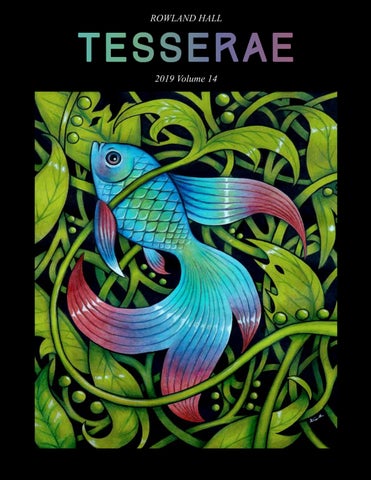
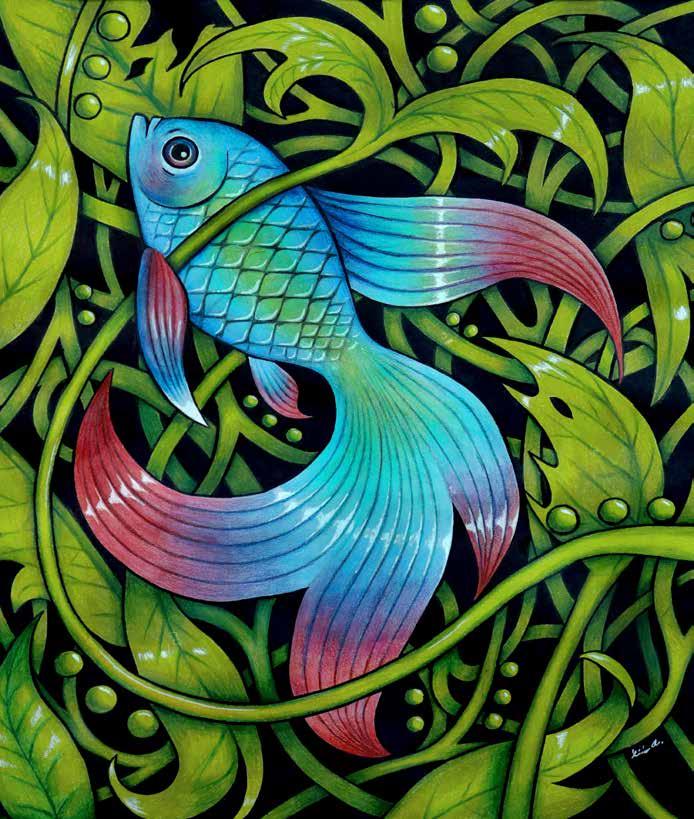
Front Cover: Fish in Vincs Colored Pencil Livia Anderson
Poetry and Prose
Clarissa
Artwork and Photography
Annika
Elli
Cate
Hakuna Regatta
“We are reading the story of our lives, As though we were in it, As though we had written it.”
— Mark Strand
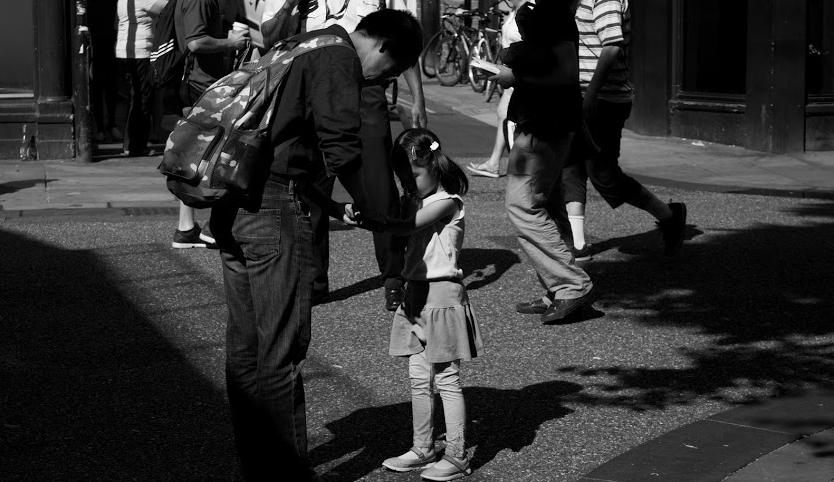
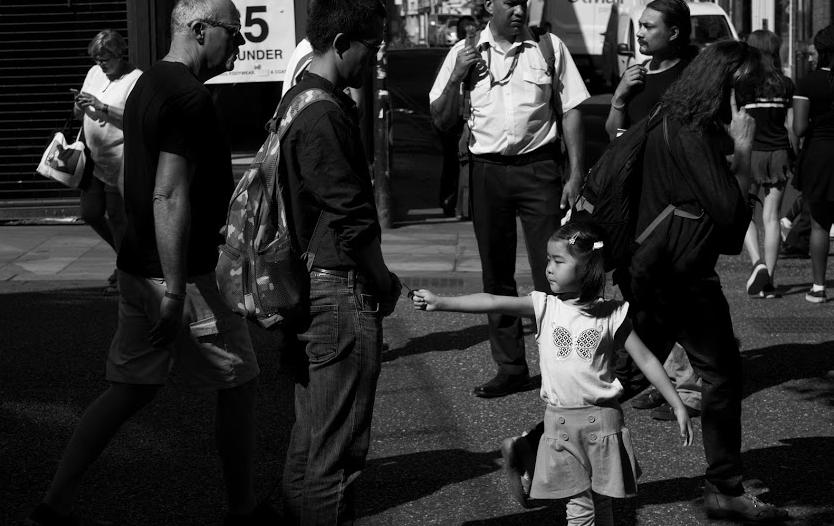
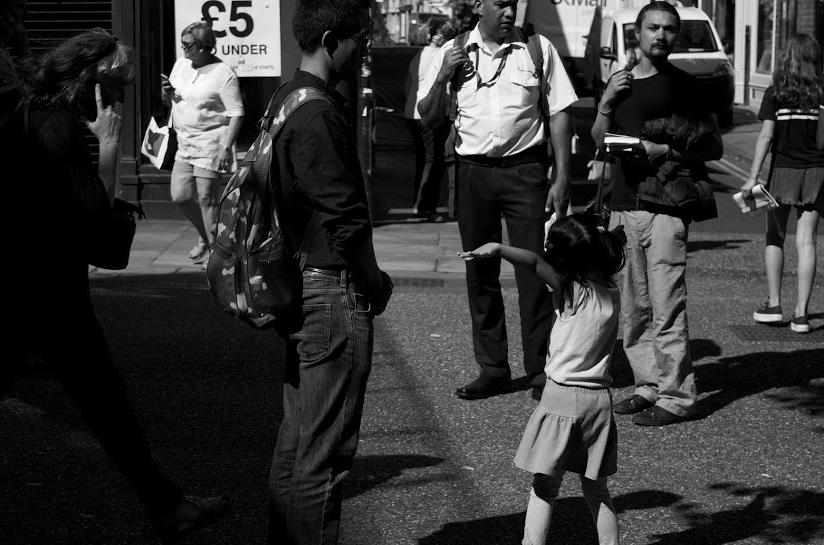
Dancing on Oxford Street
Photography
Elli Dark
Lucid Cole Topham
The trees are sick. You smell the sharp pine scent through cracked windows, inhale the leaking sap as if the nectar was your drug of choice. They stand stiff and rigid, lifeless shields scarred from coyotes and their claws, predator and prey. Their secrets lie guarded in their gnarled bark, hidden in caverns dug by enemies, the beetles and woodpeckers, nature’s checks and balances. And past their war-torn faces, squinting towards the sun, I see the dedication to ward the mist away from your clouded face. You did not return to skip giant rocks scross icy ponds, only to glance away just before they sunk to the inkwell bottom. Before you left your isolated paradise, that forest was enough to hold your trance. I know that seafoam can’t replace the snowy gravel paths, Or the yarrow flowers that dot the hills in the spring. Just remember the cities that burn their streetlights throughout the day are always fake.
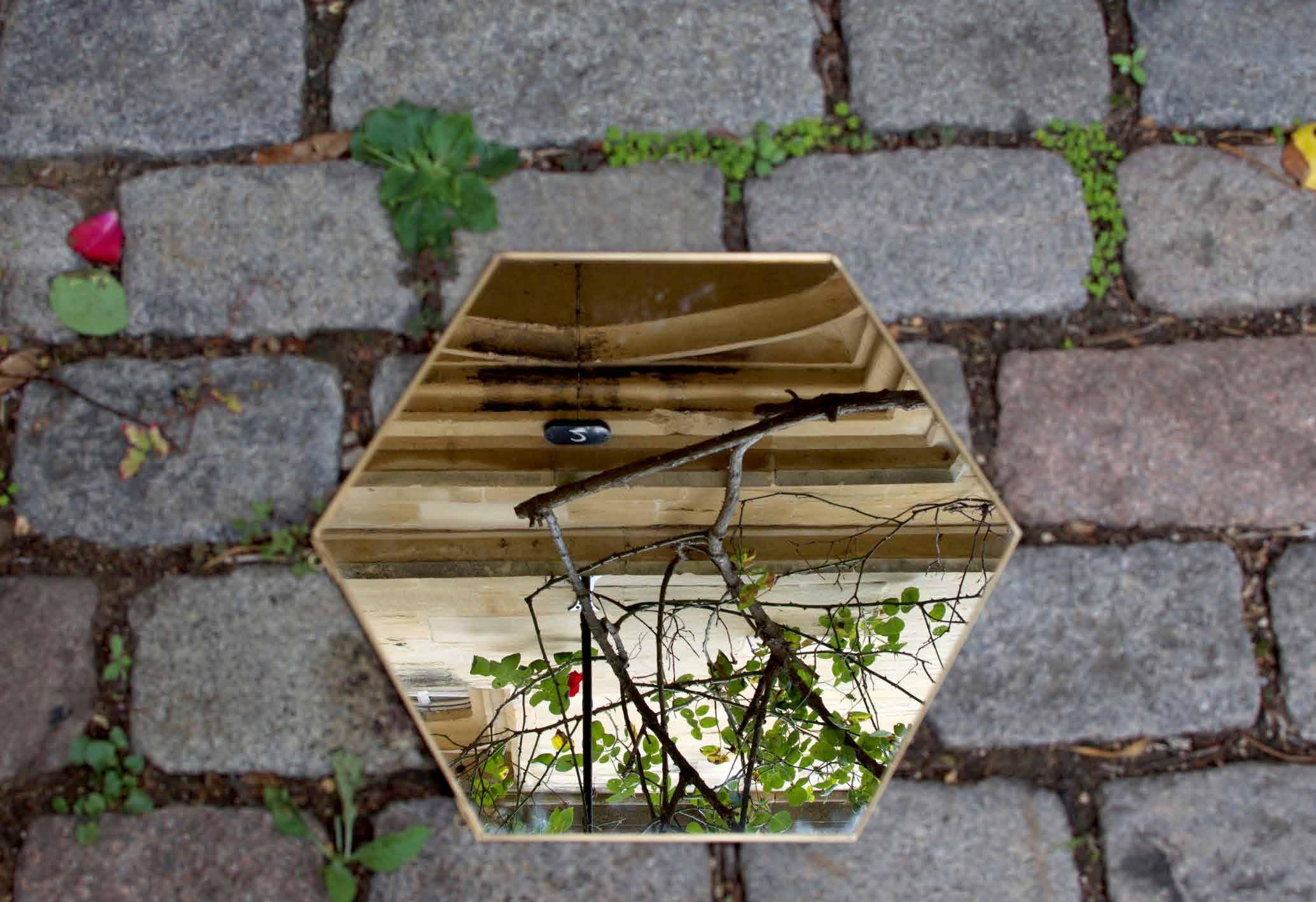
Reflection
Photography
Elli Dark
Argonauta
Jack Vitek
Oh, the places you’ll go. Turn your head on your family. A march toward the cove surrounded by facsimiles of past, present, and future. Is there someone else?
Well, maybe, just maybe, they’ll cure you. A fire in your eye and flames in the reflection. You told me of the labor you carried behind. But now, you’ve cut the rope.
Force tension no more, your stumbles turning to sprints as sulfur clouds begin to burn my irises. Are the cocaine screams still in your ear?
Those nights infatuated by the police pounding on the white-chipped door. It was your job to answer, moreover, to lie. A twisted tale concerning our reality. Until, of course, it became only mine.

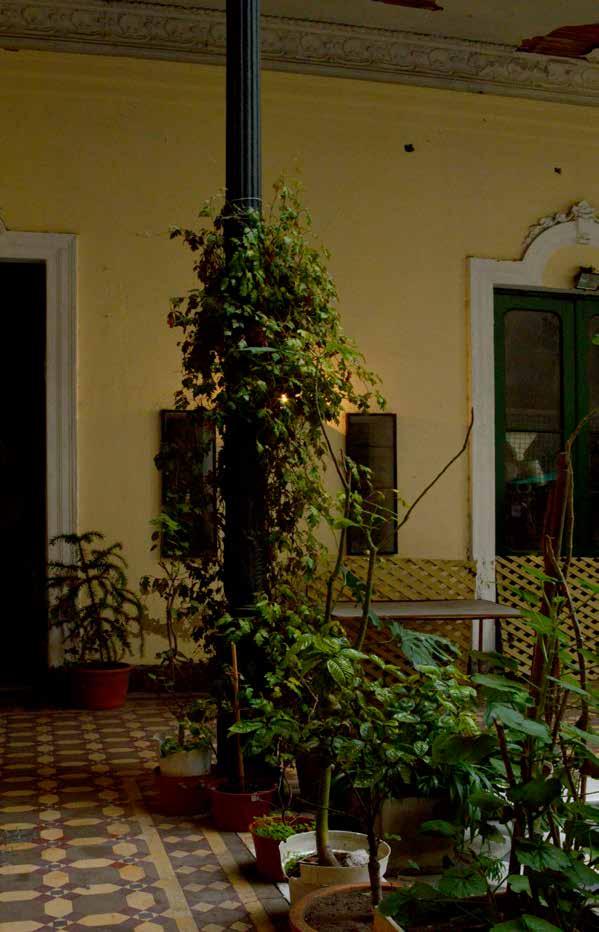
Jungles Photography Elli Dark
A Natural History
Kit Stevens
Ivory paint slowly frees itself from the shattered brick walls. Trampled blue carpet faded to grey lies atop rasping redwood. One room over, scuffed linoleum curls at the corners, escaping the perfume of moss and stagnant water that lurks in the hunched foundations. Memory, too, fades to grey, lies face down in the rubble. A high ceiling threatens to drop the skeletal remains of a chandelier. The flames that once had watched me have been snuffed out. Fractured creatures with empty sockets and hollow heads stagger to the ground. A single shaft, shimmering with dust, illuminates them as they take a final bow. Misted jewels winking like cat eyes lie on crushed velvet, discolored by lights now flickering and dying one by one. Their glass cages are still stained with smudges whose owners left and left only fingerprints behind. The rest is darkness covering the shifting figures of past selves who now barely disturb the dust, who were sheltered like the sheet draped over the dissonant grand piano. Silence now fills the space its hollow chords left behind. Silence now fills the space where memory is enshrined.
The sun is blazes red, Misty as it disappears behind The green peaked mountains, And as I shield my eyes, A withered gaze watches
As out in the horizon smog approaches:
For a moment, I am taken aback. Whatever it is, it’s coming quick. Maybe it brings hope, but more likely Demise. Did I do something wrong? My heart begins to pound, and I realize Everyone who sat beside me is gone.
But the smog comes and goes. They were just bees anyways, and I’m stuck Just standing there, alone. Because that’s all it was Ever about, being alone, defined as the presence Of no one and having no one.
Like the bees, the feeling passes, As if it were a magic trick, But I can’t see the magician. Gone… what is left is no more Than an empty casing of what once was.
Beasley
Magic Doesn’t Exist Tate
On previous page: San
Isidro Photography Elli Dark
Standard Return Policy
Lily Scaife
You may not return a used item. You cannot exchange the short, spray-tanned woman with the bedazzled back pockets for your elegant, Indian mother who wore cheetah printed mules. Although her hair has almost the same shade of thick curls, Anne’s voice is eerily high while your mother’s was deep. Anne responds with a passive aggressive compliment, while your mother had a no bullshit attitude: honesty always, even if it hurt.
However, you can initiate a return for most new and unused items within 30 days of delivery for a refund. She used to pick you up from school and drive you home with the top down in her Audi convertible, Sheryl Crow blasting from the speakers, and on Fridays, you got to sit in the front seat. You would come home and practice scales on the piano as she made fresh couscous and cucumber salad. You sat on the tall stools and did your page of arithmetic as she cooked dinner. You always set the table and made sure you put the blue plate at your seat, next to hers, on the huge red, paisley printed bench. You were only in second grade, so the homework load was light and there was always time to watch American Idol after you cleaned the dishes.
We must receive your returned items within 45 days of delivery. The lake became too cold to swim in, and she began wearing headscarves. She was too tired to watch “American Idol” downstairs, so you watched it up in her bed.
We do inspect all returned items and award a partial refund for opened or used products. All of the trees were now barren, and the sun set before dinner. Dark circles appeared underneath her eyes, and her fingers were too swollen to wear rings. She picked you up from school still wearing her pajamas from the evening before. You tried to do her hair, but upon inspection, you noticed large missing patches, a handful came out with each stroke as you put a brush through it, so you played piano for her instead. She was too tired to cook dinner, so your dad started grilling every evening, and the boys began cleaning the dishes.
If you initiate a return after 30 days, we may issue a partial refund* The wooden advent calendar sat on the table by the front door and the boys began skating on the lake. She didn’t pick you up from school anymore. You always carpooled with another, sympathetic mother, but your mom never took a turn. You still set the table, but one less setting, she did not eat, and she could not make it down the stairs. She rarely stayed awake past the first performance in American Idol. Your brothers helped her down the stairs so that she could sit and listen to you play piano.
*depending on elapsed time and condition of merchandise. She was rarely awake, before or after school. Your aunt moved in to help take care of her. She struggled to sit up in bed, and her parched lips could not take a sip of water without grimacing. Her condition was deteriorating. Her skin was dry and rough like sandstone, and her scalp was bare. Her long Indian eyelashes had all fallen off, her cheekbones had sunken into her swollen face.
You left for school one morning without attempting to see if she was awake. You sat in homeroom working on a long division worksheet. Your principal’s voice interrupted you over the loudspeaker and called you to the office. Questioning whether you had done anything naughty, a ball formed in your throat as you began to worry. Your dad was standing in the office, and your older brothers, and they were crying, you had never seen them cry. Something had changed. There, outside your elementary school, you learned that she was gone forever, dead.
Now, Anne comes over and tries to talk to you about boys and grades. Now, your brothers live in dorm rooms where Top Ramen has replaced flank steak and the extra long twin has replaced the queen. Now, she is gone. Her time has elapsed and the conditions have changed.
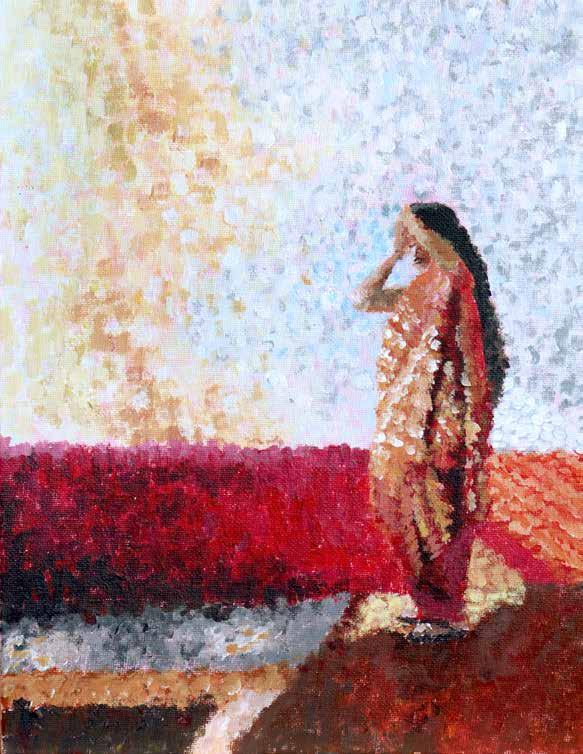
Wind Woman
Acrylic on Canvas
Jack Smith
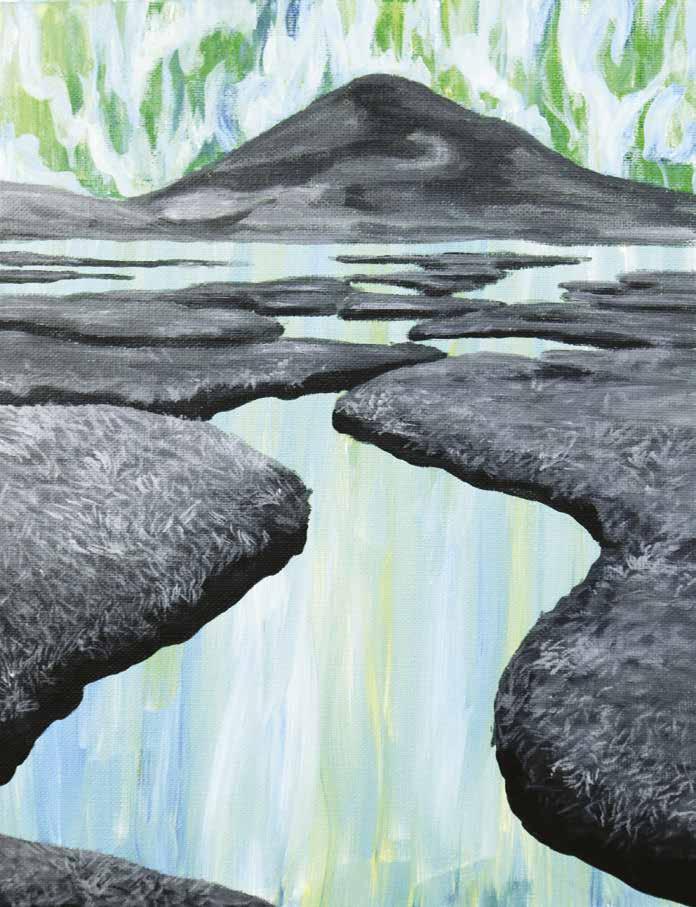
Element
Acrylic on Paper
Leah Button
Of Cats and Nitrogen
Benjamin Fowler
Liquid nitrogen is a cryogenic fluid used for rapid freezing. It is considered safe for average consumers at its highest purity. It has over a dozen uses in multiple professional fields. However, its liquid-to-gas expansion ratio has lead to debates About its safety for civilian consumers. Despite this average, Americans Have used it in culinary establishments for well over a century.
The hand of ice is broad, omnipresent, As fast-spreading as any self-respecting pandemic, Cold and indifferent as any passing car on a highway filled with faces.
Human hands have never known How to break ice without feeling admiration, How to see snow without defiling its purity.
Things only shatter when they’re frozen. Things only stop when they’re frozen. Things only slip and fall when their companions are frozen.
Did the car know
That it had killed the boy When it had killed the cat?
That in that moment its list of victims
Had grown to include a rose, a bowling ball, a coffee table, And a family photo?
I remember seeing them freeze, And thinking, “Rage is supposed to burn.”
I remember that you were angry enough to run away And sad enough to show me
The stash of liquid nitrogen you hid from your parents
The cat had been your family: A lone pillar of consistency In a life full of tragedy and separation.
You wanted to break something, anything, everything Over the head of that driver Who had driven an uncrossable line between you and your family. You were angry at the bowling ball for not being able to kill the driver. You were angry at the rose for reminding you that love had not died with your cat. You were angry at the coffee table for being large and in your field of view.
Most of all you were angry at energy and motion For allowing a cold and indifferent vehicle
To end the life of your embodiment of happiness.
You knew that ice made things weaker. You knew that ice could have saved your cat. You thought that ice could save you.
First you filled the bowling ball With nitrogen until its surface turned white. It split into three even pieces.
You threw the rose next, All innocence purged from its surface. One plant became twenty.
And then you froze your table, The one you climbed on as child. Twice as heavy because of the ice.
And then you froze your mother, your father, your sister, and your brother. I remember feeling a creeping sort of fear as the photo hardened to a sheet, And your family shattered.
And then you smiled. A sort of happy, manic smile That I hadn’t seen on you in years.
Through the simple act of freezing and throwing, We had undone years of pain and loneliness. Ice had become a shared interest that would lead a friendship to a best friendship.
And then, years later, We would reminisce over broken household appliances, The rage and sadness of spreading ice, And then go our separate ways.
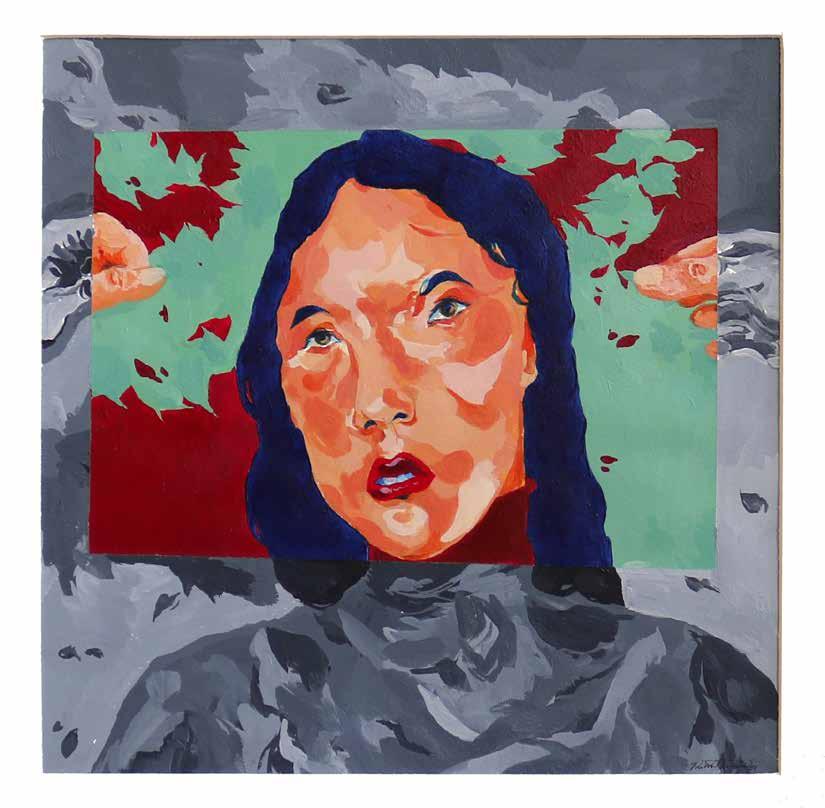
Framed
Acrylic on Paper
Robin Zeng
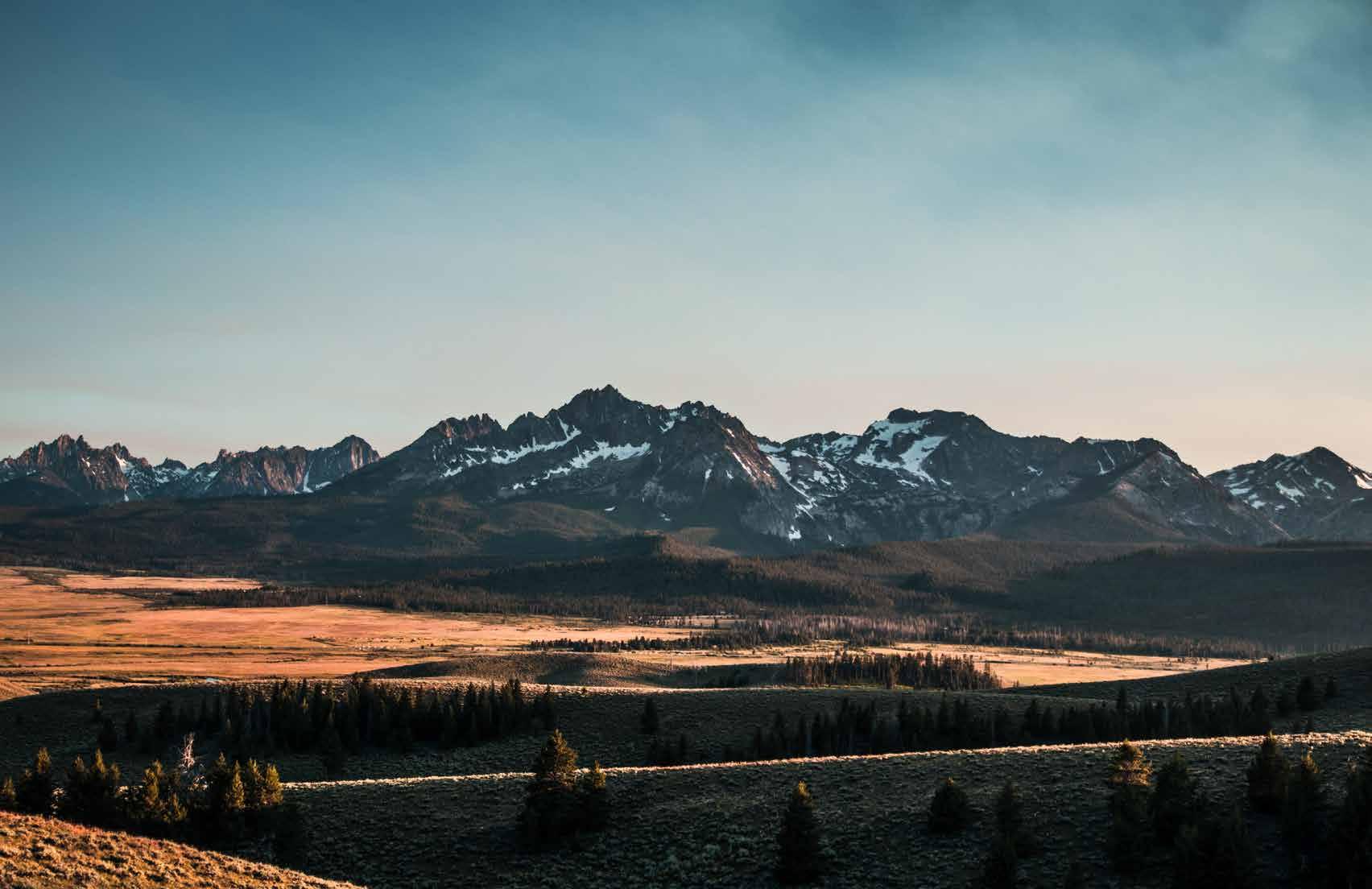
Mr. Blue Sky Photography
Garrett Glasgow
How to Design a Life
Allison Perrin
Step one: you choose who you want to be
Maybe some different flavors are needed here
It depends what you choose
What makes your taste buds tingle with a flavor of ecstacy
Maybe you want some spice or sweetness
It‘s your choice
Some put this as a final step to their meal but for me it comes first
And do not forget you can always add flavors later
Step two: pick a passion
You gather the base of your recipe
Maybe you want it to be a thick texture
Maybe you want it to crunch
Maybe you want to be safe
Or live like you’re going to die
Either way it is your choice
You are the decider of the texture of your meal
And always remember you can change this later
If your first texture doesn’t work out
Step three pick a person
Mixing your ingredients can be a difficult task
If they are either too dry or too wet
You must add another component to fix the mess you already made
Now we do not care who you pick
But make sure it is someone kind and loving
Many people stress about this step
They pour in the new substance all at once
But do not forget
This does not have to last forever
Step four: bake
You marinate your recipe so the flavors blend
You want all the parts of your recipe to fold together
To create the perfect outcome
If one move is done wrong it can spoil your appetite
It can destroy the flavor on your tongue
Never forget a recipe can always be changed
Remember that you have the final say
It is your taste that determines whether the meal will be present in your life for the future
Whether or not this is the life you want to live.
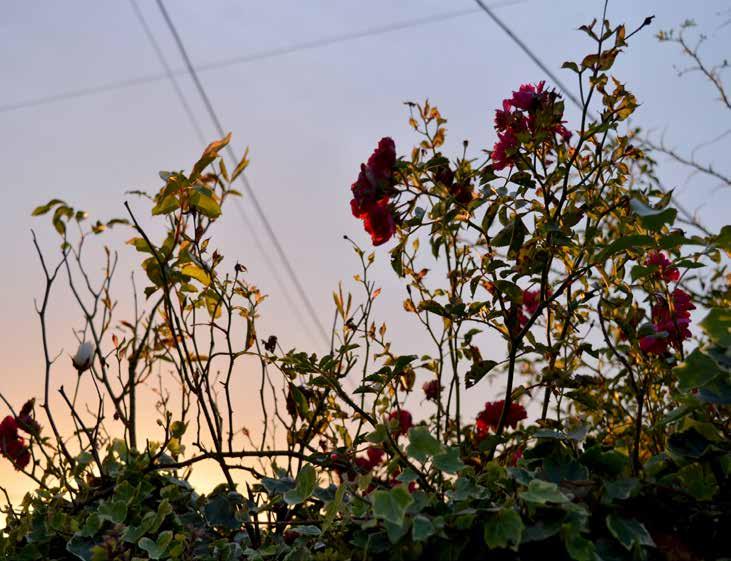
Yorkshire
Photography
Elli Dark
Child Bearing
Laura Summerfield and Kajal Ganesh
Float high above your swollen ankles, breathe in the hopes that others will gasp, sink in the lake of your porcelain prison. Open windows—inhale but don’t smell the rust. There’s a rain cloud. It quickly approaches, its liberty burdened by its connotation.

Mouse Film
Cate Christiansen
I am branded with ash’s connotation, I wear rings of decay masked by iron ankles: tomorrow and tomorrow, day approaches. The wretched priest takes his final gasp; our bodies are welded by layers of rust. We inhale the scorched earth, corpses in prison.
Escapees secretly love prison. Regardless of the dark connotation, they become husbands to the surrounding rust and mothers to the maggots in their ankles. Gangs in prison chant the Banner’s song, gasp— the shank that resembles their son approaches.
A piercing, crimson light approaches: the mother sets her children ablaze in prison. Aluminum bars steam, making shriveled pores gasp. The sky flakes on my tongue hold a connotation of homicide, wrapped around the ankles of inmates in Treblinka, now red with rust.
Her family sings of saviors of rust. Her songs save no one when the day approaches. First, they bound her heart, then her ankles, then the band around their arms became prison, and despite ignoring the truth, the connotation of the chamber stole their only gasp.
The mayflies make the lungs of the earth gasp, filling the air with their bodies, capsules of rust. Beware the citrus lead’s connotation. And the twenty-molar ammonia that approaches once trapped in the embalmed body: a prison now despised for flaunting cream-masked ankles.
Perhaps it’s not he who approaches, it’s what he’s become in this prison, it’s the slave possessing his ankles.
Nutrition Facts
Celia Davis
Nutrition Facts:
Thought©
*Percent Lifelong Value (LV) of consuming this essay is based on an eighteen-year old’s experience.
Ingredients: I am only a blank nexus of experiences I have not had, copper blonde curls tangled in detox tea and caffeine, short curls intertwined in melatonin-seeped sleep, all three parents reverberating hopes in an echo chamber of drowning beliefs, and I hand back yellowed paper opinions their ears fail to absorb, my worn-out tongue, as spent as a taffy-pulling machine, gags on conversations, and I, stuck in a three-sided box of composted projections, resembling a vacantly consumed sitcom rerun, is sooted in knowledge fixed to befall birds on agent orange, I feel my brain shut down [stacked with frozen thoughts in liquid static, and I lose my identity, I cannot function, I cry, sleep, stare at the face making aw-wah-wah sounds, shaping what should be words], hating this imperfect thought-maker (this brain), and although I don’t care if I have a label or not, they call me a go-getter with a bump in the road, (a theory of mind), and I like this because now this thought-organ’s flaws can be squished into a box [like a sepiated sponge, a bloated sponge of holly berry juice, deliciously, opaquely red], yet even though my mom calls me amazing, (her only child), like a Petco crab, [once hidden under a Land’s End polo and stretchy khaki pants], I have abandoned my hide-away and scaled into denim Dr. Martens and Velvet sweaters, an extrovert (type A too), I crave [right angles, mason jars of purple pens, and monochromatic closets of red], but when scapeled [under the layer of my too pale flesh], I am a goldfish, [glassed in a well-lit aquarium at two AM who believes they live in the sea].
Not a significant source of nutritional value, lacking in protein, fat, and carbohydrates.
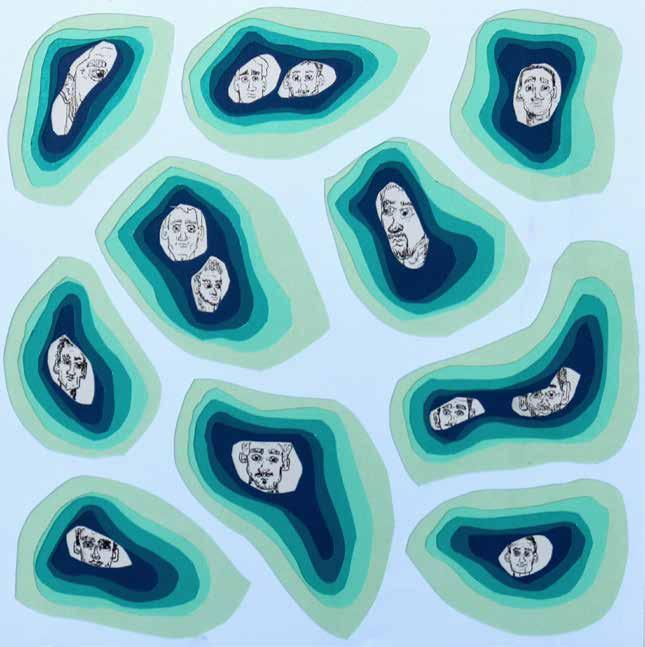
Mized Media
Ian Brown
Faces
The Fruit of Trust
Kaitlyn Bates
Created from the grime and dust of the early form of God’s fabrication, Adam took his first gulps of air. He rose to face his creator.
Adam, filled with desolation, expressed his dismay with a grimace. Using his ability to respond with the slightest of ease, The Father gifted his second creation, Eve.
Entrusting the pair with the bounty he had created, he left strict precautions. The two complied and allowed God to leave them in the oasis.
Having gifted away his sanctuary, the slightest doubt came across his mind. God pondered his decision. “Am I mistaken?” he wondered.
Tranquility was shattered. A small eerie figure slithered into and under the bushels in the lush garden, ready to place his trance over the innocent youth.
Using his mind and exploiting her, the serpent infiltrated the girl’s mind. Plucking the harvest, the rich liquid fell between her chapped lips.
Irresistible unfaltering thirst, dying to taste just a bit of the lucious and crisp juices on the tongue.
Momentarily, her conscious reminded her she had made an indecent mistake. The devil inside abused Eve, and God knew this well.
Eve dashed the hope of the Father. Seeing the grief in the eyes of the great God responsible for her, she became aware of her blunder.
Trust was destroyed. The bond diminished.
“A costly mistake,” God thought, “for such a generous gift.”
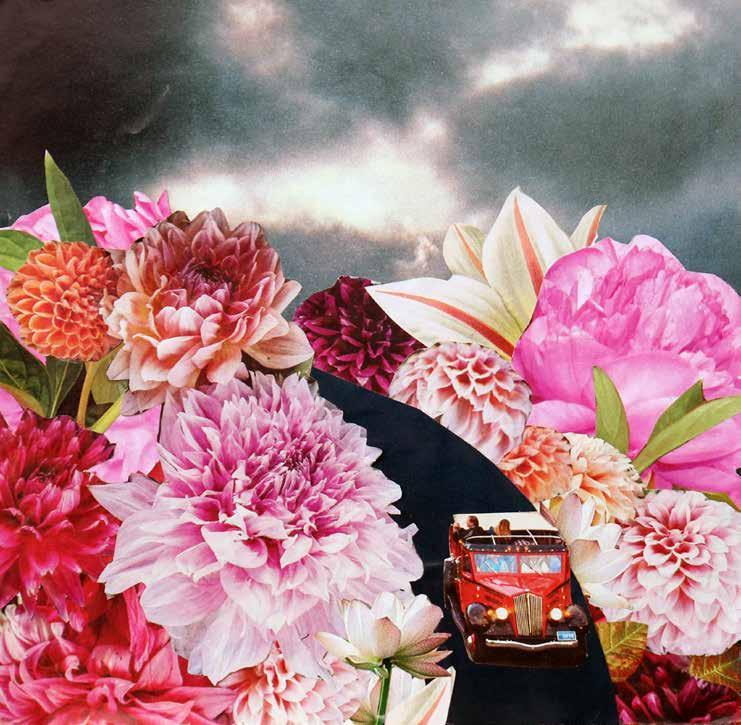
Collage
Mixed Media
Leah Button
The Fine Art of Numbers
Garrett Glasgow
On a gloomy day in France, A soldier naps in the mud,
Resting his wrath and bloodlust
As forgotten youth seeps
In the cracks of his innocence.
Alarm clocks turned to gunshots
As blind bullets bury
Their noses in dirt and some find Cozy comfort in the hearts
Of teenage boys. Spilled Youth sprinkles the trenches And spirits headline newspapers.
Our soldier grabs his rifle And runs for cover.
Screams of steel transform Into screams of anguish
As lead kissed the knee
Of a fellow comrade.
On his right, a rebellious teen
Bit the bullet and glanced into hell.
Enemies’ whistles are Harmonies under the drums of gunshots.
The soldier lies on the ground, covering his ears
To silence the melody
But who can silence
The disturbed heavens?
The soldier peers into hell And spots wrath charging.
He lifts his rifle
And aims at the enemy. Pulling a trigger
Backward is challenging.
His bullet spills
His blood across the mud. At last, innocence oozes Out of the cracks.
His gravestone: CAUSALITY #55083
Rowland Hall
Seeping Through
Photography
Elli Dark
Wax and Feathers
Summer Connery
Called in by the king, His knowledge was well known. He had a job to do, Never imagining what would happen.
A wondrous labyrinth was built, A home to a minotaur.
The King of Crete was pleased, Until, like unwinding thread,
The labyrinth was breached. The innocent Daedalus punished, Held captive on the deceitful island, Until he saw birds flying overhead.
He needed wings. He took flight
From the island of Crete With his son Icarus.
Made of wax and feathers, The wings were magnificent. They came with a warning; however, Never fly too close to the sun.
Icarus flew off with the wings, Cautious at first, Until he flew too close to the sun.
Fall
Acrylic on canvas
Leah Button
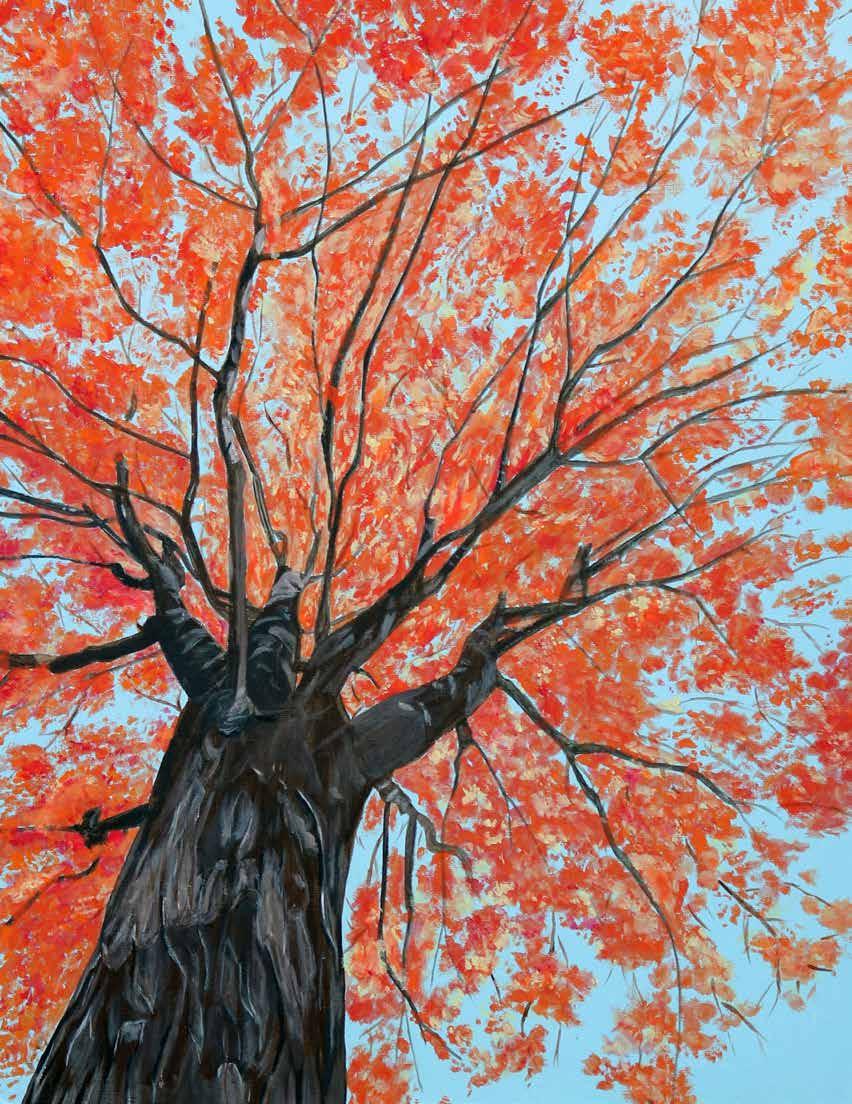
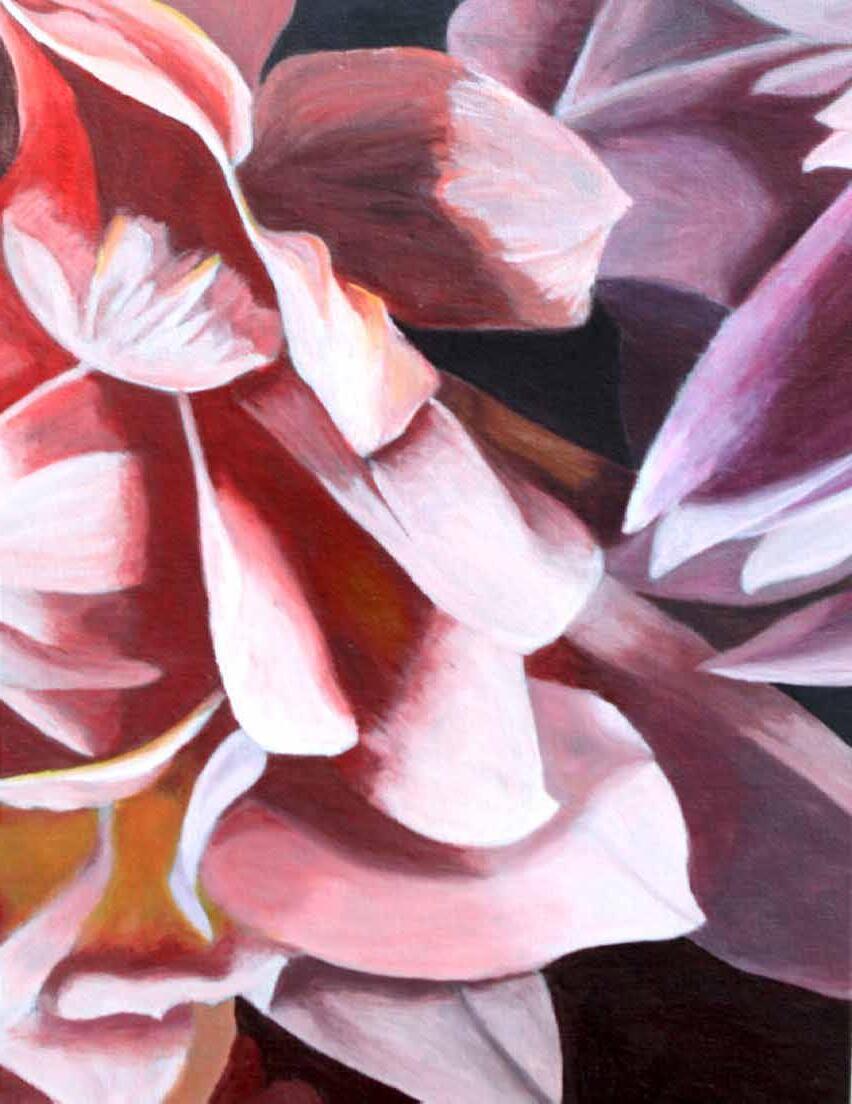
Petals
KatieRose Kimball
scattered rose petals inscribed with slanting cursive curl at shifting feet
look up
nailpolish glitter staining the broken
stitching holding us together
fingers touch blooming stars a million lightyears away
nine specks vanish with the collapsing breath of aching feet
Flow Pink Acrylic on paper
Leah Button
Shattering Glass
Samantha Lehman
You land on your knees. Sand clings to your washed out jeans and sweat soaks your hair. You inhale the breath of the ocean as the taste of candied safety stings your lips. But storm clouds loom above, taunting you. Doubt floods the dam of your resolve. You search the coast in desperation, and your friend stumbles towards you.
You catch him from his fall, a stab wound in his gut. His blood stains your hands and your screams bore into the air. The world has closed around you; you’re surrounded by mirrored glass.
His eyes, green marred with amber, expose a boat, tethered to a dock, pounding against the waves in the wind. You see the rope starting to fray, but before one world is ripped from another, a knife slices the rope, suffocating the boat in the waves. The blood ceases. Your friend is gone. The mirrored glass shatters. Surrounding you, once more, is the ocean’s deep cacophony.
Laying down your friend, you stare at the ground, now painted with the nectar of the sun. You close your eyes.
A knife burns in the darkness, the knife that killed your friend and carved your heart to forge a fire.
Mars Flim Cate Christiansen
Melt
Emma Duggleby
What now, speaking of nothing because lilacs bloom in our throats, stretching their roots through clenched toes and spreading to connect the stars like a shard of glass covered in wax.
Now we know what should only be written on crumbling paper, ink melting into ash as vines curl around our pinky fingers, prying the nail loose and sending the dust underneath into our lungs.
Do you know what the crows laugh about outside the basement window? Molted feathers twist around shaking feet and flourishing teeth as they drip with veins of light in the flowering silence.
How do we speak so that our words condense into delicate blooms, candle wax petals melting our lungs out of shape? Breathe around the broken shrapnel, planting ashen seeds in the muscle of our larynx.
Hold out our hands, inviting sky into the creases as a woman traces the lines between tenuous happiness and rapture, her words sticking in our throats until the dust settles like wax into the cracks between stars.
Octopus Film
Cate Christiansen
Rowland Hall
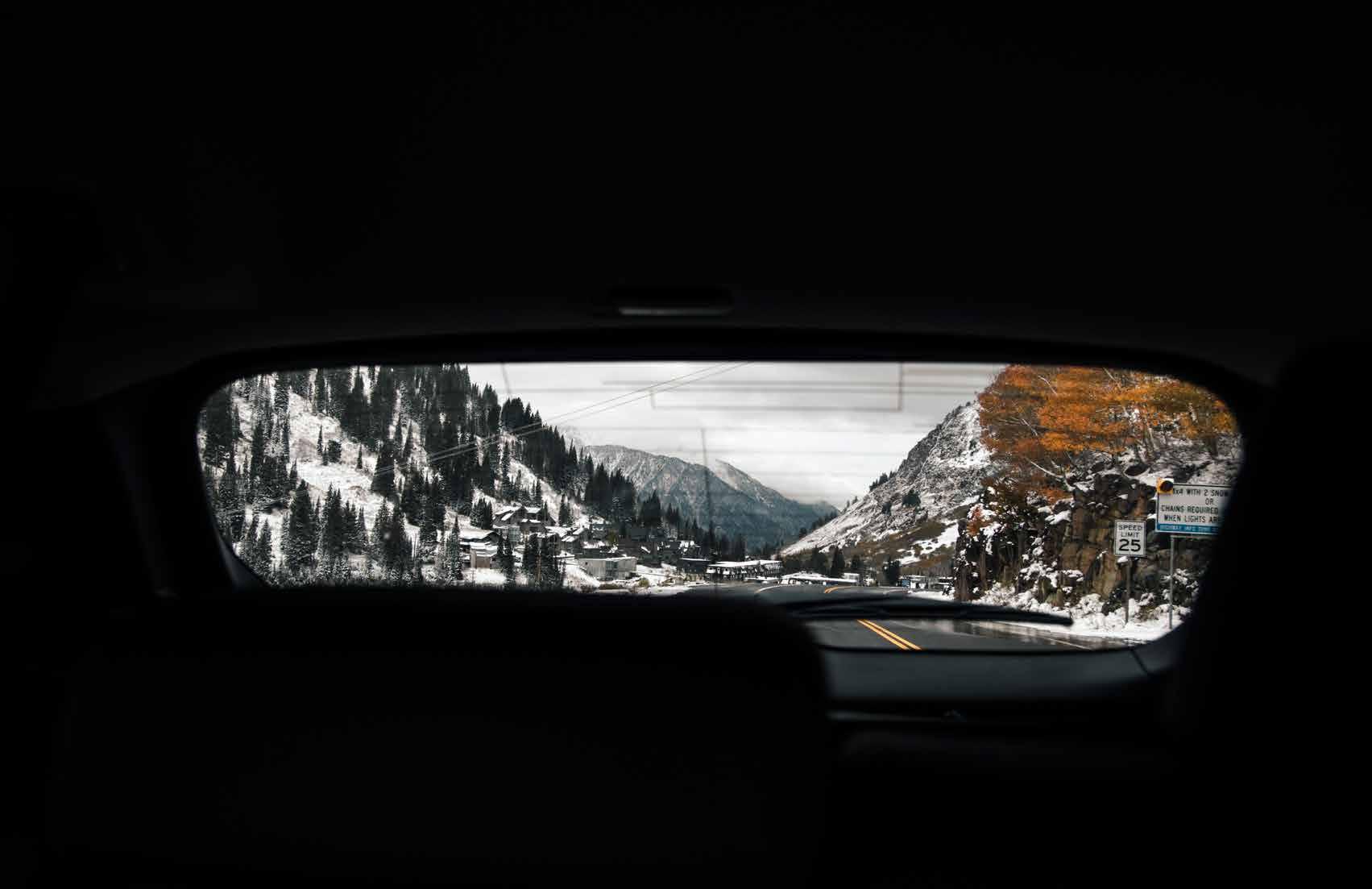
Road Trip to Oblivion
Irenka Saffarian
Outside the car, there is nothing.
Endless fields, cows grazing
On green distance and pallid sky. Yet outside the car, there is everything.
Neon markers ticking past, One at a time, they wear down mountains. Her dull eyes, watching loosely; The speeding gravel, grabbing at the wheels of the car.
Inside the sleek and rumbling shell, the world makes a dull noise: The data of her thoughts. Wind flies past, and scrapes sleek metal, But outside the car, there is nothing.
A ticking mind, her pace is set, By yellow stripes of paint. Filing away, starting again, Inside the car, there is everything.
More thoughts than she could ever know, Litter the floor of her mind, waiting. They grey in layers, nostalgic decay. Inside the car, there is nothing. Moving, always moving, Ticking and rumbling it wears away time; Her mind that paces and fills open space. Yet outside the car, there is everything.
In the Light Photography Garrett Glasgow
Rowland Hall
Reasonable Expectations
Ella Baker-Smith
I sit on the sunken sidewalk; at least it feels that way —sunken.
The dusk has officially broken–no, not broken–Snapped in half and sucked itself into the void–gone.
My body feels as if a weight were tied to my sparse hairs, the color of almonds and bark, and my eyes condense to candied saltwater droplets of my hometown’s lake. Home— strange how one word can mean their olive and coal colored hair. But now— such an empty word now.
I let my swollen gaze move to the freckled dome draped over me like a blanket, forcing my senses away from the reason I sit here now. A teenage boy’s buoyant laugh echos from somewhere down below.
She holds me tight, her spindly fingers floating across my back, as if I was something fragile she was afraid to break by applying too much pressure. and she says, “Breathe.” “Look at me.”
“I need you to breathe.”
I hear someone say, two years ago today, two sidewalk squares away, from where we sit now.
“Hey, I need you to breathe.”
“I am not going anywhere.”
Nowhere. Nothing. Gone.
I watch as the sky turns a purple bruising shade as my heart attempts to break out of its shell frame it once put so much promise into. With each sharp breath, I intake the hazed air— I understand why smokers smoke now.
It is truly an addiction, to expect the best, the most, from their dark, blackberry honey eyes and have it all amount to the hazed air.
Can you not see anything in this fog? That is because there is nothing. Nothing but wisps of whispers faded in the smoke and the empty promises they held.
I guess I wasn’t being reasonable.
I wonder how it must feel to be so comfortable holding the hand of someone else’s skin and then, to be thrown out of it, full circle, where everything began.
There is comfort in knowing exactly what you’ve gotten yourself into. Knowing nothing can hurt you but you and the air you breathe.
No expectations, just reason.
The Vines Photography Elli Dark
“There are only two or three human stories, and they go on repeating themselves as firecely as if they had never happened before.” — Willa Cather
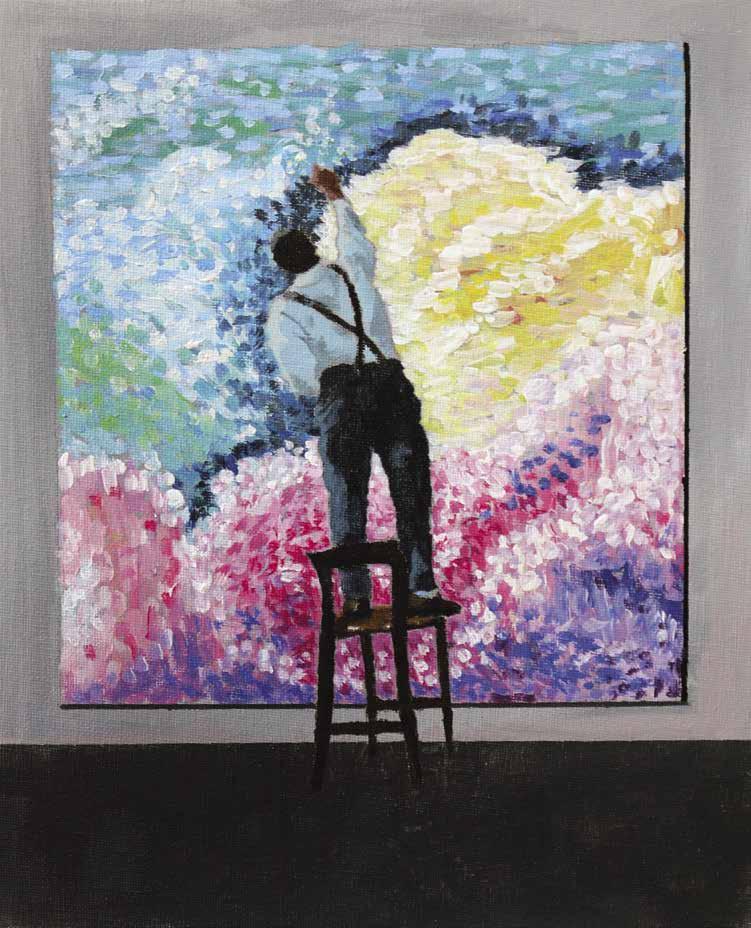
Painter
Acrylic on canvas
Jack Smith
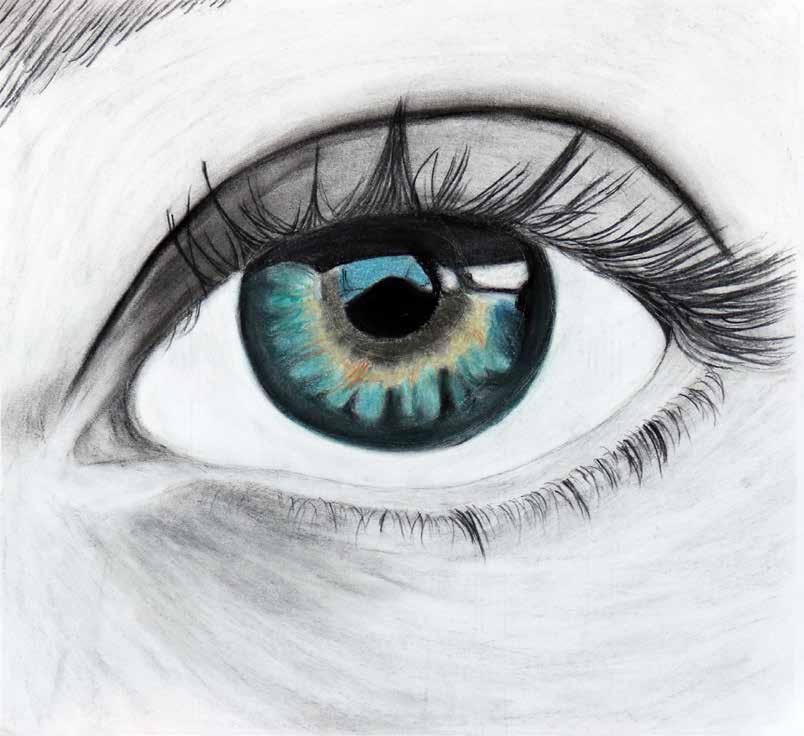
Eye
Colored Pencil
Leah Button
Sleepwalking
Leonie Anderson
My dad’s brother lost his two-and-a-half month old child, Emma Rose, to SIDS on an October morning in 1980. In less than a week, Her ten-pound body was entombed in the dirt next to my great-grandparents’ fifty-year-old corpses.
Of course I wasn’t alive at this time—I wouldn’t even meet my uncle and his wife until two and a half decades after Emma’s spirit evaporated into the air, but I’ve heard about the dead baby: how she washed over Her parents in dark waves and drowned them with Her pompous magic.
My uncle, after finding a purple, bloated body resting in his little girl’s crib that one morning, nearly dropped out of school (maybe because he didn’t want to get out of bed, or maybe because she wouldn’t let him). He still refuses to step foot in any church or acknowledge the God he claims took his daughter and left behind a shadow
My aunt, the more rational and calm of the two, spent her time framing pictures of her little girl and humming in the nursery rocking chair, eyes closed in prayer for a new baby.
Since the incident, a small, framed photograph hangs above my grandmother ’s stairwell. The hairless baby in the photograph, dwarfed by the size of the robin’s egg duvet over Her arms and washed out by the pale teddy bear beside her, lies motionless and wide-eyed. It wasn’t until last year that I learned more about the blue-eyed baby stuck in the walnut frame. It was the only photo ever taken of her, taken as Her body chilled and blood froze. The moment my uncle ran out of Emma’s room that morning, my aunt ran in with a camera, the lens covered in dust from all the times in those two-and-a-half months that it hadn’t been used.
I see this photo every time I descend into my grandmother’s basement to retrieve bottled peaches or dulled sewing needles and remember.
My grandmother keeps a photo of her granddaughter’s young corpse hanging on the wall, a reminder that the eternal youth my grandmother yearns for through rotting teeth and wrinkled lips is only available to those who will never grow old.
My grandmother visits Emma’s grave every May when decorating graves with her son and daughter-in-law, each time seeing a new interment filled with her brother, her lifelong next-door neighbor, her husband. Still, she goes every year, rests her weight on barely-functional knee joints, and rests a baby-pink silk pouch on Emma’s flat gravestone. The pouches are always filled with the same thing: dried sweet alyssum seeds and flaking tulip bulbs. Even with a truck bed full of soft flowers freshly cut from her garden, she refuses to place a single stalk on the small headstone.
Emma’s parents come to Nephi every spring for decoration. Starting at the edge of the graveyard and circling in, they place a thirty-dollar bouquet on each headstone, regardless of relation to the name carved in granite. They go around the cemetery like ice dancers, never carving the ice with their skate blades in order to slow down. They know their routine and their rink only well enough to avoid the cold little body that brought them there. So every year, the parents who lost their daughter to a faux-disease that destroyed their careers and relationships vengefully leave their girl alone in the ground— Alone except for my grandmother. Maybe that’s why the little girl refuses to leave the older woman’s maternal spirit alone.
My grandmother knows the physical manifestation of Emma’s death above the stairwell is anything but lifeless. What life is sucked from the baby-blue eyes staring through framed glass is pumped into the basement through the soggy swamp cooler. Just past the vent in the basement lies a secret door, covered by a massive safe full of bullet shells and flimsy family photos. Once uncovered, a freshly painted cream door (my grandmother repaints the basement walls at least once every two months to cover the mold stains that have appeared after Emma’s photo was placed on the wall) sits deep inside uncovered concrete bricks. Beyond this door lies what is, according to my grandmother, Emma’s room. I’ve never been inside the room. Neither has my grandmother. Neither has Emma (her flesh-and-bone-and-blood body, anyways). Still, for whatever reason, baby Emma has claimed it as Her own.
Although she is dead, I know Emma is always awake. I hear Her constantly rummaging through my grandmother’s cupboards or crying upstairs in Her father’s old nursery. But I’ve only seen Emma’s ghost manifested once when I was ten years old. I sat alone in my grandmother’s front room, the room only my grandmother enters, dragging a finger along my dad’s perfectly polished bronzed baby shoes. I was fascinated that my father had ever been so little. While pondering what my six-foot-six dad would have looked like as a two-month-old baby, I stared at the window and into the reflection of the shoes in my hands. But it wasn’t just the shoes resting on my hands. A breathless blue-eyed baby, face purple and arms twisted in pain, lay in the crook of my elbow, small feet covered in bronze.
I left Her manifestation as soon as I saw it, throwing the shining shoes to the ground and abandoning Her.
That night, as my grandmother entered her front room to close the blinds, I heard soft sniffles and mournful moans from the doorway. Curious, I stuck my head back in the room I never wanted to enter again.
My grandmother kneeled on the floor, dry eyed, the bronzed shoes in her wrinkled hands and a soft song tumbling from her lips.
I haven’t been in the room since.
Emma’s infant spirit still lives in my grandmother’s house while she waits for Her parents to come back from New Mexico every year, only to lose them again.
This will be the thirtieth year my aunt and uncle lose their daughter; the thirtieth year baby Emma loses Her parents.
With my grandmother too old to live in the three-story home by herself, the structure now sits abandoned, visited every few months by my grandmother and I. Every time we walk inside the house, I turn my back to lock the door, only to find dust and air where my grandmother once hunched.
I don’t go look for her.
Instead, I plop down on the floor near the front door, opening the cabinet to the basement laundry shoot and sticking my head in. It is completely silent, until it isn’t—
The creak of a wooden rocking chair, the soft scratching of wood on wood as a door opens.
My grandmother’s shaking singing voice serenading the basement with lullabies. And sometimes, the soft cooing of a baby.
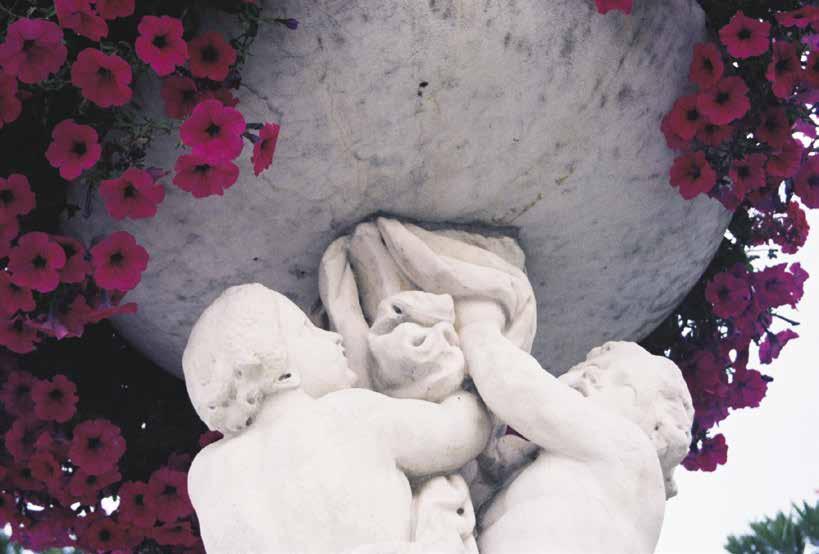
Alex Film
Cate Christiansen
Rowland Hall
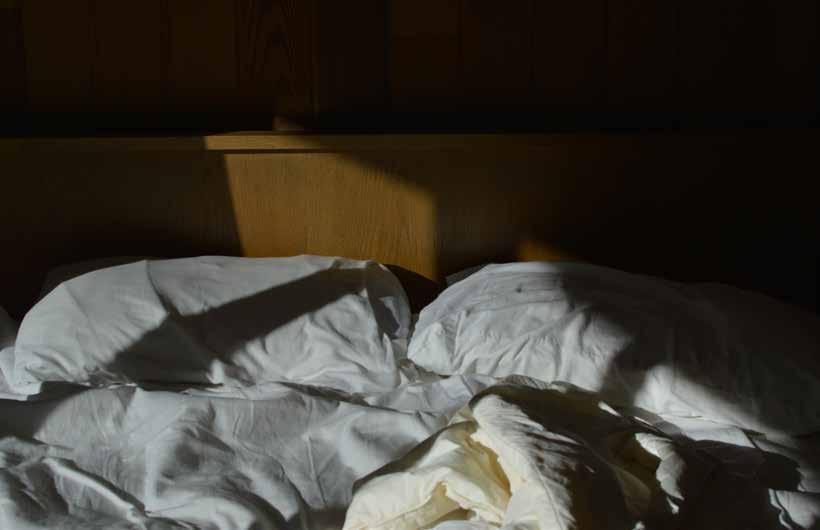
After a Long Night
Photography
Elli Dark
Erysichthon
Celia Davis
He1 ate himself. Hunger claimed his soul, infiltrating his veins, seducing his brain.
She2 controlled her appetite.
Younger, wiser, fuller, she warned him. As every woman after Eve, her voice clogged with submission, inaudible and muted. Chance grants power. Spiteful, white, delighted to subdue: time forgot to move forward.
Sold for his hunger, she suffered for his sins.
Living in silken lavender chains, darkness, and beds not her own, her mind rejected her. Her body, appraised, bruised, and secondhand, disconnected.
Never her story.
Salting our lungs, marinating our livers, broiling our brains, we venture to gorge our swelling insatiability: the deceitful deprivation whispering to our frontal lobes to lie, cheat, and steal.
Hunger3 inebriates judgement.
Ink catches on “she,” erasing the “s,” abandoning it in burnt parchment, arsenic truths too poisoned for resurrection.
1Erysichthon: Selfish king who lusted to chop down the goddess Demeter’s sacred grove (and did). He was punished with the curse of rapacious hunger, selling his wealth and eventually eating himself.
2Daughter of Erysichthon: Intelligent girl. Warned him against befalling trees, sold into slavery to pay for her father’s hunger.
3Synonyms: Craving superiority, dominance.
Rumors
Kit Stevens
It sounded broken, like nostalgia And glass shards from clouded beer bottles With the bottoms cracked off and widow’s Black clouds flowing onto shattered soil.
My dad told me that Rumors was written as they fell Apart. Green grew his hair long and ended up In the sky with diamonds and California sunshine, Preaching his cents on the green. Spencer went next, Got his own blue silk from the peyote cacti, and found His Kool-Aid calling as a cultist in The Chain.
Welch lost his “Sentimental Lady” to grapes and revelry And never pulled his head from the golden moonshine. The McVies signed their severance And battled over ivory keys, fraying strings, And Molly with her punch-colored eyes.
Stevie and Lindsey burned like a powder keg And dipped each other’s faces to the flame, Doused the fire in Chaquaca Rum, only to start it again. Lindsey went his own way and danced the tango On smoke-overed nights smelling of gin.
Stevie ended face-down in the powdered snow Coating the railroad tracks, walking with gods In clouds of Rancho Mirage turquoise and bella donna, Seeking out the street angels of small death and codeine, Trying to outrun the persistence of memory.
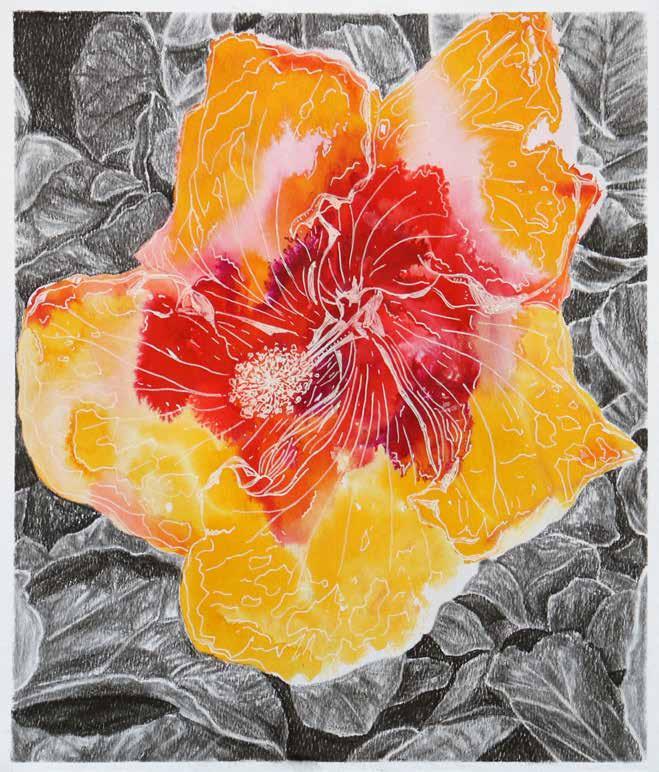
Yellow Hibiscus Ink and charcoal on paper
Leah Button
The Only Reason to Live
Max Eatchel
the hefty charcoal bowler cap floats in the air suspended by water
dancing around the yard as you and I watch
this strangely beautiful scene through our screens
we notice the real reason why the hat hovers
deep inside our brains we recognize that the hat
is merely hanging from a string and that the scene in reality
is a gimmick yet we choose not to come to terms with this fact
we prefer this because we know that we could live our lives
pointing out every gimmick or trick and by this ruining it not only
for ourselves but for everyone so we just ignore this letting it go
or rather letting it be while not affecting the way we see
the scene and for in this we save the sensation of magic
that we knew when we were children the only reasons to live
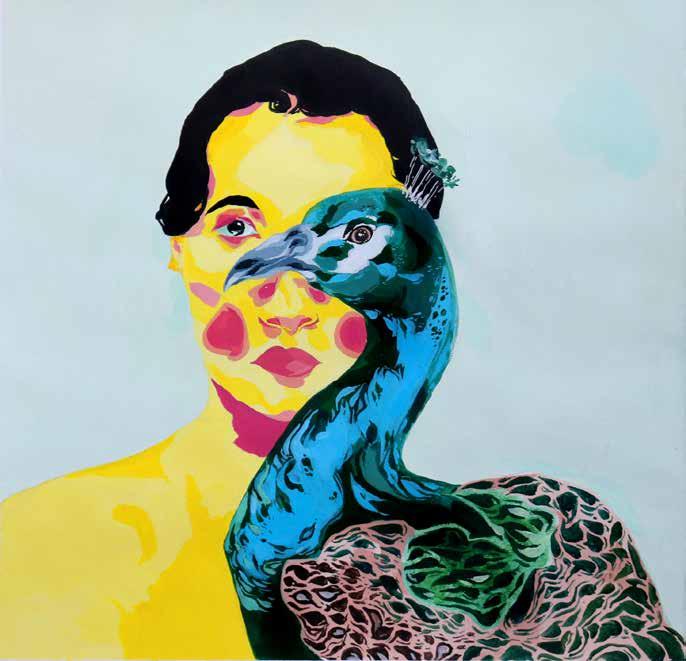
In the Eye of the Beholder Acrylic on paper
Robin Zeng
Letter to the Devil
Allison Perrin
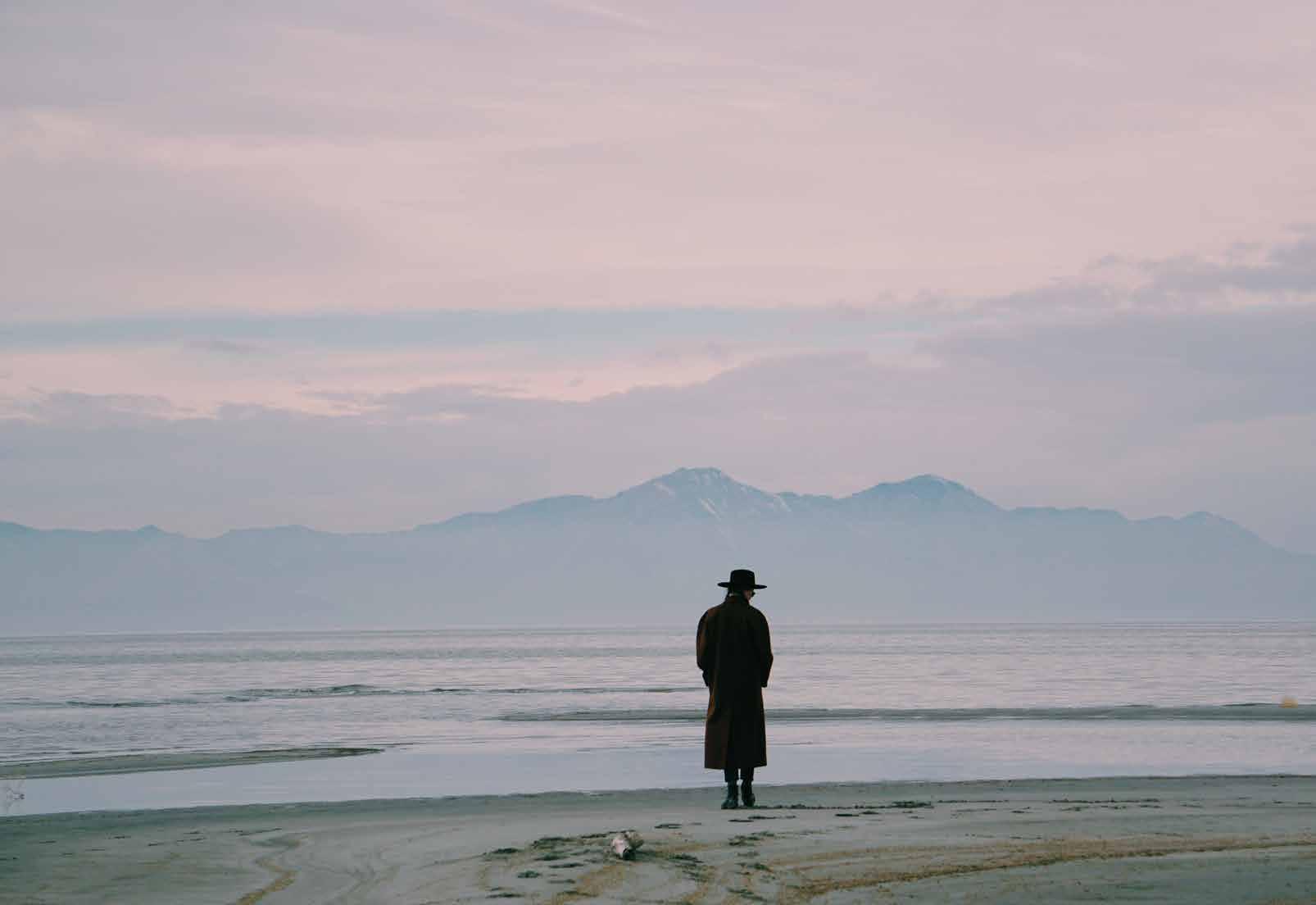
Dear Devil,
I see you in people. The way people attack or lash out, t’s ludicrous. I saw you in my first love,. I see you in my friends, sometimes in strangers. You cut me off driving; maybe it is a bad day or maybe it’s a secret need. We are all a little bad. We all have secrets, some worse than others. The way someone uses their tongue to cut you or their eyes to pierce your being. You look different on everyone, but we are all haunted. Maybe a ghost, or something far more evil. We even picked out a name for you. We are so used to your presence without even realizing it, we forget someone, something, is looking out for us. Sometimes we forget you are not out to get us. You cannot get us all, it is impossible. Maybe impossible like a fire world presenting us with our biggest fears. Maybe it is real, punishment for our bad, our sins. What if forgiveness is the key? What if redemption is possible? You like to make people pay, you have to. You are a fallen angel, punished for your sins, but what if you are lonely. What if that is why you bring us down to your home, wanting someone to understand you, someone, you can confide in? People are never trusting, yet we pretend to be. Possibly that is a gift you gave us, the gift of pretend. What if you make people lonely because you pray that they will rebel in the way you did, to show yourself that you had a reason, that you are not so bad? You are not the scary monster in stories, in life that will sweep us away if we rebel. You ask for reinforcement like the rest of us. We live our days asking someone to reinforce our choices. But that’s all they are, our choices. You made your choice. You dug your fiery grave, just as we do every time we rebel. Possibly you put something in us, something we call evil in order to feel safer. Now I ask you, has anyone else contemplated that the Devil created us?
Yours Truly, Ally
Ella Baker-Smith
Rowland Hall Reflections in Salt Photography
Lament of a House Finch
Olivia Milavetz
Warmth left my body as rain splattered my face
Like an old friend. It was then that I saw you. You, with your red breast on blatant display. I heard your song, notes heavy like paper Left out in a storm and sodden with water; I felt your sorrow before I saw your wings. No way home, a house finch without a house, Your colors are only an illusion of who you are:
Look past the disguise of the pigment you wear, And you’ll find the true meaning of song.
You’ll find the true meaning of song, If you look past the disguise of the pigment on your body. Colors are only an illusion of who you are, But there’s no deception. You’ve found your place. I heard your song, notes blooming lyrics, All leading up to a crescendo of hope. You, with your red breast on blatant display, Leaving like an old friend. It was then that I saw you. Warmth left my body as rain splattered my face.
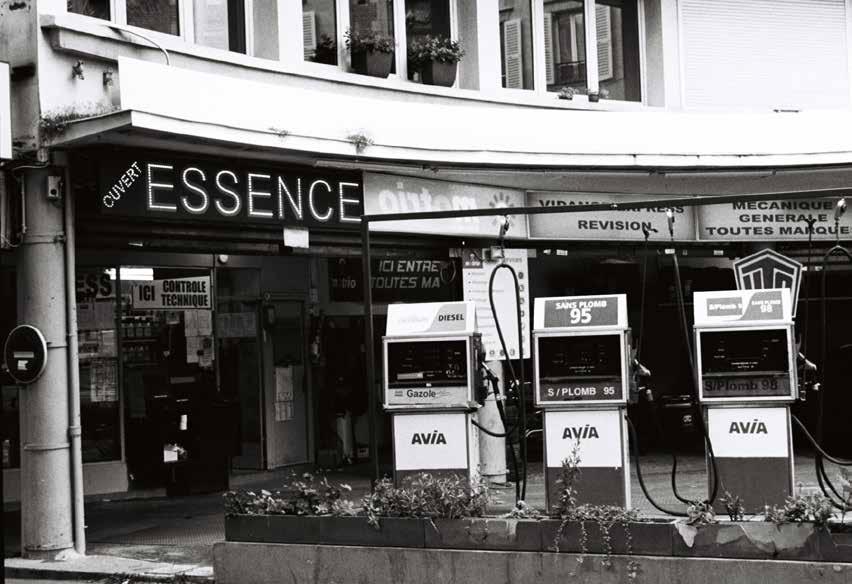
Gare
Film
Cate Christiansen
The Hydra
Cole Topham
When Hera raised the Hydra out of the swamp’s trenches, It came into the world spewing poison, raged so fierce
That the cypress trees wilted back into their roots.
When night was at its darkest, mythology’s greatest hero arrived
To complete his second task, knowing there was no glory
Involved in his labors, only gore.
Slinging tar-dipped arrows from his quiver, he painted
The lair’s darkness with fire, showering Echidna’s child with Hungry flames that evaporated her toxins, but not her piercing shrieks.
They faced each other in a clearing of their own destruction.
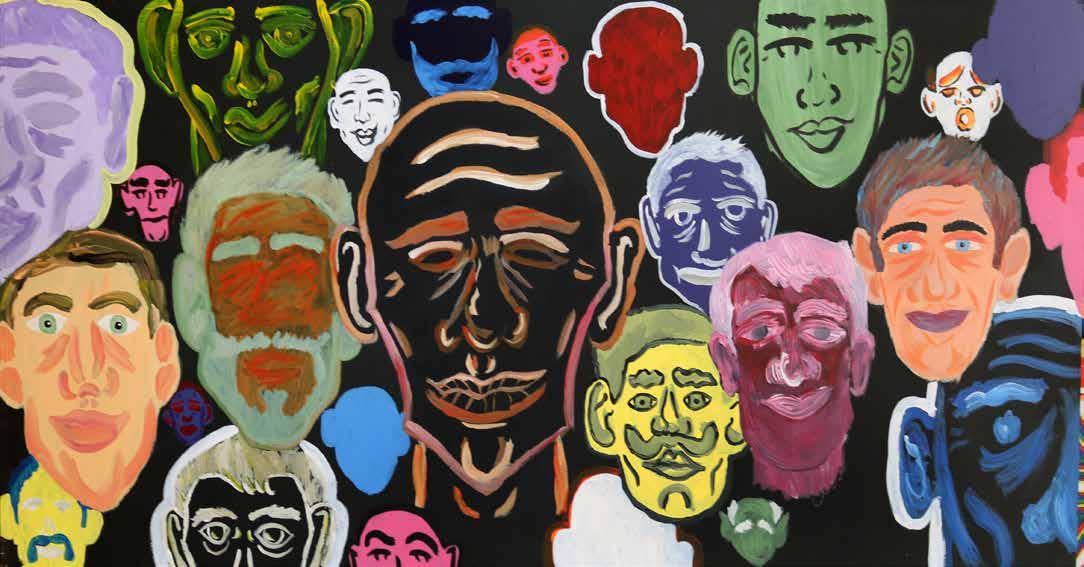
In a Crowd Acrylic on panel
Ian Brown
Hercules’ studded saber pitted against her menacing fangs, a battle he could not hope to win on The blessing of steel alone. After each slash, the severed heads were replaced By two more until Hercules plunged his torch Down each hissing serpent’s throat, and the forest Was quiet save for the Hydra’s defeated screams Echoing against the bleached rock of Olympus.
following page:
On
Station
Acrylic on canvas
Jack Smith
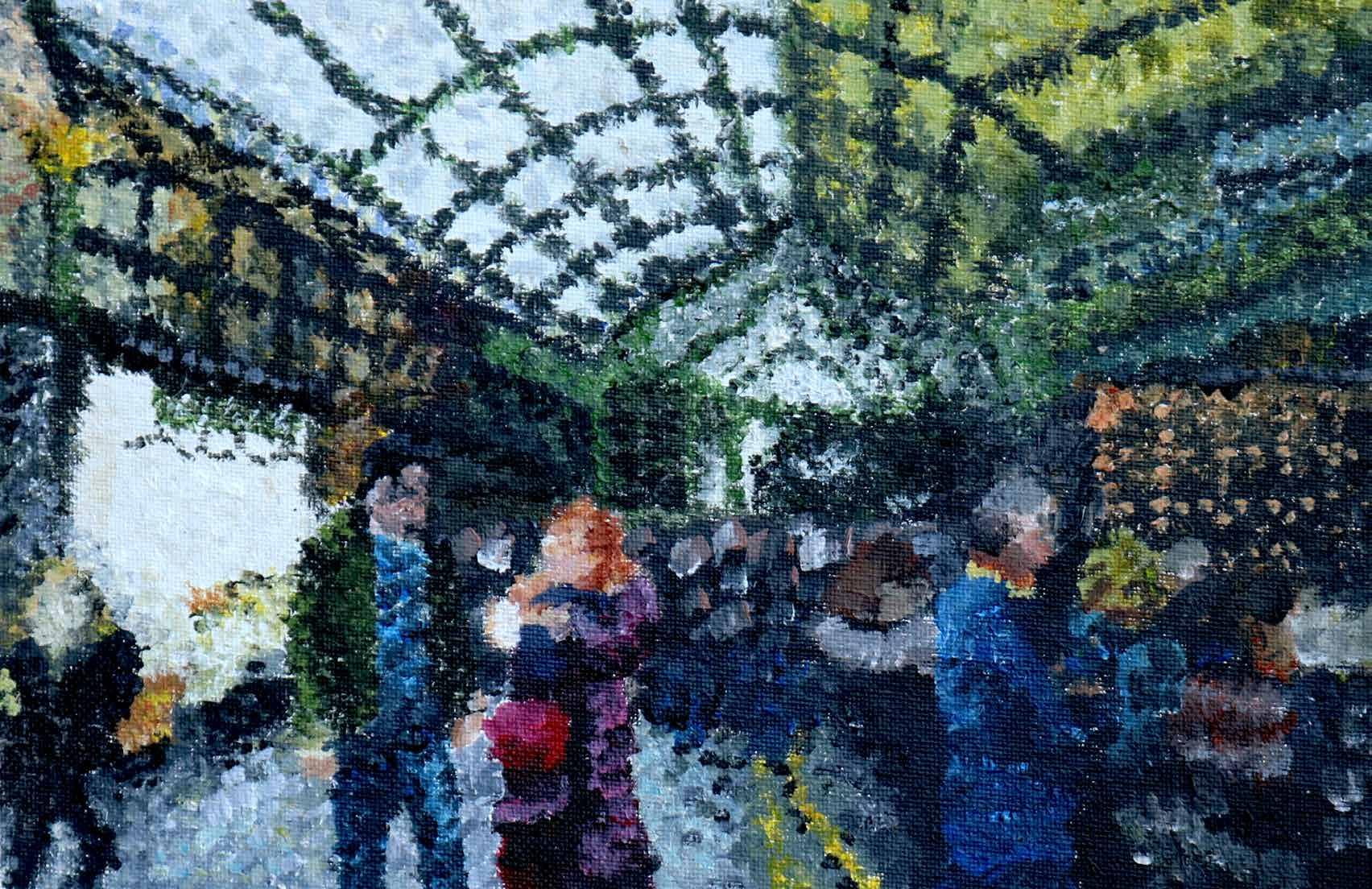
Dancing with My Father
Ella Houden
The first time I heard “Dancing with My Father,” I sat, tugging at the tight straps of the car seat. The red and black cloth of the seat was stained with blood from the cut on my elbow I had acquired falling on the black pavement of the school yard. The window was fogging up with each breath Mom and I took, skewing the sight of rain drops and the slippery roads that made me feel warm. My skin turned pink as the heater in the car left white noise in the air, pressing a windy gust of heat into my face. My jacket was tugged around me, two sizes too big, but held me in a heated embrace. I traced a smiley face into the condensation of the window, my small fingers smudging the carefully covered surface. The beads of water made my finger cold and wet, a stark contrast to the warmth the rest of me felt. The glass felt like ice as I moved my finger around it, and I made the outside visible as the fog cleared with each swipe. It squeaked to the beat of my movements, just as the windshield wipers sounded, smudging water loudly. I formed a circle around the smiley face, and added a stick body. I copied it twice, getting shorter and shorter. I labeled the figures in the picture as Dad, Mom, and Me.
The red light ahead of us spread in my view, illuminating more than just the round light bulb. The round center spilled out into a starlike shape, long triangles extinguished the grey sky behind it in firetruck hues. It burned my eyes as I had become accustomed to the darkness of the day. The front windshield was rapidly swept with the frantic, handless arms of windshield wipers. The beat of them going up and down similar to a metronome, moving along to the beat of rain, which tap danced on the sun roof with thousands of little feet out of sync.
I examined the seat with my fingernail, trying to pick up the crumbs in the cloth, the Cheerio dust that seemed to be engraved in the lining of the car seat and would remain in the pocket of the seat belt buckle forever.
I had been in a trance, a childish imagination firing rapidly with the change in weather conditions and the winding canyon. Slated stone smoothly laid out, climbing up the mountain in jagged steps sped past me. A snowy layer like powdered sugar dusted the top of the dirt mounds, and the clouds pooled over the peaks. I could see Dad slicing through it on his skis, holding me between his legs so I wouldn’t crash in the snow he loved. The road was small, with evergreens on either side and asphalt in between. We were only separated from the cliff to our right by a small partition of welded metal. I snapped out of my hypnotized state as my ears curiously picked up the new station of the radio and the intro to a new song.
Listening to the words “Back when I was a child, before life removed all the innocence, my father would lift me high,” I felt myself being unbuckled as my fathers fumbling hands pushed at the finicky buckle, tugging at it until the clasp would relent. Then, his big, soft hands would lift me up, and he would hold me above his head. He would waltz around the yard, and my arms stretched out as I flew around the sky, giggling as his sparkling eyes looked into mine. He would take me around the grass and concrete as I became a bird, an airplane, a superhero.
Next came, “Then up the stairs he would carry me, and I knew for sure I was loved.” The unheard chorus continued in my head with my fathers voice, singing me to sleep, his guitar in hand as he strummed some notes he did not know. The music was always perfectly out of tune. He would make songs of my name, just as Gramps had, and sing to me about the quests of a knight. My eyes always grew heavy, and my smile faded as I drifted off to the sound of his humming and laughter. Finally, with the words, “But could you send back the only man she loved. I know you don’t do it usually, but dear Lord she’s dying to dance with my father again. Every night I fall asleep, and this is all I ever dream.” Humming along, my smile faltered. I tried to understand the strange change in tempo. The word “Lord” struck a chord in my head, and I remembered great-grandmother’s “funeral.” Such a funny word. She had been still in a boxy bed, and this tall man had told my mother something of, “the glove of the Lord’s hand now holds hers in heaven.” Heaven is where my fish had gone when it stopped swimming. Had the dad stopped swimming or was he in the boxy bed? Suddenly, I saw the dark wood my great-grandmother had lain in. Her face was still and coated in makeup she had never worn before. Her hand had been cold when I grabbed it. I peered back at her face to see it as my father’s. He was in a suit, the kind he wore for fancy dinners with mom. His hand was there, and I reached to hold it, but it was clammy and still. I peeled back his eyelids, but the sparkly blue had gone dull. He was like great-grandmother. He was gone. My cheeks burned as salty tears streamed down, burning the scratch on my chin, and I sniffled to hold it back. My mom looked back at me alarmed, uncertain how I could have understood such sadness. But I did, and my heart burst with a hole I knew was not there. I imagined the hands of my father, gone, and I, no longer flying but falling without his careful grasp. I felt myself plummeting to the ground, the concrete, and to sleepless nights with no song to give me the escape of peaceful rest, unlike the rest great-grandmother had: only nightmares of the monsters that lurked where my father should be singing. My ears rang, and I couldn’t remember his voice, his sparkling eyes, his bear hugs. He was gone. Mom’s own tears began to flow as she pulled the car over to comfort me, but I only wanted dad.
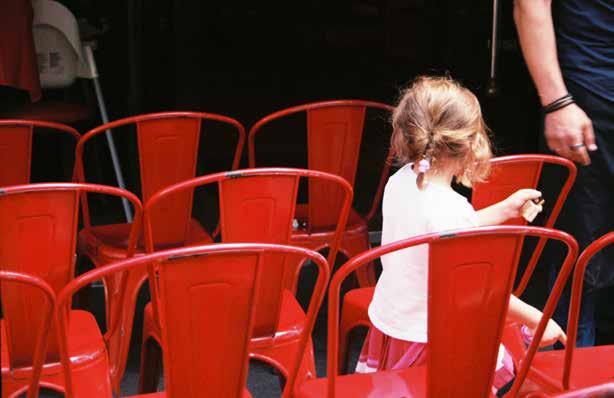
The Fine Art of Yawning
Chiara Kim
It’s a force that seizes one’s entire body, a prolonged breath that relieves boredom, pronounces tiredness. You inhale. Your breath comes to stop where the rest of the world is tuned out. Radio static plays in your ears. The breath that rises in your throat pushes moisture out of your eyes, holds tension at the top of your shoulders until the blissful release.
When I was in third grade, my classroom was a kaleidoscope of paper snowflakes and origami paper. I sat with a home for my shapened erasers in my desk and a finished multiplication quiz in front of me. I don’t remember who started it, but somebody yawned. Perhaps it was the boy who had moved from Holland. Or maybe it was the girl with stark blond hair who asked me in a Valentine’s Day card why I hated the color army green so much. This breath spread across the room, each third grader falling into giggles out of the display of the psychological phenomenon that is contagious yawns.
Seven years later, in the public restroom of a lush jungle surrounding a temple, isolated by the vibrant green leaves from the busy white noise of a nearby street, a hurried middle aged mother yawns as she dries her hands and rushes past me out of the door. Her energy moves through the air towards me as drowsiness overtakes my eyes and I give in to the yawn. As she walks out of the door, her relief lifts into the trees and becomes absorbed in the foliage. After sitting for hours in the crowded, clammy air of a plane, staring out of the window my friend and I finally arrive in the Charles de Gaulle airport, our eyelids weighed down from our travels.
Passing by the streets of a bustling city, we sit on the worn down seats of a poignantly nostalgic smelling bus. We stop at a light and I look out of the window to see two women, their headdresses tiredly slumping off of their heads. One holds a baguette and looka up at the tinted window of the bus, her jaw dropping and eyes closing as she releases a breath, and her shoulders fall.
We hike up the stairs into a cathedral with stain glass windows coated in colors, seemingly formed from the crushed pigment of flowers. I look up at the arched ceiling of the cathedral, off of which each sound reflects and waves its way back into my ear. The weight of the climb up the stairs bestows itself upon my eyelids and I yawn as I stare into the marble cut wings of an angel.
Finally, arriving back at the hotel, I have never felt more grateful for air conditioning. My yawn is a vehicle, floating me into a REM cycle on fabrics of fog that clouded my vision. I fall asleep thinking about how I would become connected to all of these new people that I had just met. I tell myself that it was only the first day, although it had seemed like the hundredth. At a dinner of pesto pasta with fresh parmesan in a restaurant tucked away in the cobblestone streets of Nice two weeks later, I learned that the rest of the kids had felt the same way, and that some of them
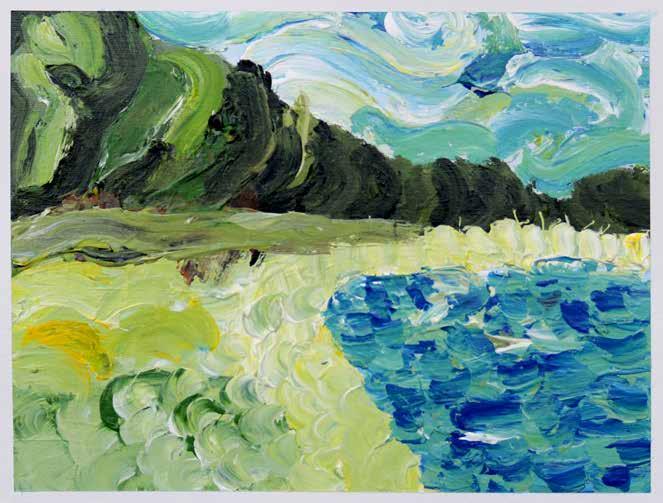
had cried the first night for fear that they wouldn’t become friends with anyone, that they wouldn’t connect with anyone. But our connection that had developed wasn’t simply because of the countless hours we had spent together, walking for miles in the arrondissements and leaning on each other in the humid rooms of the louvre gazing at the magnitude of The Wedding at Cana. Yawns brought together the mischievously smiling faces of my third grade classroom, forged a bond between myself and a woman in the quietness of a vibrating forest, connected me to all of my new friends. They were connections initially forged through the act of yawning.
Hyde Park Acrilic on Canvas
Jack Smith
Rowland Hall
Cerberus
Connor Hughes
Echidna and Typhon praise not more than uniqueness
In their children
None who lives is more unique than I Who exists to keep death unmoving
I watch the gates of hell
My haunted growl keeps the shades of death in a proper state of being Orpheus knew better than to cross the lines of death He paid the price
Greeks praise me
For being the sole survivor of the etern Who exists despite the dark gods, Some of whom are barely considered alive
The truth of death is infinite
It claims anything that dare not breathe I simply enforce it
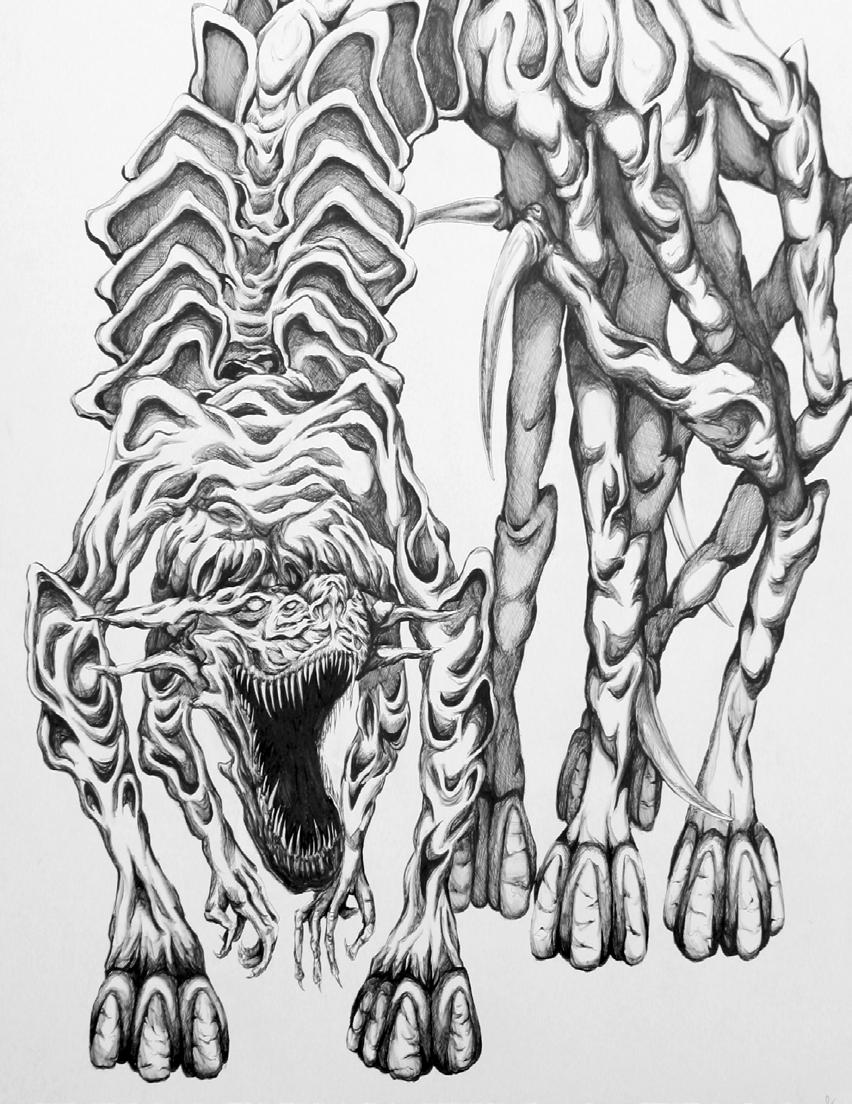
Translucent
Tate Beasley
1.
Next to The blue lizard lay the skin patched and shattered Lines of leaf
Against the rock Of a ribbed marrow Jutting
Out of the red soil, A bony tail pointed up.
2.
Chuck’s not coming back now--
Was it something I said?
I’m trying to remember If we exchanged goodbyes.
It’s raining now And I’m angry
Because he forgot to put the umbrella back in the car.
3.
Below the portrait, the barista Stands, one foot higher than And a brick wall behind. The other, her coffee-stained apron Outlining the espresso machine (I never liked coffee anyways)
And a brick wall behind.
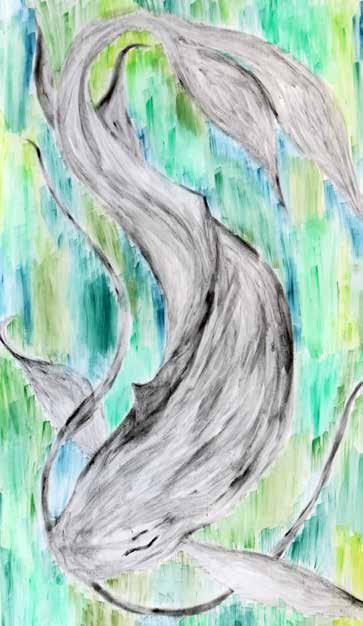
Flow
Watercolor and charcoal on paper
Amaya Hoglund
Gin Drinker’s Liver
Laura Summerfield and Kajal Ganesh
Liquid glides from popliteal arteries
Like resin we used to collect in our hands
We’d fill our buckets with maple sap
Hunched over with palms of brown sugar
I now hunch over remnants of cirrhosis, Quaking like an aspen, clutching Nux Vomica.
Breathe like the basket of Nux Vomica, Never dry the clay inside his arteries, Don facepaint to demonstrate your cirrhosis, Smoke the rolled salmon heart from his hands, Or expect anger in egg white and sugar. Drink the alcohol of his iris’s sap.
Bless the earth for its fermented sap
And poison’s disembowelment; Nux Vomica
Reminds me of the bliss of gasoline sugar. I squeeze through Spanish alleyways and arteries, Clenching red stained glass in my soft hands. Puddles of lining soak with cirrhosis.
His daughter smells faintly of cirrhosis and decapitation. The fresh, cherry sap boats from fingertip to palm, the hands raspberry and old. Nux Vomica aches in his exposed, burst arteries. His slit throat holds lemon and sugar.
Animals’ tongues harbor spoons of powdered sugar, Unaware of its poisonous cirrhosis. He holds a cord of tangled arteries
Around their necks, tasting the sap, The despicable enemy, Nux Vomica. The skin of moths’ wings envelops his hands.
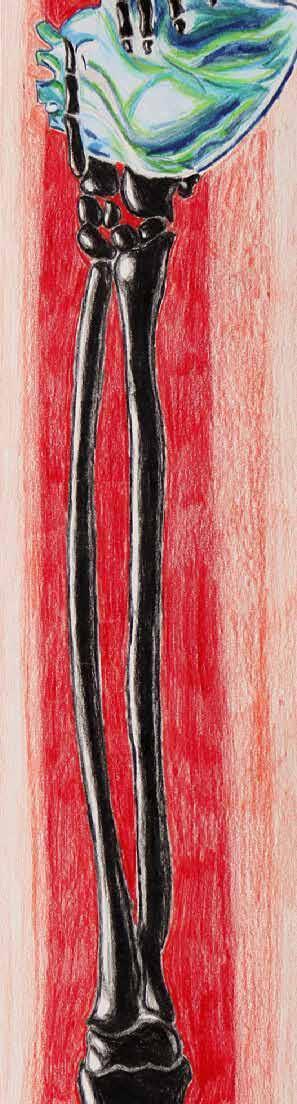
Expose your vulnerability to their hands, for you have become Honey and Sugar, and no quantity of ground Nux Vomica cures what corrupts your clients: cirrhosis. Your saliva resembles the dead oak’s sap, though it was you who wept in its arteries.
The curtain opens again -- out steps Cirrhosis, Drenched in washable ink like a dress of sap, Holding in his hands his soot-colored arteries.
Arm
Colored Pencil
Annika Pollatsek
Crescent Shadow
Clarissa Hyde
A woman with the handprint of my face and the shadow of a crescent moon on her hip stops on the side of the road. Above her, clouds cover the world like a white linen shirt stained with Indian food, holes showing off a blue stomach.
When she opens the car door I am there beside her, within her and without her. With her first breath I am reminded of one of my past lives. In my present tameness, I am caught between breathing and the opening of a secret eye, my falling into a former body:
The breathing of the wind through mountain grass, a morning on the river, a pair of worn suspenders draped over a wooden chair. These are the longings from my deepest source. Whose name have I etched into stone? What am I forced to relearn? What self must I reclaim?
These are the questions of the woman who steps out onto the highway.
I am the sweat on her brow, the collar bone beneath her skin. I am the two sticks of chewing gum between her teeth. I am the gravel at her feet, the posture of her frame looking out towards the Wasatch.
The only thing that separates us is the distance of memory, a piece of rope tethered around my ribcage, extending into morning fog. Am I still imprisoned in my own heart, walking upstream through my own consciousness, an infinity of the same human movements?
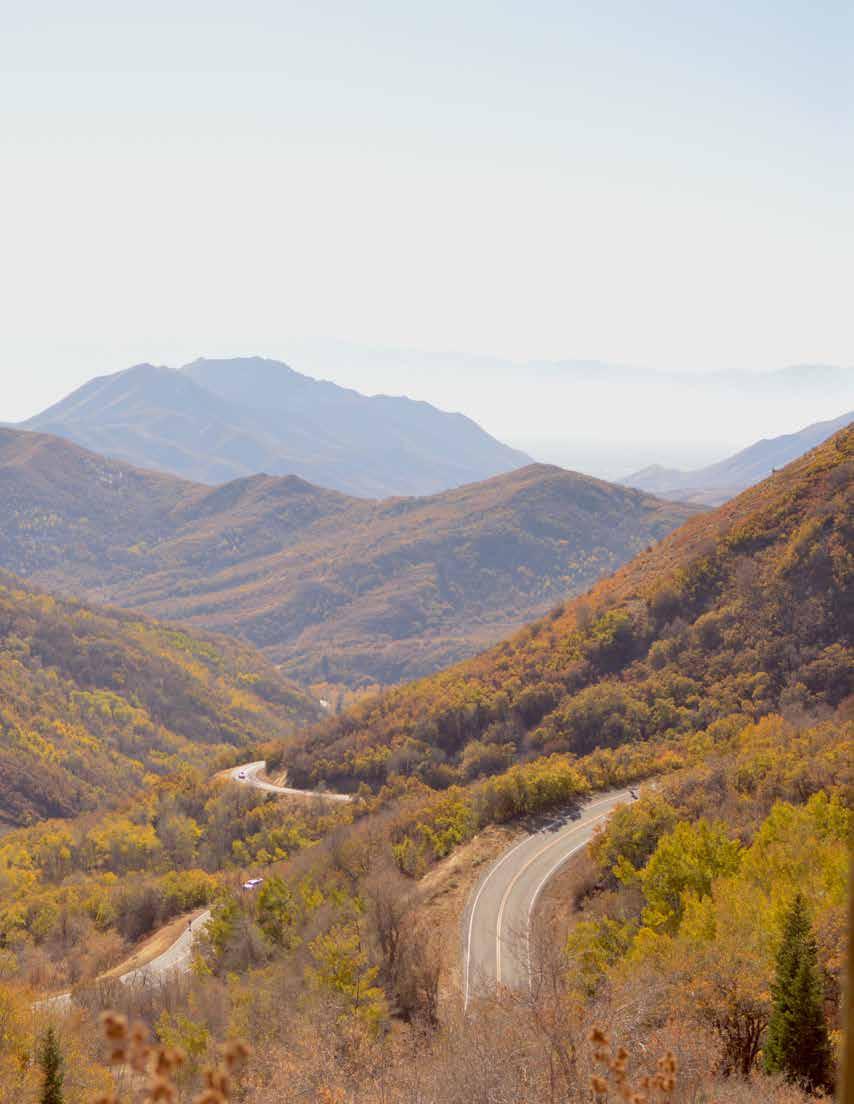
I beg to be surprised. I beg to be contradicted. I beg to feel myself in her body dripping like candle wax into her bones, like rain seeping into the fruit of a cactus, like a tattoo in the shape of my body etched into every pore of her skin.
I am only her lingering fingerprint a shadow of her voice, the echo of her body against the mountains above.
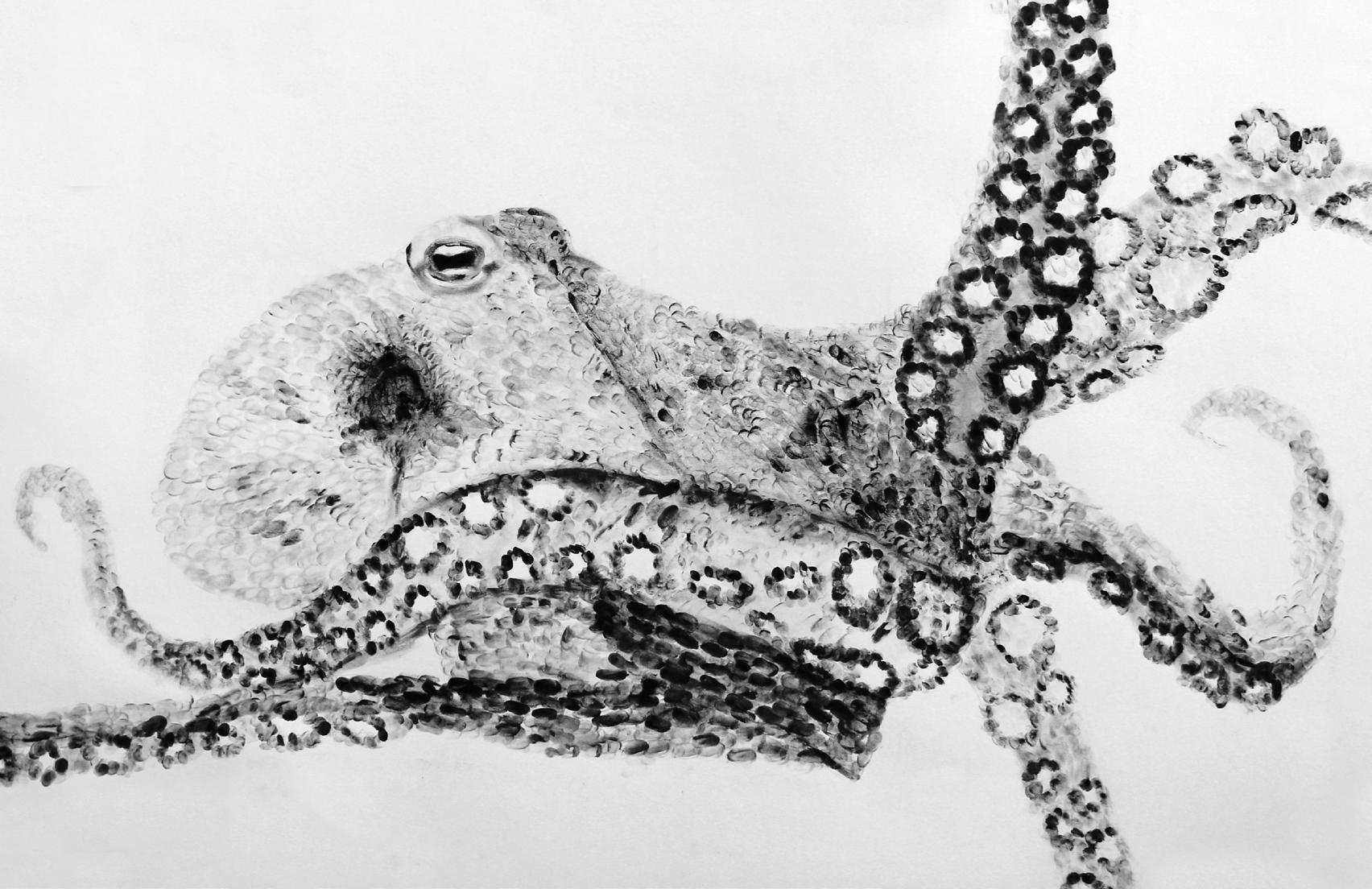
Octo Charcol on Paper
Ian Brown
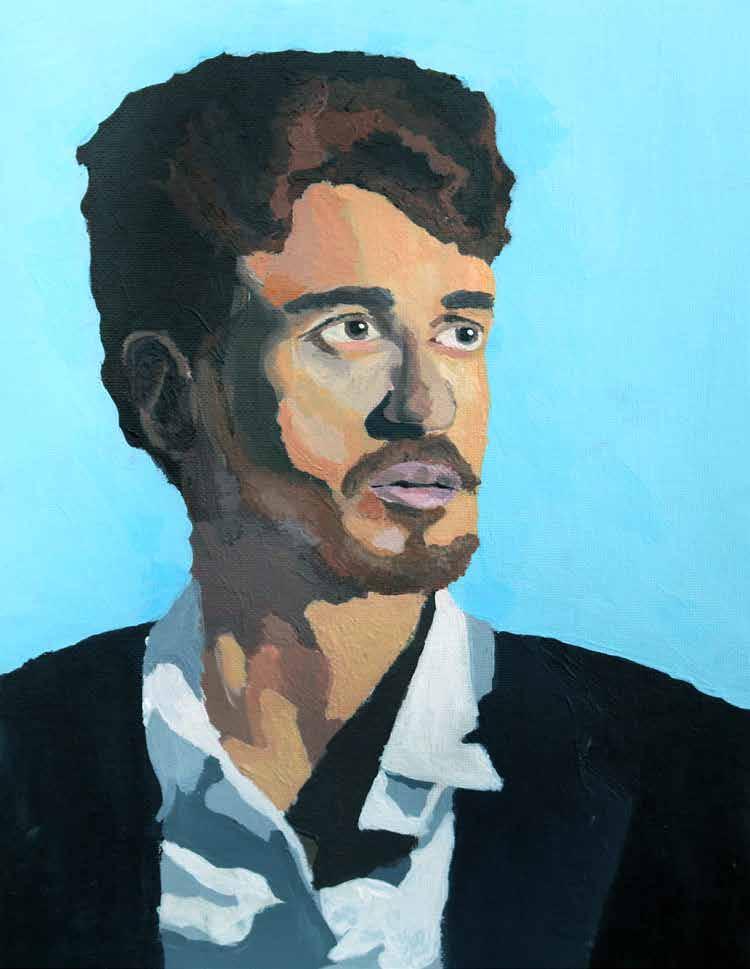
Watching my Watch
Max Eatchel
I regret killing those birds when I was a kid with the crank-action BB rifle that would spit out hot and sharp metal faster than my young eyes could see
My uncle once told me: “You can only trust a man who wears a watch” I stay silent some fights are too good to pick
I watch as the color of the robin’s eye drains to grey And my childhood flooded out of me like the blood atop the bright green grass mixed in morning dew
You can only trust a man who wears a watch to miss his kid’s birthday staying at work late “crunching numbers for clients”
Seconds tick away and that sweet little boy Who used to get up early on his mom’s birthday And make her breakfast in bed became a man
You can only trust a man who wears a watch to not be there when it matters most to you, or be inconsiderate and narcissistic.
A man that likes to watch little animals die In his back Yard now contemplates his time spent and gone to waste because his two good eyes weren’t good enough to see
You can only trust a man who wears a watch to take your money, no matter your age race or gender no a man with a watch doesn’t discriminate.
Aqua Man
Acrylic on canvas
Ian Brown
Arrow in My Heart
KatieRose Kimball
The first time I heard “arrow” by half.alive, I was deep beneath blackout-blankets, the light of my phone flooding my face. I had spent minutes staring blankly at Janelle Monae posters and vintage 1950s pin-ups, (my fovea followed the flaking tear from the top right corner to the edge of the brunette’s coiled hairstyle) before slipping slowly into the six pillows piled up around me, dragging the comforter up over my head until my already-falling-apart hairdo clung to the sheets with dragged-out static.
My roiling resentment bubbled up between cracks in the covering of put-upon indifference in my chest as I scrolled through recommended songs, flashes of brilliant color flickering and filling my tent in a imitation of a low-budget 6th grade dance. I clicked one at random with my eyes replaying memories from hours before. Memories that painted older moments in a shade just different, just off enough for the perfectionist artist to be unsatisfied, but not enough to reveal a clear path to a better choice from the array on the palette.
The video’s visuals gradually replaced those of my mind: a kitchen, a living room, a bathroom. The air bubble in my throat burst with the beat of the drums, with each repetition of repeated words. As I watched each change in scenery, the utterly casual despair, the carefully choreographed dance in coordination with the building music, I put down my mixing palette and backed away from the day’s piece of artwork. My eyes settled into the present, and my heart stuttered slow.
The fourteenth time I heard “arrow” by half.alive, I was crashing through the kitchen, blasting music on high, trying to calm the angry energy running through my bones. A moment of silence as the last song cut off in transition caught me in the middle of a breath, air solidifying between my ribs until my heart, lungs, and esophagus were encased in beating blood.
Each twitch of my fingers reminded me of his infuriating dismissal. Each beat hammered home all those moments I should have known he didn’t care, couldn’t care about my time. Each late arrival, each demanded request for a rain check, each casual twist in conversations toward his latest complaint. The drum’s building bass beat through my chest, disrupting my thoughts until I could close my eyes.
Casing eroding with each turn of the melody’s phrase, my lungs began to work again as I methodically removed each gaudy ring on my fingers and began to wipe down the counter. Eggs and butter from the fridge, carton catching on the sticky residue of an orange juice spill — in the space between — sugar and flour from the pantry, picking up a whisk on the way past a set of drawers — I know my mind’s been cheating — salt from the cabinet, the dissonant clink-clack of glass against plastic becomes its own instrument in the band — slow it down, release control — I took a breath and looked down from the flower-patterned wallpaper to the whorls in the polished counter.
Ingredients laid out on the counter in front of me, I felt the present slot back into place.
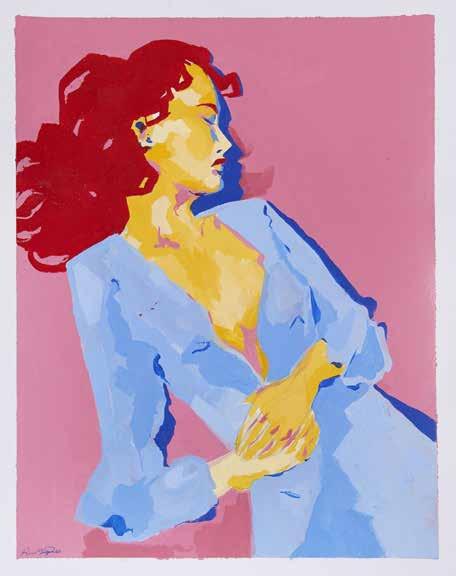
Aching Heart
Acrylic on paper
Robin Zeng
The fiftieth time I heard “arrow” by half.alive, I was caught in a thunderstorm at a bus stop. The rain pounded against the cured plastic in a frantic tap dance. My hand pressed creases in the gifted movie ticket I hadn’t used. I’d wiped off my lipstick in the movie theater bathroom, my watery eyes avoiding those of the cleaning staff working through the stalls in the mirror.
I had thoroughly familiarized myself with Jayton’s Shampoo as advertised by a beautiful brunette lying on a foreign white-sand beach by the time the playlist trickled into the song. The first few stanzas found me staring through the scattered curtain of water, tips of my shoes darkened by the occasional stray drop making its way at an angle away from the curved roof of the shelter.
Memory trickled down my neck in subtle streams. With a sudden certainty of motion, I tucked my phone inside my jacket and stepped out into the rain. My hair, sloppily transitioning from humid-curled to flopping-wet, flipped into my face as I spun. Each drop in the music anticipated by my muscles, my body danced and jumped and stepped in time as I mouthed the words. The dull, distant house lights bled across the center of my vision in a band of muted yellow-white.
With an ever increasing spread of temporary stains peppering my cardigan, I began the long walk home with a bounce in my step, the future in my mind, and an arrow in my heart.
“Language is a skin. I rub my language against the other. It is as if I had words instead of fingers, or fingers at the tip of my words.”
—Roland Barthes
Tripp
Charcoal on paper
Leah Button
Sparrow’s Waking
Clarissa Hyde
Your self. Your body in darkness, amber brick beneath your broken spine, somnambulant, unfeeling, unaware; not a toe, nor a finger, you are one; you are water power in green neon, continuous.
Rouse yourself, sparrow, this is not your only life.
1889: bed yourself on kindling and firecrackers. Unfold silk sheets into singular cities skirted with wheat seeds sowed on coffee ground dirt. You bought this boxspring on your twenty-third birthday. Escape, burn down this sleep.
Trip down the South Hill stairs, flightless, like your mother, half blind in the daylight cracking on tarnished marble. You are now at the base of a breath.
Bring no splices, sparrow. You need no protection.
Reverse this snowfall, under a horizontal rain, your unblind eye and the working half of your body branches from the asphalt in Spokane. Freeze the Falls without coldness, transpose this wildness into the tongue of your children soaring into wood chips, into the Radio Flyer downtown.
Upon exhalation, open your eyes. You are at the bank of the Colombia, Perry District with every melt of snow another version of yourself. You are no longer a murder of circling. You are the awakeness.
Whisper your secret name and you are finally an instantaneous creature, a singular scent of pine. This is as undamed as what follows and follows.
Swoop down, sparrow. Start again.
The Cliff Photography Elli Dark
Inglorious Pilferage
Garret Glasgow
O’ great black bear have you lost the way of his warmth? For even you, guardian of flame, have underestimated the sweet licks of his fiery passion.
Lost in woods, you panicked and dove deeper, trying to heal the valley between blaze and bear. How could you be so foolish? For man walks these lands, hunting for ego fulfilling treasures.
Man discovered fire in 1492, stealing the farmer’s milk without thanking him. Fed rotting sticks, the inferno lit the stars, revealing the universe’s pearl to man.
How could he have known man from bear, for even he confused the German three? Was it the middle, index, and thumb? No, for your bear paws have no thumbs.
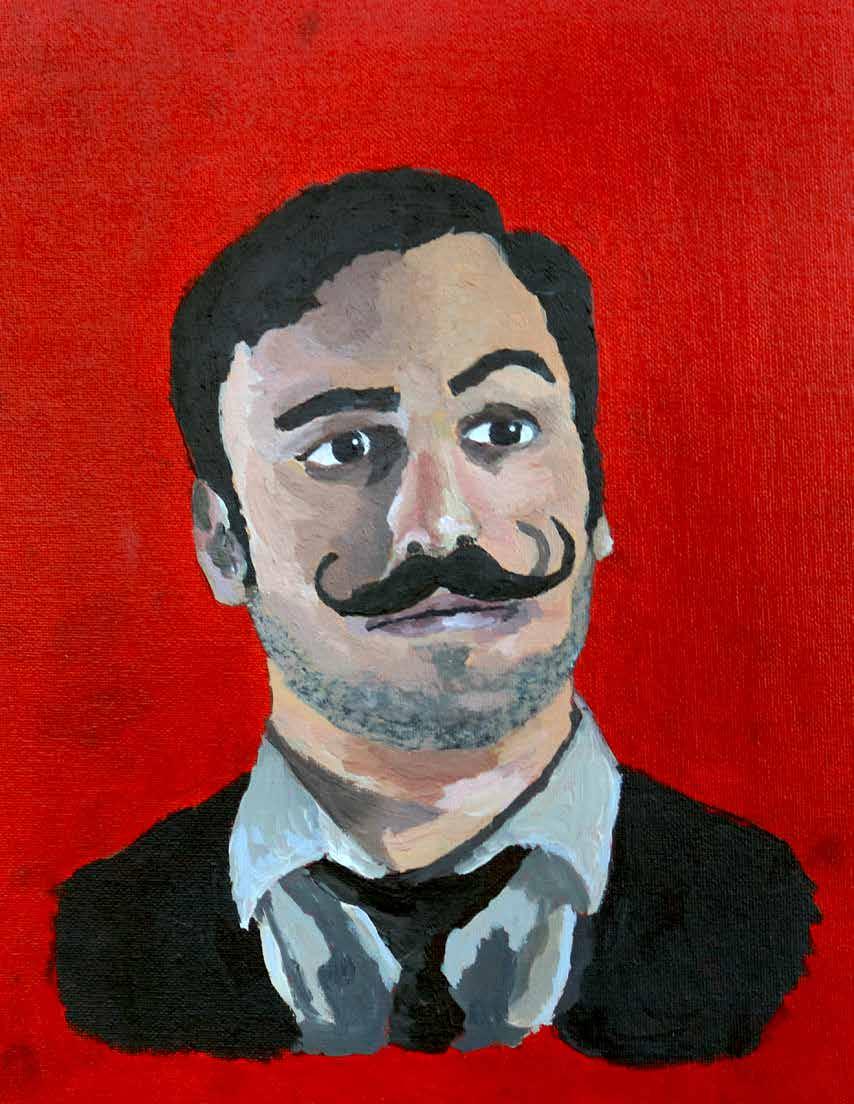
Wanted Barista
Acrylic on canvas
Ian Brown
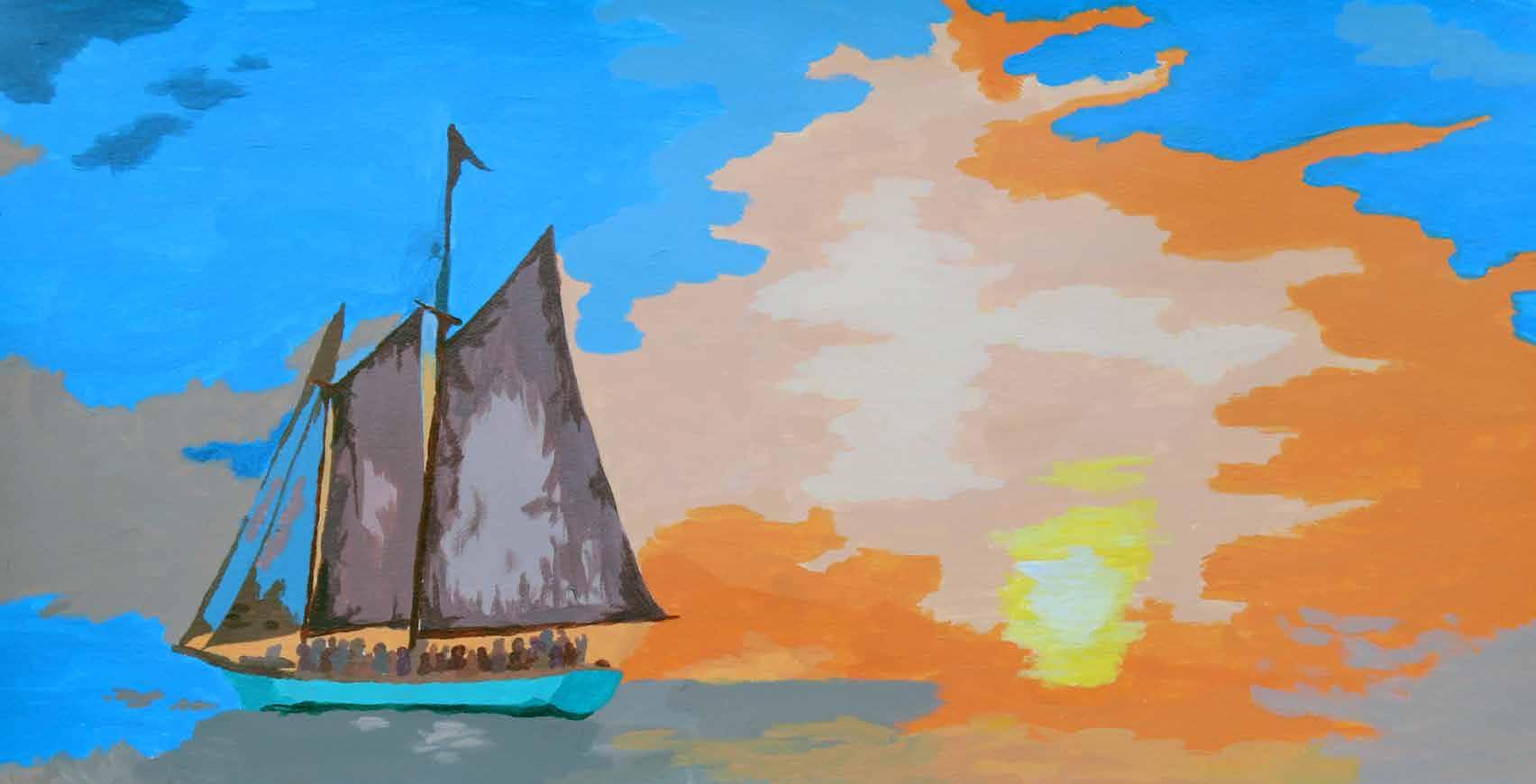
Red Sky at Night
Acrylic on canvas
Sydney Young
Image: sitting on the hood of a Jeep Wrangler, dented black metal too hot, too cold, forests and deserts blurred by speed, faint outlines of trees and bushes smeared across the retina, pebbles rocking tires like rowboats, bugs flying into eyes, guts on the lenses like road trip pitstops, polypropylene laughter bouncing off couch cushion seats, hitting the inside of the glass, trembling glass, fingers on smeared glass, wet paint forests and deserts smudged away, too cold to dry, driver painted out of couch cushion, some snippet of babble, passengers made of water, forest stream tongues, too hot to freeze, dripping down painted glass, bug wings gilding eyelashes, vibrating chest on Jeep tires, caution: wet paint

& Lungs Unraveled from Air
Image: Grey matter divots, pulses force channels through bedrock thought, logic uncovering unrefined metal in the walls of deepening valleys
Image: Breath, in and out, quivering alveoli, too small for oxygen molecules, in and out, smoke lifting off burning tissue, lava rock, in and out
Image: Iris, blooming flower, with a winter night core, sapping heat from petaled flesh, light blue to white, too bright for living meadows




Out of Time
Jack Vitek
The walls were lined with illustrations of chrysanthemums, or maybe they were lilacs, leading to a brooding wooden door. The hallway was short, ten feet or so, with low-quality light bulbs providing a sickening yellow-green glow. The rain was pouring down on this Seattle November morning, appearing as though the sky was still mourning Kurt’s death 24 and a half years on. The Airbnb was cheap, a lower-end two bedroom house with a kitchen and a seemingly mysterious hallway. Coming here was impulsive, trying to escape his self-diagnosed bipolar disorder. His family doesn’t believe him when he says he can’t live with his thoughts. They think he’s trying to make a scene, trying to gather sympathy because he doesn’t have much to offer.
“What the fxxx is behind that door?”
No one answers the question. He was alone. He had only himself to guide his journey of thoughts. Maybe it was time for him to figure out why he ran away. There was no easy way of answering this. All of his life he wanted to be something more than himself. Long ago, he began to paint these stories, these encapsulations of what he was thinking about. His art meant everything to him. As per what he thought, it was the only thing that ever understood him, as though he was meant for another time and mistakenly thrown into the 21st Century. The self-reflection began to kill him. He couldn’t stand being inside his own head for a few minutes at a time.
“I’ve got to find out why they locked that bedroom!” he shouts while pounding the oak-wood kitchen table.
Thoughts of himself dragged on and as the clock told its story of time, the young artist grew angry. Well, angry isn’t totally accurate. It was more of a mixture of anxiety and sadness that have been dealt with by anger.
“Screw this! I have to find out what is in that room!” he says, screaming now as tears are rolling down his face.
He stands up and grips a tall, wooden stool that he had been sitting in. Walking with a shake in his step, he passes the chrysanthemums, moving through the hallway. Finally, at the door, he swings the stool. Now in a rage, the artist swings, and screams, and swings until he successfully breaks a hole in the locking mechanism in the door. Trembling, he twists the door handle from the other side. The lock clicks and the guarded door opens. Light from the cloud-lit day pierces
the windows and lights up the only thing in this converted bedroom: an easel with a blank canvas, showing only the words, “Please, tell me your story.”
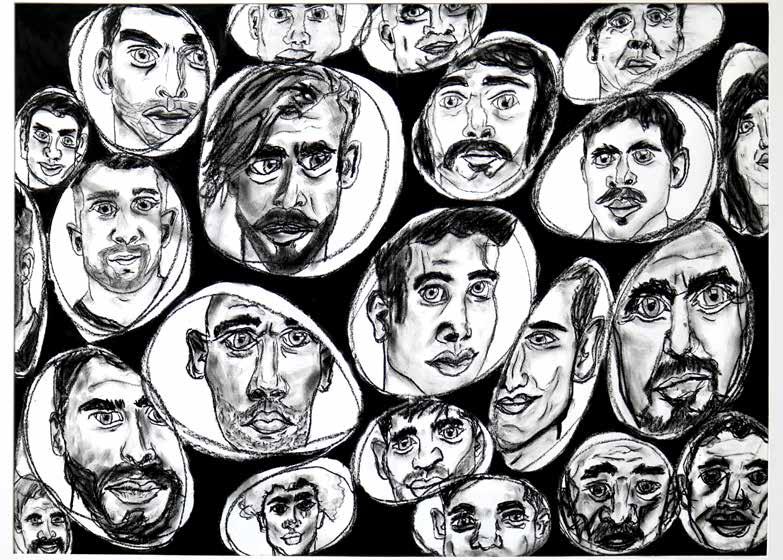
Ovals
Charcoal on paper
Ian Brown
Bad Music in a Preschool Cafeteria
Benjamin Fowler
The first time I heard Shinya Kumazaki’s 意気揚々(Ikiyōyō), I had completed the first long journey of my life. No one ever knows how to push themselves when they are seven years old, but at the time I felt pushed, perhaps by the group of geniuses sitting three tables away from me and laughing because I cannot do something as simple as slay a demon with a sword. I was marveling at the concept of invincibility frames, a moment in a video game where nothing could touch you because you were made of thin lines and black and white animation.
I was sitting three feet from the boy, Steven, that I had betrayed with the wrong word at the wrong time in the wrong place and a punch to the gut during a game of Star Wars gone horribly wrong. Weeks later, he would offer me a donut hole covered in coconut (not real coconut, that brown sugar crap that Hostess puts on all of their “tropical” products), and I would go home and cry because I hadn’t played Star Wars since.
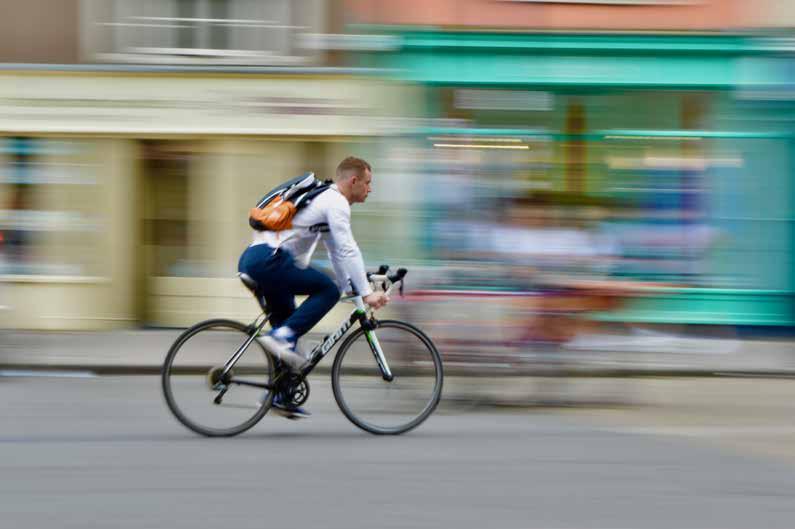
I was sitting 12 feet from the boy, Carlos, who had betrayed me with nothing but a Sparrow’s egg and a bizarre stubbornness (no wrong words or wrong places or wrong times were involved). Years later, we would be reintroduced by a mutual friend. He would not remember the egg or the betrayal, and neither would I for months until one day when betrayal just happened to be on my mind. I thanked him for being the only person who liked card games enough to play card games with someone who was too interested in card games to have friends outside of card games.
The second time I heard Shinya Kumazaki’s 意気揚々(Ikiyōyō), I was piecing together the loose string of noises that I remembered from that oh-so nostalgic day, trying to remember its name. After somewhere around 30 different Google searches, I had found it again, the song that meant the end of a fictional adventure that had become the center of my life and the end of two real friendships I couldn’t care less about.
I have listened to Shinya Kumazaki’s 意気揚々(Ikiyōyō) 5 times since I found it again, when I graduated from middle school, got my driver’s license, when my half-sister got married, at the birth of my nephew, and when my uncle died of cancer. 意気揚々(Ikiyōyō) translated to English means triumphant return. The song tells a story of victory. Thus, I listen to it whenever I have attained victory and returned triumphantly, or when an era of happiness is ended.
Shinya Kumazaki was not the writer of the song, nor did he sing it. He was the director of an electronic orchestra who composes the melody of my tears, even though the purpose of the song was to be in the background, to make the credits of a video game endurable. But to me it was a sign, a sign of the possibility of life, for if I could do so much as to murder a madman whose intentions were the death of a planet, using nothing but my given strength and cunning, then how hard could real life be?
Rush Photography Elli Dark
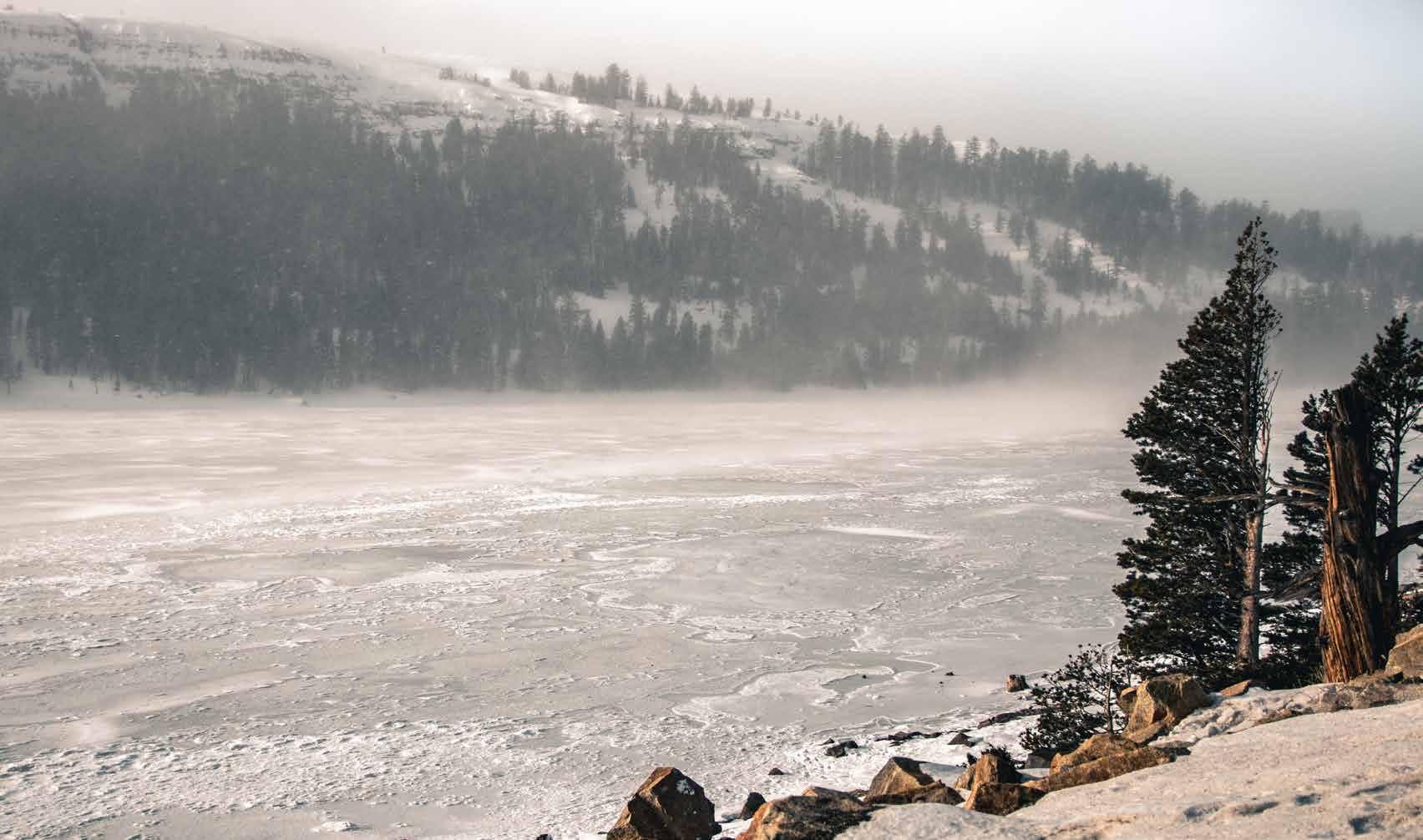
Boredom
Tate Beasley
Does it disappear like sugar in water?
Maybe it was a paper boat That sinks
Underneath the still blue.
Perhaps it was a bowl of oatmeal. That hardened like a rock in the microwave.
Do you know which way it went?
Left at the stop sign, right at the moon house. No, it went right,
Past the dandelion field.
How does it feel?
It feels like a wave passing over rocks, Chalk
Scraping against dusty canvas,
A wrinkled silk duvet. But worst of all, nothing at all.
Are you going to be okay?
If the wind still whips my face on a cold day, And the sun still stings
In my eyes.
If 52 is too long and 365 blends into 1,095, then maybe not. And you?
A Pinch of Sugar
Photography
Garret Glasgow
Echo
Emma Duggleby
Watch his reflection ripple across drowning eyes, two lovers adoring the same body, gilded by godly ruin. godly ruin.
You dance with him on moss-cushioned feet. Affection in mimicked tongue bounces off forest bark: his words embedded in your throat. your throat.
You watch him disintegrate from the edge of the pond, your body nothing more than air and emulated shadow, smoke after flame. after flame.
For his sin, his flesh twists into petal and light, beautiful face of death, brilliant against your hushed body hidden in fragmented words. fragmented words.
But he is there, bright and fleeting, capturing valleys in meadow and spreading his image through ephemeral spring. ephemeral spring.
You are here, the space between noise and silence, shaded in the syllabic grief that shelters every afterthought. every afterthought.
Light from petals casts a shadow that morphed flesh cannot take shape without, lingering past the death of the blooming body. blooming body.
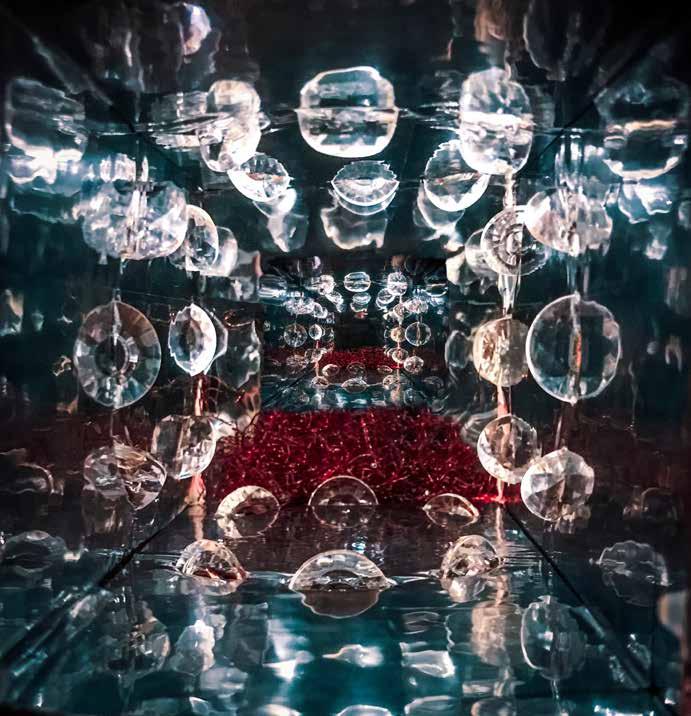
Cold Diamond Photography Garret Glasgow
Venice
Cole Topham
Sitting among olive tree orchards, toes digging into the dirt
As if they too are roots, I am almost one with Dionysus. I, however, have a sketchpad to replace his golden chalice, So I can drink my fill of the horizon and drown my thoughts In the landscape, losing sight of reality all the same. I strain to hear his voice in the wind and brace for his guidance, The prophecy that I have yet to receive. He does not speak. The only thoughts left with me are my own.
I am fortunate that a honey-hued sunset paints itself for me. Its oranges and reds burn up the Italian sky, but my head Can’t focus on the summer rays. Night will soon come to douse them, A hesitant Grim Reaper who lurks behind the giant wine barrels In the cellar but never ages, prowling until the moment when his name called.
My attention is fixated on the wheat fields in the distance instead, How they sway in the wind like your hair does when you laugh, Vibrant and blonde as if you too are seeping sunshine, Then soaking it back up again all the same.
Later that night, our gondolier effortlessly ducks
Under every bridge without looking back and fails to be distracted by the sounds of a football match being commented across the neighborhood’s televisions. I am not as strong, distracted, unqualified to be anything but a tourist. I take it all in: The small rip curls created by each paddle’s wake, smells of calzones and pistachio gelato mixed with the guts of fish Spread out across the dock, a productive fisherman’s catch.
There’s a certain charm to this underwater city. Maybe that’s why it’s so hard to leave, knowing my Feelings of liberation will fade when I step off the plane And my nose clogs with fumes of gasoline and democracy. The spartan inside me longs to take up my sword and charge Into the fray without a second thought, leaving behind The shield strapped to my back.
Those green eyes, shining like the Adriatic, are the reason for my hesitation.
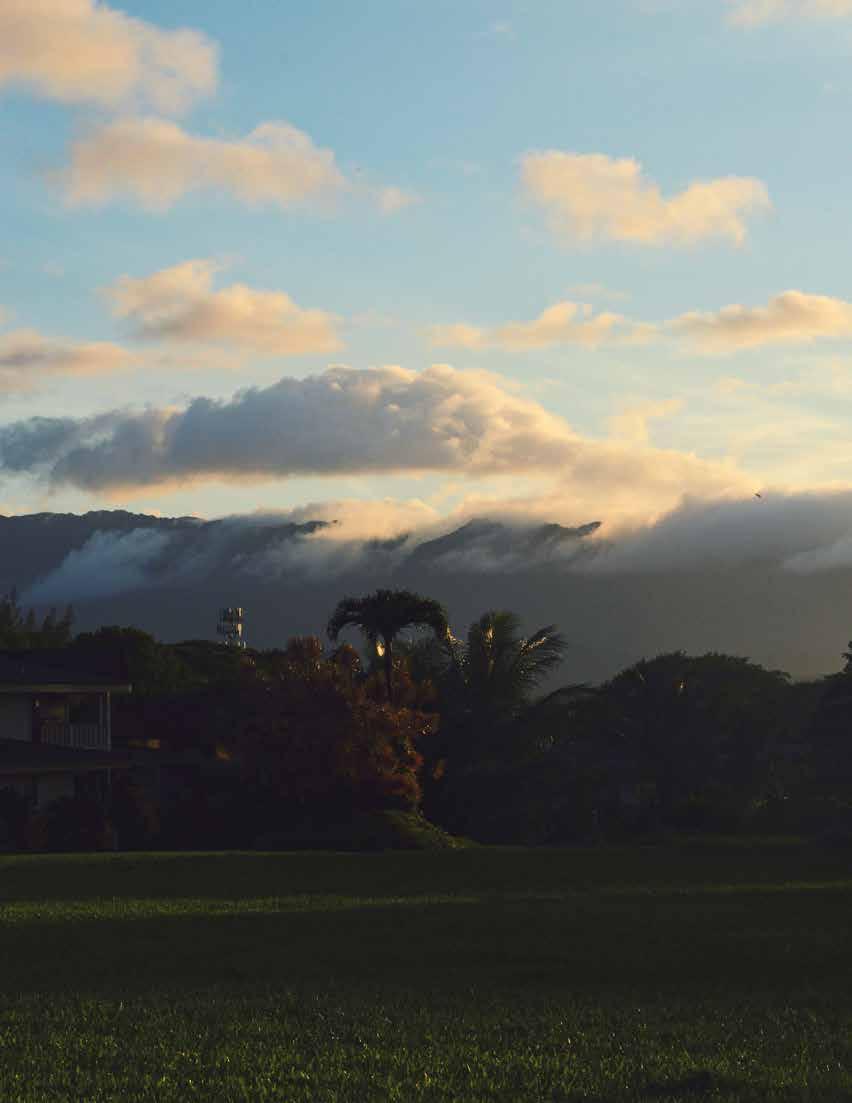
Dark
Spell to Be Said Upon Returning Home
Benjamin Fowler
Take a deep breath in a mirror.
Draw your face there so it doesn’t forget. Never take it for granted.
Push past the daisies
And hate them for not reflecting The inside of your own home.
Keep walking because you have to Not because you want to.
Live because your cocoon chose you to live transformed.
Become aware
That it does not love you
And that it never could at the bottom or in the middle.
Keep walking because you have
To end your story at the top.
Because you were made to end your story there.
Understand that the walls of ice share their goals with you. Because you don’t deserve to have your own
Until you help them with theirs.
Help the burning sticks as they gasp for breath
Even though their lives Were that of kindling.
Walk with it until it gets tired of walking with you
Even though you know that dead legs are never done walking And yours could never be alive.
Tire of helping.
Tire of walking.
Tire of loving.
Keep helping it anyway. Keep walking with it anyway. Keep loving it anyway.
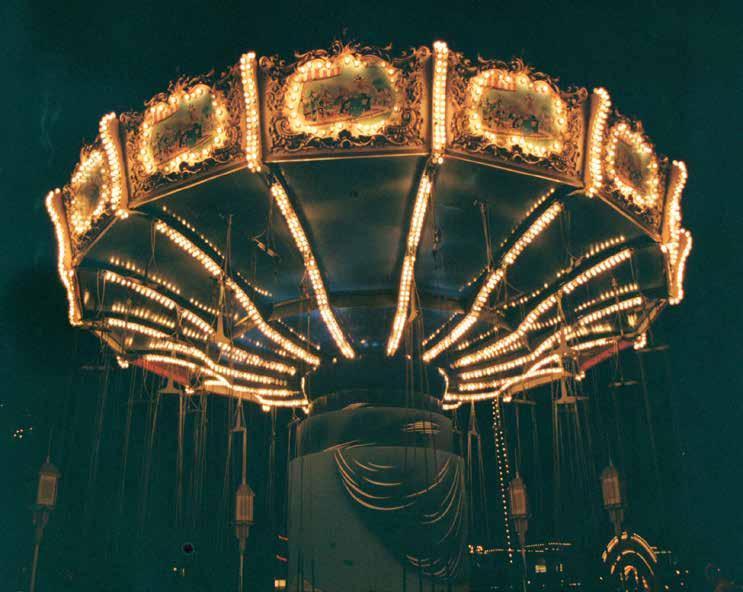
Liberty Film Film
Cate Christiansen
Rowland Hall
In the Shadow of an Eclipse You Can See Stars
KatieRose Kimball
A dusty slope in Southern Utah lightens in stages from its midday midnight. Forgetting their names, 7.5 billion people recite the phases of an eclipse. A red desert fox memorizes how to shape the beauty of the desert sky through my glasses. Swinging my legs among thousands, smelling pieces of petrichor, I learn to love the scattered moments of a benign form of anonymity.
Three dolls as big as me put watercolor brushes in their mouth, audibly defensive of the choices they make in life. I clink my cup against my China plate, lemon ginger tea spilling in gulping waves over the edge. They justify a second chance; monthly visits; my shaky, off-color drawing. I roll my tongue over sticky teeth, failing to summon the motivation to communicate the past and the present to this future.
I am first made aware of my fear and anxiety by a cat’s breath across my sketchbook. She tells me: earth-shaking paradigms are needed to weave a carpet just as the leap thought makes at each synaptic gap is uniquely capable of tackling the foundation of the artistic method. She leaves her mark in three lines across my palm. I carve lines of soil and electricity in polar curves across the page.
Intelligent ideas obstruct the sharing of conversation. Galaxies cut us off from so many other unique experiences.
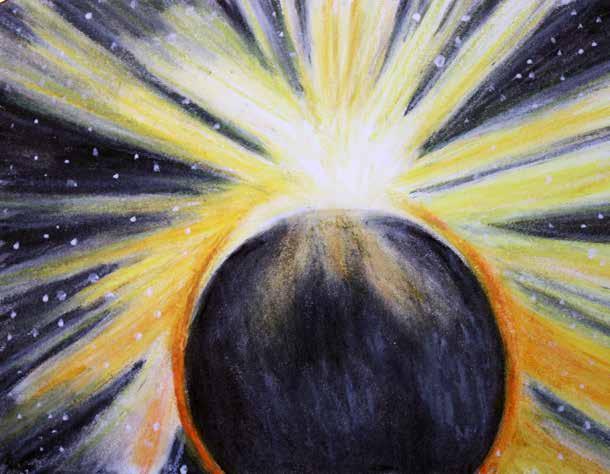
Eclipse
Pastel and charcoal on paper Leah Button
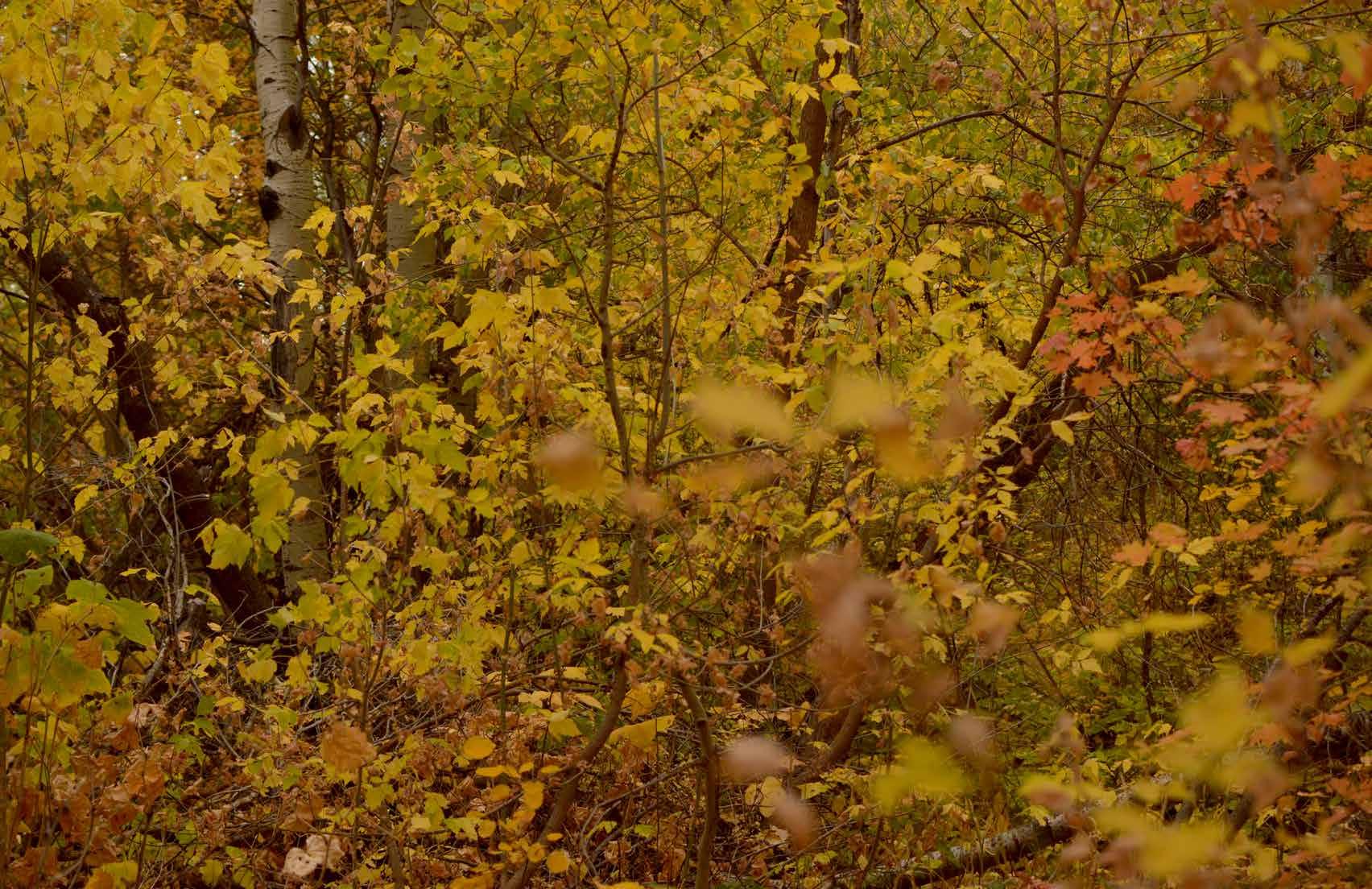
The Art of Killing Plants
Ella Baker-Smith
Step one: Provide them with a false sense of importance
Tell them you love them and will care for them
Take them to your bedside
Water them
Hold them close
When I started growing in spurts, sprouting into my body, I started placing plants in my bedroom. I felt like I needed to relate to something uncomplicated by feelings, only growth. Once, I filled my room with roses, dead and alive, cacti, succulents, magnolias, and leafy greens whose names I never knew. I filled my home as well. The more I surrounded myself with plants, the more I began to notice them in cafes, coffee shops, classrooms, in my safe spaces. I realized that whenever I don’t understand the callousness of humans, I turn to plants: how they seem to wrap around each other, tight in an embrace. They always give me comfort.
Step two: Lead them on
Open the curtains to give them sun
Watch them grow
Grow with them
Long before I began to put plants in my room, I realized that I cared too much. I don’t know exactly when or where I learned how to care. It’s not like I had a class where I learned to master it, but I guess I have had lots of practice. From boys to girls to small, spindly weeds crawling their way out of the fault-line cracked sidewalks, I have cared too much. I have always heard a sort of sermon to practice caring and kindness on others, myself, and everything I touch, yet, wherever I go, people tend to show themselves as cold and uncaring creatures. Like how poetry eulogizes the beauty and grace of flowers, yet, people pick them, pinching that very beauty in the bud. It is a paradox I will never be able to understand. How we prize those who are sweet and caring, yet, when they show even an ounce of it, people find a way of capturing that light and hiding it away, calling it, “too much.” It’s the juxtaposition of humanity, a constant contrast of what one values and what one does. I have never understood it, yet somehow, I have mastered it and been punished and praised for it. Growing up within this dichotomy of who I am has been one of the most confusing parts of my life, other than how Tillandsia can float about in the air when the survival of a plant is based on its roots in the dirt.
Step three: Take them for granted
Forget about them
Ignore them
Throw them away
Leave them for dead
Sometimes, when I can’t bring myself to work on homework anymore, I will imagine myself as one of the quaint succulents in the corner of my bedside table that someone picked out for me at Cactus and Tropicals. People choose me and say they will take care of me, so I think it is okay to care back. But then, I get attached, and all of a sudden they stop watering me, and one day they just forget altogether, and then I’m just a dried out shell of something that was once beautiful and alive. This makes me despise caring. Yet, I continue to embrace a little too tightly, like those plants in my room, and I do not think I’ll ever stop.
Step Four: Repeat.
East CanyonPhotography
Elli Dark
Shelf
Celia Davis
Lolita lives in her House of Leaves while It croons over Children of Blood and Bone, engulfing the city of Orleans in a Bone Gap filled with red balloons and footnotes.
America has an aimless notion of self-help: You pursue 21 Rituals to Change Your Life, but sedate your instinct with Confessions of a Hater, hoping to Get Sh*t Done, deserting Adulting: How to Become a Grown-Up in 468 Steps.
And, In Defense of Food, you only inhale organic, selecting the higher price tag in favor of your conscious. The Fine Art of Mixing Drinks swells alcoholism from its vodka-seeped pages, an heirloom passed from your grandfather to you, catching Dad in its tipsy typewrite.
Philosophy and Religion, oozing Judaism, short of God, question The Metsudah Siddur. But—as God is Not One—Night is the only desirous scripture, leaving the stars to tumble onto The Fountainhead as he constructs The Optimist.
We Have Always Lived in the Castle because La Vie est Breve (Life is Short). You can only whisper Au Revoir, Les Enfants to a coffin of deceased dreams.
Alice and the Hard-Boiled Wonderland taught you to dream. 1984: the first step into The Metamorphosis, opened the void of Kafka on the Shore, a sea-foamed step away from 1Q84.
The Familiar could not be less like you, no more similar than the face gawking back in the mirror.
fleSh (is what books are made for).
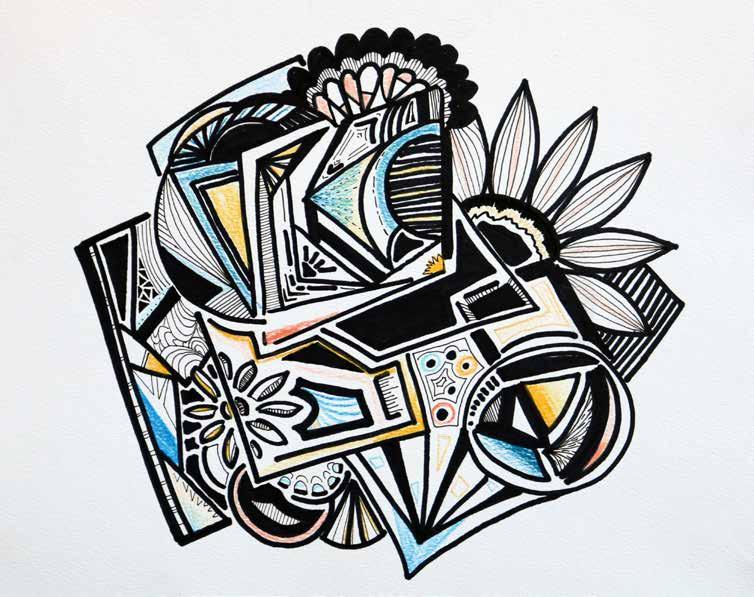
Design
Colored Pencil and Ink on Paper Leah Button
Warning
Grace Baranko
WARNING: the enclosed contents may cause injury, disease, and even death. Handle them carefully or else you may suffer from diseases such as cancer. If you have had direct contact with these contents, contact 911 immediately, or you could suffer from disease which may lead to death. You may become the sick old woman, propped up in a chair, waiting for the agressive cancer clusters to stop her heart as her relatives sit around her. You may become the person who breaks their families hearts at your all-purple funeral after suffering for months. Or you may become the person who no longer has emotion, who can no longer talk even though you were once happy and cheerful, capable of making anyone smile. You may become the person who smiles and laughs through the pain just to make the family around you happy; but that is highly unlikely due to the conditions. The contents may cause harm to you or your loved ones. Handle with care.
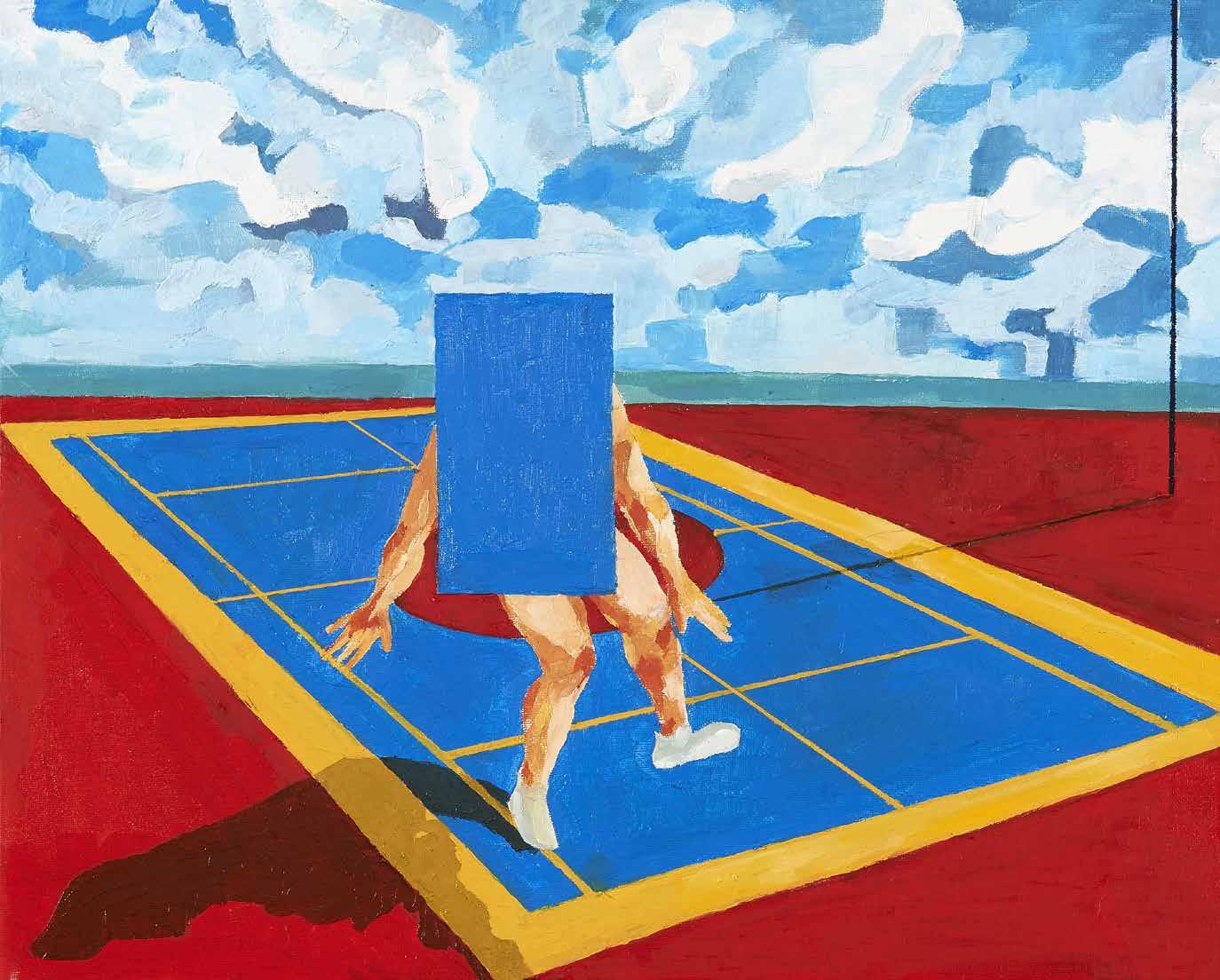
Tips and Tricks for Becoming a Pinball Pro
Benjamin Fowler
1. Find yourself the perfect pinball appliance. Maybe it’s one you’ve loved since you were a kid, maybe it’s one with a theme you like, maybe it’s the one in Grandpa and Grandma’s dining room, next to Grandpa’s collection of nude French women in oil paintings that Grandma and Mom have always complained about, and that picture of the sad clown that has scared you since you were a little kid. You know, the one with the bright red greens and yellows made to look like a demolition derby, focused on the faces of the drivers so that you can see their anguish as their dreams are demolished alongside their cars. You’ve been riveted by its loud bangs and bright colors since you were a bored 6 year old at Thanksgiving and Dad showed it to you just so that you’d have something to do while Aunt what’s-her-name and cousin fake-blonde-hair talked about how quickly you had grown up.
2. Figure out how to turn the damn thing on. The cable is sticking out of the back, and you know that it won’t reach the nearest plug. You would need two hands to count the number of times that you had gone to find that same extension cord in the back room to get it working. You know, the room where they keep the folding chairs and the dusty train tables that Grandpa had told you all about. The same train tables that had gotten you oh-so fascinated with trains and inspired you to cry out every time one passed through the car window, “Look, Mom! That cargo train has a locomotive on either side connected to a tank car! That means it’s supposed to be able to go both directions!”
3. Always remember to flip each flipper separately. Flipping them both makes it far easier for the ball to drain out, because the gap that they make is so big. It is big enough, in fact, to fit Aunt what’s-her-name and cousin shouldn’t-have-drunk-so-muchalcohol-while-she-was-pregnant talking behind your back. They scoff at you, you must look so pathetic, a 16-year-old boy playing pinball while his grandmother is on her deathbed and his grandfather is crying his eyes out. How can you be sitting here, playing on some decade-old toy while you should be talking to them, saying goodbye, taking what may be your last chance to thank them for teaching you what the different train cars are and for worrying about your delicate eyes seeing the curvature of a French woman’s bosom at such an impressionable age?
4.Try not to remember Uncle Greg. Try not to think about his epic 1965 James Bond themed pinball machine that he had in his basement, hooked up to another machine that would constantly feed it quarters so that he wouldn’t have to scrounge around his couch cushions if he wanted to play a few rounds. Especially try not to notice the pattern between now and then, when Greg and Dad were crying over Greg’s lung cancer and his doctor’s prediction that he wouldn’t make it to the end of the year. You were sitting at that epic pinball machine, trying to focus on beating Greg’s high score, and now the only difference was that you were trying to beat your own. The only time you came close to crying is when he calls you the pinball wizard, and talks about how lucky Ringo was to have a wife like Barbara Bach.
5. Blink the tears out of your eyes. Compromised vision is a pinball pro’s worst enemy. It might help to forget that image of Grandma in your head, lying spread-eagle on her bed, incapable of speech, with the look of death in her eyes. Many have found that not listening to Mom as she says “Well she’s not long for this world, and if history teaches anything about older folk, they tend to follow their spouses” and not imagining the kind of pain that must inflict on your ever-silent father to be especially helpful in this area.
6. Pray, pray to God that they leave you that old pinball machine in their will. And maybe those old train tables, too.
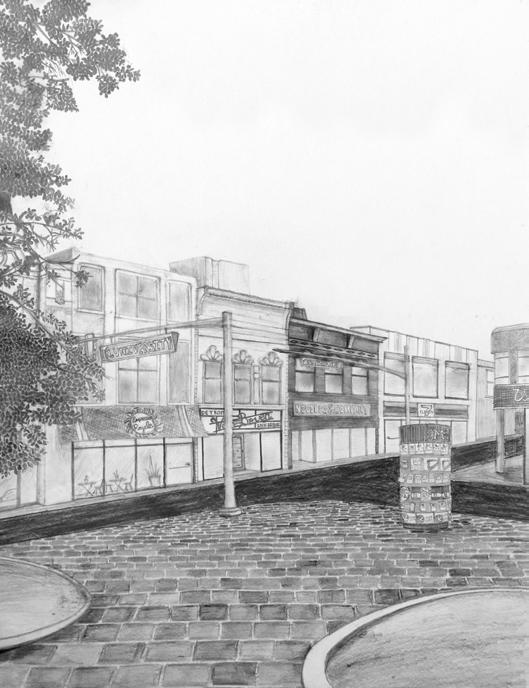
Crossroads
Graphite on paper
Sydney Young
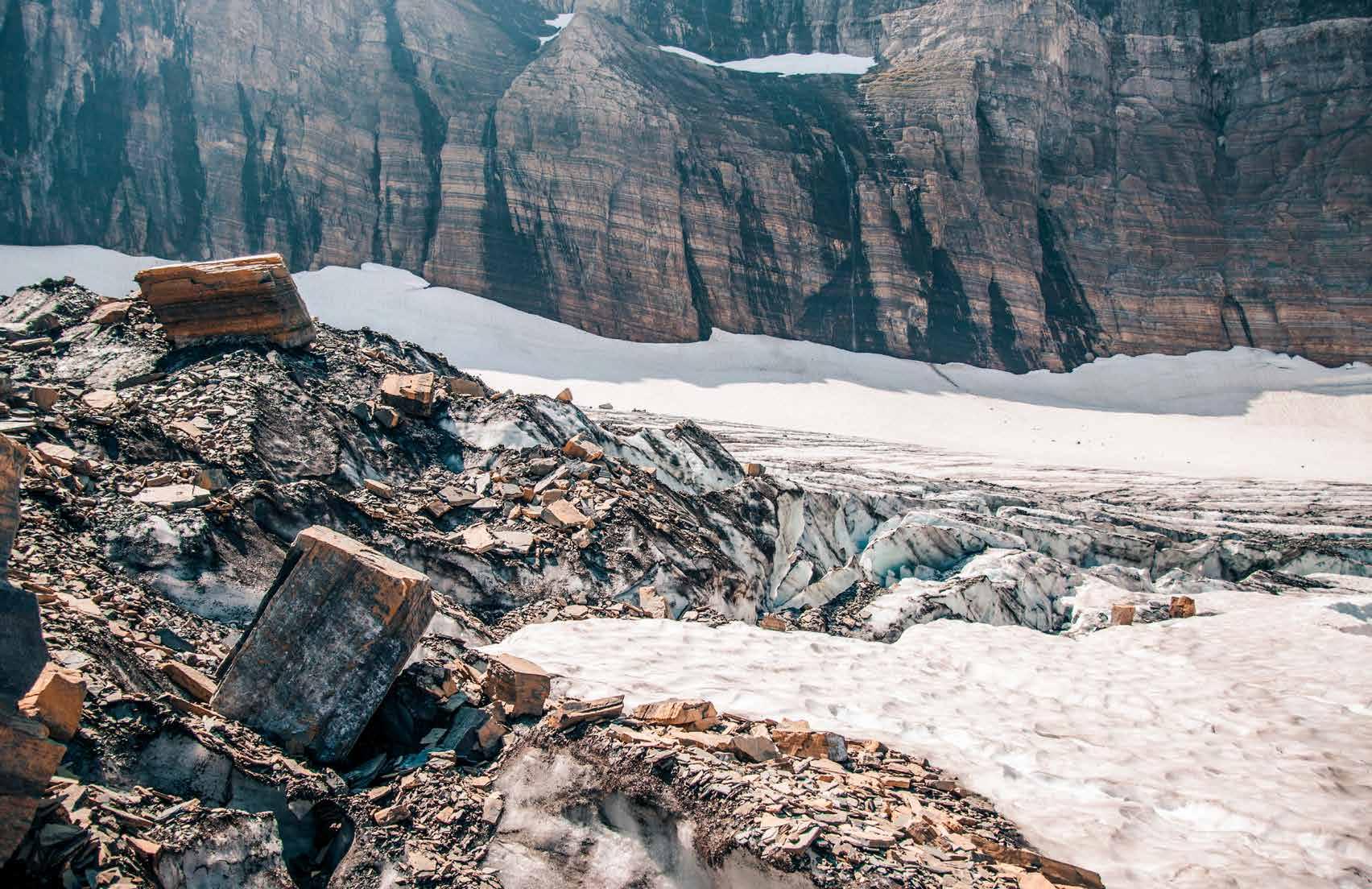
Discontinuity
Clarissa Hyde
There is a 500 million-year break in the geological record of the Grand Canyon. This discontinuity indicates a long period for which no deposits are present. No rock between Precambrian and Cambrian times was preserved, or perhaps there were no rock deposits for tens of millions of years, as if God pressed pause to take a break from his usual program. The ancient layers of the earth’s crust, still dry from the first rising of the sun holds the hand of stone formed by recent seas. There is this crack where something should be, where there is instead nothing but a chasm. This blankness is perceived by the human eye as a momentary shift in color: fine, white sands pressed against mud found on the caps of our knees. Streaks of red fall down the walls in groups like strands of hair. This discontinuity indicates that wonders of the world are capable of time travel, or possibly falling asleep in the sun, fading in and out of geological consciousness. Deep within the canyon, the Colorado river is protected from the sun while the pores on my nose gather rays filtered through the falcon’s feathers. Pressing my hand against salmon shale, this geological miser whispers to me of the hole it left in time, an emptiness in something I am supposed to remember. I asked whether it would disappear again, but even canyons lose their train of thought.
In 1990, the Isabella Stewart Gardner Museum experienced one of greatest heists in history. In the early morning light, disguised men slipped into the building like a twilight mist. Stars working their graveyard shift nodded off after the crickets grabbed their coats. The strokes of Rembrandt and Vermeer shone under halogen light, knives plunged into the edges of paint, mahogany and velvet frozen still in witness. $500 million escaped in a van never to be seen again. Over twenty years later, their frames stand empty against green silk, golden chasms outlining negative space. Somewhere either above or below, the musician’s in Vermeer’s The Concert echo against the walls of the museum like the voices of ghosts. A marble and sandstone prison holds invisible dancers captive. There is a nothingness where there was once a moment captured on canvas. Now all that is remembered is that they disappeared. These paintings traveled through both time and space, infinity through pigment. They beg to be remembered but maybe not returned.
In 2004, Michel Gondry directed Eternal Sunshine of the Spotless Mind. In the movie, Joel Parish throws a cassette tape out the window and begs to have Clementine removed from his memory. He walks up the block only to find himself where he began without Clementine. They are on the train from Montauk, in the crumbling beach house, in the laboratory, in Joel’s own memory. He chases after her as he lies in his own bed, prying his own eyelids open, a colander placed over his skull. They use computers and vodka to trace his steps back in time. Joel’s life plays out on a machine as he races away, realizing that there was nothing to regret after all, and all of this almost too late. He wakes to find the seams of pages torn from his journal, shadows, cracks in his own timeline. He wakes with a desperate need for an asprin. Her absence reminds him like a mental instinct, a broken light switch. Clementine needn’t have said anything at all. With or without his memory, Joel winds up in Montauk desperately cold, alone, and unequivocally on time. Even in the depths of Joel’s memory, Clementine grabbed on somehow, a whisper of turquoise smoke.
God returned to the drawing table and continued adding line after line, chiseling into the sandstone. Something whispered into the canyon’s ear, waking it up in the night. The Wonder of the World looked around in a cold sweat, and then lay back down onto the earth in the hole that it left and tried to remember how many constellations it knew: a prancing horse, Orion, and the Galactic Interstellar Medium, murky and brilliant in the night sky. Millions of millions of years later, I stood at the lip of the Grand Canyon, sunlight migrating like molasses, uncovering red stone like slowly removing a blanket. The entire world slept but me, and there was only silence, flaxen hair moving in a soundless breeze. I pulled my turtleneck over my nose and bit at the dead skin on my lips. Footprints in the dirt were all I left in the record of geologic memory, sauntering down into the canyon were but the loudest whispers heard by nothing and no one, just a chasm, a golden frame, an amber shadow under stars.
The Rolling Stones Photography Garrett Glasgow
“Man is condemned to be free; because once thrown into the world, he is responsible for everything he does” — Jean Paul Satre
Oh Birdy Acrylic on canvas
Jack Smith
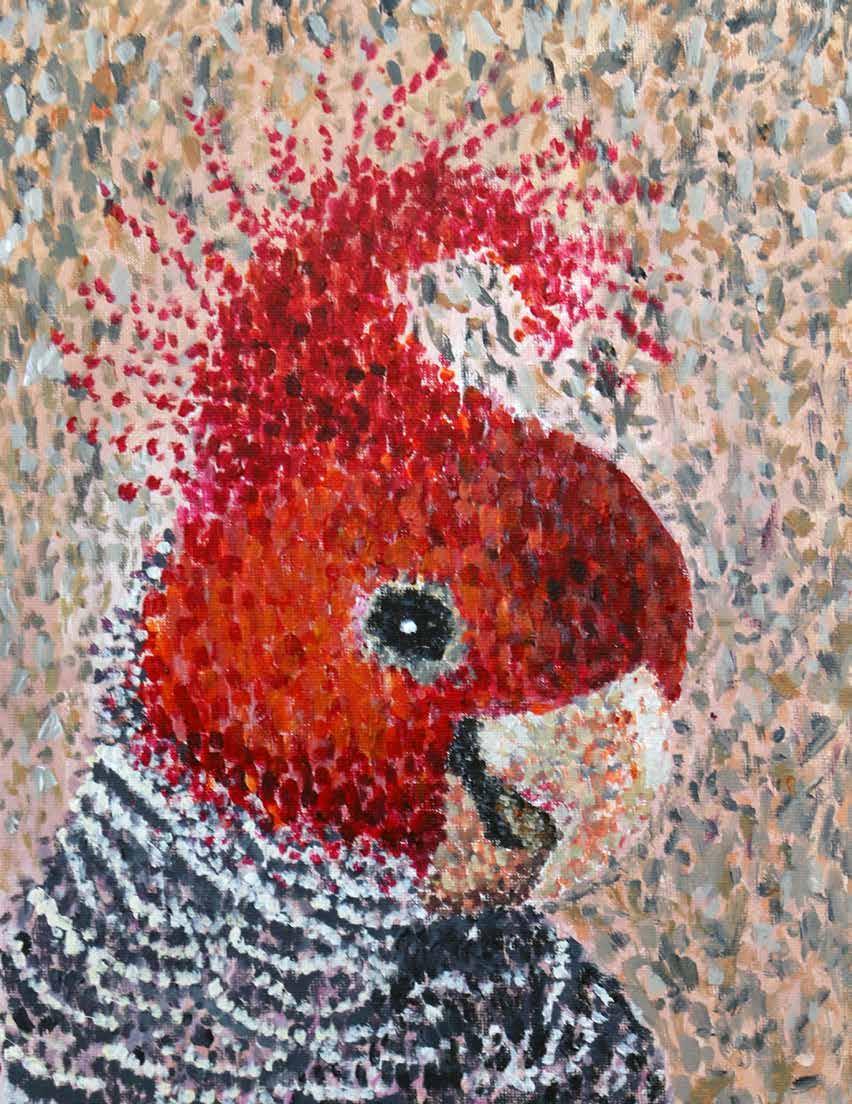
Discussion
Jericho Brown
Jericho Brown visiting Rowland Hall:
Photo by Joel Long
Jericho Brown grew up in Shreveport, Louisiana, and worked as a speechwriter for the mayor of New Orleans before earning his PhD in literature and creative writing from the University of Houston. He also holds an MFA in creative writing from the University of New Orleans and graduated with a BA from Dillard University in 1998. Brown is the author of The Tradition (Copper Canyon Press, 2019); The New Testament (Copper Canyon Press, 2014), which received the Anisfield-Wolf Book Award; and Please (New Issues, 2008), which received the 2009 American Book Award. Brown is the recipient of a Whiting Writer’s Award and has received fellowships from the Bread Loaf Writers’ Conference, the Guggenheim Foundation, the Krakow Poetry Seminar in Poland, the National Endowment for the Arts, and the Radcliffe Institute at Harvard University. He is currently an associate professor of English and creative writing at Emory University in Atlanta, Georgia.
I became a poet because I like
lis-
tening to people talk much more than I am interested in what they have to say.
I became a poet because I like listening to people talk much more than I am interested in what they have to say. I am interested in the way things were delivered or the way people say things. I grew up in the black church where people were always going the extra mile to say something in a way that is beyond just saying. It was never, “Pass me the program.” It was, “The program that you are holding I would also like to hold.”
I became attracted to poetry in particular when I was a kid. I was very fortunate to have a mother who couldn’t afford child care. She was an improvisational genius. She would take me and my sister to the library when she had to be somewhere. We spent a lot of summers in the library. The librarians and my mother didn’t have to be worried about us to tearing anything up. We weren’t going to run crazy in the library. The other wonderful thing about libraries is there were no computers, at least back then. So where we would go in the library there was nothing there but books. We didn’t have the internet to distract us from reading. Poems were interesting because they were short. I would look a page of prose and I’d be so worn out. I thought, “How am I supposed to do all that?” I would look at a poem and be like, “Oh Lord Jesus that’s only a fourth of the page! I can do this!”
The first time I finished reading a book of poems, I said, “Mommy, I read a book” and the face my mother made was amazing.
The first time I finished reading a book of poems, I said, “Mommy, I read a book” and the face my mother made was amazing. It was the only time she ever made it. She said, “My baby, my baby read a book?” I’ll never forget that. I wanted to see that again. So, I would be in a rush to get to the library and I would read every book of poetry I could find. I fell in love with poems then because I wasn’t under
the impression that I had to explicate the poem. There was no need for interpretation. I just needed to read them and enjoy them for the music of language. I didn’t know what was going on and I didn’t feel like I needed to know what was going on.
I write poems asking questions of my life. At the root of my poems I don’t have any intentions. I don’t have any designs.
I write poems asking questions of my life. At the root of my poems, I don’t have any intentions. I don’t have any designs. At the root of them I’m thinking, “Well, let me figure this out. Let me see where I’m wrong. Let me see where they’re wrong. Let me just blow that thing up.” I guess that some people don’t like that. I don’t think that many people who don’t like how I do what I do are looking at me. I think the people who are looking at me are the people who want to hear what I have to say.
The part of my life that has the biggest influence on my writing is the willingness to fall in love and fall out of love and make love and be a romantic, intimate person. Ultimately, I’m a love poet. People like talking about me being a political poet and that’s fine. But people don’t really have much to say about me being a love poet because they have to think before writing their essay or what not. I think it also has to do with the fact that I’m black.
I think on the whole that people still have a hard time understanding that black people walk around here falling in love, that they are in a rush to get home so they can cuddle with somebody.
When I say something about the police or something everyone is like,“Oh let’s see what he’s got to say about the police.” I think on the whole that people still have a hard time understanding that black people walk around here falling in love, that they are in a rush to get home so they can cuddle with somebody. There’s a wholeness to being that I know among
black people. But I don’t know if people looking at black people see that. They see the ways of the black people can be offended, but they don’t necessarily see the fact that we can fall in love. At the root of my poetry is tenderness, not politics. That’s what I’m trying to do. I’m just trying to be more tender and put more tenderness into the world.
At the root of my poetry is tenderness, not politics. That’s what I’m trying to do. I’m just trying to be more tender and put more tenderness into the world.
Discussion
Carol Moldaw
Carol Moldaw was born in Oakland, California. She received a BA from Harvard University in 1978 and an MA from Boston University in 1986. She is the author of Beauty Refracted (Four Way Books, 2018), So Late, So Soon: New and Collected Poems (Etruscan Press, 2010), The Lightning Field (Oberlin College Press, 2003), and Taken From the River (Alef Books, 1993). Moldaw is also the author of the novel The Widening (Etruscan Press, 2008). She has received a Pushcart Prize and fellowships from the Lannan Foundation and the National Endowment for the Arts. She has taught at Naropa University, the College of Santa Fe, and the University of Southern Maine, among others. She lives in Santa Fe, New Mexico. Moldaw came to speak to the Rowland Hall creative writing class on January 17, 2019.
I came to writing very early. I don’t know how or why. Honestly, it appealed to me. It seemed a natural idea to me. I always found it a struggle to put anything into words at first. Even now, sometimes it’s a struggle. I liked how poetry in particular seemed driven by sound, by rhythm, cadence, the complex interrelationship amongst syllables; how vowels and consonants have this interlocking dance.
I liked how poetry in particular seemed driven by sound, by rhythm, cadence, the complex interrelationship amongst syllables; how vowels and consonants have this interlocking dance.
For me poetry has to come from an intrinsic place. It has to arise. Often where it arises, it is just a scent. But the process has to get started. Sometimes I’m led by ideas. If they have some root in experience, perception, thought, or heightened emotion the ideas spoil my efforts. I never know where I am going with a poem. I want to discover that through writing. Where will I go? How will it develop? I want the writing to tell me that. For that reason, I’ve never related to writers who talked about being drawn to writing because they have something to say. In fact, if anything made me think I wasn’t a writer when I was young, it was hearing people talk about how they had this burning desire to say something in particular. But for me, only writing shows me what I have to say.
Only writing shows me what I have to say.
I’m a person who writes about being in this class or looking at those trees or some experience. But I don’t write it right away. Years later or months later, I might come back to the experience and I tend to find it the right frame
Carol Moldaw visiting Rowland Hall: Photo by Joel Long
of mind. There is something about memory and perspective that seem to interweave with an experience.
There is something about memory and perspective that seem to interweave with an experience.
The same is true with revision. Some people love revision, and some people love immediate revision. But I find that if you wait till the right moment you can re-enter a poem. It’s about learning to recognize the moment when something is accessible to you because it’s not always now. First of all you have to sit down. You have to trust me. You have to have whatever your instrument is; a pen, a pencil, a computer. You have to give yourself time. Some people like to write with music; you have to give yourself whatever circumstances you need to write, and you have to write on a regular basis. For me it just patience. Sometimes when I’m starting a piece, I can get very angry at myself. I think, “What am I doing?” You have to not let that stop you. Sometimes you hear a voice in your head. That’s the voice of the poem. It might be expository or it might be rhythmic or it might be lyrical. You have to follow that voice; the voice and the language that is in your head.
You have
to follow the voice of the poem;
guage
the voice and the lan-
that is in your head.
You have to be paying attention to what’s in your mind. Sometimes it’s easy to reject what’s in your head, but you shouldn’t. You have to be open to what happens when you start writing. If you have too much of an itinerary then you’re not going to be open.
Interview
Brian Laidlaw
Brian Laidlaw visiting Rowland Hall: Photo by Joel Long
Brian Laidlaw is a poet, songwriter and educator from Northern California. He earned an MFA in Poetry at the University of Minnesota, and then joined the Songwriting faculty at McNally Smith College of Music in St. Paul, Montana. His recent releases include the vinyl-LP-plus-poetry-chapbook Amoratorium (Paper Darts Press), the book and album The Stuntman (Milkweed Editions), and the 7” vinyl single Jeremiad (Hymie’s Vintage Records), as well as the forthcoming full-length collection The Mirrormaker (Milkweed Editions, 2018).
Brian came to sing some of his songs at Rowland Hall on October 17th 2018.
Interview:
Tesserae (T): What is your mission as an educator?
Brian Laidlaw (BL): My mission as an educator is to help, and in some ways correct, a bit of the damage that has been done by elementary school and maybe middle school people who are teaching poetry. I know a whole lot of people, really of all ages starting from age five up through age eighty, who think that poetry is pretty boring and square. Poetry in schools is taught as though there is a right answer to a poem and is taught as though if you read that poem and don’t get it, then you must be dumb or something. Then as a result, any time you’re encountering a poem instead of feeling like you’re having this cool experience with it, that you’re just kind of rolling through the aesthetic kind of motions and emotions with the text; you feel on edge like someone’s about to ask you, “Did you get it?” snd that’s not fun at all. It ruins the pleasure of reading poetry. There’s value in doing that kind of analytical work. But there’s way more value in learning how to just dig it. That’s my California coming out. I just dig it. And just hang loose with it until you kind of understand that the poet doesn’t have a right answer for their poem. The poet who made the poem isn’t trying to say one specific thing, they’re just trying to set in motion an interesting thought space.
(T): Should I work with the same kind of rules in essays as I do with my poetry?
(BL): Trust imaginative leaps of logic instead of of an expectation in the way that a story unfolds. Guide the listener or the reader through that experience. What’s so awesome and special and rad about poetry is that you can absolutely jettison all of those kinds of rules, and you can just jump from one place to another. And this is part of the sort of hypnotic magic of poetry because the moments
are so crystallized, like when we’re writing with good tight images, using vivid metaphors and figurative language.
As a writer, specifically in poetry and songwriting, you can get away with a lot. You can get away with leaving out a lot of those connectives and because of that, bizarrely, we just read this like a poem, a tiny, fragmentary weird poem. And I find it quite evocative. And I think that you know it has no context, no sense.
T: Is it okay if not every line in a poem works together to get to a main idea?
BL: Whatever weird, random thing, whatever crazy trajectory and direction you can go out and it will still have a center of gravity, that makes the poem intelligible as you are that center of gravity that fits perfectly in this.That’s the thing that language is often meant to access: rational minds. But then poetry kind of hijacks the language to get into our intuitive space. Poetry is where that collision kind of stuff happens.
T: What is something you find fascinating to work with?
BL: Memories, a space where we see these leaps of logic happening. In the sense that when we are looking back in time, we don’t remember our whole life as a chronological sequence of reflections that I did that when, we remember it in a big jumble. And we remember it with kind of flashes and momentary images that stand out and we don’t necessarily think of it in teaching. Poems that deal with memory are an interesting place to see some of this broken logic happening. In order for your melody to be the same in each verse, which is sort of what we need in order for a song to feel like a song, the melody has to take up the same amount of space and it has to hit all the same notes and it has to sort of resolve and land the line in the same place. Know this intuitively. Onne thing that’s tricky about songwriting, when we first pivot into it especially, is the way that I suspect many of us might, in the sense that we’re good
writers already, our poet and song lyrics usually seem bad. We sit down, and we write our first song ever, and then we try to play it on guitar or teach it to our friend and it’s like, oh man this isn’t even a song.
T: How can you tell where to go next in a song when encountering writers block?
BL: This gets into this kind of stuff where it’s just trust your gut. Ultimately, your song is performed by your body. And so it makes sense to let your body participate. And I think of it not necessarily in terms of volume or anger or emotional intensity. It’s more like what will feel really good in your body to say or sing next.
T: When starting a new piece, what do you prioritize?
BL: I really do prioritize rhyming quite a bit because I think that it’s the biggest tool that you have for creating a moment and so a lot of the time I end up and my notebook is full of these surprise factors. And then I start to feel them coming into clusters that feel like they could all belong in the same song.
T: Have you ever, and if so in what ways, used research to help your pieces?
BL: I think researching the history of where you’re from, researching your family, researching the kinds of places where your folks were. For me, it could be interesting to learn what kind of wood my guitar is made of and where it came from and who does that work. And it just sends you off in these rabbit holes, and it gives you new language, new ideas, and metaphors and and when it’s up for a research paper you know you can just follow any super weird thing you want.
Tesserae Staff
Editor in Chief
Clarissa Hyde
Editors
KatieRose Kimball
Emma Duggleby
Elli Dark
Cole Topham
Benjamin Fowler
Assistant Editors
Kit Stevens
Ella Houden
Staff
Emery Bahna
Ella Baker-Smith
Summer Connery
Tyler Gernstein
Connor Hughes Bellen
Allison Perrin
Laura Summerfield
Nathan Zhou
Elena Zipp
Celia Davis
Jack Vitek
Grace Baranko
Kaitlyn Bates
Garrett Glasgow
Max Eatchel
Submissions
We invite sumbissions from all students in the Rowland Hall Upper School. The editorial staff reviews submissions of art and literature, ranking each work according to the aesthetic excellence. Works that receive the highest scores are included in the magazine.
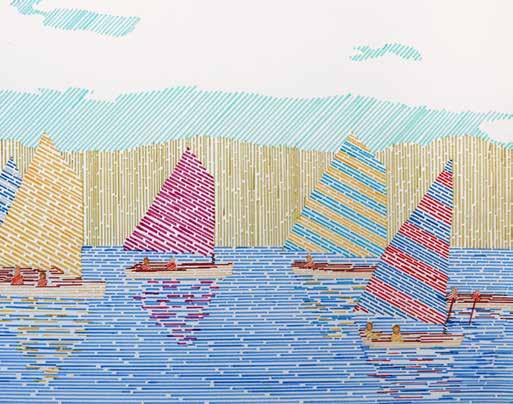
Colophon
Editors have used InDesign for the layout. The cover of this book was printed on Sterline 80# dull cover with a floor dull UV coating. The body of the book was printed on sterling 80# dull text, 10% PCW. 350 books printed.
Special thank you to mentors Joel Long and Rob Mellor for their invaluable artistic input and constant support.
Hakuna Regatta Marker on paper Sydney Young