YOGA
WHY COACHES NEED IT
RECRUITING
IT’S NOT THE END OF YOUR ROWING JOURNEY
COXING
MAKING A GOOD IMPRESSION
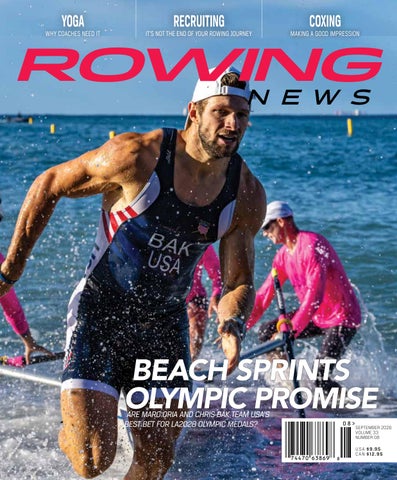
BEACH SPRINTS OLYMPIC PROMISE ARE MARC ORIA AND CHRIS BAK TEAM USA’S BEST BET FOR LA2028 OLYMPIC MEDALS?
SEPTEMBER 2026 VOLUME 33 NUMBER 08 USA $9.95 C A N $12 . 9 5
USA U23 W8+, Gold Medalists U8.21 STEALTH
row2k
GENERATION Official Boat Supplier of USRowing U19 and U23 Teams
2026 World Rowing Under 23 Championships Women’s Eight // U8.21 Women’s Quad // U4.22 Women’s Four // U4.22 Mixed Eight // U8.43 Men’s Eight // U8.43 Men’s Four // U4.42
5
FIVE STRAIGHT. ONE .
Cambridge Boat Club’s U19 women have won the Royal Canadian Henley five years runningand they also own the course record. Every victory was raced in a King SE 8+.
Different athletes. Different conditions. The same standard of performance.
Built for the days that define a program. Request a fleet consultation at
Coach Smarter.
Build your fall race strategy from real data. Compare boats, track progress across your squad. LiNK Logbook turns practice data into winning race plans.
Live Multi-Boat Dashboard — Every Seat, Every Stroke LiNK® Logbook™ Team streams real-time data from every CoxBox® GPS on the water simultaneously. Compare splits, stroke rates, and distance across your whole squad from one screen. Session Review — Anytime, Anywhere Every practice piece stored and reviewable after you leave the dock. Replay any session, identify where a boat lost time, and build the next workout around the data — not the feeling.
Head Race Planning Built Into Every Piece Head races reward consistent pacing over 4–6 kilometers. Track how your crews hold their split across long pieces in practice — arrive at the start line with a real race plan. CoxBox® GPS + LiNK — Connected Coaching System CoxBox GPS feeds split and stroke data directly into LiNK Logbook. Your coxswains coach in real time. You coach from the data. Every conversation starts with the same facts.
LiNK® Logbook™ Team Plan Multi-boat live streaming + full session archive
Free Team Trial 30 days · No commitment · Full team features
Photo credit: Row2k
Congratulations to Boston University’s Catherine Clark & Emilia Vukasinovic Winners of the IRA Lightweight 2x
Catherine Clark
Follow us on Facebook: @Rowfluid • Instagram: rowfluidesign
Emilia Vukasinovic
INTRODUCTORY OFFER
Chip Davis PUBLISHER & EDITOR Chris Pratt ASSOCIATE PUBLISHER Vinaya Shenoy ADMINISTRATIVE ASSISTANT Art Carey ASSISTANT EDITOR Ian Parish ASSOCIATE CONTRIBUTING WRITERS
Andy Anderson | CJ Bown | Nancy Clark Martin Cross | Frank Fitzpatrick | Katie LaneAnnika Nelson | Volker Nolte Frank Rowe | Marlene Royle Robbie Tenenbaum | Hannah Woodruff CONTRIBUTING PHOTOGRAPHERS
Jim Aulenback | Steve Aulenback
Radley College demonstrate the power of the CoachLink feature on their ActiveSpeeds
Stewart Cohen | Karon Phillips Patrick White | Lisa Worthy MAILING ADDRESS
Editorial, Advertising, & Subscriptions PO Box 831 Hanover, NH 03755, USA (603) 643-8476
$445 $495
Large Configurable Display (2, 4 and 6 fields) Optional Wireless Impeller & Accessories Easy Data Transfer via the DataFlow App Independent review of the ActiveSpeed Sander Roosendaal, founder of the rowing analytics site rowsandall.com, takes a deep dive into the ActiveSpeed.
INNOVATING FOR 22 YEARS www.active-tools.com
Statement of Ownership, Management, and Circulation 1. Publication Title: ROWING NEWS. 2. Publication Number: 0016-091. 3. Filing Date: August 17,2026 4. Issue Frequency: Monthly. 5. Number of Issues Published Annually: Twelve. 6. Annual Subscription Price: Seventy-Five Dollars. 7. Complete Mailing Address of Known Office of Publication (not printer) (Street, City, County, State, and ZIP+4): 53 S Main St, Hanover, NH 03755-2022. Contact Person: Vinaya Shenoy, Telephone: 603-306-2455. 8. Complete Mailing Address of Headquarters or General Business Office of Publisher: PO Box 831 Hanover NH 03755. 9. Full Names and Complete Mailing Addresses of Publisher, Editor, and Managing Editor: Publisher (Name and complete mailing address): Charles C. Davis, PO Box 831, Hanover, NH 03755. Editor: Charles C. Davis, PO Box 831, Hanover, NH 03755. 10. Owner: Charles C Davis, PO Box 831, Hanover, NH 03755. 11. Known Bondholders, Mortgages, and Other Security Holders Owning or Holding 1 Percent or More of Total Amount of Bonds, Mortgagees, or Other Securities: None. 12. Tax Status (For completion by nonprofit Organizations authorized to mail at nonprofit rates): Has not changed during Preceding 12 months. 13. Publication Title: ROWING NEWS. 14: Issue Date for Circulation Data Below: August 2026. 15. Extent and Nature of Circulation: a. Total Number of Copies (Net press run) Average No. Copies Each Issue during Preceding 12 Months: Four Thousand and seven hundred and forty-seven. No. Copies of Single Issue Published Nearest to Filing Date: Four Thousand Seven hundred. b. Paid/Requested Circulation: 1. Mailed Outside-County Paid Subscriptions Stated on PS Form 3541(include advertiser’s proof and exchange copies): Average No. Copies Each Issue During Preceding 12 Months: Four Thousand six Hundred and eleven. No. Copies of Single Issue Published Nearest to Filing Date: Four Thousand Five Hundred and Twenty-Four 2. Mailed in-County Paid Subscriptions stated on Form 3541: Average No. Copies Each Issue During Preceding 12 Months: Zero. No. Copies of Single Issue Published Nearest to Filing Date: Zero. 3. Sales through Dealers and Carriers, Street Vendors, Counter Sales and Other Non-USPS Paid Distribution: Average No. Copies each Issue During Preceding 12 Months: Zero. No. Copies of Single Issue Published Nearest to Filing Date: Zero. 4. Other Classes Mailed Through the USPS: Average No. Copies Each Issue Preceding 12 Months: Seventy-three. No. Copies of Single Issue Published Nearest to Filing Date: Seventy. c. Total Paid and/or Requested Circulation: Average No. Copies Each Issue during Preceding 12 Months: Four Thousand Six Hundred and Eighty-Four. No. Copies of Single Issue Published Nearest to Filing Date: Four Thousand Five Hundred and Ninety-four. d. Free or Nominal rate Distribution by Mail (By Mail and Outside the Mail): 1. Outside-County as Stated on Form 3541: Average No. Copies Each Issue During Preceding 12 Months: Zero. No. Copies of Single Issue Published Nearest to Filing Date: Zero 2. In-county copies as stated on Form 3541: Average: Zero. Published Nearest to Filing Date: Zero. 3. Other Classes Mailed Through the USPS: Average: Zero. Published Nearest to Filing Date: Zero. 4. Free Distribution Outside the Mail: Average: Zero. No. Copies of Published Nearest to Filing Date: Zero. e. Total Free Distribution: Average No. Copies Each Issue During Preceding 12 Months: Zero. Total Free Distribution: No. Copies of Single Issue Published Nearest to Filing Date: Zero f. Total Distribution: Average No. Copies Each Issue During Preceding 12 Months: Four Thousand and six hundred and eighty-four. Total Distribution: No. Copies of Single Issue Published Nearest to Filing Date: Four Thousand Five Hundred and Ninety-four. g. Copies Not Distributed: Average: Sixty-three. Copies Not Distributed: No. Copies Published Nearest to Filing Date: One hundred and six. h. Total: Average: Four Thousand Seven Hundred and forty-seven. Total: No. Copies Published Nearest to Filing Date: Four Thousand seven hundred. Percent Paid: Average No. Copies Each Issue During Preceding 12 Months: One Hundred percent. Percent Paid: No. Copies of Single Issue Published Nearest to Filing Date: One Hundred Percent. 16. Electronic copy circulation. Average no. Copies each issue preceding 12 months: a. Paid Electronic copies: Three hundred and forty-four. No. copies of Single issue published nearest to Filing date: Nine Hundred and eighty-one. b. Total Paid Print and Electronic Copies: Average no. Copies each issue preceding 12 months: Five Thousand and Twenty-eight. No. Copies of Single Issue Published Nearest to Filing Date: Five Thousand Five Hundred and Seventy-five. c. Total Print distribution plus paid electronic copies: Average: Five Thousand and Twenty-eight. Published Nearest to Filing Date: Five Thousand Five Hundred and Seventy-five. d. Percent Paid: Average: One Hundred percent. Published Nearest to Filing Date: One Hundred Percent. I Certify that Fifty Percent of all distributed copies are paid above a nominal price. 17. Publication of Statement of Ownership: Publication required. Will be printed in the September 2026 issue of this publication. 18. Signature and Title of Editor, Publisher, Business Manager, or Owner: Charles C Davis, Publisher. I certify that all information furnishes on this form is true and complete, I understand that anyone who furnished false or misleading information on this form or who omits material or information requested on the form may be subject to criminal sanctions (including fines and imprisonment) and/or civil sanctions (including civil penalties). e-Newsletter distribution 65,000.
PLEASE SHARE OR RECYCLE THIS MAGAZINE
CONTENTS
SEPTEMBER 2026 | VOLUME 33 NUMBER 08
FE AT URES
Coastal Rowing 32 The Whisperer Upbeat Marc Oria is a guru-like figure in Beach Sprints, which will debut at the LA Olympics, where world champion Chris Bak of the U.S. is favored to medal. BY FRANK FITZPATRICK
38 Is 40 the New 36? A constant tension between quality and quantity exists in rowing. Which is ascendant and more commonly emphasized tends to go in cycles. BY BILL MANNING
48 Coaching Carousel II Numerous coaching changes have occurred this cycle, with most of the 10 new head coaches coming from the ranks of assistant coaches. BY CHIP DAVIS
PHOTOS: TOP: LISA WORTHY ; MIDDLE: K ATIE LANE ; BOTTOM: COURTESY.
R O W INGNE W S .C OM Follow Rowing News on social media by scanning this QR code with your smartphone.
ROWING NEWS (ISSN number 1548-694X) is published 12 times a year between January and December by The Independent Rowing News, Inc, 53 S. Main St. Hanover NH 03755. Contributions of news, articles, and photographs are welcome. Unless otherwise requested, submitted materials become the property of The Independent Rowing News, Inc., PO Box 831, Hanover, NH 03755. Opinions expressed by authors do not necessarily reflect those of ROWING NEWS and associates. Periodical Postage paid at Hanover, NH 03755 and additional mailing offices. Canada Post IPM Publication Mail Agreement No. 40834009 Return undeliverable Canadian addresses to Express Messenger International, Canada N6C 6A8. POSTMASTER: Send address changes to: PO Box 831, Hanover, NH 03755. PUBLISHED BY The Independent Rowing News, Inc. Founded in 1994
DEPA R T MEN T S
25 QUICK CATCHES News Olaf Tufte, 1976—2026 Race Reports Canadian Henley, Under 19 Worlds,
Under 23 Worlds
57 TRAINING Sports Science Gaining Speed Through Skin Care Coxing Making a Good Impression Training Resisting the Toll of Travel Coach Development Why Coaches Need Yoga Fuel When Exercise Is Too Much of a Good Thing Recruiting ‘I’m Not Recruitable. Now What?’ Executive Rowing Explain the Why 14 66
From the Editor Doctor Rowing
ON THE COVER: Chris Bak. | Photo: Lisa Worthy
SEPTEMBER 2026
11
FROM THE EDITOR CHIP DAVIS
Adding and Growing
W
e’re not even halfway to the LA2028 Olympics, despite what the
calendar says. Sure, 2026 seems like the midpoint between 2024 and 2028, but in terms of international elite rowing, there are still three years to go. First, there is this year. As we’ll document and dissect in the next issue, the 2026 World Rowing Championships in Amsterdam in late August are the proving ground for the different approaches nations and their various coaches and national-team staffs have taken for this quadrennial. For the successful, the results will be affirmation of their preparations. For those who finish out of the medals—or even worse, not even in the grand finals—it will be time to make significant course corrections before the penultimate event of the Olympic cycle, the Lucerne world championship that will determine who qualifies for the very limited spots in the Olympic regatta. That will be the end of the second year. Those who fail to qualify will be back to Lucerne in year three for the Final Olympic Qualifying Regatta (FORQ), while qualifiers can train straight through to Los Angeles. For USRowing, expectations remain high, despite two mostly disappointing Olympics: the disastrous (zero medals!) Tokyo Games, and the Paris Games, where the men’s four (gold) and eight (bronze, despite having had to qualify through the FORQ) saved the day for the U.S., followed by the Para coxed four’s winning silver four weeks later in the Paralympic regatta. Hosting the Olympics, as well as the 2028 World Rowing Senior, Under 23, and Under 19 Championships at Nathan Benderson Park in Sarasota in August 2028, only raises the pressure. The U.S. needs to win only three medals in the Olympics to improve upon the 2024 Olympics, and most—possibly all—of those medals could come from our sport’s new Olympic discipline, Beach Sprints. Making its debut at LA2028, Beach Sprints offers three medals—men’s and women’s solo and the mixed double—which could come from only two athletes. Luckily for the USA, one of those athletes, Chris Bak, is the most decorated competitor in Beach Sprint history, with six total medals, four gold. In his latest feature for Rowing News, beginning on page 34, “The Coastal Rowing Whisperer,” Frank Fitzpatrick profiles the coach behind all that success, Marc Oria, a former Spanish elite flat-water oarsman who emigrated to the U.S. to work in higher education, which he still does in addition to leading USRowing’s Beach Sprints program. This and recent issues of Rowing News are full of newcomers, including, in this month’s magazine, Frank Rowe, Jr., who joins freshly recruited columnists CJ Bown and Annika Nelson. Just as rowing, the oldest intercollegiate sport in the world, adds to its offerings and grows, so do we.
Chris Bak, the most decorated rower in Beach Sprint history.
Our editorial team can be reached at editor@rowingnews.com 14
SEPTEMBER 2026
PHOTO: LISA WORTHY.
Beach Sprints offers three medals—which could come from only two athletes.
CONGRATULATIONS! CONGRATULATIONS!
To All Rowers Who Competed at the 2026 USRowing Youth National Championships
Nathan Nathan Benderson Benderson Park Park || Sarasota Sarasota,, FL FL || NathanBendersonPark.org NathanBendersonPark . org
LETTERS Letters to the Editor can be sent to editor@rowingnews.com
COACHES YOUR MOVE
COXING
PLANNING FOR FALL
RECRUITING
NEVER TOO EARLY TO PREPARE
CEDAR CUNNINGHAM
AUGUST 2026 VOLUME 33 NUMBER 07 USA $9.95 C A N $12 . 9 5
16
SEPTEMBER 2026
Alternative Coxswain
Exceptional Article
I was surprised that Gardner Cadwalader was the one to prompt Doctor Rowing to muse on the idea of an AI-helmed eight, especially since he had the one and only John Hartigan as a coxie! I was blessed with terrific coxswains even as a master but spent some time toe-ing, so I offer this as an alternative to AI: weights in the stern and a voice-activated steering system controlled by both stroke and bow (so someone actually can see!). Win or lose, the crew can throw ’em both in!
The article “Tall Order: Cedar Cunningham” (August issue) is exceptionally well written and does such a wonderful job of capturing Cedar’s rowing journey. You really brought the story to life, and I’m thrilled with how thoughtfully and accurately it reflects Cedar’s experience.
Monk Terry Miami, Fla.
Stephanie Cunningham Simpsonville, S.C.
MARCH 18-21, 2027th
REGISTRATION OPENS OCTOBER 19
INTRODUCING BEACH SPRINTS
Enjoy a discounted stay at a trusted hotel accomodation ONLY AVAILABLE THROUGH WWW.CREWCLASSIC.COM/HOTEL ®
SCAN ME
O N
M I S S I O N
B A Y
Funded in part with City of San Diego Tourism Marketing District assessment funds
18
SEPTEMBER 2026
Women of 2026 in the Montreal ‘76 The U.S. under-23 national-team women’s eight of Syracuse University’s Olivia Bachert, Ohio State University’s Amelia Boes, Princeton University’s Joely Cherniss, Princeton University’s Lauren Dubois, University of Virginia’s Elsa Hartman, University of Texas’s Katherine Nordheim, University of Tennessee’s Hannah Smith, Stanford University’s Quincy Stone, and University of Texas’s Amy Werner won gold at the 2026 World Rowing Under 23 Championships rowing in the shell Montreal ‘76 50 years after 23 U.S. women raced in the first Olympic regatta to include women, held in Montreal in 1976. PHOTO: LISA WORTHY
SEPTEMBER 2026
19
20
SEPTEMBER 2026
Sculling Gold The U.S. women’s under-23 quad of bow Lila Henn, Madison Kieft, Kathryn Serra, and stroke Sumner Kerr won the 2026 World Rowing Under 23 Championship by more than four seconds over Great Britain, with Italy third. PHOTO: LISA WORTHY
SEPTEMBER 2026
21
22
SEPTEMBER 2026
Doing It Again The U.S. women’s under-23 four of bow Claire Van Praagh, Ella Wheeler, Phoebe Wise, and Annika Jeffery are all former U19 world champions and added to their international accomplishments by winning the 2026 World Rowing Under 23 Championships in Duisburg, Germany, in July. PHOTO: LISA WORTHY
SEPTEMBER 2026
23
C A N A D I A N H E N L E Y | U 2 3 W O R L D S | U 19 W O R L D S
QUICK CATCHES
Olaf Tufte moves away from the start pontoon in the semifinal of the men’s single sculls on the sixth day of the 2009 FISA World Rowing Championships at Lake Malta in Poznan, Poland.
BIG NE WS
Olaf Tufte, 1976-2026
He was a living legend who rowed in seven Olympics, winning gold twice. Energetic, enthusiastic, humorous, he was a mentor to young rowers and close friend of his rivals.
I PHOTO:INTERSPORT-IMAGES.COM
had no idea it would be the last time I’d
see him alive. It was June 28, 2026. Lucerne’s Rotsee Lake looked stunning. The World Rowing Cup finals were just about to start. Waiting to lead the Norwegian team in its dramatic Viking row celebrations (popularized by Norway’s soccer team during its World Cup run) was Olaf Tufte—a rowing legend. His head adorned with his distinctive white baseball cap, Tufte, 50, called over to me, “Come row with us, Crossy. We need you here.”
I was seconds away from starting TV commentary, and there seemed no time. But then something—an impulse from the heart—compelled me to leave the microphone and headphones. When a living legend, a man who changed the face of rowing, calls you …. I ran down to the medal pontoon and rowed my heart out, with Tufte leading us with his dramatic drumbeat. We finished, and I ran back to my commentary position without another look at Olaf. Just over three weeks later, he died. At 3 p.m. on July 21, CONTINUES ON PAGE 26 >>>
Henley Sets Records for Attendance, Viewership Henley Royal Regatta attracted record viewership and spectator attendance, in addition to a record-breaking number of crew entries. In-person spectator attendance for the six-day regatta totaled between 300,000 and 400,000, according to the Thames Valley Police, the regional policing agency. Because many spectators attend for free, a hard count is not available. YouTube views totaled 667,000, averaging over 111,000 per day. SEPTEMBER 2026
25
QUICK CATCHES BIG NE WS >>> Olaf was found unconscious at Tufte Gård, his farm in Norway. And, as his family’s press release explained, health personnel arrived quickly. Tufte was flown to a hospital in Oslo. But his life could not be saved. There were no witnesses, and no evidence of an occupational accident. The news echoed around the world. Its impact was shocking and visceral. “I’m speechless. I’m devastated,” said World Rowing President Jean-Christophe Rolland. Iztok Cop, Tufte’s great rival and close friend, disclosed on Instagram: “Since the news hit me, I still can’t breathe normally.” Jonas Gahr Støre, the prime minister of Norway, offered “deepest condolences to his family and those close to him.” I can’t claim to have been close to him but I loved him nonetheless. And in a way, I felt loved back by Tufte. He had once said, “If you pull on an oar, you’re a rower and part of my family.”
spend our time talking about Olympic and world titles won, great races, and technical mastery, of course. For the record, Tufte won back-to-back Olympic gold medals in the single in 2004 and 2008 and two world singles titles in 2001 and 2003. From Atlanta to Tokyo, he competed in seven—yes, seven—Olympic Games. He won a silver medal in the double at the Sydney Olympics. Sixteen years later, he won a bronze in the double in Rio. He sometimes seemed almost immortal. I guess those palmarès make it look like Tufte was a shoo-in for the Keller Medal. And maybe he was. But a person’s competitive record is never the most important thing the Keller committee considers. And that’s how it was when we talked about Tufte. He knew how to lose as much as he knew how to win. How could he be otherwise when he had forged such close relationships with his rivals? It was his relationship with Iztok Cop that kickstarted a deeper camaraderie between rivals than had been seen in our sport for many a year. The Slovenian had won the double sculls Olympic gold to Tufte’s silver in Sydney. Their rivalry and friendship only grew over the years ahead. The depth of that bond was shown when Cop asked Tufte to be the best man at his wedding. It was their relationship, a way of being in the sport, that drew their fellow competitors in the single ever closer. Mahé Drysdale, Ondrej Synek, Alan Campbell, Lassi Karonen, Marcel Hacker, and more became linked inextricably. It was the Great Eight, in which these top scullers came together to compete against sweep rowers in the Head of the River Race and the Head of the Charles, that symbolized Tufte’s friendship with his rivals. And these relationships went far beyond the rowing courses. The great Kiwi two-time Olympic singles champion, Mahé Drysdale, was just one of the scullers who
He knew how to lose as much as he knew how to win. How could he be otherwise when he had forged such close relationships with his rivals? Three weeks ago, we were together in Lucerne for a meeting of the Thomas Keller Medal committee and the presentation of the 2025 medal to Ondrej Synek, another member of that incredible group of single scullers from the 2000s who raced each other to exhaustion, then partied the night away, with memories to last a lifetime. The Keller Medal is rowing’s highest honor. Tufte had been awarded it in 2021 and been asked to join the committee a couple of years later. When the Keller committee discusses potential winners, we 26
SEPTEMBER 2026
came to visit Tufte Gård in Norway to experience Olaf’s unique training methods. Drysdale and many of Tufte’s other competitors engaged in cross-country skiing, dragging trees, chopping wood with an axe, and running with sacks of grain on their backs. For Tufte, life was always about more than rowing. “If I focused only on rowing, that wouldn’t be a life,” he once said. He had always run his family’s farm. More impressive, he ran a number of businesses, too. His successful clothing company not only raised his profile in Norway but also raised rowing’s profile and drew more people to the sport. In 2008, he founded Team Tufte, an organization dedicated to helping young athletes progress. He was a mentor to many rowers. Luca Rambaldi, the 2025 Italian world-champion quad sculler, spoke of how in 2022 Tufte had helped him when Rambaldi, now 31, seemed to have lost his way. “My friend, you have so much rowing in you. Keep fighting for what you believe in. If you ever need anything to get back on your tracks, I will support you,” Tufte wrote. His family, of course, will feel his loss most deeply, especially his wife, Aina, and their two children, Herman and Mie. Right now, it seems unbelievable that life will go on without him. We have lost a man with inexhaustible energy, a wicked sense of humor, infectious enthusiasm, and a deep, deep sense of shared humanity. I am privileged to have known Tufte, to have called his races, to have talked about the world’s greatest rowers in his company, and to have shared beers with him at Mr. Pickwick Pub, where rowers throng to share stories post racing by the side of the River Reuss in Lucerne. Olaf, you know that whenever rowers gather there, stories about your life, races, and friendship will be told. Right now, I rejoice that when Olaf called me three weeks ago in Lucerne, I MARTIN CROSS said, “Yes.”
ROBBIE CONSULTING
QUICK CATCHES
Helping rowers worldwide get scholarships
H
elping high school rowers and families navigate the university recruiting process- Coaches and parent groups reach out to us! Robbie Consulting will meet your team, coaches and parents at your home club or school. Go to www. robbieconsulting.com to get in touch and schedule a visit Cambridge Boat Club’s U19 eight.
“His assistance was essential to get prepared for such a big step and to get to know the school and team I would compete for.” www.robbieconsulting.com 1-614-330-2879 • Robbie@robbieconsulting.com
California RC Men, Brock Women Win Senior Eights at Canadian Henley
O
YOUR TEAM HAS TALENT. BUT IS IT IN SYNC?
ver 2,000 entries from 130
In rowing, balance and speed come from moving together. Leadership works the same way. “Frank’s book is practical and grounded… it shows what it actually takes to build effective, productive leadership teams.” — JONNY SEARLE, MBE Olympic Gold Medalist (1992)
NE WS
GET THE BOOK + LEARN MORE
clubs traveled to St. Catharines, Ontario, to race in the 142nd Royal Canadian Henley Regatta. Strong storms brought down power lines and temporarily blocked access to the island that hosts summer’s great club regatta. Home club St. Catharines R.C. entered a whopping 92 crews, barely outdoing Calgary Rowing Club’s 85 entries and Ottawa’s 81 entries. Penn AC brought the largest number of entries from the U.S.—72. California Rowing Club won the Hanlan Memorial Challenge Trophy for men’s senior eights in 5:29.8, ahead of the University of British Columbia and the University of Victoria, which finished in 5:34.1 and 5:34.7, respectively. Brock RC won the Henley Island Helpers Presidents Cup for senior women’s eights in 6:15.8. Argentina was second in 6:28.35, with Calgary RC third in 6:29.8. Cambridge Boat Club’s women’s under-19 eight won at Canadian Henley for the fifth year in a row, going undefeated through their heat, semifinal, and final to cop the Harris/Fisher Trophy. 28
SEPTEMBER 2026
Claire Van Praagh, Ella Wheeler, Annika Jeffery, and Phoebe Wise won gold in the U23 four.
NE WS
U.S. Collegiate Rowers Win Big at U23 Worlds The women’s eight, four, and quad won gold, as did the mixed eight. The gold in the women’s straight four makes USRowing the defending U19, U23, and senior world champion.
US
PHOTO: LISA WORTHY
athletes won four gold, a
silver, and a bronze to finish second to Greece (four gold, two silver) on the medals table at the 2026 World Rowing Under 23 Championships in Duisburg, Germany, in late July. The women’s eight, four, and quad led the way for the USA, winning gold, as did the mixed eight. The U.S. women’s eight now has won gold 12 out of the 20 years the U23 worlds event has been held, never finishing worse than bronze. During that time, the U.S. senior national team eight went undefeated in Olympic, worldchampionship, and World Rowing Cup competition in the 11 years from 2006 through 2016. “We really have built on our strong American base,” said Elsa Hartman, a member of the women’s eight. “Once we shifted into that first 500, we really settled into that base, and it was awesome. From there, we were like, ‘We have the confidence, we’ve got this.’” Great Britain won the U23 men’s straight four and eight, the latter for the
seventh year in a row. The U.S. men won silver in the eight, a second back. The U.S. men’s straight four won bronze. The GB men’s Olympic eight has won gold (Paris 2024), bronze (Tokyo 2020), and gold (Rio 2016) over the past three Games. Imogen Grey and Lucy Searle, stern pair of Texas’s NCAA-champion eight, won the women’s pair, Australia’s first-ever title in the under-23 event, finishing 9.5 seconds clear of second place. Last year, Longhorns Marg van der Wal and Ilva Boone won the event for The Netherlands. The U.S. women’s U23 quad, in fourth place after the first 500, sculled through the leaders to win, more than four seconds ahead of second-place Great Britain. Stanford University’s Sumner Kerr, Harvard University’s Kathryn Serra, Michigan State University’s Madison Kieft, and University of Virginia’s Lila Henn won the first U.S. gold medal in the women’s quadruple sculls at U23 worlds since 2007. “I’m incredibly proud of what this team accomplished over the past week, but even more proud of the work that went into getting here,” said Brett
Gorman, USRowing Head Coach of High Performance Pathways. “This success is the result of months of hard work by our athletes and an exceptional coaching staff, led by head coach Sergio Espinoza.” The U.S. women’s gold in the straight four makes USRowing the current defending world champion in the Olympic boat class on the U19, U23, and senior levels. The U23 crew of Phoebe Wise, Claire Van Praagh, Ella Wheeler, and Annika Jeffery also rowed in the mixed eight—joining the men’s four crew and men’s eight coxswain Michael Kain— earning their second gold medals of the regatta. The 2026 World Rowing Under 19 Championships were held August 6 to 9 in Plovdiv, Bulgaria. The senior 2026 World Rowing Championships are August 24 to 30 in Amsterdam. CHIP DAVIS
SEPTEMBER 2026
29
QUICK CATCHES
NE WS
U.S. Men’s Eight Wins Silver at U19 Worlds Great Britain won the men’s eight for the fourth year in a row at the 2026 World Rowing Under 19 Championships in Plovdiv, Bulgaria. Romania won the women’s eight. Both countries are also the defending Olympic champions in the men’s and women’s eights. “Our crews continued to demonstrate a mature and committed approach to training,” said Great Britain’s U19 team manager John Layng. The U.S. men’s junior eight won the silver medal, ahead of Germany in third. 30
SEPTEMBER 2026
Germany and Romania tied atop the medals table with three golds and six total medals each. The U.S. was ninth of 55 nations entered on the medals table, with two total medals: the men’s eight’s silver and a bronze in the mixed eight event that drew four entries. The U.S. women’s junior eight finished fifth of five entries in their event. USRowing sent 39 athletes to Bulgaria to race in nine events at junior worlds. “We’re incredibly proud of how this group competed and represented
the United States in Plovdiv,” said Brett Gorman, USRowing’s Head Coach of High Performance Pathways. “Medals are always something to celebrate, but the larger purpose of our Pathways program is the long-term development of athletes and preparing them for future opportunities at the U23 and senior national team levels.”
PHOTO: LISA WORTHY.
The U.S. won two medals—silver in the men’s eight, bronze in mixed eight—and Germany and Romania tied atop the medals table, with three golds and six medals each.
NE WS
Lenny Peters Cup to Feature U.S. Women’s Four, Oxford, and Edinburgh Universities The Lenny Peters Foundation has given $200,000 to the 2026 Lenny Peters Cup & High Point Autumn Rowing Festival, where the U.S. women’s four will highlight an international field.
G
PHOTO: LISA WORTHY.
ene Kininmonth’s development
of rowing in North Carolina’s Piedmont Triad—and his ability to connect local racing with worldclass competition—will take another step forward this fall. Backed by a new $200,000 investment from the Lenny Peters Foundation, the Lenny Peters Cup at Oak Hollow Festival Park in High Point on Oct. 24 will enhance the international broadcast and spectator experience, while again bringing elite racing to the region. Kininmonth, the Triad United Rowing Association head coach and race director, also announced that the reigning world champion U.S. women’s four will headline this year’s regatta. The crew of Kate Knifton, Teal Cohen, Azja Czajkowski, and Molly Bruggeman is scheduled to race against a top European crew that will be announced later.
“You’ve really got to give credit to Josy [Verdonkschot, the McLane Family Chief High Performance Officer for USRowing] for bringing USRowing to the table with this,” said Kininmonth. “He recognizes we’ve got to not just financially support the athletes but give them an opportunity to race in front of people on the home course here in America, especially since we’re going to be racing the Olympics here on home waters. I’m really, really impressed, working with him to help the cause. “These funds will allow us to continue elevating the athlete and spectator experience at the Lenny Peters Cup,” Kininmonth continued. “We’ll once again produce a seven-camera live broadcast on YouTube so rowing fans around the world can watch the racing, while our giant video screen on site will let spectators follow every stroke from the shoreline.” The regatta again will feature marquee
races between leading NCAA rowing programs and top European universities, including University of Oxford, England, and University of Edinburgh, Scotland, continuing a formula that has made the Lenny Peters Cup one of the Southeast’s premier rowing events. “We’re thrilled to welcome the reigning world champion U.S. women’s four to High Point,” Kininmonth said. “It’s an incredible opportunity for fans to see the very best athletes in the world compete right here in North Carolina.” Admission to the Lenny Peters Cup is free. In addition to international rowing competition, the event will feature food trucks, beer sales, vendor exhibits, and family activities throughout the day.
SEPTEMBER 2026
31
The
Coastal Rowing
Whisperer Upbeat Marc Oria is a guru-like figure in Beach Sprints, which will debut at the LA Olympics, where world champion Chris Bak of the U.S. is favored to medal.
Story by: Frank Fitzpatrick Photos by: Lisa Worthy
SEPTEMBER 2026
33
T
hough flat-water rowers move in
straight lines, it was a memorable turn that resurrected Chris Bak’s career. At the 2021 Olympic Trials, the 2019 University of Cincinnati grad had failed to qualify in the lightweight double sculls. At 25, weary of lightweight rowing’s incessant demands, he was ready to retire. And that’s when the Coastal Rowing Whisperer got in his ear. Marc Oria, who had coached him at Cincinnati, took Bak aside and persuaded him to switch disciplines, convinced him that he possessed the skills to become a world champion in Coastal Rowing Beach Sprints. “I didn’t believe what he was saying,” Bak said. “But from the beginning, Marc did. He believed I had that ability.” Oria was right. Five years later, Bak is a four-time world champion in the frenetic event that combines running, jumping, and rowing. The sport’s most decorated athlete,
34
SEPTEMBER 2026
he’s favored to be one of two Americans–a male and a female–who will compete in three events when Coastal Rowing Beach Sprints makes its Olympic debut at the 2028 Games in Los Angeles. Fans of the spectator-thrilling sport are excited about a new opportunity for USRowing to succeed on home waters. In fact, the discipline could outpace the traditional flat-water program’s medal production. Across the Tokyo and Paris Olympics, the United States won only two medals in 14 flat-water events. Recent results suggest that potential is real. At the 2025 World Rowing Beach Sprint Finals, the U.S. earned two gold medals and one silver. Chris Bak led the way, becoming the first three-time men’s solo world champion and the most decorated Beach Sprints rower in the sport’s history. With LA28 approaching, performances like these make Beach Sprints an important part of USRowing’s Olympic strategy.
When Oria left Barcelona in 2013 for a job in Cincinnati, coastal rowing was virtually unknown here. Since then, he’s built both a formidable infrastructure for the sport in the U.S. and a powerful national team, in large part, say those who know him best, through the force of his personality. Affable, smart, non-coercive and unfailingly upbeat, Oria, 48, has become a guru-like figure in the sport. “Marc has a pure joy and love for the sport that is clear and abundant,” said Cara Stawicki, a former world-champion flat-water rower who now serves as a boat handler for the Beach Sprints team. “He honestly cares about every athlete he works with. “His depth and breadth of knowledge about the sport are certainly an asset, but what distinguishes him from all those coaches who are deeply skilled and have all this technical knowledge is that passion and joy. He takes time with everybody, listens to everybody. He moves very fast
and goes at a mile a minute, yet when you’re in conversation with him and you have a question, he’s there and he’s listening and he’s present.” Married and the father of a 20-year-old Case Western Reserve student, Oria was a lightweight rower on the Spanish national team from 1999 until 2002. His coaching style, he said, incorporates everything he learned from his own mentors, lessons he got playing basketball and tennis, and his own sunny outlook on life. “I’m a positive person,” he said. “I understand the dark side, but I always look for the good. In the end, it’s about fun. If I’m not having fun, the athletes aren’t, either. I need to be positive and enthusiastic with them because when we’re happy we achieve better things. “If we need to cry, fine, we’ll cry together. But the next day, that’s over, and it’s ‘OK, what’s the solution?’ I like to see
life in that way. The opportunities will come. They’re always there. We just need to grab them.” Oria has used his gifts to persuade flat-water rowers like Bak to test themselves against the peculiar rigors of coastal and Beach Sprints events. In the process, he’s built a community where none existed. He looks not just for excellent rowers but for rowers who are athletes. After all, beach sprinters have to run between 30 and 55 yards through thick sand, plod through knee-deep water, leap into a boat being held in place by two boat handlers, row out to and weave through a series of buoys, and then turn around and do it all in the opposite direction. And, oh yeah, the waves might be six feet high. “It’s an explosion of athleticism, adaptability, and excitement that all takes place in under three minutes,” Oria said. “The races are raw, fast, and beautifully chaotic. You need to be mentally sharp and physically agile. You have to read the water,
react to chaos, stay relaxed under pressure, and push your limits.” Because ocean conditions can vary from tranquil to tumultuous, a good coach has to have what Booth termed “an adaptive, exploratory mindset.” “And Marc does that really, really well,” Booth said. Bak had prepped for his Beach Sprints career unknowingly. Before devoting himself to rowing, he had skied and played tennis and soccer. Oria recognized those latent skills and knew they would translate well. “I didn’t even see that in myself. But Marc saw it,” said Bak. “He’s just such an extremely positive person. He can make you accomplish things that you didn’t think you were capable of doing. We’d do these 2K tests, and I think I was at 6:16. Marc would say, `You can go 6:15. You can go 6:10, 6:05, sub-6.’ Every single time, I would say, ‘I
SEPTEMBER 2026
35
36
SEPTEMBER 2026
don’t think that’s possible,’ and every single time, I’d hit that goal.” Thirteen years ago, Oria, who earned a doctorate in neuroscience from the University of Barcelona and won a postdoctoral fellowship to study in London, took a job at Cincinnati’s Children’s Hospital. He volunteered to help coach the rowing teams at the University of Cincinnati, where he’s now an associate professor in the department of radiologic oncology. He quickly became that school’s women’s coach and rekindled his fascination with coastal rowing. His affection for the niche sport, which began in France more than 40 years ago, took root in the 1990s when he witnessed an event on the Spanish coast. “It was this wonderful long-distance race in a beautiful place. I wanted to do it right away,” Oria recalled. “For me, it was a way to stay in shape, have fun, and row in amazing places.” But the coastal races were in the middle of the ocean, in flat water, too far out for spectators. Searching for a more exciting and fan-friendly remedy, World Rowing representatives met in 2011, and the idea of Beach Sprints rowing was born. As Oria’s focus shifted, USRowing officials asked him and others, including another pioneering coastal enthusiast, Ben Booth, to think about how the organization might incorporate this new discipline. “Marc and I had a similar enthusiasm for coastal, and when I met him, I was like, ‘Here’s a guy who knows what he’s talking about,’” Booth said. “We eventually formed a partnership and started Next Level Rowing. That really got things going. Marc has a real talent for recruiting, and he was able to stir people and get them passionate about the sport.” Next Level Rowing, which brought together coastal rowers and coaches from across the U.S., accelerated the sport’s growth here. The first world championships were held in 2019 without any American representation. But by 2021, pressure from World Rowing officials had made it a global sport. Suddenly, there were coaches and rowers around the world. Five years later, the Americans can field an impressive cast of rowers—one Oria believes is good enough to challenge for gold in all three Olympic Beach Sprints: men’s solo, women’s solo, and mixed double. “Every year, we have more coaches,”
Oria said. “Every year, we have more athletes. It’s growing.” No one is sure how many coastal and Beach Sprints rowers there are in the U.S., but they make up only a small fraction of USRowing’s estimated 78,000 members. Next Level Rowing has 56 members, Oria said. Its growth hasn’t come without choppy water. Practically devoid of funding and sponsors, coastal rowers have found it difficult and expensive to train and compete. Boats were hard to come by. And at past world championships, U.S. rowers would spend six to eight weeks in places like China or Brazil, paying their own way. Now the Olympic connection will provide some financial assistance. In the meantime, Oria will keep hunting for bargains. Since there are more boats, plus cheaper lodging and airfare outside the U.S., Oria often has his rowers training and racing in places like Colombia, Italy, and Costa Rica. “Marc is one of the most resourceful people I know,” Bak said. “He’ll always find a way. I remember times when we’d be in some other country and we’d have 10 people squeezed into a tiny Airbnb. People could have said they didn’t want to sleep on a floor, but Marc having that passion and belief convinced us all to make the best of it.”. This summer, Oria will be preparing his team for October’s world championships in Qingdao, China. He’ll conduct a selection camp in September. After that, a two-year focus on the Olympics will begin. And no matter the stakes, when he’s instructing his athletes, the Coastal Rowing Whisperer’s demeanor will likely remain as serene as a mountain lake. “Keep an open mind and a light heart,” Oria will tell them. “Leave your ego on the beach and let the water teach you. You need to love the fight, not just the rhythm. If you can smile through the surf and still focus on your blade, you’re in the right sport.” FRANK FITZPATRICK, a longtime sportswriter for The Philadelphia Inquirer, was a finalist for the 2001 Pulitzer Prize. He covered nine Olympics, including the 2004 Games in Athens when the U.S. men’s eight ended a 40-year drought by winning a gold medal.
SEPTEMBER 2026
37
IS 40 THE NEW 36? A CONSTANT TENSION BETWEEN QUALITY (LENGTH) AND QUANTITY (RATE) EXISTS IN ROWING. WHICH IS ASCENDANT AND MORE COMMONLY EMPHASIZED TENDS TO GO IN CYCLES. Texas won the NCAA first varsity final with an unprecedented time of 5:47, the fastest any women’s eight had ever covered 2,000 meters.
STORY BY BILL MANNING PHOTOS BY KATIE LANE SEPTEMBER 2026
39
40
SEPTEMBER 2026
A
t the NCAA national championships
Virginia based at 40/41 in the A final of NCAAs, earning an impressive fourth-place finish. Coach Wes Ng said they aimed to row even higher.
in June, the University of Texas won the first varsity race with an unprecedented time of 5:47. Not only was this the fastest time in NCAA history, it was the fastest any women’s eight had ever covered 2,000 meters. Much contributed to the speed of Texas, and no single factor earned it the win, but the crew’s base rate, at 40 strokes per minute, was unusually high—more than two beats higher than the other medalists and most of the crew’s competition. Factoring in the start and lift, the Longhorn women averaged well over 41 strokes a minute for the race. In rowing, like all sports, others typically imitate success. After all, who wouldn’t want to go fast and succeed like Texas? Imitators may copy style, equipment, training plans, and even recruiting. Will we see more crews using higher rates as they attempt to replicate the speed and success of Texas? Before other teams do so, they’d be wise to look at why and how Texas did this. An informed decision on whether to copy or not is more likely to produce success than blind imitation. Let’s begin with the physics. Power, length, and rate comprise the building blocks of boat speed. Competitive crews attempt to maximize all three. Increasing one or two while maintaining the other(s) makes the boat faster, but there’s always a trade-off, so “maintaining” is more ideal than real. The longer and higher the strokes, the more exhausting they become, and thus power declines over time. Consistently longer strokes degrade eventually and inhibit rate. Higher rates produce shorter strokes inevitably, with fatigue rising and power dropping sooner when moving fast. (If your launch is a pull start, you know this.) Historically, the tension between rate and length plays out with one ascendant until a crew comes along favoring the other, wins, and overturns the prevailing doctrine. Length and rate run in cycles. Coaches Harry Parker, Steve Gladstone, Mike Spracklen, and their many followers have long preached power and length and have used both with great success. Might Texas Coach Dave O’Neill be turning the tide away from length to rate? Is 40 the new 36? Consider the unprecedented speed of the racing at NCAAs. Five crews, SEPTEMBER 2026
41
42
SEPTEMBER 2026
including a 2V, broke World Rowing’s best time of 5:52.99. Eleven different boats went under six minutes in their final. The Lake Lanier course was fast for the entire regatta, and the predicted conditions for the finals differed little from those experienced in the semis. Everyone knew the finals would be blistering fast and factored this into race plans. Coaches looking to imitate the success of Texas by copying its use of rate should pay attention to the unique conditions at NCAAs. If the duration of the race is likely to be shorter—and it was about 20 seconds shorter this year than at last year’s NCAAs—higher rates could be beneficial. The total number of strokes averaging 40 for 5:47 and the total number averaging 38 for 6:06 (last year’s winning time) are both 231. (One wonders whether crews will begin trying to keep the total number of strokes in their 2Ks consistent by adjusting rate to conditions rather than, as is current practice, total stroke count varying race to race.) Another factor influencing the behavior of Texas at NCAAs was its recent loss to Tennessee at the SEC championships. It’s not inside information to assert that Texas wanted to get out quickly at NCAAs to negate Tennessee’s early speed rather than having to play catch-up on a short course. This was both psychological and physical. Texas considered previous results along with the anticipated duration of the race and went for it with an unusually aggressive rate. Those looking to Texas as a model may be served better by considering Virginia. UVA based at 40/41 in the A final of NCAAs, earning an impressive fourth-place finish. According to Coach Wes Ng, they aimed to row even higher. Coach Ng has used higher rates for his crews at Virginia and previously Pennsylvania (basing at 40.5 for the Ivy championships in 2023) and has prepared them deliberately to do so. Before trying to imitate, coaches should know their athletes. Higher rates may be more consequential when rowers are lighter. Bigger, taller athletes may get by hauling on it, while shorter athletes may need to take more strokes to keep up. Typically, we think lighter athletes can move more quickly, but this is not always true or, when true, beneficial. The Harvard lightweights repeated as national champions, racing 37/38 at IRAs after a winning rate of 36 last year. Actually, they
slightly under-stroked their heavyweights at the same regatta in the same conditions. Much depends upon the stroke seat, too. The abilities, limitations, preferences, and demeanor of stroke seats influence heavily what the crew behind them can do. No coach should expect a stroke seat to do something unnatural, since the athlete is likely to revert to his or her comfort zone when fatigued. If coaches are committed to rating higher (or rowing longer), they need to find or develop the stroke oar who can and wants to do so. Equipment matters. Properly sized equipment (shells and oars) is essential for athletic performance. The lighter boats and boats built for specific weight classes available today make higher rates more feasible. Boatbuilders are constructing more boats engineered for higher rates than in previous decades. Use of unsteady flow computational fluid dynamics (CFD) in the design of new racing shells makes them much more tolerant of aggressive rates than traditional shell shapes, says Hudson’s Glen Burston. “In simple terms, rates like we saw at the NCAAs generally work well in boats designed based on unsteady flow CFD.” Rigging also is important, and coaches can adjust it to help crews to rate higher or row longer. Customized rigging tweaks can benefit individual athletes. Those contemplating using higher rates should be sure they have the equipment to do so (think blade shape and size) and that the equipment is fitted properly for their athletes (think span, oar length inboard/ outboard, catch angles, and foot stretcher position). Coaches also can adjust the style of the rowing stroke to facilitate higher rates. Coach Ng taught a front-end-focused stroke with a shorter finish. This included a strong emphasis on initiating with the legs. Athletes appeared to cut off the back end, and to a degree they actually did, with less layback to facilitate transitioning out of bow, getting the handle forward, and rocking back over more easily. Losing balance and connection to the footstretchers, a common fault in those trying to row longer, gets one stuck in the bow and hinders higher rates, so long finishes are sacrificed for more strokes. Additionally, coaches can adjust training, beginning with training at higher rates and doing over-rate work to prepare the crew, such as half-slide builders. Off the water, many college programs now
have technology in their weight rooms to measure the velocity of movement. Athletes can prepare their bodies to execute more quickly and not just lift heavier. Any program can do plyometrics— explosive exercises where muscles exert maximum force in short intervals. Body and weight circuits can be done with an emphasis on rate of execution rather than number of repetitions or time of activity. If you plan to rate at 40, why not do your exercises 40 times a minute? Coach Bill Mason focused on the pacing of the exercise and the speed of motion with Imperial College in London in the 1990s. (When they beat my previously undefeated crew at Henley in 1999, I took notice.) If conditions favorable for higher rates (tailwind and/or anything else making for a faster race) hold, specific preparation should be rewarded, but if conditions change or, more commonly, the crew needs to race in varied conditions throughout its season, the coach must develop an approach that works across all racing conditions. Most opt for a fairly standard approach that splits the difference. Knowing the most likely conditions at their biggest race, some will emphasize what works best in those circumstances. One reason Harry Parker emphasized length before rate was that the most meaningful race on Harvard’s calendar was often the annual four-miler with Yale. The longer duration of this race, about 20 minutes, made rowing higher unfeasible and favored a powerful, longer stroke at a cadence in the mid-30s. This underpinned all of Harvard’s 2K racing. Coaches should determine the best combination of length and rate for their crews, but at the junior or collegiate level, rarely do coaches experiment to find this. Most add rate through the spring season with a preconceived notion of what’s best, generally mid- to high 30s for eights. Wise coaches and stopwatches will recognize when higher is no longer better. Coach Spencer Washburn tried for 37 this spring with his boys at Deerfield Academy, but it “just never became comfortable or an effective spot for them.” They won Youth Nationals basing at 35/35.5. He found the rate that produced the best speed for his crew. Today, in-boat telemetry makes it possible to experiment and collect more SEPTEMBER 2026
43
44
SEPTEMBER 2026
The total number of strokes averaging 40 for 5:47 and the total number averaging 38 for 6:06 (last year’s NCAA winning time) are both 231.
SEPTEMBER 2026
45
46
SEPTEMBER 2026
data than provided by the stopwatch alone. The breakdown in length and crew cohesion with each step-up in rate can be quantified precisely. So, too, the duration at a given rate before breakdown occurs. Whether there’s time in the season of most programs to do this is an open question. Probably not, but a fun, worthwhile project for the fall. While some may imitate Texas, others may decide that rowing a little longer and lower, as did the other two medalists (Stanford and Tennessee both based at 36/37) and four of the six A finalists at NCAAs, is a better approach. Here again, the coach should adopt a style, a rig, and the preparation that facilitate doing so. Rate-capped pieces develop length. Remove the option to row higher and athletes must rely on rowing longer and more powerfully to generate boat speed. Compared to shorter higher-rate strokes, a longer stroke can be achieved by using the torso to maintain connection through the foot stretchers well past vertical. Pieces of longer duration encourage athletes to maintain their length when fatigued. Feet-out rowing and core exercises also develop the body’s ability to stay connected to the foot stretchers, thus moving the boat farther per stroke. Distance per stroke can serve as a measure that’s more motivating than splits. As in so many things, a constant tension between quality (length) and quantity (rate) exists in rowing, and which is ascendant and more commonly emphasized tends to go in cycles. One is prioritized when it proves effective, and then the other will come into favor when a crew uses it successfully. The lesson from Texas rating 40 at NCAAs is probably less about the value of racing higher and more about good coaching identifying what the crew needed to do and preparing it to do so on race day. Coach O’Neill, Coach Ng, and Coach Washburn all did this. Whether rate or length is in fashion, good preparation, understanding one’s crew, and athletes who perform on race day never go out of style.
The 2026 NCAAs featured unprecedented speed: five crews, including the Stanford 2V, broke World Rowing’s best time of 5:52.99, and 11 different boats, including Cal (here), went under six minutes in their final.
BILL MANNING is a freelance coach and consultant in Philadelphia. For 30 years, he coached in the Ivy League, winning multiple IRA championships at Harvard and Princeton and racing at NCAAs with Princeton and Pennsylvania. His international experience includes the Olympic Games and Youth Olympic Games as well as successfully coaching at multiple Pan American Games, senior World Rowing Championships, and Henley Royal Regattas. He enjoys helping ambitious athletes on their high-performance journey and building teams.
SEPTEMBER 2026
47
Coaching Carousel II Numerous head coaching changes have occurred this cycle, drawing from assistant-coaching positions that constitute the secret sauce of many successful programs—with nine of them moving into head-coaching roles. STORY BY CHIP DAVIS
N
one of the head coaches at the
very top programs changed positions this year—a rarity in our sport (or any college sport, lately)—creating the false impression that the coaching carousel didn’t spin much this year. To the contrary, numerous significant changes occurred, especially among assistant-coaching positions that constitute the secret sauce of many successful operations. In addition to the new head coaches reported in the August issue of Rowing News—Linda Muri (Simmons), Libby Hughes (Harvard lightweight women), and Jack Impronto (Bridgeport)—10 more
48
SEPTEMBER 2026
programs hired new head coaches for the coming year, most of them from the ranks of assistant coaches. In July, the University of Connecticut hired Gordon Getsinger as its second head coach in the 29-year history of UConn’s program. Last year, Getsinger coached at Dartmouth, where he was associate head coach of women’s rowing. Before that, he worked on Yaz Farooq’s staff at the University of Washington for four years, after a successful eight-year run at Connecticut’s Saugatuck Rowing Club in Westport. Getsinger turned Saugatuck into one of the nation’s premier junior rowing programs, with the club winning five USRowing Youth National
Championships during his time there. “The opportunity to lead the rowing program at a university with one of the richest traditions in collegiate athletics is a tremendous honor,” Getsinger said. “My wife, three daughters, and I are honored to become part of the Husky community. We look forward to getting to work and seeing what we can accomplish together.” Getsinger, who rowed at the University of California, Berkeley, also coached U.S. junior and U23 nationalteam crews, as well as at Asheville Youth Rowing Association and NorCal. “I had the pleasure of coaching Gordon,” said Steve Gladstone, Getsinger’s coach at Cal. “He had a passion for the
sport and he was a phenomenal team member. Those qualities transferred directly to his coaching. He has had success in every step of his career. Of equal importance, he is a person of character and integrity.” “Head-coaching opportunities should go to people who can build programs, not just coach boats, and Gordon is exactly that kind of leader,” Farooq said. “I’ve seen firsthand his ability to teach, recruit, and develop meaningful relationships with student-athletes, while maintaining high expectations. He has earned this opportunity, and UConn has made an outstanding hire.” In August, Union College announced that Erin Czupil is its new head men’s and women’s rowing coach. Czupil spent two seasons at the University of Albany, where she helped launch the new Great Dane rowing program. Czupil, who rowed at the University of Iowa, becomes only the second head coach in the history of the men’s and women’s programs at Union and takes over from 32-year head coach Tom White, who led the then-club crews since 1994. “Coach White has built a tradition of excellence and left a lasting legacy that deserves tremendous respect,” Czupil said. “I look forward to honoring that foundation while helping write the next chapter of Union rowing.” Rachel Burleson, director of athletics at Embry-Riddle Aeronautical University, announced in August a restructuring of ERAU’s successful rowing program. Under previous head coach Grant Maddock, Embry-Riddle won its first-ever DII rowing championship in 2025. Allison Taylor, who coached at Jacksonville University for the past three and a half years, has been hired as the next head coach of the ERAU women’s rowing program, and Sami Bay has been promoted to director of rowing and head coach of the men’s rowing team. “I am looking forward to seeing where Coach Bay and Coach Taylor lead our rowing programs as we continue to compete for conference and national championships, while upholding our student/person/player philosophy,” Burleson said. “I was coaching the D1 men and D2 women at ERAU with one full-time coach,” Maddock said. “After winning an
NCAA national championship with the women and building out the men’s team to four-plus eights, it became a safety concern in my eyes that the school wasn’t willing to invest more in the staff. “I felt it was the right decision to continue developing as a coach at a higher level with more resources. All that said, I understand collegiate athletics is a business, so we parted on good terms.” The restructuring will provide additional support for both programs, Embry-Riddle stated, with a full-time assistant coach assigned to the women’s rowing team and a graduate assistant coach working with the men’s team. Smith College promoted from within, naming Meg Conan as the new head coach of rowing at the women’s college. “My approach at Smith will begin with building trust and connections with our current team,” Conan said. “I want Smith rowing to remain a top contender for NEWMAC [New England Women’s and Men’s Athletic Conference] championships and to be a consistent competitive presence at NCAAs.” The University of Pennsylvania hired Tyler Nase to be the new head coach of Quaker women’s crew after Bill Manning stepped down to pursue cancer treatment full time. (Manning intends to coach again in the future.) Nase, an Olympian, spent five seasons with Penn men’s lightweight rowing and recently led Cornell men’s lightweight rowing, now on university-imposed probation until 2029 because of hazing. Nase’s July 13 Cornell resignation opened a search four days before Penn announced his appointment. Cornell hired Reid Johnson as the Henry E. Bartels ‘48 Head Coach of Men’s Lightweight Rowing to replace Nase. Johnson captained the crew at Hobart, where he rowed in college, graduating in 2013. He was an assistant coach for the Princeton heavyweights from 2015 to 2017, and then directed the youth program at the Pelham Community Rowing Association for nine years before being hired to lead the Big Red lightweights. In July, Drake University announced the hiring of Dawson Shyne-Appignani as head coach. Shyne-Appignani heads to Des Moines after over four years as an assistant coach and recruiting coordinator at Sacred Heart University.
“Dawson is the perfect fit to be the next women’s rowing head coach at Drake,” said Charlie DiSilvestro, who was Drake’s head coach for over 30 years. “He has a great recruiting background and fresh training ideas that are going to be a perfect fit for the team. In him, we have a really good person to be the program’s next leader.” Wayne Berger, a Cornell and Harvard graduate who has coached crews to IRA, Eastern Sprints, Canadian Henley, New England Interscholastic Rowing Association, and club national championships, becomes Lehigh University’s first full-time head coach of men’s rowing and director of rowing camps. He moves into the new role after joining the rowing staff of the Mountain Hawks last season. “Wayne is an exceptional teacher, a proven developer of athletes, and a mentor,” said Lehigh’s Steven J. ‘69 & Karen A. Lee Director of Rowing Peter Costas. “This moment would not be possible without the generosity and belief of our alumni, families, friends, and administrators, whose support helped create this position and invest in the future of our student-athletes.” Bryant University named Brian Reifsnyder head coach of women’s rowing this summer. The 2017 Temple graduate goes to Smithfield, R.I., from the University of Louisville, where he’s been an assistant coach with the Cardinal women’s rowing team since 2023. “I am grateful to everyone at Bryant University for this tremendous opportunity to lead the women’s rowing program into the future,” Reifsnyder said. “I can’t wait to hit the ground running this summer and to begin training with the team in the fall.” Bryant begins its fifth season competing in the NCAA’s Division I this year and races in the Coastal Athletic Association, which receives an automatic qualifying bid to the NCAA national championship. CHIP DAVIS is the founder and publisher of Rowing News. An oarsman from birth, he rowed on championship crews at St. Paul’s School and Dartmouth College, where he captained the lightweights. Now he sculls in Vermont when the weather is suitable and ergs the other half of the year.
SEPTEMBER 2026
49
The Rowing Catalog
PERFORMANCE FABRIC SHIRTS ALL AVAILABLE WITH YOUR TEAM LOGO AT NO EXTRA CHARGE (MINIMUM 12)
UNITED STATES ROWING UV VAPOR LONG SLEEVE $40 WHITE/OARLOCK ON BACK NAVY/CROSSED OARS ON BACK RED/CROSSED OARS ON BACK
PERFORMANCE LONG SLEEVES
PERFORMANCE T-SHIRTS
PERFORMANCE TANKS
TEAM SALES Order any 12 performance shirts, hooded sweatshirts, or sweatpants and email your logo to teamorders@rowingcatalog.com and get your items with your logo at no additional cost!
HOODED SWEATSHIRTS
SWEATPANTS
HOODED SWEATSHIRTS $49.95
IRELAND ROWING
AUSTRALIA ROWING
NEW ZEALAND ROWING
CANADA ROWING
GERMANY ROWING
USA ROWING
USA ROWING
USA ROWING NAVY
USA ROWING GRAY
FACE MASKS $20
GEAR FOR ROWERS BY ROWERS MORE AT ROWINGCATALOG.COM
NEW FOR 2026
For more details and availability take a look on our website (shoprowing.shimano.com) and GET YOUR OWN SHOES.
#RowShimano
SPORT SCIENCE | TRAINING | COXING | RECRUITING | FUEL | COACH DEVELOPMENT
SP OR T SCIENCE
Gaining Speed Through Skin Care The best way to reduce surface friction on a modern racing boat is to clean the hull thoroughly, polish it carefully, and prevent physical defects on the wetted surface.
PHOTO: .LISA WORTHY.
D
on’t we all strive to row faster— ideally, by rowing smarter rather than training more or harder? What about our equipment? Could we gain speed by buying a better boat or treating it with a magic potion that no one else knows about? There’s already well-established research that answers some of these questions. A boat’s total hydrodynamic drag consists of three components: pressure drag, wave drag, and frictional drag. Pressure drag consumes energy to push the water aside and can be reduced through streamlined shapes. So buying the right boat can help. Wave resistance costs energy because it creates the waves we see when we move through the water in our boats. Whenever you see a wave emanating from the boat, that wave has consumed energy that the rower had to expend. Here, too, a better-designed boat can help—and, of course, proper rowing technique!
Frictional drag is caused by the shearing of water against the boat’s surface and, as the name suggests, creates friction between the boat and the water. All reputable boatbuilders these days try to optimize hull shapes with the help of advanced computer programs, and some conduct tests. Others simply copy the successful hulls of competitors. Rowing boats are long and narrow for a reason: to minimize pressure and wave drag. A study by Arnoud Greidanus and his colleagues on the faculty of mechanical engineering at Delft University of Technology in The Netherlands, concluded that 70 to 90 percent of total water resistance results from frictional resistance. Thus, to gain an advantage, look at the part of your boat that comes in contact with the water—the hull, where you can increase speed if you do things right. Acting on this assumption, researchers studied fast-swimming fish, particularly sharks. Using standard mechanical models, they found that sharks seem to defy the laws of physics. Sharks moved faster and
TRAINING over greater distances than should have been possible, given that their muscles couldn’t generate the force necessary to propel their bodies through the water that swiftly. What the researchers failed to take into account initially was the drag created by a shark’s shape and that the skin of sharks is uniquely designed to reduce friction. Shark skin is covered with tiny toothlike scales that form microscopic ridges, which break up chaotic water vortices and stabilize the water’s boundary layer. This allows sharks to swim faster and more quietly, reducing the energy required for high-speed swimming. This texture has inspired scientists to develop high-speed swimsuits and low-friction coatings for boats. In the early 1980s, 3M introduced a film that mimicked shark skin, which Dennis Conner used to win the America’s Cup in 1987. Tests have shown that applying the film to rowing boats reduced frictional drag by from 4.8 percent to 10 percent, thereby shaving several seconds off times in 2,000-meter races—in one trial, from 6:00 to 5:48. I was at the 1987 world championships in Copenhagen when the British pair of Steve Redgrave and Andy Holmes was caught using the 3M foil on their boat. FISA (as the international rowing federation was called at the time) was made aware of the situation, inspected the boat, and ultimately banned its use. During that regatta, the British team was forced to remove the foil, and the rules of international competition were amended to prohibit such fairing measures. To wit: “No substances or structures (including riblets) may be used that could alter the natural properties of the water or the boundary layer at the interface between the hull and the water.” World Rowing’s justification for the ban was that using the 3M foil would increase the cost of rowing significantly, putting smaller federations at a disadvantage (since they lack the scientific and financial resources for research and development), and hindering the growth of the sport. (The British pair won the world championship anyway.) SEPTEMBER 2026
55
TRAINING
VOLKER NOLTE, an internationally recognized expert on the biomechanics of rowing, is the author of Rowing Science, Rowing Faster, and Masters Rowing. He’s a retired professor of biomechanics at the University of Western Ontario, where he coached the men’s rowing team to three Canadian national titles.
56
SEPTEMBER 2026
COX ING
Making a Good Impression Good coxswains make other coxswains look good. Be easy to work with, and coaches and rowers will notice. Instead of trying to be a star, facilitate the practice the coach wants.
T
he fall season is here, and coxswains
everywhere are hoping to impress their coaches and establish themselves quickly at the top of the boathouse hierarchy. I talked to Michael Siravo, assistant coach at Syracuse women’s rowing, about some of the ways you can make a good impression when you begin in the fall. First off, if you’re thinking about how to stand out, you might want to reconsider. It’s more important to be consistently good than intermittently amazing. “I see it so often with coxswains who come in and try to impress,” Siravo said. “They do too much. They try to win the day and they treat [each part of practice] like a seat race.” When your focus is too much on your performance rather than on the team and executing an effective practice, your rowers suffer, which doesn’t make you, the coxswain, look good. “The practice never goes well if the coxswain is always trying to get their bow ball ahead, or take a corner first, or push another coxswain wide. Inhibiting someone else’s practice reflects poorly on you.” That goes for inhibiting the rowers or your fellow coxswains. One of my frequent maxims is that good coxswains make other coxswains look good. Be easy to work alongside, and your coaches and rowers will take notice. Instead of trying to be the star, focus on facilitating the practice the coach is looking for. Your job is to be a professional—to put the boat where the
coach wants, run the drills that are best for the boat, and translate productive feedback to your rowers. Initially, you may not get much feedback. That’s actually OK, Siravo said. “When you finish a practice and you go up to the coach and they don’t have any notes—early in the season that’s not a bad thing. Being not-noteworthy is not a bad thing going on.” Instead, it shows that you’ve run a seamless practice where the coach was able to focus on coaching, evaluating the rowers (both old and new), and making good technical progress. As the coxswain, you don’t want to be the focus of the first few sessions. A compliment here and there is nice, but you want to show that you’re here to do a job and you can do it well. “A lot of times, when coxswains are trying to prove themselves, it doesn’t end up a positive thing. They’re thinking ‘what do I need to do to set myself up?’ and that can turn into annoying the coach because practice isn’t running harmoniously,” Siravo said. So keep the focus on running the practice well and show that you’re a reliable performer. Then, with a few weeks of good sessions under your belt, you can begin focusing on your individual strengths from a position of consistency and reliability. HANNAH WOODRUFF is an assistant coach with the MIT heavyweight men. She began rowing at Phillips Exeter Academy, was a coxswain at Wellesley College, and has coached college, high-school, and club crews for over 10 years.
PHOTO: .LISA WORTHY.
At the time, news of the benefits of this surface treatment caused a stir in the rowing community, and people began experimenting with other methods of treating a hull’s surface to enable faster rowing. One method was to apply certain chemicals as a varnish that would absorb a tiny layer of water, thereby resulting in less friction between water and water. The problem with these chemicals, especially those that must be reapplied regularly, is that they remain in the environment and pose health risks to humans and animals. Consequently, World Rowing prohibited all toxic polishes or gloss enhancers. Another method was sanding a hull. The idea is to create a surface over which the water spreads out instead of forming beads. As with the banned chemicals, the shear force occurs between water and water instead of between water and a solid surface coating. The problem is that the surface must be wet-sanded carefully with fine-grit sandpaper (at least 1200 grit), and the process must be repeated constantly, since the sanded surface is prone to increased oxidation and loses its benefits. Result: The hull needs to be repainted frequently, making the method impractical. The sanding method was effective when rowers used wooden boats coated with varnish. Today, we use composite boats that are coated in spray booths with specially developed boat paint, resulting in a hull surface that is perfectly smooth. The best way to reduce surface friction on a modern racing boat is to clean the hull thoroughly, polish it carefully, and prevent physical defects on the wetted surface. Tests in rowing tanks have shown that such a surface causes as little friction as a sanded hull, and sometimes less. To keep your hull surface in optimal condition, apply a mild polishing paste or gel polish to smooth out minor scratches and imperfections. Avoid using heavy or sticky conventional car waxes, since water beads up on contact with the wax, thus increasing surface friction by creating tension between the water and the boat.
T R A INING
Resisting the Toll of Travel Postures that keep your hips flexed, hamstrings shortened, or neck cramped from driving can increase discomfort in the muscles you need most to power the boat.
W
ith regatta season, long
road trips and flights to races become part of your program. Much like rowing, which is a seated sport, travel puts your body in sedentary positions for lengthy periods of time. Postures that keep your hips flexed, hamstrings shortened, or neck cramped from driving can increase discomfort in the muscles you need most to power the boat. Spending hours in a plane seat does your lower back no favors. Sedentary positions reduce circulation and cause fatigue in your muscles at a time when you want to focus on performance. Before you leave the house to catch your ride, make a plan for staying mobile and relaxed when behind the wheel or
tucked into a window seat. Make a point to stand up and walk around every 30 minutes to loosen your back and hips and encourage blood flow. Pause at rest stops along the highway when driving or walk an aisle a couple of times. Stay hydrated, especially on airplanes, where the air can be very dry. Drink plain water rather than caffeinated beverages. To give your spine and discs some relief, stand up and reach overhead, stretching your arms toward the sky or ceiling, and hold for 20 seconds. While providing some gentle decompression of your lower back, it also relieves tension in your shoulders. If circumstances prevent you from getting up and stretching, perform mobility and isometric contractions in your seat.
Flexing your ankles 20 times every half hour and contracting your calf muscles will stimulate circulation in your legs by pumping blood from your feet back toward your heart. Squeezing your glutes can take pressure off your lower back, and stretching your arms overhead while bending side to side slightly can elongate your trunk so you feel fresher when you arrive to rig your boat. MARLENE ROYLE is the author of Tip of the Blade: Notes on Rowing. She specializes in training for masters rowers. Her coaching service, Roylerow Performance Training Programs, provides the program and support you need to improve your competitive edge. For information, email Marlene at roylerow@aol.com or visit www.roylerow.com.
News and updates delivered free via email eNEWSLETTER
sign up at rowingnews.com
SEPTEMBER 2026
57
TRAINING COACH DE V EL OPMEN T
The Adults in the Room, or Why Coaches Need Yoga “All In” is all talk if we as leaders don’t take responsibility for the energy we bring into the room.
A
while back, I sat across from an old teammate, and as we traded stories about the coaches we had in common, both of us were struck by how visceral the memories were, even 20 years later. Like, if a coach really saw you or didn’t, or you felt like she was on your side or wasn’t—the lightness or heaviness that came from that was still very present for both of us. Your body remembers physically what it was like to be supported. Or not. There was one coach in particular with whom we had very different experiences. My teammate loved this coach and still regards her as a resource today. She championed my teammate, made her feel connected and relevant through injury, and like a human being full of power and potential off the water—pretty much everything we ask coaches to be to young people. I’d had a different experience with her. I absolutely could sense her discomfort with and disapproval of me. So could a lot of other people. I remember being confused by it. I also remember assuming there was something glaringly wrong with me since this authority figure who barely knew me had such an emotional response. After a decade of collegiate women’s rowing coaching and another of working with young people in different capacities, I am qualified to make this observation: I triggered this woman. When she saw me and saw the way I interacted with the sport or the world or maybe even with myself, she was reminded of something or someone she did not like. What I did not understand then, but do now, is that she did not see me for me. I can say this with grace and without resentment because there are athletes to whom I did the same. I have moments I know I will never forget and for which I can only hope to forgive myself. I’d watch the way someone carried herself (Did she make eye contact or not? Did she seem warm or not?), or a choice she made (Did she raise her hand or not? Did she join in a bonding activity or not?) and I’d assume I 58
SEPTEMBER 2026
knew something about her. What she might have been dealing with didn’t matter. What mattered was whether her choice made me comfortable. I made her experience about me. Young people rarely have a full understanding of why they do anything. Even if they have an explanation, there are drivers at work at that age that take years to reveal themselves. I know how easy it is to write off an athlete as lazy or soft or maybe something unrepeatable, especially if your livelihood depends on their being stable and reliable.
The burden of holding a precious piece of someone’s story in your hands is a heavy one, and coaches need support and skills to carry it well. I’m not suggesting that the weak and the soft and the unrepeatable are not well represented out there in the rowing-verse. I am, however, suggesting that coaches are not encouraged to pursue the sort of self-compassion practices that might reveal the pain they’re still carrying. And maybe prevent them from ricocheting it onto others. Generational trauma, while it sounds like something that exists mostly in academic circles, is actually simply this: people in positions of power acting from unconscious sources of pain or fear, and imparting that tension and fear to the people they’re supposed to strengthen and keep safe. Being the adult in the room comes with a responsibility for self-care and selfinquiry. In order to impart self-awareness and personal accountability to young people, we must start with ourselves. As a coach, wouldn’t it be great to have some skills that allowed you to be fully
Marina Traub, E-RYT 500, YACEP
present every day, leaving home at home and, maybe even more importantly, work at work? No athlete should have to wonder what kind of mood her coach is in today. I know it’s unavoidable and that we’re human, but we should at least try to protect young people from that burden. And from the female perspective, it borders on the unforgivable that, of all places, the women’s scholastic and collegiate rowing space is yet another where women must learn to take the temperature of the room so they know what side of themselves is safe to show that day. Regardless of the sport or the age of the athlete, we are never just coaching Xs and Os. The burden of holding a precious piece of someone’s story in your hands is a heavy one, and coaches need support and skills to carry it well. “All In” is all talk if we as leaders don’t take responsibility for the energy we bring into the room. A yoga or meditation practice can teach us how to notice reactions and cool emotions, so we can lead with clarity and, in doing so, model leadership responsibly. MARINA TRAUB rowed at The Kent School and The University of Virginia. She spent over a decade coaching NCAA women’s rowing teams and many more teaching yoga to rowers and the broader public. She now runs her own online yoga platform, RadicalYoga.com, and is honored to work with collegiate and junior men’s and women’s rowing teams as well as national team athletes.
FUEL
When Exercise Is Too Much of a Good Thing I haven’t missed a day of exercise in 18 years! I’m afraid I’ ll gain weight if I don’t run every day. I’m injured and can’t exercise. I really need exercise to manage stress.
M
any of my clients exercise a lot—perhaps too much. I often wonder whether they are dedicated athletes or compulsive exercisers. Athletes train hard consistently to optimize performance. They follow an effective exercise program with rest and recovery days. By comparison, compulsive exercisers move their bodies for reasons other than to enhance athletic performance. Compulsive exercise is common among the estimated 30 percent to 60 percent of athletes who display dysfunctional eating behaviors such as yoyo dieting and binge eating. A study of 455 teens with anorexia revealed that 42 percent—almost half— exercised compulsively. Many of these students show up as star athletes—until overuse injuries set in. The desire to exercise compulsively can persist into adulthood, despite significant progress in treating unhealthy eating behavior. Signs and Symptoms
Compulsive exercisers have rigid rules about when, where, and how much they exercise. They may exercise hard every day and boast about their five-year exercise streak. Some may claim to take a “recovery day” each week, but does cross-training by biking intensely instead of rowing really count as a day off? Some compulsive exercisers report they have to exercise to relieve stress. Indeed, a hard workout can help a person unwind after a hectic day. But if a stressed rower has to de-stress every day with hard workouts, regardless of extreme weather, family gatherings, travel, or injuries, I question whether more is involved than simple stress relief. While exercise can be a way to escape from stress-inducing relationships and painful feelings, working with a therapist is better than exhausting your body.
Many people with undesired body fat believe they must exercise every day to be able to lose weight. Not the case. (Sick people, who can’t exercise, commonly lose weight.) To lose body fat, you need to create a calorie deficit, which can be done without exercise (albeit less healthfully). Dieters can get hooked into exercising more and more to expend calories. What may begin as a simple rowing program to lose undesired body fat can progress into extreme erg training. Fear of regaining lost weight often creates a relentless drive to exercise compulsively. Exercise also can become a way to compensate for having eaten something verboten. As in: “I just blew my diet by eating pizza for lunch. I’ll have to do an extra erg workout tonight to burn off the calories.” Compulsive exercisers can misuse exercise to manage upcoming eating opportunities (“I’ve been invited out to dinner tonight. I’d better burn off extra calories before I go”). Note: Exercise should not be used as punishment for eating. Exercise is something you should do for your body, not to your body. Compulsive exercisers who restrict their calorie intake may report they have to exercise to get warm. When food intake is sparse, the body conserves energy by lowering body temperature. Cold hands and feet can be a sign of being underfueled. The preferred way for some athletes to warm their bodies is to exercise compulsively to generate heat. Looking at the big picture
Exercise is good. It promotes health, fitness, social interaction, and enjoyment. But when the mental and physical energy devoted to maintaining a rigorous exercise program reduces quality of life (for you or your loved ones who complain you spend too much time working out and then are too tired to do anything), it’s time to think again. Exercise should never take priority over relationships. Compulsive exercisers live in what may feel like Exercise Jail. Exercise has been banned in eating-disorder treatment
programs for good reason; allowing a patient with anorexia to burn off extra calories is contrary to restoring weight to a healthy level. When exercise is restricted, compulsive exercisers fidget, stand more, and are more animated. The drive to move the body can be relentless. Withholding exercise can lead to anxiety and eliminate the opportunity to teach the person how to engage in healthful activity. When done in moderation, exercise promotes health, stabilizes mood, reverses bone loss, and builds muscle and strength. Working with a registered dietitian who specializes in sports nutrition can help the compulsive exerciser move from fearing food as the fattening enemy to embracing food as essential fuel that enhances performance. Ideally, the compulsive exerciser should work with a coach or trainer who can specify how much training is appropriate for reaching the desired performance goal, and at what intensity and frequency. Structured, supervised exercise offers undeniable benefits but it requires careful clinical judgment and an individualized training plan. Ideally, the e in exercise stands for enjoyment, not excruciating or exhausting. While dedicated rowers do have to endure excruciating workouts from time to time, the sessions have a function and purpose and are not performed simply to burn calories. My hope is that compulsive rowers can work with a therapist, learn to fuel wisely, train appropriately, and enjoy miles of smiles. NANCY CLARK, M.S., R.D., C.S.S.D., counsels both fitness exercisers and competitive athletes in the Boston area (617962-4382). Her best-selling Sports Nutrition Guidebook is a popular resource. For more information, visit nancyclarkrd. com..
SEPTEMBER 2026
59
TRAINING
RECRUI T ING
‘I’m Not Recruitable. Now What?’ If varsity rowing isn’t your path, it’s not the end of your rowing journey. Many universities have competitive club programs that offer meaningful athletic and social experiences.
to feel anxious about recruiting. Maybe you’ve dreamed of rowing at a varsitylevel program, but after sending dozens of emails, the responses have been limited—or worse, nonexistent. Perhaps you were in touch with several schools and, suddenly, the communication has gone silent. The questions naturally follow: Did they forget about me? Are they no longer interested but didn’t say so? The good news is that you still have options, even as a senior.
1. Apply Anyway
Sometimes coaches may hesitate to pursue an athlete because they’re uncertain about admissions. If you’re truly interested in a school, it can be worthwhile to apply regardless. Once admitted, you can reach out again with a fresh update: “Coach, I wanted to let you know that I’ve just been admitted to your university and would love the chance to learn more about 60
SEPTEMBER 2026
opportunities to walk on to your team.” Admission can change the conversation significantly, 2. Broaden Your Outreach
If one coach isn’t responding, consider copying others on the staff in your emails. Every coach sees athletes differently, and sometimes another set of eyes on your profile can spark interest and reopen communication. You have nothing to lose by casting a slightly wider net. 3. Pick Up the Phone
Yes—the “cold call” still has value. Call the coach’s office during working hours. If no one answers, leave a short professional voicemail. Introduce yourself, state your interest, and ask for a convenient time to talk. Direct contact can sometimes get attention when emails don’t. 4. Seek Guidance
If you’ve tried multiple approaches
without success, it may be time to consult with your current coach, a trusted mentor, or a recruiting expert who can evaluate your situation and help refine your strategy. 5. Explore Alternatives
If varsity rowing isn’t the path forward, it doesn’t mean the end of your rowing journey. Many universities—including top academic institutions—have competitive club programs that offer meaningful athletic and social experiences. For countless athletes, these programs provide a fulfilling balance of academics and rowing. The recruiting process can feel uncertain, but you have more options than you may realize. Whether through persistence, strategy, or finding the right environment, there is a place for you to continue your rowing journey. ROBBIE TENENBAUM coached at the NCAA level for over 30 years and with the U.S. junior national team for eight. He now helps rowers and families navigate the university recruiting process.
PHOTO: .LISA WORTHY.
I
t’s not uncommon for high-school seniors
E X ECU T I V E ROW ING
Explain the Why Coaches develop better athletes when they explain the purpose behind a drill or a particular workout. The best leaders know that people want both direction and context.
PHOTO: .LISA WORTHY.
O
ne spring morning, our coach had us rowing 10-minute pieces in singles at stroke rates between 24 and 30. Halfway through the first piece, he called out, “Sit taller through the finish and get your hands away sooner.” So I did. After practice, he explained what he had seen. At the higher stroke rates, I was lingering at the finish. That delayed the recovery, shortened the time for the next stroke, and made the boat feel rushed, even when the rate wasn’t particularly high. I was also collapsing slightly at the finish instead of sitting tall and rowing cleanly through the release. Suddenly, the correction made perfect sense. I could picture the difference between my old stroke and the new one. Sitting taller and sending my hands away sooner would create a smoother recovery, a more efficient stroke, and ultimately more boat speed. That lesson stayed with me because it wasn’t really about rowing. As an executive coach, I see the same pattern in leadership teams and organizations. CEOs and managers often do a good job explaining what they want or how they want it done, but they skip the most important part: why. They assume the reason is obvious.
Usually, it isn’t. When people don’t understand the why, they create their own explanation. They may conclude the decision is arbitrary. They may think leadership doesn’t trust them. Or they comply without committing fully. That’s one reason change initiatives in organizations can stall. People aren’t resisting the change itself. They’re resisting a change whose purpose hasn’t been made clear. Explaining the why doesn’t require a 20-minute presentation. Often one or two sentences is enough. “We’re changing our meeting format to make better decisions.” “We’re practicing this drill because it will help us maintain technique in the final 500 meters.” “We’re asking everyone to learn the new system because it reduces rework and increases margins.” Those few sentences create context. Context creates commitment. In my leadership work, I’ve found that once people understand how a decision connects to the organization’s strategy, customers, and long-term success, resistance often gives way to engagement. They may not love every decision but they understand where the organization is headed and why
their contribution matters. That shared understanding helps people see the role they play in achieving the organization’s goals. Of course, there are moments when leaders simply need people to act. During a race, a fire drill, or a medical emergency, there isn’t time for discussion. But most leadership happens before the urgent moment, when there is time to explain not only what people are being asked to do but also why it matters. The same principle extends beyond the workplace. Volunteers are more committed when they understand the mission. Coaches develop better athletes when they explain the purpose behind a drill or a particular workout. The best leaders know that people want both direction and context. Explaining why creates clarity. And clarity creates commitment. Most people don’t resist change. They resist change that hasn’t been explained. FRANK ROWE, JR. rowed on the U.S. national team and is now an executive coach, leadership-team consultant, and competitive masters rower. He is the author of The Leadership Stroke.
SEPTEMBER 2026
61
The Last of the Great Fall Regattas®
Chattanooga, TN November 7–8, 2026
Registration opens September 2026 headofthehooch.org @headofthehooch
TALKING IN THE BOAT A NNIK A NEL SON
The Roots of U.S. Mediocrity My running thesis is that the gap between Americans and their international teammates is grit. We’re the “port princesses” of the rowing world.
O
n land, nursing a very common American rowing phenomenon (back injury), I watched a dear teammate flip a single off the dock. In fact, everyone was struggling to adjust to small boats that morning. Except for one. My Greek teammate, Dimitra, was seemingly unfazed, launching a boat with which she’s well acquainted. Watching the others clamor into their singles, I wondered if there was a pattern here. Greece has a population of 9.8 million people. It sent a team to U23 worlds that could outmedal a country of 349 million. Statistically, this didn’t add up. That morning, I also launched–an investigation, that is–but from the safety of the bike room. You’ve heard of American excellence. But this is something else entirely. With the power of boots-on-the-dock journalism, I set out to solve the mystery of American mediocrity in the rowing world. I knew exactly where to start. As I waited for Dimitra to finish her row, I took my own trip down memory lane. The date is August 5, 2023. According to World Rowing, Dimitra allegedly beat me in the U19 pair event. In fact, she crossed the finish line an hour ahead–in the A final that I “didn’t qualify for.” A year later, when I showed up on campus with Dimitra, the pieces began coming together. I learned that the twotime U19 worlds silver medalist trained intensely year-round for the chance to be selected to the national team. In Greece, selection came with real stakes: a medal at worlds earns direct payment, and a national title can grant athletes a 10 percent boost on their final exams. All I got was a lanyard on my backpack and an “exclusive invite” to spend even more money on USA rowing merch. Naturally, I asked Dimitra to tell me the secret. Back home, she said, rowing is more individual. But in college? “I will
always be representing Dartmouth. No matter if I’m in the 1V or 5V.” I reflected on Dimitra’s attitude and where I’ve seen examples of this. It didn’t take long to recall that after getting swept in a duel in the beginning of the season, our athletic department published a story about our “taking away plenty of positives” and collecting “a handful of second-place finishes.” In a two-boat race.
I walked home dumbfounded. All my theories were null. Until it hit me: I don’t need to solve this mystery. The most American thing we can do is make excuses for our mediocrity. Our captains reminded us we didn’t lose the race, we learned the race. At this, Dimitra shook her head with shame while my fellow Yankee teammates nodded with pride. So my running thesis is that the gap between Americans and their international teammates is grit. We’re the “port princesses” of the rowing world. That was until I remembered that the most posh rower I know—a British lightweight named Inigo—is living proof that you can be a prima donna and still fast. So Americans must be inferior rowers for a different reason entirely. Once again, I wanted to take it back to the beginning. I asked Inigo why he wanted to row in the U.S.? Without missing a beat, he responded, “I didn’t. At all.” All it took was one school giving him the slightest bit of attention. “I just wanted to tell my friends, ‘This
Saturday? Oh, sorry, I can’t make it. I’m getting flown out by an Ivy League.’” So while you do everything you can to prioritize recovery, whether it be taking an ice bath, extending your WHOOP subscription, using a heating pad, or buying recovery slippers, remember the Brit beating you didn’t even want to be here in the first place. This British nonchalance apparently stems from a social-class structure built on work needing to appear effortless. “We much prefer to secretly put in effort, at the risk that we don’t achieve what we want, because it’s less embarrassing.” Which explains why your British teammate insists he didn’t train this summer—right before hitting a personal best. Meanwhile, an American teammate posted her workouts during the summer to Strava with captions like “trust the process” and “one day or day one.” I walked home dumbfounded. All my theories were null. Until it hit me: I don’t need to solve this mystery. The most American thing we can do is make excuses for our mediocrity. Sure, you can use the oldest tricks in the book: blame the rigging, overrate the steady-state erg, claim you’re sick after losing a seat race. But if you want something foolproof, find something exclusively American: You sprained your ankle during a Turkey Trot. You developed food poisoning from a tailgate. You pulled a hamstring reaching for a box of Oreos. We didn’t lose this argument. We learned it. ANNIKA NELSON is a member of the Dartmouth women’s rowing team and has extensive under-undergraduate racing experience, including a U19 worlds appearance. She is a self-described “cultural additive” who brings positivity and unsolicited advice to every boat.
SEPTEMBER 2026
63
LOOK AHEAD C J B OW N
The Curse of Anonymity Rowing has convinced itself that promoting the athlete diminishes the crew. It doesn’t. Brands invest in athletes people know, follow, and care about. LeBron James. Steph Curry. Kevin Durant. Baseball? Shohei Ohtani. Aaron Judge. Bryce Harper. Football? Patrick Mahomes. Josh Allen. Lamar Jackson. You don’t have to follow those sports to know those names. Quick. Pull out a pen and paper. Name three current American rowers on the national team. I’ll wait.... For most, that’s a problem. And before the traditionalists tell me “rowing is the ultimate team sport,” save it. I’ve heard it for 20 years. It’s become an excuse. We’ve Confused Teamwork With Anonymity
Yes, rowing is a team sport. Peter Chatain and Chris Carlson are trying to make boats go fast, not become Instagram influencers. But why does that mean nobody should know who they are? Basketball, baseball, and football celebrate individuals. Their teams somehow survive. Rowing has convinced itself that promoting the athlete diminishes the crew. It doesn’t. Rowing culture has confused anonymity with humility and tradition with virtue. And worse, we’ve somehow convinced ourselves that anonymity is noble. It isn’t. Don’t Tell Me Rowers Can’t Be Stars
Other countries have already proved that wrong. Emma Twigg is famous in New Zealand. Oliver Zeidler is famous in Germany. Karolien Florijn is famous in The Netherlands. Same sport. Same 2,000 meters. Their stories get told. Mia Levy, Regina Salmons, Justin 64
SEPTEMBER 2026
Schmidt, and Billy Bender can wear USA across their chest, compete at the highest level of the sport, then walk through an American airport completely anonymous. That’s not because rowers can’t become stars. That’s not because American rowers can’t become stars. It’s because American rowing doesn’t build them. Give Me Heroes. Give Me Villains.
Sports need stars. Stars are the front door to sports. And heroes are more interesting when they have villains. A villain isn’t a bad person. It’s a role in the story. Federer needed Djokovic. Manning needed Brady. Messi needed Ronaldo. Pick your hero. Pick your villain. It doesn’t matter which is which. A rivalry elevated both of them. Maybe Lauren O’Connor embraces being the villain in the American rowing story. What if Lauren calls her shot and tells us exactly whom she wants to beat? Maybe Sam Melvin is the hero. Who’s chasing him? Who wants his spot? Who wants to knock him off? Just give me a reason to pick a side. Imagine knowing Sophia Vitas desperately wants to beat the women in the next lane and knowing why. Imagine Kate Knifton saying another crew is overrated. Imagine Molly Bruggeman developing a rivalry that follows her from regatta to regatta. I’d watch that. Instead, rowing hides from conflict because we’re terrified it isn’t “sportsmanlike.” “Everyone raced well. We’re grateful for the opportunity. Credit to our competitors.” Boring. Great sports don’t hide rivalries. They sell them.
The worst thing that can happen to athletes isn’t having people dislike them. It’s having nobody care about them at all. The Stars Are Already Here
Claire Collins. Grace Joyce. Cedar Cunningham. Ben Davison. Different athletes. Different personalities. Different stories. Find out what makes them interesting. Then tell us. Again and again. Not just every four years. We introduce athletes to America during the Olympics, give them a few days of attention, then let them disappear. You cannot create household names once every four years. Who won? Who lost? Who’s the underdog? Who hates losing? Who wants revenge? Who’s the one everybody wants to beat? That’s sports. Rowing has all of it. We just keep hiding it. Stop Asking Why Nobody Watches
The purists will say: “That’s not what rowing is about.” You’re wrong. Personality doesn’t cheapen rowing. Rivalry doesn’t cheapen rowing. Celebrating an individual doesn’t diminish eight people moving together. You don’t need fake feuds or professional wrestling. You just have to stop stripping the story out of the sport. And here’s the irony: Professional scullers were once legitimate sporting celebrities. Thousands came to watch them race. Newspapers followed them. Rivalries mattered. People knew their names. Rowing had superstars before most modern professional sports existed. We didn’t modernize away from them. We traditionalized them out of existence. CONTINUES ON PAGE 65 >>>
N
ame three basketball players.
L OOK A HE A D CON’T FROM PAGE 64 >>>
DOC T OR ROW ING CON’T FROM PAGE 66 >>>
Nobody Sponsors a Ghost
from Second Trinity, no doubt feeling a bit put out by the arrogance of the First Trinity crew, decided that they would intimidate the other crews on the river by lashing a saber to the bow of their shell. You must remember that for English colleges the big races in those days were bumping races, where the object was to catch the crew ahead of you and bump their boat with your own (a precursor of driving in Boston). Second Trinity started the bumping race with the saber on its bow. Its crew was a good one, and in no time at all they drew alongside of another boat and prepared to bump. The opposing coxswain maneuvered his shell away from Second Trinity so that the Trinity boat had to make a sharp turn at full speed. Disaster! The saber, which was intended to be a good joke, was thrust through the opposing coxswain’s back, killing him instantly. In punishment, Second Trinity Boat Club was banned from the river from that moment on. All oarsmen who would have joined Second Trinity had to join the new club at the college instead, the combined First and Third. And that is why there is no Second Trinity Boat Club. Unfortunately for those of us who love a good story, it’s not true. Second Trinity was disbanded in 1876 because of lack of interest; three boat clubs in one college were tough to support. After World War II, First and Third combined to form a single club because of postwar austerity and because the elite nature of Third Trinity was criticized. Rowing historian Tim Koch, writing for Hear the Boat Sing, gets to the truth. “While the sword story is a fiction, the narrative grew out of a real heartbreaking incident that occurred 12 years later during the 1888 Lent Bumps. “As recorded by Cambridge historian Walter Rouse Ball in his History of the First Trinity Boat Club, a boat from Clare College made a bump and pulled over to the bank. Right behind them, a Trinity Hall boat lost control at First Post Corner and careened across the river. The sharp,
And this isn’t just about attention. It’s about money. Rowing loves the mythology of the struggling Olympian, roommates, second jobs, tiny stipends, careers delayed for another four years. We call it sacrifice. At some point, it should be embarrassing. These are some of the best athletes in the world. Being broke shouldn’t be part of the uniform. But anonymity has a price. Nobody sponsors a ghost. Brands invest in athletes people know, follow, and care about. Stories create fans. Fans create audiences. Audiences create sponsors. Sponsors create money. Yet we keep our athletes anonymous, then complain that the money isn’t there. We created the anonymity. Then we complain about the economics it produces. Storytelling isn’t cheapening the sport. It’s paying for it. The starving amateur isn’t a tradition worth protecting. It’s an economic failure worth fixing. Give Them Names
Maybe rowing doesn’t need another committee studying how to grow the sport. We don’t need a strategic plan explaining why people should care about Blake Vogel or anyone else on the team. We need to give them a reason to care. Give them heroes and villains. Give them rivalries and personalities. Give them names. Four years from now, I want to ask: Name three American rowers. And hear three names immediately. And if you can’t name three after reading this? Go back and count. I just gave you 16. CJ BOWN began his coaching career at Marquette University. He is vice president of sales at Pocock Racing Shells and president of sales and marketing at Finish Line Repair.
unprotected wooden nose of the Trinity Hall (an altogether separate college) shell struck a Clare oarsman directly over his heart, killing him on the spot. “It was this real-life horror— combined with the memory of the defunct Second Trinity club—that heavily influenced the creation of the sword myth and ultimately led to the mandatory introduction of rubber bow balls on all racing shells to ensure a sharp prow could never act as a spear again.” Do bow balls still serve a purpose? Dave Dickison, CEO of WinTech, said, “Rather than simply eliminating the safety requirement, I would favor updating it to reflect modern boat design. The bow ball made complete sense when shells had narrow, piercing bows. On many contemporary boats, however, it can feel more like a legacy requirement than a functional necessity—and Gardner is right that it often looks like a clown nose.” Safety trumps all other concerns, but there is another vital reason for the bow ball. As Paul Fuchs, naval architect, sculler, and former member of the FISA/World Rowing Equipment and Technology Committee, pointed out, “Although many new boats are not pointy (some are), they still have a point of sorts. If the bow was completely vertical, there might be a dangerous case, as the entire bow would be making the impact. Most boats still have a corner where the deck meets the hull, and corners are dangerous. “Short of regulating (demanding) a specific bow shape, a ball is a good way to decrease injury. Additionally, the ball is the definitive location of the forwardmost point of the boat for lining up the start and determining the finish. Without a ball, it is extremely hard to clearly determine when the boat crosses the finish line. Umpires are not likely to give up on bow balls, not so much for safety but for the start and finish.” There you have it, Mr. Cadwalader. What’s next? DOCTOR ROWING, a.k.a. Andy Anderson, has been coxing, coaching, and sculling for more than 55 years. When not writing, coaching, or thinking about rowing, he teaches at Groton School and considers the fact that all three of his children rowed and coxed—and none played lacrosse—his single greatest success.
SEPTEMBER 2026
65
DOCTOR ROWING A NDY A NDERSON
Bow Balls: Expendable or Essential? Most boats have a point where deck and hull narrow and join, and it can be dangerous. The bow ball also marks the forwardmost point of the boat for lining up the start and determining the finish. Dear Doc, While watching Henley, I wondered why does anyone require bow balls any longer? The boats today do not have the elegant but deadly piercing bow designs of an earlier era. Most are blunt. Bow balls look ridiculous on modern boats. Sort of like clown noses! What do you think? Can we get rid of them? Gardner A. Cadwalader Philadelphia
There’s a great myth about the origin of bow balls. It was one of the first stories I wrote about, and it’s worth retelling.
W
ow! A second interesting question from Mr. Cadwalader
to go with his “Can’t boats be self-steering like Waymo cars?” a couple of issues back. He must have swallowed gallons of Schuylkill water, and his brain won’t let
rowing go. First, let’s get to the regulations requiring shells to have bow balls. World Rowing says: The bows of all boats shall be fitted with a solid ball shape, minimum diameter four centimeters, which covers the point of the bow and is bright white. If this is an external part, it shall be firmly affixed to the bow of the boat such that it does not significantly deflect if a side force is applied. If it is an integral part of the hull construction, it shall afford equivalent protection and visibility. It stands to reason that it’s better to have the scant protection that a bow ball offers than a dagger-sharp bow. How much protection does that small (less than two inches) ball afford? Doctor Rowing is aware of a number of accidents that have been quite severe despite the bow ball. The great Canadian sculler Silken Laumann, world champion in the single in 1991, almost certainly had her chance at an Olympic gold medal ruined after being crashed into by a German pair while warming up for a tune-up race in 1992. The injuries to her ankle and lower leg were severe. “The injury looked so bad,” she said, “I actually wondered whether I was going to lose my leg, because I could see the bone.” She had five surgeries to reattach muscles to the bones. And that German pair had a bow ball. Only superhuman effort got her back to walking and sculling. She worked tirelessly to return. Just 78 days after the horrific crash, she competed in Barcelona and won a bronze medal. She won a silver medal in the 1996 Atlanta Games. There’s a great myth about the origin of bow balls. It was one of the first stories I wrote about, and it’s worth retelling. Trinity, the largest of the Cambridge University colleges, founded a boat club in 1825 that was called First Trinity. Six years later, Trinity founded a second boat club, this one for men who were reading for an honors degree. Third Trinity was formed in 1833 and soon was populated by Eton and Westminster graduates only. For many years in the 1800s, the three Trinity clubs competed separately. The legend goes that near the turn of the century, a crew CONTINUES ON PAGE 65 >>>
66
SEPTEMBER 2026
SUMMERTIME SUCCESS WITH
CONGRATS TO OUR CHAMPIONS!
LITCHFIELD HILLS U17 2X 2026 USROWING YOUTH NATIONAL CHAMPIONS 2026 USROWING ROWFEST NATIONAL CHAMPIONS 2026 ROYAL CANADIAN HENLEY CHAMPIONS
ROW NEW JERSEY 2026 ROYAL CANADIAN HENLEY CHAMPIONS (U17 8+) 2026 USROWING YOUTH NATIONAL CHAMPIONS (U17 4+)
BUFFALO ROWING CLUB 2026 ROYAL CANADIAN HENLEY CHAMPIONS (SENIOR LW T M8+, LW T M8+ DASH, U23 M4-) 2026 USROWING ROWFEST NATIONAL CHAMPIONS (U23 M4-, YOUTH 4-, U17 4+, YOUTH 2X)
ARION ROWING CENTER 4X 2026 ROYAL CANADIAN HENLEY CHAMPIONS
NORTHEAST
BRENDAN MURPHY - NORTHEAST@VESPOLI.COM
MID-ATLANTIC
JOHN MONAGHAN - MIDATLANTIC@VESPOLI.COM
SOUTHEAST MIDWEST WEST COAST
GARY MARRA - SOUTHEAST@VESPOLI.COM DAN BAKER - MIDWEST@VESPOLI.COM MICAH BOYD - WEST@VESPOLI.COM
Marc Oria | Is 40 The New 36? | Coaches Carousel II
SEPTEMBER 2026 | VOLUME 33 NUMBER 08