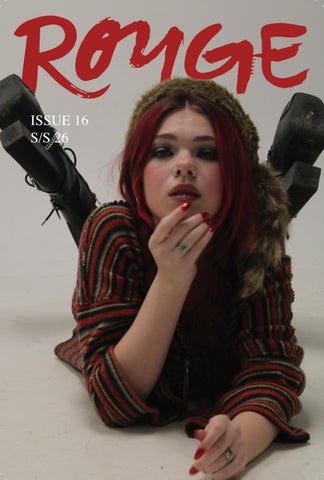
ISSUE 16 S/S 26
o Ru
ge
e
ROUGE MAGAZINE Rouge Magazine is the University of Georgia’s premier fashion publication, founded in 2007 by three visionary students within UGA’s College of Family and Consumer Sciences. Created from a shared desire to give fashion a dedicated platform on campus, Rouge became an official student organization in 2008 and has remained student-led ever since. The magazine is funded by member dues and a once-yearly allowance from the University’s College of Family and Consumer Sciences. Published biannually, Rouge is a full-color magazine conceptualized, written, and designed entirely by students. Every issue is built from the ground up by members of the Rouge staff in conjunction with the executive board united by a passion for fashion, storytelling, and visual innovation. Beyond its pages, Rouge is a community. We celebrate the creative spirit of Athens, Georgia through on-location photoshoots, local collaborations, and events that connect the fashion-minded across campus and beyond. Rouge aims to inspire boldness. To educate and challenge perspectives. To explore how fashion intersects with culture, art, and identity. Each issue is a collection of ideas, crafted to offer readers something to take away, whether it’s creative inspiration, industry insight, or simply the beauty of thoughtful design.
SPRING/SUMMER 2026
CONTE #
#
20 The Death of Seasonally Dressing By: Demi Kurtz
47 Absorbing Ink: The Evolution of Tattoos By: Ella Dri
30 Back to the Basics By: Penelope Casteel
58 Overdosing on Anti-conformity By: Camille Bruu
34 Cut From the Same Cloth By: Alisa Viens
64 Kate Moss: The Original Messy Girl By: Helen Yoo
40 From Editorial to Advertisement By: Angelie Uzcategui
68 Clean vs. Messy: Why “It” Looks Different on Boys and Girls By: Hudson Everett
TENTS 76 Fashion Beyond Clothes: A Comprehensive Hair History By: Maia Geraci
102 Personal Taste VS Trend
80 “You’re Not an It Girl — Here’s Why” By: Ann Macon Watkins
108 Devouring the Runway
90 Failures of Prediction
By: Alanná Quinn
96
Wants and Needs By: Katherine Fivgas
Adoption By: Lamiya Tasnim
By: Kimberly Pham
LETTER FROM THE EDITOR
Fashion is not just expression, it’s a system. Through the lenses of self, society, and sale, this issue reveals how what we wear is shaped before we ever claim it as our own. What we wear is informed by what we see, what we are taught to value, and what we are conditioned to desire and consume. In a landscape defined by constant exposure, fashion becomes a site where identity, perception, and consumption intersect. Power Structures explores three systems shaping fashion today: digital dominance, social conformity, and overindulgence. At the level of the self, identity is heavily constructed online, where trends are absorbed and replicated flattening individuality into something familiar. At the level of society, fashion operates as a shared code, organizing bodies into hierarchies of visibility, status, and belonging. What feels personal is often collective, shaped by unspoken rules that define what is acceptable and what is not. At the level of the industry, fashion is driven by speed, volume, and excess. Endless drops, constant renewal, and rapid turnover shift value away from meaning and toward immediacy. Here, consumption becomes instinct, and more is always expected. Together, these systems position fashion not as a reflection of autonomy, but as a structure that influences how we see ourselves, how we are seen, and what we are taught to desire. Ultimately, fashion does not operate independently of the systems around it. It reflects and reinforces three powerful structures: individual identity, social perception, and industry consumption. What feels like personal choice is often the result of influence, expectation, and access. Recognizing this does not take away from fashion’s value, but it reframes it, less as pure expression and more as something negotiated and claimed within larger forces. To the Rouge team, thank you for the work, creativity, and vision that made this issue possible. And to our readers, we hope this issue challenges the way you see fashion, moving beyond self expression and practicality and toward the power structures that shape it. As Always, Nick Cucchi
EXECU TIVE BOARD
Editor-in-Chief
Nick Cucchi
Creative Director
Haley Pearson
Head of Writing
Ella Dri
Head of Blog
Sydney Annis
Head of Fashion
Maura Rutledge
Style Editor Head of Beauty
Avery Ward Charlotte Rogers
Marketing, PR & Events Manager
Serena Strommen-Stokes
Marketing, PR & Events Manager
Lauren Chastain
Finance & Operations Manager
Georgia Hayes
Social Content Manager
Tess Minkewicz
Director of Graphic Design
Emmy Reich
Graphic Design Editor
Barret Benton
Director of Visual Conten
Evelyn Kim
Director of Web Design
Mia Tanner
STAFF Fashion Stylists Ansley Herrin Carly Diver Elayna Boeh Gennaro Montoya Helen Yoo Ira Prabhakar Kara Gibson Katie Jones
Lamiya Tasnim Olive Serrie Penelope DiMatteo Sarah Tear Skye Nguyen-Fenrich Skylar Rechtman Taylor Chen Valor Lekas
Content Creators Elayna Boeh Emma Dyslin Laila Kerik Lily Povenz Madeline Jung Michaela Kokoska Shawn Bulloch
Website Graphic Designers Print Columnists Ailsa Viens Kimberly Pham Alannà Quinn Lamiya Tasnim Ann Macon Watkins Maia Geraci Camille Bruu Hudson Everett Demi Kurtz Katherine Fivgas Helen Yoo
Delaney Chernault Sanjana Karanth Sarah Chastain Sarina Shah
Marketing, PR & Events Coordinators Ailsa Viens Alannà Quinn Allie Robinson Ann Macon Watkins Ansley Herrin Aubrie Yordy Carolyn Craig Elayna Boeh Isabella Courie Katie Jones Kimberly Pham Tianna Harbin-Ruiz
Lamiya Tasnim Lily Povenz Olive Serrie Paige Carter Safa Ali Samantha McCarthy Sarah Chastain Sarah Tear Sarina Shah Skye Nguyen-Fenrich Sophia Thomas
Beauty assistants Kara Gibson Madeline Jung Penelope DiMatteo
Delaney Chernault Eloise Whisenhunt Ira Prabhakar Owen Murphy Sanjana Karanth Sarah Nanos Sophia Perskins
STAFF
ska
Graphic Designers
Photographers/Videographers Brooke Harty Danielle Smith Ella Nance Isabella Courie Olivia Henry Paige LeCompte
Blog Columnists Allie Robinson Camille Bruu Demi Kurtz Hudson Everett Katherine Fivgas Maia Geraci Meghan Pascual Michaela Kokoska Rachel Lee Sarah Nanos Taylor Chen
Sharvil Kulkarni Shawn Bulloch Valor Lekas Yashvi Vadlamani Zam Freeman
STAFF
Inter
erface
he body is positioned as a neutral surface onto which trends are projected. Stripped of specificity, it becomes a blank canvas, absorbing influence rather than expressing individuality. Restrained palette creates a sense of visual flattening. Sleek, continuous silhouettes emphasize sameness over distinction.
THE DEATH OF SEASONALLY DRESSING DEMI KURTZ
I
t’s a cold Monday morning in New York City, with snow on the ground and a chill in the air. You bundle up with a coat, hat, and scarf, and head out to start your day, but something peculiar catches your eye while you’re in line for your morning coffee. There’s a girl in front of you wearing a crochet bikini top. Sure, she has a long sleeve top underneath it, but still a bikini top nonetheless. After heading back into the cold, you keep noticing the same thing: girls wearing bikini tops over long sleeve shirts. Eventually, overcome by your curiosity, you stop someone on the street to ask. “Haven’t you heard?” she says, “This is the newest trending Australian swim brand!” This example may sound like an exaggeration,
but it’s becoming more and more common. Seasons, and the clothes associated with them, used to be fashion benchmarks that determined what was “in” and what was “out.” However, in the current digital world, these benchmarks seem to be fading away. The digitalization of trends has made it so that fashion and ideas regarding it are being shared around the globe and cross-culturally 24/7. While not inherently bad, this has bombarded our minds with all kinds of fashion at once, and what we see may not correlate with the season that we’re currently experiencing. Fashion has moved from something localized to something digital. Trends and retail buying cycles have always
operated on a calendar, heavily influenced by fashion weeks in different cities and their seasonal collections. Fashion hubs like Paris, Milan and London introduce the trends by season, shaping what the upcoming months will look like on the rack and in buyers’ closets. Brand collections have always had categories: spring/summer and fall/winter. These categories compartmentalized fashion and demonstrated how much of a hand seasons have in dictating current styles. Clothing at its core is meant to shield us from the weather, so these cycles worked because they made sense. Different cultural markers that we’re so familiar with, such as back to school, summer vacations, and the winter holidays, further proved how these seasonal changes influenced the trend cycles. This could be observed in magazines too, with editions also based on season. As it has time and time again, though, digital media came in and
changed everything. The dual positive and negative of social media, to me, is its instantaneity. Content is constantly circulating, with new trends popping up every minute. For fashion, that means social media has become a sort of 24/7 runway. Visual overload is a real phenomenon, and is exactly what’s happening online everyday. Being exposed to all types of fashion at once may cause the brain to go into overdrive. It’s common to open your phone to an ad for a winter coat and then come across beachwear with a quick scroll. This differing content makes it difficult to navigate the current fashion microcosm and we may find ourselves asking what is truly “in.” The oversaturation of products causes us to become desensitized to what is reall applicable to us as consumers, and the choice to opt out of a trend or a purchase may lead us to feel left out. It doesn’t help
Seasonal fashion is a concept as old as time, but just as we have seen in countless industries, social media can change things in a second
that trend cycles have become the new normal. Instead of long seasons of fashion, we are being met with constantly changing trends. These trends are the new definitions of fashion timing, and lead consumers to want what is popular, no matter where it is popular. Digital relevance has started to trump climate practicality. The term “microtrend” has emerged from the 24/7 runway that is now social media. Microtrends are shortlived trends, often based on certain aesthetics, that run through fast digital cycles. You may have seen these on your own screens, such as the coastal grandmother or mob wife aesthetics. These trends are, in my opinion, slowly becoming the new seasons. No longer Microtrends capitalize on consumers who want to fit in with what they are seeing,
convincing viewers that they need these items to be “fashionable” – and then a new trend forms and the cycle starts all over again. Social media is amazing in that it has connected people all across the globe. It’s great for opening up new perspectives and shaping us into global citizens, but it has complicated our approach to our own personal styles. . Viewing multiple climates and cultural contexts simultaneously has moved us away from local identity. While Americans are in the dead of winter, we have access to videos of Australians dancing on a boat in bikinis or South Africans on a sunset hike. This may cause us to morph our wardrobes around them, forgetting our current circumstances, and it makes sense if you think about it. Social media makes us feel closer to the people on our screens, as well as their fashion, but we must remember that fashion is meant to be practical. These practicalities are being thrown out the window in order to follow trends, causing seasonal dressing and the fashion world as we know to slowly fade away.
The “see now, buy now” concept materialized by the internet has led consumers to expect immediacy and with that, the runway-to-retail gap has started to collapse. Fashion authority is also changing. Influencers and algorithms have taken the place of magazine editors, fashion critics and designers. Gone are the days of designers starting seasonal trends – influencers make the rules now and with the current influx of them, the rules seem to be changing by the day. Seasonal fashion is a concept as old as time, but just as we have seen in countless industries, social media can change things in a second. Digital acceleration and cross-cultural platforms have trained us to always want the next best thing; what we see is popular and “on trend” – even if that next best thing makes no sense when placed in our own personal context. This begs the question – is fashion becoming placeless? With so many trends and ideas coming our way and being thrown into our lives, how does one begin to compartmentalize them? We must continue to confront and dissect these questions if we ever intend to bring back seasonal logic, something I hope people can remember before it becomes a distant memory.
By Penelope Casteel Fashion trends are cyclical. We see the resurrection of statement pieces, silhouettes and fabrics from decades past. Oftentimes, these resurrections have not left behind any functional utility, and serve just as a symbol. Cheap, mass-produced symbols. I write this while eyeing the infamous Amazon corset that hangs in my closet, untouched since freshman year of college. Where did we go wrong? In the 1950s, the United States reached a post-World War II consumer boom. Affordable commodities reached the working class through cars, food and fashion. Bold choices reached all of these markets, and are noticeable in every nuclear family. But society wasn’t all happy. The baby boomers had countercultural figures such as Elvis Presley and James Dean, who not only influenced music but the fashion trends of the time. Fashion saw several decades of revolutionary (and counterrevolutionary) moments after this period. The 1960s introduced mod miniskirts and bright colors, the 1970s embraced denim and polyester. The 1980s rejected the psychedelia of the previous decade through punk fashion, and marked a new revolution of shopping. A “third place” for
American consumers was found in the suburban shopping mall. This cultural development led to a new expectation for accessible and trendy fashion–but it also came at a cost: craftsmanship began to erode. When you do not understand the rules, it is often hard to break them in any meaningful way. Alexander McQueen understood this better than most designers of his time. McQueen is widely regarded as one of the most innovative designers of his era. Many know him from his controversial 1995 Highland Rape collection, which showcased garments that were ripped, or ornate with bleach and (fake) blood. As an apprentice who started on Savile Row, he spent his late teens and early twenties as a tailor and pattern cutter. This experience led to an appreciation for the movement and form of fabric on the human body. Do you own a pair of low-rise jeans? He popularized them after studying proportions, elongating the body and emphasizing the eroticism of the lower spine, demonstrating how clothing can distort and redefine the human form.
remained relevant for months, if not years. But what once lasted through multiple couture seasons now last only a few months. In today’s rapid media cycle, styles and trends feel boundless–that Amazon corset used to be paired with cowboy boots and a white midi skirt and garnered nothing but praise. But its appreciation never came from any meaningful space, and I came to realize that my outfit’s perceived value depended entirely on how closely I followed the latest “thing.” I didn’t know how to actually wear or tie a corset. Looking back, neither did the people who I was trying to emulate. This realization was both liberating and destabilizing. It freed me from chasing trends but also disrupted my sense of personal style.
We’re called to invest into our future: a good career, a good relationship, a healthy body. But for some reason many fail to extend this sentiment to clothing; something they will be wearing for the rest of their lives. This results in closets filled with clothes we don’t wear and a generation that has never lived in a world where garments were made to last. Maybe this is a The traditional fashion calendar call to action: trade the novelty features two main collections of trendiness for the quality that per year: made two collections comes from craftsmanship, and a year–Fall/Winter and Spring/ commit yourself to learning the Summer collection. Before difference. The best investment the rise of social media and you can make is in something the digital age, trends often built to last. followed these collections and
TITLE CUT FROM THE SAME CLOTH WRITTEN BY ALISA VIENS
As anyone who has watched the 2011 hit show “Dance Moms” or paged through a fashion magazine knows, the dance and fashion communities are often harsh and critical of dancers and models in pursuit of perfection. Though these two communities may seem distant in terms of their art forms, they share many similarities. Artists in both are pressured to appear perfect, whether in their movements, the shapes they create with their bodies, or the way clothing communicates through them. These strict standards create an unattainable ideal of perfection, but they can also be avenues for self-expression and boundarypushing. To explore how these aspects of dance are reflected in the modeling industry and how their implications might be addressed, I interviewed Lennon Taylor, a former ballerina with 16 years of experience.
Dance and fashion are both art forms that involve the artist’s body, making them distinct from more traditional types of art. Dance is extremely physically demanding. “In general, people have a lot of respect for dance and dancers, and that is primarily because they understand how difficult it can be,” Taylor said. “This is especially true with ballet and pointe. The more you tell people about exactly how physically demanding it is, too, the more impressed they are.” Fashion is not as physically demanding, but it carries harsh stereotypes about what an artist’s body should look like and often imposes unrealistic standards of perfection. The hierarchical structure of both art forms worsens the treatment of models and dancers.
forms worsens the treatment of models and dancers. In both art forms, the less experienced performers defer to those who are older or more established. The less experienced artists are therefore less able to express themselves. Dance teachers often uphold the strict standards of the discipline. Taylor leans into the treatment of dancers by their teachers. “Dance instructors are incredibly demanding. If you do something correctly, they tell you to do it five more times. If you get something wrong, ten more…Teachers often
have short fuses and will get impatient quickly; barely a rehearsal passes without a teacher yelling at their students for one reason or another,” Taylor said. The typical dance class environment, as Taylor describes it, can feel harsh. This highlights the conflict between the conformity and self-expression of dance; dancers are pushed to focus on perfecting the details of their craft rather than pushing boundaries and creating something original. Similarly, fashion rules can hold people back from developing an
an individual sense of style. People tend to follow fashion rules out of fear of judgment, but in both art forms, longstanding ideas about what is acceptable shape behavior. Fear of disrupting the status quo can trap artists into conforming rather than expressing themselves.
the dance world by encouraging more creativity among dancers. One potential solution to the divisions between the dance and fashion environments is to focus on the community rather than the individual.
“It is lovely to look at a piece as the work of a team – the Taylor offers her thoughts on choreographer and musician how to unite these two opposing creating it, the dancers making aspects of dance best: “Proper it possible,” Taylor said. “It truly ballet technique takes so long is a collaborative effort, and I to learn and perfect that self- wish we thought of it that way expression becomes less and more often.” less of a priority…I think in an ideal world, the strict and rigid Taking this perspective might rules of ballet would function as a allow for a middle ground in both foundation from which a dancer the dance and fashion worlds can learn to artistically stray, so by valuing contributions from that they always look composed all participants and respecting and any variation from perfect their rules and traditions technique is understood as without allowing them to limit an intentional form of self artistic freedom. Recognizing expression,” The standards of the diversity of talent for a dance are not always a bad dance performance or fashion thing; it’s important to have show to be successful creates some framework to evaluate a a more positive narrative, dancer’s ability and help them which encourages greater selfimprove. expression within both art forms. Similarly, fashion rules are not inherently harmful, particularly when they function as a vehicle to help individuals develop personal style instead of contributing to trend cycles and overconsumption. Taylor offers a more measured approach to
From Editorial To Advertisement Angelie Uzcategui In the corner of my room, collecting dust, my stack of Vogues sits abandoned. I’ve rifled through them countless times - looking for something to cut out, glue, and plaster together into the collages I’ve planned to make. However, instead of inspiration, I’ve been met with a brick wall. Seemingly overnight, these major outlets shifted from delivering vision to force-feeding their audience merchandise. I’ve been left with no choice but to scour the basements of libraries for old magazines that seem to carry the essence of creativity that today’s media, I feel, is lacking. I tried shifting to Pinterest as a modern-day alternative, but was greeted again with more ads than ideas. Long gone are the days
of chic textiles and sources for outfit inspo. Now, an innocent click will more than likely open a new tab, take you to a storefront, and force you to answer the question every platform seems to be asking – do you want to buy this? The ads are overwhelming – and this isn’t the only social network that’s twisted creativity into consumerism. TikTok Shop has taken over many users’ For You pages, with Business Insider writing that some users claim there is an ad on their FYP every six videos. The dent in our bank accounts shouldn’t be our biggest concern, though. Fashion and art have lost their sincerity and meaning because of their immense commercialization. The thought and innovation that once went into the mak-
ing of a single jacket or bag is now overlooked, and the efforts of artists are diminished. It’s almost ironic. I stand in front of my overflowing closet, and I can’t conjure up a single outfit. I look at my collage materials, and I have no vision. I feel deeply uninspired in an era where I have the world at my fingertips, and I’ve concluded that an idea stops being an idea once it’s sold to you. It becomes a product - and everything feels like a product now. This process turns us creatives into simple consumers, blocking our full potential through this process of relentless commoditization. If we “need” new pieces to complete ourselves, and continue to look outwards instead of inwards, our personal style can never be fully developed. We will have given the autonomy of that creativity to algorithms at large. Constantly adding things to our carts is holding us back from truly expressing ourselves through our fashion.
My solution isn’t to just download an ad-blocker, although that would be helpful. We must become more thoughtful and intentional with the media we consume and the places we go to for inspiration. Try finding someone whose personal style you align with. Having a style icon can serve as a guide in your pursuit of a consistent look, helping you better use the pieces you already have in your closet. My style icon isn’t just someone whose clothes I like; I admire her presence, her lifestyle, and her habits. When choosing someone, observe their features and interests. What makes them an individual? And does the way they express themselves feel sustainable in your own life? You could also try waiting before making any purchases. Contemplating a little before buying a piece allows you to decide whether or not you can
truly integrate it into your closet. This philosophy can also be applied to second-hand shopping by making a list of things you hope to find before walking into the thrift store, keeping you from shopping blind and buying whatever you happen to find on the rack that day. It’s easy to become overwhelmed by the flood of options we’re presented with in the media every day, but sometimes the best thing we can choose to do is intentionally slow down and reevaluate. By becoming more in tune with ourselves and more aware of who we use for creative inspiration, not only do our closets become better,
we may learn to express ourselves more authentically altogether.
Absorbing Ink: The Evolution of
TATTOOS
By: Ella Dri
Our blank slate begins at the skin. As style ebbs and flows, we have become increasingly drawn to projecting trends onto our bodies. This can be most clearly seen in the form of tattoos. An art form carried through generations, tattoos have long held meaning. More than just decoration, or something to post on social media,
theyareourselfdeclarations. We live in a time when tattoos are becoming more visible and accessible. While there can be a stigma in certain environments, younger generations are pushing for an acceptance of tattoosemphasizing the importance of self-expression. No longer an act of rebellion, the ink may allow therapeutic respite. This is the age we live in, yet tattoos have not always been seen as such. There were times when we associated tattoos with negative assumptions. Poor life decisions were reflected by the dark, shaded ink. They worked as a silent communication that echoed caution to many. People have been shamed, denied work and cast into ostracized social groups for simply being different. Never mind the fact that your parents may disapprove- tattoos once lived in a time when their meanings did not translate across communities. What held meaning and rank among one community was taboo to another.
Throughout time, tattoos have been engraved in cultures, especially within the United States. In European art from the colonial era, Indigenous tattoos appear in watercolor hues. Spanning across the chest, face and arms, Indigenous men and women were accustomed to welcoming ink to their skin. These marks played various roles that fluctuated over time. Oftentimes, an individual’s tribal affiliation and role were reflected in their tattoo. Additionally, they signaled military achievements, religious or served as ornamental decoration. In pre-18th century Europe, tattooing was often associated with stigma, appearing on Greek and Roman slaves, criminals and other marginalized people. An interesting piece of tattoo history simply lies in its name. The word “stigma,” now known as a word that describes a mark of disgrace, is what the Greeks used to describe tattoos. That origin hints at how tattooing became linked to shame in Western context. Furthermore, the English used many terms to describe tattoos. “Punching,” “pricking” and “cutting” are just a few to share. Following an English explorer’s travels to the island of Tahiti, the Tahitian word “tattow” is how we came to have the word “tattoo”. The word itself gives insight into how a once separate act slowly began to come together.
And yet, we continue to see tattoos evolve today. Interestingly enough, some areas of our world are just beginning to warm up by putting ink to skin. In South Korea, tattoos have been restricted only to licensed medical practitioners. Tattoo artists without medical licenses could face criminal penalties. Many South Korean tattoo artists have found fame via social media, yet the ban on tattoos hindered the potential to create a deep tattoo culture in the country. The hesitancy for the legalization of artistic tattoos can be dated back to premodern Korea, Japan and China. During this time, many criminals were identified by the tattoos on their face, representing their loyalty to whatever gang they belonged to. Yet, in the late 2025, the new Tattooist Act will take effect. It created a pathway for tattoo artists to train and obtain licenses, including passing an exam. To see how tattoos grow and flourish across the world inspires creativity and independence.
Our body is seen as our canvas in many aspects, and the skin is the most basic place to start. The ink in which we paint our bodies offers a therapeutic way to carry memories, joys and qualities that otherwise might have gone unnoticed. Acting as a timestamp,a tattoo can hold something that matters deeply to you and travel with you through time.
Tattoos reflect a deeply personal and intentional art form. Wherever and however you choose to express art is left to your own hands, and well, maybe consider your tattoo artist as well.
Wherever and however you choose to express art is left to your own hands, and well, maybe consider your tattoo artist as well.
On a societal level, fashion operates as a shared system of visibility, status, and conformity. How bodies are read, ranked, and accepted within social hierarchies. What makes a fashion it girl an it girl?
Mainframe
examines fashion at the level of society by framing dress as social code. Silhouettes, textures, and degrees of exposure act as markers of belonging, shaped by modern ideals such as clean girl versus messy girl.
Overdosing on Anti-conformity | Camille Bruu It speaks before the mouth does, before words do. It creates an idea of who we are, what we are, and what we stand for before we say a word. Fashion. Style. How we dress our bodies tells a story. How we decorate our ears with gold and silver, how our socks peek out or are hidden, the color of the laces we choose, it all writes the story of us. Words aren’t necessary when how we dress does the talking. And the pivotal thing that we all keep in mind when performing the act of style is how we want to be perceived. When you meet someone for the first time, cross someone on the street, or smile at a stranger, whether you’re aware of it or not, you create a predisposed idea of who they are through how they choose to dress themselves. Clothes are more than fabric; they’re our identity. Style is more than articles of clothing; it’s the tangible version of ourselves that we want to push into the world. But what happens when our dress becomes our restraints?
Over the past decades, the rise of counter-culture, anticonformity, and the concept of becoming niche has seeped into mainstream culture, infusing itself into the fashion sphere. Stemming all the way back to the early ‘70s with hippie culture and the counterculture movement taking the center stage in popular culture, defying cultural norms and standing out has always been present. In recent years, the concept of
standing out and not blending in has taken a particular forefront with the rise of buzzwords in media, such as being the “cool girl,” being “niche,” and being “underground.” Media and popular culture have undergone a tangible shift in their desire to be seen as different. Now, we all desire to stand out, be considered cool and unique, and become the “cool girl.” But how is this desire to be seen as “cool” and “unique” manifested? Through our style of course. This deep, intrinsic need within us can be physically expressed through our performance of personal style. We perform the act of being “cool” by dressing in what would be considered unique and cool, what a “cool girl” would wear. But at the end of the day, it's a performance. We all desire to not be like everyone else, to not be forgettable, to be different in some way, but when this desire becomes allconsuming, it hollows you out. It becomes the chase. You see someone post on Instagram in the coolest, most effortless outfit you’ve ever seen and think, “Wow, I wish I could be that chic and unique,” and it starts. You
you try to meet their level. You buy more, thrift more, but it's never enough. As soon as you think you’ve met them on their level, you'll always see the next, most unique and underground styled outfit. The pattern becomes cyclical. This cycle not only drains you, but the chase is the exact antithesis of the anticonformity you were once striving for. When how we dress is so heavily catered to what others are not wearing and defying trends, we are conforming to trends and the culture just as much as those we are trying to stand out against. While others follow trends and blend in with the cultural climate, by directly opposing current trends and not conforming to current culture, you are actualizing and bending to the will of the culture as much as those who follow it. Your idea of anticonformity takes shape into conformity once again. By chasing what will make you look cooler and "unforgettable," you conform to the trends and culture you are trying to rebel against. The style and fashion you once found liberation through and self-expression becomes a straitjacket. Suffocating. Hollowing.
The only way to truly not conform to the culture and trends is to ignore them. It’s as simple as that. Follow what you think is cool. What you find beautiful, unique, artistic. Don’t let the current culture and trends seep into your sphere of influence, either by following trends or by desperately trying to defy them. The real anticonformists are those who follow their own passion and desire. Dress in what you think is beautiful. Style doesn’t have to be a performance. It can be restored to its original message, true selfexpression, not conformity. Don’t give trends the power to pull your strings. Style is about yourself; let yourself dictate what is cool. Bring the power back to you. It's that simple.
By Helen Yoo Arguably the most recognizable fashion icon of the ‘90s and early 2000s, Kate Moss redefined the modeling expectations on and off the runway. Her off-duty looks defied the polished puttogether outfits often sported by other models during this era. Tabloids coined her nickname “Kate Mess”, yet her outfits still showed cohesion and paved the way for more expressive fashion to break out. In the ‘90s, Moss favored looks that were largely minimalist with hints of edginess. One of the era’s most iconic looks from the ‘90s was the sheer dress she wore to the 1993 Look of the Year party hosted by Elite Model Management. Her simple
makeup and casual updo starkly contrasted with the black underwear visible beneath her sheer dress. Although Moss reportedly was unaware of the dress’ see-through nature, it still remains an iconic moment in fashion history. The dress helped popularize sheer fabrics in ‘90s fashion. Moss’s matching look with Johnny Depp to the screening of Banter in 1994 encapsulates that minimalist edge of her looks from the ‘90s. She wore a black leather jacket over a simple white top and skirt, paired with her infamous “just got out of bed” hair. Photographers often captured Moss with her messy hair, a key factor in why her style
style has become so influential. The disheveled hair combined with edgier outfits created a sense of effortless cool, something rare in other off-duty looks. Other models, such as Cindy Crawford, opted for cleaner styles. Crawford’s classic combo of jeans, t-shirt and a blazer has become a common off-duty outfit models today still sport. Even after the height of her career in the ‘90s, Moss remained influential in the early 2000s. As fashion shifted from the ‘90s to the 2000s, Moss’s style transitioned from minimalist to more bohemian. She was frequently photographed wearing large, feathered jackets, boots and shorts and accessories with western influences. Her most notable outfits were what would be considered “indie sleaze”. Indie sleaze is the blending of ‘90s grunginess with the bohemian, festival looks of the 2000s. Moss is also credited with the rise of this style due to her laid back and low-effort looks.
the start of Moss’s time being known as “Kate Mess” because her style was seen as disheveled to the public. Moss was famously described as a “rockstar trapped in a supermodel’s body” because of her public drug use. Her smokey eyed makeup paired with a more casual style can be seen making a comeback today, showing the extensive reach of Moss’s influence on fashion trends. Today, Moss’s style has transformed from messy to mature and put-together. She still holds elements from her grungy past, but now her fashion provides a more structured and elevated silhouette. Modern fashion has evolved past her grunge days, leaning more into the “clean girl” look. Moss combines modernity with her personal style by offering outfits that are more tailored, but still bring out the “rocker” look. Her style has grown mature with her age, which may be a reflection of how society expects older women to dress more refined, but Kate Moss remains true to the roots of her style, effectively locking in her status as a fashion icon who continues to defy expectations.
Hudson Everett
Why “It” Looks Different on Boys and Girls
“It girl.”
The phrase conjures images of Lindsay Lohan’s mug shot, Paris Hilton climbing out of an Escalade and Nicole Richie rocking her signature oversized sunglasses. Since the rise of Hollywood, pop culture has crowned its female trendsetters with the title “It girl.” Each era produces its own version: the downtown waif, the tabloid party girl, the off-duty model. But the expectation remains the same: she must be effortlessly captivating and just a little messy. Being an It girl is a performance in controlled chaos.
Once you reach that status, you aren’t expected to act like a normal person. Instead, you must remain effortlessly chic. Your messes are curated masterpieces, your camera roll could hang in the Museum of Modern Art. In today’s online landscape, where both public outings and private moments are recorded, It girls must remain on brand at all times. Think of Alex Consani, one of today's most noticed It girls. She must remain chaotic and quirky even when stepping off the runway. Gabbriette must keep her eyebrows bleached and mascara smudged lest her edgy punk girl aesthetic be ruined.
Even influencer It girls, whose brands necessitate transparency, are bound by the rules of curation. Alix Earle, within her signature sororitygirl aesthetic, must share her daily struggles and small mishaps to feel relatable but never anything truly unglamorous. Her chaos is aspirational: wardrobe malfunctions at New York Fashion Week, yacht mishaps in Miami, all presented as stylized drama for her audience to admire, but never actually experience.For these women, allure isn’t just about style or authenticity. It’s about projection. The audience must be able to imagine themselves in her world but always from a distance. Most people know they could never be an It girl, and that impossibility is part of the appeal. An It girl’s subtle chaos reminds the audience that she is human, something that makes her all the more enduring to the masses.
even less inspiring, with most appearances sporting the quieter, more reclusive a tuxedo or muted-colored cousin of “It girls,” exist under a suit. If a woman wore similar different set of rules. Where she clothing, she wouldn’t be on is expected to transform, he is anyone's Pinterest board, let expected to remain the same. alone considered a style icon. His appeal lies not in spectacle, Yet it is Butler's commitment to but in polish: a uniform of tailoring and well-cut tailoring, meticulous traditional grooming, and an effortlessness pieces that that calls no attention to itself. sets him Whereas the It girl’s charm apart. thrives in curated disorder, the It boy’s allure is found in restraint and consistency. Austin Butler, known among Gen Z for his effortless style, is a textbook example of these rules. Stylistically, Butler is painfully bland. His daily uniform almost always consists of a white T-shirt paired with jeans and boots. His red carpet style is
Jacob Elordi is another example. Elordi’s streetwear style consists of what most women wear on a casual day out: jeans paired with a sweatshirt and a shoulder bag or tote bag. Yet, there are whole TikTok accounts dedicated to Elordi’s style and the ways you can achieve it. So, how did these gendered standards come about? On paper, It girls and It boys might seem like they should follow the same rules, but in practice, the expectations are strikingly different. In American society, women are pressured to layer on makeup, style their hair and curate their outfits to meet an ideal of beauty. For women, appearing poised and put together is the baseline. To earn the title of It girl, they must also stand out. Those who carefully push beyond conventional standards of beauty, taking risks or bending the rules of style, are rewarded with cultural admiration. Their allure lies in walking the line between conformity and individuality, staying striking without ever crossing into what might be seen as unattractive.
Men are rarely expected to make any effort at all, and when they do society applauds them for it. For them, simply putting care into themselves redefines expectations. A welltailored suit, neatly groomed hair, and a composed presence are often enough to signal style, confidence, and relevance. Society does not come to men to dictate trends. So, It boys lean into traditional masculinity to remain relevant. In other words, while It girls must balance effort with intentional messiness, ‘It boys’ can maintain allure simply by showing up polished. Style, like society, still judges men and women by very different rules.
Maia Geraci
Fashion Beyond Clothes: A Comprehensive
HAIR History
A person with a shaved head passes you on a bustling city street. A man with long hair stands beside you at a local concert. A woman types on her computer in a coffee shop, her hair shaped into a full afro. All of these people have something in common: they are wearing their hair in fashions that first surfaced during eras when hair became a tool of dissent, used to rebel against current societal standards. The afro resurged in the United States during the 1960s, a period rife with conflict due to the shifting societal standards of the time. Civil rights groups like the Black Panther Party strongly supported the natural hair movement: a crusade that reinforced the idea that curly hair is innately beautiful and does not need to be straightened or covered to conform to the societal expectations set by those of European descent. The afro, which symbolized power, identity, heritage and wealth in Black culture, was worn widely by members of the Black Panther Party. Choosing to wear their hair in a style stigmatized by American society created a level of status and visibility among African Americans as they physically expressed their allegiance and stance on the civil rights movement. During the Vietnam War, a counterculture known as the hippie movement e merged in protest of the military draft. A major signifier of devotion to the movement was men growing their hair long enough for it to appear feminine. Long hair worn by men symbolized freedom and the choice to not conform
to the traditional roles of American society. It was a common way to show disagreement with the social norms of the time, including compulsory military service. This long, carefree hairstyle stood in direct contrast to traditional male haircuts in the military, which included the “high and tight” or the crew cut. Not all hair countercultures emerge from a time of conflict. The 1970s saw a resurgence in Liberty spikes: a punk fashion in which one’s hair is gelled into upright spikes across the head. This revival of a once-dead hairstyle gained momentum after Sex Pistols members Sid Vicious and Johnny Rotten adopted the look as a symbol of rebellion against the mainstream styles. The effort required to maintain such a gravity-defying, high-maintenance hairstyle communicated how dedicated punks were to the subculture and its message. “The height and rigidity of early Liberty spikes were directly proportional to the perceived oppression by mainstream society. It was a physical manifestation of pushing back against the norm. “The higher the spike, the louder the unspoken protest,” hair historian Alistair Finch said (Amorim 2025). Another facet of punk hair counterculture was the shaved head. This hairstyle similarly reflected the rejection of societal norms and conformity, forcing observers to confront a person without relying on hair as a visual cue for identity. Punk icons like the late Sinéad O’Connor or Henry Rollins are known for sporting this hairstyle, which remains popular today.
ashion F Beyond Clothes
The prominent presence of hair culture throughout history underscores that fashion is not just what we adorn our bodies with, but also what we are born with. Self-expression through hair provides a unique lens through which political ideas, protest and personal preference can be expressed. The wide range of hairstyles available today reflects the freedom people have to present themselves as the choose. Presentation preferences like dyed hair, locs, baby bangs, the bob, the shag, braids and more put into perspective the freedoms we have to express ourselves physically. There is far more room for individuality and eccentricity in today’s society than in the past, when hair countercultures were used to combat the mainstream and protest controversial eras like the Vietnam War’s draft and America’s long period of segregation and racial inequality. Hair, something nearly every individual is born with, can be molded into countless styles. Something so natural can be an individual’s most powerful tool of self-expression whether through shaving it off completely, letting it grow beyond social norms, styling it elaborately or leaving it natural.
OT AN IT N E R U’ GIR O L Y HE
Ann Macon Watkins
RE ’S
W HY
In today’s constant stream of
media,
the term “it girl” has remained pervasive circulating around what to wear, what to buy and how to change to align with a shifting ideal of popularity and polish. But this girl is not an individual, nor is she a cultural movement. She is a system, a set of rigid, unspoken rules enforced through visibility and repetition, upheld by influencers, celebrities and the images we consume daily. This system did not emerge overnight; it evolved across decades, aesthetics and cultural moments, shaping how desirability is defined and who is permitted to embody it. The early 2000s reshaped the way trends were consumed, fueled by tabloids, paparazzi culture and spectacle-driven fashion. With the constant circulation of red carpets, runway shows and highly publicized nights out, celebrities like Paris Hilton, Britney Spears and Destiny’s Child embraced chaos over restraint. This era was defined by visibility and
access;style was loud, excessive and immediately legible. The public not only saw what was being worn, but quickly bought into it. Fashion encouraged aspiration through rule-breaking: dangerously low-rise jeans, heavy layering, and unapologetic over-accessorizing. As internet culture accelerated this cycle, cultural taste became increasingly reactive, allowing trends to move from celebrity to consumer within days of their emergence. The introduction of Tumblr in 2007 marked a turning point in how people viewed and consumed fashion. Aesthetics became a form of personal branding because anyone could publicly curate their favorite looks and trends. Fashion shifted from celebrity-led to internet-curated, and the modern influencer emerged. People expressed themselves through preexisting visual frameworks: grunge, soft girl, indie and normcore, where individuality existed, but only if it fit within an already recognizable online category. Belonging became visual. If you look right, you fit in.
Then came the modern-day “clean girl,” defined by her minimalist yet perfectly curated outfits, quiet luxury staples, slicked-back hair and dewy, barely-there makeup that suggests effortlessness. With the rise of TikTok and Instagram, aesthetic values shifted toward restraint, neutrality and control. These looks present themselves as natural while requiring intense labor, access and money, rules that are nearly impossible to fully meet.
The clean girl aesthetic is less about style and more about circumstance. It rewards slim bodies, luxury, free time and proximity to trends. The system pretends the door is open to everyone while quietly keeping
it
girl
l
it shut, unless you can afford the $3,500 red-light therapy mask or the latest “essential” wellness product. Effort is constantly disqualified, while invisibility is praised. The it girl role is not something you earn; it is something you are granted. The modern guide to becoming an it girl revolves around buying your way into her image. Retailers and influencers promise that the right products can transform you overnight, into a 5-foot-8, glass-skin, Pilates-body version of yourself with just the right amount of blush. Trends cycle endlessly: expensive skincare, perfectly fitting jeans and lip balms clipped to phones for maximum visibility. Consumption has become reflexive, not expressive. We s croll, add to cart, and hit “continue checkout” through perfectly curated LikeToKnowIt pages without stopping to question why. This mindset has even bled into health, with the normalization
of Ozempic and other GLP-1 drugs influencing consumers at younger and younger ages. The system survives by ensuring you never feel finished. So who gets to be an it girl? That depends: how hard are you willing to try? Or better yet, why do you want to be one in the first place? In a culture where beauty standards, trends and ideals constantly shift, achieving what society asks of you is impossible. Maybe the most chic thing you can do is stop trying to fit the system at all. Sometimes, ignoring the rules is the only way out.
OVER DRIVE
Fashion is driven by speed, volume, and perpetual renewal. Endless drops and rapid turnover transform consumption into reflex, shifting value away from meaning and toward immediacy. Overdrive stages excess as abundance, where layering, scale, and surplus materials create scenes that feel indulgent to the point of unease. Repetition and exaggeration overwhelm restraint, pushing form beyond familiarity. Distorted silhouettes and amplified styling blur the line between taste and access. What remains is a system in continual expansion, consuming itself as it produces.
Failures of Prediction by Alanna Quinn
Historically, fashion follows a 20-year cycle in which silhouettes, colors, and fabrics from the past make a nostalgic return. The 2020s saw a boom in “Y2K” fashion, featuring low-rise jeans, ballet flats, and Juicy Couture. It is difficult to determine how this long-standing fashion pattern emerged because pop culture is often embedded in the process. Whether it is a phenomenon driven purely by nostalgia or by a human desire to reimagine the past and reinterpret it for the future remains unclear. It is important to acknowledge that the retro revival ultimately proves why it’s retro in the first place. These recycled trends exist within the typical fashion cycle: introduction, rise, peak, decline, and obsolescence. Nostalgia-driven trends often take longer to reach their peak, sometimes requiring years of slow integration depending on public willingness to embrace renewed styles. However, modern fashion now changes at a rapid pace, and instead of a slow resurgence, more eras are being consumed quickly. Logically, the modern turn to fast fashion should discourage the use of vintage clothing, which can be pricier – particularly on secondhand resale sites- and harder to maintain. However, the ability to produce and adapt to nearly any
era has significantly shortened the half-life of trends. So it’s somehow become more convenient to pull from your own closet instead of buying new, as seen with the revival of 2016 trends. The 10-year gap between 2026 and 2016 challenges the theory that fashion repeats itself every 20 to 30 years. Information sharing has never been faster, resources never more abundant, and lives never more monitored. The urge to conform – or, more precisely, to catch up – has grown from anxiety among younger generations. With the digital age came a new fashion phenomenon: microtrends. These often only last from a few weeks to a month, and mirror the internet’s growing incoherency. Consumers are enticed because they feel like they’re finally caught up to the rest of the world, for those few minutes of relevancy. The year 2026 is significant because, instead of gradually incorporating past silhouettes, colors, and fabrics, consumers are close enough to these nostalgic eras to integrate authentic pieces into modern fashion. The revival feels more intentional this time. Fast fashion continues to produce trends at breakneck speed, and consumers have actively chosen to sustain a system that, theoretically, should collapse under its own excess. If genuine pieces can be reused, why does overconsumption persist?
A class divide may influence this dynamic, particularly in how pop culture responds to these shifts. In 2020, the “It” girls could often be seen wearing the famed Lirika Matoshi Strawberry dress, a $490 piece. With access to sites like S h e i n , T e m u , etc, it has become easier for people to replicate highend fashion over the past years, but the quality hits its limit around complicated pieces like this. Trends are often trending because pieces are hard to come by, and the exclusivity makes wearers stand out from the crowd. So when we look at nostalgia-wear, this pattern is significant in seeing how people adapt. Now that we’ve almost caught up to modern times,
There has to be a middle ground found in this whirlpool of eras and trends, with the privilege of having trending pieces in a box in the attic and the ability to wear anything in current culture. It’s never been more important to make the conscious decision to source fashion items as close as you can, with the boom of fast-fashion, vintage, and handmade pieces has only become more special. Yet many second-hand sources have been “stuffed with two decades of fast fashion cycling in and out of style.”
Where does that leave consumers?
Although it’s tempting to discard these and look forward, maybe fashion can right its environmental wrongs and begin to attempt to use them again.
WANTS & NEEDS BY KATHERINE FIVGAS
1.
Vanilla protein powder (breakfast smoothies!)
2.
Gua shua (I need my jaw to look snatched)
3.
Matching sweat sets (I’m tired of looking bummy on campus)Mouth tape (will I still be able to breathe?)
4. Toilet paper 5.
Contact lens solution
6. Lymphatic vibration pad (need to get ASAP!!, so it’ll work by spring break) 7.
Newest skims drop (thanks for snatching me, Kim!)
8. Digi cam for pics (perfect for Insta) 9.
Another pair of sunglasses (wanna give celeb hiding from the pap)
10. New skin care routine (she’s dry) 11. Havaianas flip flops (they are way cuter than my old ones) 12. new tires 13. Bag charm (to match with friends!) 14. New water bottle (the new colorway is so cute) 15. SHEIN cart (spring break and study abroad fits have to be perfect) 16. LED lights 17. Linen pants (perfect for spring!!!) 18. Chain necklace 19. AirPod case 20. Free people set (it looked so cute on that girl in my class) 21. Metabolism gummies (summerbod) 22. Parke Sweatshirt (new designs finally dropped) 23. New iPhone (love the orange color) 24. pay the electricity bill… 25. That TikTok shop lip kit (I keep losing my liner every time I go out:/) 26. Jellycat (have to add to my collection)
We like things, we want them. Our friends have something we want to match. But it’s important to recognize the difference between what we want and what we need. Fashion waste is becoming an increasingly serious problem, as is overconsu mption in general. Do I r e a l l y need eight s l i g h t l y different white tank tops? No. But I do need to pay my electricity bill. This is not to say we don’t deserve the things we want. We should be mindful. Often, women are the ones put in the spotlight for wanting too many things; this list may highlight that. That’s because these are the things I, as a woman, am advertised to enjoy; these are things I enjoy. Everyone has needs and desires, and we all need to get better at differentiating the two.
At an industry standpoint, fashion is driven by speed, volume, and perpetual renewal. Endless drops, limited releases, and rapid turnover trans form consumption into reflex, shifting value away from meaning and toward immediacy. Visually, Overdrive stages overindulgence as an extravagant feast. A long table overflowing, hands full. Coats layered upon coats and surplus materials create abundant scenes that feel indulgent to the point of unease. The eccentric excess is deliberate, bordering on grotesque. Unfamiliar silhouettes and overdone makeup that make you question what differentiates taste vs access. Overdrive presents fashion in a state of c ontinual expansion capturing a portrait devouring itself.
It’s normal to have desires and wants.
Personal Taste VS Trend Adoption By Lamiya Tasnim
Do you actually like something, or is it a trend? Having something introduced to you as a trend can make you feel inclined to participate in it for reasons ranging from wanting to look cool to wanting to fit a certain aesthetic. More often than not, this scenario follows: The hype dies out, the trend fades as quickly as it arrived, and the piece sits in the back of your closet collecting dust, leaving you wondering why you ever bought it. I, too, am a victim of this cycle of consumption. However, there is nothing wrong with wanting to wear something because it
is the latest style. What really matters is whether you like it and see yourself wearing it when it’s “out of style.” That’s easier said than done. The lines between what you like and what the majority likes can blur, and gaining inspiration from social media can spark our creativity further. Are you liking something because your favorite influencer wears it or because it fits an aesthetic or image you want to project? The deciding factor will always be you, the person wearing it. Finding common ground between
what you like and what the world likes shapes your style. To make the process simpler, consider these questions before your next purchase. Would you still like the item if it were unbranded? It may be the latest pair of shoes or jeans you have been eyeing, repeatedly appearing on your FYP – the algorithm at work– further convincing you to make the purchase. If you find yourself in this situation, pause and consider whether you would still want the item without the brand name attached. Do you genuinely like the item regardless of the brand, or do you want it solely for the label? Your answer will help you better understand your taste and style. Try this: If you have a pricey branded item in your wishlist, try to imagine if you would wear it and incorporate it into your outfits if it were not that
specific brand. If not, then I would reconsider buying it entirely. Liking a brand is fine, but really think about the product, especially if it is at a high price point, to see whether you really want it or not. Does it work with your current wardrobe? Consider whether the item complements your existing clothes or whether you would need to buy an entirely new outfit to style it. Analyze the colors you wear most. If most of your closet consists of neutrals –black, white, beige, and denim– a neon or bold color may be harder to integrate unless a pop of color amid muted tones is your goal. Also consider whether it matches your preferred silhouette. Whether you prefer oversized, baggy looks or fitted, structured pieces, does it align with your usual style? Try this: Make as many outfits as you can with your current wardrobe. Rather than shopping with a blank slate, know your closet and what it needs. Would you wear it if it were not trendy? Consider whether you would feel comfortable wear-
ing the item in less fashion-focused environments, such as a small town while running errands. Would you still like it if no one else were wearing it? Trendy pieces often create short-term excitement, especially if you are wearing them solely because they are popular and not because you genuinely like them. Timeless pieces – garments you can wear until they tear – typically provide longer-term satisfaction. That does not mean you cannot buy something that is trending and grow to wear it more often. In fact, following trends can help you discover what you like and dislike and refine your personal style. Consider this: A popular trend recently, the Tabi shoes made by Maison Marigela. There is something undeniably striking about them. The split-toe design immediately draws attention. Some people love the bold, almost sculptural look. Others find them strange or even uncomfortable to look at. They are not subtle shoes. They announce themselves the moment you walk into a room.
The question is not whether they are interesting. The question is whether you would still reach for them if they were not circulating on fashion TikTok or walking down runways. Would you wear them to the grocery store in a quiet suburb? Would you pack them for a family gathering where no one knows the brand name? If the answer is yes, then they may genuinely fit your style. If the answer is no, then maybe it is the hype speaking louder than your own taste. In the end, fashion is not a race to keep up or a checklist of what is currently popular. It is a language. Trends will always come and go, cycling in and out with new names and new faces. They can be
inspiring and even helpful in pushing you to experiment. But style is what remains when the noise fades. It is the quiet confidence of knowing what feels like you. The goal is not to reject trends completely, nor to follow them blindly. It is to approach them with intention. To ask yourself why you like something. To notice whether you are drawn to it because it speaks to you, or because it speaks loudly online. When you build a wardrobe rooted in your own preferences, trends become tools rather than rules. Fashion changes. Style evolves. But authenticity never goes out of style.
Fashion changes. Style evolves. But authenticity never goes out of style.
Devouring the Runway
Kimberly Pham
The first glass was pressed into my hand before I could refuse it. Champagne trembled inside the glittering crystal glass, light shattering through the stem and scattering over my skin. I took a sip and felt it sting my tongue. Bright, cold; a warning disguised in
sweetness.
We were arranged as carefully as the decadent courses, placed with the same precision as the cutlery and crystal. Here, people could be molded and curated into strict perfection. Names waited at each table setting in a looping script on thick paper that felt too expensive to touch with fingers predestined to be sticky. Everyone sat like they were being photographed, should ers slightly angled, laughter spilling from their mouths. Even our silences were styled, and it didn’t end with the seating chart. It continued on our bodies, tightened and pressed into every detail that could be controlled. Silk was pulled tight across collarbones. Cotton hugged shoulders. Lipstick glazed mouths into something stark and intentional. I could feel my dress against me. Slick, almost damp in the warmth of bodies gathered too closely. When I shifted in my seat, the fabric dragged along my thigh with a whisper that felt too intimate,
like the dress had leaned in to speak directly to my skin. I sat straighter without meaning to, as if posture could protect me. Then the feasting began. The first reach was delicate, almost reverent, fingers hovering as if choosing the wrong fruit would lead to punishment, reveal something shameful. But it didn’t stay delicate. It never does. The table had been set like a shrine, but we approached it like a conquest. Grapes tumbled from silver trays, almost violent in their gloss. Figs lay split open, their insides glistening with bruised wounds, jeweled and wet. I reached for it, and it yielded too easily. The fruit collapsed between my fingers, juice slipping down my wrist before I could stop it. I lifted it to my mouth anyway.
Honeyed sweetness bloomed thick and heavy, clinging to my tongue. Around me, sharp knives sank into layered cakes crowned with sugared roses that were already wilting. Forks pierced the frosting. Crimson syrup bled slowly through the ivory icing, staining the white beneath it. Nothing stayed untouched.
Bread tore open under impatient, desperate hands. Burrata split and spilled itself across porcelain china, cream pooling into oil and crushed herbs. Wine deepened from shimmering gold to a plum red. They were poured too quickly, too often. Glasses refilled before they emptied. Plates replaced before they cooled. There was no hunger here. Only frenzied motion. Only the instinct to take before someone else does. The florals along the center of the table grew unruly. Stems bent under their own abundance, leaves brushing against wrists and shoulders like hands seeking attention or a lover’s caress. Petals dropped into drinks, into plates, into laps. Someone laughed too loudly, and a fork clattered against the crystal. The sound cracked the air like a bullet. I felt something shift.
My lipstick blurred at the edges while a smear of icing streaked across my fingertips. Silk clung more tightly now, warmed by the closeness of others, by the heady breath. Under the table, knees were pressed together. A hand brushed mine as it reached for the same cluster of grapes, and neither of us withdrew. The intimacy in devouring lies in exposing what you want and what you desire, without the dignity of language. You can’t devour politely, demurely. Eventually, something slips, a smear at the corner of your lip, juice dripping from your wrist. And once this polish cracks, it feels like being undressed. The sun sank lower, dragging shadows long across the linen tablecloth that was no longer white. It bore
the evidence of indulgence. Golden blooms of spilled champagne. Deep crimson stains from crushed fruit. Smudges where fingers had pressed too hard, too eagerly. The runway had been immaculate once. Now it was ruined in the most exquisite way. Frosting slid down the side of a cake and onto the linen. Petals fell like surrender, squished under its own excess. A glass tipped and shattered, its stem snapping clean. No one paused. We all continued our consuming. I could taste sugar and salt, and wine layered thick on my tongue. My dress shifted, no longer clinging to my body in tailored perfection, but claimed haphazardly by the evening. I stood slowly, stepping back from the table. My hem brushed against the grass,
already marked by dirt and slicked dew. Around me, mouths gleamed with carnage. Hands glistened with juice and wine. The florals had wilted entirely, their heads bowed toward the wreckage. The feast did not end with applause. It ended with saturation. With heavy, stained linen. With fractured glass. With sweetness that turns to rot in the throat. We had devoured everything placed before us. The fruit, the sugar, the spectacle. There was nothing pristine left to admire. Only the evidence that we had wanted and taken, until beauty collapsed under the weight of our selfish hunger, and the table, once a decadent, divine runaway, became what it always had been beneath the linen and flickering candlelight:
a place where desire is indulged and left to spoil.
Amorim, L. (2025). Liberty spikes: Decoding the cultural phenomenon and styling mastery. Retrieved from https://explore.st-aug.edu/exp/liberty-spikes-decoding-the-cultural-phenomenon-and-styling-mastery Bozzani, N. (2026, February 7). Forever ‘indie sleaze’ at heart. Retrieved from https://www. nicolebozzani.com/blog/2025/2/7/kcdp33wmvjjexujhtuxxljdjtw9tkt Chokrane, B., & Pérez, C. (2025, January 26). Y2K fashion 101: How 2023 got the millennium bug all over again. Vogue. Retrieved from https://www.vogue.com/article/y2k-fashion Cokley, K. (2023). The politics of Black hair. Psychology Today. Retrieved from https://www. psychologytoday.com/us/blog/black-psychology-matters/202312/the-politics-of-black-hair
SOUR Dri, E. F. (2026, January 10). Rouge Magazine. Retrieved from https://rougemag.squarespace.com/
Eckardt, S. (2019, October 31). A history of Kate Moss’s indelible personal style. W Magazine. Retrieved from https://www.wmagazine.com/fashion/kate-moss-best-red-carpet-fashion-style Ewens, H. (2022, December 14). Trends used to come back round every 20 years. Not anymore. VICE. Retrieved from https://www.vice.com/en/article/how-the-20-year-trend-cycle-collapsed/ Full. (2025, July 28). Full circle: How fashion keeps repeating itself. Sartorial Magazine. Retrieved from https://sartorialmagazine.com/fashion-1/2025/7/28/full-circle-how-fashion-keeps-repeating-itself Getahun, H., & Cahill, S. (2023, November 11). We watched 1,000 TikToks; nearly a third were ads. Business Insider. Retrieved from https://www.businessinsider.com/tiktok-ads-sponsored-posts-for-you-page-
Colonial Williamsburg. (2025, June 23). Tattoos in early America. Retrieved from https://www. colonialwilliamsburg.org/discover/daily-life/tattoos-in-early-america/ affiliate-creators-promotion-2023-11
Harrison, E. E. (2025, July 5). Theater: Anti-war message of “Hair” as timely as it was in the ’60s. Arkansas Democrat Gazette. Retrieved from https://www.arkansasonline.com/news/2025/jul/05/ theater-anti-war-message-of-hair-as-timely-as-it-was-in-the-60s/ Kuhn, A. (2025, October 5). After years of operating underground, South Korea’s tattoo artists can breathe easy. NPR. Retrieved from https://www.npr.org/2025/10/05/nx-s1-5558080/after-years-ofoperating-underground-south-koreas-tattoo-artists-can-breathe-easy Lewis, H. (2017, September 5). Tattoos and the class war (A polemic). Medium. Retrieved from https:// medium.com/@honestlewis/tattoos-and-the-class-war-9e98c8d701fe PBS. (2003). Tattoos beyond Polynesia. Skin Stories. Retrieved from https://www.pbs.org/skinstories/ history/beyond.html
RCES Peppin, H. (n.d.). The little-known story behind Kate Moss’s iconic sheer dress. Harper’s Bazaar.
Retrieved from https://harpersbazaar.com.au/kate-moss-and-jane-birkin-did-not-know-naked-dresswas-see-through/ Sangster, E. (n.d.). Now and forever: The ’90s model-off-duty looks that have endured. Harper’s Bazaar. Retrieved from https://harpersbazaar.com.au/best-90s-model-style/ Ulaby, N. (2022, March 1). From Tumblrcore to 2014core, the nostalgia loop is getting smaller and faster. NPR. Retrieved from https://www.npr.org/2022/03/01/1081115609/from-tumblrcore-to2014core-the-nostalgia-loop-is-getting-smaller-and-faster Wilson, E. (2025). Politics of hair: Women define their own identities. House of Solo Magazine. Retrieved from https://www.houseofsolo.com/politics-of-hair/ The 20-year fashion cycle: Why style always comes back around. (2025). Ayana Active. Retrieved from https://ayanaactive.com/blogs/news/the-20-year-fashion-cycle-why-style-always-comes-back-around
THANK YOU
To UGA Dance Department, Skyler Rechtman, and Studio Evermore...
We extend our sincere thanks for allowing Rouge to bring Power Structures to life within your spaces. Your contributions added unique depth, character, and authenticity that helped shape the visual story of this issue. Love, Rouge Magazine