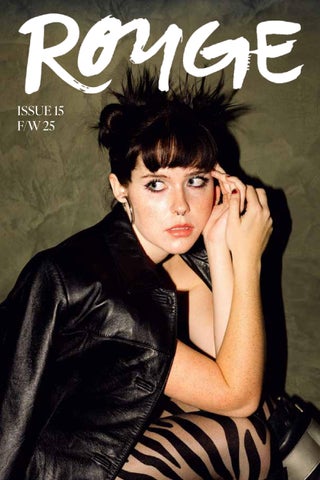
ISSUE 15 F/W 25
1
Phase
It’s Just A Rouge Magazine Fall/Winter 2025
Rouge Magazine is the University of Georgia’s premier fashion publication, founded in 2007 by three visionary students within UGA’s College of Family and Consumer Sciences. Created from a shared desire to give fashion a dedicated platform on campus, Rouge became an official student organization in 2008 and has remained student-led ever since. The magazine is funded by member dues and a once-yearly allowance from the University’s College of Family and Consumer Sciences.
3
Published biannually, Rouge is a full-color magazine conceptualized, written, and designed entirely by students. Every issue is built from the ground up by members of the Rouge staff in conjunction with the executive board united by a passion for fashion, storytelling, and visual innovation. Beyond its pages, Rouge is a community. We celebrate the creative spirit of Athens, Georgia through on-location photoshoots, local collaborations, and events that connect the fashion-minded across campus and beyond.
Rouge aims to inspire boldness. To educate and challenge perspectives. To explore how fashion intersects with culture, art, and identity. Each issue is a collection of ideas, crafted to offer readers something to take away, whether it’s creative inspiration, industry insight, or simply the beauty of thoughtful design.
4
FULL MOON The Full Moon in Fiction, Fact, and Fashion The Mirror of Girlhood in the Digital Age It Grows On You The Next Time You’re Cruisin’ Down the Countryside, Goin’ ‘bout 99 How Fashion Shapes the Emotional Lives of Adolescents When the Moon Watched Her Run
CRESCENT Take Me to a Dream of Fabrics Blast From the Past: Gen Z’s Obsession with Nostalgia
Contents
The Rise and Fall of Justice and Tweendom Styled by Geography: How Place Shapes Personal Style Below the Belt Little Outfits, Lasting Impressions
ECLIPSE Fashion as Power: A Language that Can’t Be Silenced The Art of Rejection and the Power of Absence: A Guide The Thrift Eclipse: Fashion, Fast Fashion, andSustainability in Athens A Color Palette to Kill Rebel to Runway Concert Fashion: The Meaning’s in the Details 5
Carly Diver
19
Cira Thigpen
25
Ella Dri
33
Helen Yoo
38
Isabella Pang
48
Kimberly Pham
55
Allison Fuller
66
Ashley Aiken
71
Demi Kurtz
76
Hudson Everett
89
Katherine Fivgas
95
Olivia Bostick
101
Claudia Skelton
114
Drew Renner
120
Eryn Gentry
127
Maia Geraci
136
Maia Bolt
142
Sophia Thomas
150 6
A Letter From the Editor
Fashion, much like the moon, moves through phases, each one a reflection of identity, transformation, and self-expression. We wax and wane through experience, shedding what no longer serves us while gravitating toward new forms of becoming. In its cyclical rhythm lies a metaphor for the human condition: the continual process of refinement, reinvention, and return. From innocence to experimentation to unapologetic confidence, this issue examines how fashion mirrors the evolution of selfhood, affirming that every phase, no matter how transient, leaves an indelible imprint on who we are.
7
It’s Just a Phase unfolds across three phases of becoming: Full Moon, Crescent, and The Eclipse. In Full Moon, purity and vulnerability take center stage. Bathed in white, flowing fabrics and soft silhouettes capture the untouched beauty of beginnings, emphasizing the original look in our eyes when we were young, before diverging into life’s trials. Crescent embodies a mischievously bold playful rebellion. A phase symbolizing growth, potential, and experimentation, where identity becomes something to be tried on, mixed, and redefined. Finally, The Eclipse marks a full embrace of self, dark and commanding, where desire is realized into power. And as the sun rises, we’re reminded that even endings hold the promise of beginning again. Together, these phases remind us that growth is not linear but cyclical, each version of ourselves is both temporary and timeless.
As the moon changes shape, so do we. Every outfit, every choice, every reinvention is a reflection of where we are in our own orbit. Through these editorials, I wanted to explore how fashion holds space for transformation. No matter the phase you’re in, there’s beauty in becoming. To the Rouge team: thank you for bringing this vision to life with passion and heart. You’ve each left your mark on these pages. And to our readers, may this issue remind you that every phase is worthy of celebration. Here’s to evolving, embracing, and expressing every version of yourself, one moon at a time.
Until the Next Phase,
Nick Cucchi 8
Editor in Chief Nick Cucchi
Creative Director Haley Pearson
Staff List
Head of Fashion Maura Rutledge Style Editors Avery Ward, Kennedy Jackson Fashion Stylists
Finance & Operations Manager Georgia Grace Hayes
9
Amelia Pappas Ann Marie McNiff Bailee Motes Caroline Riggs Carly Driver Charlotte Rogers Eileen Carry Emma Dyslin Eryn Gentry Forest Riviere Godswill Maxwell Helen Yoo Ishan Barve Izzy Mellars Katie Jones Kayden Powell Kylie Hoover
Lillie Barrientos Maria Albano Max Zacha Mia Stewart Olivia Bostick Sivani Dontu Skye Nguyen-Fenrich Skylar Rechtman Taylor Chen Will Tritto Zaina Davies Virginia Odom Carolyn Craig Lauren Cady Emma Ginorio Claire Hames
Director of Graphic Design Emma Lovell Graphic Design Editor Barret Benton
Social Content Managers
Graphic Designers
Salma Hanifa, Tess Minkewicz
Anne Gardezi Audrey Djunaidi Delaney Chernault Eloise Whisenhunt Emily Reich Illiana Santiago Owen Murphy Iris Chang Kayla Pyrtle Shevlin Harley Sophia Perkins
Content Creators
Head of Writing Stella Tunner Print Columnists Allison Fuller Ashley Aiken Carly Diver Cira Thigpen Claudia Skelton Demi Kurtz Drew Renner Ella Dri Eryn Gentry
Helen Yoo Hudson Everett Isabella Pang Katherine Fivgas Kimberly Pham Maia Boldt Maia Geraci Olivia Bostick Sophia Thomas
Audrey Djunaidi Ciara Swenumson Delaney Chernault Emma Dyslin Gissell Balderas Isabella Courie josefine vitriol Kate McGuire Laila Kerik Madeline Jung Maia Boldt Paige LeCompte Shawn Bulloch Victoria Haynes Yashvi Vadlamani Iliana Santiago Ly Le
10
Head of Blog Sydney Annis Blog Columnists Allison Fuller Arianna Dossa Bailee Motes Chandra Sunkara Cira Thigpen Claudia Skelton Demi Kurtz Hudson Everett Isabella Pang Katherine Fivgas Lauren Groce Lucy Dorn Maia Geraci Maggie Monk Meghan Pascual Rachel Lee Taylor Chen
Director of Website Design Mia Tanner Website Graphic Designers Delaney Chernault Sanjana Karanth Sarah Chastain Sarah Rakoski
Head of Beauty Katherine Sovich Beauty Editor Lily Marcus Beauty Assisstants Asritha Pallaki Caroline Riggs Charlotte Rogers Katie Jones Madeline Jung
11
Marketing, PR + Events Manager Savannah Williams Marketing, PR & Events Coordinators Aida Nasser Alexandra Bradberry Ally Arthur Allie Dunn Anna Askue Ann Marie McNiff Arianna Dossa Aubrie Yordy Caroline Roshelli Ciara Swenumson Eileen Carry Elayna Boeh Ellie Erwin Gissell Balderas Iris Chang josefine vitriol Kate McGuire
Kayden Powell Kimberly Pham Kyla White Laila Kerik Lauren Chastain Lauren Groce Maria Albano Safa Ali Sarah Chastain Seddy Slayton Serena Strommen-Stokes Shreeya Goel Sophia Thomas Victoria Haynes Zaina Davies
Head of Visual Content Evelyn Kim Photographers/Videographers Ann Marie McNiff Arti Girish Catherine Edwardson Danielle Smith Ella Nance Isabella Courie Izzy Mellars Jolie Bellaff Kylie Hoover
Paige LeCompte Safa Ali Serena Strommen-Stokes Sharvil Kulkarni Shawn Bulloch Zaina Davies
12
13
14
The world feels untouched, bathed in a forgiving glow. A soft wind ripples through dew-dipped grass; old barns creaking awake as pastures stretch beneath the light. White fabrics billow gently, lace catching a shimmer like spun glass. You soak it in: the quiet before the world wakes, the beauty of simply being. In this stillness, innocence hums beneath your skin. You’re not running, not reaching – just existing, unguarded and whole. Sacred and divine like a sprout beneath the surface that is yet to meet the light. The world exhales, the moment unfolding in quiet grace. Eyes clear and heart open, you realize purity isn’t naivety. It’s the courage to be seen exactly as you are.
15
This is the birth of desire. 16
17
18
19
The
Full Moon in Fiction,
&
Fact, Fashion
BY
CARLY
‘Throughout history, the moon has stood as a symbol of many things. The full moon, in particular, has been used to convey purity, innocence, femininity, rebirth, and renewal across many cultures over time. The moon has stood as an emblem of great importance in many works over the past 20 years, such as “H2O: Just Add Water” and “Avatar: the Last Airbender,” as well as in the physical, scientific world. In the three-season Australian franchise “H2O: Just Add Water,” three teenage girls obtain the unnatural ability to transform into mermaids after subsequently finding themselves in the infamous “moon pool” on Mako
DIVER
Island during a full moon. This (fictional) phenomenon imbues the three girls– Rikki, Cleo, and Emma–with fish-like tails when they touch water, and the ability to heat objects, to manipulate water, and to freeze it, respectively. While this is a children’s show, the idolization of the full moon as a catalyst for metamorphosis, transformation, and amplification is paramount. In the Nickelodeon series, “Avatar: the Last Airbender,” one of the four core nations (the nation of water) is known for its strength, spirituality, and dexterity. In many instances, the full moon is shown to enhance waterbenders’ capabilities. Those in 20
c
4
i i 7
6 6 7
21
c
e e 4
the affected water is pushed and squeezed around the globe, encroaching on beaches and shorelines until it bulges out on the side closest to and farthest from the moon. As Earth rotates, its landmasses pass through the two bulges — the high tides. The majority of Earth’s shorelines undergo two high tides and low tides per day, with one cycle from each extreme (high tide to high tide, or low tide to low tide) taking a little over 12 hours. The moon’s position with respect to the sun also plays a role in how extreme the tides are. When the moon is in line with the sun and the Earth, the tides are at their most extreme (spring tide), during the full and new moons. When the moon and sun are at right angles to each other, the tides are at their weakest (neap tides). These never-ending changes and shifts are paramount in the symbolism of the moon — it literally appears in phases, in peaks and dips, in extremes and moderation. But how does this relate to fashion? The concept of styling only women in garments, accessories, hairstyles and makeup that encapsulate the full moon is somewhat
c
the Northern Water Tribe are at their strongest when the full moon rises, as seen at the end of Book 1; Katara also gains the strength to bloodbend–to manipulate people at her behest–when the moon is brightest. Furthermore, a key element of the series as a whole is that of spirituality. The Northern Water Tribe holds the Spirit Oasis, home to the twin spirits Tui, the moon spirit, and La, the ocean spirit. Their interconnectedness to the waterbenders, and the balance of the natural world as a whole, is of utmost importance. Balance is one of the most crucial aspects in all of Avatar, and it is depicted in the never-ending “push-and-pull” relationship between Tui and La. Water and the full moon (rather, the moon in general) have always been depicted as closely intertwined. This phenomenon is not fiction; according to NASA, the moon directly affects ocean tides. The moon’s gravity, while not wholly responsible for the surge and retreat of saltwater on the shores, tugs at the Earth, shifting its mass. Water on opposite sides of the Earth surges, but because of Earth’s gravity, it is not lifted upward. Instead,
abstract, though what is conveyed in each model’s dress is unique yet still cohesive. Lace, crochet, whites, offwhites and golds are featured heavily in this shoot, and can be incorporated into any person’s closet. The moon, as stated before, is representative of change, transformation, malleability and conversion. The moon is also not flat; it is chock-full of craters, dents, dips and bumps. These quirks can be seen most clearly when the moon is full. This shoot incorporates various textures, shapes and silhouettes. Layering different fabrics and pieces is a marvelous way to bring out more in an outfit without messing with color too much. Clothing ought to be fun and personal, and the full moon is a paragon of inspiration when looking to alter an outfit in an
Out ofthe Box
Way.
4
i i
c
7
6 6
c
e e 4
e e
7 22
2
2
2
e
e
2
oe7e e e 7
e 7
2
o e e o e e
2
e
e 7
e
e e7 oe e
oe e 7 o e e
e
e
2
2
23
e 7o oe e e e e 7
oe7e e
e e7 oe e
oe e 7 o e e
e 2
2
2
e
e
2
e 7
e
2
2
o e
2
2
e
e e 7
e e7 oe e
oe e 7 o e e
e
24
e 7
25
Mirrorof Girlhood in the Digital Age The
By Cira Thigpen I have known my friend Emma for my whole life. From her clothes to her shoes, she has always been the most fabulous person I know. Growing up, it felt like we were practically one person. She was one of the friends I had where everything just clicked – I was inspired by her and what she did. Emma played soccer, so I played soccer. Emma wore all Justice, I wanted all Justice. What Emma found funny, I found amusing. But not in a way that felt inauthentic to myself. See, from the beginning of my life, I’ve always
had friends like Emma to hold on to, who mimicked who I felt I was. Someone who, again, was fabulous and kind. Funny and outgoing. Someone I saw pieces of myself in. I am now 20 years old. I am faced with the early throes of womanhood and with working toward the image of who I want to become. I believe this craft, this ever-so-difficult journey, begins at our youngest. Like Emma, most of my friends influenced how I wanted to be perceived at an early age. 26
I have also been lucky enough to grow up with those whom I have known at every stage of my life. My situation is unique and fortunate, and quite frankly, worked out in my favor because my friends happen to be lovely humans. They say you become the five people you surround yourself with the most, and if that’s true, I’ll thank my cards every day for the chance to be an embodiment of the girls I call family. Now, I’ve never had a solidified idea of who I am, but I’ve always had these great examples of who I’d want to be. And in less fortunate cases, who I’d rather not be. I’ve always felt the relationships I had with these girls were essential to my own self-discovery. My friends at the earliest stages of my life came packaged with emotional support and understanding, something I think is innate in women anyway. I felt as though my closest friends seemed like a mirror through which I could better understand my own identity, values, and place in the world at an age of innocence.
27
Growing up, we spent hours crafting imaginary futures with Barbies and dress-up games, projecting our dreams into tiny plastic lives. Those moments were just rehearsals for who we hoped to become. As we grew older, those games faded into high school football games, practice, and sleepovers filled with drama. But the image of my friends and me —of who we were and who we wanted to be —remained constant. During this time, you had to experiment with your identity. I felt I could do this with a blanket of security, knowing there was no judgment amongst these girls going through a similar experience. I remember one of my friends changed personas practically 7 times, and nonetheless, we supported her in each era. I find this to be a special aspect of female friendships, specifically because we search within ourselves to understand our friends’ visions.
2
2
28
In real life, we are worried about the people we run into every day and the image of ourselves they see. Today, though, our perception of our own image is altered by another outlet, social media.
29
Middle school was probably my first real encounter with the digital world’s influence on identity. Suddenly, I had access to hundreds of versions of girlhood—YouTubers with perfect rooms, curated outfits, and lives that felt impossibly put together. I remember scrolling for hours, comparing myself to girls I’d never met, wanting to be them. Social media cracked open a new realm of possibilities, but also a new layer of insecurity. It introduced a kind of comparison that felt endless and exhausting. One that blurred my own image of myself, no longer relying on the safe space of my friend group. For young girls today, social media can be both a window and a funhouse mirror. It offers inspiration, yes—but also distortion. It can make you question the very things that once felt true about yourself. In a world where likes and feeds shape perception, discovering who you are becomes more confusing. The digital space often amplifies the pressure to perform rather than simply be. I couldn’t begin to count the number of times I’ve seen perfect Instagram feeds and questioned everything about my life.
And yet, even in that noise, I’ve found grounding in the friendships that shaped me. The girls I grew up with, Emma included, remind me of who I’ve always been without the overwhelming digital world. I feel a sense of security knowing that they know the person behind what I post online. With every post, they can see what is coming from my true personality and what may be slightly performative. Which is a trait I think everyone can be found guilty of being. Yet the older we get, the more social media is one of the ways I see them evolve. As much as each of us changes, I will still view their posts and see the identical girls I grew up with. I will still know a person who shares the same childhood as I do, the same memories. They are my reminder of every version of myself I’ve tried on, offering clarity that self-discovery is not a solo act.
30
31
32
33
It Grows On You BY
ELLA
DRI
T
he early choices we make in fashion can define how we dress from youth to adulthood. Taking a look back to the trends that we made without the influence of a screen can bring a renewed state of inspiration to what we love today. Many of the choices we made instinctively as children held a level of creativity that we now purposefully attempt to achieve. Breaking down the trends of childhood fashion that have leaked into today’s accessories, shoes and clothes. 34
One of the most important parts of a young fashionista’s outfit is how we accessorize. Accessories continue to be the most defining part of who we are in what we wear. Whether it was matching friendship jewelry, hair covered in butterfly pins or jelly bracelets stacked up our wrists, this was our first lesson in self-expression. Think about the jewelry we wear now; most of it holds a story. It could be a sentimental necklace you’ve worn for years, or a new piece that elevates your look. P ra c t i ca l i t y built many of our wardrobes as children. Every piece we wore survived playgrounds, art classes, and many more childhood adventures. We might see the rise of athleisure, the love for cargo pants, and the popularity of sneaker-style shoes as a true reflection of our 35
initial intentions in dressing –to move, not to impress. Prioritizing comfort grew from us making our fashion decisions for ourselves, and it may be why modern fashion leans on comfort and function. Let’s talk about layering. This styling technique has evolved like none other. In the early days, layering might have been a ploy used by parents to get you to dress for the weather and not wear your favorite tank top on a cold winter day. Wearing a skirt with leggings underneath was an often favorite for many. Now we use it of our free will. It has become one of the simplest ways to make an outfit personal. Wearing a graphic T-shirt over a long-sleeve or adding fun fabrics over jeans, skirts, etc., adds an element of intentionality.
What should we bring back? The freedom to re-wear and repeat. Think back to the times you would get that perfect shirt or dress and beg to wear it for days. Somewhere along the way, that passion was lost. We now think back to the last time we wore something, who will notice, and feel the constant need to purchase an outfit for every occasion. Why is that? Take time to learn to love the pieces you collect and feel satisfied. Adopting an era of sustainability and mindful consumption not only makes re-wearing outfits feel nostalgic, but necessary.
Fashion is cynical, but at its core, it's deeply personal. The style choices we made as children weren’t curated for a TikTok; they didn’t come from a Pinterest post. We were authentically ourselves. And when we really think about it, we haven’t outgrown our instincts at all. It’s simple, really: our childhood fashion trends aren’t gone;
They’ve Simply On Us
Grown
36
e eo e
o e e
e 7
2
2
2
37
e7
o e
e
oe7e
e 2
2
e 7
e
2
e 7
2
o e e e e 7 eo
2
e
2
2
o e
2
2
e
e e 7
e e7 oe e
oe e 7 o e e
e
e 7
o
e e
38
The
Next Time
You’re Cruisin’ Down the Countryside, Goin’ ‘bout By
39
Helen
Yoo
99
I
magine this: you’re on a road trip, driving through the countryside in the passenger seat of a vintage truck, wearing cowboy boots, a white and flowy outfit, and bows in loose braided hair. The wind is flowing through your open window and the grassfields blur by, reminding you of a more innocent time. Now, everyone knows the music on a roadtrip either makes or breaks it, so the next time you find yourself with aux in that kind of scenario (or whenever you feel like a prairie girl), play one of these mix-tapes to really maximise the vibes:
40
MIXTAPE 1: OLD CARS, DUST, DIRT PATHS AND A LOW, HOT SUN
“Bang Bang (My Baby Shot Me Down)” by Nancy Sinatra “California Dreamin’” by The Mamas & The Papas “The Ballad of Boot Hill” by Johnny Cash “Televangelism” by Ethel Cain “The Devil Wears a Suit and Tie” by Colter Wall “My Rifle, My Pony and Me” by Dean Martin “Fearless” by Pink Floyd “Whitehouse Road” by Tyler Childers “Ain’t No Sunshine” by Bill Withers “Gold Dust Woman” by Fleetwood Mac 41
If you’re into Southern Gothic (minus the scary, grotesque elements) then this playlist is for you! Songs like “Bang Bang (My Baby Shot Me Down)” and “The Devil Wears a Suit and Tie” bring you a familiar picture of a beat up truck kicking up dust along a dirt road. Mixtape 1 channels a romanticised nature of the Southern Gothic aesthetic and makes you feel like a lone traveller, going along Route 66.
MIXTAPE 2:
WHITE DRESSES, BRAIDED HAIR, FLOWERS AND BAREFEET “Crush” by Ethel Cain “Oh Honey” by Delegation “Wild Horses” by The Rolling Stones “Bluebird” by Lana Del Rey “Chemtrails Over The Country Club” by Lana Del Rey
“Yosemite” by Lana Del Rey
“Violets for Roses” by Lana Del Rey
“Summer Wine” by Nancy Sinatra and Lee Hazlewood
“Dreams” by Fleetwood Mac
“Sunny Side of Heaven” by Fleetwood Mac 42
This playlist is for when you’re with your girls, coordinating outfits and laughing together in the car. The brighter tones of these songs make for the best playlist that channels peak girlhood. The songs from Lana Del Rey and Fleetwood Mac help create the soundtrack for really cute memories!
MIXTAPE 3:
ABANDONED BUILDINGS, GLOWING EYES, GRAVEL PATHS AND THE DARK
“Wicked Game” by Chris Isaak “Paint It, Black” by The Rolling Stones “Ain’t No Grave” by Johnny Cash “Hope Faith County” by Jaye Jayle “Dust Bowl” by Ethel Cain “Avalanche” by Leonard Cohen “Lonesome Town” by Ricky Nelson “Death Don’t Have No Mercy” by Rev. Gary Davis “House Of The Rising Sun” by The Animals “Cold Ground” by Rusty Truck
43
F
or those who want songs that feel like actual Southern Gothic, Mixtape 3 is where it’s at. This playlist features iconic songs like “Paint It, Black” and “House Of The Rising Sun” that immediately evoke the Wild West. Still, the addition of Ethel Cain adds the underlying unease and dread of a proper Southern Gothic setting.
MIXTAPE 4:
STICK LEMONADE, WARM BREEZE, SOFT SINGING AND SITTING ON PORCHES “Rhiannon” by Fleetwood Mac
“Old Paint” by Linda Ronstadt
“Cowpoke” by Colter Wall
“Nectar of The Gods” by Lana Del Rey
“Little Green Apples” by Roger Miller
“Expecting to Fly” by Buffalo Springfield
“Knockin’ on Heaven’s Door” by Bob Dylan “It Ain’t Me Babe” by Joan Baez “Kate McCannon” by Colter Wall “God Damn The Sun” by Swans
T
his mixtape is the best to put on in the background while you’re lounging on the porch of a farmhouse while watching the animals graze on grass. If you think that isn’t realistic, then you can definitely listen to this playlist to act like you’re drinking in the sunlight on a porch. The songs “Little Green Apples” and “Expecting to Fly” create a lazy-day atmosphere that’s perfect for a cute, sweeter car ride! 44
45
So,
whether you’re actually cruising down the countryside or just simply imagining you’re doing so, any of these playlists should transform your road trip into
Something Dreamy. 46
47
48
how fashion shapes the emotional lives of adolescents
by isabella pang
49
Getting dressed is a mix of intent and unconscious habit. We’re choosing how we want to feel, who we want to be, and how we want the world to see us. For teenage girls especially, fashion becomes more than a daily routine – it’s a way to explore identity, assert independence, and navigate adolescence.
According to the International Journal for Multidisciplinary Research, the connotations we attach to particular clothes or hues may affect our mental health. Whether it’s the confidence boost from a tailored blazer or the comfort of a worn-in hoodie, our fashion choices are deeply psychological. 50
not just what everyone else liked. That carried into college, too. Even though most girls still dress similarly, I’ve learned to trust my own style.” Her experience echoes a broader truth: for many girls, diverging from fashion norms isn’t just about standing out—it’s about tuning in. Hawkins’ shift from conformity to self-expression illustrates how clothing can become a quiet rebellion, a way to reclaim identity in environments that reward uniformity. Gately Hawkins, a fourth-year animal This kind of self-discovery is prebioscience student at the University cisely what fashion psychology exof Georgia, reflected on how fash- plores. When girls begin to dress ion shaped her own sense of self. for themselves, not for approval, “In high school, everyone dressed the they start building emotional resilsame,” Hawkins said. “When I started ience. Fashion becomes more than branching out, I got weird looks – but a mirror. It becomes a compass. it helped me figure out what I liked, This phenomenon is especially prevalent during adolescence. Psychologists call it “enclothed cognition” – the idea that what we wear influences how we think and feel. For teenage girls, whose self-concept is still forming, clothing can act as emotional armor or a mirror into their true identity. For example, a sparkly top might signal a desire to be seen; an oversized sweatshirt might offer protection from that very visibility.
51
52
53
54
55
Moon Run WHEN THE
WATCHED HER
By
Kimblery
She looked at herself in her gilded vanity mirror, a crooked grin curling her lips, and told herself she’d wear the damn dress just once. All for the spectacle. For the gasps it would draw when she walked in, cloaked in a shroud of lace. For the bored aunts with pearl chokers and opinions that creased into the folds of their faces, wrinkles along their foul mouths. For the girl she used to be, the wide-eyed one who was a dreamer, a believer, who thought that white meant devotion and forever. And the dress? It was everything she had once imagined. It was a shimmering caress of silk and tulle, all frothy layers and pleated ruffles, soft at the edges. It was ivory, not
Pham
white, not that sterile, virginal white, but something older, warmer, like the color of milk left under moonlight. The bodice was boned, shaped to cinch her waist and suffocate. It was embroidered with silvered thread so fine it caught the light. Pearls, real ones that shimmered with iridescence, were sewn along the seams in trailing vines. The sleeves were made of lace, clinging to the arms like frost. Tiny mother-ofpearl buttons kissed the wrists, each one with a delicate clasp that felt like manacles cuffed around her limbs. Across the collarbone, the neckline dipped into a soft, dangerous curve, framed by ruffled tulle like the edge of a cloud.
56
And the skirt—gods, that damn skirt— billowed like smoke with dozens of layers of decadent silk, glass beads glimmering across the hem like fallen stars while the train spilled behind in a long, sweeping arc.
a noose as the music began, soft and sacred. It was the opening notes of a song she had dreamed once as a girl, lying beneath her quilted blanket, eyes closed, imagining her heart would always know who to walk toward. But now, the air was too still. And her It was a masterpiece of tradition, abheart wasn’t pulling her forward. It was solutely ridiculous, which is exactly why screaming at her to turn around. she had to put it on. She had waited for the magic, waited for love to feel like a storm, like someShe let the silk slither up her legs, let thing written among the stars. But this the sleeves tug at her wrist, let the wasn’t it. It was a performance, somebone of her corset dig into her flesh. thing playing across a stage. It was a She pulled the veil over her head, which script she no longer wanted to follow. she hated, but she wanted to look So she turned and ran, flying down the them all in the eye when they had no chapel steps, her veil whipping behind idea. And that was the fun of it. her like tendrils of smoke. The silk of her She’d known for weeks that she gown snapped at her ankles, snagging wouldn’t go through with it, knew from on stone, but she didn’t stop, not even the moment he slipped the diamond for a breath or a moment of reprieve. ring on her finger and said, The chapel gardens blurred around her: hedges, rose bushes, marble statues with cracks slithering up their divine forms. She took off her heels and threw them aside. She didn’t care when the gravel bit into her soles. In fact, she craved that sharp pain, the clarity it brought her.
“I Love You,”
as if it were something to be memorized. She knew, and still, she smiled because it was easier to nod. Until tonight. She stood behind the chapel doors, the dress suffocating, her ribs aching underneath the boning that pinched her waist. The veil tickled her neck like 57
Overhead, the moon watched, following her through the garden, huge and silver. It sat low in the sky, spilling its light across the dirt path, pooling on her skin, setting her dress aglow as if she were walking through a dream. It bathed the lilies and the hyacinths in pale fire, caught in the lace of her dress. Branches reached for her like hands, clawing at her sleeves, snagging the tulle, tearing free the delicate threads. The veil tore completely loose, caught in a bramble, left fluttering like a flag of victory. She reached the wrought-iron gate at the edge of the grounds and didn’t hesitate. She pushed through it and kept running, onto the empty road, and into the wide, wild night.
The sky above her stretched open and endless, stars pricking the lush velvet, but it was the moon she followed, its light steady and unblinking. It lit her way as the chapel fell behind her, as the cold air wrapped around her shoulders like a new kind of vow. For the first time in forever, she didn’t feel lost, like a wanderer with no place to call home.
She felt chosen, by no one but herself.
58
59
60
CRES 61
CENT 62
63
The energy shifts. Light sharpens, color blooms, and the quiet calm gives way to something a bit more charged. There’s a spark in the air: mischievous, daring, and alive. Music echoes in the background as conversation spills across the room. Everything feels possible. Patterns clash, textures collide, nothing matches and somehow everything does. Effortless but deliberate, movement replaces stillness; curiosity replaces restraint. It’s not about getting it right, it’s about seeing what happens when you do it your way. Every glance, every pose, every flash of light feels like a new version of yourself coming into focus.
This is experimentation in motion: proof that becoming can look as good as being. 64
65
66
Take Me to the Dream of Fabrics By Allison Fuller
67
TAKE ME THERE
I want to go Where the walls are PINK And my mind can roam
TAKE ME THERE
With what little money we have In this dream with lights I promise— Not to ask for more than that
TAKE ME THERE—
All the other girls Seem to have BLACK pants Of hearts ZEBRA STRIPES SEQUINS And frills
TAKE ME THERE And nowhere else With a smile so wide My eyes shut tight— I can lose myself
TAKE ME THERE
A vision so real I dance around In BABY BLUE heels Where the colors bound within me Never suffocating But only attaching To the air around me Of only expression– A sea of color That’s surrounding I jump off the cliff Where the water is— DROWNING
TAKE ME THERE
With the neon sign Where the senses are brightened And are pure of sight 68
69
70
71
BLAST from the
PAST: Gen Z’s Obsession with Nostalgia
BY ASHLEY AIKEN FROM Jenna Ortega’s recreation of the famous Carrie Bradshaw, John Galliano newspaper dress (Cafolla), to Ryan Murphy’s upcoming series chronicling the relationship between John F. Kennedy Jr. and Carolyn Bessette, to Claudia Schiffer’s return to the runway with Versace (Jackson) , it’s quite evident that the nineties still hold a firm grip on the pulse of culture. Sometimes to go forward you have to turn back the clock. In the modern era, uniformity has become normalized, positioning boldness and uniqueness as social currency in the current
culture of fashion. Therefore, it’s no surprise that Gen Z deeply desires to differentiate ourselves from the present, by leaning into nostalgia and longing for the vibrancy (and quality) of 20th century fashion. So, is it truly possible to be nostalgic for a time that you weren’t alive for? In a world of fast-fashion and uniform style, there has been an increasing desire throughout our generation to turn back the clock and find a solid sense of identity through style. We find ourselves trying to recreate the lives of our parents through romanticized, small daily choic72
es like using a digital camera (Farrell), frequenting thrift stores or watching shows like “Friends” and “Sex and The City.” When you look back to childhood, 2000s kids often wore bright colors, playful patterns and statement shoes like Sketchers’ Twinkle Toes. However, the rise of beige and minimalist aesthetics in recent times has provided a stark contrast to the vibrancy of our generation’s childhood. So why such an emphasis on the 90s? The 30 year theory surrounding nostalgia presents that after three decades a time period is no longer seen as tacky or outdat73
ed, but instead refreshing and vintage. For example, in 2023, GWI found that 40% of Gen Z feels nostalgic for the nineties, despite the fact that the majority of the generation was not even born yet (Cochrane). In the modern era, many teenagers and young adults seek online and in-person thrift stores, such as Depop or Goodwill. According to findings from ThredUp, thrifting is expected to become more popular than fast-fashion by 2029 (Sicurella) which does not come as a surprise. The majority of modern department stores carry the same pieces with little varia-
tion, leading thrift and vintage shops to be the source for any pieces that contain a sense of eccentricity or personal style. So, as we continue to reference the past, it’s important to remember the future that lies in front of our culture. How can we embrace authenticity and individuality moving forward?
Maybe with an unstable future ahead, the first step is making a conscious choice to utilize the uniqueness of the past to learn and continue forward, creating our own trends, styles and ideas when it pertains to fashion and culture. In a world where dressing boldly and honestly is becoming increasingly rare,
Maybe authentic style is the first step of rebellion. 74
75
76
THE
AND
AND
77
OF
magine a store full of bright colors, sparkles and fun patterns, with all the clothes, accessories and toys one could want – essentially a tween girl’s paradise. At one point in time this store existed. It was called Justice, and was extremely popular among young girls. Justice became a glittering sanctuary for tween girls who were navigating that awkward time we all remember. You know, the one that comes right after childhood has ended, but adolescence hasn’t quite started yet. During the 2000s, Justice became a staple in the lives of tweens, so where did it go? So, childhood is over, but you still aren’t quite a full-fledged teenager. What do you do? Where do you shop? These are some of the questions tween girls have had for ages. They don’t quite fit into a certain demographic, and either end up in childish clothes that are probably too small, or in styles way too mature. Justice, which was originally Limited Too before it rebranded in 2009, realized the prevalence of this issue and decided to capitalize on it. They set out to create a
78
and to no surprise, succeeded. They did something no one had ever done before: gave tweens their very own paradise. They made them feel seen as their own demographic, not just looped in with one that didn’t fully fit them. These tween girls finally felt like they had a place for them that catered to their tastes, sizes, and identity. Justice was created in the right place at the right time, operating over 1,000 stores across the U.S. at its peak. At the time the store started to gain traction, mall culture was thriving. Tween girls had many icons that they obsessed over such as Hannah Montana and One Direction. Tween magazines, like J-14, YM and Seventeen, were flying off the shelves. The culture among tweens was only growing and Justice pounced on this, creating a physical space where it could thrive. Justice wasn’t just a physical space, it was a safe space. A space where girlhood could 79
thrive and growing up didn’t mean having to lose the sparkle of childhood. Tween girls wanted to feel older in theory, but they also didn’t want to lose the joy that comes with being a kid. While the world was pressuring tweens to grow up, Justice created this space for them, a place where they could figure out who they wanted to be as they entered this new phase in their lives – slowly wading into what it meant to be a tween in a store designed specifically for them. Justice gave girls a place where they had their own choices. With everything being tailored to their specific age group, the possibilities were endless. Parents knew the clothes at Justice wouldn’t be too mature for their daughters, so parental approval was not an issue either. Tweens felt empowered by making their own choices, starting the foundation for their lifelong personal fashion journey.
80
also became a place of friendship and common ground among girls. It seemed like everyone was shopping there. Justice wasn’t just a store, it was a social experience for girls and their friends. Bonding over sharing a best friend necklace, or getting matching pajamas for a sleepover, became special moments for tween girls who were just trying to find themselves in a world where they felt like they didn’t quite fit. Justice took a world that didn’t have a place for tweens and made their own. The visual identity of the store was unmistakable, characterized by sequins, bright colors, big patterns, inspirational slogans and overall, a philosophy of more is more. Items included graphic tees with fun designs, tons of colorful accessories and jewelry, pajama sets, athleisure, appropriate but fun swimwear, and even more functional pieces such as school uniforms, underclothes and 81
school supplies. The environment of the store further created this aesthetic for tweens. Always playing loud pop music and having TVs playing tweens’ favorite music videos made the store into a party, not just a shopping experience. The store was full of invitations to play, try things on and touch the merchandise. With so much going on at once, one might think it could get overwhelming, but it worked. The sensory overload was on purpose, making tween shoppers feel excited. Justice’s marketing tactics brought tweens in and made them loyal customers. The company deeply understood tween psychology and effectively created a fan base that would not stray. First, they created a loyalty program called “Club Justice.” Members got perks such as a welcome gift, points for each purchase that could add up towards rewards, birthday gifts and free shipping. This program created
brand devotion and made girls feel like VIPs. Justice also introduced a lot of limited-edition items, making girls return often so that they could get them before they were gone. Another marketing tactic they used was friend-centric messaging. They had many friendship jewelry items and clothes that friends could get to match together, saying things like “Peace, Love, Bffs.” These items emphasized the friendships of girlhood and influenced friends to go shop together. Their marketing campaigns featured “real girls,” not high-end models, making tweens feel like they were looking at girls just like them in Justice’s clothes and increasing accessibility. Justice also had a catalog that was very popular among girls. Whether it came in the mail or off the racks, girls would pore over these glossy publications to find their next purchase.
was COVID-19. Justice’s fall can be attributed to a combination of things: First is the death of mall culture. As 2020 neared, malls had already started to decline. While Justice did have an online store, the mall was its natural habitat, meant for browsing and impulse buying. The whole point of the store was the experience, not just the clothes. After 2020, when people couldn’t shop in person, malls really began to decline as people became more accustomed to online shopping. There was also the emergence of more fast fashion companies, like Shein, that offered trendy clothes at very
Despite all of this, all good things must come to an end, right? While Justice’s rise was fast, its fall was more of a slow burn that’s ultimate final blow 82
low prices. These companies thrived online, pushing out Justice for cheaper, easier options. The fashion industry as a whole also shifted a lot towards athleisure for everyday wear, overshadowing the maximalist items at Justice. All of these factors contributed to Justice’s decline, but I personally think the main kicker was the shifting childhood lifestyle and social media impacts we are still seeing today. Due to COVID-19, kids were shut inside with only their devices to connect to others. TikTok blew up, and so did the influencing space. Today’s tweens are much more digital than those of the early 2000s, and their aspirations are changing. Gone is the want for innocent, girly clothes that tie tweens to what’s left of their childhood. Tweens nowadays are consuming sophisticated content, leading them to want to dress to fit the part. They look to influencers and trends instead of going to stores and figuring it out for themselves. After all of this, Justice filed for bankruptcy in 2020. The story of Justice is not just about the store. It tells a bigger story, one of the cultural shifts we 83
are experiencing. The 2000s were a time of excess, positivity, and strong consumer culture. However, the 2010s and beyond have been characterized by shifts towards minimalism, sustainability, and social consciousness. Tweens have gotten into thrifting, advocating for what they believe in and creating their own personal style instead of finding it in one store’s aesthetic. Don’t get me wrong, these are not bad things. But it shows how the world, especially for young people, is changing in ways we never could have imagined. The tween market currently is centered around micro-trends, usually coming from TikTok, and is always changing within a matter of weeks or even days. A single retailer would not be able to recreate what Justice did because it was a monoculture, something that just doesn’t exist anymore. The tweens of today have the whole world at their fingertips, and with all of this access, aren't interested in 84
being loyal to one singular store, especially one that tries to keep them intact with their childhood. Even though Justice has closed, the mark it left on millennial and older Gen Z women is something that will stay for a lifetime. Mention Justice to any 20-year-old girl right now and immediately memories filled with nostalgia will come flooding back; birthday parties, matching with your best friend and finally convincing your mom to let you go pick out a new outfit. Justice was the last time tweens had their own protected space, where they could be teens and also still kids, not worrying too much about which category they were leaning towards more.
85
Justice is a lesson in how retail shapes and reflects culture, thriving when it aligned with tweens and struggling when that vision began to change. However, the rise and fall of Justice is more than just a story about retail. It is a story of how childhood and girlhood as we know them are changing in the digital age. Somewhere out there, there may still be room for the carefree, safe space that Justice created, but it seems unlikely. I am just glad that there was room for it when I was a tween.
Somewhere out there, there may still be room for the carefree, safe space that J U S T I C E created, but it seems unlikely. I am just glad that there was room for it when I was a tween.
86
87
88
89
Style by
Geography:
A
How Place Shapes Personal Style Hudson Everett
person’s style is shaped by all the experiences of their life. Their culture, community and the people they encounter all leave a mark. Above all, it is the place they come from that shapes how they present themselves to the world. In a place as diverse as the University of Georgia, where students come from across the globe, there is no shortage of unique sources for personal style. In Georgia alone, people hail from cities as large as Atlanta to towns with populations under 1,000. “Being from a small town definitely made it harder figuring out what I like,” says thirdyear pre-nursing student Corey Nichols, who grew up in Warner Robbins. “There’s just not that many people stepping out of their comfort zone. Everyone just stays 90
in whatever their parents put them in.” Nichols describes his personal style as “versatile streetwear.” Zaina Davies, a first-year marketing major from Hoschton—a small town with a population under 5,000—says growing up in a rural town had a big impact on how she dressed. “A lot of people in my town dress similarly, so I wanted to separate myself from others,” Davies says. She describes her personal style as super colorful. “I get a lot of my clothes when I visit bigger cities like Atlanta.” With nearly 2,000 independent clothing stores and 1,500 chain stores, Atlanta has grown into a major fashion retail hub, hosting major events like ATLFW and the Atlanta Apparel Market. Still, with
91
easy access to the latest brands, online shopping remains the most popular option for Atlanta natives. According to the Metro Atlanta CEO, 73% of Atlanta shoppers prefer shopping online, reflecting a growing trend in urban areas. “Atlanta is very consumeristic,” says first-year advertising major and Atlanta native Michele Colbert. “Even though we have a lot of stores, everyone still just wants to shop online.”
Trends
also appear in bigger cities much earlier than in rural areas. Urban centers like Atlanta serve as incubators for fashion trends because of their density of retail options, cultural hubs and visible street style. The streetwear aesthetic, which first became popular in urban areas in the mid-2010s, didn’t reach small towns until 2019–2020. Y2K fashion revivals, which gained popularity in places like New York City and Los Angeles before COVID, didn’t spread to the broader United States until around 2023. Even today, many Y2K styles have yet to become popularized in rural areas.
In an isolated college town like Athens, students influence much of what’s trendy locally, including what other students are wearing. “I kind of just take aspects from other people’s outfits and put them into my own,” Nichols says. “My style has definitely changed since I got to Athens,” Colbert says. “I don’t have as much time to experiment with my outfits as I used to.” She describes her personal style as “all over the place.” “I like the vibes of fashion more than fashion itself, so my outfits can be super different day-to-day.” Whether you’re from a small town or big city, your background shapes who you are and how you express yourself. In our increasingly interconnected world, exposure to different cultures, communities and trends continues to expand the ways people define their style. 92
93
94
95
BELOW THE BELT As low-rise pants have recirculated through trending fashion, so has the pairing of low-rise pants with higher-rise undergarments, layered to peek through the wearer’s waistline. This style has become highly praised, yet its ancestors, such as sagging and the whale tail, were once demonized by society. Sagging, the practice of wearing pants at or below the buttocks with underwear high and visible, was a trend among hip-hop artists, thought to have originated in the U.S. prison system and due to a lack of belts (Demby, 2014). Meanwhile, the whale tail or visible thong made its debut at a Jean Paul Gaultier show in 1997 (Huber & Images,
2020). Similarly, Mexican and African American men who wore “zoot suits” faced similar issues. Initially, marginalized men were seen wearing baggy or unfitted suits due to a lack of access to tailoring or more expensive clothing; however, over time, it became a statement. Some wore it because it was simply cool, while others wore it in protest against the treatment their communities faced. With World War II looming and a shortage of textiles and workers, zoot suits slowly became a thing of the past, and so did “immoral fashion,” until the rise of sagging several decades later. Moral Panic. Disgust. Disrespect. All of these words exemplify how the 96
US viewed “sagging” and socalled “saggers,” with some counties and even states passing bills that prohibited sagging for its perceived disrespect. A fashion trend deemed to have originated from prison was actually causing people to end up there. The origin of sagging is highly debated and glorified, with some attributing it to the effect of disallowing belts and laces in the prison system. In contrast, others say it was a marker for being “down” for sexual activities in prison (Demby, 2014). However, the reality is much darker and more telling of America’s horrific history; as either punishment 97
or demonstrations of power, enslavers would take enslaved men, pull their pants down, rape them and then force them to keep their pants sagging below the butt so others could see what had occured (The Making of African American Identity: Vol. I, 1500-1865, Primary Resources in U.S. History and Literature, Toolbox Library, National Humanities Center, n.d.). However, this is not a reason; it is so badly talked about, or why those who did it in modern day were deemed immoral or criminal. Throughout almost all the literature on the topic, authors, interviewees, historians, and others deem it disrespectful
to oneself and others, citing that it would be impossible to get a job dressed like that or imagine one’s grandma seeing one dressed like that. However, that is not the point. Fashion is expression. Sagging is an expression. It is looked down upon in the same way as those with liberty spikes or facial piercings are. All because it is different. Unfortunately for naysayers of sagging and expression, the peeking of waistbands through pants is back and better than ever. High-fashion brands such as Miu Miu have curated collections of panty-like pants and underwear with intricate bands, some even featuring
sparkles that are meant to be seen, which have been styled on and off the runway. At the same time, brands such as Zara and Berksha have begun to sell pants with a layered underwear waistband already attached. Well-loved celebrities such as Troye Sivan, Sydney Sweeney, and Charli XCX have also taken to the stages, red carpets and the grocery store in a similar fashion (Bramley, 2025). This time around, instead of being demonized and disrespected, people can have a little fun with their choice of underwear in peace.
98
99
100
101
Little Outfits, Lasting Impressions
Olivia Bostick
QUIZ TIME - Don’t worry, this one you’ll actually enjoy!
102
Your favorite pair of shoes as a child were...
On picture day, did you show up in...
a. Mary Janes b. Jelly shoes or glitter Twinkle-toes c. Velcro sneakers d. Crocs
a. A perfectly coordinated oufit b. A sparkly tutu and bejeweled earrings c. Jeans, a band tee, and snakers d. Whatever you found off of the floor
When your parents said “Time to get d r e s s e d ,” what was your response... a. “I laid out my outfit already!” b. “Can I wear my princess dress again?” c. “Ugh, mom, can’t I just stay in my pajamas?” d. “This outfit is uncomfortable!” 103
Your go-to accessory was... a. A nice belt and sweater b. A custom-made Rainbow Loom bracelet c. Your favorite sports team’s hat d. You did not wear accessories... they were annoying
U RO
GE M AGA
es t.
E
R
Z IN
Take a moment to reflect back on those fun days when your mom would make you and your siblings perfectly coordinate outfits just to go to school. Maybe you remember those thick, itchy sweaters, or the gaudy matching polo shirts. Or, you may recall the moments when you sought to be rebellious and wear a princess costume for the third day in a row to church, or insisting that your superhero cape was “real clothes.” For many of us, looking back on those moments provides a sense of humor and nostalgia. They are what we lovingly call the “good-ole” days. As kids, fashion was never really about expression– it was about begging for the same outfit your classmates had. It was a time when we children saw fashion as more of a battle against our mom, rather than a way to express who we were as a person. Some of us longed to dress in sparkles, glitter shoes and whatever makeup products our mom would let us wear. Others may have lost the battle and showed up to school with neatly combed hair and perfectly ironed khakis. As much as we may have rolled our eyes or pitched a fullblown fit, those little battles quietly created the foundation for how we would later view clothing in terms of,
2007
comfort, practicality and self-presentation. 104
Over the course of our lives, we evolve our style choices into what phase we are in in our lives (also taking into consideration what trends are in). Yet, we tend to maintain the same roots formed when we were younger. The oversized hair bows or superhero capes might have given way to the business casual and carefully curated outfits we shape in our adult years. As one moves through the phases of life, we often carry those little nostalgic pieces of our childhood closets in our minds. This is where the quiz above comes in - to act as a guide, showing one that whether they wanted to be comfortable or bedazzled from head to toe every day at school, the same need for comfortability or statement pieces serves as a guidepost to how you clothe yourself today. The goal of this fun, interactive quiz is not just to tell you whether you are a minimalist or a maximalist, but also something in between. It highlights how childhood inclinations do not fade entirely– their shadows instead trail behind. Take a look at what your childhood style says about you!
105
If you chose a lot of the “momapproved” coordinating c h o i c e s : you have most likely grown into someone who values planning ahead, polish and neat presentation. You might lean towards timeless styles/ pieces, and you most always dress intentionally and accurately to your settings.
If you chose a lot of the “comfortfirst” choices: If you chose a lot of the “SPARKLE, S P A R K L E , S P A R K L E ” c h o i c e s :
you truly thrive on selfexpression. You most likely turn heads at many functions and are unapologetically you. You want your clothes to tell a story about you, and you succeed at this very thoroughly.
you are guided by ease and function. You are most likely pretty go-with-theflow, but you can still put yourself together nicely. You probably have the trendiest sweat-sets in your closet!
If you chose a lot of the “rebellious, ro c k- a n d roll” choices:
you still have a bold sense of style. You most likely experiment with new trends and are not afraid to stand out in a crowd. For you, fashion is art.
With the help of this quiz/guide, it is easy to see that fashion is not just about “what’s in” right now. Maybe it is about channeling your inner childhood self and honoring what that little boy or girl would have chosen to wear to school, whether it was your sparkliest pair of shoes or your most comfortable pajamas. Our childhood closets may have been filled with all sorts of crazy pieces of clothing, but when looking back, those fun and fearless choices helped shape the way we dress and express ourselves today. 106
107
108
109
ECLIPSE 110
Darkness settles with purpose. Shadows carve along the walls, strong and sharp. Every movement is intentional now: certain and unafraid. You’ve arrived fully within yourself; nothing feels borrowed. The noise fades; what remains is clarity. Nothing here asks for attention; it commands it. Leather cuts with precision – the edges clean, the silhouettes severe. You’ve outgrown hesitation. Every look, every gesture holds its weight. Here, strength doesn’t shout; it smolders. Black overtakes color; it’s armor, elegance, instinct. You don’t need to prove it; you are it.
This is the embodiment of control. 111
112
113
114
FASHI N AS P WER: A Language that Can’t Be Silenced CLAUDIA SKELTON For many, fashion is more than just personal expression. It is a visual language through which groups can communicate beliefs and social affiliations. It can bring awareness and recognition to groups and movements, and ultimately, serve as a source of power for groups that are often pushed down. Fashion can be used as a form of symbolic power for social expression, allowing marginalized groups to assert identity, claim authority and resist norms in spite of society’s attempts to silence them. Fashion is often used to assert one’s identity and belonging to certain groups or cultures, bringing recognition to these groups. Tra115
ditional clothing within cultures, like the kilt in Scottish culture or the kimono in Japanese culture, indicates to others in the culture as well as outside the culture one’s belonging to that culture. Because everyone is able to recognize these iconic pieces of clothing, it brings attention to one’s involvement in those cultures. This principle also applies to subcultures. LGBTQIA+ people have historically used fashion as a way to create community and express their identities when it can be unsafe to outright say so. It was common for gay men to wear green carnations on the lapels of their suits in the 1980s. These recognizable accessories bring about a sense of
116
117
camaraderie and belonging within these groups, creating a powerful sense of unity. This can be a very influential tool when it comes to marginalized or oppressed groups. Fashion can also be an expression of defiance, allowing groups to resist norms. It’s not just for aesthetics; it can be a powerful statement. A topical example of this is artists and actors wearing a red pin on a piece of their clothing as part of the Artists4Ceasefire initiative. Recently, Hannah Einbinder wore one on her Louis Vuitton gown at the 2025 Emmy Awards. This was a clear statement of where she stands on the Israel-Palestine conflict. Additionally, the theme of the most recent Met Gala was “Superfine: Tailoring Black Style,” which explores how black dandyism has been used to express identity, assert dignity and resist oppression. Black dandyism was a powerful reclamation of space in a world that sought to confine black identity in the 1800s. Dandyism originated in the 18th century, and at the time, it was a rebel-
lion against societal norms of what was expected of African Americans. Dandyism was about more than just the perfectly tailored, flamboyant clothes. It was about African Americans shaping their own identity and resisting the box society was trying to put them in. When fashion is used as an act of defiance, it shines a powerful light on movements that are often forced into the shadows. Fashion is more than just the clothes we wear. There is almost always a deeper meaning to why you choose to wear what you do. Maybe you’re trying to align your personal identity with that of a certain group. Maybe you’re trying to make a political statement. Whatever the reason, fashion is a powerful language that groups that are often silenced can use to speak even when others are attempting to bury their stories. So, next time you see someone wearing a cool outfit, ask yourself, what message are they trying to convey through it, because it is often one worth being heard. 118
119
120
The Art of R e j e ct i o n and the Power of Absence: A Guide Drew
Renner In a world that glorifies presence and pursuit, absence can be just as commanding — rejection becomes an art form, and withholding desire becomes its most powerful expression. The ultimate seduction is achieved when you become the chooser, not the chosen.
STEP ONE Let Your Absence Fill
the
Room
True power lies in the spaces you occupy — and the ones you leave behind. Influence is felt most in what is withheld rather than what is offered. Wrap yourself in oversized coats and floor-length dresses. Think of these pieces as armor — as lengths that don’t cover you but expand you. 121
The coat doesn’t swallow you, dear. It only magnifies your presence.
STEP THREE Let
Your
Take a step back with purpose. Say Gaze Decide less, linger less and watch how silence makes people lean toward The smoldering gaze is both invitayou. Dress in black and silver, let- tion and denial. A single look can say I ting your look merge with shadows. decide the terms, and none are yours to claim without breaking the silence. Power is knowing you don’t have to be seen to be noticed; absence Frame your eyes with smoky tones and can be just as alluring as attention. finish with a dark eyeliner. Try a highnecked top to draw focus upward. Look me in my eyes. Respect begins there.
STEP TWO Cut
the
Noise
Hold your gaze just long enough Strip anything that does not to make them wonder. Let siserve you. Rejection begins with lence mark their question and clarity: you know what you want, what lingers mark your answer. and you know what you do not. Wear head-to-toe monochrome. When it gets cold out, add structured outerwear to supply texture without distraction. Slick your hair back for a polished, imperious look. Accessorize sparingly — rely on subtle metallic accents, whether these be in the belt, the earrings or the bangles. Learn the art of subtraction. Then, edit yourself. Drop what feels like clutter — in your outfit, in your conversations and in your intentions. 122
STEP FOUR
Hold Desire in Suspension Seduction thrives on restraint. Show just enough, and hold back the rest. Balance leather with sheer lace, and reveal only in fragments — slits and cut-outs that hint but do not reveal. Accidental, yet deliberate unveiling: a slit when you shift, lace when you turn, leather when you lean. Restraint transforms curiosity into craving, so leave room for the imagination. The emergence should be intentional, controlled and always measured.
STEP FIVE Let Silence Follow
Allow the quiet to echo. Turning your back is not dismissal — it is declaration: I decide when this ends. Wear gloves or high collars that obscure your movement until you decide otherwise. Then, let fabric — a flowing dress, skirt or coat trail behind you as you turn away. In absence lies the final truth: power lives in departure. And when you are gone, leave the silence to thicken — denser than your presence ever was. 123
124
125
126
THE THRIFT E C L I P S E FASHION, & IN
FAST FASHION, SUSTAINABILITY ATHENS
E R Y N 127
G E N T R Y
It is not uncommon to hear a compliment go out to a beautiful piece of clothing, and for the wearer of the piece to exclaim, “Thanks! I actually thrifted it!” There is almost a sense of—pride?—when one is able to say that they thrifted something. That means they didn’t simply go online and hit the “add to cart” button. They went to the thrift store, sifted through racks of clothing, sometimes looking for hours, until they finally found the perfect piece that would soon elicit such a compliment. Thrifting requires a mix of luck, maybe even some skill, often patience
and most definitely offers a cheaper and more sustainable solution to shopping firsthand and fast fashion. Yet, thrifting is one small piece of sustainability, and the pressures of the ever-changing trends of the modern fashion era often threaten to eclipse participation in sustainable fashion— despite the pride one may feel while wearing a beautiful, thrifted piece. At a school like UGA, there is no shortage of events. Football games, date nights, girls’ nights out, university events, concerts, dates and so much more happen seven days a week in Athens, GA. These events all require the same question to be asked by the attendee: What am I going to wear? 128
There is a mix of methods students use to keep up with the demands of a college social life and its fashions. One method many employ is shopping at cheap online fashion brands. I asked one of my friends, who has previously shopped on the fast fashion website Shein, what she likes about it: “They have stylish things, and it is affordable. The downside is it’s always bad quality. It lasts like two washes, and then it’s not even wearable.” (Charleigh Logue, Elementary Education major). The fast fashion method is popular, but thrifting continues to stand out as a way to acquire bold and unique fashions. For many students, thrifting has become a creative compromise—a way to keep up with fashion without feeding into fast fashion’s waste. America’s Thrift, Uptown Cheapskate, and Plato’s Closet in Athens are often bustling with college employees, students hopeful for cash for their clothes, and individuals looking for a cheap but styl-
129
ish new ensemble. I asked one of my thrifty friends, a regular at local thrifts, why she enjoys thrifting: “I look for unique stuff that aligns with my personal style but that is also affordable. That’s my main reason for going. I like it to fit me and be something that you wouldn’t find at a usual department store” (Anna Rose, International Affairs major).
130
I myself am an avid thrifter. One of my favorite pieces of clothing is a vibrant, velvet maxi skirt featuring various panels that showcase paisley and mesh patterns. I thrifted it here in Athens, GA, at Junk in the Trunk. To have found a skirt of this quality and style online, I would have had to pay significantly more than what I did. Thrifting offers the shopper a unique treasure hunt that can yield wonderful results. But despite its wonders, it does have its woes. The thrifting landscape is not the same as it used to be. It’s no longer surprising to see many items from Shein, Fashion Nova and other fast fashion brands while sliding the plastic and metal hangers across the rack. My same thrifty friend expressed this challenge: “It is frustrating that there is a bunch of turnover— people buy things last year or a few months ago and just quickly turn around and donate them to the thrift store.” While donating unwanted clothes from fast fashion sites is a better alternative to throwing them away, this creates issues for both thrift stores and thrifters. In an interview with The New York Times, Adam Minter, author of Secondhand: Travels in the New Global 131
Garage Sale, discusses how the rise in thrifting and donating can overwhelm thrift stores, requiring them to increase prices to cover operating costs (Paz, 2022).According to Vogue, ThredUp, an online thrifting store, saw a 186% increase in items from Shein within a couple of years. The thrifting business is booming, but experts worry that the low quality of fast fashion means many of these items will not be resellable (Benissan, 2023). Consumers are encouraged to “shop better” and are morally driven to seek out sustainable options like thrifting. But with a disappointing lack of production reform and corporate accountability, it’s unfair to put the onus entirely on the consumer to find sustainable solutions. Even students actively trying to thrift are limited by what’s available and affordable in secondhand stores. The power of thrifting, despite its challenges, is not going anywhere. Still, we are in desperate need of policies and actions to block the burning light of unsustainable fast fashion, or we lie at great risk of
ruining the heart of thrifting and the beauty of the environment we live in. Thrifting in Athens, even if imperfectly, can still be a small rebellion against fast fashion. Clubs on campus like Fair Fashion, the UGA Swap Shop, and clothing mending and repair workshops hosted by UGA libraries highlight the thriving community of sustainable fashion here at UGA. 132
COMMUNITY feeling friends. go and together
with You look for
UNIQUE PIECES,
and there’s just something different about asking my friends if they want to go thrift than going to just a regular store,
133
“
“
I feel like thrifting provides this
said Erin Shea, an Interdisciplinary Art major. Wearing thrifted pieces on campus represents both individuality and a small act of change toward a better fashion future. Perhaps, with increasing pressure from Gen Z on companies to do better environmentally, we will also hear the statement
“THANKS!
I THRIFTED IT!” become increasingly echoed at UGA and beyond. 134
135
136
A Color Palette to Kill Article by Maia Geraci 137
Body bathed in black satin, graceful like a cat that always lands on its feet, her hair a glossy sheet down her gem-adorned back. The woman was confident, comfortable in her own skin and always the center of attention at the party. Was she a vampire? Something ancient and otherworldly, like her fashion suggests? It made the people nervous, sweating in their stuffy suits and monotone colors. Where did this confident woman come from? Did she spring from the earth, bathed in fire, horns curling from her brow? Or was she just a woman with a color palette to kill? The woman was self-assured, dripping in confidence and power. Anyone could tell from the way she held herself and the colors she chose to wear, as if they were a uniform. Black on red on red on black. No one had ever seen the woman in anything different; she cloaked herself in the bloodiest of crimsons, the darkest of noirs. She lounges in velvet armchairs by blazing fires, hands and throat dripping in rubies and black pearls, her crimson mouth curled in a secret smile.
She is power. She seemed as ancient as red and black itself. Red dyes dripping from brazilwood in ancient times, St. John’s blood stains the hands of dyers as they try to replicate the vivid colors this woman wears. Tannins, madder and woad. The textbook image of sophistication, of intensity. Her fashion radiates her confidence and power. Underneath these draping layers of satin, silk and chiffon is just a girl, like all the rest. She is not otherworldly, she is not a vampire, nor is she truly the most powerful in the room. She is just a woman who knows how to command attention through her clothes. She once wore the monotone colors, the stuffy cotton blouses, and it bored her. Men in sleek suits with large briefcases carved trenches with their footsteps, like shifting
138
tectonic plates forming new channels. The woman wanted a piece of that, to be able to carve her own way through the world, and she found the answer in shades of red and black so vivid that nothing was brave enough to stand in her way. She found that those clothed in bold, dangerous colors command that attention and power she desired, and she became more than the bored girl with the boring clothes. She became a woman who knew how to wear just the right thing for every occasion. Soon enough, young girls flocked to the woman, wanting to know her secret. How is she so bold, so confident? Is there a way for them to be like that, too? And the woman told them her secrets, creating an army of girls in black and red. She stripped off her diamonds and rubies and pearls and strung them around the necks of these girls. She combed her closet and gave away her satins, silks and chiffons with a red slash of a smile on her face, letting them take what they pleased.
139
140
141
142
143
Danny Zuko leans against his car, leather jacket gleaming under the drive-in lights, hair slicked, smirk sharp enough to cut glass. In Grease, those leather jackets aren’t just clothing, they’re a signal. The moment he puts it on, he becomes the ultimate “bad boy,” dangerous, desirable, and impossible to ignore. From 1950s rebels to 1980s rock stars, leather has long been a second skin for those who defy the rules. Leather has never been just a fabric. Over time, it shifted from a marker of danger to an expression of sleek yet edgy commanding style:
144 14
carrying confidence, power, and seduction in every stitch.
Before
leather became a statement, it was survival. Thick, heavy, and built to last, it protected workers, horse riders and bikers from the conditions they lived in. But what started as pure practicality quickly picked up an attitude. By the 1950s, leather slipped from factory floors onto movie screens, wrapping around the shoulders of movie stars and rock ‘n’ roll icons who made it look dangerous and untouchable. Its sudden rise on screen sparked real-world rebellion. After Marlon Brando appeared in The Wild One (1953), wearing the iconic leather motorcycle jacket his character was known for, schools across the U.S. and Britain banned leather jackets, fearing they encouraged defiance and disorder. The controversy only 145
deepened leather’s association with rebellion and danger: an image that still lingers today. Punk culture in the 1960s and 1970s took that same attitude and amplified it, adding spikes and studs, further highlighting leather’s dangerous and commanding look. Icons like Elvis Presley and The Beatles cemented leather’s reputation as a symbol of rebellion and seduction through the way they wore it. Tight jackets, slick pants and bold styles challenged social norms and drew attraction. More and more people in the public eye were seen wearing leather.
In the late 1960s to 1980s, high fashion designers really began to take notice of leather. Designers like Yves Saint Laurent and Giorgio Armani transformed leather, turning its raw toughness into runway glamour. They reimagined it, transforming oversized bomber jackets and their inherent toughness into something sleek and sophisticated: a blend of elegance, edge, and effortless style. Their designs became refined and sculpted, integrating leather seamlessly into their collections. This period also marked the emergence of the leather jacket in women’s fashion, as icons like Madonna and Debbie Harry embraced it as a statement of boldness, edginess and female empowerment. That energy still defines leather today and in recent years. For example when Taylor Swift entered her
Reputation era in 2017, she turned to leather’s legacy of rebellion and resilience to mark her own transformation: stepping out after silence and reclaiming control. Dressed in black leather bodysuits and kneehigh boots, she projected dominance, confidence and defiance both on and off stage. Leather, once again, was used to express power, threat and confidence:
THE PER FECT MATCH FOR HER UN APOLOGETIC REBIRTH. 146
We see leather in fashion and celebrities and models consistently today. At the 2025 Oscars, Timothée Chalamet wore a custom butter-yellow leather cropped jacket and matching trousers by Sarah Burton for Givenchy. This butter-yellow Givenchy set steps out of leather’s traditional black and rebellious image, showing how the material has fully crossed into the fashion and luxury world. Though leather will always carry traces of its rebellious past, Timothee’s leather look isn’t about being a rule breaker, it’s about bending the rules of style. The soft, unexpected color shows how leather has evolved from a stigmatized symbol of defiance into a statement 147
of high luxury fashion. Similarly, at the 2025 Grammys, Miley Cyrus wore a Saint Laurent black leather gown, showing how leather’s roots in rebellion have transformed into symbols of bold, unapologetic luxury. Additionally, leather has fully stepped onto the world’s biggest runways. At Milan Fashion Week, designers like Prada, Diesel, and Fendi showcased it in bold, tailored shapes and styles; distressed jackets, sculpted midi skirts, and various statement pieces. What started as outlawed biker wear now commands attention on the most prestigious runways, proving that leather’s edge and luxury coexist seamlessly. Everywhere you look, from runways to collections, like Balenciaga’s structured jack-
ets or Bottega Veneta’s minimalist dresses, leather still commands attention and holds its past. It’s sleek, seductive, and stylish, but never lost its edge. Today, leather carries that same unspoken message: I am bold, fearless and impossible to ignore. Leather has always carried an energy and attitude far beyond its material weight. What was once banned from schools is now celebrated on the world’s biggest runways. Leather has evolved from a symbol of defiance into a marker of style, confidence and luxury: without losing an ounce of its edge. From movie stars and rock stars to iconic celebrities, models and runways. Leather continues to transform the wearer, exuding confidence, seductive power and effortless style while commanding
attention in every cut, color and silhouette. Rooted in rebellion and defiance, it projects resilience and courage, yet has also now evolved into a symbol of luxury, sophistication and high fashion. Leathers journey from an outlawed fabric to iconic runway statement shows that leather’s aesthetic edge, allure and attitude remain as undeniable as ever.
148
149
150
CON CERT FASH ION It’s In The Details
Sophia Thomas 151
The planning of attire for an upcoming concert has always been something to look forward to. Still, it’s undeniable that in recent years, the level of intricacy and effort woven into concert outfits have significantly risen the standard. As we gaze at the crowds that engulf us or appear on our phones, we see complex music video outfit replicas, bedazzled leotards and calculated layering that nods to an artist’s lyrics or song titles. Dressing up for a concert has become a way for fans to show devotion to their favorite artist (Solá-Santiago, 2023). Once
the “Ticketmaster War” has been won, the next battle is figuring out what to wear. The thought is that if you put in the time, money and effort to carefully curate the most flawless outfit, you are the top fan of the night. If you get lucky, you may even receive the highly acclaimed honor of getting noticed or posted by an HQ account. Getting noticed at a concert can be one of the best feelings because it makes a fan feel like they are a part of the tour and are making their mark (Sherwood, 2023). 152
O S 153
O of the largest recent headlining tours include The Eras Tour, Chromakopia, Miss Possessive, Hit Me Hard and Soft, The Sweat Tour, Guts, Love on Tour, and Short N’ Sweet Tours. Taylor Swift, continuing to make waves with the largest-grossing tour of all time, The Eras Tour, was not disappointed by the match of energy from her fans. Swifties put their all into showing up as one of her “eras”. Whether representing Fearless, Reputation, or another one of her 12 albums, concertgoers arrived decked head to toe in gems and sparkles, fringes, and cowboy boots accompanied by memes and lyrics written on their bodies. One of the trademark features of most Swiftie outfits is a colorful, sparkling number 13 displayed on the right hand, replicating one of Swift’s past concert traditions. The Short N’ Sweet Tour follows a similar vibe, but added features of sultry and sexiness are a differentiating feature of her music and performances, often translated through suggestive fan outfits or peeking garters.
154
The Chromakopia Tour offers a contrasting hip-hop soul feel, but nonetheless, fans continue to demonstrate their devotion to perfecting their outfits. The articulation of concert outfit details has turned into a showcase of personal expression. It’s an outlet for a fan to communicate their love for an artist or even take a chance to be acknowledged by someone they value and look up to. Some attendees go the extra mile by DIY-ing their outfits and recreating them after one of the artist’s music video looks. Multiple videos of Tate McRae fans’ recreations of her iconic revolving “Revolving Door” music video outfit have circulated social media; a seemingly simple outfit, but one that serves to display the flawless understanding of the artist and her work. One fan that went viral even DIY-ed a wildly complicated layered seatbelt look, a nod to the promo
155
S
art that was posted as McRae’s most recent tour announcement. The Sweat Tour was a crossover-collaboration with Charli XCX and Troye Sivan, which was extremely successful. The pop, rave, club-inspired shows provided a welcoming and carefree space for fans to be themselves and dance the night away, much like the atmosphere of Billie Eilish’s Hit Me Hard and Soft Tour, which is still on its run. Comfort was a priority in attire, but layering expressive and loud textures and fabrics was also a common feature of fashion found at the shows. The hyper-recognizable shade of green used on Charli XCX’s brat album cover was a staple integrated in tour outfits. Accessories were highly valued; looking around the venue, you’d be overwhelmed by the sea of hair fabrics, sunglasses, chunky jewelry, baggy layers and statement belts.
S ome of the best outfits of each night were featured in a fan tradition, which quickly became one of the highlights of every show. The camera would be turned on a select few fans to perform the dance section of the song “Apple”, which was trending on TikTok at the time.
156
157
Something that has
become especially common at concerts these days is wearing the artists own merch to the concert. Merch stands are often set up at multiple spots on the way into the stage area, giving fans the perfect window of time to collect their souvenirs and beat the post-concert crowds. In the past, a taboo surrounded the idea of wearing merchandise of the artist to their concert because people thought it made them look too eager or overenthusiastic, which they found embarrassing. However, as Gen Z takes over, letting loose and enjoying life overrides embarrassment. It has now become a trend to swipe your merch as soon as you enter the venue, then wear it for the duration of the concert (after you get your perfect outfit pics, of course). This phenomenon has embedded itself across social media trends, like how Tate McRae fans will record themselves walking in slow-motion out of the arena, revealing their new
purchase as they flex their unforgettable night and love for their favorite artist. Concert fashion has not always served as the catalyst for self-expression and creativity that it does today. In the 60s and 70s, concert attire was less based upon the aesthetics of the artist, but more influenced by general social preferences and fashion trends from that period of time. While there were groups of people who made creative decisions focused on capturing the vibe of the artist, it usually wasn’t elevated to the level of intricacy we see today (Sherwood, 2023). As we developed to the modern day, social standards have transformed to value individuality and assertiveness, features that are demonstrated in the shift of concert fashion culture. As we experience the Gen Z take on concert fashion, we can’t help but wonder: Where will the next generation take it? 158
159
160
TH AN K YO 161
To: UGA Equestrian, Osteria Olio, and Studio Evermore We extend our sincere thanks for allowing Rouge to bring It’s Just a Phase to life within your spaces. Your contributions added unique depth, character, and authenticity that helped shape the visual story of this issue.
LOVE,
ROUGE MAGAZINE
SOURCES
Adam, Hajo, and Adam D. Galinsky. “Enclothed Cognition.” Journal of Experimental Social Psychology, vol. 48, no. 4, July 2012, pp. 918–925, www.sciencedirect.com/science/arti cle/abs/pii/S0022103112000200, https://doi.org/10.1016/j.jesp.2012.02.008. Benissan, Ezreen. “Gen Z Will Drive Explosive Growth in Secondhand Sales, Says Thredup.” Vogue Business, 5 Apr. 2023, www.voguebusiness.com/sustainability/gen-z-will-driveexplosive-growth-in-secondhand-sales-says-thredup. Bramley, Ellie Violet. ““Rebellious and Subversive”: The Rise of the New Visible Panty Line.” The Guardian, The Guardian, 2 Aug. 2024, www.theguardian.com/fashion/article/2024/ aug/02/rise-new-visible-panty-line-charli-xcx-billie-eilish. Accessed 9 Nov. 2025. Cafolla, Anna. “Jenna Ortega Channels Carrie Bradshaw’s Most Iconic Dress Moment.” Vogue, 14 May 2025, www.vogue.com/article/jenna-ortega-carrie-bradshaw-newspa per-dress. Accessed 9 Nov. 2025. Centers for Disease Control and Prevention. YOUTH RISK BEHAVIOR SURVEY DATA SUM MARY & TRENDS REPORT. 2023. Chakraborty, Namrata. “The Timeless Allure: A History of Leather in Fashion.” Pampeano, 5 July 2025, www.pampeano.com/blogs/journal/the-timeless-allure-a-history-of-leath er-in-fashion?srsltid=AfmBOooXlb6rere-AyxB4lvCOxDL_YtWrBSZaj8gv2l_Z63oxT 55GJAU. Accessed 9 Nov. 2025. Cochrane, Lauren. “Why Are We All so Nostalgic for the Nineties?” ELLE, 5 Jan. 2024, www. elle.com/uk/fashion/trends/a46210433/90s-trend-culture/. Demby, Gene. “Sagging Pants and the Long History of “Dangerous” Street Fashion.” NPR. org, 11 Sept. 2014, www.npr.org/sections/codeswitch/2014/09/11/347143588/saggingpants-and-the-long-history-of-dangerous-street-fashion. Farrell, Mike. “Digital Cameras Back in Fashion after Online Revival.” BBC News, 6 Feb. 2023, www.bbc.com/news/technology-64512059. Gjoni, Ariana. “The Influence of Fashion on Identity and Aesthetics: A Sociocultural Per spective within the Framework of Sustainable Development Goal.” Journal of Lifestyle and SDGs Review, vol. 5, no. 4, 25 Mar. 2025, p. e06116, sdgsreview.org/LifestyleJournal/ article/view/6116, https://doi.org/10.47172/2965-730x.sdgsreview.v5.n04.pe06116. Huber, Eliza. “Fashion Has Long Loved a Visible Thong. Can the Whale Tail Make a Come back?” Refinery29.com, Refinery29, 13 Nov. 2020, www.refinery29.com/enus/2020/11/10158777/g-string-showing-style-history. Accessed 9 Nov. 2025. Jackson, Hannah. “Claudia Schiffer Makes Her Return to the Runway.” Vogue, 22 Sept. 2023, www.vogue.com/article/claudia-schiffer-return-to-the-runway-versacespring-2024. Accessed 9 Nov. 2025.
163
Nadeem, Reem. “Pressures Teens Are Facing.” Pew Research Center, 13 Mar. 2025, www. pewresearch.org/social-trends/2025/03/13/pressures-teens-are-facing/. Novoselov, Anna. “Justice — No Longer the Epitome of High Fashion.” The Saratoga Falcon, 2024, saratogafalcon.org/10789/columns/justice-no-longer-epitome-high-fashion/. Paz, Isabella Grullón. ““The Golden Age of Thrifting Is Over.”” The New York Times, 6 July 2022, www.nytimes.com/2022/07/06/style/thrift-stores-fast-fashion.html. Preston, Cheryl. “Sagging Pants Have a Dark History Rooted in American Slavery and Rape.” Styled, 2020, vocal.media/styled/sagging-pants-have-a-dark-history-rooted-inamerican-slavery-and-rape. Rajput, Nasir. “Exploring the History of Leather Jackets in American Culture.” Styled, 2024, vocal.media/styled/exploring-the-history-of-leather-jackets-in-american-culture. Sherwood, Jess. “Why Fans Dress up for Taylor Swift, Beyoncé and Harry Styles.” BBC News, 26 July 2023, www.bbc.com/news/entertainment-arts-66244480. Sicurella, Savannah. “When Second Hand Becomes Vintage: Gen Z Has Made Thrifting a Big Business.” NPR, 18 June 2021, www.npr.org/2021/06/18/1006207991/when-secondhand-becomes-vintage-gen-z-has-made-thrifting-a-big-business. Singhal, Samridhi. Fashion and Mental Health: Exploring the Psychological Impact of Fashion Choices on Consumer Identity. International Journal for Multidisciplinary Re search, 2024. Solá-Santiago, Frances. “Concert Fashion Is a Key Part of Fandom & Everyone’s Invited.” Www.refinery29.com, 27 July 2023, www.refinery29.com/enus/2023/07/11477880/2023-concert-fashion-trends-fandom. Stefani, Chloe. “What Happened to Justice?” The Looking Glass, 19 Mar. 2023, lookingglass. montroseschool.org/front-page-scroll/2023/03/19/what-happened-to-justice/. Stewart, Kelsey. “Here’s How the Italian Fashion Crowd Is Wearing Leather RN.” The Zoe Report, 25 Feb. 2024, www.thezoereport.com/fashion/distressed-leather-trend-milanfashion-week-fall-winter-2024. “The Making of African American Identity: Vol. I, 1500-1865, Primary Resources in U.S. Histo ry and Literature, Toolbox Library, National Humanities Center.” Nationalhumanitiescen ter.org, nationalhumanitiescenter.org/pds/maai/index.htm. Tyko, Kelly. “Justice Store Closings: 600-plus Locations to Shutter as Part of Ascena Retail Group Bankruptcy. See the List.” USA TODAY, 23 July 2020, www.usatoday.com/ story/money/2020/07/23/justice-store-closings-list-2020-ascena-retail-bankrupt cy/5489827002/. Vogel, Tracy. “Tides - NASA Science.” Science.nasa.gov, NASA, 2024, science.nasa.gov/ moon/tides/. 164