Thu 21 May 2026 • 20.15 Fri 22 May 2026 • 20.15

Thu 21 May 2026 • 20.15 Fri 22 May 2026 • 20.15
conductor Lahav Shani
piano Daniil Trifonov
Arnold Schoenberg 1874-1951
Transfigured Night, Op. 4 (1899/1917)
intermission
Johannes Brahms 1833-1897
Piano Concerto No. 2 in B flat major, Op. 83 (1878/81)
• Allegro non troppo
• Allegro appassionato
• Andante
• Allegretto grazioso
Concert ends at around 22:15
Most recent performances by our orchestra:
Schoenberg Transfigured Night: Feb 1999, conductor Gilbert Varga Brahms Piano Concerto No. 2: Apr 2018, piano Nelson Freire, conductor James Conlon
One hour before the start of the concert, Marien van Staalen will give an introduction (in Dutch) to the programme, admission €7,50. Tickets are available at the hall, payment by debit card. The introduction is free for Vrienden.
At the turn of the 19th century, Arnold Schoenberg found himself straddling the line between Romanticism and Modernism. Twenty years earlier, Johannes Brahms had, in contrast, still embedded the Romantic spirit within classical forms.
Schoenberg
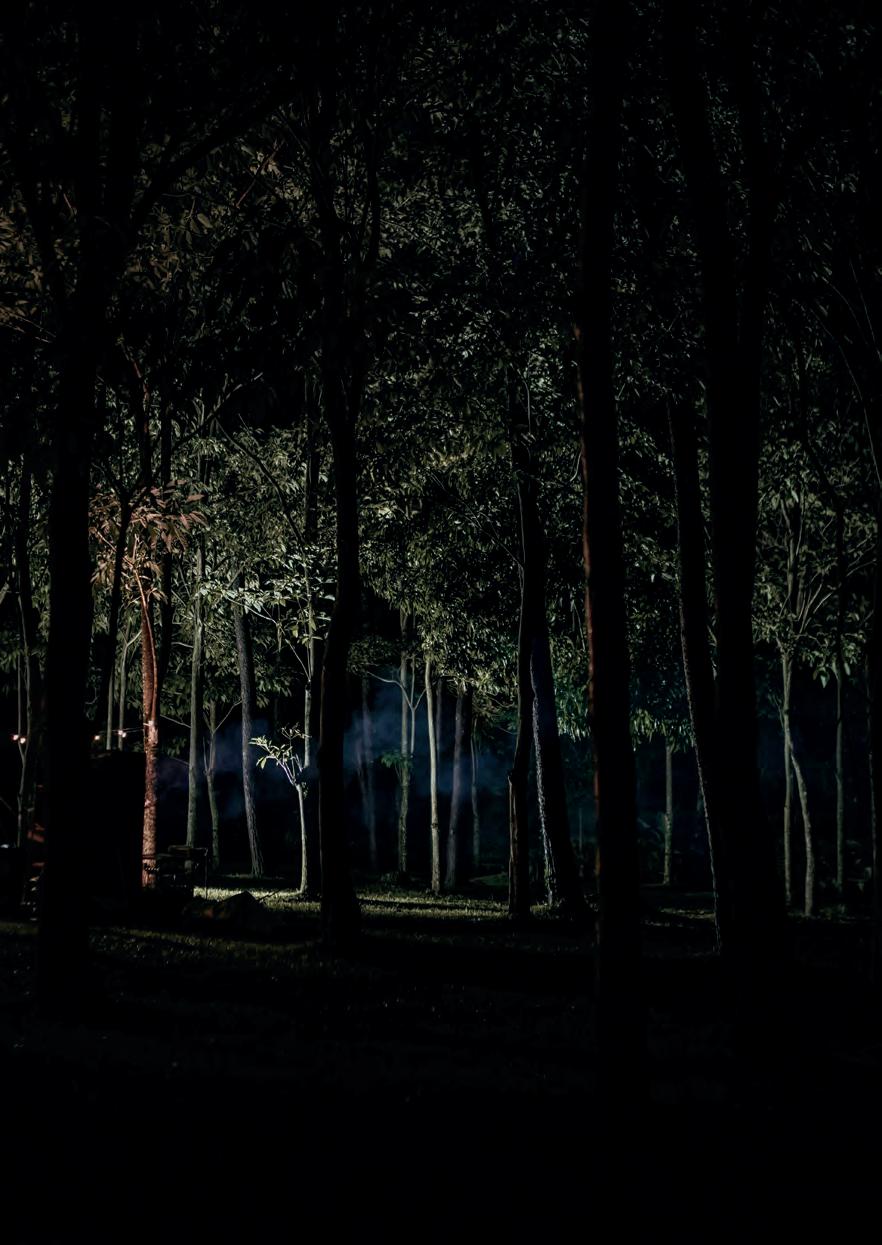
At night, two lovers walk through a forest. The woman confesses to the man that she is pregnant, but the child is not his, and she is tormented by guilt. He comforts her, telling her to put her fears aside and that, out of love for her, he will accept the child. The woman feels relieved and the two walk on through what is now a transfigured night.
Such is the content of a poem by Richard Dehmel, ‘Verklärte Nacht’. A beautiful poem. Arnold Schoenberg thought so too. Deeply moved, he put his own Transfigured Night to paper in a few weeks in September 1899. He was only 25 years old, and deeply in love himself at the time; the world of the poem was not far removed from his own experience. Transfigured Night marked a significant step forward in his still nascent oeuvre; ‘masterful,’ judged both Gustav Mahler and Schoenberg’s teacher and future father-inlaw, Alexander von Zemlinsky.
If only everyone had been so kind… But the conservative gentlemen of the Wiener Tonkünstlerverein, to whom Zemlinsky had handed the score for performance, mocked
it. Horribly modern, they thought – they had no idea how difficult Schoenberg’s later music would become – and they joked that it sounded ‘as if someone had wiped over the score of Wagner’s Tristan whilst the ink was still wet’. It was not until three years later that musicians dared to stage the premiere. Transfigured Night fared no better then. It was a complete debacle; a few people clapped, but the rest hissed, shouted or came to blows. The press, too, was critical. Could that moonlit love story, sneered the Neue Freie Presse, really be conveyed without words? The reviewer did not believe such a thing were possible. But a literal representation had never been Schoenberg’s intention at all. He had merely wished to give expression to the human feelings he found so beautifully expressed in the poem. Recognition came later all the same: Transfigured Night was to become Schoenberg’s most frequently performed score.
Brahms’ Second Piano Concerto exudes a sense of relaxed tranquillity. The music is like a long, warm but never too hot summer’s day, stretching on endlessly; both man and
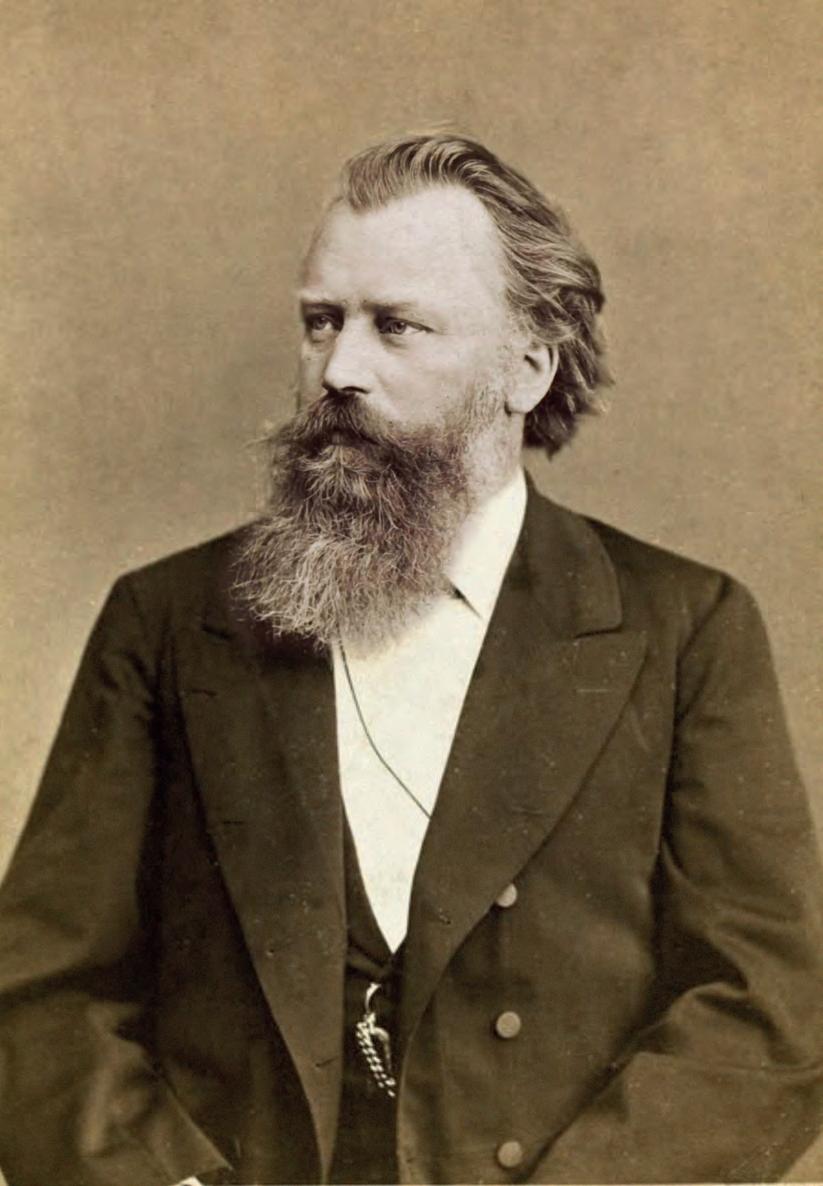
nature feel content. Here we hear from a composer at the height of his creative powers, who is fully aware of this and derives great, serene happiness from it. Brahms completed the concerto in the summer of 1881; he was then 48 years old and, following the great success of his first two symphonies, had been unofficially named ‘Beethoven’s successor.’ No small feat.
Here we hear from a composer at the height of his creative powers, who derives serene happiness from it
It remains a mystery why Brahms was never able to express in plain terms that he was satisfied with one of his own works, or to say anything positive about it at all (perhaps one must hear it in the music itself). With selfdeprecating humour, he announced the birth of the new opus to his friend Elisabeth von Herzogenberg: ‘I wanted to tell you that I have written a lovely, lovely little piano concerto with a very small, tender little scherzo.’ Strange words for a piano concerto which, with a playing time of over 50 minutes, is one of the most substantial ever written. And to his friend, the surgeon Theodor Billroth, he spoke of ‘a few little piano pieces’. Yet one cannot help but assume that Brahms was proud of his work. He performed it himself on numerous occasions, including during a tour of the Netherlands, and rarely did he go to such lengths to bring one of his compositions to the public’s attention. With interruptions, he had worked on it for four years before drawing the final bar line on 7 July 1881 in Pressbaum near Vienna. You’d expect something in return for that.
The concerto has four movements. Unusual, as a concerto usually has three. Brahms inserted the second movement (a scherzo) because he found the first movement somewhat ‘simple’. Another such disparaging term, but this was apparently Brahms’ way of saying that fierce drama and passion had been spared in the opening movement to come across all the more convincingly in the scherzo. Brahms’ publisher, Fritz Simrock, felt that this scherzo should simply be omitted. Apparently, he failed to see that it served an important function, including that of separating the first movement and the Andante, both of which are predominantly lyrical in tone. Brahms therefore did not even consider withdrawing it.
The beginning of this piano concerto is also exceptional. No orchestral tutti! A solo horn sings the opening; the piano joins in with tentative broken chords, softly humming along. In addition, another orchestral instrument plays a splendid part in the concerto, namely the cello. It brings the Andante to life in a way that reminds quite a few listeners of how unfortunate it is that Brahms never wrote a cello concerto. This Andante refers in two ways to the most important woman in Brahms’s life, the pianist and composer Clara Schumann. Perhaps he borrowed the idea of the cello solo from Clara’s piano concerto, which also features a prominent cello part in the slow movement. Elsewhere in the Andante there is a passage of the utmost tenderness: in F sharp major, the clarinets quote Brahms’s song ‘Todessehnen’, one of his songs most directly addressed to Clara. Brahms would later develop the cello melody further in the song ‘Immer leiser wird mein Schlummer’.
Stephen Westra
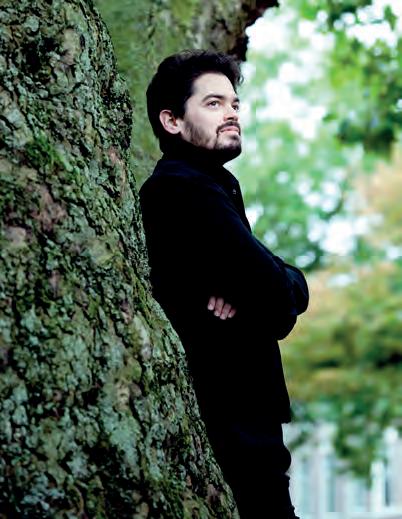
Born: Tel Aviv, Israel
Current position: chief conductor Rotterdam
Philharmonic Orchestra; music director Israel
Philharmonic Orchestra; chief conductor designate Münchner Philharmoniker (from 2026/27)
Before: principal guest conductor Vienna
Symphony Orchestra
Education: piano at the Buchmann-Mehta School of Music Tel Aviv; conducting and piano at the Academy of Music Hanns Eisler Berlin; mentor: Daniel Barenboim
Breakthrough: 2013, First Prize Gustav Mahler
International Conducting Competition in Bamberg
Subsequently: guest appearances Wiener Philharmoniker, Berliner Philharmoniker, Gewandhaus Orchester, Münchner
Philharmoniker, Symphonieorchester des Bayerischen Rundfunks, London Symphony Orchestra, Boston Symphony Orchestra, Chicago Symphony Orchestra, Philadelphia Orchestra, Royal Concertgebouw Orchestra
Debut with the Rotterdam Philharmonic: 2016
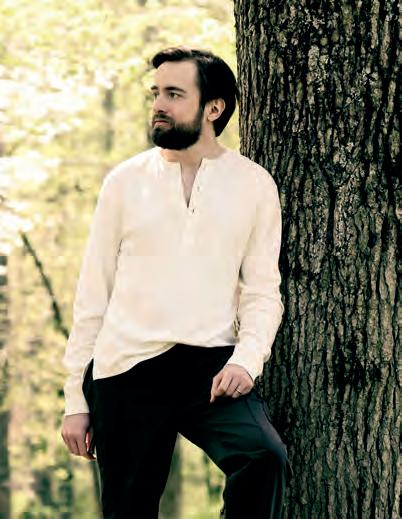
Born: Nizhniy Novgorod, Russia
Education: Gnessin School of Music Mosow with Tatiana Zelikman; Cleveland Institute of Music (piano and composition)
Awards: Chopin Competition Warsaw (2010); Tchaikovsky Competition Moscow; FrancoAbbiati Award (2013); Musical America’s Artist of the Year (2019)
Breakthrough: 2011, First Prize Arthur Rubinstein Competition Tel Aviv, also Pnina Salzman Prize, Chamber Music Prize and Audience Favorite Prize
Solo-appearances: Berlin Philharmonic, Staatskapelle Dresden, Tonhalle Orchester
Zürich, Royal Concertgebouw Orchestra, symphony orchestras of Boston, Chicago, New York Philharmonic, Los Angeles Philharmonic
Recitals: Carnegie Hall New York, Wigmore Hall London, Musikverein Vienna, Suntory Hall Tokyo, Salle Pleyel Paris
Debut with the Rotterdam Philharmonic: 2016
Lahav and Friends
Thu 28 May 2026 • 20.15
soprano Chen Reiss
piano Lahav Shani
musicians from the Rotterdam
Philharmonic
Mozart Quintet for Piano and Winds
Mahler Three Rückert Songs
Schubert Trout Quintet
Fri 29 May 2026 • 20.15
Sun 31 May 2026 • 14.15 conductor and piano Lahav Shani
soprano Chen Reiss
Mozart Concert Aria ‘Ch’io mi scordi di te?’
Zedginidze Symphonic Poem (World Premiere)
Wagenaar Overture Cyrano de Bergerac
Mahler Symphony No. 4
Chief Conductor
Lahav Shani
Honorary Conductor
Yannick Nézet-Séguin
Principal Guest Conductor
Tarmo Peltokoski
First Violin
Marieke Blankestijn, Concert Master
Vlad Stanculeasa, Concert Master
Quirine Scheffers
Hed Yaron Meyerson
Saskia Otto
Rachel Browne
Maria Dingjan
Marie-José Schrijner
Noëmi Bodden
Petra Visser
Sophia Torrenga
Hadewijch Hofland
Annerien Stuker
Alexandra van Beveren
Marie Duquesnoy
Second Violin
Charlotte Potgieter
Laurens van Vliet
Elina Staphorsius
Jun Yi Dou
Bob Bruyn
Eefje Habraken
Maija Reinikainen
Babette van den Berg
Melanie Broers
Tobias Staub
Sarah Decamps
Robin Veldman
Viola
Anne Huser
Roman Spitzer
Galahad Samson
José Moura Nunes
Kerstin Bonk
Janine Baller
Veronika Lénártová
Rosalinde Kluck
León van den Berg
Olfje van der Klein
Jan Navarro
Cello
Emanuele Silvestri
Gustaw Bafeltowski
Joanna Pachucka
Daniel Petrovitsch
Mario Rio
Eelco Beinema
Carla Schrijner
Pepijn Meeuws
Yi-Ting Fang
Killian White
Paul Stavridis
Double Bass
Matthew Midgley
Ying Lai Green
Jonathan Focquaert
Arjen Leendertz
Ricardo Neto
Javier Clemen Martínez
Marta Fossas Mallorqui
Mario Fernández
Flute
Juliette Hurel
Joséphine Olech
Manon Gayet
Flute/Piccolo
Beatriz Baião
Oboe
Karel Schoofs
Anja van der Maten
Oboe/Cor Anglais
Ron Tijhuis
Clarinet
Julien Hervé
Bruno Bonansea
Alberto Sánchez García
Clarinet/ Bass Clarinet
Romke-Jan Wijmenga
Bassoon
Pieter Nuytten
Lola Descours
Marianne Prommel
Horn
David Fernández Alonso
Felipe Freitas
Wendy Leliveld
Richard Speetjens
Laurens Otto
Pierre Buizer
Trumpet
Alex Elia
Adrián Martínez
Simon Wierenga
Giovanni Giardinella
Trombone
Pierre Volders
Alexander Verbeek
Remko de Jager
Bass trombone
Rommert Groenhof
Tuba
Martijn van Rijswijk
Timpani/ Percussion
Danny van de Wal
Ronald Ent
Martijn Boom
Jesús Iberti Rubira
Harp Albane Baron