
Lahav and Friends Thu 28 May 2026 • 20.15
Lahav and Friends Thu 28 May 2026 • 20.15
piano Lahav Shani
oboe Karel Schoofs
clarinet Bruno Bonansea
bassoon Lola Descours
horn Felipe Freitas
sopraano Chen Reiss
violin Marieke Blankestijn
viola Roman Spitzer
cello Emanuele Silvestri
double bass Ying Lai Green
Wolfgang Amadeus Mozart (1756–1791)
Quintet in E flat major, K 452 for piano and winds (1784)
• Largo – Allegro moderato
• Larghetto
• Rondo: Allegretto
Gustav Mahler (1860–1911)
Three Rückert Songs (1901–02)
• Ich atmet’ einen linden Duft
• Liebst du um Schönheit
• Ich bin der Welt abhanden gekommen
Franz Schubert (1797–1828)
Piano Quintet in A major, D 667, ‘Trout Quintet’ (1819)
• Allegro vivace
• Andante
• Scherzo: Presto
• Andantino – Allegretto
• Allegro giusto
Concert ends at around 21:45
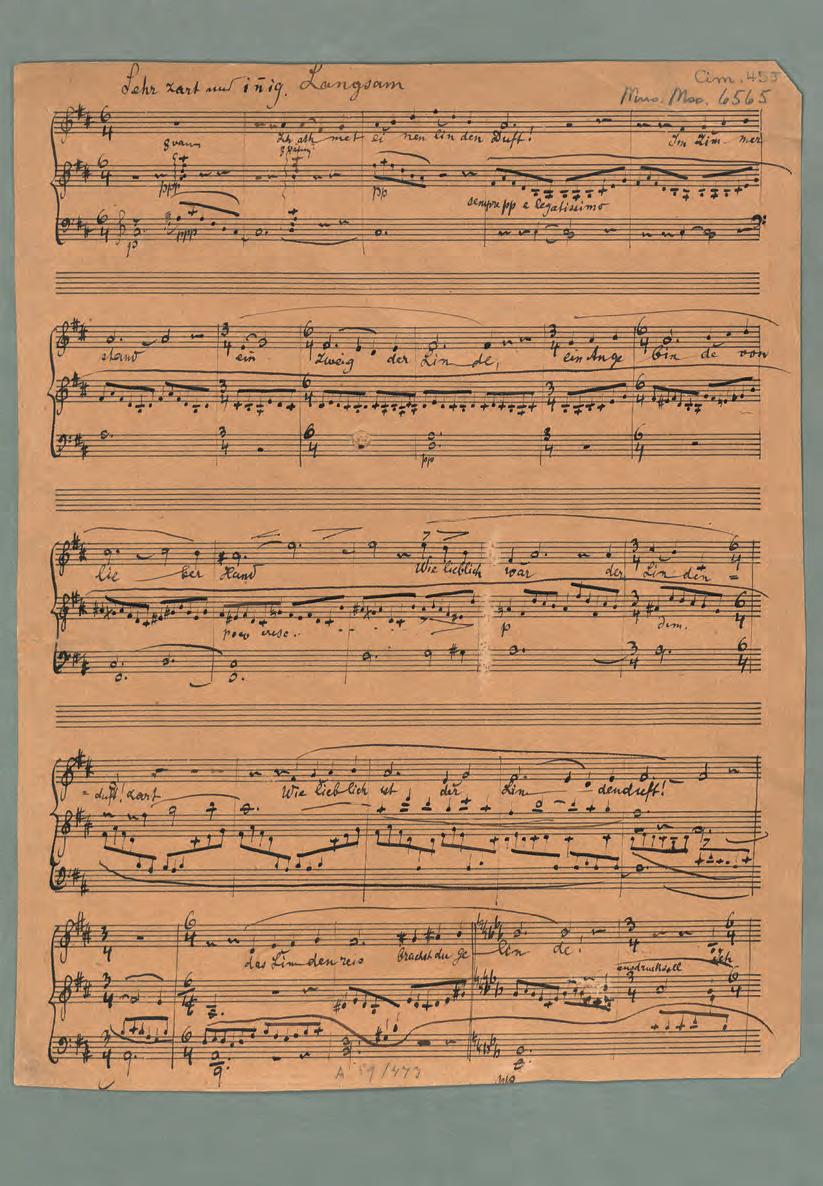
Ich atmet’ einen linden Duft. Manuscript (1901) by Gustav
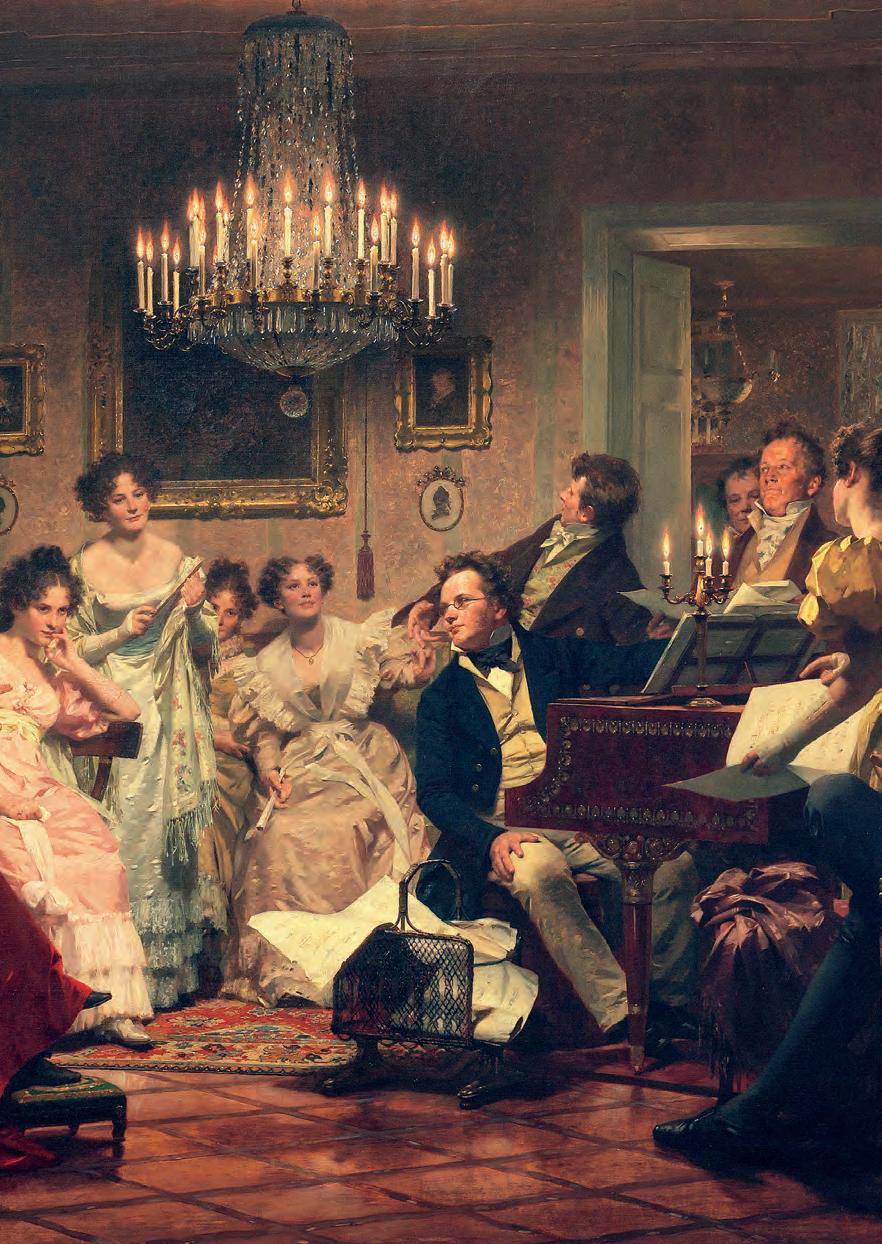
‘Kannevas?’ – ‘Is he any good?’ Whenever Franz Schubert was approached by a friend who wanted to introduce him to a stranger, that was invariably his response. If the person in question did indeed have a talent – playing an instrument, singing, or reciting poetry – the ice was soon broken.
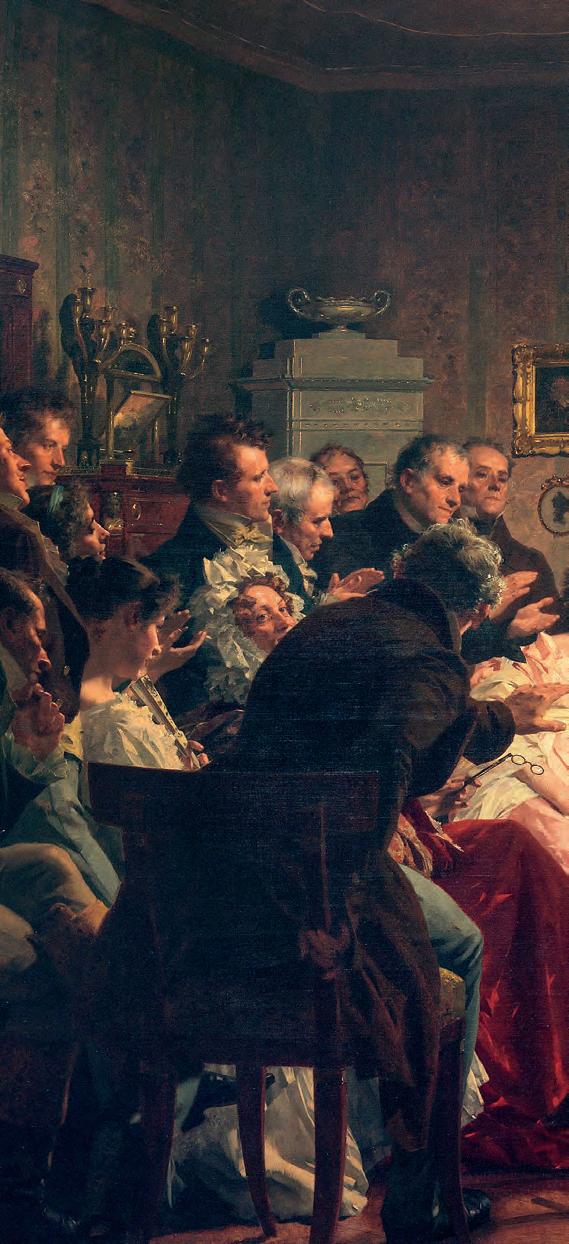
Making music together in an informal setting at someone’s home, with friends and strangers – that was something you could wake Franz Schubert up for. Informal musical evenings with him at the piano became a household name in Vienna; visitors even began to call them ‘Schubertiades’ or ‘Kannevas’.
But Schubert was certainly not the inventor of such musical gatherings; even in Mozart’s day, chamber music was already being played extensively among Viennese friends. Mozart enjoyed taking part: he would then bring out his viola and form an impromptu quartet with fellow musicians. Mozart played the viola solely for his own pleasure; the piano was the instrument with which he performed for paying audiences. He organised concerts himself in which he performed his own works. The audience expected to hear something new every time, so with every series of concerts Mozart planned, he also took on a composing task. In March 1784 alone, he wrote two major piano concertos and a quintet for piano and wind instruments. The ink was still wet when they
were premiered on 1 April. Mozart was particularly pleased with the new quintet. ‘I myself consider it the best I have ever composed in my entire life,’ he wrote in a letter to his father shortly after the premiere. ‘I wish you could have heard it!’ The audience, too, was wildly enthusiastic about this novelty. A piece in which a piano and four wind instruments converse on equal terms: who among those present had ever experienced anything like it before?
One hundred and twenty years after Mozart organised his concert series, the ‘Vereinigung schaffender Tonkünstler’ (Association of Creative Musicians) was founded in Vienna. It was an initiative by three young composers who, like Mozart, were seeking a stage and an audience for their own work and other contemporary music. They managed to secure Gustav Mahler as honorary president, and he granted the Society the premiere of one of his new compositions. In the years prior, he had written several songs to poems by Friedrich Rückert, none of which had yet been performed. On 29 January 1905, they
were heard for the first time in the packed Small Hall of the Vienna Musikverein: the cycle Kindertotenlieder and four separate songs – together with a selection of Wunderhorn songs, which had already become part of the repertoire.
One Rückert song was missing: the audience did not get to hear ‘Liebst du um Schönheit’. Mahler had written it three years earlier as a declaration of love to Alma Schindler, whom he had just married at the time. He regarded the song as a private matter; it was not to be published until after his death. But even the Rückert songs that Mahler’s audience was allowed to hear seem to play out behind closed doors. In ‘Ich atmet’ einen linden Duft’, the poet is in his room; he is alone, yet senses the presence of his beloved in the scent of the blossoming linden branch standing there in a vase. From an even greater seclusion comes ‘Ich bin der Welt abhanden gekommen’, in which all that is earthly is, at most, a memory. The 21-year-old Anton Webern, who was in the audience at the premiere, wrote in his diary how he was moved by the ‘overwhelming intimacy’ of Mahler’s new works: so utterly different from the brilliantly folkloric character of the Wunderhorn songs.
With these two qualities – intimate refinement and folkloric robustness – Mahler proved himself, as a composer of lieder, to be a worthy heir to his fellow citizen Franz Schubert. In Schubert’s work, too, the sublime and the earthly constantly alternated. His song ‘Die Forelle’ falls into the latter category: with a melody that possesses the natural ease of a folk tune, it tells of the unfortunate fate of a trout that strays too close to a fisherman’s bait. The song quickly became a hit and proved to be no flash in the pan. Two years after the world had first been introduced to ‘Die Forelle’,
Schubert was asked to incorporate its melody into a new quintet for piano, violin, viola, cello and double bass. The commission came from a wealthy amateur cellist, with whom Schubert was staying during his holiday. Schubert began composing immediately and completed the piece once he was back home.
Schubert’s quintet consists of five movements. The trout is most clearly discernible in the fourth movement: the song’s melody appears there as the theme for a series of five variations, in each of which a different instrument takes the lead. But a reference to ‘Die Forelle’ can also be heard in the very first movement of the quintet, right from the opening bars. In the piano, a motif of six ascending notes is heard that is strongly reminiscent of the song’s piano accompaniment, flowing wildly like a mountain stream. Variations on that ascending motif recur in the following movements, giving the quintet – seemingly one and all spontaneous invention – a cohesive structure. The patron was presented with a masterpiece. One wonders, however: would he, as an amateur cellist, have been skilled enough to play it himself?
Is he any good? That question was also on the minds of the Rotterdam Philharmonic Orchestra when Lahav Shani made his debut there ten years ago. The answer turned out to be a resounding ‘yes’, and even during the first rehearsal, the debuting conductor-pianist and the orchestra made music together as if they had known each other all their lives. That bond has since developed into a deep friendship. And what better way to illustrate that friendship than an evening of chamber music?
Bart Diels
Ich atmet’ einen linden Duft!
Im Zimmer stand
Ein Zweig der Linde, Ein Angebinde
Von lieber Hand.
Wie lieblich war der Lindenduft!
Wie lieblich ist der Lindenduft! Das Lindenreis
Brachst du gelinde!
Ich atme leis
Im Duft der Linde
Der Liebe linden Duft.
Liebst du um Schönheit, O nicht mich liebe!
Liebe die Sonne, Sie trägt ein gold’nes Haar!
Liebst du um Jugend, O nicht mich liebe!
Liebe den Frühling, Der jung ist jedes Jahr!
Liebst du um Schätze, O nicht mich liebe.
Liebe die Meerfrau, Sie hat viel Perlen klar.
Liebst du um Liebe, O ja, mich liebe!
Liebe mich immer, Dich lieb’ ich immerdar.
Ich bin der Welt abhanden gekommen, Mit der ich sonst viele Zeit verdorben, Sie hat so lange nichts von mir vernommen, Sie mag wohl glauben, ich sei gestorben.
Es ist mir auch gar nichts daran gelegen, Ob sie mich für gestorben hält, Ich kann auch gar nichts sagen dagegen, Denn wirklich bin ich gestorben der Welt.
Ich bin gestorben dem Weltgetümmel, Und ruh’ in einem stillen Gebiet. Ich leb’ allein in meinem Himmel, In meinem Lieben, in meinem Lied.
I breathed in a gentle scent!
In the room stood A sprig of linden, A gift
From a dear hand. How lovely was the scent of linden! How lovely is the scent of linden!
You gently plucked
The linden sprig!
I breathe softly
In the scent of linden, The gentle scent of love.
If you love for beauty’s sake, O do not love me!
Love the sun
With its golden hair!
If you love for youth, Oh, do not love me!
Love spring, Which is young every year!
If you love for treasures, Oh, do not love me.
Love the mermaid, She has many shiny pearls.
If you love for love’s sake, Oh yes, love me!
Love me always, I shall love you forever.
I have been lost to the world, With which I used to waste so much time; It has heard nothing from me for so long, It may well believe I have died. Nor do I care in the least
Whether it thinks me dead; I cannot contradict it, For truly I have died to the world. I have died to the world’s turmoil, And rest in a quiet realm. I live alone in my heaven, In my love, in my song.
Lahavs Farewell
Fri 29 May 2026 • 20.15
Sun 31 May 2026 • 14.15
conductor and piano Lahav Shani
soprano Chen Reiss
Mozart Concert Aria ‘Ch’io mi scordi di te? – Non temer, amato bene’
Zedginidze Symphonic Poem (World Premiere)
Wagenaar Overture Cyrano de Bergerac
Mahler Symphony No. 4