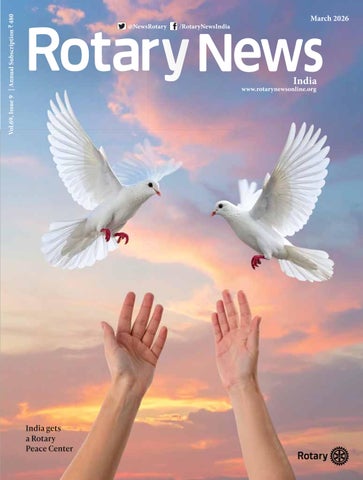
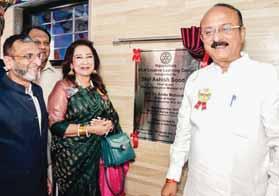
Rotary’s eighth Peace Center inaugurated at Symbiosis, Pune
Lighting an entrepreneurship spark through RYLA
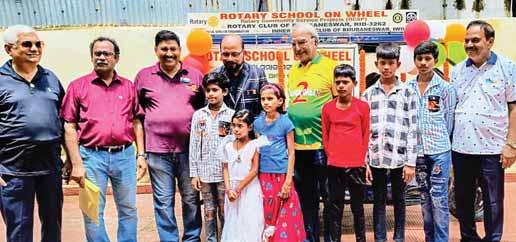
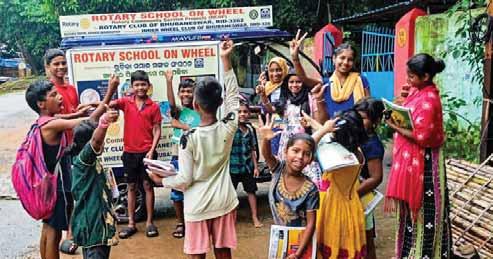
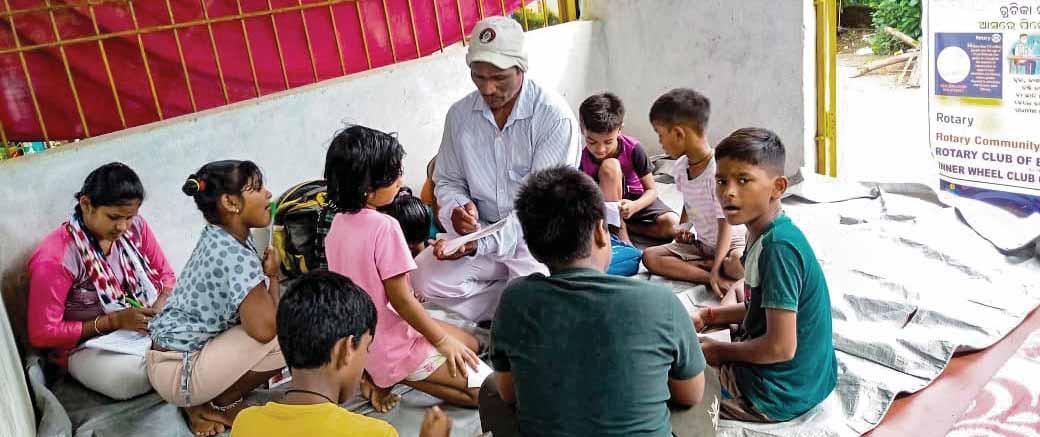
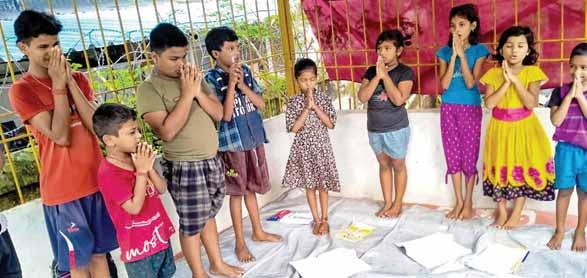
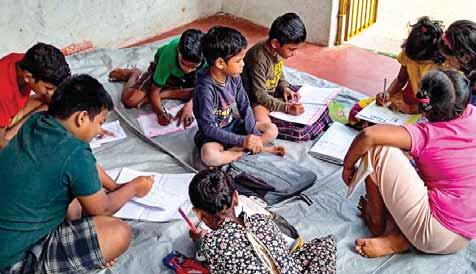
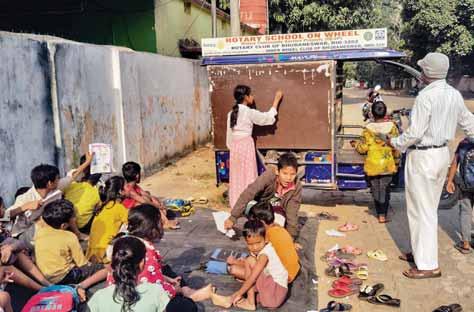
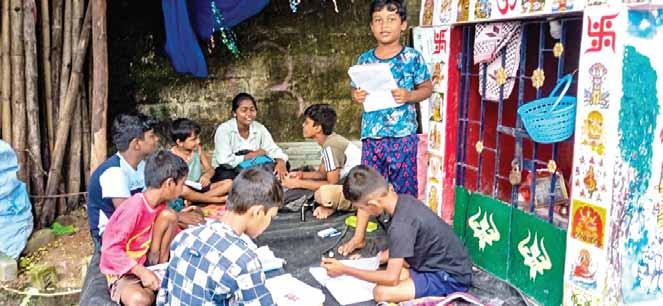
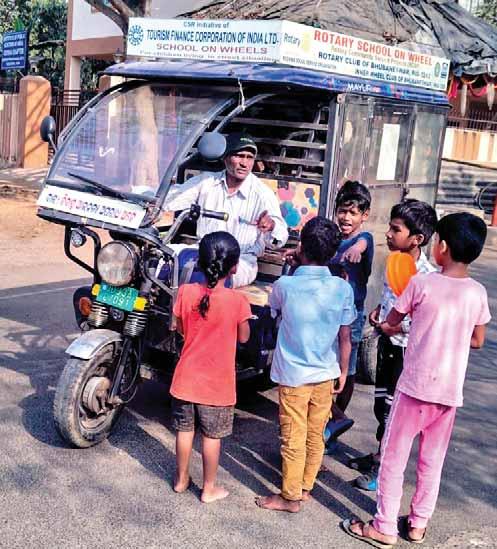
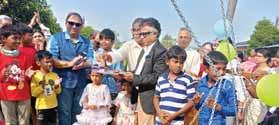
Creating schooling opportunity for street children
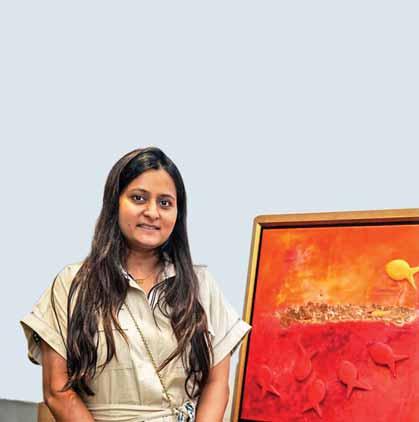
Using canvas to fund classroom
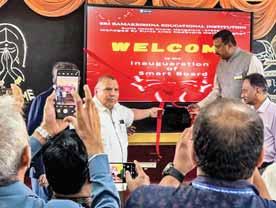
Rotary nurtures young scientists
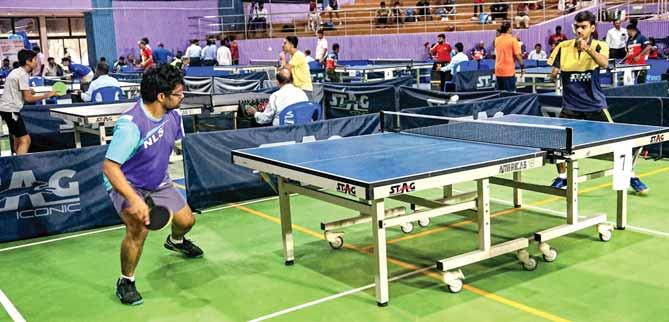
Rotary para TT at IIT Madras
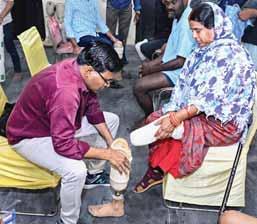
Protecting tribal girls from cervical cancer
Switch to E-version. Save the environment.
E-version rate Reduced
From July 1, 2024, our E-version subscription has been revised from `420to `324
IfeltIndia's
elated going through your editorial India stands tall and triumphant at InternationalAssembly (Feb issue). We feel proud that an Indian, DGE Ravishankar Dakoju, could donate `500 crore to TRF. An exemplary record set in the Rotary world. Further, the elevation of RID M Muruganandam, chair, Rotary News Trust, as Rotary’s Vice President (2026–27) is great news. Three cheers for these two great Indian Rotarians.
proud moments in Orlando
Arun Kumar Dash
RC Baripada — D 3262
Asyour Feb editorial points out, it was truly, a moment of pride for all of us in Orlando. The elevation of RID Muruganandam to Vice President of RI is not just a personal milestone, but a historic journey that began as a Rotaractor and now culminated in one of the highest offices in Rotary. His achievement reflects 35 years of unwavering commitment to service, not a sudden rise, but a steady climb built on consistency, conviction, humility and passionate service. After 71 years, India once again saw this leadership position, continuing the proud legacy of three great Indian Rotary stalwarts. This appointment is a reaffirmation of India’s growing moral and
Bravo RC Bhavnagar!
The cover story on RC Bhavnagar resonated with me as it encap-
can do to help the forgotten children of India. Time is the most undervalued form of giving, as once given, it -
tional, it is intimate. It tells others that they matter enough for you to pause your life and step into theirs. For me the cover story is the essence of giving your time to a regular cause and
service leadership in the Rotary world, and a proud moment for India, Tamil Nadu, and especially RID 3000, which nurtured and shaped this extraordinary leader. This is a testimony that sustained service, when rooted in values, earns global trust. As we witness India’s rising TRF contribution and strengthening of the Rotary News Trust, it shows that India is not just participating in Rotary; it is shaping its future.
N Senthil Nathan RC Madurai Innovators — D 3000
Aftergoing through the Editor’s note in the Feb issue, I eagerly flipped the pages to know about DGE Dakoju and Paola, who are epitomes of humility and generosity. I was amazed to find that he faced so many challenges in his life, and now thinks that giving back to society is his duty. There is no dearth of noble souls in our country. God lives in the form of humans like Dakoju and Paola. Hats off to RC Akola for adopting a remote village school where the girl students are benefitting the most. Kudos to Radheshyam Modi, an octogenarian Rotarian at the helm of affairs at RC Akola.
Raj Kumar Kapoor, RC Roop Nagar — D 3080
I look forward to every issue.
Zarir Dadachanji
RC Poona — D 3131
Bhavnagar's three projects — Ray of Hope
Miyawaki forests are truly inspiring. If Rotarians read the magazine, they -
ening to note that after 70 years, an Indian, RI director M Muruganandam,
I am running a WhatsApp group called
Career Hub to help rural engineering and MBA students on their interview skills. In the cover story, the skill training for rural youth has inspired me to continue with it.
Sivaperumal Subramani
RC Walajapet — D 3231
RC Bhavnagar projects are excellent and inspiring. Especially, Project Educare that is spreading literacy among rural children; it is really
S N Shanmugam
RC Panruti — D 2981
Thanksto Rasheeda Bhagat for a wonderful coverage of the service activities of RC of Akola. She has a gift of weaving words transforming them into beautiful text. The Feb issue carries many such beautifully written articles that make the reading of the magazine interesting, and Giving rural children wings to fly is one which captures our attention.
Another is Donating `500 crore to TRF, which speaks of the largesse from a kind-hearted Rotarian. And many more. One keeps waiting for the next issue. Congrats to the Rotary News Team for good coverage of great social work being done by Rotarians across the country.
Radheshyam Modi
RC Akola — D 3030
Webow our head reading about our army officers’ courage, loyalty and patriotism in the well-written article Why Indian armed forces are fearless. What really inspire generations to join the armed forces, says Brig Basera, is naam, namak and nishan. Our naam is Bharat. Our namak is the
Smile... and scowls
soil and our nishan is our national flag. For these three things, we can go to any extent.” Thank you, madam for the inspiring article.
Dr D Harischandra Rama RC Anantapur — D 3160
Thisis with reference to the LBW article Readingslowly, drinking quickly (Feb issue) that appeared on the last page. It is unfortunate that the author talks about smoking and drinking, even though his salary was meagre.
RotaryNews is a well-read magazine. Rotarians, Anns, Annettes, Rotaractors and Interactors read and get motivated by inspiring articles on the service done by Rotarians. Why give space to such views? At least a disclaimer could have been given: ‘Drinking and smoking are dangerous to health.’
L Radhakrishnan
RC Chennai IT City — D 3233
Ifeelthe review of the book They willshootyou,Madamby Harinder Baweja, is misplaced in our magazine. Since we’ve joined Rotary only to serve society, such articles
Cover illustration by S Krishna Pratheesh.
We welcome your feedback Write to the Editor: rotarynews@rosaonline.org; rushbhagat@gmail.com. Mail your project details, along with hi-res photos, to rotarynewsmagazine @gmail.com.
Messages on your club/district projects, information and links on zoom meetings/webinar should be sent only by e-mail to the Editor at rushbhagat@gmail.com or rotarynewsmagazine@gmail.com.
WHATSAPP MESSAGES WILL NOT BE ENTERTAINED.
are best avoided to strengthen our organisation.
D Joseph Alexis Rozer RC Karamadai — D 3203
Iaman avid reader of RotaryNews, and have learnt so much from the articles which are thought-provoking and useful lessons for life. Sharing details on impactful projects helps the clubs to plan and execute muchneeded community service projects.
TCA Srinivas Raghavan’s column is always a fine ending for a beautiful magazine. Congrats to Team Rotary News for giving us every month a world-class magazine, both in terms of content and design.
Going through the Feb issue made me a better and a more committed Rotarian than I am. It also made me proud to be a Rotarian from India. Those who attended the IA in Orlando must have been elated, as expressed in the Editor’s note titled India stands tall and triumphant at International Assembly. RID Nagesh’s message Peace is built quietly is inspiring. Pranesh Jahagirdar RC Bijapur North — D 3170
Have you read Rotary News Plus? sent to the e-mail ID of Read Rotary News Plus www.rotarynewsonline.org
The reach of community action
Water connects us all. From a river in a remote forest to a stream running past a city neighbourhood, freshwater ecosystems sustain humanity. Yet these waters are increasingly under strain. Pollution, overuse and climate pressures remind us that protecting freshwater is a global challenge.
Rotary has always believed change begins within communities. Now we are working to see how far the impact of community action can travel. When local service is connected, measured and shared, it becomes a force that extends beyond geography and borders.
A water project led by the Rotary Club of Panamá Nordeste exemplifies this idea. The project served indigenous communities in Panama’s Darién province, a region accessible only by canoe and small boat. With no roads, limited electricity, and reliance on untreated river water, families faced serious health risks.
To reach these communities, Rotarians had to rethink how supplies and services could be delivered. Working with a partner club in the United States and a specialised water organisation, they introduced solar-powered water treatment systems for an area without access to an electrical grid. Local leaders were trained to operate and maintain the system, ensuring that clean water would continue flowing long after installation crews departed.
The results were immediate. Children who once missed school due to illness returned to classrooms. No longer needing to haul water from rivers, adults gained time and strength to work and support their families.
What began as a water project became a foundation for healthier, more resilient communities.
This is how we extend our reach: combine local leadership with global partnerships, technical expertise, and long-term thinking.
That same spirit is at the heart of Rotary’s partnership with the United Nations Environment Programme through the Community Action for Fresh Water initiative. Around the world, Rotary and Rotaract clubs are restoring waterways, protecting wetlands, and safeguarding vital freshwater sources. By collecting data to map and measure this work, we can better understand its impact and show how local service contributes to worldwide solutions.
Data is not an end. It is a tool that helps us learn and improve so that Rotary’s service delivers real, measurable change. Each project entered and each waterway restored adds to a shared story of stewardship and responsibility. You can learn more and get involved at communityactionforfreshwater.org
As we observe Water, Sanitation and Hygiene Month, I encourage you to reflect on the freshwater systems that sustain your community and the role Rotary can play in protecting them.
When we connect local action to a global vision, we strengthen Rotary’s ability to make lasting change. Together, by extending our reach and working side by side, we truly Unite for Good
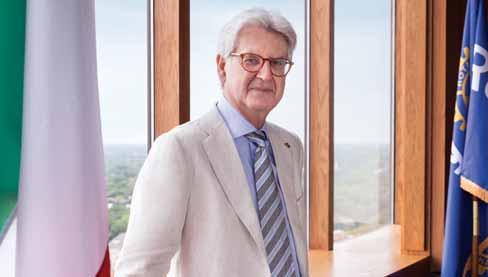
Francesco Arezzo President, Rotary International
Monika Lozinska
SPune’s Peace Center offers hope
prawling, green university and school campuses have a mesmerism of their own… they take you back to your student days where most of your major problems were either an exam for which you were ill-prepared, or fluttering of the heart if your institutions happened to be co-ed. Mine weren’t… both school and college were strictly for girls and had convents attached, with strict curfews even for day scholars. Only once we bunked two lectures to watch the classic Richard Burton/Peter O’Toole starrer Becket, hoping to benefit from it as students of literature, but got into serious trouble!
Memories associated with college days came flooding in at the Symbiosis International University in Pune last month where Rotary’s eighth Peace Center was inaugurated. It was indeed a proud moment for Indian Rotarians and as TRF Trustee Bharat Pandya pointed out, its importance could be gauged from the fact that including Rotary leaders from RI Districts 3131 and 3141 which have played a great role in getting this Peace Center in Pune, Rotarians from 22 districts in our zones were present to cheer on the realisation of this dream. He disclosed that when the trustees decided in Feb 2024 to establish a Peace Center in Asia, 17 institutions from 6 countries were invited to submit expressions of interest. At the final stage there was a tough competition between Symbiosis and a university in South Korea, and finally Symbiosis was selected to host this Peace Center.
pointed out that peace is not absence of war but “the presence of trust, understanding and justice. It is the daily work of building bridges and helping people live free from poverty, hate and prejudice, because these things create conflict and destroy peace.” The saddest part is that people feel lonely even in a crowd, and when this happens, fear and uncertainty about the future grow. Conflicts leading to wars happen when we “fear strangers who have been shown as evil and dangerous.” Likening this to a child’s fear of darkness or hearing sounds at night, he said these fears are resolved not through armed guards but information and knowledge, providing which was the very purpose of a Rotary Peace Center. “They help to replace fear with understanding and turn confusion into clarity. They teach skills that reduce conflict and support cooperation, train people to listen well, build trust and solve disputes without violence.” Bingo!
Rarely do both the RI President and TRF Trustee Chair attend the same event in any country, but at this inaugural both President Francesco Arezzo and Trustee Chair Holger Knaack were present, sending out a clear message how very important these peace centres and the task of promoting world peace are to Rotary. In a moving speech, President Arezzo Rasheeda Bhagat
The importance of structured institutions to resolve conflicts, of which there is no dearth in the world around us today, and promote peace, cannot be articulated better than this. One is sure that in the coming years, international scholars coming here from different cultures and viewpoints will acquire the skills to work with unbiased minds and compassionate hearts in troubled and conflicted areas. So that they can chip away at hate, prejudice and misunderstandings, to stop violence, resolve problems and restore calm and sanity, for peace to prevail in our troubled world. Good luck and godspeed…
Director speak
Make & Keep Commitments
Makea commitment and keep that commitment” is one of my favourite sayings — a principle I practise and preach everywhere I go.
When you make a commitment, your purpose is defined. When you keep that commitment, your character is revealed.
The higher your commitment, the deeper your sense of fulfilment. In Japanese philosophy, it is called Ikigai — the reason for being. The stronger our commitment to meaningful service, the more complete our Ikigai becomes.
As a Rotary member, you are already committed to Service Above Self. Let us begin with simple, tangible commitments. Make a commitment to attend your club meetings regularly. Show up. Participate. Engage. Rotary thrives not merely on ideas, but on presence.
Commit to bringing in new members — individuals who will carry forward the torch of service. Every new member brings fresh energy, fresh networks and fresh possibilities.
If you are in a leadership role — at the club or district level — raise the bar consistently. As we march towards the third quarter of this Rotary year, it is time to stand by and adhere to whatever you had committed to, in your capacity as a club president, district governor, or in any other designation, in the beginning of your tenure, and honour it within the stipulated time.
Strive for positive membership growth. Strengthen your support for The Rotary Foundation. Enhance your public image so that communities clearly see Rotary as a force of credibility and impact. When people see results, it speaks volumes about your leadership.
Why do I emphasise making and keeping commitments so strongly? Because commitment shapes
you. It refines your communication, sharpens your decision-making, strengthens your delegation skills. It teaches teamwork, builds resilience and transforms intention into identity.
As the philosopher Ayn Rand said, “The sight of an achievement is the greatest gift a human being could offer others.” Achievement is not accidental. It is the outcome of promises honoured.
Making a commitment to a noble cause is an expression of humanity. Keeping that commitment, despite challenges, distractions and obstacles — that is an expression of something higher. It is the discipline that elevates service into leadership and leadership into legacy.
Rotary does not grow merely because of positions held. It grows because of promises kept.
Let us therefore commit — consciously and consistently. And above all, let us keep every commitment we make — to Rotary, to our communities, and to ourselves.
Because when we do this, we do not just build projects. We build trust. We build credibility. We build a community committed to Unite for Good.
M Muruganandam RI Director, 2025–27
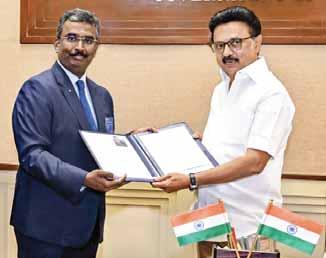
RID M Muruganandam discussed with Tamil Nadu Chief Minister MK Stalin the collaborative community welfare projects that Rotary is doing in partnership with the TN government. The CM congratulated him on his appointment as RI Vice President.
Message from TRF Trustee
It starts with water
Since2013, The Rotary Foundation has invested more than $230 million to support thousands of water, sanitation, and hygiene initiatives. Behind these numbers is Rotary’s unique approach. Rather than offering one-time fixes, we train communities to manage systems for generations, moving beyond charity to lasting change. Erica Gwynn, manager of Rotary’s water, sanitation and hygiene area of focus, shares her perspective:
I have worked with hundreds of members, providing technical support to improve the sustainability and impact of their projects. During site visits, I am struck not only by their dedication but by how farreaching their impact truly is — oftentimes in ways no one anticipated.
In northern Uganda for RI work, I met a Rotary member who had been a child soldier in the rebel Lord’s Resistance Army and escaped. During the conflict, he said, schools and healthcare facilities became places of refuge. Years later, after joining Rotary, he wanted to give back. He volunteered to improve water and sanitation in those same schools and facilities, which were once again centres of refuge — this time for the health, safety, and vitality of the entire community.
In Maharashtra, India, I witnessed how our Programs of Scale grant initiative, Partners for Water Access and Better Harvests in India, is bringing irrigation to a traditional farming region that gave women a voice. Though the women couldn’t own land, the water project enabled them to engage in silviculture, or care for forests, and other income-generating activities. They became knowledgeable about farming techniques, increasing their economic agency and dignity.
It’s no coincidence that water challenges are most acute in areas affected by conflict. In Haiti, I have seen how these projects are central to rebuilding resilience in communities recovering from instability and violence. I see the same theme playing out everywhere: These projects deliver so much more than clean water. They boost Rotary’s other areas of focus and are a source of safety, pride and hope.
Indeed, water projects improve health, foster economic opportunity, and amplify education through increased school attendance, especially for girls who no longer spend hours fetching water. And they fight poverty.
By giving to our Foundation and volunteering in water projects, you are part of this success. Everything we do opens an opportunity for someone, somewhere.
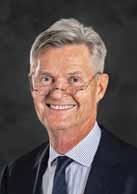
Holger Knaack TRF Trustee Chair
Governors Council
RID 2981
RID 2982
RID 3000
RID 3011
RID 3012
RID 3020
RID 3030
RID 3040
RID 3053
RID 3055
RID 3056
RID 3060
RID 3070
RID 3080
RID 3090
RID 3100
RID 3110
RID 3120
RID 3131
RID 3132
RID 3141
RID 3142
RID 3150
RID 3160
RID 3170
RID 3181
RID 3182
RID 3191
RID 3192
RID 3203
RID 3204
RID 3205
RID 3206
RID 3211
RID 3212
RID 3231
RID 3233
RID 3234
RID 3240
RID 3250
RID 3261
RID 3262
RID 3291
Leone J
Sivasundaram P
Karthik J
Ravinder Gugnani
Amita Anil Mohindru
Kalyan Chakravarthy Y
Dnyaneshwer P Shewale
Sushil Malhotra
Nisha Shekhawat
Nigamkumar L Chaudhari
Pragya Mehta
Amardeep Singh Bunet
Rohit Oberoi
Ravi Prakash
Bhupesh Mehta
Nitin Kumar Agarwal
Rajen Vidyarthi
Ashutosh Agarwal
Santosh Madhukar Marathe
Sudheer V Lature
Manish Motwani
Harsh Virendr Makol
Raam Prasad S V
Ravindra M K
Arun Daniel Bhandare
Ramakrishna P Kannan
Palaksha K
Sridhar B R
Elizabeth Cherian
Dhanasekar B
Bijosh Manuel
Ramesh G N
Chella K Raghavendran
Tina Antoney Kunnumkal
Dhinesh Babu J
Suresh V
Devendran D
Chair Website
Vinod Kumar Saraogi
Kameswar Singh Elangbam
Namrata
Amit Jayaswal
Manoj Kumar Tripathy
Ramendu Homchaudhuri
This periodical is published by PT Prabhakar from Dugar Towers 3rd Floor, 34, Marshalls Road, Egmore, Chennai 600 008, on behalf of Rotary News Trust, edited by Rasheeda Bhagat and printed by Rasi Graphics at 40 Peters Road, Royapettah, Chennai 600 014, India.
Contributions are welcome but will be edited. Content can be reproduced with permission and attributed to RNT.
Board of Trustees
M Muruganandam RID 3000
RI Director & Chairman, Rotary News Trust
KP Nagesh RID 3191
RI Director
Dr Bharat Pandya RID 3141 TRF Trustee
Rajendra K Saboo RID 3080
Kalyan Banerjee RID 3060
Shekhar Mehta RID 3291
Ashok Mahajan RID 3141
PT Prabhakar RID 3234
Dr Manoj D Desai RID 3060
C Basker RID 3000
Kamal Sanghvi RID 3250
Dr Mahesh Kotbagi RID 3131
AS Venkatesh RID 3234
Raju Subramanian RID 3141
Anirudha Roychowdhury RID 3291
Gulam A Vahanvaty RID 3141
Executive Committee Members (2025–26)
Rohit OberoiRID 3070 Chairman, Governors Council
Dnyaneshwar ShewaleRID 3030 Vice Chairman, Governors Council
M K RavindraRID 3160 Secretary, Governors Council
Chella K RaghavendranRID 3206 Treasurer, Governors Council
Editor
Rasheeda Bhagat
Deputy Editor
Jaishree Padmanabhan
Administration and Advertisement Manager Vishwanathan K
Rotary News Trust 3rd Floor, Dugar Towers, 34 Marshalls Road, Egmore Chennai 600 008, India. Phone: 044 42145666 rotarynews@rosaonline.org www.rotarynewsonline.org
Magazine
Message
from TRF Trustee
The new Rotary Peace Center at Symbiosis University, Pune
The journey of a thousand miles begins with a single step. Rotary’s journey began with the step and dream of one individual, Paul Harris, with a simple plan to promote friendship and a spirit of mutual cooperation — two ingredients essential for peace. The Symbiosis educational institution began with the dream of one individual — Dr SB Mujumdar with the vision of Vasudhaiva Kutumbakam — the world is one family — an important concept for peace.
On January 26, 2026, these two visions and journeys seamlessly came together when the first Rotary Peace Center in India, and indeed in South Asia, was inaugurated at the Symbiosis International University (SIU) in Pune. This is a momentous occasion for both organisations. It reflects the shared values of Symbiosis and Rotary — of integrity, quality education, cross-cultural bonding, and understanding and developing global competencies.
With a well thought-out selection process, including Expression of Interest from 17 institutions in six Asian countries, to rigorous evaluation criteria including 20 indicators and site visits, the selection of SIU is a matter of pride, prestige and joy for Rotary in India. The fact that Rotarians from 22 districts were present at the inauguration speaks greatly about the commitment of Rotary and Rotarians in India to this peace centre. Compliments and thanks to the two host districts — 3131 and 3141, and the team who guided and helped in the application process, to Symbiosis and its committed leadership, and to the Rotary staff, for making this happen.
The economic impact of violence on the global economy in 2024 was estimated to be $19.97 trillion or $2,455 per person. This is a grave reality and a greatly concerning issue. Rather than react to violence, we in Rotary believe in creating conditions conducive to peace — focusing on healthcare, water, sanitation, literacy, economic development and a holistic approach to what we call ‘Positive Peace’. Rotary’s peace centres and Peace Scholars programme are an important step in our work for peace. By supporting emerging leaders and empowering them in conflict resolution and sustainable development, Rotary creates impact at the local and global level.
To paraphrase Arch Klumph: ‘If we build temples, churches and mosques they will crumble into ruins, if we erect monuments time will deface them; but if we work with minds of men and women and imbue in them a spirit of compassion, integrity, cooperation and service, we are doing something that will endure as long as this civilisation exists.’ Rotary’s peacebuilding efforts are aimed at just that — transforming mindsets and unleashing the potential within each individual — to make a difference in our world.
The new peace centre represents an opportunity to aspiring young men and women to become peace scholars. But it also represents an opportunity to have a more peaceful, equitable, compassionate world in India and in Asia. Amen to that. Enjoy Rotary.
Bharat Pandya TRF Trustee
Rotary’s eighth Peace Center inaugurated
at Symbiosis, Pune
Rasheeda Bhagat
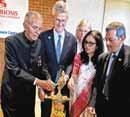
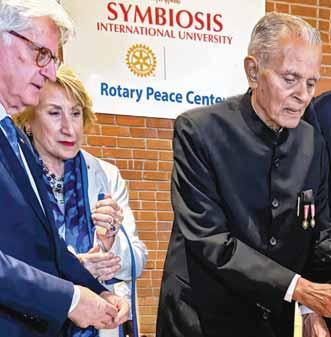
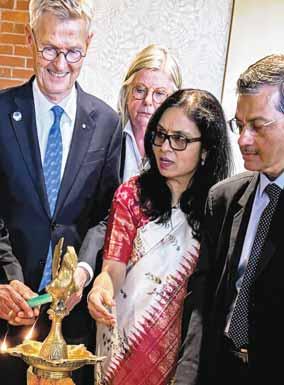
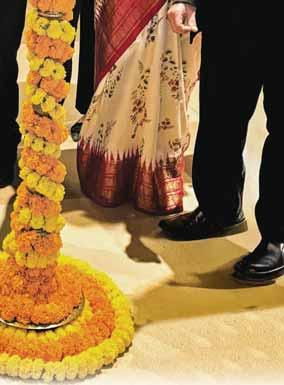
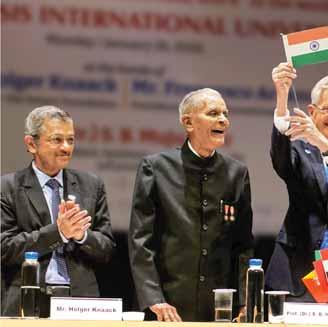
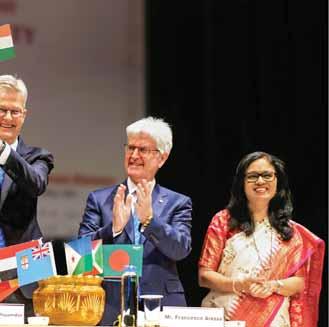
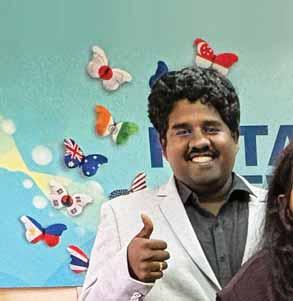
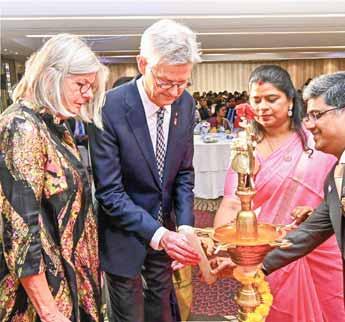
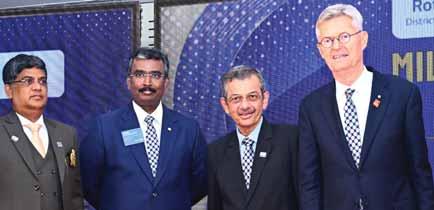
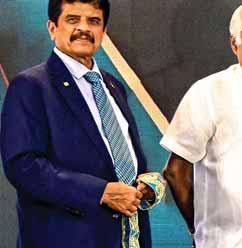
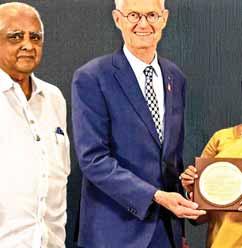
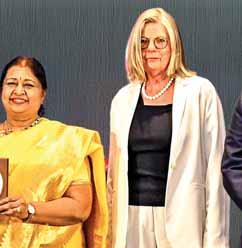
TRF Trustee Chair Holger Knaack and Prof S B Mujumdar, founder and chancellor of Symbiosis International University, Pune, light a lamp as (from L) RI President Francesco Arezzo, his wife Anna, Suzanne Knaack, Vidya Yeravdekar, the University’s Pro-chancellor and Trustee Bharat Pandya look on.
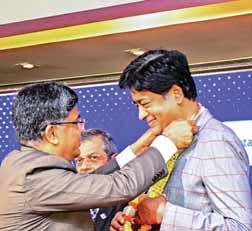
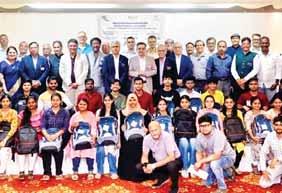
Most of the conflicts that our world is facing today are the result of fear and failure to understand the other side. Many people speak about “peace as if it is only the absence of war, but peace is much more than that. Peace is the presence of trust, understanding, justice. It is the daily work of building bridges and helping people live free from poverty, hate and prejudice, because these things create conflict and destroy peace,” said RI President Francesco Arezzo. He was participating in the inaugural ceremony of Rotary’s eighth Peace Center in the world, and first in South Asia. This centre is located at the sprawling 400-plus acre campus of the Symbiosis International University (SIU) in Pune, Maharashtra.
Peace cannot exist without freedom, and respect for the dignity of every human being. But we live in a strange time, when people have more freedom than ever, but too often this freedom “serves only their ego. We forget our duty to care for humanity. We live close to other people, but we feel far from them and are lonely in a crowd. When you are lonely in a crowd, fear grows. In many parts of the world, people fear an
TWhat is on offer
he newest Rotary Peace Center established at the Symbiosis International University in Pune will provide a fully-funded one-year PG diploma programme in Peace and Development Studies to its scholars. Rotary’s peace programmes are designed and targeted at mid-career professionals working in various fields in government and private sectors that deal with welfare, development, law and order, judicial systems, and so on. The Pune centre will give an opportunity
to professionals within Asia and Asian communities.
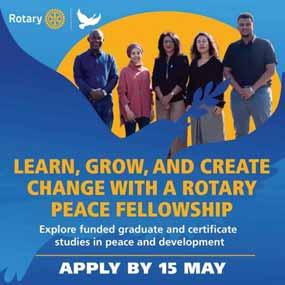
Applications for this PG diploma programme at SIU will be open from Feb 1 – May 15, 2026. Visit to learn more about the Rotary Peace Fellowship programmes and how to apply. Currently, Rotary awards up to 170 fully-funded fellowships for dedicated peace and development leaders from around the world to study at one of its eight peace centres across the world.
If we want peace in the world, we must face our fear of the other. The other person, the other culture, the other way of life. We must resist the arms of modern life that makes us isolated and closed.
Francesco Arezzo RI President
uncertain future. They fear losing their identity and fear strangers who have been shown as evil and dangerous.”
The saddest part, Arezzo said, was that both sides related “the same story” — fear on both sides became a weapon. But fear cannot be defeated by running away, or aggression. Giving the example of a child who fears darkness or hearing sounds at night, he said these fears are resolved not through armed guards but information. Knowledge was the first step toward peace. And this was the purpose of a Rotary Peace Center, “which helps to replace fear with understanding and turn confusion into clarity. It teaches skills that reduce conflict and support cooperation, trains people to listen well, build trust and solve disputes without violence.”
Arezzo said that while good intentions did matter, they weren’t enough, and peace didn’t happen by accident. “Peacebuilding needs skill, practice and people who are trained to work in hard places, with calm minds and steady hearts. A peace centre also builds a strong network. People trained at this peace centre will not be alone.
They will stay connected to others who do this work in many countries and many cultures. Peace is fragile when it is carried by one person, but peace is stronger when it is carried together.”
That is why Rotary invests in peace centres, in order to “build peace, not only for today, but for the long future.” His theme for this year — Unite for Good — was more than a slogan. “It is a challenge to build peace in ourselves, in our communities and in our world. To unite for good doesn’t mean we are all the same, or we erase our differences. It means we refuse to treat differences as enemies, and we choose to work together, even, and particularly, when it is not easy.”
The RI President said that while a university is “a place of learning, it is also a place of listening. It is a place that makes room for questions, debate and truth, because peace needs that kind of space. Today, we opened this new Rotary Peace Center, and we
renew a simple belief that peace can be built on purpose, not quickly, not perfectly, but on purpose, through learning, training and partnership.”
Rotary was an organisation built on friendship, knowing, understanding and caring about other people. “When we build friendships across borders, we build peace.” Peacebuilding also required self-reflection; if we want peace in the world, “we must face our fear of the other. The other person, the other culture, the other way of life. We must resist the arms of modern life that makes us isolated and closed.”
Peace came from small steps, “taken together toward mutual respect and understanding. Peace was essentially knowledge, awareness of our duties and wise defence of our rights and the rights of others. It was a shared path, which could be long and hard, but it could be walked, if we walk it together.”
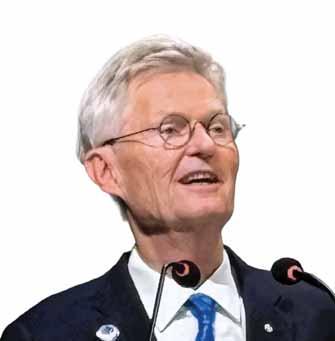
Addressing the meet, TRF Trustee Chair Holger Knaack said Rotary Peace Centers were a source of pride for Rotary and an investment into the future “built on justice, understanding, and problem solving.”
By inaugurating its eighth Peace Center, Rotary was opening “a door to learning, partnership and service. It was building a lasting place where peace is not only “discussed, but learned, practised, and carried into the world.”
TRF, supported by its generous donors, existed to help Rotarians “turn compassion into action, and this centre would be a new home for peacebuilding in Pune and in the heart and careers of the people who will study and grow here.” The Foundation enabled Rotarians to turn their “best ideas into reality, at scale, with strong stewardship and with long-lasting impact. We invest in projects and programmes that protect health, expand opportunities, and strengthen communities. And we do this because we believe that dignity and hope should not be a rare privilege, but normal conditions for human life.”
That was also why peace was a cornerstone of Rotary’s mission. Its peace centres have trained more than 1,800 peace fellows to become effective catalysts for peace through careers in government, education, and international
organisations like UN agencies. “This is why today is so meaningful in these difficult times. A new peace centre means a new source of knowledge, a new network of trained leaders, a new place where Rotary’s values can take roots in the minds and action of people who will carry them beyond this campus.”
Knaack said that a Rotary Peace Center was only as strong as the institutions that host it. “That is why we are so grateful to Symbiosis University, which has a clear commitment to education, service and building understanding across communities. These values are so close to Rotary values which are built on friendship and service, just as Symbiosis is built on learning and connections. Together we are a very powerful combination. We do not see this as a simple agreement. We see this as a long partnership, one that we will value, protect and grow.”
The Trustee Chair also thanked the TRF trustee from India, Bharat
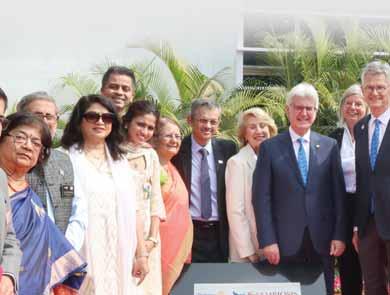
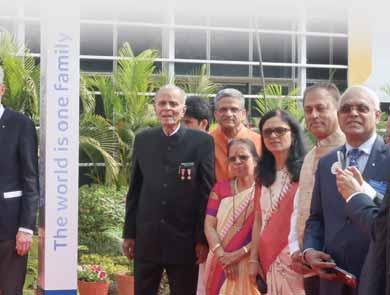
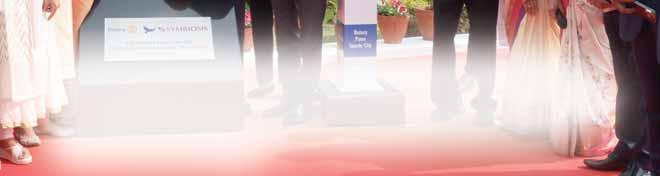
Trustee Chair Knaack, Suzanne, RI President Arezzo, Anna, Trustee Pandya and Madhavi, PRIDs Mahesh Kotbagi and Aniruddha Roychowdhury, DG Santosh Marathe, PDG Manjoo Phadke with Prof Mujumdar and Vidya Yeravdekar after installing a Peace Pole at the University.
Pandya, for connecting Rotary with Symbiosis and helping identify such a strong partner. Such partnerships don’t happen by luck and require a lot of work. He also thanked members of RI Districts 3141 and 3131 for taking the responsibility of being hosts to the peace fellows who will come to this centre. Hosting, he said, was not just about logistics; it is making them welcome and supporting them. It is making sure that people who arrive from
A new peace centre is a new source of knowledge, a new network of trained leaders, a new place where Rotary’s values can take roots in the minds and action of people who will carry them beyond this campus.
Holger Knaack Trustee Chair
many places feel they belong here and that they can succeed here. “Your role will help shape their experience and it will help shape the future of this peace centre. And TRF will stand with you in this work.”
He assured the aspirants that behind every peace fellow is a network of support, faculty, mentors, Rotarians, community partners and donors. “That is how Rotary works. We build a system of support around the world and people who want to serve.”
Thanking the generous donors of TRF, who made such Peace Centers possible, Knaack promised the donors that their gifts will be used “with care, transparency and with real impact. When we say we are committed to peace, we also mean we are committed to the hard work that peace requires over many, many years. This is just a beginning… of new learning and friendship for new peacebuilders who will go into the world better prepared to reduce conflicts and build trust.”
The Trustee Chair added that Rotary’s mission was to create lasting change, and peace was at the centre of that mission. This new Rotary Peace Center would “help change lives; one
From L: TRF Trustee Pandya, Prof Mujumdar, Trustee Chair Knaack, RI President Arezzo and Vidya Yeravdekar.
fellow, one community and one partnership at a time.”
Founder and Chancellor of SIU Prof S B Mujumdar said he constantly heard accolades about how he has created a wonderful university. He was born in a small village in Kolhapur district of Maharashtra. “There were no lights or towers, no phones, TV or radio. I completed my primary and secondary education from two small government schools. And the beauty of those schools was that the children of poor and rich, children of parents of various castes and religions studied together.”
After completing his education, he joined the Fergusson College, Pune, in 1963, and later started Symbiosis. Along the way he faced many challenges and had “very sad and bitter experiences.” Once, he asked a student from Ghana what do you want to do with your life? “He said I would like to run away from your city as soon as possible. I said why? He said, early in the morning when I go to the bathroom, your Indian students either close their
eyes or turn their heads. Because they believe that seeing anything black early in the morning is a bad omen. When I travel in a local bus, Indian girls prefer to stand rather than sit beside me.”
After hearing similar experiences from many students from Kenya, Uganda, Tanzania, Vietnam, Thailand and Sri Lanka, he was both distressed and disappointed, and wondered what kind of impressions these students would carry home about Pune, or India and our culture. So he started a small centre in a 10x12 room and being a teacher of botany, the word Symbiosis came naturally to him. Realising that though their colour and culture might be different, their blood was red, just like ours, he thought if “we provide a home, away from home to these foreign students by giving them courtesy, good treatment, they will be our cultural ambassadors in
the world.” And that is how Symbiosis International Cultural Centre was established, so that cultural education would go hand-in-hand with whatever stream of education they chose.
Agrateful Prof Mujumdar said that “when Symbiosis was passing through teething troubles, it was Rotary which came to my rescue, and gave us `1 lakh to start a Symbiosis Educational Centre. Our collaboration began from 1973, and continued in different ways.”
There were also frequent exchanges between Rotary clubs and Symbiosis International students. “This is a small, simple way of contributing to global understanding, which will perhaps lead to world peace.”
citizens. He hoped the “Rotary peace centre will send a global message to global students that peace is the only craving of humanity. Wars and battles are no solutions for human problems.”
He assured the assembled Rotarians that this Peace Center would flourish and prosper and the fellows who passed out from it “will be the messengers of peace across the world.”
TRF trustee Bharat Pandya said the fact that out of the 42 RI districts in India, 23 were represented at the inaugural of this Peace Center was a testimony to how much importance Rotarians gave to peace.
In 2002, the institution got the status of a university and now it has off-campus centres in Bengaluru, Hyderabad, Noida, Nagpur,Nashik and Mumbai, and more recently Dubai. India has 1,053 universities, and over 50,000 colleges. But at Symbiosis, the accent is on internationalisation; it has students from 85 countries and all states of India. “They play together, read, sing together and they often quarrel together.”
He is often asked about his future goal, which is to create global
In today’s world, global conflict has created a huge crisis. There are 17 million-plus refugees and displaced persons in the world. In 2024, it was estimated that the economic impact of conflicts, displaced people and refugees to the world is $19.97 trillion.
Economic toll was only a part of this huge crisis; Rotary not only talked about peace but worked in all areas related to peace, such as health, economic and community development, water and sanitation, disease prevention and environmental protection, to create conditions which help peace to flourish.
Another important step was its peace centres and peace scholars. By empowering young emerging leaders and opinion makers and equipping them with the skills for conflict resolution and sustainable development, Rotary is helping to create an impact both at the local and global levels. “Arch Klumph once said that if you build temples, churches and mosques, they will crumble into ruins. If you build monuments, time will deface them. But if you work with the minds of people and imbue in them a sense of compassion, integrity, responsibility, cooperation and understanding, then you
are doing something that is imperishable and that will last for centuries to come.”
That was the objective of Rotary in building its peace centres. Pandya thanked SIU and its leaders for hosting this peace centre, and Rotarians from districts 3141 and 3131 for sowing this important seed for peace to flourish in our conflicted world.
Pro Chancellor of SIU Dr Vidya Yeravdekar said the inaugural of the new peace centre also marked the 55th Foundation Day of SIU. She had learnt there were several applications from across the world for the establishment of the Peace Center, and after a rigorous selection process, SIU was chosen. Perhaps the RI committee’s interaction with both Prof Mujumdar and the international students had helped clinch the deal. “Thank you, Rotary, for showing so much faith and trust in this university,” she said.
She assured Rotarians that the core values of their organisation and the guiding principles of SIU, particularly
Trustee Chair Knaack, Prof Mujumdar and RI President Arezzo inaugurate the Rotary Peace Center at the Symbiosis University.
its motto Vasudhaiva Kutumbakam (the whole world is one family), were in total sync. She was confident that the Rotary peace fellows who will get admitted to this centre in 2027, will be “well-equipped with adequate skills and knowledge that would help them to promote world peace.”
Sudakshina Sen, centre head for the Rotary Peace Center, said its establishment at Symbiosis was all the more
significant as both the organisations shared core values of service to society, respect for diversity, and commitment to education.
This centre will cater to the greater Asia region, “integrating an interdisciplinary approach with experiential learning. The diploma programme will be offered in a blended learning format to empower mid-level professionals working in different spheres of peace and development, to advance their engagement in sustainable and actionable outcomes for social change in Asia,” she added.
Past RI director Mahesh Kotbagi recalled the long relationship the Rotarians in Pune had with SIU, particularly in healthcare, where Rotary had helped the hospital in Symbiosis with both funds and equipment, particularly in establishing the dialysis centre with 35 machines where free service was given to poor patients. He announced that the number of dialysis units would be increased from 35 to 50, and DG Vinod Saraogi, RID 3234, who was present at the meet, had given an instant commitment that he would take care of the funding.
Pictures by Rasheeda Bhagat
Rotary Peace Fellowship applications
Submit applications for Rotary Peace Fellowship for the 2027–28 academic year before May 15, 2026 to The Rotary Foundation.
To prepare a competitive application
Research the curriculum and programmes at each of the Rotary Peace Centers. For the master’s programme, you will be asked to rank the two centres you prefer. Use the Club Finder (https://my.rotary.org/club-search) to locate the Rotary or Rotaract club nearest you. A club or district recommendation is optional, but strongly encouraged as part of your application.
Candidates must submit original and authentic content based on their personal experience, knowledge and motivation. Use of Generative AI content is highly discouraged. Plagiarism will disqualify an application.
Applications require a resume, academic and/or professional recommendations, personal statement video and essays, transcripts from post-secondary colleges and universities attended (master’s only), English language proficiency test scores (master’s only), and social impact plan (certificate only). Allow time to request university transcripts and register for IELTS or TOEFL exams if your programme requires these. All materials must be in English. If you are selected for a fellowship, you will be notified in November which Rotary Peace Center will be the site for your studies.
Candidates selected for the fellowship will then apply for admission to the university where their Peace Center is located. Being selected for the fellowship does not mean you have been admitted to the university.
Certificate programme eligibility
Candidates for the certificate programme at Makerere University, Kampala, Uganda, or the Bahcesehir University, Istanbul, Turkiye, or the Symbiosis International University, Pune, India, either must be from that respective country, or have worked there or with the region’s communities or initiatives outside the continent, or they can be from outside the region, but must demonstrate a compelling interest in learning about peacebuilding approaches within the region.
Selection process
The Rotary Peace Centers Committee, composed of Rotary members, and university representatives review the top can-
versity for an interview. Applications are reviewed based on the following criteria:
Qualification based on the eligibility requirements
English proficiency
Commitment to peace and development
Leadership potential
Compatibility with fellowship objectives and fit with Rotary
Academic record and compatibility with preferred university programme
Feasibility and impact of Social Change Initiative (certificate only)
Eligibility restrictions
Rotary Peace Fellowships may not be used for doctoral study. The following people are not eligible for the fellowship: Active Rotary members, or Rotaract members who are also Rotary members. Rotaract club members who are not Rotary club members are eligible to apply.
Employees of a Rotary club or district, RI, or other Rotary entity
Spouses, lineal descendants (children or grandchildren by blood or legal adoption), their spouses, or ancestors (parents or grandparents by blood) of any living person in these categories
Former Rotary members and their relatives as described above (within 36 months of their resignation)
Master’s candidates must have at least three years between the completion of their most recent academic degree programme and their intended start date for the fellowship.
Rotary Peace Fellows who have completed the certificate or master’s programme, or a Global Grant Scholarship, must wait three years after they complete the programme to apply for the fellowship.
Please refer https://on.rotary.org/3LjPXGO
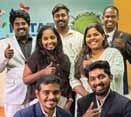
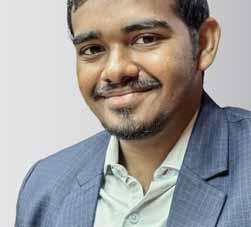
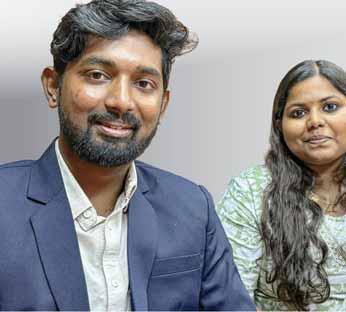
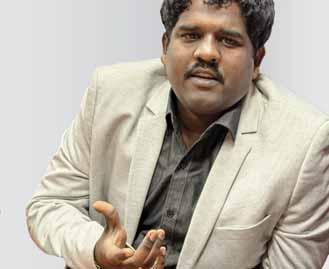
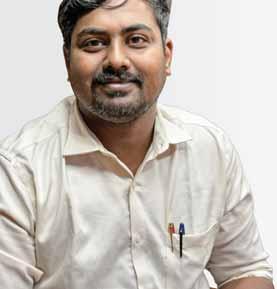
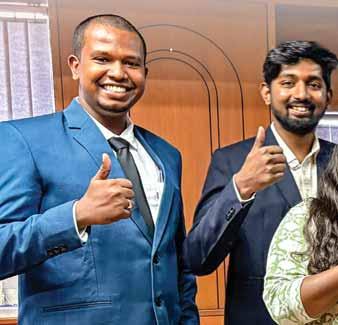
The entrepreneurs who thrived from the ‘Be an entrepreneur’ RYLA conducted by RC
Virudhunagar, at the Rotary News Trust office in Chennai.
Lighting an entrepreneurship spark through RYLA
Rasheeda Bhagat
When Ahmed Ibrahimsha was a final year student at the Kamaraj College of Engineering in Madurai in 2021, he was told about the RYLA — Be an entrepreneur programme being conducted by the Rotary Club of Virudhunagar.
but landed up with a job three years ago in the tourism sector,” and has now started his own company called Blue Gateways, which handles both inbound and outbound travel, from Southeast Asian countries and many states of India by people interested in visiting temples in Tamil
Nadu, particularly the MaduraiRameshwaram belt.
So what did he learn at RYLA?
“I learnt that when you are passionate about something, you work tirelessly… you don’t look at the time at all, and that brings success.” He has started dabbling in food tourism and his dream is to explore this further… and also open a hotel.
Kanishka Sagadevan is from Chennai and attended the third batch of RYLA. A Rotaractor from the age of 19, she learnt about RYLA sessions being conducted to give practical knowledge to youngsters on how to “become an entrepreneur and create jobs instead of seeking jobs.”
He found this three-day event totally different; “it was so practical, and hands on,” says the young entrepreneur, seated in the Board Room of Rotary News Trust. Six other entrepreneurs in the room nod in unison.
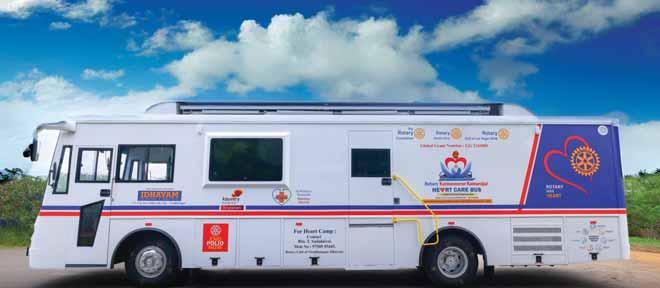
They’ve all emerged entrepreneurs after attending RYLA sessions in different parts of Tamil Nadu conducted by RC Virudhunagar, and sponsored by Idhayam, an edible oil brand owned by PDG VR Muthu, RI District 3212.
Ahmed was always “fascinated by the food industry,
An MBA from VIT, Chennai, she had always wanted to be an entrepreneur. Along with two other partners, she has developed a database akin to LinkedIn, “the difference being that we only give verified data from individuals.” The three youngsters developed a prototype and started Noshack Solutions, investing `12 lakh. Kanishka got her share of `4 lakh from her mother. “But we required a lot more money to scale up, which we didn’t have, so we jumped into another business.”
This is called Dreamer’s Kit which offers customised storybooks for gifts. “If someone wants to make and gift a book about his/her life to anybody, they give us the info and we convert it into a nicely designed book and present a copy to the individual.”
Her marketing pitch: “At Dreamer’s Kit, we create personalised storybooks to celebrate a person’s
Ahmed Ibrahimsha
having been exposed to the startup ecosystem even in my college days where I was part of a core team running a stationery shop on the campus of our engineering college.”
biomedical engineer who already owns a company called 16 Groups Innovation Labs, which was running a lot of activities for kids.
most meaningful moments. Each book is crafted with care to capture the individual’s journey and can become a keepsake.” On an average, depending on the number of pages, each book costs around `2,000 and till now they have produced 500 such customised books. The youngsters use AI for the writing part, enabling a hefty profit of `1,600 a book.
The profit from this venture is put into her core company — Noshack Solutions, which “can’t bring us money. It is something like social service for us! That is why the other model. After two years, we’ll make some money and jump into another model. We have a lot of ideas,” she beams.
As a couple of generations in his family have only been in government service, this was all very new and exciting for him. Just before he passed out in 2020, his team won the Smart India Hackathon conducted by the AICTE, for building an air cooler model. “But we weren’t able to make our innovation into a venture, because in my team, I was the only one ready for a startup,” he sighs.
So he took up a job, quitting within a month, believing “we have to take risks when we are young as after that there will be lot of responsibilities.”
He started Lab N Box, and after a while joined hands with his senior in college Nishanthini. She is a
Venkatasubramanian and Nishanthini Raja have set up Lab N Box in Chennai, which offers DIY science kits and organises fun science events for children. Venkat, as he is known to his fellow entrepreneurs, is a mechanical engineer. “Right after college I ventured into a startup,
Nishanthini is all smiles as she says: “I love kids and wanted to do something that ensures interaction with kids.” The two went through several incubators in order to get funding, and by chance met a food scientist Pasupathy, who introduced them to PDG VR Muthu.
When the duo met PDG Muthu, “he immediately saw that we were so passionate about what we were doing and said for products like ours, which were linked to education, marketing was needed, and recommended a RYLA session being conducted by him as Rotary district governor.” Pasupathy is the project director of another project initiated by Muthu — Vignana Ratham (Science on Wheels).
The RYLA session, which they attended in 2023, proved extremely useful to in fine-tuning and marketing their products which strive to make science a fun learning activity for young children. Says Nishanthini: “Lab N Box brings science to life
Kanishka Sagadevan
Venkatasubramanian and Nishanthini Raja.
through high-energy science parties, engaging school science shows, and thoughtfully designed science kits. Our Science Parties turn celebrations into hands-on adventures where kids experiment, explore, and have loads of fun.”
Adds Venkat: “In schools, our interactive science shows make learning exciting and spark curiosity among students. Our take-home science kits extend learning beyond the event, encouraging children to explore concepts at their own pace. Guided by our motto, Lab N Box — Fun Science Unboxed, we make science joyful, accessible and unforgettable.”
He explains that in the DIY science box, when a child opens the box, 10 or 20 different things pop out and while playing around with them, she discovers many science fun facts. One fun fact I discover in this conversation is that girls are much more interested in science than boys. “Boys are more into sports and doing things… but girls are fascinated by science. They were so interested in our forensics box, which is about forensic investigation.” Depending on the composition of their boxes/kits, the cost ranges between `500–1,200.
Venkat found his RYLA session akin to “a trigger… the faculty plants so many ideas in your minds. The whole experience lights a spark in you… a spark of entrepreneurship. Personally, I felt that these RYLA sessions are suitable for everyone… even those who don’t know even the meaning of the word business.”
The DIY also offers a new package called Science Parties which is getting popular with parents celebrating their children’s birthday. It costs `990
per child and the minimum number required are 10 children. The average billing per parent is around `20,000, and the ideal age group is from 4–8… “it’s an age when the sense of wonder is still alive in the child.”
So are these packages more popular for the birthdays of girls or boys?
“Of late girls; earlier it used to be only for sons. But these days girls’ birthday parties are highly ticketed. Parents of daughters take only premium packages and they have to be aesthetically good too. Recently, for a daughter’s birthday party, the parents paid around `55,000,” says Venkat.
John Thomas says: “Building stuff is my thing!” He attended a RYLA session in 2022 and was the president of his Sivakasi college’s Rotaract club. “Somebody suggested I attend this programme and I did, having no idea what it was all about.”
He was then doing a diploma in mechanical engineering; earlier he had dropped out of two premier colleges in Chennai — Loyola College and Madras Christian College. While in Loyola, he teamed up with another student and “we made an EV scooter way back in 2019. I love building things… LEGO and stuff like that were my favourites. That was the only thing I was passionate about, and wanted to do it for the rest of my life.”
But his father, an import and export consultant, disapproved. The son wasn’t interested
in trading and despite doing a BBA diploma course at Loyola, would work on the EV model with student in another stream. Finally he quit BBA, and got into BA History at the MCC, but that didn’t interest him either. “During my MCC days I built other EV prototypes and all this before I was 23! I had a few sets of motors, and I would build and break down the chassis and rebuild new ones,” he smiles.
Not happy with History either, he returned to Sivakasi to work in a small workshop of his own. “Initially my dad provided some funds, but he thought I was reckless. For him things like innovation or experimentation were taboo, and he always advised me to play it safe, saying: I have an established business; why don’t you take it over?”
But the son was not interested and decided to do a diploma in mechanical engineering at a polytechnic in his hometown, and get into EV as a mainstream for commercial operations. “But as you know, that’s a very capital intensive business. My father said: ‘If
John Thomas
you want EV, join Tata Motors or something like that. Either go work somewhere, or start with something small.’”
Six months after he finished his diploma, Thomas got married, at 23! And now has a daughter. “So I lost the ability to go out, explore and do some additional experimentation. My dad borrowed a few machines from his partners, gave me one of his old industry buildings and said instead of EVs, build some steel structures.”
He tried a few projects, which didn’t work, before he succeeded in making steel furniture racks, chairs, etc which can be assembled at home… IKEA style. He also makes agri tools and other machinery. But this was not really his cup of tea and “I was making substantial losses as there were so many details that I could not understand.”
At some point his father cut him off, saying if you want to do something more, pledge your own jewels. His wife helped by giving her jewels too, and he raised some more money through a parallel business he runs of buying and installing solar systems. “We buy solar panels, inverters and batteries and I have a team which installs total solar systems. This is a profitable business.”
His startup is named Trinity ICR Enterprises; it is a diversified manufacturing and engineering company focused on “innovation, conservation and reformation. Built on strong and essential industrial domains of solar system installations and precision-fabricated steel products like designer steel furniture, agri tools and machinery,
solar mounting structures (which are made at his site), and bulk custom-engineered components, with a hands-on approach to design, prototyping and scalable production, we provide manufacturing services to tier-3 cities like Sivakasi.”
Even though he wants to improve both technology and design-led manufacturing, and create precision, durable and efficient industrial products, his heart is still into EV business, including agri EV machinery. He has stated making small EV tractors. “Right now, it’s a struggle but I’m confident that I will eventually succeed in doing what I have been passionate about, and that is product manufacturing. I want to build OEM components for customers like Tata Motors and others,” Thomas says confidently.
Kyou make so many crores. But if you tick eight factors in any particular segment, they tell you what are the problems you are likely to face in that specific business and what realistic steps you can take to solve them. That is why all of us keep saying this training is so practical.”
So they are not exactly selling dreams… I prompt my young interviewees… and in one voice they say: “Exactly; that is what we mean by saying this RYLA course is so practical.”
Kirubhakaran underwent the training and zeroed down on manufacturing Spirulina capsules which are packed, he explains, with nutrients such as proteins, Vitamins B12, E, K and Omega 3. “It is a superfood and required for people who do not get adequate nutrition from their daily food.”
He invested a capital of around `3 lakh, which was given to him by his mother. He explains that in RYLA
irubhakaran Sathiaseelan, who graduated in civil engineering in 2017, is from Rajapalayam in Tamil Nadu. For over four years he worked in the engineering field before he heard about RYLA being conducted by a Rotary club in his district (Virudhunagar) and he attended a session in Nov 2021.
Asked how the three-day session helped him, he said the way in which the model was structured “helps us to make easy progress. And it is very practical; they give you 10 factors and you have to tick them according to your preference. They don’t tell you what enterprise you should choose or how this or that venture will help
Kirubhakaran Sathiaseelan
“we have investment mentoring, which is part of the business plan we have to prepare.”
He admits that along the way, in the making and marketing of Spirulina, he encountered many problems but handled them. His marketing is done online and at exhibitions. Confident about the future, he says proudly, “We manufacture high-quality Spirulina and offer value-added products like capsules, tablets and chocolates which are perfect for fitness enthusiasts, health seekers, and environmentally aware individuals. Our product is nutrient-rich and sustainably sourced, catering to health-conscious consumers. With focus on quality and innovation, we aim to make Spirulina accessible and enjoyable for everyone,” is his marketing pitch.
Madhusudhan Rajrani is from Trichy and into the construction business, handling both real estate as well as interiors. When he attended his RYLA session in 2023, done by RC Trichy, he was “already into business for three years. His initial business dream was to develop a selfsustained township model.”
But wouldn’t that need a huge investment? “Yes, but since I’m a structural engineer that’s been my dream from college days.” He worked in Chennai, where he did his PG in Civil Engineering, for a year, but when Covid struck, he returned to his hometown. Not wanting to “sit idle” he started his own real estate venture. “We’d
build five or six houses and then sell them when ready.”
For this he took a loan of nearly `60 lakh, but not from a bank. It was an unsecured loan at an astounding monthly interest rate of 2.5 per cent!
To my horrified ‘What?’ he says with a smile: “Yes, that was a huge mistake. I was completely lost.” He admits that he did this despite his family, which has been in business for 30 years, advising him against such rash behaviour. “They did warn me, but I just didn’t listen and jumped into it.”
Eventually he went into joint ventures. Madhusudhan says the mistake he made was being rigid and waiting till his fixed price was met to make a sale. He thus burnt all his profits in the high interest rate. “But when I went for RYLA, they told me that ego should not be there when it comes to money. If it’s destroying your business, you have to get out of it. To be honest, before I came into RYLA, I was completely lost,” he admits candidly.
“The financial pressure on me was huge. Even the profits which my company earned from other projects in construction, interiors etc was going into paying high interest rates. That kind of interest is not sustainable, so I wasn’t able to think properly how to take my business further. I was not able to quit also because I had to pay back everything.”
He didn’t want to ask his parents for help either “because I didn’t listen to them in the first place.” He started getting out of the hole he had dug himself into by selling his housing units even at the base price. This way he managed to pay off almost 80 per cent of his loans of nearly `70 lakh. He paid off around `55 lakh but still `15 lakh remained. But he was able to manage because with a bulk of the capital gone, the interest amount came down and he is back in black.
He has changed his business model too by roping in investors in his ventures, and building apartments instead of individual houses, with the investors getting share in the profits. “I no longer have to pay interest,” Madhusudhan grins.
But his dream still remains “building sustainable townships,” and he is confident he will do that some day!
Pictures by Rasheeda Bhagat
Designed by Krishna Pratheesh
Madhusudhan Rajrani
The RYLA cheerleaders
For John Thomas, one of the entrepreneurs trained at RYLA, the session was more like a three-day crash course or “an MBA with a much more practical approach. I got a much clearer idea about what business I wanted to do.” Asked to elaborate on how he could compare a short RYLA session with a crash MBA course, Thomas explains that each participant is given `400, to order raw ingredients, turn them into a product and sell it at the local market. Such as fruits for fruit salad or paper, glue h he ore e ursse p praaceareer r t ted d ow w
etc for paper handicrafts. “We are briefed on the profile of customers at that market and their spending pattern.”
The products range from fruit salad and rose milk to pani puri or paper crafts. Once, “some participants made paper earrings, expecting teenage girls to buy them.” But their end customers were actually “the boys who bought them for their girlfriends!”
like a one-minute reel, and promote it on their social media for a fee. The clear motto: Create a business model and make money! There are appreciative nods around the table and the discussion veers around “how the subsequent batches of RYLA are doing a lot better than us. Each RYLA is becoming better,” is the unanimous opinion.
Participants can also market their technical skills; digital content are e ers ng it or r cie ectB Buut l lly miccs! ! t ntennt t
Talk about marketing dynamics!
The participants who’ve becomes entrepreneurs also keep in touch through a WhatsApp group called .
There are 328 members and anybody having a business requirement can spell it out on this group and connect with the person who responds.
From every batch, two-star participants are selected for a trip to Singapore where meetings are organised for them. The idea is to give them an exposure to the business culture there, and to understand or get a feel of why the economy has developed so well in that country.
Ahmed, Kanishka, Kirubhakaran and Madhusudanan made it to Singapore and simply loved the experience. Says Kanishka: “The RYLA experience trains us to communicate… it just pushes you, shows you the direction. You have
uireoup ho i ip e the e l in n kaaraan e ou, a avve e
Ato walk and run, but on your own. They will just guide you, also to deal with problems, saying every business has problems. Deal with them.”
Venkat adds how these days much younger people are getting into RYLA, including students. “They offer digital marketing services to us. When we contact them, they say I’m a second or third-year student and if you pay me this much, I will design so many Insta posts for you. They have no investment, but are monetising their time.”
are applied to “offer customised solutions, enabling participants to gain clarity.” The participants’ “take home: a confirmation that their business idea is workable; a business plan that helps them plan ahead and a material kit designed by him. As also a reassurance that our team will continue to be available for consulting and mentoring even after the workshop.”
sked on his expectations and the outcome of the programme he has so lovingly nurtured and financially supported, PDG Muthu says: “I feel a sense of profound fulfilment watching young people grow into confident and capable entrepreneurs who innovate, create jobs and strengthen India’s economy. Seeing them take charge and grow as successful business persons gives me immense delight and pride.”
The crucial factor, adds Jayaraman, is that “it is not really a three-day workshop. Our engagement with participants begins the moment they register. Six days before the workshop, we initiate pre training exercises that include assessment and other activities, so that once they are with us, we simply plug them into the mainstream flow.”
Faculty member A A Jayaraman, a consultant to major industries and who the RYLA participants adore, says a distinguishing feature of this programme is the approach — prior to the programme “each participant’s profile, business interest, workable idea and the specific questions they want answered are captured. We ensure that these questions are addressed meaningfully,” their intent is strengthened and ideas refined.
The template and diagnostic tools he use for industry workshops w wn. o r ry t th g T They y o y saay y n nt will o ou r re s mmme e thu u ple e, a’s a arge s ght t maan, annd d re, this s p prioor r , are nged c hoops
Also, the three days are extensive and intensive; “because participants arrive already primed for an entrepreneurial journey, we see a strong conversion rate. Thus, three focused, immersive days are sufficient to sow the seeds — provided there is sincere and serious follow up. Our team takes ownership of mentoring each participant and tracks their progress. This mechanism has helped us continuously evolve our programme design based on real needs.”
This is corroborated by the entrepreneurs; one of them relates excitedly how he had a “long chat of 45 minutes only the previous evening with Jayaraman Sir.”
And he remembers him?
“Of course, he remembers every RYLA he has conducted,” is the response.
RB
Dr T S Chhabra (third from L), member of RC Nilgiris, with past president Vijayakumar Dar (R) and fellow Rotarians.
At 99, active in Rotary
Jaishree
At 99, when most people step away from public life, Dr TS Chhabra still comes to his Rotary meetings in Coonoor, Nilgiris. The veteran dentist, Army officer and Rotarian, represents a generation for whom service was not a slogan, but a way of life. With 57 years in Rotary and nearly a century of lived experience behind him, he is one of the oldest and most respected
members of the Rotary Club of Nilgiris, RID 3203.
Born in undivided India, Chhabra’s formative years were shaped by India’s Freedom movement. Between 1944 and 1947, while studying dentistry in Lahore, he was swept up by the patriotic fervour of young Indians demanding independence. “We were fired and inspired,” he recalls. He participated actively in protests and demonstrations against the British rule.
The Partition of 1947 uprooted his family. Like millions of others, they migrated to independent India as refugees. He resumed his education at Bombay’s JJ Hospital and completed his dental studies in 1948. A few months later, in January 1949, the Indian Army invited qualified dentists to join as commissioned officers. Chhabra applied immediately. He was one of the first dentists to be commissioned into the Indian Army’s Dental Corps after Independence, a distinction he wears lightly, but proudly.
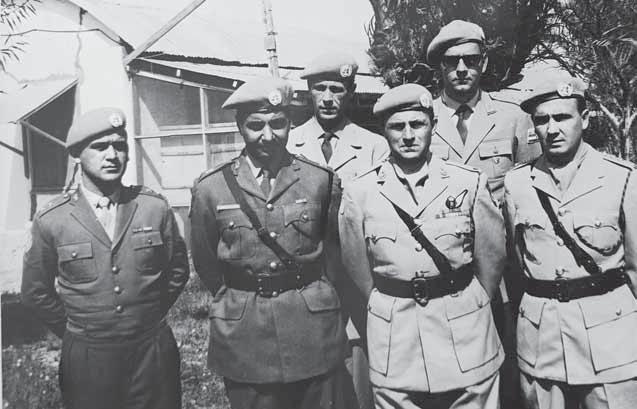
For two decades, he served in uniform, learning lessons that stayed with him long after retirement. His postings included two stints at the Military Hospital in Wellington, Nilgiris, first as a Major and later as a Lieutenant Colonel. In 1966–67, he was deputed to the Gaza Strip on a United Nations assignment during a period of conflict, “an experience that broadened my worldview and deepened my commitment to humanitarian service. The Army taught me discipline, loyalty and camaraderie. We came from all over the country, without divisions of caste
DG B Dhanasekar and his wife Amudhapriya felicitate Dr Chhabra for his 55 years of Rotary service. Club president H Harikrishnan is on the right.
or religion. We were one extended family,” he recalls.
After taking premature retirement in 1969, Chhabra chose to settle in Coonoor. Impressed by the fellowship and service ethos of the Rotary Club of Nilgiris, he accepted membership in September 1969. “I found that Rotary rests on two strong pillars — service and fellowship. That is what drew me in,”
he recalls. More than five decades later, those pillars continue to support him.
Today, he describes Rotary as his “extended family,” a source of emotional and physical strength, especially in his sunset years. He attends meetings regularly, often accompanied by his daughter Sunaina, who joined Rotary after her mother’s passing. Service, for the Chhabra family, has always been a shared legacy. His wife Aruna was a founder secretary of Inner Wheel in the early 1970s.
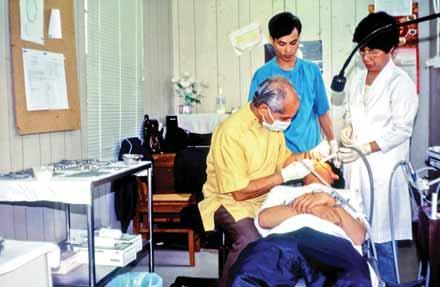
Among his many Rotary initiatives, Chhabra takes special pride in dental and medical camps and his association with free clinics. However, one experience stands out: serving as a Rotary International volunteer dentist. The role took him across countries, enabling him to interact with Rotarians worldwide and reinforcing his belief in Rotary’s global fellowship. “I simply enjoyed these assignments and found Rotary fully satisfying,” he smiles.
He recalls the visit of the then RI
President Rajendra Saboo in 1991, when RC Nilgiris celebrated its golden jubilee. There were delegations from Sri Lanka, Bangladesh and Pakistan.
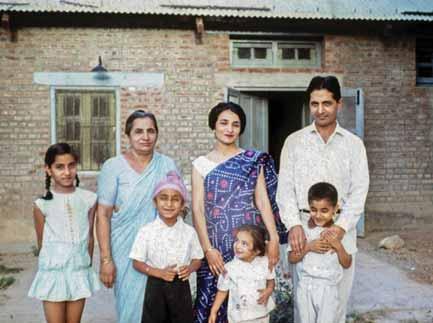
Dr Chhabra and his family in their younger days.
“The Rotary delegates from Pakistan were all Punjabis, and they were glad to find me speaking their language. It was of course a nostalgic occasion, and they even invited me to my village in Pakistan,” smiles Chhabra.
Over the decades, he has witnessed Rotary’s evolution — from a maleonly organisation to a more inclusive and vibrant movement. While welcoming this progress, he offers a gentle word of caution. “We should be selective in who we induct. Clubs should identify people who have the time and inclination to get involved in Rotary’s ethos. When we join Rotary, we only become members of Rotary. Only when we get involved do we truly become Rotarians,” he says.
Despite personal losses — including the passing of his wife and, more recently, his grandson — Chhabra remains resilient and self-reliant. His days are filled with reading, music, social interaction and a weekly game of bridge at the Coonoor Club to keep his “grey cells ticking”. His son Tarun, a former dentist who is now a full-time environmentalist working to preserve Toda culture, visits him regularly.
Chhabra’s advice to the younger generation: Slow down. We have
become slaves to money. God created time, man created hurry. He urges young professionals to balance ambition with empathy. “Make money, but never lose your human touch. Talk to your family. Tell them you care. Do it today. Tomorrow may never come.”
To fellow Rotarians, his message is equally clear: leadership must be collective, service must be humble, and teamwork must be sincere.
His influence is felt deeply within the club. As club member Deepika Unni aptly puts it, “99 years young and
over 55 years in Rotary, Chhabra uncle reminds us that service has no retirement age. I love listening to his stories about his overseas service for Rotary and his joy in being a Rotarian.”
Fellow Rotarian Jacob Mathews marvels at his remarkable clarity of mind. “Even today, he recalls events from decades ago with extraordinary detail. His humour is sharp, witty and stories never repeated. His eyesight remains enviably sharp, and he reads without glasses. He even drove till the age of 97.” He adds that Chhabra occupies an almost symbolic seat in the club — the extreme left corner of the first row. “To many of us, he is a father figure, offering guidance through his quiet presence rather than words. In all my years of knowing him, I have never seen him angry. Grace and dignity are simply his way of life.”
Past president Vijayakumar Dar, who has known him for nearly two decades, says, “A man who is an inspiration for both young and old; whose service to Rotary spans half a century; whose memory rivals our Nilgiris elephants; whose sense of humour still has a glint of mischief — a man one meets but once in a lifetime. Knowing the Chhabras is a rare blessing.”
Dr Chhabra (second from L) with international dental officers at an UNEF camp in Egypt.
At his clinic in Coonoor.
A living link to history at RC Madras
Kiran Zehra
The highlight of the 28th weekly meeting of the Rotary Club of Madras (RCM), RID 3234, at Chennai, was the presence of Rtn John Armstrong, grandson of Sir Godfrey George Armstrong, the charter president of RCM. “Nearly a century after Sir Godfrey helped establish our club in 1929, his grandson stands before us, connecting the present-day Rotary Club of Madras with its origins,” said NK Gopinath, the club’s past president.
A PowerPoint presentation traced the life of Sir Armstrong, starting from the time he had first come to India at age 23, working as a traffic controller with the South Indian Railway. When World War I broke out in 1914, he served in France as a lieutenant, later becoming a battalion commander in Normandy.
In 1920, he returned to India, serving as chairman of the Madras Port Trust and going on to charter the Rotary Club of Madras in 1929.
Gopinath reflected on Rotary’s early years in India. RCM was founded just two months after the Rotary Club of Bombay, making it one of the earliest clubs in the country. He also recalled that C James of RCM later became the first district governor from the club, at a time when India functioned as a single Rotary district — District 89. “He went on to serve as RI president in 1933–34, marking a proud chapter in the club’s history.” Some of
the club’s important projects were also highlighted at the meeting.
When asked how it felt to connect with his grandfather’s roots, John Armstrong, who is a member of RC Chiswick and Brentford, London responded, “I feel very pleased to be here.” He recalled his previous visit to Madras many years ago, joking about “the intense heat at the time, the current season is far more pleasant.” PRID PT Prabhakar and DGND S Ravi were present at the meeting. “More than just a weekly meeting, the event served as a reminder that Rotary is built not only on service projects and leadership, but on stories, relationship and continuity. Nearly a hundred years after its founding, the Rotary Club of Madras continues to honour its past while strengthening its future,” said Prabhakar.
The meeting also featured a lively Q&A with mountaineer Jafar Ismail whose mountaineering journey began in 2012 with Mount Kilimanjaro and evolved into a pursuit of high-altitude challenges worldwide. In May 2024, he achieved his “greatest milestone — summiting Mount Everest.”
Jafar also spoke about his book, Embracing Everest, Conquering Self, which captures not just a climb, but a personal transformation.
Pictures by Kiran Zehra
From L: PRID PT Prabhakar, John Amstrong and his wife Betty, club member M Balasubramanian and past president N K Gopinath.
Club secretary Prasanna Rajagopalan and president Nikhil Raj with John Armstrong.
Together for Healthy Families in Nigeria
Olubunmi Afolabi
The success of a programme to reduce maternal deaths in Nigeria is measured in more than statistics.
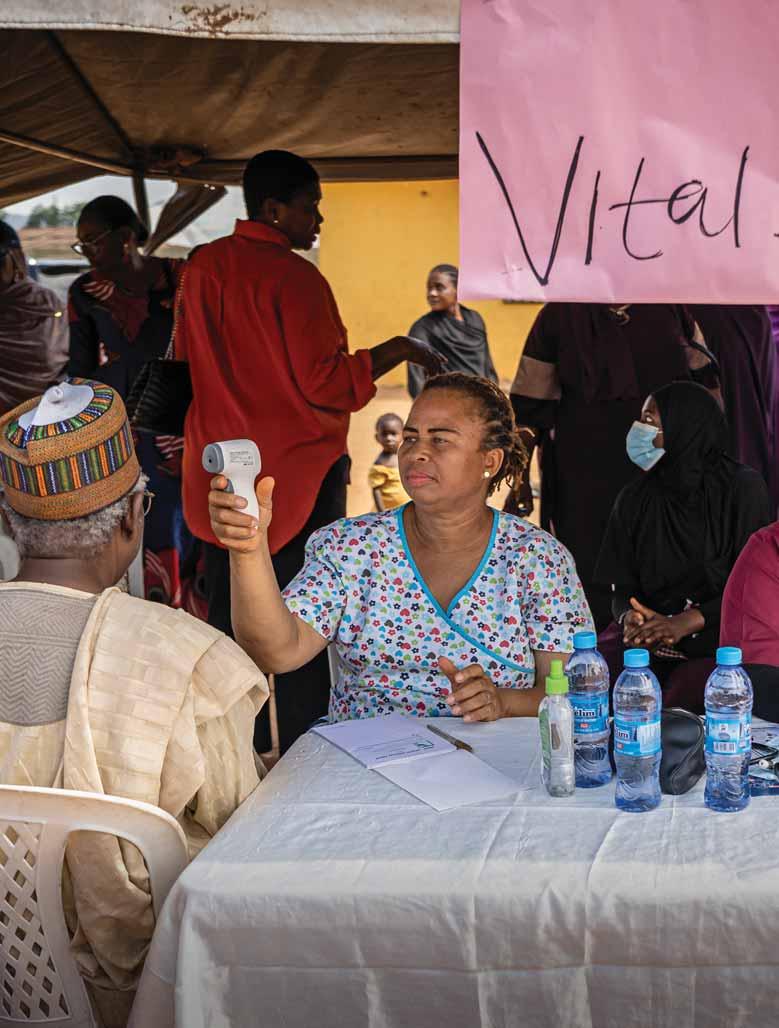
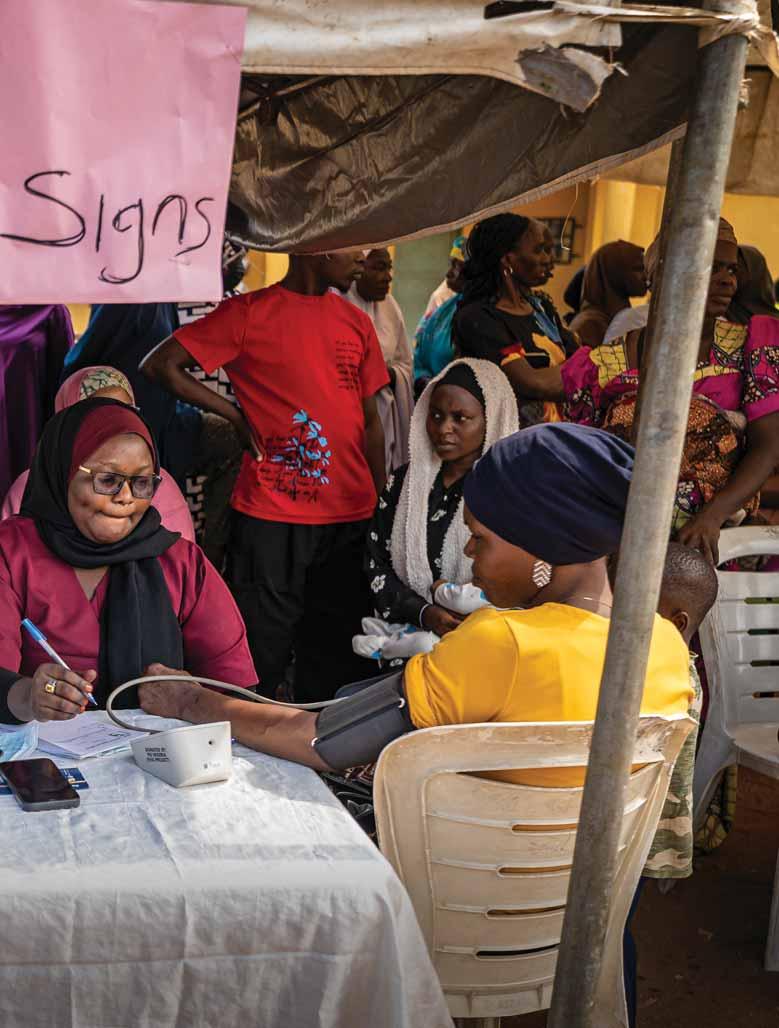
A health fair serves session attendees.
The statistics may appear faceless on paper: 512 deaths for every 100,000 pregnant women in Nigeria, one of the highest maternal mortality rates globally. But they’re not faceless to me. I see the mothers. I see the babies. I have stood in the rooms where those numbers become either tragedies or triumphs.
I work with Together for Healthy Families in Nigeria, a Rotary Foundation Programs of Scale grant-funded initiative. Having just completed its third year, the initiative aims to reduce maternal and neonatal mortality in select areas of Nigeria by 25 per cent. To do this, we’re conducting community dialogues and home visits to increase the number of families choosing to get healthcare in clinical settings rather than at home. We’re also making those services higher quality by providing additional training for health workers.
During a recent emergency obstetric and neonatal care training, a woman in labor came into a nearby health centre in Aaye in Ekiti state. The woman had been pregnant five times before and was carrying twins for just over 36 weeks.
The situation was tense. The facility was short-staffed and the officer in charge, a nurse midwife, was absent. A community health extension worker had stepped in to manage the delivery. She was not a midwife by training, but she had been part of our programme, equipped with lifesaving skills through the emergency care training.
The first twin came quickly, headfirst. The cries of the newborn filled the room, and for a moment, relief washed over us. But the second twin was not as cooperative. He was in breech position, and despite the community health worker’s best efforts, the delivery would not progress. Time seemed to slow. The room grew heavy with anxiety.
A referral was made immediately, and thanks to the training and
Above: A community health worker mimics a pregnant person as she gives a talk about maternal health at a community dialogue in November.
Below: Rotary Foundation Trustee Ijeoma Pearl Okoro (second from left) and Trustee Chair Holger Knaack (far right) receive appreciation awards, with (from left) Kingsley Okoro, Lanre Adedoyin and Joy Nky Okoro.
coordination in place, the medical officer of health and a nurse who were also attending the workshop acted without hesitation. Together, they transferred the woman to the General Hospital in the town of Iyin Ekiti.
Hours later, I stood at her bedside as the second twin was delivered safely. But the ordeal was not over. The patient began to bleed. She was experiencing a postpartum hemorrhage, a leading cause of maternal death in Nigeria. Swiftly, she was given several drugs and her bleeding came under control. The mother’s life had been saved, and both babies, though small, were breathing steadily.
That night, as I lay down, I thought of her face, pale but smiling, and the tiny forms of her children bundled at her side. I thought of the community
health worker whose training gave her the courage to try of the referral system that worked when things turned complicated, and of the hospital team that did not give up until mother and babies were safe.
For me, this was more than another day on the job. It was a calling reaffirmed. The experience reminded me that behind every statistic is a story: a mother, a child, a family, a future.
Olubunmi Afolabi is communications officer for Together for Healthy Families in Nigeria and a member of the Rotary E-Club of Nigeria New Dawn.
Health workers trained in emergency obstetric and neonatal care
Statistics are as of June 30, 2025.
542
Health workers trained in various maternity care
133
Health facilities delivered with contraceptives, medicine and supplies
38,783
Home visits to encourage people to use available maternal and child healthcare
408
Community dialogues to educate residents about maternal and child health
51,350
People reached at community dialogues across four target states
Inspiring investments in hope
Jaishree
The TRF meet titled ‘Million Dollar Opportunity’ organised by RI District 3233 in Chennai in honour of TRF Trustee Chair Holger Knaack’s visit was an evening of renewed commitment as Rotary leaders highlighted how generosity, trust and strategic giving continue to transform lives across the world.
“Rotary indeed opens opportunities for many, many people,” said Knaack. While Rotary offers members friendship, leadership and shared values, he stressed that the Foundation’s greatest role is in creating opportunities for those it serves. He thanked the district’s major donors, AKS members and
CSR partners for their generosity. “It’s not about the money. It’s about what the money is doing. But to be honest, of course, it’s also about the money. Otherwise nothing would work,” he said candidly. For him, the true reason behind giving is trust. “The Rotary Foundation is a trustful foundation. It is our foundation. It is run by us.”
To illustrate this credibility, he cited Bill Gates, whose Foundation matches Rotary’s polio contributions two-toone. “After we collect $50 million, the Gates Foundation transfers $100 million to our account. That is what I really call trust,” he remarked.
Sharing an anecdote about a 93-year-old donor in Berlin who questioned “overhead costs,” he explained why Rotary invests heavily in stewardship and measurement. “Planning, assessment and measurement are not overheads. They ensure impact,” he said. Introducing the framework of input, output, outcome and impact, he explained how Rotary evaluates whether projects truly create lasting change.
Whether it is dialysis machines helping patients live with dignity or
farmer-support programmes improving family livelihoods, Rotary now focuses on measurable, long-term results. “We are putting more emphasis on impact, not just on money,” he noted.
Quoting former RI President Cliff Dochterman’s theme: Real happiness is helping others, he said, “that is exactly what we are doing with our Rotary Foundation. Through the Foundation, donors can turn their dreams — of clean water, education and health — into reality.”
Ending polio remains his deepest aspiration. Though India has been polio-free for over a decade, he warned of complacency after a recent detection of the virus in Germany. “Let us keep our promise that no child will ever be crippled by polio again,” he urged.
Calling TRF “the backbone of Rotary” and “our window to the outside world”, Trustee Bharat Pandya said that through the Foundation, Rotary’s e f e, y o and h
TRF Trustee Chair Holger Knaack lighting the lamp along with DG D Devendran as Suzanne Knaack, Archana Devendran and Geetharani Ambalavanan look on.
Pandya shared an example of his club’s eye care initiative. “At Rotary Club of Borivili, we run an eye bank and processing centre. While many eye banks collect donated eyes, very few are equipped to process and assess corneas for transplantation. In Mumbai, there are only three such centres, and one is run by our club,” he said.
DG Devendran welcomes Trustee-elect AS Venkatesh as Trustee Bharat Pandya, PDG N Nandakumar and DGN Ganapathi Suresh cheer on.
global impact becomes visible — from school upgrades in Gujarat and Project Orange in Chennai to WASH projects in Nepal and medical missions in Africa. Highlighting the link between Foundation work and membership, he shared survey findings showing that Rotarians who participate in global grants are more engaged and satisfied. “Humanitarian grants are a powerful tool to attract, engage and retain members,” he noted.
For over a decade, the facility has restored sight to more than 2,500 people. But one experience stood out. Last year, the club members visited a school on the outskirts of Mumbai where 150 blind girls were studying, to see if any could be helped medically. After screening, they found that 12 girls were corneally blind, a condition that could be corrected. “All 12 underwent successful surgery. Today, they are studying in regular schools, confident and independent. That is the power of Rotary’s work... truly life-changing.”
He also spoke of the “multiplier effect” of TRF, recalling how a $1,000 contribution from his club grew into a $117,000 project through matching grants. Recalling his tenure as governor of RID 3140, when the district became the world’s top contributor, he said it changed perceptions about India’s giving capacity. “We proved that Indians are capable of giving, not just taking,” he said.
RI Director M Muruganandam congratulated Trustee Chair Knaack and Trustee Pandya on inaugurating the Rotary Peace Center at the Symbiosis University, Pune. Quoting the Four-Way Test, he urged members to “walk the talk,” reminding them that Rotary is an extended family bound by values. Linking Rotary’s seven Areas of Focus to global challenges, he said, “Where there is a lack of education, there is misunderstanding. Where health is poor, there is suffering. Where children are not protected, the future is uncertain — and that is where Rotary steps in.”
Earlier, introducing the trustee chair, PRID AS Venkatesh highlighted his love for youth programmes and long association with Rotary, noting that Knaack and Suzanne had hosted 45 youth exchange students.
Referring to TRF contributions as “investments in humanity”, DG D Devendran urged members to “give not out of excess, but empathy.” District Rotary Foundation Chair L Neelakantan shared that the district, born out of bifurcation and in only its second year, had contributed $1.03 million to TRF last year. Citing initiatives like Project Orange, mobile health units and smart classrooms, he said, “We are not just giving grants. We are building systems.” This year, “we are building our $1.2 million goal across all three pillars of the Foundation — Annual Fund, Endowment Fund, Polio Fund and the Grants. Every dollar raised will be converted into real impact,” he said.
From R: Trustee Chair Knaack, Trustee Bharat Pandya, RI Director M Muruganandam and DG Devendran.
Rotary nurtures young scientists
V Muthukumaran
Path-breaking scientists and technocrats are not born, they are made… on a treadmill of constant, hard learning, and intense research despite setbacks. To nurture future innovators, Young Scientists Forum 2025 (YSF) extended a platform to around 340 students from 42 schools in Tamil Nadu, Kerala and Mumbai to display their creative ingenuity through scientific models, prototypes and concept ideas at their project demo stalls at a one-day exhibition in Pollachi, TN.
Hosted jointly by RC Pollachi, RID 3203, and Arcomm Tech Solutions, a knowledge-based NGO that provides hands-on tech skills to children, the YSF was held at the Kovai Vidyashram school in Coimbatore. “For the first time, we had partnered with Arcomm which has been conducting the science expo for school students across TN over the last three years. Now with Rotary joining hands, both the scale and reach of YSF have grown tremendously, making an impact among the schools in the region,” said V Satish Chandran, club president.
Five scientists were invited by Arcomm for the YSF. The elite members interacted and gave valuable suggestions to the participants who gained confidence
to further pursue their research work. “They also got a peek into the real-world applications of new tech concepts during their tête-à-tête with the scientists,” he said.
Scientific curiosity
Recalling the genesis of Project YSF, club secretary Sreekanth Venkat said, “I visited the Arcomm exhibition in 2024, and was amazed by the kind of impact they had among school students in promoting science, technology, and problem-solving concepts for real life applications. We discussed at the club’s board meeting about partnering with this entity in organising the annual science fair for schools, and thus was born our first joint YSF in Nov 2025.”
It is a competitive event in which students are classified based on their grades (Class 5–12), and the basic idea is to infuse scientific
curiosity and an innovative mindset among them , said Venkat. “The YSF made the participants think beyond classrooms and textbook pedagogy, and gave wings to their imagination that focused on emerging technologies like the AI-based models, IoT (internet of things) applications like smart homes, digital office, etc. They were exposed to the opportunities that science can throw
open to solve emerging problems and social issues,” he explained.
“YSF opened up a wonderful learning curve for me. After presenting my demo model, I interacted with experts. I am privileged to get exposed to the real-world conditions in the scientific community,” said Mubhassir (Class 9) from Arokiamatha HS School, Pollachi. Heaping praise on Rotary
from left: RID 3203 DG B Dhanasekar (4th from L) and his wife Amuthapriya at the distribution of new clothes to government schoolchildren. Also seen are (from R) RC Pollachi secretary Sreekanth Venkat and president V Satish Chandran; School students display their scientific models; DG Dhanasekar puts a plastic bottle in a mega litter bin in a major drive at the Valparai-Aliyar Forest Range. Also seen are club president Chandran (L), Amuthapriya and secretary Venkat (2nd from R); Sweet box and a Thank You note given to a motorist following traffic rules during the Road Safety Awareness drive.
and Arcomm, Prakash, father of Vanishree (Class 8) from the Vijayamatha Convent HS School in Chittoor, Kerala, thanked the organisers for a “motivational event that guided the students to think creatively, ask questions and develop a scientific mindset.”
In another initiative, the club organised Project Heal that screened 130 rural women for breast and cervical cancer at two detection camps held at Pollachi, with the support of major hospitals. “We got the mammography van from RC Mettupalayam to examine 60 women for breast cancer in the camp held with the support of the Kovai Medical Centre and Hospital; and followed it up with another camp in which 70 women were screened for both breast and cervical cancer (through Pap smear test),” said Venkat. The Ganga Medical Centre and Hospitals supported the second camp.
Under Operation Clean, the Rotarians and Rotaractors collected plastic litter and other garbage, discarded by tourists, across the Valparai-Aliyar Forest Range, a biodiversity hotspot, on Sundays. “We collected around 10 tonnes of debris which was posing a grave hazard to the wildlife and environment,” he said. A new classroom is under construction at the Government Middle School, Vazhaikombu Nagoor (a tribal hamlet), with CSR funding (`37.5 lakh) from IHL, Hyderabad. DG B Dhanasekar laid the foundation stone for the project in December. “On the same day, we distributed new clothes and school uniforms worth `15,000 to 80 tribal children of the school,” said Chandran.
As part of a mega community outreach, the club presented Nation Builder Awards to 25 frontline workers such as traffic inspectors, nurses, special educators, social s “ c s o B w n
Clockwise
workers, government drivers, environmental activists, and cultural artists. At a poultry workshop held under RYLA banner titled Protein for the Nation, Prosperity for Youth, held at the STC College, 240 students were exposed to career opportunities in the livestock sector, farm management, nutrition, veterinary service and supply-chain logistics. Held with the support of Poultry Farmers Regulatory Committee, the event also honoured a few poultry entrepreneurs for boosting the local economy and giving jobs to the local youth.
In order to create a green legacy, a two-phase mega planting drive was conducted at Karappadi village, near Pollachi. “Around 1,000 palm seeds were planted for long-term green cover and soil conservation, followed by planting 600 native species which will benefit the villagers,” said Chandran. Thanks to the participation of villagers and youth volunteers, along with Rotarians, “we will transform the hamlet into a green paradise, leaving behind a strong ecological footprint.”
In an attempt to enter the India Book of Records, a Rotary Relay Run was organised jointly with Rotaractors to create awareness against drug abuse. Around 250 participants ran a 120km course from Pollachi to Erode, “through villages and towns
instilling a strong message of ‘Say No to Drugs’ among the people,” he said. Pollachi Municipality chairperson N Shyamala flagged off the relay marathon, along with Chandran, in the presence of RID 3203 Traffic Awareness coordinator Sivanantha Vadivel, Rotaract chair Rajalakshmi and DRR Selvavignesh. An oral hygiene camp screened 55 people at Karappadi village with the support of the Indian Dental Association, local chapter.
As part of its DEI outreach, 205 differently-abled children from 10 special schools performed a synchronised yoga dance in a joint programme with Newbridge Centre at the Bharathiar University. The special dance for 10 minutes entered into the Virtue Book of World Records.
Western Ghats. RC Belmont, RID 9423, Australia, is the global partner.
Once completed, the toilet blocks will benefit 500 students at these 10 schools, which once had enrolled over 1,000 students; “but absenteeism and dropouts because of pathetic sanitary condition, along with deplorable hygiene, led to the student number shrinking drastically over the last few years,” said Venkat. “The school faculty is optimistic that once the Rotary toilets are constructed, there will be a big jump in the new admissions.” This is the second GG project of the club, “the first one was setting up an electric crematorium, way back in 1995, at `2.5 crore. We are still maintaining the facility.”
As part of its DEI outreach, 205 differently-abled children from 10 special schools performed a synchronised yoga dance.
Global grant project
Now the spotlight is on their ongoing global grant project ($65,000) titled Mission Sparkle which is building 10 gender-segregated toilet blocks at 10 government primary and middle schools at the Anaimalai Education Block, a tribal habitat and reserve forest area on the foothills of the
“We are giving our time and hearts to serve remote villages where Rotary’s need is felt the most,” smiles Chandran. With 89 members, including an honorary Rotarian, the 41-year-old club has sponsored five Rotaract and two Interact clubs. Textile baron and philanthropist, Krishnaraj Vanavarayar, chairman, Kumaraguru Group of educational institutes, was the charter president of RC Pollachi.
Club president Chandran at a tree planting drive in Karappadi village.
Only in Taipei
Chinese cuisine and opera are among special offerings for attendees.
There are so many ways to find connection and fun at the Rotary International Convention. Beyond the inspiring convention programme itself, you’ll have your pick of special experiences when you go to Taiwan June 13–17. Highlights include the opera, a gathering for Rotary Youth Exchange alumni and supporters, and even an around-the-island bike trip.
Your friends in Taipei have organised Rotary nights at the national theatre for opera and at the National Symphony Orchestra. You’re invited to a host hospitality night banquet for exquisite Chinese cuisine and exciting performances. Or raise money to end polio: Choose from a weeklong bike trip ahead of the convention that circles the island or a 3K or 12.5K run on June 13.
Seeing the sights is simple with planned tours in Chinese or English, ranging from a half-day Taipei itinerary to five days exploring Taiwan’s diverse landscapes. One of the many shorter Taipei tours is sure to match your interests: national landmarks, nature spaces, “old streets” for shopping, and traditional arts, to name a few.
Rotary Youth Exchange gets the spotlight at two ticketed events. At a banquet on June 12, Youth
Exchange leaders and alumni can mingle and hear speakers share their stories of how the programme promotes global understanding. The next day, the Rotary Youth Exchange Preconvention is the spot to network with leaders, participants, and people interested in getting involved.
Rotary President Francesco Arezzo says something special happens when members come together at the convention. “It is this feeling that anything is possible,” he says. That feeling comes alive in Taipei, and Arezzo has a request: Come experience it together.
Learn more and register at convention.rotary.org
STATEMENT ABOUT OWNERSHIP
Statement about ownership and other particulars about Rotary News to be published in the first issue of every year after the last day of February
1.Place of Publication:Chennai - 600 008
2.Periodicity of its publication:Monthly
3.Printer’s Name:PT Prabhakar Nationality:Indian Address:15, Sivasami Street
Mylapore Chennai 600 004
4.Publisher’s Name:PT Prabhakar Nationality:Indian Address:15, Sivasami Street
6.Name and address of individual:Rotary News Trust who owns the newspaper and Dugar Towers, partner or shareholders 3rd Floor holding more than one percent 34, Marshalls Road of the total capitalEgmore Chennai - 600 008
I, PT Prabhakar, declare that the particulars given are true to the best of my knowledge and belief.
Chennai - 600 008sd/1st March, 2026PT Prabhakar
Children attending a class at the School on Wheels.
Creating schooling opportunity for street children
Rasheeda Bhagat
Children living on the streets is not a novel phenomenon in several Indian cities and Bhubaneswar is no exception. Here a large number of children live in street situations across railway station areas, footpaths and near temples and market places. “A common job of these children is ragpicking, in which boys and girls as young as six years old sift through garbage in order to collect recyclable material. If they live with their parents on the streets, at least some food is assured. If not, their next meal is not guaranteed. When personal health and hygiene cannot be assured, education is a remote dream. These children are at high risk of getting addicted to substance abuse and serious illness,” says S Harichandan, past president of the Rotary Club of Bhubaneswar, RID 3262.
With any form of structured or regular education remaining a pipedream for such children, they are exposed and vulnerable to various forms of exploitation and abuse. As they live in small groups, it is difficult to start a formal education programme for them, leaving them exposed to total absence of any kind of education, he says.
To make at least a dent in this huge problem and make a difference to some of these unfortunate children, the Ruchika Social Service Organisation (RSSO) was founded in 2010 by a visionary educationist, late Inderjit Khurana, who was affectionately referred to as Mama by students, and the Ruchika School was set up for such underprivileged children. After her passing, the work was continued by Dr Benudhar Senapati as the CEO of RSSO, who conceptualised the idea of School on Wheels. With the India Tourism Development Corporation providing three
battery-operated electric rickshaws, known as Totos in Odisha, in 2021 Dr Senapati approached Harichandan, who was then RC Bhubaneswar president, seeking Rotary’s help to take this project forward.
The club president discussed the project with members, got a very positive response and confirmed the partnership. “After a lot of brainstorming between Ruchika representatives and us, we set up an operational budget, and discussed the financial implications of the services that can be provided to these street children. Our past president and director of community services, the late Dr SK Ray, played an instrumental role. The club decided to spend `1.5 lakh and an MoU was signed between Ruchika and Rotary in August 2021, and the Inner Wheel members also came on board,” he says.
The first Rotary School on Wheels under the chairmanship of Ray came into existence and the Inner Wheel Club of Bhubaneswar joined hands as partners to provide food ration throughout the year. The project was inaugurated on Teachers’ Day in 2021 by the then RID 3262 DG Santanu Kumar Pani.
The club started with one centre and one Toto — today it has two centres
Bijay, the driver-cum-teacher, teaching the children.
From fourth left: PDGs Yagyansis Mohapatra and D N Padhi, and the club’s past president Harichandan (extreme right) with students.
Children in front of the Rotary School on Wheels, which operates from an e-rickshaw.
and two Totos catering to some 60 students — and continued its engagement with this project, setting aside `1.5 lakh every year for it. Along with schooling, basic healthcare needs of the children are also taken care of.
Explaining the way in which this project works, Harichandan says their School on Wheels is an integrated approach towards providing quality basic education to children living in streets or street-like situations. “We have two centres, but the project is implemented in different corners of Bhubaneswar city area, including the street behind the old Bidhan Soudha and the street of Sishu Bhawan Square… wherever the children live in street situations. Basically, it’s a doorstep educational programme for these children, in which a battery-operated E-rickshaw (Toto), decorated like a school and containing learning and play material, toys, some food and first-aid box, visits the children. The two sides of the Toto are used as a chalkboard, and maps and charts are displayed around the Toto. Bijay has been appointed by the club to act as driver-cum-teacher of the Toto. He drives the Toto to the place where
the children are, and teaches them for an hour, before moving on to another place where five or more children are available. The Toto visits four such centres in a day and Bijay admits: “I often have to resort to singing and dancing to attract and hold the interest of the children while teaching them some concept or some lesson. Toys are also used to engage the children’s attention and teach them some subjects.”
Apart from teaching them numbers and words, he also counsels the children on the advantages of education and motivates them to go to a formal government school, provides first-aid service, if required, and give some food if the children are hungry. Painting and craft work are also encouraged. Songs, games and puppetry are an integral part of each day’s learning session as this attracts the children to the learning points. At the end of the learning work, the teacher gives some homework to keep the kids engaged.
When the teacher finds that some of the children are ready to get into a regular school, arrangements are made put to put them into government schools. The teacher keeps on providing academic support after the school hours for children who get into regular schools.
Harichandan confirms that many of the children are at present in government schools, several have even passed their high school exams. But it was not an easy task to get these street children into regular schools. “We had to work with the teachers of neighbourhood government schools and convince them to accept these street children into their schools and give them an opportunity to enjoy the school environment. We also had to take some sessions with the students of these schools to convince them to accept these children as their friends,” he adds.
Even at the learning centres, to give the children a feeling of being in a school, the Rotarians have given each child two t-shirts with the Rotary logo, as also shoes, toys, books, medicines etc. With a club member donating some 50 toys for the School on Wheels, a toy bank was started and the children were delighted when given different kinds of toys to play with every day.
Harichandan says that this ‘schooling’ project has had a profound effect on the children that goes beyond
learning. “When we took them to the Regional Museum of Natural History, Bhubaneswar, we found them so disciplined and well-behaved that we were pleasantly surprised. During their visit to the museum, they really enjoyed observing the preserved carcasses of extinct animals, birds, big fish and different types of stones collected from different parts of India. The club hopes to organise similar tours in the future too.”
Striking a poignant note, he says that while other children look forward to celebrating their birthdays with doting parents indulging them, “many of the children living in the streets do not even know the date on which they were born. Thanks to PP Jnana Ranjan Rath, a system was started to celebrate the birthdays of all children on the last date of every month by cutting a cake by the youngest one, in order to spread joy and smiles and distribute cake to the children. Later we found on the last day of each month, the children come to centre with clean shirts, hair neatly combed, nails cut and faces washed clean!”
Till today the club religiously celebrates the birthdays of children on the last day of every month, and the
youngsters look forward to eating cake that day!
Other welfare measures taken up by the club members for these children’s families include giving blankets to them during winter, and an Annapurna Day, when the children and their families are served cooked food by the Rotarians.
Through this project, at least a few hundred children have benefitted and apart from getting some basic education, they have also enjoyed the benefits of basic healthcare, medication and first-aid services when needed. They have also learnt about good hygiene and sanitation practices to remain healthy and safe, and are educated
about their rights and the help they can get from various government organisations when needed. By 2024-end, 132 children had been admitted to government schools and given books and uniforms.
IPDG Yagyansis Mohapatra adds that the club’s “overall objective through this initiative is to reach out to as many children living in street situations as we can with a joyful and creative learning atmosphere that incorporates basic education and life skills, healthcare, hygiene and sanitation knowledge. We also link these vulnerable children to various government services available for protecting children’s rights.”
Past president Srichandan Mishra shares the trickle-down effect of this project, as after their initiative, two more similar Schools on Wheels have been supported by the Azim Premji Foundation and a Belgian organisation. The club has been able to sustain this project with support from several DGs who have visited these centres during their governorship. They include PDGs Santanu Pani, Prabhu Subudhi, Jayashree Mohanty and Yagyansis Mohapatra.
Food being served to children and their families.
Jalna Rotarians provide critical equipment for premature babies’ eyecare
Rasheeda Bhagat
The Rotary Club of Jalna Midtown, RID 3132, has set up one of Maharashtra’s first state-of-the-art RetCam Diagnostic Centre for Neonatal ICU infants, adding a significant service to the highly specialised care required to protect premature babies from the danger of losing their eyesight, and put them on the path to normal, healthy growth. This equipment is targeted at ensuring that neonatals do not face the danger of premature retinopathy, endangering their vision.
This centre, established at the Shri Ganpati Netralaya, Jalna, a tertiary eyecare centre, run by the Mahyco Research Foundation Trust, and equipped with sophisticated devices to diagnose and treat retinopathy in premature babies, was made possible by a global grant of around $49,500, with the Shri Ganpati Netralaya contributing around `1.5 crore.
Explaining the genesis of his project and the work that went behind it, the club’s past president Anup Karwa, grant lead and RID 3132 grant subcommittee chair (DGSC, RY24-25), said that in their conversation with doctors at the partner hospital, the Rotarians found that this Netralaya examines at least 3–4 neonates a day for this condition
known in medical terminology as Retinopathy of Prematurity (ROP). The finding: many of these babies have already developed stage 5 ROP with extremely poor prognosis. This is just the tip of the iceberg, with many “research publications reporting the incidence of ROP to be alarmingly high. It is estimated that nearly one-third of premature babies
A premature infant being screened for retinopathy with the help of the RetCam equipment installed by RC Jalna Midtown at Shri Ganpati Netralaya.
develop this condition. Unfortunately, most government hospitals lack the expertise to diagnose and treat this condition, which requires both high-skilled surgeons and highend equipment and facilities to treat it,” he says.
In districts like Jalna and surrounding rural belts, access to advanced retinal imaging and trained specialists are woefully lacking. Babies had to be referred to distant cities, losing precious time.
ROP is a potentially blinding condition and affects the retinal vessels of premature infants who weigh less than 1.5kg or were born before 32 weeks. Quoting numbers, he says that the survival of preterm infants has significantly increased globally in the last two decades, especially in countries such as India, with over 3.5 million preterm infants born and surviving annually. The financial burden of blindness and vision impairment in a thickly populated country like India is phenomenal.
Keeping all these factors in mind, “our dream of establishing a RetCam Diagnostic Centre took shape,” says Karwa, hastening to add, that for those involved in planning and executing this project, “this was much more than just the purchase of an equipment… it was setting up a lifesaving and sustainable system that would give hope to parents of premature babies in this region.”
The journey began with conversations between Rotarians, doctors, neonatologists and the families of tiny patients. Visits to NICUs revealed stories that stayed long after the visits ended. “What was the hardest for us to note was that so many
In Jalna and surrounding rural belts, advanced retinal imaging and trained specialists are woefully lacking. Babies have to go to distant cities, losing precious time.
babies survived critical days, only to face a future of darkness,” he says.
The first step was understanding the real need and rigorous community assessment and this was done through “multiple hospital visits and discussions with experts in the field. These revealed a critical gap… the absence of RetCam technology, the gold standard for ROP diagnosis. After collecting data, documenting case histories and assessing the magnitude of the problem, “we were convinced that the need was real, urgent, and undeniable.”
Once convinced about the need, the core team members reached out to many international Rotary clubs in the US. Through presentations, storytelling, and data-backed need assessment, the project’s importance was shared with RC Corona in RID 5330 and RC Austin, RID 5870, by Karwa, who secured funding commitments and cemented the partnership. The GG valued at $49,500 was approved by TRF and the Ganpati Netralaya contributed $170,000 (`1.5 crore at the prevalent exchange rate then).
The centre with the state-of-art imaging technology was inaugurated in 2025 in the presence of District Governor Sudhir Lature, with Rajendra Barwale, chairman,
Mahyco Group, IPDG Suresh Saboo, PDG Swati Herkel, club president Ankit Agrawal, Dr Rushikesh Naigaonkar, medical director of Shri Ganpati Netralaya, and Anup Karwa. The service here will be provided free of cost, “ensuring no child is denied care due to financial constraints,” said Agrawal.
Once the equipment was procured and the centre inaugurated, screening of neonates admitted in the NICU of government hospitals in various districts of Maharashtra began. The screening is being conducted by skilled and trained technicians using the fundus camera, which is being transported in an air-conditioned mobile van equipped with telemedicine facilities already available with partner hospitals, and will continue to be done periodically.
The images captured by this special camera will be shared via Cloud servers with retina specialists trained in the diagnosis and treatment of ROP, who are available at the partner hospital in Jalna.
Since Diwali this portable equipment has screened over 50
prematurely born babies across three cities near Jalna and prevented retinopathy in eight cases at Stage 1 and 2, through timely drops and adequate eye care. If these cases were not diagnosed in time, it might have led to surgery or even blindness, Karwa added.
neonatologists and ophthalmologists for early detection of this condition.
The mobile equipment will be taken to rural areas and the images captured by the special camera will be shared via Cloud servers with retina specialists for timely diagnosis and treatment.
The babies diagnosed with the malady and requiring specialised medical management will be treated in the NICUs, where they are already admitted. Neonates requiring surgical management will be referred to Shri Ganpati Netralaya, Jalna, where all facilities for the required operation are available. The cost of surgeries will be covered under the national medical insurance scheme, said club president Anil Agrawal.
Next on the cards are doctors’ workshops to train paediatricians,
“A workshop for NICU doctors from 10 cities of Maharashtra will be held. We’ll connect with more NICUs to ensure universal screening coverage, and send the mobile unit to remote areas for timely detection and management,” said Karwa. During his term as DGSC last year he did 15 GGs worth $700,000, including district grants.
More camps will be held across Maharashtra and those interested in volunteering can travel with the Netralaya doctors to contribute to this project, he added.
NICU and Rotary eye care hospitals across Maharashtra can reach out for collaboration at rcjmidtown@gmail.com and anupkarwa@gmail.com
Students witness RH-200 launch at ISRO
Rotary Club of Tirupur Metal Town, RID 3203, has sponsored 50 government school students to witness the RH-200 sounding rocket launch at ISRO, with club member Ben VG Anandram contributing `1 lakh to cover the travel and related expenses.
i g n e t t e s
Team
Rotary News
Interactors host artificial limb fitment camp
The Interact Club of Raipur Pinnacle, sponsored by RC Raipur Queens, RID 3261, organised a four-day artificial limb donation camp in Raipur. A professional team from Gujarat conducted prosthetic fittings, while Interactors managed registration, logistics and rehabilitation support.
A park for children
RC Sonarpur, RID 3291, together with South Kolkata Vision (a past presidents’ forum), celebrated Children’s Day by gifting a newly developed children’s park to the community at Sonarpur, near Kolkata. The park has been built with the support of the club’s RCC Ashram Anandam.
Creating smart classrooms
RCs Mangalore North (RID 3181) and Bangalore Vijayanagar (RID 3191) have installed five smart boards at the Sree Ramakrishna Educational Institutions, Mangalore, under a `5.8 lakh CSR project sponsored by Rtn PV Rai, CEO of Pixcel Softex. The initiative will strengthen digital classroom infrastructure enhancing interactive learning.
A beneficiary being fitted with an artificial foot.
Club members, along with children, at the inauguration of the park.
PDG Krishna Shetty (L) inaugurating a digital classroom.
Students at ISRO, Thiruvananthapuram.
Using canvas to fund classroom
Kiran Zehra
The sale of a painting titled Crimson Depth, Golden Dreams, has helped in funding the education of children at the Rotary Bangalore Vidyalaya, a school for underprivileged students in Bengaluru. Thirty per cent of the proceeds from the artwork were given to the school through Kala for Vidya, an art-based fundraising initiative of RC Bangalore (RCB), RID 3192.
The painting was created by Bengaluru-based artist Khushboo Tibrewal after she visited rural Karnataka under the government’s Dr BR Ambedkar International Scholarship Scheme (a fully-funded initiative by the state government to support SC students in pursuing master’s and doctoral studies in foreign universities). During these visits, she interacted with SC/ST students who
Artist Khushboo Tiberwal with her painting titled Crimson Depth, Golden Dreams.
were eager for an education but had limited exposure to higher education pathways. “Many students had never considered studying in Bengaluru, and international education was largely out of the question. Those encounters shaped the theme and intent of the work,” she says. Her artwork was sold for `41,000.
Kala for Vidya uses the sale of artworks to raise funds for education. Rather than relying on traditional donation-based appeals, the initiative channels a fixed portion of art sales toward funding education, while ensuring that artists retain the majority share of the proceeds.
RCB recently concluded the 2025 edition of Kala for Vidya, its 18 th annual art fundraising exhibition, which was held at the Bangalore International Centre. The exhibition raised funds for Rotary Bangalore Vidyalaya in Nagadevanahalli, which supports the education of over 450 children from underserved communities.
The exhibition was inaugurated by Rotarians Sitalakshmi Chinnappa, Meera Shankar, Srichand Rajpal and Shanti Baliga. DG Elizabeth Cherian and DGE Ravishankar Dakoju were present. This year’s edition featured 201 paintings and 21 sculptures contributed by 155 artists, representing a wide range of media and styles.
This year, the club adopted an extended sales model, says Sandeep Ohri, the club’s International Service director. While the physical exhibition concluded in October, the artworks continued to be available through an online platform till end 2025.
To support the online phase, the club developed a structured digital campaign, including professional documentation of artworks and artist testimonials. “The objective was to improve visibility while maintaining consistency in presentation and pricing.”
The beneficiary school
Funds raised through support Rotary Bangalore Vidyalaya, an institution operated by the Rotary Club of Bangalore Charitable Trust. The school offers education from pre-nursery to Class X in both Kannada and English medium.
Located in Nagadevanahalli and accessible by public transport, the campus includes classrooms, science and computer labs, a library, a playground and an auditorium. The school’s computer lab was upgraded in 2023 with modern systems, licensed software and digital learning facilities. E-learning content is provided for students from Class 1–10.
Academic progress is supported through regular assessments, experienced teaching staff and scheduled parent–teacher interactions. The school also emphasises
extracurricular participation, field visits, hygiene and annual medical check-up.
A task force committee comprising members of RC Bangalore
meets monthly to review administrative, academic, safety and statutory matters, with representation from the school’s chief executive officer and the headmistress.
Kala for Vidya operates on a financial structure different from commercial galleries, “which typically retain 50–60 per cent commission on sales. Under this model, after statutory taxes and payment processing charges, approximately 30 per cent of proceeds are given for education, with artists receiving the majority share. Unsold works remain the property of the artists, who retain full ownership and copyright,” says Ohri.
Participation fees were structured to accommodate artists at different career stages, with lower entry costs for printmakers and emerging artists. “These fees were designed to offset basic operational expenses such as venue hire, insurance and logistics, rather than generate surplus revenue.”
The exhibition included works in oil, watercolour, charcoal, terracotta,
stucco and mixed media, and priced from ` 7,000 to ` 13.7 lakh. Encouraged by the response to the 2025 edition, RC Bangalore is exploring the possibility of expanding the programme into a year-round platform rather than an annual event. The objective is to provide artists with sustained visibility while generating continuous funding for education at the Rotary Bangalore Vidyalaya. “Discussions are also underway on potential collaborations with art institutions and schools, including the integration of art education into community-based service programmes. While these plans remain at an early stage, the initiative reflects a broader shift toward models that combine cultural production with long-term social investment,” explains Ohri.
Students of Rotary Bangalore Vidyalaya displaying their models at an exhibition.
DGE Ravishankar
Dakoju at the exhibition.
Rotary para TT at IIT Madras
V Muthukumaran
After hosting para table tennis tournaments in the last three years, RC Madras Chenna Patna, RID 3234, has now collaborated with IIT Madras to jointly conduct the National Para Ranking TT Championship for the first time in Tamil Nadu. This is the third edition of the event conducted on a national level for differently-abled paddlers.
Around 220 para athletes including 60 women from across 20 states participated in the two-day event organised at IIT Madras. DG Vinod Saraogi welcomed the participants and said, “Our members from the host club will ensure a hassle-free experience for you all.” A team of Rotary and IIT coordinators took care of boarding, food and logistics. Top facilities with a modern indoor stadium at the Study Activity
Centre on the IIT campus, experienced coaches and referees were arranged in tie-up with IIT Madras.
Efforts are on to upgrade the para ranking TT championship into an international level in the next two years, he said. Tracing the evolution of the para TT event, project chair Rajshekhar Raman said that RC Madras Chenna Patna used to conduct table tennis league matches for Rotarians every year. “As we saw great enthusiasm and camaraderie among participants, we thought of doing something inspiring and useful for the differently-abled. The thought, around three years ago, became a spark for us to hold all-India para TT open tournaments.”
In the first year, the para TT meet saw just 36 athletes, the following year it grew to 46, “but word spread quickly
about the quality of our event. Hence, last year (2025) our club hosted 156 para players from across the country.” Some of the players travelled for two days by train, overcoming every challenge with “a remarkable spirit and passion which inspired us to take the para TT tournament to the next level,” said Rajshekhar.
After seeing the club’s past record in hosting the tournament, the Table Tennis Federation of India (TTFI) and the Tamil Nadu TT Association awarded the National Para Ranking TT Championship to RC Madras Chenna Patna.
Step in IIT Madras
When the Rotary club was searching for a suitable venue and a partner, IIT Madras came forward to collaborate
From L to R: RC Madras Chenna Patna president Antony Kumar, RID 3234 AG R Ravi Shankar, DG Vinod Saraogi, district secretaries RJ Kumaravel and R Saptagiri, and J Ganesh at the inaugural of the National Para Ranking Table Tennis Championship.
with Rotary. “Both our club and the institute shared the same vision of reaching out to the para players. It is heartening to see the enthusiasm and support from IIT-M director V Kamakoti, and other deans involved in planning, student affairs, and professors in organising the para TT championship,” explained Rajshekhar.
During the two-day tournament, IIT research scholars will study the movements of para players through AI and motion analysis by installing CCTVs which will enable them to develop assistive tech platforms that can enhance the performance, capability of special athletes and their training modules.
Niggling woes
A regular at the para TT tournaments for the last five years, Bhavika Kukadiya (30), from Surat was competing in one of the standing categories at the event. She complimented the food, accommodation and travel arrangements provided at the event. Bhavika has won over 25 national and international medals, and is employed in a pharma firm.
Her friend, Prachi Pandey from Unnao district, UP, a wheelchair-bound paddler, said, “the travel from the hostel to the venue was difficult for us. Much can be improved in terms of logistics for wheelchair-bound players.” Prachi has won 37 national and international medals in para TT. “The organisers should consider the mobility issues faced by para athletes, and set right these problems in the next edition,” Bhavika added.
Highest prize money
For the first time, “the winners of the national para TT event will get the highest prize money, thanks to the generosity from the IIT Madras Alumni Charitable Trust,” said Sanjay Madhavan, chief organiser from RC Madras. Each of the seven chosen players — among the 17 winners — got a motorised wheelchair (`75,000 each), one of which was donated by Thrive Mobility, an incubator project.
All the 17 winners got a trophy, certificate and a cash prize of `5,000 each; 17 runners-up received a cash prize of `3,000 each, along with a trophy and certificate; and 34 special prizes of `1,500 each were also distributed.
For the nine standing winners (other than wheelchair-bound), the club gave a cash prize of ` 10,000 each; while the World of Table Tennis store owned by veteran paddler Sharad Kamal presented a gift voucher of `2,000 each to these standing winners. “At least six winners of this para TT event would be given a three-day coaching by Kamal at the High Performance Centre set up with the help of the state government,” said Madhavan.
Speaking to Rotary News , RC Madras Chenna Patna president Antony Kumar said, “DEI principles are close to our heart as we reach out to the differently-abled through many initiatives. Our 10-year-old microloans project has empowered 80 beneficiaries, mostly physically-challenged and LGBTQ community, with interest-free credit ranging from ` 50,000 to ` 1 lakh. Our small loans have helped them own a small business or kirana shop for self-employment.”
The 33-year-old club with 40 members is known for breast cancer detection and healthcare camps, apart from educational projects for less privileged children.
Pictures by Muthukumaran
A league match in progress.
Touching lives through RAHAT
Jaishree
For two days, the quiet campus of Chandrashekhar Azad Government PG College in Sehore (MP) transformed into a bustling, fully functional hospital. Through a RAHAT (Rotary’s Active Hands Are Touching) medical camp organised by the Rotary Clubs of Bhopal Hills and Sehore, RID 3040, over 5,000 people received free treatment for a wide range of ailments. Sharing some of the most moving moments from the camp, project chair Umang Saxena recalled the case of 12-year-old Raju who had lived with a cleft lip since birth. “He was very quiet and hesitant to even look at people. His parents are daily wage labourers and had no means to afford surgery. After
the operation, when he came back for review, he smiled freely for the first time. That smile made all our efforts worthwhile.”
Saxena also spoke about 68-yearold Savitri Devi, who had been gradually losing her eyesight to cataract formation. “For nearly five years, she depended on her family for everything. She told us she had stopped stepping out of the house because she could not see properly. After her surgery, when the bandage was removed, she held my hand and said, ‘Now I can see my grandson clearly again.’ It was an emotional moment for all of us.”
Along with consultations, several patients underwent surgery for cleft lip, gall bladder stones and other complex conditions right at the venue. A complete
hospital infrastructure — including pathology and radiology units — was installed for the duration of the camp. Except for a CT scanner, all major medical equipment were transported from People’s Hospital, Bhopal.
Around 220 doctors, nurses and paramedical staff, representing 20 medical specialisations, volunteered their time and expertise. “They offered their services entirely free of cost. We took care of their travel, stay and meals,” said Harssh Y Mittal, president of RC Bhopal Hills.
Calling it probably the largest medical camp ever held in Sehore, Mittal explained why this location was chosen. “Sehore is surrounded by more than 100 villages. By hosting the camp here, we could reach thousands of people who otherwise have limited access to quality healthcare.”
Volunteers from both clubs travelled across 162 villages for a week, conducting door-to-door campaign and holding group meetings to spread awareness. Their efforts paid off; the turnout was overwhelming. To manage the crowds efficiently, 10 registration counters were set up, supported by a customised software developed in-house. “We now have a digital medical record of every patient, which will help in follow-up treatment,” he said.
Nearly 180 patients were advised hospitalisation for eye surgeries, cardiac conditions and other serious disorders. Their treatment is currently underway at People’s Hospital, Bhopal, completely free of cost. The clubs are also bearing the expenses for transport, accommodation and meals for patients and their caregivers.
DG Sushil Malhotra takes a blood test at the RAHAT camp.
RC Bhopal Hills pressed into service two mobile clinics — ophthalmology and dental vans — which were launched earlier this year through GGs. Given this region’s high tobacco consumption, oral cancer screening was given special priority. Patients with suspected malignancy were referred for advanced treatment at no cost.
The camp was organised drawing on Umang Saxena’s earlier experience of a similar camp in Jhabua in March 2024, which benefitted over 1.5 lakh people, with support from PGIMER, Chandigarh. He is a member of RC Jhabua.
RC Bhopal Hills, now in its 27th year, has recently added a 10-bed dialysis centre at the People’s Hospital and has set up a dental clinic with six chairs, x-ray, CT scan and oral cancer detection devices. The medical facilities, along with the mobile eye and dental clinics, are all supported through GGs,
Service transcends barriers
Team Rotary News
The spirit of service transcends caste, religion, discrimination, time and boundaries as it is a noble and sacred act, said RI director M Muruganandam, speaking at the charter presentation of a new club — RC Salem Divine Hearts — exclusively made up of disabled members.
He noted that by joining Rotary, the charter members “have demonstrated to the world that we too can render impactful service to society.” Muruganandam praised the efforts of AG K Vasumathi, and Kamaraj Pillai, president of the sponsoring club, RC Salem Gymkhana, its secretary Suresh Babu and members, for coming
with nearly 40 per cent funding contributed by the club itself.
Mittal acknowledged the vital support of PDG Vijay Patel (UK) and major donors Dr Rita and Ramesh Garg from
Michigan, US, who have supported seven GGs in RID 3040, including four for RC Bhopal Hills. “Their total contribution is close to $100,000, made in memory of their son, Aashish Garg,” he said.
together to form a first-of-its-kind club in RI District 2982.
In his address, DG P Sivasundaram said the charter installation event of the club reflected the theme ‘Ability beyond Disability’and the new club is a towering example of Rotary’s DEI principles. P Manikandan was installed as charter president, Zakir Hussan as secretary and
C Vijayakumar as treasurer.The new club has 16 charter members.
The event was attended by DGND S Suresh Kumar, PDGs R Govindarajan, Dharmesh Patel, DRFC M Srinivasan, District membership chair Rajesh, service projects chair Gowri Shankar, and Genesis Foundation chairman Karlin Ebe, a Rotarian.
A child being tested for hearing at the camp.
RI Director M Muruganandam presents a memento to RC Salem Divine Hearts charter president P Manikandan.
A giant dish for a greener hospital
Team Rotary News
In a landmark initiative to promote sustainable healthcare, the Rotary Club of Bombay Pier, RID 3141, has supported the installation of a mega-sized solar concentrator at Muni Seva Ashram, which houses the Kailash Cancer Hospital in Goraj village near Vadodara, Gujarat.
This project was made possible in December 2025 through a CSR India Grant of `1.6 crore from Apar Industries. Club secretary Murtuza Sitarwala says this installation represents one of the most advanced applications of renewable energy in the healthcare sector in India.
The device consists of a massive solar dish capable of powering a 600-tonne air-conditioning unit at the hospital. Rising to the height of a seven-storey building and spanning 25 metres in diameter, the parabolic solar
The device consists of a massive solar dish capable of powering a 600-tonne air-conditioning unit at the hospital.
A giant solar concentrator installed at the Muni Seva Ashram, Vadodara, by RC Bombay Pier.
concentrator is embedded with hundreds of precision mirrors. These mirrors focus sunlight onto a single focal point, generating extremely high temperatures of around 1,070°C using only solar energy.
Water passing through a receiver at this focal point is converted into high-pressure steam. This steam is then used to operate a vapour absorption refrigeration system, enabling large-scale solar-powered air conditioning. The solar dish is also equipped with smart software that continuously tracks the sun’s movement, ensuring
maximum efficiency throughout the day.
Originally developed in Australia by the Australia National University and Sunrise CSP, an Australia-based company, the concentrator was now built in India following an initiative by Ashram board member Deepak Gadhia.
When representatives from Australia visited Dholera, a greenfield industrial smart city 100km from Ahmedabad, for a proposed desalination plant, they expressed interest to bring the solar concentrator technology to India. A subsidiary was subsequently
established in India and the first solar dish was installed at the Ashram three years ago, explains Sitarwala. The steam generated from this earlier installation continues to be used for cooking, laundry and other daily operations.
The two environment-friendly facilities will significantly reduce dependence on conventional power sources and help lower carbon emissions, he says.
The hospital authorities have promised that the significant cost saved in electricity from the use of the green devices will be passed on to introduce better patient care facilities at the hospital.
d d i h i ffi i h h bli h d i I di
Members of RC Bombay Pier in front of the solar dish.
Protecting tribal girls from cervical cancer
Jaishree
ADr Aruna Tantia, member of RC Salt Lake Metropolitan Kolkata, with a student who was given a shot of HPV vaccine.
round 550 girls of Adhigam Bhoomi School, a residential institution in Pailan, Joka, in South Kolkata, recently received the first dose of the cervical cancer vaccine, thanks to an initiative by the Rotary Club of Salt Lake Metropolitan Kolkata, RID 3291. The programme, an important step in safeguarding the health of vulnerable adolescent girls, was supported by the Bengal Obs and Gynaec Society.
Club member Dr Aruna Tantia explained that cervical cancer is one of the leading causes of cancer-related deaths among women in India. It is primarily caused by persistent infection caused by the Human Papillomavirus (HPV). The HPV vaccine, when administered between ages 9 and 14, is most effective in preventing this disease. It offers long-term protection and significantly reduces the risk of developing cervical cancer later in life.
Recognising this, the club organised a two-day vaccination drive at the school, targeting girls in this critical age group.
Speaking about the need for such initiatives, she pointed out the stark healthcare gaps in regions such as Joka, the Sundarbans, Purulia and Bankura. “These areas lack adequate medical facilities. Women, in particular, tend to ignore their health problems in the struggle of daily life,” she said.
Adhigam Bhoomi School provides shelter and education to nearly 1,200 tribal girls from nearby villages. Run in a gurukulstyle setting, the school offers training in weaving, pottery, organic farming and rainwater harvesting, along with formal education in English, Hindi and Mathematics. Most parents are daily wage earners who cannot afford proper education or healthcare for their children, making such interventions vital.
Before administering the vaccine, the Rotary team conducted awareness sessions for parents.
“We explained what cervical cancer is and how vaccination can protect their daughters. Once they understood its importance, they readily gave consent.” The girls will receive two doses, with the second scheduled after six months. The vaccines, procured from the Serum Institute of India at a subsidised cost of `2,230 per dose, are fully sponsored by the club.
The vaccination drive was complemented by the club’s ongoing global grant project, Matri Raksha, which focuses on women’s health. Launched in 2021, the project screens women for anaemia and menstrual disorders and promotes treatment through affordable,
locally available nutrition. “Prolonged bleeding and lack of awareness often lead to severe anaemia. Many women hesitate to seek medical help due to embarrassment,” she explained.
Through Matri Raksha, the club also screens children for thalassaemia and provides awareness sessions on menstrual hygiene and healthy diets. Vitamin supplements and iron tablets are distributed, usually for three months at a time. So far, 87 camps have been organised, benefiting over 400 women at each camp. Nearly 70 per cent were found anaemic, and 18 per cent had hypertension, said Aruna. With support from three Rotary clubs in Switzerland and four clubs within the district, the project aims to reach at least 20,000 women.
Parents attending an awareness session on cervical cancer.
TKiran Zehra
he Gates Foundation has transferred its matching funds to The Rotary Foundation, honouring its commitment to match every dollar raised by Rotary with two additional dollars. This announcement by TRF Trustee Chair Holger Knaack set the tone for the evening at the multidistrict TRF meet A Million-Dollar Opportunity hosted by RID 3234.
Sharing the update, he highlighted “Rotary’s enduring credibility in global health.” The partnership with the Gates Foundation aims to raise $150 million annually for polio
eradication, with Rotary contributing $50 million every year.
Referring to the $50 million spent on polio eradication this year, Knaack said, “The true measure of the work is the confidence of mothers who bring their children for immunisation, knowing their child will never be crippled. That confidence is our result. That confidence is Rotary. We are trusted to do the job by our partners and beneficiaries.”
Trustee Bharat Pandya pointed out that TRF remains “the most effective vehicle through which Rotary does good in the world.”
While the wild poliovirus has now been reduced to a single genome and confined to limited geographies, he cautioned that “the battle is far from over. This fight is not just against a disease; it is also against mindsets and terrorism.” He was referring to over 200 polio workers killed in Pakistan. Supporting the Polio Fund remains critical, he stressed.
Incoming Trustee AS Venkatesh offered a reflective perspective on giving. “I will not ask or advise you to give. Giving should be guided by what the Foundation does, not by ignorance. When you give, you must know why you are giving.” He recalled an early experience as sergeant-at-arms during a school project where desks and benches were donated. After the formalities ended, he noticed a young girl lingering in the classroom. When he urged her to join the others for refreshments, she replied, “This is the first time I am sitting on a bench.
From L: DG Vinod Saraogi, PDG Abirami Ramanathan, Trustee Chair Holger Knaack, Nallammai Ramanathan, Suzanne Knaack, RI Director M Muruganandam, Trustee Bharat Pandya and Trustee Elect AS Venkatesh.
You are like God for giving us this privilege. I want to enjoy it a little longer.” That moment, he said, left him uncomfortable accepting praise without personal contribution. That discomfort led him “to study the Foundation more closely, discover global grants, and donate $1,000 that very year. Understand what the Foundation does. Learn about the Programs of Scale. Ask questions. Be proud of our Foundation’s work and then be part of it. When you truly understand, open your hearts and reach for your wallets.”
RI Director M Muruganandam said, “This is an opportunity to give and an opportunity to make our dream of a better world come true. It is not about the number of years you get to live, but how you live. The donors here today are not just giving; they are living their values.” He highlighted Zone 5’s strong performance, noting its No 1 ranking in membership and Rotaract
expansion, and said the projected contribution of $15–20 million to TRF which will be met soon.
Sharing his journey with TRF, PDG Abirami Ramanathan candidly admitted that his “initial contributions
were driven by obligation. But I realised Rotary is about giving, not receiving,” and said: “Whenever I have given $1 million to TRF, I have seen $2 million come back in impact. But the most important thing is to give with a good heart.”
PDG J Sridhar, RRFC for 2026–29, highlighted the contribution of $66,784 by Rotaractors of RID 3234. “We must inspire Rotaractors to give for them to truly understand the value of the Foundation,” he said.
PDG N Saravanan announced that RIDs 3231 and 3234 would together contribute $1.2 million to TRF. AKS members, Major Donors, Endowment Fund contributors, and CSR donors from RID 3234 were honoured. DG Vinod Saraogi joined the AKS Chair’s Circle with a contribution of $126,000, while PDG Ravi Raman presented a cheque for $100,000 towards global grants.
RID 3231 DG V Suresh thanked his club presidents for collectively raising $30,000 within a day of receiving an invitation for the TRF meet from RID Muruganandam.
RID 3234 IPDRR Sasi Kumar (second from L) and DRR Sathish Kumar (R) with Trustee Chair Knaack and DG Saraogi.
Growing Rotary with purpose
He joined Rotary in 2000, inspired by his late father Virender Makol, a member of RC Godhra. After moving to Mumbai in 2011, Harsh Makol became a charter member of the RC Navi Mumbai-Palm Beach. His defining “Rotary moment” came during a polio corrective surgery camp, where he carried a child from the operation theatre to the ward due to shortage of stretchers. The gratitude of the child’s mother deeply moved him, strengthening his “commitment to service.”
A Valentine’s-themed public image initiative titled , encouraged members to introduce prospective Rotarians at a fun evening. The district has also launched a loyalty programme offering special discounts at partner retailers, along with a special Rotary pin.
After adding 400 members and seeing 300 exits within a short period, he shifted strategy toward “strengthening quality over numbers, closing non-performing clubs and reinforcing meaningful engagement.”
Meet your Governors
Kiran Zehra
The district has undertaken CSR initiatives, including the distribution of pink autorickshaws to transgender individuals and widows, and bicycles to tribal students.
On the Foundation front, the district has set a target of $1 million and has already raised $800,000. He is encouraging clubs to prioritise global grants over district grants, with 10 global grants approved and 20 planned, involving 34 clubs, this year.
The district has started 10 new Interact clubs and seven Rotaract clubs.
Under the Rotary Youth Exchange programme this year, seven Indian students will travel overseas, while seven international students will be hosted in India.
Strengthening fellowship, expanding service
He joined Rotary in 2010–11 after being introduced to the organisation by Rtn Dilip Mehta, a friend. A former Interactor, Rotaractor, and son of a Rotarian, Amit Jayaswal was closely connected to Rotary from a young age. He says fellowship and meaningful service attracted him most to this organisation.
Recalling a community service visit to a village school where Rotarians were distributing uniforms, books and shoes, he says the team expected a simple programme. Instead, they were welcomed with a festive reception, complete with music and cultural performance. The arrangements were organised by the school principal, Sumita Sahu, a beneficiary of the Rotary Jaipur Foot, who mobilised the entire village to thank the Rotarians for their work. “This experience reinforced my belief that Rotary’s service creates real and lasting impact.”
The district currently has a membership of 3,474. So far, 80 new members have been added towards a target of 100. This year, 28 new Rotaract clubs and 50 new Interact clubs have been started. As a charter Interact and Rotaract president himself, he is strongly focusing on youth development, “because the future of Rotary depends on young members.”
Key goals for the year include planting 50,000 trees, collecting 5,000 units of blood, and implementing weekly service targets for individual clubs. Seminars are being conducted by the district DEI team to promote awareness and encourage inclusive club environments, he adds.
Amit Jayaswal
Harsh Virender Makol
From housing to healthcare
A Rotarian since 1996 and son of a charter member of Rotary Club of Poona West, Santosh Marathe has been actively involved in environmental and community projects since childhood.
RID 3131 has recorded a net membership growth of 430. Marathe emphasises retention and sustainable expansion over rapid or inorganic growth, encouraging clubs to induct one or two quality members at a time. His message to club presidents is to “go slow and go strong.”
In line with Diversity, Equity and Inclusion (DEI), the district has launched a satellite club for transgender members and instituted a DEI Award to recognise corporates that implement inclusive policies.
The district’s total TRF-giving goal for the year is $4 million. A key CSR initiative, , supplements the housing assistance provided under the Pradhan Mantri Awas Yojana. While beneficiaries receive `1.25 lakh under the government scheme, Rotarians and CSR partners contribute an additional `1.5 lakh to help complete the construction of homes.
Interact clubs in the district are active and engaged in meaningful projects. While urban Rotaract clubs are performing well, rural Rotaract clubs have faced challenges due to membership dues, leading to reduced village representation. To address this, the district is focusing on strengthening Rotary Community Corps (RCCs) in rural areas.
Focus on membership
Amar Singh Bunet joined Rotary in 2006, inspired by the service culture of his home club, RC Bharuch. Regular visits to the M I Patel Rotary Youth Centre, a flagship project of the club, exposed him to Rotary’s community impact and motivated him to become a part of the organisation.
Membership growth is his key priority and he is encouraging clubs to maintain a minimum strength of 30 members, and “ensure timely registration of new members on . I am aiming for a 10–15 per cent annual net growth and hope to inspire club presidents to induct more women and youth, and sponsor new clubs.”
While urban Rotaract clubs are doing well, rural clubs have faced challenges due to membership dues, leading to reduced village representation.
DG Santosh Madhukar RID 3131
Bunet emphasises personal engagement during official visits, by “listening to members’ concerns, and resolving issues promptly to maintain strong relationships and morale across the district.” The district is also committed to Diversity, Equity and Inclusion by promoting balanced leadership opportunities across gender, age and vocation.
This year’s flagship projects in his district include providing freezer units for deceased persons to ensure dignity for grieving families and installing dialysis machines in select hospitals to make the treatment accessible and affordable. Rotaract and Interact are being strengthened through joint projects, mentorship, and leadership development programmes,“to build a strong youth pipeline.”
Collections towards annual giving are “steadily progressing, and several impactful grants have already been completed.” While there are minor challenges, continuous awareness about TRF keeps members motivated and committed to achieving their giving targets, adds Bunet.
*Membership figures as on February 1, 2026. *TRF contribution figures as on January 31, 2026.
LPreeti Mehra
New rules have been recently framed by the government to ensure that more waste is collected, and its treatment is taken seriously in the country. Bulk generators as well as citizens will now have to act responsibly.
et me appraise you on what’s in store for you and the colony, office space, or society you live in, from April this year. Now, don’t get me wrong. I will not indulge in any crystal ball gazing and make some alarming predictions. In fact, I will only be familiarising you with some green rules that may have escaped your notice, but which demand your attention.
Well, here goes. To work towards making the country greener and garbage free, the Union government has very recently announced new and stricter rules for waste management. These set of rules notified as the Solid Waste Management (SWM) Rules, 2026, set to be implemented from April 1, should put less load on urban local bodies and promote waste
management right at the source, with the onus on every bulk generator.
You may wonder who is a bulk generator? Simply put, the government has included in its definition our colony, our society, workplace, university, schools, institutions, any government-run building, private office or our panchayat.
The onus will be on us — on each and every individual who contributes to the garbage of the ‘bulk generator’. So, if you are callous enough not to throw your chips packet or pet water bottle in your office dustbin, or you don’t bother to segregate the garbage at home, your office administration or
your housing society could be responsible for your behaviour. They in turn might have to take you to task for your “un-green” attitude and keep a closer watch on residents who are careless enough not to follow the rules.
However, the good news is that following the guidelines is not as daunting as it sounds. It is quite simple to follow and just needs a disciplined outlook. Remember, from now on there will be four mandatory streams of segregation at source instead of the existing two. So, please be ready to add another two waste bins to the green and red ones you already have at home. And, also, be prepared to educate your family
Henceforth bulk generators will be responsible for collecting waste, transporting it and ensuring that it is recycled or processed in a sustainable, environmentfriendly manner.
members and household staff about what goes where.
The four streams of segregation have now been defined as follows:
Wet waste: This is the familiar green coloured bin and is typically used for waste that is biodegradable. This includes all kinds of kitchen waste — vegetable and fruit peels, spent tea leaves and coffee ground, food scraps and garden waste.
Dry waste: This consists of waste paper, plastic, metal, glass, wood, rubber and all things recyclable, to be put in a blue coloured bin.
Sanitary waste: This is a red coloured bin for sanitary waste such as diapers, sanitary pads and condoms.
Special care waste: This is a black coloured bin for all domestic waste that is hazardous. This includes paint cans, bulbs, tube lights, wires, medicines and used batteries.
have a massive responsibility, which they are, in all likelihood, going to pass on to individual citizens to streamline the procedure.
Henceforth bulk generators will be responsible for collecting waste, transporting it and ensuring that it is recycled or processed in a sustainable, environment-friendly manner. They will be required to process their wet waste at the site of the collection or get a bulk waste generator responsibility certificate when onsite processing is not possible. If violations take place environment compensation in the form of fines will be levied using the ‘polluter pays’ principle.
When the new rules come into effect in April, bulk generators will
With rules becoming stringent, you may have to bear an extra cost while vacationing. If you go for a holiday to a hill station or an island, both environmentally fragile geographies, you could end up paying a levy to the local authorities for handling and management of solid waste. They can also restrict the number of visitors per day during peak tourist season to check overcrowding and to ensure that tourists do not spoil the environment by leaving litter behind.
Official estimates indicate that India generates about 170,000 tonnes of municipal solid waste per day. This translates to nearly 62 million tonnes annually.
Given that our hills and beaches are full of single-use plastic and polythene bags, I believe this law needs to be enforced with utmost seriousness.
By and large, the focus of the new rules is on prevention and reduction of waste followed by reuse, recycling, recovery and disposal.
The hope is that in the future, landfills will only have to take in nonrecyclable, non-energy recoverable waste. Here is what may compel bulk generators into submission — they will be charged an exorbitant fee for sending unsegregated waste to the landfill.
instance, will be extremely steep if it does not follow the rules, and this in turn will increase the maintenance bill for each one of us residents.
There may additionally be strict regulations to see that green is the future of our garbage. A new, centralised portal for real-time tracking with provisions to ensure robust data generation and tracking is to be set up. However, if we just follow the rules and bulk generators take their responsibility seriously, we can mitigate the problem.
The enormity of the issue that we face cannot be overstated. Official estimates indicate that India generates about 170,000 tonnes of municipal solid waste per day. This translates to nearly 62 million tonnes annually. And roughly only half of it is treated scientifically. Projections suggest that urban India alone may generate around 165 million tonnes of waste annually by 2030, and 436 million tonnes by 2050.
The fee for unsegregated waste will be higher than the cost of segregation, transportation and processing. Hence, the outflow of funds for a Residents’ Welfare Association, for
To provide a binding statutory framework for the segregation, recycling, treatment, energy recovery, and environmentally sound disposal of municipal solid waste was long due. So, please do your bit to make the world a greener and cleaner place!
The writer is a senior journalist who writes on environmental issues
RID
RC Chinnamanur
Nutritious food was provided to TB patients at the government hospital, Chinnamanur, in Theni district of southern TN as part of its ongoing food distribution drive.
Club matters
RC Bhiwadi
RID
3053
With a target of 50 mammography camps this year, the club has conducted 22 cancer screening camps. So far, the camps have a detection rate of seven per cent, thus pointing to the importance of early screening.
RC Shri Madhopur Sunrise
At the 75th cataract screening camp, 86 patients were examined, among whom 40 were chosen for surgery at the Sankara Eye Hospital, Jaipur. Food, accommodation and transport were arranged by the club. So far, the club has done 2,249 surgeries. RID
3056
RC Samana
RID
3090
Block education officer Gurpreet Goldy was the chief guest at the distribution of chairs, mats and mattresses to children at the Government Primary School, Sahijpur Khurd. Club president Arun Bansal led the initiative sponsored by Sumit Goel.
RID 3012
RC Delhi Shahdara
Delhi education minister Ashish Sood inaugurated a Nipun Shala at the Sarvodaya Kanya Vidyalaya, Janakpuri. This centre will boost the literacy and numeracy skills of students under the Nipun Sankalp Yojana.
RID
3132
Rotary E-Club Empowering Youth
DG Sudhir Lature inaugurated two new classrooms (`7 lakh) at the Sakharam Mehtre Prathamik Vidyalaya and Keshavrao Gadilkar High School through CSR funding by Forcas Impex. Two new Interact clubs were chartered.
RID
3120
RC Allahabad South Sports, drawing competition etc were organised for differentlyabled children on World Disabled Day (Dec 3). Prizes, gifts and food packets were distributed.
Our favourite Taipei mementos
Tuck these souvenirs in your suitcase.
When you visit Taipei for the Rotary International Convention in June, you’ll be able to explore the city’s vibrant “old streets,” admire thousands of years’ worth of Chinese art and artifacts, and eat your way through night markets — but these experiences can be hard
to tote home in your suitcase. Luckily the island also produces an array of mementos that will help you remember your stay. If you haven’t registered yet, you can still get a preregistration discount through March 31. Then check out our shopping guide to plan your Taiwan souvenir strategy.
— Monica Eng
1 Tea
Taipei brims with hundreds of teahouses,
locally grown oolong varieties including light, creamy high mountain, or honey-toned oriental beauty. Proprietors are often happy to let prospective buyers try the teas before purchasing as part of a delightful tea ceremony.
2 Pineapple cakes
sweet and tangy pineapple jelly and wrapped in a shortbread-like dough. They’re individually portioned, making them an ideal souvenir to share with folks back home. Like a lot of Asian gifts, the cakes represent success and fortune; in the Hokkien dialect, the word for pineapple (ong lai) sounds like “prosperity arrives”.
3 Kuai Kuai snacks
to protect your technology — or at least that’s the superstition behind Kuai Kuai, which sounds like the words “be good” or “behave.” “I don’t know if it really works, but when I was at IBM in Taipei our tech department kept a bag next to the mainframe,” says Michael Tung-Mao Tseng, a member of the Rotary Club of Taipei Prosperity. Find them at most 7-Elevens and FamilyMarts.
4 Latest tech
While you probably aren’t going to take home one of Taiwan’s famous processing chips, you can check out some of the latest and trendiest tech products including accessories for phones, audio, and video making. One place to look: the Guanghua Digital Plaza, which has six storeys of electronics.
Photographs: Courtesy of Getty images, Monica Eng, Rawpixel
Photo illustration by Madison Wisse
5 Jade
from this precious mineral all over Taiwan, including at the National Palace Museum. There, among the museum’s view a Chinese cabbage carved from green and white jadeite, a stone some believe to have healing and protective properties. Look for your own treasures at the weekend Jianguo Holiday Jade Market in the Da’an district.
6 Dried herbs, fruits and candy Taipei is full of shops selling herbal remedy blends as well as dried fruits and nuts, some of which you can take home. Wander along Dihua Street, one of Taipei’s old streets, in the Dadaocheng neighbourhood for an abundance of dried goods sellers.
Russia included in Zone 8, to be headed by India
The RI Board of Directors, in its January 2026 meeting, has approved the new zone structure for Asia, Europe/Africa, and the Americas, recommended by the Zones Review Steering Committee chaired by RI Vice President Alain Van de Poel.
Under the new rezoning, Russia (RI District 2223) has been included along with the north and northwestern districts of India under Zone 8.
Here is the new zone structure for Asia:
Zone 4: India (western): 3030, 3040, 3060, 3131, 3132, 3141, 3142, 3172
Zone 5: India (southern), Maldives, Sri Lanka: 2981, 2982, 3000, 3203, 3206, 3212, 3220, 3231, 3233, 3234
7 Gaji market totes
These popular mesh shopping bags — classically in red, blue, gift and come in an array of sizes, even one for water bottles. They’re available at gift shops around the city including on Dihua Street.
8 Dumpling-themed gifts
Xiao long bao (soup dumplings) originated in China, and it was the Taiwanese chain Din Tai Fung that brought them international renown. You can remember this delicious dish when you’re back home as the dumpling motif shows up in housewares, toys, jewellery, clothes and art, both at Din Tai Fung restaurant gift shops and all over the island.
9 Anime toys
Figurines and toys based on manga or anime characters are sold from gachapon (toy vending machines), shops, and in malls across Taipei. Some come obscured in boxes that keep the
the greatest selection at the Taipei City Mall, which stretches for a half-mile underground and makes for great rainy day and comparison shopping with dozens of anime shops in one place.
Register by March 31 for a discounted rate. Scan the QR code or visit convention.rotary.org
Zone 6: Bhutan, India (eastern and northeastern), Nepal: 3100, 3110, 3120, 3240, 3250, 3261, 3262, 3291, 3292
Zone 7: India (southern): 3020, 3150, 3160, 3171, 3181, 3182, 3191, 3192, 3204, 3205, 3211
Zone 8: India (north and northwest): 3011, 3012, 3053, 3055, 3056, 3070, 3080, 3090; Russia: 2223
Every year, the RI Board of Directors makes minor changes to the list of zones based on decisions to merge or create new districts, or grant district requests to change zones. In addition, the board conducts a comprehensive review at least every eight years to comply with RI bylaws that districts and clubs be divided into 34 zones of approximately equal number of Rotarians. This is done to ensure that Rotary’s Board of Directors
global membership.
In 2025, three board-approved regional workgroups developed rezoning proposals for Asia, Europe/ Africa and the Americas. The Zones Review Steering Committee, chaired by RI Vice President Alain Van de Poel, consolidated them into a single, worldwide plan and the board voted unanimously to approve this plan.
The board will consider other zone-related issues such as sectioning, pairing and director election rotation at its April 2026 meeting.
Updated maps are still to come, but for now members can access the zone list or contact Zones@rotary.org with any questions.
Refer new zone list: https:// my.rotary.org/en/my-rotary/rotaryinternational-zones
Rotary International
Addressing Chest Pain
Gi Gitta a M t athhai
Chest pain is frightening, especially if it occurs on the left side. After all, everyone (even children) knows that is where the heart is situated. This fear is reinforced, especially in middle-aged and older people, by graphic images, seen in
the media, of people receiving bad news, clutching their chest, keeling over sideways, gasping for air and falling down dead. It is okay in a movie, but scary in real life, when you think it is happening to you or a loved one.
Heart attacks can occur at any age, even though they are more
common in men over 45 and women over 55 (post-menopause). However, they are increasingly occurring in younger people. Nearly half of heart patients today are under 40.
The pain in a heart attack is severe and crushing, not necessarily on the left side of the chest and over the heart. It may be felt behind the
breastbone and may radiate down the left arm, neck, or back, and be accompanied by sweating and giddiness. It may be precipitated by sudden, untrained exercise or exertion in an unconditioned person, or even by a heavy meal. Women may present atypically with no pain at all. Instead, there may be unexplained fatigue, anxiety, nausea, or pain in the jaw, left arm, or even the right arm.
the hospital. With this emergency treatment, you can save a life.
Evaluation of chest pain requires an ECG (electrocardiogram), chest X-ray, and blood tests such as troponin, CK (creatine kinase), CK-MB and serum myoglobin. These blood tests may be repeated to check for changes over time. This may be followed by CT or MRI scans to determine if the person is having a heart attack. An angiogram can discover the site of the block. A stent can be inserted to bypass the block at the same time.
A heart attack occurs when the blood supply to a portion of the heart muscle is reduced or blocked, causing it to die. This can be because, over the years, fatty, cholesterolcontaining deposits can build up and narrow a coronary artery. The fatty plaque itself may rupture, releasing a clot that blocks another narrower artery. The portions of the heart supplied by the affected artery die and are eventually replaced by scarred tissue. Electrical signals in the heart, essential for its efficient functioning, are disrupted at the scar site. Following this, the heartbeat can become irregular or stop altogether.
Heart attacks are likely in people who are obese (even if they are young) and inactive (with video games being their primary sport), those who use tobacco (smoke, chew, or inhale), have diabetes or hypertension, or have a family history of early heart attacks.
People who are aerobically active, exercising for 150 minutes a week, develop efficient collateral circulation in the heart, which can bypass major blocks in the coronary arteries.
Not all chest pain has a cardiac cause. Nearly 30 per cent of people who reach emergency care do not have heart disease at all. Their pain, which can mimic a heart attack exactly, may arise from other structures in the chest, such as the chest wall muscles, due to strain or sudden awkward movements. It may originate in the sternum (breastbone) or at the junction between the ribs and the sternum (costochondral junctions). Viral infections can also cause chest pain. The herpes virus, in particular, can cause herpes zoster along the chest wall with severe pain. Pneumonia, other lung infections, pleural diseases (the covering of the lungs), or lung clots can also cause chest pain. The oesophagus, situated just behind the sternum, can cause ‘non-cardiac’ chest pain due to GERD (gastro-oesophageal reflux disease), uncoordinated motility, or a heightened pain response.
Chest pain should be taken seriously. Immediately crush one adult aspirin (375mg) or four tablets of baby aspirin (75mg), dissolve it in water, and make the person swallow it. Then proceed to
If a person complains of chest pain, immediately crush one adult aspirin (375mg) or four tablets of baby aspirin (75mg), dissolve it in water, and make her swallow it.
chest pain. Even then, it is safer to administer aspirin and proceed to the hospital so that trained professionals can evaluate the patient and reach a diagnosis.
All causes of non-cardiac chest pain are aggravated by stress and anxiety. If these issues are not addressed, the person may have repeated, unsatisfactory hospital visits.
If the pain cannot be localised, is associated with pressure or tightness, is aggravated by activity, and is accompanied by shortness of breath, dizziness, sweating, nausea, or vomiting, it is likely to be a heart attack requiring urgent medical treatment. If, on the other hand, pressure on the chest wall reproduces the pain, it is more likely to be non-cardiac
To keep yourself healthy and safe: Exercise aerobically (walk) for 150 minutes a week
Achieve ideal body weight (weight divided by height in metres squared × 23)
Avoid tobacco use and passive exposure to tobacco smoke
Avoid processed foods containing trans fats
Control diabetes, hypertension and lipid levels
Take your medication regularly and do not skip doses during festivals or events or if you are feeling better.
The writer is a paediatrician and author of Staying Healthy in Modern India
Making a difference
A marathon for winged visitors
Around 3,600 people ran the Run for the Wings marathon organised by RC Mettur Dam City, RID 2982, to create awareness on the need to protect birds. The event focused on the Pannawadi areas of Salem district, TN, which is a habitat for over 200 bird species.
DG P Sivasundaram released a book titled Learning about the Environment of Farm Birds, which was received by the Salem district forest officer Lavanya. In another initiative, an oral hygiene camp was held at the Sahaya Annai Illam, an orphanage at Chinnapallam village, with the support of the Indian Dental Association, Mettur. Children were given toothpastes, toothbrushes and stationery.
Limb fitment camp at Jamnagar
Around 40 amputees benefitted at the three-day, Project Gift of Mobility (Prabha Foot) camp organised by RC Jamnagar, RID 3060. The camp was supported by the KL Institute for the Deaf, Bhavnagar, and sponsored by Alang Auto and Engineering, Rajhans Metals and Alpha Automation.
Technicians including a prosthetist assisted a doctor who evaluated the beneficiary’s health and condition of the residual stump to ensure its suitability for a prosthetic. The camp was held at the Rotary Disaster Management Centre in Jamnagar.
An amputee is fitted with a Prabha Foot.
A dance record at a Vellore school, TN
RI District 3231 entered into the Oscars Book of Records for organising 1,105 children to perform Bharatanatyam non-stop for 15 minutes.
The event was conducted at the VVNKM Senior Secondary School, Vellore, to promote the UNDP’s Sustainable Development Goal-3. This goal “ensures healthy lives and promotes well-being” in the world, and is aligned with RI’s seven areas of focus. Addressing the gathering, DG V Suresh said “this record symbolises the power of Rotary’s commitment to youth development and cultural preservation.”
The dance performance was witnessed by Oscars Book of Records coordinator R Bhuvaneshwari, past governors and officebearers of RID 3231.
Flood relief kits to cyclone-hit families
Ration kits were distributed to 120 families at Perungudi, a neighbourhood in Chennai, as part of Cyclone Ditwah relief distribution drive by RC Nanganallur Elite, RID 3234, in partnership with the Future India Trust. Each kit had a 5kg rice bag, 500g refined oil, toor dhal, cumin, mustard, atta and salt packets, valued at `600. The total project cost was `75,000. The kits were distributed at the Anbucholai Senior Citizens Day Care Centre, Perungudi, and the Government Model School, Saidapet.
RID 3234 DG Vinod Saraogi distributes ration kits to flood affected families, and to his right is RC Nanganallur Elite president VS Gopalakrishnan.
Who were the Jinnahs, really?
Read about them in two books that introduce us to persons swept behind personas of history textbooks. Living, loving, breathing, battling…
Rattanbai ‘Ruttie’ Petit had just turned 18 when she married Mohammed Ali Jinnah, 24 years her senior, the future founder of Pakistan. When the ‘confirmed bachelor’ (he had been married many years earlier but his young wife had died very early), successful lawyer and upstanding nationalist suddenly eloped with the beautiful, impetuous, madly-in-love only daughter of Sir Dinshaw Petit, a big name in the Parsi community of Bombay, there was mayhem. A Parsi marrying a Mohammedan, marrying outside her community? Unheard of. Absolutely unacceptable. But when
Sandhya Rao
Ruttie refused to give in to any and every kind of threat, Dinshaw Petit formally charged Jinnah with abducting his daughter with a “mercenary eye on her fortune”. What did Ruttie do? Standing before the judge, “with a bold defiance that smote Sir Dinshaw even more than her elopement, she jumped impetuously to Jinnah’s defence. ‘Sir,’ she said with that fierce protectiveness she had already developed for her J, ‘Mr Jinnah has not abducted me; in fact, I have abducted him.’” A union that began with such drama ended tragically barely 11 years later when Ruttie succumbed to an overdose on her 29th birthday, leaving Jinnah heartbroken, despite all the tensions in their marriage. Outwardly cold and composed, inwardly remorseful, “he did confess to a friend’s wife, many
years later: ‘She was a child and I should never have married her. The fault was mine.’”
The eminent journalist Sheela Reddy tells their story in Mr and Mrs Jinnah: The Marriage that Shook India, a book I might have missed but for Sam Dalrymple (and more about him and his book sometime soon) mentioning it in an interview. To place things in context for our readers, their daughter Dina (who, for the longest time, had remained unnamed by her parents mainly because they were otherwise occupied, and who named herself around age nine, after her grandmother) married businessman Neville Wadia, founder of the Wadia Group with interests in textiles, aviation and more. The family remains well entrenched in India’s business world today.
With research based extensively on private letters written by Ruttie, Sarojini Naidu and her daughter Padmaja Naidu, and information culled diligently from various other sources, Sheela Reddy paints an engaging, intimate picture of not just the ‘marriage that shook India’, but also the social ‘gup’, to use Jinnah’s word, and political intimations of the time. There are no letters written by Jinnah himself that have as yet come to light. While this is a major handicap, the writing is so seamless, so lucid, that this gap is not felt. The book is fundamentally a love story; it is also the story of a time when ideas of freedom and nationhood had begun to stir a people still in the grip of colonial rule. But the light of the British Empire was definitely beginning to dim. Therefore, we also catch revealing glimpses of a whole gamut of other famous personalities, such as Motilal Nehru, Mahatma Gandhi, the Ali brothers. Sarojini Naidu and her children, who feature prominently in the narrative. She was a great admirer of Jinnah and the go-to
person for Ruttie; her daughters were close to Ruttie and they wrote regularly to each other.
As Kiran Doshi mentions in his review in The Hindu of April 1, 2017, the book owes its life to the happy circumstance of the author stumbling upon “a bundle of private letters preserved by Padmaja and Leilamani Naidu, daughters of that most remarkable woman and indefatigable letter-writer, Sarojini Naidu…” He goes on to add that while the letters could themselves have made an absorbing booklet, “Happily, the author…has made a whole book out of them by blending them with two excellent ingredients: one, vignettes of those times, political as well as social, which, though known to history buffs,
should nevertheless be of interest to the general reader; and two, the author’s interpretations of what the letters say — as well as some general observations and conclusions. The final product, even if some of it is old wine, is a heady cocktail that is difficult to put down till after the last drop of it is drunk.”
Doshi should know, considering he himself has written a fabulous book, historical fiction that overlaps with and extends beyond the same time period — the first half of the 20th century in India — featuring many of the same personalities and including some fictional characters no doubt inspired by real life. I had just gone through a few pages of M&MJ when the penny dropped: Wasn’t there a Jinnah book in one of my cupboards? Yes indeed! Jinnah Often Came To Our House (JOCTOH) by, you’re right, Kiran Doshi! What I discovered soon thereafter was that this book had won The Hindu Lit for Life Award in 2016. This amazing book had been sitting on the shelf for 10 years, unnoticed, untouched! More fool I.
Many marriages suffered; the Jinnahs’ collapsed. Perhaps Gandhi’s movement gave them a sense of purpose that compensated for the personal sacrifices.
JOCTOH begins in 1904 and ends in 1948. It tells the story of another marriage, that of the dashing Sultan Kowaishi, just back from passing the bar in London, settling into the easy life of an affluent family, and Rehana, the perfect amalgam of beauty and brains. Sultan meets and strikes a friendship with Mohammad Ali Jinnah, well-known in legal circles and a rising star of the Indian National Congress. Their story too unravels against the background of the freedom struggle. While Sultan is indifferent to all causes except that of beating Jinnah at the legal-eagle game and growing his wealth, Rehana gets drawn into issues of freedom, emancipation of women and education, and becomes a devout follower of Gandhiji.
Meanwhile, life happens. Significant events such as the Khilafat movement, the Jallianwala Bagh massacre, political gamesmanship take place, even as love and betrayal punctuate people’s lives. There are also long periods when seemingly nothing happens; and we realise that that’s how time flows even though history textbooks give the impression that events follow hot on the heels of each other. Of course, these are just the bare bones of the story, but Jinnah is a crucial player in it, friend to Sultan and Rehana, and supporter of Rehana’s efforts to educate girls. Freedom finally dawns; Pakistan is born.
This book too ends poignantly: “And the girls observed a minute’s silence when a former trustee of Ekta (a school) called Jinnah passed away one hot September day in a faraway land. The Evening News said that he had breathed his last in a stalled ambulance on a desert road with nobody by his side except his sister Fatima, struggling to keep flies away from his face with a folded newspaper. ‘Dadi, did you know this man Jinnah?’ Mira asked Rehana as they sat down for dinner. ‘Yes, darling,’ Rehana said. ‘A long long time back, he often came to our house.’”
In an interview published in the National Herald of April 2, 2017, Sheela Reddy offers an important insight when she says that “other spouses were equally negligent of their husbandly and wifely duties and their marriages suffered as well, but it didn’t destroy them as it did the Jinnahs and I think this had something to do with Gandhi’s movement which gave a sense of purpose and meaning to everyone’s life and compensated for the personal sacrifices.” Something to mull over, even as we revisit, kindly, the lives of our freedom fighters.
The columnist is a children’s writer and senior journalist
RID 3141
RC Mumbai Dahisar Laptops were donated to 81 underprivileged students to enhance their classroom learning. The project team led by Rajendran Unnikrishnan coordinated for the success of the event jointly hosted by RCs Mira Road and Vasai.
Club matters
RID
3182
RC Shimoga Jubilee – RID 3182 Health kits were given to 75 participants at a healthcare event held jointly with the Zilla Ayush department. Medical officer Dr S Sundresh and disaster management trainer Dr VLS Kumar gave talks on healthy living.
3203
RC Avinashi Next Generation
DG B Dhanasekar and IPDG Suresh Babu inaugurated five machines at the Matheswari Dialysis Centre, through the club’s maiden GG project ($46,000). RC Wyong Tuggerah, RID 9685, Australia was the global partner.
RC Curchorem-Sanvordem
RID
RID
RC Tripunithura Royale
Around 1,500 women and over 250 children with type 1 diabetes took part in Vismay Run, a 5km marathon flagged off by MP Hibi Eden and DG G N Ramesh. Lt Col Dilna and Roopa were honoured for circumnavigating the world.
3170
Rotary Fiesta 2025, a two-week fair, showcased culture, music, fitness and service with a dozen programmes that attracted people of all ages and backgrounds. Selfless, hardworking professionals were recognised with Vocational Awards.
RID
3240
RC Burdwan South
Around 500 people including 120 patients with thalassaemia benefitted at an HLA typing camp held at the Burdwan Government Hospital. Bone marrow transplant specialists from the Kokilaben Dhirubhai Ambani Hospital, Mumbai, screened the patients.
RID
3231
RC Pallikonda
At an eye check-up camp for rural and underserved communities, 400 people were screened for sight disorders. Villagers, panchayat leaders and school teachers expressed their gratitude to Rotary.
Compiled by V Muthukumaran
Memoirs: published and unpublished
TCA Srinivasa Raghavan
Last December, as part of our annual cleanup of various things in the house, usually not my thing though, I was instructed by my wife to give away a few of my books because they were now piling up on the floor. How many, I asked. Start with the memoirs, she said.
I know why, 25 years ago I had written in an article, that it was a great pity that not enough former civil servants wrote their memoirs. After all, they were witnesses to, and participants in, some important events. But that once again proved an old saying: one must be careful what one wishes for. Since then, there has been a flood of bureaucratic memoirs.
I asked a publisher friend once about this and he rubbed his thumb on his forefinger. Fat advances, he said. Not all bureaucrats get handsome advances, of course. They have to be celebrities for that. That is, their last job before retirement should have been one that the media covered extensively. If it was two jobs, like say, first finance secretary and then RBI governor or first home secretary and then cabinet secretary, or first ambassador and then foreign secretary etc, the advances can be truly generous. This happens because of competition amongst publishers looking for a quick buck from what would, Inshallah, turn out to be a bestseller. Hope springs eternal in the human breast, after all, especially the publisher’s breast. Poor fellows are always keeping their fingers crossed because only one in a hundred books makes money.
Well, be that as it may, one must not complain, either at the good fortune of the bureaucrats or at their self-importance, even when a few have an abundance of both. The mitigating factor is that every little bit of formally recorded history helps in cross-checking versions. But what of the
publishers? And this is where the twist in the tale lies because while you can take a bureaucrat out of the bureaucracy, you can’t take bureaucracy out of him or her. Their innate caution or overwhelming mediocrity, or as is often the case both, can rain on the publisher’s parade.
I am an avid reader of all sorts of memoirs, and have read over 100. I have even read a few unpublished ones. And I can say with confidence that 99 per cent of these books are, well, let’s just say totally disappointing. Even if you ignore the excessive ‘apre mois le deluge’ (French for ‘after me, deluge’) motif that runs through such books, most are a complete waste of the reader’s time and money. My heart bleeds for the publishers. I much prefer the autobiographies of business people, police officers, military personnel, doctors and other professionals. They tend to be less selfcentred and more honest. Sadly, they rarely write their memoirs because publishers are only interested in the glamorous ones who held important pre-retirement posts. There is the odd exception, of course, but by and large this is the case.
It’s interesting to note here that journalists don’t write their memoirs. They, too, have a host of stories to tell, especially the TV journalists. Until 2020 I used to participate in budget-related TV shows and have some idea of how taxing their job is as a fly on the wall. They see and hear all sorts of things that I, at any rate, would love to read about. One classic story I heard a cameraman tell was about a rookie reporter and very well-known finance minister. The reporter, who was barely out of the teens, was dispatched to get a ‘bite,’ short for sound bite, or a quote. The reporter got the minister to say a few words and then asked, completely innocently, “Sir, what’s your name and what do you do? I have to tell the viewers.”
Posted at Egmore RMS Patrika Channel. Date of posting: 4–10 every month. Regd with RNI 3880/57. Rotary News Published 1st week of every month. Registered No. TN/CCN/360/2024-2026
Licensed to post WPP No.TN/PMG(CCR)/WPP 431/24-26
Total number of pages in this monthly issue, including cover, 84. Price: `40