From July 1, 2024, our E-version subscription has been revised from `420to `324
A wonderful puri-bhaji project
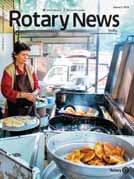
Maharaj Birmani and his wife Roma from RC Deolali are doing wonderful service (Jan cover story) offering puri-bhaji to the working community for 28 years. What a remarkable job they’ve been doing, leading Birmani to say proudly: “Nobody sleeps hungry in Deolali.”
Let us congratulate this couple for their marvellous work and may God bless them with a long life. RI director Muruganandam has penned a meaningful message with the headline Keep glowing, keep growing.
Thenew RI President-elect’s theme Create lasting impact is perfect for the cover story on RC Deolali’s Maharaj Birmani. I was astonished by his noble deed and Service above Self attitude. Such service creates lasting impact on society, and boosts Rotary’s public image.
Sajan Suresh, RC Kalpetta — D 3204
ThePublic image is one of the significant pillars of Rotary along with membership, Rotary Foundation and service. “For the world to support us, the world must see us and understand us,” he rightly says. We must keep the Rotary banner high in the horizon.
S Mohan, RC Madurai West — D 3000
Greetings for the new year to you and your team. We all admire the commitment, dedication and finesse with which you have been spreading the magic of Rotary month after month all these years.
This morning, I picked up the Jan issue, and like always, read your note — Peace Matters first. While I totally agree with the message of peace, I suggest that as Rotarians we should avoid taking a stand in favour of or against any groups/communities in the world. If you feel that Palestinians are a persecuted lot, there are those who feel otherwise. So let’ s avoid taking such conflicting stands. This is not only my personal opinion, but the view of many which I hope is taken in the right spirit.
Sunil Goyal
RC Nilgiris – D 3203
cover story, 28 years of compassionate efforts to end hunger, was heartwarming. What a wonderful person Birmani is. His longstanding and nutritious food service has improved the health of poor workers. At IKYAM Feeding Hope, we do weekly meal distribution. Last year, we provided 2,556 meals. Birmani’s service is inspiring. This year, I plan to improve this charity. Thanks to the author for the wonderful article.
Shiva Perumal Subramani RC Walajapet — D 3231
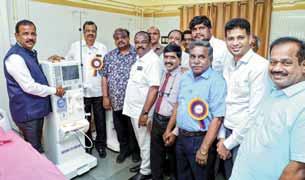
RI President Francesco Arezzo’s message (Dec issue) was superb. Kudos to RC Trivandrum Central for providing a mobile blood bank to meet the city’s growing need for blood, which helps to save the lives of patients, accident victims and surgical cases.
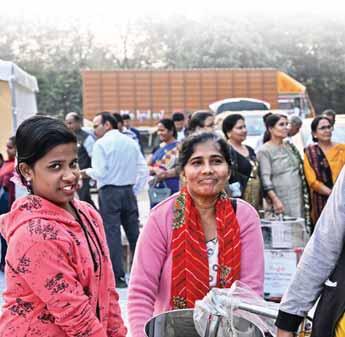
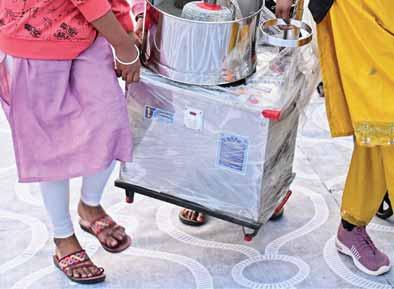
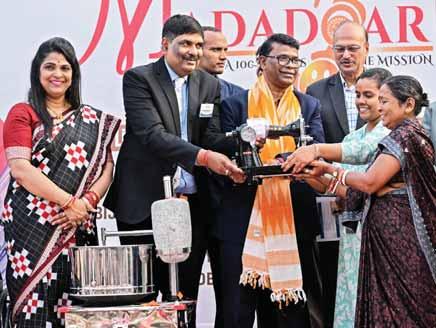
Congrats to RID 3233 for helping 200 women, an economic empowerment dream, by providing sewing machines and skill training to become economically self-reliant and take care of their families.
Muthukumaran’s article Let’s finish polio once for all was fantastic. Gita Mathai's column on B12-the key to nerve health was informative. Congrats to her. We must include such topics in our Rotary News regularly.
Daniel Chittilappilly
RC Kaloor — D 3205
My heartfelt gratitude to you and your hard-working team for publishing the various community projects of RC Imphal in the November issue.
A big thanks to Jaishree for the meaningful write-up Transforming lives in Manipur that highlighted the initiatives undertaken by our club. This coverage has boosted the morale of our club and helped us to reach a wider audience, inspiring others to join our cause. We are grateful for your commitment to showcase community projects and look forward to continued collaboration with more such insightful articles.
N Muhindro Singh RC Imphal — D 3240
Rotary’s 121 years journey is a testimony to its impact in shaping today’s world. The presidential message
Create lasting impact is a clarion call to ‘people of action’ across the globe to ‘act to impact’ locally, globally.
Murali Krishna RC Berhampur – D 3262
OntheSidelines, detailing some interesting moments at the Tejas Institute, written in a lighter style, is interesting to read. Another one, When Science rolls in has showcased practical demonstration of experiments by students through Rotary initiative. We appreciate the efforts of Editor Rasheeda Bhagat and her team in making Rotary News interesting and readable.
Radheshyam Modi RC Akola — D 3030
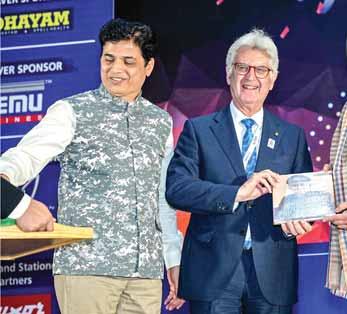
We felt honoured to read the article When Science rolls in as it captured the essence of RC Virudhunagar’s close-to-heart project, Vigyan Rath, in partnership with Idhayam. Jaishree has compiled the details, clearly underlined the impact and benefits of the project and acknowledged the benevolent members whose contribution was instrumental in its success.
Our thanks and appreciation for your recognition of this initiative as it inspires us to continue striving to do more and do better in our service endeavours. Thank you, madam.
PDG V R Muthu RC Virudhunagar — D 3212
Rahul D Shah’s article How AI can transform Rotary’s work was very good and simple, but in detail as it touched issues related to this emerging tech. This article lucidly explains for Rotarians how they can use digital technologies like AI for their clubs and networking activity. The analysis concludes with a touching statement that “AI is a tool that enhances our
LETTERS
An incredible article on mental health
Ijust finished reading the article Stopbottlingup by Vidhya Subramanian in the Jan issue and felt compelled to reach out. The spouse of a hotshot director often remains in the shadows. But this article by such a spouse (of PRID Raju Subramanian) places her exactly where she belongs — a person of immense courage, encouraging others to seek help, and being available when such help is sought.
Your words were incredibly timely and brave. We often talk about service and leadership, but this piece reminded me that we cannot pour from an empty cup. I was particularly moved
ability to serve, but should not be a substitute for our values.” Compliments to the author.
P S Kamaraj Pillai RC Salem Gymkhana — D 2982
I read with interest A leadership journey like no other that turned the spotlight on our soldiers who guard our country on difficult terrains. It was a goosebumps moment for me to read it. My compliments; do publish such inspiring features and articles.
A Guna Seelan, RC Bhavani Carpet City — D 3203
I’d like to thank her for being such a strong advocate of mental wellness and for encouraging us to break the silence. The work that she and the RID 3141 team are doing with the podcasts is truly groundbreaking. We need more voices like theirs to remind us that it’s okay to prioritise our own peace.
I do hope PRIP Gordon McInally has read this article. He will truly appreciate it.
PRIP K R Ravindran
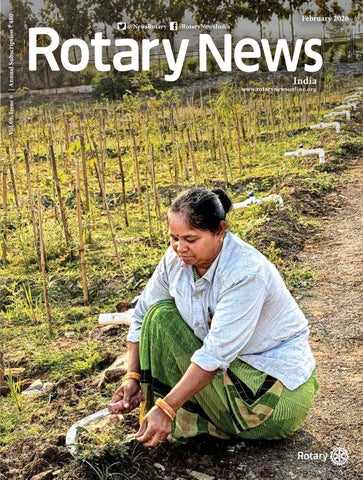
On the cover: A Miyawaki forest developed by RC Bhavnagar. Picture: Rasheeda Bhagat by the point on how “too much tolerance” can actually be self-destructive. It’s a perspective we rarely hear, especially in our circles where we are taught to adjust and persevere.
Have you read Rotary News Plus?
This online publication is sent to the e-mail ID of every subscribing member. Read Rotary News Plus on our website www.rotarynewsonline.org
We welcome your feedback Write to the Editor: rotarynews@rosaonline.org; rushbhagat@gmail.com. Mail your project details, along with hi-res photos, to rotarynewsmagazine @gmail.com. Messages on your club/district projects, information and links on zoom meetings/webinar should be sent only by e-mail to the Editor at rushbhagat@gmail.com or rotarynewsmagazine@gmail.com.
WHATSAPP MESSAGES WILL NOT BE ENTERTAINED.
Let action define us
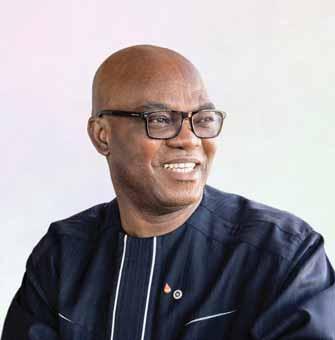
At last month’s International Assembly, President-elect Olayinka “Yinka” Hakeem Babalola called on members of the Rotary world to live out our presidential message for the 2026–27 Rotary year: Create Lasting Impact
This February, as we observe Peacebuilding and Conflict Prevention Month, we have an opportunity to channel Yinka’s call to action into real change.
Peace is not simply the absence of war. A life free from conflict but marked by hunger, instability, or the inability to care for one’s family is not true peace. Peace requires liberty, opportunity, and respect for human dignity. Yet fear often blocks that path — fear of change, of cultural loss, of people we don’t understand.
Fear isn’t defeated through avoidance or aggression. Knowledge is the first step toward peace. Rotary embraces this idea. Our Rotary Peace Centers and their peace fellows, along with other peace education initiatives, demonstrate how knowledge builds trust and helps communities find solutions to conflict.
In Colombia, decades of conflict have left deep wounds. The 2025 Rotary Foundation Programs
of Scale awardee, Pathways to Peace and Prosperity, partners with the United Nations World Food Programme to expand opportunity, improve conflict resolution, and connect people with social services. Its goal is to break cycles of violence, poverty, and food insecurity so peace can take root.
In Maharashtra, India, People of Action honoree Swati Herkal built peace through prosperity. Her project confronted farmers’ declining soil health, rising debt, and illness caused by chemical fertilisers. She and her Rotary partners launched a regenerative agriculture programme that revitalised the land, lowered costs, and restored stability. More than 1,100 farmers now participate and over 50 villages have adopted the model.
Rotary also advances peace by restoring dignity. In Chad, Rotary Peace Fellow Domino Frank discovered that more than 1,500 women who fought in a rebellion had been erased from reintegration programmes. His advocacy led to Chad’s first Rotary Foundation global grant and the creation of Corridors of Peace. More than 100 women — triple the goal — completed literacy and vocational training and formed a cooperative to support their families.
From Colombia to India to Chad, the lesson is clear: Peace is not a dream. It is the result of sustained action with a focus on true, lasting impact. To replicate these successes, Rotary clubs can take three steps: Learn from peace fellows and other peace experts in our organisation, apply a peacebuilding lens to community assessments, and prioritise impact over ceremony.
In a world filled with fear, Rotary cannot be satisfied with half-measures and empty words. If we are truly people of action, then action must define us. Together, we can Create Lasting Impact — across the globe, in our communities, and in ourselves.
Francesco Arezzo President, Rotary International
India stands tall and triumphant at International Assembly
It is no secret that India has impressed the Rotary world in the last decade on several counts; growth in membership in an era where Rotary’s pioneering nations have seen a worrying drop in numbers. Also, from once a nation that constantly sought funds from The Rotary Foundation to do service projects, we have steadily become a ‘giving’ country, and emerged as the second highest giver to TRF in the last few years.
But at the recently concluded International Assembly in Orlando, where the incoming district governors undergo rigorous training, India truly emerged the superstar. First came the jawdropping announcement from RID 3192 DGE Ravishankar Dakoju that his wife Paola and he had decided to donate around 85 per cent of their wealth — an approximate $50 to 60 million — to The Rotary Foundation. Given the present exchange rate, the figure comes to a staggering `500 crore or so.
in a muted and nuanced tone, that if you want to help your fellow human beings, and restore some of the lost glory of Mother Earth, TRF is the place.
But India’s triumph at Orlando didn’t halt with the Dakojus’ display of generosity. RI Director M Muruganandam, who is presently the chair of Rotary News Trust (2025–26), was named Rotary’s vice-president for the coming Rotary year (2026–27). He becomes only the fourth Indian to get this high office. BT Thakur (1946–47), Shapoor Billymoria (1949–50) and Nitish Laharry (1953–54) held this position while serving as RI directors. Laharry of course went on to become the first Indian RI President. Small wonder that his appointment was greeted with much joy by the euphoric Indians present in Orlando.
If we keep aside the numbers for a moment, it was really the humility with which Dakoju and Paola presented themselves at the podium, the sombre manner in which the man delivered the moving, brutally honest and simple speech that summed up his seven decades on the planet, that moved the assembled Rotarians and their spouses resulting in standing ovations… during and after the speech.
Many senior Rotarians commented that this is in all probability the single largest donation ever made to the Foundation. With one stroke the couple from Bengaluru reinforced in the minds and hearts of Rotarians faith in the power of TRF, through its million-plus army of Rotarians, to do good in the world. The gesture screamed, though Rasheeda Bhagat
India’s moment at the IA was summed up neatly by past RI President KR Ravindran, who wrote in a forum for senior RI leaders: “It is impossible not to reflect on how prominently India featured in these last few days — through leadership, example, and values that resonate deeply with the spirit of Rotary. Ravishankar was, quite simply, the toast of the Assembly… his actions have redefined the scale of personal commitment to Rotary.” He hailed him for his “heart-moving eloquence, courage, conviction and generosity that very few human beings are capable of.” Ravindran added that Muruganandam’s appointment as VP “is a moment for us to celebrate a leader whose relentless pursuit of Rotary’s philosophy and ideals has propelled him to this responsibility.”
TPeace is built quietly
he recently concluded International Assembly is a powerful reminder of what Rotary truly represents. When Rotarians from every corner of the world come together, the conversations may differ, the contexts may vary, but the purpose is unmistakably shared. Across continents and cultures, Rotary continues to be a force that builds stability, trust and hope — often quietly, and almost always without fanfare.
February, as peace building and conflict resolution month, invites us to reflect on a truth we do not speak about often enough: peace is rarely created in one defining moment. It is built patiently, through everyday actions that reduce inequality, restore dignity and create opportunity. When a community gains access to healthcare, when education replaces exclusion, when livelihoods bring selfworth, and when young people are given direction instead of despair, peace takes root. Rotary’s grassroots projects — small or large, yet deep in intent — have been doing exactly this for decades.
From an international perspective, what stands out is how consistently Rotarians “punch above their weight.” Our clubs may not always command headlines, but their impact is tangible and enduring. These local efforts, repeated thousands of times across communities, quietly strengthen the social fabric — first at the grassroots, then across regions and nations. It is a contribution to peace that deserves greater recognition, even as it remains rooted in humility.
The International Assembly also offered a glimpse into the direction Rotary is shaping for the future. The Presidential message for 2026–27 speaks of creating lasting impact — a message that resonates strongly with what we are already doing today. Preparing our clubs for the future
Director speak
does not require dramatic change; it requires focus. Focus on meaningful service, on continuity rather than one-off efforts, on projects that are measurable, scalable and rooted in real community needs. What we begin now, we will carry forward with greater strength in the years ahead.
Peace is also inseparable from health, and Rotary’s fight against polio remains one of the world’s most powerful examples of collective action for peace and humanity. As we edge closer to eradication, our responsibility does not diminish; it intensifies. Every contribution to PolioPlus is amplified through the extraordinary 2-for-1 match by the Bill & Melinda Gates Foundation, turning generosity into exponential impact. Supporting this cause is not just about ending a disease; it is about keeping a promise the world made together.
As we move through the remaining months of this Rotary year, the way forward is clear. To sustain and multiply our impact, we must grow our membership with care, engage our communities with sincerity, and invite stakeholders to be partners in our journey. Growth is not about numbers alone; it is about how people feel when they walk into a Rotary meeting, and whether they see purpose, warmth and relevance in what we do.
Rotary’s story is one of quiet leadership and enduring service. If we continue to validate our work through results, tell our story with authenticity, and stay committed to highimpact service, we will not only strengthen Rotary; we will help build more peaceful, resilient communities.
And that, surely, is Rotary at its very best.
KP Nagesh RI Director, 2025–27
Convention
Do it! Make Taipei your first Rotary International Convention. Here are five reasons from other first-timers:
1. Take time for your passion
Give yourself a break from the daily grind to delve into topics that interest you most. Explore Rotary Fellowships and Rotary Action Groups to join. Learn about new service opportunities at member-led breakout sessions.
2.Supercharge your service
At the convention, you’ll begin to grasp the reach of this global network and how it can amplify the impact of one person’s idea.
downtime, make a vacation of it. After all, you’ll be in the heart of Taipei, a city rich in culture and oneof-a-kind experience.
5.Nurture your network Rotary friendships are a path to happiness and meaningful connection, and the convention is a great place to build them.
3. Make Rotary what you want it to be
Gather ideas to take back to your club, deepen your contributions to your favourite Rotary area of focus, and network to grow in your profession.
4.Relax and recharge
Refill your well of positive energy with world-class speakers and main stage entertainers. During your
Mena Dant knows that firsthand. Working from home, she missed “hugs, smiles, and other people’s energy” and needed some fun to restore work-life balance. So she joined the Rotary Club of Tualatin, Oregon, and became a convention first-timer last year in Calgary, Canada. Dant wants you to know you’ll have a great time, too, in Taiwan June 13–17 even if you don’t know many attendees. Hit the House of Friendship and meaningful conversations will follow. “You walk in and everybody’s friends,” she says.
Learn more and register at convention.rotary.org
Governors Council
RID 2981
RID 2982
RID 3000
RID 3011
RID 3012
RID 3020
RID 3030
RID 3040
RID 3053
RID 3055
RID 3056
RID 3060
RID 3070
RID 3080
RID 3090
RID 3100
RID 3110
RID 3120
RID 3131
RID 3132
RID 3141
RID 3142
RID 3150
RID 3160
RID 3170
RID 3181
RID 3182
RID 3191
RID 3192
RID 3203
RID 3204
RID 3205
RID 3206
RID 3211
RID 3212
RID 3231
RID 3233
RID 3234
RID 3240
RID 3250
RID 3261
RID 3262
RID 3291
Thhis pe froom D
Leone J
Sivasundaram P
Karthik J
Ravinder Gugnani
Amita Anil Mohindru
Kalyan Chakravarthy Y
Dnyaneshwer P Shewale
Sushil Malhotra
Nisha Shekhawat
Nigamkumar L Chaudhari
Pragya Mehta
Amardeep Singh Bunet
Rohit Oberoi
Ravi Prakash
Bhupesh Mehta
Nitin Kumar Agarwal
Rajen Vidyarthi
Ashutosh Agarwal
Santosh Madhukar Marathe
Sudheer V Lature
Manish Motwani
Harsh Virendr Makol
Raam Prasad S V
Ravindra M K
Arun Daniel Bhandare
Ramakrishna P Kannan
Palaksha K
Sridhar B R
Elizabeth Cherian Paramesh
Dhanasekar B
Bijosh Manuel
Ramesh G N
Chella K Raghavendran
Tina Antoney Kunnumkal
Dhinesh Babu J
Suresh V
Devendran D
Vinod Kumar Saraogi
Kameswar Singh Elangbam
Namrata
Amit Jayaswal
Manoj Kumar Tripathy
Ramendu Homchaudhuri
This periodical is published by PT Prabhakar from Dugar Towers 3rd Floor, 34, Marshalls Road, Egmore, Chennai 600 008, on behalf of Rotary News Trust, edited by Rasheeda Bhagat and printed by Rasi Graphics at 40 Peters Road, Royapettah, Chennai 600 014, India.
Rooad, E Rootary y annd priin Rooyape e
C Contriib
C Conteen a a att
Contributions are welcome but will be edited. Content can be reproduced with permission and attributed to RNT.
Board of Trustees
M Muruganandam RID 3000
RI Director & Chairman, Rotary News Trust
KP Nagesh RID 3191
RI Director
Dr Bharat Pandya RID 3141 TRF Trustee
Rajendra K Saboo RID 3080
Kalyan Banerjee RID 3060
Shekhar Mehta RID 3291
Ashok Mahajan RID 3141
PT Prabhakar RID 3234
Dr Manoj D Desai RID 3060
C Basker RID 3000
Kamal Sanghvi RID 3250
Dr Mahesh Kotbagi RID 3131
AS Venkatesh RID 3234
Raju Subramanian RID 3141
Anirudha Roychowdhury RID 3291
Gulam A Vahanvaty RID 3141
Executive Committee Members (2025–26)
Rohit OberoiRID 3070 Chairman, Governors Council
Dnyaneshwar ShewaleRID 3030 Vice Chairman, Governors Council
M K RavindraRID 3160 Secretary, Governors Council
Chella K RaghavendranRID 3206 Treasurer, Governors Council
Editor
Rasheeda Bhagat
Deputy Editor
Jaishree Padmanabhan
Administration and Advertisement Manager Vishwanathan K
Rotary News Trust 3rd Floor, Dugar Towers, 34 Marshalls Road, Egmore Chennai 600 008, India. Phone: 044 42145666 rotarynews@rosaonline.org www.rotarynewsonline.org
Magazine
Message from TRF Trustee
Chair
Building peace at scale
February is Peacebuilding and Conflict Prevention Month, a perfect time to reflect on The Rotary Foundation’s mission to advance world understanding, goodwill and peace. Whether improving health, supporting education, or alleviating poverty, peace is at the heart of everything Rotary does.
Rotary Peace Centers bring our ideals into the world by training the next generation of peacebuilders. Since 2002, more than 1,800 Rotary Peace Fellows have become catalysts for peace in over 140 countries.
I am often asked whether our peace fellows continue working for peace after their studies. The answer is a resounding yes. Many serve in United Nations agencies, governments, nongovernmental organisations, and groups they’ve founded themselves.
Recently, I met with the recipients of our latest Programs of Scale award, Pathways to Peace and Prosperity in Colombia. This $3 million partnership with the World Food Programme is establishing four peace hubs that will train 1,000 people in conflict resolution and support 700 entrepreneurs in communities touched by conflict.
During the meeting, I thought I recognised one participant as Brigitta von Messling, a German peace fellow I worked closely with in Berlin 13 years ago. But so much time had passed I wasn’t sure. When I asked Gladys Maldonado, a leader of the Colombia initiative, she confirmed it was Brigitta:
Brigitta is based in my city, Cúcuta, and is an active member of my Rotary club. She does wonderful work with the United Nations as an observer of the 2016 peace agreement Colombia signed with rebels. She even travels to remote locations in the Catatumbo region, an area of northern Colombia that has experienced violence by armed groups.
She has my utmost admiration. I had the good fortune of meeting her three years ago. She’s incredibly intelligent, with a gift for recognising the strengths of others. Brigitta is invaluable to my country, my city, and my Rotary club. She connected me with the World Food Programme so we could build the Programs of Scale project, which has filled my city and country with hope.
What Gladys said about Brigitta echoes so many stories we hear about Rotary Peace Fellows worldwide: They are invaluable. They remind us that peace is built one person at a time.
Your support of The Rotary Foundation opens countless opportunities for transformation.
Holger Knaack TRF Trustee Chair
Rasheeda Bhagat
RC Bhavnagar does sustainable, impactful projects
As I zip through some iconic projects done by the Rotary Club of Bhavnagar, RI District 3060, such as their Ray of Hope project where children who have never seen the inside of a school are huddled over books in different groups in a spacious hall at the Rotary Centre built by the club, or 25-odd terminally ill senior citizens getting dignified and compassionate care at the Rotary Karunalaya, the words uttered by past RI President Kalyan Banerjee, in a casual conversation, come to mind.
“In so many different ways, Rotary in Gujarat, I tell you, is very special… unknown, unheralded, but always vibrant and on the job when it comes to community service projects, and RC Bhavnagar is no exception. You should visit the place someday.”
Well, it took me a couple of years… no less, but driving back from Bhavnagar to the Ahmedabad airport on the slick new and smooth Expressway, I console myself… der aaye, durust aaye (better late than never)!
The bunch of Rotarians led by club president Kaushal Sheth, including PDG Pradeep Gohil, take me around the projects the club, one of the largest in RID 3060 with 150 members and started 81 years ago, is running.
Rotary E Library
The first stop is at the Rotary E Library, where a group of youngsters are glued on to either their mobile phones, computers or textbooks. No, they are not playing games or chatting on their phones. They are downloading or browsing study material in preparation for their entrance exams. At this brightly lit and spacious library, started in 2015 at a cost of `15 lakh (substantially big money 10 years ago), which included a donation of `3 lakh given by Dr Ramniklal Mehta, aspirants for as many as 75 different vocations can access study material to prepare for entrance exams for banking
and insurance services, IAS/IPS and other police posts, engineering jobs in the government sector…. “You name the competitive exam and our library can give you access to either text/reference books or online material which can be downloaded,” says Umang Desai, past president of the club.
Initially the library service, which is virtually free, charging a paltry annual membership fee of ` 500, began with books and printed material. “Over the years we got a few computers where students can access online study material — there is unlimited wi-fi service available here — but we now find that even the use of computers is decreasing as those coming here can download everything on their mobile phones. So many exams are being offered online now.”
PDG Gohil adds that periodically mock exams are conducted at the centre. Over 10 years, about 1,500 students have benefitted from this library, and of the `15 lakh spent, half has been given by corporates and the other half has been raised through donations.
Kinjal, who is seated here, wants to become a PSI; to my puzzled look she says “Police sub-inspector!” Why, I ask and she says simply: “Because I have always dreamt of wearing the police uniform.” She has been coming to this library to prepare for her entrance exam for one year, and admits “that I simply love coming here, because it gives me a chance to study without any disturbance.”
Kaushal Joshi is preparing for his CA Foundation exam; “I can get my hands on a lot of material, which I can access both online, and study through books available here. … it is actually a six-month course, but I couldn’t clear it in my first attempt, so am repeating. But I am confident that I will get through this time,” he smiles.
Both the youngsters were here, along with the others, when the library opened at 8.30am, and Gohil says that they will
Children learning at the Rotary Centre of RC Bhavnagar.
probably remain here till it closes at 7.30pm. Adds Desai, “You must have seen a bunch of tiffin boxes on the ground floor. There is a beautiful garden close by; they all come in the morning, bringing their lunch boxes from home, and in the afternoon, they will take their lunch break in the garden.”
I ask who are these youngsters, where do they come from, and realise on hearing the answer what a prized sanctuary this must be for the job aspirants. “Many of them come from far-flung villages; they all belong to lower middle and middle classes. Most of them live in one-room homes and do not have at home the privacy or conducive atmosphere required for a concentrated study in order to prepare for their entrance exams.”
Adds Desai, “With the help of this library so many have passed their exams and have become police subinspectors and got jobs in so many different vocations. Many times parents used to come and thank us profusely for providing this place for their children to study. The two children of our Rotary Centre caretaker you wrote about (Rotary News, June 2025), both used to come and study here.” (While one sibling has become an IT engineer, his sister has got a job with the Gujarat Electricity Board).
One crucial requirement for all these young job seekers is some level of proficiency in English grammar and taking care of this aspect is past president Purnima Mehta, a retired English professor, who comes here and helps the youngsters with the language. Periodically, the Rotarians also groom them in communication skills; how to manage interviews, how to present themselves and conduct mock exams.
Miyawaki forest
A current project which is getting all the energy and enthusiasm of the core team of the club is the development of
Above: Standing (from L): Tarak Dholakia, Yogesh Kanakiya, Manish Vakil, Rakesh Kanada, Tejas Thakkar, Neeraj Joshi, Jiten Shah, Shahin Lalani, Chetan Kamdar, Ketan Parekh, Bhavesh Shah, Punit Mehta and club secretary Mahipal Rana. Sitting (from L): Parth Dave, Jigar Trivedi, Umang Desai, club president Kaushal Sheth and Parag Shah.
Below: Women participants at the Rotary Sports League.
Above
for
Left & Right: Youngsters preparing for competitive exams at the Rotary E Library.
& Below: Literacy programme
children from the slums and construction sites at the Rotary Centre.
a Miyawaki forest bang in the heart of the city, on a 10,000 sq metre plot given to them by the Bhavnagar Corporation. Club president Kaushal Sheth explains that the Rotarians have already planted about 25,000 trees in the form of canopies and local, fast-growing varieties have been chosen. “Three years ago, we had tried to do a similar project on Railway land, but the project could not materialise for various reasons. This time we got the necessary permissions, corporate funding and started the work before the monsoon.”
The project will cost around `25 lakh, and a major chunk of the funds — around `18 lakh have been committed by one of their CSR partners — Tamboli Casting — which has given around `20 lakh, and the rest has been collected by the club through donations. He explains that the corporate partner has been roped into this project, thanks to the Rotary Sports League, an annual sports tournament the club organises exclusively for corporates, to give their employees an opportunity to play and compete in one of the four games — cricket, table tennis, badminton and volleyball. “You will see tomorrow, at the inauguration of this year’s tournament how by conducting it for the last 20 years, our club has got sustained corporate funding for our service projects,” he beams. The CSR sum raised is an impressive `4 crore!
Giving details of the kind of trees being planted, past president and project director Tejas Thakkar says that three different kinds of canopies with local, fast growing tree varieties have been planned, and these will be at different heights — 22 to 25 metres, medium variety of around 15 to 20 metres, and smaller trees that are less than 15 metres in height.
“According to our research and what we saw in some Miyawaki forests we visited over two years, we can get up to 15ft growth in a year. The
Festive atmosphere at the Rotary Sports League.
project will be completed in a month and we have signed a three-year MoU with the Bhavnagar Corporation under which we will maintain this place.”
Desai adds that the Gujarat government is building oxygen parks across the state, and “in our discussions, the corporation authorities specified this should be developed as an oxygen park. Well, some call it that, others urban or Miyawaki forest, but the idea is to green the places we live in. The basic concept is that you plant native trees very close to each other so that they compete with each other, both for food and sunlight, and in the process, grow much faster!” There is a lake adjoining this park, and the Rotarians are allowed to use that water for the trees.
The transformation is visible; from a dirty, unkempt piece of land where the overflowing lake water was stagnating, the Rotarians have created a green lung for the city, with proper walking path, a fence to keep out stray animals and even planned for parking space for a few vehicles. Lighting has been avoided to encourage birds to come in; later butterflies also will be introduced. Some mulberry trees have already started yielding fruit, and are attracting birds already.
In so many different ways, Rotary in Gujarat is very special… unknown, unheralded, but always vibrant and on the job when it comes to community service projects, and RC Bhavnagar is no exception.
Kalyan Banerjee Past RI President
At the glittering, spanking clean and spacious hall at the Rotary Centre, I find several children pouring over textbooks, engaging in a dialogue with their teachers, or taking notes. There is a vibrant buzz in the air, chatter, and the kind of cheer and positive energy that a group of children can spontaneously inject into any setting or gathering.
A Ray of Hope
We next visit the Rotary Karunalaya which is a hospice and rehabilitation centre for terminally ill patients who will no longer benefit from further medical care. (Await a detailed report in a subsequent issue of Rotary News).
But the project that really touches the heart and reinforces the difference Rotarians are making in the lives of Bhavnagar’s less fortunate citizens is the one titled Ray of Hope — Child Educare Centre, through which children of the poorer classes who either have no means for or see no merit in education, get a shot at learning… and thus a future.
One of RC Bhavnagar’s longest projects which was started in 1988 when Manish Kothari was club president, its objective was to provide educational opportunities to poor and underprivileged children, particularly those living in slum areas or in tents put up at construction and other sites where daily wagers bring their children. Earlier, Kothari had told me in an interview (Rotary News, June, 2025) that in the initial years, “when the poor did not give much importance to education, we had to literally lure the children to the Educare centre by offering them snacks, new clothes, toys, and retain them by telling them interesting stories and offering fun activities.” His sister-in-law Parulben Kothari was a regular teacher and was recently given an award for meritorious service by RI.
As the centre started getting more children, other Rotary Anns started volunteering, teaching the children alphabets, numbers first and then reading, writing and various subjects.
“Even today, the food we give them, as well as uniforms and other clothes, is a big draw and brings the children here. They are from absolutely poor families, and as they are not in school, they loiter on the streets, and start stealing and indulging in all kinds of nefarious activities,” says PDG Gohil.
As the children got hooked and started learning quickly, the Rotarians first got them admission into government schools, later sending the brighter ones to private schools. Many of these children have graduated and have become engineers, accountants, nurses, pharmacists and got government jobs too. “So many of them, now successful and working in Bhavnagar, come back regularly here to teach our students. And that is very touching for us to see,” says club president Sheth.
Teaching one group of eager young students is Jyoti Manish Vakil, who tells me she comes on all five days of the week, to teach the children. “No, no, I have no experience as a teacher, but I have been coming here regularly for the last 27 years,” she beams.
Jyoti is a member of Rotary Club of Bhavnagar Vibrant, an all-women’s club. She teaches the children social science, Gujarati language, English and Hindi. She “simply loves coming here daily; it gives me such a huge sense of fulfilment,” she smiles.
Taru Thakkar is the mother of past president Tejas Thakkar and has been coming here for over two decades. She just loves to teach the children how to read properly. “They can read Gujarati, but they have very little confidence. So I teach them how to read with confidence… communication skills are so important.” She teaches them to read Gujarati, English and Hindi. The first
one in Bhavnagar to start a beauty parlour in 1977, she has now handed over that business to her two daughters-inlaw and gives all her energy to what she loves best — teaching these children.
Elsewhere, in another cluster, a group of children are debating enthusiastically all about buying and selling of vegetables… the distribution, the market chain, and so on.
aches
gular schools — either munical
o se w h o s h ow erest
Past president Purnima, who also teaches English here, says so many of the children coming here get into regular schools — either municipal or private — and those who show interest and talent are helped to get into colleges.
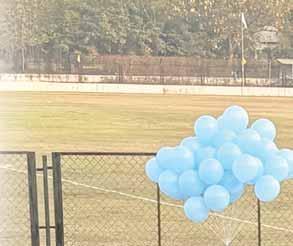
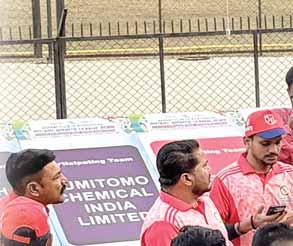
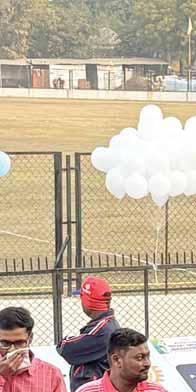
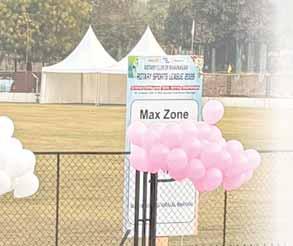
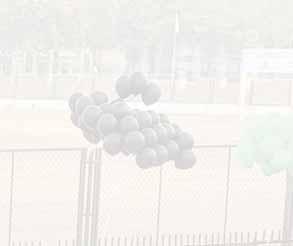
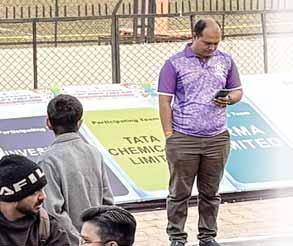
morning to the vast, sprawling grounds of the Bhavnagar University where the two-day sports tournament being conducted by RC Bhavnagar exclusively for corporates is being held. This is the 20th year of RSL; the air is festive, there is music and colourful balloons ready to be released for the inauguration and this year, teams from nine different corporates will compete in the four games of cricket, volleyball, table tennis and badminton.
t are get i nto ll eges. We h ave v en t h e ild r e n o un d cles, which lp them comu t e fr o m t heir mes and back. Many the Anns them me-made ildren also them equate We them hool sweaters raincoats.”
“We have given the children around 75 cycles, which help them commute from their homes and back. Many of the Anns bring with them home-made snacks which the children enjoy and also it gives them adequate nutrition. We also give them school bags, sweaters and raincoats.”
Rotary Sports League
otary
wind up my visit to e next day by going nippy
I wind up my short visit to Bhavnagar the next day by going on a nippy p
Giving details of this tournament, past president and tournament committee chair Chetan Kamdar says the basic idea in starting this tournament for corporates 20 years ago was to connect corporates with Rotary. “The idea of CSR came later. We had thought that if corporates join Rotary in any way, or partner with us, then it will be easy for us to get funds for our service projects.”
With a chuckle, he recalls how “tough it was 20 years ago to organise such a tournament… because the corporates looked at all the minute details, and even worked out that if my person plays one ball, it will cost me around `750!”
But as the club connected with more corporates, first in and around Bhavnagar, and later entire Gujarat, things improved. At the venue each year, a prominent banner is put up detailing the service projects done by the clubs in the city. Thanks to this relationship with corporates, carved out two decades ago, the club has managed to raise nearly `4 crore of CSR funding for its
service projects. This is apart from the sponsorship for the tournament.
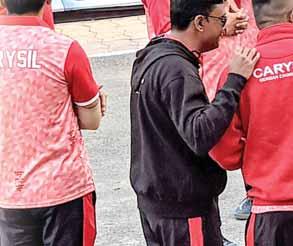
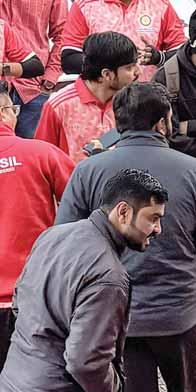
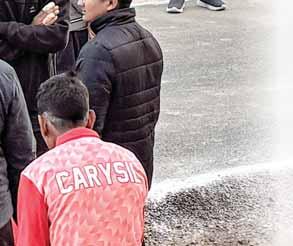
The tournament raises each year around `15–20 lakh depending on the number of teams participating; this year there are nine, and sometimes the number goes up to 16. “More than that we cannot manage.” CEO of Carysil Ltd Chirag Parekh is present at the venue; Carysil is one of their main sponsors and gives each year `4 lakh; co-sponsors give `2.5 lakh each. And each participating corporate has to pay a fee of `75,000 for the organisation, venue rent, food etc. After all expenses, a surplus of `8–10 lakh or so is generated, which is used for the club’s projects.
This year, for the first time, and following Indian women’s team winning the World Cup in cricket, each team was asked to compulsorily send one woman player. “Yesterday, in your talk you stressed the importance of gender justice; this is our way of ensuring gender justice. Yes, it is only one player in 10, but still, it is a beginning.
(In this tournament the cricket team has 10 and not 11 players).”
The corporate partners at the tournament include Investment and Precision Castings, Nirma, Tata Chemical, Steelcast, Inarco, Agrocell, Renaissance Jewellery etc.
On their part, the players enjoy this tournament so much, that “they wait all year for it to happen,” says past president of the club Jiten Shah. “And if some prospective candidate looking for a job in one of the competing corporates is good in one of the four games, he is more likely to get the job.”
So what next for the club, I ask the Rotarians. Desai says the club has applied for a global grant of around $65,000 with a partner club in the US. “The money will be raised from some local doctors and a relative of mine from the US is donating $15,000.” When the funds come through, the club wants to provide smartboards to some 50 schools.
Pictures by Rasheeda Bhagat Designed by N Krishnamurthy
Club members at the Miyawaki forest site.
Rasheeda Bhagat
Iam 71 years old. My life was a journey that began in weakness but blossomed into strength. I was born sickly; asthma and eczema kept me in bed for months while other children were at school or playing outdoors. I lost my father at ten. My father had donated every piece of our family land to poor landless farmers as part of a movement in India that encouraged landowners to share their land with the landless.”
With these simple and heartfelt words RI District 3192 DGE Ravishankar Dakoju grabbed the attention and captivated the hearts of the delegates at the recent International Assembly in Orlando. But it hardly prepared them for the spectacular announcement that this unassuming Rotarian, known for his spontaneity and unconventional acts, accompanied by his wife Paola, was about to make. Without any hesitation and discomfort, he traced his life’s journey. And that story was a typical, textbook rags-toriches story.
But what was far from textbook or typical was the magnanimity the couple
DGE Dakoju & Paola create history by donating `500 crore to TRF
RID 3192 DGE
Ravishankar Dakoju and his wife Paola.
— an decide
displayed — Dakoju announced that he and his wife had decided to donate about 85 per cent of their wealth — around 450–550 crore — to The Rotary Foundation. He made this staggering pledge saying: “Years ago, Paola and I shared a dream — that one day, when we have enough to live with dignity, we would return 85 per cent of our wealth back to society. My friends, that day has arrived… and Paola and I are ready to walk that talk.”
85 cent of their wea $50–60 million — 45 Foundation sayin dr eno retur our wealth back to soc tha
I was not the smartest, most educated or most connected. Whatever I’ve achieved so far came from the kindness of people, grace of life, and opportunities Rotary gives.
DGE Ravishankar Dakoju
hile this announcement got a standing ovation, what really made the couple the toast of the Assembly hall, if not the whole event, was the brutal honesty and humility with which Dakoju told his life’s story. He related the sudden death of his father at only 53, leaving behind “seven children, four dogs, and 100 in the bank.” His two brothers had to discontinue their education and take up small jobs. His mother, “less educated and unprepared for the shock, raised us with great difficulty, helped only by the government’s pension, free-schooling, my brothers’ meagre salaries and her extraordinary courage.”
Without any qualms Dakoju related how this tragedy quickly transformed him into a vagabond…. “I drifted… became the leader of a street gang. My friends were jailed, murdered, or lost to alcohol. I sold black market movie tickets; and shoplifted to feed my gang members and failed my school exams
With neighbours ensuring their children kept away from this youngster, he developed an inferiority complex. But then something extraordinary happened. The local community “punished me, only with love. Hungry, I would go to their homes, and not once did those mothers and sisters turn me away. Their kindness became my lifeline.”
hile this a a w the toast of if not the whole ev w told his death of his father at on behind “seven children, only `100 bank ” to up His educated and unprepare raised us with great diff pe my brothers’ meagr any qualm how quick him a vagabond became the leader of a mu to t members and failed three times.” en children he an inferio extraor The local “ Hungry on mothers and sisters turn kindness my li
By sheer “luck and grace,” he got a decent education — a degree and a diploma in marketing. For his first job, for which he commuted taking three different buses, he got a salary of just $2 a month. But suddenly his life changed when he met BSN Hari, who went on to become “more than a family member.” Together they built a thriving real estate business — Hara Housing.
He then “married my college sweetheart, Paola Rodrigues, whose faith and warmth sobered my life. I was a Hindu; she was a Christian. We became parents to two wonderful girls, Ektaa (unity) and Samta (equality).” He tried a brief stint at politics, failing miserably!
One day, his friend Ramesh Chari, invited him to Rotary. “I took to Rotary like a duck to water, loved the service projects; especially those related to the environment and basic education. I admired the selflessness of my fellow Rotarians, always remembering my father, who gave away everything he owned without worrying about himself.”
Gradually his business thrived and just before the Covid pandemic Paola
and he decided to donate about $15 million to TRF, the decision being driven by their belief that “anything beyond our basic needs wasn’t ours to keep. For us, giving was not a luxury; it was a duty.”
The decision was announced when their good friend Suresh Hari became the DG in 2018.
But the coming days unfolded their own mystery; “the more we gave, the more life returned. From that point, miracles began to unfold.”
What they had thought of as sacrifice “turned into unexpected abundance. Opportunities increased. Trust grew stronger. Goodwill enveloped us.” Their two daughters were happily married; his once fragile health improved enough to withstand 16–17-hour work days. “Most importantly, Paola survived cancer! Our company, Hara, which had grown by 20–30 per cent for decades, showed exponential growth.”
New opportunities opened up, all turning into success. A startup called Fish Mongers, which supported and protected marginalised farmers from falling into debt traps, and founded by a group of youngsters, where he is an angel investor and mentor, registered a six-fold increase in just three years.
Another investment he made in a school and corporate transport business, along with RI director KP Nagesh to support their common friend, Neil Joseph, also a Rotarian, grew fourfold in three years. A real estate company started with another Rotarian friend, Ritesh, grew 10 times in four years. He is now investing in social enterprises related to senior citizens’ living, urban waste management and eco-restoration.
To get a sense of how Dakoju’s address, delivered without any fuss or fanfare, with his wife Paola standing quietly by his side, was received by the audience, here is an excerpt from what past RI President KR Ravindran posted in a group of senior Rotary leaders. “A moment that stood out unmistakably was Ravishankar being, quite simply, the toast of the Assembly. He was received not merely as a speaker but as a global figure whose actions have redefined the scale of personal commitment to Rotary. His decision to donate 85 per cent of his personal wealth — $50–60 million (about `500 crore) — to TRF is unprecedented. To the best of my knowledge, this makes him the single largest
A moment that stood out was Ravishankar being the toast of the Assembly. He was received as a global figure whose actions have redefined the scale of personal commitment to Rotary.
PRIP KR Ravindran
individual donor in the Foundation’s history.”
But more of the accolades later. Dakoju continued in his typical, matter-of-fact style. “None of my success came from being extraordinary. I was not the smartest, not the most educated, and certainly not the most connected. Whatever I have achieved so far came from the kindness of people, the grace of life, and the opportunities Rotary brought into my world.”
Taking the pledge, he said, at the present exchange rate “that pledge may be valued between $50–60 million,” and added, after a pause:
“We do this not because we are wealthy, but because we know we have enough to fulfil our needs. The father of our nation, Mahatma Gandhi, had reminded us: ‘The world has enough for everyone’s need, but not everyone’s greed.’ Paola and I believe this deeply. What we keep may serve only our family, nothing beyond that! What we give TRF will serve the entire humanity.”
In conclusion, Dakoju added that Rotary had given him new life, purpose, friendships, meaning and a global family. And life had taught him this beautiful truth: ‘When you give more than you think you can, life returns to you more than you can ever imagine.’
On Dakoju and Paola’s stunning gift to TRF, RI President Francesco Arrezzo posted on Facebook, “This remarkable commitment reflects their deep
belief in Rotary’s mission and in the power of people coming together to Unite for Good. Their generosity will strengthen our global efforts and expand what Rotary can achieve in communities around the world. I am deeply inspired by Ravishankar’s leadership and the shared values he and Paola embody!”
PRIP Ravindran added that the standing ovation Dakoju received, “during and long after his address, was not only for his heart-moving eloquence. It was also for his courage, conviction and generosity that very few human beings are capable of. To witness such a moment was a privilege for all of us present. We must also acknowledge his partner, Paola. A gift of this magnitude is never the act of one person alone; it requires a partner of uncommon strength, wisdom and selflessness. What touched everyone most was the humility with which this remarkable couple carried themselves thereafter.”
Pictures
by Monika Lozinska, RI
Dakoju and Paola with TRF Trustee Chair Elect Jennifer Jones.
With PRIP K R Ravindran.
The Game Changer
Diana Schoberg
OMeet your 2026–27
layinka “Yinka” Hakeem Babalola is sitting on the wrong side of his desk, staring at the tiny squares on the laptop perched in front of him. He’s just finished speaking on a call with 300 Rotaractors from the African continent and other parts of the world, Rotary’s presidentelect explains as he turns down the volume. “They held a celebration for me because I’m a past Rotaractor,” he says. By seeing Babalola, himself once in their shoes, embarking on the highest position in Rotary, who knows how many of the 300 he will inspire.
It’s early October, less than two months since the RI Board of Directors selected Babalola to lead Rotary, in a special session in late August after the resignation of RI President-elect SangKoo Yun, who died shortly after, following months of cancer treatment.
It’s only the second trip to Rotary headquarters for Babalola, of the Rotary Club of Trans Amadi in Nigeria, since his selection. His office is nearly empty, void so far of all the gifts Rotary leaders tend to accumulate during their travels as an incoming president.
While he’s new to the position, he has a long history with Rotary, starting as a Rotaractor in 1984 and then as a Rotarian in 1994. “One thing is for certain, preparing me for this role are my many years of engaging with Rotary” — over four decades, he says. “Not many people who get to this position have that privilege.”
In that time, has served not only as RI vice-president and a member of the RI Board of Directors but also
Rotary President Olayinka Hakeem Babalola.
as an active leader and participant in RI committees such as the End Polio Now Countdown to History Campaign Committee and the Nigeria PolioPlus Committee. Babalola was a trustee of ShelterBox. His Rotary honours include the Regional Service Award for a Polio-Free World, the Service Above Self Award, and a Rotary Foundation Citation for Meritorious Service. He and his wife, Preba, a member of the Rotary Club of Port Harcourt Passport, are Arch Klumph Society members.
That’s all on top of his professional life. He worked for 25 years in the oil and gas industry, holding senior positions with Shell. He is the founder of two companies: Riviera Technical Services Ltd, an oil and gas infrastructure delivery company, and Lead and Change Consulting, an executive coaching and organisational performance advisory group.
Rotary magazine senior staff writer Diana Schoberg sat down with Babalola to find out more about the president-elect.
He was inspired to join Rotary because of something he saw on TV. On summer break between his last year of high school and his first year of college, Babalola was hanging out at home watching TV when a well-dressed man on the screen caught his eye. The man was wearing all white, and “his English was something else,” Babalola recalls. Curious, he listened more closely. The man was talking about Rotary. “It was the first time I heard anything about Rotary,” Babalola says. “Like with most TV interviews, it probably lasted
one or two minutes, but he made an impression on me.”
Fast forward to Babalola’s second year at the university, when the school’s public image director, a member of the Rotary Club of Bauchi, approached him with a proposal: Would Babalola like to help organise a Rotaract club at the school? “I still tell people I have no
idea why he approached me,” Babalola says. He recalled the well-spoken man in white and asked if the director was somehow connected. It turns out the director knew the man on TV, who was the past district governor. Babalola was sold on the connection and went on to become the Rotaract club’s charter president.
He met his wife at a Rotaract meeting. After finishing up his university education, Babalola moved to Port Harcourt and joined the community-based Rotaract Club of Trans Amadi. At one
event, he recalls noticing a beautiful woman, the president of a universitybased club. He pointed her out to a friend and said, “That’s the one.” He was right.
But Yinka and Preba aren’t the only members of their family who have been involved in Rotary. Their oldest daughter was the charter president of the Interact club at her secondary school. She moved to North America for college and today belongs to the Rotary Club of Winnipeg in Manitoba. Another daughter was the president of her university’s Rotaract club.
Rotary’s headquarters building with Rotary Foundation Trustee
Martha Peak Helman and RI Vice President Alain Van de Poel.
His nickname is “the game changer.” Babalola served as district governor in 2011–12 while employed by Shell, a multinational energy company. This was unlike his predecessors, who were either retired or running their own businesses while they held that role. He knew things had to change for him to be successful.
At his first meeting with the assistant governors and committee chairs, he asked them to include what would be the “game changer” in their proposals: how they used to do things, and how their approach would change going forward. “If they have no answer,” he says, “the proposal is thrown away. They need to present it again.”
“It occurred to people that this guy actually wants something different,” he continues. “I’m called the game changer, but the ideas that changed the game were not mine.”
He raised $80,000 with a text message. Part of Babalola’s effort to make changes as DG involved his use of technology. On November 1, the start of Rotary Foundation Month, he woke up around 3am and sent a request to a district group on a BlackBerry messaging app asking everyone on the platform to give something to the Foundation that day, no matter how small. Then he went back to sleep. When he woke up a few hours later, he made his own donation and posted the evidence. Within a few hours, the group had raised $80,000. “Usually, you would gather people together, you’d talk to them, and ask for it,” he says. “But with technology, you could ask virtually.”
That year, every club throughout the district gave something to the Foundation. The nearly $1 million raised was, he says, the highest amount ever from a district on the African continent for TRF.
we see a world where people unite and take action to create lasting change — across the globe, in our communities, and in ourselves.” This Rotary year, Babalola explains, RI has been focusing on that first word, “together,” through the message Unite for Good.
In 2026–27, members will tackle the next part of the vision statement: creating change that lasts.
Lasting change across the globe is an easy idea for most Rotary members to understand, he says.
He wishes he had more time to go scuba diving.
Babalola is certified to dive to 30m and has done some diving in the Mediterranean, the Red Sea, and the Atlantic. He’s looking forward to someday diving in Hurghada, a resort city on Egypt’s Red Sea coast that’s known for its marine life, iconic wrecks, and high visibility in the water. “The reefs are wonderful,” he says.
He also enjoys other outdoor pursuits including swimming, gardening and bird-watching. One of the most interesting birds he’s seen is the Ibadan malimbe, a rare songbird with bright red feathers around its head and face that is found only near his hometown.
The 2026–27 presidential message is Create Lasting Impact.
If you need it, here’s a refresher on Rotary’s vision statement: “Together,
“They can give you examples: our polio eradication work, our peace centres, global grants,” he says. “When you talk about lasting change in communities, they know because they do things in their own communities. But each time I’ve been in a gathering of Rotarians and asked them about lasting change in themselves, usually the room goes quiet.”
He thinks a key to growing Rotary is realising the effect it has on you. While members can and should measure the impact of a project, Babalola wants to see that idea flipped, too. “How has doing all of that impacted you?”
He can clearly see how Rotary has changed his own life. “I had a privileged upbringing — a good education in a place where many did not have that opportunity,” he says. “Rotary grounded me. It pulled me out of my privileged world and put me in touch with the realities of my community.”
Many Rotary members have their own stories about how their membership has changed their lives for the better,
how it humbled them or brought them closer to their fellow human beings. Babalola encourages them to share those stories. “If we are going to grow this organisation, we must let people understand how membership can make a lasting impact on their own lives,” he says. “That’s one of the things I’m hoping that I can help communicate.”
Rotary made him a diplomat. As a Rotary director in 2018–20, Babalola represented more than 80 Rotary countries and geographical areas — over a third of the Rotary world — including countries in Africa (where at least 1,000 languages are spoken), the Middle East, and parts of Europe. The zones he represented included politically sensitive areas such as Israel, Lebanon, Ukraine and Afghanistan. “There are certain skills you end up building,” he says.
For example, at a Rotary institute he convened in Egypt, he received a phone call from a senior government official about a map of Africa used at the event. The map, which he’d found on the internet, showed Western Sahara as a separate country, which Morocco does not recognise. Egypt supports the position of Morocco. “That kind of situation brings a certain awareness straight to you,” he says.
He’s the second president from Africa. “It means a lot for the people of that continent,” he says. And, he adds, everyone seems ready to do the work to support him. “I’m used to delivering results. We need to deliver results,” he says. That’s what he’s been preaching at the Rotary institutes he’s attended. “I’ve told them, stop talking about things. Just do it. If it works somewhere, copy it shamelessly. Don’t be afraid to fail — be afraid not to try.”
Believing firmly that just as children studying in urban elite schools, those studying in modest schools in villages deserve a decent classroom, computer education, well-equipped library and other related facilities, the Rotary Club of Akola, RID 3030, has adopted a rural school with 250 children in Gaigaon, a small village 15km from the city of Akola.
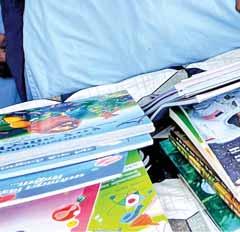
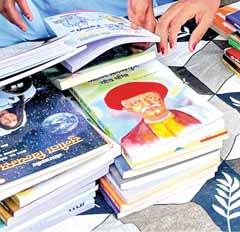
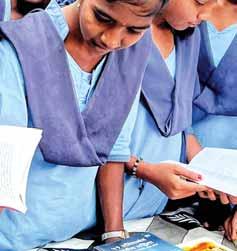
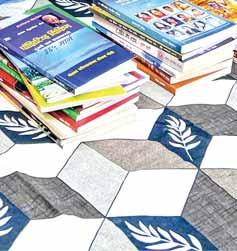
Taking baby steps to improve the learning facilities available in this school, the Rotarians first provided 100 books with pictorial content to the students and quietly watched their response to this gift. Past president of the club Radheshyam Modi who frequently visits this school and interacts with the students, found to his delight that the students, particularly the girls, embraced these books and started reading them with interest. He explained that the decision to acquire books which were rich in visual content and with lots of pictures and illustrations was taken because till then the school had only books with grey text.
And in their interaction with the students, the Rotarians had found them very interested in learning and getting a good education. “But lack of books, that too visually attractive books, has always been the restrictive factor in learning for these children. So when we gave them access to a library filled with books such as
Giving rural children
Raashheeeeda d Bhahaga g t
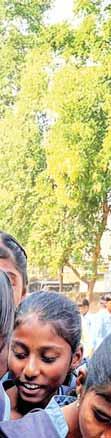
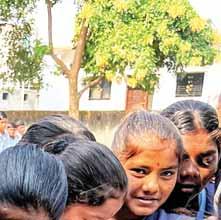
The magic world of illustrated books opens up for girl students.
g gi
“Fr we
the Panchatantra, books by RK Narayan, Sudha Murty and the Marathi writer Pula Deshpande, they immediately got hooked and started reading them.” The project cost a modest `12,000 which was given by some donors. When it was feedback time, expectedly, the Rotarians found that more than 50 per cent of the girls had shown immediate interest and read the books. “From the boys’ side, the response was very poor, but we weren’t surprised, because we find all the time that girls are much more interested in studying and coming up in life,” he chuckles.
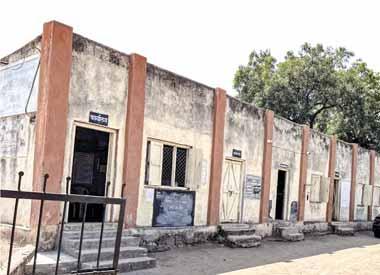
This co-education school — Swami Samarth High School — is in name a private school but the teachers are paid by the government. Apart from this, it has seen little interest from either the entity owning it or the government to improve either the infrastructure or the learning facilities. The children come from poor families of mainly farm labourers, and though the number on the rolls is 250, on an average only 150 to 200 children attend classes, with the missing ones being pressed in to lend a hand to their parents whenever field work is available.
When unemployed youngsters are available, politicians use them for this campaign or that, to raise slogans here or throw stones there. That is the worst way to harness the energy of the young.
Modi, an octogenarian, is a passionate Rotarian, and has been a Rotarian for 50 years now. He has very strong views on how the “quality of education a child gets should not be defined by her pin code, and girls should be particularly encouraged to go to school because they have so many social and cultural barriers that restrict their education. This perpetuates the cycle of poverty and limit opportunities for women.”
An income tax consultant till recently, he has now hung up his boots but is always
thinking of ways to help rural youth. Though 85, he regularly visits this school, driving the 15km either himself or with his driver, now that he has more free time.
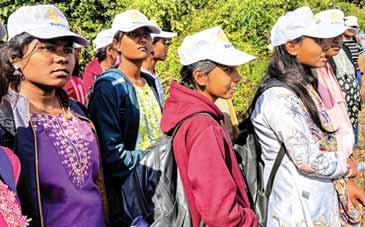
Another project the club organised for this school was a nature study camp in which a busload of about 50 students was taken to the Katepurna Wildlife Sanctuary, about 50km from Akola. The objective was to give them practical knowledge about the diverse flora and fauna, the birds and wildlife in this sanctuary. Interacting with the children during this excursion, the Rotarians found that these students were seeing a forest cluster
and its varied vegetation for the first time. The youngsters learnt about how everything on our planet was meant for both human beings and other living beings, and needed to be shared equitably. The students were mesmerised when they saw the wide expanse of the brimming water in the Mahan Lake.
“We made them walk around the designated trekking range in the jungle area of about 2km, after which
Many Rotary clubs begin the academic year giving educational material… uniforms, books, stationery etc. How long can we continue like this? We have to give knowledge, not charity, to these children.
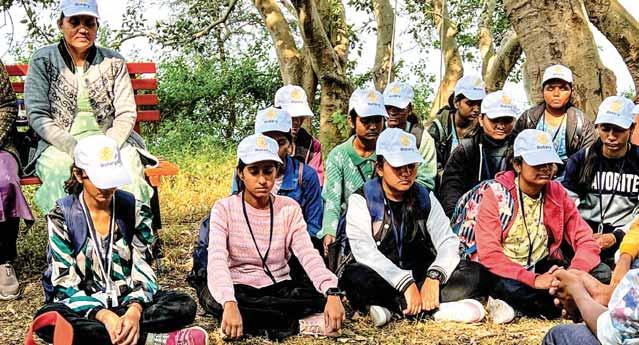
we asked them to sit down for 10 minutes, close their eyes and listen to the chirping of the birds and the sounds being made by the cricket and other creatures in the forest. They saw spotted deer, monkeys, and other wildlife while trekking through the forest. Finding spider webs in the tree branches was a mesmerising experience for them,” said club president Naryosang Taraporewala.
The children were sensitised to the environmental concerns of planet earth, and when asked to spell out their takeaway from this trip, said they will no longer carelessly throw around candy wrappers, or empty plastic water bottles or polythene bags which are choking our planet.
“These are the messages we are trying to plant in these young minds; even if we get 10 per cent success, we will be happy,” he added.
Enjoying and understanding nature and its bounties.
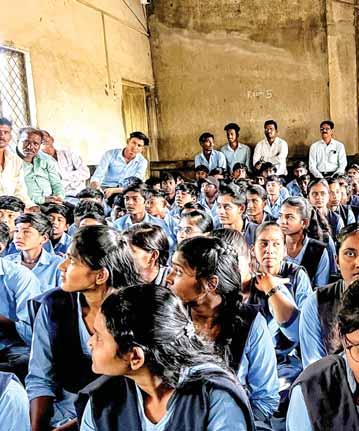
When collecting the children’s feedback, the Rotarians were thrilled to find that 7–8 girls voluntarily got up and gave a small impromptu talk expressing their gratitude for the steps taken by the club members for their overall education. Neelam, Jayashree, Shubhangi, Nandini, Yash, Gauri, Shubham, Meena and Dhanashree expressed their gratitude to their benefactor Vinod Toshniwal. (This project was sponsored by Shri Radhakisan
Toshniwal Public Trust, Akola). “Now it is not easy for rural girls to get up and give a speech; we really appreciated that and thought we have to do much more,” said Taraporewala. While scholarships for `5,000 each have been given to 20 girl students from Class 10–12 already, many more ventures for the students’ welfare are in the pipeline. Apart from an eye camp which is being held regularly by the club in the village for the
general public, where over 150 eye operations were performed till now, the club members next want to give the school a computer lab with some 4–5 computers. This will cost `2.5 lakh, “which is not a problem at all, because there is always enough and more money available in India where charity is ingrained into our very being. But there are other challenges,” says Modi.
Amajor challenge is related to putting in good quality computers costing around `2.5 lakh in the school, but the main concern is the building having zero security. While discussing their plans with the teachers, the Rotarians expressed their concern on the computers being stolen in the night, and the teachers assured that the security cameras were in place. “But I told them, these cameras will not get us back the computers if they are stolen,” Modi quipped.
The poor state of maintenance of this school.
Meditation time in the wildlife sanctuary.
But when there’s a will there’s a way. The unfazed Rotarians did find a solution and have provided the school with five computers, a printer and some associated IT accessories. “We knew we had to find a solution because we were hell-bent on these children getting computer literacy as this is the call of the day and very much necessary. There are already so many obstructions in their way… if we don’t remove these obstructions, who else will,” he asks pointedly.
Next on the cards are a bunch of skilling programmes; “there is so much scope for them, classes in tailoring, cooking and so many other vocations. Our emphasis is that these children should be able to generate employment for themselves instead of being job seekers, and perhaps employ a few others too.”
On the horizon are one or two-day workshops to give them culinary skills to make food products which can be easily marketed. Such as the famous
and very tasty banana chips available in Kerala. “We get them in Maharashtra too, but the taste is nowhere near the original. Like this there are so many products which can be marketed and give youngsters an opportunity to start their own small ventures. Why should Haldiram alone be marketing such snacks all over the country? Similarly, there is such a huge demand for chefs, so boys can benefit too from cookery classes.” Many other agriculturerelated avenues are also open where youngsters can be skilled to earn their livelihood.
This veteran Rotarian advocates that all Rotary clubs in India should adopt village schools or do something concrete for rural youth. “If our incoming district governors can promote this idea instead of concentrating only in promoting their district conferences which will anyway come only 6–7 months later during their term, such projects will get a boost and Rotary can really make a huge difference in India.”
The children said they will no longer carelessly throw around candy wrappers, empty plastic water bottles or polythene bags which are choking our planet.
It is well-known that there is no money crunch in India; every Rotarian should act as a catalyst and find that money. “There is a lot of money with and around us… with our friends, acquaintances, business partners and relatives. Also, there are so many private charitable trusts, not to mention the CSR
A trek through the Katepurna Sanctuary.
A girl student getting funds for paying her fees from Vinodkumar
Toshniwal, managing trustee, Radhakisan Toshniwal Public Trust
funds available. And they trust Rotarians like us!”
Modi is proud that he has convinced one of his colleagues to build a skill development academy in Akola which can cost between `1 and `2 crore. “He is ready with the money and the resolve and has told me that with your efforts, direction and involvement, this can be done. He said let’s teach different types of skills — auto industry, tailoring, fashion designing, beauty care, etc — to youngsters.” Women from the village will also be involved in these skill development projects to enable them to start their own self-employment programmes.
He adds that in and around Akola there are many dhal mills… specially for processing and packing toor dhal, and skilled workers are always required for this industry. “We can also train youngsters in IT skills, and vocations such as plumbing, carpentry and electrical services. I am a member in an educational society where several members run institutions and they are helping us in putting up this skilling centre.”
Akola, Modi adds, has a population of around 10 lakh and a floating population of one or two lakh. And too many youngsters have no jobs; “because they have no skills. And when unemployed youngsters are available, politicians use them for this campaign or that, to raise slogans here or throw stones there. That is the worst way to harness the energy of the young.”
So many Rotary clubs begin the academic year giving educational material… uniforms, books, stationery etc. “But how long can we continue like this? We have to give knowledge, not charity, to these children, so that they can earn their livelihood.”
He acknowledges that his club gets “many ideas to do service project after reading about the good work some of the clubs do around the country. One project in the South where 50 sewing machines had been given to poor women inspired us to start such a project in one of our villages.”
Designed by Krishna Pratheesh S
The students have got five computers and a printer.
RID 3234 celebrates
Jaishree
While the world chases fashion trends that expire in weeks, the saree remains the ultimate power move, commanding, timeless and effortlessly versatile, from the boardroom to festive occasions. It has long shed its ‘traditional-only’ tag and today stands tall as a symbol of high fashion.
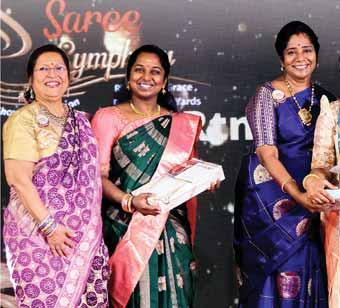
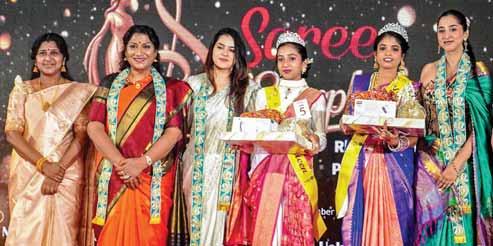
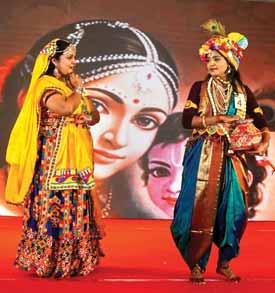
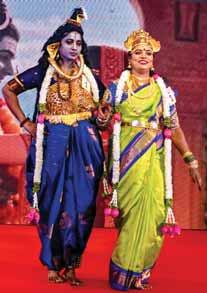
RI District 3234 marked World Saree Day (Dec 21) with an elegant and imaginative fashion presentation that paid tribute to India’s timeless drape. Aptly titled Saree Symphony,
the event saw the district’s women members take centre stage, showcasing the saree in its many avatars — from classical weaves and regional traditions to bold, contemporary interpretations.
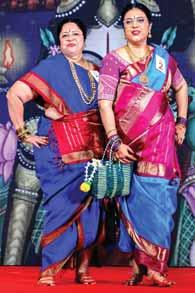
A swirl of colour, creativity and culture, the event celebrated the saree not merely as an attire, but as a story of India woven into six yards of fabric. The ramp walk featured powerful thematic presentations expressed through innovative saree styling. One segment honoured India’s ‘warrior women,’ blending
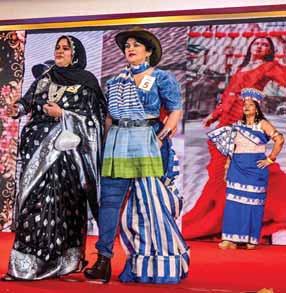
strength and femininity in regal woven sarees; another drew warm applause as a confident ‘Lady James Bond’ strode the ramp in a Kanchivaram saree paired with a modern denim blouse, boots and cowboy hat, playfully merging tradition with modernity.
Also interesting was a presentation by a traditionally dressed mother and her Gen Z daughter in a modern-styled saree, symbolising continuity across generations. The audience was also treated to vibrant portrayals of Lord Krishna and his mythological companions, as well as Shiva and Parvati, all draped in rich, ancientstyle sarees that evoked the grandeur of classical India.
The Ragas in Drapes segment paid tribute to iconic women in music, showcasing distinctive saree styles associated with legends such as MS Subbulakshmi in her iconic ‘MS Blue,’ Usha Uthup,
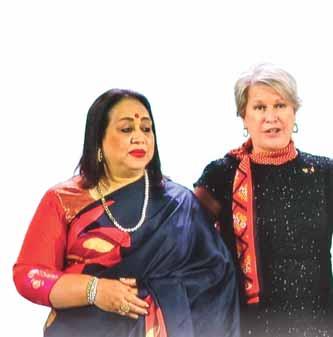
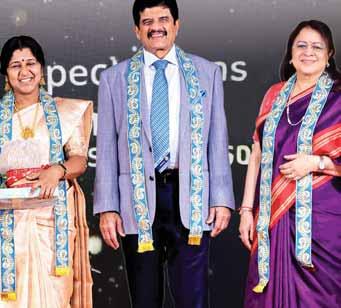
From L: Event chair Usha Saraogi, Priyadarshini (RI Director M Muruganandam’s daughter), event advisor Punitha Sridhar, Sumathi Muruganandam, DG Vinod Saraogi and DGN Vijaya Bharathi.
It is inspiring to see Rotary women take the lead in honouring our heritage.
Sumathi Muruganandam
Lata Mangeshkar, Sufi singer Harshdeep Kaur and Vijayalakshmi Navaneethakrishnan. Another standout team brought alive the timeless elegance of yesteryear Tamil film artistes Savithri, Sripriya, Sowcar Janaki, Vanisri and Lata, evoking nostalgia and admiration.
DG Vinod Saraogi, commending the initiative, said the event beautifully blended art and culture. “The saree is a symbol of identity, dignity and pride. Today, our Rotary women have shown how tradition can be celebrated in meaningful and creative ways,” he said. His wife Usha Saraogi was the event chair.
Sumathi, wife of RI director M Muruganandam, praised the spirit of participation and fellowship. “It is inspiring to see Rotary women take the lead in honouring our heritage. The saree may be centuries old, but it continues to evolve, just like the women who wear it,” she said, appreciating the elegance, confidence and cultural pride displayed on stage.
The event was judged by noted danseuse Narthaki Nataraj, former Mrs Chennai Shruti Turakhia and fashion stylist Deekshita Nikkam. Punitha, wife of PDG J Sridhar, and Bharati, wife of PDG NS Saravanan, were the event advisors. The programme drew an audience of around 250 Rotarians, including spouses of past district governors.
Sumathi Muruganandam and the judges Narthaki Nataraj, Shruti Turakhia and Deekshita Nikkam.
RC Gangtok makes a bio-toilet at 13,000ft!
Rasheeda Bhagat
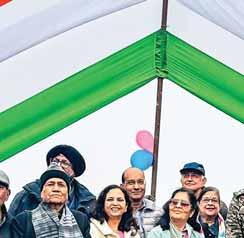
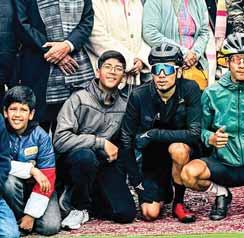
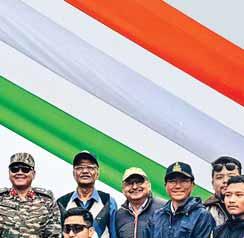
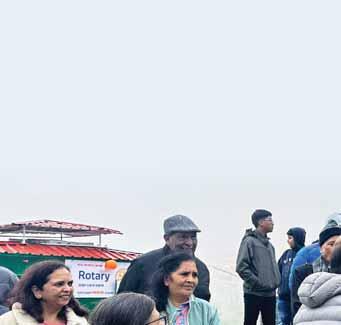
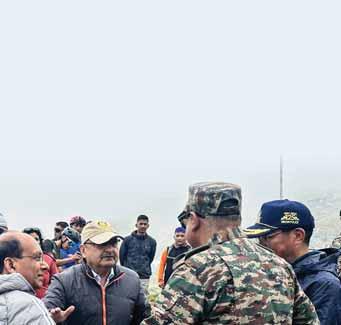
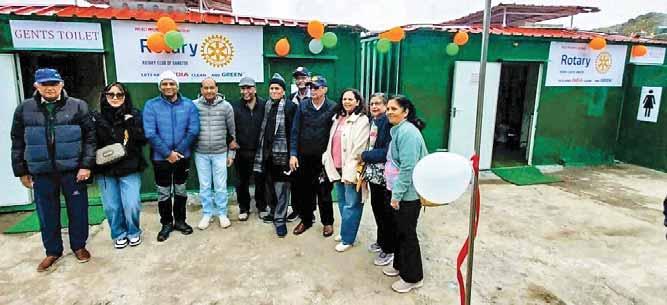
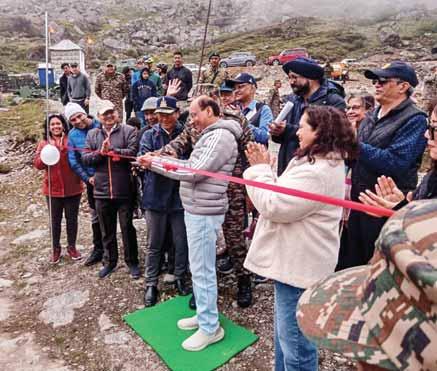
Brigadier Jha (centre), PDG Yogesh Verma and club president Naresh Agarwal with club members during the inauguration of the bio-toilet at Kupup, Sikkim.
Members of the Rotary Club of Gangtok, RID 3240, have pulled off an environmentfriendly coup in establishing a biotoilet block at probably the highest altitude in the world. After a lot of planning and challenges in execution that dragged on over two years, a glistening new bio-toilet facility, with separate washrooms for men and women, has come up at Kupup town in East Sikkim, which is located about 65km from Gangtok. The altitude — a formidable 13,000ft!
In September, in this beautiful and scenic town, one of the highest in the region and which boasts of breathtaking vistas of the renowned
Elephant Lake, named for its elephant-like shape, Brigadier Jha from the Indian Army inaugurated the bio-toilet. Kupup, a difficult hilly terrain which has substantial army presence, also holds historical significance as a prominent trade point along the ancient Silk Route between India and Tibet. It is also home to the Baba Harbhajan Singh Shrine, where both soldiers and locals offer prayers.
Explaining the genesis of this project, PDG Dr Yogesh Verma, a member of this club, said that this is a very fragile region environmentally and it is very difficult to have sanitary pipelines and other facilities required for conventional toilets. With its natural beauty and the shimmering waters of the Elephant Lake, it gets a large influx of tourists and “the Indian Army personnel we consulted while doing community assessment made a strong case for putting up a bio-toilet there.” The land for the toilet was provided by the Army, and the work was also done with support from the Army.
The existing toilet was in a pathetic condition, had only two urinals and was being maintained very poorly. The new bio-toilet provided by the Rotarians at a cost of `20 lakh has two sides, segregated for men and women and each side has three commodes, with urinals also provided in the men’s toilet.
The plumbers found it difficult to work in the challenging weather conditions and punishing temperatures of minus 5–10 degree Celsius.
“Members of RC Gangtok worked tirelessly to overcome logistical challenges, including transporting material and adapting the design to withstand extreme temperatures, and liaising with the Indian Army and local administration for smooth execution.” The toilet essentials were pre-fabricated in Lucknow, but the difficulty came in transporting these and other required material to the tricky spot. It was here that the Indian Army extended its support in transporting the material and coordinating the whole thing.
“Believe it or not, our main challenge was to get the plumbers to put the toilet together,” chuckles Verma. “First of all, it is a restricted area and permits are required to visit this spot; normally only one day permits are given but the plumbers needed to be there for 15 days. Again, the Army helped.”
But planning and executing a bio-toilet project for a hilly and difficult terrain in a fragile ecosystem in a state like Sikkim and town like Kupup came with its own set of unique challenges. The project was the culmination of years of planning, coordination and dedication.
Then came the challenging weather conditions and punishing temperatures of minus 5–10 degree Celsius! “Add to this the wind factor; the plumbers were from the plains and found it very difficult to survive and work in that kind of cold weather. Once again, the Army helped with the shelter and the stay but despite all that, we had to pay the
plumbers much higher wages to keep them at the site to finish the job.”
PR director of the club Prakash Mundra adds that the bio-toilet was such a crying need and such a big boon to the local community that the inaugural ceremony was attended by not only Brigadier Jha, who is the core commander of the Indian Army there, but also Tashi Wangyal, IGP, Law and Order, Sikkim Police. Club president Naresh Agarwal, joined the brigadier to inaugurate the toilet and hand it over for public use.
Stressing on the significance of the project, PDG Verma said: “This bio-toilet stands as a testament to Rotary’s commitment towards sustainable development, public health and environmental conservation. To achieve this at such a high
altitude, in such a difficult terrain and challenging climatic conditions, reflects the dedication and perseverance of our team.”
He specially thanks two club members — Aswin Oberoi and Gurpreet Dhunna — for ploughing on when quite a few members complained during the most trying times about the need to take on such a difficult project and said: Yeh kaha funs gaye (Why did we get caught in this). But at the end of the day all of us are very happy because we know this project will benefit thousands of soldiers, pilgrims and tourists who visit this revered site (shrine) and tourist spot every year.”
This pioneering initiative is not only a matter of pride for Rotary in India but also a global benchmark in sustainable sanitation and environmental stewardship. It symbolised “Rotary’s ability to break new frontiers in service, while protecting
the environment. Unlike conventional toilets, the bio-toilet system ensures waste decomposition through bacterial processes, preventing water contamination and preserving the fragile Himalayan ecosystem. By addressing sanitation concerns at a popular tourist destination, this project will enhance visitor experience while safeguarding public health,” added Verma, who also acknowledged the contribution of At the end of the day all of us are very happy because we know this project will benefit thousands of soldiers, pilgrims and tourists.
Club president Agarwal and PDG Verma interacting with Brig Jha.
Rtn Arijit Banerjee (Ramaesis Realty, Kolkata) whose relentless efforts made the project a reality.
The club, with 36 members, now wants to explore putting up similar eco-friendly sanitation facilities at other high-altitude locations to promote hygiene and responsible tourism in the Himalayan region.
Verma, who has retired as a medical professor and was running two hospitals in Sikkim, recalls with pride the VTT programme he had conducted in 2014 to improve maternal and child health in the region, and reduce
maternal mortality. “In 2012, I was the head of the government hospital here and we used to have in Sikkim 26 maternal deaths a year… a big number in such a small state! Women would die during childbirth because there was delay in reaching them expert medical care.”
The team of gynaecologists from UK, organised by PDG Himanshu Bashu from that country, comprising five experts, first trained 13 doctors and paramedics in Sikkim, on how to conduct training to reduce maternal mortality.
“I was DG then and all the teaching and training material was brought from UK and in the one-week workshop we trained 13 gynaecologists, nurses and 30 other doctors on how to handle emergencies at delivery points.”
The VTT was repeated for two more years, with the result that in “two years the maternal mortality went down to 9 from 26 and then 6. The impact of that programme was so great that till date we have maternal mortality only in single digit,”’ beams the PDG, adding, “our club is very proud of that project.”
Club president Naresh Agarwal (fourth from L) with club members in front of the bio-toilet.
Rotary empowers Malda villagers
V Muthukumaran
Most of the community projects of RC Malda Central, RID 3240, are done through member contributions, “as our main aim is to reach out to the underprivileged and the common man of this municipal town with a service motto,” says Abhijit Chowdhury, executive secretary of the club. English Bazar is 350km north of Kolkata, and is the headquarter town of Malda district which is dotted with remote, tribal villages. The 22-year-old club is visible among the locals through its flagship Project Jaladhar (water booth), where members
sponsor the drinking water kiosk in a municipal ward in memory of their late parents or relatives. “So far, we have set up two Jaladhar booths (`1.2 lakh each), and this year the third water kiosk will come up in April. We select a proper location among the 29 wards of the Malda English Bazar Municipality on a needs basis,” says Chowdhury. About 500 people drink water from each Rotary booth in a day.
A series of new initiatives was taken up this year, boosting the club’s public image — a postermaking competition on the eve of World Literacy Day (Sep 8)
saw over 70 school students displaying their art skills; two handwash stations (each `8,500) were installed at government primary schools; and Project Sharodiyo Sangati (festive unity) donated new garments for Durga Puja to 126 students from poor, tribal families at the Damdama Government Primary School, Aiho, a remote village 17km from English Bazar.
School bags distributed to students at the Sonatala Jadupur Junior Basic School under Project Vidya
saaw over studentts
A poster-making competition for school students to create awareness on literacy.
Since 2019, the club, under Project Sharod Sampriti (autumnal harmony), is donating new clothes to elders and destitute at Anubhab, an old age home, on Mahalaya, an auspicious day before Navratri. This year, they distributed clothes to around 30 inmates and served lunch to them. “While the puja garments were funded by the club, the food was sponsored by a member.” Project Vidya has
From L: Rtr Monoroma Saha Roy, Abhishek Sinha, club’s project chair Syed Imtiaz Rahman, executive secretary Abhijit Chowdhury (sitting), president Bipul Datta and treasurer Manoj Jain (back) at Project Sharodiyo Sangati, a joint initiative with the RAC Malda Central, at the Damdama Govt Primary School, Malda.
benefitted over 2,000 students at 13–14 government primary schools in the last seven years. “This year, we gave school bags and study material including stationery, notebooks, drawing tools, geometry boxes etc to 113 underprivileged students,” says Chowdhury. All school-related projects like setting up the library, donating furniture and school uniforms are being done under Project Vidya
A Smart Class (`45,000) was set up with a digital screen and computer through a district grant at the Sailpur Junior High School for the first time. The digital classroom will benefit 450 students, says project chair Syed Imtiazur Rahman.
Paul Harris Rotary Sadan
With a glint of pride in his eyes, Chowdhury says, “we are the only club in Malda to have our own premises — the Paul Harris Rotary Sadan, a two-storey edifice built in 2014 at a cost of `25 lakh, totally funded by members.”
Now, the 6,000 sqft building on the banks of the Mahananda River, a
tributary of the Ganges River, runs five vocational centres. In the last 10 years, tailoring (Satarupa), beautician (Rupashree) and yoga (Shape-up) courses have each turned out 400 skilled people. “We have introduced chess academy (checkmate) and theatre workshop (spotlight) now, each taking in 60 aspirants this year.”
As the club members push the ‘boundaries of service,’ their president Bipul Datta says, “we are not just following the traditional path of doing Rotary projects. We are turning modern ideas into meaningful action to uplift every corner of Malda. We are innovating to serve the rural communities and for over a decade, we have been empowering women through vocational training.”
In this Malda club with 46 members, there is good balance between young (35–40 years), senior (40–60) and super senior (above 70) Rotarians. “There is harmony among members, across age groups, with all of them involved in projects, for service is our credo,” says Rahman. Till now, the club has sponsored an Interact and a Rotaract club.
A chess tournament for the visually challenged
Rasheeda Bhagat
For 42 visually challenged persons who participated in a chess tournament organised in November by the Rotary Club of Bombay Juhu Beach, RID 3141, and conducted by the Mumbai Suburban District Chess Association, it was not only a day of intense concentration on their game but also a day of pampering and feeling valued.
The event was held over a single day, and the participants competed in a 15-minute rapid round using the Swiss League format. (This system uses a noneliminating format for large tournaments where players with similar scores play each other over a set number of rounds, avoiding a full round-robin).
What was impressive was that 24 of the participants were internationally rated under the FIDE-rate system. This rating comprises a numerical score showing a chess player’s skill which is calculated by the International Chess Federation (FIDE). It’s an internationally recognised standard reflecting relative strength and is used for seeding in tournaments, tracking progress and earning titles such as that of a Grandmaster.
PR director of the club Pradeep Parikh, who was closely involved in organising the tournament, said that the Rotarians who played a role in putting this event together were amazed at the dedication and concentration displayed by the players. Six rounds had to be played because there were 42 players.
We realised how much more challenging the game of chess is for the visually challenged than those of us who can see…. It literally gave us goosebumps.
“Chess is a game of strategy, foresight, and mental strength — but to play it blindfolded, relying purely on memory and spatial visualisation, is absolutely inspirational. Each player touched the chess pieces and
squares on the board… which are specially made with grooves so the coins do not topple over… and committed them to memory, before making their moves. For these special players, the white and black coins have differentiating marking for them to decipher. What we witnessed was an incredible display of concentration and intellect.”
The Rotarians watched in awe as with spatial recognition and mind power the visually challenged players navigated the complex game of chess, making their moves. “We then realised how much more challenging the game of chess is for the visually challenged than those of us who can see…. It literally gave us goosebumps,” said Parikh.
The event, which cost around `1.31 lakh, began in the morning and all the players were served breakfast and concluded after lunch which was lovingly served to the guests. The registration charge of `300 was refunded to each participant and `25,000 was given out as cash awards to the winners. He added that the participants were “very excited, ecstatic, overwhelmed… but they needed help for things like going to the washroom, and we were very happy to guide them. Even for their two meals we insisted they remain seated comfortably and we served them at their seats, making them feel respected, so and so that when they left some of them told us they were ‘very happy with the way you treated us.’”
From L: Neha Sanghavi, Smita Shah, Pradeep Parikh, Mona Shah, club president Bhavna Pandya, chief guest Dhruv Sitwala, Ojas Dave, Rajeev Gandhi, Parul Doshi, Shraddha Dave and IPP Mansi Thakkar.
Parikh added that the successful hosting of this competition has enthused the club members so much that they want to make this chess tournament for the blind an annual feature. “It was heartwarming to witness the joy and enthusiasm of each participant. Following this satisfying experience and now that we have some expertise, the next time we hope to double the number of participants to 80 players! For us, it was both an inspiring and humbling experience to see their sportsmanship, grace and positivity. Hats off to every participant for reminding all of us about the true strength and endless potential of the human mind.”
Why Indian armed forces are fearless: Brig Basera
Rasheeda Bhagat
At one of the sessions at the Tejas zone institute in Delhi, Brig DS Basera, secretary of the Kendriya Sainik Board (KSB), Department of Ex-Servicemen Welfare, Ministry of Defence, enlightened a packed hall at the Manekshaw Centre on why people join our defence forces and why those guarding our nation are fearless.
General Manekshaw, after whom the venue was named, belonged to the Gorkha regiment; Basera was from the 35th Gorkha regiment as well. “In case of war, we are the first ones to be launched in any part of the country.” Manekshaw was elevated as field marshal in 1973, in recognition for winning the 1971 war when Bangladesh was liberated. Basera himself was a third-generation officer from his family in the Indian Army. “My grandfather fought in World War II, was shot in the head, declared dead, and was awarded the military cross. After 21 days he came back alive, recovered, fought again and was again awarded the military cross!”
Despite all the travails he faced, he motivated Basera’s father to join the Indian Army; he fought both in the 1962 and 1971 wars. “In the insurgency, my father lost his right-hand finger and was about to be withdrawn from the army. He remained in the same branch, served in various situations and motivated me to join the army at the age of 18. And today after 33 years of service and four years of training in the National Defence Academy and Indian Military Academy, I stand before you. My son is with us, and he will join the Indian Army too.”
Brigadier
DS Basera, secretary of the Kendriya Sainik Board.
When he was commissioned in 1992, the insurgency broke out in the northeast and he was involved in the counter insurgency operations, “where you do not know where your enemy is… as the enemy is within. So, we fought a different kind of warfare. And I still want my son to join the armed forces, despite all the challenges. You must be wondering, despite getting shot in the head, losing limbs, and the challenges in my own service career, why do I want that.”
The broader question, he added, was what inspires generations to join the armed forces time and again. “It’s naam, namak and nishan. Our naam is Bharat. Our namak is the soil, and our nishan is our national flag. For these three things, we can go to any extent.”
One of the things that motivated the Indian soldiers and made them fearless was that “the soldiers and their families are taken care of while serving, after retirement and even after death. This is the reason that we are fearless. We don’t have
to fear. If we are alive, we have medals on our chest. If we are dead, our name is at the National War Memorial behind India Gate, written in golden words. Every day, thousands of people remember us. What bigger honour than to be wrapped in the national flag while departing from this world,” Basera asked a mesmerised audience.
KSB looks after about 37 lakh ex-servicemen and promotes their welfare. Giving the genesis of the Manekshaw Centre where a part of the Tejas Institute was held, he said around 2009–10, various conclaves and discussions were held to discuss the armed forces. “We are the second largest armed forces in the world today, totalling over 14 lakh.” Of these, about 12 lakh are in the Indian Army, 1.5 lakh in the Air Force and 75,000–80,000 in the Navy. After these discussions it was decided to have an exclusive centre for the defence forces to hold their own meetings, conclaves etc, and the Manekshaw Centre came up in 2010.
Coming to the crucial need to look after ex-servicemen and their families, Basera said that the Kargil war was the last he had fought at the age of 27. It was a short but intense and high-risk war, and required younger, and physically very fit soldiers and those without heavy family responsibility as a high casualty rate was a given in that war. “I had the privilege of participating in that war, where we were operating in minus 35–40 deg Celsius. Because we were young, we could sustain.
SA soldier is taught to never retreat
aying that every picture/ portrait displayed at the Manekshaw Centre had its own history, and every painting its own story, Brig Basera narrated a gripping tale of an operational task done by the Indian armed forces in the 1962 war in Ladakh.
“We had an aggression from a neighbouring country, and in the northern Ladakh area there is a place called Rezang La (a strategically vital, high-altitude mountain pass). Here, 120 soldiers from the 13th Kumaon Regiment, fighting under the leadership of a Major, faced a barrage of Chinese soldiers with heavy firing. A major has about 8–9 years’ service. The battalion started fighting the enemy forces but at some point, ran out of ammunition. “They got orders that okay, if the ammunition is finished, we cannot supply anything more as there is no time, no logistics, so bring on the artillery fire.”
inflicted a lot of casualties on the enemy.”
But a point came when the battalion ran out of artillery fire, and “the officer was directed to fall back with his men. Now ladies and gentlemen, in the Indian Army, we never come back. We are not taught to come back. I don’t know how to come back. I am not trained to come back. I will never come back. There is no question about it…”
So the young major kept his troops at the station… “they fought with whatever weapons they had, they fought with their hands and then their nails.”
What inspires people to join the armed forces is naam, namak and nishan naam is Bharat, namak is soil and nishan, our national flag.
Basera explained that there is a system in the Indian Army’s war fighting strategy; when there is nothing left and you are surrounded by the enemy, you have to continue inflicting casualties on them, fighting with whatever you have. “Even if you die, as long as the enemy is getting inflicted casualties from us, we are ready to sacrifice our lives. That situation came, the fire was brought and they took positions in the bunker and
Basera added that when he saw their pictures at the National War Memorial behind India Gate, he was really devastated. “I am a soldier… tears don’t come easily to us. But that day I cried, and thought why was I born late and not well before 1962, so I could have fought in that war. The story of how these 120 people fought fearlessly… and with whatever they had, and killed 3,100 enemy soldiers is deeply moving. In the end, none of them survived. All 120 sacrificed their lives. There were so many ways they could have fallen back; they were told to fall back. Nothing would have happened to them. But they didn’t. This is the Indian Army.”
This has now been made into a film, , and is streaming on Amazon Prime.
RI President Francesco Arezzo gives a memento to Brig Basera. RI Directors KP Nagesh and M Muruganandam are also present.
But in just one week, I lost 12 of my battle mates, and of those the wives of four were pregnant.”
The consequences of a much younger army is that instead of the earlier retirement age of 50–55, today soldiers retire at around 35. “What happens then? While you are in the army, it’s all very good. You have seen the glamour of the Indian Army at the Republic Day parade. You’ve seen us moving around in peace situations. But not many of you get to see us when we are in difficult operational areas operating in extreme temperatures ranging between plus 50 deg C to minus 35 deg C.”
All this takes a big toll on the soldiers’ health. “Imagine the plight of a jawan retiring at age 35; what is our social responsibility towards him? How much can the government do for such a mighty force guarding such big borders?”
As somebody who was involved in the welfare of 37 lakh
ex-servicemen in India and Nepal, he sought help from Rotarians not only to help the families of those killed at the front, but also the young retired people who need to be re-employed, whose children need to be educated. Expressing his gratitude for the way in which organisations like Rotary and other Indians rooted for and rallied behind our soldiers, Brig Basera said: “we fight fearlessly because of the kind of respect, honour and dignity that you give us. We are assured that even if I am gone, my wife, my children will be taken care of, and with lot of respect. My humble request to you all is that whenever you meet your soldiers, they don’t need any money
What makes Indian soldiers fearless is the confidence that their families are taken care of while serving, after retirement and even after death.
from you. They want respect. We fight for honour and ethics. In Kargil war, we had so many enemy dead bodies lying there. But not a single person was left behind. We gave them all an honourable burial. After the 1971 war, 93,000 enemy forces were returned to their country. Which country has done this?”
In conclusion, he added that there was a time when senior army personnel never came out in the open to address meetings. “But now the times have changed. The direction from the government is that our citizens must know our history.” Having served in the UN for two years and visiting 18 countries, particularly in Europe, he was very impressed with the kind of knowledge the people there had of their armed forces and the respect they showed them. “They understand because they are informed about what is happening. In our country we were not informed. Our citizens did not know.” But this was changing.
He added that he looked forward to partnering with Rotarians in working on projects, particularly in healthcare and prevention of breast cancer, cervical cancer etc.
A life lived in Service above Self: PDG Puru
Team Rotary News
PDG PV Purushothaman (R) with fellow polio eradication pioneers — Rtn SL Chitale, PDGs Vishwanatha Reddy and S Krishnaswami and Dr HV Hande.
The passing of PDG P V Purushothaman (Jan 5, 2026), fondly known as Puru, has left a void not only within RID 2982, but across the Rotary community in India.
He was instrumental in implementing the first PolioPlus grant to India, a $2.6 million initiative for Tamil Nadu that funded oral polio vaccines, surveillance systems, and an extensive cold chain network essential for effectively storing the vaccines. “Puru arranged cold chain facilities throughout Tamil Nadu with remarkable dedication. He was deeply devoted and worked tirelessly to monitor every detail,” recalls PDG S Krishnaswami, RID 3234, who along with PDG Purushothaman, was part of the initial five-member committee formed to eradicate polio in India. Later, his vast experience took him
to Zambia, Zimbabwe and Malawi for polio eradication efforts.
“Puru was a big pillar of polio eradication, working hand-in-hand with PRID OP Vaish. He came to Gujarat after the plague outbreak in 1994 to understand the polio eradication work we were doing,” recalls PDG Mayur Vyas, RID 3060.
“He would travel any distance for polio work,” remembers another Rotarian. “Once, he drove through the night just to attend a polio workshop at Kolhapur. He played a vital role in eradicating polio from India.”
RI director M Muruganandam recalls a Rotaract conference in Yercaud, a hill station in TN, where Puru was the chief guest. “His absence is truly an irreparable loss to his family and the entire Rotary fraternity.”
N Bhaskaran Pillai, past president of RC Quilon West, recalls Purushothaman’s extempore address in 1985 on Rotary’s membership
challenges. “His stirring call, Grow or go, earned a standing ovation and continues to resonate with many to this day. Such was his commitment to Rotary that he once cut short a family holiday in Kashmir to honour another Rotary invitation.”
Purushothaman’s impact was visible in enduring community landmarks, including the Rotary Colony near Salem. Along with his brothers — PDGs PV Jambukeshan (RID 321, Tirunelveli) and P V Parthasarathy (RID 323, Chennai) — he belonged to a rare trio of siblings who served as DGs, leaving behind schools and community halls that continue to reflect their leadership. The PVPV name, associated with the ARAS PVPV group, also remains synonymous with integrity and excellence in South India’s automobile industry.
With the passing of Purushothaman, Rotary bids farewell to a doyen of service and humanity.
Olayinka Babalola urges Rotarians to Create Lasting Impact
Etelka Lehoczky
Rotary International Presidentelect Olayinka Babalola called on members to Create Lasting Impact by making their clubs more welcoming, carrying out impactful projects, and allowing their Rotary experiences to transform them personally.
“Rotary has changed us. It has shaped who we are and made us better people,” Babalola said at the International Assembly in Orlando, Florida, USA, on January 12. “We often talk about changing the world. We talk about ending polio, about building peace. We do not think enough about how Rotary transforms us.”
Babalola, a member of the Rotary Club of Trans Amadi, Nigeria, RID 9141, described how joining a Rotaract club as a teenager enlarged his perspective beyond the limited, privileged outlook he had once. That change in awareness came from observing the lasting impact his club had in the community, particularly from teaching people to read and write.
“As members of Rotary, we share a vision of a better future. To make this vision a reality, we must acknowledge and unleash the change within ourselves. We must focus not only on outcomes, but on impact,” he said. Change and impact are not the same, he added: “Change is only the beginning. Impact is what endures.”
Understanding impact
Rotary members have made an impact by expanding early childhood education in Knysna, South Africa, and increasing access to prenatal care in Nigeria, Babalola said. The Rotary Club of Knysna empowered local women to open and manage early childhood education centres.
T h e pro j ect h as r eac h e d t h ousan d s o f children and families, and it will continue to provide education in those communities f or generat i ons.
RI President Elect
Olayinka Babalola
this kind of impact in other parts of the world, and in doing so we can earn the trust and recognition of our neighbours in the communities we serve. And when more communities trust Rotary, more people want to join.”
Babalola also described the wide-ranging impact of Together for Healthy Families in Nigeria. The natal mortality rates received a $2 million Rotary Programs of
initiative to reduce maternal and neonatal mortality rates received a $2 million Rotary Programs of Scale grant in 2022.
vention, many women avoided prenatal care,
ing a safe birth for both mother and child. After
“Before Rotary’s intervent i on, many women a vo id e d prenata l care, which is essential to ensuri ng bi rt h for b ot h mot h er an d c hild . Afte r
working with Rotary, systems were put in place to help expecting mothers receive prenatal care. The community was involved. Attendance went up. Mortality went down. That project will transform lives across Nigeria for decades.”
Extending a welcome
Babalola urged members to take a more open, welcoming attitude toward newcomers to their clubs. He described how, when he was a Rotaract club member eager to join a Rotary club, the president of the Rotary club treated him with scorn.
“He said, ‘What audacity! You cannot just join. You need an invitation,’” Babalola recalled.
“I could have walked away. Instead, I said, ‘I didn’t know a child needed an invitation to enter his parents’ home.’”
While things have changed since that time, Babalola said, they haven’t changed enough. Some clubs close themselves off instead of “embracing the world with open arms,” he said. Young people aren’t necessarily treated with respect, he added, and people with different ideas and backgrounds aren’t always made to feel welcome. He urged members to think about how they could better welcome others.
“You never know whose Rotary story might begin — or end — based on the way you make them feel at a meeting or service project,” he said.
Another way members can focus on personal change, he said, is to aim to do better than their best. He urged district leaders to examine their past successes in raising funds, planning projects, and recruiting members. Then, he said, they should challenge themselves to surpass their past triumphs.
“When we change ourselves, we change our clubs and districts,” he concluded. “When we change our districts, we change the communities we serve. And when we change our communities, we create lasting impact across the globe, in our communities, and in ourselves.”
Muruganandam chosen RI Vice President
RI director M Muruganandam has been chosen by RIPE Olayinka Babalola and the RI Board of Directors to serve as vice-president of Rotary International for 2026–27. He will be the fourth Indian to serve as VP, after BT Thakur (1946–47), Shapoor Billymoria (1949–50) and Nitish Laharry (1953–54).
Muruganandam’s Rotary journey began at 16 in Rotaract; he became a Major Donor to The Rotary Foundation while still a Rotaractor. In 2016–17, as one of the youngest governors of RID 3000, he spearheaded record-breaking initiatives recognised by the Guinness Book of World Records to commemorate TRF’s centennial.
He also played a pivotal role in chartering 99 Rotaract clubs, 250
Team Rotary News
RI Director M Muruganandam with RIPE Olayinka Babalola.
Interact clubs and 100 RCCs in his district. He is the recipient of RI’s Vocational Service Leadership Award and TRF’s Citation for Meritorious Service.
Muruganandam and his wife Sumathi, both members of RC Bhel City Tiruchirapalli, support TRF as AKS members.
One family One vision
Jaishree
Rotaract is not the future of Rotary. Rotaract is the present of Rotary,” said RI President Francesco Arezzo, addressing district Rotaract leaders at the Tejas zone institute in Delhi.
He explained that Rotary functions in a rapidly changing, fluid society, which is “very different from the world of our founder Paul Harris.” While Rotarians often recognise change only after it has occurred, Rotaractors “live the change, feel the change and understand what is changing.” Rotary therefore needs Rotaract to remain relevant, to understand new forms of communication and evolving community
needs. At the same time, Rotaract needs Rotary’s experience, because “the future comes from our past.” Calling it a win–win relationship, he urged Rotary and Rotaract to plan, study communities and execute projects together. “We are great together; we cannot survive alone.”
RI director KP Nagesh highlighted the importance of nurturing the next generation early, while also strengthening Rotary’s own diversity. He noted that women’s membership in Rotary in India currently stands at around 17 per cent, with a focused push to reach 30 per cent. While gender balance is not a concern in Rotaract and Interact,
he emphasised the need to introduce Rotary’s values and vision to young people at an early age, ensuring continuity of leadership and service.
If the Rotary wheel is to rotate for decades to come, Rotaract and Interact must be central to Rotary’s strategy, said RI director M Muruganandam. “When we dream together, think together and work together, growth is not an option, it is an outcome,” he added. He called for innovative club models, and proposed the 1:2:3 approach — each Rotarian to introduce two Rotaractors and three Interactors, and each Rotary club to sponsor two Rotaract and three Interact clubs.
Rotaractors with RI President Francesco Arezzo, RI Directors M Muruganandam and KP Nagesh, RI President’s aide John de Giorgio and Rotararact session chair PDRR Karthik Kittu.
Apanel discussion titled Unite to Grow, moderated by both the directors, highlighted the advantages of the collective strength of Rotary, Inner Wheel, Rotaract and Interact.
District Rotaract Representative (RID 3192) Janice Philip described Rotaract as the momentum behind Rotary’s impact. “Rotaractors bring speed, agility and the ability to start anything from scratch,” she said. As digital natives, Rotaractors can provide visibility and scale by harnessing technology to run synchronised initiatives across districts and countries. She proposed a shared annual service calendar focusing on key causes such as polio eradication, health, environment, cervical cancer prevention and women’s empowerment. Emphasising integration at the club level, she said, “It is no
Rotarians often recognise change only after it has occurred, Rotaractors live the change, feel the change and understand what is changing.
longer Rotary and Rotaract. It has to be Rotary with Rotaract.”
Janice also highlighted Rotaract’s growing commitment to TRF, including aspirations to collectively contribute to the Polio Fund and work towards a Rotaract-led Arch Klumph Society–level contribution in India, with support from Rotarians and Inner Wheel members.
RID 3011 District Interact Representative Aahana Roy shared how joining Interact at age 12 instilled in her empathy and social awareness. “Interact taught me that even two minutes with someone can mean the world to them,” she said, recalling visits to NGOs supporting the elderly and children. While Interactors bring spark and creativity, Rotaractors bring innovation, and Rotarians, vision. “Rotary is the soil, Rotaract is the sunlight and Interact is the seed that brings tomorrow’s hope,” she noted. Aahana advocated mentorship opportunities and greater involvement of Interactors in Rotary initiatives to build confidence and leadership early.
Jyoti Mahipal, national president of Inner Wheel, showcased how Inner Wheel complements Rotary’s mission through impactful projects such as Sparsh Ek Ehsaan, which addresses child abuse awareness, along with human milk banks and cervical cancer vaccination initiatives. Sharing her
personal journey, she said Inner Wheel transformed her from a shy homemaker into a confident leader. “What I could not do professionally, I could do through Inner Wheel,” she said, recalling how initiatives such as the Praram Montessori House and Gyan Jyoti scholarship programme that she had initiated as president are now permanent projects of her Inner Wheel club. Inner Wheel is not just about service, but about lifelong friendships, confidence and purpose, she noted.
Three major collaborations were announced at the institute by session chair PDRR Karthik Kittu — a partnership between Rotaract South Asia Multi District Information Organisation and the Rotary Environment Foundation to promote ProjectDakoju Dhanyavad focusing on large-scale tree planting and ecosystem creation across villages; a partnership with the Head Held High Foundation to create 10–20 model AI villages across India by empowering rural communities with AI literacy; and with Culkey Foundation and GoI’s Ministry of Tourism to empower local artisans and self-help groups to strengthen livelihoods through art, culture and eco-tourism.
From L: RI Director K P Nagesh, national president of Inner Wheel Jyoti Mahipal, past president Preeti Gugnani, RID 3192 DRR Janice Philip, RID 3011 DIR Aahana Roy and RI Director M Muruganandam.
Spread love in the world
V Muthukumaran
It is time to reflect and take Rotary to the next level, “so that we impart the ideals of love in this disruptive and conflict-ridden world, and spread the message of togetherness,” said Irfan Razack, an AKS member and CMD of Prestige Estates, Bengaluru. He is the first million-dollar donor (`9 crore) from RID 3191. “There are many avenues to spend money, but Rotarians are the privileged few with their yeoman service to those in need, contributing their might towards education, health, sanitation and water,” he said.
Addressing a session titled ‘Power of giving,’ at the Tejas institute, he said in a way god has
been kind to Rotarians as “they get an opportunity to serve, apart from having their interactions and fellowship. With a huge legacy of TRF, around half a million Rotary clubs in the world spend $400 million a year on deserving causes.” While Rotary is not a social club, for members take part in every activity “with involvement and dedication, its ethos also includes social mingling and sharing of ideas for service.”
Over the decades, Rotary has changed tremendously with clubs not insisting on compulsory attendance at its weekly meetings, and “even the classification norms being diluted with preference given to quantity
over quality. Of course, the biggest achievement of Rotary is polio eradication, which is now limited to just two countries, and it will be totally gone soon.” The pleasure of giving is “something different as the more we give, you keep getting it back. And it is common to see more number of 100 per cent PHF clubs which take pride in having AKS and Major Donor members… When you do good to society, it will return to you from someone else.”
Giving a parable involving the Dead Sea and the Sea of Galilee, a freshwater lake, Razack said the former has stagnant water as there is no flow outlet, “the water is dead
AKS member Irfan Razack being honoured by TRF trustee Ann-Britt Asebol in the presence of (from L) RID M Muruganandam, Rotary President Francesco Arezzo, RID K P Nagesh and PDG Sharat Jain.
with no marine life and vegetation. Whereas the Galilee is vibrant with the best of marine life and free-flowing water (emptying into Dead Sea)… both the water bodies get water from the Jordan River.” Hence, there is life only in giving as exemplified by Rotary.
To illustrate the power of love, he said while taking a walk on a hot day, a young couple saw three young strangers, named Success, Wealth and Love, distraught and in a huddle. Taking pity, the wife approached them to know if they wanted help, for which they chorused, ‘you have a choice of selecting one of us only.’ As the couple were deliberating on which one to opt for, either ‘success or wealth,’ their girl child wanted to pick up love. When they chose Love, “the rest two – Success and Wealth – accompanied them to their house.” Only love can overcome the forces of disruption and negativity in the world, said Razack, and called upon Rotary to instil this humane quality among people for a united, compassionate world.
workforce, and healthy people who are bold enough to dream together.”
Sahil Barua, founder-CEO, Delhivery, a startup enterprise in the logistics and supply chain domain, spoke on ‘Change through innovation with purpose.’ If India has to fast track its economic growth for a giant leap, it needs to get some basic fundamentals right, he said. “First, we must have good access to financial services, along with a modern logistics sector, then an educated
He recalled his first brush with the Indian bureaucracy during peak Covid after he got an e-mail from a Rotarian from RC Hyderabad. “The club urgently needed oxygen concentrators, and the civil aviation ministry cleared our request to fly a planeload of these cylinders from China… In three months, we flew in 85,000 concentrators through 46 planes for treating patients.” He learnt the ‘delivery dynamics’ 15 years ago when he founded the company along with his four partners. “Most of the godowns were on the city outskirts, difficult to access, dimly lit, and lacking efficiency and professional conduct. Our logistic infrastructure including trucks moving freight and goods, and warehouses had a dismal look, unlike the ones owned by Fedex, UPS or DHL in the US and European markets.”
MNCs did not want to set up shop in India as they found many constraints — buying land is a tedious process, construction takes time, labour woes, and above all, there were 30 different languages making it difficult to communicate, even as the education level of workers was very low. Barua had to build the supply-chain network and warehouses from scratch. “We hired 1,000 engineers, signed a deal with Volvo, Sweden, for a new design of our cargo trucks, and built warehouses across the country.”
The bigger challenge is to teach the workforce ‘dignity of labour’ to inculcate a sense of pride in what truck drivers and other staff do for their living, he smiled.
On average, their Delhivery Academy trains one lakh personnel each year, and coordinates with 50,000 partners across verticals for a hassle-free running of their cargo transportation services.
Delhivery founder-CEO Sahil Barua gets a Rotary pin from RI President Arezzo as RIDs Muruganandam and Nagesh look on.
A Filipino mother thanks Bengaluru Rotarians
Team Rotary News
Aviannalyn Jade after the cardiac surgery in Bengaluru.
Rotary clubs of RIDs 3191 and 3192 are supporting heart surgeries on disadvantaged children and adults suffering from various heart ailments, through the Rotary Needy Heart Foundation and the Needy Heart Foundation, both based in Bengaluru and set up by past president of RC Bangalore Indira Nagar OP Khanna. These surgeries are done at three designated hospitals in Bengaluru — Jayadeva Hospital, which is a government hospital, Manipal Hospital and the Narayana Hrudayalaya. Children suffering from congenital heart diseases from various countries are also supported by the RNHF and the NHF.
The latest beneficiary of this mega Rotary project in Bengaluru was two-year-old Aviannalyn Jade from Manila, Philippines. She was referred to PDG Rajendra Rai, the managing trustee of RNHF by PDG Kalpana Khound. Aviannalyn’s heart surgery was sponsored by Bimal Desai, a member of RC Bangalore Midtown. He and his wife Veena have sponsored the treatment of 20 children from Ethiopia, Ghana and the Philippines at a cost of `30 lakh. At a recent fundraiser organised by the RNHF, they’ve promised to support 20 more children from Africa, while an anonymous foreign donor has pledged to contribute `25 lakh for paediatric heart surgeries through his Rotary club.
Here is a note from Aviannalyn’s mother Avengelyn Amoroso:
Thank you very much for the kindness you bestowed on my daughter Aviannalyn. When I found out that we would be going to India and she will be operated on there, I was wondering if I could handle it all by myself, but we felt safe and comfortable under the remarkable hospitality and care by the Rotarians there.
Aviannalyn was born on May 23, 2023. When she was only two days old, she suddenly developed a fever. Her blood sample was taken
and the doctor told me that she had sepsis. I did not know what to do as I was only 18 when I gave birth to Aviannalyn. The doctor told me that she needed to be treated for seven days but I rejected the advice and left the hospital. In the first year after her birth, Aviannalyn was very healthy. She seldom fell sick, except for some cough and cold. If she got fever, it only lasted for a couple of days.
But soon, the day I had been dreading arrived. Many people noticed how she was gradually
losing weight. When she was 14 months, my sister also noticed that her lips and nails were pale blue. Immediately we consulted a paediatric cardiologist who confirmed that she had CHD. Maybe if I had treated her sepsis from the beginning, we would have known sooner that she had a heart condition, but the Lord had a plan for her.
Aviannalyn and I were at the Philippine Heart Center, in a queue for a 2D echo test. I met a mother with her son who had autism. As we
Aviannalyn and her mother Avengelyn Amoroso with the doctors at the
were talking, a doctor came up to talk with her. She told me he was Dr Nischal Pandey, who was helping them to go to India where her son would undergo an open heart surgery. Dr Pandey is the president of the Rotary E-club Connect, RID 3012, and he has sponsored heart surgery for many children at the Philippine Heart Center.
While I waited for our turn, she introduced me to Dr Pandey. When I told him about my daughter’s heart
When Aviannalyn was 14 months, my sister noticed that her lips and nails were pale blue. Immediately we consulted a paediatric cardiologist who confirmed that she had CHD.
condition he told me not to worry. “I will take care of your daughter and do my best so that she can have a surgery in India,” he said, and gave a hair band and a hair pin to Aviannalyn. I didn’t expect that day would change Aviannalyn’s life. I thought it was just a normal check-up day. But it did. It seems like we were really destined to meet Dr Pandey and I thank God that he made a plan for Aviannalyn. Now she is slowly recovering and getting stronger to enjoy the new life you all have given her.
I am grateful to PDG Rajendra Rai of Rotary Needy Heart Foundation who coordinated with the Jayadeva Hospital for the heart surgery and the post-surgery stay in Bengaluru, cardiac surgeon Dr Sunil and his team, Rtn Bimal Desai of Rotary Bangalore Midtown who funded the surgery, Dr Pandey who funded our stay, and Rajiv Srivastava, a member of a Rotary club in the Philippines, who
lent his apartment in Bengaluru for a brief stay after the surgery.
Many thanks also to PDG Kalpana Khound from Assam who introduced Dr Pandey to PDG Rai to take up this surgery in Bengaluru, Rajesh Shah, president of Rotary Bangalore Midtown, past president Atul Kaushik, Rotary Bangalore West president Yogesh Pachisia, Rakesh Nayyar of Mission Chai and Dr Srikanth of RC Bangalore Indiranagar.
I also thank the Indian Ambassador to Philippines Harsh Jain and Ambassador of Philippines to India Josel F Ignacio; our Indian community in Manila — Kamal Abhichandani, Vijay Gurung, Vishal Hathi Ramani and Soni — who funded our air tickets to Bengaluru and James Kumar, president of the Filipino Indian Commerce and Welfare Society based in Manila.
Thank you all. Maraming salamat po!
Jayadeva Hospital, Bengaluru.
Focus on retention, branding
Every year around 1,000 new members join, but 800–900 of them quit Rotary. “We are focused on retention with three unique programmes,” says Dr Manish Motwani. Rotary Verified Business, a form of certification, was issued to 330 corporates, small businesses and traders as “mutual promotion so that we grow through visibility in the market.” The citations will be given to 2,500 entities this year.
Secondly, Rotary Internship Employment Programme (RIEP) offers 3–6 months training to Annets and Rotaractors who will be absorbed by firms owned by Rotarians. “Currently, 80 interns are being trained, and it will reach 500 shortly,” says Motwani. Every club does a monthly fireside meeting to foster bonding among members. With 6,800 members across 121 clubs, Motwani is aiming for a 15 per cent net membership growth. “I am keen on adding more members to the existing 121 clubs.” With headcount at 6,800, he will charter five new clubs.
Meet your Governors
V Muthukumaran
Through a GG+CSR mix, Rotary Heart and Multispecialty Hospital, Deonar (`18 crore); Rotary Eye Hospital, Mulund (`5.6 crore); and Rotary Heart Hospital (`4.7 crore) at the KHM Hospital, Kandivali, will all be inaugurated in the next three months. Around one lakh HPV vaccination and one lakh screenings for breast-cum-cervical cancer will be done. Twentyfive Palghar villages (CSR+GG: ` 20 crore) will be transformed into model habitats, while 40 RI dispensaries will be set up in underserved areas.
For TRF-giving, he is confident of crossing $7.5 million. Motwani joined Rotary in 2001 inspired by his father, Ramesh Motwani, a Rotarian, and PRID Ashok Mahajan.
Manish Motwani
Medical projects galore
A clutch of medical projects including distribution of aids and crutches to rural beneficiaries has lifted the public image of Rotary in remote corners of Odisha, says Manoj Tripathy. “We have lined up GG projects that offer healthcare to the villagers. While a diagnostic centre (GG: $56,000) is coming up at Puri, a Rotary Eye Hospital (GG: $90,000) was set up by RC Barbil in Keonjhar district. Another eye hospital (GG: $66,000) will be inaugurated at Jaleswar in Balasore district, and RC Bhubaneswar Metro will be donating hightech equipment (GG: $44,000) to the Pipili Health Centre, a charitable hospital offering treatment for spinal cord injuries.”
The district has 4,600 members in 125 clubs, and 422 members have been added already, and 78 more will join. Out of the targeted 10 new clubs, four were already chartered.” He has distributed Apollo and Utkal health cards to district Rotarians which will enable them to undergo regular medical check-up. In a mega distribution drive by all the clubs, wet grinders, tricycles, wheelchairs, hearing aids and artificial limbs were given to over 1,000 women across Odisha. Similarly, at special camps in Nayagarh, Ganjam, Gajapati and Berhampur districts, artificial limbs, hearing aids, white canes and wheelchairs were given to 1,250 beneficiaries. His TRF-giving target is $500,000. He joined Rotary in 2002, influenced by club member Dipankar Das Gupta, a general surgeon.
Manoj K Tripathy
Betting on quality members
A nine-machine dialysis centre will be set up at the St Joseph’s Mission Hospital, Mananthavady, a small taluk in the Wayanad district of Kerala, through a GG project worth `70 lakh. “The dialysis centre will offer free sessions to the underprivileged. Others will get subsidised rates,” says Bijosh Manuel. RC Kalpetta will soon flag off a blood collection van (GG: `40 lakh) that will serve local hospitals and clinics.
With 3,200 Rotarians across 91 clubs, Manuel wants to induct at least 800 new members and charter 18–20 new clubs. “We are into a stabilisation mode. I have asked clubs to verify the genuineness of new members before inducting them as we only want those who are in sync with Rotary ideals and can remain with us for long. We do not want to add members jut for the sake of numbers,” he explains.
Around 3–4 GG projects worth $40,000 each are in the drafting stage as “clubs normally speed-up their service activity in the last six months of the year.”
Manuel wants to double the number of Rotaractors to 500 members by forming 20 new Rotaract clubs by June 30. “From this year on, we are giving a new thrust to Rotaract which will be strengthened by expanding its base.” His target for TRF-giving is $360,000.
He joined Rotary in 2008 as “I had wanted to network with likeminded people and enjoy their fellowship,” he smiles.
GG projects for eye care
Having been a Rotaractor in his college days in the late 1980s, Rajen Vidyarthi is motivated by the “act of reaching out to the needy, and this service-minded approach inspires me to be active in Rotary over all these years,” he recalls.
With 3,760 members across 144 clubs in western UP and parts of Uttarakhand, he wants to cross the 4,000 number and charter six more clubs. He had already formed nine new clubs so far. Eye surgery equipment (GG: $32,000) was donated to the Government Hospital, Aligarh; “and medical equipment projects worth $100,000 through GGs are in the planning stage.”
Medical equipment projects worth $100,000 through GGs are in planning stage, and the clubs are yet to decide on their beneficiary hospitals.
DG Rajen Vidyarthi RID 3110
has distributed 25,000 school bags to government school students; while has conducted 60 eye check-up camps for school children till now, and 40 more such camps will be held reaching out to over one lakh beneficiaries in rural and urban schools this year. Till now, 40,000 spectacles were distributed. In a bid to promote inclusivity, a sports meet for special children was hosted by RC Agra Royal and saw 250 participants. Around 100 girls were given HPV vaccination against cervical cancer at special camps held at private clinics, and “we will reach out to 500 more girls by June-end,” says Vidyarthi.
His TRF-giving target is $500,000. He has been a Rotarian since 1999. “I was drawn by fellowship and service, the twin pillars of Rotary,” he adds.
Bijosh Manuel
Rajen Vidyarthi
Warmth and hope
Kiran Zehra
Members of the Rotaract Club of Chandigarh Midtown, RID 3080, arrived at the Advanced Paediatric Centre at PGIMER, Chandigarh, carrying bags of toys as part of their Christmas celebration initiatives.
“We stopped at each bedside, offering small gifts to children
undergoing treatment. Children sat up, caregivers, especially mothers, relaxed, and the room momentarily loosened its grip on worry,” says club president Dilreet Kaur.
Named Khushiyon-ka-Pitara (box of happiness), the project helped distribute around 300 toys. Most of the children here come from underprivileged backgrounds, and some of them are hospitalised for a long time. “We just wanted to add
some fun and help them enjoy a light moment.” The children unwrapped their gifts immediately and were absolutely thrilled to see their toys, which were age-appropriate and safe. Dr Praveen Kumar, HOD, Paediatrics, PGIMER, appreciated the effort, saying that “small gestures of kindness play a significant role in uplifting children during difficult medical journeys.”
Under another initiative, Sardi ki Wardi (winter’s uniform), the club, in association with the Inner Wheel Club of Chandigarh Midtown and Shiksha Sab Ke Liye, an NGO, distributed 100 cartons of woollen clothes to over 350 families at PGIMER, Chandigarh. This also included new winter wear worth `60,000,
Rotaractors distributing warm clothes to the needy.
contributed by the Inner Wheel club. “The initiative supported families of patients — many from economically weaker sections — who brave harsh winter while staying outdoors near the hospital.” The NSS wing of the Government Girls Model School, Chandigarh, assisted in the distribution.
Alumni meet
The Grand Alumni Meet brought together former members of the
This wasn’t just a celebration of our past. It was a reminder that service is most meaningful when it responds to the present.
Aman Garg Event chair
club, right from the founding batch of 1983 and 13 past presidents over the last two decades. “This club has always been bigger than individual terms or titles. The reunion showed that the values we inherited decades ago are still alive and guiding us today,” says Dilreet.
It was an evening of reflection with purpose, featuring conversations about earlier projects, leadership challenges, presentations and heartfelt speeches. The meet raised `30,000 on the spot, and the amount was given for flood relief work.
“This wasn’t just a celebration of our past. It was a reminder that service is most meaningful when it responds to the present,” says event chair Aman Garg.
Organised entirely by current members, “the alumni meet honoured the club’s legacy while also responding to an immediate need, showing that relationships built through service continue to matter long after formal membership ends,” he smiles.
The 13 former presidents of RAC Chandigarh Midtown at the Grand Alumni Meet.
Children with the gifts given to them by club members.
embership & TR F contribution summary
*Membership figures as on January 6, 2026. *TRF contribution figures as on December 31, 2025. Rotary clubs No. of Rotarians
Diwali is over months ago and, yet several cities in the country are suffering from acute air pollution. What does that mean? That air pollution is not a passing festival phenomenon as people used to think and dismiss it as. Neither can it be blamed solely on farmers burning the stubble of freshly harvested crops. In fact, Delhi as well as large swathes of North India saw the worst phase of elevated air pollution levels in December last when farmers were clearly not the ones who were guilty.
It did not take long for ordinary citizens in the national capital to realise that air pollution is a hydra-headed phenomenon with several causative factors contributing to hazardous air quality. These include vehicular pollution, construction activity, industrial emissions, waste burning and geographical/meteorological factors. Crop stubble burning and Diwali crackers do add to bad air quality, but they cannot be held responsible in isolation.
One thing is becoming increasingly clear. The Air Quality Index (AQI) is a matter of concern not only in cities like Delhi but also across the subcontinent. Last year saw smog envelope Mumbai forcing citizens to keep a watch on the AQI in their city. In Chennai, it rose to unhealthy levels in December-January although the city is blessed by relatively clean air when compared to Lucknow or Kanpur.
Only if citizens
Preeti Mehra
play their part
can we ensure healthier AQI levels.
So, what exactly is AQI and how does it impact us? Simply put, it is a figure used by health and pollution monitoring agencies, to indicate how polluted the air is in a particular region or part of a city. The higher the figure, the more toxic the air, carrying with it greater health risks. The figure released at different times of the day is colour-coded to indicate the extent and severity of atmospheric pollution.
Thus AQI level from 0-50 is coded green indicating that the air quality is good; 51 to 100 is marked yellow and stands for moderate air; 101 to 150 is in orange and the air is unhealthy for sensitive groups; 151 to 200 is unhealthy and flagged red; 201 to 300 is marked very unhealthy and colour-coded purple and, anything over 300 is hazardous and marked in maroon.
While calculating the AQI the following parameters are considered: particulate matter (PM 2.5:fine inhalable particles, 2.5 micrometers or less, and PM 10, 10 micrometers or less) , nitrogen dioxide (NO2), sulphur dioxide (SO2), carbon monoxide (CO), ozone (O3), ammonia (NH3), and lead (Pb).
The readings from across the country last year gave a grim prognosis that if corrective steps are not taken, our children, our elderly, and ailing citizens will be put to much distress. Even the health of those who consider themselves healthy will be at risk. Respiratory illnesses will only increase if the air that we breathe is of an unhealthy quality.
We know air quality is a matter of concern, and that it directly contributes to global warming. What can we as individuals do to improve air quality in
our home, town, city and by extension in our country?
First and foremost, advocate for better air quality by persuading the authorities to take measures such as reducing vehicular traffic and increasing public transport for citizens. The maximum air pollution is created by vehicular traffic. Public transport should be made so attractive an alternative, and so convenient with adequate incentives that people naturally take to it. Encouraging cycling and building good cycle lanes that are obstacle free would be great. Amsterdam in Europe is one such city and universally appreciated for its stringent rules relating to vehicular traffic.
Unfortunately, there are not enough incentives in India for people who use public transport or cycles. Think about it. If we had to pay six times as much for parking and five times as much for fuel when using private vehicles, we would naturally take the bus or the metro to work. And if the buses were well maintained, clean and efficient, kept to strict schedules and were frequent enough to carry the whole population, why would people need to use expensive private transport? Hence, amplifying the demand for excellent public transport is an important role all of us can play in the long run.
However, in the short term when peak air pollution is right at your doorstep there are some tips that will help. Shut all doors and windows to prevent outdoor air from drifting in. Today, several people are investing in air purifiers to maintain better air quality. But these too need regular maintenance, with filters requiring regular change.
You could monitor indoor air quality regularly to check the level of particulate matter, humidity and volatile organic compounds. This would be advisable if you have infants, children or senior citizens at home. Monitoring helps you to decide how to cope with
the situation, when to use the air purifier and when to ventilate the room. Ventilating when air pollution is at its lowest is also important.
It would be wise to invest in a vacuum cleaner and use it frequently as it picks up fine dust particles. Curtains, towels, bedsheets, and cushions also need to be washed often so that allergens of all kinds are reduced.
Of course, you must know that it is best never to smoke indoors if you are in the habit. Lighting up in the house only increases the pollution and health risk for family members. The use of exhaust fans in the kitchen also helps in clearing out pollutants, especially if elaborate meals that generate smoke are being cooked.
They say that wisely chosen indoor plants can reduce indoor pollution as they absorb volatile organic compounds such as formaldehyde and benzene. But for that to be effective you need large number of plants, which may not be a practical solution.
All said and done, there is one truth: that no one is immune to air pollution. It adversely impacts each of us and you cannot “get used to it” as I heard someone say the other day. I was aghast when an acquaintance remarked that people in Delhi are used to living in a polluted atmosphere. In fact, that was the trigger for writing this column.
We could borrow a leaf from China on how it managed to clear the air in Beijing, once known as the smog capital of the world. The strongest role was played by curbing industrial emissions and reshaping the city’s transport landscape. The latter was done through increased public transport, emphasis on cycling, and larger fleets of e-vehicles. We know that air pollution is preventable, but only if there is a will.
The writer is a senior journalist who writes on environmental issues
RC Jindal Nagar
Around 70 units of blood was collected at a blood donation and thalassaemia screening camp held at the GS Medical College and Hospital. PDG Ramesh Agarwal gave useful information on how to ward off the genetic blood disease at the awareness event.
Club matters
RC Moradabad
RC Indore Central
RID
3040
A four-day Modern Pentathlon Federation of India (MPFI) Championship saw participation of 700 athletes. DG Sushil Malhotra and PDGs Sohanlal Parkh, Nitin Dafria and Ramesh Tiwari were present.
3100
An eye and organ donation rally was conducted with students from the Interact Club of Moradabad to spread awareness in the society. Local MP Ruchi Veera and DGN Kavya Rastogi flagged off the rally from the Panchayat Bhawan. RID
RC Nagpur Horizon
RID
RC Honavar
Ten Interact teams participated in the Rotary-Interact Premier League, a cricket tournament held to promote sportsmanship, teamwork and fellowship among Interactors.
Blood samples of 32 children at the RCC Navegaon Deshmukh were sent to Lok Kalyan Path Lab for CBC and sickle disease testing. After a gap of four months, the same tests will be conducted and during this period, they will be given a nutritious diet sponsored by Nandini Deshmukh.
RID 3120
RC Kushinagar
School bags and umbrellas with the Rotary Wheel logo were distributed to children at the Upper Primary School, Mundera Ratanpatti in Kasia.
RID
3131
RC Pune Heritage
Under Project Mahadaan, over 4.5 tonnes of foodgrains and 600 bags of clothes mobilised through a special drive were distributed to shelter homes and orphanages. The collected funds (`12 lakh) will be used for artificial limbs and installation of dialysis machines.
A fun RYLA for students
Team Rotary News
RC Bokaro Steel City, RID 3250, organised a three-day residential Rotary Youth Leadership Awards (RYLA) programme, bringing together 100 students from Class 9–12, including 10 participants from Bhurkunda, Jharkhand.
With the tagline, New paths, new dreams… exploring new opportunities, the programme focused on helping students identify their potential, build confidence and develop leadership skills through a structured, interactive and activity-based approach.
RYLA chair Poonam Rehan, club secretary Ghanshyam Dass and PDG Mahesh Kejriwal addressed
the participants. Fun and learning, team-building activities camaraderie, energising yoga and Zumba sessions filled the event.
Day two featured sessions on a range of topics such as positive psychology, creativity and dreams, and included a quiz programme. The cultural evening concluded with
a bonfire and a Bada Khana that brought together students, Rotarians and school principals for dinner.
On the final day, the RYLA participants visited the club’s adopted village, Ulgora. Moving through the village in small groups, they interacted with residents and noted local challenges. Participants were given certificates.
From RI South Asia Office
Important reminder for club leaders When making online contributions through rotary.org, members should use their My Rotary account. This ensures that donations are promptly and accurately credited to their Rotary membership profile. While the ‘Give as Guest’ option may appear convenient, it is primarily intended for non-Rotarian donors and comes with several drawbacks:
• A new Rotary ID is created, delaying the linkage to the member’s actual profile
• Contributions are automatically recorded under the World Fund at RI headquarters, with no credit to the club or district
• Corrections cannot be carried over to the next Rotary year, complicating recognition and reconciliation.
We urge club leaders to regularly review their Club Recognition Summary to identify any contributions mistakenly credited to the World Fund. Please contact RISAO promptly to ensure these are corrected within the current Rotary year.
Introducing the Annual Fund 50:50 Milestone Award!
We are happy to announce the launch of the Annual Fund 50:50 Milestone Award, a special recognition initiated by Trustee Bharat Pandya and RRFCs from zones 4, 5, 6 and 7. This special
recognition celebrates the spirit of giving to TRF’s Annual Fund. The 50:50 Milestone Award is your chance to showcase your club’s commitment to Doing Good in the World. Encourage your members, rally your clubs, and let’s cross this milestone with pride!
How to qualify
For clubs: At least 50 per cent of members contribute $50 or more to the Annual Fund by March 31, 2026.
For districts: At least 50 per cent of clubs contribute $500 or more to the Annual Fund by March 31, 2026.
For questions or guidance, please reach out to your zone RRFC or RISAO.
An interactive session at the RYLA.
Healthcare initiatives
RC Tapi Surat, RID 3060, inaugurated the SVNM Rotary Pathology Laboratory at SVNM Hospital, Supa, in partnership with the SVNM Trust, to provide affordable diagnostic services to Supa and nearby villages. A CSR grant from Aether Industries supported the `6.5 lakh project. The club also set up a Vision Centre at Maroli, Surat, under a `27 lakh GG. Ek Pehal, a vocational training programme for the visually impaired, was initiated at the Pragnachakshu Skill Development and Training Centre in collaboration with Swami Vivekanand Netra Mandir Trust.
i g n e t t e s
Kitchen facility for jawans
RC Bombay Seacoast, RID 3141, donated a fully equipped kitchen and dining hall for the Indian Army personnel stationed at the Machal Valley, Kashmir. The facility, contributed by club member Harish Shani, enables soldiers serving in extreme sub-zero conditions to access hot, nutritious meals. The jawans have named the facility ‘Mom’s Kitchen’.
Cervical cancer awareness
Home for the underprivileged
RC Marthandam Honey City, RID 3212, has built and handed over a house, Annai Illam, to a family with two children, where the husband has 90 per cent vision impairment and the wife is permanently wheelchair-bound due to Transverse Myelitis. It was inaugurated by DGE Gandhi Krishnan.
RC Bangalore Lakeside, RID 3191, launched a cervical cancer awareness and vaccination programme, supported by a CSR grant from Embitel Technologies. Implemented with R L Jalappa Hospital and Research Centre, Kolar, the initiative aims to vaccinate over 1,000 government schools students.
Jawans at the newly-installed kitchen.
DGE Gandhi Krishnan and club members, along with beneficiaries, at the housewarming ceremony.
A child being vaccinated in a school.
Club members including PDG Tushar Shah (third from R) at the SVNM Rotary Pathology Laboratory.
WAvoid muscle atrophy & cognitive decline by walking
Gita Mathai
e started at the bottom of the evolutionary scale as quadrupeds, walking on all our fours. As our brains evolved, we became bipeds, walking on two limbs. This freed our arms for other activities and contributed significantly to the development of intelligence and civilisation.
Although walking is a natural skill, we are losing it as the motorised revolution has taken over the world. Today, hardly anyone walks. Even toddlers have motorised scooters, tricycles and batteryoperated cars. Among adults, many are unwilling to walk even 100 metres without a vehicle.
Most of us want to lead active, independent, and mobile lives well into our nineties. Preparation for such a healthy life, barring unforeseen events, should ideally begin in the early teens, but it is never too late to start.
Current medical findings recommend at least 40 minutes of physical activity daily. Of all the activities suggested, jogging, running, swimming, dancing, or sports like tennis, walking is the easiest to adopt. It requires no special training or expensive equipment, can be done anywhere, does not need a partner, and is least likely to cause injury.
As we grow older, attention must be paid to a proper walking technique. Slouching, poor posture, and an improper gait are avoidable pitfalls. While walking, hold your head high and the neck straight. The eyes should be focused 15–20 feet ahead, the chin parallel to the
ground, the abdomen gently pulled in, feet placed shoulder-width apart, and arms swinging naturally at right angles to the body, not across it.
Walking first thing in the morning has several advantages. Muscles rested overnight, and mental alertness both get “kickstarted.” Later in the day, other commitments or visitors may interfere with the routine.
There are different types of walking. A casual stroll or amble does not improve fitness. If you can sing or carry on a long conversation while walking, you are nowhere near achieving 50–80 per cent of your target heart rate (calculated as 220 minus your age).
listening to music makes this routine easy to follow.
Maintain an upright posture with the head straight. Breathe through the nose with the mouth closed, and avoid clenching your hands into fists. Efficiency and balance improve if you occasionally include backwards walking in your routine.
During a brisk walk, you should be able to cover one km in 9–10 minutes, breathe faster but not feel breathless, and speak only in short sentences. Aim for under 10 minutes per km.
Power walking involves a speed of about 8km/hour, with arms pumping vigorously.
Race walking is an Olympic sport in which one foot must remain in contact with the ground at all times.
Nordic walking uses two ski poles, which dig into the ground on either side, engaging the upper body as well. It is efficient and practical; the poles can even help ward off stray dogs, monkeys, or chain-snatching miscreants.
If you are confined indoors, you can try spot walking in a V-shape. Even for this, proper footwear is essential.
If you have not exercised for a long time, walking is gentle and places minimal strain on joints and muscles. Start with 10 minutes a day during the first week. Gradually increase the duration, speed, and distance each week until you reach 4km in about 45 minutes. Focus first on time, then on speed, never both simultaneously. Doubling the distance on weekends or holidays provides an additional cardiovascular benefit.
Stretching gently before and after walking helps prevent injury and improves muscle efficiency, even if it seems like a waste of time.
In senior citizens, lack of physical activity first makes climbing difficult, then walking, then standing, and eventually even sitting. Prolonged immobility can lead to postural pneumonia, muscle atrophy, cognitive decline, and premature death.
Infinity walking is another safe and popular method. On a terrace or garage, imagine a central point and walk in a figure of eight. The Japanese have improved its effectiveness with the 3-minute rule: walk for three minutes, then jog or run slowly for three minutes. Since most songs last about three minutes,
When advised to exercise, many people protest, “I don’t have time, doctor. You can’t imagine how busy I am!” In reality, everyone’s life is hectic; even those who spend hours watching television serials cannot afford to miss an episode. (Though you can do spot walking at that time).
Starting to walk is easy. All it requires is willpower and an end to procrastination.
The writer is a paediatrician and author of Staying Healthy in Modern India.
Making a difference
Free cleft lip-palate surgery in Indore
Free surgical treatment for cleft lip, cleft palate and other facial deformities is being provided by RC Indore Royal, RID 3040, at the DNS Hospitals, Indore. Under this medical project, the entire cost, travel, accommodation, post-surgery care and other therapies, if needed, are met by the club.
Nandini, 24-year-old, was one of the first beneficiaries. Rtn Jagpreet Singh Tuteja guided her to the InGa Foundation, the co-partner, after she contacted the club at a surgery awareness camp held at the Khalsa College. She was operated upon by a craniofacial team led by Dr Avni Pandey at the DNS Hospitals and will undergo additional corrective surgeries in the coming months. Psychological counselling is being given by Rtn Anita Pandey.
Water heating system at govt school
Asolar water heating system was installed by RC Surendranagar, RID 3060, at the Virendragadh Ashramshala, a government primary school for tribal students near the Dhrangadhra taluk of Surendranagar district, Gujarat. The facility will ensure hot water to all the 150 children during winter, thus improving their hygiene, comfort and overall well-being.
RC Indore Royal president Yatti Arora (4th from R), Dr Avni Pandey and Rtn Jagpreet Singh Tuteja (L), along with Nandini who underwent surgery.
Eyecare van in Sawantwadi
Anophthalmic van (`40 lakh) was provided by RC Sawantwadi, RID 3170, to the NAB Eye Hospital under a GG to extend eyecare to 35 villages in Sindhudurg district in Maharashtra. RC St Simons Island, RID 6920, was the global partner.
The project was initiated by AG Vinaya Baad when she was club president (2022–23). As its primary contact she worked closely with DG Arun Bhandare, PDGs Venkatesh Deshpande and Sharad Pai, and DRFC Ajay Menon. Chintamani Motors owned by Rtn Ujwal Sathe designed the eyecare van.
Past president Vinaya Baad, along with (from L) PDGs Venkatesh Deshpande, Gaurish Dhond and DRFC Ajay Menon, at the launch of the ophthalmic van.
From L: RID 3231 DG V Suresh switches on a dialysis machine as Rotary Social Welfare Trust chairman S Krishnakumar, PDGs Sridhar Balaraman and JKN Palani, among others, look on.
A Rotary Dialysis Centre in Tiruvannamalai, TN
DGVSuresh inaugurated a dialysis centre set up by RC Mooncity Thiruvannamalai, RID 3231, with the aim to provide critical healthcare to those suffering from kidney ailments and hailing from disadvantaged backgrounds. The new centre with 15 machines has a capacity to serve around 7,700 persons a year, reaching out to the marginalised patients in this town.
Sustaining dignity
Jaishree
Avillager in Odisha has the word ‘Rotary’ tattooed on his forearm –his way of thanking the Rotarians of RC Jajpur, RI District 3262, who gifted him a
of setting up a small tuck shop and earning a living with dignity,” says DG Manoj Kumar Tripathy who was instrumental in bringing together Project Madadgar (Helping People), a large-scale livelihood enhancement initiative executed with the collective
strength of 125 Rotary clubs across RID 3262.
in ng
Over 1,000 individuals across Odisha were supported with tools that enabled economic independence, confidence and sustainable income. Sewing machines, wet grinders, hearing aids, wheelchairs and artificial limbs were distributed to beneficiaries. What set the project apart was not only its scale, but also “the meticulous planning that ensured the right support
ome.
i iess. What set the apart was not o onnly its but also “the meticulous p pllan a ning that ensured the support r reeaached the right hands.”
Be n e f ici ar ies we r e ide nt i f ied t thhrough c camps organised Rotary clubs a across the district. Aadhaar cards w were c cards to confirm economic status, and PWD disabilities. “We wanted to
Beneficiaries were identified through special government-supported camps organised by Rotary clubs across the district. Aadhaar cards were used to verify identity, BPL cards to confirm economic status, and PWD certificates to validate physical disabilities. “We wanted to ensure that every item distributed had the potential to change a life,”
says Tripathy. Under received machines, them skills, start home-based and supplement their family income.
A Another 100 women were wet g grrinders, up in f foood and small v veentures.
The true im p act o f Madadga r u un nfolded reemmote h hoome
w weet she welcomed him with a w warm masala. “This is from
Under the project, 100 women received sewing machines, helping them improve tailoring skills, start home-based enterprises and supplement their family income. Another 100 women were given wet grinders, opening up opportunities in food preparation and small catering Madadgar unfolded during the DG’s visit to a remote village. When he visited the home of a woman who had received a wet grinder, she welcomed him with a warm smile, and a small bowl of freshly ground masala. “This is from the grinder Rotary gave me,” she said
A family takes home a wet grinder gifted by a Rotary club.
proudly. “It was a simple gesture, but one that captured the essence of Madadgar,” he smiles.
For many others, the project restored mobility and independence. Wheelchairs and artificial limbs brought renewed confidence to beneficiaries who had long depended on others for basic movement. Tripathy recalls being deeply moved when an elderly man, fitted with an artificial limb, ‘walked’ up to him and said that he was standing unaided for the first time in years.” Equally touching was the experience of a woman who received a hearing aid. Having lost her hearing in an accident, she told him she had “forgotten the world of sound. When she said she felt alive again, hearing voices and everyday sounds,
it was humbling and heartwarming,” he recounts.
The project also addressed preventable blindness, with 100 cataract surgeries performed for those who could not afford treatment. For them, it meant returning to work, recognising loved ones again, and reclaiming everyday joys long taken for granted.
The total project cost was `35 lakh which was met through district funds (`14 lakh) and club contributions. All materials were procured at subsidised rates from vendors. The project was inaugurated in Bhubaneshwar on Dec 23 by the state labour minister Ganesh Ram Singh Khuntia, local MLA Sushanta Rout and other district officials. Distribution activities continued for a week across RID 3262.
Encouraged by the impact, the DG has charted out similar initiatives in the months ahead. “District clubs are now working on providing e-autos in association with Bajaj India, pink autorickshaws and pushcarts to help women further enhance their family income,” he says.
Wheel chair provided to a woman under Project Madadgar.
DG Manoj Kumar Tripathy and Labour minister Ganesh Ram Singh Khuntia give a sewing machine to a family.
Reporting it like it is
Integrity and objectivity appear to be deserting the media, but there is hope yet.
Some fifty years ago, an Indian politician declared, “When asked to bend, they crawled.”
This is attributed to the veteran LK Advani who apparently was commenting on the media during the infamous Emergency (1975–77). That statement holds ever more relevant today, undermining the fact that the press was once considered the fourth pillar of democracy. It is in this context that we must read Harinder Baweja’s memoir, They Will Shoot You, Madam: My Life Through Conflict. A senior journalist with wide-ranging field experience, she chronicles with an objective lens her journey through events that made a significant contribution to or dent in the contemporary history of India.
Sandhya Rao
Interestingly, her first big assignment (for Probe magazine) came in 1984: “Operation Blue Star had just ended, and Punjab was simmering with tension. Why had I been chosen to cover the aftermath of an operation that had serious consequences for the country? I was bewildered but I did not protest.” It doesn’t take her long to realise that the reasons, ostensibly, were that she was an army kid, she was Sikh, and she was a woman. But, as she goes on to clarify, “…I had grown up with a deep sense of being Indian. … I was a journalist, not a Sikh journalist or a woman journalist.” This commitment comes through, even if the editing could have been more mindful.
Harinder Baweja worked for several different media houses over a career than spans forty-plus years. They Will Shoot You, Madam covers some salient assignments, all of them politically significant. As mentioned, she begins with
Operation Blue Star, in which she discusses the Punjab conflagration which was followed by riots after the assassination of the then prime minister Indira Gandhi. “The more violence I witnessed,” she writes, “the more I wanted to probe. There is no greater untruth than the oftrepeated line of, ‘terrorists don’t have a religion’. Spending long years through various conflict zones and societies, including Punjab, Kashmir, Pakistan and Afghanistan, I realised that religion has a lot to do with radicalisation.”
You see this play out in the different scenarios described in the book, all of which are based on information, interviews and observation. Nor does there seem cause to doubt her analysis, whether it concerns the Kashmir question, the Babri Masjid-Ram Mandir issue, the Taliban in Afghanistan, the IndiaPakistan conundrum, or indeed any of the other things she talks about. She takes us into Pakistan-Occupied Kashmir after getting permission to visit it in 1994. It would appear she painted a fair picture of the situation there, else why would she would have been blacklisted and prevented from visiting on future occasions? Her ‘crime’ was the publication in India Today of an article, and an interview with Sardar Abdul Qayyum Khan, the then prime minister of POK (Azad Kashmir), parts of which are reproduced in the book. For instance, in response to her asking if trained militants were allowed to cross the LOC, he had replied: “We consider Indian-held Kashmir a part of our territory. It is no secret that militants keep coming and going. According to the UN resolutions, there is no restriction on the movement of Kashmiris from one side to another.”
In each instance, she keeps to the journalist’s creed of presenting
layer to the complex web of violence in the Valley.”
as many sides of a story as possible. Talking about Kashmir, she shares different points of view; she also unravels a little-publicised aspect of security operations thereby introducing us to Mohammad Yusuf Parray alias Kuka Parray “who had been persuaded by intelligence agencies to become the leader of the army’s rogue army,” and chief of the Ikhwan-ul-Muslimeen which was “fighting for Kashmir’s ‘liberation’… from the pro-Pakistan Hizbul Mujahideen and the Jamaate-Islami.” As Harinder comments, “Instead of rehabilitating those who chose to surrender, the government decided to use them as counterinsurgents. This only added another
Nothing is black and white, certainly not when the question is political. Written in clear, lucid prose with the additional luxury of the text being easy on the eye, the details and analysis provided in each chapter emphasise the complexity of issues underlying each of the conflicts the author reports on. They also highlight the ludicrous extent to which tit-for-tat games are carried on, and for how long. She points out that “…many of the surrendered militants felt that they were better off as ‘real militants.’ After surrendering, they had no source of livelihood and were afraid of leaving their homes. They feared they would be killed. The popular sentiment still favoured the insurgents and as (one of them) said, they were often taunted by their own extended families. ‘They ask me what I’ve earned by surrendering.’” As if this was not complicated enough, there is the rivalry between the army and the BSF: “Salim Javed, one amongst the group I met, displayed his injuries. His crime? He had surrendered to the army and not the BSF. I was shocked when one of them said, ‘The BSF officials tell us to pick up the gun once again and then surrender it to them.’ The intense rivalry was undermining the counter-insurgency operations.”
really have all that much to celebrate. The book, in other words, is a reality check.
In fact, this book reminds me of a 2015 title, The Emergency, by the remarkable journalist Coomi Kapoor. It’s a personal memoir of a time when her husband, Virendra Kapoor, along with countless others, was incarcerated in prison by an insecure, vindictive leadership. Sounds familiar? But this was some fifty years ago! Still, this is a good time to remember that when a lot of the press caved, there were a few that soldiered on: “…when asked how he had continued to fight the government despite the enormous pressure on him, including crippling financial and personal consequences, Ramnath Goenka (head of the Indian Express group) replied, ‘I had two options: to listen to the dictates of my heart or my purse. I chose to listen to my heart.’”
The Indian Express was one of the few newspapers to publish boldly, even as several column centimetres of reportage were redacted (blacked out) by the censors on a daily basis.
They Will Shoot You, Madam covers a lot of ground, right down to the Pahalgam attack that took the lives of innocent tourists, revealed the lack of security, and highlighted the bravery of locals in rescuing as many as they did.
This book covers a lot of ground, right down to the Pahalgam attack that took the lives of innocent tourists, revealed the lack of security in a popular tourist spot, and highlighted the bravery of locals in rescuing as many as they did. Nor does she hesitate to call out offenders, although in measured tones. We get shocking facts regarding the impossible pressures under which Indian soldiers fought the Kargil war, all of which serve to remind us that we don’t
Here’s a short passage from The Emergency: “The adulation she (Indira Gandhi) received after December 1971 (when India helped liberate East Pakistan / create Bangladesh) and her sweeping victory in the subsequent Assembly elections fanned Mrs Gandhi’s megalomania. Cocooned in an atmosphere of sycophancy, Mrs Gandhi ran the party as a one-woman show. She started demolishing the democratic edifices her father had installed. She ousted powerful chief ministers without consulting the legislators and appointed lightweights in their place. Her cabinet ministers were rubber stamps to do her bidding…” These words echo eerily.
The columnist is a children’s writer and senior journalist
RC Uppinangadi
RID 3181
Hearing aid was given to a differently-abled child by PDG Vikram Dutta in the presence of club president John Canute, secretary Srikanth Patel, and AG Rajaram
KB. District TRF Annual Fund chairman Sooryanarayan K was also there.
Club matters
RID
3191
RC Bangalore Raja Rajeshwari Nagar Centennial
Uniforms were distributed to 130 students at the Pattanagere Government School to inspire these young learners hailing from economically weak families to pursue education.
RID
3203
RC Pollachi
A cancer and diabetes screening camp was held at the Sree Saraswathi Thyagaraja College with the support of Ganga Hospital, Coimbatore. Mammogram test was conducted for women to screen for breast cancer.
RID
RC Chikmagalur-Coffee Land
RID
RC Mavelikara
A week-long self-defence training was conducted for girls at the St Mary’s Cathedral Public School, Mavelikara, by a team of martial arts exponents. They were also taught situational awareness and mental preparedness.
3182
With 153 charter members, the largest Interact club at RID 3182 was installed at the Pride Euro School. DistrictInteract Club vice-chairman Ravindranath Naidu pinned the new president Vijendra Jain and secretary Harshitha.
RID
3291
RC Salt Lake
Metropolitan Kolkata
At the 79th Matri Raksha and cataract camp, 150 people were examined for anaemia and menstrual diseases, diabetes, BP, orthopaedic and cataract problems. Among them, 23 were identified for cataract surgery. Around 7,500 women had benefitted from Matri Raksha project so far.
RID
3231
RC Tiruvannamalai Galaxy
A mega eye screening camp was conducted in partnership with Balaji Nethralaya Eye Hospital at the Naidu Mangalam T M Primary School for the benefit of rural community. RID 3231 membership advisor Kishan Chand and Sapna Kamalesh from RC Tiruvannamalai Vegan were special guests.
Compiled by V Muthukumaran
Reading slowly, drinking quickly
TCA
Srinivasa Raghavan
Most people drink slowly and read quickly. I am the opposite. I savour the writing and gulp the toddy. As the saying goes, it’s all a matter of taste. And, of course, the two should be done independently, preferably drink in the afternoon and read at night. What else is old age and retirement for? Reading and drinking, however, come with attendant risks. Both make you mellow and thoughtful and sometimes I envy the contentment of people who do neither. They are in a majority and worth emulating for that reason alone. If I may change the old biblical saying, neither a reader nor a drinker be. The thing is both activities are hugely addictive. You start down the path and unless you are very strong willed, your financial goose is cooked. You have to have your whiskey and you have to have your books. I have done a full analysis of the comparative costs because money being limited even at the best of times, but especially after retirement, you have to allocate your resources efficiently. And believe me, as any chairman of the now dead Planning Commission will tell you, there’s nothing harder than efficient allocation. This is because what’s efficient today need not be efficient tomorrow. You may have three large drinks today, read one chapter, and feel satisfied. But tomorrow you may need the opposite. So how many bottles of whiskey and how many books should you buy on the first of each month? Economics calls this a dynamic optimisation problem with no single solution.
I was not confronted with it when I started working 53 years ago. Being employed in a publishing company, books were plentiful and nearly, or fully, free. So in a way the whiskey came for
free, too, because I could buy five bottles on the first of the month — three for me and two for the inevitable guests who took advantage of the fact that there was no wife to guard the premises.
As you might have guessed, it wasn’t just books and booze. There was the cost of cigarettes, too.
I used to buy two cartons on the first of the month. I needed 300 cigarettes a month. And although physicists and mathematicians insist that a three variable system is inherently unstable, I managed to stabilise it. It was as nearly a perfect solution as any mathematician would ever find. The trick was to make books, which were far cheaper, the variable cost while fixing the other two. For fifty rupees I could get a dozen books plus another dozen free because the company had written them down and off the stocks.
But all good things must end and 45 years ago I became a journalist at a much lower salary. I also acquired a wife. Income down, expenses up. You can imagine how tough the allocation problem became now. It wasn’t just the inter se distribution between booze and books but also another much bigger one: efficiency, which was now defined by my wife. Eventually we arrived at a compromise. She would not read, or read very little, but would decide how many bottles to buy. In the interest of fairness, and after much haggling, it became two of each. Cheating was permitted for me via quarter bottles and for her via magazines. She said magazines weren’t books and I said quarters were like Coca Cola. She said you can read my magazines and I said you can share my quarters. You get the point? It was like the trade deals between countries. In a strange way we both benefitted. I bought more quarters which helped cash flow, enabling her to read more magazines.
Posted at Egmore RMS Patrika Channel. Date of posting: 4–10 every month. Regd with RNI 3880/57. Rotary News Published 1st week of every month. Registered No. TN/CCN/360/2024-2026
Licensed to post WPP No.TN/PMG(CCR)/WPP 431/24-26
Total number of pages in this monthly issue, including cover, 84. Price: `40