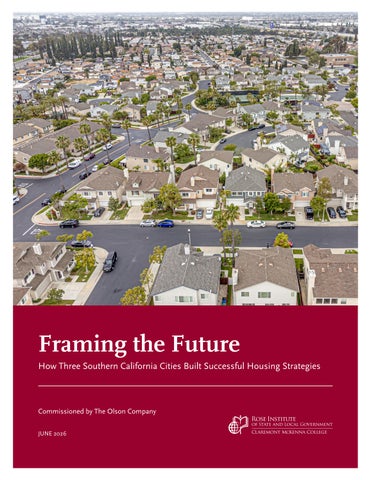
Framing the Future
How Three Southern California Cities Built Successful Housing Strategies
Commissioned by The Olson Company JUNE 2026
ROSE INSTITUTE OF STATE AND LOCAL GOVERNMENT
CLAREMONT MCKENNA COLLEGE
About the Rose Institute
The Rose Institute of State and Local Government is a leading source of objective, non-partisan information on California state and local governments. Founded at Claremont McKenna College in 1973, the Institute’s mission is to enhance the education of students at CMC, produce high quality research, and promote public understanding on issues of state and local government, politics, and policy, with an emphasis on California.
Project Team
Andrew Cheung ’28
Arushi Goyal ’28
Jathan Pai ’28
Shanna Rose, PhD
Kenneth P. Miller, JD, PhD
Bipasa Nadon, JD
Acknowledgments
Joseph Bessette, PhD
Marionette Moore

About The Olson Company
Since 1988, The Olson Company’s mission has been to work hand-in-hand with cities to solve the critical shortage of urban housing by promoting and investing in responsible development that improves quality of life for everyone. The Company approaches development by listening and seeking to understand the social, cultural, and aesthetic qualities of the neighborhoods in which it builds. The Olson Company works in collaboration with community stakeholders, city staff and officials to deliver creative solutions for neighbors and future residents. Its communities lower environmental impacts by relying on existing infrastructure, reducing or eliminating commute times and encouraging walkability to support local businesses, amenities, and resources. The Company’s success would not be possible without the partnership it has enjoyed with over 100 California cities and neighborhoods.
I. Introduction
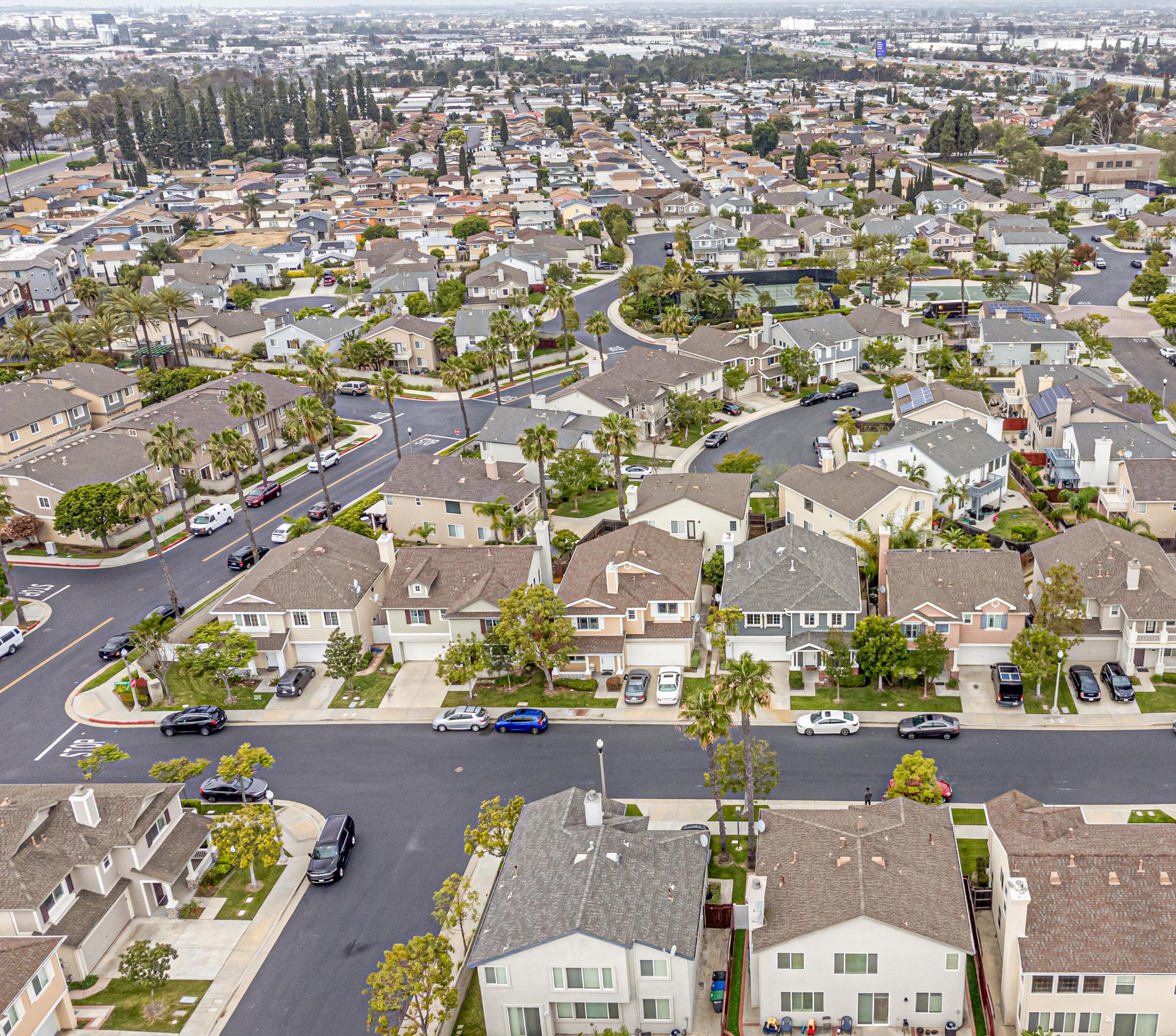
Across California, municipal governments are grappling with a severe, structural housing crisis. City officials are caught between stringent state production mandates and intense local political resistance to increasing density. While the state’s regional housing allocations demand major expansions of affordable housing, traditional suburban land-use policies have long insulated single-family neighborhoods, creating a steep uphill battle for new construction.
Some jurisdictions are finding a path forward, however. This paper examines the distinct, innovative housing strategies deployed by three Southern California cities—Santa Ana, Carson, and Costa Mesa—each navigating a unique set of economic landscapes, demographic pressures, and political environments, to expand their housing supply.
In the heart of Orange County, Santa Ana has emerged as a regional leader in affordable housing by fostering a municipal policy culture that starts from a position of “yes” to housing. The city has expanded housing for lower-income residents by blending an ambitious but flexible inclusionary housing ordinance with project-based federal subsidies, successfully balancing private investment with deep affordability.
Meanwhile, the industrialized LA suburb of Carson has pioneered a localized “corridor strategy.” By redirecting density away from its politically organized single-family neighborhoods and onto underutilized commercial strips, mobile home parks, and vacant parcels, Carson has engineered a breakthrough in
moderate-income housing production while fiercely guarding its local land-use autonomy.
Finally, Costa Mesa represents a compelling case of political course-correction. For years, the city’s housing market was virtually frozen by a highly restrictive, anti-growth voter initiative known as Measure Y; however, recent developments—including the passage of the pro-housing Measure K in 2022 and a developer-friendly Affordable Housing Ordinance in 2024—have potentially paved the way for thousands of new mixed-use units.
Together, the varied experiences of these three municipalities demonstrate that there is no singular blueprint for building affordable housing. Instead, their triumphs and ongoing trials show how creative zoning, strategic financing, and political compromise can be tailored to align community needs with developer feasibility.
II. Santa Ana
Santa Ana, located in the heart of Orange County, is the county’s third most populous city with more than 300,000 residents. Santa Ana is a very densely populated city, with more than 11,000 residents per square mile. It is a major regional economic hub and a “jobs-rich” city with a 2-to-1 jobs-to-housing ratio. Santa Ana’s median household income of approximately $94,000 makes it one of the lowest-income cities in Orange County. The median value of owner-occupied housing units is $713,000, while the median rent is $2,082. Approximately 55% of residents are renters.1
The City of Santa Ana is a regional leader in affordable housing development. According to city officials, Santa Ana’s success is fundamentally rooted in a policy culture
that starts from a position of saying “yes” to housing and working backwards from there.2 Through its ambitious but flexible inclusionary housing ordinance and its leveraging of a variety of federal housing programs, the city has expanded housing opportunities for lower-income residents while continuing to attract new private investment.
Santa Ana’s experience suggests that local governments can balance the competing interests of various housing-policy stakeholders, expanding affordable housing while still encouraging private development. However, finding the right balance has involved some trial and error.
1 U.S. Census Bureau, Quick Facts: Santa Ana, California. https://www.census.gov/quickfacts/fact/table/santaanacitycalifornia/INC110224. The jobs-to-housing ratio indicates the number of jobs located within the city per housing unit.
2 Judson Brown (Housing Manager, Community Development Agency) and Ali Pezeshkpour (Executive Director, City of
Ana Planning and Building Agency), interview by author, April 3, 2026.
Santa
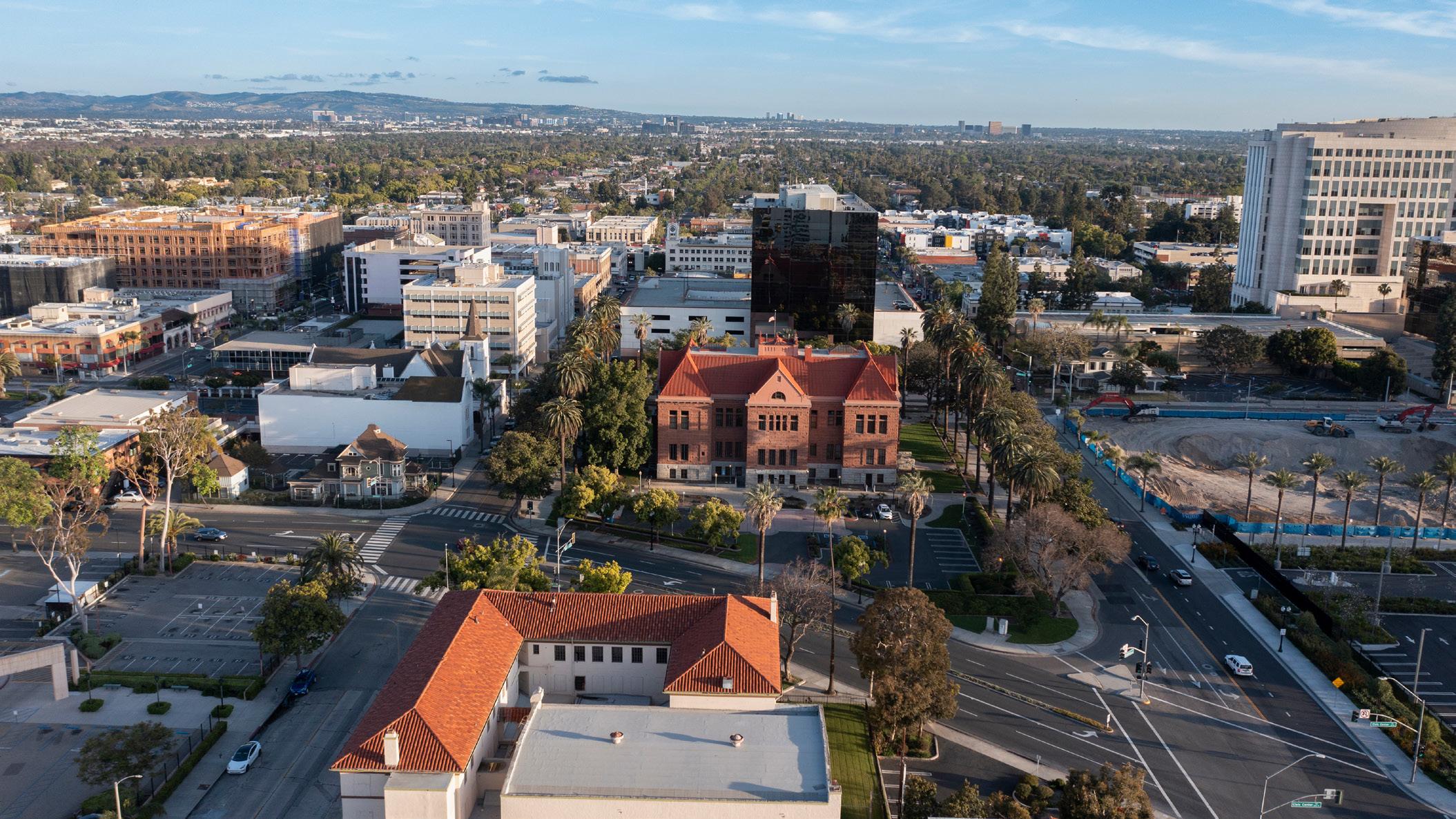
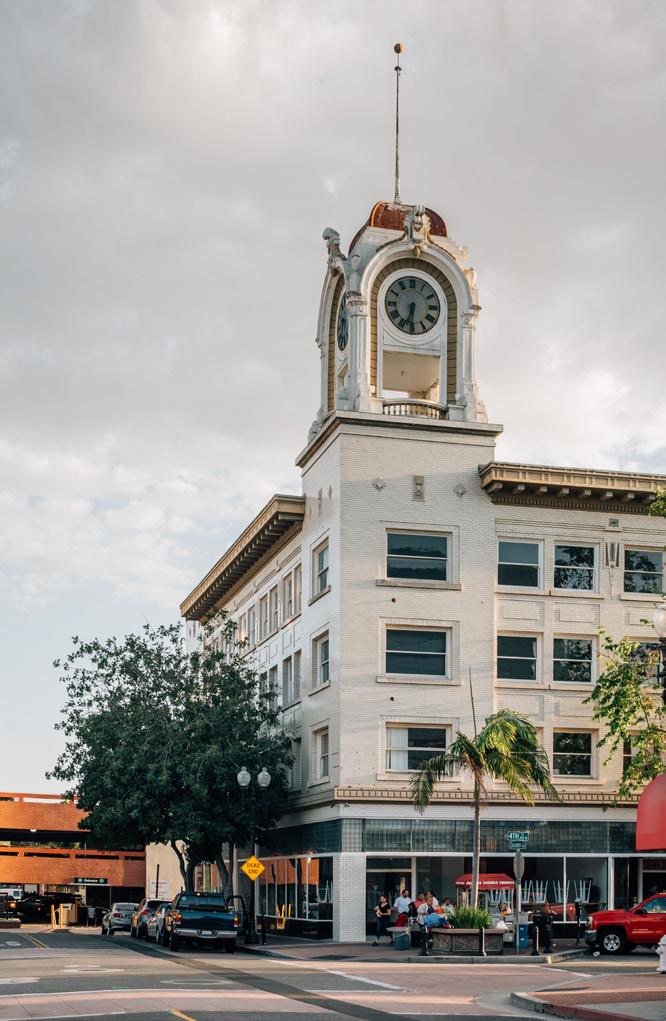
Aerial view of downtown Santa Ana, California (Adobe Stock)
Inclusionary Housing Ordinance
THE
CITY OF SANTA ANA IS A REGIONAL LEADER IN AFFORDABLE HOUSING DEVELOPMENT. ACCORDING TO CITY OFFICIALS, SANTA ANA’S SUCCESS IS FUNDAMENTALLY ROOTED IN A POLICY CULTURE THAT STARTS FROM A POSITION OF SAYING
“YES”
TO HOUSING AND WORKING BACKWARDS FROM THERE.
The centerpiece of Santa Ana’s affordable housing strategy is its inclusionary housing ordinance. In 2011, the city council adopted the Housing Opportunity Ordinance (HOO). The policy required private residential developments of 20 or more units to either contribute directly to the city’s affordable housing supply by designating 15% of units in new residential projects as affordable or paying a flat in-lieu fee of $15 per square foot.3 The fee revenue was used for developing new affordable units in other areas of the city, renovating existing affordable units, and subsidizing housing for vulnerable populations.
Santa Ana’s inclusionary housing ordinance has been revised twice in recent years. First, in 2020, economic concerns during the COVID-19 pandemic led the city council to reduce the developer in-lieu fee from $15 to $5 per square foot, and to narrow the types of projects subject to the ordinance. These investor-friendly rollbacks were welcomed by developers but prompted intense community pushback. During city council meetings, proponents, including real estate groups and construction unions, argued that the 2011 ordinance was too burdensome, that the pandemic was slowing
development, and that the city had already exceeded its affordable housing goals. However, affordable housing advocates and residents expressed concerns that the rollback would prioritize the needs of developers over those of the community.4
The rollback proved short-lived. After the 2020 election brought in a progressive, pro-renter majority, the city council majority sought to reverse these investor-friendly rollbacks, concerned that market-rate housing was being built at a disproportionate rate compared to affordable units. In 2021 the Council passed the Affordable Housing Opportunity and Creation Ordinance (AHOCO), formally codified via Municipal Code in 2022. This policy expanded the scope of the ordinance while enhancing flexibility for developers. Whereas the original 2011 ordinance had featured a rigid 15% set-aside requirement, the 2021 revision allowed a lower set-aside of 5% if developers guaranteed units to very low-income or extremely low-income households. The new ordinance also reduced the applicability threshold from projects with 20 or more units down to 5 or more units, ensuring that smaller development projects contributed to the city’s housing goals, but introduced a sliding-scale in-lieu fee structure
3 City of Santa Ana. n.d. Housing Opportunities Ordinance https://santaana.granicus.com/MetaViewer.php?view_id=2&event_id=7186&meta_id=24530
4 Ben Brazil, “Santa Ana rolls back affordable housing restrictions on developers,” Los Angeles Times August 19, 2020. https://www.latimes.com/socal/daily-pilot/ entertainment/story/2020-08-19/santa-ana-council
for smaller projects.5 Today, the policy is one of the stronger inclusionary housing ordinances in Orange County, thanks to its expanded scope and flexible options for developers.6
Leveraging Federal Programs
Because Santa Ana is home to many low-income renters, the city’s affordable housing strategy also relies heavily on means-tested federal programs. These programs help the city to expand access to affordable housing while reducing the extent to which affordability must be delivered solely through private development mandates. One such mechanism is the Housing Choice Voucher (HCV) program, also known as Section 8. Administered locally by the city’s housing authority, it provides rental subsidies that let very low-income families secure housing in the private rental market rather than being limited to designated subsidized units.7
Instead of giving all vouchers directly to tenants to search for private market apartments, Santa Ana uses Project-Based Vouchers (PBVs). The city attaches vouchers directly to specific physical units within new, private housing developments. Developers use these guaranteed, long-term federal rental subsidies to secure private construction loans. For example, this strategy was utilized for the Archways Santa Ana development, where the Santa Ana Housing Authority committed 26 project-based vouchers to lock in permanent supportive housing for unhoused individuals.8
Santa Ana has made extensive use of federal programs targeted to specific vulnerable populations. For instance, it has used the U.S. Department of Housing and Urban Development’s Veterans Affairs Supportive Housing (HUD-VASH) program to help fund developments such as Heroes’ Landing, Orange County’s largest permanent supportive housing development for veterans experienc-
ing homelessness, which opened in 2020. In 2022, Santa Ana also became one of the first cities in the country to be awarded American Rescue Plan Act funds, which the city used to add 47 affordable homes for vulnerable women and domestic violence survivors at WISEPlace.9 Taken together, these programs form a key pillar of Santa Ana’s affordable housing strategy: subsidizing affordability without relying solely on developers to deliver it.
Santa Ana also has 11 federally-designated Opportunity Zones, which provide tax advantages for long-term investments in qualifying projects located within lowerincome census tracts. Investors who reinvest capital gains in Opportunity Zone projects can defer certain federal taxes and potentially exclude taxes on appreciation if investments are held long enough.10 These incentives have encouraged private capital to flow into housing development within several parts of the city.
Targeted Development Strategies
Santa Ana has pursued a range of targeted development strategies to expand the city’s housing supply. Much of the city’s recent housing production has occurred through infill development and adaptive reuse, reflecting Santa Ana’s status as a largely built-out, urban environment where the potential for large-scale, greenfield development is limited. Despite being one of the densest cities in the nation, Santa Ana has taken creative, incremental approaches to adding housing such as redevelopment of small, underutilized commercial sites. For example, one recent project converted underutilized church land into 93 affordable apartments at Legacy Square.11 The city has also pursued adaptive reuse strategies, including the conversion of several hotel properties into residential units.12
Santa Ana has also experienced significant growth in mixed-use residential projects and mid-rise apartment
5 City of Santa Ana, “2021 Affordable Housing Opportunity and Creation Ordinance,” accessed March 8, 2026, https://www.santa-ana.org/2021-affordable-housingopportunity-and-creation-ordinance/
6 City of Anaheim, ”Comparison of Orange County Cities with Inclusionary Housing Ordinances,” accessed April 7, 2026, https://local.anaheim.net/docs_agend/questys_ pub/16734/16764/16766/18684/18690/5.%20Comparison%20of%20Orange%20County%20Cities%20with%20Inclusionary%20Housing%20Ordinances18690.pdf
7 City of Santa Ana, “Learn About Section 8 Rental Assistance,” accessed March 8, 2026, https://www.santa-ana.org/learn-about-section-8-rental-assistance/
8 City of Santa Ana, “Archways Santa Ana affordable housing community opens with financial support from City of Santa Ana,” March 12, 2025. https://www.santa-ana. org/community-development-partners-opens-archways-santa-ana-affordable-community-with-financial-support-from-city-of-santa-ana/
9 City of Santa Ana, “City Council approves loans for Affordable Housing Projects,” June 29, 2022. https://www.santa-ana.org/city-council-approves-loans-for-affordablehousing-projects/
10 City of Santa Ana, “Opportunity Zone,” accessed March 8, 2026, https://www.santa-ana.org/opportunity-zone/
11 Amancai Biraben, “How Southern California Churches Are Turning Unused Land into Affordable Housing,” Orange County Register, May 3, 2026. https://www.ocregister. com/2026/05/03/how-southern-california-churches-are-turning-unused-land-into-affordable-housing/
12 Steven Sharp, “Senior Affordable Housing Breaks Ground at 4610 Santa Ana St. in Cudahy,” Urbanize LA, September 30, 2025, https://la.urbanize.city/post/senioraffordable-housing-breaks-ground-4610-santa-ana-st-cudahy
Total Units (Permits) by Year
Source: U.S. Department of Housing and Urban Development, Office of Policy Development and Research, SOCDS Building Permits
construction, often located along commercial corridors and near transit routes. Additional housing units have been added through accessory dwelling units, density bonus projects, townhome developments, and the redevelopment of aging retail sites, vacant lots (such as the Crossroads at Washington), and shopping centers (such as La Placita Cinco).13 These strategies enable the city to add housing incrementally within existing urban areas while making use of state density bonus policies that can offset the costs associated with affordability requirements.
Santa Ana has seen a surge in development in recent years. In 2023, the city approved a record number of building permits (Figure 1) with an all-time high construction valuation of $772 million. The increase partly reflects the city’s recent efforts to streamline building processes.
In 2022, the City updated its General Plan, laying the groundwork for new mixed-use development opportunities, and modernized its Zoning Code to streamline project application review processes and provide clarity on land use regulations—all helping to maintain developer interest in the area.14 The pace of development slowed somewhat after 2023, mirroring a statewide pattern that appears to be driven in part by elevated mortgage rates and economic uncertainty.15
Measuring Success
Santa Ana’s housing policies and development strategies have translated into measurable progress toward expanding the city’s housing supply. The city is on pace to meet its Regional Housing Needs Allocation (RHNA) targets well ahead of the 2029 deadline. Less than three
13 Nancy Luna, “Santa Ana Approves 1600 Homes Near South Coast Plaza,” Orange County Business Journal, September 17, 2025, https://www.ocbj.com/real-estate/santaana-approves-1600-homes-near-south-coast-plaza/
14 City of Santa Ana, “Santa Ana sees record development surge with $772 million permit valuation in 2023.” April 23, 2024. https://www.santa-ana.org/santa-ana-seesrecord-development-surge-with-772-million-permit-valuation-in-2023/
15 Jonathan Lansner, “California building permits tumble to 16% below average.” Orange County Register September 23, 2025. https://www.ocregister.com/2025/09/03/ california-building-permits-run-16-below-average/
Figure 1. Santa Ana’s Total Annual Building Permits, 2001-2025
years into the current eight-year planning cycle (2021-2029), Santa Ana had already issued building permits for approximately 74% of the housing units required under the state’s allocation (Figure 2). The City has greatly outpaced neighboring Orange County municipalities in meeting state-mandated RHNA goals (Figure 3).
Santa Ana’s efforts have also received recognition at the state level. The city has been awarded a ProHousing Designation, an award granted by the State of California to municipalities that adopt policies encouraging housing production and reducing regulatory barriers to development.16 The award signals that Santa Ana has taken proactive steps to advance housing production and affordability simultaneously.
Despite recent progress, Santa Ana continues to face several structural challenges that will shape the future of housing development in the city. Developers must continue to navigate the city’s inclusionary housing ordinance, which is layered on top of provisions embedded in state housing legislation, creating a cumulative set of regulatory and labor standards that can add costs and feasibility concerns to the development process. Community concerns about density also remain a factor in the local development process. As infill projects bring additional housing into established neighborhoods, local opposition can influence project approvals and shape the scale or design of new developments. Managing these concerns while maintaining housing production will require continued engagement between city officials, developers, and residents.
Source: California Department of Housing and Community Development (HCD) and Southern California Association of Governments (SCAG), 6th Cycle RHNA Allocation (2021–2029).
16 California Department of Housing and Community Development, “Prohousing Designated Jurisdictions,” accessed March 8, 2026, https://www.hcd.ca.gov/planningand-research/prohousing/designated-jurisdictions
Source: Most recent available Annual Progress Report (APR) or city-reported permitting totals for the 6th Cycle RHNA (2021-2029).17
17 Noah Biesiada and Michelle King, “Many Orange County Cities Fail At Low Income Housing Development,” Voice of OC, April 1, 2026, https://voiceofoc.org/2026/04/ cities-lag-affordable-housing/
Figure 2. Santa Ana’s Progress toward 6th Cycle RHNA
Figure 3. Santa Ana Leads Comparable Cities in Progress Toward RHNA Goals
(2021-2029
III. Carson
Carson is an industrialized suburb of Los Angeles, situated in the South Bay between the 405 and 110 freeways and the Ports of Los Angeles and Long Beach. The city occupies 19 square miles, is home to approximately 91,000 residents, has a median household income of $109,000, and boasts a 2-to-1 jobs-to-housing ratio.18 Carson is a fairly densely populated city, with more than 5,000 residents per square mile. The median value of owner-occupied housing units is $704,400, and the median rent is $1,956. Carson has a 74% owner-occupied housing rate—more than 40 percentage points above the Los Angeles County average.19
For many years, housing production in Carson was stagnant. Between 2000 and 2017, Carson added roughly 225 housing units, or an average of only eleven units per year. This low output can be largely traced to political resistance among homeowners. The city’s residential neighborhoods, built almost entirely between the 1940s and 1960s, are dominated by owner-occupied, single-family detached homes. These homeowners are politically
organized, and proposed infill of already-developed residential lots has faced stiff political resistance.
Recently, Carson has experienced a breakthrough in housing production. The number of building permits rose dramatically starting in 2018 (Figure 4), and the city has since added approximately 3,800 housing units—more than the preceding two decades combined.20 This acceleration was the direct result of a series of critical policy decisions. Carson’s political leadership identified the city’s stock of large, underperforming parcels as the path of least resistance, then used development agreements and a state bond mechanism to convert those parcels into residential units. The strategy concentrated new density on commercial corridors in an effort to preserve the single-family neighborhoods that constitute 72% of the existing housing stock.21
On a per-capita basis, Carson’s recent uptick in housing permits has outpaced those of its neighboring South Bay cities (Figure 5). In 2018, Carson issued 1.7 permits per
18 U.S. Census Bureau, Quick Facts: Carson, California. https://www.census.gov/quickfacts/fact/table/carsoncitycalifornia/PST045224
19 U.S. Census Bureau, ACS 2023 1-year estimates, Tables DP04, B25003, B25077. SCAG, Carson Local Profile, 2019.
20 SCAG, “Pre-Certified Local Housing Data for the City of Carson, April 2021 https://scag.ca.gov/sites/default/files/old/file-attachments/carson-he-0421.pdf?1620800026= Census Reporter, “Carson, CA” https://censusreporter.org/profiles/16000US0611530-carson-ca/.
21 U.S. Census Bureau, ACS 2023 1-year estimates, Tables DP04, B25003, B25077. SCAG, Carson Local Profile, 2019.
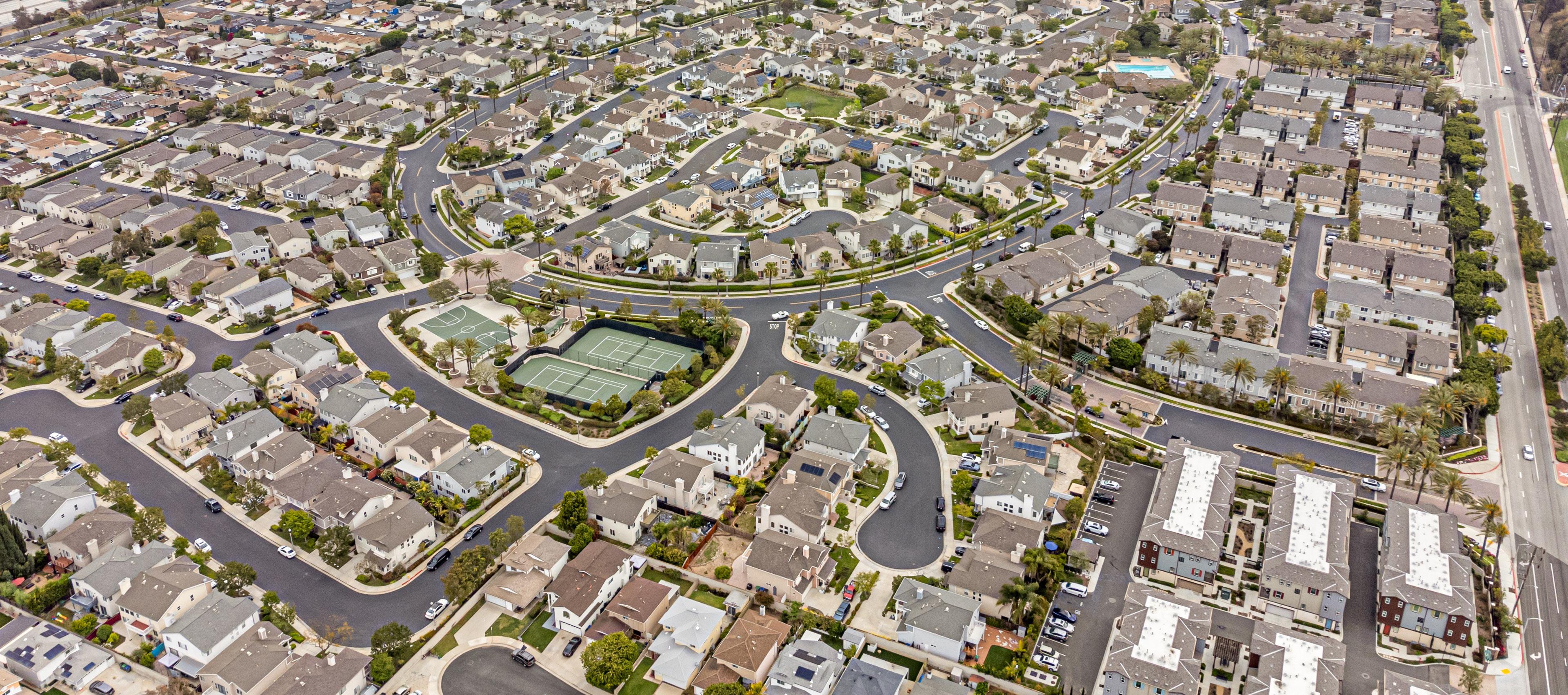
Aerial view of Carson, California in May, 2024 (Adobe Stock)
Figure 5. Carson’s Permits Per 1,000 Residents vs. Comparable Cities
1,000 residents. This was below the Los Angeles County rate of 2.2, but several times the rate of neighboring South Bay jurisdictions including Torrance (0.3), Lakewood (0.3), and Compton (0.2). Although this expansion peaked in 2018–2020, Carson’s per-capita rate has since moderated to 1.5 in 2022, remaining ahead of Lakewood (0.3) and Compton (1.4).
Major Pipeline Projects
Carson’s outperformance of its peer cities largely reflects a housing strategy centered on development of a set of large, underperforming parcels uncommon in the South Bay: a string of aging mobile home parks along Avalon Boulevard, acres of low-value commercial strip—including auto lots, parking lots, and obsolete retail—along the same corridor, and a 157-acre former landfill vacant since 1965. Together, these parcels constitute a land bank with the potential to absorb thousands of housing units without directly affecting existing residential neighborhoods. Yet development of these parcels also has been encumbered by a variety of obstacles including displacement of mobile home residents, toxic contamination, and litigation.
Carson’s corridor strategy is straightforward: convert low-productivity commercial land and mobile home parks into mixed-use, multifamily residential development through site-specific entitlements that give developers the certainty needed to commit capital. The largest of these projects is the Imperial Avalon Specific Plan, also known as Envision Carson, which rezoned a 27-acre mobile home park at 21207 South Avalon Boulevard to permit roughly 1,100 residential units, 10,000 square feet of restaurant space, and a public park (Figure 6). The City Council approved the plan unanimously in December 2022, after a process that moved from initial scoping to full approval in under two years.22 The project required displacing approximately 225 mobile home households, mostly elderly residents on fixed incomes. The developer offered buyout packages that the city described as the highest relocation package in California history.23 Others contested this characterization, however, as some homeowners
22 City of Carson, File No. 2022-983, Public Hearing: Imperial Avalon Specific Plan, Zone Change, General Plan Amendment, Vesting Tentative Tract Map, Environmental Impact Report, and Development Agreement, Dec. 2022. Accessed via carson.legistar.com/LegislationDetail.aspx?ID=5951515
23 Spectrum News 1, “Are we seeing less and less mobile home parks?,” August 2, 2021. https://spectrumnews1.com/ca/la/housing/2021/08/02/are-weseeing-less-and-less-mobile-home-parks-
CARSON’S CORRIDOR STRATEGY IS STRAIGHTFORWARD: CONVERT LOW-PRODUCTIVITY COMMERCIAL LAND AND MOBILE HOME PARKS INTO MIXED-USE, MULTIFAMILY RESIDENTIAL DEVELOPMENT THROUGH SITE-SPECIFIC ENTITLEMENTS THAT GIVE DEVELOPERS THE CERTAINTY NEEDED TO COMMIT CAPITAL.
Figure
Major Pipeline Projects
Project Name, Status, and Number of Units
Envision Carson Groundbreaking 3/25
District at South Bay Remediation
Carson Triangle Entitled 10/24
Sources: Terelle Jerricks, “The Dirt is Moving,” Random Lengths News, March 20, 2025, https://www.randomlengthsnews.com/archives/2025/03/20/state-ofthe-city-2/69997#:~:text=Days%20before%20Carson%20Mayor%20Lula,Imperial%20Avalon%20mobile%20home%20park; City of Carson, “The District at South Bay Specific Plan Amendment,” Notice of Determination, SCH No. 2005051059, CEQAnet, June 9, 2022, https://ceqanet.lci.ca.gov/2005051059/14; Steven Sharp, “283 Townhomes Coming to 21212 Avalon Boulevard in Carson,” Urbanize LA, October 20, 2024, https://la.urbanize.city/post/283-townhomescoming-21212-avalon-boulevard-carson#:~:text=October%2020%2C%202024%2C%208%3A,Freeway%20at%2021212%20Avalon%20Boulevard
received appraisals as low as $37,000.24 In July 2021, approximately 60 residents protested outside Carson City Hall.25 City Manager Sharon Landers acknowledged that the city had limited legal authority to prevent a landowner from closing a mobile home park, but that the council had worked to maximize benefits for displaced residents.26 Eventually, nearly every former resident chose the buyout, with only a handful choosing the return option.27 The council’s unanimous vote was arguably the single most consequential housing production decision Carson made during this period. It signaled to the development community that the city would tolerate political opposition in service of increased housing development.
The city entitled the Carson Triangle project, which will construct 283 townhomes (including 32 affordable units) at 21212 Avalon Boulevard.28 Together, the projects concentrate thousands of new housing units along a single corridor, converting low-productivity commercial strip into a mixed-use residential district while leaving the city’s single-family neighborhoods intact.
Another potential development site is the former Cal Compact Landfill, which operated from 1959 to 1965 and accepted hazardous waste that left behind contaminated soil, groundwater toxins, and methane seepage.29 After its closure, the 157-acre parcel was one of the largest
24 David Rosenfeld, “Carson Mobile Home Park Closures Put Owners, Residents at Odds, with City in the Middle,” Daily Breeze (SCNG), July 26, 2021. https://www. dailybreeze.com/2021/07/26/carson-mobile-home-park-closures-put-owners-residents-at-odds-with-city-in-the-middle/.
25 Rosenfeld, “Carson Mobile Home Park.”
26 Phoenix Tso, “Mobile Home Residents in Carson Say Closing Their Park Leaves Them with No Affordable Place to Live,” LAist, July 16, 2021. https://laist.com/news/ housing-homelessness/mobile-home-residents-in-carson-protest-closure; CBS News, “Sale of Mobile Home Parks in Carson Displaces Hundreds of Elderly Residents,” July 15, 2021. https://www.cbsnews.com/losangeles/news/sale-of-mobile-home-parks-in-carson-displacing-some-445-elderly-residents/.
27 Andrew Khouri, “Carson Developer to Bring 1,200 Units of Housing, a Country Mart Complex to City,” Daily Breeze (SCNG), October 10, 2022. https://www.dailybreeze. com/2022/10/10/carson-developer-to-bring-1200-units-of-housing-a-country-mart-complex-to-city/; Carson Chamber of Commerce, Envision Carson Groundbreaking Press Release No. 25-008, March 17, 2025; 2UrbanGirls, “Carson 2025 State of the City,” March 26, 2025. https://2urbangirls.com/2025/03/carson-2025-state-of-the-citymayor-lula-davis-holmes-highlights-growth-safety-and-sustainability/.
28 Stephen Sharp, “20-Acre Development Could Bring Over 1,000 Apartments to Carson,” Urbanize LA, September 24, 2019 https://la.urbanize.city/post/20-acredevelopment-could-bring-over-1000-apartments-carson; Urbanize LA, “283 Townhomes Coming to 21212 Avalon Boulevard in Carson,” October 20, 2024. https:// la.urbanize.city/post/283-townhomes-coming-21212-avalon-boulevard-carson
29 Daily Breeze, South Bay History (staff blog), “Tracing the History of a Very Important South Bay Vacant Lot,” August 29, 2015. https://sbhistoryblog.wordpress.com/2015/08/29/tracing-the-history-ofa-very-important-south-bay-vacant-lot/.
6. Carson’s
283 Units
CARSON WAS THE FIRST
SOUTHERN CALIFORNIA CITY TO
PARTICIPATE IN THE CALIFORNIA STATEWIDE COMMUNITIES
DEVELOPMENT
AUTHORITY’S (CSCDA) WORKFORCE HOUSING PROGRAM, PRODUCING 507 INCOME-RESTRICTED UNITS WITHIN SIX MONTHS BETWEEN LATE 2020 AND MID-2021 WITHOUT A TRADITIONAL PUBLIC SUBSIDY.
undeveloped tracts in Los Angeles County. Despite its prime location in proximity to the 405 and 110 freeways, it was unbuildable without millions of dollars in environmental remediation. Every attempt to develop the site has followed a similar trajectory: large proposal, remediation cost overruns, and collapse. These failed projects included the LA MetroMall, Michael Ovitz’s 75,000-seat NFL stadium, and the Boulevards at South Bay. The most recent plan, a multi-use project known as the District at South Bay, is slated to include over 1,200 housing units, a hotel, an outlet mall, industrial buildings, and parks.
Tax-Exempt Bond Financing
Carson has been a pioneer in the use of tax-exempt bonds to finance the expansion of affordable housing. Carson was the first Southern California city to participate in the California Statewide Communities Development Authority’s (CSCDA) Workforce Housing Program, producing 507
income-restricted units within six months between late 2020 and mid-2021 without a traditional public subsidy.30
The mechanism operates as follows. CSCDA, a joint powers authority co-sponsored by the League of California Cities and the California State Association of Counties, issues tax-exempt bonds to acquire market-rate apartment buildings and convert them into rent-restricted housing. The tax-exempt status reduces debt service costs, and the savings pass through as lower rents restricted to households earning 80-120% of area median income (AMI). Existing tenants are not displaced. Annual rent increases are capped at 4%, below the ceiling imposed by AB 1482.31
In December 2020, CSCDA issued $78 million in bonds to acquire the 150-unit Renaissance at City Center in Carson, the first such transaction in Southern California.32 In June 2021, the authority completed an approximately $216 million acquisition of the 357-unit Union South Bay complex on Carson Street.33 Standard Communities served as project administrator for both transactions, and
30 Our Weekly, “Carson Luxury Apartment Complex to Welcome ‘Middle-Income’ Tenants,” January 28, 2021. https://www.ourweekly.com/2021/01/28/carson-luxuryapartment-complex-welcome-middle-inc/.
31 Sentinel News Service, “Carson Capitalizes on State’s $65 Billion Housing Program for its Middle-Income Professionals,” June 24, 2021. https://lasentinel.net/carsoncapitalizes-on-states-65-billion-housing-program-for-its-middle-income-professionals.html; Standard Communities, “Standard Communities Leads Public-Private Partnership Creating 357 Units of Middle-Income Housing in Southern California,” July 15, 2021, https://standard-communities.com/news/standard-communities-leadspublic-private-partnership-creating-357-units-of-middle-income-housing-in-southern-california/.
32 Our Weekly, “Carson Luxury Apartment Complex to Welcome ‘Middle-Income’ Tenants,” January 28, 2021. https://www.ourweekly.com/2021/01/28/carson-luxuryapartment-complex-welcome-middle-inc/.
33 The Real Deal, “Standard Communities Buys Carson Rental Complex,” July 20, 2021. https://therealdeal.com/la/2021/07/20/standard-communities-buys-350-unitcomplex-in-carson/; Urbanize LA, “354-Unit Apartment Complex in Carson to Be Converted to ‘Middle-Income’ Housing,” July 14, 2021. https://la.urbanize.city/post/ carson-union-south-bay-apartments-middle-income.
subsequently formed a $2 billion joint venture with Faring to replicate the model statewide.34 Carson Mayor Lula Davis-Holmes tied the initiative to her post-pandemic economic recovery plan, framing the conversions as a strategy to attract middle-income employers and retain Carson’s professional workforce.35
The CSCDA model has obvious appeal for a city like Carson: it creates income-restricted housing without requiring the city to fund, zone, or build new units. It converts existing market-rate apartments into moderate-income housing through a financial instrument that costs the municipality nothing beyond consent. The limitation is correspondingly evident. The program serves households earning too much for subsidized housing but too little for market rents. It does not reach very low- or low-income households—the categories that dominate Carson’s 6th-cycle state-mandated Regional Housing Needs Allocation (RHNA) obligation.
Carson vs. the Capital
Carson’s relationship with Sacramento has been characterized by both cooperation and conflict. Carson successfully fought the state on Senate Bill 9 (2021), which requires cities to ministerially approve (without public hearings) construction of up to two residential units per single-family lot, and subdivision of single-family lots into two parcels, effectively allowing up to four units where only one was previously permitted. In 2022, Carson joined Redondo Beach, Torrance, Whittier, and Del Mar in filing a petition for writ of mandate in Los Angeles Superior Court, arguing that SB 9 was unconstitutional as applied to charter cities.36 In April 2024, the court agreed, ruling that SB 9 violated the California Constitution because it was neither reasonably related to its stated purpose of ensuring affordable housing nor narrowly tailored to avoid interference with local government. The ruling is binding on the five petitioner cities, and the logic extends to California’s 121 charter cities.37
The litigation reflects the internal logic of Carson’s housing strategy. SB 9 would permit ministerial approval of duplexes and lot splits in single-family zones—the neighborhoods Carson’s corridor strategy was designed to insulate from densification. By concentrating new units on Avalon Boulevard and the landfill site, the city has sought to protect existing homeowners from infill. SB 9 would have violated that informal compact. Carson’s lawsuit was accordingly directed at dispersed, by-right density on single-family lots—not at housing production per se.
Notwithstanding the lawsuit, California’s Department of Housing and Community Development (HCD) awarded Carson its Pro-housing Designation, a distinction conferred on jurisdictions that demonstrate progress on housing availability, in December 2023.38 The designation carries scoring advantages on certain state funding applications. That the state conferred this recognition on a city that had recently sued to block a state housing law illustrates the gap between the designation’s production-based metrics and Sacramento’s broader policy objectives. Carson has satisfied the state’s quantitative criteria while preserving local land-use autonomy over residential neighborhoods.
State Housing Mandates
The state’s sixth-cycle RHNA assigned Carson 5,618 units for the 2021–2029 planning period, a 231% increase over the 5th-cycle allocation of 1,698.39 The lower-income categories (very low and low income) account for 2,683 of those units. Nearly all of Carson’s production to date falls in the above-moderate category. Completed and under-construction affordable projects (including West Carson Villas, 111 units; 800 W. Carson Street, 230 units; Veterans Village, 51 units) total approximately 400 lower-income units, or roughly 15% of the mandate (Figure 7).
34 Standard Communities, “Standard Communities and Faring Form Joint Venture to Create $2 Billion of Middle-Income Housing in California” August 10, 2021. https:// standard-communities.com/news/standard-communities-and-faring-form-joint-venture-to-create-2-billion-of-middle-income-housing-in-california/; Stephen Sharp, “Developers Form $2-Billion Joint Venture to Create ‘Middle-Income’ Housing in California,” Urbanize LA, October 12, 2021. https://la.urbanize.city/post/standardcommunities-faring-workforce-housing-california.
35 Sentinel News Service, “Carson Capitalizes.”
36 City of Redondo Beach et al. v. Rob Bonta, Case No. 22STCP01143, L.A. County Superior Court, ruling April 22, 2024 (Hon. Curtis A. Kin, Dept. 86). Allen Matkins LLP, “Superior Court Ruling: Charter Cities Not Subject to SB 9,” April 2024 https://www.allenmatkins.com/real-ideas/superior-court-ruling-charter-cities-not-subject-to-sb-9. html
37 City of Redondo Beach et al. v. Rob Bonta, Case No. 22STCP01143.
38 CA HCD, Prohousing Designation Program, hcd.ca.gov/community-development/prohousing
39 SCAG, 6th Cycle Final RHNA Allocation Plan, adopted March 4, 2021, amended July 1, 2021, scag.ca.gov/rhna; City of Carson, 2021–2029 Housing Element, Ch. 4.
40 HCD review letter re: C arson Housing Element, May 6, 2022 hcd.ca.gov/community-development/ housing-element/docs/lancarsonadoptedout050622.pdf Inclusionary housing feasibility study: carsonca.gov/ihilf. php (pending adoption as of March 2026).
Note: Production/pipeline figures are estimates pending current APR verification.
Source: California Department of Housing and Community Development (HCD) and Southern California Association of Governments (SCAG), 6th Cycle RHNA Allocation (2021–2029).
6th Cycle RHNA Obligation Estimated Units Produced / In Pipeline
Figure 7. Carson’s Progress toward 6th Cycle RHNA by Income Category
40 An inclusionary housing ordinance is under study in Carson, but has not advanced to adoption. Without an inclusionary ordinance or dedicated pipeline of subsidized construction, the affordable housing obligation remains largely unmet. The political impetus that produced 3,400 entitled units on the Avalon corridor has not been directed at the income categories where the RHNA shortfall is concentrated. Whether the CSCDA model can extend down-market remains uncertain. The bond mechanism that serves households at 80-120% of AMI depends on rental income sufficient to service tax-exempt debt. At very low-income levels (below 50% of AMI), the economics require direct subsidy. Carson’s current toolkit does not include the instruments—such as inclusionary mandates, dedicated local trust funds, and density bonuses conditioned on deep affordability—that would generate those units at scale.
The city’s Housing Element projects accessory dwelling unit (ADU) production of 35 units per year to help close the gap. This projection will require a sizable acceleration, as Carson has issued very few ADU permits in recent years.
IV. Costa Mesa
Costa Mesa, a city of approximately 109,000 residents in Orange County, has a median household income of $112,000, an owner-occupied housing rate of just under 40%, and a jobs-to-housing ratio of approximately 1.6. At just under 16 square miles, it is a small but relatively densely populated city, with more than 7,000 residents per square mile.41 Its median home value of $1.1 million is substantially higher than those of Santa Ana and Carson; its median rent is also higher at $2,446. Nearly half of Costa Mesa residents are considered housing-burdened, spending more than 30% of their income on housing.42
Like many California cities, Costa Mesa has faced steep hurdles to expanding affordable housing, including stiff political opposition from homeowners. For many years, an anti-growth ballot initiative known as Measure Y stifled
housing development. More recently, however, the city reversed course with passage of pro-housing Measure K in 2022 and an Affordable Housing Ordinance in 2024. Although it is too soon to evaluate the success of these measures, Costa Mesa’s course correction is a hopeful sign for future expansion of housing supply.
Measures Y and K
In 2016, a political action committee known as Costa Mesa First placed Measure Y on the ballot. Measure Y was an anti-growth ballot initiative rooted in concerns that a “developer-friendly, heavy-handed” City Council was approving “uncontrolled development” that was contributing to traffic and density problems.43
41 U.S. Census Bureau, Quick Facts: Costa Mesa, California. https://www.census.gov/quickfacts/fact/table/costamesacitycalifornia/PST045224
42 Spencer Custodio, “Costa Mesa Leaders Consider Mandating Affordable Housing Developments,” July 26, 2023, https://voiceofoc.org/2023/07/costa-mesa-leadersconsider-mandating-affordable-housing-developments/
43 Geoff West, “With Measure K, voters in Costa Mesa can change the stifling effects of Measure Y.” Los Angeles Times, September 20, 2022. https://www.latimes.com/ socal/daily-pilot/opinion/story/2022-09-20/commentary-with-measure-k-voters-in-costa-mesa-can-change-the-stifling-effects-of-measure-y
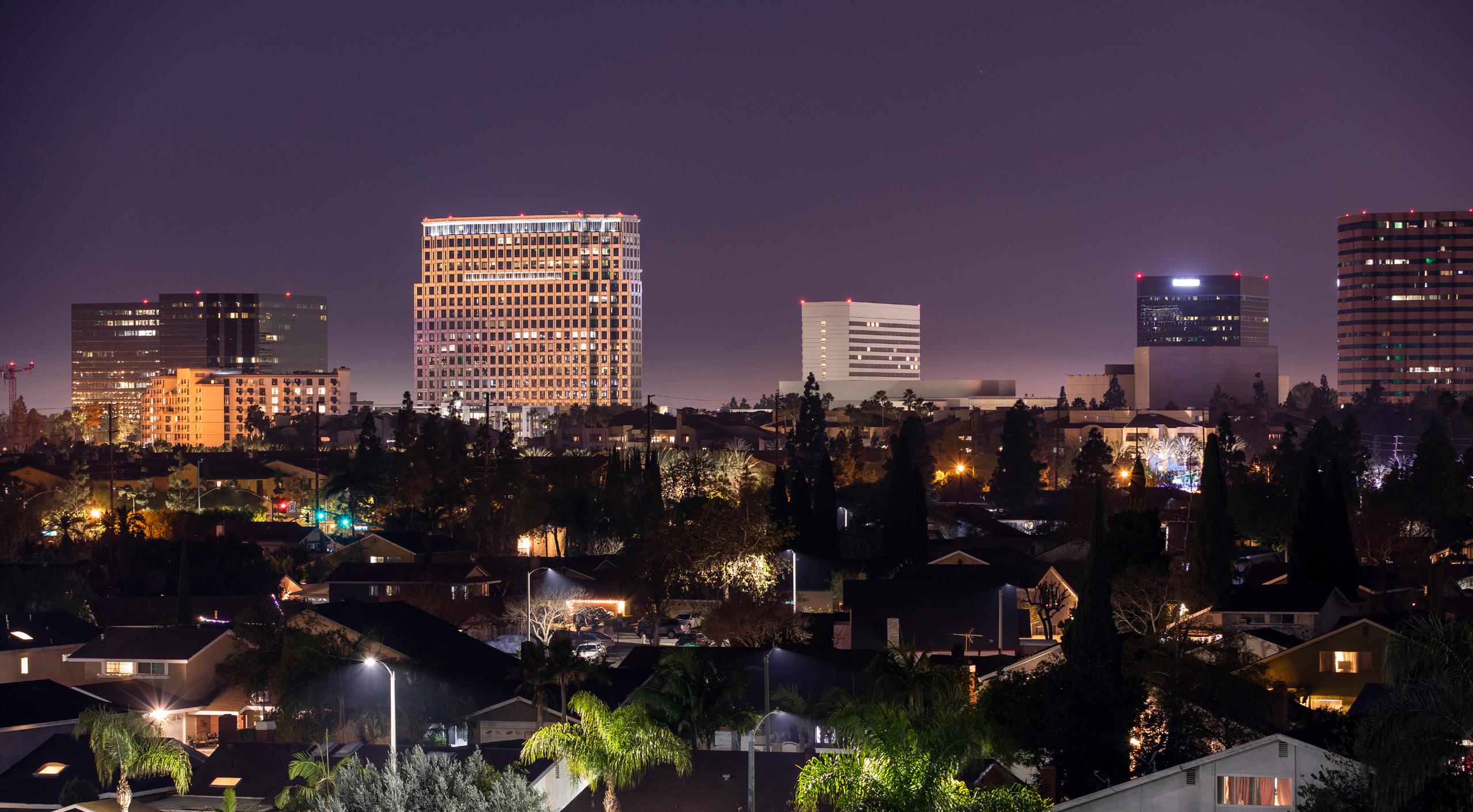
Skyline view of downtown Costa Mesa, California at night (Adobe Stock)
Figure
8. Costa Mesa’s Total Annual Building Permits, 2001-2025
Source: U.S. Department of Housing and Urban Development, Office of Policy Development and Research, SOCDS Building Permits.
Indeed, the number of permits issued was rising rapidly around this time (Figure 8). Under Measure Y, any residential project that added more than 40 dwelling units, 10,000 square feet in nonresidential floor area, or 200 daily automobile trips would trigger a vote of the people. Voters passed Measure Y by a wide margin of 68-32%.44
With the electorate serving as gatekeeper for every mid-tolarge-sized project, new housing development stagnated. The Los Angeles Times reported that thanks to Measure Y, “developers simply choose to take their development dollars elsewhere,” and as a result, “virtually all development in the city has dried up.” Indeed, there was not a single vote of the people on any development following the measure’s passage. Measure Y also stalled property improvements, contributed to vacancies and blight, and
encouraged “tenants of last resort,” such as dispensaries and massage parlors. It created a roadblock to fulfillment of state housing mandates, potentially subjecting the city to enormous financial penalties, loss of eligibility for state grant funds, and loss of local control over housing.45
The 2018 election, following Costa Mesa’s switch from at-large to district-based voting, changed the makeup of the City Council, replacing a slow-growth regime with a more developer-friendly body. The Council voted 6-1 to place on the 2022 ballot Measure K, which would carve out certain areas of the city, primarily commercial corridors, from Measure Y’s voter-approval requirement. This carve-out allowed those sites to be included in the city’s updated housing element and become eligible to count towards the RHNA allocation. Voters passed Measure K by a razor-thin margin.46
44 Ballotpedia, “Costa Mesa, California, Require Voter Approval On Certain Development Projects, Measure Y (November 2016)” https://ballotpedia.org/Costa_Mesa,_ California,_Require_Voter_Approval_On_Certain_Development_Projects,_Measure_Y_(November_2016)
45 Geoff West, “With Measure K, voters in Costa Mesa can change the stifling effects of Measure Y.” Los Angeles Times, September 20, 2022. https://www.latimes.com/ socal/daily-pilot/opinion/story/2022-09-20/commentary-with-measure-k-voters-in-costa-mesa-can-change-the-stifling-effects-of-measure-y
46 Ballotpedia, “Costa Mesa, California, Measure K, Residential Neighborhood Revitalization Measure (November 2022)” https://ballotpedia.org/Costa_Mesa,_ California,_Measure_K,_Residential_Neighborhood_Revitalization_Measure_(November_2022)
Project Name, Number of Units, and Status
Fairview Developmental Center
Specific Plan in Progress
One Metro West Approved Mesa Vista
Sources: Fairview Developmental Center Specific Plan, https://fdcplan.com/; Sara Cardine, “Patience pays off for One Metro West, which will not go before Costa Mesa voters,” Los Angeles Times, June 6, 2024, accessed April 12, 2026, https://www.latimes.com/socal/daily-pilot/news/story/2024-06-06/ patience-pays-off-for-one-metro-west-which-will-not-go-before-costa-mesa-voters; Community Development Partners, “Mesa Vista Apartments,” https://www. communitydevpartners.com/communities/mesa-vista-apartments/; Nicole Kavros, “Costa Mesa Approves Live-Work Development,” Voice of OC, March 20, 2025, https://voiceofoc.org/2025/03/costa-mesa-approves-live-work-development/
Measure K has paved the way for the development of thousands of new housing units. One notable example is One Metro West, a 1,057-unit mixed-use development north of the 405 Freeway (Figure 9).47 This and other projects would have been subject to Measure Y’s voterapproval requirement had it not been for Measure K’s carveout.
Affordable Housing Ordinance
In 2022, the Costa Mesa City Council and city planners began working with consultants to draft an Affordable Housing Ordinance (AHO). The proposal focused on adding affordable housing in specific corridors, mostly commercial and industrial areas along the north side of the 405 freeway and sections of Harbor and Newport Beach Boulevards, among others. The initial proposal featured set-aside requirements of 10% low-income or 5%
very low-income units for rental developments of 60 units per acre or more. For medium-sized projects, the requirement would be 6% low-income or 4% very low-income. Any project proposing fewer than 10 units would not face affordable-housing requirements. Developers would have the option to pay the city an in-lieu fee of $10 per square foot, with proceeds funneling directly into a newly established affordable housing trust, instead of meeting the set-aside requirements. Alternatively, developers could build affordable units off-site or donate vacant or buildable land within Costa Mesa city limits that is sufficient to accommodate the required number of affordable units.
The proposed affordable housing ordinance was designed to be relatively conservative and flexible so as to avoid discouraging private housing development.48 Compared to Santa Ana’s ordinance, it had looser applicability thresholds, lower set-aside requirements, and lower in-lieu fees. Indeed, during public hearings, affordable
47 Sara Cardine, “Patience pays off for One Metro West, which will not go before Costa Mesa voters.” Los Angeles Times, June 6, 2024. https://www.latimes.com/socal/ daily-pilot/news/story/2024-06-06/patience-pays-off-for-one-metro-west-which-will-not-go-before-costa-mesa-voters
48 Heather McRea, “New housing projects in Costa Mesa could be required to include affordable housing,” Orange County Register, December 15, 2023. https://www. ocregister.com/2023/12/15/new-housing-projects-in-costa-mesa-could-be-required-to-include-affordable-housing/
Figure 9. Costa Mesa’s Major Pipeline Projects
COSTA MESA’S EXPERIENCE WITH ITS AHO OFFERS A VALUABLE LESSON FOR CALIFORNIA
CITIES. THE CITY’S DECISION TO SOLICIT DEVELOPER INPUT ON APPLICABILITY
THRESHOLDS, IN-LIEU FEES, AND OTHER FLEXIBLE OPTIONS HAS PRODUCED A POLICY THAT IS POLITICALLY VIABLE.
housing advocates pushed city officials to adopt a more ambitious ordinance, explicitly citing Santa Ana as a model. As one advocate put it: “If Santa Ana can do this, Costa Mesa can certainly do this. It’s supported by the data. It’s proven to work.”49 When the Costa Mesa City Council ultimately approved the ordinance in 2024, it had been amended to be slightly more expansive, applying to all new developments of 50 units or more.50
Costa Mesa’s affordable housing ordinance carefully balances affordable housing goals against the needs and potential reactions of developers. For example, the in-lieu fee was deliberately set on the low side so as not to send developers running to other cities, especially considering that many of Costa Mesa’s neighbors do not have an inclusionary housing ordinance. Similarly, the City Council considered setting the applicability threshold as low as 30 units, but predicted that some developers would build just under the threshold to avoid the requirement, and therefore preferred a higher threshold.
Despite the AHO’s adoption, as of May 2026, no new developments have yet been subject to its requirements. Carrie Tai, Costa Mesa’s Economic and Development Services Director, acknowledged that “there may be some strategic intention to avoid being subject to the inclusionary housing ordinance, but at the same time, I’m hearing from developers that are telling me that the most in-demand housing product is for-sale townhomes,” which are not subject to the AHO. While no for-sale townhome communities have been subject to the ordinance, some of those developments may be voluntarily incorporating
affordable units to trigger benefits under the State Density Bonus Law. Additionally, Ms. Tai noted that developers are currently facing significant financing challenges for stacked flat rental projects, where rising insurance costs and other macroeconomic headwinds have dampened the pace of new projects.
Costa Mesa’s experience with its AHO offers a valuable lesson for California cities. The city’s decision to solicit developer input on applicability thresholds, in-lieu fees, and other flexible options has produced a policy that is politically viable. However, the ordinance’s early implementation record suggests that the collaboration making AHOs developer-friendly may also make these policies easier to game. Time will tell whether developer-informed policymaking can actually deliver affordable housing units that the region’s housing crisis demands.
Progress Toward State Mandates
The most transformative housing development on the horizon is not a product of the AHO, but stands to significantly change Costa Mesa’s housing landscape nonetheless. The redevelopment of the Fairview Developmental Center, a 95-acre campus initially identified in the city’s housing element as capable of accommodating 2,300 units (including 900 affordable units), has started to pick up momentum (Figure 9). The state is now soliciting input from the community and interest from private developers, signaling that the project is moving from the planning phase toward implementation. Moreover,
49 Hosam Elattar, “Costa Mesa to Require Affordable Homes in Residential Developments,” Voice of OC, January 18, 2024. https://voiceofoc.org/2024/01/costa-mesa-torequire-affordable-homes-in-residential-developments/
50 Michael Slaten, “Costa Mesa sets affordable housing mandates for new developments,” Orange County Register, August 14, 2024. https://www.ocregister. com/2024/08/14/costa-mesa-sets-affordable-housing-mandates-for-new-developments/
a recently approved land-use framework would accommodate even more units: up to 4,000 homes. If realized, Fairview would represent a major contribution to Costa Mesa’s housing landscape, helping the city meet its RHNA obligations.51
The state’s RHNA allocation requires Costa Mesa to construct 11,760 new housing units between 2021 and 2029, distributed across income categories: 2,919 very low-income units, 1,794 low-income units, 2,088 moderate-income units, and 4,959 above moderate-income units (Figure 10). This means that approximately 58% of the required housing (6,801 units) must be affordable to households earning at or below moderate income levels, creating substantial pressure on the city to develop effective affordable housing mechanisms.52
Costa Mesa is currently lagging on its state-mandated RHNA goals. The 2024 Affordable Housing Ordinance was a step in the right direction, but so far it appears to have had a negligible impact on construction of affordable housing. Another contributing factor has been the city’s struggle to maintain a state-approved Housing Element, prompting warnings from the California Department of Housing and Community Development. However, if the Fairview Developmental Center project goes through, it will cover roughly one-third of the city’s total RHNA requirement.
51 Claire Wang, “Guidelines for future reuse of Fairview Development Center open for public review,” March 31, 2026. https://www.ocregister.com/2026/03/31/ guidelines-for-future-reuse-of-fairview-developmentcenter-open-for-public-review/
52 Southern California Association of Governments (SCAG), “6th Cycle Final RHNA Allocation Plan,” https:// scag.ca.gov/sites/default/files/old/file-attachments/6thcycle-rhna-final-allocation-plan.pdf?1616462966=
Figure 10. Costa Mesa’s Progress toward 6th Cycle RHNA by
Income Category
RHNA Obligation vs. Estimated Units Produced (2021-2029)
6th Cycle RHNA Obligation
Source: California Department of Housing and Community Development (HCD) and Southern California Association of Governments (SCAG), 6th Cycle RHNA Allocation (2021–2029).
Note: Production/pipeline figures are estimates pending current APR verification.
IV. Conclusion
The divergent paths taken by Santa Ana, Carson, and Costa Mesa underscore that municipal housing success requires creative, locally-tailored frameworks.
Santa Ana has demonstrated the power of blending ambitious local mandates with assertive use of federal voucher programs, whereas Carson’s corridor approach illustrates how industrial suburbs can satisfy state production quotas while shielding entrenched single-family neighborhoods. Costa Mesa’s shift from the paralysis of Measure Y to the market-opening Measure K serves as a stark reminder that regulatory frameworks are only as durable as the local political coalitions that underpin them.
Looking to the remainder of the sixth Regional Housing Needs Allocation (RHNA) cycle, the
durability of these local strategies will face intense political and economic stress tests. For all three cities, the most formidable hurdle is translating entitlements into actual, physical groundbreakings against a backdrop of economic uncertainty. Moreover, as the low-hanging fruit of underutilized commercial corridors, vacant lots, mobile home parks, and church lands is gradually developed, these municipalities will likely be forced to fully confront the political challenges of residential infill. The true measure of success for Southern California’s next generation of housing policies will
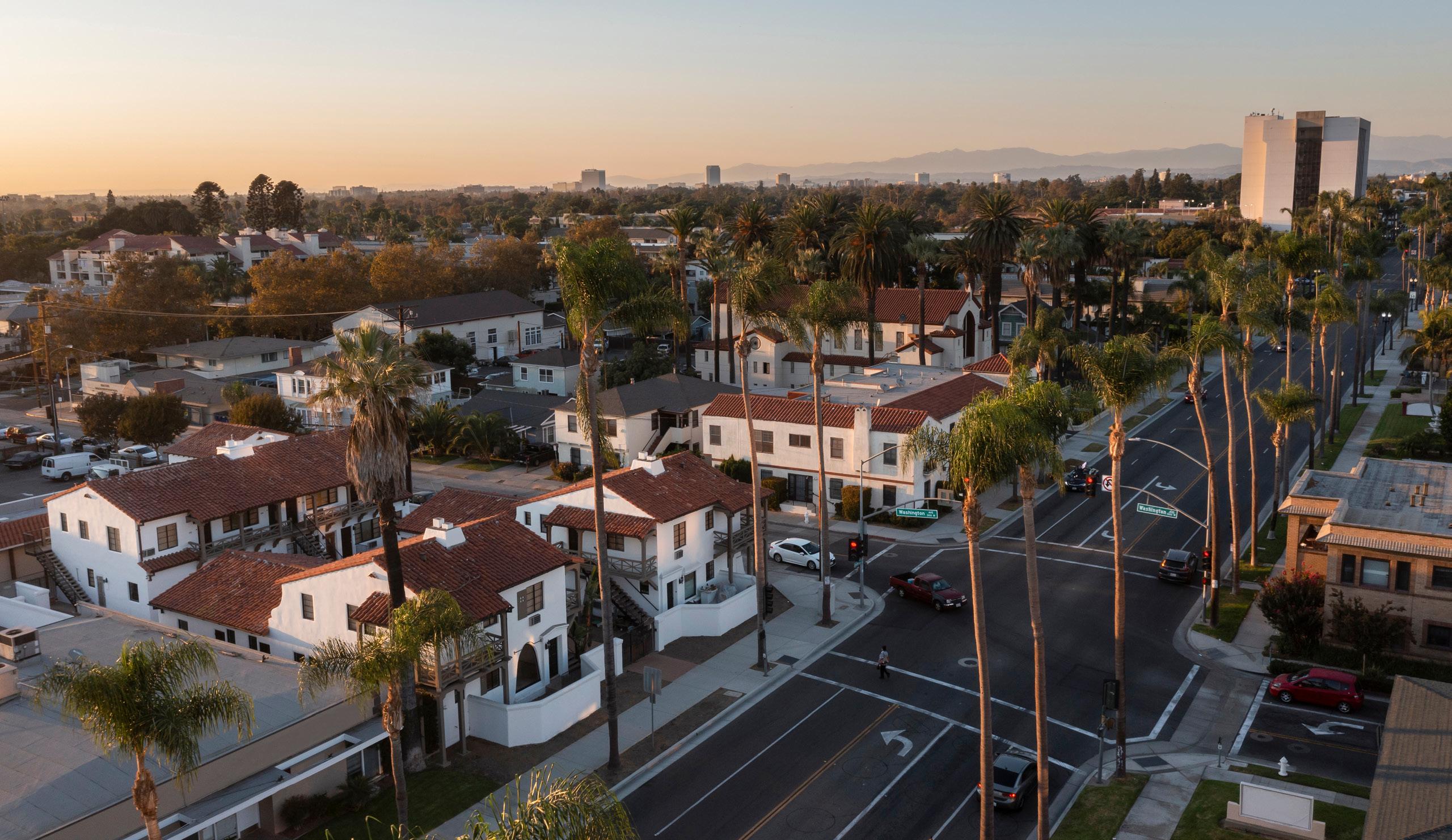
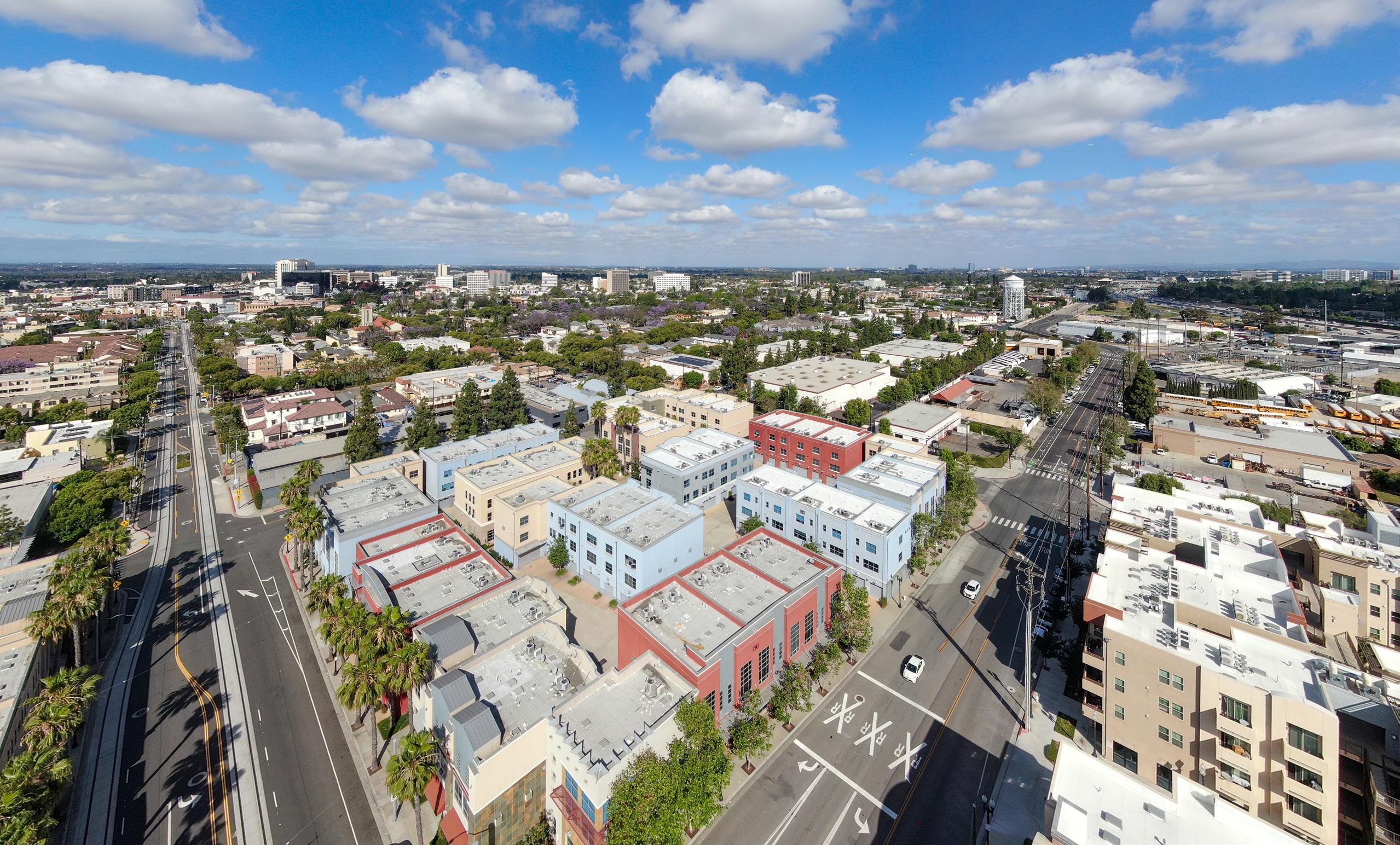
Aerial view of apartment buildings in Santa Ana, California (Adobe Stock)
THESE CITIES ARE DEMONSTRATING THAT THOUGHTFUL COLLABORATION BETWEEN LOCAL GOVERNMENTS, DEVELOPERS, AND COMMUNITIES CAN THREAD THE NEEDLE BETWEEN STATE MANDATES AND HOMEOWNER CONCERNS.
depend on whether municipal leaders can continue to balance local autonomy against state mandates to ensure that housing production remains politically sustainable.
Nonetheless, the stories of Santa Ana, Carson, and Costa Mesa represent a genuine shift in how Southern California municipalities are approaching one of the region’s most intractable challenges. Each city has demonstrated that innovative, locally-driven housing policy can yield real results: Santa Ana’s record-breaking permit approvals and ProHousing Designation, Carson’s transformation of dormant commercial corridors into thousands of new homes, and Costa Mesa’s hard-won political reversal through Measure K all signal a growing willingness to prioritize housing production.
These cities are demonstrating that thoughtful collaboration between local governments, developers, and communities can thread the needle between state mandates and homeowner concerns. Their collective momentum—born of creative zoning, innovative financing mechanisms, and hard-fought political compromise—offers an inspiring model for the dozens of California municipalities still searching for their own path forward. The housing crisis is far from solved, but the ingenuity on display in these three cities suggests that Southern California is more than capable of rising to meet it.
Bibliography
Ballotpedia. “Costa Mesa, California, Measure K, Residential Neighborhood Revitalization Measure (November 2022).” https://ballotpedia.org/Costa_Mesa,_California,_Measure_K,_Residential_Neighborhood_Revitalization_Measure_(November_2022)
Ballotpedia. “Costa Mesa, California, Require Voter Approval On Certain Development Projects, Measure Y (November 2016).” https:// ballotpedia.org/Costa_Mesa,_California,_Require_Voter_Approval_On_Certain_Development_Projects,_Measure_Y_(November_2016)
Biesiada, Noah, and Michelle King. “Many Orange County Cities Fail At Low Income Housing Development.” Voice of OC, April 1, 2026. https://voiceofoc.org/2026/04/cities-lag-affordable-housing/
Biraben, Amancai. “How Southern California Churches Are Turning Unused Land into Affordable Housing.” Orange County Register, May 3, 2026. https://www.ocregister.com/2026/05/03/how-southern-california-churches-are-turning-unused-land-into-affordable-housing/
Brazil, Ben. “Santa Ana Rolls Back Affordable Housing Restrictions on Developers.” Los Angeles Times, August 19, 2020. https://www. latimes.com/socal/daily-pilot/entertainment/story/2020-08-19/santa-ana-council
Brown, Judson (Housing Manager, Community Development Agency), and Ali Pezeshkpour (Executive Director, City of Santa Ana Planning and Building Agency). Interview by author, April 3, 2026.
California Department of Housing and Community Development. “Prohousing Designated Jurisdictions.” Accessed March 8, 2026. https://www.hcd.ca.gov/planning-and-research/prohousing/designated-jurisdictions
California Department of Housing and Community Development. Review Letter re: Carson Housing Element, May 6, 2022. https://hcd. ca.gov/community-development/housing-element/docs/lancarsonadoptedout050622.pdf
Cardine, Sara. “Costa Mesa Passed Measure K to Spur Housing. Now, a 1,050-Unit Project Is in the Pipeline.” Los Angeles Times, August 5, 2023. https://www.latimes.com/socal/daily-pilot/news/story/2023-08-05/costa-mesa-passed-measure-k-to-spur-housing-now-a1-050-unit-project-is-ready-to-go.
Cardine, Sara. “Patience Pays Off for One Metro West, Which Will Not Go Before Costa Mesa Voters.” Los Angeles Times, June 6, 2024. https://www.latimes.com/socal/daily-pilot/news/story/2024-06-06/patience-pays-off-for-one-metro-west-which-will-not-go-beforecosta-mesa-voters
Carson Chamber of Commerce. Envision Carson Groundbreaking Press Release No. 25-008, March 17, 2025.
CBS News. “Sale of Mobile Home Parks in Carson Displaces Hundreds of Elderly Residents.” July 15, 2021. https://www.cbsnews.com/ losangeles/news/sale-of-mobile-home-parks-in-carson-displacing-some-445-elderly-residents/.
Census Reporter. “Carson, CA.” https://censusreporter.org/profiles/16000US0611530-carson-ca/
City of Anaheim. “Comparison of Orange County Cities with Inclusionary Housing Ordinances.” Accessed April 7, 2026. https://local. anaheim.net/docs_agend/questys_pub/16734/16764/16766/18684/18690/5.%20Comparison%20of%20Orange%20County%20 Cities%20with%20Inclusionary%20Housing%20Ordinances18690.pdf.
City of Carson. 2021–2029 Housing Element. Adopted February 1, 2022. HCD-certified November 11, 2022.
City of Carson. File No. 2022-983. Public Hearing: Imperial Avalon Specific Plan, Zone Change, General Plan Amendment, Vesting Tentative Tract Map, Environmental Impact Report, and Development Agreement, December 2022. https://carson.legistar.com/ LegislationDetail.aspx?ID=5951515
City of Redondo Beach et al. v. Rob Bonta. Case No. 22STCP01143. L.A. County Superior Court, ruling April 22, 2024 (Hon. Curtis A. Kin, Dept. 86).
City of Santa Ana. “2021 Affordable Housing Opportunity and Creation Ordinance.” Accessed March 8, 2026. https://www.santa-ana. org/2021-affordable-housing-opportunity-and-creation-ordinance/
City of Santa Ana. “Archways Santa Ana Affordable Housing Community Opens with Financial Support from City of Santa Ana.” March 12, 2025. https://www.santa-ana.org/community-development-partners-opens-archways-santa-ana-affordable-community-with-financial-support-from-city-of-santa-ana/
City of Santa Ana. “City Council Approves Loans for Affordable Housing Projects.” June 29, 2022. https://www.santa-ana.org/city-council-approves-loans-for-affordable-housing-projects/
City of Santa Ana. Housing Opportunities Ordinance. n.d. https://santaana.granicus.com/MetaViewer.php?view_id=2&event_ id=7186&meta_id=24530
City of Santa Ana. “Learn About Section 8 Rental Assistance.” Accessed March 8, 2026. https://www.santa-ana.org/learn-about-section8-rental-assistance/
City of Santa Ana. “Opportunity Zone.” Accessed March 8, 2026. https://www.santa-ana.org/opportunity-zone/
City of Santa Ana. “Santa Ana Sees Record Development Surge with $772 Million Permit Valuation in 2023.” April 23, 2024. https:// www.santa-ana.org/santa-ana-sees-record-development-surge-with-772-million-permit-valuation-in-2023/
Custodio, Spencer. “Costa Mesa Leaders Consider Mandating Affordable Housing Developments.” Voice of OC, July 26, 2023. https:// voiceofoc.org/2023/07/costa-mesa-leaders-consider-mandating-affordable-housing-developments/
Daily Breeze. “Tracing the History of a Very Important South Bay Vacant Lot.” South Bay History (staff blog), August 29, 2015. https:// sbhistoryblog.wordpress.com/2015/08/29/tracing-the-history-of-a-very-important-south-bay-vacant-lot/
Elattar, Hosam. “Costa Mesa to Require Affordable Homes in Residential Developments.” Voice of OC, January 18, 2024. https://voiceofoc.org/2024/01/costa-mesa-to-require-affordable-homes-in-residential-developments/
Khouri, Andrew. “Carson Developer to Bring 1,200 Units of Housing, a Country Mart Complex to City.” Daily Breeze (SCNG), October 10, 2022. https://www.dailybreeze.com/2022/10/10/carson-developer-to-bring-1200-units-of-housing-a-country-mart-complex-tocity/
Lansner, Jonathan. “California Building Permits Tumble to 16% Below Average.” Orange County Register, September 23, 2025. https:// www.ocregister.com/2025/09/03/california-building-permits-run-16-below-average/
Luna, Nancy. “Santa Ana Approves 1600 Homes Near South Coast Plaza.” Orange County Business Journal, September 17, 2025. https:// www.ocbj.com/real-estate/santa-ana-approves-1600-homes-near-south-coast-plaza/
McRea, Heather. “New Housing Projects in Costa Mesa Could Be Required to Include Affordable Housing.” Orange County Register, December 15, 2023. https://www.ocregister.com/2023/12/15/new-housing-projects-in-costa-mesa-could-be-required-to-include-affordable-housing/
Our Weekly. “Carson Luxury Apartment Complex to Welcome ‘Middle-Income’ Tenants.” January 28, 2021. https://www.ourweekly. com/2021/01/28/carson-luxury-apartment-complex-welcome-middle-inc/
Rosenfeld, David. “Carson Mobile Home Park Closures Put Owners, Residents at Odds, with City in the Middle.” Daily Breeze (SCNG), July 26, 2021. https://www.dailybreeze.com/2021/07/26/carson-mobile-home-park-closures-put-owners-residents-at-odds-withcity-in-the-middle/
Sentinel News Service. “Carson Capitalizes on State’s $65 Billion Housing Program for Its Middle-Income Professionals.” June 24, 2021. https://lasentinel.net/carson-capitalizes-on-states-65-billion-housing-program-for-its-middle-income-professionals.html
Sharp, Steven. “20-Acre Development Could Bring Over 1,000 Apartments to Carson.” Urbanize LA, September 24, 2019. https://la.urbanize.city/post/20-acre-development-could-bring-over-1000-apartments-carson
Sharp, Steven. “Developers Form $2-Billion Joint Venture to Create ‘Middle-Income’ Housing in California.” Urbanize LA, October 12, 2021. https://la.urbanize.city/post/standard-communities-faring-workforce-housing-california
Sharp, Steven. “Senior Affordable Housing Breaks Ground at 4610 Santa Ana St. in Cudahy.” Urbanize LA, September 30, 2025. https:// la.urbanize.city/post/senior-affordable-housing-breaks-ground-4610-santa-ana-st-cudahy
Slaten, Michael. “Costa Mesa Sets Affordable Housing Mandates for New Developments.” Orange County Register, August 14, 2024. https://www.ocregister.com/2024/08/14/costa-mesa-sets-affordable-housing-mandates-for-new-developments/
Southern California Association of Governments (SCAG). “6th Cycle Final RHNA Allocation Plan.” Adopted March 4, 2021; amended July 1, 2021. https://scag.ca.gov/sites/default/files/old/file-attachments/6th-cycle-rhna-final-allocation-plan.pdf.
Southern California Association of Governments (SCAG). Carson Local Profile. Published May 2024. https://scag.ca.gov/sites/default/ files/2024-05/carson_localprofile.pdf
Southern California Association of Governments (SCAG). Pre-Certified Local Housing Data for the City of Carson, April 2021. https:// scag.ca.gov/sites/default/files/old/file-attachments/carson-he-0421.pdf
Spectrum News 1. “Are We Seeing Less and Less Mobile Home Parks?” August 2, 2021. https://spectrumnews1.com/ca/la/housing/2021/08/02/are-we-seeing-less-and-less-mobile-home-parks-
Standard Communities. “Standard Communities and Faring Form Joint Venture to Create $2 Billion of Middle-Income Housing in California.” August 10, 2021. https://standard-communities.com/news/standard-communities-and-faring-form-joint-venture-to-create2-billion-of-middle-income-housing-in-california/
Standard Communities. “Standard Communities Leads Public-Private Partnership Creating 357 Units of Middle-Income Housing in Southern California.” July 15, 2021. https://standard-communities.com/news/standard-communities-leads-public-private-partnership-creating-357-units-of-middle-income-housing-in-southern-california/
The Real Deal. “Standard Communities Buys Carson Rental Complex.” July 20, 2021. https://therealdeal.com/la/2021/07/20/standardcommunities-buys-350-unit-complex-in-carson/
Tso, Phoenix. “Mobile Home Residents in Carson Say Closing Their Park Leaves Them with No Affordable Place to Live.” LAist, July 16, 2021. https://laist.com/news/housing-homelessness/mobile-home-residents-in-carson-protest-closure
2UrbanGirls. “Carson 2025 State of the City.” March 26, 2025. https://2urbangirls.com/2025/03/carson-2025-state-of-the-city-mayorlula-davis-holmes-highlights-growth-safety-and-sustainability/
Urbanize LA. “283 Townhomes Coming to 21212 Avalon Boulevard in Carson.” October 20, 2024. https://la.urbanize.city/post/283townhomes-coming-21212-avalon-boulevard-carson
Urbanize LA. “354-Unit Apartment Complex in Carson to Be Converted to ‘Middle-Income’ Housing.” July 14, 2021. https://la.urbanize. city/post/carson-union-south-bay-apartments-middle-income
U.S. Census Bureau. ACS 2023 1-Year Estimates, Tables DP04, B25003, B25077.
U.S. Census Bureau. Building Permits Survey (BPS), Annual Data by Place, 2000–2022. https://census.gov/construction/bps.
U.S. Census Bureau. Quick Facts: Carson, California. https://www.census.gov/quickfacts/fact/table/carsoncitycalifornia/PST045224
U.S. Census Bureau. Quick Facts: Costa Mesa, California. https://www.census.gov/quickfacts/fact/table/costamesacitycalifornia/ PST045224
U.S. Census Bureau. Quick Facts: Santa Ana, California. https://www.census.gov/quickfacts/fact/table/santaanacitycalifornia/ INC110224
Wang, Claire. “Guidelines for Future Reuse of Fairview Development Center Open for Public Review.” Orange County Register, March 31, 2026. https://www.ocregister.com/2026/03/31/guidelines-for-future-reuse-of-fairview-development-center-open-for-public-review/
West, Geoff. “With Measure K, Voters in Costa Mesa Can Change the Stifling Effects of Measure Y.” Los Angeles Times, September 20, 2022. https://www.latimes.com/socal/daily-pilot/opinion/story/2022-09-20/commentary-with-measure-k-voters-in-costa-mesacan-change-the-stifling-effects-of-measure-y.