Florida
September 2026
ROOFING A Publication of FRSA – Florida’s Association of Roofing Professionals
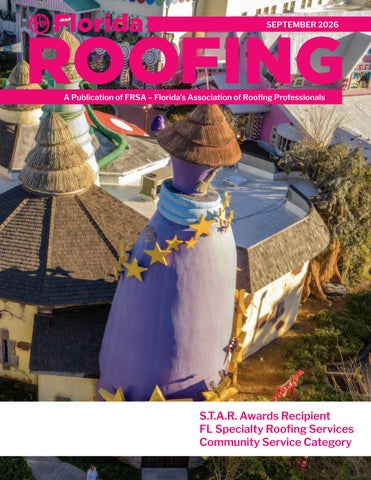
S.T.A.R. Awards Recipient FL Specialty Roofing Services Community Service Category
UV-resistant. Single-step. Direct-to-deck application.
Peel & Seal® provides a complete waterproofing barrier to the elements.
Self-adhering and easy-to-use low-slope and flashing membrane.
Peel & Seal® is the original, self-stick roll roofing specifically designed for low-slope roofing applications, as well as a durable flashing membrane for exterior penetrations. Designed to be left exposed to the elements, count on Peel & Seal® to provide a long lasting, durable, and maintenance-free surface.
• Aggressively adheres direct to the surface • Designed to be left exposed to the elements • Ideal for hundreds of waterproofing applications • 10-year warranty Count on Peel & Seal® for ease of installation and increased savings!
Request a free sample at mfmbp.com or call 800.882.7663.
FL Specialty Roofing Services, Altamonte Springs, received a First Place S.T.A.R. Award in the Community Service Category for its shake work on the whimsical Give Kids the World Village in Kissimmee.
Contents
10 | Why Every Florida Roofing Contractor Needs a Strong Qualifier Agreement 16 | The Real Costs of Replacing a New Roof 18 | Skylights: Adding Value, Natural Light and Performance to Florida Roofs
20 | A Year Worth Celebrating
FRSA-Florida Roofing Magazine Contacts: For advertising inquiries, contact: Skip Heymann at: skip@floridaroof.com (800) 767-3772 ext. 127 All feedback and reprint permission requests (please include your full name and address) contact: Lisa Pate, Editor, at: lisapate@floridaroof.com (800) 767-3772 ext. 157 Florida Roofing Magazine PO Box 4850, Winter Park, FL 32793-4850 View media kit at: www.floridaroof.com/florida-roofing-magazine/
#FRSA #roofingprotects
On Mobile Devices
25 | S.T.A.R. Award Recipients
Florida
ROOFING Available Online at www.floridaroof.com/florida-roofing-magazine/
September 2026
Any material submitted for publication in Florida Roofing becomes the property of the publication. Statements of fact and opinion are the responsibility of the author(s) alone and do not imply an opinion or endorsement on the part of the officers or the membership of FRSA. No part of this publication may be reproduced or transmitted in any form or by any means, without permission from the publisher. Florida Roofing (VOL. 11, NO. 9), September 2026, (ISSN 0191-4618) is published monthly by FRSA, 3855 N. Econlockhatchee Trl. Orlando, FL 32817. Periodicals Postage paid at Orlando, FL. POSTMASTER: Please send address corrections (form 3579) to Florida Roofing, PO Box 4850, Winter Park, FL 32793-4850.
www.floridaroof.com | FLORIDA ROOFING
3
A LEGACY OF TRUST
Proudly Protecting Florida Contractors Since 1955. The Self Insurers Fund has evolved from a roofing industry workers’ comp provider into a trusted partner providing insurance to all licensed trades.
We’re stepping into the future as BrightFund, with the same values, stronger tools and an even bigger vision.
Why Licensed Contractors Choose BrightFund: • Dividends paid back to members • In-house safety experts • Responsive claims support
FRSA Self Insurers Fund is Now BrightFund
• Subcontractor compliance help • Easy COI requests • Personalized services
800-767-3772 ext. 200 brightfund.com
Setting the Pace in Roofing FRSA President Matthew Leonard, Architectural Sheet Metal Inc. I am honored and proud to be your 2026-2027 FRSA President. I promise to do my best for the Association and roofers across the state. My theme is Setting the Pace in Roofing and my goals for the year include education, employee recognition and supporting the people who make what we do possible. One of the most important issues we have all dealt with for years is labor. While we as an industry must continue to find and implement effective methods of training and onboarding the next generation, I want to make sure we take a holistic look at factors that cause both our pains and achievements. We hear a lot about training and education and while they are of the utmost importance, without the people who install the roofs, we have nothing. So, I intend to begin by recognizing the efforts of the men and women on the roofs each and every day. They are the backbone of our industry. When you are proud of what you do, it will highlight the industry and help to bring new people in. If I was looking for a career and saw people who enjoy what they do and were well treated and appreciated – then I would want to join them. Let’s all take time to make sure those around us know that we appreciate them.
SAVE THE DATE for FRSA’s 105th Annual Convention & Expo
July 7-9, 2027 Gaylord Palms Resort & Convention Center, Kissimmee
I have worked with many different people over the years; some for very short periods of time and others for many years. I am especially grateful to those who have been dedicated for the long term. I try extremely hard to let everyone on my team know that I appreciate them, but in the hectic day-to-day work, they might not always hear it or I may miss opportunities to express it. So, I want to ensure I take the time now to thank everyone at Architectural Sheet Metal. I value each of you! Another factor that impacts us is material prices. Wow, at the beginning of the year, who saw these increases coming? Prices appeared to have been somewhat stable and then it all changed. From shingles to metal – prices are going up everywhere and it hurts. While we can’t stop it, we need to pay attention and use the resources available to help us prepare for the future. Which brings me to FRSA. Did you know that as an FRSA member you have access to contract provisions, legislative updates and future building codes that can give you an edge and help when bidding projects? There are so many ways FRSA can help you and your company stay up-to-date and ahead of trends. Being active with FRSA can help connect you to people and resources that can change everything. If you’re not an FRSA member, contact Kelly Sealander, Membership Director, at 800-767-3772 ext. 142 or by email at kelly@floridaroof.com to learn more. Remember, it’s not what you know but who you know. This holds true at FRSA. Bonus benefit – you’ll make lifelong friends and build relationships with other industry professionals. Kind regards,
Matthew Leonard FRSA President matthew@asmfl.com
www.floridaroof.com | FLORIDA ROOFING
5
Industry Updates Since joining Eagle 22 years ago, Charles Eagle Roofing Products announced promotions of four Schneider has been accomplished leaders whose expertise and dedication instrumental in the company’s growth and have helped shape the company’s success. These manufacturing excelappointments reflect Eagle’s continued investment lence. Leveraging his in leadership, innovation, operational excellence and extensive experience delivering exceptional customer experience. Effective immediately, John Campbell has been pro- with concrete products and both concrete and moted to President, Charles Schneider to Executive clay roof tile manufacVice President, Tyler Allwood to Vice President of Sales & Business Development and Lissette Pamplona turing, he has helped shape Eagle’s nationwide Charles Schneider to Senior Director of Customer Experience. manufacturing opera“The Burlingame family built Eagle on a foundation tions through leadership of trust,” stated John Campbell, President of Eagle. in plant design, equip“Trust in our people, trust in our craft and trust in a ment installation and manufacturing standards. As shared vision for what this company could become. It Vice President of Manufacturing, Schneider has driven is a privilege to honor that legacy by working alonginnovation, standardized processes and fostered a side Charles, Tyler and Lissette in roles where their strong commitment to safe, efficient and environmentalent, dedication and character will help carry Eagle tally responsible manufacturing. forward.” Over the past 13 Campbell continued, “We are operating in a deyears, Tyler Allwood, has manding market and meeting that moment head-on earned the respect of by investing in manufacturing excellence, embracing colleagues and customtechnology to empower our team members and ers through his steady deepening our commitment to the training and deleadership, disciplined velopment that will define our next chapter. The trust business approach and the Burlingame family has placed in all of us is someexceptional technical thing we do not take lightly and this leadership team expertise. In his new will honor it every single role, he will lead Eagle’s day.” company-wide sales and Throughout his business development 14-year career at Eagle, efforts, driving growth John Campbell has Tyler Allwood through a unified stratbeen a driving force egy that expands the behind the company’s company’s geographic continued growth and reach, strengthens relationships with key industry prosperity. Beginning as partners, advances contractor education and delivers National Sales Manager customer-focused roofing solutions that create longand advancing to Vice term value. President of Sales and Lissette Pamplona Marketing, Campbell has John Campbell joined Eagle 13 years ago led the Sales, Marketing, as Marketing Manager Technical and Customer and, through her exService teams while ceptional leadership also overseeing Eagle’s Florida Division as General and strategic vision, Manager. With decades of rooftile industry expeadvanced to Director of rience and a strategic vision for the future, he has Marketing, where she strengthened Eagle’s national presence, enhanced helped strengthen the customer service, improved operational efficiency Eagle brand into one of and transformed the sales team through innovative the most recognized and CRM initiatives and data-driven solutions. Campbell’s dedication to customers and the Eagle team continue respected names in the Lissette Pamplona building products industo make a lasting impact. try. In her expanded role,
Eagle Roofing Products Announces Strategic Executive Leadership Promotions
6
FLORIDA ROOFING | September 2026
she will lead initiatives to enhance customer experience across every key touchpoint, driving innovative strategies, supporting expansion into new markets and ensuring every interaction with Eagle is accessible, consistent and delivers lasting value.
support to our branches, customers and vendor partners.” Sims currently resides in Atlanta and will ultimately relocate to Tampa where he will be based at Gulfeagle’s Branch Support Center. In the meantime, he will divide his time working closely with branches and teams Gulfeagle Supply Appoints Kevin Sims as across the company. Chief Operating Officer Additionally, Brad Powers will continue as the Gulfeagle Supply announced the appointment of Kevin company’s CRO, utilizing his 25 years’ experience in Sims as its first Chief Operating Officer (COO). As the industry to focus on sales growth and relationship the company continues to grow with more than 130 development. branches across 33 states, the addition of the Chief Operating Officer position further strengthens the NRCA and The GLO Group Launch Executive company’s executive leadership team and supports its Leadership Bilingual Program continued growth. The National Roofing Contractors Association (NRCA) Sims brings more than 25 years of roofing distriand The GLO Group announced the launch of the bution experience to Gulfeagle. He began his career Executive Leadership Bilingual Pilot Program, a with his family’s roofing supply company in Tennessee six-course leadership development initiative built to and went on to hold district, regional, director and help roofing companies bridge communication gaps vice president leadership positions with some of the between executives and Hispanic field teams while deindustry’s largest organizations, overseeing operations veloping the industry’s next generation of field leaders. across networks of more than 150 locations. Hispanic employees make up a substantial share of “Kevin’s extensive experience in roofing distribution the roofing workforce and many companies are recogand operations leadership makes him an outstanding nizing that language differences, cultural disconnects addition to our executive team,” stated Brad Resch, and inconsistent leadership development quietly President of Gulfeagle Supply. “As Gulfeagle continues erode productivity, safety, retention and profitability. to grow, Kevin’s leadership will help strengthen our The pilot program was created to give contractors operations while continuing to provide exceptional practical, field-ready strategies to close those gaps.
CFRSA YOU'RE INVITED TO
Roofers & Building Officials Meeting hosted by Mike Silvers CPRC FREE Bar-B-Q Lunch provided by Dustin’s Bar-B-Q September 23, 2026 | 11:00 AM Lakeside Reception Hall 4005 N Orange Blossom Trl Orlando, FL 32804 RSVP by September 4, 2026
Brad Hogan | 321-340-3851
"Together We Build a Strong Industry." www.floridaroof.com | FLORIDA ROOFING
7
“One of the biggest misconceptions I see is that communication challenges are simply a language issue. In reality, they’re a leadership issue,” said Monica Vornbrock, Co-founder and Chief Innovation & Transformation officer of The GLO Group. “Companies already have talented Hispanic employees with the potential to become exceptional leaders but, too often, they haven’t been given the tools, coaching or opportunities to grow. That’s why we built this pilot program with NRCA – to help roofing companies develop stronger leaders, sharpen communication and build more aligned, high-performing teams.” “The roofing industry is facing a real workforce shortage and Hispanic field talent represents one of our best opportunities to build the next generation of supervisors and site leaders,” said Chris Navarro, NRCA Manager of Membership Sales and Spanish relations. Built for Decision-Makers, Not Just HR The six-course program was developed for owners, executives, operations leaders, HR professionals and managers responsible for leading diverse teams. Rather than treating language as the core issue, it equips leaders with tools to build alignment from the executive office to the jobsite. Participants will learn how to: ■ Develop confident Hispanic supervisors capable of leading high-performing crews ■ Reduce costly communication breakdowns that contribute to rework, delays and safety incidents ■ Build trust, accountability and psychological safety across multilingual teams ■ Improve retention by creating stronger leadership pathways for Hispanic employees ■ Increase adoption of technology, systems and AI through people-centered leadership practices ■ Create greater consistency in how crews execute work, regardless of language or cultural background Program Pricing NRCA members receive special pricing: ■ $195 per individual course ■ $875 for the complete six-course program Non-Members: ■ $295 per individual course ■ $1,325 for the complete six-course program Contractors can enroll in the program at www.floridaroof.com/elbp.
8
FLORIDA ROOFING | September 2026
Central States Manufacturing Names Melissa Dunson Vice President
Central States Inc., a leading provider of metal building components, roofing and building solutions, named Melissa Dunson Vice President of Sales and Marketing. Dunson brings extensive leadership experience in customer engagement, commercial strategy, marketing, product management Melissa Dunson and sales enablement to the role. Since joining Central States in 2024, she has played an instrumental role in strengthening customer relationships, aligning sales and marketing initiatives and developing programs that help customers and sales teams succeed. As Vice President of Sales and Marketing, Dunson will lead Central States’ sales organization, focusing on accelerating growth, enhancing the customer experience and delivering long-term value to customers across the company’s markets, while continuing to provide leadership over the marketing and sales functions of the business. “Melissa has consistently demonstrated a deep commitment to our customers, our employee-owners and our growth strategy,” said Kurt Weaver, Central States Chief Executive Officer. “Her ability to connect customer needs with business solutions, build strong teams and drive collaboration across the organization makes her the ideal leader to guide our sales organization into the future.” An industry veteran with more than 15 years of experience in building products, Dunson has worked closely with sales, operations, product management, customer experience and marketing teams over her career to support business growth and strengthen and elevate company positions in the marketplace. Her customer-first approach and focus on building trusted relationships have helped to drive success for both Central States and its customers. “I am honored to step into this new role and continue serving our customers and employee-owners,” said Dunson. “Our success has always been built on strong partnerships, exceptional service and a commitment to helping our customers grow their businesses. I look forward to working alongside our sales teams to continue delivering value and creating new opportunities for our customers.” FRM
DOORS | WINDOWS SIDING | STONE | ROOFING
PROVIA METAL ROOFING SYSTEMS ARE ®
HVHZ - APPROVED HVHZ-Approved Roofing Systems
Made with 26-gauge steel and engineered to endure extreme weather, ProVia Metal Roofing systems are approved for use in High Velocity Hurricane Zones (HVHZ), so you know they’re tough. The multipoint attachment systems and interlocking panels on our Shake, Slate, and Barrel Tile profiles are tested and certified to resist wind uplift and wind-driven rain. The panels have a Class 4 Impact Rating, and the GalvaTec™ finish exceeds ASTM performance standards. Partner with ProVia for metal roofing systems built to withstand hurricane-force wind, rain, and hail. Learn more at provia.com/roofing-hvhz
Why Every Florida Roofing Contractor Needs a Strong Qualifier Agreement Trent Cotney, Partner, Adams & Reese, LLP and FRSA General Counsel In Florida, a contractor’s license does more than satisfy an administrative requirement. It provides the legal foundation that allows a roofing company to contract, obtain permits, advertise services and perform regulated work. When a licensed individual qualifies a business organization, that person assumes substantial statutory responsibility. A carefully drafted qualifier agreement helps both the license holder and the company understand those responsibilities before problems arise. Florida Statutes, Section 489.119 requires a business organization engaged in contracting to operate through an approved qualifying agent. A primary qualifying agent must attest that he or she has final approval authority over construction work and business matters, including contracts, specifications, checks, drafts and payments, unless the Construction Industry Licensing Board (CILB) has approved a financially responsible officer. Section 489.1195 further provides that primary qualifying agents are responsible for supervising the company’s operations, field work and financial matters. If the company has an approved financially responsible officer (FRO), the primary qualifier remains responsible for construction activities. Florida law therefore expects genuine authority, active supervision and meaningful involvement. It does not permit a contractor to simply “rent” a license while preventing the qualifier from controlling the work performed under that license. This is where a qualifier agreement becomes critical. The agreement should translate the statutory framework into specific contractual duties and rights. At a minimum, it should identify whether the license holder will serve as a primary or secondary qualifying agent, describe the company and license classifications covered and define the qualifier’s authority over operations within the licensed scope. A strong agreement should expressly grant the qualifier access to contracts, permits, job files, inspection reports and accounting records if the qualifier is also the FRO. It should require timely notice of new projects and provide the qualifier with authority to stop work, reject noncompliant practices, require corrective action and prevent the company from using the license outside its lawful scope. The agreement should also establish practical supervision procedures. These may include periodic project reviews, jobsite visits and permit tracking. The exact process will depend on the company’s size 10
FLORIDA ROOFING | September 2026
and operations but the arrangement must allow the qualifier to perform the role required by Florida law. A contract that gives the qualifier responsibility without authority creates risk for everyone. In addition, the agreement should prohibit the company from qualifying additional entities, expanding into new license categories or materially changing its operations without the qualifier’s written approval. Section 489.119 gives the CILB discretion when a license holder seeks to qualify additional business organizations and requires evidence that the qualifier can adequately supervise each entity. Compensation and risk allocation also deserve careful attention. The agreement should address salary or fees, reimbursement of expenses, insurance coverage, defense and indemnity obligations and responsibility for fines or losses caused by unauthorized conduct. The company should maintain appropriate general liability, workers’ compensation, automobile and employment-related coverage. The qualifier should confirm whether applicable policies protect the license holder individually and whether the company will continue that protection for claims arising after termination. Termination provisions must account for Florida’s licensing requirements. Under section 489.119, both the qualifier and the business have notification obligations when the relationship ends. A company that loses its only qualifier has 60 days to employ another qualifying agent but it may not engage in contracting during that period unless the Executive Director or Board chair grants a temporary, nonrenewable certificate or registration permitting the company to proceed with incomplete contracts. The agreement should require written notice of termination, immediate cessation of unauthorized license use, removal of the license number from advertising and permit activity when appropriate, cooperation with pending projects and completion of required filings with the Department of Business and Professional Regulation. It should also address ownership and return of records and survival of indemnity and insurance obligations.
No qualifier agreement can eliminate the license holder’s statutory duties or prevent regulatory discipline. It can, however, create a clear operational structure, establish enforceable authority, document the parties’ expectations and reduce the likelihood that the qualifier becomes responsible for activities he or she could not see or control. Even if you are an owner of the company, a qualifier agreement remains a valuable tool for defining the company’s obligations to you individually. This becomes especially important if the company becomes insolvent, undergoes a change in control or is acquired by another entity. The agreement can address compensation, indemnification, access to records, insurance coverage and the company’s duty to notify you of events that may affect your license. It can also establish a clear process for ending the qualifying relationship and allocate responsibility for claims arising after departure, while recognizing that the agreement cannot eliminate statutory responsibility for matters that occurred during the qualifying relationship. For Florida roofing contractors, the best qualifier agreement is a compliance document that reflects how the company will actually operate. Companies and license holders should review these agreements periodically, especially when ownership, personnel, financial controls, service areas or business models
change. Careful planning at the beginning of the relationship can protect the license, the company and the customers who rely on both. FRM Disclaimer: This article is for general informational purposes only and does not constitute legal advice. Contractors should consult with legal counsel regarding the laws, contract requirements and safety obligations that apply to their specific projects and jurisdictions. Trent Cotney is a Partner and Construction Team Leader at Adams & Reese, LLP and is also FRSA’s General Counsel. You can reach him at 813-227-5501 or trent.cotney@arlaw.com.
Free Legal Helpline for FRSA Members
Adams & Reese is a full-service law firm dedicated to serving the roofing industry. FRSA members can contact Trent Cotney to discuss and identify legal issues and to ask general questions through access to specialized counsel. They offer free advice (up to 15 minutes) for members. If additional legal work is required, members will receive discounted rates. This is a pro bono benefit provided to FRSA members only. Contact Trent at 813-227-5501.
– A PANCAKE STYLE VENT WITH ALUMINUM CAP AND EPDM BASE SUITABLE FOR MULTIPLE PANEL PROFILES. – A SLANT-BACK STYLE VENT MOLDED TO FIT 3/4 HI-RIB PANELS. NUMEROUS COLORS AVAILABLE. PATENTED AND TESTED.
www.floridaroof.com | FLORIDA ROOFING
11
Property Tax Update Kylee Bo, Government Affairs Advisor, GrayRobinson As you may recall, the Florida Legislature convened a special session on property tax reform in late May and early June, ultimately passing House Joint Resolution 1F (HJR 1F) and Senate Bill 4F (SB 4F) on June 2. HJR 1F, which will appear as Amendment 3 on the November 2026 ballot, would increase the homestead exemption for non-school property taxes to $150,000 in 2027 and $250,000 in 2028; reduce the assessment growth cap on non-homestead property from 10 to 5 percent; establish a five-year residency requirement for new residents to qualify for the enhanced exemption and limit local governments’ use of property tax revenue to defined core purposes. SB 4F, the implementing legislation, would also restrict the extent to which local governments may increase millage rates above the rolled-back rate without supermajority or voter approval. Local governments continue to raise concerns about the potential fiscal impacts of the proposed changes. According to a report by the Florida Office of Economic and Demographic Research, local governments could experience nearly $5 billion in lost revenue in the first year, increasing to nearly $12 billion by the fifth year. Larger urban counties are expected to experience the greatest fiscal impact if Amendment 3 is approved by voters. Ballot language has become the subject of legal challenges. On August 3, Leon County Circuit Judge David Frank ruled that Amendment 3’s ballot title and summary were “clearly and conclusively defective.” Judge Frank found that the title, “Save Our Homes From Excessive Property Taxes,” was “more akin to a political slogan,” and was neither fair nor neutral as it advocates a policy position. Moreover, he concluded that the ballot summary included three political
taglines: “ensuring funding for core services,” “protecting small businesses,” and “ensuring fairness for Florida residents.” This provides voters with reasons to support the proposal rather than neutrally explaining its effects. The ruling does not affect the underlying amendment, which remains eligible for the November ballot. Instead, the title and summary must be revised. Attorney General James Uthmeier has 10 days to submit revised language to the Department of State. Following submission, any party seeking to challenge the revised language will have 10 days to do so, with Judge Frank retaining jurisdiction over the case. As of this writing, the revised language has not yet been published. FRM Kylee Bo, GrayRobinson, is a Government Affairs Advisor specializing in policy and appropriations at both the Florida Capitol and local levels. Based in Orlando, she offers clients strategic insights, summaries of state and local hearings and tailored government affairs updates and reports. Kylee works to strengthen relationships with elected officials across the state and represents GrayRobinson at key board meetings. She also delivers educational briefings to select groups, including college students pursuing careers in the legislative field.
Brian D’Amico Earns CPRC Designation Since 1922, FRSA has steadfastly maintained its efforts to elevate the roofing, sheet metal and air conditioning industries. Through educational workshops and seminars, liaison with other associations and through local and state government, the Association strives for stability and professionalism within the industry. In the early 1970s, FRSA developed a voluntary professional certification program committed to developing leadership that promotes professional development beyond state licensing requirements. These designations became the certified professional roofing contractor (CPRC), certified professional air 12
FLORIDA ROOFING | September 2026
conditioning contractor (CPAC) and the certified professional sheet metal contractor (CPSC). In order to qualify, an applicant must complete the Florida Construction Industry Licensing Board Certification Examination in the appropriate area of specialization with a score of eighty-five percent or above and have been active in the appropriate field of construction for five consecutive years prior to applying. They must demonstrate their proficiency in their trade by furnishing references from architects, general contractors, owners and state-certified contractors in their field. Additionally, they must meet qualifications Continued on page 35
Building Better Cost History: The Foundation of Accurate Roofing Estimates John Kenney, CPRC, CEO, Cotney Consulting Group I have sat in more than a few project closeout meetings where everyone knew the job had missed its expected margin but no one could agree on why. Accounting had the final number. The project manager remembered the schedule interruptions. The foreman knew the crew worked more hours than planned and the estimator believed the labor allowance was reasonable when the bid went out. Each person had part of the story but the company did not have enough reliable information to put the full picture together. This is where many roofing contractors discover the difference between having job records and having a true cost history. Most companies have plenty of records. They have estimates, payroll reports, purchase orders, invoices, daily logs, job-cost reports and years of completed work. Some have more information available than they know what to do with. The problem is that much of it sits in separate systems, uses different cost codes or lacks enough detail to be useful the next time an estimator prices similar work. A final gross-profit percentage tells you whether a job performed well overall. It does not tell you where
labor was gained or lost. It does not explain whether tear-off took longer than expected, if material handling slowed the crew, if detail work was underestimated or if repeated mobilizations affected productivity. Without that detail, the company may know the result but still be left guessing the cause. Accurate estimating depends on understanding what the company can actually produce under real field conditions. That information does not come from a takeoff program or a general industry labor table. It comes from completed work, properly tracked and honestly reviewed. I have seen companies continue using the same production rates for years, even though their crews, project types and operating conditions had changed.
www.floridaroof.com | FLORIDA ROOFING
13
The estimates looked detailed. The quantities were correct. Material pricing was current. Yet the labor assumptions were based more on habit than on the company’s recent performance. This is one of the easiest ways for margin to begin slipping without anyone noticing immediately. Building a better cost history starts in the field and this is where the process often becomes difficult. Foremen and project managers are expected to keep work moving, solve problems, coordinate crews, communicate with customers and manage safety. Asking them to record labor against detailed cost codes can feel like one more administrative burden unless they understand why it matters. The purpose is not to create paperwork for accounting. It is to preserve the lessons from the job while they are still fresh. Take a low-slope reroof as an example. If every labor hour is charged to one general code, the company may know the total project exceeded budget by 400 hours. That number alone does not help the estimator very much. The loss may have come from tear-off, deck preparation, installation, membrane work, perimeter details or rooftop equipment flashing. Those are all very different problems. The same thing happens in steep-slope work. A company may know that a residential reroof took longer than expected but not whether the cause was access, landscaping protection, steepness, loading, multiple layers, deck repairs or unusually complex flashing conditions. If all those factors disappear into one total labor number, the company has very little to carry forward. Cost codes do not have to become so detailed that no one can use them. In fact, overly complicated systems usually fail. They need to be detailed enough to identify the major phases of work and simple enough for the field to use consistently. Consistency is more important than complexity. One estimator cannot code sheet metal details one way while another estimator includes them under roofing labor. One foreman cannot separate setup and loading while another charges every hour to installation. When the company changes definitions from one job to the next, comparisons become unreliable even when the reports appear complete. This is why leadership has to stay involved. Cost history cannot be left entirely to accounting, because accounting can only report the information it receives. Owners and senior managers need to understand how estimates are structured, how labor is coded in the field and how completed jobs are reviewed. When there is a variance, someone needs to ask what happened before the explanation is forgotten. The best time to begin that conversation is not six weeks after the project is finished. Strong contractors compare estimated and actual labor while work is underway. They review major cost categories weekly and look for movement before the 14
FLORIDA ROOFING | September 2026
job is too far along to correct. If insulation installation is consuming more hours than planned, the project manager should know early enough to investigate. If material usage is running high, someone should determine whether waste, damage, ordering or field conditions are responsible. This type of review is not about assigning blame, it is about understanding performance. I have found that the most useful questions are usually straightforward. What did the estimate assume? What did the crew encounter? Were the planned production rates realistic? Was the crew size appropriate? Did access slow the work? Were there schedule interruptions? Was the material staged properly? Did another trade interfere with progress? Was there rework? Those answers help separate a weak estimate from an operational problem. That distinction matters because the response should not always be the same. If the estimate was too aggressive, the production rate needs to be adjusted. If the issue involved crew training, supervision or planning, simply raising the labor allowance may hide the problem rather than solve it. Cost history should improve operations as well as estimating. Over time, patterns become easier to recognize. A particular crew may perform well on large open roof areas but struggle on detail-heavy projects. Certain roof systems may consistently require more labor than expected. One type of project may perform well when material is rooftop-loaded and poorly when it has to be moved repeatedly. Some customers or general contractors may create scheduling conditions that need to be considered during bidding. That information becomes valuable only when the company interprets it correctly. Not every unusual job should change the standard production rate. A project with restricted access, extreme heat, repeated mobilizations, concealed deck damage or owner-driven delays should be identified as an exception. If every result is averaged together without context, the company can end up building unusual conditions into normal pricing. Historical data still requires judgment. This is where experienced estimators, project managers and field leaders need to work together. The numbers may show that a phase ran over budget but the people involved can explain why. One without the other is incomplete. Data without context can be misleading. Experience without data can become opinion. A meaningful closeout process brings the two together. The review does not need to be long or overly formal. It should compare estimated and actual labor, material, equipment and subcontractor costs by major phase. It should also record the conditions that affected the outcome. The most important part is making sure those findings are available to the estimator the next time similar work is priced.
Too many companies close the job in accounting and then move on. The estimator never sees the actual results. The project manager does not review the original assumptions. The field lessons stay with the foreman until they are forgotten or that person leaves the company. It’s a lost opportunity. I have always believed that estimating does not really end when the proposal is submitted. The estimate creates the plan but the process is not complete until the work is performed, the results are reviewed and the lessons are carried into future pricing. The estimator establishes the expectations. Operations execute the work. The field records what happened. Accounting captures the financial result. Leadership makes sure the information comes back around. When that cycle is working, every completed project improves the next estimate. Technology can help organize the process but it cannot create discipline. A company may have strong estimating, project management and accounting systems and still lack dependable cost history if labor codes are inconsistent, daily reports are late or departments use different definitions. The software is not the solution itself. It is the tool that supports the process. The most valuable estimating database a roofing contractor can build already exists inside the company. It is being created every day by crews, project managers, estimators and accounting staff. The challenge is capturing it in a form that can be understood, compared and used. After more than forty-five years in this industry, I have seen the same estimating mistakes repeated many times, not because contractors lacked exper-
ience but because the lessons from completed work never made it back to the front of the process. A company with a dependable cost history does not eliminate estimating risk. Roofing will always involve variables. What it does is reduce the number of assumptions the contractor has to make. The work completed yesterday should make the estimate prepared tomorrow better. That is how estimating accuracy improves; not from one new system or one new report but from a company learning consistently from its own work. FRM John Kenney, CPRC is CEO of Cotney Consulting Group, Plant City. He has decades of experience on commercial roofing projects, providing a unique understanding of what it takes to succeed in roofing – on the roof, in the office and at scale. Cotney Consulting offers COO on Demand, online training, technology solutions, business advisory consulting, collections, contracts, Castagra estimating training, safety and OSHA training. John partners with FRSA to provide educational seminars. For more information, contact John at jkenney@cotneyconsulting.com or 813-851-4173.
AA FOUNDATION FOUNDATION TESTED TESTED TO TO ADD ADD STRENGTH STRENGTH FOR FOR YOUR YOUR ROOFING ROOFING UPGRADES UPGRADES BUILD ON STRENGTH. BUILD WITH ROOF HUGGER.
CONTACT US TODAY! CONTACT US TODAY!
RoofHugger.com
1-800-771-1711
www.floridaroof.com | FLORIDA ROOFING
15
The Real Costs of Replacing a New Roof Mike Silvers, CPRC, Owner, Silvers Systems Inc. and FRSA Technical Director I think we can agree that all roofs need to be replaced eventually. Exposure to the elements will make it necessary. I want to focus on when a new roof must be replaced, not because it isn’t performing or because it’s leaking, but because of a technical issue that has arisen and someone with the authority to do so, says it has to be replaced. It may be a building official, a judge, a manufacturer, your customer or your conscience. It is often a technical requirement such as a building code provision or manufacturers’ recommendations that weren’t met and have been discovered during or just after the installation, usually during an inspection by a building official or a potential expert witness. Often, it is not a condition the contractor purposely created but something they weren’t aware of and is clearly required. Before we discuss some ways to hopefully avoid being faced with this very unpleasant circumstance, let’s look at the real cost of a mandated replacement. For this example, I will use a replacement cost of $10,000, which must be absorbed by the contractor. When a cost like this arises, it is usually paid for through earned or future profits. So how much work will need to be completed to earn that money back? Let’s assume that a company earns five percent net profit. This is after all expenses for the period: materials, labor, labor burden (matching social security and FICA and workers’ compensation) travel and all other overhead expenses (supervision, sales, all office personnel, physical location, vehicles, insurance, etc.). By the way, those costs all have to be applied to the replacement as well. Based on this example, to earn $10,000 you will have to do $200,000 worth of future work. This is a daunting figure but remember, while you are doing that $200k worth of work and using the profit to pay for the replacement, you are not making profit from this work because it is already being absorbed. So, you must do future work to return those profits. As we can see, this can eat away at your bottom line for quite some time. This example will apply to small and big companies alike. Maybe a large company can more easily absorb this amount but bigger companies install bigger, more expensive roofs. The $10k example makes it easy to adjust this to a replacement of any amount. 16
FLORIDA ROOFING | September 2026
Obviously being in this situation is something we know we want to avoid but looking at this example clearly indicates that avoiding it is critical to your company’s future success. Besides the monetary cost there is an untold loss to your reputation and possibly your future insurability if your insurer gets involved. Keep in mind that most liability coverages do not cover the actual cost of a roof replacement in these situations. So how do we protect ourselves from this nightmare? It isn’t easy. Like so many things it comes down to knowledge. To consider how to avoid this situation, we will revisit and take a deeper dive into the two most common reasons for having to replace a new roof. Non-compliance with the building code or manufacturer’s installation instructions, which, in many cases, is also noncompliance with the code. Where the code itself is the concern, it usually starts with unfamiliarity with its specific provisions. I sometimes hear a contractor say something along the lines of “I don’t worry about what’s in the code because I do more than it requires.” Not worrying about it indicates a lack of knowing its content and yet they somehow know that they exceed it: a good trick and a sure way to eventually end up in trouble. Someone involved in your company’s project planning processes should not only be aware of the codes’ content about the roof systems that you install but, just as importantly, stay up to date with changes in the code and local interpretations. The license holder is expected to do so. In Florida, keeping up with these requirements can be difficult. We have two distinct roofing codes: one for two counties (MiamiDade and Broward), referred to as the High Velocity Hurricane Zone (HVHZ), and the primary code sections for the other 65 counties. There are as many as 35 different municipal building departments in some counties, accounting for as many as 389 in Florida. Being aware of local interpretations in all 389 building departments is all but impossible.
Staying up on the code is difficult enough with the planned code revision process happening every three years but the legislature can also direct the Florida Building Commission to change the code during any of its sessions, typically once a year unless there are special sessions. Working in an area where you are familiar with the requirements and expectations can definitely help but obviously it is not always possible. It is a good idea to make sure that your permit application explains the scope of the work clearly and concisely, whether the application form requires it or not. Include the correct product approval for the roof system. By providing this information at least you have a chance that a plans examiner or someone else reviewing your application might catch something that does not comply. I suggest if your project isn’t located in Miami-Dade or Broward Counties that you do not use a Miami-Dade Notice of Acceptance (NOA), which brings in often confusing and complex Roofing Application Standards (RAS) and Testing Application Standards (TAS). These are so complex that they require a separate sub-code volume that is almost 400 pages long. That is nearly half as large as the FBC Building volume’s 884 pages, which covers all non-residential construction, not just roofing. If you regularly work in the HVHZ, you should be familiar with these standards. For others, it may be perilous to voluntarily use them by selecting an NOA. I suggest that you use the state’s product approvals, indicating that they are for use outside the HVHZ. I would also strongly recommend that if you very seldom or have never done a project located in those two counties, you proceed with extreme caution. To say that the code there is different is a huge understatement. The same caution applies if you are not familiar with using and following NOAs. With so many potential obstacles to overcome, surely if we lay out the project scope, bring the information to the building department in a permit application, have it accepted, a permit issued, arrange for inspections and possibly even receive a final inspection, you should be good, right? To answer that question, I point to the following code section, which in part states: 2023 Florida Building Code, Building, Eighth Edition CHAPTER 1 SCOPE AND ADMINISTRATION SECTION 105 PERMITS 105.4 Conditions of the permit. 105.4.1 Permit intent. A permit issued shall be construed to be a license to proceed with the work and not as authority to violate, cancel, alter or set aside any of the provisions of the technical codes, nor shall issuance of a permit prevent the building official from thereafter requiring a
correction of errors in plans, construction or violations of this code. Clearly, it is the contractor’s responsibility to comply with these technical requirements and, if you don’t, you may be forced to bring the work into compliance. Not every minor code deviation demands correction. To address which ones may, see the statute below that explains what is considered a material violation. If you look at the section that states: the term “ material violation” means a Florida Building Code violation that exists within a completed building, structure, or facility which may reasonably result, or has resulted, in physical harm to a person or significant damage to the performance of a building or its systems. Again, this leaves it open for interpretation as to what may result in physical harm or damage to the performance of the building or its systems. An issue like fire resistance could easily be seen as reasonably resulting in physical harm. A wind resistance requirement could reasonably be seen as damaging to the performance of a building. So, slight variations (nonmaterial violations) in these technical requirements may not rise to dictate a necessary replacement; many others certainly can. To avoid this, you may want to limit the different types of roof coverings that you choose to install, Continued on page 23
The 2025 Florida Statutes Title XXXIII REGULATION OF TRADE, COMMERCE, INVESTMENTS, AND SOLICITATIONS Chapter 553 BUILDING CONSTRUCTION STANDARDS Chapter 553.84 Statutory civil action.— Notwithstanding any other remedies available, any person or party, in an individual capacity or on behalf of a class of persons or parties, damaged as a result of a material violation of this part or the Florida Building Code has a cause of action in any court of competent jurisdiction against the person or party who committed the material violation; however, if the person or party obtains the required building permits and any local government or public agency with authority to enforce the Florida Building Code approves the plans, if the construction project passes all required inspections under the code, and if there is no personal injury or damage to property other than the property that is the subject of the permits, plans, and inspections, this section does not apply unless the person or party knew or should have known that the material violation existed. For purposes of this section, the term “material violation” means a Florida Building Code violation that exists within a completed building, structure, or facility which may reasonably result, or has resulted, in physical harm to a person or significant damage to the performance of a building or its systems. www.floridaroof.com | FLORIDA ROOFING
17
Skylights: Adding Value, Natural Light and Performance to Florida Roofs Mims Mobley, Southeast District Sales Manager, VELUX Skylights In Florida, the roof does a lot. It manages heat, supports energy performance and shapes the comfort of everyday living in the home. When specified correctly, skylights integrate into the roof system to support energy efficiency, storm readiness, indoor comfort and long-term property value. For roofing contractors, skylights also represent an opportunity to increase revenue and help homeowners make smarter decisions.
The Best Time to Install a Skylight
A reroof is the ideal time to install or replace a skylight. The roof is already open, flashing details are being reconsidered and the crew is onsite. This makes it easy to evaluate whether an older skylight needs replacing, whether impact-rated glass is appropriate, whether a shade would improve comfort or whether a new skylight or tubular skylight could improve another interior space. This conversation is also a chance to demonstrate your roofing and skylight expertise. If a homeowner doesn’t understand the differences in skylight materials or how certain variables affect performance, your ability to educate them helps them make more confident decisions – and helps you set yourself apart from companies that only focus on shingles or tile.
Glass vs. Polycarbonate Skylights: What Modern Roofs Demand
Florida’s climate puts unique demands on every roof component. Heat, humidity, wind-driven rain, intense sun and hurricane exposure all affect product selection. Acrylic dome skylights and polycarbonate units have served the market for years and polycarbonate remains common in certain areas of the state.
18
FLORIDA ROOFING | September 2026
However, glass skylights now offer clear advantages in several areas.
Venting Capabilities
A fixed skylight works well for hallways, living rooms and stairwells where daylight is the main goal. But in bathrooms, kitchens, laundry rooms and rooms with high ceilings where heat or humidity collects, a venting glass skylight is a better fit. Venting skylights open to let warm, humid air escape while bringing natural light in from above. In Florida, where moisture management is always part of the building conversation, added ventilation may support a more comfortable indoor environment. Like shades, venting capabilities are more common in glass skylights than polycarbonate domes.
Skylight Shades
Florida homeowners want natural light but they also want control. Skylight shades offer flexibility throughout the day and across seasons. A shade can reduce glare, soften direct sun, improve privacy and help manage heat gain. Overall, that control makes a skylight more useful and comfortable. Some shades also add a layer of insulation between the room and the glazing. While common in glass skylights, shade options are typically unavailable with polycarbonate products.
Impact Resistance
Impact resistance is a major topic statewide, especially as insurance requirements evolve. Florida homeowners already understand the value of impactrated windows and doors and skylights belong in that same conversation. While polycarbonate has been a go-to in Florida for its impact qualities, laminated impact-rated glass skylights are now available that meet demanding windborne debris and design pressure requirements. Growing in popularity among Florida roofers, impact-rated glass skylights deliver a strong combination of storm performance and long-term durability while providing higher daylight quality and clearer sky views.
Low-E Glass Performance
Low-E (low emissivity) glass features a thin, transparent coating that manages heat transfer while still allowing visible daylight into the home. In practical terms, Low-E glass reduces unwanted solar heat gain, improves insulating performance and protects interiors from UV exposure. For Florida homeowners, that means natural light with better comfort and energy efficiency than older plastic or non-coated glass options. As energy codes and homeowner expectations advance, thermal performance matters, making Low-E glass a stronger choice than acrylic or polycarbonate options.
Meeting Building Codes: What Roofers Should Look For
In Florida, skylight selection must start with code compliance. Contractors should verify that any skylight being installed has documentation appropriate for the Why Roofers Should Make Glass Skylights project location, roof type and wind zone. Key items to Part of the Conversation Adding glass skylights to the conversation with your look for include: customers about their roofing or reroofing projects Florida Product Approval (FPA): Confirms the product delivers real business benefits for you: has been evaluated for use under the Florida Building Increase profitability. Skylights add revenue to jobs Code. Roofers should verify the approval number, approved configurations, glazing type, roof application you’re already doing. The roof is open, your crew is there and the installation integrates with work already and installation requirements. in progress. Impact Rating Levels: Some areas of Florida may Differentiate your business. Most roofers focus only only require basic impact ratings while others may on the roof itself. Offering skylight expertise sets require HVHZ approval. It’s important to confirm with your local Building Department what the local require- you apart and positions you as a full-service roofing ments are. Approved products can be found on Florida professional. Install with confidence. Today’s glass skylights are Product Approval and Miami-Dade websites. Design Pressure Ratings: Skylights must be rated for designed to simplify the installation process. Preconfigured flashing kits for different roof types and the positive and negative wind pressures required for straightforward installation take away any guesswork, the specific building location and roof height. so you always feel comfortable installing skylights. Impact Testing Standards: For windborne debris regions, look for testing such as ASTM E1886/E1996 or Build customer trust for long after the job is done. Miami-Dade TAS 201, TAS 202 and TAS 203, depend- Glass skylights are engineered to endure Florida’s climate backed by strong warranties and built with ing on jurisdiction and product approval path. features homeowners appreciate over time. When Structural and Air/Water Testing: Standards such as your customers stay satisfied with their skylights, you ASTM E330 for structural performance and ASTM earn their trust, referrals and repeat business. E283/E331 for air filtration and water penetration are commonly referenced in fenestration performance. When you make glass skylights a part of your everyEnergy Ratings: NFRC-rated values, including day roofing business, you open the door to bigger jobs, U-factor, solar heat gain coefficient (SHGC) and visible happier customers and a stronger reputation in your transmittance, help contractors compare thermal market. performance and daylight transmission. FRM Approved Installation Instructions: Product approvals Mims Mobley is the Southeast District Sales Manager are only valid when the skylight is installed according for VELUX Skylights, bringing more than three deto the approved method, including fastener type, spaccades of experience and industry expertise to the role. ing, underlayment, flashing, curb requirements and He began his career with VELUX as the local Sales roof pitch limitations. Representative for Central and South Florida before Do not assume that one product approval covers every relocating to Ohio, then Atlanta and ultimately returnapplication. A skylight approved for one roof type, ing to his hometown of Greenwood, South Carolina, slope, size or glazing package may not be approved home to the VELUX America manufacturing headfor another. Always check the current approval docquarters. Mims can be reached at 704-975-0890 or uments and local jurisdiction requirements before mims.mobley@velux.com. installation. www.floridaroof.com | FLORIDA ROOFING
19
A Year Worth Celebrating Lisa Pate, FRSA Executive Director As FRSA’s fiscal year comes to a close on September 30, I’m pleased to report it has been another prosperous year for the Association – both financially and through successful programs throughout the year. We operate with a small staff of five full-time employees and three consultants. In addition, we rely heavily on General Counsel, Trent Cotney, and Legislative Counsel, Chris Dawson, to round out the team. We’re also very fortunate to have an incredible group of volunteers who participate on our eleven committees and the Board of Directors. Their guidance, industry knowledge and support enable us to accomplish much each year.
Social Media and Website Engagement
With assistance from the Membership Committee, we launched “FRSA – With You After the Storm,” a short video FRSA members can include in emails, on their website and on social media platforms. It informs homeowners and potential customers about the importance of doing business with a Florida-licensed roofing professional. Members can download it from the “Member Login” section of our website and add their contact info at the end of the video. By utilizing social media and posting information on the Consumer page of our website, we caution homeowners to do their homework and avoid fraudulent scams. We often receive calls from homeowners throughout the state looking for licensed contractors they can trust and many have visited our website and selected a member contractor in their area. As a reminder to members, you can add information to your free member website listing and include the counties where you work, types of roofing you specialize in and up to three photos with your profile. Visit www.floridaroof.com, Find a Professional, to view your company information and contact Kelly (kelly@floridaroof.com) to update your profile. We also revamped our social media with more engaging content and posts. What’s Wrong Wednesdays and Throwback Thursdays are always big hits. In an effort to encourage more participation, we’re following members and asking them to follow us. At the end of this article, we’ve added our social media handles.
state or stop writing this line of business altogether – much as homeowners insurance carriers have done in recent years. Once again, ours was the only industry to testify at the hearing. Ultimately, the OIR approved a 6.9 percent overall rate decrease, along with an 11.04 percent decrease specific to the roofing classification code (5551). Florida’s workers’ compensation framework is unique and deviating from its established rate structure remains a significant challenge. Because workers’ comp is a voluntary market for carriers, sustained rate depression tends to push insurers to “voluntarily” withdraw from the state, leaving roofing contractors with increasingly limited access to coverage through the standard market. Rate reductions, then, present a double-edged sword for Florida contractors. On the surface, lower rates suggest lower insurance costs. But that benefit means little if no carrier remains willing to write the policy. This is the core question we continue to raise with both NCCI and the Florida OIR.
Worker Training
With the current limited workforce, developing and implementing training programs has never been more important. FRSA’s Worker Training Subcommittee finalized our worker training manual, Introduction to Roofing Technology, a comprehensive guide to the roofing industry. It includes basic information on roofing terminology, calculations, measurements, steep- and low-slope roofing systems, coatings, reroofing, repairs and maintenance. It’s the perfect manual for those just beginning a roofing career and can be purchased on our website. The committee is working on a Spanish version and instructor presentations for both versions, which should be ready early next year.
Florida Building Codes
FRSA’s Codes Subcommittee, a small group of code-savvy volunteer members, worked with Technical Director, Mike Silvers, CPRC to submit Florida Building Code (FBC) code modifications for the 2026 code. Among the many code modifications submitted and approved was a clarification on calNCCI Hearing culating R-value for tapered insulation, increased In October, the National Council on Compensation corrosion resistance of fasteners in saltwater expoInsurance (NCCI) proposed another workers’ comsures, adding flexibility in the codes’ replacement pensation rate decrease for the roofing industry. In versus recovering options, extensive updates to the response, we reached out to the Florida Office of flashing and drip edge sections, improvements in hip Insurance Regulation (OIR) to advocate for consisten- and ridge installation methods for shingle and metal cy in rate-setting, raising concerns that carriers writing roofs, clarification of the lightning protection system workers’ comp for roofing contractors could exit the to roof component interface requirements and remov20
FLORIDA ROOFING | September 2026
ing some prescriptive options to align the HVHZ tile underlayment sections more closely with those used in the rest of the state. To better understand some of these changes, read Mike’s FRM articles at www.floridaroof.com/codearticles.
Legislative Success
In March, a small group of members headed to the Capitol to meet with Representatives and Senators to discuss items of importance to the industry. Chris Dawson arranged nine meetings between attendees and members of Congress. These face-to-face meetings are very successful and give us the opportunity to share information and support Florida Building Commission approved roofing systems. They also provide the chance to discuss the pros and cons of various bills and how they may impact our industry, to offer alternative language and work with industry partners to resolve issues before bills are finalized. Chris Dawson and team were able to support or defeat bills that impacted the industry, including: ■ protecting roofing licensure and continuing education ■ preventing insurance-driven forced reroofs ■ preventing discrimination among roof covering types in Florida Statutes ■ advocating for predictability in workers’ comp rates and curbing bad actors ■ advocating for workforce development initiatives and the promotion of trades to students ■ protecting business interests of the Florida roofer Perhaps the most important industry bill was HB 803, which, among numerous other changes, provides an exemption for work on a single-family home with a construction cost of $7,500 or less. The bill clarifies that any electrical, plumbing, structural (including roofing), mechanical or gas work performed on the property containing a single-family dwelling requires
a permit (local permit exemption thresholds for minor repairs would still apply). To help support and clarify this position, Chris worked with bill sponsors Representatives Alex Andrade and Toby Overdorf and Senator Nick DeCeglie to submit letters to the FBC supporting the inclusion of roofing as structural for this specific permitting issue only. We’ll see how the FBC responds.
Legal Support
Throughout the year, Mike Silvers works with Trent Cotney and team to monitor declaratory (DEC) statements that are submitted to CILB and the FBC for clarification and often include overzealous contractors who want to encroach on the scope of a roofing contractors license. Trent’s team files responses to DEC statements on our behalf and attends meetings as needed. We’re extremely fortunate to have them working with us. In addition to monthly articles in FRM, Trent also provides contract provisions and language members can use in contracts and agreements – an invaluable resource. A full list of contract language options is available on the “Member Login” section of our website.
Affiliate Council
FRSA supports eleven chapter Affiliates throughout the state in major metropolitan locations. These Affiliates support their local roofing communities and focus on education, charity projects, interacting with local building departments, social events and meeting the needs of the industry in their areas. They are part of the FRSA family and offer contractors an opportunity to engage and interact with like-minded individuals working for the good of the industry. If you’re interested in participating in your local Affiliate, contact Kelly (kelly@floridaroof.com) for more information.
The Young Professionals Council get together for a friendly game of golf while raising funds for charity.
www.floridaroof.com | FLORIDA ROOFING
21
Young Professionals Council
In 2015, then FRSA President Rob Springer, CPRC, launched the Young Professionals Council for members 39 years of age and younger. Although it was a great idea, the roofing industry was not yet ready to embrace the concept. Now, eleven years later, the YPs are one of the fastest growing FRSA committees. Their goals are simple: education, personal development and industry support. Each meeting is focused and extremely productive. They engage seasoned industry professionals for educational programs and guidance and produce social events that raise funds for the Charity of Choice.
Convention and Expo
FRSA’s Convention and Expo experienced another great year with over 4,800 registrations, standingroom-only seminars and a sold-out Expo floor with 250 exhibitors. (For 2027, we have an expanded Expo floor and have already sold the majority of floor space.) There were 27 seminars offered with and without continuing education credit and the best attended seminars included code-based and AI topics. Attendees continued to be extremely generous, raising over $12,000 for the 2026 Charity of Choice, PATCHES, a medical facility serving the needs of children with more than one chronic condition and lifelong functional impairments. Many thanks to those who contributed!
FRSA’s leadership understood the tough financial environment the industry is currently facing and decided to give back to the membership by offering free seminars during the Convention – a huge savings for members.
Educational and Research Foundation
The primary purpose of the Foundation is to provide industry-specific seminars, conduct industry research and offer scholarships and this year we’ve delivered results. We’re currently working with industry partners to develop a more comprehensive asphalt shingle hip and ridge wind resistance test standard. Because the new Florida Building Code goes into effect on December 31, we’ve developed educational seminars highlighting the roofing-related changes that were presented at Convention and will continue to be presented in various locations around the state. This June, the Foundation proudly awarded $65,000 in scholarships. Foundation scholarships are open to FRSA members, their families and employees. Applications for the 2027 scholarship program will be available in October.
Roof-to-Wall Connections
Last year, FRSA was instrumental in getting the legislature to allow roofing contractors to install roofto-wall connections to structures with wood decking – something they were not previously authorized to evaluate or improve. Working with industry partners, Mike Silvers developed a two-hour seminar to address roofing-specific requirements (which are different from those required by residential, building and general contractors). The seminar has been taught at FRSA’s training center and during Convention.
Training Center
FRSA’s in-house training center has gained popularity in the industry and is used by manufacturers, suppliers and service providers to offer training to contractors. Groups have utilized the indoor and outdoor spaces for hands-on demonstrations and the conference room for company meetings. Rental fees include audio visual, staff support and catering options.
Working With Industry Partners
FRSA President Tibor Torok and his wife, Toni, present PATCHES, their Charity of Choice, a check for funds raised.
22
FLORIDA ROOFING | September 2026
Over the years, we’ve successfully worked with industry partners to address issues as they arise. This year, we’ve had great success working with MiamiDade County, the Asphalt Roofing Manufacturers Association (ARMA), the Home Builders Association and the Building Officials Association of Florida (BOAF). These valued partnerships strengthen our legislative and building code efforts while helping us expand our reach in the construction industry. Over the next few months, we’ll be working with BOAF to present two seminars: one on the 2026 FBC roofingrelated changes and the other on metal roofing. FRSA
members are also able to attend these seminars at a discounted rate.
FRSA-SIF/BrightFund
Last year, the FRSA Self Insurance Fund rebranded as BrightFund, positioning itself for profitable growth beyond roofing to serve additional trades, including electrical, HVAC, plumbing and masonry contractors. Under the leadership of CEO Mark Askins, a veteran insurance executive, BrightFund is partnering with insurance agents and modernizing its approach to serving their policyholders. The newly redesigned website now features downloadable resources, safety articles and practical tips for contractors. BrightFund continues to offer the benefits members have come to rely on: dividends, in-house safety experts, dedicated claims support and strong advocacy for contractors – backed by the same experienced staff. For more information, contact Alexis (alexis@brightfund.com).
Orlando Credit Union
FRSA’s partnership with O Financial, a brand of Orlando Credit Union, offers members a home improvement loan program to assist your customers with reroofing or home improvement projects. This includes work on gutters, solar panels, air conditioning, painting or any other service that a member company offers to its customers. Loan amounts have been increased to $40,000 and rates are based on your customers’ credit score. If you have a customer interested in financing options, contact Adrienne (adriennep@orlandocreditunion.org).
Membership
Membership is our lifeblood and this year, we’re once again fortunate to boast 980 member companies. There’s strength in numbers and we’re proud to represent over 52,000 roofing professionals and their employees in Florida. If you’re not a member and would like to join, please contact Kelly at 800-767-3772 ext. 142 (kelly@floridaroof.com). There is an extensive list of member benefits available on our website. Not all roofing contractors understand the advantages of being an FRSA member but we continue to represent all contractors as we work for the betterment of the industry. For over 104 years, we’ve led the industry in Florida, earning the respect and professionalism our members deserve. If you’d like to know more about FRSA, please visit www.floridaroof.com. FRM
flroof flroof
flroof
flroof
Connect with FRSA’s Staff 407-671-3772 | www.floridaroof.com Lisa Pate, Executive Director Ext. 157 | lisapate@floridaroof.com Board of Directors, Committees, Editor and Ad Sales Florida Roofing Magazine Mike Silvers, CPRC, Technical Director Ext. 169 | silvers@floridaroof.com Code Consultant, Code Committees, Worker Training Kelly Sealander, Membership Director Ext. 142 | kelly@floridaroof.com Membership, Affiliate Council Relations, Training Center Alison Locklar, Expo Director Ext. 177 | alison@floridaroof.com Expo, Young Professionals Council, Social Media Joshua Smith, Foundation Director Ext. 123 | joshua@floridaroof.com Educational Foundation, Endowment, Worker Training, Training Center Amber Morris, Convention Director Ext. 111 | amber@floridaroof.com Convention, Meeting Planning, Ladies’ Committee Replacing a New Roof, continued from page 17
allowing you to be more familiar with their specific requirements. You may also consider using product manufacturers you’ve become familiar with and those who provide strong technical support, including representatives who are based near where the work is being performed or at least someone who is familiar with local requirements. I know these are burdensome recommendations and you can apply them as you choose but considering the true cost of the replacement of a recently completed roof, it may be prudent to apply as many of them as possible. FRM Mike Silvers, CPRC is Owner of Silvers Systems Inc. and is consulting with FRSA as Director of Technical Services. Mike is an FRSA Past President, Life Member and Campanella Award recipient and brings over 50 years of industry knowledge and experience to FRSA’s team.
floridaroof www.floridaroof.com | FLORIDA ROOFING
23
PROUDLYREPRESENTING THE
ROOFING INDUSTRY
ADAMSANDREESE.COM // TRENT.COTNEY@ARLAW.COM // 866.303.5868 MAIN OFFICE: TAMPA
Quality Roofing Inc. Receives Shining Star Award for Matt Law Firm Building
Shining Star
This year’s Shining Star – the “Best of the Best” among S.T.A.R. Award recipients – was awarded to Quality Roofing, Inc., Tampa, for its Matt Law Firm project in Tampa. Richard C. Jenkins is the project’s roofing contractor. Read more about this project on pages 32-33. The S.T.A.R. Awards – Spotlight Trophy for the Advancement of Roofing – is an awards program designed by FRSA to recognize members’ unique and outstanding projects. A panel of judges evaluates the entries for outstanding performance in each category. The panel also selects one project from all submissions to receive the “Shining Star” Award and recognition as the best roofing project of the year. This year, there are 12 S.T.A.R. Award recipients in four categories including: Low-Slope – Modified Bitumen/Single Ply (TPO, PVC, EPDM)/BUR-Tar and Gravel/Metal; any variation of the above types of low-sloped roofing systems.
Craftsmanship in Roofing – A roof system installation where a superior level of workmanship is evident and made the completed project unique in fit, finish or use. Open to any size or type of roof system. Community Service – Any non-profit roof installation that can be documented as a whole or partial donation (minimum 50 percent free material or labor). The S.T.A.R. Awards program is open to all members, regardless of company size. If you have a unique or difficult roofing project, we encourage you to take multiple high-resolution photos of before, in-progress and finished projects substantially completed in 2026. Drone shots are welcome, however closeup photos – especially in-progress details – help the judges better understand and evaluate a project. The following pages feature this year’s S.T.A.R. Award recipients. FRM
Steep-Slope – All shingle, tile, metal, slate, wood shake/shingle or composite material applied as a roof system to a 2:12 or greater roof slope. www.floridaroof.com | FLORIDA ROOFING
25
S.T.A.R. Awards — Community Service First Place FL Specialty Roofing Services
Type of Roof Application: Composite Brava Shake, Canyon Grey Roof Size: 30 squares Roof Height: 30 feet Contractor: Cody Bates Project MVP: Gustavo Musa Estimator: Jonathon Fountain Project Manager: Gustavo Musa Superintendent: Cody Bates Manufacturer: Brava Roof Tile Distributor: FLS Roofing Supply
Project MVP:
Gustavo Musa
Second Place Quality Roofing, Inc.
Type of Roof Application: Asphalt Shingles Roof Size: 27 squares Roof Height: 26 feet Contractor: Richard C. Jenkins Project MVP: David Placensio Estimator: Richard C. Jenkins Project Manager: Nathan Cole Superintendent: Mario Angeles Manufacturers: Siplast, GAF
Project MVP:
David Placensio
Third Place Jenkins Roofing Tampa, Inc.
Type of Roof Application: 24-Gauge Standing Seam Metal Roof Size: 30 squares Roof Height: 13 feet Contractor: Karen Ruel Project MVP: Zachary Johnson Estimator: Zachary Johnson Project Manager: Jason King Superintendent: Daniel Romero Manufacturers: Polyglass USA, Sentriclad Architectural Metals Distributor: Handy Distribution General Contractor: Gabler Brothers Architect: JMA, Inc., Jerel McCants
26
FLORIDA ROOFING | September 2026
Project MVP:
Zachary Johnson
Give Kids the World Village, Kissimmee
Give Kids the World Village was in desparate need of a replacement on an aging and failing artificial shake roof on their flagship building, The Castle of Miracles. They reached out to FL Specialty Roofing Services to bid on the project. Seeing what a great organization they were and the impact they had on children suffering from terminal illnesses, FL Specialty Roofing Services worked with their partners to fully donate the shake roof. The project itself was very challenging given the incredibly unique architecture that needed to be integrated with flashing. It required full safety and supervision as the facility stayed open for business.
Veteran Roof Giveaway, Brandon
Charles “Dan” Jackson, a Vietnam War veteran, was without power for 15 weeks in the aftermath of Hurricane Milton after a tree impacted his home and damaged his electrical box. Upon hearing about Mr. Jackson’s situation through the Angel Foundation, the Quality Roofing team did not hesitate to donate and install a brand-new roof on the vet’s home. Thanks to the team – and the support from other volunteers who donated their time, effort and supplies – Mr. Jackson can now live in safety and comfort.
Boy Scout Hut, Tampa
When Boy Scout Troop 4 needed a new permanent facility to hold meetings and events, Jenkins Roofing of Tampa stepped up to the challenge. The opportunity came through a long-time partner of Jenkins Roofing and Troop Leader for the Boy Scouts of Troop 4. With a strong history of supporting children’s charities and youth initiatives, the connection was immediate and the owner of Jenkins Roofing got to work securing fabrications, labor and donated materials while overseeing the planning and execution of the installation.
www.floridaroof.com | FLORIDA ROOFING
27
S.T.A.R. Awards — Low-Slope First Place PSI Roofing
Type of Roof Application: SBS & Waterproofing Roof Size: 552 squares Roof Height: 880 feet Contractor: Paulo Souza Project MVP: Luis Perez Estimator: Jon-Claude Damion Project Manager: Lucas Lucio Superintendent: Rick Murphy Manufacturer: GAF, Ryan Eslich and Daniel Pena Distributor: QXO, Deerfield Beach
Project MVP:
Luis Perez
Second Place Quality Roofing, Inc.
Type of Roof Application: Siplast Modified Bitumen Roof Size: 377 squares Roof Height: 414 feet Contractor: Richard C. Jenkins Project MVP: Frank J. Cruz Estimator: Chris Brooks Project Manager: John Garrison Superintendent: John Garrison Foreman: Frank J. Cruz Manufacturer: Siplast
Project MVP:
Frank J. Cruz
Third Place Register Roofing & Sheet Metal Type of Roof Application: Two-Ply Siplast Paradiene Modified Bitumen Roof Size: 16,730 sq ft Roof Height: 90 feet Contractor: Lincoln Register Project MVP: Aaron Stapleton Estimator: Mike Fain Project Manager: Aaron Stapleton Superintendent: Blut Doe Manufacturer: GAF, Vic Truster Distributor: CRS, Mike Howard General Contractor: Valcourt Building Services Architect: Belt Engineering
28
FLORIDA ROOFING | September 2026
Project MVP:
Aaron Stapleton
Panorama Tower, Miami
The Panorama Tower roof replacement and waterproofing project involved full replacement of the existing roof system and installation of a comprehensive waterproofing system on an 880-foot, 85-plus story, occupied residential high-rise located in the High Velocity Hurricane Zone. Due to building height, wind exposure and continuous occupancy, the roof system was designed to meet the uplift requirements of 21 separate roof areas at multiple elevations. The complex and dangerous nature of the project required careful planning and management, which PSI demonstrated by completing the project without a lost-time incident.
SkyPoint, Tampa
As one of the tallest structures in Tampa, with a total of 264 air conditioning units located across the roof and a functioning gas line that extended the length of the building, the SkyPoint project presented a unique situation. Reaching a height of 414 feet, all materials and debris were transported using multiple hoist systems, while the elevators were reserved for the crew to use. Ground-level safety measures, including lane closures and overhead protection for pedestrians, were implemented throughout the duration of work. Despite these challenges, the crew was successful in removing the existing roof and restoring the building with a durable, high-performance solution.
Seascape Condominiums, Jacksonville
Located along the Atlantic coastline in Jacksonville Beach, the Seascape Condominiums roof replacement was a complex project that required careful coordination, strict safety protocols and attention to resident considerations. Despite challenges including a 90-foot roof elevation without parapet walls, limited roof access, coastal wind exposure and mechanical equipment coordination, Register Roofing successfully delivered a high-quality roofing system while the property remained fully occupied. The completed roofing assembly provides the building with a durable, energy-efficient system designed to withstand Florida’s demanding coastal environment and provides long-term protection for the property and its residents.
www.floridaroof.com | FLORIDA ROOFING
29
S.T.A.R. Awards — Steep-Slope First Place Complete Roofing Solutions
Type of Roof Application: Ludowici Roof Tiles over CertainTeed SA PlyBase Roof Size: 6,300 sq ft Roof Height: 30 feet Contractor: George Jacobazzi Project MVP: Joseph Jacobazzi Estimator: Joseph Jacobazzi Project Manager: Joseph Jacobazzi Superintendent: Alfredo Ixmay Manufacturers: Ludowici Roof Tiles, CertainTeed, Mike Anusbigian Distributor: Gulfeagle Supply, Erica Izquierdo General Contractor: BNK Construction Architect: Blazo Donev
Project MVP:
Joseph Jacobazzi
Second Place Jenkins Roofing Tampa, Inc.
Type of Roof Application: Tesla Solar Roof & GAF Flat Roof Roof Size: 70 squares Roof Height: 30 feet Contractor: Karen Ruel Project MVP: Dan Ruszkowski Estimator: Dan Ruszkowski Project Manager: Daniel Romero Project MVP: Superintendent: Jason King Dan Ruszkowski Manufacturers: Tesla, Senox, Sentriclad, Tampa Metal Works, GAF Distributors: Triangle Fastener Corp, Handy Distribution, SRS Building Products General Contractor: LJ Silva Construction Architect: Tesla
Third Place Sutter Roofing Co. of FL
Type of Roof Application: ISO Dens Deck, GAF .60-mil Everguard TPO Roof Size: 73,942 sq ft Roof Height: 100 feet Contractor: Brad Sutter Project MVP: Serafin Ramos Estimator: Michael McCarthy Superintendent: Serafin Ramos Manufacturer: GAF, Matt Foxenberger Distributor: QXO, Marcy Quian
30
FLORIDA ROOFING | September 2026
Project MVP:
Serafin Ramos
Gulla Residence, Lantana
The Gulla Residence project was a new home construction, which Complete Roofing Solutions recommended installing a Ludowici matte white tile. A distinguishing feature of this project was the level of craftsmanship demonstrated during installation. Each tile was meticulously hand-cut on the ground before being installed to exact standards. All hip and ridge tiles were finished with mitered cuts to ensure a clean and professional appearance. This meticulous approach resulted in a striking, high-end finish that elevated both the aesthetic and overall quality of the home’s roofing system.
Nadler Residence, Boca Grande
The Nadler Residence project involved the installation of a steep-slope Tesla solar roof system across a luxury coastal property on Boca Grande Island. The project included reroofing the main residence, guest house and a detached garage. The primary roof sections consisted of 6:12 steep-slope roof planes, forming multiple intersecting hips, ridges and valleys across the main structure. Installation required careful layout of photovoltaic and non-photovoltaic metal Tesla roof tiles to maintain a consistent architectural appearance while positioning solar generating tiles in the most effective areas of the roof system.
Salt Warehouse, Palmetto
The Salt Warehouse project in Palmetto, totaling 73,942 square feet, showcased Sutter Roofing’s expertise in tackling complex and high-risk installations. With steep 12:12 slopes and multiple roof sections, the project demanded advanced safety measures, including rappelling systems and specialized scaffolding. The team executed a full tear-off and installed a variety of high-performance solutions to ensure a seamless transition between elevations. Every detail was handled with precision. The result is a durable, high-performing roofing system that reflects exceptional innovation and an unwavering commitment to safety.
www.floridaroof.com | FLORIDA ROOFING
31
S.T.A.R. Awards — Craftsmanship in Roofing First Place Quality Roofing Inc.
Type of Roof Application: Slate and TPO Roof Size: 54 squares Roof Height: 56 feet Contractor: Richard C. Jenkins Project MVP: Ismael Almaraz Estimator: Ehsan Siddiqui Project Manager: Nathan Cole Superintendent: Ramon Colon Foreman: Ismael Almaraz Manufacturers: Vermont Slate Company LLC, Jim Cramer; Johns Manville, Bradley Frieden; Polyglass USA, Rob DeHaan Distributors: SPEC Building Products, Gulfeagle Supply
Project MVP:
Ismael Almaraz
Second Place Sun Catcher Roofing II
Type of Roof Application: .032 Aluminum Metal Roof Roof Size: 27 squares Roof Height: 45 feet Contractor: Nicholas Neddeff Project MVP: Nicholas Neddeff Estimator: Nicholas Neddeff Project Manager: Nicholas Neddeff Superintendent: Caleb Laughlin Foreman: Caleb Laughlin Manufacturers: Dynamic Metals, Polyglass General Contractor: Wiestma & Lippolis Construction
Project MVP:
Nicholas Neddeff
Third Place Collis Roofing
Type of Roof Application: Standing Seam Metal Roof Roof Size: 30,210 sq ft Roof Height: Two stories Contractor: Doug Lanier, CPRC Project MVP: Wally Martin Estimator: Wally Martin Project Manager: Buster Broomfield Superintendent: Dustin Lare Foreman: Arturo Castellanos Manufacturer: First Coast Metal, Jon Sprowles Distributor: ABC Supply, Sam Shearer
32
FLORIDA ROOFING | September 2026
Project MVP:
Wally Martin
Matt Law Firm, Tampa
Originally constructed in 1908 and known as the “Hutchinson House,” the property currently serves as the offices for Matt Law. The building changed hands many times and was used for a variety of purposes, including a hospital and a fraternity. Despite its state of disrepair, it was designated a historical landmark in 1977. Quality Roofing, Inc. custom cut “fish scale” pattern slate and integrated them to match the original building design. High-quality copper trim and standing seam dormers enhance the exterior. Extensive structural support repairs were imperative to accommodate the internal copper gutter system and to preserve the decorative trim details.
Shining Star
Talanian Residence, Boca Raton
The Talanian Residence project involved the installation of a premium metal roofing system engineered specifically for South Florida’s demanding coastal environment. The multilevel, 45-foot-tall single-family home required a complete roof replacement capable of withstanding salt-air exposure, wind uplift pressures and intense UV radiation, while enhancing the architectural character of the property. This project exemplifies best practices in coastal residential metal roofing. The use of .032 aluminum panels, a mechanical lock standing seam profile, fire-resistant underlayment and code-engineered fastening patterns demonstrates a comprehensive approach to durability and performance.
Christ Sanctified Church, Orlando
Christ Sanctified Church was a 30,210 square foot roof replacement project in Orlando. The church reached out to Collis Roofing because of numerous repairs that continued to create significant leaks on an aging foam and tile roof. Each copper penny panel of the new standing seam roof was fabricated onsite. Whether walking up, driving by or flying over, everyone can see, enjoy and take pride in the skill and craftsmanship – from their metal fabricators to an unparalleled installation that is built for ultimate beauty and lasting workmanship.
www.floridaroof.com | FLORIDA ROOFING
33
Hire Right the First Time: What the Best Roofing Companies Know About Matching People to Culture Gary A. Cohen, Executive Vice President, Certified Contractors Network (CCN) Hiring is one of the most consequential decisions a roofing contractor makes and one of the most costly to get wrong. Industry estimates consistently put the total cost of a bad hire at one to three times that person’s annual salary when you factor in recruiting, onboarding, lost productivity and team disruption. For a manager-level position, that number can easily reach six figures. The people who fail in management roles rarely fail because they lack technical knowledge. They fail because they were never a good fit for the environment, the culture or the demands of the role. The best roofing companies have figured out that hiring well is a science, not a gut feeling. And it starts long before the first resume crosses your desk.
Motivational Drivers: What Gets Them Out of Bed
A candidate can have the right behavioral style and still be a poor long-term fit if the role does not satisfy what motivates them at a deeper level. Some people are driven by money. Others are motivated by achievement, recognition, influence, helping others or the opportunity to build something meaningful. When motivational drivers are fed, people give everything. When they are starved, Start With Your Mission and Core Values people disengage and eventually leave. Before you can hire the right person, you have to know For a manager-level hire, you want someone whose what “right” looks like inside your specific company. motivational profile aligns with what the role actually Your mission statement and core values cannot just be delivers. Mismatches in motivation are one of the top words on a wall. They have to be a genuine filter. reasons high-potential candidates underperform or If your culture is built on integrity and accountabili- exit within their first year. ty, you need people who are naturally wired that way. If it is collaborative and team-first, a lone wolf with great Emotional Intelligence: The Leadership individual results may quietly damage the environment Differentiator you have worked hard to build. Get honest about what Technical skills will get a person hired. Emotional intelyour organization actually values in practice, not just in ligence (EQ) is what determines whether they succeed theory, and use those values as your hiring North Star. as a leader. EQ is the ability to recognize and manage Every candidate should be measured against them. your own emotions while reading and responding effectively to the emotions of others. A manager with Behavioral Style: How People Are low EQ will struggle under pressure, lash out during Wired to Work conflict, fail to connect with their crew and create an Every person has a natural behavioral style that shapes environment that drives turnover. how they communicate, make decisions, handle conThe most critical dimension of EQ is self-awareness. flict and respond to pressure. A production manager A self-aware manager knows how they come across, who needs to solve problems fast on jobsites, commu- understands their triggers and can regulate their nicate constantly with crews and adjust on the fly is a behavior in difficult moments. They hold tough concompletely different behavioral fit than an estimator versations without making them personal and stay who needs to be precise, patient and methodical. steady when things go sideways on a jobsite. EQ can Putting the wrong style in either seat creates friction, be measured accurately with validated tools, giving frustration and eventual failure. you information that no interview question can reliably Behavioral assessments rooted in validated frame- surface. works like DISC give you an objective window into how a candidate naturally operates. The goal is not to reject Critical Thinking: Can They Actually people who differ from your expectations. It is to unSolve Problems? derstand who you are hiring before they are sitting in The roofing business does not wait for anyone. your morning meeting. Problems happen fast and managers need to think clearly and decide quickly, often with incomplete 34
FLORIDA ROOFING | September 2026
information. Critical thinking assessments measure how a person processes information, evaluates competing priorities and reaches conclusions under pressure. They reveal whether a candidate identifies root causes or just treats symptoms. A candidate who interviews brilliantly but struggles with a critical thinking assessment is telling you something important. Do not skip this piece.
Bringing It All Together With Your Finalists
Assessments are most powerful at the finalist stage. By then, you have already confirmed experience and credentials. The question now is a different one: which of these people is actually going to thrive here? That is exactly the problem HirePro AI from CCN was built to solve. It brings together behavioral style analysis, motivational driver profiles, emotional intelligence assessment and critical thinking measurement into one integrated platform designed specifically for the contractor market. Rather than sending candidates to multiple separate tools and trying to piece the results together yourself, HirePro AI delivers a comprehensive picture of each finalist in a single, structured report. The reports are readable and actionable, not buried in psychological jargon. You can sit down with your leadership team, compare finalists side by side and have a data-informed conversation about who is the best fit for the role, the team and the culture you have built. That conversation, grounded in real assessment data rather than impressions and instincts, is what leads to better decisions.
someone looks good in the interview. Take the extra step with your finalists. Run the assessments. Read the data. Have the conversation. The right hire is worth finding and now you have the tools to find them. FRM Gary Cohen is Executive Vice President of Certified Contractors Network (CCN), a membership organization dedicated to helping independent home improvement contractors build more profitable, professionally run businesses. CCN provides training, coaching and business development resources to contractors across North America. To learn more, visit www.contractorsnetwork.com. Brian D’Amico, CPRC, continued from page 12
in the areas of experience, financial responsibility, continuing education and industry service. To date, there are only 41 contractors who have earned one of these professional designations. During FRSA’s Convention, President Tibor Torok recognized Brian D’Amico as the latest CPRC. Congratulations to Brian, All Pro Roofing & Consulting, Jacksonville, on his certified professional roofing contractor designation. FRM
The Real Cost of Getting It Wrong
A manager-level bad hire in a roofing company does not just cost money. It costs morale. It costs your best crew members, who have options and will not stay in a broken environment. It costs customer relationships when jobsite leadership breaks down. And it costs time, your most irreplaceable resource, as you manage the fallout, restart the search and repair the damage. Assessment tools exist to make warning signs visible before the hire, not after. The investment in that level of diligence on your finalists is a fraction of what a bad hire will cost you. It is not an expense. It is insurance.
Companies That Hire Best Win
The most successful roofing contractors share a common trait: they are intentional about who they bring into their organization. They have defined what their company stands for and use that definition as a filter at every stage of the hiring process. They do not rely on gut instinct alone. They use validated tools to understand the whole person before making a commitment. The next time you have a manager-level seat to fill, resist the temptation to move fast just because
Brian D’Amico, CPRC and Tibor Torok
www.floridaroof.com | FLORIDA ROOFING
35
At QXO, we’re not just here to help you build more — we’re here to empower your vision, fuel your ambition, and create a lasting impact. Together, we shape the future, one bold step at a time. • 34+ Locations Across Florida • Proudly Stocking the Top Brands You Need • Experts in Residential, Commercial, Metal, and Tile Roofing
Florida’s Home for Metal Roofing
Visit QXO.com to find a location near you