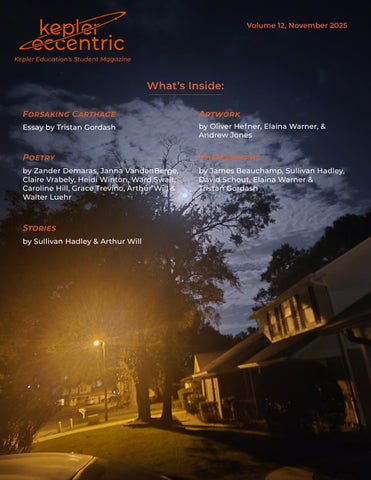
Kepler Education’s Student Magazine

Forsaking Carthage Essay by Tristan Gordash
![]()

Kepler Education’s Student Magazine

Forsaking Carthage Essay by Tristan Gordash
Volume 12, November 2025
Artwork by Oliver Hefner, Elaina Warner, & Andrew Jones
Photographs by James Beauchamp, Sullivan Hadley, David Schout, Elaina Warner & Tristan Gordash Poetry
by Zander Demaras, Janna VandenBerge, Claire Vrabely, Heidi Winton, Ward Swait, Caroline Hill, Grace Trevino, Arthur Will & Walter Luehr
Stories by Sullivan Hadley & Arthur Will
A L etter from the P resident of K e PL er e du CAtion


Dear Kepler Students and Parents,
One of the key features of a classical Christian education is the pursuit of the transcendentals: truth, goodness, and beauty. Here in North Idaho, our Creator has once again condescended to our human sensibilities and placed beauty on full display for us by painting the skyline with another brilliant array of autumn colors. Having been an educator for more than 30 years now, this scene inevitably reminds me that we are approaching the end of the first semester and the anticipation for the coming holidays will only continue to grow from here. For me, the temptation for the impending busyness of the season to overwhelm my enjoyment of the beauty of the season is a temptation I must regularly contend with. And, unless you’re different from any of the students I’ve ever encountered, I suspect many of you also find yourselves contending with this temptation at times.
Let me encourage you to be intentional about focusing, decluttering, and enjoying the particularities of this season of life in all of its aspects, despite the building pressure to balance your responsibilities and complete your assignments on time. You’ll never pass this way again. Although there will be other years to enjoy the fall season in both its work and wonder, the opportunity to enjoy this year is a once-in-a-lifetime opportunity, just like this issue of the Kepler Eccentric is a once-in-a-lifetime opportunity. There will be other issues in the future, but never this issue again.
Speaking of which, Congratulations! What a joy to see another issue of the Kepler Eccentric manifest itself in the world. It’s a beautiful showcase of your brilliant achievements and it always thrills me to see the creative work our students can accomplish when they set their minds and skills to work. On behalf of the Kepler staff and board of directors, we are honored to partner with you in the cultivation of your minds and hearts in the knowledge of Christ. May the beauty of the season remind you of the beauty of Christ’s holiness and the beauty of a life well lived.
By God’s Grace and For His Glory,
Scott Postma President, Kepler Education
Cover image: Moon by Sullivan Hadley
Magazine design and layout: Carissa Hale
Kepler Eccentric logo design: Josiah Nance
Copyright November 2025 Kepler Education

L

Welcome to the Fall 2025 issue of The Eccentric, Kepler Education’s student magazine! In these pages, you will discover how truly multi-talented our students are here at Kepler Education. As their teachers, of course we know they are something special, but The Eccentric gives us a chance to share their creativity and skills with a wider audience! As the Student Life Coordinator here at Kepler, I am thankful for the leadership of this year’s Student Council: Tristan Gordash (President), Jasper Crawford (Vice President), Anna Tanenbaum (Eccentric advisor) and William Foucachon (Member at Large). They have worked hard to plan and host exciting events for the Kepler community. We just had our first Kepler-wide Jeopardy game. The knowledge and creativity on display in the game were impressive! Stay tuned for more events throughout the year. Fall is a wonderful time of year, with the brilliant colors, changing weather, and late afternoon crisp clarity of light glancing on the hills here in Northern Idaho. Every year, I am struck by God’s wisdom in creating and designing the changing seasons. Every Fall, we celebrate the hard work and achievements of the previous Spring and Summer. It is a time for taking stock of our lives, and giving thanks for all the blessings of the previous year. It is also a time of fading glory, which reminds us that all of our lives will end eventually. All empires, and all nations, fade at some point. This is one of the lessons of history. However, another lesson of history is that virtue and heroism endure. We are still talking about the heroes of ancient wars, centuries later. What will our legacy be? These questions are more urgent for those of us in the middle seasons of life, but it is not too young for you, as Kepler students, to begin thinking about these things. You are in a time of planting the seeds of the rest of your life. You are cultivating a field that will—Lord willing—bear an abundant harvest in the years to come. But fruitful harvests and abundant fields don’t just spring up out of nowhere. They require hard work, self-discipline, and dedication now. Let the promise and reward of the ultimate Harvest motivate you now to pursue further excellence in all that you do (1 Cor. 3:11–15)!
At Kepler, we know that there is more to life than just academics, as important as they are. In this edition of The Eccentric, you will see evidence of the wide range of pursuits of our students: short stories, poetry, photography, recipes, and more! May you glimpse a small portion of God’s Fall-Glory in this issue, and thanks for reading!
Dr. Gregory Soderberg Student Life Coordinator


n ote from the s tudent C oun C i L P resident
Hello fellow Keplerites,
First of all, I would like to thank our Eccentric team for organizing this latest edition. They invest vast amounts of time and effort into each Eccentric release, truly making the Eccentric unique and special. Secondly, I would like to thank everybody who contributed to this Eccentric magazine.
Fall takes form in a variety of ways. In some places the trees turn into the most majestic colors. Other locations may just be slightly colder, or the weather will become cloudy and gray. Regardless of what kind of Autumn you may be experiencing, each kind possesses its own wonder and spectacle. I hope all of you enjoy this Fall Eccentric as well as this season.
Sincerely,
Tristan Gordash Student Council President


by Zander Demaras
A hint of cold enters the atmosphere— A chill waiting to be released From its subdued slumber.
Autumn is in the air.
Crimson leaves crumble quietly On copper fields.
Strong winds carry scents of fading harvests ’Cross the land.
Grey geese gesticulate stories of a white world As they fly south.
Big beastly bears and things go back to hibernate, Back in their caves and holes they dig To keep them warm.
Back into sleep and slumber they go, Autumn is in the air.
Squeaking squirrels slip in the rain As they gather one last acorn. The clouds make noises As they darken overhead.
The rain starts pouring, animals are snoring In the breezy brink of day. Autumn is in the air.

by Tristan Gordash
sail for Italy not of my own free will!”1 This is Aeneas’s defiant reply to Queen Dido’s distraught cry to stop him from sailing away. Regarded as one of the greatest literary works ever to be composed, The Aeneid was crafted roughly around 30–19 B.C. by Vergil. 2 It follows a Trojan warrior named Aeneas, whose purpose is to found Rome. Despite the fact that Aeneas is destined to found Rome by Jupiter himself, Juno despises all things Trojan and drives hardships upon Aeneas whenever an opportunity is presented. In book I Juno enters into a pact with Venus to cause Dido, the Queen of Carthage, which is where Aeneas was blown off course, to fall in love with him. Viciously, Juno intends this to disrupt Aeneas’ mission, leading him to settle in Carthage permanently. They spend the entire winter with each other in a love struck state. However, Aeneas is not destined by the gods to settle anywhere besides Italy, and thus leaves Dido abruptly when the gods remind him of his goal. Realizing she has lost everything, Aeneas’s departure causes Dido to commit suicide. Although Aeneas should have not engaged in a relationship knowing well that he could not maintain it, Aeneas was justified in leaving Dido since he had to be obedient to the gods, more harm would have befallen the city if he had stayed, and they were not joined in a marital union.
1 Vergil, The Aeneid , trans. Robert Fitzgerald (New York: Vintage Books, 1990), 108.
2 “Aeneid,” Enclycopledeia Britannica, last updated on August 9, 2025, https://www.britannica.com/topic/ Aeneid.
Because obedience to one’s duty is fundamental to leading a righteous life, Aeneas was correct in forsaking Dido. The Bible repeatedly displays how true honor is only attained through faithfully following God’s law and call. While not a Bible character, Aeneas is faced with a quest which is rather similar to Abraham’s: to laboriously found a new nation despite only seeing a fringe of its coming glory. 3 Aeneas must choose either a calm and relaxing existence with Dido in Carthage or go settle a new realm, enduring many hardships. However, if he gave in to his primal urges, he would be sinning against the gods as well as not pursuing glory, disregarding both Roman piety and honor. Forgetting that the Roman deities were anything but caring, significant issues would be presented to Aeneas both in his spiritual and casual life if he lived in such rebellion. Aeneas had no choice besides setting sail for Latium: “And though he sighed his heart out, shaken still with love of her, yet he took the course heaven gave him and went back to the fleet.”4 Although undeterred in his mission, Aeneas did feel sorrow in his speedy departure. Living in alignment with God’s will through obedience is key, justifying Aeneas in following Mercury’s message. If Aeneas had stayed with Dido in Carthage, the punishments propelled by the gods would have been devastating. Undeniably, Aeneas’s arrival and departure negatively affect-
3 Russell E. Gmirkin, Plato and the Creation of the Hebrew Bible (Abingdon: Routledge, 2016), 238.
4 Vergil, The Aeneid , 110.
ed Carthage since his involvement with Dido disrupted the city’s productivity as well as influenced Dido to take her own life. However, it is very well possible that even more damage would have been done if Aeneas had stayed. In book III Aeneas believed he was fated to settle his citadel on the island of Crete, but it was not the correct location, resulting in a disastrous colony. “Our men not long engaged in marriages or sowing the new fields, while I gave out homesteads and laws, when, without warning, plague, out of the infected air to sap our bodies came on us pitiable to see, and came to blight our trees and the crops—a year of death.”5 It is quite likely that Jupiter would have sent similar plagues on the Carthaginians and maybe even arouse war from the surrounding kingdoms. Tracing back to Aeneas, the citizens would blame him as the source of all their anguish and dispose of him as well as Dido. Thus, Dido has nothing just as if Aeneas had left. Aeneas, by the gods’ providence, founds Rome as he is destined. The same basic result occurs whether Aeneas stays or leaves. Aeneas possibly would have done much more damage to Dido and Carthage if he heeded Dido’s plea to stay.
However, forgetting all other arguments which exonerate Aeneas from any wrongdoing in leaving Dido, their relationship was not governed by the confines of marriage. “Do you go to get away from me?” Dido cries, “I beg you, by these tears, by your own right hand, since I have left my wretched self nothing, but that—yes, by the marriage we entered on.”6 While Dido acted as if their relationship was constructed on firm marble, in reality it was built on shifting sand. Responding to Dido, Aeneas articulates, “I never held the torches of a bridegroom, never en-
tered upon the pact of marriage.” 7 Aeneas has no legal obligation. They were not married. They were merely pretending. Obviously, Aeneas can and should be blamed for engaging in such an affair. However, since it was neither feasible nor fated for him to marry Dido, he cannot be accused of any wrong doing in leaving her. Aeneas is justified in departing from Dido onto Italy since they were not in a marital communion, but rather an unrighteous affair.
Clearly, Aeneas had to obey the gods when they reminded him of his destiny. Even if Aeneas listened to Dido and remained with her, the gods would have both penalized Aeneas as well as the entire city for his defiance. However, all other facts aside, they were not married. Collectively, Aeneas is exempt of any charges of malice towards Dido in his sudden departure from Carthage. Many morals and lessons can be drawn from this heart-wrenching episode, but the most important factor is to be obedient to Christ’s law. Even though Aeneas fared well after their relationship, it caused Dido to commit suicide, 8 weakened Carthage, and caused thousands to later suffer in the Punic wars. Sin has its cost. Attacking relentlessly, temptations and vices will be presented in this world. However, as hard as it may be to resist sin, it will not only destroy and mutilate the one who commits it but also his loved ones. Thus, every man must decide whether he will forsake his wants—his Carthage—and pursue the Lord’s command, or give into selfish desire and neglect pushing on toward his Latium.
5 Vergil, The Aeneid , 70.
6 Ibid., 106.
7 Ibid., 107.
8 Ibid., 119.
by Oliver Hefner

by Heidi Winton
With hair the shade of autumn leaves that fall
And skin as white and soft and fair as snow Does walk with grace, so that she seems to flow.
My sweet beloved, willowy and tall
And when in morning I would hear her call
To do some task, or help the garden grow
Responding, “As you wish” I’d gladly go
And in each task, I’d gladly give my all
But she, in all her haste did not, at least
At first, notice what I had told her true
And though I cared for all her wants and needs I kept on saying it to her anew
Until at last, she noticed and gave heed
That what I’d truly said was, “I love you.”

f riendshi P
by Heidi Winton
The autumn leaves fell softly down
Red, brown and gold upon the ground
A wonder to behold
The leaves swirled ’round and as the breeze
Went by, it whispered to the trees And ’membered things of old
Of days of summer and of spring
Of when the breeze would play and bring
Refreshing air and joy.
To this its friend the maple tree
With its then leaves of brightest green, A beauty to enjoy
And now when flow’rs and blossoms fade
And boys and girls no longer wade And splash in yonder stream
The faithful little breeze comes ‘round
And with a gentle rustling sound
Brings friendship to the tree.

by Elaina Warner


m urder in the m A nsion P A rt 3
by Sullivan Hadley
Now you’re probably thinking, “When is this guy gonna talk about the murder? I mean, isn’t it called Murder in the Mansion ?” Well, dear reader, yes, it is, and this part should make you excited. Everybody loves a good murder. Right? Right?
With the dinner complete, we all headed towards the library. All of us, that is, except a few people, who, due to the trouble of this case, I report completely to help with details. Mr. Lewis, not being a chatty person, without the persuasion of a bottle or two of fine wine or whiskey, had gone to the bathroom, or at least, that is what he told us, which I have reason to believe because he was back with us but a few 15 minutes later. The sickness of William and Elizabeth, feigned or not, detained them, keeping to their alibi, true or false, from enjoying the evening with us. Anna had stayed behind to take care of the kitchen cleaning duties, but she was the only other one missing, that I know of. Due to the geniality between the servants and the family, of which there was hardly a difference, all the servants, except the ones listed aforehand, had joined us in the living room with a cup of coffee or tea, each to their own preference. While everyone made their tea and let it steep and after everyone had sat down with their tea, patiently waiting for them to cool down, Mr. Lewis re-entered the room. He sat down in his chair, which had remained empty, for the sole purpose of the use of it by George. He picked up the newspaper off the table and started reading it in a grumpy manner. Something had annoyed him. The si-
lence was screaming at us, broken up by the occasional rustle of newspaper.
After about five minutes of this continuation of awkward social time, George looked at Hannah and said, “Is this today’s newspaper?”
She looked at him with a face that showed that she had answered this question already. “No dear, that’s yesterday’s newspaper.”
“Well.” A short pause. “Where’s today’s newspaper?”
“I told you already, I don’t run up to get the mail every day, but if you would like to,” she looked at him with a smile that showed that what she was proposing was going to be disliked, or ignored, “you could go and grab it.”
George stuck his nose back in his newspaper in a very grumpy fashion.
I proposed a game of cards, hoping to help George improve his mood. One thing that always made him, and most everyone, feel better, is winning. There was just the problem that it might have the opposite effect and make his mood worse if it was too easy.
Mrs. Lewis suggested bridge after I asked about maybe playing some cards. “A splendid idea!” said George. His storm clouds hovering over his persona had flown away, and fast at that too.
We set up the cards, allowing for one of the servants to play. The others got together and played spades with a different deck. Harold was the name of my teammate. He was the “backup gardener” as I liked to call him. His job was to do general lawn care maintenance, excepting the garden, which was alone over -

seen by Hannah. Harold had learned this the hard way. It was quite a funny story. It was the first week that the Lewises hired Harold. Their gardener had passed away recently, and the lawn was in disrepair. He had put himself out there as in need of work. They met up at the front of their property, and Harold took a gulp. I was there. He knew he was getting into something big. 3 weeks of no lawn care in the summer on a multi-acre plot where there were several trees, a large garden that was overrun, as well as a field, does not result in a quick job. Harold explained to us, George and I, that it would take at least a month to properly get the field completely done without any help working 8 hours a day. George then proposed that he become a full-time servant and haggled some deal where his generosity got the better of him. A handsome wage was given to Harold, and he agreed to be a full time servant. The next details would normally be considered minutiae but seeing the importance of their effect on the case at hand, I here record them. The contract, in full, was as follows:
It is to be here recorded that: Harold Arnold Churchill IV, son of Harold Arnold Churchill III, is to be here-on out the manservant of George Lewis, son of William Lewis, being paid a minimum wage of $400 dollars a month, in which he is to use to purchase any supplies needed to maintain the lawn care. All food and lodging are to be provided by George Lewis, son of William Lewis. The only way that this contract is to be broken is upon case of death of either Harold Arnold Churchill IV, son of Harold Arnold Churchill III, or George Lewis, son of William Lewis, or by agreement of both Harold Arnold Churchill IV, son of Harold Arnold Churchill III, and George Lewis, son of William Lewis, or by payment by Harold Arnold Churchill IV, son of Harold Arnold Churchill III, of a sum
equal to the half of the total amount of money paid by George Lewis, son of William Lewis, over the total amount of years, provided Harold Arnold Churchill IV, son of Harold Arnold Churchill III. ~~~
James Kendrick was found lying over this journal, dead. This is the second death in a series that we think are connected. The body is dated to being dead at 1:45 A.M., approximately. We interviewed Mrs. Lewis on the times:
“Mrs. Lewis, I have a few questions to ask, that I hope you will be able to answer to shed some light on a few curious matters.”
“Oh dear! What happened?” Her eyes were red from crying recently.
“I don’t want to consternate you further this morning after the quite tragic events of the last few days, but James Kendrick was killed last night.”
Her eyes showed little to no reaction, but she quickly made a quiet gasp.
“Can you tell me when Mr. Kendrick left the house two nights ago?”
“Yes. Well, let’s see. We ate dinner at five minutes after eight, and then James left about half an hour later. So, that would be about 8:30.”
“Hmm, yes. That lines up.”
“It does?” Mrs. Lewis interrupted.
“Yes. It does. Do you know of any enemies that Mr. Kendrick had?”
She paused to think for half a minute. “No, I don’t think so. He never showed a great temper, in public, at least, and he was a resolute bachelor, so, no, I don’t believe so.”
I told her thanks, wishes for a good morning, which were equally exchanged, and then left the premises. The house still seemed pristine, as clean, if not cleaner, than when I had visited it a few days prior.
Walking onto the sidewalk, I recalled that I wished to question her about the death of her husband. “Oh well. That can wait for tomorrow.”
To fill my readers in, I am that weird man who was described strangely by James Kendrick. I am a private detective. James Kendrick did come to see me at nine last night in the hotel that I was staying at for my visit to my hometown. I am unknown in my hometown because of two reasons: one, my name was never told because, when I was a child, I practically lived indoors, coming outside for church, when I could, because I had a very poor health as a child, and two… well, the point was really wrapped up in the first reason.
So, James came to me last night and immediately barraged me with an assortment of questions such as who I was, why I was here, how I was here, and so on. So, I explained to him, “That is quite a menagerie of questions, I shall start with the first. My name is Jeffrey Xavier Logan. Please call me Jeff. I am a pri-
vate detective by profession. I am here to prevent a murderer who used to be a friend of mine. You probably don’t know him. I have failed thus far and wish to succeed now. This is but yet another in a series of seemingly interesting cases including much from robberies to murders. This is a case of the latter. I was warned by my, dare I call him, friend, that Mr. George Lewis will die tonight. That is why I was talking to him. I offered protection to him. He, with the noblesse of a gentleman of old, declined, laughing. I expect him to be dead now, or in the next hour. That is also why I have called you here. I expect the latter will occur, and I plan to stop it. So, if you will be so kind as to follow me, Mr. Kendrick.” I started walking to the door, while he stood there, somewhat dumbfounded, in the sense that he did not know what to do. I turned around. “Are you coming or not?”
“Yes, I’m coming.” And with that, we hurried along towards the Lewis estate as my watch showed 9:30.
by James Beauchamp

by Zander Demaras
Dancing, dashing, ducking through the thicket,
Grassy, greenish, overwhelmingly so,
Overgrowth, overextravagant Lo!
Fragrances bursting forth like bombs explode,
Gargantuan towers armored in bark,
Big booming birds, with glorious gold gapes,
All loom overhead, very vigilant.
Not two log’s lengths behind, a raucous roar,
A high-pitched cry, erupts from the creature.
Brown bushy tail, brushes ’cross the wood,
Fleeing on the frondescent forest floor,
From a nightmare, a formidable foe,
One with undeterred determination,
One with undeniable skill and wit,
One with an alien’s killer instinct.
The beast hunts in the shadows of the light

Where grows the thorns and shrooms of the night.
It’s searching for food, and you’re it’s next snack, How can one evade a cougar attack?

by Walter Luehr
The bees hum from clover to clover
As I push my mower through the grass.
The blades throb over and over
As my roaring pushcart rolls past, Leaving a wake of uniform destruction, Only for the weeds to start wild reconstruction.
by Claire Vrabely
I wander through the endless haze Searching for my heart’s desire. But nothing meets my steady gaze.
All I see is smoke and fire In a listless, barren desert, As I plunge deep in the mire.
My mind I wish I could avert From its ceaseless search for beauty In a world filled with pain and hurt.
I sigh and turn away gloomy
My mind with misery unfurled Until a new thought sparks through me
What if?—my thoughts becoming whirled— I was made for another world?

e tern AL K ing
by Claire Vrabely
Like lilies that toil and spin all day And chaff that disappears into the wind; Like all beautiful things that fade away So man is doomed just as his life begins.
Power and greed will consume all in him, Dwindling away to darkness inside. Man is only mortality and sin; A tabernacle for evil to hide.
But upon this looked an infinite love; Mercy so strong it could not be destroyed. He sent His only Son, pure as a dove To rescue those of loveliness devoid.
Eternal King with the glorious throne
Sacrificed His life to give us a home.
by Caroline Hill
I am standing near Beside an agèd fountain Watching as she sheds Her glistening leaves of silver.
Come now, gentle fountain Hearken to my calling Let thy mist amidst us fall.
For the wellspring of the Divine Is comprehensible to none here But accessible to all.

by David Schout


t he s n AK e C h A rmer C h AP ter i : P ursuit
by Arthur Will
f ire .

Screams resounded throughout the village as houses blazed. Sobbing women and screaming children fled, while the men of the village, carrying whatever weapons they could get their hands on were charging towards, not away from, the impending destruction.
Temujin the Invincible, Tsepiin Tsohkigch, the Scourge of the Steppe, had arrived, and with him, destruction, as hundreds of the fearsome Molgai Mangudai slaughtered everyone they came across, lit buildings on fire, and plundered everything they thought was valuable.
Beowulf, son of Æthelred, sprinted out of his house, a short sword thrust through his belt and a wooden bow in his hands, an arrow nocked.
A Molga horseman was charging up the street, brandishing a torch.
Beowulf took aim and fired, and the man dropped from his horse with a dart in his throat, but not before flinging his torch into Beowulf’s house. The thatch roof lit easily, and a woman screamed inside.
Beowulf dropped his bow in the street, crashed through the doorway, and into the house.
The ceiling was already in flames. Thatch was not meant to be fireproof.
He stood for a moment, stunned at the ruin; he’d lived almost his entire life in this house. The final seal seemed set on the de -
struction of his former life.
But mourning over what had been was not to be an option right now; Beowulf’s sister Edith had their mother’s arm over her shoulders, and was attempting to help her while she coughed and gagged at the smoke pouring into the room.
“Edith!” said Beowulf.
He leapt across the room and lifted his mother over his shoulder.
“We have to get out!”
Out in the street, the Molga’s horse had bolted in panic at the fire, but that hardly mattered.
“Beo!” said Edith, choking down a sob. “They’ll kill us!”
Hooves pounded up the street ahead of them.
“Beowulf,” said his mother.
“I’ve got you mom,” said Beowulf.
“Leave me,” said his mother. “Leave me here, I’ll only slow you down. Get your sister to safety.”
“Not a chance, mom,” said Beowulf. “I’ll get Edith to safety, but you’re coming with us.”
Taking his younger sister by the hand, Beowulf ran down a side-alley, and hundreds of hooves thundered past.
Normally he would have outdistanced his younger sister by a long shot in a straight run, but carrying the extra weight they were about even.
“If we can beat them to the stable, we can run for it,” said Beowulf.

“Leave me,” Beowulf’s mother begged. She coughed and gagged.
“Never,” said Beowulf. “What will I do without you? You’ve been all that’s keeping our family together since dad disappeared!”
He slowed to a halt just outside of a narrow gap between two houses.
He set his mother down and leaned against the wall, panting for breath. Edith was crying.
“Leave me here,” said his mother. “Leave me, I beg you. If it is because of me that you are caught, then the torture of it would be far worse than immediate capture. Take your sister and go.”
“I can’t leave you, mom,” Beowulf said. His breathing was evening out, and he stared out ahead of him, assessing the situation.
Miles in the distance, a large plume of smoke rose to the horizon where another village had fallen prey mere hours ago.
Over the years, Temujin’s raids had grown bolder, and he was venturing farther and farther into the lands of Terranova, and because of the Prophecy, there was nothing anyone could do to stop him. Every attempt had met with incalculable disaster, and Terranova had only slid farther and farther into ruin.
Of the once many confederated tribes and clans of Terranova, only three still stood their ground: the Horse clan, the Otter clan, and the Wolf clan. Beowulf’s clan. The Rat, Squirrel, and Serpent clans had all been exiled long ago. The Lion clan, the Royal clan, was no more than an empty symbol of what had once been great power. All the other clans had been ground into the dust years ago, whether in wars long past or in Temujin’s recent raids. And nobody spoke of the Raven clan unless they could help it.
Orange light suddenly flared to life behind Beowulf, and the sound of steady hooves advancing at a slow walk.
Beowulf whirled around, whipping out his sword.
A tall, powerfully built man with a large recurved bow in his left hand and a long spear in his right, was riding towards them on a midnight black charger that was taller than Beowulf all by itself.
“Ah, the model of filial loyalty,” said the man. “In a weaker man than I, it would doubtless bring tears to the eye… unfortunately for you, I am not a weaker man. Allow me to introduce myself. I am Temujin, Tsepiin Tsohkigch, The Invincible, Scourge of the Steppe. And you are?”
“Does it matter?” asked Beowulf, brandishing his sword. “I’m warning you, I know how to use this piece of steel, and I’m not afraid to demonstrate.”
“A brave spirit, but entirely useless,” said Temujin soothingly. “I admire it, but the name is not for nothing; I am invincible. I cannot be defeated. At a word from me, the White Nymph granted my wish in terror, and I became the most feared man in the entire world. I could kill you instantly in a dozen different ways from where I sit right now.”
“Try it,” said Beowulf.
“Beowulf!” said his mother, and she rose to her feet. “Beowulf, take your sister and run. Leave me behind.”
The note of command in her voice was one that Beowulf had not heard before often, but it was one he could not disobey.
With a powerful heave he threw his sword straight for Temujin. It missed miserably, but it caused Temujin to flinch slightly to one side.
Beowulf scooped his sister up in his arms and fled.
Temujin flung his spear after the boy, knowing that he would not make it two steps, a satisfied smirk spreading across his face.
Beowulf’s mother threw herself in front

of the throw and took it in the right shoulder.
She sank to the ground with a groan. Blood seeped through her dress.
Temujin’s smirk grew.
“Lady Godivia,” he said. “Wife of Æthelred. Ever the courageous one. You have bought your son and daughter pointless seconds. How would it be if I left you here to bleed to death while I chased them on horseback and trampled them into the ground?”
Cackling, he left Godivia on the ground with her blood pooling beneath her, and the grim thought that she had accomplished nothing.
Beowulf refused to think about it. Any of it.
He ran as fast as he possibly could, his sister, no longer crying, jouncing in his arms with every leaping stride.
He had made it to the stable, but he heard the thundering of more hooves behind.
Temujin was there, and arrow nocked to his bow, with a hundred other Molgai horsemen right behind, carrying spears, bows, maces, and all manner of brutal but deadly weapons, all of which were smeared with blood and char.
Beowulf was weaponless, but he knew that it would not have made a difference if he had one. He would not be a match for the least of the Molgai on his own and on foot.
He swung his sister into the saddle of their horse Berend and slapped his rump.
“Go!” he shouted.
He turned to face the Molgai as Berend leapt out of the stable and galloped away.
Beowulf grabbed a stone from the ground and hurled it hard and accurately, knocking the first of the Molgai warriors to the ground.
He picked up another stone, but strong hands grabbed him under the shoulder, and he found himself being twisted by the rider as
the horse wheeled, turned, and galloped in a different direction.
As soon as the horses slowed to a stop, Beowulf was dropped.
He landed heavily on his face, his arm feeling damaged beyond repair, and much bruised.
Men alighted from their horses in a ring around him.
“Get up little boy,” said one. “Or we might just feel kind enough to kill you right here. But first, it might be a good deal of fun to see just how long you can stay alive while we tear your heart out.”
“Stand down Teneg,” said the voice of Temujin. “This boy is none other than the son of Æthelred. He may be useful to us, and when Auraboris finds out that he lives, it will want him to stay that way for as long as he stays useful.”
“I was only trying to get him to move,” whined Teneg.
“Let me put it this way,” said Temujin smoothly. “If you do not do as I say, and if you offer even one more foolish complaint, it might be a good deal of fun to see just how long you can stay alive while I tear your heart out.”
Beowulf groaned and rolled over.
His very being existed almost entirely of pain.
He was lying flat on his back in the middle of a wide ring of unfriendly faces, most of them with beards and a collection of various motley jewelry and very definitely used weaponry.
More of the Mangudai raiders were coming up to their leader. Most of them stayed on their horses, staring down at the aching boy, and wondering why he was attracting so much curiosity.
“What is this boy?” asked one. “He is a mere stripling from the peasant villagers around here. Why do we not slay him as we did the rest of them?”
“Because,” said Temujin, “I recognize him as the son of Æthelred. As you know, Auraboris takes a very great interest in Æthelred.”
Silence reigned among the horsemen.
“I shall take him to my father Tohktamysh Khan,” said Temujin loudly, his voice becoming a chant. The rest of the Mangudai joined in, slapping their knees and the sides of the horses. Those not chanting gave vent a deep throaty call, and the fires in the village blazed up high.
“We take the Stripling to the feet Of Great Tohktamysh Khan. Upon great skulls a golden seat; Tohktamysh sits thereon.
“The Golden Horde in Glory shines, Under Tohktamysh Khan; From highest peaks to deepest mines, Rules Great Tohktamysh Khan.
“Old Subotai with Mangudai Has turned the oceans red; Tohktamysh Khan with piercing eye Has watched as nations bled.
“On iron plates green fires burn, Devouring skulls and blood. Tohktamysh Khan slays each in turn, The victims of his rod.
“Where sits the Mighty god of War, Consuming nations gone, There blood and bones do live no more, Where sits Tohktamysh Khan!”
Beowulf shuddered involuntarily as the chanting reached a fever pitch and then died suddenly.
He tried to stand, but Temujin placed a heavy boot on his chest and thrust him painfully back down.
“Be still, child,” he said. Then, louder to the men, “Place him in a tent. We can carry him captive to my father in the morning, when we return to Mönkh Darkan with our plunder.”
“Shall we bind him?” asked one.
“If you like,” said Temujin dismissively. “It matters not, for we can simply chase him down and capture him. Listen, boy, for this is for your own sake, but I think that my men are entitled to a bit of fun if you escape, and, after all, how would they know who you are if you run off during the night? Arrows meant for stags may still kill men.” …
Scan the QR code or click the following link to continue reading the story.
https://docs.google.com/document/d/1UsV1BzokI2hj2v1CKULJ_CrpWVdrUNDd1qjezdzuuiw/edit?usp=sharing

by Ward Swait
After reading Gregory the Great’s commentary in the Book of Pastoral Rule about Leviticus 21:17–18.
No blemished priest may offer loaves of bread. Not blind, nor lame, nor scabbed the Lord has said.
For blind ones do not seek for heav’n, Whose eyes are bleared by sin like leav’n.
A nose that’s small can’t smell an odious sin. A large one snuffles into ev’rythin’.
The broken foot cannot walk the way. The lame seeks heaven though he’s drawn away.
The hunchback’s bent by many worldly cares. The speck eye’s vision pride impairs.
The mind of the ruptured dwells on turpitude, And scabs over lusting bodies intrude.
So if ye be diseased, offer not, and ye may thus avoid an awful lot.
by Janna VandenBerge
I sit, and seek to write words that amuse, An anecdote, or play on words, or pun. There are abundant themes from which to choose, The problem being: choosing only one.
Though many topics fight for center stage, In synchrony my mind stays fuzzy, blank. The words refuse to flow out on the page. At least I’m reassured I won’t waste ink.
I wish to beat my head upon the ground, Or trade my brain for one that isn’t mine.
But then, at last, an inspiration’s found! I’ll form these troubles into verse and line.
Perhaps, although my wit sees fit to stall, I’ve sown the seeds of humor after all.

“ n o m ore s ti LL ! ”
by Grace Trevino
Ere lay Roanoke silent and still
The weird wind whistles high and still, Raleigh observed, chin in his hand, Desolate it lies, deserted land.
Mystery endures through the ages, Still it puzzles and amazes.
Hundred fifteen people now lost Ambition satisfied, but at what cost?
Croatoan—what can it mean?
Nothing like this ever perceived, Ere lies Roanoke silent and still Ere lies Roanoke no more still.
by Sullivan Hadley


by Arthur Will
It was Clovis, the Frankish king, Who conquered northern Gaul Who took on him a mighty thing, To make his Name stand tall.
He saw the southern Gaulish Lords Who fell to Heresy. They now followed Arius’ words; The great old Pharisee.
He was intent on bringing them To faith by force of arms; He got him weapons, horses, men, And Grace to shield from harm.
He marched his armies south to Gaul And fought great battles there He crushed the Gothic Arians all And stripped the kingdom bare.
King Alaric of Gothic blood Was slaughtered by the sword. The Frankish monks, with cowl and hood, Taught Gaul the Catholic word.
King Clovis now, with sword and spear, Turned home with victory. But now this king, who had no peer? This is but history.

by Richard Beauchamp
Clovis, king of Franks, did know How to strike a mighty blow. Store of wit with strength of arm: Foes against them took alarm.
See the son of Sigibert, Filled with greed to do much hurt: Gave his father early grave, Gained his own as well, that knave.
Clovis tricked that wicked man, All to grow his glorious clan: “Support your claim to rule I will, After Sigibert is nill.”
Clovis, king, did use to plot, Ragna’s men, a sorry lot. Bands of bronze disguised as gold: These they took, their king they sold.
After Ragna, Ricchar died. Then the nobles said, “You lied! Bronze are these! What gives, you Frank?” Traitors! Gold like this suits thy rank.
Clovis, sorry, now seemed to ask, “Kin, did all perish? None to task, Help, or aid in my defense?” (Sought only to kill them hence.)
submitted by Ethne Woodruff
Chewy Pumpkin Cookies
from In Bloom Bakery by Ginny Dyer (https://inbloombakery.com/chewy-pumpkin-cookies/)
For the spiced sugar:
1/4 cup (50 g) granulated white sugar
1/2 tsp pumpkin pie spice
For the pumpkin cookies:
3/4 cup (168 g) unsalted butter, softened
1 cup (220 g) light brown sugar, packed
2 egg yolks, at room temperature
2 tsp vanilla
1/2 cup (122 g) canned pumpkin puree, Libby’s works best
1 3/4 cups (219 g) all purpose flour, spooned and leveled
1 tbsp pumpkin pie spice
1/2 tsp baking soda
1/2 tsp baking powder
1/2 tsp salt

For the spiced sugar:
1. In a small bowl mix the granulated sugar and pumpkin pie spice together. Set aside.
For the pumpkin cookies:
2. Preheat oven to 350 degrees and line two baking sheets with parchment paper.
3. Start by drying your pumpkin. (This step is not optional. The cookies will not bake properly if you skip this step.)
Spread the canned pumpkin on a plate and lightly press with a paper towel to absorb the excess liquid. Repeat the step at least four more times.
The pumpkin should be dry enough that it goes from being 1/2 cup dried down to just about a 1/4 cup. Hardly any liquid should transfer onto a paper towel once it has been dried enough. (Like stated above, try to use Libby’s canned pumpkin as almost all cans of it have the same consistency and are not too wet.) Then set aside.
4. In a small bowl, whisk together the flour, pumpkin pie spice, baking soda, baking powder and salt. Set aside.

5. In a large bowl cream the softened butter and brown sugar together with an electric mixer on high speed for 1–2 minutes until light and fluffy.
6. Add in the egg yolks and vanilla and mix on medium speed until pale and fluffy, about 1–2 minutes.
7. Add in the pumpkin and mix on medium-low speed to combine.
8. Add in the dry ingredients and mix on low speed just until combined.
9. Scoop the dough with a 2 tbsp cookie scoop, and roll them into balls. Then roll the dough balls in the spiced sugar. (If the dough is too “sticky” chill it in the fridge for 10 minutes, then proceed.)
10. Place the cookie dough balls at least 2 inches apart on the baking sheets. (I usually bake 6 at a time.)
11. Bake the cookies for 12–14 minutes. (12 minutes for really chewy centers, 14 minutes for a slightly crispier cookie). When the cookies are done baking the centers will be puffy. As they cool the centers will fall and the cookie will get “wrinkly.”
12. Let the cookies cool on the baking sheet for 5 minutes, then transfer them to a cooling rack to finish cooling. They are best enjoyed when they have cooled for at least 15 minutes!
Makes 18 cookies. Prep: 30 min. Bake: 12 min.

A h A i K u on W inter
by Janna VandenBerge
Frigid waves break white Wearing pinnacles of rock Into dust and sand

The beginning of all philosophical inquiry is the search for the answer to the question, “What is the good life?” Jane Austen seeks in each of her novels to answer this question, and does so in the tradition of framing her search in terms of the classical and religious virtues. In his book “After Virtue”, the ethical philosopher Alisdair MacIntyre calls Jane Austen “the last great effective imaginative voice of the tradition of thought about, and practice of, the virtues”. In this class, we will explore Austen’s search and the answers she presents to us for consideration as we read three of her novels along with selections from the great philosophers on the virtues and the vices, including Aristotle, Aquinas, Dante, Plato, Montesquieu, and Lewis, as well as others.
Texts in Western Political Thought with Dr. Jonathan McIntosh

What is the nature and purpose of civil government? What is civil government’s unique and proper task, belonging to it and no other human institution? What are the proper limits of civil government, and what, if anything, may be done to resist government when it exceeds those limits? Would there have been civil government had human beings never fallen into sin? Where does political authority come from, and how do we know? These are some of the central and perennial questions of political philosophy, and which serve as the focus of this semester-long course. In this class, students will read and critically examine some of the most important and influential texts and ideas in the history of western political thought.

Economics is generally approached as an inductive science; as a boring, mathematical dissection of past events. However, economics properly understood is a fascinating examination of human actions, and the cause and effects that these actions have on each other as we use them to form society. Students will learn how the true science of economics is built on axioms derived from the classical study of human society, and how these axioms are then used as deductive stepping stones to form economic laws that are then applied first to micro and then macro-economics. At the center of our study lies the Word of God which rules over our interpretation of these laws. It is impossible to discuss economics apart from its connections with politics, sociology, philosophy, and theology. We will study various competing forms of economic schools of thought, as well as the effect that their application has had on all these aspects of life.

A chronological investigation of humanity in Western society undertaken through the study of art, music, literature, politics, philosophy, and theology from antiquity to the late medieval world (ca. 1500 A.D.). The historical experience of man and his cultural expressions and values are interpreted through a Christian worldview as the best means to understand the nature of man. Prerequisite: Eligibility for EH 1301. Offered every semester.

Rhetoric 1 is a semester-long course designed for high students grades 10–12 who desire to study the art of rhetoric through reading Great Book selections and writing practice. Additionally, students engage in live-class discussions addressing the reading materials to further practice rhetorical skills and to engage in mature, meaningful, and respectful discourse. Students learn how to disagree with courtesy and professionalism. Although the course focuses on writing, students will gain basic public speaking experience by delivering at least one speech to a live class. This course is distinct because students read great literature selections which model rhetoric and then put observed techniques into practice by composing their own written essays. This exercise allows the student to learn by example and practice. Students work with an assigned writing partner to develop proof-reading and editing skills. Selected material has additional support through supplemental videos and podcasts for deeper and more meaningful conversation. Students are guided through the five canons of rhetoric: invention, organization, style, memory, and delivery. They are taught how to use the five common topics for invention: definition, comparison, relationship, circumstance, and testimony. This course is pending approval for dual enrollment.

Mortimer Adler ’s Three Columns Revisited Micro-Course with Dr. Robert Woods (Adult Learning)
A micro-course consists of one live, 90-minute online session with one of our master teachers. A very short reading(s) will be assigned and completed in advance of the live session. No quiz will be given as part of the final assessment but you will walk away knowing you learned something of significance.
Subscribe to the Kepler Newsletter and try a Kepler Micro-course for Free! ($30 value) Plus, you’ll learn more about Classical Christian Education and receive news and updates about online courses, regional conferences, and our academic journal.
Kepler Education has partnered with several like-minded institutions to help college-bound students successfully navigate their path to post-secondary education. Whether it is a grant or dual enrollment credits, each of our partners offers Kepler students a unique opportunity and educational experience that is suited to their particular calling and need.


Visit kepler.education/higher-education/ to view courses offered in partnership with Faulkner University and Colorado Christian University
2025 Kepler Education 121 E 3rd Street, Moscow, Idaho 83843 |