M E T H O D S O F
E N V I R O N M E N T A L A N A L Y S I S
What are the effects of lighting on student learning experiences in university lecture theatres in central London?
The dilemma of ever-changing environmental facets in the built environment presents themselves with all types of sufficiency and defect, that influence the overall health and wellbeing of occupants. Studies have proven that light influences people’s behaviour and cognition, daylight illuminance allows for a better output performance than that of artificial light alone, lighting characteristics variations positively influence mood and stimulation, and higher intensities of light allow for a more substantial level of alertness.
Within this study, an analysis study consisting of environmental measures on 50 lecture theatres as well as anonymous survey questionnaire responses from 2,279 students reflected individual experiences and judgement on the environmental qualities of lecture theatres’ in UCL. Results concluded that while there may be no significant data that implies lighting positively effects learning spheres within UCL, lighting holds the capacity to elevate health and wellbeing to high multitudes.

Building for health and welfare bestows people the opportunity to benefit on multiple fronts. By reason, the built environment calls for buildings that educe positive attributes to the beholder. The latter is, that the amalgam of ever-changing environmental facets in the built environment present themselves with all types of sufficiency and defect, which make it difficult to outline optimal environments for human health and wellbeing. This study is motivated by the intention of knowing what the optimal environments are within the learning sphere in order to deliver them to both students and teachers within the University College London Institution.
While many factors contribute to the overall learning experience within educational institutions, this study will focus on lighting in its capacity to influence student learning experiences within lecture theatres. Because lighting profoundly affects numerous human attributes, as reviewed by the relevant literature, such as cognitive performance, attention, concentration, and behaviour along with other health factors such as vision, circadian rhythms, and mood, it is implicit to direct attention to its effects on learning spheres. It leads to the important question, of how educational constituents select lighting optimal for concentration and performance within teaching and learning environments, and in the specified context, if University College London authorities have successfully achieved this within their presented lecture theatres and attentively to the Torrington (1-19) G13 lecture theatre, or elsewise there remains room for improvement.
The aim of this research is to understand the effects of lighting on student learning experiences in university lecture theatres in central London. Although there may be a research gap on the variables that contribute to or deduct from the overall learning experience, the objective efforts are to find lighting parameters, analyse survey and analytical data obtained from student questionnaires, identify possible conflicts and synergies, and synthesise results through identifying correlations between student concentration and lighting whilst attending to the relationship of independent and dependant variables. Surely, lighting features that can enhance or deny learning will be exposed through measures of environmental analysis.
One must first understand the characteristics and types of lighting along with how it can alter user encounters in various environments in order to grasp how it can aid learning experiences. An abundance of literature addressing the facets of lighting on learning and working spheres was found to ground the given context with the sufficient logic required to progress into the study.
Essentially, the level of light, also called illuminance is measured in lux (lx). This is the illuminance measured over a certain area and is given as the luminous flux per square meter. Additionally, the colour temperature of light is a combination of wavelengths which is correlated with thermal temperature in which an idealized black body would emit light with the same chromaticity values as the source, and this is measured in Kelvin (K) (Barkmann, Wessolowski & Schulte-Markwort, 2012).
Light is a key environmental factor within the dynamic of the built environment. Studies have directed that the element can affect blood pressure, pulse, respiration rates, brain activity, and biorhythms (Tanner, 2008). Nor is it only limited to that, but cases of exposure to full-spectrum light (light that covers the electromagnetic spectrum from infrared to near-ultraviolet), aids the body’s output of the neurotransmitter serotonin and influences the pineal gland’s synthesis of melatonin, proving to be critical to children’s health and development (Ott, 1990). Where the notion of light can convey different responses, light conditions that facilitate positive affects influence people’s behaviour and cognition (Knez & Kers, 2000). In particular, better work performance, fewer errors and rejects, better safety, fewer accidents, and lower absenteeism (van Bommel & van den Beld, 2004).
A study conducted by C. Kenneth Tanner (2008), compared levels of student achievement within three school design classifications: movement and circulation, day lighting, and views. The study took measure of the three categories with a ten-point Likert scale from a sample of 71 schools and compared them with the outcome of student performance that was obtained via six parts of the Iowa Test of Basic Skills (ITBS) – a valid measure of cognitive performance that tests reading comprehension, reading vocabulary, language arts, mathematics, social studies, and science. The results conducted that daylight significantly affected the variance in the subjects of science and reading vocabulary scores, but not in mathematics.
While one might argue that the results of this study are imprecise due to the collective measure of the three components, and how they build upon one another, it is important to understand that the regression statistical analysis made in the study assumed on the average, “errors balance out; independent variables are not random; uncontrolled variables are approximately the same for each observation; there are no autocorrelations among uncontrolled variables; and the design classifications are linearly independent.” (Tanner, 2008) Here we can draw, that with the assumed absence of error, schools that integrated higher levels of daylight illuminance contributed to a more positive output performance within the learning sphere than those with lower levels of daylight illuminance. As daylight further differentiates in dynamic and can be flexibly controlled by design parameters, the varying levels of intensity, colour, and hue, yield a good working environment in which changes in its characteristics positively influence mood and stimulation (van Bommel & van den Beld, 2004).
Whilst the effects of lighting variable in illuminance and colour temperature within educational settings do not enhance achievement motivation, they have proven students to perform fewer errors, improve their reading speed and reading comprehension, and ultimately rate variable lighting positively (Barkmann, Wessolowski & Schulte-Markwort, 2012).
In regard of light characteristic changes, a study by the government of Hamburg, Germany, and the Universitätsklinikum Hamburg-Eppendorf, examined the effects of dynamic lighting on student learning. The study proposed that four distinct lighting settings were to alter the behaviour of children within an educational environment.
The four settings were categorised under the labels of normal, focus, energy, and calm, and were to be controlled by the teacher via a control panel. Where the intention of normal was to be used for regular classroom activities with standard brightness and colour tone, focus was to educe concentration with highest light intensity and a cool colour tone, energy was to regenerate vitality with high light intensity and a very cool colour tone and calm was to promote cooperation and support among the children with standard intensity and a warm colour tone. Results highlighted those children studying under such measures experienced a 35% increase in reading speed, 45% decrease in frequency of errors and a 76% decrease in hyperactive behaviour compared to those under standard lighting systems (SchoolVision lighting, 2021).
An additional study tested four classrooms of 84 grade 3 children, under the mentioned conditions of “focus” and “normal” lighting systems. The four classrooms were randomly assigned to either of the lighting conditions in groups of two. Focus lighting consisted of 1000 lux with a temperature of 6500 K (highest light intensity and a cool colour tone) and normal lighting consisted of 500 lux with a temperature of 3500 K (standard brightness and colour tone). By conducting a d2 Test of Concentration (a test that measures processing speed, rule compliance, and performance) that allowed for an estimation of individual attention and concentration ability along with a mixed-model ANOVA statistical analysis of results, the study found a positive effect of focus lighting on student oral reading performance, and no highly significant effects on concentration (Mott et al., 2012). In this case, there is a need for further evaluation of the effects of illumination level and colour temperature on student outcomes.
Additionally various published studies examine the effects of light on alertness and mood, also categorised as arousal, under nightshift conditions. This is for assumption that the results would be strongest determined with the absence of daylight. Figure 2.1 (figure 1) shows the mean scores for shift-workers arousal after midnight with altering lighting conditions. A steady decline of arousal within all four conditions can be seen, there is however a consistent difference for all the lighting conditions (Boyce et al., 1997). Alternatively, figure 2.2 (figure2) expands on this by investigating the effect of two lighting regimes, 250 lux and 2800 lux, on arousal levels. The graph portrays a decline in arousal for both regimes, but the 2800 lux regime results in a significantly increased arousal level and thus better alertness and mood (van Bommel & van den Beld, 2004). It is also deliberated that people in high illumination spaces of around 1000 lux are more inclined to sustain attention despite possible discomfort and dissatisfaction from lighting features (Zhang et al., 2020) additionally, lighting levels raised from 300 lux to 2000 lux allow a substantial increase in productivity (Kerkhof & Licht, 2002).


On the other hand, it is important to note that the analysis of light’s characteristics at the users’ eye level should be given if not more, the same focus as the respect of standard photometric quantities requirements, in order to evaluate non-visual effects such as melatonin suppression, heart rate and alertness variations that are particularly relevant in educational spheres as people spend most of their time in (Bellia et al., 2015).
Now that both variants of light; daylight and artificial light, have been reviewed, the overall study directs to investigate the effects of daylight and artificial light simultaneously on learning environments. Respectively, a study on stress complaints levels in people working solely under artificial compared to working under a combination of artificial light and daylight helps clarify the relationship between both dynamics. As can be seen from figure 3, in January, when winter weathers affect the penetration of daylight, there is very little significant difference of stress complaints between both groups. Whereas in summer weathers of May, the results vary drastically, in which the group experiencing artificial light along with daylight reports significantly less stress complaints (Kerkhof & Licht, 2002; van Bommel & van den Beld, 2004). This particularly highlights the advantages of adequate daylight levels within the working sphere and gives little significance to artificial light alone. Alternatively, cases of bright light exposure without potential discomfort during winter weathers implies improvement in health-related qualities of indoor workers such as bettering mood, vitality and alleviating distress (Partonen & Lönnqvist, 2000).
Taken altogether, the study will move on to highlight methods and tests raised to examine the conducted literature in context.

An analysis study consisting of environmental measures on 50 lecture theatres as well as anonymous survey questionnaire responses from 2,279 students that reflected individual experiences and judgement on the lecture theatres’ environmental qualities was conducted. The study took place in University College London, Central London on the 17th and 25th of October 2019. A data worksheet was presented to the MSc Environmental Design and Engineering and the MSc Health and Wellbeing in Sustainable Buildings cohort. The spreadsheet introduced quantative and qualitative data that will advance to outline the context of the study and the steps acquired to answer the presented research question.
The environmental measures accounted numerous variables, and were measured via HOBO devices (loggers that measure temperature, relative humidity, and lighting levels), with placement recorded in the data set and with measures in relevance to lighting. The survey consisted of 23 questions that identify how familiar the respondent is to the lecture theatre along with the comfort of their seating and learning space limits (see questionnaire in appendix). It goes on to prompt the respondent to rate the environmental features and design qualities of the lecture theatre from their perspective, state, and seating position on a Likert numerical scale; features and qualities touch upon clothing level, air quality, visibility, lighting, acoustics, controls, accessibility, maintenance level, concentration, and the overall theatre design. Where the response of certain questions did not make sense to the research, cells were highlighted in red, and their assumed input neglected to prevent outliers from influencing the data analysis. An additional space on the questionnaire offered participants to input comments in relation to the scope of the research to allow for further remarks.
The overall study proceeds through the following methods outline:
1. Proposing questions that infer the sample data to identify implications on the wider population by setting null hypotheses, alternative hypotheses, and the alpha value.
2. Cleaning the data set, to focus the research inquiry.
3. Identifying categorical and numerical data to recognize appropriate statistical tests.

4. Summarising and visualising the data set.
5. Looking at combinations of variables and providing a summary.
6. Identifying what combinations of data will be observed to carry out statistical tests.
7. Performing statistical analysis.
8. Drawing conclusions from the data analysis and rejecting/not rejecting hypotheses.
3 . 2 A L L O C A T E D L E C T U R E T H E A T R E S T U D Y
Beneficial to answering the raised question within the context of the Torrington (1-19) G13 lecture theatre, the study will initially adapt an approach into the broader context of all lecture theatres to identify trends that contribute to the focused result.
Respective to the conducted survey questionnaire and the environmental measures, the study highlights the learning and environmental sphere of the Torrington (1-19) G13 lecture theatre as portrayed in figures 4, through a plan with its light placement and figure 5 with its installed lighting controls.


Within the scope of the literature review, and the obtained data, the study thus raises the two research questions:
1. Does the presence of daylight within the lecture theatres allow for higher concentration levels?
H0 : There is no difference in concentration levels when daylight is present in the lecture theatre
H1 : There is a difference in concentration levels when daylight is present in the lecture theatre
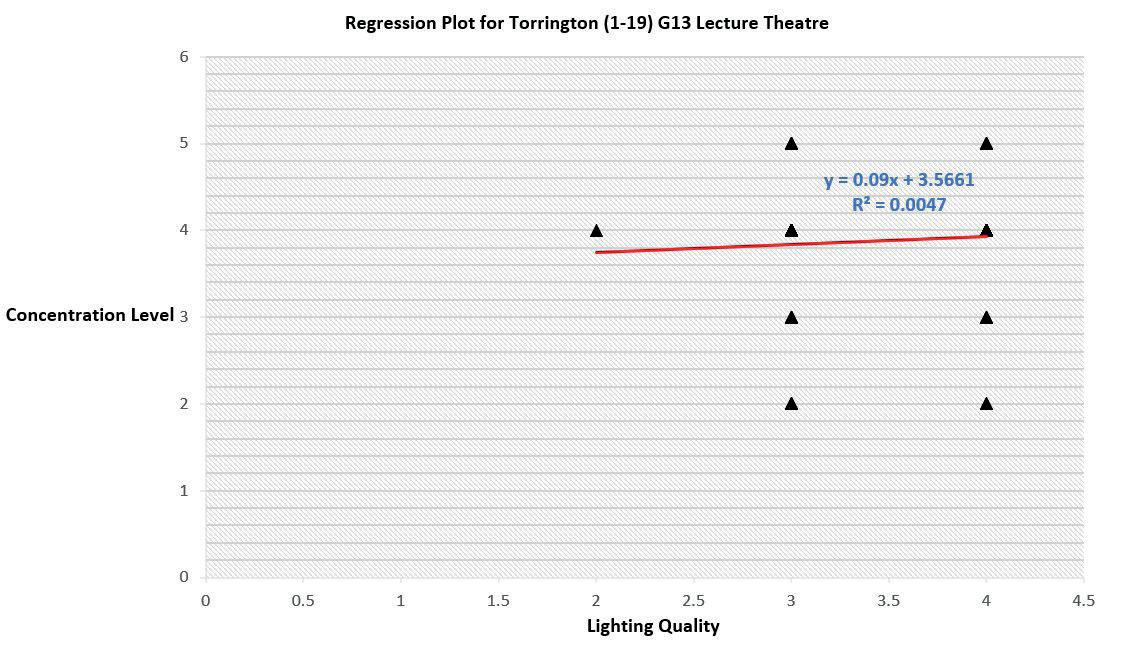
1. Do high intensities of light recorded by respondents imply alertness and consequently higher concentration levels despite possible discomfort?
H0 : Concentration levels will not have a significant correlation with high light intensities as recorded by respondents
H1 : Concentration levels will have a significant correlation with high light intensities as recorded by respondents
The value of alpha here, also known as the level of significance, is set at 0.05
To focus the data on regard to lighting, table below highlights categorical and numerical environmental and relevant measures identified from the data set. It is important to note that although some of the data may be considered categorical, the measured survey presents them in numerical values – and so they are accounted for likewise, and vice versa. –