NOVEMBER 2025
pg. 21
AM in Automotive ..........................................pg. 16 AI-Powered Virtual Assistance.......................pg. 10 Decorating Aluminum Cans and Bottles.......pg. 13
#5
NOVEMBER 2025
FEATURES [ 16 ] Innovations in Automotive Adoption of Plastic 3D Printing in the Automotive Space [ 21 ] Plastic Possibilities Direct Printing
COLUMNS Editor’s Letter [Advancing Plastics Forward]........................................4 13
Showtime [A Decade of Innovation: Formnext 2025 Preview].............5 Spotlight [ New Packaging Possibilities ]................................................8 AM [ Helpful Hands]...............................................................................10 DTO [Clink, Clack—Print!].......................................................................13
8
10
Advertiser Index...................................................................................19 Companies Mentioned......................................................................19 Target Chart [Ceramic 3D Printing].....................................................20
16
industrialprintmagazine.com
21
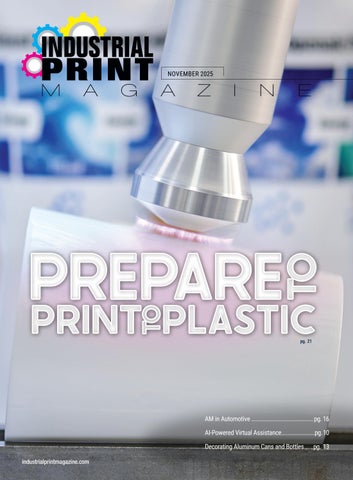
ON THE COVER: Plasmatreat GmbH manufactures atmospheric pressure plasma systems for the pretreatment of substrate surfaces including plastic. See page 21.
November 2025 [ Industrial Print Magazine ] 3
.RIAL 9PRINT
IN DUSTRIALPRI NTMAGAZINE.COM Volume 12, Number 6
EDrTIIR'S LETTER
ADVANCING PLASTICS FORWARD The possibilities of printing directly to plastic continue to expand as more industries adopt inkjet technologies in house. Ink sets are advanc ing at a rapid rate, allowing for excellent adhesion and durability. Today's digitally printed products are able to withstand just the right amount of wear and tear depending on the application's needs.
EDITOR IN CHIEF Thomas Tetreault 978-921-7850 EDITOR Melissa Donovan mdonovan@rockportpubs.com ASSOCIATE EDITOR Cassandra Balentine cbalentine@rockportpubs.com ART DIRECTOR Sarah M. White swhite@rockportpubs.com
This issue looks at direct printing to plastics in Plastic Possibilities. The
WEB EDITOR Melissa Mueller
them-low surface energy-and more importantly how to combat
CONTRIBUTORS Pete Basiliere, Olivia Cahoon, Kemal Carr, Maria Conrado, Mark Hanley, Melinda Tetreault
feature discusses the inherent issues plastics present, chief among
these challenges. Of note, pretreatment options like plasma, corona, or flame treatments.
ADVERTISING SALES
We also look at plastic in the vein of additive manufacturing (AM). In
novations in Automotive shares how plastic-based three-dimensional
(3D) printing gains popularity for not just prototypes but also end-use
parts production. Our columns this edition vary between a spotlight on the benefits of digi tal printing of corrugated, the continued use of digital decoration for alu
PUBLISHER Thomas Tetreault 300 Newburyport Turnpike, Ste. 11 Rowley, Massachusetts 01969 Ph 978-921-7850 x110 • Fx 978-921-7870 edit@rockportpubs.com SALES Amanda Doyon Ph 978-921-7850 x170 • Fx 978-921-7870 adoyon@rockportpubs.com
minum cans and bottles, AM leveraging artificial intelligence as a virtual assistant, and finally a 3D ceramic printer chart. Don't forget to check out our preview of Formnext 2025. The event is one of the largest venues to see products part of the entire process chain of
ROCKPORT
CusToM PuBLISHING
industrial 3D printing. Learn more on page 5.
Happy Holidays,
CORPORATE & PUBLISHING OFFICE 300 Newburyport Turnpike, Ste. 11 Rowley, Massachusetts 01969 ROCKPORT CUSTOM PUBLISHING, LLC
Melissa Donovan, Editor
CHAIRMAN Jeffrey Jensen PRESIDENT & CEO Thomas Tetreault CONTROLLER Missy Tyler Industrial Print magazine is published by Rockport Custom Publishing, LLC. Send change of address forms to 300 NewburyportTurnpike, Ste. 11, Rowley, MA 07 969. © Rockport Custom Publishing, LLC 2025. Reproduction by any means of the whole or part of Industrial Print magazine without written permission from the publisher is prohibited. Views expressed in the editorial pages do not imply our endorsement. Subscription Rates: U.S. $41.65 per year, seven issues; single copies: $5.95, Cana da and Mexico: $52.22 (U.S.D.), Other international subscriptions: $71.05 (U.S.D.) Vendors: We welcome your product news. Include prices, slides, photos, and digital files with your press release. Please forward product samples and media kits to Reviews Editor, Industrial Print magazine 300 Newburyport Turnpike, Ste. 11, Rowley, MA 01969. We cannot be responsible for unsolicited product samples.
4 [ lndustJial Print Magazine J November 2025
industrialprintmagazine.com
A DECADE OF INNOVATION Formnext 2025 Preview
by Industrial Print Magazine Staff
Formnext Frankfurt takes place November 18 to 21, 2025 with more than 800 exhibitors set to showcase their participation in additive manufacturing (AM) and intelligent, industrial production. Visitors to the event hail from automotive, aerospace, and medical backgrounds, in addition to a host of others from packaging, tool and die making to architecture and jewelry, to name a few. This year Formnext celebrates ten years in existence. Follow along below as vendors look to promote their newest solutions at this important event. 3D Systems, booth D11, hall 11.1, presents a hands-on look at the future of AM. Visitors can explore its latest 3D printing technologies, innovative materials, and end-to-end solutions that are transforming industries from healthcare to aerospace. A team of experts lead educational sessions and live demonstrations, offering insights into how companies 1 are scaling production and accelerating product development with AM. Attendees have the chance to see realworld applications in action, understand material performance, and discuss strategies for integrating three dimensional (3D) printing into their workflows. Whether you’re exploring new technologies or optimizing existing processes, 3D Systems’ Formnext showcase highlights practical, industry-ready solutions driving innovation today. Don’t miss the public debut of a new solution, engineered to deliver unmatched precision, flexibility, and efficiency in modern manufacturing workflows. INFO# 150 Boston Micro Fabrication (BMF), booth B46, hall 11.1, showcases the microArch S240, the company’s high-precision 10-micron 3D printer, alongside a range of parts that demonstrate the power of micro-scale AM. Visitors see real customer applications that highlight how BMF’s Projection Micro Stereolithography technology enables true end-use production at the microscale—including 3D printed connectors for electronics
industrialprintmagazine.com
and fiber optics, ceramic components, electroplated parts, and examples from across medical, photonics, microfluidics, and research markets. The display illustrates how BMF’s technology combines unmatched accuracy, fine detail, and material versatility to help engineers and manufacturers push the boundaries of what’s possible in precision manufacturing. INFO#151 Caracol, booth C101, hall 12.1, unveils a new breakthrough in robotic large format AM. Building on its leadership in robotic 3D printing, the company introduces new capabilities that will use advanced data integration to enhance performance, intelligence, and connectivity across its platforms. Visitors experience Caracol’s Heron AM and Vipra AM platforms in action, alongside applications in composite and metal materials. 1. Nikon Advanced Manufacturing, booth D119, hall 12.0, invites visitors to experience The Power of Perspective—a showcase of how Nikon technologies are redefining precision, scalability, and performance in AM.
November 2025 [ Industrial Print Magazine ] 5
2 Booth highlights include disruptive success stories in sectors such as railways, marine, and energy. INFO# 152 Carbon, booth C61, hall 11.1, is a leader in producing advanced elastomers that meet diverse needs in both consumer and industrial 3D printing. This expansive range of innovative materials is used by leading global footwear, cycling, and sports helmet brands for comfort and performance benefits, as well as by companies within areas like med-tech and automotive to create superior engineering-grade products and parts. INFO# 153 Conflux Technology, booth D76, hall 11.1, exhibits serial production heat exchangers now deployed across highperformance industries. In line with the show’s focus on commercially successful applications, Conflux showcases solutions from recent customer programs including Honeywell’s TheMa4HERA program, Pagani and Xtrac, Donkervoort, and AMCM. These projects demonstrate how Conflux’s AM thermal solutions deliver measurable gains in performance, efficiency, and reliability in real-world environments. Visitors see 2. Cubicure, booth D38, hall 11.1, enables the produc-
tion of high-precision polymer components at scale with its hot lithography technology.
6 [ Industrial Print Magazine ] November 2025
a broad portfolio of heat exchange technologies, including cold plates, water charge air coolers, and air-to-air heat exchangers, showcasing how Conflux is successfully scaling AM into serial production. INFO# 154 Cubicure, booth D38, hall 11.1, transforms visionary ideas into industrial reality. With its hot lithography technology, it enables the production of high-precision polymer components at scale—combining exceptional surface quality with outstanding mechanical performance. From prototypes to series production, the solutions bridge the gap between innovation and industrialization. Whether in automotive, medical technology, or consumer goods, Cubicure’s scalable 3D printing systems empower manufacturers to rethink design freedom and efficiency. From vision to volume, it delivers the tools to make AM a true production technology. INFO# 155 DyeMansion, booth C31, hall 12.1, showcases how continuous innovation and engineering excellence drive greater cost efficiency across the entire print-toproduct workflow. With a focus on lowering total cost of ownership, visitors experience firsthand how DyeMansion solutions optimize productivity while
maintaining the company’s signature quality standards. The booth features the complete, connected workflow— from cleaning and surfacing to coloring and finishing—along with a range of applications from different industries. A special highlight this year, the VX1 from ASM, a small scale vapor smoothing solution that compliments the print-toproduct workflow. INFO# 156 GEFERTEC, booth D31, hall 11.1, unveils its latest advancements in wire arc AM (WAAM). The process pushes the boundaries of 3D printing for metallic components. WAAM enables the rapid, efficient, and resource-conscious production of large and complex parts. It holds strategic relevance for industries such as energy, aerospace, rail, and toolmaking. At its booth, GEFERTEC, showcases representative examples of completed component projects, including a 700 kg impeller for turbines, an emergency exit frame for aircraft, a toolprint for toolmaking, and a yaw damper console for the rail industry. Additionally, a load collar—part of a high-performance turbine—is featured at the VDMA booth. INFO# 157 JEOL, booth C42, hall 12, presents its latest developments in electron beam powder bed fusion, featuring metal components produced on the JAM-5200EBM system. These parts demonstrate precision, microstructural control, and thermal stability across demanding alloys like titanium and tungsten. Visitors gain insight into the system’s high-power beam control, in-situ monitoring, and preheating technology enabling stress-free, high-quality builds. A highlight is a scanning electron microscope for live surface and structure analysis. JEOL invites attendees to bring printed parts—by JEOL or other AM technologies—for quality comparison and material evaluation. With over 70 years of electron beam expertise, JEOL continues to advance high-performance metal AM. INFO# 158
industrialprintmagazine.com
Lithoz, booth C35, hall 11.1, dedicates a booth area to the new CeraFab System S320 industrial printer with a five-fold larger build area. A series of new, medium-sized ceramic applications from serial production will be grouped around the machine, which visitors can experience live in production. The highlight of this display is an S320 build platform filled with 46 ceramic casting cores used for aircraft turbine production. The highly complex design of the casting cores enables increasingly intricate branching of the cooling channels in single crystal turbine blades. The series-proven feasibility using lithography-based ceramics manufacturing technology opens a new approach to the aviation industry for more efficient cooling, a major construction challenge for reducing fuel consumption though higher operating temperatures in future generation engines. INFO# 159 Nikon Advanced Manufacturing, booth D119, hall 12.0, invites visitors to experience The Power of Perspective—a showcase of Nikon technologies redefine precision, scalability, and performance in AM. Discover the latest advancements in laser powder bed fusion from Nikon SLM Solutions, explore Lasermeister directed energy deposition for turbine blade repair, and experience advanced x-ray CT inspection from Nikon Metrology. Together, these solutions illustrate Nikon’s approach to integrating optics, metrology, and AM to deliver the highest quality and most efficient production across industries including aerospace, defense, and energy. INFO# 160 Oqton, booth D52, hall 11.1, launches AMVero, a new on-premise, AI-powered real-time monitoring solution. This universal tool acts as an expert assistant for the entire shop floor by automatically detecting critical build anomalies such as warpage, spatter, and recoater issues and visualizing
industrialprintmagazine.com
them in the context of the as-built part. With intelligent alert configuration that filters out noise and targets only actionable issues, AMVero increases throughput and ensures quality by deploying Oqton’s production-proven AI engine directly within your factory’s secure environment. INFO# 161 Solukon, booth D71, hall 12.0, presents a special edition of its anniversary machine, the SFM-AT800-S. This exclusive variant showcases automated part transport and depowdering combined with robotic finishing. Proudly presented together with the renowned technology partners Grenzebach and Yaskawa, this innovation marks a significant step toward even greater efficiency and automation in depowdering and post-processing workflows. Also on display, the SFM-T350-E for medium-sized parts. Eversion of the system with ultrasonic excitation for a gentle and noiseless cleaning of LBPF parts. INFO# 162
WASP, 12.1, B101, presents the WASP CUBO HDP, a compact, large format pellet 3D printer designed for design and manufacturing. With a print volume of 120x120x120 centimeters, it is ideal for producing large-scale parts and finished products. Entirely developed and produced in Italy, the machine stands out for its low power consumption, efficient material reuse, and the ability to print with microplastics and shredded plastics, making it a truly sustainable solution for eco-conscious production. Alongside the CUBO HDP, it showcases a range of technologies—from pellet and ceramic printing to 3D construction systems. It also features RIGENERA, a 3D Print Recycling Station and CEREBRO, a robotic integration system. INFO# 163 Formnext offers attendees innovation, learning opportunities, and more. Be sure to check back after November on industrialprintmagazine.com for a recap of the event. IPM
#1 November 2025 [ Industrial Print Magazine ] 7
SPOTLIGHT
NEW PACKAGING POSSIBILITIES Evolve with Customer Demands by Cassandra Balentine
Digitally printed corrugated packaging is trend ing upwards and customer expectations si multaneously evolve.
The Atlantic Packaging (AP) Group of Compa nies offers solutions from corrugated and decora tive packaging to recycling services and paper bags. A vertically integrated manufacturer, the organiza tion does more than provide corrugated packaging. "Our customers are looking for packaging that not only performs but also gives them flexibility and ability to stand out in competitive markets. Whether that's running shorter quantities, responding quick ly to market changes, or creating unique designs for promotions and seasonal opportunities. Digital cor rugated printing in our Ontario business division addresses these needs by reducing barriers such as tooling costs and long lead times, while still deliv ering the high-quality graphics that brands expect," says Anthony Memme, digital print manager, AP Products. Headquartered in Canada with divisions in the U.S., AP is a privately owned company with over 3,600 employees and more than 20 manufacturing facilities serving customers across North America.
"Adoption of new technologies, including digital print, naturally takes time, especially with some of our larger customers that operate on longer design cycles. However, there is steady growth as more customers recognize the unique opportunities and advantages digital printing offers. We're confident that digital will continue to gain momentum as customers experience Products and Services the unmatched flexibility and value it brings to their packaging AP offers a range of product lines and services. Within its cor- strategies," comments Memme. rugated print business, corrugated packaging is its biggest To create its digital corrugated print work, AP relies on business focus. However, the company is more than corrugat machinery from Koenig & Bauer Durst, a relationship that ed. Going beyond the box, it has paper mills, paper bags, retail Memme says is built on partnership and collaboration. "As and display, and preprint with any new technology, -------,,------business units. there are challenges along Digital corrugated print the way, but its team is steadfast in supporting us ing currently represents an important but relatively small portion of its over 1. & 2. Headquartered in Canada with divisions in the U.S., AP is a all corrugated business. privately owned company with over Memme says this is expect - Anthony Memme, digital print manager, AP Products 3,600 employees and more than ed, given the scale and com 20 manufacturing facilities serving plexity of AP's operations. customers across North America. �------,,-------
Digital corrugated printing in our Ontario business division addresses these needs by reducing barriers...
8 [ lndustJial Print Magazine J November 2025
industrialprintmagazine.com
throughout the process. They share our commitment to success, not only for AP but also for the customers we serve. This alignment gives us the confidence to continue investing, innovating, and delivering high-quality, customer-focused packaging solutions.” In 2023, AP Products—the Ontario business division within the AP Group of Companies—installed the Koenig & Bauer Durst Delta SPC 130. The waterbased corrugated press was purchased with one clear objective—to prioritize customers’ evolving requirements. “We needed a solution that could meet their rising demand for highgraphic corrugated packaging while giving them greater flexibility in how they respond to the marketplace,” shares Memme. “The Delta SPC 130, a highspeed, single-pass press using waterbased inks, allows us to do just that. It supports our customers in managing inventory, handling brand proliferation, adapting to changing market conditions, and introducing more creativity and innovation into their marketing programs.” Innovation and flexibility were also central to AP’s decision. “The Delta SPC 130 enables quick response to changing market conditions, whether it’s managing inventory more effectively, supporting brand proliferation, or offering the freedom to add creativity and agility into marketing programs,” says Memme. Sustainability was another key factor in its investment decision. “By investing in water-based digital printing technology, we’re reducing environmental impact while maintaining the highest print standards,” continues Memme. AP Products also utilizes a range of finishing equipment to make sure its digital corrugated board printing can deliver exactly what its customers need. “For higher volume work, we complement
C O M PA N I E S M E N T I O N E D
the speed of the press with traditional flatbed and rotary die cutting as well as gluing, ensuring orders move efficiently through production. For specialty projects and smaller quantity 2 runs, we also use digital CAD tables, which give us the flexibility to handle unique designs and quickturn requests. This combination allows us to support everything from large-scale production to highly customized packaging solutions,” shares Memme. Investing in a new technology does not come without challenges. Memme identifies one of the biggest challenges with single-pass, direct digital printing is board warp. He explains that this technology requires corrugated board that meets much tighter tolerances than conventional printing and converting machines, so maintaining consistent board quality is critical. “It all comes down to the vacuum being able to hold down the board, and perhaps the tolerances need to be wider.” Another challenge is on the customer side as a new technology adoption. “We work closely with our customers and brand partners to help them see the opportunities that single-pass digital brings. That means debunking some of the myths about digital printing and encouraging a shift in mindset, from viewing it as just another print method to recognizing how it can open new possibilities for packaging. By embracing this change, marketers and customers can take advantage of the flexibility, creativity, and responsiveness that digital makes possible,” offers Memme. See page 19 for more information.
INFO# Company
Website
100
koenig-bauer-durst.com
Koenig & Bauer Durst
industrialprintmagazine.com
Recent Work AP Products recently completed a project on the Koenig & Bauer Durst Delta SPC 130 for one of its long-standing customers, the third-largest brewer in Canada—Sleeman. “This customer typically runs its high-volume items using preprint, but in this case, it wanted a smaller quantity promotional run—for a marketing campaign—while still keeping the main graphics consistent with their existing look,” explains Memme. Traditionally producing this job with preprint requires a major investment in tooling and setup. “By leveraging digital, we delivered exactly the quantity our customer needed at a significantly lower total cost, even though the unit cost per box is higher at smaller volumes compared to preprint,” shares Memme. What made this job unique was the ability to not only match Sleeman’s established branding, but also activate a creative promotion quickly without the usual lead times associated with preprint.
Up and Coming As market demands evolve, AP Group of Companies listens to customers and aligns its capabilities with their goals—whether that’s faster speed to market, increased creative freedom, or more sustainable and efficient ways to manage their supply chain. “Our focus is always on enhancing the customer experience and making sure we’re prepared with the right solutions as their needs and the technology continue to advance,” concludes Memme. IPM
November 2025 [ Industrial Print Magazine ] 9
AM
HELPFUL HANDS
Al-Powered Virtual Assistance by Industrial Print Magazine Staff
Artificial intelligence (Al) is used in various ways in additive manufactur ing (AM) settings. One role Al is built for is acting as a virtual assistant. Utilized as a tool that helps users cut down on manual processes all while collecting valuable data insights that they can leverage further down the production line.
W<PlcomatoyoorCTJD-pmunuassislan� I am 1ra......ito..,.,s,•1iryoorQUOSll<ln!;aboo14D AddrtMIHowc.w,l�yoo?
"Our customers manage large invento ries of 3D parts and the sheer time that it would take to manually process them is often a deal breaker for the adoption of 1 three-dimensional (3D) printing. AI can �;;;;;;;;;;;;;.;�;;;;;;;;;;;;;;;;;;;;;;;;;;;;;;;;;;;;;;;;;;;;;;;;;;;;;;;;;;;;;;;;;;;;;;;;��������������e.i.ulliiliu& process thousands of parts in parallel, providing highly dis provides support, but also learns and continuously adapts to tilled reports and valuable data insights," shares Simone Dal new processes, materials, and machines. This creates virtual Poz, VP of backend, 3YOURMIND. expertise that radically shortens conventional learning curves Lennart Bruning, product developer, CoreTechnologie in AM," explains Bruning. GmbH, notes that AM is not a monolithic technology, but in stead an eco-system of processes-each with its own rules. Task Driven These rules are difficult to streamline across various methods When AI is used as a virtual assistant in 3D printing settings, of 3D printing. For example stereolithography can result in it can take on a number of tasks. complex support geometries. The powder-based 3D printing AI-powered technical drawing assistance is one example. process selective laser sintering often leads to thermal stress Users can bulk upload their technical drawings and 3D mod es. In the metalworking process, process instability can occur, els, and in a matter of minutes, thanks to AI they receive a fea requiring costly post processing. Until now, this knowledge sibility analysis along with cost breakdowns per technology. was reserved exclusively for experienced 3D printing users. "With the latest developments in pre-trained language models, ''AI-supported assis AI can extract structured tance has the potential �-------,,-------� data from heterogeneous to make this knowledge sources, such as tech available in real time, nical drawings, manu als, thumbnails, and 3D scalable and acces sible to every user. This models, and feed it to an makes the experience of alytics systems. Together an entire development with retrieval augmented generation, it can link all team tangible in soft ware at any time. The the pieces of information - Lennart BrUning, product developer, CoreTechnologie vision-a digital knowl together to create a com edge base that not only prehensive knowledge ,, [ Telmemo,eabootSlMsupponstructuresj
Al-supported assistance has the potential to make this knowledge available in real time, scalable and accessible to every user.
�-------
1 O [lndustfia/ Print Magazine J November 2025
--------
industrialprintmagazine.com
AM
base and provide recommendations based on already existing, manually validated parts,” shares Dal Poz. Referred to as automatic geography analysis, Brüning says AI is used here as classic repair and proactive detection of risks. “Such as walls that are too thin or inaccessible support areas. In the case of an automotive supplier, for example, AI assistance provides immediate feedback if the wall thickness of a prototype is too low for MultiJet Fusion process and automatically suggests corrections.” Another example, adaptive component orientation—consideration of thermal flows, support volumes, and even post-processing strategies, notes Brüning. He provides the example of the virtual assistant for an aerospace engine component that selects a construction orientation that minimizes thermal stresses and facilitates post processing. AI can take on virtual test printing. “These are simulations that anticipate real production with predictions on distortion, component quality, and surface roughness. In medical technology, implants could be tested virtually in advance so that only validated geometries are actually manufactured,” says Brüning. The future is bright, Brüning believes even more tasks could fall under AI-powered virtual assistance. “An AI assistant could also evaluate cost effectiveness, comparing the time, costs, and sustainability of different printing strategies at the touch of a button. This would make AI not only a virtual production assistant, but also a business decision-making tool. In this way, AI optimizes the manufacturing process and at the same time calculates the return on investment
as an efficient basis for deciding whether a component should be manufactured additively or conventionally.”
Put in Place AI as a virtual assistant can be implemented via third-party software or directly incorporated into a 3D printer. According to Brüning a centralized software solution is the most practical approach. “It supports multiple processes and machines and can be flexibly integrated into existing workflows. The advantages of this method are its manufacturer independence and the resulting centralized knowledge database. Nevertheless, disadvantages such as data and know-how protection remain key challenges.” Brüning advises that independent software platforms offer greater added value. Citing a MarketsandMarkets study that says the market for AI assistants will grow by 44.5 percent annually until 2030, this is a clear indicator of the relevance of this technology. 3YOURMIND is a third-party software provider, so it enables part analysis, material and printer suggestions, analytics, as well as 3D printer orchestrion.
As a third-party software provider, Dal Poz believes that incorporating AI directly into the 3D printer doesn’t capture the whole picture. “Only with a comprehensive understanding of your inventories and workload can AI’s true potential be unlocked. Centralized orchestration and AI analysis are currently more prevalent, but this may change in the future.” “Direct integration into individual printers is possible, but is usually limited to one manufacturer and one process,” attests Brüning. Which is why as a third-party provider, CoreTechnologie’s 4D_Additive 3D printing software offers a comprehensive software platform for all 3D printing processes. “Integrating AI into a printer is beneficial only if you are prepared to handle the next level of granularity,” notes Dal Poz.
Necessity or Not Depending on the setting, AI-powered virtual assistance might not be necessary. It all depends on the environment in question.
1. Increase productivity in 3D printing with AI-
supported chat integration. Swivel bearing created with selective laser melting support structures in CoreTechnologie’s 4D_Additive software. 2. 3YOURMIND offers its AI-Powered Technical Drawing Analysis assistant, which extracts data from technical drawings and 3D models.
industrialprintmagazine.com
2
November 2025 [ Industrial Print Magazine ] 11
2D Drawing Analysis 20 Technical Drawing • Ci) Upload a single or multiple files at the same hme
Q Click to upload or drag and drop �
PNG, TIF TIFF. PDF (max. 9 5 M1B)
Part Type'
Seltw::t th pan type that will be assigned to all uploaded files Spare Pan
3
Cancel
3. The Al-Powered Technical Drawing Analysis as sistant from 3YDURMIND organizes all uploaded models into their respective assemblies.
well as provide alternative material sug gestions. In addition, it organizes all the uploaded models into their respective assemblies. Soon the assistant will be able to recognize similar and identical parts and cluster them based on part geo metrical properties and metadata. All the reports are made available by a powerful BI tool. CoreTechnologie offers its 4D_Addi tive 3D printing software platform for all 3D printing processes. A particular high light is the Al-supported nesting func tion. The software uses intelligent strat egies to make optimum use of the build space, reduce material consumption, and shorten build times. The CoreTech nologie team is currently developing a new Al assistant. The new tool will answer context-specific questions and provide customers with assistance on processes, parameters, and build orien tations. This will facilitate the training of new employees and optimize the daily work of experienced users, contributing to time and cost savings. 3YOURMIND and CoreTechnologie are both examples of third-party software providers offering Al virtual assistance.
COMPANIES MENTIONED�
ir I See page 19 for more information.
According to Dal Poz, "qualified parts with high production volumes and already optimized workflows don't great ly benefit from Al." Bruning believes the following areas benefit from AI integration-industrial applications with high-quality require ments, series production where scrap and process times are crucial, and ser vice centers with a range of machinery and changing customer requirements. "Here, Al-supported assistance can make a decisive difference from faster decisions to significantly higher pro cess reliability. With its ability to predict which strategy offers the highest pro cess stability and the best utilization, Al has the potential to revolutionize predic tive manufacturing," continues Bruning.
Features to Find 3YOURMIND provides its Al-Powered Technical Drawing Analysis assistant, which extracts data from technical draw ings and 3D models, such as dimensions, volume, area, weight, and material, as
INFO# Company 117 118 119 120
3DCeram
Website
3dceram.com
3YOURMIND
3vourmind.com
CoreTechnologie GmbH
coretechnologie.com
Rapid Fusion
rapidfusion.co.uk
12 [lndustfia/ Print Magazine J November 2025
As aforementioned, there are printer OEMs offering direct integration into their devices. 3DCeram developed CERIA for its CERAMAKER range of printers. CERIA is deployed in several modules, the first of which, CERIA Set, is a 3D printing as sistant designed to check files, compose tanks, and produce optimized printing parameters. CERIA is aimed at the mar ket for technical ceramics, which are in great demand for applications such as aerospace, biomedical, and semiconduc tor. According to the company, the goal of CERIA Set is to maximize productiv ity, reduce production costs, and reduce time to market. Rapid Fusion is another OEM that created its own virtual assistant, Bob, thanks to Al. Announced in August 2025, Bob works with Rapid Fusion's robotic AM systems like Apollo, Medusa, and Zeus. Best-in-class settings include smart extrusion readiness, material aware in telligence, task completion orchestrator, fast pattern matching, Al interpretation, and advanced contextual understanding. "It's feature rich, has a modern user interface, is completely secure and, im portantly, has been built for universal in tegration and agent flexibility, meaning it can be shipped with either an OpenAl powered agent or a locally hosted Al agent for online/air-gapped use," states MartinJewell, CTO, Rapid Fusion, in the press release.
The Way of the Future Whether it's via third-party software or directly incorporated into a 3D printer, AI-powered virtual assistance certainly seems to be the way of the future. '½I helps our customers to quickly validate 3D printing use cases and opti mize their production workflows," states Dal Poz. As a variable-heavy process, it makes sense that AM leverages the power of Al. Utilizing it means less error and quicker build times. 1PM
industrialprintmagazine.com
CLINK, CLACK—PRINT! Aluminum Cans and Bottles by Melissa Donovan
Direct printing to aluminum cans offers durable, seamless, full-color messaging. With demand at an all-time high for niche product lines, personalized options, and so much more, digital technologies are perfectly positioned as the key decorating devices. This is due to their speed, cost effectiveness for shorter runs and variability, as well as great quality and color.
Moving Forward Over the last few years, direct digital printing to aluminum cans has taken off. This due in part to advancements in both the hardware and ink sets used. On the hardware side, Sandi Baginski, creative director, Innovative Digital Systems (IDS), says features like edge-to-edge customization in a rapid print process allows the aluminum can and bottling industry the ability to incorporate vibrant, seamless, and complex designs directly onto their products. 1 “There is more aftermarket embellishment, especially for events. With the ease of use and the speed of modern UV printers, it becomes very cost effective Met and Fixed Aluminum cans present concerns that need to be considered to print designs on aluminum cans and bottles that are specific to events, and venues,” agrees Lon Riley, founder/CEO, during the decoration process. This includes handling as well as ink adhesion, and beyond that how the graphic remains on The DPI Laboratory. Printhead and related software technologies also play the can when out in the elements—i.e. a refrigerator or cooler. “Printing onto any substrate via a digital process requires cona role by “allowing for high drop printing, which offers betsiderations related to ter print quality on the surface,” explains the shoulder of cans. Paul Edwards, VP of These advancements These advancements allow suppliers to the digital division, INX allow suppliers to beInternational Ink Co. come more flexible become more flexible with their product line, Baginski points out with their product line, being able to offer seasonal designs, limited-edition that aluminum can be being able to offer seathin, soft, and malleable. sonal designs, limiteddecorations, and even personalized pieces, all edition decorations, advantages of a digital print process. 1. The DPI Laboratory offers and even personalized the Catalyst Nanos and Catapieces, all advantages — Sandi Baginski, creative director, IDS lyst Aventra printers, both ideof a digital print proal for embellishing aluminum cess,” notes Baginski. cans and bottles.
industrialprintmagazine.com
November 2025 [ Industrial Print Magazine ] 13
process is applied is recommended to consistently achieve great print quality and ink adhesion after processing,” notes Edwards. Riley admits that challenges involving single-use aluminum cans are mostly environmental. “The printed items need to survive perhaps water exposure in a cooler or sweating when moved from a cool to warmer environment.”
Inked In
2 “Extra care should be taken in assessing the process and tooling required to decorate the object to avoid product damage.” Ink adhesion isn’t as challenging as other surfaces. “Aluminum tends to have very good adhesion with most inks. For decorative purposes, it is an easy surface to print and typically has an exceptional look,” says Riley. “The adhesion onto the can, especially after pasteurization, must remain strong and consistent. Therefore, the use of a coating before the inkjet
C O M PA N I E S M E N T I O N E D INFO# Company
UV ink is a popular choice for direct printing to aluminum cans. It is cost effective, safe, and durable. UV printing offers a cost effective, fast, and easy way to produce short runs of a design or multiple designs using variable data, says Riley. “These inks meet strict safety and compliance standards, offer low migration, and are safe for use for indirect food contact packaging,” comments Baginski. An example of this is INX’s INXJet MDLM ink set, which offers regulatory compliance with low migration as a patented LED UV technology developed especially for aluminum cans. UV-curable ink sets are durable. “They are designed to adhere well to a variety of surfaces, maintain long-term integrity throughout the product’s lifecycle, and are tested to withstand harsh conditions and handling with improved abrasion properties,” says Baginski. Edwards points out that beyond UV, a number of ink sets are available for digitally printing onto aluminum cans. “The basic requirements relate to ink performance in the printing system, as well as its performance on the printed can. Another element to consider is the regulatory profile of the inks. In this application, the contents are likely to meet See page 19 for more information. Website
125
The DPI Laboratory
dpi-lab.com
126
Innovative Digital Systems
ids-digital.com
127
INX International Ink Co.
inxinternational.com
14 [ Industrial Print Magazine ] November 2025
the can surface and customers will often drink out of the can. Therefore, it is important to ensure the ink components follow regulatory guidelines,” continues Edwards.
Extra Help Sometimes ink can use a little help adhering to a surface or protected from damage after applied. It can’t do it all. Pretreatment and post-treatment methods assist. However, not any coating or process will do. When it comes to aluminum cans, there are certain things to consider like the fact that if it is a beverage container, people will be coming in contact with it via their mouth. Baginski recommends pretreating any metal surface with a propane flame application prior to print. “A simple propane flame treatment before print will help to adjust the surface tension of the material into a friendly range, enhancing its receptivity to UV ink. The flame treatment will also remove any physical surface contaminants that could potentially disrupt the inkto-substrate bond.” “Pretreatment of the cans is critical for the final product performance,” comments Edwards. “A thin coating can be applied in an analog process to the surface to enhance the quality and adhesion characteristics. It is also possible to inkjet a precoat on the surface of the can to carry out the same requirements as pre-coated cans. However, this process is more expensive to implement based on the type and amount of ink required, and the need for an extra print station on the printing system to do it.” Riley cautions that in regards to pretreatment it is important to “avoid any chemical promoter applications when dealing especially with vessels designed for drinking” and instead “rely on the adhesive properties of the ink.” 2. IDS’ line of rotary printers can digitally print a standard aluminum can at varying production speeds to support short- to medium-length production runs.
industrialprintmagazine.com
To ensure the graphic will last in conditions like water exposure, Riley suggests a varnish top coat. However, Baginski says the luxury of using UV-curable ink as the decoration method is that no post-treatment is required. “The inks are cured during print, and a varnish clear coat can be layered on top of the CMYK for added durability.” “Usually, the can printer has a channel to print a gloss varnish to finish the can, but it is recommended this ink should be regulatory friendly,” agrees Edwards. Depending on the can, it’s also possible to provide an analog clear coating to achieve different finishes such as matte or satin, adds Edwards. In the future, Edwards believes there will be more post-treatment methods available to enhance and differentiate the final product.
Recyclability Influence Post use, aluminum cans are prime candidates for recycling. However, when digitally printed, the ink and/or a pre/posttreatment might need to be taken into consideration to allow for recycling. Recycling entails “using high temperatures to melt the aluminum back to its original form and burn off any other materials. The use of labels applied to a can, either in the form of a paper label or a plastic sleeve, can complicate recycling and requires much more material to be burned off in the recycling process,” explains Edwards. Directly printing onto the aluminum can be more sustainable, as less material is used or burned off during the recycling process, adds Edwards. “When considering small, decorative additions to existing products and the
amount of ink used is incredibly small on a per unit basis,” recyclability isn’t really affected, shares Riley. Choosing UV-curable ink is an ecofriendly choice, attests Baginski. Its quick cure rates, minimal pollutant emissions, and reduced waste make them one step closer to “greener” printing. “The innovations with UV inks are maturing daily, with more sustainable and biodegradable options emerging in the industry constantly that can also play a part in determining the most sustainable digitally printed shelf life for any custom product,” says Baginski.
Cheers to Digital Aluminum cans and bottles benefit from the capabilities of digital printing, especially as advancements in ink sets—particularly UV—make the process easier. IPM
#3 industrialprintmagazine.com
November 2025 [ Industrial Print Magazine ] 15
'
;
.::
l
•· � ..- .,..,,.., ,......... ·�"'
.___...•
-
�.
••
-
-'l>�-
\r
--
_• ..,
--�
----- - -
----
r �------=-.......,.--:;-.,-.- ,._....
ADOPTION OF PLASTIC 3D PRINTING IN THE AUTOMOTIVE SPACE
If
hree-dimensional (3D) printing plays a growing role in automo bile manufacturing, from proto types to end use parts production. ''Automobile manufacturers were among the first companies to adopt 3D
16 [lndustfia/ Print MagazineJ November 2025
by Cassandra Balentine
printing. They have a long history of ac celerating product development of using it for part and assembly prototyping, de sign models, and various tooling applica tions," comments Dave Flynn, business line manager production, Materialise.
Many materials support the produc tion of 3D printed parts, including plas tic-based options. Above: A miniature model broken into components for inspection. All objects were printed on the Mimaki 3DUJ-553 3D printer.
industrialprintmagazine.com
Plastic-Based 3D Printing Matthew Stark, 3D segment manager, Mimaki USA, Inc., points to jigs, fixtures, and out-of-production part manufactur ing through digital warehousing and mockups as popular applications created with plastic 3D printing materials. Jon Walker, government relations and key account manager, EOS, sees it main ly used for prototyping or preproduc tion needs. "Selective laser sintering's (SLS') unique ability to match injection molding parts most closely, compared to any other 3D technology, enables the most options when it comes to prototyp ing large or missing critical parts, like instrument panels. There are some end use production parts for electrical con nections, vehicle customization, and spare parts." Fused filament fabrication (FFF) machines are mainly used to facilitate easy production of parts that would oth erwise require expensive tooling-injec tion molding-or much more expensive outsourced machining-CNC machin ing. "This results in less overhead and fewer man hours working on these parts as the workflow is cut down significantly. A typical workflow looks like this-de signing the 3D model in a CAD software, exporting the 3D model, slicing the mod el in a 3D printer job preparation soft ware-also known as a slicer, then print ing," says Christopher Thibeault, service engineer, BigRep America Inc. Along with manufacturing opera tions, Thibeault says fused deposition modeling (FDM) machines also opti mize the workflow for creative aftermar ket automotive parts and restoration projects by making one-off parts. Like in manufacturing, the time and costs associated are significantly less for busi nesses when compared to traditional methods of fabrication. Through its software solutions, Ma terialise works with major automotive manufacturers. From this perspective, Flynn says the four primary use cases
industrialprtntmagazine.com
for plastics in 3D printing in automo tive are prototyping for rapid iteration; custom tooling and fixtures; low-volume customization; and increasingly, end use parts production.
Next-Gen Manufacturing Custom jigs and fixtures mean faster manufacturing turnaround. "3D print ing parts from a digital warehouse al lows companies to service vehicles that are no longer in production. 3D printed mockups speed up the design process," explains Stark. Thibeault adds that 3D printing can decrease lead times for custom parts, as sembly jigs, fixtures, and in some cases even tooling, while also providing capa bilities for manufacturing many parts on site that would previously be outsourced. Flynn agrees, noting that speed and agility are offered with 3D printing. "Our customers can make faster decisions, re duce supplier dependency, and increase production flexibility. But the real game changer is digital control. This isn't just about printing parts; it's about trans forming how automotive manufacturers manage their entire additive manufac turing (AM) operations."
Thibeault points out that 3D printing gives more flexibility for part design that was once impossible with the limitations of injection molding or CNC machining. Further, robots have entered the pic ture. Walker admits that it's not a "new" idea to 3D print the end effector for a ro bot, but it is having a moment. "People are hitting the limitations of FDM in this space and the unique abilities of SLS are crafting those parts that other tech nologies cannot do."
Industry Advancements Advancements in the plastic-based 3D print space for automotive include new materials, better material recyclability, and the newer machines launching that are much cleaner to operate and run, suggests Walker. Stark sees lower prices, more en gineering-grade materials, and faster printing speeds. In recent years, Thibeault notes large strides in the general productivity of FFF machines. "Features previously re served for hobbyist or 'prosumer' class 1. The Big Rep VI 10 250 is engineered to take users from large-scale prototyping to short-run production, with minimal operator interaction.
November 2025 [ Industrial Print Magazine J 17
2 3D printers are now adopted by industrial machines to a much higher extent as this industry matures.” Advancements also include multimaterial systems like BigRep’s VIIO 250 with an Infinity Box, an automated filament handler feature similar to options available in popular desktop 3D printers. “Auto calibration—i.e. probe Z-offset calibration, input shaping, encoderbased flow calibration, and clog detection—greatly decreases the amount of time a machine operator needs to spend with the machine before getting a print job running,” says Thibeault. “This, in my opinion, has made adoption much easier for companies as the quick turnarounds and deadlines in the automotive industry make budgeting for a dedicated machine operator difficult to justify to leadership,” explains Thibeault. Flynn says Materialise’s software has driven several key advances including seamless integration with enterprise systems through its CO-AM Software Platform, automated workflows that reduce human intervention, realtime monitoring and quality control, and scalability solutions that enable
manufacturers to move from prototyping to production volumes. “We essentially digitized and industrialized 3D printing for automotive applications.”
Which Parts A variety of plastic parts are printed in 3D for automotive use, including jigs and fixtures in addition to trim and exterior components. However, Stark points out that 3D printing is slow and not made for mass manufacturing. “Typically short-run parts or parts that cannot be manufactured traditionally are being 3D printed. There are also limitations on material properties in 3D printed plastics so there are many components that are still unable to be 3D printed due to lack of strength or chemical resistance.” Any part where tooling costs cannot be justified by the volume—such as lowvolume, customized pieces or niche, geographical market variants, are well suited for 3D printing with plastics, says Walker. Additionally, Walker suggests that any part too sophisticated to print or requires design for AM and cannot be molded, is a good candidate.
C O M PA N I E S M E N T I O N E D
See page 19 for more information.
INFO# Company
Website
142
BigRep America Inc.
bigrep.com
143
EOS
eos.info
144
Materialise
materialise.com
145
Mimaki USA, Inc.
mimakiusa.com
18 [ Industrial Print Magazine ] November 2025
Flynn says Materialise’s software enables 3D printing of everything from complex interior components and lightweight structural parts to custom tooling and fixtures. “The ‘why’ is often geometric complexity, customization needs, or rapid iteration requirements, all scenarios where our software optimization really shines. Our RapidFit+ subsidiary specializes in high-precision tooling where traditional manufacturing would be cost prohibitive or time consuming,” comments Flynn. In automotive manufacturing, Thibeault says FFF 3D printing is commonly used for rapid prototyping along with jigs and fixtures to support their manufacturing operations. “When we extend this to automotive aftermarket, use cases become much more diverse. This is where the ease of rapid prototyping with FFF really shines. Between our machine and print service customers we see an assortment, from full-scale bumpers, fenders, interior panels, subwoofer enclosures, speaker grills, and aerodynamic components. These can now be printed rather than machined or made with fiberglass molds, saving valuable resources and fabricator time,” comments Thibeault. 2. An image of how some companies use 3D
printing in the early stages of automotive design. The item pictured is a concept car designed by Takumi Yamamoto. The paint job and render was done by Dixon Castro. All objects were printed on the Mimaki 3DUJ-553 3D printer.
industrialprintmagazine.com
Types of Plastic There are many types of plastic, so which are commonly used for 3D print ing in the automotive industry? Stark finds the most common 3D printed plastic is polyactic acid or poly lactide (PLA), due to its low cost and sta ble physical characteristics as a thermo plastic. "This is mostly used in hobbyist 3D printers since it is not an engineering grade plastic," he notes. Flynn says polyamides (PA 12, PA 11) are often used due to their durability and chemical resistance. Additionally, thermoplastic polyurethane or TPU is for flexible applications, and acryloni trile butadiene styrene (ABS)-like resins are used for tooling. Nylon, a type of polyamide, is the de fault standard, according to Walker. He says the automotive industry is familiar with it and it's the most common in SLS. "The interesting part are the variations which come from powder bed. Adding specific ratios of glass fibers or beads, carbon fiber, stiffening agents, and melt mixing to optimize a material specifi cally to the mechanical needs."
ABS is another sought-after plas tic because it is a standard commodity, says Thibeault. "However, as 3D print ing grows in adoption, the material sci ence follows to satisfy the needs of both OEMs and aftermarket companies. Oth er plastics include acrylonitrile styrene acrylate or ASA, various nylon polymers (ex. PA6/66, PA12), along with specialty materials like BigRep's HI-TEMP and HI-TEMP CF, which offer the properties of an ABS without the difficulty." Flynn stresses that material choice is just one piece of the overall picture. "You need to ensure optimal processing pa rameters for each material through soft ware when building your part to maxi mize their inherent properties while maintaining the consistency and quality that automotive standards demand."
Features in Demand There are several functions of 3D print ed plastic materials that the automotive industry seeks. Flynn says thermal resistance, chem ical resistance, mechanical strength, fire retardancy (FR), and lightweight design
are common demands. "Our software solutions are built specifically to help manufacturers achieve these specifica tions through precise process control, quality assurance workflows, and com pliance tracking. In automotive, it is es sential to ensure parts meet stringent standards through integrated quality management systems, like Materialise's CO-AM Software Platform." Walker says it is a budding field. "We have some FR materials for the aero space industry, and they have been used in production for over a decade. I think there is great potential for their use in the automotive space as well."
Engaged in Automotive The automotive industry is a notewor thy early adopter of 3D printing tech nology. From prototyping to lightweight end-use components, the technology evolves to enable faster development cycles, reduced waste, and greater de sign flexibility. As plastic materials advance, so do its use cases. Read more on the topic at industrialprintmagazine.com. 1PM
Get more information from vendors appearing in this issue! Visit IPMagdirect.com. With just a few clicks, order FREE information from dozens of companies covered in this issue.
AD INDEX
3
Innovative Di ital S stems 1ST
27 15
ids-di ital.com ist-uv.com
COMPANIES MENTIONED Company
INFO
Company
INFO#
Company
INFO#
3DCeram
117
Innovative Digital Systems
125
Mutoh America, Inc.
137
3YOURMIND
118
INX International Ink Co.
126
Plasmatreat GmbH
139
119
LSINC Corporation
135
The DPI Laboratory
143
Mimaki USA, Inc.
3DT LLC
BigRep America Inc.
CoreTechnologie GmbH
Engineered Printing Solutions EDS
lnkcups
industrialprtntmagazine.com
130 142 132
133
Innovative Digital Systems
134
Koenig & Bauer Durst
100
Materialise
Mimaki USA, Inc.
144 136
O&PM Europa BV Rapid Fusion
The DPI Laboratory
138 120
121
131
145
November 2025 [ Industrial Print Magazine J 19
INFO
by Melissa Donovan
irect digital printing to plastic is challenging, but that doesn't make it impossible. Variables such as low surface energy, the variations of plastic, how it is manufactured, and environment it is placed in all play a role when it comes to ensuring ink initially adheres to the surface and remains there for the intended duration. Pretreatments—whether executed inline, near line, or offline of the printing
industrialprintmagazine.com
process—represent one way to help enhance adhesion. Wipe-on primers and coatings are another option to consider. Today’s ink sets are also advancing at a rapid rate. Their chemical configurations make it less necessary for outside help like pretreatments, but aren’t quite there yet. Above: IDS provides a range of digital inkjet solutions—both dedicated flatbed and rotary style for cylindrical printing—that are able to print to plastic.
November 2025 [ Industrial Print Magazine ] 21
1 Identifying Issues When direct printing to plastics, the surface energy will make a difference. This is affected by the plastic manufacturing process. All plastics are not created equal.
2
22 [ Industrial Print Magazine ] November 2025
“Plastics are ubiquitous, but that doesn’t mean they are all the same. Each material type and mold process can present digital printers with a very different surface to print on—things like surface energy, mold release chemicals,
and other surface contaminants create adhesion and wetting issues for any print process, digital or analog,” shares Kenneth Stack, executive chairman, Engineered Printing Solutions (EPS). Plastic versatility is an advantage and disadvantage. There are seven main types of plastic, says Jessica Makrinos, marketing manager, Inkcups, each with its own set of pros and cons, its own flexibility, and its own particular surface energy, which affects adhesion. “In addition to this, because plastic is used in so many different ways, each individual use case also warrants careful consideration before selecting pretreatment, inks, and equipment.” “The key factor is ink compatibility with the surface, which is dictated largely by the surface energy of the plastic. Some plastics, like polypropylene (PP) have very low surface energy, which translates to low adhesion. Others, such as ABS, have substantially higher surface energy, which leads to exceptional adhesion. Dyne testing is a common way to get an idea of how ink may adhere to a particular surface, even before printing,” says Lon Riley, founder/CEO, The DPI Laboratory. James Bullington, CTO, LSINC Corporation, notes that other olefins besides PP like polyethylene (PE) and high-density PE (HDPE) also have low surface energy, which makes them incompatible with inks without pretreatments or primers. On the other hand, “co-polyesters can print like a dream with fantastic adhesion, but one has to watch the static and its impact on ink mist. Styrenes and expanded polystyrenes are highly susceptible to static generation that must be mitigated.” “Static can attract dust or distort the ink spray path—especially in inkjet printing, degrading print quality,” cautions Bas Buser, global market segment manager printing applications, Plasmatreat GmbH. 1. The DPI Laboratory’s Catalyst Aventra offers superior ink adhesion on a variety of substrates. 2. Plasmatreat is an international leader in the development and manufacture of atmospheric pressure plasma systems for the pretreatment of substrate surfaces.
industrialprintmagazine.com
A plastic’s manufacturing process may present challenges. “HDPE, PP, or PET plastics for example, depending on method of manufacture, may have mold release present in a range of ratio mixes that can adversely impact print adhesion. Parts in a common lot may even have more or less mold release present depending on when they were produced in a run,” suggests Samantha Solomon-Crump, research and development (R&D) manager, Innovative Digital Systems (IDS). “Different plastics, even within the same family, can vary significantly based on the supplier, colorant compounds, glass-fill/mineral fill, polymer resin melt flow, and processing aids. Many companies printing on plastics do not have a definitive material specification and procure based on best pricing,” add Erik Kiel, president, 3DT LLC and Scott Sabreen, president/owner, The Sabreen Group. Plastic is also able to take on many shapes. “Often I am presented with a plastic object that requires use of specific print settings in regard to controlling speed, direction, and dot size to maximize the surface area of an odd shape that can be printed accurately,” says Emilio Rangel, UV product manager, Mutoh America, Inc. Also, consider thermal sensitivity. “Many printing processes—especially digital and thermal transfer—involve heat. Plastics can deform or melt under high temperatures, limiting the choice of printing methods,” explains Buser. “Add in issues like expansion and contraction under temperature shifts as well as chemical resistance and it creates challenges for both adhesion and long-term durability. Some products choose these difficult-to-print plastics because of their specific ability to resist staining or marking,” notes Hugo Gonzalez, senior segment specialist, Mimaki USA, Inc.
Combat Challenges There are a number of ways to remedy the issue of poor surface adhesion— among other problems that may arise.
industrialprintmagazine.com
The solution to adhesion problems can occur one of two ways—from within or outside the printer system, recommends Gonzalez. “From within, ink chemistry can be improved and more compatible curing systems built like low-energy curing lamps. Hardware can also include precision ink drop placement, size, and shape that may optimize the way the ink is cured.” Mimaki takes a multi-layered approach. The UJF Series offers a variety of ink types along with jetted primer that is printed only in the required print area reducing waste and expanding the types of printable material types. Mimaki also employs low-energy UV LED lamps that reduce the possibility of warping temperature-sensitive materials. From outside of the printer system, pretreatment equipment is introduced to remedy adhesion problems. Plasmatreat is an international leader in the development and manufacture of atmospheric pressure plasma systems for the pretreatment of substrate surfaces. “The system we recommend and suggest depends on a number of process parameters like production speed, size of the treatment area, product shape, and chemical composition of the product,” shares Buser. Makrinos says Inkcups constantly works to develop inks and equipment in response to challenges. “Sometimes, that means innovations in pretreatment, sometimes it sparks ideas for equipment
updates, and sometimes it leads to the development of new inks, but it always entails keeping the end use of our customers’ products in mind.” When EPS sells a system, it needs to ensure the customer can successfully print on the complete range of materials that led to its purchase. “We take this responsibility very seriously and offer our customers access to many different forms of surface pretreatment inline with our printers. Both surface pretreatment and curing are critical to the print process for UV inkjet,” explains Stack. Noting that adhesion is challenging to plastic when working with its water-based printers, O&PM Europa BV developed its own set of primers in response. “With more than 20 recipes we guarantee adhesion on any surface. If none of these work, we can adapt the recipe to the properties of the substrate,” explains Dursun Acun, sales director, O&PM.
#2 November 2025 [ Industrial Print Magazine ] 23
Testing makes all the difference, agrees Rangel. “I keep a variety of adhesion promoters to test on plastics. There are quite a few good choices that usually do the trick. Mutoh also prides itself in its R&D teams’ ability to maximize adhesion properties out of the box so to speak.” “R&D plays a role in taking on a new plastic product line in your catalog,” admits Solomon-Crump.
Pretreatment Recommendations
3 While product advancements continue to address issues, Riley admits that education is the most important factor. “The DPI Laboratory designs its systems and compatible inks to adhere to a wide range of surfaces, but we cannot plan for every application. Educating customers about ink adhesion considerations during the buying phase arms them with the information they need to make the right decisions and create long-lasting prints on their products,” he says. Similarly, Kiel and Sabreen believe “education is important for companies in
4
24 [ Industrial Print Magazine ] November 2025
order to make the best purchase decisions not only for the types of pretreatment, but for long-term project success. Specific to inkjet printing machines and prospective procurement, companies too often do not conduct adequate testing of samples only to learn that certain inks and UV LED pinning lamps do not produce sufficient power/energy density to achieve full cure. Radiometers are important to determine proper UV dosage. Undercure and overcure conditions result in adhesion/abrasion failure. Inkjet printers require exact setup and maintenance.”
Pretreatment is a common solution to ensure proper ink adhesion to a plastic surface, indirectly it also improves long-term durability. Prevalent options include corona discharge, plasma treatment, wet chemical (solvents and primers), and flame treatment. They may be placed inline, near line, or offline from the printer; or applied manually. According to Kiel and Sabreen, gas phase “glow discharge” plasma surface pretreatments are generally necessary to achieve acceptable ink adhesion and abrasion resistance. These surface pretreatments increase surface energy and improve the wetting and adhesive properties of polymer materials. Chemical primers are sometimes used instead of gas plasma processes. Kiel and Sabreen say the industry uses a variety of gas-phase surface oxidation pretreatment processes, including low-pressure, cold-gas plasma; electrical or corona discharge; flame plasma; and low-temperature, voltagefree atmospheric plasma. “Each method is application specific and possesses unique advantages and potential limitations. Each of these processes is characterized by its ability to generate gas plasma– an extremely reactive gas consisting of free electrons, 3. Inkcups built on its XFlexx series of flexible UV inks to develop the TB series of UV inks specifically for printing on a variety of tote bag material. 4. The corona treatment HeliDyne from 3DT handles materials up to 200 inches wide and two inches thick in a single pass. It can be integrated inline or paired with a conveyor.
industrialprintmagazine.com
positive ions, and other chemical species. In the science of physics, the mechanisms in which these plasmas are generated are different but their effects on surface wettability are similar,” explains Kiel and Sabreen. 3DT offers ten different surface pretreatment systems that include corona and plasma pretreatments. Each system is designed for adaptability and can be configured to meet the exact requirements of unique applications. The engineering team at 3DT collaborates with customers through every stage of system development, including comprehensive application development, dyne testing, design, engineering, as well as system integration. Its new HeliDyne corona treatment is designed to produce strong bonding on
wide, thick materials for printing, gluing, coating, and laminating applications. The system is engineered with numerous pin electrodes, which generate a broad corona discharge that increases surface tension on challenging materials without the heat damage typical of conventional treatment. Additionally, unlike most systems, HeliDyne handles materials up to 200 inches wide and two inches thick in a single pass, according to 3DT. It can be integrated inline or paired with a conveyor. Plasma pretreatment systems can integrate within the inkjet printer as well, note Kiel and Sabreen. 3DT also offers these. “When pretreatment heads are mounted onto flatbed systems there are weight considerations for the balance of the reciprocating
printhead. For single-pass inkjet printing, there are other design considerations. Pretreating rigid parts is much different than pretreating thin, flexible banners. For example, polyolefins are often selected for both rigid and thin material products, however the amount of heat applied is an important factor that determines which of our plasma technologies is best.” As a manufacturer of plasma treatment systems, Plasmatreat advises inline placement of its treatment, but ultimately it depends on several process parameters, admits Buser. Choosing inline assures that between the plasma treatment and printing process there is no room for new contamination of the plastic surface. However, the size of a product or technical limitations might
#4 industrialprintmagazine.com
November 2025 [ Industrial Print Magazine ] 25
5 make offline treatment the best possible choice. LSINC accommodates jettable primers in its printers. “To maintain production rates, place portions of the pretreatment upstream of the printing process. Any process that raises the temperature of the media must be far enough upstream to ensure that it is at 5. LSINC’s direct to object printers enable printing to items such as plastic wine glasses.
the proper temperature to prevent impacts to the image quality,” advises Bullington. Propane flame treatment is often used at IDS to combat plastic adhesion challenges. “Propane burns off releasing agents and other physical contaminants purifying the surface while also opening the ‘pores’ of the material prepping it for printing. This is what is referred to as ‘surface activation,’” explains Solomon-Crump. Typically, IDS’ auxiliary PyroBond or PyroTrack flame treatment systems are recommended. “These systems provide the capability to propane flame and/or Pyrosil flame materials as an offline solution. The PyroBond system is a four-station rotary system used for drinkware while the PyroTrack conveys flat goods such as coolers. Both of these systems would be placed near line to create a work station in conjunction with the printing process,” recommends Solomon-Crump. If choosing to work with corona discharge, plasma treatment, wet chemical
C O M PA N I E S M E N T I O N E D INFO# Company
See page 19 for more information. Website
130
3DT LLC
3dtllc.com
131
The DPI Laboratory
dpi-lab.com
132
Engineered Printing Solutions
epsvt.com
133
Inkcups
inkcups.com
134
Innovative Digital Systems
ids-digital.com
135
LSINC Corporation
lsinc.com
136
Mimaki USA, Inc.
mimakiusa.com
137
Mutoh America, Inc.
mutoh.com
138
O&PM Europa BV
oenpm-europa.com
139
Plasmatreat GmbH
plasmatreat.com
140
The Sabreen Group
sabreen.com
26 [ Industrial Print Magazine ] November 2025
(solvents and primers), or flame treatment systems, the surface energy of the plastic is changed, “by breaking bonds on the chemical level. By doing this, it gives the ink anchor points to adhere with the plastics. These effects are generally temporary, so printing needs to occur soon after application or treatment. These systems can be placed inline with the printer to improve production and increase the effectiveness of the treatment,” says Gonzalez. Another avenue is wipe-on adhesion promoters or UV LED curable jettable primers that allow for registered-to-print surface treatment, notes Solomon-Crump. Usually a simple cleaning with alcohol, then a wipe down application of the promoter that provides optimal adhesion characteristics is suggested when working with Mutoh printers, comments Rangel. The level and type of pretreatment depends on the plastic as well as the intended life of the product. “For instance, printing onto a frisbee or a cooler demands very different adhesion standards to a squeezable sports bottle or a Tritan picnic cup,” shares Makrinos. “The pretreatment solution of choice is dictated by the substrate to be printed, the machine of imprint, and even the print environment,” concurs Solomon-Crump. Stack says EPS customers use everything from corona treatment to plasma treatment to flame. “It really depends on the materials and configuration of parts, the type of surface we are dealing with, and most importantly the customer’s end user performance requirements.” Riley cautions that some surface preparations can be aggressive, so testing is suggested. “We first recommend testing to ensure any pretreatments affect adhesion sufficiently, but do not negatively affect the appearance of the end product. Most treatments can be applied in manual or automated fashion, our recommendations rely largely upon our clients’ volume and processes.”
industrialprintmagazine.com
Ink Negates Pretreat Ink advancements change the way we print. It is possible that in the future, such ink chemistries will make pretreatment prior to printing to plastic unnecessary. Currently, Solomon-Crump says ink chemistries formulated for very specific plastic applications can negate the use/ need for a pretreatment. “If an ink manufacturer is given a specific product to which they need to adhere ink on, or meet a specific regulatory requirement, it provides brackets for the expectations of the ink formulation. For example, an HDPE squeeze bottle may require a different flexible and low-migration ink solution with certain pretreatment requirements that varies greatly from the requirements of a rigid PET cooler or ABS automotive good. So pretreatments may or may not
be needed depending on the substrate of choice, its post-imprint functional use, and the adhesion requirements to the end user. This directly translates to the formulation of the ink itself.” Numerous advances in inks have improved adhesion, UV in particular, notes Stack. “Higher viscosity inks allow formulators to improve ink films and add adhesion promotors that before were limited by lower viscosity. While improved photoinitiators improve curing.” “In general, I feel there are industry wide ink improvements, but there is such a range of plastic variability that pretreatment processes are a constant necessity. I feel they will continue to be a necessity because printers generally want to be able to print to a range of materials and it is unlikely that one ink will
encompass a large range of dyne levels,” believes Gonzalez. Kiel and Sabreen say the simple answer is no—ink chemistries will not negate the use of pretreatment. “While more types of inks are offered, printing on plastics requires a wettable surface and oxidative chemical functionality. Too often, companies limit their focus on surface wetting and not the polar functional groups introduced onto the surface.”
Successful Adhesion Achieving successful adhesion to plastic means understanding the type of plastic being utilized as well as the application’s end use. Learn more about printing directly to plastic in our webinar, which is available at industrialprintmagazine.com. IPM
#8 industrialprintmagazine.com
November 2025 [ Industrial Print Magazine ] 27
#6