DUSTRIAL RINT


PREDICTABLEMANUFACTURING
Predictability in manufacturing is an important asset. Parts and pieces that make up a larger item must be precisely replicated time and time again. There are so many ways to achieve predictability today thanks to technological advancements.
Take for example artificial intelligence's (Al's) use in software. The technology improves efficiency, accuracy, and decision makingthanks to predictive analytics and machine learning algorithms. This issue includes an article on Al and its particular use in corrugated software solutions, specifically areas like production planning and scheduling as well as data reporting and analytics.
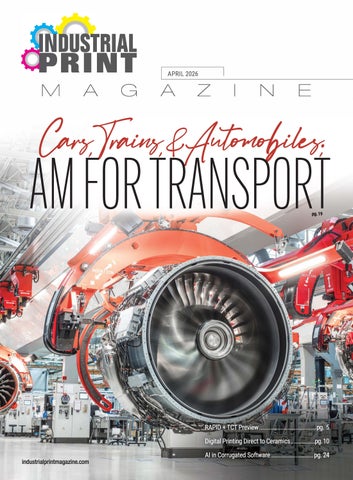
Additive manufacturing (AM) also plays a role in predictable manufacturing. Aerospace, trains, and automobiles-the transportation sectorturns to AM to create accurate parts and tools for various solutions. As technology evolves, so too does AM's use-from prototypes to end use components. Read more in Send Me on My Way.
We foresee a lot of chatter about predictability at the RAPID+ TCTtrade show in Boston, MA in April. The event is shaping up to be a hub for the latest and greatest in AM. Flip to page 5 to read a preview about what to expect at the show.

Cheers
Melissa Donovan, Editor
.RIAL 9PRINT
INDUSTRIALPRINTMAGAZINE.COM
Volume 13,Number2
EDITORINCHIEF ThomasTetreault 978-921-7850
EDITOR
Melissa Donovan mdonovan@rockportpubs.com
ASSOCIATE EDITOR
Cassandra Balentine cbalentine@rockportpubs.com
ARTDIRECTOR
Sarah M. White swhite@rockportpubs.com
WEBEDITOR
Melissa Mueller
CONTRIBUTORS
Pete Basiliere, Marco Boer, Kemal Carr, Maria Conrado, Mark Hanley, MelindaTetreault
ADVERTISING SALES
PUBLISHER
ThomasTetreault
300 NewburyportTurnpike, Ste.11 Rowley, Massachusetts01969 Ph978-921-7850x110 • Fx978-921-7870 edit@rockportpubs.com
SALES
Amanda Doyon Ph978-921-7850x170 • Fx978-921-7870 adoyon@rockportpubs.com
ROCKPORT CusToM PuBLISHING

CORPORATE&PUBLISHING OFFICE
300 NewburyportTurnpike, Ste.11 Rowley, Massachusetts01969
ROCKPORTCUSTOMPUBLISHING, LLC
CHAIRMAN
JeffreyJensen
PRESIDENT&CEO
ThomasTetreault
CONTROLLER MissyTyler

SHIPPINGUPTOBOSTON
RAPID
+TCTPreview
by IndustrialPrint Magazine Staff
RAPID + TCT takes place April 13 to 16, 2026 at the Thomas M. Menino Convention & Exhibition Center in Boston, MA This is the first time the show has occurred in Boston and is sure to be a successful chapter in an already influential series of events.
As one of the largest additive manufacturing (AM) and industrial three dimensional (3D) printing events in North America, there are more than 160 technical presentations planned held by industry-leading experts. This year's RAPID + TCT includes three dedicated expo showcases-the AeroDef Manufacturing Showcase, the StartUp Showcase, and the Healthcare Showcase. Hyperfocused on each topic, the choice to dive into these three in particular is indicative of where AM is succeeding at this time.
In addition, over 450 product and service providersinthe AMspace areset to exhibit inthemain hall. Here are some of their plans.
3D Systems, booth 1801, advances AM quality with the U.S. debut of the SLA 825 Dual, an industrial, large frame SLA solution built for high-speed, ultra-precise production of large format parts. Engineered for demanding, high-volume applications, itfeatures synchronoushigh-powerduallasers, one of the largest build volumes in its class, ultra-fast scanning, and a fully integrated workflow to support production from file to finished part. Also on display is the DMP Flex 350 Triple metal 3D printer. This three-laser system delivers reliable, repeatable production of high-quality metal parts across multiple alloys. Backed by 3D Systems' Application Innovation Group, it supports seamless development, validation, and technologytransfer-particularly for applications in highly regulated industries. INFO# 205


3DPrinterOS, part of 3D Control Systems, booth 2721, showcases its 3D printing management platform designed for enterprise, education, and manufacturing environments. Attendees can see demonstrations of the cloud-based solution that
enables organizations to manage entire fleets of 3D printers from any manufacturer through a single interface. Key features on display include Al-powered print failure detection, automated workflow management, user access controls, and real-time printer monitoring. The company demonstrates how organizations with more than 50 printers streamline operations, reduce costs, and scale their AM programs. INFO# 206 AltForm, booth 1120, (formerly known as Prima Additive by Sodick) makes its debut at RAPID + TCT 2026 in Boston,
1. Equispheres, booth 1201, welcomes engineers and partners to connect around applications in aluminum and copper AM, with products printed using 3D Systems'devices.

introducing U.S. audiences to its industrial solutions for advanced laser manufacturing and metal additive production. While no machines are displayed at the booth, visitors have the opportunity to meet AltForm’s experts and explore the company’s technological capabilities across key processes including powder bed fusion, direct energy deposition (DED), and high-speed laser cladding. AltForm develops production-ready systems designed for industrial environments, with platforms such as the Print 300 and Print 400 series, engineered for scalable manufacturing and automation. The company also provides custom automated solutions and advanced systems for demanding sectors such as aerospace and defense, including the ZENIT robotic cell with inert chamber for processing reactive materials. Although this marks AltForm’s first major exhibition in the U.S., the company already supports
2. Direct Dimensions, Inc., booth 2117, is a leading provider of advanced 3D scanning solutions for manufacturing, engineering, design, and digital fabrication.
3. EDM Network Inc., booth 1963, exhibits its newest Horizontal Fast Wire EDM Edmmax650HW. 4. AltForm, booth 1120, introduces U.S. audiences to its industrial solutions for advanced laser manufacturing and metal additive production.
North American customers through its partner Sodick, near Chicago, IL, ensuring local presence and technical support. INFO# 207
BigRep, both 2355, showcases its industrial large format AM systems like the BigRep ONE, with a one cubic meter build volume; the BigRep VIIO 250, an automated large format industrial system designed for demanding manufacturing workflows; and the BigRep DRYCON, a filament conditioning and annealing system, engineered to maintain material integrity and maximize material properties in parts. Whether evaluating large format AM for the first time or looking to scale an existing workflow, stop by the BigRep booth to learn more.
INFO# 208
BMF, booth 1347, demonstrates the new microArch S150 powered by projection micro stereolithography to deliver true 25µm optical resolution and layer thicknesses from ten to 50µm on a compact desktop platform. Designed for labs, development teams, and production environments alike, the S150 offers one-touch operation with no calibration required—press a button and print. Explore an array of micro parts showcasing what’s possible across microfluidics,
biomedical devices, fiber optics, electronics, and advanced research applications. Also on the display, the microArch D1025, a dual-resolution 3D printer capable of printing at both ten and 25µm resolutions. INFO# 209
Conflux Technology, booth 2407, showcases AM heat exchangers engineered for defense-grade performance across aerospace, land, and naval platforms. As power density increases and envelopes contract, thermal limits constrain propulsion, power electronics, mission systems, and environmental control systems. AM-enabled architectures are designed to unlock higher heat rejection, lower pressure drop, and reduced mass within the same or smaller integration space. On display are solutions for cold plates, charge-air cooling, avionics thermal control, fuel cell cooling, high-velocity gas cooling, oil cooling, multi-domain liquid cooling, and laser and photonics cooling. Each solution follows a defined pathway to qualification and serial production under AS9100 and ISO9001 frameworks. INFO# 210
Direct Dimensions, Inc., booth 2117, provides advanced 3D scanning solutions for manufacturing, engineering, design, and digital fabrication. For more than 30 years, the company has helped organizations capture real-world objects, spaces, and environments in accurate 3D digital formats for reverse engineering, quality inspection, design, and AM workflows. Direct Dimensions showcases its line of Artec 3D handheld scanners and software, demonstrating fast, accurate, and easy-to-use tools for capturing parts, tools, and products directly from the physical world. Visitors experience live demonstrations of portable scanning solutions capable of digitizing everything from small mechanical components to complex industrial assemblies and facilities. INFO# 211
EDM Network Inc., booth 1963, exhiits its newest Horizontal Fast Wire EDM Edmmax650HW. With a cutting capacity

of l,000x650xl,250 millimeters (mm) high,thisnewmodelcancutbuildplates up to 650x650 or 800x400 mm. Horizontal EDMs offer easy and fast loading from above with no holding fixtures required, easy wire alignment to the build plates, easy programming at the EDM control, and no need to catch the part as it cuts off-no fixture required. EDM Network offers everything in fast wire EDMswithovertenmodels,verticaland horizontal, plus pure water models, for 3D metalprinting.INFO#212
Equispheres, booth 1201, welcomes engineers and partners to connect around applications in aluminum and copper AM. The team showcases aluminum powders across multiple alloys-including newer offerings such as scalmalloy-alongside copper and copper-alloy powders. Conversations center on how Equispheres supports customer applications. Powder is on display as are printed parts produced with the powders for attendees to handle and discuss. INFO# 213
Lithoz, booth 1721, demonstrates use cases for serial production in ceramic 3D printing, highlighting its most impactfulreal worldapplications. These range from aerospace and semiconductors over "green" technology, to medical and dental. A highlight for visitors is the range of medical applications that

tooling capacity. Visitors at the AeroDef Manufacturing showcase experience how RapidWings overcomes tooling delays,associatedlaborcosts,supplychain constraints, and geopolitical challenges by enabling localized, on demand A&D end-to-end production. Leveraging Massivit's AM tooling technology combined with Sika materials, the RapidWings solution is proven to cut tooling time by up to 90 percent and save 40 to 70 percent on costs. RapidWings provides design, tooling, and final part production for UAV airframes, defense and aerospace structures, and interiors with a five day turnaround. INFO# 215
customizing AM workflows. In healthcare, Materialise also presents how personalization, automation, and additive technologies expand possibilities in spine surgery through the Mimics platform. INFO# 216
MELD Manufacturing Corporation, booth 2226, demonstrates its unique capabilities to 3D print metal without melting it using its patented additive friction stir deposition (AFSD) process. MELD displays parts printed for/ by AFSD users, highlighting MELD's unique capabilities in defense and aerospace production. Some parts presented include aircraft structural
Materialise, booth 1110, demon- parts, large cylinders, and case studies demonstrate advanced materials and strates how its technologies. These include innovative bone implants-cranial, zygomatic, and earossicles; durablesurgicaltoolsmade from advanced ceramics; personalized ATZ hearing aidearmolds; zirconiadental implants; lithium disilicate brackets and crowns; silicon nitride spinal cages; anda pediatricbloodpump fromanEUfunded project. INFO#214
Massivit, booth 2312, introduces RapidWings-a full-cycle manufacturing solution that accelerates composite production of air structures for defense and aerospace. Defense production today is not limited by demand; it is limited by
open and secure CO-AM platform helps organizations connect workflows, tools,andmachines while accelerating new product introduction. Visitors can see CO-AM Brix,aTCTAwards finalistpresentedin the U.S. for the first time, showcasing a low-code approach to automating and


5 of real-world applications. Additionally, the booth features the new DragonForge series, showcasing MELD's newest advancements in AA7075 printing and the upgraded hardware and software that come with the DragonForge series. INFO# 217
Meltio, booth 1833, presents, in collaboration with Force Automation, its containerized solution Meltio Robot Cell, where in a closed environment a robotic arm with Meltio's Blue Laser head manufactures and repairs parts of various geometries. Industries such as defense, naval, aerospace, oil and gas, and energy can move the Meltio Robot Cell solution anywhere, facilitating logistics and transport. It is a large mobile metal 3D printer with a robotic arm. In addition, Meltio presents its Meltio M600 industrial metal 3D printer, which prints live with materials such as aluminum, titanium, copper, and stainless steel for real industrial applications. Meltio presents the Meltio M600 together with its business partnerJupiter. INFO# 218
Mimaki USA, Inc., booth 2364, highlights the capabilities of its 3DUJ Series

how realistic color and detail can expand what's possible with AM. Mimaki offers a range of applications that showcase the technology's versatility. Examples include prototyping models with precise color matching, medical and anatomical models used for education and surgical planning, and research and educational tools that bring complex concepts to life. The booth display also features art, collectibles, and consumer product concepts that benefit from photorealistic color and fine detail. Together, these applications demonstrate how full-color 3D printing can bridge the gap between digital design and physical reality across industries. INFO# 219
NIDEC Machine Tool America, booth 2250, showcases its LAMDA metal DED systems. Having both additive and subtractive experience allows NIDEC to provide advanced technologies such as Local Shield for3Dprintingtitaniumand AI monitoring with real-time, in-process laser power control. The unique, compact design of the LAMDA nozzle delivers two different materials in separate or gradient applications. The use of AI pro-
the monitoring system controls the laser power to fully optimize the melt pool. NIDEC LAMDA DED systems manufacture titanium parts in an open atmosphere, without an inert chamber, of nearly any size-reaching up to a measurement of 5,000x2,500xl,600 mm. INFO# 220
Prodways, booth 2311, showcases its CERAM PRO 365 3D printer, coexhibits with its partner Tethon3D, and demonstrates high-precision ceramic AM for industrial applications. Visitors can discover how its technology produces complex ceramic parts with resolutions down to 3lµm, reduces lead times, and supports a range of technical materials, including alumina, silica, and advanced slurries. Experts are on hand to present MovingLight DLP technology, discuss digital workflows from prototyping to low-volume production, and explore real world solutions for aerospace, defense, and electronics industries. INFO# 221
Senvol, booth 2402, demonstrates in Senvol ML data-driven machine learning software for AM that is used to accelerate material and process development. The software is used to help optimize AM process parameters, qualify AM machines and materials, predict material properties, gain insights from in-situ monitoring data, leverage preexisting data, and minimize data generation costs. INFO# 222
Stratasys, booth 1601, showcases JS DAP, Origin Two, H350, and F770 hardware. In addition, it hosts presentations from customers and partners regarding end-to-end workflow-hardware, software, post processing. It also showcases a new medical grade silicone material and ToughONE in black-white ToughOne was launched last year. INFO# 223 full-color 3D printers. It demonstrates videsanomalydetection and 100 percent
5. Lithoz, booth 1721, demonstrates use cases for serial production in ceramic 3D printing, highlighting its most impactful real world medical applications.

monitoring of the melt pool throughout Visit Boston the entire build cycle for quality control. Make plans to attend RAPID+ TCT and The closed-loop feedback provided by visit these vendors while in Boston! 1PM

INNOVATIONS IN INKJET FOR CERAMICS
Printhead, Ink, & Glazing Advancements Improve Reach
by Cassandra Balentine
Industrial inkjet innovations drive the future of ceramics. New printheads improve precision, temperature resistance, and glaze compatibility on this type of surface, paving the way for more creative tile designs and decorative objects.
Shane O’Neill, director of business development, FUJIFILM Dimatix, Inc., states that the ceramic tile industry has transitioned from analog rotary printing to non-contact inkjet printing. “This shift enables producers to address the need for productivity, uptime, waste mitigation, and print designs on a wider variety of tile base materials.”

One of the biggest shifts Neil Cook, business development manager, Xaar, notices is the move towards aqueous glazes and more efficient, lean production processes. “As tile formats get larger, the production process changes and you lose some of the natural surface structure you’d traditionally get. That structure now needs to be recreated with glazes and special effects.”
Extensive Innovation
Within the ceramic tile industry over the last several years, O’Neill notes extensive technology innovation, both from a hardware/software perspective, as well as from the fluid and chemistry side of the market. “OEMs are developing intelligent printing machines with innovations to ensure the output from the printers are of a very high quality, optimizing productivity and increasing yields and throughput.”
The ability to jet at a high viscosity, large particle size, and highly loaded fluids—including glass frits—opens up a variety of decorative techniques.
“Printheads that can jet large particles and high-solid content fluids enable manufacturers to digitally apply those functional and decorative layers with much greater control. Compared with analog systems, which often put down too much material, inkjet allows you to deposit exactly
what you need, where you need it—reducing waste, drying time, and overall cost while still delivering the required surface structure,” notes Cook.
Innovations like Xaar’s Ultra High Viscosity and High Laydown technologies allow unique decorative effects such as relief textures, matte finishes, metallics, and luster. “Xaar’s Aquinox printhead spearheads this innovation with its true through-flow architecture, thanks to Xaar’s unique TF Technology, ensuring reliable jetting of challenging fluids including aqueous-based inks with up to 50 percent solids and particle sizes up to D90(v) ≤ 3 microns,” explains Michael Walsh, director of technical sales, Xaar.
FUJIFILM Dimatix focuses on improving performance, productivity, and durability of its printheads to withstand harsh operating conditions in industrial printing environments. “The repairability of FUJIFILM Dimatix STARFIRE printheads allow a technician to disassemble and repair the printhead without the need to replace the complete printbar unit,” shares O’Neill.
Michael Perrelli, sales director, Innovative Digital Systems, believes the biggest leap in capacities is printing around handled items through direct to object inkjet—a clear improvement over traditional dye-sublimation and pad printing.
Technology is evolving at a rapid pace.
—
Michael Perrelli, sales director, Innovative Digital Systems
1. FUJIFILM Dimatix’s main product line in the ceramic market is the FUJIFILM Dimatix STARFIRE C-Series for ceramic tile printing using oil/ solvent and aqueous inks.
High-gap technology now allows printing on irregular or contoured ceramics, including mugs with lips, rings, and concave areas. This solves the long-standing challenge of shape inconsistencies in formed clay products.
Another advancement is jettable primers, which improve adhesion and make prints dishwasher durable—all through a fully inkjet-driven process. Perrelli says these developments completely changed what’s possible in ceramic decoration.
Recent Developments
Reliability in ceramics has always been key to inkjet printing’s success, but printhead development has recently focused on precision jetting of high-viscosity, high-solid content fluids while maintaining compatibility with ceramic glazes. It also copes with the demanding nature of ceramic glazes.
Perrelli points to key printhead developments like high-gap printheads that jet ink farther while maintaining fine droplet control, giving higher print resolution without sacrificing speed; the introduction of full nozzle recirculation—a continuous flow of ink through the printhead— prevents clogging and ensures consistent performance; and support of multi-purpose inks, allowing ceramics to be printed with standard UV formulations rather than requiring specialized inks.
Xaar’s Aquinox printhead supports aqueous fluids, reducing complexity and environmental impact compared to some solvent-based systems. “The development of our printheads alongside Xaar’s technologies and waveforms is now allowing up to 350 g/m² glaze deposition in ceramics, ensuring durability and performance under demanding manufacturing conditions,” shares Walsh.
Cook says this glaze deposition rate “means manufacturers can jet the kind of glaze layers and textures they need for modern ceramic production, while maintaining process robustness and compatibility with challenging fluids.”
FUJIFILM Dimatix printheads celebrate over ten years at the forefront of ceramic tile production. “Our printhead products withstand challenging conditions within the tile production environment, which is typically dusty, hot, and involves the transportation of large clay slabs into printing, glazing, and subsequent high-temperature curing in a kiln,” explains O’Neill.
O’Neill says tile manufacturers demand reliable and dependable machines, which can run sustainably on a continuous basis. The FUJIFILM Dimatix STARFIRE C-Series printheads incorporate an array of technological innovations,


which it developed and optimized over the years in cooperation with partners.
FUJIFILM’s REDIJET ink recirculation technology includes down-to-the-nozzle recirculation ensuring its printheads are ready to jet under normal operating conditions. Recirculating high-particle inks through the fluid path ensures the ink is dispersed uniformly as well as keeping nozzle meniscus such that the printhead is in a ready-to-print state, which contributes to overall print system productivity and system uptime.
FUJIFILM’s VersaDrop open waveform architecture allows its OEMs to tune and optimize the jetting profile for each ink to help ensure consistent jetting.
“Mostly recently, we introduced the FUJIFILM Dimatix STARFIRE SG1024 C-Series specifically designed to handle aqueous-based ceramic fluids. These fluids present unique challenges for printheads compared with the more common solvent-based ceramic ink chemistries. ” says O’Neill.
Room for Growth
Even with innovation in direct printing to ceramics, there is room for growth.
“While current printheads have set new benchmarks, there is ongoing potential to enhance temperature resistance, fluid compatibility, and precision for even larger particle sizes and image quality and definition,” suggests Walsh.
Cook believes it is important to respond to new requirements as they appear. “In many respects we feel we’re ahead of where the market is today, but as applications evolve and new fluids are developed, there will always be opportunities to refine and extend printhead capability. So while the foundations are strong, innovation in this area certainly isn’t finished.”
O’Neill also sees room for advancement. “Over the past decade, FUJIFILM Dimatix has expanded the STARFIRE platform to include eight printhead variants to meet the need of our OEMs, and we continue to learn and improve on the solutions we can offer in the future.”
On the ink side, Cook says the main trend is the shift from oil-based systems towards aqueous, water-based formulations. “This supports leaner, more efficient production and aligns well with broader industry drivers.”
Xaar partners like Esmalglass-Itaca Group, Itaca Digital, and Torrecid are developing specialized aqueous inks with high pigment loads and large particles to complement Xaar’s printhead capabilities. “These formulations enable effects like digital relief, metallic finishes, and luster to create the latest tactile and highquality tile designs consumers ask for,” comments Walsh.
Ink producers have made significant strides in producing new and improved inks and glazes, which are very stable and uniform, with excellent jetting characteristics that are sustainable over long production cycles. “Their latest innovations focused on aqueous-based solutions for decorative inks, glazes, and adhesives are now starting to gain traction in the market,” adds O’Neill.
Perrelli says modern inks are more versatile and regulation ready, adhering to a wider range of substrates while meeting strict safety and environmental standards. “These formulations deliver consistent quality across an array of applications and align with market expectations for safer, more sustainable materials.”
Walsh expects future ink developments to focus on expanding color and effect ranges, improving stability for high solid inks, and optimizing drying and curing performance for faster more environmentally friendly production cycles.
We are at the beginning of a new generation of inkjet fluids for the ceramic industry. “As new growth comes into the sector, we’ll see new technologies, processes, 2. Innovative Digital Systems’ RevHDL, TwinRev 360, and RevPro 360 rotary printers are designed to meet the growing needs of ceramic decorators. These systems combine high-speed printing, contour capability, and robust adhesion. 3. The Xaar Aquinox printhead is designed for aqueous fluids, high solids, and large particles in ceramics.
and fluid types being explored. There is still plenty of room for innovation in ink formulations, and we’re excited to see how we can help the industry as those new fluids are developed and brought to market,” states Cook.
“Future innovation will likely focus more on ink chemistry and safety, as these factors now define the next frontier for printhead compatibility, performance, and further applications,” comments Perrelli.
Market demands, evolving regulations, and sustainability goals continue to push ink innovation. “The industry’s next step is balancing performance with eco-responsibility and compliance,” adds Perrelli.
Drying and curing advancements are also critical to growth. “Digital glaze applications reduce the need for traditional drying steps by enabling precise deposition and controlled thickness, which shortens kiln cycles and supports thinner tile production. Saving time, energy, and money,” states Walsh.
Further integration of energy-efficient drying systems and rapid curing technologies will enhance productivity and sustainability. “Moving away from traditional fossil fuel kilns may be realized with electric alternatives considered,” adds Walsh.
Perrelli says UV LED curing is the gold standard for drying. “Prints now come off the press fully cured and ready for packaging—no waiting or post processing required. This shift enables faster turnaround, lower energy use, and consistent results across ceramic surfaces.”
Incremental improvements will continue based on what the market demands, particularly in energy efficiency and curing control. “Future systems will likely use adaptive curing to optimize energy use based on material and print density,” predicts Perrelli.
There is always workflow to consider. “As an example, integration with our partner System Ceramics Spa machinery has streamlined workflows by eliminating physical plates with patterns, as well as enabling fast changeovers and perfect

alignment of color and relief effects using the same digital file,” offers Walsh.
Future workflow improvements will focus on greater automation, real-time quality monitoring, and data-driven optimization to maximize efficiency and reduce downtime, notes Walsh.
“Workflow innovation never stops—our focus is helping customers get more output from their machines, faster, smarter, and with more automated integration,” shares Perrelli.
Where Inkjet Shines
The adoption of inkjet for ceramics is strongest in tile manufacturing, particularly in Italy and Spain in Europe and China and Indonesia in Asia. “Here OEMs are integrating Xaar technology into their machine platforms with applications including digital glaze deposition, as well as special effects before and after color decoration printing,” shares Walsh.
Cook points out that Asia and South America are typically lower cost markets where manufacturers are looking for higher efficiency. “By switching to digital print, they can lower their production costs, increase flexibility, and offer more customized designs, which in turn helps them drive additional revenue and stand out in competitive, price-sensitive regions.”
O’Neill also feels that the ceramic tile production industry remains the primary focus for inkjet technology. “While there
are niche ceramic applications in areas such as three-dimensional printing and tableware, tile manufacturing is still the key sector. This industry experiences fluctuations due to its close ties to the construction industry, and wider socioeconomic factors that drive that sector. Within that broad segment, our OEM partners continue to innovate. For example, they are now delivering solutions for large slab printing and tactile glazes.”
Aside from tiles, there is also a place for inkjet ceramic printing in mugs and promotional gifting. “Technology is evolving at a rapid pace. Just a few years ago, digital rotary printing on mugs wasn’t even possible. That changed with machines like a UV rotary printer capable of printing on handled items. Now, businesses can produce full-wrap, high-quality graphics faster and with far less setup— making digital printing the preferred choice for decorators and manufacturers alike,” offers Perrelli.
Driving Innovation in Ceramics
For providers working with ceramics, productivity, performance, and durability are critical. Recent advancements—from printheads to inks and workflow—support expanded applications. Tile production is a key sector for digital capabilities in ceramics, but there is also movement in mugs and promotional items thanks to technological advancements. IPM
SMOOTH DETAIL
Resin-Based Printing Tactics
by Melissa Donovan
Resin printing, or photopolymer threedimensional (3D) printing, builds objects layer-by-layer from liquid photopolymer resin cured by UV light. Technologies in this segment include stereolithography (SLA), digital light processing (DLP), and masked SLA (MSLA) also known as liquid crystal display (LCD). The result is highly detailed, smooth parts ideal for miniatures, prototypes, and even final pieces.
While resin printing offers finer detail than other technologies, for example filament printing, the logistics are messier. Users are exposed to fumes, sticky resin, and solvents. To combat the risks, careful handling is encouraged through the use of personal protective equipment (PPE), ventilation, and post-processing techniques like washing and curing.
UV Power

process highly filled ceramic resins at a level meeting the highdensity demands for advanced ceramics,” explains Homa.
Resin or photopolymer 3D printing involves building objects using UV light. Common processes are SLA, DLP, and LCD/ MSLA. According to Johannes Homa, CEO/founder, Lithoz, there are two ways to build objects using UV light—either with pixels or a laser.
DLP and LCD are two pixel-based options, which “feature a bottom up approach with light exposure from underneath or a top down approach with exposure atop,” describes Homa.
Lithoz’s lithographybased ceramic manufacturing (LCM) process for ceramics uses the DLP principle in a bottom up approach. “When we developed LCM, it was the first time that DLP was adapted to successfully
Perfect density is a key requirement in LCM that has evolved over time, notes Homa. “In LCM, where the photopolymer acts as a binder within the liquified ceramic material, the printed parts need to undergo a second step, which is sintering. This thermal treatment makes all resin-based ceramic technologies two-step processes.”
Laser-based SLA technology is one of the first commercialized 3D printing technologies, points out Homa. “In the beginning it was primarily used for prototypes due to poor material properties. These materials have made significant progress and today this technology is used in plastics, metal, and ceramics for mass production.”
…resin-based 3D printing stands out for its ability to produce extremely fine features, smooth surface finishes, and highly complex geometries…
— Laura Galloway, director of marketing, BMF
Beyond SLA, DLP, LCD/MSLA, and LCM, Laura Galloway, director of marketing, Boston Micro Fabrication (BMF), says there are advanced 1. Part yielded from Liqcreate’s resin-based material.
photopolymer-based processes designed specifically for high-resolution and microscale fabrication. She provides the example of projection micro stereolithography (PµSL), which uses highly controlled optical systems to achieve micron-level accuracy and repeatability. BMF’s technology is based on this.
PµSL utilizes the benefits of both DLP and SLA. It involves printing in the top down direction of SLA. However rather than using a small spot laser, the entire image, or a section of the image is cured like in DLP.
Advancements in optics, light engines, and material science play a role in how photopolymer technology has evolved. “Feature sizes have shrunk dramatically while dimensional accuracy and surface quality have improved. At the same time, photopolymer materials expanded to include engineering-grade and application-specific resins, making the technology viable for functional testing, research, and low-volume production,” explains Galloway.
Resin Stand Out
Resin printing is distinctive due to its ability to create fine details, which leads to it being well suited for delicate, minute applications.
Overall, “resin-based 3D printing stands out for its ability to produce extremely fine features, smooth surface finishes, and highly complex geometries that are difficult or impossible to achieve with other additive methods such as extrusion or powder bed fusion,” says Galloway.
Narrowing it to specific processes like LCM, is useful, according to Homa, because it “produces intricate features, which make ceramic high-performance components lightweight yet enduring.”
Applications with requirements for high resolution and tight tolerances, complex internal channels or thin walls, and excellent surface quality without extensive post processing are

all candidates for resin-based technology, according to Galloway.
Accurate parts are achieved via resin printing like DLP and LCD, making it ideal for parts in dentistry, medicine, and jewelry, notes Jim Hoeben, R&D and business development, Liqcreate.
“From a micro-precision standpoint, resin printing is commonly used for medical devices, microfluidics, electronics, photonics, and advanced research applications. In these areas, dimensional accuracy and geometric fidelity are often more critical than build speed or part size,” continues Galloway.
With Lithoz’s technology, Homa says it is used in industries like aerospace, medical technology, and dentistry.
“For various industries such as aerospace or semiconductors, typical applications are nozzles, injectors, membrane filters, or thrusters, all of which benefit from those internal complexities and also have frequent contact to harsh environments or corrosive chemicals. Applied to medical technology or the dental industry, these qualities allow for the creation of multi-feature surgical tools increasing patient well being as the miniaturization of components results in realizing even more minimal invasive features,” shares Homa.
Beware of Danger
Challenges arise during the printing process that users should consider.
Compared to fused filament fabrication (FFF) and fused deposition modeling (FDM) printing where an already polymerized material is used—monomers are reacted in the manufacturing process to form a final polymer that the user just needs to reheat and shape—resin printing involves an unformed polymer, states Hoeben.
The resin, as an unformed polymer, is dangerous. “Photopolymer resins are chemically reactive materials designed to cure under UV light. In their uncured state, these resins can cause skin, eye, or respiratory irritation if handled improperly,” cautions Galloway.
“For ceramic resin-based printing technologies, materials in liquid state are classified ‘irritant,’” admits Homa.
The resin “is formed inside the resin 3D printer by the reaction with UV light. So the monomers are still in the process. Now with smart development the most safe monomers available can be selected, but they are still chemicals. After printing, washing, and post curing the parts are in the same state as your FFF/FDM filament and safe to handle without gloves,” suggests Hoeben.
Resin printing is actually less harmful compared to other 3D printing options,
2. With Lithoz’s LCM, the photopolymer acts as a binder within the liquified ceramic material and the printed parts need to undergo a second step, which is sintering.


notes Homa. "Compared to some ways of additively manufacturing metals, where there is the critical challenge of metal dust-requiring a whole range of safety measures such as respiratory protection and that under certain conditions is also subject to danger of explosions-photopolymer-based 3D printing is completely dust free and thus uncritical in health and security aspects."
Post processing of the resins also raises concerns. "The post-processing steps required to clean and cure printed parts introduce further exposure to solvents and UV radiation. Because of this, resin printing environments-particularly in professional or industrial settings-must follow established safety practices to protect operators and 3. BMF's technology is based on PµSL, which uses highlycontrolled opticalsystemsto achieve micronlevel accuracy and repeatability.

ensure consistent, repeatable results," notes Galloway.
Careful Handling
To combat issues with resin, careful handling and safety methods are required whether it be use of PPE, ventilation, or additional post-processing techniques that protect the user.
Hoeben points out that material selection is essential. "It all starts with material selection. There are a lot of resins out there, and the more affordable ones tend to use the most affordable raw materials, which in turn are less friendly to work with. Once you have chosen a material, always read the safety data sheet. All information on how to handle this material is available in that document."
PPE can be as simple as wearing nitrile gloves when handling the resin, safety glasses/goggles to protect eyes from splashes, and protective lab gear in environments that have a higher level of throughput, lists Galloway.
"In general it is always advised to wear safety goggles, use protective clothing and gloves-preferably nitrile or latex, and work in a well-ventilated area," suggests Hoeben.
Proper ventilation helps combat any bad outgassing fromresinprinting.
Using local exhaust ventilation or fume extraction when possible, and simply avoiding prolonged exposure in enclosed spaces are two handy tips from Galloway.
During post processing, Gallowaysuggeststhat printed parts be washedin controlled solvent systems, dedicatedUVcuring units are usedinstead of uncontrolled light sources, and proper disposal of resin wasteandcontaminated materialsisinaccordance with local regulations.
"PPE and ventilation are standard in professional labs and manufacturing environments where resin printing is commonly deployed," admits Galloway.
The type of print process also dictates safety practices. With DLP-based Lithoz LCM printers, for instance, PPE is encouraged but only for handling the ceramic slurry. Gloves are recommended for handling if a bigger job requires the exchange of slurry cartridges.
Other 3D printing systems also minimize handling. "For instance Formlabs has a washing and curing station that the platform of 3D printed parts is placed in-but it is a manual process. If you want to run without full intervention then automated 3D printing lines from manufacturers like Genera Printer GmbH, Intrepid Automation, or Rapid Shape GmbH are an option. With these systems the operators do not come in contact with any of the resins or washing agents," shares Hoeben.
Risk Vs. Reward
Resin-based printing systems like SLA, DLP, LCD/MSLA, LCM, and PµSL are regularly used in dentistry, medical, jewelry, and aerospace segments due to their ability to yield intricate, delicate pieces for the applications in question. Adopters of this technology should be aware of the issues resin can present. To counter any risk, the use of PPE, ventilation, and post-processing techniques like washing and curing are encouraged. 1PM

TRANSFORMINGOPERATIONS
Ablebox Increases Outputand EfficiencywithePS
by IndustrialPrint Magazine Staff
From order management to production planningandinventorycontroltoqualityassurance, the latest corrugated software can improve efficiency and productivity, enhance customer experience, and eliminate redundancy.
With three manufacturing facilities across the South of the U.K., Ablebox is a leading innovator in the U.K. corrugated packaging industry. The company has significantly enhanced its operational capabilities and sustainability through a strategic partnership with ePS Packaging, specifically by utilizing the Escada system. This collaboration has transformed the company's production metrics, achieving efficiency gains, waste reduction, and improved product quality.

Ablebox serves a range of industries including food and beverage, pharmaceuticals, and fast-moving consumer goods. The company is committed to pioneering sustainable and superior quality packaging solutions.
Solving Challenges
Ablebox's partnership with ePS Escada corrugated technology drives innovation in corrugated packaging manufacturing, as it continues its journey of technological transformation and utilizes artificial intelligence (AI) to enhance the corrugated board and box making process.
Prior to the integration of Escada, Ablebox faced challenges with optimizing its J.S. India Machine JET 300 double wall
corrugator, which was commissioned in late 2020.
The company was looking to enhance highvolume output, ensure consistent product quality, reduce production waste, and decrease operator dependency to streamline operations in a highly competitive market.

The solution was to implement Escada's corrugator quality and process control system. The decision was influenced by ePS' proactive support and collaborative approach in tailoring solutions to meet the packaging provider's specific needs.
"Escada's technologyis a game changer, introducing advanced automationcapabilities that refine production processes and dramaticallyimprove operational efficiency;' statesJack Lloyd, managing director, Ablebox.
The specific technologies implemented at Ablebox include Escada Profile, which is a closed-loop process control system with laser bar, and Escada Synchro 7, a single-point corrugated control system.
Thispartnershipequippedusto bettermeetcustomerdemandsand tackleindustrychallengesheadon.
-JackLloyd,managingdirector,Ablebox
Escada Profile redefines corrugator performance by delivering improved repeatability and consistency in reducing variation in the production process. The system decreases warp and delamination issues and
1.Ableboxenhanced itsoperationalcapabilitiesandsustainabilityby partneringwithePSPackaging.

ensures waste reduction of typically 0.5 percent, resulting in substantial cost savings and a more sustainable approach to production. Additionally, Profile optimizes starch consumption, leading to starch reductions ofup to 25 percent.
Escada Syncro maximizes efficiency and productivity by integrating corrugator dry and wet end operations. It covers every phase of corrugator application, from the roll stands through to the take-offconveyors. Syncro Dry End Control connects your production planning system with your dry end machinery, automatically aligning orders and performing efficient automatic order changes at maximum speeds. Syncro Wet End Control provides a complete range offunctions, some ofthe integrated modules include butt roll calculation and display, end-of-roll splicing, splice removal, automatic bridge contents
Synergy at Work
Implementing Escada technology at Ablebox resulted in impressive results that were proven within a matter of months of installation.
The company saw a 30 percent increase in output, optimizing production flow; a 30 precent reduction in production waste, bolstering environmental sustainability; and a 15 percent increase in conversion efficiencies and throughput thanks to the consistent production of flat, highquality board.
"These enhancements not only streamlined operational workflows but also significantly alleviated the physical and mental load on facility operators, creating a more productive and supportive work environment," adds Lloyd.
Ablebox views ePS Escada as an integral partner for ongoing technological control, bridge contents validation, and advancements. The focus is on further synchronized splicing. automating and refining processes and


using Al as a way to maintain leadership in the corrugated packaging sector. Continuous improvements are aimed at scalability and sustainability.
"The synergy between Ablebox and ePS Escada sets a high standard in the industry, showcasing the transformative potential ofintegrated technologyin manufacturing. The successful deployment of Escada systems within our operations exemplifies industry-leading innovation in process optimization and environmental responsibility;• adds Lloyd.
Transforming Operations
Ablebox's implementation of ePS Escada was pivotal to the transformation of its operational dynamics. The Escada system helps enhance its production capabilities and advance its environmental and sustainability goals.
"This partnership equipped us to better meet customer demands and tackle industry challenges head on. We eagerly anticipate continued collaboration with the Escada team as we explore further technological enhancements in corrugated packaging," concludes Lloyd. 1PM

Withjustafewclicks, order FREEinformationfromdozensofcompaniescoveredinthisissue.


Transportation Makes Moves with AM
by Melissa Donovan

he transportation industry is vast, comprising of rail, aerospace, maritime, and automotive. One common factor-additive manufacturing's (AM's) place in the production of the various parts and tools used.
According to Norbert Gall, head of marketing, Lithoz, "transportation as a collective term comprises many industries and subcontractors, which contribute to final means of transport. A passenger car consists of approximately 10,000 single components, from load bearing components

over smart electronics to interiors. Accordingly, each of these categories have specific challenges and cost structures, which make AM more or less attractive."
Three-dimensional (3D) printing allows for design freedom, minimized lead times, and the elimination of
Above: With a lateral resolutionof 40 µm and theabilityto print up to 150 layers per hour, the Lithoz CeraFab System S65 creates intricate parts, oftenusedforcoolingdevicesmadefromceramicswithexceptionalthermal properties,aboveallinhydrogen-poweredairandgroundvehicles.

storage. As these benefits become more noticeable and technology advances it makes sense that what was once predominantly prototype focused, transportation as an industry is now leveraging AM for end use parts.
Well Suited to Manufacturing
3D printing is ideal for manufacturing parts and tools ultimately used in automotive, rail, and aerospace. Designs not capable of being manufactured via more traditional technologies are possible.
According to Matthew Stark, 3D segment manager, Mimaki USA, Inc., transportation OEMs and suppliers benefit from 3D printing’s design freedom, rapid iteration, and low-volume production without the tooling costs associated with conventional manufacturing.
“3D printing is a natural fit for transportation because our customers must do more in less space, at lower weight, and with higher efficiency,” explains Dan Woodford, CEO, Conflux Technology.
1. For custom tooling or full-scale parts, an organization may choose the BigRep ONE or the BigRep VIIO 250. Barcelona, Spain-based BigRep customer NewsFender utilizes both the ONE as well as the VIIO for producing custom marine fenders, boat components, and research and development applications. 2. GEFERTEC’s experience from over 250 WAAM projects with many transportation applications among them— for example this yaw damper for a rail system—confirms the benefits of 3D printing.
Applications in this segment include weight optimized, safety relevant parts. AM yields “complex internal channels, lattice structures, and part consolidation, which help reduce weight and integrate multiple functions into a single component and supporting efficiency goals,” shares the Rapid Shape marketing team.
“Transportation components often require complex geometries, functional surfaces, lightweight structures, and tight process control. AM enables this by allowing engineers to design around function rather than tooling constraints,” says Daniele Grosso, marketing manager, AltForm, formerly Prima Additive by Sodick.
An example is rapid coating of brake discs where laser-based deposition is used to apply functional coatings that improve wear resistance and reduce emissions. AltForm industrialized this process, adapting additive principles to high-throughput production and designing fully automated lines capable of operating continuously in automotive environments.
The creation of complex geometries using 3D printing also eliminates the use of additional machinery like heat exchangers, piping, suspension systems, disk brakes, and turbine blades, asserts Tobias Dornai, senior AM engineer, NIDEC Machine Tool America.
Transportation systems rely on embedded sensors, antennas, wiring, and control
electronics to support autonomy, connectivity, health monitoring, and electrification. 3D printing is well suited for these applications. “These electronic features can be printed directly onto or within complex 3D surfaces, reducing part count, wiring complexity, weight, and assembly steps,” notes Brandon Dickerson, business development, nScrypt.
Supply chains and delivery lead times are also influenced, with on demand manufacturing shortening both. This is something attractive for fleets and long lifecycle vehicles, states the Rapid Shape marketing team.
“In aerospace, rail, and automotive sectors, 3D printing allows engineers to optimize parts for weight reduction, thermal performance, and mechanical strength while significantly shortening development timelines. It also supports faster innovation, qualification, and validation of new designs,” suggests Sébastien Jacoberger, marketing manager, Prodways Printers.
Sébastian Recke, senior key account manager, GEFERTEC GmbH, references wire arc AM (WAAM) as a particular 3D printing technology that “enables the production of large metal parts with high deposition rates, significantly reducing delivery times compared to casting or forging. Parts can be produced near-net-shape and often require minimal post-machining, saving time and enabling rapid availability of critical components.”
On demand production offers the ability to create spare parts without the cost of storage. There are number of reasons why a one-off part or small quantities of a single part might be needed.
“Transportation programs increasingly demand variant parts, customized interior components, specialty tooling, and limited-run spares. AM eliminates tooling costs and lead times,” explains Patrick Boyd, marketing director, EOS North America.
Kailey Harvey, sales and marketing operations coordinator, MELD Manufacturing Corporation, points out that many
transportation components are legacy parts, where the tooling no longer exists if replacements are needed. “3D printing allows for tooling to be repaired or replaced without the long lead times and remanufacturing costs. This eliminates warehousing and the personnel required to store and archive physical tooling.”
Increased maturation of AM systems means more niches for AM—above all spare part management. “The fast, geographically independent production of parts is already becoming reality in transportation. Considering an operational life of railcars or planes of multiple decades, passenger cars of 15 years, reproducing high-mix low-volume spare parts locally relieves logistic chains and cuts on cost pressure connected to warehouses and factories,” adds Gall.
In ceramic 3D printing, Lithoz has experienced two particular trends, both connected to efficiencies previously unattainable with legacy technologies—lightweight cooling or electrolysis components for hydrogen propulsions, and cooling elements for heat protection of compact electronic high-performance units.
Prototype to Final
While 3D printing is traditionally used for prototyping in aerospace, rail, and automotive applications, it is also utilized for final transportation components.
“Earlier limitations such as slow print times, limited material choices, and lower resolution made it difficult to produce detailed features like threads or very smooth surfaces. Components involving motion or structural loads were avoided due to concerns about reliability. Adoption was further slowed by a lack of consistent standards and uncertainty around the process. Over time, advances in materials and process control have resulted in more predictable and repeatable outcomes,” which has made it so AM is increasingly used for final part creation, details Dornai.
Established qualification pathways, certified materials, and production-grade

facilities support serial manufacturing, note Andrew Cunningham, senior application engineer – automotive and motorsports, and Ralf Frohwerk, global head of business development, Nikon SLM Solutions AG. “Rail and heavy vehicle manufacturers use AM for spare and replacement parts, particularly where castings or legacy tooling create long lead times.”
“Across all industries, around 67 percent of users still apply 3D printing primarily for prototyping, while roughly 21 percent use it for end use parts overall. Transportation stands out—in recent surveys, about 33 percent of transportation users already apply AM for end use parts, significantly above the cross-industry average,” shares the Rapid Shape marketing team.
A report from Protolabs published in 2024 relays similar information. The transportation industry uses AM for a higher share of end use parts than most other industries. Around one third of 3D printed parts in the transportation sector are considered end use. “This is due to both the reduction in cost of materials, advancement in printing technology, and addition of engineering grade materials,” states Stark.
Historically, Boyd says AM in transportation was 80 to 90 percent prototyping. Today, he says automotive is 25 to 35 percent end use parts, aerospace 60 to
70 percent, and rail 30 to 40 percent. He attributes growth to material maturity, repeatable high-volume printing platforms, and digital certification workflows.
Harvey believes that while 3D printing is still primarily used for prototyping and tooling, it is starting to change. “3D printing is increasingly applied to low-volume and performance-driven applications. This is notable in applications limited by supply chain constraints. As 3D printing matures, the emphasis is moving from feasibility to reliability and repeatability, which is what supports production use.”
“Currently, prototyping is the predominant use case for AM in transportation. But it is a limitation more existing in the minds of users than based on technological reality. The trend to localize spare part supply for high-mix low-volume portfolios is the gateway to fully scale AM into the transport industry. It is key for system providers to long-term proof the economically viable robustness and scalability to make OEMs adapt the systems for regular production,” remarks Gall.
Prototyping remains important, but there is a steady and concrete increase in the use of AM for final parts, suggests Grosso. This is true when traditional processes struggle with flexibility, lead time, or performance. The aforementioned brake disc coating application is a good example of the evolution—here

AM is used as a fully qualified, scalable production process integrated into automated manufacturing lines.
“Over the years, improvements in laser systems, process stability, material control, and digital monitoring have made this transition possible, allowing AM to enter production environments that demand consistency, uptime, and traceability,” adds Grosso.
According to Jacoberger, as printing accuracy, process stability, and material performance improve, AM becomes integral to the production chain rather than a standalone prototyping step. “In aerospace, for example, 3D printed ceramic molds are now used in the investment casting of turbine blades and other
high-temperature metal components. Compared to traditional methods, which can take one to two years to produce and qualify tooling, AM reduces lead times to just a few weeks.”
Woodford believes 3D printing has moved from mainly prototypes to a proven production route in high-performance programs, which is illustrated by Conflux’s recent collaboration with Pagani and Xtrac.
“We iterated multiple full-scale 3D printed cartridge heat exchanger prototypes, tested on road, track, and through thermal shock, to tune performance and durability. That same AM design is now the final, homologated transmission oil heat exchanger under a six year production commitment, with about a 30 percent
132AltForm, formerly Prima Additive by Sodickaltform.com
133BigRep bigrep.com
134 Conflux Technology confluxtechnology.com
135EOS eos.info
136 GEFERTEC gefertec.de
137 Lithoz lithoz.com
138MELD Manufacturing Corporation meldmanufacturing.com
139Mimaki USA, Inc. mimakiusa.com
gain in heat rejection in the same package, which is why more hypercar, motorsport, and advanced aerospace programs are keeping AM all the way into end use parts,” shares Woodford.
Recke credits increasing industrialization of WAAM—process monitoring, data integration, robust machine architecture, and validated wire materials—as lowering the barrier for serial production. This has transitioned AM from a prototyping tool to a production-ready process for large metal parts, especially in transportation-relevant sectors. Customers of GEFERTEC often approach the company to discuss production of real industrial applications—this includes rapid production of railway components such as yaw dampers.
Material Choice
Various materials are used in 3D printing for transportation—metal, polymers, composite materials, and ceramics. No matter which is run through the printer, they need to exhibit essential properties.
“Regardless of material, many transportation applications demand the same fundamentals—survive vibration and cyclic loading, hold properties at elevated temperatures over extended periods, and stay stable over long service lives,” explains Woodford.
Transportation has specific material specifications. “Mechanical strength/ fatigue resistance is critical for vibration-heavy environments. Thermal stability is important for under-hood components, aero ducting, and battery housings. Impact resistance is required for automotive interiors and rail components. Corrosion and chemical resistance to fluids, oils, and weather; dimensional stability and repeatability; and flame, smoke, and toxicity compliance is necessary,” lists Boyd.
140 NIDEC Machine Tool America nidec-machinetoolamerica.com
141Nikon SLM Solutions AG nikon-slm-solutions.com
142nScrypt nscrypt.com
143Prodways Printers prodways.com
144 Rapid Shape rapidshape3d.com See page 18 for more information.
3. A NASCAR brake pedal model displaying the internal weight-reducing structures of a metal 3D print created with a Mimaki printer. Part courtesy of Hass Racing and Autodesk. 4. nScrypt works closely with aerospace and automotive companies to support the development and production of next-generation electronic systems for transportation platforms.
No matter the material, certifications need to be addressed. “In the railway industry for example, certifications include UL 94 V0, which verifies if a material self extinguishes after exposure to flame; ASTM E662 measuring the amount of smoke released during burning; and ASTM D638, which confirms the material’s mechanical strength and structural stability,” says Jason Tzintzun, head of marketing, Americas, BigRep.
Metal is popular for applications that require load bearing parts, as they can rely on the metal’s strength, durability, and well-understood behavior, according to Harvey. Exterior components turn to metal because they are exposed to elements and subjected to external forces such as uneven roads or damaged railways.
“Metal remains the dominant material category for structural and safetycritical components. Materials must meet demanding requirements, including mechanical strength, fatigue resistance, thermal stability, and corrosion resistance often within strict regulatory environments. When properly processed, alloys demonstrate properties comparable to wrought equivalents and are increasingly covered by ASTM, ISO, SAE, aerospace, and motorsport standards. Continued material development is expanding the range of qualified applications,” say Cunningham and Frohwerk.
Some examples of metals used would be steel—high strength and durability is essential here to build brackets, housings, and large structural nodes for railways; copper aluminum and nickel aluminum alloys—required for corrosion resistance these are commonly used for propellers and other marine structures; and titanium—chosen for aircrafts due to its high strength-to-weight ratio and resistance to heat and corrosion, lists Recke.
Boyd says metals are most prevalent for transportation. Aluminum alloys are ideal for TVs, aerospace, and motorsport with their lightweight, strong, excellent thermal properties. Titanium alloys offer

high strength-to-weight ratios and are corrosion resistant. Nickel alloys offer hightemperature performance for aviation engines and thermal systems. Copper alloys are used for heat exchangers and e-motor components because of thermal efficiency.
Polymer and composite materials are used for interiors, tooling, and non-structural parts. “They must offer high mechanical strength and stiffness; impact and fatigue resistance; thermal stability; and resistance to chemicals, UV, and humidity, often with required flame retardant and low-smoke properties,” adds the Rapid Shape marketing team.
Stark believes polymers and polymer composites are popular because they provide a strong balance of performance, cost, and manufacturability. “Key required material attributes include mechanical strength and durability; thermal stability; chemical and UV resistance; flame, smoke, and toxicity compliance; as well as dimensional stability and surface finish.”
Polymers with functional inks—conductive, dielectric, and resistive—exhibit reliable electrical conductivity and signal integrity; strong adhesion; mechanical durability; thermal stability; and resistance to moisture, chemicals, and environmental exposure, according to Dickerson
Part of the polymer family, thermoplastics are used, including “polyamide/ nylon materials—PA6,66, PA12, or any
of the carbon fiber/glass fiber reinforced versions; polycarbonate for durability and heat resistance; polyetherimide for its flame retardancy; and polyphenylsulfone or polyetheretherketone for high performance, chemically resistant parts,” shares Tzintzun.
Ceramics are also utilized. Jacoberger considers silica-based materials critical for projects that demand extreme temperature resistance, tight tolerances, and high dimensional stability. “Silica ceramics offer excellent thermal resistance, chemical inertness, and mechanical strength, making them ideal for producing turbine blade molds, heat resistant tooling, and components exposed to severe thermal cycles.”
“Ceramics are gaining traction in extreme temperature applications such as combustion systems and hardware used in hypersonic environments,” adds Dornai.
Positive Possibilities
There are many options when it comes to using 3D printing for transportation parts, tooling, and end use components. Materials like metal, polymer, and ceramic present opportunities in terms of creating not only prototypes but finished products at scale.
Visit industrialprintmag.com for an article on printers serving this space from vendors interviewed in this piece. Also, listen to a webinar on the same topic. IPM


Expected Growth
The adoption of AI in workflow, specifically corrugated software, is expected to expand significantly as data quality improves and integration across systems becomesmoreseamless. "Intbe future, we'll see more predictive intelligence, whereAI not onlyidentifiesissuesbut recommends solutions," believes Anderson.
This includes more advanced demand sensing, automatic scheduling adjustments, smarter inventory management, and improved cost-to-serve analysis. '½s the industry continues to face margin pressure, labor challenges, and increasing customization demands, AI will play a critical role in helping operations stay competitiveand agile," predictsAnderson.
Sosnowski stresses that Al's role in the corrugated industry is poised for significant expansion. "Rather than a sudden revolution, we expect a steady, powerful evolution that will transform everyday workflows. Today, AI primarily supports teams with intelligent recommendations, but this is only the beginning. These capabilities will mature into semi-automated decision making and ultimately into fully automated, end-to-end processes that drive speed, accuracy, and operational excellence."
Innovation will move in many directions. "One of the most exciting areas is the deeper integration of real-time sensor data-not just to trigger alerts, but to automatically initiate corrective actions at tbe exact moment they're needed. As these technologiesadvance, AI won't sim-

ensuring the data feeding these systems is accurate. Poor AI can be worse than no AI," states the post.
MikeAgness, VP of business development, Americas, Hybrid Software, feels that AI should be in every department in every company in the future. "Think of it as your basketball team's 'sixth man.' It should be there with you to make your process more efficient. And, it should be trained to tie everything together, helping to make everything fast."
Benefits and Limitations
Several areas of digital corrugated print production already utilize AI.
Leading producers leverage AI-powered tools to enhance every stage of the printing workflow, including prepress and automated file preparation, adaptive color management, real-time quality control, and predic-

ply support operations; it will become a tive maintenance of proactive engine that anticipates issues, inkjet printheads. enhances performance, and elevates the overall efficiency of corrugated production environments,'' offers Sosnowski.
1. Advantive Abaca provides a comprehensive, fully integrated ERP solution designed to support the end-to-end needs of corrugated and packaging manufacturers. 2. Advantive's Kiwiplan offers a purpose-builtsuiteofsolutions designed specifically for thecomplexityandpaceof
In a blog post Q&,,A: Corrugated Best Practice &' the Role of Process Control, published by ePS Packaging, the company addresses the future of AI and automation in corrugated print environments. "In 20 years, AI-driven corrugators will likely be standard, but the key is corrugatedmanufacturing. aCON<S
2


Anderson finds AI commonly applied to file preparation, color management, and quality control. ''AI-driven tools optimize artwork for printability, detect potential defects before printing, and adjust color profiles dynamically to maintain consistency across short runs."
AI is also increasingly used to analyze print data to reduce setup time, minimize material waste, and improve registration accuracy, which is important in high-mix, low-volume digital print environments that are common in corrugated packaging, adds Anderson.
For example, Hybrid Software deals mostly with graphic assets. ''A component of graphic assets is also the structural data related to it. Some areas where AI is of great assistance is searching through all past jobs to see if


ARE HUMANS STILL NEEDED?
Just like any other software and technology, artificial intelligence (AI) doesn’t call in sick. It just does what it knows to do. And it’s going to give you an answer, suggests Mike Agness, VP of business development, Americas, Hybrid Software.
“But, humans are absolutely needed, because AI doesn’t have emotion. It doesn’t have the ability to think differently. AI gives you an answer in a minute.”
Agness likes to use the example of Waymo learning, self-driving cars. “They work very well—until traffic lights are out. Then they don’t know what to do. They can’t make an on-the-fly decision.”
Human intelligence also still needs to be applied to let AI know if an answer is correct. “Is it a correct answer, or do I need to return to the engine and say, ‘How about this?’ It’ll say, ‘Oh yeah, you’re right.’ And it’ll think differently. It’s all about the prompts, what needs to be done, and how things can go on,” adds Agness.
a graphic fits any of the dies you may already have. Also, do you have any similar graphics to assure consistency? AI can also help to predict press performance— for example, the scheduled time to run a job, and predicting press issues or maintenance. AI is phenomenal for scheduling those algorithms,” says Agness.
While Sosnowski points out that the level of AI adoption in digital corrugated printing varies by organization, one thing is clear, “AI is rapidly becoming a key enabler of print quality, consistency, and efficiency. Especially given the unique challenges of printing on corrugated substrates. Uneven surfaces, variable material quality, and the prevalence of brown Kraft liners all demand smarter, more adaptive technology.”
Other areas of AI Agness sees specifically for digital print is analyzing the files to fine tune the RIP to get the press running its fastest. “We have the ability to read and interpret a file as it’s coming in, conduct ‘on the fly’ settings, and learn
from the job to know what we need to do to rasterize the art most efficiently. Today’s technology and speed of hardware has become tremendous, but you still get those reasonably designed files with 58 million points that need to be optimized for output.”
Through these innovations, AI transforms digital corrugated printing from a traditionally challenging process into a more predictable, efficient, and highquality production environment across many areas including prepress, color management, and maintenance.
Many parts of the corrugated print production process are candidates for AI. “I think AI will be used throughout all facets of many different projects as we continue to teach it new tasks. AI will continue to learn, but you have to instruct it throughout the entire process. It will be important for people to be involved because we still don’t get good files coming in from customers and designers. This is even true for digital print, which is typically less
See page 18 for more information.
Solutions hiflowsolutions.com
128Hybrid Software hybridsoftware.com
intricate than traditional print processes,” shares Agness.
Of course, while AI is a powerful tool, not every part of the workflow is a good candidate for this type of automation.
“Strategic decision making, critical thinking, customer relationship management, and creative design still rely heavily on human judgment, experience, and collaboration. Additionally, tasks that involve nuanced trade-offs, ethical considerations, or deep customer context are best handled by people,” comments Anderson.
Anderson feels that AI works best as an enabler, augmenting human expertise rather than replacing it. “It is meant to be a thought partner, not a thought leader. This is especially true in an industry where operational knowledge and customer trust are critical.”
Sosnowski agrees, noting that AI is excellent at supporting corrugated packaging printing workflows, but it should not replace human responsibility, creativity, craftsmanship, and relationship-based decision making.
Areas like final responsibility and signoff decisions; final artwork approval; print run approval before going on press; physical machine intuition and craftsmanship; fine manual adjustments based on sound, smell, touch; emergency fixes during print runs; supplier and customer relationship management; and handling complaints and price negotiations, are not tasks ideal for AI, lists Sosnowski.
Expanding Reach
AI continues to expand its reach in automated print workflows. Corrugated is no exception.
Corrugated-focused workflow systems deliver value across multiple areas including production planning and scheduling, material optimization, business and operational automation, and analytics, providing insights that help improve quality, throughput, and profitability.
However, AI cannot replace human decision making in many instances. IPM