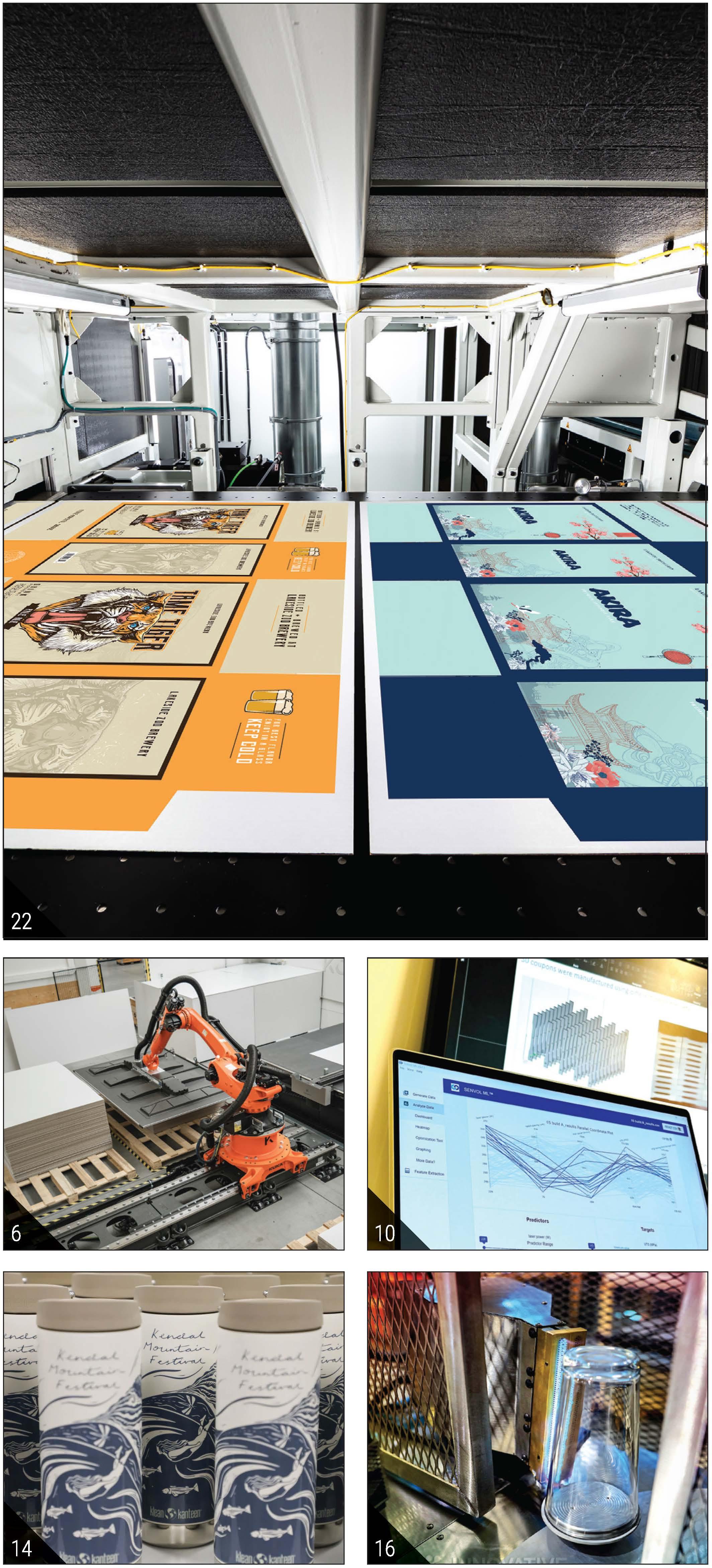
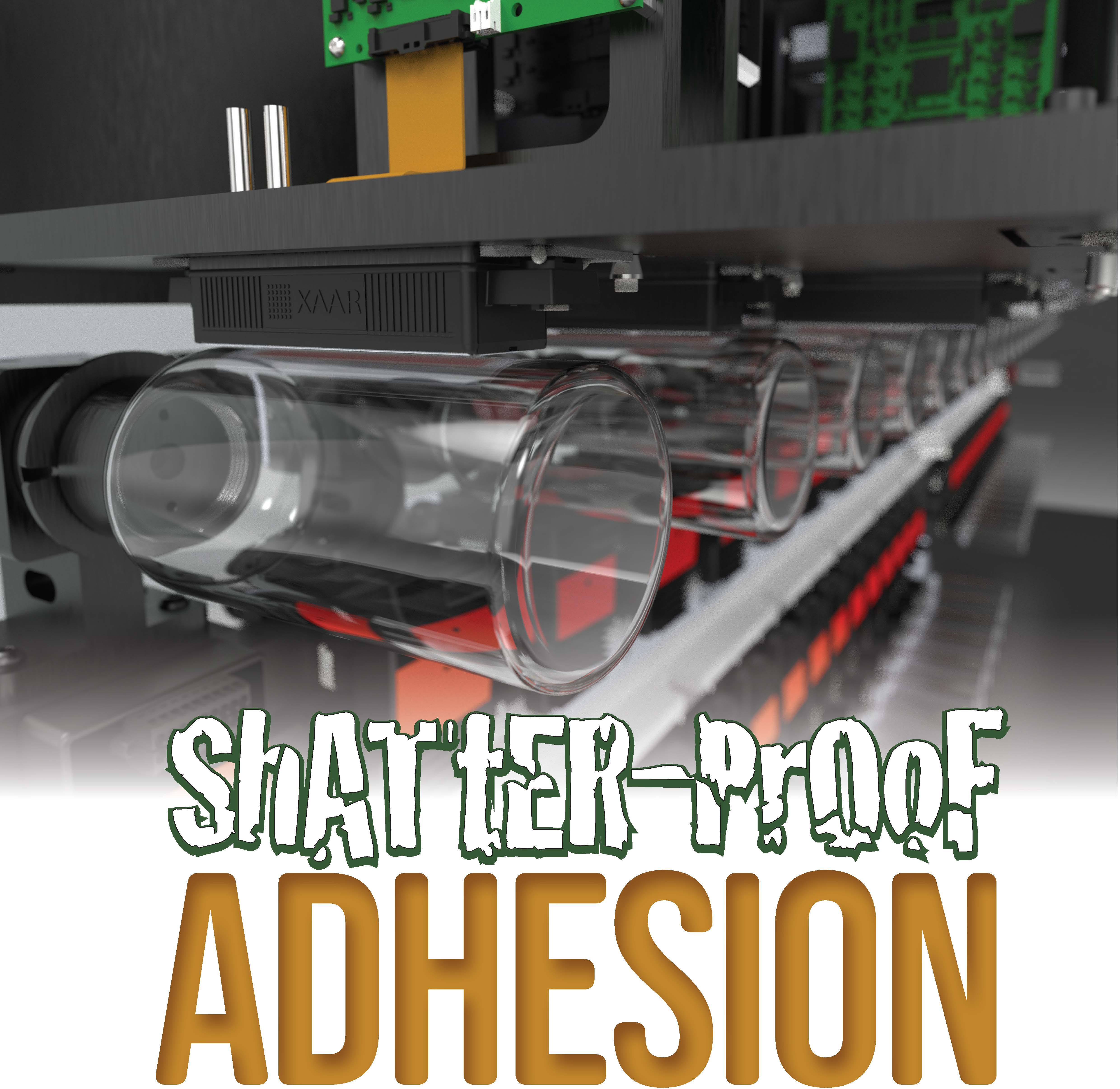
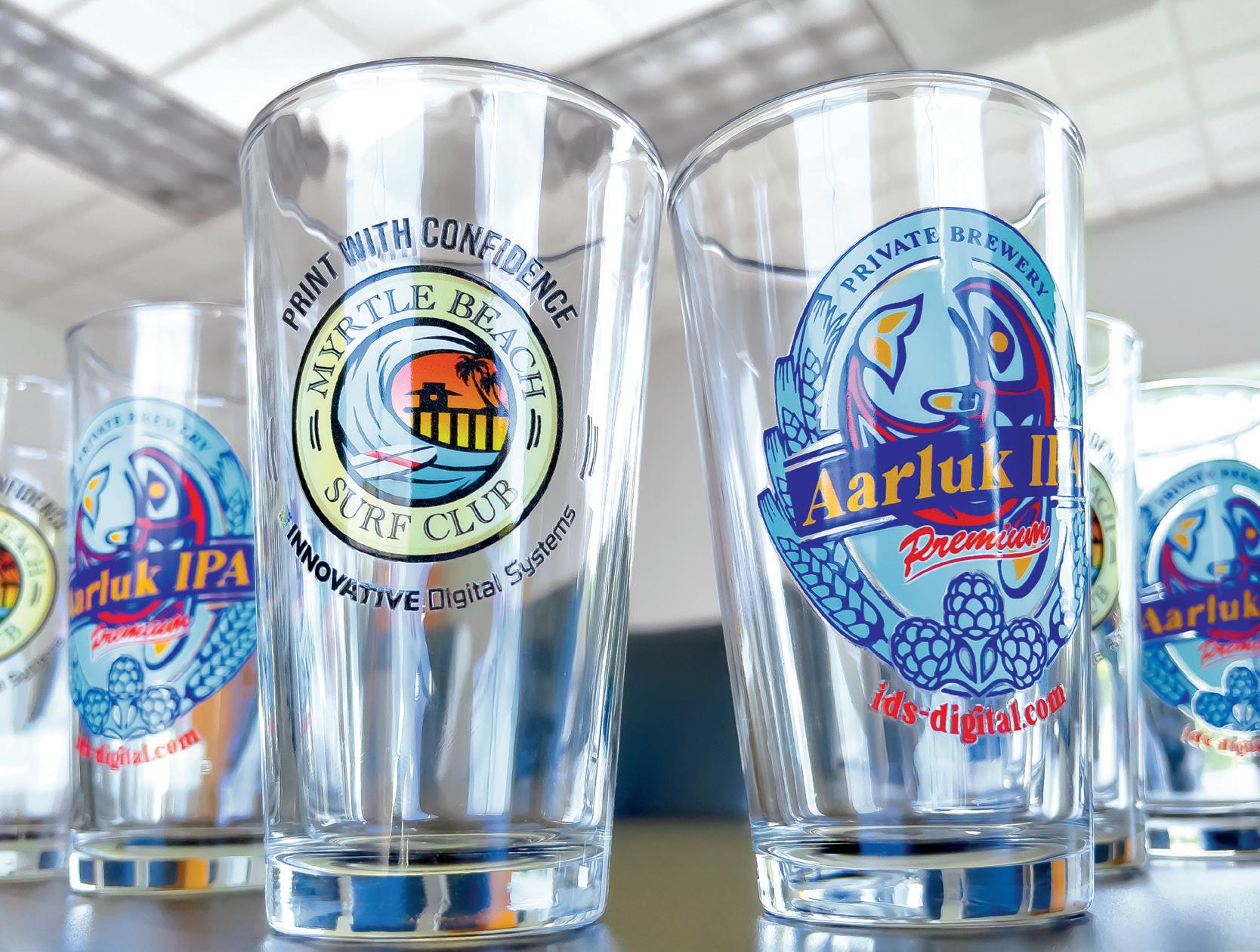
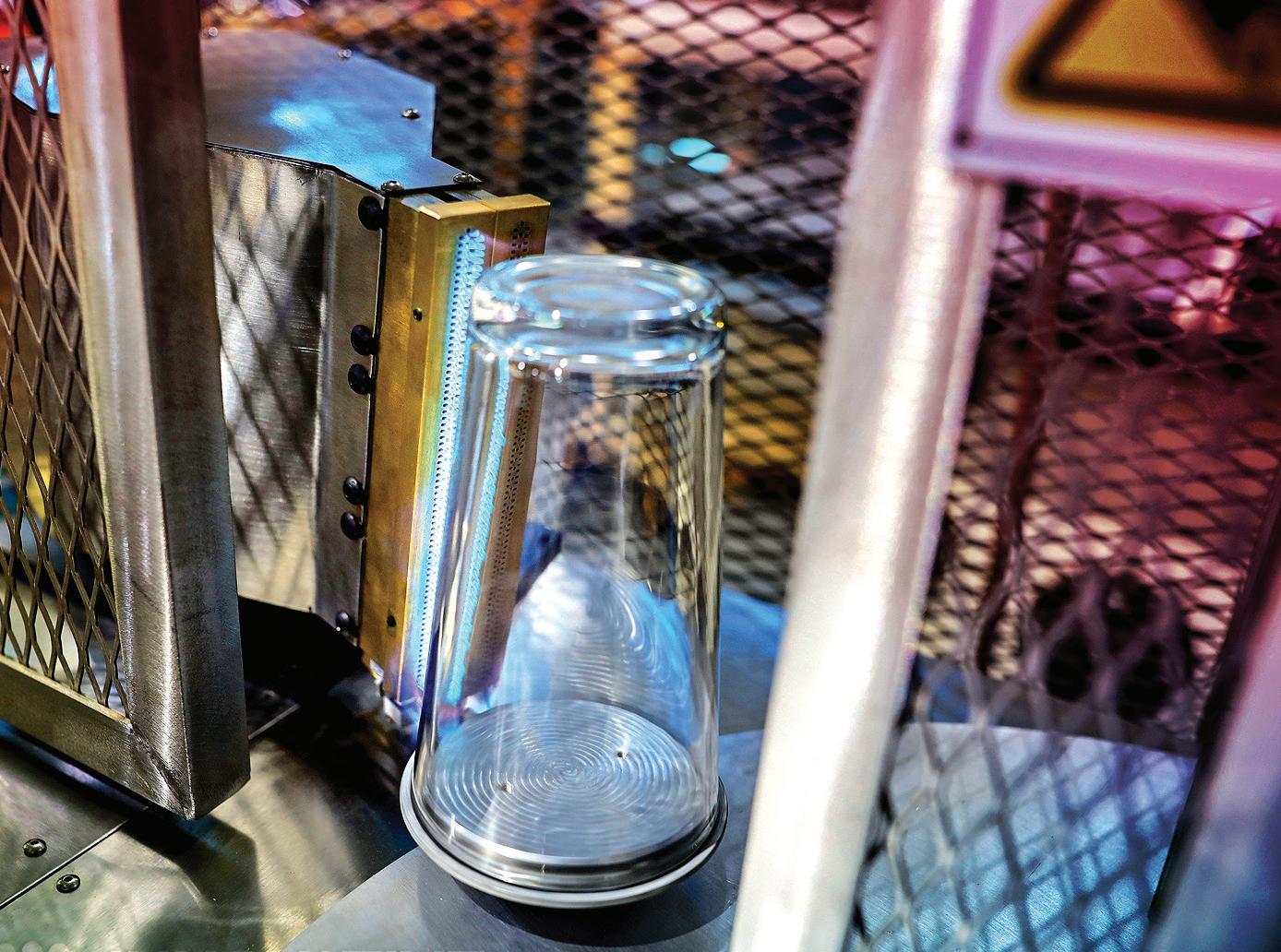
Starting off any print process on the right foot is essential to the overall success of the final output, whether it be a corrugated box, glassware, or three-dimensional (3D) print. Proper preparation of the surface in the instance of glassware is critical. Our cover story, Shatter-ProofAdhesion, looks at the various methods of pretreatment for glass and furthermore discusses the importance of pretreatment for this particular surface prior to directly printing to it.
Another aspect of prep is identifying the right printer for thejob. Take for example corrugated package printing. Are you considering integrating digital technologies into a high-production run? Then a single-pass system is your best choice. Prototyping or shorter runs, look to multi-pass flatbeds. Read more in ExpandingProduction withDigital.
This issue also dives into automated material handing for corrugated board, security software for 3D printing systems, a spotlight on a tradefocused promotional print provider, and a chart listing automated finishing hardware for corrugated boards.
Cheers, Melissa Donovan, Editor
.RIAL 9PRINT
INDUSTRIALPRINTMAGAZINE.COM
Volume 13,Number3
EDITORINCHIEF
ThomasTetreault
978-921-7850
EDITOR
Melissa Donovan mdonovan@rockportpubs.com
ASSOCIATE
EDITOR
Cassandra Balentine cbalentine@rockportpubs.com
ARTDIRECTOR
Sarah M.White swhite@rockportpubs.com
WEBEDITOR
Melissa Mueller
CONTRIBUTORS
Pete Basiliere, Marco Boer, Kemal Carr, MariaConrado, MelindaTetreault
End-of-line automation eliminates the extra person manually cutting or moving material at the conclusion of a print job. Corrugated board is prime for automation. Its unwieldy, unpredictable construction leaves room for error. End-of-line automation eliminates material challenges and allows for complex jobs being handled with ease.
Useful Options
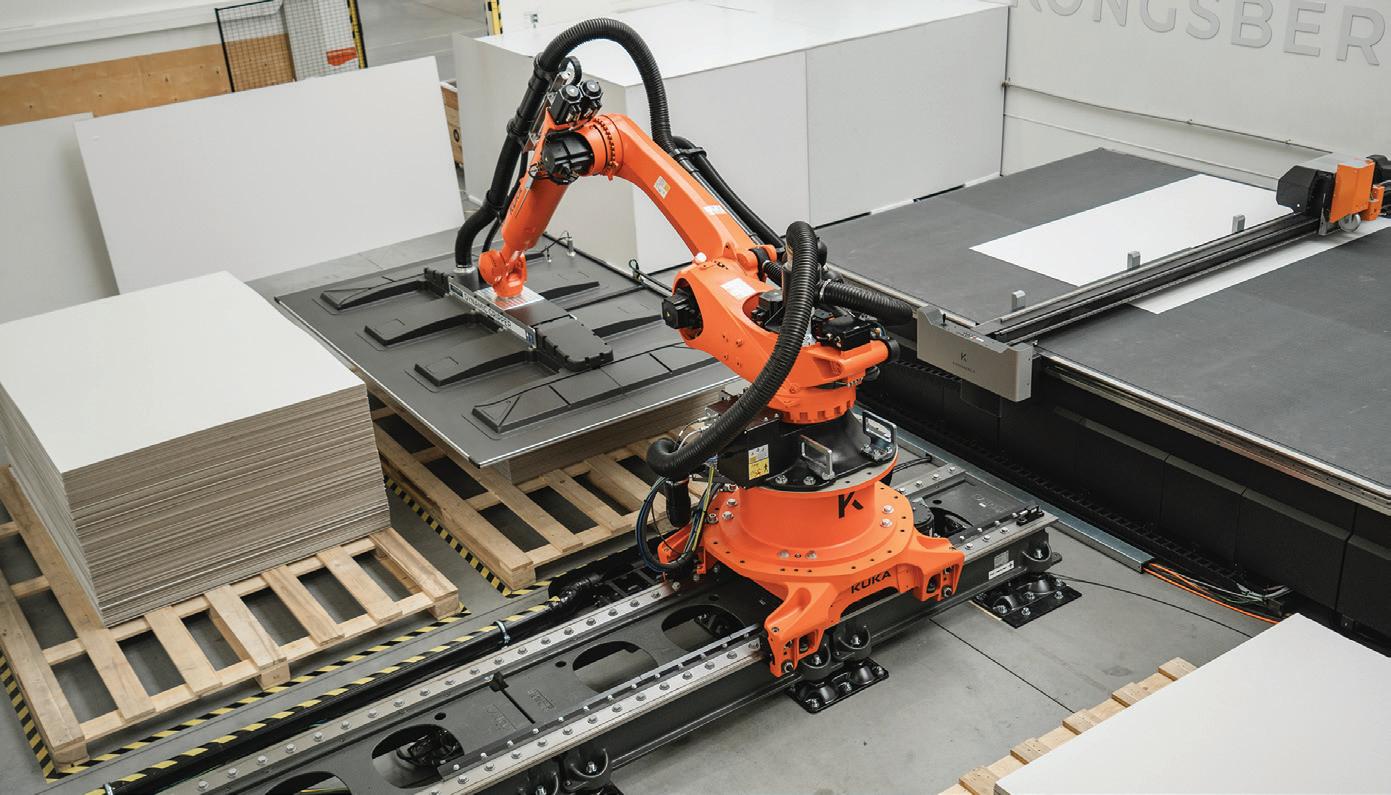
Automation frees up press operators for other tasks. In a corrugated printing environment, end-of-line automation options include mechanisms like material feeders and stackers, robotic arms, conveyors, and intuitive software.
“Feeders and stackers reduce labor dependency, enhance workplace safety, and eliminate inconsistencies caused by fatigue, human error, or skill differences,” explains Steven Lueders, co-owner, Infinite Motion Control (IMC).
Using automation, stronger return on investment is achieved through higher output and reduced waste, states Lueders. Take for example IMC’s Vector Feeder. Adding it to a digital printing line increases production throughput up to 60 percent while maximizing equipment uptime, according to the company.
“Pre-feeders, stackers, conveyors, bundle forming, palletizing, and inline inspection keep production continuous, efficient, and consistent,” lists Rob Casella, technical director, SUN Automation Group.
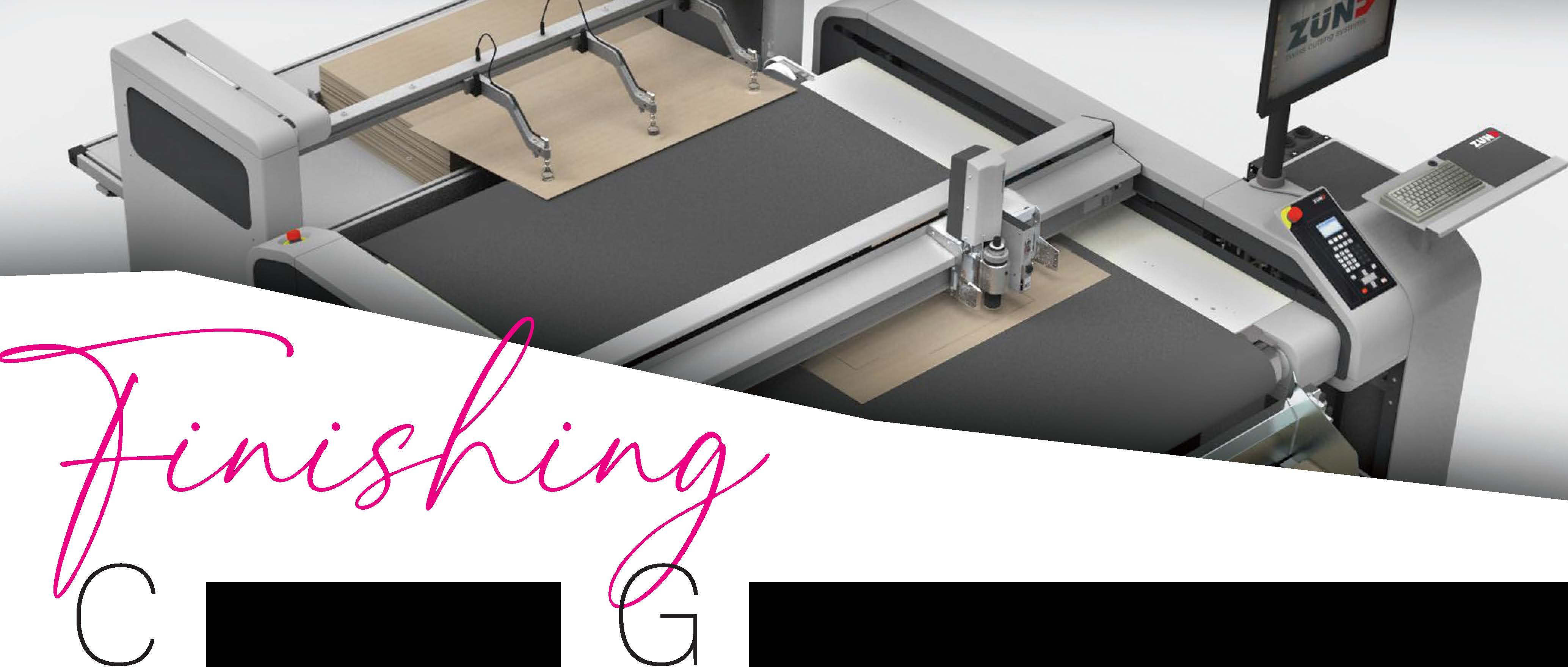
Cutter extensions as well as robotic picking and sorting devices can keep material consistently moving and free up operators from repetitive handling tasks, shares Martin Thornton, packaging business development manager, Zund America,
Inc. “This lets teams redeploy labor to areas where operators add the most value, while also improving process reliability, throughput, and overall equipment efficiency.”
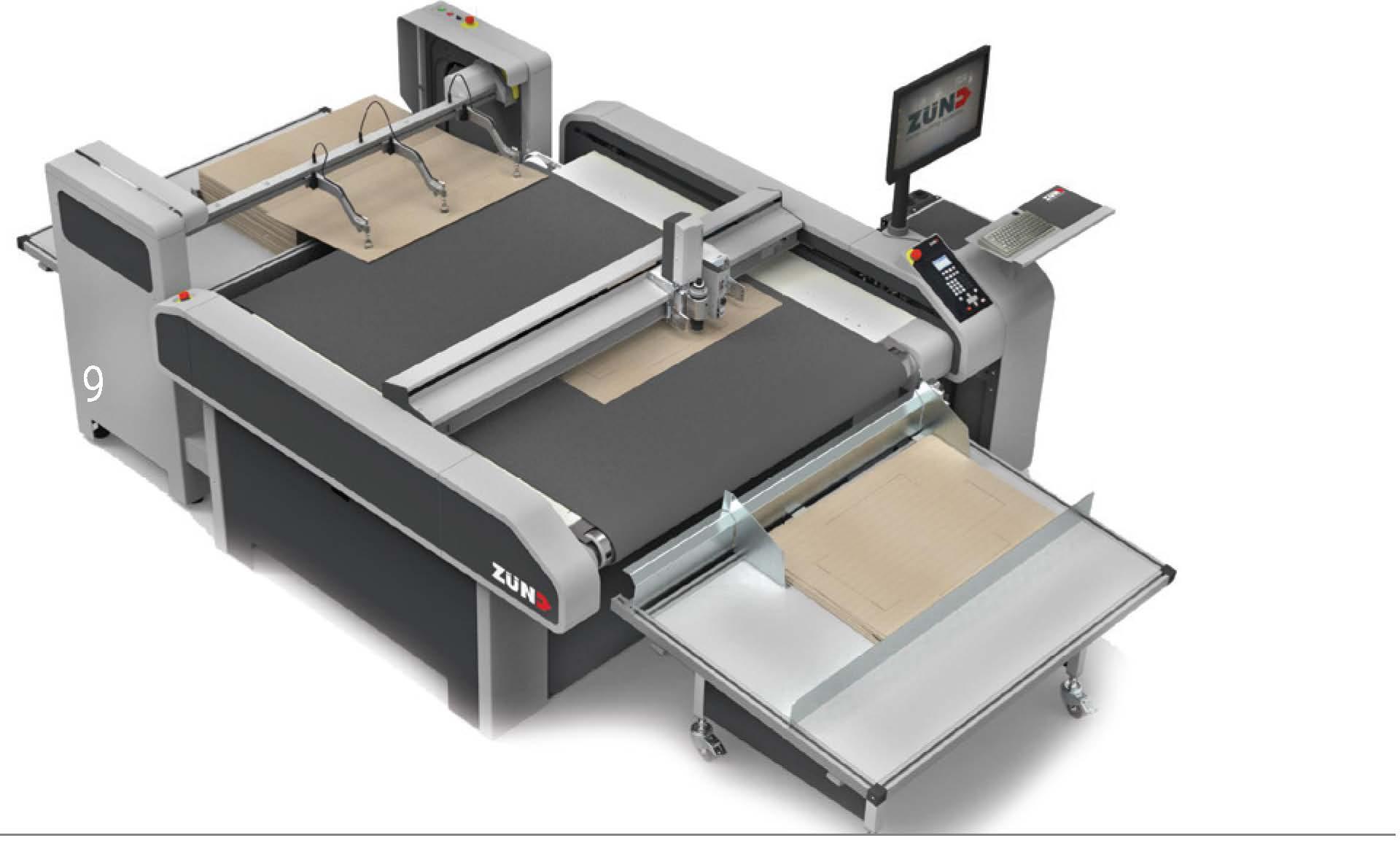
Collaborative robot (co-bot) solutions designed for Zünd by Robotfactory include the Robot PortaTable 130, which automates the removal of cut materials. This co-bot works side by side with the operator and takes on loading/unloading tasks—including picking and sorting—as needed. The Robot PortaTable 130 is extremely flexible. Thanks to its mobility, it can quickly and easily be repositioned around the machine or moved from one Zünd cutter to another.
Automation reduces the risk of damage that often occurs during manual handling, while also ensuring a consistent throughput.
— Nimil David, product manager, robotics and automation, Kongsberg PCS
According to Nimil David, product manager, robotics and automation, Kongsberg Precision Cutting Systems (PCS), automation is closing the gap when it comes to lost revenue. “True productivity is defined by how continuously the knife or blade of the digital cutting table is in the material. In other words, how long production is actually ‘live.’ If the machine sits idle while an operator loads or unloads a sheet, that’s lost revenue.”
Automation tools eliminate human error and ensure precision with every cut, explains David. Kongsberg PCS offers end-of-line automation for cutting tables with its Feeder & Stacker and Robotic Material Handler. Also helpful, a vision system with top and under side cameras that simplifies operations for print side down applications and scans registration marks or barcodes to automatically pull up correct digital files.
Specialty Media
For corrugated board in particular, endof-line automation is important. It keeps production moving and avoids errors that can occur when manually handling the material.
Since the material “is large, unwieldy, and often processed in higher volumes” it makes “manual handling inefficient, inconsistent, and physically demanding,” notes Thornton.
“Automation reduces the risk of damage that often occurs during manual handling, while also ensuring a consistent throughput. By automating the end of the line, shops remove the physical strain on their workers while ensuring every crease and fold is perfectly aligned,” explains David.
Automation plays a crucial role in the corrugated industry, says Lueders. It does so “by converting production from a fluctuating, operator-dependent process into a predictable and repeatable process from job to job and shift to shift. This creates more reliable delivery schedules and boosts confidence in meeting deadlines, ultimately improving overall operational consistency and performance.”
“Corrugated production is high volume, heavy, and fast paced. Automation keeps lines moving smoothly, prevents bottlenecks, ensures consistent stacking, and reduces intensity,” adds Casella.
Solution Sets
Corrugated board benefits directly from automated solutions like feeders, conveyor belts, and cameras found on finishing hardware.
A feeder is vital, insists Lueders. “It reliably de-stacks warped sheets from distorted pallets and presents them flat to printers or cutters by holding the front edge until the machine takes control. This is especially important because almost all types of corrugated cardboard—single wall, double wall, or recycled—are affected by temperature and humidity, which can cause warping. Even corrugated plastic can weaken in moist conditions.”
Pre-feeders, stackers, conveyors, strapping, inspection, and palletizing are all key automated solutions for corrugated, lists Casella. “Together, they enable continuous flow, consistent output, and reduced labor, improving efficiency and reliability.”
“Automated feeding and stacking are essential because they remove the biggest bottlenecks—loading large, unwieldy sheets and efficiently managing finished stacks. These solutions ensure consistent, uninterrupted production and allow operators to focus on quality and process management rather than material handling,” says Thornton.
Things to look for in a solution designed for corrugated board, suggests
David, are features that reduce damage while handling the sheets, are able to deal with warps, and support preventing any interruptions in the operation.
According to David, in a corrugated workflow, the goal is to treat the cutting table like a high-speed production factory. “By combining sheet feeders and cameras, you remove the biggest obstacles brought by manual operations— physical exhaustion, alignment errors, and set up delays, which in turn ensures consistent productivity.”
Easy Peasy
Not all solutions are created equal. It’s important to work with reputable vendors when considering implementing an automation solution. The majority of the time these vendors have the staff, training, and tools available to minimize any downtime during installation as well eliminate most of the learning curve.
“The ease of implementing end-ofline automation depends on the equipment being automated, the automation options available for that equipment, and which part of the production workflow the customer wants to streamline,” suggests Thornton.
David suggests businesses considering an investment in finishing automation “ensure their tables integrate with
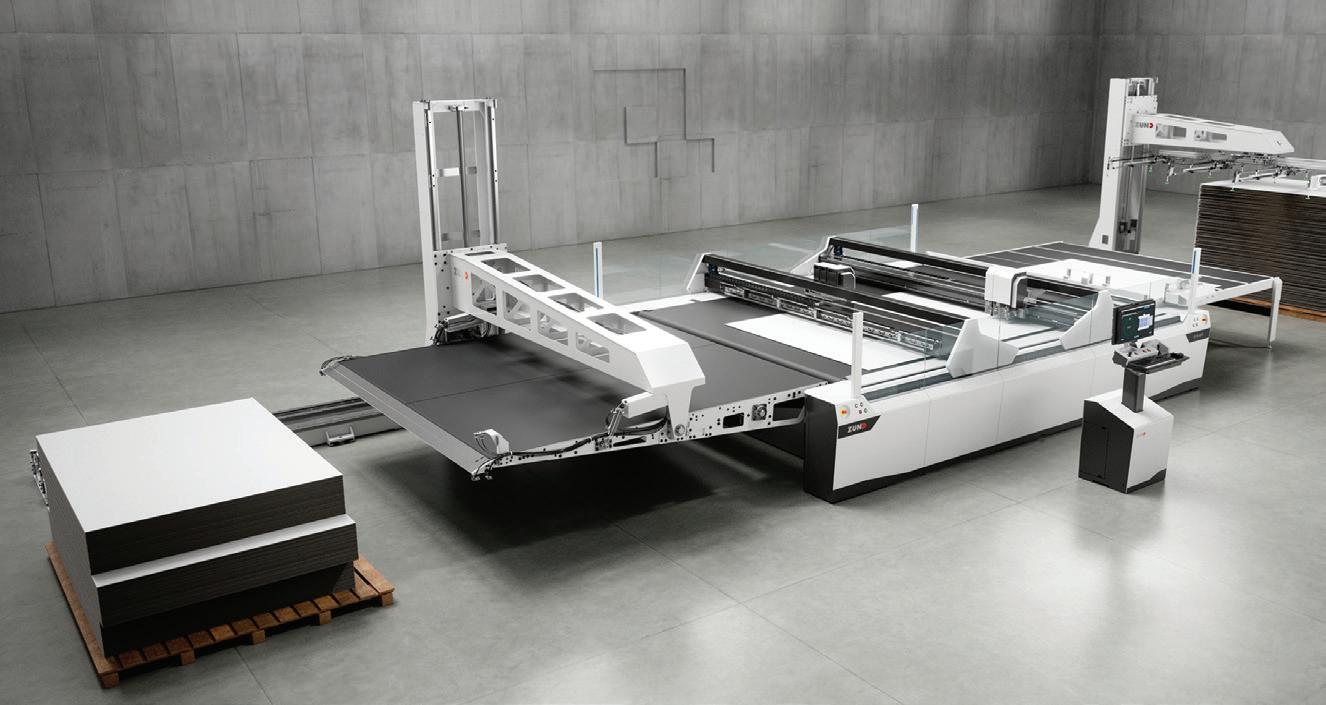
1. Advanced feeding/stacking with the Zünd BHS180 Board Handling System. 2. Kongsberg PCS offers end-of-line automation with its Feeder & Stacker and Robotic Material Handler.
Launched in May 2026 at FESPA Barcelona, the new F Series Vantage marks the next evolution in flatbed cutting from Summa. The F Series Vantage is made to accelerate every stage of the workflow, combining enhanced cutting speeds with intelligent automation to deliver the ultimate operator-friendly experience. Its open, modular architecture ensures seamless integration into existing production environments, offering maximum flexibility and compatibility.
Promising 40 percent productivity gains, the F Series Vantage transforms the finishing workflow thanks to automation that anticipates errors before they happen, an open eco-system, and a wide tool library, which features a new high-frequency 3.7kW router, Fast+ and Core+ tangential modules, and rigid material and high precision cutout tools.
Speed improvements run deeper than tooling alone. New motion control, unique blade recognition, and a new media thickness sensor accelerate every stage—from setup to execution. The result is cleaner edges, fewer tool swaps, and a workflow that feels effortless.
The F Series’ safety eco-system is designed to be nonnegotiable and impossible to bypass, protecting operators while also minimizing downtime and ensuring production keeps running at peak performance.
True to Summa’s philosophy, the F Series Vantage integrates seamlessly into any production environment. No lock-ins. No closed systems. Just freedom to build and evolve your workflow on your terms.
current systems and printer speeds to cause the least disruption to operations.”
For example, Kongsberg PCS automation solutions are modular, which allows for ease in adding a loading or loading/ unloading solution to an existing Kongsberg PCS cutting table. Installation and training is completed in a few days because the products are intuitive in nature.
Due to the modularity of Zünd systems, workflow automation—both in terms of software and hardware—can be added after the fact, even years after the initial installation. “This allows for gradual scaling without having to purchase more than immediate needs
dictate, which helps reduce the initial investment in finishing equipment,” adds Thornton.
“Most automation is modular and easy to integrate, with operators typically up to speed in days. Brief downtime may occur during installation, but long-term uptime improves thanks to fewer jams and automated handling,” admits Casella.
IMC’s automation offers a scalable foundation for modular growth, allowing for gradual expansion, one device at a time if desired. The printer or cutter can be upgraded with initial feeding, followed by a stacker, and a flipper for two-sided printing or print-side-down cutting.
page
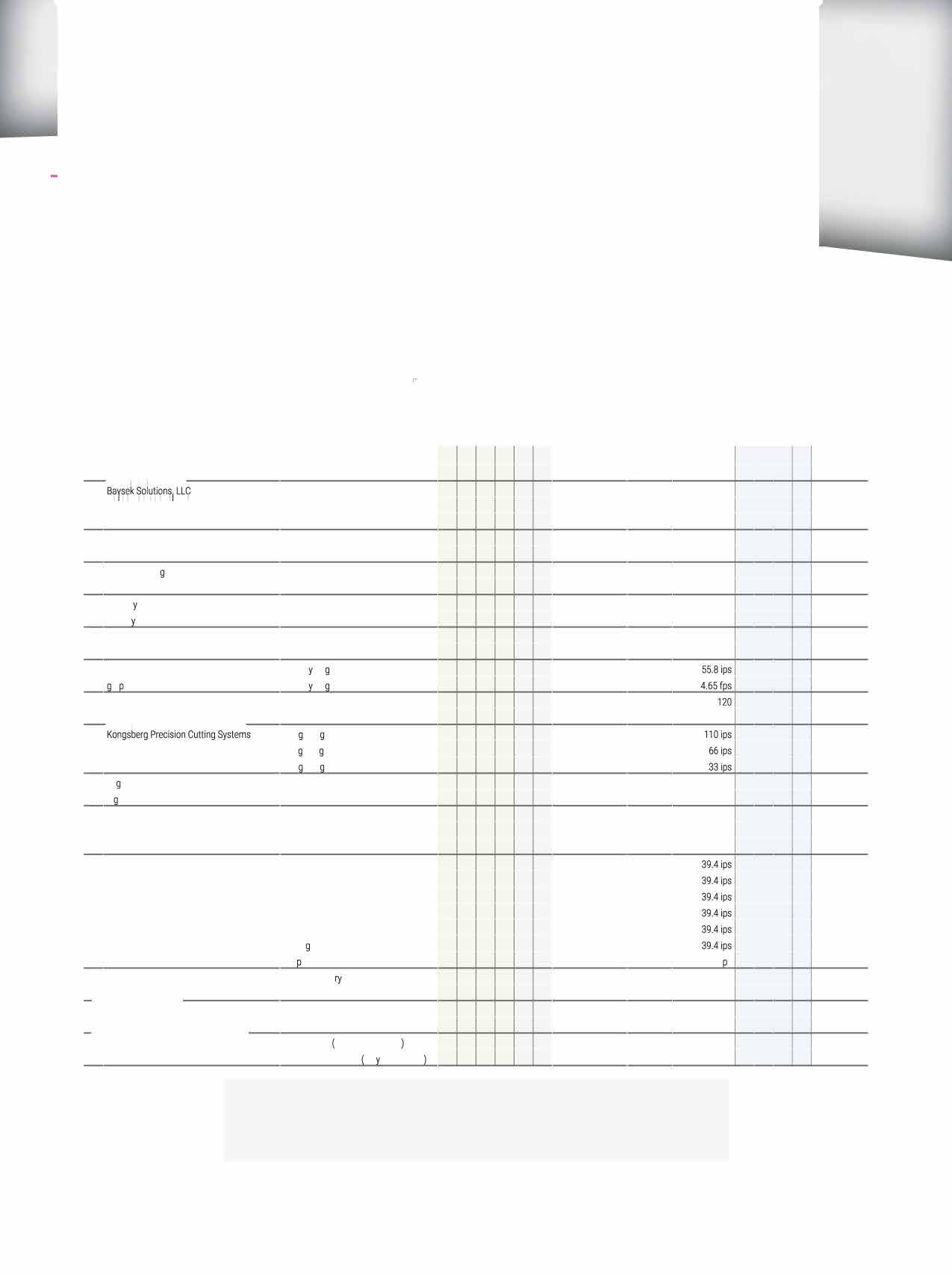
110 Infinite Motion Control Inc. infinitemc.com
summa.com 113SUN Automation Group sunautomation.com 114Zund America, Inc. zund.com
An Ally in Business
When we think of automation, minds go to concerns about machines taking over. However, it’s best to think of automation as an ally.
“Automation should not be considered a threat but rather an ally that takes away manual, repetitive tasks so you can focus on more productive and skillful work. For instance, instead of being the worker who simply moves material, you become the person who manages the process and maximizes the potential of the equipment. This allows you to be more creative and engaged. Ultimately, automation helps you work smarter, not harder,” suggests David.
Thornton agrees. “Zünd automation is designed to support operators, not replace them. It tends to make their job easier and takes over the most repetitive, physically demanding material handling tasks so they can focus on quality control, fine tuning operations, and other higher value responsibilities. In most shops, this ultimately makes the operator’s role safer, less strenuous, and becomes essential in maintaining a smooth, consistent production workflow.”
“Automation enhances operators’ roles, replacing repetitive tasks with higher value work in setup, quality control, and optimization. Production becomes safer, less physical, and more technical,” attests Casella.
The possibility for workplace accidents is reduced, as is the risk of injury, when automated feeding and stacking is integrated. Tasks like manual lifting of heavy or oddly shaped, oversized boards is likely eliminated, adds Lueders.
Natural Next Step
No longer a luxury, automating components of the corrugated production process is becoming a necessity. This includes feeders, stackers, robotic arms, and much more that push through the clutter and maximize productivity on the back end. IPM
SUMMA LAUNCHES NEW F SERIES VANTAGE
ORRU ATE0 BOARD
Tools for Production
117BrausseGroup
brausse.com
118ColexFinishin,Inc. ColexSharpcutFlatbedCutter
colex.com
119CarrusstemsB.V. AsahiAP-1060
corrusstems.com
120ElitronAmericaInc. KomboTAV
elitron.com KomboSDSeries
121Graphco
rahco.com
122InfiniteMotionControlInc.
124LaunaTools
launatools.com
mimakiusa.com
summa.com
zund.com
SMART ALGORITHMS
Security Software for AM Supply Chains
by Melissa Donovan
Machine learning (ML), artificial intelligence (AI), and other smart algorithms make it more necessary than ever before to implement security solutions on additive manufacturing (AM) processes. Software solutions enhance resilience against cyber threats, sabotage, and unauthorized manipulation.
While there are many advantages to ML and AI, the fact remains that their presence means security solutions are not optional. “The same connectivity that enables smarter manufacturing also widens the attack surface,” suggests Kyle Adriany, director of business development, Materialise Software.
How It’s Used
AM leverages ML for a number of positive reasons, however with its increased usage, systems are more vulnerable to cyber attacks and unauthorized use.
“ML is revolutionizing AM by enhancing process optimization, improving print quality, and offering predictive insights into production trends. These advancements are accelerating AM from an experimental stage to full-scale production across industries,” shares Marcellus Buchheit, president/CEO, WibuSystems USA Inc.
Designing and actual printing of parts benefits from AI and ML. “On the design side, AI-driven generative modeling tools reduce trial and error by automatically exploring and optimizing part geometries. During printing, ML algorithms fine-tune process parameters in real time to ensure consistent output
Adriany says ML is helpful for catching defects in situations and supporting quality certification—which is identifying anomalies during the build rather than relying solely on postprocess inspection. “That’s valuable, but it also means more software is connected to more machines, generating and consuming more sensitive data.”
AI and ML, while helpful, increase the burden of protecting every component of the AM workflow.
“In AM, the design file represents the intellectual property (IP), which is at the heart of the entire process, but it is only one component of the broader digital manufacturing pipeline. Protecting the entire workflow including slicing software, machine firmware, and printer execution systems is critical. Ensuring that only authorized
Security software and hardware will no longer be an optional enhancement; it will be a standard requirement to protect IP, ensure product quality, and maintain trust in AM processes.
— Marcellus Buchheit, president/CEO, Wibu-Systems USA Inc.
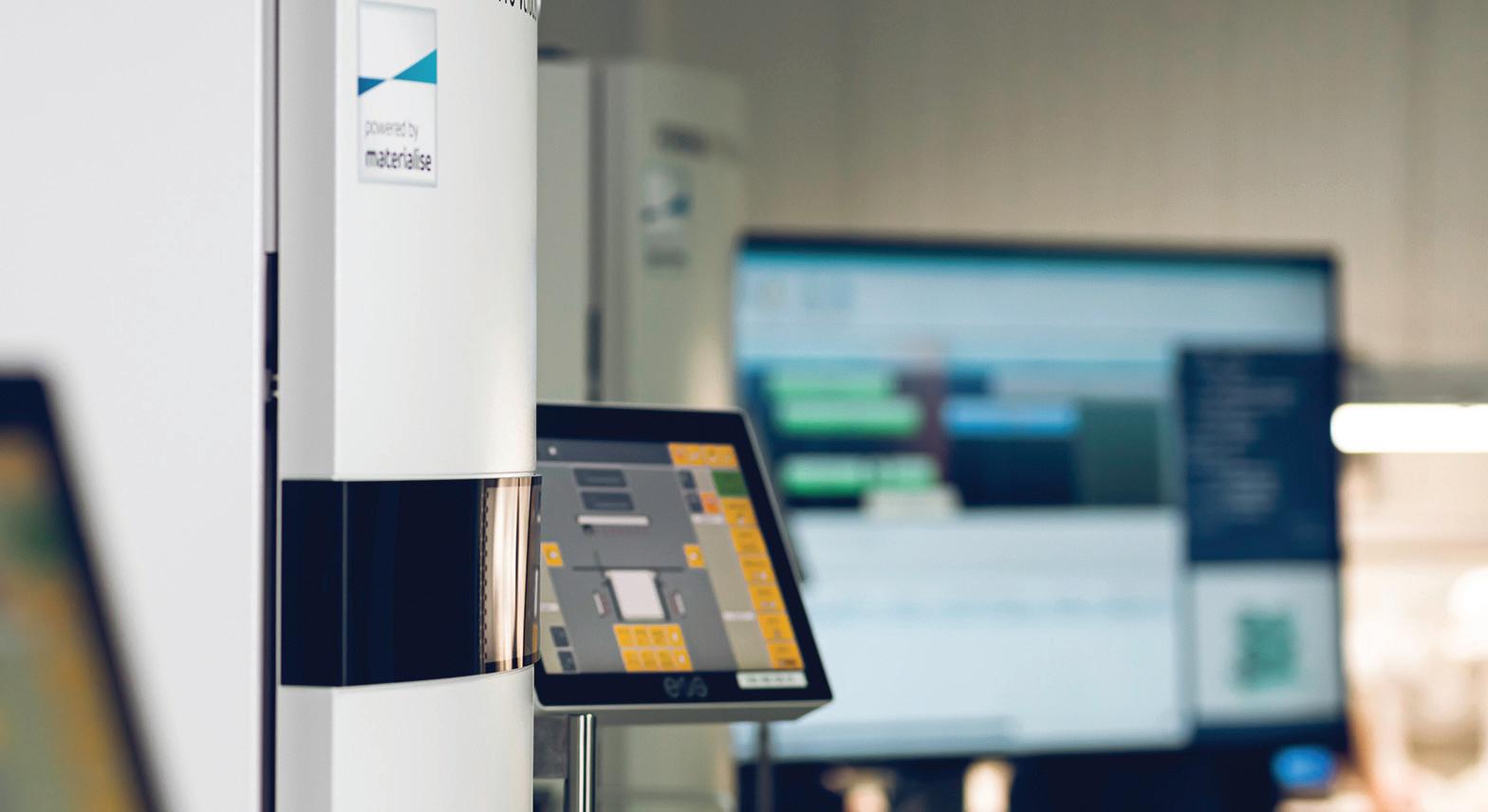
1. Materialise Software’s Identify3D is an end-to-end cybersecurity and IP control platform built for AM supply chains.
quality without manual intervention,” adds Victor Gerdes, VP of global software product strategy, Stratasys.
users and systems can access or execute these assets prevents tampering, IP theft, and unauthorized production. As the sector scales, failure to implement comprehensive security systems exposes manufacturers to significant risks, including gray market production, IP theft, and the creation offaulty or imitation parts on unauthorized machines," notes Buchheit.
''Adversaries use AI tools to attempt attacks at scale-probing systems, generating phishing vectors, and automating intrusion attempts in ways that weren't practical years ago," explains Adriany.
"The risks that arise when connected AM systems are compromised are no longer theoretic. The core vulnerability in AM environments stems from the convergence of information technology (IT) and operational technology (OT). Traditional IT moves data. OT moves physical things, and 3D printers fall squarely into that category alongside CNC machines, robots, and automated production lines. When these two infrastructure types share the same network, protocols, and security approaches, the attack surface expands significantly. And unlike an IT failure, an OT
specifications, or even counterfeit production can occur. "Unauthorized changes in production parameters, particularly when design files are shared across various manufacturers or suppliers, make it increasingly difficult to control the integrity of the final product. Protecting against these risks requires a comprehensive approach to digital asset security," explains Buchheit.
Adriany separates attacks in AM into two categories-tampering and unauthorized access. "Tampering means builds or files are modified to sabotage failure can cause physical damage, dis-output-subtle parameter changes that
Risk Awareness rupt production, or compromise the inRisk is heightened when AI and ML so- tegrity ofa printed part in ways that aren't lutions are connected to AM. Systems immediately visible," explains Gerdes. are vulnerable to activities like data ma- When AM workflows are compronipulation and file tampering. mised, manipulated designs, altered
affect material properties or part performance without being visually obvious. Unauthorized access means confidential IP is leaked, copied, or used outside its intended scope."
When attacks occur on digital input, Adriany explains, the result is compromised physical output. “And increasingly, agentic AI solutions connected directly to machines open additional avenues for data misuse and leakage. The more autonomous and ‘connected’ the workflow, the greater the need for granular control over both machine access and IP usage.”
Gerdes agrees. “As organizations add printers, requestors, and supply chain partners to their AM operations, each of those risk categories compounds.”
Safety Protocols
Security software is available to prevent unauthorized access, tampering, data manipulation, and other types of activities that are increasingly common thanks to AI and ML.
According to Buchheit, security software protects not only design files, but the full AM workflow from slicing software to machine firmware and printer execution systems. “It ensures that unauthorized users and systems cannot access, modify, or misuse digital assets used in the AM process.”
In general, security software encrypts and controls the use of an IP from the moment it is authored to the machine where it is printed. “That means protecting files against tampering, enforcing who can access and use them, and ensuring production only happens under approved conditions—the right machine, material, and parameters. The goal is continuous control across the entire workflow, not just protecting files at rest or in transit, but maintaining the IP owner’s intent through execution,” says Adriany.
Buchheit admits that encryption is a cornerstone of security software, safeguarding files during storage and transfer. Digital rights management and advanced licensing technologies are also sought after features that ensure files can only be accessed and executed under approved conditions, including limits on production volume.
Another way to circumvent risk is localizing AI or ML software. “Security,
particularly regarding AM data, is of high concern. ML software as a local install best addresses this concern. It does not connect to the cloud, and you do not even need to be connected to the internet to use it,” explains Zach Simkin, president, Senvol LLC.
Beware of the Consequences
The consequences of not implementing security software are severe. Despite how obvious these results are, it seems security software’s use in AM is in a gradual transition.
Adriany believes adoption is reactionary. “Organizations implement it after an attack has already caused harm. By that point, the damage is done.”
Repercussions include IP theft, counterfeit parts entering the supply chain, and, in the worst case scenario, product recalls or failures due to tampered files, admits Buchheit.
Other consequences involve machine downtime, IP loss, and compromised parts, all of which compound further downstream in the manufacturing process—no matter the sector. “A faulty aerospace component doesn’t just fail in isolation; it can ground assets, delay maintenance, and disrupt operations. Lost IP undermines revenue and trust. And suppliers who cannot demonstrate secure handling of sensitive manufacturing data increasingly lose eligibility for defense and aerospace work, regardless of their production capability,” notes Adriany.
Attackers gaining access to unsecured printer interfaces create trouble that leads to unfortunate end results. Things like manipulation of G-code files, altering print parameters, introducing structural defects, or causing printers to overheat are possible. “In research settings, these attacks have produced
parts that pass visual inspection but fail under stress. In a production environment, that means defective tooling, failed end use parts, or compromised components making their way into downstream products,” says Gerdes.
“AM is a direct link between digital designs and physical products. Without protection, a compromised file can lead to catastrophic failure in the physical product, compromising safety, reliability, and performance. Simply put, unsecured files are a direct threat to both business and consumer safety,” says Buchheit.
AM users in aerospace, defense, and medical drive adoption of security software. These are segments “where the consequences of a compromised part are too severe to leave security as an afterthought. Defense will lead, but the same approach will extend into other regulated sectors as the model proves out,” suggests Adriany.
Buchheit believes that as AM grows beyond prototyping to become a mainstream manufacturing method—especially in critical sectors like aerospace, medical, and defense—security will become non-negotiable. “With an increasing reliance on distributed networks and digital supply chains, the need to secure digital assets is paramount. Security software and hardware will no longer be an optional enhancement; it will be a standard requirement to protect IP, ensure product quality, and maintain trust in AM processes.”
Regulatory frameworks are also accelerating the shift. “Standards including NIST, IEC 62443, and ISO/ASTM 52907 are establishing security requirements specifically relevant to AM environments. Organizations that want to operate in defense supply chains, sell to regulated industries, or participate in distributed digital manufacturing will increasingly need to demonstrate compliance with these frameworks, not just good intentions,” states Gerdes.
Solution Selection
Assembrix addresses the challenge of security with an AM platform designed specifically for secure distributed production. Instead of sending files directly to printers or external partners, OEMs manage production through a controlled digital environment. Build files are encrypted, access is restricted to authorized users and machines, and each print job is executed under predefined rules set by the IP owner. Sensitive data is never exposed as open files, even when production takes place remotely, while real time visibility and full traceability allow OEMs to monitor production, maintain audit trails, and ensure consistency across sites.
Materialise’s Identify3D is an end-toend cybersecurity and IP control platform built for AM supply chains. It encrypts, distributes, and traces digital part data from authoring through machine execution, giving IP owners continuous control over how, where, and the number of times a part can be produced. What sets it apart is machine-level integration. Rather than stopping at file protection, Identify3D extends control through the last mile, eliminating compliance and security gaps at the junction between the machine and upstream IT systems. The result is a platform that supports cybersecurity, IP protection, and quality assurance as a unified workflow.
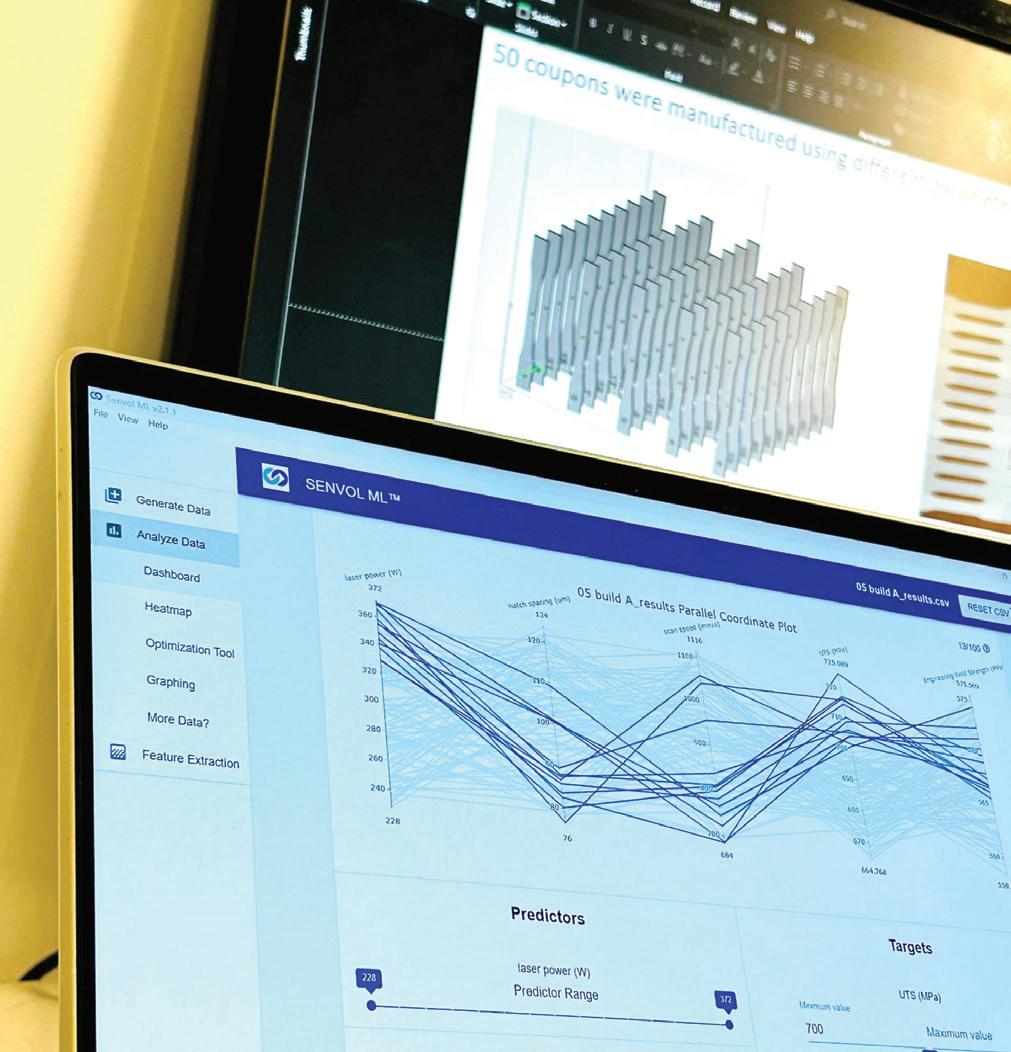
Senvol ML is ML software specifically for AM. It can be used to analyze data from any AM machine, material, and process to rapidly optimize parameters, develop materials, and predict material properties. The software is provided as a local install, it does not connect to the cloud, and users do not need to be connected to the internet to use it. This is for software security.
Stratasys’ GrabCAD Streamline Pro is an enterprise software platform for managing AM at scale. It includes several components with distinct security roles, plus hardware and partner options for
the most demanding security environments. For example, GrabCAD Shield is an industrial-grade hardware firewall device installed at the printer. Bi-directional protection defends the printer from the network and the network from the printer. ProtectAM is a hardware and software upgrade for the Stratasys F900 printer that meets U.S. Department of Defense STIG cybersecurity requirements under DoDI 8510.01 and AFI 17-101. It provides an enclave controller running Red Hat Enterprise Linux as the sole network access point, creating a fully separated network area for the printer to operate.
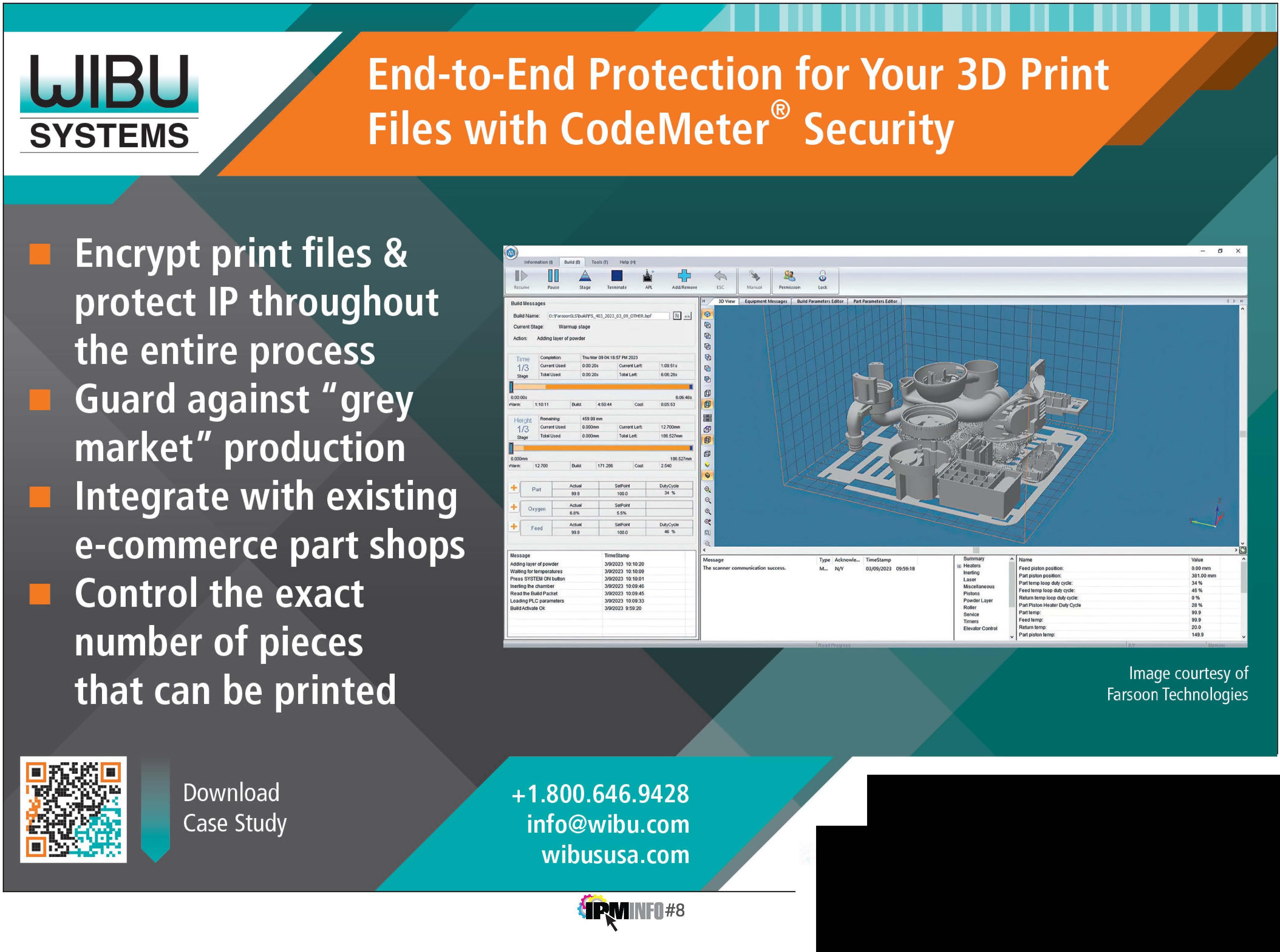
Wibu-Systems provides CodeMeter, a software protection and licensing platform built for industrial environments, including AM. CodeMeter secures the entire AM workflow including design files, file transfer, slicing software, machine firmware, and printer execution systems. The platform combines encryption, flexible licensing, and secure key storage available both digitally and through physical dongles, providing tamper-resistant, hardware-backed protection. Manufacturers control which machines can print, where and how many parts can be produced, and ensure that files cannot be reused outside authorized environments. This prevents unauthorized use and gray market production while providing full traceability across distributed manufacturing networks. In addition to security, CodeMeter enables new business models including pay-per-print workflows and secure digital spare parts distribution via ecommerce platforms.
Smart Algorithms
While ML and AI enhance AM, their use isn’t without consequences. The entire AM supply chain is susceptible to risk, whether it is file tampering or IP theft. Security software prevents attacks and protects against unauthorized use. The need for this type of solution will only increase as ML and AI continue to be part of the AM discussion. IPM
PERSONALIZATIONBYTRADE
Businessto Business Customizationwith OTO
by IndustrialPrint Magazine Staff
Direct to object (DTO) printing is well suited for producing custom gift products. Innovations in digital print systems, inks, and primers/surface treatments continue to push the possibilities.
Surrey,UK-basedProperGooseprovidespersonalized gift products from playing cards to glassware and tins. The company started in 2015 as FDCCovers designing and making its Limited Edition First Day Covers. It soon branched out into the personalized gift market and became Proper Goose in 2016.
Trade Printing
In2021 Proper Gooseidentified agapinthe market for personalized drinkware and opened up a tradefocused division of the company, Bottled Goose. This division offers custom bottles and tumblers, glassware, and homeware products. Decorations are done using a Helix Hi-Fi printer, Double Helix printer, and Magicoat pretreatment system by Inkcups.
Helix range of printers allows Bottled Goose to work with leading brands like Duplo, Kew Gardens, Lucozade, and Winchester Distillery.
Bottled Goose specializes in delivering high-quality product printing for businesses ofall sizes, from small start-ups to large brands. It offers co-branding, print on demand, wholesale, as well as sample and tooling services. It is supported by a team of software developers, printer experts, and a state-ofthe-art production facility.
One challenge with printing for the trade means there are sometimes fluctuations in the volume of products required, which varyfrom items suchasspiritsbottlesfordistilleries, perfume bottles and candle holders for cosmetics houses, or thousands of units of branded
According to Inkcups in a published case study about Proper Goose/Bottled Goose, the cylindrical inkjetprinters are well suited for digitally printing on drinkware, ideal for premium glassware, stadium cups, tumblers, barware, shot glasses, water bottles, and candles.
Because Bottled Goose requires seamless printing onto cylindrical and tapered products, the ability to print onto prefilled bottles is crucial. "The very nature of supplying to the trade means that there can be fluctuations in volume ofproducts required. This varies from personalized, one-off items such as specialist whisky glasses or bottles for events. Bottled Goose finds that the Inkcups Helix range ofDTO presses is able to handle this variability.
DTO in Action
The capabilities, quality, and speed offered by the
wellsuitedfordigitallyprintingon drinkware...
bottles for a client, to tens
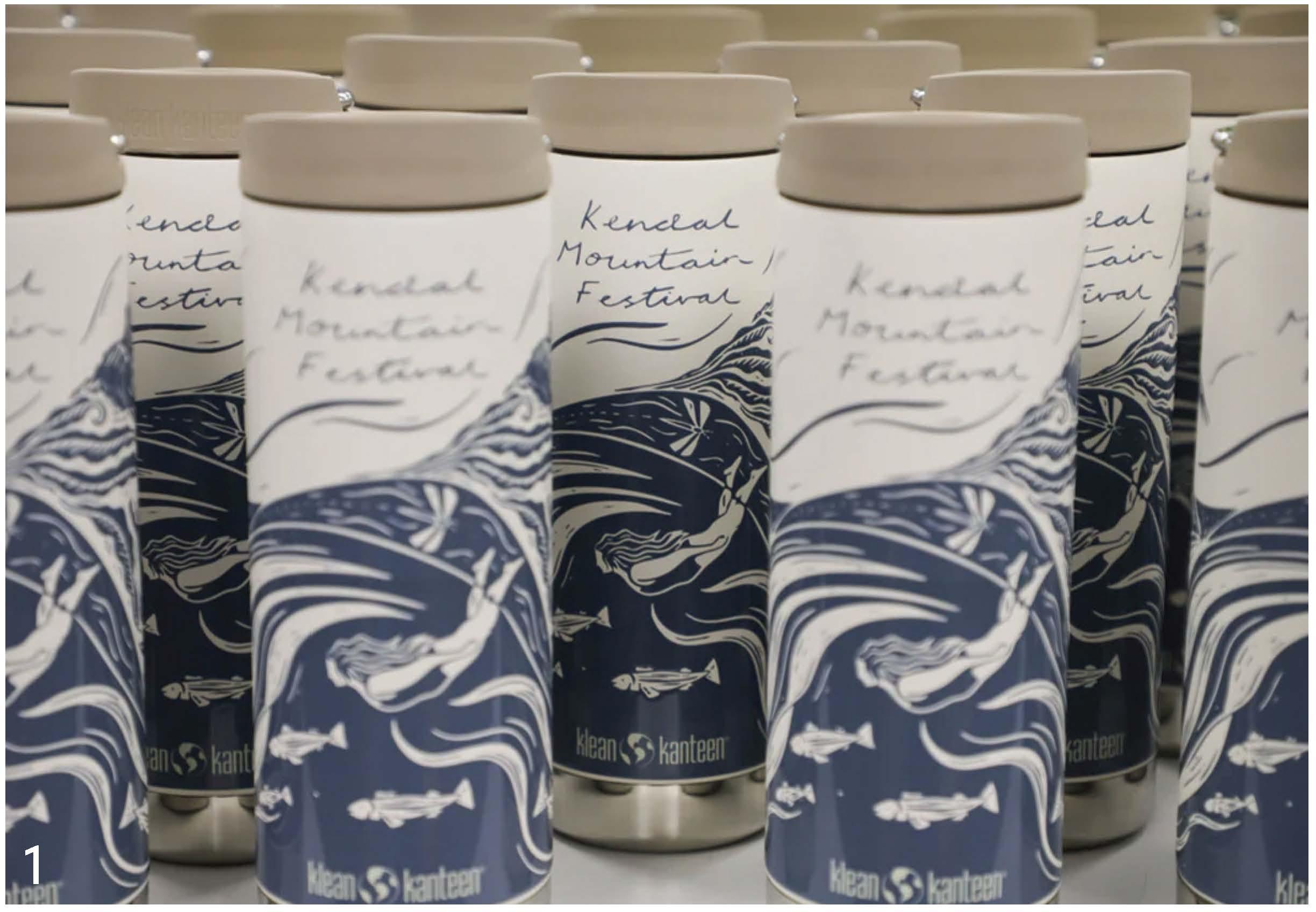
1. Bottled Goose printed custom designs with lnkcups equipment on KleanCanteenwater bottlesfor Whitby & Co. 2. Proper Goose, a personalized gift producer based in Surrey, began producing a range of personalized items in 2015 for occasions such as Father's Day, birthdays, and even King Charles Ill's Coronation.
of thousands of units such as branded glasses or bottles for events. The Inkcups Helix range offers this flexibility with no compromise on quality. The simple process from receiving the client's artwork and then it being sent directly to the printer, offers an easy and streamlined experience for clients. Speed and efficiency from the first moment," notes the study.
Testing the output quality for Bottled Goose products is an important element of its reputation for offering a bespoke service. According to Inkcups, tests on the durability of the printed product confirm that it is dishwasher safe, scratch resistant, and outstanding quality.
Whitby&Co.
One of the services offered by Bottled Goose is custom prints on Klean Canteen water bottles. The company recent created a batch for its client, Whitby & Co., a U.K.-based distributor of outdoor accessory products.
Using its Inkcups printers, the custom drinkware provider printed 60, 16
ounce colored bottles with a custom design for the Kendall Mountain Festival. Designed by a local artist, the artworka full wrap around the bottle-captures a mountain and sea scene, featuring a tent, a hiker, and wildlife elements.
Printed in a denim blue color with a 100 percent varnish overlay, the design
stands out against the matte finish of the container. The water bottles were exclusively sold at the festival.
Continued Evolution
Proper Goose and its Bottled Goose division continue to look for new opportunities with DTO printing. 1PM
ACHIEVE QUALITY AND DURABILITY WITH PRIMERS AND PRETREATMENTS
by Cassandra Balentine
Glass provides a convenient and beautiful surface for decoration. However, it can be tricky for ink adhesion. For glass decoration expected to last beyond initial handling, pretreatment is a critical part of the digital direct to object (DTO) printing process.
Success with Glass
adhesion and long-term durability. "Ink chemistry has come a long way, but glass is still a demanding substrate. If the printed part needs to withstand handling, abrasion, washing, or environmental exposure, pretreatment is usually a key part of building a reliable process," stresses Ken Tyler, national sales manger, Engineered Printing Solutions.
For digital DTO printing on glass, pretreatment is gen- Above: Engineered Printing Solutions' XD-360' is a multi-color, UV LED, erally essential if the end application requires strong high-resolution inkjet printer built for decorating cylindrical objects.
"While some glass surfaces may allow ink to adhere initially without pretreatment, long-term durability requirements such as scratch resistance, wash resistance,andenvironmentalexposure almost always require surface preparation," echosSandi Baginski, creative director,Innovative DigitalSystems.
According to Hugo Gonzalez, senior segment specialist, Mimaki USA, Inc., glass, while a printable substrate, has variability. "Its printability varies widely depending on the specific formulation, coatings, andmanufacturing methods. Varieties of glass should be approached like any range of printed material, each type may require its own solution."
Surface treatment ensures durability and lasting image vibrancy, but also helps remove dirt, debris, or other
coatings that may affect adhesion. Tom Lang, digital product manager, Inkcups, explains that the limited resin in digital inks makes adhesion to glass challenging and following annealing-a controlledslow-coolheattreatmentprocess that is part ofglass manufactureglassware is often sprayed with either a hot-orcold-endcoating."Thiscoatingis used to protect the glass during transit, butwhilethiscoatingprotectstheglass, italsopreventsinksfromstickingtoit."
Bas Buser, global segment manager, printing applications, Plasmatreat GmbH, believes that it's a little more nuanced. Pretreatment is essential for UV-curable inks, but not for ceramic inks. "Glass objects sometimes have a coating that makes it possible to print on with UV curing inks directly. It depends then on the coating, which can
for example be an anti-scratch coating oracolorvarnish.Butingeneral,apretreatmenton glass is needed."
Tyler points out that for ink to properly adhere, itneeds to wet out and anchor to the surface in a controlled way. "Glass can be difficult because the surface is not always naturally receptive enough for that to happen consistently. On top of that, two glass parts that appear very similar can behave quite differently depending on coatings, contamination, manufacturing variation, orevenhowtheyhavebeenhandledbefore printing. That's why experience in handling glass is essential for success in DTOprinting."
Lang suggests that 24 hours after a graphic has been UV digitally printed onto the glass, some adhesion testing, includingscratch,tape,anddishwasher
tests, is recommended to assure that the ink has properly adhered to the glass, the edges are completely smooth, and the surface stays fully intact. “Getting pretreatment right demands an understanding of the end application and have enough knowledge of the right substrate to pair the right technique with the right ink and technology. This is why it’s advisable to work with an equipment manufacturer with expertise in pretreatment across a range of applications, inks, substrates, and printing methods.”
Understanding Surface Properties
Adhering UV-curable digital inks to glass is challenging due to its inherent surface characteristics. Glass is extremely smooth, non-porous, and features a low surface energy without pretreatment.
Several key properties work against strong ink bonding including low surface energy; a smooth, non-porous surface; chemical inertness; surface contamination sensitivity; presence of a hydrated surface layer; and high surface tension mismatch, suggests Buser.
Unlike porous materials, ink cannot penetrate the surface, so adhesion depends entirely on how well the ink bonds to the exterior layer, offers Baginski. Poor adhesion on glass surfaces results from protective coatings or formation of glass corrosion during storage and transport, shares Dr. Arnd Schimanski, managing director, SURA Instruments GmbH.
The transition from inorganic glass to organic coating (ink) must be generated without mechanical stress in the coating for good adhesion, adds Schimanski. Contamination is also a concern, as many glass products—especially containers—are subject to surface contaminants through the manufacturing process.
“Glass may be treated during manufacturing with protective coatings designed to reduce scratching, may have residual mold release, or packaging materials used to improve transport durability. While beneficial for the glass manufacturer, these contaminants can have an adverse effect to ink adhesion if they are not properly addressed through surface preparation prior to printing,” states Baginski. Contamination can happen during other steps as well. Baginski points out that oils from handling, dust, moisture, and invisible residues can all negatively impact adhesion if proper cleaning and preparation procedures are not followed. Also, all glass is not created equal. “For example, glass used for solar panels is a different chemistry than one might use for bottling liquids. Each additive compound has its own characteristics, each use might require a different coating that drastically affects its printability,” explains Gonzalez.
Growth of Digital
The growth of digital DTO printing influences pretreatment requirements and pushes their advancement. Faster line speeds and shorter cycles reduce the time available to pretreat the object.
As digital DTO printing continues to grow, expectations are dictated by and evolve based on market demands. “The requirements for a glass drinkware product vary greatly from an industrial-use glass panel, for example. Today’s customers expect prints that can withstand dishwashers, aggressive chemicals,
heavy handling, extreme temperature changes, all while maintaining a long product lifecycle,” says Baginski.
Tyler adds that the increase in digital DTO printing has changed how people think about pretreatment. “Pretreatment has always been important in glass decoration, even in traditional analog processes. Digital has made pretreatment more integrated into the overall production workflow. In some cases, it can be brought inline as part of a digital cell, which helps with consistency and throughput.”
Further, digital DTO printing enables a variety of items to be decorated, and as such has expanded into new areas including packaging. Because of this, many operators need to understand how to decorate a broader range of different substrates and items than ever before. “This requires specialist knowledge and expertise into what level of adhesion and abrasion resistance each item requires, and this is why working with an equipment manufacturer is advisable to ensure the desired result is achieved,” states Lang.
Treatment Options
increases surface energy and alters the surface chemistry to improve wettability and adhesion.
Schimanski says flames remove impurities like water, dust, and protection
A variety of pretreatment options are suitable for digital DTO printing including chemical primers—wipes and sprays; flame and flame silicatization/Pyrosil; as well as corona and plasma.
Flame treatment works by cleaning and activating the glass surface. “The heat removes contaminants and increases surface energy, allowing ink to wet out more effectively,” shares Baginski.
Tyler explains that flame-based methods thermally activate the surface and Pyrosil deposits a silicon dioxide layer onto the substrate, which both
agents from the surface. Flame silicatization like Pyrosil forms a reactive silicate layer on the glass surface.
Surface tension after flame treatment is in the range of 50 to 60 millinewton
per meter (mN/m) depending on flaming parameters. Pyrosil coating reaches 72 mN/m on glass surfaces and after primer application surface tension is between 48 and 56 mN/m depending on application parameters, adds Schimanski.
Pyrosil-type treatments chemically modify the surface to create stronger bonding sites for ink. “These systems are often used when durability requirements are especially demanding, which is critical for DTO printing on glass. Plasma
and corona treatment operate similarly by modifying the surface at a molecular level, typically in automated production environments,” explains Baginski.
Corona uses a high-frequency, electrical discharge to raise the surface energy of the substrate, notes Tyler.
Each pretreatment approach used in digital glass printing is designed to solve adhesion challenges in different ways. Baginski says hand-applied primers and adhesion promoters create
a bondable ink receptive layer between the ink and glass. “These are cost effective and easy to implement but can be labor dependent.”
Alternatively, jettable primers offer a more controlled approach by applying adhesion promoters only where ink will be printed. “This reduces waste and improves process efficiency,” notes Baginski.
Tyler adds that chemical primer wipes can also improve adhesion, although they are generally less practical for high-speed production environments.
“All of these treatments are trying to move the surface into a better adhesion window. The difference is in how they get there and how suitable they are for a given application, which is where the expertise of the supplier comes in,” concludes Tyler.
Determining Surface Treatment
The most appropriate pretreatment method depends on several features including glass and coating type, durability requirements, production speed and volume, ink chemistry, cost, and handling.
How well an ink bonds to a substrate depends on coatings, surface energy, dyne levels, and other bonding requirements. Lang says clean, untreated glass typically has a surface energy between 30 to 72 dynes, while most UV inks have a surface tension between 35 to 45 dynes.
“As a rule of thumb, the surface tension of the ink should be about ten dynes lower than the surface energy of the glass. For optimal adhesion, a surface energy of around 35 to 45 dynes is ideal. A dyne pen or a tensiometer can then be used to measure surface energy or surface wetting. Achieving the target dyne
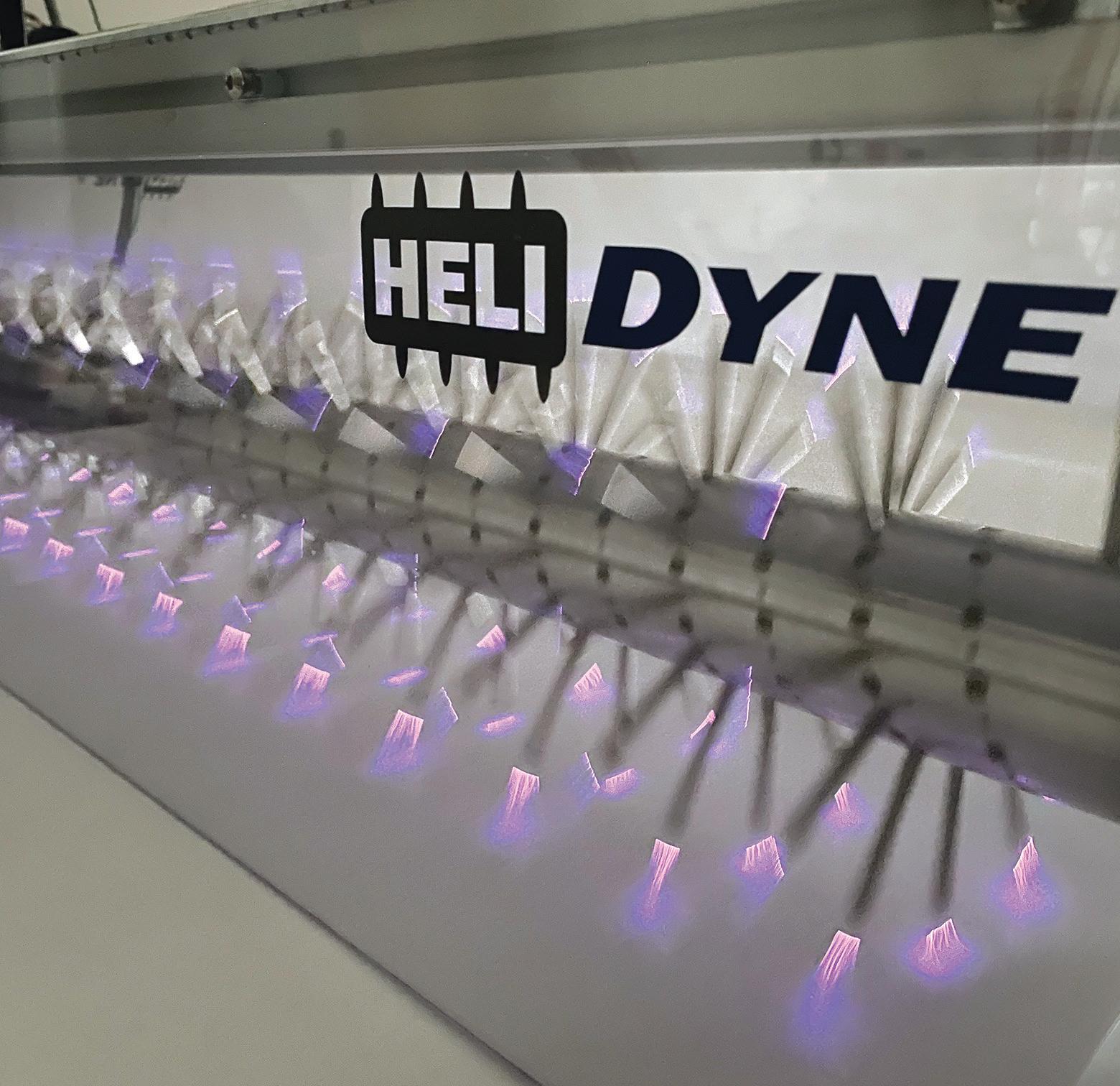
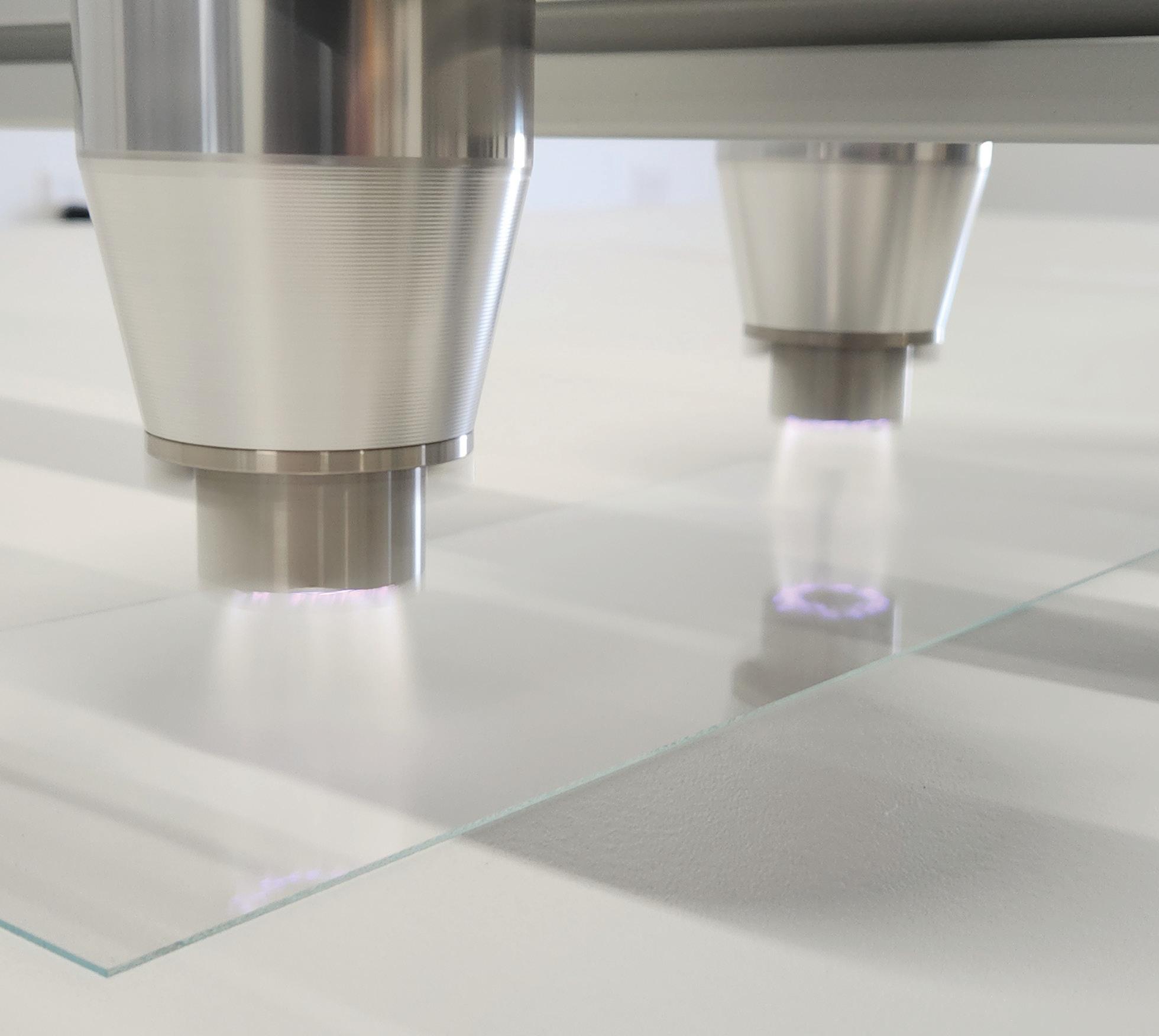
3. The HeliDyne is a corona treatment system from 3DT. 4. Plasma energy is at the core of 3DT’s PlasmaDyne Pro, revolutionizing surface treatment and adhesion performance in manufacturing.
level does not guarantee adequate surface tension or adhesion. We always recommend validating ink bonding in conjunction with pretreatment by performing print testing, rather than relying solely on dyne level measurements,” offers Lang.
Lang says primer wipes can be effective for applications where durability and automation isn’t a priority, whereas applications that require strict adhesion testing or high levels of washability rely on flame treatment or automated systems to ensure high levels of adhesion.
When printing directly onto glass, Erik Kiel, president/owner, 3DT LLC, believes the choice of pretreatment method depends on several factors, including the type of glass being printed, the ink and ink system used, and the configuration and speed of the printing process. “Glass surfaces are extremely smooth and easily contaminated, so achieving adequate surface energy and cleanliness is critical for reliable ink adhesion.”
consistent adhesion. Integration with the printing line, part handling, and process speed are also important considerations,” explains Kiel.
Both corona and atmospheric plasma treatments can increase surface energy when treated immediately prior to printing. “Corona treatment is often suitable for relatively wide, flat surfaces and certain production setups where speed is important. Atmospheric plasma can provide more concentrated cleaning and activation, which may be beneficial for complex shapes, localized treatment areas, or applications requiring very
For short-run customization or single-use products, a manual primer may be sufficient. For high-volume industrial production, automated flame or chemical pretreatment often delivers better consistency and scalability, comments Baginski. “Ultimately, the right answer is the one that supports reliable production—not just successful samples.”
Pretreatment selection is also driven by structured testing. “The right choice usually comes down to the part, the line, and the performance requirement. We look at the type of glass, the shape of the part, the production speed, whether the process needs to
run inline, and what kind of durability the customer needs. A decorative indoor application may not require the same approach as a product that will face repeated washing or exposure to the elements. Cost and practicality matter too, but we always start with what works technically and then narrow it down from there,” notes Tyler.
Direct to Glass
Printing to glass is challenging, but also rewarding. Pretreatments ensure adhesion and durability of digitally decorated glass objects.
Baginski adds that the conversation is no longer just about making ink stick to the surface. It is about creating a more robust and streamlined manufacturing process. IPM
CORRUGAT KAGE PRINTING
multi-pass printing is now credible for abroader production mix than before."
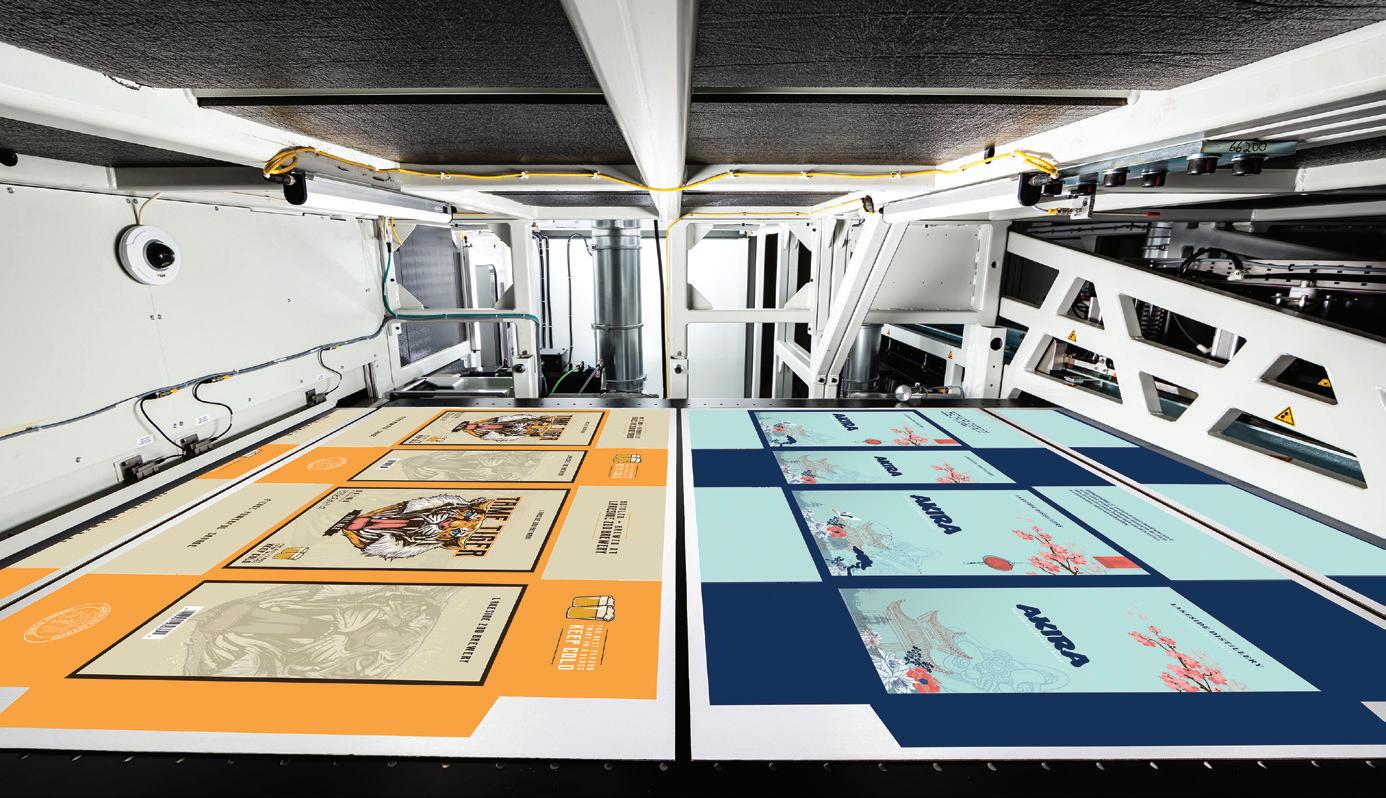
Digital's use in corrugated packaging wouldn't be where it is today without the help of multi-pass digital printers.
"Multi-pass systems are the preferred on ramp-they allow production teams to adopt digital printing gradually, masteringworkflow,colorcontrol,andsubstrate behavior before moving into high-volume applications. Users often begin with multi-passprintersbecauseitfitsnaturally into their existing production mix," explains Dieter Jancart, segment manager high-endsystems, printing systems,Agfa.
Erik Norman, president, swissQprint America, agrees, citing multi-passflatbed systems as already well established in short-run production, sampling, versioning, and display packaging. Single pass
swissaprint
is increasingly positioned for medium to longer production runs where speed is critical.With this in mind, Norman notes converters adopting a hybrid strategy.
"They continue to rely on flexography for very long runs while using digitalespecially multi-pass UV flatbeds-for short runs, fast turnarounds, and highvalue applications. The shift is not about replacing flexography entirely, but about expanding productionflexibility and profitability," suggests Norman.
Hugo Gonzalez, senior segment specialist, Mimaki USA, Inc., echoes his peers, noting that multi-pass does "play an important role, especially in prototyping, short runs, mockups, and specialty applications. In this space, it is not so much about replacing flexographic systems, but about providing a faster and
economical option to go from concept to finishedproduct."
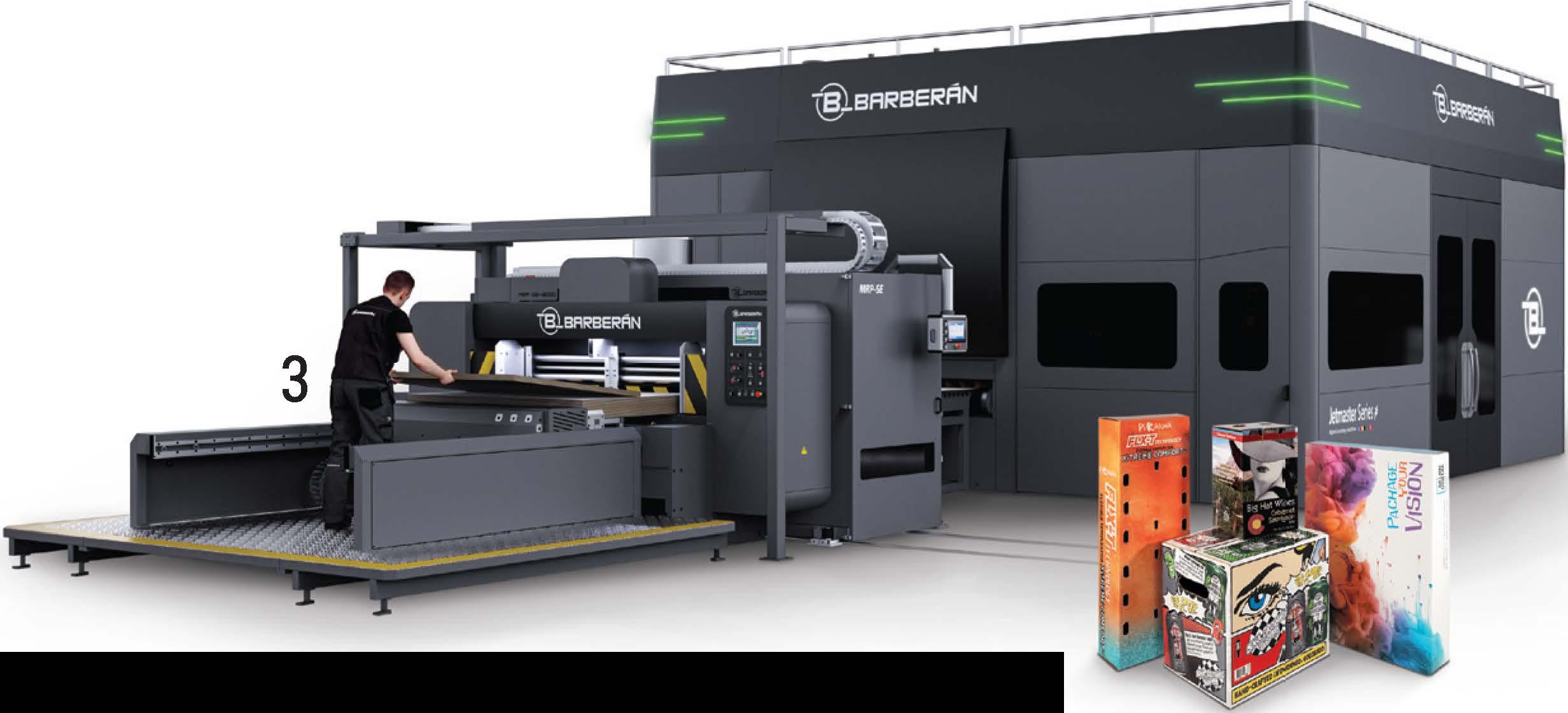
Onthesingle-passprintingside,Chuck Slingerland, VP, Barberan US, says this technologyisalreadyinfullindustrialuse. "Today's systems deliver high line speeds suitable for mainstream corrugatedjobs, consistent and repeatable quality that meets brand expectations, and integration with automated board handling for continuous production."
"Single-pass technology is an excellent solution for profitable corrugated work, versioning, retailer-specific graphics, seasonal campaigns, and increasinglyforrepeatproductionwhereconverters need flexography-like productivity with digital agility," shares Bill Myers, marketing manager, Domino Digital Printing NorthAmerica.
MADE FOR WINNERS LOVED BYTHOUSANDS
Another example, Daniel Velema, managing director, Koenig & Bauer Durst, says single-pass inkjet systems like the Delta SPC 130 platform print tens and tens of million sheets per year. “Digital is no longer limited to prototyping or short runs. Converters now run digital lines around the clock for both primary and secondary packaging. These are not experimental setups; they are part of serious production strategies.”
Kristen Minlschmidt, product marketing and NPI strategy manager, HP Inc., believes that great printing alone is not enough to transition to full industrial levels of digital corrugated printing. “Converters must bring together workflows that are often siloed today, from planning and ERP, graphics and prepress, the digital press, quality inspection, through to downstream corrugation and converting, so the entire system runs as one efficient manufacturing process. Once the broader production workflow is aligned, corrugated digital printing becomes a scalable manufacturing model, not a specialty capability.”
All that being said, “industry adoption is still early—worldwide digital print in
corrugated remains only a very small percentage of total volume, so the technology is ready faster than the market has fully transitioned,” admits John Kelley, managing director, Kento North America.
Thriving System Updates
Engineering developments from ink sets to printheads allow digital printing to compete with analog presses in the corrugated packaging space. These updates enable a positive outcome despite the challenging nature of corrugated board.
Ink sets used for corrugated board must demonstrate specific feature sets. “Corrugated boards are inconsistent— they warp and vary in porosity. Ink sets must be engineered to deliver exceptional jetting reliability even at high printhead gaps, ensuring clean, consistent droplet placement despite surface unevenness. The ink’s formulation should support long open printhead times, stray light robustness, and excellent jetting. This reliability directly mitigates issues like dot gain and inconsistent absorption,” notes Jancart.
A consideration post-print is that the ink set withstand bending and creasing without cracking. “Optional inline overprint varnish can enhance surface protection and appearance so printed packaging can withstand conversion, handling, and transit,” adds Minlschmidt.
“The newest single-pass corrugated presses tackle ink absorption, dot gain, and surface variability by engineering the primer, ink, printheads, and curing as one system. Together, these advances turn highly variable liner board into a more predictable, repeatable print platform,” explains Slingerland.
Printhead improvements include “improved recirculation technologies and more robust nozzle design, which help maintain consistency even in dusty corrugated environments. In practice, this means more stable print quality across varying liner board qualities without sacrificing productivity,” shares Kelley.
UV LED curable inks meet the needs of corrugated board. They offer a combination of durability, color performance, and energy efficiency. “UV LED technology enables instant curing, excellent adhesion, and strong abrasion resistance. High pigment density supports vibrant colors even on brown or kraft liner board. In addition, UV LED curing reduces energy consumption compared to traditional mercury lamp systems,” states Norman.
When printing with UV LED curable inks, an inline primer acts as a sealer, reducing the absorbency of high-recycled liners and creating a more uniform surface so pigments don’t sink into the fibers or wick along the grain. “UV LED curable inks cure on this primed surface almost instantly, which limits dot gain and keeps pigments near the surface for higher color density and better durability. The primer’s surface energy is matched to the ink and to modern printhead jetting, presenting controlled wetting, clean edges, and more consistent halftones. Meanwhile multi-zone LED curing is tuned to line speed and ink load to lock the image in place with minimal heat and warp,” explains Slingerland.
Primer technology helps standardize the print surface. “The priming station widens the usable range of top liners, improving print quality, sharpening fine
2. The Domino X630i digital aqueous inkjet corrugated press is a single-pass corrugated press engineered for everyday production printing 4,500 sheets per hour at 600 dpi. 3. The Barberán Jetmaster 2.0 is a sheet-fed, single-pass industrial inkjet platform designed for true high-volume production.
detail and text,optimizing color gamut, and enabling flying job change with spot priming.That is highly relevant to corrugated because the real challenge is not only absorption, but also the variability between coated,uncoated,brown,white, and lower grade liners," says Lynn.
In addition, Koenig & Bauer Durst's digital primer provides controlled surface energy and absorption uniformity. "By stabilizing the print surface, the primer increases achievable optical density and can reduce ink consumption by up to 20 percent compared to nonprimed printing," explains Velema.
Water-based ink chemistry is also used in corrugated board printing. Certain formulations are monomer free, organic pigmented,odor free,and abrasion resistant,lists Lynn.
"True water-based and high-viscosity aqueous ink systems align with corrugated sustainability requirements and increasingly stringent regulatory expectations for direct food contact packaging. At the same time, advances in pigment dispersion and ink formulation deliver higher color density and durability, while reducing penetration into the substrate. This results in better print performance with lower ink consumption and improved recyclability profiles," states Kelley.
The evolution ofaqueous pigment ink chemistry is significant,certain particles allow for enhanced printing reliability."iTech PolyM is a polymeric particle technology designed to print reliably on both coated and uncoatedcorrugated without a separateprimer or bonding agent.That is significant from both a productivity and sustainability standpoint-it simplifies the process, reduces consumables, and supports strong color performance while maintaining the mechanical properties needed for corrugated packaging," explains Myers.
Hybrid architectures are also noteworthy, as they marry the advantages of flexography with digital printing in one device. This means "using flexography
for solids, backgrounds,whites, and spot colors, while using single-pass inkjet where digital adds value,such as high-definition graphics,variable content,and fast changeovers. The hybrid model directly attacks the traditional economic weakness of digital in corrugated by reducing expensive digital ink consumption while preserving the benefits of plate-free production," says Kelley.
Handling Media
Advances are also made in regard to material handling-across every part of the process. "There are fully automated systemswith loading and unloading arms, pneumatic and fixed registration systems, as well as hands free and zoned vacuum controls," lists Gonzalez.
"Automation is essential. Corrugated converters are dealing with more SKU proliferation, more substrate variation, and tighter lead times than ever before;' states Myers.
Thanks to automation,operators easily switch between different grades,flute sizes,and thicknesses."This is increasingly important as they face a growing variety of board types driven by segmentation, customization, and sustainability initiatives;' saysJancart.
"Innovations in board stabilizationsuch as optimized media guide systems onmulti-pass hybrid printersand high vacuum tables on multi-pass flatbeds-help keep even warped or lower grade boards flat during printing. This significantly improves registration, ink placement, and color consistency;' explainsJancart.
Stabilizing the board is not just a convenience feature in multi-pass scenarios, notes Lynn. "It is critical when the substrate itself is inconsistent in caliper, flatness, or flute profile. Better board control directly helps reduce print
defects that operators might otherwise blame on dot gain or absorbency."
'With so many board grades and flute sizes in use, reliable automation in hardware and software simply keeps production predictable and profitable," adds Velema.
High-volume, single-pass print lines also use fully automated board handling. It helps them "move seamlessly from microflute to double wall,with recipe-based setups,automatic vacuum and alignment adjustments, and warp management tuned for lightweight and high-recycled boards. This allows plants to switch quickly between E, B, and C flutes for display and packaging work and heavy BC or double wall for shipping cases without creating bottlenecks at the press. On the back end, automated stackers and material handling systems manage programmable stack formats, automatic counting and separation,and integration with existing conveyors and logistics for hands-off,continuous high-speed production," states Slingerland.
Automation and workflow work hand in hand."The physical movement ofrolls, sheets, and stacks has to stay synchronized with the movement of data. Automation only delivers productivity when material handling and digital job intelligence work as one system,so the correct substrate,job sequence,and downstream instructions arrive together, right when they're needed," shares Minlschmidt.
"Across both multi- and single-pass printing, improvements in automation, software integration, and color management have made digital systems more predictable and production ready. The result
is reduced waste, faster job changeovers, and more efficient handling of variable data and multiple SKUs,” shares Norman.
For example, Gonzalez shares how front end software simplifies everything from design to print to processing—all from one interface. This increases production and reduces waste by eliminating touch points for operators.
Existing Barriers
There are challenges to overcome in terms of digital printing’s wider adoption into corrugated manufacturing facilities.
According to Norman, the main barriers are still cost structure and production mindset. “Flexographic printing remains highly cost effective for very long runs. Digital must justify itself through flexibility, reduced inventory, faster turnaround, and versioning capabilities. Another barrier is integration into existing workflows. Converters need confidence in uptime, operator training, and predictable performance across varying board materials.”
“Digital ink cost is still a concern compared to flexography, particularly for large coverage areas. In addition, many converters are still evaluating where digital fits best within their production mix. The transition is not just about investing in equipment—it requires changes in workflow, prepress, production planning, and commercial strategy. While the demand for shorter runs and higher SKU variation is clearly growing, the shift toward digital is happening progressively rather than overnight,” admits Kelley.
COMPANIES MENTIONED
Lynn suggests digital does not have to imitate flexography exactly to compete with it. “In corrugated, value increasingly comes from versioning, variable content, reduced tooling, shorter make ready, and fast changes between jobs or substrates. So the competitive equation is no longer just ‘cost per square meter at one long repeat run,’ but overall plant efficiency and responsiveness across a job portfolio.”
“Converters need confidence in the business model—where digital fits against flexography, what run lengths make sense, how to schedule mixed analog/digital production, and how to sell the value of shorter runs, versioning, and inventory reduction to brand owners,” states Myers.
Another barrier is substrate and process complexity. “Corrugated is not one substrate; it is many. The variation in top liners, absorbency, flute construction, thickness, and converting requirements means digital success depends on engineering the process correctly—including board quality, priming, drying, color management, and finishing,” shares Lynn.
According to Minlschmidt, the challenges associated with digital adoption are more about what it takes to industrialize digital within the existing ecosystem of a corrugated plant. “Substrate variability and the production environment can all challenge consistency, so systems must be engineered and maintained for robust, repeatable production. And because corrugated manufacturing is built around highspeed material logistics, success also
See page 15 for more information.
100Agfa agfa.com
101Barberán US jetmasterseries.com
102Domino Digital Printing North America dominodigitalprinting.com
103Durst Image Technology US durstus.com
104HP Inc. hp.com
105Kento North America kentodigitalprinting.com
106Koenig & Bauer Durst koenig-bauer-durst.com
107Mimaki USA, Inc. mimakiusa.com
108swissQprint swissqprint.com
depends on seamless integration with the physical flow of rolls, sheets, and stacks staying synchronized with the flow of data, automation, and downstream instructions across the plant.”
“The primary barriers are organizational, not technical. Most converters already recognize the reliability and quality of industrial digital systems, but they are still aligning their workflows, estimating models, and production planning to fully exploit the possibilities of manufacturing digitization. Digital printing is only solving a part of the puzzle, that is also why working together with the customer and its other suppliers during a project is in our natural DNA,” admits Velema.
For multi-pass systems, Gonzalez believes the primary barrier is economical. “While it may make sense for a smaller PSP to have a multi-pass digital system for short-run applications, it may not likely make sense for volume corrugated printers to incorporate multi-pass digital.”
Full Reach
Physical upgrades to the newest digital presses from board handling to ink chemistries, as well as workflow software aid in creating a a successful environment for any corrugated packaging provider.
A hybrid approach allows for canvasing the full range of corrugated packaging, whether that be long static runs (flexography), prototypes and sampling (multi-pass digital), or high-speed multiple versions and/or SKUs (single-pass digital). While it may not be a feasible economic investment to incorporate all three at one facility, acknowledging how each technology complements the other is key.
“The plants that recognize digital as a core part of a modern hybrid production strategy—rather than a niche add on—are already using single pass as a mainstream tool and demonstrating that these remaining barriers are transitional, not structural,” suggests Slingerland.
Visit industrialprintmagazine.com in June for a webinar on this topic. IPM