■
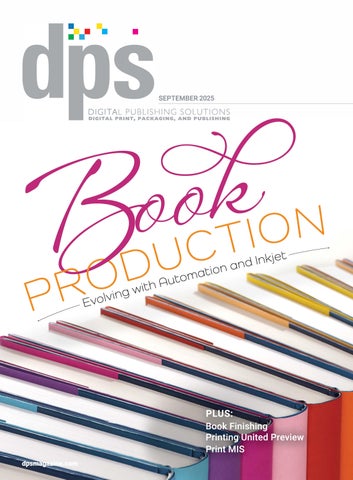
SEPTEMBER 2025
DIGITA ��BLISHING SOL UTIONS P� l , PACKAGING, AND PUBLISHING
DIGITAL
INFO #9
September ’25
11 || Reacting to Market Needs Savvy Book Publishers Excel with Digital Print
18 || Book Smart Intelligent, Automated Book Finishing
22 || Automating Estimation Is Your Workflow Automation Ready?
11
Editor’s Letter.....................................................................................4 All About Automation Showtimes Printing United Preview...................................................................6 Labels and More...............................................................................8 Recent Events................................................................................. 10 Moving Forward with Inkjet Advertiser Index............................................................................. 27
10
Companies Mentioned................................................................. 27 Showcase........................................................................................ 27
6 18
dpsmagazine.com
22
September 2025 || dps || 3
dpsmagazine.com Volume 27, Number 5 • ISSN: 1529-2320
All About Automation Today’s print providers are tasked with doing more with less. Whether or not you are ready to embrace automation, it is increasingly essential to digital and hybrid print environments. For commercial printers, quick and accurate estimation is essential. Print MIS software increasingly implements rulesbased automation to speed the estimation process—which has advantages and disadvantages. Read more in Automation and Estimation.
Whether or not you are ready to embrace automation, it is increasingly essential to digital and hybrid print environments.
EDITOR IN CHIEF Thomas Tetreault 978-921-7850 EDITOR Cassandra Balentine cbalentine@rockportpubs.com ASSOCIATE EDITOR Melissa Donovan mdonovan@rockportpubs.com ART DIRECTOR Sarah M. White swhite@rockportpubs.com WEB EDITOR Melissa Mueller CONTRIBUTORS Kemal Carr, Olivia Cahoon, Gina Ferrara, Mark Hanley ADVERTISING SALES
One print segment fully embracing automation is publishing. Book manufacturers look to advancements in inkjet and end-to-end finishing to streamline production. We discuss advancements in both printing and finishing in Reacting to Market Needs and Book Smart, respectively.
PUBLISHER Thomas Tetreault 300 Newburyport Turnpike, Ste. 11 Rowley, Massachusetts 01969 Ph 978-921-7850 x110 • Fx 978-921-7870 edit@rockportpubs.com
We also provide a recap of the recent thINK Ahead 2025 event and a preview of the upcoming Label Expo and Printing United trade events coming this September and October. Find more about these shows online at dpsmagazine.com and in our October issue.
SALES Amanda Doyon Ph 978-921-7850 x170 • Fx 978-921-7870 adoyon@rockportpubs.com Subscribe online at dpsmagazine.com
Cheers,
Cassandra Balentine, editor cbalentine@rockportpubs.com
CORPORATE & PUBLISHING OFFICE 300 Newburyport Turnpike, Ste. 11, Rowley, Massachusetts 01969 ROCKPORT CUSTOM PUBLISHING, LLC CHAIRMAN Jeffrey Jensen PRESIDENT & CEO Thomas Tetreault CONTROLLER Missy Tyler
Digital Publishing Solutions is published by Rockport Custom Publishing, LLC. Please send change of address forms to: 300 Newburyport Turnpike, Ste. 11, Rowley, MA 01969. © Rockport Custom Publishing, LLC 2025. Reproduction by any means of the whole or part of Digital Publishing Solutions without written permission from the publisher is prohibited. Views expressed in the editorial pages do not imply our endorsement. Subscription Rates: U.S. $41.65 per year, seven issues; single copies: $5.95, Canada and Mexico: $52.22 (U.S.D.), Other international subscriptions: $71.05 (U.S.D.) Vendors: We welcome your product news. Include prices, slides, photos, and digital files with your press release. Please forward product samples and media kits to Reviews Editor, DPS Magazine, 300 Newburyport Turnpike, Ste. 11, Rowley, MA 01969. We cannot be responsible for unsolicited product samples.
4 || dps || September 2025
dpsmagazine.com
INFO #5
•
showtime
PRINTING United Preview Looking Ahead to Print Innovations
By OPS Magazine Staff
PRINTING United Expo 2025 takes place from October 22 to 24, 2025 at the Orange County Convention Center in Orlando, FL. Hosted by the Printing United Alliance, a member-based printing and graphic arts association, the event promises global product launches, forward-looking education, and opportunities for networking. Among the hundreds of vendors expect ed to exhibit, here are a few highlights. Aleyant, booth 2632, showcases advancements to its print automation solutions-Pressero, Prin1JobManager, tFlow, and the new PDF2Press Core & Pro. PDF2Press is a next-generation prepress workflow automation soft ware designed to automatically pre flight and correct common file issues, generate proofs at checkout, or send email proofs. INFO# 300 Crawford Technologies, booth 5007, showcases its AI-powered job onboard ing and workflow consolidation solu tions. See how to speed job onboarding and consolidate hundreds of unique workflows into a single, intelligent work flow that simplifies operations, reduces operator training, and drives cost sav ings. INFO# 301
1
6 II dps II September 2025
GBC and SEAL, booth 5673, unveils a game changer-don't miss it. In addi tion, see live demonstrations of the new GBC LamPrix 100 pages per minute au tomated laminator; MagnaPunch Elite Modular Punch Machine; and SEAL 62 Base laminator. INFO# 302 Graphco, booth 2900, highlights the F150R Pro. Graphco is the exclusive distributor of SD-Italy's Augusta hybrid CNC solutions. INFO# 303 lnkcups, booth 1530, showcases its di rect-to-object UV inkjet portfolio. On dis play, the Helix range of cylindrical and UV inkjet flatbed printers including the XJET Switch direct-to-bag printer and the X5-T High Throw, pre-treatment systems, pad printing machines, and inks. INFO# 304 Kavalan, booth 3968, spotlights its PVC-free banner materials for the large format printing industry. INFO# 305
MBM Corporation, booth 4855, pro vides finishing products for today's digi tal and offset print industries. Its product line includes Triumph and VRCut Ready Triumph cutters, AeroCut digital print finishing systems, folders, creasers, col lators, and bookletmakers. INFO# 306 Muller Martini, booth 3234, high lights print finishing solutions for com mercial and book printers, trade bind eries, newspapers, and digital book manufacturers. Through their innova tive Smart Factory solutions, they are "Driving the Digital Transformation" with systems, software, and machines that optimize workflow and accommo date offset, digital, and hybrid printed products. INFO# 307 1. In booth 2864 PrintFactory demonstrates its cloud based RIP workflow. 2. Xante showcases the X-121 UV flatbed printer in booth 1513.
2
dpsmagazine.com
PLASTGrommet, booth 2866, offers banner and textile finishing solutions designed to streamline and automate the banner finishing process from start to finish, from media roll lifters and media racks to welding, grommeting, cutting, and sewing. Making its U.S. show debut is a range of automation products including the entry-level, All In One Edge integrated banner finishing machine and the TexWiz sewing module. INFO# 308 PrintFactory, booth 2864, demonstrates how its cloud-based RIP workflow software is transforming print operations around the world. Visit the booth to see how it helps print shops streamline production, improve color consistency, and reduce media and ink waste, all from a single platform. INFO# 309 Sentinel, booth 4608, showcases its iPro ink management technology, which
revolutionizes sheet-fed offset presses by boosting efficiency, reducing costs, and supporting sustainability. INFO# 310 Sharp, booth 4242, highlights its Digital Press Series. The four- and six-color production printing systems are equipped with a Fiery print server and print up to six colors in a single pass. INFO# 311 Techkon, booth 4817, educates attendees on SpectroDens, a combined color spectrophotometer and densitometer to help control process, spot, Pantone, or other brand colors. SpectroDrive is a press-side, automated, scanning solution for offset presses. SpectroPlate is a high-resolution, multifunctional digital microscope used to inspect and measure printing plates. ChromaQA 6 with SmartInk is a color quality software platform designed to simplify workflows. INFO# 312
Xanté, booth 1513, releases its largest UV flatbed printer to date. The Xanté X-121, with a five- by ten-foot full-bleed imaging area and high production speed, builds on the industry success of the X-98. The X-121 delivers unmatched output capacity and creative flexibility. Its expansive bed supports up to fifteen 18by 24-inch yard signs at once, boosting throughput while reducing turnaround times. Despite its size, the flatbed printer’s engineered, smart, compact design fits through any standard doorway, making installation possible, even in the tightest of workspaces. INFO# 313
Part One of Two Check back for pre- and post-show coverage of Printing United 2025 in our upcoming October and November issues as well as online at dpsmagazine.com. dps
INFO #7 dpsmagazine.com
September 2025 || dps || 7
•
showtime
Labels and More Labelexpo 2025 Show Preview
By OPS Magazine Staff
Labelexpo Europe 2025 debuts in Barcelona at the Fira Gran Via from September 16 to 19, 2025. The biennial trade show is part of the Labelexpo Global Series and its largest event.
Since its inaugural event in 1980, Label expo serves as a leading global industry platform for label and package printing professionals. The show brings together manufacturers and suppliers of the most advanced collection of technology with printers, brand owners, and designers un der one roof. This year, the show includes a strate gic pivot by event organizers to add fold ing carton and flexible packaging print and converting to the mix.
On the Floor
AB Graphic International (ABG), booth
3E41, showcases its customer-driven in novations. With a focus on automation, efficiency, and delivering complete end-to end solutions, ABG promises an engaging experience across its own stand and in collaboration with HP, who is exhibiting on stands 5E25 and 5D21. INFO# 350
8 II dps II September 2025
ACTEGA, booth 3D4 l, showcases its latest solutions, partner and customer collaborations, and advanced labelling technologies. Combining quality, ftmc tionality, and sustainability, these inno vations demonstrate how the company helps brands achieve environmental and performance goals. Visitors will see live demonstrations of ECOLEAF, ACTE G& on demand metallization technol ogy, configured with a Gallus One Digital Press. ACTEGA and Gallus' established partnership recently extended to include ECOLEAF technology. INFO# 351 Amtech, booth 5F25, invites attend ees to see the latest Label Traxx enhance ments, which are designed to help label converters streamline operations and drive growth, including managing mul tiple facilities in one solution. INFO# 352 CARTES, booth 3D101, shows seven embellishment lines as well as its digital
embellishment system with new features. The CARTES digital embellishing technology, Jet D-Screen, combined with the laser die-cutting system builds a perfect blend for digital converting processing. INFO# 353 Domino Printing Sciences, booth 3E91, unveils its latest digital printing innovations, including the new compact Domino N410 LED label press. Find live demonstrations of the N410 LED label press, N730i and N610i digital la bel presses, as well as K600i and K300 monochrome inkjet printers. INFO# 354 GEW, booth 3G61, highlights its air cooled AeroLED2 UV LED curing sys tem, alongside its highest power, water cooled LeoLED2 system. GEW launches 1. In booth 3A109, Hoenle showcases LED-UV curing systems from its LED Powerline series. 2. See dem onstrations of Graph-Tech USA's digital printing solu tions and narrow web systems in booth 3A54.
dpsmagazine.com
OxyGuard, the company’s next generation oxygen control system, which is designed to rapidly achieve and maintain the optimal curing atmosphere for low odor, low migration production, siliconisation, and other high-performance curing applications. GEW also launches DoseGuard, which is powered by ICAD technology to deliver inline UV monitoring and automatic UV dose control. INFO# 355 Graph-Tech USA, booth 3A54, educates the label, flexible packaging, and folding cartons communities on how efficient and flexible inkjets are. See demonstrations of its digital printing solutions and narrow web systems and discover or learn more about its products designed to help you increase your throughput and uptime and reduce costs. INFO# 356 Heidelberg/Gallus, booth 3E23-3E29, unveil a new chapter in its vision for smart, connected printing with the debut of two new machine solutions. Visitors experience how, underpinned by Gallus’ System to Compose concept, existing and new innovations launched at the show enable converters to futureproof their operations, with Gallus’ modular solutions designed to work seamlessly not just within its own ecosystem, but also alongside complementary partner technologies from across the production line. The announcements build on the momentum of recent developments from Gallus, including the recent launch of Gallus MatteJet technology for the Gallus One. INFO# 357 Hoenle, booth 3A109, showcases cutting-edge LED-UV curing systems from its proven LED Powerline series, designed not only for label printing, but also for the increasingly important flexible packaging market. Among the highlights is the innovative Curing System LED Powerline Web. Also on display, the unique UV dose measurement system UV Scan MACS and the entire Hoenle UV Technology portfolio for drying and curing inks, coatings, and varnishes, such as LED-UV, IR/Hot Air, and Inert UV solutions. INFO# 358
dpsmagazine.com
HP, booths E25 and D21, displays the HP Indigo V12, HP Indigo 6K+, and HP PrintOS and HP Nio. INFO# 359 hubergroup Print Solutions, booth 4D19, presents its latest developments for flexographic printing alongside its established, versatile portfolio—from inks, varnishes, and laminating adhesives to a range of services. INFO# 360 Hybrid Software, booth 5E55, highlights the latest innovations for label printing across its pre-press and production workflow ecosystem, including PACKZ, CLOUDFLOW, iC3D, Capture 3D, along with new products like PACKZ Max and Colorspace. INFO# 361 KURZ, booth 3D73, invites visitors to “rethink what’s possible” by showing a fully integrated ecosystem, from innovative design software like DREAMCOMPOSER, to efficient digital production equipment, to high-impact print embellishment that drives results at the point of sale. Live demonstrations on the
DM‑UNILINER 3D and the new MJET D-Series Generation 2 highlight how digital embellishment meets next-level precision and industrial efficiency, translating design visions into measurable commercial impact. INFO# 362 Valloy Incorporated, booth 5A36, introduces advanced automation technology that empowers non-experts to achieve high-quality results with ease. DUOBLADE FX is a versatile, sheet-fed finishing system using multiple tools simultaneously to produce stickers, tags, toppers, boxes, and decorative cards—all without user intervention. INFO# 363
Industry Innovations The vendors featured here and many more will feature the latest innovations in label and package printing, including advancements in digital print and finishing at Labelexpo Europe 2025. Stay tuned to dpsmagazine.com for continued updates and news from the event. dps
INFO #6 September 2025 || dps || 9
•
recent events
Moving Forward with Inkjet
Recap of Canon's Annual th INK Ahead Conference
By OPS Magazine Staff
th INK is an independent community of Canon production inkjet customers, solution vendors, and print industry experts. Each year the organization comes together for the thlNK Ahead conference. Sponsored by Canon, it encourages thought ful discussions that combat industry challenges and help forge positive changes that lead to mutual success. This year marked the 11th year of the conference, which was held in Boca Ra ton, FL from July 14 to 16, 2025. The event attracted 145 customers, 65 pros pects, and a total of 435 attendees. The thINK Board kicked off the event with an energetic welcome, followed up by an keynote presentation by Matt Ise man-host of American Ninja Warrior. The final day of the event, attendees were given a Canon update from Sam my Kobayashi, president/CEO, Canon U.S.A., Inc. and Takao Hada, advisory director, deputy chief executive digital printing business operations, Canon Inc. Of note, Hada provided an in-depth look at the recently released vario PRINT iX 1700 sheet-fed inkjet press, which features new Qualinx technology. Peter Wolff, chief marketing officer, Canon Production Printing Holding
10 II dps II September 2025
B.V., a subsidiary of Canon, also spoke to the company's market strength and product portfolio as print trends move from analog to digital.
Future Focused The allure of Boca Raton as the host venue for the annual event is more than just sunshine, pools, and beaches. Canon's Customer Innovation Center is just a few minutes away. Attendees were invited to visit the facility for tours and demonstrations. On display this year, web-fed Canon ProStream 3160 and Canon ColorStream 8200 produc tion inkjet presses; Canon PRISMA soft ware; varioPRINT iX 3200/varioPRESS iV7 and varioPRINT iX 1700 sheet-fed inkjet presses; and the Canon Colorado, Canon Texas, and Canon Arizona large format printers.
The 2025 event featured 43 sponsors, including Canon U.S.A., Inc.-the Execu tive Partner; Platinum Partners Domtar, Muller Martini, Pixelle, Standard Fin ishing Systems, and Tecnau; and sev eral Gold Partners. Experts from partner companies were stationed in the Partner Pavilion to meet with attendees. The conference also featured break out sessions tackling hot topics includ ing artificial intelligence for print suc cess, future-proofing your workplace demands, predicting the future of com mercial print in a chaotic time, and el evating print consistency with G7+.
Boca:2026 thINK Ahead 2026 is scheduled next year from July 13 to 15, 2026. dps 1. & 2. thlNK celebrated its 11th annual conference in Boca Raton, FL from July 14 to 16, 2025.
dpsmagazine.com
Trends in publishers' production strategies support the prominence of digital print. "Printing closer to publi cation date-rather than the six months or more out-due to retailers' changing order patterns is now common. Lower unit initial runs followed by more fre quent and more tightly scheduled re prints regularly occur. Printing closer to warehousing and distribution facilities 1. The HP PageWide T500M HD is a 54-inch, 1,000 inkjet feet-per-minute press.
1211 dps II September 2025
to mitigate supply chain disruption and reduce the carbon footprint of 'book miles' is not unheard of. Printing in mar ket to avoid potential tariff-related delays at ports in the U.S. and to comply with European sustainability regulations like the European Deforestation Regulation are strategies employed by publishers," outlines Ashley Gordon, publishing seg ment manager, HP PageWide Industrial. The way books are introduced to the market also make digital printing
and finishing attractive options. "This is driven by the strength of the physi cal bookstore as a discovery and sales channel and by social media platforms like TikTok's BookTok and Instagram where influencers use the physical book in their video testimonials, like the 'unboxing' trend of posting the act of opening a new subscription shipment of several books," explains Gordon. These books are usually special col lectors' editions of previously published books or matching sets, and can include colorful edge printing with elaborate de signs, custom end papers, or spot gloss and foil on the cover-all achieved with digital technologies, suggests Gordon. "There's a clear shift toward shorter runs, faster turnaround, and automat ed production-all driven by changes in how books are consumed, ordered, and distributed. Publishers are reeval uating their supply chains to avoid over stocking, reduce warehousing costs, and better meet unpredictable demand. That's where digital excels," explains Kent Wolford, marketing director North America, Xeikon. Automation and sustainability are trends found in publishing. "Today's book manufacturers need production lines that are not only flexible, but intelligent-auto mated systems that move from white pa per roll to finished book block with min imal touch points. We also see growing demand for sustainable, waste-reducing processes, as well as tighter integration between digital presses and finishing equipment," shares Wolford. Customization is prevalent. Digital technologies support variable data print ing. "Each book block can be tailored, whether it's for personalized covers or unique content," explains Michael Poulin, senior manager - inkjet press solutions, FUJIFILM North America Corporation. •�utomation, cost reduction, and speed to market are the keys to devel oping solutions to serve the current in terests of book manufacturers. Overall
dpsmagazine.com
INFO #2
2 production operations follow the industry objectives and look at every chance to become as efficient as possible while addressing labor and cost issues,” notes Stephen Sanker, national sales director, digital web, Koenig & Bauer US.
Growth Statistics Digital printing’s use in publishing continues to grow in the U.S., expanding beyond more common segments like textbooks to niche books influenced by social media trends. “Digital book printing experienced significant growth in recent years and is increasingly becoming popular due to publishers’ demands for shorter print runs and quick job turnarounds. This trend is expected to continue,” foresees Andrea Connor, WW solutions marketing manager, Kodak. As a testament to the importance of digital print and the future of book manufacturing, Lisa Weese, director, product strategy and product planning; and Lucy Perez-Sierra, product strategy, Canon U.S.A., Inc., cite BR Printers’ recent book market analysis. “The volume of 2. Kodak PROSPER presses feature an open architecture offering flexibility for efficient book production.
14 || dps || September 2025
book pages printed digitally has surged in recent years. In 2022, approximately 326 billion book pages were printed, with the number of pages printed on digital inkjet presses increasing by 925 percent since 2014.” Wolford admits that “while exact percentages vary by segment, it’s fair to say that double-digit market share for digital is now the norm, not the exception. In some niches, such as academic publishing, manuals, or self-publishing platforms, digital printing dominates. There is strong growth in digitally printed books with frequent updates like textbooks or guides, short shelf life— event-based or seasonal content, and unpredictable demand such as niche topics or long-tail titles.” Books commonly produced digitally are short run and print on demand titles, self-published works, and books influenced by social media trends, list Weese and Perez-Sierra. “Books with limited print runs or those produced as needed are ideal candidates for digital printing, reducing inventory costs and waste. Platforms like Amazon’s Kindle Direct Publishing empower authors to pro-
duce and distribute their books digitally, leading to a significant increase in self-published titles. Genres popularized through platforms like TikTok’s BookTok community often experience sudden spikes in demand, making digital printing a flexible solution to meet these fluctuations,” say Weese and Perez-Sierra. The use of digital print in book publishing even five years ago is much different that today. “Once used almost exclusively for perfect-bound, mono paperbacks at the end of their life cycle via print on demand or for books with little sales demand produced only in short runs, digital production now applies from the first day of a book’s life cycle and all through its peak and slower sales periods as publishers look to mitigate supply chain risk, more economically manage inventory, and never miss a sale,” stresses Gordon. What’s changed over the years is that digital is no longer only for prototypes or reprints. “It’s a strategic tool to control inventory, eliminate waste, and react faster to market needs,” says Wolford. The quality-to-cost ratio has improved. “Over the past few years, what I think has changed is the quality and cost effectiveness of digital printing,” notes Poulin.
dpsmagazine.com
He says today’s digital presses deliver “incredible print quality that rivals offset while the cost per book allows for longer runs, so publishers are feeling more confident than ever about switching to digital, even for books where quality is critical.” “Pressure is increasing in all areas of production, while acquisition/consolidation and ownership changes are driving a lot of these dynamics and forcing some of the issues to the surface. Digital printing plays a role in speed to market and addresses the labor challenges a lot of manufacturers face. Finding the right balance between the cost of production and turnaround times is becoming more essential,” adds Sanker.
Hybrid Printing Instances of hybrid—digital and analog—printing in the publishing world
continue to grow. Many vendors say that the combination of both technologies is actually preferred. Due to market demand and the way consumers buy books, a hybrid model may make sense. “Combining conventional methods along with digital methods under one roof is a necessary strategy for most manufacturers. Minimum order quantities are diminishing and titles are increasing, thus, the ability to serve both ends of the spectrum hasbecome essential for the leaders of the industry,” states Sanker. Many modern print providers integrate both legacy offset and digital presses to cater to more clients, from mass market paperbacks to short-run, self-published books, adds Poulin. “Hybrid production scenarios are quite common, with the high-pagination
book block—often just black text or black plus some spot color—being printed digitally, while the cover is printed in full color using traditional offset printing. However, digital printing is increasingly popular for printing book covers,” admits Connor. Wolford believes a hybrid workflow is strategic. “Publishers may use offset for large first runs, then switch to digital for reprints, backlist titles, or niche markets. Others combine offset-printed covers with digitally printed interiors—or vice versa. Some print interiors digitally and outsource cover production separately.” “This approach allows publishers and printers to combine the cost effectiveness of offset for large runs with the flexibility of digital for short runs, customization, and rapid turnaround,” share Weese and Perez-Sierra. While the initial larger runs
INFO #4 dpsmagazine.com
September 2025 || dps || 15
EFFICIENT BOOK PRODUCTION The printing press is only one part of achieving streamlined book production, finishing and software solutions are essential elements. OEMs partner with supporting companies to encourage efficient book production. Canon U.S.A., Inc. works with a number of workflow, paper, and finishing partners to ensure its presses can enable a complete end-to-end solution for book production. Thanks to flexibility, meaning various combinations of workflow and finishing, Canon inkjet presses can be used for book production but could also be used to create general commercial print applications, direct mail, and critical communications. Fujifilm North America Corporation understands that efficient book production isn’t just about the press, it’s about creating end-to-end solutions. That’s why it partners with industry-leading companies to ensure customers have access to complete, efficient, book production solutions. Whether it’s finishing or workflow it collaborates with companies that complement its digital presses. HP PageWide Industrial actively partners with a range of finishing and software providers to ensure seamless and efficient digital book production. The presses, regardless of the width, are designed to integrate with numerous finishing solutions. This flexibility provides customers with a vast array of finishing possibilities, offering versatility to handle diverse jobs. For example, at Hunkeler Innovation Days HP showcased the Advantage 2200 press along with a Hunkeler Starbook line and Muller Martini Vareo Perfect Binder, all in line. This combination allows for automated book production from a paper roll to a completed softcover book. HP also
partners with two key finishing vendors, Magnum and Manroland, which integrate seamlessly with the HP T500 systems. Kodak PROSPER presses have an open architecture, offering flexibility for efficient book production. Printers can work with a wide range of suppliers of unwinders/rewinders, post-press machines, and dedicated book finishing equipment. Whether a printer chooses an inline or near-line finishing solution depends on its individual requirements, its job structure, and the throughput capacity of the available finishing equipment. Since an inline configuration always carries the risk of having to stop the press in the event of a technical problem in the finishing department, roll-to-roll production and the use of offline or near-line finishing maximizes press productivity. Koenig & Bauer US partners and integrates with many finishing or roll handling suppliers. It also performs direct integration for those suppliers to its industrial printing systems. Integration is a key element of its book manufacturing solutions. Koenig & Bauer also conduces a significant amount of solution design in this area and supports customers throughout the lifecycle of the system. Xeikon’s philosophy is to offer open, flexible integration with the best-in-class partners across the value chain. For book production, it often works with Tecnau and Hunkeler for web-fed finishing systems. This eco-system approach means customers can configure an end-to-end solution tailored to their throughput, format, and finishing needs. Xeikon presses are designed to connect easily into existing environments or form the heart of a new production line.
might benefit from offset print technology, the reverse can also hold true, “where publishers will test the market with smaller print runs produced digitally and,
if successful, will move to larger runs produced with offset,” they continue. According to Gordon, “the objective is to create a balance between demand
COMPANIES MENTIONED
See page 27 for more information.
COMPANY
WEBSITE
INFO#
Canon U.S.A., Inc.
usa.canon.com
125
Fujifilm North America Corporation
print-us.fujifilm.com
126
Hunkeler
hunkeler.ch
127
HP PageWide Industrial
hp.com
128
Kodak
kodak.com
129
Koenig & Bauer US
us.koenig-bauer.com
130
Magnum Digital Solutions
magnumds.com
131
Manroland
mandrolandsheetfed.com
132
Muller Martini
mullermartini.com
133
Tecnau
tecnau.com
134
Xeikon
xeikon.com
135
16 || dps || September 2025
and supply, so the book is never out of stock but the inventory is as low as possible to reduce overhead and capital costs. A well-managed production and inventory strategy provides a competitive edge among publishers in a tight consumer market. Having a print vendor that offers a variety of digital solutions in addition to analog is key to achieving this balance.”
Roll-Fed Digital Printing Beyond the base advantages of simply using digital print, continuous-feed digital printing in book block production offers added benefits. 3. Koenig & Bauer provides industrial-level digital web press solutions for book block production, including the RotaJET digital inkjet web printing machine.
dpsmagazine.com
3 “Book block production is web oriented and converting this form of paper stock is most efficient via web-based solutions and keeps the cost of material handling lower than sheeting prior to print production,” explains Sanker. When compared to sheetfed digital presses, Connor points out that webor continuous-fed digital presses offer “significantly higher printing speeds and faster production. Furthermore, a streamlined press operation means fewer operators when compared to sheetfed digital and offset presses, resulting in tangible labor savings and enhanced productivity. And compared to sheetfed book printing, printers like the Kodak PROSPER Presses score additional points in that they do not use paper sheets but rather more cost-effective roll paper.” High-speed production and cost efficiency for medium- to small-volume print runs are positives for web-fed digital printing. Others “include on demand scalability, allowing books to be printed as needed without maintaining large inventories.
dpsmagazine.com
Advantages extend to consistent and reproducible prints, ensuring a book printed today will look identical to one printed months later. Additionally, the process is easy to operate and does not require labor trained in offset printing,” share Weese and Perez-Sierra. Automation, waste reduction, and sustainability are additional advantages. “Automation is ideal for inline book block production, reducing labor and handling. Waste reduction is achieved through precise pagination and versioning limit overprint. Efficient use of paper, energy, and toner makes for a sustainable print process,” explains Wolford. Overall, the flexibility offered by digital print is one of the main benefits related to book block production. “In today’s market, where shorter runs, customization, and on demand printing are becoming the norm, digital roll-fed presses allow print providers to operate efficiently and adapt to variable demand. Digital makes it easier to print only what’s needed, when it’s needed, without the upfront costs of lengthy setups,” notes Poulin.
There are limitations to using rollfed digital printing in book production. For instance, it is not always economical for certain size runs. “Limitations include being less cost effective than offset printing for very large print runs, as well as being less economical than sheetfed inkjet for very small runs,” say Weese and Perez-Sierra. Related to cost is the initial investment. As Wolford cautions, digital does “require careful return on investment planning and business case preparation.” Substrate restrictions are also common, however Weese and Perez-Sierra admit these are gradually reducing as more papers are developed and qualified for inkjet use.
Digital Critical to Publishing Today’s publishing model is supported by achievements in high-speed, continuous-feed inkjet technologies as short- to medium-runs are the norm. Find more on the topic online at dpsmagazine.com, including a roundup of continuous-feed inkjet devices. dps
September 2025 || dps || 17
INTELLIGENT, RUTOMRTED BOOK FINISHING
I
by Cassandra Balentine
n today's digital world, book finishing processes take on new features and functions that enable automation and integra tion. Termed "smart finishing'' for the purpose of this article, the definition is similar across major vendors in the space. "Smart finishing ultimately empowers us to deliver enhanced efficiency, precision, and flexibility-capabilities that are essen tial in today's market, where shorter runs, faster turnarounds, and high levels of customization are in constant demand," shares Anthony Gandara, partner alliance manager, Duplo USA.
18 II dps II September 2025
James Tressler, EVP, C.P. Bourg Inc., explains that smart finishing in the modern era of printing is the deployment of technology and workflows that can be modified and enhanced as needed. "Technology that is automated and scalable is ul timately profitable for the end user and promotes diversifica tion of products that can be produced using the technology," he notes. Shown: Among its finishing portfolio, the Duplo DBM-700S offers users a square spine finish to deliver thicker, fiatter books.
dpsmagazine.com
Carlos Martins, head of solution management, Muller Martini, agrees, noting that smart finishing refers to a highly automated, data-driven workflow that seamlessly integrates digital and offset print streams with finishing equipment. “Smart finishing leverages intelligent software, barcode-driven job control, and connected machinery to minimize manual intervention, enable ultra-short runs—even down to a quantity of one, and ensure consistent, high-quality output. It’s about creating a touchless workflow that maximizes efficiency, flexibility, and responsiveness for book manufacturers.” With the combination of advanced automation and a user-friendly interface, “operators can manage and control the entire system through a PC, significantly streamlining the workflow by eliminating unnecessary touchpoints. The system enables an efficient, automated, and tool-less setup, reducing manual intervention and minimizing the risk of human error. Job changeovers can be completed in seconds, allowing for greater productivity and responsiveness,” says Gandara. Don Dubuque, director of marketing, Standard Finishing, adds that smart book finishing equipment and processes leverage the power of automation and integrated/connected systems to improve efficiency, ease-of-use, accuracy, versatility, and book quality.
books from printing through finishing. With these new tools, book manufacturers are looking to optimize and grow instead of playing catch up with the publishing industry. They are now able to invest in new equipment and software that incorporates automation and, in some cases, artificial intelligence (AI) to transform their operations and situate themselves better for the future.” Book production automation and workflow efficiency continue to advance in response to shifting market demands. “As the industry faces ongoing challenges in hiring skilled labor, publishers and print service providers increasingly turn to solutions that are highly reliable, user friendly, and streamlined. These capabilities are critical for controlling costs and meeting tight deadlines—even for complex or customized jobs,” offers Gandara. As run lengths continue to get shorter and the content more variable, Tressler argues that even generic products are produced today in ultra-short run lengths, preventing obsolescence, and minimizing infrastructure such as warehousing and pick and pack labor costs.
“The past five years have seen a dramatic shift toward shorter runs, on demand production, and greater product variety,” agrees Martins. These changes lead publishers and printers away from large inventories and toward just-in-time manufacturing where digital print and supporting technologies shine. “Digital print technology is matured and finishing systems have to evolve to keep pace—requiring smarter, more flexible, and more automated solutions. Data integration and workflow connectivity have become essentially a requirement in this new age of book production along with smart finishing systems,” notes Martins. There is a rising demand for unique and specialty bookletmaking features, like square spine booklets, which help differentiate offerings and add value in a competitive market, comments Gandara.
Cultural Change There is a clear shift towards shorter runs in many areas of book manufacturing. Much of this change is driven by an evolving consumer culture.
Ever Evolving Providers involved in book production have transformed their print operations with the help of smart finishing systems. “We’ve seen leading print manufacturers introduce a new generation of inkjet printers that further closes the gap with offset printing in terms of quality and support for a wider range of formats and substrates,” shares Dubuque. “Finishing manufacturers have also stepped up their game with automated book production equipment that pairs well with these new printers for the efficient production of
dpsmagazine.com
INFO #3 September 2025 || dps || 19
1
"From my vantage point it's the way consumers are purchasing products that's enabling automation in man ufacturing. Home school content is purchased from the content provider's website and the individual orders are pushed directly to the digital press and finishing solutions with limited interven tions along the way. This scenario holds true for pleasure read, education, vanity press, expressions and greetings, and so many other markets and products. The future is bright and the content is seem ingly endless," offers Tressler. Martins sees the demand for ul tra-short runs and personalized content fueled by the growth of digital publishing 1. The Standard BBS-56 Book Block Solution sup ports roll-fed book block production that can be configured with a range of downstream finishing. 2. With the Muller Martini Sigmaline Compact, dig ital printers can produce more end products in small er spaces with fewer staff and a lower waste rate.
and ecommerce. "Customers expect rapid delivery, high quality, and the ability to print exactly what they need, when they need it. This has forced the industry to embrace automation, data connectivity, and highly flexible finishing solutions." Since the pandemic, Dubuque no tices renewed interest in printed books. "These changing consumer preferenc es, as well as the continued desire for shorter runs and print-on-demand models, have paired well with the technological advancements related to book production." The move to smarter technologies is also driven by challenges in the pressroom, including "the lack of a qualified or interested workforce, competitive market, and operating cost," says Gandara.
On the Horizon The future of book production continues to move towards automation. Tressler expects more automation as well as smaller print facilities locat ed closer to consumers. Looking ahead, Martins sees con tinued growth in automation, with even greater integration across the entire print-to-finish workflow. ''AI and machine learning will play a larger role in predic tive maintenance, job optimization, and quality assurance. It has already found its way into service, in the area of re mote support. It aids our specialists in providing solutions even faster. The fu ture is about even smarter, more con nected systems that empower printers to respond instantly to market needs
COMPANIES MENTIONED C.P. Bourg Inc.
Duplo USA Muller Martini
Standard Finishing
Tecnau
20 II dps II September 2025
cpbourg.com
duplousa.com
mullermartini.com
standardfinishing.com
tecnau.com
115 116 117 118 119
and deliver highly customized products efficiently," he predicts. "Even if consumer behavior changes again, I believe the book manufacturing space is well positioned for the future. This new era of automated book man ufacturing is efficient. Manufacturers have minimal waste, allowing them to adapt quickly to changing industry con ditions. I expect to see even more tech nological innovation in book production in the next few years as automation, connectivity, and AI are further refined," adds Dubuque.
Latest Advancements Smart finishing solutions continue to evolve with new technology advancements targeting book production. C.P. Boug's "Cover to Content" match ing solution for the Bourg Barcode Read er Manager is one of the company's latest advancements. Its development is driven from the need for its clients to efficiently produce "book of one" without waste. The solution can manage "cover to content" as well as trim size format changes. It automatically adjusts for varying spine thicknesses without hu man intervention and is available is ei ther PUR or EVA adhesives. "The system prevents the wrong cov er from being applied to a book block that isn't its match. It also prevents the covers or book blocks from being assem bled inside out or upside down eliminat ing waste and enabling the solution to thrive in a personalized, variable book of one environment," states Tressler. Duplo's latest advancement is the DBM-700S Square Spine, which enhanc es its flagship bookletmaking solution by enabling the production of saddle-stitched booklets with up to 50 sheets/200 pages. It delivers a clean, square spine finish that gives each booklet a flat, profession al appearance-closely resembling a per fect-bound book. Muller Martini's flagship smart fin ishing solutions in book production
dpsmagazine.com
include the SigmaLine or Hunkeler book block solutions integrated with its digital finishing binding solutions such as our Alegro Digital or Antaro Digital lines that are fully integrated with the Connex workflow system. “These fully integrated end-to-end solutions automate everything from PDF file in from a customer MIS/ERP system to finished products out ‘File to Finish Workflow.’ The Connex workflow suite acts as the digital backbone, connecting prepress, press, and finishing, and enabling real-time tracking, job management, and automatic setup of finishing lines,” shares Martins. Recent advancements by Muller Martini include enhanced barcode-driven workflow automation, improved integration with MIS/ERP systems, and advanced quality control features using vision systems. “We also expanded our connectivity to support hybrid workflows—allowing seamless switching between digital and offset jobs. These innovations were incorporated to address market demands for shorter runs, faster turnaround times, and higher levels of customization, while reducing labor and error rates,” says Martins. Standard Horizon has a number of flagship smart finishing solutions for book finishing ranging from single-clamp perfect binders to seventeen-clamp binders to roll-fed, end-toend solutions. Horizon’s latest book production solution is the BBS-56 Roll-fed Book Block Solution. The BBS-56 is a plowfold book block-making system designed for short- to medium-run production. It can be fully integrated into a comprehensive Smart Binding System with the BQ-500 Perfect Binder and HT-1000V or HT-300 Trimmer for a roll-to-book production line that excels at short- and medium-run jobs. The configuration can reach production speeds of up to 800 books per hour.
dpsmagazine.com
2 Also, the BQ-300 is Horizon’s latest perfect binder, and the company has incorporated a lot of new features to promote ease-of-use for all operators while maintaining output quality. This includes not only improved and expanded automation, but also advancements like a new template feature for book-of-one production, the automated adjustment of all areas from the feeding section to the nipping section based on the reading from the built-in book thickness caliper, and a larger, more user-friendly touchscreen. These new features lead to improved efficiency as they help eliminate manual touchpoints, freeing up operators for other work. Dubuque points out that application and configuration flexibility are important for Horizon’s newest generation of perfect binders, allowing book manufacturers to do a wider range of work in-house. The BBS-56 Book Block Solution supports roll-fed book block production that can be configured with a range of downstream finishing. Additionally, while the BQ-300 can be configured with a trimmer or even a robotic feeder arm, Horizon offers optional accessories for the BQ-500 that support case binding operations. Another new advancement is builtin connectivity to Horizon’s cloud-based iCE LiNK bindery management tool. iCE
LiNK provides real-time device monitoring, KPI analysis, preventative maintenance scheduling and alerts, JDF/JMF workflow support, job creation, editing, and more. iCE LiNK allows for production management across multiple finishing devices to provide a higher level of operational efficiency. Tecnau’s latest advancements in book production/finishing all share a focus on automation to address challenges like finding skilled labor to run their printing and finishing lines. “Tecnau is building expertise into our systems to facilitate job setups, allowing less-skilled operators to more quickly come up to speed and produce book blocks for near-line binding,” offers Scott Peterson, product marketing manager, Tecnau.
Automated Book Production The demand for streamlined, automated workflows continues as the book manufacturing space adopts high-speed inkjet for book manufacturing. The latest finishing systems support a range of formats and substrates in order to offer the versatility needed for just-in-time production. Removing human touchpoints and waste are the name of the game in modern book manufacturing and the latest smart finishing systems play an essential role in making this possible. dps
September 2025 || dps || 21
)
V
-·
4)
-
�:
p
••
�_ ••� -�
ll! ,JI
I .
J \
ISYOURWORKFLOWAl/AUIDMATION READY?
A
by Cassandra Balentine
tificial intelligence (AI) has entered the conversation. However, whether it's resistance to change or fear of the unknown, many are reluctant to trust AI. "I sent a broadcast email out to our customer base to ask if anyone had any suggestions about where AI in Print Shop Manager would make their life easi er," recalls Rich Giles, president, AACRO Computer Systems, Inc. "I was surprised at the response. The largest number of responses indicated they did not want AI in the program. They do not trust it."
2211 dps II September 2025
Nevertheless, AI is making its way into processes across the board. It may be time to consider how AI can best help your business processes and fuel automation. After all, Ginni Rometty, former CEO, IBM, may have said it best-''AI will not replace humans, but those who use AI will replace those who don't."
Automation Considerations Automation-especially AI-driven-is poised to transform print workflows tools including management information systems
dpsmagazine.com
(MIS), enterprise resource planning (ERP) solutions, and end-to-end work flow offerings. "The push for automation is never ending," asserts Sashikanth Goparaju, CTO, InSoft Automation. "The industry, its machinery, and way of doing business are changing faster than ever before and automation must keep pace with these changes. The digital world is all around us, and we all expect instant answers to our questions." Joseph Lehn, director of product management, PressWise, feels that the shift to automation is more of a steady movement versus a trend. "Everyone needs to do more with less, which means finding the most efficient ways to get things done. Run lengths are often shortening as the focus of the audience becomes more concise. Short-run cus tom jobs are becoming more common."
Rules-Based Automation Rules-based automation is one of the most basic forms of machine intelligence. It is used to apply directives that store, sort, and manipulate data based on predefined perimeters, generally set by humans. Esti mation tools often utilize rule-based tech nology to drive automation. "We have seen a significant shift in the past few years that continues to accel erate to rules-based automation or even AI-driven automation," says Nick Benkov ich, chief product officer, Print ePS. He predicts this will continue to accel erate as service providers are challenged with hiring skilled workers and managing the volume and complexity of the work they need to deliver. Driven by the demand for speed, consistency, scalability, and profitabili ty, rules-based automation not only im proves responsiveness and customer experience-it also unlocks workllow automation downstream. With rules based automation in estimating, accept ed quotes can automatically convert into production jobs, trigger inventory checks,
dpsmagazine.com
www 1nsoftautomat1on com X
ESTIMATION DETAILS {FOLDING CARTON)
28inX40in ..... Layout
30397Sheets 19784.155 lbs $11116.79
Komori
Bobst
ShrsSSmin.
$1058.71 8hrs 24min.
$3209.69
Proteck
Law,
Bobst
$756.09
$801.38
$2050.93
10hrs. 28min.
0.0min.
16hrs24min
$18993.59 41hrs11 min.
@ $562 per 1000 lbs
Carton
Bobst
MK
$1308.66
$680.21
$1988.87 28hrs8min.
19hrs38min. 8hrs30min.
Produc t
1
$11116.79
$3209.69
$1058.71
ShrsSSmin
Bhrs24min
$756.09 10hrs28min
$801.38
notify purchasing, and populate dash boards and reports, forming the back bone of an end-to-end automated MIS. "This level of integration isn't just a trend, it's becoming the baseline expectation in a modern print operation," he asserts. Jef Stoffels, head of marketing, Da taline, also sees a growing trend towards automation and rules-based estimation, particularly in segments of the market where order intake is increasingly digital. "Print companies that rely heavily on web to print (W2P) or print on demand plat forms are especially keen to streamline their workllows. In these environments, standardized products and repeatable processes create ideal conditions for ap plying estimation rules;' Helle Vogt Mikkelsen, head of market ing and strategic partnerships, PrintVis, agrees, noting that fast and accurate es timation is admittedly a major challenge for many print providers, and automa tion-even AI-can help. For example, she says PrintVis is investing heavily in AI-en hanced estimation, which is expected to launch soon. "Our system already offers a flexible setup that allows users to cre ate templates and estimate jobs quickly, automatically, and consistently to ensure that no details are overlooked. By guiding estimators through all relevant factors, PrintVis helps reduce errors and ensures accurate pricing every time;' Allison Taylor of Franklin Estimating sees a trend towards automation and rules-based automation for common print ing projects. However, for special projects
$2050.93
$1308.66
$680.21
16hrs24min 19hrs38min Bhrs30min
Packing $363.79
Dispatch
3.3min.
0.0min.
$363.79 0.0 min.
$50.00
$413.79 3.3min.
$50.00
it is not as likely as specs on the project, although similar, many have too many fac tors that change. '½TI example is cost for stock, inks, and even staff;'
Aland MIS The integration of AI and machine learn ing (ML) in MIS and similar systems also plays an increased role in the future of automated estimating. Craig Powell, GM, North America, Print IQ, feels that AI and ML are just beginning to play a transformative role in estimating within print MIS plat forms-moving beyond traditional rule based logic to unlock predictive insights, intelligent recommendations, and con tinuous optimization. "While the print industry has historically relied on static estimating rules, AI introduces the abil ity to learn from past quoting and pro duction data. For example, an ML model can analyze historical win/loss rates, actual versus estimated job costs, and material usage trends to recommend pricing strategies or highlight inefficien cies in estimating logic. Over time, these systems can adapt to evolving customer behavior, seasonal patterns, or supplier changes-delivering smarter, more com petitive estimates." By analyzing historical data, job spec ifications, and customer behavior, Stof fels says AI-driven systems can suggest 1. lnSoft Automation's estimation engine is rules based. Pricing as well as its algorithms and mark ups are customizable. The solution is able to handle complex, multi-part jobs.
September 2025 II dps 1123
2 optimized pricing in real time, even for complex or customized orders. “AI and ML are definitely transforming the way estimations are handled within MIS environments,” offers Stoffels. “On one hand, they help estimation professionals work significantly faster by automating repetitive tasks and learning from past data. On the other, they bring a new level of precision and flexibility to pricing structures, particularly in web to print and print on demand workflows—both business to business and business to consumer.” “The complexity of the work, the shortage of skills, the less sophisticated buyers, and the need to turn more estimates faster have driven the need to use tools like Natural Language Processing for buyers, sales representatives, and even customer service to become part of the estimating process simply by describing what that final product needs to be and allowing AI to do the work,” offers Benkovich. While some ML techniques have been applied to estimation for more than a decade now, Goparaju says there is significant success in certain domains and not so much in some. “With respect to cost estimation for printing, the results in my opinion are not up to the mark,” he cautions. When dealing with automation, accuracy is critical. Gerald Clement, partner, Computer Productivity Services Inc., explains that its estimating application 2. InSoft’s Imp layout planning software is used by many MIS to improve the accuracy of estimation modules by basing cost estimation on precise layouts calculated by a smart layout planning tool.
24 || dps || September 2025
is very structured with many automatic checks and balances. “Users ask for system changes at the plant level to password protect non-standard changes. Users can also create their own system alerts for any condition. In other words the system is very good at catching issues but people still have to decide what they want to do about it.” Overall, the goal isn’t to replace human estimators, but to empower them with intelligent tools that accelerate decision making and reduce errors. As AI models mature and data volume grows, Powell expects estimating modules within MIS platforms to evolve into learning systems—continually refining the accuracy, profitability, and speed of every quote generated. Taylor points out that while AI is expected be found in many MIS solutions as a selling point; from a programming standpoint, it has little to offer right now to serious developers. “As AI scheduling and inventory management can offer time and cost savings, taking responsibilities from users is risky business.”
Benefits and Limitations The primary benefits of AI in MIS include time savings, improved resource allocation, increased accuracy, faster estimating cycles, proactive error detection, and continuous optimization. “With AI, users can automate time-consuming tasks, instantly summarize complex order data, receive real-time decision support, predict needs, and suggest next steps,” comments Vogt Mikkelsen.
Further, Powell says ML can assess past quote performance and recommend pricing strategies that align with customer behavior or market conditions, helping boost quote conversions. AI can also suggest optimal configurations or pre-populate estimates based on job type, past behavior, or seasonal trends—reducing estimator workload and response time. AI and ML offer the potential to make estimating within a print MIS more powerful. “One of the biggest advantages is the ability to tap into the vast amount of historical data already stored in the MIS—every estimate, job detail, and outcome becomes valuable input for smarter, data-driven decisions,” offers Stoffels. “AI enables adaptive learning—quote accuracy improves over time as the system digests more real-world outcomes, feeding back into pricing models and workflow decisions,” adds Powell. Like any AI application, Vogt Mikkelsen says its effectiveness depends on the quality of the data and the consistency of usage patterns. “AI doesn’t replace human judgment for highly customized or unusual jobs—but it provides invaluable support.” Stoffels agrees, adding that AI and ML require clean, structured, and sufficiently rich data to deliver reliable results. “If the data quality is poor or inconsistent, the output will reflect that.” Unlike rules-based automation engines, Powell points out that AI/ML models can be opaque. “This lack of transparency may make users wary of trusting recommendations without clear rationale or audit trails.” Goparaju says that real-world mathematics of cost estimation for print products is non linear. “Sometimes, just a millimeter change in the dimension of a product could cause a significant difference in the cost, as the fit of the product on the print layout could change.” Therefore, Goparaju suggests that training AI/ML models for such scenarios
dpsmagazine.com
is difficult, if not impossible. “Further, the model can fail when challenged with jobs outside the training data, directly leading to financial losses. In financial matters, the emphasis on precision as well as accuracy is much higher. To generate confidence in the quote they send out, users generally want to look at the actual impositions/ layouts based on which cost estimates are made. However, that is not possible when using AI/ML technics.” Powell admits that AI performs best in high-volume, repeatable contexts. “Uncommon or highly customized jobs still require human judgment and can’t be reliably estimated by pattern recognition alone.” Further, embedding AI/ML into a live MIS environment requires thoughtful architecture, real-time data access, and sometimes new infrastructure—making it a longer term investment, adds Powell. Overall, Powell concludes that AI/ML within a print MIS offers tremendous upside—but only when paired with quality data, thoughtful implementation, and human oversight. “The future lies in hybrid intelligence—where AI accelerates insight and consistency, and humans guide the edge cases and strategic decisions.” Taylor feels that taking responsibilities from users of software and placing it mostly in the hands of ML can certainly miss special circumstances. “However, if implemented well, with user input throughout the AI’s functions, those risks can be reused to save time and costs.”
MIS is managing the job after the order confirmation. The quotation cycles before the order confirmation can be considered as a welcome add-on module to an MIS for a much smoother and more integrated system. But if the estimation
module of the MIS is not accurate with its numbers, then it makes a lot of sense to have independent, more accurate estimation software,” adds Goparaju. Estimating is a key function of any print MIS, and automation only
Automated Estimating in MIS Automated estimating is increasingly tied directly to print MIS. This alignment is both logical and necessary for modern print operations. The lifecycle of a job starts with a customer query and ends with delivery of a finished product. “An important event in this lifecycle is the customer accepting a quote and confirming an order. It is only then that the job hits the production line. The essential task of an
dpsmagazine.com
INFO #1 September 2025 || dps || 25
·- . ..,.....,. .,
o:iu.n..s.i..11..kdown
1*11151/#ii-}1
and capacity, pricing rulesall of which are managed within the MIS. Tying -� estimating to ::-· ....... _ the MIS ensures that quotes are grounded in live, reliable data." Also, it helps to automate workflow. "When estimating is em bedded in the MIS, accepted quotes can instantly trigger downstream actions like job creation, stock reservations, purchase orders, or scheduling. This creates a seamless, touch-less workflow from quote to delivery." Automated estimating within an MIS also brings margin and cost control, self-service and portals, as well as scal ability, according to Powell. Powell points out that standalone estimating tools often suffer from data silos, duplicate entry, and disjointed workflows. "By contrast, tying estimat ing into the MIS enables a single source of truth-which is critical for accuracy, efficiency, and business intelligence. printIQ has fully embraced this model. "Our estimating engine is not a bolt-on; it's core to the system ar chitecture, integrated with inventory, production, shipping, outsourcing, and invoicing. That's what makes end-to-end s.io.er@�
·�
strengthens its value. "If AI and ML can improve the speed, accuracy, and success rate of estimates, then these capabilities become key assets within the MIS," says Stoffels. "Importantly, once an estimate is approved, the same data should flow seamlessly through production, logistics, shipping, and fi nance. This end-to-end consistency is only possible if the automated estimat ing function is fully integrated within the MIS, making that connection not just beneficial, but essential for modem print companies." Powell says integrating automat ed estimating within an MIS makes sense for many reasons. One being centralized data. "Estimating relies on accurate costs, inventory, production 3. Dataline's Multi Press offers a highly flexible esti mation tool that supports all types of print jobs and production techniques, from simple digital runs to complex, multi-step offset or large format projects.
■ ..
I
·-·---
COMPANIES MENTIONED AACRO Computer Systems, Inc.
aacro.com
100
Computer Productivity Services Inc.
cpsinc.ca
101
Dataline Solutions NV
dataline.eu/en
102
eProductivity Software/Print ePS
epssw.com
103
Franklin Estimating Systems
franklinestimating.com
104
lnSoft Automation
insoftautomation.com
105
PressWise by Smartsoft
presswise.com
106
PrintlQ
printiq.com
107
PrintVis
printvis.com
108
26 II dps II September 2025
automation possible-and why we be lieve estimating belongs at the heart of the MIS." Lehn argues that automated esti mating is not new to print MIS, as the PressWise system has combined the power of the estimating engine with the storefront, the estimating system, and job creation to ensure consistency of pricing regardless of how the price was requested from its inception. "On short-run digital jobs, the margin is often small enough that creating the need for a person to review the order before it goes to print negates the margin. Au tomating the pricing that is always con sistent makes these jobs possible." Goparaju shares that InSoft's Imp layout planning software is used by many MIS to improve the accuracy of their estimation modules. The bene fit of using such MIS is that they base their cost estimation on precise layouts calculated by a smart layout planning tool. "Yet, there are many printers who have MIS that do not have such an estimation module. For them, InSoft offers Imp+, a smart and highly adapt able estimation tool. Almost all of our customers who use this tool, export an XML file from our software that is later imported into their MIS to create a new order in their production environment."
Accurate and Automated As the print industry moves to shorter run, tighter turnaround work, the need for accurate, flexible, and intelligent es timating is apparent. When properly im plemented, rules-based intelligence and AI enables estimating engines within MIS and similar systems to automatical ly produce accurate quotes. However, it is imperative to ensure that solid, accu rate data feeds into the system and that many checks and balances are in place to reduce the risk of under quoting. For more discussion on this topic, check out our recent webinar, Automa tion in Print Management. dps
dpsmagazine.com
INFO #10
INFO #11
AD INDEX INFO# Company
Page Website
INFO# Company
Page Website
3
Graphic Whizard Inc.
19
graphicwhizard.com
11
Shark Finishing Machinery
27
2
Kodak
13
graphics.kodak.com
7
Sharp
7
business.sharpusa.com
4
Komori America
15
komori-america.us
8
Signs365
28
signs365.com
sharkmachinery.com
5
Muller Martini
5
mullermartini.com
1
Smartsoft by PressWise
25
presswise.com
10
Nobelus
27
nobelus.com
9
Standard Finishing Systems
2
standardfinishing.com
6
Rollem International
9
rollemusa.com
COMPANIES MENTIONED Company
INFO#
Company
INFO#
Company
INFO#
Company
INFO#
ACCRO Computer Systems, Inc.
100
eProductivity Software
103
Koenig & Bauer US
130
PrintVIS
108
C.P. Bourg Inc.
115
Franklin Estimating Systems
104
Magnum Digital Solutions
131
Screen Americas
134
Canon U.S.A., Inc.
125
Fujifilm North America Corporation
126
Manroland
132
Standard Finishing Systems
118
Canon U.S.A., Inc.
140
HP PageWide Industrial
128
Muller Martini
117
Tecnau
119
Computer Productivity Services Inc.
101
Hunkeler
127
Muller Martini
133
Tecnau
135
Dataline Solutions NV
102
Insoft Automation
105
PressWise
106
Xeikon
136
Duplo USA
116
Kodak
129
PrintIQ
107
dpsmagazine.com
September 2025 || dps || 27
INFO #8