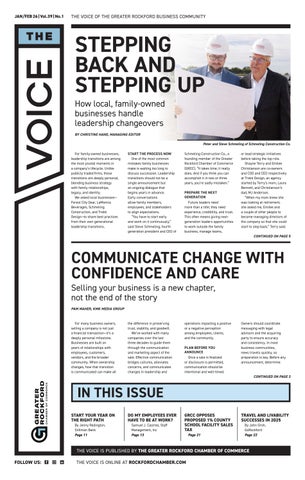
January/February VOICE 2026

Page 1


STEPPING BACK AND STEPPING UP

How local, family-owned businesses handle leadership changeovers

For family-owned businesses, leadership transitions are among the most pivotal moments in a company’s lifecycle. Unlike publicly traded firms, these transitions are deeply personal, blending business strategy with family relationships, legacy, and identity.

We asked local businesses— Forest City Gear, LaMonica Beverages, Schmeling Construction, and Trekk Design—to share best practices from their own generational leadership transitions.

START THE PROCESS NOW

One of the most common mistakes family businesses make is waiting too long to discuss succession. Leadership transitions should not be a single announcement but an ongoing dialogue that begins years in advance. Early conversations allow family members, employees, and stakeholders to align expectations.

“You have to start early and work on it continuously,” said Steve Schmeling, fourth generation president and CEO of

Schmeling Construction Co., a founding member of the Greater Rockford Chamber of Commerce (GRCC). “It takes time; it really does. And if you think you can accomplish it in two or three years, you’re sadly mistaken.”

PREPARE THE NEXT GENERATION

Future leaders need more than a title; they need experience, credibility, and trust. This often means giving nextgeneration leaders opportunities to work outside the family business, manage teams,

or lead strategic initiatives before taking the top role.

Shayne Terry and Emilee Christianson are co-owners and COO and CEO respectively at Trekk Design, an agency started by Terry’s mom, Laura Bennett, and Christianson’s dad, MJ Anderson.

“When my mom knew she was looking at retirement, she asked me, Emilee and a couple of other people to become managing directors of the company so that she could start to step back,” Terry said.

COMMUNICATE CHANGE WITH CONFIDENCE AND CARE

Selling your business is a new chapter, not the end of the story

PAM MAHER, KMK MEDIA GROUP

For many business owners, selling a company is not just a financial transaction—it’s a deeply personal milestone. Businesses are built on years of relationships with employees, customers, vendors, and the broader community. When ownership changes, how that transition is communicated can make all

the difference in preserving trust, stability, and goodwill.

We’ve worked with many companies over the last three decades to guide them through the communication and marketing aspect of the sale. Effective communication bridges cultures, alleviates concerns, and communicates changes in leadership and

IN THIS ISSUE

operations impacting a positive or a negative perception among employees, clients, and the community.

PLAN BEFORE YOU ANNOUNCE

Once a sale is finalized or disclosure is permitted, communication should be intentional and well-timed.

Owners should coordinate messaging with legal advisors and the acquiring party to ensure accuracy and consistency. In most business communities, news travels quickly, so preparation is key. Before any announcement, determine:

Peter and Steve Schmeling of Schmeling Construction Co.

Since taking the reins in summer of 2024, I’ve been guiding the GRCC in rebuilding our foundation to support our mission of leading business growth. I’m happy to report that with all that the staff, board, and volunteers have accomplished in the past 18 months, our foundation is solid, and we’re poised for growth in 2026 and beyond.

First things first, we built a clear, measurable strategic plan for the organization. In its second year of execution, we continue to live our mission and drive toward our vision to relentlessly grow, develop, and support a thriving business community. In doing this, we live our values every day and honor our promise to partner with members and the community to foster a business culture of equity and belonging.

Building on that strategy, we now have an economic development roadmap which was created with the expertise of 815 Impact consultants Terrance Hall and Matthew Simpson and launched in October. Terrance and Matt helped us accomplish more in less time, ensuring that the GRCC is equipped with the systems, processes, and tools to lead business growth through economic development initiatives.

These solid, well-documented, and communicated strategies allow us to further strengthen our committee and staffing structure to support implementation.

The GRCC is governed by a board of directors (you’ll find them along with our staff listing online at rockfordchamber.com/about-us) that appoints a slate of committees to collaborate with the staff in fulfilling our mission. Our committee structure includes executive, finance, economic development, talent, government affairs, nominating, and the Rockford Area Aerospace Network (RAAN). The board also appoints representatives to govern our charitable entity Rockford Area Strategic Initiatives (RASI) and our political action committee, ROCPAC. The committee structure ensures our work remains member-centric and business focused.

On the staffing front, we recently welcomed our new vice president of business expansion and attraction, Everett Butzine. Everett relocated to Rockford from the Madison, Wisconsin, area. As a credentialled economic developer through International Economic Development Council, Everett brings deep knowledge and breadth of expertise to the GRCC (see “More than a piece of dirt,” page 8). His primary focus is in executing the workplan from our economic development roadmap, including business retention and expansion visits, marketing the region as a great place to expand or bring your business, and connecting with developers and site

POISED FOR GROWTH

The GRCC’s readiness for 2026 and beyond

selectors—plus the myriad of analytics and tools it takes to understand and grow investments in our local economy.

We’ve also welcomed new talent to support recruiting and serving members. Our new director of sales and service, Michael Lacny, leads the team responsible for ensuring members receive maximum value for their investment in the GRCC (see “Greater Together,” page 8). In addition, Mike’s team (Kristin Muehlfelder and Jessica Prath) is responsible for hitting our targets for advertising and sponsorship sales to keep our products and services affordable, profitable, and sustainable.

Under the leadership of Carmen Kellerman, our events manager, we have designed a full array of gatherings for 2026. Members asked for more opportunities to “simply connect,” and we responded with six affordable, classic networking events scheduled throughout the year. At the same time, we are maintaining our most popular events, such as, The Rockford Mayor’s Address to the Business Community, golf classic, annual dinner, and more. And, we just confirmed new RPS205 superintendent Dr. Larry Huff to speak at a July event. Of course, we are already working on our two targeted, in-depth conferences—Pow(H)er in November and the Midwest Aerospace Conference (MAC), in partnership with our RAAN committee, in October. Details of events that are open for registration are on our website at rockfordchamber.com/event-calendar.

The GRCC Ambassadors have been a foundation of our organization for decades. These volunteers are wellknown for their appearance at ribbon cuttings and celebrations, and, in the months ahead, you’ll see them serving members and the business community in other ways. Under the leadership of our member services specialist, Kristin Muehlfelder, our ambassador volunteers will be assisting at events, curating connections at networking gatherings, and more. In addition, you’ll see them sporting our new brand in official GRCC Ambassador attire, thanks to our partnership with A New Look by Anisha, Tad More Tailoring, and Benny’s Cleaners. One of the most visible signs that the GRCC is poised for growth is our new logo and brand image. Following a regimented RFP and selection process, we chose Trekk Design to partner with us

in creating our new image (see “Stepping back and stepping up,” pg. 1 for more about this homegrown firm). We are thrilled to roll it out to our membership and business community here in the pages of the VOICE. You’ll begin to see it in all your interactions with the GRCC as we heighten our presence in the market.

The inspiration for our new identity is the phrase “greater together,” which we’ve adopted as a tagline. The icon represents our role in uniting businesses, partners, and regional stakeholders. As described by team Trekk, “Its bold, geometric weight conveys leadership and confidence, projecting a strong, unapologetic presence that aligns with an organization stepping into a new era of clarity and purpose.” The brand rationale further explains that “the abstract ‘G’ stands for ‘greater’ but also ‘growth.’ “The interwoven shapes reflect the Chamber’s function as a central connector within

the regional economic ecosystem, while the crafted negative spaces create an implied pathway, symbolizing guided progress, development, and forward motion. This pathway resolves into a subtle upward arrow, reinforcing momentum and economic advancement.”

We love how this imagery represents our work and are indeed emboldened and inspired by our new logo as we step into this “era of clarity and purpose.” We are poised for growth—for leading business growth—and we hope you’ll join us.

Angela Kay Larson, Greater Rockford Chamber of Commerce CEO, is a brand fanatic, having spent the majority of her career in communications and marketing. She has led several rebranding and new identity projects, including the rollout of applying the new logo to websites, social media platforms, sales materials, buildings, signage, coffee cups, t-shirts, toys, cowboy hats (your name it!), and of course, publications of all sizes and complexity. In appreciation of the attention to detail required to roll out a new identity, she crafted one of her many marketing truisms, “If you want to find a typo, print 50,000 copies.”

ABOUT THIS ISSUE …

It’s finally happening—the launch of GRCC’s new identity and the new look for the VOICE. We appreciate your patience and flexibility as we shuffled schedules and consolidated issues to give this launch the attention it deserved.

You’ll gradually start to see the new identity in more places as we roll out our implementation plan. If you advertise your status as a Chamber member on your company’s website, please email Doug Hessong at dhessong@rockfordchamber.com to request new logo art.

Now it’s time to dive into this issue of the VOICE, where you’ll meet new GRCC staff members, learn about succession planning, gain financial advice, get updated on new employment laws, and see the results of the Q4 2025 GRCC Business Sentiment Survey. It’s the issue you’ve been waiting for.

editor

UPCOMING EDITORIAL THEMES FOR THE VOICE

March – Marketing and Branding

April – The MATH issue (mathematics in business) May -- The Great Outdoors (sports, recreation, nature, outdoor occupations)

Chamber members are welcome to submit objective, thought leadership articles for publication in the VOICE. Visit rockfordchamber.com/the-voice for our editorial calendar, article guidelines, and advertising information.

• Will communication be joint or will the buying or selling company take the lead?

Who should hear the news first?

What will change and what will remain the same?

Who will speak on behalf of the business?

How will questions from employees, customers, and community partners be addressed?

Clear, aligned messaging prevents confusion and speculation.

EMPLOYEES: YOUR FIRST AND MOST IMPORTANT AUDIENCE

points. Be honest about what is known, what is still being decided, and when additional updates will be shared.

Reassure employees about continuity, job stability where possible, and the ongoing commitment to the company’s values.

Even when uncertainty exists, transparency builds credibility and helps maintain morale during transition.

CLIENTS: REASSURANCE MATTERS

For customers, especially those who value long-standing relationships, change can raise concerns. Communication should focus on reassurance and continuity. Customer messaging should emphasize:

For key clients, personal outreach, such as a phone call or meeting, can go a long way in reinforcing trust and demonstrating respect for the relationship.

PUBLIC RELATIONS: SHAPING

THE COMMUNITY NARRATIVE

Public relations play a vital role in shaping how the sale is perceived by the community, industry peers, and potential customers. A press release or Chamber announcement should highlight:

The history and accomplishments of the business.

• The strategic rationale for the sale.

• The positive outlook for employees and customers. Any ongoing involvement of the former owner, if applicable.

Proactive media outreach helps ensure accurate coverage and prevents speculation.

COMMUNICATION: YOUR STRONGEST BUSINESS ASSET

Pam Maher is president of KMK Media Group, Inc., a nearly 30-year-old marketing firm headquartered in downtown Rockford providing services to industries including construction, healthcare, finance, government, education, and entertainment. CONTINUED FROM PAGE 1

Employees are the heart of every business. They deserve to hear about a sale directly from leadership—not through rumors or headlines. Whenever possible, communicate the news in person, followed by written communication that reinforces key

Continued commitment to service and quality.

• Stability in operations, staffing, and relationships. Any benefits the transition brings to customers.

Handled well, communication during a sale can preserve goodwill, stabilize operations, and even enhance the value of the transaction. Handled poorly, it can create uncertainty and erode trust.

For business owners, investing time in a clear, coordinated communications plan is not optional—it’s a strategic must. By prioritizing employees, reassuring customers, and managing the public narrative, owners can ensure their business transitions with confidence and integrity, protecting their legacy and ensuring their company’s next chapter starts strong.

The views expressed are those of the author(s) and do not necessarily represent those of the Greater Rockford Chamber of Commerce.

FROM CORN TO KILOWATTS

The energy crop that grows year round

If you’ve ever driven through Northern Illinois and wondered how the corn grows so tall, the secret isn’t magic; it’s the official state soil, Drummer, dark as coffee and one of the most productive soils on Earth.

Long before Illinois farmers planted rows of corn or soybeans, the land itself was already working, quietly storing the sun’s power in its rich, black soil. For generations that “black gold” has transformed sunlight into life, feeding families, fueling economies, and powering progress across the Prairie State.

Farmers have been harvesting the power of the sun for a long time. Some of that solar energy gets turned into food for us and our animals. Some of the solar energy, however, is burned as fuel and converted to electricity. Of all the corn that farmers grow, today 35-40% is turned into ethanol.

Solar energy, like ethanol, is a tool for growing the economy. Ethanol was popularized in the 1980s as an ecofriendly supplement for gasoline. It was seen as a success story for rural economies and farm families, and it’s still a major part of the U.S. economy. As energy demand grows, converting some of the land used to grow ethanol into solar energy could create diversified

China has historically been one of the largest buyers of U.S. corn and soybeans, but recent demand has fallen significantly as the country has increased its imports from other suppliers such as Brazil. The share of soybeans China purchased from the U.S. dropped from 41% in 2016 to 20% in 2024, and, according to the most recent data from September 2025, China imported no U.S. soybeans at all.

Farmers, whose income depends on unstable foreign markets, see solar generation as an opportunity to save their family’s farmland. And the sun shines regardless of drought, flood, or freeze, meaning solar provides year-round income stability.

Solar energy could reduce the total amount of land required to power the U.S. It’s both more land-efficient and costeffective compared to other renewable sources. Today, more than half of all U.S. land dedicated to energy production is used to grow corn for ethanol, more than what’s used for coal mining, power lines, and pipelines combined. Yet, ethanol accounts for only about 5% of the nation’s total energy use and demands significant labor from farmers.

Solar gives farmers more choice about how to use their land. Solar doesn’t take

land out of production; it simply changes what the land produces. Instead of growing crops for food or fuel, it harvests the sun directly, generating clean, homegrown energy to power homes, schools, and businesses across Illinois.

American farmers are excellent at meeting U.S. demand, and always produce enough corn for animal feed, food products, exports, industrial uses, and ethanol production in the U.S. and for countries around the world.

Farmers are essential to the important work of powering our communities and producing American-made energy. Ultimately, it is the choice of the farmer

to decide how they use the abundant sun’s energy when it hits their land.

Gemini Solar is a proposed 224-megawatt, utility-scale solar project located in Winnebago County, Illinois. Developed by Geenex, Gemini Solar is designed to deliver long-term economic and environmental benefits to the local community. Once operational, it is expected to generate significant new tax revenue, create jobs, and provide reliable, locally produced energy.

The views expressed are those of the author(s) and do not necessarily represent those of the Greater Rockford Chamber of Commerce.

Anne-Marie Williams is the director of community relations at Gemini Solar. She works with landowners, community members, and local leaders to build understanding of utility-scale solar energy and how it can help preserve farmland, strengthen economies, and support the next generation.

income streams for farmers.
“Families matter and always will.”

“It was so useful and very smart of her to have that transition for us. We needed to actually go through it while she was still there to advise and guide us.”

Peter Schmeling, VP of sales at Schmeling Construction, has spent the past nine years preparing to be the fifth generation to lead the family business, including working for another construction company after college.

Carly LaMonica, third generation president of LaMonica Beverages in Loves Park, not only worked for another company for five years, but she also had to complete a multi-year training program required by the company’s largest supplier before being approved as successor to the family business.

ADDRESS FAMILY DYNAMICS OPENLY

Family relationships don’t disappear at the office door. Bringing in neutral third parties—such as advisors, facilitators, or family business consultants—can help families navigate

sensitive discussions productively.

Kika Young, third generation president of Forest City Gear in Roscoe, transitioned into leadership under less-than-ideal circumstances after both of her parents had to step back from their respective roles at the helm due to health issues.

“When I was running the company as interim president, we seriously considered selling, because my mom was worried it would be too much of a burden on our relationship as siblings. So, we worked with a private equity company and an investment banking company to explore our options,” Young said. “It was actually my sisters who decided they weren’t interested in selling and wanted me to run the business.”

Young’s sisters, Appy Mikel and Mindy Young, remain shareholders in the family business.

LaMonica admits she was nervous about how her transition to president might affect the relationship with her siblings who also have leadership

roles in the family business. Her brother, MJ LaMonica, is director of warehouse and logistics, and her sister, Jessie Fletcher, is director of business operations and successor manager.

“But I’ve been blessed to work with two of the strongest people I know in the business, and they work their butts off. We all pull our own weight, and our roles in the company are separate enough that we’re not on top of each other.”

COMMUNICATE CLEARLY TO BUILD TRUST AND RESTORE CONFIDENCE

Leadership transitions can create anxiety among employees, customers, and partners. Clear, consistent communication helps maintain trust and stability.

Terry and Christianson learned that although they had both worked at Trekk for several years, it didn’t mean the staff knew what to expect from them as leaders. So, they started writing an internal newsletter to share their vision for the company.

“We had to build trust with everybody from ground zero, because we’re not our parents; we’re not the same people. We’re just going to do things a little bit differently,” Christianson said.

“We couldn’t leave things open to interpretation; it was important to be explicit,” Terry said.

HONOR

CORE VALUES WHILE EMBRACING CHANGE

Successful transitions balance respect for the company’s history and values with openness to innovation.

“One of the things that I worked on very closely with my parents many years ago was defining our core values

The first and foremost is, ‘Families matter and always will,’” said Young. For the team at Trekk, fun and creativity are vital to the business culture. “If you’re doing creative work, it’s got to be a little fun. You have to have a lightness about it and a playfulness about it for those really creative ideas to come through. We do this job because it’s actually really fun, and we’re very lucky because we have wonderful clients,” Terry said.

PLAN FOR LIFE AFTER LEADERSHIP

One of the most underestimated risks in a family transition is an ambiguous post-transition role for the incumbent. When leaders “hang around” without clear boundaries, they unintentionally undermine their successor. Employees, customers, and stakeholders must understand that decisions now rest with the new leader.

“The hardest thing for me to give up has been my regular customers. When I was a project manager, I developed relationships with these people that have lasted for years. But I’m not their go-to guy anymore, and that gives a little punch to the ego,” Schmeling said. “But that’s OK. You want your children and your team members to succeed. And that’s how it should be.”

Generational leadership transitions are not just about replacing a leader—they are about positioning a family-owned business for long-term success. With early planning, open communication, and a willingness to adapt, families can turn a moment of change into a powerful opportunity to renew their business and preserve its legacy for generations to come.

ABOUT FAMILY-OWNED BUSINESSES

According to GALLUP.com, family-owned businesses: Account for 80% to 90% of the world’s firms.

Generate more than half of the U.S. gross national product.

According to the KPMG Private Enterprise Global Family Business Report 2025 (kpmg.com):

Only about 30% of family-owned businesses survive into the second generation. Only 12% of family-owned businesses survive into the third generation.

• Only about 3% of family-owned businesses survive into the fourth generation and beyond.

These statistics highlight the importance of succession planning and leadership development to ensure the long-term success of family-owned businesses.

Trekk co-owners Shayne Terry, COO, and Emilee Christianson, CEO, at GRCC’s PowHer 2025 Conference.
The LaMonica siblings (left to right) Jessie Fletcher, MJ LaMonica, and Carly LaMonica.
Kika Young (center), president of Forest City Gear, with sisters Appy Mikel (left) and Mindy Young (right).

IS YOUR ESTATE PLAN READY?

Preparing for the great wealth transfer

We have all seen the headlines— trillions of dollars of wealth are expected to change hands in the coming decades. Is your estate plan ready? Just as good health requires regular attention, so does your financial legacy. As one of the largest generational wealth transfers in history unfolds, families who proactively review their estate plans will be better prepared to preserve their intentions and values for future generations. My goal in this article is to help you identify whether you are prepared for this upcoming wealth transfer by asking three diagnostic questions.

Note for business owners: These considerations are particularly important if your business accounts for a substantial portion of your wealth. Succession planning, liquidity needs, and how ownership will shift can all influence the eventual transfer and may require additional planning to avoid potential complications later.

ARE YOUR BENEFICIARY DESIGNATIONS CURRENT?

Beneficiary designations play a central role in wealth transfer. In many cases, these designations determine the distribution of more assets than a trust or last will and testament. Yet many people rarely review them. Some of the more common beneficiary designation issues include:

A spouse is named who is now an ex-spouse.

No contingent beneficiary is listed. Beneficiaries are unintentionally excluded (such as after-born children). Do not assume your designations

are correct. Make a habit of reviewing them each year. If you are still working, open enrollment is a convenient time to take a second look.

IS YOUR REVOCABLE TRUST FUNDED?

A revocable trust is a common estate planning document that often serves as the primary go-to at the time of death. One of its main benefits is that a properly funded trust allows assets to be administered without going through probate, a step that may save your loved ones time and substantial legal costs.

However, a revocable trust is only effective to avoid probate for the assets you title in its name during your lifetime.

A trust’s instructions cannot govern an asset that is not titled in the trust. Retitling is often neglected, but it is critical to the health and effectiveness of the estate plan. A perfectly drafted trust accomplishes very little if it does not hold any assets. If you have a revocable trust, review the ownership of your real estate, business interests, and investment accounts to ensure they are properly titled. This is especially important if you own properties or business interests in multiple states, where titling can be more complex.

ARE THE RIGHT PEOPLE IN CHARGE?

Review your estate planning documents to confirm that the right individuals are named to administer your estate. Thoughtful selection is essential to carrying out your wishes and supporting family harmony. However, many people default to naming children in birth order, which may overlook important considerations such as availability, competency, or geographic proximity.

For example, your oldest child may be fully capable, but if they live thousands of miles away, it may be difficult for them to act effectively. Consider who is best suited for each role and take time to discuss your decisions with your loved ones.

FINAL THOUGHT

My hope is that this article serves as a catalyst to proactively review your current estate plan, especially your beneficiary designations, the funding of your trust, and the individuals you have named to administer your estate. Just as important, sharing your decisions with your family may reduce confusion and provide the clarity needed when decisions must be made, especially if a family business is involved. Taking these steps today helps

lay the groundwork for a thoughtful transfer of wealth as this significant generational shift continues to unfold.

Midland Wealth Management is a trade name used by Midland States Bank, Midland Trust Company, and Midland Wealth Advisors, LLC, a registered investment adviser. Services offered by Midland Wealth Advisors, LLC are separate from Midland States Bank and Midland Trust Company. Midland States Bank is Member FDIC. Investment products and services are not FDIC insured, not deposits, and may lose value.

The views expressed are those of the author(s) and do not necessarily represent those of the Greater Rockford Chamber of Commerce.

Doug Warren, JD, senior trust officer at Midland Wealth Management, serves clients through a personalized, relationship-driven approach, supporting families throughout the trust and estate administration process. He brings more than 15 years of fiduciary and legal experience, having previously practiced as a trust and estate attorney, specializing in complex planning matters.

MEMO TO EMPLOYERS FOR 2026

Don’t underestimate the importance of soft skills

Let’s say you own, manage, or staff an organization in the Rockford Region that employs welders, electricians, nurses, or other practitioners of skilled trades. Maybe you have some job openings to fill, and you’re looking to start the new year right. Nothing unusual there. According to the Greater Rockford Chamber of Commerce (GRCC) 2025

Q3 Business Sentiment survey, 34% of respondents reported an increase in staff. So where should you search for qualified candidates? You could ask your colleagues for recommendations and referrals. Or you could retain a recruiter. Or you could check online job services. All well and good.

But here’s another option … You could contact your local vocational school. I’ve worked in higher education for 23 years and served as president of a vocational college for the last 11 years.

Here are some lessons I’ve learned.

Vocational schools, whether at the high school or college levels, place a premium on training students in hardcore technical abilities. But the best of the best also teach the so-called soft skills.

Employers who overlook or underestimate the importance of soft skills risk missing out on wellrounded employees. Our employer partners throughout the Rockford area frequently tell me they’re looking for job candidates who are:

1. Coachable. They’re curious, eager to learn the ropes, and pay close attention to mentors and supervisors. They’re open to being molded to fit the job at hand.

2. Cooperative. They can get along with others, reconcile differences, and act in good faith. They also show up on time.

3. Communicative. They can express themselves clearly, convey ideas, and

look you in the eye doing so. They’re rarely buried in a phone screen or relying on ChatGPT to compose an email. Knowing how to talk to people is the ultimate equalizer.

Those are among the personal and professional qualities that the global job marketplace in general, and Rockford employers in particular, have a right to expect and demand from new college graduates.

As we tell our students, “Technical skills will get you only so far. You may know how to weld or nurse, but unless you’re coachable, cooperative, and communicate effectively, you’ll never go anywhere. You’ll have to be outstanding in all three departments to elevate yourself and maximize your earning potential.”

When it comes to hiring from vocational schools, I’ve taken the pulse of our business community at GRCC events. They want employees who can pivot and elevate on a continuous basis. This is how business grows.

I’m seeing more demand than ever for graduates who’ve undergone career education. And we are seeing the needs of adult learners shift as well. To satisfy that growing demand, we meet regularly with our local business partners, as well as high school students and guidance counselors, to maintain strong relationships.

Rockford is an ideal place for a vocational school to be of the utmost community service. The city still commands a strong industrial base, primarily in advanced manufacturing, aerospace, healthcare and life sciences, and logistics and distribution. For skilled trades, those sectors represent nothing less than the future for generations to come.

Rockford Career College is the seventh oldest career training college in the United States and the oldest of its kind in Illinois.

The views expressed are those of the author(s) and do not necessarily represent those of the Greater Rockford Chamber of Commerce.

Michael O’Herron, president of Rockford Career College, has served in higher education for 23 years. He’s also a team leader for the Accrediting Commission of Career Schools and Colleges.

MORE THAN A PIECE OF DIRT

GRCC’s new VP shares what economic development means to him

In January, the Greater Rockford Chamber of Commerce (GRCC) welcomed Everett Butzine, CEcD, as its new vice president of business expansion and attraction. Newly relocated from Madison, Wisconsin, where he served as the interim president and CEO of the Madison Region Economic Partnership, Everett brings a heart for community and a passion for economic development to his new role at the Chamber.

What made you decide to go into economic development?

I earned two undergrad degrees—urban planning and geography—but I really didn’t know what economic development was. Luckily, I kind of fell into it in my first job out of college, and I fell in love with it.

I realized that the things I was passionate about when I was younger are what economic development is all about; I just didn’t know the terminology for it. I had an infatuation with old river cities, old industrial cities, old architecture. I saw how my hometown went into recession after a large manufacturing corporation left. And I was obsessed with Detroit, for whatever reason, and its history and struggles. One of my undergrad professors was from Detroit, and he told us stories of seeing houses

and entire city blocks demolished by bulldozers. That had an impact on me.

What does the CEcD after your name stand for?

The International Economic Development Council is the gold standard for economic development, best practices, and advocacy, and they have an economic development certification, the CEcD.

Early on in my career, I was very aware that I wanted to hold leadership positions in economic development. I knew getting my master’s degree and getting certified were a part of that. The IEDC certification process is extremely difficult. It has a 33% success rate of passing the exam on your first try. Fortunately, I was among the 33%. You have to take a plethora of courses and sit for three days of testing. It’s pretty intensive but worth it to be part of this network of economic development professionals. It’s a symbol of credibility, integrity, and the standard I operate at as a practitioner.

What are some of your early impressions of the Rockford Region?

I actually have past experience with Rockford. My stepfather’s family is from here, and I’ve been coming here since I was nine years old. I think there’s a renewed excitement that people have

GREATER TOGETHER

A letter to the business community from the new kid on the block

It’s week two of my new position here at the Greater Rockford Chamber of Commerce (GRCC) and our managing editor asked me to write a piece about membership. I’m a Rockford area resident and have been for over 38 years, but I have never stepped foot into the Chamber office before taking this job. So, I’m thinking … What can I really share about membership as the new kid on the block? Then I thought … Wait, my first week is no different than any business person learning about GRCC. I share the same perspective that all membership inquiries experience. So, here’s what I’ve learned in my short time at the Chamber. GRCC members are serious about connecting and growing their businesses. Members

about the community and the region as a whole. I’ve noticed a positive energy, whether it’s a simple hello or a thank you for holding the door open, whatever it may be. People seem a lot happier to be a part of the community.

Rockford has a lot of potential, and the collaboration is strong. I believe it’s at a tipping point to skyrocket. What are some of your immediate goals in your new role?

Moving to Rockford was obviously a big priority. Being a part of the community is important to me. I look forward to getting better acquainted with local businesses and key stakeholders. I’m also focused on implementing the strategies that GRCC laid out in its economic roadmap prior to me joining the team. And I’ll be making sure there are no gaps in the work that we should be doing. What would you say is the biggest challenge for the Rockford Region when it comes to economic development?

I think fighting past perspectives is one of the biggest things, which is a challenge everywhere, not just here.

whether they’re customers or not.

I’ve learned that the team at GRCC is creative, professional yet “real,” and engaged at multiple levels in the community. They care about small businesses with just a few employees as well as businesses with thousands of employees. They care about business retention and expansion and the growth of the community, creating a favorable atmosphere for businesses in the Rockford Region.

are the movers and shakers in the region; they are known and strive to stay at the forefront of the community. They know that making connections with the right people leads to increasing their chances of winning in business.

Connecting with a professional nonprofit organization like the GRCC lends third party credibility to everything your company does. In an age where so many products and services are commoditized, business owners need to find ways to stand out. B2B and B2C customers are more comfortable doing business with companies that are visible, engaged with their local community, and part of a professional organization. This is how businesses demonstrate that they care about the region and its people—

New this year, the GRCC has added Coffee & Connections events at our offices throughout the year to help members network. These “come-as-youare” events have no agenda apart from making connections and learning from each other. As more people return to the

Everett with his dog, Remi, whom he graciously shares with his coworkers at the GRCC office.

If people have an outdated or narrow perspective, it can limit ambitions.

The role of the Chamber is to be the driver and the motivator. We’re making economic development big and impressive and exciting so people want to be a part of it and we’re all moving in the same direction. What would you say is the Rockford Region’s biggest asset?

The people. First and foremost, economic development is all about people and collaboration— employers, employees, civic leaders, educators, all working together.

I believe perspectives are changing and people have a real sense of pride. There’s a growing collective willing to cooperate to make things happen.

You can have all the land in the world with utilities, infrastructure, and more. But if you don’t have people in the community working together, that piece of land is just dirt, and it’s just going to stay dirt. But if people are willing to collaborate and show mutual respect, that piece of dirt will actually become something.

office, there’s a greater desire to drop the multi-tasking video call and meet face to face with real people. It’s refreshing, and you know you’re being seen and heard. Just the other day I met with a couple who are starting their own business. We sat down and discussed their plans and goals. They recognized that being part of the Chamber is a foundational first step to establishing and growing their business in the Rockford area. It’s great to know that we can help them gain exposure, connect with the community, build credibility, and develop professionally.

Personally, I look forward to taking part in many more of these meetings with new and existing GRCC members. I hope you’ll let me know how I can help bring value to your business and our community, so we can become Greater Together.

Mike Lacny is GRCC’s new director of sales and service. He leads strategic membership growth and oversees service excellence, including member benefits, sponsorship, and advertising. Mike admits that he doesn’t like selling, but he does enjoy helping people buy things.

2026 GRCC BOARD OF DIRECTORS

Conor Brown, Chair NorthWest Illinois Alliance of Realtors
Travis Andersen UW Health Northern Illinois Region
Troy Haggestad WilliamsMcCarthy LLP
Peter Schmeling Schmeling Construction Co.
Mayor Tom McNamara City of Rockford
Wendy Alsteen, Vice Chair Hard Rock Casino
David Anspaugh Northern Illinois Building Contractors Association
Sheila Hill Think Big Corporation
Jose Solorzano Solorzano & Associates Agency LLC
Michael Dunn, Jr. Region 1 Planning Council
Nate Jordan, Treasurer Illinois Small Business Development Center
Dietmar Goellner Advanced Machine Engineering & Hennig
Jeff Hultman Foresight Financial
Alexis Wright Conniff Woodward
Gina Caronna The Workforce Connection
Lesly Couper Immediate Past Chair Workplace
Alec Grabowski OSF Healthcare
Carly LaMonica LaMonica Beverages
Kika Young Forest City Gear
John Groh GoRockford
Thomas Green Barrick, Switzer, Long, Balsley & Van Evera, LLP
Roger Raley Waldom Electronics
Angela Kay Larson Greater Rockford Chamber of Commerce

LOOKING BACK ON 13 YEARS

Lasting change takes time, teamwork, and humility

As my time as superintendent winds down this July, I’ve been reflecting on what these past 13 years have meant for me personally, for our schools, and our community. One thing is clear to me; I have a lot to be thankful for.

The Board of Education placed an incredible amount of trust in me, and I never took that trust lightly.

Now that the board has selected the next superintendent, I’m grateful for the opportunity to support a smooth transition over the next several months. I look forward to sharing what I’ve learned along the way; both what I’m proud of, and what I wish I had handled differently.

Because 13 years in this role is a long time, and after more than a decade of shared effort, it’s clear that real, lasting change takes time, teamwork, and humility.

PARTNERSHIPS THAT MADE A DIFFERENCE

Looking back, the work that stands out most wasn’t done alone. The

biggest wins were the result of strong, consistent collaboration between the district, city, and community partners.

Take Rockford Promise. What started with a single scholarship in 2011 has grown into the leading location-based scholarship program in Illinois, with more than 500 students at NIU, Rock Valley College, Rockford University, and St. Anthony’s College of Medicine. It’s a partnership that’s changing lives.

Consider also our district facilities.

When I arrived in 2011, school buildings had gone decades without major updates. With two successful referendums and $500 million invested in improvements, students now learn in brighter, safer, more modern spaces, complete with air-conditioned classrooms and a cutting-edge college and career center in the new QUAD.

And let’s not overlook financial stewardship. RPS now has the lowest property tax rate among 11 area school districts and has held that title for two years running. With thoughtful planning,

Serving as superintendent of Rockford Public Schools since 2013 has been a true honor.

help from the state’s evidence-based funding model, and steady leadership from the RPS 205 board, we’ve lowered our tax rate from $7.93 to $4.70 between 2015 and 2025. That has saved taxpayers hundreds of millions and driven a 40% increase in local property values.

LESSONS I’LL CARRY FORWARD

Still, not everything went perfectly, and I’ve learned a lot from the moments I’d handle differently. I’ll be honest about those experiences with my successor, because I believe that transparency makes us all better.

I also want to help him understand the importance of the long game. Every meaningful improvement we’ve seen— whether it’s Rockford Promise, new facilities, or financial stability—took more

than a decade of focused, sustained effort. That kind of progress doesn’t come from quick fixes. It comes from consistency, partnership, and shared vision.

I feel confident about where RPS stands today. The turbulent times before 2013, when the district saw 11 superintendents in just 14 years, feel further and further behind us. But keeping that stability requires all of us to stay engaged, focused, and committed to working together.

We’ve come a long way, but there’s still more to do.

The views expressed are those of the author(s) and do not necessarily represent those of the Greater Rockford Chamber of Commerce.

Dr. Ehren Jarrett is superintendent of Rockford Public Schools, where he has led transformative changes aimed at improving educational outcomes and supporting the community.

START YOUR YEAR ON THE RIGHT PATH

How to get your financial house in order

As a business owner, the day-to-day grind often takes over any strategic planning for the future. I challenge you to take a few hours in these early months of 2026 just for strategic planning and getting your financial house in order. These few hours now may save you countless hours later in the year. Here’s a checklist to help get you started. Make sure you are maintaining completely separate personal and business finances. I know, it’s easy to say I’ll buy this on my personal credit card now and pay myself back later. But later may never get here; life gets in the way. Using dedicated business bank accounts and credit cards makes life easier in the long run by simplifying your accountant’s life and protecting yourself both legally and financially. This includes setting up

a regular, consistent salary for yourself. Implement a cloud-based accounting software. This isn’t just for the medium to large business owner; manual spreadsheets are a cumbersome and inaccurate way to report your financial picture. Many software solutions make it much easier to track down an item later in the year than sorting through random files. Review 2025 performance. This may seem like a given, and many business owners do this in their head, but taking the time to actually analyze income statements, balance sheets, and cash flow reports (all easily accessible in a cloud-based accounting software system) to help identify problem areas and successes is a great way to plan for your 2026 budget. Speaking of budget … Be

sure to factor in potential cost increases due to inflation (including labor). We recommend a cash reserve of at least six months of operating expenses. Review employee benefits. Ensure you’re taking advantage of the tax breaks available to your business and that your benefit expenses are in line with current market prices. That 401(k) plan that has been in place for years may not have been benchmarked in quite some time. Believe it or not, that is one benefit expense that has seen a large decrease in the past several years. Your plan sponsor or a financial advisor who works with employer plans can help with this. Also, many local financial institutions offer no-cost benefits to your employees, such as financial education, in-office setup of accounts, and direct deposit.

Set a schedule for regular reconciliation and reviews of all your bank, investment, and credit card statements. Schedule a regular checkin with your financial advisor to make

the process less overwhelming in the future and keep you accountable. Review your legal documents. Now is a good time to review your most important documents, including employment contracts, vendor agreements, estate planning documents, and transfer-on-death beneficiaries, to verify that all are up to date.

Stillman Bank is a locally owned, full-service community bank founded in 1882, serving individuals, businesses, and agricultural customers across northern Illinois. With multiple branches and personalized service, it offers checking, savings, loans, trust, and wealth management, and digital banking—combining modern solutions with a hometown touch.

The views expressed are those of the author(s) and do not necessarily represent those of the Greater Rockford Chamber of Commerce.

Jenny Redington is a financial advisor at Stillman Bank with over 25 years of experience in financial services, specializing in financial planning and wealth management. She holds a degree from Judson University, as well as the Chartered Retirement Planning Counselor (CRPC™) and Certified Financial Planner (CFP®) designations.

SMOOTH EXIT PLAN

Explore your transition options

Delaying exit planning until you’re ready to retire often results in rushed decisions and missed opportunities. Taking time now to understand your company’s value and explore transition options can help you secure a better outcome, whether you intend to sell in a few years or a few decades.

WHY BUSINESS VALUATION MATTERS

A formal valuation gives you a clear, objective measure of your company’s worth. Without it, you’re essentially guessing when making decisions about retirement income, tax strategies, or estate goals. It also helps determine which exit paths might yield the best results. Different valuation methods produce different perspectives on worth:

Asset-based valuations add up everything the business owns and subtract liabilities. This is useful to estimate the value of hard assets, which buyers often find important. This is also used to help determine liquidation value.

Income-based valuations focus on cash flow, assessing how steady it is and whether it’s expected to grow or shrink after you leave. This approach provides the buyer with a realistic picture of cash available to fund debt and provide distributable earnings after purchase.

Market-based valuations compare your business to recent sales of similar companies, offering insight into what buyers are currently paying in for businesses like yours.

Industry “rules of thumb” provide quick estimates, often based on multiples of revenue or earnings. While convenient, these averages can’t account for your company’s unique strengths, risks, or growth potential.

Understanding these approaches allows you to have a more informed conversation about value and helps you recognize how changes in operations or market conditions might impact your eventual payout.

CHOOSING YOUR TRANSITION PATH

When it’s time to step away, business owners have several options—each with its own trade-offs.

• Selling to a strategic third-party buyer often produces the highest price. These buyers typically seek operational efficiencies and economies of scale.

Transferring ownership to family members or your management team can preserve your legacy and keep the business in trusted hands.

• Some owners keep their business but reduce involvement, stepping back from daily management while retaining ownership.

Liquidation is usually the least desirable option but may be necessary if the business isn’t saleable due to declining performance or market shifts.

STARTING THE PLANNING PROCESS

As you start to plan, consider questions, such as:

Do you have a detailed, written succession plan?

How much will you need, after taxes, to fund your retirement lifestyle? Could your business operate effectively without you for 30 days or more? If not, what steps could reduce owner dependence and strengthen operations?

Enhancing efficiency, documenting processes, and mentoring future leaders reduces risk and makes your company more appealing to buyers. This is intended for informational purposes only and should not be construed as personalized financial advice. Please consult your financial professional regarding your unique situation.

The views expressed are those of the author(s) and do not necessarily represent those of the Greater Rockford Chamber of Commerce.

Drake Grindle is a financial advisor for Savant Wealth Management, headquartered in Rockford, IL. He specializes in comprehensive financial planning, including tax strategies, retirement income optimization, and wealth transfer. His background includes public accounting and financial statement audits for clients in a variety of industries.

Michael Mesch is a director of Savant Tax & Consulting in Cedar Rapids, IA, and an accredited senior appraiser (ASA). Since 2001, he has specialized in tax preparation, audits, and valuations for a variety of businesses. He also has extensive experience in financial and operational consulting.

DO MY EMPLOYEES EVER HAVE TO BE AT WORK?

Recent new and amended Illinois leave laws

Over 15 state and federal laws provide employees with protected leave and time off from work. Illinois employers will soon need to navigate new and expanded employee leave rights, most of which took effect on Jan. 1.

Neonatal Intensive Care Leave Act.

Significantly, the Neonatal Intensive Care Leave Act (effective June 1, 2026) introduces new unpaid leave rights for employees with a child in a neonatal intensive care unit (NICU). The law defines “child” broadly, including biological, adopted, foster, and stepchildren, as well as legal wards and children for whom the employee stands in loco parentis. Leave entitlement varies by employer size:

• 16–50 employees: 10 unpaid days

• 51 or more employees: 20 unpaid days

Employees may take leave in increments as short as two hours, and the leave is in addition to any available under the federal Family and Medical Leave Act (FMLA). Employers must maintain health insurance and reinstate employees to their jobs after leave. While verification of the child’s NICU stay is allowed, employers cannot request HIPAA-protected information.

Expanded Protections Under VESSA.

Amendments to the Victims’ Economic Security and Safety Act (VESSA), went into effect Jan. 1, 2026. The law continues to provide leave for victims of domestic, sexual, gender, or other crimes of violence and their family members. The amount of leave depends on employer size:

• 50+ employees: 12 weeks

• 15–49 employees: 8 weeks

• 1–14 employees: 4 weeks

New provisions add protections for an employee’s personal use of employerprovided electronic devices, such as cell phones. Employers may not penalize an employee “because the employee used employer-issued equipment to record domestic violence, sexual violence, gender violence, or any other crime of violence committed against the employee

or a family or household member of the employee.” Employers must also allow employee access to such recordings.

Blood and Organ Donation Leave Act.

Starting Jan. 1, 2026, amendments to the Blood and Organ Donation Leave Act extend paid organ donation leave to part-time employees. Organ donation leave was previously limited to an employer’s full-time staff. Employees may also continue to take up to one hour of paid leave every 56 days to donate blood and up to 10 paid days annually for organ donation.

Military Leave Act Updates. Effective August 1, 2025, the Military Leave Act—formerly the Family Military Leave Act—establishes a paid leave benefit to participate in a funeral honors detail for veterans. Eligible employees may take up to eight hours per month and 40 hours per year at their regular rate of pay. Employers at 24/7 care facilities may deny leave if staffing would fall below safe levels.

An employee is eligible for paid leave if the employee is trained to participate in a funeral honors detail and : (1) is a retired or active member of the armed forces, a reserve component, or the Illinois National Guard; or (2) an authorized provider or a registered member of a nonprofit or other organization authorized provider, including a member of a veteran’s service organization. What employers should do now? With these looming changes, Illinois employers should:

Review the law to determine if they are a covered employer.

Review and update leave policies and handbooks to ensure compliance. Train HR teams and managers on new requirements.

• Prepare for additional recordkeeping and verification processes.

The views expressed are those of the author(s) and do not necessarily represent those of the Greater Rockford Chamber of Commerce.

Samuel J. Castree is senior vice president and general counsel at Staff Management, Inc., a multi-state certified professional employer organization and human resource management consulting and outsourcing firm. His responsibilities include chief legal officer and management of the firm’s human resource outsourcing services.

THE BITCOIN STANDARD

The high price of not acquiring bitcoin in the early days

One of the earliest conversations I recall about bitcoin took place at Oscar’s Pub and Grill in 2016. A friend, celebrating his last day at Road Ranger, enthusiastically described this “magic internet money” and predicted that its value in dollars would rise significantly. I foolishly disagreed with him and did not listen to any of his reasons in favor of the new asset class. At the time, one bitcoin was priced at just over $400. Today, as I write this, the same bitcoin would cost around $90,000. He was right; I was wrong.

In 2016, my ego prevented me from seriously exploring this emerging technology. Instead, I echoed the dismissive views common among many financial professionals at the time—views that, regrettably, some still hold today … It’s a scam … It’s a Ponzi scheme … It’s a bubble. These were uninformed opinions. Because I failed to conduct my own research, I have since paid a higher price—literally—for acquiring bitcoin.

Bitcoin regained my attention in 2017, when its price rose from under $1,000 at the start of the year to approximately $20,000 by year-end. More acquaintances were discussing it, prompting me to attempt trading it for dollar profits. I still did not fully understand it, but I found the speculation exciting. My focus was on maximizing dollar gains rather than accumulating bitcoin itself—a perspective I would later recognize as misguided.

The year 2020 brought unprecedented global disruption. I remember the confusion when my office announced an indefinite shift to remote work. Initially, my days were consumed with reassuring clients amid market uncertainty. Once things stabilized, with remote work continuing, I finally committed to exploring bitcoin in depth.

That exploration fundamentally changed my viewpoint. What if, instead of pricing goods and services in dollars, I priced them in bitcoin? Doing so made life appear progressively cheaper. I began calculating past purchases in bitcoin terms and was struck by the results.

For example, in 2012 I purchased a house for $84,000—equivalent to approximately 7,000 bitcoin at the time.

After some improvements, I sold it in 2021 for $152,500, or about 3.81 bitcoin. In dollar terms, this represented a solid gain of $68,500. In bitcoin terms, however, the property had depreciated dramatically, costing me nearly 6,996 bitcoin in opportunity terms.

I applied the same analysis to other purchases:

An Apple Watch purchased in 2015 for $249 (about 1.08 bitcoin). That bitcoin would now be worth more than $97,000, and the watch would equate to approximately 0.0027 bitcoin.

A new Jeep Wrangler bought in 2019 for an estimated $50,000 (around 12.5 bitcoin). Even assuming no depreciation in dollar value, it would today represent only about 0.55 bitcoin.

Virtually everything becomes less expensive when measured in bitcoin over time. I encourage you to apply this exercise to your own past expenditures— it can be extremely eye opening.

For an even more striking perspective, calculate what those dollars would be worth today had they been used to purchase bitcoin instead of the item in question. Be prepared, however; the results may induce significant buyer’s remorse. Proceed with caution!

Digital assets are speculative and highly volatile, can become illiquid at any time, and are for investors with a high-risk tolerance. Investors in digital assets could lose the entire value of their investment. In addition, bitcoin markets and exchanges are not regulated with the same controls or customer protections available in equity, option, futures, or foreign exchange investing.

Vista Investment Partners II, d/b/a Orange Horizon Wealth is an independent financial services firm and uses a variety of different investment strategies. Neither the information nor any opinion expressed is to be construed as a solicitation to buy or sell a security or personalized investment, tax, or legal advice.

The views expressed are those of the author(s) and do not necessarily represent those of the Greater Rockford Chamber of Commerce.

Jeff Aurand is an accomplished financial advisor with over two decades of experience in the financial services industry.

Based in Rockford, Jeff serves clients as a wealth advisor with Orange Horizon Wealth, focusing on personalized financial planning, investment management, and retirement strategies.

FIVE TIPS FOR USING AI RESPONSIBLY

Things small businesses must have in place to protect their organizations in 2026

Artificial intelligence is already embedded in many small businesses, often more deeply than leaders realize. Employees are using AI to draft emails, create marketing content, analyze information, and respond to customers, sometimes without formal guidance or oversight.

That reality makes one thing clear: The challenge heading into 2026 is not whether small businesses will use AI, but whether they are using it responsibly, with enough leadership clarity to protect their people, data, and reputation.

Based on current research and realworld leadership patterns, here are five essentials small businesses must have in place to use AI responsibly and avoid costly missteps.

1. CLEAR OWNERSHIP OF AI DECISIONS

One of the most common mistakes small businesses make is treating AI as a technical or operational issue. In reality, AI affects workflows, customer interactions, data use, and employee trust. Someone at the leadership level must be accountable for how AI tools are selected, approved, and monitored. Without that ownership, adoption becomes fragmented and reactive. Research summarized in The State of AI by McKinsey & Company consistently shows that organizations struggling to realize value from AI often lack clear leadership direction and accountability.

2. DEFINED BOUNDARIES FOR AI USAGE

Responsible AI use starts with boundaries. Small businesses should be explicit about:

What types of data may be used with AI tools. Which decisions should never be fully automated. Where human review is required.

Without these guardrails, organizations risk inconsistent outputs, data exposure, or decisions that conflict with company values. Gartner’s research on AI adoption repeatedly identifies governance gaps as a primary reason AI initiatives stall after early experimentation.

3. EMPLOYEE CLARITY AND PSYCHOLOGICAL SAFETY

AI creates uncertainty, especially in smaller organizations where roles are closely tied to job security and identity. When leaders do not explain how AI fits into the business, employees fill in the gaps themselves, often with fear or quiet misuse. In practice, this may look like employees pasting sensitive information into AI tools or relying on outputs they don’t fully trust, simply because expectations were never clarified. The World Economic Forum emphasizes that workforce readiness, transparency, and trust are critical to successful AI adoption. For small businesses, where culture is often a competitive advantage, this clarity is essential.

4. A BASIC REVIEW PROCESS

AI tools and their impacts change quickly. Leaders should periodically review how AI is being used, whether outputs remain accurate and appropriate, and whether unintended consequences are emerging. According to leadership and transformation analysis published by Harvard Business Review, organizations that treat AI as an ongoing leadership responsibility, rather than a onetime rollout, are far more likely to achieve sustained value over time.

5. FOCUS BEYOND EFFICIENCY

Efficiency is often the starting point for AI adoption, but it should not be the finish line. Leaders should also consider the long-term effects on

Tiffany Ingram is a business strategist and executive advisor who works with organizations navigating leadership, workforce, and technology change. She focuses on helping leaders adopt emerging technologies responsibly while protecting culture, trust, and long-term performance.

employee engagement, customer trust, and decision quality.

As AI becomes more autonomous and embedded into daily operations in 2026, research and advisory insights suggest the cost of unstructured adoption will rise, especially for smaller organizations without formal safeguards.

LEAD RESPONSIBLY INTO 2026

AI is not inherently risky. What creates risk is unstructured adoption without leadership clarity. Small businesses do not need enterprise-level bureaucracy to use AI responsibly. They need leaders who make expectations clear, set boundaries early, and stay engaged as technology evolves.

The organizations that win with AI will not be the fastest adopters;

they will be the most intentional. And that intentionality starts with you making the decision today to lead with clarity. I encourage you to make today the moment you step up and own your AI strategy. Your people, your customers, and your future are counting on you to get this right.

Luxe Link Business Solutions is a consulting firm that supports organizations with leadership strategy, workforce readiness, and responsible technology adoption.

The views expressed are those of the author(s) and do not necessarily represent those of the Greater Rockford Chamber of Commerce.

THE EQUITY ALGORITHM

Benefits of nurse-led AI

Health disparities in marginalized communities are not random occurrences; they are predictable outcomes of longstanding structural inequities. Nurses have historically been the frontline responders to these inequities, yet our systems remain largely reactive. The emergence of artificial intelligence (AI) offers a transformative opportunity—not to replace nurses but to amplify our ability to influence outcomes, detect early risk, and restore trust in communities that healthcare has historically underserved.

DISPARITIES AS DATA GAPS

Disparaged communities experience poorer outcomes not because of individual shortcomings but because of systemic barriers: inaccessible care, lack of transportation, limited health literacy support, cultural barriers, and delayed follow-up. AI transforms these inequities from vague concepts into measurable, analyzable patterns— creating opportunities for intervention long before a crisis occurs.

AI AS AN EARLY-WARNING SYSTEM

Nurses often recognize subtle clinical cues before they appear in a chart. Predictive AI enhances this by identifying population-level risks such as uncontrolled chronic conditions, asthma exacerbations tied to environmental factors, and early indicators of mental health decline. When paired with nurse interpretation, AI becomes a powerful prevention tool.

NURSING ENHANCED BY TECHNOLOGY

For communities that lack reliable access to healthcare, AI-supported nursing models—including mobile care units, virtual triage, and culturally tailored education—provide a lifeline. These solutions reduce no-show rates, strengthen continuity of care, and make health services more accessible and culturally relevant.

RESTORING TRUST THROUGH HUMAN-CENTERED TECHNOLOGY

Technology alone does not build

trust; nurses do. However, AI enables personalized education, anonymous symptom screening, language translation, and bias detection—tools that support nurses in rebuilding credibility and creating culturally safe spaces for care.

PREPARING THE NEXT GENERATION

To close the equity gap, nursing education must evolve. A proposed new specialty—Equity Nursing with AI Integration™—includes training in predictive analytics, algorithm bias mitigation, digital ethics, community engagement, and datadriven advocacy. Nurses become not only clinicians but equity strategists empowered by real-time insight.

NURSES AS SYSTEM DISRUPTORS

AI equips nurses with measurable evidence of inequity, enabling advocacy grounded in data rather than anecdote. With this capability, nurses can influence policy, redesign care

workflows, and challenge structures that perpetuate disparities. AI does not diminish nursing—it elevates it.

The future of health equity depends on nurses who are willing to innovate, advocate, and redefine how care is delivered. AI provides the tools; nurses provide the humanity. Together, they form a new paradigm where disparities are no longer inevitable—they are preventable.

Illinois Institute of Nursing Studies, Inc. is a Rockford-based nursing education organization focused on preparing practical nurses and nurse aides for entry into the healthcare workforce. The institute emphasizes academic excellence, workforce readiness, community engagement, and equitable access to nursing education across diverse populations.

The views expressed are those of the author(s) and do not necessarily represent those of the Greater Rockford Chamber of Commerce.

Linda Lowry, RN, is a registered nurse, nurse educator, and healthcare entrepreneur based in Rockford, Illinois. She has spent more than a decade promoting asthma awareness, nursing education, workforce development, and communitybased care, with a focus on health equity, innovation, and system-level change.

FUTUREPROOF YOUR LEGACY Succession planning for small businesses

Succession planning is one thing every small business owner should prioritize early and revisit often. Depending on the structure and scope of the business, forming a comprehensive strategy for leadership transitions and other personnel changes can take years, and it’s not always possible to predict when it will be needed. One study conducted by Robert Half indicates that, of 2,500 hiring managers surveyed, 19% had no succession plans in place. Additionally, more than a third expressed that they struggle with succession planning due to retirements, insufficient upskilling opportunities, or a lack of qualified and interested succession candidates. These roadblocks are common and can lead a small business to failure if not accounted for in advance.

BE PROACTIVE

Whether you are a new business owner or well established in the community, the best time to begin working on succession planning is right now. Starting with yourself and any other senior leaders, make a list of every team member’s role and responsibilities. Identify which roles are critical to business operations, and take note of the skills, experience, and organizational knowledge one would need to fill each position. Then, consider how you might find and train suitable candidates: Would you need to recruit a new hire, or could you promote internally? In the meantime, can you bridge knowledge gaps by offering professional development opportunities to less experienced team members? Once you know which approach you are most likely to take, you can prepare for streamlined leadership transitions— even if the changes are unexpected.

PLAN AS YOU GROW

Keep your succession plan at the forefront of your mind as you scale your business, and take the time to share this plan with the current leaders and top succession candidates on your team. Remember to give special consideration

to who could take over for you as the head of operations should you decide to sell the business, step away from it to pursue other ventures, or simply take an extended vacation. In her article, “A manager’s ultimate guide to effective succession planning,” Kat Boogaard notes that nearly half of all leadership transitions are considered failures within two years. With this in mind, it’s in your best interest to build a business that continues to run smoothly without your direct supervision.

TOOLS AND RESOURCES

There are many resources available to assist you in developing a strong succession plan. While they cannot provide insights on specific processes or company knowledge, artificial intelligence (AI) tools like ChatGPT can help you identify and compile basic information about key roles in your business. If you decide to fill open roles through external hiring, local talent acquisition and executive search firms will provide qualified candidates. When you are ready to sell your business, you can contact the Illinois Small Business Development Center (SBDC) at Rock Valley College, where Director Nate Jordan offers expert guidance on how best to transition out of your leadership role during mergers and acquisitions. Whatever approach you take, prioritizing succession planning is crucial to protecting your small business and preserving your legacy. The Illinois Small Business Development Center (SBDC) at Rock Valley College fosters local economic development by delivering personalized support to small business owners and aspiring entrepreneurs. Funded by SBA Federal and ILDCEO State Grants, the SBDC is proud to serve the greater Rockford area at no cost to the community.

The views expressed are those of the author(s) and do not necessarily represent those of the Greater Rockford Chamber of Commerce.

Crystal Behling is a communications specialist with a professional background in higher education and career services. A top graduate of Rockford University, Behling proudly supports local business owners and entrepreneurs as the current administrative assistant for the SBDC at Rock Valley College.

GREATER ROCKFORD CHAMBER OF COMMERCE OPPOSES PROPOSED 1% COUNTY SCHOOL FACILITY SALES TAX

The Government Affairs Committee (GAC) of the Greater Rockford Chamber of Commerce (GRCC) is chartered to advance policies that reflect and represent the collective interests of the business community and support the overall health, vitality, and competitiveness of the regional economy. Last year, the committee established four core policies that reflect this charter: education and workforce development, business development, public safety, and tax and regulation.

The GRCC’s policy statement on taxes reads, “A fair, predictable, and transparent tax and regulatory environment is essential to a strong, competitive regional economy. The Chamber supports fiscal policies that prioritize long-term economic growth, business stability, and private investment. Government spending should be efficient, accountable, and aligned to foster a strong business climate.”

As new taxes and regulations are proposed, the Government Affairs Committee considers and evaluates them based on their impact on business competitiveness, economic growth, and the overall health of the local economy. In reviewing the county-wide school facility

sales tax on the ballot for March 17, the committee concluded the following:

• Winnebago County communities already face some of the highest combined sales tax rates in the region, placing additional pressure on residents, small businesses, and employers. Increasing the sales tax further risks undermining consumer spending, retail competitiveness, and the broader economic vitality of the county, particularly at a time when affordability remains a significant concern. While the GRCC recognizes the importance of safe, modern school facilities and supports thoughtful investment in education, a countywide sales tax is a blunt funding mechanism that disproportionately impacts working families and local businesses.

• Furthermore, the referendum does not include a sunset clause. Without a defined end date, the tax lacks a clear mechanism for accountability and denies voters the opportunity to periodically reassess whether the tax remains necessary or effective.

The GRCC is also concerned that no detailed plan has been made public outlining how sales tax revenues would be distributed among school districts or how funds would be prioritized and spent. The lack of clear allocation criteria and transparency makes it difficult for taxpayers and businesses to understand the long-term fiscal impact or evaluate whether the proposal delivers equitable and measurable outcomes across the county.

The GRCC believes that longterm tax measures should include transparency, defined timelines, clear accountability standards, and opportunities for voter review. Absent these safeguards, the proposed tax raises concerns about ongoing cost burdens without sufficient public oversight.

The GRCC encourages continued exploration of alternative funding strategies that balance school facility needs with fiscal responsibility, equity across jurisdictions, and a competitive economic environment for businesses and families throughout Winnebago County.

PLAN NOW FOR THESE ISSUES OF THE VOICE

MARCH: MARKETING AND BRANDING

Article deadline Feb. 10

Advertising deadline Feb. 13

APRIL: MATH IN BUSINESS

Article deadline March 10

Advertising deadline March 13

MAY: THE GREAT OUTDOORS (sports, recreation, nature, outdoor occupations)

Article deadline April 10

Advertising deadline April 17

JUNE: MAKERS AND MOVERS (manufacturing, logistics, warehousing, distribution)

Article deadline May 10

Advertising deadline May 15

Be a guest contributor: GRCC member companies can submit two thought leadership articles a year for possible publication in the VOICE newspaper. Please review our article guidelines at rockfordchamber.com/the-voice. Contact editor@rockfordchamber. com with questions.

Be an advertiser: For information about print and digital advertising opportunities with GRCC, please contact Mike Lacny, director of sales and service, at mlacny@ rockfordchamber.com.

TRAVEL AND LIVABILITY SUCCESSES IN 2025 Region gains recognition, momentum

As our team at GoRockford moves into another year of promoting travel to and livability in Rockford and Winnebago County, we’re energized by our efforts and successes in 2025.

SPORTS TOURISM

In April, GoRockford was named the 2025 Sports Tourism Organization of the Year by the Sports Events & Tourism Association, the leading professional trade association for the sports tourism industry and the primary authority on measuring the economic impact of sports events. Vying for this best-in-class national award were the destination marketing and management teams from more than 80 other tourism bureaus in U.S. cities with populations under 500,000.

On June 22—a day the National Weather Service issued a heat advisory—nearly 2,500 athletes from 45 U.S. states and 36 countries swam, biked, and ran here during the first IRONMAN 70.3 race in the state of Illinois. In surveys and social media posts, athletes praised the level of execution for a first-time hosting city. Many competitors said they would not have finished had it not been for the measures that organizers coordinated for heat relief.

We are now preparing for another IRONMAN 70.3 on June 14, the second in our three-year partnership with the world’s largest operator of mass-participation sports.

Sports tourism is just one of the many other reasons travelers visit our community, and their spending makes a powerful impact. According to the 2024 Illinois Tourism Economic Impact Report (released in 2025), visitor spending in the Rockford Region reached $523.4 million, up from $515.4 million in 2023. Many counties across Illinois saw declines, but Winnebago County moved in the opposite direction.

LIVABILITY POSITIONING

“Paying double for half the life? Time to move home” … If you spotted billboards like this in the city over the holidays, you saw messaging from our Made for Rockford program. This talent-attraction initiative, whose value proposition is the affordability and quality of life in the Rockford Region, grew in scope in 2025, the first full year its director, former television anchor Whitney Martin, was at the helm.

PUBLIC ART

For our CRE8IV: transformational art program, 2025 was the year of sculptures. In August, we installed 18 sculptures by local and nationally known artists throughout the city. This was the largest single-year installation of sculptures in the program’s history.

BUSINESS SUPPORT

A record 65 businesses participated in Rockford Restaurant Week 2025. This 11-day promotion was our fifth and most successful. GoRockford.com website traffic for the menu specials surged to nearly 90,000 views and social media engagement surged by more than 100%. Restaurant sales increased by roughly 20%, with several participating businesses reporting a more than 35% spike. As this edition goes to press, Rockford Restaurant Week 2026 is underway with another great lineup of culinary experiences to discover and enjoy.

In April 2025, we administered the third and fourth rounds of grants to relieve the burden of pandemic-era unemployment insurance on local eateries caused by the required shutdowns. In that round, 51 businesses shared $301,760 in relief, bringing the total distributed to $967,038. A final round of grants will be awarded in February.

On Nov. 29, Mother Nature delivered record snowfall during GoRockford’s signature celebration, Stroll on State, presented by UMB Bank. Even as we adapted to the severe weather, the enduring appeal of Stroll was unmistakable: Families still came downtown, traditions carried on, and the spirit of the season shone through.

LOOKING FORWARD

The Rockford IceHogs will host the 2026 American Hockey League All-Star Classic at the BMO Center on Feb. 1011. It’s been more than 20 years since the All-Star Classic has been in the Midwest, and it’s never been held in Illinois. GoRockford is honored to work alongside BMO Center and IceHogs staff to welcome the AHL to Rockford.

I encourage you to attend the AHL All-Star Classic events and to follow GoRockford.com for other events and reasons to love being in Rockford and Winnebago County.

The views expressed are those of the author(s) and do not necessarily represent those of the Greater Rockford Chamber of Commerce.

John Groh serves as president/CEO of GoRockford, guiding efforts to grow tourism, build community pride, and share Rockford’s story with the world.

SUCCESSION PLAN MUST-DOS

Don’t gamble with your organization’s future

Whether you operate a small family business or lead a mid-sized organization, leadership transitions are inevitable. Yet many local companies admit they haven’t formally prepared for who will take the reins when key leaders retire, resign, or move into new roles. Effective succession planning isn’t about predicting the future—it’s about preparing for it. The most successful organizations follow a set of core practices to ensure they’re ready when change occurs. Here are nine best practices that can strengthen your succession planning process and help safeguard your organization’s future.

1. START EARLY AND THINK LONG-TERM

Succession planning is not a project you complete in a single meeting. It’s a long-term strategy that takes time and energy. Ideally, planning begins years before a transition occurs, allowing future leaders time to develop the capabilities and experiences they need. Starting early also reduces the stress and rush that accompany unplanned leadership changes.

2. MAKE IT A LEADERSHIP PRIORITY

The most effective plans include active involvement from senior leadership. Their involvement ensures alignment with business strategy and accountability. When current leadership understands the importance of succession planning and supports the process, the entire organization follows.

3. BUILD A STRONG TALENT PIPELINE

Instead of simply identifying replacements for one or two key positions, build a pipeline of emerging leaders at multiple levels. A strong internal bench reduces turnover, strengthens engagement, and ensures your organization is never caught off guard when unexpected situations occur.

4. GIVE ONGOING FEEDBACK

Future leaders need clarity about expectations, strengths, and developmental areas. Regular feedback helps emerging leaders refine their skills and stay engaged with their career trajectory. Feedback should include honest conversations about readiness, timelines, and opportunities for growth.

5. LOOK BOTH INTERNALLY AND EXTERNALLY

Internal candidates ensure continuity and cultural alignment, but external candidates can bring fresh perspectives that spark innovation. A balanced approach helps your organizations adapt to changing business needs while preserving what makes you strong.

6. PREPARE FOR THE UNEXPECTED

Not all transitions are planned. Sudden departures due to illness, resignation, or personal matters can create operational disruptions. Developing emergency succession plans, especially for critical roles, ensures that your organization remains stable even during unforeseen events.

7. KEEP THE PLAN FLEXIBLE

Your organizational needs will evolve, and your succession plan must evolve with them. Review the plan at least annually to ensure it still aligns with your strategic priorities, growth goals, and the current talent landscape.

8. USE TECHNOLOGY AND DATA

Using talent analytics and competency assessments can provide objective data on leadership readiness. These tools help you evaluate performance, identify skill gaps, and support more strategic decision-making.

9. CELEBRATE AND LEARN

Recognize successful leadership transitions and highlight what worked well. At the same time, evaluate bumps in the road. Every transition offers lessons that can strengthen your future succession efforts. Leadership transitions don’t need to be stressful or disruptive. By embracing these best practices, organizations can create a thoughtful, proactive succession plan that supports stability, growth, and long-term success. Succession planning is not about anticipating a crisis—it’s about building a stronger, more resilient future. The best time to start? Right now.

The views expressed are those of the author(s) and do not necessarily represent those of the Greater Rockford Chamber of Commerce.

Lesly Couper is the president at Workplace where she oversees company operations and strategy while fostering a highly inclusive workplace culture. Lesly has over 22 years of experience in human resources, operations, and sales. She is also involved in community service, serving on the boards of several organizations, including Carpenter’s Place and the Greater Rockford Chamber of Commerce.

GREATER ROCKFORD CHAMBER OF COMMERCE 2025 Q4 BUSINESS SENTIMENT SURVEY RESULTS

Each quarter, the Greater Rockford Chamber of Commerce (GRCC) conducts a survey of its members and other local professionals to gauge business and economic insights. Highlights of the Q4 survey results are published here, and a full report was shared with GRCC members, as well as other survey participants by request. If you wish to participate in future surveys and receive advance copies of the full report, please email info@rockfordchamber.com.

SELECT COMPARISONS OF LOCAL RESULTS FOR EACH QUARTER IN 2025

The following compares responses to key questions posed every quarter in the GRCC 2025 Business Sentiment Survey.

INVESTMENT

Businesses in Q4 2025 reported a more cautious approach to investment compared to earlier quarters. A greater share of respondents planned to maintain current investment levels rather than increase spending, reflecting uncertainty around costs, demand, and regulatory conditions.

STAFFING

A majority of respondents (65%) expected product/service demands and budget constraints to influence their staffing decisions in the year ahead.

REVENUE

In Q4 2025, respondents most frequently identified expanding product or service offerings and entering new markets as key opportunities for revenue growth in the year ahead.

INTERNSHIPS

While internships are not yet a standard practice for most respondents, results point to an opportunity to strengthen regional talent pipelines through targeted support, partnerships, and program coordination.

SELECT COMPARISONS BETWEEN LOCAL AND NATIONAL RESULTS

The following compares key results from the GRCC 2025 Q4 Business Sentiment Survey with results from the U.S. Chamber of Commerce (USCC) Small Business Index for Q4 2025.

BUSINESS HEALTH

A majority of respondents at both the local and national levels rated the overall health of their businesses as good in Q4.

ECONOMIC HEALTH

Regional businesses viewed their local economy as average at a much higher rate compared to the national average. Fewer local businesses cast votes for the two extremes, “very poor” or “very good,” indicating uncertainty.

INVESTMENT

Local businesses were less confident about increasing investments next year compared to national respondents.

STAFFING

Staffing expectations remained steady in Q4 2025. Nearly all respondents locally and nationally anticipated maintaining or increasing their workforce over the next year.

The GRCC is committed to being a member-driven organization. Our program topics, professional development offerings, and government advocacy strategies are based on these survey results and other member feedback (formal and informal). We use this information to determine what local businesses need and how effective we are at delivering on those priorities. That’s why your participation with these quarterly surveys is so critical.

Special thanks to everyone who participated in the Q4 survey and to Region 1 Planning Council for administering the survey and compiling the results.

MEMBERS IN THE NEWS

BOARD APPOINTMENTS

First Mid Bancshares, Inc. appointed Alex J. Melvin (1) to its board of directors. He will also serve on the board of directors of First Mid Bank & Trust, a subsidiary of the company. Melvin is the owner and chairman of Rural King Farm & Home Store and Rural King Real Estate.

The Rock River Valley Tooling & Machining Association (RRVTMA), the Stateline’s chapter of the National Tooling and Machining Association, elected Jared Lyford (2), director of operations at Forest City Gear, as its new president.

Wesley Willows appointed Mike Gann (3) and Brent Scott (4) to its board of trustees.

The Crusader Community Health Foundation appointed Rev. Maurice West, Sr. to its board of directors.

NEW HIRES/ PROMOTIONS/ RETIREMENTS

Rockford Mutual Insurance Company hired Amber Dallman (5), product analyst, and Hannah Russell (6), personal lines underwriter.

Barb Ridley (7), customer service specialist, is retiring from RMIC after 43 years with the organization.

Savant Wealth Management welcomed Matt Lane (8) as its chief people officer.

Fehr Graham hired Juliet Betke (9) as a staff engineer in its Rockford, Illinois, office.

Wesley Willows promoted Brett Nelson (10) to chief operating officer.

OSF HealthCare Saint Anthony Medical Center welcomed Dennis Cunningham (11), MD, MHA, FAAP,

as vice president and chief medical officer, and Lexie Schwartz (12) as vice president, surgical, and procedural services.

Family Counseling Services of Northern Illinois (FCS) selected Stan Goral (13) as its new CEO, following the retirement of FCS Executive Director Lynn Momberger.

Riverside Catering at Ironworks Campus in Downtown Beloit welcomed Daisy Varney as its new restaurant manager.

Aqua-Aerobic Systems promoted Kent Campbell (14) to senior

8. Matt Lane
6. Hannah Russell
34. Aaron Powers
1. Alex J. Melvin 2. Jared Lyford
30. Brenden Kittleson
9. Juliet Betke
3. Mike Gann
31. Hunter Lange
10. Brett Nelson
4. Brent Scott
32 Anil Jasti
11. Dennis Cunningham
7. Barb Ridley
35. Erna Colborn
5. Amber Dallman
33. Tiffany Herron
12. Lexie Schwartz 13. Stan Goral 14. Kent Campbell
15. Steve Saichek
22. Monica Meyers
20. Andrea Cruise
16. Darryl Gravagno
23. Tahlor Holland
17. Char Kepler
24. Renee Perry
18. Brad Kisner
25. Tez Lockhart
21. Erik Ingbretson
19. Giavonna Kaspar
26. Amanda Fair 27. Teddy Hill
28. Alex Summers
29. Robert Castro

MEMBERS IN THE NEWS

operations technology engineer, Steve Saichek (15) to electrical engineering supervisor, Darryl Gravagno (16) to R&D project manager, and Char Kepler (17) to contract administrator.

Chartwell Agency welcomed Brad Kisner (18) as director of project strategy.

Orange Horizon Wealth welcomed Giavonna Kaspar (19) as wealth management assistant.

Fehr Graham hired Andrea Cruise (20) as human resources generalist.

First Mid Bank & Trust (First Mid) appointed Erik Ingbretson (21) as community bank president in St. Charles, Illinois.

Stillman Bank welcomed Monica Meyers (22) as director of loan operations.

Tahlor Holland (23), product analyst, joined Rockford Mutual Insurance Company

RAMP Disability Resources & Services welcomed Renee Perry (24), youth services specialist, and Tez Lockhart (25), youth services specialist. Amanda Fair (26) was promoted to development associate, and Teddy Hill (27) was promoted to youth services specialist.

Rock Valley Credit Union (RVCU) promoted Alex Summers (28) to enterprise systems technician, Robert Castro (29) to digital marketing specialist, and Brenden Kittleson (30) to MX manager in

DeKalb. RVCU welcomed Hunter Lange (31) as graphic design specialist.

Mercyhealth welcomed Anil Jasti (32), MD, board certified rheumatologist, to the staff at Mercyhealth Physician Clinic–Rockton, 2350 N. Rockton Ave., Rockford.

Rockford Mutual Insurance Company (RMIC) promoted Tiffany Herron (33) to chief financial officer and vice president of accounting and Aaron Powers (34) to assistant vice president of accounting. Mark McWethy will retire in June after more than 30 years with the company.

Erna Colborn (35), an Edward Jones financial advisor in Rockford, accepted an invitation to become a limited partner in The Jones Financial Companies, L.L.L.P., the holding company for the St. Louisbased financial services firm.

Aqua-Aerobic Systems promoted Terry Reid (36), P.E. to vice president of research and development.

Stillman Bank welcomed Jennifer Whiteman (37) as senior vice president and chief credit officer.

EMPLOYEE/ COMMUNITY RECOGNITION

Forest City Gear, recognized several employees for their long-term dedication to the company: Mark Cunningham (38) (25 years), Keith Tillman (39) (15 years), and Doug Klitz (40) (10 years).

Celebrating anniversaries with Rockford Mutual Insurance Company are Jeannie Hill (41), casualty specialist, (30 years), and Melissa Spencer (42), customer service specialist, (five years).

The Chicago Titan 100 program named Brent Brodeski (43), CPA, CFP®, CFA®, MBA, founder and CEO of Savant Wealth Management, to its list of 2026 Titan 100 recipients. Brodeski, who was also named a 2026 Chicago Titan 100 Hall of Fame Honoree, previously received the Titan 100 award in 2024 and 2025. The award recognizes accomplished business leaders in their industries, demonstrating exceptional leadership, vision, and passion.

The Rockford Park District inducted Rick and Lana Engen into the 2025 Golf Hall of Fame class.

Hannah Orem (44), DC, of Spine and Body Renewal was named a NUCCA Credentialed Instructor by the National Upper Cervical Chiropractic Association (NUCCA).

Alec Grabowski (45), president of OSF HealthCare Saint Anthony Medical Center, was named a Rising Star: 100 healthcare leaders under 40 by Becker’s Hospital Review.

Northern Illinois Food Bank President and CEO Julie Yurko (46) was named the 2025 Food Bank Leader of the Year by Food Bank News, a national publication covering hunger relief organizations and trends across the country.

Kirsten Peterson (47), human resources generalist at Fehr Graham, earned the HR Business Partner certification.

Rock Valley Credit Union (RVCU) employees Christa Grossen (48), Ann Kossman (49), and Matthew Martinez (50) received the designation as Certified Credit Union Financial Counselors (CCUFC) through America’s Credit Union.

GRCC Ambassador Kaleb Price (51) earned his learning and development certification from Academy to Innovate HR.

Rockford Park District announced that Jiharia Young (52), Harlem High School Senior from Machesney Park and girls’ flag football standout, was selected to represent the Chicago Bears and Invisalign in a variety of activation events leading up to Super Bowl LX in San Francisco

36. Terry Reid
37. Jennifer Whiteman
38. Mark Cunningham 39. Keith Tillman
40. Doug Klitz
41. Jeannie Hill
42. Melissa Spencer
43. Brent Brodeski
50. Matthew Martinez
48. Christa Grossen
44. Hannah Orem
51. Kaleb Price
45. Alec Grabowski
52. Jiharia Young
46. Julie Yurko
49. Ann Kossman
47. Kirsten Peterson

BUSINESS BRIEFS

The Rockford IceHogs Community Fund awarded $5,000 to the Northern Illinois Food Bank to help stock the food pantry for the holiday season. IceHogs staff were joined by IceHogs players Drew Commesso and Connor Mylymok (above) to stock shelves at the food bank.

In partnership with Zipcar, ComEd is funding and building dedicated electric vehicle (EV) charging locations in underserved communities to expand access to shared Zipcar EVs. Zipcar has officially launched its EV program in Rockford at 501 S Main Street in Rockford across from the Embassy Suites

KMK Media Group earned a national “Education Digital Marketing Award” for its 2025 design of Hononegah High School’s digital annual report.

KMK also earned recertification as a State of Illinois and City of Rockford designated “Women Business Enterprise,” a minority business title requiring extensive documentation and a lengthy initial application process, verifying a business is majority owned, operated and controlled by a woman.

Hendricks Commercial Properties and Geronimo Hospitality Group will join forces with AJ Foyt Racing throughout the 2026 NTT INDYCAR season to drive support for Homes For Our Troops (HFOT), a nonprofit that builds and donates speciallyadapted custom homes for severely injured post9/11 veterans.

First Mid Ag Services, a division of First Mid Wealth Management, released its annual third-party seed research results. With test plots throughout Illinois and into Western Indiana, the company provides unbiased, regionally relevant seed performance data to support farmers’ seed selection decisions for the year ahead.

Mercyhealth celebrated the 10-year anniversary of the MD-1 Emergency Response Program. The program brings hospital-level care directly to the scene of a trauma or medical emergency. MD-1 doctors work alongside first-responders to stabilize patients prior to transfer to an emergency department.

YWCA Northwestern Illinois is accepting applications for the Bright Future Scholarship and La Voz Latina Scholarship. Scholarship winners will be announced on March 2, 2026, during the 46th Annual Leader Luncheon: Women of Achievement Awards, presented by UMB. Applications are now available at www.ywcanwil.org/scholarships/

Habitat for Humanity announced its 2025 awardees: Live Generously Award: Lowe’s Distribution Safety Award: Mike Meinert and Luke Carmichael Dedicated Service Award: Pat Nimtz Advocacy Award: Aj Teeter Impact Award: Mike Hotopp Rookie of the Year Award: Gina Boettcher

Lifetime Achievement Award: Don Kelley Volunteer of the Year Award: Guilford High School, East High School, and Jefferson High School

Barbara Olson Center of Hope received a $20,000 matching grant from The Blazer Foundation for its year-end appeal. The nonprofit also received a $2,400 grant from the Try Beta Club to purchase two PCs and monitors.

Mercyhealth’s Javon Bea Hospital–Riverside (above) received the 2025 Illinois Birthing Hospital Quality Star Award by the Illinois Perinatal Quality Collaborative Birth Quality Designation Program.

The Coronado Theatre announced a new annual membership program with premium offerings designed for businesses interested in exclusive access to entertainment and elevated hospitality. Learn more at Coronado.RockfordLive. com/premium-experiences/memberships

Chartwell Agency received two Gold Educational Digital Marketing Awards for excellence in marketing and website design for the Regis College – Rise @ Regis brand campaign and the Rural Medical Training Collaborative website redesign.

ComEd will return more than $803 million to customers under the framework established in Illinois’ Climate and Equitable Jobs Act (CEJA) enacted in 2021, which requires nuclear plants to pay customers when prices are high. ComEd residential and commercial customers can expect to benefit from these funds in the form of bill credits, with the average residential customer expected to receive approximately $13 a month, depending on usage, over the first five months of the year.

To show its pride in the Rockford Region, Hard Rock Casino Rockford gave 10,000 branded, long-sleeved shirts to the first 10,000 guests in December.

The Community Foundation of Northern Illinois Board of Trustees awarded a $28,750 grant from the Community Grants Program to RAMP Disability Resources & Services for Project SEARCH.

The Rockford Area Arts Council is accepting nominations for the 2026 Arts Awards at www. artsforeveryone.com/rockford-area-arts-awards

The awards ceremony will be Friday, March 6 at Rockford University

Forest City Gear added a KAPP NILES KNM 4X analytical measuring machine to its inspection department, further expanding the company’s ability to inspect high-precision gears, gear tools, and rotationally symmetric workpieces.

The Rockford Area Arts Council confirmed that Robert (Bob) Greenblatt, Rockford native and TV/ film executive, will return to Rockford to attend the Rockford Area Arts Awards on Friday, March 6, and receive the ‘Symbol of Rockford’ Award.

RAMP is accepting student applications for Project SEARCH Embassy Suites & Mercyhealth for 20262027. Project SEARCH is a school-to-work program that offers workplace internships, classroom learning, and guidance from a supportive team. The program serves young adults with intellectual and developmental disabilities, as well as other challenges, such as physical and mental health disabilities, poverty, and homelessness. Visit rampcil.org/project-search.

NAMI Illinois is recruiting young professionals for Next Gen Minds, a young adult–led workgroup and advisory board designed to drive mental wellness advocacy, and stigma reduction (NAMIIllinois.org).

Rock Valley Credit Union (RVCU) welcomed the Institute of Languages, Mathematics and Sciences (ILMS) as its newest partner in the Partnership + Program (above).

OSF HealthCare and Shared Medical Services, Inc. (SMS) announced the deployment of the mobile GE HealthCare Omni Legend Digital PET/CT system, bringing next-generation molecular imaging to communities across the OSF Ministry.

The Natural Land Institute’s Legacy Tree Program selected a majestic sycamore located at Oak Ridge Forest Preserve in Cherry Valley as its December Tree of the Month and an Illinois State Champion Tree, a Paper Birch, located at Dahlquist Park in Rockford for the January Tree of the Month.

The Rockford Area Arts Council, in partnership with the Illinois Arts Council and the City of Rockford, is awarding nearly $60,000 in 2026 Regional Arts Partner grants to artists, organizations, and nonprofits for arts programming and events in Boone, DeKalb, Ogle, and Winnebago counties.

ComEd announced the first set of new Transmission Security Agreements (TSAs) designed to protect customers and ensure fairness in the cost of connecting and providing transmission service to new large loads requesting service from the grid. These agreements help safeguard existing customers from bearing costs of serving proposed large-load projects and ensure that those new projects pay their fair share.

The Midtown neighborhood was awarded technical assistance through Region 1 Planning Council’s (R1) Livable Community Initiative (LCI). R1 will work with Midtown community members to develop a plan to tackle the neighborhood’s most pressing livability challenges.

The City of Rockford’s Community and Economic Development Department launched the Business Association Grant (BAG) Program and Business Association Development Grant Engagement (BADGE) Program. The BAG Program and BADGE Program provide funding to strengthen business associations as engines for local economic vitality and to encourage collaboration among businesses, property owners, and community partners. For more information, visit www.Rockfordil.gov/ BusinessAssociationFundingPrograms

The City of Rockford updated its City Council agenda management system. The new, userfriendly system provides access to agendas, documents, and meeting materials and improves the quality and reliability of live streaming for council meetings through the web application and on the City’s YouTube channel (@cityofrockfordgovernment). Please visit www.rockfordil.gov/537/Council-Agenda-Minutes to access archived meeting information and link to the new meeting platform.

Communities and nonprofit organizations are invited to apply for grant funding through ComEd’s Green Region, Powering Safe Communities, or Powering the Arts grant programs. Visit comed.com/grants

BUSINESS BRIEFS

Region 1 Planning Council hosted the Third Annual Northern Illinois Council of Governments luncheon, addressing important issues such as education, youth violence, and housing. The discussion panel included State Senators Li Arellano, Jr. (R), Andrew Chesney (R), Steve Stadelman (D), Dave Syverson (R), and State Representatives John Cabello (R), Joe Sosnowski (R), Dave Vella (D), and Maurice West II (D). The event was moderated by Rockford Mayor Tom McNamara, with Martesha Brown representing Midland State Bank as the presenting sponsor.

OSF HealthCare is piloting a new clinical intelligence platform designed to help medical providers quickly identify meaningful trends in patient data without interrupting care or adding clicks to already busy workflows. The platform, called CliniPane, was developed through OSF Innovation.

WATT Global Media will host the third annual Feed Mill of the Future Conference and host a Women In Petfood Leadership networking reception at the upcoming International Production & Processing Expo (IPPE) in Atlanta.

The Aktion Club, a service club of Alpine Kiwanis, collected 200 pounds of plastic caps and lids to make a six-foot recycled plastic bench and has donated it to Rock House Kids. The bench was

made by Green Tree Plastics Company located in Evansville, Indiana. The Aktion Club earned an A+ from Green Plastics for the condition of their caps and lids.

Mercyhealth finalized an affiliation agreement with FHN, effective January 1, 2026. To honor the strong tradition and identity in the communities it serves, FHN Memorial Hospital has been named Mercyhealth FHN Hospital.

The Rockford Park District’s 40th Annual Illinois Snow Sculpting Competition, scheduled for January 28-31, 2026, at Sinnissippi Park, 1401 N. Second Street, Rockford, was postponed to February 1114, 2026. Visit www.rockfordparkdistrict.org for details.

United Way of Rock River Valley recently helped coordinate a donation of children’s bicycles from Waldom Electronics to Youth Services Network. Over the holiday season, employees at Waldom Electronics volunteered their time to assemble the bicycles.

Five trees recognized by the Natural Land Institute’s Legacy Tree program have been confirmed as Illinois State Champion trees for their noteworthy size, natural, historical or cultural significance.

The American Hockey League playing rosters for the 2026 AHL All-Star Classic presented by BMO, to be held February 10-11 in Rockford, includes IceHogs’ defenseman Kevin Korchinski and forward Nick Lardis

Rock River Valley Blood Center (RRVBC) launched “We’ve Got to Keep Poking,” a multi-channel awareness and donor engagement campaign designed by Chartwell Agency to address critical blood shortages in the region.

OrthoMidwest Surgery Center in Beloit was named a 2025 Press Ganey Human Experience Guardian of Excellence Award® winner, placing it among the top 5% of outpatient and ambulatory surgery centers nationwide for patient experience.

Keith Country Day School was named a 2025 AP Honor Roll Platinum School by the College Board, the highest level of recognition awarded through the national program.

Rockford Mutual Insurance Company (RMIC) associates donated non-perishable food items to food pantries in Janesville, Freeport, and Rochelle. RMIC employees also donated hats and mittens and other winter gear to Rock House Kids in Rockford.

NEW MEMBERS MEMBER ANNIVERSARIES

JANUARY ANNIVERSARIES

FEBRUARY ANNIVERSARIES

CyberNINES facebook.com/cybernines

Eight Blessings Plastic eightblessing.com

Fresh Printz of Loves Park freshprintzlp.com

Hendricks Commercial Properties instagram.com/ hendrickscommercialproperties

Hotworx

hotworx.net/studio/rockfordspringcreekrd

ImageLab Med Spa imagelabmedspa.com

JW Innovative Coaching LLC jwicfreedom.com

Mo Cara Hospice mocarahospice.org

Neighbor Branding weareneighbor.com

Pro Restoration, LLC pro-restorationllc.com/serviceareas/machesney-park-il

Riverside Family Restaurant 3415 East State, Rockford www.facebook.com/profile. php?id=61582635068587

The Moring Group, LTD 815-703-7368

MEMBERSHIP RENEWALS

Thank you to our members who renewed with the Greater Rockford Chamber of Commerce in November 2025.

Advanced Chimney Systems Inc.

Aetna Building Solutions

AMDG Holdings LLC

Berkshire Hathaway HomeServices

Crosby Starck Real Estate

Bobcat of Rockford

Brightpoint

CherryVale Mall

City of Rockford

Consumers Credit Union

Forest City Diagnostic Imaging

Furst-McNess Company

GiGi’s Playhouse Rockford

Holiday Inn of Rockford

Independence Village at Rockford

Keith Country Day School

Keller Williams Realty Signature

Lowe’s Distribution Center

NLT Title, a division of Attorneys’

Title Guaranty Fund, Inc.

Olson Enterprises LLC

Olson Funeral & Cremation Services

Ltd./Fred C. Olson Chapel

Olson Funeral & Cremation Services, Ltd./North Main

Chapel & Care Center

Powmet, Inc.

Premium Roofing Solutions PLLC

Professional Graphics Inc.

Rockford Housing Authority

Rockford Promise

Rockford Toolcraft, Inc.

Saint Anthony College of Nursing

Spine and Body Renewal

Title Underwriters Agency

Trekk, Inc.

The Greater Rockford Chamber of Commerce welcomes member submissions for the VOICE. Deadline is the 10th of the month preceding publication date. Send news releases and people announcements to editor@rockfordchamber.com. For information about advertising contact customer service at 815-987-8100.

The VOICE of the Greater Rockford Business Community (USPS 784-120). ISSN number 1086-0630, is published monthly by the Greater Rockford Chamber of Commerce, 308 W. State St., Ste. 350, Rockford, Illinois 61101. Periodicals postage paid at Rockford, Ill.

POSTMASTER: Send address changes to: The VOICE of the Greater Rockford Business Community, 308 W. State St., Ste. 190, Rockford, IL 61101.

35 Years

Lincoln Rent-All & Sales, Inc.

30 Years

Savant Wealth Management YWCA Northwestern Illinois

25 Years

Stanley Steemer of Rockford 15 Years

Arc Design Resources, Inc.

Benning Group LLC

5 Years

Rock Valley College Foundation

MEMBERSHIP RENEWALS

Thank you to our members who renewed with the Greater Rockford Chamber of Commerce in December 2025.

A. W. Anderson Agency, Inc.

Anderson Japanese Gardens

Baker Tilly US, LLP

City of Rockford, Health & Human Services Department

Edward Jones - Financial

Advisor: Jen Reisinger, ChFC®, AAMS™, CRPS™

Edward Jones - Associate Financial Advisor: Lory Molchin, AAMS™

Edward Jones - Financial

Advisor: Erna Colborn, CFP®, ABFP™, CRPS™, AAMS™

Edward Jones - Financial Advisor:

Maren Sanders, AAMS™

Grindstone Strategic, LLC

LaLoggia Investment Group of Wells Fargo Advisors

Merrill Lynch

Novo Nordisk

Pansy Louise Foundation

Piping Industry Council of the Rockford Area

Rockford Christian Schools

Rockford Rotary Club

Satori Pathway Network

Special Power, Inc.

The Mauh-Nah-Tee-See Club

Trinity Day Care

University Club of Rockford

University of Illinois College of Medicine Rockford

COMMUNITY EVENTS NOW ON SOCIAL

sure to follow the Chamber on Facebook and Instagram for timely event info and live links. Members may continue to submit event announcements to editor@rockfordchamber.com

For the latest info on fun and interesting things to do in the Rockford Region, check out the events calendar at GoRockford.com

GRCC EVENTS ADVERTISERS INDEX

FEBRUARY 2026

February 17: The Power of Style

11 a.m., Greater Rockford Chamber of Commerce

308 W. State St., Suite 190, Rockford

Look the part, lead with purpose, and step into your next opportunity—confidently. Join us for a one-hour, in-person style workshop designed for professionals ready to sharpen their image, build confidence, and elevate their personal brand—one outfit at a time. You’ll learn:

• Why your image is a silent tool of leadership and influence.

• How to identify wardrobe gaps that could be blocking your next career move.

• Simple style strategies to immediately elevate your everyday presence.

• What your outfit says about you before you even speak.

Walk away with practical tips and a mini style audit.

February 19: For the Love of the Region

8:30 a.m., Radisson Hotel, 200 S. Bell School Rd., Rockford

This February, we’re taking an honest, grounded look at what’s working across the Rockford Region. We’ll focus on real examples of growth, momentum, and long-term commitment. You’ll hear from community leaders, GRCC member businesses, manufacturers, and partners who are backing their belief in this region by growing here, reinvesting here, and building their future here. Take a practical look at why confidence in the Rockford Region is well placed, how alignment across communities is producing results, and where momentum is taking shape. Designed for business owners, employers, and community partners, this briefing offers a clearer understanding of where and why progress is happening.

Registration closes Feb. 12.

February 25: Coffee & Connections

8:30 a.m., Greater Rockford Chamber of Commerce

308 W. State St., Suite 190, Rockford

GRCC STAFF

CHAMBER OFFICE 815-987-8100

Angela Kay Larson, Chief Executive Officer

Caitlin Pusateri, Chief Operating Officer

Melissa Adams, Operations Manager

DIRECT

815-987-8100

815-316-4337

815-316-4312

Everett Butzine, VP Business Expansion and Attraction 920-203-3859

Doug Hessong, Director of Publications & Technology

Christine Hand, Managing Editor, the VOICE

Alex Keedi, Business Development Manager

Carmen Kellerman, Events Manager

Michael Lacny, Director of Sales and Service

Coffee & Connections is your monthly morning boost of meaningful networking. Designed with small businesses and entrepreneurs in mind, this meetup helps you make new contacts, find potential partners, and expand your visibility within the regional business community. It’s low-pressure, high-ROI, and a great way to start your day with conversations that matter. No speakers, no agenda — just genuine connection and great coffee from Ivy House Creative Café.

Registration closes Feb. 23.

MARCH

2026

March 10 *Save the date* Economic Outlook on Tap 3-5 p.m., Prairie Street Brewing Co, 200 Prairie St, Rockford.

March 26: Celebration of Leadership 10 a.m., UMB Bank Pavilion, 1868 Reid Farm Rd, Rockford.

Celebrate the 71st cohort of the Leadership Rockford program with coworkers and friends. After months of exploring what makes the Rockford Region unique, the 2025/2026 Leadership Rockford graduates embrace their roles as community leaders. (Note: All LR graduates receive a complimentary seat for this event and are not required to register.)

Registration closes March 19.

March 31: Coffee & Connections

8:30 a.m., Greater Rockford Chamber of Commerce, 308 W. State St., Suite 190, Rockford

Coffee & Connections is your monthly morning boost of meaningful networking. Designed with small businesses and entrepreneurs in mind, this meetup helps you make new contacts, find potential partners, and expand your visibility within the regional business community. It’s low-pressure, high-ROI, and a great way to start your day with conversations that matter. No speakers, no agenda — just genuine connection and great coffee from Ivy House Creative Café.

Registration closes March 27.

815-316-4338

815-988-3354

815-316-4310

815-316-4302

815-494-6476

Kristin Muehlfelder, Member Operations Specialist 815-316-4315

Jessica Prath, Membership Operations jprath@rockfordchamber.com

GRCC BOARD OF DIRECTORS

EXECUTIVE COMMITTEE

Conor Brown NorthWest Illinois Alliance of Realtors Chair

Wendy Alsteen Hard Rock Casino Vice Chair

Nate Jordan Illinois Small Business Development Center Treasurer

Lesly Couper Workplace

Immediate Past Chair

DIRECTORS

Travis Andersen UW Health Northern Illinois Region

David Anspaugh Northern Illinois Building Contractors Assoc.

Dietmar Goellner Advanced Machine & Engineering/Hennig

Alec Grabowski OSF Healthcare

Thomas Green Barrick, Switzer, Long, Balsley & Van Evera, LLP

Troy Haggestad WilliamsMcCarthy LLP

Sheila Hill Think Big Corporation

Jeff Hultman Foresight Financial Group

Carly LaMonica LaMonica Beverages, Inc.

Roger Raley Waldom Electronics

Peter Schmeling Schmeling Contruction Co.

Jose Solorzano Solorzano & Associates Agency LLC

Alexis Wright Conniff Woodward

Kika Young Forest City Gear

EX-OFFICIO DIRECTORS

Mayor Tom McNamara City of Rockford

Gina Caronna

The Workforce Connection

Michael Dunn, Jr. Region 1

John Groh GoRockford

Angela Kay Larson Greater Rockford Chamber of Commerce

Turn static files into dynamic content formats.

Create a flipbook
Issuu converts static files into: digital portfolios, online yearbooks, online catalogs, digital photo albums and more. Sign up and create your flipbook.