Cars • Trucks • Jobbers
C-stores • Installers • Recyclers
Carwashes • Service stations
Dealers • Garages • Body shops
Cars • Trucks • Jobbers
C-stores • Installers • Recyclers
Carwashes • Service stations
Dealers • Garages • Body shops
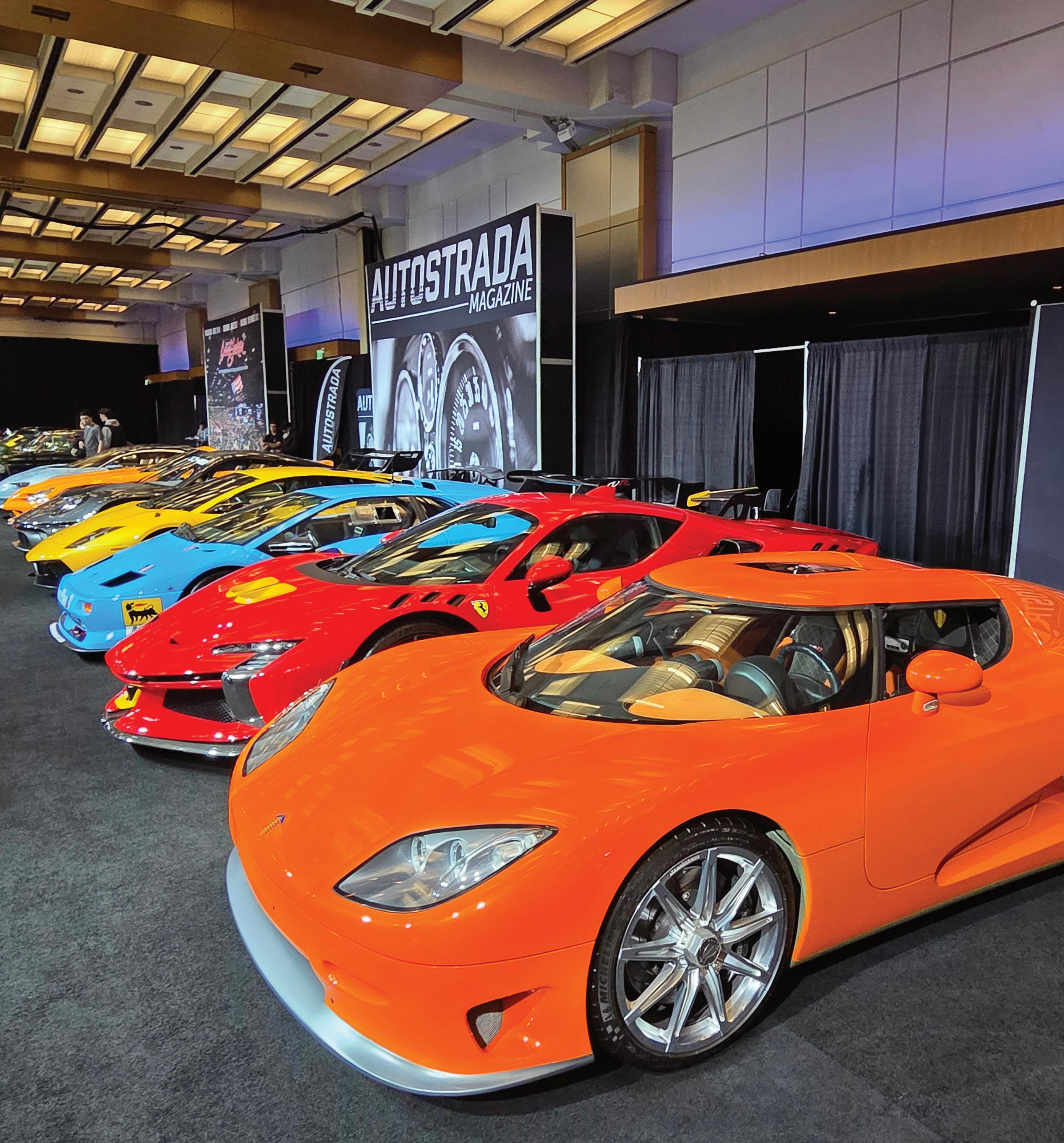
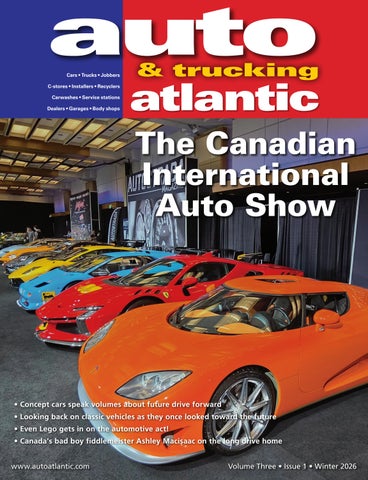
• Concept cars speak volumes about future drive forward
• Looking back on classic vehicles as they once looked toward the future
• Even Lego gets in on the automotive act!
• Canada’s bad boy fiddlemeister Ashley Macisaac on the long drive home
BUILT DIFFERENT

CARLYLE Tools have been crafted to exceed the quality and standards that are demanded by today’s automotive technicians. From hand tools that grip like a beast to power tools that strike with predator-like precision, every piece of equipment carries the instincts of our Sabertooth spirit. This isn’t just an upgrade – it’s a complete transformation that proves our tools are BUILT DIFFERENT, just like those who use them.

Page 4 Editor’s letter
ATA’s first trip to the Canadian International Auto Show proves to be nothing less than cathartic.
Page 20 The Green mile : Circular economy 101
PUBLISHER
Robert Alfers rob@autoatlantic.com
EDITOR
Carter Hammett carter@autoatlantic.com
IT MANAGER
Tyler Graves tyler@autoatlantic.com
ART DIRECTOR
Nicole Shadbolt
ADVERTISING REPS
Wayne Brown wayne@autoatlantic.com
Robert Rogers
CONTRIBUTORS
Carter Hammett
Sana Fatemi
Rohit Narayan Sholingur
Sean Maddox
Scott Friedman
Zachary Perlmutter
IMAGES VIA Unsplash FreePik
Carter Hammett
Rohit Narayan Sholingur
Auto & Trucking
Atlantic is published digitally by Robert Alfers. For advertising rates or information regarding Auto & Trucking Atlantic, please contact us at: rob@autoatlantic.com
In response to the automotive industry’s turn toward green initiatives, we offer a primer on the circular economy. By Carter Hammett
Page 22 Women and wheels
Six safety tips for female drivers
Page 24 Electric avenue
Canada’s venerable EV program Plug ‘N Drive turns a milestone 15 y.o. Zachary Perlmutter reports.
Page 26 News of the weird
Did you know that three per cent of Subarau Outback owners have chickens and use their cars to transport them? Neither did we.
Page 30 Motor matters
The feds launch a new nationwide strategy to transform Canada’s auto industry.
Page 34 The Atlantic road report
Nova Scotia dishes out 15 million to support a gaggle of meaningful municipal projects.
Page 37 Stars in cars
Canada’s bad boy fiddle prodigy Ashley MacIsaac is all about the long drive.
Canadian International Auto Show 2026
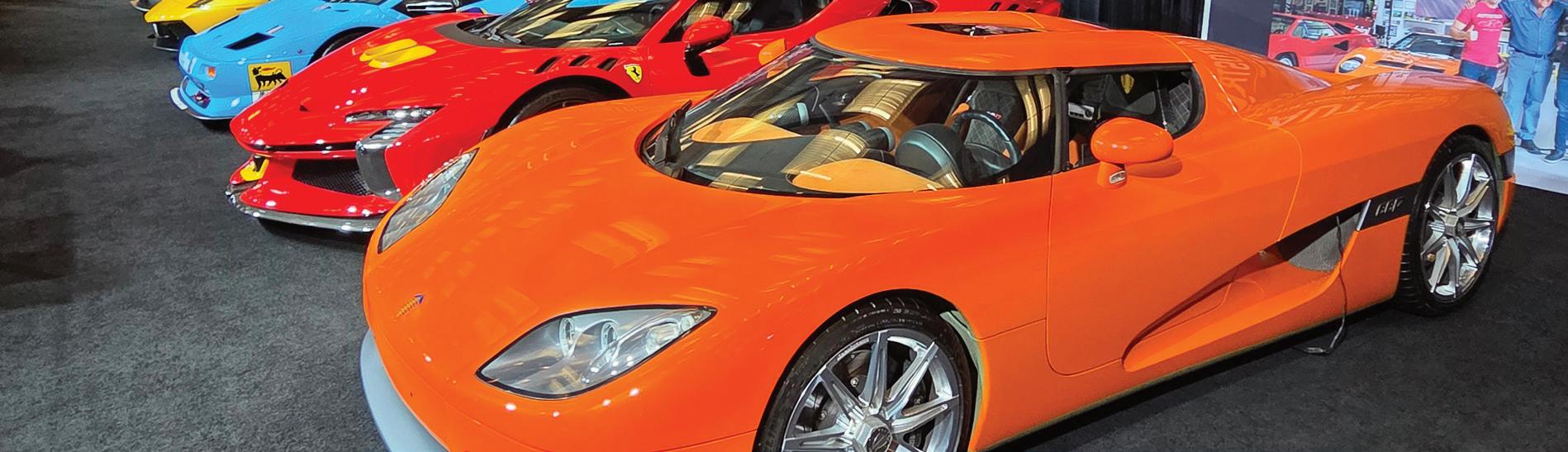
Page 6–15 This year the CIAS was a show about maturity, not ideas. And how it’s grown up! Looking to the future with the latest concept cars while acknowledging the past with classic vehicles, this is a show with something for literally everyone. From hot wheels to Lego to which vehicle was named car of the year, ATA has you covered!
By Rohit Narayan Sholingur, Sana Fatemi and Carter Hammett
Multiple revenue streams are the lifeblood for C-stores says our correspondent. By offering a variety of purchase options, you can enhance both the customer experience as well as the bottom line. By Scott Friedman autoatlantic.com
Tel: 902.452.0345
Mail: 608 - 56 Jacob Lane Bedford, NS B3M 0H5, Canada
Page 18 Banff plays host to Fix Network’s annual conference
Page 28 Genuine parts company announces plan to separate automotive and industrial businesses into two parts - The company, which also oversees the NAPA brand, plots its future
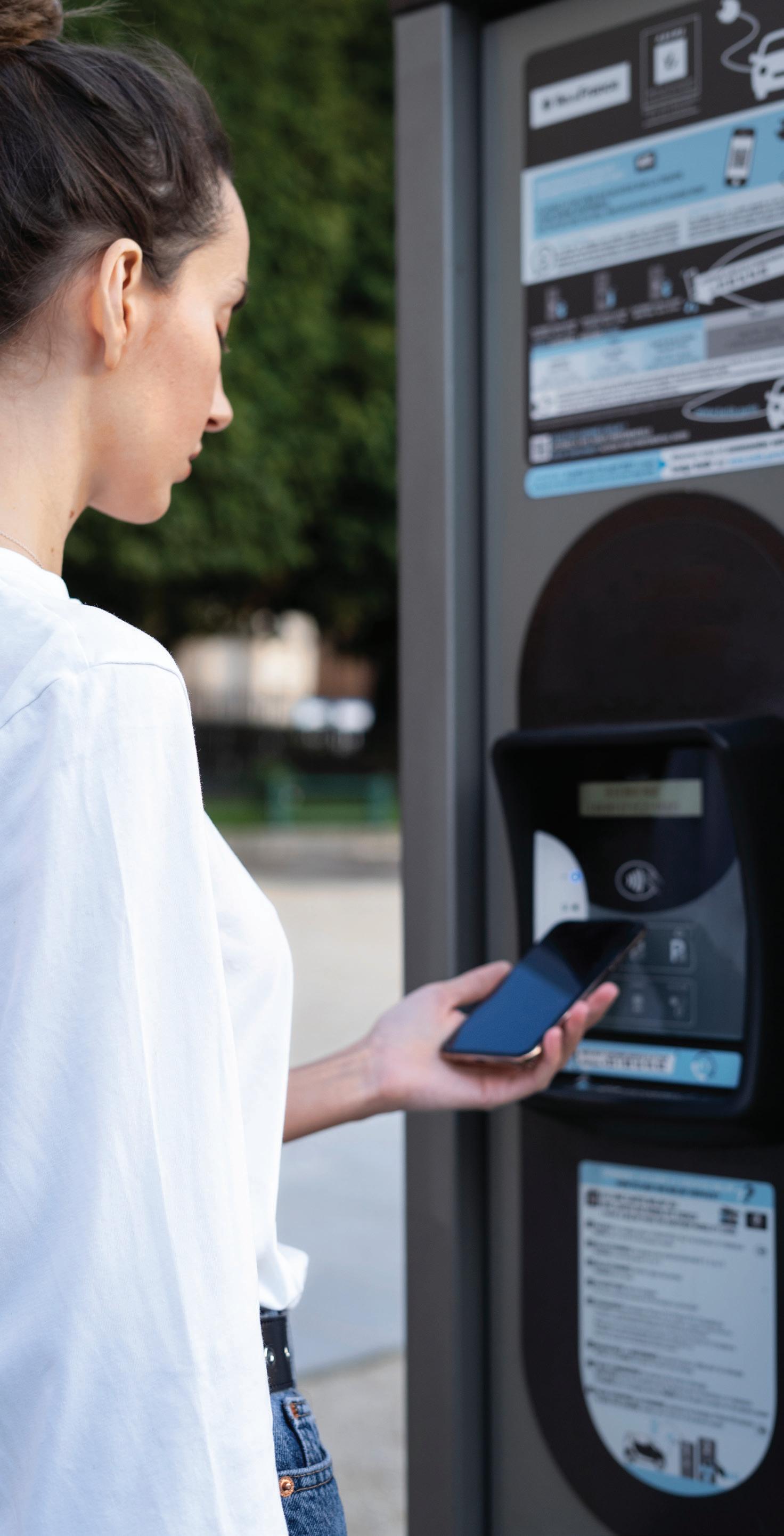
Page 16 Terminal profitability: How modern payment kiosks can kickstart revenue

As we welcome you to the latest issue of Auto and Trucking Atlantic, I’m excited to share a first for us. While our focus has always been firmly rooted in Atlantic Canada, this month we stepped onto a much larger stage. For the first time, ATA attended the Canadian International Auto Show (CIAS) — and to say we were blown away would be an understatement.
Held annually in Toronto, the CIAS is a cornerstone event for the automotive and trucking industries. It draws global manufacturers, innovators, suppliers, media, and enthusiasts under one roof for a dazzling showcase of engineering, design, and forward-thinking technology. Though we’ve long reported on developments shaping our regional market, experiencing this event firsthand underscored just how interconnected our industry truly is.
I had the pleasure of attending alongside two of our star writers, Rohit Narayan Sholingur and Sana Fatemi. Together, we navigated sprawling exhibit halls filled with everything from next-generation electric vehicles to heavy-duty trucks built for the toughest jobs. Every turn offered something new to admire — and to learn from.
Among the most captivating displays were the concept vehicles that offered a glimpse into the automotive future. One standout was the striking Hyundai Crater. This vehicle may not be on dealership lots tomorrow, but it clearly signals where manufacturers are investing their imagination and resources.
By Carter Hammett
Beyond the future-forward prototypes, there was also a deep reverence for the past. The classic car exhibits were a reminder that innovation is built on heritage. We admired beautifully restored examples like the 1967 Ford Mustang fastback, an enduring symbol of North American muscle, and the elegant 1957 Chevrolet Bel Air, gleaming chrome and all. These vehicles drew enthusiasts of all ages, proving that great design and craftsmanship are timeless. For those of us who appreciate the lineage of today’s trucks and performance vehicles, seeing these classics up close was a powerful experience.
For our readers in Atlantic Canada, events like the Canadian International Auto Show might feel geographically distant, but their impact is felt here at home. The technologies unveiled, the trends identified, and the partnerships formed in Toronto inevitably influence the vehicles arriving in our driveways, job sites, and transport fleets. Whether it’s electric pickup trucks poised to reshape rural mobility or efficiency innovations designed to lower operating costs for commercial carriers, the ripple effects are significant.
What struck us most was the spirit of celebration that permeated the show. This is an industry that powers livelihoods, connects communities, and fuels passion. From families exploring the latest SUVs to seasoned truck operators examining heavy-duty innovations, the event truly was a celebration of all things vehicular. At the same time, it offered a compelling taste of
the future — one shaped by sustainability, connectivity, and bold design.
We were thrilled to be part of this monumental event and proud to bring its highlights back to our readers. As ATA continues to grow, so too will our commitment to covering the broader industry stories that ultimately shape our region. The Canadian International Auto Show reminded us that while our roots are local, our perspective can — and should — be national.
We hope you enjoy this issue as much as we enjoyed putting it together.
Before I go, I just want to take a moment to introduce our new Advertising Sales Rep, Wayne Brown. Wayne brings over 15 years of sales experience and relationship-building expertise to ATA. Known for his straightforward approach and commitment to delivering value, Wayne works closely with partners to ensure their message reaches the fleets, service professionals, and industry decision-makers that matter most.
He understands that effective advertising isn’t just about visibility — it’s about credibility, trust, and long-term growth within the Atlantic Canadian transportation and commercial vehicle community.
Welcome to the team Wayne! We look forward to making great things together!


By Rohit Narayan Sholingur
The 2026 Canadian International AutoShow felt different. It wasn’t just another show; it felt like the car industry was hitting the reset button after a tough patch of supply chain issues and cautious talk about going electric. This year, the manufacturers in Toronto seemed much clearer on things. Going electric isn’t a question anymore.
Design is back in style, and Canada remains a key location for testing cars that need to withstand the weather, be practical, and incorporate advanced technology.Based on direct observations at the show, along with information from the manufacturers, five auto manufacturers really showed where cars are headed. They weren’t ranked, but as a group, they demonstrated five ways to address the same problem: how to evolve in a world where EVs are rapidly becoming the norm without leaving behind the drivers who made them famous.
Nissan: Electric cars you can actually use, with a familiar feel. Nissan went with what works instead of trying to reinvent everything. Many brands went for crazy concept cars, but Nissan brought cars that make electric power easy to use in the real world. This makes sense, since they’ve been doing the EV thing for a while. Nissan showed that they’re making their current electric designs better so they can go farther and handle winter better. This is a big deal for Canadians who deal with freezing weather. Instead of going for wild new looks, their cars still look like the crossovers people know. Nissan thinks
that getting people to switch to EVs means making them feel comfortable, not just being innovative. The inside of the cars keeps this idea going: simple digital stuff that isn’t too much, buttons you can actually feel, and a focus on making things comfortable. Nissan seems to be saying that the next step for EVs isn’t about being new, but about earning trust by making things a little better for the user each time.
Ford: Old-school style, new electric power. Ford’s showcase balanced the brand’s deep North American heritage with explicit acknowledgment that performance and utility must now integrate with electrification. Company executives took the presentation stage to address attendees directly, emphasising Ford’s historical significance in North America. Their display focused on cars that are still tough like a Ford but have electric and hybrid tech. The info they gave out at the show said that they’re not giving up what made them great, but turning it into new kinds of power. They talked about how much torque the cars have, how well they drive in any weather, and how the digital systems help with towing, and long trips. Ford didn’t go for the super-fu -
turistic thing that others did. Their cars had strong lines, stood tall, and looked confident, showing that electric cars don’t have to ditch the look of a truck or SUV. The message was pretty clear: Ford thinks their fans want changes that respect the past, not changes that are just for the sake of change.
Toyota: Still going in a bunch of different directions. Toyota kept pushing its idea of having different options: hybrid, plug-in hybrid, and full electric, all working together. They said that this plan works well in places like Canada, where some areas have good charging stations and others don’t. Instead of just pushing EVs, Toyota said that being sustainable means having different choices for different drivers. They said that hybrid tech, which they’ve been doing for a long time, isn’t just a temporary thing, but still important for cutting emissions while electric charging gets better. Toyota’s new designs were more about being smooth and quiet than flashy. The insides of the cars had better materials and easy-touse tech, showing that they’re going for a more classy feel in their regular cars. The message was that Toyota isn’t trying to be the first to go all-elec -
tric, but wants to make sure customers get there without any problems.
Kia: Cool designs that most people can afford. Kia might have had the most eyecatching display. They’ve changed a lot recently. Now they’re not just about being cheap; they’re about cool designs.
Their cars had sharp lines, unique lights, and a modern look. They said they’re trying to make advanced tech available to everyone: driver-assist systems, big screens, and electric power in a way that’s not just for the rich. Kia’s design team is using EV platforms to change how cars look. Longer wheelbases, open interiors, and flat floors make the inside feel bigger without making the outside huge. This is great for cities like Toronto. Kia’s display showed that they’re not just trying to keep up. They’re setting their own style and attracting buyers who want cool cars without paying luxury prices.
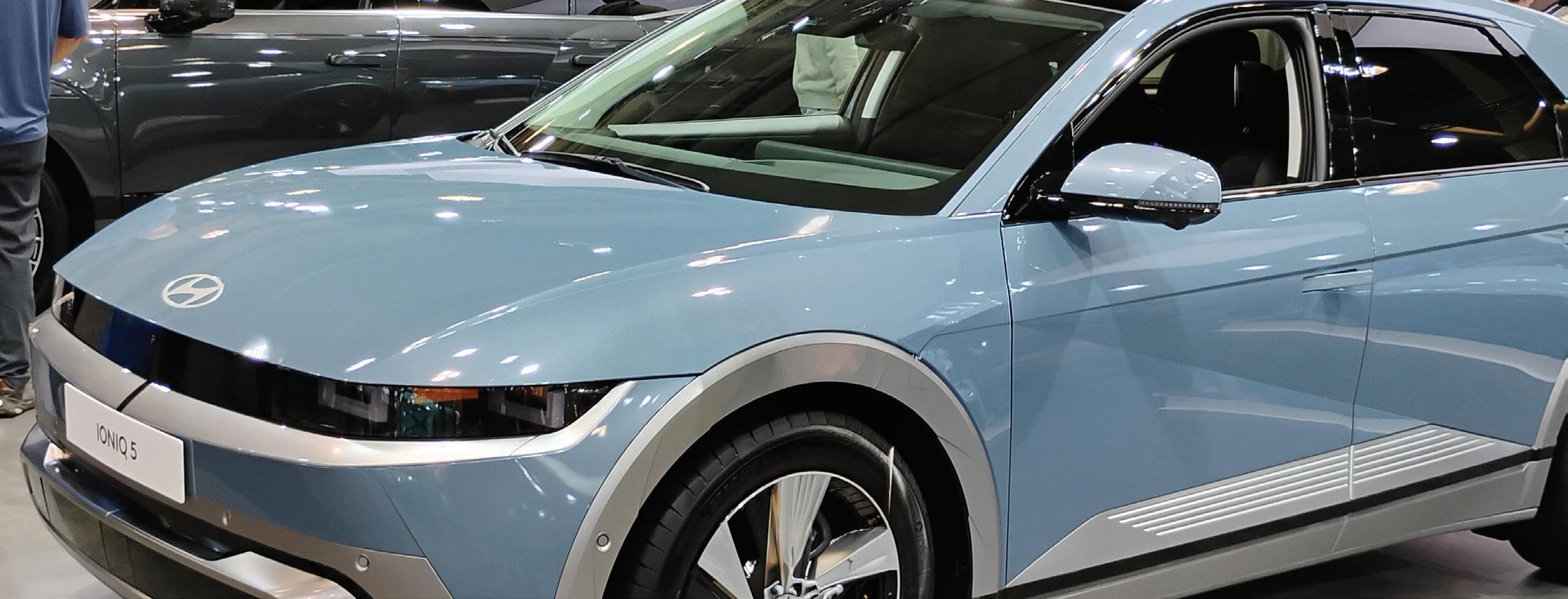
Hyundai: Tech that’s part of everyday life. Hyundai showed off tech but focused on how it fits into your daily drive. They talked less about crazy new inventions and more about how tech can make driving better every day. They talked about their software updates, online services, and systems that help the car use less energy, especially in cold weather. With the government rebate program still active , Hyundai’s EV lineup remains accessible for a broader Canadian consumer target.
The company featured their award-winning Palisade alongside their KONIA N Line, which they tied to their partnership with FIFA for the 2026 World Cup. They said this isn’t just a sponsorship but a chance to show off big transportation solutions, sustainability projects, and online systems that can handle an event across Canada, the U.S., and Mexico. The cars were presented as part of a bigger picture – not just for personal use but for future smart cities and big events. Hyundai kept using clean, geometric shapes with special details, which gives their cars a futuristic look but keeps things consistent. The inside of the cars felt like lounges, suggesting that Hyundai sees the car as a digital living room and a way to get around. The result was a display that showed Hyundai as not just a car company but a tech company that’s comfortable working with both hardware and software.
Concept cars: A new era rolls in. Besides the cars you can buy now, two concept cars stood out for how they showed new design ideas and luxury expectations.
Hyundai Crater concept: Designing cars around the environment. The Hyundai Crater concept was a cool look at how cars might change to fit extreme environments. Its design had sharp angles, protective armor, and a strong look. Instead of just focusing on speed, the concept looked at how future EV platforms could be tough,
adaptable, and environmentally friendly – ideas that are important in Canada. The Crater felt less like a typical concept car and more like a study on how to get around in rough places.
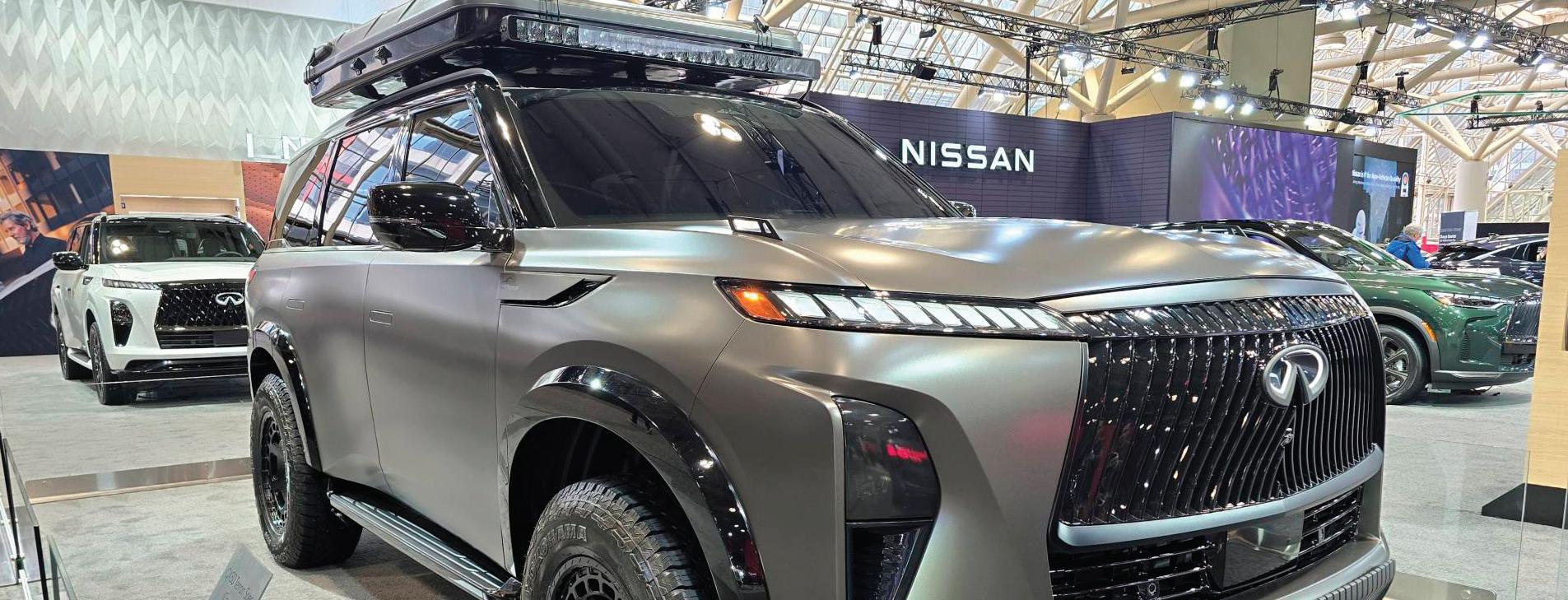
The Infiniti QX80: Redefining luxury. Infiniti’s QX80 concept showed something different: big luxury cars with smooth electric power and simple details. The car was still big like a flagship SUV but had flowing surfaces and carefully lit elements instead of looking heavy. Inside, the focus was on being calm – less clutter, layered materials, and digital displays that fade into the background. Infiniti suggested that the future of luxury might be more about the overall experience than about showing off.
Conclusion: A show about maturity, not just wild ideas. The 2026 AutoShow stood out because it wasn’t full of crazy experiments but because the industry seemed to know where it was going. The cars weren’t about big changes but about making things better – car companies using what they’ve learned over the past decade of fast tech changes. The AutoShow didn’t feel like a look into some far-off sci-fifuture. Instead, it was something more useful: a look at an industry that’s confident in where it’s headed. For people walking around the show, it wasn’t about wondering what’s next but about realizing that the change is already happening – quietly, steadily, and convincingly.
Cobble Beach Classics presented a century’s worth of classic cars on display at CIAS.The wow factor was high on both old and young.
The CIAS was and is a show of contrasts. One of the more interesting examples of this was the sampling of classic cars, presented once again by Cobble Beach Classics, and a certain judge still in his teenage years.
“It’s 100 years of elegance,” says Cobble Beach chief judge Patrick Rizzo.
A Concours judge at a mere 18 years of age, Rizzo’s love of classic cars began seven years ago at age 11, after his mother invited classic car owners to his birthday. Rizzo was instantly gobsmacked and started attending classic cars shortly thereafter, including the Fleetwood Country Cruise-In.
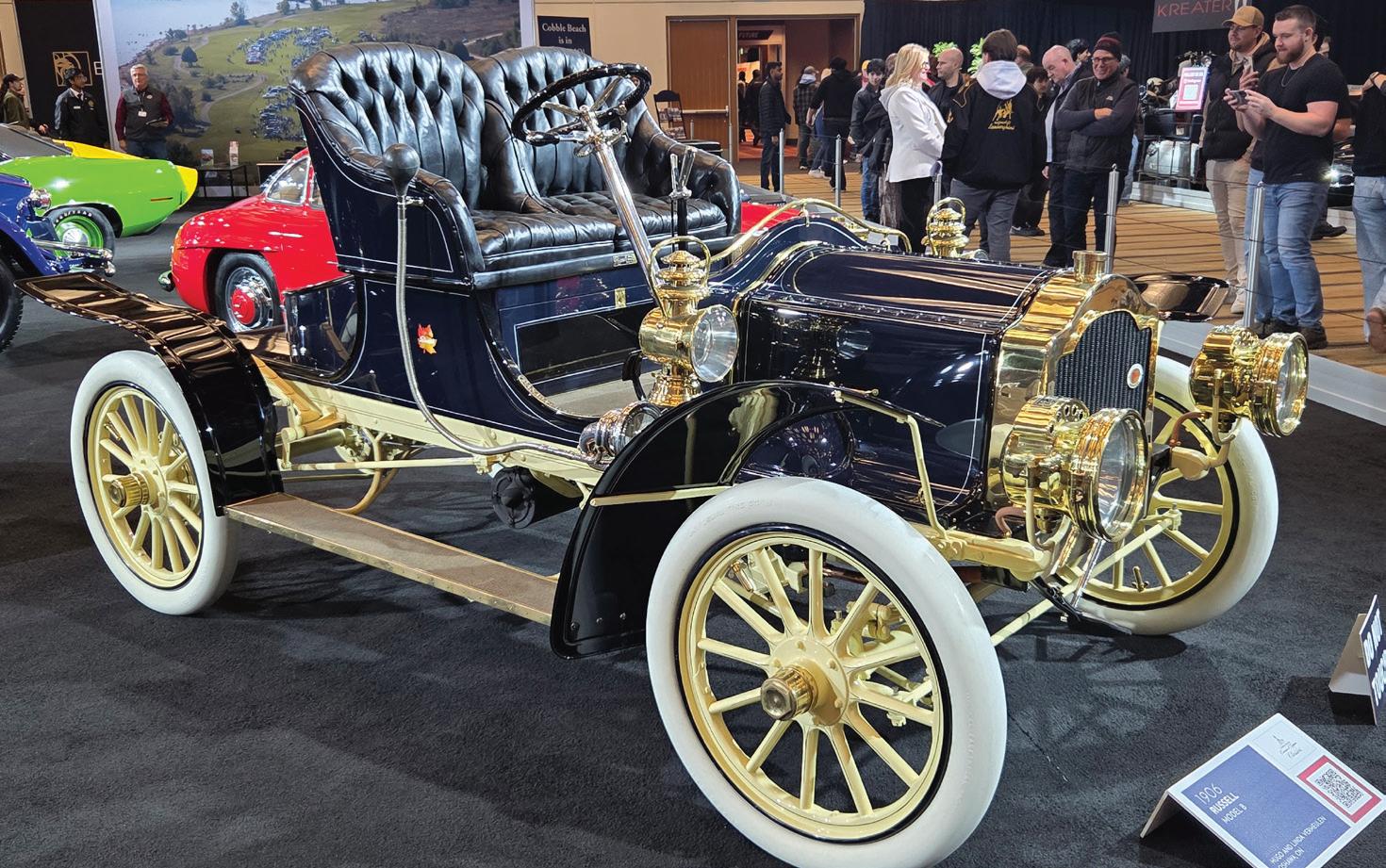
This year’s lineup consisted of eight rare and exotic collector cars–supplied by private owners and GM’s own collection among others–spanning a century in automotive history, each demonstrating the startling evolution of technology throughout the decades. Indeed, the earliest car in this year’s line up is the1906 Russell Model B. This pristine example produced by the Russell Motor Car Company, followed, naturally, the Model A, the company’s first car,introduced the year before. With the addition of the Model C the company grew, reaching towards its goal of 140 vehicles on the road that year. The company produced vehicles from 1904 to 1916 and was considered Canada’s first successful auto manufacturer.
Currently a student at Georgian College’s Automotive Business School* Rizzo started Concours judging in 2019 through Hagerty’s youth judging program after meeting Rob McLeese at a local car show. Impressed with the youngster’s knowledge of vehicles, Rizzo was invited to Cobble Beach to observe his first Concours and shortly thereafter started attending Cobble Beach as a shadow judge along with other shows and attained the rank of chief judge at the Northville Concours d’Elegance in Michigan at only 17! He has aspirations to mentor judges un der 18 into the hobby.
“A lot of older people think that young people aren’t interested in old cars,” says Rizzo.
“They think young people know nothing about them, but social media has generated a lot of interest.”
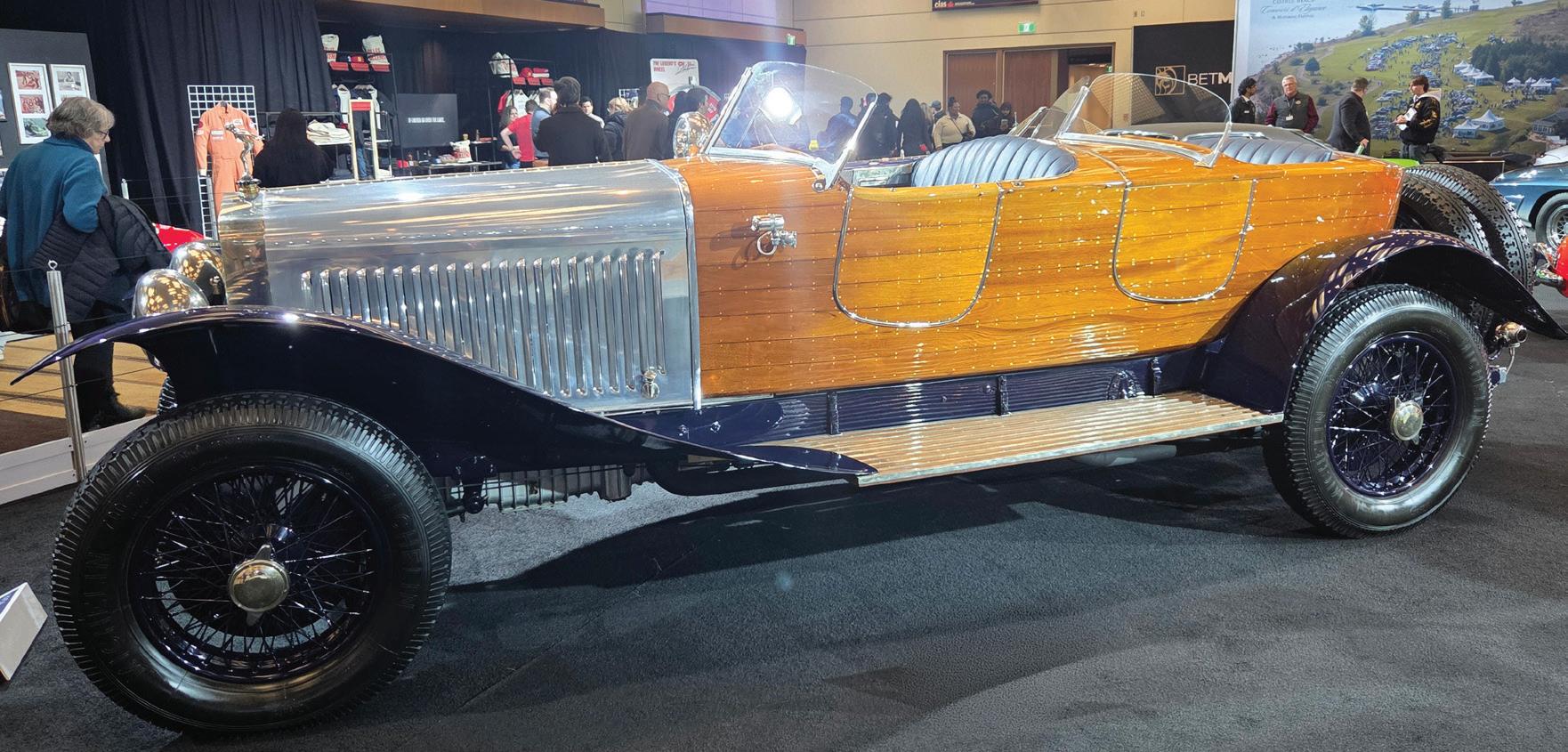
Rizzo’s own favourite of the cars on display is the 1924 Delage GL Skiff Torpedo.
Also known as “The Grand Luxe” this example is considered one of the finest cars ever produced by Delage. Designed in the early 1920s by Maurice Sainturat to rival Rolls Royce and others, the GL is a product of both what was then stylish design and performance, reaching 90 mph, a record for its time. This car was rediscovered 35 years ago being used as a tow vehicle, the car was restored to its original glory and even appeared in the film Chariots of Fire. Furthermore, it has won a number of prestigious awards.
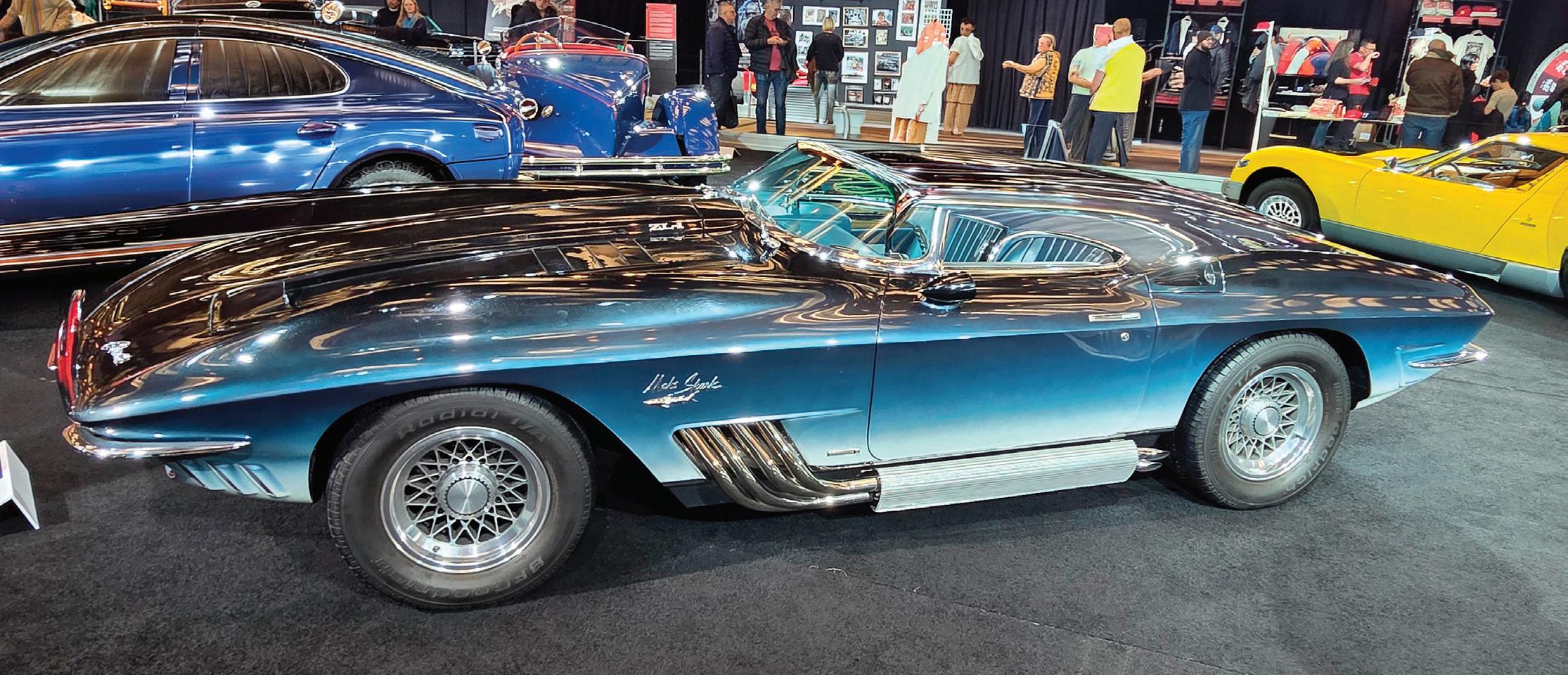
But that’s not the only beauty on display. A personal favourite was the 1961 Chevrolet Mako Shark | Corvette. Originally known as the XP-755 Corvette Shark, this baby was designed to preview the future Corvette and was inspired by an actual mako shark that was captured off of Florida by

GM Design VP William Mitchell. Making its debut at the 1961 New York Auto Show, designer Larry Shinoda adapted the lines of the forthcoming C2 Corvette onto a first-generation chassis, which helped to emphasize the gill-inspired side exhausts and general shark-like appearance.
The car has housed a number of engines over the years including its current powerplant, a Chevrolet ZL-1 V8, producing over 425 horsepower. The car has toured extensively during the 1960s and is now housed at the GM Heritage Museum in Grand Blanc Michigan.
These are just some of the cars on display at CIAS. Others included the smooth lines and clean elegance of the 1927 Duesenberg Model X and 2003 BMW Alpina Z8 Roadster, a rare and highly coveted luxury sports car. More classics like these can be viewed at the Cobble Beach Concours d’Elegance and Motoring Festival which runs September 1820 in Kemble O.N. near Owen Sound.
For the uninitiated, The Cobble Beach Concours d’Elegance is a premier Canadian automotive event held annually on the shores of Georgian Bay, O.N., showcasing rare, highend classic cars. The event features over 100 meticulously restored vehicles, including historical pre-war classics and unique post-war models. In addition to the Concourse d’Elegance, attendees can enjoy an array of activities including the Participant Tour, Cars and Coffee and Concours d’Lemons presented by Hagerty in Owen Sound’s river district as well as two automotive seminars at the Roxy Theatre in Owen Sound itself. Complemented by stunning vistas, great noshing and dozens of vendor displays, this is a can’tmiss event.
*Georgian College’s Automotive Business School: https://www.georgiancollege.ca/academics/academic-areas/automotive-business/automotive-business-school-of-canada More information can be found at: https://www.cobblebeachconcours.com/visitors
By Sana Fatemi
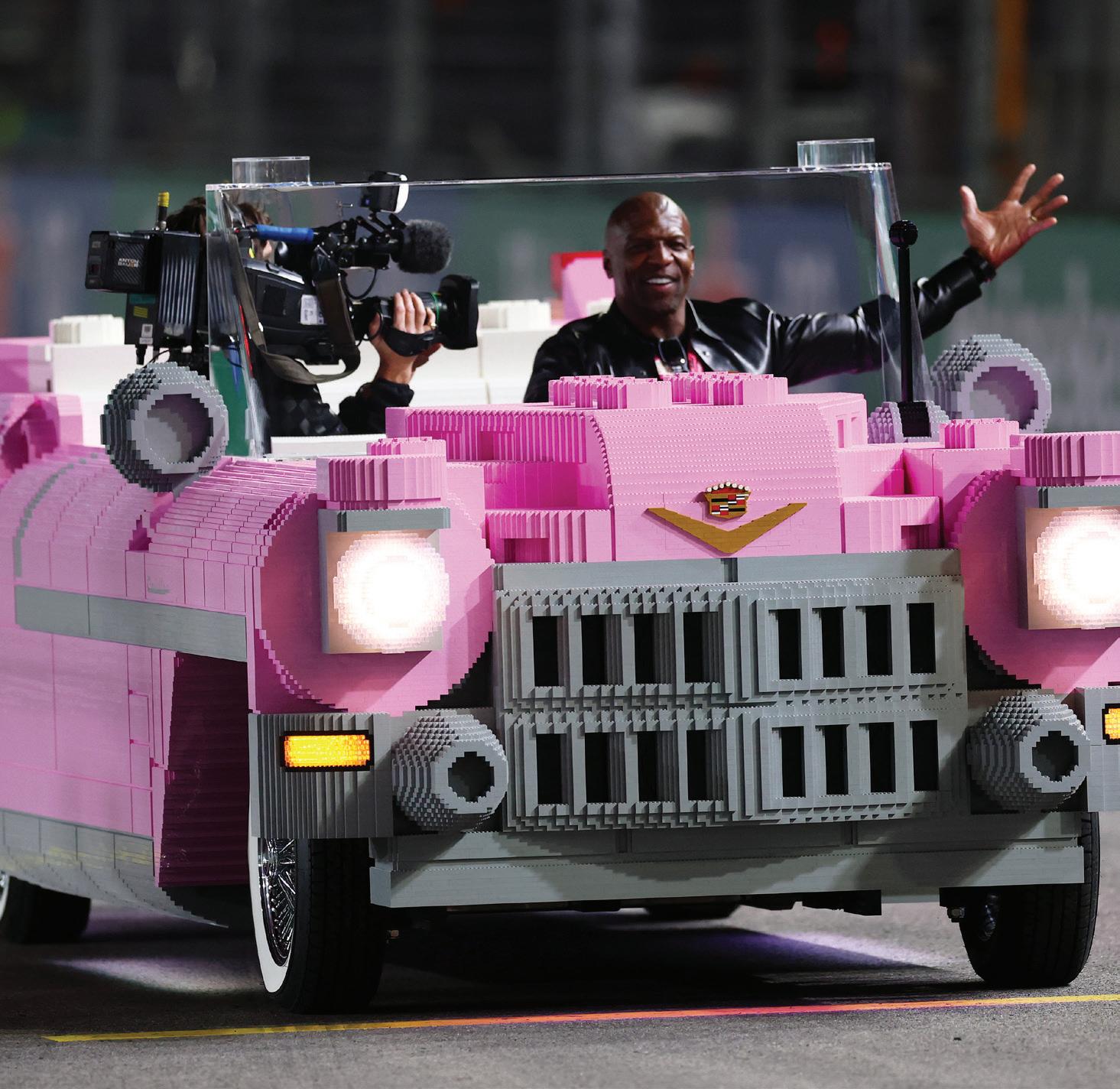
At once a symbol of playful nostalgia and feminine mystique suspended within a showcase of testosterone, one little pink car stood out from all the rest….
Among the futuristic electric vehicles and luxury prototypes at the Canadian International AutoShow, the life-sized pink LEGO Cadillac did more than stand out; it transformed the atmosphere. In a convention centre dominated by matte blacks, chrome finishes, and a forward-looking design language, the bubble-gum-coloured silhouette of a 1950s Cadillac made from plastic bricks felt deliberately out of place. It did not hum with battery efficiency or promise autonomous precision. It simply stood there, radiant and unlikely.
Yet it was impossible to ignore.
The pink Cadillac has long held a mythic place in North American culture. From Elvis Presley’s famously flamboyant model to its link with postwar prosperity and the open-road dream, it embodies a particular vision of the American Dream: glamorous, mobile, aspirational. When reconstructed in LEGO, that dream becomes both ironic and nostalgic. The luxury icon is pared down to a childhood plaything without losing its essence. Instead, it becomes oddly more accessible, a symbol anyone could once craft on their bedroom floor, now amplified into an extravaganza.
What makes the display especially compelling is the paradox beneath its playfulness. Though composed of toy bricks, the structure demands serious engineering. Thousands of pieces must interlock with precision; weight must be distributed; curves must be approximated through painstaking design. In that sense, the LEGO Cadillac mirrors the craftsmanship of the real vehicles surrounding it. It is not simply a toy; it is a feat of labour disguised as nostalgia.
Its popularity revealed something else about contemporary car culture. Visitors clustered around it, phones raised,
while nearby electric vehicles, boasting cutting-edge range and torque specifications, waited more patiently for attention. The LEGO car does not drive, does not innovate, and does not even function as transportation. And yet it may have been one of the most photographed objects in the building. In an era shaped by social media and the attention economy, visual boldness and narrative resonance often eclipse mechanical advancement. The car that cannot move travels the farthest online.
There is also something significant about its colour. Following pop-cultural moments that have revived hyper-feminine aesthetics, a pink Cadillac carries layered meanings: camp, empowerment, parody, and nostalgia. Whether
intentional or not, the display taps into that visual language. It feels playful but strategic, aware that spectacle now competes as fiercely as horsepower.
Ultimately, LEGO’s Cadillac acts as immersive corporate storytelling. It turns an auto show, traditionally a place for technical demos and persuading consumers, into something more like a playground. It invites adults to revisit childhood memories while standing among vehicles priced beyond reach. In a space focused on the future of mobility, the object drawing the most attention was a carefully built monument to the past. Plastic, pink, and highly photogenic, it indicated that modern brands don’t just sell cars. They sell identity, emotion, and the comforting structure of memory.








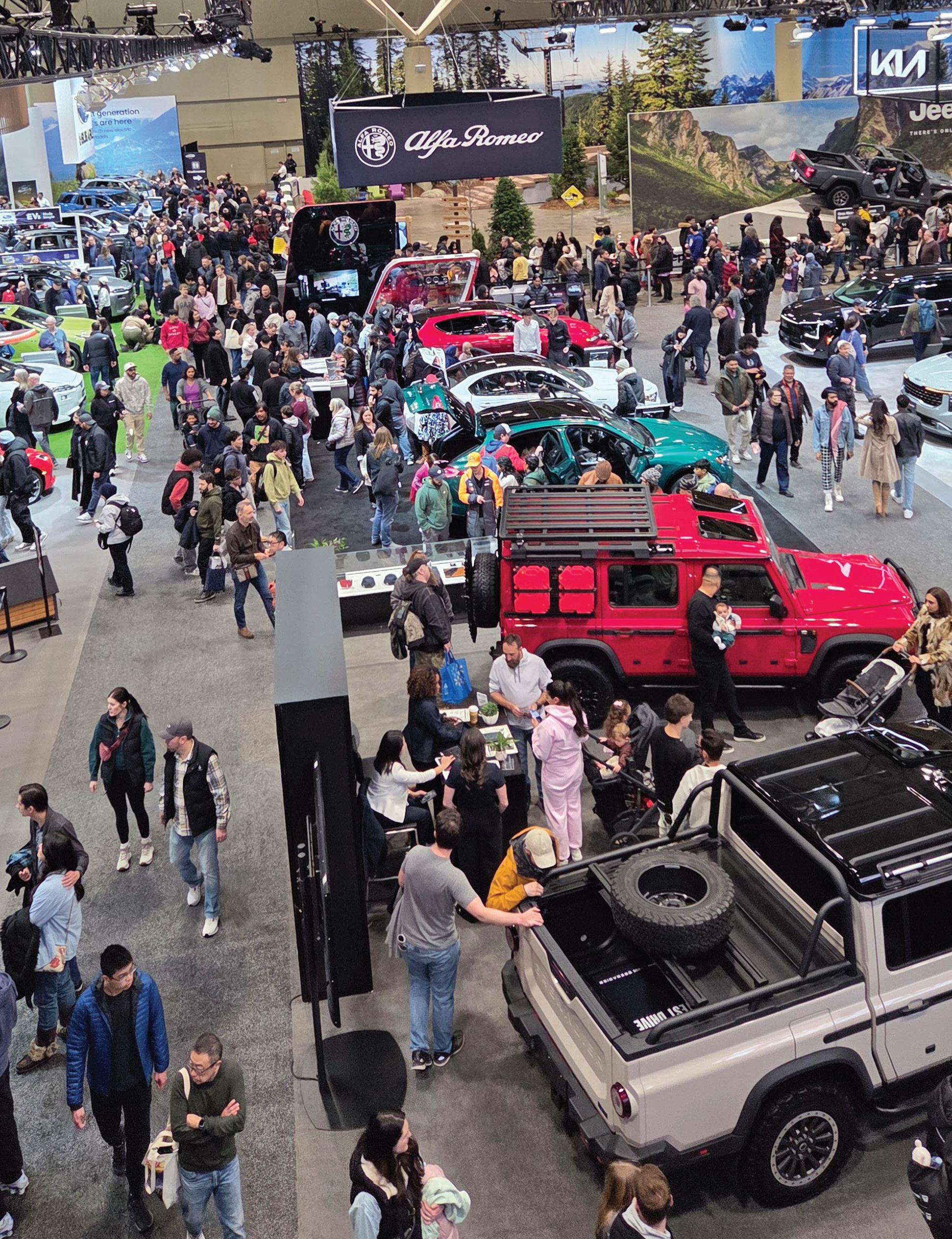
With six floors of demos spread across two buildings the Canadian International Auto Show did not disappoint and literally offered something for everyone. And while we only could have hoped to document everything, this was beyond our scope, so instead we offer ATA’s “bullet journal,” a rapid fire look at some of the show’s highlights.
The four winners of the 2026 Canadian Car of the Year Awards (CCOTY), presented by the Automobile Journalists Association of Canada (AJAC), were announced February 12 during opening ceremonies of the Canadian International AutoShow.
The Honda Civic is the 2026 Canadian Car of the Year – retaining its title and scoring a third win in five years for the Canadian-made Civic, which is also the country’s biggest-selling passenger car. AJAC jurors identified its quality, interior ergonomics and wide consumer appeal as the winning attributes.
The 2026 Canadian Utility Vehicle of the Year is the new Hyundai Palisade – the second year in a row that Hyundai has taken this award after winning with the Santa Fe in 2025. Judges singled out the large family SUV’s quality and interior design for particular praise.
In the first of two awards for the latest electric and plug-in
hybrid vehicles, the Porsche Taycan takes home the trophy as the 2026 Canadian Electric Car of the Year. The facelifted sports sedan is more efficient than ever, while judges also praised its stylish interior and engaging drive.
Meanwhile the 2026 Canadian Electric Utility Vehicle of the Year is the Kia EV9, which climbs to the top step after being a runner-up in 2024 and ’25. AJAC judges were particularly won over by its exterior design, infotainment system and safety features.
“Congratulations to the winners,” said Jason Campbell, General Manager of the Canadian International AutoShow. vhese awards are uniquely Canadian – judged by Canadian experts, on Canadian roads – and announcing the results at the Canadian International AutoShow brings that story to life for media, industry, and consumers alike.
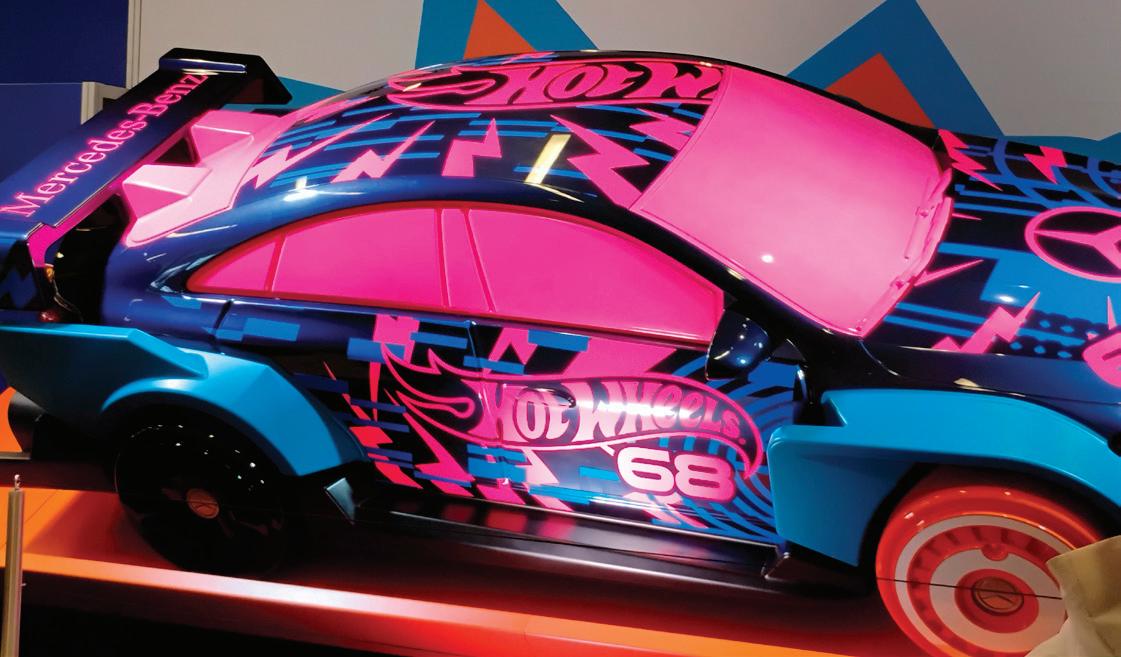
The 2026 Canadian International AutoShow featured an unexpected partnership between Hot Wheels and Mercedes-Benz.
The main attraction featured a life-size race car, which displayed Hot Wheels’ unique branding. The high-performance vehicle transformed into a toy collector’s dream through its electric pink and blue graphics, which included lightning bolts and the famous flame logo. Hot Wheels succeeds through its design approach, which enables the brand to create extreme automotive designs that most brands consider excessive.
The feature also showcased multiple Hot Wheels die-cast miniature vehicles, which included special edition MercedesBenz models that replicate the automaker’s historical vehicle collection. The collection included vehicles from different historical eras, which ranged from traditional sedans to contemporary sport utility vehicles. For collectors, these miniatures served as more than toys because they functioned as miniature representations of automotive heritage.
The partnership holds special significance, particularly because of the unique timing of the collaboration. Hot Wheels’ infused the event with an exciting new energy, showcasing their deep passion for cars and engaging fans in a vibrant display of automotive enthusiasm.
The exhibition drew a diverse crowd. Parents brought their children, who pressed their faces against the display cases,
while adult collectors examined the limited-edition pieces. Hot Wheels’ presence at such a large auto show feels democratising, as most people can afford at least a small piece of automotive culture.
The Hot Wheels partnership at CIAS 2026 underscored the importance of emotions in the changing automotive industry. While technology improves, the appeal of well-designed vehicles remains.
We all need to think back to what got us hyped about cars in the first place. And when those memories pop up in bright pink and electric blue, the nostalgia really hits hard.
—
Rohit Narayan Sholingur.
Hyundai IONIQ 6 N makes its Canadian Debut at the 2026 Canadian International Auto Show
Hyundai Auto Canada celebrated a major milestone for its high- performance N Brand February 12 with the national premiere of the all-new IONIQ 6 N at the 2026 Canadian International AutoShow (CIAS). Revealed during Hyundai’s press conference in Toronto, the IONIQ 6 N represents the next evolution of Hyundai N’s electrified performance strategy, combining track-inspired capability with everyday usability.
Building on the technical achievements of the acclaimed IONIQ 5 N, the IONIQ 6 N delivers an even more distinct N-focused design and a plethora of advanced features for heightened precision and engagement. Specifically optimized for high-intensity driving, it integrates newly developed hardware and intelligent software to ensure peak capability, control, and endurance on circuit.
Key technical innovations include a fully redesigned suspension geometry for superior handling, an enhanced N e-Shift (virtual gear shift) system with shorter gear ratios, and a refined N Active Sound + system achieved through upgraded hardware and meticulous acoustic tuning — all contributing to a more engaging and immersive driving experience.
The Canadian debut of IONIQ 6 N marks a natural evolution from Hyundai’s performance - EV journey in Toronto, follow-
Tucked away in a relatively quiet corner, away from the dog and pony show, the concepts and classics, I happened upon a micro mobile, just slightly bigger than a golf cart. This is none other than the Safe Active Reliable Integral Technology (SARIT) LSV.
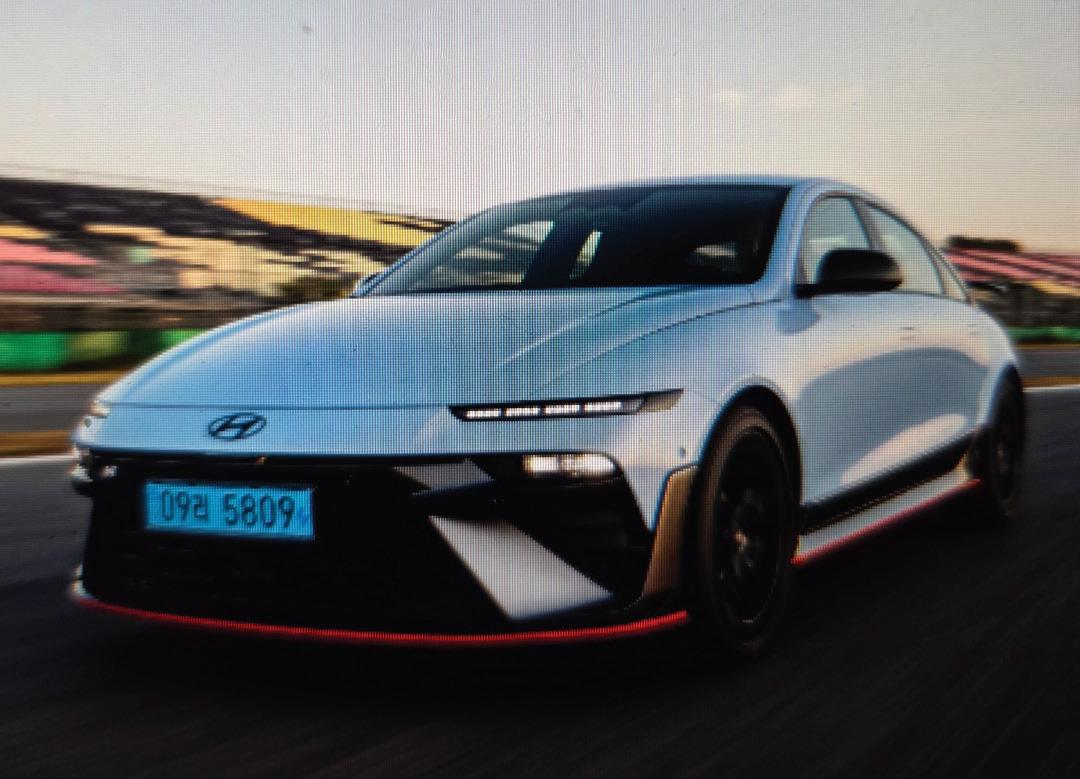
ing the reveal of the RN22e concept at the Canadian International Auto Show in 2023
“The arrival of IONIQ 6 N in Canada is a clear signal of Hyundai’s confidence in the growth of the N Brand and the appetite for high- performance electrified vehicles,” said Michael Ricciuto, director of product and corporate strategy at Hyundai Auto Canada. “N has become a key pillar of our brand identity, driven by motorsport-inspired engineering, bold design, and a relentless focus on the driver. IONIQ 6 N takes those values to new territory.”
“It really is the next evolution of golf carts but made for the urban road,” says SARIT’s Chief Technology Officer Daniel Lajeunesse. “It’s built for any road where the speed limit is 50 km.”
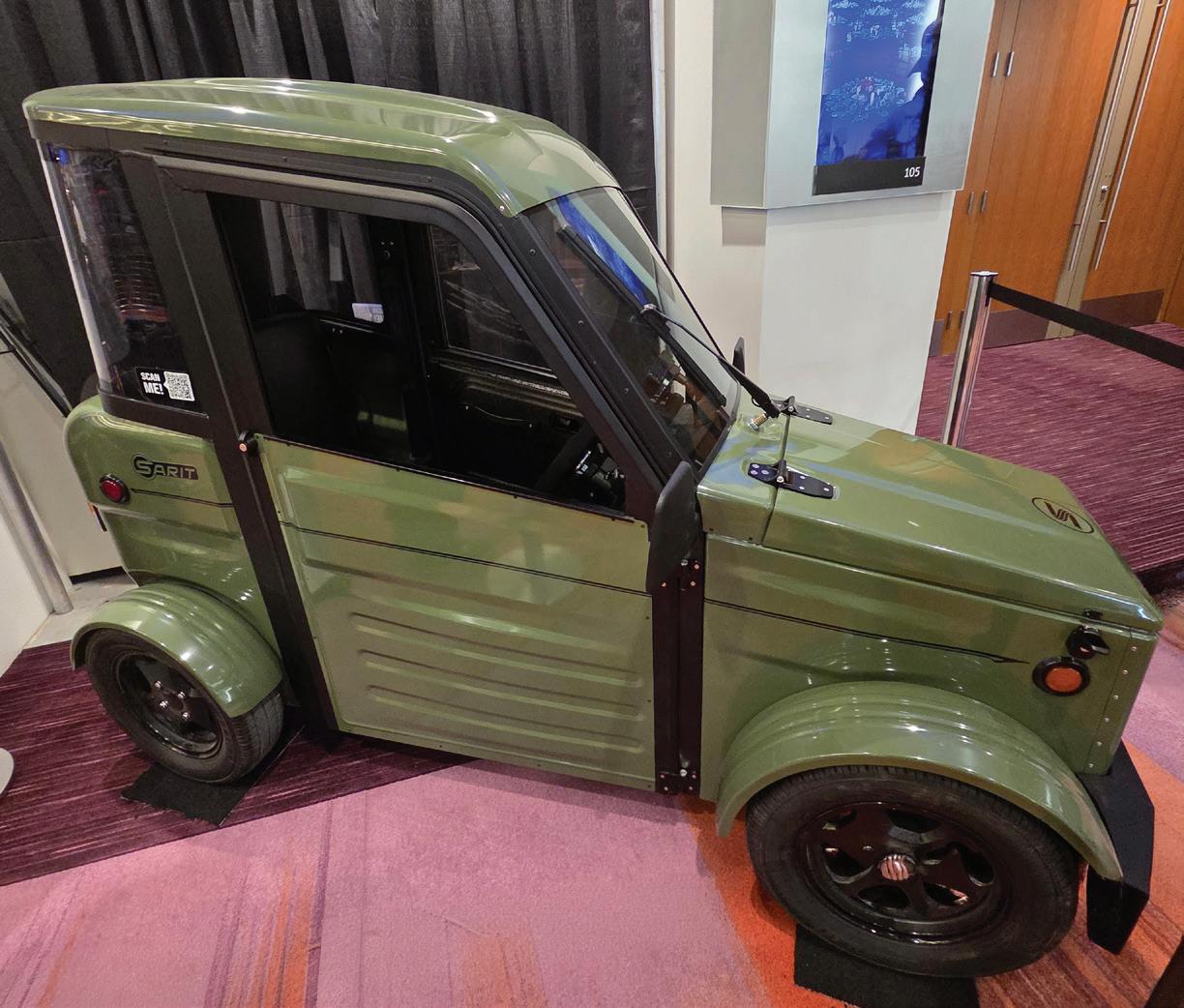
Purely electric, the LSV is a personal electric vehicle built for one driver, that positions itself as an alternative to standard vehicles. It’ll easily ride along urban bike paths and functions well in various weather conditions. It’s so slim that four of these can be parked side-by-side in a standard parking space, says Lajeunesse.
The total width is a meer 0.995 metres and its wheels are 12 inches high. The car’s body is aluminum and the doors are plastic. “Most parts are North American sourced,” says Lajeunesse.
What’s more the vehicle is powered by lithium ion phosphate batteries which can obtain distance up to 100km on a single charge. For urban driving this lasts up to four days. The models suggest a potentially bright future as mini and micro-mobility vehicles not only improve congestion and parking issues, but also have a significantly positive impact on the environment, and the power grid. For more info visit: https://saritmobility.com

By Scott Friedman
For a transactional business like a convenience store, revenue streams are the lifeblood. By offering multiple purchase options for key profit drivers such as the fuel dispensers and carwashes, you can enhance both the customer experience and your bottom line.
But you need the right tools for the task. Without them, you risk profit loss, often right at the payment terminal itself.
Carwash customers have specific expectations – where the name of the game is speed and efficiency. They want open lanes at the pumps and a quick and thorough carwash, which starts with an easy-to-use, EMV-compliant payment system.
But many convenience store sites that fail to update their payment kiosks are missing a significant opportunity for profit gain and a chance to provide a fast and simple process for their customers. Older payment terminals are increasingly inefficient and clunky and can lead to additional expenses for the site. For example, operators may not be aware of the hidden fees associated with non-EMV compliance.
Outdated terminals also directly affect the customer and traffic flow in and out of the bay. Drivers can spend time fumbling for cash or coins, causing long lines to form, and there’s always the risk of older machines jamming or operating incorrectly. These are the types of inadequacies that harm the customer experience from the outset, reducing the likelihood of repeat business and frustrating the customer in the process.
Upgrading to modern kiosks can help mitigate that.
While C-store and carwash operators cannot lower every cost, there are opportunities to reduce the risk of lost profits through equipment upgrades
without compromising operational uptime or customer satisfaction. To accomplish this, sites must consistently deliver effortless operation across the board, which begins with the first customer touchpoint – the kiosk.
What can updating the payment terminals do for the store?
The value of updating the terminals extends far beyond the checkout counter or wash lane.
Today, an increasing number of devices are becoming interconnected on-site. It is easier than ever to offer incentives for the carwash or the store, right at the fuel pump, inside the store, or both. That communication flexibility enables the C-store to easily sell wash subscriptions, promote loyalty programs and more.
New kiosks serve as the central hub, bringing with them several key advantages to the business:
• Systems designed specifically for C-stores
• Built for in-bay or outdoors
• EMV compliance
• Improved efficiency
• Flexible and secure transactions for multiple payment types
• Increases the number of customers served in peak hours
• Personalized customer advertising
• Upsell opportunities
• Connects to apps for subscriptions and rewards programs
• Speed, security and personalization with AI-powered license plate recognition (AI-LPR)
With multiple ways to communicate and transact with customers compared to older payment terminals, op -
erations have a more centralized approach to improve efficiency and add revenue streams.
“Upgrading to new kiosks makes them essentially the hub of your operation,” said Kevin Ahnert, general manager, payment solutions and controllers at Innovative Control Systems (ICS), part of OPW Vehicle Wash Solutions. “Devices and customers are communicating more on-site: Tanks, dispensers, phone apps, they all connect into one system. It’s a great set of tools for both new and existing customers to use. With all the personalization options like AI-LPR, RFID and voice prompts, the business will have new opportunities for customer communication and effective cross-selling.”
Another benefit is the relatively simple upgrade process.
Installation is straightforward from a physical standpoint, requiring no special infrastructure or technology aside from having adequate power availability and a secure internet connection. With most new systems built for plugand-play capabilities, a C-store site can be up and running with new digital payment terminals quickly and easily.
How do new terminals benefit the C-store customer?
Customers visit convenience stores for a quick stop, whether for fuel, snacks, a carwash, or all the above. In any case, they expect speed and reliability. Operators shouldn’t hamper that with outdated payment kiosks that slow everything down or are prone to errors.
“Today’s technologies are more accepting of different payment methods, which speeds things up,” Ahnert said. “Modern kiosks are EMV-ready, allowing for cards, apps and rewards programs to make things more efficient and give the store more revenue options. Plus, new kiosks are much
more user-friendly, with bigger screens, simple interfaces and easy-to-follow instructions.”
New payment systems also provide several key benefits to the customer that can kick off a great experience and drive repeat business:
• Ease of use
• Speed and efficiency
• Multiple payment options – no need to count cash or risk a jam during payment
• Personalized incentives based on purchase history
• Quick access to rewards, discounts, memberships and loyalty programs
Many C-store carwashes are losing profits at the payment terminals without realizing it. The inefficiencies and cumbersome operation of older kiosks can slow down traffic during peak hours, frustrate customers who expect a quick, smooth payment process and limit the flexibility of the store to collect multiple payment types.
By upgrading to new generation terminals, the C-store can more effectively cross-market between the fuel pumps, car wash, the store and even the individual customer through several levels of interactivity. Furthermore, installing new kiosks that accept multiple, secure and accessible payment types gives the operation additional revenue streams while minimizing profit loss from outdated equipment and the chance for customers to have a negative experience.
Scott Friedman is the director of marketing at OPW Vehicle Wash Solutions. OPW Vehicle Wash Solutions was formed in January 2019 and consists of PDQ Manufacturing, Inc., Belanger, Inc., Innovative Control Systems (ICS), Kesseltronics and Transchem.
Fix Network has announced that its 2026 National Conference will take place May 6–9, 2026, at the Fairmont Banff Springs in Banff, Alberta.
The network confirmed the news following a teaser campaign that hinted at the conference’s mountain destination with poetic clues:
“Where mountains and clear skies are mirrored in shimmering waters, our partners gather beneath towering pines, contemplating one of canada’s wonders. From breathtaking panoramas to outdoor escapes, discover new heights and embrace the beauty that awaits.”
Chris Peterson, Fix Network’s Regional Vice President for Western Canada, said the conference will bring together franchise owners, vendors, insurance partners and corporate staff from across the country.
“Fix Network’s 2026 National Conference will be a standout — strong content, stronger connections, and an unforgettable setting,” Peterson said. “There’s no better backdrop than the Rockies to gather our Canadian franchise owners, corporate team, and vendor and insurance partners together to learn, collaborate, and celebrate our successes. Banff, here we come!”
Details on the conference agenda and registration are expected to follow. The 2026 event will continue Fix Network’s tradition of bringing together its Canadian network for learning, networking and celebration.
“The beautiful Fairmont Banff Springs Hotel is the ideal setting for a conference representing the best of Canada.”









UAP keeps Canada moving since 1926
By Carter Hammett

A massive shift is occurring in the green automotive sector as more and more companies are starting to reconsider traditional linear models in favour of the economic and environmental benefits of a circular economy. Let’s have a look a circularity 101.
The automotive industry is undergoing a massive shift towards green initiatives that focus on sustainable practices driven by government regulations, a more enlightened consumer and a neverending barrage of environmental concerns. While the automotive sector contributes up to 10 per cent of industrial emissions, in recent years a slew of eco-friendly practices have been introduced with the goal of reducing carbon emissions. Green automotive practices are playing an emerging yet critical role in the future of sustainable vehicles.
One of these is the growing awareness of the circular economy (CE). In relation to cars, The World Economic Forum (WEF) describes CE as a “shift from the take-make-dispose’ model to one focused on maximizing vehicle lifespan, remanufacturing parts and recycling materials like steel and battery metals. This approach reduces waste and carbon emissions while boosting profitability, aiming for a sustainable closed looped system for manufacturing.”
Indeed, with our current models and throwaway culture, we put incredible strain on our public health, our ecosystems and communities. We operate within a linear economy which starts
as resource exploitation, ending as something to be disposed of.
In a circular economy, the process is bombarded by the six R’s: retain, recover, refurbish, remanufacture, repurpose and/or recycle. A circular economy asks us to consider our resources and determine better ways to use them in ways that benefit both the economy and the environment.
With this mindset, resources and materials are kept in circulation over a longer period of time, allowing investment to be made for recycled products which can then be repurposed and used to create optimized items once more.
According to sources like rematec.com, customers benefit from lower costs due to the fact that remanufactured parts are more cost- effective than originals. Furthermore, the automotive supply chain needs to observe several variables in order to reduce pollution. A sampling of these include, well-to-wheel emissions, reduction of waste disposal due to replacement parts, particulate matter released from brakes and tires and reduction of CO2 emissions.
One area that Canada excels at is in automotive recycling and dismantling. The Automotive Recyclers of Canada
states that up to 80% of end-of-life weight is recovered, including both plastics and metals for reuse. ARC also provides quality recycled OEM parts thereby cutting the need for material extraction.
Key examples of Canada’s automotive circularity include component remanufacturing including engines, clutches and alternators, thereby extending their lifespan while cutting waste. Canada also plays an important role in dismantling with advanced methods in digital inventories and fluid recovery.
Another area of growth is automotive remanufacturing. Canada’s parts manufacturing sector grew to over $10 billion in GDP in 2023. Investment in auto remanufacturing is a key area of growth as part of the federal $25 billion investment since 2020.
So, when a part like an engine, powertrain or battery is damaged or has reached its end-of-life, used parts acquire an extended life through the magic of remanufacturing. These parts are often better than new since companies are able to incorporate quality upgrades into the new components. ARC claims there is virtually no difference to the remanufactured pieces

and that it takes 80% less energy to remanufacture a component than it does to produce a new one.
The average Canadian keeps their car for up to 11 years. This is a massive opportunity for Canadian remanufacturing companies since an increase in demand for spare parts will naturally evolve out of this. From a green perspective, remanufacturing is an excellent concept since steps like material extraction, along with material and parts manufacturing, are substantially reduced through the art of manufacturing.
Other key circular economy examples include innovative design which incorporates materials that are easier to separate, reclaim and recycle at endof -life. Another example focuses on a shift towards vehicle sharing and service-based models that maximize the so-called “usage intensity” of trucks and cars. Still another variable is the fact that more companies are starting to remanufacture parts which create more affordable choices instead of new parts.
The World Business Council for Sustainable Development (wbcsd.org) states a circular economy substantially reduces our carbon footprint from production, garbage and landfill while increasing profits on a per- vehicle basis by up to 20 times due to interventions like remanufacturing and extending life cycles.
It all sounds good in theory but there are a number technical, regulatory and cost barriers, especially in Canada, where high costs of battery recycling, a reliance on OEM parts over remanufactured ones and splintered, provincially-specific Extended Producer Responsibility (EPR) policies continue to cause irregularity and slow a national strategy down to a glacial pace.

The Council of Canadian Academies states that waste management, is a provincial responsibility so there is no harmonization between provinces and differing time lines vary from provinceto-province. This affects national adaptability, especially when it comes to EV batteries. On the same topic, end-oflife battery management costs are often prohibitive since they are driven by logistics and distribution costs.
There’s also a lack standardized data
available on the management of EV batteries, making it expensive to recycle and transport them efficiently.
Despite these issues, Canada has made some notable progress in specific areas, especially in the high diversion rate for EOL tires.
On a global level, meanwhile The World Economic Forum has in recent years introduced the Circular Cars Initiative (CCI) which is hastening the change over to circularity, along with the cooperation of 30 global value chain players.
To date decarbonization has largely focused on electrification but emissions exist within vehicle materials as well, and this will gradually become more important as evidence-based data becomes more accepted. Certain circular practices like vehicle sharing, remanufacturing and smart charging are proving themselves to be effective when lowering economic and environmental impact.
Creating business value from circularity is proving itself a challenge across al all sectors and this requires greater industry commitment along with a cross-pollination of partnerships and collaboration to create real corporate buy-in and therefore real impact. But with a global chorus of voices, policies and community pressure, the shift to a global automotive circular economy may be closer than we think.
By Women In Trucking Staff1
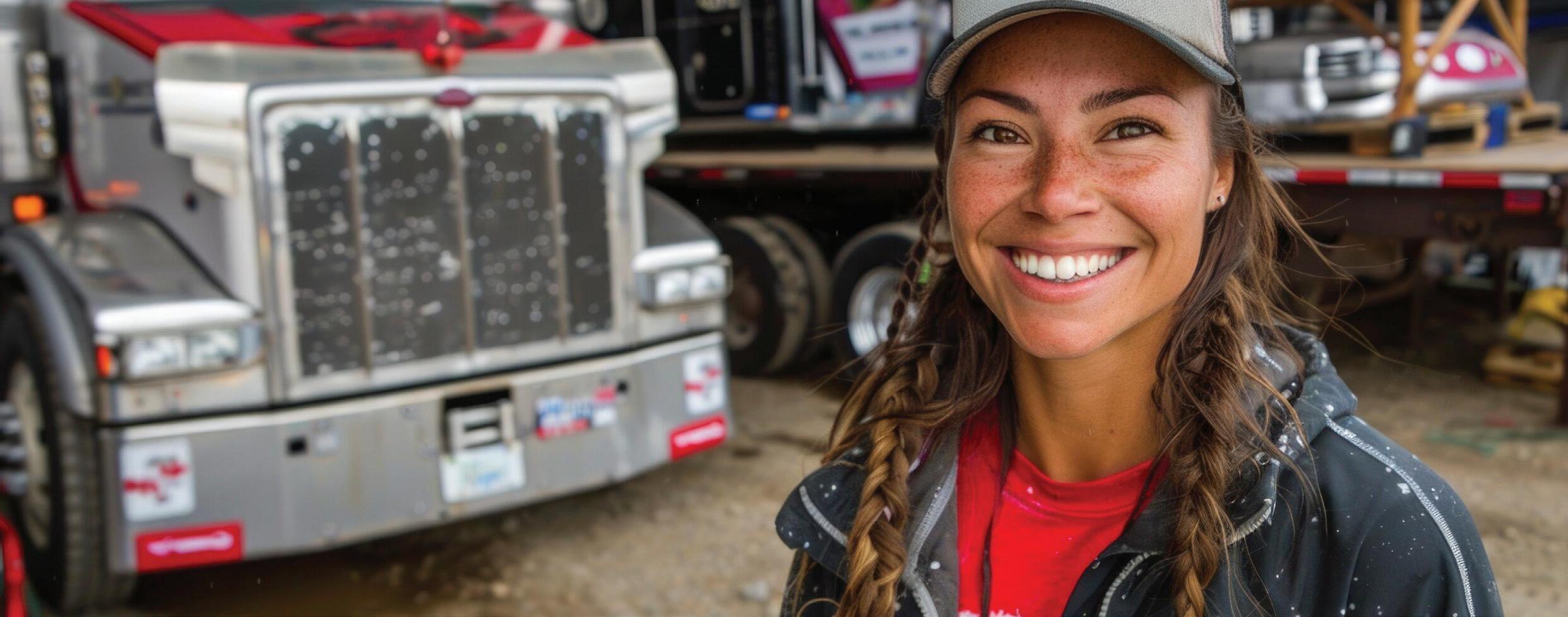
For women behind the wheel, safety on the road extends beyond defensive driving and vehicle maintenance – particularly for those involved in long-haul trucking. While trucking presents unique challenges for all drivers, female truck drivers often face additional concerns related to personal security, situational awareness, and work-life balance. The good news is that preparation, awareness, and smart habits can significantly reduce risk and increase confidence on the road.
While professional truck driving can be a gratifying and rewarding career choice for women, it’s not without its concerns or drawbacks. For females, these concerns and challenges focus heavily on safety and harassment in a malepopulated industry.
A few years ago, WIT published a WIT Female Driver Safety and Harassment Study. This research initiative was conducted to gain a voice of the driver around safety and harassment issues. MindShare Strategies, WIT’s association management company and publisher of Redefining the Road magazine, deployed this research project that involved an online survey. Female drivers weighed in through an online survey on critical areas of concern. Nearly 450 professional drivers completed the survey so the results are statistically valid.
The good news is that a majority of females feel the trucking industry is a safe one for them, according to feedback in this study. When asked if they feel trucking is safe for women to be employed in, approximately 54% strongly agreed or agreed with this statement. However, there are still a significant number of female drivers who do not think trucking is a safe industry for them. In fact, nearly 18% think that trucking is not a safe industry for women.
So what can women truck drivers do to enhance their safety? This article encapsulates a number of practical tips on safety
from many professional truck drivers in the Women In Trucking (WIT) Facebook Private Discussion Group, which is comprised of nearly 11,000 followers. Given safety on the road is a concern for many female drivers, the moderators of this group asked the question: “What safety tips do you suggest for female truckers?” This article covers six practical tips that were commonly offered in the discussion.
Trip planning isn’t just about miles and delivery windows. Before starting a run, identify safe, well-lit truck stops, rest areas, and parking locations along your route. Use trusted apps, company resources, and peer recommendations to choose locations known for strong security, visible staff, and consistent traffic.
“Use good judgment,” advises Nicole, one of several professional truck drivers featured in this article. “Only experience will truly show you good places and bad places. I have refused to park somewhere simply because it felt wrong.”
Kathy agrees: “Stick to yourself. Be picky about where you park.”
Also plan ahead and take steps to minimize the times you
may need to exit your cab when parked. “Get a porta potty so you don’t have to get out of the truck at night,” says Robin.
If something doesn’t feel right, it probably isn’t. Whether it’s a parking area, a person approaching your truck, or an interaction at a fuel stop, trusting your instincts is one of your strongest safety tools. Don’t hesitate to relocate, lock down, or ask for help if you feel uncomfortable.
“Carry yourself with confidence,” advises Jacqueline. “Predators look for uncertainty. Confidence, real or projected, signals that you’re not an easy target.”
Lynda agrees: “Walk through the truck stop with your head held high. Make sure you make eye contact. Walk like you own the place. Don’t play victim.”
“If something ‘feels off’ it probably is,” adds Gwen. “Trust your gut instinct and take a couple self-defense classes.”
Staying alert to your surroundings is key. Avoid distractions when entering or exiting your truck, fueling, or walking through parking lots. Simple habits such as scanning the area, keeping doors locked, and limiting phone use outside the cab can make a meaningful difference.
“Walk in the middle of lanes in parking lots, not next to the trucks,” advises Laura. “Act confident, be aware, and don’t be looking at your phone!”
Your cab is your personal space. Keep doors locked at all times, even during quick stops. Be cautious about sharing personal details, routes, or schedules with strangers, and avoid posting real-time location updates on social media while on the road.
Another professional driver, Jacqueline, suggests that you should secure your cab like it’s your home and suggests you follow these practices: “Keep doors locked at all times, even when you’re inside. Close curtains fully before changing or resting. Use window shades that block silhouettes. Consider a steering wheel lock or door bar for extra security.”
Female truck drivers can enhance personal safety in the cab by keeping practical, non-lethal safety essentials within easy reach. Bright flashlights, a loud personal alarm, and reflective gear improve visibility and draw attention if needed. Many drivers also keep door locks engaged at all times, use window coverings for privacy while resting, and carry basic first-aid supplies. The goal isn’t confrontation, but preparedness—having tools that support awareness, communication, and quick response can provide peace of mind and an added layer of protection against bad actors.

“Always be aware of your surroundings,” says Danielle. “Avoid walking around at night, if you can. I always carry a knife on me. I know of some ladies who carry pepper spray. If you are going to carry (whether it be a knife, pepper spray, pistol), be efficient with your carry option.
“Have wasp spray, it sprays farther the pepper spray,” advises Nancy. “Have a Billy club and lock doors - always. If walking with cup of coffee, always carry two so (any bad actor) thinks you have a co-driver. Walk with other drivers you feel comfortable with to and from the truck stop, and carry on a conversation as if you know them.”
Nicole agrees: “Carry bear spray or wasp spray,” but she emphasizes it’s important to be aware of company policies and any limitations you may need to follow based upon those: “Most companies don’t like weapons on the truck.”
Modern technology can enhance safety. GPS tracking or a tracking app, check-in features, emergency alerts, dash cameras, and hands-free communication tools provide additional layers of protection. Let someone you trust know your route and check in regularly, especially during long hauls.
In addition, connection matters. Stay in touch with family, friends, dispatchers, or fellow drivers. Many female drivers find value in women-focused trucking communities and organizations that offer peer support, resources, and safety education.
“Keep communication tight,” says Jacqueline. “Share your route with someone you trust. Check in at predictable intervals. And use your phone’s ‘share location’ feature when stopping overnight.”
Our round up of national electric vehicle news collected from around the web.
By Zachary Perlmutter

For the past decade and a half, Plug ‘N Drive has been promoting the virtues of all things electric. Now, during a milestone anniversary, the venerable nonprofit hits the road again with an extended federal message.
Stop the presses, and start your engines! Hot off participating in this year’s Canadian International AutoShow, Plug ‘N Drive (PND) is celebrating its 15th anniversary as a messenger of all things electric. A completely Canadian, non-profit organization since 2011, Plug ‘N Drive’s vision is to help Canada achieve its targeted goal of 100% electric vehicle sales by 2035 or earlier.
This is achieved with a wide assortment of programs and education, including test-drive experiences, roadshows, Mobile EC Education Trailers (MEETS) and the launch of the world’s
first EV discovery centre in Toronto.
The agency also collaborates with postsecondary institutions and employment partners to enhance student learning while promoting upskilling in the green automotive sector.
Corporate partnerships include EV auto manufacturers, utilities, EV charger manufacturers, and many others who share a commitment to accelerating Canada’s transition to electric transportation.
For the past decade, Plug ‘N Drive has been travelling back-and-forth across the nation to extoll the virtues of eve -
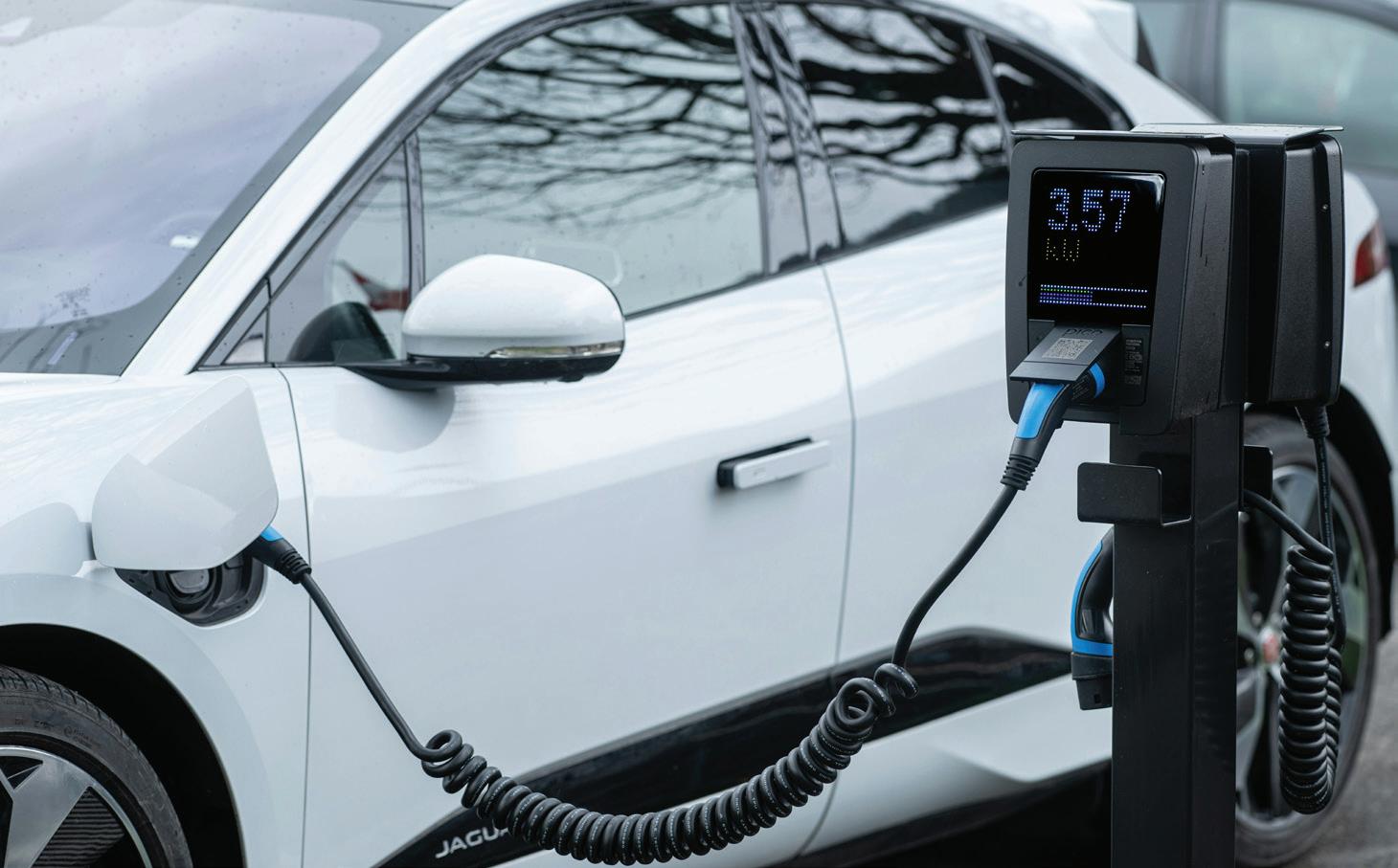
rything EV, from the newest models through locating the best places to charge your EVs to determining cost and maintenance of EV ports in residential units. They’ve left virtually no stone unturned in their quest, which is interactive to say the least. This year will include planned stops in Calgary, Edmonton and Vancouver.
Among PND’s offerings are: their Electric Vehicle Roadshow, a PND priority program, that travels across the country year-round to participate in conferences, tradeshows and festivals, offering electric vehicle education and test drive activities.
As part of this year’s cross country tour, PND will include EV test-drive experiences at major events across the country. These offerings give attendees the chance to compare multiple EV models in one place, ask questions, and learn from EV experts. These shows will be listed below as they are confirmed.
Not to be outdone, the EV Discovery Centre (EVDC) remains a primary draw and will be a major stop during this year’s tour. Operating throughout the year, the EVDC offers hands-on EV education, interactive displays, charging demonstrations, and test drives of a rotating lineup of EVs. Visitors receive neutral, evidence-based information

to help them make informed decisions.
A key part of PND’s recent activities include promoting the federal government’s EV Affordability Program, which includes a federal rebate when buying or leasing a new electric vehicle. Available incentives include up to $5,000 for fully electric vehicles and up to $2,500 for plug-in hybrids.
A number of qualifications apply: The vehicle must be new; the final purchase must be $50,000 or less (no ceiling for EVs made in Canada). Furthermore, the vehicle must be built in Canada or a country with a free-trade agreement with Canada, and, finally, only certain models, trims and model years apply.
The price cap includes the vehicle, options, and dealer fees—but does not include taxes, government rebates, freight, winter tires, home chargers, or financing costs.
Are you intrigued, yet don’t know if Plug ‘N Drive will be making the rounds in your city? Not to worry! Plug ‘N Drive will be having EVs for EVeryone MEET Tours all over Canada in the spring and summer and will promote test drives and classes. For more information visit www.plugndrive.ca
700,000
More than 700,000 fully-electric and plug-in hybrid electric vehicles on the road in Canada and growing.
$3,000
Driving an electric vehicle can save you $3,000 per year on fuel savings alone.
90%
Driving an electric vehicle can reduce your vehicle’s emissions by as much as 90%.
80+%
More than 80% of Canada’s electricity comes from from non-greenhouse gas (non-GHG) emitting sources.
30,000
Canada has more than 30,000 public charging stations.
110+
There are over 110 models available for sale in Canada with more on the way.
400+ kms
Many new 2025 models offer 400+ kms of range on a single charge.

Bits and pieces of the strange, bizarre and sometimes inexplicable gathered from around the web so you don’t have to! Yer welcome!
Q: Why did the chicken cross the road?
A: To catch a Subaru of course!
Do we have your attention? Good. If you read our recent Subaru Outback Wilderness review—which we highly recommend—you may have noticed that we concluded by noting that 3 percent of Subaru Outback owners have chickens and use their cars to transport them.
This fact was presented to us by Subaru during a slideshow about the latest Wilderness model. While we obviously remembered something as weird as that, it left us wondering: What other animals do Subaru drivers like to lug around?
Now, keeping tabs on who your owners are isn’t a particularly novel thing. Every car company has pretty good data on the age, gender, and, uh, interests of most of its buyers. In fact, we’d wager that this isn’t even the most ridiculous personal detail a car company has on file.
That said, most of the really in-depth stuff typically stays inside the building. So, when we reached out to Subaru to see if they knew anything about their drivers’ specific petcarrying habits beyond what was already detailed, we were thrilled that this specific bit of info made it out of the forbidden file cabinet.
Source: www.motor1.com/news/785908/subaru-owners-hauling-animals-percentage
To our surprise, the data is pretty detailed. Some of these animals you probably expect—dogs, cats, etc—but others are a bit more… out there. The percentages are maybe the funniest part, with some animals accounting for just two or three percent of haulage (?), making the list.
The animals are as follows, with percentage rates representative of how many buyers have what:
Dogs — 48%
Cats — 30%
Fish — 4%
Chickens — 3%
Birds — 2%
Some of these numbers may come as a shock; we thought chickens and birds would be lumped into the same bulletpoint, but we get why they’re not. Otherwise, the rest of the details mostly check out.
Dogs are, statistically, the most popular pet in America, so it makes sense that over half of Subaru owners have them. On the flip side, we don’t know who is carrying fish around in their Outback, but we respect the hustle.
This is a slightly older story we just happened to come across, but in case you haven’t heard about it we thought you needed to know…
If you use a public vacuum to clean your car, you may be doing a lot more harm than good.
According to a lab study commissioned by Panda Hub, selfserve vacuums—the kind you’d typically find at car wash facilities or gas stations—are loaded with all manner of bacteria, some of it potentially dangerous.
The list includes, ahem, fecal matter. If you’re unsure what that means, the Cambridge Advanced Learner’s Dictionary defines it as “solid waste passed out of the body of a human or animal through the bowels.” Poop, in other words.
Key Findings from the lab study:
Every single swabbed vacuum had higher than average
amounts of microbes that can cause sickness:
• Listeria
• E. coli
• Mixed Coliforms
• Staphylococcus
• Pseudomonas
Several vacuums had high amounts of coliforms and E. coli presence, strongly indicating a presence of fecal matter.
How much fecal matter, you ask? According to the report, the swab from the most contaminated vacuum tested contained more fecal matter than most toilet seats. When you consider what’s likely on the bottom of the shoes you wear, and that those shoes are regularly grinding their soles into your car’s carpet, the results aren’t actually that surprising.
But still gross.
The study also includes statistics on how many people regularly use the poopy vacuums.
• 58% of surveyed car owning Americans claimed self serve vacuums were part of their car cleaning routine. From over 212M registered drivers, this would amount to over 123 million Americans.
• 32% of respondents said they would use self-serve car vacuums on a daily or weekly basis. This would amount to over 67 million Americans.
What’s more, 173 million Americans are using their cars to deliver food. Now, if you’ll excuse us, we’re going to head out and buy that little handheld car vacuum we’ve had our eye on.
Source: https://www.autoguide.com/auto/auto-news/the-nasty-facts-about-public-car-vacuums-44615773
This microcar set the slowest Nürburgring lap time ever
Automakers love to brag about how fast their cars can lap the dreaded Nürburgring. But what about how slow they can go around the famed circuit? That’s exactly what French automaker Ligier wanted to find out.
French automotive journalists Nicolas Meunier and Martin Coulomb took a diesel-powered Ligier JS50 quadricycle for an official lap of the Nürburgring. Technically in the same class as something like the Citroën Ami, the JS50 produces a mighty 8 horsepower in its most powerful trim and has a blistering top speed of 28 miles per hour.
Despite—or because of—those limitations, the adorable JS50 completed an official Nürburgring lap time of 28 min -
Source: https://www.motor1.com/news/783524/slowest-nurburgring-lap-time
utes and 25.8 seconds. That’s officially the slowest Nürburgring lap on record, beating (losing to?) the previous record holder: the Trabant P50, which logged a 16-minute, 1-second lap back in 1960. By comparison, the Mercedes-AMG One still has the fastest Nürburgring lap time, at 6 minutes and 29.1 seconds.
Ligier jokingly said the lap time “hinted at [its] glorious history in Formula 1,” according to Autocar. The real challenge, though, was completing a lap of the full 12.9-mile course on a single tank of fuel—which Meunier and Coulomb successfully achieved, averaging an impressive 94.1 miles per gallon.


Separation to Unlock Significant Shareholder Value and Enhance Strategic Clarity, Operational Focus and Financial Performance for Both Companies. Tax-Free Separation Expected to be Completed in the First Quarter of 2027.
Genuine Parts Company (NYSE: GPC), a leading global service provider of automotive and industrial replacement parts and value-added solutions, announced Feb 17 its intention to separate the company into two independent, publicly traded companies, one comprising its Automotive Parts Group (“Global Automotive”) and the other comprising its Industrial Parts Group (“Global Industrial”). The transaction, which is targeted for completion in the first quarter of 2027, is expected to qualify as a tax-free transaction for U.S. federal tax purposes to Genuine Parts Company shareholders.
“Genuine Parts Company has a proud history of evolving with our markets for nearly a century,” said Will Stengel, Chair-Elect and Chief Executive Officer. “Over the past decade, we established leading global footprints in attractive geographies, simplified our business mix and accelerated strategic investments to advance and differentiate our business. Creating two focused, independent companies sharpens customer and market alignment, increases clarity and speed, simplifies operations and enables disciplined, business-specific investments to unlock long-term value.”
The business separation is the result of a comprehensive strategic and operational review of market opportunities, in-flight initiatives and business structure considerations across Global Automotive and Global Industrial.
Pursuing the separation is expected to create two, scaled market leaders,
better able to execute their respective strategies by:
• Creating dedicated platforms that improve operating clarity and execution speed at each company to deliver greater customer value and long-term shareholder returns;
• Establishing separate management teams with tailored expertise, strategies and decision-making authority to better address customer needs;
• Providing enhanced financial flexibility to enable strategic investments that accelerate profitable growth, improve productivity and extend market leadership positions;
• Allowing each business to design capital structures and capital allocation strategies aligned with specific business objectives, while targeting investment-grade credit metrics at each company; and
• Enabling each business to attract a long-term investor base through a clear, compelling and differentiated investment profile.
Global Automotive is the largest global network of automotive parts and auto care repair centers, operating in North America, Europe, U.K. and Australasia. Going to market under the globally recognized NAPA brand, amongst others, Global Automotive will be a more focused automotive aftermarket platform able to more effectively capitalize on local customer needs and market trends, including significant growth and market share opportunities with the commercial ‘do-it-for-me’
customer. Through its 100-year legacy, NAPA has earned its leadership position with unmatched customer loyalty built on trusted product quality, deep relationships and a differentiated culture grounded in expertise, service, performance and innovation. Global Automotive’s international businesses in Europe and Australasia hold leading market positions and leverage our iconic brands, NAPA and Repco, to expand share in their respective geographies.
Global Automotive generated more than $15 billion in sales, and $1.2 billion of EBITDA in 2025. Global Automotive has a network of more than 10,000 global locations with a significant opportunity in a fragmented $200 billion addressable market driven by non-discretionary demand. The business will continue to benefit from its unique global footprint, including independent owner coverage, dedicated network of over 20,000 NAPA Auto Care repair centers in North America, resilient and growing commercial ‘do-it-for-me’ end markets and diversified customer segments.
Global Automotive has been executing significant technology and supply chain transformation programs, which are expected to deliver accelerating growth and margin expansion, further optimize working capital and increase return on invested capital. Global Automotive is targeting to maintain investment-grade credit metrics, with a tailored capital structure designed to support future capital investment priorities. Global Automotive will prioritize high-return organic investments across sales and stores, technology, supply chain and accretive bolt-on acquisitions. Global Automotive expects to complement its strategic investments with a balanced capital return program.
Global Industrial: a diversified, best-in-class industrial solutions provider
Global Industrial, operating under the Motion brand, is a market leading diversified industrial distributor and valueadded solutions provider with operations in North America and Australasia. The business generated approximately $9 billion in sales, and more than $1.1 billion of EBITDA in 2025. Motion is the market leading provider of ‘mission critical’ industrial maintenance and repair and value-added solutions including fluid power, automation, conveyance and repair services. Motion maintains deeply embedded customer relationships in over 14 diversified end markets across critical manufacturing sectors. Motion’s scale, omni-channel go-to-market strategy and strategic supplier relationships enable its differentiated product offering, including over 10 million SKUs to support its over
Motion is well-positioned to extend its industry leadership position in a fragmented $150 billion global market through its differentiated customer value proposition driven by solution-based selling, technical and product expertise, product breadth, delivery coverage and service excellence. Motion will continue to benefit from long-term secular tailwinds including re-shoring and nearshoring opportunities, automation and robotics, artificial intelligence infrastructure build out and the increasing scarcity of manufacturing technical expertise.
Motion expects to build on its track record of delivering best-in-class financial performance with profitable sales growth, strong operating leverage translating into double-digit EBITDA margins, free cash flow generation and attractive returns on invested capital. Motion is targeting to maintain investment-grade
credit metrics, with capital allocation priorities focused on investments that enhance the customer experience across commercial excellence, technology and supply chain. Motion will continue to pursue strategic acquisitions and a balanced capital return program.
There are no changes to the GPC executive team. The company names, executive teams and Boards of Directors for Global Automotive and Global Industrial will be announced at a later date.
The transaction is expected to be completed in the first quarter of 2027, subject to satisfaction of customary conditions, including final approval from the GPC Board and filing and effectiveness of a Form 10 registration statement with the U.S. Securities and Exchange Commission. The separation does not require shareholder approval.


The world is changing rapidly, fundamentally reshaping trade relationships and leaving economies, businesses and workers under a cloud of uncertainty. Canada’s automotive industry is on the front line of this shift, with more than 90% of Canadian-made vehicles and 60% of Canadian-made auto parts currently exported to the U.S.
On February 18, John Zerucelli, Secretary of State (Labour), visited Palcam Technologies Ltd in Newmarket, Ontario to highlight the Government of Canada’s new Automotive Strategy and new measures to help workers and employers navigate current pressures while preparing to meet the workforce needs of tomorrow.
The government is focused on what we can control—implementing a new industrial strategy. Canada is transforming the economy from one that is reliant on a single trade partner to one that is more resilient to global shocks—a stronger, more sustainable, more independent economy built on the solid foundation of strong Canadian industries and bolstered by
diverse international trade partners. In parallel, the government is launching a national electricity strategy to leverage our energy advantage to provide clean, affordable and reliable power to Canadians.
These shifts present a unique opportunity to transform Canada’s auto industry to be less reliant on the U.S. and gas-powered vehicles. To that end, the government has introduced a new auto strategy that rewards the production of made-in-Canada vehicles and harnesses our world-class capabilities in artificial intelligence and technology expertise to build the cars of the future. This is a strategy that positions Canada to become a global leader in electric vehicle (EV) production.
On February 5, Prime Minister Mark Carney announced the following new measures:
1. To accelerate investment in Canada’s auto manufacturing sector, the government will:
• allocate $3 billion from the Strategic Response Fund and up to $100 million from the Regional Tariff Response Initiative to help the auto industry adapt, grow, and diversify to new markets.
• harness the Productivity Super-Deduction and reduced corporate tax rates for zero emission- technology manufacturers to encourage investment in clean technologies and EVs.
2. To rationalise emissions reduction policies to focus on outcomes that matter to Canadians, the government will:
• introduce stronger greenhouse gas emission standards for model years 2027–32. These standards will put Canada on a path to achieve a goal of 75% EV sales by 2035 and 90% EV sales by 2040—reducing our carbon footprint and securing Canada’s global leadership in clean energy.
• These more stringent emissions standards will enable the Government of Canada to repeal the Electric Vehicle Availability Standard. This approach will allow manufacturers to use a wide array of technologies to meet the standards and respond to consumer preferences in the near term, while driving EV adoption over time.
3. To build up a domestic consumer base and make electric vehicles more affordable and reliable, the government will:
• launch a five-year EV Affordability Program to lower the cost of EVs for Canadians and create a stronger domestic consumer market.
• The new $2.3 billion program will offer individuals and businesses purchase or lease incentives of up to $5,000 for battery electric and fuel EVs, and up to $2,500 for plug-in hybrids (PHEV) with a final transaction value up to $50,000 on cars made by countries Canada has free trade agreements with. To support the Canadian automotive industry, this $50,000 cap will not apply to Canadian made - EVs and PHEVs.
• enhance our national EV charging network through investments of $1.5 billion through the Canada Infrastructure Bank’s Charging and Hydrogen Refuelling Infrastructure Initiative, making it easier and more convenient for drivers to charge their EVs across the country.
4. To establish a comprehensive trade regime that strengthens the competitiveness of the auto sector, the government will:
• strengthen Canada’s automotive remission framework to reward companies that produce and invest in Canada.
• maintain counter-tariffs on auto imports from the United States to ensure a level playing field for Canadian automotive manufacturers in the domestic market.
• build on its recently strengthened strategic partnership with the Republic of Korea by signing a memorandum of understanding (MOU) to strengthen Canada Korea- industrial collaboration for future mobility. This builds on other MOUs that Canada has signed with global automakers to promote cooperation.
• focus on establishing a new strategic partnership with China, a global leader in EV manufacturing, to further diversify trade and catalyse new investment in the automotive sector. The recently announced partnership
will look to drive new Chinese joint venture investment in Canada and allow for a fixed volume of Chinese EV imports into the Canadian market.
1. To protect Canadian auto workers and businesses from immediate pressures while helping them bridge them to the future, the government will:
• provide support to employees through a new Work-Sharing grant— preventing layoffs and supporting worker retention so businesses can plan for the future.
• establish a new workforce alliance of industry, labour and training partners to address bottlenecks and catalyse private investment.
• provide employment assistance and reskilling supports for up to 66,000 workers across Canada, including for displaced auto workers, through a $570 million investment.
The government will leverage our new and existing trade agreements—including the recent EV arrangement with China —to catalyse massive new investment in the sector, diversify Canada’s auto export markets and position Canada as a global leader in EVs. Canadian workers and industries are well equipped to seize this opportunity, and we are making generational investments in critical minerals, including those essential for batteries,
to secure Canada’s place in the world’s most important supply chains.
The choices made now will shape the Canadian auto industry for decades to come. By protecting the industry and incentivising automakers to build here, we are helping ensure that Canada’s workers and businesses can transform to compete and win in this new global environment.
These measures build on previously announced initiatives to help transform strategic Canadian industries, including steel and softwood lumber. Together, they form an ambitious industrial strategy that will build a stronger, more resilient, more independent Canadian economy and ensure workers and industries can bridge to that future and seize its opportunities.
A new driver survey highlighted in the Globe and Mail echoes the concerns The Canadian Trucking Alliance has repeatedly raised with governments and officials for a decade – that worker misclassification, labour abuse, wage theft and deteriorating safety conditions are systemic problems spreading throughout the trucking industry, that demand sustained enforcement and reform.
According to the survey of more than 400 truck drivers across Canada, conducted by Parkdale Community Legal Services, Labour Community Services of Peel, and driver advocacy organizations, nearly 70 per cent of long-haul drivers report experiencing wage theft. The average amount of unpaid earnings cited was about $10,000 per driver. The findings point to illegal deductions, unpaid hours of work, misclassification of employees as Driver Inc. contractors, and unsafe operating conditions.
Supporting CTA’s claim the Driver Inc. scheme is rampant in trucking, more than 65 per cent of surveyed drivers reported being misclassified as independent contractors, a tax-evading practice by companies which also deprives workers of basic protections and legal entitlements.
Alarmingly, nearly one third (29%) report their employers frequently pres-
sure them to take risks on the road; while 60 percent say they are forced to often drive trucks that are not properly maintained. This reinforces CTA’s longstanding claim there is a direct correlation between Driver Inc companies that evade taxes, commit labour abuses, steal workers’ wages and threaten public safety by pressuring drivers to break highway and commercial trucking laws while operating unsafe equipment.
“These findings are deeply troubling, but they are also not surprising,” said Stephen Laskowski, president of the CTA. “The report supports years of CTA warnings that the culture of non-compliance and overall lawlessness in trucking is growing. There is clearly a systemic association between tax fraud, labour abuse and the deterioration of driver and public safety we are all witnessing on our highways. We drastically need intervention from all levels of government to save this industry.”
During recent testimony before the federal transport committee, CTA explained how Driver Inc carriers can illegally save up to $30,000 per driver by misclassifying workers.
The Globe article further underscores that trucking represents just 17 per cent of federally regulated employment, yet accounts for 85 per cent of federal labour code violations between 2017 and 2022.
“For years, CTA and responsible industry partners have said that weak or nonexistent enforcement and minimal pen-
alties create a business environment where non-compliance is normalized, putting the travelling public at risk while undermining responsible, compliant trucking companies,” said Laskowski.
While CTA has welcomed recent federal investments and changes aimed at improving enforcement, including additional resources for inspections and action against misclassification, the Alliance is emphasizing that more must be done to ensure timely investigations, meaningful penalties, and consistent application of the law.
“We hope governments will continue to listen to those trying to fix these problems – including driver advocates, legal clinics, and industry groups committed to fair labour practices and competition –rather than continue being distracted by voices that insist there are no problems here. These denials aim to obscure the strong correlation between misclassification, labour abuse and safety violations; while obstructing progress to undermine hard-working drivers and reputable trucking companies.”
CTA reiterated its call for stronger enforcement of existing labour laws, adding ESDC’s misclassification team will be critical in combatting many of the problems highlighted in the report. CTA says additional budgetary measures are still needed to ensure this group has the sustained funding and resources needed to curb the rampant noncompliance and labour abuse.















































































































Automotive-related content gathered from around the Maritime provinces so you don’t have to!

and Infrastructure, announced the funding today at an event in Conception Bay South. Minister Petten was joined by Paul Connors, Member of Parliament for Avalon and His Worship Darrin Bent, Mayor of Conception Bay South.
To support further housing development in the Town of Conception Bay South, water and sewer services in the town are being expanded through this joint investment. The funding will facilitate the installation of new drinking water and new sewer lines, provide continued service to 55 housing units, and will enable the development of at least 65 new housing units. The expanded infrastructure will open up additional vacant land for residential construction, including lots along Legion Road in the town. This project will support Conception
housing in Conception Bay South and helps ensure that the community has reliable water and sewer infrastructure essential for long-term planning and continued growth,” said the Honourable Barry Petten, Minister of Transportation and Infrastructure
The first full closure of the Centennial Bridge in Miramichi will take place this year.
“First, I want to say that I understand the frustration of the people in Miramichi who have been hearing about a planned closure for the last number years, only for it to not happen for one reason or
The Department of Transportation and Infrastructure and the City of Miramichi will host an open house on Feb. 26 at the Miramichi Agricultural Exhibition Association, 24 Church St., to inform people about the work being done and to discuss the mitigation measures being put in place.
The government has confirmed that it will support a number of mitigation measures with the City of Miramichi, including a signed detour route, and will be providing financial relief for additional fire and police services on both sides of the bridge during the closure, increased public transit service, as well as funding for additional accessible transit vehicles. Additionally, a water taxi is planned to operate during the summer months in 2026.
“The safety of the travelling public is a priority for our government,” said Chiasson. “We are committed to getting this project completed and are working with our partners at the City of Miramichi and in the community to provide assistance with some of the traffic delays that will be caused by this planned closure.”
The Centennial Bridge is a vital transportation link in Miramichi, carrying Route 8 and Route 11 traffic across the Miramichi River. With a height of about 73 metres and length of 1.1 kilometres, the bridge is one of the largest structures in the province.
“The City of Miramichi recognizes the significant disruption the closure will cause in the community, but also understands the importance and necessity of the work in renewing our flagship Centennial Bridge,” said Miramichi Mayor Adam Lordon. “As such, we have been preparing mitigation plans for city services to minimize disruption, especially in public safety, and will be communicating those at every opportunity over the next few weeks alongside the province.”
During these closures, motorists are encouraged to consider alternatives, such as working from home, walking, biking, carpooling, using public transit and completing errands outside of heavy traffic times.
Province supports growth for municipalities
The Province is investing in critical infrastructure projects so municipalities can expand services, support housing growth and build more inclusive communities.
Eighteen projects will receive $15 million in total, covering up to 50 per cent of eligible project costs, from the Growth and Renewal for Infrastructure Development Program.
“These investments help municipalities with the infrastructure they need to support development and drive
growth,” said John A. MacDonald, Minister of Municipal Affairs. “By strengthening core services, enhancing climate resiliency and increasing accessibility, we’re helping to lay the foundation for more housing, more opportunity, and a better quality of life for residents across Nova Scotia.”
Since 2021, the Province has committed nearly $500 million to support municipalities with critical infrastructure projects, including water, stormwater, disaster mitigation, accessibility and transit.
“We are pleased that our application has received this level of support from the government. The improvements will be directed to the Windsor water treatment facility and help to address existing redundancy requirements with our water treatment process while helping to future proof our utility for existing and future customers. We remain committed to investing in our now consolidated water utility to accommodate growth and to ensure ongoing quality water to our community. This project aligns with the capital plans for the municipality, including the recent addition of a new water tower in the Garlands Crossing area ” said Abraham Zebian, Mayor of West Hants Regional Municipality.
Shoreline protection planned for Murchison Lane
A new shoreline protection project on Murchison Lane in Charlottetown will
improve trail safety, protect access to the Queen Elizabeth Hospital (QEH), and safeguard hospital lands by reducing coastal erosion and flooding.
Coastal erosion and flooding in the area have increased the risk to the road and the nearby shoreline trail, which is used by residents as well as QEH patients, visitors and staff.
Work will take place in two phases. In early February, crews will install 350 linear meters of stone bank protection along the most vulnerable sections of cliff beside the shoreline trail.
In the winter of 2026–27, offshore stone sills will be added at strategic locations to stabilize and foster additional growth of existing salt marsh plants, which will reduce onshore wave impacts. Vegetated and forested areas along the bluff will also be restored.
The effort will protect the road and trail while also helping restore the nearby salt marsh. Salt marshes function as a natural buffer, absorbing wave action and reducing shore erosion.
This project aligns with findings from the province’s State of the Coast report, which highlights coastal erosion and flooding as growing risks to roads, trails, and other infrastructure. It will also provide the background information needed to develop policies that support better coastal management.
Work is expected to be completed by the end of 2027.
Whether he’s driving fast or driving everyone crazy, musician Ashley MacIsaac is many things: dull ain’t one of them.
By Carter Hammett
Throughout a colourful, controversial, hot-and-cold career marked by artistic highs and financial lows, one thing’s remained constant throughout musician Ashley MacIssac never- dull star journey: a deep abiding love of cars.
“Always loved cars, especially sedans,” MacIsaac growls over the phone from his home in Windsor, O.N. “I got my license at 16 and shortly after got myself a 1989 Pontiac Parisienne Brougham while still in high school. I wound up competing with the high school principal who also had a Brougham. I wound up parking in his space!” he says with a laugh.
MacIsaac says he flipped cars frequently and claims to have owned a slew of cars including a 1995 Grand Marquis GS, and a 1969 Delta 98 among many others. “When I moved to Toronto, I got rid of all my cars,” he says.
These days he’s content moving himself to gigs in cars that give him lots of comfort.
“I do a lot of long-distance travel often so I might have to drive three-or-four hours just to get there. You need to be relaxed before- and- after the show. When I’m working, the most comfortable place for me is on the highway. There’s safety and security too.”
“I often drive from Windsor O.N. to Halifax and that’s a 26-hour drive. A

bigger car is just more comfortable. Plus I like to smoke while driving.”
Furthermore, he thrives being on the road, whether it’s the lonesome highway or even being stuck at rush hour. “I’m a city guy. I love driving in congested traffic,” he laughs.
A fiddling prodigy and cousin to renowned musicians Jack White (of the White Stripes) and Natalie MacMaster, MacIsaac was born in 1975 in Creignish, N.S. Growing up on Cape Breton Island, he learned traditional Celtic music from some of the best local fiddlers. While still a teenager, he released two albums of fiddle music before his career took off in 1995.
That was the year he released Hi How Are You Today? An album that merged traditional fiddle rhythms with punk rock and dance music that produced a top 20 hit with “Sleepy Maggie” in collaboration with Gaelic singer Mary Jane Lamond. That led to heavy video rotation, movie appearances, more music, an autobiography and a growing reputation as an enfant terrible, complete with unpredictable behaviours that have raised a lot of eyebrows over the years.
He appears to have slowed down in recent times but continues to write, record and perform, including The
Festival of Small Halls and venues like Hugh’s Room in Toronto.
In 2015 musician Phillip Glass composed a music piece called “Orion” in collaboration with numerous musicians including MacIsaac. MacIsaac revisits Glass’ music in a project intended for recording in April. He states he’s also working on a long-awaited country album. “I’m trying to bring a George Jones vibe with a fiddle player.
“It’s a different world post-Covid,” he says. “The music industry’s changed. If you’re trying to sell CDs, you need to figure out different angles.”
That includes lots of touring he says, noting that sometimes unexpected things happen on the road.
One time we were travelling on a bus around the eastern seaboard and we passed a bus stop and something inside made me wanna turn back. Turned out the bus we passed had broken down and belonged to (rock group) The Proclaimers (of “500 Miles” fame) and they still had 500 miles to go!
“As an Atlantic Canadian I still see certain things as a driver. The government should get their shit together so more people can be safe on the road. It’s important: being on the road in Canada is a great pleasure.”