
RAINBOW

Page 1


Photo by Elliott Wright-Anderson
Photo by Gabi Linke
Photos by Elliott Wright-Anderson

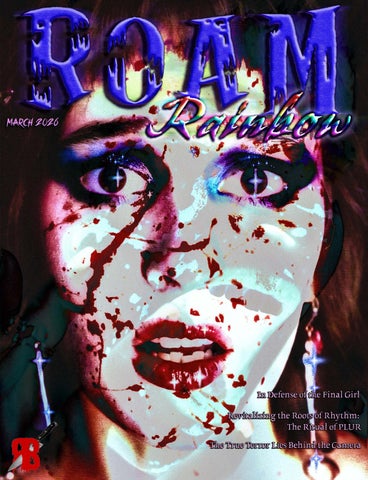
She emerges distraught and covered in blood, having survived long enough to either be rescued or to save herself ng or to save herself defeating her assailant. Ultimately, she is stronger because of it. Countless horror movies since the 1970s have f it. Countless horror movies since this pattern: one heroine survives to the end, living through the deaths of her friends and family. The “final he deaths of her friends and is polarizing among horror fans. Some love and identify with it, while others view it as inherently misogynistic. , while others view it as Misogyny echoes through Hollywood in myriad ways, and the portrayal of women’s suffering is one of them. rayal of women’s Infamously sexist director Alfred Hitchcock once said, “Torture the women!” explaining that he would rather he would rather a pretty face in pain than an ugly one. This chauvinistic sentiment is reflected in the wave of horror heroines ment emerged in the 1970s and 1980s, where women’s suffering often became a central spectacle.

Film scholar Carol J. Clover coined the term “final girl” in 1987, defining it through several prototypical traits 87, traits by patriarchal expectations of femininity. For instance, she cannot dress or behave “too femininely,” because cannot dress or behave “too must also be masculine enough to overcome the typically male attacker. She also cannot be sexually available; tacker. She also cannot be horror films, on-screen sex has historically functioned as a death sentence. Despite these controversial origins ath sentence. Despite these restrictive traits attached to the trope, many women and queer viewers have found solace in the final girl. Unexpected r viewers have found solace in horror fans have found comfort in characters who embody this role, either by reclaiming what she represents le, she represents simply identifying with her resilience.

While the final girl trope can at times cater to a male gaze, Clover argued that it is “designed to align spectators with the male tormentor, but with the female victim—the ‘final girl’—who finally defeats her oppressor.” Horror al oppressor.” Horror films may not always celebrate her femininity throughout the narrative, but her survival nonetheless centers arrative, centers within the genre. Her existence connects horror to an audience that has often been marginalized in other cinematic that has often been in other cinematic spaces.

Queer viewers who do not identify as women have also connected to the final girl, perhaps because of her position d of her position marginalized yet ultimately triumphant. The final girl’s resilience and ultimate victory can offer an empowering ence and ultimate victory can an empowering sense of catharsis. Though villains are often the face of horror franchises, final girls frequently become the cultural r become the cultural icons. Ellen Ripley (“Alien”), Sydney Prescott (“Scream”), Nancy Thompson (“Nightmare on Elm Street”), Laurie cy Street”), Laurie Strode (“Halloween”) and so many others have left lasting impressions on generations of viewers. Characters like Strode, albeit strong and resilient, simply lived long enough to be saved by a man. Characters ved Characters Ripley and Thompson use intelligence and strategy to confront and defeat their antagonists themselves. Over Over the trope has shifted. Final girls increasingly defeat their assailants independently, rather than simply enduring r assailants independently, rather than enough to be rescued.

herself by have followed “final girl” trope misogynistic. them. rather see heroines that traits shaped because she available; in origins and the Unexpected represents or by spectators not Horror centers women cinematic position as empowering cultural Laurie Characters like Over time, enduring long

21st century final girls like Grace Le Domas (“Ready or Not”) and Jay Height (“It Follows”) have shown modern reinterpretations of the trope. Le Domas exhibits toughness without sacrificing femininity, while Height challenges expectations by being an imperfect victim who still plays a central role in the climactic confrontation.

The rigid traits Clover originally outlined have become less essential in defining who qualifies as a final girl. Contemporary horror presents female characters with more varied personalities, behaviors and identities, reflecting a broader appreciation for feminist interpretations of the genre among both filmmakers and viewers alike.

With both feminist and misogynistic implications embedded within it, the final girl remains understandably divisive. It is important to acknowledge the misogyny woven into the trope, but it is equally valid to feel empowered by her survival. You can be an apologist for the final girl, criticize the final girl, or both. While the trope has historically carried misogynistic undertones, it has also provided a framework for women’s empowerment, even at its inception. As the final girls in newly released media become progressively more feminist, this additional role gains even more weight. Portrayals of women in horror still have a long way to go, but in defense of the final girl: we should celebrate her womanhood, strength, resilience and her ultimate victory over masculine evil.

Satchel McGuire
Photo by Tyler Anderson
Photos by Tyler Anderson
Photo by Dylan Renslen
Photo by Sutton Raeburn
Photos by Sutton Raeburn
Photo by Elliott Wright-Anderson
Photos by Gabi Linke
Photos by Elliott Wright-Anderson and Dylan Renlen
Photos by Olivia Gewanter

by

Photo
Kyle Sanchez
Photos by Tyler Anderson
Photos by Kyle Sanchez

“I just remember being 11, 12 years old, telling my mom, she’s asking me, ‘What do you want to be when you grow up?’ I’m like, I want to be a DJ.” Local Sleaze, a Denver-based DJ, always knew who she would become.

Though she began life as a shy personality, she attests that being a DJ transformed her in more ways than one. Not only did her body confidence flourish, but so did the way she carried herself. She recounts her struggle with comments on her body in earlier years, in disbelief about the expectations.

“Growing up, I did get shamed a lot and bullied for how skinny I am…I was going to middle school and high school around the era where 2016 instabaddies were the norm,” she said. But that didn’t get to her!

Local Sleaze credits the rave community in promoting body positivity and allowing her to cultivate kindness for herself, physically and mentally. She notes that the rave scene isn’t merely a scene, but a community of like-minded “freaks” who encourage authenticity.

“I feel like now I can f---ing own it—I feel like it’s telling everyone who’s ever shamed me, f--- you, this is my body, you’re gonna see it, whether you like it or not,” she said.

Before she could “own it” at shows, Local Sleaze cited Facebook as the place where she first aired her dirty laundry, earning her the title of “Denver’s Paris Hilton.” Here, she found an outlet to express herself without shame, which she now channels towards establishing a legacy: The Ritual.

“I’ve always wanted to create something that would become something bigger than myself…I just wanted to create an event series that was a safe space for what I like to call the ‘freaks of the night.’ I feel like people like me don’t have anywhere to go dance and mingle, so I wanted to create something.” The Ritual is a place that she hopes others can use to embrace PLUR: Peace, Love, Unity and Respect.

In Roam’s interview, Local Sleaze explained the role of PLUR in her community, when hate is becoming the new norm: “I just try to be a f--ing example and despite the tragedies that are happening all around us, I try to promote that, even when we go through oppression and tragic events, we will always unite by music, dancing and [being] with f---ing community.”

Photos by Dylan Renlen
Photo by Kyle Sanchez

Turn static files into dynamic content formats.
Create a flipbook