Lifeboat Design: David Constant, Lee Hawkins, Emily Scott
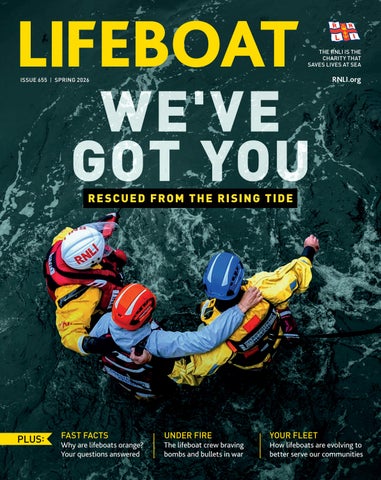
Front cover image: Real-life rescue shot: the RNLI and the Coastguard guide a stranded walker to safety. Photo: Lyme Regis Coastguard Rescue Team
Photo (below): Lyme Regis RNLI B class lifeboat Spirit of Loch Fyne. Photo: Max Redwood
Contact us
Would you prefer to receive a digital copy of Lifeboat magazine by email or not receive it at all? Are you moving house? Do you have another question? Then please email supporterexperience@rnli.org.uk with your request, including your supporter number. You can also call us on 0300 300 9990 (from the UK), 01 511 9836 (from Ireland) or +44 1202 663234 (from any other country), or write to us at RNLI Support Centre, West Quay Road, Poole, Dorset, BH15 1HZ.
Blind and partially sighted people can choose to receive a free CD or mp3 of the magazine
The Royal National Lifeboat Institution is the charity that saves lives at sea. We do so by providing a rescue service, safety education, and supervision on beaches. We also influence other organisations, policy-makers and regulators. Our crews and lifeguards have saved more than 146,700 lives since the RNLI was formed in 1824. Our Water Safety Team helps keep people safe at the coast and our International Team works to reduce drowning around the world where it’s a major risk. We are independent from the government and rely on voluntary contributions and gifts in Wills for income. The Royal National Lifeboat Institution, a charity registered in England and Wales (209603), Scotland (SC037736), the Republic of Ireland (CHY 2678 and 20003326), the Bailiwick of Jersey (14), the Isle of Man (1308 and 006329F), the Bailiwick of Guernsey and Alderney
Bethany Hope, Editor Email: lifeboat@rnli.org.uk
Welcome
What do you think of the photo on the cover? It’s from a rescue of four walkers who were cut off by the tide at Lyme Regis. The walker in the middle is guided through the surf back to shore, by a lifeboat volunteer and a coastguard. You’d trust them with your life, that’s for sure. Hear direct from Tom and Steve, the rescuers (page 10).
Also in this issue, crews from Peel and Donaghadee launch to help the crew of a damaged yacht at night in heavy seas (page 12). And Senior Lifeguard Lois single-handedly saves two young swimmers who are drowning at Skegness Beach (page 16).
Of course, there’s nothing new about RNLI courage. We take you back to 1940 Arbroath (page 24), where the lifeboat crew contend with bombs and bullets during a rescue in the Second World War. These stories show, through the years, you’re in safe hands with the RNLI. Thank you so much for helping our lifesavers to be ready for their next shout. See what’s next for our charity, on page 28.
25 years of RNLI lifeguards
Since 2001, RNLI lifeguards have made our beaches safer, carrying out 48 million preventative actions.
This year, we’re celebrating 25 years of RNLI lifeguarding. Lifeguards are ready for another busy season, with many patrolling beaches from the start of the Easter holidays.
This anniversary year brings new ways to get to know your lifeguards, including a lifeguard range in RNLI Shop and a podcast series exploring lifeguard life launching in spring. Our Meet the Lifeguard programme will also head inland to reach even more school children with vital water safety education. We’ll be celebrating the 25th anniversary in your Lifeboat magazine throughout the year.
If you’re visiting the coast, remember the sea is still shockingly cold. Choose a lifeguarded beach and stop by to say hello –our friendly lifeguards can help you enjoy your visit safely.
As an RNLI member, your support helps fund the kit and training our lifeguards depend on to save lives this season. Thank you.
Visit RNLI.org/lifeguards to find out more.
Lest we forget
In November, we released Stories of Courage: a special one-off podcast to mark Remembrance Day, narrated by award-winning historian, journalist and television presenter Dan Jones. Stories of Courage highlights the sad loss of lifeboat crew in the Second World War, and also many incredible stories including our involvement in the Dunkirk evacuation and the rescue of downed pilots during the Battle of Britain.
Dan says: ‘The RNLI were involved in some of the key moments of the Second World War and it’s amazing to hear the different stories from crew and direct descendants of those who saved lives.’
Stories of Courage is available on all major podcast platforms and was made possible by a grant provided by The National Lottery Heritage Fund.
2026 – the 25th anniversary of RNLI lifeguard patrols
Kessock RNLI hosted Scotland’s first Women in Search and Rescue event
Women in SAR
In 2025, lifeboat stations around our coasts hosted Women in Search and Rescue (SAR) events, bringing lifesavers together to practise afloat exercises, skills workshops and shared learning.
Women in SAR events were hosted in Kessock, Fishguard, Cullercoats, Hunstanton, Burnham-on-Crouch and Poole. The Kessock event was the first-ever in Scotland, organised by Helm Jane Hier. Jane says: ‘Hearing from so many incredible women across different operational roles … reminds us how strong we are when everyone has the chance to step forward and be part of the crew.’
We’ll host more Women in SAR events in 2026, building on our commitment to equitable development of RNLI volunteers and celebrating women’s vital role in saving lives at sea for more than 200 years.
Lifesavers recognised
RNLI volunteers and staff have been recognised in His Majesty The King’s New Year Honours for their roles in helping to save lives at sea.
British Empire Medal (BEM)
Clive Buckley, Founder and Chair, Solihull RNLI Fundraising Branch
Christopher Cuff, RNLI South West Regional Medical Adviser and Chair of the Lifeboat Management Group, The Lizard RNLI
Member of the Most Excellent Order of the British Empire (MBE)
Victor Dade, Volunteer and Former Crew Member, Hunstanton RNLI
Tony Jones, Chair of the Lifeboat Management Group, New Brighton RNLI
Clive Rand, RNLI Vice President and Committee Member, West Yorkshire RNLI Business Branch
Patsy Smith, Fundraiser and Shop Volunteer, Kirkwall RNLI
To read their stories, please visit RNLI.org/NYHonours26
In brief
Free Wills Month
This March, if you’re 55 or older, you can write or update a simple Will for free with the RNLI as part of Free Wills Month. Visit RNLI.org/LifeboatFWM to find out more.
Reminder: AGM 2026
Our Annual General Meeting (AGM) will be held at 30 Euston Square, London, on Wednesday 17 June 2026 at 2pm. It’s open to all RNLI governors. Find out more at RNLI.org/AGM .
OddBalls
Tynemouth RNLI volunteers had a lot of fun trying out the RNLI x OddBalls underwear recently. It’s agreed: the range is bright, bold, and comfy! You can find it in the OddBalls online shop.
Shared enthusiasm
The Lifeboat Enthusiasts’ Society (LBES) is inviting you to join them. LBES membership is perfect for anyone who has a passion for lifeboats, lifeboat stations and lifeboat history. You’ll get three Lifeboats Past & Present magazines each year, plus an annual handbook. Head to lifeboatenthusiasts.org.
Photos: Oddballs, RNLI/(Johny Cook, Laura Lewis, Ashton Milton)
Community
Welcome to a selection of news from your RNLI community. For all the latest from where you are, head to RNLI.org/news
Calm and courage
Seahouses RNLI crew have praised kayaker Linda who, along with her father Gary, helped save a fellow kayaker near St Cuthbert’s Isle last year. While Gary kept the casualty safe, Linda paddled back to shore against strengthening wind and tidal flow to raise the alarm. Working together, HM Coastguard, Seahouses RNLI and beachgoers brought the casualty safely ashore.
Volunteers welcomed Linda and Gary to the station for a visit, saying: ‘Linda’s ability to stay calm and paddle to shore against the elements demonstrates immense courage.’
Throwing in support
Saxmundham Judo Club has raised £2,850 for Aldeburgh RNLI through quiz nights, bingo and sponsored walks.
Aldeburgh RNLI Lifeboat Operations Manager Martin Quinn says: ‘We were delighted to be chosen among all the good causes locally. Their support helps ensure our volunteers have the equipment and training needed to save lives at sea.’
The club was invited to tour the station and watch a training launch of the inshore lifeboat. Chair and Founder Keith Cartwright-Jones says: ‘What a spectacular visit and such a warm welcome. Watching the launch with a large group from the club shows how important and appreciated the lifeboat crew are, and how grateful we are for the commitment of everyone involved at Aldeburgh RNLI.’
Saxmundham Judo Club raised £2,850 for the RNLI
Linda visits Seahouses Lifeboat Station to meet the crew
SUFFOLK
EAST LOTHIAN
All-weather art
Dunbar RNLI’s all-weather lifeboat
John Neville Taylor featured in a town-wide art show in the autumn, thanks to Digital Artist and RNLI Shore Crew Member Jay Kirkland. Jay was one of 47 artists exhibiting across 29 venues as part of Dunbar Art Route. Her collages, displayed at McArthur’s Store, depict the Trent class lifeboat in stormy seas. Jay says: ‘My work often draws on folk legend and mythology. I photographed the lifeboat while berthed in the harbour and reimagined it in two sea scenes, going through the teeth of a gale.’
Events
Martin Brockman’s Illustrated Talk
The Portbyhan Hotel, Quay Road, Looe
Saturday 14 March, 7.30–10.30pm
Hear the history of RNLI Penlee and the Penlee Disaster of 1981, with shanties from the Polperro Fishermen’s Choir. Free to attend, but registration is essential – via RNLI.org/events
Yellow Welly Cobble Wobble
Clovelly Visitor Centre, Clovelly Sunday 3 May, 8am–1pm
Saddles and summits
Walmer Volunteer Helm Dan Sinclair and his friend Nathan Siddans are celebrating, after completing a gruelling challenge. The pair cycled from John O’Groats to Land’s End and climbed Ben Nevis, Scafell Pike and Yr Wyddfa (also known as Snowdon). They raised more than £13,500 for the RNLI.
Along the way, they endured wind, rain, punctures, and long nights, but were spurred on by messages of support from family, friends and supporters.
Dan says: ‘The comments helped us through some demanding and exhausting days.
‘Every donation helps the RNLI keep saving lives, and that’s what this is all about.’
A 12-mile off-road run taking in the epic scenery and infamous hills of the Clovelly Estate. Expect challenging climbs and technical descents, bluebell woodland and a pebble beach.
Registration before 27 April for £35, through RNLI.org/events
London Mayday Collection
Train stations across London Thursday 7 May 2026, 7am–7pm
Answer the call for help by offering an hour of your time at the RNLI London Mayday collections with fellow volunteers and crew. Register on Eventbrite or contact adam_clarke @ rnli.org.uk for more information.
GET INVOLVED
To find more events coming up in your area, including lifeboat open days, head to RNLI.org/events .
Dunbar’s all-weather lifeboat in one of Jay’s digital collages
Photos: RNLI/(Hugh Fell, Jay Kirkland, Susie Potter, Christopher Winslade)
Nathan and Dan reach the finish line
RESCUE STORIES
As a loyal supporter, you are helping our lifeboat crews and lifeguards carry out thousands of rescues every year. Here are some highlights, and you can read full accounts of other rescues on the following pages:
For more rescue stories, head to RNLI.org/rescues
6 LYME REGIS | PAGE 10 7 PEEL AND DONAGHADEE | PAGE 12 8 SKEGNESS BEACH | PAGE 16 8
BACK INJURY
SKERRIES | 15 AUGUST
Volunteers were called out to an injured woman aboard a yacht, near Skerries Harbour. The B class lifeboat crew took extra care to protect the woman’s spine. First, they helped the yacht alongside the pier. Then the woman was lifted onto a rigid stretcher, transported by lifeboat to the lifeboat station and handed over to paramedics.
SURFER SAVED
PORTHCAWL | 10 SEPTEMBER
An experienced surfer stayed calm when a rip current dragged him out to sea. He kept hold of his board and signalled for help. Thankfully, a dog walker spotted him and called 999.
RNLI volunteers launched their B class
lifeboat into winds gusting to force 8 and rough seas. The surfer had drifted over half a mile from the main bay, but the crew found him quickly. They pulled him aboard, unharmed despite the tough conditions.
SOGGY CRICKETERS
CALSHOT AND COWES | 11 SEPTEMBER
A charity cricket match between two Hampshire and Isle of Wight yacht clubs went awry when the weather turned. Calshot and Cowes inshore lifeboat crews were on standby at the popular annual event, which is held on a sandbar in the Solent. They helped the crews of the clubs’ boats, which were being swamped by the rising tide and choppy seas, and cared for a cricketer who had suffered a suspected asthma attack.
FREE AS A BIRD
WHITBY | 30 SEPTEMBER
A member of the public did the right thing by calling for help rather than attempting to rescue a distressed bird by the water themselves. Launching their D class lifeboat, Whitby lifeboat crew found the bird, a Turnstone, trapped in fishing wire and hanging from the pier. The crew cut it down and managed to untangle the line around its neck and wings before setting it free.
TANGLED PROPELLER
DUNBAR | 13 OCTOBER
As Trainee Coxswain Gordon Kirkham prepared for his final assessment (a mock rescue), the crew pagers sounded for real. The propeller of a motorcruiser was entangled in fishing gear and the skipper was unable to free it. When Dunbar’s lifeboat crew arrived with Gordon aboard, a volunteer entered the water to cut the rope and free the boat. They then returned to station where Gordon completed his assessment and became a coxswain!
Photos: RNLI/(Gerry Canning, Gary Fairbairn, Porthcawl, Sofia Voudouroglou)
Sunday 14 September. Four people are cut off by the tide at Black Ven cliffs. Joint rescuers Tom Crabbe and Steve Hewins take up the story ...
Photos: Lyme Regis and West Bay Coastguard Rescue Teams, Olly Rose Photography
Tom and Steve work together to guide the casualty off the beach, along the base of the cliff and through the surf to the safety of the sea wall steps
Tom Crabbe, Lyme Regis
RNLI Crew Member
We had just radioed to the Coastguard that we were on our way in the B class lifeboat, when we spotted the casualties. We got as close as we could to shore in the rough sea conditions and tried to communicate. The danger was the casualties could panic and try to climb the cliffs to safety. It’s all thick mud and that would just make their situation much worse.
Obstacles in the water and the large swell meant we couldn’t get the lifeboat very close. I volunteered to swim ashore. It was a tough swim with the surf throwing me back and forth.
Once I was on the beach, I spoke to the casualties and began walking them back towards the waiting Coastguard Team. As we made our way back, I could see the surf roaring around the sea wall. Ahead of us were the steps leading up to the walkway and the Coastguard Team, but the waves were breaking between us.
We decided the best course of action was to walk the casualties through the surf and to the steps. With the waves rolling around, I was surprised at how open the casualties were to the idea. I think they just wanted to get on with their day!
Myself and Steve, a Coastguard rescue officer, would together walk them one-by-one to the steps. We put lifejackets on each of them and we had a guide rope leading to safety.
Steve Hewins, Coastguard Rescue Officer
Three of the Coastguard Team had already deployed onto the beach with lifejackets and throw lines by the time I arrived. I could see the lifeboat floating off the coast and a crew member swimming to the casualties. I was on top of the sea wall with Scott, the officer in charge. I could see the lifeboat couldn’t get close. I got dressed into a dry suit, so we were covered for all eventualities.
Where the steps are located, the water can rush in and pull you out very quickly. Plus there were the obstacles in the water, so it could have been very dangerous. We took our time and started moving the casualties.
There was one clear path that we stuck to. All the while we were talking to each casualty, trying to keep them calm, their spirits up. Telling them where to put their feet. I knew I could trust Steve. I just needed the casualties to trust us.
Tom had moved the casualties towards the edge of the sea wall, close to where the steps were.
The weather was getting worse; rain starting to fall harder. We finalised the plan to walk the casualties back through the water to the steps.
I waded through the water towards Tom, taking my time to not get swept up by the surf.
We put lifejackets on the casualties and talked them through what would happen next. I took one arm, Tom took the other, and we began walking the first casualty back to the steps. Walking the third casualty back, there was a sudden large set of waves. We had to shield embrace the casualty to keep them from getting swept off their feet. It was instinct, me and Tom just automatically moved to protect the casualty.
You can’t rescue someone if you don’t know or trust the other people you’re working with. We’re always keen to do more training exercises with the RNLI crew at Lyme Regis. I knew Tom was an experienced crew member, and I would like to think he also trusts us as coastguard rescue officers.
It’s great when you can, quite literally, work arm in arm to help a casualty out.
Your support means our crews can train with partner agencies like the UK Coastguard so we’re ready to work together to save lives. You can help keep your friends and family safe too – head to RNLI.org/tides for top safety tips.
Tom: ‘I could see the surf roaring around the sea wall’
Steve: ’I took one arm, Tom took the other’
When a yacht’s mast snapped in the middle of the night in heavy seas, two RNLI lifeboat crews had their work cut out
It was a moonless, stormy night in August. On the west coast of the Isle of Man, strong winds blew. Fishing boats strained on their moorings. Waves lashed against the rocky shores of St Patrick’s Isle, home to Peel’s castle ruins – and Peel Lifeboat Station. Coxswain Mike Faragher’s pager sounded at 1.45am. He woke with a start, dressed quickly and headed to the lifeboat station.
HM Coastguard had requested an immediate launch to an 11m boat with three people onboard, sailing from Bangor in Co Down to Portishead in Somerset. The boat had lost its mast and, with rigging in the water, the crew couldn’t safely use its engine. There was a report of an emergency position-indicating radio beacon (EPIRB) signal, suggesting that a casualty might be in the water. The RNLI crew had no time to waste.
Mike and five volunteer crew pulled on their kit and, with the support of the shore crew, launched the station’s Shannon class lifeboat Frank and Brenda Winter into the Irish Sea.
‘I briefed the crew as we were going out the door of the lifeboat station, because if there’s a person or persons in the water, it’s a dire situation,’ says Mike. ‘With force 7 winds and rough seas, we knew it was going to be challenging, and once you leave the safety of the harbour, it’s pitch black out there. You’re totally reliant on your navigation system.’
As they powered through 3m waves, the crew were pensive. ‘We were all hoping the casualties were going to be OK,’ says Mike. ‘And I had a lot of things running through my mind. I was working out the best ways to search the area once we got there, which crew members would do what, and what equipment we had, such as the searchlights and flares. We also heard from the Coastguard that a personal location beacon (PLB)
had been triggered as well as the EPIRB, so we were increasingly worried about someone being in the water.’
Meanwhile, the Coastguard had also requested the immediate launch of Donaghadee lifeboat. A crew of six, led by Coxswain Philip McNamara, launched the station’s Trent class lifeboat Macquarie and headed towards the location, 25 miles south-east of Donaghadee station. Helicopters were also tasked to the rescue.
‘We were 15 miles away from shore and it was pitch black – a long swim in the dark!’
JUAN OWENS, VOLUNTEER CREW MEMBER, PEEL RNLI
At around 2.30am, the Coastguard confirmed that a nearby bulk carrier had responded to their call for help, had located the casualty vessel and communicated with them. Thankfully, the casualties were still on the yacht and were uninjured. With nobody injured or missing in the water, the helicopters were stood down. And after playing its part, the bulk carrier continued with its journey.
‘Peel lifeboat was on scene first, just before 3am. I got the crew out onto the deck, and we did an assessment,’
says Peel Coxswain Mike. ‘You could barely see the little yacht. It was pitch black and they just had a small torch. We set up searchlights and circled the vessel to work out the safest approach. The yacht’s deck was moving up and down with the motion of the waves –it wasn’t a nice situation. I knew we were going to have to put a crew member onboard the casualty boat. It’s a horrible decision because you basically have their life in your hands.’
Mike decided that Peel Crew Member Juan Owens, an experienced sailor, was the right person for the job.
‘I have a sailing background so was best placed to understand what was needed,’ says Juan. ‘There was rigging and debris all over the yacht’s deck and dragging in the water. The lower half of the mast was still in place, but it wasn’t fixed to the deck, so it was jumping up and down, which was really dangerous.
Photo opposite and here: volunteer crew clear the rigging aboard the stricken yacht
A lifeboat searchlight illuminates the yacht
MEET THE CREW
‘Mike carefully manoeuvred the lifeboat up alongside the yacht so I could step onto it. It certainly got my heart racing! If the boats had moved apart when I stepped over, I could have slipped in between the two. We were 15 miles away from shore and it was pitch black – a long swim in the dark!
‘The biggest danger was the amount of rigging in the air that was so unstable and could have come down and hit anyone on deck – that would have been serious.’
In the darkness, and on a violently pitching deck, the crew passed over the bolt croppers and, wearing his protective helmet, Juan started on the difficult task of cutting stainless-steel cables.
‘The biggest danger was the amount of rigging in the air that … could have come down and hit anyone on deck’
JUAN OWENS, VOLUNTEER CREW MEMBER, PEEL RNLI
Minutes later, Donaghadee lifeboat arrived and transferred Crew Member Christopher Stewart to the casualty vessel to help with cutting down and clearing the rigging.
‘When we got on scene, the sea was choppy and rough,’ says Christopher.
‘The casualty boat was getting knocked about all over the place. Thanks to the skill of Coxswain Philip McNamara working in difficult conditions, I transferred to the yacht to help. The mast had snapped and the top half was swinging around and half the rig was sitting in the water, so I helped cut it away to make the boat safe. I also checked in with casualties – they were sitting below and feeling a bit worse for wear, so they lay low while we got on with it.’
Shipping, including large vessels, oil tankers and passenger ships travel through the west side of the Isle of Man, so if it had been left at the mercy of the sea, the casualty yacht would have been a danger to navigation as well as the crew onboard.
It was essential to secure the boat as quickly as possible, but cutting the rigging was a lengthy and difficult process. The situation wasn’t helped by the high winds and swell. As Peel Crew Member Chloe Spooner says: ‘You almost needed another set of arms just to hold you on the deck!’
With the lifeboats lighting up the scene with their searchlights, Juan and Christopher worked for 2 hours until the rigging was clear. It was then decided that the safest thing to do was tow the yacht into Peel harbour. The towline was secured – not an easy task in choppy seas and in the dark – and Christopher transferred back to the Donaghadee lifeboat while Juan stayed onboard the casualty vessel.
‘I thought I was going to have a wee holiday to Isle of Man,’ jokes Christopher. ‘But I ended up back in our lifeboat and back to Donaghadee at about 4am. We don’t often train with Peel, so it was good to work with them.’
With the towline triple checked and the casualty drogue prepared (ready to help stabilise the vessel if needed), Peel lifeboat towed the yacht back to Peel Harbour, a journey of around 4 hours. With daylight breaking, the crew did not allow themselves a sigh of relief until the casualty yacht was safely tied up in the harbour.
On dry land and reflecting on the night’s work, both crews viewed the challenging rescue as a success. Philip McNamara, Donaghadee says: ‘I commend their hard
The lifeboat towed the yacht into Peel Harbour
Mike Faragher, Peel Coxswain has been with the RNLI since 2013
Juan Owens , Peel Crew Member, stepped bravely onto the casualty vessel
Chloe Spooner, also a coxswain at Peel, was part of the crew that night
Donaghadee Crew Member
Christopher Stewart helped cut down the loose rigging
Donaghadee Coxswain
Philip McNamara has served for over 40 years
work in challenging conditions, dealing with the collapsed mast and rigging to make the yacht seaworthy. We were happy to provide whatever support was needed for Peel to complete the rescue. Our intensive and regular training prepares the crew members for incidents like this.’
Mike agrees: ‘It was a successful shout and both crews worked well together,’ he says. ‘The two crew onboard the yacht were getting flung around with all the rigging around them, I felt sorry for them. They did a fantastic job cutting it all down –I was so proud of them. The crew were very professional, and that’s because
of our training and kit. Every aspect of your training kicks in at sea and all our kit is vital. I’ve always said it’s the people who donate who are the true heroes. They don’t get enough praise. It’s thanks to them that we can save lives at sea.’
And how did the crew members cool down after a night of such drama? They carried on with their lives as normal: breakfast, dog walks, taking the kids to rugby or swimming lessons, tidying up the garden or going to work. They continued with their weekend, pleased with the outcome of the night’s joint rescue, ready to respond to the next call for help.
‘It was 1am when the mast came down, tearing a hole in the deck. We made a pan pan call, but the aerial wasn’t working because it was 50ft underwater instead of being up in the air! We rang 999 for the Coastguard and set off the emergency positionindicating radio beacon (EPIRB) and a personal locator beacon (PLB).
It was a relief to see the lifeboats from Peel and Donaghadee, and I was very grateful to the crew members who came aboard to cut the rigging away. I was amazed by the immensely powerful and manoeuvrable lifeboats, and the crew were very professional – it was superbly done.’
Thank you for providing for the crews. Your generosity means they have the right kit and skills in an emergency. As we all know, prices have risen, and durable lifesaving kit doesn’t come cheap.
MIKE HALLGARTH SKIPPER OF THE YACHT
One of the metal stays had ripped out, leaving a hole in the deck
Words: Amy Bratley
Photos: Mike Hallgarth, Carol Hunter, Margaret Ramm
A LIFESAVING INSTINCT
Years of lifeguarding teach you to trust your gut. And Lois Kemp sensed something was wrong with two youngsters swimming in the sea
‘I just got this inkling they were going to need help’
LOIS KEMP, RNLI SENIOR LIFEGUARD, SKEGNESS
As people across the globe shared real-life stories to mark World Drowning Prevention Day on 25 July 2025, another was about to unfold in front of beachgoers at Skegness. The third heatwave of the year had hit the seaside resort, so the beach was packed.
‘It was my seventh season there. My fifth as a senior RNLI lifeguard,’ says Lois. ‘I was on a patrol, on my rescue board, and there was a lot going on. I’d already been out and was on my way back to shore. Another lifeguard was about to come down to relieve me and take up the next patrol shift.’
But as Lois made her way back in, she spotted two little girls in the water between the red-and-yellow flags. ‘One of them was about 6 years old,’ she says. ‘The other looked a bit older, maybe 10. I think the younger one was following her.’ Lois stopped to watch them from the shoreline and could see that they were starting to drift out to sea. Conditions were good but there was a gentle breeze running, creating a slight chop. ‘I just got this inkling they were going to need help,’ she says.
Lois kept an eye on the girls and could see that they were now beginning to drift
even further away from the beach. She remembers thinking: ‘You know what, I’ll go back in. I can double check on them and I’ll tell them: “You should probably head back in, girls. It’s getting a bit deep here”.’
By now, the pair were about 50m out. Lois trusted her instincts and started paddling towards them on a rescue board. But, as she reached the halfway mark, she saw both their heads going under the surface. ‘Then I paddled as fast as I could,’ says Lois. ‘That can be frustrating sometimes because, no matter how fast you paddle, you’re still watching events unfold before your eyes. You need to keep an eye on exactly where people are and where they’re going. You’re never quite sure what’ll happen and if you’ll make it in time.’
When Lois arrived at the scene, the younger girl had disappeared beneath the surface. ‘It was the first time I’d seen anyone completely sink underwater,’ she says. ‘I’ve saved people who had waves continually breaking over their heads but not fully submerged like this. I saw an arm pop out of the water and I grabbed it. I pulled the younger girl on the board first, then the older one.’ Lois then paddled the youngsters back to the beach.
‘I had my radio on me and called Liam, a lifeguard supervisor, to let him know what was going on,’ she says. It had all happened so quickly, it was the first opportunity
Lois had to check in with him. ‘He’d been expecting me to come off patrol and hand over to someone else. But he could see through his binoculars that I had two kids on the front of my board. I said: “Look what happened here!”’
Back on the golden sands of Skegness beach, the lifeguards checked the girls over and deemed it safe to send them on their way. Luckily, neither had inhaled any seawater. Their anxious mum was extremely relieved to get the girls back. ‘She was really overwhelmed, but was very grateful,’ says Lois.
Reflecting on the rescue, Lois adds: ‘I feel quite proud that my gut feeling was right. I’m so glad I reacted the way I did, pre-empting the situation and getting there in time. It was a good outcome for the day.’
‘I saw an arm pop out of the water and I grabbed it’
Lois explains why she loves lifeguarding: ‘It may sound like a cliché but I enjoy helping people – and working outside in a solid team. When you come away from a successful rescue or first aid incident, it’s a fantastic feeling. Some people may come home and think: “Rough day with those spreadsheets.” As lifeguards, we sometimes get home thinking: “I saved a life today.” There’s no other job like it.’
Throughout the summer, RNLI lifeguards patrol the popular sandy beach at Skegness
We
love that RNLI supporters are a curious bunch. Here we answer just 10 of your most frequently asked questions
Why isn’t the RNLI government funded?
Thanks to you and our volunteers, the RNLI is independent. Less than 1% of our charity’s funding comes from government sources. It’s better this way because we ensure that your trusted donations are spent where they can save the most lives. Our service is impartial and without borders: across the UK and Ireland –and helping to prevent drowning around the world. Falling on hard times in the mid 19th century, the RNLI reluctantly accepted a government subsidy to keep afloat. This came at a price: granting the Board of Trade influence over our operations. Thankfully, an uptick in public support meant we were able to cancel the arrangement in 1869 and regain full independence – which remains to this day, all because of you.
Left: The handful of government grants the RNLI does receive support international projects, where we work in partnership to prevent drowning
FAST FAST
Why are lifeboats orange?
If you’re in trouble at sea, there’s nothing more reassuring than the sight of a vivid orange lifeboat appearing on the horizon. Our lifeboats didn’t always look like this. In the 1800s they were painted ultramarine and, later, a deeper royal blue (now RNLI Blue). Sometimes they had red and white features to match the RNLI flag too. These colours were easy to get hold of. But, by the 1950s, a range of brighter, bolder colours became available. The RNLI chose safety orange (now RNLI Orange) for all-weather and inshore lifeboats, as it proved to be the most visible colour at sea. Similarly, international orange is widely used in the sea and aerospace industries today, for its unique ability to set objects apart from their surroundings.
Ever seen a yellow lifeboat? Readers from the ‘90s may remember we experimented with RNLI Yellow on the prototype Severn class lifeboat to see if it was more visible. It wasn’t!
Why do so many crew have nicknames?
2 3
For many stations, nicknames are a sign of affection and a big part of crew camaraderie. They’re also helpful for clarity when three of your crew mates are called Dave. Some origins are obvious: Tiny is always the tallest(!) on the crew. Others play on family names, like at Withernsea where Helm Antony Binns is fondly known as Binhead and his son Hayden is styled Binhead Jnr. Many bynames have backstories: Cromer Coxswain Henry Davies was nicknamed Shrimp when his famous lifeboating uncle Henry Blogg saw him as a tiny baby. Torbay Second Coxswain Richard Fowler is lovingly called Greasy, thanks to appearances in oily overalls as former mechanic. Dover Crew Member Panda Lain got her unusual moniker aged 5, when her dad got her name muddled with her cuddly toy panda. It’s stuck ever since. ‘I sometimes forget my actual name is Paula,‘ she says.
Are lifeguards volunteers?
Some are, but the vast majority are employees. Local authorities contribute to their wages. The RNLI always welcomes volunteer lifeguards, but there wouldn’t ever be enough volunteers to guarantee cover for 8-hour days, throughout the summer. Lifeguard Operations Manager Brett Shepherd explains the set up: ‘We provide a contracted service on behalf of a local authority for a set number of lifeguards to be on the beach. With around 240 beaches, we need to recruit more than 1,600 paid lifeguards every year.’
Maybe you’re looking to build your work (and life) experience? Find out how to be a lifeguard at RNLI.org/become-a-lifeguard
Right: Some of our lifeguards are also lifeboat volunteers, like lifesaver Ben Colling
FACTS
FACTS
5
Where do crew pee when at sea?
Until recently, the answer would have been ‘over the side’. That’s fine when you’re all hard-nosed, seadog bros from the 19th century, but lifeboating isn’t like that anymore. Today’s RNLI volunteers deserve a little comfort when at sea for hours on end – especially now that 14% of our crew are women. So, we developed a toilet kit for our Shannon class lifeboats. Easily installed by station mechanics, the loo mounts down below in the bow and sits behind a bulkhead door for privacy. Sadly, it’s not an option for lifesavers on smaller, inshore lifeboats, but the news on lifeboat loos has generally gone down well with the volunteers.
Left: Paula’s nicknames include Panda, PP, Pan, Coach Panda and Salty Sea Panda
One of our engineers tries out the new lifeboat loo for size
Do I need to be rich to leave a legacy?
You don’t have to be wealthy to leave a gift in your Will to charity. Many of our lifeboats are paid for by a gift, or several smaller gifts, that people have left to us in their Will. But gifts in Wills also pay for lots of other things including crew kit, lifeguard training and the fuel that keeps our craft running. So, whatever the size of your gift –large or small – you can be sure that we will be hugely grateful. You’ll be helping our crew save lives at sea and come home safely.
Did you know that a legacy gift to the RNLI doesn’t stop you putting your loved ones first? If you arrange for it to be a residuary gift, it will only be paid after all the other gifts you leave to family or friends have been made.
Unsure where to start? Learn the important steps, and the lifesaving difference you could make, at RNLI.org/legacies
Why do so many lifeboat crew have beards?
The RNLI has changed so much since 1824, yet the iconic image of the bearded lifeboatman endures. The lifeboat beard may be rooted in protection against the elements but, with the development of modern crew kit, it’s become a mark of identity or maritime fashion. Some crew members continue the tradition today, and the rise of hipster culture led to something of a resurgence. But fewer RNLI crew members are rocking massive beards than you might think. Many prefer a clean-shaven look or are, you know, women.
Kind legacy gifts power 6 in 10 lifeboat launches, meaning generous supporters like you are the force behind our lifesaving future
How many lives has the RNLI saved?
Since the RNLI was founded in 1824, our volunteer crews and lifeguards have saved more than 146,700 lives. And around 4M people are alive today, thanks to the wider generational impact of the RNLI’s work. The figure was calculated by the Worshipful Company of Actuaries, assessing the number of descendants born following a life saved.
The lifeboat beard – a timeless classic. As evidenced by Coxswain Henry Freeman of Whitby (19th century) and Helm Craig Pearson of Redcar (21st century)
The RNLI Memorial sculpture at Poole, Dorset, honours those who have lost their lives while endeavouring to save others
Are lifeboat crews superstitious?
Faced with the unpredictable and awesome might of the sea, mariners have often resorted to superstition to cope. Our lifesavers are no exception and have long relied on lucky charms, self-imposed rules and rituals before launching into danger.
Some superstitions have gone out of fashion, while some have endured. ‘Never whistle onboard – you’ll whistle up a wind,’ warns Crew Member Rob Aggas of Swanage. A former crew member at Portishead once admitted he used to avoid stepping on cracks in the ground on the way to a shout. Meanwhile, Tynemouth crew have recently reintroduced a ‘13th crew member’ after many years of avoiding the number. Current incumbent Rob Blake is said to have no experience of bad luck – but his crew mates still take extra care of him during shouts and training, all the same.
RNLI Since 1824 Welly Socks – yours for £8. With all profits going to the RNLI, they’re a real lifesaver
What do lifesavers wear under their wellies?
You never see RNLI appeals for cosy socks – but they’re an important part of crew kit. Our volunteers usually keep a pair of their faves, ready for action, in the station changing room. And some swear by the RNLI’s very own socks, called Since 1824 Welly Socks. Thick and comfy, they keep toes toasty at sea or ashore. Volunteer Lauren Rogers says: ‘My dad’s boat crew and I’m shore crew at Mudeford. Our feet can get freezing in winter, so the socks are perfect for wearing with our yellow wellies.’
Help save lives by getting a pair for your own adventures at shop.RNLI.org/WellySocks.
Some of today’s crew at Aldeburgh wear specially made silver acorn charms for luck. This stems from the 1899 Aldeburgh lifeboat disaster, where sole survivor Augustus Mann credited his good luck to the three acorns he kept in his pocket
Words: Jon Jones Photos: Stephen Duncombe, EMEDO, RNLI/(Harrison Bates, Nathan Williams), FM Sutcliffe/Dave Cocks
Me and my ... chart
Lifeboat volunteer Robin navigates us through his world of charts, maps and parallel rules
After 30 years with St Davids, I’m one of the old-timers. Navigation is knowing where you are in the sea, a crucial part of any rescue. I plot a safe course avoiding dangers such as underwater rocky reefs.
Importantly, charts show the depth of the seabed at low tide. You work out how much water is under your keel at any given time – vital to not running aground.
We rely on electronic navigation, but if it fails you need the skills to operate the old-school way. There’s a set of paper charts on the lifeboat, and instruments such as chart dividers and parallel rules.
I produce flood maps in my day job, so I’m a map and chart nerd! I go on motorbike tours with mates from the crew and I’m the ‘map man’. There’s nothing better on a winter’s night than poring over a map to plan your next adventure.
Photo: RNLI/Nigel Millard
Navigator Robin Copley studies
charts aboard St Davids
RNLI Tamar class lifeboat
COURAGE UNDER FIRE
It’s 1940, and the crew at Arbroath RNLI have launched to help a barge in distress. But there’s an unexpected interruption to their rescue mission …
9 February 1940, 10.35am. Arbroath, Angus. Distress signals are heard off the coast. The local volunteers gather and quickly launch their self-righting motor lifeboat John and William Mudie. It’s a hazy day but the Arbroath RNLI crew power on. Six miles into their journey, they see two minesweepers – small warships that remove or detonate naval mines. Just beyond the minesweepers is a 59m hopper barge
from Aberdeen called Foremost 102, designed to transport bulk materials like sand, coal or steel.
Foremost is stationary in the water. The lifeboat heads towards it, to see if its crew needs help.
The lifeboat volunteers are only a quarter of a mile away when two German planes appear from the mist. They pass just 2.5m above the lifeboat and begin attacking the barge with bombs and machine guns.
Caught in the crossfire
The nearby minesweepers immediately open fire on the bombers. This puts the lifeboat under fire from the German planes and the minesweepers. Undeterred, the brave crew continue towards the barge. Suddenly, 10 bombs fall from above, dropping perilously close to the lifeboat. According to the crew, the explosion seems ‘to lift the lifeboat out of the water’ and makes
A coastguard helps two survivors, rescued by Arbroath RNLI during a bombing raid
‘all the air-cases inside her rattle’. Yet, the lifeboat crew persevere.
Then a British fighter plane appears and drives the bombers off. Miraculously, neither the barge nor the lifeboat has been hit.
The lifeboat crew finally reach the barge, only to discover that two of Foremost ’s men had died in an earlier attack. The volunteers rescue the remaining seven and bring them safely ashore.
‘Gallant performance’
To recognise the heroic rescue, Queen Elizabeth The Queen Mother (then Duchess of York) sends a message to Coxswain William Swankie and his crew. The Queen Mother congratulates them and refers to a visit to Arbroath in 1932, for the naming ceremony of John and William Mudie. The letter reads:
‘The Queen has heard with great interest of the fortitude displayed by the crew of the Arbroath lifeboat who put out recently, undeterred by their lack of defence, to the aid of a dredger which was being attacked by a German bomber.
‘Her Majesty well remembers launching the life-boat at Arbroath, and whilst it is no surprise to learn of the gallantry of her fellow-countrymen, she would be glad if you would convey to Mr. William Swankie and all his crew her congratulations on their gallant performance.’
Coxswain William Swankie is awarded the RNLI Bronze Medal for Gallantry. The six members of his crew, Second
Coxswain David Bruce, Bowman Robert Cargill, Motor Mechanic Harry Swankie, and Crew Members William Scott, Joseph Cargill and Charles Smith, all receive the Thanks of the Institution Inscribed on Vellum.
Coxswain Swankie is also awarded the British Empire Medal for his bravery and meritorious service.
Exceptional circumstances
Looking back, RNLI volunteers played a remarkable role in the Second World War, saving lives at sea in exceptionally dangerous conditions.
Lifeboat crews weren’t just launching to the rescue of shipwrecked sailors during this time – they were towing vessels loaded with explosives and top-secret information, navigating minefields, rescuing downed aircrew, ferrying food to remote villages, bringing doctors to the injured and taking priests to the dying.
Over the course of the war, RNLI lifeboat crews saved 6,376 lives, as well as evacuating 3,400 people from Dunkirk.
Through peace and war, our volunteers have always been ready to save lives –powered by courage, determination, and the support of kind people like you.
Before the war, Queen Elizabeth The Queen Mother visits Arbroath RNLI
Arbroath lifeboat crew in 1932, with Coxswain William Swankie (far left)
The naming ceremony for Arbroath’s first motor class lifeboat, John and William Mudie
The Swankie family
William Swankie’s bravery during the Foremost rescue has inspired generations of his family to join the crew
William Swankie had saltwater in his blood. Born into a family of fishers, he first went to sea at 13, joining his father’s sailboat crew as they fished for herring. During the First World War, William served on minesweepers in Scotland and in the English Channel, helping to clear shipping lanes of these deadly devices.
In 1932, William joined the lifeboat crew at Arbroath, on the James Gowland, the final oar and sail lifeboat to be on service at the station. Later that year, he was part of the crew that took The Queen Mother (then Duchess of York) around the harbour in the new motor lifeboat.
In 1953, the lifeboat Robert Lindsay sank while on service, losing six lifeboat crew members. Sickness prevented William from being on the crew that day. Among those who lost their lives were his brother, Henry, and William’s son, William Jr.
Today, William’s great-grandson Neil Swankie is a helm at the lifeboat station, following on from his father and cousin who were both volunteers at Arbroath – deputy launch authority and deputy coxswain respectively.
Neil says: ‘My uncle remembers a story about William, where he was the only person in his street who had a phoneline because he was coxswain of the lifeboat. Whenever he received a shout, he would
walk around knocking on doors to raise the crew. Because he was the only person with a phoneline, all the residents of the street – including the police – used to come to his home to use the phone.’
The diary of a lifesaver
During his time at Arbroath lifeboat, William Swankie would keep a record of every launch in a pocket diary that he carried with him. This piece of history was eventually handed down to Neil. It would play a part in a poignant moment for Arbroath.
‘My great-grandfather was onboard the first slipway launch trial at Arbroath on 7 March 1932,’ remembers Neil. ‘He documented this in his diary. I was lucky enough to have this diary on myself during the last launch of the Mersey class lifeboat when she left Arbroath. She was the last slipway launch lifeboat at Arbroath, with the current boat now launched by trailer.
‘My family’s been part of the lifeboat for as long as I can remember. I have two young sons and they’ve been around the lifeboat station. When they are old enough, I’m sure they’ll be a part of it, one way or another.’
The John and William Mudie lifeboat, launching for the first time in 1932
Neil Swankie with his father, Ian
Words: James Dwyer
Photos: Associated Scottish Newspapers, Dougie Nicolson/DCT Media, RNLI/Arbroath, Neil Swankie
SHARE YOUR STORY
The RNLI’s tales of courage and sacrifice from the Second World War are countless. As we commemorate 80 years since the end of the conflict, we’re inviting people to share their RNLI memories from this period of time. Whether it’s something that happened to you or a story shared in your family, we would love to hear from you.
To submit your story and read those shared by others, visit RNLI.org/StoriesOfCourage
William Swankie’s diary entry,
William Swankie’s brother and son died in the Arbroath lifeboat tragedy of 1953, along with all but one of the seven-strong crew
William Swankie (centre) with his crew in 1940
ONE CREW, ONE PLAN
Hear direct from RNLI CHIEF EXECUTIVE PETER SPARKES about ambitious plans for our lifesaving charity
Thank you from everyone at the RNLI for your support for our vital lifesaving mission. We couldn’t do it without your generous donations and backing.
As Chief Executive, I will never take the trust and confidence you place in our volunteers and staff for granted, which is why I would like to update you on the exciting plans that lie ahead for us all.
In the 202 years since the RNLI was founded, we have saved more than 146,700 lives which, in turn, has resulted in 4 million lives lived by those we have rescued and their descendants. This represents a quite extraordinary contribution by the RNLI to society and the countries and communities we proudly serve.
Powered by the courage, selfless commitment and dedication of our people, and funded by the generosity of you, our wonderful supporters, the RNLI is an organisation cherished by our nations and depended upon by those who need us most.
I wrote to you in these pages this time last year to explain how the nature of lifesaving at sea has changed profoundly in recent years, and with it, the demand for our lifesaving service. More often than not, we now rescue people who begin onshore and get into difficulty, rather than the professional mariners shipwrecked or sinking offshore we once so often saved.
The statistics on what lifesaving
Photo: RNLI/Nathan Williams
for the RNLI looks like today are compelling and are worth repeating:
• 98% of all our launches are to incidents within 10 miles of the shore
• 1.8% are between 10 and 25 miles
• Only 0.2% of incidents are more than 25 miles from the shore.
Just as those who have come before us at the RNLI have done, we must evolve and adapt to ensure that we continue to fulfil our vital purpose, to save lives at sea.
We launched One Crew, One Plan: RNLI 2026–30 last autumn. It’s the first of three five-year plans setting out how we intend to evolve in our third century as a lifesaving charity.
Under the ambitious plan, we will provide a more fully integrated lifesaving service, starting onshore and working outwards, that responds to the changing nature of lifesaving.
We are rethinking how we work, so that we are genuinely lifesaving service-led in all we do. This means our processes, structures and support services being guided by the people who live our lifesaving mission every day: our volunteers, lifeboat crews, lifeguards, fundraisers, staff and the communities we serve. Their voices will inform our future
To read One Crew, One Plan: RNLI 2026–30 and find out more about how the RNLI is working to save lives in the future, scan the QR code or visit RNLI.org/OneCrewOnePlan
decision making and shape how we improve the delivery of our lifesaving work, whether it be our lifeboat crews and lifeguards or our global drowning prevention activity.
So, what will this look like? Well, for starters, we will bring more modern and effective 24/7 lifesaving assets into service, including a new coastal lifeboat class, the details of which are being worked on as I write. This is all while rationalising and, where appropriate, retiring some of our venerable all-weather lifeboat classes such as the Mersey. In January 2026 we said farewell to the last Mersey class lifeboat on service, at Newcastle in Co Down.
Over time, we aim to reduce our all-weather lifeboat fleet from 155 down to around 100, while ensuring the right assets are in the right places to deliver the maximum lifesaving impact and, crucially, to provide effective flanking cover – to rescue the rescuer, if required, to bring every one home safely.
We are working at pace to upgrade the conditions and amenities in our lifeboat stations and lifeguard units –improving the experience for all our people and the communities they serve.
This is an ambitious plan and an incredibly exciting moment in the history of this remarkable institution, which I am proud to lead – not least as 2026 marks 25 years since our lifeguard service came into existence following a successful trial in south-west England in 2001. Today our lifeguards keep millions of beachgoers safe at more than 240 locations throughout the UK and Channel Islands during the peak summer season.
The five-year plan represents a change in tack in the way we work but, reassuringly, the feedback is that it has landed well with our volunteers, staff and lifesaving partners. You can view the plan for yourself by following the QR code or website address shown above.
I have been inspired and encouraged by all the amazing people I have met since my appointment in June 2024 and I have real confidence that everyone who is part of the RNLI – who loves, supports and depends upon us –wants us to be even better tomorrow than we are today.
Thank you for your support and for all you do to save lives at sea.
SHELF LIFE
This spring, lose yourself in a new story – learn about creatures of the deep, explore the Mediterranean or uncover hidden histories with these terrific tales
Reviewed by Becci Jewell, Hannah Old, Vicki Lovegrove-Fray and Nikki McMullen
The Book of Sea Monsters
by Prema Arasu
EDITOR’S PICK
The Book of Sea Monsters travels through time, literature and oceans to deliver everything you need to know about kraken, sirens, sea-nymphs, leviathans, mermaids and more. Sharing excerpts from Homer and Pliny the Elder to Herman Melville and Arthur Conan Doyle, Arasu sheds light on myriad monsters and the meaning behind these enduring myths. Dive in for a sea monster marathon or simply dip a tentacle in now and again – this beautifully illustrated and richly researched book will fascinate anyone drawn to fine art, history and the mysteries of the deep.
Published by Adlard Coles | Price: £25/€28.99 (hardback)
What the Wild Sea Can Be
by Helen Scales
What the Wild Sea Can Be journeys from prehistoric seas to the Anthropocene age and from sunlit seagrass meadows to dark deep-sea vents where yeti crabs dwell. Marine Biologist Dr Helen Scales shares stories of species struggling – and others succeeding – as ocean inhabitants encounter dramatically changing conditions. Whether you’re already an ocean aficionado or newly curious about marine matters, this book is awash with fascinating facts and ocean optimism. In the final chapters, Scales explores how we might live beside the seas of the future – the fates of which remain uncertain. One thing is clear: we have a great deal to fight for.
Published by Grove Press UK | Price: £10.99/€13.99
Stars to Steer By
by Julia Jones
Travel back in time with Julia Jones and learn about some of the incredible, unconventional and independent women who set sail in the 20th century. These explorers, racers, adventurers and workers followed their passions and defied expectations, paving the way for the sailing superstars of today.
Julia celebrates their remarkable achievements, giving a much-needed platform to stories that have been overlooked.
Prepare to be entertained, educated, inspired – and perhaps surprised –by these extraordinary stories of overcoming prejudice and preconceptions.
Published by Adlard Coles
Price: £22 (hardback)
Published by Vertebrate Publishing
Price: £11.99
Adventures on the Water
Edited by Jo Moseley
Treat yourself to this uplifting collection of personal stories from Jo Moseley’s fellow paddlers, who share how paddleboarding has changed their lives. From finding new friendships to helping people through tough times, each story explores the incredible physical and mental wellbeing benefits of spending time on the water.
You’ll also find top tips and ideas for new paddling adventures, but you don’t have to be a pro to enjoy this beautiful book. Wherever you are in your paddleboarding journey, these stories will leave you feeling inspired. If you want to learn how to appreciate more of life’s simple joys, consider this as your next read.
Sailing in the Shallows
by Roger Barnes
Climb aboard as dingy sailor Roger Barnes takes you on his lifetime of sailing adventures. These are not grand voyages – more humble jaunts to balance the fast pace of life on land with the solace and rejuvenation of being on the water.
Each chapter is dedicated to the joys and challenges of sailing different inland and coastal waters around the UK, western Europe and the Mediterranean in small boats.
Published by Bloomsbury
Price: £16.99
Why not join us?
This is a book you’ll want to read and re-read, not just for the stories, but for the advice on small boat skills, techniques and lessons learned that Roger expertly weaves in along the way.
Are you an armchair explorer? Do you love a nautical yarn? We’re always looking for new reviewers for Lifeboat magazine. If you’re interested in penning a 100-word review, please email us. Please email the editor at lifeboat@rnli.org.uk
Friends of the RNLI
Meet our longest-serving supporter: The Lifeboat Fund
Would you believe that The Lifeboat Fund has been fundraising for the RNLI since 1866! Back then, a group of civil servants raised money from their colleagues to buy their first lifeboat.
Over the years, the public service charity has donated a staggering £26 million to the RNLI and funded 54 lifeboats, including ones currently saving lives at Wells-next-the-Sea and Cromer.
It’s not just lifeboats that the charity raises money for. The Lifeboat Fund made contributions of nearly £400,000 to two major lifeboat station rebuild projects,
Puzzle time
Quick wordsearch
at Kirkcudbright and Dart, due to be completed this year. Chair of The Lifeboat Fund, John-Paul Marks, says: ‘These projects will strengthen the RNLI’s lifesaving capability for years to come, and I’m grateful to all the trustees, fundraisers and supporters who made this possible.’
Have you spotted the latest RNLI appeal, all about essential works on lifeboat moorings? Can you find these words, linked to moorings, which keep our lifeboats safe?
What lies beneath?
What kind of survey is completed as part of designing a lifeboat mooring, to map the seabed?
a. Topographic b. Bathymetric c. Barrydockic
(Answer on page 41.)
Photo: RNLI/Harrison Bates
The Shannon class Duke of Edinburgh at Wells-next-the-Sea was funded in part by The Lifeboat Fund
Photo:
The perfect birthday present
On a surprise birthday trip to the seaside, your little lifesaver helps a soggy doggy get to safety, with a little help from the lifeboat crew! Inspire a love for the RNLI with this wonderful, personalised book. Simply choose your character’s name, customise their appearance and you’ll make them the hero of the story.
Order yours for £22
Scan the QR code or visit: shop.RNLI.org/BirthdayBook
THE RNLI CLUB FOR KIDS
The RNLI’s club for kids is an exciting, educational present for under 9s. They’ll be delighted with their welcome pack –it contains a special bag, pencil case and stickers! Members also receive four Storm Force magazines a year, packed with rescue stories, comics, water safety advice and more.
LAUNCHES
Thank you – you are the force behind the launches listed on these pages. Check out the recent action at your favourite lifeboat station and crack the code to the letters/numbers with the handy key opposite
1,607
RNLI RESCUE CRAFT LAUNCHES 1 September to 30 November 2025
The launches listed here are those for which returns had been received at the RNLI Support Centre and processed by 15 December 2025.
St Davids Tamar class lifeboat Norah Wortley (ON1306) launches down the slipway
Photo: RNLI/Nathan Williams
ABERDEEN
ON1248 (17-24): Sep 23, Oct 4,24
ABERYSTWYTH
A-78: Nov 21
B-937: Sep 6,27, Nov 21
AITH
ON1232 (17-14): Sep 10, 23, Oct 7,13
ALDEBURGH
D-808: Nov 23
ALDERNEY
ON1245 (14-29): Sep 2,27
AMBLE
D-867: Oct 19,28, Nov 9, 16,22,23
D-881: Sep 7
ON1323 (13-16): Oct 28, Nov 16,22
ON1347 (13-40): Oct 19
ANGLE
ON1291 (16-11): Sep 1, 6(x2),8,11(x2),13,15,29, Oct 2(x2),5(x2),26,29, Nov 7,9,10,13,14,21
ANSTRUTHER
D-802: Sep 23
ON1354 (13-47): Sep 6,9, Oct 14
APPLEDORE
B-861: Sep 6, Oct 16, Nov 4,25
D-756: Oct 17, Nov 24
ON1301 (16-21): Oct 18
ARAN ISLANDS
ON1217 (17-06): Sep 23, Nov 10,12
ON1262 (17-33): Sep 28, Oct 16,26
ARBROATH
B-927: Sep 13
B-954: Nov 14
D-892: Sep 13, Nov 14
ARRAN (LAMLASH)
B-876: Oct 27
ARRANMORE
ON1244 (17-22): Sep 20, 21,25(x2), Oct 10,12,21,24, Nov 11,12(x2),15,20
BALLYCOTTON
ON1233 (14-25): Sep 28
BALLYGLASS
ON1235 (17-15): Sep 25, Nov 7,15
BALTIMORE
B-910: Sep 4(x2)
ON1290 (16-10): Sep 4,5, 8, Oct 17,19,22,26
BANGOR (CO DOWN)
B-944: Sep 6,17,25, 28(x3), Oct 21
BARMOUTH
D-814: Sep 6,23, Oct 16
ON1337 (13-30): Oct 8, Nov 28
BARRA ISLAND
ON1230 (17-12): Sep 7, Nov 22
BARROW
D-866: Sep 12, Oct 24, Nov 16
BARRY DOCK
D-820: Sep 19,21,25, Oct 14(x2), Nov 14
ON1358 (13-51): Oct 14, Nov 9
BEAUMARIS
B-838: Sep 2,3,4,8,12,26, Nov 5,9,13,22,29
BEMBRIDGE
D-778: Oct 3(x2),4,7, Nov 22
ON1297 (16-17): Sep 18, 20, Oct 3(x2),5,12,19, 30(x2), Nov 11,17,18,20
ON1301 (16-21): Sep 9, 17(x2)
BERWICK-UPON-TWEED
B-940: Oct 8
D-900: Nov 27
BLACKPOOL
B-867: Sep 10, Oct 12, Nov 6
D-862: Sep 18,19,26, Oct 10,16,20, Nov 6
D-864: Sep 6,10, Oct 1, 10,16
BLYTH
B-923: Sep 15,20
D-878: Sep 8,20, Nov 1
BORTH
D-893: Oct 17,22, Nov 7
BRIDLINGTON
D-852: Sep 22
ON1329 (13-22): Oct 3,4
BRIGHTON
B-852: Sep 1,3,5,6,10,17, 19, Oct 8,12,13,24,26(x2), Nov 15
BROUGHTY FERRY
D-834: Sep 4,6,28, Oct 8
ON1204 (14-06): Sep 28, Oct 1,8
ON1252 (14-31): Sep 4,6, 12,14
BUCKIE
ON1268 (17-37): Sep 3,9, 30, Nov 11
BUNDORAN
B-834: Sep 8,20,25, 26(x4), Oct 18
BURNHAM-ON-CROUCH
B-849: Sep 20,21, Oct 2, Nov 9
D-807: Nov 9
BURNHAM-ON-SEA
B-914: Oct 16
D-801: Oct 7,16, Nov 16
BURRY PORT
B-883: Sep 6,28(x2), Oct 5,6,19
D-761: Sep 5
D-882: Sep 18,28, Oct 5, 6,19
CALSHOT
B-860: Sep 11,15,17(x2), Oct 12,26,30, Nov 12
D-880: Sep 11, Nov 13
CAMPBELTOWN
D-870: Sep 4
ON1241 (17-19): Sep 29 CARDIGAN
B-871: Sep 22
D-845: Sep 13, Nov 17(x2) CARRYBRIDGE
B-904: Sep 11(x3), Nov 16 CASTLETOWNBERE ON1277 (17-44): Oct 22,29
CHISWICK
E-07: Sep 5, Oct 11(x3), 18,20,21,22,29(x3), Nov 5, 6(x2),7,8,12,13(x3)
E-08: Sep 1,2(x3),3(x2), 4,18,19(x2),23,25(x3), 28(x2), Oct 1,4,6(x2),9, 17,27
E-09: Sep 6(x2),8,10, 16(x4),17(x2), Nov 17(x2), 22,25(x2),28(x3),30
CLACTON-ON-SEA
D-849: Sep 7,22,27, Oct 6, 16, Nov 29
ON1359 (13-52): Sep 11, 20,21(x2), Oct 5,10,11, Nov 5,6,21,29
CLEETHORPES
D-889: Sep 3,6,7, Oct 2, 9,12,31, Nov 16,23,26
CLIFDEN
B-869: Sep 9
BB-068: Nov 5 CLOGHERHEAD ON1338 (13-31): Nov 28,29
CONWY
D-898: Sep 7, Oct 18,31, Nov 2,11
COURTMACSHERRY HARBOUR
ON1352 (13-45): Oct 4,27
COURTOWN
D-846: Sep 25
COWES
B-859: Sep 3,6,8(x2), Nov 1(x2)
B-865: Sep 11(x3),12(x2), 29, Oct 6,11,18
CRASTER
D-839: Sep 4,29
CRICCIETH
A-76: Oct 8
B-938: Oct 8,9, Nov 23
CRACK THE CODE
Use this simple key to identify the lifeboat/craft in action
trolley
You power our lifesaving
This is what it costs on average to build the lifeboat, deliver it, and make it ready for service.
CROMER
D-868: Sep 27, Nov 23 ON1293 (16-13): Oct 29, Nov 5
CROSSHAVEN
B-892: Sep 2,11,12,13, 20,26, Oct 1
CULLERCOATS
B-921: Sep 1,10(x2),14, 27(x2), Oct 5,12,15,20, 21,22
DART
B-931: Sep 21, Oct 22, 24,27(x2)
D-838: Oct 24,26,27(x2), Nov 30
DONAGHADEE
ON1225 (14-21): Sep 20(x2), Nov 13 DOVER
ON1220 (17-09): Sep 2, 9(x2),10,19(x4),28,30, Oct 7,18, Nov 6(x2),8
ON1243 (17-21): Sep 22
DUN LAOGHAIRE
D-865: Sep 5,13, Oct 9, Nov 10,20,21,23 ON1200 (14-05): Nov 23
DUNBAR
D-844: Sep 6,24(x2),25 ON1266 (14-35): Sep 24, Oct 13
DUNGENESS
ON1309 (13-02): Sep 6(x2), 9,10,28, Oct 8, 12,17, Nov 6(x2)
DUNMORE EAST
ON1348 (13-41): Sep 28
EASTBOURNE
D-876: Sep 2,14,18,19,24, 28, Oct 10,11(x2),17, Nov 14,30
ON1197 (14-02): Sep 8, 18,25(x2),28, Oct 3,8,11, 22,23, Nov 3,11,12,16,17 ENNISKILLEN
B-912: Sep 11, Oct 31, Nov 13
EXMOUTH
D-805: Sep 7, Oct 2,3,30, Nov 1,5,9
ON1310 (13-03): Sep 2, Oct 5, Nov 5
EYEMOUTH
ON1336 (13-29): Sep 13, Nov 13
FALMOUTH
B-916: Sep 6,23(x2), 27,29, Oct 7,13,28, Nov 1,6,14
ON1363 (13-56): Sep 15, Oct 2,8,13,19,20
FENIT
ON1239 (14-27): Sep 5, 7,16
FETHARD
D-819: Sep 4
FILEY
B-928: Oct 26
D-859: Oct 26 FISHGUARD
D-789: Sep 8, Oct 18
ON1198 (14-03): Sep 21
FLAMBOROUGH
B-820: Sep 21, Oct 1 FLEETWOOD
D-853: Sep 9 FLINT
D-795: Sep 6,28, Oct 10, Nov 1,7 FOWEY
D-817: Nov 22
FRASERBURGH
ON1259 (14-34): Sep 15, Nov 2,3,4,7
GALWAY
B-901: Sep 29,30, Oct 15, 18,28, Nov 1,6(x2),19
GIRVAN
ON1330 (13-23): Sep 28, Nov 7
GRAVESEND
B-827: Sep 11,15,25,27, Oct 2,11, Nov 8,13,17,26
GREAT YARMOUTH AND GORLESTON
B-925: Sep 6(x2),7,10,20, 21(x2),22(x2),24,25, Oct 4(x2),13,18,19, Nov 9, 10,18,21,22
HAPPISBURGH
D-813: Sep 11,12
HARTLEPOOL
B-881: Sep 8,28, Nov 14,16
ON1361 (13-54): Sep 22, 28, Nov 14,16
HARWICH
B-907: Sep 8,9(x2),20(x2), 24,28, Oct 24, Nov 6,11
ON1202 (17-03): Nov 19,22
HASTINGS
D-835: Sep 25,27,29, Oct 17
ON1339 (13-32): Sep 6,13
HAYLING ISLAND
B-829: Nov 8,13
B-913: Sep 9
D-779: Sep 19, Oct 6
HELENSBURGH
B-903: Sep 6,13, Oct 8,13, Nov 1,21(x2),22
HELVICK HEAD
B-874: Sep 6(x2),13,25, Nov 9
HOLYHEAD
D-791: Sep 5,6,24, Oct 1,18
ON1205 (14-07): Sep 6, Oct 18
HORTON AND PORT EYNON
D-824: Sep 7,28, Oct 17
HOWTH
D-796: Sep 18, Oct 6, Nov 6,7
ON1215 (14-17): Sep 3,
5,18,20, Oct 13, Nov 6 HOYLAKE
H-005: Sep 9,19
ON1313 (13-06): Nov 27 HUMBER
ON1216 (17-05): Oct 1, 3,29
HUNSTANTON
B-848: Sep 7(x2) ILFRACOMBE
D-863: Oct 17, Nov 1 INVERGORDON
ON1344 (13-37): Sep 14, 26, Oct 4,13, Nov 7 ISLAY
ON1219 (17-08): Nov 1, 18,21
KESSOCK
B-873: Sep 1,9,10, Nov 2,23 KILKEEL
B-812: Sep 4,21, Oct 13
KILMORE QUAY
ON1298 (16-18): Sep 4, 25, Nov 10
KILRUSH
B-844: Sep 6,7, Oct 4
KINGHORN
B-836: Sep 7,9,11,16,17, 28, Oct 2,12(x2),20, Nov 4,5
KINSALE
B-909: Sep 14,21,30
KIPPFORD
D-854: Nov 8
KIRKCUDBRIGHT
B-814: Sep 13, Oct 21
KIRKWALL
ON1231 (17-13): Sep 19
ON1260 (17-31): Nov 8
KYLE OF LOCHALSH
B-856: Sep 13, Oct 4,20 LARGS
B-854: Sep 2,6(x3),10
B-898: Oct 3,17, Nov 15
LARNE
D-783: Sep 4,11,23,25,28, Oct 6, Nov 9
ON1246 (14-30): Sep 23, 25,28,29, Nov 7,9
LERWICK
ON1221 (17-10): Oct 30, Nov 26
ON1237 (17-17): Nov 5
LITTLEHAMPTON
B-891: Sep 7,13(x2),28, Oct 8,10,12,16,19, Nov 1,4
D-902: Sep 28, Oct 10, Nov 8,9,13
LITTLESTONE-ON-SEA
B-922: Sep 21,28, Oct 8,26
LLANDUDNO
D-793: Sep 5,13(x2), Nov 1
D-881: Sep 24,26, Oct 1
ON1325 (13-18): Sep 7, Nov 29
LOCH NESS
B-902: Sep 4,11, Nov 3,29
LOCHINVER
ON1271 (17-40): Oct 4, 14,25
LONGHOPE
ON1284 (16-05): Sep 19
LOOE
B-894: Sep 13
D-872: Sep 3
LOUGH DERG
B-911: Sep 29, Oct 13, Nov 13
LOUGH REE
B-920: Sep 8,11
LOUGH SWILLY
B-819: Sep 28, Oct 8,14
BB-069: Oct 14
ON1315 (13-08): Sep 28, Oct 14, Nov 15
LOWESTOFT
ON1312 (13-05): Sep 4, 10, Oct 15,29, Nov 4,11, 13,14
ON1347 (13-40): Nov 28(x2)
LYME REGIS
B-857: Sep 5,14,27, Oct 11,25, Nov 1,2,14,17
LYMINGTON
B-880: Sep 4,15, Oct 28, Nov 26
LYTHAM ST ANNES
D-800: Sep 23, Oct 5(x2)
ON1331 (13-24): Oct 11
MABLETHORPE
B-887: Sep 4,17, Oct 30, Nov 21,23(x2)
D-790: Oct 30
MACDUFF
B-933: Sep 4,12,25, Oct 22,29
MARGATE
B-930: Sep 7, Oct 25, 26(x2)
D-841: Sep 2,7, Oct 9
MINEHEAD
B-939: Sep 3,30
MOELFRE
ON1305 (16-25): Sep 7, 11, Oct 18, Nov 9
MONTROSE
D-897: Sep 25(x2),26
ON1317 (13-10): Oct 21, Nov 27
MORECAMBE
D-855: Sep 12,18, Oct 21, Nov 2
H-002: Sep 18, Nov 2,29
MUDEFORD
B-948: Sep 2(x2),6(x3), 11,19(x2),25, Oct 25, Nov 26,27(x2),29
NEW BRIGHTON
B-837: Sep 1,21,24, Oct 4, 5, Nov 27
NEW QUAY (CEREDIGION)
ON1355 (13-48): Nov 16 NEWBIGGIN
B-864: Sep 19, Nov 12 NEWCASTLE (CO DOWN)
D-775: Sep 4, Oct 19 ON1177 (12-20): Sep 4,25
NEWHAVEN
D-890: Sep 20, Oct 22, Nov 21
ON1243 (17-21): Oct 10, 21, Nov 28,30
NEWQUAY (CORNWALL)
B-936: Sep 15, Oct 3
D-773: Sep 6,17, Oct 3
D-907: Oct 9,18,26 NORTH BERWICK
D-875: Sep 8, Nov 17 OBAN
ON1357 (13-50): Sep 6, 12,19,23,29, Oct 1,3,7,8, 12,13,15,17,18,20,26, Nov 2,12,28 PADSTOW
ON1283 (16-04): Sep 6, 17,29, Oct 21 PENARTH
B-839: Sep 6,7, Oct 7
D-809: Sep 6 PENLEE
B-893: Oct 14, Nov 6,22 ON1265 (17-36): Oct 2,9, 11, Nov 22 PETERHEAD
ON1282 (16-03): Oct 19, 25, Nov 1,3,21 PLYMOUTH
B-908: Sep 6,12(x2),19,21, 24,25,27(x2), Oct 6,22, Nov 1(x2),11,16 ON1264 (17-35): Sep 24, 27, Oct 8, Nov 6,11 POOLE
B-826: Sep 3,7,11,14,15, 24,25,27, Nov 14,20(x2), 22,30
D-792: Nov 14
D-804: Sep 25, Oct 22 PORT ERIN
B-951: Oct 11
PORT ISAAC
D-843: Sep 20, Oct 12, Nov 1
PORT TALBOT
D-848: Sep 4,5,16,21, Nov 18
PORTAFERRY
B-833: Sep 5,25,26(x2), Nov 8,16,22
PORTHCAWL
B-832: Sep 5,10,24,25, Oct 5(x2),15, Nov 19,30
D-861: Oct 15
PORTHDINLLAEN
ON1304 (16-24): Sep 12, 15,28, Oct 12,26, Nov 14 PORTISHEAD
B-884: Sep 6,20,24,27, Oct 7, Nov 8,29
PORTPATRICK
ON1332 (13-25): Sep 6, 7,30 PORTREE
BB-764: Sep 11
ON1214 (14-16): Sep 9, 11,16,25, Nov 4,7 PORTRUSH
D-871: Nov 9
ON1257 (17-30): Oct 13,20 PORTSMOUTH
B-846: Sep 1,6,13,29, Oct 11,19,25, Nov 16
D-850: Sep 27, Oct 19, Nov 18
QUEENSFERRY
B-851: Sep 8,11,15,17, 20,21,27, Oct 5,11,12,15, 18,25, Nov 10,16,22 RAMSEY
ON1349 (13-42): Sep 15, Oct 5
RAMSGATE
B-878: Sep 2,11,12,19, 24,27,28, Oct 9,22,26,29
ON1303 (16-23): Sep 12, 19(x4), Oct 5,7, 22(x2),26, Nov 2,5,6(x2),8 RED BAY
ON1253 (14-32): Sep 29 REDCAR
B-899: Sep 9,16,27, Oct 11,14,16
D-786: Sep 6,16, Oct 16
RHYL
D-903: Sep 7, Nov 9
ON1341 (13-34): Nov 14
ROCK
D-905: Oct 9,10
ROSSLARE HARBOUR
ON1276 (17-43): Nov 12
SALCOMBE
B-905: Oct 21, Nov 20
ON1289 (16-09): Sep 1,4, 9, Oct 6, Nov 20
SCARBOROUGH
D-856: Sep 2,3, Oct 6,9, 15, Nov 6
ON1322 (13-15): Oct 3,29
SEAHOUSES
D-828: Sep 1,11, Oct 21
ON1343 (13-36): Sep 5, 18,20, Oct 5
SELSEY
D-827: Sep 4(x2),8,19,22, Oct 1(x2),6, Nov 14
ON1327 (13-20): Sep 4, Oct 1,31, Nov 2,6
SENNEN COVE
D-896: Oct 6
ON1294 (16-14): Sep 28, Oct 16,21
SHEERNESS
D-888: Sep 24, Oct 6,17, 20,25,31, Nov 12,17,21,22
ON1345 (13-38): Sep 12, Oct 2,3,9,26(x2), Nov 12,30
SHOREHAM HARBOUR
D-784: Sep 27,28,30, Oct 1,5(x2),11,12,13, Nov 26
ON1295 (16-15): Sep 1, 10,20,27(x2), Oct 5,13,24, Nov 1(x2),8,30
SKEGNESS
D-842: Sep 11, Oct 20,27, Nov 6
ON1324 (13-17): Sep 5, 7(x2),17, Oct 30, Nov 23
SKERRIES
B-866: Sep 3, Nov 28
SLIGO BAY
B-888: Sep 6,15,26, Nov 29
SOUTHEND-ON-SEA
B-885: Sep 7,27, Nov 20,23
SOUTHWOLD
B-868: Sep 6,7,17,20,28
ST AGNES
D-787: Sep 8, Oct 7,9,11, Nov 7
ST BEES
B-831: Nov 19
ST CATHERINE
B-918: Oct 7(x3),23, Nov 30
ST DAVIDS
ON1306 (16-26): Sep 6, Oct 13,15
ST HELIER
B-934: Sep 11, Nov 4
ON1292 (16-12): Sep 5, Oct 17
ST IVES
D-803: Sep 8,25,26, Oct 9, 15,18,20,27, Nov 7,30
ON1318 (13-11): Sep 8, 25,26, Oct 9,15,18,23, Nov 7,19(x2)
ST PETER PORT
B-943: Sep 30
ON1203 (17-04): Oct 4,7, 13,26
STAITHES AND RUNSWICK
B-897: Oct 16
STONEHAVEN
B-919: Nov 1,2
STORNOWAY
ON1269 (17-38): Sep 17
STROMNESS
ON1236 (17-16): Oct 29
SUNDERLAND
B-945: Sep 21,30(x3), Oct 10,12, Nov 21
D-879: Sep 1,6,7,9(x2), Oct 26,28, Nov 2
SWANAGE
D-884: Sep 7,22, Nov 9,14
ON1320 (13-13): Sep 3, 6(x2),12,20,25(x2), Nov 9, 14,22,30
TEDDINGTON
D-785: Oct 5,6(x2),10, Nov 7(x2)
D-874: Sep 4, Oct 6,10, Nov 7(x2),30 TEIGNMOUTH
B-947: Sep 6,9,17,24, 29(x2), Oct 1,2,14, Nov 5,6 TENBY
D-774: Sep 6,7,17,24,25, 30, Oct 23, Nov 6
ON1299 (16-19): Sep 6, 22,24,25(x2),28, Oct 5 THE LIZARD
ON1300 (16-20): Sep 30 THE MUMBLES
D-894: Sep 4,7(x2),23, 25(x2),28, Oct 9,11, Nov 2(x2),10,13
ON1307 (16-27): Sep 4,5, 7(x2),19,25,28, Oct 8, Nov 13
THURSO
ON1273 (17-42): Sep 4, 29, Nov 15 TOBERMORY
ON1270 (17-39): Sep 7, 13,19,24, Oct 3,27 TORBAY
D-788: Sep 3,4,6,8,12,19, 20, Oct 2
ON1255 (17-28): Sep 4, 29, Oct 2, Nov 5 TOWER
E-07: Nov 25
E-09: Sep 24,25(x2),26, 27(x2),28(x2),30, Oct 1(x3), 4(x2),7(x2),8(x3),10(x2), 11(x4),13,14(x2),15(x2), 16,17(x3),18(x2),19(x2), 20,21,23,25,26(x2),27, 28,29,30(x2),31(x2), Nov 1(x3),2,3(x2),4(x3), 5,7(x4),8,10,12(x3)
E-10: Sep 1,2,3,5(x3),7, 8(x2),9(x3),11(x4),12,13, 15,17,18,19(x3),20,21, 22(x2),24(x2), Nov 7(x4), 8,13(x2),15,18(x3),21,25, 28(x2),29(x2)
TRAMORE
D-781: Sep 30
TREARDDUR BAY
B-847: Sep 7,28
B-926: Oct 18, Nov 2
D-885: Sep 12
TROON
D-821: Nov 17
ON1362 (13-55): Sep 10, 22, Nov 15
TYNEMOUTH
D-829: Sep 3,10,12,15, 19,26,27,29, Oct 4,12,28, Nov 10,13,18
ON1263 (17-34): Sep 20, 21, Oct 2,15
WALMER
B-950: Sep 2,8,9,19(x2), Oct 5
D-794: Sep 8,22,26,29, Oct 7,8
D-812: Oct 22, Nov 6
WALTON AND FRINTON
D-798: Sep 12,23
WELLS
D-797: Sep 8,9,25
ON1353 (13-46): Oct 29
WEST KIRBY
D-883: Sep 6,11,23
WEST MERSEA
B-879: Sep 20(x2),24, Oct 4(x2),22,26, Nov 5,6, 9,10
B-946: Sep 8,11
WESTON-SUPER-MARE
B-875: Sep 6, Oct 5(x2), 21, Nov 29
D-832: Sep 6,19(x2),21, Oct 5(x2),16,21,24, Nov 29
WEXFORD
D-782: Sep 12, Oct 13,25
WEYMOUTH
B-917: Sep 6(x2),17, Oct 4,8, Nov 3,9(x2),17,21 ON1261 (17-32): Sep 5,6, 10, Oct 12, Nov 2,9,21 WHITBY
D-810: Sep 10,30, Nov 9, 22,26,27
ON1356 (13-49): Sep 5, 18,20,27, Nov 26
WHITSTABLE
B-877: Sep 5(x2),7(x3), 12,24, Oct 9,26 WICK
ON1224 (14-20): Sep 21 WICKLOW
D-806: Sep 1
ON1328 (13-21): Nov 9,15 ON1340 (13-33): Sep 1 WITHERNSEA
D-837: Sep 8,28, Nov 9 WORKINGTON
D-901: Nov 24
ON1326 (13-19): Oct 3 YARMOUTH
ON1249 (17-25): Sep 6, 11(x2), Oct 19,27,28(x2), Nov 1,10
YOUGHAL
B-890: Oct 11,29
Thank you very much to all the donors and trusts who funded these lifeboats. Pictured is the new lifeboat at Littlehampton, Spirit of Fidelity, generously funded by Michael and Alison Veale
Photo: RNLI/Littlehampton
NAMING CEREMONIES
B-919, Jamie Hunter, Stonehaven, 6 September 2025 ON1359 (13-52), Chris and Jo West, Clacton-on-Sea, 6 September 2025
D-901, James R Allan, Workington, 13 September 2025
D-902, Spirit of Fidelity, Littlehampton, 27 September 2025
D-905, PJS, Rock, 4 October 2025
D-904, Sue Sorotos, Southend-on-Sea, 18 October 2025
D-909, The Peter Dixon, relief fleet, 24 November 2025
LIFESAVER Stuart Andrew Lindsay
Find out why Stuart loves volunteering at the heart of the RNLI
What made you want to volunteer with us?
I’ve always donated to the RNLI and in 2020, after a fulfilling career in banking, I finally had time to volunteer, so I became a Discovery Tour Guide at RNLI College.
When I show guests around the college, I share the history of the charity and explain what we do. We see the lifeboats and tour the Sea Survival Centre where the fun happens in the pool, the lifeboat simulator and live engine workshop. I love being able to take people on a journey and when they say ‘Wow, I never knew that’, I feel like I’ve achieved something special.
What skills do you need to be a tour guide?
You need to be comfortable standing in front of people, bringing RNLI stories to life. I think the most important thing is being passionate about the RNLI. If you can convey how amazing the RNLI is – that’s key.
What’s the new tour you helped develop?
I think everyone should be able to learn about the RNLI, so along with Stephen Bennett, South East Retail Lead, I helped develop a tour for people with
special educational needs. It’s shorter, more interactive and focuses on the RNLI’s key messages. There’s been some great feedback – I’ve even received some handwritten letters and drawings from young people who enjoyed the tour. It’s been so rewarding and I’m very proud to be involved.
Why is inclusion and diversity important to you?
I always knew I was gay and came out when I was 23. It’s been very important to me, during my career, to be able to bring my whole self to work. I firmly believe that an organisation with diversity and inclusion at its core is going to be the most successful because it brings so much colour to its values and strategy. From the minute I walked in to the RNLI, I felt included, welcomed and comfortable. Whatever your story, the thing that pulls us together at the RNLI is that we all believe in saving lives at sea.
Would you like to volunteer with the RNLI?
Photo: RNLI/Nathan Williams
Your spring shopping made easy
Fancy starting the season with some retail therapy? With our new digital spring catalogue, it’s now even easier to browse the latest RNLI gifts and goodies! Simply visit shop.RNLI.org/spring2026 to start browsing the catalogue. Then click on any product to find out more and buy! It’s quick and easy to share your favourites with friends and family. And the best part is, you can shop to your heart’s content anywhere at any time, knowing that every penny you spend will help save lives at sea.
GET FREE UK DELIVERY ON ORDERS OVER £50*
Simply visit our website to discover a wide range of products in the digital catalogue at shop.RNLI.org/spring2026 or scan the QR code with your smartphone or tablet.
Corgi Shannon
Socks
Special delivery
Your letters, posts and pictures
Henrietta H: caught on camera
Editor: Thank you very much to IAN SUTCLIFFE , who kindly sent in this photo of the lifeboat Henrietta H at Mudeford, on the day of its naming ceremony.
Attention to detail
Having been a supporter of the RNLI in the 1970s, I have fond memories of the Lifeboat magazines of that era. I found the objective and unemotional style of those reports of rescues only further emphasised the impressive work that is performed by the institution. Without wishing to detract in any way from your excellent magazine’s current style, I would be very interested to read a more complete report of services.
STEVE HARROP
Editor: Thank you, Steve, for your constructive feedback. I do receive a few requests for more in-depth or technical rescue stories. I hope to have found the balance in this issue, with the more detailed account of the Peel and Donaghadee rescue (pages 12–15).
Inspirational!
Editor: A big thank you to FAOLAN (aged 10) who raised more than £1,000 for the RNLI, completing a 30-day sea swimming challenge.
Editor: Thumbs up for RORY ’s crew kit! Rory (aged 7) chose this outfit for his school’s Halloween disco. Thank you for all your support, Rory.
Write to us
Were you moved by a rescue story? Do you want to know more about something you’ve read in Lifeboat? We love hearing from you and seeing your photos. Please get in touch with us.
Keeping my family safe
I’ve just read the lovely story in the autumn issue of your magazine [about a rescued woman, choosing to leave a gift in her Will to the RNLI]. I too have pledged money in my Will.
This is because we have visited Perranporth Beach in Cornwall every summer for years, both with my three children and now with my grandchildren. It is always so reassuring to see the lifeguards and know that they are an extra pair of eyes when everyone is in the sea.
We also had an incident with my adult son who was stung by a wasp on the beach and had a bad reaction. We were given exemplary care by the lifeguard who called an ambulance and monitored my son until it came.
I am extremely grateful for the dedication and care shown by you all.
JANET
Lifeguards watch over beachgoers at Perranporth
Share your stories on social media
180 years of lifesaving
Editor: ADAM PENTNEY, Chairman of the RNLI Gloucester and Forest of Dean Branch, sent in this special photo of a group visit to Barry Dock RNLI. Branch members Chris and Dora Edwards, Michael Hicks, Malcolm Graves and David and Julia Pagett are celebrating 30 years of volunteering – that’s 180 years of service between them!
Multi-talented
Several years ago my grandson picked up a piece of driftwood on a Cornish beach. It was part of a wrecked rowing boat. I added some board to the back and a portion of slate to be a rock and painted a picture of the Padstow lifeboat on it. I called it Race to the Rescue. It raised £100 for the RNLI. I’ve also self-published a short book called The Adventures and Misadventures of a Boatman (available online).
I am, and have been for very many years, a supporter of the RNLI, as you do such great work. I’m 80 now. I’ll keep my monthly support going as long as I’m able, especially as my son and grandson are keen surfers, and my granddaughters are trained scuba divers too.
. ALEC HITCHCOCK
Editor: Thank you, Alec, for all your creative support for the lifeboats! Thank you too for sending me a copy of your book, which I loved.
Puzzle solution (page 32): B. BATHYMETRIC SURVEYS MAP THE DEPTH OF WATER AND UNDERWATER FEATURES. TOPOGRAPHIC SURVEYS SHOW ELEVATION ABOVE SEA LEVEL.
Photos: Peter Hancock, Alec Hitchcock, RNLI/Barry Dock, Ian Sutcliffe
Your RNLI family
The lives and loves of your fellow lifesavers
Lifesaving’s in their blood
Littlestone RNLI is celebrating their newest volunteer –Samuel Leigh, the third generation of his family to join the crew.
Samuel, a student at the London School of Economics, is following in the footsteps of his father Peter and grandfather Pat.
Samuel says: ‘It’s very rewarding to know that I am another link in the chain of volunteers helping to save lives at sea at Littlestone.’
Samuel’s dad, Helm Peter Leigh, started volunteering at the station over 35 years ago. He volunteered alongside his own father, Pat, who joined the crew in the 1960s.
Peter says: ‘I’m really proud of Samuel carrying on our family tradition and I look forward to going out on service calls with him.’
Baby onboard
Helm Leam Donn and his partner Sophie Gouge are celebrating the birth of his adorable son, Alfie.
‘Alfie came to the station when he was just 3 weeks old. He met the crew, saw our boats and saw what his dad loves doing for the RNLI,’ says Leam.
‘It made me so proud to see his big blue eyes light up with the reflection of the orange lifeboat. I just know that one day, he’ll follow in my footsteps. I can’t wait to see him in his own drysuit, getting ready to go out and save lives at sea.’
Pat, Peter and Samuel: the Leigh family have been saving lives at sea for nearly 60 years
Welcome to the crew, baby Alfie
A marathon effort
Over in Oban, Deputy Mechanic Jasmin Manning has secured a place in the TCS London Marathon – and she’s raising money for the RNLI. At the time of writing, her total was £4,176!
Jasmin has also started a running club. ‘The Lifeboat Running Club is a fun way to bring people from our community together, to get outside for a social run on a Wednesday night,’ she says. ‘Along the way, I will be taking the opportunity to talk to everyone about Oban RNLI. If they choose to make a donation, or help promote the fundraising, that will be lovely.’
We’re wishing Jasmin the best of luck with her training – and for the big day in April!
Tying the knot
Wedding bells were ringing in Rhyl, as Crew Member Craig Kelly and his partner Alfie tied the knot!
‘Our wedding was truly everything we could have hoped for,’ says Craig. ‘We wanted to keep it small and intimate, surrounded by our closest family and friends. One of the most special parts was seeing both our families come together and feel like one big extended family. It’s a memory we’ll both treasure forever.’
Celebrating life
Join us in remembering our RNLI family members who have recently passed away
Ken Allen – July 2025
Former Lifeboat Surveyor, East England
William Bache – September 2025
Volunteer at Walsall Branch
Jackie Bailey – September 2025
Treasurer at Barrow Ladies Guild
Sheila Bailey – August 2025
Committee Member at Alsager Guild
Dennis Duddy – July 2025
Treasurer at Christchurch Fundraising Branch
Nuala Goulding – October 2025
Water Safety Volunteer and Member of Howth Fundraising Branch
Brian Harding – November 2025
Volunteer at Howth Fundraising Branch
Marjorie Harris – September 2025
Fundraiser at Grange-over-Sands Branch
Isabella Irvine – August 2025
Guild Treasurer at Lerwick Lifeboat Fundraising Guild
Ken James – October 2025
Congratulations, Craig and Alfie!
A few of Craig’s fellow RNLI volunteers joined the happy couple on their special day too. ‘We couldn’t have everyone, or the boat would be going off service!’ jokes Craig.
Congratulations, Craig and Alfie! We wish you both every happiness.
Former Deputy Launching Authority at Torbay RNLI
Michael Edward Lavelle – October 2025
Vice Chair and former Chair of the Achill Island Fundraising Branch
Bryan ‘Buddy’ Miller – October 2025
Former Deputy Launch Authority and Honorary Secretary at Rosslare Harbour RNLI
Pat Murphy – September 2025
Member of Clontarf Fundraising Branch
William Ryan – September 2025
Treasurer of Limerick Branch
Liz Strahand – October 2025
Former Visits Officer at Fistral Lifeguard Centre
Christine Weatherby – August 2025
Committee Member at Alsager Guild
Eric Wood – September 2025
President at Stafford with Rugeley Fundraising Branch
Jasmin Manning is running the London Marathon for the RNLI
Photos: Memory Lane Studio, RNLI/(John Kenny, Stephen Lawson), The Timeless Edit
GO
What’s involved?
• Walk, run, hop or roll a mile a day in May.
• Do it anywhere, anytime, at your own pace.
• Raise lifesaving funds for the RNLI. The money you raise from your Mayday Mile will help prepare RNLI volunteers for their busiest season, so that they’re ready to bring more people home safe this summer.