S U B S C R I B E R - E XC L U S IV E S PE C IA L S E C TI O N S E P T EM B ER 17, 2017
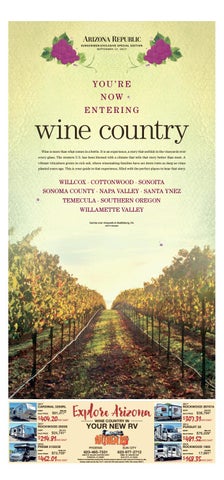
YOU ’ R E NOW ENTERING
wine country Wine is more than what comes in a bottle. It is an experience, a story that unfolds in the vineyards over every glass. The western U.S. has been blessed with a climate that tells that story better than most. A vibrant viticulture grows in rich soil, where winemaking families have set down roots as deep as vines planted years ago. This is your guide to that experience, filled with the perfect places to hear that story.
WILLCOX · COTTONWOOD · SONOITA SONOMA COUNTY · NAPA VALLEY · SANTA YNEZ TEMECULA · SOUTHERN OREGON WILLAMETTE VALLEY Sunrise over vineyards in Healdsburg, CA. GETTY IMAGES
2017
2017
CARDINAL 3250RL MSRP SALE PRICE
2017
ROCKWOOD 2503S SALE PRICE
MSRP
$61,417*
$ 404.20/MO OAC* MSRP
ROCKWOOD 26707A
$98,168
$31,013
$24,741*
SALE PRICE
WINE COUNTRY IN
YOUR NEW RV
MSRP SALE PRICE
$109,419
$72,705*
$ 462.01/MO OAC*
2014
PURSUIT 22 MSRP
$89,126
$76,229*
$ 481.52/MO OAC*
2018
PRISM 2150CB
$ 307.31/MO OAC*
SALE PRICE
$ 214.81/MO OAC*
$40,629
$38,794*
2016
PHOENIX
623-465-7331
44019 N. BLACK CANYON HWY PHOENIX, AZ 85087
SUN CITY
623-977-2712 10801 W. GRAND AVE SUN CITY, AZ 85351
*Photos are for illustration purposes only. All prices based on approved credit. Prices do not include tax, title, licenses, freight and doc fees. Tier A+ credit with 20% down payment 4.99%. Offer expires 9/30/17.
ROCKWOOD 1905 MSRP SALE PRICE
$25,856
17,991*
$ 168.35 /MO OAC*
2P
|| S U N D AY , S E P T E M B E R 17 , 2 017
|| T H E A R I Z O N A R E P U B L I C
WILLCOX, ARIZONA
Historic town with big future RICHARD RUELAS THE REPUBLIC
C
ome to Willcox now so that in the coming years you can be one of those who can talk about how much the area has changed. h This is the epicenter of Arizona’s wine industry. Although it is the newest federally recognized viticultural area, Willcox is the source of most of the state’s grapes. Land here is cheaper than up in the tourist mecca of the Verde Valley. It is also geologically interesting, nestled at the base of the Chirichuaua Mountains and with almost loam-like sands in which the vines flourish. h While vineyards have found homes here, tourists not so much. h This is a place for serious oenophiles who want to be near vineyards. Not a lot of frills; not many unique places to stay; no white-table-
cloth restaurants. One of two places open late in downtown Willcox is a bar where you can cook your own steaks.h That should change in the coming years. Prodded by regulators’ plans to run a power line through the area, landowners trotted out blueprints of their plans for expansion. There was talk of bed-and-breakfasts and multi-story tasting rooms. The power line was moved somewhere else.h The center of Willcox has the bones of a city. This is a historic place that was once a boomtown for cattle and cotton. It has since been looking for the next big industry to bring life to the abandoned buildings around downtown. Now, the bet is wine. Known for: Vineyards and some Old West atmosphere. There is a grouping of vineyards a few miles south of Willcox. Not all have tasting rooms; eventually, most will. There are four tasting rooms downtown, right across from the park honoring the city’s most famous resident, Rex Allen, the singing cowboy from the 1930s. willcoxwines.com
recommend a food truck parked outside an autorepair shop says something about Willcox food options. For a break: The Rex Allen Museum honors the most famous resident of Willcox, who starred as a singing cowboy in a string of Westerns in the 1950s. The museum on Railroad Avenue has memorabilia of the man from his film and television days. A statue of Allen sits across the way in Railroad Park. rexallenmuseum.org
For the first-timer: Start downtown. KeelingSchaefer, Flying Leap, Aridus and Carlson Creek have tasting rooms within walking distance of each other. Keeling-Schaefer is in a historic bank building. For the connoisseur: Head south into the vineyards. Most are open for tastings on weekends. Some will open by appointment. Check a map first; GPS might not be reliable in this area. Most tasting rooms are right off the vineyards and you will most likely be greeted by the owners or someone close to them. Ask questions. These entrepreneurs have taken a risk in this industry and are eager to share their stories and knowledge. Hidden gem: Golden Rule Vineyards. This is off the beaten track, about a half-hour from downtown Willcox and the other vineyard areas. But it’s worth a stop on your way into or out of Willcox. Owners Ruth and Jim Graham are from Midwest farming families and moved to Arizona to tend to the pistachio trees relatives planted out here. They soon moved to grapes, having their wine made by some of the area’s top vintners. A few miles southeast of Golden Rule, along U.S. 191, is Lorraine Patisserie, an authentic French bakery in Pearce. Stop for a snack or a sandwich to take to the vineyards. goldenrulevineyards.com, facebook.com/LorrainePatisserie More than wine: Apple Annie’s has been a tourist draw long before Willcox had a wine industry. There are two you-pick farms north of downtown Willcox; one grows fruit and the other grows vegetables. Wander the orchards, take a wagon ride and, during October, get lost in the corn maze. appleannies.com
Where to stay: A string of chain hotels lines Interstate 10, where tired motorists or truckers might lay down for the night. But the Arizona Sunset Inn is a refurbished motel near the center of town that’s a gem. Rates are reasonable. Rooms are sparkling clean. It is a motel, yes, but an extremely nice one. Across the street is another abandoned motel that, in a few years, will probably provide some spruced-up competition. sunsetwillcox.com Where to eat: The traditional foods paired with wines are not here in abundance yet. For dinner, there is no French bistro; no Italian spot. But there is a great family-run Mexican restaurant, La Unica. Or, for an unexpected experience, try the New Orleans-style food at Rodney’s, a tiny spot on Railroad Avenue. A sign in the window says it has been in Willcox for 20 years, but that sign itself is about two decades old. For lunch, the tapas at Coronado Vineyards hit the spot and are wine-friendly. For atmosphere, Big Tex BBQ serves up smoked meats in a railroad car. The tortas are fabulous at El Rey Taco, a food truck parked on Haskell Avenue outside Buddyz Auto Repair. And the fact we
Best mode of transportation: A vehicle with some heft. One of the main roads to the vineyards, Robbs Road, is unpaved and rutted from tractor and truck use. There are enough tasting rooms downtown to make a mini-tour, but you’ll really want to drive a few miles south and soak in the views and the vineyards. This is best done in a sturdy vehicle. The ride in a small sedan will be a little bumpy. Expect that the roads will be paved in the coming years and visiting now will allow you to talk about how rough the roads were before the asphalt was poured. There is no shuttle service from Phoenix to the Willcox tasting rooms, but there is at least one, Sonoran Tasting Tours, from Tucson. Uber and Lyft haven’t made it out here yet. Best advice: taste and spit. It will keep your head clear for the drive. sonorantastingtours.com Best time to visit: Since you come here for the vines, the best time is when they are at their prettiest. That means mid-summer through harvest time in September and October. Willcox is 10 to 15 degrees cooler than Phoenix during the day and has cool gorgeous mornings and evenings. Arrive on a weekend, unless you have a personal invite from a winemaker. Though the downtown tasting rooms have regular hours on other days, the vineyard rooms are only open at the end of the week; some on Thursdays, most on Fridays. Visitation is still low enough that you should have no problem getting a hotel room. Or, wait for the Willcox Wine Festival in October, a weekend when the wineries set up in Rex Allen Park, saving you the drive.
Above: Dan Pierce exposes his grapes to the rising sun at the Bodega Pierce vineyards. Below: Grenache vines are backdropped by the Dragoon Mountains at the Golden Rule Vineyards in Cochise, Ariz. PHOTOS MICHAEL CHOW/THE REPUBLIC
WWW.AZCENTRAL.COM
|| S U N D AY , S E P T E M B E R 17 , 2 017
COTTONWOOD, ARIZONA
Feel like a local DAWN GILBERTSON THE REPUBLIC
pend a couple days in the Verde Valley and you start to feel like a local. h It’s hard to visit a winery, tasting room, restau-
S
rant or bar and not run into someone you’ve met at another spot. Cottonwood is that collegial. h The laid-back setting makes it the perfect destination for wine aficionados as well as beginners who don’t know there is more than one type of zinfandel. h Jonathan Pierce, a Chicago transplant who works at the Fire Mountain Wines tasting room on Main Street and That Brewery, loves that about Cottonwood. h “A lot of the people who work in the industry, both winemakers and just the people you meet behind the bar, they know a lot about wine. They can tell you why our wines are different and
they can talk to you intelligently about wines if you know a lot,” he said. h “But it’s also very unpretentious. So if you don’t know a lot about wine, and you’re just getting exposed and you want to learn more, and do tastings in a setting where you’re not going to feel overwhelmed by the staff or the other customers ... it’s a great place to go and start your wine journey.”
Left: Manager Phillip Brown serves wine at the Southwest Wine Center Tasting Room in Clarkdale. Right: The tasting room of the Merkin Vineyards in Cottonwood. PHOTOS BY MICHAEL CHOW/THE REPUBLIC
Known for: Old World-style wines served along the Verde Valley Wine Trail, a loose, sprawling collection of tasting rooms and wineries that span Cottonwood, Clarkdale, Cornville, Jerome and Sedona. Cottonwood calls itself the heart of the wine trail, with several tasting rooms on Main Street. vvwinetrail.com For the first-timer: Visit the tasting rooms on Main Street in Old Town Cottonwood, especially if you’re staying downtown and don’t want a designated driver or cab fare. There are six tasting rooms within walking distance: Merkin Vineyards, Arizona Stronghold Vineyards, Pillsbury Wine Co., Fire Mountain Wines, Burning Tree Cellars and Winery 101. For the connoisseur: Merkin Vineyards Tasting Room & Osteria, from the Jerome winery owned by Maynard James Keenan, frontman for the rock band Tool. The newest member of Main Street — Merkin opened in late 2016 — is also the most swank. The large bar offers tastings and wines by the glass or bottle and the restaurant has booth seating. Do not miss the Merkin Mac & Cheese, from a family recipe, or the oversize seasonal salad. merkinvineyardsosteria.com Hidden gem: D.A. Ranch. The estate-grown wines from this tiny, family-owned winery are worth the 11-mile drive to Cornville and the lodge setting and beautiful grounds are a bonus. D.A. Ranch, whose wine is delicious (we loved the Willow White), doesn’t serve food but you can bring your own. Many visitors stop by nearby Up the Creek Bistro & Wine Bar for takeout such as hamburgers and salads. The restaurant has been featured on “Check Please! Arizona” on PBS. Call ahead because most tastings are by appointment. daranch.com
More than wine: Southwest Wine Center at Yavapai College. The school has a popular viticulture and enology degree program and the posh $3.2 million tasting room and production center, which opened in late 2015, shows off students’ work. The wines are gaining attention: The 2014 Sunlight, a white blend, won a gold medal in the 2017 Sunset International Wine Competition. (Don’t look for it in the tasting room. It sold out before the medal was announced.) This is the perfect spot to start or end your Verde Valley trip. Ask for a free tour if the manager has time. Like yoga? Check out the monthly class on the patio. It’s $10 and includes a glass of wine. The views of Mingus Mountain are free. southwestwinecenter.org Where to stay: The Iron Horse Inn has a prime Main Street location, great value and friendly service. For luxury, check out the Tavern Hotel, also on Main Street. Book the Sip and Stay package, which includes extras such as welcome drinks, a $50 restaurant gift card, wine tastings and more. ironhorseoldtown.com, thetavernhotel.com Where to eat: For a town of its size, Cottonwood is loaded with a great restaurant lineup. Where to start? Don’t miss Crema Cottonwood for a decadent breakfast or brunch (try the Providence tacos with lobster, chorizo, bacon and more), a Bloody Mary with bacon and oversize bakery treats including cookies and brownies. You can never go wrong at sister restaurant Bocce Pizzeria. For something new on Main Street, check out Colt Grill for brisket, ribs and other barbecue favorites. In nearby Clarkdale, Violette’s Bakery Cafe, in a train caboose, is known for its quiche and other breakfast treats. Up the Creek, which has a treehouse-
like setting in Cornville, is worth the drive for lunch or dinner. Saturday night is prime-rib night. cremacottonwood.com, boccecottonwood.com, colt804.com, facebook.com/violetsfinepastries, upthecreekaz.com For a break: Ride the Verde Canyon Railroad, hike in Dead Horse Ranch State Park or kayak the Verde River on the Adventure Center’s Water to Wine Tour. verdecanyonrr.com, azstateparks.com/dead-horse, sedonaadventuretours.com Best mode of transportation: Uber and Lyft are not readily available. If you don’t want to drive among the wineries and tasting rooms, contact All Hours Transportation or CK’s Need a Lift in advance or check out one of the tours that originate in Sedona. Search for “Sedona winery tours” to find options. allhourstransportation.wordpress.com, cksneedalift.com Best time to visit: The Verde Valley is usually pleasant year round, but it can get hot in the summer. If you want to time your visit to the grape harvest, visit between late August and late October. The tasting rooms in Old Town Cottonwood are open every day, most beginning at noon. Wineries have more limited hours, with some only open Thursday through Sunday or Monday. Book hotels in advance, especially for weekend getaways because hotels in Old Town are small and often sell out. For best availability, stay SundayThursday. For day trips, weekends are the best because everything is open and the most activities are available.
|| 3 P
4P
|| S U N D AY , S E P T E M B E R 17 , 2 017
|| T H E A R I Z O N A R E P U B L I C
S O N O I TA , A R I Z O N A
Rolling hills a world away WELDON B. JOHNSON THE REPUBLIC
lose your eyes and paint a mental picture of wine country. h You probably envision rolling hills, blue skies and rows
C
upon rows of grapes ripening on the vine. h If that’s your vision, it’s a pretty good likeness of the Sonoita/Elgin area in southeastern Arizona. h As you drive into town you’ll be mesmerized by the rolling hills in front of you and the mountains in the distance. If your car has a thermometer you’ll notice the temperature dropping steadily as you climb out of the desert heat. h In terms of climate, landscape and attitude, Sonoita and Elgin are a world away from the heat and hustle of Phoenix. h In fact, they’re so far removed that you could easily miss Sonoita if you’re not paying attention. It’s
a small cluster of shops and restaurants at the intersection of State Routes 83 and 82.h Once you get here, head for the dozen or so tasting rooms where you’ll encounter friendly people eager to tell you all about their wine-making art. (You might have to step over a sleeping dog to enter.) If you’re the social type, enjoy getting to know the other visitors while enjoying a glass of zinfandel. Or you could just sit and gaze out over the vineyards and watch a rainstorm approach while you sip a crisp rosé.
Known for: The Sonoita/Elgin area is Arizona’s first federally recognized American Viticulture Area (winegrowing region) and home to many of Arizona’s best wineries. While it’s the oldest wine-growing region in the state, it’s still maturing as wineries such as Deep Sky Vineyards recently opened a tasting room in Elgin and Rune Wines added an indoor room at its Sonoita location. arizonawine.org/visit-az-wine-country/sonoita
level of its tasting room on Winery Row in Elgin. The tastefully appointed suite has a private balcony overlooking the vineyard and rolling hills. sonoitainn.com, doscabezas.com, kj-vineyards.com Where to eat: The dining scene is likewise limited. In Sonoita, check out The Steak Out, which serves hearty meat-and-potatoes meals. Try the ribs if you like barbecue. The Café offers lunch daily and dinner Thursdays through Sundays. Check out the happy-hour menu for good food at great prices. The Vineyard Café is a popular choice for breakfast and lunch. Patagonia, about 12 miles south, offers options including the Gathering Grounds coffee shop and deli and Velvet Elvis Pizza Co. azsteakout.com, vineyardcafesonoita.com, cafesonoita.com, gatheringgroundsaz.com, velvetelvispizza.com
For the first-timer: You don’t have to be a serious enthusiast to have a good time at the tasting room at Arizona Hops and Vines in Sonoita. In addition to sampling wines, visitors can drop their hopes and dreams in the wishing barrel, make friends with the animals on the property (including a cat named Jennifer Aniston) or just relax and enjoy spectacular mountain views from the patio. During special events such as the Summer Solstice Bonfire and the Bad Decisions Camp Out, those those who don’t to imbibe or are too young for wine can get non-alcoholic refreshments at the Sober Shack. azhopsandvines.com For the connoisseur: Take your pick — many of Arizona’s top wineries are clustered here. Just about every winemaker here can boast of award-winning bottles. If you’re into wine history, Sonoita Vineyards can lay claim to being the state’s first commercial vineyard. A University of Arizona soil scientist, Gordon Dutt, found that the soil in the area closely matched that of the Burgundy region of France. He planted the first grapes in 1979 and opened Sonoita Vineyards in 1983. sonoitavineyards.com Hidden gem: Step through the huge, arched double doors into the barrel room at Lightning Ridge Cellars and enter a space that looks like it could be part of a medieval castle. The room can be arranged with tables in various configurations and rented for meetings, receptions and other events. lightningridgecellars.com/wp More than wine: Sonoita and Elgin are known for wine, but craft spirits are starting to carve out a presence here too. Flying Leap Vineyards has a tasting room for spirits to show off its outstanding vodka and brandy. In a few years it will add whiskies to the mix as those beverages mature. Village of Elgin Winery also has a separate tasting room for spirits. Its distillery has
For a break: If you need get away from the grind of sampling fine wines, cave tours at Kartchner Caverns State Park are a short drive away, as are Parker Canyon and Patagonia lakes. Both have easy hikes and pretty scenery. Bird watchers will want to check out the Nature Conservancy’s Patagonia-Sonoita Creek Preserve. azstateparks.com/kartchner, parkercanyonlake.com, azstateparks.com/patagonia-lake, nature.org
Above: Grapes on the vine at Flying Leap Vineyards. Below: Deep Sky Vineyard’s 2013 viognier. PHOTOS BY MICHAEL CHOW/THE REPUBLIC
produced award-winning bourbons and will offer Scotch once that spirit matures. It also offers vodka, rum and brandy. Craft-beer enthusiasts can check out Copper Hop Ranch in Elgin. flyingleapvineyards.com, elginwines.com, copperhopranch.com Where to stay: The Sonoita Inn is the only hotel in this tiny community, but there are plenty of vacation rentals, bed-and-breakfasts and guest ranches. Two vineyards even offer on-site lodging. Dos Cabezas Wineworks has two rental spaces, both with kitchens. The Casa is a two-bedroom home and the Casita is a studio apartment-style rental. Guests of both can use the swimming pool and barbecue grills. Kief-Joshua Vineyards offers, through Airbnb, a suite on the upper
Best mode of transportation: You’ll need a vehicle because the wineries are spread out and taxis, Uber and Lyft are practically non-existent. If you don’t want to drive, tour companies in Tucson offer trips in buses, vans and limousines. The Sonoita Wine Guild’s website lists some options. sonoitawineguild.com/visiting-sonoita Best time to visit: Peak season is harvest time in late summer and early fall. The Sonoita Vineyards Harvestfest in late July gets things started and the season runs into October. Those coming from the Phoenix area might want to consider visiting in the summer, traditionally a slow time. Sonoita enjoys an elevation of about 5,000 feet and is about 15-degrees cooler than the Valley. Southeast Arizona also gets more frequent monsoon activity than the Phoenix area, which provides a break from the heat. Most tasting rooms are closed during the week. A few offer Thursday hours and a few more open up on Friday. The rest are open only on Saturday and Sunday.
WWW.AZCENTRAL.COM
|| S U N D AY , S E P T E M B E R 17 , 2 017
S O N O M A C O U N T Y, C A L I F O R N I A
New discoveries JOHNATHAN L. WRIGHT RENO GAZETTE JOURNAL
alifornia’s Sonoma County enjoys the reputation of being less crowded and more relaxed than Napa Valley, its sister
C
over the Mayacamas Mountains to the east. h Part of this reputation stems from geography: Sonoma and Napa each have about 500 wineries, but Sonoma’s are scattered across 1,600 square miles, about twice the size of Napa Valley. h There’s simply more to explore, and much of the county feels like the road less traveled. h Sonoma wineries range from three hippies in a barn making obscure varietals to estates featuring all the modern conveniences: tours, tastings, pampered gardens, private parties, lavish architecture, merchandise. h But even at its most stylish, Sonoma
County feels welcoming, without the brand name and worldwide tourism of Napa Valley, and that makes the county especially ideal for travelers who are new to wine. Known for: Pinot noir, an expressive medium-bodied wine made from one of the world’s most finicky grapes. Sip pinot at an organic winery, then head up the road for a bigger bolder red from one of Sonoma’s mountain vineyards. If bubbles are your thing, some excellent sparkling wines emerge from the county’s cooler climes. sonoma.com For the first-timer: Decide which wineries you want to hit, consult a map, then anchor your trip in the closest town. Santa Rosa, the largest city in Sonoma County, offers affordable accommodations and is the most centrally located. It’s a great spot for families and those who want the trappings of a city — grocery stores, bars, fast-casual restaurants and the like. The Sonoma County Airport is in Santa Rosa. Sonoma is a sleepy burg that’s a 45-minute drive southeast of Santa Rosa. Its plaza, the historic town square, is surrounded by restaurants like The Girl & The Fig and tasting rooms. Sonoma also is home to 19th century adobe buildings — Mission San Francisco Solano and the Sonoma Barracks — once used by the Mexican military. Healdsburg is the swankiest town in Sonoma County, and is north of Santa Rosa — about a 20-minute drive from the county seat. The town, arranged around a charming square, is quite walkable, with tasting rooms, restaurants, bars and boutiques. For the connoisseur: In 2003, DeLoach Vineyards, a pioneer in the Russian River Valley, began converting to certified organic and biodynamic farming. Biodyamics bans chemical pesticides and fertilizers while incorporating diverse crops and native flora and fauna. The tasting room and grounds offer an enclosed terrace, local cheese, picnicking, a frog pond and a garden. Because many DeLoach wines are produced in small quantities, they’re sold only at the winery. Ferrari-Carano Vineyards and Winery in Dry Creek Valley ranks among the most beautiful properties in the California wine country. Ferrari-Carano and its sister wineries draw from vineyards across Napa, Sonoma and the cool climes of Mendocino County to the north. You can taste wine daily at the bar in the Italianate Villa Fiore, in the Enoteca cellar beneath or on Il Terrazzo terrace overlooking the gardens and valley. For good luck, rub the nose of “Boardeaux,” a 1,300-pound bronze replica of a wild boar that once roamed the Ferrari-Carano vineyards. deloachvineyards.com, ferrari-carano.com
Inn, a few blocks from the downtown tasting rooms. The well-tended grounds are lovely for morning coffee or a nightcap, and the Pezzi King room has a relaxing soaking tub. Breakfast is served communally, so you can chat about your wine finds with other guests. calderwoodinn.com Where to eat: Celebrated chef Charlie Palmer runs the rustically elegant Dry Creek Kitchen in Healdsburg. The menu marries seasonal California cooking with Sonoma County wines. On warm nights, the oversize doors open to the ivy-draped terrace. Vintners Inn in Santa Rosa features John Ash & Co. restaurant, named for the chef who is a father of wine-country cuisine. A culinary garden and more than 30 local farmers provide ingredients. drycreekkitchen.com, vintnersinn.com
Above: Dry Creek Kitchen in Healdsburg, Calif., offers dishes by celebrated chef Charlie Palmer. Below: A couple shares a glass of wine and enjoy the view. RGJ MEDIA FILE (ABOVE) SARA SANGER (BELOW)
Hidden gem: Merry Edwards was one of the first female winemakers in California. Merry Edwards Winery is outside Sebastopol. Walk-in tastings are available, but your best bet is to make an appointment for the in-depth experience. Her delicious sauvignon blanc is available only in the tasting room. Other standouts include the Olivet Lane chardonnay, Meredith Estate pinot noir and Georgeanne pinot noir. merryedwards.com
For a break: The savannah meets Sonoma at Safari West, a 400-acre wildlife preserve on a former sheep ranch near Santa Rosa. African-style safaris combine walking and riding to bring giraffes, gazelles, zebras, wildebeests and other animals up close. You can camp in luxury tents with polished wood floors, private bathrooms (including hot showers) and custom furniture. safariwest.com Best mode of transportation: At 1,600 square miles, Sonoma is a vast area to explore and a car is essential (either your own or a driver you hire; Uber is an option). Allow for extra time. California 101, the main artery in Sonoma County, is legendary for traffic delays.
More than wine: Wine Road brings together nearly 200 wineries and more than 50 lodging properties in the Russian River, Dry Creek and Alexander valleys. The association sponsors several annual events, including Winter Wineland in January, Barrel Tasting in March, and the Wine and Food Affair in November. All offer something new even to old wine-country hands. wineroad.com
Best time to visit: Summer through the early fall harvest is peak tourist season. Winter and spring are quieter (with, notably, less traffic). In any season, midweek is less busy than weekends.
Where to stay: Santa Rosa, the county seat, lies roughly at mid-Sonoma, so it’s a convenient — and likely the most affordable — place to stay. If your destination is Healdsburg, consider the Calderwood
Always call ahead to confirm tasting times, prices and policies. Some wineries require appointments.
SONOMA COUNTY TIPS Other resources: www.sonoma.com and www.sonomacounty.com
|| 5 P
6P
|| S U N D AY , S E P T E M B E R 17 , 2 017
|| T H E A R I Z O N A R E P U B L I C
WWW.AZCENTRAL.COM
|| S U N D AY , S E P T E M B E R 17 , 2 017
N A P A V A L L E Y, C A L I F O R N I A
Beautiful landscapes, buzz-worthy vineyards JOHNATHAN L. WRIGHT RENO GAZETTE JOURNAL
ver since the famed Judgment of Paris tasting in 1976, when two Napa Val-
E
ley wines bested their vaunted French counterparts in a blind tasting, the valley has been shorthand for California wine (and for American wine in general). h Napa Valley combines the gauzy romance of the industry and the pleasures of wine and food with big-name wineries, revered winemakers, lavish tasting rooms, exuberant architecture and year-round events. h
Not every corner of Napa is ritzy, but the days of finding a pokey family operation that doesn’t charge for tasting are pretty much over. (For that, you’ll have to head to California’s emerging Central Coast region.) h Unlike meandering Sonoma County, Napa Valley’s wineries populate three general areas. There’s the Carneros appellation, in the southern part of the valley off Highway 12, where vines are cooled by breezes from San Pablo Bay. h The valley’s main drag is Highway 29, running from Napa in the south to Calistoga in the north; several famous producers have estates here. Many wineries also cluster along Silverado Trail, against the foothills of the Vaca Mountains, to the east of the valley floor. h Also unlike Sonoma County, Napa Valley doesn’t offer
Where to stay: The city of Napa marks the entrance to the valley; 29 miles to the north, Calistoga offers a last hurrah. In between lie four communities: Yountville, Oakville, Rutherford and St. Helena (pronunciation: Saint Hel-LEE-nuh). Lodging options range from chains and B&Bs to inns, hotels and resorts. No matter where you stay, rooms are expensive. One bright spot: Because the valley’s wineries aren’t widely scattered, the location of your lodging doesn’t matter. For the full Napa Valley experience, skip the chain hotels in the city and head into the country. » Auberge du Soleil cascades down a hillside high above the Rutherford appellation and the hamlet of Rutherford. The resort has rooms, suites and villas; a spa; a gorgeous pool kitted out with cabanas and bird’s-eye views; and one of wine country’s best restaurants (with a Michelin star). Sip a craft cocktail by the pool, explore the art-filled paths or book a table for the tasting menu. A splurge, to be sure, but worth it. aubergedusoleil.com » The charming El Bonita Motel, an Art Deco gem on the outskirts of St. Helena, began as a religious retreat and became a motel in the 1950s. Choose from poolside, garden or homestead rooms (including a two-room suite). Breakfast is included; at night, open a bottle of wine on your balcony or patio. There also are a hot tub and sauna. With rooms begin-
much in the way of side trips. You would not, for instance, make an excursion to charmless American Canyon directly south, and adjacent Sonoma County would be a full trip in itself. h A visit to the valley, in other words, is a visit to the valley. Known for: If you want to experience a diversity of wine styles, if you want try releases you might only have read about, if you want to dine in ridiculously beautiful landscapes, if you want to sip some of the buzz — if you want to do any of these things, a visit to Napa Valley is in order. Many folks feel this way. In 2016, 3.5 million people visited the valley, according to Visit Napa Valley, the region’s tourism marketing organization. visitnapavalley.com For the first-timer: Here are tips for getting the most from your visit. » Always call ahead to confirm tasting times, prices and policies. Some wineries (especially big names) require appointments. » Make reservations early for everything, especially lodging during peak times. » It’s not necessarily cheaper to buy wine from the winery — many producers charge the top retail price. » On the other hand, there are some wines you can buy only at the winery. And many wineries will refund your tasting price if you spend a certain amount on wine. » Before you buy wine, consider how you’ll store it before returning to the hotel or home. Wine left in hot cars can “cook,” damaging the wine. » Buying a lot of wine? Ask the winery if the laws of your state allow direct shipments. For the connoisseur: You’ll find lots of well-known names that line the shelves of your hometown wine shop in Napa Valley, like Mondavi and Beringer. But these less-familiar wineries are worth a stop. » The ancient Persian city of Persepolis provided the inspiration for the architecture of Darioush winery, a palatial stop on the Silverado Trail. Kneeling bulls guard the entrance; travertine columns glow in the late afternoon sun. Darioush makes outstanding merlot, dense and roasty, and a crisp chardonnay. Its rich yet sprightly viognier is one of the best in California. Make reservations for a private pairing of wines with artisan cheese and nuts. darioush.com » PlumpJack Winery has some famous neighbors in Oakville: Groth, Silver Oak, Opus One. But friendly, low-key PlumpJack is worth a visit. The Napa Valley chardonnay, aged in French oak, is creamy but vibrant. Napa Valley merlot delivers a deft balance of acidity, tannins and fruit. The estate cabernet sauvignon can be aged up to 20 years. Part of the pleasure of PlumpJack is wandering the grounds with glass in hand. plumpjackwinery.com
» Robert Sinskey Vineyards farms organically on its estate in the Stags Leap district. Pinot shows pride of place here, in a style with lower alcohol and more acidity. Like Sinskey pinots, the POV red blend (merlot, cabernet franc, cabernet sauvignon) is elegant and restrained. The union of food and wine forms an important part of the Sinskey philosophy, and the winery has a chef, culinary gardens and flock of sheep raised for pelts and meat. The Eat Drink RSV experience, in the great hall or on the terrace, features Sinskey wines and seasonal dishes from the kitchen. robertsinskey.com » Schramsberg Vineyards traces its origins to 1862, the very beginning of winemaking in the Napa Valley. In the 1870s, Chinese laborers gouged caves from hillside volcanic rock so wine could be stored and aged in them. The winery still uses the caves to age up to 3 million bottles. Be sure to tour the chambers when you visit Schramsberg. Be sure, also, to try one of the sparkling wines for which the winery is known. The blanc de blancs sparkler — dry, crisp, green apples — is a fine flute to start with. schramsberg.com » Whitehall Lane Winery lies at the border of Rutherford and St. Helena. The outstanding sauvignon blanc, tart and lemony, is likely to be among the first wines you taste when you book the winery’s Club Room, with its stone terrace, vineyard views and majestic old California oak standing sentry. Other wines you’ll want to try: rosé (in summer) that pairs nicely with a house cheese plate, a meaty reserve cabernet sauvignon, and a similarly (and surprisingly) meaty merlot. The folks at Whitehall Lane like to say it’s a merlot for cab drinkers. whitehalllane.com Hidden gem: The vine rows at Schweiger Vineyards mantle Spring Mountain at an elevation of about 2,000 feet. The estate’s 35 acres, mostly chardonnay and cabernet sauvignon, are sustainably managed with rainwater catchment, solar power and grape stems and skins scattered to help control erosion. The chardonnay, palate weight followed by a flinty finish, is for folks who don’t like stereotypically flabby California chardonnay. The cabernet sauvignon wraps berry and chocolate around smooth tannins. Take a glass out to the terrace and drink in the view. schweigervineyards.com More than wine: Take a docent-led tour of di Rosa, a 217acre property featuring a vast collection of northern California art housed in three galleries, a 35-acre lake, a sculpture park and a wildlife preserve. Di Rosa, in the Carneros region of the southern Napa Valley, also presents art and nature hikes, Spanish-language tours, special exhibitions and an annual fundraiser in late summer. dirosaart.org
Clockwise starting at top left: The ancient Persian city of Persepolis inspired the architecture of Darioush Winery. The architecture of Whitehall Lane Vineyards & Winery cuts a distinctive figure in the Napa Valley’s Rutherford appellation. Red wines of the Robert Sinskey Vineyards. The caves at Schramsberg Vineyards in the northern Napa Valley can hold up to 3 million bottles of wine that age two to 10 years before release. Below: Hot Air ballooning over the Napa vineyards. RGJ MEDIA PHOTO FILES
ning at about $180 a night, El Bonita is a deal by Napa Valley standards. elbonita.com » Calistoga is known for its spas and hot springs. Calistoga Spa Hot Springs has one of the valley’s best assortment of pools: four mineral pools, a lap pool and a wading pool for kids. A signature treatment at the spa incorporates a volcanicash mud bath, mineral whirlpool, aromatherapy, eucalyptus steam and a blanket wrap for $99. Though Napa Valley is mainly an adult destination, picnic tables, barbecues and rooms with stocked kitchens make this property familyfriendly. calistogaspa.com For a break: Napa Valley’s vineyards, ponds, thickets, hills and estates slide beneath as you take an early morning hotair balloon ride with Napa Valley Aloft. The Kimball family has been ballooning since before Napa became Napa. The one-hour rides leave from Yountville and begin at $200 per person in low season. Add an après-elevation breakfast, a fine old ballooning tradition, for $25. nvaloft.com » Twice a week from roughly April through November, Napa hosts the downtown Napa Farmers Market with produce, flowers, seafood, meat and dairy items from 40 local producers, many of them certified organic. The market also offers artisan jam, honey, cheese and baked goods, along with chef demonstrations and children’s activities. napafarmersmarket.org » Napa Valley Paddle offers guided kayak or stand-up paddleboard tours of the Napa River from tidal marshlands, through downtown Napa, past the Oxbow Preserve to the Oak Knoll Viticultural Area. Other tours include striped bass fishing and an oyster barbecue with Beaujolais by the river. You also can rent kayaks and paddleboards by the hour. napavalleypaddle.com » Three 1870s winery buildings in Yountville were converted to form V Marketplace, whose retailers offer clothing, local bath and body products, home and garden items, art, jewelry and more. After shopping, wander the cobblestone walkways, take in the picnic gardens or grab a table at Bottega for chef Michael Chiarello’s take on rustic Italian cooking. vmarketplace.com Best mode of transportation: A car is pretty much a prerequisite, if for no other reason than to have a trunk to fill with your new favorite reds and whites. Traveling among wineries takes longer than you think, no matter what the map app says. Always allow extra time. Highway 29 often brims with traffic. Avoid it by taking Silverado Trail to the east. That said, making a left across either Highway 29 or Silverado Trail can feel like it requires an act of God. Good luck. Uber is finally in Napa. We’ve used it several times without incident. Best time to visit: Weekends and the peak season of summer to early fall are most crowded. If you’re not determined to be there during the harvest, consider visiting in low season, January through March. The towns and tasting rooms will be less busy and you might save a bit on lodging.
|| 7 P
WWW.AZCENTRAL.COM
|| S U N D AY , S E P T E M B E R 17 , 2 017
TEMECULA, CALIFORNIA
Tasting SoCal’s secret valley XOCHITL PENA THE DESERT SUN
W
ith its rolling hills and vineyards, Temecula Valley is one of California’s best-kept wine secrets.h An hour and a half from Los Angeles and one hour from San Diego and Palm Springs, it’s the perfect draw for Southern California tourists whether it be a day trip, long weekend or full-fledged vacation. Almost 3 million people visit Temecula Valley’s wine region each year. h The first winery was established in the late 1960s and now there are more than 40, ranging from intimate boutiques to large-production wineries. Most have tasting rooms where winemakers are more than happy to share their vintages by day and offer live entertainment by night. You can
even taste wine in a cave at Oak Mountain Winery. h Most wineries in Temecula produce only enough for visitors to their tastings rooms, members of their wine clubs or for online purchases, so you won’t find many of their bottles in grocery stores or wine shops. And many are pet-friendly, so you don’t have to leave your favorite pooch at home.
Known for: Being an approachable wine region with pastoral rolling hills, panoramic views and high-quality reds. The Mediterranean-like climate of warm, dry summers and cool winters creates the right environment for red varietals such as syrah, cabernet and zinfandel. visittemeculavalley.com
For a break: Temecula also has an emerging beer scene with more than 10 breweries and tastings rooms where people can sample local stouts, lagers and IPAs. Wiens Family Cellars, known for its stellar “big red” wines and tasting room, opened a craft brewery in 2012 on the other side of Temecula. wiensbrewing.com
For the first-timer: Splurge for a Vintner’s Seated Tasting at Masia de la Vinya, where the host guides you through the tasting in a relaxed setting. Your personal wine guide can talk you through the Five S’s of wine tasting: Sight, swirl, smell, sip and savor. Masia de la Vinya has undergone extensive renovations. It has incredible patio views and fun, relaxed tasting rooms. Cost is $30 a person. (Check Groupon for 2-for-1 discounts.) masiadelavinya.com
Best mode of transportation: Many people jump in their car or grab an Uber and create their own itineraries, but there also are wine tours in everything from limousines and shuttles to trolleys and horse-drawn carriages. You can even take a hot-air balloon ride before or after your wine tour to see wine country from a heightened perspective. Tours include lunch and three to four winery stops. Check Groupon for discounts. Grapeline Wine Tours has been transporting people around wine country since 2002 and has fun, knowledgeable guides. gogrape.com/temecula
For the connoisseur: Explore Baily Winery. The main tasting room offers current releases, and the Estate Tasting Room — by appointment only at the winery’s production facility — offers “library” wines such as meritage, cabernet sauvignon and cabernet franc. A library wine is an older wine that is not currently being sold, so it’s a treat for collectors. Baily also offers a short tour of the facilities during the Estate Tasting. bailywinery.com Hidden gem: All of Temecula Valley could be considered a hidden gem since it’s not as widely known as Napa or Sonoma. In the heart of Temecula wine country is Briar Rose Winery, a “micro winery” that looks like Snow White’s home brought to life. Tastings are by appointment only from 11 a.m. to 5 p.m. Thursdays through Mondays. But if you love wine and are a fan of Disney, you won’t want to miss this. Try the Talking Frog Wine Lager, one of Briar Rose’s specialties. It’s a bubbly wine lager made of viognier grapes and a Hefeweizen lager. briarrosewinery.com More than wine: Marcelo Doffo’s love of winemaking is rivaled only by his love of motorcycles. So the winemaker who established his 15-acre hand-planted winery in 1997 has merged his two passions. Behind Doffo’s original home where he served wine to strangers knocking on his door is the quaint Doffo
Above: The Moto Barrel Room at the Doffo Winery. Below: Vineyards cover the rolling hills of Temecula wine country in Southern California. PHOTOS BY XOCHITL PENA/THE DESERT SUN
Winery tasting room complete with vintage scooters and motorcycles. And there’s the Moto Barrel Room, which houses the MotoDoffo collection of more than 100 vintage and historical motorcycles amid barrels of wines. doffowines.com Where to stay: Temecula has national hotel and motel chains, bed-and-breakfasts and vacation rentals. If you want to wake up and walk amid the grapes, a few wineries double as inns. South Coast Winery Resort and Spa, which earned its fourth title as California State Winery of the Year in 2016, has suites and villas within the vineyards. There’s also a spa offering vine-based treatments, a restaurant, behind-the-scene tours and food-and-wine pairings. southcoastwinery.com/resort Where to eat: Unlike California wine regions where wineries are prohibited from operating full-service restaurants, almost half the wineries in Temecula offer artisanal provisions. The Restaurant at Ponte Winery is a great place to stop for fresh and casual American fare enjoyed al fresco overlooking the beautifully manicured lawns and vineyards. Specialties include bacon-wrapped meatloaf, sumac-crusted seared lamb rack and sautéed shrimp and Spanish chorizo. pontewinery.com/restaurant
Best time to visit: Tasting rooms are busiest on weekends, so for a more intimate tasting or private winery tour, your chances improve mid-week. Harvest is from late July through October or November. The vineyards are buzzing with activity and the vines are bursting with grapes. September is California Wine Month and wineries celebrate all month long. The last weekend in January is the Temecula Valley Annual Barrel Tasting Event, where people can sample unfinished barrels and tank wines as well as newly released wines. temeculawines.org
|| 9 P
10 P
|| S U N D AY , S E P T E M B E R 17 , 2 017
|| T H E A R I Z O N A R E P U B L I C
SOUTHERN OREGON
Expansive views, surprising flavors BROOKE JACKSON-GLIDDEN STATESMAN JOURNAL
outhern Oregon is a naturalists’ playground. Its wild rivers, mountains and forests make for a fun, rustic vacation. And
S
its wines, which have recently emerged on the national stage, offer surprising flavors.h Southern Oregon’s wine country is expansive, and comes complete with jaw-dropping views as it follows the rivers that wind throughout the countryside. The Rogue, Umpqua and Applegate valleys are the largest grape-growing areas. It takes at least 30 minutes to drive from one to the next. The three largest base camps for wine tasting are Ashland, Roseburg and Grants Pass: Ashland at the base of the Rogue Valley, Roseburg in the center of the Umpqua and Grants Pass north of Applegate.h Your best bet is
to drive from Eugene through the Umpqua and Applegate valleys and stay in Ashland. The theatrical town is known as the home of the Oregon Shakespeare Festival, but the area's wines have achieved prestige for their chardonnays and Spanish-style wines, from albario to tempranillo. h Some areas grow pinot noir, but warmer-weather varieties tend to flourish in Southern Oregon. Sauvignon blanc, viognier and syrah are having a moment, and unicorn wines — those elusive hidden gems — can be found here. Try a cabernet franc or a gruner veltliner. You won’t be disappointed. Known for: Its variety of wines. Because southern Oregon has a combination of hot summers and river valleys, many varietals grow with ease, from tempranillo to pinot. The area also is known for its buttery chardonnays, viognier and albariño.
more Southeast Asian flavors in a cool, casual spot, Tot crafts everything from Vietnamese banh mi to tater tots with tamarind barbecue dipping sauce. Specialoccasion diners will enjoy Amuse restaurant's galleryready plating and elegant continental fare. Spot the occasional celebrity or local actor at Smithfields, a casual steakhouse with thoughtful attention to detail. thaipepperashland.com, totrestaurant.com, amuserestaurant.com, smithfieldsashland.com
For the first-timer: Abacela and Delfino wineries are local favorites for Spanish-style warm-weather wines, with impressive tempranillos and blends. Tempranillo is the grape that put southern Oregon on the wine list. abacela.com , delfinovineyards.com For the connoisseur: Quady North swept the Wine Enthusiast reviews in its June 2017 edition, with editor's choice bottles ranging from viognier to rosé. quadynorth.com Hidden gem: Cliff Creek Cellars tackles Bourdeauxstyle wines, with a popular claret and fun, funky cabernet franc that's priced so reasonably that you can actually take home a bottle. cliffcreek.com More than wine: Reustle Prayer Rock Vineyards, Wine Press Northwest's Pacific Northwest Winery of the Year, hosts concerts, movie nights and cooking classes at the expansive Roseburg estate, with plenty of room for garden strolling, relaxed outdoor tasting and intimate sips by the pond. DANCIN Vineyards is a new critical darling that pleases lovers of all types of wine with a rustic Italian tasting room, pristine outdoor garden, live music and tasting list full of award-winning wines. Red Lily Vineyards, another specialist in Spanish-style wines, hosts live music every Thursday and its beautiful patio and creekside setting make for a lovely, quiet retreat. reustlevineyards.com, dancinvineyards.com, redlilyvineyards.com
Side view of friends toasting with variety of wines. GETTY IMAGES/ISTOCKPHOTO
Where to stay: The Peerless Hotel in Ashland has individually themed guest rooms with hand-painted murals. Some rooms have claw-foot tubs. Walk through the garden for dinner in the hotel’s exceptional Peerless Restaurant. Wine enthusiasts can stay in a guest cottage at Delfino Vineyards. The stay includes daily breakfast, a bottle of wine, complimentary wine tasting, lap pool, hot tub and vineyard views. Reustle Prayer Rock Vineyards welcomes guests to its carriage house. Amenities include a full gym, complimentary wine tasting and a bottle of wine. peerlesshotel.com, delfinovineyards.com/guest-cottage, reustlevineyards.com/lodging Where to eat: Outside of occasional wood-fired pizza nights at vineyards, your best bets for dining are in Ashland. Thai Pepper marries traditional Thai flavors with Western techniques and specialty cocktails. For
For a break: See a show in the outdoor Elizabethan theater at the Oregon Shakespeare Festival from June through mid-October. Local beers and wines are sold at all three of OSF’s theaters. Raft the Umpqua or Rogue river. Trips are available with put-ins near Ashland and Roseburg. Hike to one of the area’s many waterfalls or visit Toketee Falls east of Roseburg for a gorgeous photo op. After all that hiking and rafting, relax at the Umpqua natural hot springs near Toketee, or go luxe at Ashland’s Chozu Bath & Tea Gardens. osfashland.org, orangetorpedo.com, soakoregon.com/ umpqua-hot-springs, blm.gov/or/districts/roseburg/ recreation/Thundering_Waters/toketee_falls.html Best mode of transportation: If you’re coming from out of state, fly into Eugene and rent a car and drive to Roseburg or Ashland. Uber and Lyft are not available but several companies offer cars and drivers you can hire for winery tours. Best time to visit: Southern Oregon can get hot in the summer, so plan on visiting after Memorial Day and before July. Email Brooke Jackson-Glidden brookejg@statesman journal.com or call 503-428-3528. Follow her on Twitter @jacksonglidden, or like her Facebook page www.facebook.com/BrookeJackson-Glidden.
WWW.AZCENTRAL.COM
|| S U N D AY , S E P T E M B E R 17 , 2 017
W I L L A M E T T E V A L L E Y, O R E G O N
Comfort and sophistication BROOKE JACKSON-GLIDDEN STATESMAN JOURNAL
O
regon, long known for its pinot noir, is far more than Burgundy Light. The state’s wine production ranges from Spanish-style spicy tempranillo to diverse varieties of riesling and viognier. Oregon is known for its broad variety of winemakers and wines, due to the state’s range of soils, climate and topography. h Wine tasting ranges from the comfortably casual to the supremely sophisticated, from $5 vineyard barns in the eastern Willamette Valley to luxurious clubhouses in the Dundee Hills. The chief characteristics of Oregon wine tasting are spontaneity and surprise: 27-year-old pinot noir in a $20 public tasting, salsa night with live music, an insightful conversation
with an 80-year-old winemaker. h The majority of Oregon wineries are small production, with wines you can only buy here poured in modest tasting rooms often run by the winemaker. Taste enough of them and you’re sure to find that forever bottle. h The Willamette Valley grows some of the world’s most celebrated pinot noir and chardonnay grapes in a large, verdant region. Roughly following Interstate 5 between Eugene and Portland, the area consists of seven distinct American Viticultural Areas, more than 500 wineries and more than 14,000 acres of pinot noir. Known for: World-class pinot noir. willamettewines.com For the first-timer: Need a pinot noir primer? Willamette Valley Vineyards pours sustainably grown wines from across the Willamette Valley and the tasting often includes an explanation of the basics — the AVAs, soil types, weather. For those looking for a more intimate setting, The Eyrie Vineyards, home to the first pinot planting in the region, is a phenomenal tasting rich with history and breathtaking wine; if you’re lucky, you might end up sipping a 1990s pinot. wvv.com, eyrievineyards.com For the connoisseur: Serious wine lovers should schedule an appointment at Shea Wine Cellars, the label of one of Willamette Valley’s most sought-after vineyards. A quick wander through wine country will inevitably involve other Shea vineyard wines; the area’s top winemakers fight for wine contracts at Shea. Ken Wright Cellars also makes some of the top-rated pinot noir in the area, with several recent releases receiving 95 points or more from Wine Enthusiast. sheawinecellars.com, kenwrightcellars.com
Above: DANCIN Vineyards pairs picturesque tasting room and grounds with wildly successful wines. Below: Visitors play on the tire swing at the Stoller Family Estate. The vineyard was established in 1993 and is the largest contiguous vineyard in the Dundee Hills region. COURTESY OF DAN MARCA, DANCIN (TOP) MOLLY J. SMITH/STATESMAN JOURNAL (BOTTOM)
expensive taste may like the sprawling ornate clubhouse at Domaine Serene, where Emeril Lagasse is a member. brookswine.com, eolahillswinery.com, cubanisimovineyards.com, domaineserene.com
Hidden gem: Industry folk wouldn’t consider Cristom Vineyards a hidden gem, but this vintage-focused estate in the Eola-Amity Hills gets nowhere near the love it deserves. Meticulous vineyard management and creative winemaking result in these whole-cluster, native-yeast-fermented wines that capture the Willamette Valley’s essence: interesting, diverse and hard to forget. This is the vineyard other winemakers frequent on off-days. cristomvineyards.com
Where to stay: The Willamette Valley is a large area. To be among the big players, stay within the major AVAs near Salem or McMinnville. The Vintages boutique trailers are perfect for small parties, right off the major wine highway through the Dundee Hills. For something larger, 3rd Street Flats offers chic renovated apartments in the heart of McMinnville. the-vintages.com, thirdstreetflats.com
More than wine: Brooks Wines‘ surprising reds start with fruit sourced from vineyards around its Amity estate. But visitors also can savor the lovely view, play a game of corn hole or enjoy one of Chef Abby McManigle’s perfect food pairings. Outdoor lovers will fawn over Eola Hills Legacy Estate, where you can stroll through the forested acres to spot wildlife. Cubanismo hosts salsa lessons, parties and live music for a dance with your drink. The ultra-luxurious traveler with
Where to eat: Joel Palmer House has long been considered Oregon’s quintessential wine-country fine dining. The menu, which features locally foraged mushrooms, pairs with bottles dating back to the 1990s. For something a little less luxe and more kidfriendly, Archie’s in Dayton serves greasy paninis and scoops of ice cream. joelpalmerhouse.com, www.facebook.com/Archies-Ice-Cream-AndEatery-336816919740679/
For a break: Wine country’s location in Oregon’s verdant farm country allows for plenty of pastoral activities. Berry picking at local pick-your-own farms can be a great kid-friendly trip in June. In the Dundee Hills, Red Ridge Farms has an olive mill to tour in the summer, complete with olive oil tastings. A quick stop in Lafayette can turn into a visit to the Trappist abbey at Our Lady of Guadalupe, with picturesque hiking trails around the area. For city fun, Portland, Salem and Eugene all offer breweries, museums and hikes. oregonfb.org, redridgefarms.com, trappistabbey.org Best mode of transportation: Fly into Portland and rent a car. Guided tours are available with hotel pickup: $425 for 1 or 2 guests from Cellar Door Wine Tours (including pickup and drop-off, but not including tasting fees) and Backcountry Wine Tours at $170 per person. Uber and Lyft also operate in the Salem area. cellardoorwinetours.com, backcountrywine.tours Best time to visit: August and September are a great bet for clear skies and a spot on the patio. Annual special events fall on Memorial Day and Thanksgiving weekend, but expect a line at the tasting bar. Many tasting rooms close during the winter, so check ahead.
|| 11P
12 P
|| S U N D AY , S E P T E M B E R 17 , 2 017
|| T H E A R I Z O N A R E P U B L I C
2014 PURSUIT 22 MSRP $89,126
SALE PRICE $76,229 $481.52 /MO OAC*
2018 PRISM 2150CB MSRP $109,419
SALE PRICE $72,705* $462.01/ MO OAC*
2017 GEORGETOWN
2017 GEORGETOWN
2017 GALLERIA
MSRP
MSRP
MSRP
30X3
$125,115
SALE PRICE
$
$86,530*
556 38 /MO OAC*
$
$85,346
$60,958*
389 08 /MO OAC*
2017 BLAZEN
555 75 /MO OAC*
MSRP
SALE PRICE
$
$46,997
$129,275
$93,985*
583 15
$25,898
209 17 /MO OAC* PHOENIX
623-465-7331
44019 N. BLACK CANYON HWY PHOENIX, AZ 85087
MSRP
SALE PRICE
$
$148,536
SALE PRICE
$
$103,399*
646 02/MO OAC*
2017 WINNEBAGO
/MO OAC*
MINI WINNIE 27Q MSRP
92,788
SALE PRICE
$
$65,204*
416 59
/MO OAC*
2018 GEO PRO
2250
CURRENT VALUE
$
$86,429*
2018 EVO
22FS
SALE PRICE
$
$120,158
3 24FW
21RS
SALE PRICE
SALE PRICE
24RT
2017 ISATA
2018 FREELANDER MSRP
31B3
174K ROCKWOOD $26,552
$17,919
137 76
/MO OAC*
MSRP
$24,930
SALE PRICE
$
$17,490*
136 76
/MO OAC*
SUN CITY
623-977-2712 10801 W. GRAND AVE SUN CITY, AZ 85351
*Photos are for illustration purposes only. All prices based on approved credit. Prices do not include tax, title, licenses, freight and doc fees. Tier A+ credit with 20% down payment 4.99%. Offer expires 9/30/17.