W W W . A Z C E N T R A L . C O M || T U E S D A Y , A P R I L 1 , 2 0 1 4 || P A G E A 3
E.J. MONTINI
Valley&State R E A C H U S || M A R I A N F R A N K , V A L L E Y & S T A T E E D I T O R , M A R I A N . F R A N K @ A R I Z O N A R E P U B L I C . C O M
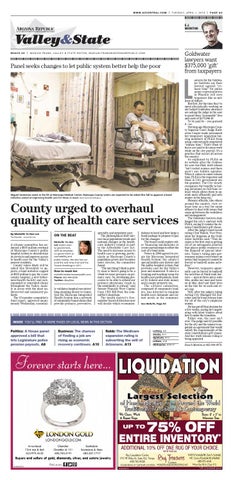
Panel seeks changes to let public system better help the poor
Goldwater lawyers want $375,000 ‘gift’ from taxpayers
L
Miguel Sarmiento waits in the ER at Maricopa Medical Center. Maricopa County voters are expected to be asked this fall to approve a bond initiative aimed at improving health care for those in need. NICK OZA/THE REPUBLIC
County urged to overhaul quality of health care services By Michelle Ye Hee Lee The Republic · azcentral.com
A citizens committee has en dorsed a $935 million overhaul of Maricopa County’s public hospital system to decentralize its services and improve access to health care for the Valley’s poorest residents. County voters likely will be asked this November to approve a bond initiative capped at $935 million to pay for a new county hospital, a new behavioral-health facility and new, expanded or renovated clinics throughout the Valley, mainly in areas with the most un derserved and uninsured patients. The 15-member committee’s final report, approved unanimously Wednesday, essential-
ON THE BEAT Michelle Ye Hee Lee covers county government, with an emphasis on government accountability and public money. She also has covered the Jodi Arias trial and the Tucson shootings in 2011.
How to reach her
michelle.lee@arizonarepublic.com Phone: 602-444-8290 Twitter: @myhlee
ly validates hospital executives’ long-standing desire to transition the Maricopa Integrated Health System into a network of community-based clinics that provide primary, preventive,
specialty and outpatient care. The philosophical shift mirrors local population trends and national changes in the healthcare industry related in part to the Affordable Care Act. The need to increase access to health care is growing, particularly as Maricopa County’s population grows and becomes more diverse, the committee found. “The one thing I think is pretty clear is there’s going to be a whole lot more pressure on primary care. So, developing processes to be able to extend our primary physicians’ reach in the community is critical,” said former Pinnacle West Capital Corp. CEO Bill Post, the committee’s chairman. The health district’s fivemember board of directors now will decide which recommen-
dations to heed and how large a bond package to propose to pay for the changes. The board could explore other financing mechanisms or create partnerships to offset the cost of a bond issue. Voters in 2004 agreed to create the Maricopa Integrated Health System, the county’s special health-care district and the public hospital system that provides care for the Valley’s poor and uninsured. It also is a training and teaching venue for health-care professionals, funded by federal and state money and a county property tax. The citizens committee, composed of community leaders, was directed to examine health-care demands and unmet needs in the communiSee HEALTH, Page A5
INSIDE YOU’LL FIND 14 MORE PAGES OF LOCAL NEWS IN THIS SECTION
Politics: A House panel approved a bill that lets Legislature police pension payouts. A8
Business: The chances of finding a job are rising as economic recovery continues. A10
Robb: The Medicare expansion ruling is subverting the will of Arizonans. A13
Lottery, A4 Stocks, A11 Opinions, A13 Letters, A14 Obituaries, A16-17
awyers for the Goldwater Institute say their lawsuit against “release time” for police union representatives in Phoenix will save taxpayers like us millions of dollars. But first, for the time they’ve spent altruistically working on our behalf Goldwater attorneys are asking the judge in the case to grant them “reasonable” fees and costs of $375,046.10. To be paid by – you guessed it – us. Not long ago Maricopa County Superior Court Judge Katherine Cooper made permanent her temporary injunction barring members of PLEA from using contractually-negotiated “release time.” That’s when officers are paid to do union work while on the city payroll. It’s a practice that occurs all across the country. As explained by PLEA on its website after the Goldwater case was filed, work release “isn’t rocket science and there aren’t any hidden agendas. When it comes to union release time, PLEA is the requestor and those in City government are the grantors. The City clearly recognizes the benefits to having personnel on full-time release which allows them to operate more efficiently and save money in the long run.” Phoenix officials, like others around the country, view release time as a way for union officers to deal with issues that come up between the workforce and management. The Goldwater lawyers challenged the city’s contract with PLEA, saying it violates the Arizona Constitution’s gift clause. After the judge’s most recent ruling Clint Bolick, Vice President for litigation at the Goldwater Institute said, “This decision is the first step in getting rid of an outrageous practice that places public resources at the disposal of special interests. Today’s ruling puts government unions everywhere on notice that taxpayers cannot be forced to bankroll union activities.” However, taxpayers apparently can be forced to bankroll the activities of think tank lawyers — men in three-piece suits who, unlike our men and women in blue, don’t put their lives on the line for us each and every day. Still, after the judge’s ruling Acting City Manager Ed Zuercher said he’d end release time for all of the city’s employee unions. He has put off that decision for a few weeks, saying he’s negotiating with labor leaders about how to make the transition. Either way, the case isn’t over. The judge said it’s possible for the city and the unions to negotiate an agreement that would satisfy the requirements of the state constitution’s gift clause. And her work release ruling is being appealed. Reach Montini at 602-444-8978.
P A G E C 2 || S U N D A Y , M A R C H 3 0 , 2 0 1 4 || T H E A R I Z O N A R E P U B L I C
From the cover
Crime Continued from Page C1
except Glendale experienced a decline in its property-crime rate. Glendale’s rate remained steady from 2011 to 2012. Some of the violent crime is a simple recovery from historically low figures, but the slight increase can also be attributed to statutory changes and programs such as those that encourage undocumented immigrants and domestic-violence victims to report the crimes committed against them, according to experts. State law changed in 2010 to add the crime of aggravated assault by strangulation. And a program to educate police officers about the signs of strangulation in domestic-violence victims led to a 42 percent increase in felony strangulation cases filed by the Maricopa County Attorney’s Office during the first half of 2012. The three Valley cities with a measurable increase in the violent-crime rate all experienced an increase in aggravated assaults. “When you talk about an increase, think about the things the community has done to get the victims to come forward,” said Sgt. Trent Crump, a Phoenix police spokesman. “That’s a good thing. But you know on the back side of that double-edged sword, you’re going to have a higher number of cases reported.” Many of the crimes measured in the FBI annual reports can be difficult to accurately track, experts say, with factors such as a sexual-assault victim’s reluctance to report the crime or an officer’s inclination to avoid reporting a bar brawl as an aggravated assault playing a role in the data. But there are two fields that are almost universally reliable, experts say: homicides, because investigations and autopsies can typically discern a murder; and stolen vehicles, because people are diligent about reporting them for insurance purposes. Homicides crept back up in Phoenix in 2012, when there were 123 recorded murders, up from 116 in 2011. But the total for 2012 was still about 26 percent lower than in 2008, when 167 murders were reported. The number of murder cases fluctuated in other large Valley cities, where the number of homicides is so low that large annual changes typically represent statistical anomalies. The number of stolen vehicles throughout the Valley, however, continued to drop steadily and rapidly, with the largest cities in the Phoenix area reporting more than a 50 percent decline in auto thefts during the past five years. In many ways, that trend is the inverse of the inevitable uptick in violent crime, said Scott Decker, director of Arizona State University’s School of Criminology and Criminal Justice. “In 2006, we, as a state, had the highest (auto-theft) rates in the nation. They really didn’t have anywhere to go but down, so some of this is what we call statistical regression to the mean,” Decker said. “When you
Homicides crept back up in Phoenix in 2012, when there were 123 recorded murders, up from 116 in 2011. But the total for 2012 was still about 26 percent lower than in 2008, when 167 murders were reported. GETTY IMAGES
NUMBER OF STOLEN VEHICLES IN VALLEY The number of stolen vehicles throughout the Valley dropped from 2008 to 2012. Here’s a breakdown by city: Chandler 1,000
Gilbert 400 350
800
300 250
600
Glendale
Mesa
Peoria
2,500
2,500
600
2,000
2,000
1,500
1,500
1,000
1,000
500
500
500
100
200
50 0
0 2008
2012
2008
0 2012
400
set a record for something, it’s hard to sustain that over time.”
Auto-theft trend The trend is, in part, attributable to automakers improving anti-theft devices in new vehicles and police having more technology at their disposal, which is why other large cities throughout the U.S. also saw a drop in vehicle theft. But while Dallas, Las Vegas and San Diego — all cities with similar population sizes, demographics and climates — saw a drop in auto theft of about 40 percent between 2008 and 2012, none of those cities experienced the steep declines seen in Phoenix and other parts of the Valley. That could also be due to the publicity that the area’s high auto-theft rates received in the past decade, Decker said, and the subsequent response from the public, who might have been conditioned to be more diligent about locking their vehicles or parking under streetlights. “One of the things that high rates do is they spark a response by law enforcement. Police and prosecutors can do some things, but auto theft is a crime of opportunity,” he said. “There are relatively straightforward, lifestyle things that citizens can do, and that’s especially true of burglary and auto thefts.” Police said, from their per-
2012
2008
Tempe
250
1,200
10,000
300
600 100
200
100 0 2008
spective, factors like a struggling construction industry led to fewer trucks being stolen, aside from a one-month spike in Phoenix earlier this year. Education campaigns, such as the one offered recently in Goodyear to etch a vehicle-identification number on vehicle windows, and programs that require victims to sign an affidavit swearing their vehicle was stolen have played a role in reducing the number of reported stolen vehicles and increasing the number of those recovered. But police in Phoenix and other parts of the Valley have started to focus on catching thieves in addition to recovering a stolen vehicle and returning it to its rightful owner, tactics that can shut down an entire ring when successful,
ABOUT THE WRITER JJ Hensley is the Breaking News Editor in the Arizona Republic. He was a reporter for nine years before becoming an editor, covering public safety and the Maricopa County Sheriff’s Office. How to reach him jj.hensley@arizonarepublic.com Phone: 602-444-8464 Twitter @JJHensley
2012
2008
200
0
0 2012
400
50
100
0
800
150
5,000
2012
1,000
200
400
200
0
2008
Surprise
600 500
300
150
Scottsdale
15,000
200 400
Phoenix 20,000
2008
2012
said Sgt. Eric Hammel, a detective in the Phoenix police autotheft unit. “We have followed these suspects to Gilbert, Chandler,” Hammel said. “They’re doing it all over the Valley.” Phoenix police have in the past five years worked to decentralize its auto-theft detectives to ensure that they are in touch with everyone from patrol officers to the department’s repeatoffender program.
Career criminals targeted Last month, a Phoenix detective received a tip about a chop shop operating in the backyard of a home near 45th Avenue and Camelback Road, and he found surveillance cameras surrounding the house when he responded, according to court records. The detective drove through the alley and heard David Castillo dismantling a Nissan Maxima under a blue tarp in his backyard, according to records. A Polaris utility vehicle and enclosed trailer were nearby, along with numerous other vehicles, according to the records. Less than a week later, police learned that a Chevrolet Cavalier they found in Castillo’s backyard was reported stolen, according to court records. Castillo had been released from prison in January after serving a nine-year sentence
0 2008
2012
2008
2012
for auto theft; he is now in jail awaiting trial on charges that he stole vehicles and operated a chop shop, records show. “The detectives are targeting career auto-theft criminals, learning their locations and following up with search warrants and recoveries,” Hammel said. The decline in property crimes has also had an impact on insurance rates, which have fallen 21 percent in Arizona in the past decade, according to one major provider. Police expect the number of stolen vehicles to continue dropping as older vehicles cycle out of the market and auto manufacturers continue to upgrade antitheft technology. But as long as the Valley remains a drug-distribution hub for the United States, there will still be demand for stolen vehicles, police say. “Phoenix is still getting hammered with the older (vehicle) thefts, and they’re pretty much all going south,” said Sgt. Robert Weeks, with the Arizona Department of Public Safety’s vehicle-theft task force. “They steal them, park them, and stage them (in the Valley) and then run them south when they think they’ve cooled off enough,” Weeks said. “A lot of our recoveries are in the Vekol Valley area. They’re all trucks and SUVs for the most part, and a lot of them we find are loaded with marijuana.”
Scottsdale led Valley in 2012 violent crime decrease By D.S. Woodfill and Matthew Dempsey The Republic · azcentral.com
Scottsdale saw a decline in violent crimes last year, bucking an upward tick across much of the Valley, according to recently released statistics from the FBI. The number of reported murders, assaults and other serious offenses per 10,000 residents fell nearly 18 percent, from 400 in 2011 to 329 in 2012, the FBIcompiled numbers show. That was the biggest drop among Valley cities. Chandler had the second-largest decline in its per capita rate of violent-crime reports, falling 9 percent. Mesa and Peoria both saw rates drop 3 percent. Property-crime reports also fell in Scottsdale from 6,724 in 2011 to 6,047, according to the FBI’s annual Uniform Crime Report. “Scottsdale’s a very safe city,” said Scottsdale Police Sgt. Mark Clark. “We’ve always had a very low number of violent crimes per population.” In Scottsdale, the drop in violent crime was led by a decrease in aggravated-assault reports, which fell nearly 29 percent, from 237 in 2011 to 169.
Robberies showed the secondbiggest drop. Reports fell 8 percent, from 125 in 2011 to 115. Reported rapes were the only violent-crime reports that increased. They went up from 34 reports in 2011 to 42. Scottsdale Police Cmdr. Scott Popp, who oversees the department’s Investigative Services Division, credited the declines in large part to a recent focus on repeat offenders, an integration of local, regional and national crime data in recent years, and an aggressive crimeprevention public outreach and education program. Popp said the department gathers and utilizes data from the lowest-ranking beat cop to the chief of police. In 2008, the department refined its policing efforts by putting a crime-prevention officer and crime-prevention police aide in each district, he said. “That’s really the shift from having just a crime-prevention unit that was kind of department-wide to ... crime prevention and fighting at a district level,” he said. Each crime-prevention officer and police aide answers to a district commander, he said. The police aides digest information from crime reports as well as intelligence gathered by beat
“Scottsdale’s a very safe city. We’ve always had a very low number of violent crimes per population.” SGT. MARK CLARK Scottsdale Police
officers to identify problems, such as emerging crime sprees or possible suspects operating in a particular area. The department’s crime analysts, meanwhile, are charged with the sharing and dissemination of similar data of regional interest with their counterparts at other departments. That flow of information is part of an intelligence-sharing agreement that Scottsdale has with other police departments through the East Valley Gang and Criminal Information Fusion Center in Mesa. Crime analysis units from various departments also share information via a listserv, a computer application that distributes messages to subscribers on an electronic mailing list, he said. Finally, national crime information gathered and shared by the FBI Violent Crimes Task
Force and the Secret Service Electronic Crimes Task Force helps provide a clear picture of the department’s crime challenges. Popp said data from all of those sources are then pored over at a twice-a-month meeting attended by the district representatives, such as the police aides and their commanders, department crime analysts, the police chief and other department officials. The parties work to spot emerging crime trends and cut them off at the pass by marshaling the appropriate resources and manpower. Jeff Sedgwick, former director of the U.S. Bureau of Justice Statistics and retired University of Massachusetts professor, was cautious about reading too much into one year’s data. The number of crimes is small, reflective of the relativity small size of the community, and there is considerable upand-down volatility from year to year, he said. That makes it difficult to extract any meaning and determine how effective police are at pushing down crime. Even though violent-crime reports jumped from 353 to 400 from 2010 to 2011, Clark said said the five-year trend is heading downward. “We will take any drop we
can get,” he said. Bill Crawford, a downtown Scottsdale business owner and frequent critic of the city’s efforts to police crime near the city’s downtown entertainment district — home to a high concentration of bars and dance clubs — said the dip in crime was encouraging news. “I am pleasantly surprised,” said Crawford, president of the Association to Preserve Downtown Scottsdale’s Quality of Life, which was formed in response to problems associated with the bar district. Crawford belongs to a group of residents and business owners alarmed at the level of criminal activity in the entertainment district, where Crawford owns a fitness gym. The area has been the focus of much scrutiny following a fatal stabbing outside Martini Ranch, a now-shuttered nightclub at 7295 E. Stetson Drive. “The campaign to notify Scottsdale there was trouble was unwelcome and painful,” he said. “It appears there is now a political will to address the issue, and everyone on the law enforcement side is doing a much better job.” Republic reporter JJ Hensley contributed to this article.
P A G E C 2 || S U N D A Y , M A R C H 3 0 , 2 0 1 4 || T H E A R I Z O N A R E P U B L I C
From the cover
Journey Continued from Page E1
stumbling numbly through the days, to the meetings, through the memorial. She pulled open the passenger door; Amanda’s mom, Kathy Funston, slid in behind the wheel. It was time to return to Santa Ynez, Calif., along 516 miles of highway as familiar as home. They backed out of the driveway of Sean and Amanda’s home, falling in line behind the honor guard and Sean’s pickup. “That’s my heart in that truck,” Tammy remembers thinking. Because inside that truck, in that moment, was nearly everything that mattered: her son. The love of her son’s life. His two dogs. And Tammy’s first grandchild-to-be.
‘It’s in our blood’ For a while, Sean worked on airplanes. But just for a while. On his mother’s side, Sean’s great-grandfather Chester McElwee was in the fire service, and his grandfather Herbert McElwee was a fire chief in Montecito in Santa Barbara County. His uncle Terry McElwee still is the operations chief there. Another uncle, Tim McElwee, is retired from the Prescott Fire Department and teaches at the fire academy. His son, Travis, is a Prescott firefighter. Sean’s dad, Ron, had worked summers while in college on a hotshot crew for the California Department of Forestry and Fire Protection. His mom, Tammy, is a medical assistant and worked as an EMT. As a boy, Sean rode on fire trucks in the annual Fourth of July parades in the Santa Ynez Valley and grew up on stories of out-of-control fires tamed, homes saved, harrowing rescues and narrow escapes. “When we say, ‘It’s in our blood,’ I think maybe we’ve been brainwashed,” Tammy says with a laugh. Of course Sean would be a firefighter.
The phone call June 30. Ron, Tammy and her mother, Loretta McElwee, were relaxing in their living room in Santa Ynez, about to watch “Emma,” a movie based on the novel by Jane Austen. Tammy had just gotten off the phone with daughter Steffie, who’s 28 and lives in Nashville. The phone rang again, around 6:30 p.m. It was Amanda, Sean’s wife. A neighbor had said 20 firefighters were missing in Yarnell. But don’t worry, Amanda said. No one seemed to know yet what had happened. Amanda had called Tammy’s brother Tim, who had worked for the fire department in Prescott and was best positioned to find out. She was waiting for him to call back. Tammy couldn’t wait. She called Tim. No answer. She called again. He answered. “I’m doing what I can,” Tim promised. He would call back. He did, 10 minutes later, though it felt like forever. “Tam,” Tim started, “this is the hardest thing I’ve ever had to do.” And Tammy knew. She heard it in his voice. She threw her phone across the room, hard, and it skittered onto the kitchen floor. She dropped to her knees, screaming. “No! No! This can’t be happening!” Ron picked up her phone and talked low to Tim. Maybe Sean wasn’t out there, Tammy thought. The day before, he had suffered a bout of heat exhaustion and had to sit out. Maybe he hadn’t been with the crew. Maybe he went up to the truck for water. Maybe he was lost. “I was making all these excuses — anything,” Tammy said. Anything for it not to be true. Those thoughts pulled her to her feet. They had to go. The pets. Someone would need to take care of the pets, the cats and the bearded dragon. She called her best friend and asked her to come over. Clothes. She jammed some into a bag. She told her mother and Ron to do the same. Water bottles, crackers. She took some from the kitchen. “We can buy stuff when we get there,” Tammy told them. “Let’s get in the car and go. We need to go.” An hour after her brother’s call, they were on the road. Tammy was a teen when her
In a bittersweet moment, Ron and Tammy Misner rejoice as they welcome the birth of their first grandson, Sean Jaxon Herbert Misner, born Thursday, Aug. 22, in Prescott Valley. The Misners lost their son, Sean, during the summer to the Yarnell fire. CHERYL EVANS/THE REPUBLIC
brother Tim was hired by the Prescott Fire Department, and she made the drive with her parents and younger brother, Terry, to visit. When she got her license, her dad let her drive, even navigating the family’s van through a monsoon storm one trip. When her own kids were little, Tammy would tuck them into the backseat still in their pajamas and leave at 2 a.m. to avoid the Los Angeles traffic. Her mother also lived in Prescott for a time, so they went for Thanksgiving and Christmas. The cousins played in the woods and fished in Watson Lake, among the boulders just outside Prescott. “It was part of growing up for me, and it became part of my kids’ growing up,” Tammy says. The children would sleep the first part of the trip. Just as they reached the desert, the sun would rise, framed in the windshield. In the backseat, the kids listened to music, read books or looked out the window. They counted license plates from New York or Texas and picked out shapes in the clouds. When Steffie was in junior high, Tammy drove her and her friends to Phoenix to see the Backstreet Boys and took Sean and a buddy at 16 to watch the Arizona Diamondbacks play. Then in September last year, Sean and Amanda moved here, to this place Tammy had always known. Soon, Sean would be on a fire crew, and Amanda would be pregnant. “I drive it so often I can drive it with my eyes closed,” Tammy jokes. “The car practically knows the way.”
Grief en route to Prescott Tammy usually drives, but after the phone call from Tim, she slid into the backseat and let Ron drive. She couldn’t see for crying. They stopped for gas in Ventura, just over an hour down the road. On a normal drive, Tammy would stop just once for gas and to use the bathroom. This time they made four stops. She was sick to her stomach and felt claustrophobic, trapped in the car that wouldn’t move fast enough. “With all this going on in my head, I would have liked to be running,” Tammy says. She’s a runner; Ron is a high-school track and cross-country coach. From the minute they pulled out of the driveway, the drive was taking too long. Tammy wished she could snap her fingers and be there. She couldn’t stand to listen to music. There were long stretches of silence. Ron was stoic. Tammy says, “He couldn’t believe anything. He wouldn’t believe anything until he saw it for himself.” Her mother would ask, “Are you doing OK?” Tammy didn’t know how to answer. Instead of counting license plates as she did with her kids, Tammy stared into the darkness as the landmarks marked the miles — the rest stop in Beaumont; the Love’s Truck Stop in Indio; Blythe, Quartzsite. She tried playing a game on her phone but couldn’t focus. She dozed off and then startled
VIDEO ONLINE Tammy Misner talks about the pain of losing her son and the joy of seeing him in a new grandson. See more at aznarratives.azcentral.com.
awake, her stomach twisting. She did drive for about 45 minutes; Ron rested his eyes. And then he drove through Phoenix and up to Prescott, the highway they usually take through Yarnell closed by the fire. The drive usually takes nine hours, give or take. This time, even with the extra stops, they made it in 81/2. Just as they drove into Prescott Valley, the sky began to lighten.
19 names, 1 by 1 Later that day, families of the hotshot crew gathered at Prescott’s Mile High Middle School, where a fire official read aloud from a list of those believed to have been killed in the fire. “Andrew Ashcraft. Robert Caldwell.” With each name, sobbing. “Travis Carter. Dustin DeFord. Christopher MacKenzie.” A cry. “Eric Marsh. Grant McKee.” And then, “Sean Misner.” And then it felt real, Tammy says. Too much time had passed for Sean to have been somewhere else, getting water or lost, no matter how much she wanted to believe. Fire officials asked for Sean’s dental records. “We knew,” Tammy says. “There was just this emptiness. Sean was gone.” Sea n, who had always seemed unstoppable. Slim-built, he was an unlikely football player, but he played his whole life. As a senior, he played both wide receiver and defensive back. His coach said he was fearless. His mom was on the sidelines every game, cheering loud: “Yay, Seanie! Go, Seanie!” Afterward, she’d ask Sean if he heard her. He would grin: “Yeah, Mom, everybody heard you.” “I couldn’t hold back,” Tammy says. “I was just so proud.” She couldn’t hold back either at a memorial for the hotshots when she saw the white hearse with her son’s name in the window. “Seanie!” she called before she could stop herself. She could almost hear his voice in her head, “Oh, Mom. Tone it down a bit!” The trip back to Califor-
ABOUT THE WRITER Karina Bland has been a reporter and columnist for the Arizona Republic for 19 years. She has covered state government, problems in the Child Protective Services agency, and has been nominated for the Pulitzer Prize for her columns that appear weekly in the Sunday Arizona Republic.
How to reach her
kbland@arizonarepublic.com Phone: 602-444-8614 Twitter: @AZkbland
nia would be somber. Tammy climbed into the SUV, behind Sean’s white pickup. The honor guard led the way, then Amanda, then Tammy, riding with Amanda’s mother. From Prescott Valley, this place of sweet family memories, they drove through Prescott and down to Yarnell. There was no rush this time, not like the night Tammy rushed across the desert to get here. They drove slowly through the town in respect to all that had been lost there. Even inside the SUV, Tammy could smell the fire. She rolled down the window, breathed it in. When she was a girl, her father would come home smelling of smoke. Her brothers, too. She was pregnant with Steffie when her husband was on a hotshot crew. It is the smell of the men in her life. It had always been familiar and comforting, and a plume of smoke in the distance or a call to the station meant a rush to get there, and sirens. Now, as they drove slowly through Yarnell, the windows down, Tammy saw the random cruelty of the fire — one house reduced to ashes, another left untouched — differently. “I hated even the thought of it. I just didn’t want to see it anymore. I felt this horrible, deep anger,” she says. “I’ve known this all of my life and this is what takes a love of my life? I hate this.” She rolled up the window.
A truck and a girl Now, as they drove, Tammy watched Sean’s truck as they followed Arizona 71 to U.S. 60 and then onto Interstate 10. Painted on the back window were the words, “We love you, our hero, Sean”; a star for the Dallas Cowboys, Sean’s favorite team; an American flag; and a Maltese cross with the number 19 on it. Sean had been proud of that truck. He was 22 when he bought it, his first vehicle, with the help of his grandfather Herbert McElwee. McElwee took Sean to Santa Barbara for a test drive, paid the down payment and cosigned on the loan. Sean and his grandfather were close, taking drives, playing cards and fishing. The truck had 22 miles on it. Sean pulled up to the house and held the passenger door open for his mother, beaming. He made every payment on time. He sent the last one in June, paying off the loan just before he died. For Amanda, this drive had begun to reflect the same kind of significance it held for Tammy, back and forth with the man she loved, soon with a child, between two places that each felt like home. Following in the SUV, Amanda’s mom and Tammy talked about their children. Sean and Amanda had been made for each other, they agreed. Sean had been working in the produce department at the Los Olivos Grocery in Santa Ynez. Amanda worked in the deli. The first time Sean brought Amanda home, to watch a movie, Tammy knew. “She’s such a beautiful girl, and he obviously adored her,” she says. “I could just tell.” Sean was kind of quiet, Amanda outgoing. Tammy is like that, too, and she told Amanda, “Whatever happens between you and Sean, regardless, you are adopted into our family.” Sean proposed to Amanda on April 8, 2012 — his birthday, a gift to himself, he told friends. They were married Sept. 15.
‘Are you afraid?’ The last time Tammy had talked to Sean on the phone, he had described the fires and what the crews were up against. She had asked him, “Are you afraid?” “No,” he had answered as quickly as she had finished asking the question. “He knew his job. That’s what he said to me. He said, ‘I know what I’m doing out there. I am confident in the guys I’m working with. They know what they are doing,’” Tammy says. Sean knew the dangers. His Uncle Terry, who also had worked with the California Department of Forestry, talked of dropping hotshot crews into the middle of fires and how they would fight them from the inside out. His grandfather told of how once, while driving the perimeter of a fire in a Jeep, he had deployed an emergency fire shelter to protect himself. Tammy figures Sean probably heard a half-dozen stories of firefighters having to deploy their shelters
and surviving. Maybe he remembered those stories and how it always turned out all right when it came time to deploy his own shelter, his mother said. Maybe he wasn’t afraid. “I try to believe that it was so fast that they didn’t have time to think — they covered up, and it was there, and it was gone, and that they just didn’t have time to hurt or be afraid,” she says. “I like to believe that it was just so fast that they didn’t feel anything.”
500 miles of honor The small convoy — the honor-guard truck, followed by Amanda in Sean’s truck, the moms in the blue SUV, and the red fire truck — crossed from Arizona into California. Out of nowhere, a Forest Service brush truck appeared on the highway and drove along with them. At about 11:30 a.m., they pulled off the freeway and stopped at the Love’s Truck Stop in Indio. Inside, Tammy ran into firefighters from Montecito and Santa Barbara County on their way back from fighting a fire in Colorado. One of them was the hotshot who had presented Tammy with an American flag at the memorial service in Prescott Valley. He hugged her and asked, “Would you mind if we followed you?” She wiped her tears and nodded. No. She wouldn’t mind. They left Indio, the procession growing, and as they approached the overpass at Washington Street, Tammy saw a line of firefighters standing at attention atop a fire truck, arms stiff in salute. “Oh, my gosh. When I first saw that, both Kathy and I started crying. I was just overwhelmed,” Tammy says. She asked Kathy, “Where are all our flags?” They had been given flags at the memorial. Tammy reached into the backseat for one, rolled down her window and waved it, the wind blowing her tears dry. The firefighter in the Montecito truck bringing up the rear was radioing ahead to tell of their approach. At practically every overpass, there were fire engines, pumpers or ladder trucks, with firefighters standing at attention. Some unfurled huge American flags. A red California state forestry truck joined the convoy, and then one from Santa Barbara County. As they drove through each new district or county, trucks would join the procession and then peel off, new ones taking their place. Santa Barbara County. Ventura. San Ysidro. “It’s heartbreaking for us to lose one of our own in one of these incidents, let alone to lose 19,” said Geri Ventura of the Montecito Fire Protection District, who was in uniform on an overpass that day. “It was very emotional.” Tammy thought she was all cried out, but just as she would catch her breath, there would be another fire engine with firefighters standing at attention, or a car on the side of the road with its lights on, an entire family behind a sign that said, “Our hero,” or even a driver in the next lane giving her a thumbs up and smiling. As they turned on to California 154, she saw cars pulled over on the side of the road, their headlights on, people standing with their hands over their hearts, or waving. Her brother Terry texted his sister, asking, “Let me know when you get to Lake Cachuma.” Arrival at the lake would mean they were home. Trucks and hotshot buggies lined the roadway. There were signs everywhere: “Sean, our hero” and “Never forget.” “We’re here,” she texted Terry. And he texted back, “Welcome home, Seanie.”
‘Don’t worry about me’ The last time Tammy made the drive to Prescott Valley was in April, when the school where she worked was on spring break. They celebrated Sean’s birthday on the eighth, the same day he and Amanda had an appointment for an ultrasound and learned the baby was a boy. The day after his birthday was Sean’s first day with the Granite Mountain Hotshots. “I got to see him go off to work on his first day,” Tammy says. It was like every first day, from kindergarten to senior year of high school. She jokingly asked him, “Do you have all your water? Do you have your lunch packed?” “Mom, I have everything,” Sean told her. “Don’t worry about me.” She hugged him hard. “Be safe out there.”